5.2 Microsoft Excel
…Microsoft Excel is the spreadsheet
component of the Microsoft Office Suite.
It is used primarily to enter, edit, format,
sort, perform mathematical computations,
save, retrieve and print numeric data.
Microsoft Excel…
• Identify the main parts of the Excel
window.
• Identify the purpose of the commands
on the menu bar.
• Work with the buttons on the toolbar.
Objectives
• Explain the purpose of options available
for printing a spreadsheet.
• Enter and format text and numbers into
cells.
Objectives
• Successfully move from one cell to
another containing formulas and text.
• Copy, Cut and Paste text and formulas.
• Understand cell references.
Objectives
• Understand cell references.
• Perform basic mathematical operations
in a spreadsheet.
Objectives
Screen Components
The opening screen for
Microsoft Excel 2010 looks like this…
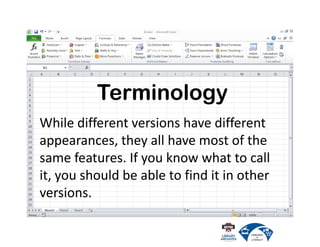
While different versions have different
appearances, they all have most of the
same features. If you know what to call
it, you should be able to find it in other
versions.
Terminology
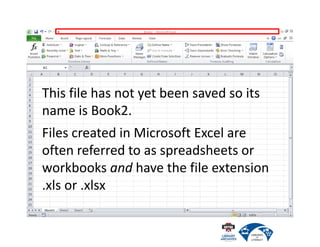
The area outlined in red is called the
title bar.
It displays the names of the open
program (in this case Microsoft Excel)
and the name of the current file.
This file has not yet been saved so its
name is Book2.
Files created in Microsoft Excel are
often referred to as spreadsheets or
workbooks and have the file extension
.xls or .xlsx
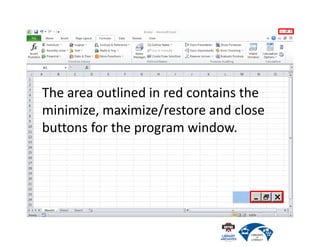
The area outlined in red contains the
minimize, maximize/restore and close
buttons for the program window.
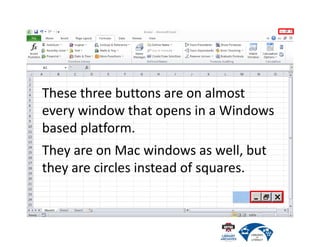
These three buttons are on almost
every window that opens in a Windows
based platform.
They are on Mac windows as well, but
they are circles instead of squares.
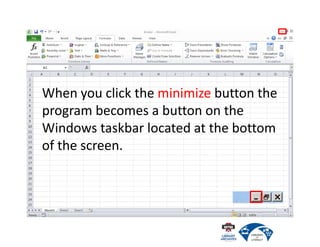
When you click the minimize button the
program becomes a button on the
Windows taskbar located at the bottom
of the screen.
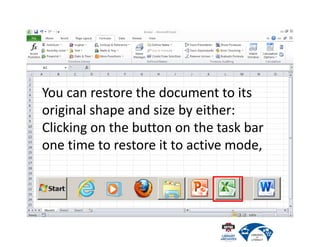
You can restore the document to its
original shape and size by either:
Clicking on the button on the task bar
one time to restore it to active mode,
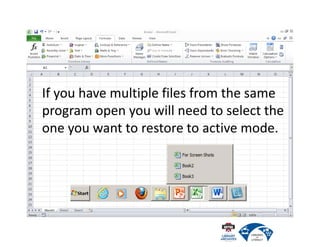
If you have multiple files from the same
program open you will need to select the
one you want to restore to active mode.
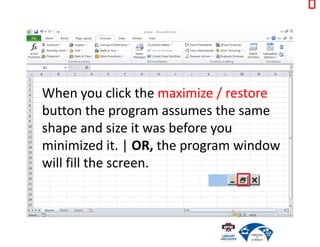
When you click the maximize / restore
button the program assumes the same
shape and size it was before you
minimized it. | OR, the program window
will fill the screen.
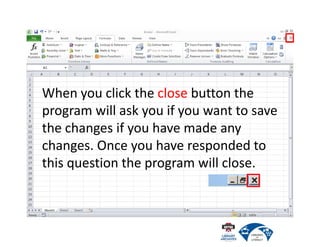
When you click the close button the
program will ask you if you want to save
the changes if you have made any
changes. Once you have responded to
this question the program will close.
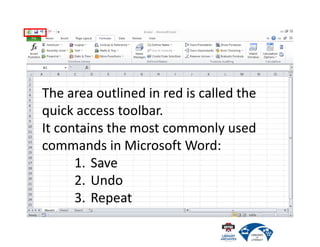
The area outlined in red is called the
quick access toolbar.
It contains the most commonly used
commands in Microsoft Word:
1. Save
2. Undo
3. Repeat
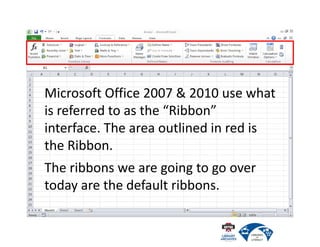
Microsoft Office 2007 & 2010 use what
is referred to as the “Ribbon”
interface. The area outlined in red is
the Ribbon.
The ribbons we are going to go over
today are the default ribbons.
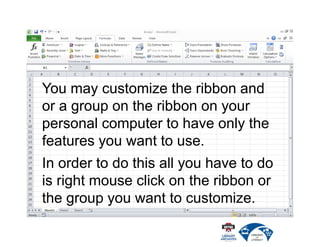
You may customize the ribbon and
or a group on the ribbon on your
personal computer to have only the
features you want to use.
In order to do this all you have to do
is right mouse click on the ribbon or
the group you want to customize.
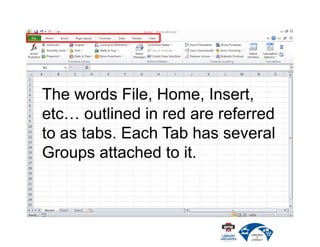
The words File, Home, Insert,
etc… outlined in red are referred
to as tabs. Each Tab has several
Groups attached to it.
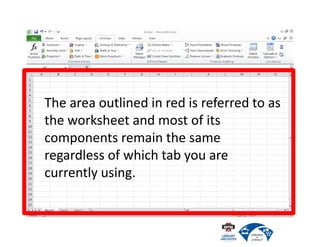
The area outlined in red is referred to as
the worksheet and most of its
components remain the same
regardless of which tab you are
currently using.
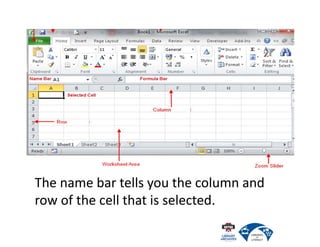
The name bar tells you the column and
row of the cell that is selected.
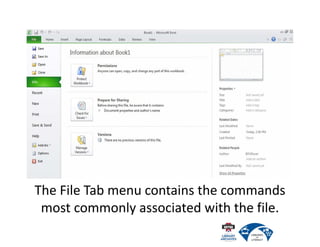
The File Tab menu contains the commands
most commonly associated with the file.
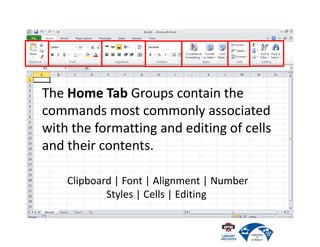
The Home Tab Groups contain the
commands most commonly associated
with the formatting and editing of cells
and their contents.
Clipboard | Font | Alignment | Number
Styles | Cells | Editing
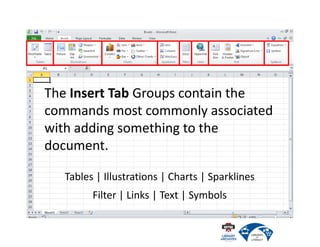
The Insert Tab Groups contain the
commands most commonly associated
with adding something to the
document.
Tables | Illustrations | Charts | Sparklines
Filter | Links | Text | Symbols
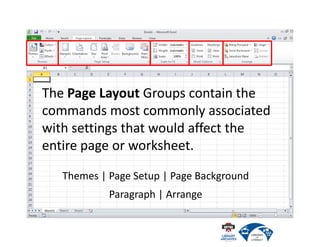
The Page Layout Groups contain the
commands most commonly associated
with settings that would affect the
entire page or worksheet.
Themes | Page Setup | Page Background
Paragraph | Arrange
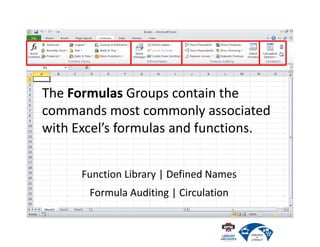
The Formulas Groups contain the
commands most commonly associated
with Excel’s formulas and functions.
Function Library | Defined Names
Formula Auditing | Circulation
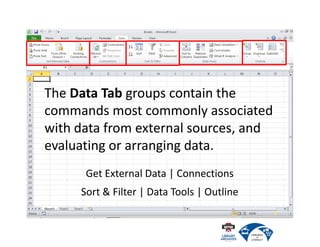
The Data Tab groups contain the
commands most commonly associated
with data from external sources, and
evaluating or arranging data.
Get External Data | Connections
Sort & Filter | Data Tools | Outline
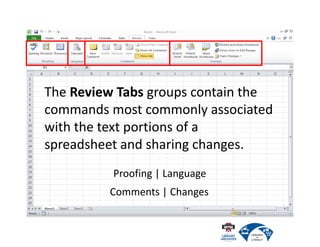
The Review Tabs groups contain the
commands most commonly associated
with the text portions of a
spreadsheet and sharing changes.
Proofing | Language
Comments | Changes
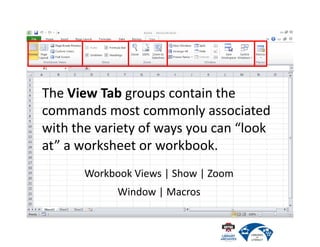
The View Tab groups contain the
commands most commonly associated
with the variety of ways you can “look
at” a worksheet or workbook.
Workbook Views | Show | Zoom
Window | Macros

5-2 Introduction to Microsoft Excel Presentation.pdf

  • 1.
  • 2.
    …Microsoft Excel isthe spreadsheet component of the Microsoft Office Suite. It is used primarily to enter, edit, format, sort, perform mathematical computations, save, retrieve and print numeric data. Microsoft Excel…
  • 3.
    • Identify themain parts of the Excel window. • Identify the purpose of the commands on the menu bar. • Work with the buttons on the toolbar. Objectives
  • 4.
    • Explain thepurpose of options available for printing a spreadsheet. • Enter and format text and numbers into cells. Objectives
  • 5.
    • Successfully movefrom one cell to another containing formulas and text. • Copy, Cut and Paste text and formulas. • Understand cell references. Objectives
  • 6.
    • Understand cellreferences. • Perform basic mathematical operations in a spreadsheet. Objectives
  • 7.
    Screen Components The openingscreen for Microsoft Excel 2010 looks like this…
  • 8.
    While different versionshave different appearances, they all have most of the same features. If you know what to call it, you should be able to find it in other versions. Terminology
  • 10.
    The area outlinedin red is called the title bar. It displays the names of the open program (in this case Microsoft Excel) and the name of the current file.
  • 11.
    This file hasnot yet been saved so its name is Book2. Files created in Microsoft Excel are often referred to as spreadsheets or workbooks and have the file extension .xls or .xlsx
  • 12.
    The area outlinedin red contains the minimize, maximize/restore and close buttons for the program window.
  • 13.
    These three buttonsare on almost every window that opens in a Windows based platform. They are on Mac windows as well, but they are circles instead of squares.
  • 14.
    When you clickthe minimize button the program becomes a button on the Windows taskbar located at the bottom of the screen.
  • 15.
    You can restorethe document to its original shape and size by either: Clicking on the button on the task bar one time to restore it to active mode,
  • 16.
    If you havemultiple files from the same program open you will need to select the one you want to restore to active mode.
  • 17.
    When you clickthe maximize / restore button the program assumes the same shape and size it was before you minimized it. | OR, the program window will fill the screen.
  • 18.
    When you clickthe close button the program will ask you if you want to save the changes if you have made any changes. Once you have responded to this question the program will close.
  • 19.
    The area outlinedin red is called the quick access toolbar. It contains the most commonly used commands in Microsoft Word: 1. Save 2. Undo 3. Repeat
  • 20.
    Microsoft Office 2007& 2010 use what is referred to as the “Ribbon” interface. The area outlined in red is the Ribbon. The ribbons we are going to go over today are the default ribbons.
  • 21.
    You may customizethe ribbon and or a group on the ribbon on your personal computer to have only the features you want to use. In order to do this all you have to do is right mouse click on the ribbon or the group you want to customize.
  • 22.
    The words File,Home, Insert, etc… outlined in red are referred to as tabs. Each Tab has several Groups attached to it.
  • 23.
    The area outlinedin red is referred to as the worksheet and most of its components remain the same regardless of which tab you are currently using.
  • 24.
    The name bartells you the column and row of the cell that is selected.
  • 25.
    The File Tabmenu contains the commands most commonly associated with the file.
  • 26.
    The Home TabGroups contain the commands most commonly associated with the formatting and editing of cells and their contents. Clipboard | Font | Alignment | Number Styles | Cells | Editing
  • 27.
    The Insert TabGroups contain the commands most commonly associated with adding something to the document. Tables | Illustrations | Charts | Sparklines Filter | Links | Text | Symbols
  • 28.
    The Page LayoutGroups contain the commands most commonly associated with settings that would affect the entire page or worksheet. Themes | Page Setup | Page Background Paragraph | Arrange
  • 29.
    The Formulas Groupscontain the commands most commonly associated with Excel’s formulas and functions. Function Library | Defined Names Formula Auditing | Circulation
  • 30.
    The Data Tabgroups contain the commands most commonly associated with data from external sources, and evaluating or arranging data. Get External Data | Connections Sort & Filter | Data Tools | Outline
  • 31.
    The Review Tabsgroups contain the commands most commonly associated with the text portions of a spreadsheet and sharing changes. Proofing | Language Comments | Changes
  • 32.
    The View Tabgroups contain the commands most commonly associated with the variety of ways you can “look at” a worksheet or workbook. Workbook Views | Show | Zoom Window | Macros