1
Access 2016 Module 1
Getting Started with Access 2016
2
• Understand relational databases
• Explore a database
• Create a database
• Create a table
• Create primary keys
• Relate two tables
• Enter data
• Edit data
Module Objectives
© 2017 Cengage Learning. All Rights Reserved. May not be copied, scanned, or duplicated, in whole or in part, except for use as permitted in a license distributed with a certain product or service or otherwise on a
password-protected website for classroom use.
3
• Relational database software
• Data organized into lists
• Examples – customers, products, vendors, employees
• Access provides tools that allow
• Sorting, grouping, analyzing and reporting data in many different ways
Understand Relational Databases (Slide 1 of 3)
© 2017 Cengage Learning. All Rights Reserved. May not be copied, scanned, or duplicated, in whole or in part, except for use as permitted in a license distributed with a certain product or service or otherwise on a
password-protected website for classroom use.
4
• Duplicate data minimized
• Information is more accurate, reliable and consistent
• Data entry is faster and easier
• Data can be viewed and sorted in many ways
• Information is more secure
• Data can be shared and edited by several users simultaneously
Understand Relational Databases (Slide 2 of 3)
© 2017 Cengage Learning. All Rights Reserved. May not be copied, scanned, or duplicated, in whole or in part, except for use as permitted in a license distributed with a certain product or service or otherwise on a
password-protected website for classroom use.
5
Understand Relational Databases (Slide 3 of 3)
© 2017 Cengage Learning. All Rights Reserved. May not be copied, scanned, or duplicated, in whole or in part, except for use as permitted in a license distributed with a certain product or service or otherwise on a
password-protected website for classroom use.
Excel vs. Access Comparison
6
• Can start Access in different ways
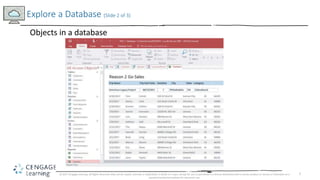
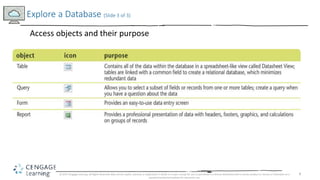
• Database contains different objects
• Tables
• Queries
• Forms
• Reports
• Navigation Pane displays objects
Explore a Database (Slide 1 of 3)
© 2017 Cengage Learning. All Rights Reserved. May not be copied, scanned, or duplicated, in whole or in part, except for use as permitted in a license distributed with a certain product or service or otherwise on a
password-protected website for classroom use.
7
Explore a Database (Slide 2 of 3)
© 2017 Cengage Learning. All Rights Reserved. May not be copied, scanned, or duplicated, in whole or in part, except for use as permitted in a license distributed with a certain product or service or otherwise on a
password-protected website for classroom use.
Objects in a database
8
Explore a Database (Slide 3 of 3)
© 2017 Cengage Learning. All Rights Reserved. May not be copied, scanned, or duplicated, in whole or in part, except for use as permitted in a license distributed with a certain product or service or otherwise on a
password-protected website for classroom use.
Access objects and their purpose
9
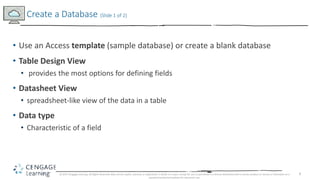
• Use an Access template (sample database) or create a blank database
• Table Design View
• provides the most options for defining fields
• Datasheet View
• spreadsheet-like view of the data in a table
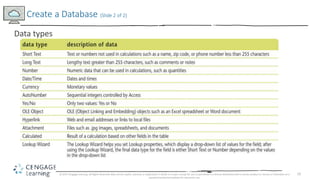
• Data type
• Characteristic of a field
Create a Database (Slide 1 of 2)
© 2017 Cengage Learning. All Rights Reserved. May not be copied, scanned, or duplicated, in whole or in part, except for use as permitted in a license distributed with a certain product or service or otherwise on a
password-protected website for classroom use.
10
Data types
Create a Database (Slide 2 of 2)
© 2017 Cengage Learning. All Rights Reserved. May not be copied, scanned, or duplicated, in whole or in part, except for use as permitted in a license distributed with a certain product or service or otherwise on a
password-protected website for classroom use.
11
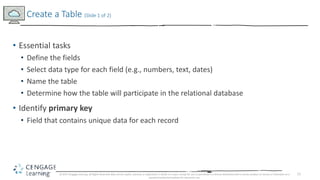
• Essential tasks
• Define the fields
• Select data type for each field (e.g., numbers, text, dates)
• Name the table
• Determine how the table will participate in the relational database
• Identify primary key
• Field that contains unique data for each record
Create a Table (Slide 1 of 2)
© 2017 Cengage Learning. All Rights Reserved. May not be copied, scanned, or duplicated, in whole or in part, except for use as permitted in a license distributed with a certain product or service or otherwise on a
password-protected website for classroom use.
12
Important database terminology
Create a Table (Slide 2 of 2)
© 2017 Cengage Learning. All Rights Reserved. May not be copied, scanned, or duplicated, in whole or in part, except for use as permitted in a license distributed with a certain product or service or otherwise on a
password-protected website for classroom use.
13
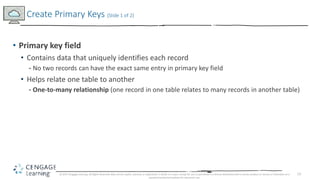
• Primary key field
• Contains data that uniquely identifies each record
- No two records can have the exact same entry in primary key field
• Helps relate one table to another
- One-to-many relationship (one record in one table relates to many records in another table)
Create Primary Keys (Slide 1 of 2)
© 2017 Cengage Learning. All Rights Reserved. May not be copied, scanned, or duplicated, in whole or in part, except for use as permitted in a license distributed with a certain product or service or otherwise on a
password-protected website for classroom use.
14
Creating a primary key field
Create Primary Keys (Slide 2 of 2)
© 2017 Cengage Learning. All Rights Reserved. May not be copied, scanned, or duplicated, in whole or in part, except for use as permitted in a license distributed with a certain product or service or otherwise on a
password-protected website for classroom use.
15
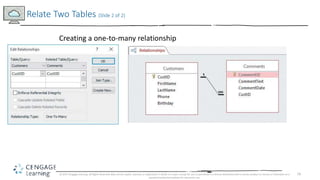
• Create a one-to-many relationship
• Use a common field to relate tables
• Primary key is the “one” side of the relationship
• Foreign key is the “many” side of the relationship
• One-to-many line shows the link with a “1” on the one side and an infinity symbol on
the many side
• In Datasheet view, subdatasheet shows related records (records in the many
table)
Relate Two Tables (Slide 1 of 2)
© 2017 Cengage Learning. All Rights Reserved. May not be copied, scanned, or duplicated, in whole or in part, except for use as permitted in a license distributed with a certain product or service or otherwise on a
password-protected website for classroom use.
16
Relate Two Tables (Slide 2 of 2)
© 2017 Cengage Learning. All Rights Reserved. May not be copied, scanned, or duplicated, in whole or in part, except for use as permitted in a license distributed with a certain product or service or otherwise on a
password-protected website for classroom use.
Creating a one-to-many relationship
17
• Focus
• Which data you would enter or edit if you started typing
• Options for changing focus
• [Tab]
• [Enter]
• Navigation buttons:
Previous record
Next record
Enter Data (Slide 1 of 2)
© 2017 Cengage Learning. All Rights Reserved. May not be copied, scanned, or duplicated, in whole or in part, except for use as permitted in a license distributed with a certain product or service or otherwise on a
password-protected website for classroom use.
18
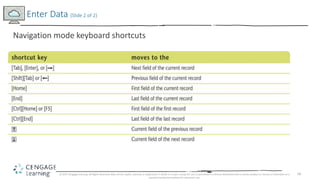
Navigation mode keyboard shortcuts
Enter Data (Slide 2 of 2)
© 2017 Cengage Learning. All Rights Reserved. May not be copied, scanned, or duplicated, in whole or in part, except for use as permitted in a license distributed with a certain product or service or otherwise on a
password-protected website for classroom use.
19
• Access automatically saves new data and changes to existing data as soon as
you move to another record OR close the datasheet
• To change the contents of an existing record, navigate to the field you want to
change and type the new information
• Press [Esc]
• Once to remove the current field’s editing changes
• Twice to remove all changes to current record
Edit Data (Slide 1 of 2)
© 2017 Cengage Learning. All Rights Reserved. May not be copied, scanned, or duplicated, in whole or in part, except for use as permitted in a license distributed with a certain product or service or otherwise on a
password-protected website for classroom use.
20
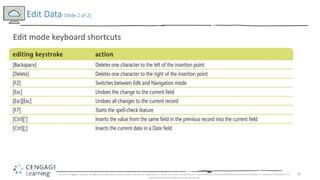
Edit mode keyboard shortcuts
Edit Data (Slide 2 of 2)
© 2017 Cengage Learning. All Rights Reserved. May not be copied, scanned, or duplicated, in whole or in part, except for use as permitted in a license distributed with a certain product or service or otherwise on a
password-protected website for classroom use.

Access 2016 module 1 ppt presentation

  • 1.
    1 Access 2016 Module1 Getting Started with Access 2016
  • 2.
    2 • Understand relationaldatabases • Explore a database • Create a database • Create a table • Create primary keys • Relate two tables • Enter data • Edit data Module Objectives © 2017 Cengage Learning. All Rights Reserved. May not be copied, scanned, or duplicated, in whole or in part, except for use as permitted in a license distributed with a certain product or service or otherwise on a password-protected website for classroom use.
  • 3.
    3 • Relational databasesoftware • Data organized into lists • Examples – customers, products, vendors, employees • Access provides tools that allow • Sorting, grouping, analyzing and reporting data in many different ways Understand Relational Databases (Slide 1 of 3) © 2017 Cengage Learning. All Rights Reserved. May not be copied, scanned, or duplicated, in whole or in part, except for use as permitted in a license distributed with a certain product or service or otherwise on a password-protected website for classroom use.
  • 4.
    4 • Duplicate dataminimized • Information is more accurate, reliable and consistent • Data entry is faster and easier • Data can be viewed and sorted in many ways • Information is more secure • Data can be shared and edited by several users simultaneously Understand Relational Databases (Slide 2 of 3) © 2017 Cengage Learning. All Rights Reserved. May not be copied, scanned, or duplicated, in whole or in part, except for use as permitted in a license distributed with a certain product or service or otherwise on a password-protected website for classroom use.
  • 5.
    5 Understand Relational Databases(Slide 3 of 3) © 2017 Cengage Learning. All Rights Reserved. May not be copied, scanned, or duplicated, in whole or in part, except for use as permitted in a license distributed with a certain product or service or otherwise on a password-protected website for classroom use. Excel vs. Access Comparison
  • 6.
    6 • Can startAccess in different ways • Database contains different objects • Tables • Queries • Forms • Reports • Navigation Pane displays objects Explore a Database (Slide 1 of 3) © 2017 Cengage Learning. All Rights Reserved. May not be copied, scanned, or duplicated, in whole or in part, except for use as permitted in a license distributed with a certain product or service or otherwise on a password-protected website for classroom use.
  • 7.
    7 Explore a Database(Slide 2 of 3) © 2017 Cengage Learning. All Rights Reserved. May not be copied, scanned, or duplicated, in whole or in part, except for use as permitted in a license distributed with a certain product or service or otherwise on a password-protected website for classroom use. Objects in a database
  • 8.
    8 Explore a Database(Slide 3 of 3) © 2017 Cengage Learning. All Rights Reserved. May not be copied, scanned, or duplicated, in whole or in part, except for use as permitted in a license distributed with a certain product or service or otherwise on a password-protected website for classroom use. Access objects and their purpose
  • 9.
    9 • Use anAccess template (sample database) or create a blank database • Table Design View • provides the most options for defining fields • Datasheet View • spreadsheet-like view of the data in a table • Data type • Characteristic of a field Create a Database (Slide 1 of 2) © 2017 Cengage Learning. All Rights Reserved. May not be copied, scanned, or duplicated, in whole or in part, except for use as permitted in a license distributed with a certain product or service or otherwise on a password-protected website for classroom use.
  • 10.
    10 Data types Create aDatabase (Slide 2 of 2) © 2017 Cengage Learning. All Rights Reserved. May not be copied, scanned, or duplicated, in whole or in part, except for use as permitted in a license distributed with a certain product or service or otherwise on a password-protected website for classroom use.
  • 11.
    11 • Essential tasks •Define the fields • Select data type for each field (e.g., numbers, text, dates) • Name the table • Determine how the table will participate in the relational database • Identify primary key • Field that contains unique data for each record Create a Table (Slide 1 of 2) © 2017 Cengage Learning. All Rights Reserved. May not be copied, scanned, or duplicated, in whole or in part, except for use as permitted in a license distributed with a certain product or service or otherwise on a password-protected website for classroom use.
  • 12.
    12 Important database terminology Createa Table (Slide 2 of 2) © 2017 Cengage Learning. All Rights Reserved. May not be copied, scanned, or duplicated, in whole or in part, except for use as permitted in a license distributed with a certain product or service or otherwise on a password-protected website for classroom use.
  • 13.
    13 • Primary keyfield • Contains data that uniquely identifies each record - No two records can have the exact same entry in primary key field • Helps relate one table to another - One-to-many relationship (one record in one table relates to many records in another table) Create Primary Keys (Slide 1 of 2) © 2017 Cengage Learning. All Rights Reserved. May not be copied, scanned, or duplicated, in whole or in part, except for use as permitted in a license distributed with a certain product or service or otherwise on a password-protected website for classroom use.
  • 14.
    14 Creating a primarykey field Create Primary Keys (Slide 2 of 2) © 2017 Cengage Learning. All Rights Reserved. May not be copied, scanned, or duplicated, in whole or in part, except for use as permitted in a license distributed with a certain product or service or otherwise on a password-protected website for classroom use.
  • 15.
    15 • Create aone-to-many relationship • Use a common field to relate tables • Primary key is the “one” side of the relationship • Foreign key is the “many” side of the relationship • One-to-many line shows the link with a “1” on the one side and an infinity symbol on the many side • In Datasheet view, subdatasheet shows related records (records in the many table) Relate Two Tables (Slide 1 of 2) © 2017 Cengage Learning. All Rights Reserved. May not be copied, scanned, or duplicated, in whole or in part, except for use as permitted in a license distributed with a certain product or service or otherwise on a password-protected website for classroom use.
  • 16.
    16 Relate Two Tables(Slide 2 of 2) © 2017 Cengage Learning. All Rights Reserved. May not be copied, scanned, or duplicated, in whole or in part, except for use as permitted in a license distributed with a certain product or service or otherwise on a password-protected website for classroom use. Creating a one-to-many relationship
  • 17.
    17 • Focus • Whichdata you would enter or edit if you started typing • Options for changing focus • [Tab] • [Enter] • Navigation buttons: Previous record Next record Enter Data (Slide 1 of 2) © 2017 Cengage Learning. All Rights Reserved. May not be copied, scanned, or duplicated, in whole or in part, except for use as permitted in a license distributed with a certain product or service or otherwise on a password-protected website for classroom use.
  • 18.
    18 Navigation mode keyboardshortcuts Enter Data (Slide 2 of 2) © 2017 Cengage Learning. All Rights Reserved. May not be copied, scanned, or duplicated, in whole or in part, except for use as permitted in a license distributed with a certain product or service or otherwise on a password-protected website for classroom use.
  • 19.
    19 • Access automaticallysaves new data and changes to existing data as soon as you move to another record OR close the datasheet • To change the contents of an existing record, navigate to the field you want to change and type the new information • Press [Esc] • Once to remove the current field’s editing changes • Twice to remove all changes to current record Edit Data (Slide 1 of 2) © 2017 Cengage Learning. All Rights Reserved. May not be copied, scanned, or duplicated, in whole or in part, except for use as permitted in a license distributed with a certain product or service or otherwise on a password-protected website for classroom use.
  • 20.
    20 Edit mode keyboardshortcuts Edit Data (Slide 2 of 2) © 2017 Cengage Learning. All Rights Reserved. May not be copied, scanned, or duplicated, in whole or in part, except for use as permitted in a license distributed with a certain product or service or otherwise on a password-protected website for classroom use.