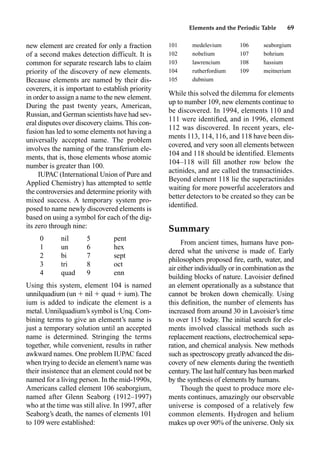
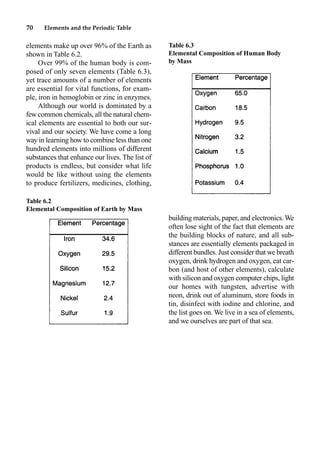
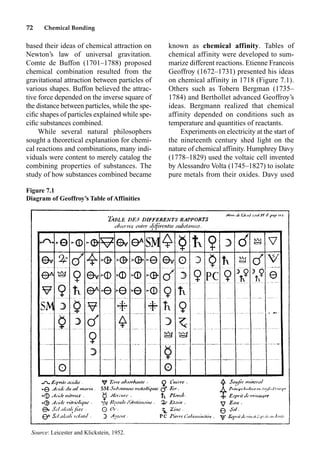
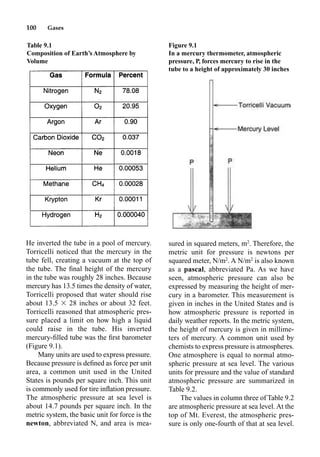
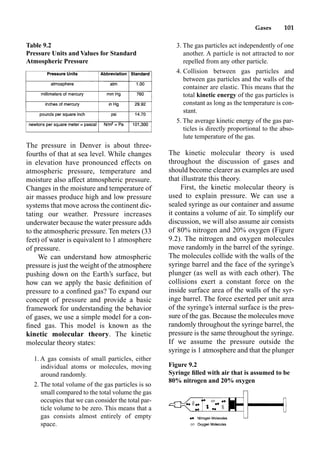
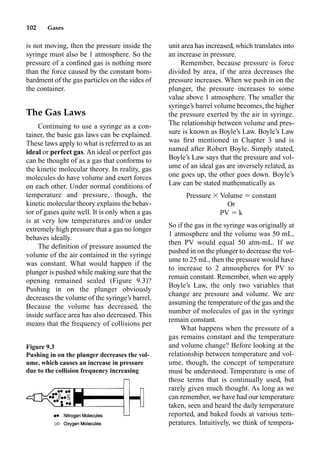
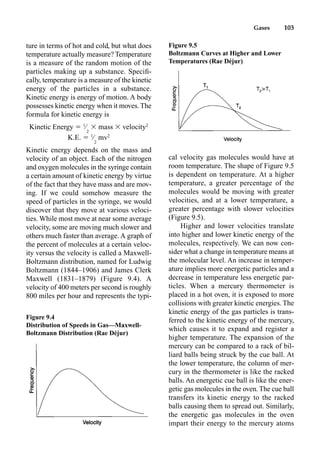
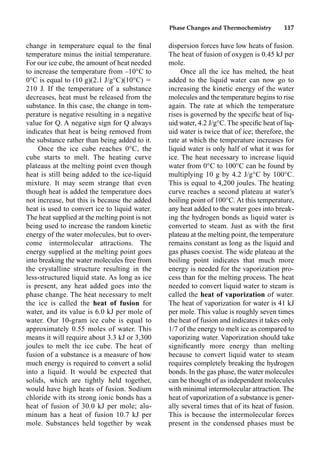
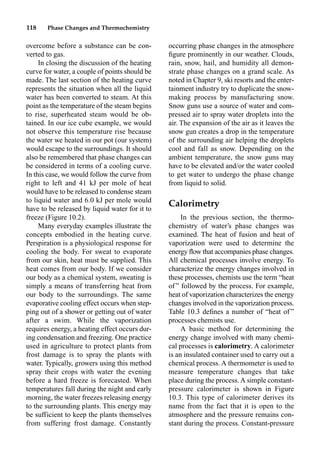
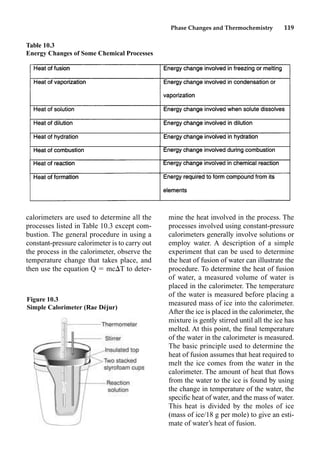
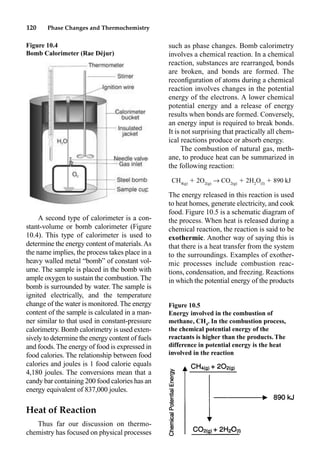
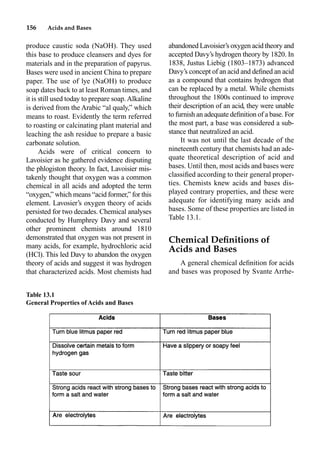
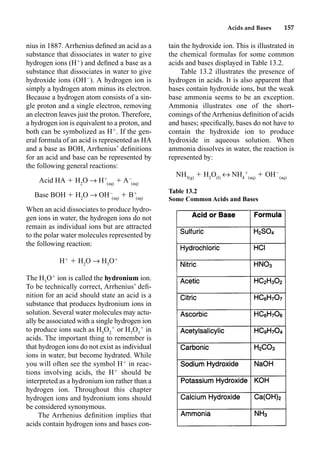
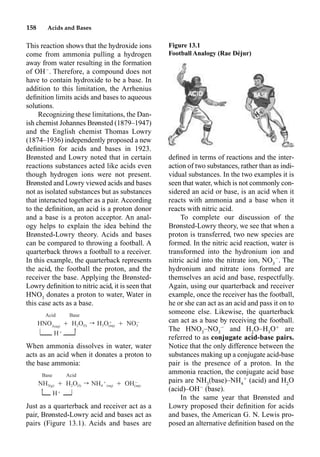
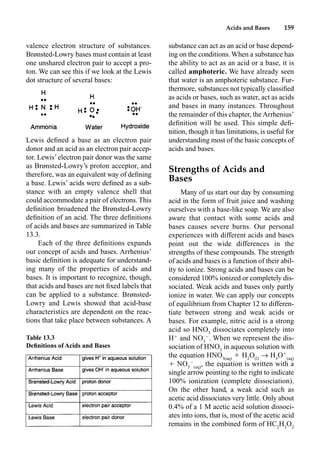
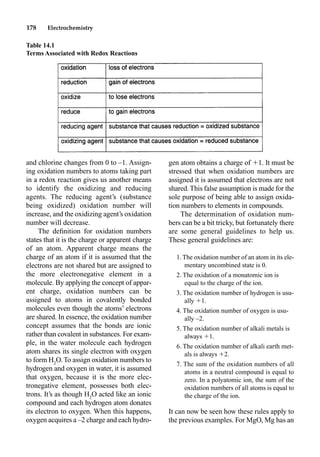
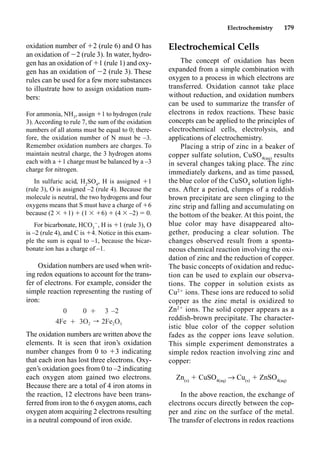
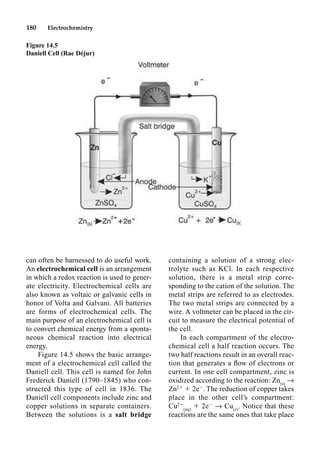
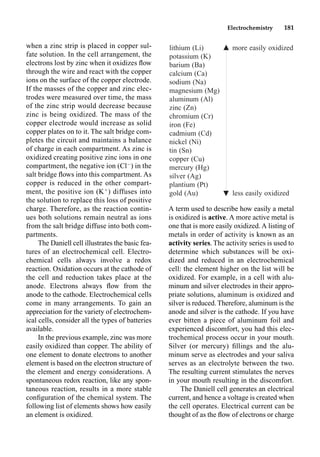
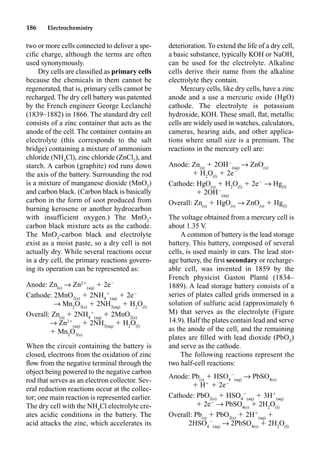
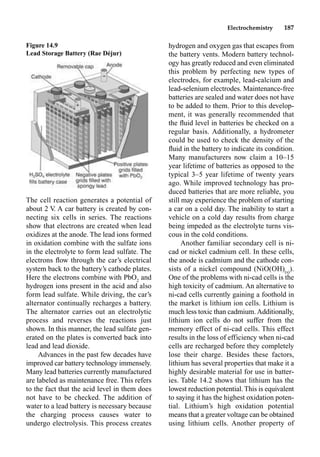
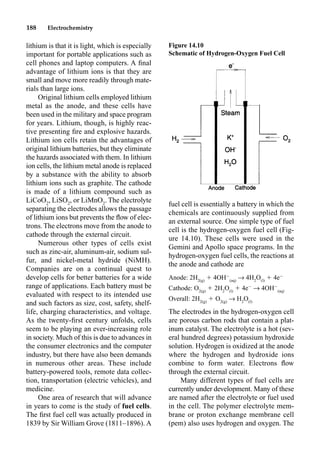
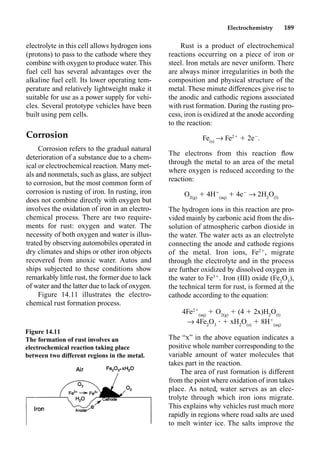
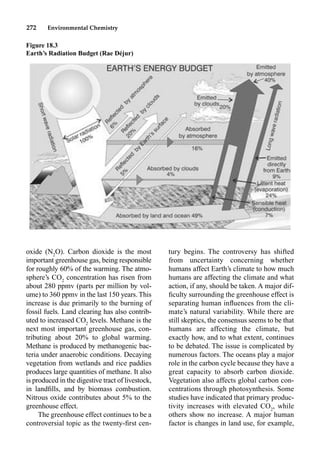
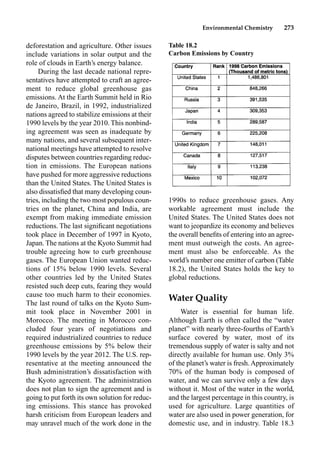
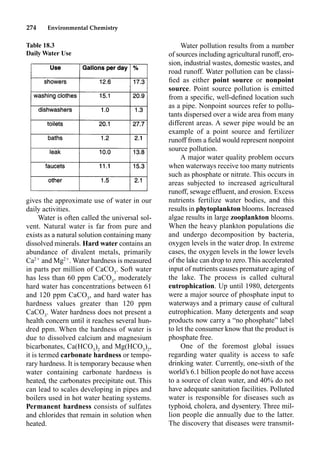
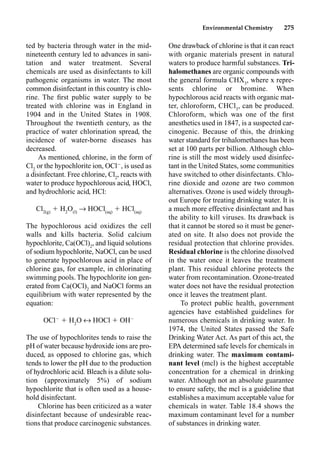
The Basics of Chemistry
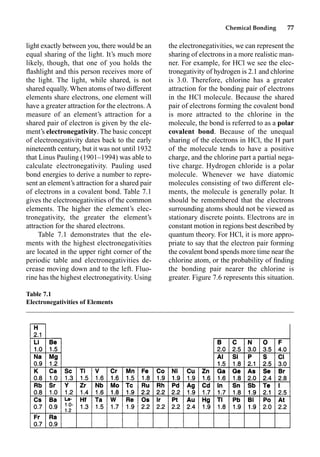
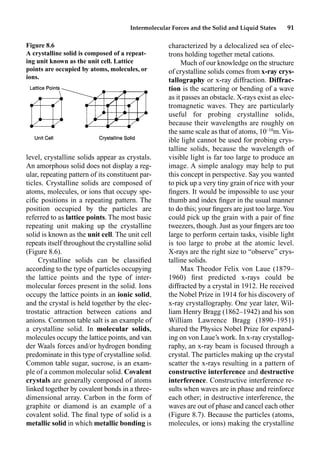
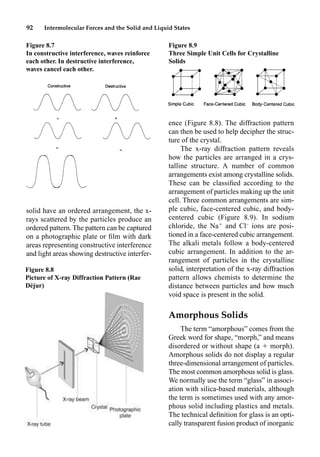
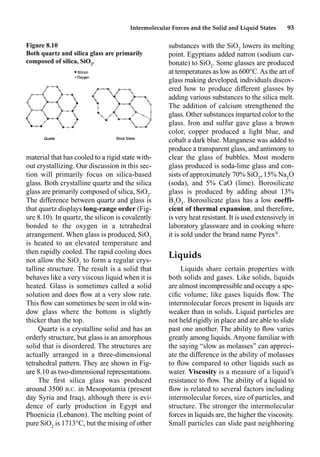
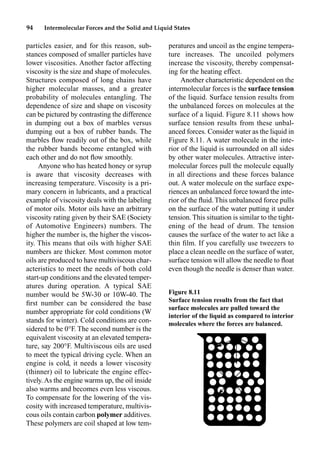
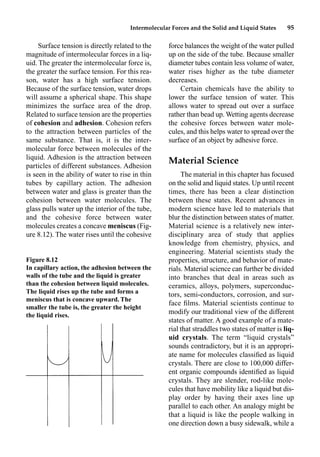
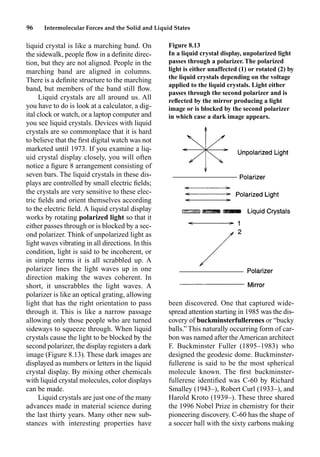
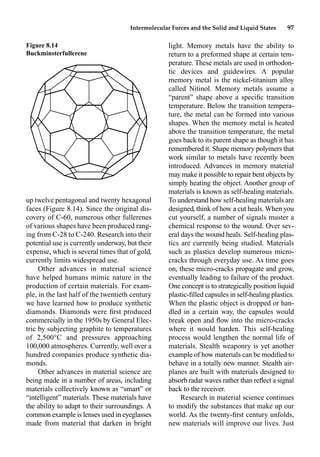
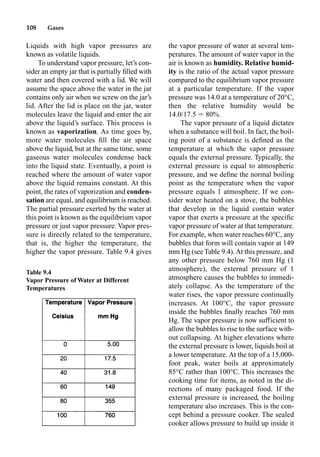
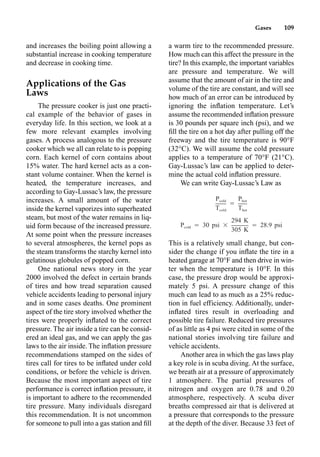
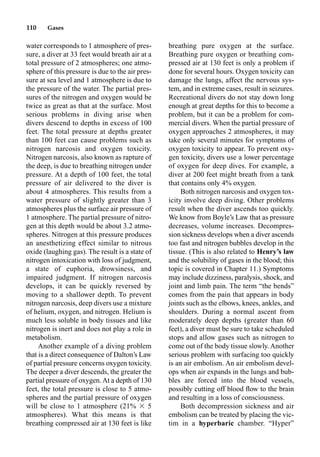
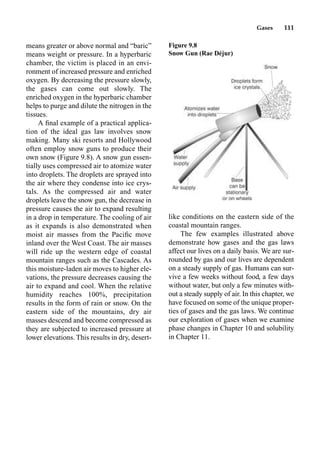
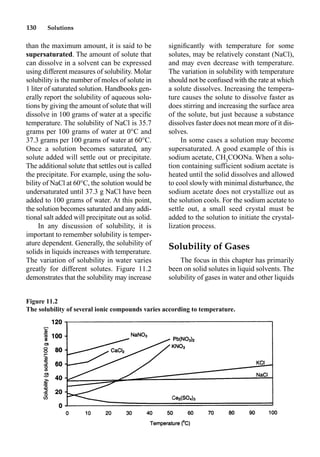
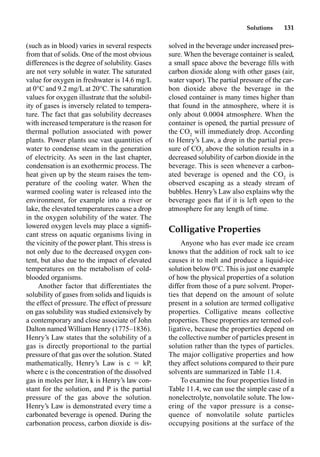
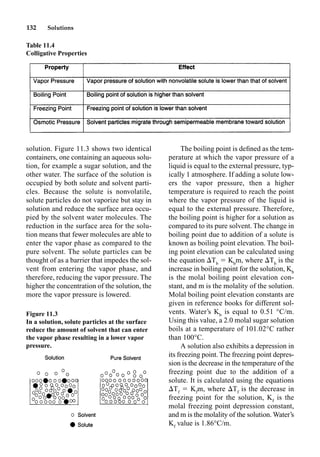
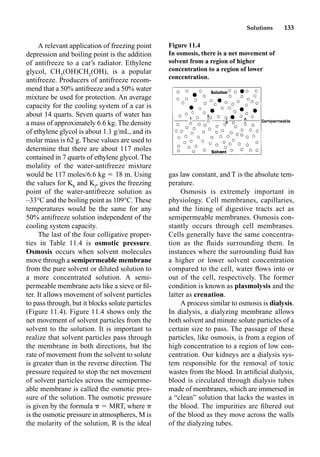
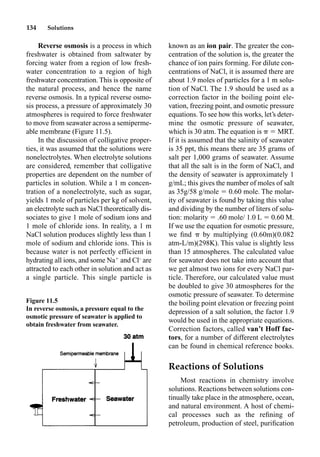
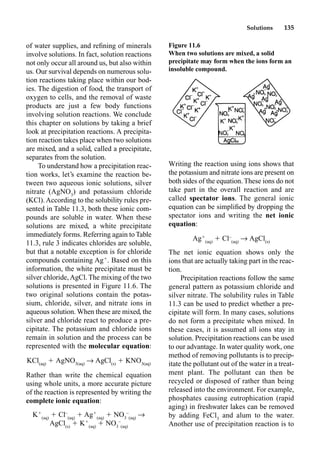
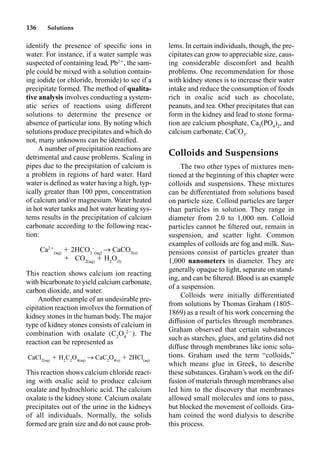
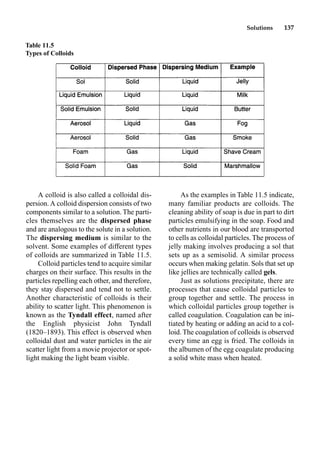
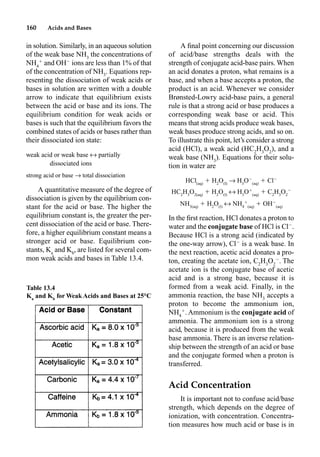
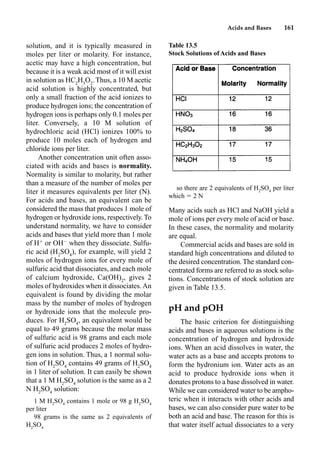
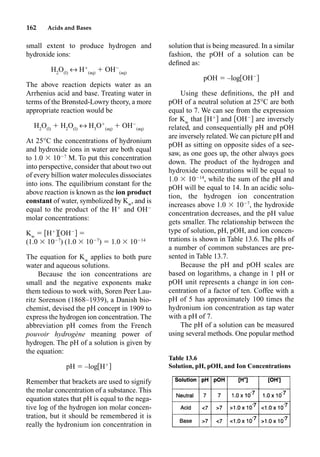
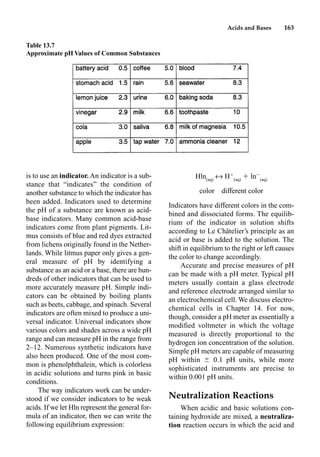
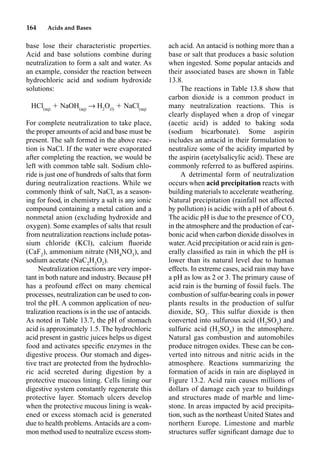
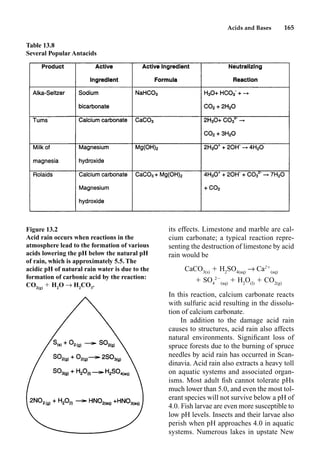
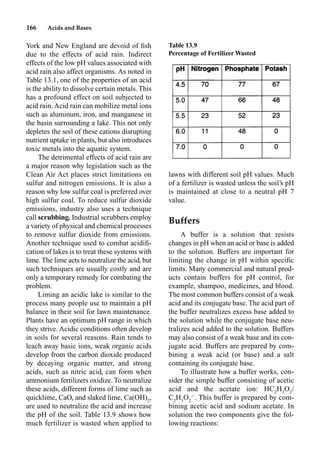
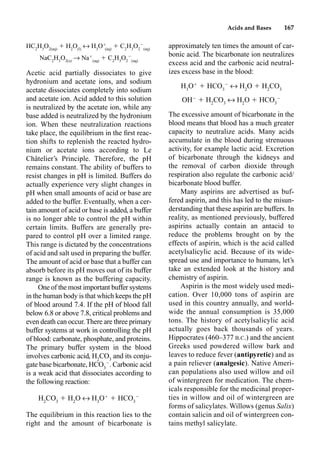
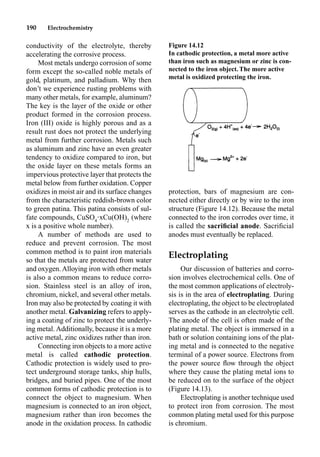
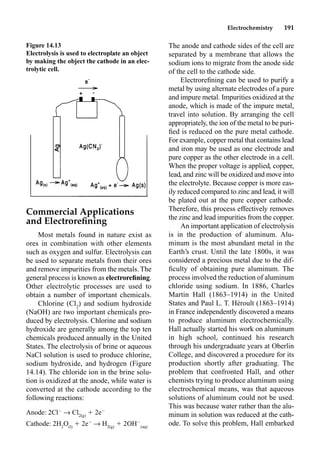
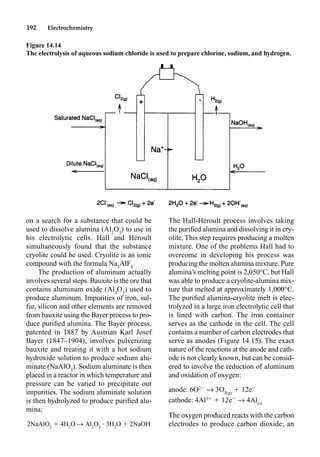
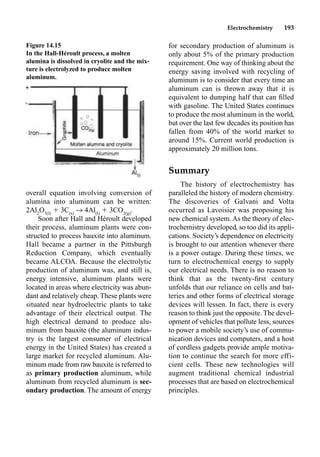
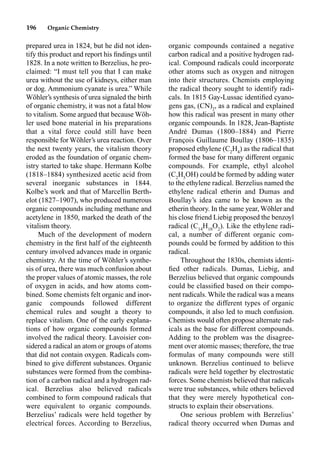
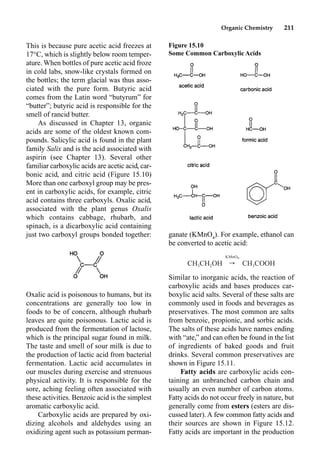
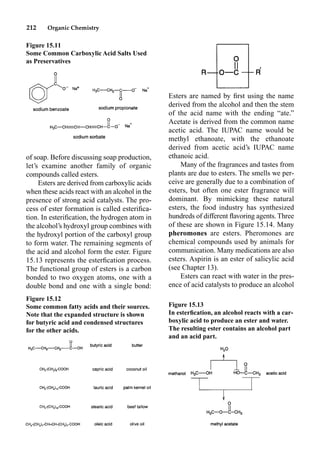
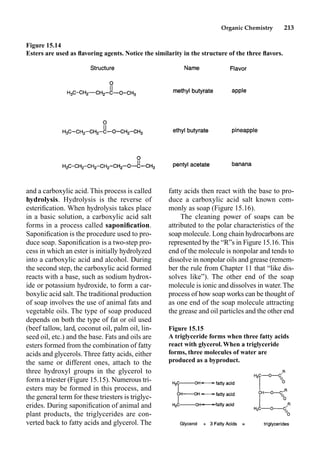
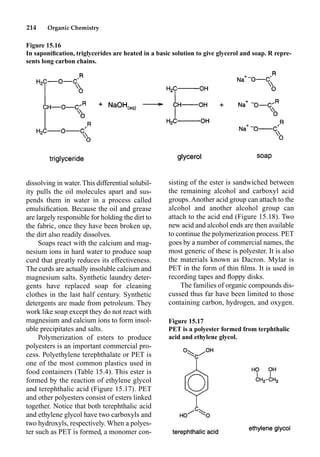
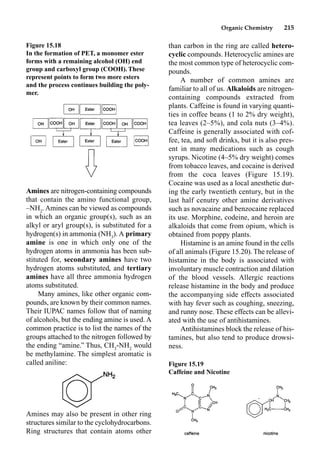
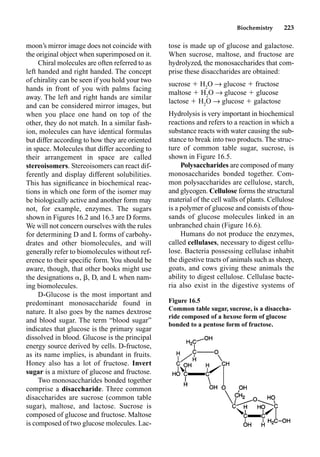
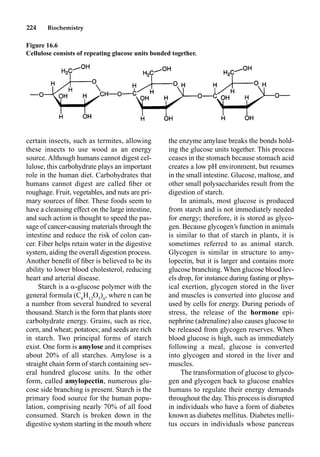
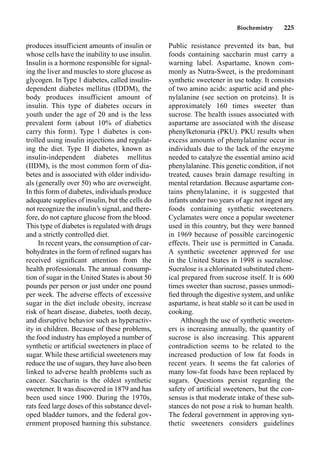
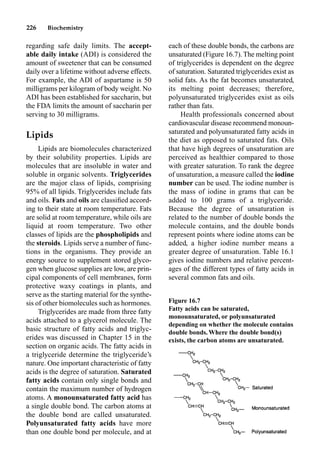
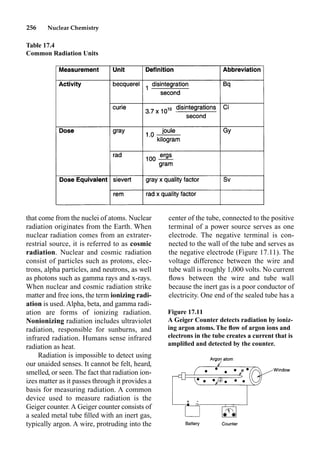
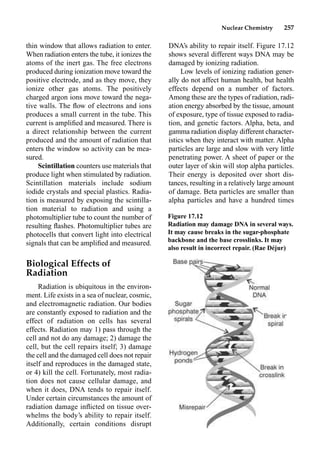
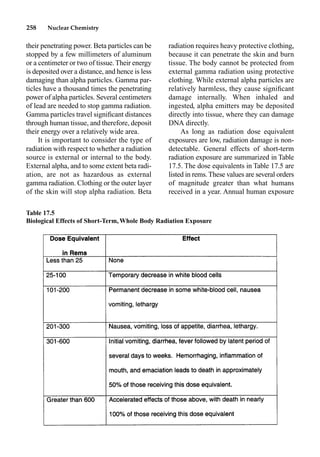
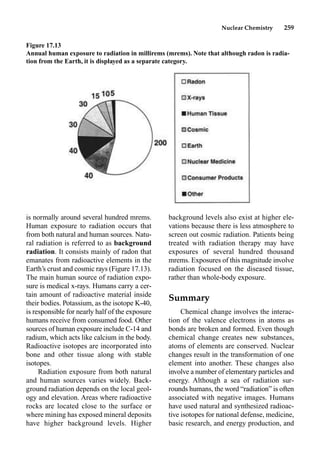
Richard Myers
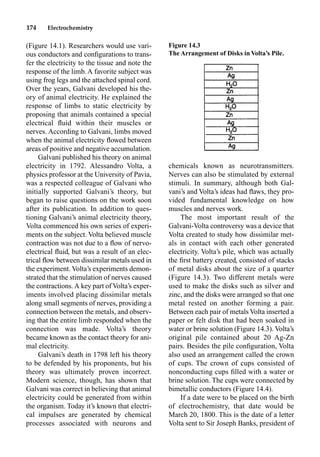
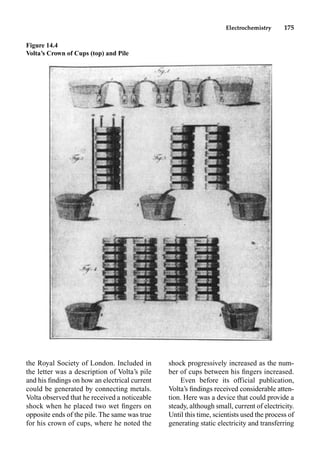
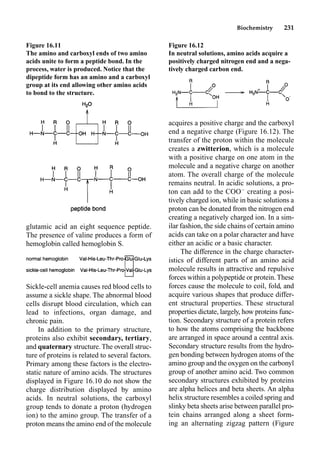
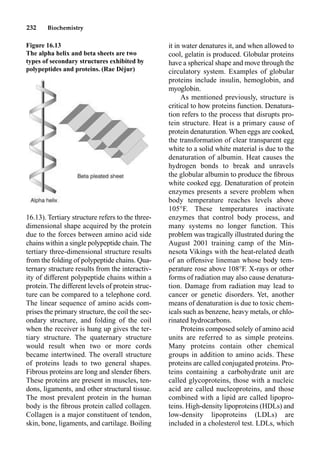
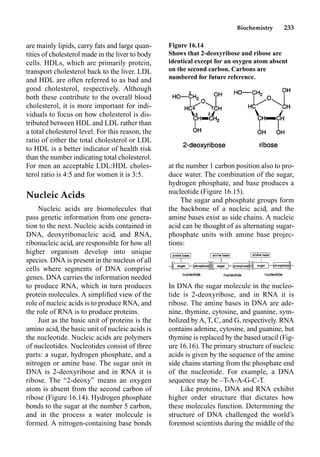
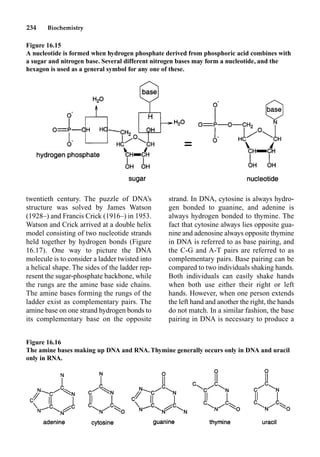
Basics of the Hard Sciences
Robert E. Krebs, Series Editor
GREENWOOD PRESS
Westport, Connecticut • London
Library of Congress Cataloging-in-Publication Data
Myers, Richard, 1951–
The Basics of chemistry / Richard Myers.
p. cm.––(Basics of the hard sciences)
Includes bibliographical references and index.
ISBN 0–313–31664–3 (alk. paper)
1. Chemistry. I. Title. II. Series.
QD33.2.2.M94 2003
540––dc21 2002028436
British Library Cataloging in Publication Data is available.
Copyright © 2003 by Richard Myers
All rights reserved. No portion of this book may be
reproduced, by any process or technique, without the
express written consent of the publisher.
Library of Congress Catalog Card Number: 2002028436
ISBN: 0–313–31664–3
First published in 2003
Greenwood Press, 88 Post Road West, Westport, CT 06881
An imprint of Greenwood Publishing Group, Inc.
www.greenwood.com
Printed in the United States of America
The paper used in this book complies with the
Permanent Paper Standard issued by the National
Information Standards Organization (Z39.48–1984).
10 9 8 7 6 5 4 3 2 1
Every reasonable effort has been made to trace the owners of copyrighted materials in this book, but in some
instances this has proven impossible. The author and publisher will be glad to receive information leading to
more complete acknowledgments in subsequent printings of the book and in the meantime extend their
apologies for any omissions.
To Chris.
For all your support and companionship during our thirty years.
Contents
Preface xiii
Acknowledgments xv
Chapter 1 Introduction: Chemistry and Its Divisions 1
Introduction 1
The Scientific Enterprise 2
What Is Chemistry? 3
Divisions of Chemistry 4
Chapter 2 A Brief History of Chemistry 7
Introduction 7
Early History 7
Greek Science 9
Alchemy 11
Chemistry in the Middle Ages 13
Chapter 3 The Birth of Modern Chemistry 17
Introduction 17
The Beginnings of Modern Chemistry 17
The Phlogiston Theory 19
Pneumatic Chemistry 20
Lavoisier 25
Chapter 4 The Atom 31
Introduction 31
The Law of Definite Proportions 31
Dalton and the Birth of the Atomic Theory 33
Gay-Lussac and Avogadro’s Hypothesis 34
The Divisible Atom 35
Atomic Structure 38
Quantum Mechanics 40
A Modern View of the Atom 44
Atomic Mass, Atomic Numbers, and Isotopes 45
Ions 45
Summary 46
Chapter 5 Atoms Combined 49
Introduction 49
Mixtures, Compounds, and Molecules 49
Naming Elements 50
Naming Compounds 51
Writing Chemical Formulas 54
Chemical Reactions 54
Types of Reactions 55
From Molecules to Moles 56
Chapter 6 Elements and the Periodic Table 61
Introduction 61
Discovery of the Elements 61
The Modern Periodic Table 64
The Main Group Elements 64
d and f Block Elements 67
Metals, Metalloids, and Nonmetals 67
Periodic Problems 67
Summary 69
Chapter 7 Chemical Bonding 71
Introduction and History 71
Dot Formulas, the Octet Rule, and Ionic Bonds 74
Covalent Bonds 76
Electronegativity and the Polar Covalent Bond 76
Polar Molecules and Hydrogen Bonds 78
Bond Energies 79
The Metallic Bond 80
Bonding and Molecular Geometry 80
Modern Bonding Theory 82
Chapter 8 Intermolecular Forces and the Solid and Liquid States 85
Introduction 85
Characteristics of Solids, Liquids, and Gases 86
Intermolecular Forces 86
Crystalline Solids 90
Amorphous Solids 92
Liquids 93
Material Science 95
viii Contents
Contents ix
Chapter 9 Gases 99
Introduction 99
Pressure 99
The Gas Laws 102
The Ideal Gas Law 106
Partial Pressure and Vapor Pressure 107
Applications of the Gas Laws 109
Chapter 10 Phase Changes and Thermochemistry 113
Introduction 113
Changes of State 113
Energy and Phase Changes 113
Heating Curves 115
Calorimetry 118
Heat of Reaction 120
Applications of Heat of Reactions 122
Chapter 11 Solutions 125
Introduction 125
The Solution Process 126
Electrolytes 128
Concentration of Solutions 129
Solubility of Gases 130
Colligative Properties 131
Reactions of Solutions 134
Colloids and Suspensions 136
Chapter 12 Kinetics and Equilibrium 139
Introduction 139
Reaction Rates 139
The Collision Theory 140
Factors Affecting Reaction Rates 142
Reaction Mechanisms and Catalysis 144
Chemical Equilibrium 147
Le Châtelier’s Principle 149
The Equilibrium Constant 151
Ammonia and the Haber Process 152
Chapter 13 Acids and Bases 155
Introduction and History 155
Chemical Definitions of Acids and Bases 156
Strengths of Acids and Bases 159
Acid Concentration 160
pH and pOH 161
Neutralization Reactions 163
Buffers 166
Summary 169
x Contents
Chapter 14 Electrochemistry 171
Introduction 171
History 171
Oxidation and Reduction 176
Oxidation Numbers 177
Electrochemical Cells 179
Electrolysis 184
Batteries 185
Corrosion 189
Electroplating 190
Commercial Applications and Electrorefining 191
Summary 193
Chapter 15 Organic Chemistry 195
Introduction and History 195
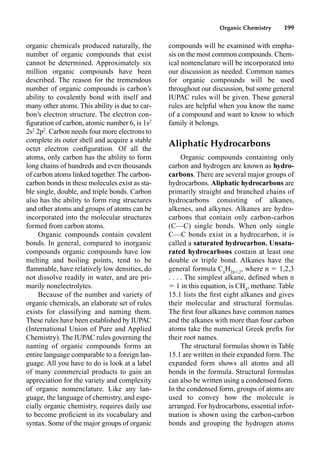
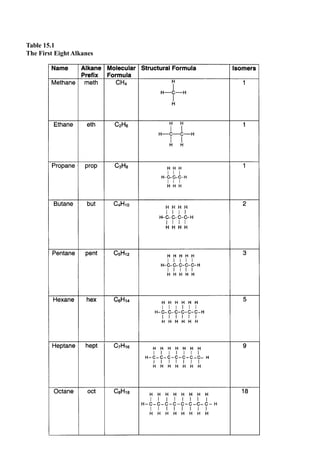
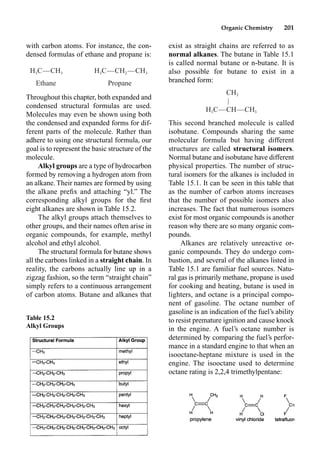
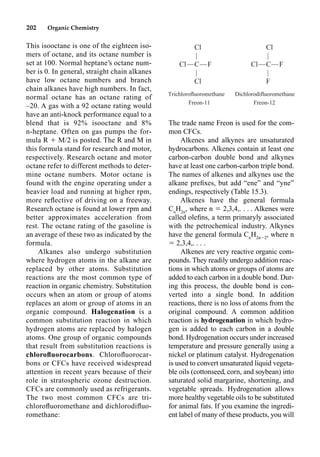
Organic Compounds 198
Aliphatic Hydrocarbons 199
Aromatic Hydrocarbons––Benzene 205
Functional Groups and Organic Families 207
Petroleum 216
Organic Products 219
Summary 220
Chapter 16 Biochemistry 221
Introduction 221
Carbohydrates 221
Lipids 226
Proteins 229
Nucleic Acids 233
Biotechnology 236
Chapter 17 Nuclear Chemistry 241
Introduction 241
Nuclear Stability and Radioactivity 241
Radioactive Decay and Nuclear Reactions 243
Half-Life and Radiometric Dating 244
Nuclear Binding Energy––Fission and Fusion 246
Fusion and Stellar Evolution 251
Transmutation 252
Nuclear Medicine 254
Radiation Units and Detection 255
Biological Effects of Radiation 257
Summary 259
Contents xi
Chapter 18 Environmental Chemistry 261
Introduction 261
Stratospheric Ozone Depletion 262
Acid Rain 266
The Greenhouse Effect 270
Water Quality 273
Air Pollution 278
Pesticides 281
Summary 287
Chapter 19 The Chemical Industry 289
Introduction 289
Acids and Alkalis 290
Explosives 292
Synthetic Dyes 293
Synthetic Fibers and Plastics 297
Synthetic Rubber 299
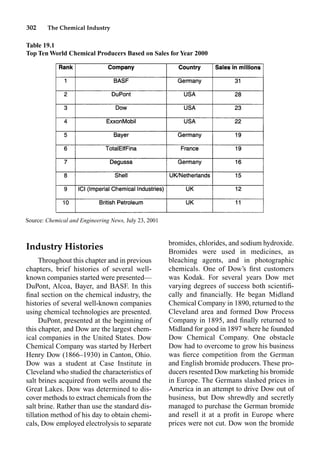
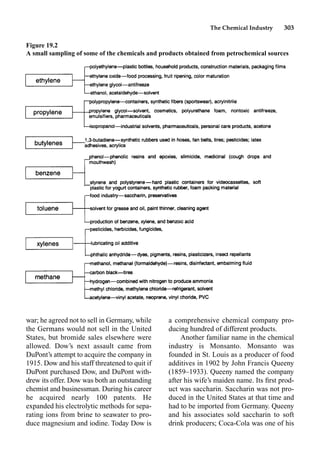
Petrochemicals 301
Industry Histories 302
Summary 307
Chapter 20 Chemistry Experiments 309
Introduction 309
The Scientific Method 309
Chemistry Experimentation 312
Chemical Activities 313
Chapter 21 A Future in Chemistry 327
Introduction 327
Chemist’s Job Description and Training 327
Careers in Chemistry 330
Professional Development and the American Chemical Society 332
Glossary 335
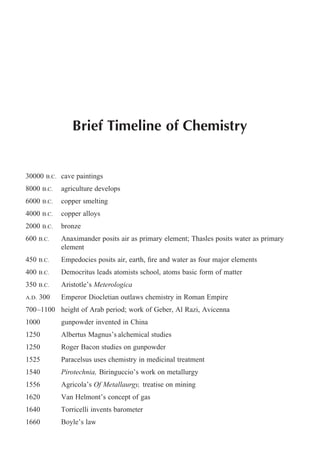
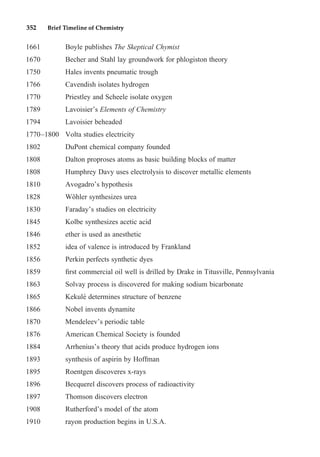
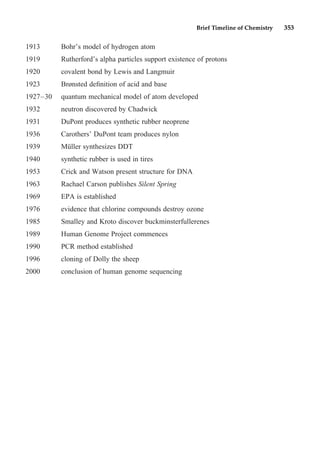
Brief Timeline of Chemistry 351
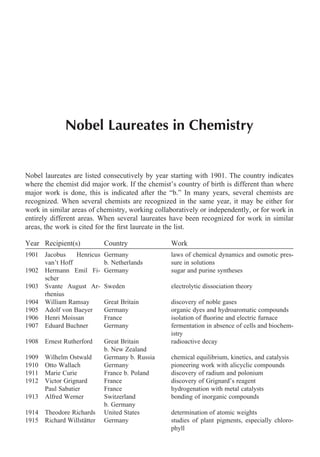
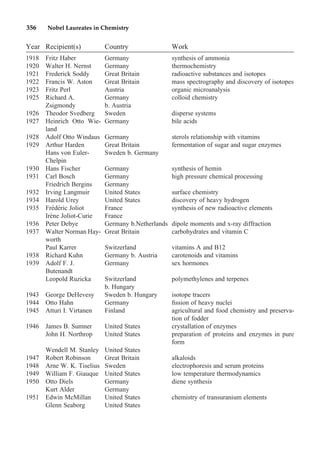
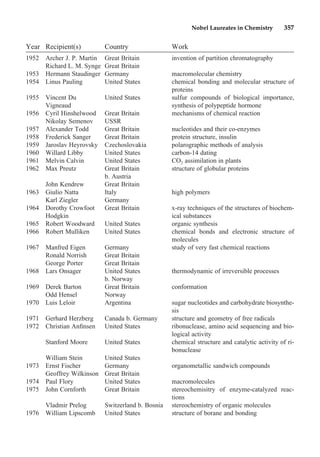
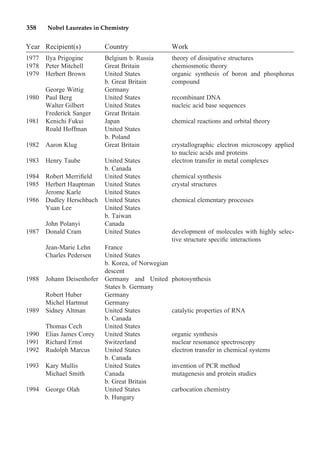
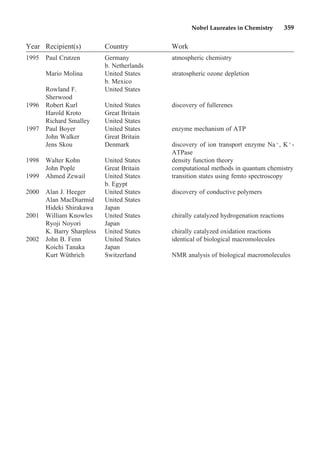
Nobel Laureates in Chemistry 355
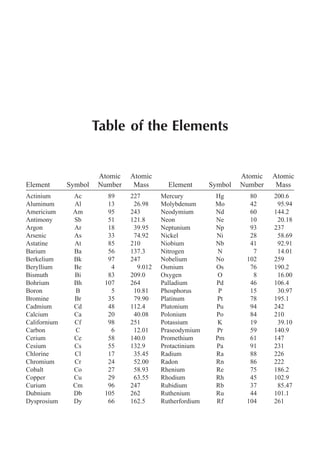
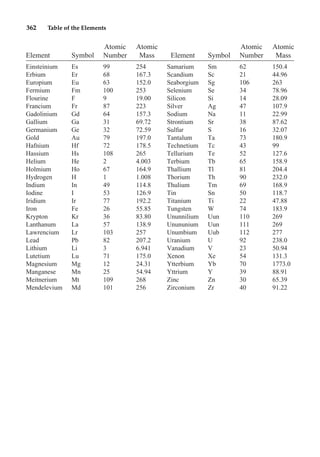
Table of the Elements 361
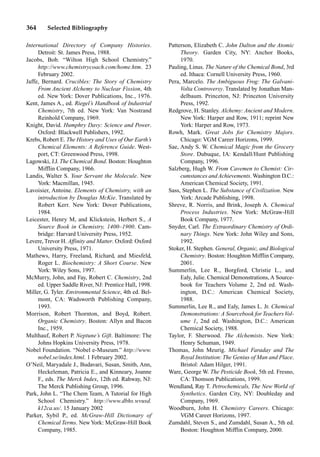
Selected Bibliography 363
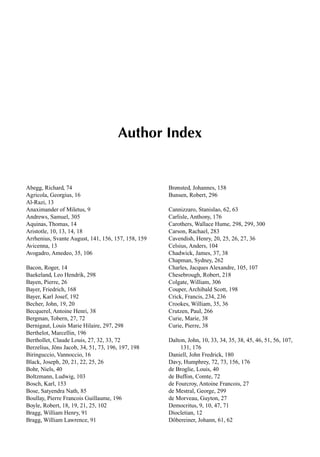
Author Index 365
Subject Index 369
Preface
Perhaps not everyone is a student of chemistry in the formal sense of being enrolled in a chem-
istry course, but everyone uses chemistry on a daily basis. Every time a package label is read
to check ingredients, food is tasted to determine whether it needs spices added, or mixtures are
prepared, chemistry is practiced. Without even knowing it, all of us have accumulated a basic
understanding of chemistry by observing the world around us. Observations such as salt melt-
ing ice, milk souring, leaves turning color, iron rusting, and wood burning demonstrate that
changes are constantly occurring. Because chemistry is essentially the study of change and
we are constantly observing these changes, we all are students of chemistry.
The Basics of Chemistry is written for students beginning a formal study of chemistry. These
readers are primarily high school and college students enrolled in their first chemistry course.
In addition to these students, individuals who are not enrolled in a chemistry course but would
like a general overview of the subject should find this book helpful. Teachers of all grades may
use The Basics of Chemistry as a general reference on the subject.
The Basics of Chemistry is a general reference book that presents the basic scientific con-
cepts of chemistry in addition to providing information on several related subjects. Chapters
progress through several areas. The first several chapters focus on chemistry’s roots as a mod-
ern science. Although the first chapters focus heavily on the historical development of chem-
istry, most of the other chapters give a historical overview of the chapter’s content. The heart
of this book is devoted to explaining basic chemistry concepts. In these chapters, I review the
content found in a beginning chemistry course. Subjects such as nomenclature, chemical bond-
ing, acids and bases, equilibrium, kinetics, solutions, and gases are covered. Building on these
general concepts, the chapters that follow explore several subdivisions of chemistry and pre-
sent additional concepts especially important in these subdivisions. Chapters on organic chem-
istry, biochemistry, electrochemistry, nuclear chemistry, and environmental chemistry are
included. Chapter 19 presents an overview of the chemical industry and includes information
on industrial chemistry. Chapter 20 presents the experimental method and twenty chemistry
activities. The final chapter provides an overview of the chemistry profession, possible careers
in chemistry, and chemical education.
This book is enhanced by other features. It includes a glossary of chemistry terms. Glossary
terms are typed in boldface when they first appear in the text. The year of birth and year of
xiv Preface
death of important individuals are given in parentheses following the first appearance of a per-
son’s name. Ample illustrations, tables, and analogies are used to clarify basic chemistry con-
cepts and highlight important chemical information. The chapter on the chemistry industry
provides background information on the founding of a number of well-known chemical com-
panies.
The most difficult task in writing a book called The Basics of Chemistry is deciding what
material to include in the book. What may be “the basics” for one person may not be for
another. Rather than present a list of basic facts, I present chemistry from a broad perspec-
tive. An introductory book on such a broad subject should give the student a glimpse of the
discipline, provide basic concepts and information, and offer a foundation for further study.
In this respect, an introductory text is like wiping the moisture from a fogged window. Many
objects become clear through the transparent opening, but the rest of the glass remains foggy.
Objects viewed through the fog are unclear. Even after wiping away all of the moisture, only
a small portion of the outside world can be seen. My hope is that The Basics of Chemistry pro-
vides the student with a small, cleared opening into the world of chemistry. Once a glimpse
is gained through this opening, the student can continue to enlarge the opening. After clear-
ing the window, then it’s time to move to the next window.
Acknowledgments
Many individuals helped in the preparations of this book. Jennifer Rochelle provided timely
typing whenever needed. Sean Tape and the team at Impressions Book and Journal Services
did an exceptional job of editing the manuscript. Greenwood Press initiated this book as part
of a series of general reference books in the sciences. I would like to thank the staff at Green-
wood for the opportunity to write this book. Greenwood’s Debby Adams provided guidance
and a firm hand at the wheel as she shepherded the project through production. Rae Déjur’s
illustrations demonstrate that one picture is truly worth a thousand words, and in some cases
much more. A special thanks goes to Robert Krebs who mentored me throughout this project
by providing encouragement and valuable feedback.
A number of chemical structures were drawn by ACD/ChemSketch version 4.55 developed
by Advanced Chemical Development, Inc. For more information please check the ACD Web
site at www.acdlabs.com.
1
Introduction: Chemistry and Its Divisions
Introduction
What do you think of when the word “chem-
istry” is mentioned? For many, chemistry
projects images of a crazed scientist dressed
in a white lab coat mixing a bubbly, spew-
ing, stinking concoction. The absentminded
professor is the classic stereotype of a
chemist. The original Disney movie (The
Absentminded Professor) released in 1961
tells the story of a chemistry professor who
accidentally creates “flubber,” a substance
with gravity-defying levitative properties. A
few years later in 1965, chemists produced
what seemed to be real-world flubber. It was
and continues to be marketed as the super-
ball®
. A more modern version of a chemist
is FBI agent Stanley Goodspeed portrayed
by Nicholas Cage in the movie The Rock.
Goodspeed is the FBI’s point man on chem-
ical weapons. In the movie, he secretly pen-
etrates Alcatraz Island, which is held by a
group of ultrapatriotic military extremists.
Once on Alcatraz, he must beat a deadline
to disarm rockets loaded with a deadly
chemical weapon aimed at San Francisco.
Hollywood’s portrayal of chemistry
stretches the imagination, but probably no
more than that of a person living at the
beginning of the twentieth century who
could foresee life at the start of the twenty-
first century. A quick look around is all it
takes to see how chemistry has transformed
our modern world. The plastic disposable
ballpoint pen I use to write with has been in
existence only since 1950.Your clothes may
be made of natural materials, but chances
are you are wearing plenty of synthetics
such as nylon, dacron, and polyurethane.
You drink tap water that was chlorinated in
the last few hours and will be chlorinated
again at the treatment plant before it contin-
ues its journey through the water cycle. Our
vehicles burn refined oil, and catalytic con-
verters reduce the amount of pollution
entering the atmosphere. Just opening a
medicine cabinet gives ample evidence of
the advances in chemistry during the last
one hundred years. Cosmetics, soaps, med-
icines, and cleansers are all products of the
modern chemical industry.
Much of the twentieth century has been
characterized by the use and abuse of chem-
istry. There is no doubt that advances in
chemistry and chemical technology have
improved and extended life, but there is also
2 Introduction: Chemistry and Its Divisions
a price for living in a modern chemical soci-
ety. Environmental costs such as ozone
depletion, acid rain, water pollution, air pol-
lution, and hazardous wastes are part of the
price we pay for the benefits of living in a
chemical society. New drugs and medicines
have eradicated disease, and advances in
chemistry have allowed possible fertilizers
and other agricultural advances to increase
the world’s food supply. These develop-
ments have led to a booming world popu-
lation currently at six billion and growing.
To sustain a growing world population of
over six billion means converting raw mate-
rials into products. In recent years, we have
recognized the need to “reduce, reuse, and
recycle.” We know that one of the funda-
mental principles of chemistry is that mat-
ter is not created or destroyed, and chemical
processes themselves play a major role in
recovering raw materials from used prod-
ucts. Many items once considered waste are
now recycled supplementing raw materials
obtained from the Earth. As more countries
such as China develop their industrial infra-
structure, the demand for energy and mate-
rial resources is bound to increase.
The laws of thermodynamics tell us that
the conversion of raw materials into finished
goods requires energy and ultimately results
in an ever-increasing amount of heat
released into the environment. This waste
heat is accompanied by carbon dioxide pro-
duced from the burning of fossil fuels.
There seems to be a consensus among sci-
entists that our planet’s temperature is
increasing due to the greenhouse effect,
although a minority of scientists do not
believe that our planet’s temperature is
increasing. Many scientists also feel that
increased temperatures are part of natural
fluctuations and that humans have little
impact on the recent trend of elevated
global temperatures. International efforts
are now underway to curb carbon dioxide
emissions worldwide, such as revegetation,
curbing slash and burn practices, and se-
questering carbon dioxide in the sea, are
stalled by disagreements between developed
and underdeveloped countries, as well as
Europe and the United States.
The Scientific Enterprise
So how do we strike a balance between
the benefits of better living through chem-
istry and the costs associated with this
lifestyle? One answer to this question is
knowledge. Greater knowledge equips us
with the tools to make informed decisions
when we live in a free democratic society.
Chemical knowledge is based on a long his-
tory of chemical research. The methodolog-
ical procedure to attain scientific knowledge
is often defined as the scientific method. The
classical view of the scientific method pre-
sents science as a neat step-by-step proce-
dure starting with formulating a question,
posing a hypothesis, performing a con-
trolled experiment to address the hypothe-
sis, and drawing conclusions from the
experiment. Although this view is accurate
in an idealized sense, in reality, true science
is filled with pitfalls, blind alleys, dead ends,
false starts, fortuitous accidents, and human
idiosyncrasies. Books on science often give
the impression that science proceeds in a
linear, uniform fashion. More often, scien-
tific progress follows a circuitous route with
periods of accelerated discoveries and long,
relatively dormant periods.
The theories and facts we cling to today
are only an experiment away from revision.
As you read these words, chemical research
is occurring in thousands of labs across the
globe. The modern scientific enterprise is
vastly different from that of the quintessen-
tial scientist working in isolation in a small
laboratory. Modern research is characterized
by research teams led by scientists who spe-
Introduction: Chemistry and Its Divisions 3
cialize in very specific fields. Teamwork is
essential as research teams across the world
attempt to answer fundamental questions.
These teams work both cooperatively and
competitively with other teams working on
similar problems. Work is continually
reviewed, critiqued, revised, and published
in scientific journals. The advent of the
Internet has led to both a wider audience
and a faster distribution for research results.
Much of today’s research takes place in uni-
versities and is supported by governmental
agencies that distribute millions of dollars
annually to those teams whose work is
deemed worthy of support. In addition to
this research, numerous private companies
operate their own private research labs to
develop products and processes to give them
an advantage over their competitors. Chem-
ical research is both basic and applied. Basic
research addresses the fundamental laws of
nature and is undertaken to advance the the-
oretical foundation of chemistry. Applied
research is performed with a specific appli-
cation in mind, for example, better products
or to improve the quality of life. Research
should not be viewed in terms of a basic or
applied research dichotomy. Most research
contains elements of both basic and applied
research.
As new knowledge is gained through
research, additional questions are raised and
new areas of research are continually
exposed in a neverending process. Because
knowledge is power, as we embark on the
twenty-first century, a knowledge of chem-
istry is essential to shape a sustainable
future. Chemical knowledge may lead to a
simple decision to recycle or choose one
product over another. Perhaps this knowl-
edge helps you make a decision to under-
take a certain medical treatment or vote for
or against an issue. Chemical knowledge
can help guide you in any number of choices
you make today. More important, this
knowledge will help you with decisions
concerning novel areas we can only imagine
but know will develop as the twenty-first
century unfolds.
What Is Chemistry?
Chemistry is the branch of science that
deals with the composition and structure of
matter and the changes that matter under-
goes. Matter is anything that has mass and
occupies spaces, which means just about
anything you consider. This book, your body
and the air you breathe are all examples of
matter. Matter is simply the stuff that makes
up our universe.
Chemistry, like all branches of science,
is a method that attempts to simplify and
organize. Every object we might consider is
a separate piece of matter, and matter can be
classified in any number of ways. One sim-
ple classification scheme for matter is based
on the three states of matter: solid, liquid,
and gas (four if we include plasma).
Another classification scheme, and one that
is fundamental to chemistry, is classifying
matter by chemical composition. Rather
than speaking of water as a form of matter,
we can speak of water composed of approx-
imately 11% hydrogen and 89% oxygen by
mass. Similarly, air is a mixture of matter
containing approximately 78% nitrogen,
21% oxygen, a little less than 1% argon by
volume, and an assortment of other gases in
small percentages.
Much of the history of chemistry has
concerned itself with determining the ulti-
mate composition of matter. The Greeks
considered all matter to be composed of dif-
ferent combinations of earth, air, fire, and
water. It is only during the last two hundred
years that the modern idea of chemical ele-
ments developed and only in the last one
hundred years that we have determined that
elements themselves are composed of
4 Introduction: Chemistry and Its Divisions
protons, neutrons, and electrons. Hence, we
can think of all matter to be composed of 91
naturally occurring elements, and protons,
neutrons, and electrons are the building
blocks that make up the elements. Chem-
istry not only deals with the composition of
matter, but how the pieces of matter fit
together, that is, the structure of matter. The
structure of matter can have a major impact
on its properties. For example, carbon can
exist as a two-dimensional flat structure, or
a soft, black graphite, or in the pyramidal
three-dimensional tetrahedron shape we
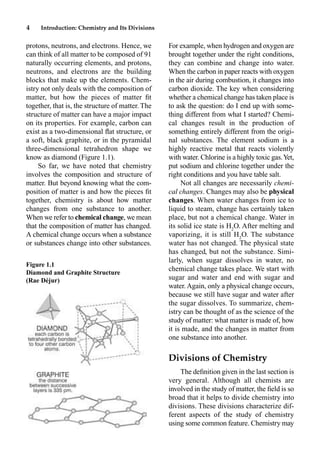
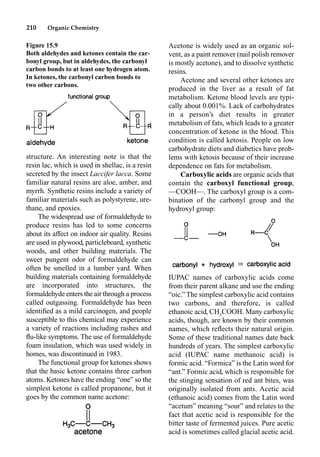
know as diamond (Figure 1.1).
So far, we have noted that chemistry
involves the composition and structure of
matter. But beyond knowing what the com-
position of matter is and how the pieces fit
together, chemistry is about how matter
changes from one substance to another.
When we refer to chemical change, we mean
that the composition of matter has changed.
A chemical change occurs when a substance
or substances change into other substances.
For example, when hydrogen and oxygen are
brought together under the right conditions,
they can combine and change into water.
When the carbon in paper reacts with oxygen
in the air during combustion, it changes into
carbon dioxide. The key when considering
whether a chemical change has taken place is
to ask the question: do I end up with some-
thing different from what I started? Chemi-
cal changes result in the production of
something entirely different from the origi-
nal substances. The element sodium is a
highly reactive metal that reacts violently
with water. Chlorine is a highly toxic gas.Yet,
put sodium and chlorine together under the
right conditions and you have table salt.
Not all changes are necessarily chemi-
cal changes. Changes may also be physical
changes. When water changes from ice to
liquid to steam, change has certainly taken
place, but not a chemical change. Water in
its solid ice state is H2
O. After melting and
vaporizing, it is still H2
O. The substance
water has not changed. The physical state
has changed, but not the substance. Simi-
larly, when sugar dissolves in water, no
chemical change takes place. We start with
sugar and water and end with sugar and
water. Again, only a physical change occurs,
because we still have sugar and water after
the sugar dissolves. To summarize, chem-
istry can be thought of as the science of the
study of matter: what matter is made of, how
it is made, and the changes in matter from
one substance into another.
Divisions of Chemistry
The definition given in the last section is
very general. Although all chemists are
involved in the study of matter, the field is so
broad that it helps to divide chemistry into
divisions. These divisions characterize dif-
ferent aspects of the study of chemistry
using some common feature. Chemistry may
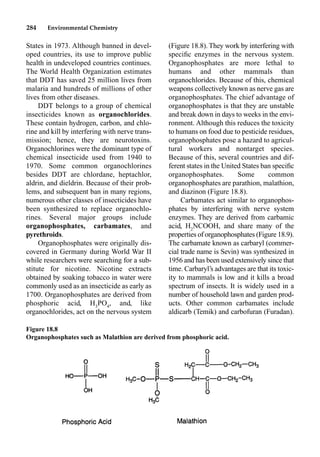
Figure 1.1
Diamond and Graphite Structure
(Rae Déjur)
Introduction: Chemistry and Its Divisions 5
be divided into the two very large divisions
of inorganic and organic chemistry.
Inorganic chemistry involves the
study of the chemical elements, their com-
pounds, and reactions excluding those that
contain carbon as the principal element.
Organic chemistry is the study of the
composition and the reaction of carbon-
containing compounds. The distinction
between inorganic and organic results from
the days when chemical compounds were
classified according to their origin. Inor-
ganic means not derived from life. Inor-
ganic substances were thought to originate
only from mineral, nonliving sources. Con-
versely, organic compounds were thought to
have come from living plant or animal
sources. All organic substances contain car-
bon, and it was once believed that these car-
bon substances could originate only from a
living source. We know today that many
organic compounds are synthesized from
inorganic, nonliving sources. Some exam-
ples include polypropylene, acrylics, and
nylon used in clothing; polystyrene (styro-
foam) used for insulation; and ethylene gly-
col (antifreeze). Even though the original
distinction separating inorganic and organic
does not hold, the terms are still used to
distinguish two broad areas of chemistry.
For our purposes, we can think of organic
chemistry as simply the chemistry of car-
bon compounds and inorganic chemistry as
the study of all other compounds. It should
be noted, though, that certain carbon com-
pounds, most notably carbon dioxide and
carbonates, are classified as inorganic.
In addition to the large divisions of
organic and inorganic chemistry, several
other large divisions of chemistry exist. Bio-
chemistry is the study of chemical substances
associated with living organisms. Bio-
chemists study the nature of biological sub-
stances. The study of DNA, viruses, and
immune systems are examples of biochemi-
cal research. Physical chemistry deals with
the structure of matter and how energy affects
matter. Physical chemists are concerned with
the physical characteristics of matter. Areas
of research in physical chemistry might
include how chemicals absorb light or how
much energy is released or absorbed when a
chemical reaction occurs. Closely related to
physical chemistry is the study of nuclear
chemistry. Nuclear chemistry focuses on the
study of atomic nuclei, nuclear fission reac-
tions, and nuclear fusion reactions. The
nucleus is the positive central portion of an
atom composed of positively charged protons
and uncharged neutrons. Fission reactions
involve the physical splitting of heavier ele-
ments into smaller elements, and fusion
involves lighter elements physically combin-
ing to form heavier elements, for example,
the fusion of hydrogen to form helium. Ana-
lytical chemistry deals with techniques used
to identify and quantify the composition of
matter. Analytical chemists, as the name
implies, analyze substances for their content.
An analytical chemist might perform tasks
such as determining the sugar content of a
fruit juice, the amount of pollutant in a water
body, or the purity of a drug. Environmental
chemistry focuses on the occurence of natu-
ral and synthetic substances in the environ-
ment and their impact on the environment.
The study of the chemistry of pollution is a
major area of concern for environmental
chemists. Problems involving water pollu-
tion, air pollution, solid waste, hazardous
materials, and toxic substances involve a
study of environmental chemistry. Each of
the major areas of chemistry mentioned
above, however, are not rigid divisions.
The nature of chemistry is such that the
fields of study in many areas naturally cross
over into other areas. A biochemist naturally
works in the area of organic chemistry, and
an environmental chemist who studies radi-
ation is concerned with nuclear chemistry.
6 Introduction: Chemistry and Its Divisions
Many branches of chemistry exist in con-
junction with other areas of science. For
example, the study of the chemistry of rocks
and minerals falls under the category of
geochemistry. The combination of medicine
and chemistry leads to medicinal chemistry.
Other divisions include agricultural chem-
istry, food chemistry, petroleum chemistry,
soil chemistry, and polymer chemistry.
As chemical knowledge continues to
expand, we are certain to develop new areas
of study in chemistry. Just recently, chemists
have performed simple computer functions
using chemical reactions rather than per-
forming these functions electronically.
Chemical reactions that perform computer
operations bring computers closer to model-
ing human thought processes. Our thoughts
result from chemical reactions that occur in
our brains.As chemists work at the forefront
of this area of technology and others, new
interdisciplinary areas will certainly develop.
Those new areas add to existing branches of
chemistry and at the same time create new
areas of study.
In the chapters to follow, the basic con-
cepts that guide chemists in their study of
matter are examined. In addition to intro-
ducing these basic concepts, the historical
foundation of chemical thought, as well as
new areas of chemical research, are ex-
plored. This knowledge is intended to give
the reader a clearer view of the wonderful
world of chemistry that is all around us; and
with this, a foundation to build upon. All
progress by scientists is dependent on the
work of those who precede them. In a letter
to Robert Hooke, Isaac Newton stated, “If I
have seen farther than others, it is because
I was standing on the shoulders of giants.”
The goal of this book is to help you see a
little farther.
Introduction
Chemistry has always existed. The forma-
tion of the Earth and the development of
life involved innumerable chemical pro-
cesses. Humans, as part of the natural
world, are part of these natural processes.
As humans evolved and observed chemical
processes constantly occurring all around
them, they attempted to control these pro-
cesses in their daily existence. For example,
combustion in the form of fire could be
used to clear land, light the darkness, cook
food, and provide protection. Eventually,
humans learned that fire could be use to
harden clays and melt ores to refine metals.
Other chemical discoveries were used to
improve living conditions. In this respect,
our ancient ancestors were no different than
modern humans. Chemical technology has
been used throughout history to improve
our lives. As a modern science, chemistry
has only existed for two hundred years.
Modern chemistry developed out of a tra-
dition of chemical technology applied
throughout history. This chapter examines
some of that history, and the following
chapter focuses on the events that estab-
lished chemistry as a modern science.
Early History
Chemistry is often called the central sci-
ence. It derives this name because of its
importance to all the other sciences.
Although chemistry did not exist as a mod-
ern science until two hundred years ago,
humans have used chemistry from prehis-
toric times. Evidence of the early uses of
chemistry includes cave paintings dating
from 25,000 B.C. It is not hard to imagine
our ancestors obtaining natural pigments by
squeezing berries or mixing crushed rocks
with water to produce different colors to use
as paints. Similar processes could have been
used to obtain dyes for clothes or for body
decorations. Fragrances obtained from
flower extracts or fats rendered from ani-
mals were the prehistoric version of the cos-
metic and repellant industry. Evidence for
the use of fermentation to produce wine
and beer dates from the earliest civilizations.
Fermentation involves the conversion of
glucose to ethyl alcohol (ethanol) in the
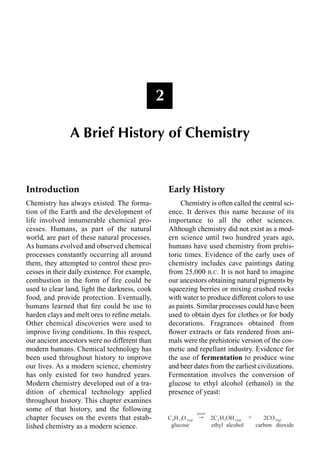
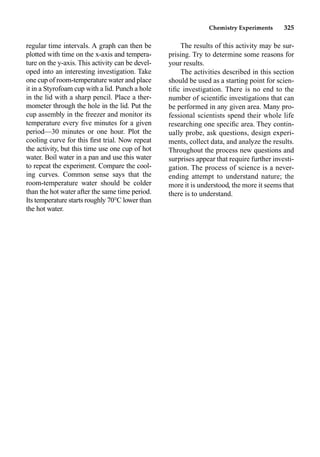
presence of yeast:
2
A Brief History of Chemistry
HDVW
& + 2  + 2+ 2
  DT   DT  J
JOXFRVH HWKO DOFRKRO FDUERQ GLR[LGH

r
8 A Brief History of Chemistry
One of the earliest uses of fire was in pot-
tery making. Early humans undoubtedly
observed that when clay was heated its
water was driven out and a hard rock sub-
stance remained. Our ancestors made clay
implements and art fixtures by heating their
work in open pit fires, and clay implements
from 20,000 years ago have been found.
Early human civilizations used stone,
bone, and wood for objects. Approximately
ten thousand years ago, metals first ap-
peared. The first metals used were those
found in their native form, or in a pure,
uncombined state. Most metals today are
acquired from an ore containing the metal
in combination with other elements such as
oxygen. The existence of native metals is
rare, and only a few metals exist in native
form. Iron and nickel were available in lim-
ited supply from meteorites. The first met-
als utilized widely by humans were copper,
silver, and gold. Pure nuggets of these met-
als were pounded, in a process known as
“cold hammering,” with stones into various
shapes used for weapons, jewelry, art, and
various domestic implements. Eventually,
smiths discovered if a metal was heated it
could be shaped more easily. The heating
process is known as annealing. Because the
supply of native metals was limited, metal
items symbolized wealth and status for
those who possessed them.
The discovery that metals could be
obtained from ore-bearing minerals signaled
the true start of the metal age. The first metal
to be extracted from its ore was copper. The
technology used for firing clay could be
directly applied to the smelting of metals.
Kilns and furnaces were adapted with
troughs to capture metals obtained during
the smelting process. Smelting involved
heating the metal-bearing ore with wood or
charcoal. The carbon from the charcoal
combined with the oxygen in the ore sepa-
rating the metal from the oxygen. During
the smelting process, the sulfur, which was
often associated with metal ores, was driven
off as sulfur dioxide. Sulfur, with its char-
acteristic odor and yellow fumes that are
released when it burns, came to be closely
associated with the transformation of met-
als and subsequently played a key role in
alchemical reactions. The earliest evidence
of the smelting of copper dates from around
6000 B.C.
By 4000 B.C., smelters were combining
copper and tin to produce the alloy bronze.
An alloy is simply a mixture of metals. The
bronze produced in ancient times consisted
mostly of copper mixed with between 1%
and 10% tin. Because the production of
bronze required a source for both copper and
tin, major trade centers and trade routes
developed to mine and produce bronze. One
of the major sources of tin from the Bronze
Age until recent times was the Cornwall
region in southwest England. The Romans
and other groups settled the area and
exported tin to other parts of Europe. Bronze
was the first metal used over wide geographic
regions. Advances in kilns, annealing, alloy-
ing, oxidation, and smelting continued to
advance the craft of metalsmithing as the pro-
duction of bronze flourished.
Iron, which requires a higher tempera-
ture to smelt than does bronze, is found in
relics dating from approximately 1500 B.C.
Early evidence of the use of iron was pro-
vided upon the opening of King Tut’s tomb
when an iron dagger that dated from 1350
B.C. was found buried with the king. The
first irons produced were of inferior quality.
Repeated heating and hammering (temper-
ing) were needed to produce an iron of
acceptable quality. A major advancement
made in iron production was the use of bel-
lows to obtain temperatures high enough
(approximately 1,500°C) to smelt iron,
although even irons created with the higher
temperatures and the tempering process
A Brief History of Chemistry 9
were inferior to bronze. It was only when
iron was heated with carbon that an iron
with superior strength qualities was
obtained. This process foreshadowed the
modern steel industry. Steel is iron to which
carbon has been added.
The metal age brought about a number
of advances in chemical technology.Yet, the
smelting of metals and their incorporation
into products involved more art and craft
than science. Smiths were thought to pos-
sess magical powers to be able to obtain
refined metals from rock. Civilizations and
their rulers closely guarded their trade
secrets. After all, metals were the strategic
weapons of ancient civilizations. Still,
progress made in metallurgy had a direct
impact on the development of chemistry.
Advances in heating devices such as fur-
naces and kilns, fuels to fire the kilns, and
processes such as mixing, extracting, and
mining were directly applicable to latter
advances in chemistry.
Greek Science
The technologies of early civilizations
used chemical technology empirically. That
is, different substances and methods were
discovered through experimentation. Ap-
plied science took precedence over any the-
oretical understanding of the general laws
and principles governing chemical pro-
cesses. As early as 600 B.C., Greek philoso-
phers sought a more basic understanding of
matter. Anaximander of Miletus (circa
610–545 B.C.) believed air was the primary
substance of matter and that all other sub-
stances came from air. For example, fire was
a form of thin air, and earth was thick air.
Heraclitus of Ephesus (544–484 B.C.) be-
lieved fire was the primary substance and
viewed reality in terms of change. Matter
was always in a state of flux, and nature was
always in a process of dissolving and
reforming. His ideas on change are summa-
rized in his saying: “you cannot step twice
into the same river.” Heraclitus’ philosophy
also considered reality in terms of opposites.
The way up and the way down were one and
the same depending on one’s perspective.
The Eleatic school of Greek philosophy
was centered in the southern Italian city-
state of Elea, which flourished in the sixth
and fifth centuries B.C. The Eleatics directly
opposed the ideas of Heraclitus and believed
the universe did not change. They felt
knowledge acquired through sensory per-
ception was faulty because reality was dis-
torted by our senses. One of the leading
Eleatics was Parmenides (circa 515–450
B.C.), who viewed the world as a unity and
believed change was an illusion. To make
their ideas about the absence of change con-
form to observations, the Eleatics expanded
upon Anaximander’s idea of one primary
substance. Rather than considering air as the
primary substance, the Eleatic philosopher
Empedocles of Agrigentum (circa 495–435
B.C.) proposed four primary elements: air,
earth, fire, and water.
In response to the Eleatics, the atomist
school led by Leucippus (circa 450–370
B.C.) and his student Democritus (circa
460–370 B.C.) developed. The atomists
refuted the idea that change was an illusion
and developed a philosophy that supported
the sensory observations of the physical
world. The atomist school proposed that the
world consisted of an infinite void (vacuum)
filled with atoms. According to Democritus,
“nothing exists except atoms and empty
space, everything else is opinion.” Atoms
were eternal, indivisible, invisible, minute
solids that comprised the physical world.
Atoms were homogeneous but existed in
different sizes and shapes. The idea of atoms
developed on logical grounds. If a piece of
gold was continually divided into smaller
and smaller units, the gold would eventually
10 A Brief History of Chemistry
reach a point where it was indivisible. The
ultimate unit of gold, or any other substance,
was an atom. According to Democritus,
an infinite number of atoms moved through
the void and interacted with each other.
The observable physical world was made
of aggregates of atoms that had collided a
nd coalesced. The properties of matter
depended on the size and shape of the
atoms. Change was explained in terms of
the motion of the atoms through the void or
how atoms arranged themselves. Aristotle
(384–322 B.C.) rejected the idea of atoms,
but Democritus’ atomist philosophy was
later adopted by Epicurus (341–270 B.C.)
and the Roman poet Lucretius (circa 95–55
B.C.).Almost two thousand years would pass
until atoms were resurrected by Dalton in
the development of modern chemistry.
Of all ancient philosophers, Aristotle
had the greatest influence on scientific
thought. Aristotle’s writings and teaching
established a unified set of principles that
could be used to explain natural phenome-
non. Although today we would consider his
science rather foolish, it was based on
sound, logical arguments that incorporated
much of the philosophical thought of his
time. The teleological nature of Aristotle’s
explanations led to the subsequent accep-
tance by the Church in western Europe. This
contributed to Aristotle’s two thousand year
longevity in Western thought.
Aristotle’s Meterologica synthesized his
ideas on matter and chemistry. Aristotle
believed that four qualities could be used to
explain natural processes. The four qualities
were hot, cold, dry, and moist. Hot and cold
were active qualities. Hence, the addition or
subtraction of heat leads to the transforma-
tion of things. Moist and dry were the result
of the action of the active qualities. Only
four possible combinations of these quali-
ties could exist in substances. These were
hot and moist, hot and dry, cold and moist,
and cold and dry. Opposite qualities could
not coexist. The combinations of hot and
cold and moist and dry were impossible in
Aristotle’s system. The four allowable com-
binations determined the four basic ele-
ments. Air possessed the qualities hot and
moist, fire possessed hot and dry, earth pos-
sessed dry and cold, and water possessed
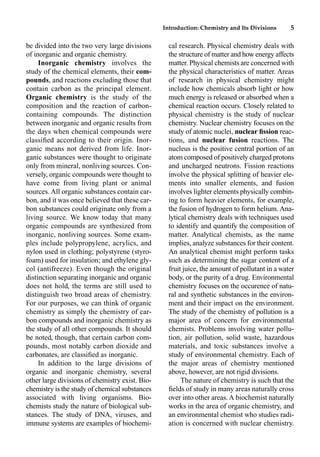
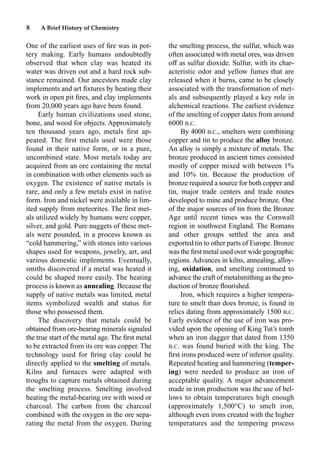
wet and cold. Aristotle’s system is summa-
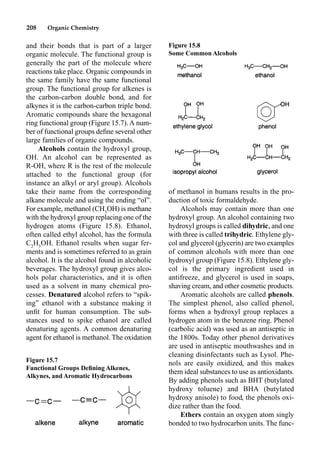
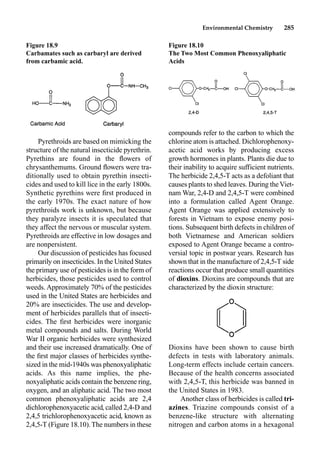
rized in Figure 2.1, which is found in a
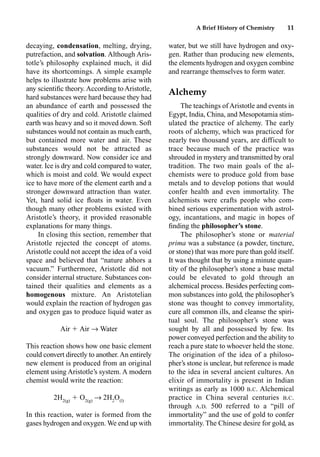
number of ancient chemical writings.
Using the four qualities of matter and
four elements as a starting point, Aristotle
developed logical explanations to explain
numerous natural observations. Both the
properties of matter and the changes in mat-
ter could be explained using Aristotle’s
theory.
Aristotle explained the process of boil-
ing as a combination of moisture and heat. If
heat is added to a substance that contains
moisture, the heat draws the moisture out.
The process results in the substance divid-
ing into two parts. When the moisture
leaves, the substance becomes thicker,
whereas the separated moisture is lighter
and rises. Aristotle used this type of rea-
soning to explain numerous physical and
chemical processes including evaporation,
Figure 2.1
Aristotle’s Diagram on Matter and Change
A Brief History of Chemistry 11
decaying, condensation, melting, drying,
putrefaction, and solvation. Although Aris-
totle’s philosophy explained much, it did
have its shortcomings. A simple example
helps to illustrate how problems arise with
any scientific theory. According to Aristotle,
hard substances were hard because they had
an abundance of earth and possessed the
qualities of dry and cold. Aristotle claimed
earth was heavy and so it moved down. Soft
substances would not contain as much earth,
but contained more water and air. These
substances would not be attracted as
strongly downward. Now consider ice and
water. Ice is dry and cold compared to water,
which is moist and cold. We would expect
ice to have more of the element earth and a
stronger downward attraction than water.
Yet, hard solid ice floats in water. Even
though many other problems existed with
Aristotle’s theory, it provided reasonable
explanations for many things.
In closing this section, remember that
Aristotle rejected the concept of atoms.
Aristotle could not accept the idea of a void
space and believed that “nature abhors a
vacuum.” Furthermore, Aristotle did not
consider internal structure. Substances con-
tained their qualities and elements as a
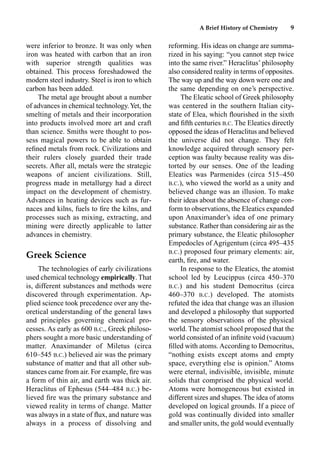
homogenous mixture. An Aristotelian
would explain the reaction of hydrogen gas
and oxygen gas to produce liquid water as
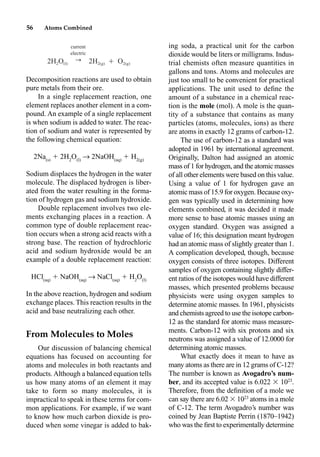
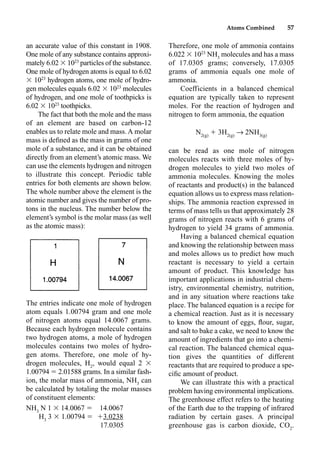
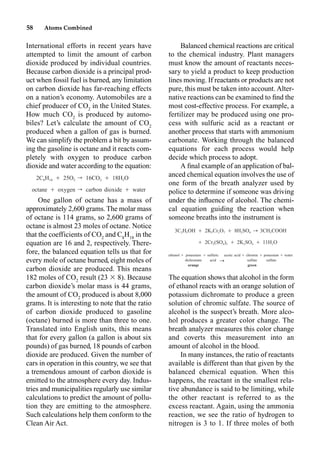
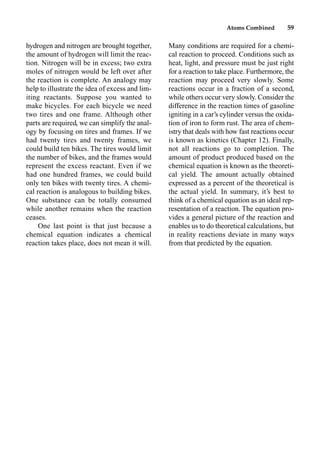
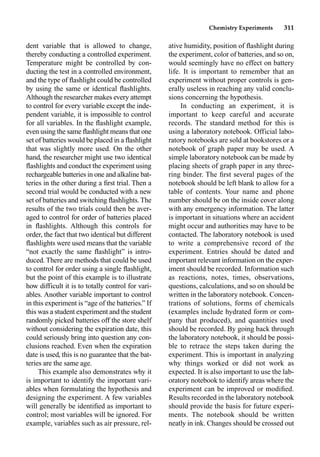
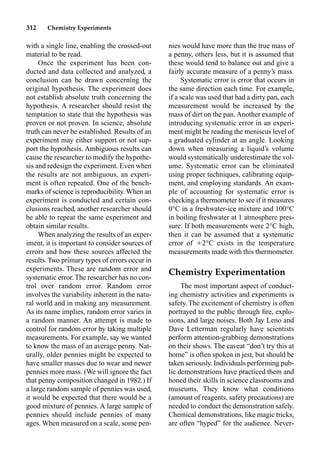
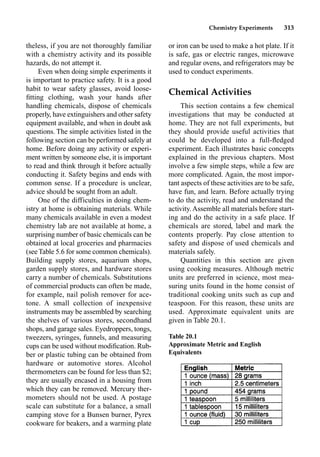
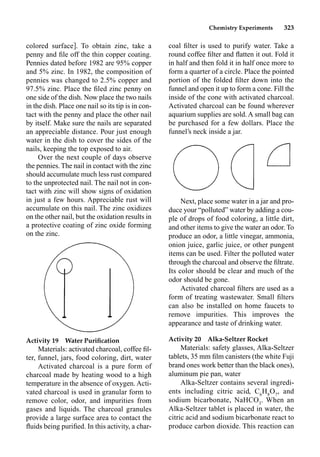
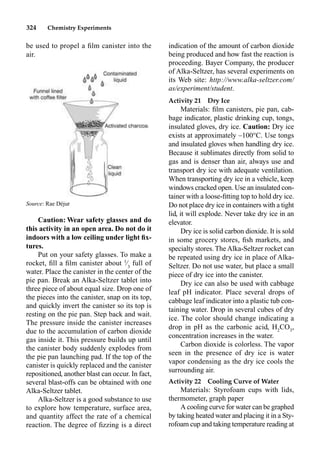
Air  Air p Water
This reaction shows how one basic element
could convert directly to another.An entirely
new element is produced from an original
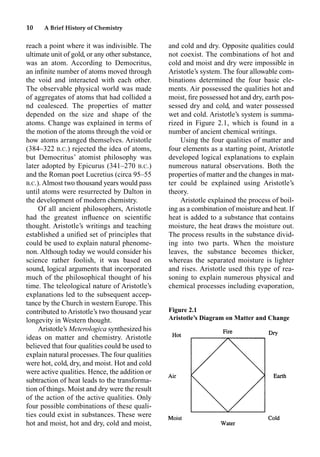
element using Aristotle’s system. A modern
chemist would write the reaction:
+ J
 O J
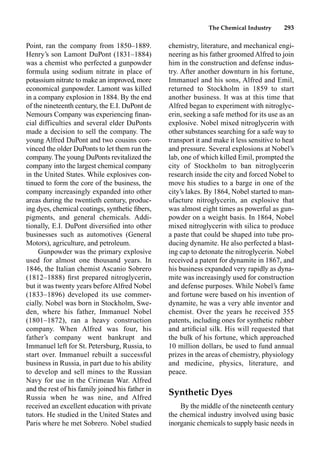
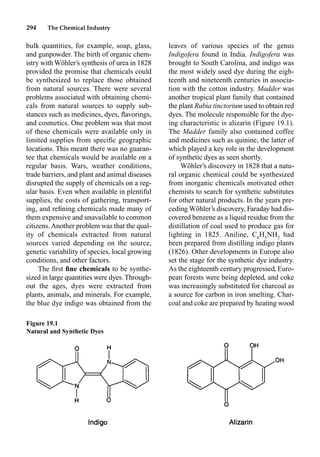
p 2H
O O
In this reaction, water is formed from the
gases hydrogen and oxygen. We end up with
water, but we still have hydrogen and oxy-
gen. Rather than producing new elements,
the elements hydrogen and oxygen combine
and rearrange themselves to form water.
Alchemy
The teachings of Aristotle and events in
Egypt, India, China, and Mesopotamia stim-
ulated the practice of alchemy. The early
roots of alchemy, which was practiced for
nearly two thousand years, are difficult to
trace because much of the practice was
shrouded in mystery and transmitted by oral
tradition. The two main goals of the al-
chemists were to produce gold from base
metals and to develop potions that would
confer health and even immortality. The
alchemists were crafts people who com-
bined serious experimentation with astrol-
ogy, incantations, and magic in hopes of
finding the philosopher’s stone.
The philosopher’s stone or material
prima was a substance (a powder, tincture,
or stone) that was more pure than gold itself.
It was thought that by using a minute quan-
tity of the philosopher’s stone a base metal
could be elevated to gold through an
alchemical process. Besides perfecting com-
mon substances into gold, the philosopher’s
stone was thought to convey immortality,
cure all common ills, and cleanse the spiri-
tual soul. The philosopher’s stone was
sought by all and possessed by few. Its
power conveyed perfection and the ability to
reach a pure state to whoever held the stone.
The origination of the idea of a philoso-
pher’s stone is unclear, but reference is made
to the idea in several ancient cultures. An
elixir of immortality is present in Indian
writings as early as 1000 B.C. Alchemical
practice in China several centuries B.C.
through A.D. 500 referred to a “pill of
immortality” and the use of gold to confer
immortality. The Chinese desire for gold, as
12 A Brief History of Chemistry
opposed to that in the West, was strictly con-
cerned with physical and spiritual health
rather than acquiring wealth. Hermetic phi-
losophy and the writings of Hermes (a
pseudonym) incorporated both Egyptian
and Greek mythology in the first few cen-
turies A.D. and mentioned a solidified spirit
derived from the Sun capable of perfecting
all things.Ancient ideas on the philosopher’s
stone were undoubtedly passed among cul-
tures. Ideas from India and China could
have easily found their way into medieval
Europe through Arab cultures.
Alchemy’s foundation was based on the
teachings of Aristotle. Aristotle held that
rocks and minerals were alive and grew in
the interior of the Earth. Like humans, min-
erals attempt to reach a state of perfection
through the growth process. Perfection for
minerals was reached when they ripened
into gold. Based on these premises, the
alchemist sought to accelerate the ripening
process for metals by subjecting them to a
series of physical and chemical processes.
One typical series might include heating the
metal with sulfide to remove impurities.
Then a starter seed of gold was added to the
metal. After the seed was added, the metal
was treated with arsenic sulfide. This treat-
ment resulted in whitening of the metal,
which could be interpreted as a production
of silver, or a stage halfway to the perfect
gold stage. Finally, the whitened metal could
be treated with polysulfides to produce the
characteristic yellow gold color. Of course,
the process could take weeks or months, and
it all had to be performed under the right
sign of the stars.
The early center of alchemy was the
intellectual capital of ancient Greece,
Alexandria. Very little remains of the origi-
nal alchemical manuscripts from ancient
Greece. The rise of Christianity and con-
cerns about disrupting the economy eventu-
ally led the Roman Emperor Diocletian to
outlaw alchemy in A.D. 296. Diocletian’s
edict resulted in the destruction of much
of the knowledge accumulated by the al-
chemists. Two original works that did sur-
vive are known as the Leyden Papyrus X and
the Stockholm Papyrus. These two related
works were discovered in a tomb of a buried
Egyptian in ancient Thebes. The papyri date
from the end of the third century, although it
is believed the papyri are copies of an orig-
inal written sometime between A.D. 100 and
300. They are written in Greek and consist
of a series of recipes for alchemical prepa-
rations. The recipes include instructions for
making alloys, determining the purity of
metals, making fake gold and silver, pro-
ducing imitation gemstones, and dyeing
textiles.
The rise of the Arab Empire shifted
advances in learning to the East. The Arab
Empire at its peak spanned from its eastern
borders with China and India all the way
across northern Africa into southern Spain.
The Arabs translated and dispersed the
works of the Greeks, and for the next one
thousand years learning and advances in sci-
ence, medicine, astronomy, and mathemat-
ics were made by the Arabs. The Arab
influence can be seen in the word “alchemy”
itself. The word “al” is the Arab prefix for
“the.” Adding this prefix to “chyma,” Greek
for melting of metals, gives “al chyma.” The
term “alchemy” first appeared in the fourth
century A.D. Another term to appear was “al
iksirs.” Iksirs were coloring agents used as
an ingredient in the procedure to produce
gold. Today, the term “elixir” is a reminder
of its alchemical root.
The period between A.D. 700 and 1100
was the peak of the Arab Empire. The vast
geographic expanse of the Arab influence
meant that a great variety of materials were
available and that there was ample opportu-
nity for the cross-fertilization of knowledge.
Several individuals from this period had a
A Brief History of Chemistry 13
lasting influence on the development of the
chemical arts. Jabir ibn Hayyan (Latin name
Geber, 721–815) accepted many of the ideas
of Aristotle but also modified Aristotle’s
ideas. Jabir proposed two primary exhala-
tions. One exhalation was smoky and
believed to contain small particles of earth.
The other was vaporous and contained small
particles of water. The principal smoky
exhalation was sulfur, and the primary
vaporous exhalation was mercury. Jabir
believed pure sulfur and mercury combined
in different proportions to produce all met-
als. Most of the writings attributed to Jabir
are actually a compilation from numerous
Arab alchemists and early European
alchemists written over several hundred
years. These writings described processes
for producing acids, metals, dyes, inks, and
glass.
Al-Razi (Rhazes, 854–925) was a Per-
sian who studied in Baghdad. Al-Razi wrote
extensively on medicine, philosophy, astron-
omy, and alchemy, but he was primarily a
physician. Al-Razi was less mystical than
his contemporary alchemists and classified
chemicals by their origin. According to Al-
Razi, chemicals came from either animals,
plants, and minerals or were derived from
other chemicals. Al-Razi wrote The Com-
prehensive Book, which was an enormous
medical encyclopedia that synthesized med-
ical practices of ancient Greeks, Syrians,
Arabs, and Persians. Al-Razi was the first
person known to describe the disease small-
pox. Most of his alchemical writings have
been lost, but Al-Razi believed in the atomic
nature of matter. Al-Razi took a systematic
approach to science and rejected the idea of
divine intervention. His rational methods
and descriptions were more consistent with
modern science than most individuals of his
time. Ali al Husayn ibn Sina (Avicenna,
980–1037) was another Persian physician
whose voluminous works, including The
Canon of Medicine, guided the practice of
medicine for 500 years after his death. Avi-
cenna rejected the idea that a base metal
could be transformed into gold. Avicenna
claimed correctly that diseases were spread
through air and water. Much of Avicenna’s
teachings questioned the status quo and
teachings of Aristotle.
By Avicenna’s time, around 1000, the
Arab Empire was in decline from both inter-
nal and external forces. Factions of the
Islamic faith battled one another. A general
intolerance of science pervaded Arab cul-
ture, and scientists were not free to publish
their ideas. Christian Crusaders from the
West and Mongol invaders from the East
exerted pressure on theArabic world.As tra-
ditional Arab regions were recaptured by
Europeans, the classical knowledge that had
been preserved and advanced by the Arabs
influenced European thinking. Major Arab
learning centers, such as Toledo in Spain,
provided works to rekindle European sci-
ence. From the twelfth century, major
advances in the chemical arts shifted from
Arab lands to western Europe.
Chemistry in the Middle
Ages
Scholars, especially clergy from the
Catholic Church, were primarily responsi-
ble for translating Arabic, Syrian, and Per-
sian writings into Latin. The translators not
only reintroduced traditional Aristotelian
philosophy, but they also explained numer-
ous technological advances made during the
period in which the Arabs flourished. Trans-
lated works brought to light advances in the
practice of distillation, glass making, filtra-
tion, calcination, sublimation, and crystal-
lization. From these translations it was
apparent that the Arabs and Persians had
advanced chemical knowledge significantly,
especially during the period from A.D. 700
14 A Brief History of Chemistry
to 1100. Contributions from the Arab and
Persian regions followed the work of Jabir.
Jabir developed chemistry by focusing on
practical applications using the method of
experimentation.
Arab and Persian work in the area of
chemistry was principally conducted by
individuals practicing medicine. In addition
to preparing medicines, experimenters
sought improvements in various crafts such
as refining metals, preparing inks, dyeing
fabrics, waterproofing materials, and tan-
ning leather. Modern distillation originated
with the Arabs and was improved by Avi-
cenna, who invented the refrigerated coil.
Advanced distillation techniques spread
throughout the Middle East, and the Arabs
used the refrigerated coil to distill ethanol
from fermented sugar. The ethanol was used
as a solvent for extracting plant oils, which
were substituted for animal fats in prepara-
tions. Because essential oils were consid-
ered the basis of odors and flavors, any
improvement in extraction processes were
valued. The Arabs also incorporated other
industries into their empire as they
expanded. The manufacture of glass was
dominated by Syria and Alexandria until
A.D. 850. The Arabs conquered these areas
and incorporated and improved the art of
glass making. Glass was used as a building
material and aesthetically in ornamentation
and religious designs. After the fall of the
Arab Empire, the center of glass making
moved west to Venice. Besides technical
advances in processes and apparatus, the
Arabs had developed and improved the
purity of substances such as alcohols, acids,
and gunpowder, which were not available to
the Europeans.
Several Europeans, while not al-
chemists themselves, contributed to setting
the stage for modern chemistry. Albertus
Magnus (1200–1280), also known as Albert
the Great, played an important role in intro-
ducing Greek and Arabic science and phi-
losophy in the Middle Ages. Albert pro-
duced numerous commentaries on the
works of Aristotle. These commentaries
helped establish the value of studying natu-
ral philosophy along with the philosophical
logic of Aristotle. Albert had a major influ-
ence on his most famous student, Thomas
Aquinas (1225–1274). Aquinas reconciled
Aristotelian logic and Christian teaching.
Albert was declared a saint in 1931 and is
considered the patron saint of all who study
science.
Roger Bacon (1214–1294) was an
English contemporary of Albert Magnus.
Bacon was a Franciscan clergy who taught
at Oxford and conducted studies in alchemy,
optics, and astronomy. He conducted major
studies on gunpowder. In his Opus Majus
(Major Work), Opus Minus (Minor Work),
and Opus Tertium, Bacon argued that the
study of the natural world should be based
on observation, measurement, and experi-
mentation. Bacon proposed that the univer-
sity curriculum should be revised to include
mathematics, language, alchemy, and exper-
imental science. Because of his teachings,
Bacon often had difficulties with his supe-
riors, although today, we accept many of
Bacon’s ideas as the foundation of modern
science.
Another influential figure was the Swiss
self-proclaimed physician Paracelsus
(1493–1541). Paracelsus’ real name was
Phillippus Aureolus Theophrastus Bombas-
tus von Hohenheim. The name “Paracelsus”
was a nickname he chose for himself, mean-
ing “superior to Celsus.” Celsus was a
second-century Greek poet and physician.
Paracelsus was an itinerant scholar. He trav-
eled throughout Europe undertaking both
formal studies and absorbing folk remedies.
At various times in his life, he worked as a
surgeon (which at that time was a low-class
medical craft), a physician to miners, and a
A Brief History of Chemistry 15
medical admistrator. Paracelsus applied the
principles of alchemy to medicine. As such,
he rejected the traditional medical practices
of his time, which were based on the ancient
principles of Galen (circa 129–199).
Paracelsus adopted the ideas ofAristotle and
applied these to medicine. He believed that
disease was the result of an outside agent
invading the body. According to Paracelsus,
disease was the result of seeds being spread
between individuals, and it was the physi-
cian’s job to find a specific cure to negate
each disease seed. Paracelsus experimented
and searched for remedies by distilling
materials to produce purified medicines. In
addition to preparing an assortment of reme-
dies, Paracelsus knew it was important to
determine the dosage necessary to produce
maximum benefit. Paracelsus used mercury
salts to cure syphilis and as disinfectants in
working against infections. Although much
of his approach involved a systematic exper-
imental search for cures, Paracelsus was
a mystic who also used astrology in his
practice.
Paracelsus attacked the established
medical community of his time. His criti-
cism was harsh, and he alienated many of
his established fellow physicians with his
bombastic writings. Yet, many of his prac-
tices were sound, and more importantly,
those physicians who did ascribe to his prac-
tices achieved better results than when using
traditional methods. Paracelsus’works were
not published and distributed widely until
some twenty years after his death. By the
end of the sixteenth century, Paracelsus’
methods had attracted a number of follow-
ers, and his methods formed the new basis
of standard medical practice. Paracelsus’
followers became known as the iatrochem-
ical physicians. They used a variety of drugs
and treatments that depended on specific
dosages of medicine prepared with specific
purity. His ideas on chemical purity and for-
mulation also found use in other crafts such
as metallurgy and soap making. Chemists
became known as dealers in medicinal
drugs who gained knowledge about prepa-
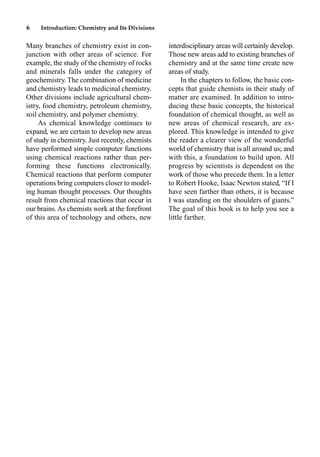
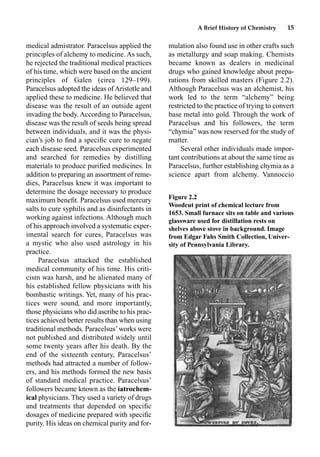
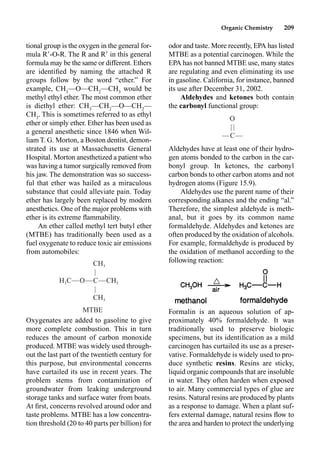
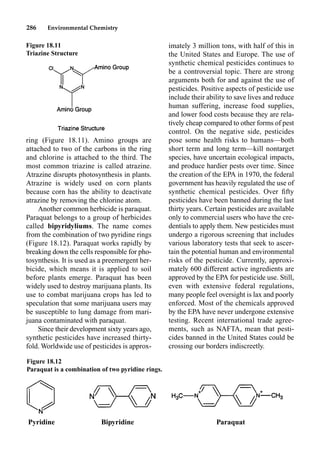
rations from skilled masters (Figure 2.2).
Although Paracelsus was an alchemist, his
work led to the term “alchemy” being
restricted to the practice of trying to convert
base metal into gold. Through the work of
Paracelsus and his followers, the term
“chymia” was now reserved for the study of
matter.
Several other individuals made impor-
tant contributions at about the same time as
Paracelsus, further establishing chymia as a
science apart from alchemy. Vannoccio
Figure 2.2
Woodcut print of chemical lecture from
1653. Small furnace sits on table and various
glassware used for distillation rests on
shelves above stove in background. Image
from Edgar Fahs Smith Collection, Univer-
sity of Pennsylvania Library.
16 A Brief History of Chemistry
Biringuccio (1480–1539) wrote Pirotech-
nia in 1540. This work was a basic text
written in Italian on the science of metal-
lurgy. Biringuccio’s work provided tech-
niques for processing metal, and he rejected
the alchemists’ idea of transmutation of
metals. A similar work focusing on the pro-
cessing of metals was Concerning Metals
written by Georgius Agricola (1494–1555).
Andreas Libavius (1540–1616) critiqued
Paracelsus. His work Alchemia published
in 1597 was a comprehensive review of
chemical knowledge available at the time.
Libavius’ work organized chemistry by
summarizing the methods, operations,
chemicals, and properties of chemicals.
Libavius entitled the section of Alchemia
describing the properties of substances
Chymia. The term “chymia” eventually
became the term “chemistry.” Libavius con-
tributed to the establishment of chemistry
as a unique discipline deserving study in its
own right.
By the start of the seventeenth century,
the stage had been set for transformation in
the study of chemistry. Up to this time,
chemistry played a central role in the arts
and crafts, but as a science, it had made only
modest advances from the days of Aristotle.
This started to change as individuals
adopted a scientific approach and subjected
the ideas of Aristotle to experimental test-
ing. By 1700, the walls of unquestioned
authority concerning scientific thought had
been shattered by individuals such as Gali-
leo, Isaac Newton, and Francis Bacon. The
time was now ripe for rapid changes in the
study of chemistry.
Introduction
Through the sixteenth century, the chemical
arts had advanced due to developments in
metallurgy, medicine, and alchemy. Physi-
cians, metal smiths, tanners, textile workers,
soap makers, and a host of other crafts peo-
ple and artisans employed chemical knowl-
edge to carry out their trades. Although
alchemy and the teaching of the ancient
Greeks persisted well into the nineteenth
century, increasingly individuals started to
conduct science by performing experiments.
Natural philosophers critically examined
ideas such as Aristotle’s four-element theory
and proposed alternative explanations to
describe the behavior of matter. Chemistry
was now ready to establish its own identity.
Throughout Europe during the two hundred-
year period from 1600 to 1800, natural
philosophers posed questions, experi-
mented, published their findings, and modi-
fied their ideas until the basic principles of
chemistry started to take shape. The story of
the developments leading up to the late
eighteenth-century chemical revolution
must be told through the individuals respon-
sible for this revolution.
The Beginnings of Modern
Chemistry
Jan Baptista van Helmont (1577–1644)
was one of the early iatrochemists who fol-
lowed the practices of Paracelsus. Van Hel-
mont developed the idea of a gas, which he
distinguished from ordinary air. He used the
term “spiritus sylvestrius” to describe the
gas produced during the combustion pro-
cess, and he realized that this same gas also
was produced during fermentation and when
acids reacted with sea shells. To van Hel-
mont, a gas was a substance that could not
be retained in a vessel and was invisible.Van
Helmont considered air and water as the
basic elements of matter, and so he never
associated different gases as new substances.
Because he could condense water vapor but
not ordinary air, he used the Greek word for
chaos, “khaos.” The Greek “kh” is phoneti-
cally pronounced as “g” in Flemish, and the
result was the English word gas. To van Hel-
mont, a gas was modified water, and water
was the basis for chemical change. In one of
his experiments van Helmont attempted to
prove that plants were transformed water.
Van Helmont planted a willow in a measured
3
The Birth of Modern Chemistry
18 The Birth of Modern Chemistry
weight of soil. Reweighing the soil and wil-
low after five years of watering, van Helmont
discovered no change in the weight of the
soil, but the willow had gained approxi-
mately 80 kilograms of weight. From this,
van Helmont concluded the water had been
converted into plant mass.
The most influential figure of seven-
teenth-century chemistry was Robert Boyle
(1627–1691). Boyle was born in Ireland to a
wealthy English family; his father was the
Earl of Cork. The Boyle’s family wealth
allowed Robert to pursue studies in natural
philosophy, free from worry about income
to support himself. While still in his teens,
Boyle traveled to Italy and was in Florence
when Galileo died. Boyle was greatly influ-
enced by Galileo’s approach to science, and
throughout his life based his approach to
science on an experimental, mathematical-
mechanical study of nature. Because of civil
unrest in his native Ireland, Boyle returned
to Oxford where he was a member of the
group known as the Invisible College. This
group was an informal, independent associ-
ation of thinkers devoted to developing new
ideas in science and philosophy.
Boyle, like many scholars of his day,
studied and published in a number of areas
including theology, philosophy, science, and
political thought. In the area of chemistry,
Boyle, in the tradition of van Helmont, stud-
ied gases. Aided by his assistant Robert
Hooke, Boyle used a vacuum pump to con-
duct experiments in which he discovered air
was necessary for life, sound does not travel
in a vacuum, and that the volume of a gas is
inversely proportional to pressure. This last
discovery is one of the basic gas laws, and
today is known as Boyle’s Law (see Chap-
ter 9). Boyle applied his work on gases to a
study of the atmosphere and determined the
density of air, and how atmospheric pressure
changes with elevation.
During the seventeenth century, an
atomic view of nature was employed to
explain the physical properties of matter.
Daniel Sennert (1572–1627) proposed four
different types of atoms corresponding to the
ancient elements of earth, air, fire, and water.
Boyle took an atomic view of nature believ-
ing that matter consisted of corpuscles (an
idea borrowed from Descartes), which were
particles of different size and shape. Like
van Helmont, Boyle considered air to be one
substance, but considered gases to be vari-
ous varieties of air rather than a different
form of water. Boyle’s studies included
appreciable work on chemical analysis. In
this area, Boyle rejected the idea that water
was an element. In one of his many experi-
ments, he boiled water in a flask for many
days, adding more water to replace water
that boiled away. Boyle discovered sediment
in the flask after the boiling process, and he
suggested this finding might indicate water
was a compound. He speculated that the sed-
iment may have come from the glass and
suggested weighing the glass before and
after the boiling process to determine the
source of the sediment. Boyle never repeated
the experiment to determine if the sediment
came from the glass. One hundred years later
Antoine Lavoisier (1743–1794) repeated
Boyle’s experiment and demonstrated that
indeed the sediment came from the glass
flask and had not been derived from the
water. Boyle’s lasting contribution to chem-
istry was his book The Sceptical Chymist
published in 1661. In this work, Boyle
sought to expose the inconsistencies and
paradoxes of chemical theory of his day.
Using the same approach that Galileo used
in his Dialogue, Boyle presented his ideas in
the form of a conversation between several
individuals. One person speaks forAristotle,
another for Paracelsus, and one who ques-
tions both systems by providing new expla-
nations for the behavior of matter. Boyle
refuted Paracelsus’ idea that salt, sulfur, and
mercury were basic substances. He also
advanced the corpuscular theory of matter
The Birth of Modern Chemistry 19
and used this theory to differentiate mixtures
from compounds. Boyle also performed
experiments on combustion with Robert
Hooke. Boyle and Hooke showed that com-
bustion of charcoal and sulfur required the
presence of air, and that these substances
could ignite in a vacuum when mixed with
saltpeter (potassium nitrate, KNO3
). Hence,
Boyle concluded there must be something
common to both air and saltpeter (which we
now know was oxygen). Boyle also did work
on acids and bases and he developed indica-
tors to distinguish between them.
John Mayow (1643–1679), a contem-
porary of Boyle, did important work on
combustion and respiration. Mayow iso-
lated gases emitted from combustion and
respiration by using a siphon to capture the
gases in a vessel underwater. Mayow dis-
covered that only part of a volume of air is
utilized during combustion and respiration.
Mayow called this part nitro-aerial particles.
The work, conducted in the 1600s, pointed
the way for advances that would take place
in chemical theory in the 1700s. The study
of gases, respiration, combustion, and calci-
nation were areas that sparked interest.
While we are familiar with the process of
combustion, to understand chemical devel-
opments in the 1700s, it is important to
understand the process of calcination. Cal-
cination is a process in which a metal is
heated without melting. During the proce-
dure, the metal’s volatile components
escape. Calcination is often employed as an
initial step in the extraction of a metal from
its ore. The material left after a substance
has undergone the calcination process is
known as a calx. Combustion and calcina-
tion have been known since ancient times.
Combustion was considered to be a process
in which something was removed from a
substance. The ancients thought that fire was
liberated when a substance burns. Paracel-
sus associated sulfur with combustion, and
Boyle proposed special fire particles to
explain combustion and calcination. In this
line of thinking, fire was the primary ele-
ment in the combustion/calcination process
and air played only a secondary role. Air
was the media that absorbed and transported
the fire away from a substance during com-
bustion. Using this interpretation, a candle
goes out when a jar is placed over it because
the air in the jar becomes saturated with fire.
Because the air cannot absorb any more fire,
the candle goes out.
Using the ancient idea of fire and its
modification over the ages, reasonable
explanations were developed for chemical
processes.Yet, a fundamental fact continued
to plague individuals working in chemistry.
Combusted substances weighed less after
combustion because fire had left the sub-
stance. This fact was consistent with the
four-element theory. Conversely, when met-
als were heated during calcination, they
gained weight. If fire was supposed to leave
a material, why did calcinified metals gain
weight? As more emphasis was placed on
quantitative methods in the 1700s, this prob-
lem grew increasingly troublesome.
The Phlogiston Theory
The phlogiston theory was an attempt to
formulate a comprehensive explanation for
chemical observations made up to the start
of the eighteenth century. John Becher
(1635–1682) is generally given credit for
laying the foundation of the phlogiston
theory. Born in Germany, Becher was a self-
educated scientist, economist, and busi-
nessman. Becher spent his life serving in the
administrations of European royalty, pro-
moting different industrial projects, and pur-
suing various other business schemes. He
never remained in place long, quickly wear-
ing out his welcome with his unfulfilled
promises. Included in the latter were a per-
petual motion machine and a contraption to
change sand into gold. Becher traveled
20 The Birth of Modern Chemistry
throughout Europe, always keeping one step
ahead of his enemies and detractors.
Although considered a charlatan by many,
Becher conducted and published serious sci-
entific studies. Becher proposed five funda-
mental elements: air, water, fusible earth,
fatty earth, and fluid earth. Fatty earth was
combustible earth, fusible earth did not
burn, and fluid earth was distillable.
Becher’s three earths were analogous to
Paracelsus’ sulfur (fatty earth), mercury
(fluid earth), and salt (fusible earth) princi-
ples of matter. Becher’s work summarized
many of the ideas of his predecessors and
included many ideas that the Chinese held
on chemical processes.
Becher did not develop his theory com-
pletely; this was left to his principal disciple,
the German physician George Stahl
(1660–1734). Stahl changed Becher’s term
for fatty earth (terra secunda) to phlogiston
and popularized the phlogiston theory. Phlo-
giston is derived from the Greek word phlo-
gistos meaning flammable. Stahl accepted
phlogiston as a real substance that was
responsible for combustion. Phlogiston had
no color or taste. Materials that burned
almost to completion, such as coal, were
believed to be almost completely phlogiston.
Substances that did not burn possessed little
or no phlogiston. Although we might be
quick to dismiss the phlogiston theory today,
we must remember that it was the accepted
theory for explaining a wide range of phe-
nomenon by the mid-1700s. The phlogiston
theory made sense of a number of chemical
observations and among these were:
• Combustibles lose weight when they burn
because they lose phlogiston.
• Charcoal almost burns completely because
it is almost entirely phlogiston.
• A flame is extinguished because the sur-
rounding air becomes saturated with phlo-
giston.
• Animals die in airtight spaces because the
air becomes saturated with phlogiston.
• Metal calxes turn to metal when heated
with charcoal because phlogiston transfers
from the charcoal to calx.
While the phlogiston theory explained a
number of observations, the problem of cal-
cination still remained. Why did metals
increase in weight when heated? After all, if
phlogiston left the metal during calcination,
the metal should weigh less. To accommo-
date the phlogiston theory, different solu-
tions were proposed to make the theory
work. This is precisely the way science
works. A theory develops and claims
widespread acceptance. As scientists use the
theory, observations and experimental re-
sults occasionally arise that are not consis-
tent with the theory. Scientists are then
forced to modify the theory in some fashion
to explain their results. In the case of the cal-
cination problem, some individuals pro-
posed different types of phlogiston. One
type had negative weight; therefore, when it
was liberated from the substance, the sub-
stance weighed more. The idea of negative
weight may sound a bit far-fetched, but we
must remember people were still consider-
ing only a few basic elements at that time.
It’s easy for us to reason a balloon stays sus-
pended in air because it contains helium,
and the balloon sinks as it loses helium. In
essence, negative-weight phlogiston was the
eighteenth-century equivalent to helium. It
was an attempt to resolve a major inconsis-
tency in accepted phlogiston theory, but as
further experimentation on gases ensued, a
new theory developed to take its place.
Pneumatic Chemistry
The stage was now set for a critical
examination of phlogiston theory and the
birth of modern chemistry. By the mid-
The Birth of Modern Chemistry 21
1700s, the study of chemistry as a distinct
discipline had been established. Although
the research of Boyle, van Helmont, Stahl,
and others provided a sound foundation to
build on, it was primarily a series of exper-
iments on gases that took place in the last
half of the eighteenth century that created
the science of modern chemistry. Several
men stand out as prominent figures who
contributed to the demise of the phlogiston
theory. Black, Priestley, and Cavendish con-
ducted important studies in Great Britain,
but it was a Frenchman who revolutionized
chemistry. Antoine Lavoisier synthesized
his work and that of other natural philoso-
phers into a modern theory of chemistry.
The pneumatic chemists did experi-
ments on gases. To do this work, a method
was required to generate and isolate the
gases produced in a chemical reaction. It
was important that the gases generated dur-
ing reactions not become contaminated with
air. An invention that facilitated the study of
gases was the pneumatic trough (Figure
3.1). Stephen Hales (1677–1761) perfected
this device in his studies of animal and plant
physiology. Hales’trough was nothing more
than a gun barrel bent and sealed at one end.
Hale placed a substance in the sealed end
and heated it. The open end of the barrel was
directed upward into a flask filled with water
and partially submerged in a bucket of
water. Any gas generated when a substance
was heated would be directed through the
tube and would displace the water in the
flask. Using Hales’ pneumatic trough, a
group of English chemists conducted impor-
tant experiments that assisted Lavoisier in
formulating his ideas.
Joseph Black (1728–1799) conducted
an important series of experiments during
work on his doctoral dissertation in
medicine. Black was searching for a mate-
rial to dissolve kidney stones. He chose
magnesia alba (magnesium carbonate), but
he found it could not be used for his primary
topic on kidney stones so he turned his
attention to stomach acidity. His studies of
magnesia alba were based on a number of
experiments on carbonates. Black observed
that magnesia alba reacted with acid to pro-
duce a gas and a salt. Black also worked
with limestone (calcium carbonate, CaCO3
)
and quicklime (calcium oxide, CaO) at the
same time, and so he thought that magnesia
alba, which behaved similarly to limestone,
might be another form of limestone. Black
subjected magnesia alba to calcination and
found that it lost a substantial amount of
weight during calcination. The residue left
after calcination did not behave at all like
quicklime. Because quicklime is obtained
when limestone is calcined, Black con-
cluded magnesium alba was not a form of
limestone. Black continued his investigation
by treating both the magnesia alba and the
calcined magnesia alba with acid. He found
that magnesia alba and acid produced a salt
and gas, while the calcined magnesia alba
Figure 3.1
Diagram of Pneumatic Trough (Rae Déjur)
22 The Birth of Modern Chemistry
produced the same salt but not the gas.
Blacks two reactions were
acid  magnesia alba p salt  gas
acid  calcined magnesia alba p salt
Black explained his results by determining
that calcination of magnesia alba gives off a
gas, and this gas is the same gas produced
when magnesia alba is treated with acid. It
should be remembered that Black inter-
preted his results based on phlogiston the-
ory. According to phlogiston theory, the
magnesia alba should have gained weight
when it was calcinated due to phlogiston
leaving the fire and flowing into the magne-
sia alba. Therefore, during the calcination of
magnesia alba, gas was given off and phlo-
giston was gained. Black then devised a
method to determine the weight of the gas
evolved from magnesia alba. Hales’ pneu-
matic trough would not work, because the
gas dissolved in water. Therefore, Black
weighed the acid and magnesia alba before
and after they reacted. Black measured the
difference in weights as the weight of gas
evolved. Once he did this, Black found that
the change in weight was close to the weight
loss when magnesia alba was calcined. This
result indicated that there was no weight
gain due to phlogiston entering the magne-
sia alba. Black could explain the changes
using conservation of mass without resort-
ing to a gain of phlogiston. The changes in
weight in magnesia alba could be explained
by the loss of a gas during both calcination
and reaction with an acid.
Black decided that the gas given off in
the reaction between magnesia alba and acid
was similar to one described by van Hel-
mont. He coined the term “fixed air” to indi-
cate that this gas was fixed or trapped in
magnesia alba. Black also recognized that
fixed air was the same gas produced in res-
piration, combustion, and fermentation.
Today, we know Black’s fixed air was car-
bon dioxide. Black published his work in
1756 in England, but it took a number of
years for word of his study to spread.
Black’s work inspired other British scientists
to study gases. He had demonstrated that
gases had to be accounted for in chemical
reactions, especially when looking at
changes in weight. Black also showed that
chemical reactions could be explained with-
out resorting to phlogiston. According to the
phlogiston theory, limestone, when heated,
absorbed phlogiston to become quicklime.
Black showed that the production of quick-
lime could be explained by the loss of fixed
air from limestone. Phlogiston was not
needed to explain the process, although
Black never abandoned the phlogiston
theory.
Joseph Black, upon completion of his
study on magnesia alba, received his medi-
cal degree. He published very little after this
study. Black taught at universities in Glas-
gow and Edinburgh, and continued to do
solid research, which he presented in his
lectures. One area in which he did important
work was heat and the latent heat of steam.
His work in this area inspired one of his stu-
dents James Watt to apply Black’s ideas in
making improvements to the steam engine.
Similar to Black, Daniel Rutherford
(1749–1819) studied gases for his medical
degree dissertation. Rutherford found that
common air contained a part that supported
respiration and a part that did not. Initially,
Rutherford assumed the part that did not
support respiration was contaminated by
fixed air. Rutherford experimented and
removed the fixed air, and he discovered the
uncontaminated air still did not support life
or combustion. Rutherford assumed the gas
he had isolated was ordinary air saturated
with phlogiston; hence, it was phlogisticated
air, which he referred to as noxious air.
What Rutherford had isolated was nitrogen,
and he is given credit for its discovery.
The Birth of Modern Chemistry 23
Another important figure in the chemi-
cal revolution was Joseph Priestley
(1733–1804). Priestley was a minister by
training who earned his living at various
times as a pastor, tutor, and school adminis-
trator. He had no formal science training,
and throughout his life he was branded a
dissident and radical. Early in his scientific
studies, Priestley met Benjamin Franklin
who sparked his interest in electricity. One
year after meeting Benjamin Franklin,
Priestley wrote The History of Electricity.
Priestley’s first investigations in chemistry
dealt with the gas produced in a brewery
near his parish in Leeds. Priestley discov-
ered he could dissolve the gas in water to
produce a pleasant tasting beverage. Priest-
ley had actually produced soda water, the
equivalent of sparkling water. Priestley’s
process for producing carbonated water was
made commercially feasible in the 1790s by
Jacob Schweppe (1740–1821), the founder
of the company that still bears his name.
Priestley’s work on electricity and gases
resulted in his election to the French Acad-
emy of Sciences in 1772, and he was also
honored by the Royal Society in 1773.
In 1772, the second Earl of Shelburne
employed Priestley as an advisor and per-
sonal secretary. This position gave Priestley
ample time and freedom to continue his
studies on gases. Priestley used a strong
magnifying glass to heat substances trapped
under glass, and in this manner he was able
to liberate gases from substances. He also
employed a pneumatic trough using mercury
instead of water. In this manner, Priestley
was able to isolate fixed air (CO2
) and a
number of other gases. He produced nitrous
oxide, N2
O, which he called dephlogisti-
cated nitrous air. Priestley noted dephlo-
gisticated nitrous air caused people to laugh,
and thus, this gas became known as laugh-
ing gas. Nitrous oxide was used years later
for anesthesia, and it is currently used as a
propellant in cans of whipped cream. Priest-
ley also isolated alkaline air (ammonia, NH3
)
vitriolic acid air (sulfur dioxide, SO2
), heavy
inflammable air (carbon monoxide, CO), and
nitrous acid air (nitrogen dioxide, NO2
). His
research on gases was summarized in a
series of volumes published between 1774
and 1786 entitled Experiments and Obser-
vations on Different Kinds of Air. Priestley’s
most famous studies concerned the produc-
tion of oxygen (Figure 3.2). Priestley heated
the calx of mercury (mercuric oxide, HgO)
and collected the gas. He observed that a
candle burned brightly in the gas. At first,
Priestley assumed the gas was dephlogisti-
cated nitrous air (N2
O) because of results he
had obtained previously. When Priestley fur-
ther examined the gas and its solubility prop-
erties, he decided it was not dephlogisticated
nitrous air but an entirely new gas. He
noticed that mice lived longer in the gas, and
the gas did not lose its ability to support
combustion as quickly as dephlogisticated
nitrous oxide. Priestley came to realize he
was dealing with a gas similar to common
air but with a greater ability to support com-
bustion and respiration. We know that Priest-
ley was dealing with oxygen, but Priestley
was a strong believer in phlogiston theory.
He explained his findings in terms of
phlogiston. Priestley assumed oxygen was
dephlogisticated air, common air in which
phlogiston had been removed. To Priestley,
dephlogisticated air was air that had the abil-
ity to absorb a substantial amount of phlo-
giston. Priestley was conservative in the
interpretation of his results, which was a
major difference between Priestley and
Lavoisier. Additionally, Lavoisier empha-
sized quantitative measurements in his study
of gases while Priestley placed secondary
importance on quantitative relationships.
Priestley left the employment of Lord
Shelburne in 1780 having made his major
scientific discoveries. Priestley’s political
24 The Birth of Modern Chemistry
and religious ideas continued to cause him
trouble within England. He had supported
the colonists in the Revolutionary War and
supported the French Revolution. His
unorthodox Unitarian views ran against
those of the Church of England. In 1782, he
published a book entitled History of Cor-
ruptions of Christianity, which was banned
by the Church of England. Eventually, the
situation got so bad for Priestley that his
home and church were burned by an angry
mob in 1791. Priestley was forced to move
to the United States in 1794, where he lived
the last decade of his life in Pennsylvania.
In 1874, on the 100th anniversary of Priest-
ley’s discovery of oxygen, a celebration was
held, and the event marked the founding of
the American Chemical Society. The high-
est honor this society gives is the Priestley
Award.
While Joseph Priestley generally re-
ceives credit for the discovery of oxygen, it
was Carl Sheele (1742–1786) who probably
deserves credit as the first to isolate oxygen.
Scheele was a Swede who became inter-
ested in chemistry during his apprenticeship
as an apothecary. Scheele acquired his own
pharmacy and during the process researched
the production of different medicines.
Scheele realized that common air contained
Figure 3.2
Apparatus used by Priestley for investigations on gases. The tub is Priestley’s pneumatic trough.
From Experiments on Different Kinds of Air. Image courtesy of School of Chemical Sciences,
University of Illinois at Urbana-Champaign.
The Birth of Modern Chemistry 25
a component that was responsible for com-
bustion and termed this component fire air.
Scheele succeeded in isolating fire air by
reacting nitric acid (HNO3
) and potassium
hydroxide (KOH) to obtain potassium
nitrate (KNO3
) and then heated the potas-
sium nitrate and used a salt to absorb the
nitrogen oxides from the gas produced. The
process resulted in fire air. Unfortunately, by
the time Scheele published his results in
1777, Priestley’s results were well known. In
addition to his work on gases, Scheele made
numerous other discoveries in the field of
chemistry. He is credited with the discovery
of a number of organic acids including tar-
taric, oxalic, uric, lactic, and citric. Scheele
also discovered numerous acids such as
hydrofluoric, hydrocyanic, and arsenic. The
fact that Scheele lived far from the centers
of scientific activity and died at the age of
44 contributed to his lack of recognition.
Scheele was a firm believer in phlogiston
theory and explained all his findings within
the phlogiston framework.
Another of the English pneumatic
chemists who made important discoveries
was Henry Cavendish (1731–1810). For
years, it was known that gas was produced
when metals reacted with acid. Cavendish
studied this gas and in 1766 used the term
“inflammable air” to describe the gas.
Cavendish’s inflammable air was hydrogen.
Because of its explosive nature, Cavendish
considered inflammable air to be pure phlo-
giston. Cavendish was able to demonstrate
water was a compound by combining
inflammable air (hydrogen) and dephlogis-
ticated air (oxygen) and using a spark to
ignite the mixture to produce water.
By 1780, a number of different types of
airs had been isolated and discoveries made
that raised serious questions about the
nature of matter. Air, earth, and water were
shown to be compounds and mixtures rather
than the basic elements from ancient times.
Fire was associated with the mysterious
material known as phlogiston. This phlogis-
ton could not be detected with the senses
and had either positive, negative, or no
weight depending on how experiments were
interpreted. The discoveries of Boyle, Black,
Cavendish, Scheele, Priestley, and other pio-
neer chemists were interpreted using the
phlogiston theory.Yet, phlogiston theory left
too many questions unanswered. Lavoisier,
like his contemporaries, was initially a con-
firmed phlogistonist, but his interpretation
of his own work and that of others lead him
to abandon phlogiston. Lavoisier’s work fol-
lowed Newton’s revelations in physics and
preceded Darwin’s theory of evolution and
established the modern science of chemistry
at the end of the eighteenth century.
Lavoisier
Antoine Laurent Lavoisier was a mem-
ber of the French nobility; his father was a
wealthy Parisian lawyer. Educated at the
best French schools, Lavoisier developed a
deep interest in science. Lavoisier showed
early promise in geology and astronomy, but
he also was interested in chemistry, which
he studied under Giullame Francois Rouelle
(1703–1770). Lavoisier was wealthy enough
to fund his own scientific studies, but he also
was involved in significant government
work and business dealings. In 1768,
Lavoisier purchased a position in a private
French tax-collecting firm known as Ferme
Générale. It was through this firm that
Lavoisier met his wife, Marie-Anne, who
assisted Lavoisier in his scientific endeavors
throughout his life.
Lavoisier’s serious work in chemistry
started around 1770. Lavoisier conducted
studies on the combustion of sulfur and
phosphorous and focused on the weight
increase during the combustion process.
Lavoisier’s work on combustion led him to
26 The Birth of Modern Chemistry
believe that a weight gain may accompany
all combustion and calcination reactions.
Lavoisier related his ideas on air being fixed
in substances during combustion and calci-
nation in a note dated November 1, 1772, to
the French Academy.
In 1774, Lavoisier’s work Opuscles
Physiques et Chymiques (Physical and
Chemical Tracts) appeared in print. This
book presented Lavoisier’s findings and was
based largely on repeating and expanding
upon the work of Joseph Black. Opuscles
indicated that Lavoisier believed calcination
and combustion involved combination with
some component of air. Initially, Lavoisier
thought fixed air was the gas involved with
calcination and combustion. At this point,
Lavoisier was still unclear about the gas
involved in combustion and calcination, and
he turned to the work of other natural
philosophers to point the way. This was typ-
ical of Lavoisier. Much of Lavoisier’s labo-
ratory work was based on repeating the
work of other scientists. Using this method
enabled Lavoisier to observe a wide range
of chemical observations and tie these
together without resorting to phlogiston.
After publication of Opuscles, Lavoisier met
with Priestley in Paris during the fall of
1774. Lavoisier also was familiar with the
work of French chemist Pierre Bayen
(1725–1798); Bayen also rejected the idea
of phlogiston. Bayen, like Priestley, had
reported that the calx of mercury when
heated produced fixed air in the presence of
carbon and another gas when carbon was
not present. Lavoisier also received a letter
from Scheele on his work in the fall of 1774.
Lavoisier resumed his work on com-
bustion and calxes in the spring of 1775. At
this time, Lavoisier wrote his initial paper
entitled On the Nature of Principles which
Combine with Metals During Calcination
and Increases Their Weight. A revised ver-
sion of this paper did not appear until 1778.
In this paper, Lavoisier said air consists of
two elastic fluids and distinguished between
active and inactive components of air.
Lavoisier’s reactive air was the same as
Priestley’s dephlogisticated air (oxygen).
Lavoisier slighted Priestley by not giving
Priestley due credit for helping him interpret
his work. Priestley felt Lavoisier was claim-
ing credit for his work, but Lavoisier was
equally adamant in staking claim to an orig-
inal interpretation of the role of dephlogis-
ticated air in combustion and calcination.
This claim irritated Priestley immensely and
resulted in a bitter rivalry between the two
for the rest of their lives.
In 1775, Lavoisier was appointed Chief
of the Royal Gunpowder Administration. In
this position, Lavoisier reformulated French
gunpowders and improved their quality to
become the best in Europe. At his arsenal
lab, Lavoisier continued his chemical exper-
iments. Lavoisier focused much of his atten-
tion on acids. He was the first to use the
term “oxygine” in September of 1777, a
word derived from the Greek terms oxys and
gen meaning acid producing. Lavoisier
believed incorrectly oxygine was a basic
component in all acids.
Another problem Lavoisier wrestled
with was the reaction of dephlogisticated air
and inflammable air (oxygen and hydrogen)
to produce water. Lavoisier repeated
Cavendish’s experiments. He also per-
formed an experiment where he passed
steam through a heated iron rifle barrel
obtaining hydrogen and iron calx (rust). By
decomposing water into hydrogen and oxy-
gen, Lavoisier claimed credit for demon-
strating water was a compound. Again,
others such as Cavendish, Priestley, and
James Watt had previously shown water was
a compound, but it was Lavoisier who
explained the true nature of water without
using phlogiston. Lavoisier conducted
numerous experiments with different gases,
The Birth of Modern Chemistry 27
isolating them and studying their character-
istics (Figure 3.3). By 1780, Lavoisier was
well into developing his new philosophy to
explain chemical reactions. He published
Reflections on Phlogiston in 1783. In this
work he attacked the phlogiston theory and
introduced his own oxygen theory to explain
chemical reactions.
Lavoisier’s ideas met initial resistance
from the established chemical community.
After all, phlogiston had been used for a
century to explain chemistry, and natural
philosophers had explained their work based
on phlogiston theory. The leading chemists
of the day, including Richard Kirwan
(1733–1812), Priestley, Cavendish, and Tor-
bern Bergman (1735–1784), not only
rejected Lavoisier’s ideas, but they also were
antagonistic toward him. This was not to say
that Lavoisier did not have support. Other
chemists had questioned phlogiston, but
they could not put forth an acceptable alter-
native theory. Lavoisier’s strongest disciples
were several of his countrymen. The French
chemists Claude Louis Berthollet (1749–
1822), Guyton de Morveau (1737–1816),
and Antoine Francois de Fourçroy
(1755–1809) joined Lavoisier in promoting
his new chemistry. In addition to Lavoisier’s
new theoretical explanation, he and his col-
leagues proposed a new system of nomen-
clature. Led by de Morveau, the French
associates proposed a new system of nam-
ing chemicals based on their elemental com-
position.At the time substances were named
using archaic names passed down through
the ages. Names such as fuming liquor of
Libavius (tin tetrachloride, SnCl4
), Epsom
Figure 3.3
Lavoisier conducting human respiration experiment while Madame Lavoisier takes notes.
Image from Edgar Fahs Smith Collection, University of Pennsylvania Library.
28 The Birth of Modern Chemistry
salt (magnesium sulfate, MgSO4
), azote
(nitrogen), and acid of salt (hydrochloric
acid, HCl) gave no indication of the true
composition of substances. In their Methods
of Chemical Nomenclature, published in
1787, the French chemists proposed a sys-
tem consisting of Latin and Greek names
using prefixes and suffixes to distinguish the
composition of substances. Using the new
nomenclature, chemists now had a language
that told them what a substance was made
of and pointed the way on how to make the
substance. The supporters of phlogiston
were reluctant to accept the system and ini-
tially rejected the new nomenclature.
Lavoisier summarized his ideas devel-
oped over the previous twenty years in his
seminal 1789 book Traité Élémentaire de
Chimie (Elements of Chemistry). This work
presented his findings on gases and the role
of heat in chemical reactions. He explained
his oxygen theory and how this theory was
superior to phlogiston theory. Lavoisier
established the concept of a chemical ele-
ment as a substance that could not be bro-
ken down by chemical means or made from
other chemicals. Lavoisier also presented a
table of thirty-three elements. The thirty-
three elements mistakenly included light
and caloric (heat). Lavoisier put forth the
modern concept of a chemical reaction, the
importance of quantitative measurement,
and the principle of conservation of mass.
The final part of Lavoisier’s book presented
chemical methods, a sort of cookbook for
performing experiments.
Lavoisier’s Elements of Chemistry syn-
thesized and explained in a coherent man-
ner the chemistry of his day. The work was
readily accepted by many as a substantial
improvement over the phlogiston theory.
Young chemists quickly adopted Lavoisier’s
ideas and new nomenclature rather than try-
ing to fit their work within a phlogiston
framework. Upon reading Lavoisier’s book,
many of the “old guard” became converts.
Lavoisier’s ideas spread quickly to other
countries. English, Spanish, German, Ital-
ian, and Dutch translations of Elements of
Chemistry were made within a few years.
Furthermore, Lavoisier actively promoted
his new chemical system in lectures,
reviews, and by lobbying fellow chemists.
Lavoisier’s greatest ally in his campaign
to promote the new chemical system was
Marie-Anne Lavoisier. In one episode,
Marie-Anne staged a scene where she pub-
licly burned the works of Stahl and other
books promoting phlogiston. Marie-Anne
served Antoine in several important capaci-
ties. As a gifted linguist and artist, she trans-
lated English works and illustrated his
publications. She served as a personal sec-
retary transcribing notes, editing papers, and
assisting in his laboratory experiments.
Lavoisier, by all accounts, was not a
humble person. Some suspect he took credit
for the work of others, was arrogant, and did
little original work. While true in some
respects, Lavoisier nevertheless synthesized
the vast wealth of chemical knowledge that
had accumulated by the end of the eigh-
teenth century. Lavoisier never discovered
an element or isolated a new gas, but what
he accomplished was far more important.
Lavoisier established chemistry as a modern
science and laid the foundation for the quan-
titative experimental methods of chemistry.
Lavoisier also served France throughout his
life as a public servant. His work on French
gunpowder has already been mentioned, but
Lavoisier also worked on reform in agricul-
ture, the measurement system (he was an
early proponent of the metric system), penal
systems, and medicine. Unfortunately,
Lavoisier fell victim to the Reign of Terror
of the French Revolution. As a partner of
Ferme Générale, he was associated with this
despised tax-collecting agency. Because
Lavoisier was a member of the French
nobility, he received little sympathy from the
revolutionaries. Although the case against
him was weak, Lavoisier was convicted and
executed by the guillotine on May 8, 1794.
By the end of the eighteenth century,
chemistry had established itself as a modern
science. Conservation of mass and the
accounting of reactants and products in a
chemical balance sheet, although established
early in the century, was perfected by
Lavoisier as a unifying principle in chemistry.
Lavoisier used conservation of mass to draw
conclusions, devise new experiments, and
transform ideas in chemistry. In this manner,
Lavoisier established a method for examining
chemical reactions that applies to this day.
Like Lavoisier, modern chemists work within
a theoretical framework and are guided by
general principles as they conduct experi-
ments. Experimental results collectively are
used to lend support or ultimately refute
accepted theories. Lavoisier’s experiments led
him away from the phlogiston theory, and in
so doing created another framework that
guided chemical thought. Lavoisier estab-
lished modern chemical reasoning and a
model for modern chemists. Lavoisier’s
experiments often required the modification
of equipment or fabrication of new equip-
ment. Likewise, advances in modern science
are dependent on advances in equipment and
technology. Lavoisier also stressed the impor-
tance of language in presenting the results of
science. Chemical nomenclature today is
highly specific with the names of substances
portraying their chemical composition using
a precise language. Finally, Lavoisier demon-
strated how chemical knowledge could be
used to better society and promote industry.
Lavoisier applied chemistry to real-world
problems such as improving agriculture,
manufacturing gunpowder, or developing
lighter-than-air balloons. Most modern
chemists operate in just this manner, apply-
ing chemical principles to a endless multitude
of practical problems.
The Birth of Modern Chemistry 29
Introduction
As the eighteenth century drew to a close,
Lavoisier’s new system of chemistry had
won the day. Mysterious phlogiston was no
longer needed to interpret chemical phe-
nomenon, yet phlogiston still had a few
staunch adherents such as Joseph Priestley.
Priestley persisted in his belief of phlogis-
ton until his death in 1804. By this time,
however, a whole new school of chemists
was busy wrestling with problems raised
by Lavoisier’s new chemistry. Foremost
among these problems was determining the
correct composition of substances and
assigning the correct relative masses to the
chemical elements. The relative mass refers
to the ratio of the mass of one element to
another, for example, how many times
heavier is oxygen than hydrogen. The com-
position and mass problems were closely
related. Without knowing the exact com-
position of a substance, it was impossible
to determine accurately the mass of indi-
vidual elements. Likewise, inaccurate rela-
tive masses of the elements brought into
question the exact composition of a sub-
stance. The mass/composition dilemma
was critical to advancing chemistry and
drew the attention of chemists at the start
of the nineteenth century. Atoms were
adopted and gradually accepted during the
first part of the century. By the end of
the century, the atomic model was one
of the fundamental theories in science and
fundamental particles comprising the atom
began to be discovered.
The Law of Definite
Proportions
The problem of chemical composition
was directly related to that of chemical com-
bination. Combining chemicals to produce
new substances had been a goal of individ-
uals throughout history. Lavoisier’s work
emphasized the quantitative study of chem-
ical combination. Chemists sought to deter-
mine the proportion in which chemicals
combined, and how much of one substance
it took to react with another. Rather than
combining substances using the alchemist’s
trial and error method, chemists sought to
determine the specific ratio of chemicals
involved in chemical reactions.
Jermias Benjamin Richter (1762–
1807) was one of the first chemists to focus
4
The Atom
32 The Atom
attention on the relative weights of the ele-
ments. Richter conducted experiments in
which he determined how much acid of
various types it took to neutralize bases.
Richter was searching for the underlying
mathematical relationships inherent in
chemical reactions. Richter used measure-
ments, math, and observations to decipher
chemical reactions. He coined the word
“stoichiometry,” which is still used to
describe mass balances associated with
chemical reactions. Richter based his cal-
culated atomic weights on equivalences, or
how much of one substance would react
with another. A specific amount of sulfuric
acid was used as a reference. Ernest Gott-
fried Fischer (1754–1831) brought atten-
tion to Richter’s work when he published
his German translations of Berthollet’s
study on chemical combinations.
According to Lavoisier’s disciple
Berthollet, when elements combined to
form compounds, the compounds contained
variable proportions of elements within
defined limits. Berthollet believed the com-
position of a compound depended on how
much of each element was present when the
compound was formed. If salt happened to
be produced by a process with ample
sodium and little chlorine, then it would be
enriched in sodium. Because of Berthollet’s
stature as a chemist, his views and ideas car-
ried great weight at the turn of the nine-
teenth century. He had based his ideas on
years of study. Berthollet had accompanied
Napoleon to Egypt and noticed that in salt
lakes sodium chloride reacted with lime-
stone (calcium carbonate) deposits to give
sodium carbonate and calcium chloride.
Berthollet knew from his lab work in France
that solutions of calcium chloride and
sodium carbonate reacted to give calcium
carbonate and sodium chloride. He now
observed the reverse reaction occurring in
Egypt’s salt lakes.
This observation provided evidence to
advance the idea of reversible reactions.
Berthollet analyzed many substances and
found their composition did vary within a
limited range strengthening his conviction
that substances did not display constant
composition. Joseph Louis Proust (1754–
1826) opposed Berthollet’s views on the
composition of substances. Proust’s chemi-
cal education began as an apprentice to his
apothecary father in Angers in western
France. Subsequently, Proust moved to Paris
and left for Spain during the French Revo-
lution. In Madrid, Proust held several aca-
demic positions and conducted studies in a
well-equipped laboratory. Through his anal-
yses of substances, Proust found that com-
pounds had a fixed and invariable chemical
composition. Proust based his findings
largely on careful studies of various metal
compounds of sulfates, carbonates, and
oxides. Proust discovered that laboratory-
prepared copper carbonate was no different
than copper carbonate found in nature.
Proust expressed his views clearly on the
composition of compounds:
The properties of true compounds are invari-
able, as is the ratio of their constituents. Between
pole and pole, they are found identical in these
two respects; their appearance may vary owing
to the manner of aggregation, but their proper-
ties never.
Proust put forth his views starting in 1799
and for the next ten years attacked Berthol-
Lake Reaction
2NaCl Ⳮ CaCO r Na CO Ⳮ CaCl
(aq) 3(s) 2 3(s) 2(aq)
sodium chloride Ⳮ calcium carbonate
r sodium carbonate Ⳮ calcium chloride
Lab Reaction
CaCl Ⳮ Na CO r CaCO Ⳮ 2NaCl
2(aq) 2 3(aq) 3(s) (aq)
calcium chloride Ⳮ sodium chloride
r calcium carbonate Ⳮ sodium chloride
The Atom 33
let’s ideas on variable composition. Proust
demonstrated that Berthollet’s results were
based on analyzing substances with impuri-
ties and pointed out several other flaws in
Berthollet’s methods. Berthollet countered
with his own explanations, but by 1808 he
adopted Proust’s view. Proust’s Law, also
know as the Law of Definite Proportions,
was one of the cornerstones in the develop-
ment of modern chemistry. The Law of Def-
inite Proportions meant that compounds had
a fixed chemical composition that could be
used to help determine the relative masses
of elements making up the compound.
Dalton and the Birth of the
Atomic Theory
John Dalton (1766–1844) was a Quaker
and largely self-educated schoolteacher who
developed an interest in chemistry as a
result of his work in meteorology. His early
scientific work included essays on meteoro-
logical observations, equipment, and color-
blindness (Daltonism). As a result of his
interest in meteorology and the atmosphere,
Dalton turned his attention to a study of
gases. He discovered that the vapor pressure
of water increases with temperature. Dalton
considered air to be a mixture of gases
rather than a chemical compound, and he
formulated the concept of partial pressure.
Dalton determined that the total pressure of
air was the sum of the individual pressures
exerted by individual gases in a mixture.
Furthermore, the pressure exerted by each
gas was independent of the other gases pres-
ent in the mixture.
One question that Dalton considered
and which guided his formulation of the
atomic theory was why the gases in air
formed a homogenous mixture and did not
separate according to density. Dalton knew
that water vapor was lighter than nitrogen,
and nitrogen was lighter than oxygen. Why
then didn’t these gases form stratified, or
separate, layers in the atmosphere? The rea-
son for this according to Dalton was that
gases diffused in each other. According to
Dalton, the forces between different gas par-
ticles were responsible for the mixing of
gases in the atmosphere. Like gas particles
repelled each other, and unlike gas particles
were neutral with respect to each other.
In attempting to explain the behavior of
gases, Dalton experimented on the solubil-
ity of gases in water. Dalton’s work on sol-
ubility was done with his close colleague
William Henry (1774–1836). Dalton was
convinced that the different solubility of
gases in water was due to the weight of the
ultimate particle of each gas, heavier parti-
cles being more soluble than lighter parti-
cles. Dalton needed to know the relative
weights of the different gases to support his
ideas on gas solubility. This need led him to
develop a table of comparative weights of
ultimate gas particles. In 1803, he presented
his table of relative weights (Table 4.1).
Over the next five years, he continued to
develop his ideas on atomism and work on
atomic weights.
As a result of his work on relative
weights, Dalton formulated the Law of
Multiple Proportions, which states that
when elements combine to form more than
one compound, then the ratio of the masses
of elements in the compounds are small
whole number ratios of each other. For
example, the elements carbon and oxygen
form the two compounds carbon monoxide
(CO) and carbon dioxide (CO2
). The ratio of
Table 4.1
34 The Atom
carbon to oxygen masses using Dalton’s
Table would be
Dalton’s Law of Multiple Proportions meant
that two elements combine in simple whole
number ratios. Dalton believed that com-
pounds found in nature would be simple
combinations. Hence, knowing that hydro-
gen combines with oxygen to give water,
Dalton’s formula for water would consist of
1 H and 1 O. Its formula would be HO using
modern nomenclature. Both Proust’s Law of
Definite Proportions and Dalton’s Law of
Multiple Proportions are outcomes of an
atomic view of nature. In 1808 Dalton pub-
lished his table of relative atomic weights
along with his ideas on atomism in A New
System of Chemical Philosophy.
Because Dalton did not know the chem-
ical formula for compounds, he assumed the
greatest simplicity. This worked fine for
some compounds such as CO or NO, but
introduced error for other compounds, for
example, assuming water was HO. Never-
theless, Dalton’s ideas laid the foundation
for the modern atomic theory. Dalton’s ideas
briefly summarized are:
1. Elements are made of tiny indivisible par-
ticles called atoms.
2. Elements are characterized by a unique
mass specific to that element.
3. Atoms join together in simple whole num-
ber ratios to make compounds.
4. During chemical reactions, atoms rear-
range themselves to form new substances.
5. Atoms maintain their identity during the
course of a chemical reaction.
Dalton’s work on relative weights, mul-
tiple proportions, and the atomic theory did
not have an immediate effect on chemists of
his day. Dalton’s ideas did provide a frame-
work for determining the empirical formula
of compounds, but his table of relative
weights was not accurate enough to give
consistent results. Many scientists still
debated the existence of atoms in the second
half of the nineteenth century. Still, little by
little, the atomic theory was adopted by
chemists as a valid model for the basic
structure of matter. While Dalton continued
his life as a humble tutor in Manchester,
other chemists used Dalton’s ideas to estab-
lish the atomic theory. Foremost among
these was Jöns Jacob Berzelius (1779–
1848) of Sweden, the foremost chemical
authority of the first half of the nineteenth
century.
Gay-Lussac and Avogadro’s
Hypothesis
Dalton’s work provided a system for
representing chemical reactions, but inev-
itably, conflicts arose when trying to resolve
Dalton’s idea on chemical combination with
experimental evidence. According to Dal-
ton, one volume of nitrogen gas combined
with one volume of oxygen to give one vol-
ume of nitrous gas (nitric oxide). Dalton
referred to combination of atoms as com-
pound atoms. Using Dalton’s symbols, this
reaction would be represented as
But when one volume of nitrogen reacted
with one volume of oxygen, the result was
two volumes of nitrous oxide, not one.
Joseph Louis Gay-Lussac (1778–1850) had
experimentally demonstrated that two vol-
umes of nitrous gas result from combining
one volume of nitrogen with one volume of
CO CO2
C 4.3 C 4.3
⳱ ⳱ 0.78 ⳱ ⳱ 0.39
O 5.5 O 11.0
C 0.78 2
in CO compared to CO ⳱ ⳱
2
O 0.39 1
The Atom 35
oxygen. Dalton could not use atomic theory
to explain Gay-Lussac’s results. Berzelius
knew Gay-Lussac’s experiments were cor-
rect and supported Gay-Lussac’s hypothesis
that volumes combined just like atoms. This
meant equal volumes of gases contained
equal numbers of atoms. If Gay-Lussac was
correct, then volumes could be used to
determine the correct formulas. All one
would have to do is determine the ratio of
combining volumes. This would be similar
to the practice of using the ratio of combin-
ing masses. Employing gas volumes gave
chemists another method for determining
atomic masses. It must be remembered that
at the time different formulas were obtained
depending on the atomic mass used. For
example, the formula for water could be
HO, H2
O, HO2
, or H2
O2
depending on
which values were used for the masses of
hydrogen and oxygen.
One way to resolve the problem of com-
bining volumes was to split the combining
atoms in two before the combination. But
atoms were supposed to be indivisible, and
so this was not an acceptable solution.
Berzelius urged Dalton to reexamine his
ideas in light of Gay-Lussac’s findings, but
Dalton would not accept Gay-Lussac’s
results. In 1811, Amedeo Avogadro (1776–
1856) resolved the problem using both
Dalton and Gay-Lussac’s ideas. Avogadro
hypothesized that equal volumes of gases
contain equal numbers of molecules as
opposed to atoms. Avogadro took the basic
unit of a gas as a molecule not an atom. This
meant when nitrogen and oxygen combined,
the reaction could be represented as
Avogadro had no experimental evidence to
back his claim, yet his hypothesis solved the
problem. It took fifty years for the scientific
community to accept Avogadro’s idea.
Today, we take for granted that common
gases such as hydrogen, oxygen, and nitro-
gen exist as molecules rather than atoms in
their natural state.
The Divisible Atom
Dalton proposed that atoms are the
basic building blocks of matter in the early
1800s. It is one thing to claim the existence
of atoms, but it is another to develop the
concept until it is readily accepted. A cen-
tury after Lavoisier’s chemical revolution
the true nature of the atom began to unfold.
Although the question about the true nature
of the atom concerned chemists, physicists
led the way in the study of the atom. Evi-
dence accumulated during the 1800s indi-
cated that Dalton’s atoms might not be
indivisible particles. As the twentieth cen-
tury unfolded, so did the mystery of the
atom.
One area of research that raised ques-
tions about the atom involved experiments
conducted with gas discharge tubes. Gas
discharge tubes are sealed glass tubes con-
taining two metal electrodes at opposite
ends of the enclosed tube (similar to small
fluorescent lights). During operation, the
metal electrodes are connected to a high
voltage power source. The negatively
charged electrode is called the cathode, and
the positively charged electrode is the
anode. Before a gas discharge tube is
sealed, most of the air is pumped out of it.
Alternatively, the tube may contain a gas
such as hydrogen or nitrogen under very low
pressure. During the last half of the nine-
teenth century, numerous improvements
were made in gas discharge tubes.
William Crookes (1832–1919) ob-
served a faint greenish glow and beam using
his own discharge tubes called Crookes
tube. Crookes noted that the beam in his
36 The Atom
tubes originated from the cathode, and
hence, the beams became known as cathode
rays. The tubes themselves took on the name
cathode-ray tubes (Figure 4.1). Crookes
conducted numerous experiments with
cathode-ray tubes. He observed that cathode
rays moved in straight lines, but they could
be deflected by a magnet. From this work,
Crookes concluded cathode rays were some
sort of particle, but other researches be-
lieved cathode rays were a form of light.
Part of the problem involved in inter-
preting cathode rays resulted from the
ambiguous results obtained by various
researchers. For example, cathode rays were
bent in a magnetic field supporting the par-
ticle view of cathode rays, yet when sub-
jected to an electric field, cathode rays were
not deflected. The fact that cathode rays
were not deflected in an electric field sup-
ported the view that cathode rays were a
form of electromagnetic radiation or light.
The true nature of cathode rays was ulti-
mately determined by a group of physicists
led by J. J. Thomson (1856–1940) at the
Cavendish Laboratory at Cambridge Uni-
versity.
Joseph John Thomson was appointed
head of the prestigious Cavendish Labora-
tory (endowed by the Cavendish family in
honor of Henry Cavendish) at the age of 28.
Thomson was a brilliant mathematician and
experimenter who tackled the problem of
cathode rays at the end of the nineteenth
century. Thomson’s initial experiments led
him to believe cathode rays were actually
negatively charged particles. Using cathode-
ray tubes in which the air had been evacu-
ated until a very low pressure was attained
(艐 1/200 atmosphere), Thomson demon-
strated cathode-rays could indeed be
deflected by an electric field. The failure of
previous researchers to evacuate their dis-
charge tubes to such low pressure had pre-
vented the cathode-ray beams from being
deflected in an electric field. Thomson was
convinced that cathode rays were particles
or in his terms “corpuscles,” but he still had
to determine the magnitude of the charge
and mass of his corpuscle to solidify his
arguments.
Thomson and his colleagues at Caven-
dish conducted numerous experiments on
cathode-rays. They used different gases
in their tubes, varied the voltage, and em-
ployed different metals as electrodes. As the
years went by and Thomson accumulated
more and more data, he was able to calcu-
late a charge to mass ratio for the corpuscle.
Thomson’s results startled the scientific
community. His results showed that the
charge to mass ratio (e/m) was one thousand
times greater than the accepted value for
hydrogen ions (hydrogen ions are just
protons).
At the time, hydrogen ions were the small-
est particle known to exist. Thomson’s
results could be interpreted as either the
charge of the corpuscle being one thousand
times greater than the hydrogen ion or the
mass of the corpuscle being 1/1,000 that of
Figure 4.1
Cathode-Ray Tube (Rae Déjur)
Thomson's Corpuscle Hydrogen Ion
Charge 1000e e
⳱
Mass m m
The Atom 37
the hydrogen ion. Thomson suspected the
charge of the corpuscle was equal and oppo-
site to that of the hydrogen ion, and there-
fore, assumed the corpuscle had a mass of
1/1,000 of a hydrogen ion. Thomson pub-
lished his results in 1897. Thomson’s cor-
puscles eventually came to be called
electrons based on a term coined by George
Stoney (1826–1911) to designate the funda-
mental unit of electricity.
While Thomson’s work proved the exis-
tence of electrons, his studies still left open
the question of the exact charge and mass of
the electron. Robert Andrew Millikan
(1868–1953) tackled this problem at the
University of Chicago by constructing an
instrument to measure the mass and charge
of the electron (Figure 4.2). Millikan’s
instrument consisted of two parallel brass
plates separated by about one centimeter. A
pinhole-size opening drilled into the top
plate allowed oil droplets sprayed from an
atomizer to fall between the two plates. The
opening between the two plates was brightly
illuminated and a microscopic eyepiece
allowed Millikan to observe individual oil
droplets between the two plates. Millikan
calculated the mass of oil droplets by mea-
suring how long it took an oil droplet to
move between the two uncharged plated.
Next, Millikan charged the top brass plate
positive and the bottom plate negative. He
also used an x-ray source to negatively
charge the oil droplets when they entered
the space between the plates. By varying the
charge, Millikan could cause the oil droplets
to rise or stay suspended between the plates.
Using his instrument and knowing the mass
of the oil droplet enabled Millikan to calcu-
late the charge of the electron, negative. In
1913 Millikan determined that the charge of
an electron was 1.591  1019
coulomb.
This is within 1% of the currently accepted
value of 1.602177  1019
coulomb. With
Millikan’s value for charge, the electron’s
mass could be determined. The value was
even smaller than given by Thomson and
found to be 1/1,835 that of the hydrogen
atom. Millikan’s work conducted around
1910 gave definition to Thomson’s electron.
The electron was the first subatomic parti-
cle to be discovered, and it opened the door
to the search for other subatomic particles.
In their studies with cathode rays,
researchers observed different rays traveling
in the opposite direction of cathode rays. In
1907, Thomson confirmed the rays carried
a positive charge and had variable mass
depending on the gas present in the cathode-
ray tube. Thomson and others found the pos-
itive rays were as heavy or heavier than
hydrogen atoms. In 1914, Ernest Rutherford
(1871–1937) proposed that the positive rays
were composed of a particle of positive
charge as massive as the hydrogen atom.
Subsequent studies on the interaction of
alpha particles with matter demonstrated
that the fundamental positive particle was
the proton. By 1919, Rutherford was cred-
ited with identifying the proton as the sec-
ond fundamental particle.
The last of the three fundamental parti-
cles is the neutron. Experimenters in the
early 1930s bombarded elements with alpha
particles. One type of particle produced had
the same mass of the proton, but carried no
charge. James Chadwick (1891–1974), in
collaboration with Rutherford, conducted
Figure 4.2
Picture of Millikan’s Instrument (Rae Déjur)
38 The Atom
experiments to confirm the existence of the
neutral particle called the neutron. Chad-
wick is credited with the discovery of the
neutron in 1932.
Atomic Structure
With the discovery of the neutron, a
basic atomic model consisting of three fun-
damental subatomic particles was complete.
While discoveries were being made on the
composition of atoms, models were ad-
vanced concerning the structure of the atom.
John Dalton considered atoms to be solid
spheres. In the mid-1800s, one theory con-
sidered atoms to consist of vortices in an
ethereal continuous fluid. J.J. Thomson put
forth the idea that the negative electrons of
atoms were embedded in a positive sphere.
Thomson’s model was likened to raisins
representing electrons in a positive blob of
pudding; the model was termed the “plum-
pudding” model as shown in Figure 4.3. The
negative and positive parts of the atom in
Thomson’s model canceled each other,
resulting in a neutral atom.
A clearer picture of the atom began to
emerge toward the end of the first decade
of the twentieth century. This picture was
greatly aided by several significant discov-
eries in physics. In 1895 while observing the
glow produced by cathode rays from a
sealed Crookes tube, Wilhelm Conrad
Roentgen (1845–1923) noticed that nearby
crystals of barium platinocyanide glowed.
Barium platinocyanide was a material used
to detect cathode rays, but in this case, the
cathode rays should have been blocked by
the glass and an enclosure containing the
Crookes tube. Roentgen also discovered that
a photographic plate inside a desk was
exposed and contained an image of a key
resting on top of the desk. Evidently what-
ever had caused the barium platinocyanide
to glow could pass through the wooden desk
but not through the metal key. Roentgen
coined the term “x-rays” for his newly dis-
covered rays. He was awarded the first
Nobel Prize in physics for his discovery in
1901.
Roentgen’s discovery of x-rays stimu-
lated great interest in this new form of radi-
ation worldwide. Antoine Henri Becquerel
(1852–1908) accidentally discovered the
process of radioactivity while he was
studying x-rays. Radioactivity involves the
spontaneous disintegration of unstable
atomic nuclei. Becquerel had stored ura-
nium salts on top of photographic plates in
a dark drawer. When Becquerel retrieved the
plates, he noticed the plates contained
images made by the uranium salts. Bec-
querel’s initial discovery in 1896 was further
developed by Marie Curie (1867–1934) and
Pierre Curie (1859–1906). Marie Curie
coined the word “radioactive” to describe
the emission from uranium.
Three main forms of radioactive decay
involve the emission of alpha particles, beta
particles, and gamma rays. An alpha parti-
cle is equivalent to the nucleus of a helium
atom. Beta particles are nothing more than
electrons. Gamma rays are a form of elec-
tromagnetic radiation.
Figure 4.3
Thomson proposed the atom consisted of
negative electrons embedded in a positive
pool, like raisins in plum pudding.
The Atom 39
Physicists and chemists doing pioneer
work on atomic structure employed
radioactive substances to probe matter. By
examining how radiation interacted with
matter, these researchers developed atomic
models to explain their observations.
Rutherford along with Johannes Wilhelm
Geiger (1882–1945), creator of the first
Geiger counter in 1908 to measure radia-
tion, and Ernest Marsden (1889–1970) car-
ried out their famous gold foil experiment
that greatly advanced our concept of the
atom. Rutherford’s experimental set-up is
shown in Figure 4.4.
Rutherford used foils of gold, plat-
inum, tin, and copper and employed
polonium as a source of alpha particles.
According to Thomson’s plum pudding
model, alpha particles would pass through
the gold with little or no deflection. The
uniform distribution of charge in Thom-
son’s model would tend to balance out the
total deflection of a positive alpha particle
as it passed through the atom. Rutherford,
Geiger, and Marsden found a significant
number of alpha particles that experienced
large deflections of greater than 90°. This
result surprised Rutherford who years later
described the phenomenon of widely scat-
tered alpha particles “as if you had fired a
15-inch shell at a piece of tissue paper and
it came back and hit you.” To account for
these experimental results, Rutherford pro-
posed a new atomic model in which the
atom’s mass was concentrated in a small
positively charged nucleus. The electrons
hovered around the nucleus at a relatively
great distance. To place the size of Ruther-
ford’s atom in perspective, consider the
nucleus to be the size of the period at the
end of this sentence, the electrons would
circle the nucleus at distances of several
meters. If the nucleus was the size of a
ping-pong ball, the electrons would be
about one kilometer away. Rutherford’s
planetary model represented a miniature
solar system with the electrons rotating
around the nucleus like the planets around
the sun. Most of the atom’s volume in
Rutherford’s model consisted of empty
space, and this space explained the results
from the gold foil experiment. Most alpha
particles passed through the foil with little
or no deflection. This occurred because the
net force on the alpha particle was close to
zero as it passed through the foil. The
widely scattered alpha particles resulted
when the positively charged alpha particles
approached the nucleus of a gold atom.
Because like charges repel each other, the
alpha particle would be deflected or even
back-scattered from the foil.
Table 4.2
Forms of Radiation
Figure 4.4
Rutherford’s Set-Up (Rae Déjur)
40 The Atom
Niels Bohr (1885–1962) advanced
Rutherford’s model by stipulating that an
atom’s electrons did not occupy just any
position around the nucleus, but they
occupied specific orbitals to give a stable
configuration. Bohr based his ideas on a
study of the spectrum for hydrogen. A
spectrum results when light is separated
into its component colors by a prism.
When visible light passes through a prism,
a continuous spectrum similar to a rain-
bow results. Light from a hydrogen dis-
charge tube does not produce a continuous
rainbow, but it gives a discontinuous pat-
tern of lines with broad black areas sepa-
rating the lines. Bohr proposed specific
electron energy levels or orbitals to
account for the lines produced in hydro-
gen’s emission spectrum. In Bohr’s model,
when the hydrogen in the tube became
energized by applying a voltage, electrons
jumped from a lower energy level to a
higher level. As they moved back down,
energy was released in the form of visible
light to produce the characteristic lines of
hydrogen in its spectrum. Figure 4.5 dis-
plays this graphically. While Bohr’s model
successfully explained hydrogen’s line
spectrum, it could not account for the
spectra obtained for gases with more than
one electron such as that for helium.
Nonetheless, Bohr had shown that matter
was discontinuous and introduced the idea
of the quantum nature of the atom.
Quantum Mechanics
World War I delayed advances in basic
research on the atom for several years as sci-
entists turned their attention to national
security. The end of WWI brought renewed
interest and further development on atomic
theory in the 1920s. Louis de Broglie
(1892–1977) from France introduced the
idea of wave properties of matter in his doc-
toral thesis in 1924. The Austrian Edwin
Schrödinger (1887–1961) formulated wave
mechanics to explain the behavior of elec-
trons in terms of wave properties. Werner
Heisenberg (1901–1976) from Germany
developed an atomic theory using matrix
mathematics. Schrödinger and Heisenberg’s
work between 1925 and 1928 contributed to
the formulation of quantum mechanics. In
quantum mechanics, the position and energy
of electrons are described in terms of prob-
ability. Rather than saying an electron is
located at a specific position, quantum num-
bers are used to describe each electron in an
atom. The numbers give the probability
of finding an electron in some region
surrounding the nucleus. The quantum-
mechanical model is a highly mathematical
and nonintuitive picture of the atom. Rather
than thinking of electrons orbiting the
nucleus, the quantum mechanical picture
places electrons in clouds of different
shapes and sizes around the nucleus. These
clouds are referred to as orbitals. Several
orbital are shown in Figure 4.6.
Figure 4.5
Electrons Changing Energy Level in the
Bohr Atom
Figure 4.6
Representation of Several Different Orbitals
The Atom 41
In the quantum-mechanical model of the
atom, electrons surround the nucleus in
orbitals, which are in regions called shells.
Shells can be thought of as a group of orbitals,
although the first shell contains only one
orbital. The number of electrons surrounding
the nucleus equals the number of protons in
the nucleus forming a neutral atom.An atomic
orbital is a volume of space surrounding the
nucleus where there is a certain probability of
finding the electron. The electrons surround-
ing the nucleus of a stable atom are located in
the orbitals closest to the nucleus. The orbital
closest to the nucleus has the lowest energy
level, and the energy levels increase the far-
ther the orbital is from the nucleus. The loca-
tion of electrons in atoms should always be
thought of in terms of electrons occupying the
lowest energy level available.An analogy can
be drawn to the gravitational potential energy
of an object. If you hold an object such as this
book above the floor, the book has a certain
amount of gravitational potential energy with
respect to the floor. When you let go of the
book, it falls to the floor where its potential
energy is zero.The books rests on the floor in
a stable position. If we pick the book up, we
used work to increase its potential energy and
it no longer rests in a stable position. In a sim-
ilar fashion we can think of electrons as rest-
ing in stable shells close to the nucleus where
the energy is minimized.
Orbitals can be characterized by quan-
tum numbers. One way to think of quantum
numbers is as the addresses of electrons sur-
rounding the nucleus. Just as an address
allows us to know where we are likely to
find a person, quantum numbers give us
information about the location of electrons.
We cannot be sure a person will be home at
their address, and we can never be exactly
sure an electron will be located within the
orbital. The address of electrons in an atom
is given by using quantum numbers and is
referred to as the electron configuration. The
electron configuration of each element pro-
vides valuable information about the ele-
ment’s chemical properties.
Four quantum numbers characterize the
electrons in an atom. These are:
1. The principal quantum number symbol-
ized by the letter n. The principal quantum
number tells which shell the electron is in
and can take on integral values starting
with 1. The higher the principal quantum
number, the farther the orbital is from the
nucleus. A higher principal quantum num-
ber also indicates a higher energy level.
Letters may also be used to designate the
shell. Orbitals within the same shell have
the same principal quantum number.
2. The angular momentum quantum number
is symbolized by the letter l. The angular
momentum quantum numbers gives the
shape of an orbital. Values for l depend on
the principal quantum number and can
assume values from 0 to n–1. When l  0,
the shape of the orbital is spherical,
and when l  1, the shape is a three-
dimensional figure eight (see representa-
tions in Figure 4.6). As the value of l
increases, more complex orbital shapes
result. Letter values are traditionally used
to designate l values.
The letter designation originated from
spectral lines obtained from the elements.
Lines were characterized as sharp, princi-
pal, or diffuse (s,p,d). Lines after d were
labeled alphabetically starting from the
letter f.
3. The magnetic quantum number symbol-
ized by ml
. The magnetic quantum num-
Principal Quantum Numbers
n 1 2 3 4 5 6
Shell K L M N O P
² Energy r
l value 0 1 2 3 4
Letter s p d f g
² Energy r
42 The Atom
ber gives the orientation of the orbital in
space. Allowable values for ml
are integer
values from l to 1, including 0. Hence,
when l  0, then ml
can only be 0, and
when ml
 1, ml
can be 1, 0, or 1.
4. The spin quantum number symbolized by
ms
. The spin quantum number tells how
the electron spins around its own axis. Its
value can be 1
⁄2
or 1
⁄2
, indicating a spin
in either a clockwise or counterclockwise
direction.
Using the above definitions for the four
quantum numbers, we can list what combi-
nations of quantum numbers are possible. A
basic rule when working with quantum
numbers is that no two electrons in the same
atom can have an identical set of quantum
numbers. This rule is known as the Pauli
Exclusion Principle named after Wolfgang
Pauli (1900–1958). For example, when n 
1, l and ml
can be only 0 and ms
can be 1
⁄2
or 1
⁄2
. This means the K shell can hold a
maximum of two electrons. The two elec-
trons would have quantum numbers of
1,0,0,1
⁄2
and 1,0,0,1
⁄2
, respectively. We
see that the opposite spin of the two elec-
trons in the K orbital means the electrons do
not violate the Pauli Exclusion Principle.
Possible values for quantum numbers and
the maximum number of electrons each
orbital can hold are given in Table 4.3 and
shown in Figure 4.7.
Using quantum numbers, electron con-
figurations can be written for the elements.
To write electron configurations we need to
remember that electrons assume the most
stable configuration by occupying the low-
est energy levels. We also must remember
that no two electrons can have the same four
quantum numbers. Let’s start with the sim-
plest element hydrogen and write several
configurations to demonstrate the process.
Hydrogen has only one electron. This elec-
tron will most likely be found in the K (n 
1) shell. The l value must also be 0. We don’t
need to consider the ml
and ms
since the for-
mer is 0 and the latter can arbitrarily be
assigned either plus or minus 1
/2
. The elec-
tron configuration for hydrogen is written as
Helium has two electrons. Both elec-
trons have n values of 1, l values of 0, and ml
values of 0, but they must have opposite
spins to conform to the Pauli Exclusion
Principle. Therefore, the electron configura-
tion of He is 1s2
. Lithium with an atomic
number of 3 has three electrons. The first
two electrons occupy the 1s orbital just like
helium. Because the 1s orbital in the K shell
can hold only two electrons, the third elec-
tron must go into the next lowest energy
level available in the L shell. This is where
the n value is 2 and the l value is 0. The elec-
tron configuration of lithium is thus 1s2
2s1
.
As the atomic number increases moving
through the periodic table, each element has
one more electron than the previous ele-
ment. Each additional electron goes into the
orbital with the lowest energy. The electron
configuration for the first twenty elements is
given in Table 4.4.
An examination of the electron config-
uration of the first 18 elements indicates that
the addition of each electron follows a reg-
Figure 4.7
Maximum Numbers of Electrons per
Orbital
The Atom 43
ular pattern. One would expect that the elec-
tron configuration of element 19, potassium,
would be 1s2
2s2
2p6
3s2
3p6
3d1
, but Table 4.4
indicates the 19th electron goes into the 4s
orbital rather than 3d. The same is true for
calcium with the 20th electron also falling
into the 4s orbital rather than 3d. It is not
until element 21, scandium, that the 3d
begins to fill up. The reason for this and sev-
eral other irregularities has to do with elec-
tron repulsion. It is easier for the electrons to
go into the 4th shell rather than the partially
filled 3rd shell.
The quantum mechanical model and
the electron configurations of the elements
provide the basis for explaining many
aspects of chemistry. Particularly important
are the electrons in the outermost orbital of
Table 4.3
Quantum Numbers
44 The Atom
an element. These electrons, known as the
valence electrons, are responsible for the
chemical properties elements display, bond-
ing, the periodic table, and many chemical
principles. The role the valence electrons
play will be discussed more fully when
these topics are addressed.
A Modern View of the Atom
Since the beginning of the twentieth cen-
tury whenThomson identified the electron as
part of the atom, hundreds of other subatomic
particles have been identified. Modern parti-
cle accelerators and atom smashers have
enabled scientists to catalog a wide variety of
particles each characterized by their unique
mass, charge, and spin. Murray Gell-Mann
(1929–) and George Zweig (1937–) indepen-
dently proposed the existence of quarks in
1963 as the basic constituents of matter. The
term “quark” was coined by Gell-Mann who
obtained it from a line in James Joyce’s 1939
novel Finnegans Wake: “Three quarks for
Muster Mark!” According to the quark the-
ory, small hypothesized particles call quarks
combine to produce subatomic particles.
Quarks carry a fractional charge of 1
/3
or
2
⁄3
. Six “flavors” or types of quarks make
up all subatomic particles. Each flavor of
quark can be further classified as having one
of three colors.These are not colors or flavors
as commonly thought of, but part of a classi-
fication scheme used to explain how matter
behaves.The language of quarks makes them
seem like some creation of fantasy, but the
quark theory can be used to explain many
properties of subatomic particles. For exam-
ple, a proton can be considered to be made of
two up quarks and a down quark, and a neu-
tron of two down quarks and an up quark
(Figure 4.8). Quark flavors and charges are
given in Table 4.5.
Table 4.4
Electron Configurations of the First 20
Elements
Figure 4.8
Structure of Protons and Neutrons
Table 4.5
Flavor and Charge of Quarks
The Atom 45
Electrons are not thought to be made of
quarks, but of another class of elementary
particles called leptons. Leptons do not
seem to be made of other particles and are
either neutral or carry a unit charge.
Atomic Mass, Atomic
Numbers, and Isotopes
The most basic unit of a chemical ele-
ment that can undergo chemical change is
an atom. Atoms of any element are identi-
fied by the number of protons and neutrons
in the nucleus. The number of protons in the
nucleus of an element is given by the
atomic number. Hydrogen has one proton
in its nucleus so its atomic number is one.
The atomic number of carbon is six, because
each carbon atom contains six protons in its
nucleus. Besides protons, the nucleus con-
tains neutrons. The number of protons plus
the number of neutrons is the mass number
of an element. A standard method of sym-
bolizing an element is to write the elements
with the mass number written as a super-
script and the atomic number as a subscript.
Carbon-12 would be written as
An element’s atomic number is con-
stant, but most elements have varying mass
numbers. For example, all hydrogen atoms
have an atomic number of one, and almost
all hydrogen atoms have a mass number of
one. This means most hydrogen atoms have
no neutrons. Some hydrogen atoms have
mass numbers of two or three, with one and
two neutrons, respectively. Different forms
of the same element that have different mass
numbers are known as isotopes. Three iso-
topes of hydrogen are symbolized as
Isotopes of elements are identified by
their mass numbers. Hence, the isotope
C-14 is the form of carbon that contains
eight neutrons. Isotopes of an element have
similar chemical properties. Therefore,
when we eat a bowl of cereal and incorpo-
rate carbon in our bodies, we are assimilat-
ing C-14 (and other carbon isotopes) along
with the common form of carbon, C-12.
The mass number gives the total num-
ber of protons and neutrons in an atom of an
element, but it does not convey the absolute
mass of the atom. To work with the masses
of elements, we use comparative masses.
Initially, Dalton and the other pioneers of
the atomic theory used the lightest element
hydrogen and compared masses of other ele-
ments to hydrogen. The modern system uses
C-12 as the standard and defines one atomic
mass unit (amu) as 1/12 the mass of one C-
12 atom. One amu is approximately 1.66 
10–24
g. This standard means the masses of
individual protons and neutrons are slightly
more than 1 amu as shown in Table 4.6.
The atomic mass of an element is actu-
ally the average mass of atoms of that element
in atomic mass units. Average mass must be
used because atoms of any elements exist as
different isotopes with different masses.Thus,
the atomic mass of carbon is slightly higher
than 12 with a value of 12.011. This is
because most carbon (99%) exists as C-12,
but heavier forms of carbon also exist.
Ions
Mass numbers and atomic masses focus
on the nucleus of the atom. Little has been
12
C
6
2 3
1
H H H
1 1 1
Hydrogen Deuterium Tritium
Table 4.6
Masses of Fundamental Atomic Particles
46 The Atom
said about electrons because the mass of
electrons is negligible compared to the mass
of protons and neutrons. Electrons have only
about 1/2,000 the mass of protons and neu-
trons. For an atom to remain electrically
neutral, the number of electrons must equal
the number of protons. When a neutral atom
gains or loses electrons, a charged particle
called an ion results. This process is known
as ionization. Positive ions are referred to
as cations, and negative ions are call
anions. Atoms gain or lose one or more
electrons to become ions. Ions are written
using the elements symbol and writing the
charge using a superscript. A simple equa-
tion can be written to symbolize the ioniza-
tion process. For example, when lithium
loses an electron to form Li
, the equation is
Li p Li
 e–
Several other equations representing the
ionization process are
F  e–
p F–
Ca p Ca2
 2e–
O  2e–
p O2–
Atoms do not gain or lose electrons in a
haphazard fashion. Chemical reactions
involve the loss and gain of electrons. In
fact, the chemical behavior of all substances
is dictated by how the substances’ valence
electrons interact when the substances are
brought together. This subject is introduced
in the next chapter in a preliminary discus-
sion of compounds, and the concepts form
the basis of our discussion on bonding.
Summary
The resurrection of Democritus’atom by
Dalton at the start of the nineteenth-
century was one of those seminal events in
the history of science. Dalton’s atom, while
not immediately accepted, nonetheless pro-
vided an organizing framework to guide
chemical thought for the next one hundred
years. Dalton’s atomic theory followed
closely on the heels of Lavoisier’s work, and
the work of these two scientists lit the path
that led to the development of modern chem-
istry. The atomic theory eventually became
the touchstone by which new chemical theo-
ries were judged, and it played a fundamental
role in the development of new branches of
chemistry such as organic chemistry, bio-
chemistry, and nuclear chemistry.The atomic
theory and the problem of atomic weights
was at the heart of the development of the
periodic table in the mid-1800s.
As the twentieth-century unfolded, the
internal structure of the atom began to
unfold, and as it did, immediate practical
uses were made of this knowledge. Roent-
gen’s x-rays were applied to medical diag-
nosis almost immediately after their
discovery in 1895. While humans have
always pondered the ultimate nature of mat-
ter, theoretical knowledge also provided the
hope of harnessing the atom’s energy. This
hope was realized in December of 1942
when Enrico Fermi (1901–1954) created the
first controlled chain reaction beneath the
football stadium at the University of
Chicago. This experiment led three years
later to the use of atomic weapons to end
World War II. Nuclear fission was initially
viewed as a new source of energy with vast
potential. The promise of nuclear power has
yet to be realized as nuclear accidents occur-
ring at Three Mile Island, Pennsylvania, in
1979 and Chernobyl, Ukrainia, in 1986
raised serious questions in the public’s mind
about the safety of nuclear power. Current
research on fusion may eventually lead to it
being employed as an energy source. More
will be said about this topic in the chapter
on nuclear chemistry (Chapter 17).
While the hope of obtaining energy
from atoms has diminished in recent years,
The Atom 47
there are numerous other applications based
on the atomic nature of matter. With simple
atoms and molecules as starting blocks,
organic synthesis led to the development of
the modern chemical industry. Over the
years, a host of materials have been pro-
duced that we naturally accept as part of
everyday life, for example, teflon, polyvinyl
chloride (pvc), polyester, and nylon. This
process continues as witnessed by the cre-
ation of the relatively new discipline of
material science.Advances in medicines and
pharmaceuticals are yet another aspect of
organic synthesis that owes its existence to
a fundamental knowledge of atomic theory.
The atomic theory is so rooted in
today’s science that we readily accept the
existence of atoms. Even though few of us
have observed them directly, we have faith
that everything around us is made of them.
Yet we continue to probe the structure of the
atom. It is interesting that we continue to
seek greater knowledge about the atom and
its smallest constituents in order to under-
stand the largest entity we can think of—the
universe. Just as Democritus’ quest was to
build a philosophical system to explain
nature, we continue to probe the atom in
hope of understanding the universe and our
place in it.
Introduction
Atoms rarely exist as individual units.
Atoms combine with each other to produce
the familiar substances of everyday life.
Chemistry is largely the study of how atoms
combine to form all the different forms of
matter. The reason atoms combine involves
the subject of chemical bonding, which is
explored in Chapter 7. In this chapter, the
grouping of atoms into different types of
compounds is examined. In the first half of
the chapter, chemical nomenclature is dis-
cussed. Some of the basic rules for naming
compounds are presented. Atoms combine
and are rearranged through chemical reac-
tions. The last half of the chapter examines
the basic process of chemical reactions and
classifies several different types of reactions.
Mixtures, Compounds, and
Molecules
An element is a pure substance that can-
not be broken down chemically.The smallest
unit of an element is an atom. When sub-
stances combine and retain their original
identity, the combination is called a mixture.
In a mixture, two or more substances are
brought together and no chemical reaction
takes place. Mixtures may consist of sub-
stances in the same or different physical
states. For example, bronze is an alloy con-
sisting of the two solid metals, copper and tin.
The most common solutions are mixtures of
a solid in a liquid. Mixtures may be classified
as homogenous or heterogeneous. Homoge-
nous mixtures consist of a uniform distribu-
tion of the substances throughout the mixture.
Air is a homogenous mixture of nitrogen,
oxygen, argon and other trace gases. Hetero-
geneous mixtures do not have a uniform con-
sistency.A bottle of salad dressing consisting
of separate layers of oil and vinegar is an
example of a heterogeneous mixture.
Substances resulting from the chemical
combination of two or more elements in
fixed proportions are called compounds. The
elements in compounds are chemically
bonded to each other. Most elements do not
exist in their free native state but are found
in combination with other elements as
chemical compounds. Compounds may
exist as ionic compounds or molecular com-
pounds. In ionic compounds, the constituent
elements exist as ions. Ions are atoms or
groups of atoms that carry a charge by virtue
of losing or gaining one or more electrons.
5
Atoms Combined
50 Atoms Combined
Ionic compounds result from the combina-
tion of a positive ion known as a cation and
a negative ion called an anion. Salt is an
ionic compound in which sodium cations
and chloride anions chemically combined.
Molecular compounds contain discrete
molecular units. Molecular units or mole-
cules are the smallest unit of a molecular
compound. Atoms in a compound are held
together by covalent bonds. Bonds dictate
how atoms are held together in a compound
or molecule, but for now, just think of ionic
compounds as compounds composed of
ions, and molecular compounds as com-
pounds composed of molecules. Sugar,
water, and carbon dioxide are examples of
molecular compounds.
While a compound consists of two or
more elements, a molecule consists of two
or more atoms. The water molecule is com-
posed of two atoms of hydrogen and one
atom of oxygen. Not all molecules will
contain different elements. The oxygen
molecule is made of two oxygen atoms, and
the ozone molecule consists of three oxygen
atoms.
Naming Elements
Just as the modern science of chemistry
developed from the ancient arts and
alchemy, so did the language of chemistry
progress from ancient roots. During ancient
times, humans knew of seven metals and
each of these was associated with the seven
known celestial bodies and the seven days
of the week. The characteristics of the metal
and celestial bodies were thought to be
related, and astrological symbols repre-
sented an early form of naming chemicals.
Gold was associated with the glowing sun,
and a circle, considered to be the most per-
fect shape, was used to represent it. Silver
was related to and represented by the moon.
Saturn, the most distant planet known at the
time, moved slowly across the sky and was
associated with the heavy metal lead. The
seven metals and their associated celestial
body and ancient symbols are shown in
Table 5.1.
As the ancients and alchemists discov-
ered more substances, an increasing number
of symbols were required to represent the
substances. Because different civilizations
used different symbols for the same sub-
stance, confusion resulted and there was no
common language to transfer chemical
knowledge.
This situation persisted up to the nine-
teenth century. Even Lavoisier, who put so
much effort in constructing an unambiguous
chemical language, used pictures to repre-
sent elements. Lavoisier and his colleagues
used letters enclosed in a circle, short
Table 5.1
Metal, Celestial Bodies, and Ancient
Symbols
Atoms Combined 51
straight lines, and semicircles to represent
substances. Hydrogen, sulfur, carbon, and
phosphorus were represented as Ž, Š, ‹, ‰,
respectively.
Dalton too would not divorce himself
from the use of pictures to represent ele-
ments and compounds. Dalton resorted to a
series of circles containing various patterns
and letters to represent substances. A sam-
ple of Dalton’s nomenclature is shown in
Table 5.2.
In 1814, the eminent Swedish chemist
Jacob Berzelius (1779–1848) discarded the
old sign language of chemical symbols and
proposed a new system based on the initial
letter of the element. Berzelius, in compil-
ing the Swedish Pharmacopia, used the ini-
tial letter of its Latin name to symbolize an
element. If two elements had the same first
letter, Berzelius would include a second let-
ter that the two elements did not have in
common. Using Berzelius’ system, hydro-
gen, oxygen, nitrogen, carbon, phosphorus,
and sulfur became H, O, N, C, P, and S,
respectively. Berzelius’ system utilized tra-
ditional Latin names for existing chemicals,
and this explains why some of our modern
symbols seem unrelated to its English name.
For example, gold comes from aurum (Au),
sodium from natrium (Na), and potassium
from kalium (K).
During the nineteenth and twentieth
centuries, as new elements were identified,
the discoverer received the honor of naming
the element. Different trends in assigning
names developed at different times. Ele-
ment names were based on mythological
figures, celestial bodies, color, chemical
properties, geographical areas, minerals,
derived names, and people. Table 5.3 gives
the derivation of names and symbols for the
common elements.
Naming Compounds
Berzelius’method of assigning letters to
represent elements was also applied to com-
pounds. Berzelius used superscripts to
denote the number of atoms in a compound.
Thus, water would be H2
O and carbon diox-
ide CO2
. Later these superscripts were
changed to the current practice of designat-
ing the number of atoms using subscripts.
The absence of a subscript implies the sub-
script one. Using symbols we can write the
chemical formula for ammonia:
The rule for naming compounds
depends on the type of compound. For ionic
compounds consisting of two elements
(binary compounds), we start by naming the
cation element. After the cation element is
named, the stem of the anion is used with
the ending “ide” added to the stem.
Anion
oxygen p oxide
nitrogen p nitride
chlorine p chloride
sulfur p sulfide
Table 5.2
Dalton’s Chemical Symbols
N H3
F
1 atom of 3 atoms of
Nitrogen Hydrogen
F
52 Atoms Combined
Examples of ionic compounds named
using this system follow:
NaCl sodium chloride
CaF2
calcium fluoride
BaO barium oxide
NaI sodium iodide
Two or more atoms may combine to
form a polyatomic ion. Common poly-
atomic ions are listed in Table 5.4.
The names of polyatomic ions may be
used directly in compounds that contain
Table 5.3
Symbols and Name Derivations for Common Elements
Table 5.4
Polyatomic Ions
Atoms Combined 53
them. Hence, NaOH is sodium hydroxide,
CaCO3
is calcium bicarbonate, and
Ba(NO3
)2
is barium nitrate.
Naming molecular compounds uses
Greek prefixes to indicate the number of
atoms of each element in the compound
or molecule. Prefixes are given in Table
5.5.
Prefixes precede each element to indi-
cate the number of atoms in the molecular
compound. The stem of the second element
is used with the “ide” suffix. The prefix
“mon” is dropped for the initial element,
that is, if no prefix is given, it is assumed the
prefix is one. Examples of molecular com-
pounds are:
CO2
carbon dioxide
CO carbon monoxide
CCl4
carbon tetrachloride
N2
O4
dinitrogen tetroxide
Some compounds are known by their
common name rather than their systematic
names. Many of these are common house-
hold chemicals. Table 5.6 summarizes some
of these common chemicals.
Table 5.5
Greek Prefixes
Table 5.6
Common Chemicals
54 Atoms Combined
Writing Chemical Formulas
Knowing the names of the elements and
a few basic rules allows us to name simple
compounds given the chemical formula. We
also can reverse the process. That is, if we
know the name of the compound, we should
be able to write the chemical formula. The
process is straightforward for molecular
compounds because prefixes are included in
the names. Hence, the formula for sulfur
dioxide is SO2
and carbon monoxide is CO.
Writing the formula for ionic com-
pounds requires us to know the charge of the
cation and anion making up the ionic com-
pound. Information on the charge of com-
mon ions can be obtained from the periodic
table. More will be said about this in Chap-
ter 7, but for now, a few basic rules will help
us write the formulas for simple ionic com-
pounds:
1. Elements in the first column (Group 1) of
the periodic table form ions with a 1
charge.
2. Elements in the second column (Group 2)
of the periodic table form ions with a 2
charge.
3. Generally speaking, elements in Group 13
(the column starting with the element B)
form ions with a 3 charge.
4. Oxygen and sulfur generally form ions
with a –2 charge.
5. The halogens, Group 17 (the column with
F at the top), form ions with a –1 charge.
Using these rules and the fact that a
compound carries no net charge allow us to
write the compound’s formula. This is illus-
trated for the compound magnesium chlo-
ride. Magnesium is a Group 2 element, so it
forms Mg2
ions. Chloride is a halogen and
forms Cl–
ions. For the compound magne-
sium chloride to be neutral, two chloride
ions must combine with one magnesium ion
to give MgCl2
. An easy way of determining
the formula on an ionic compound is to
write the elements with their charges over
them and then crisscross the charges to
make subscripts.
Notice that two choride ions, each with a –1
charge, are necessary to balance the 2
charge of the magnesium ion. If the sub-
scripts have a common factor, then that
common factor should be divided into both
subscripts. Therefore, the formula for bar-
ium oxide would be BaO.
The same method can be applied when a
polyatomic ion is one of the ions. For exam-
ple, the formula for sodium sulfate would be
Na2
SO4
.
Chemical Reactions
Chemical changes take place through
chemical reactions. Chemical symbols are
used to write chemical reactions in a chem-
ical equation. For example, when a mixture
of hydrogen gas (H2
) and oxygen gas (O2
)
ignites, the hydrogen and oxygen combine
to form water. A chemical equation express-
ing the combination of hydrogen and oxy-
gen to form water is
Let’s examine the chemical equation above
more closely. Hydrogen and oxygen are writ-
ten as molecules rather than atoms. Hydro-
gen, oxygen, and a number of other gases
(Cl2
, N2
, Br2
, I2
) exist in their natural state as
Atoms Combined 55
diatomic (two atoms) molecules. The reason
for this diatomic form becomes apparent
after we discuss electron configuration and
bonding. The plus sign in the equation
means “reacts with.” The equation states a
molecule of hydrogen reacts with a molecule
of oxygen to yield a water molecule. Hydro-
gen and oxygen are called reactants. Reac-
tants appear on the left side of a chemical
equation. Water is the product in the reac-
tion; products appear on the right side of
chemical equations. The standard practice
for writing a chemical equation is to write
the individual reactants on the left side sep-
arated by a plus sign and use an arrow point-
ing toward the product(s) on the right side.
The circles drawn below the equation are
used to represent the atoms.The circles indi-
cate this chemical equation is not balanced.
One of the basic principles of chemistry that
must be reflected in the chemical equation is
conservation of mass. An accounting of the
atoms in the formation of water shows an
imbalance in the number of oxygen atoms:
The process by which we make a chemical
equation conform to conservation of mass is
called balancing the equation. A chemical
equation is balanced by placing whole num-
ber coefficients in front of reactants and/or
products to make the number of atoms of
each element equal on both sides of the equa-
tion. In our example, this is done by placing
a 2 in front of both hydrogen and water
By balancing the equation, we see that the
number of hydrogen and oxygen atoms is
equal on both sides of the equation:
The balanced equation now reads two
molecules of hydrogen react with a molecule
of oxygen to yield two molecules of water.
Additional information may be included
when writing a chemical equation. One com-
mon practice is to indicate the physical state
of substances by use of the subscripts (s), (l),
(g), (aq) to indicate solid, liquid, gas, or
aqueous (dissolved in water), respectively.
Hence, the combustion of carbon to form
carbon dioxide would be represented as:
C(s)
 O2(g)
p CO2(g)
A small symbol over the arrow may be used
to indicate conditions necessary for the
reaction to take place. For example, a 
(Greek delta) over the arrow indicates that
heat is required for the reaction, and an h
indicates ultraviolet radiation is needed for
the reaction to take place.
Types of Reactions
The reactions of hydrogen and oxygen
to form water and carbon and oxygen to
yield carbon dioxide are examples of com-
bination reactions. A combination or syn-
thesis reaction results when two or more
substances unite to form a compound. Many
other types of reactions exist. Three other
common types of reactions are decompo-
sition, single replacement, and double
replacement.
Decomposition is the opposite of com-
bination. Decomposition takes place when
a compound breaks down into two or more
simpler substances. An electric current can
be used to decompose water into hydrogen
and oxygen:
Reactants Products
2 atoms of hydrogen 2 atoms of hydrogen
2 atoms of oxygen 1 atom of oxygen
Reactants Products
4 atoms of hydrogen 4 atoms of hydrogen
2 atoms of oxygen 2 atoms of oxygen
56 Atoms Combined
Decomposition reactions are used to obtain
pure metals from their ore.
In a single replacement reaction, one
element replaces another element in a com-
pound. An example of a single replacement
is when sodium is added to water. The reac-
tion of sodium and water is represented by
the following chemical equation:
2Na(s)
 2H2
O(l)
p 2NaOH(aq)
 H2(g)
Sodium displaces the hydrogen in the water
molecule. The displaced hydrogen is liber-
ated from the water resulting in the forma-
tion of hydrogen gas and sodium hydroxide.
Double replacement involves two ele-
ments exchanging places in a reaction. A
common type of double replacement reac-
tion occurs when a strong acid reacts with a
strong base. The reaction of hydrochloric
acid and sodium hydroxide would be an
example of a double replacement reaction:
HCl(aq)
 NaOH(aq)
p NaCl(aq)
 H2
O(l)
In the above reaction, hydrogen and sodium
exchange places. This reaction results in the
acid and base neutralizing each other.
From Molecules to Moles
Our discussion of balancing chemical
equations has focused on accounting for
atoms and molecules in both reactants and
products.Although a balanced equation tells
us how many atoms of an element it may
take to form so many molecules, it is
impractical to speak in these terms for com-
mon applications. For example, if we want
to know how much carbon dioxide is pro-
duced when some vinegar is added to bak-
ing soda, a practical unit for the carbon
dioxide would be liters or milligrams. Indus-
trial chemists often measure quantities in
gallons and tons. Atoms and molecules are
just too small to be convenient for practical
applications. The unit used to define the
amount of a substance in a chemical reac-
tion is the mole (mol). A mole is the quan-
tity of a substance that contains as many
particles (atoms, molecules, ions) as there
are atoms in exactly 12 grams of carbon-12.
The use of carbon-12 as a standard was
adopted in 1961 by international agreement.
Originally, Dalton had assigned an atomic
mass of 1 for hydrogen, and the atomic masses
of all other elements were based on this value.
Using a value of 1 for hydrogen gave an
atomic mass of 15.9 for oxygen. Because oxy-
gen was typically used in determining how
elements combined, it was decided it made
more sense to base atomic masses using an
oxygen standard. Oxygen was assigned a
value of 16; this designation meant hydrogen
had an atomic mass of slightly greater than 1.
A complication developed, though, because
oxygen consists of three isotopes. Different
samples of oxygen containing slightly differ-
ent ratios of the isotopes would have different
masses, which presented problems because
physicists were using oxygen samples to
determine atomic masses. In 1961, physicists
and chemists agreed to use the isotope carbon-
12 as the standard for atomic mass measure-
ments. Carbon-12 with six protons and six
neutrons was assigned a value of 12.0000 for
determining atomic masses.
What exactly does it mean to have as
many atoms as there are in 12 grams of C-12?
The number is known as Avogadro’s num-
ber, and its accepted value is 6.022  1023
.
Therefore, from the definition of a mole we
can say there are 6.02  1023
atoms in a mole
of C-12. The term Avogadro’s number was
coined by Jean Baptiste Perrin (1870–1942)
who was the first to experimentally determine
current
electric
r
2H O 2H Ⳮ O
2 (l) 2(g) 2(g)
Atoms Combined 57
an accurate value of this constant in 1908.
One mole of any substance contains approxi-
mately 6.02  1023
particles of the substance.
One mole of hydrogen atoms is equal to 6.02
 1023
hydrogen atoms, one mole of hydro-
gen molecules equals 6.02  1023
molecules
of hydrogen, and one mole of toothpicks is
6.02  1023
toothpicks.
The fact that both the mole and the mass
of an element are based on carbon-12
enables us to relate mole and mass. A molar
mass is defined as the mass in grams of one
mole of a substance, and it can be obtained
directly from an element’s atomic mass. We
can use the elements hydrogen and nitrogen
to illustrate this concept. Periodic table
entries for both elements are shown below.
The whole number above the element is the
atomic number and gives the number of pro-
tons in the nucleus. The number below the
element’s symbol is the molar mass (as well
as the atomic mass):
The entries indicate one mole of hydrogen
atom equals 1.00794 gram and one mole
of nitrogen atoms equal 14.0067 grams.
Because each hydrogen molecule contains
two hydrogen atoms, a mole of hydrogen
molecules contains two moles of hydro-
gen atoms. Therefore, one mole of hy-
drogen molecules, H2
, would equal 2 
1.00794  2.01588 grams. In a similar fash-
ion, the molar mass of ammonia, NH3
can
be calculated by totaling the molar masses
of constituent elements:
NH3
N 1  14.0067  14.0067
H3
3  1.00794  3.0238
17.0305
Therefore, one mole of ammonia contains
6.022  1023
NH3
molecules and has a mass
of 17.0305 grams; conversely, 17.0305
grams of ammonia equals one mole of
ammonia.
Coefficients in a balanced chemical
equation are typically taken to represent
moles. For the reaction of hydrogen and
nitrogen to form ammonia, the equation
N2(g)
 3H2(g)
p 2NH3(g)
can be read as one mole of nitrogen
molecules reacts with three moles of hy-
drogen molecules to yield two moles of
ammonia molecules. Knowing the moles
of reactants and product(s) in the balanced
equation allows us to express mass relation-
ships. The ammonia reaction expressed in
terms of mass tells us that approximately 28
grams of nitrogen reacts with 6 grams of
hydrogen to yield 34 grams of ammonia.
Having a balanced chemical equation
and knowing the relationship between mass
and moles allows us to predict how much
reactant is necessary to yield a certain
amount of product. This knowledge has
important applications in industrial chem-
istry, environmental chemistry, nutrition,
and in any situation where reactions take
place. The balanced equation is a recipe for
a chemical reaction. Just as it is necessary
to know the amount of eggs, flour, sugar,
and salt to bake a cake, we need to know the
amount of ingredients that go into a chemi-
cal reaction. The balanced chemical equa-
tion gives the quantities of different
reactants that are required to produce a spe-
cific amount of product.
We can illustrate this with a practical
problem having environmental implications.
The greenhouse effect refers to the heating
of the Earth due to the trapping of infrared
radiation by certain gases. A principal
greenhouse gas is carbon dioxide, CO2
.
58 Atoms Combined
International efforts in recent years have
attempted to limit the amount of carbon
dioxide produced by individual countries.
Because carbon dioxide is a principal prod-
uct when fossil fuel is burned, any limitation
on carbon dioxide has far-reaching effects
on a nation’s economy. Automobiles are a
chief producer of CO2
in the United States.
How much CO2
is produced by automo-
biles? Let’s calculate the amount of CO2
produced when a gallon of gas is burned.
We can simplify the problem a bit by assum-
ing the gasoline is octane and it reacts com-
pletely with oxygen to produce carbon
dioxide and water according to the equation:
One gallon of octane has a mass of
approximately 2,600 grams. The molar mass
of octane is 114 grams, so 2,600 grams of
octane is almost 23 moles of octane. Notice
that the coefficients of CO2
and C8
H18
in the
equation are 16 and 2, respectively. There-
fore, the balanced equation tells us that for
every mole of octane burned, eight moles of
carbon dioxide are produced. This means
182 moles of CO2
result (23  8). Because
carbon dioxide’s molar mass is 44 grams,
the amount of CO2
produced is about 8,000
grams. It is interesting to note that the ratio
of carbon dioxide produced to gasoline
(octane) burned is more than three to one.
Translated into English units, this means
that for every gallon (a gallon is about six
pounds) of gas burned, 18 pounds of carbon
dioxide are produced. Given the number of
cars in operation in this country, we see that
a tremendous amount of carbon dioxide is
emitted to the atmosphere every day. Indus-
tries and municipalities regularly use similar
calculations to predict the amount of pollu-
tion they are emitting to the atmosphere.
Such calculations help them conform to the
Clean Air Act.
Balanced chemical reactions are critical
to the chemical industry. Plant managers
must know the amount of reactants neces-
sary to yield a product to keep production
lines moving. If reactants or products are not
pure, this must be taken into account. Alter-
native reactions can be examined to find the
most cost-effective process. For example, a
fertilizer may be produced using one pro-
cess with sulfuric acid as a reactant or
another process that starts with ammonium
carbonate. Working through the balanced
equations for each process would help
decide which process to adopt.
A final example of an application of bal-
anced chemical equation involves the use of
one form of the breath analyzer used by
police to determine if someone was driving
under the influence of alcohol. The chemi-
cal equation guiding the reaction when
someone breaths into the instrument is
The equation shows that alcohol in the form
of ethanol reacts with an orange solution of
potassium dichromate to produce a green
solution of chromic sulfate. The source of
alcohol is the suspect’s breath. More alco-
hol produces a greater color change. The
breath analyzer measures this color change
and coverts this measurement into an
amount of alcohol in the blood.
In many instances, the ratio of reactants
available is different than that given by the
balanced chemical equation. When this
happens, the reactant in the smallest rela-
tive abundance is said to be limiting, while
the other reactant is referred to as the
excess reactant. Again, using the ammonia
reaction, we see the ratio of hydrogen to
nitrogen is 3 to 1. If three moles of both
2C H Ⳮ 25O r 16CO Ⳮ 18H O
8 18 2 2 2
octane Ⳮ oxygen r carbon dioxide Ⳮ water
3C H OH Ⳮ 2K Cr O Ⳮ 8H SO 3CH COOH
2 5 2 2 7 2 4 3
Ⳮ 2Cr (SO ) Ⳮ 2K SO Ⳮ 11H O
2 4 3 2 4 2
ethanol Ⳮ potassium Ⳮ sulfuric acetic acid Ⳮ chromic Ⳮ potassium Ⳮ water
dichromate acid sulfate sulfate
orange green
r
r
Atoms Combined 59
hydrogen and nitrogen are brought together,
the amount of hydrogen will limit the reac-
tion. Nitrogen will be in excess; two extra
moles of nitrogen would be left over after
the reaction is complete. An analogy may
help to illustrate the idea of excess and lim-
iting reactants. Suppose you wanted to
make bicycles. For each bicycle we need
two tires and one frame. Although other
parts are required, we can simplify the anal-
ogy by focusing on tires and frames. If we
had twenty tires and twenty frames, we
could build ten bikes. The tires would limit
the number of bikes, and the frames would
represent the excess reactant. Even if we
had one hundred frames, we could build
only ten bikes with twenty tires. A chemi-
cal reaction is analogous to building bikes.
One substance can be totally consumed
while another remains when the reaction
ceases.
One last point is that just because a
chemical equation indicates a chemical
reaction takes place, does not mean it will.
Many conditions are required for a chemi-
cal reaction to proceed. Conditions such as
heat, light, and pressure must be just right
for a reaction to take place. Furthermore, the
reaction may proceed very slowly. Some
reactions occur in a fraction of a second,
while others occur very slowly. Consider the
difference in the reaction times of gasoline
igniting in a car’s cylinder versus the oxida-
tion of iron to form rust. The area of chem-
istry that deals with how fast reactions occur
is known as kinetics (Chapter 12). Finally,
not all reactions go to completion. The
amount of product produced based on the
chemical equation is known as the theoreti-
cal yield. The amount actually obtained
expressed as a percent of the theoretical is
the actual yield. In summary, it’s best to
think of a chemical equation as an ideal rep-
resentation of a reaction. The equation pro-
vides a general picture of the reaction and
enables us to do theoretical calculations, but
in reality reactions deviate in many ways
from that predicted by the equation.
Introduction
If there were a flag that represented the sci-
ence of chemistry, it would be the periodic
table. The periodic table is a concise organi-
zational chart of the elements. The periodic
table not only summarizes important facts
about the elements, but it also incorporates
a theoretical framework for understanding
the relationships between elements. The
modern periodic table attests to human’s
search for order and patterns in nature. As
such, the periodic table is a dynamic
blueprint for the basic building blocks of our
universe. This chapter examines the devel-
opment of the modern periodic table and
presents information on how the modern
periodic table is organized.
Discovery of the Elements
The organization of the elements into
the first modern periodic table in 1869
depended on two important developments.
One was that enough elements had to be
identified to organize the elements into a
meaningful pattern. Nine elements were
known in ancient times. These were gold,
silver, iron, mercury, tin, copper, lead, car-
bon, and sulfur. Bismuth, zinc, antimony,
and arsenic were isolated in the alchemical
period and Middle Ages. By the start of the
nineteenth century, approximately thirty ele-
ments had been identified, and this number
doubled over the next sixty years. Currently,
116 elements have been identified, but sci-
entists at research labs throughout the world
are attempting to create more using high
speed particle accelerators. Figure 6.1 gives
the approximate dates of the discovery of
elements during different time periods.
As the number of elements increased, so
did attempts to organize them into mean-
ingful relationships. Johann Döbereiner
(1780–1849) discovered in 1829 that certain
elements had atomic masses and properties
that fell approximately mid-way between the
masses and properties of two other ele-
ments. Döbereiner termed a set of three ele-
ments a triad. Thus, chlorine, bromine, and
iodine form a triad; Döbereiner proposed
several other triads (lithium-sodium-
potassium, calcium-strontium-barium). Dö-
bereiner recognized that there was some sort
of relationship between elements, but many
elements did not fit in any triad group, and
even those triads proposed displayed numer-
ous inconsistencies.
6
Elements and the Periodic Table
62 Elements and the Periodic Table
John Newlands (1837–1898) attempted
to organize the elements by listing them in
order of increasing atomic mass. Newlands
prepared a table with elements grouped in
columns of seven elements. Several rows in
Newlands’ table contained related elements
and also included Döbereiner’s triads.
Because there was some evidence of char-
acteristics repeating with every eighth ele-
ment, Newlands proclaimed a law of
octaves for the elements. Newlands’ table
listed the elements in a continuous manner
and did not leave any blank spaces. His
adherence to a rigid organizational scheme
resulted in a number of inconsistencies.
Other chemists ridiculed Newlands when he
presented his table at conferences and meet-
ings between 1863 and 1865. In fact, there
was so much skepticism regarding his work
that he was unable to get it published.Years
later Newlands was vindicated when others
recognized his insight of recognizing peri-
odic patterns among the elements.
The second development that led to the
modern periodic table was the acceptance of
specific atomic masses for the elements.
While today we readily accept the masses
given in a periodic table, there was much
disagreement regarding masses in the mid-
nineteenth century. A major problem that
was not recognized until that time is that
some elements exist in their natural state as
atoms, while others exist as molecules. The
element hydrogen (H) has an atomic mass
of approximately 1, but hydrogen exists as
a diatomic molecule (H2
) with a mass of
approximately 2. The existence of molecules
and Avogadro’s law was the key for deter-
mining universally accepted atomic masses.
Although Avogadro put forth his ideas in
1811, the concept of molecules as a basic
unit of matter was not widely accepted in
the mid-nineteenth century. The situation
changed when Stanislao Cannizzaro
(1826–1910), a disciple of Avogadro’s ideas,
resurrected Avogadro’s work at the First
International Chemical Congress convened
in Karlsruhe, Germany, in 1860. Cannizzaro
vigorously defended the existence of
molecules using Avogadro’s law as a basis
for determining the correct atomic masses
of the elements. Cannizzaro circulated a
paper he had written in 1858 outlining his
ideas on the matter. This paper helped per-
suade several prominent chemists on the
utility of incorporating Avogadro’s law into
Figure 6.1
Discovery Dates of the Elements
Elements and the Periodic Table 63
their thinking. Cannizzaro’s crusade and the
Karlsruhe Conference ultimately resulted in
universally accepted values for atomic
masses.
Two chemists in attendance at the Karls-
ruhe were Julius Lothar Meyer (1830–1895)
and Dmitri Mendeleev (1834–1907). These
two independently developed the periodic
law and constructed their own versions of
the periodic table. Meyer based his table pri-
marily on the physical properties of the ele-
ments. Meyer plotted atomic volume against
the atomic mass and noticed the periodicity
in volumes of the elements. Other physical
properties also showed periodic trends. Fig-
ure 6.2 shows how the melting point of the
first fifty-five elements rises and falls in a
roughly periodic fashion as atomic number
increases. Based on his analysis, Meyer
published his periodic table in 1870.
Despite Meyer’s efforts, Mendeleev
receives the majority of credit for the mod-
ern periodic table. Mendeleev’s table
resulted from years of work examining the
properties of the elements. Mendeleev’s
method involved writing information about
the elements on individual cards and then
trying to organize the cards in a logical
order. His genius resulted from modifica-
tions he introduced into his table that others
had not included. He produced his table in
1869 as part of a text he had written for
chemistry. Mendeleev did not always
arrange the elements in strict order of
atomic masses, and he claimed that several
of the accepted atomic masses were wrong.
More important, he left blank spaces in his
table where he claimed undiscovered ele-
ments existed. Two of the empty spaces fell
right after aluminum and silicon, respec-
tively. Mendeleev named these undiscovered
elements eka-aluminum and eka-silicon
(“eka” is the Sanskrit word for first, so eka-
aluminum was first after aluminum). Using
his knowledge about the periodic properties
of the elements, he predicted the chemical
and physical properties of eka-aluminum
and eka-silicon. In 1875, the element gal-
lium (named after ancient France, Gaul)
was discovered, which turned out to be
Mendeleev’s eka-aluminum. The properties
of gallium were almost identical to those
Mendeleev had predicted as seen in Table
6.1. Germanium (named after Germany)
discovered in 1886 turned out to be
Mendeleev’s eka-silicon. Scandium (named
for Scandanavia) discovered in 1879 was
another element Mendeleev had predicted
with his table.
Mendeleev’s periodic table (Figure 6.3)
was used with little modification until well
into the twentieth century. The top of each
Figure 6.2
Periodic Trend of Melting Point
64 Elements and the Periodic Table
group gives the general formula for how the
group’s elements combine with hydrogen
and/or oxygen. Blank spaces appear at
atomic masses of 44, 68, 72, and 100 for
undiscovered elements. At the turn of the
century, the discovery of the noble gases led
to the addition of another column. Since the
time of Mendeleev’s original table, many
different versions of the periodic table have
appeared. These include three-dimensional,
circular, cylindrical, and triangular shapes.
Yet, Mendeleev’s basic arrangement has
stood the test of time, and the periodic table
is the universally recognized icon of chem-
ical knowledge.
The Modern Periodic Table
Elements in the modern periodic table
are arranged sequentially by atomic number
in rows and columns. Mendeleev and his
contemporaries arranged elements accord-
ing to atomic mass. In 1913, Henry Mose-
ley’s (1887–1915) studies on the x-ray
diffraction patterns for metals showed a
relationship between the spectral lines and
the atom’s nuclear charge. Moseley’s work
established the concept of atomic number,
the number of protons in the nucleus, as the
key for determining an element’s position in
the periodic table. Rows in the periodic table
are referred to as periods, and columns are
called groups. The periods run left to right,
and the groups from top to bottom. A group
may also comprise a chemical family. The
first and second groups are the alkali met-
als and alkaline earth metals, respectively.
The group starting with fluorine (F) is the
halogen family (halogen means salt form-
ing). The last group on the far right of the
table is the noble gas family.
Groups are numbered across the top of
the table. Unfortunately, Americans and
Europeans have different group numbering
systems that at times cause confusion. The
American system uses Roman numerals fol-
lowed by either the letter A or B. The A
groups are known as main group or repre-
sentative elements. Those groups with the
letter B comprise the transition elements.
Main groups fall at both ends of the periodic
table with transition elements in the center.
The European system also uses Roman
numerals and the letters A and B, but the A
is used for groups on the left half of the table
and B for groups on the right half. In recent
years, scientists have suggested eliminating
the letters and using the Arabic numerals
1–18 to number each group starting on the
left. We use the latter method to identify
groups.
The Main Group Elements
To understand how elements are orga-
nized into different groups, we need to con-
sider the electron configuration of elements.
Specifically, it is the electron configuration
of the valence electrons that characterizes
groups. Remember, the valence electrons
are those electrons in the outer shell. We can
use Group 1 to illustrate how the valence
electron configuration defines the group.
The electron configurations of Group 1 ele-
ments are listed on page 66.
Table 6.1
Comparison of Mendeleev's Prediction and
Actual Properties for Eka-Aluminum
(Gallium)
Mendeleev’s
Prediction
Actual
Properties
Atomic Mass 68 69.7
Melting Point low 29.8C
Density 5.9 g/cm3
5.9 g/cm3
Oxide X2O3 Ga2O3
Figure 6.3
Mendeleev’s 1869 Periodic Table (Top) and 1870 Table (bottom). Image from Edgar Fahs Smith
Collection, University of Pennsylvania Library.
66 Elements and the Periodic Table
H 1s1
Li 1s2
2s1
Na 1s2
2s2
2p6
3s1
K 1s2
2s2
2p6
3s2
3p6
3d10
4s1
Rb 1s2
2s2
2p6
3s2
3p6
3d10
4s2
4p6
4d10
4f14
5s1
Cs 1s2
2s2
2p6
3s2
3p6
3d10
4s2
4p6
4d10
4f14
5s2
5p6
5d10
6s1
Fr 1s2
2s2
2p6
3s2
3p6
3d10
4s2
4p6
4d10
4f14
5s2
5p6
5d10
6s2
6p6
7s1
We see from the electron configurations that
all Group 1 elements have a valence config-
uration of ns1
, where n is the period of the
element. Electron configurations for ele-
ments in Groups 2 and 13–18 show a regu-
lar pattern similar to that demonstrated
above. Each group would have its own dis-
tinctive valence electron configuration:
Group Valence Electron
Configuration
1 ns1
2 ns2
13 ns2
np1
14 ns2
np2
15 ns2
np3
16 ns2
np4
17 ns2
np5
18 ns2
np6
Groups 1 and 2 together are often referred
to as the s-block, and Groups 13–18 are the
p-block elements. These names come from
the valence orbital being filled in each
block. In the s-block, the s orbital is filled,
while in the p-block, the p orbital is pro-
gressively filled across a period.
The valence electron configuration
explains why groups define chemical fami-
lies that exhibit similar chemical properties.
Because it is the valence electrons that
determine an element’s chemical behavior,
and groups have similar valence electron
configurations, then elements in the same
group display similar chemical behavior.
The electron configuration also explains the
periodic law. We can demonstrate this by
examining how one property, the atomic
radius, changes moving across a period.
Lithium is the first element in the 2nd period
with an atomic number of 3. It has an atomic
radius of 152 picometers (pm). As we move
across the 2nd period, the atomic number
increases in increments of one. Each time
the atomic number increases one more pro-
ton is added to the nucleus and one addi-
tional electron is added to the 2nd electron
shell. Because each electron goes into a
shell where the principal quantum number
is 2, and the principal quantum number
gives the average distance from the nucleus,
we would expect the radii of atoms across
the period to stay constant. In reality, mov-
ing across the period there is a tendency for
the radii to decrease. This happens because
as protons and electrons are added, the pos-
itive nucleus exhibits a relatively stronger
pull on the cloud of electrons in the 2p
orbital. This trend continues across the
period until we reach sodium. At this point,
an additional electron must go into the 3rd
shell, and the radius displays a “jump” from
neon. After this abrupt increase in sodium’s
radius occurs, a trend similar to that for
period 2 repeats itself in period 3. This trend
is demonstrated in Figure 6.4, which is a
graph of atomic radii versus atomic number
for periods 2 and 3.
The periodic trend of a decrease in
atomic radii across a period is readily seen
in the Figure 6.4. Other properties related to
atomic radii show a similar pattern. Know-
ing that the elements exhibit a general peri-
odic trend allows us to predict unknown
properties for elements and aided in the dis-
covery of unknown elements. The periodic
nature of the elements supported the devel-
opment of the quantum theory. The ele-
ments show a periodic pattern in both their
properties and electron configurations. The
periodic trend in properties of the elements
Elements and the Periodic Table 67
should be interpreted as a general pattern
that elements in the periodic table follow.
There are many examples of deviations
from the periodic law. It should not be
viewed as a strict rule, but as pattern that
presents general trends among the elements.
d and f Block Elements
The elements in Groups 3 to 12 are
called the transition elements or transition
metals.Transition elements are characterized
by a filling of the d orbitals from left to right
across a period. Collectively these elements
form the d-block of the periodic table. The
d-block groups do not demonstrate the con-
sistent pattern displayed by main group ele-
ments. In general, though, the pattern of
filling the d orbital gives transition elements
a nd1–10
configuration. For example Group 3
elements have nd1
electrons, and Group 12
nd10
electrons, where n represents the period.
The two periods at the bottom of the
periodic table represent two special groups
that fall between the s and d blocks. The
period beginning with lanthanum (La) is
called the lanthanides.The next period begin-
ning with actinium (Ac) is the actinides. Ele-
ments in these two periods form the f-block.
Moving across each period the f orbital is
progressively filled; the 4f orbital is filled for
the lanthanides, and the 5f orbital is filled
for the actinides. These elements are some-
times referred to as the rare earths, because
it was originally difficult to separate and
identify these elements. Rare earths are actu-
ally not scarce, but the term “rare earths” is
still used for the lanthanides and actinides.A
more accurate modern term for these two
periods are the inner transition elements.
Metals, Metalloids, and
Nonmetals
Figure 6.6 summarizes different blocks,
families, and areas of the periodic table.
Most elements can be classified as metals.
Metals are solid at room temperature, are
good conductors of heat and electricity, and
form positive ions. Moving across the table
from left to right elements lose their metal-
lic characteristics. The metalloids, also
known as the semi-metals, have properties
intermediate between metals and nonmetals.
Because they display characteristics of both
conductors and nonconductors, elements
such as silicon and germanium find wide
use in the semi-conductor industry. Non-
metals are found on the far right of the peri-
odic table. Nonmetals are poor conductors
and are gases at room temperature.
Periodic Problems
Don’t be surprised if you see a periodic
table that looks different than the one pre-
sented in this book. As already mentioned,
slightly different versions exist depending on
the conventions used to prepare the table.
Some tables start the lathanides and actinides
in the f-block with cesium and thorium.
Another problem is the placement of hydro-
gen. Hydrogen is positioned above lithium
in Figure 6.5, which indicates it can act like
Figure 6.4
Change in Atomic Radii for Periods 2 and 3
68 Elements and the Periodic Table
an alkali metal, but hydrogen should not be
considered an alkali metal. It often acts as a
nonmetal like a halogen because, like other
halogens, it needs one more electron to
achieve the electron configuration of a noble
gas. Hydrogen is a gaseous nonmetal that at
time behaves like a halogen. Some tables list
hydrogen separately to indicate that it is not
associated with any family.
The problem concerning the use of let-
ters to identify groups has already been men-
tioned. A similar but more serious problem
involves the naming of newly discovered ele-
ments. The elements beyond uranium, with
atomic numbers greater than 92, are not nat-
ural. These heavy elements are synthesized
in particle accelerators. New elements are
created by bombarding an existing heavy ele-
ment with neutrons or the nucleus of another
element such as hydrogen, carbon, or oxy-
gen. In the latter case, fusion of the nuclei of
the heavy element and the bombarding ele-
ment creates a new element. The newly cre-
ated heavy element is unstable and may last
for only a fraction of a second before it
decays. The fact that only a few atoms of a
Figure 6.5
Blocks, Families, and Areas of the Periodic Table
Elements and the Periodic Table 69
new element are created for only a fraction
of a second makes detection difficult. It is
common for separate research labs to claim
priority of the discovery of new elements.
Because elements are named by their dis-
coverers, it is important to establish priority
in order to assign a name to the new element.
During the past twenty years, American,
Russian, and German scientists have had sev-
eral disputes over discovery claims.This con-
fusion has led to some elements not having a
universally accepted name. The problem
involves the naming of the transferium ele-
ments, that is, those elements whose atomic
number is greater than 100.
IUPAC (International Union of Pure and
Applied Chemistry) has attempted to settle
the controversies and determine priority with
mixed success. A temporary system pro-
posed to name newly discovered elements is
based on using a symbol for each of the dig-
its zero through nine:
0 nil 5 pent
1 un 6 hex
2 bi 7 sept
3 tri 8 oct
4 quad 9 enn
Using this system, element 104 is named
unnilquadium (un  nil  quad  ium).The
ium is added to indicate the element is a
metal. Unnilquadium’s symbol is Unq. Com-
bining terms to give an element’s name is
just a temporary solution until an accepted
name is determined. Stringing the terms
together, while convenient, results in rather
awkward names. One problem IUPAC faced
when trying to decide an element’s name was
their insistence that an element could not be
named for a living person. In the mid-1990s,
Americans called element 106 seaborgium,
named after Glenn Seaborg (1912–1997)
who at the time was still alive. In 1997, after
Seaborg’s death, the names of elements 101
to 109 were established:
101 medelevium 106 seaborgium
102 nobelium 107 bohrium
103 lawrencium 108 hassium
104 rutherfordium 109 meitnerium
105 dubnium
While this solved the dilemma for elements
up to number 109, new elements continue to
be discovered. In 1994, elements 110 and
111 were identified, and in 1996, element
112 was discovered. In recent years, ele-
ments 113, 114, 116, and 118 have been dis-
covered, and very soon all elements between
104 and 118 should be identified. Elements
104–118 will fill another row below the
actinides, and are called the transactinides.
Beyond element 118 lie the superactinides
waiting for more powerful accelerators and
better detectors to be created so they can be
identified.
Summary
From ancient times, humans have pon-
dered what the universe is made of. Early
philosophers proposed fire, earth, water, and
air either individually or in combination as the
building blocks of nature. Lavoisier defined
an element operationally as a substance that
cannot be broken down chemically. Using
this definition, the number of elements has
increased from around 30 in Lavoisier’s time
to over 115 today. The initial search for ele-
ments involved classical methods such as
replacement reactions, electrochemical sepa-
ration, and chemical analysis. New methods
such as spectroscopy greatly advanced the dis-
covery of new elements during the twentieth
century.The last half century has been marked
by the synthesis of elements by humans.
Though the quest to produce more ele-
ments continues, amazingly our observable
universe is composed of a relatively few
common elements. Hydrogen and helium
makes up over 90% of the universe. Only six
70 Elements and the Periodic Table
elements make up over 96% of the Earth as
shown in Table 6.2.
Over 99% of the human body is com-
posed of only seven elements (Table 6.3),
yet trace amounts of a number of elements
are essential for vital functions, for exam-
ple, iron in hemoglobin or zinc in enzymes.
Although our world is dominated by a
few common chemicals, all the natural chem-
ical elements are essential to both our sur-
vival and our society. We have come a long
way in learning how to combine less than one
hundred elements into millions of different
substances that enhance our lives. The list of
products is endless, but consider what life
would be like without using the elements
to produce fertilizers, medicines, clothing,
building materials, paper, and electronics. We
often lose sight of the fact that elements are
the building blocks of nature, and all sub-
stances are essentially elements packaged in
different bundles. Just consider that we breath
oxygen, drink hydrogen and oxygen, eat car-
bon (and host of other elements), calculate
with silicon and oxygen computer chips, light
our homes with tungsten, advertise with
neon, drink out of aluminum, store foods in
tin, disinfect with iodine and chlorine, and
the list goes on. We live in a sea of elements,
and we ourselves are part of that sea.
Table 6.2
Elemental Composition of Earth by Mass
Table 6.3
Elemental Composition of Human Body
by Mass
Introduction and History
Only a small portion of matter consists of
elements in uncombined atomic states.
Hydrogen, which comprises over 90% of the
universe, exists as molecular hydrogen, H2
.
Likewise, the nitrogen and oxygen in the air
we breath exist as the diatomic molecules N2
and O2
. Practically all substances consist of
aggregates of atoms in the form of com-
pounds and molecules. The fact that matter
exists as combinations of atoms leads natu-
rally to several basic questions:
• What forces hold atoms together?
• Why do certain elements combine to
form compounds?
• How are atoms connected to form
compounds?
The concepts of chemical bonding provide
the answers to these questions and are fun-
damental to the science of chemistry.
The atomists led by Leucippus and
Democritus explained chemical combina-
tion by proposing that atoms consisted of
various shapes, which contained projec-
tions. Different-shaped atoms interlocked
like pieces of a jigsaw puzzle or atoms with
hook-like projections latched onto other
atoms. By proposing atoms of various sizes
and shapes, the atomist Greeks explained
the existence of the three states of matter.
Solids were composed of atoms with jagged
edges, while liquid and gases were made of
particles with smooth, rounded edges. Aris-
totle rejected the idea of atoms and consid-
ered matter to be continuous in nature.
Adopting this viewpoint eliminated the need
to address chemical combination.
Traditional theories on chemical combi-
nation were based on projecting observable
phenomenon at the macroscopic level to the
microscopic level. Hence, the mechanical
explanations using size and shape persisted
well into the 1600s.Alchemical explanations
projected human qualities on matter to
account for specific reactions and combina-
tions. Substances that combined had a natu-
ral attraction or “love” for one another.
Conversely, other substances “hated” each
other and did not combine.
Isaac Newton (1642–1727) was one of
the first to speculate on the true nature of
chemical attraction. Newton believed an
attractive force similar to that of gravity,
magnetism, and electricity also applied to
matter at the molecular level. Other scientists
7
Chemical Bonding
72 Chemical Bonding
based their ideas of chemical attraction on
Newton’s law of universal gravitation.
Comte de Buffon (1701–1788) proposed
chemical combination resulted from the
gravitational attraction between particles of
various shapes. Buffon believed the attrac-
tive force depended on the inverse square of
the distance between particles, while the spe-
cific shapes of particles explained while spe-
cific substances combined.
While several natural philosophers
sought a theoretical explanation for chemi-
cal reactions and combinations, many indi-
viduals were content to merely catalog the
combining properties of substances. The
study of how substances combined became
known as chemical affinity. Tables of
chemical affinity were developed to sum-
marize different reactions. Etienne Francois
Geoffroy (1672–1731) presented his ideas
on chemical affinity in 1718 (Figure 7.1).
Others such as Tobern Bergman (1735–
1784) and Berthollet advanced Geoffroy’s
ideas. Bergmann realized that chemical
affinity depended on conditions such as
temperature and quantities of reactants.
Experiments on electricity at the start of
the nineteenth century shed light on the
nature of chemical affinity. Humphrey Davy
(1778–1829) used the voltaic cell invented
by Alessandro Volta (1745–1827) to isolate
pure metals from their oxides. Davy used
Figure 7.1
Diagram of Geoffroy’s Table of Affinities
Source: Leicester and Klickstein, 1952.
Chemical Bonding 73
electrolysis to discover a number of metals
including potassium, sodium, calcium, bar-
ium, and magnesium. Davy’s work provided
evidence that chemical affinity was some-
how related to electricity. Michael Faraday
(1791–1867), Davy’s assistant and succes-
sor, expanded upon Davy’s studies and
believed electrical attraction and chemical
affinity not only were related, but also were
actually a manifestation of the same force.
Berzelius proposed a model in which a com-
pound was held together because it con-
tained a positive part and negative part.
Berzelius’model explained affinity for sim-
ple inorganic compounds, but it fell short
when applied to more complex compounds,
especially organic compounds. Berzelius’
polar model consisting of an attraction
between positive and negative components
of a compound introduced the concept of
the ionic bond.
To explain the structure and composi-
tion of organic molecules, Berzelius pro-
posed radicals as basic building blocks.
Berzelius believed radicals had opposite
electrical charges and were held together
by electrical attraction. According to
Berzelius, organic radicals consisted of
indestructible combinations of positive
hydrogen and negative carbon. Auguste
Laurent (1808–1853) disputed Berzelius’
ideas on organic structure and proposed
that organic molecules had a nucleus to
which radicals, single atoms, or groups of
atoms were attached. The nucleus of the
organic molecule dictated its nature. Lau-
rent carried out reactions in which chlorine
was substituted for hydrogen in organic
compounds. Because both carbon and
chlorine were considered negative, Lau-
rent’s work refuted Berzelius’ radical
theory. Laurent believed a process of sub-
stitution was a better explanation for how
organic molecules were built.
Berzelius’ idea of charged radicals lost
favor to Laurent’s substitution model after
Berzelius died in the mid-1800s. Using Lau-
rent’s model as a starting point, it became
apparent that a central atom serving as a
nucleus would only accept a certain number
of atoms or groups when it combined with
other atoms. For example, oxygen would
only accept two atoms or radicals, nitrogen
would combine with three, and sodium
would only combine with one. Edward
Frankland’s (1825–1899) work on organo-
metallic compounds led him to propose the
theory of combining power. Frankland used
the term “atomicity” in a paper he delivered
in 1852 to indicate the tendency of an atom
to combine with a specific number of other
atoms. Frankland’s ideas on combination
were advanced by Friedrich Kekulé
(1829–1896) in the 1860s and led directly
to the concept of valence. The term
“valence” (Latin for power) started to be
used about this time.
By the start of the twentieth century,
the stage had been set for advancing the
idea of chemical affinity. Thomson’s dis-
covery of the electron provided a theoret-
ical foundation upon which new ideas of
affinity could be based. Chemical affinity
and valence had been based on empirical
evidence; the discovery of the electron
and a clearer picture of atomic structure
provided the framework for new ideas on
chemical bonding. The ionic bond involv-
ing the transfer of electrons from one
atom to another was firmly established at
the start of the twentieth century, but it
had numerous shortcomings that made it
difficult to explain certain observations.
Specifically, halogen molecules, such as
Cl2
and I2
could not be explained using a
polar model based of ionic bonds. The
problem was how could two halogens,
which were considered to be negatively
charged, be attracted to each other. A sim-
ple polar explanation also fell short when
trying to explain bonding in organic
molecules.
74 Chemical Bonding
Richard Abegg (1869–1910) noted that
the noble gases were extremely stable and
suggested other atoms may gain or lose elec-
trons to achieve a stable electron configura-
tion similar to the noble gases. One of the
pioneers in developing new concepts on affin-
ity was theAmerican chemist Gilbert Newton
Lewis (1875–1946). Lewis expandedAbegg’s
idea into the octet rule. Lewis had proposed
as early as 1902 that electrons were arranged
in an atom around a nucleus in a cubic con-
figuration as represented in Figure 7.2.
In 1913, Lewis first hinted at a nonpolar
bond in which electrons were not transferred
between atoms, but shared by atoms. It
should be noted that at about the same time
as Lewis was developing his theories simi-
lar ideas were proposed by the German
Walther Kossel (1888–1956). Lewis pub-
lished his ideas on bonding in a 1916 paper.
In this paper, Lewis proposed that electrons
at the corners of cubic atomic structures
were shared. According to Lewis, two cubes
sharing an edge represented the affinity of
halogens. This shared edge would comprise
the single bond holding the atoms together.
In this arrangement, each atom would be
surrounded by eight electrons (the octet
rule) and obtain the stable electron configu-
ration of a noble gas (Figure 7.3).
A double bond formed when atoms
shared a common face with four electrons
being shared (Figure 7.4).
Lewis’s model established the idea of
the nonpolar covalent bond, although his
idea of the cubic arrangement of electrons
had several major flaws, for example, how
to represent a triple bond in which six elec-
trons must be shared. Irving Langmuir
(1875–1946) further developed Lewis’s idea
on the nonpolar bond from 1919 to 1921.
The nonpolar model became known as
the Lewis-Langmuir model. The Lewis-
Langmuir model established the covalent
bond to complement the ionic bond to
explain chemical affinity.
Dot Formulas, the Octet
Rule, and Ionic Bonds
Lewis and Langmuir’s ideas were being
developed as the modern view of the atom
was unfolding. Knowledge of atomic struc-
ture enables us to develop a more accurate
picture of chemical bonding. A chemical
bond is simply a force that holds atoms
together. Chemical bonding involves the
valence electrons, those electrons in the
outer shells of atoms. One method of repre-
senting an atom and its valence electrons is
by using Lewis electron dot formulas. A
Lewis electron dot formula consists of an
element’s symbol and one dot for each
valence electron. The representative ele-
ments and noble gases contain between one
Figure 7.2
Lewis’s Representation of Valence Electrons
in Cubic Arrangements
Figure 7.3
Lewis’s Representation of Single Bond
Figure 7.4
Lewis’s Representation of Double Bond
Chemical Bonding 75
and eight valence electrons according to
their position in the periodic table. The
Lewis structure for the first element in each
family of the representative elements and
noble gases are shown in Figure 7.5.
As mentioned previously, in 1916,
Lewis noted that noble gases were particu-
larly stable and did not form compounds.
Lewis used these facts to formulate the octet
rule. The noble gases have their outer elec-
tron shell filled with eight electrons.
(Helium is an exception with only two elec-
trons in its outer shell.) The octet rule says
that the most stable electron configuration
of an atom occurs when that atom acquires
the valence electron configuration of a noble
gas. That is, when an atom can acquire eight
(octet) electrons in its valence shell (or two
for hydrogen to become like helium).
Using the octet rule and knowing the
valence configuration of the elements ex-
plains why ionic compounds form. Strong
metals such as the alkalis and alkaline earths
have a strong tendency to lose electrons.
When an alkali metal loses an electron, it
obtains an octet valence electron configura-
tion and acquires a 1 charge.Alkaline earth
metals lose two electrons and become cations
with a 2 charge. Conversely, nonmetals
tend to accept electrons. The halogens have
high electron affinities and readily accept a
single electron to become anions with a–1
charge. By accepting a single electron, halo-
gens obtain an octet electron configuration.
Similarly, elements such as oxygen and sulfur
accept two electrons and acquire a–2 charge.
When atoms of a strong metal and nonmetal
react, electrons are transferred from the metal
to nonmetal. Because the metal and nonmetal
ions produced in this process have opposite
charges, the ions are attracted to each other.
This electrical attraction is the ionic bond.
We can use Lewis dot formulas to repre-
sent the transfer of electrons in the formation
of ionic compounds. For example, the forma-
tion of the ionic compound sodium fluoride,
NaF, can be represented using Lewis dot for-
mulas and valence electron configurations:
Sodium donates an electron to fluorine, and
in the process, sodium becomes the sodium
ion, Na
, and fluorine becomes the fluoride
ion, F–
. The net outcome of the transfer of
an electron in this case results in both
sodium and fluorine obtaining a valence
electron configuration similar to the noble
gas neon. The Na
and F–
are held together
by the electrostatic attraction between the
oppositely charged ions.
More than a single electron may be
transferred when an ionic bond is formed.
Two examples of ionic compound formation
involving the transfer of more than one elec-
tron are the formation of calcium chloride
and magnesium oxide:
Figure 7.5
Lewis’s Dot Structure of Representative
Elements and Noble Gas
76 Chemical Bonding
In the first reaction, a single calcium atom
donates two electrons to two chlorine atoms.
This results in the formation of a Ca2
ion
and two Cl–
ions. The positive ion and two
negative ions are attracted to each other. In
the formation of magnesium oxide, magne-
sium donates two electrons to oxygen result-
ing in Mg2
and O2–
In summary, ionic bonds form when
there is a transfer of electrons between
atoms of different elements. The result of
this transfer produces oppositely charged
ions. The ions produced generally obtain the
valence electron configuration of noble
gases, that is, conform to the octet rule. The
oppositely charged ions produced are held
together by electrostatic attraction. This
attractive force is the ionic bond.
Covalent Bonds
Lewis and many other chemists had rec-
ognized the shortcomings of the ionic bond.
When diatomic molecules, such as H2
or
Cl2
, were considered, there was no reason
why one atom should lose an electron and
an identical atom should gain an electron.
There had to be another explanation for how
diatomic molecules formed. We have seen
how the octet rule applies to the formation
of ionic compounds by the transfer of elec-
trons. This rule also helps explain the for-
mation of covalent bonds when molecules
(covalent compounds) form. Covalent bonds
result when atoms share electrons. Using
fluorine, F, as a representative halogen, we
can see how the octet rule applies to the for-
mation of the F2
molecule. Each fluorine
atom has seven valence electrons and needs
one more electron to achieve the stable octet
valence configuration. If two fluorines share
a pair of electrons, then the stable octet con-
figuration is achieved:
A shared pair of electrons creates a sin-
gle covalent bond in F2
. Often the double
dots forming the bond are replaced with a
short dash to represent the bond (F-F). The
other halogens form diatomic molecules
with single bonds in a similar fashion.
Other diatomic molecules, such as oxy-
gen and nitrogen, are also held together by
covalent bonds, but they share more than a
single pair of electrons. Oxygen, with its six
valence electrons, needs two additional elec-
trons to achieve an octet. If two oxygens
share four electrons, each oxygen atom
obtains the stable valence configuration of
neon. The four shared electrons create a
double bond.
Similarly, sharing six electrons unites two
nitrogen atoms. Each nitrogen obtains an
octet, and the two nitrogen atoms are united
by a triple bond.
Electronegativity and the
Polar Covalent Bond
It is easy to see from the examples in the
previous section how two identical atoms
can share electrons to achieve an octet and
form diatomic molecules. Because each of
our examples dealt with identical atoms, the
electrons can be considered to be shared
equally by each atom. The bond formed
when the atoms are equally shared can be
thought of as a pure covalent bond. But what
happens in covalent compounds? Remem-
ber, a compound contains two different
elements. When atoms of two different ele-
ments are held together by covalent bonds,
there is an unequal sharing of the electrons.
The sharing of electrons in a covalent bond
may be compared to you and a friend shar-
ing a flashlight while walking down a dark
street. If you and your friend both held the
Chemical Bonding 77
light exactly between you, there would be an
equal sharing of the light. It’s much more
likely, though, that one of you holds the
flashlight and this person receives more of
the light. The light, while shared, is not
shared equally. When atoms of two different
elements share electrons, one element will
have a greater attraction for the electrons. A
measure of an element’s attraction for a
shared pair of electron is given by the ele-
ment’s electronegativity. The basic concept
of electronegativity dates back to the early
nineteenth century, but it was not until 1932
that Linus Pauling (1901–1994) was able to
calculate electronegativity. Pauling used
bond energies to derive a number to repre-
sent an element’s attraction for a shared pair
of electrons in a covalent bond. Table 7.1
gives the electronegativities of the common
elements. The higher the element’s elec-
tronegativity, the greater the element’s
attraction for the shared electrons.
Table 7.1 demonstrates that the ele-
ments with the highest electronegativities
are located in the upper right corner of the
periodic table and electronegativities de-
crease moving down and to the left. Fluo-
rine has the highest electronegativity. Using
the electronegativities, we can represent the
sharing of electrons in a more realistic man-
ner. For example, for HCl we see the elec-
tronegativity of hydrogen is 2.1 and chlorine
is 3.0. Therefore, chlorine has a greater
attraction for the bonding pair of electrons
in the HCl molecule. Because the shared
pair of electrons forming the covalent bond
is more attracted to the chlorine in the
molecule, the bond is referred to as a polar
covalent bond. Because of the unequal
sharing of the electrons in HCl, the H part
of the molecule tends to have a positive
charge, and the chlorine part a partial nega-
tive charge. Hydrogen chloride is a polar
molecule. Whenever we have diatomic
molecules consisting of two different ele-
ments, the molecule is generally polar. It
should be remembered that the electrons
surrounding atoms should not be viewed as
stationary discrete points. Electrons are in
constant motion in regions best described by
quantum theory. For HCl, it is more appro-
priate to say that the electron pair forming
the covalent bond spends more time near the
chlorine atom, or the probability of finding
the bonding pair nearer the chlorine is
greater. Figure 7.6 represents this situation.
Table 7.1
Electronegativities of Elements
78 Chemical Bonding
The point to emphasize with polar covalent
bonds is that atoms do not equally share the
bonding electrons.
Electronegativities provide a conve-
nient tool for classifying the type of bond-
ing present in a compound. The closer the
electronegativities of two elements, the
greater the degree of sharing of electrons.
In the extreme case for homonuclear
diatomic molecules (H2
, Cl2
, O2
, etc.) the
electronegativities are equal, and the bond
is a pure covalent bond. As the difference
in electronegativities increases, the bond
becomes less covalent and more ionic.
While we can characterized bonds as cova-
lent, polar covalent, and ionic, these terms
should be interpreted as describing bonds
in a general sense. The true nature of a
bond should be viewed more as a contin-
uum moving from ionic when the differ-
ence in electronegativities is large to pure
covalent when the electronegativities are
the same. Table 7.2 is useful when using
electronegativity to characterize the nature
of a bond.
Polar Molecules and
Hydrogen Bonds
In the previous section, HCl was
described as a polar molecule containing a
polar covalent bond. The unequal sharing of
electrons in a bond leads to what is referred
to as a dipole. A dipole is symbolized using
a modified arrow pointing toward the nega-
tive end of the dipole. For HCl, this can be
represented as
The dipole in HCl causes the H end of the
molecule to possess a partial positive charge
and the Cl end to possess a partial negative
charge. This is denoted as
 
HCl
with the character indicating a partial
charge.
The dipole created in HCl creates a
polar molecule. The presence of polar cova-
lent bonds does not necessarily mean the
molecule will be polar. Some molecules
contain two or more dipoles that cancel to
give a nonpolar molecule. For example, in
CO2
the two oxygens are attached to carbon
by polar covalent bonds.
The more electronegative oxygens attract
the shared electrons that form the double
covalent bonds. Thus, two polar double
Figure 7.6
The electron density is greater nearer the
chlorine atom in the HCl molecule. Dots
represent the nuclei.
Table 7.2
Percent Ionic Character Based on Difference in Electronegativity
Chemical Bonding 79
covalent bonds are present in CO2
, but
because of the symmetry of the dipoles the
molecule itself is nonpolar.
When determining whether a molecule
is polar or nonpolar, it is important to con-
sider the geometry of the molecule. Carbon
dioxide is nonpolar because it is a straight
molecule in which the dipoles balance each
other so that the center of negative charge
coincides with the center of positive
charge. Nonpolar CO2
can be contrasted
with H2
O:
Water is a bent molecule. In water, the polar
covalent bonds lead to dipoles in which the
centers of positive and negative charge do
not coincide. This makes water a polar
molecule.
In water, the hydrogen atoms are bonded
to an oxygen atom. Oxygen has a high elec-
tronegativity, which means the bond has a
high polarity. The fact that hydrogen is
a small atom also means that its positive
nucleus can closely approach an oxygen
atom on a neighboring water molecule. The
partial positive charge of the small hydrogen
atoms and partial negative charge of oxy-
gen create a highly polar molecule, which
creates a strong attraction between water
molecules. The strong attraction between
hydrogen in one water molecule and oxygen
in another water molecule is called the
hydrogen bond. Hydrogen bonding is not
unique to water, but occurs when hydrogen
is bonded to atoms of oxygen, nitrogen, or
fluorine.The fact that hydrogen is small cou-
pled with the high electronegativities of oxy-
gen, nitrogen, and fluorine lead to hydrogen
bonding. This is why compounds of these
elements have unique physical properties,
for example, high boiling points, high heat
capacity.
Bond Energies
A bond is a force holding atoms
together. When atoms come together to form
compounds and molecules, the atoms ac-
quire a more stable electron configuration.
The more stable electron configuration
means that the chemical potential energy of
the system is lowered, and energy is released.
To decompose a compound, energy must be
supplied to break the chemical bond(s) hold-
ing the atoms together.The energy necessary
to break a chemical bond is referred to as the
bond energy. Bond energy is measured in
kilojoules per mole of bonds. Average bond
energies for some common covalent bonds
are given in Table 7.3.
From Table 7.3, it is seen that double
bonds are stronger than single bonds, and
triple bonds are stronger than double bonds.
Table 7.3 shows that the bond energies for
covalent bonds are about several hundred
kilojoules per mole. For comparison, the
amount of energy associated with ionic
bonds is given by the lattice energy. The lat-
tice energy is the force that holds ions
together in an ionic compound. Lattice ener-
gies range from approximately 1,000 kilo-
joules per mole to several thousand
kilojoules per mole. This indicates that ionic
bonds are roughly a magnitude stronger
compared to covalent bonds. The strength of
hydrogen bonds ranges between 10 and 40
kilojoules per mole, a magnitude smaller
than covalent bonds.
Table 7.3
Bond Energies in kJ per Mol
80 Chemical Bonding
The Metallic Bond
Several properties characteristic of met-
als include high thermal and electrical con-
ductivity, ductibility, and malleability. The
properties of metals can be attributed to the
special forces holding metal atoms together.
In a metal, the atoms are arranged in a
closely packed structure. Rather than
valence electrons being shared between two
adjacent atoms, the electrons move freely
through the crystalline structure. For exam-
ple, in solid sodium eight other sodium
atoms surround each sodium atom, as
shown in Figure 7.7.
Each sodium atom contains a 3s1
valence electron. Metals have a tendency to
lose electrons and form positive ions. The
valence electrons loosely held in metals are
pooled and belong to the crystal structure as
a whole. The positive metal ions are contin-
ually being formed as they lose their valence
electrons, and these electrons are shared
among the metal atoms. In this situation, we
say the electrons are delocalized and are
free to move throughout the crystal. Figure
7.8 represents the sodium ions embedded in
a sea of the pooled electrons.
The Na
ions are surrounded by a pool
of delocalized electrons, which acts as the
“glue” that holds the metallic atoms to-
gether. This arrangement is referred to as the
metallic bond. This mobile pool of electrons
accounts for the characteristic properties of
metals. For example, because the electrons
are loosely attached, rigid bonds are not
formed and atoms can easily be shaped
because the electrons move freely through-
out the structure.
Bonding and Molecular
Geometry
While the basic principles of bonding
provide insights on how and why atoms
combine to form compounds and molecules,
the information does not give us a picture of
the structure of substances. Molecular struc-
ture depends on the interaction between the
valence electrons of atoms making up the
molecule. We know that electrons carry a
negative charge and like charges repel each
other. In molecules containing two or more
bonds, the shape or molecule geometry of
the molecule can be predicted using a model
known as the valence shell electron pair
repulsion (VSEPR) model. As the name of
the model implies, the shape of the molecule
is derived from the repulsion of electron
pairs in the molecule.
A few examples will illustrate how
VSEPR is used to predict molecular geom-
etry. Beryllium chloride, BeCl2
, has the
Lewis structure
Cl––Be––Cl
The central beryllium atom has two bond-
ing pairs of electrons. These bonding pairs
repel each other and attempt to remain as far
Figure 7.7
Arrangement of Sodium Atoms in Metallic
Sodium
Figure 7.8
Sodium Ions in a Pool of Delocalized
Valence Electrons
Chemical Bonding 81
apart as possible. The arrangement that sat-
isfies this condition is linear, with each chlo-
ride atom separated by an angle of 180°.
Now consider boron trifluoride, BF3
in
which boron is covalently bonded to three
fluorine atoms. For the electron pairs to
remain as far apart as possible, the arrange-
ment is triangular with a 120° angle between
fluorines:
The Lewis dot structure for BF3
shows the
central boron atom being surrounded by
only six electrons, which violates the octet
rule. This illustrates that the octet rule, while
providing general guidelines, has excep-
tions.
For a final example, let’s consider
methane, CH4
with four bonding electrons
surrounding the central carbon atom.
VSEPR predicts a tetrahedral arrangement
with bond angles of 109.5°.
In each of our examples, only bonding
pairs of electrons surrounded the central
atom. Many times the central atom contains
a single lone pair or lone pairs of electrons
in addition to bonding pairs. The presence
of lone pairs, which occupy more space than
bonding pairs, affects the repulsive forces
between the valence electrons in molecules.
When lone pairs are present, several differ-
ent repulsive forces exist: between bonding
pairs, between bonding pair and a lone pair,
and between lone pairs. The VSEPR model
is based on different repulsive forces for the
three situations. These are shown here:
The difference in repulsive forces between
electron pairs means that when lone pairs
are present the geometries change. Let’s
examine two common substances to see
how the presence of lone pairs affects the
geometries of molecules. Ammonia, NH3
,
contains three bonding pairs and one lone
pair surrounding the nitrogen atom:
The four pairs of electrons surrounding
nitrogen are similar to the electron structure
in methane. Methane, though, has four
bonding pairs, and ammonia has three bond-
ing pairs and one lone pair. The repulsive
force between the single lone pair and three
bonding pairs is greater than the repulsive
force between the bonding pairs. This
results in the hydrogens being “squeezed”
together so that the H–N–H bond angles
are 107° rather than the 109.5° found in
methane.
Water contains two bonding pairs and
two lone pairs:
Greater
repulsion
䉱
冷
lone pair and lone pair
lone pair and bonding pair
bonding pair and bonding pair
82 Chemical Bonding
Like ammonia, the structure is similar to the
tetrahedral structure of methane. The two
lone pairs repel each other in order to be as
far apart as possible. The squeezing of the
hydrogens in water is even greater than that
in ammonia. The H–O–H bond angle in
water is 104.5°.
The VSEPR model lets us predict
molecular geometry based on the number of
bonding pairs and lone pairs on the central
atom. Table 7.4 summarizes several of the
simpler geometries based on the number of
bonding pairs and lone pairs possessed by
the central atom.
Modern Bonding Theory
The use of Lewis dot structures and
VSEPR to explain bonding and predict
molecular geometry portrays electrons as dis-
crete, fixed units of charge. It is important to
remember that in the modern quantum view
of the atom electrons occupy a probabilistic
region of space surrounding the nucleus.
Electrons are described in terms of waves
using a probabilistic model. While quantum
theory is not required to understand the basic
concepts of bonding, the actual structure and
properties of many substances can be
explained only using quantum mechanical
Table 7.4
Simple Molecular Geometries
Chemical Bonding 83
bonding theories. Two modern theories used
to describe bonding are the valence bond the-
ory and the molecular orbital theory.These
two models can be compared by applying
them to the hydrogen molecule, H2
.
Valence bond theory assumes that cova-
lent bonds form by atoms sharing valence
electrons in overlapping valence orbitals. In
valence bond theory, the individual atoms
possess valence orbitals that take part in
bonding. The overlap of valence orbitals is
used to explain bonding. For the hydrogen
molecule, each hydrogen atom has one
valence electron in a 1s orbital. As two
hydrogen atoms approach each other, each
electron is attracted to the other atom’s
nucleus, while the electrons repel each
other. The overlapping 1s orbitals that result
when the hydrogen atoms combine is the
covalent bond:
In valence bond theory, the strength of the
bond depends on the degree of overlap. The
greater the overlap, the stronger the bond.
One feature of the bond valence theory is
that the orbitals may combine to produce
hybrid orbitals. For example, an s and three
p orbital may combine to form four sp3
hybrid orbitals.
A second quantum mechanical bonding
theory is molecular orbital theory. This the-
ory is based on a wave description of elec-
trons. The molecular orbital theory assumes
that electrons are not associated with an
individual atom but are associated with the
entire molecule. Delocalized molecular
electrons are not shared by two atoms as in
the traditional covalent bond. For the hydro-
gen molecule, the molecular orbitals are
formed by the addition of wave functions for
each 1s electron in each hydrogen atom. The
addition leads to a bonding molecular
orbital when the waves reinforce each other
and to an antibonding orbital when the
waves cancel each other. A bonding molec-
ular orbital diagram for the hydrogen
molecule is shown in Figure 7.9.
The two electrons in the hydrogen
molecule occupy the bonding orbital with
the lowest energy. The energy of this orbital
is lower than the energy of the electrons in
individual hydrogen atoms resulting in a
more stable configuration.
One way of understanding molecular
orbitals is to relate them to atomic orbitals.
We know electrons fill atomic orbitals start-
ing at the lowest energy levels. As more
electrons are added, the atomic orbitals fill.
Certain electron configurations are more
stable than others, for example, the noble
gas configuration. In molecular orbital the-
ory, electrons fill molecular orbitals. Elec-
trons in certain molecular orbitals are more
stable than when they exist as electrons in
individual atoms. The stability of molecular
orbitals is useful in predicting whether a
molecule will form. The more stable the for-
mation of molecular orbitals is, the more
likely a molecule will form. Molecular
orbitals in which the arrangement of elec-
trons produces a higher-energy, less-stable
configuration predict nonbonding situations,
that is, a molecule will not form. For exam-
ple, the molecular orbital diagram for He2
results in two electrons in a bonding orbital
and two electrons in a nonbonding orbital.
Figure 7.9
Bonding Molecular Orbital Diagram for H2
There is no decrease in energy in this
arrangement; therefore, we can conclude
that He molecules do not form.
There are many aspects to valence bond
theory and molecular orbital theory. Each
theory has its strengths and weaknesses, and
chemists must use both theories individually
and collectively to explain chemical behav-
ior. This section has provided just a brief
glimpse into modern bonding theory. More
detailed introductions can be found in many
college texts.
84 Chemical Bonding
Introduction
The previous chapter dealt with chemical
bonding and the forces present between the
atoms in molecules. Forces between atoms
within a molecule are termed intramolecu-
lar forces and are responsible for chemical
bonding. The interaction of valence elec-
trons between atoms creates intramolecular
forces, and this interaction dictates the
chemical behavior of substances. Forces
also exist between the molecules them-
selves, and these are collectively referred to
as intermolecular forces. Intermolecular
forces are mainly responsible for the physi-
cal characteristics of substances. One of the
most obvious physical characteristics related
to intermolecular force is the phase or phys-
ical state of matter. Solid, liquid, and gas are
the three common states of matter. In addi-
tion to these three, two other states of
matter exist—plasma and Bose-Einstein
condensate.
Plasma is a gas in which most of the
atoms or molecules have been stripped of
some or all of their electrons. The electrons
removed still stay within the vicinity of the
atom or molecule. This state generally
occurs when a gas is subjected to tremen-
dous temperatures, is electrically excited, or
is bombarded by radiation. Plasma is the
principal component of interstellar space
and comprises over 99% of the universe.
The plasma state is also present in gas-
emitting light sources such as neon lights.
The state of matter known as the Bose-
Einstein condensate was theoretically pre-
dicted by Satyendra Nath Bose (1894–1974)
and Albert Einstein (1879–1955) in 1924. A
Bose-Einstein condensate forms when
gaseous matter is cooled to temperatures
millionths of a degree above absolute zero.
At this temperature atoms, which normally
have many different energy levels, coalesce
into the lowest energy level. At this level,
atoms are indistinguishable from one
another and form what has been termed a
“super atom.” The first experimentally
produced Bose-Einstein condensate was
reported 1995, and currently, a number of
research groups are investigating this new
state of matter.
In this chapter, we focus on solids and
liquids. In the next chapter, we turn our atten-
tion to gases. Except where noted, the dis-
cussion focuses on the states of matter under
normal atmospheric conditions, that is, 1
atmosphere pressure and room temperature.
8
Intermolecular Forces and the Solid
and Liquid States
86 Intermolecular Forces and the Solid and Liquid States
Characteristics of Solids,
Liquids, and Gases
Most of the naturally occurring ele-
ments exist as solids under normal condi-
tions (Figure 8.1). Eleven elements exist as
gases, and only two exist as liquids.
Liquids and gases share some common
characteristics, such as the ability to flow and
together are classified as fluids. Likewise, liq-
uids also share some characteristics with
solids, and these two states are called con-
densed states. Solids, liquids, and gases can
be differentiated by their properties. Solids
and liquids have relatively strong intermolec-
ular attraction compared to gases, in which
the intermolecular attraction can be consid-
ered to be nonexistent under normal condi-
tions. Solids and liquids contain molecules
and ions arranged close together with little
empty space between particles. Therefore,
compared to gases, solids and liquids have
high densities and are nearly incompressible.
Gases are characterized by predominantly
void space through which the molecules
move. In solids, molecules and ions are held
rigidly in place preventing any appreciable
movement of particles with respect to one
another. Solid have a fixed shape and volume.
In liquids, the intermolecular forces are
weaker than in solids, and so liquids have the
ability to flow and take the shape of the object
containing the liquid. Table 8.1 summarizes
some of the characteristics of the solid, liquid,
and gas states.
Intermolecular Forces
Intermolecular forces are responsible
for the condensed states of matter. The par-
ticles making up solids and liquids are held
together by intermolecular forces, and these
forces affect a number of the physical prop-
erties of matter in these two states. Inter-
molecular forces are quite a bit weaker than
the covalent and ionic bonds discussed in
Chapter 7. The latter requires several hun-
dred to several thousand kilojoules per mole
to break. The strength of intermolecular
forces are a few to tens of kilojoules per
Ce Pr Nd Pm Sm Eu Gd Tb Dy Ho Er Tm Yb Lu
Th Pa U Np Pu Am Cm Bk Cf Es Fm Md No Lr
H He
Li Be B C N O F Ne
Na Mg Al Si P S Cl Ar
K Ca Sc Ti V Cr Mn Fe Co Ni Cu Zn Ga Ge As Se Br Kr
Rb Sr Y Zr Nb Mo Tc Ru Rh Pd Ag Cd In Sn Sb Te I Xe
Cs Ba La Hf Ta W Re Os Ir Pt Au Hg Tl Pb Bi Po At Rn
Fr Ra Ac Rh Db Sg Bh Hs Mt Uun Uuu Uub
Figure 8.1
States of elements under normal conditions. Light gray indicates gas, dark gray indicates
liquids, all the rest are solids.
Intermolecular Forces and the Solid and Liquid States 87
mole. One of the strongest and most impor-
tant types of intermolecular forces is the
hydrogen bond. Its strength can be as high
as 40 kilojoules per mole. The hydrogen
bond was introduced in Chapter 7. Let’s
examine the hydrogen bond before looking
at several other types of intermolecular
attractions.
Hydrogen bonds are formed between
molecules that contain hydrogen covalently
bonded to atoms of oxygen, fluorine, or
nitrogen. Hydrogen bonded to any one of
these elements produces a highly polar
molecule. The hydrogen takes on a partial
positive charge, and the electronegative ele-
ment has a partial negative charge. The
hydrogen on one molecule has a high attrac-
tion for the electronegative atom on an adja-
cent molecule. It is important to remember
that the hydrogen bond is an intermolecular
force.
Water is the most common substance
displaying hydrogen bonding. The hydrogen
on one molecule is attracted to an unshared
pair of electrons held by oxygen on an adja-
cent water molecule (Figure 8.2). Because
each oxygen in water has two unshared pairs
of electrons and there are also two hydrogen
atoms in water, a network of water molecules
forms, held together by hydrogen bonds.
Hydrogen bonding has a pronounced effect
on the physical properties of water. For
example, the boiling points of compounds
Table 8.1
Characteristics of Solids, Liquids, and Gases
Figure 8.2
Hydrogen bonding in water. Hydrogen
bonds are represented by dashed lines. Only
several water molecules are shown and not
all bonds are displayed. The pattern for the
central oxygen atom continues to form a net-
work of hydrogen-bonded water molecules.
88 Intermolecular Forces and the Solid and Liquid States
generally decrease up a group in the periodic
table. The reason for this decrease involves
intermolecular forces and is explained
shortly. In the oxygen group, the boiling
points of H2
Te, H2
Se, H2
S, and H2
O are
graphed in Figure 8.3.
The trend follows the expected trend for
the first three compounds with the boiling
point decreasing from the largest compound
H2
Te to H2
S. According to the normal pat-
tern, water should have the lowest boiling
point. If the trend displayed for the first three
compounds continued, then water’s boiling
point should be lower than that of H2
S. The
reason that water has an abnormally high
boiling point compared to similar com-
pounds is that water molecules exhibit
hydrogen bonding. Because the water
molecules are hydrogen bonded, it takes
more energy to cause water to leave the liq-
uid state and enter the gas state. It’s just as
though you were with a group of friends,
and someone tried to pulled you away from
the group. It would be a lot harder to pull
you, or any of your friends, away from the
group if you were all holding on to each
other. In essence, hydrogen bonding is how
water molecules hold on to each other. A
pattern similar to that shown in Figure 8.3
exists for Groups 15 and 17 hydrogen com-
pounds with ammonia, NH3
and hydrogen
fluoride, HF, having the highest boiling
points in these two groups, respectively. This
is not surprising because both ammonia
and hydrogen fluoride exhibit hydrogen
bonding.
Another interesting property of water is
that its maximum density is at 4°C. In gen-
eral, almost all substances have a greater
density in their solid state than in their liq-
uid state. Hydrogen bonding is also respon-
sible for this unique property of water.
Because each water molecule has two hydro-
gen atoms and two lone pairs of electrons,
the water molecules can form a three dimen-
sional network of approximately tetrahe-
drally bonded atoms. Each oxygen is
covalently bonded to two hydrogen atoms
and also hydrogen bonded to two oxygen
atoms (Figure 8.2). When water exists as ice,
the molecules form a rigid three-dimensional
crystal. As the temperature of ice increases
to the melting point of 0°C, hydrogen bond-
ing provides enough attractive force to main-
tain the approximate structure of ice. The
increase in temperature above water’s melt-
ing point causes thermal expansion, and this
would normally lead to an increase in vol-
ume and a corresponding decrease in den-
sity. Remember, density is mass divided by
volume so a larger volume results in a
smaller density. The reason water actually
becomes more dense is that at the melting
point and up to 4°C there is enough energy
for some of the water molecules to overcome
the intermolecular attraction provided by the
hydrogen bonding. These water molecules
occupy void space in the still-present
approximate crystalline structure. Because
more molecules of water are occupying the
same volume, the density increases. This
phenomenon continues until the maximum
density is reached at 4°C. At this point, the
trapping of additional water molecules in the
void space is not great enough to overcome
the thermal expansion effect that lowers the
density; therefore, solid ice is less dense than
liquid water.
Figure 8.3
Trend in Boiling of Several Group 16
Compounds
Intermolecular Forces and the Solid and Liquid States 89
The fact that the maximum density of
water is at 4°C has significant environmen-
tal impacts. Consider the freezing of a fresh-
water lake in winter. As the temperature
decreases, the surface water becomes pro-
gressively denser and sinks to the bottom.
This process helps carry oxygen from the
surface to deeper water. The cycling of a
lake’s waters also helps to bring nutrients to
the surface. This process is sometimes
referred to as the fall overturn. Once the
lake reaches a temperature of 4°C, the water
is at its maximum density. Further cooling
results in less dense water, which doesn’t
sink, eventually forming a layer of ice if
temperatures are cold enough. The ice layer
effectively insulates the rest of the lake.
Because the water was replenished with
oxygen during the fall overturn, the lake
generally does not become anoxic. If water
behaved like most substances, the entire
lake would cool down to its freezing point,
and then the entire lake would freeze solid.
Several other unique properties of water
can be attributed to hydrogen bonding. We
discuss these after we have had a chance to
examine some of the other intermolecular
forces. The hydrogen bond is actually an
unusually strong form of what is known as
a dipole-dipole force. Polar molecules give
rise to dipole-dipole forces. A dipole-dipole
force results from the electrostatic attraction
between the partial positive and negative
charges present in polar molecules. The
strength of the dipole-dipole force is directly
proportional to the strength of the dipole
moment of the molecule.
Just as two polar molecules, like oppo-
site ends of a magnet, are attracted to each
other, a polar molecule may be attracted to
an ion. This gives rise to an ion-dipole
force. The negative ends of polar molecules
are attracted to cations and the positive end
to anions. The charge on the ion and the
strength of the dipole moment determine the
strength of the ion-dipole force. When an
ionic compound such as salt, NaCl, dis-
solves in water, ion-dipole forces come into
play. The positive hydrogen end of water and
negative chloride ion are attracted to each
other, while the negative oxygen end and
positive sodium ion are attracted to each
other (Figure 8.4). Polar molecules tend
to be soluble in water, while nonpolar
molecules are insoluble. This fact is illus-
trated by a mixture of oil and water. The
nonpolar oil does not dissolve in water, and
two separate layers result. A similar effect
occurs with the polar vinegar and nonpolar
oil portions of a salad dressing.
Hydrogen bonding, dipole-dipole, and
ion-dipole forces all involve polar mole-
cules, and all involve electrostatic attrac-
tions between opposite charges. A force
that is present in both polar and nonpolar
molecules is known as a dispersion or
London force. The London force is named
for Fritz London (1900–1954) who
described this force in 1931. Dispersion
forces are a consequence of the quantum
nature of the atom. Electrons move around
atomic nuclei in a probabilistic fashion, but
they occupy specific energy levels. In non-
polar molecules, on average, the movement
of the electrons are such that the centers of
positive and negative charge are the same.
It is important to realize, though, that this is
an average state and does not represent
what is occurring at any one instance.
Because the electrons are in constant
motion, the electrons assume an asymmet-
rical distribution producing an temporary
dipole. An instant later, this situation
Figure 8.4
Ion-Dipole Forces. M
represents a cation
and X
an anion.
90 Intermolecular Forces and the Solid and Liquid States
changes. Because electrons are constantly
moving and changing position, temporary
dipoles are continually being formed and
dissolved (Figure 8.5). Temporary dipoles
induce other temporary dipoles in adjacent
atoms. That is, the negative and positive
ends of the dipole will attract or repel
electrons in adjacent atoms. This continual
process leads to an ever-present attraction
between nonpolar (as well as polar)
molecules.
Dispersion forces depend on temporary
dipoles inducing dipoles in adjacent atoms
or molecules. The ease with which electrons
in an atom or molecule can be distorted to
form a temporary dipole is known as polar-
izability. The larger the atom or molecule
is, the greater its polarizability. This is
because larger atoms have more electrons,
and these electrons are located farther from
their respective nuclei. Electrons farther
from the nucleus are held less tightly, and
this results in their greater polarizability.
This is why larger molecules in a series tend
to have higher boiling points. For example,
the boiling points of methane (CH4
),
propane (C3
H8
), and butane (C4
H10
) are
161°C, 42°C, and 0°C, respectively.
An example of how dispersion forces
and polarizability affect physical properties
is seen in the halogens. Moving down the
halogen group fluorine and chlorine are
gases, bromine is a liquid, and iodine a
solid. This is just what would be expected.
Dispersion forces become stronger moving
down the halogen group as the atoms
increase in size and are more polarizable.
Another illustration is seen in Table 8.2
which lists the freezing point of the Nobel
gases. The freezing point increases down the
group. If the temperature of a mixture of the
gases listed in the table was lowered, Xenon
would freeze first because of the presence of
greater dispersion forces.
Dipole-dipole, ion-dipole, and disper-
sion forces are collectively known as van
der Waals forces. Johannes Diederick van
der Waals (1837–1923) received the 1910
Nobel Prize in physics for his work on flu-
ids. We have seen how hydrogen bonding
and van der Waals forces affect the physical
properties of substances, and more is said
about these forces as we examine the differ-
ent states of matter.
Crystalline Solids
Solids are the most obvious state of mat-
ter for us; they are ubiquitous and come in
all shapes and sizes. Solids are classified as
either crystalline solids or amorphous
solids. A crystalline solids displays a regu-
lar, repeating pattern of its constituent parti-
cles throughout the solid.At the microscopic
Figure 8.5
On average, the electron distribution in
helium is symmetrical, and the centers of
positive and negative charge are the same as
shown on the left.At any instant, though, the
electrons may assume an asymmetrical dis-
tribution as shown on the right. In this situ-
ation, a temporary dipole is formed.
Table 8.2
Freezing Points of Noble Gases
Intermolecular Forces and the Solid and Liquid States 91
level, crystalline solids appear as crystals.
An amorphous solid does not display a reg-
ular, repeating pattern of its constituent par-
ticles. Crystalline solids are composed of
atoms, molecules, or ions that occupy spe-
cific positions in a repeating pattern. The
position occupied by the particles are
referred to as lattice points. The most basic
repeating unit making up the crystalline
solid is known as the unit cell. The unit cell
repeats itself throughout the crystalline solid
(Figure 8.6).
Crystalline solids can be classified
according to the type of particles occupying
the lattice points and the type of inter-
molecular forces present in the solid. Ions
occupy the lattice points in an ionic solid,
and the crystal is held together by the elec-
trostatic attraction between cations and
anions. Common table salt is an example of
a crystalline solid. In molecular solids,
molecules occupy the lattice points, and van
der Waals forces and/or hydrogen bonding
predominate in this type of crystalline solid.
Common table sugar, sucrose, is an exam-
ple of a common molecular solid. Covalent
crystals are generally composed of atoms
linked together by covalent bonds in a three-
dimensional array. Carbon in the form of
graphite or diamond is an example of a
covalent solid. The final type of solid is a
metallic solid in which metallic bonding is
characterized by a delocalized sea of elec-
trons holding together metal cations.
Much of our knowledge on the structure
of crystalline solids comes from x-ray crys-
tallography or x-ray diffraction. Diffrac-
tion is the scattering or bending of a wave
as it passes an obstacle. X-rays exist as elec-
tromagnetic waves. They are particularly
useful for probing crystalline solids,
because their wavelengths are roughly on
the same scale as that of atoms, 10–10
m. Vis-
ible light cannot be used for probing crys-
talline solids, because the wavelength of
visible light is far too large to produce an
image. A simple analogy may help to put
this concept in perspective. Say you wanted
to pick up a very tiny grain of rice with your
fingers. It would be impossible to use your
thumb and index finger in the usual manner
to do this; your fingers are just too large.You
could pick up the grain with a pair of fine
tweezers, though. Just as your fingers are too
large to perform certain tasks, visible light
is too large to probe at the atomic level.
X-rays are the right size to “observe” crys-
talline solids.
Max Theodor Felix von Laue (1879–
1960) first predicted x-rays could be
diffracted by a crystal in 1912. He received
the Nobel Prize in 1914 for his discovery of
x-ray crystallography. One year later, Wil-
liam Henry Bragg (1862–1942) and his son
William Lawrence Bragg (1890–1951)
shared the Physics Nobel Prize for expand-
ing on von Laue’s work. In x-ray crystallog-
raphy, an x-ray beam is focused through a
crystal. The particles making up the crystal
scatter the x-rays resulting in a pattern of
constructive interference and destructive
interference. Constructive interference re-
sults when waves are in phase and reinforce
each other; in destructive interference, the
waves are out of phase and cancel each other
(Figure 8.7). Because the particles (atoms,
molecules, or ions) making the crystalline
Figure 8.6
A crystalline solid is composed of a repeat-
ing unit known as the unit cell. Lattice
points are occupied by atoms, molecules, or
ions.
92 Intermolecular Forces and the Solid and Liquid States
solid have an ordered arrangement, the x-
rays scattered by the particles produce an
ordered pattern. The pattern can be captured
on a photographic plate or film with dark
areas representing constructive interference
and light areas showing destructive interfer-
ence (Figure 8.8). The diffraction pattern
can then be used to help decipher the struc-
ture of the crystal.
The x-ray diffraction pattern reveals
how the particles are arranged in a crys-
talline structure. A number of common
arrangements exist among crystalline solids.
These can be classified according to the
arrangement of particles making up the unit
cell. Three common arrangements are sim-
ple cubic, face-centered cubic, and body-
centered cubic (Figure 8.9). In sodium
chloride, the Na
and Cl–
ions are posi-
tioned in a face-centered cubic arrangement.
The alkali metals follow a body-centered
cubic arrangement. In addition to the ar-
rangement of particles in the crystalline
solid, interpretation of the x-ray diffraction
pattern allows chemists to determine the
distance between particles and how much
void space is present in the solid.
Amorphous Solids
The term “amorphous” comes from the
Greek word for shape, “morph,” and means
disordered or without shape (a  morph).
Amorphous solids do not display a regular
three-dimensional arrangement of particles.
The most common amorphous solid is glass.
We normally use the term “glass” in associ-
ation with silica-based materials, although
the term is sometimes used with any amor-
phous solid including plastics and metals.
The technical definition for glass is an opti-
cally transparent fusion product of inorganic
Figure 8.7
In constructive interference, waves reinforce
each other. In destructive interference,
waves cancel each other.
Figure 8.8
Picture of X-ray Diffraction Pattern (Rae
Déjur)
Figure 8.9
Three Simple Unit Cells for Crystalline
Solids
Intermolecular Forces and the Solid and Liquid States 93
material that has cooled to a rigid state with-
out crystallizing. Our discussion in this sec-
tion will primarily focus on silica-based
glass. Both crystalline quartz and the silica
glass are primarily composed of silica, SiO2
.
The difference between quartz and glass is
that quartz displays long-range order (Fig-
ure 8.10). In quartz, the silicon is covalently
bonded to the oxygen in a tetrahedral
arrangement. When glass is produced, SiO2
is heated to an elevated temperature and
then rapidly cooled. The rapid cooling does
not allow the SiO2
to form a regular crys-
talline structure. The result is a solid that
behaves like a very viscous liquid when it is
heated. Glass is sometimes called a solid
solution and does flow at a very slow rate.
This flow can sometimes be seen in old win-
dow glass where the bottom is slightly
thicker than the top.
Quartz is a crystalline solid and has an
orderly structure, but glass is an amorphous
solid that is disordered. The structures are
actually arranged in a three-dimensional
tetrahedral pattern. They are shown in Fig-
ure 8.10 as two-dimensional representations.
The first silica glass was produced
around 3500 B.C. in Mesopotamia (present
day Syria and Iraq), although there is evi-
dence of early production in Egypt and
Phoenicia (Lebanon). The melting point of
pure SiO2
is 1713°C, but the mixing of other
substances with the SiO2
lowers its melting
point. Egyptians added natron (sodium car-
bonate) to SiO2
. Some glasses are produced
at temperatures as low as 600°C.As the art of
glass making developed, individuals discov-
ered how to produce different glasses by
adding various substances to the silica melt.
The addition of calcium strengthened the
glass. Other substances imparted color to the
glass. Iron and sulfur gave glass a brown
color, copper produced a light blue, and
cobalt a dark blue. Manganese was added to
produce a transparent glass, and antimony to
clear the glass of bubbles. Most modern
glass produced is soda-lime glass and con-
sists of approximately 70% SiO2
, 15% Na2
O
(soda), and 5% CaO (lime). Borosilicate
glass is produced by adding about 13%
B2
O3
. Borosilicate glass has a low coeffi-
cient of thermal expansion, and therefore,
is very heat resistant. It is used extensively in
laboratory glassware and in cooking where
it is sold under the brand name Pyrex®
.
Liquids
Liquids share certain properties with
both solids and gases. Like solids, liquids
are almost incompressible and occupy a spe-
cific volume; like gases liquids flow. The
intermolecular forces present in liquids are
weaker than in solids. Liquid particles are
not held rigidly in place and are able to slide
past one another. The ability to flow varies
greatly among liquids.Anyone familiar with
the saying “slow as molasses” can appreci-
ate the difference in the ability of molasses
to flow compared to other liquids such as
water. Viscosity is a measure of a liquid’s
resistance to flow. The ability of a liquid to
flow is related to several factors including
intermolecular forces, size of particles, and
structure. The stronger the intermolecular
forces in liquids are, the higher the viscosity.
Small particles can slide past neighboring
Figure 8.10
Both quartz and silica glass are primarily
composed of silica, SiO2
.
94 Intermolecular Forces and the Solid and Liquid States
particles easier, and for this reason, sub-
stances composed of smaller particles have
lower viscosities. Another factor affecting
viscosity is the size and shape of molecules.
Structures composed of long chains have
higher molecular masses, and a greater
probability of molecules entangling. The
dependence of size and shape on viscosity
can be pictured by contrasting the difference
in dumping out a box of marbles versus
dumping out a box of rubber bands. The
marbles flow readily out of the box, while
the rubber bands become entangled with
each other and do not flow smoothly.
Anyone who has heated honey or syrup
is aware that viscosity decreases with
increasing temperature. Viscosity is a pri-
mary concern in lubricants, and a practical
example of viscosity deals with the labeling
of motor oils. Motor oils have an arbitrary
viscosity rating given by their SAE (Society
of Automotive Engineers) numbers. The
higher the number is, the higher the viscos-
ity. This means that oils with higher SAE
numbers are thicker. Most common motor
oils are produced to have multiviscous char-
acteristics to meet the needs of both cold
start-up conditions and the elevated temper-
atures during operation. A typical SAE
number would be 5W-30 or 10W-40. The
first number can be considered the base
number appropriate for cold conditions (W
stands for winter). Cold conditions are con-
sidered to be 0°F. The second number is the
equivalent viscosity at an elevated tempera-
ture, say 200°F. Multiviscous oils are used
to meet the typical driving cycle. When an
engine is cold, it needs a lower viscosity
(thinner) oil to lubricate the engine effec-
tively.As the engine warms up, the oil inside
also warms and becomes even less viscous.
To compensate for the lowering of the vis-
cosity with increased temperature, multivis-
cous oils contain carbon polymer additives.
These polymers are coil shaped at low tem-
peratures and uncoil as the engine tempera-
ture increases. The uncoiled polymers
increase the viscosity, thereby compensat-
ing for the heating effect.
Another characteristic dependent on the
intermolecular forces is the surface tension
of the liquid. Surface tension results from
the unbalanced forces on molecules at the
surface of a liquid. Figure 8.11 shows how
surface tension results from these unbal-
anced forces. Consider water as the liquid in
Figure 8.11. A water molecule in the inte-
rior of the liquid is surrounded on all sides
by other water molecules. Attractive inter-
molecular forces pull the molecule equally
in all directions and these forces balance
out. A water molecule on the surface expe-
riences an unbalanced force toward the inte-
rior of the fluid. This unbalanced force pulls
on the surface of the water putting it under
tension. This situation is similar to the tight-
ening of the head of drum. The tension
causes the surface of the water to act like a
thin film. If you carefully use tweezers to
place a clean needle on the surface of water,
surface tension will allow the needle to float
even though the needle is denser than water.
Figure 8.11
Surface tension results from the fact that
surface molecules are pulled toward the
interior of the liquid as compared to interior
molecules where the forces are balanced.
Intermolecular Forces and the Solid and Liquid States 95
Surface tension is directly related to the
magnitude of intermolecular forces in a liq-
uid. The greater the intermolecular force is,
the greater the surface tension. For this rea-
son, water has a high surface tension.
Because of the surface tension, water drops
will assume a spherical shape. This shape
minimizes the surface area of the drop.
Related to surface tension are the properties
of cohesion and adhesion. Cohesion refers
to the attraction between particles of the
same substance. That is, it is the inter-
molecular force between molecules of the
liquid. Adhesion is the attraction between
particles of different substances. Adhesion
is seen in the ability of water to rise in thin
tubes by capillary action. The adhesion
between water and glass is greater than the
cohesion between water molecules. The
glass pulls water up the interior of the tube,
and the cohesive force between water
molecules creates a concave meniscus (Fig-
ure 8.12). The water rises until the cohesive
force balances the weight of the water pulled
up on the side of the tube. Because smaller
diameter tubes contain less volume of water,
water rises higher as the tube diameter
decreases.
Certain chemicals have the ability to
lower the surface tension of water. This
allows water to spread out over a surface
rather than bead up. Wetting agents decrease
the cohesive forces between water mole-
cules, and this helps water to spread over the
surface of an object by adhesive force.
Material Science
The material in this chapter has focused
on the solid and liquid states. Up until recent
times, there has been a clear distinction
between these states. Recent advances in
modern science have led to materials that
blur the distinction between states of matter.
Material science is a relatively new inter-
disciplinary area of study that applies
knowledge from chemistry, physics, and
engineering. Material scientists study the
properties, structure, and behavior of mate-
rials. Material science can further be divided
into branches that deal in areas such as
ceramics, alloys, polymers, superconduc-
tors, semi-conductors, corrosion, and sur-
face films. Material scientists continue to
modify our traditional view of the different
states of matter. A good example of a mate-
rial that straddles two states of matter is liq-
uid crystals. The term “liquid crystals”
sounds contradictory, but it is an appropri-
ate name for molecules classified as liquid
crystals. There are close to 100,000 differ-
ent organic compounds identified as liquid
crystals. They are slender, rod-like mole-
cules that have mobility like a liquid but dis-
play order by having their axes line up
parallel to each other. An analogy might be
that a liquid is like the people walking in
one direction down a busy sidewalk, while a
Figure 8.12
In capillary action, the adhesion between the
walls of the tube and the liquid is greater
than the cohesion between liquid molecules.
The liquid rises up the tube and forms a
meniscus that is concave upward. The
smaller the tube is, the greater the height
the liquid rises.
96 Intermolecular Forces and the Solid and Liquid States
liquid crystal is like a marching band. On
the sidewalk, people flow in a definite direc-
tion, but they are not aligned. People in the
marching band are aligned in columns.
There is a definite structure to the marching
band, but members of the band still flow.
Liquid crystals are all around us. All
you have to do is look at a calculator, a dig-
ital clock or watch, or a laptop computer and
you see liquid crystals. Devices with liquid
crystals are so commonplace that it is hard
to believe that the first digital watch was not
marketed until 1973. If you examine a liq-
uid crystal display closely, you will often
notice a figure 8 arrangement consisting of
seven bars. The liquid crystals in these dis-
plays are controlled by small electric fields;
the crystals are very sensitive to these elec-
tric fields and orient themselves according
to the electric field. A liquid crystal display
works by rotating polarized light so that it
either passes through or is blocked by a sec-
ond polarizer. Think of unpolarized light as
light waves vibrating in all directions. In this
condition, light is said to be incoherent, or
in simple terms it is all scrabbled up. A
polarizer lines the light waves up in one
direction making the waves coherent. In
short, it unscrabbles the light waves. A
polarizer is like an optical grating, allowing
light that has the right orientation to pass
through it. This is like a narrow passage
allowing only those people who are turned
sideways to squeeze through. When liquid
crystals cause the light to be blocked by the
second polarizer, the display registers a dark
image (Figure 8.13). These dark images are
displayed as numbers or letters in the liquid
crystal display. By mixing other chemicals
with liquid crystal molecules, color displays
can be made.
Liquid crystals are just one of the many
advances made in material science during
the last thirty years. Many other new sub-
stances with interesting properties have
been discovered. One that captured wide-
spread attention starting in 1985 was the dis-
covery of buckminsterfullerenes or “bucky
balls.” This naturally occurring form of car-
bon was named after the American architect
F. Buckminster Fuller (1895–1983) who
designed the geodesic dome. Buckminster-
fullerene is said to be the most spherical
molecule known. The first buckminster-
fullerene identified was C-60 by Richard
Smalley (1943–), Robert Curl (1933–), and
Harold Kroto (1939–). These three shared
the 1996 Nobel Prize in chemistry for their
pioneering discovery. C-60 has the shape of
a soccer ball with the sixty carbons making
Figure 8.13
In a liquid crystal display, unpolarized light
passes through a polarizer. The polarized
light is either unaffected (1) or rotated (2) by
the liquid crystals depending on the voltage
applied to the liquid crystals. Light either
passes through the second polarizer and is
reflected by the mirror producing a light
image or is blocked by the second polarizer
in which case a dark image appears.
Intermolecular Forces and the Solid and Liquid States 97
up twelve pentagonal and twenty hexagonal
faces (Figure 8.14). Since the original dis-
covery of C-60, numerous other fullerenes
of various shapes have been produced rang-
ing from C-28 to C-240. Research into their
potential use is currently underway, but their
expense, which is several times that of gold,
currently limits widespread use.
Other advances in material science
have helped humans mimic nature in the
production of certain materials. For exam-
ple, in the last half of the twentieth century
we have learned how to produce synthetic
diamonds. Diamonds were first produced
commercially in the 1950s by General Elec-
tric by subjecting graphite to temperatures
of 2,500°C and pressures approaching
100,000 atmospheres. Currently, well over a
hundred companies produce synthetic dia-
monds.
Other advances in material science are
being made in a number of areas, including
materials collectively known as “smart” or
“intelligent” materials. These materials have
the ability to adapt to their surroundings. A
common example is lenses used in eyeglasses
made from material that darken in bright
light. Memory metals have the ability to
return to a preformed shape at certain tem-
perature. These metals are used in orthodon-
tic devices and guidewires. A popular
memory metal is the nickel-titanium alloy
called Nitinol. Memory metals assume a
“parent” shape above a specific transition
temperature. Below the transition tempera-
ture, the metal can be formed into various
shapes. When the memory metal is heated
above the transition temperature, the metal
goes back to its parent shape as though it has
remembered it. Shape memory polymers that
work similar to metals have recently been
introduced. Advances in memory material
may make it possible to repair bent objects by
simply heating the object. Another group of
materials is known as self-healing materials.
To understand how self-healing materials are
designed, think of how a cut heals. When you
cut yourself, a number of signals muster a
chemical response to the wound. Over sev-
eral days the wound heals. Self-healing plas-
tics are currently being studied. Materials
such as plastics develop numerous micro-
cracks through everyday use. As time goes
on, these micro-cracks propagate and grow,
eventually leading to failure of the product.
One concept is to strategically position liquid
plastic-filled capsules in self-healing plastics.
When the plastic object is dropped or han-
dled in a certain way, the capsules would
break open and flow into the micro-cracks
where it would harden. This self-healing
process would lengthen the normal life of
materials. Stealth weaponry is yet another
example of how materials can be modified to
behave in a totally new manner. Stealth air-
planes are built with materials designed to
absorb radar waves rather than reflect a signal
back to the receiver.
Research in material science continues
to modify the substances that make up our
world. As the twenty-first century unfolds,
new materials will improve our lives. Just
Figure 8.14
Buckminsterfullerene
98 Intermolecular Forces and the Solid and Liquid States
consider biomaterials used for bone replace-
ment, drug delivery microchips, and skin
grafts; composites used in cars, planes, and
other transportation vehicles; building mate-
rials that are lighter, provide insulation, and
have superior strength. All we have to do is
take a good look around us to realize that
many of the common materials present
today were not available even fifty years
ago, for example, teflon, fiberglass, and
semi-conductors. Material scientists con-
tinue to improve old materials and create
new ones. In this manner, they are the mod-
ern version of the ancient alchemists. Like
alchemists, material scientists strive to per-
fect the basic elements into something more
perfect, although without the mystical con-
nection. As these new alchemists continue
to perfect materials, chemistry will play a
central role in their quest.
Introduction
This chapter continues to explore states of
matter by focusing on the gas state. Table
8.1 summarized the main features of gases.
In the gaseous state, molecules are much
farther apart than in either solid or liquids.
Because of this distance molecules in the
gaseous state have virtually no influence on
each other. The independent nature of gas
molecules means intermolecular forces in
this state are minimal. A gas expands to fill
the volume of its container. Most of the vol-
ume occupied by the gas consists of empty
space. This characteristic allows gases to be
compressible, and gases have only about
1/1,000 the density of solids and liquids.
Eleven elements (hydrogen, helium,
oxygen, nitrogen, fluorine, chlorine, argon,
neon, krypton, xenon, and radon) exist as
gases under normal conditions. Addition-
ally, many molecular compounds exist as
gases. The most common gases are those
found in our atmosphere. Nitrogen and oxy-
gen comprise most of the atmosphere (Table
9.1). The third most abundant gas in the
atmosphere is argon. Only trace amounts of
carbon dioxide, helium, neon, methane,
krypton, and hydrogen are present in the
atmosphere.
Pressure
One of the most important properties
characterizing a gas is its pressure. Pressure
is defined as the force exerted per unit area.
Atmospheric pressure is the force exerted by
the atmosphere on the Earth’s surface. A
common device used to measure atmo-
spheric pressure is the barometer. The
barometer was invented in 1643 by Evange-
lista Torricelli (1608–1647). Torricelli, who
was a student of Galileo, was presented with
the problem of why water could not raise
more than 32 feet with a suction pump.
Galileo explained the rise of water up a pipe
by invoking the statement “nature abhors a
vacuum.” When a pump created a vacuum,
Galileo believed water rose to fill the void
created, but somehow there was a limit of
approximately 32 feet. Torricelli reasoned
correctly that the height to which water
could be pumped was due to atmospheric
pressure. In his study of the pump problem,
Torricelli took a sealed tube approximately
four feet in length and filled it with mercury.
9
Gases
100 Gases
He inverted the tube in a pool of mercury.
Torricelli noticed that the mercury in the
tube fell, creating a vacuum at the top of
the tube. The final height of the mercury
in the tube was roughly 28 inches. Because
mercury has 13.5 times the density of water,
Torricelli proposed that water should rise
about 13.5  28 inches or about 32 feet.
Torricelli reasoned that atmospheric pres-
sure placed a limit on how high a liquid
could raise in the tube. His inverted
mercury-filled tube was the first barometer
(Figure 9.1).
Many units are used to express pressure.
Because pressure is defined as force per unit
area, a common unit used in the United
States is pounds per square inch. This unit
is commonly used for tire inflation pressure.
The atmospheric pressure at sea level is
about 14.7 pounds per square inch. In the
metric system, the basic unit for force is the
newton, abbreviated N, and area is mea-
sured in squared meters, m2
. Therefore, the
metric unit for pressure is newtons per
squared meter, N/m2
. A N/m2
is also known
as a pascal, abbreviated Pa. As we have
seen, atmospheric pressure can also be
expressed by measuring the height of mer-
cury in a barometer. This measurement is
given in inches in the United States and is
how atmospheric pressure is reported in
daily weather reports. In the metric system,
the height of mercury is given in millime-
ters of mercury. A common unit used by
chemists to express pressure is atmospheres.
One atmosphere is equal to normal atmo-
spheric pressure at sea level. The various
units for pressure and the value of standard
atmospheric pressure are summarized in
Table 9.2.
The values in column three of Table 9.2
are atmospheric pressure at sea level. At the
top of Mt. Everest, the atmospheric pres-
sure is only one-fourth of that at sea level.
Table 9.1
Composition of Earth’s Atmosphere by
Volume
Figure 9.1
In a mercury thermometer, atmospheric
pressure, P, forces mercury to rise in the
tube to a height of approximately 30 inches
Gases 101
The pressure in Denver is about three-
fourths of that at sea level. While changes
in elevation have pronounced effects on
atmospheric pressure, temperature and
moisture also affect atmospheric pressure.
Changes in the moisture and temperature of
air masses produce high and low pressure
systems that move across the continent dic-
tating our weather. Pressure increases
underwater because the water pressure adds
to the atmospheric pressure. Ten meters (33
feet) of water is equivalent to 1 atmosphere
of pressure.
We can understand how atmospheric
pressure is just the weight of the atmosphere
pushing down on the Earth’s surface, but
how can we apply the basic definition of
pressure to a confined gas? To expand our
concept of pressure and provide a basic
framework for understanding the behavior
of gases, we use a simple model for a con-
fined gas. This model is known as the
kinetic molecular theory. The kinetic
molecular theory states:
1. A gas consists of small particles, either
individual atoms or molecules, moving
around randomly.
2. The total volume of the gas particles is so
small compared to the total volume the gas
occupies that we can consider the total par-
ticle volume to be zero. This means that a
gas consists almost entirely of empty
space.
3. The gas particles act independently of one
another. A particle is not attracted to nor
repelled from any other particle.
4. Collision between gas particles and
between gas particles and the walls of the
container are elastic. This means that the
total kinetic energy of the gas particles is
constant as long as the temperature is con-
stant.
5. The average kinetic energy of the gas par-
ticles is directly proportional to the abso-
lute temperature of the gas.
The kinetic molecular theory is used
throughout the discussion of gases and
should become clearer as examples are used
that illustrate this theory.
First, the kinetic molecular theory is
used to explain pressure. We can use a
sealed syringe as our container and assume
it contains a volume of air. To simplify our
discussion, we will also assume air consists
of 80% nitrogen and 20% oxygen (Figure
9.2). The nitrogen and oxygen molecules
move randomly in the barrel of the syringe.
The molecules collide with the walls of the
syringe barrel and the face of the syringe’s
plunger (as well as with each other). The
collisions exert a constant force on the
inside surface area of the walls of the syr-
inge barrel. The force exerted per unit area
of the syringe’s internal surface is the pres-
sure of the gas. Because the molecules move
randomly throughout the syringe barrel, the
pressure is the same throughout the syringe.
If we assume the pressure outside the
syringe is 1 atmosphere and that the plunger
Table 9.2
Pressure Units and Values for Standard
Atmospheric Pressure
Figure 9.2
Syringe filled with air that is assumed to be
80% nitrogen and 20% oxygen
102 Gases
is not moving, then the pressure inside the
syringe must also be 1 atmosphere. So the
pressure of a confined gas is nothing more
than the force caused by the constant bom-
bardment of the gas particles on the sides of
the container.
The Gas Laws
Continuing to use a syringe as a con-
tainer, the basic gas laws can be explained.
These laws apply to what is referred to as an
ideal or perfect gas. An ideal or perfect gas
can be thought of as a gas that conforms to
the kinetic molecular theory. In reality, gas
molecules do have volume and exert forces
on each other. Under normal conditions of
temperature and pressure, though, the
kinetic molecular theory explains the behav-
ior of gases quite well. It is only when a gas
is at very low temperatures and/or under
extremely high pressure that a gas no longer
behaves ideally.
The definition of pressure assumed the
volume of the air contained in the syringe
was constant. What would happen if the
plunger is pushed while making sure that the
opening remained sealed (Figure 9.3)?
Pushing in on the plunger obviously
decreases the volume of the syringe’s barrel.
Because the volume has decreased, the
inside surface area has also decreased. This
means that the frequency of collisions per
unit area has increased, which translates into
an increase in pressure.
Remember, because pressure is force
divided by area, if the area decreases the
pressure increases. When we push in on the
plunger, the pressure increases to some
value above 1 atmosphere. The smaller the
syringe’s barrel volume becomes, the higher
the pressure exerted by the air in syringe.
The relationship between volume and pres-
sure is known as Boyle’s Law. Boyle’s Law
was first mentioned in Chapter 3 and is
named after Robert Boyle. Simply stated,
Boyle’s Law says that the pressure and vol-
ume of an ideal gas are inversely related, as
one goes up, the other goes down. Boyle’s
Law can be stated mathematically as
Pressure  Volume  constant
Or
PV  k
So if the gas in the syringe was originally at
1 atmosphere and the volume was 50 mL,
then PV would equal 50 atm-mL. If we
pushed in on the plunger to decrease the vol-
ume to 25 mL, then the pressure would have
to increase to 2 atmospheres for PV to
remain constant. Remember, when we apply
Boyle’s Law, the only two variables that
change are pressure and volume. We are
assuming the temperature of the gas and the
number of molecules of gas in the syringe
remain constant.
What happens when the pressure of a
gas remains constant and the temperature
and volume change? Before looking at the
relationship between temperature and vol-
ume, though, the concept of temperature
must be understood. Temperature is one of
those terms that is continually used, but
rarely given much thought. As long as we
can remember, we have had our temperature
taken, seen and heard the daily temperature
reported, and baked foods at various tem-
peratures. Intuitively, we think of tempera-
Figure 9.3
Pushing in on the plunger decreases the vol-
ume, which causes an increase in pressure
due to the collision frequency increasing
Gases 103
ture in terms of hot and cold, but what does
temperature actually measure? Temperature
is a measure of the random motion of the
particles making up a substance. Specifi-
cally, temperature is a measure of the kinetic
energy of the particles in a substance.
Kinetic energy is energy of motion. A body
possesses kinetic energy when it moves. The
formula for kinetic energy is
Kinetic Energy  1
⁄
2
 mass  velocity2
K.E.  1
⁄
2
mv2
Kinetic energy depends on the mass and
velocity of an object. Each of the nitrogen
and oxygen molecules in the syringe contain
a certain amount of kinetic energy by virtue
of the fact that they have mass and are mov-
ing. If we could somehow measure the
speed of particles in the syringe, we would
discover that they move at various veloci-
ties. While most move at near some average
velocity, some are moving much slower and
others much faster than average. A graph of
the percent of molecules at a certain veloc-
ity versus the velocity is called a Maxwell-
Boltzmann distribution, named for Ludwig
Boltzmann (1844–1906) and James Clerk
Maxwell (1831–1879) (Figure 9.4). A
velocity of 400 meters per second is roughly
800 miles per hour and represents the typi-
cal velocity gas molecules would have at
room temperature. The shape of Figure 9.5
is dependent on temperature. At a higher
temperature, a greater percentage of the
molecules would be moving with greater
velocities, and at a lower temperature, a
greater percentage with slower velocities
(Figure 9.5).
Higher and lower velocities translate
into higher and lower kinetic energy of the
molecules, respectively. We can now con-
sider what a change in temperature means at
the molecular level. An increase in temper-
ature implies more energetic particles and a
decrease in temperature less energetic par-
ticles. When a mercury thermometer is
placed in a hot oven, it is exposed to more
collisions with greater kinetic energies. The
kinetic energy of the gas particles is trans-
ferred to the kinetic energy of the mercury,
which causes it to expand and register a
higher temperature. The expansion of the
mercury can be compared to a rack of bil-
liard balls being struck by the cue ball. At
the lower temperature, the column of mer-
cury in the thermometer is like the racked
balls. An energetic cue ball is like the ener-
getic gas molecules in the oven. The cue ball
transfers its kinetic energy to the racked
balls causing them to spread out. Similarly,
the energetic gas molecules in the oven
impart their energy to the mercury atoms
Figure 9.4
Distribution of Speeds in Gas—Maxwell-
Boltzmann Distribution (Rae Déjur)
Figure 9.5
Boltzmann Curves at Higher and Lower
Temperatures (Rae Déjur)
104 Gases
causing them to expand up the thermometer
column. Cooling would cause the mercury’s
volume to decrease. If the mercury was
cooled to its freezing point of –39°C, the
formation of solid mercury might be con-
sidered analogous to racking up the billiard
balls.
The two most common scales used to
measure temperature are the Fahrenheit and
Celsius scales. The German Daniel Fahren-
heit (1686–1736) proposed his temperature
scale in 1714 in Holland. Fahrenheit
invented the modern mercury thermometer
and calibrated his thermometer using three
different temperature standards. He assigned
a value of 0 to the lowest temperature he
could obtain using a mixture of ice, salt, and
liquid water. A value of 30 was used for a
mixture of ice and freshwater.The third point
was set at 96 based on the oral temperature
of a healthy person. Using his scale Fahren-
heit determined the boiling point of water
would be 212. He later changed the standard
of the ice-freshwater mixture from 30 to 32
in order to have an even 180 temperature
divisions between the freezing and boiling
points of water. The latter change resulted in
98.6°F being the accepted normal body tem-
perature of a healthy person.
Anders Celsius (1701–1744) from Swe-
den devised his temperature scale in 1742.
Celsius assigned a value of 0 to the boiling
point of water and 100 to the temperature of
thawing ice. Instrument makers soon
reversed the 0 and 100 to give us the mod-
ern freezing and boiling points of water as
0°C and 100°C, respectively. The relation-
ship between the Fahrenheit and Celsius
temperature scales are given by the two
equations:
Degrees Celsius 
5
/9
 (Degrees Fahrenheit  32)
Degrees Fahrenheit 
(9
/5
 Degrees Celsius)  32
Both the Fahrenheit and Celsius tem-
perature scales are based on the physical
characteristics of water. The use of water to
establish a zero point means that both 0°F
and 0°C are arbitrary and not true zero
points. Because temperature is a measure of
the random motion of the particles making
up a substance, true zero on either the
Fahrenheit or Celsius scale would imply that
there is no motion at 0°F and 0°C. We know
that substances at these temperatures parti-
cles possess an ample amount of motion and
kinetic energy. A temperature scale that has
a true zero is known as an absolute temper-
ature scale. One problem that arises when
using the Fahrenheit and Celsius tempera-
ture scales is because they are not absolute
scales, the mathematical comparisons do not
make sense. For example, if we compare
equal quantities of water at 10°C and 20°C,
we might expect the water at 20°C to be
twice as hot or have twice as much energy
as the water at 10°C. This is not the case. As
an analogy, consider a child who is 3 feet tall
and an adult who is 6 feet tall. Our absolute
scale for measuring a person’s height is the
vertical distance from the bottom of our
feet, and using this absolute scale the adult
is twice the height of the child. But what if
both the child and adult stood on top of 5-
foot ladders and we measured their heights
from the ground? The child would now mea-
sure 8 feet and the adult 11. The adult on
this revised scale is no longer twice as tall
as the child. The Fahrenheit and Celsius
temperature scales are like measuring
heights of people standing on ladders. It
might sound ridiculous to measure people
standing on ladders, but the heights would
seem normal if that’s how we have always
measured height.
The most common absolute tempera-
ture scale used by scientists is the Kelvin
temperature scale. The Kelvin temperature
scale was proposed by William Thompson,
Gases 105
Lord Kelvin (1824–1907). The Kelvin tem-
perature scale has an absolute zero. True
comparisons can be made using the Kelvin
scale. A substance at a temperature of 400
Kelvins contains particles with twice as
much kinetic energy as a substance at 200
Kelvins. Absolute zero is the temperature
where the random motion of particles in a
substance stops. It is the absence of temp-
erature. Absolute zero is equivalent to
273.16°C. How this value is determined
is discussed shortly after we discuss our next
gas law. The relationship between Kelvin
and Celsius temperature is
Kelvins  Degrees Celsius  273.16
For most work, it is generally sufficient to
round off 273.16 to 273.
Now that the physical meaning of tem-
perature has been explored, the relationship
between temperature and volume of an ideal
gas can be examined. Let’s consider a
syringe containing a specific volume of air
at a specific temperature. The syringe is
originally at room temperature, about 20°C,
and placed in a pot of boiling water at
100°C. In the boiling water, energy is trans-
ferred to the nitrogen and oxygen molecules
in the syringe barrel, and they move faster.
The number of collisions with the interior
walls of the syringe’s barrel increases. If the
pressure within the syringe is to remain con-
stant, the volume must increase. Another
way of putting this is that an increase in tem-
perature causes the pressure within the
syringe to increase. Because the pressure
outside the syringe is 1 atmosphere, the gas
will push out on the plunger until the pres-
sure in the syringe returns to 1 atmosphere.
There is a direct relationship between tem-
perature and volume of an ideal gas.As tem-
perature increases, volume increases. The
direct relationship between temperature and
volume in an ideal gas is known as Charles’
law. Jacques Alexandre Charles (1746–
1823) was an avid balloonist. Charles made
the first hydrogen-filled balloon flight in
1783 and formulated the law that bears his
name in conjunction with his ballooning
research.
Charles’ law can be stated mathemati-
cally as
When applying Charles’Law it is important
to remember that the absolute temperature
must be used. Let’s use the syringe example
to determine how much the volume would
increase if the temperature was raised from
20°C to 100°C. Let’s assume the original
volume at 20°C is 25 mL. First we’ll con-
vert the temperatures to Kelvins, and then
apply Charles’ Law. The calculations are
Solving for V, we find that the volume at
100°C is approximately 32 mL.
Louis Gay-Lussac continued the bal-
looning exploits initiated by Charles, as-
cending to over 20,000 feet in a hydrogen
balloon in the early 1800s. Gay-Lussac’s
law defines the relationship between the
pressure and temperature of an ideal gas. If
the temperature of the air in the syringe
increases while keeping the volume con-
stant, the gas particles speed up and make
more collisions with the inside walls of the
syringe barrel. As we have seen, an increase
frequency in the number of collisions of
the gas particles with a container’s wall
translates into an increase in pressure. Gay-
Lussac’s law says that pressure is directly
Volume
⳱ Constant
Temperature
V
⳱ k
T
20C Ⳮ 273 ⳱ 293 Kelvins
100C Ⳮ 273 ⳱ 373 Kelvins
25 mL V
⳱
293 Kelvins 373 Kelvins
106 Gases
proportional to temperature. Gay-Lussac’s
law expressed mathematically is
Again, the temperature must be expressed in
Kelvins. If the pressure and temperature of
the air in the syringe are originally 1.0 atmo-
sphere and 293 Kelvins and the syringe is
placed in boiling water, the pressure will
increase to approximately 1.3 atmospheres.
The calculations are
The relationship between temperature
and pressure provides a method for deter-
mining the value for absolute zero. By mea-
suring the pressure of a gas sealed in a
constant volume container at different tem-
peratures and extrapolating to a pressure of
0 atmospheres gives the value for absolute
zero (Figure 9.6).
Boyle’s, Charles’, and Gay-Lussac’s
laws explain the relationships between pres-
sure, volume, and temperature of an ideal
gas. In the examples thus far, the amount of
gas in the syringe was considered to be con-
stant. The amount of gas is measured in
moles (the standard symbol for moles is n).
In Chapter 4, we learned that Avogadro’s
hypothesis stated that equal volumes of
gases contain an equal number of mole-
cules. This means that the volume of a gas is
directly proportional to the number of
molecules present, and therefore, the num-
ber of moles of gas. This relationship is
known as Avogadro’s law. If temperature
and pressure are held constant and somehow
more molecules are added to the syringe
barrel, the volume would increase. A better
example to illustrate Avogadro’s Law is to
think about blowing up a balloon. As you
blow up the balloon, you are adding more
gas molecules (principally carbon dioxide)
and the volume increases. It is assumed the
pressure and temperature stay constant as
the balloon inflates, and that the increase in
volume is due to the increase in the number
of moles of gas entering the ballon. Because
the relationship between pressure and moles
is direct, the relationship is expressed math-
ematically as
The four fundamental gas laws are sum-
marized in Table 9.3.
The Ideal Gas Law
The gas laws discussed in the previous
section are limited, because they only allow
us to examine the relationship between two
variables at a time. Fortunately, all four laws
can be combined into one general law called
Pressure
⳱ Constant
Temperature
P
⳱ k
T
1.0 atmosphere Pressure Final
⳱
293 Kelvins 373 Kelvins
Pressure Final ⳱ 1.0 atmospheres
373 Kelvins
⳯ ⳱ 1.3 atmospheres
293 Kelvins
Figure 9.6
The value of absolute zero may be
determined by extrapolating a plot of
pressure versus temperature to a value of 0
atmosphere. This gives a value for absolute
zero of 273.16°C
Volume
⳱ Constant
moles
V
⳱ k
n
Gases 107
the ideal gas law. The ideal gas law relates
the four quantities pressure, volume, moles,
and temperature. The ideal gas law is given
by the equation
Pressure  Volume  Moles  R  Temperature
PV  nRT
In this equation, R is called the ideal gas law
constant. Its value depends on the units
used, but assuming pressure is measured in
atmospheres, volume in liters, and tempera-
ture in Kelvins its value is 0.082 atm-L/mol-
K. Other forms of the ideal gas law are
The four gas laws in the previous section are
all special cases of the ideal gas law. We can
use the ideal gas law to calculate the volume
one mole of gas occupies at standard condi-
tions. Standard conditions are 0°C (273 K)
and 1 atm pressure. The volume at these
conditions is known as a standard molar vol-
ume. Plugging the numbers into the ideal
gas law equation gives a value of 22.4 liters
for the standard molar volume.
Partial Pressure and Vapor
Pressure
John Dalton was a contemporary of
Charles and Gay-Lussac. As a meteorolo-
gist, he had a keen interest in the atmo-
sphere and devoted much of his work to a
study of the behavior of gases. Dalton’s
study of gases led him to formulate the law
of partial pressure and the concept of vapor
pressure. Dalton’s Law of Partial Pressure
states that in a mixture of gases each gas
exerts a pressure independent of the pres-
sure exerted by other gases in the mixture.
The pressure of the individual gases in the
mixture is the partial pressure of that gas.
The sum of the partial pressures is the total
pressure. Figure 9.7 depicts the concept of
partial pressure.
Partial pressure is directly related to the
moles of gas present. The partial pressures
of gases in our atmosphere are approxi-
mately 0.78 atm for nitrogen, 0.21 atm for
oxygen, and 0.01 atm for all the other gases
combined.
At the same time that Dalton proposed
his ideas on partial pressure, he developed
the concept of vapor pressure. A vapor is
the gaseous form of a substance that nor-
mally exists as a solid or liquid. A gas is a
substance that exists in the gaseous states
under normal conditions of temperature and
pressure. The vapor pressure of a liquid is
the partial pressure of the liquid’s vapor at
equilibrium. Liquids with strong inter-
molecular forces exert lower vapor pressures
than those with weak intermolecular forces.
In liquids with strong intermolecular forces,
it is more difficult for the molecules to leave
the liquid state and enter the gaseous state.
Table 9.3
Summary of Four Laws for an Ideal Gas
PV P V P V
1 1 2 2
⳱ R or ⳱
nT n T n T
1 1 2 2
Figure 9.7
Dalton’s Laws of Partial Pressure states that
in a mixture of gases each gas exerts a pres-
sure independent of the other gases. The
total pressure is the sum of the partial pres-
sures
108 Gases
Liquids with high vapor pressures are
known as volatile liquids.
To understand vapor pressure, let’s con-
sider an empty jar that is partially filled with
water and then covered with a lid. We will
assume the space above the water in the jar
contains only air when we screw on the jar’s
lid. After the lid is place on the jar, water
molecules leave the liquid and enter the air
above the liquid’s surface. This process is
known as vaporization. As time goes by,
more water molecules fill the air space
above the liquid, but at the same time, some
gaseous water molecules condense back
into the liquid state. Eventually, a point is
reached where the amount of water vapor
above the liquid remains constant. At this
point, the rates of vaporization and conden-
sation are equal, and equilibrium is reached.
The partial pressure exerted by the water at
this point is known as the equilibrium vapor
pressure or just vapor pressure. Vapor pres-
sure is directly related to the temperature,
that is, the higher the temperature, the
higher the vapor pressure. Table 9.4 gives
the vapor pressure of water at several tem-
peratures. The amount of water vapor in the
air is known as humidity. Relative humid-
ity is the ratio of the actual vapor pressure
compared to the equilibrium vapor pressure
at a particular temperature. If the vapor
pressure was 14.0 at a temperature of 20°C,
then the relative humidity would be
14.0/17.5  80%.
The vapor pressure of a liquid dictates
when a substance will boil. In fact, the boil-
ing point of a substance is defined as the
temperature at which the vapor pressure
equals the external pressure. Typically, the
external pressure is equal to atmospheric
pressure, and we define the normal boiling
point as the temperature when the vapor
pressure equals 1 atmosphere. If we con-
sider water heated on a stove, the bubbles
that develop in the liquid contain water
vapor that exerts a pressure at the specific
vapor pressure of water at that temperature.
For example, when water reaches 60°C, any
bubbles that form will contain vapor at 149
mm Hg (see Table 9.4). At this pressure, and
any other pressure below 760 mm Hg (1
atmosphere), the external pressure of 1
atmosphere causes the bubbles to immedi-
ately collapse. As the temperature of the
water rises, the vapor pressure continually
increases. At 100°C, the vapor pressure
inside the bubbles finally reaches 760 mm
Hg. The vapor pressure is now sufficient to
allow the bubbles to rise to the surface with-
out collapsing. At higher elevations where
the external pressure is lower, liquids boil at
a lower temperature. At the top of a 15,000-
foot peak, water boils at approximately
85°C rather than 100°C. This increases the
cooking time for items, as noted in the di-
rections of many packaged food. If the
external pressure is increased, the boiling
temperature also increases. This is the con-
cept behind a pressure cooker. The sealed
cooker allows pressure to build up inside it
Table 9.4
Vapor Pressure of Water at Different
Temperatures
Gases 109
and increases the boiling point allowing a
substantial increase in cooking temperature
and decrease in cooking time.
Applications of the Gas
Laws
The pressure cooker is just one practi-
cal example of the behavior of gases in
everyday life. In this section, we look at a
few more relevant examples involving
gases. A process analogous to the pressure
cooker which we all can relate to is popping
corn. Each kernel of corn contains about
15% water. The hard kernel acts as a con-
stant volume container. When the kernel is
heated, the temperature increases, and
according to Gay-Lussac’s law, the pressure
increases. A small amount of the water
inside the kernel vaporizes into superheated
steam, but most of the water remains in liq-
uid form because of the increased pressure.
At some point when the pressure increases
to several atmospheres, the kernel pops as
the steam transforms the starchy kernel into
gelatinous globules of popped corn.
One national news story in the year
2000 involved the defect in certain brands
of tires and how tread separation caused
vehicle accidents leading to personal injury
and in some cases deaths. One prominent
aspect of the tire story involved whether the
tires were properly inflated to the correct
pressure. The air inside a tire can be consid-
ered an ideal gas, and we can apply the gas
laws to the air inside. The inflation pressure
recommendations stamped on the sides of
tires call for tires to be inflated under cold
conditions, or before the vehicle is driven.
Because the most important aspect of tire
performance is correct inflation pressure, it
is important to adhere to the recommended
tire pressure. Many individuals disregard
this recommendation. It is not uncommon
for someone to pull into a gas station and fill
a warm tire to the recommended pressure.
How much can this affect the pressure in the
tire? In this example, the important variables
are pressure and temperature. We will
assume that the amount of air in the tire and
volume of the tire are constant, and will see
how much of an error can be introduced by
ignoring the inflation temperature. Let’s
assume the recommended inflation pressure
is 30 pounds per square inch (psi), and we
fill the tire on a hot day after pulling off the
freeway and the tire temperature is 90°F
(32°C). We will assume the cold pressure
applies to a temperature of 70°F (21°C).
Gay-Lussac’s law can be applied to deter-
mine the actual cold inflation pressure.
We can write Gay-Lussac’s Law as
This is a relatively small change, but con-
sider the change if you inflate the tire in a
heated garage at 70°F and then drive in win-
ter when the temperature is 10°F. In this
case, the pressure drop would be approxi-
mately 5 psi. A pressure change of this
much can lead to as much as a 25% reduc-
tion in fuel efficiency. Additionally, under-
inflated tires result in overloading and
possible tire failure. Reduced tire pressures
of as little as 4 psi were cited in some of the
national stories involving tire failure and
vehicle accidents.
Another area in which the gas laws play
a key role is in scuba diving. At the surface,
we breath air at a pressure of approximately
1 atmosphere. The partial pressures of
nitrogen and oxygen are 0.78 and 0.20
atmosphere, respectively. A scuba diver
breaths compressed air that is delivered at
a pressure that corresponds to the pressure
at the depth of the diver. Because 33 feet of
P P
cold hot
⳱
T T
cold hot
294 K
P ⳱ 30 psi ⳯ ⳱ 28.9 psi
cold
305 K
110 Gases
water corresponds to 1 atmosphere of pres-
sure, a diver at 33 feet would breath air at a
total pressure of 2 atmospheres; one atmo-
sphere of this pressure is due to the air pres-
sure at sea level and 1 atmosphere is due to
the pressure of the water. The partial pres-
sures of the nitrogen and oxygen would be
twice as great as that at the surface. Most
serious problems in diving arise when
divers descend to depths in excess of 100
feet. The total pressure at depths greater
than 100 feet can cause problems such as
nitrogen narcosis and oxygen toxicity.
Nitrogen narcosis, also known as rapture of
the deep, is due to breathing nitrogen under
pressure. At a depth of 100 feet, the total
pressure of air delivered to the diver is
about 4 atmospheres. This results from a
water pressure of slightly greater than 3
atmospheres plus the surface air pressure of
1 atmosphere. The partial pressure of nitro-
gen at this depth would be about 3.2 atmo-
spheres. Nitrogen at this pressure produces
an anesthetizing effect similar to nitrous
oxide (laughing gas). The result is a state of
nitrogen intoxication with loss of judgment,
a state of euphoria, drowsiness, and
impaired judgment. If nitrogen narcosis
develops, it can be quickly reversed by
moving to a shallower depth. To prevent
nitrogen narcosis, deep divers use a mixture
of helium, oxygen, and nitrogen. Helium is
much less soluble in body tissues and like
nitrogen is inert and does not play a role in
metabolism.
Another example of a diving problem
that is a direct consequence of Dalton’s Law
of partial pressure concerns oxygen toxicity.
The deeper a diver descends, the greater the
partial pressure of oxygen.At a depth of 130
feet, the total pressure is close to 5 atmo-
spheres and the partial pressure of oxygen
will be close to 1 atmosphere (21%  5
atmospheres). What this means is that
breathing compressed air at 130 feet is like
breathing pure oxygen at the surface.
Breathing pure oxygen or breathing com-
pressed air at 130 feet is only a problem if
done for several hours. Oxygen toxicity can
damage the lungs, affect the nervous sys-
tem, and in extreme cases, result in seizures.
Recreational divers do not stay down long
enough at great depths for this to become a
problem, but it can be a problem for com-
mercial divers. When the partial pressure of
oxygen approaches 2 atmospheres, it may
take only several minutes for symptoms of
oxygen toxicity to appear. To prevent oxy-
gen toxicity, divers use a lower percentage
of oxygen for deep dives. For example, a
diver at 200 feet might breath from a tank
that contains only 4% oxygen.
Both nitrogen narcosis and oxygen tox-
icity involve deep diving. Other problems
result when the diver ascends too quickly.
We know from Boyle’s Law that as pressure
decreases, volume increases. Decompres-
sion sickness develops when a diver ascends
too fast and nitrogen bubbles develop in the
tissue. (This is also related to Henry’s law
and the solubility of gases in the blood; this
topic is covered in Chapter 11.) Symptoms
may include dizziness, paralysis, shock, and
joint and limb pain. The term “the bends”
comes from the pain that appears in body
joints such as the elbows, knees, ankles, and
shoulders. During a normal ascent from
moderately deep depths (greater than 60
feet), a diver must be sure to take scheduled
stops and allow gases such as nitrogen to
come out of the body tissue slowly. Another
serious problem with surfacing too quickly
is an air embolism. An air embolism devel-
ops when air expands in the lungs and bub-
bles are forced into the blood vessels,
possibly cutting off blood flow to the brain
and resulting in a loss of consciousness.
Both decompression sickness and air
embolism can be treated by placing the vic-
tim in a hyperbaric chamber. “Hyper”
Gases 111
means greater or above normal and “baric”
means weight or pressure. In a hyperbaric
chamber, the victim is placed in an envi-
ronment of increased pressure and enriched
oxygen. By decreasing the pressure slowly,
the gases can come out slowly. The
enriched oxygen in the hyperbaric chamber
helps to purge and dilute the nitrogen in the
tissues.
A final example of a practical applica-
tion of the ideal gas law involves snow
making. Many ski resorts and Hollywood
often employ snow guns to produce their
own snow (Figure 9.8). A snow gun essen-
tially uses compressed air to atomize water
into droplets. The droplets are sprayed into
the air where they condense into ice crys-
tals. As the compressed air and water
droplets leave the snow gun, the decrease in
pressure causes the air to expand resulting
in a drop in temperature. The cooling of air
as it expands is also demonstrated when
moist air masses from the Pacific move
inland over the West Coast. The air masses
will ride up the western edge of coastal
mountain ranges such as the Cascades. As
this moisture-laden air moves to higher ele-
vations, the pressure decreases causing the
air to expand and cool. When the relative
humidity reaches 100%, precipitation
results in the form of rain or snow. On the
eastern side of the mountains, dry air
masses descend and become compressed as
they are subjected to increased pressure at
lower elevations. This results in dry, desert-
like conditions on the eastern side of the
coastal mountain ranges.
The few examples illustrated above
demonstrate how gases and the gas laws
affect our lives on a daily basis. We are sur-
rounded by gas and our lives are dependent
on a steady supply of gas. Humans can sur-
vive a few weeks without food, a few days
without water, but only a few minutes with-
out a steady supply of air. In this chapter, we
have focused on some of the unique proper-
ties of gases and the gas laws. We continue
our exploration of gases when we examine
phase changes in Chapter 10 and solubility
in Chapter 11.
Figure 9.8
Snow Gun (Rae Déjur)
Introduction
Chapters 8 and 9 explored the three com-
mon states (phases) of matter—solid, liquid,
and gas. Substances are generally associated
with one of these three phases under normal
conditions of 1 atmosphere pressure and
room temperature; yet phase changes con-
stantly occur all around us. Take an ice cube
out of the freezer, and in a few seconds it
will start to melt changing from the solid to
the liquid phase. The familiar phase changes
of water can be used to explore changes of
state and also introduce the topic of ther-
mochemistry. Thermochemistry is the
study of the energy changes associated with
chemical processes. The term “chemical
process” will be used throughout this chap-
ter, and it includes both physical processes
and chemical reactions. After looking at the
thermochemistry of phase changes, chemi-
cal processes in general will be examined.
Changes of State
The phase changes of water result in the
transitions between the solid, liquid, and gas
states:
H2
O(s)
m H2
O(l)
m H2
O(g)
(1)
The double arrows indicate that two pro-
cesses are possible at each stage. The terms
freezing and melting indicate the general
direction of the phase change. The former
from liquid to solid, and the latter from
solid to liquid. Similarly, condensation and
vaporization characterize a phase change
from gas to liquid and from liquid to gas,
respectively. Equation 1 is somewhat mis-
leading because it implies the liquid phase
is always intermediate between the solid
and gas phases. A solid can pass directly
into the gas phase without passing through
the liquid phase. This process is known as
sublimation. Solid carbon dioxide, also
known as dry ice, is a substance that sub-
limes under normal conditions. The change
from a gas directly to a solid is called depo-
sition. Table 10.1 summarizes the different
phase changes.
Energy and Phase Changes
Before looking at the energy associated
with phase changes, some basic terms
related to thermochemistry need to be
10
Phase Changes and Thermochemistry
114 Phase Changes and Thermochemistry
defined. Terms, such as “work,” “heat,” and
“energy” are used every day, but they have
very specific meaning in the context of
chemistry. Whenever a chemical process
such as a phase change or chemical reaction
is examined, it is important to specify
exactly what is being examined. This state-
ment might seem obvious, but it is espe-
cially important when considering the
energy aspects of a chemical process. The
chemical system or simply system is that
part of the universe a person is interested in
and wants to examine. The concept of a sys-
tem is a somewhat abstract concept. At
times, it is very easy to define a system,
while in other cases it might not be obvious
what the system includes. For example,
when you take an ice cube out of the freezer
and observe how it changes, you can define
your system as the ice cube. If you are look-
ing at the reaction between vinegar and bak-
ing soda, the system might be a beaker
containing these two substances. A system
might be microscopic, or it might be as large
as the planet. For example, a biochemist
looking at the effect of toxins on humans
might define a system as the human cell;
whereas an atmospheric chemist looking at
how the chemical composition of the atmo-
sphere affects global temperatures might
define the system as the entire planet and its
atmosphere. Everything outside the system
is considered the surroundings. This means
the entire universe excluding the defined
system comprises the surroundings. A use-
ful conceptual formula is
System  Surroundings  Universe
Energy is defined as the ability to do
work or produce heat. In Chapter 9, kinetic
energy was defined as the energy of motion.
The motion of molecules and the electrons
within the atoms make up the kinetic energy
of a chemical system. Potential energy can
be considered stored energy. Potential
energy results from the position or configu-
ration of a system. Just as the gravitational
potential energy of an object is due to its
position with respect to the Earth’s surface,
chemical potential energy results from the
position of electrons with respect to nuclei.
Chemical potential energy is stored in the
bonds of compounds. During a chemical
reaction, atoms are rearranged, and it is this
reconfiguration of the atoms that causes the
energy changes accompanying the reaction.
The sum total of the kinetic and potential
energy of all particles in the chemical sys-
tem is termed the internal energy.
Inherent in the definition of energy are
the terms “work” and “heat.” Work is
defined as force times distance. In physics,
work is generally calculated by multiplying
the resultant force applied to an object by
how far the object moves. The physical
definition of work can be modified into
a chemical definition for our purposes.
Chemical work can be considered expan-
sion work. To understand chemical work,
consider a chemical reaction that takes
place in a container equipped with a fric-
tionless piston (Figure 10.1). Let’s assume
a gas is generated during the chemical reac-
tion, for example alka-seltzer plus water.
The gas generated in the reaction expands
in the container and forces the plunger out.
Table 10.1
Phase Changes
Phase Changes and Thermochemistry 115
The external pressure outside the container
can be assumed to be 1 atmosphere. It can
be shown that the work done during the
chemical reaction is equal to the external
pressure times change in volume. This work
is called PV work, and it is what is meant
by chemical work.
Energy may also produce heat. Heat is
defined as a transfer of energy from a body
of higher temperature to a body of lower
temperature. Energy and heat are often con-
sidered as synonymous terms, but heat
involves the flow of energy. When examin-
ing thermochemistry, the transfer of energy
between the chemical system and its sur-
roundings is of primary concern.
Work, heat, and energy can be ex-
pressed using various units. The metric unit
for energy is the joule, abbreviated J. The
joule was named in honor of the English
physicist James Prescott Joule (1818–1889).
The joule is a rather small unit of energy. It
takes approximately 10,000 joules to raise
the temperature of a coffee cup of water by
10°C. Often kilojoules (kJ) are used with
1 kJ equal to 1,000 J. Another popular unit
is the calorie, abbreviated with a c. A calo-
rie is the amount of heat necessary to raise
one gram of water by 1°C. One calorie is
equal to 4.18 joules. The physical unit of a
calorie should not be confused with a food
calorie. A food calorie, symbolized with a
capital C, is equivalent to 1,000 calories.
When you eat a piece of cake with 400
Calories, you have actually consumed
400,000 calories.
Heating Curves
Phase changes are most often the result
of a heat added or released from a sub-
stance. Phase changes are also pressure
related, but the thermal aspects of phase
changes are the primary focus in this sec-
tion. The overall transition between phases
of a substance can be graphically displayed
using a heating curve. A heating curved is
a graph showing the temperature of the sub-
stance versus the amount of heat absorbed
over time. Note that it could have been
called a cooling curve and the transitions
examined in terms of heat released over
time. Whether called a heating curve or
cooling curve, the graph would be exactly
the same.
Figure 10.2 shows the heating curve for
water. To understand Figure 10.2, the path
of an ice cube on the curve is followed as
heat is supplied to it. To make our example
realistic, assume the ice cube has a mass of
10 grams and is taken out of a freezer where
its temperature is 10°C. Consider what
happens when the cube is placed in a pan on
a stove and heat applied. Initially, the ice
cube is at 10°C when it is removed from
the freezer. The temperature of the ice cube
Figure 10.1
A reaction generates a gas, which causes the
plunger to expand. The volume increases by
an amount equal to V. The external
pressure is P. Because pressure  force(f)/
area(A), then the force is equal to PA. The
distance the plunger moves is d.Work 
force  distance gives work  PAd. The fig-
ure shows Ad is equal to V. This means
work is equal to PV (Rae Déjur)
116 Phase Changes and Thermochemistry
immediately starts to raise, but it does not
start to melt until its temperature reaches
0°C. The amount of heat absorbed between
10°C and the melting point of 0°C can be
determined using the specific heat capac-
ity, or just specific heat, of ice. The specific
heat of a substance is a measure of the
amount of heat necessary to raise the tem-
perature of one gram of a substance by 1°C.
The specific heats of several common sub-
stances are listed in Table 10.2.
Table 10.2 demonstrates that the spe-
cific heat of a substance depends on its
phase. The specific heat of liquid water is
approximately twice that of ice and steam.
Water has one of the highest specific heats
compared to other liquids. The high specific
heat of liquid water is directly related to the
presence of hydrogen bonds. Because spe-
cific heat is a measure of the heat needed to
change the temperature of a substance, and
temperature is a measure of the random
kinetic energy of the particles, substances
with hydrogen bonds have a greater ten-
dency to resist temperature change. The
high specific heat of water explains why
coastal environments have more moderate
weather than areas at similar latitudes
located inland. Water’s high heat capacity
means coastal regions will not heat up or
cool down as much as areas not adjacent to
a body of water.
The relationship between heat, specific
heat, and temperature change is given by the
equation Q  mcT. In this equation, Q is
the amount of heat absorbed or released in
joules, m is the mass in grams, c is the spe-
cific heat of the substance, and T is the
Figure 10.2
The Heating Curve for Water
Table 10.2
Specific Heats of Some Common Substances
Phase Changes and Thermochemistry 117
change in temperature equal to the final
temperature minus the initial temperature.
For our ice cube, the amount of heat needed
to increase the temperature from –10°C to
0°C is equal to (10 g)(2.1 J/g°C)(10°C) 
210 J. If the temperature of a substance
decreases, heat must be released from the
substance. In this case, the change in tem-
perature is negative resulting in a negative
value for Q. A negative sign for Q always
indicates that heat is being removed from
the substance rather than being added to it.
Once the ice cube reaches 0°C, the
cube starts to melt. The heating curve
plateaus at the melting point even though
heat is still being added to the ice-liquid
mixture. It may seem strange that even
though heat is added the temperature does
not increase, but this is because the added
heat is used to convert ice to liquid water.
The heat supplied at the melting point is not
being used to increase the random kinetic
energy of the water molecules, but to over-
come intermolecular attractions. The
energy supplied at the melting point goes
into breaking the water molecules free from
the crystalline structure resulting in the
less-structured liquid state. As long as ice
is present, any heat added goes into the
phase change. The heat necessary to melt
the ice is called the heat of fusion for
water, and its value is 6.0 kJ per mole of
water. Our 10-gram ice cube is equal to
approximately 0.55 moles of water. This
means it will require about 3.3 kJ or 3,300
joules to melt the ice cube. The heat of
fusion of a substance is a measure of how
much energy is required to convert a solid
into a liquid. It would be expected that
solids, which are tightly held together,
would have high heats of fusion. Sodium
chloride with its strong ionic bonds has a
heat of fusion of 30.0 kJ per mole; alu-
minum has a heat of fusion 10.7 kJ per
mole. Substances held together by weak
dispersion forces have low heats of fusion.
The heat of fusion of oxygen is 0.45 kJ per
mole.
Once all the ice has melted, the heat
added to the liquid water can now go to
increasing the kinetic energy of the water
molecules and the temperature begins to rise
again. The rate at which the temperature
rises is governed by the specific heat of liq-
uid water, 4.2 J/g°C. The specific heat of liq-
uid water is twice that of ice; therefore, the
rate at which the temperature increases for
liquid water is only half of what it was for
ice. The heat necessary to increase liquid
water from 0°C to 100°C can be found by
multiplying 10 g by 4.2 J/g°C by 100°C.
This is equal to 4,200 joules. The heating
curve reaches a second plateau at water’s
boiling point of 100°C. At this temperature,
any heat added to the water goes into break-
ing the hydrogen bonds as liquid water is
converted to steam. Just as with the first
plateau at the melting point, the temperature
remains constant as long as the liquid and
gas phases coexist. The wide plateau at the
boiling point indicates that much more
energy is needed for the vaporization pro-
cess than for the melting process. The heat
needed to convert liquid water to steam is
called the heat of vaporization of water.
The heat of vaporization for water is 41 kJ
per mole. This value is roughly seven times
the heat of fusion and indicates it takes only
1/7 of the energy to melt ice as compared to
vaporizing water. Vaporization should take
significantly more energy than melting
because to convert liquid water to steam
requires completely breaking the hydrogen
bonds. In the gas phase, the water molecules
can be thought of as independent molecules
with minimal intermolecular attraction. The
heat of vaporization of a substance is gener-
ally several times that of its heat of fusion.
This is because the intermolecular forces
present in the condensed phases must be
118 Phase Changes and Thermochemistry
overcome before a substance can be con-
verted to gas.
In closing the discussion of the heating
curve for water, a couple of points should be
made. The last section of the heating curve
represents the situation when all the liquid
water has been converted to steam. At this
point as the temperature of the steam begins
to rise, superheated steam would be ob-
tained. In our ice cube example, we would
not observe this temperature rise because
the water we heated in our pot (our system)
would escape to the surroundings. It should
also be remembered that phase changes can
be considered in terms of a cooling curve.
In this case, we would follow the curve from
right to left and 41 kJ per mole of heat
would have to be released to condense steam
to liquid water and 6.0 kJ per mole would
have to be released by liquid water for it to
freeze (Figure 10.2).
Many everyday examples illustrate the
concepts embodied in the heating curve.
Perspiration is a physiological response for
cooling the body. For sweat to evaporate
from our skin, heat must be supplied. This
heat comes from our body. If we consider
our body as a chemical system, sweating is
simply a means of transferring heat from
our body to the surroundings. The same
evaporative cooling effect occurs when step-
ping out of a shower or getting out of water
after a swim. While the vaporization
requires energy, a heating effect occurs dur-
ing condensation and freezing. One practice
used in agriculture to protect plants from
frost damage is to spray the plants with
water. Typically, growers using this method
spray their crops with water the evening
before a hard freeze is forecasted. When
temperatures fall during the night and early
morning, the water freezes releasing energy
to the surrounding plants. This energy may
be sufficient to keep the plants themselves
from suffering frost damage. Constantly
occurring phase changes in the atmosphere
figure prominently in our weather. Clouds,
rain, snow, hail, and humidity all demon-
strate phase changes on a grand scale. As
noted in Chapter 9, ski resorts and the enter-
tainment industry try to duplicate the snow-
making process by manufacturing snow.
Snow guns use a source of water and com-
pressed air to spray water droplets into the
air. The expansion of the air as it leaves the
snow gun creates a drop in the temperature
of the surrounding air helping the droplets
cool and fall as snow. Depending on the
ambient temperature, the snow guns may
have to be elevated and/or the water cooled
to get water to undergo the phase change
from liquid to solid.
Calorimetry
In the previous section, the thermo-
chemistry of water’s phase changes was
examined. The heat of fusion and heat of
vaporization were used to determine the
energy flow that accompanies phase changes.
All chemical processes involve energy. To
characterize the energy changes involved in
these processes, chemists use the term “heat
of ” followed by the process. For example,
heat of vaporization characterizes the energy
changes involved in the vaporization process.
Table 10.3 defines a number of “heat of ”
processes chemists use.
A basic method for determining the
energy change involved with many chemi-
cal processes is calorimetry. A calorimeter
is an insulated container used to carry out a
chemical process. A thermometer is used to
measure temperature changes that take
place during the process. A simple constant-
pressure calorimeter is shown in Figure
10.3. This type of calorimeter derives its
name from the fact that it is open to the
atmosphere and the pressure remains con-
stant during the process. Constant-pressure
Phase Changes and Thermochemistry 119
calorimeters are used to determine all the
processes listed in Table 10.3 except com-
bustion. The general procedure in using a
constant-pressure calorimeter is to carry out
the process in the calorimeter, observe the
temperature change that takes place, and
then use the equation Q  mcT to deter-
mine the heat involved in the process. The
processes involved using constant-pressure
calorimeters generally involve solutions or
employ water. A description of a simple
experiment that can be used to determine
the heat of fusion of water can illustrate the
procedure. To determine the heat of fusion
of water, a measured volume of water is
placed in the calorimeter. The temperature
of the water is measured before placing a
measured mass of ice into the calorimeter.
After the ice is placed in the calorimeter, the
mixture is gently stirred until all the ice has
melted. At this point, the final temperature
of the water in the calorimeter is measured.
The basic principle used to determine the
heat of fusion assumes that heat required to
melt the ice comes from the water in the
calorimeter. The amount of heat that flows
from the water to the ice is found by using
the change in temperature of the water, the
specific heat of water, and the mass of water.
This heat is divided by the moles of ice
(mass of ice/18 g per mole) to give an esti-
mate of water’s heat of fusion.
Table 10.3
Energy Changes of Some Chemical Processes
Figure 10.3
Simple Calorimeter (Rae Déjur)
120 Phase Changes and Thermochemistry
A second type of calorimeter is a con-
stant-volume or bomb calorimeter (Figure
10.4). This type of calorimeter is used to
determine the energy content of materials.As
the name implies, the process takes place in a
heavy walled metal “bomb” of constant vol-
ume. The sample is placed in the bomb with
ample oxygen to sustain the combustion.The
bomb is surrounded by water. The sample is
ignited electrically, and the temperature
change of the water is monitored.The energy
content of the sample is calculated in a man-
ner similar to that used in constant-pressure
calorimetry. Bomb calorimetry is used exten-
sively to determine the energy content of fuels
and foods.The energy of food is expressed in
food calories. The relationship between food
calories and joules is 1 food calorie equals
4,180 joules. The conversions mean that a
candy bar containing 200 food calories has an
energy equivalent of 837,000 joules.
Heat of Reaction
Thus far our discussion on thermo-
chemistry has focused on physical processes
such as phase changes. Bomb calorimetry
involves a chemical reaction. In a chemical
reaction, substances are rearranged, bonds
are broken, and bonds are formed. The
reconfiguration of atoms during a chemical
reaction involves changes in the potential
energy of the electrons. A lower chemical
potential energy and a release of energy
results when bonds are formed. Conversely,
an energy input is required to break bonds.
It is not surprising that practically all chem-
ical reactions produce or absorb energy.
The combustion of natural gas, meth-
ane, to produce heat can be summarized in
the following reaction:
CH4(g)
 2O2(g)
p CO2(g)
 2H2
O(l)
 890 kJ
The energy released in this reaction is used
to heat homes, generate electricity, and cook
food. Figure 10.5 is a schematic diagram of
the process. When heat is released during a
chemical reaction, the reaction is said to be
exothermic. Another way of saying this is
that there is a heat transfer from the system
to the surroundings. Examples of exother-
mic processes include combustion reac-
tions, condensation, and freezing. Reactions
in which the potential energy of the products
Figure 10.4
Bomb Calorimeter (Rae Déjur)
Figure 10.5
Energy involved in the combustion of
methane, CH4
. In the combustion process,
the chemical potential energy of the
reactants is higher than the products. The
difference in potential energy is the heat
involved in the reaction
Phase Changes and Thermochemistry 121
is greater than the potential energy of the
reactants are called endothermic reactions.
In an endothermic reaction, the heat flows
from the surroundings into the system.
Melting and vaporization are endothermic
processes.
Another means to describe the transfer
of energy into or out of a chemical system
is in terms of internal energy. It was previ-
ously stated that internal energy was equal
to the sum total of the potential and kinetic
energy of all particles making up a chemi-
cal system. It is impossible to measure
directly the internal energy of a system, but
the first law of thermodynamics states that
the change in internal energy of a system is
equal to the heat plus work:
E  q  w (3)
The first law of thermodynamics simply
says that energy cannot be created or
destroyed. With respect to a chemical sys-
tem, the internal energy changes if energy
flows into or out of the system as heat is
applied and/or if work is done on or by the
system. The work referred to in this case is
the PV work defined earlier, and it simply
means that the system expands or contracts.
The first law of thermodynamics can be
modified for processes that take place under
constant pressure conditions. Because reac-
tions are generally carried out in open sys-
tems in which the pressure is constant, these
conditions are of greater interest than con-
stant volume processes. Under constant
pressure conditions Equation 3 can be
rewritten as
E  qp
– PV (4)
Written as Equation 4, qp
is the heat
exchange at constant pressure and PV is
the work done. It is important to understand
the significance of the mathematical signs in
Equation 4, and how they relate to the
change in internal energy. When qp
is posi-
tive, heat is transferred from the surround-
ings into the system causing the internal
energy to increase. Pressure is always a pos-
itive value, but V ( means “change in,”
so V means change in volume) can be pos-
itive or negative. When V is positive, work
is being done by the system on its sur-
roundings. Think of a syringe in which a
reaction results in the production of gas that
expands and forces the plunger out. In this
case, V is positive and this causes the
internal energy of the system to decrease.
When the gas expands, some of the internal
energy of the system is being used to do
work on its surroundings. There are actual
four cases that describe how heat and work
can affect the internal energy of the system.
These are summarized in Table 10.4.
Reactions under constant pressure con-
ditions are so prevalent in chemistry that the
quantity qp
is defined as the change in
enthalpy of a chemical system and is sym-
bolized as H. Substituting H for qp
in
Equation 4 and rearranging gives H  E
 PV. The change in enthalpy is typically
used to characterize a reaction as exother-
mic or endothermic. When qp
is positive,
heat flows into the system increasing the
potential energy of the system, and this
results in an endothermic reaction. A nega-
tive qp
signifies a heat flow out of the
system decreasing the potential energy and
giving an exothermic reaction.
When writing a chemical reaction, H
should be included with the reactants and
products; it is assumed that the reaction
takes place under the standard conditions of
25°C and 1 atmosphere. Several simple
reactions with their Hs are
2H2(g)
 O2(g)
p 2H2
O(g)
H  –484 kJ
N2(g)
 3H2(g)
p 2NH3(g)
H  –93 kJ
6CO2(g)
 6H2
O(l)
p C6
H12
O6

6O2(g)
H  2,816 kJ
The first two reactions given are for the for-
mation of water and ammonia, respectively.
122 Phase Changes and Thermochemistry
The H values for these two reactions are
negative, indicating that these reactions are
exothermic. In both of these reactions, the
products are formed from their basic ele-
ments so the Hs represent heats of forma-
tion. The third reaction is the familiar
reaction for photosynthesis. The energy
needed for this endothermic reaction is sup-
plied by the sun.
Applications of Heat of
Reactions
We have seen that energy changes are
an integral part of chemical processes. We
close this chapter with a brief look at some
of the applications of energy changes in
everyday life. All life and our society are
dependent on a multitude of exothermic
reactions. The metabolic breakdown of food
in organisms supplies the energy they
require to exist. For humans, the exothermic
combustion of fossil fuels powers our mod-
ern industrial society. It is interesting to look
at the energy content of different fuels. Table
10.5 lists the energy content of several fuels.
The figures in Table 10.5 indicate that
the biomass fuel ethanol, proposed as an
alternative to fossil fuels, yields signifi-
cantly less energy per gram than octane.
This means that driving a vehicle with
ethanol will decrease the fuel efficiency of
Table 10.4
Four Cases Describing How Heat and Work Affect Internal Energy of a System
Table 10.5
Energy Content of Selected Fuels
Phase Changes and Thermochemistry 123
a car. It should be noted, though, that
ethanol is sometimes used as an additive to
decrease the amount of carbon monoxide
emissions. The table also shows that the
energy content of fat is over twice that of
carbohydrates, and also almost twice that of
protein. The higher energy content of fats
and the fact that they are more readily stored
in the body explain why hibernating organ-
isms build up a high fat content during the
year.
One common application of thermo-
chemistry in everyday life is the use of hot
and cold packs. A variety of these are used
to treat injuries and provide warmth. One
type of pack used to provide heat utilizes the
exothermic oxidation of iron to produce
heat. The reaction can be represented as
4Fe(s)
 3O2(g)
p 2Fe2
O3
H  –1650 kJ
A hot pack is activated when someone ini-
tiates the reaction by some physical action
such as shaking or breaking a seal on the
pack. The actual hot pack reaction involves
several other chemicals, but the primary
reaction is the oxidation of iron. The iron
in the hot pack is a fine powder to increase
the efficiency of the reaction. As expected,
cold packs depend on some type of
endothermic process. One common cold
pack is based on the mixing of ammonia
nitrate and water. In this case, the heat of
solution is positive, indicating an endother-
mic reaction:
NH4
NO3(s)
 H2
O(l)
p NH4

(aq)

NO3
–
(aq)
H  26kJ
When the reaction is initiated by breaking a
barrier separating the ammonia nitrate and
water contained in the pack, heat is
absorbed from the surroundings. The imme-
diate surroundings in this case happen to be
the body part to which the cold pack is
applied.
In this chapter, we have examined the
energy aspects of chemical processes. While
our focus on chemistry until this chapter has
been on matter, we must realize that a com-
plete study of chemical processes must also
include energy. The principles of thermo-
chemistry can help us answer fundamental
questions such as how organisms maintain
themselves or what is the ultimate fate of the
universe. On a more practical level, phase
changes and thermochemistry form the
basis of many common devices. Car radia-
tors, refrigerators, power plants, air condi-
tioners, and heat pumps all employ phase
changes to the benefit of modern society.
The combustion of fuels powers modern
society. Now that we have laid the ground-
work for including energy considerations in
our examination of chemical principles, we
include these principles in coming chapters.
Chapter 11
Introduction
Much of the world around us is composed
of solutions. Air, oceans, steel, gasoline,
and soda pop are just a few examples of
common substances that exist as solutions.
A solution is nothing more than a homoge-
neous mixture in which the particles range
in size from 0.2 to 2.0 nm. There are other
homogeneous mixtures with smaller parti-
cle sizes. These are known as colloids and
suspension, but our main focus in this chap-
ter is on solutions. When considering solu-
tions, it helps to think in terms of one
substance dissolved in another substance.
The simplest solutions consist of two com-
ponents. The component in the greater
amount is referred to as the solvent, and the
component in the lesser amount is called the
solute. Therefore, a solution can be thought
of as a homogeneous mixture containing a
solute dissolved in a solvent:
solute  solvent  solution
By far, the most familiar solutions con-
sist of solid solutes dissolved in water. The
oceans are giant solutions containing hun-
dreds of solutes; the major ones exist in
ionic form and include sodium, chloride,
magnesium, iodide, calcium, and carbonate
(Table 11.1). Although the most familiar
solution consists of a solid dissolved in a
liquid, solutions can consist of numerous
combinations of phases. Table 11.2 summa-
rizes different types of solutions based on
the state of the solute and solvent.
11
Solutions
Table 11.1
Major Ions Present in Seawater
126 Solutions
Table 11.2 shows that many different
types of solutions exist. In this chapter, we
are primarily concerned with solutions in
which water is the solvent. These are known
as aqueous solutions.
The Solution Process
Why is it that some substances readily
mix to form solutions while others do not?
Whether one substance dissolves in another
substance is largely dependent on the inter-
molecular forces present in the substances.
For a solution to form, the solute particles
must become dispersed throughout the sol-
vent. This process requires the solute and
solvent to initially separate and then mix.
Another way of thinking of this is that the
solute particles must separate from each
other and disperse throughout the solvent.
The solvent may separate to make room for
the solute particles or the solute particles
may occupy the space between the solvent
particles. Determining whether one sub-
stance dissolves in another requires exam-
ining three different intermolecular forces
present in the substances—between the
solute particles, between the solvent parti-
cles, and between the solute and solvent par-
ticles. The formation of a solution can occur
when the magnitude of all three of these
forces are similar. Conversely, if the inter-
molecular forces for solute particles are
much stronger than their attraction for sol-
vent particles, then mixing is not favored.
The tendency of substances with similar
intermolecular forces to mix leads to the
general rule of thumb: “like dissolves like.”
Substances with “like” intermolecular
forces tend to form solutions. As a simple
analogy for the solution process, assume
two situations take place in a stadium in a
town with two rival teams. In the first situ-
ation, consider a football game between the
two cross-town rivals. The fans from one
side of town will occupy one side of the sta-
dium, while the fans from the opposite side
of town will sit together on the other side.
There is no attraction of either side for the
other, and this corresponds to the situation
when two substances do not mix to form a
solution. On the other hand, consider a sec-
ond situation in which a rock concert is held
in the stadium. In this case, people from the
Table 11.2
Examples of Solutions
Solutions 127
opposite sides of towns will mix throughout
the stadium. Fans from both sides of town
are equally attracted to the music, and there
is an equal desire to get the best seats. This
second situation is analogous to what hap-
pens when two substances mix to form a
solution.
The “like dissolves like” rule provides
a general guideline for determining which
type of substances will form solutions. To
see how this rule applies, let’s look at the
solubility of some of the major types of
compounds. Ionic compounds tend to dis-
solve in polar solvents. Because water is the
most common polar solvent, ionic com-
pounds tend to form aqueous solutions. For
example, NaCl dissolves in water. Consider
what happens when a few grains of salt are
sprinkled into water. Each salt grain is a
crystalline lattice structure containing mil-
lions of unit cells of NaCl. Although the
ionic bond holding the NaCl unit cells
together is strong, the polarity of water
causes the positive hydrogen end of water to
be attracted to the chloride ion (Cl–
) and the
negative oxygen end to be attracted to the
sodium ion (Na
). Water molecules initially
interact with the NaCl crystals on the outer
surface of the grains. Water molecules act
collectively to pull individual ions out of the
crystalline structure (Figure 11.1). The gen-
eral process by which a solute becomes dis-
persed in a solution is known as solvation.
When water is the solvent, the process is
known as hydration.
While many ionic compounds are solu-
ble in water, many are not. The term “solu-
bility” is somewhat subjective. There are
actually degrees of solubility. A substance is
considered soluble if 0.1 moles of it can dis-
solve in 1 liter of water. If less than 0.001
mole of the substance dissolves in water, a
substance is considered insoluble. Partially
soluble substances fall between these two
extremes. Table 11.3 summarizes the solu-
bility of some major groups of ionic com-
pounds in water.
Whether an ionic compound dissolves
in water depends on the strength of the
ionic bond holding the compound together.
Water must have sufficient strength to
break the ionic bond. The strength of the
Figure 11.1
Diagram of Hydration of NaCl (Rae Déjur)
128 Solutions
bond depends on the size and charge of the
ions in the compound. Stronger ionic bonds
occur when the ions are smaller and the
ions carry multiple charges. Because of
this, many ionic compounds may not be sol-
uble in water, as is seen by noting the
exceptions listed in Table 11.3.
Polar covalent molecules may or may
not dissolve in water depending on whether
they have the ability to form hydrogen
bonds. For example, many alcohols will dis-
solve in water because the OH group char-
acteristic of alcohols gives them the ability
to hydrogen bond with water. The attraction
between alcohol and water is demonstrated
when equal volumes of the two are mixed to
give a total less than the sum of their indi-
vidual volumes, for example, 100 mL of
alcohol  100 mL of water produces less
than 200 mL of solution. Nonpolar sub-
stances tend not to dissolve in water, but
they do dissolve in nonpolar solvents. Fats,
oil, grease, and gasoline, for example, do
not dissolve in water, but they form a layer
on top of water. When substances do not
mix but form distinct layers, they are
referred to as immiscible. Nonpolar sub-
stances can be dissolved in a nonpolar sol-
vent such as benzene or carbon tetrachlo-
ride.
Electrolytes
A useful characteristic in classifying
solutions is their ability to conduct electric-
ity. Solutions that are good conductors of
electricity are said to contain strong elec-
trolytes. Strong electrolytes have the ability
to produce ions when dissolved in water; the
greater the degree of ionization of a sub-
stance is, the stronger the electrolyte. Strong
electrolytes include soluble salts, strong
acids, and strong bases. Many substances,
such as weak acids and weak bases, only par-
tially ionize when dissolved in water. These
substances are referred to as weak elec-
trolytes. Still other substances do not ionize
at all, but they dissolve as whole molecules
and are referred to as nonelectrolytes. Sugar
is an example of a nonelectrolyte. When
sugar dissolves, the covalent bonds holding
the molecule together are sufficiently strong
to keep the molecule together. Table sugar,
C12
H22
O11
, contains a number of oxygen
Table 11.3
Solubility of Ionic Compounds in Water at 25°C
Solutions 129
atoms making it a polar molecule. Its high
number of oxygen atoms allows it to hydro-
gen bond to many water molecules, and
therefore, sugar is quite soluble.
Soluble ionic compounds tend to be
strong electrolytes, while alcohols and
organic compounds are nonelectrolytes.
Remember that classification as a strong
electrolyte, weak electrolyte, or nonelec-
trolyte is somewhat subjective. Freshwater
can be either a weak electrolyte or a non-
electrolyte depending on its purity. The
important consideration in classifying a sub-
stance is to what extent an aqueous solution
of the substance will conduct electricity.
Concentration of Solutions
The amount of solute and solvent in a
solution can be quantitatively expressed
using numerous concentration units. The
choice of a particular concentration unit
depends largely on practice and convenience.
We have probably all made solutions using
recipes or directions that tell us to add so
much water to a substance. In the field of
chemistry, the most common concentration
units are molarity, molality, percent by mass,
and “parts per.” Each of these is defined here:
Molarity is the moles of solute per liter of solu-
tion. It is abbreviated with a large “M.” A 1 M
solution contains 1 mole of the substance dis-
solved in 1 liter of solution. It is important to
realize molarity is the amount of solute per liter
of solution. If a 1 M solution of sodium hydrox-
ide were to be prepared, 40 grams of NaOH
would be diluted to 1 liter. Special flasks of var-
ious volumes are made for just this purpose.
Adding 1 liter of water to 40 grams would not
produce a 1 M solution, but a solution of slightly
less than 1 M because adding 1 liter of water to
40 grams of NaOH makes the final volume of
the solution greater than 1 liter.
Molality is the number of moles of solute
dissolved in 1 kilogram of solvent. It is abbrevi-
ated by “m.” A 1 m solution of NaOH contains
40 grams of NaOH dissolved in 1 kilogram of
water. Molality is especially important in work-
ing with colligative properties such as boiling
point elevation and freezing point depression.
Percent by mass is the mass of the solute
divided by the mass of solution multiplied by
100.
Parts per a particular quantity is used exten-
sively in environmental work and is useful when
expressing the concentration of dilute aqueous
solutions. Common concentration expressions
using this unit include parts per thousand, parts
per million, and parts per billion. Ocean salinity
is expressed in parts per thousand (ppt). Typical
ocean salinity is 35 ppt and can be translated to
mean that for every 1,000 grams of ocean water
there are 35 grams of dissolved material. Parts
per million (ppm) is used frequently in environ-
mental work and to express the solubility of
gases in water. For example, the solubility of
oxygen in a lake may be given as 10 ppm.
Because the density of water is approximately 1
mg/L, a ppm is the same as mg/L for dilute aque-
ous solutions. A part per billion (ppb) is also
frequently used for water standards. The recom-
mended drinking water standard for lead is 15
ppb. A part per billion is the same as 1 g/L.
Modern instruments have allowed chemists to
measure progressively smaller concentrations of
substances in the environment, some at parts per
trillion concentrations. Even though it is possible
to detect toxic substances at very low concen-
trations, this should not be interpreted as mean-
ing these substances present a threat to human
health. A low concentration may be statistically
equivalent to zero, presenting no problem what-
soever.
While concentration units indicate how
much solute and solvent make up a solution
at any given time, often it is desirable to
know the concentration when the solution is
saturated. A solution is saturated when the
maximum amount of solute has dissolved in
the solvent at a particular temperature. When
the solvent holds less than its maximum
amount of solute, the solution is said to be
unsaturated; when the solution holds more
130 Solutions
than the maximum amount, it is said to be
supersaturated. The amount of solute that
can dissolve in a solvent can be expressed
using different measures of solubility. Molar
solubility is the number of moles of solute in
1 liter of saturated solution. Handbooks gen-
erally report the solubility of aqueous solu-
tions by giving the amount of solute that will
dissolve in 100 grams of water at a specific
temperature. The solubility of NaCl is 35.7
grams per 100 grams of water at 0°C and
37.3 grams per 100 grams of water at 60°C.
Once a solution becomes saturated, any
solute added will settle out or precipitate.
The additional solute that settles out is called
the precipitate. For example, using the solu-
bility of NaCl at 60°C, the solution would be
undersaturated until 37.3 g NaCl have been
added to 100 grams of water. At this point,
the solution becomes saturated and any addi-
tional salt added will precipitate out as solid.
In any discussion of solubility, it is
important to remember solubility is temper-
ature dependent. Generally, the solubility of
solids in liquids increases with temperature.
The variation of solubility in water varies
greatly for different solutes. Figure 11.2
demonstrates that the solubility may increase
significantly with temperature for some
solutes, may be relatively constant (NaCl),
and may even decrease with temperature.
The variation in solubility with temperature
should not be confused with the rate at which
a solute dissolves. Increasing the tempera-
ture causes the solute to dissolve faster as
does stirring and increasing the surface area
of the solute, but just because a substance
dissolves faster does not mean more of it dis-
solves.
In some cases a solution may become
supersaturated. A good example of this is
sodium acetate, CH3
COONa. When a solu-
tion containing sufficient sodium acetate is
heated until the solid dissolves and allowed
to cool slowly with minimal disturbance, the
sodium acetate does not crystallize out as
the solution cools. For the sodium acetate to
settle out, a small seed crystal must be
added to the solution to initiate the crystal-
lization process.
Solubility of Gases
The focus in this chapter has primarily
been on solid solutes in liquid solvents. The
solubility of gases in water and other liquids
Figure 11.2
The solubility of several ionic compounds varies according to temperature.
Solutions 131
(such as in blood) varies in several respects
from that of solids. One of the most obvious
differences is the degree of solubility. Gases
are not very soluble in water. The saturated
value for oxygen in freshwater is 14.6 mg/L
at 0°C and 9.2 mg/L at 20°C. The saturation
values for oxygen illustrate that the solubil-
ity of gases is inversely related to tempera-
ture. The fact that gas solubility decreases
with increased temperature is the reason for
thermal pollution associated with power
plants. Power plants use vast quantities of
water to condense steam in the generation
of electricity. As seen in the last chapter,
condensation is an exothermic process. The
heat given up by the steam raises the tem-
perature of the cooling water. When the
warmed cooling water is released into the
environment, for example into a river or
lake, the elevated temperatures cause a drop
in the oxygen solubility of the water. The
lowered oxygen levels may place a signifi-
cant stress on aquatic organisms living in
the vicinity of the power plant. This stress is
not only due to the decreased oxygen con-
tent, but also due to the impact of elevated
temperatures on the metabolism of cold-
blooded organisms.
Another factor that differentiates the
solubility of gases from solids and liquids is
the effect of pressure. The effect of pressure
on gas solubility was studied extensively by
a contemporary and close associate of John
Dalton named William Henry (1775–1836).
Henry’s Law states that the solubility of a
gas is directly proportional to the partial
pressure of that gas over the solution. Stated
mathematically, Henry’s Law is c  kP,
where c is the concentration of the dissolved
gas in moles per liter, k is Henry’s law con-
stant for the solution, and P is the partial
pressure of the gas above the solution.
Henry’s Law is demonstrated every time a
carbonated beverage is opened. During the
carbonation process, carbon dioxide is dis-
solved in the beverage under increased pres-
sure. When the beverage container is sealed,
a small space above the beverage fills with
carbon dioxide along with other gases (air,
water vapor). The partial pressure of the car-
bon dioxide above the beverage in the
closed container is many times higher than
that found in the atmosphere, where it is
only about 0.0004 atmosphere. When the
container is opened, the partial pressure of
the CO2
will immediately drop. According
to Henry’s Law, a drop in the partial pres-
sure of CO2
above the solution results in a
decreased solubility of carbon dioxide in the
beverage. This is seen whenever a carbon-
ated beverage is opened and the CO2
is
observed escaping as a steady stream of
bubbles. Henry’s Law also explains why the
beverage goes flat if it is left open to the
atmosphere for any length of time.
Colligative Properties
Anyone who has ever made ice cream
knows that the addition of rock salt to ice
causes it to melt and produce a liquid-ice
solution below 0°C. This is just one example
of how the physical properties of a solution
differ from those of a pure solvent. Proper-
ties that depend on the amount of solute
present in a solution are termed colligative
properties. Colligative means collective
properties. These properties are termed col-
ligative, because the properties depend on
the collective number of particles present in
solution rather than the types of particles.
The major colligative properties and how
they affect solutions compared to their pure
solvents are summarized in Table 11.4.
To examine the four properties listed in
Table 11.4, we can use the simple case of a
nonelectrolyte, nonvolatile solute. The low-
ering of the vapor pressure is a conse-
quence of nonvolatile solute particles
occupying positions at the surface of the
132 Solutions
solution. Figure 11.3 shows two identical
containers, one containing an aqueous solu-
tion, for example a sugar solution, and the
other water. The surface of the solution is
occupied by both solute and solvent parti-
cles. Because the solute is nonvolatile,
solute particles do not vaporize but stay in
solution and reduce the surface area occu-
pied by the solvent water molecules. The
reduction in the surface area for the solu-
tion means that fewer molecules are able to
enter the vapor phase as compared to the
pure solvent. The solute particles can be
thought of as a barrier that impedes the sol-
vent from entering the vapor phase, and
therefore, reducing the vapor pressure. The
higher the concentration of the solution, the
more the vapor pressure is lowered.
The boiling point is defined as the tem-
perature at which the vapor pressure of a
liquid is equal to the external pressure, typ-
ically 1 atmosphere. If adding a solute low-
ers the vapor pressure, then a higher
temperature is required to reach the point
where the vapor pressure of the liquid is
equal to the external pressure. Therefore,
the boiling point is higher for a solution as
compared to its pure solvent. The change in
boiling point due to addition of a solute is
known as boiling point elevation. The boil-
ing point elevation can be calculated using
the equation Tb
 Kb
m, where Tb
is the
increase in boiling point for the solution, Kb
is the molal boiling point elevation con-
stant, and m is the molality of the solution.
Molal boiling point elevation constants are
given in reference books for different sol-
vents. Water’s Kb
is equal to 0.51 °C/m.
Using this value, a 2.0 molal sugar solution
boils at a temperature of 101.02°C rather
than 100°C.
A solution also exhibits a depression in
its freezing point. The freezing point depres-
sion is the decrease in the temperature of the
freezing point due to the addition of a
solute. It is calculated using the equations
Tf
 Kf
m, where Tf
is the decrease in
freezing point for the solution, Kf
is the
molal freezing point depression constant,
and m is the molality of the solution. Water’s
Kf
value is 1.86°C/m.
Table 11.4
Colligative Properties
Figure 11.3
In a solution, solute particles at the surface
reduce the amount of solvent that can enter
the vapor phase resulting in a lower vapor
pressure.
Solutions 133
A relevant application of freezing point
depression and boiling point is the addition
of antifreeze to a car’s radiator. Ethylene
glycol, CH2
(OH)CH2
(OH), is a popular
antifreeze. Producers of antifreeze recom-
mend that a 50% antifreeze and a 50% water
mixture be used for protection. An average
capacity for the cooling system of a car is
about 14 quarts. Seven quarts of water has
a mass of approximately 6.6 kg. The density
of ethylene glycol is about 1.1 g/mL, and its
molar mass is 62 g. These values are used to
determine that there are about 117 moles
contained in 7 quarts of ethylene glycol. The
molality of the water-antifreeze mixture
would be 117 moles/6.6 kg  18 m. Using
the values for Kb
and Kf
, gives the freezing
point of the water-antifreeze solution as
–33°C and the boiling point as 109°C. These
temperatures would be the same for any
50% antifreeze solution independent of the
cooling system capacity.
The last of the four colligative proper-
ties in Table 11.4 is osmotic pressure.
Osmosis occurs when solvent molecules
move through a semipermeable membrane
from the pure solvent or diluted solution to
a more concentrated solution. A semi-
permeable membrane acts like a sieve or fil-
ter. It allows movement of solvent particles
to pass through, but it blocks solute particles
(Figure 11.4). Figure 11.4 shows only the
net movement of solvent particles from the
solvent to the solution. It is important to
realize that solvent particles pass through
the membrane in both directions, but the
rate of movement from the solvent to solute
is greater than in the reverse direction. The
pressure required to stop the net movement
of solvent particles across the semiperme-
able membrane is called the osmotic pres-
sure of the solution. The osmotic pressure
is given by the formula  MRT, where
is the osmotic pressure in atmospheres, M is
the molarity of the solution, R is the ideal
gas law constant, and T is the absolute tem-
perature.
Osmosis is extremely important in
physiology. Cell membranes, capillaries,
and the lining of digestive tracts act as
semipermeable membranes. Osmosis con-
stantly occurs through cell membranes.
Cells generally have the same concentra-
tion as the fluids surrounding them. In
instances where the surrounding fluid has
a higher or lower solvent concentration
compared to the cell, water flows into or
out of the cell, respectively. The former
condition is known as plasmolysis and the
latter as crenation.
A process similar to osmosis is dialysis.
In dialysis, a dialyzing membrane allows
both solvent and minute solute particles of a
certain size to pass. The passage of these
particles, like osmosis, is from a region of
high concentration to a region of low con-
centration. Our kidneys are a dialysis sys-
tem responsible for the removal of toxic
wastes from the blood. In artificial dialysis,
blood is circulated through dialysis tubes
made of membranes, which are immersed in
a “clean” solution that lacks the wastes in
the blood. The impurities are filtered out
of the blood as they move across the walls
of the dialyzing tubes.
Figure 11.4
In osmosis, there is a net movement of
solvent from a region of higher
concentration to a region of lower
concentration.
134 Solutions
Reverse osmosis is a process in which
freshwater is obtained from saltwater by
forcing water from a region of low fresh-
water concentration to a region of high
freshwater concentration. This is opposite of
the natural process, and hence the name
reverse osmosis. In a typical reverse osmo-
sis process, a pressure of approximately 30
atmospheres is required to force freshwater
to move from seawater across a semiperme-
able membrane (Figure 11.5).
In the discussion of colligative proper-
ties, it was assumed that the solutions were
nonelectrolytes. When electrolyte solutions
are considered, remember that colligative
properties are dependent on the number of
particles in solution. While a 1 m concen-
tration of a nonelectrolyte, such as sugar,
yields 1 mole of particles per kg of solvent,
an electrolyte such as NaCl theoretically dis-
sociates to give 1 mole of sodium ions and
1 mole of chloride ions. In reality, a 1 m
NaCl solution produces slightly less than 1
mole of sodium and chloride ions. This is
because water is not perfectly efficient in
hydrating all ions, and some Na
and Cl–
are
attracted to each other in solution and act as
a single particle. This single particle is
known as an ion pair. The greater the con-
centration of the solution is, the greater the
chance of ion pairs forming. For dilute con-
centrations of NaCl, it is assumed there are
about 1.9 moles of particles for a 1 m solu-
tion of NaCl. The 1.9 should be used as a
correction factor in the boiling point ele-
vation, freezing point, and osmotic pressure
equations. To see how this works, let’s deter-
mine the osmotic pressure of seawater,
which is 30 atm. The equation is  MRT.
If it is assumed that the salinity of seawater
is 35 ppt, this means there are 35 grams of
salt per 1,000 grams of seawater. Assume
that all the salt is in the form of NaCl, and
the density of seawater is approximately 1
g/mL; this gives the number of moles of salt
as 35g/58 g/mole  0.60 mole. The molar-
ity of seawater is found by taking this value
and dividing by the number of liters of solu-
tion: molarity  .60 mole/ 1.0 L  0.60 M.
If we use the equation for osmotic pressure,
we find by multiplying (0.60m)(0.082
atm-L/m)(298K). This value is slightly less
than 15 atmospheres. The calculated value
for seawater does not take into account that
we get almost two ions for every NaCl par-
ticle. Therefore, our calculated value must
be doubled to give 30 atmospheres for the
osmotic pressure of seawater. To determine
the boiling point elevation or freezing point
depression of a salt solution, the factor 1.9
would be used in the appropriate equations.
Correction factors, called van’t Hoff fac-
tors, for a number of different electrolytes
can be found in chemical reference books.
Reactions of Solutions
Most reactions in chemistry involve
solutions. Reactions between solutions con-
tinually take place in the atmosphere, ocean,
and natural environment. A host of chemi-
cal processes such as the refining of
petroleum, production of steel, purification
Figure 11.5
In reverse osmosis, a pressure equal to the
osmotic pressure of seawater is applied to
obtain freshwater from seawater.
Solutions 135
of water supplies, and refining of minerals
involve solutions. In fact, solution reactions
not only occur all around us, but also within
us. Our survival depends on numerous solu-
tion reactions taking place within our bod-
ies. The digestion of food, the transport of
oxygen to cells, and the removal of waste
products are just a few body functions
involving solution reactions. We conclude
this chapter on solutions by taking a brief
look at precipitation reactions. A precipita-
tion reaction takes place when two solutions
are mixed, and a solid, called a precipitate,
separates from the solution.
To understand how a precipitation reac-
tion works, let’s examine the reaction be-
tween two aqueous ionic solutions, silver
nitrate (AgNO3
) and potassium chloride
(KCl). According to the solubility rules pre-
sented in Table 11.3, both these ionic com-
pounds are soluble in water. When these
solutions are mixed, a white precipitate
immediately forms. Referring again to Table
11.3, rule 3 indicates chlorides are soluble,
but that a notable exception is for chloride
compounds containing Ag
. Based on this
information, the white precipitate must be
silver chloride, AgCl. The mixing of the two
solutions is presented in Figure 11.6. The
two original solutions contain the potas-
sium, chloride, silver, and nitrate ions in
aqueous solution. When these are mixed, the
silver and chloride react to produce a pre-
cipitate. The potassium and chloride ions
remain in solution and the process can be
represented with the molecular equation:
KCl(aq)
 AgNO3(aq)
p AgCl(s)
 KNO3(aq)
Rather than write the chemical equation
using whole units, a more accurate picture
of the reaction is represented by writing the
complete ionic equation:
K
(aq)
 Cl–
(aq)
 Ag
(aq)
 NO3
–
(aq)
p
AgCl(s)
 K
(aq)
 NO3
–
(aq)
Writing the reaction using ions shows that
the potassium and nitrate ions are present on
both sides of the equation. These ions do not
take part in the overall reaction and are
called spectator ions. The general ionic
equation can be simplified by dropping the
spectator ions and writing the net ionic
equation:
Ag
(aq)
 Cl–
(aq)
p AgCl(s)
The net ionic equation shows only the
ions that are actually taking part in the reac-
tion.
Precipitation reactions follow the same
general pattern as potassium chloride and
silver nitrate. The solubility rules in Table
11.3 can be used to predict whether a pre-
cipitate will form. In many cases, solutions
do not form a precipitate when mixed. In
these cases, it is assumed all ions stay in
solution. Precipitation reactions can be used
to our advantage. In water quality work, one
method of removing pollutants is to precip-
itate the pollutant out of the water in a treat-
ment plant. The pollutant can then be
recycled or disposed of rather than being
released into the environment. For example,
phosphates causing eutrophication (rapid
aging) in freshwater lakes can be removed
by adding FeCl3
and alum to the water.
Another use of precipitation reaction is to
Figure 11.6
When two solutions are mixed, a solid
precipitate may form when the ions form an
insoluble compound.
136 Solutions
identify the presence of specific ions in
water. For instance, if a water sample was
suspected of containing lead, Pb2
, the sam-
ple could be mixed with a solution contain-
ing iodide (or chloride, bromide) to see if a
precipitate formed. The method of qualita-
tive analysis involves conducting a system-
atic series of reactions using different
solutions to determine the presence or
absence of particular ions. By noting which
solutions produce precipitates and which do
not, many unknowns can be identified.
A number of precipitation reactions are
detrimental and cause problems. Scaling in
pipes due to the precipitation of calcium is
a problem in regions of hard water. Hard
water is defined as water having a high, typ-
ically greater than 100 ppm, concentration
of calcium and/or magnesium. Water heated
in hot water tanks and hot water heating sys-
tems results in the precipitation of calcium
carbonate according to the following reac-
tion:
Ca2
(aq)
 2HCO3
–
(aq)
p CaCO3(s)
 CO2(aq)
 H2
O(l)
This reaction shows calcium ion reacting
with bicarbonate to yield calcium carbonate,
carbon dioxide, and water.
Another example of an undesirable pre-
cipitation reaction involves the formation of
kidney stones in the human body. The major
type of kidney stones consists of calcium in
combination with oxalate (C2
O4
2
). The
reaction can be represented as
CaCl2(aq)
 H2
C2
O4(aq)
p CaC2
O4(s)
 2HCl(aq)
This reaction shows calcium chloride react-
ing with oxalic acid to produce calcium
oxalate and hydrochloric acid. The calcium
oxalate is the kidney stone. Calcium oxalate
precipitates out of the urine in the kidneys
of all individuals. Normally, the solids
formed are grain size and do not cause prob-
lems. In certain individuals, though, the pre-
cipitates can grow to appreciable size, caus-
ing considerable discomfort and health
problems. One recommendation for those
with kidney stones is to increase their water
intake and reduce the consumption of foods
rich in oxalic acid such as chocolate,
peanuts, and tea. Other precipitates that can
form in the kidney and lead to stone forma-
tion are calcium phosphate, Ca3
(PO4
)2
, and
calcium carbonate, CaCO3
.
Colloids and Suspensions
The two other types of mixtures men-
tioned at the beginning of this chapter were
colloids and suspensions. These mixtures
can be differentiated from solutions based
on particle size. Colloid particles are larger
than particles in solution. They range in
diameter from 2.0 to 1,000 nm. Colloid
particles cannot be filtered out, remain in
suspension, and scatter light. Common
examples of colloids are fog and milk. Sus-
pensions consist of particles greater than
1,000 nanometers in diameter. They are
generally opaque to light, separate on stand-
ing, and can be filtered. Blood is an example
of a suspension.
Colloids were initially differentiated
from solutions by Thomas Graham (1805–
1869) as a result of his work concerning the
diffusion of particles through membranes.
Graham observed that certain substances
such as starches, glues, and gelatins did not
diffuse through membranes like ionic solu-
tions. Graham used the term “colloids,”
which means glue in Greek, to describe
these substances. Graham’s work on the dif-
fusion of materials through membranes also
led him to the discovery that membranes
allowed small molecules and ions to pass,
but blocked the movement of colloids. Gra-
ham coined the word dialysis to describe
this process.
Solutions 137
A colloid is also called a colloidal dis-
persion. A colloid dispersion consists of two
components similar to a solution. The parti-
cles themselves are the dispersed phase
and are analogous to the solute in a solution.
The dispersing medium is similar to the
solvent. Some examples of different types
of colloids are summarized in Table 11.5.
Colloid particles tend to acquire similar
charges on their surface. This results in the
particles repelling each other, and therefore,
they stay dispersed and tend not to settle.
Another characteristic of colloids is their
ability to scatter light. This phenomenon is
known as the Tyndall effect, named after
the English physicist John Tyndall
(1820–1893). This effect is observed when
colloidal dust and water particles in the air
scatter light from a movie projector or spot-
light making the light beam visible.
As the examples in Table 11.5 indicate,
many familiar products are colloids. The
cleaning ability of soap is due in part to dirt
particles emulsifying in the soap. Food and
other nutrients in our blood are transported
to cells as colloidal particles. The process of
jelly making involves producing a sol that
sets up as a semisolid. A similar process
occurs when making gelatin. Sols that set up
like jellies are technically called gels.
Just as solutions precipitate, there are
processes that cause colloidal particles to
group together and settle. The process in
which colloidal particles group together is
called coagulation. Coagulation can be ini-
tiated by heating or adding an acid to a col-
loid. The coagulation of colloids is observed
every time an egg is fried. The colloids in
the albumen of the egg coagulate producing
a solid white mass when heated.
Table 11.5
Types of Colloids
Introduction
Two important aspects of chemical reactions
are how fast they occur and to what extent
the reaction takes place. The area of chem-
istry that deals with the speed of chemical
reactions is known as chemical kinetics. In
many reactions, reactants are only partially
converted into products. In these reactions a
state is reached in which the concentrations
of reactants and products remain constant.At
this point, the reaction is said to have reached
equilibrium. In this chapter, we explore
each of these important areas of chemistry.
Reaction Rates
It is well known that reactions take place
at different rates. Some reactions occur in an
instant, while others can be measured in sec-
onds, minutes, and hours. The explosive
combustion of gasoline in the cylinder of a
car occurs in a fraction of a second. Reac-
tions used to develop film take place over
seconds to minutes. Chemical reactions
responsible for changing the color of fall
leaves take days to weeks, and the oxidation
of metals takes place over years. Whenever
reactions occur, chemical kinetics play a
vital role. Kinetics dictate how fast products
can be produced in the chemical industry,
how long it takes for medicines and drugs to
act in our bodies, how quickly the depletion
of the ozone layer occurs, and how long it
takes food to spoil. Knowledge of kinetics
gives us insights into not only how fast they
occur, but also how they occur.
Because kinetics deals with the rates of
chemical reactions, it is important to estab-
lish a definition for reaction rate. Because
most reactions occur in or between solu-
tions, it is logical to define reaction rates in
terms of changes in concentration. Reaction
rate is typically defined as the change in
concentration of a reactant or product over
time. For example, hydrogen peroxide
decomposes slowly over time. Its decompo-
sition is accelerated by heat and exposure to
light, and therefore, it is stored in opaque
containers. The reaction is represented by
the equation:
2H2
O2(l)
p 2H2
O(l)
 O2(g)
Hydrogen peroxide sold in stores is typically
a 3% solution. This solution is equivalent to
approximately 0.90 M. The rate of the
decomposition of H2
O2
can be expressed
12
Kinetics and Equilibrium
140 Kinetics and Equilibrium
by the change in hydrogen peroxide con-
centration over time:
If after one year the concentration was 1.5%
or 0.45 M, then the reaction rate would be
equivalent to –0.45 M/year. Rather than
looking at the disappearance of hydrogen
peroxide, the reaction rate could be
expressed in terms of the production of
water or oxygen. Expressing the reaction
rate in terms of the amount of oxygen
formed, the stoichiometry of the reaction
could be used to determine the rate of for-
mation of oxygen. The reaction shows 1
mole of molecular oxygen is formed for
every 2 moles of hydrogen peroxide that
decompose. The amount of oxygen formed
after one year would be half of 0.45 M or
about 0.22 M/yr. Notice that the plus sign
indicates a species is forming and a negative
sign indicates a species is disappearing.
The Collision Theory
An understanding of reaction rates can
be explained by adopting a collision model
for chemical reactions. The collision theory
assumes chemical reactions are a result of
molecules colliding, and the rate of the reac-
tion is dictated by several characteristics of
these collisions. An important factor that
affects the reaction rate is the frequency of
collisions. The reaction rate is directly
dependent on the number of collisions that
take place, but several other important fac-
tors also dictate the speed of a chemical
reaction.
Consider a piece of coal, which for our
purposes can be considered pure carbon, sit-
ting on the table. The coal is exposed to bil-
lions upon billions of collisions with oxygen
molecules, O2
each second.Yet, the reaction
C  O2
p CO2
does not occur. The coal
could sit on the desk for years and experi-
ence countless collisions with oxygen with-
out reacting. Obviously, merely the presence
of collisions does not mean a reaction
occurs. It’s similar to saying we bruise when
we come into contact with an object. While
contact with an object may be a necessary
condition to bruising, we do not get a bruise
every time we touch something.
To understand why most collisions do
not cause a reaction, the energetics of a
reaction must be considered. As noted sev-
eral times, reactions involve the breaking
and formation of bonds. Energy is required
to break bonds, and energy is released when
bonds form. According to the collision the-
ory, the energy needed to break bonds
comes from the kinetic energy of the col-
liding molecules. During a collision
between molecules, kinetic energy is con-
verted to potential energy. More often than
not, there is simply not enough kinetic
energy to break bonds and initiate a reac-
tion. The situation can be compared to
dropping a rubber ball from a certain height
onto the floor. As the ball falls, gravitational
potential energy is converted to kinetic
energy. The ball’s kinetic energy reaches a
maximum value just before it contacts the
floor. When it strikes the floor, the ball is
deformed as kinetic energy is converted to
potential energy. This potential energy is
referred to as elastic potential energy and is
similar to the energy stored when a spring
is compressed. When the ball has reached
its maximum deformation, it momentarily
stops and has no kinetic energy. At this
point, the elastic potential energy stored in
the rubber ball is at a maximum. This
energy is converted back into kinetic energy
as the ball bounces back up. If the ball were
thrown with sufficient energy, it would
break apart when it struck the floor. This is
analogous to molecules colliding. Most of
the time they just bounce off each other, but
 Concentration
Rate ⳱
 time
Kinetics and Equilibrium 141
if they have enough kinetic energy, they can
break apart.
During chemical reactions, the kinetic
energy of the molecules are converted into
potential energy during collisions. The col-
lisions distort and stretch the bonds; the
bonds can be viewed as acting like tiny
springs or rubber bands. If the energy of the
collision is sufficient, bonds break, similar
to the breaking of a rubber band if it is
stretched too far. In a chemical reaction, the
minimum energy needed to break bonds and
initiate a reaction is known as the activation
energy. No matter how many collisions
occur between reactants, a reaction does not
occur unless the energy of the collision is
equal to the activation energy. Therefore,
while the carbon in the lump of coal experi-
ences an endless number of collisions with
oxygen, these collisions are not sufficient to
provide the activation energy for the com-
bustion of coal. The energy in the collisions
is insufficient to break the double bond of
the oxygen molecule.
The activation energy is often depicted
as an energy hill or barrier that reactants
must overcome for a reaction to take place.
Two situations are shown in Figure 12.1 cor-
responding to exothermic and endothermic
reactions. When the reaction is exothermic,
the total potential energy of the products is
less than the potential energy of the reac-
tants. The difference in potential energies of
the reactants and products equals the change
in internal energy of the system. Because
energy flows from the system to the sur-
roundings in an exothermic reaction, the
internal energy decreases and E is nega-
tive. In an endothermic reaction, the prod-
ucts have a higher potential energy than the
reactants, energy flows from the surround-
ings into the system, and E is positive.
At the top of the energy hill a transition
state exists called the activated complex.
The activated complex represents the stage
in the reaction where reactants may be trans-
formed into products. The idea of an acti-
vated complex was first proposed by Svante
August Arrhenius (1859–1927) around
1890. Arrhenius received the Nobel Prize in
chemistry in 1903. Reactants may reach the
activated complex stage and still not be con-
verted into products, but “slide” down the
activation energy hill back to reactants. On
Figure 12.1
The activation energy, Ea
, acts as an energy barrier. For a reaction to occur, the amount of
kinetic energy converted to potential energy during a collision must be greater than the activa-
tion energy.
142 Kinetics and Equilibrium
the other hand, when a reaction does occur,
then the activated complex stage is where
bonds are broken and formed as reactants
are changed into products.
Even though molecules may have
enough kinetic energy to supply the activa-
tion energy, a reaction may still not take
place. A collision between molecules must
not only possess sufficient energy, but the
molecules must also have the proper orien-
tation during the collision. To appreciate the
importance of orientation, think of the dam-
age caused when two cars collide. A head-
on collision results in appreciable damage
compared to a sideswipe or indirect colli-
sion. Similarly, the energy transferred when
molecules collide can vary significantly
depending on how they collide. Experi-
ments demonstrate that the rate of a chemi-
cal reaction is often less than what is
expected at a particular temperature. One
major reason for this disparity is that many
of the collisions do not have the correct ori-
entation to break the bonds of reactants.
Factors Affecting Reaction
Rates
The collision theory can be used to
examine those factors that affect reaction
rates. The most obvious factor is tempera-
ture. There is a direct relationship between
temperature and kinetic energy. Kinetic
energy is equal to 1
⁄2
mv2
and is also a mea-
sure of temperature. By increasing the tem-
perature at which a reaction occurs, the
kinetic energy of the molecules also
increases. Recall from Chapter 9 the distri-
bution of velocities at two different tem-
peratures. Figure 12.2 shows that as the
temperature increases, there is a greater
proportion of molecules with higher veloc-
ities, and therefore, more molecules with
sufficient kinetic energy to overcome the
activation energy barrier. The higher the
temperature is, the greater the proportion of
particles with higher kinetic energies.
It’s often taken for granted that increas-
ing the temperature increases the reaction
rate. Hot water is used for cleaning, elevated
temperatures to cook and bake, and sparks
and flames to ignite fuels. One general rule
of thumb regarding temperature and reaction
rate is that for every increase of 10°C the
reaction rate doubles. This rule is sometimes
referred to as the van’t Hoff rule. Jacobus
Hendricus van’t Hoff (1852–1911) was one
of the foremost chemists of his time. Van’t
Hoff’s did work on thermochemistry, solu-
tions, and organic chemistry. He received the
first Nobel Prize awarded in chemistry in
1901. Van’t Hoff’s rule can also be stated in
reverse by saying that the reaction rate is
halved for every decrease of 10°C.
Every time an item is placed in the
refrigerator we depend on lower tempera-
tures to slow reaction rates to prevent food
spoilage. The effect of temperature on reac-
tion rates is also illustrated by its impact on
human survival. Normal body temperature
is 37°C. An increase of body temperature of
just a few degrees to produce a fever condi-
tion increases the metabolic rate, while low-
ering the body temperature slows down
metabolic processes. The slowing of human
Figure 12.2
As the temperature increases, a greater pro-
portion of particles reach higher velocities
and therefore higher kinetic energies. (Rae
Déjur)
Kinetics and Equilibrium 143
metabolic processes explains why individu-
als who have fallen through ice and been
submerged under cold water for long peri-
ods can sometimes be revived. In some
cases, people have been under cold water for
20 to 30 minutes and been revived with lit-
tle or no permanent damage. Under normal
conditions the brain requires a steady sup-
ply of oxygen. If this supply is cut off for a
few minutes, permanent brain damage
results. In cold icy waters, the need for oxy-
gen is greatly reduced; therefore, someone
may be able to survive a lack of oxygen for
an extended period. This phenomenon is
also applied in some surgical procedures,
such as heart surgery, where the body tem-
perature is lowered during an operation to
mitigate reduced oxygen flow to the brain.
Another factor that affects the rate of a
chemical reaction is the concentration of
reactants. As noted, most reactions take
place in solutions. It is expected that as the
concentration of reactants increases more
collisions occur. Therefore, increasing the
concentrations of one or more reactants gen-
erally leads to an increase in reaction rate.
The dependence of reaction rate on concen-
tration of a reactant is determined experi-
mentally. A series of experiments is usually
conducted in which the concentration of one
reactant is changed while the other reactant
is held constant. By noting how fast the
reaction takes place with different concen-
trations of a reactant, it is often possible to
derive an expression relating reaction rate to
concentration. This expression is known as
the rate law for the reaction.
The decomposition of hydrogen perox-
ide illustrates the dependence of reaction
rate on concentration. One way to determine
how fast hydrogen decomposes is to mea-
sure the amount of oxygen generated. By
performing a series of trials using different
concentrations of hydrogen peroxide, it is
found that the reaction rate increases in
direct proportion to the original concentra-
tion of H2
O2
. This is expressed mathemati-
cally as
rate  k H2
O2
This equation is the rate law for the decom-
position of hydrogen peroxide. The constant
k is referred to as the rate constant and the
brackets indicate that the concentration of
hydrogen peroxide is expressed in molar
units. When the concentration is directly
proportional to the concentration of a reac-
tant, the reaction is first order with respect
to that reactant. Therefore, the decomposi-
tion of H2
O2
is first order with respect to
H2
O2
. The reaction order tells us how the
reaction rate is related to the concentration.
As another example, consider the reaction
of hydrogen and iodide to produce hydrogen
iodide:
H2(g)
 l2(g)
p 2Hl(g)
The rate law for this reaction has been deter-
mined to be
rate  k H2
l2
Therefore, for this reaction, the rate is
first order with respect to hydrogen and first
order with respect to iodide. The over-
all order of a reaction is found by summing
the individual orders. Therefore, the overall
order for the above reaction is 2.
The reaction order is equal to the expo-
nent of the concentration in the rate law. A
general expression for the rate law can be
written using the standard reaction: A  B
p products, where A and B represent reac-
tants. The general rate law for this expres-
sion can be written as
rate  k A x
B y
In this expression, A and B represent molar
concentrations of the reactants and x and y
144 Kinetics and Equilibrium
are the orders with respect to each reactant.
The overall order of the reaction would be
equal to x  y. Reaction orders typically
have values like 0, 1, and 2, although it is
not unusual to have fractional reaction
orders. A reaction order of 0 for a reactant
means that the rate does not depend on the
concentration of that reactant. This makes
sense if it’s remembered that any value to
the 0 power is one. For example, if the reac-
tion did not depend on the concentration of
reactant A, then A 0
 1 and the rate law
becomes rate  k B y
.
As stated previously, the rate law for a
chemical reaction is determined experimen-
tally. Because rates are not constant with
time but change during the course of the
reaction, rates are measured during the ini-
tial stages of the reaction. Once the rate law
for a reaction is determined, an expression
can be derived using calculus that expresses
the change in concentration of reactant with
time. One of the most widely used forms of
these expresses the change in concentration
using half-life. The half-life is simply the
time it takes for the original concentration
of a reactant to drop to half its original
value. A shorter half-life means that the
reaction is faster. Half-life also is used
extensively in areas such as nuclear reac-
tions and toxicology. Half-life is covered
more extensively in Chapter 17.
A third important factor in determining
how fast a reaction occurs involves the sur-
face area of the reactants. Because collisions
take place on the surface of reactants,
increasing the surface area increases the rate
of chemical reactions. The more a substance
is divided, the greater the amount of
exposed surface area (Figure 12.3).
Dividing a reactant into small pieces
makes a significance difference in the reac-
tion rate. A familiar example is the differ-
ence between igniting a log versus igniting
wood chips. One situation that illustrates
how the reaction rate depends on surface
area is the occasional violent explosion of
grain dust. Finely powdered grain is as
explosive as dynamite due to its tremendous
surface area. In grain elevators and storage
bins, ventilation and other methods of dust
control are used to reduce the chances of a
violent explosion.
Reaction Mechanisms and
Catalysis
Another method of increasing the reac-
tion rate is by employing a catalyst. A cata-
lyst is a substance that speeds up the
reaction but is not consumed in the reaction.
A substance that slows down or stops a reac-
tion in known as an inhibitor. To under-
stand how catalysts work and their role in
reaction kinetics requires knowledge of
reaction mechanisms. A reaction mecha-
nism is the series of reactions or steps
involved in the conversion of reactant to
Figure 12.3
Dividing a substance into smaller pieces
increases the amount of exposed surface
area. The volume of the large cube and the
total volume of the eight small cubes are the
same, but the small cubes have twice the
total surface area.
Kinetics and Equilibrium 145
products. When a chemical reaction is writ-
ten, the equation often represents the sum of
a series of reactions. For example, the deple-
tion of ozone in the atmosphere can be rep-
resented with the reaction
O3
 O p 2O2
According to this reaction, ozone, O3
, com-
bines with atomic oxygen to produce molec-
ular oxygen. One mechanism to explain this
reaction is
The reaction mechanism shows that while
the sum of reactions 1 and 2 results in the
original reaction given for ozone depletion,
the ozone does not react directly with
atomic oxygen but with chlorine. Steps 1
and 2 are called the elementary steps in the
mechanism. Summing the elementary steps
in a reaction mechanism gives the overall or
net reaction. Chemical reactions are gener-
ally presented as the net reaction, and the
elementary steps are typically omitted. It is
important to remember that while the net
reaction gives the reactants and products,
the mechanisms show how the reactants
became products. We can think of the reac-
tants and products as the start and destina-
tion of a trip. We may start a trip in New
York City and end in Los Angeles, but there
are numerous paths we could use to make
our trip. We might go directly from New
York to L.A., but we just as easily could
have stopped in St. Louis and Denver on the
way. Similarly, reactants may go directly to
products, but there may also be intermedi-
ate reactions along the way.
The reaction mechanism shown for
ozone depletion includes chorine. Chlorine
in this reaction acts as a catalyst. A principal
source of this chlorine is from the ultravio-
let breakdown of CFC (chlorofluorocar-
bons) in the upper atmosphere. A catalyst
works by altering the reaction mechanism so
that the activation energy of the reaction is
lowered. If the reaction mechanism is con-
sidered as a path, a catalyst can be viewed
as providing a shortcut around the activation
energy barrier. As an analogy, consider a
group of bicycle riders who need to climb a
steep mountain. One path might be a road
straight to the top, while another might be a
tunnel bored through the mountain. Only the
heartiest cyclists may be able to make it over
the mountain by going up the road, but
many more will be able to get to the other
side by using the tunnel. To see how a cata-
lyst works in a chemical reaction, reconsider
the decomposition of hydrogen peroxide. As
pointed out at the start of this chapter,
hydrogen peroxide slowly decomposes into
water and oxygen. Iodide serves as a cata-
lyst for this reaction according to the fol-
lowing mechanism:
In the decomposition of hydrogen peroxide,
the iodide catalyst reacts in the first ele-
mentary step, and it is regenerated in the
second step.
In a reaction mechanism with two or
more steps, the slowest step will control the
rate of the net reaction. This step is referred
to as the rate determining step. The rate
determining step in a reaction mechanism
can be compared to the slowest step in a
series of activities. For example, say we
were mailing out letters and set up an
assembly line of several people that
included the following tasks: 1) take enve-
lope out of box, 2) place stamp on envelope,
3) put letter in envelope, 4) address enve-
lope, and 5) seal envelope. All the steps
except step 4 could be done in a matter of
seconds. It might take a minute or two to
Cl Ⳮ O3 r ClO Ⳮ O2 1
Ⳮ ClO Ⳮ O r Cl Ⳮ O2 2
O3 Ⳮ O r 2O2
H2O2(aq) Ⳮ r H2O(l) Ⳮ
ⳮ ⳮ
l Ol
(aq) (aq)
Ⳮ H2O2(aq) Ⳮ r H2O1 Ⳮ O2(q) Ⳮ
ⳮ ⳮ
Ol l
(aq) (aq)
2H2O2(aq) r 2H2O(l) Ⳮ O2(g)
146 Kinetics and Equilibrium
address the envelope, and this step essen-
tially controls how fast the letters can be
prepared. In a similar fashion, the slowest
reaction in a series of reactions making up
the mechanism controls the overall rate of
the reaction.
The importance of catalysts in chemical
reactions cannot be overestimated. In the
destruction of ozone previously mentioned,
chlorine serves as a catalyst. Because of its
detrimental effect to the environment, CFCs
and other chlorine compounds have been
banned internationally. Nearly every indus-
trial chemical process is associated with
numerous catalysts. These catalysts make
the reactions commercially feasible, and
chemists are continually searching for new
catalysts. Some examples of important cat-
alysts include iron, potassium oxide, and
aluminum oxide in the Haber process to
manufacture ammonia; platinum and
rhodium in the Ostwald synthesis of nitric
acid; and nickel when vegetable oil is hydro-
genated to produce saturated fats such as
margarine. Catalytic converters in automo-
biles rely on platinum, rhodium, and palla-
dium as catalysts. The catalytic converters
aid in the complete combustion of emissions
from engines by converting carbon monox-
ide to carbon dioxide, nitric oxides into
nitrogen and oxygen, and hydrocarbons into
carbon dioxide and water. Because catalytic
converters must perform both oxidation and
reduction (see Chapter 14 on electrochem-
istry), catalytic converters generally work in
two stages. The hot exhaust first passes
through a bed of rhodium catalyst to reduce
nitric oxides and then through a platinum
catalyst to oxidize CO and hydrocarbons
(Figure 12.4).
Enzymes are catalysts that accelerate
metabolic processes in organisms. The word
“enzyme” comes originally from the Greek
term “enzymos” for leavening. Enzymes are
Figure 12.4
Catalytic Converter (Rae Déjur)
Kinetics and Equilibrium 147
a critical ingredient in bread, wine, yogurt,
and beer. Without enzymes, the biochemi-
cal processes would be much too slow.
Enzymes have the ability to speed chemical
reactions tremendously. It is not unusual for
enzymes to increase the reaction rate by a
factor of a million. Like any other catalyst,
enzymes work by lowering the activation
energy. Enzymes, though, are very specific
with respect to the compound they interact
with and the reactions they catalyze. The
compound associated with a particular
enzyme is known as the substrate. A gen-
eral model to explain how enzymes work is
the lock-and-key model (Figure 12.5). In
this model, the enzyme, which is typically a
large protein molecule, has a “keyhole” or
region known as an active site. The active
site has the specific shape and chemical
characteristics to act on a particular sub-
strate. The substrate enters the active site
just as a key would enter a keyhole. The
enzyme-substrate forms a complex where
the chemical reaction takes place. The
enzyme catalyzes the substrate into the
product and then the product separates from
the enzyme. The human body contains thou-
sands of enzymes involved in all biochemi-
cal processes such as digestion, respiration,
and reproduction.
Enzymes in humans work best at tem-
peratures of 37°C. When temperatures
climb too high, the efficiency of an enzyme
can be greatly reduced. This is one example
where an increase in temperature can retard
the reaction rate. Another problem is that
certain substances can disrupt enzymes by
blocking active sites and preventing the sub-
strate from bonding with the enzyme. Sub-
stances that disrupt enzymes are known as
inhibitors. Many poisons and drugs fit in
this category.
Chemical Equilibrium
In the discussion of reactions in Chapter
5, all reactions were written as complete
reactions. Complete reactions are written
with a single arrow pointing to the right (r),
indicating reactants are converted into prod-
ucts. For complete reactions, reactants are
converted into products until one of the
reactants disappears. Many reactions are
actually reversible reactions. Reversible
reactions are written with a double arrow
(p or m). Reversible reactions actually
consist of two reactions called the forward
reaction and the reverse reaction. The for-
ward reaction represents the conversion of
reactants into products, while the reverse
reaction represents the conversion of prod-
ucts back to reactants. The reaction of
hydrogen and nitrogen to form ammonia is
a reversible reaction:
N2(g)
 3H2(g)
m 2NH3(g)
If it’s assumed that there is no ammonia when
the reaction starts, then the reactants initially
combine according to the forward reaction
to produce ammonia. As the ammonia is
Figure 12.5
Lock-and-Key Model of Enzyme (Rae
Déjur)
148 Kinetics and Equilibrium
formed, some of this product decomposes
back into hydrogen and nitrogen as indicated
by the reverse reaction. Eventually, a point is
reached where the rate of the formation of
ammonia is equal to the rate of decomposi-
tion of ammonia. It is also true that both
nitrogen and hydrogen are forming and dis-
appearing at a constant rate.At this point, the
concentrations of reactants and products do
not change and the reaction has reached equi-
librium. Figure 12.6 shows how the concen-
tration of nitrogen, hydrogen, and ammonia
change with time. According to the reaction,
1 mole of nitrogen reacts with 3 moles of
hydrogen to produce 2 moles of ammonia.
Therefore, hydrogen disappears three times
as fast as nitrogen, while ammonia is formed
at twice the rate that nitrogen disappears.
Whenever equilibrium is considered,
certain assumptions concerning the reaction
are made. One assumption is that the reac-
tion takes place in a closed system, that is, it
is assumed reactants are mixed in a closed
container. It is also assumed that the reaction
takes place under constant temperature and
pressure conditions. When conditions under
which the reaction takes place change, the
equilbium is affected.This topic is addressed
shortly, but first the equilbrium state is
examined.
It is important to realize that once equi-
librium is reached the reaction does not
stop. At equilibrium, reactants continue to
change into product as products are con-
verted back into reactants. As long as the
reaction is at equilibrium, the rates of the
forward and reverse reactions are equal and
the concentrations remain constant. Equil-
brium can be compared to a department
store during the day of a big sale. We can
consider the store to be empty or contain
only a few people before it opens. Similarly,
before a reaction starts we can assume there
are little or no products. When the store
opens, people rush in and start to fill the
store; very few, if any, people exit the store
at this point. This corresponds to the initial
stage of a reaction when the concentration
of reactants is at its highest. As the day pro-
gresses, people continue to enter, but now at
a slower rate than when the store opened.
The number of people exiting also increases
as the day progresses. Eventually, the rate at
which people enter and exit is equal. At this
point, the number of people in the store
remains constant and we can consider this
to be equilibrium. This equilibrium condi-
tion exists until closing time approaches.
Now the rate of people exiting the store
increases and the rate of people entering
decreases. Finally, at closing time the store
is nearly empty again. Equilibrium was
established in the store once the number of
people entering equaled the number of peo-
ple exiting. Equilibrium exists in the store
until some condition or event changes the
equilibrium. In our example, we can con-
sider the store to be initially at equilibrium
with only a few salepeople (product) and
lots of people outside the store (reactants).
The original condition exists until the store
opens, and then a new equilibrium point is
established that is maintained throughout
most of the day. Equilibrium again changes
as the closing hour approaches. Other con-
ditions during the day may cause the equi-
librium in the store to shift. For example, if
Figure 12.6
Change in H2
, N2
, NH3
(Rae Déjur)
Kinetics and Equilibrium 149
a fire alarm sounded, the store would
quickly empty or there may be an increase
in shoppers around lunch-time. Chemical
reactions are similar to our store with the
forward and reverse reactions representing
shoppers entering and exiting. Equilibrium
must always be considered with respect to
the existing conditions. If these conditions
change, then the equilibrium shifts until a
new equilibrium position is reached.
Le Châtelier’s Principle
The equilibrium position of a chemical
reaction changes when the conditions under
which the reaction takes place change.
These conditions include adding or remov-
ing reactants or products, changing the tem-
perature, and changing the pressure. A
change in any one of these or several of
these simultaneously shifts the equilibrium.
A change in conditions can favor the for-
ward reaction or reverse reaction. In the for-
mer case, more reactants form into products,
while the latter causes more products to
change to reactants. When the equilibrium
favors the forward reaction, the reaction
shifts to the “right,” and when the reverse
reaction is favored, the equilibrium shifts to
the “left.” The terms “right” and “left” are
often used to designate how the equilibrium
shifts.
How a chemical system at equilibrium
changes when conditions change was first
stated by Henri Louis Le Châtelier
(1850–1936) in 1884. Le Châtelier was a
professor at a mining school in France who
worked on both the theoretical and practical
aspects of chemistry. His research on the
chemistry of cements led him to formulate a
principle to predict how changing the pres-
sure affected a chemical system. In the pub-
lication Annals of Mines in 1888, Le
Châtelier stated the principle that bears his
name: “Every change of one of the factors
of an equilibrium occasions a rearrangement
of the system in such a direction that the fac-
tor in question experiences a change in
sense opposite to the original change.”
According to Le Châtelier’s Principle,
changing the conditions of a chemical sys-
tem at equilibrium places a stress on the sys-
tem. A stress is just a change in conditions
such as temperature or pressure. The equi-
librium shifts to the right or left to relieve
the stress placed on the system. To see how
Le Châtelier’s Principle works, consider the
reaction used to prepare hydrogen gas:
C(s)
 H2
O(g)
m CO(g)
 H2(g)
H  131 kJ
Let’s assume this reaction is at equilib-
rium and use Le Châtelier’s Principle to pre-
dict what happens when we change the
concentration, pressure, and temperature of
the system. Le Châtelier’s Principle says that
when a stress is placed on the system, the
equilibrium shifts to relieve the stress. One
way to stress the system is by adding or
removing reactants or products, that is,
changing the concentration of reactants or
products. In the hydrogen gas reaction if
more steam (H2
O) was added, the reaction
would shift to the right producing more
hydrogen and carbon monoxide. The reac-
tion shifts to cause more hydrogen to react.
This shift counteracts the stress of adding
more hydrogen to the system. Likewise, by
removing hydrogen and carbon monoxide,
the equilibrium shifts to the right, or if more
of these products are added, the reaction
shifts to the left.
Another way to stress a chemical sys-
tem is by changing the pressure. What if the
pressure of the system increased in the
above reaction? How might this stress be
relieved? The key to this lies in the stoi-
chiometry of the reaction. The reaction
shows 1 mole of solid carbon reacting with
1 mole of steam to yield 1 mole of carbon
150 Kinetics and Equilibrium
monoxide and 1 mole of hydrogen. To
understand the effect of pressure on equi-
librium, remember that pressure is the force
per unit area, and this force results from the
collisions of gas particles with the container
walls. The reaction shows that there is 1
mole of gas on the left side of the equation
and two moles of gas on the right side.
Therefore, when the pressure is increased,
the reaction shifts toward the side with the
fewer number of moles of gas. This means
the reaction shifts to the left. Each time a
carbon monoxide molecule combines with
a hydrogen molecule to produce a water
molecule and solid carbon, there is a loss of
one gas molecule. A decrease in the number
of gas molecules means there are fewer col-
lisions, and fewer collisions translates into
a pressure decrease. Using the same reason-
ing, decreasing the pressure on the system
when it is at equilibrium shifts the reaction
to the right.
The effect of pressure on equilibrium
depends on the number of moles of gas par-
ticles on the right and left sides of the bal-
anced equation. In reactions where the
numbers of moles of gas are equal, a change
in pressure has no effect on the equilibrium.
Changes in pressure are directly related to
changes in volume. This is because a
decrease in volume gives the same result as
increasing the pressure, while an increase in
volume is the same as a decrease in pres-
sure. This situation exists when equilibrium
occurs in a cylinder with a movable piston,
and the volume is changed by moving the
piston.
Pure solids and liquids do not need to
be considered when using Le Châtelier’s
Principle, because the concentrations of
pure solids and liquids are constant during
the course of the reaction. For example, con-
sider the solid carbon in the hydrogen gas
reaction. Figure 12.7 shows two situations
with different amounts of carbon. Assume
the system is at equilibrium with a small
amount, say 12 g, of carbon. The concentra-
tion of carbon can be calculated using this
information. The molar concentration of a
substance is the number of moles of that
substance divided by the volume it occupies.
Twelve grams of carbon are equivalent to 1
mole of carbon. The volume occupied by the
carbon can be found by dividing the mass,
12 g, by its density, 2.6 g/cm3
, and convert-
ing to liters. This gives a volume of 0.0046
L. The molar concentration of carbon is
found by dividing 1 mole by 0.0046 L,
which equals 217 M. If more carbon is
added so that the amount of carbon in the
system is 120 g, then there are now 10
moles of carbon in the container. The vol-
ume of carbon is also ten times greater.
Therefore, the molar concentration remains
constant at 217 M. Whenever pure solids
and liquids are present in the system, they
do not need to be considered in the equilib-
rium. Changing the amount of hydrogen in
our reaction shifts the reaction because the
concentration of hydrogen changes. Adding
or removing carbon has no effect on the
equilibrium because the concentration of
carbon does not change.
Figure 12.7
When more solid carbon is added to the sys-
tem at equilibrium, the equilibrium is not
affected. The concentration of carbon
remains constant.
Kinetics and Equilibrium 151
The final stress to be considered is a
change in temperature. To apply Le Châte-
lier’s Principle with temperature changes,
the sign of H for the reaction needs to be
known. The H in our example is  131
kilojoules. This indicates that the forward
reaction is endothermic and the reverse
reaction is exothermic. When the tempera-
ture of a system at equilibrium is increased,
the equilibrium will favor the endothermic
reaction. One way to think of the effect of
temperature is to think of energy as a reac-
tant or product. This is seen when the for-
ward and reverse reactions are written as
two separate reactions:
Forward Reaction
131 kJ  C(s)
 H2
O(g)
p CO(g)
 H2(g)
Endothermic
Reverse Reaction
CO(g)
 H2(g)
p C(s)
 H2
O(g)
 131 kJ
Exothermic
In an endothermic reaction, energy can be
considered a reactant, and in an exothermic
reaction, energy can be considered a prod-
uct. When the temperature of a system at
equilibrium is increased, energy flows into
the system. To relieve this stress, energy is
used in the endothermic reaction to estab-
lish a new equilibrium. The effect of adding
energy is no different from the effect of
adding another reactant, for example, steam.
Decreasing the temperature of the system
removes energy from the system; to coun-
teract this stress, the exothermic reaction is
favored.
The Equilibrium Constant
Two Norwegians named Cato Maximil-
ian Guldberg (1836–1902) and Peter Waage
(1833–1900) carried out a comprehensive
study of equilibrium between 1864 and
1879. Their work led to what is known as
the law of mass action. For a general
reversible reaction given by the equation: aA
 bB m cC  dD, the law of mass action
states an equilibrium constant, Keq
, can be
defined at a particular temperature:
The small letters are the coefficients in the
balanced equation and the brackets indicate
the molar concentrations (moles per liter) of
the reactants and products. Applying the law
of mass action to the hydrogen gas equation
gives
Notice that solid carbon does not appear in
the reaction. Again, this is because the con-
centration of solid carbon is constant and is
assumed to be part of Keq
. The value for Keq
is approximately 2 at 1,000°C.
Values for equilibrium constants have
been tabulated for numerous reactions
occurring at various temperatures. Because
many of these constants are associated with
industrial processes, the temperature at
which a Keq
is reported varies considerably.
That is, it might seem odd that a Keq
value
for a reaction is given at what seems like an
arbitrary temperature, but it should be
remembered that these constants have prob-
ably been determined with regard to a spe-
cific industrial process, for example,
1,000°C for the production of hydrogen gas
from steam and coke (carbon).
Values for equilibrium constants vary
widely. For example, consider the following
two reactions:
N2(g)
 O2(g)
m 2NO(g)
Keq
 1.0  1031
@ 25°C
H2(g)
 Cl2(g)
m 2HCl(g)
Keq
 1.8  1033
@ 25°C
c d
[C] [D]
K ⳱
eq a b
[A] [B]
[CO][H ]
2
K ⳱
eq
[H O]
2
152 Kinetics and Equilibrium
The value of an equilibrium constant indi-
cates whether reactants or products domi-
nate at equilibrium. The small Keq
value for
the first reaction above shows that, for all
practical purposes, nitrogen and oxygen do
not react to form nitric oxide, NO, at 25°C.
Conversely, hydrogen and chloride are quite
reactive and react almost completely at
25°C. Remember that the equilibrium con-
stant is reported at a specific temperature. It
is known that nitrogen and oxygen do not
react at room temperature from the fact that
the reaction is not occurring while you sit
here and read these words. Nitric oxide,
though, is a significant air pollutant that is a
by-product of automobile exhaust and
power plant combustion. The higher tem-
peratures associated with fuel combustion
shifts the equilibrium to the right and
increases the Keq
value for the formation of
nitric oxide. The value of Keq
for this reac-
tion is approximately 1.7  103
at
2,000°C.
Many different types of reversible reac-
tions exist in chemistry, and for each of
these an equilibrium constant can be
defined. The basic principles of this chapter
apply to all equilibrium constants. The dif-
ferent types of equilibrium are generally
denoted using an appropriate subscript. The
equilibrium constant for general solution
reactions is signified as Keq
or Kc
, where the
c indicates equilibrium concentrations are
used in the law of mass action. When reac-
tions involve gases, partial pressures are
often used instead of concentrations, and the
equilibrium constant is reported as Kp
(p
indicates that the constant is based on par-
tial pressures). Ka
and Kb
are used for equi-
libria associated with acids and bases,
respectively. The equilibrium of water with
the hydrogen and hydroxide ions is
expressed as Kw
. The equilibrium constant
used with the solubility of ionic compounds
is Ksp
. Several of these different K expres-
sions will be used in chapters to come, espe-
cially in the next chapter on acids and bases.
Ammonia and the Haber
Process
Similar to chemical kinetics, chemical
equilibrium plays a critical role in all areas
of chemistry. The chemical industry con-
stantly uses equilibrium principles to
increase product yield, design efficient
chemical processes, and ultimately increase
profits. One example that illustrates how
equilibrium and Le Châtelier’s Principle
apply to the chemical industry is in the pro-
duction of ammonia. Ammonia is widely
used in fertilizers, refrigerants, explosives
and cleaning agents and to produce other
chemicals, such as nitric acid. Approxi-
mately 18 million tons of ammonia are man-
ufactured annually in the United States, and
each year it ranks as one of the top ten
chemicals produced. During ancient times,
ammonia was produced by the distillation of
animal dung, hooves, and horn. In fact, the
name is derived from the ancient Egyptian
diety Amun who was known to the Greeks
asAmmon. Greeks observed the preparation
of ammonia from dung in Egypt from sal
ammoniac (ammonium chloride) near the
temple of Amun. Sal ammoniac or “salt of
Ammon” is an ammonium-bearing mineral
(ammonium chloride) of volcanic origin.
The importance of nitrogen fertilizers in
agriculture was established during the mid-
1800s, and this coupled with the growth of
the chemical industry, provided incentive to
find a method for fixing nitrogen. Nitrogen
fixation is a general term to describe the
conversion of atmospheric nitrogen, N2
, into
a form that can be used by plants. One
method to fix nitrogen mimicked the natu-
ral fixation of nitrogen by lightning. The
process involved subjecting air to a high
voltage electric arc to produce nitric oxide:
Kinetics and Equilibrium 153
N2(g)
 O2(g)
p 2NO(g)
The nitric oxide was then converted into
nitric acid and combined with limestone to
produce calcium nitrate. The problem with
this process was that the procedure was
energy intensive, and it was only economi-
cal where there was a steady and cheap sup-
ply of electricity.
Another way to fix nitrogen is by the
synthesis of ammonia. The conversion of
nitrogen and hydrogen into ammonia had
been studied since the mid-1800s, but seri-
ous work on the subject did not occur until
the turn of the century. In 1901, Le Châtelier
attempted to produce ammonia by subject-
ing a mixture of nitrogen and hydrogen to a
pressure of 200 atmospheres and a temper-
ature of 600°C in a heavy steel bomb. Con-
tamination with oxygen led to a violent
explosion, and Le Châtelier abandoned his
attempt to synthesize ammonia. Toward the
end of his life, Le Châtelier was quoted as
saying “I let the discovery of the ammonia
synthesis slip through my hands. It was the
greatest blunder of my scientific career.”
By 1900, the increasing use of nitrate
fertilizers to boost crop production provided
ample motivation for finding a solution to
the nitrogen fixation problem. During the
last half of the nineteenth century and the
early twentieth century, the world’s nitrate
supply came almost exclusively from the
Atacama Desert region of northern Chile.
This area contained rich deposits of salt-
peter, NaNO3
, and other minerals. The War
of the Pacific (1879–1883) between Chile
and Bolivia and its ally Peru was fought
largely over control of the nitrate-producing
region. Chile’s victory in the war (some-
times referred to as the “nitrate war”) forced
Bolivia to cede the nitrate region to Chile,
and as a result, Bolivia not only lost the
nitrate-rich lands but also became land-
locked.
After Le Châtelier’s failed attempt to
synthesize ammonia, the problem was tack-
led by the German Fritz Haber (1868–
1934).As early as 1905, Haber’s progress on
the problem indicated it might be possible
to make the process commercially feasible.
Haber continued to work throughout the
next decade and by 1913, on the eve of
World War I, had solved the problem. The
implementation of Haber’s work into a com-
mercial process was carried out by Karl
Bosch (1874–1940) and became known
as the Haber or Haber-Bosch process.
Haber’s work was timely because Germany
acquired a source of fixed nitrogen to pro-
duce nitrate for fertilizer and explosives to
sustain its war effort. Without this source, a
blockade of Chilean nitrate exports would
have hampered German’s war effort
severely. Haber received the Nobel Prize in
chemistry in 1918 for his discovery of the
process that bears his name. Karl Bosch
received the Nobel Prize in 1931 primarily
in conjunction with his work on the produc-
tion of gasoline.
The Haber process for the synthesis
illustrates several concepts presented in this
chapter. The reaction is represented as fol-
lows:
N2(g)
 3H2(g)
m 2NH3(g)
H  –92.4 kJ
According to Le Châtelier’s Principle,
the production of ammonia is favored by a
high pressure and a low temperature. The
Haber process is typically carried out at
pressures between 200 and 400 atmospheres
and temperatures of 500°C. While Le
Châtelier’s Principle makes it clear why a
high pressure would be favorable in the
Haber process, it is unclear why a high tem-
perature would be desirable because the
reaction is exothermic. An increase in tem-
perature shifts an exothermic reaction to the
left. Even though the equilibrium shifts to
154 Kinetics and Equilibrium
the left at high temperatures, the reaction is
too slow at lower temperatures. This demon-
strates the trade-off between equilibrium
and kinetics in this reaction. It is fruitless to
keep the temperature low to produce a
higher yield if it takes too long. For instance,
it would make more sense to accept a 10%
yield if you could get this in 30 minutes as
opposed to a 60% yield that took 12 hours.
In the commercial production of ammonia,
NH3
is continually removed as it is pro-
duced. Removing the product causes more
nitrogen and hydrogen to combine accord-
ing to Le Chatelier’s Principle. Unreacted,
nitrogen and hydrogen are separated from
the product and reused.
An important aspect of the Haber pro-
cess is the use of several catalysts in the reac-
tion. A major problem in Haber’s attempt to
synthesis ammonia was identification of suit-
able catalysts. Haber discovered that iron
oxides worked as the primary catalysts in
combination with smaller amounts of oxides
of potassium and aluminum.
Introduction and History
Two of the most important classes of chem-
ical compounds are acids and bases. A small
sampling of acids and bases found around
the home demonstrates their importance in
daily life. A few of these include fruit juice,
aspirin, milk, ammonia, baking soda, vine-
gar, and soap. Beyond their presence in
numerous household items, acids and bases
are key ingredients in the chemical process
industry. More sulfuric acid is produced
than any other chemical in the United States
with an annual production of 40 million
tons. While the commercial applications of
acids and bases illustrate their importance
in everyday life, on a more fundamental
level each one of us inherited our character-
istics and genetic make-up through the acid
DNA, deoxyribonucleic acid.
Human use of acids and bases dates
back thousands of years. Probably the first
acid to be produced in large quantities was
acetic acid, HC2
H3
O2
. Vinegar is a diluted
aqueous solution of acetic acid. This acid is
an organic acid that forms when naturally
occurring bacteria called acetobacter aceti
convert alcohol to acetic acid. Ancient
Sumerians used wine to produce vinegar for
use in medicines and as a preservative. A
significant advance in chemistry occurred
around the year 1200 when alchemists dis-
covered how to prepare strong mineral
acids. These acids include sulfuric, nitric,
and hydrochloric acid. Mineral acids were
prepared by distilling various vitriols (sul-
fate compounds) or virtriol mixtures. Dis-
tilling green vitriol (FeSO4
) and dissolving
the vapor in water produced sulfuric acid,
formerly called oil of vitriol. The distillation
of vitriol and saltpeter (KNO3
) resulted in
nitric acid. Aqua regia or royal water con-
sists of a mixture of one part nitric acid and
three parts hydrochloric acid. The name
aqua regia denotes the ability of this mix-
ture to dissolve precious metals such as
gold. The word “acid” comes from the Latin
word “acere,” which means sour.
The use of bases or alkalines also dates
back thousands of years. Bases were no
doubt created as prehistoric humans carried
out their daily activities. Bases are a key
ingredient of soap; some of the first soap
recipes date back to 2800 B.C. from the
Babylonian period.The Egyptians combined
lime (calcium oxide) and soda ash (sodium
carbonate) and evaporated the product to
13
Acids and Bases
156 Acids and Bases
produce caustic soda (NaOH). They used
this base to produce cleansers and dyes for
materials and in the preparation of papyrus.
Bases were used in ancient China to prepare
paper. The use of lye (NaOH) to produce
soap dates back to at least Roman times, and
it is still used today to prepare soap.Alkaline
is derived from the Arabic “al qualy,” which
means to roast. Evidently the term referred
to roasting or calcinating plant material and
leaching the ash residue to prepare a basic
carbonate solution.
Acids were of critical concern to
Lavoisier as he gathered evidence disputing
the phlogiston theory. In fact, Lavoisier mis-
takenly thought that oxygen was a common
chemical in all acids and adopted the term
“oxygen,” which means “acid former,” for this
element. Lavosier’s oxygen theory of acids
persisted for two decades. Chemical analyses
conducted by Humphrey Davy and several
other prominent chemists around 1810
demonstrated that oxygen was not present in
many acids, for example, hydrochloric acid
(HCl). This led Davy to abandon the oxygen
theory of acids and suggest it was hydrogen
that characterized acids. Most chemists had
abandoned Lavoisier’s oxygen acid theory and
accepted Davy’s hydrogen theory by 1820. In
1838, Justus Liebig (1803–1873) advanced
Davy’s concept of an acid and defined an acid
as a compound that contains hydrogen that
can be replaced by a metal. While chemists
throughout the 1800s continued to improve
their description of an acid, they were unable
to furnish an adequate definition of a base. For
the most part, a base was considered a sub-
stance that neutralized an acid.
It was not until the last decade of the
nineteenth century that chemists had an ade-
quate theoretical description of acid and
bases. Until then, most acids and bases were
classified according to their general proper-
ties. Chemists knew acids and bases dis-
played contrary properties, and these were
adequate for identifying many acids and
bases. Some of these properties are listed in
Table 13.1.
Chemical Definitions of
Acids and Bases
A general chemical definition for acids
and bases was proposed by Svante Arrhe-
Table 13.1
General Properties of Acids and Bases
Acids and Bases 157
nius in 1887. Arrhenius defined an acid as a
substance that dissociates in water to give
hydrogen ions (H
) and defined a base as a
substance that dissociates in water to give
hydroxide ions (OH
). A hydrogen ion is
simply a hydrogen atom minus its electron.
Because a hydrogen atom consists of a sin-
gle proton and a single electron, removing
an electron leaves just the proton. Therefore,
a hydrogen ion is equivalent to a proton, and
both can be symbolized as H
. If the gen-
eral formula of an acid is represented as HA
and a base as BOH, Arrhenius’ definitions
for an acid and base can be represented by
the following general reactions:
Acid HA  H2
O p H
(aq)
 A
(aq)
Base BOH  H2
O p OH
(aq)
 B
(aq)
When an acid dissociates to produce hydro-
gen ions in water, the hydrogen ions do not
remain as individual ions but are attracted
to the polar water molecules represented by
the following reaction:
H
 H2
O p H3
O
The H3
O
ion is called the hydronium ion.
To be technically correct, Arrhenius’ defi-
nition for an acid should state an acid is a
substance that produces hydronium ions in
solution. Several water molecules may actu-
ally be associated with a single hydrogen ion
to produce ions such as H5
O2

or H7
O3

in
acids. The important thing to remember is
that hydrogen ions do not exist as individual
ions in water, but become hydrated. While
you will often see the symbol H
in reac-
tions involving acids, the H
should be
interpreted as a hydronium ion rather than a
hydrogen ion. Throughout this chapter
hydrogen ions and hydronium ions should
be considered synonymous.
The Arrhenius definition implies that
acids contain hydrogen ions and bases con-
tain the hydroxide ion. This is illustrated in
the chemical formulas for some common
acids and bases displayed in Table 13.2.
Table 13.2 illustrates the presence of
hydrogen in acids. It is also apparent that
bases contain hydroxide ions, but the weak
base ammonia seems to be an exception.
Ammonia illustrates one of the short-
comings of the Arrhenius definition of acids
and bases; specifically, bases do not have to
contain the hydroxide ion to produce
hydroxide in aqueous solution. When
ammonia dissolves in water, the reaction is
represented by:
NH3(g)
 H2
O(l)
m NH4

(aq)
 OH
(aq)
Table 13.2
Some Common Acids and Bases
158 Acids and Bases
This reaction shows that the hydroxide ions
come from ammonia pulling a hydrogen
away from water resulting in the formation
of OH
. Therefore, a compound does not
have to contain hydroxide to be a base. In
addition to this limitation, the Arrhenius
definition limits acids and bases to aqueous
solutions.
Recognizing these limitations, the Dan-
ish chemist Johannes Brønsted (1879–1947)
and the English chemist Thomas Lowry
(1874–1936) independently proposed a new
definition for acids and bases in 1923.
Brønsted and Lowry noted that in certain
reactions substances acted like acids even
though hydrogen ions were not present.
Brønsted and Lowry viewed acids and bases
not as isolated substances but as substances
that interacted together as a pair. According
to the definition, an acid is a proton donor
and a base is a proton acceptor. An anal-
ogy helps to explain the idea behind the
Brønsted-Lowry theory. Acids and bases
can be compared to throwing a football. A
quarterback throws a football to a receiver.
In this example, the quarterback represents
the acid, the football the proton, and the
receiver the base. Applying the Brønsted-
Lowry definition to nitric acid, it is seen that
HNO3
donates a proton to water, Water in
this case acts as a base.
When ammonia dissolves in water, water
acts as an acid when it donates a proton to
the base ammonia:
Just as a quarterback and receiver act as a
pair, Brønsted-Lowry acid and bases act as
pairs (Figure 13.1). Acids and bases are
defined in terms of reactions and the inter-
action of two substances, rather than as indi-
vidual substances. In the two examples it is
seen that water, which is not commonly con-
sidered an acid or base, is an acid when it
reacts with ammonia and a base when it
reacts with nitric acid.
To complete our discussion of the
Brønsted-Lowry theory, we see that when a
proton is transferred, two new species are
formed. In the nitric acid reaction, water is
transformed into the hydronium ion and
nitric acid into the nitrate ion, NO3

. The
hydronium and nitrate ions formed are
themselves an acid and base, respectfully.
Again, using our quarterback and receiver
example, once the receiver has the football,
he or she can act as an acid and pass it on to
someone else. Likewise, the quarterback
can act as a base by receiving the football.
The HNO3
–NO3

and H2
O–H3
O
are
referred to as conjugate acid-base pairs.
Notice that the only difference between the
substances making up a conjugate acid-base
pair is the presence of a proton. In the
ammonia reaction, the conjugate acid base
pairs are NH3
(base)–NH4

(acid) and H2
O
(acid)–OH
(base).
In the same year that Brønsted and
Lowry proposed their definition for acids
and bases, the American G. N. Lewis pro-
posed an alternative definition based on the
Acid Base
Ⳮ ⳮ
HNO Ⳮ H O r H O Ⳮ NO
3(aq) 2 (l) 3 (aq) 3
| HⳭ H
Base Acid
Ⳮ ⳮ
NH Ⳮ H O r NH Ⳮ OH
3(g) 2 (l) 4 (aq) (aq)
HⳭ |
H
Figure 13.1
Football Analogy (Rae Déjur)
Acids and Bases 159
valence electron structure of substances.
Brønsted-Lowry bases must contain at least
one unshared electron pair to accept a pro-
ton. We can see this if we look at the Lewis
dot structure of several bases:
Lewis defined a base as an electron pair
donor and an acid as an electron pair accep-
tor. Lewis’electron pair donor was the same
as Brønsted-Lowry’s proton acceptor, and
therefore, was an equivalent way of defining
a base. Lewis’ acids were defined as a sub-
stance with an empty valence shell that
could accommodate a pair of electrons. This
definition broadened the Brønsted-Lowry
definition of an acid. The three definitions
of acids and bases are summarized in Table
13.3.
Each of the three definitions expands
our concept of acids and bases. Arrhenius’
basic definition is adequate for understand-
ing many of the properties of acids and
bases. It is important to recognize, though,
that acids and bases are not fixed labels that
can be applied to a substance. Brønsted-
Lowry and Lewis showed that acid-base
characteristics are dependent on the reac-
tions that take place between substances. A
substance can act as an acid or base depend-
ing on the conditions. When a substance has
the ability to act as an acid or a base, it is
called amphoteric. We have already seen
that water is an amphoteric substance. Fur-
thermore, substances not typically classified
as acids or bases, such as water, act as acids
and bases in many instances. Throughout
the remainder of this chapter, the Arrhenius’
definition will be used. This simple defi-
nition, though it has limitations, is useful for
understanding most of the basic concepts of
acids and bases.
Strengths of Acids and
Bases
Many of us start our day by consuming
acid in the form of fruit juice and washing
ourselves with a base-like soap. We are also
aware that contact with some acids and
bases causes severe burns. Our personal
experiences with different acids and bases
point out the wide differences in the
strengths of these compounds. The strength
of acids and bases is a function of their abil-
ity to ionize. Strong acids and bases can be
considered 100% ionized or completely dis-
sociated. Weak acids and bases only partly
ionize in water. We can apply our concepts
of equilibrium from Chapter 12 to differen-
tiate between strong and weak acids or
bases. For example, nitric acid is a strong
acid so HNO3
dissociates completely into
H
and NO3

. When we represent the dis-
sociation of HNO3
in aqueous solution with
the equation HNO3(aq)
 H2
O(l)
p H3
O
(aq)
 NO3

(aq)
, the equation is written with a
single arrow pointing to the right to indicate
100% ionization (complete dissociation).
On the other hand, a weak acid such as
acetic acid dissociates very little. Only about
0.4% of a 1 M acetic acid solution dissoci-
ates into ions, that is, most of the acetic acid
remains in the combined form of HC2
H3
O2
Table 13.3
Definitions of Acids and Bases
160 Acids and Bases
in solution. Similarly, in an aqueous solution
of the weak base NH3
the concentrations of
NH4

and OH
ions are less than 1% of that
of the concentration of NH3
. Equations rep-
resenting the dissociation of weak acids or
bases in solution are written with a double
arrow to indicate that equilibrium exists
between the acid or base and its ions. The
equilibrium condition for weak acids or
bases is such that the equilibrium favors the
combined states of acids or bases rather than
their dissociated ion state:
weak acid or weak base m partially
dissociated ions
strong acid or base p total dissociation
A quantitative measure of the degree of
dissociation is given by the equilibrium con-
stant for the acid or base. The higher the
equilibrium constant is, the greater the per-
cent dissociation of the acid or base. There-
fore, a higher equilibrium constant means a
stronger acid or base. Equilibrium con-
stants, Ka
and Kb
, are listed for several com-
mon weak acids and bases in Table 13.4.
A final point concerning our discussion
of acid/base strengths deals with the
strength of conjugate acid-base pairs. When
an acid donates a proton, what remains is a
base, and when a base accepts a proton, the
product is an acid. Whenever we consider
Brønsted-Lowry acid-base pairs, a general
rule is that a strong acid or base produces a
corresponding weak base or acid. This
means that strong acids produce weak bases,
weak bases produce strong acids, and so on.
To illustrate this point, let’s consider a strong
acid (HCl), a weak acid (HC2
H3
O2
), and a
weak base (NH3
). Equations for their solu-
tion in water are
HCl(aq)
 H2
O(l)
p H3
O
(aq)
 Cl
HC2
H3
O2(aq)
 H2
O(l)
m H3
O
(aq)
 C2
H3
O2

NH3(aq)
 H2
O(l)
m NH4

(aq)
 OH
(aq)
In the first reaction, HCl donates a proton to
water and the conjugate base of HCl is Cl
.
Because HCl is a strong acid (indicated by
the one-way arrow), Cl
is a weak base. In
the next reaction, acetic acid donates a pro-
ton, creating the acetate ion, C2
H3
O2

. The
acetate ion is the conjugate base of acetic
acid and is a strong base, because it is
formed from a weak acid. Finally, in the
ammonia reaction, the base NH3
accepts a
proton to become the ammonium ion,
NH4

. Ammonium is the conjugate acid of
ammonia. The ammonium ion is a strong
acid, because it is produced from the weak
base ammonia. There is an inverse relation-
ship between the strength of an acid or base
and the conjugate formed when a proton is
transferred.
Acid Concentration
It is important not to confuse acid/base
strength, which depends on the degree of
ionization, with concentration. Concentra-
tion measures how much acid or base is in
Table 13.4
Ka
and Kb
for Weak Acids and Bases at 25°C
Acids and Bases 161
solution, and it is typically measured in
moles per liter or molarity. For instance,
acetic may have a high concentration, but
because it is a weak acid most of it will exist
in solution as HC2
H3
O2
. Thus, a 10 M acetic
acid solution is highly concentrated, but
only a small fraction of the acid ionizes to
produce hydrogen ions; the concentration of
hydrogen ions is perhaps only 0.1 moles per
liter. Conversely, a 10 M solution of
hydrochloric acid (HCl) ionizes 100% to
produce 10 moles each of hydrogen and
chloride ions per liter.
Another concentration unit often asso-
ciated with acids and bases is normality.
Normality is similar to molarity, but rather
than a measure of the number of moles per
liter it measures equivalents per liter (N).
For acids and bases, an equivalent can be
considered the mass that produces 1 mole of
hydrogen or hydroxide ions, respectively. To
understand normality, we have to consider
acids and bases that yield more than 1 mole
of H
or OH
when they dissociate. Sulfu-
ric acid (H2
SO4
), for example, will yield 2
moles of hydrogen ions for every mole of
sulfuric acid that dissociates, and each mole
of calcium hydroxide, Ca(OH)2
, gives 2
moles of hydroxides when it dissociates. An
equivalent is found by dividing the molar
mass by the number of moles of hydrogen
or hydroxide ions that the molecule pro-
duces. For H2
SO4
, an equivalent would be
equal to 49 grams because the molar mass
of sulfuric acid is 98 grams and each mole
of sulfuric acid produces 2 moles of hydro-
gen ions in solution. Thus, a 1 normal solu-
tion of H2
SO4
contains 49 grams of H2
SO4
in 1 liter of solution. It can easily be shown
that a 1 M H2
SO4
solution is the same as a 2
N H2
SO4
solution:
1 M H2
SO4
contains 1 mole or 98 g H2
SO4
per liter
98 grams is the same as 2 equivalents of
H2
SO4
so there are 2 equivalents of H2
SO4
per liter
which  2 N
Many acids such as HCl and NaOH yield a
mole of ions per every mole of acid or base.
In these cases, the normality and molarity
are equal.
Commercial acids and bases are sold in
standard high concentrations and diluted to
the desired concentration. The standard con-
centrated forms are referred to as stock solu-
tions. Concentrations of stock solution are
given in Table 13.5.
pH and pOH
The basic criterion for distinguishing
acids and bases in aqueous solutions is the
concentration of hydrogen and hydroxide
ions. When an acid dissolves in water, the
water acts as a base and accepts protons to
form the hydronium ion. Water acts as an
acid to produce hydroxide ions when it
donates protons to a base dissolved in water.
While we can considered water to be ampho-
teric when it interacts with other acids and
bases, we can also consider pure water to be
both an acid and base. The reason for this is
that water itself actual dissociates to a very
Table 13.5
Stock Solutions of Acids and Bases
162 Acids and Bases
small extent to produce hydrogen and
hydroxide ions:
H2
O(l)
m H
(aq)
 OH
(aq)
The above reaction depicts water as an
Arrhenius acid and base. Treating water in
terms of the Brønsted-Lowry theory, a more
appropriate reaction would be
H2
O(l)
 H2
O(l)
m H3
O
(aq)
 OH
(aq)
At 25°C the concentrations of hydronium
and hydroxide ions in water are both equal
to 1.0  107
M. To put this concentration
into perspective, consider that about two out
of every billion water molecules dissociates
into ions. The equilibrium constant for the
above reaction is known as the ion product
constant of water, symbolized by Kw
, and is
equal to the product of the H
and OH
molar concentrations:
Kw
 H
OH

(1.0  107
) (1.0  107
)  1.0  1014
The equation for Kw
applies to both pure
water and aqueous solutions.
Because the ion concentrations are
small and the negative exponents make
them tedious to work with, Soren Peer Lau-
ritz Sorenson (1868–1939), a Danish bio-
chemist, devised the pH concept in 1909 to
express the hydrogen ion concentration. The
abbreviation pH comes from the French
pouvoir hydrogène meaning power of
hydrogen. The pH of a solution is given by
the equation:
pH  –log H
Remember that brackets are used to signify
the molar concentration of a substance. This
equation states that pH is equal to the nega-
tive log of the hydrogen ion molar concen-
tration, but it should be remembered it is
really the hydronium ion concentration in
solution that is being measured. In a similar
fashion, the pOH of a solution can be
defined as:
pOH  –log OH
Using these definitions, the pH and
pOH of a neutral solution at 25°C are both
equal to 7. We can see from the expression
for Kw
that H
and OH
are inversely
related, and consequentially pH and pOH
are inversely related. We can picture pH and
pOH as sitting on opposite sides of a see-
saw, as one goes up, the other always goes
down. The product of the hydrogen and
hydroxide concentrations will be equal to
1.0  1014
, while the sum of the pH and
pOH will be equal to 14. In an acidic solu-
tion, the hydrogen ion concentration
increases above 1.0  107
, the hydroxide
concentration decreases, and the pH value
gets smaller. The relationship between the
type of solution, pH, pOH, and ion concen-
trations is shown in Table 13.6. The pHs of
a number of common substances are pre-
sented in Table 13.7.
Because the pH and pOH scales are
based on logarithms, a change in 1 pH or
pOH unit represents a change in ion con-
centration of a factor of ten. Coffee with a
pH of 5 has approximately 100 times the
hydronium ion concentration as tap water
with a pH of 7.
The pH of a solution can be measured
using several methods. One popular method
Table 13.6
Solution, pH, pOH, and Ion Concentrations
Acids and Bases 163
is to use an indicator. An indicator is a sub-
stance that “indicates” the condition of
another substance to which the indicator has
been added. Indicators used to determine
the pH of a substance are known as acid-
base indicators. Many common acid-base
indicators come from plant pigments. Lit-
mus consists of blue and red dyes extracted
from lichens originally found in the Nether-
lands. While litmus paper only gives a gen-
eral measure of pH by identifying a
substance as an acid or a base, there are hun-
dreds of other indicators that can be used to
more accurately measure pH. Simple indi-
cators can be obtained by boiling plants
such as beets, cabbage, and spinach. Several
indicators are often mixed to produce a uni-
versal indicator. Universal indicators show
various colors and shades across a wide pH
range and can measure pH in the range from
2–12. Numerous synthetic indicators have
also been produced. One of the most com-
mon is phenolphthalein, which is colorless
in acidic solutions and turns pink in basic
conditions.
The way indicators work can be under-
stood if we consider indicators to be weak
acids. If we let Hln represent the general for-
mula of an indicator, then we can write the
following equilibrium expression:
Hln(aq)
m H
(aq)
 ln
(aq)
color different color
Indicators have different colors in the com-
bined and dissociated forms. The equilib-
rium of the indicator in solution shifts
according to Le Châtelier’s principle as an
acid or base is added to the solution. The
shift in equilibrium to the right or left causes
the color to change accordingly.
Accurate and precise measures of pH
can be made with a pH meter. Typical pH
meters usually contain a glass electrode
and reference electrode arranged similar to
an electrochemical cell. We discuss electro-
chemical cells in Chapter 14. For now,
though, consider a pH meter as essentially a
modified voltmeter in which the voltage
measured is directly proportional to the
hydrogen ion concentration of the solution.
Simple pH meters are capable of measuring
pH within  0.1 pH units, while more
sophisticated instruments are precise to
within 0.001 pH units.
Neutralization Reactions
When acidic and basic solutions con-
taining hydroxide are mixed, a neutraliza-
tion reaction occurs in which the acid and
Table 13.7
Approximate pH Values of Common Substances
164 Acids and Bases
base lose their characteristic properties.
Acid and base solutions combine during
neutralization to form a salt and water. As
an example, consider the reaction between
hydrochloric acid and sodium hydroxide
solutions:
HCl(aq)
 NaOH(aq)
p H2
O(l)
 NaCl(aq)
For complete neutralization to take place,
the proper amounts of acid and base must be
present. The salt formed in the above reac-
tion is NaCl. If the water were evaporated
after completing the reaction, we would be
left with common table salt. Sodium chlo-
ride is just one of hundreds of salts that form
during neutralization reactions. While we
commonly think of salt, NaCl, as a season-
ing for food, in chemistry a salt is any ionic
compound containing a metal cation and a
nonmetal anion (excluding hydroxide and
oxygen). Some examples of salts that result
from neutralization reactions include potas-
sium chloride (KCl), calcium fluoride
(CaF2
), ammonium nitrate (NH4
NO3
), and
sodium acetate (NaC2
H3
O2
).
Neutralization reactions are very impor-
tant in both nature and industry. Because pH
has a profound effect on many chemical
processes, neutralization can be used to con-
trol the pH. A common application of neu-
tralization reactions is in the use of antacids.
As noted in Table 13.7, the pH of stomach
acid is approximately 1.5. The hydrochloric
acid present in gastric juices helps us digest
food and activates specific enzymes in the
digestive process. Our stomach and diges-
tive tract are protected from the hydrochlo-
ric acid secreted during digestion by a
protective mucous lining. Cells lining our
digestive system constantly regenerate this
protective layer. Stomach ulcers develop
when the protective mucous lining is weak-
ened or excess stomach acid is generated
due to health problems. Antacids are a com-
mon method used to neutralize excess stom-
ach acid. An antacid is nothing more than a
base or salt that produces a basic solution
when ingested. Some popular antacids and
their associated bases are shown in Table
13.8.
The reactions in Table 13.8 show that
carbon dioxide is a common product in
many neutralization reactions. This is
clearly displayed when a drop of vinegar
(acetic acid) is added to baking soda
(sodium bicarbonate). Some aspirin
includes an antacid in their formulation to
neutralize some of the acidity imparted by
the aspirin (acetylsalicylic acid). These are
commonly referred to as buffered aspirins.
A detrimental form of neutralization
occurs when acid precipitation reacts with
building materials to accelerate weathering.
Natural precipitation (rainfall not affected
by pollution) is acidic with a pH of about 6.
The acidic pH is due to the presence of CO2
in the atmosphere and the production of car-
bonic acid when carbon dioxide dissolves in
water. Acid precipitation or acid rain is gen-
erally classified as rain in which the pH is
lower than its natural level due to human
effects. In extreme cases, acid rain may have
a pH as low as 2 or 3. The primary cause of
acid rain is the burning of fossil fuels. The
combustion of sulfur-bearing coals in power
plants results in the production of sulfur
dioxide, SO2
. This sulfur dioxide is then
converted into sulfurous acid (H2
SO3
) and
sulfuric acid (H2
SO4
) in the atmosphere.
Natural gas combustion and automobiles
produce nitrogen oxides. These can be con-
verted into nitrous and nitric acids in the
atmosphere. Reactions summarizing the
formation of acids in rain are displayed in
Figure 13.2. Acid rain causes millions of
dollars of damage each year to buildings
and structures made of marble and lime-
stone. In areas impacted by acid precipita-
tion, such as the northeast United States and
northern Europe. Limestone and marble
structures suffer significant damage due to
Acids and Bases 165
its effects. Limestone and marble are cal-
cium carbonate; a typical reaction repre-
senting the destruction of limestone by acid
rain would be
CaCO3(s)
 H2
SO4(aq)
p Ca2
(aq)
 SO4
2
(aq)
 H2
O(l)
 CO2(g)
In this reaction, calcium carbonate reacts
with sulfuric acid resulting in the dissolu-
tion of calcium carbonate.
In addition to the damage acid rain
causes to structures, acid rain also affects
natural environments. Significant loss of
spruce forests due to the burning of spruce
needles by acid rain has occurred in Scan-
dinavia. Acid rain also extracts a heavy toll
on aquatic systems and associated organ-
isms. Most adult fish cannot tolerate pHs
much lower than 5.0, and even the most tol-
erant species will not survive below a pH of
4.0. Fish larvae are even more susceptible to
low pH levels. Insects and their larvae also
perish when pH approaches 4.0 in aquatic
systems. Numerous lakes in upstate New
Table 13.8
Several Popular Antacids
Figure 13.2
Acid rain occurs when reactions in the
atmosphere lead to the formation of various
acids lowering the pH below the natural pH
of rain, which is approximately 5.5. The
acidic pH of natural rain water is due to the
formation of carbonic acid by the reaction:
CO2(g)
 H2
O p H2
CO3
.
166 Acids and Bases
York and New England are devoid of fish
due to the effects of acid rain. Indirect
effects of the low pH values associated with
acid rain also affect organisms. As noted in
Table 13.1, one of the properties of an acid
is the ability to dissolve certain metals. This
has a profound effect on soil subjected to
acid rain. Acid rain can mobilize metal ions
such as aluminum, iron, and manganese in
the basin surrounding a lake. This not only
depletes the soil of these cations disrupting
nutrient uptake in plants, but also introduces
toxic metals into the aquatic system.
The detrimental effects of acid rain are
a major reason why legislation such as the
Clean Air Act places strict limitations on
sulfur and nitrogen emissions. It is also a
reason why low sulfur coal is preferred over
high sulfur coal. To reduce sulfur dioxide
emissions, industry also uses a technique
call scrubbing. Industrial scrubbers employ
a variety of physical and chemical processes
to remove sulfur dioxide from emissions.
Another technique used to combat acidifi-
cation of lakes is to treat these systems with
lime. The lime acts to neutralize the acid, but
such techniques are usually costly and are
only a temporary remedy for combating the
problem.
Liming an acidic lake is similar to the
process many people use to maintain a pH
balance in their soil for lawn maintenance.
Plants have an optimum pH range in which
they strive. Acidic conditions often develop
in soils for several reasons. Rain tends to
leach away basic ions, weak organic acids
develop from the carbon dioxide produced
by decaying organic matter, and strong
acids, such as nitric acid, can form when
ammonium fertilizers oxidize. To neutralize
these acids, different forms of lime such as
quicklime, CaO, and slaked lime, Ca(OH)2
,
are used to neutralize the acid and increase
the pH of the soil. Table 13.9 shows how
much fertilizer is wasted when applied to
lawns with different soil pH values. Much
of a fertilizer is wasted unless the soil’s pH
is maintained at close to a neutral pH 7
value.
Buffers
A buffer is a solution that resists
changes in pH when an acid or base is added
to the solution. Buffers are important for
limiting the change in pH within specific
limits. Many commercial and natural prod-
ucts contain buffers for pH control, for
example, shampoo, medicines, and blood.
The most common buffers consist of a weak
acid and its conjugate base. The acid part of
the buffer neutralizes excess base added to
the solution while the conjugate base neu-
tralizes acid added to the solution. Buffers
may also consist of a weak base and its con-
jugate acid. Buffers are prepared by com-
bining a weak acid (or base) and a salt
containing its conjugate base.
To illustrate how a buffer works, con-
sider the simple buffer consisting of acetic
acid and the acetate ion: HC2
H3
O2
/
C2
H3
O2

. This buffer is prepared by com-
bining acetic acid and sodium acetate. In
solution the two components give the fol-
lowing reactions:
Table 13.9
Percentage of Fertilizer Wasted
Acids and Bases 167
HC2
H3
O2(aq)
 H2
O(l)
m H3
O
(aq)
 C2
H3
O2

(aq)
NaC2
H3
O2(s)
p Na
(aq)
 C2
H3
O2

(aq)
Acetic acid partially dissociates to give
hydronium and acetate ions, and sodium
acetate dissociates completely into sodium
and acetate ion. Acid added to this solution
is neutralized by the acetate ion, while any
base added is neutralized by the hydronium
ion. When these neutralization reactions
take place, the equilibrium in the first reac-
tion shifts to replenish the reacted hydro-
nium or acetate ions according to Le
Châtelier’s Principle. Therefore, the pH
remains constant. The ability of buffers to
resist changes in pH is limited. Buffers do
actually experience very slight changes in
pH when small amounts of acid or base are
added to the buffer. Eventually, when a cer-
tain amount of acid or base is added, a buffer
is no longer able to control the pH within
certain limits. Buffers are generally pre-
pared to control pH over a limited range.
This range is dictated by the concentrations
of acid and salt used in preparing the buffer.
The amount of acid or base that a buffer can
absorb before its pH moves out of its buffer
range is known as the buffering capacity.
One of the most important buffer systems
in the human body is that which keeps the pH
of blood around 7.4. If the pH of blood fall
below 6.8 or above 7.8, critical problems and
even death can occur.There are three primary
buffer systems at work in controlling the pH
of blood: carbonate, phosphate, and proteins.
The primary buffer system in the blood
involves carbonic acid, H2
CO3
and its conju-
gate base bicarbonate, HCO3

. Carbonic acid
is a weak acid that dissociates according to
the following reaction:
H2
CO3
 H2
O m H3
O
 HCO3

The equilibrium in this reaction lies to the
right and the amount of bicarbonate is
approximately ten times the amount of car-
bonic acid. The bicarbonate ion neutralizes
excess acid and the carbonic acid neutral-
izes excess base in the blood:
H3
O
 HCO3

m H2
O  H2
CO3
OH
 H2
CO3
m H2
O  HCO3

The excessive amount of bicarbonate in the
blood means that blood has a much greater
capacity to neutralize acids. Many acids
accumulate in the blood during strenuous
activity, for example lactic acid. Excretion
of bicarbonate through the kidneys and
the removal of carbon dioxide through
respiration also regulate the carbonic acid/
bicarbonate blood buffer.
Many aspirins are advertised as buf-
fered aspirin, and this has led to the misun-
derstanding that these aspirin are buffers. In
reality, as mentioned previously, buffered
aspirins actually contain an antacid to
reduce the problems brought on by the
effects of aspirin, which is the acid called
acetylsalicylic acid. Because of its wide-
spread use and importance to humans, let’s
take an extended look at the history and
chemistry of aspirin.
Aspirin is the most widely used medi-
cation. Over 10,000 tons of aspirin are
used in this country annually, and world-
wide the annual consumption is 35,000
tons. The history of acetylsalicylic acid
actually goes back thousands of years.
Hippocrates (460–377 B.C.) and the ancient
Greeks used powdered willow bark and
leaves to reduce fever (antipyretic) and as
a pain reliever (analgesic). Native Ameri-
can populations also used willow and oil
of wintergreen for medication. The chem-
icals responsible for the medicinal proper-
ties in willow and oil of wintergreen are
forms of salicylates. Willows (genus Salix)
contain salicin and oil of wintergreen con-
tains methyl salicylate.
168 Acids and Bases
While the use of willow bark and oil of
wintergreen as an accepted antipyretic and
analgesic has been around for at least 2,000
years, by the nineteenth century medicines
were starting to be synthesized in chemical
laboratories. In 1837, Charles Frederic Ger-
hardt (1819–1856) prepared salicylic acid
from salinin, but abandoned work in the
area because of difficulties he encountered
in trying to synthesize this compound. The
German Adolph Wilhelm Hermann Kolbe
(1818–1884) synthesized salicylic acid in
1853. Salicylic acid was used for pain relief,
fever, and to treat rheumatism, but it caused
gastrointestinal problems and had an
unpleasant taste so its use was limited. In
1860, salicylic acid was identified as the
agent in plants that resulted in pain relief.
Chemists sought to improve medicines by
synthesizing different compounds contain-
ing salicylic acid. Sodium salicylate was
first used around 1875, and phenyl salicy-
late, known as salol, appeared in 1886, but
both these produced the undesirable gas-
trointestinal side effects.
The discovery of aspirin or acetylsali-
cylic acid as a pain reliever is credited to
Felix Hoffman (1868–1946) who was look-
ing for a substitute for sodium salicylate to
treat his father’s arthritis. Hoffman uncov-
ered and continued the work of Gerhardt
from forty years before. Hoffman reacted
salicylic acid with acetic acid to produce
acetylsalicylic acid in 1897 Figure 13.3.
Hoffman’s acetylsalicylic acid com-
peted with the other salicylate compounds
after its initial synthesis. In 1899 Hoffman’s
employer, the Bayer Company, founded in
1861 by Friedrich Bayer (1825–1880),
began to market acetylsalicylic acid under
the name Aspirin. The term “aspirin” was
derived by combining the letter “a” from
acetyl and “spirin” from spiric acid. Spiric
acid is another name for salicylic acid found
in plants of the genus Spirea. Bayer pro-
moted aspirin widely at the turn of the cen-
tury and rapidly established a large market
for its use. Bayer also acquired a trademark
to the name Aspirin, but relinquished these
rights to England, the United States, and
France as part of the Treaty of Versailles
ending World War I. After Bayer’s patent on
aspirin expired, other companies started to
produce aspirin.
Aspirin’s original use as an analgesic,
antipyretic, and to reduce inflammation con-
tinues to this day, and more recently some
evidence has been found that it may lessen
the chance of heart attacks due to its effect as
a blood “thinner.” Just as aspirin continues to
provide the same benefits as a century ago, it
also produces some of the same problems.
The major problem is that it can upset the
stomach. In the acidic environment of the
stomach, aspirin can diffuse through the pro-
tective mucous lining of the stomach and rup-
ture cells and produce bleeding. Under
normal doses, the amount of blood loss in
most individuals is only a milliliter or two,
but in some individuals who take heavy doses
bleeding can be severe. To counterattack this
side effect, manufacturers include an antacid
such as aluminum hydroxide and call the
aspirin a buffered aspirin. As noted previ-
Figure 13.3
Acetylsalicylic Acid
C6
H4
(OH)COOH  HC2
H3
O2
r C9
H8
O4
 H2
O
Salicylic acid  Acetic acid
r Acetylsalicylic acid  Water
Acids and Bases 169
ously, this term is misleading because the
antacid does not buffer the solution, but neu-
tralizes some of the acidic effects of the
aspirin.Another type of aspirin called enteric
aspirin dissolves in the intestines where the
environment is more basic.
Summary
We have seen in this chapter that acids
and bases describe two broad classes of
compounds that have significant impacts on
our lives. Our bodies contain scores of these
compounds. We are exposed to hundreds of
acids and bases daily. It was only at the start
of the twentieth century that an adequate
definition for acids and bases was proposed
by several individuals. The most common
acids and bases are those that occur in aque-
ous solutions. A solution’s pH defines
whether a solution is an acid or base and is
the one of the most common measurements
made in chemistry. As we refer to acids and
bases in the pages ahead, we will have a
much better understanding of these impor-
tant compounds.
Introduction
Whenever you start a car, use a battery-
powered device, apply a rust inhibitor to a
piece of metal, or use bleach to whiten your
clothes, you deal with some aspect of elec-
trochemistry. Electrochemistry is that
branch of science that involves the interac-
tion of electrical energy and chemistry.
Many of our daily activities use some form
of electrochemistry. Just imagine how your
life would be in a world without batteries.
What immediately comes to mind is the loss
of power for our portable electronic devices.
While this would certainly be an inconve-
nience, consider the more critical needs of
those with battery-powered wheelchairs,
hearing aids, or heart pacemakers. In this
chapter, we examine the basic principles of
electrochemistry and some of their applica-
tions in our lives.
History
The phenomenon called electricity has
been observed since the earliest days of
humans. Lightning struck fear in our pre-
historic ancestors and led to supernatural
explanations for the displays accepted today
as a natural atmospheric occurrence. The
ancient Greeks observed that when a tree
resin they called elektron hardened into
amber, it possessed a special attractive prop-
erty. When amber was rubbed with fur or
hair, it attracted certain small objects. The
Greek Thales observed this attractive prop-
erty and noted that this property also existed
in certain rocks. Thales’ attractive rock was
lodestone (magnetite), which is an iron-
bearing mineral with natural magnetic prop-
erties. The modern study of electricity
commenced with the publication of William
Gilbert’s (1544–1603) De Magnete in 1600.
Gilbert coined the word “electricity” from
the Greek “elektron” and proposed that the
Earth acted as a giant magnet.
During the seventeenth and eighteenth
centuries, several individuals made signifi-
cant contributions to the science of electric-
ity. Otto von Guericke (1602–1686) created
one of the first electrostatic generators by
building a sphere of sulfur that could be
rotated to accumulate and hold an electric
charge. Numerous devices were built to gen-
erate static electricity through friction, and
other instruments in the form of plates, jars,
and probes were constructed to hold and
transfer charge (Figure 14.1). One of the
14
Electrochemistry
172 Electrochemistry
most popular of these devices was the Ley-
den jar, which was perfected at the Univer-
sity of Leyden by the Dutch physicist Pieter
van Musschenbroek (1692–1761). The orig-
inal Leyden jar was a globular-shaped glass
container filled with water fitted with an
insulated stopper. A nail or wire extended
through the stopper into the water. The Ley-
den jar was charged by contacting the end
of the protruding nail with an electrostatic
generator. Leyden jars are still used in sci-
ence laboratories.
Charles Du Fay (1698–1739) observed
that charged objects both attracted and
repelled objects and explained this by posit-
ing that electricity consisted of two differ-
ent kinds of fluids. Du Fay called the two
fluids vitreous and resinous electricity and
said each of these two different fluids
attracted each other, but each repelled itself.
Benjamin Franklin (1706–1790) also con-
sidered electricity a fluid, but he considered
electricity a single fluid. Franklin consid-
ered the fluid either present, positively
charged, or absent, negatively charged, and
said that the electrical fluid flowed from
positive to negative. The practice of defin-
ing electricity as flowing between positive
and negative poles can be attributed to
Franklin.
The birth of electrochemistry paralleled
the birth of modern chemistry. Both oc-
curred at the end of the eighteenth century,
and both grew out of conflicting theories
supported by eminent scientists. The battle
over phlogiston between Priestley and
Lavoisier contributed largely to the devel-
opment of modern chemistry. During the
same period that Lavosier and Priestley
were advancing their ideas, the two promi-
nent Italian scientists Luigi Galvani (1737–
1798) and Alessandro Volta (1745–1827)
Figure 14.1
Numerous devices were used to generate and hold charge: a) Guericke’s generator, b) Leyden
jar, and c) Wimhurst generator. (Rae Déjur)
Electrochemistry 173
held opposite views on the subject of ani-
mal electricity. Galvani, physician and pro-
fessor of anatomy at the University of
Bologna, devoted most of his life to the
study of the physiology of muscle and
nerve response to electrical stimuli. Gal-
vani’s work was a natural consequence of
his profession and the period in which he
lived. Electrical shock was a popular thera-
peutic treatment in the late eighteenth cen-
tury. Patients were subjected to static
electrical shocks as a means to treat all sorts
of ailments including gout, rheumatism,
infertility, toothaches, and mental disorders
(Figure 14.2). The area for which this
“shock therapy” seemed to hold the most
promise was in treating paralysis. The hope
of reversing paralysis grew out of experi-
ments in which dissected body parts of ani-
mals responded to electrical discharge
through them. Within this framework, Gal-
vani and other researchers sought a theo-
retical explanation for the contraction of
muscles when nerves were electrically stim-
ulated.
Galvani conducted hundreds of experi-
ments starting in the late 1770s. These
experiments consisted of using dissected
body parts and subjecting them to charge
held on a device such as a Leyden jar
Figure 14.2
Galvani’s Study of Animal Electricity (Courtesy of the Bakken Library, Minneapolis)
174 Electrochemistry
(Figure 14.1). Researchers would use vari-
ous conductors and configurations to trans-
fer the electricity to the tissue and note the
response of the limb. A favorite subject was
using frog legs and the attached spinal cord.
Over the years, Galvani developed his the-
ory of animal electricity. He explained the
response of limbs to static electricity by
proposing that animals contained a special
electrical fluid within their muscles or
nerves. According to Galvani, limbs moved
when the animal electricity flowed between
areas of positive and negative accumulation.
Galvani published his theory on animal
electricity in 1792. Alessandro Volta, a
physics professor at the University of Pavia,
was a respected colleague of Galvani who
initially supported Galvani’s theory, but
began to raise questions on the work soon
after its publication. In addition to ques-
tioning Galvani’s animal electricity theory,
Volta commenced his own series of experi-
ments on the subject. Volta believed muscle
contraction was not due to a flow of nervo-
electrical fluid, but was a result of an elec-
trical flow between dissimilar metals used in
the experiment. Volta’s experiments demon-
strated that the stimulation of nerves caused
the contractions. A key part of Volta’s exper-
iments involved placing dissimilar metals
along small segments of nerves, providing a
connection between the metals, and observ-
ing that the entire limb responded when the
connection was made. Volta’s theory
became known as the contact theory for ani-
mal electricity.
Galvani’s death in 1798 left his theory
to be defended by his proponents, but his
theory was ultimately proven incorrect.
Modern science, though, has shown that
Galvani was correct in believing that animal
electricity could be generated from within
the organism. Today it’s known that electri-
cal impulses are generated by chemical
processes associated with neurons and
chemicals known as neurotransmitters.
Nerves can also be stimulated by external
stimuli. In summary, although both Gal-
vani’s and Volta’s ideas had flaws, they pro-
vided fundamental knowledge on how
muscles and nerves work.
The most important result of the
Galvani-Volta controversy was a device that
Volta created to study how dissimilar met-
als in contact with each other generated
electricity. Volta’s pile, which was actually
the first battery created, consisted of stacks
of metal disks about the size of a quarter
(Figure 14.3). Two different metals were
used to make the disks such as silver and
zinc, and the disks were arranged so that one
metal rested on another forming a pair.
Between each pair of metals Volta inserted a
paper or felt disk that had been soaked in
water or brine solution (Figure 14.3). Volta’s
original pile contained about 20 Ag-Zn
pairs. Besides the pile configuration, Volta
also used an arrangement called the crown
of cups. The crown of cups consisted of
nonconducting cups filled with a water or
brine solution. The cups were connected by
bimetallic conductors (Figure 14.4).
If a date were to be placed on the birth
of electrochemistry, that date would be
March 20, 1800. This is the date of a letter
Volta sent to Sir Joseph Banks, president of
Figure 14.3
The Arrangement of Disks in Volta’s Pile.
Electrochemistry 175
the Royal Society of London. Included in
the letter was a description of Volta’s pile
and his findings on how an electrical current
could be generated by connecting metals.
Volta observed that he received a noticeable
shock when he placed two wet fingers on
opposite ends of the pile. The same was true
for his crown of cups, where he noted the
shock progressively increased as the num-
ber of cups between his fingers increased.
Even before its official publication,
Volta’s findings received considerable atten-
tion. Here was a device that could provide a
steady, although small, current of electricity.
Until this time, scientists used the process of
generating static electricity and transferring
Figure 14.4
Volta’s Crown of Cups (top) and Pile
176 Electrochemistry
this charge in pulses. Volta’s results were
published in English (the original letter was
written in French) in The Philosophical
Magazine, September 1800. Other scientists
immediately constructed their own versions
of Volta’s pile to study this new type of elec-
tricity. One of the first experiments using a
pile was done by William Nicholson (1753–
1815) and Anthony Carlisle (1768–1840).
They created a pile and used it to electrolyze
water into hydrogen and oxygen.
The most important figure that emerged
in the new science of electrochemistry was
Humphrey Davy. Volta had attributed the
current generated in his pile to the direct
contact between metals. His work focused on
the physical relationship between the metals,
and for the most part neglected the chemical
aspects of the electrical current. Davy
believed a chemical reaction was the basis of
the current produced in the piles or electro-
chemical cells. Davy discovered that no cur-
rent was generated in the cells if pure water
was used, and better results were obtained
when an acid solution was used to separate
metals. Davy constructed a variety of cells.
He used cups of agate and gold and experi-
mented with various metals and solutions to
construct cells that were more powerful.
Using a huge battery constructed by con-
necting over two hundred cells, Davy applied
current to various salts and his work led to
the discovery of a number of new elements.
Potassium was discovered when Davy ran
current through potash in 1807 and several
days later he isolated sodium from soda in a
similar fashion. The next year he discovered
magnesium, strontium, barium, and calcium.
Davy determined oxygen was not a product
in the electrolysis of hydrochloric acid lead-
ing him to refute Lavoisier’s oxygen theory
of acids. Because of his work on HCl, Davy
is sometimes credited with the discovery of
chlorine that had been isolated a generation
earlier by Scheele.
The work of Davy was continued and
expanded upon by the great English scientist
Michael Faraday (1791–1867). Faraday’s
primary studies in electrochemistry took
place between 1833 and 1836. Faraday is
responsible for giving us much of our mod-
ern electrochemical terminology. The terms
“electrode,” “anode,” “cathode,” “elec-
trolyte,” “anion,” “cation,” and “electroly-
sis” are all attributed to Faraday. Even more
important than his qualitative description of
electrochemistry, Faraday did quantitative
studies that led to his formulation of elec-
trochemical laws. These laws provided
a means to determine the relationship
between current and the amount of materials
reacting in an electrochemical reaction.
Because Faraday’s major contributions are
still used today, they are covered in the prin-
ciples of electrochemistry later in the chap-
ter rather than in this historical section.
Oxidation and Reduction
Early pioneers in the field of electro-
chemistry had no knowledge of electrons or
the structure of the atom. In fact, early stud-
ies involving electrochemistry were con-
temporaneous with Dalton’s proposed
atomic theory. It was not until Thomson’s
discovery of the electron at the end of the
nineteenth century that a true understanding
of electrochemical processes could begin.
Chemical reactions involve the breaking and
formation of bonds. These bonds consist of
electron pairs that rearrange as atoms sepa-
rate and recombine during a chemical reac-
tion. Many reactions involve the transfer of
electrons from one substance to another. The
transfer of electrons is responsible for ionic
bonding.As a brief review, consider the sim-
ple reaction of magnesium and oxygen to
form magnesium oxide:
2Mg  O2
p 2MgO
Electrochemistry 177
In this reaction, each of the two magnesium
atoms donates two electrons to the two oxy-
gen atoms making up the oxygen molecule.
In the process, each magnesium atom
becomes Mg2
and each oxygen atom
becomes O2
Mg p Mg2
 2e
O  2e
p O2
Because the balanced equation involves two
magnesium and oxygen atoms, the previous
equations are more appropriately written as
2Mg p 2Mg2
 4e
O2
 4e
p 2O2
The two magnesium ions with a positive
charge are attracted to the two negatively
charged oxygen atoms to form the ionic
compound magnesium oxide, MgO.
The reaction of magnesium and oxygen
is an example of an oxidation reaction. The
combination of an element with oxygen was
the traditional way to define an oxidation
reaction. This definition of oxidation has
been broadened by chemists to include reac-
tions that do not involve oxygen. Our mod-
ern definition for oxidation is that oxidation
takes place when a substance loses elec-
trons. Anytime oxidation takes place and a
substance loses one or more electrons,
another substance must gain the electron(s).
When a substance gains one or more elec-
trons, the process is known as reduction.
Reactions that involve the transfer of one or
more electrons always involve both oxida-
tion and reduction. These reactions are
known as oxidation-reduction or redox
reactions.
Redox reactions always consist of one
oxidation reaction and one reduction reac-
tion. The separate oxidation and reduction
reactions are known as half reactions. The
sum of the two half reactions gives the over-
all reaction. When the half reactions are
summed, there is an equal number of elec-
trons on each side of the equation. In our
example, the sum of the two half reactions is
When writing the overall reaction, it is cus-
tomary to cancel the number of electrons on
both side of the chemical equation.
In the formation of magnesium oxide,
magnesium undergoes oxidation and oxy-
gen undergoes reduction. Another way of
saying this is that magnesium was oxidized
and oxygen was reduced. Because oxygen
accepted electrons causing magnesium to be
oxidized, oxygen was the oxidizing agent in
the reaction. In a similar manner, magne-
sium donated electrons and caused the oxy-
gen to be reduced so it was the reducing
agent. The terms associated with redox
reactions are summarized in Table 14.1.
Oxidation Numbers
In the oxidation of magnesium, each
magnesium atom loses two electrons and
acquires a charge of 2, and each oxygen
atom accepts these two electrons and
acquires a charge of –2. The charge or ap-
parent charge an atom has or acquires is
called its oxidation number. The oxidation
number of magnesium in MgO is 2, and
the oxidation number of O is –2. The con-
cept of oxidation number is used in chem-
istry as a form of electron accounting. In the
magnesium oxide reaction, electrons are
transferred from magnesium to oxygen. The
magnesium and oxygen start in their
uncombined elemental forms so their oxi-
dation numbers are originally both zero. As
noted already after Mg and O combine, their
oxidation numbers become 2 and –2,
respectively. Likewise, when sodium com-
bines with chlorine to give NaCl, the oxida-
tion number of Na changes from 0 to 1
2Mg r 2Mg2Ⳮ
Ⳮ 4eⳮ
oxidation half reaction
Ⳮ O2 Ⳮ 4eⳮ
r 2O2ⳮ
reduction half reaction
2Mg Ⳮ O2 Ⳮ 4eⳮ
r 2Mg2Ⳮ
Ⳮ Ⳮ 4eⳮ
ⳮ
2O2
178 Electrochemistry
and chlorine changes from 0 to –1. Assign-
ing oxidation numbers to atoms taking part
in a redox reaction gives us another means
to identify the oxidizing and reducing
agents. The reducing agent’s (substance
being oxidized) oxidation number will
increase, and the oxidizing agent’s oxidation
number will decrease.
The definition for oxidation numbers
states that it is the charge or apparent charge
of an atom. Apparent charge means the
charge of an atom if it is assumed that the
electrons are not shared but are assigned to
the more electronegative element in a
molecule. By applying the concept of appar-
ent charge, oxidation numbers can be
assigned to atoms in covalently bonded
molecules even though the atoms’ electrons
are shared. In essence, the oxidation number
concept assumes that the bonds are ionic
rather than covalent in substances. For exam-
ple, in the water molecule each hydrogen
atom shares its single electron with oxygen
to form H2
O.To assign oxidation numbers to
hydrogen and oxygen in water, it is assumed
that oxygen, because it is the more elec-
tronegative element, possesses both elec-
trons. It’s as though H2
O acted like an ionic
compound and each hydrogen atom donates
its electron to oxygen. When this happens,
oxygen acquires a –2 charge and each hydro-
gen atom obtains a charge of 1. It must be
stressed that when oxidation numbers are
assigned it is assumed that electrons are not
shared.This false assumption is made for the
sole purpose of being able to assign oxida-
tion numbers to elements in compounds.
The determination of oxidation num-
bers can be a bit tricky, but fortunately there
are some general guidelines to help us.
These general guidelines are:
1. The oxidation number of an atom in its ele-
mentary uncombined state is 0.
2. The oxidation of a monatomic ion is
equal to the charge of the ion.
3. The oxidation number of hydrogen is usu-
ally 1.
4. The oxidation number of oxygen is usu-
ally –2.
5. The oxidation number of alkali metals is
always 1.
6. The oxidation number of alkali earth met-
als is always 2.
7. The sum of the oxidation numbers of all
atoms in a neutral compound is equal to
zero. In a polyatomic ion, the sum of the
oxidation numbers of all atoms is equal to
the charge of the ion.
It can now be seen how these rules apply to
the previous examples. For MgO, Mg has an
Table 14.1
Terms Associated with Redox Reactions
Electrochemistry 179
oxidation number of 2 (rule 6) and O has
an oxidation of 2 (rule 3). In water, hydro-
gen has an oxidation of 1 (rule 1) and oxy-
gen has an oxidation of 2 (rule 3). These
rules can be used for a few more substances
to illustrate how to assign oxidation num-
bers:
For ammonia, NH3
, assign 1 to hydrogen (rule
3). According to rule 7, the sum of the oxidation
numbers of all atoms must be equal to 0; there-
fore, the oxidation number of N must be –3.
Remember oxidation numbers are charges. To
maintain neutral charge, the 3 hydrogen atoms
each with a 1 charge must be balanced by a –3
charge for nitrogen.
In sulfuric acid, H2
SO4
, H is assigned 1
(rule 3), O is assigned –2 (rule 4). Because the
molecule is neutral, the two hydrogens and four
oxygens means that S must have a charge of 6
because (2  1)  (1  6)  (4  –2)  0.
For bicarbonate, HCO3

, H is 1 (rule 3), O
is –2 (rule 4), and C is 4. Notice in this exam-
ple the sum is equal to –1, because the bicar-
bonate ion has a charge of –1.
Oxidation numbers are used when writ-
ing redox equations to account for the trans-
fer of electrons. For example, consider the
simple reaction representing the rusting of
iron:
The oxidation numbers are written above the
elements. It is seen that iron’s oxidation
number changes from 0 to 3 indicating
that each iron has lost three electrons. Oxy-
gen’s oxidation goes from 0 to –2 indicating
each oxygen atom gained two electrons.
Because there are a total of 4 iron atoms in
the reaction, 12 electrons have been trans-
ferred from iron to the 6 oxygen atoms, each
oxygen atom acquiring 2 electrons resulting
in a neutral compound of iron oxide.
Electrochemical Cells
The concept of oxidation has been
expanded from a simple combination with
oxygen to a process in which electrons are
transferred. Oxidation cannot take place
without reduction, and oxidation numbers
can be used to summarize the transfer of
electrons in redox reactions. These basic
concepts can be applied to the principles of
electrochemical cells, electrolysis, and
applications of electrochemistry.
Placing a strip of zinc in a beaker of
copper sulfate solution, CuSO4(aq)
results
in several changes taking place. The zinc
immediately darkens, and as time passed,
the blue color of the CuSO4
solution light-
ens. After a period, clumps of a reddish
brown precipitate are seen clinging to the
zinc strip and falling and accumulating on
the bottom of the beaker. At this point, the
blue color may have disappeared alto-
gether, producing a clear solution. The
changes observed result from a sponta-
neous chemical reaction involving the oxi-
dation of zinc and the reduction of copper.
The basic concepts of oxidation and reduc-
tion can be used to explain our observa-
tions. The copper in solution exists as
Cu2
ions. These ions are reduced to solid
copper as the zinc metal is oxidized to
Zn2
ions. The solid copper appears as a
reddish-brown precipitate. The character-
istic blue color of the copper solution
fades as the copper ions leave solution.
This simple experiment demonstrates a
simple redox reaction involving zinc and
copper:
Zn(s)
 CuSO4(aq)
p Cu(s)
 ZnSO4(aq)
In the above reaction, the exchange of
electrons occurs directly between the cop-
per and zinc on the surface of the metal.
The transfer of electrons in redox reactions
0 0 Ⳮ 3 –2
4Fe Ⳮ 3O r 2Fe O
2 2 3
180 Electrochemistry
can often be harnessed to do useful work.
An electrochemical cell is an arrangement
in which a redox reaction is used to gener-
ate electricity. Electrochemical cells are
also known as voltaic or galvanic cells in
honor of Volta and Galvani. All batteries
are forms of electrochemical cells. The
main purpose of an electrochemical cell is
to convert chemical energy from a sponta-
neous chemical reaction into electrical
energy.
Figure 14.5 shows the basic arrange-
ment of a electrochemical cell called the
Daniell cell. This cell is named for John
Frederick Daniell (1790–1845) who con-
structed this type of cell in 1836. The
Daniell cell components include zinc and
copper solutions in separate containers.
Between the solutions is a salt bridge
containing a solution of a strong elec-
trolyte such as KCl. In each respective
solution, there is a metal strip corre-
sponding to the cation of the solution. The
metal strips are referred to as electrodes.
The two metal strips are connected by a
wire. A voltmeter can be placed in the cir-
cuit to measure the electrical potential of
the cell.
In each compartment of the electro-
chemical cell a half reaction occurs. The
two half reactions result in an overall reac-
tion that generates a flow of electrons or
current. In one cell compartment, zinc is
oxidized according to the reaction: Zn(s)
p
Zn2
 2e
. The reduction of copper takes
place in the other cell’s compartment:
Cu2
(aq)
 2e
p Cu(s)
. Notice that these
reactions are the same ones that take place
Figure 14.5
Daniell Cell (Rae Déjur)
Electrochemistry 181
when a zinc strip is placed in copper sul-
fate solution. In the cell arrangement, the
electrons lost by zinc when it oxidizes flow
through the wire and react with the copper
ions on the surface of the copper electrode.
If the masses of the copper and zinc elec-
trodes were measured over time, the mass
of the zinc strip would decrease because
zinc is being oxidized. The mass of the
copper electrode would increase as solid
copper plates on to it. The salt bridge com-
pletes the circuit and maintains a balance
of charge in each compartment. As zinc is
oxidized creating positive zinc ions in one
compartment, the negative ion (Cl
) in the
salt bridge flows into this compartment. As
copper is reduced in the other compart-
ment, the positive ion (K
) diffuses into
the solution to replace this loss of positive
charge. Therefore, as the reaction contin-
ues both solutions remain neutral as ions
from the salt bridge diffuse into both com-
partments.
The Daniell cell illustrates the basic fea-
tures of an electrochemical cell. Electro-
chemical cells always involve a redox
reaction. Oxidation occurs at the cathode of
the cell and reduction takes place at the
anode. Electrons always flow from the
anode to the cathode. Electrochemical cells
come in many arrangements. To gain an
appreciation for the variety of electrochem-
ical cells, consider all the types of batteries
available.
In the previous example, zinc was more
easily oxidized than copper. The ability of
one element to donate electrons to another
element is based on the electron structure of
the element and energy considerations. A
spontaneous redox reaction, like any spon-
taneous reaction, results in a more stable
configuration of the chemical system. The
following list of elements shows how easily
an element is oxidized.
A term used to describe how easily a metal
is oxidized is active. A more active metal is
one that is more easily oxidized. A listing of
metals in order of activity is known as an
activity series. The activity series is used to
determine which substances will be oxi-
dized and reduced in an electrochemical
cell: the element higher on the list will be
oxidized. For example, in a cell with alu-
minum and silver electrodes in their appro-
priate solutions, aluminum is oxidized and
silver is reduced. Therefore, aluminum is the
anode and silver is the cathode. If you have
ever bitten a piece of aluminum foil and
experienced discomfort, you had this elec-
trochemical process occur in your mouth.
Silver (or mercury) fillings and the alu-
minum serve as electrodes and your saliva
serves as an electrolyte between the two.
The resulting current stimulates the nerves
in your mouth resulting in the discomfort.
The Daniell cell generates an electrical
current, and hence a voltage is created when
the cell operates. Electrical current can be
thought of as the flow of electrons or charge
lithium (Li) 䉱 more easily oxidized
potassium (K)
barium (Ba)
calcium (Ca)
sodium (Na)
magnesium (Mg)
aluminum (Al)
zinc (Zn)
chromium (Cr)
iron (Fe)
cadmium (Cd)
nickel (Ni)
tin (Sn)
copper (Cu)
mercury (Hg)
silver (Ag)
plantium (Pt)
gold (Au) less easily oxidized
䉱
182 Electrochemistry
in a circuit, but the concept of voltage is a
little less obvious. Voltage measures the
electrical potential or electromotive force
of a charge. What does this actually mean?
Potential energy is the ability of a system to
do work by virtue of its position or configu-
ration. When referring to gravitational
potential energy, sea level is used as a refer-
ence, hills and mountains have positive
gravitational potential energy. The higher
the elevation of a unit mass (1 kg), the more
gravitational potential energy it has. In a
similar fashion, electrical potential can be
considered as the potential energy of a unit
charge in electrical space. This unit charge
can be at different levels. When the charge is
on an electrical hill or mountain, its electri-
cal potential is higher than when in a valley.
Just as the ability of a unit mass to do work
is governed by its difference in elevation, the
difference in electrical potential dictates the
ability of a unit charge to do work. Electri-
cal potential is measured using the units
volts.
A voltmeter connected to the circuit of
the cell shown in Figure 14.5 would read
1.10 V
. This measurement assumes that the
concentrations of the solutions are both 1 M
and the temperature is 25°C. Under these
conditions (and for gases at 1 atmosphere),
the measured voltage is referred to as the
standard potential of the cell, symbolized
E0
. Different electrochemical cells obvi-
ously give different E0
measurements.
To determine the E0
of different cell
arrangements, chemists use what are called
standard reduction potentials for half-
cells. A standard reduction potential is the
electrical potential under standard condi-
tions of a cell compared to the standard
hydrogen electrode. The standard hydrogen
electrode is a special half-cell that has been
chosen as a reference to measure electrical
potential. Just as sea level is a logical ele-
vation for measuring gravitational potential,
an electrical “sea level” must be chosen for
measuring cell potentials. The standard
hydrogen electrode is shown in Figure 14.6.
Hydrogen gas at 1 atmosphere pressure and
25°C is bubbled through a 1 M solution of
hydrochloric acid. At the platinum elec-
trode, the following reduction reaction is
defined to have a standard reduction poten-
tial of 0:
2H
(aq)
 2e
p H2(g)
E0
 0 V
Remember that the standard hydrogen
electrode is arbitrarily defined as having a
voltage of 0; it cannot be measured. The
gravitational potential energy does not have
to be defined as 0 at sea level, but using this
measurement as a reference allows the grav-
itational potential energy at any other ele-
vation to be determined. Similarly, the
reduction potential of half-cell can be mea-
sured with respect to the standard hydrogen
electrode.
Chemists have chosen to use standard
reduction potentials as the basis of calculat-
Figure 14.6
Standard Hydrogen Electrode (SHE)
Electrochemistry 183
ing E0
. The oxidation potential of a half-cell
is obtained simply by changing the sign of
the reduction half-cell. This might sound a
bit confusing so let’s demonstrate how the
procedure would work to obtain the 1.10 V
of the Daniell cell. Each of the two half-cells
are connected to the standard hydrogen elec-
trode as shown in Figure 14.7.
The two reduction reactions and the
measured voltages are
Cu2
(aq)
 2e
p Cu(s)
E0
 0.34 V
Zn2
(aq)
 2e
p Zn(s)
E0
 –0.76 V
There is nothing wrong with having a neg-
ative potential. Again, referring to the com-
parison to gravity, there are places on earth
that are below sea level and have a negative
gravitational potential. In the Daniell cell,
zinc is oxidized. To obtain the oxidation
potential of zinc, the reduction reaction
must be reversed and the sign of E0
changed:
Zn(s)
p Zn2
 2e
E0
 0.76
Adding the two half-cell reactions to obtain
the overall reaction and the cell E0
gives
Chemistry handbooks and many texts list
the standard reduction potentials for numer-
ous half reactions. A small sampling of
these is provided in Table 14.2.
The reduction potential increases mov-
ing up the table. This means that substances
near the top of the table are more likely to
be reduced (are better oxidizing agents) and
substances near the bottom are more likely
to be oxidized (are better reducing agents).
The substances in Table 14.2 correspond to
the previous listing of how easily substances
are oxidized. When two substances in Table
14.2 take part in a redox reaction, the one
higher in the table is the substance that is
reduced.
Thinking about the position of elements
in the periodic table and their valence elec-
tron structure should help in understanding
the relative order of the reduction potentials.
Fluorine gas is very electronegative and
readily accepts electrons to obtain a stable
configuration. Conversely, alkalines and
Figure 14.7
Two half-cells in the Daniell cell are each connected to the standard hydrogen half-cell (Rae
Déjur)
Zn(s) r Zn2Ⳮ
Ⳮ 2e E0
⳱ Ⳮ0.76V
Ⳮ Cu2Ⳮ
Ⳮ 2eⳮ
r Cu(s) E0
⳱ 0.34 V
Zn(s) Ⳮ r Cu(s) Ⳮ E0
⳱ Ⳮ 1.10V
2Ⳮ 2Ⳮ
Cu Zn
(aq) (aq)
184 Electrochemistry
alkali earth metals such as sodium and mag-
nesium readily donate electrons to obtain a
stable octet electron configuration; therefore,
their reduction potentials are low or equiva-
lently their oxidation potentials are high.
One more example demonstrates how to
use standard reduction potentials to deter-
mine the standard potential of a cell. Let’s
say you wanted to construct a cell using sil-
ver and zinc. This cell resembles the Daniell
cell of the previous example except that a
silver electrode is substituted for the copper
electrode and a silver nitrate solution is used
in place of copper sulfate. From Table 14.2,
it is determined that when silver and copper
interact silver is reduced and copper oxi-
dized. The two relevant reactions are
Ag
(aq)
 e
p Ag(s)
E0
 0.80V
Zn2
 2e
p Zn(s)
E0
 0.76 V
Because zinc is oxidized, the zinc reaction
must be reversed and the sign of its E0
changed to give
Ag
(aq)
 e
p Ag(s)
E0
 0.80V
Zn(s)
p Zn2
 2e
E0
 0.76 V
The number of electrons lost by zinc and
gained by silver is not equal. To balance the
transfer of charge, the silver half reaction
must be multiplied by 2:
2Ag
(aq)
 2e
p 2Ag(s)
E0
 0.80V
Zn(s)
p Zn2
 2e
E0
 0.76 V
Notice that when the silver reaction is mul-
tiplied by 2 its E0
value stays the same. The
potential of a half-cell does not depend on
the coefficients of the equation because the
potential of the cell is independent of the
quantities of reactants. Adding the two half
reactions gives the overall reaction and the
cell voltage:
Zn(s)
 2Ag
p Zn2
 2Ag(s)
E0
 1.56 V
Electrolysis
Electrochemical cells produce electrical
energy from a spontaneous chemical reac-
tion. In electrolysis, the process is reversed
so that electrical energy is used to carry out
a nonspontaneous chemical change. A cell
arranged to do this is called an electrolytic
cell.An electrolytic cell is similar to an elec-
trochemical cell except that an electrolytic
cell’s circuit includes a power source, for
example, a battery. The same electrochemi-
cal cell terminology applies to electrolytic
cells. Reduction occurs at the cathode and
oxidation at the anode.
In an electrolytic process, redox reac-
tions that occur spontaneously in electro-
chemical cells can be reversed. One of the
most common electrolytic procedures
demonstrating this is when a battery is
Table 14.2
Standard Reduction Potentials
Electrochemistry 185
charged. During its normal operation, a
rechargeable battery functions as an electro-
chemical cell. When charging it, electrical
energy reverses the process. This concept
can be applied to the previous example using
silver and zinc. If instead of reducing silver
and oxidizing zinc, we want to oxidize silver
and reduce zinc, we attach a power supply to
the circuit and use a voltage greater than
1.56 V to reverse the current. Electrons now
flow from the silver electrode to the zinc
electrode where Zn2
is reduced. Oxidation
occurs at the solid silver electrode.
On several occasions the electrolysis of
water has been mentioned. This was one of
the first investigations conducted with
Volta’s pile. The electrolysis of water can be
observed by placing a small 9 V battery in a
glass of water and sprinkling in a little salt
(to create an electrolyte to conduct current).
Very soon a steady stream of bubbles will
appear emerging from the positive and neg-
ative terminals. The standard half reactions
representing the electrolysis of water are
The reactions show that oxygen gas is pro-
duced and the solution becomes acidic at the
anode. Hydrogen gas and a basic environ-
ment occur at the cathode. The overall reac-
tion for the electrolysis of water can be
simplified if it’s assumed the hydrogen and
hydroxide ions combine to form water.
Doing this and canceling water from both
sides of the equation gives
2H2
O(l)
p 2H2(g)
 O2(g)
Note that the actual potential to electrolyze
pure water is about 1.25 volts. Remember,
the value for E0
, which is –2.06 V, assumes
standard conditions where the concentration
of hydrogen and hydroxide ions are both 1
M. In reality, the concentration of H
and
OH
is only 107
M, and this changes the
actual cell voltage.
Batteries
Electrochemical processes occur all
around us. We close this chapter by examin-
ing a few of these processes and relating
them to the electrochemical principles pre-
viously introduced. Batteries are probably
the most common example of electrochem-
ical applications associated with every-
day life. While batteries come in all sizes
and shapes, all batteries contain the basic
elements common to all electrochemical
cells. What differentiates one battery from
another are the materials used for cathode,
anode, and electrolyte, and how these mate-
rials are arranged to make a battery. The
standard dry cell battery or alkaline cell is
shown in Figure 14.8. Batteries consist of
anode:
2H2O(l)rO2(g)Ⳮ Ⳮ4eⳮ
E0
⳱ⳮ1.23V
Ⳮ
4H(aq)
cathode:
Ⳮ4H2O(l)Ⳮ4eⳮ
r2H2(g)Ⳮ E0
⳱ⳮ0.83V
ⳮ
4OH(aq)
6H2O(1)r2H2(g)ⳭO2(g)Ⳮ Ⳮ E0
⳱ⳮ2.06
Ⳮ ⳮ
4H 40H
(aq) (aq)
Figure 14.8
Dry Cell Battery (Rae Déjur)
186 Electrochemistry
two or more cells connected to deliver a spe-
cific charge, although the terms are often
used synonymously.
Dry cells are classified as primary cells
because the chemicals in them cannot be
regenerated, that is, primary cells cannot be
recharged. The dry cell battery was patented
by the French engineer George Leclanché
(1839–1882) in 1866. The standard dry cell
consists of a zinc container that acts as the
anode of the cell. The container contains an
electrolyte (this corresponds to the salt
bridge) containing a mixture of ammonium
chloride (NH4
Cl), zinc chloride (ZnCl2
), and
starch. A carbon (graphite) rod runs down
the axis of the battery. Surrounding the rod
is a mixture of manganese dioxide (MnO2
)
and carbon black. (Carbon black is basically
carbon in the form of soot produced from
burning kerosene or another hydrocarbon
with insufficient oxygen.) The MnO2
-
carbon black mixture acts as the cathode.
The MnO2
-carbon black and electrolyte
exist as a moist paste, so a dry cell is not
actually dry. While several reactions occur
in a dry cell, the primary reactions govern-
ing its operation can be represented as:
Anode: Zn(s)
p Zn2
(aq)
 2e
Cathode: 2MnO2(s)
 2NH4

(aq)
 2e
p Mn2
O3(s)
 2NH3(aq)
 H2
O(l)
Overall: Zn(s)
 2NH4

(aq)
 2MnO2(s)
p Zn2
(aq)
 2NH3(aq)
 H2
O(l)
 Mn2
O3(s)
When the circuit containing the battery is
closed, electrons from the oxidation of zinc
flow from the negative terminal through the
object being powered to the negative carbon
rod that serves as an electron collector. Sev-
eral reduction reactions occur at the collec-
tor; one main reaction is represented earlier.
The dry cell with the NH4
Cl electrolyte cre-
ates acidic conditions in the battery. The
acid attacks the zinc, which accelerates its
deterioration. To extend the life of a dry cell,
a basic substance, typically KOH or NaOH,
can be used for the electrolyte. Alkaline
cells derive their name from the alkaline
electrolyte they contain.
Mercury cells, like dry cells, have a zinc
anode and a use a mercuric oxide (HgO)
cathode. The electrolyte is potassium
hydroxide, KOH. These small, flat, metallic
cells are widely used in watches, calculators,
cameras, hearing aids, and other applica-
tions where small size is a premium. The
reactions in the mercury cell are:
Anode: Zn(s)
 2OH
(aq)
p ZnO(s)
 H2
O(l)
 2e
Cathode: HgO(s)
 H2
O(l)
 2e
p Hg(l)
 2OH
(aq)
Overall: Zn(s)
 HgO(s)
p ZnO(s)
 Hg(l)
The voltage obtained from a mercury cell is
about 1.35 V.
A common of battery is the lead storage
battery. This battery, composed of several
cells, is used mainly in cars. The lead stor-
age battery, the first secondary or recharge-
able cell, was invented in 1859 by the
French physicist Gaston Planté (1834–
1889). A lead storage battery consists of a
series of plates called grids immersed in a
solution of sulfuric acid (approximately 6
M) that serves as the electrolyte (Figure
14.9). Half the plates contain lead and serve
as the anode of the cell, and the remaining
plates are filled with lead dioxide (PbO2
)
and serve as the cathode.
The following reactions represent the
two half-cell reactions:
Anode: Pb(s)
 HSO4

(aq)
p PbSO4(s)
 H
 2e
Cathode: PbO2(s)
 HSO4

(aq)
 3H
(aq)
 2e
p PbSO4(s)
 2H2
O(l)
Overall: Pb(s)
 PbO2(s)
 2H
(aq)

2HSO4

(aq)
p 2PbSO4(s)
 2H2
O(l)
Electrochemistry 187
The cell reaction generates a potential of
about 2 V. A car battery is created by con-
necting six cells in series. The reactions
show that electrons are created when lead
oxidizes at the anode. The lead ions formed
in oxidation combine with the sulfate ions
in the electrolyte to form lead sulfate. The
electrons flow through the car’s electrical
system back to the battery’s cathode plates.
Here the electrons combine with PbO2
and
hydrogen ions present in the acid and also
form lead sulfate. While driving, the car’s
alternator continually recharges a battery.
The alternator carries out an electrolytic
process and reverses the reactions just
shown. In this manner, the lead sulfate gen-
erated on the plates is converted back into
lead and lead dioxide.
Advances in the past few decades have
improved car battery technology immensely.
Many lead batteries currently manufactured
are labeled as maintenance free. This refers
to the fact that the acid level in them does
not have to be checked. The addition of
water to a lead battery is necessary because
the charging process causes water to
undergo electrolysis. This process creates
hydrogen and oxygen gas that escapes from
the battery vents. Modern battery technol-
ogy has greatly reduced and even eliminated
this problem by perfecting new types of
electrodes, for example, lead-calcium and
lead-selenium electrodes. Maintenance-free
batteries are sealed and water does not have
to be added to them. Prior to this develop-
ment, it was generally recommended that
the fluid level in batteries be checked on a
regular basis. Additionally, a hydrometer
could be used to check the density of the
fluid in the battery to indicate its condition.
Many manufacturers now claim a 10–15
year lifetime of batteries as opposed to the
typical 3–5 year lifetime of twenty years
ago. While improved technology has pro-
duced batteries that are more reliable, you
still may experience the problem of starting
a car on a cold day. The inability to start a
vehicle on a cold day results from charge
being impeded as the electrolyte turns vis-
cous in the cold conditions.
Another familiar secondary cell is ni-
cad or nickel cadmium cell. In these cells,
the anode is cadmium and the cathode con-
sists of a nickel compound (NiO(OH)(s)
).
One of the problems with ni-cad cells is the
high toxicity of cadmium. An alternative to
ni-cad cells currently gaining a foothold in
the market is lithium ion cells. Lithium is
much less toxic than cadmium.Additionally,
lithium ion cells do not suffer from the
memory effect of ni-cad cells. This effect
results in the loss of efficiency when ni-cad
cells are recharged before they completely
lose their charge. Besides these factors,
lithium has several properties that make it a
highly desirable material for use in batter-
ies. Table 14.2 shows that lithium has the
lowest reduction potential. This is equivalent
to saying it has the highest oxidation poten-
tial. Lithium’s high oxidation potential
means that a greater voltage can be obtained
using lithium cells. Another property of
Figure 14.9
Lead Storage Battery (Rae Déjur)
188 Electrochemistry
lithium is that it is light, which is especially
important for portable applications such as
cell phones and laptop computers. A final
advantage of lithium ions is that they are
small and move more readily through mate-
rials than large ions.
Original lithium cells employed lithium
metal as the anode, and these cells have
been used in the military and space program
for years. Lithium, though, is highly reac-
tive presenting fire and explosive hazards.
Lithium ion cells retain the advantages of
original lithium batteries, but they eliminate
the hazards associated with them. In lithium
ion cells, the lithium metal anode is replaced
by a substance with the ability to absorb
lithium ions such as graphite. The cathode
is made of a lithium compound such as
LiCoO2
, LiSO2
, or LiMnO2
. The electrolyte
separating the electrodes allows the passage
of lithium ions but prevents the flow of elec-
trons. The electrons move from the anode to
cathode through the external circuit.
Numerous other types of cells exist
such as zinc-air, aluminum-air, sodium sul-
fur, and nickel-metal hydride (NiMH).
Companies are on a continual quest to
develop cells for better batteries for a wide
range of applications. Each battery must be
evaluated with respect to its intended use
and such factors as size, cost, safety, shelf-
life, charging characteristics, and voltage.
As the twenty-first century unfolds, cells
seem to be playing an ever-increasing role
in society. Much of this is due to advances in
the consumer electronics and the computer
industry, but there have also been demands
in numerous other areas. These include
battery-powered tools, remote data collec-
tion, transportation (electric vehicles), and
medicine.
One area of research that will advance
in years to come is the study of fuel cells.
The first fuel cell was actually produced in
1839 by Sir William Grove (1811–1896). A
fuel cell is essentially a battery in which the
chemicals are continuously supplied from
an external source. One simple type of fuel
cell is the hydrogen-oxygen fuel cell (Fig-
ure 14.10). These cells were used in the
Gemini and Apollo space programs. In the
hydrogen-oxygen fuel cells, the reactions at
the anode and cathode are
Anode: 2H2(g)
 4OH
(aq)
p 4H2
O(l)
 4e
Cathode: O2(g)
 2H2
O(l)
 4e
p 4OH
(aq)
Overall: 2H2(g)
 O2(g)
p H2
O(l)
The electrodes in the hydrogen-oxygen cell
are porous carbon rods that contain a plat-
inum catalyst. The electrolyte is a hot (sev-
eral hundred degrees) potassium hydroxide
solution. Hydrogen is oxidized at the anode
where the hydrogen and hydroxide ions
combine to form water. Electrons flow
through the external circuit.
Many different types of fuel cells are
currently under development. Many of these
are named after the electrolyte or fuel used
in the cell. The polymer electrolyte mem-
brane or proton exchange membrane cell
(pem) also uses hydrogen and oxygen. The
Figure 14.10
Schematic of Hydrogen-Oxygen Fuel Cell
Electrochemistry 189
electrolyte in this cell allows hydrogen ions
(protons) to pass to the cathode where they
combine with oxygen to produce water. This
fuel cell has several advantages over the
alkaline fuel cell. Its lower operating tem-
perature and relatively lightweight make it
suitable for use as a power supply for vehi-
cles. Several prototype vehicles have been
built using pem cells.
Corrosion
Corrosion refers to the gradual natural
deterioration of a substance due to a chem-
ical or electrochemical reaction. Many met-
als and nonmetals, such as glass, are subject
to corrosion, but the most common form of
corrosion is rusting of iron. In rusting, iron
does not combine directly with oxygen but
involves the oxidation of iron in an electro-
chemical process. There are two require-
ments for rust: oxygen and water. The
necessity of both oxygen and water is illus-
trated by observing automobiles operated in
dry climates and ships or other iron objects
recovered from anoxic water. Autos and
ships subjected to these conditions show
remarkably little rust, the former due to lack
of water and the latter due to lack of oxygen.
Figure 14.11 illustrates the electro-
chemical rust formation process.
Rust is a product of electrochemical
reactions occurring on a piece of iron or
steel. Iron metals are never uniform. There
are always minor irregularities in both the
composition and physical structure of the
metal. These minute differences give rise to
the anodic and cathodic regions associated
with rust formation. During the rusting pro-
cess, iron is oxidized at the anode according
to the reaction:
Fe(s)
p Fe2
 2e
.
The electrons from this reaction flow
through the metal to an area of the metal
where oxygen is reduced according to the
reaction:
O2(g)
 4H
(aq)
 4e
p 2H2
O(l)
The hydrogen ions in this reaction are pro-
vided mainly by carbonic acid from the dis-
solution of atmospheric carbon dioxide in
the water. The water acts as an electrolyte
connecting the anode and cathode regions
of the metal. Iron ions, Fe2
, migrate
through the electrolyte and in the process
are further oxidized by dissolved oxygen in
the water to Fe3
. Iron (III) oxide (Fe2
O3
),
the technical term for rust, is formed at the
cathode according to the equation:
4Fe2
(aq)
 O2(g)
 (4  2x)H2
O(l)
p 4Fe2
O3
•  xH2
O(s)
 8H
(aq)
The “x” in the above equation indicates a
positive whole number corresponding to the
variable amount of water molecules that
takes part in the reaction.
The area of rust formation is different
from the point where oxidation of iron takes
place. As noted, water serves as an elec-
trolyte through which iron ions migrate.
This explains why vehicles rust much more
rapidly in regions where road salts are used
to melt winter ice. The salts improve the
Figure 14.11
The formation of rust involves an
electrochemical reaction taking place
between two different regions in the metal.
190 Electrochemistry
conductivity of the electrolyte, thereby
accelerating the corrosive process.
Most metals undergo corrosion of some
form except the so-called noble metals of
gold, platinum, and palladium. Why then
don’t we experience rusting problems with
many other metals, for example, aluminum?
The key is the layer of the oxide or other
product formed in the corrosion process.
Iron (III) oxide is highly porous and as a
result rust does not protect the underlying
metal from further corrosion. Metals such
as aluminum and zinc have an even greater
tendency to oxidize compared to iron, but
the oxide layer on these metals forms an
impervious protective layer that protects the
metal below from further oxidation. Copper
oxidizes in moist air and its surface changes
from the characteristic reddish-brown color
to green patina. This patina consists of sul-
fate compounds, CuSO4
•xCu(OH)2
(where
x is a positive whole number).
A number of methods are used to
reduce and prevent corrosion. The most
common method is to paint iron materials
so that the metals are protected from water
and oxygen. Alloying iron with other metals
is also a common means to reduce corro-
sion. Stainless steel is an alloy of iron,
chromium, nickel, and several other metals.
Iron may also be protected by coating it with
another metal. Galvanizing refers to apply-
ing a coating of zinc to protect the underly-
ing metal. Additionally, because it is a more
active metal, zinc oxidizes rather than iron.
Connecting iron objects to a more active
metal is called cathodic protection.
Cathodic protection is widely used to pro-
tect underground storage tanks, ship hulls,
bridges, and buried pipes. One of the most
common forms of cathodic protection is to
connect the object to magnesium. When
magnesium is connected to an iron object,
magnesium rather than iron becomes the
anode in the oxidation process. In cathodic
protection, bars of magnesium are con-
nected either directly or by wire to the iron
structure (Figure 14.12). Because the metal
connected to the iron corrodes over time, it
is called the sacrificial anode. Sacrificial
anodes must eventually be replaced.
Electroplating
Our discussion of batteries and corro-
sion involves electrochemical cells. One of
the most common applications of electroly-
sis is in the area of electroplating. During
electroplating, the object to be electroplated
serves as the cathode in an electrolytic cell.
The anode of the cell is often made of the
plating metal. The object is immersed in a
bath or solution containing ions of the plat-
ing metal and is connected to the negative
terminal of a power source. Electrons from
the power source flow through the object
where they cause the plating metal ions to
be reduced on to the surface of the object
(Figure 14.13).
Electroplating is another technique used
to protect iron from corrosion. The most
common plating metal used for this purpose
is chromium.
Figure 14.12
In cathodic protection, a metal more active
than iron such as magnesium or zinc is con-
nected to the iron object. The more active
metal is oxidized protecting the iron.
Electrochemistry 191
Commercial Applications
and Electrorefining
Most metals found in nature exist as
ores in combination with other elements
such as oxygen and sulfur. Electrolysis can
be used to separate metals from their ores
and remove impurities from the metals. The
general process is known as electrorefining.
Other electrolytic processes are used to
obtain a number of important chemicals.
Chlorine (Cl2
) and sodium hydroxide
(NaOH) are two important chemicals pro-
duced by electrolysis. Chlorine and sodium
hydroxide are generally among the top ten
chemicals produced annually in the United
States. The electrolysis of brine or aqueous
NaCl solution is used to produce chlorine,
sodium hydroxide, and hydrogen (Figure
14.14). The chloride ion in the brine solu-
tion is oxidized at the anode, while water is
converted at the cathode according to the
following reactions:
Anode: 2Cl
p Cl2(g)
 2e
Cathode: 2H2
O(l)
 2e
p H2(g)
 2OH
(aq)
The anode and cathode sides of the cell are
separated by a membrane that allows the
sodium ions to migrate from the anode side
of the cell to the cathode side.
Electrorefining can be used to purify a
metal by using alternate electrodes of a pure
and impure metal. Impurities oxidized at the
anode, which is made of the impure metal,
travel into solution. By arranging the cell
appropriately, the ion of the metal to be puri-
fied is reduced on the pure metal cathode.
For example, copper metal that contains lead
and iron may be used as one electrode and
pure copper as the other electrode in a cell.
When the proper voltage is applied, copper,
lead, and zinc will be oxidized and move into
the electrolyte. Because copper is more eas-
ily reduced compared to zinc and lead, it will
be plated out at the pure copper cathode.
Therefore, this process effectively removes
the zinc and lead impurities from the copper.
An important application of electrolysis
is in the production of aluminum. Alu-
minum is the most abundant metal in the
Earth’s crust. Until the late 1800s, it was
considered a precious metal due to the dif-
ficulty of obtaining pure aluminum. The
process involved the reduction of aluminum
chloride using sodium. In 1886, Charles
Martin Hall (1863–1914) in the United
States and Paul L. T. Héroult (1863–1914)
in France independently discovered a means
to produce aluminum electrochemically.
Hall actually started his work on aluminum
in high school, continued his research
through his undergraduate years at Oberlin
College, and discovered a procedure for its
production shortly after graduating. The
problem that confronted Hall, and other
chemists trying to produce aluminum using
electrochemical means, was that aqueous
solutions of aluminum could not be used.
This was because water rather than the alu-
minum in solution was reduced at the cath-
ode. To solve this problem, Hall embarked
Figure 14.13
Electrolysis is used to electroplate an object
by making the object the cathode in an elec-
trolytic cell.
192 Electrochemistry
on a search for a substance that could be
used to dissolve alumina (Al2
O3
) to use in
his electrolytic cells. Hall and Héroult
simultaneously found that the substance
cryolite could be used. Cryolite is an ionic
compound with the formula Na3
AlF6
.
The production of aluminum actually
involves several steps. Bauxite is the ore that
contains aluminum oxide (Al2
O3
) used to
produce aluminum. Impurities of iron, sul-
fur, silicon and other elements are removed
from bauxite using the Bayer process to pro-
duce purified alumina. The Bayer process,
patented in 1887 by Austrian Karl Josef
Bayer (1847–1904), involves pulverizing
bauxite and treating it with a hot sodium
hydroxide solution to produce sodium alu-
minate (NaAlO2
). Sodium aluminate is then
placed in a reactor in which temperature and
pressure can be varied to precipitate out
impurities. The sodium aluminate solution
is then hydrolyzed to produce purified alu-
mina:
2NaAlO2
 4H2
O p Al2
O3
• 3H2
O  2NaOH
The Hall-Héroult process involves taking
the purified alumina and dissolving it in cry-
olite. This step requires producing a molten
mixture. One of the problems Hall had to
overcome in developing his process was
producing the molten alumina mixture. Pure
alumina’s melting point is 2,050°C, but Hall
was able to produce a cryolite-alumina mix-
ture that melted at approximately 1,000°C.
The purified alumina-cryolite melt is elec-
trolyzed in a large iron electrolytic cell that
is lined with carbon. The iron container
serves as the cathode in the cell. The cell
contains a number of carbon electrodes that
serve as anodes (Figure 14.15). The exact
nature of the reactions at the anode and cath-
ode is not clearly known, but can be consid-
ered to involve the reduction of aluminum
and oxidation of oxygen:
anode: 6O2
p 3O2(g)
 12e
cathode: 4Al3
 12e
p 4Al(s)
The oxygen produced reacts with the carbon
electrodes to produce carbon dioxide; an
Figure 14.14
The electrolysis of aqueous sodium chloride is used to prepare chlorine, sodium, and hydrogen.
Electrochemistry 193
Figure 14.15
In the Hall-Héroult process, a molten
alumina is dissolved in cryolite and the mix-
ture is electrolyzed to produce molten
aluminum.
overall equation involving conversion of
alumina into aluminum can be written:
2Al2
O3(l)
 3C(s)
p 4Al(l)
 3CO2(g)
.
Soon after Hall and Héroult developed
their process, aluminum plants were con-
structed to process bauxite into aluminum.
Hall became a partner in the Pittsburgh
Reduction Company, which eventually
became ALCOA. Because the electrolytic
production of aluminum was, and still is,
energy intensive, aluminum plants were
located in areas where electricity was abun-
dant and relatively cheap. These plants were
situated near hydroelectric plants to take
advantage of their electrical output. The
high electrical demand to produce alu-
minum from bauxite (the aluminum indus-
try is the largest consumer of electrical
energy in the United States) has created a
large market for recycled aluminum. Alu-
minum made from raw bauxite is referred to
as primary production aluminum, while
aluminum from recycled aluminum is sec-
ondary production. The amount of energy
for secondary production of aluminum is
only about 5% of the primary production
requirement. One way of thinking about the
energy saving involved with recycling of
aluminum is to consider that every time an
aluminum can is thrown away that it is
equivalent to dumping half that can filled
with gasoline. The United States continues
to produce the most aluminum in the world,
but over the last few decades its position has
fallen from 40% of the world market to
around 15%. Current world production is
approximately 20 million tons.
Summary
The history of electrochemistry has
paralleled the history of modern chemistry.
The discoveries of Galvani and Volta
occurred as Lavoisier was proposing his
new chemical system. As the theory of elec-
trochemistry developed, so too did its appli-
cations. Society’s dependence on electricity
is brought to our attention whenever there
is a power outage. During these times, we
turn to electrochemical energy to supply
our electrical needs. There is no reason to
think that as the twenty-first century
unfolds that our reliance on cells and bat-
teries and other forms of electrical storage
devices will lessen. In fact, there is every
reason to think just the opposite. The devel-
opment of vehicles that pollute less, sources
to power a mobile society’s use of commu-
nication devices and computers, and a host
of cordless gadgets provide ample motiva-
tion to continue the search for more effi-
cient cells. These new technologies will
augment traditional chemical industrial
processes that are based on electrochemical
principles.
Introduction and History
Organic chemistry is the study of carbon
compounds. While the formal development
of this branch of chemistry began in the
mid-eighteenth century, organic chemicals
have been used throughout human history.
All living material, the food we eat, and the
fossil fuels we burn all contain organic com-
pounds. Numerous organic substances were
prepared by ancient civilizations including
alcohols, dyes, soaps, waxes, and organic
acids. From its modest beginning in the
early 1800s, an increasing number of
organic compounds have been isolated, syn-
thesized, and identified. By far, organic
compounds dominate the number of known
chemicals. Currently, there are over twenty
million known organic compounds and
these make up over 80% of all known chem-
icals.
The term “organic” was not used until
1807 when Berzelius suggested it to distin-
guish between compounds devised from liv-
ing (organic) and nonliving (inorganic)
matter. Before Berzelius made this distinc-
tion, interest in organic compounds was
based primarily on the medicinal use of
plants and animals. Plant chemistry involved
the study of chemicals found in fruits,
leaves, saps, roots, and barks.Animal chem-
istry focused on compounds found in the
blood, saliva, horn, skin, hair, and urine. In
contrast to plant and animal chemistry, sci-
entists distinguished those compounds iso-
lated from nonliving mineral material. For
example, mineral acids, referred to in Chap-
ter 13, were made from vitriolic sulfur com-
pounds.
Until the mid-eighteenth century, scien-
tists believed organic compounds came only
from live plants and animals. They reasoned
that organisms possessed a vital force that
enabled them to produce organic com-
pounds. The first serious blow to this theory
of vitalism, which marked the beginning of
modern organic chemistry, occurred when
Friedrich Wöhler (1800–1882) synthesized
urea from the two inorganic substances lead
cyanate and ammonium hydroxide:
Pb(OCN)2
 2NH4
OH p 2(NH2
)2
CO  Pb(OH)2
lead cyanate  ammonium hydroxide p urea
 lead hydroxide
Wöhler was actually attempting to synthe-
size ammonium cyanate when he discovered
crystals of urea in his samples. He first
15
Organic Chemistry
196 Organic Chemistry
prepared urea in 1824, but he did not iden-
tify this product and report his findings until
1828. In a note written to Berzelius, he pro-
claimed: “I must tell you that I can make
urea without the use of kidneys, either man
or dog. Ammonium cyanate is urea.” While
Wöhler’s synthesis of urea signaled the birth
of organic chemistry, it was not a fatal blow
to vitalism. Some argued that because Wöh-
ler used bone material in his preparations
that a vital force could still have been
responsible for Wöhler’s urea reaction. Over
the next twenty years, the vitalism theory
eroded as the foundation of organic chem-
istry started to take shape. Hermann Kolbe
(1818–1884) synthesized acetic acid from
several inorganic substances in 1844.
Kolbe’s work and that of Marcellin Berth-
elot (1827–1907), who produced numerous
organic compounds including methane and
acetylene in 1850, marked the death of the
vitalism theory.
Much of the development of modern
chemistry in the first half of the eighteenth
century involved advances made in organic
chemistry. At the time of Wöhler’s synthe-
sis of urea, there was much confusion about
the proper values of atomic masses, the role
of oxygen in acids, and how atoms com-
bined. Some chemists felt organic and inor-
ganic compounds followed different
chemical rules and sought a theory to
replace vitalism. One of the early explana-
tions of how organic compounds formed
involved the radical theory. Lavoisier con-
sidered a radical an atom or groups of atoms
that did not contain oxygen. Radicals com-
bined to give different substances. Organic
substances were formed from the combina-
tion of a carbon radical and a hydrogen rad-
ical. Berzelius also believed radicals
combined to form compound radicals that
were equivalent to organic compounds.
Berzelius’ radicals were held together by
electrical forces. According to Berzelius,
organic compounds contained a negative
carbon radical and a positive hydrogen rad-
ical. Compound radicals could incorporate
other atoms such as oxygen and nitrogen
into their structures. Chemists employing
the radical theory sought to identify radi-
cals. In 1815 Gay-Lussac identified cyano-
gens gas, (CN)2
, as a radical and explained
how this radical was present in many other
organic compounds. In 1828, Jean-Baptiste
André Dumas (1800–1884) and Pierre
François Guillaume Boullay (1806–1835)
proposed ethylene (C2
H4
) as the radical that
formed the base for many different organic
compounds. For example, ethyl alcohol
(C2
H5
OH) could be formed by adding water
to the ethylene radical. Berzelius named the
ethylene radical etherin and Dumas and
Boullay’s idea came to be known as the
etherin theory. In the same year, Wöhler and
his close friend Liebig proposed the benzoyl
radical (C14
H10
O2
). Like the ethylene radi-
cal, a number of different organic com-
pounds could be formed by addition to this
radical.
Throughout the 1830s, chemists identi-
fied other radicals. Dumas, Liebig, and
Berzelius believed that organic compounds
could be classified based on their compo-
nent radicals. While the radical was a means
to organize the different types of organic
compounds, it also led to much confusion.
Chemists would often propose alternate rad-
icals as the base for different compounds.
Adding to the problem was the disagree-
ment over atomic masses; therefore, the true
formulas of many compounds were still
unknown. Berzelius continued to believe
radicals were held together by electrostatic
forces. Some chemists believed that radicals
were true substances, while others believed
that they were merely hypothetical con-
structs to explain their observations.
One serious problem with Berzelius’
radical theory occurred when Dumas and
Organic Chemistry 197
his student Auguste Laurent (1808–1853)
discovered that chlorine replaced hydrogen
in a number of reactions. Dumas’ work in
this area originated when he was presented
with a problem by the French royalty. Evi-
dently, the emissions from candles burned
during a royal ball irritated the guests.
Dumas determined the reason for this was
that the gas hydrogen chloride (HCl) was
emitted when the candles burned. The chlo-
ride was introduced when the candles were
bleached with chorine solution. Dumas pro-
ceeded to conduct numerous experiments on
the chlorination of wax.As Dumas, Laurent,
and others reported that chlorine could
substitute for hydrogen in organic com-
pounds, Berzelius voiced strong objections.
Berzelius and his supporters Liebig and
Wöhler believed a negative chlorine atom
could not replace a positive hydrogen in an
organic compound, because this would
mean there was an attraction between two
negative atoms: carbon and chlorine.
During the 1840s as more scientists
demonstrated that substitution occurred in
organic chemical reactions, Berzelius’elec-
trochemical theory of organic radicals was
severely questioned. This period also saw
several alliances and bitter rivalries develop
among the chemists attempting to develop a
coherent theory of organic compounds. A
main source of controversy was a theory
developed by Laurent called the nuclear the-
ory. Laurent believed organic compounds
were based on three-dimensional nuclei
instead of radicals. According to Laurent,
atoms occupied positions on the corners and
edges of geometrical shapes. Substitution
could take place at these positions or addi-
tion of other atoms took place on the face of
the figure (Figure 15.1).
Dumas initially supported his student
Laurent, but then under pressure from
Berzelius and Liebig turned against Lau-
rent. Wöhler and others ridiculed Laurent in
scientific journals. At the same time, Dumas
developed his own theory of organic substi-
tution called type theory. Dumas’theory had
many similarities to Laurent’s nuclear the-
ory. Laurent accused Dumas of stealing his
ideas. Laurent, ostracized by the established
chemical community and unable to obtain
an academic position, joined forces with
another chemical outcast and brilliant
chemist named Charles Gerhardt (1816–
1856). Gerhardt’s idea on organic com-
pound formation was called the theory of
residues. According to Gerhardt, organic
radicals decomposed into residues. Some of
these residues recombined to form organic
compounds, while other residues formed
stable inorganic compounds such as water
and ammonia.
The collaboration of Gerhardt and Lau-
rent resulted in the type theory for organic
compounds. A type according to Gerhardt
and Laurent was an inorganic compound that
produced an organic compound when sub-
stitution of a hydrogen atom in the inorganic
compound occurred. Gerhardt and Laurent
defined four types of organic compounds:
water type, ammonia type, hydrogen type,
and hydrogen chloride type.These four types
Figure 15.1
August Laurent believed organic structure
was based on geometric nuclei. Substitution
and addition take place at different
positions in the figure.
198 Organic Chemistry
could be used to explain the formation of all
organic compounds. For example, alcohols
were a water type that formed when one of
the hydrogen atoms in water was replaced by
a radical, for example, methyl alcohol
formed when the methyl radical replaced
one of the hydrogen atoms in water: H2
O 
CH3
p CH3
OH. A vast array of organic
compounds such as ethers, aldehydes,
ketones, amines, and so on were defined
using the four types. Other chemists pro-
posed additional types to explain the ever-
increasing array of organic chemicals being
discovered. Laurent and Gerhardt’s method
of classification for organic compounds was
based on a specific type that unified a group
of organic compounds. This method formed
the basis of the modern classification of
organic chemicals based on functional
groups. These functional groups are exam-
ined later in this chapter. The death of
Berzelius in 1848 and the advancement of
the work in organic chemistry contributed to
the acceptance of the work of Laurent and
Gerhardt. Unfortunately, both of these
chemists died just as their work was being
accepted and they were being vindicated by
the established chemical community.
In the late 1850s, Frankland introduced
the concept of valence (see Chapter 7). This
set the stage for Archibald Scott Couper
(1831–1892) and Kekulé to explain the
structure of organic compounds. Couper
wrote a paper in 1858 entitled On a New
Chemical Theory. Couper’s paper showed
that carbon acted as a tetravalent (capable of
combining with four hydrogen atoms) or
divalent atom (capable of combining with
two hydrogen atoms). Couper also explained
how tetravalent carbon could form chains to
produce organic molecules. He also pre-
sented diagrams in his paper depicting the
structure of organic compounds and even
proposed ring structures for some organic
compounds. Unfortunately for Couper, the
presentation of his paper was delayed, and in
the meantime Kekulé’s similar, but less
developed, ideas appeared in print. Kekulé,
who originally studied architecture but
switched to chemistry, had close contacts
with the great chemists of his day including
Liebig, Gerhardt, and Dumas. His work was
readily accepted as a solid theory to explain
organic structure. Kekulé showed that
organic molecules could be constructed by
carbon bonding to itself and other atoms. In
1865, Kekulé explained how the properties
of benzene (C6
H6
) could be explained using
a ring structure. Benzene’s structure came to
Kekulé during a dream in which he saw
atoms as twisting snakes and was inspired
when one snake bites its own tail.
While Kekulé received the credit for the
modern theory of tetravalent carbon during
his day, Couper suffered from a mental
breakdown and spent the last thirty years of
his life in ill-health. It was not until the
1900s after his death that chemists appreci-
ated the depth of his work and acknowl-
edged he deserved to share credit with
Kekulé for the theory of modern organic
structure. The work of Couper and Kekulé
marked the start of modern organic theory.
Radicals, types, and residues were no longer
needed to explain organic structure. The
revival of Avogadro’s hypothesis by Canniz-
zaro enabled chemists to agree on atomic
masses, and the acceptance of atoms as the
building blocks of molecules advanced
modern organic theory. With this brief his-
tory as a background, we can now examine
the basic groups of organic compounds,
important organic reactions, and the role
organic chemicals play in modern society.
Organic Compounds
Of all the existing chemical compounds,
the number that contains carbon is over-
whelming. Due to the preponderance of
Organic Chemistry 199
organic chemicals produced naturally, the
number of organic compounds that exist
cannot be determined. Approximately six
million organic compounds have been
described. The reason for the tremendous
number of organic compounds is carbon’s
ability to covalently bond with itself and
many other atoms. This ability is due to car-
bon’s electron structure. The electron con-
figuration of carbon, atomic number 6, is 1s2
2s2
2p2
. Carbon needs four more electrons to
complete its outer shell and acquire a stable
octet electron configuration. Of all the
atoms, only carbon has the ability to form
long chains of hundreds and even thousands
of carbon atoms linked together.The carbon-
carbon bonds in these molecules exist as sta-
ble single, double, and triple bonds. Carbon
also has the ability to form ring structures
and other atoms and groups of atoms can be
incorporated into the molecular structures
formed from carbon atoms.
Organic compounds contain covalent
bonds. In general, compared to inorganic
compounds organic compounds have low
melting and boiling points, tend to be
flammable, have relatively low densities, do
not dissolve readily in water, and are pri-
marily nonelectrolytes.
Because of the number and variety of
organic chemicals, an elaborate set of rules
exists for classifying and naming them.
These rules have been established by IUPAC
(International Union of Pure and Applied
Chemistry). The IUPAC rules governing the
naming of organic compounds forms an
entire language comparable to a foreign lan-
guage. All you have to do is look at a label
of many commercial products to gain an
appreciation for the variety and complexity
of organic nomenclature. Like any lan-
guage, the language of chemistry, and espe-
cially organic chemistry, requires daily use
to become proficient in its vocabulary and
syntax. Some of the major groups of organic
compounds will be examined with empha-
sis on the most common compounds. Chem-
ical nomenclature will be incorporated into
our discussion as needed. Common names
for organic compounds will be used
throughout our discussion, but some general
IUPAC rules will be given. These general
rules are helpful when you know the name
of a compound and want to know to which
family it belongs.
Aliphatic Hydrocarbons
Organic compounds containing only
carbon and hydrogen are known as hydro-
carbons. There are several major groups of
hydrocarbons. Aliphatic hydrocarbons are
primarily straight and branched chains of
hydrocarbons consisting of alkanes,
alkenes, and alkynes. Alkanes are hydro-
carbons that contain only carbon-carbon
(C––C) single bonds. When only single
C––C bonds exist in a hydrocarbon, it is
called a saturated hydrocarbon. Unsatu-
rated hydrocarbons contain at least one
double or triple bond. Alkanes have the
general formula Cn
H2n2
, where n  1,2,3
. . . . The simplest alkane, defined when n
 1 in this equation, is CH4
, methane. Table
15.1 lists the first eight alkanes and gives
their molecular and structural formulas.
The first four alkanes have common names
and the alkanes with more than four carbon
atoms take the numerical Greek prefix for
their root names.
The structural formulas shown in Table
15.1 are written in their expanded form. The
expanded form shows all atoms and all
bonds in the formula. Structural formulas
can also be written using a condensed form.
In the condensed form, groups of atoms are
used to convey how the molecule is
arranged. For hydrocarbons, essential infor-
mation is shown using the carbon-carbon
bonds and grouping the hydrogen atoms
Table 15.1
The First Eight Alkanes
Organic Chemistry 201
with carbon atoms. For instance, the con-
densed formulas of ethane and propane is:
Throughout this chapter, both expanded and
condensed structural formulas are used.
Molecules may even be shown using both
the condensed and expanded forms for dif-
ferent parts of the molecule. Rather than
adhere to using one structural formula, our
goal is to represent the basic structure of the
molecule.
Alkyl groups are a type of hydrocarbon
formed by removing a hydrogen atom from
an alkane. Their names are formed by using
the alkane prefix and attaching “yl.” The
corresponding alkyl groups for the first
eight alkanes are shown in Table 15.2.
The alkyl groups attach themselves to
other groups, and their names often arise in
organic compounds, for example, methyl
alcohol and ethyl alcohol.
The structural formula for butane shows
all the carbons linked in a straight chain. In
reality, the carbons actually line up in a
zigzag fashion, so the term “straight chain”
simply refers to a continuous arrangement
of carbon atoms. Butane and alkanes that
exist as straight chains are referred to as
normal alkanes. The butane in Table 15.1
is called normal butane or n-butane. It is
also possible for butane to exist in a
branched form:
This second branched molecule is called
isobutane. Compounds sharing the same
molecular formula but having different
structures are called structural isomers.
Normal butane and isobutane have different
physical properties. The number of struc-
tural isomers for the alkanes is included in
Table 15.1. It can be seen in this table that
as the number of carbon atoms increases
that the number of possible isomers also
increases. The fact that numerous isomers
exist for most organic compounds is another
reason why there are so many organic com-
pounds.
Alkanes are relatively unreactive or-
ganic compounds. They do undergo com-
bustion, and several of the alkanes listed in
Table 15.1 are familiar fuel sources. Natu-
ral gas is primarily methane, propane is used
for cooking and heating, butane is used in
lighters, and octane is a principal compo-
nent of gasoline. The octane number of
gasoline is an indication of the fuel’s ability
to resist premature ignition and cause knock
in the engine. A fuel’s octane number is
determined by comparing the fuel’s perfor-
mance in a standard engine to that when an
isooctane-heptane mixture is used in the
engine. The isooctane used to determine
octane rating is 2,2,4 trimethylpentane:
Table 15.2
Alkyl Groups
H3C—CH3 H3C—CH2—CH3
Ethane Propane
CH3
|
H C—CH—CH
3 3
202 Organic Chemistry
The trade name Freon is used for the com-
mon CFCs.
Alkenes and alkynes are unsaturated
hydrocarbons. Alkenes contain at least one
carbon-carbon double bond and alkynes
have at least one carbon-carbon triple bond.
The names of alkenes and alkynes use the
alkane prefixes, but add “ene” and “yne”
endings, respectively (Table 15.3).
Alkenes have the general formula
Cn
H2n
, where n  2,3,4,. . . . Alkenes were
called olefins, a term primaryly associated
with the petrochemical industry. Alkynes
have the general formula Cn
H2n2
, where n
 2,3,4,. . . .
Alkenes are very reactive organic com-
pounds. They readily undergo addition reac-
tions in which atoms or groups of atoms are
added to each carbon in a double bond. Dur-
ing this process, the double bond is con-
verted into a single bond. In addition
reactions, there is no loss of atoms from the
original compound. A common addition
reaction is hydrogenation in which hydro-
gen is added to each carbon in a double
bond. Hydrogenation occurs under increased
temperature and pressure generally using a
nickel or platinum catalyst. Hydrogenation
is used to convert unsaturated liquid vegeta-
ble oils (cottonseed, corn, and soybean) into
saturated solid margarine, shortening, and
vegetable spreads. Hydrogenation allows
more healthy vegetable oils to be substituted
for animal fats. If you examine the ingredi-
ent label of many of these products, you will
This isooctane is one of the eighteen iso-
mers of octane, and its octane number is
set at 100. Normal heptane’s octane num-
ber is 0. In general, straight chain alkanes
have low octane numbers and branch
chain alkanes have high numbers. In fact,
normal octane has an octane rating of
–20. A gas with a 92 octane rating would
have an anti-knock performance equal to a
blend that is 92% isooctane and 8%
n-heptane. Often on gas pumps the for-
mula R  M/2 is posted. The R and M in
this formula stand for research and motor,
respectively. Research octane and motor
octane refer to different methods to deter-
mine octane numbers. Motor octane is
found with the engine operating under a
heavier load and running at higher rpm,
more reflective of driving on a freeway.
Research octane is found at lower rpm and
better approximates acceleration from
rest. The octane rating of the gasoline is
an average of these two as indicated by the
formula.
Alkanes also undergo substitution
where hydrogen atoms in the alkane are
replaced by other atoms. Substitution
reactions are the most common type of
reaction in organic chemistry. Substitution
occurs when an atom or group of atoms
replaces an atom or group of atoms in an
organic compound. Halogenation is a
common substitution reaction in which
hydrogen atoms are replaced by halogen
atoms. One group of organic compounds
that result from substitution reactions is
chlorofluorocarbons. Chlorofluorocar-
bons or CFCs have received widespread
attention in recent years because of their
role in stratospheric ozone destruction.
CFCs are commonly used as refrigerants.
The two most common CFCs are tri-
chlorofluoromethane and dichlorodifluo-
romethane:
Cl Cl
| |
Cl—C—F Cl—C—F
| |
Cl F
Trichlorofluoromethane Dichlorodifluoromethane
Freon-11 Freon-12
Organic Chemistry 203
Other examples of addition polymerization
of alkenes are the production of polypropy-
lene from propylene, polyvinyl chloride
(PVC) from vinyl chloride, and Teflon from
tetrafluoroethylene. The structure of the
three monomers is depicted in Figure 15.2.
The characteristics of different polymers
may be modified by the inclusion of different
see the term “partially hydrogenated” refer-
ring to this process.
Ethene or ethylene is the most impor-
tant organic chemical used in commercial
applications. Annual production of ethylene
in the United States was over twenty-five
million tons in the year 2000. Propylene is
also used in large quantities with an annual
production of over thirteen million tons.
Alkenes such as ethylene and propyl-
ene have the ability to undergo addition
polymerization. In this process, multiple
addition reactions take place and many
molecules link together to form a polymer.
A polymer is a long chain of repeating units
called monomers. For example, the addi-
tion of two ethylene molecules can be rep-
resented as
In the production of polyethylene, this pro-
cess is repeated thousands of times. The
basic repeating structure can be pictured as
Table 15.3
Basic Alkenes and Alkynes
Figure 15.2
The polymers polyethylene, polyvinyl
chloride, and Teflon are made by repeated
addition of their respective monomers.
204 Organic Chemistry
wraps, commonly called plastic wrap, are
made of LDPE.
A variety of polymers are classified
under the general heading of plastics. While
this classification may suffice for everyday
usage, recycling of plastics requires them to
be separated according to their chemical
composition. Failure to separate plastics by
chemical composition results in contaminat-
ing one type of plastic with another. Because
of this, international agreement requires
plastic containers greater than eight ounces
to contain a symbol designating their chem-
ical composition. The symbol consists of a
triangle made of three arrows containing a
number. The symbol is generally molded
right into the bottom of the container during
manufacturing. Table 15.4 summarizes the
symbols, their composition, and some uses
of several common polymers.
atoms or different reaction conditions, for
example, varying temperature and pressure.
Additives affect properties such as flamma-
bility, flexibility, thermal stability, and resis-
tance to chemicals and bacteria. One
example of the difference in polymer char-
acteristics is demonstrated by two main types
of polyethylene. High density polyethylene
(HDPE) consists mostly of straight chain
molecules, while low density polyethylene
(LDPE) consist of molecules containing
many branches. For this reason, HDPE
molecules can pack together more tightly
producing a hard rigid material. HDPE plas-
tics are use to produce materials where flex-
ibility is not critical such as T.V
. cabinets or
rigid bottles. Conversely, the branching in
LDPE plastics results in a significantly more
flexible material. Items such as plastic gro-
cery bags, squeeze bottles, and various food
Table 15.4
Plastic Recycling Symbols
Organic Chemistry 205
Aromatic Hydrocarbons—
Benzene
Aromatic hydrocarbons are unsatu-
rated cyclic compounds that are resistant to
addition reactions. The aromatic hydrocar-
bons derive their name from the distinctive
odors they exhibited when discovered. Ben-
zene is the most important aromatic com-
pound. Because many other aromatic
compounds are derived from benzene, it can
be considered the parent of other aromatic
compounds. Benzene molecular formula is
C6
H6
and its structural formula is
This structure is usually represented with-
out the carbon and hydrogen atoms in either
of two ways as shown in Figure 15.4.
Benzene was discovered in 1825 by
Michael Faraday who identified it from a
liquid residue of heated whale oil. Faraday
called the compound bicarburet of hydrogen
and its name was later changed to benzin by
Eilhardt Mitscherlich (1794–1863) who iso-
lated the compound from benzoin. Ben-
zene’s formula indicates it is highly
unsaturated. This would suggest benzene
Approximately 90% of the plastic recy-
cled by consumers falls into categories 1
and 2.
Alkynes contain a triple bond. The sim-
plest alkyne is ethyne (C2
H2
) and goes by
the common name acetylene:
Acetylene is the most widely used alkyne.
Alkynes undergo the same reactions as
alkenes. Because a triple bond connects the
two carbon atoms, addition of an atom ini-
tially forms a double bond. The addition of
a second atom converts the double bond
into a single bond. For example, hydro-
genation of propyne to propane is repre-
sented as:
The alkanes, alkenes, and alkynes dis-
cussed thus far are acyclic. This means that
the hydrocarbon chains are linear and do
not form rings that close on themselves.
Alkanes, alkenes, and alkynes have the
ability to form closed rings. At least three
carbon atoms are needed to form a ring so
the simplest cyclic alkane is a form of
propane called cyclopropane. Several sim-
ple cyclic alkanes are shown in Figure
15.3.
Cyclic compounds have different gen-
eral formulas compared to their acyclic
counterparts. The general formula for cyclic
alkanes for instance is Cn
H2n
.
Figure 15.3
Alkane, alkenes, and alkynes can fold themselves to form cyclic compounds. Those represented
above are cycloalkanes.
206 Organic Chemistry
structure of benzene as a hybrid of the two
resonance structures. Each carbon atom in the
benzene ring is bonded to two other carbon
atoms and a hydrogen atom in the same plane.
This leaves six delocalized valence electrons.
These six delocalized electrons are shared by
all six carbon atoms. This is demonstrated by
the fact that the lengths of all carbon-carbon
bonds in benzene are intermediate between
what one expects for a single bond and a dou-
ble bond. Rather than consider a structure that
exists as one resonance form or the other,
benzene should be thought of as existing as
both resonance structures simultaneously. In
essence, 1.5 bonds are associated with each
carbon in benzene rather than a single and
double bond. Using the hexagon symbol with
a circle inside is more representative of the
delocalized sharing of electrons rather than
using resonance structures, although benzene
is often represented using one of its resonance
structures.
Because of its structure, benzene is a
very stable organic compound. It does not
readily undergo addition reactions. Addition
reactions involving benzene require high
temperature, pressure, and special catalysts.
The most common reactions involving ben-
zene involve substitution reactions. Numer-
ous atoms and groups of atoms may replace
a hydrogen atom or several hydrogen atoms
in benzene. Three important types of sub-
stitution reactions involving benzene are
alkylation, halogenation, and nitration. In
alkylation, an alkyl group or groups substi-
tute for hydrogen(s). Alkylation is the pri-
mary process involving benzene in the
chemical industry. An example of alkylation
is the production of ethyl benzene by react-
ing benzene with ethylchloride and an alu-
minum chloride catalyst:
and other aromatic compounds should read-
ily undergo addition reactions like the
aliphatic compounds. The fact that benzene
did not undergo addition puzzled chemists
for a number of years. In 1865 Kekulé, as
discussed earlier in this chapter, determined
the correct structure of benzene to explain
its behavior. Kekulé proposed that benzene
oscillated back and forth between two struc-
tures so that all carbon-carbon bonds were
essentially equivalent. His model for the
structure of benzene is represented in Fig-
ure 15.5. In Figure 15.5, benzene is shown
as changing back and forth between two
structures in which the position of the dou-
ble bonds shifts between adjacent carbon
atoms. The two structures are called reso-
nance structures.
A true picture of benzene’s structure was
not determined until the 1930s when Linus
Pauling produced his work on the chemical
bond. Benzene does not exist as either of its
resonance structures, and its structure should
not be considered as either one or the other.A
more appropriate model is to consider the
Figure 15.4
Two Alternate Ways of Representing
Benzene
Figure 15.5
Kekulé proposed that the structure for ben-
zene resonated between two alternate struc-
tures in which the position of the double and
single bonds switched positions.
Organic Chemistry 207
In halogenation, halogen atoms are sub-
stituted for hydrogen atoms. The process of
nitration produces a number of nitro com-
pounds, for example, nitroglycerin. Nitra-
tion involves the reaction between benzene
and nitric acid in the presence of sulfuric
acid. During the reaction, the nitronium ion,
NO2
, splits off from nitric acid and substi-
tutes on to the benzene ring producing
nitrobenzene:
Just as an alkyl group is formed by
removing a hydrogen atom from an alkane,
removing a hydrogen atom from an aromatic
ring produces an aryl group. Removing a
single hydrogen atom from benzene pro-
duces phenyl, C6
H6
. The phenyl group
bonds with carbon in many organic com-
pounds. Benzene rings may fuse together to
form fused ring aromatic compounds. A
common fused ring is naphthalene. Naph-
thalene is used in mothballs and in the man-
ufacture of many chemical products.
Naphthalene has the distinctive odor of an
aromatic compound. Its structural formula
is
Some fused benzene rings have been impli-
cated as carcinogens (cancer-causing
agents). Several of these are found in
tobacco smoke.
Millions of organic chemicals are
derived from benzene. Many of these are
familiar chemicals such as aspirin (Chapter
13) and several already mentioned in this sec-
tion. Figure 15.6 shows some other common
benzene derivatives. Besides the benzene
derivatives mentioned in this section, count-
less other products are based on the benzene
ring. Cosmetics, drugs, pesticides, and
petroleum products are just a few categories
containing benzene-based compounds.Thou-
sands of new benzene compounds are added
annually to the existing list of millions.
The field of organic synthesis is like
working with an atomic Lego set. Using just
a few atoms, millions of compounds can be
built. This process has occurred naturally
throughout Earth’s history, and in the last
century chemists have been able to mimic it.
This section dealt with the two main classes
of hydrocarbons called the aliphatic and aro-
matic hydrocarbons. In the next section the
concept of the functional group is examined.
Functional groups are used to define organic
families.
Functional Groups and
Organic Families
A functional group is a small chemical
unit consisting of atoms or a group of atoms
Figure 15.6
Several Common Benzene Derivatives
208 Organic Chemistry
of methanol in humans results in the pro-
duction of toxic formaldehyde.
Alcohols may contain more than one
hydroxyl group. An alcohol containing two
hydroxyl groups is called dihydric, and one
with three is called trihydric. Ethylene gly-
col and glycerol (glycerin) are two examples
of common alcohols with more than one
hydroxyl group (Figure 15.8). Ethylene gly-
col is the primary ingredient used in
antifreeze, and glycerol is used in soaps,
shaving cream, and other cosmetic products.
Aromatic alcohols are called phenols.
The simplest phenol, also called phenol,
forms when a hydroxyl group replaces a
hydrogen atom in the benzene ring. Phenol
(carbolic acid) was used as an antiseptic in
the 1800s. Today other phenol derivatives
are used in antiseptic mouthwashes and in
cleaning disinfectants such as Lysol. Phe-
nols are easily oxidized, and this makes
them ideal substances to use as antioxidants.
By adding phenols such as BHT (butylated
hydroxy toluene) and BHA (butylated
hydroxy anisole) to food, the phenols oxi-
dize rather than the food.
Ethers contain an oxygen atom singly
bonded to two hydrocarbon units. The func-
and their bonds that is part of a larger
organic molecule. The functional group is
generally the part of the molecule where
reactions take place. Organic compounds in
the same family have the same functional
group. The functional group for alkenes is
the carbon-carbon double bond, and for
alkynes it is the carbon-carbon triple bond.
Aromatic compounds share the hexagonal
ring functional group (Figure 15.7). A num-
ber of functional groups define several other
large families of organic compounds.
Alcohols contain the hydroxyl group,
OH. An alcohol can be represented as
R-OH, where R is the rest of the molecule
attached to the functional group (for
instance an alkyl or aryl group). Alcohols
take their name from the corresponding
alkane molecule and using the ending “ol”.
For example, methanol (CH3
OH) is methane
with the hydroxyl group replacing one of the
hydrogen atoms (Figure 15.8). Ethanol,
often called ethyl alcohol, has the formula
C2
H5
OH. Ethanol results when sugar fer-
ments and is sometimes referred to as grain
alcohol. It is the alcohol found in alcoholic
beverages. The hydroxyl group gives alco-
hols polar characteristics, and it is often
used as a solvent in many chemical pro-
cesses. Denatured alcohol refers to “spik-
ing” ethanol with a substance making it
unfit for human consumption. The sub-
stances used to spike ethanol are called
denaturing agents. A common denaturing
agent for ethanol is methanol. The oxidation
Figure 15.8
Some Common Alcohols
Figure 15.7
Functional Groups Defining Alkenes,
Alkynes, and Aromatic Hydrocarbons
Organic Chemistry 209
odor and taste. More recently, EPA has listed
MTBE as a potential carcinogen. While the
EPA has not banned MTBE use, many states
are regulating and even eliminating its use
in gasoline. California, for instance, banned
its use after December 31, 2002.
Aldehydes and ketones both contain
the carbonyl functional group:
Aldehydes have at least one of their hydro-
gen atoms bonded to the carbon in the car-
bonyl group. In ketones, the carbonyl
carbon bonds to other carbon atoms and not
hydrogen atoms (Figure 15.9).
Aldehydes use the parent name of their
corresponding alkanes and the ending “al.”
Therefore, the simplest aldehyde is meth-
anal, but it goes by its common name
formaldehyde. Aldehydes and ketones are
often produced by the oxidation of alcohols.
For example, formaldehyde is produced by
the oxidation of methanol according to the
following reaction:
Formalin is an aqueous solution of ap-
proximately 40% formaldehyde. It was
traditionally used to preserve biologic
specimens, but its identification as a mild
carcinogen has curtailed its use as a preser-
vative. Formaldehyde is widely used to pro-
duce synthetic resins. Resins are sticky,
liquid organic compounds that are insoluble
in water. They often harden when exposed
to air. Many commercial types of glue are
resins. Natural resins are produced by plants
as a response to damage. When a plant suf-
fers external damage, natural resins flow to
the area and harden to protect the underlying
tional group is the oxygen in the general for-
mula R-O-R. The R and R in this general
formula may be the same or different. Ethers
are identified by naming the attached R
groups follow by the word “ether.” For
example, CH3
––O––CH2
––CH3
would be
methyl ethyl ether. The most common ether
is diethyl ether: CH3
––CH2
––O––CH2
––
CH3
. This is sometimes referred to as ethyl
ether or simply ether. Ether has been used as
a general anesthetic since 1846 when Wil-
liam T. G. Morton, a Boston dentist, demon-
strated its use at Massachusetts General
Hospital. Morton anesthetized a patient who
was having a tumor surgically removed from
his jaw. The demonstration was so success-
ful that ether was hailed as a miraculous
substance that could alleviate pain. Today
ether has largely been replaced by modern
anesthetics. One of the major problems with
ether is its extreme flammability.
An ether called methyl tert butyl ether
(MTBE) has traditionally been used as a
fuel oxygenate to reduce toxic air emissions
from automobiles:
Oxygenates are added to gasoline to give
more complete combustion. This in turn
reduces the amount of carbon monoxide
produced. MTBE was widely used through-
out the last part of the twentieth century for
this purpose, but environmental concerns
have curtailed its use in recent years. The
problem stems from contamination of
groundwater from leaking underground
storage tanks and surface water from boats.
At first, concerns revolved around odor and
taste problems. MTBE has a low concentra-
tion threshold (20 to 40 parts per billion) for
CH3
|
H C—O—C—CH
3 3
|
CH3
MTBE
O
| |
—C—
210 Organic Chemistry
Acetone is widely used as an organic sol-
vent, as a paint remover (nail polish remover
is mostly acetone), and to dissolve synthetic
resins.
Acetone and several other ketones are
produced in the liver as a result of fat
metabolism. Ketone blood levels are typi-
cally about 0.001%. Lack of carbohydrates
in a person’s diet results in greater
metabolism of fats, which leads to a greater
concentration of ketone in the blood. This
condition is called ketosis. People on low
carbohydrate diets and diabetics have prob-
lems with ketosis because of their increase
dependence on fats for metabolism.
Carboxylic acids are organic acids that
contain the carboxyl functional group,
––COOH––. The carboxyl group is a com-
bination of the carbonyl group and the
hydroxyl group:
IUPAC names of carboxylic acids come
from their parent alkane and use the ending
“oic.” The simplest carboxylic acid contains
two carbons, and therefore, is called
ethanoic acid, CH3
COOH. Many carboxylic
acids, though, are known by their common
names, which reflects their natural origin.
Some of these traditional names date back
hundreds of years. The simplest carboxylic
acid (IUPAC name methanoic acid) is
formic acid. “Formica” is the Latin word for
“ant.” Formic acid, which is responsible for
the stinging sensation of red ant bites, was
originally isolated from ants. Acetic acid
(ethanoic acid) comes from the Latin word
“acetum” meaning “sour” and relates to the
fact that acetic acid is responsible for the
bitter taste of fermented juices. Pure acetic
acid is sometimes called glacial acetic acid.
structure. An interesting note is that the
resin lac, which is used in shellac, is a resin
secreted by the insect Laccifer lacca. Some
familiar natural resins are aloe, amber, and
myrrh. Synthetic resins include a variety of
familiar materials such as polystyrene, ure-
thane, and epoxies.
The widespread use of formaldehyde to
produce resins has led to some concerns
about its affect on indoor air quality. Resins
are used in plywood, particleboard, synthetic
woods, and other building materials. The
sweet pungent odor of formaldehyde can
often be smelled in a lumber yard. When
building materials containing formaldehyde
are incorporated into structures, the
formaldehyde enters the air through a process
called outgassing. Formaldehyde has been
identified as a mild carcinogen, and people
susceptible to this chemical may experience
a variety of reactions including rashes and
flu-like symptoms. The use of formaldehyde
foam insulation, which was used widely in
homes, was discontinued in 1983.
The functional group for ketones shows
that the basic ketone contains three carbon
atoms. Ketones have the ending “one” so the
simplest ketone is called propanone, but it
goes by the common name acetone:
Figure 15.9
Both aldehydes and ketones contain the car-
bonyl group, but in aldehydes, the carbonyl
carbon bonds to at least one hydrogen atom.
In ketones, the carbonyl carbon bonds to
two other carbons.
Organic Chemistry 211
ganate (KMnO4
). For example, ethanol can
be converted to acetic acid:
Similar to inorganic acids, the reaction of
carboxylic acids and bases produces car-
boxylic acid salts. Several of these salts are
commonly used in foods and beverages as
preservatives. The most common are salts
from benzoic, propionic, and sorbic acids.
The salts of these acids have names ending
with “ate,” and can often be found in the list
of ingredients of baked goods and fruit
drinks. Several common preservatives are
shown in Figure 15.11.
Fatty acids are carboxylic acids con-
taining an unbranched carbon chain and
usually an even number of carbon atoms.
Fatty acids do not occur freely in nature, but
generally come from esters (esters are dis-
cussed later). A few common fatty acids and
their sources are shown in Figure 15.12.
Fatty acids are important in the production
This is because pure acetic acid freezes at
17°C, which is slightly below room temper-
ature. When bottles of pure acetic acid froze
in cold labs, snow-like crystals formed on
the bottles; the term glacial was thus asso-
ciated with the pure form. Butyric acid
comes from the Latin word “butyrum” for
“butter”; butyric acid is responsible for the
smell of rancid butter.
As discussed in Chapter 13, organic
acids are some of the oldest known com-
pounds. Salicylic acid is found in the plant
family Salix and is the acid associated with
aspirin (see Chapter 13). Several other
familiar carboxylic acids are acetic acid, car-
bonic acid, and citric acid (Figure 15.10)
More than one carboxyl group may be pres-
ent in carboxylic acids, for example, citric
acid contains three carboxyls. Oxalic acid,
associated with the plant genus Oxalis
which contains cabbage, rhubarb, and
spinach, is a dicarboxylic acid containing
just two carboxyl groups bonded together:
Oxalic acid is poisonous to humans, but its
concentrations are generally too low in
foods to be of concern, although rhubarb
leaves are quite poisonous. Lactic acid is
produced from the fermentation of lactose,
which is the principal sugar found in milk.
The taste and smell of sour milk is due to
the production of lactic acid from bacterial
fermentation. Lactic acid accumulates in
our muscles during exercise and strenuous
physical activity. It is responsible for the
sore, aching feeling often associated with
these activities. Benzoic acid is the simplest
aromatic carboxylic acid.
Carboxylic acids are prepared by oxi-
dizing alcohols and aldehydes using an
oxidizing agent such as potassium perman-
Figure 15.10
Some Common Carboxylic Acids
KMnO4
CH CH OH ——r CH COOH
3 2 3
212 Organic Chemistry
Esters are named by first using the name
derived from the alcohol and then the stem
of the acid name with the ending “ate.”
Acetate is derived from the common name
acetic acid. The IUPAC name would be
methyl ethanoate, with the ethanoate
derived from acetic acid’s IUPAC name
ethanoic acid.
Many of the fragrances and tastes from
plants are due to esters. The smells we per-
ceive are generally due to a combination of
esters, but often one ester fragrance will
dominant. By mimicking these natural
esters, the food industry has synthesized
hundreds of different flavoring agents. Three
of these are shown in Figure 15.14. Many
pheromones are esters. Pheromones are
chemical compounds used by animals for
communication. Many medications are also
esters. Aspirin is an ester of salicylic acid
(see Chapter 13).
Esters can react with water in the pres-
ence of acid catalysts to produce an alcohol
of soap. Before discussing soap production,
let’s examine another family of organic
compounds called esters.
Esters are derived from carboxylic acids
when these acids react with an alcohol in the
presence of strong acid catalysts. The pro-
cess of ester formation is called esterifica-
tion. In esterification, the hydrogen atom in
the alcohol’s hydroxyl group combines with
the hydroxyl portion of the carboxyl group
to form water. The remaining segments of
the acid and alcohol form the ester. Figure
15.13 represents the esterfication process.
The functional group of esters is a carbon
bonded to two oxygen atoms, one with a
double bond and one with a single bond:
Figure 15.11
Some Common Carboxylic Acid Salts Used
as Preservatives
Figure 15.12
Some common fatty acids and their sources.
Note that the expanded structure is shown
for butyric acid and condensed structures
for the other acids.
Figure 15.13
In esterfication, an alcohol reacts with a car-
boxylic acid to produce an ester and water.
The resulting ester contains an alcohol part
and an acid part.
Organic Chemistry 213
fatty acids then react with the base to pro-
duce a carboxylic acid salt known com-
monly as soap (Figure 15.16).
The cleaning power of soaps can be
attributed to the polar characteristics of the
soap molecule. Long chain hydrocarbons are
represented by the “R”s in Figure 15.16.This
end of the molecule is nonpolar and tends to
dissolve in nonpolar oils and grease (remem-
ber the rule from Chapter 11 that “like dis-
solves like”). The other end of the soap
molecule is ionic and dissolves in water.The
process of how soap works can be thought of
as one end of the soap molecule attracting
the grease and oil particles and the other end
and a carboxylic acid. This process is called
hydrolysis. Hydrolysis is the reverse of
esterification. When hydrolysis takes place
in a basic solution, a carboxylic acid salt
forms in a process called saponification.
Saponification is the procedure used to pro-
duce soap. Saponification is a two-step pro-
cess in which an ester is initially hydrolyzed
into a carboxylic acid and alcohol. During
the second step, the carboxylic acid formed
reacts with a base, such as sodium hydrox-
ide or potassium hydroxide, to form a car-
boxylic acid salt. The traditional production
of soap involves the use of animal fats and
vegetable oils. The type of soap produced
depends on both the type of fat or oil used
(beef tallow, lard, coconut oil, palm oil, lin-
seed oil, etc.) and the base. Fats and oils are
esters formed from the combination of fatty
acids and glycerols. Three fatty acids, either
the same or different ones, attach to the
three hydroxyl groups in the glycerol to
form a triester (Figure 15.15). Numerous tri-
esters may be formed in this process, and
the general term for these triesters is triglyc-
erides. During saponification of animal and
plant products, the triglycerides are con-
verted back to fatty acids and glycerol. The
Figure 15.14
Esters are used as flavoring agents. Notice the similarity in the structure of the three flavors.
Figure 15.15
A triglyceride forms when three fatty acids
react with glycerol.When a triglyceride
forms, three molecules of water are
produced as a byproduct.
214 Organic Chemistry
dissolving in water. This differential solubil-
ity pulls the oil molecules apart and sus-
pends them in water in a process called
emulsification. Because the oil and grease
are largely responsible for holding the dirt to
the fabric, once they have been broken up,
the dirt also readily dissolves.
Soaps react with the calcium and mag-
nesium ions in hard water to produce soap
curd that greatly reduces its effectiveness.
The curds are actually insoluble calcium and
magnesium salts. Synthetic laundry deter-
gents have replaced soap for cleaning
clothes in the last half century. Synthetic
detergents are made from petroleum. They
work like soap except they do not react with
magnesium and calcium ions to form insol-
uble precipitates and salts.
Polymerization of esters to produce
polyesters is an important commercial pro-
cess. Polyethylene terephthalate or PET is
one of the most common plastics used in
food containers (Table 15.4). This ester is
formed by the reaction of ethylene glycol
and terephthalic acid (Figure 15.17). PET
and other polyesters consist of esters linked
together. Notice that both terephthalic acid
and ethylene glycol have two carboxyls and
two hydroxyls, respectively. When a polyes-
ter such as PET is formed, a monomer con-
sisting of the ester is sandwiched between
the remaining alcohol and carboxyl acid
groups. Another acid group can attach to the
alcohol and another alcohol group can
attach to the acid end (Figure 15.18). Two
new acid and alcohol ends are then available
to continue the polymerization process. PET
goes by a number of commercial names, the
most generic of these is polyester. It is also
the materials known as Dacron. Mylar is
PET in the form of thin films. It is used in
recording tapes and floppy disks.
The families of organic compounds dis-
cussed thus far have been limited to those
containing carbon, hydrogen, and oxygen.
Figure 15.16
In saponification, triglycerides are heated in a basic solution to give glycerol and soap. R repre-
sents long carbon chains.
Figure 15.17
PET is a polyester formed from terphthalic
acid and ethylene glycol.
Organic Chemistry 215
Amines are nitrogen-containing compounds
that contain the amino functional group,
–NH2
. Amines can be viewed as compounds
in which an organic group(s), such as an
alkyl or aryl group(s), is substituted for a
hydrogen(s) in ammonia (NH3
). A primary
amine is one in which only one of the
hydrogen atoms in ammonia has been sub-
stituted for, secondary amines have two
hydrogen atoms substituted, and tertiary
amines have all three ammonia hydrogen
atoms substituted.
Many amines, like other organic com-
pounds, are known by their common names.
Their IUPAC names follow that of naming
of alcohols, but the ending amine is used. A
common practice is to list the names of the
groups attached to the nitrogen followed by
the ending “amine.” Thus, CH3
-NH2
would
be methylamine. The simplest aromatic is
called aniline:
Amines may also be present in other ring
structures similar to the cyclohydrocarbons.
Ring structures that contain atoms other
than carbon in the ring are called hetero-
cyclic compounds. Heterocyclic amines are
the most common type of heterocyclic com-
pounds.
A number of common amines are
familiar to all of us. Alkaloids are nitrogen-
containing compounds extracted from
plants. Caffeine is found in varying quanti-
ties in coffee beans (1 to 2% dry weight),
tea leaves (2–5%), and cola nuts (3–4%).
Caffeine is generally associated with cof-
fee, tea, and soft drinks, but it is also pres-
ent in many medications such as cough
syrups. Nicotine (4–5% dry weight) comes
from tobacco leaves, and cocaine is derived
from the coca leaves (Figure 15.19).
Cocaine was used as a local anesthetic dur-
ing the early twentieth century, but in the
last half cenutry other amine derivatives
such as novacaine and benzocaine replaced
its use. Morphine, codeine, and heroin are
alkaloids that come from opium, which is
obtained from poppy plants.
Histamine is an amine found in the cells
of all animals (Figure 15.20). The release of
histamine in the body is associated with
involuntary muscle contraction and dilation
of the blood vessels. Allergic reactions
release histamine in the body and produce
the accompanying side effects associated
with hay fever such as coughing, sneezing,
and runny nose. These effects can be allevi-
ated with the use of antihistamines.
Antihistamines block the release of his-
tamines, but also tend to produce drowsi-
ness.
Figure 15.18
In the formation of PET, a monomer ester
forms with a remaining alcohol (OH) end
group and carboxyl group (COOH). These
represent points to form two more esters
and the process continues building the poly-
mer.
Figure 15.19
Caffeine and Nicotine
216 Organic Chemistry
Epinephrine, commonly referred to as
adrenaline, is an amine secreted in
increased amounts during times of stress
(Figure 15.21). Adrenaline increases the
heart rate and blood pressure, releases
sugar stored in the liver, and constricts
blood vessels. It is sometimes administered
to people in shock or during periods of
acute asthma attacks.
The organic families and compounds
presented in this section give only a
glimpse of the vast array of organic chem-
icals present in our world. While each
organic family is characterized by a unique
functional group, many compounds contain
more than one functional group and classi-
fying a compound into a specific family can
be difficult. Table 15.5 summarizes those
families presented in this chapter. It can be
used for a quick reference to the basic
organic families.
Petroleum
Petroleum is the principal starting mate-
rial for the vast array of organic chemicals
that dominate modern society. Chemicals
produced from petroleum are collectively
termed petrochemicals. The most prevalent
use of petrochemicals is as a fuel source, but
they are also the basic building blocks of
plastics, synthetic fabrics, detergents, pesti-
cides, and many other products. Petroleum
is created over a process lasting millions of
years as microscopic marine organisms are
deposited in sediments and transformed by
high pressure and temperature into oil and
gas. Over time, the trapped oil and gas
molecules migrate through sedimentary
rock formations to areas called reservoirs
where they become trapped. These reser-
voirs may be close to or far beneath the sur-
face of the Earth. In certain regions, oil and
gas seeps to the surface. Throughout history,
surface seeps have been a source of lubri-
cants and tars used for caulking and water-
proofing. Medicinal products were distilled
from oil obtained from surface sources by
the alchemists. The industrial revolution cre-
ated a greater demand for oil. In the mid-
1800s, whale oil was the principal source of
oil used in lamps, candles, and industry. The
difficulty of obtaining whale oil, and its lim-
ited supply, made it and its derivatives quite
expensive. This motivated the search for
alternative sources of oil. It was known min-
eral oil could be obtained from the Earth.
Besides known surface seeps, oil was some-
times found mixed with water when digging
water wells. Individuals in both this country
and in Europe dug wells in hope of finding
oil that could be distilled into kerosene for
lamps. Edwin L. Drake (1819–1880) drilled
the first successful commercial well, strik-
ing oil on August 27, 1859, in Titusville
Pennsylvania. This marked the start of the
petrochemical industry.
Figure 15.20
Histamine
Figure 15.21
Adrenaline
Organic Chemistry 217
Crude oil is a mixture of hundreds of
organic chemicals. Through a process of
fractional distillation, the different com-
ponents of petroleum can be segregated
(Figure 15.22). Fractional distillation, or
refining, involves separating the compo-
nents according to their boiling points as the
crude oil is heated. The lightest components,
those containing between one and four car-
bon atoms, are gases at room temperature.
Methane, ethane, propane, and butane are
used as fuels and are converted into other
alkenes such as ethylene and propylene for
industrial use. Propane (boiling point
–42°C) and butane (boiling point 0°C) can
be liquified under pressure, and the term LP
Table 15.5
Organic Families
218 Organic Chemistry
is used for liquified petroleum. Propane is
readily available at many gas stations for use
in barbecues and camp stoves. Butane is
used in lighters. Compounds containing
between 4 and 10 carbon atoms, C5
to C10
,
include those that form petroleum ethers
and gasoline. These compounds are ob-
tained at temperatures between approxi-
mately 30°C and 200°C. The next
component includes compounds ranging
from C11
to C16
. Kerosene, the primary prod-
uct in this range, is obtained between tem-
peratures of 175°C and 275°C. Heating oils,
C14
to C18
are obtained between 250°C and
350°C, and lubricating oils and paraffin wax
are obtained above 300°C. The solid residue
remaining after distillation consists of heavy
asphalt and tar components.
It is interesting to note that refiners in the
1800s were primarily interested in obtaining
kerosene and heavier components. Before
the auto industry and the development of the
modern petrochemical industry, there was
relatively little need for gasoline and its asso-
ciated hydrocarbons. One of the residues
obtained from refining oil is petroleum jelly.
Petroleum jelly’s, or petrolatum’s, use as a
skin conditioner was developed by an early
pioneer in the oil industry named Robert
Chesebrough. Chesebrough noticed that oil
workers in western Pennsylvania applied a
thick oily residue deposited on the drilling
rods to their skin as a salve. Chesebrough
collected the material and started to market
it under the name Vaseline. Evidently, Vase-
line was derived from the words “vase” and
“line” denoting the fact that Chesebrough
stored the product in vases.
Other processes are combined with frac-
tional distillation to obtain the multitude of
chemicals used in the petrochemical indus-
try. Cracking is a process where large
organic molecules are broken up into smaller
molecules. Thermal cracking involves the
use of heat and pressure. Catalytic cracking
employs various catalysts to reduce the
amount of heat and pressure required during
the cracking process. Alkylation is a process
Figure 15.22
Fractionating Column for Oil (Rae Déjur)
Organic Chemistry 219
in which smaller molecules are combined
into larger molecules. Alkylation is used to
produce branched hydrocarbons that have
much higher octane numbers than straight
chain hydrocarbons.
Organic Products
The accelerated use of synthetic chem-
icals in society, which commenced after
World War II, has brought about a concern
for their overuse. This has created a market
for so-called natural or organic products; in
reality, all food can be considered organic.
The perception among many consumers of
these products is that natural or organic
products are safer and healthier, decrease
damage to the environment, and are more
nutritious. Companies have capitalized on
these perceptions by packaging and adver-
tising products as “natural” or “organic.”
The labels of these products often portray
the perceived benefits by using a natural
scene or natural colors, or proclaiming the
presence or absence of certain substances.
The words “includes” or “doesn’t include”
are often prominently displayed to convey
the message that this product is acceptable
or better than the competition.
While new markets have been created
and new companies founded to meet the
demand for natural products, the consumer
is often misled or confused regarding these
products. When the ingredient labels of
many advertised “natural products” are
examined, they are often found to include a
number of synthetic chemicals. The words
“natural” or “organic” should not be inter-
preted as meaning good or better, and the
presence of synthetic chemicals does not
mean bad. There is no difference in chemi-
cals derived from natural sources or pro-
duced synthetically. A chemical is the same
chemical whether it comes from a natural or
synthetic source. Synthetic ascorbic acid,
vitamin C, and natural ascorbic acid
obtained from rose hips are identical.
Although synthetic and natural chemicals
are identical, there may be an advantage in
using one over the other, for example, price,
ease of preparation. It should also be noted
that individuals may be allergic to certain
chemicals, both natural and synthetic, so
that it is important in many instances to
know the actual ingredients in a product.
The federal government takes an active
role in product labeling, and one area of
concern during the last decade has been that
of organic foods. The organic food market
is a $9 billion industry in this country grow-
ing at a rate of 20% per year (compare to the
average retail growth of 3%). The Organic
Foods Production Act (OFPA) of 1990 was
passed to establish standards for the grow-
ing, handling, processing, and distribution
of organic food. A part of the OFPA is
intended to address truth in advertising
regarding organic food.
During the decade that followed this act,
the government has tried to clarify the mean-
ing of the term “organic” in agriculture. The
regulations defining this act were set forth on
April 21, 2001. The industry has eighteen
months to comply with the regulations. The
fact that it took the National Organic Stan-
dards Board, a panel of fifteen individuals
overseeing the implementation of the OFPA,
eleven years to develop the standards indi-
cates the difficulty in defining what it means
to be “organic.” During the 1990s, over forty
organizations had their own criteria for
organic food. These organizations had
diverse interests that included farmers, han-
dlers, processors, and distributors.
According to the 2001 regulations,
organic is taken to mean grown and prepared
without the use of synthetic chemicals,
sewage sludge (as fertilizers), or ionizing
radiation. Synthetic pesticides, defoliants,
fertilizers, and herbicides are forbidden.
220 Organic Chemistry
Instead, natural methods such as tillage,
mulching, crop rotation, mechanical weed-
ing, and natural pest management must be
employed.The regulations would lead one to
believe that foods labeled as “organic” con-
tain no synthetic chemicals, but there are
exemptions and loopholes that allow syn-
thetic chemicals to be used. Specifically,
thirty-five synthetic chemical additives and
stabilizers are exempt from regulation.
Another aspect of the regulations regards
how soon organic crops can be planted on
soil to which synthetic chemicals had previ-
ously been applied. The new regulations
specify a three-year time span has to pass.
Opponents of this rule argue that certain syn-
thetic chemical residues do not degrade in
that time and remain in the soil after three
years. To make sure that organic growers are
adhering to the regulations, they must be cer-
tified by United States Department of Agri-
culture (USDA) certified agents.
The most apparent aspect of the OFPA
to consumers regards product labeling. By
October 2002, USDA labels will specify
whether a food is organic. To be labeled
organic, the food must be made with at least
95% organic material. Percentages can be
included, so some producers may opt to
label their foods as 100% organic. When
foods are produced with at least 70%
organic material, the label “made with
organic material” will be used.
The OFPA also regulates animal pro-
duction. Feed for organic livestock must be
100% organic. No hormones or antibiotics
are allowed. Certain vaccinations are per-
mitted. If an animal is treated for a condi-
tion with medication, it is no longer
considered organic.
The OFPA defines organic food accord-
ing to the USDA. There are calls by certain
groups, such as those producing natural
products, that similar regulations are needed
in the cosmetic and health care industry. So
far the Food and Drug Administration
(FDA) has shown no inclination to follow
the lead of the USDA to establish organic
standards for cosmetics and health care
products.
Summary
The material in this chapter traced the
history of organic chemistry from Wöhler’s
synthesis of urea through Kekulé’s structure
of benzene. The millions of organic chem-
icals known to exist can be classified into a
relatively small number of families, each
defined by a common functional group.
During the last century, chemists have dis-
covered how to mimic nature to synthesize
organic chemicals. A multitude of familiar
products are natural or synthesized organic
chemicals.
Although organic substances with
unique properties tailored to meet the needs
of the producer dominate modern society,
new organic compounds that are safer,
stronger, cheaper, and perform better are
continually being sought. Some of the
organic substances produced have created
unpredictable health and environmental
consequences, but that is part of the price
for the benefits accrued from these sub-
stances. As we search for cures to diseases,
seek safer and better products, and try to
correct our past mistakes, organic chemicals
and organic chemistry will continue to play
a vital role in modern society.
Introduction
Biochemistry is the study of chemicals asso-
ciated with life and how these chemicals
interact. Living matter consists primarily of
the elements carbon, hydrogen, oxygen, and
nitrogen. Many other elements, such as sul-
fur and phosphorus, are essential to life, but
they do not comprise a large portion of living
matter. For instance, the elemental mass com-
position of humans is approximately 65%
oxygen, 18% carbon, 10% hydrogen, 3%
nitrogen, 1.6% calcium, and 1.2% phospho-
rus, with the rest of the elements found in the
human body totaling the remaining 1.2%.
Elements combine to form the molecules that
make up living cells. The molecules associ-
ated with life are called biomolecules, and
the main categories of biomolecules include
carbohydrates, proteins, lipids, and nucleic
acids. Biomolecules form cells that comprise
living matter, while biomolecular reactions
provide the energy needed to sustain life.
Biomolecules are constantly broken down in
a process called catabolism and put together
through anabolism as organisms carry out
life processes such as growth, locomotion,
and reproduction. The sum total of catabolic
and anabolic reactions is known as metab-
olism. In this chapter, we examine the main
classes of biomolecules and emphasize their
role in human metabolism.
Carbohydrates
Carbohydrates are the predominant
class of biomolecules. Carbohydrates derive
their name from glucose, C6
H12
O6
, which
was considered a hydrate of carbon with the
general formula of Cn
(H2
O)n
, where n is a
positive integer. Although the idea of water
bonded to carbon to form a hydrate of car-
bon was wrong, the term “carbohydrate”
persists. Carbohydrates consist of carbon,
hydrogen, and oxygen atoms, with the car-
bon atoms generally forming long un-
branched chains. Carbohydrates are also
known as saccharides, derived from the
Latin word for sugar “saccharon.”
Carbohydrates contain either an alde-
hyde or a ketone group and may be either
simple or complex. Simple carbohydrates,
known as monosaccharides, contain a sin-
gle aldehyde or ketone group and cannot be
broken down by hydrolysis reactions. Glu-
cose and fructose are simple carbohydrates
(Figure 16.1).˚ Glucose contains an alde-
hyde group and fructose a ketone group.
16
Biochemistry
222 Biochemistry
Although shown as open chain struc-
tures in Figure 16.1, most common sugars
in nature exist as closed five- and six-carbon
ringed structures known as pentoses and
hexoses, respectively. Figure 16.2 illustrates
the common ring structures for glucose and
fructose. The glucose and fructose struc-
tures shown in Figure 16.2 are only one of
several forms possible depending on the
arrangement of atoms in the molecule. The
forms shown in Figure 16.2 are the beta
forms and are referred to as -glucose and
-fructose, respectively. There are also
alpha forms as shown in Figure 16.3. Notice
that the alpha forms are identical to the beta
forms except that the atoms on the right side
of the molecules have been flipped. Addi-
tionally, carbohydrates, as well as other
biomolecules, may exist as L and D forms.
The “L” and “D” come from the Latin lae-
vus and dexter meaning left and right,
respectively. The L and D refer to mirror
images of each molecule and are related to
the concept of chirality. A chiral object is
one in which mirror images cannot be
superimposed on one another. In achiral
objects, mirror images are superimposable.
For example, consider the mirror images of
the heart and moon shown in Figure 16.4.
The heart is achiral because the two images
are identical when superimposed on each
other. The moon is chiral, because the
Figure 16.1
Glucose and fructose are simple
carbohydrates. Notice that in glucose the
carbonyl C is bonded to a hydrogen atom
characteristic of an aldehyde, while in fruc-
tose the carbonyl C is bonded to two carbon
atoms characteristic of a ketone.
Figure 16.2
Most carbohydrates exist as closed rings
rather than open chains.
Figure 16.3
Alpha Forms of Glucose and Fructose
Figure 16.4
The heart is achiral and the moon is chiral.
The mirror images of chiral objects do not
coincide when superimposed on each other.
Biochemistry 223
moon’s mirror image does not coincide with
the original object when superimposed on it.
Chiral molecules are often referred to as
left handed and right handed. The concept
of chirality can be seen if you hold your two
hands in front of you with palms facing
away. The left and right hands are similar
and can be considered mirror images, but
when you place one hand on top of the
other, they do not match. In a similar fash-
ion, molecules can have identical formulas
but differ according to how they are oriented
in space. Molecules that differ according to
their arrangement in space are called
stereoisomers. Stereoisomers can react dif-
ferently and display different solubilities.
This has significance in biochemical reac-
tions in which one form of the isomer may
be biologically active and another form may
not, for example, enzymes. The sugars
shown in Figures 16.2 and 16.3 are D forms.
We will not concern ourselves with the rules
for determining D and L forms of carbohy-
drates and other biomolecules, and will
generally refer to biomolecules without ref-
erence to their specific form. You should be
aware, though, that other books might use
the designations , , D, and L when nam-
ing biomolecules.
D-Glucose is the most important and
predominant monosaccharide found in
nature. It also goes by the names dextrose
and blood sugar. The term “blood sugar”
indicates that glucose is the primary sugar
dissolved in blood. Glucose is the principal
energy source derived by cells. D-fructose,
as its name implies, is abundant in fruits.
Honey also has a lot of fructose. Invert
sugar is a mixture of glucose and fructose.
Two monosaccharides bonded together
comprise a disaccharide. Three common
disaccharides are sucrose (common table
sugar), maltose, and lactose. Sucrose is
composed of glucose and fructose. Maltose
is composed of two glucose molecules. Lac-
tose is made up of glucose and galactose.
When sucrose, maltose, and fructose are
hydrolyzed, the monosaccharides that com-
prise these disaccharides are obtained:
sucrose  H2
O p glucose  fructose
maltose  H2
O p glucose  glucose
lactose  H2
O p glucose  galactose
Hydrolysis is very important in biochemical
reactions and refers to a reaction in which a
substance reacts with water causing the sub-
stance to break into two products. The struc-
ture of common table sugar, sucrose, is
shown in Figure 16.5.
Polysaccharides are composed of many
monosaccharides bonded together. Com-
mon polysaccharides are cellulose, starch,
and glycogen. Cellulose forms the structural
material of the cell walls of plants. Cellulose
is a polymer of glucose and consists of thou-
sands of glucose molecules linked in an
unbranched chain (Figure 16.6).
Humans do not produce the enzymes,
called cellulases, necessary to digest cellu-
lose. Bacteria possessing cellulase inhabit
the digestive tracts of animals such as sheep,
goats, and cows giving these animals the
ability to digest cellulose. Cellulase bacte-
ria also exist in the digestive systems of
Figure 16.5
Common table sugar, sucrose, is a disaccha-
ride composed of a hexose form of glucose
bonded to a pentose form of fructose.
224 Biochemistry
certain insects, such as termites, allowing
these insects to use wood as an energy
source. Although humans cannot digest cel-
lulose, this carbohydrate plays an important
role in the human diet. Carbohydrates that
humans cannot digest are called fiber or
roughage. Fruit, vegetables, and nuts are pri-
mary sources of fiber. These foods seem to
have a cleansing effect on the large intestine,
and such action is thought to speed the pas-
sage of cancer-causing materials through the
intestine and reduce the risk of colon can-
cer. Fiber helps retain water in the digestive
system, aiding the overall digestion process.
Another benefit of fiber is believed to be its
ability to lower blood cholesterol, reducing
heart and arterial disease.
Starch is a -glucose polymer with the
general formula (C6
H12
O5
)n
, where n can be
a number from several hundred to several
thousand. Starch is the form that plants store
carbohydrate energy. Grains, such as rice,
corn, and wheat; potatoes; and seeds are rich
in starch. Two principal forms of starch
exist. One form is amylose and it comprises
about 20% of all starches. Amylose is a
straight chain form of starch containing sev-
eral hundred glucose units. In the other
form, called amylopectin, numerous glu-
cose side branching is present. Starch is the
primary food source for the human popu-
lation, comprising nearly 70% of all food
consumed. Starch is broken down in the
digestive system starting in the mouth where
the enzyme amylase breaks the bonds hold-
ing the glucose units together. This process
ceases in the stomach because stomach acid
creates a low pH environment, but resumes
in the small intestine. Glucose, maltose, and
other small polysaccharides result from the
digestion of starch.
In animals, most glucose is produced
from starch and is not immediately needed
for energy; therefore, it is stored as glyco-
gen. Because glycogen’s function in animals
is similar to that of starch in plants, it is
sometimes referred to as animal starch.
Glycogen is similar in structure to amy-
lopectin, but it is larger and contains more
glucose branching. When glucose blood lev-
els drop, for instance during fasting or phys-
ical exertion, glycogen stored in the liver
and muscles is converted into glucose and
used by cells for energy. During periods of
stress, the release of the hormone epi-
nephrine (adrenaline) also causes glucose to
be released from glycogen reserves. When
blood glucose is high, such as immediately
following a meal, glucose is converted
into glycogen and stored in the liver and
muscles.
The transformation of glucose to glyco-
gen and glycogen back to glucose enables
humans to regulate their energy demands
throughout the day. This process is disrupted
in individuals who have a form of diabetes
known as diabetes mellitus. Diabetes melli-
tus occurs in individuals whose pancreas
Figure 16.6
Cellulose consists of repeating glucose units bonded together.
Biochemistry 225
produces insufficient amounts of insulin or
whose cells have the inability to use insulin.
Insulin is a hormone responsible for signal-
ing the liver and muscles to store glucose as
glycogen. In Type 1 diabetes, called insulin-
dependent diabetes mellitus (IDDM), the
body produces insufficient amount of
insulin. This type of diabetes occurs in
youth under the age of 20 and is the less
prevalent form (about 10% of diabetics
carry this form). Type 1 diabetes is con-
trolled using insulin injections and regulat-
ing the diet. Type II diabetes, known as
insulin-independent diabetes mellitus
(IIDM), is the most common form of dia-
betes and is associated with older individu-
als (generally over 50) who are overweight.
In this form of diabetes, individuals produce
adequate supplies of insulin, but the cells do
not recognize the insulin’s signal, and there-
fore, do not capture glucose from the blood.
This type of diabetes is regulated with drugs
and a strictly controlled diet.
In recent years, the consumption of car-
bohydrates in the form of refined sugars has
received significant attention from the
health professionals. The annual consump-
tion of sugar in the United States is about 50
pounds per person or just under one pound
per week. The adverse effects of excessive
sugar in the diet include obesity, increase
risk of heart disease, diabetes, tooth decay,
and disruptive behavior such as hyperactiv-
ity in children. Because of these problems,
the food industry has employed a number of
synthetic or artificial sweeteners in place of
sugar. While these artificial sweeteners may
reduce the use of sugars, they have also been
linked to adverse health problems such as
cancer. Saccharin is the oldest synthetic
sweetener. It was discovered in 1879 and has
been used since 1900. During the 1970s,
rats feed large doses of this substance devel-
oped bladder tumors, and the federal gov-
ernment proposed banning this substance.
Public resistance prevented its ban, but
foods containing saccharin must carry a
warning label. Aspartame, known com-
monly as Nutra-Sweet, is the predominant
synthetic sweetener in use today. It consists
of two amino acids: aspartic acid and phe-
nylalanine (see section on proteins). It is
approximately 160 times sweeter than
sucrose. The health issues associated with
aspartame are associated with the disease
phenylketonuria (PKU). PKU results when
excess amounts of phenylalanine occur in
individuals due to the lack of the enzyme
needed to catalyze the essential amino acid
phenylalanine. This genetic condition, if not
treated, causes brain damage resulting in
mental retardation. Because aspartame con-
tains phenylalanine, it is suggested that
infants under two years of age not ingest any
foods containing synthetic sweeteners.
Cyclamates were once a popular sweetener
used in this country, but they were banned
in 1969 because of possible carcinogenic
effects. Their use is permitted in Canada.
A synthetic sweetener approved for use
in the United States in 1998 is sucralose.
Sucralose is a chlorinated substituted chem-
ical prepared from sucrose itself. It is 600
times sweeter than sucrose, passes unmodi-
fied through the digestive system, and unlike
aspartame, is heat stable so it can be used in
cooking.
Although the use of synthetic sweeten-
ers is increasing annually, the quantity of
sucrose is also increasing. This apparent
contradiction seems to be related to the
increased production of low fat foods in
recent years. It seems the fat calories of
many low-fat foods have been replaced by
sugars. Questions persist regarding the
safety of artificial sweeteners, but the con-
sensus is that moderate intake of these sub-
stances do not pose a risk to human health.
The federal government in approving syn-
thetic sweeteners considers guidelines
226 Biochemistry
regarding safe daily limits. The accept-
able daily intake (ADI) is considered the
amount of sweetener that can be consumed
daily over a lifetime without adverse effects.
For example, the ADI of aspartame is 50
milligrams per kilogram of body weight. No
ADI has been established for saccharin, but
the FDA limits the amount of saccharin per
serving to 30 milligrams.
Lipids
Lipids are biomolecules characterized
by their solubility properties. Lipids are
molecules that are insoluble in water and
soluble in organic solvents. Triglycerides
are the major class of lipids, comprising
95% of all lipids. Triglycerides include fats
and oils. Fats and oils are classified accord-
ing to their state at room temperature. Fats
are solid at room temperature, while oils are
liquid at room temperature. Two other
classes of lipids are the phospholipids and
the steroids. Lipids serve a number of func-
tions in the organisms. They provide an
energy source to supplement stored glyco-
gen when glucose supplies are low, are prin-
cipal components of cell membranes, form
protective waxy coatings in plants, and
serve as the starting material for the synthe-
sis of other biomolecules such as hormones.
Triglycerides are made from three fatty
acids attached to a glycerol molecule. The
basic structure of fatty acids and triglyc-
erides was discussed in Chapter 15 in the
section on organic acids. The fatty acids in
a triglyceride determine the triglyceride’s
nature. One important characteristic of fatty
acids is the degree of saturation. Saturated
fatty acids contain only single bonds and
contain the maximum number of hydrogen
atoms. A monounsaturated fatty acid has
a single double bond. The carbon atoms at
the double bond are called unsaturated.
Polyunsaturated fatty acids have more
than one double bond per molecule, and at
each of these double bonds, the carbons are
unsaturated (Figure 16.7). The melting point
of triglycerides is dependent on the degree
of saturation. Saturated triglycerides exist as
solid fats. As the fat becomes unsaturated,
its melting point decreases; therefore,
polyunsaturated triglycerides exist as oils
rather than fats.
Health professionals concerned about
cardiovascular disease recommend monoun-
saturated and polyunsaturated fatty acids in
the diet as opposed to saturated fats. Oils
that have high degrees of unsaturation are
perceived as healthier compared to those
with greater saturation. To rank the degree
of unsaturation, a measure called the iodine
number can be used. The iodine number is
the mass of iodine in grams that can be
added to 100 grams of a triglyceride.
Because the degree of unsaturation is
related to the number of double bonds the
molecule contains, and the double bonds
represent points where iodine atoms can be
added, a higher iodine number means a
greater degree of unsaturation. Table 16.1
gives iodine numbers and relative percent-
ages of the different types of fatty acids in
several common fats and oils.
Figure 16.7
Fatty acids can be saturated,
monounsaturated, or polyunsaturated
depending on whether the molecule contains
double bonds.Where the double bond(s)
exists, the carbon atoms are unsaturated.
Biochemistry 227
Phospholipids are lipids that contain
phosphorus. They are similar in structure to
triglycerides, except rather than having three
fatty acids bonded to a glycerol one of the
fatty acids in a triglyceride is replaced by
phosphoric acid and an amino alcohol
group. Replacing a single fatty acid with the
phosphorus group changes the solubility
characteristics of the molecule. The fatty
acid end of a phospholipid is soluble in fats
and oils, while the phosphorus end is solu-
ble in water. The differential solubility char-
acter of the opposite ends of phospholipids
makes them ideal emulsifiers. An emulsifier
is a substance that mixes with both fats and
water, and allows emulsion. Emulsion is the
ability of a lipid and water to mix. The abil-
ity of phospholipids to mix in both water
and oil makes them important substances
for transporting lipids across cell walls in
organisms. Phospholipids are a key sub-
stance in the cell walls of plants and ani-
mals. Common phospholipid groups found
in all living tissue are the lecithins. Lecithins
are widely employed in the food industry to
assist in the mixing of fats and oil into water.
Commercial lecithin is extracted from soy-
beans and egg yolks, and can be found as an
ingredient in many food products, for exam-
ple, margarine, candy bars, cookies, choco-
late chips, and so on.
The third class of lipids is steroids.
Included in this category of lipids are
cholesterol, bile salts, and sex hormones.
Steroid structures contain fused rings con-
sisting of three six-carbon rings and a five-
carbon ring:
Table 16.1
Fatty Acid Composition and Iodine Numbers
228 Biochemistry
Cholesterol is a steroidal alcohol or
sterol. (Figure 16.8). It is the most abundant
steroid in the human body and is a compo-
nent of every cell. Cholesterol is produced
in the liver, and a number of other sub-
stances are synthesized from it including
vitamin D, steroid hormones, and bile salts.
Cholesterol is commonly associated with
cardiovascular disease. High blood serum
cholesterol levels are often correlated with
excessive plaque deposits in the arteries, a
condition known as arteriosclerosis or
hardening of the arteries. Genetics plays a
significant role in blood cholesterol levels,
but reducing the amount of saturated fat in
the diet can often control elevated choles-
terol. Drugs are also employed to reduce
cholesterol levels. Bile is produced in the
liver from cholesterol and stored in the gall
bladder. Bile acts as an emulsifying agent
enabling triglycerides to mix with water in
the small intestine where enzymes act to
digest fats. Steroidal hormones, including
the sex hormones, are also steroids. The sex
hormones fall into three major groups.
These are estrogens, which are female sex
hormones; androgens, which are male sex
hormones; and progestins, which are preg-
nancy hormones. The basic steroid structure
is present in the three main hormones in
each of these groups (Figure 16.9).
Biochemists have succeeded in produc-
ing synthetic steroids that have found wide
use in a number of applications. Oral con-
traceptives used for birth control are based
on structures that resemble progesterone.
Oral contraceptives were first marketed in
1960. Synthetic progestins act by producing
a state of false pregnancy that prevents the
female user from ovulating. Synthetic sex
hormones have also been employed, mostly
illegally, to boost athletic performance.
Anabolic steroids are testosterone deriva-
tives that serve to build muscle mass and
speed recovery from strenuous physical
activity. The advantage gained by the use of
these performance-enhancing drugs is not
without cost. Side effects include cancer,
heart disease, atrophy of testicles, disruption
Figure 16.8
Cholesterol
Figure 16.9
Estradiol, testosterone, and progesterone are the principal sex hormones from the estrogen,
androgen, and progestin groups, respectively. These hormones are synthesized in the human
body starting with cholesterol.
Biochemistry 229
of the menstruation cycle, kidney damage,
and the appearance of masculine traits in
females.
Proteins
Proteins are the third major class of
biomolecules. The word “protein” comes
from the Greek word “proteios” meaning
primary. Protein is the primary material
composing cells. Fifty percent of the human
body is composed of proteins, and it is esti-
mated that roughly 100,000 different pro-
teins are found in humans. Protein is a major
component of structural and connective tis-
sue found in skin, ligaments, bones, mus-
cles, and tendons. Digestive enzymes,
insulin, and other hormones are proteins.
Proteins are polymers made up of
amino acid units that form long chains.
Amino acids are molecules that contain
an amino group, NH2
, and a carboxyl group,
COOH, which characterize carboxylic
acids. All amino acids contain a simple
chemical backbone consisting of a carbon
atom with an amino group, a carboxyl
group, and a side chain group attached to
the carbon:
The side chain differentiates one amino
acid from another. The simplest amino acid
is glycine in which the side group consists
of a single hydrogen atom. Proteins found in
nature are composed of 20 standard amino
acids (Figure 16.10).
Humans have the ability to produce
about half of the twenty basic amino acids.
The other ten that must be obtained from
food are called essential amino acids.
A sequence of up to 50 amino acids is
called a peptide, and the bonds between
individual amino acid units are called pep-
tide bonds. Peptide bonds form between the
amino group of amino acid and the carboxyl
group of an adjacent amino acid in a peptide
chain. The process of peptide formation is
illustrated in Figure 16.11, which shows
how two amino acids bond together to form
a dipeptide. Two amino acids form a dipep-
tide, three form a tripeptide, several amino
acids make an oligopeptide, and more than
ten comprise a polypeptide. Proteins can be
considered polypeptides of more than 50
amino acids. Peptides are named by using
the abbreviations for their constituent amino
acids separated by dashes. By convention,
the peptides start at the nitrogen-containing
end and the sequence is read from left to
right, for example, Tyr-Gly-Bly-Phe-Met.
Numerous hormones secreted by the body’s
pituitary, hypothalamus, and endocrine
glands are polypeptides. Insulin is a hor-
mone that stimulates glucose uptake from
the bloodstream. Another polypeptide
glucagon stimulates the release of glucose
from the liver. Other polypeptides release
growth hormones, stimulate production of
steroidal hormones, and block nerve mes-
sages to control pain.
When the number of amino acids in a
polypeptide chain reaches more than fifty, a
protein exists. The structure of both
polypeptides and proteins dictate how these
biomolecules function. There are several
levels of structure associated with polypep-
tides and proteins. The sequence of the
amino acids forming the backbone of the
protein is referred to as the primary struc-
ture. A different order or even a minor
change in an amino acid sequence creates an
entirely different molecule. Just reversing
the order of amino acids in a dipeptide
changes how the dipeptide functions. An
example of this is sickle-cell anemia.
Sickle-cell anemia is a genetic disorder that
occurs when the amino acid valine replaces
Figure 16.10
The twenty basic amino acids that can be grouped to form proteins.Abbreviations are given in
parentheses. Those shown in bold are essential amino acids for humans.Arginine is essential in
children, but not adults.
Biochemistry 231
glutamic acid an eight sequence peptide.
The presence of valine produces a form of
hemoglobin called hemoglobin S.
Sickle-cell anemia causes red blood cells to
assume a sickle shape. The abnormal blood
cells disrupt blood circulation, which can
lead to infections, organ damage, and
chronic pain.
In addition to the primary structure,
proteins also exhibit secondary, tertiary,
and quaternary structure. The overall struc-
ture of proteins is related to several factors.
Primary among these factors is the electro-
static nature of amino acids. The structures
displayed in Figure 16.10 do not show the
charge distribution displayed by amino
acids. In neutral solutions, the carboxyl
group tends to donate a proton (hydrogen
ion) to the amino group. The transfer of a
proton means the amino end of the molecule
acquires a positive charge and the carboxyl
end a negative charge (Figure 16.12). The
transfer of the proton within the molecule
creates a zwitterion, which is a molecule
with a positive charge on one atom in the
molecule and a negative charge on another
atom. The overall charge of the molecule
remains neutral. In acidic solutions, a pro-
ton can add to the COO
creating a posi-
tively charged ion, while in basic solutions a
proton can be donated from the nitrogen end
creating a negatively charged ion. In a sim-
ilar fashion, the side chains of certain amino
acids can take on a polar character and have
either an acidic or a basic character.
The difference in the charge character-
istics of different parts of an amino acid
molecule results in attractive and repulsive
forces within a polypeptide or protein.These
forces cause the molecule to coil, fold, and
acquire various shapes that produce differ-
ent structural properties. These structural
properties dictate, largely, how proteins func-
tion. Secondary structure of a protein refers
to how the atoms comprising the backbone
are arranged in space around a central axis.
Secondary structure results from the hydro-
gen bonding between hydrogen atoms of the
amino group and the oxygen on the carbonyl
group of another amino acid. Two common
secondary structures exhibited by proteins
are alpha helices and beta sheets. An alpha
helix structure resembles a coiled spring and
slinky beta sheets arise between parallel pro-
tein chains arranged along a sheet form-
ing an alternating zigzag pattern (Figure
Figure 16.11
The amino and carboxyl ends of two amino
acids unite to form a peptide bond. In the
process, water is produced. Notice that the
dipeptide form has an amino and a carboxyl
group at its end allowing other amino acids
to bond to the structure.
Figure 16.12
In neutral solutions, amino acids acquire a
positively charged nitrogen end and a nega-
tively charged carbon end.
232 Biochemistry
16.13). Tertiary structure refers to the three-
dimensional shape acquired by the protein
due to the forces between amino acid side
chains within a single polypeptide chain.The
tertiary three-dimensional structure results
from the folding of polypeptide chains. Qua-
ternary structure results from the interactiv-
ity of different polypeptide chains within a
protein. The different levels of protein struc-
ture can be compared to a telephone cord.
The linear sequence of amino acids com-
prises the primary structure, the coil the sec-
ondary structure, and folding of the coil
when the receiver is hung up gives the ter-
tiary structure. The quaternary structure
would result when two or more cords
became intertwined. The overall structure
of proteins leads to two general shapes.
Fibrous proteins are long and slender fibers.
These proteins are present in muscles, ten-
dons, ligaments, and other structural tissue.
The most prevalent protein in the human
body is the fibrous protein called collagen.
Collagen is a major constituent of tendon,
skin, bone, ligaments, and cartilage. Boiling
it in water denatures it, and when allowed to
cool, gelatin is produced. Globular proteins
have a spherical shape and move through the
circulatory system. Examples of globular
proteins include insulin, hemoglobin, and
myoglobin.
As mentioned previously, structure is
critical to how proteins function. Denatura-
tion refers to the process that disrupts pro-
tein structure. Heat is a primary cause of
protein denaturation. When eggs are cooked,
the transformation of clear transparent egg
white to a solid white material is due to the
denaturation of albumin. Heat causes the
hydrogen bonds to break and unravels
the globular albumin to produce the fibrous
white cooked egg. Denaturation of protein
enzymes presents a severe problem when
body temperature reaches levels above
105°F. These temperatures inactivate
enzymes that control body process, and
many systems no longer function. This
problem was tragically illustrated during the
August 2001 training camp of the Min-
nesota Vikings with the heat-related death
of an offensive lineman whose body tem-
perature rose above 108°F. X-rays or other
forms of radiation may also cause denatura-
tion. Damage from radiation may lead to
cancer or genetic disorders. Yet, another
means of denaturation is due to toxic chem-
icals such as benzene, heavy metals, or chlo-
rinated hydrocarbons.
Proteins composed solely of amino acid
units are referred to as simple proteins.
Many proteins contain other chemical
groups in addition to amino acids. These
proteins are called conjugated proteins. Pro-
teins containing a carbohydrate unit are
called glycoproteins, those with a nucleic
acid are called nucleoproteins, and those
combined with a lipid are called lipopro-
teins. High-density lipoproteins (HDLs) and
low-density lipoproteins (LDLs) are
included in a cholesterol test. LDLs, which
Figure 16.13
The alpha helix and beta sheets are two
types of secondary structures exhibited by
polypeptides and proteins. (Rae Déjur)
Biochemistry 233
are mainly lipids, carry fats and large quan-
tities of cholesterol made in the liver to body
cells. HDLs, which are primarily protein,
transport cholesterol back to the liver. LDL
and HDL are often referred to as bad and
good cholesterol, respectively. Although
both these contribute to the overall blood
cholesterol, it is more important for indi-
viduals to focus on how cholesterol is dis-
tributed between HDL and LDL rather than
a total cholesterol level. For this reason, the
ratio of either the total cholesterol or LDL
to HDL is a better indicator of health risk
than the number indicating total cholesterol.
For men an acceptable LDL:HDL choles-
terol ratio is 4:5 and for women it is 3:5.
Nucleic Acids
Nucleic acids are biomolecules that
pass genetic information from one genera-
tion to the next. Nucleic acids contained in
DNA, deoxyribonucleic acid, and RNA,
ribonucleic acid, are responsible for how all
higher organism develop into unique
species. DNA is present in the nucleus of all
cells where segments of DNA comprise
genes. DNA carries the information needed
to produce RNA, which in turn produces
protein molecules. A simplified view of the
role of nucleic acids is to produce RNA, and
the role of RNA is to produce proteins.
Just as the basic unit of proteins is the
amino acid, the basic unit of nucleic acids is
the nucleotide. Nucleic acids are polymers
of nucleotides. Nucleotides consist of three
parts: a sugar, hydrogen phosphate, and a
nitrogen or amine base. The sugar unit in
DNA is 2-deoxyribose and in RNA it is
ribose. The “2-deoxy” means an oxygen
atom is absent from the second carbon of
ribose (Figure 16.14). Hydrogen phosphate
bonds to the sugar at the number 5 carbon,
and in the process a water molecule is
formed. A nitrogen-containing base bonds
at the number 1 carbon position also to pro-
duce water. The combination of the sugar,
hydrogen phosphate, and base produces a
nucleotide (Figure 16.15).
The sugar and phosphate groups form
the backbone of a nucleic acid, and the
amine bases exist as side chains. A nucleic
acid can be thought of as alternating sugar-
phosphate units with amine base projec-
tions:
In DNA the sugar molecule in the nucleo-
tide is 2-deoxyribose, and in RNA it is
ribose. The amine bases in DNA are ade-
nine, thymine, cytosine, and guanine, sym-
bolized byA, T, C, and G, respectively. RNA
contains adenine, cytosine, and guanine, but
thymine is replaced by the based uracil (Fig-
ure 16.16). The primary structure of nucleic
acids is given by the sequence of the amine
side chains starting from the phosphate end
of the nucleotide. For example, a DNA
sequence may be –T-A-A-G-C-T.
Like proteins, DNA and RNA exhibit
higher order structure that dictates how
these molecules function. Determining the
structure of DNA challenged the world’s
foremost scientists during the middle of the
Figure 16.14
Shows that 2-deoxyribose and ribose are
identical except for an oxygen atom absent
on the second carbon. Carbons are
numbered for future reference.
234 Biochemistry
strand. In DNA, cytosine is always hydro-
gen bonded to guanine, and adenine is
always hydrogen bonded to thymine. The
fact that cytosine always lies opposite gua-
nine and adenosine always opposite thymine
in DNA is referred to as base pairing, and
the C-G and A-T pairs are referred to as
complementary pairs. Base pairing can be
compared to two individuals shaking hands.
Both individuals can easily shake hands
when both use either their right or left
hands. However, when one person extends
the left hand and another the right, the hands
do not match. In a similar fashion, the base
pairing in DNA is necessary to produce a
twentieth century. The puzzle of DNA’s
structure was solved by James Watson
(1928–) and Francis Crick (1916–) in 1953.
Watson and Crick arrived at a double helix
model consisting of two nucleotide strands
held together by hydrogen bonds (Figure
16.17). One way to picture the DNA
molecule is to consider a ladder twisted into
a helical shape. The sides of the ladder rep-
resent the sugar-phosphate backbone, while
the rungs are the amine base side chains.
The amine bases forming the rungs of the
ladder exist as complementary pairs. The
amine base on one strand hydrogen bonds to
its complementary base on the opposite
Figure 16.15
A nucleotide is formed when hydrogen phosphate derived from phosphoric acid combines with
a sugar and nitrogen base. Several different nitrogen bases may form a nucleotide, and the
hexagon is used as a general symbol for any one of these.
Figure 16.16
The amine bases making up DNA and RNA. Thymine generally occurs only in DNA and uracil
only in RNA.
Biochemistry 235
neatly wound double helix. In DNA replica-
tion, the two strands unwind and free
nucleotides arrange themselves according to
the exposed amine bases in a complemen-
tary fashion. DNA replication can be com-
pared to an unzipping a zipper. As the DNA
strands unzips, complementary nucleotides
match up with the unpaired nucleotide. In
this manner DNA replicates itself (Figure
16.18).
Genes, residing in the chromosomes, are
segments of the DNA molecule. The
sequence of nucleotides, represented by
their letters, corresponding to a specific gene
may be hundreds or even thousands of let-
ters long. Humans have between 50,000 and
100,000 genes contained in their 46 chro-
mosomes, and the genetic code in humans
consists of roughly five billion base pairs.
The process by which the information in
DNA is used to synthesize proteins is called
transcription. Transcription involves turning
the genetic information contained in DNA
into RNA. The process starts just like DNA
replication with the unraveling of a section
of the two strands of DNA.A special protein
identifies a promoter region on a single
strand. The promoter region identifies where
the transcription region begins. An enzyme
called RNA polymerase is critical in the
transcription process.This molecule initiates
the unwinding of the DNA strands, produces
a complementary strand of RNA, and then
terminates the process. After a copy of the
DNA has been made, the two DNA strands
rewind into their standard double helix
shape. The RNA strand produced by RNA
polymerase follows the same process as in
DNA replication except that uracil replaces
thymine when an adenosine is encountered
on the DNA strand. Therefore, if a DNA
sequence consisted of the nucleotides: C-G-
T-A-A, the RNA sequence produced would
be G-C-A-U-U. The transcription process
occurs in the cell’s nucleus, and the RNA
produced is called messenger RNA or
mRNA. Once formed, mRNA moves out of
the nucleus into the cytoplasm where the
mRNA synthesizes proteins. The transfer of
Figure 16.17
DNA Molecule (Rae Déjur)
Figure 16.18
In DNA replication, the two strands making
the double helix unravel and nucleotides
pair against their complementary nucleotide
in the original strands. In this manner, the
DNA can replicate itself.
236 Biochemistry
genetic information to produce proteins
from mRNA is called translation. In the
cytoplasm, the mRNA mixes with ribo-
somes and encounters another type of RNA
called transfer RNA or tRNA. Ribosomes
contain tRNA and amino acids. The tRNA
translates the mRNA into three letter
sequences of nucleotides called codons.
Each three letter sequence corresponds to a
particular amino acid. Because there are four
nucleotides (C, G, A, and U), the number of
different codons would be equal to 43
or 64.
Because there are only twenty standard
amino acids, several codons may produce
the same amino acid. For example, the
codons GGU, GGC, GGA, and GGG all
code for glycine. Three of the codons serve
as stop signs to signal the end of the gene.
These stops also serve in some cases to ini-
tiate the start of a gene sequence. The
sequential translation of mRNA by tRNA
builds the amino acids into the approxi-
mately 100,000 proteins in the human body.
Biotechnology
Since Watson and Crick’s discovery of
the structure of DNA in 1953, advances in
biochemistry, molecular biology, and genet-
ics have had tremendous impacts on mod-
ern society. No area has been more affected
than human health and modern medicine.
Scientists continue to develop more precise
methods for recognizing genetic diseases,
and gene therapies hold promise for curing
some of these diseases. In addition to
advances in human health, advances in bio-
chemistry and molecular biology affect
numerous other fields. These include agri-
culture with genetically engineered plants
and animals, forensics that uses DNA fin-
gerprinting in crime analysis, and bioreme-
diation that uses genetically modified
microorganisms to clean contaminated
areas. While advances in biotechnology
have created new opportunities, they have
also presented society with difficult choices
concerning the use of this technology. Con-
troversial issues such as human cloning,
stem cell research, and alternative forms of
reproduction such as artificial insemination
receive wide coverage in the popular media.
These issues will increasingly capture the
public’s attention and provide a source of
debate as further scientific discoveries are
made as the twenty-first century unfolds. To
conclude this chapter, we touch upon a few
modern biochemical applications, empha-
sizing the science behind the applications.
The Human Genome Project is an inter-
national project to identify all the genes in
the nucleus of a human cell. In short, the
Human Genome Project seeks to read the
biochemical blueprint that is responsible for
making a human being. This blueprint,
termed the human genome, consists of the
sequence of base pairs on all 46 chromo-
somes. By mapping the human genome, sci-
entists hope to understand the relationship
between different human characteristics and
diseases and genes. For example, a gene
located on the seventh chromosome carries
cystic fibrosis.
A technique that has revolutionized the
field of molecular biology during the last
decade is the polymerase chain reaction
(PCR). This method, conceived by Kary B.
Mullis (1944–) in 1983, involves making
multiple copies of fragments of DNA in a
short time. Mullis received the 1993 Nobel
Prize in chemistry for his work. PCR mim-
ics DNA’s natural ability to replicate itself. It
involves three basic steps conducted at dif-
ferent temperatures. In the first step, a
mixture of DNA and other basic PCR ingre-
dients is heated in a test tube to approxi-
mately 90°C. At this temperature, the DNA
strands unwind. The second step involves
lowering the temperature to around 55°C,
which allows special enzymes called
Biochemistry 237
primers to mark the section of DNA to be
duplicated. The primers serve as bookends
that identify the section of DNA to be
copied. Once the primers have attached
themselves to the strand, the temperature is
raised to 75°C. At this temperature, the
polymerase makes a copy of the two DNA
segments. The entire process takes only a
few minutes, and once completed the pro-
cess is repeated to produce more copies. In
this manner millions of copies of the origi-
nal DNA material can be produced in a few
hours. One of the keys in perfecting this
method was the use of polymerase isolated
from the bacterium Thermus aquaticus. This
organism resides in hot springs such as
those located in Yellowstone National Park.
The polymerase used in the PCR is called
Taq polymerase to signify its origin. The
ability of Taq polymerase to function over
rapid temperature changes and at elevated
temperatures made this polymerase ideal for
the PCR method. Most polymerases, such as
those extracted from humans, were not sta-
ble at elevated temperatures.
The ability to produce multiple seg-
ments of DNA segments is referred to as
DNA amplification. The PCR method gave
scientists a quick, simple, and inexpensive
means to amplify DNA. Amplification is
important because the amount of DNA
available often is limited for a particular
procedure. Using PCR, the amount of DNA
necessary for certain analyses can be pro-
duced from very small original samples.
One application where this has been used is
in genetic fingerprinting in crime cases. A
small sample of DNA found in a drop of
blood or a piece of hair can be amplified,
and then sequenced for comparison to a
sample of DNA obtained from a suspect or
victim. While most of the DNA sequence in
all humans is identical, there are regions in
the DNA where individual variation exists.
By focusing on these sections of DNA,
forensic experts now have the ability to
determine whether evidence gathered at a
crime scene can be linked to a particular
individual. DNA fingerprinting can be used
to prove guilt or innocence; in recent years
individuals on death row have been freed
when PCR and DNA fingerprinting was
applied to evidence saved in police files.
PCR amplification has led to more
sophisticated and accurate diagnostic tech-
niques regarding diseases. This allows ear-
lier detection of the disease compared to
conventional methods, making earlier treat-
ment possible. For example HIV (human
immunodeficiency virus) may be detected
by searching for the DNA sequence unique
to this virus. Amplifying samples and
searching for DNA associated with the bac-
teria responsible for the condition has iden-
tified infectious bacterial diseases. Lyme
disease, certain stomach ulcers, and middle
ear infections have been detected in this
manner.
One interesting case of the use of PCR
involved analysis of tissue preserved from
the eyes of John Dalton. Dalton, who died
in 1844, requested that an autopsy be con-
ducted after his death to determine the rea-
son for his color blindness. The modern
analysis amplified DNA from Dalton’s eye
tissue and discovered he lacked a gene nec-
essary for detecting the color green. This
explains why Dalton suffered red-green
color blindness and could not differentiate
between these two colors.
Current PCR technology requires a
device about the size of a small television
and costs several thousand dollars.
Advances are reducing both the size and
cost of PCR analyses. This is making PCR
screening standard practice in diagnostic
medicine and available in numerous other
areas. These include such diverse fields as
archaeology, ecology, art history, paleontol-
ogy, and conservation biology.
238 Biochemistry
Genetic engineering involves the alter-
ation of an organism’s genetic material in
order to introduce desirable effects or elim-
inate undesirable effects. The most basic
form of genetic engineering has been prac-
ticed for thousands of years ever since our
ancestors used selective breeding to culti-
vate heartier plants and animals. While the
practice of selective breeding continues to
flourish, genetic engineering in the twenty-
first century involves the modern practice of
synthesizing recombinant DNA. Recombi-
nant DNA is DNA in which genetic mate-
rial from one organism is spliced into the
genetic material of another. Using restric-
tion enzymes to cut a section out of plasmid,
DNA obtained from an organism, typically
a bacterium or yeast, is used in the initial
step to create recombinant DNA. Plasmids
are small circular DNA molecules that con-
tain a few genes. The same restriction
enzyme is then used to cut a matching sec-
tion of chromosomal DNA (gene) from
another organism. The exposed ends of the
plasmid and chromosomal DNA contain
unpaired bases that are complementary to
each other. Using enzymes called DNA lig-
ases, the ends of the DNA from the two dif-
ferent organisms can be joined. Because the
ends of chromosomal DNA stick to the ends
of the plasmid DNA, the ends are called
sticky ends (Figure 16.19). Once chromoso-
mal DNA is inserted into the plasmid, the
bacterium containing the recombined plas-
mid is allowed to reproduce. The reproduc-
tion of the bacteria produces clones. Clones
are cells with identical DNA that originated
from a single cell. In this manner multiple
copies of genes coded for specific proteins
can be made. The protein produced in the
bacterium can then be extracted for human
use.
Today thousands of products in med-
icine, agriculture, and industry are geneti-
Figure 16.19
Recombinant DNA (Rae Déjur)
Biochemistry 239
cally engineered using recombinant DNA
technology. For example, plants have been
engineered to resist viruses, make them
more frost-resistant, and delay spoilage.
Growth hormones are regularly used to
increase dairy and beef yield from cows. In
medicine, recombinant DNA is used to
genetically engineer proteins that can be
used to treat various diseases. The technol-
ogy is also used to produce vaccines that
are used to treat certain diseases, for exam-
ple, hepatitis and influenza. Insulin was the
first recombinant DNA substance approved
for human use in 1982. Before this time,
diabetics depended on insulin extracted
from hogs and cattle. Current methods
require the injection of insulin produced
using recombinant DNA. The hope for the
future is that gene therapy can be used to
cure diabetics. Gene therapy involves
inserting a healthy gene for an abnormal or
missing gene to cure a condition. While this
technique is still being perfected, there is
hope that gene therapy will eventually pro-
vide a cure for many diseases. Currently,
gene therapy is being attempted on a lim-
ited basis to treat cystic fibrosis and mus-
cular dystrophy.
Introduction
Chemical reactions involve the interaction
of the outer electrons of substances. As one
substance changes into another, chemical
bonds are broken and created as atoms rear-
range. Atomic nuclei are not directly
involved in chemical reactions, but they play
a critical role in the behavior of matter. Typ-
ical chemical reactions involve the interac-
tion of electrons in atoms, but nuclear
reactions involve the atom’s nucleus. The
nucleus contains most of the atom’s mass
but occupies only a small fraction of its vol-
ume. Electrons have only about 1/2000 the
mass of a nucleon. To put this in perspec-
tive, consider that if the nucleus were the
size of a baseball, the mean distance to the
nearest electrons would be over two miles.
At the start of the twentieth century, it
was discovered that the nucleus is composed
of positively charged protons and neutral
neutrons (see Chapter 4). These particles are
collectively called nucleons. During the last
half of the same century, scientists learned
how to harness the power of the atom. The
deployment of two atomic bombs brought a
quick and dramatic end to World War II.
This was followed by nuclear proliferation,
the Cold War, and the current debate over
developing a nuclear defense shield. The use
of nuclear power as a source of clean, effi-
cient energy continues to be debated. While
nuclear power is used by many countries to
fulfill their energy needs, accidents such as
Chernobyl in Ukrainia and Three Mile
Island in this country have dampened the
public’s enthusiasm for this energy source.
Because of nuclear weapons and reactor
accidents, people often perceive the term
“nuclear” negatively, but there are many
positive aspects to nuclear science. Nuclear
medicine is used extensively for both diag-
nostic and therapeutic procedures. Radio-
metric dating is an invaluable tool to
scientists who use this method for applica-
tions such as dating relics, determining the
age of the Earth, and studying climate
change. In this chapter, we extend our exam-
ination of the nucleus started in Chapter 4,
and examine in detail the scientific princi-
ples behind human use of the atom.
Nuclear Stability and
Radioactivity
Each element exists as several isotopes.
Isotopes of an element have identical
atomic numbers, but different mass num-
bers (see Chapter 4). Therefore, isotopes of
17
Nuclear Chemistry
242 Nuclear Chemistry
an element differ in the number of neutrons
in their nuclei. Every element has at least
one unstable or radioactive isotope, but
most have several. The nuclei of unstable
isotopes undergo radioactive decay.
Radioactive decay is the process where par-
ticles and energy are emitted from the
nuclei of unstable isotopes as they become
stable.
Nuclear stability is related to the ratio
of protons to neutrons. Protons packed into
the atom’s nucleus carry a positive charge
and exert a repulsive force on each other.
For the nucleus to remain intact, a force
called the strong nuclear force must balance
the electrostatic repulsion between protons.
The strong nuclear force is the “nuclear
glue” responsible for holding the nucleus
together. This force is related to the ratio of
neutrons to protons in the nucleus. A nor-
mal hydrogen atom’s nucleus contains a sin-
gle proton, and therefore, no neutrons are
needed because there is no repulsive force
between protons. All other elements have
more than one proton and require neutrons
to supply the strong nuclear force. Helium
atoms have two protons and two neutrons in
their nuclei. When moving up the periodic
table, the atomic number increases as more
protons exist in each element’s nucleus.
When more protons are packed into the
nucleus, more neutrons are required to
overcome the resultant repulsive force. For
elements with an atomic number less than
20, stable nuclei have either an equal num-
ber of protons and neutrons or one more
neutron than proton. For example, carbon
has 6 protons and 6 neutrons and fluorine
has 9 protons and 10 neutrons. For elements
with atomic numbers greater than 20, the
ratio of neutrons to protons becomes
increasingly greater than 1. All isotopes
above bismuth, atomic number 83, are
radioactive. The relationship between
nuclear stability and the ratio of neutrons to
protons is depicted in Figure 17.1. Figure
17.1 shows a zone of stability. Stable nuclei
tend to be found in the zone of stability. The
neutron-to-proton ratio for isotopes outside
the zone of stability characterizes unstable
nuclei, and these undergo various forms of
radioactive decay.
Stable isotopes prefer a certain combi-
nation of neutrons and protons. By far,
most stable isotopes have an even number
of both protons and neutrons. A smaller
number of stable isotopes have either an
even number of protons and an odd num-
ber of neutrons or vice-versa, and only a
few have both an odd number of protons
and neutrons (Table 17.1). Stable nuclei are
also associated with a specific number of
protons or neutrons. These islands of sta-
bility occur when the number of protons or
neutrons is 2, 8, 20, 28, 50, 82, and 126. To
illustrate this, consider tin with an atomic
number of 50. Tin has ten stable isotopes,
but antimony with an atomic number of 51
has only two.
Figure 17.1
The ratio of the number of neutrons to pro-
tons determines the stability of atomic
nuclei.As the number of protons in the
nucleus increases, the number of neutrons
must increase at a greater rate to be stable.
Nuclear Chemistry 243
Radioactive Decay and
Nuclear Reactions
An unstable nucleus emits particles or
electromagnetic radiation, or both, until a
stable nucleus results. The main forms of
radioactive decay include alpha (), beta
(), and gamma () decay. These three
forms of radiation are named for the first
three letters of the Greek alphabet. An alpha
particle is equivalent to the nucleus of a
helium atom and consists of 2 protons and
2 neutrons. A beta particle is equivalent to
an electron. Gamma radiation is electro-
magnetic energy with wavelengths that
range from 1014
to 1011
m. When alpha
and beta particles are emitted from an
atom’s nucleus, the atomic number changes.
This means the atom changes from one ele-
ment to another.Alpha particles have a mass
number of 4, while beta particles have a
mass number of 0. Therefore, the emission
of an alpha particle changes both the atomic
and mass number, but the emission of a beta
particle only changes the atomic number.
Because gamma radiation is a form of light,
the atomic number and mass number remain
constant when gamma radiation is emitted.
The emission of gamma radiation does not
transform an element. Table 17.2 summa-
rizes the properties and symbols used for the
three main types of radioactive emissions.
Conservation of mass and charge are
used when writing nuclear reactions. For
example, let’s consider what happens when
uranium-238 undergoes alpha decay. Ura-
nium-238 has 92 protons and 146 neutrons
and is symbolized as 238
92
U. After it emits an
alpha particle, the nucleus now has a mass
number of 234 and an atomic number of 90.
Table 17.1
Nuclear Stability and Numbers of Neutrons and Protons
Table 17.2
Main Forms of Radioactive Emissions
244 Nuclear Chemistry
Because the atomic number of the nucleus is
90, the element becomes thorium, Th. The
overall nuclear reaction can be written as
Notice that in this equation mass is con-
served, 238  234 4, and charge is con-
served, 92  90  2. In a chemical reaction,
reactants are transformed into products. In
a nuclear reaction, the terms “parent” and
“daughter” correspond to reactants and
products, respectively. In our example, the
U-238 was the parent that decayed into the
Th-234 daughter.
During beta decay, a neutron is trans-
formed into a proton. If Th-234 were to emit
a beta particle, it would be transformed into
protactinium-234 according to the equation:
Again, both mass and charge are conserved.
Gamma emission often accompanies both
alpha and beta decay, but because gamma
emission does not change the parent ele-
ment it is often emitted when writing
nuclear reactions.
An unstable parent nucleus may decay
into either a stable or an unstable daughter.
When the daughter is unstable, which is
often the case, the daughter will decay.
Often the journey from an unstable nucleus
to a stable nucleus involves a long series of
steps referred to as a radioactive decay
series. One example is the decay series for
radium (Figure 17.2).
Half-Life and Radiometric
Dating
In Chapter 12, the concept of half-life
was used in connection with the time it took
for reactants to change into products during
a chemical reaction. Radioactive decay fol-
lows first order kinetics (Chapter 12). First
order kinetics means that the decay rate
depends on the amount of parent material
present at any given time. In nuclear decay,
the number of parent nuclei decreases in an
exponential fashion (Figure 17.3). The
decay rate or activity of a radioactive sub-
stance is equal to the decrease in parent
nuclei over time
where N equals the change in number of
parent nuclei and T is the change in time.
The standard unit for activity is the bec-
querel. One becquerel is equal to 1 decay
per second.
At any given time, a parent nucleus may
decay into a daughter. Although it cannot be
known when any individual nucleus may
decay into a daughter, the half-life can be
used as a collective measure of the time it
238 234 4
U r Th Ⳮ He
92 90 2
234 234 0
Th r Pa Ⳮ e
90 91 ⳮ1
N
activity ⳱
T
Figure 17.2
One possible decay series for radium. Ra-
226 is transformed into stable Pb-206
through a series of alpha and beta
emissions. Horizontal arrows represent beta
emissions and diagonal arrows alpha emis-
sions.
Nuclear Chemistry 245
takes for radioactive decay to take place.
Half-life, often symbolized using t1/2 is the
time required for half the parent nuclei in a
sample to decay into daughter nuclei. An
equivalent definition is that it is the time it
takes for the activity of a substance to be cut
in half. The concept of radioactive decay
and half-life can be compared to popping
corn. The kernels represent the parent nuclei
and the popped corn the daughters. During
the popping process, some kernels pop
quickly after heat is applied, while others
never pop. Although we cannot say when
any one kernel will pop, we could charac-
terize the popping time using half-life. For
example, the half-life of a bag of microwave
popcorn might be 2 minutes.
During each consecutive half-life, the
amount of material remaining is one half of
the amount present at the start of the half-
life (Figure 17.4). The half-lives of radioac-
tive isotopes vary over a wide range, from a
fraction of a second to over billions of years.
Table 17.3 lists the half-lives of some com-
mon isotopes.
The half-life of isotopes provides scien-
tists with a nuclear clock that can be used to
date objects. The concept is based on know-
ing the fraction of original material that is
present in a sample. For instance, if half of
the original isotope is present in the sample,
then the sample’s age is equivalent to the
isotope’s half-life. If one-fourth of the orig-
inal material is present, then the sample’s
age is 2 half-lives. Because the use of radio-
metric dating involves making accurate
measurements of parent and daughter activ-
ities in the sample, it is assumed that parent
Figure 17.3
Exponential Decay (Rae Déjur)
Figure 17.4
The amount of a radioactive substance is cut
in half after each consecutive half-life. The
amount of the original material remaining
after n half-lives is (1
⁄2
)n
.
Table 17.3
Half-Lives of Common Isotopes
246 Nuclear Chemistry
material is not lost from the sample or that
the sample has not been contaminated.
Radiometric techniques have been
applied in a variety of disciplines including
archaeology, paleontology, geology, clima-
tology, and oceanography. The isotopic
method used for dating depends on the
nature of the object. Geologic samples that
are billions of years old would require using
an isotope with a relatively long half-life
such as potassium-40 (t1
⁄2
 1.25  109
years). Conversely, the movement of ocean
water masses or groundwater might use tri-
tium (tritium is hydrogen containing 2 neu-
trons, 3
1
H) that has a half-life of 12.3 years.
In general, an isotope can be used to date an
object up to ten times its half-life; for exam-
ple, tritium could be used for measurements
of up to 125 years.
Carbon-14, t1
⁄2
 5,730 years, is one of
the most prevalent methods used for dating
ancient artifacts. Williard Libby (1908–
1980) developed the method around 1950
and was awarded the Nobel Prize in chem-
istry in 1960 for this work. The carbon-14
method is based on the fact that living
organisms continually absorb carbon into
their tissues during metabolism. Most of the
carbon taken up by organisms is in its sta-
ble carbon-12 form, but unstable carbon-14
(as well as other carbon isotopes) is assim-
ilated along with carbon-12. No distinction
is made between the isotopes of carbon
assimilated, and so the ratio of carbon-14 to
carbon-12 in the organism remains the
same as that in the organism’s environment,
for example, the atmosphere or ocean. The
natural occurrence of C-14 in the environ-
ment is about one C-14 atom for every 850
billion C-12 atoms. As long as an organism
is alive, the carbon-14 to carbon-12 ratio
remains constant. Once the organism dies,
the carbon-14 stopwatch starts, and the
C-14:C-12 ratio begins to decrease due to
the decay of C-14. Comparing the activity
of C-14 in a sample to that in living mate-
rial can date the sample. For example, if the
activity of C-14 in an excavated bone is half
that of bone from a living organism, then
the bone must be approximately 5,730 years
old. Carbon-14 dating is used extensively
with materials such as wood, seeds, fabrics,
and bone.
A popular method used to date rocks is
the potassium-argon method. Potassium is
abundant in rocks such as feldspars, horn-
blendes, and micas. The K-Ar method has
been used to date the Earth and its geologic
formations. It has also been applied to deter-
mine magnetic reversals that have taken
place throughout the Earth’s history.
Another method used in geologic dating is
the rubidium-strontium, Rb-Sr, method.
Some of the oldest rocks on Earth have been
dated with this method, providing evidence
that the Earth is approximately 5 billion
years old. The method has also been used to
date moon rocks and meteorites.
Nuclear Binding Energy—
Fission and Fusion
Because the nucleus consists of a col-
lection of nucleons, it would be expected
that the mass of the nucleus is equal to the
sum of its constituent nucleons. In fact, the
mass of the nucleus is always slightly less
than the sum of its parts. This decrease in
mass of the nucleus is called the mass
defect. What happens to this missing mass
when the nucleus of an atom is created out
of nucleons? The answer is related to the
strong nuclear force that holds the nucleus
together. The mass defect is converted to
energy and released when the nucleons
combine to form a nucleus. The amount of
energy released is related to the mass defect
according to Einstein’s famous equation: E
 mc2
, where m is mass and c is the speed
of light. Because the speed of light is so
Nuclear Chemistry 247
high (c  3  108
m/s or 6.7  108
mph), it
does not take much mass to produce a
tremendous amount of energy. The energy
calculated from Einstein’s equation using
the mass defect for m is called the nuclear
binding energy. To separate the nucleus of
an atom into its individual protons and neu-
trons would take an amount of energy equiv-
alent to the binding energy.
The binding energy provides a measure
of the stability of atomic nuclei, the greater
the binding energy per nucleon of a nucleus,
the greater its stability. When the amount of
binding energy per nucleon is calculated for
the different elements, it is found that the
Fe-56 has the highest binding energy (Fig-
ure 17.5). The fact that the highest binding
energy curve peaks at the element iron has
important consequences for obtaining
nuclear energy. When a heavier nucleus
splits in a process called nuclear fission,
lighter nuclei are produced. The lighter
nuclei are more stable. Whenever a process
involves moving to a more stable state or
configuration, energy is released. More sta-
ble nuclei can also be obtained when lighter
nuclei combine to form a heavier nucleus in
a process called nuclear fusion. The most
common example of a fusion reaction takes
place inside the sun, where hydrogen nuclei
fuse to form helium. The continual fusion of
solar hydrogen provides the energy that
makes life on Earth possible.
Modern nuclear power is based on har-
nessing the energy released in a fission reac-
tion. The development of atomic energy
started in the 1930s with the discovery that
atoms could be split with neutrons. This dis-
covery laid the foundation for building the
first atomic bombs during World War II. A
basic reaction representing the fission of
uranium can be represented as:
The equation shows that uranium-235
absorbs a neutron. After absorbing the neu-
tron, the excited uranium nucleus splits and
forms barium-141, krypton-92, and three
neutrons. Energy is also produced in the
reaction. This reaction is only one of a num-
ber of different ways that U-235 may split.
Several hundred different isotopes have been
identified when U-235 undergoes fission.
The three neutrons produced when ura-
nium splits have the ability to split other U-
235 nuclei and start a self-sustaining chain
reaction. Whether a chain reaction takes
place depends on the amount of fissionable
material present. The more fissionable mate-
rial that is present, the greater the probabil-
ity that a neutron will interact with another
U-235 nucleus. The reason for this involves
the basic relationship between surface area
and volume as mass increases. If a cube
with a length of 1 unit is compared to a cube
of 2 units, it is found that the surface area to
volume ratio of the 1 unit cube is twice that
of the 2 unit cube (Figure 17.6). This shows
that volume increases at a greater rate than
surface area as size increases. The probabil-
ity that neutrons escape rather than react
also depends on the surface area to volume
ratio. The higher this ratio is the more likely
neutrons escape. When a U-235 nucleus
contained in a small mass of fissionable
uranium is bombarded by a neutron, the
Figure 17.5
Binding Energy Curve. Those elements such
as iron, cobalt, and nickel have the highest
binding energy per nucleon, and therefore,
are the elements with the most stable nuclei.
1 235 141 92 1
n Ⳮ U r Ba Ⳮ Kr Ⳮ 3 n Ⳮ energy
0 92 56 36 0
248 Nuclear Chemistry
probability is that less than one additional
fission will result from the three product
neutrons. The amount of fissionable mate-
rial at this stage is called a subcritical mass.
As the mass of fissionable material
increases, a point is reached where exactly
one product neutron causes another U-235
fission, which in turn produces three more
neutrons, and one of these splits another U-
235 nucleus. The quantity of fissionable
material at the point where the reaction is
self-sustaining is termed the critical mass.
Once the critical mass is reached, a chain
reaction can take place. If more than one
product neutron reacts with other U-235
nuclei, a supercritical mass exists. In this
case, the process accelerates, creating an
uncontrolled chain reaction. The develop-
ment of the first atomic bombs involved
bringing together simultaneously a number
of subcritical masses to form a supercritical
mass in a fraction of a second. Once the
supercritical mass was assembled, a stream
of neutrons detonated the device.
Traditional nuclear power involves
using the heat generated in a controlled fis-
sion reaction to generate electricity. A
schematic of a nuclear reactor is shown in
Figure 17.7. The reactor core consists of a
heavy-walled reaction vessel several
meters thick that contains fuel elements
consisting of zirconium rods containing
enriched pellets of U-235 in the form of
UO2
. Natural uranium is 0.7% U-235 and
99.3% U-238. Uranium-238 is nonfission-
able, and therefore, naturally occurring
uranium must be enriched to a concentra-
tion of approximately 3% U-235 to be used
in common nuclear reactors. The reactor is
filled with water. The water serves two dif-
ferent purposes. One purpose is to serve as
a coolant to transport the heat generated
from the fission reaction to a heat
exchanger. In the heat exchanger, the
energy can be used to generate steam to
turn a turbine for the production of elec-
tricity. Water also serves as a moderator.
A moderator slows down the neutrons,
increasing the chances that the neutrons
will react with the uranium. Interspersed
between the hundreds of fuel rods are con-
trol rods. Control rods are made of cad-
mium and boron. These substances absorb
neutrons. Raising and lowering the control
rods controls the nuclear reaction.
While the basic design of most nuclear
reactors is similar, several types of reactors
are used throughout the world. In the United
States, most reactors use plain water as the
coolant. Reactors using ordinary water are
called light water reactors (LWR). Light
water reactors can be pressurized to approx-
imately 150 atmospheres to keep the pri-
mary coolant in the liquid phase at
temperatures of around 300°C. The heat
from the pressurized water is used to heat
secondary water to generate steam. In a
boiling water reactor (BWR), water in the
core is allowed to boil. The steam produced
powers the turbines directly. Heavy water
reactors employ water in the form of D2
O as
the coolant and moderator. Heavy water gets
its name from the fact that the hydrogen in
the water molecule is the isotope deu-
terium, D (2
1
H), rather than ordinary hydro-
gen. The use of heavy water allows natural
uranium rather than enriched uranium to be
used as the fuel.
Figure 17.6
As the size increases, volume increases at a
greater rate than the surface area.
Nuclear Chemistry 249
Breeder reactors were developed to
utilize the 97% of natural uranium that
occurs as nonfissionable U-238. The idea
behind a breeder reactor is to convert U-238
into a fissionable fuel material, plutonium.
A reaction to breed plutonium is
The plutonium fuel in a breeder reactor
behaves differently than uranium. Fast neu-
trons are required to split plutonium. For
this reason, water cannot be used in breeder
reactors because it moderates the neutrons.
Liquid sodium is typically used in breeder
reactors, and the term liquid metal fast
breeder reactor (LMFBR) is used to
describe it. One of the controversies associ-
ated with the breeder reactor is that it results
in the production of weapon grade pluto-
nium and could contribute to nuclear arms
proliferation.
The world use of nuclear power to sup-
ply a nation’s electricity varies widely by
country. France, for example, gets around
75% of its electricity from nuclear power,
and several other European countries get
over half of their energy from this source.
Approximately 20% of the electricity in the
United States comes from 103 operating
nuclear power plants. Nuclear is second only
to coal, 50%, and ahead of natural gas, 15%,
hydropower, 8%, and oil, 3%, as a source of
electrical energy. Although once hailed by
President Eisenhower in the 1950s as a safe,
clean, and economical source of power, the
U.S. nuclear industry has fallen on hard
times in the last twenty-five years. Nuclear
accidents atThree Mile Island, Pennsylvania,
Figure 17.7
Schematic of Nuclear Power Plant (Rae Déjur)
238 1 239 239 0
U Ⳮ n r U r Np Ⳮ e
92 0 92 93 ⳮ1
239 0
r Pu Ⳮ e
94 ⳮ1
250 Nuclear Chemistry
this is related to the small size of hydrogen
nuclei. Many more hydrogen nuclei can be
packed into an H-bomb compared to the
number of uranium nuclei in an atomic
bomb. Because the energy produced in a
nuclear weapon depends on the number of
fission or fusion reactions that take place in
a given volume, H-bombs are far more
destructive. The quest to produce the first
superbomb, as the H-bomb was known, ini-
tiated the arms race that characterized the
relationship between the United States and
the Soviet Union during most of the last half
of the twentieth century. It has only been in
the last decade that this race has abated with
the fall of the Soviet Union, but President
Bush’s talk of a nuclear defense shield is a
reminder that the threat of mutually assured
destruction remains.
Temperatures in the range of 20 to 100
million degrees Celsius are required for
fusion reactions. For this reason, a hydrogen
bomb is triggered by a conventional fission
atomic bomb. The atomic bomb produces
the tremendous heat necessary to fuse
hydrogen nuclei; therefore, fusion bombs
are often referred to as thermonuclear. The
United States exploded the first hydrogen
bomb on Eniwetok Atoll in the Pacific
Ocean on November 1, 1952. This bomb
was based on the fusion of deuterium:
The fusion of deuterium produces another
hydrogen isotope called tritium, 3
1
H, along
with common hydrogen, 1
1
H. The fusion of
deuterium may also produce helium accord-
ing to the reaction:
There is hope that nuclear fusion may
one day prove to be a practical energy
source. The U.S. government has spent bil-
lions of dollars on fusion energy research,
and several prototype reactors have been
built. Researchers attempting to produce
in 1979 and Chernobyl, Ukrainia, in 1986
raised public concerns about the safety of
nuclear power. Utility companies, facing
more stringent federal controls and bur-
geoning costs, have abandoned nuclear
power in favor of traditional fossil fuel
plants. The last nuclear power plant ordered
in the United States was built in 1978. Sev-
eral nuclear plants under construction have
been left abandoned, while other operating
plants have been shut down and decommis-
sioned.
The lack of emphasis on nuclear power
during the last twenty-five years does not
necessarily mean it will not stage a come-
back in the future. Concerns about green-
house gases and global warming from the
burning of fossil fuels are one of the
strongest arguments advanced in favor of a
greater use of nuclear power. New develop-
ments in reactor design hold the promise
that safe reactors can be built.Yet, concerns
about the safe handling and transport of
nuclear fuels, nuclear waste disposal,
nuclear proliferation, and a nimby (not in
my back yard) attitude present formidable
obstacles to the resurrection of the industry
in the United States.
The other type of nuclear reaction is a
fusion reaction. The binding energy curve
indicates that fusion of light atomic nuclei
to form a heavier nucleus is an exothermic
reaction. Although in theory many light ele-
ments can combine to produce energy, most
practical applications of fusion technology
focus on the use of hydrogen isotopes. The
first application of fusion technology
involved development and testing of hydro-
gen bombs (H-bombs) in the early 1950s.
The United States and the former Soviet
Union feared that the other would develop
the H-bomb. This would pose an unaccept-
able threat to the country without the bomb.
Leaders of each country knew that hydrogen
bombs would be much more destructive
than atomic (fission) bombs. The reason for
2 2 3 1
H Ⳮ H r H Ⳮ H
1 1 1 1
2 2 3 1
H Ⳮ H r He Ⳮ N
1 1 2 0
Nuclear Chemistry 251
reactor. At a precise point, a pellet and the
laser beams all intersect to create a con-
trolled thermonuclear explosion. The heat
from the explosion can then be used to pro-
duce work.
Fusion and Stellar Evolution
The fusion of hydrogen to form helium
takes place throughout the universe. Stars
are natural thermonuclear machines that are
responsible for the formation of all naturally
occurring elements. The universe is pre-
dominantly composed of hydrogen. Hydro-
gen is not scattered uniformly throughout
the universe. Galaxies are regions of high
density, while interstellar space contains lit-
tle. Some regions of space contain clouds of
cool hydrogen gas called nebula, and it is in
these regions that stars are born. The birth
of a star begins when gravitational attraction
causes a nebula to contract. As it contracts,
the mass of hydrogen generates heat. The
nebula continues to contract, and as it does,
its temperature rises and its interior pressure
increases, forming a protostar. Eventually,
a point is reached where the protostar’s inte-
rior temperature reaches several million
degrees. At this point, the temperature is
sufficient to initiate fusion of hydrogen
nuclei. Two primary hydrogen fusion reac-
tions are:
In the first reaction a positively charged
electron is formed. This particle is called a
positron. In addition to the fusion of hydro-
gen nuclei, the helium created can also enter
into fusion reactions:
Fusion reactions signify the formation of a
true star. The fusion reactions balance the
gravitational contraction and an equilibrium
energy from fusion face several major prob-
lems. One problem is how to produce the
tremendous temperatures required for
fusion. Another is how to confine a fuel,
such as deuterium, in a manner to produce a
sustained reaction. Yet, another difficulty is
obtaining more energy out of the reaction
than is required to initiate fusion. One
design used to produce temperatures of
around 50,000,000°C involves using a
donut-shaped coiled electromagnet called a
tokamak (Figure 17.8). The electromagnetic
field within the cavity of the magnet acts on
hydrogen isotopes, stripping them of their
electrons and producing a plasma. Increas-
ing the electric current intensifies the elec-
tromagnetic field and raises the temperature
to a point where the deuterium nuclei can
fuse. Confining the fuel in a suspended
plasma state within an electromagnetic field
isolates the reactor materials from the
extreme temperatures required for fusion. In
another design called inertial confinement,
a series of lasers is focused on glass pellets
filled with a mixture of deuterium and tri-
tium at a pressure of several hundred atmo-
spheres. The pellets are then injected into a
Figure 17.8
Tokamak Design (Rae Déjur)
1 1 2 0
H Ⳮ H r H Ⳮ e
1 1 1 1
1 2 3
H Ⳮ H r He
1 1 2
3 1 4 0
He Ⳮ H r He Ⳮ e
2 1 2 1
3 3 4 1
He Ⳮ He r He Ⳮ 2 H
2 2 2 1
252 Nuclear Chemistry
were created. This would imply that all the
elements in our bodies were once part of
stars, and the heavier elements came from a
supernova that exploded billions of years
ago.
Transmutation
Transmutation is the process where
one element is artificially changed into
another element. Rutherford conducted the
first transmutation experiment in 1919 when
he bombarded nitrogen atoms with alpha
particles. The nitrogen was transmuted into
oxygen and hydrogen according to the reac-
tion:
The process of transmutation produces most
of the known isotopes. In fact, only about
10% of the approximately 3,000 known iso-
topes occur naturally. The rest are synthe-
sized in large instruments called particle
accelerators.
Particle accelerators are devices used to
accelerate charged particles and ions to
speeds approaching the speed of light. By
colliding accelerated particles with other
particles, scientists study the ultimate nature
of matter. Collisions produced in particle
accelerators are like breaking open a piñata.
Accelerated particles serve as a club to
break open atomic nuclei and reveal their
contents. Hundreds of different elementary
particles have been detected during colli-
sion experiments. The term “elementary”
was originally used to define a few basic
indivisible particles such as the electron, but
during the last century hundreds of different
elementary particles have been discovered.
The term “elementary” has been expanded
to include a number of different classes of
particles associated with matter. Protons,
neutrons, and electrons are the most famil-
iar elementary particles.
is reached. Hydrogen burning in the star’s
interior balances gravitational contraction as
long as a sufficient supply of hydrogen is
available. Depending on the size of the star,
hydrogen burning may last less than a million
years or for billions of years. Larger stars
expend their hydrogen faster than smaller
stars. The sun is considered a normal star,
with an expected life expectancy of 10 billion
years. Its current estimated age is 5 billion
years, so it is about halfway through its
hydrogen-burning stage.
Once hydrogen burning stops, there is
no longer a balance between gravitational
contraction and the nuclear energy released
through fusion. The star’s interior at this
stage is primarily helium. The core will
again start to contract and increase in tem-
perature. Eventually, a temperature is
reached where helium fusion is sufficient to
balance the gravitational contraction.
Depending on the size of the star, several
contractions may take place. It should be
realized that at each stage in a star’s life
cycle numerous fusion reactions take place.
In addition to hydrogen and helium, many
other light elements such as lithium, carbon,
nitrogen, and oxygen are involved.
Once a star has expended its supply of
energy, it will contract to a glowing white
ember called a white dwarf. The elements
produced in the interior of a star depend on
the size of the star. Small stars do not have
sufficient mass to produce the temperatures
required to create the heaviest elements. The
most massive stars, though, may go through
a series of rapid contractions in their final
stages. These massive stars have the ability
to generate the temperatures and pressures
necessary to produce the heaviest elements
such as thorium and uranium. The final fate
of these massive stars is a cataclysmic
explosion called a supernova. It is in this
manner that scientists believe all the natu-
rally occurring elements in the universe
14 4 17 1
N Ⳮ He r O Ⳮ H
7 2 8 1
Nuclear Chemistry 253
mass of the particle due to relativistic
effects.
Particle accelerators are some of the
largest scientific instruments. The largest
particle accelerator is located at CERN
(European Organization for Nuclear
Research) outside of Geneva on the border
of France and Switzerland. It has a circum-
ference of 25 kilometers and is buried 100
meters below the surface of the Earth. This
accelerator is known as LEP for large
electron-positron collider. Fermi Labs out-
side of Chicago contains an accelerator
called a Tevatron. The Tevatron has a four-
mile circumference and is used to acceler-
ate protons and antiprotons in opposite
directions to 99.9999% of the speed of light.
These particles are then smashed together
and detectors connected to computers are
used to analyze the results. The bottom and
top quark (Chapter 4) were first detected at
Fermi Labs. The charm quark was discov-
ered at the Stanford LinearAccelerator Cen-
ter. To advance the frontiers of science and
learn more about the nature of matter
requires building more powerful and larger
particle accelerators. The United States
started construction on what would have
been the largest particle accelerator in 1983.
Two billion dollars was spent on the design
and initial construction of the Supercon-
ducting Super Collider (SSC). This would
have been a giant accelerator built in Texas
using thousands of superconducting mag-
nets. The SSC would have accelerated pro-
tons and antiprotons around an oval track 54
miles in circumference. The proton energies
would be twenty times that produced by cur-
rent accelerators. In 1993, Congress can-
celled funding of this project.
Particle accelerators are used to pro-
duce most isotopes by transmutation. All
elements greater than uranium, known as
the transuranium elements, have been pro-
duced in particle accelerators. For example,
Several basic types of particle acceler-
ators are used, but they are all based on the
principle that charged particles can be
accelerated in an electromagnetic field. The
first accelerators built in the 1930s were lin-
ear accelerators, or linacs. These consisted
of a series of hollow tubes in which the
alternating current regulated down the
length of the tube was used to accelerate the
particle (Figure 17.9). The speed a particle
can obtain using a linear accelerator is
directly related to the length of the acceler-
ator. The largest linear accelerator is located
at Stanford University and is slightly longer
than two miles.
Another design for particle accelerators
is based on a circular arrangement. A
cyclotron is similar to a linear accelerator
wound into a spiral. A series of electromag-
nets causes the particles to move in a circle
as they are accelerated by the electric field.
According to Einstein’s theory of relativity,
an object’s mass increases as it accelerates.
In particle accelerators this is a problem
because as the mass increases, the particle
slows down and becomes out of sync with
the changing electric field. A synchrotron is
a cyclotron in which the electric field
increases to compensate for the change in
Figure 17.9
In a linear accelerator, a positive proton is
accelerated through a series of tubes by
using alternating current. The proton is
pushed by the positive charge on the first
tube and pulled by the negative charge on
the second tube, causing it to accelerate. By
timing the change in voltage applied to the
tubes, the proton continues to accelerate
down the length of the tube.
254 Nuclear Chemistry
tons are negatively charged protons, and
antineutrons have different magnetic proper-
ties than regular neutrons.Antiparticles have
been detected in particle accelerators, and
antiatoms were detected at CERN in 1995.
When matter meets antimatter, mutual anni-
hilation results with the mass converted into
short-lived particles and gamma rays. This
principle forms the basis of PET.
In PET, positron-emitting isotopes such
as C-11, N-13, O-15, and F-18 are used.
Each of these unstable isotopes is charac-
terized by lacking a neutron compared to its
stable form; for example, C-11 needs one
more neutron to become C-12. They
undergo positron emission when a proton
changes into a neutron:
When a PET isotope is administered to
tissue, it emits positrons. These positrons
encounter electrons found in tissue, the
interaction of an electron and positron
results in mutual annihilation and the pro-
duction of beams of gamma rays directly
opposite to each other (Figure 17.10). The
Pu-241 is produced when U-238 collides
with an alpha particle:
Tritium is produced in a nuclear reaction
between lithium and a neutron:
Nuclear Medicine
While our discussion on transmutation,
particle accelerators, and elementary parti-
cles has focused on basic research, nuclear
discoveries have been applied in many
areas. Radioactive isotopes produced in par-
ticle accelerators have found wide use in
nuclear medicine. Radioactive nuclei are
used to diagnose and treat a wide range of
conditions. Radioactive tracers are iso-
topes that can be administered to a patient
and followed through the body to diagnose
certain conditions. Most tracers are gamma
emitters with short half-lives (on the order
of hours to days) that demonstrate similar
biochemical behavior as their corresponding
stable isotopes. Because tracers are radioac-
tive, radiation detectors can be used to study
their behavior in the body. Several examples
of common tracer studies in medicine
include iodine-131 to study the thyroid
gland, technetium-99 to identify brain
tumors, gadolinium-153 to diagnose osteo-
porosis, and sodium-24 to study blood cir-
culation.
A recent development in nuclear
medicine that illustrates how advances in
basic research are transformed into practical
applications is positron emission tomogra-
phy or PET. PET creates a three-dimensional
image of a body part using positron emitting
isotopes. Positrons, positively charged elec-
trons, are a form of antimatter. Antimatter
consists of particles that have the same mass
as ordinary matter, but differ in charge or
some other property. For example, antipro-
238 4 241 1
U Ⳮ He r Pu Ⳮ n
92 2 94 0
6 1 3 4
Li Ⳮ n r H Ⳮ He
3 0 1 2
1 1 0
H r n Ⳮ e
1 0 1
Figure 17.10
In positron emission tomography, positrons
interact with electrons in body tissue to pro-
duce gamma rays that are detected and con-
verted into an image.
Nuclear Chemistry 255
When matter absorbs radiation, a cer-
tain quantity of energy is imparted to the
matter. The dose is the amount of radiation
energy absorbed by matter. With respect to
human health, the matter of concern is
human tissue. The traditional unit of dose is
the rad. One rad is defined as the 100 ergs
of energy absorbed per gram of matter. The
Sl unit for dose is the gray, Gy. One gray is
equal to 1.0 joule of energy absorbed per
kilogram of matter. The relationship
between rads and grays is 1 gray is equal to
100 rads. Similar to activity measurements,
prefixes can be attached to the gray unit.
The most important measure of radia-
tion in terms of health effects is the dose
equivalent. Dose by itself does not consider
the type of radiation absorbed by tissue.
Radiation effects on human tissue depend
on the type of radiation. For instance, a dose
of alpha radiation is about twenty times
more harmful compared to equivalent doses
of beta or gamma radiation. Dose equivalent
combines the dose with the type of radiation
to give dose equivalent. It is found by mul-
tiplying the dose by a quality factor. The
quality factors for gamma, beta, and alpha
radiations are 1, 1, and 20, respectively.
Dose equivalent is the best measure of the
radiation effects on human health. The rem
is the dose equivalent when dose is mea-
sured in rads. Rem is the most frequently
used unit for measuring dose equivalent.
The unit rem is actually an acronym for
roentgen equivalent for man. Millirems
(mrems or 1/1,000 rem) are most often used
to express everyday exposures (Table 17.4).
When expressing dose in grays, the unit for
dose equivalent is the sievert, Sv. One rem
is equal to 0.01 Sv. The various units asso-
ciated with radiation measurements are
summarized in Table 17.4.
Radiation comes in many different
forms. Most of this chapter has dealt with
nuclear radiation, those forms of radiation
beams strike gamma detectors, and the two
signals are translated into an image by a
computer. PET has been used to diagnose
neurological disorders such as Parkinson’s
disease, Alzheimer’s disease, epilepsy, and
schizophrenia. PET is also used to diagnose
certain heart conditions and examine glu-
cose metabolism in the body.
Radioisotopes are also used in radiation
therapy to treat cancer. The goal in radiation
therapy is to kill malignant cells, while pro-
tecting healthy tissue from radiation effects.
Radioisotopes such as yttrium-90, a beta
emitter, may be placed directly in the tumor.
Alternatively, the diseased tissue may be
subjected to beams of gamma radiation.
Cobalt-60 used in radiation therapy is pre-
pared by a series of transmutations:
Radiation Units and
Detection
Radiation measurements are expressed
in several different units depending on what
is being measured. The strength or activity
of a radioactive source is the number of dis-
integrations that occurs per unit time in a
sample of radioactive material. This is most
often expressed as the number of disinte-
grations per second. The Sl unit for activity
is the becquerel, abbreviated Bq. One bec-
querel is equivalent to one disintegration per
second. The curie, Ci, is often used when
the activity is high. One curie is equal to 3.7
 1010
becquerels. Common prefixes such
as pico (1012
), micro (106
), milli (103
)
are often used in conjunction with curies to
express activity values. For example, EPA
considers radon levels in a home high if the
measured activity in the home is greater
than 4.0 picocuries per liter of air.
58 1 59
Fe Ⳮ n r Fe
26 0 26
59 59 0
Fe r Co Ⳮ e
26 27 ⳮ1
59 1 60
Co Ⳮ n r Co
27 0 27
256 Nuclear Chemistry
that come from the nuclei of atoms. Nuclear
radiation originates from the Earth. When
nuclear radiation comes from an extrater-
restrial source, it is referred to as cosmic
radiation. Nuclear and cosmic radiation
consist of particles such as protons, elec-
trons, alpha particles, and neutrons, as well
as photons such as gamma rays and x-rays.
When nuclear and cosmic radiation strike
matter and free ions, the term ionizing radi-
ation is used. Alpha, beta, and gamma radi-
ation are forms of ionizing radiation.
Nonionizing radiation includes ultraviolet
radiation, responsible for sunburns, and
infrared radiation. Humans sense infrared
radiation as heat.
Radiation is impossible to detect using
our unaided senses. It cannot be felt, heard,
smelled, or seen. The fact that radiation ion-
izes matter as it passes through it provides a
basis for measuring radiation. A common
device used to measure radiation is the
Geiger counter.A Geiger counter consists of
a sealed metal tube filled with an inert gas,
typically argon. A wire, protruding into the
center of the tube, connected to the positive
terminal of a power source serves as one
electrode. The negative terminal is con-
nected to the wall of the tube and serves as
the negative electrode (Figure 17.11). The
voltage difference between the wire and
tube wall is roughly 1,000 volts. No current
flows between the wire and tube wall
because the inert gas is a poor conductor of
electricity. One end of the sealed tube has a
Table 17.4
Common Radiation Units
Figure 17.11
A Geiger Counter detects radiation by ioniz-
ing argon atoms. The flow of argon ions and
electrons in the tube creates a current that is
amplified and detected by the counter.
Nuclear Chemistry 257
thin window that allows radiation to enter.
When radiation enters the tube, it ionizes the
atoms of the inert gas. The free electrons
produced during ionization move toward the
positive electrode, and as they move, they
ionize other gas atoms. The positively
charged argon ions move toward the nega-
tive walls. The flow of electrons and ions
produces a small current in the tube. This
current is amplified and measured. There is
a direct relationship between the current
produced and the amount of radiation that
enters the window so activity can be mea-
sured.
Scintillation counters use materials that
produce light when stimulated by radiation.
Scintillation materials include sodium
iodide crystals and special plastics. Radia-
tion is measured by exposing the scintilla-
tion material to radiation and using a
photomultiplier tube to count the number of
resulting flashes. Photomultiplier tubes are
photocells that convert light into electrical
signals that can be amplified and measured.
Biological Effects of
Radiation
Radiation is ubiquitous in the environ-
ment. Life exists in a sea of nuclear, cosmic,
and electromagnetic radiation. Our bodies
are constantly exposed to radiation and the
effect of radiation on cells has several
effects. Radiation may 1) pass through the
cell and not do any damage; 2) damage the
cell, but the cell repairs itself; 3) damage
the cell and the damaged cell does not repair
itself and reproduces in the damaged state,
or 4) kill the cell. Fortunately, most radia-
tion does not cause cellular damage, and
when it does, DNA tends to repair itself.
Under certain circumstances the amount of
radiation damage inflicted on tissue over-
whelms the body’s ability to repair itself.
Additionally, certain conditions disrupt
DNA’s ability to repair itself. Figure 17.12
shows several different ways DNA may be
damaged by ionizing radiation.
Low levels of ionizing radiation gener-
ally do not affect human health, but health
effects depend on a number of factors.
Among these are the types of radiation, radi-
ation energy absorbed by the tissue, amount
of exposure, type of tissue exposed to radia-
tion, and genetic factors. Alpha, beta, and
gamma radiation display different character-
istics when they interact with matter. Alpha
particles are large and slow with very little
penetrating power. A sheet of paper or the
outer layer of skin will stop alpha particles.
Their energy is deposited over short dis-
tances, resulting in a relatively large amount
of damage. Beta particles are smaller than
alpha particles and have a hundred times
Figure 17.12
Radiation may damage DNA in several ways.
It may cause breaks in the sugar-phosphate
backbone and the base crosslinks. It may
also result in incorrect repair. (Rae Déjur)
258 Nuclear Chemistry
their penetrating power. Beta particles can be
stopped by a few millimeters of aluminum
or a centimeter or two of tissue.Their energy
is deposited over a distance, and hence is less
damaging than alpha particles. Gamma par-
ticles have a thousand times the penetrating
power of alpha particles. Several centimeters
of lead are needed to stop gamma radiation.
Gamma particles travel significant distances
through human tissue, and therefore, deposit
their energy over a relatively wide area.
It is important to consider the type of
radiation with respect to whether a radiation
source is external or internal to the body.
External alpha, and to some extent beta radi-
ation, are not as hazardous as external
gamma radiation. Clothing or the outer layer
of the skin will stop alpha radiation. Beta
radiation requires heavy protective clothing,
because it can penetrate the skin and burn
tissue. The body cannot be protected from
external gamma radiation using protective
clothing. While external alpha particles are
relatively harmless, they cause significant
damage internally. When inhaled and
ingested, alpha emitters may be deposited
directly into tissue, where they can damage
DNA directly.
As long as radiation dose equivalent
exposures are low, radiation damage is non-
detectable. General effects of short-term
radiation exposure are summarized in Table
17.5. The dose equivalents in Table 17.5 are
listed in rems.These values are several orders
of magnitude greater than what humans
received in a year. Annual human exposure
Table 17.5
Biological Effects of Short-Term,Whole Body Radiation Exposure
Nuclear Chemistry 259
is normally around several hundred mrems.
Human exposure to radiation occurs that
from both natural and human sources. Natu-
ral radiation is referred to as background
radiation. It consists mainly of radon that
emanates from radioactive elements in the
Earth’s crust and cosmic rays (Figure 17.13).
The main human source of radiation expo-
sure is medical x-rays. Humans carry a cer-
tain amount of radioactive material inside
their bodies. Potassium, as the isotope K-40,
is responsible for nearly half of the exposure
humans receive from consumed food. Other
sources of human exposure include C-14 and
radium, which acts like calcium in the body.
Radioactive isotopes are incorporated into
bone and other tissue along with stable
isotopes.
Radiation exposure from both natural
and human sources varies widely. Back-
ground radiation depends on the local geol-
ogy and elevation. Areas where radioactive
rocks are located close to the surface or
where mining has exposed mineral deposits
have higher background levels. Higher
background levels also exist at higher ele-
vations because there is less atmosphere to
screen out cosmic radiation. Patients being
treated with radiation therapy may have
exposures of several hundred thousand
mrems. Exposures of this magnitude involve
radiation focused on the diseased tissue,
rather than whole-body exposure.
Summary
Chemical change involves the interac-
tion of the valence electrons in atoms as
bonds are broken and formed. Even though
chemical change creates new substances,
atoms of elements are conserved. Nuclear
changes result in the transformation of one
element into another. These changes also
involve a number of elementary particles and
energy. Although a sea of radiation sur-
rounds humans, the word “radiation” is often
associated with negative images. Humans
have used natural and synthesized radioac-
tive isotopes for national defense, medicine,
basic research, and energy production, and
Figure 17.13
Annual human exposure to radiation in millirems (mrems). Note that although radon is radia-
tion from the Earth, it is displayed as a separate category.
260 Nuclear Chemistry
in numerous commercial products. For
example, smoke detectors contain a source
of alpha-emitting americium and gas lantern
mantles contain radioactive thorium. Lumi-
nescent exit signs found in many schools,
movie theaters, and airlines contain tubes
filled with tritium. As with any technology,
the benefits of nuclear applications must be
weighed against their costs. This is particu-
larly true with radioactive materials. As the
use of these materials continues, scientists
will seek to control their deleterious effects.
In the future, nuclear power may be
taken for granted, and our generation’s
burning of fossil fuels may be viewed as
primitive. For now, the use of nuclear tech-
nology is in its infancy. In Star Trek, the
starship Enterprise relies on two forms of
nuclear power to power it through the uni-
verse. Fusion power is used for the impulse
engines to achieve speeds below the speed
of light. Warp speeds, which are faster than
the speed of light, are obtained by using
energy obtained from a reaction between
matter and antimatter. Protons and antipro-
tons are used to power the Enterprise’s
warp drive. While today fusion power use
as a practical energy source is science fic-
tion, it may one day be a viable source of
energy.
Introduction
Throughout human history, homo sapiens
have had an impact on our planet. As the
planet’s human population has grown,
accompanied by advances in technology,
human impacts have also increased. In the
last century, the world population has grown
from 3 billion in the year 1900 to over 6 bil-
lion today. Each day 2 million more people
are added to the planet. The industrial revo-
lution and advances in science throughout
the twentieth century have extended the life
spans of humans. The Earth’s increasing
population and use of its resources to sup-
port this population have natural conse-
quences for the environment. Human
activities continually affect the Earth’s litho-
sphere (land), hydrosphere (water), atmo-
sphere (air), and biosphere (organisms).
The Earth’s natural resources supply the
chemicals used by humans for the energy
and the raw materials used to sustain life.
Throughout history, most of the substances
used by humans have consisted of natural
products, but in the last fifty years chemists
have learned how to synthesize a plethora of
new products. While synthetic substances
have provided many benefits to society, they
have also created additional impacts on the
planet.
Environmental chemistry deals with the
chemical aspects of the interaction between
humans and their environment. Several of
the issues of concern to environmental
chemists are global in nature and have been
well publicized. These include stratospheric
ozone destruction, acid precipitation, and
the greenhouse effect. Although these issues
garner the bulk of the popular media’s atten-
tion, many common applications of envi-
ronmental chemistry have a far greater
impact on everyday life. For example, dis-
infecting drinking water with chlorine has
eliminated many diseases transmitted
through water in many regions. Wastewater
is also subjected to chlorination and may
undergo further chemical treatments before
being discharged into receiving waters.
Whenever a vehicle is started, we immedi-
ately initiate a number of chemical reactions
that transform fossil fuels into other chemi-
cals that are eventually released into the
atmosphere. Modern agriculture depends on
a variety of synthetic chemicals used as fer-
tilizers, pesticides, and herbicides. Agricul-
tural chemicals have an impact on soil,
18
Environmental Chemistry
262 Environmental Chemistry
groundwater, surface water, and the atmo-
sphere. Use of synthetic chemicals is preva-
lent in many industries. Most of these are
presumed safe, although some have been
discovered to be harmful after their
widespread use. Examples include PCBs in
electrical transformers, dioxins in the paper
industry, and CFCs used in refrigerants and
propellants.
In this chapter, we examine the envi-
ronmental chemistry associated with both
global and local issues. One goal of this
chapter is to provide a balanced perspective
on the subject. This in turn should help the
reader use chemistry to make informed
decisions about environmental issues. An
axiom of the environmental movement is to
“think globally and act locally.” While both
global and local issues will be treated sepa-
rately, the nature of having an environmen-
tal perspective means knowing that local
decisions made by many individuals cumu-
latively have global consequences.
Stratospheric Ozone
Depletion
Ozone, O3
, is a relatively unstable
allotrope of oxygen consisting of three oxy-
gen atoms. Although it exists in only minute
concentrations in the atmosphere, ozone’s
presence is critical for life on Earth. Ozone
acts as a protective shield by absorbing
harmful ultraviolet radiation in the strato-
sphere. The stratosphere is the region of the
atmosphere lying between approximately 13
and 20 kilometers (8 to 12 miles) above the
Earth’s surface. Ozone is constantly created
and destroyed in the stratosphere. This
occurs when ultraviolet light with sufficient
energy splits the double bond of the ordi-
nary molecular oxygen, O2
, producing two
oxygen atoms. The reaction can be repre-
sented as
O2
 UV p 2O
Ultraviolet light, like other forms of
electromagnetic radiation, can be character-
ized by its wavelength and frequency. Wave-
length and frequency are inversely related,
as wavelength gets larger the frequency gets
smaller. Figure 18.1 shows the electromag-
netic spectrum for common forms of radia-
tion.
The energy of a photon of electromag-
netic radiation is given by Planck’s equation:
In this equation, E is energy of a photon in
joules, h is Planck constant  6.63  1034
J-s, c is the speed of light  3.0  108
m/s,
and  is the wavelength of electromagnetic
radiation in meters. Planck’s equation shows
that the energy of electromagnetic radiation
is inversely proportional to its wavelength.
The maximum wavelength of light neces-
sary to split a molecule of oxygen is 242
nm. Ultraviolet light includes radiation
between about 50 and 400 nm.
Oxygen atoms produced by the ultravi-
olet dissociation of O2
can take part in sev-
eral reactions that create and destroy ozone.
One set of reactions involving atomic and
molecular oxygen is known as the Chap-
man reactions. The reactions are named
after Sydney Chapman (1888–1970) who
first proposed them in 1930. In one reaction,
an oxygen atom combines with O2
to form
ozone. Alternately, it can recombine with
another oxygen atom to produce an oxygen
molecule or react with ozone to produce two
oxygen molecules. These reactions are sum-
marized as
O  O2
p O3
O  O p O2
O3
 O p 2O2
Ozone formed in the stratosphere is
unstable. It can be broken down by ultravi-
olet light shorter than 320 nm (UV-C and
UV-B) according to the reaction:
hc
E ⳱
Environmental Chemistry 263
O3
 UV p O2
 O*
where O* represents an excited oxygen
atom. The form of oxygen, which exists in
the stratosphere, is related to the altitude.
The top of the stratosphere is highly ener-
getic with an abundance of UV-C radiation.
In this region oxygen exists predominantly
as atomic oxygen. Collisions between oxy-
gen atoms can form molecular oxygen, but
the presence of UV-C radiation keeps
molecular oxygen concentrations low. This
in turn precludes any appreciable accumu-
lation of ozone. In the lower stratosphere,
ozone concentrations are low due to the
absence of UV-C radiation. Because UV-C
has been absorbed in the upper and middle
stratosphere by O2
and O3
, it is not available
to produce atomic oxygen. Because atomic
oxygen is not present in any appreciable
amount in the lower stratosphere, ozone is
not formed here. The presence of adequate
concentrations of both atomic and molecu-
lar oxygen in the middle stratosphere means
that stratospheric ozone concentrations peak
at about 35 kilometers altitude. Even though
ozone reaches its highest concentrations at
this level, its concentration is still less than
10 ppm. Thus, the term “ozone layer” is
misleading. Ozone does not exist as a pro-
tective blanket, but more as a diffuse screen
that partially protects the Earth from harm-
ful ultraviolet radiation.
The Chapman reactions show that
ozone is continually being created and
destroyed in the stratosphere. Natural pro-
cesses such as volcanoes, climate change,
and solar activity change ozone concentra-
tions over long time periods. Seasonal
effects in ozone concentrations also exist
due to changes in solar radiation. Ozone
also reacts with many chemicals in the
atmosphere such as nitrogen, chlorine,
bromine, and hydrogen. In this process, a
substance captures an oxygen from ozone.
If X symbolizes a chemical substance that
removes oxygen, then a general reaction for
the destruction of O3
is represented as:
X  O3
p XO  O2
Figure 18.1
The E-M Spectrum (Rae Déjur)
264 Environmental Chemistry
The XO compound formed in this reaction
then reacts with oxygen to regenerate X and
molecular oxygen:
XO  O p X  O2
The regenerated S can destroy another O3
molecule, and the process can continue
indefinitely. Thus a single atom or molecule
can destroy many ozone molecules.
Even though stratospheric ozone con-
centrations are the result of dynamic pro-
cesses, a natural balance of creation and
destruction can be expected to produce a
steady-state concentration. Steady-state
occurs when the concentration of ozone
remains constant and exists when the rate of
ozone formation equals the rate of ozone
destruction. Steady-state is similar to letting
water run into a bathtub while it drains out,
but the water level in the tub remains the
same. Humans have disrupted this equilib-
rium in recent decades by introducing chem-
icals into the atmosphere that have increased
the rate of destruction. Reduction of ozone
levels varies with location, but during the
last three decades, there has been about a
5% decrease worldwide. Reduction in ozone
means that a greater percentage of UV-B
radiation can penetrate the atmosphere. UV-
B is ultraviolet radiation with wavelengths
between 280 and 320 nm, UV-A includes
wavelengths between 320 and 400 nm, and
UV-C wavelengths are between 220 and 280
nm. Higher UV-B levels have been associ-
ated with increased rates of skin cancer and
cataracts. Another consequence of increased
UV-B radiation is its ability to suppress the
immune system in organisms. UV-B may
affect entire ecosystems. Increased UV-B
radiation has been mentioned as a con-
tributing factor in the destruction of coral
reefs throughout the tropics; it may also
destroy or disrupt phytoplankton and reduce
productivity in the oceans.
Although ozone depletion is global, the
polar regions, especially Antarctica, have
experienced the greatest impacts and have
received the most attention with respect to
this problem. The “ozone hole” appears
aboveAntarctica around September or Octo-
ber. It is called an ozone hole because at this
time of the year ozone concentrations drop
precipitously by as much as 95%. The rea-
son for this condition is a combination of
meteorological conditions and chemistry.
During the Southern Hemisphere’s winter, a
weather condition known as the polar vortex
is established overAntarctica.The polar vor-
tex is a wind pattern created as cool air
descends over the continent.The descending
air is deflected by the Coriolis force into a
westerly direction around Antarctica. The
vortex effectively isolates the atmosphere
overAntarctica and creates the region where
ozone depletion occurs. The strength and
duration of the polar vortex varies annually,
but in general it can be thought of as a
boundary that defines a giant reaction vessel
where ozone-destroying reactions take place.
During the dark, polar winter the tem-
perature drops to extremely low values, on
the order of –80°C. At these temperatures,
water and nitric acid form polar strato-
spheric clouds. Polar stratospheric clouds
are important because chemical reactions in
the stratosphere are catalyzed on the surface
of the crystals forming these clouds. The
chemical primarily responsible for ozone
depletion is chlorine. Most of the chlorine
in the stratosphere is contained in the com-
pounds hydrogen chloride, HCl, or chlorine
nitrate, ClONO2
. Hydrogen chloride and
chlorine nitrate undergo a number of reac-
tions on the surface of the crystals of polar
stratospheric clouds. Two important reac-
tions are:
ClONO2(g)
 HCl(s)
p Cl2(g)
 HNO3(s)
ClONO2(g)
 H2
O(s)
p HOCl(g)
 HNO3(s)
Environmental Chemistry 265
During the long Antarctic night, appreciable
amounts of molecular chlorine, Cl2
, and
hypochlorous acid, HOCl, accumulate
within the polar vortex. When the sun
returns during the spring (in September in
Antarctica), ultraviolet radiation decom-
poses the accumulated molecular chlorine
and hypochlorous acid to produce atomic
chlorine, Cl. Atomic chlorine is a free rad-
ical. Free radicals are atoms or molecules
that contain an unpaired or free electron.
The Lewis structures of free radicals contain
an odd number of electrons. The unpaired
electron in free radicals makes them very
reactive. The free radical Cl produced from
the decomposition of Cl2
and HOCl cat-
alyzes the destruction of ozone as repre-
sented by the reaction:
Cl  O3
p ClO  O2
ClO  O p Cl  O2
net reaction O3
 O p 2O2
This reaction shows that the original chlo-
rine atom acts like “X” in the general ozone-
destroying reaction presented previously. A
chlorine atom captures an oxygen atom
from ozone in the first reaction. A chlorine
atom is regenerated in the second reaction.
Thus, a single chlorine atom can lead to the
destruction of numerous ozone molecules.
There are numerous natural contributors
of chlorine to the stratosphere, for example,
volcanic eruptions. The main concern
regarding ozone destruction in recent years
is associated with human activities that have
increased chlorine and other synthetic
chemical input into the stratosphere. At the
top of the list of such chemicals are chlo-
rofluorocarbons, or CFCs. CFCs are com-
pounds that contain carbon, chlorine, and
fluorine; they were first developed in 1928.
Common CFCs are called Freons, a trade
name coined by the DuPont chemical com-
pany. CFC compounds are nonreactive, non-
toxic, inflammable gases. Because of their
relative safety, CFCs found widespread use
as refrigerants, aerosol propellants, solvents,
cleaning agents, and foam blowing agents.
Their use grew progressively from the
1930s until the 1990s, when their annual
production was over a billion pounds.
Chlorofluorocarbons are named using a
code that can be used to determine the
CFC’s formula. Adding 90 to the CFC num-
ber gives a three-digit number that indicates
the number of carbon, hydrogen, and fluo-
rine atoms in the molecule. Any remaining
atoms in the molecule are assumed to be
chlorine. For example, the formula for CFC-
12 is found by adding 90 to 12 to give 102.
Therefore, the CFC-12 molecule has one
carbon atom, no hydrogen atoms, and two
fluorine atoms. Because carbon is bonded to
four other atoms, the remaining two atoms
in the molecule are chlorines. The chemical
formula for CFC-12 is CF2
Cl2
.
F. Sherwood Rowland (1927–) and
Mario Molina (1943–) predicted the
destruction of stratospheric ozone in 1974.
Rowland and Molina theorized that inert
CFCs could drift into the stratosphere,
where they would be broken down by ultra-
violet radiation. Once in the stratosphere,
the CFCs would become a source of ozone-
depleting chlorine. The destruction of ozone
by CFCs can be represented by the follow-
ing series of reactions:
CF2
Cl2
 UV p Cl  CF2
Cl
Cl  O3
p ClO  O2
ClO  O p Cl  O2
net reaction CF2
Cl2
 O3
 O p Cl
 CF2
Cl  2O2
This set of reactions shows that ultraviolet
radiation strikes a CFC molecule removing
a chlorine atom. The chlorine atom collides
with an ozone molecule and bonds with one
of ozone’s oxygen atoms. The result is the
formation of chlorine monoxide, ClO, and
molecular oxygen. Chlorine monoxide is a
266 Environmental Chemistry
free radical and reacts with atomic oxygen,
producing another atom of chlorine that is
released and available to destroy more
ozone.
The actual destruction of ozone in the
stratosphere actually involves hundreds of
different reactions. Besides the Chapman
reactions and destruction by CFCs, many
other chemical species can destroy ozone. In
1970, Paul Crutzen (1933–) showed that
nitrogen oxides could destroy ozone. Nitric
oxide can remove an oxygen atom from
ozone and be regenerated according to the
following reactions:
NO  O3
p NO2
 O2
NO2
 O p NO  O2
Crutzen’s work provided arguments against
the development of high-flying super sonic
planes, such as the Concorde, that would
deposit nitrogen oxides directly into the
stratosphere.
The pioneering work of Rowland,
Molina, and Crutzen raised questions con-
cerning human activity at least a decade
before serious depletion of the ozone layer
was confirmed. These three scientists shared
the 1995 Nobel Prize in chemistry for their
work. Ozone measurements taken in the
mid-1980s demonstrated that humans were
doing serious damage to the ozone layer.
This prompted international action and
adoption of the Montréal Protocol in 1987.
The original agreement called for cutting
the use of CFCs in half by the year 2000.
Subsequent strengthening of the agreement
banned the production of CFCs and halons
in developed countries after 1995. Halons
are compounds similar to CFCs that contain
bromine, for example, CF2
BrCl. Production
of other ozone chemicals such as methyl
bromide, CH3
Br, is also banned. Methyl
bromide later was widely used as a soil
fumigant to treat agricultural land.
The phasing out of CFCs and other
ozone-depleting chemicals has given rise to
new compounds to take their place.
Hydrofluorochlorocarbons, or HCFCs, are
being used as a short-term replacement for
hard CFCs. Hard CFCs are those that do not
contain hydrogen, while soft CFCs contain
hydrogen. The presence of hydrogen atoms
in HCFCs allows these compounds to react
with hydroxyl radicals, OH, in the tropo-
sphere. Some HCFCs can eventually be
converted in the troposphere to compounds
such as HF, CO2
, and H2
O. Other HCFCs
can be converted into water-soluble com-
pounds that can be washed out by rain in the
lower atmosphere. HCFCs provide a short-
term solution to reversing the destruction of
stratospheric ozone. Their use signaled the
first step in repairing the damage that has
occurred over the last fifty years. Signs are
positive that the ozone layer can repair itself,
but it may take another fifty years to bring
ozone levels back to mid-twentieth century
levels.
Acid Rain
If the pH of natural rain were measured,
you might expect a pH of around 7.0.
Because a pH of 7.0 indicates neutral con-
ditions, many people assume this to be the
pH of rain. The theoretical pH of pure rain-
water is actually about 5.6. Pure rain is
acidic due to the equilibrium established
between water and carbon dioxide in the
atmosphere. Carbon dioxide and water com-
bine to give carbonic acid:
CO2(g)
 H2
O(l)
m H2
CO3(aq)
m H
(aq)
 HCO
3(aq)
Acid rain or precipitation refers to rain,
snow, fog, or gaseous particles that have a
pH significantly below 5.6. There is no
absolute pH that defines acid rain, but a gen-
eral guideline that can be used is that pre-
cipitation below 5.0 can be considered
acidic. Although the term “acid rain” is used
Environmental Chemistry 267
in our discussion, consider rain to include
all forms of precipitation and moisture.Acid
rain occurring as rain or snow is referred to
as wet deposition. Dry deposition occurs
when gaseous acidic particles are deposited
directly on surfaces.
Robert Angus Smith (1817–1884), a
Scottish chemist, was the first to identify
acid rain and study it in depth in 1852.
Smith studied the differences in rain chem-
istry in proximity to Manchester, England.
He described how rain changed with respect
to geography, fuel combustion, and local
conditions. In 1872, he coined the term
“acid rain” in his book Air and Rain: The
Beginning of a Chemical Climatology. The
examination of acid rain accelerated around
1920 when Scandinavian scientists started
to notice detrimental impacts on lakes in
their countries. As more data were collected,
it became apparent that acid rain was a
global phenomenon that required interna-
tional attention. It has been a prominent
environmental issue in this country since the
1960s.
The principal cause of acid rain is the
combustion of fossil fuels that produce sul-
fur and nitrogen emissions. The primary
sources are electrical power plants, automo-
biles, and smelters. Power plants produce
most of the sulfur emissions and automo-
biles most of the nitrogen emissions. Other
sources of acid rain include nitrogen fertil-
izers, jet aircraft, and industrial emissions.
Just as in our discussion of ozone, numer-
ous reactions are involved in the formation
of acid rain. The process can be understood
by considering the transformation of sulfur
and nitrogen oxides into their respective
acidic forms: sulfuric acid and nitric acid.
Sulfur, present up to a few percent in fuels
such as coal, is converted to sulfur dioxide
when the fuel is burned. The sulfur dioxide
reacts with water to produce sulfurous acid,
H2
SO3(aq)
, that is then oxidized to sulfuric
acid. The reactions are
S8(s)
 8O2
p 8SO2
SO2(g)
 H2
O(l)
p H2
SO3(aq)
2H2
SO3(aq)
 O2(g)
p 2H2
SO4(aq)
Nitric acid, HNO3
, and nitrous acid, HNO2
,
form when nitrogen dioxide reacts with
water:
NO2(g)
 H2
O(l)
p HNO3(aq)
 HNO2(aq)
Many reactions contribute to the overall for-
mation of acid rain. These reactions often
involve a number of complicated steps that
depend on the atmospheric conditions. The
reactions just shown represent general reac-
tions that form sulfuric and nitric acids, and
do not show the numerous reactions that
actually occur.
Acid rain has a number of negative
effects on humans, plants, animals, building
materials, and entire ecosystems. Acid rain
directly affects human health by irritating
the respiratory passages. Elderly and asth-
matic individuals are particularly suscepti-
ble to acidic gases. Conditions include
persistent coughing, headaches, watery
eyes, and difficulty in breathing. Acid rain
can have an indirect effect on human health
when drinking water is obtained from acid-
ified lakes because acidic water can dissolve
toxic metals, such as lead and copper in
pipes, introducing these into drinking water.
Acid rain has caused significant damage
to forests throughout much of Europe. In
some areas of eastern Europe, as much as
half of the forests have been damaged by
acid rain. Acid rain has both direct and indi-
rect effects on plants.Acid rain dissolves the
waxy protective coating of leaves interfer-
ing with plant respiration. In areas where
acid rain is a problem, plant leaves often
become discolored. For example, a yellow-
ing discoloration of conifer needles has
been observed at high elevations. Trees may
also shed their leaves or needles when sub-
jected to acid rain. Such conditions weaken
268 Environmental Chemistry
with hydrogen ions to produce bicarbonate,
HCO3

. Bicarbonate reacts with hydrogen
ions to produce carbonic acid, H2
CO3
. The
reactions are
CaCO3(s)
 H
(aq)
p Ca2
(aq)
 HCO3

(aq)
HCO3

(aq)
 H
(aq)
p H2
CO3(aq)
p CO2(g)
 H2
O
In areas where the geology is dominated by
granite, lakes have less buffering capacity
and are much more susceptible to the
impacts of acid rain. Fish and aquatic organ-
isms differ in their ability to adapt to acidic
conditions. The natural pH of lakes is
approximately 8.0. The pH of poorly buf-
fered lakes is between 6.5 and 7.0. The
effects of pH on different aquatic organisms
are summarized in Table 18.1.
Another detrimental effect of acid rain
is the damage it does to buildings and other
structures. Limestone and marble used as
building material are readily attacked by
acid rain. The calcium carbonate in lime-
stone and marble dissolves in acid. These
materials can also react with sulfur dioxide
to produce gypsum, CaSO4
• 2H2
O, which
is much weaker and more soluble than cal-
cium carbonate. Many cultural treasures
have been severely damaged by acid rain,
including well-known buildings such as the
Taj Mahal, Westminster Abby, and the
Parthenon. European cathedrals and statues
throughout the world are slowly dissolving
as they are subjected to acid rain. In Egypt
and Mexico, it is estimated that more dam-
age to ancient ruins has occurred in the last
50 years than in the previous 2,500 years.
Acid rain also attacks iron structures, cat-
alyzing the formation of rust. In areas of
acid rain, the oxidation of metals is greatly
accelerated, greatly increasing maintenance
costs.
To control acid rain requires interna-
tional cooperation and much effort has gone
into crafting agreements between countries
plants and make them less resistant to dis-
ease, insects, and extreme environmental
conditions, such as frost and wind. In
extreme cases, entire forest areas die. Agri-
cultural plants are subjected to the same
impacts as natural plants. Crop damage and
disease cause significant economic losses
each year throughout the world.
Besides affecting plants directly, acid
rain affects plants indirectly by altering the
pH of the soil, although some soils are nat-
urally acidic. The pH of some European
soils subjected to acid rain has been lowered
by one pH unit over the last 60 years.
Because the pH scale is a logarithmic scale,
this means that the soil is ten times more
acidic now than sixty years ago. Lower soil
pH interferes with the ability of plants to
absorb nutrients. This is why it is important
to have the correct pH before fertilizing a
lawn. Soil acidity is typically neutralized by
applying lime (CaCO3
) to the soil. In addi-
tion to affecting the nutrient balance in
plants, acid rain mobilizes and leaches out
soil cations such as Al3
, Mg2
, Ca2
, Na
,
and K
. These cations dissolve in acidic soil
water. This results in the release of toxic
metals into the environment that can affect a
number of other organisms. This condition
is especially pronounced in the spring, when
rapid melting of winter snow causes a pulse
of dissolved substances in runoff that floods
into water bodies. Toxic metals in this runoff
can have a pronounced effect on embryos
and eggs of amphibians, fish, and other
aquatic organisms.
Acid rain has resulted in the loss of life
in a number of lakes. The ability of a lake to
withstand the impacts of acid rain is related
to the geology of the lake’s basin. In areas
with limestone (calcium carbonate)
deposits, a lake has a natural buffering
capacity. The buffering capacity refers to the
ability to resist changes in pH. In well-
buffered lakes, calcium carbonate reacts
Environmental Chemistry 269
fur dioxide and nitrogen oxides by the years
2010 and 2000, respectively. The Title IV
amendments call for an annual reduction in
sulfur dioxide emissions from power plants
of 10 million tons from a 1980 level of 19
million tons. Significant progress has been
made on reaching the 2010 goal. In 2002,
the total emissions from power plants was
approximately 11 million tons per year.
Progress on reduction of nitrogen oxides has
lagged behind that of other pollutants.
While power plant emissions have fallen
from 6.1 million tons per year in 1980 to
approximately 5.0 million tons per year in
2002, total nitrogen oxides emissions have
increased by 9% over the past twenty years
due to emissions from engines (used for
purposes other than transportation) and
diesel vehicles.
Industry has adopted both input and
output approaches to reducing emissions.
An input approach involves using fuels with
to reduce sulfur and nitrogen emissions. The
problem with acid rain is that much of the
emissions responsible for this problem are
introduced into the atmosphere through tall
smokestacks to alleviate local air quality
problems. Reactions producing acid rain
take place over several days as air masses
carrying sulfur and nitrogen emissions move
with prevailing winds. When the moisture in
the air mass is released as precipitation, it
may be several hundred to several thousand
miles away from the source of emissions. It
is estimated that half of Canada’s acid rain is
produced in the United States. Similarly,
emissions in England and Germany can
impact Sweden and Finland. In the United
States, the CleanAirAct addresses the prob-
lem of acid rain by requiring reductions in
sulfur and nitrogen emissions. Much of the
legislation is targeted at coal burning elec-
trical power plants. Title IV of Clean Air Act
enacted in 1990 mandates reductions in sul-
Table 18.1
Effect of pH on Aquatic Organisms
270 Environmental Chemistry
and how much it reradiates back into space.
Any object naturally radiates electromag-
netic energy over a wide range of wave-
lengths. The principal wavelength of
radiated energy is determined by the body’s
surface temperature. Wien’s Law states that
the peak radiation is inversely proportional
to the absolute temperature:
In this equation, the peak wavelength is in
nanometers (1 nanometer, abbreviated nm, is
equal to 109
meter) and T is the absolute
temperature in Kelvin.Wien’s equation shows
that as the surface temperature increases, the
peak wavelength decreases. Assuming the
Sun’s surface temperature is 6,000 K, the peak
wavelength of radiation from the Sun is
approximately 483 nm. The peak wavelength
for Earth with an average surface temperature
of 288 K is about 10,000 nm. The peak elec-
tromagnetic energy radiated from the Sun is
in the visible range, while that from Earth is
primarily infrared radiation. Radiation from
the Sun is often termed shortwave radiation
and radiation from Earth longwave radiation
(Figure 18.2).
Incoming radiation from the Sun and
backradiation emitted by Earth interacts
with the atmosphere. Although about half of
the Sun’s radiation passes directly to Earth’s
surface, a portion is reflected back directly
into space, while another portion is
absorbed by atmospheric gases and reradi-
ated. Figure 18.3 shows the fate of radiation
intercepting Earth. About half of the incom-
ing solar radiation actually reaches the sur-
face of Earth. The rest is reflected or
absorbed by the atmosphere or clouds.
Infrared radiation reflected from Earth’s sur-
face is partially absorbed and reflected by
the atmosphere and clouds. Some of this
radiation is reradiated back toward Earth’s
lower sulfur content. Soft bituminous coal
sulfur’s content may be as low as a few
tenths of a percent compared to hard east-
ern anthracite coal, which has sulfur con-
tents of several percent. One problem,
though, is the transportation of western coal
often makes its use economically unfeasi-
ble. An alternative input approach is to use
a process to remove sulfur from coal before
burning it. Coal cleaning involves using a
physical process to separate pyrite, FeS,
from coal by dispersing coal in oil and
allowing the heavier pyrite to settle out.
Another input approach includes actually
switching from coal to natural gas.
Although natural gas emits less sulfur, the
higher combustion temperatures involved
produces more nitrogen oxides. An output
approach involves removing the sulfur from
the flue gas after combustion. Emissions
can be removed using scrubbers that reduce
harmful emissions. In scrubbers, chemicals
convert a gas pollutant to less harmful prod-
ucts. For example, a solution of calcium
carbonate can be sprayed down stacks emit-
ting sulfur dioxide to produce solid calcium
sulfate, CaSO4
:
CaCO3(s)
 SO2(g)
p CaSO3(s)
 CO2(g)
2CaSO3(s)
 O2(g)
p 2CaSO4(s)
The Greenhouse Effect
The greenhouse effect refers to an ele-
vation of the Earth’s temperature as a result
of changes in the Earth’s atmosphere due to
human activities. The name comes from the
fact that the atmosphere acts like glass in a
greenhouse trapping radiation and causing
a temperature increase. To understand the
greenhouse effect requires knowing how
radiation interacts with gases to regulate the
Earth’s temperature. The Earth’s surface
temperature is primarily determined by the
amount of radiation it receives from the Sun
6
2.9 ⳯ 10
 ⳱
peak
T
Environmental Chemistry 271
The ability of certain molecules in the
atmosphere to absorb infrared radiation and
reradiate back to Earth depends on the
molecule’s structure. Molecules must pos-
sess a dipole moment and have bonds capa-
ble of vibrating at a frequency in the
infrared range. Because the major atmo-
spheric gases N2
, O2
, and Ar do not possess
a dipole moment, they do not absorb
infrared radiation. Gases capable of absorb-
ing infrared radiation are referred to as
greenhouse gases. The most common green-
house gas is water. Water’s ability to absorb
infrared radiation is demonstrated by the
warming effect of clouds.
Human activities have changed the con-
centration of a number of greenhouse gases.
Unlike water, these gases exist in trace
amounts and the relative human impact
on their concentrations is significant. The
primary greenhouse gases include carbon
dioxide, methane (CH4
), CFCs, and nitrous
surface, causing a raise in temperature. The
atmosphere is responsible for Earth’s tem-
perature being about 30°C higher than it
would be if the atmosphere was not present.
In fact, the atmosphere is responsible for a
natural greenhouse effect. Many scientists
define the natural temperature increase as
the greenhouse effect and the temperature
increase due to human activities that mod-
ify the atmosphere as the enhanced green-
house effect. We will define the greenhouse
effect as excess warming due to human
activities, but keep in mind that a natural
greenhouse effect preceded humans on our
planet. In summary, Earth’s surface temper-
ature is due to the balance between incom-
ing and outgoing radiation. The fact that the
atmosphere is more transparent to short-
wave solar radiation compared to longwave
radiation from Earth leads to a natural
greenhouse effect that produces a surface
temperature of 288 K (15°C or 59°F).
Figure 18.2
Peaks of Solar and Earth Radiation (Rae Déjur)
272 Environmental Chemistry
tury begins. The controversy has shifted
from uncertainty concerning whether
humans affect Earth’s climate to how much
humans are affecting the climate and what
action, if any, should be taken. A major dif-
ficulty surrounding the greenhouse effect is
separating human influences from the cli-
mate’s natural variability. While there are
still skeptics, the consensus seems to be that
humans are affecting the climate, but
exactly how, and to what extent, continues
to be debated. The issue is complicated by
numerous factors. The oceans play a major
role in the carbon cycle because they have a
great capacity to absorb carbon dioxide.
Vegetation also affects global carbon con-
centrations through photosynthesis. Some
studies have indicated that primary produc-
tivity increases with elevated CO2
, while
others show no increase. A major human
factor is changes in land use, for example,
oxide (N2
O). Carbon dioxide is the most
important greenhouse gas, being responsible
for roughly 60% of the warming. The atmo-
sphere’s CO2
concentration has risen from
about 280 ppmv (parts per million by vol-
ume) to 360 ppmv in the last 150 years. This
increase is due primarily to the burning of
fossil fuels. Land clearing has also contrib-
uted to increased CO2
levels. Methane is the
next most important greenhouse gas, con-
tributing about 20% to global warming.
Methane is produced by methanogenic bac-
teria under anaerobic conditions. Decaying
vegetation from wetlands and rice paddies
produces large quantities of methane. It also
is produced in the digestive tract of livestock,
in landfills, and by biomass combustion.
Nitrous oxide contributes about 5% to the
greenhouse effect.
The greenhouse effect continues to be a
controversial topic as the twenty-first cen-
Figure 18.3
Earth’s Radiation Budget (Rae Déjur)
Environmental Chemistry 273
1990s to reduce greenhouse gases. Any
workable agreement must include the
United States. The United States does not
want to jeopardize its economy and believes
the overall benefits of entering into an agree-
ment must outweigh the costs. An agree-
ment must also be enforceable. As the
world’s number one emitter of carbon (Table
18.2), the United States holds the key to
global reductions.
Water Quality
Water is essential for human life.
Although Earth is often called the “water
planet” with nearly three-fourths of Earth’s
surface covered by water, most of its
tremendous supply of water is salty and not
directly available for human use. Only 3%
of the planet’s water is fresh. Approximately
70% of the human body is composed of
water, and we can survive only a few days
without it. Most of the water in the world,
and the largest percentage in this country, is
used for agriculture. Large quantities of
water are also used in power generation, for
domestic use, and in industry. Table 18.3
deforestation and agriculture. Other issues
include variations in solar output and the
role of clouds in Earth’s energy balance.
During the last decade national repre-
sentatives have attempted to craft an agree-
ment to reduce global greenhouse gas
emissions. At the Earth Summit held in Rio
de Janeiro, Brazil, in 1992, industrialized
nations agreed to stabilize emissions at their
1990 levels by the year 2010. This nonbind-
ing agreement was seen as inadequate by
many nations, and several subsequent inter-
national meetings have attempted to resolve
disputes between countries regarding reduc-
tion in emissions. The European nations
have pushed for more aggressive reductions
than the United States. The United States is
also dissatisfied that many developing coun-
tries, including the two most populous coun-
tries on the planet, China and India, are
exempt from making immediate emission
reductions. The last significant negotiations
took place in December of 1997 in Kyoto,
Japan. The nations at the Kyoto Summit had
trouble agreeing how to curb greenhouse
gases. The European Union wanted reduc-
tions of 15% below 1990 levels. Several
other countries led by the United States
resisted such deep cuts, fearing they would
cause too much harm to their economies.
The last round of talks on the Kyoto Sum-
mit took place in November 2001 in
Morocco. The meeting in Morocco con-
cluded four years of negotiations and
required industrialized countries to reduce
greenhouse emissions by 5% below their
1990 levels by the year 2012. The U.S. rep-
resentative at the meeting announced the
Bush administration’s dissatisfaction with
the Kyoto agreement. The administration
does not plan to sign the agreement and is
going to put forth its own solution for reduc-
ing emissions. This stance has provoked
harsh criticism from European leaders and
may unravel much of the work done in the
Table 18.2
Carbon Emissions by Country
274 Environmental Chemistry
Water pollution results from a number
of sources including agricultural runoff, ero-
sion, industrial wastes, domestic wastes, and
road runoff. Water pollution can be classi-
fied as either point source or nonpoint
source. Point source pollution is emitted
from a specific, well-defined location such
as a pipe. Nonpoint sources refer to pollu-
tants dispersed over a wide area from many
different areas. A sewer pipe would be an
example of a point source and fertilizer
runoff from a field would represent nonpoint
source pollution.
A major water quality problem occurs
when waterways receive too many nutrients
such as phosphate or nitrate. This occurs in
areas subjected to increased agricultural
runoff, sewage effluent, and erosion. Excess
nutrients fertilize water bodies, and this
results in phytoplankton blooms. Increased
algae results in large zooplankton blooms.
When the heavy plankton populations die
and undergo decomposition by bacteria,
oxygen levels in the water drop. In extreme
cases, the oxygen levels in the lower levels
of the lake can drop to zero. This accelerated
input of nutrients causes premature aging of
the lake. The process is called cultural
eutrophication. Up until 1980, detergents
were a major source of phosphate input to
waterways and a primary cause of cultural
eutrophication. Many detergents and soap
products now carry a “no phosphate” label
to let the consumer know that the product is
phosphate free.
One of the foremost global issues
regarding water quality is access to safe
drinking water. Currently, one-sixth of the
world’s 6.1 billion people do not have access
to a source of clean water, and 40% do not
have adequate sanitation facilities. Polluted
water is responsible for diseases such as
typhoid, cholera, and dysentery. Three mil-
lion people die annually due to the latter.
The discovery that diseases were transmit-
gives the approximate use of water in our
daily activities.
Water is often called the universal sol-
vent. Natural water is far from pure and
exists as a natural solution containing many
dissolved minerals. Hard water contains an
abundance of divalent metals, primarily
Ca2
and Mg2
. Water hardness is measured
in parts per million of CaCO3
. Soft water
has less than 60 ppm CaCO3
, moderately
hard water has concentrations between 61
and 120 ppm CaCO3
, and hard water has
hardness values greater than 120 ppm
CaCO3
. Water hardness does not present a
health concern until it reaches several hun-
dred ppm. When the hardness of water is
due to dissolved calcium and magnesium
bicarbonates, Ca(HCO3
)2
and Mg(HCO3
)2
,
it is termed carbonate hardness or tempo-
rary hardness. It is temporary because when
water containing carbonate hardness is
heated, the carbonates precipitate out. This
can lead to scales developing in pipes and
boilers used in hot water heating systems.
Permanent hardness consists of sulfates
and chlorides that remain in solution when
heated.
Table 18.3
Daily Water Use
Environmental Chemistry 275
One drawback of chlorine is that it can react
with organic materials present in natural
waters to produce harmful substances. Tri-
halomethanes are organic compounds with
the general formula CHX3
, where x repre-
sents chlorine or bromine. When
hypochlorous acid reacts with organic mat-
ter, chloroform, CHCl3
, can be produced.
Chloroform, which was one of the first
anesthetics used in 1847, is a suspected car-
cinogenic. Because of this, the drinking
water standard for trihalomethanes has been
set at 100 parts per billion. Although chlo-
rine is still the most widely used disinfec-
tant in the United States, some communities
have switched to other disinfectants. Chlo-
rine dioxide and ozone are two common
alternatives. Ozone is used widely through-
out Europe for treating drinking water. It is
a much more effective disinfectant and has
the ability to kill viruses. Its drawback is
that it cannot be stored so it must be gener-
ated on site. It also does not provide the
residual protection that chlorine provides.
Residual chlorine is the chlorine dissolved
in the water once it leaves the treatment
plant. This residual chlorine protects the
water from recontamination. Ozone-treated
water does not have the residual protection
once it leaves the treatment plant.
To protect public health, government
agencies have established guidelines for
numerous chemicals in drinking water. In
1974, the United States passed the Safe
Drinking Water Act. As part of this act, the
EPA determined safe levels for chemicals in
drinking water. The maximum contami-
nant level (mcl) is the highest acceptable
concentration for a chemical in drinking
water. Although not an absolute guarantee
to ensure safety, the mcl is a guideline that
establishes a maximum acceptable value for
chemicals in water. Table 18.4 shows the
maximum contaminant level for a number
of substances in drinking water.
ted by bacteria through water in the mid-
nineteenth century led to advances in sani-
tation and water treatment. Several
chemicals are used as disinfectants to kill
pathogenic organisms in water. The most
common disinfectant in this country is chlo-
rine. The first public water supply to be
treated with chlorine was in England in
1904 and in the United States in 1908.
Throughout the twentieth century, as the
practice of water chlorination spread, the
incidence of water-borne diseases has
decreased.
As mentioned, chlorine, in the form of
Cl2
or the hypochlorite ion, OCl
, is used as
a disinfectant. Free chlorine, Cl2
, reacts with
water to produce hypochlorous acid, HOCl,
and hydrochloric acid, HCl:
Cl2(g)
 H2
O(l)
p HOCl(aq)
 HCl(aq)
The hypochlorous acid oxidizes the cell
walls and kills bacteria. Solid calcium
hypochlorite, Ca(OCl)2
, and liquid solutions
of sodium hypochlorite, NaOCl, can be used
to generate hypochlorous acid in place of
chlorine gas, for example, in chlorinating
swimming pools. The hypochlorite ion gen-
erated from Ca(OCl)2
and NaOCl forms an
equilibrium with water represented by the
equation:
OCl
 H2
O m HOCl  OH
The use of hypochlorites tends to raise the
pH of water because hydroxide ions are pro-
duced, as opposed to chlorine gas, which
tends to lower the pH due to the production
of hydrochloric acid. Bleach is a dilute solu-
tion (approximately 5%) of sodium
hypochlorite that is often used as a house-
hold disinfectant.
Chlorine has been criticized as a water
disinfectant because of undesirable reac-
tions that produce carcinogenic substances.
276 Environmental Chemistry
der, and kidney. Initial symptoms include
skin discoloration. Arsenic contamination is
a serious problem in a number of countries,
especially in rural areas that depend on well
water as a drinking source. In Bangladesh,
it is estimated that millions of people
depend on water sources contaminated with
arsenic. In the United States, the EPA low-
ered the arsenic mcl from 50 parts per bil-
lion to 10 parts per billion during the waning
days of the Clinton administration in 2000.
The standard was lowered due to evidence
that arsenic in drinking water poses a higher
cancer risk than once thought. This ruling
was initially suspended by the Bush admin-
istration pending further review, but the 10
ppb was finally accepted in late 2001. Water
utility companies in areas where arsenic is
naturally high fear excessive costs in meet-
ing the stricter standard.
Mercury, known in ancient times as
quicksilver, is another metal that has been
studied for years. Mercury is widely used in
batteries, thermostats, scientific instruments
(thermometers and barometers), alloys,
fungicides, and precious metal extraction.
During the 1800s, mercury (II) nitrate,
Hg(NO3
)2
, was used in the curing process to
manufacture felt hats. Individuals working
in the hat industry had a high rate of mer-
cury poisoning, although at the time the
effects of mercury on humans were
unknown. Because mercury poisoning
results in neurological damage, the phrase
“mad as a hatter” became associated with
hat workers who used mercury compounds.
Mercury poisoning symptoms include
slurred speech, tremors, and memory loss.
Lewis Carroll’s character the Mad Hatter
from Alice in Wonderland, written in 1865,
was based on the perception of aging hat
workers going mad.
The greatest environmental concern
involving mercury involves methylated
forms of mercury. These forms result when
Most of the substances listed in Table
18.4, as well as a number of others, have
been associated with serious environmental
problems in this country and many others.
Arsenic, mercury, and lead are metals that
seriously affect human health when found in
excessive amounts in drinking water.
Arsenic is the quintessential poison, appear-
ing in Shakespeare, Sherlock Holmes, and
modern murder scenes. It has been known
since ancient times and was traditionally
used as an antibiotic; it was commonly used
to cure syphilis until the advent of penicillin
and modern antibiotics. Arsenic’s extensive
use in pesticides, primarily before the
advent of organic pesticides, and its unin-
tentional release during mining are major
sources of water contamination. Arsenic
poisoning can lead to several forms of can-
cer including cancer of the skin, lungs, blad-
Table 18.4
Maximum Contaminant Level
Environmental Chemistry 277
restricted in recent years as the detrimental
effects of lead on human health have been
discovered. In the 1970s, leaded gasoline
began to be phased out and in the 1980s lead
was reduced in paints. Drinking water is
generally not a major source of lead in
humans, but it can be as high as 60% in
infants drinking water-based milk formula.
Lead in drinking water is associated with the
use of lead pipes and lead solder used in
plumbing systems. This is especially preva-
lent in older water systems built before 1930
where the water is soft. Hard water contains
carbonates that form protective deposits on
the interior of pipes. In some systems where
the possibility of lead contamination from
pipes exists, phosphates are added to the
water to form protective deposits on the
interior of pipes. Ironically, new homes less
than five years old may also suffer from lead
problems because their pipes have not been
coated with deposits. The 1986 amendments
to the Safe Drinking Water Act prohibited
the use of lead pipe and solder in all public
water systems.
Water pollution from benzene, C6
H6
,
results from its presence as an octane
booster in gasoline. Health effects of ben-
zene include anemia, suppression of the
immune system, nerve damage, and
leukemia. Groundwater contamination from
benzene, and its associated derivates such as
toluene and xylene, continues to be a preva-
lent problem due to leakage from under-
ground storage tanks. Millions of these
tanks exist at gas stations and other locales
throughout the United States. Starting in the
1990s, the EPA began an intensive effort to
put into place a comprehensive series of reg-
ulations regarding the monitoring and
replacement of underground storage tanks.
PCBs, or polychlorinated biphenyls, con-
sist of a group of chlorinated organic chemi-
cals that found widespread use starting
around 1960.The biphenyl molecule consists
bacteria convert Hg2
into methyl mercury
compounds during anaerobic respiration.
Dimethyl mercury, CH3
HgCH3
, methyl
mercury, CH3
Hg
, and other methylated
mercury compounds appear in the sedi-
ments where anaerobic bacteria exist. In this
manner, mercury is incorporated into the
food chain and ends up in fish consumed by
humans. A number of lakes in the United
States and Canada contain mercury-
contaminated fish. Fish with the highest
concentrations are large, carnivorous fish
that reside high on the food chain, such as
northern pike and largemouth bass. In areas
known to be affected, state agencies have
posted warnings, and people are advised to
regulate their consumption of fish. Mercury
poisoning is especially detrimental to native
communities whose diet has traditionally
consisted of large quantities of fish. Saltwa-
ter species such as shark, mackerel, and
swordfish are often associated with high
mercury levels. The Food and Drug Admin-
istration has issued warnings concerning
consumption of these species, and pregnant
women are especially advised to monitor
their fish intake.
Lead is yet another metal that is associ-
ated with environmental problems. It has
been used for thousands of years and is cur-
rently used in lead-acid batteries, nuclear
sheathing, pipes, paints, solder, and alloys.
Leaden ware is often cited as a primary
source of poisoning in Roman times. Stud-
ies on the bones of ancient Romans have
shown lead levels several orders of magni-
tude higher than those of modern humans.
Lead poisoning can result in anemia, paral-
ysis of joints, fatigue, reproductive prob-
lems, and colic. Severe cases of lead
poisoning result in damage to the brain, kid-
ney, and nervous system. In recent years,
lead has been implicated in the delayed
mental development of children, resulting in
lower IQ scores. The use of lead has been
278 Environmental Chemistry
During the last thirty years the United
States has made significant progress in
reducing pollution to the nation’s waters.
The Clean Water Act passed by Congress in
1972 has been the primary legislation
responsible for curbing water pollution dur-
ing this period. This act mandated stricter
water standards and regulated those entities
that discharged effluent into the nation’s
water. Federal permits were required for
many discharge activities, for example,
municipal treatment plant effluent. The
Clean Water Act also provided grant money
for municipalities to improve their waste-
water treatment facilities by building new
plants and applying modern technology to
upgrade existing facilities. Although the
media often highlights pollution incidents
that tend to capture attention, the overall
water quality in the United States has
greatly improved since passage of the Clean
Water Act.
Air Pollution
Just as water bodies such as rivers,
lakes, and the ocean can be considered enor-
mous aqueous solutions, the atmosphere is a
gigantic gaseous solution. The atmosphere
is composed primarily of nitrogen, 78%, and
oxygen, 21%. The third most abundant gas
in the atmosphere is argon, which makes up
about 0.9%. The remaining 0.1% consists of
of two benzene rings joined by a single bond.
It is formed by heating benzene in the pres-
ence of a catalyst:
PCBs are produced when biphenyl is reacted
with chlorine and the chlorine atoms replace
the hydrogen atoms. More than two hundred
different PCBs can be produced. Because
PCBs are nonflammable, inert, and poor con-
ductors, they made ideal electrical insulators
in transformers. PCBs also found use in
hydraulic fluids, plasticizers, pesticides, copy
paper, cutting oils, and fire retardants. Unfor-
tunately, it was discovered that PCBs might
be associated with liver, gastrointestinal, and
reproductive problems. Some workers in the
PCB industry developed a permanent, disfig-
uring form of acne called chloracne. Animal
tests showed cancers developed in test ani-
mals. Another concern was that PCBs were
fat soluble and bioaccumulated in the food
chain. Because the structure of PCBs is sim-
ilar to DDT, it was feared that their continued
use could have severe consequences for
wildlife (Figure 18.4). Although the acute
toxicity of PCBs is low, there was enough
evidence that PCBs could have long-range
health effects to prompt Monsanto, their sole
producer in North America, to discontinue
their production.
Figure 18.4
DDT and PCB. The Xs in PCB denote where chlorine atoms may attach.
Environmental Chemistry 279
the respiratory system. The NAAQS pollu-
tants are called criteria pollutants. Criteria
pollutants are generic pollutants that all
states and local governments need to con-
sider. The Clean Air Act has specific regu-
lations regarding emissions of many other
substances such as toxic chemicals, but
these substances have unique sources often
associated with specific industries.
Chemicals can be labeled as either a pri-
mary air pollutant or secondary air pollu-
tant. Primary air pollutants are those such as
carbon monoxide and sulfur dioxide that
enter the atmosphere directly as a result of
human or natural events. Carbon monox-
ide’s primary source in the atmosphere is the
incomplete combustion of gasoline. Hun-
dreds of different chemicals are present in
gasoline. The combustion of octane, C8
H18
,
can be used to represent the general reaction
of hydrocarbons in an automobile engine to
produce energy:
2C8
H18
 25O2
p 18H2
O  16CO2
 energy
Carbon monoxide results when insufficient
oxygen is present during the combustion
process. Carbon monoxide’s toxic effect
results from the fact that hemoglobin’s affin-
ity for CO is more than 200 times greater
than it is for oxygen. Because carbon
monoxide displaces oxygen in the blood,
breathing air with high carbon monoxide
levels results in a lack of oxygen. The effects
of carbon monoxide poisoning depend on
the concentration and length of exposure
(Table 18.6). If the CO concentration is high
enough, people can slowly suffocate
unaware (CO is odorless and invisible) that
they are suffering from CO poisoning. Sev-
eral hundred people die each year in the
United States due to CO poisoning, mainly
due to faulty furnaces or using gas heaters
in enclosed areas without proper ventilation.
While normal CO levels in areas with heavy
a variety of gases including carbon dioxide,
water, xenon, helium, methane, and ozone.
The previously mentioned problems of
ozone depletion, acid rain, and global
warming illustrate how human impacts on
the chemical composition of trace gases in
the atmosphere can produce serious prob-
lems. On the local level, air quality is a
product of many factors such as climate,
weather, population density, land use, indus-
try, and transportation.
The Clean Air Act of 1967 forms the
legal basis for air pollution control in the
United States. This act and its subsequent
amendments give the federal government
the right to establish national ambient air
quality standards (NAAQS) for major pol-
lutants. These standards are intended to pro-
tect public health as well as to protect public
welfare. The latter includes protecting visi-
bility, nonhuman species, and structures.
The NAAQS for the six major categories of
air pollutants are given in Table 18.5. Table
18.5 shows that while several of the pollu-
tants are gases, lead and particulate matter
consist of solid particles suspended in air.
PM-10 refers to solid particles with diame-
ters of less than 10 micrometers. Particles of
this size are the most detrimental to human
health because they can be inhaled deep into
Table 18.5
NAAQS
280 Environmental Chemistry
ular basis. Photochemical smog forms
through a complex series of reactions in-
volving nitrogen oxides, hydrocarbons, and
sunlight in relatively warm climates (Figure
18.5).Automobile exhaust contains nitrogen
oxides (NO and NO2
) and hydrocarbons that
are the two main ingredients necessary for
the formation of photochemical smog.
Nitrogen dioxide (NO2
) is a brown gas that
produces an irritating odor. When the sun
rises in areas with high concentrations of
nitrogen dioxide and hydrocarbons, numer-
ous reactions occur to produce a variety of
photochemical oxidants. For example,
ozone is formed by the following reactions:
NO2(g)
 sunlight p NO(g)
 O(g)
O(g)
 O2(g)
p O3(g)
It is interesting to note that ozone formation
in the stratosphere is desirable, but ozone
formation in the troposphere is not. PAN
results from a complex series of reactions
traffic congestion are not lethal, they can
result in drowsiness, headaches, irritability,
and impaired judgment.
Secondary pollutants result from chem-
ical reactions that occur in air. Sulfuric acid
and nitric acid responsible for acid rain are
examples of secondary pollutants. Another
large class of secondary pollutants is pho-
tochemical oxidants. Photochemical
oxidants include ozone, PAN (peroxyacyl-
nitrate), and formaldehyde. A common term
for photochemical oxidants is photochemi-
cal smog. Smog, a term derived from com-
bining “smoke” and “fog,” was originally
coined to described polluted air in London.
Smog is particularly characteristic in cities
where industrial pollution occurs. Photo-
chemical smog is another type of smog that
occurs mainly in dry climates where there is
ample sunlight and an abundance of cars.
Los Angeles and Mexico City are cities
where photochemical smog occurs on a reg-
Table 18.6
Effects of CO Poisoning
Environmental Chemistry 281
primates grooming each other, we can imag-
ine our ancient ancestors performing simi-
lar activities to combat pests. Agriculture as
a means of obtaining food started approxi-
mately 10,000 years ago, and this increased
the number of species that could be classi-
fied as pests. Several methods can be used
to control pests. These include physical,
genetic, biological, and chemical methods,
but in this section only chemical controls
will be considered. The word “pesticide”
is a collective term in that it includes nu-
merous other “cides” such as herbicides,
insecticides, rodenticides, fungicides, bac-
tericides, and avicides.
The use of chemical pesticides can be
traced back several thousand years. The
Sumerians, occupying present-day Iraq,
burned sulfur compounds to produce fumi-
gants. The Greeks also employed this prac-
tice as early as 1000 B.C. Evidence exists
that the Chinese extracted pesticides from
involving nitrogen oxides, oxygen, alde-
hydes, and hydrocarbons. PAN is a power-
ful eye irritant and irritates the respiratory
system.
Just as the Clean Water Act has
improved water quality in the United States,
the Clean Air Act has greatly improved air
quality since it was passed in 1967 and
amended several times after. States and
municipalities must meet the NAAQS or
face the loss of federal dollars for road
projects. Programs such as vehicle emission
inspections, reduction in speed limits, emis-
sion permitting, alternative fuels, and use of
best available technology have served to
clean the nation’s air.
Pesticides
As long as humans have existed they
have been plagued by pests. Today when we
observe animal species rolling in mud or
Figure 18.5
Smog Formation (Rae Déjur)
282 Environmental Chemistry
Müller (1899–1965) discovered that the
compound dichlorodiphenyltrichloroethane
(DDT) was an effective insecticide (Figure
18.6). DDT had first been synthesized in
1873, but it was Müller who discovered its
efficacy as an insecticide. DDT was initially
marketed in 1941, and found its first
widespread use in World War II. During
World War I several million deaths, includ-
ing 150,000 soldiers, were attributed to
typhus. There are several forms of typhus,
but the most common form is due to bacte-
ria carried by lice. During World War II,
fearing a repeat of typhus outbreaks, the
Allied forces used DDT to combat not only
typhus but also malaria, yellow fever, and
other diseases carried by insects. Soldiers
liberally applied talcum powder with 10%
DDT to clothes and bedding to kill lice.
American and European allies were rela-
tively free from typhus and other diseases,
while the Germans who did not use DDT
had many more noncombat deaths due to
infectious diseases. In liquid form, DDT
was used in the Pacific Theater to prevent
malaria and yellow fever. In addition to its
use in the war, DDT was employed in trop-
ical areas as a generic insecticide to prevent
infectious diseases, especially malaria. Once
the war ended, its use to advance public
health in tropical undeveloped countries was
expanded for use in agriculture in developed
countries. Paul Müller was awarded the
plants as early as 1200 B.C. The first pesti-
cides used widely in recent history were poi-
sonous metals. In France in the early
eighteenth century a mixture of copper sul-
fate (CuSO4
) and lime (CaCO3
) was sprayed
on grapes to make them unappealing to
thieves. It was noted that this mixture also
protected the grapes from certain fungi, and
thus a pesticide known as Bordeaux mixture
came into existence. Paris green, a com-
pound of copper and arsenic, was a common
pesticide used throughout the eighteenth
century. Lead arsenate, Pb3
(AsO4
)2
, and sev-
eral metal compounds containing antimony
and mercury started to replace Paris green
at the beginning of the twentieth century.
Metal, inorganic pesticides were common
throughout the first half of the twentieth
century. Sodium fluoride and boric acid,
B(OH)3
, were commonly used as ant and
cockroach poisons; hydrogen cyanide
(HCN) was a fumigant. Nicotine solutions
made from soaking tobacco leaves in water
have been used for several hundred years as
insecticides and rodenticides.
The common inorganic compounds
used as pesticides have several problems.
Although they kill the target pest, they tend
to be very lethal to humans and other mam-
mals. Pesticides that kill indiscriminately
are classified as broad spectrum pesticides.
This means they do not distinguish between
target and nontarget species, but kill many
harmless and helpful species.Another major
problem with the inorganic pesticides is that
they are persistent in the environment, last-
ing years and even decades. A final major
detriment to the widespread use of inorganic
metal compounds is that they are expensive.
To try to alleviate some of these problems
and produce large quantities of pesticides
that were economically feasible, chemists
turned to synthetic organic pesticides in the
1930s. In 1939, while working for the Geigy
chemical company, the Swiss chemist Paul
Figure 18.6
DDT
Environmental Chemistry 283
Nobel Prize in medicine in 1948 for his dis-
covery of the insecticide potential of DDT.
By 1950 DDT and several related com-
pounds were viewed as miracle insecticides
that were inexpensive and that could be used
indiscriminately.
Even though DDT seemed to be a cheap
and effective pesticide, enough was known
in its early development to raise concerns.
DDT is a persistent chemical that lasts a
long time in the environment. DDT is fat
soluble and not readily metabolized by
higher organisms. This meant that DDT
accumulated in the fat tissues of higher
organisms. As organisms with longer life
spans residing higher on the food chain con-
tinually fed on organisms lower on the food
chain, DDT would accumulate in their tis-
sue. For example, the concentration of DDT
in a lake might be measured in parts per tril-
lion, plankton in the lake may contain DDT
in parts per billion, fish a few parts per mil-
lion, and birds feeding on fish from the lake
several hundred parts per million. The accu-
mulation of a chemical moving up the food
chain is a process known as biological mag-
nification (Figure 18.7). Another concern
raised was that certain pests seemed to
develop an immunity to DDT and the appli-
cation rate had to be increased to combat
insects. This was because natural selection
favored insects that had the genetic charac-
teristics to survive DDT and passed this
ability on to their offspring. Direct deaths of
bird and fish populations had also been
observed in areas with heavy DDT use. The
problems associated with DDT and other
post-WWII organic pesticides became a
national concern with Rachael Carson’s
(1906–1964) publication of Silent Spring in
1962. Carson’s book alerted the public to the
hazards of insecticides, and while not call-
ing for a ban, challenged the chemical and
agricultural industry to curtail its
widespread use of chemical pesticides. Most
developed countries started to ban the use of
DDT and related compounds in the late
1960s. DDT was banned in the United
Figure 18.7
Biological Magnification (Rae Déjur)
284 Environmental Chemistry
States in 1973. Although banned in devel-
oped countries, its use to improve public
health in undeveloped countries continues.
The World Health Organization estimates
that DDT has saved 25 million lives from
malaria and hundreds of millions of other
lives from other diseases.
DDT belongs to a group of chemical
insecticides known as organochlorides.
These contain hydrogen, carbon, and chlo-
rine and kill by interfering with nerve trans-
mission; hence, they are neurotoxins.
Organochlorines were the dominant type of
chemical insecticide used from 1940 to
1970. Some common organochlorines
besides DDT are chlordane, heptachlor,
aldrin, and dieldrin. Because of their prob-
lems, and subsequent ban in many regions,
numerous other classes of insecticides have
been synthesized to replace organochlo-
rines. Several major groups include
organophosphates, carbamates, and
pyrethroids.
Organophosphates were originally dis-
covered in Germany during World War II
while researchers were searching for a sub-
stitute for nicotine. Nicotine extracts
obtained by soaking tobacco in water were
commonly used as an insecticide as early as
1700. Organophosphates are derived from
phosphoric acid, H3
PO4
, and, like
organochlorides, act on the nervous system
(Figure 18.8). They work by interfering with
specific enzymes in the nervous system.
Organophosphates are more lethal to
humans and other mammals than
organochlorides. Because of this, chemical
weapons collectively known as nerve gas are
organophosphates. The chief advantage of
organophosphates is that they are unstable
and break down in days to weeks in the envi-
ronment. Although this reduces the toxicity
to humans on food due to pesticide residues,
organophosphates pose a hazard to agricul-
tural workers and nontarget species.
Because of this, several countries and dif-
ferent states in the United States ban specific
organophosphates. Some common
organophosphates are parathion, malathion,
and diazinon (Figure 18.8).
Carbamates act similar to organophos-
phates by interfering with nerve system
enzymes. They are derived from carbamic
acid, H2
NCOOH, and share many of the
properties of organophosphates (Figure 18.9).
The carbamate known as carbaryl (commer-
cial trade name is Sevin) was synthesized in
1956 and has been used extensively since that
time. Carbaryl’s advantages are that its toxic-
ity to mammals is low and it kills a broad
spectrum of insects. It is widely used in a
number of household lawn and garden prod-
ucts. Other common carbamates include
aldicarb (Temik) and carbofuran (Furadan).
Figure 18.8
Organophosphates such as Malathion are derived from phosphoric acid.
Environmental Chemistry 285
Pyrethroids are based on mimicking the
structure of the natural insecticide pyrethrin.
Pyrethins are found in the flowers of
chrysanthemums. Ground flowers were tra-
ditionally used to obtain pyrethin insecti-
cides and used to kill lice in the early 1800s.
Synthetic pyrethins were first produced in
the early 1970s. The exact nature of how
pyrethroids work is unknown, but because
they paralyze insects it is speculated that
they affect the nervous or muscular system.
Pyrethroids are effective in low dosages and
are nonpersistent.
Our discussion of pesticides has focused
primarily on insecticides. In the United States
the primary use of pesticides is in the form of
herbicides, those pesticides used to control
weeds. Approximately 70% of the pesticides
used in the United States are herbicides and
20% are insecticides. The use and develop-
ment of herbicides parallels that of insecti-
cides. The first herbicides were inorganic
metal compounds and salts. During World
War II organic herbicides were synthesized
and their use increased dramatically. One of
the first major classes of herbicides synthe-
sized in the mid-1940s was phenoxyaliphatic
acids. As this name implies, the phe-
noxyaliphatic acids contain the benzene ring,
oxygen, and an aliphatic acid. The two most
common phenoxyaliphatic acids are 2,4
dichlorophenoxyacetic acid, called 2,4-D and
2,4,5 trichlorophenoxyacetic acid, known as
2,4,5-T (Figure 18.10).The numbers in these
compounds refer to the carbon to which the
chlorine atom is attached. Dichlorophenoxy-
acetic acid works by producing excess
growth hormones in plants. Plants die due to
their inability to acquire sufficient nutrients.
The herbicide 2,4,5-T acts as a defoliant that
causes plants to shed leaves. During theViet-
nam War, 2,4-D and 2,4,5-T were combined
into a formulation called Agent Orange.
Agent Orange was applied extensively to
forests in Vietnam to expose enemy posi-
tions. Subsequent birth defects in children of
both Vietnamese and American soldiers
exposed to Agent Orange became a contro-
versial topic in postwar years. Research has
shown that in the manufacture of 2,4,5-T side
reactions occur that produce small quantities
of dioxins. Dioxins are compounds that are
characterized by the dioxin structure:
Dioxins have been shown to cause birth
defects in tests with laboratory animals.
Long-term effects include certain cancers.
Because of the health concerns associated
with 2,4,5-T, this herbicide was banned in
the United States in 1983.
Another class of herbicides is called tri-
azines. Triazine compounds consist of a
benzene-like structure with alternating
nitrogen and carbon atoms in a hexagonal
Figure 18.9
Carbamates such as carbaryl are derived
from carbamic acid.
Figure 18.10
The Two Most Common Phenoxyaliphatic
Acids
286 Environmental Chemistry
ring (Figure 18.11). Amino groups are
attached to two of the carbons in the ring
and chlorine is attached to the third. The
most common triazine is called atrazine.
Atrazine disrupts photosynthesis in plants.
Atrazine is widely used on corn plants
because corn has the ability to deactivate
atrazine by removing the chlorine atom.
Another common herbicide is paraquat.
Paraquat belongs to a group of herbicides
called bipyridyliums. The name comes
from the combination of two pyridine rings
(Figure 18.12). Paraquat works rapidly by
breaking down the cells responsible for pho-
tosynthesis. It is used as a preemergent her-
bicide, which means it is applied to soil
before plants emerge. Paraquat has been
widely used to destroy marijuana plants. Its
use to combat marijuana crops has led to
speculation that some marijuana users may
be susceptible to lung damage from mari-
juana contaminated with paraquat.
Since their development sixty years ago,
synthetic pesticides have increased thirty-
fold. Worldwide use of pesticides is approx-
imately 3 million tons, with half of this in
the United States and Europe. The use of
synthetic chemical pesticides continues to
be a controversial topic. There are strong
arguments both for and against the use of
pesticides. Positive aspects of pesticide use
include their ability to save lives and reduce
human suffering, increase food supplies,
and lower food costs because they are rela-
tively cheap compared to other forms of pest
control. On the negative side, pesticides
pose some health risks to humans—both
short term and long term—kill nontarget
species, have uncertain ecological impacts,
and produce hardier pests over time. Since
the creation of the EPA in 1970, the federal
government has heavily regulated the use of
synthetic chemical pesticides. Over fifty
pesticides have been banned during the last
thirty years. Certain pesticides are available
only to commercial users who have the cre-
dentials to apply them. New pesticides must
undergo a rigorous screening that includes
various laboratory tests that seek to ascer-
tain the potential human and environmental
risks of the pesticide. Currently, approxi-
mately 600 different active ingredients are
approved by the EPA for pesticide use. Still,
even with extensive federal regulations,
many people feel oversight is lax and poorly
enforced. Most of the chemicals approved
by the EPA have never undergone extensive
testing. Recent international trade agree-
ments, such as NAFTA, mean that pesti-
cides banned in the United States could be
crossing our borders indiscreetly.
Figure 18.11
Triazine Structure
Pyridine Bipyridine Paraquat
Figure 18.12
Paraquat is a combination of two pyridine rings.
Environmental Chemistry 287
Although a decrease in the use of syn-
thetic chemical pesticides is not foreseen,
scientists continue to explore the production
of safer pesticides and other methods to
augment chemical pesticides. Integrated
pest management (IPM) is an approach for
controlling pests that utilize multiple tech-
niques in an ecological systematic fashion.
In this multifaceted approach, techniques
such as cultivation methods, genetic engi-
neering, natural biological controls, and
insect sterilization are combined with chem-
ical techniques to control pests. As IPM
methods develop during the twenty-first
century, the role of synthetic chemical pes-
ticides in modern society will also change.
Summary
As our planet’s population continues to
grow and undeveloped countries such as
China industrialize, an increasing emphasis
will be placed on using our nonrenewable
resources wisely. The planet’s land, water,
and atmosphere can be considered giant
reaction vessels where humans conduct
large-scale chemical reactions. In many
cases, we know what the results of the reac-
tions will be, but in other instances the
results of human activities are unclear. How
will an increasing CO2
concentration in the
atmosphere affect global climate? What are
the long-term effects of synthetic organic
chemicals introduced in the last half cen-
tury? Can nuclear energy supply our energy
needs safely? These are just a few of the
many questions in which knowledge of
environmental chemistry is critical for
determining the answer. Even more impor-
tant are those areas for which we do not
even know a question exists. While we try
to anticipate problems and consequences
with new discoveries and products, we can
never fully anticipate how nature will
respond to our actions. Furthermore, the
response from nature is not always imme-
diate, but delayed. It is the role of environ-
mental scientists to provide policy makers
and the public with their best scientific per-
spective on issues. In addition to informing
the public on what is known, it is also
important to tell what is not known. The sci-
ence of most environmental issues is
“fuzzy,” and environmental scientists must
continually strive to bring the science of
these issues into focus. Human-induced
changes to the environment must be sepa-
rated from natural changes, a task that is
often difficult. Even when the cause of an
environmental problem is known, the
course of action is often unclear. In addition
to science, the nature of environmental
problems involves economics, politics, and
culture. While environmental scientists
must provide their expertise, it is the role of
the individuals to try to understand the fun-
damental science behind environmental
issues and act accordingly. This chapter
attempts to help you take a step in that
direction.
Introduction
All one has to do is take a quick look around
to appreciate modern society’s dependence
on the chemical industry. The paper these
words are printed on and the ink used to
print them are both products of modern
chemical technology. In fact, we would be
hard pressed to find materials that are not
related in some fashion to the chemical
industry. Plastics, medicines, paints, textiles,
explosives, fertilizers, cosmetics, fuels,
detergents, glass, electroplating, metallurgy,
and photography are examples of products
and processes that illustrate the impact of
the chemical industry on our daily lives. The
growth of the modern chemical industry
corresponds to the development of chem-
istry, commencing in the late eighteenth
century. The growth of chemical industries
during the 1800s was part of the industrial
revolution. While Great Britain and the
United States led the industrial revolution in
areas of agriculture and textiles, it was in
Germany where the chemical industry
achieved prominence. This situation per-
sisted until World War I, when by necessity,
the United States, Great Britain, and other
countries at war with Germany were forced
to develop their own chemical industries.
Traditionally, chemical technology was
more art than science. Processes to produce
chemicals and products were crafts that
often involved techniques passed between
family members and generations. Physi-
cians, alchemists, and apothecaries mixed
small quantities of chemicals available for
medicines and used as ingredients for prod-
ucts such as soaps, candles, perfumes,
foods, and beverages. Regions located close
to specific raw materials developed indus-
tries that capitalized on their geographic
location; for example, coal areas gave raise
to the steel industries around Pittsburgh and
the Ruhr Valley in Germany. As raw materi-
als became depleted and demand for prod-
ucts increased, chemical technologies were
applied to meet demand. Chemical indus-
tries developed to produce substances in
large batch quantities that were then mar-
keted internationally.
The development of chemistry as a mod-
ern science provided a theoretical basis for
chemical technology, and knowledge gained
in basic chemistry could be applied to meet
societal needs.This tradition continues today
19
The Chemical Industry
290 The Chemical Industry
with the modern chemical industry providing
a primary source of research funds.All of the
large chemical companies have departments
of research and development dedicated to
improving current technology and bringing
new discoveries to market. In this chapter, we
trace the history of the modern chemical
industry. Additionally, we look at the basic
chemistry used by industry to produce a few
of the materials that are part of daily life.
Acids and Alkalis
The first large chemical industries that
developed in modern times involved the
production of acids and alkalis. The most
important industrial chemical used through-
out history is sulfuric acid. Each year sulfu-
ric acid tops the list of chemicals used by
industry, and it is often said that a country’s
economic status can be gauged by the
amount of sulfuric acid it consumes in a
year. In ancient times sulfuric acid was pro-
duced by heating the ore green vitiriol,
FeSO4
•7H2
O:
FeSO4
•7H2
O p H2
SO4(l)
 FeO(s)
 6H2
O(g)
Sulfuric acid produced in this manner was
called oil of vitriol. During the early 1700s,
sulfuric acid was produced in glass jars of
several liters using sulfur and potassium
nitrate, KNO3
. In 1746, John Roebuck
(1718–1794) substituted large lead-lined
chambers for glass jars and was able to
increase the amount of sulfuric acid pro-
duced from a few liters or pounds at a time
to tons. The lead-chamber process was used
throughout the 1800s to produce sulfuric
acid. The reactions representing this process
are
While the lead-chamber process increased
the amount of sulfuric acid that could be
produced, it relied on a source of nitrate that
usually had to be imported. The process also
produced nitric oxide gas, NO, which oxi-
dized to brown nitrogen dioxide in the atmo-
sphere. To reduce the supply of nitrate
required and the amount of nitric oxide pro-
duced, Gay-Lussac proposed that the nitric
oxide be captured in a tower and recycled
into the lead chamber. Although Gay-
Lussac first proposed this modification to
the lead-chamber method around 1830, it
was not until the 1860s that John Glover
(1801–1872) actually implemented Gay-
Lussac’s idea with the Glover tower.
The lead-chamber process supplied the
world’s need for sulfuric acid for a century
and a half. In the late nineteenth century, the
contact process replaced the lead-chamber
process. The contact process utilized sulfur
dioxide, SO2
, which was produced as a by-
product when sulfur-bearing ores were
smelted. The contact process was named
because the conversion of sulfur dioxide to
sulfur trioxide, SO3
, takes place on “con-
tact” with a vanadium or platinum catalyst
during the series of reactions:
The production of sulfuric acid was suf-
ficient to meet world demand in the mid-
eighteenth century. Sulfuric acid was used
in producing dyes, bleaching wools and tex-
tiles, and refining metals. Its demand greatly
increased at the end of the eighteenth cen-
tury when a method was discovered for
preparing sodium carbonate, also known as
soda ash or soda, using H2
SO4
.
Sodium carbonate, Na2
CO3
, and potas-
sium carbonate (potash), K2
CO3
, were two
heat
6KNO Ⳮ 7S rÆ 3K S Ⳮ 6NO Ⳮ 4SO
3(s) (s) 2 (g) 3(g)
SO Ⳮ H O r H SO
3(g) 2 (l) 2 4(aq)
heat
S O r SO
(s) 2(g) 2(g)
heat, catalyst
2SO O 2SO
2(g) 2(g) 3(g)
SO H O H SO
3(g) 2 (l) 2 4(l)
r
r
——
The Chemical Industry 291
common alkalis used for making soap,
glass, and gunpowder. Throughout history
these alkalis were obtained from natural
sources. Natron imported from Egyptian
lakes was one source of soda ash. It was also
produced by burning wood and leaching the
ashes with water to obtain a solution that
yielded soda ash when the water was boiled
off. In a similar manner, potash (the name
comes from the process used to produce a
“pot of ashes”) was produced. Potash was
used in the manufacture of saltpeter (potas-
sium nitrate), which was a principal compo-
nent of gunpowder; potash was viewed as a
critical chemical by national governments.
Another source of soda ash was the barilla
plant. The scientific name of this plant is
Salsola soda, but it goes by the common
names of sodawort or glasswort because the
soda produced from it was used in making
glass. Barilla is a common plant found in
saline waters along the Mediterranean Sea
in Spain and Italy. Brown kelp from the
genus Fucus found off Scotland’s North Sea
coast was also a source of potash. Barilla
and brown kelp were dried and burned to
produce alkali salts. The depletion of Euro-
pean forests and international disputes made
the availability of alkali salts increasingly
uncertain during the latter part of the eigh-
teenth century. This prompted the French
Academy of Science to offer a reward to
anyone who could find a method to produce
soda ash from common salt, NaCl. Some of
the leading chemists of the day including
Scheele and Guyton sought a solution to the
soda ash problem, but it was Nicholas
LeBlanc (1743–1806) who was credited
with solving the problem. LeBlanc proposed
a procedure in 1783, and a plant based on
LeBlanc’s method was opened in 1791.
Unfortunately, LeBlanc’s association with
French royalty led to the confiscation of the
plant at the time of the French Revolution.
Furthermore, conflicting claims for
LeBlanc’s method were made by several
other chemists, and he never received the
reward. LeBlanc, disheartened and destitute,
committed suicide in 1806.
LeBlanc’s method uses sulfuric acid and
common salt to produce sodium sulfate,
Na2
SO4
. Sodium sulfate is then reacted with
charcoal and lime to produce sodium car-
bonate and calcium sulfide:
H2
SO4(l)
 2NaCl(aq)
p Na2
SO4(s)
 2HCl(g)
Na2
SO4(s)
 2C(s)
 CaCO3(s)
p Na2
CO3(s)
+ CaS(s)
The sodium carbonate and calcium sulfide
were separated by mixing with water.
Because sodium carbonate was soluble in
the water and calcium sulfide insoluble, the
former would be suspended in solution.
LeBlanc’s process increased the
demand for sulfuric acid, and the alkali and
acid industries were the first large-scale
chemical industries. Plants using the
LeBlanc process were situated in areas asso-
ciated with salt mines, and this naturally cre-
ated locales for other industries that
depended on soda ash. The alkali industry
using the LeBlanc process created environ-
mental problems near the alkali plants. The
hydrogen chloride gas killed vegetation in
the immediate vicinity of the plants. To
decrease air pollution, the gas was dissolved
in water, creating hydrochloric acid that was
then discharged to streams, but this just
turned the air pollution problem into a water
pollution problem. Another problem was
created by the solid calcium sulfide product.
Calcium sulfide tailings stored around alkali
plants reacted with air and water, creating
noxious substances such as sulfur dioxide
and hydrogen sulfide. Landowners adjacent
to alkali plants sought relief from the envi-
ronmental damage resulting from soda pro-
duction. The situation got so bad in England
that the Parliament’s House of Lords
292 The Chemical Industry
enacted the first of the “Alkali Acts” in
1863. These laws regulated the production
of soda ash and required producers to
reduce their environmental impacts on the
surrounding countryside.
The LeBlanc process was the principal
method of producing soda ash until 1860
when the Belgian Ernest Solvay
(1838–1922) developed the process that
bears his name. The Solvay process, some-
times called the ammonia method of soda
production, utilized ammonia, NH3
, carbon
dioxide, and salt to produce sodium bicar-
bonate (baking soda), NaHCO3
. Sodium
bicarbonate was then heated to give soda
ash. The series of reactions representing the
Solvay process are
Explosives
During the beginning of the nineteenth
century, the alkali and acid industries pro-
vided the model for other chemical indus-
tries. One characteristic of the chemical
industry is that development in one area
often stimulates development in another
area. For example, the lead-chamber method
produced enough sulfuric acid to make the
acid practical for use in the LeBlanc pro-
cess. Similarly, the Solvay process used
ammonia produced when coke was made
for steel production. Certain chemical
industries were perceived by royalty and
national leaders as critical to their nation’s
welfare. One of these was the manufacture
of gunpowder, also known as blackpowder.
Gunpowder is a mixture of approximately
75% potassium nitrate (saltpeter), 15%
charcoal, and 10% sulfur. Gunpowder was
invented by the Chinese in the ninth century
and introduced into Europe around the thir-
teenth century. Gunpowder mills were
established in Europe soon after its intro-
duction, and they were heavily controlled by
European governments. Lavoisier made
extensive studies of the saltpeter (potassium
nitrate, KNO3
) used in French gunpowders
at the Royal Arsenal in Paris; as a result,
French gunpowder improved to the highest
quality in Europe.
One of Lavoisier’s apprentices at the
arsenal was a sixteen-year-old named
Eleuthère Irénée DuPont de Nemours
(1772–1834). DuPont came from an influen-
tial family associated with the French roy-
alty. DuPont’s father, Pierre Samuel DuPont
(1739–1817), who attached the “de
Nemours” to the DuPont family name to dis-
tinguish them from numerous other
DuPonts, barely escaped being guillotined
with Lavoisier. Pierre and his sons were
forced to flee to the United States in 1800.
The gunpowder industry in the United States
had traditionally been a cottage industry; the
first gunpowder mill did not appear in the
colonies until 1775. Eleuthère Irénée DuPont
purchased land along the Brandywine River
near Wilmington, Delaware, to establish an
American gunpowder mill. Using knowl-
edge gained from working at the French
Royal Arsenal, DuPont started his plant in
1802. DuPont began selling gunpowder in
1804, and his business quickly expanded. By
the War of 1812, DuPont was the largest
manufacturer of gunpowder in the United
States producing more than 200,000 pounds
annually. One hundred years later the com-
pany sold over 1.5 billion pounds of explo-
sives to the Allied forces for World War I.
DuPont remained a family business well into
the twentieth century. Eleuthère’s son Henry
DuPont (1812–1889), a graduate of West
2NH Ⳮ CO Ⳮ H O r (NH ) CO
3(g) 2(g) 2 (l) 4 2 3(aq)
(NH ) CO Ⳮ CO Ⳮ H O
4 2 3(aq) 2(g) 2 (l)
r 2NH HCO
3 3(aq)
(NH )HCO Ⳮ NaCl
4 3(aq) (aq)
r NaHCO Ⳮ NH Cl
3(s) 4 (aq)
heat
2NaHCO r Na CO Ⳮ H O Ⳮ CO
3(g) 2 3(s) 2 (l) 2(g)
The Chemical Industry 293
Point, ran the company from 1850–1889.
Henry’s son Lamont DuPont (1831–1884)
was a chemist who perfected a gunpowder
formula using sodium nitrate in place of
potassium nitrate to make an improved, more
economical gunpowder. Lamont was killed
in a company explosion in 1884. By the end
of the nineteenth century, the E.I. DuPont de
Nemours Company was experiencing finan-
cial difficulties and several elder DuPonts
made a decision to sell the company. The
young Alfred DuPont and two cousins con-
vinced the older DuPonts to let them run the
company.The young DuPonts revitalized the
company into the largest chemical company
in the United States. While explosives con-
tinued to form the core of the business, the
company increasingly expanded into other
areas during the twentieth century, produc-
ing dyes, chemical coatings, synthetic fibers,
pigments, and general chemicals. Addi-
tionally, E.I. DuPont diversified into other
businesses such as automotives (General
Motors), agriculture, and petroleum.
Gunpowder was the primary explosive
used for almost one thousand years. In
1846, the Italian chemist Ascanio Sobrero
(1812–1888) first prepared nitroglycerin,
but it was twenty years before Alfred Nobel
(1833–1896) developed its use commer-
cially. Nobel was born in Stockholm, Swe-
den, where his father, Immanuel Nobel
(1801–1872), ran a heavy construction
company. When Alfred was four, his
father’s company went bankrupt and
Immanuel left for St. Petersburg, Russia, to
start over. Immanuel rebuilt a successful
business in Russia, in part due to his ability
to develop and sell mines to the Russian
Navy for use in the Crimean War. Alfred
and the rest of his family joined his father in
Russia when he was nine, and Alfred
received an excellent education with private
tutors. He studied in the United States and
Paris where he met Sobrero. Nobel studied
chemistry, literature, and mechanical engi-
neering as his father groomed Alfred to join
him in the construction and defense indus-
try. After another downturn in his fortune,
Immanuel and his sons, Alfred and Emil,
returned to Stockholm in 1859 to start
another business. It was at this time that
Alfred began to experiment with nitroglyc-
erin, seeking a safe method for its use as an
explosive. Nobel mixed nitroglycerin with
other substances searching for a safe way to
transport it and make it less sensitive to heat
and pressure. Several explosions at Nobel’s
lab, one of which killed Emil, prompted the
city of Stockholm to ban nitroglycerin
research inside the city and forced Nobel to
move his studies to a barge in one of the
city’s lakes. By 1864, Nobel started to man-
ufacture nitroglycerin, an explosive that
was almost eight times as powerful as gun-
powder on a weight basis. In 1864, Nobel
mixed nitroglycerin with silica to produce
a paste that could be shaped into tube pro-
ducing dynamite. He also perfected a blast-
ing cap to detonate the nitroglycerin. Nobel
received a patent for dynamite in 1867, and
his business expanded very rapidly as dyna-
mite was increasingly used for construction
and defense purposes. While Nobel’s fame
and fortune were based on his invention of
dynamite, he was a very able inventor and
chemist. Over the years he received 355
patents, including ones for synthetic rubber
and artificial silk. His will requested that
the bulk of his fortune, which approached
10 million dollars, be used to fund annual
prizes in the areas of chemistry, physiology
and medicine, physics, literature, and
peace.
Synthetic Dyes
By the middle of the nineteenth century
the chemical industry involved using basic
inorganic chemicals to supply basic needs in
294 The Chemical Industry
bulk quantities, for example, soap, glass,
and gunpowder. The birth of organic chem-
istry with Wöhler’s synthesis of urea in 1828
provided the promise that chemicals could
be synthesized to replace those obtained
from natural sources. There were several
problems associated with obtaining chemi-
cals from natural sources to supply sub-
stances such as medicines, dyes, flavorings,
and cosmetics. One problem was that most
of these chemicals were available only in
limited supplies from specific geographic
locations. This meant there was no guaran-
tee that chemicals would be available on a
regular basis. Wars, weather conditions,
trade barriers, and plant and animal diseases
disrupted the supply of chemicals on a reg-
ular basis. Even when available in plentiful
supplies, the costs of gathering, transport-
ing, and refining chemicals made many of
them expensive and unavailable to common
citizens. Another problem was that the qual-
ity of chemicals extracted from natural
sources varied depending on the source,
genetic variability of species, local growing
conditions, and other factors.
The first fine chemicals to be synthe-
sized in large quantities were dyes.Through-
out the ages, dyes were extracted from
plants, animals, and minerals. For example,
the blue dye indigo was obtained from the
leaves of various species of the genus
Indigofera found in India. Indigofera was
brought to South Carolina, and indigo was
the most widely used dye during the eigh-
teenth and nineteenth centuries in associa-
tion with the cotton industry. Madder was
another tropical plant family that contained
the plant Rubia tinctorium used to obtain red
dyes. The molecule responsible for the dye-
ing characteristic is alizarin (Figure 19.1).
The Madder family also contained coffee
and medicines such as quinine, the latter of
which played a key role in the development
of synthetic dyes as seen shortly.
Wöhler’s discovery in 1828 that a natu-
ral organic chemical could be synthesized
from inorganic chemicals motivated other
chemists to search for synthetic substitutes
for other natural products. In the years pre-
ceding Wöhler’s discovery, Faraday had dis-
covered benzene as a liquid residue from the
distillation of coal used to produce gas for
lighting in 1825. Aniline, C6
H5
NH2
had
been prepared from distilling indigo plants
(1826). Other developments in Europe also
set the stage for the synthetic dye industry.
As the eighteenth century progressed, Euro-
pean forests were being depleted, and coke
was increasingly substituted for charcoal as
a source for carbon in iron smelting. Char-
coal and coke are prepared by heating wood
Figure 19.1
Natural and Synthetic Dyes
The Chemical Industry 295
or coal in a low oxygen environment. When
coal is heated to make coke, the residue is
called coal-tar. By 1845, it was found that
coal-tar consisted of a mixture of a numer-
ous organic molecules including benzene,
toluene, naphthalene, and xylene. With a
ready supply of coal-tar provided by the pro-
duction of coke, methods were devised to
isolate different organic compounds from
each other. A leader in early coal-tar work
was August Wilhelm von Hofmann
(1818–1892) who, although German, was
director of the Royal College of Chemistry
in London from 1845 to 1864.
William Henry Perkins (1838–1907)
enrolled in the Royal College at age 15, and
by the time he was 18, he was a laboratory
assistant to Hofmann. Hofmann assigned
Perkins the problem of synthesizing quinine,
C20
H24
N2
O2
from aniline. Quinine is an
alkaloid that was commonly used to treat
malaria. It reduced the fever of those suffer-
ing from malaria, but it did not provide a
complete cure. Quinine’s natural source is
the bark and roots of cinchonas trees found
in the Andean regions of Bolivia and Peru.
Jesuits introduced quinine to Europeans
who called the drug “Jesuit’s powder.” Dur-
ing the mid-nineteenth century, the British
Empire had colonies surrounding the globe.
Many of these colonies were in tropical
areas where malaria was prevalent. Because
the natural supply of quinine was insuffi-
cient to meet its demand for medicinal use,
a synthetic source would provide both
medicinal and commercial benefits. Perkins
attempted to synthesize quinine by oxidiz-
ing allyltoluidine, C10
H13
N:
2C10
H13
N  3O p C20
H24
N2
O2
 H2
O
Perkins did not obtain the white crystals
that characterize quinine, but instead got a
reddish-black precipitate. Perkins decided to
repeat the experiment replacing allyltolui-
dine with aniline. When he oxidized aniline
with potassium dichromate, K2
Cr2
O7
he got
a brown precipitate. Upon rinsing out the
container containing this residue, he pro-
duced a purple substance that turned out to
be the first synthetic dye. Instead of quinine,
Perkins had produced aniline purple. Rather
than continue his studies at the Royal Col-
lege, to Hofmann’s displeasure, Perkins
decided to leave school and commercialize
his accidental discovery. Backed by his
father and a brother, Perkins established a
dye plant in London and obtained a patent
for aniline purple or mauve. It took several
years for Perkins to perfect the manufacture
of mauve, and in the process, he had to con-
vince the textile industry of the advantages
of his synthetic dye. Mauve first found
widespread use in France, but by 1862
Queen Victoria was wearing a dress dyed
with mauve. Perkins went on to produce
numerous other synthetic dyes at his factory,
including alizarin. The synthetic production
of alizarin, a red dye, ruined the farming of
madder in the Provençe region of France.
Other synthetic dyes ruined local economies
in areas that had produced natural dyes, for
example, indigo in parts of India. Perkins
sold his dye factory when he was thirty-
seven years old. By this time, he was inde-
pendently wealthy and devoted the rest of
his life to basic chemical research.
Perkins’ discovery of mauve and his
commercial success should not hide the fact
that Perkins worked under the German Hof-
mann at the Royal College. As mentioned
previously, during the last half of the nine-
teenth century and up until World War I, Ger-
many was the undisputed center for advances
in industrial chemistry. Several leading
chemists besides Hofmann conducted
research on dyes and organic synthesis
throughout the country. Justus von Liebig
(1803–1873) was the leader of the German
group that dominated the chemical industry
296 The Chemical Industry
of this, the dye industry was directly respon-
sible for the birth of the pharmaceutical
industry. Louis Pasteur (1822–1895) estab-
lished the science of microbiology, but he
was educated as a chemist at Paris’ École
Normale. Pasteur worked closely with Lau-
rent and early in his career worked on crys-
tals and chemicals associated with the
French wine industry. His first significant
discoveries dealt with optical isomers, the
ability of solutions to bend polarized light
in opposite directions. In 1854, Pasteur’s
interest in biological problems grew as he
studied the different organisms responsible
for various chemicals produced in fermen-
tation. Pasteur found that fermentation in
wine, milk, butter, and other foods was the
result of microorganisms and applied this
idea to develop the germ theory of disease.
Pasteur developed several vaccines includ-
ing one for anthrax in livestock. A number
of prominent scientists used Pasteur’s ideas
to advance the study of human disease using
dyes. Robert Koch (1843–1910) used ani-
line dyes to selectively isolate bacterium for
study. Paul Ehrlich (1854–1915), assistant
to Koch, believed dyes could be used to kill
bacteria and prevent disease. For example,
he found methylene blue was effective in
treating malaria. Another discovery related
to Pasteur’s work included Joseph Lister’s
(1827–1912) use of phenol (carbolic acid,
C6
H5
OH), a coal-tar derivative, as an anti-
septic in 1865 to sterilize wounds and sur-
gical instruments. The Bayer company,
originally founded in 1861 to produce the
dye fuchsine, acquired its reputation for
manufacturing aspirin (see Chapter 13,
“Aspirin”).
Germany’s dominance in the chemical
industry ended with the start of World War
I in 1914. The war forced the European
allies to abandon many German sources
and develop their own chemical industries.
Furthermore, chemical companies in coun-
in the latter half of the nineteenth century.
Liebig was professor of chemistry at Giessen
where he established a research institution
that provided a steady stream of well-
educated chemists who advanced chemical
theory and technology throughout the coun-
try. Liebig’s educational philosophy was
based on a heavy emphasis in experimenta-
tion and chemical analysis. Hofmann was a
student at Giessen before being appointed to
head the newly created Royal Institute of
Chemistry in London in 1845. Hofmann
returned to Berlin in 1865. Other illustrious
German chemists educated at Giessen
included Kekulé, Karl Fresenius (1818–
1897), and Robert Bunsen (1811–1899).
These individuals in turn established centers
for chemical research in other German cities,
Fresenius in Wiesbaden, Bunsen in Heidel-
berg, Hofmann in Berlin, and Kekulé in
Bonn. The German government and private
industry saw research as the key to the devel-
opment of the chemical industry. During this
time, several major chemical companies were
founded to produce synthetic dyes including
BASF (Badische Anilin and Soda Fabrik) in
1861, Frederick Bayer  Co. (maker of
Bayer aspirin) in 1863, and Hoechst in 1880.
Across the German border in Basel, Switzer-
land, Chemische Industrie Basel (CIBA) was
established in 1859. This company merged
with the Geigy (founded in 1759) in 1970 to
form Ciba-Geigy. While universities, private
industries, and the German government
worked cooperatively to develop their chem-
ical industry, other countries did not see the
benefit of chemical research that did not have
immediate financial benefits. Fortunately,
manyAmerican and European chemists were
educated in Germany and returned to their
native countries bringing the German chem-
ical philosophy with them.
Although synthetic dyes principally
found use in the textile industry, dyes even-
tually found use in treating disease. Because
The Chemical Industry 297
were not truly synthetic. Charles Topham
was searching for a suitable filament for
light bulbs in 1883 when he produced a
nitrocellulose fiber. Louis Marie Hilaire
Bernigaut (1839–1924) applied Topham’s
nitrocellulose to make artificial silk in 1884.
Bernigaut’s artificial silk was the first rayon.
Rayon is a generic term that includes sev-
eral cellulose-derived fibers produced by
different methods. Bernigaut’s rayon was
nitrocellulose in which cellulose from cot-
ton was reacted with a mixture of sulfuric
and nitric acid. A general reaction to repre-
sent the nitration of cellulose is:
C6
H7
O2
(OH)3 n
 HNO3
m C6
H7
O2
(NO3
)3 n
 H2
O
The sulfuric acid acts to take up the water
that is formed in this reaction. After con-
verting the cellulose into nitrocellulose, the
liquid is removed from the solution, and the
nitrocellulose can be forced through a spin-
neret to produce fibers. Bernigaut’s rayon
was highly flammable, and he spent several
years reducing the flammability of his nitro-
cellulose rayon before starting commercial
production in 1891. Rayon was first pro-
duced commercially in the United States in
1910. By this time, several other methods of
treating cellulose had been developed to
replace nitrocellulose rayon. One involved
dissolving cellulose in a copper-ammonium
hydroxide solution and is called the
cupraammonium process. The third method,
known as the viscose process, involved
reacting cellulose that had been soaked in an
alkali solution with carbon disulfide, CS2
, to
produce a cellulose xanthate solution called
viscose. The viscose process became the
most widely accepted method for producing
rayon and accounts for most of the current
rayon production.
Cellulose acetate is another form of cel-
lulose that was produced in the late 1800s.
tries such as neutral Switzerland and the
United States, which did not enter the war
until 1917, were more than willing to meet
the demands of the Allied countries. Spe-
cific chemical industries, notably those
associated with explosives, particularly
benefited from the war. World War I also
forced Germany to develop specific tech-
nologies such as the ammonia industry as
noted at the end of Chapter 12. Germany’s
defeat in WWI led to a loss of its monopoly
of a number of chemicals. Before the war,
Germany controlled over 90% of the syn-
thetic dye industry, but by the end of the
war, it shared this industry with the United
States and Switzerland. For war reparations,
German patents, trademarks, and holdings
in foreign countries were relinquished to
the Allied powers. By the end of WWI, the
chemical industry was still dominated by a
limited number of industries: synthetic
dyes, acid-alkali, fertilizer, and explosives.
The war set the stage for a new period in
industrial chemistry. International alliances
were built between corporations to search
for new products and markets using syn-
thetic petrochemicals as the building blocks
of the chemical industry.
Synthetic Fibers and Plastics
Throughout human history a limited
number of fibers provided the fabric used
for clothing and other materials—wool,
leather, cotton, flax, and silk. As early as
1664, Robert Hooke speculated that pro-
duction of artificial silk was possible, but it
took another two hundred years before syn-
thetic fibers were produced. The production
of synthetic fibers took place in two stages.
The first stage, started in the last decades of
the nineteenth century, involved chemical
formulations employing cellulose as a raw
material. Because the cellulose used in these
fibers came from cotton or wood, the fibers
298 The Chemical Industry
ting plastic hardens into its final shape upon
heating, whereas thermoplastics can be
repeatedly heated and reformed into various
shapes. Baekeland established the General
Bakelite Company in 1910.
By the 1920s, many companies were
producing cellulose-based synthetic materi-
als, and the stage had been set for the pro-
duction of truly synthetic materials. By this
time DuPont had diversified its interest from
gunpowder and munitions production, which
utilized large quantities of nitrocellulose, into
a comprehensive chemical company. In 1920,
DuPont started to produce rayon, and at this
time DuPont started to invest heavily in
research. In 1928, DuPont hired the Harvard
organic chemist Wallace Hume Carothers
(1896–1937), whose specialty was polymers,
to lead a team of highly trained chemists in
basic research. Carothers’ team quickly
started to develop commercially viable prod-
ucts such as the synthetic rubber neoprene in
1931. During the early 1930s the DuPont
team produced a number of different fibers,
but these had specific problems such as lack-
ing heat resistance. In February 1935, a fiber
known in the lab as “fiber 66” was produced
that held promise for commercialization.
Fiber 66, also called nylon 66, was the first
nylon produced. Like rayon, nylon is a
generic term used for a group of synthetically
produced polyamides. The “66” refers to the
number of carbon atoms in the reactants used
to produce it. In the case of nylon 66, the six
refers to six carbons in adipic acid,
HOOC(CH2
)4
COOH and six carbons in hex-
amethylenediamine, H2
N(CH2
)6
NH2
. Nylon
66 is produced when these two reactants are
combined under the proper conditions:
The basic cellulose unit contains three
hydroxyl groups. The triester cellulose triac-
etate forms when cellulose is reacted with
glacial acetic acid. Hydrolysis removes some
of the acetate groups to form a secondary
ester, which averages about 2.4 acetyl groups
per unit rather than three. The secondary
ester is then dissolved in acetone and the
solution ejected through a spinneret to form
fibers. Cellulose acetate processed in this
manner is referred to as acetate rayon, but it
may be more commonly known by its trade
name Celanese.
The development of plastics accompa-
nied synthetic fibers. The first synthetic
plastic with the trade name Celluloid was
made in 1870 from a form of nitrocellulose
called pyroxylin, the same substance used to
produce the first rayon. Celluloid was devel-
oped in part to meet the demand for expen-
sive billiard balls, which at the end of
the nineteenth century were produced from
ivory obtained from elephant tusks. John
Wesley Hyatt (1837–1920) combined pyr-
oxylin with ether and alcohol to produce a
hard substance called collodion. Hyatt’s col-
lodion, like Bernigaut’s original rayon, was
unstable and potentially explosive. He
solved this problem by adding camphor to
the collodion to produce a stable hard plas-
tic he called Celluloid.
Celluloid, like rayon, was derived from
cellulose, and therefore, was not a truly syn-
thetic material. The first completely syn-
thetic plastic was Bakelite. This material
was produced in 1906 by the Belgian-born
(he immigrated to the United States in 1889)
chemist Leo Hendrik Baekeland (1863–
1944). Baekeland had made a small fortune
selling photographic paper to George East-
man (1854–1932). Using this money,
Baekeland studied resins produced from
phenol and formaldehyde by placing these
materials in an autoclave and subjecting
them to heat and pressure. Bakelite was a
thermosetting phenol plastic. A thermoset-
The Chemical Industry 299
was Velcro. The Swiss inventor George de
Mestral (1907–1990) received a patent for
Velcro in 1955 after several years of trial-
and-error experimentation. Mestral’s idea
for Velcro came to him while picking burrs
off his clothing and his dog’s fur after
returning from a hike. He came up with the
word “Velcro” from the French terms
“velour” (velvet) and “crochet” (hooks).
Synthetic Rubber
Rubber is another natural substance that
chemists synthesized during the twentieth
century. Spanish explorers discovered native
Central and South Americans using rubber
in the sixteenth century for waterproofing,
balls, and bindings. Natural rubber comes
from latex obtained from numerous plants,
but the most important of these is Hevea
brasiliensis. Europeans were intrigued with
rubber products brought back by explorers,
and the substance remained a curiosity for
two centuries. Priestley noted the substance
could be used as an eraser if writing was
rubbed with it and so the name “rubber”
came into use. Rubber factories developed
in France and England at the start of the
nineteenth century, but it was not until the
end of the century that an increased demand
led to an expansion of the industry. At this
time, rubber tree seedlings (from seeds
smuggled out of Brazil) were cultivated in
European herbariums and transplanted to
the tropical colonies of various countries.
Rubber plantations developed in a number
of regions, especially in the countries cur-
rently known as Malaysia, Indonesia, Sri
Lanka, and Thailand. Concurrent with the
rise of European plantations in Southeast
Asia, the United States obtained rubber
from natural sources in Central and South
America. The rise of the auto industry and
an increased demand for pneumatic tires
accelerated the demand for rubber during
the twentieth century.
The adipic acid used to produce nylon is the
product of several reactions starting with
benzene. The adipic acid in turn is used to
produce hexamethylenediamine.
During the years 1936 to 1939, DuPont
developed the production methods neces-
sary to market nylon. Unfortunately,
Carothers never lived to reap the rewards as
the inventor of nylon. He committed suicide
in April of 1937. Nylon’s first widespread
use was as a replacement for silk in women’s
hosiery, but by 1941 nylon was being used
in neckties, toothbrushes, thread, and some
garments. During World War II, the United
States government requisitioned the pro-
duction of nylon solely for the war effort.
Nylon replaced silk in military items such
as parachutes, tents, rope, and tires. After
the war ended, nylon’s use in civilian prod-
ucts resumed. The demand for nylon stock-
ings, which DuPont had created before the
war, resumed. In addition to its use as a
hosiery fabric, it was used in upholstery,
carpet, and clothing.
In addition to introducing nylon to the
public in 1939, DuPont introduced numer-
ous other synthetic fabrics including
acrylics (Orlon, introduced in the year
1950), Dacron (a polyester marketed start-
ing in 1959), Spandex (1959), and Kevlar
(1971). Other companies developed count-
less other fabrics and blends consisting of
rayon (1910), polyester (1953), and
polypropylene (1961). Gore-Tex, a polyte-
trafluoroethylene (PTFE) material, was
developed by Wilbert Gore (1912–1986)
and his wife Genevieve in their basement.
Gore was a DuPont engineer who started his
business in 1958 after failing to persuade
DuPont executives to pursue PTFE fabrics.
Gore worked on developing Teflon, which is
another PTFE product, at DuPont. The
Gores mortgaged their home to start their
business, and Gore-Tex outdoor clothing
became popular in the late 1980s. Another
material invented by individual initiative
300 The Chemical Industry
reactions with acetylene at Notre Dame
University. In one series of experiments,
Nieuwland passed acetylene into a solution
of copper (l) chloride and ammonium chlo-
ride to produce several polymers, one of
these was monovinylacetylene. It was this
compound that the chemists at DuPont were
able to convert into chloroprene to make
Duprene:
The double bonds in isoprene and chloro-
prene allow these compounds to be vulcan-
ized. In vulcanization, sulfur attaches to the
doubly bonded carbon to produce cross-
linked chains:
Other producers were successful in linking
single polymers or two polymers, called
copolymers, to produce synthetic rubbers. In
Germany, a copolymer of butadiene
(CH2
CHCHCH2
) and acrylonitrile
(CH2
CHCN) was produced by using a
sodium catalyst. It was called Buna, which
came from combining “bu” for butadiene
and “Na” for sodium. During the years lead-
ing up to World War II, the United States,
realizing how dependent it had become on
foreign sources of rubber, continued
research on synthetic rubbers. The war and
Japan’s control of the rubber-producing areas
in Southeast Asia cut the United States’ nat-
Natural rubber tends to coagulate
quickly into a hard tacky substance. To pro-
duce different rubbers requires that various
additives be combined with the latex
obtained from rubber plants. Adding ammo-
nia to the latex prevents coagulation and
allows the latex to be shipped and processed
as a liquid. Charles Goodyear (1800–1860)
was attempting to improve the quality of
rubber in 1839 when he accidentally
dropped a rubber-sulfur mixture on a hot
stove. He discovered the product had supe-
rior qualities compared to other natural rub-
bers of his day. The process Goodyear
discovered was vulcanization. Vulcanized
rubber is more elastic, stronger, and more
resistant to light and chemical exposure.
Goodyear never reaped the rewards of his
discovery and died in poverty. Half a cen-
tury later the Goodyear Tire Company was
named after him and is currently the largest
tire producer in the United States and third
in the world behind Michelin (France) and
Bridgestone (Japan).
Synthetic rubbers include a variety of
compounds that mimic the properties of nat-
ural rubber. In 1860, Charles Greville
Williams (1829–1910) isolated the
monomer isoprene from rubber, showing
that rubber was a polymer of isoprene:
Numerous attempts were made to synthe-
size isoprene rubber, but the first successful
synthetic rubber was produced by
Carothers’ group at DuPont. Dupont pro-
duced Neoprene (DuPont’s name was
Duprene) from chloroprene in 1930.
DuPont’s success was a result of work ini-
tially performed by Father Julius Nieuwland
(1878–1936), who conducted research on
H C
3
|
H C—C⳱C⳱CH
2 2
|
S
|
H C—C⳱C⳱CH
2 2
|
CH3
Vulcanization
Cl
|
H C⳱CH—C⳱CH
2 2
Chloroprene
The Chemical Industry 301
formed by the incomplete combustion of
natural gas. Carbon black consists of fine
particles of carbon and was used in the early
1900s for ink, pigments, and tires. The first
oil company to produce petrochemicals on
a commercial basis was Standard Oil of
New Jersey (Exxon). Standard of New Jer-
sey started to produce commercial quanti-
ties of isopropyl alcohol from petroleum in
1920. The petrochemical industry grew
steadily during the twentieth century as oil
companies developed chemical processes
for separating and converting petrochemi-
cals from crude oil. Following the lead of
Standard of New Jersey, other oil companies
developed chemical divisions and started
research and design (R  D) departments to
process petrochemicals. Additionally, oil
companies acquired or merged with estab-
lished chemical companies to boost their
profitability. This trend has continued to the
modern day as witnessed by such recent
mergers as Exxon-Mobil, Phillips-Atlantic-
Richfield (ARCO), and the acquisition of
Conoco by DuPont. A number of the largest
chemical companies in the world (based on
sales) are names traditionally associated
with gasoline: Exxon, Chevron, Amoco,
Shell, Phillips, Ashland, and British
Petroleum (Table 19.1). It should be noted
that the figures in Table 19.1 are based on a
strict definition of chemical sales. Chemi-
cals such as gasoline, agricultural products
,and pharmaceuticals, although chemicals,
are not defined as chemical sales.
A relatively small number of chemicals
form the basis of the petrochemical indus-
try. These are methane, ethylene, propylene,
butylenes, benzene, toluene, and xylenes.
These chemicals are used to derive thou-
sands of other chemicals that are used to
produce countless products. Figure 19.2 lists
some of the principal chemicals and prod-
ucts derived from these seven basic chemi-
cals.
ural rubber supply by over 90%. In response,
several major companies including Standard
Oil, Dow, U.S. Rubber, Goodrich, Goodyear,
and Firestone signed an agreement to share
research to boost synthetic rubber produc-
tion. The cooperative agreement resulted in
improved qualities and grades of rubber and
accelerated growth in the synthetic rubber
industry. The United States developed a rub-
ber called GR-S (government rubber-
styrene) that was a copolymer made from
butadiene and styrene. Once the war ended,
the development of synthetic rubbers had
displaced much of the United States’depen-
dence on natural rubber. Plants controlled by
the government to support the war effort
retooled to serve civilian needs in trans-
portation, electrical, and consumer products.
Petrochemicals
The use of petrochemicals was intro-
duced in Chapter 15. The modern chemical
industry is largely based on the use of petro-
chemicals, that is, chemicals derived from
petroleum and natural gas. Oil, natural gas,
and coal have traditionally been used as
fuels to provide energy. Coal tar provided
the bulk of organic chemicals used for
industrial products during the nineteenth
century. The production of commercial
quantities of oil from wells drilled in west-
ern Pennsylvania at the end of the century
provided an alternative source of hydrocar-
bons for synthesizing organic chemicals.
Initially, oil production provided kerosene
for illumination and oil for heating. The
development of the automobile in the twen-
tieth century shifted the emphasis of oil pro-
duction toward gasoline. Oil refined to
produce gasoline also produced a host of
other chemicals that could be used as feed-
stocks for other products.
The first petrochemical produced in
large quantities was carbon black, which is
302 The Chemical Industry
bromides, chlorides, and sodium hydroxide.
Bromides were used in medicines, as
bleaching agents, and in photographic
chemicals. One of Dow’s first customers
was Kodak. For several years Dow met
varying degrees of success both scientifi-
cally and financially. He began Midland
Chemical Company in 1890, returned to the
Cleveland area and formed Dow Process
Company in 1895, and finally returned to
Midland for good in 1897 where he founded
Dow Chemical Company. One obstacle
Dow had to overcome to grow his business
was fierce competition from the German
and English bromide producers. These pro-
ducers resented Dow marketing his bromide
in Europe. The Germans slashed prices in
America in an attempt to drive Dow out of
business, but Dow shrewdly and secretly
managed to purchase the German bromide
and resell it at a profit in Europe where
prices were not cut. Dow won the bromide
Industry Histories
Throughout this chapter and in previous
chapters, brief histories of several well-
known companies started were presented—
DuPont, Alcoa, Bayer, and BASF. In this
final section on the chemical industry, the
histories of several well-known companies
using chemical technologies are presented.
DuPont, presented at the beginning of
this chapter, and Dow are the largest chem-
ical companies in the United States. Dow
Chemical Company was started by Herbert
Henry Dow (1866–1930) in Canton, Ohio.
Dow was a student at Case Institute in
Cleveland who studied the characteristics of
salt brines acquired from wells around the
Great Lakes. Dow was determined to dis-
cover methods to extract chemicals from the
salt brine. Rather than use the standard dis-
tillation method of his day to obtain chemi-
cals, Dow employed electrolysis to separate
Table 19.1
Top Ten World Chemical Producers Based on Sales forYear 2000
Source: Chemical and Engineering News, July 23, 2001
The Chemical Industry 303
a comprehensive chemical company pro-
ducing hundred of different products.
Another familiar name in the chemical
industry is Monsanto. Monsanto was
founded in St. Louis as a producer of food
additives in 1902 by John Francis Queeny
(1859–1933). Queeny named the company
after his wife’s maiden name. Its first prod-
uct was saccharin. Saccharin was not pro-
duced in the United States at that time and
had to be imported from Germany. Queeny
and his associates sold saccharin to soft
drink producers; Coca-Cola was one of his
war; he agreed not to sell in Germany, while
the Germans would not sell in the United
States, but bromide sales elsewhere were
allowed. Dow’s next assault came from
DuPont’s attempt to acquire the company in
1915. Dow and his staff threatened to quit if
DuPont purchased Dow, and DuPont with-
drew its offer. Dow was both an outstanding
chemist and businessman. During his career
he acquired nearly 100 patents. He
expanded his electrolytic methods for sepa-
rating ions from brine to seawater to pro-
duce magnesium and iodine. Today Dow is
Figure 19.2
A small sampling of some of the chemicals and products obtained from petrochemical sources
304 The Chemical Industry
Air Products, and Electro Metallurgical to
form the Union Carbide  Carbon Com-
pany. In 1957, the company’s name was
shortened to Union Carbide. In addition to
batteries, some of its major products include
Prestone antifreeze, Glad wrap, and Cham-
pion spark plugs. Union Carbide’s repu-
tation was severely hurt in 1984 when its
pesticide plant in Bhopal, India, had an acci-
dent resulting in the death of 2,500 Indians.
In February of 2001, a merger between
Union Carbide and Dow was completed,
making Union Carbide a subsidiary of Dow.
In the section on rubbers it was noted
that the Goodyear Tire and Rubber Com-
pany was not founded by Charles Goodyear.
Frank A. Seiberling (1859–1955) and his
brother Charles (1861–1946) founded
Goodyear in 1898, thirty-eight years after
Goodyear’s death. Originally, the Seiberling
brothers produced carriage and bicycle tires,
but in 1901 they started producing automo-
bile tires for the infant automobile industry.
Although Goodyear built its reputation on
rubber products, it expanded interests into
textiles, chemicals, and a number of petro-
chemical products related to the rubber
industry. The B.F. Goodrich rubber com-
pany was started by Benjamin Franklin
Goodrich (1841–1888). Goodrich, along
with several partners, founded a rubber
company on the Hudson River in 1869.
Goodrich, as president of the company,
believed a location further west would be
more suitable for his company and explored
Akron, Ohio, as a possible site for reloca-
tion. With backing from Akron business
interests, Goodrich moved his operation to
Akron, incorporating as Goodrich, Tew 
Company on December 31, 1871 (Tew was
Goodrich’s brother-in-law). Goodrich’s
company went through several reorganiza-
tions and grew slowly during its first decade.
It was not until after Goodrich’s death that
the company established itself as a viable
primary customers. Monsanto expanded
production into caffeine, vanilla, aspirin,
phenolphthalein, and several other chemi-
cals over the next decade. World War I
accelerated Monsanto’s growth, and it
steadily expanded its product line after the
war. Its many products include synthetic
fibers, rubber, pesticides, detergents, and
pharmaceuticals. More recently attempts
have been made to merge Monsanto with
Dow, which would create the largest chem-
ical company in the United States.
Union Carbide grew out of companies
making carbon electrodes and acetylene for
city and home lighting. The National Car-
bon Company founded in 1886 produced
carbon electrodes for street lamps. It devel-
oped the first commercial dry cell batteries
and distinguished its batteries with the
Eveready trademark. Union Carbide was
founded in 1898 by Canadian Thomas L.
Willson (1860–1915) and James T. More-
head (1840–1908). Morehead and Willson
were using an electric arc furnace in an
attempt to prepare aluminum. In 1892,
while searching for a process to make alu-
minum, Morehead and Willson combined
lime and coal tar in their furnace and pro-
duced calcium carbide, CaC2
. Acetylene,
C2
H2
, is produced when calcium carbide
reacts with water according to the following
reaction:
CaC2(s)
 2H2
O(l)
p C2
H2(g)
 Ca(OH)2(aq)
Morehead started promoting the use of
acetylene for lighting, and calcium carbide
plants were established in Sault Ste. Marie,
Michigan, and Niagara Falls, New York.
Morehead developed a high carbon fer-
rochrome in 1897, which was used for
armor plating in the Spanish-American War.
In 1917, Union Carbide merged with the
National Carbon Company, Prest-O-Lite
(another calcium carbide producer), Linde
The Chemical Industry 305
producer of bicycle and carriage tires.
Goodrich’s most significant innovation dur-
ing this period was the development of a
pneumatic tire suitable for the speeds and
load of automobiles. Goodrich expanded
into the chemical business after World War
I and developed a method for producing
polyvinyl chloride. This development con-
tinued, and in 1943 B.F. Goodrich opened a
chemical division producing plastics, vinyl
flooring, and chemicals. A third major
American rubber and tire company was
founded by Harvey Samuel Firestone
(1868–1938). Firestone started Firestone
Rubber Company while working for his
uncle’s carriage shop in Chicago in 1896. In
1900, he relocated to Akron, Ohio, and
founded Firestone Tire  Rubber Company.
Firestone built his company by supplying
tires to Ford Motor Company. He was a
close friend of Henry Ford (1863–1947)
throughout his life. In 1988, Firestone Tire
and Rubber was acquired by the Japanese
firm Bridgestone Tires.
As noted previously, Exxon Corpora-
tion is one of the leading chemical compa-
nies in the world. It regularly ranks among
the top five world chemical producers.
Exxon was one of a number of oil compa-
nies formed from the breakup of John D.
Rockefeller’s (1839–1937) Standard Oil
Trust. Rockefeller started his oil business
with Samuel Andrews in 1863 in Cleveland
and quickly developed into the major refiner
of crude coming out of the fields of Penn-
sylvania. In 1870, Rockefeller and his asso-
ciates formed the Standard Oil Company.
Rockefeller built an oil monopoly by obtain-
ing rebates from the railroads and buying
out competitors. His practices were chal-
lenged in state and federal courts forcing
Rockefeller to relocate from Ohio to New
Jersey in 1892, where state laws were more
favorable to his attempts to form a trust and
preserve his monopoly. At the time, Rocke-
feller controlled more than 90% of the refin-
ing and distribution of oil in the United
States. In 1911 following years of litigation,
the Standard Oil Trust was finally dissolved
under the Sherman Antitrust Act. Standard
of New Jersey became Exxon and continues
as a major force in the oil and petrochemi-
cal industry. Other major petroleum compa-
nies that resulted from Standard Oil include
Amoco (Standard of Indiana), SOHIO
(Standard of Ohio and subsequently taken
over by British Petroleum), Chevron (Stan-
dard of California), and Mobil (Standard of
New York). It is ironic that Standard Oil
trust, which was dissolved by the courts at
the beginning of the twentieth century, has
been somewhat rebuilt in recent years with
mergers such as Exxon and Mobil.
Procter  Gamble is a familiar company
that has supplied household products for
over 150 years. William Procter (1801–
1884), an immigrant candle maker from
England, and James Gamble (1803–1891),
an Irish soapmaker, met in Cincinnati when
they married sisters. Procter and Gamble
were encouraged by their father-in-law to
start a candle- and soap-making business
together. They started their business in 1837
in Cincinnati. At the time, Cincinnati was a
center for hog butchering, and the slaughter-
ing houses provided an abundance of animal
fat that was used to produce lye (NaOH), a
key ingredient in both soap and candles.
Procter  Gamble’s business grew steadily.
The Ohio River and the railroads provided
easily accessible transportation to ship goods
both east and west. Procter  Gamble was a
major supplier to the UnionArmy during the
Civil War. During this period, due to the
shortage of raw material created by the war,
Procter  Gamble developed new methods
for candle and soap making. In the mid-
1870s, Procter  Gamble, under the direc-
tion of Gamble’s son William, sought to
develop a low-cost high-quality soap to rival
306 The Chemical Industry
expensive castile soaps made from olive oil.
One early batch of their soap had inadver-
tently been mixed excessively when a worker
failed to shut down a machine during the
lunch break. Excessive air was introduced
into the batch, causing the hardened cakes to
float. Rather than scrap the batch, the soap
was sold and customers demanded more of
the floating soap. The soap’s ability to float
was advantageous to people who often
bathed in rivers and lakes at the time. If the
soap was dropped, it was easier to find than
other soaps that sunk when dropped. Harley
Procter, son of William, named the soap
Ivory inspired by Psalm 45 in the Bible:
“The perfume of myrrh and aloes is on your
clothes; musicians entertain you in palaces
decorated with ivory.” Harley Procter orga-
nized a large advertising campaign to pro-
mote Ivory soap. As part of the advertising
campaign, Procter  Gamble, which had
always stressed quality control in its prod-
ucts and used its moon and stars trademark
to distinguish P  G products from others,
used independent chemical analyses of Ivory
soap, which showed 0.56% impurities.
Hence, the slogan 99 44
/100
% pure was born.
Soaps continued to be Procter  Gamble’s
main product throughout the nineteenth cen-
tury. The company pioneered the process of
hydrogenation of unsaturated fats and intro-
duced Crisco to the public in 1912. In 1957,
Procter  Gamble acquired Clorox, the
largest producer of household bleach in the
country. Clorox was founded in 1913 by five
businessmen in Oakland, California. The
original Clorox bleach solution, 21% sodium
hypochlorite (NaOCl), was delivered in five-
gallon returnable buckets to dairies, brew-
eries, and laundries that used the solution for
disinfecting equipment. A 5.25% solution
was sold door-to-door and in local groceries
starting in 1916, and Clorox bleach remained
the company’s most sold product up until it
was acquired by Procter  Gamble.
Procter  Gamble’s number one com-
petitor is another well-known producer of
household items: Colgate-Palmolive. Wil-
liam Colgate (1783–1857) was a candle
maker from New York City who opened his
business in 1806. Colgate sold candles,
starch, and soap out of his Manhattan shop.
These products formed the core of Colgate’s
business for its first fifty years. In 1873, Col-
gate marketed toothpaste in jars, and it
introduced the familiar tube dispenser in
1896. Today it is the world’s largest producer
of toothpaste. Colgate merged with The Pal-
molive Company in 1928, forming Colgate-
Palmolive. The Palmolive Company was
originally founded as B.J. Johnson Soap
Company in Milwaukee in 1864. In 1898,
Johnson introduced Palmolive soap. Pal-
molive soap was made with palm and olive
oil, hence the name Palmolive, rather than
with animal fat and became so popular that
the company eventually changed the com-
pany’s name to that of the soap.
This section has focused on a few well-
known chemical companies started in the
United States. Remember that Germany led
the world in industrial chemistry for half a
century before World War I forced other
countries to develop their own chemical
infrastructure. Germany continues to be a
leader in the modern chemical industry.
BASF (Badische Analin und Soda Fabrik)
and Bayer (of aspirin fame), traditionally
two of the largest chemical companies in the
world, have exerted a major influence on the
world chemical industry since the mid-
nineteenth century. Before World War II,
BASF partnered with the two other German
giants: Bayer and Hoechst, and with hun-
dreds of smaller German companies to form
the chemical cartel known as IG Farben. IG
Farben was a major supporter of Adolf
Hitler and instrumental in rearming Ger-
many in the period between World War I and
World War II. IG Farben factories were
The Chemical Industry 307
heavily damaged during WWII. After the
war, many of the directors of IG Farben
were tried as war criminals, and allies
argued about the fate of the German chem-
ical cartel. It was eventually decided to
break IG Farben into BASF, Bayer, and
Hoechst and nine smaller companies. While
BASF and Bayer continue to be major
chemical producers, in 1998 Hoechst
merged with the French company Rhône-
Poulenc to form the pharmaceutical and
agrochemical company Aventis.
Summary
This chapter has given a brief overview
of the chemical industry, with emphasis on
chemical production in the United States.
The importance of the chemical industry in
the United States cannot be overstated. The
United States is the largest producer of
chemicals in the world, accounting for 27%
of the world’s production in the year 2000.
The total value of chemicals produced in
the United States during 2000 was $460 bil-
lion. Of this total, $80 billion was exported
and the United States’ trade surplus in
chemicals was $6.3 billion. Thirty-one bil-
lion dollars was spent on research and
design in the year 2000. There are over
12,000 chemical plants in the United States.
One hundred and seventy U.S. chemical
companies operate an additional 3,000
chemical plants in foreign countries. The
chemical industry employs over 1,000,000
workers and accounts for 1.2% of our gross
domestic product. The top chemical pro-
ducing states are Texas, New Jersey, Loui-
siana, North Carolina, and Illinois.
In recent decades, much of the chemi-
cal industry has been scrutinized with
respect to its products and practices.
National stories on hazardous wastes gener-
ated by the industry (Love Canal, Times
Beach) paint a picture of a toxic cornucopia.
The popular movie Erin Brockovich,
although focusing on the power industry, is
an example of how the popular media can
simplify the public’s perception of chemical
exposure. In Erin Brockovich the chemical
of concern was hexavalent chromium, Cr6
.
Hexavalent chromium is listed as a carcino-
gen by EPA, but complicated questions
dealing with exposure (drinking, inhalation,
absorption through skin), toxicity levels,
and specific health effects were lost in Hol-
lywood’s version.
The modern chemical industry is a
highly regulated industry. National legisla-
tion passed in the last few decades such as
the Resource Conservation and Recovery
Act (RCRA), Toxic Substances Control Act
(TSCA), and Comprehensive Environment
Response, Compensation, and Liability Act
(Superfund) have required chemical com-
panies to take responsibility for their
wastes. Furthermore, chemical industries
have discovered that minimizing waste and
being energy-efficient are sound business
practices that increase profits. While acci-
dents in the chemical industry will continue
to happen and a small proportion of com-
panies will try to “cut corners,” overall the
chemical industry is safe and responsible.
Society has become dependent on many of
the products marketed by the chemical
industry. Everyday life would be signifi-
cantly changed without many of these
products.
This chapter has touched upon only a
few of the core chemical industries:
petroleum refining, rubber, plastics, and
textiles. A comprehensive review of the
chemical industry would include agro-
chemicals, glass, pharmaceuticals, paper,
metals, photography, brewing, cement,
ceramics, printing, and paints. As the
twenty-first century unfolds, the chemical
industry will continue to play a dominant
role in dictating our quality of life. The core
308 The Chemical Industry
tries. Additionally, the old guard will not
stand still. The large chemical companies,
which have developed over the last century,
will continue to develop new products
while at the same time will search the globe
for acquisitions, partnerships, and mergers
to increase their value.
industries such as petroleum, chlor-alkali,
metal smelting, and rubber will continue to
provide the products of daily life. However,
new industries based on biotechnology,
newly created materials, and exotic pro-
cesses (products created in space) will
attract entrepreneurs to form new indus-
Introduction
Science begins with careful observation
using all of our senses. Most people associ-
ate observation with the sense of vision, but
the senses of smell, taste, hearing, and touch
are also used to observe. All five of these
senses are important in working with chem-
icals. Observations accompanying chemical
reactions are often made by smelling an
odor. For example, a distinctive odor is pro-
duced in reactions where ammonia is
formed. Inadvertently coming into contact
with a strong acid or base causes a burning
sensation. One way to characterize acids and
bases is by taste; acids taste sour and bases
bitter. Nearly all of our observations made
every day are accepted at face value, but fre-
quently there are observations that do not fit
our expectations. These observations gain
our attention. Many are quickly dismissed,
but some tend to peak our curiosity. We
might question whether we can believe our
senses and then attempt to verify an initial
strange observation. If we trust our senses,
we might begin to ask questions to explain
our observations. Many paths can be taken
when trying to explain observations, but the
one used by scientists is termed the scien-
tific method. In this chapter, we take a brief
look at the scientific method, discuss some
elements of experimentation, and conclude
with a few chemistry activities and experi-
ments.
The Scientific Method
As stated in the previous section, ques-
tions naturally arise from observations made
in daily activities. Questions may also arise
from something read, a discussion, or an
experience. There are various methods used
to seek the answers to questions. Asking
another person, consulting a book, or
searching the Internet is often sufficient.
Scientific questions are questions to which
the scientific method can be employed. The
scientific method is a systematic procedure
used to answer questions in order to develop
logical explanations for the world (universe)
around us. The general scientific method
follows a common pattern for answering a
question. The procedure consists of devel-
oping a question into a testable hypothesis,
developing an experiment to test the hypoth-
esis, performing the experiment, and using
the results to come to some conclusion
about the original question. As described in
20
Chemistry Experiments
310 Chemistry Experiments
this fashion, the scientific method seems
like a straightforward procedure for tackling
a question. In reality, the scientific method
often follows a circuitous path.Applying the
scientific method is like driving in new loca-
tions. In familiar locations, there is little
problem of getting from one place to
another. Several routes may be used, but
steady progress is made in arriving at a des-
tination. Conversely, driving in an unfamil-
iar area, such as a large city, often consists
of wrong turns, backtracking, and running
into dead ends. Even with a road map and
directions, the path taken is less than direct.
In the rest of this section, some of the key
elements of the scientific method are briefly
discussed.
When using the scientific method it is
important to formulate a scientific question
about a subject and that this question points
the researcher toward further knowledge on
the subject. Posing a question may seem
trivial, but great scientists are often charac-
terized by having asked the right question.
This often means looking past the obvious
and focusing on questions that have not
been asked. Alternatively, perhaps everyone
else has ignored the obvious and overlooked
a very basic question. Scientific questions
must be clearly defined. Students starting
projects often use terms loosely in posing
questions. For example, a question such as
“which battery is better?” is unclear. Ques-
tions arise concerning what is meant by bet-
ter (cheaper, longer life, more powerful),
under what conditions, and the type of bat-
tery. An alternate question might be “how
does the life of rechargeable batteries on a
single charge compare to nonrechargeable
alkaline batteries in audio equipment?” For-
mulating an appropriate question leads the
researcher to developing a testable hypoth-
esis.
A hypothesis is a possible explanation
that answers the question. It is often pre-
sented as a concise statement of what the
outcome of an experiment will be. A
hypothesis is often defined as being an edu-
cated guess. Before a hypothesis is stated, as
much background information about the
subject should be gathered. In fact, it may
be possible that an answer to the question
will come from the preliminary research.
Books, journal articles, the Internet, and
experts on the subjects can be used to guide
the researcher in refining the question and
developing a hypothesis. Researching the
subject allows the researcher to draw tenta-
tive conclusions based on the work of oth-
ers. This is why the hypothesis is only a
possible explanation. Researching the sub-
ject can help identify important variables in
formulating the hypothesis. Variables are
conditions that change and may affect the
results of an experiment. For example, in a
study comparing the life of batteries it may
be important to know how batteries operate
at different temperatures. If the purpose
were to compare battery use of flashlights
used both indoors and outdoors, then tem-
perature would be an important variable to
consider. This would affect how the hypoth-
esis was formulated, and ultimately, how the
experiment was designed.
Once a hypothesis is formulated, an
experiment is conducted to test the hypothe-
sis. Experimentation is what distinguishes
chemistry, and other experimental science,
from other disciplines. In simple experi-
ments, the researcher designs the experiment
to examine one independent variable and
attempts to hold all other variables constant.
Again, using the battery example, if the
experiment was designed to test battery life
in flashlights, then “battery life” would be the
dependent variable. It would be im-portant to
define in exact terms the variable “battery
life” and exactly how it would be measured.
The researcher would then attempt to control
all other variables, except for one indepen-
Chemistry Experiments 311
dent variable that is allowed to change,
thereby conducting a controlled experiment.
Temperature might be controlled by con-
ducting the test in a controlled environment,
and the type of flashlight could be controlled
by using the same or identical flashlights.
Although the researcher makes every attempt
to control for every variable except the inde-
pendent variable, it is impossible to control
for all variables. In the flashlight example,
even using the same flashlight means that one
set of batteries would be placed in a flashlight
that was slightly more used. On the other
hand, the researcher might use two identical
flashlights and conduct the experiment using
rechargeable batteries in one and alkaline bat-
teries in the other during a first trial. Then a
second trial would be conducted with a new
set of batteries and switching flashlights.The
results of the two trials could then be aver-
aged to control for order of batteries placed
in flashlights. Although this controls for
order, the fact that two identical but different
flashlights were used means that the variable
“not exactly the same flashlight” is intro-
duced. There are methods that could be used
to control for order using a single flashlight,
but the point of this example is to illustrate
how difficult it is to totally control for vari-
ables. Another variable important to control
in this experiment is “age of the batteries.” If
this was a student experiment and the student
randomly picked batteries off the store shelf
without considering the expiration date, this
could seriously bring into question any con-
clusions reached. Even when the expiration
date is used, this is no guarantee that the bat-
teries are the same age.
This example also demonstrates why it
is important to identify the important vari-
ables when formulating the hypothesis and
designing the experiment. A few variables
will generally be identified as important to
control; most variables will be ignored. For
example, variables such as air pressure, rel-
ative humidity, position of flashlight during
the experiment, color of batteries, and so on,
would seemingly have no effect on battery
life. It is important to remember that an
experiment without proper controls is gen-
erally useless in reaching any valid conclu-
sions concerning the hypothesis.
In conducting an experiment, it is
important to keep careful and accurate
records. The standard method for this is
using a laboratory notebook. Official labo-
ratory notebooks are sold at bookstores or a
notebook of graph paper may be used. A
simple laboratory notebook can be made by
placing sheets of graph paper in any three-
ring binder. The first several pages of the
notebook should be left blank to allow for a
table of contents. Your name and phone
number should be on the inside cover along
with any emergency information. The latter
is important in situations where an accident
might occur and authorities may have to be
contacted. The laboratory notebook is used
to write a comprehensive record of the
experiment. Entries should be dated and
important relevant information on the exper-
iment should be recorded. Information such
as reactions, notes, times, observations,
questions, calculations, and so on should be
written in the laboratory notebook. Concen-
trations of solutions, forms of chemicals
(examples include hydrated form or com-
pany that produced), and quantities used
should be recorded. By going back through
the laboratory notebook, it should be possi-
ble to retrace the steps taken during the
experiment. This is important in analyzing
why things worked or did not work as
expected. It is also important to use the lab-
oratory notebook to identify areas where the
experiment can be improved or modified.
Results recorded in the laboratory notebook
should provide the basis for future experi-
ments. The notebook should be written
neatly in ink. Changes should be crossed out
312 Chemistry Experiments
with a single line, enabling the crossed-out
material to be read.
Once the experiment has been con-
ducted and data collected and analyzed, a
conclusion can be drawn concerning the
original hypothesis. The experiment does
not establish absolute truth concerning the
hypothesis. A researcher should resist the
temptation to state that the hypothesis was
proven or not proven. In science, absolute
truth can never be established. Results of an
experiment may either support or not sup-
port the hypothesis. Ambiguous results can
cause the researcher to modify the hypothe-
sis and redesign the experiment. Even when
the results are not ambiguous, an experi-
ment is often repeated. One of the bench-
marks of science is reproducibility. When an
experiment is conducted and certain con-
clusions reached, another researcher should
be able to repeat the same experiment and
obtain similar results.
When analyzing the results of an exper-
iment, it is important to consider sources of
errors and how these sources affected the
results. Two primary types of errors occur in
experiments. These are random error and
systematic error. The researcher has no con-
trol over random error. Random error
involves the variability inherent in the natu-
ral world and in making any measurement.
As its name implies, random error varies in
a random manner. An attempt is made to
control for random error by taking multiple
measurements. For example, say we wanted
to know the mass of an average penny. Nat-
urally, older pennies might be expected to
have smaller masses due to wear and newer
pennies more mass. (We will ignore the fact
that penny composition changed in 1982.) If
a large random sample of pennies was used,
it would be expected that there would be a
good mixture of pennies. A large sample of
pennies should include pennies of many
ages. When measured on a scale, some pen-
nies would have more than the true mass of
a penny, others less, but it is assumed that
these would tend to balance out and give a
fairly accurate measure of a penny’s mass.
Systematic error is error that occurs in
the same direction each time. For example,
if a scale was used that had a dirty pan, each
measurement would be increased by the
mass of dirt on the pan. Another example of
introducing systematic error in an experi-
ment might be reading the meniscus level of
a graduated cylinder at an angle. Looking
down when measuring a liquid’s volume
would systematically underestimate the vol-
ume. Systematic error can be eliminated
using proper techniques, calibrating equip-
ment, and employing standards. An exam-
ple of accounting for systematic error is
checking a thermometer to see if it measures
0°C in a freshwater-ice mixture and 100°C
in boiling freshwater at 1 atmosphere pres-
sure. If both measurements were 2°C high,
then it can be assumed that a systematic
error of 2°C exists in the temperature
measurements made with this thermometer.
Chemistry Experimentation
The most important aspect of conduct-
ing chemistry activities and experiments is
safety. The excitement of chemistry is often
portrayed to the public through fire, explo-
sions, and large noises. Both Jay Leno and
Dave Letterman regularly have scientists
perform attention-grabbing demonstrations
on their shows. The caveat “don’t try this at
home” is often spoken in jest, but should be
taken seriously. Individuals performing pub-
lic demonstrations have practiced them and
honed their skills in science classrooms and
museums. They know what conditions
(amount of reagents, safety precautions) are
needed to conduct the demonstration safely.
Chemical demonstrations, like magic tricks,
are often “hyped” for the audience. Never-
Chemistry Experiments 313
theless, if you are not thoroughly familiar
with a chemistry activity and its possible
hazards, do not attempt it.
Even when doing simple experiments it
is important to practice safety. It is a good
habit to wear safety glasses, avoid loose-
fitting clothing, wash your hands after
handling chemicals, dispose of chemicals
properly, have extinguishers and other safety
equipment available, and when in doubt ask
questions. The simple activities listed in the
following section can be performed safely at
home. Before doing any activity or experi-
ment written by someone else, it is important
to read and think through it before actually
conducting it. Safety begins and ends with
common sense. If a procedure is unclear,
advice should be sought from an adult.
One of the difficulties in doing chem-
istry at home is obtaining materials. While
many chemicals available in even a modest
chemistry lab are not available at home, a
surprising number of basic chemicals can be
obtained at local groceries and pharmacies
(see Table 5.6 for some common chemicals).
Building supply stores, aquarium shops,
garden supply stores, and hardware stores
carry a number of chemicals. Substitutions
of commercial products can often be made,
for example, nail polish remover for ace-
tone. A small collection of inexpensive
instruments may be assembled by searching
the shelves of various stores, secondhand
shops, and garage sales. Eyedroppers, tongs,
tweezers, syringes, funnels, and measuring
cups can be used without modification. Rub-
ber or plastic tubing can be obtained from
hardware or automotive stores. Alcohol
thermometers can be found for less than $2;
they are usually encased in a housing from
which they can be removed. Mercury ther-
mometers should not be used. A postage
scale can substitute for a balance, a small
camping stove for a Bunsen burner, Pyrex
cookware for beakers, and a warming plate
or iron can be used to make a hot plate. If it
is safe, gas or electric ranges, microwave
and regular ovens, and refrigerators may be
used to conduct experiments.
Chemical Activities
This section contains a few chemical
investigations that may be conducted at
home. They are not full experiments, but
they should provide useful activities that
could be developed into a full-fledged
experiment. Each illustrates basic concepts
explained in the previous chapters. Most
involve a few simple steps, while a few are
more complicated. Again, the most impor-
tant aspects of these activities are to be safe,
have fun, and learn. Before actually trying
to do the activity, read and understand the
activity. Assemble all materials before start-
ing and do the activity in a safe place. If
chemicals are stored, label and mark the
contents properly. Pay close attention to
safety and dispose of used chemicals and
materials safely.
Quantities in this section are given
using cooking measures. Although metric
units are preferred in science, most mea-
suring units found in the home consist of
traditional cooking units such as cup and
teaspoon. For this reason, these units are
used. Approximate equivalent units are
given in Table 20.1.
Table 20.1
Approximate Metric and English
Equivalents
314 Chemistry Experiments
Activity 1 Dissolving an Eggshell
Materials: egg, vinegar, jar or container
In this activity, an eggshell is dissolved
with vinegar, illustrating a simple chemical
reaction. To dissolve the eggshell, fill a jar
or other suitable container with enough
vinegar to cover an egg. Place an egg in the
vinegar. Vinegar is diluted acetic acid,
HC2
H3
O2
. In two or three days, the shell will
be gone. As the egg dissolves, bubbles will
be observed. These bubbles are carbon diox-
ide, CO2
. Handle the egg carefully after the
shell is gone. The egg’s membrane remains
with the albumen and yolk inside. Acetic
acid reacts with the calcium carbonate in the
eggshell. The reaction can be represented as
CaCO3(s)
 2HC2
H3
O2(aq)
p
Ca(C2
H3
O2
)2(aq)
 H2
O(l)
 CO2(g)
Dissolving an eggshell in vinegar
demonstrates a modern environmental prob-
lem. Calcium carbonate is present in Earth’s
crust as marble, limestone, and chalk. Many
modern buildings, statues, and stone struc-
tures contain calcium. Acid rain is slowly
dissolving these structures.
Do not throw away the egg; it can be
used for the next activity.
Activity 2 Osmosis
Materials: egg with shell removed from
Activity 1, corn syrup, water, food coloring,
drinking glass or other container to hold
egg, spoon
Osmosis takes place when a solvent
moves across a semipermeable membrane.
The solvent moves from an area of high sol-
vent concentration to an area of low solvent
concentration. Osmosis can be demon-
strated using an egg with its shell removed.
Remember to handle the egg carefully so the
membrane does not break. Place the egg in
a container with enough corn syrup to sur-
round the egg. Observe what happens to the
egg over the next day. The egg should shrivel
up. This occurs because water passes from
inside the egg (area of higher concentration
of water) across the egg’s membrane into the
corn syrup (lower concentration of water).
The membrane allows the water molecules
to pass through; the sugar molecules are too
large to fit through the openings in the mem-
brane. The water molecules move in both
directions across the membrane, but overall
more molecules move from the water inside
the egg into the corn syrup than vice versa.
To reverse the process, use a spoon to
take the egg out of the corn syrup. Carefully
blot off the syrup. Now place the egg in
water to which several drops of food color
have been added. Again, observe what hap-
pens over the next day or two. The egg will
expand and the inside of it should be tinted
by the food color.
Activity 3 Surface Tension
Materials: small drinking glass such as
juice glass, water, small metal objects such
as pennies, paper clips, small nails,
medicine dropper (optional)
Surface tension is the energy needed to
increase the surface area of a liquid per unit
area. It is a measure of the intermolecular
attractions of a liquid. Because of hydrogen
bonding, water has a high surface tension.To
demonstrate this, take a small glass and fill it
to the very top with water. Once you believe
the glass is completely full, start to place the
small metal objects into the glass one at a
time. Count how many of the objects you can
place in the glass before water spills out.
Chemistry Experiments 315
Another variation of this activity is to guess
the number of water drops that can be placed
on a penny using a medicine dropper.
In both variations of this activity, a
much larger number of objects or drops than
expected will probably be found. The reason
for this is that the intermolecular forces and
surface tension of water cause the water
molecules to form into a spherical, tightly
bound shape.
Activity 4 Electrolysis
Materials: water, 9 V battery, vinegar,
distilled water, salt, clear drinking glass
The electrolysis of water can be seen by
taking a 9 V battery and placing it in enough
distilled water to cover the entire battery.
Make sure the electrodes are several cen-
timeters below the water’s surface. After
placing the battery in the distilled water,
note any evidence of a reaction. There are
not enough free ions in distilled water to
conduct electricity and no evidence of a
reaction should be observed. Now add a tea-
spoon of vinegar to the water and note what
happens at the battery terminals. Bubbles
form around the terminals and then a steady
stream of tiny bubbles emerge from both
terminals of the cell.
When vinegar is added to the water, it
partially dissociates into free hydrogen and
acetate ions:
HC2
H3
O2(aq)
p H
 CH3
COO
The ions enable a current to flow through
the water-vinegar solution. At the anode
(negative terminal), oxidation of water
occurs:
2H2
O(l)
p O2(g)
 H
(aq)
 4e
While at the cathode ( terminal), reduc-
tion of hydrogen ions takes place:
2H3
O
 2e
p H2(g)
 H2
O(l)
Try this activity with tap water. Evidence of
bubbles would indicate the presence of free
ions from dissolved minerals in the water.
Instead of vinegar, add salt to the dis-
tilled water. Bubbles will again appear at
each terminal. If the concentration of salt is
high enough, chlorine gas, Cl2
, is produced
at the anode from the oxidation of chlorine
ions:
2Cl
 2e
p Cl2(g)
Hydrogen is produced at the cathode by the
reaction:
2H2
O  2e
p 2H2
 2OH
Activity 5 Solubility of Packing
Materials
Materials: Styrofoam packing peanuts,
starch packing peanuts, acetone, water, glass
Polystyrene is a common polymer used
to make Styrofoam containers, packing
peanuts, and insulation. Another kind of
packing peanut used is made of starch. Place
about a cup of acetone in a glass container.
Acetone is available wherever paint is sold.
Do this in a well-ventilated area. Be careful
with the acetone, it can remove paint and
ruin finishes. Add a starch packing peanut
to the acetone and then a Styrofoam pack-
ing peanut. The starch peanut will not dis-
solve, but the polystyrene peanut will.
Dilute the acetone with ample amounts of
water before disposing down the sink.
Repeat the activity using warm water
instead of acetone. When water is used, the
starch peanut dissolves and the polystyrene
peanut does not.The acetone and polystyrene
do not exhibit hydrogen bonding, while starch
peanuts and water do exhibit hydrogen bond-
ing. This illustrates the general principle of
“like dissolves like.” Not all the polystyrene
dissolves because of the presence of cross-
linked units that form the polystyrene.
316 Chemistry Experiments
Activity 6 Cabbage pH Indicator
Materials: red cabbage, pot, strainer,
household liquids to test (ammonia, vinegar,
tap water, lemon juice, etc.)
Acid-base indicators can be extracted
from different plant materials. An easy way
to prepare an indicator is to cut about half
of a small red cabbage into small pieces.
Place these pieces in a pot, cover with water,
and boil until the water turns a deep purple.
It should take about 5 to 10 minutes of boil-
ing. Let the solution cool and then either
pour off the liquid or strain to separate the
liquid from the cabbage leaves.
The cabbage can now be used as a pH
indicator to test different substances. An
approximate scale is shown below.
Different household liquids can be tested
such as ammonia, vinegar, tap water, lemon
juice, and Sprite. Items such as orange juice
that possess a characteristic color should be
diluted and then tested. Diluted solutions of
solids like dishwasher soap, cream of tartar,
and baking soda can also be made. The indi-
cator can be frozen or mixed with alcohol to
preserve for later use.
The chemical compounds responsible for
the indicator properties of red cabbage are
called anthocyanins. These compounds lose
hydroxide ions at low pH, creating a color
change. Other plants can be tried as indica-
tors including beets and red onions beets.
Activity 7 Putty
Materials: small glass jars, measuring
cup, Elmer’s glue, Borax, food coloring
A simple putty can be made with
Elmer’s glue by mixing 2 tablespoons (30
mL) of glue with 4 teaspoons (20 mL) of
water in a jar. In another jar, mix about 1
⁄2
cup (120 mL) of water, 1
⁄2
teaspoon of
Borax, and 2 or 3 drops of food color. Take
a tablespoon (15 mL) of the Borax solution
and add it to the glue solution. Mix the two
solutions until a viscous putty forms.
Remove the putty from the jar and note its
ability to stretch, bounce, and so on.
Activity 8 Copper to Gold
Caution: This activity should be done
with adult supervision in a well-ventilated
area. By using only small amounts of chem-
icals, it can be done safely. Wear safety
glasses.
Materials: safety glasses, several shiny
new pennies, metal file, hot-dipped galva-
nized zinc nails 8 cm (3 inches) or longer
are preferred, paper or cardboard, a hot
plate, Red Devil lye, a small ceramic pot
(capacity of around 1
⁄2
cup), tweezers, sev-
eral plastic containers such as yogurt cups
or butter tubs
In this activity, galvanized nails are used
as a source of zinc. Galvanization is a pro-
cess by which metals such as steel are
dipped in zinc to protect them from rusting.
One type of nail is dipped in a hot bath of
molten zinc to form a protective coating.
Zinc is more easily corroded than iron, so it
oxidizes rather than the steel.
Before preparing the zinc, mix the lye
solution. Be careful with lye! Read the
precautions on the package! Do this part
outside or in a well-ventilated area. Place
about 1
⁄2
cup of cold water in a yogurt or
other plastic container. Slowly add a table-
spoon of lye and mix gently. The solution
will warm considerably. Place the solution
in a safe place where it won’t spill. It should
sit for at least 30 minutes. To prepare the
zinc, file the outside of the nails on a piece
of paper or cardboard.Your goal is to obtain
a small pile of minute zinc chips. Enough
zinc can be obtained using as little as four
nails. Only a little zinc is needed, perhaps a
pile large enough to cover this circle:
Chemistry Experiments 317
Turn on the hot plate and fill a plastic
container with about a cup of tap water. Set
the container aside for now. Place 3 table-
spoons of the previously prepared lye solu-
tion in your small pot.Add the zinc shavings.
The zinc should sink to the bottom. A little
swirl of the pot will cause the zinc to form a
small pile on the bottom of the pot. Place a
penny on top of the zinc pile with the tweez-
ers. Now put the pot on the hot plate. Bring
the pot just to its boiling point; if you see
bubbles that indicate boiling, turn down the
heat.As the solution heats, zinc will plate on
the penny. The penny will obtain a shiny sil-
ver luster. Use the tweezers to remove the
penny and rinse it in the tapwater container.
Blot the penny dry. Now place the penny on
the hot plate. The penny will turn a dull gold
color. It may only take a few seconds or a
half a minute or so depending on the hot
plate’s temperature. Use the tweezers to
remove the penny and drop it in the water.
The penny will turn into a shiny “gold” coin.
If a gold color change is not observed on the
hot plate, the hot plate’s temperature is too
low. In this case, the silver coin can be held
with tongs and slowly waved through a gas
stove flame until it turns color. Immerse the
hot coin in water immediately after flaming.
Once the cooking process is perfected,
several pennies can be prepared at a time.
The lye-zinc solution may have to be swirled
during the coating process to get good cov-
erage. You may also need to add more lye
solution. Add small amounts of solution
carefully.
Silver-colored coins do not have to be
transformed into gold coins immediately.
The coins can be plated with zinc and saved
for heating at a later time. Excess lye solu-
tion can be poured down the drain after
diluting with plenty of cold water. Plate
enough pennies until the zinc is used. Old
pennies can be plated, but will produce a
duller, dirty finish.
The silver color is due to the plating of
zinc on the penny. The final heating process
causes the copper and zinc to fuse, produc-
ing a brass alloy. Brass is an alloy of zinc
and copper. Typical brass alloys contain
between 3% and 30% zinc.
Activity 9 Polar Water Molecule
Materials: comb
Water is a polar molecule. The oxygen
atom in the water molecule carries a partial
negative charge and the hydrogen atoms
carry a partial positive charge. This polarity
can be observed by using a charged comb.
Turn on a faucet so that a very small con-
tinuous stream of water is coming out of the
faucet. Open the faucet the minimum
amount to get a continuous stream. Take a
comb and run it several times through your
hair.Your hair should be dry, and you should
be able to hear little discharge sparks as you
comb your hair. Alternately, the comb can
be rubbed on a piece of fur or even a pet’s
fur. Bring the charged comb up to the stream
of water. Notice how the water is attracted
to the comb. Move the comb around and
observe how the water “dances” in response
to the comb’s movement. The positive
hydrogen end of the polar water molecules
is attracted to the negatively charged comb,
while the negative oxygen is repelled.
Activity 10 Immiscible Liquids
Materials: old fruit juice glass bottle
(8–16 oz.) with screw-on lid, ethyl alcohol,
charcoal lighter fluid, olive oil, water, dish-
washing detergent
Immiscible liquids can be combined to
give a colorful display in a bottle. Take a
clear glass bottle and remove the label. A
bottle used for fruit juices works well. Soak-
ing the bottle in soapy water for several
hours makes it easier to remove the label.
Some scraping may be necessary. Make sure
the bottle has a screw-on cap. Once the bot-
tle is clean fill it halfway with water, then
318 Chemistry Experiments
add ethyl alcohol until the bottle is about
95% full. Ethyl alcohol is available in paint
and hardware stores. Finally, add several
drops of charcoal lighter fluid until the total
level of the fluids in the bottle is just below
the lip. Tightly screw the cap on. Turning the
bottle on the side produces a rolling display
of lighter fluid suspended in the alcohol.
Adding a drop or two of food coloring
makes a more colorful display.
As another example of immiscible liq-
uids, take a jar with a lid and place water
and olive oil in the jar. The water and oil will
form two distinct layers. Shake the jar to
mix the oil and water, and they will separate.
You can take an identical jar with the same
amount of water and olive oil and add a lit-
tle dishwashing detergent. Shake both jars
and observe how long it takes for the water
and oil to separate in the jars. The jar with
detergent should keep the olive oil sus-
pended in water longer. Detergents weaken
the intermolecular forces between water
molecules and the detergent molecules sur-
round the oil molecules with water
molecules. Detergents’action on oil in water
gives them their cleaning ability.
Activity 11 Creation of Carbon
Dioxide and Oxygen
Materials: baking soda, vinegar, 3%
hydrogen peroxide, yeast, wood splint, plas-
tic containers such as butter or cottage
cheese tubs, lids, matches
Gases are produced in many common
reactions. The reaction of baking soda,
NaHCO3
, and vinegar, HC2
H3
O2
, produces
carbon dioxide according to the reactions:
NaHCO3(s)
 HC2
H3
O2(aq)
p NaC2
H3
O2(aq)
 H2
CO3(aq)
H2
CO3(aq)
p H2
O(l)
 CO2(g)
Place about a tablespoon of baking soda in
a 16 oz. plastic container. To the container,
add about a 1
⁄2
cup vinegar and immediately
cover the container with a loose-fitting lid.
Do not snap the lid on tight, but simply lay
the lid across the top of the container. A
piece of cardboard or any suitable covering
can be used for a lid. Let the reaction pro-
ceed for 15–30 seconds, light a match, and
then lower it into the tub. The match will
immediately be extinguished by the CO2
.
Carbon dioxide is used in certain types of
fire extinguishers.
To produce oxygen, place about 1
⁄2
cup
of 3% hydrogen peroxide, H2
O2
, in the bot-
tom of a tub. To the tub, add a teaspoon of
yeast and immediately cover the container.
After the reaction has proceeded for a minute
or two, light one end of a wooden splint. A
shaved piece of wood or Popsicle stick can be
used for a splint. Blow out the flame on the
splint and immediately lift the lid and place
the still glowing end of the splint inside the
tub.The splint should reignite in the rich oxy-
gen environment. Oxygen gas is produced
from the decomposition of hydrogen perox-
ide according to the reaction:
2H2
O2
p O2(g)
 2H2
O(l)
The yeast acts as a catalyst to speed up the
decomposition reaction.
Activity 12 Air Pressure and Gas Laws
Caution: This experiment should be
done with adult supervision. Wear safety
glasses or goggles.
Materials: safety glasses, hard-boiled
egg, large glass juice bottle with a mouth
slightly narrower than an egg, rubbing alco-
hol, cotton, aluminum pie pan, tongs
On Earth partial vacuums are used for
all kinds of applications. The most common
is the vacuum cleaner. Another one is drink-
ing out of a straw. The word “suck” is used
when dealing with vacuums or straws, but
this term is misleading. What happens when
a liquid moves up a straw is that a partial
vacuum is created and atmospheric pressure
Chemistry Experiments 319
pushes liquid into this partial vacuum, forc-
ing it up the straw.
To do this activity, first boil and peel an
egg. The egg should be slightly wider than
the mouth of the bottle. Wet the cotton ball
with a little alcohol. You don’t need a lot.
Put the cap back on the rubbing alcohol
container and remove it from the area.
Now place the cotton ball in the pie pan and
light it. Using the tongs, grab the flaming
cotton ball and drop it in the bottle. Place
the egg, narrow end up, in the opening. In a
few seconds the flame should go out and
atmospheric pressure should push the egg
into the bottle. To get the egg out, position
the egg with its narrow end in the opening.
Tilt the bottle back and blow into it as if
you’re blowing a trumpet. The egg should
slide out.
When asked why the egg is forced into
the bottle, most people respond that a par-
tial vacuum is created because the oxygen is
removed during combustion. While this is
true, it also must be remembered that car-
bon dioxide is created and replaces the oxy-
gen. The egg is forced into the bottle
because of the relationship between temper-
ature and pressure. The flame heats up the
air in the bottle. Because the bottle is ini-
tially open to the atmosphere, the pressure
inside the bottle is the same as the atmo-
spheric pressure. Once the opening of the
bottle is blocked with the egg, the flame
goes out due to lack of oxygen. The gas
molecules comprising the air inside the bot-
tle are no longer heated and are less ener-
getic. This translates into a drop in pressure
inside the bottle and in pops the egg.
To get the egg out, it wouldn’t make
sense to suck on the bottle’s mouth. The
pressure inside the bottle is the same as
atmospheric pressure. Extracting more air
would just lower the pressure inside the bot-
tle even further. To get the egg out, you have
to increase the pressure inside the bottle so
that it is higher than the atmospheric pres-
sure. This is accomplished by blowing into
the bottle. Give the bottle a good blow and
out slides the egg. It may take a little prac-
tice, but you should be able to get the egg
out with a good blow.
Activity 13 Balloon in the Bottle
Materials: safety glasses, gloves, baby
bottle with screw-on lid, 15 balloon,
microwave oven, water, potholder
Wear safety glasses for this activity. As
an alternative or addition to Activity 11, this
activity can be performed. Prepare a baby
bottle for this activity by removing the nip-
ple from the top lid. The screw on lid should
now have a hole in place of the nipple. Take
a balloon and inflate several times to stretch
it. Stretch the balloon over the opening of
the lid. Stretch the balloon evenly over the
hole in the lid so that the balloon’s opening
is centered. Put the lid close to the
microwave oven. In the bottle, place several
tablespoons of water. About 3 cm (1 inch)
of water on the bottom of the bottle is suffi-
cient. Put on gloves. Place the bottle in a
Source: Rae Déjur
320 Chemistry Experiments
microwave for a minute or however long it
takes to boil the water in the bottle for at
least 30 seconds. After the water has boiled
for at least 30 seconds, using a potholder or
mitten, quickly remove the bottle from the
microwave oven and screw on the lid. Once
the lid is screwed on, make sure the balloon
is upright and not folded over to one side.
You may have to move it slightly to the
upright position.
In a short period, usually less than a
minute, the balloon will be pushed into the
bottle similar to the egg being pushed into
the bottle. In this case, the baby bottle fills
with water vapor when it is boiling. When
the bottle is removed from the oven, it is
filled with steam and it immediately begins
to cool. Quickly placing the lid on the bot-
tle traps the steam. As the bottle continues
to cool, the steam condenses. This decreases
the pressure inside the bottle, and the bal-
loon is forced into it. The same principle is
used to seal jars when making jelly or can-
ning.
Activity 14 Heat Capacity of Water
This experiment should be done with
adult supervision. Do this activity out-
doors or in a well-ventilated area.
Materials: old cotton socks, container,
70% rubbing alcohol, measuring cup, alu-
minum pie pan, tongs, bucket of water, long
fireplace matches
Water has a very high heat capacity.
Substances with high heat capacities expe-
rience smaller temperature changes when
heat is exchanged between them and their
surroundings as compared to substances
with smaller heat capacities. In this activity,
the high heat capacity of water enables a
piece of fabric to stay below its kindling
temperature and in the process the fabric
dries. Prepare a mixture of 1
⁄3
cup water and
2
⁄3
cup 70% rubbing alcohol. Once you are
done with the alcohol, remove it from the
area. Cut a small, approximately 10 cm (3
inch), square out of an old cotton sock or
another piece of clothing. Soak the fabric in
the water-alcohol mixture. Ring out the fab-
ric, dry your hands, and place the fabric in
the pie pan. Light the fabric with a long fire-
place match. Alternately, hold the fabric
with tongs and light it, then place it in the
pie pan. The alcohol in the fabric burns, but
the fabric does not ignite. The water absorbs
much of the heat and keeps the temperature
below the ignition temperature of the fabric.
This activity can be done with ethyl
alcohol or 95% rubbing alcohol. In this
case, use 1
⁄2
cup each of water and alcohol.
This activity can also be done with paper
such as a dollar bill.
Activity 15 Paper Chromatography
Materials: white construction paper,
alcohol, nail polish remover, felt tip pens
and markers, food coloring, small dish,
small juice glasses or jar, toothpicks
Chromatography is a method used to
separate mixtures of substances into their
constituents. It is based on the principle of
differential attraction of the components of
Source: Rae Déjur
Chemistry Experiments 321
a mixture to mobile and stationary phases as
the mobile phase moves through the sta-
tionary phase. In this activity, acetone will
be the mobile phase and the construction
paper will be the stationary phase. The com-
ponents in inks will be separated.
Cut a sheet of white construction paper
into several strips approximately 15 cm (6)
long and 2 cm (1) wide. About 2 cm from
the bottom of the strip, make several small
marks using the different felt pens.
Pour enough nail polisher remover (the
primary ingredient of nail polish remover is
acetone) into a jar or small glass to cover the
bottom. Only a small amount of acetone is
needed. The depth of the acetone in the jar
does not have to be more than 1 cm (1
⁄2
inch). Place the prepared construction paper
in the acetone. The dots should be above the
acetone. The acetone will move up the con-
struction paper and the ink mixture will be
separated. Compare several different col-
ored inks and note the components present.
Individual food colors or mixtures of food
colors can be made and separated. To apply
food colors, place a drop of food color on a
dish or piece of paper, use a toothpick, and
dab the color onto the paper. When finished,
the acetone can be diluted with water and
flushed down the sink.
Chemists use a number of very sophis-
ticated chromatographic methods for analy-
sis of drugs, DNA, petroleum products, and
air samples. Chromatography is used to sep-
arate and identify different substances.
Activity 16 Solution Saturation
Materials: safety glasses, quart jar with
lid, tall drinking glass, slaked lime,
Ca(OH)2
, straw, permanent marker
Solvents have the ability to hold only a
certain amount of solute, and then they
become saturated. Once saturation is
reached, a solute generally precipitates out
of solution.A solution can become saturated
in a number of ways. Some of these include
a change in the solution’s temperature or
pressure, a chemical reaction occurring in
the solution, and adding more solute to the
solution. In this activity, the addition of CO2
to limewater causes a precipitate of CaCO3
to form.
Limewater is a saturated aqueous cal-
cium hydroxide, Ca(OH)2
, solution. To
make limewater, a small amount of calcium
hydroxide is needed. Calcium hydroxide is
marketed commercially as slaked lime or
hydrated lime. It is used for cement, increas-
ing the pH in soils, and water treatment.
Lime may be obtained from building mate-
rial stores in the cement section and in agri-
cultural stores. The smallest quantities sold
are generally 5- or 10-pound bags, which
cost a few dollars. Because only a teaspoon
of lime is needed (the solubility of calcium
hydroxide in water is 0.1g per 100 mL), ask
the sales clerk if there are any broken bags
from which you can take a tablespoon of
lime. Often there will be enough lime dust
where it is stored to obtain an ample amount
for this activity.
Take a jar and using a permanent
marker label the jar “Limewater DO NOT
DRINK!” Fill the labeled jar almost full
with water and add 1
⁄4
teaspoon of lime. Cap
the jar with the lid and shake the solution.
The water will become cloudy. Set the jar in
a safe place and let the Ca(OH)2
settle. It
will probably take several hours. A good
322 Chemistry Experiments
idea is to mix the solution and let it settle
overnight. After the settling period, the
limewater should be clear. Solid calcium
hydroxide will be present on the bottom of
the jar. Handling the jar gently so as not to
disturb the solid Ca(OH)2
carefully pour
about 1
⁄2
cup of the clear solution into a tall
drinking glass or jar. Put on safety glasses
and using the straw blow gently into the
limewater. Continue to blow bubbles into
the limewater and notice how it changes. Be
careful not to ingest any limewater. The
safety glasses protect your eyes in case any
limewater splashes out of the jar.
The limewater should eventually turn
cloudy as you blow into it. It may take a
couple of minutes of blowing, so be patient.
Blowing into the limewater introduces CO2
from your breath into the solution. Carbon
dioxide reacts with the Ca(OH)2
in the
limewater to produce calcium carbonate,
CaCO3
:
CO2(g)
 Ca(OH)2(aq)
p CaCO3(s)
 H2
O(l)
Calcium carbonate is insoluble in water, and
this produces the cloudy appearance of the
limewater.
Make sure to dispose of the used lime-
water immediately upon completion of this
activity and wash out the drinking glass.
Water can be added to the unused limewa-
ter in the labeled jar and stored until used
again. A pH indictor can be added to the
limewater before blowing into it to see if a
change in pH can be detected. Blowing into
the limewater causes carbonic acid, H2
CO3
,
to form as CO2
dissolves in water. This low-
ers the pH of the limewater:
CO2
 H2
O p H2
CO3
Activity 17 Self-Sealing Polymer
Materials: 9–15 round balloon, bam-
boo skewer, Vaseline or baby oil
Inflate a round balloon to a moderate
size and tie off the end. Take a bamboo
skewer and rub some Vaseline or baby oil on
it. Using the skewer, pierce the balloon near
the knot. You may need to use a twisting
motion to break through the latex. The bal-
loon should not pop when it is pierced. Con-
tinue to thread the skewer through the
balloon and pierce the end opposite the
knot. The balloon will now have a skewer
through it, and it may slowly deflate. The
skewer can be taken out of the balloon and
used to pop the balloon by piercing through
the side.
Latex balloons are made of polymers.
The latex near the knot and top of the bal-
loon are not stretched as tightly as latex on
the side. This can be seen by observing the
transparency of the different parts of the bal-
loon. The knot and top areas of the balloon
have a greater polymer density. Therefore,
the balloon in these areas has a greater abil-
ity to stretch and partially seal itself around
the skewer. On the sides of the balloon, the
tightly stretched latex cannot seal around the
needle and the balloon pops.
Activity 18 Cathodic Protection
Materials: nongalvanized steel nails,
penny, metal file, small dish
Cathodic protection involves connect-
ing a metal to be protected to another metal
that is more easily oxidized. The more eas-
ily oxidized metal serves as the anode and
the metal to be protected is the cathode in
an electrochemical cell. The metal that is
oxidized is called the sacrificial anode
because it is sacrificed to protect another
metal. Metals such as zinc and magnesium
are often used to protect iron. Cathodic pro-
tection is demonstrated in this activity by
using two steel nails. The nails are placed on
a shallow dish. Using a white or light-
colored dish displays the oxidation better
iron (III) oxide, Fe2
O3
, referred to com-
monly as rust is more visible on a light-
Chemistry Experiments 323
colored surface . To obtain zinc, take a
penny and file off the thin copper coating.
Pennies dated before 1982 are 95% copper
and 5% zinc. In 1982, the composition of
pennies was changed to 2.5% copper and
97.5% zinc. Place the filed zinc penny on
one side of the dish. Now place the two nails
in the dish. Place one nail so its tip is in con-
tact with the penny and place the other nail
by itself. Make sure the nails are separated
an appreciable distance. Pour just enough
water in the dish to cover the sides of the
nails, keeping the top exposed to air.
Over the next couple of days observe
the pennies. The nail in contact with the zinc
should accumulate much less rust compared
to the unprotected nail. The nail not in con-
tact with zinc will show signs of oxidation
in just a few hours. Appreciable rust will
accumulate on this nail. The zinc oxidizes
on the other nail, but the oxidation results in
a protective coating of zinc oxide forming
on the zinc.
Activity 19 Water Purification
Materials: activated charcoal, coffee fil-
ter, funnel, jars, food coloring, dirt, water
Activated charcoal is a pure form of
charcoal made by heating wood to a high
temperature in the absence of oxygen. Acti-
vated charcoal is used in granular form to
remove color, odor, and impurities from
gases and liquids. The charcoal granules
provide a large surface area to contact the
fluids being purified. In this activity, a char-
coal filter is used to purify water. Take a
round coffee filter and flatten it out. Fold it
in half and then fold it in half once more to
form a quarter of a circle. Place the pointed
portion of the folded filter down into the
funnel and open it up to form a cone. Fill the
inside of the cone with activated charcoal.
Activated charcoal can be found wherever
aquarium supplies are sold. A small bag can
be purchased for a few dollars. Place the
funnel’s neck inside a jar.
Next, place some water in a jar and pro-
duce your “polluted” water by adding a cou-
ple of drops of food coloring, a little dirt,
and other items to give the water an odor. To
produce an odor, a little vinegar, ammonia,
onion juice, garlic juice, or other pungent
items can be used. Filter the polluted water
through the charcoal and observe the filtrate.
Its color should be clear and much of the
odor should be gone.
Activated charcoal filters are used as a
form of treating wastewater. Small filters
can also be installed on home faucets to
remove impurities. This improves the
appearance and taste of drinking water.
Activity 20 Alka-Seltzer Rocket
Materials: safety glasses, Alka-Seltzer
tablets, 35 mm film canisters (the white Fuji
brand ones work better than the black ones),
aluminum pie pan, water
Alka-Seltzer contains several ingredi-
ents including citric acid, C6
H8
O7
, and
sodium bicarbonate, NaHCO3
. When an
Alka-Seltzer tablet is placed in water, the
citric acid and sodium bicarbonate react to
produce carbon dioxide. This reaction can
324 Chemistry Experiments
be used to propel a film canister into the
air.
Caution: Wear safety glasses and do
this activity in an open area. Do not do it
indoors with a low ceiling under light fix-
tures.
Put on your safety glasses. To make a
rocket, fill a film canister about 1
⁄3
full of
water. Place the canister in the center of the
pie pan. Break an Alka-Seltzer tablet into
three piece of about equal size. Drop one of
the pieces into the canister, snap on its top,
and quickly invert the canister so its top is
resting on the pie pan. Step back and wait.
The pressure inside the canister increases
due to the accumulation of carbon dioxide
gas inside it. This pressure builds up until
the canister body suddenly explodes from
the pie pan launching pad. If the top of the
canister is quickly replaced and the canister
repositioned, another blast can occur. In fact,
several blast-offs can be obtained with one
Alka-Seltzer tablet.
Alka-Seltzer is a good substance to use
to explore how temperature, surface area,
and quantity affect the rate of a chemical
reaction. The degree of fizzing is a direct
indication of the amount of carbon dioxide
being produced and how fast the reaction is
proceeding. Bayer Company, the producer
of Alka-Seltzer, has several experiments on
its Web site: http://www.alka-seltzer.com/
as/experiment/student.
Activity 21 Dry Ice
Materials: film canisters, pie pan, cab-
bage indicator, plastic drinking cup, tongs,
insulated gloves, dry ice. Caution: Dry ice
exists at approximately –100°C. Use tongs
and insulated gloves when handling dry ice.
Because it sublimates directly from solid to
gas and is denser than air, always use and
transport dry ice with adequate ventilation.
When transporting dry ice in a vehicle, keep
windows cracked open. Use an insulated con-
tainer with a loose-fitting top to hold dry ice.
Do not place dry ice in containers with a tight
lid, it will explode. Never take dry ice in an
elevator.
Dry ice is solid carbon dioxide. It is sold
in some grocery stores, fish markets, and
specialty stores. TheAlka-Seltzer rocket can
be repeated using dry ice in place of Alka-
Seltzer. Do not use water, but place a small
piece of dry ice into the canister.
Dry ice can also be used with cabbage
leaf pH indicator. Place several drops of
cabbage leaf indicator into a plastic tub con-
taining water. Drop in several cubes of dry
ice. The color should change indicating a
drop in pH as the carbonic acid, H2
CO3
,
concentration increases in the water.
Carbon dioxide is colorless. The vapor
seen in the presence of dry ice is water
vapor condensing as the dry ice cools the
surrounding air.
Activity 22 Cooling Curve of Water
Materials: Styrofoam cups with lids,
thermometer, graph paper
A cooling curve for water can be graphed
by taking heated water and placing it in a Sty-
rofoam cup and taking temperature reading at
Source: Rae Déjur
Chemistry Experiments 325
regular time intervals. A graph can then be
plotted with time on the x-axis and tempera-
ture on the y-axis. This activity can be devel-
oped into an interesting investigation. Take
one cup of room-temperature water and place
it in a Styrofoam cup with a lid. Punch a hole
in the lid with a sharp pencil. Place a ther-
mometer through the hole in the lid. Put the
cup assembly in the freezer and monitor its
temperature every five minutes for a given
period—30 minutes or one hour. Plot the
cooling curve for this first trial. Now repeat
the activity, but this time use one cup of hot
water. Boil water in a pan and use this water
to repeat the experiment. Compare the cool-
ing curves. Common sense says that the
room-temperature water should be colder
than the hot water after the same time period.
Its temperature starts roughly 70°C lower than
the hot water.
The results of this activity may be sur-
prising. Try to determine some reasons for
your results.
The activities described in this section
should be used as a starting point for scien-
tific investigation. There is no end to the
number of scientific investigations that can
be performed in any given area. Many pro-
fessional scientists spend their whole life
researching one specific area. They contin-
ually probe, ask questions, design experi-
ments, collect data, and analyze the results.
Throughout the process new questions and
surprises appear that require further investi-
gation. The process of science is a never-
ending attempt to understand nature; the
more it is understood, the more it seems that
there is to understand.
Introduction
This book began by portraying a chemist as
the quintessential absent-minded professor.
A bespectacled male concocting strange
reactions in the lab is the stereotypical pic-
ture of a chemist perpetuated in movies and
cartoons. In reality, a relatively small pro-
portion of chemists spend their days dressed
in white lab coats conducting experiments,
many are women, and they work in a vari-
ety of settings. At the end of Chapter 19, it
was stated that over 1,000,000 workers are
employed in the chemical industry. Many of
these workers are not chemists. Conversely,
many chemists are employed in a myriad of
professions not directly related to the chem-
ical industry, including banking, law, sales,
teaching, and public service. Approximately
100,000 chemists are employed in chemical
fields in the United States, with roughly
60% of these involved in chemical manu-
facturing. This final chapter presents infor-
mation for exploring careers in chemistry
and chemistry-related fields.
Chemist’s Job Description
and Training
Because chemistry is such a broad field,
it is difficult to give a concise job descrip-
tion of a chemist. In general, chemists study
the composition, structure, and characteris-
tics of matter in an attempt to improve
substances and products; discover new sub-
stances and products; and improve and
develop chemical processes. Chemists work
in a multitude of industries including agri-
culture, medicine, pharmaceuticals, textiles,
petrochemicals, mining, plastics, hazardous
materials, electronics, adhesives, paints,
household products, and cosmetics.
Chemists are frequently grouped into
subcategories to distinguish their area of
expertise. Five large chemical specialties
into which many chemists may be classified
are inorganic chemist, organic chemist,
physical chemist, biochemist, and analytical
chemist. Inorganic chemists work with
noncarbon-based compounds and frequently
work in areas such as solid-state electronics,
21
A Future in Chemistry
328 A Future in Chemistry
the metal industry, and mining. Organic
chemists focus on carbon-based compounds
working with petrochemicals, pharmaceuti-
cals, plastics, synthetic fiber, and rubber.
Many organic chemists use organic synthe-
sis to create new compounds. Physical
chemists focus on the relationship between
the chemical and physical properties of mat-
ter. Employment opportunities exist for
physical chemists in alternative energy
fields, nuclear power, and material science.
Biochemists work on compounds associated
with life and are frequently employed by the
drug industry, in medical research, and in
genetic engineering. Analytical chemists
determine and quantify the composition of
substances. Analytical chemists are heavily
employed in the pharmaceutical industry to
determine the nature and purity of drugs.
They also are heavily employed in the envi-
ronmental field where they sample the envi-
ronment for pollutants. Analytical chemists
also develop new methods for characteriz-
ing matter.
A job in chemistry generally requires a
four-year undergraduate degree in chem-
istry, although chemical technician positions
are available with a two-year degree. In
areas such as industrial research or college
teaching, an advanced degree, typically a
Ph.D., is required. Students preparing for a
career in chemistry should focus on the sci-
ences and math in high school. In addition
to having the proper academic background
to enter a college chemistry program, stu-
dents should be naturally inquisitive, enjoy
laboratory work, be able to work both indi-
vidually and in groups, and be comfortable
working with computers and instruments.
Hundreds of colleges and universities
offer bachelor degrees in chemistry in the
United States. Around 600 bachelor pro-
grams, 300 master’s programs, and 200 doc-
toral programs are approved by the
American Chemical Society. With so many
programs at all levels, it is expected that a
variety of curricula and programs are in
place. Chemistry programs at large univer-
sities offer a wide range of courses that
allow students to focus in one of several spe-
cialty areas in chemistry. Small schools have
more focused programs, but may have
developed a unique niche in one specialty
area. Although there is a wide diversity of
bachelor programs, an undergraduate stu-
dent can expect to complete a core of basic
chemistry, science, and math courses. While
colleges differ in how they organize and
name their courses, there is consistency in
the content. For example, some schools may
offer laboratory work as independent
courses, while others may include labora-
tory work within the framework of a main
course.
A model undergraduate curriculum for
a bachelor degree in chemistry is presented
in Table 21.1. This model shows the core
technical courses for a traditional four-year
undergraduate degree in chemistry.
The model program is based on a
semester system and generic names are used
to identify courses. Most undergraduate
chemistry programs reflect the courses
listed in the model program. Embedded
within the chemistry curriculum is content
that may not be apparent in the course titles.
Topics such as lab safety, chemical infor-
mation retrieval, and record keeping fit into
this category. Depending on the school,
actual coursework in chemistry may only
comprise about one-third of the total
amount of credit hours to obtain the bache-
lor degree. The remaining coursework is
filled with additional science courses and
basic requirements such as English, human-
ities, and social sciences.
Elective courses can be used by the stu-
dent to enhance their technical education.
These courses are often neglected by stu-
dents who assume that mastering the tech-
A Future in Chemistry 329
nical material is sufficient to become a suc-
cessful chemist. For example, one of the
most highly valued skills sought in gradu-
ates by employers is the ability to commu-
nicate clearly in writing and speech. A
technical writing or speech course helps stu-
dents develop these skills. Another benefit
of elective courses is to help the student
develop career goals. For example, if a stu-
dent wanted to work in chemical sales or
work in a non-English speaking country,
courses in marketing or foreign language
would be beneficial.
Another option that the student should
consider is completing an internship as part
of the undergraduate program or summer
employment in the chemical industry. Some
colleges require an internship as part of their
programs. There are many advantages to
completing an internship.An internship pro-
vides a professional experience that exposes
the student to practical applications of
chemistry. The internship can be used to net-
work with professionals to assist in obtain-
ing employment upon graduation or being
admitted into a graduate program. An
internship exposes students to advanced
equipment and processes. For instance,
work as an intern in a refinery would
acquaint the student with distillation towers,
cracking columns, heat exchangers, reac-
tors, and other specialized equipment. Stu-
dents completing research internships often
have access to modern instrumentation not
available at the college. Internships can be
found through the college’s chemistry or
career service department. Students may
also contact the human resource department
Table 21.1
Model Undergraduate Chemistry Curriculum
330 A Future in Chemistry
of large chemical companies, the American
Chemical Society, or individual chemists or
faculty members to learn about internships.
The Internet is an invaluable tool for explor-
ing internship opportunities.
Careers in Chemistry
In addition to the five general special-
ties of inorganic, organic, analytical, physi-
cal and biochemist, there are numerous
other specialties that are named by placing a
descriptive word in front of the word
“chemist.” A small sampling includes envi-
ronmental chemist, food chemist, cosmetic
chemist, soil chemist, atmospheric chemist,
medicinal chemist, polymer chemist,
petroleum chemist, geochemist, and indus-
trial chemist. Other specialties combine dif-
ferent fields of study with chemistry and use
the term “chemical” as a descriptive term.
Examples include chemical engineer, chem-
ical oceanographer, and chemical techni-
cian. There are other professions that require
a thorough knowledge of chemistry, for
example, pharmacy and hazardous material
management. To fully describe the numer-
ous jobs dependent on chemistry would be
impossible. In this section, a brief descrip-
tion of selected chemical careers is given.
Although only a limited number of careers
are presented, the descriptions serve to
demonstrate the importance of chemistry in
a number of fields and the breadth of oppor-
tunities available to people with back-
grounds in chemistry.
Chemical engineers use engineering
principles to solve problems of a chemical
nature. Nearly three-fourths of the approxi-
mately 33,000 chemical engineers in the
United States work in chemical manufac-
turing. They design chemical plants,
develop chemical processes, and optimize
production methods. A primary concern of
chemical engineers working in industry is to
develop economic methods to lower pro-
duction costs. Such measures might include
reducing waste, improving energy effi-
ciency, or modifying reaction conditions.
Chemical engineers work in research and
development departments to develop new
products, improve existing products, and
determine the best way to produce a prod-
uct. Undergraduate programs in chemical
engineering include a basic core of chem-
istry courses in inorganic, organic, and
physical chemistry along with a core of gen-
eral engineering courses such as thermody-
namics, computer-aided design, fluid
dynamics, and economics. Specialized
chemical engineering courses in an under-
graduate curriculum include plant design,
process control, unit operations, and trans-
port processes.
Chemical technicians assist chemists
and chemical engineers. Much of their time
is spent in the laboratory, where they per-
form chemical analyses, test products, cali-
brate equipment, prepare solutions and
reagents, and monitor quality control. In
addition to laboratory work, chemical tech-
nicians may collect samples from the field.
For example, technicians in environmental
work may collect water samples from lakes
to analyze in the field or transport back to
the lab. Petroleum technicians monitor con-
ditions at oil and gas wells. Chemical tech-
nician positions do not require a four-year
degree, although many individuals working
as technicians have or are in the process of
obtaining a bachelor’s degree in chemistry.
A job as a chemical technician is an excel-
lent entry-level position for chemists. There
are a limited number of two-year chemical
technician programs offered. These are gen-
erally found in community colleges and
offer a study in basic chemistry, science, and
math with a heavy emphasis on laboratory
work. Although not technically considered
as chemical technicians, many other techni-
A Future in Chemistry 331
cian jobs involve work in chemistry, for
example, medical technician, pharmacy
technician.
Hazardous materials managers oversee
the removal, transportation, and disposal of
harmful materials and substances. The han-
dling of hazardous materials requires an
understanding of the chemistry of these
materials. Especially important is knowl-
edge on the compatibility of different
chemicals, how they move through the
environment (air, soil, groundwater), and
their effects on humans and other organ-
isms. In addition to courses in chemistry,
the academic preparation of hazardous
materials normally includes courses in
environmental regulations, toxicology, and
industrial hygiene. Because hazardous
waste management is a relatively new field,
only a few colleges offer four-year or grad-
uate degrees specifically in this area. Many
schools offer a certificate program requir-
ing the completion of a limited number of
courses in hazardous material management.
These certificate programs are often com-
pleted by individuals already possessing a
degree in science or engineering who are
already working or desire to work as haz-
ardous material managers.
Pharmacists provide patient care that
involves dispensing drugs, monitoring their
use, and advising patient and health care
workers about their effects. Although the
most obvious role of the pharmacist is as a
dispenser of drugs, this role is changing to
that of a general health care provider
involved in education and advising patients.
Actually less than half of all pharmacists
work at local pharmacies. The majority
work at hospitals, universities or research
institutes, government agencies, or industry.
Currently there are around 200,000 phar-
macists in the United States. In the year
2000, people in the United States spent $75
billion on prescription and nonprescription
drugs. Because the population of the United
States is aging, pharmacy is a growing pro-
fession. The education required to become
a pharmacist has changed in recent years;
the bachelor of pharmacy degree is being
phased out and students seeking to become
pharmacists will need to complete a doctor-
ate in pharmacy program. This is generally
a four-year competitive program that
requires two years of prepharmacy course-
work; therefore, a total of six years of post-
secondary education will generally be
required to become a pharmacist. Prepara-
tory courses in general chemistry, organic
chemistry, math, physics, and the humani-
ties are needed for entrance into a college of
pharmacy. The pharmacy program builds on
this education with courses in biochemistry,
medicinal chemistry, pharmaceutical chem-
istry, and pharmaceutics. Pharmacists must
be licensed to practice in all of the fifty
states. To obtain a license, a prospective
pharmacist must pass a qualifying exam.
Many chemists find employment as sec-
ondary or college teachers. Students can
prepare themselves as secondary teachers
by majoring in chemical education or com-
bining a chemistry major with the appropri-
ate education courses to become certified to
teach. A number of colleges have master’s
programs that enable a person with an
undergraduate degree in chemistry to
become a certified teacher. Many areas of
the country are experiencing a shortage of
qualified chemistry teachers. Large cities
such as New York City currently recruit
chemistry teachers from foreign countries to
help fill their shortage. Teaching in a com-
munity college requires at least a master’s
degree, but most college positions require a
doctorate in chemistry.
Chemical sales and marketing is
another area where chemists are widely
employed. Knowledge in chemistry allows
a chemical sales representative to better
332 A Future in Chemistry
communicate product information to cus-
tomers. It also helps the sale representative
to provide information back to chemical
manufacturers about customer needs,
helping to shape product improvements and
development. In addition to their chemical
training, chemical sales representatives ben-
efit from courses in business, for example,
marketing. A popular career path taken by
many chemists and chemical engineers is to
obtain a master’s of business administration
(MBA). This degree allows technically
trained scientists and engineers to move into
numerous management positions with
chemical manufacturers.
A field that combines chemistry with
crime investigation is forensic chemistry.
Forensic chemists use the tools of analytical
chemistry to analyze samples collected from
crime scenes. They often work with small
samples such as blood stains, glass shards,
paint chips, hairs, and fabric threads in an
attempt to analyze the evidence of a case.
Forensic chemists are employed primarily
by government crime labs at the federal,
state, and local levels. There are a limited
number of college programs offering
degrees in forensic science. Many people
enter the profession with degrees in chem-
istry or other sciences and receive special-
ized training from agencies such as the FBI
or Drug Enforcement Agency (DEA).
A few of the many employment oppor-
tunities available to those with an interest in
chemistry have been summarized in this
section. The few examples should illustrate
the breadth of possibilities available to indi-
viduals who obtain degrees in chemistry and
related fields. Chemistry majors also branch
out into other diverse fields that make use of
their technical training. Examples include
law (patent law, environmental law), insur-
ance inspectors, journalists, technical writ-
ers, and librarians or chemical information
specialists. Pay for chemical jobs vary
widely depending on geographic location,
specialty field, and education required. In
the year 2000, median salaries for newly
graduated chemistry majors was approxi-
mately $33,000 and for chemical engineers
was close to $50,000. Chemical technicians
tend to be at the low end of salaries starting
in the low to mid-$20,000 range. At the
other end of the salary range, pharmacists’
starting salaries average about $65,000.
Professional Development
and the American Chemical
Society
All scientific disciplines have profes-
sional organizations that promote their dis-
ciplines and assist their members in their
professions. The American Chemical Soci-
ety (ACS) is the predominant chemical
organization in the United States. It is
unique because it is the largest scientific
society in the world with 150,000 members.
ACS’s headquarters are in Washington,
D.C., where elected officers and a large pro-
fessional staff coordinate a myriad of activ-
ities. These activities include publishing
journals, conducting meetings, offering
courses for members, assisting in member
job placement, providing outreach to the
public, producing chemistry curriculum
materials, approving college programs, dis-
tributing chemical information, and inter-
acting with government and industry
officials. ACS has student memberships and
approximately 100 campuses have student
affiliate organizations.
The American Chemical Society pub-
lishes a weekly magazine called Chemical
 Engineering News. This publication
informs ACS members and others on cur-
rent news and significant events in chem-
istry and related areas. Topics include new
advances in research, awards in chemistry,
book reviews, government legislation, per-
A Future in Chemistry 333
spectives on major global issues related to
chemistry, and a classified section listing
current job openings in education, private
industry, and government.
One of the roles of ACS is to promote
chemical science among young people. In
addition to ACS’s college program, it coor-
dinates a number of activities targeted at ele-
mentary and secondary students. Especially
pertinent to this chapter are two publications
written for high school students interested
in chemistry: Chemistry and Your Career:
Question and Answers and I Know You’re a
Chemist, But What DoYou Do. Information
on how to obtain them can be found under
“Student Programs” on the “Education
Page” accessed through the ACS Web site
(http://www.acs.org). In this same section of
the ACS Web page, summaries of different
job descriptions are given. Look for “Chem-
ical Careers in Brief.”
As a professional organization, one of
the roles of the American Chemical Society
is to present chemistry in a positive light. To
promote the highest standards among its
members, the ACS has adopted a code of
conduct. The code presents basic principles
to guide the action and responsibilities of
chemists.
Chemists acknowledge responsibilities
to:
The Public
Chemists have a professional responsibility
to serve the public interest and welfare and to
further knowledge of science. Chemists should
actively be concerned with the health and wel-
fare of coworkers, consumers, and the commu-
nity. Public comments on scientific matters
should be made with care and precision, without
unsubstantiated exaggerated, or premature state-
ments.
The Science of Chemistry
Chemists should seek to advance chemical
science, understand the limitations of their
knowledge, and respect the truth. Chemists
should ensure that their scientific contribution,
and those of their collaborators, are thorough,
accurate, and unbiased in design, implementa-
tion, and presentation.
The Profession
Chemists should remain current with devel-
opments in their field, share ideas and informa-
tion, and keep accurate and complete laboratory
records, maintain integrity in all conduct and
publications, and give due credit to the contri-
butions of others. Conflicts of interest and sci-
entific misconduct, such as fabrication and
plagarism, are incompatible with this Code.
The Employer
Chemists should promote and protect legiti-
mate interests of their employers, perform work
honestly and completely, fulfill obligations, and
safeguard proprietary information.
Employees
Chemists as employers should treat subordi-
nates with respect for their professionalism and
concern for their well-being, and provide them
with a safe, congenial working environment, fair
compensation, and proper acknowledgment of
their scientific contribution.
Students
Chemists should regard the tutelage of stu-
dents as trust conferred by society for the pro-
motion of the student’s learning and professional
development. Each student should be treated
respectfully and without exploitation.
Associates
Chemists should treat associates with respect,
regardless of their level of formal education,
learn with them, share ideas honestly, and give
credit for their contributions.
Clients
Chemists should serve clients faithfully and
incorruptibly, respect confidentiality, advise hon-
estly, and charge fairly.
The Environment
Chemists should understand and anticipate
the environmental consequences of their work.
Chemists have a responsibility to avoid pollution
and to protect the environment.
Modern chemistry was born in the late
eighteenth century. Building on three hun-
dred years of tradition, chemists continue to
334 A Future in Chemistry
build models attempting to understand the
mysteries of matter. This knowledge is not
collected in secrecy and coveted like the
ancient alchemists. Guided by the principles
embodied in the Code of Conduct, chemists
operate in the world community and collec-
tively have a major influence on all humans.
Chemists have developed the ability to mod-
ify matter in an amazing number of ways.
This has led to improved materials, new
compounds, and even new chemical ele-
ments, the basic building blocks of matter.
New knowledge is helping us to understand
the chemical basis of life itself, enabling sci-
entists to modify life and even create new
life forms. This in turn has raised questions
on the role of chemists in modern society.
Many benefits have accrued from chemistry
in the last three hundred years, and chem-
istry continues to improve the quality of life.
As chemists continue to advance the fron-
tiers of science, an educated public is
required to understand these advances along
with their actual and potential application
and resultant consequences. Only in this
manner can informed discussion take place
that includes both scientists and nonscien-
tists. Chemists, as good citizens, have an
obligation to use their knowledge for the
benefit of humankind, and part of this obli-
gation is educating the public on their disci-
pline. In turn, all citizens have an obligation
to understand basic science in order to make
informed decisions. My hope is that these
pages have assisted you in your understand-
ing of chemistry and provided a foundation
for you to use this knowledge to enhance
your own life, as well as the lives of others.
Glossary
Absolute Zero 0 Kelvins or–273.15°C, the
lowest possible temperature, the point on the
temperature scale where all molecular
motion ceases
Acceptable Daily Intake the maximum
amount of a substance that can be consumed
without damaging health
Acid a substance that yields hydrogen ions
in solution or donates protons
Acid Precipitation a collective term for
rain, snow, or dry deposition with low pH
values
Activated Complex momentary intermedi-
ate arrangement of atoms when reactants are
converted into products in a chemical reac-
tion, also called transition state
Activation Energy minimum energy
needed to initiate a chemical reaction
Active how easily a metal is oxidized
Activity Series a ranking of elements in
order of their ability to reduce or oxidize
another element
Acyclic an open-chained compound
Addition Polymerization bonding of
monomers without the elimination of atoms,
formation of polymer by the bonding of
unsaturated monomers
Adhesion attraction between the surface of
two different bodies
Alcohol organic molecules characterized by
containing the OH group
Aldehyde organic molecules characterized
by the CHO group
Aliphatic Hydrocarbon organic hydrocar-
bons characterized by a straight chain of
carbon atoms
Alkali Metal group I elements in the peri-
odic table: Li, Na, K, Rb, Cs, Fr
Alkaline Earth Metal group II elements in
the periodic table: Be, Mg, Ca, Sr, Ba
Alkaloid a nitrogen-containing compound
obtained from plants, for example, caffeine,
nicotine
Alkane an acyclic saturated hydrocarbon
Alkene an acyclic hydrocarbon that con-
tains at least one carbon-carbon double
bond
Alkyl Group the group left when a hydro-
gen atom is removed from an alkane, for
example, methane gives the methyl group
Alkylation chemical process in which an
alkyl group is introduced into an organic
compound
Alkyne an acyclic hydrocarbon that con-
tains at least one carbon-carbon triple
bond
Allotrope different forms of an element
characterized by different structures
Alloy a mixture of two or more metals, for
example, zinc  copper  brass
Alpha Decay nuclear process in which an
alpha particle is emitted by the nucleus
336 Glossary
Alpha Particle a radioactive particle con-
sisting of two protons and two neutrons,
identical to the nucleus of a helium atom
Amine organic compounds that result when
one or more hydrogen atoms in ammonia
are replaced by organic radicals
AminoAcid organic acids that contain both
an amino group NH2
and a carboxyl
group COOH, the building blocks of pro-
teins
Amorphous Solid solids with a random
particle arrangement
Amphoteric a substance that exhibits both
acidic and basic properties
Amylopectin branched glucose polymer
component of starch
Amylose straight-chain glucose polymer
component of starch
Anabolism metabolic reactions in which
smaller molecules are built up into larger
molecules
Anaerobic without oxygen, condition or
process that exists when oxygen is absent
Analgesic a drug that relieves pain
Androgen a male sex hormone
Anion a negatively charged ion
Anneal to heat a metal or glass to a high
temperature and slowly cool reducing brit-
tleness of material
Anode the positively charged electrode in
an electrolytic cell where oxidation takes
place
Anoxic condition that exists when oxygen
is absent
Antimatter all particles having comple-
mentary properties of matter, for example,
positrons
Antipyretic substance that reduces fever
Aromatic Hydrocarbon an unsaturated
cyclic hydrocarbon that does not readily
undergo additional reaction, benzene and
related compounds
Arteriosclerosis condition known as hard-
ening of the arteries due to plaque deposits
in arteries
Aryl Group an aromatic ring from which a
single hydrogen has been removed
Assimilate to incorporate into the body
Atmosphere envelope of gas surrounding
Earth’s surface composed primarily of nitro-
gen and oxygen
Atomic Number the number of protons
contained in the nucleus of an atom of an
element
Avogadro’s Law law stating that equal vol-
umes of gases at the same temperature and
pressure contain an equal number of parti-
cles
Avogadro’s Number 6.02  1023
, the num-
ber of particles defining one mole of a sub-
stance
Background Radiation amount of natural
radiation detected in the absence of nonnat-
ural radioactive sources
Base a substance that yields hydroxide ions
in solution or accepts protons
Becquerel SI unit for activity equal to
one disintegration per second, abbrevi-
ated Bq
Beta Decay nuclear process in which a beta
particle is emitted
Beta Particle in nuclear processes, particle
equivalent to an electron
Binding Energy the amount of energy
holding the nucleus of element together,
equivalent to the mass defect  c2
Bioaccumulate the accumulation of a
chemical in an organism
Biological Magnification an increase in the
concentration of a chemical moving up the
food chain
Biomolecule molecules associated with life,
for example, carbohydrates, fats, proteins
Biosphere total of living and decaying
organisms
Bipyridyliums class of herbicides that
includes paraquat
Boiling Point Elevation increase in normal
boiling point of a pure liquid due to the pres-
ence of solute added to the liquid
Glossary 337
Bond Energy the heat of formation of a
molecule and its constituent atoms or the
energy necessary to form or break apart a
molecule
Bose-Einstein Condensate phase of matter
that is created just above absolute zero when
atoms lose their individual identity
Boyle’s Law law that states volume of a gas
is inversely related to its pressure
Breeder Reactor type of nuclear reactor
that creates or “breeds” fissionable pluto-
nium from nonfissionable U-238
Buckministerfullerene C60
, allotrope of
carbon consisting of spherical arrangement
of carbon, named after architect Buckmin-
ister Fuller, Invertor of geodesic dome
Buffer a solution that resists a change in
pH
Calcination slow heating of a substance
without causing it to melt
Calorie unit of energy equivalent to the
energy required to raise the temperature of
one gram of water from 14.5°C to 15.5°C,
equivalent to 4.18 J
Calorimetry experimental technique used
to determine the specific heat capacity of a
substance or various heats of chemical reac-
tions
Calx oxide of metal formed during calcina-
tion process
Carbamates class of insecticides derived
from carbamic acid
Carbohydrate large class of biomolecules
consisting of carbon, hydrogen, and oxygen
and having the general formula Cx
(H2
O)y
,
more specifically a polyhydroxyl ketone or
polyhydroxyl aldhyde
Carbonate an ion with the formula CO3
2
or a compound that contains this ion
Carbonate Hardness condition of water
when magnesium and calcium are combined
with carbonates and bicarbonates, also
called temporary hardness because it can be
removed by boiling, responsible for scale in
pipes
Carbonyl a carbon atom and oxygen atom
joined by a double bond CO, present in
aldehydes and ketones
Carboxyl Functional Group a carbonyl
with a hydroxyl (–OH) attached to the car-
bon atom
Carboxylic Acid group of organic com-
pounds characterized by the presence of car-
boxyl group
Carcinogen a substance that causes cancer
Catabolism metabolic processes where
molecules are broken down
Catalysis chemical process in which a reac-
tion rate is accelerated
Catalyst a substance used to accelerate a
chemical reaction without taking part in the
reaction
Cathode the negatively charged electrode in
an electrolytic cell where reduction takes
place
Cathodic Protection method where a more
active metal is connected to a metal struc-
ture such as a tank or a ship protecting the
structure because the active metal is oxi-
dized rather than the structure
Cation a positively charged ion
Cellulase a group of enzymes that
hydrolyze cellulose
Cellulose common carbohydrate that is
the primary constituent of cell walls in
plants
Chapman Reactions series of reactions
responsible for the destruction of strato-
spheric ozone
Charles’s Law law that states volume of a
gas is directly related to its absolute tem-
perature
ChemicalAffinity the tendency of particu-
lar atoms to bond to each other
Chemical Change a transformation in
which one substance changes into another,
as opposed to a physical change
Chemical Element a pure substance that
cannot be broken down into a simpler sub-
stance by chemical means
338 Glossary
Chemical Family a group of elements that
share similar chemical properties and share
the same column in the periodic table, for
example, halogens, alkali earth
Chirality condition that describes the
“handedness” of a molecule or whether a
molecule exists in forms that can be super-
imposed on each other
Chlorofluorocarbons also called CFCs,
compounds consisting of chorine, fluorine,
and carbon that are responsible for strato-
spheric ozone destruction
Coagulation precipitation or separation
from a dispersed state
Coefficient of Thermal Expansion mea-
sure of the rate at which a substance will
expand when heated
Cohesion intermolecular attractive force
between particles within a substance
Colligative Property a property dependent
on the number of particles in solution and
not on the type of particles, for example,
boiling point elevation and freezing point
depression
Colloid particles having dimensions of
1–1000 nm or a suspension containing par-
ticles of this size
Combination Reaction also called synthe-
sis, reaction in which two or more sub-
stances combine to form a compound
Combustion burning of a fuel to produce
heat, oxidation of a fuel source
Complete Ionic Equation equation used to
express reactions in aqueous solutions
where reactants and products are written as
ions rather than molecules or compounds
Complete Reaction a chemical reaction in
which one of the reactants is completely
consumed
Complex Carbohydrate polysaccharides
such as cellulose and starch
Compound a substance consisting of atoms
of two or more different elements chemi-
cally bonded
Condensation transformation from the gas
to liquid state
ConjugateAcid in the Brønsted theory, the
substance formed when a base accepts a
proton
Conjugate Acid-Base Pair in the Brønsted
theory, an acid and its conjugate base or a
base and its conjugate acid
Conjugate Base in the Brønsted theory, the
substance that remains when an acid
donates a proton
Constructive Interference when waves
combine to reinforce each other
Control to remove or account for the effect
of a variable in an experiment
Control Rod rods used in nuclear reactor to
absorb neutrons and control fission of
radioactive fuel
Controlled Experiment method in which
all variables except one independent vari-
able are held constant or accounted for in
some fashion
Coriolis Force pseudo-force introduced to
account for motion that takes place on a
rotating Earth, to the right in the Northern
Hemisphere and left in the Southern Hemi-
sphere
Cosmic Radiation charged atomic particles
originating from space
Covalent Bond chemical bond in which
electrons are shared between atoms
Covalent Crystal crystal in which atoms
are held together by covalent bonds in a
rigid three-dimensional network, for exam-
ple, diamond
Cracking process by which a compound is
broken down into simpler substances, typi-
cally employed in petroleum industry to
break carbon-carbon bonds
Crenation condition that results when cells
lose water and shrivel up
Critical Mass quantity of fissionable mate-
rial necessary to give a self-sustaining
nuclear reaction
Glossary 339
Crystalline Solid solid in which atoms are
arranged in definite three-dimensional pat-
tern
Cultural Eutrophication accelerated aging
of water body due to human influence and
water pollution
Curie measure of radiation activity equal to
3.7  1010
disintegrations per second
Cyclic arrangement of molecule in which
carbons are bonded together in a ring-
pattern
Dalton’s Law of Partial Pressure law
that states the total pressure in a mixture
of gases is equal to the sum of pressures
each gas would exert in absence of other
gases
Daughter the by-product in a radioactive
decay
D-Block Element a transition element,
valence electrons are in the d orbitals
Decay Activity the rate of decay of a
radioactive substance
Decomposition Reaction reaction in which
a compound is broken down into its compo-
nents
Delocalized not associated with a particular
region, in metallic bonding it refers to the
fact that electrons are shared by the metal as
a whole
Denatured to make unsuitable for human
consumption
Dephlogisticated Air term Priestley used
for oxygen, air devoid of phlogiston
Dephlogisticated Nitrous Air term Priest-
ley used for nitrous oxide, N2
O, laughing
gas
Destructive Interference when waves com-
bine to cancel each other
Deuterium isotope of hydrogen containing
1 proton and 1 neutron
Dialysis the separation of particles from a
colloid suspension by the passage of sus-
pension solution through a semipermeable
membrane
Diffraction the spreading of light or other
waves after passing through an opening or
passing by an obstacle
Dihydric an alcohol with two hydroxyl
groups
Dioxins chlorinated cyclic compounds
Dipeptide two amino acids joined a peptide
bond
Dipole a difference in the centers of positive
and negative charge in a molecule
Dipole Moment condition when the centers
of positive and negative charge in a mole-
cule differ
Dipole-Dipole Force type of intermolecu-
lar force existing between molecules pos-
sessing dipole moments
Disaccharide carbohydrates in which
two monosaccharides are bonded to each
other
Dispersing Medium in a colloid suspen-
sion, the substance in which the particles are
suspended
Dispersing Phase in a colloid suspension,
the particles that are suspended in the dis-
persing medium
Dispersion Force intermolecular force that
results from continuous temporary dipoles
formed in molecules not possessing perma-
nent dipole moments
Dose the amount of substance administered
to an organism during a treatment or exper-
iment
Dose Equivalent a means of comparing dif-
ferent forms of radiation on different body
tissue
Double Replacement Reaction a reaction
between two compounds in which elements
or ions replace each other
Effluent discharge from a pipe or
another source, associated with water qual-
ity
Electrical Potential the electrical potential
energy of charged body above ground mea-
sured in volts
340 Glossary
Electrochemical Cell a cell in which elec-
trical energy is used to cause a nonsponta-
neous chemical reaction to occur
Electrode a terminal that conducts current
in an electrochemical cell
Electrolysis process involving the passage
of current through an electrochemical cell
forcing a nonspontaneous reaction to occur
Electrolyte a substance that conducts cur-
rent when it is dissolved in water
Electrolyze to bring about a chemical
change by passing an electrical current
through an electrolyte
Electromotive Force force due to a differ-
ence in electrical potential causing current
to flow in a circuit
Electron Configuration distribution of
electrons into different shells and orbitals
from the lower to higher energy levels
Electronegativity measure of the attraction
of an element for a bonding pair of electrons
Electroplating process where a metal is
reduced on to the surface of an object,
which serves as the cathode in an electro-
chemical cell
Electrorefining purification of a metal
using electrolysis
Electrostatic charge at rest
Element see Chemical Element
Elementary Particle collectively the small-
est units of matter, electrons, protons,
quarks, and so on.
Elementary Steps single reaction in a
series of reactions that produce a net chem-
ical equation
Empirical experimental, to determine
experimentally
Emulsifier a substance that allows two
phases to mix and form a solution or sus-
pension, used in food processing
Endothermic a chemical reaction in which
energy is absorbed from the surroundings
Energy the ability to do work
Enzymes a biological catalyst
Equilibrium state of chemical reaction
where the rates of forward and reverse reac-
tions are equal, causing concentrations of
reactants and products to remain constant
Equilibrium Constant a number equal to
the ratio of the concentration of products at
equilibrium over the concentration of reac-
tants at equilibrium all raised to a power
equal to the stoichiometric coefficient in the
chemical equation
Essential Amino Acid an amino acid that
cannot be produced by our bodies and must
be ingested
Ester class of organic compounds that
results from the reaction of carboxylic acid
and an alcohol
Estrogen female sex hormones
Ether class of organic compound contain-
ing an oxygen atom singly bonded to two
carbon atoms C-O-C
Eutrophication the natural aging of a water
body
Exothermic a chemical reaction that liber-
ates energy to the surroundings
Fats biomolecules consisting of glycerols
and fatty acids (triglycerides) that are solid
at room temperature
FattyAcid long unbranched carboxylic acid
chain
F-Block Element the lanthanides and
actinides, valence electrons in the f orbitals
Feedstock a process chemical used to pro-
duce other chemicals or products
Fine Chemicals chemicals produced in rel-
atively low volumes and at higher prices as
compared to bulk chemicals such as sulfuric
acid, includes flavorings, perfumes, phar-
maceuticals, and dyes
First Law of Thermodynamics law that
states energy in universe is constant, energy
cannot be created or destroyed
First Order Reaction reaction in which the
rate is dependent on the concentration of
reactant to the first power
Glossary 341
Fission see Nuclear Fission
Fixed Air carbon dioxide, term used by
Joseph Black for CO2
Fossil Fuels a fuel derived from the remains
of ancient organisms: oil, natural gas, and
coal
Fractional Distillation process in which a
mixture of chemicals is separated by their
difference in boiling points, used exten-
sively to refine petroleum into its different
components or fractions
Free Radical a species possessing at least
one unpaired electron
Freezing Point Depression decrease in
freezing point of a pure liquid due to the
presence of solute added to the liquid
Fuel Cell type of electrochemical cell in
which reactants are continually supplied to
create electrical energy
Fullerene pure carbon molecule consisting
of at least 60 carbon atoms arranged spher-
ically like a soccer ball
Functional Group atom or group of atoms
that characterize a class of compounds
Fusion see Nuclear Fusion
Galvanize a method used to protect metals
by plating them with another metal, for
example, coating iron with zinc
Gamma Ray form of high energy electro-
magnetic radiation with no mass and no
charge
Gamma Decay radioactive process in
which gamma ray is emitted from the
nucleus
Gay-Lussac’s Law law that states the pres-
sure of a gas is directly proportional to the
gas’s absolute temperature
Gay-Lussac’s Principle law that states
when a chemical reaction takes place
involving gases, the volumes of reactants
and products are in small whole number
ratios
Gel colloid in which a liquid is dispersed in
a solid
Gray SI unit to measure the amount of radi-
ation dose equal to deposition of one joule
of energy into one kilogram of matter
Greenhouse Effect warming of the Earth
due to absorption of infrared radiation by
particular atmospheric gases such as H2
O,
CO2
, and CH4
Groups columns or families in the periodic
table
Haber Process method used to produce
ammonia from nitrogen and hydrogen at
high temperature and pressure under the
presence of a catalyst
Half Reaction the oxidation or reduction
reaction in an oxidation-reduction reaction
Half-Life time it takes for substance to be
reduced to half its original amount or activ-
ity in a chemical or nuclear reaction
Halogen family consisting of group 17 ele-
ments in the periodic table: F, Cl, Be, I, At
Halogenation chemical reaction involving
the addition of a halogen
Hard Water water containing a high con-
centration of divalent metal ions particularly
calcium and magnesium
Heat flow of energy from a region of higher
temperature to a region of lower temperature
Heat of Fusion energy necessary to change
one kilogram of a substance from a liquid to
solid at the substance’s freezing point
Heat of Vaporization energy necessary to
change one kilogram of a substance from a
liquid to gas at the substance’s boiling point
Heating Curve graph that shows how the
temperature of a substance changes as heat
is added to the substance
Henry’s Law principle that states the
amount of gas dissolved in a solution is
directly proportional to the partial pressure
of the gas above the solution
Heterocyclic Compound a cyclic com-
pound in which at least one carbon atom in
the ring has been replaced by another atom
or group of atoms
342 Glossary
Homogeneous a solution or mixture that is
well mixed with a constant composition
throughout
Hormone chemical messengers released by
glands
Humidity the amount of moisture contained
in the air expressed in mass of water vapor
per unit volume of air
Hydration process by which solute parti-
cles become surrounded by water molecules
in an aqueous solution
Hydrocarbon organic compound consist-
ing of only carbon and hydrogen
Hydrogen Bond intermolecular force
formed between hydrogen of one molecule
and highly electronegative atom such as
nitrogen, oxygen, or fluorine on another
molecule
Hydrogenation reaction in which hydrogen
is added to unsaturated organic compounds
in presence of a catalyst, used to turn liquid
vegetable oils into solids
Hydrolysis decomposition or change of a
substance by its reaction with water
Hydronium the H3
O
ion
Hydrosphere the sum total of Earth’s water
including the oceans, polar ice caps,
groundwater, atmospheric water, rivers, and
lakes
Hyperbaric a condition of elevated pres-
sure
Hypothesis a tentative statement used to
explain some aspect of nature and tested
through an experiment
Iatrochemical medical school of thought
that attributed disease to chemical imbal-
ances in the body
Ideal Gas gas in which it is assumed gas
molecules occupy no appreciable portion of
the total volume, do not interact with one
another, and undergo elastic collision with
one another
Ideal Gas Law relationship describing the
behavior of an ideal gas, PV  nRT where
P is the pressure, V is volume, n is number
of moles, R is ideal gas law constant, and T
is absolute temperature
Immiscible when two liquids do not mix,
for example, oil and water
Independent Variable the factor which a
researcher varies in an experiment
Indicator a substance that exhibits a color
change dependent on pH
Industrial Hygiene dealing with the health
and safety of workers, a discipline that deals
with the maintenance of a healthy work
environment
Inhibitor a substance that slows down or
stops a reaction
Inorganic Chemistry chemistry of com-
pounds excluding hydrocarbons and other
compounds based on carbon
Intermolecular between molecules
Internal Energy the total potential and
kinetic energy of all particles comprising a
system
Intramolecular within a molecule
Invert Sugar a sugar mixture consisting of
glucose and fructose
Iodine Number measure of the amount
of iodine absorbed by an unsaturated fat
and used to measure the degree of satura-
tion
Ion a charged species created when an atom
or group of atoms gains or loses electrons
Ion-Dipole Force intermolecular force
between an ion and a dipole
Ion Pair in a solution when a positive and
negative ion exist as a single particle
Ion Product Constant in an ionic reaction,
the product of each ion’s concentration in
solution raised to a power equal to the coef-
ficient in the net ionic equation, for water it
equals H
OH
Ionic Bond intramolecular force created
when electrons are transferred from one
atom to another creating ions that possess
electrostatic attraction for one another
Ionic Solid a solid composed of anions and
cations such as NaCl
Glossary 343
Ionization process by which an atom or
molecule gains or loses electrons and
acquires a charge becoming an ion
Ionizing Radiation alpha, beta, or gamma
radiation possessing sufficient energy to
dislodge electrons from atoms in tissue
forming ions that can cause cell damage
Isomer different compounds that have the
same molecular formula
Isotope forms of the same element that have
different mass numbers
Joule SI unit for energy and work equiva-
lent to 0.24 calorie
Ketone class of organic compounds con-
taining a carbonyl group bonded to two
other carbon atoms
Kilojoules unit of energy equal to 1,000
joules
Kinetic Energy energy associated with
motion equal to 1
⁄2
mv2
Kinetic Molecular Theory model that
defines an ideal gas and assumes the aver-
age kinetic energy of gas molecules is
directly proportional to the absolute tem-
perature
Kinetics that area of chemistry that deals
with how fast reactions take place
Latent Heat energy transferred to material
without a change in temperature, associated
with phase changes such as melting and
boiling
Lattice Points positions in a unit cell occu-
pied by atom, molecules, or ions
Law of Definite Proportion law that states
that different samples of the same com-
pound always contain elemental mass per-
centages that are constant
Law of Mass Action mathematical expres-
sion based on the ratio between products
and reactants at equilibrium, an equation to
determine the equilibrium rate constant
Law of Multiple Proportions law that
states when two elements combine to form
more than one compound that the mass of
one element compared to the fixed mass of
the other element is in the ratio of small
whole numbers
Le Chatelier’s Principle principle that says
when a system is at equilibrium and a
change is imposed on the system that the
system will shift to reduce the change
Lewis Electron Dot Formula a diagram
showing how the valence electrons are dis-
tributed around an atom or distributed in a
molecule
Lipid a class of biomolecules including fats
and oils characterized by their insolubility
in water
Liquid Crystals materials that have prop-
erties of both solids and liquids used exten-
sively in digital displays
Lithosphere outer surface of Earth includ-
ing the crust and upper mantle
Lock-and-Key Model model to explain
how enzymes catalyze reactions with
specific enzymes acting as locks that only
certain substrates which act as keys can
fit
London Force intermolecular force that
arises when momentary temporary dipoles
form in nonpolar molecules
Long-Range Order general term to
describe regular repeating structure found in
crystals
Longwave Radiation infrared radiation
emitted by Earth
Main Group Element elements in groups
1, 2, and 13–18, members in each group
have the same general electron configuration
Mass Defect the change in mass when a
nucleus is formed from its constituent
nucleons
Mass Number sum of protons and neutrons
in the nucleus of an atom
Matter the material that comprises the uni-
verse, anything that has mass and occupies
space
Maximum Contaminant Level the maxi-
mum concentration of a substance dissolved
in water deemed safe for consumption
344 Glossary
Meniscus the curved upper surface of a nar-
row column of water
Metabolism the total of chemical reactions
and processes used by organisms to trans-
form energy, reproduce, and maintain them-
selves
Metal class of elements characterized by
their ability to form positive ions, conduct
heat and electricity, malleability, and luster
Metallic Bond bond present in metals due
to delocalized electrons moving throughout
the metal lattice
Metallic Solid type of solid characterized
by delocalized electrons and metal atoms
occupying lattice points
Metalloid elements have properties inter-
mediate between metals and nonmetals
Mixture combination of two or more sub-
stances where the individual substances
maintain their identity
Moderator a material such as graphite or
deuterium used to slow down neutrons in
nuclear reactors
Molality a way to express concentration of
a solution, moles of solute per kilogram of
solvent
Molarity a way to express concentration of
a solution, moles of solute per liter of solu-
tion
Mole number of C-12 atoms in exactly 12
grams of C-12 equal to 6.022  1023
, a
quantity of substance equal to the molar
mass expressed in grams
Molecular Equation a reaction in which
the reactants and products are expressed
as molecules or whole units rather than as
ions
Molecular Orbital Theory a model that
uses wave functions to describe the position
of electrons in a molecule, assuming elec-
trons are delocalized within the molecule
Molecular Solid a solid that contains mol-
ecules at the lattice points
Molecule a group of atoms that exist as a
unit and are held together by covalent bonds
Monomer discrete molecules that join
together to form a polymer
Monosaccharide a simple sugar molecule
containing only a single aldehyde or ketone
group, for example, glucose
Nanometer one billionth of a meter, 109
m
Nebula cloud of dust and gases, principally
hydrogen, distributed throughout the uni-
verse
Net Ionic Equation a chemical equation
that shows only the ionic species that actu-
ally take part in the reaction
Neutralization process that occurs when an
acid reacts with a base, a type of reaction
involving an acid and base
Newton SI unit for force equal to 1 kg-m/s2
Nonelectrolyte a substance that does not
conduct current when it is dissolved in water
Nonionizing Radiation electromagnetic
radiation with insufficient energy to dis-
lodge electrons and cause ionization in
human tissue, for example, radio waves,
microwave, visible light
Nonmetal elements found on the right side
of the periodic table that conduct heat and
electricity poorly
Nonpoint Source Pollution pollution that
does not originate from one specific loca-
tion, such as a sewer pipe, but comes from
multiple locations spread over a wide area,
for example, runoff from city streets
Nonrenewable Resource a resource in fixed
supply or one that it is replenished at a rate
so slow that it is exhausted before it is
replenished, for example, oil
Normal Alkane an alkane in which all the
carbon atoms in the molecule are attached
in a continuous chain
Normality a way to express the concentra-
tion of a solution, the number of equivalents
per liter of solution
Nuclear Fission the splitting of the nucleus
of an atom of a heavier element into smaller
nuclei to produce energy in a nuclear reac-
tion
Glossary 345
Nuclear Fusion the combination of atomic
nuclei of lighter elements into heavier nuclei
to produce energy
Nucleic Acid complex biomolecules
responsible for passing on genetic informa-
tion and for protein synthesis, include DNA
and RNA
Nucleon a proton or a neutron, the number
of nucleons in an atom equals the sum of
protons and neutrons in the nucleus
Octet Rule general rule that states that the
most stable electron configuration occurs
when an atom surrounds itself with eight
valence electrons
Oil biomolecules consisting of glycerols
and fatty acids (triglycerides) that are liquid
at room temperature
Oil of Vitriol concentrated sulfuric acid
Optical Isomer isomers that differ in their
ability to rotate light in opposite directions
Organic Chemistry chemistry of carbon-
based compounds
Organochloride chlorine substituted hydro-
carbon molecule widely used in industry,
pesticides, CFCs
Organophosphate organic compounds
containing phosphorus, widely used in cer-
tain pesticides
Osmosis process in which a solvent flows
from a diluted solution to a more concen-
trated solution across a semipermeable
membrane
Osmotic Pressure pressure required to stop
the movement of the solvent across a semi-
permeable membrane during osmosis
Oxidation process that describes the loss of
electrons
Oxidation Number the amount of charge
transferred by or to an atom when it is
assumed an ionic bond is formed as elec-
trons are donated to the more electronega-
tive atom
Oxidation Reaction a chemical reaction in
which an atom, molecule, or ion loses elec-
trons
OxidizingAgent a substance that is reduced
and hence causes oxidation to occur in a
redox reaction
Parent in a nuclear reaction the original
substance that emits some form of radiation
Partial Pressure pressure exerted by an
individual gas in a mixture of gases
Parts Per Million way to express concen-
tration by giving the number of units of
mass or volume out of one million units of
mass or volume
Pascal SI unit for pressure equal to 1 new-
ton per square meter
Peptide a sequence of 50 or fewer amino
acids joined by peptide bonds
Peptide Bond bond formed between the
carboxyl group of one amino acid and the
amino group of another amino acid in a pep-
tide
Percent by Mass proportion of the mass of
each element in a compound expressed as a
percent or proportion of solute mass as total
mass of solution
Perfect Gas see Ideal Gas
Period a horizontal row in the periodic table
Permanent Hardness condition of water
when magnesium and calcium are combined
with chlorides and sulfates rather than car-
bonates, cannot be removed by heating
Petrochemical chemicals derived from oil
or natural gas
pH the negative of the base 10 logarithm of
the molar concentration of the hydrogen ion
concentration of a solution, –log H
Phenol C6
H5
OH, the molecule formed
when a hydroxyl group is substituted for a
hydrogen in benzene or a compound that
contains the phenol group
Phenyl C6
H5
, group formed when a hydro-
gen is removed from benzene
Pheromones compounds produced in ani-
mals, especially insects, to communicate
messages to members of the same species
Philosopher’s Stone imaginary substance
that alchemists believed could turn base
346 Glossary
metal into gold or was an elixir to cure dis-
eases
Phlogiston a material once thought to be an
element responsible for combustion
Phospholipid lipid containing phosphorus
derived from phosphoric acid
Photochemical Oxidants air pollutants
produced when hydrocarbons, nitrogen
oxides, and other chemicals react under the
influence of sunlight, for example, ozone,
peroxyacylnitrates (PAN)
Physical Changes transformations in the
natural world, such as freezing and boiling,
that do not involve a change in substances
or in which a chemical reaction does not
take place
Phytoplankton marine and freshwater
plants that float in the surface waters, many
are microscopic and include different forms
of algae
Plasma state of matter in which atoms or
molecules have been ionized to form posi-
tive ions and electrons
Plasmolysis condition that results when
cells absorb water and rupture
Pneumatic Chemistry study of gases and
air, important in the development of modern
chemistry
Pneumatic Trough device used to collect
and measure the volume of gases invented
in 1700s by Stephen Hales, consisted of
glass container submerged in water in which
gas displaced water
pOH the negative of the base 10 logarithm
of the molar concentration of the hydroxide
ion concentration of a solution, –log OH
Point Source Pollution pollution originat-
ing from a specific location, for example, a
smokestack
Polar Covalent Bond a covalent bond in
which the bonding pair of electrons are not
shared equally between atoms, the atom
with the greater electronegativity has a
greater affinity for the bonding electrons
Polar Molecule a molecule where the cen-
ters of positive and negative charge differ,
creating a permanent dipole moment
Polarizability ability of an electron cloud in
a neutral atom to be distorted
Polarized Light light in which the electro-
magnetic wave vibrates in only one plane
Polyatomic Ion an ion consisting of more
than one atom
Polymer giant molecule formed by the link-
ing of simple molecules called monomers
Polypeptide a chain of more than 50 amino
acids
Polysaccharide a carbohydrate polymer
consisting of monosaccharides bonded
together
Polyunsaturated FattyAcid fatty acid con-
taining multiple carbon-carbon double
bonds
Positron a subatomic particle with the mass
of an electron and a charge of 1
Potential Energy the ability to do work by
virtue of the position or arrangement of a
system
Pressure force per unit area
Primary Amine an amine in which the
nitrogen atom is bonded to a single carbon
atom, when only one hydrogen in ammonia
has been replaced by an organic R group
Primary Cells batteries that cannot be
recharged
Primary Production conversion of matter
into biomass using sunlight by plants in an
ecosystem
Primary Structure the sequence of amino
acids bonded to each other in a peptide
chain
Principal Quantum Number a number
that designates an electron’s energy level
and its average distance from the nucleus of
an atom
Products the resulting substances in a
chemical reaction
Progestin pregnancy hormones
Glossary 347
Protein biomolecules consisting of poly-
peptide chain with large molecular mass
Protostar early stage in the formation of a
star when gases and dust start to contract
due to gravitational forces
P-V Work work associated with the expan-
sion or compression of a gas
Pyrethroids synthetic forms of pyrethrins,
insecticides based on extracts from chrysan-
themums
Qualitative Analysis general method used
to determine the composition of a com-
pound
Quality Control a system for maintaining
proper standards in a product or collection
of data
Quantum Mechanics theory that explains
the behavior of matter using wave functions
to characterize the energy of electrons in
atoms
Quark a fundamental particle hypothesized
to form the basic building blocks of all
matter; there are six different quark types:
up, down, strange, charm, top, and bot-
tom
Quaternary Structure describes the asso-
ciation of the different chains in multichain
proteins
Rad a unit for an absorbed dose of radiation
equal to 100 ergs of energy absorbed by a
gram of matter
Radioactive unstable atomic nuclei sponta-
neously emitting particles and energy
RadioactiveTracer a radioactive substance
used to monitor the movement and behavior
of a chemical in biological processes and
chemical reactions
Rate Determining Step the slowest reac-
tion in the reaction mechanism
Rate Law general mathematical expression
that gives the rate of reaction, depends on
rate constant and concentrations of reactants
Reactants substances initially present in a
chemical reaction
Reaction Mechanism series of reactions
that shows how reactants are converted into
products in a chemical reaction
Redox Reaction reaction involving the
transfer of electrons, an oxidation-reduction
reaction
Reducing Agent a substance that is oxi-
dized and causes reduction to occur in a
redox reaction
Reduction process that describes the gain
of electrons
Reduction Reaction a chemical reaction in
which an atom, molecule, or ion gains elec-
trons
Relative Humidity ratio of the vapor pres-
sure of water in air compared to the saturated
vapor pressure of pure water at the same
temperature, measure of the amount of water
vapor in an air mass expressed as percent of
how much water vapor that air mass can hold
Relative Mass mass measured with respect
to a standard, atomic masses based on C-12
standard
Rem unit used to measure radiation dose
equivalents based on the quantity of radia-
tion absorbed and type of radiation
Residual Chlorine chlorine that has not
combined with organic matter
Resins sticky, liquid organic substances
exuded from plants that harden upon expo-
sure to air
Resonance Structures any of two or more
structures used to represent the overall
structure and behavior of a compound even
though the compound does not exist in any
of the resonance forms
Reverse Osmosis process in which pressure
is used to force a solvent of a concentrated
solution through a semipermeable mem-
brane toward a diluted solution, often used
to purify water
Reversible Reaction a reaction that occurs
in both directions: reactants to products and
products to reactants
348 Glossary
Rod component of nuclear reactor holding
fuel (fuel rod) or substances used to control
nuclear reaction (control rod)
Saccharides carbohydrates
Sacrificial Anode in cathodic protection,
the metal connected to the structure to be
protected that is more readily oxidized than
the structure
Salt Bridge concentrated solution of elec-
trolyte used to complete the circuit in an
electrochemical cell that helps to equalize
charge distribution in each half cell
Saltpeter potassium nitrate, KNO3
Saponification conversion of a fat to soap
by reacting with an alkali
Saturated solution that contains the maxi-
mum amount of solute under a given set of
conditions
Saturated Fatty Acid fatty acids in which
the carbon chain contains only single
carbon-carbon bonds
Saturated Hydrocarbon a hydrocarbon
containing only single carbon-carbon bonds
Scintillation process producing discrete
flashes or sparks of light
Scrubbing process used to remove air pol-
lutants from industrial emissions
Secondary Amine an amine in which the
nitrogen atom is bonded to two carbon atoms,
when two hydrogen atoms in ammonia have
been replaced by two organic R groups
Secondary Cell batteries capable of being
recharged
Secondary Production conversion of plant
matter into biomass by organisms feeding at
the second trophic level and above
Secondary Structure designates how
atoms in a protein’s backbone structure are
arranged in space
Semipermeable Membrane media that
allows the passage of solvent molecules but
blocks solute molecules
Shortwave Radiation radiation emitted by
the Sun that passes through and interacts
with the atmosphere
Simple Carbohydrate monosaccharides
such as glucose, fructose, and galactose that
cannot be broken down by water
Single Replacement Reaction type of
chemical reaction in which one element
replaces another in a compound
Smelting to melt an ore in order to refine a
metal from the ore
Solute in a solution the component present
in the smaller amount
Solution a homogeneous mixture of two or
more substances
Solvation process by which a solute dis-
solves in a solvent
Solvay Process method used to produce
sodium carbonate using sodium chloride,
ammonia, and carbon dioxide
Solvent in a solution the component present
in the larger amount
Specific Heat Capacity the amount of heat
required to raise the temperature of an
object by 1 degree Celsius
Spectator Ions ions that do not take part in
a chemical reaction
Standard Hydrogen Electrode standard
electrode consisting of hydrogen gas at 1
atmosphere pressure, a platinum electrode,
and 1 molar hydrochloric acid, the potential
of this electrode is defined as 0 and is used
to determine the potential of other half-
reactions
Standard Reduction Potential the voltage
measured for a half-cell under standard con-
ditions when in reference to the standard
hydrogen electrode
Steady-State a system that does not change
with time
Stereoisomer isomers in which the atoms
differ in their three-dimensional spatial
arrangement
Steroids lipids that contain four fused car-
bon rings, three containing six carbons and
one containing five carbons, include choles-
terol and the sex hormones
Sterols see Steroids
Glossary 349
Stoichiometry mass relationship in a chem-
ical reaction
Straight Chain hydrocarbon structure in
which carbon is bonded in a linear fashion
as opposed to branching
Strong Electrolyte a substance that is a
good conductor of electricity when dis-
solved in water
Strong Nuclear Force force responsible for
binding the nucleons of an atom’s nucleus
together
Structural Isomer compounds that have
the same formula but have different atomic
arrangement
Subcritical Mass when the quantity of
radioactive fuel is insufficient to produce a
self-sustaining chain reaction
Sublimation process where a substance
passes directly from the solid to gaseous
phase without going through the liquid
phase
Substrate the compound an enzyme acts
upon
Supercritical Mass when the quantity of a
radioactive fuel is sufficient to produce a
self-sustaining chain reaction
Supernova massive explosion of giant star
at the end of its life
Supersaturated a solution containing more
solute than is present in its saturated state
Surface Tension property of liquid causing
it to contract to the smallest possible area
due to the unbalance of forces at the surface
of the liquid
Surroundings the remainder of the universe
outside a defined system
Suspension a mixture of nonsettling solid
particles in a liquid, that is, gels and aerosols
Synthesis Reaction see combination reac-
tion
System that part of the universe of concern
to us
Temper heat treatment of metals
Temporary Hardness see Carbonate hard-
ness
Tertiary Amine an amine in which the
nitrogen atom is bonded to three carbon
atoms, when three hydrogen atoms in
ammonia have been replaced by three
organic R groups
Tertiary Structure three-dimensional
structure in protein resulting from interac-
tion of amino acids in coiled chain
Thermochemistry area of chemistry that
deals with energy changes that take place in
chemical processes
Thermoplastics plastics that can be repeat-
edly heated and reformed
Thermosetting Plastics type of plastics that
harden into final form after being heated
once
Trace Gas gaseous components of the
atmosphere that occur in low concentra-
tions, for example, methane, ozone
Transmutation nuclear transformation in
which the atomic nucleus of one element is
converted into another element
Triazine group of herbicides that work by
disrupting photosynthesis
Triglyceride principal component of fats
and oils formed from three molecules of
fatty acids and one glycerol molecule
Trihalomethane class of suspected car-
cinogens that form when chlorine and other
halogens react with humic acids, chloro-
form, and bromoform
Trihydric an alcohol with three hydroxyl
groups
Tyndall Effect scattering of light by fine
particles in a suspension
Unit Cell most basic repeating unit of a lat-
tice structure
Unsaturated solution that has not reached
the point of saturation and can hold more
solute
Unsaturated Hydrocarbon a hydrocarbon
that contains at least one double or triple
bond
Valence a positive number indicating the
ability of an atom or radical to combine with
350 Glossary
other atoms or radicals, the number of elec-
trons an atom can donate or accept in a
chemical reaction
Valence Bond Theory theory of bonding
based on overlapping valence orbitals
Valence Electron Configuration quantum
numbers of electrons that reside in the out-
ermost shell of an atom
Van Der Waal Force intermolecular force
that can include dipole-dipole, ion-dipole,
or London force
Van’t Hoff Factor ratio of the number of
actual particles dissolved in solution to the
theoretical number of particles predicted
when a substance dissolves
Vapor the gaseous state of a substance
that normally exists in the solid or liquid
phase
Vapor Pressure pressure exerted by a liq-
uid or solid’s vapor when the liquid or solid
is in equilibrium with its vapor
Vaporization evaporation, process that
occurs when molecules pass from liquid to
gaseous state
Variable one of any number of factors that
change and may influence an observation or
experimental outcome
Viscosity the resistance to flow
Vitalism theory that a vital force associated
with life was associated with all organic
substances
VSEPR Model valence shell electron pair
repulsion model, model used to predict the
geometry of molecule based on distribu-
tion of shared and unshared electron pairs
distributed around central atom of a mole-
cule
Vulcanization heating rubber in the pres-
ence of sulfur to remove its tackiness and
improve its quality
Weak Electrolyte a substance that is a poor
conductor of electricity when dissolved in
water
White Dwarf old star that no longer under-
goes thermonuclear reaction but continues
to radiate light
Wien’s Law law that states the wavelength
of maximum energy radiation from an
object is inversely proportional to the sur-
face temperature of the object
Work product of force times displace-
ment
X-Ray Crystallography method used to
determine structure of crystal by examining
diffraction pattern produced by x-rays
directed at crystal
Zooplankton marine and freshwater ani-
mals that float in the surface waters, many
are microscopic
Zwitterion a molecule with a negative
charge on one atom and a positive charge on
another atom
Brief Timeline of Chemistry
30000 B.C. cave paintings
8000 B.C. agriculture develops
6000 B.C. copper smelting
4000 B.C. copper alloys
2000 B.C. bronze
600 B.C. Anaximander posits air as primary element; Thasles posits water as primary
element
450 B.C. Empedocies posits air, earth, fire and water as four major elements
400 B.C. Democritus leads atomists school, atoms basic form of matter
350 B.C. Aristotle’s Meterologica
A.D. 300 Emperor Diocletian outlaws chemistry in Roman Empire
700–1100 height of Arab period; work of Geber, Al Razi, Avicenna
1000 gunpowder invented in China
1250 Albertus Magnus’s alchemical studies
1250 Roger Bacon studies on gunpowder
1525 Paracelsus uses chemistry in medicinal treatment
1540 Pirotechnia, Biringuccio’s work on metallurgy
1556 Agricola’s Of Metallaurgy, treatise on mining
1620 Van Helmont’s concept of gas
1640 Torricelli invents barometer
1660 Boyle’s law
352 Brief Timeline of Chemistry
1661 Boyle publishes The Skeptical Chymist
1670 Becher and Stahl lay groundwork for phlogiston theory
1750 Hales invents pneumatic trough
1766 Cavendish isolates hydrogen
1770 Priestley and Scheele isolate oxygen
1789 Lavoisier’s Elements of Chemistry
1794 Lavoisier beheaded
1770–1800 Volta studies electricity
1802 DuPont chemical company founded
1808 Dalton proproses atoms as basic building blocks of matter
1808 Humphrey Davy uses electrolysis to discover metallic elements
1810 Avogadro’s hypothesis
1828 Wöhler synthesizes urea
1830 Faraday’s studies on electricity
1845 Kolbe synthesizes acetic acid
1846 ether is used as anesthetic
1852 idea of valence is introduced by Frankland
1856 Perkin perfects synthetic dyes
1859 first commercial oil well is drilled by Drake in Titusville, Pennsylvania
1863 Solvay process is discovered for making sodium bicarbonate
1865 Kekulé determines structure of benzene
1866 Nobel invents dynamite
1870 Mendeleev’s periodic table
1876 American Chemical Society is founded
1884 Arrhenius’s theory that acids produce hydrogen ions
1893 synthesis of aspirin by Hoffman
1895 Roentgen discoveres x-rays
1896 Becquerel discovers process of radioactivity
1897 Thomson discovers electron
1908 Rutherford’s model of the atom
1910 rayon production begins in U.S.A.
Brief Timeline of Chemistry 353
1913 Bohr’s model of hydrogen atom
1919 Rutherford’s alpha particles support existence of protons
1920 covalent bond by Lewis and Langmuir
1923 Brønsted definition of acid and base
1927–30 quantum mechanical model of atom developed
1932 neutron discovered by Chadwick
1931 DuPont produces synthetic rubber neoprene
1936 Carothers’ DuPont team produces nylon
1939 Müller synthesizes DDT
1940 synthetic rubber is used in tires
1953 Crick and Watson present structure for DNA
1963 Rachael Carson publishes Silent Spring
1969 EPA is established
1976 evidence that chlorine compounds destroy ozone
1985 Smalley and Kroto discover buckminsterfullerenes
1989 Human Genome Project commences
1990 PCR method established
1996 cloning of Dolly the sheep
2000 conclusion of human genome sequencing
Nobel Laureates in Chemistry
Nobel laureates are listed consecutively by year starting with 1901. The country indicates
where the chemist did major work. If the chemist’s country of birth is different than where
major work is done, this is indicated after the “b.” In many years, several chemists are
recognized. When several chemists are recognized in the same year, it may be either for
work in similar areas of chemistry, working collaboratively or independently, or for work in
entirely different areas. When several laureates have been recognized for work in similar
areas, the work is cited for the first laureate in the list.
Year Recipient(s) Country Work
1901 Jacobus Henricus
van’t Hoff
Germany
b. Netherlands
laws of chemical dynamics and osmotic pres-
sure in solutions
1902 Hermann Emil Fi-
scher
Germany sugar and purine syntheses
1903 Svante August Ar-
rhenius
Sweden electrolytic dissociation theory
1904 William Ramsay Great Britain discovery of noble gases
1905 Adolf von Baeyer Germany organic dyes and hydroaromatic compounds
1906 Henri Moissan France isolation of fluorine and electric furnace
1907 Eduard Buchner Germany fermentation in absence of cells and biochem-
istry
1908 Ernest Rutherford Great Britain
b. New Zealand
radioactive decay
1909 Wilhelm Ostwald Germany b. Russia chemical equilibrium, kinetics, and catalysis
1910 Otto Wallach Germany pioneering work with alicyclic compounds
1911 Marie Curie France b. Poland discovery of radium and polonium
1912 Victor Grignard France discovery of Grignard’s reagent
Paul Sabatier France hydrogenation with metal catalysts
1913 Alfred Werner Switzerland
b. Germany
bonding of inorganic compounds
1914 Theodore Richards United States determination of atomic weights
1915 Richard Willstätter Germany studies of plant pigments, especially chloro-
phyll
356 Nobel Laureates in Chemistry
Year Recipient(s) Country Work
1918 Fritz Haber Germany synthesis of ammonia
1920 Walter H. Nernst Germany thermochemistry
1921 Frederick Soddy Great Britain radioactive substances and isotopes
1922 Francis W. Aston Great Britain mass spectrography and discovery of isotopes
1923 Fritz Perl Austria organic microanalysis
1925 Richard A.
Zsigmondy
Germany
b. Austria
colloid chemistry
1926 Theodor Svedberg Sweden disperse systems
1927 Heinrich Otto Wie-
land
Germany bile acids
1928 Adolf Otto Windaus Germany sterols relationship with vitamins
1929 Arthur Harden Great Britain fermentation of sugar and sugar enzymes
Hans von Euler-
Chelpin
Sweden b. Germany
1930 Hans Fischer Germany synthesis of hemin
1931 Carl Bosch Germany high pressure chemical processing
Friedrich Bergins Germany
1932 Irving Langmuir United States surface chemistry
1934 Harold Urey United States discovery of heavy hydrogen
1935 Frédéric Joliot France synthesis of new radioactive elements
Irène Joliot-Curie France
1936 Peter Debye Germany b.Netherlands dipole moments and x-ray diffraction
1937 Walter Norman Hay-
worth
Great Britain carbohydrates and vitamin C
Paul Karrer Switzerland vitamins A and B12
1938 Richard Kuhn Germany b. Austria carotenoids and vitamins
1939 Adolf F. J.
Butenandt
Germany sex hormones
Leopold Ruzicka Switzerland
b. Hungary
polymethylenes and terpenes
1943 George DeHevesy Sweden b. Hungary isotope tracers
1944 Otto Hahn Germany fission of heavy nuclei
1945 Atturi I. Virtanen Finland agricultural and food chemistry and preserva-
tion of fodder
1946 James B. Sumner United States crystallation of enzymes
John H. Northrop United States preparation of proteins and enzymes in pure
form
Wendell M. Stanley United States
1947 Robert Robinson Great Britain alkaloids
1948 Arne W. K. Tiselius Sweden electrophoresis and serum proteins
1949 William F. Giauque United States low temperature thermodynamics
1950 Otto Diels Germany diene synthesis
Kurt Alder Germany
1951 Edwin McMillan United States chemistry of transuranium elements
Glenn Seaborg United States
Nobel Laureates in Chemistry 357
Year Recipient(s) Country Work
1952 Archer J. P. Martin Great Britain invention of partition chromatography
Richard L. M. Synge Great Britain
1953 Hermann Staudinger Germany macromolecular chemistry
1954 Linus Pauling United States chemical bonding and molecular structure of
proteins
1955 Vincent Du
Vigneaud
United States sulfur compounds of biological importance,
synthesis of polypeptide hormone
1956 Cyril Hinshelwood Great Britain mechanisms of chemical reaction
Nikolay Semenov USSR
1957 Alexander Todd Great Britain nucleotides and their co-enzymes
1958 Frederick Sanger Great Britain protein structure, insulin
1959 Jaroslav Heyrovsky Czechoslovakia polarographic methods of analysis
1960 Willard Libby United States carbon-14 dating
1961 Melvin Calvin United States CO2 assimilation in plants
1962 Max Preutz Great Britain
b. Austria
structure of globular proteins
John Kendrew Great Britain
1963 Giulio Natta Italy high polymers
Karl Ziegler Germany
1964 Dorothy Crowfoot
Hodgkin
Great Britain x-ray techniques of the structures of biochem-
ical substances
1965 Robert Woodward United States organic synthesis
1966 Robert Mulliken United States chemical bonds and electronic structure of
molecules
1967 Manfred Eigen Germany study of very fast chemical reactions
Ronald Norrish Great Britain
George Porter Great Britain
1968 Lars Onsager United States
b. Norway
thermodynamic of irreversible processes
1969 Derek Barton Great Britain conformation
Odd Hensel Norway
1970 Luis Leloir Argentina sugar nucleotides and carbohydrate biosynthe-
sis
1971 Gerhard Herzberg Canada b. Germany structure and geometry of free radicals
1972 Christian Anfinsen United States ribonuclease, amino acid sequencing and bio-
logical activity
Stanford Moore United States chemical structure and catalytic activity of ri-
bonuclease
William Stein United States
1973 Ernst Fischer Germany organometallic sandwich compounds
Geoffrey Wilkinson Great Britain
1974 Paul Flory United States macromolecules
1975 John Cornforth Great Britain stereochemisitry of enzyme-catalyzed reac-
tions
Vladmir Prelog Switzerland b. Bosnia stereochemistry of organic molecules
1976 William Lipscomb United States structure of borane and bonding
358 Nobel Laureates in Chemistry
Year Recipient(s) Country Work
1977 Ilya Prigogine Belgium b. Russia theory of dissipative structures
1978 Peter Mitchell Great Britain chemiosmotic theory
1979 Herbert Brown United States
b. Great Britain
organic synthesis of boron and phosphorus
compound
George Wittig Germany
1980 Paul Berg United States recombinant DNA
Walter Gilbert United States nucleic acid base sequences
Frederick Sanger Great Britain
1981 Kenichi Fukui Japan chemical reactions and orbital theory
Roald Hoffman United States
b. Poland
1982 Aaron Klug Great Britain crystallographic electron microscopy applied
to nucleic acids and proteins
1983 Henry Taube United States
b. Canada
electron transfer in metal complexes
1984 Robert Merrifield United States chemical synthesis
1985 Herbert Hauptman United States crystal structures
Jerome Karle United States
1986 Dudley Herschbach United States chemical elementary processes
Yuan Lee United States
b. Taiwan
John Polanyi Canada
1987 Donald Cram United States development of molecules with highly selec-
tive structure specific interactions
Jean-Marie Lehn France
Charles Pedersen United States
b. Korea, of Norwegian
descent
1988 Johann Deisenhofer Germany and United
States b. Germany
photosynthesis
Robert Huber Germany
Michel Hartmut Germany
1989 Sidney Altman United States
b. Canada
catalytic properties of RNA
Thomas Cech United States
1990 Elias James Corey United States organic synthesis
1991 Richard Ernst Switzerland nuclear resonance spectroscopy
1992 Rudolph Marcus United States
b. Canada
electron transfer in chemical systems
1993 Kary Mullis United States invention of PCR method
Michael Smith Canada
b. Great Britain
mutagenesis and protein studies
1994 George Olah United States
b. Hungary
carbocation chemistry
Nobel Laureates in Chemistry 359
Year Recipient(s) Country Work
1995 Paul Crutzen Germany
b. Netherlands
atmospheric chemistry
Mario Molina United States
b. Mexico
stratospheric ozone depletion
Rowland F.
Sherwood
United States
1996 Robert Kurl United States discovery of fullerenes
Harold Kroto Great Britain
Richard Smalley United States
1997 Paul Boyer United States enzyme mechanism of ATP
John Walker Great Britain
Jens Skou Denmark discovery of ion transport enzyme NaⳭ
, KⳭ
-
ATPase
1998 Walter Kohn United States density function theory
John Pople Great Britain computational methods in quantum chemistry
1999 Ahmed Zewail United States
b. Egypt
transition states using femto spectroscopy
2000 Alan J. Heeger United States discovery of conductive polymers
Alan MacDiarmid United States
Hideki Shirakawa Japan
2001 William Knowles United States chirally catalyzed hydrogenation reactions
Ryoji Noyori Japan
K. Barry Sharpless United States chirally catalyzed oxidation reactions
2002 John B. Fenn United States identical of biological macromolecules
Koichi Tanaka Japan
Kurt Wüthrich Switzerland NMR analysis of biological macromolecules
Table of the Elements
Element Symbol
Atomic
Number
Atomic
Mass Element Symbol
Atomic
Number
Atomic
Mass
Actinium Ac 89 227 Mercury Hg 80 200.6
Aluminum Al 13 26.98 Molybdenum Mo 42 95.94
Americium Am 95 243 Neodymium Nd 60 144.2
Antimony Sb 51 121.8 Neon Ne 10 20.18
Argon Ar 18 39.95 Neptunium Np 93 237
Arsenic As 33 74.92 Nickel Ni 28 58.69
Astatine At 85 210 Niobium Nb 41 92.91
Barium Ba 56 137.3 Nitrogen N 7 14.01
Berkelium Bk 97 247 Nobelium No 102 259
Beryllium Be 4 9.012 Osmium Os 76 190.2
Bismuth Bi 83 209.0 Oxygen O 8 16.00
Bohrium Bh 107 264 Palladium Pd 46 106.4
Boron B 5 10.81 Phosphorus P 15 30.97
Bromine Br 35 79.90 Platinum Pt 78 195.1
Cadmium Cd 48 112.4 Plutonium Pu 94 242
Calcium Ca 20 40.08 Polonium Po 84 210
Californium Cf 98 251 Potassium K 19 39.10
Carbon C 6 12.01 Praseodymium Pr 59 140.9
Cerium Ce 58 140.0 Promethium Pm 61 147
Cesium Cs 55 132.9 Protactinium Pa 91 231
Chlorine Cl 17 35.45 Radium Ra 88 226
Chromium Cr 24 52.00 Radon Rn 86 222
Cobalt Co 27 58.93 Rhenium Re 75 186.2
Copper Cu 29 63.55 Rhodium Rh 45 102.9
Curium Cm 96 247 Rubidium Rb 37 85.47
Dubnium Db 105 262 Ruthenium Ru 44 101.1
Dysprosium Dy 66 162.5 Rutherfordium Rf 104 261
362 Table of the Elements
Element Symbol
Atomic
Number
Atomic
Mass Element Symbol
Atomic
Number
Atomic
Mass
Einsteinium Es 99 254 Samarium Sm 62 150.4
Erbium Er 68 167.3 Scandium Sc 21 44.96
Europium Eu 63 152.0 Seaborgium Sg 106 263
Fermium Fm 100 253 Selenium Se 34 78.96
Flourine F 9 19.00 Silicon Si 14 28.09
Francium Fr 87 223 Silver Ag 47 107.9
Gadolinium Gd 64 157.3 Sodium Na 11 22.99
Gallium Ga 31 69.72 Strontium Sr 38 87.62
Germanium Ge 32 72.59 Sulfur S 16 32.07
Gold Au 79 197.0 Tantalum Ta 73 180.9
Hafnium Hf 72 178.5 Technetium Tc 43 99
Hassium Hs 108 265 Tellurium Te 52 127.6
Helium He 2 4.003 Terbium Tb 65 158.9
Holmium Ho 67 164.9 Thallium Tl 81 204.4
Hydrogen H 1 1.008 Thorium Th 90 232.0
Indium In 49 114.8 Thulium Tm 69 168.9
Iodine I 53 126.9 Tin Sn 50 118.7
Iridium Ir 77 192.2 Titanium Ti 22 47.88
Iron Fe 26 55.85 Tungsten W 74 183.9
Krypton Kr 36 83.80 Ununnilium Uun 110 269
Lanthanum La 57 138.9 Unununium Uun 111 269
Lawrencium Lr 103 257 Unumbium Uub 112 277
Lead Pb 82 207.2 Uranium U 92 238.0
Lithium Li 3 6.941 Vanadium V 23 50.94
Lutetium Lu 71 175.0 Xenon Xe 54 131.3
Magnesium Mg 12 24.31 Ytterbium Yb 70 1773.0
Manganese Mn 25 54.94 Yttrium Y 39 88.91
Meitnerium Mt 109 268 Zinc Zn 30 65.39
Mendelevium Md 101 256 Zirconium Zr 40 91.22
Selected Bibliography
Aftalion, Fred. A History of the International Chem-
istry Industry, 2nd ed. Philadelphia: Chemical
Heritage Press, 2001.
Amato, Evan. Stuff: The Materials the World Is Made
Of. New York: Basic Books, 1997.
Asimov, Isaac. A Short History of Chemistry. Garden
City, NY: Anchor Books, 1965.
Baird, Colin. Environmental Chemistry. New York:
W.H. Freeman and Company, 1995.
Brock, William H. The Norton History of Chemistry.
New York: W.W. Norton and Company, 1993.
Bureau of Labor Statistics. Occupational Outlook
Handbook. http://stats.bls.gov/oco/ocos029.htm.
25 February 2002.
Campbell, Mary K. Biochemistry. Philadelphia: Saun-
ders Publishing, 1991.
Chang, Raymond. Chemistry, 7th ed. Boston:
McGraw-Hill, Inc., 2002.
Chemical Heritage Foundation. http://www.chem
heritage.org/. 24 February 2002.
Cobb, Cathy, and Goldwhite, Harold. Creations of
Fire: Chemistry’s Lively History fromAlchemy to
the Atomic Age. New York: Plenum Press, 1995.
Cox, P. A. The Elements on Earth. Oxford: Oxford
University Press, 1995.
Emsley, John. The Elements, 3rd ed. Oxford: Claren-
don Press, 1998.
Encarta Encylopedia 99 (1999). CD-ROM . Red-
mond, WA: Microsoft Inc.
Farber, Eduard. Great Chemists. New York: Inter-
science, 1961.
Finucane, Edward W. Definitions, Conversions and
Calculations for Occupational Safety and Health
Professionals, 2nd ed. Boca Raton: Lewis Pub-
lishers, 1998.
Gibbs, F. W. Joseph Priestley. Garden City, NY: Dou-
bleday and Company, Inc., 1967.
Giunta, Carmen. “Selected Classic Papers from the
History of Chemistry.” http://webserver.lemoyne.
edu/faculty/giunta/papers/html. 23 February
2002.
Goran, Morris. The Story of Fritz Haber. Norman:
University of Oklahoma Press, 1967.
Greenaway, Frank. John Dalton and the Atom. Ithaca:
Cornell University Press, 1966.
Greenberg, Arthur. A Chemical History Tour. New
York: Wiley Interscience, 2000.
Heiserman, David L. Exploring Chemical Elements
and Their Compounds. Blue Ridge Summit, PA:
TAB Books, 1992.
Herron, J. Dudley, Kukla, David A, Schrader, Clifford,
DiSpezio, Michael A., and Erickson, Julia Lee.
Heath Chemistry. Lexington, MA: D.C. Heath
and Company, 1987.
Hill, John W. Chemistry for Changing Times, 6th ed.
New York: Macmillan Publishing, 1992.
Hill, John W., and Feigl, Dorothy M. Chemistry and
Life: An Introduction to General, Organic, and
Biological Chemistry, 3rd ed. New York:
Macmillan Publishing Company, 1978.
Hoffmann, Roald. The Same and Not The Same. New
York: Columbia University Press, 1995.
Hoover’s Handbook of American Business 2002.
Austin, TX: Hoover’s Business Press, 2002.
HowStuffWorks, Inc. http://www.howstuffworks.com/.
20 December 2001.
Hudson, John. The History of Chemistry. New York:
Chapman and Hall, 1992.
Idhe, Aaron J. The Development of Modern Chem-
istry. New York: Harper and Row, 1964.
364 Selected Bibliography
International Directory of Company Histories.
Detroit: St. James Press, 1988.
Jacobs, Bob. “Wilton High School Chemistry.”
http://www.chemistrycoach.com/home.htm. 23
February 2002.
Jaffe, Bernard. Crucibles: The Story of Chemistry
From Ancient Alchemy to Nuclear Fission, 4th
ed. New York: Dover Publications, Inc., 1976.
Kent, James A., ed. Riegel’s Handbook of Industrial
Chemistry, 7th ed. New York: Van Nostrand
Reinhold Company, 1969.
Knight, David. Humphry Davy: Science and Power.
Oxford: Blackwell Publishers, 1992.
Krebs, Robert E. The History and Uses of Our Earth’s
Chemical Elements: A Reference Guide. West-
port, CT: Greenwood Press, 1998.
Lagowski, J.J. The Chemical Bond. Boston: Houghton
Mifflin Company, 1966.
Landis, Walter S. Your Servant the Molecule. New
York: Macmillan, 1945.
Lavoisier, Antoine. Elements of Chemistry, with an
introduction by Douglas McKie. Translated by
Robert Kerr. New York: Dover Publications,
1984.
Leicester, Henry M, and Klickstein, Herbert S., A
Source Book in Chemistry, 1400–1900. Cam-
bridge: Harvard University Press, 1952.
Levere, Trevor H. Affinity and Matter. Oxford: Oxford
University Press, 1971.
Mathews, Harry, Freeland, Richard, and Miesfeld,
Roger L. Biochemistry: A Short Course. New
York: Wiley Sons, 1997.
McMurry, John, and Fay, Robert C. Chemistry, 2nd
ed. Upper Saddle River, NJ: Prentice Hall, 1998.
Miller, G. Tyler. Environmental Science, 4th ed. Bel-
mont, CA: Wadsworth Publishing Company,
1993.
Morrison, Robert Thornton, and Boyd, Robert.
Organic Chemistry. Boston: Allyn and Bacon
Inc., 1959.
Multhauf, Robert P. Neptune’s Gift. Baltimore: The
Johns Hopkins University Press, 1978.
Nobel Foundation. “Nobel e-Museum.” http://www.
nobel.se/index.html. 1 February 2002.
O’Neil, Maryadale J., Budavari, Susan, Smith, Ann,
Heckeleman, Patricia E., and Kinneary, Joanne
F., eds. The Merck Index, 12th ed. Rahway, NJ:
The Merck Publishing Group, 1996.
Park, John L. “The Chem Team, A Tutorial for High
School Chemistry.” http://www.dbhs.wvusd.
k12ca.us/. 15 January 2002
Parker, Sybil P., ed. McGraw-Hill Dictionary of
Chemical Terms. NewYork: McGraw-Hill Book
Company, 1985.
Patterson, Elizabeth C. John Dalton and the Atomic
Theory. Garden City, NY: Anchor Books,
1970.
Pauling, Linus. The Nature of the Chemical Bond, 3rd
ed. Ithaca: Cornell University Press, 1960.
Pera, Marcelo. The Ambiguous Frog: The Galvani-
Volta Controversy. Translated by Jonathan Man-
delbaum. Princeton, NJ: Princeton University
Press, 1992.
Redgrove, H. Stanley. Alchemy: Ancient and Modern.
New York: Harper and Row, 1911; reprint New
York: Harper and Row, 1973.
Rowh, Mark. Great Jobs for Chemistry Majors.
Chicago: VGM Career Horizons, 1999.
Sae, Andy S. W. Chemical Magic from the Grocery
Store. Dubuque, IA: Kendall/Hunt Publishing
Company, 1996.
Salzberg, Hugh W. From Cavemen to Chemist: Cir-
cumstances andAchievements. Washington D.C.:
American Chemical Society, 1991.
Sass, Stephen L. The Substance of Civilization. New
York: Arcade Publishing, 1998.
Shreve, R. Norris, and Brink, Joseph A. Chemical
Process Industries. New York: McGraw-Hill
Book Company, 1977.
Snyder, Carl. The Extraordinary Chemistry of Ordi-
nary Things. New York: John Wiley and Sons,
1992.
Stoker, H. Stephen. General, Organic, and Biological
Chemistry. Boston: Houghton Mifflin Company,
2001.
Summerlin, Lee R., Borgford, Christie L., and
Ealy, Julie. Chemical Demonstrations, A Source-
book for Teachers Volume 2, 2nd ed. Wash-
ington, D.C.: American Chemical Society,
1988.
Summerlin, Lee R., and Ealy, James L. Jr. Chemical
Demonstrations: A Sourcebook for TeachersVol-
ume 1, 2nd ed. Washington, D.C.: American
Chemical Society, 1988.
Taylor, F. Sherwood. The Alchemists. New York:
Henry Schuman, 1949.
Thomas, John Meurig. Michael Faraday and The
Royal Institution: The Genius of Man and Place.
Bristol: Adam Hilger, 1991.
Ware, George W. The Pesticide Book, 5th ed. Fresno,
CA: Thomson Publications, 1999.
Wendland, Ray T. Petrochemicals, The New World of
Synthetics. Garden City, NY: Doubleday and
Company, 1969.
Woodburn, John H. Chemistry Careers. Chicago:
VGM Career Horizons, 1997.
Zumdahl, Steven S., and Zumdahl, Susan A., 5th ed.
Boston: Houghton Mifflin Company, 2000.
1
Author Index
Abegg, Richard, 74
Agricola, Georgius, 16
Al-Razi, 13
Anaximander of Miletus, 9
Andrews, Samuel, 305
Aquinas, Thomas, 14
Aristotle, 10, 13, 14, 18
Arrhenius, Svante August, 141, 156, 157, 158, 159
Avicenna, 13
Avogadro, Amedeo, 35, 106
Bacon, Roger, 14
Baekeland, Leo Hendrik, 298
Bayen, Pierre, 26
Bayer, Friedrich, 168
Bayer, Karl Josef, 192
Becher, John, 19, 20
Becquerel, Antoine Henri, 38
Bergman, Tobern, 27, 72
Bernigaut, Louis Marie Hilaire, 297, 298
Berthelot, Marcellin, 196
Berthollet, Claude Louis, 27, 32, 33, 72
Berzelius, Jöns Jacob, 34, 51, 73, 196, 197, 198
Biringuccio, Vannoccio, 16
Black, Joseph, 20, 21, 22, 25, 26
Bohr, Niels, 40
Boltzmann, Ludwig, 103
Bosch, Karl, 153
Bose, Satyendra Nath, 85
Boullay, Pierre Francois Guillaume, 196
Boyle, Robert, 18, 19, 21, 25, 102
Bragg, William Henry, 91
Bragg, William Lawrence, 91
Brønsted, Johannes, 158
Bunsen, Robert, 296
Cannizzaro, Stanislao, 62, 63
Carlisle, Anthony, 176
Carothers, Wallace Hume, 298, 299, 300
Carson, Rachael, 283
Cavendish, Henry, 20, 25, 26, 27, 36
Celsius, Anders, 104
Chadwick, James, 37, 38
Chapman, Sydney, 262
Charles, Jacques Alexandre, 105, 107
Chesebrough, Robert, 218
Colgate, William, 306
Couper, Archibald Scott, 198
Crick, Francis, 234, 236
Crookes, William, 35, 36
Crutzen, Paul, 266
Curie, Marie, 38
Curie, Pierre, 38
Dalton, John, 10, 33, 34, 35, 38, 45, 46, 51, 56, 107,
131, 176
Daniell, John Fredrick, 180
Davy, Humphrey, 72, 73, 156, 176
de Broglie, Louis, 40
de Buffon, Comte, 72
de Fourcroy, Antoine Francois, 27
de Mestral, George, 299
de Morveau, Guyton, 27
Democritus, 9, 10, 47, 71
Diocletian, 12
Döbereiner, Johann, 61, 62
366 Author Index
Dow, Herbert Henry, 302, 303
Drake, Edwin L., 216
Du Fay, Charles, 172
Dumas, Jean-Baptiste André, 196, 197, 198
DuPont, Henry, 292, 293
DuPont, LaMont, 293
DuPont, Pierre Samuel, 292
DuPont de Nemours, Eleuthère Irènèe, 292
Eastman, George, 298
Ehrlich, Paul, 296
Einstein, Albert, 85, 246
Empedocles of Agrigentum, 9
Epicurus, 10
Fahrenheit, Daniel, 104
Faraday, Michael, 73, 176, 205, 294
Fermi, Enrico, 46
Firestone, Harvey Samuel, 305
Fischer, Ernest Gottfried, 32
Ford, Henry, 305
Frankland, Edward, 73, 198
Franklin, Benjamin, 23, 172
Fresenius, Karl, 296
Fuller, F. Buckminster, 96
Galen, 14
Galilei, Galileo, 99
Galvani, Luigi, 172, 173, 174, 180, 193
Gamble, James, 305, 306
Gamble, William, 306
Gay-Lussac, Joseph Louis, 34, 35, 105, 107, 196,
290
Geiger, Johannes Wilhelm, 39
Gell-Mann, Murray, 44
Geoffroy, Etienne Francois, 72
Gerhardt, Charles Fredric, 168, 197, 198
Gilbert, William, 171
Glover, John, 290
Goodrich, Benjamin Franklin, 304, 305
Goodyear, Charles, 300, 304
Gore, Wilbert, 299
Graham, Thomas, 136
Grove, Sir William, 188
Guldberg, Cato Maximilian, 151
Haber, Fritz, 153, 154
Hales, Stephen, 21, 22
Hall, Charles Martin, 191, 192, 193
Heisenberg, Werner, 40
Henry, William, 33, 131
Heraclitus of Ephesus, 9
Héroult, Paul L. T., 191, 192, 193
Hippocrates, 167
Hoffman, Felix, 168
Hooke, Robert, 6, 18, 19, 297
Hyatt, John Wesley, 298
Jabir ibn Hayyan (Geber), 13, 14
Joule, James Prescott, 115
Kekulé, Friedrich August, 73, 198, 206, 296
Kirwan, Richard, 27
Koch, Robert, 296
Kolbe, Adolph Wilhelm Hermann, 168, 196
Kossel, Walther, 74
Kroto, Harold, 96
Langmuir, Irving, 74
Laurent, Auguste, 73, 197, 198
Lavoisier, Antoine, 18, 20, 21, 23, 25, 26, 27, 28, 29,
31, 32, 35, 70, 156, 193, 196, 292
Le Châtelier, Henri Louis, 149, 153
LeBlanc, Nicholas, 291
Leclanché, George, 186
Leucippus, 9, 71
Lewis, Gilbert Newton, 74, 75, 76, 159
Libavius, Andreas, 16
Libby, Williard, 246
Liebig, Justus, 156, 197, 198, 295, 296
Lister, Joseph, 296
London, Fritz, 89
Lowry, Thomas, 158, 159
Lucretius, 10
Magnus, Albertus, 14
Marsden, Ernest, 39
Maxwell, James Clerk, 103
Mayow, John, 19
Mendeleev, Dmitri, 63, 64, 65
Meyer, Julius Lothar, 63
Millikan, Robert Andrew, 37
Mitscherlich, Eilhardt, 205
Molina, Mario, 265, 266
Morehead, James T., 304
Morton, William T. J., 209
Moseley, Henry, 64
Müller, Paul, 282, 283
Mullis, Kary B., 236
Newlands, John, 62
Newton, Isaac, 6, 25, 71, 72
Nicholson, William, 176
Nieuwland, Julius, 300
Nobel, Alfred, 293
Nobel, Immanuel, 293
Author Index 367
Paracelsus, 14, 15, 18
Parmenides, 9
Pasteur, Louis, 296
Pauli, Wolfgang, 42
Pauling, Linus, 77
Perkins, William Henry, 295
Perrin, Jean Baptiste, 56
Planté, Gaston, 186
Priestley, Joseph, 20, 23, 24, 25, 26, 27, 31, 172
Procter, Harley, 306
Procter, William, 305, 306
Proust, Joseph Louis, 32, 33
Queeny, John Francis, 303
Richter, Jermias Benjamin, 31, 32
Rockefeller, John D., 305
Roebuck, John, 290
Roentgen, Wilhelm Conrad, 38, 46
Rouelle, Giullame Francois, 25
Rowland, F. Sherwood, 265, 266
Rutherford, Daniel, 22
Rutherford, Ernest, 37, 39
Scheele, Carl, 24, 25, 26
Schrödinger, Edwin, 40
Schweppe, Jacob, 23
Seaborg, Glenn, 69
Seiberling, Charles, 304
Seiberling, Frank A., 304
Sennert, Daniel, 18
Smalley, Richard, 96
Smith, Robert Angus, 267
Sobrero, Ascanio, 293
Solvay, Ernest, 292
Sorenson, Soren Peer Lauritz, 162
Stahl, George, 20, 21
Stoney, George, 37
Thompson, William (Lord Kelvin), 104, 105
Thomson, Joseph John, 36, 37, 38, 73, 176
Topham, Charles, 297
Torricelli, Evangelista, 99, 100
Tyndall, John, 137
van der Waals, Johannes Diederick, 90, 91
van Helmont, Jan Baptista, 17, 18, 21
van Musschenbroek, Pieter, 172
van’t Hoff, Jacobus Hendricus, 142
Volta, Alessandro, 72, 172, 174, 175, 176, 180, 193
von Guericke, Otto, 171
von Hofmann, Wilhelm, 295, 296
von Laue, Max Theodor Felix, 91
Waage, Peter, 151
Watson, James, 234, 236
Watt, James, 22, 26
Williams, Charles Greville, 300
Willson, Thomas L., 304
Wöhler, Friedrich, 195, 196, 197, 294
Zweig, George, 44
1
Subject Index
Absolute zero, 105
Acetone, 210
Acid ionization constant (Ka
), 160
Acid precipitation, 164, 266
Acid rain, 266–70, 314; effect on aquatic
organisms, 269
Acids: common, 157; definitions of, 156–59; gen-
eral properties of, 156; history of 155–56,
290–91; stock solutions, 299
Actinides, 67
Activated complex, 141
Activation energy, 141
Activity series, 181
Addition polymerization, 203
Adhesion, 95
Alchemy, 11
Alcohols, 208, 217; common, 386; denatured, 386
Aldehyde, 209–10
Alizarin, 294
Alkali metal, 64
Alkaline earth metal, 64
Alkaloid, 215
Alkanes, 199–201, 205
Alkenes, 202–3, 205
Alkyl group, 207
Alkynes, 202–3, 205
Allotrope, 495
Alloy, 8, 317
Alpha: decay, 39, 243–44; particle, 39, 243–44
Alpha helix, 231–32
Aluminum, 191–93
American Chemical Society, 332–33
Amine, 215–17
Amino acid, 229; essential, 230
Ammonia, 152–54
Ammonium ion, 52
Amorphous solids, 92
Amylopectin, 224
Amylose, 224
Anabolism, 221
Androgen, 228
Anion, 46
Annealing, 8
Antacids, 167
Antimatter, 254
Aqua regia, 155
Aromatic hydrocarbons, 205–7, 217
Arsenic, 276; use as pesticide, 282
Arteriosclerosis, 228
Aryl group, 207
Aspirin, 168–69
Atmospheric pressure, 99–100, 318–20; composi-
tion of, 100
Atom: Bohr model, 40; history of, 9, 33–34; plane-
tary model, 39
Atomic mass, 45
Atomic number, 42, 45
Atomic orbitals, 40–43
Atomic theory, 31–34
Avogadro’s law, 106
Avogadro’s number, 56
Bakelite, 298
Base ionization constant (Kb
), 160
BASF, 306–7
Bayer Company, 168, 306–7
370 Subject Index
Becquerel: radiation unit, 244
Benzene, 205–7
Beta: decay, 39, 243–44; particle, 39, 243–44
B. F. Goodrich Company, 301–4
Binding energy, 246–47
Biological magnification, 283
Bipyridyliums, 286
Boiling point elevation, 132–33
Bond energies, 79
Bonds: covalent, 76–78; early ides, 71–74; ionic,
74–76; metallic, 80; polar covalent, 76–77
Bose-Einstein condensate, 85
Boyle’s Law, 102
Breeder reactor, 249
Buckminsterfullerenes, 96–97
Buffer, 166–67
Caffeine: structure, 215
Calcination, 19–20
Calorimetry, 118–20
Calx, 20
Carbamates, 284
Carbohydrates, 221–26
Carbon dioxide: emissions by country, 273
Carbon monoxide, 279–80
Carbon-14 dating, 246
Carbonyl, 209
Carboxyl, 210
Carboxylic acids, 210–12, 217
Catabolism, 221
Catalysts, 144–47
Catalytic converter, 146
Cathode-ray tube, 35–36
Cathode rays, 35–36
Cathodic protection, 190
Cation, 46
Cellulase, 223–24
Cellulose, 223–24
Celsius temperature scale, 104
Chain reaction, 248
Chapman reactions, 262
Charles’ law, 105
Chemical change, 4
Chemical composition: of Earth, 70; of human body,
70
Chemical compound: naming, 51–53
Chemical equilibrium, 147–49
Chemical formula, 54
Chemist’s code of conduct, 333
Chirality, 222–23
Chlorine: as water disinfectant, 275
Cohesion, 95
Colligative properties, 131–34
Collision theory, 140–42
Colloids, 136–37
Compounds, 49; common names, 53; cyclic, 205;
naming, 51–53
Concentration units: of solutions, 129
Conjugate acid-base pairs, 158
Corrosion, 189–90
Cracking process, 218
Crenation, 133
Crookes tube, 35
Crystalline solid, 90–92
Curie: radiation unit, 255
Cyclic compounds, 205
Dalton’s Law of Partial Pressure, 107
d-Block elements, 67
DDT, 282–84
Dephlogisticated air, 23
Diabetes, 224–25
Dialysis, 133
Diamond: structure, 4; synthetic, 97
Dioxins, 285
Dipole-dipole force, 89
Dipole moment, 271
Dispersion force, 89
DNA, 2; replication, 235; structure, 233–35
Dry cell battery, 185–86
Dry ice, 324
Dupont Chemical Company, 292–93, 302
Dyes, 293–97
Dynamite, 293
Electrochemical cell, 179–84
Electrolysis: of water, 185, 315
Electrolyte, 128
Electromagnetic radiation, 262; spectrum of, 263
Electromotive force, 182
Electron: charge to mass ratio, 36–37; discovery of,
36–37; size, 45
Electron configuration, 42–45
Electronegativity, 76–78
Electroplating, 190
Element, 3, 28
Elementary steps, 145
Elements: discovery of, 61–62; periodic trends, 63;
table of, 361–62
Emulsifier, 227
Endothermic reaction, 121
Energy content: of selected fuels, 122
Enzymes, 146–47
Error: random, 312; systematic, 312
Esters, 211–12, 217
Estrogens, 228
Ether, 208–9, 217; as anesthetic, 209
Eutrophication, 274
Subject Index 371
Exothermic reaction, 120
Exxon, 301, 305
Fahrenheit temperature scale, 104
Fatty acids, 211, 226–27; common, 212; in common
fats and oils, 227; in soap, 213
Fermentation, 8
Firestone Tire and Rubber Company, 305
First law of thermodynamics, 121
Fission, 246–47
Fixed air, 22
Formaldehyde, 209
Fossil fuels, 216
Fractional distillation, 217
Free radical, 265
Freezing point depression, 132
Fructose, 222
Fuel cells, 188
Fullerene, 96–97
Functional group, 198, 207, 217
Fundamental particle, 44–45
Fusion, 247
Gamma: decay, 39, 243; energy, 39, 243
Gasoline, 218; combustion of, 279
Gay Lussac’s law, 105–6
Geiger counter, 256
Genetic engineering, 238
Glass, 92–93
Glucose, 222–23
Glycogen, 224
Goodyear Tire and Rubber Company, 300, 304
Gore-Tex, 299
Gunpowder, 292–93
Haber process, 152–53
Half-Life: chemical, 144; of common isotopes, 245;
radioactive, 244
Half reactions, 177
Halogen, 64
Halogenation, 202
Hard water, 274
Heat capacity, 116
Heat of: fusion, 117, 119; reaction, 120;
vaporization, 117, 119
Henry’s law, 110, 131
Histamine, 215
Human genome project, 236
Hydration, 127
Hydrocarbons, 199; saturated, 199; unsaturated, 199
Hydrogen, 25
Hydrogen bond, 87–88
Hydrogenation, 202
Hydrolysis, 213
Ideal gas, 102
Ideal gas law, 106–7
Indigo, 294
Internal energy, 114
Invert sugar, 223
Iodine number, 226; of common fats and oils, 227
Ion product constant (Kw
), 162
Ion-dipole force, 89
Ionization, 46
Ionizing radiation, 256
Ions, 45–46; present in seawater, 125
Iron: corrosion of, 189
Isotope, 45; half-lives of, 245
IUPAC, 69
Ivory soap, 305–6
Joule: unit of energy, 115
Ka
, 160
Kb
, 160
Kelvin temperature scale, 104–6
Ketone, 209–10, 217
Latex, 299
Lathanides, 67
Law of Definite Proportions, 33–34
Law of mass action, 151
Law of Multiple Proportions, 33–34
Lead: toxic effects, 266–67
Lead-chamber process, 290
Lead storage battery, 186–87
LeBlanc method, 291
LeChâtelier’s Principle, 149–50
Lewis acid, 159
Lewis base, 159
Lewis electron dot formula, 74–76
Limewater, 321
Lipids, 226
Liquid crystals, 95–96
Lock-and-key model, 147
London force, 89
Long-range order, 93
Main group elements, 64–67
Mass defect, 246
Mass number, 45
Matter, 3, 10
Mauve, 295
Mercury: toxic effects, 276–77
Metallic bond, 80
Metalloids, 67
Metals, 67–69
Mixture, 49
Mole, 56
372 Subject Index
Molecular orbital theory, 83
Molecule, 35, 49–50
Monsanto, 303–4
MTBE, 209
Neutron, 37, 45
Nicotine: as pesticide, 282; structure, 215
Nitroglycerin, 293
Nitrous gas, 34
Nobel prize, 293
Nobel prizes: in chemistry, 355–59
Noble gas, 64, 68
Nomenclature: ancient symbols, 50; common
names, 53; history of, 49–52; for naming com-
pounds, 51–54
Non-ionizing radiation, 256
Nonmetals, 67
Nuclear fission, 246–47
Nuclear fusion, 247; and stellar evolution, 251–52
Nuclear power, 248–51
Nuclear stability, 241–42
Nucleon, 241
Nylon, 298–99
Octane number, 201–2
Octet rule, 74
Oil, 94
Optical isomer, 296
Organic Foods Production Act, 219
Organic substitution, 197
Organochloride, 284
Organophosphates, 284
Osmosis, 133
Osmotic pressure, 133
Oxidation numbers, 177–79
Oxidation reaction, 176–77
Oxidizing agent, 177
Oxygen: discovery of, 23–25
Ozone, 262; depletion, 262–66
Partial pressure, 107; and diving, 109–10
Pauli Exclusion Principle, 42
PCBs, 277–78
Peptide, 229
Perfect gas, 102
Periodic table, inside cover; history of, 63–64; mod-
ern, 64; recently discovered elements and, 69
Pesticides, 281–87; history of, 281–82
Petrochemicals, 218
pH, 161–63; of common substances, 163; indicator,
163, 310
Phase changes, 113–16
Phenol, 208
Phenyl, 207
Pheromones, 212
Philosopher’s stone, 11
Phlogiston theory, 19–20
Physical change, 4
Plasmolysis, 133
Plastics, 297–99; recycling symbols, 204
Pneumatic trough, 21
pOH, 161–63
Polarizability: and intermolecular forces, 90
Polarized light, 96
Polyatomic ions, 52
Polyethylene terephthalate (PET), 214
Polymerase chain reaction, 236–37
Polymerization, 203
Polysaccharide, 223
Potash, 290–91
Potential energy, 114; chemical, 120
Pressure, 99; units, 101
Procter and Gamble, 305–6; and Ivory soap, 306
Progestin, 228
Protein, 229; structure, 229–32; synthesis, 235
Proton, 44–45; discovery of, 37
Pyrethroids, 284–85
Quantum numbers, 40–42
Qualitative analysis, 136
Quarks, 44
Quaternary structure, 231–32
Radiation: background, 259; biological effects,
257–59; detection, 256–57; units, 255–56
Radical theory, 196
Radiometric dating, 244–46
Random error, 312
Rate law, 143
Reaction order, 143
Reaction rates: factors affecting, 142
Reactions, 54; balancing, 55; complete, 147; oxida-
tion/reduction, 176–77; reversible; 147; types
of, 55
Recombinant DNA, 238
Recycling symbols, 204
Reducing agent, 177
Relative humidity, 108
Relative mass, 45; Dalton’s, 33
Resins, 209
Resonance structures, 206
Reverse osmosis, 134
RNA, 235–36
Rubber: synthetic, 299–301
Saccharides, 221, 223
Saccharin, 2
SAE number, 94
Subject Index 373
Saponification, 213–14
Scientific method, 310–13
Sickle-cell anemia, 231
Smog, 280–81
Soap, 213
Soda ash, 291. See also LeBlanc method; Solvay
process
Solids: amorphous, 92; crystalline, 90; ionic, 91;
metallic, 91; molecular, 91
Solubility: of gases, 130–131; rules for ionic com-
pounds, 128; and temperature, 130
Solutions: concentration units, 129; saturated, 129
Solvation, 127
Solvay process, 292
Specific heat, 116; of common substances, 116
Specific heat capacity, 116
Standard hydrogen electrode, 182
Standard reduction potential, 182; of common half-
reactions, 184
Starch, 224
States of matter, 85–87
Stereoisomers, 223
Steroids, 228
Stoichiometry, 32
Structural isomers, 201
Sublimation, 113–14
Sulfuric acid, 155, 157; lead chamber process, 290
Surface tension, 94
Temperature scales, 104
Tokamak, 251
Transmutation, 252
Triazines, 285–86
Trihalomethanes, 275
Tyndall effect, 137
Ultraviolet radiation, 263; in ozone depletion,
262–63
Union Carbide, 304
Urea: synthesis of, 195
Valence, 73
Valence bond theory, 83
Valence electron configuration, 43–44
Valence shell electron pair repulsion (VSEPR),
80–83
Vapor pressure, 107
Vaporization, 113–14; heat of, 117
Vaseline, 218
Velcro, 299
Viscosity, 93
Vitalism, 195
Vulcanization, 300
Water: hydrogen bonding in, 87; quality,
273–78
Wien’s Law, 270
Work: P-V
, 115
X-Ray crystallography, 91–92
Zwitterion, 231

chemistry.pdf

  • 1.
    The Basics ofChemistry Richard Myers Basics of the Hard Sciences Robert E. Krebs, Series Editor GREENWOOD PRESS Westport, Connecticut • London
  • 2.
    Library of CongressCataloging-in-Publication Data Myers, Richard, 1951– The Basics of chemistry / Richard Myers. p. cm.––(Basics of the hard sciences) Includes bibliographical references and index. ISBN 0–313–31664–3 (alk. paper) 1. Chemistry. I. Title. II. Series. QD33.2.2.M94 2003 540––dc21 2002028436 British Library Cataloging in Publication Data is available. Copyright © 2003 by Richard Myers All rights reserved. No portion of this book may be reproduced, by any process or technique, without the express written consent of the publisher. Library of Congress Catalog Card Number: 2002028436 ISBN: 0–313–31664–3 First published in 2003 Greenwood Press, 88 Post Road West, Westport, CT 06881 An imprint of Greenwood Publishing Group, Inc. www.greenwood.com Printed in the United States of America The paper used in this book complies with the Permanent Paper Standard issued by the National Information Standards Organization (Z39.48–1984). 10 9 8 7 6 5 4 3 2 1 Every reasonable effort has been made to trace the owners of copyrighted materials in this book, but in some instances this has proven impossible. The author and publisher will be glad to receive information leading to more complete acknowledgments in subsequent printings of the book and in the meantime extend their apologies for any omissions.
  • 3.
    To Chris. For allyour support and companionship during our thirty years.
  • 5.
    Contents Preface xiii Acknowledgments xv Chapter1 Introduction: Chemistry and Its Divisions 1 Introduction 1 The Scientific Enterprise 2 What Is Chemistry? 3 Divisions of Chemistry 4 Chapter 2 A Brief History of Chemistry 7 Introduction 7 Early History 7 Greek Science 9 Alchemy 11 Chemistry in the Middle Ages 13 Chapter 3 The Birth of Modern Chemistry 17 Introduction 17 The Beginnings of Modern Chemistry 17 The Phlogiston Theory 19 Pneumatic Chemistry 20 Lavoisier 25 Chapter 4 The Atom 31 Introduction 31 The Law of Definite Proportions 31 Dalton and the Birth of the Atomic Theory 33 Gay-Lussac and Avogadro’s Hypothesis 34 The Divisible Atom 35 Atomic Structure 38
  • 6.
    Quantum Mechanics 40 AModern View of the Atom 44 Atomic Mass, Atomic Numbers, and Isotopes 45 Ions 45 Summary 46 Chapter 5 Atoms Combined 49 Introduction 49 Mixtures, Compounds, and Molecules 49 Naming Elements 50 Naming Compounds 51 Writing Chemical Formulas 54 Chemical Reactions 54 Types of Reactions 55 From Molecules to Moles 56 Chapter 6 Elements and the Periodic Table 61 Introduction 61 Discovery of the Elements 61 The Modern Periodic Table 64 The Main Group Elements 64 d and f Block Elements 67 Metals, Metalloids, and Nonmetals 67 Periodic Problems 67 Summary 69 Chapter 7 Chemical Bonding 71 Introduction and History 71 Dot Formulas, the Octet Rule, and Ionic Bonds 74 Covalent Bonds 76 Electronegativity and the Polar Covalent Bond 76 Polar Molecules and Hydrogen Bonds 78 Bond Energies 79 The Metallic Bond 80 Bonding and Molecular Geometry 80 Modern Bonding Theory 82 Chapter 8 Intermolecular Forces and the Solid and Liquid States 85 Introduction 85 Characteristics of Solids, Liquids, and Gases 86 Intermolecular Forces 86 Crystalline Solids 90 Amorphous Solids 92 Liquids 93 Material Science 95 viii Contents
  • 7.
    Contents ix Chapter 9Gases 99 Introduction 99 Pressure 99 The Gas Laws 102 The Ideal Gas Law 106 Partial Pressure and Vapor Pressure 107 Applications of the Gas Laws 109 Chapter 10 Phase Changes and Thermochemistry 113 Introduction 113 Changes of State 113 Energy and Phase Changes 113 Heating Curves 115 Calorimetry 118 Heat of Reaction 120 Applications of Heat of Reactions 122 Chapter 11 Solutions 125 Introduction 125 The Solution Process 126 Electrolytes 128 Concentration of Solutions 129 Solubility of Gases 130 Colligative Properties 131 Reactions of Solutions 134 Colloids and Suspensions 136 Chapter 12 Kinetics and Equilibrium 139 Introduction 139 Reaction Rates 139 The Collision Theory 140 Factors Affecting Reaction Rates 142 Reaction Mechanisms and Catalysis 144 Chemical Equilibrium 147 Le Châtelier’s Principle 149 The Equilibrium Constant 151 Ammonia and the Haber Process 152 Chapter 13 Acids and Bases 155 Introduction and History 155 Chemical Definitions of Acids and Bases 156 Strengths of Acids and Bases 159 Acid Concentration 160 pH and pOH 161 Neutralization Reactions 163 Buffers 166 Summary 169
  • 8.
    x Contents Chapter 14Electrochemistry 171 Introduction 171 History 171 Oxidation and Reduction 176 Oxidation Numbers 177 Electrochemical Cells 179 Electrolysis 184 Batteries 185 Corrosion 189 Electroplating 190 Commercial Applications and Electrorefining 191 Summary 193 Chapter 15 Organic Chemistry 195 Introduction and History 195 Organic Compounds 198 Aliphatic Hydrocarbons 199 Aromatic Hydrocarbons––Benzene 205 Functional Groups and Organic Families 207 Petroleum 216 Organic Products 219 Summary 220 Chapter 16 Biochemistry 221 Introduction 221 Carbohydrates 221 Lipids 226 Proteins 229 Nucleic Acids 233 Biotechnology 236 Chapter 17 Nuclear Chemistry 241 Introduction 241 Nuclear Stability and Radioactivity 241 Radioactive Decay and Nuclear Reactions 243 Half-Life and Radiometric Dating 244 Nuclear Binding Energy––Fission and Fusion 246 Fusion and Stellar Evolution 251 Transmutation 252 Nuclear Medicine 254 Radiation Units and Detection 255 Biological Effects of Radiation 257 Summary 259
  • 9.
    Contents xi Chapter 18Environmental Chemistry 261 Introduction 261 Stratospheric Ozone Depletion 262 Acid Rain 266 The Greenhouse Effect 270 Water Quality 273 Air Pollution 278 Pesticides 281 Summary 287 Chapter 19 The Chemical Industry 289 Introduction 289 Acids and Alkalis 290 Explosives 292 Synthetic Dyes 293 Synthetic Fibers and Plastics 297 Synthetic Rubber 299 Petrochemicals 301 Industry Histories 302 Summary 307 Chapter 20 Chemistry Experiments 309 Introduction 309 The Scientific Method 309 Chemistry Experimentation 312 Chemical Activities 313 Chapter 21 A Future in Chemistry 327 Introduction 327 Chemist’s Job Description and Training 327 Careers in Chemistry 330 Professional Development and the American Chemical Society 332 Glossary 335 Brief Timeline of Chemistry 351 Nobel Laureates in Chemistry 355 Table of the Elements 361 Selected Bibliography 363 Author Index 365 Subject Index 369
  • 11.
    Preface Perhaps not everyoneis a student of chemistry in the formal sense of being enrolled in a chem- istry course, but everyone uses chemistry on a daily basis. Every time a package label is read to check ingredients, food is tasted to determine whether it needs spices added, or mixtures are prepared, chemistry is practiced. Without even knowing it, all of us have accumulated a basic understanding of chemistry by observing the world around us. Observations such as salt melt- ing ice, milk souring, leaves turning color, iron rusting, and wood burning demonstrate that changes are constantly occurring. Because chemistry is essentially the study of change and we are constantly observing these changes, we all are students of chemistry. The Basics of Chemistry is written for students beginning a formal study of chemistry. These readers are primarily high school and college students enrolled in their first chemistry course. In addition to these students, individuals who are not enrolled in a chemistry course but would like a general overview of the subject should find this book helpful. Teachers of all grades may use The Basics of Chemistry as a general reference on the subject. The Basics of Chemistry is a general reference book that presents the basic scientific con- cepts of chemistry in addition to providing information on several related subjects. Chapters progress through several areas. The first several chapters focus on chemistry’s roots as a mod- ern science. Although the first chapters focus heavily on the historical development of chem- istry, most of the other chapters give a historical overview of the chapter’s content. The heart of this book is devoted to explaining basic chemistry concepts. In these chapters, I review the content found in a beginning chemistry course. Subjects such as nomenclature, chemical bond- ing, acids and bases, equilibrium, kinetics, solutions, and gases are covered. Building on these general concepts, the chapters that follow explore several subdivisions of chemistry and pre- sent additional concepts especially important in these subdivisions. Chapters on organic chem- istry, biochemistry, electrochemistry, nuclear chemistry, and environmental chemistry are included. Chapter 19 presents an overview of the chemical industry and includes information on industrial chemistry. Chapter 20 presents the experimental method and twenty chemistry activities. The final chapter provides an overview of the chemistry profession, possible careers in chemistry, and chemical education. This book is enhanced by other features. It includes a glossary of chemistry terms. Glossary terms are typed in boldface when they first appear in the text. The year of birth and year of
  • 12.
    xiv Preface death ofimportant individuals are given in parentheses following the first appearance of a per- son’s name. Ample illustrations, tables, and analogies are used to clarify basic chemistry con- cepts and highlight important chemical information. The chapter on the chemistry industry provides background information on the founding of a number of well-known chemical com- panies. The most difficult task in writing a book called The Basics of Chemistry is deciding what material to include in the book. What may be “the basics” for one person may not be for another. Rather than present a list of basic facts, I present chemistry from a broad perspec- tive. An introductory book on such a broad subject should give the student a glimpse of the discipline, provide basic concepts and information, and offer a foundation for further study. In this respect, an introductory text is like wiping the moisture from a fogged window. Many objects become clear through the transparent opening, but the rest of the glass remains foggy. Objects viewed through the fog are unclear. Even after wiping away all of the moisture, only a small portion of the outside world can be seen. My hope is that The Basics of Chemistry pro- vides the student with a small, cleared opening into the world of chemistry. Once a glimpse is gained through this opening, the student can continue to enlarge the opening. After clear- ing the window, then it’s time to move to the next window.
  • 13.
    Acknowledgments Many individuals helpedin the preparations of this book. Jennifer Rochelle provided timely typing whenever needed. Sean Tape and the team at Impressions Book and Journal Services did an exceptional job of editing the manuscript. Greenwood Press initiated this book as part of a series of general reference books in the sciences. I would like to thank the staff at Green- wood for the opportunity to write this book. Greenwood’s Debby Adams provided guidance and a firm hand at the wheel as she shepherded the project through production. Rae Déjur’s illustrations demonstrate that one picture is truly worth a thousand words, and in some cases much more. A special thanks goes to Robert Krebs who mentored me throughout this project by providing encouragement and valuable feedback. A number of chemical structures were drawn by ACD/ChemSketch version 4.55 developed by Advanced Chemical Development, Inc. For more information please check the ACD Web site at www.acdlabs.com.
  • 15.
    1 Introduction: Chemistry andIts Divisions Introduction What do you think of when the word “chem- istry” is mentioned? For many, chemistry projects images of a crazed scientist dressed in a white lab coat mixing a bubbly, spew- ing, stinking concoction. The absentminded professor is the classic stereotype of a chemist. The original Disney movie (The Absentminded Professor) released in 1961 tells the story of a chemistry professor who accidentally creates “flubber,” a substance with gravity-defying levitative properties. A few years later in 1965, chemists produced what seemed to be real-world flubber. It was and continues to be marketed as the super- ball® . A more modern version of a chemist is FBI agent Stanley Goodspeed portrayed by Nicholas Cage in the movie The Rock. Goodspeed is the FBI’s point man on chem- ical weapons. In the movie, he secretly pen- etrates Alcatraz Island, which is held by a group of ultrapatriotic military extremists. Once on Alcatraz, he must beat a deadline to disarm rockets loaded with a deadly chemical weapon aimed at San Francisco. Hollywood’s portrayal of chemistry stretches the imagination, but probably no more than that of a person living at the beginning of the twentieth century who could foresee life at the start of the twenty- first century. A quick look around is all it takes to see how chemistry has transformed our modern world. The plastic disposable ballpoint pen I use to write with has been in existence only since 1950.Your clothes may be made of natural materials, but chances are you are wearing plenty of synthetics such as nylon, dacron, and polyurethane. You drink tap water that was chlorinated in the last few hours and will be chlorinated again at the treatment plant before it contin- ues its journey through the water cycle. Our vehicles burn refined oil, and catalytic con- verters reduce the amount of pollution entering the atmosphere. Just opening a medicine cabinet gives ample evidence of the advances in chemistry during the last one hundred years. Cosmetics, soaps, med- icines, and cleansers are all products of the modern chemical industry. Much of the twentieth century has been characterized by the use and abuse of chem- istry. There is no doubt that advances in chemistry and chemical technology have improved and extended life, but there is also
  • 16.
    2 Introduction: Chemistryand Its Divisions a price for living in a modern chemical soci- ety. Environmental costs such as ozone depletion, acid rain, water pollution, air pol- lution, and hazardous wastes are part of the price we pay for the benefits of living in a chemical society. New drugs and medicines have eradicated disease, and advances in chemistry have allowed possible fertilizers and other agricultural advances to increase the world’s food supply. These develop- ments have led to a booming world popu- lation currently at six billion and growing. To sustain a growing world population of over six billion means converting raw mate- rials into products. In recent years, we have recognized the need to “reduce, reuse, and recycle.” We know that one of the funda- mental principles of chemistry is that mat- ter is not created or destroyed, and chemical processes themselves play a major role in recovering raw materials from used prod- ucts. Many items once considered waste are now recycled supplementing raw materials obtained from the Earth. As more countries such as China develop their industrial infra- structure, the demand for energy and mate- rial resources is bound to increase. The laws of thermodynamics tell us that the conversion of raw materials into finished goods requires energy and ultimately results in an ever-increasing amount of heat released into the environment. This waste heat is accompanied by carbon dioxide pro- duced from the burning of fossil fuels. There seems to be a consensus among sci- entists that our planet’s temperature is increasing due to the greenhouse effect, although a minority of scientists do not believe that our planet’s temperature is increasing. Many scientists also feel that increased temperatures are part of natural fluctuations and that humans have little impact on the recent trend of elevated global temperatures. International efforts are now underway to curb carbon dioxide emissions worldwide, such as revegetation, curbing slash and burn practices, and se- questering carbon dioxide in the sea, are stalled by disagreements between developed and underdeveloped countries, as well as Europe and the United States. The Scientific Enterprise So how do we strike a balance between the benefits of better living through chem- istry and the costs associated with this lifestyle? One answer to this question is knowledge. Greater knowledge equips us with the tools to make informed decisions when we live in a free democratic society. Chemical knowledge is based on a long his- tory of chemical research. The methodolog- ical procedure to attain scientific knowledge is often defined as the scientific method. The classical view of the scientific method pre- sents science as a neat step-by-step proce- dure starting with formulating a question, posing a hypothesis, performing a con- trolled experiment to address the hypothe- sis, and drawing conclusions from the experiment. Although this view is accurate in an idealized sense, in reality, true science is filled with pitfalls, blind alleys, dead ends, false starts, fortuitous accidents, and human idiosyncrasies. Books on science often give the impression that science proceeds in a linear, uniform fashion. More often, scien- tific progress follows a circuitous route with periods of accelerated discoveries and long, relatively dormant periods. The theories and facts we cling to today are only an experiment away from revision. As you read these words, chemical research is occurring in thousands of labs across the globe. The modern scientific enterprise is vastly different from that of the quintessen- tial scientist working in isolation in a small laboratory. Modern research is characterized by research teams led by scientists who spe-
  • 17.
    Introduction: Chemistry andIts Divisions 3 cialize in very specific fields. Teamwork is essential as research teams across the world attempt to answer fundamental questions. These teams work both cooperatively and competitively with other teams working on similar problems. Work is continually reviewed, critiqued, revised, and published in scientific journals. The advent of the Internet has led to both a wider audience and a faster distribution for research results. Much of today’s research takes place in uni- versities and is supported by governmental agencies that distribute millions of dollars annually to those teams whose work is deemed worthy of support. In addition to this research, numerous private companies operate their own private research labs to develop products and processes to give them an advantage over their competitors. Chem- ical research is both basic and applied. Basic research addresses the fundamental laws of nature and is undertaken to advance the the- oretical foundation of chemistry. Applied research is performed with a specific appli- cation in mind, for example, better products or to improve the quality of life. Research should not be viewed in terms of a basic or applied research dichotomy. Most research contains elements of both basic and applied research. As new knowledge is gained through research, additional questions are raised and new areas of research are continually exposed in a neverending process. Because knowledge is power, as we embark on the twenty-first century, a knowledge of chem- istry is essential to shape a sustainable future. Chemical knowledge may lead to a simple decision to recycle or choose one product over another. Perhaps this knowl- edge helps you make a decision to under- take a certain medical treatment or vote for or against an issue. Chemical knowledge can help guide you in any number of choices you make today. More important, this knowledge will help you with decisions concerning novel areas we can only imagine but know will develop as the twenty-first century unfolds. What Is Chemistry? Chemistry is the branch of science that deals with the composition and structure of matter and the changes that matter under- goes. Matter is anything that has mass and occupies spaces, which means just about anything you consider. This book, your body and the air you breathe are all examples of matter. Matter is simply the stuff that makes up our universe. Chemistry, like all branches of science, is a method that attempts to simplify and organize. Every object we might consider is a separate piece of matter, and matter can be classified in any number of ways. One sim- ple classification scheme for matter is based on the three states of matter: solid, liquid, and gas (four if we include plasma). Another classification scheme, and one that is fundamental to chemistry, is classifying matter by chemical composition. Rather than speaking of water as a form of matter, we can speak of water composed of approx- imately 11% hydrogen and 89% oxygen by mass. Similarly, air is a mixture of matter containing approximately 78% nitrogen, 21% oxygen, a little less than 1% argon by volume, and an assortment of other gases in small percentages. Much of the history of chemistry has concerned itself with determining the ulti- mate composition of matter. The Greeks considered all matter to be composed of dif- ferent combinations of earth, air, fire, and water. It is only during the last two hundred years that the modern idea of chemical ele- ments developed and only in the last one hundred years that we have determined that elements themselves are composed of
  • 18.
    4 Introduction: Chemistryand Its Divisions protons, neutrons, and electrons. Hence, we can think of all matter to be composed of 91 naturally occurring elements, and protons, neutrons, and electrons are the building blocks that make up the elements. Chem- istry not only deals with the composition of matter, but how the pieces of matter fit together, that is, the structure of matter. The structure of matter can have a major impact on its properties. For example, carbon can exist as a two-dimensional flat structure, or a soft, black graphite, or in the pyramidal three-dimensional tetrahedron shape we know as diamond (Figure 1.1). So far, we have noted that chemistry involves the composition and structure of matter. But beyond knowing what the com- position of matter is and how the pieces fit together, chemistry is about how matter changes from one substance to another. When we refer to chemical change, we mean that the composition of matter has changed. A chemical change occurs when a substance or substances change into other substances. For example, when hydrogen and oxygen are brought together under the right conditions, they can combine and change into water. When the carbon in paper reacts with oxygen in the air during combustion, it changes into carbon dioxide. The key when considering whether a chemical change has taken place is to ask the question: do I end up with some- thing different from what I started? Chemi- cal changes result in the production of something entirely different from the origi- nal substances. The element sodium is a highly reactive metal that reacts violently with water. Chlorine is a highly toxic gas.Yet, put sodium and chlorine together under the right conditions and you have table salt. Not all changes are necessarily chemi- cal changes. Changes may also be physical changes. When water changes from ice to liquid to steam, change has certainly taken place, but not a chemical change. Water in its solid ice state is H2 O. After melting and vaporizing, it is still H2 O. The substance water has not changed. The physical state has changed, but not the substance. Simi- larly, when sugar dissolves in water, no chemical change takes place. We start with sugar and water and end with sugar and water. Again, only a physical change occurs, because we still have sugar and water after the sugar dissolves. To summarize, chem- istry can be thought of as the science of the study of matter: what matter is made of, how it is made, and the changes in matter from one substance into another. Divisions of Chemistry The definition given in the last section is very general. Although all chemists are involved in the study of matter, the field is so broad that it helps to divide chemistry into divisions. These divisions characterize dif- ferent aspects of the study of chemistry using some common feature. Chemistry may Figure 1.1 Diamond and Graphite Structure (Rae Déjur)
  • 19.
    Introduction: Chemistry andIts Divisions 5 be divided into the two very large divisions of inorganic and organic chemistry. Inorganic chemistry involves the study of the chemical elements, their com- pounds, and reactions excluding those that contain carbon as the principal element. Organic chemistry is the study of the composition and the reaction of carbon- containing compounds. The distinction between inorganic and organic results from the days when chemical compounds were classified according to their origin. Inor- ganic means not derived from life. Inor- ganic substances were thought to originate only from mineral, nonliving sources. Con- versely, organic compounds were thought to have come from living plant or animal sources. All organic substances contain car- bon, and it was once believed that these car- bon substances could originate only from a living source. We know today that many organic compounds are synthesized from inorganic, nonliving sources. Some exam- ples include polypropylene, acrylics, and nylon used in clothing; polystyrene (styro- foam) used for insulation; and ethylene gly- col (antifreeze). Even though the original distinction separating inorganic and organic does not hold, the terms are still used to distinguish two broad areas of chemistry. For our purposes, we can think of organic chemistry as simply the chemistry of car- bon compounds and inorganic chemistry as the study of all other compounds. It should be noted, though, that certain carbon com- pounds, most notably carbon dioxide and carbonates, are classified as inorganic. In addition to the large divisions of organic and inorganic chemistry, several other large divisions of chemistry exist. Bio- chemistry is the study of chemical substances associated with living organisms. Bio- chemists study the nature of biological sub- stances. The study of DNA, viruses, and immune systems are examples of biochemi- cal research. Physical chemistry deals with the structure of matter and how energy affects matter. Physical chemists are concerned with the physical characteristics of matter. Areas of research in physical chemistry might include how chemicals absorb light or how much energy is released or absorbed when a chemical reaction occurs. Closely related to physical chemistry is the study of nuclear chemistry. Nuclear chemistry focuses on the study of atomic nuclei, nuclear fission reac- tions, and nuclear fusion reactions. The nucleus is the positive central portion of an atom composed of positively charged protons and uncharged neutrons. Fission reactions involve the physical splitting of heavier ele- ments into smaller elements, and fusion involves lighter elements physically combin- ing to form heavier elements, for example, the fusion of hydrogen to form helium. Ana- lytical chemistry deals with techniques used to identify and quantify the composition of matter. Analytical chemists, as the name implies, analyze substances for their content. An analytical chemist might perform tasks such as determining the sugar content of a fruit juice, the amount of pollutant in a water body, or the purity of a drug. Environmental chemistry focuses on the occurence of natu- ral and synthetic substances in the environ- ment and their impact on the environment. The study of the chemistry of pollution is a major area of concern for environmental chemists. Problems involving water pollu- tion, air pollution, solid waste, hazardous materials, and toxic substances involve a study of environmental chemistry. Each of the major areas of chemistry mentioned above, however, are not rigid divisions. The nature of chemistry is such that the fields of study in many areas naturally cross over into other areas. A biochemist naturally works in the area of organic chemistry, and an environmental chemist who studies radi- ation is concerned with nuclear chemistry.
  • 20.
    6 Introduction: Chemistryand Its Divisions Many branches of chemistry exist in con- junction with other areas of science. For example, the study of the chemistry of rocks and minerals falls under the category of geochemistry. The combination of medicine and chemistry leads to medicinal chemistry. Other divisions include agricultural chem- istry, food chemistry, petroleum chemistry, soil chemistry, and polymer chemistry. As chemical knowledge continues to expand, we are certain to develop new areas of study in chemistry. Just recently, chemists have performed simple computer functions using chemical reactions rather than per- forming these functions electronically. Chemical reactions that perform computer operations bring computers closer to model- ing human thought processes. Our thoughts result from chemical reactions that occur in our brains.As chemists work at the forefront of this area of technology and others, new interdisciplinary areas will certainly develop. Those new areas add to existing branches of chemistry and at the same time create new areas of study. In the chapters to follow, the basic con- cepts that guide chemists in their study of matter are examined. In addition to intro- ducing these basic concepts, the historical foundation of chemical thought, as well as new areas of chemical research, are ex- plored. This knowledge is intended to give the reader a clearer view of the wonderful world of chemistry that is all around us; and with this, a foundation to build upon. All progress by scientists is dependent on the work of those who precede them. In a letter to Robert Hooke, Isaac Newton stated, “If I have seen farther than others, it is because I was standing on the shoulders of giants.” The goal of this book is to help you see a little farther.
  • 21.
    Introduction Chemistry has alwaysexisted. The forma- tion of the Earth and the development of life involved innumerable chemical pro- cesses. Humans, as part of the natural world, are part of these natural processes. As humans evolved and observed chemical processes constantly occurring all around them, they attempted to control these pro- cesses in their daily existence. For example, combustion in the form of fire could be used to clear land, light the darkness, cook food, and provide protection. Eventually, humans learned that fire could be use to harden clays and melt ores to refine metals. Other chemical discoveries were used to improve living conditions. In this respect, our ancient ancestors were no different than modern humans. Chemical technology has been used throughout history to improve our lives. As a modern science, chemistry has only existed for two hundred years. Modern chemistry developed out of a tra- dition of chemical technology applied throughout history. This chapter examines some of that history, and the following chapter focuses on the events that estab- lished chemistry as a modern science. Early History Chemistry is often called the central sci- ence. It derives this name because of its importance to all the other sciences. Although chemistry did not exist as a mod- ern science until two hundred years ago, humans have used chemistry from prehis- toric times. Evidence of the early uses of chemistry includes cave paintings dating from 25,000 B.C. It is not hard to imagine our ancestors obtaining natural pigments by squeezing berries or mixing crushed rocks with water to produce different colors to use as paints. Similar processes could have been used to obtain dyes for clothes or for body decorations. Fragrances obtained from flower extracts or fats rendered from ani- mals were the prehistoric version of the cos- metic and repellant industry. Evidence for the use of fermentation to produce wine and beer dates from the earliest civilizations. Fermentation involves the conversion of glucose to ethyl alcohol (ethanol) in the presence of yeast: 2 A Brief History of Chemistry HDVW & + 2 + 2+ 2 DT DT J JOXFRVH HWKO DOFRKRO FDUERQ GLR[LGH r
  • 22.
    8 A BriefHistory of Chemistry One of the earliest uses of fire was in pot- tery making. Early humans undoubtedly observed that when clay was heated its water was driven out and a hard rock sub- stance remained. Our ancestors made clay implements and art fixtures by heating their work in open pit fires, and clay implements from 20,000 years ago have been found. Early human civilizations used stone, bone, and wood for objects. Approximately ten thousand years ago, metals first ap- peared. The first metals used were those found in their native form, or in a pure, uncombined state. Most metals today are acquired from an ore containing the metal in combination with other elements such as oxygen. The existence of native metals is rare, and only a few metals exist in native form. Iron and nickel were available in lim- ited supply from meteorites. The first met- als utilized widely by humans were copper, silver, and gold. Pure nuggets of these met- als were pounded, in a process known as “cold hammering,” with stones into various shapes used for weapons, jewelry, art, and various domestic implements. Eventually, smiths discovered if a metal was heated it could be shaped more easily. The heating process is known as annealing. Because the supply of native metals was limited, metal items symbolized wealth and status for those who possessed them. The discovery that metals could be obtained from ore-bearing minerals signaled the true start of the metal age. The first metal to be extracted from its ore was copper. The technology used for firing clay could be directly applied to the smelting of metals. Kilns and furnaces were adapted with troughs to capture metals obtained during the smelting process. Smelting involved heating the metal-bearing ore with wood or charcoal. The carbon from the charcoal combined with the oxygen in the ore sepa- rating the metal from the oxygen. During the smelting process, the sulfur, which was often associated with metal ores, was driven off as sulfur dioxide. Sulfur, with its char- acteristic odor and yellow fumes that are released when it burns, came to be closely associated with the transformation of met- als and subsequently played a key role in alchemical reactions. The earliest evidence of the smelting of copper dates from around 6000 B.C. By 4000 B.C., smelters were combining copper and tin to produce the alloy bronze. An alloy is simply a mixture of metals. The bronze produced in ancient times consisted mostly of copper mixed with between 1% and 10% tin. Because the production of bronze required a source for both copper and tin, major trade centers and trade routes developed to mine and produce bronze. One of the major sources of tin from the Bronze Age until recent times was the Cornwall region in southwest England. The Romans and other groups settled the area and exported tin to other parts of Europe. Bronze was the first metal used over wide geographic regions. Advances in kilns, annealing, alloy- ing, oxidation, and smelting continued to advance the craft of metalsmithing as the pro- duction of bronze flourished. Iron, which requires a higher tempera- ture to smelt than does bronze, is found in relics dating from approximately 1500 B.C. Early evidence of the use of iron was pro- vided upon the opening of King Tut’s tomb when an iron dagger that dated from 1350 B.C. was found buried with the king. The first irons produced were of inferior quality. Repeated heating and hammering (temper- ing) were needed to produce an iron of acceptable quality. A major advancement made in iron production was the use of bel- lows to obtain temperatures high enough (approximately 1,500°C) to smelt iron, although even irons created with the higher temperatures and the tempering process
  • 23.
    A Brief Historyof Chemistry 9 were inferior to bronze. It was only when iron was heated with carbon that an iron with superior strength qualities was obtained. This process foreshadowed the modern steel industry. Steel is iron to which carbon has been added. The metal age brought about a number of advances in chemical technology.Yet, the smelting of metals and their incorporation into products involved more art and craft than science. Smiths were thought to pos- sess magical powers to be able to obtain refined metals from rock. Civilizations and their rulers closely guarded their trade secrets. After all, metals were the strategic weapons of ancient civilizations. Still, progress made in metallurgy had a direct impact on the development of chemistry. Advances in heating devices such as fur- naces and kilns, fuels to fire the kilns, and processes such as mixing, extracting, and mining were directly applicable to latter advances in chemistry. Greek Science The technologies of early civilizations used chemical technology empirically. That is, different substances and methods were discovered through experimentation. Ap- plied science took precedence over any the- oretical understanding of the general laws and principles governing chemical pro- cesses. As early as 600 B.C., Greek philoso- phers sought a more basic understanding of matter. Anaximander of Miletus (circa 610–545 B.C.) believed air was the primary substance of matter and that all other sub- stances came from air. For example, fire was a form of thin air, and earth was thick air. Heraclitus of Ephesus (544–484 B.C.) be- lieved fire was the primary substance and viewed reality in terms of change. Matter was always in a state of flux, and nature was always in a process of dissolving and reforming. His ideas on change are summa- rized in his saying: “you cannot step twice into the same river.” Heraclitus’ philosophy also considered reality in terms of opposites. The way up and the way down were one and the same depending on one’s perspective. The Eleatic school of Greek philosophy was centered in the southern Italian city- state of Elea, which flourished in the sixth and fifth centuries B.C. The Eleatics directly opposed the ideas of Heraclitus and believed the universe did not change. They felt knowledge acquired through sensory per- ception was faulty because reality was dis- torted by our senses. One of the leading Eleatics was Parmenides (circa 515–450 B.C.), who viewed the world as a unity and believed change was an illusion. To make their ideas about the absence of change con- form to observations, the Eleatics expanded upon Anaximander’s idea of one primary substance. Rather than considering air as the primary substance, the Eleatic philosopher Empedocles of Agrigentum (circa 495–435 B.C.) proposed four primary elements: air, earth, fire, and water. In response to the Eleatics, the atomist school led by Leucippus (circa 450–370 B.C.) and his student Democritus (circa 460–370 B.C.) developed. The atomists refuted the idea that change was an illusion and developed a philosophy that supported the sensory observations of the physical world. The atomist school proposed that the world consisted of an infinite void (vacuum) filled with atoms. According to Democritus, “nothing exists except atoms and empty space, everything else is opinion.” Atoms were eternal, indivisible, invisible, minute solids that comprised the physical world. Atoms were homogeneous but existed in different sizes and shapes. The idea of atoms developed on logical grounds. If a piece of gold was continually divided into smaller and smaller units, the gold would eventually
  • 24.
    10 A BriefHistory of Chemistry reach a point where it was indivisible. The ultimate unit of gold, or any other substance, was an atom. According to Democritus, an infinite number of atoms moved through the void and interacted with each other. The observable physical world was made of aggregates of atoms that had collided a nd coalesced. The properties of matter depended on the size and shape of the atoms. Change was explained in terms of the motion of the atoms through the void or how atoms arranged themselves. Aristotle (384–322 B.C.) rejected the idea of atoms, but Democritus’ atomist philosophy was later adopted by Epicurus (341–270 B.C.) and the Roman poet Lucretius (circa 95–55 B.C.).Almost two thousand years would pass until atoms were resurrected by Dalton in the development of modern chemistry. Of all ancient philosophers, Aristotle had the greatest influence on scientific thought. Aristotle’s writings and teaching established a unified set of principles that could be used to explain natural phenome- non. Although today we would consider his science rather foolish, it was based on sound, logical arguments that incorporated much of the philosophical thought of his time. The teleological nature of Aristotle’s explanations led to the subsequent accep- tance by the Church in western Europe. This contributed to Aristotle’s two thousand year longevity in Western thought. Aristotle’s Meterologica synthesized his ideas on matter and chemistry. Aristotle believed that four qualities could be used to explain natural processes. The four qualities were hot, cold, dry, and moist. Hot and cold were active qualities. Hence, the addition or subtraction of heat leads to the transforma- tion of things. Moist and dry were the result of the action of the active qualities. Only four possible combinations of these quali- ties could exist in substances. These were hot and moist, hot and dry, cold and moist, and cold and dry. Opposite qualities could not coexist. The combinations of hot and cold and moist and dry were impossible in Aristotle’s system. The four allowable com- binations determined the four basic ele- ments. Air possessed the qualities hot and moist, fire possessed hot and dry, earth pos- sessed dry and cold, and water possessed wet and cold. Aristotle’s system is summa- rized in Figure 2.1, which is found in a number of ancient chemical writings. Using the four qualities of matter and four elements as a starting point, Aristotle developed logical explanations to explain numerous natural observations. Both the properties of matter and the changes in mat- ter could be explained using Aristotle’s theory. Aristotle explained the process of boil- ing as a combination of moisture and heat. If heat is added to a substance that contains moisture, the heat draws the moisture out. The process results in the substance divid- ing into two parts. When the moisture leaves, the substance becomes thicker, whereas the separated moisture is lighter and rises. Aristotle used this type of rea- soning to explain numerous physical and chemical processes including evaporation, Figure 2.1 Aristotle’s Diagram on Matter and Change
  • 25.
    A Brief Historyof Chemistry 11 decaying, condensation, melting, drying, putrefaction, and solvation. Although Aris- totle’s philosophy explained much, it did have its shortcomings. A simple example helps to illustrate how problems arise with any scientific theory. According to Aristotle, hard substances were hard because they had an abundance of earth and possessed the qualities of dry and cold. Aristotle claimed earth was heavy and so it moved down. Soft substances would not contain as much earth, but contained more water and air. These substances would not be attracted as strongly downward. Now consider ice and water. Ice is dry and cold compared to water, which is moist and cold. We would expect ice to have more of the element earth and a stronger downward attraction than water. Yet, hard solid ice floats in water. Even though many other problems existed with Aristotle’s theory, it provided reasonable explanations for many things. In closing this section, remember that Aristotle rejected the concept of atoms. Aristotle could not accept the idea of a void space and believed that “nature abhors a vacuum.” Furthermore, Aristotle did not consider internal structure. Substances con- tained their qualities and elements as a homogenous mixture. An Aristotelian would explain the reaction of hydrogen gas and oxygen gas to produce liquid water as Air Air p Water This reaction shows how one basic element could convert directly to another.An entirely new element is produced from an original element using Aristotle’s system. A modern chemist would write the reaction: + J O J p 2H O O In this reaction, water is formed from the gases hydrogen and oxygen. We end up with water, but we still have hydrogen and oxy- gen. Rather than producing new elements, the elements hydrogen and oxygen combine and rearrange themselves to form water. Alchemy The teachings of Aristotle and events in Egypt, India, China, and Mesopotamia stim- ulated the practice of alchemy. The early roots of alchemy, which was practiced for nearly two thousand years, are difficult to trace because much of the practice was shrouded in mystery and transmitted by oral tradition. The two main goals of the al- chemists were to produce gold from base metals and to develop potions that would confer health and even immortality. The alchemists were crafts people who com- bined serious experimentation with astrol- ogy, incantations, and magic in hopes of finding the philosopher’s stone. The philosopher’s stone or material prima was a substance (a powder, tincture, or stone) that was more pure than gold itself. It was thought that by using a minute quan- tity of the philosopher’s stone a base metal could be elevated to gold through an alchemical process. Besides perfecting com- mon substances into gold, the philosopher’s stone was thought to convey immortality, cure all common ills, and cleanse the spiri- tual soul. The philosopher’s stone was sought by all and possessed by few. Its power conveyed perfection and the ability to reach a pure state to whoever held the stone. The origination of the idea of a philoso- pher’s stone is unclear, but reference is made to the idea in several ancient cultures. An elixir of immortality is present in Indian writings as early as 1000 B.C. Alchemical practice in China several centuries B.C. through A.D. 500 referred to a “pill of immortality” and the use of gold to confer immortality. The Chinese desire for gold, as
  • 26.
    12 A BriefHistory of Chemistry opposed to that in the West, was strictly con- cerned with physical and spiritual health rather than acquiring wealth. Hermetic phi- losophy and the writings of Hermes (a pseudonym) incorporated both Egyptian and Greek mythology in the first few cen- turies A.D. and mentioned a solidified spirit derived from the Sun capable of perfecting all things.Ancient ideas on the philosopher’s stone were undoubtedly passed among cul- tures. Ideas from India and China could have easily found their way into medieval Europe through Arab cultures. Alchemy’s foundation was based on the teachings of Aristotle. Aristotle held that rocks and minerals were alive and grew in the interior of the Earth. Like humans, min- erals attempt to reach a state of perfection through the growth process. Perfection for minerals was reached when they ripened into gold. Based on these premises, the alchemist sought to accelerate the ripening process for metals by subjecting them to a series of physical and chemical processes. One typical series might include heating the metal with sulfide to remove impurities. Then a starter seed of gold was added to the metal. After the seed was added, the metal was treated with arsenic sulfide. This treat- ment resulted in whitening of the metal, which could be interpreted as a production of silver, or a stage halfway to the perfect gold stage. Finally, the whitened metal could be treated with polysulfides to produce the characteristic yellow gold color. Of course, the process could take weeks or months, and it all had to be performed under the right sign of the stars. The early center of alchemy was the intellectual capital of ancient Greece, Alexandria. Very little remains of the origi- nal alchemical manuscripts from ancient Greece. The rise of Christianity and con- cerns about disrupting the economy eventu- ally led the Roman Emperor Diocletian to outlaw alchemy in A.D. 296. Diocletian’s edict resulted in the destruction of much of the knowledge accumulated by the al- chemists. Two original works that did sur- vive are known as the Leyden Papyrus X and the Stockholm Papyrus. These two related works were discovered in a tomb of a buried Egyptian in ancient Thebes. The papyri date from the end of the third century, although it is believed the papyri are copies of an orig- inal written sometime between A.D. 100 and 300. They are written in Greek and consist of a series of recipes for alchemical prepa- rations. The recipes include instructions for making alloys, determining the purity of metals, making fake gold and silver, pro- ducing imitation gemstones, and dyeing textiles. The rise of the Arab Empire shifted advances in learning to the East. The Arab Empire at its peak spanned from its eastern borders with China and India all the way across northern Africa into southern Spain. The Arabs translated and dispersed the works of the Greeks, and for the next one thousand years learning and advances in sci- ence, medicine, astronomy, and mathemat- ics were made by the Arabs. The Arab influence can be seen in the word “alchemy” itself. The word “al” is the Arab prefix for “the.” Adding this prefix to “chyma,” Greek for melting of metals, gives “al chyma.” The term “alchemy” first appeared in the fourth century A.D. Another term to appear was “al iksirs.” Iksirs were coloring agents used as an ingredient in the procedure to produce gold. Today, the term “elixir” is a reminder of its alchemical root. The period between A.D. 700 and 1100 was the peak of the Arab Empire. The vast geographic expanse of the Arab influence meant that a great variety of materials were available and that there was ample opportu- nity for the cross-fertilization of knowledge. Several individuals from this period had a
  • 27.
    A Brief Historyof Chemistry 13 lasting influence on the development of the chemical arts. Jabir ibn Hayyan (Latin name Geber, 721–815) accepted many of the ideas of Aristotle but also modified Aristotle’s ideas. Jabir proposed two primary exhala- tions. One exhalation was smoky and believed to contain small particles of earth. The other was vaporous and contained small particles of water. The principal smoky exhalation was sulfur, and the primary vaporous exhalation was mercury. Jabir believed pure sulfur and mercury combined in different proportions to produce all met- als. Most of the writings attributed to Jabir are actually a compilation from numerous Arab alchemists and early European alchemists written over several hundred years. These writings described processes for producing acids, metals, dyes, inks, and glass. Al-Razi (Rhazes, 854–925) was a Per- sian who studied in Baghdad. Al-Razi wrote extensively on medicine, philosophy, astron- omy, and alchemy, but he was primarily a physician. Al-Razi was less mystical than his contemporary alchemists and classified chemicals by their origin. According to Al- Razi, chemicals came from either animals, plants, and minerals or were derived from other chemicals. Al-Razi wrote The Com- prehensive Book, which was an enormous medical encyclopedia that synthesized med- ical practices of ancient Greeks, Syrians, Arabs, and Persians. Al-Razi was the first person known to describe the disease small- pox. Most of his alchemical writings have been lost, but Al-Razi believed in the atomic nature of matter. Al-Razi took a systematic approach to science and rejected the idea of divine intervention. His rational methods and descriptions were more consistent with modern science than most individuals of his time. Ali al Husayn ibn Sina (Avicenna, 980–1037) was another Persian physician whose voluminous works, including The Canon of Medicine, guided the practice of medicine for 500 years after his death. Avi- cenna rejected the idea that a base metal could be transformed into gold. Avicenna claimed correctly that diseases were spread through air and water. Much of Avicenna’s teachings questioned the status quo and teachings of Aristotle. By Avicenna’s time, around 1000, the Arab Empire was in decline from both inter- nal and external forces. Factions of the Islamic faith battled one another. A general intolerance of science pervaded Arab cul- ture, and scientists were not free to publish their ideas. Christian Crusaders from the West and Mongol invaders from the East exerted pressure on theArabic world.As tra- ditional Arab regions were recaptured by Europeans, the classical knowledge that had been preserved and advanced by the Arabs influenced European thinking. Major Arab learning centers, such as Toledo in Spain, provided works to rekindle European sci- ence. From the twelfth century, major advances in the chemical arts shifted from Arab lands to western Europe. Chemistry in the Middle Ages Scholars, especially clergy from the Catholic Church, were primarily responsi- ble for translating Arabic, Syrian, and Per- sian writings into Latin. The translators not only reintroduced traditional Aristotelian philosophy, but they also explained numer- ous technological advances made during the period in which the Arabs flourished. Trans- lated works brought to light advances in the practice of distillation, glass making, filtra- tion, calcination, sublimation, and crystal- lization. From these translations it was apparent that the Arabs and Persians had advanced chemical knowledge significantly, especially during the period from A.D. 700
  • 28.
    14 A BriefHistory of Chemistry to 1100. Contributions from the Arab and Persian regions followed the work of Jabir. Jabir developed chemistry by focusing on practical applications using the method of experimentation. Arab and Persian work in the area of chemistry was principally conducted by individuals practicing medicine. In addition to preparing medicines, experimenters sought improvements in various crafts such as refining metals, preparing inks, dyeing fabrics, waterproofing materials, and tan- ning leather. Modern distillation originated with the Arabs and was improved by Avi- cenna, who invented the refrigerated coil. Advanced distillation techniques spread throughout the Middle East, and the Arabs used the refrigerated coil to distill ethanol from fermented sugar. The ethanol was used as a solvent for extracting plant oils, which were substituted for animal fats in prepara- tions. Because essential oils were consid- ered the basis of odors and flavors, any improvement in extraction processes were valued. The Arabs also incorporated other industries into their empire as they expanded. The manufacture of glass was dominated by Syria and Alexandria until A.D. 850. The Arabs conquered these areas and incorporated and improved the art of glass making. Glass was used as a building material and aesthetically in ornamentation and religious designs. After the fall of the Arab Empire, the center of glass making moved west to Venice. Besides technical advances in processes and apparatus, the Arabs had developed and improved the purity of substances such as alcohols, acids, and gunpowder, which were not available to the Europeans. Several Europeans, while not al- chemists themselves, contributed to setting the stage for modern chemistry. Albertus Magnus (1200–1280), also known as Albert the Great, played an important role in intro- ducing Greek and Arabic science and phi- losophy in the Middle Ages. Albert pro- duced numerous commentaries on the works of Aristotle. These commentaries helped establish the value of studying natu- ral philosophy along with the philosophical logic of Aristotle. Albert had a major influ- ence on his most famous student, Thomas Aquinas (1225–1274). Aquinas reconciled Aristotelian logic and Christian teaching. Albert was declared a saint in 1931 and is considered the patron saint of all who study science. Roger Bacon (1214–1294) was an English contemporary of Albert Magnus. Bacon was a Franciscan clergy who taught at Oxford and conducted studies in alchemy, optics, and astronomy. He conducted major studies on gunpowder. In his Opus Majus (Major Work), Opus Minus (Minor Work), and Opus Tertium, Bacon argued that the study of the natural world should be based on observation, measurement, and experi- mentation. Bacon proposed that the univer- sity curriculum should be revised to include mathematics, language, alchemy, and exper- imental science. Because of his teachings, Bacon often had difficulties with his supe- riors, although today, we accept many of Bacon’s ideas as the foundation of modern science. Another influential figure was the Swiss self-proclaimed physician Paracelsus (1493–1541). Paracelsus’ real name was Phillippus Aureolus Theophrastus Bombas- tus von Hohenheim. The name “Paracelsus” was a nickname he chose for himself, mean- ing “superior to Celsus.” Celsus was a second-century Greek poet and physician. Paracelsus was an itinerant scholar. He trav- eled throughout Europe undertaking both formal studies and absorbing folk remedies. At various times in his life, he worked as a surgeon (which at that time was a low-class medical craft), a physician to miners, and a
  • 29.
    A Brief Historyof Chemistry 15 medical admistrator. Paracelsus applied the principles of alchemy to medicine. As such, he rejected the traditional medical practices of his time, which were based on the ancient principles of Galen (circa 129–199). Paracelsus adopted the ideas ofAristotle and applied these to medicine. He believed that disease was the result of an outside agent invading the body. According to Paracelsus, disease was the result of seeds being spread between individuals, and it was the physi- cian’s job to find a specific cure to negate each disease seed. Paracelsus experimented and searched for remedies by distilling materials to produce purified medicines. In addition to preparing an assortment of reme- dies, Paracelsus knew it was important to determine the dosage necessary to produce maximum benefit. Paracelsus used mercury salts to cure syphilis and as disinfectants in working against infections. Although much of his approach involved a systematic exper- imental search for cures, Paracelsus was a mystic who also used astrology in his practice. Paracelsus attacked the established medical community of his time. His criti- cism was harsh, and he alienated many of his established fellow physicians with his bombastic writings. Yet, many of his prac- tices were sound, and more importantly, those physicians who did ascribe to his prac- tices achieved better results than when using traditional methods. Paracelsus’works were not published and distributed widely until some twenty years after his death. By the end of the sixteenth century, Paracelsus’ methods had attracted a number of follow- ers, and his methods formed the new basis of standard medical practice. Paracelsus’ followers became known as the iatrochem- ical physicians. They used a variety of drugs and treatments that depended on specific dosages of medicine prepared with specific purity. His ideas on chemical purity and for- mulation also found use in other crafts such as metallurgy and soap making. Chemists became known as dealers in medicinal drugs who gained knowledge about prepa- rations from skilled masters (Figure 2.2). Although Paracelsus was an alchemist, his work led to the term “alchemy” being restricted to the practice of trying to convert base metal into gold. Through the work of Paracelsus and his followers, the term “chymia” was now reserved for the study of matter. Several other individuals made impor- tant contributions at about the same time as Paracelsus, further establishing chymia as a science apart from alchemy. Vannoccio Figure 2.2 Woodcut print of chemical lecture from 1653. Small furnace sits on table and various glassware used for distillation rests on shelves above stove in background. Image from Edgar Fahs Smith Collection, Univer- sity of Pennsylvania Library.
  • 30.
    16 A BriefHistory of Chemistry Biringuccio (1480–1539) wrote Pirotech- nia in 1540. This work was a basic text written in Italian on the science of metal- lurgy. Biringuccio’s work provided tech- niques for processing metal, and he rejected the alchemists’ idea of transmutation of metals. A similar work focusing on the pro- cessing of metals was Concerning Metals written by Georgius Agricola (1494–1555). Andreas Libavius (1540–1616) critiqued Paracelsus. His work Alchemia published in 1597 was a comprehensive review of chemical knowledge available at the time. Libavius’ work organized chemistry by summarizing the methods, operations, chemicals, and properties of chemicals. Libavius entitled the section of Alchemia describing the properties of substances Chymia. The term “chymia” eventually became the term “chemistry.” Libavius con- tributed to the establishment of chemistry as a unique discipline deserving study in its own right. By the start of the seventeenth century, the stage had been set for transformation in the study of chemistry. Up to this time, chemistry played a central role in the arts and crafts, but as a science, it had made only modest advances from the days of Aristotle. This started to change as individuals adopted a scientific approach and subjected the ideas of Aristotle to experimental test- ing. By 1700, the walls of unquestioned authority concerning scientific thought had been shattered by individuals such as Gali- leo, Isaac Newton, and Francis Bacon. The time was now ripe for rapid changes in the study of chemistry.
  • 31.
    Introduction Through the sixteenthcentury, the chemical arts had advanced due to developments in metallurgy, medicine, and alchemy. Physi- cians, metal smiths, tanners, textile workers, soap makers, and a host of other crafts peo- ple and artisans employed chemical knowl- edge to carry out their trades. Although alchemy and the teaching of the ancient Greeks persisted well into the nineteenth century, increasingly individuals started to conduct science by performing experiments. Natural philosophers critically examined ideas such as Aristotle’s four-element theory and proposed alternative explanations to describe the behavior of matter. Chemistry was now ready to establish its own identity. Throughout Europe during the two hundred- year period from 1600 to 1800, natural philosophers posed questions, experi- mented, published their findings, and modi- fied their ideas until the basic principles of chemistry started to take shape. The story of the developments leading up to the late eighteenth-century chemical revolution must be told through the individuals respon- sible for this revolution. The Beginnings of Modern Chemistry Jan Baptista van Helmont (1577–1644) was one of the early iatrochemists who fol- lowed the practices of Paracelsus. Van Hel- mont developed the idea of a gas, which he distinguished from ordinary air. He used the term “spiritus sylvestrius” to describe the gas produced during the combustion pro- cess, and he realized that this same gas also was produced during fermentation and when acids reacted with sea shells. To van Hel- mont, a gas was a substance that could not be retained in a vessel and was invisible.Van Helmont considered air and water as the basic elements of matter, and so he never associated different gases as new substances. Because he could condense water vapor but not ordinary air, he used the Greek word for chaos, “khaos.” The Greek “kh” is phoneti- cally pronounced as “g” in Flemish, and the result was the English word gas. To van Hel- mont, a gas was modified water, and water was the basis for chemical change. In one of his experiments van Helmont attempted to prove that plants were transformed water. Van Helmont planted a willow in a measured 3 The Birth of Modern Chemistry
  • 32.
    18 The Birthof Modern Chemistry weight of soil. Reweighing the soil and wil- low after five years of watering, van Helmont discovered no change in the weight of the soil, but the willow had gained approxi- mately 80 kilograms of weight. From this, van Helmont concluded the water had been converted into plant mass. The most influential figure of seven- teenth-century chemistry was Robert Boyle (1627–1691). Boyle was born in Ireland to a wealthy English family; his father was the Earl of Cork. The Boyle’s family wealth allowed Robert to pursue studies in natural philosophy, free from worry about income to support himself. While still in his teens, Boyle traveled to Italy and was in Florence when Galileo died. Boyle was greatly influ- enced by Galileo’s approach to science, and throughout his life based his approach to science on an experimental, mathematical- mechanical study of nature. Because of civil unrest in his native Ireland, Boyle returned to Oxford where he was a member of the group known as the Invisible College. This group was an informal, independent associ- ation of thinkers devoted to developing new ideas in science and philosophy. Boyle, like many scholars of his day, studied and published in a number of areas including theology, philosophy, science, and political thought. In the area of chemistry, Boyle, in the tradition of van Helmont, stud- ied gases. Aided by his assistant Robert Hooke, Boyle used a vacuum pump to con- duct experiments in which he discovered air was necessary for life, sound does not travel in a vacuum, and that the volume of a gas is inversely proportional to pressure. This last discovery is one of the basic gas laws, and today is known as Boyle’s Law (see Chap- ter 9). Boyle applied his work on gases to a study of the atmosphere and determined the density of air, and how atmospheric pressure changes with elevation. During the seventeenth century, an atomic view of nature was employed to explain the physical properties of matter. Daniel Sennert (1572–1627) proposed four different types of atoms corresponding to the ancient elements of earth, air, fire, and water. Boyle took an atomic view of nature believ- ing that matter consisted of corpuscles (an idea borrowed from Descartes), which were particles of different size and shape. Like van Helmont, Boyle considered air to be one substance, but considered gases to be vari- ous varieties of air rather than a different form of water. Boyle’s studies included appreciable work on chemical analysis. In this area, Boyle rejected the idea that water was an element. In one of his many experi- ments, he boiled water in a flask for many days, adding more water to replace water that boiled away. Boyle discovered sediment in the flask after the boiling process, and he suggested this finding might indicate water was a compound. He speculated that the sed- iment may have come from the glass and suggested weighing the glass before and after the boiling process to determine the source of the sediment. Boyle never repeated the experiment to determine if the sediment came from the glass. One hundred years later Antoine Lavoisier (1743–1794) repeated Boyle’s experiment and demonstrated that indeed the sediment came from the glass flask and had not been derived from the water. Boyle’s lasting contribution to chem- istry was his book The Sceptical Chymist published in 1661. In this work, Boyle sought to expose the inconsistencies and paradoxes of chemical theory of his day. Using the same approach that Galileo used in his Dialogue, Boyle presented his ideas in the form of a conversation between several individuals. One person speaks forAristotle, another for Paracelsus, and one who ques- tions both systems by providing new expla- nations for the behavior of matter. Boyle refuted Paracelsus’ idea that salt, sulfur, and mercury were basic substances. He also advanced the corpuscular theory of matter
  • 33.
    The Birth ofModern Chemistry 19 and used this theory to differentiate mixtures from compounds. Boyle also performed experiments on combustion with Robert Hooke. Boyle and Hooke showed that com- bustion of charcoal and sulfur required the presence of air, and that these substances could ignite in a vacuum when mixed with saltpeter (potassium nitrate, KNO3 ). Hence, Boyle concluded there must be something common to both air and saltpeter (which we now know was oxygen). Boyle also did work on acids and bases and he developed indica- tors to distinguish between them. John Mayow (1643–1679), a contem- porary of Boyle, did important work on combustion and respiration. Mayow iso- lated gases emitted from combustion and respiration by using a siphon to capture the gases in a vessel underwater. Mayow dis- covered that only part of a volume of air is utilized during combustion and respiration. Mayow called this part nitro-aerial particles. The work, conducted in the 1600s, pointed the way for advances that would take place in chemical theory in the 1700s. The study of gases, respiration, combustion, and calci- nation were areas that sparked interest. While we are familiar with the process of combustion, to understand chemical devel- opments in the 1700s, it is important to understand the process of calcination. Cal- cination is a process in which a metal is heated without melting. During the proce- dure, the metal’s volatile components escape. Calcination is often employed as an initial step in the extraction of a metal from its ore. The material left after a substance has undergone the calcination process is known as a calx. Combustion and calcina- tion have been known since ancient times. Combustion was considered to be a process in which something was removed from a substance. The ancients thought that fire was liberated when a substance burns. Paracel- sus associated sulfur with combustion, and Boyle proposed special fire particles to explain combustion and calcination. In this line of thinking, fire was the primary ele- ment in the combustion/calcination process and air played only a secondary role. Air was the media that absorbed and transported the fire away from a substance during com- bustion. Using this interpretation, a candle goes out when a jar is placed over it because the air in the jar becomes saturated with fire. Because the air cannot absorb any more fire, the candle goes out. Using the ancient idea of fire and its modification over the ages, reasonable explanations were developed for chemical processes.Yet, a fundamental fact continued to plague individuals working in chemistry. Combusted substances weighed less after combustion because fire had left the sub- stance. This fact was consistent with the four-element theory. Conversely, when met- als were heated during calcination, they gained weight. If fire was supposed to leave a material, why did calcinified metals gain weight? As more emphasis was placed on quantitative methods in the 1700s, this prob- lem grew increasingly troublesome. The Phlogiston Theory The phlogiston theory was an attempt to formulate a comprehensive explanation for chemical observations made up to the start of the eighteenth century. John Becher (1635–1682) is generally given credit for laying the foundation of the phlogiston theory. Born in Germany, Becher was a self- educated scientist, economist, and busi- nessman. Becher spent his life serving in the administrations of European royalty, pro- moting different industrial projects, and pur- suing various other business schemes. He never remained in place long, quickly wear- ing out his welcome with his unfulfilled promises. Included in the latter were a per- petual motion machine and a contraption to change sand into gold. Becher traveled
  • 34.
    20 The Birthof Modern Chemistry throughout Europe, always keeping one step ahead of his enemies and detractors. Although considered a charlatan by many, Becher conducted and published serious sci- entific studies. Becher proposed five funda- mental elements: air, water, fusible earth, fatty earth, and fluid earth. Fatty earth was combustible earth, fusible earth did not burn, and fluid earth was distillable. Becher’s three earths were analogous to Paracelsus’ sulfur (fatty earth), mercury (fluid earth), and salt (fusible earth) princi- ples of matter. Becher’s work summarized many of the ideas of his predecessors and included many ideas that the Chinese held on chemical processes. Becher did not develop his theory com- pletely; this was left to his principal disciple, the German physician George Stahl (1660–1734). Stahl changed Becher’s term for fatty earth (terra secunda) to phlogiston and popularized the phlogiston theory. Phlo- giston is derived from the Greek word phlo- gistos meaning flammable. Stahl accepted phlogiston as a real substance that was responsible for combustion. Phlogiston had no color or taste. Materials that burned almost to completion, such as coal, were believed to be almost completely phlogiston. Substances that did not burn possessed little or no phlogiston. Although we might be quick to dismiss the phlogiston theory today, we must remember that it was the accepted theory for explaining a wide range of phe- nomenon by the mid-1700s. The phlogiston theory made sense of a number of chemical observations and among these were: • Combustibles lose weight when they burn because they lose phlogiston. • Charcoal almost burns completely because it is almost entirely phlogiston. • A flame is extinguished because the sur- rounding air becomes saturated with phlo- giston. • Animals die in airtight spaces because the air becomes saturated with phlogiston. • Metal calxes turn to metal when heated with charcoal because phlogiston transfers from the charcoal to calx. While the phlogiston theory explained a number of observations, the problem of cal- cination still remained. Why did metals increase in weight when heated? After all, if phlogiston left the metal during calcination, the metal should weigh less. To accommo- date the phlogiston theory, different solu- tions were proposed to make the theory work. This is precisely the way science works. A theory develops and claims widespread acceptance. As scientists use the theory, observations and experimental re- sults occasionally arise that are not consis- tent with the theory. Scientists are then forced to modify the theory in some fashion to explain their results. In the case of the cal- cination problem, some individuals pro- posed different types of phlogiston. One type had negative weight; therefore, when it was liberated from the substance, the sub- stance weighed more. The idea of negative weight may sound a bit far-fetched, but we must remember people were still consider- ing only a few basic elements at that time. It’s easy for us to reason a balloon stays sus- pended in air because it contains helium, and the balloon sinks as it loses helium. In essence, negative-weight phlogiston was the eighteenth-century equivalent to helium. It was an attempt to resolve a major inconsis- tency in accepted phlogiston theory, but as further experimentation on gases ensued, a new theory developed to take its place. Pneumatic Chemistry The stage was now set for a critical examination of phlogiston theory and the birth of modern chemistry. By the mid-
  • 35.
    The Birth ofModern Chemistry 21 1700s, the study of chemistry as a distinct discipline had been established. Although the research of Boyle, van Helmont, Stahl, and others provided a sound foundation to build on, it was primarily a series of exper- iments on gases that took place in the last half of the eighteenth century that created the science of modern chemistry. Several men stand out as prominent figures who contributed to the demise of the phlogiston theory. Black, Priestley, and Cavendish con- ducted important studies in Great Britain, but it was a Frenchman who revolutionized chemistry. Antoine Lavoisier synthesized his work and that of other natural philoso- phers into a modern theory of chemistry. The pneumatic chemists did experi- ments on gases. To do this work, a method was required to generate and isolate the gases produced in a chemical reaction. It was important that the gases generated dur- ing reactions not become contaminated with air. An invention that facilitated the study of gases was the pneumatic trough (Figure 3.1). Stephen Hales (1677–1761) perfected this device in his studies of animal and plant physiology. Hales’trough was nothing more than a gun barrel bent and sealed at one end. Hale placed a substance in the sealed end and heated it. The open end of the barrel was directed upward into a flask filled with water and partially submerged in a bucket of water. Any gas generated when a substance was heated would be directed through the tube and would displace the water in the flask. Using Hales’ pneumatic trough, a group of English chemists conducted impor- tant experiments that assisted Lavoisier in formulating his ideas. Joseph Black (1728–1799) conducted an important series of experiments during work on his doctoral dissertation in medicine. Black was searching for a mate- rial to dissolve kidney stones. He chose magnesia alba (magnesium carbonate), but he found it could not be used for his primary topic on kidney stones so he turned his attention to stomach acidity. His studies of magnesia alba were based on a number of experiments on carbonates. Black observed that magnesia alba reacted with acid to pro- duce a gas and a salt. Black also worked with limestone (calcium carbonate, CaCO3 ) and quicklime (calcium oxide, CaO) at the same time, and so he thought that magnesia alba, which behaved similarly to limestone, might be another form of limestone. Black subjected magnesia alba to calcination and found that it lost a substantial amount of weight during calcination. The residue left after calcination did not behave at all like quicklime. Because quicklime is obtained when limestone is calcined, Black con- cluded magnesium alba was not a form of limestone. Black continued his investigation by treating both the magnesia alba and the calcined magnesia alba with acid. He found that magnesia alba and acid produced a salt and gas, while the calcined magnesia alba Figure 3.1 Diagram of Pneumatic Trough (Rae Déjur)
  • 36.
    22 The Birthof Modern Chemistry produced the same salt but not the gas. Blacks two reactions were acid magnesia alba p salt gas acid calcined magnesia alba p salt Black explained his results by determining that calcination of magnesia alba gives off a gas, and this gas is the same gas produced when magnesia alba is treated with acid. It should be remembered that Black inter- preted his results based on phlogiston the- ory. According to phlogiston theory, the magnesia alba should have gained weight when it was calcinated due to phlogiston leaving the fire and flowing into the magne- sia alba. Therefore, during the calcination of magnesia alba, gas was given off and phlo- giston was gained. Black then devised a method to determine the weight of the gas evolved from magnesia alba. Hales’ pneu- matic trough would not work, because the gas dissolved in water. Therefore, Black weighed the acid and magnesia alba before and after they reacted. Black measured the difference in weights as the weight of gas evolved. Once he did this, Black found that the change in weight was close to the weight loss when magnesia alba was calcined. This result indicated that there was no weight gain due to phlogiston entering the magne- sia alba. Black could explain the changes using conservation of mass without resort- ing to a gain of phlogiston. The changes in weight in magnesia alba could be explained by the loss of a gas during both calcination and reaction with an acid. Black decided that the gas given off in the reaction between magnesia alba and acid was similar to one described by van Hel- mont. He coined the term “fixed air” to indi- cate that this gas was fixed or trapped in magnesia alba. Black also recognized that fixed air was the same gas produced in res- piration, combustion, and fermentation. Today, we know Black’s fixed air was car- bon dioxide. Black published his work in 1756 in England, but it took a number of years for word of his study to spread. Black’s work inspired other British scientists to study gases. He had demonstrated that gases had to be accounted for in chemical reactions, especially when looking at changes in weight. Black also showed that chemical reactions could be explained with- out resorting to phlogiston. According to the phlogiston theory, limestone, when heated, absorbed phlogiston to become quicklime. Black showed that the production of quick- lime could be explained by the loss of fixed air from limestone. Phlogiston was not needed to explain the process, although Black never abandoned the phlogiston theory. Joseph Black, upon completion of his study on magnesia alba, received his medi- cal degree. He published very little after this study. Black taught at universities in Glas- gow and Edinburgh, and continued to do solid research, which he presented in his lectures. One area in which he did important work was heat and the latent heat of steam. His work in this area inspired one of his stu- dents James Watt to apply Black’s ideas in making improvements to the steam engine. Similar to Black, Daniel Rutherford (1749–1819) studied gases for his medical degree dissertation. Rutherford found that common air contained a part that supported respiration and a part that did not. Initially, Rutherford assumed the part that did not support respiration was contaminated by fixed air. Rutherford experimented and removed the fixed air, and he discovered the uncontaminated air still did not support life or combustion. Rutherford assumed the gas he had isolated was ordinary air saturated with phlogiston; hence, it was phlogisticated air, which he referred to as noxious air. What Rutherford had isolated was nitrogen, and he is given credit for its discovery.
  • 37.
    The Birth ofModern Chemistry 23 Another important figure in the chemi- cal revolution was Joseph Priestley (1733–1804). Priestley was a minister by training who earned his living at various times as a pastor, tutor, and school adminis- trator. He had no formal science training, and throughout his life he was branded a dissident and radical. Early in his scientific studies, Priestley met Benjamin Franklin who sparked his interest in electricity. One year after meeting Benjamin Franklin, Priestley wrote The History of Electricity. Priestley’s first investigations in chemistry dealt with the gas produced in a brewery near his parish in Leeds. Priestley discov- ered he could dissolve the gas in water to produce a pleasant tasting beverage. Priest- ley had actually produced soda water, the equivalent of sparkling water. Priestley’s process for producing carbonated water was made commercially feasible in the 1790s by Jacob Schweppe (1740–1821), the founder of the company that still bears his name. Priestley’s work on electricity and gases resulted in his election to the French Acad- emy of Sciences in 1772, and he was also honored by the Royal Society in 1773. In 1772, the second Earl of Shelburne employed Priestley as an advisor and per- sonal secretary. This position gave Priestley ample time and freedom to continue his studies on gases. Priestley used a strong magnifying glass to heat substances trapped under glass, and in this manner he was able to liberate gases from substances. He also employed a pneumatic trough using mercury instead of water. In this manner, Priestley was able to isolate fixed air (CO2 ) and a number of other gases. He produced nitrous oxide, N2 O, which he called dephlogisti- cated nitrous air. Priestley noted dephlo- gisticated nitrous air caused people to laugh, and thus, this gas became known as laugh- ing gas. Nitrous oxide was used years later for anesthesia, and it is currently used as a propellant in cans of whipped cream. Priest- ley also isolated alkaline air (ammonia, NH3 ) vitriolic acid air (sulfur dioxide, SO2 ), heavy inflammable air (carbon monoxide, CO), and nitrous acid air (nitrogen dioxide, NO2 ). His research on gases was summarized in a series of volumes published between 1774 and 1786 entitled Experiments and Obser- vations on Different Kinds of Air. Priestley’s most famous studies concerned the produc- tion of oxygen (Figure 3.2). Priestley heated the calx of mercury (mercuric oxide, HgO) and collected the gas. He observed that a candle burned brightly in the gas. At first, Priestley assumed the gas was dephlogisti- cated nitrous air (N2 O) because of results he had obtained previously. When Priestley fur- ther examined the gas and its solubility prop- erties, he decided it was not dephlogisticated nitrous air but an entirely new gas. He noticed that mice lived longer in the gas, and the gas did not lose its ability to support combustion as quickly as dephlogisticated nitrous oxide. Priestley came to realize he was dealing with a gas similar to common air but with a greater ability to support com- bustion and respiration. We know that Priest- ley was dealing with oxygen, but Priestley was a strong believer in phlogiston theory. He explained his findings in terms of phlogiston. Priestley assumed oxygen was dephlogisticated air, common air in which phlogiston had been removed. To Priestley, dephlogisticated air was air that had the abil- ity to absorb a substantial amount of phlo- giston. Priestley was conservative in the interpretation of his results, which was a major difference between Priestley and Lavoisier. Additionally, Lavoisier empha- sized quantitative measurements in his study of gases while Priestley placed secondary importance on quantitative relationships. Priestley left the employment of Lord Shelburne in 1780 having made his major scientific discoveries. Priestley’s political
  • 38.
    24 The Birthof Modern Chemistry and religious ideas continued to cause him trouble within England. He had supported the colonists in the Revolutionary War and supported the French Revolution. His unorthodox Unitarian views ran against those of the Church of England. In 1782, he published a book entitled History of Cor- ruptions of Christianity, which was banned by the Church of England. Eventually, the situation got so bad for Priestley that his home and church were burned by an angry mob in 1791. Priestley was forced to move to the United States in 1794, where he lived the last decade of his life in Pennsylvania. In 1874, on the 100th anniversary of Priest- ley’s discovery of oxygen, a celebration was held, and the event marked the founding of the American Chemical Society. The high- est honor this society gives is the Priestley Award. While Joseph Priestley generally re- ceives credit for the discovery of oxygen, it was Carl Sheele (1742–1786) who probably deserves credit as the first to isolate oxygen. Scheele was a Swede who became inter- ested in chemistry during his apprenticeship as an apothecary. Scheele acquired his own pharmacy and during the process researched the production of different medicines. Scheele realized that common air contained Figure 3.2 Apparatus used by Priestley for investigations on gases. The tub is Priestley’s pneumatic trough. From Experiments on Different Kinds of Air. Image courtesy of School of Chemical Sciences, University of Illinois at Urbana-Champaign.
  • 39.
    The Birth ofModern Chemistry 25 a component that was responsible for com- bustion and termed this component fire air. Scheele succeeded in isolating fire air by reacting nitric acid (HNO3 ) and potassium hydroxide (KOH) to obtain potassium nitrate (KNO3 ) and then heated the potas- sium nitrate and used a salt to absorb the nitrogen oxides from the gas produced. The process resulted in fire air. Unfortunately, by the time Scheele published his results in 1777, Priestley’s results were well known. In addition to his work on gases, Scheele made numerous other discoveries in the field of chemistry. He is credited with the discovery of a number of organic acids including tar- taric, oxalic, uric, lactic, and citric. Scheele also discovered numerous acids such as hydrofluoric, hydrocyanic, and arsenic. The fact that Scheele lived far from the centers of scientific activity and died at the age of 44 contributed to his lack of recognition. Scheele was a firm believer in phlogiston theory and explained all his findings within the phlogiston framework. Another of the English pneumatic chemists who made important discoveries was Henry Cavendish (1731–1810). For years, it was known that gas was produced when metals reacted with acid. Cavendish studied this gas and in 1766 used the term “inflammable air” to describe the gas. Cavendish’s inflammable air was hydrogen. Because of its explosive nature, Cavendish considered inflammable air to be pure phlo- giston. Cavendish was able to demonstrate water was a compound by combining inflammable air (hydrogen) and dephlogis- ticated air (oxygen) and using a spark to ignite the mixture to produce water. By 1780, a number of different types of airs had been isolated and discoveries made that raised serious questions about the nature of matter. Air, earth, and water were shown to be compounds and mixtures rather than the basic elements from ancient times. Fire was associated with the mysterious material known as phlogiston. This phlogis- ton could not be detected with the senses and had either positive, negative, or no weight depending on how experiments were interpreted. The discoveries of Boyle, Black, Cavendish, Scheele, Priestley, and other pio- neer chemists were interpreted using the phlogiston theory.Yet, phlogiston theory left too many questions unanswered. Lavoisier, like his contemporaries, was initially a con- firmed phlogistonist, but his interpretation of his own work and that of others lead him to abandon phlogiston. Lavoisier’s work fol- lowed Newton’s revelations in physics and preceded Darwin’s theory of evolution and established the modern science of chemistry at the end of the eighteenth century. Lavoisier Antoine Laurent Lavoisier was a mem- ber of the French nobility; his father was a wealthy Parisian lawyer. Educated at the best French schools, Lavoisier developed a deep interest in science. Lavoisier showed early promise in geology and astronomy, but he also was interested in chemistry, which he studied under Giullame Francois Rouelle (1703–1770). Lavoisier was wealthy enough to fund his own scientific studies, but he also was involved in significant government work and business dealings. In 1768, Lavoisier purchased a position in a private French tax-collecting firm known as Ferme Générale. It was through this firm that Lavoisier met his wife, Marie-Anne, who assisted Lavoisier in his scientific endeavors throughout his life. Lavoisier’s serious work in chemistry started around 1770. Lavoisier conducted studies on the combustion of sulfur and phosphorous and focused on the weight increase during the combustion process. Lavoisier’s work on combustion led him to
  • 40.
    26 The Birthof Modern Chemistry believe that a weight gain may accompany all combustion and calcination reactions. Lavoisier related his ideas on air being fixed in substances during combustion and calci- nation in a note dated November 1, 1772, to the French Academy. In 1774, Lavoisier’s work Opuscles Physiques et Chymiques (Physical and Chemical Tracts) appeared in print. This book presented Lavoisier’s findings and was based largely on repeating and expanding upon the work of Joseph Black. Opuscles indicated that Lavoisier believed calcination and combustion involved combination with some component of air. Initially, Lavoisier thought fixed air was the gas involved with calcination and combustion. At this point, Lavoisier was still unclear about the gas involved in combustion and calcination, and he turned to the work of other natural philosophers to point the way. This was typ- ical of Lavoisier. Much of Lavoisier’s labo- ratory work was based on repeating the work of other scientists. Using this method enabled Lavoisier to observe a wide range of chemical observations and tie these together without resorting to phlogiston. After publication of Opuscles, Lavoisier met with Priestley in Paris during the fall of 1774. Lavoisier also was familiar with the work of French chemist Pierre Bayen (1725–1798); Bayen also rejected the idea of phlogiston. Bayen, like Priestley, had reported that the calx of mercury when heated produced fixed air in the presence of carbon and another gas when carbon was not present. Lavoisier also received a letter from Scheele on his work in the fall of 1774. Lavoisier resumed his work on com- bustion and calxes in the spring of 1775. At this time, Lavoisier wrote his initial paper entitled On the Nature of Principles which Combine with Metals During Calcination and Increases Their Weight. A revised ver- sion of this paper did not appear until 1778. In this paper, Lavoisier said air consists of two elastic fluids and distinguished between active and inactive components of air. Lavoisier’s reactive air was the same as Priestley’s dephlogisticated air (oxygen). Lavoisier slighted Priestley by not giving Priestley due credit for helping him interpret his work. Priestley felt Lavoisier was claim- ing credit for his work, but Lavoisier was equally adamant in staking claim to an orig- inal interpretation of the role of dephlogis- ticated air in combustion and calcination. This claim irritated Priestley immensely and resulted in a bitter rivalry between the two for the rest of their lives. In 1775, Lavoisier was appointed Chief of the Royal Gunpowder Administration. In this position, Lavoisier reformulated French gunpowders and improved their quality to become the best in Europe. At his arsenal lab, Lavoisier continued his chemical exper- iments. Lavoisier focused much of his atten- tion on acids. He was the first to use the term “oxygine” in September of 1777, a word derived from the Greek terms oxys and gen meaning acid producing. Lavoisier believed incorrectly oxygine was a basic component in all acids. Another problem Lavoisier wrestled with was the reaction of dephlogisticated air and inflammable air (oxygen and hydrogen) to produce water. Lavoisier repeated Cavendish’s experiments. He also per- formed an experiment where he passed steam through a heated iron rifle barrel obtaining hydrogen and iron calx (rust). By decomposing water into hydrogen and oxy- gen, Lavoisier claimed credit for demon- strating water was a compound. Again, others such as Cavendish, Priestley, and James Watt had previously shown water was a compound, but it was Lavoisier who explained the true nature of water without using phlogiston. Lavoisier conducted numerous experiments with different gases,
  • 41.
    The Birth ofModern Chemistry 27 isolating them and studying their character- istics (Figure 3.3). By 1780, Lavoisier was well into developing his new philosophy to explain chemical reactions. He published Reflections on Phlogiston in 1783. In this work he attacked the phlogiston theory and introduced his own oxygen theory to explain chemical reactions. Lavoisier’s ideas met initial resistance from the established chemical community. After all, phlogiston had been used for a century to explain chemistry, and natural philosophers had explained their work based on phlogiston theory. The leading chemists of the day, including Richard Kirwan (1733–1812), Priestley, Cavendish, and Tor- bern Bergman (1735–1784), not only rejected Lavoisier’s ideas, but they also were antagonistic toward him. This was not to say that Lavoisier did not have support. Other chemists had questioned phlogiston, but they could not put forth an acceptable alter- native theory. Lavoisier’s strongest disciples were several of his countrymen. The French chemists Claude Louis Berthollet (1749– 1822), Guyton de Morveau (1737–1816), and Antoine Francois de Fourçroy (1755–1809) joined Lavoisier in promoting his new chemistry. In addition to Lavoisier’s new theoretical explanation, he and his col- leagues proposed a new system of nomen- clature. Led by de Morveau, the French associates proposed a new system of nam- ing chemicals based on their elemental com- position.At the time substances were named using archaic names passed down through the ages. Names such as fuming liquor of Libavius (tin tetrachloride, SnCl4 ), Epsom Figure 3.3 Lavoisier conducting human respiration experiment while Madame Lavoisier takes notes. Image from Edgar Fahs Smith Collection, University of Pennsylvania Library.
  • 42.
    28 The Birthof Modern Chemistry salt (magnesium sulfate, MgSO4 ), azote (nitrogen), and acid of salt (hydrochloric acid, HCl) gave no indication of the true composition of substances. In their Methods of Chemical Nomenclature, published in 1787, the French chemists proposed a sys- tem consisting of Latin and Greek names using prefixes and suffixes to distinguish the composition of substances. Using the new nomenclature, chemists now had a language that told them what a substance was made of and pointed the way on how to make the substance. The supporters of phlogiston were reluctant to accept the system and ini- tially rejected the new nomenclature. Lavoisier summarized his ideas devel- oped over the previous twenty years in his seminal 1789 book Traité Élémentaire de Chimie (Elements of Chemistry). This work presented his findings on gases and the role of heat in chemical reactions. He explained his oxygen theory and how this theory was superior to phlogiston theory. Lavoisier established the concept of a chemical ele- ment as a substance that could not be bro- ken down by chemical means or made from other chemicals. Lavoisier also presented a table of thirty-three elements. The thirty- three elements mistakenly included light and caloric (heat). Lavoisier put forth the modern concept of a chemical reaction, the importance of quantitative measurement, and the principle of conservation of mass. The final part of Lavoisier’s book presented chemical methods, a sort of cookbook for performing experiments. Lavoisier’s Elements of Chemistry syn- thesized and explained in a coherent man- ner the chemistry of his day. The work was readily accepted by many as a substantial improvement over the phlogiston theory. Young chemists quickly adopted Lavoisier’s ideas and new nomenclature rather than try- ing to fit their work within a phlogiston framework. Upon reading Lavoisier’s book, many of the “old guard” became converts. Lavoisier’s ideas spread quickly to other countries. English, Spanish, German, Ital- ian, and Dutch translations of Elements of Chemistry were made within a few years. Furthermore, Lavoisier actively promoted his new chemical system in lectures, reviews, and by lobbying fellow chemists. Lavoisier’s greatest ally in his campaign to promote the new chemical system was Marie-Anne Lavoisier. In one episode, Marie-Anne staged a scene where she pub- licly burned the works of Stahl and other books promoting phlogiston. Marie-Anne served Antoine in several important capaci- ties. As a gifted linguist and artist, she trans- lated English works and illustrated his publications. She served as a personal sec- retary transcribing notes, editing papers, and assisting in his laboratory experiments. Lavoisier, by all accounts, was not a humble person. Some suspect he took credit for the work of others, was arrogant, and did little original work. While true in some respects, Lavoisier nevertheless synthesized the vast wealth of chemical knowledge that had accumulated by the end of the eigh- teenth century. Lavoisier never discovered an element or isolated a new gas, but what he accomplished was far more important. Lavoisier established chemistry as a modern science and laid the foundation for the quan- titative experimental methods of chemistry. Lavoisier also served France throughout his life as a public servant. His work on French gunpowder has already been mentioned, but Lavoisier also worked on reform in agricul- ture, the measurement system (he was an early proponent of the metric system), penal systems, and medicine. Unfortunately, Lavoisier fell victim to the Reign of Terror of the French Revolution. As a partner of Ferme Générale, he was associated with this despised tax-collecting agency. Because Lavoisier was a member of the French
  • 43.
    nobility, he receivedlittle sympathy from the revolutionaries. Although the case against him was weak, Lavoisier was convicted and executed by the guillotine on May 8, 1794. By the end of the eighteenth century, chemistry had established itself as a modern science. Conservation of mass and the accounting of reactants and products in a chemical balance sheet, although established early in the century, was perfected by Lavoisier as a unifying principle in chemistry. Lavoisier used conservation of mass to draw conclusions, devise new experiments, and transform ideas in chemistry. In this manner, Lavoisier established a method for examining chemical reactions that applies to this day. Like Lavoisier, modern chemists work within a theoretical framework and are guided by general principles as they conduct experi- ments. Experimental results collectively are used to lend support or ultimately refute accepted theories. Lavoisier’s experiments led him away from the phlogiston theory, and in so doing created another framework that guided chemical thought. Lavoisier estab- lished modern chemical reasoning and a model for modern chemists. Lavoisier’s experiments often required the modification of equipment or fabrication of new equip- ment. Likewise, advances in modern science are dependent on advances in equipment and technology. Lavoisier also stressed the impor- tance of language in presenting the results of science. Chemical nomenclature today is highly specific with the names of substances portraying their chemical composition using a precise language. Finally, Lavoisier demon- strated how chemical knowledge could be used to better society and promote industry. Lavoisier applied chemistry to real-world problems such as improving agriculture, manufacturing gunpowder, or developing lighter-than-air balloons. Most modern chemists operate in just this manner, apply- ing chemical principles to a endless multitude of practical problems. The Birth of Modern Chemistry 29
  • 45.
    Introduction As the eighteenthcentury drew to a close, Lavoisier’s new system of chemistry had won the day. Mysterious phlogiston was no longer needed to interpret chemical phe- nomenon, yet phlogiston still had a few staunch adherents such as Joseph Priestley. Priestley persisted in his belief of phlogis- ton until his death in 1804. By this time, however, a whole new school of chemists was busy wrestling with problems raised by Lavoisier’s new chemistry. Foremost among these problems was determining the correct composition of substances and assigning the correct relative masses to the chemical elements. The relative mass refers to the ratio of the mass of one element to another, for example, how many times heavier is oxygen than hydrogen. The com- position and mass problems were closely related. Without knowing the exact com- position of a substance, it was impossible to determine accurately the mass of indi- vidual elements. Likewise, inaccurate rela- tive masses of the elements brought into question the exact composition of a sub- stance. The mass/composition dilemma was critical to advancing chemistry and drew the attention of chemists at the start of the nineteenth century. Atoms were adopted and gradually accepted during the first part of the century. By the end of the century, the atomic model was one of the fundamental theories in science and fundamental particles comprising the atom began to be discovered. The Law of Definite Proportions The problem of chemical composition was directly related to that of chemical com- bination. Combining chemicals to produce new substances had been a goal of individ- uals throughout history. Lavoisier’s work emphasized the quantitative study of chem- ical combination. Chemists sought to deter- mine the proportion in which chemicals combined, and how much of one substance it took to react with another. Rather than combining substances using the alchemist’s trial and error method, chemists sought to determine the specific ratio of chemicals involved in chemical reactions. Jermias Benjamin Richter (1762– 1807) was one of the first chemists to focus 4 The Atom
  • 46.
    32 The Atom attentionon the relative weights of the ele- ments. Richter conducted experiments in which he determined how much acid of various types it took to neutralize bases. Richter was searching for the underlying mathematical relationships inherent in chemical reactions. Richter used measure- ments, math, and observations to decipher chemical reactions. He coined the word “stoichiometry,” which is still used to describe mass balances associated with chemical reactions. Richter based his cal- culated atomic weights on equivalences, or how much of one substance would react with another. A specific amount of sulfuric acid was used as a reference. Ernest Gott- fried Fischer (1754–1831) brought atten- tion to Richter’s work when he published his German translations of Berthollet’s study on chemical combinations. According to Lavoisier’s disciple Berthollet, when elements combined to form compounds, the compounds contained variable proportions of elements within defined limits. Berthollet believed the com- position of a compound depended on how much of each element was present when the compound was formed. If salt happened to be produced by a process with ample sodium and little chlorine, then it would be enriched in sodium. Because of Berthollet’s stature as a chemist, his views and ideas car- ried great weight at the turn of the nine- teenth century. He had based his ideas on years of study. Berthollet had accompanied Napoleon to Egypt and noticed that in salt lakes sodium chloride reacted with lime- stone (calcium carbonate) deposits to give sodium carbonate and calcium chloride. Berthollet knew from his lab work in France that solutions of calcium chloride and sodium carbonate reacted to give calcium carbonate and sodium chloride. He now observed the reverse reaction occurring in Egypt’s salt lakes. This observation provided evidence to advance the idea of reversible reactions. Berthollet analyzed many substances and found their composition did vary within a limited range strengthening his conviction that substances did not display constant composition. Joseph Louis Proust (1754– 1826) opposed Berthollet’s views on the composition of substances. Proust’s chemi- cal education began as an apprentice to his apothecary father in Angers in western France. Subsequently, Proust moved to Paris and left for Spain during the French Revo- lution. In Madrid, Proust held several aca- demic positions and conducted studies in a well-equipped laboratory. Through his anal- yses of substances, Proust found that com- pounds had a fixed and invariable chemical composition. Proust based his findings largely on careful studies of various metal compounds of sulfates, carbonates, and oxides. Proust discovered that laboratory- prepared copper carbonate was no different than copper carbonate found in nature. Proust expressed his views clearly on the composition of compounds: The properties of true compounds are invari- able, as is the ratio of their constituents. Between pole and pole, they are found identical in these two respects; their appearance may vary owing to the manner of aggregation, but their proper- ties never. Proust put forth his views starting in 1799 and for the next ten years attacked Berthol- Lake Reaction 2NaCl Ⳮ CaCO r Na CO Ⳮ CaCl (aq) 3(s) 2 3(s) 2(aq) sodium chloride Ⳮ calcium carbonate r sodium carbonate Ⳮ calcium chloride Lab Reaction CaCl Ⳮ Na CO r CaCO Ⳮ 2NaCl 2(aq) 2 3(aq) 3(s) (aq) calcium chloride Ⳮ sodium chloride r calcium carbonate Ⳮ sodium chloride
  • 47.
    The Atom 33 let’sideas on variable composition. Proust demonstrated that Berthollet’s results were based on analyzing substances with impuri- ties and pointed out several other flaws in Berthollet’s methods. Berthollet countered with his own explanations, but by 1808 he adopted Proust’s view. Proust’s Law, also know as the Law of Definite Proportions, was one of the cornerstones in the develop- ment of modern chemistry. The Law of Def- inite Proportions meant that compounds had a fixed chemical composition that could be used to help determine the relative masses of elements making up the compound. Dalton and the Birth of the Atomic Theory John Dalton (1766–1844) was a Quaker and largely self-educated schoolteacher who developed an interest in chemistry as a result of his work in meteorology. His early scientific work included essays on meteoro- logical observations, equipment, and color- blindness (Daltonism). As a result of his interest in meteorology and the atmosphere, Dalton turned his attention to a study of gases. He discovered that the vapor pressure of water increases with temperature. Dalton considered air to be a mixture of gases rather than a chemical compound, and he formulated the concept of partial pressure. Dalton determined that the total pressure of air was the sum of the individual pressures exerted by individual gases in a mixture. Furthermore, the pressure exerted by each gas was independent of the other gases pres- ent in the mixture. One question that Dalton considered and which guided his formulation of the atomic theory was why the gases in air formed a homogenous mixture and did not separate according to density. Dalton knew that water vapor was lighter than nitrogen, and nitrogen was lighter than oxygen. Why then didn’t these gases form stratified, or separate, layers in the atmosphere? The rea- son for this according to Dalton was that gases diffused in each other. According to Dalton, the forces between different gas par- ticles were responsible for the mixing of gases in the atmosphere. Like gas particles repelled each other, and unlike gas particles were neutral with respect to each other. In attempting to explain the behavior of gases, Dalton experimented on the solubil- ity of gases in water. Dalton’s work on sol- ubility was done with his close colleague William Henry (1774–1836). Dalton was convinced that the different solubility of gases in water was due to the weight of the ultimate particle of each gas, heavier parti- cles being more soluble than lighter parti- cles. Dalton needed to know the relative weights of the different gases to support his ideas on gas solubility. This need led him to develop a table of comparative weights of ultimate gas particles. In 1803, he presented his table of relative weights (Table 4.1). Over the next five years, he continued to develop his ideas on atomism and work on atomic weights. As a result of his work on relative weights, Dalton formulated the Law of Multiple Proportions, which states that when elements combine to form more than one compound, then the ratio of the masses of elements in the compounds are small whole number ratios of each other. For example, the elements carbon and oxygen form the two compounds carbon monoxide (CO) and carbon dioxide (CO2 ). The ratio of Table 4.1
  • 48.
    34 The Atom carbonto oxygen masses using Dalton’s Table would be Dalton’s Law of Multiple Proportions meant that two elements combine in simple whole number ratios. Dalton believed that com- pounds found in nature would be simple combinations. Hence, knowing that hydro- gen combines with oxygen to give water, Dalton’s formula for water would consist of 1 H and 1 O. Its formula would be HO using modern nomenclature. Both Proust’s Law of Definite Proportions and Dalton’s Law of Multiple Proportions are outcomes of an atomic view of nature. In 1808 Dalton pub- lished his table of relative atomic weights along with his ideas on atomism in A New System of Chemical Philosophy. Because Dalton did not know the chem- ical formula for compounds, he assumed the greatest simplicity. This worked fine for some compounds such as CO or NO, but introduced error for other compounds, for example, assuming water was HO. Never- theless, Dalton’s ideas laid the foundation for the modern atomic theory. Dalton’s ideas briefly summarized are: 1. Elements are made of tiny indivisible par- ticles called atoms. 2. Elements are characterized by a unique mass specific to that element. 3. Atoms join together in simple whole num- ber ratios to make compounds. 4. During chemical reactions, atoms rear- range themselves to form new substances. 5. Atoms maintain their identity during the course of a chemical reaction. Dalton’s work on relative weights, mul- tiple proportions, and the atomic theory did not have an immediate effect on chemists of his day. Dalton’s ideas did provide a frame- work for determining the empirical formula of compounds, but his table of relative weights was not accurate enough to give consistent results. Many scientists still debated the existence of atoms in the second half of the nineteenth century. Still, little by little, the atomic theory was adopted by chemists as a valid model for the basic structure of matter. While Dalton continued his life as a humble tutor in Manchester, other chemists used Dalton’s ideas to estab- lish the atomic theory. Foremost among these was Jöns Jacob Berzelius (1779– 1848) of Sweden, the foremost chemical authority of the first half of the nineteenth century. Gay-Lussac and Avogadro’s Hypothesis Dalton’s work provided a system for representing chemical reactions, but inev- itably, conflicts arose when trying to resolve Dalton’s idea on chemical combination with experimental evidence. According to Dal- ton, one volume of nitrogen gas combined with one volume of oxygen to give one vol- ume of nitrous gas (nitric oxide). Dalton referred to combination of atoms as com- pound atoms. Using Dalton’s symbols, this reaction would be represented as But when one volume of nitrogen reacted with one volume of oxygen, the result was two volumes of nitrous oxide, not one. Joseph Louis Gay-Lussac (1778–1850) had experimentally demonstrated that two vol- umes of nitrous gas result from combining one volume of nitrogen with one volume of CO CO2 C 4.3 C 4.3 ⳱ ⳱ 0.78 ⳱ ⳱ 0.39 O 5.5 O 11.0 C 0.78 2 in CO compared to CO ⳱ ⳱ 2 O 0.39 1
  • 49.
    The Atom 35 oxygen.Dalton could not use atomic theory to explain Gay-Lussac’s results. Berzelius knew Gay-Lussac’s experiments were cor- rect and supported Gay-Lussac’s hypothesis that volumes combined just like atoms. This meant equal volumes of gases contained equal numbers of atoms. If Gay-Lussac was correct, then volumes could be used to determine the correct formulas. All one would have to do is determine the ratio of combining volumes. This would be similar to the practice of using the ratio of combin- ing masses. Employing gas volumes gave chemists another method for determining atomic masses. It must be remembered that at the time different formulas were obtained depending on the atomic mass used. For example, the formula for water could be HO, H2 O, HO2 , or H2 O2 depending on which values were used for the masses of hydrogen and oxygen. One way to resolve the problem of com- bining volumes was to split the combining atoms in two before the combination. But atoms were supposed to be indivisible, and so this was not an acceptable solution. Berzelius urged Dalton to reexamine his ideas in light of Gay-Lussac’s findings, but Dalton would not accept Gay-Lussac’s results. In 1811, Amedeo Avogadro (1776– 1856) resolved the problem using both Dalton and Gay-Lussac’s ideas. Avogadro hypothesized that equal volumes of gases contain equal numbers of molecules as opposed to atoms. Avogadro took the basic unit of a gas as a molecule not an atom. This meant when nitrogen and oxygen combined, the reaction could be represented as Avogadro had no experimental evidence to back his claim, yet his hypothesis solved the problem. It took fifty years for the scientific community to accept Avogadro’s idea. Today, we take for granted that common gases such as hydrogen, oxygen, and nitro- gen exist as molecules rather than atoms in their natural state. The Divisible Atom Dalton proposed that atoms are the basic building blocks of matter in the early 1800s. It is one thing to claim the existence of atoms, but it is another to develop the concept until it is readily accepted. A cen- tury after Lavoisier’s chemical revolution the true nature of the atom began to unfold. Although the question about the true nature of the atom concerned chemists, physicists led the way in the study of the atom. Evi- dence accumulated during the 1800s indi- cated that Dalton’s atoms might not be indivisible particles. As the twentieth cen- tury unfolded, so did the mystery of the atom. One area of research that raised ques- tions about the atom involved experiments conducted with gas discharge tubes. Gas discharge tubes are sealed glass tubes con- taining two metal electrodes at opposite ends of the enclosed tube (similar to small fluorescent lights). During operation, the metal electrodes are connected to a high voltage power source. The negatively charged electrode is called the cathode, and the positively charged electrode is the anode. Before a gas discharge tube is sealed, most of the air is pumped out of it. Alternatively, the tube may contain a gas such as hydrogen or nitrogen under very low pressure. During the last half of the nine- teenth century, numerous improvements were made in gas discharge tubes. William Crookes (1832–1919) ob- served a faint greenish glow and beam using his own discharge tubes called Crookes tube. Crookes noted that the beam in his
  • 50.
    36 The Atom tubesoriginated from the cathode, and hence, the beams became known as cathode rays. The tubes themselves took on the name cathode-ray tubes (Figure 4.1). Crookes conducted numerous experiments with cathode-ray tubes. He observed that cathode rays moved in straight lines, but they could be deflected by a magnet. From this work, Crookes concluded cathode rays were some sort of particle, but other researches be- lieved cathode rays were a form of light. Part of the problem involved in inter- preting cathode rays resulted from the ambiguous results obtained by various researchers. For example, cathode rays were bent in a magnetic field supporting the par- ticle view of cathode rays, yet when sub- jected to an electric field, cathode rays were not deflected. The fact that cathode rays were not deflected in an electric field sup- ported the view that cathode rays were a form of electromagnetic radiation or light. The true nature of cathode rays was ulti- mately determined by a group of physicists led by J. J. Thomson (1856–1940) at the Cavendish Laboratory at Cambridge Uni- versity. Joseph John Thomson was appointed head of the prestigious Cavendish Labora- tory (endowed by the Cavendish family in honor of Henry Cavendish) at the age of 28. Thomson was a brilliant mathematician and experimenter who tackled the problem of cathode rays at the end of the nineteenth century. Thomson’s initial experiments led him to believe cathode rays were actually negatively charged particles. Using cathode- ray tubes in which the air had been evacu- ated until a very low pressure was attained (艐 1/200 atmosphere), Thomson demon- strated cathode-rays could indeed be deflected by an electric field. The failure of previous researchers to evacuate their dis- charge tubes to such low pressure had pre- vented the cathode-ray beams from being deflected in an electric field. Thomson was convinced that cathode rays were particles or in his terms “corpuscles,” but he still had to determine the magnitude of the charge and mass of his corpuscle to solidify his arguments. Thomson and his colleagues at Caven- dish conducted numerous experiments on cathode-rays. They used different gases in their tubes, varied the voltage, and em- ployed different metals as electrodes. As the years went by and Thomson accumulated more and more data, he was able to calcu- late a charge to mass ratio for the corpuscle. Thomson’s results startled the scientific community. His results showed that the charge to mass ratio (e/m) was one thousand times greater than the accepted value for hydrogen ions (hydrogen ions are just protons). At the time, hydrogen ions were the small- est particle known to exist. Thomson’s results could be interpreted as either the charge of the corpuscle being one thousand times greater than the hydrogen ion or the mass of the corpuscle being 1/1,000 that of Figure 4.1 Cathode-Ray Tube (Rae Déjur) Thomson's Corpuscle Hydrogen Ion Charge 1000e e ⳱ Mass m m
  • 51.
    The Atom 37 thehydrogen ion. Thomson suspected the charge of the corpuscle was equal and oppo- site to that of the hydrogen ion, and there- fore, assumed the corpuscle had a mass of 1/1,000 of a hydrogen ion. Thomson pub- lished his results in 1897. Thomson’s cor- puscles eventually came to be called electrons based on a term coined by George Stoney (1826–1911) to designate the funda- mental unit of electricity. While Thomson’s work proved the exis- tence of electrons, his studies still left open the question of the exact charge and mass of the electron. Robert Andrew Millikan (1868–1953) tackled this problem at the University of Chicago by constructing an instrument to measure the mass and charge of the electron (Figure 4.2). Millikan’s instrument consisted of two parallel brass plates separated by about one centimeter. A pinhole-size opening drilled into the top plate allowed oil droplets sprayed from an atomizer to fall between the two plates. The opening between the two plates was brightly illuminated and a microscopic eyepiece allowed Millikan to observe individual oil droplets between the two plates. Millikan calculated the mass of oil droplets by mea- suring how long it took an oil droplet to move between the two uncharged plated. Next, Millikan charged the top brass plate positive and the bottom plate negative. He also used an x-ray source to negatively charge the oil droplets when they entered the space between the plates. By varying the charge, Millikan could cause the oil droplets to rise or stay suspended between the plates. Using his instrument and knowing the mass of the oil droplet enabled Millikan to calcu- late the charge of the electron, negative. In 1913 Millikan determined that the charge of an electron was 1.591 1019 coulomb. This is within 1% of the currently accepted value of 1.602177 1019 coulomb. With Millikan’s value for charge, the electron’s mass could be determined. The value was even smaller than given by Thomson and found to be 1/1,835 that of the hydrogen atom. Millikan’s work conducted around 1910 gave definition to Thomson’s electron. The electron was the first subatomic parti- cle to be discovered, and it opened the door to the search for other subatomic particles. In their studies with cathode rays, researchers observed different rays traveling in the opposite direction of cathode rays. In 1907, Thomson confirmed the rays carried a positive charge and had variable mass depending on the gas present in the cathode- ray tube. Thomson and others found the pos- itive rays were as heavy or heavier than hydrogen atoms. In 1914, Ernest Rutherford (1871–1937) proposed that the positive rays were composed of a particle of positive charge as massive as the hydrogen atom. Subsequent studies on the interaction of alpha particles with matter demonstrated that the fundamental positive particle was the proton. By 1919, Rutherford was cred- ited with identifying the proton as the sec- ond fundamental particle. The last of the three fundamental parti- cles is the neutron. Experimenters in the early 1930s bombarded elements with alpha particles. One type of particle produced had the same mass of the proton, but carried no charge. James Chadwick (1891–1974), in collaboration with Rutherford, conducted Figure 4.2 Picture of Millikan’s Instrument (Rae Déjur)
  • 52.
    38 The Atom experimentsto confirm the existence of the neutral particle called the neutron. Chad- wick is credited with the discovery of the neutron in 1932. Atomic Structure With the discovery of the neutron, a basic atomic model consisting of three fun- damental subatomic particles was complete. While discoveries were being made on the composition of atoms, models were ad- vanced concerning the structure of the atom. John Dalton considered atoms to be solid spheres. In the mid-1800s, one theory con- sidered atoms to consist of vortices in an ethereal continuous fluid. J.J. Thomson put forth the idea that the negative electrons of atoms were embedded in a positive sphere. Thomson’s model was likened to raisins representing electrons in a positive blob of pudding; the model was termed the “plum- pudding” model as shown in Figure 4.3. The negative and positive parts of the atom in Thomson’s model canceled each other, resulting in a neutral atom. A clearer picture of the atom began to emerge toward the end of the first decade of the twentieth century. This picture was greatly aided by several significant discov- eries in physics. In 1895 while observing the glow produced by cathode rays from a sealed Crookes tube, Wilhelm Conrad Roentgen (1845–1923) noticed that nearby crystals of barium platinocyanide glowed. Barium platinocyanide was a material used to detect cathode rays, but in this case, the cathode rays should have been blocked by the glass and an enclosure containing the Crookes tube. Roentgen also discovered that a photographic plate inside a desk was exposed and contained an image of a key resting on top of the desk. Evidently what- ever had caused the barium platinocyanide to glow could pass through the wooden desk but not through the metal key. Roentgen coined the term “x-rays” for his newly dis- covered rays. He was awarded the first Nobel Prize in physics for his discovery in 1901. Roentgen’s discovery of x-rays stimu- lated great interest in this new form of radi- ation worldwide. Antoine Henri Becquerel (1852–1908) accidentally discovered the process of radioactivity while he was studying x-rays. Radioactivity involves the spontaneous disintegration of unstable atomic nuclei. Becquerel had stored ura- nium salts on top of photographic plates in a dark drawer. When Becquerel retrieved the plates, he noticed the plates contained images made by the uranium salts. Bec- querel’s initial discovery in 1896 was further developed by Marie Curie (1867–1934) and Pierre Curie (1859–1906). Marie Curie coined the word “radioactive” to describe the emission from uranium. Three main forms of radioactive decay involve the emission of alpha particles, beta particles, and gamma rays. An alpha parti- cle is equivalent to the nucleus of a helium atom. Beta particles are nothing more than electrons. Gamma rays are a form of elec- tromagnetic radiation. Figure 4.3 Thomson proposed the atom consisted of negative electrons embedded in a positive pool, like raisins in plum pudding.
  • 53.
    The Atom 39 Physicistsand chemists doing pioneer work on atomic structure employed radioactive substances to probe matter. By examining how radiation interacted with matter, these researchers developed atomic models to explain their observations. Rutherford along with Johannes Wilhelm Geiger (1882–1945), creator of the first Geiger counter in 1908 to measure radia- tion, and Ernest Marsden (1889–1970) car- ried out their famous gold foil experiment that greatly advanced our concept of the atom. Rutherford’s experimental set-up is shown in Figure 4.4. Rutherford used foils of gold, plat- inum, tin, and copper and employed polonium as a source of alpha particles. According to Thomson’s plum pudding model, alpha particles would pass through the gold with little or no deflection. The uniform distribution of charge in Thom- son’s model would tend to balance out the total deflection of a positive alpha particle as it passed through the atom. Rutherford, Geiger, and Marsden found a significant number of alpha particles that experienced large deflections of greater than 90°. This result surprised Rutherford who years later described the phenomenon of widely scat- tered alpha particles “as if you had fired a 15-inch shell at a piece of tissue paper and it came back and hit you.” To account for these experimental results, Rutherford pro- posed a new atomic model in which the atom’s mass was concentrated in a small positively charged nucleus. The electrons hovered around the nucleus at a relatively great distance. To place the size of Ruther- ford’s atom in perspective, consider the nucleus to be the size of the period at the end of this sentence, the electrons would circle the nucleus at distances of several meters. If the nucleus was the size of a ping-pong ball, the electrons would be about one kilometer away. Rutherford’s planetary model represented a miniature solar system with the electrons rotating around the nucleus like the planets around the sun. Most of the atom’s volume in Rutherford’s model consisted of empty space, and this space explained the results from the gold foil experiment. Most alpha particles passed through the foil with little or no deflection. This occurred because the net force on the alpha particle was close to zero as it passed through the foil. The widely scattered alpha particles resulted when the positively charged alpha particles approached the nucleus of a gold atom. Because like charges repel each other, the alpha particle would be deflected or even back-scattered from the foil. Table 4.2 Forms of Radiation Figure 4.4 Rutherford’s Set-Up (Rae Déjur)
  • 54.
    40 The Atom NielsBohr (1885–1962) advanced Rutherford’s model by stipulating that an atom’s electrons did not occupy just any position around the nucleus, but they occupied specific orbitals to give a stable configuration. Bohr based his ideas on a study of the spectrum for hydrogen. A spectrum results when light is separated into its component colors by a prism. When visible light passes through a prism, a continuous spectrum similar to a rain- bow results. Light from a hydrogen dis- charge tube does not produce a continuous rainbow, but it gives a discontinuous pat- tern of lines with broad black areas sepa- rating the lines. Bohr proposed specific electron energy levels or orbitals to account for the lines produced in hydro- gen’s emission spectrum. In Bohr’s model, when the hydrogen in the tube became energized by applying a voltage, electrons jumped from a lower energy level to a higher level. As they moved back down, energy was released in the form of visible light to produce the characteristic lines of hydrogen in its spectrum. Figure 4.5 dis- plays this graphically. While Bohr’s model successfully explained hydrogen’s line spectrum, it could not account for the spectra obtained for gases with more than one electron such as that for helium. Nonetheless, Bohr had shown that matter was discontinuous and introduced the idea of the quantum nature of the atom. Quantum Mechanics World War I delayed advances in basic research on the atom for several years as sci- entists turned their attention to national security. The end of WWI brought renewed interest and further development on atomic theory in the 1920s. Louis de Broglie (1892–1977) from France introduced the idea of wave properties of matter in his doc- toral thesis in 1924. The Austrian Edwin Schrödinger (1887–1961) formulated wave mechanics to explain the behavior of elec- trons in terms of wave properties. Werner Heisenberg (1901–1976) from Germany developed an atomic theory using matrix mathematics. Schrödinger and Heisenberg’s work between 1925 and 1928 contributed to the formulation of quantum mechanics. In quantum mechanics, the position and energy of electrons are described in terms of prob- ability. Rather than saying an electron is located at a specific position, quantum num- bers are used to describe each electron in an atom. The numbers give the probability of finding an electron in some region surrounding the nucleus. The quantum- mechanical model is a highly mathematical and nonintuitive picture of the atom. Rather than thinking of electrons orbiting the nucleus, the quantum mechanical picture places electrons in clouds of different shapes and sizes around the nucleus. These clouds are referred to as orbitals. Several orbital are shown in Figure 4.6. Figure 4.5 Electrons Changing Energy Level in the Bohr Atom Figure 4.6 Representation of Several Different Orbitals
  • 55.
    The Atom 41 Inthe quantum-mechanical model of the atom, electrons surround the nucleus in orbitals, which are in regions called shells. Shells can be thought of as a group of orbitals, although the first shell contains only one orbital. The number of electrons surrounding the nucleus equals the number of protons in the nucleus forming a neutral atom.An atomic orbital is a volume of space surrounding the nucleus where there is a certain probability of finding the electron. The electrons surround- ing the nucleus of a stable atom are located in the orbitals closest to the nucleus. The orbital closest to the nucleus has the lowest energy level, and the energy levels increase the far- ther the orbital is from the nucleus. The loca- tion of electrons in atoms should always be thought of in terms of electrons occupying the lowest energy level available.An analogy can be drawn to the gravitational potential energy of an object. If you hold an object such as this book above the floor, the book has a certain amount of gravitational potential energy with respect to the floor. When you let go of the book, it falls to the floor where its potential energy is zero.The books rests on the floor in a stable position. If we pick the book up, we used work to increase its potential energy and it no longer rests in a stable position. In a sim- ilar fashion we can think of electrons as rest- ing in stable shells close to the nucleus where the energy is minimized. Orbitals can be characterized by quan- tum numbers. One way to think of quantum numbers is as the addresses of electrons sur- rounding the nucleus. Just as an address allows us to know where we are likely to find a person, quantum numbers give us information about the location of electrons. We cannot be sure a person will be home at their address, and we can never be exactly sure an electron will be located within the orbital. The address of electrons in an atom is given by using quantum numbers and is referred to as the electron configuration. The electron configuration of each element pro- vides valuable information about the ele- ment’s chemical properties. Four quantum numbers characterize the electrons in an atom. These are: 1. The principal quantum number symbol- ized by the letter n. The principal quantum number tells which shell the electron is in and can take on integral values starting with 1. The higher the principal quantum number, the farther the orbital is from the nucleus. A higher principal quantum num- ber also indicates a higher energy level. Letters may also be used to designate the shell. Orbitals within the same shell have the same principal quantum number. 2. The angular momentum quantum number is symbolized by the letter l. The angular momentum quantum numbers gives the shape of an orbital. Values for l depend on the principal quantum number and can assume values from 0 to n–1. When l 0, the shape of the orbital is spherical, and when l 1, the shape is a three- dimensional figure eight (see representa- tions in Figure 4.6). As the value of l increases, more complex orbital shapes result. Letter values are traditionally used to designate l values. The letter designation originated from spectral lines obtained from the elements. Lines were characterized as sharp, princi- pal, or diffuse (s,p,d). Lines after d were labeled alphabetically starting from the letter f. 3. The magnetic quantum number symbol- ized by ml . The magnetic quantum num- Principal Quantum Numbers n 1 2 3 4 5 6 Shell K L M N O P ² Energy r l value 0 1 2 3 4 Letter s p d f g ² Energy r
  • 56.
    42 The Atom bergives the orientation of the orbital in space. Allowable values for ml are integer values from l to 1, including 0. Hence, when l 0, then ml can only be 0, and when ml 1, ml can be 1, 0, or 1. 4. The spin quantum number symbolized by ms . The spin quantum number tells how the electron spins around its own axis. Its value can be 1 ⁄2 or 1 ⁄2 , indicating a spin in either a clockwise or counterclockwise direction. Using the above definitions for the four quantum numbers, we can list what combi- nations of quantum numbers are possible. A basic rule when working with quantum numbers is that no two electrons in the same atom can have an identical set of quantum numbers. This rule is known as the Pauli Exclusion Principle named after Wolfgang Pauli (1900–1958). For example, when n 1, l and ml can be only 0 and ms can be 1 ⁄2 or 1 ⁄2 . This means the K shell can hold a maximum of two electrons. The two elec- trons would have quantum numbers of 1,0,0,1 ⁄2 and 1,0,0,1 ⁄2 , respectively. We see that the opposite spin of the two elec- trons in the K orbital means the electrons do not violate the Pauli Exclusion Principle. Possible values for quantum numbers and the maximum number of electrons each orbital can hold are given in Table 4.3 and shown in Figure 4.7. Using quantum numbers, electron con- figurations can be written for the elements. To write electron configurations we need to remember that electrons assume the most stable configuration by occupying the low- est energy levels. We also must remember that no two electrons can have the same four quantum numbers. Let’s start with the sim- plest element hydrogen and write several configurations to demonstrate the process. Hydrogen has only one electron. This elec- tron will most likely be found in the K (n 1) shell. The l value must also be 0. We don’t need to consider the ml and ms since the for- mer is 0 and the latter can arbitrarily be assigned either plus or minus 1 /2 . The elec- tron configuration for hydrogen is written as Helium has two electrons. Both elec- trons have n values of 1, l values of 0, and ml values of 0, but they must have opposite spins to conform to the Pauli Exclusion Principle. Therefore, the electron configura- tion of He is 1s2 . Lithium with an atomic number of 3 has three electrons. The first two electrons occupy the 1s orbital just like helium. Because the 1s orbital in the K shell can hold only two electrons, the third elec- tron must go into the next lowest energy level available in the L shell. This is where the n value is 2 and the l value is 0. The elec- tron configuration of lithium is thus 1s2 2s1 . As the atomic number increases moving through the periodic table, each element has one more electron than the previous ele- ment. Each additional electron goes into the orbital with the lowest energy. The electron configuration for the first twenty elements is given in Table 4.4. An examination of the electron config- uration of the first 18 elements indicates that the addition of each electron follows a reg- Figure 4.7 Maximum Numbers of Electrons per Orbital
  • 57.
    The Atom 43 ularpattern. One would expect that the elec- tron configuration of element 19, potassium, would be 1s2 2s2 2p6 3s2 3p6 3d1 , but Table 4.4 indicates the 19th electron goes into the 4s orbital rather than 3d. The same is true for calcium with the 20th electron also falling into the 4s orbital rather than 3d. It is not until element 21, scandium, that the 3d begins to fill up. The reason for this and sev- eral other irregularities has to do with elec- tron repulsion. It is easier for the electrons to go into the 4th shell rather than the partially filled 3rd shell. The quantum mechanical model and the electron configurations of the elements provide the basis for explaining many aspects of chemistry. Particularly important are the electrons in the outermost orbital of Table 4.3 Quantum Numbers
  • 58.
    44 The Atom anelement. These electrons, known as the valence electrons, are responsible for the chemical properties elements display, bond- ing, the periodic table, and many chemical principles. The role the valence electrons play will be discussed more fully when these topics are addressed. A Modern View of the Atom Since the beginning of the twentieth cen- tury whenThomson identified the electron as part of the atom, hundreds of other subatomic particles have been identified. Modern parti- cle accelerators and atom smashers have enabled scientists to catalog a wide variety of particles each characterized by their unique mass, charge, and spin. Murray Gell-Mann (1929–) and George Zweig (1937–) indepen- dently proposed the existence of quarks in 1963 as the basic constituents of matter. The term “quark” was coined by Gell-Mann who obtained it from a line in James Joyce’s 1939 novel Finnegans Wake: “Three quarks for Muster Mark!” According to the quark the- ory, small hypothesized particles call quarks combine to produce subatomic particles. Quarks carry a fractional charge of 1 /3 or 2 ⁄3 . Six “flavors” or types of quarks make up all subatomic particles. Each flavor of quark can be further classified as having one of three colors.These are not colors or flavors as commonly thought of, but part of a classi- fication scheme used to explain how matter behaves.The language of quarks makes them seem like some creation of fantasy, but the quark theory can be used to explain many properties of subatomic particles. For exam- ple, a proton can be considered to be made of two up quarks and a down quark, and a neu- tron of two down quarks and an up quark (Figure 4.8). Quark flavors and charges are given in Table 4.5. Table 4.4 Electron Configurations of the First 20 Elements Figure 4.8 Structure of Protons and Neutrons Table 4.5 Flavor and Charge of Quarks
  • 59.
    The Atom 45 Electronsare not thought to be made of quarks, but of another class of elementary particles called leptons. Leptons do not seem to be made of other particles and are either neutral or carry a unit charge. Atomic Mass, Atomic Numbers, and Isotopes The most basic unit of a chemical ele- ment that can undergo chemical change is an atom. Atoms of any element are identi- fied by the number of protons and neutrons in the nucleus. The number of protons in the nucleus of an element is given by the atomic number. Hydrogen has one proton in its nucleus so its atomic number is one. The atomic number of carbon is six, because each carbon atom contains six protons in its nucleus. Besides protons, the nucleus con- tains neutrons. The number of protons plus the number of neutrons is the mass number of an element. A standard method of sym- bolizing an element is to write the elements with the mass number written as a super- script and the atomic number as a subscript. Carbon-12 would be written as An element’s atomic number is con- stant, but most elements have varying mass numbers. For example, all hydrogen atoms have an atomic number of one, and almost all hydrogen atoms have a mass number of one. This means most hydrogen atoms have no neutrons. Some hydrogen atoms have mass numbers of two or three, with one and two neutrons, respectively. Different forms of the same element that have different mass numbers are known as isotopes. Three iso- topes of hydrogen are symbolized as Isotopes of elements are identified by their mass numbers. Hence, the isotope C-14 is the form of carbon that contains eight neutrons. Isotopes of an element have similar chemical properties. Therefore, when we eat a bowl of cereal and incorpo- rate carbon in our bodies, we are assimilat- ing C-14 (and other carbon isotopes) along with the common form of carbon, C-12. The mass number gives the total num- ber of protons and neutrons in an atom of an element, but it does not convey the absolute mass of the atom. To work with the masses of elements, we use comparative masses. Initially, Dalton and the other pioneers of the atomic theory used the lightest element hydrogen and compared masses of other ele- ments to hydrogen. The modern system uses C-12 as the standard and defines one atomic mass unit (amu) as 1/12 the mass of one C- 12 atom. One amu is approximately 1.66 10–24 g. This standard means the masses of individual protons and neutrons are slightly more than 1 amu as shown in Table 4.6. The atomic mass of an element is actu- ally the average mass of atoms of that element in atomic mass units. Average mass must be used because atoms of any elements exist as different isotopes with different masses.Thus, the atomic mass of carbon is slightly higher than 12 with a value of 12.011. This is because most carbon (99%) exists as C-12, but heavier forms of carbon also exist. Ions Mass numbers and atomic masses focus on the nucleus of the atom. Little has been 12 C 6 2 3 1 H H H 1 1 1 Hydrogen Deuterium Tritium Table 4.6 Masses of Fundamental Atomic Particles
  • 60.
    46 The Atom saidabout electrons because the mass of electrons is negligible compared to the mass of protons and neutrons. Electrons have only about 1/2,000 the mass of protons and neu- trons. For an atom to remain electrically neutral, the number of electrons must equal the number of protons. When a neutral atom gains or loses electrons, a charged particle called an ion results. This process is known as ionization. Positive ions are referred to as cations, and negative ions are call anions. Atoms gain or lose one or more electrons to become ions. Ions are written using the elements symbol and writing the charge using a superscript. A simple equa- tion can be written to symbolize the ioniza- tion process. For example, when lithium loses an electron to form Li , the equation is Li p Li e– Several other equations representing the ionization process are F e– p F– Ca p Ca2 2e– O 2e– p O2– Atoms do not gain or lose electrons in a haphazard fashion. Chemical reactions involve the loss and gain of electrons. In fact, the chemical behavior of all substances is dictated by how the substances’ valence electrons interact when the substances are brought together. This subject is introduced in the next chapter in a preliminary discus- sion of compounds, and the concepts form the basis of our discussion on bonding. Summary The resurrection of Democritus’atom by Dalton at the start of the nineteenth- century was one of those seminal events in the history of science. Dalton’s atom, while not immediately accepted, nonetheless pro- vided an organizing framework to guide chemical thought for the next one hundred years. Dalton’s atomic theory followed closely on the heels of Lavoisier’s work, and the work of these two scientists lit the path that led to the development of modern chem- istry. The atomic theory eventually became the touchstone by which new chemical theo- ries were judged, and it played a fundamental role in the development of new branches of chemistry such as organic chemistry, bio- chemistry, and nuclear chemistry.The atomic theory and the problem of atomic weights was at the heart of the development of the periodic table in the mid-1800s. As the twentieth-century unfolded, the internal structure of the atom began to unfold, and as it did, immediate practical uses were made of this knowledge. Roent- gen’s x-rays were applied to medical diag- nosis almost immediately after their discovery in 1895. While humans have always pondered the ultimate nature of mat- ter, theoretical knowledge also provided the hope of harnessing the atom’s energy. This hope was realized in December of 1942 when Enrico Fermi (1901–1954) created the first controlled chain reaction beneath the football stadium at the University of Chicago. This experiment led three years later to the use of atomic weapons to end World War II. Nuclear fission was initially viewed as a new source of energy with vast potential. The promise of nuclear power has yet to be realized as nuclear accidents occur- ring at Three Mile Island, Pennsylvania, in 1979 and Chernobyl, Ukrainia, in 1986 raised serious questions in the public’s mind about the safety of nuclear power. Current research on fusion may eventually lead to it being employed as an energy source. More will be said about this topic in the chapter on nuclear chemistry (Chapter 17). While the hope of obtaining energy from atoms has diminished in recent years,
  • 61.
    The Atom 47 thereare numerous other applications based on the atomic nature of matter. With simple atoms and molecules as starting blocks, organic synthesis led to the development of the modern chemical industry. Over the years, a host of materials have been pro- duced that we naturally accept as part of everyday life, for example, teflon, polyvinyl chloride (pvc), polyester, and nylon. This process continues as witnessed by the cre- ation of the relatively new discipline of material science.Advances in medicines and pharmaceuticals are yet another aspect of organic synthesis that owes its existence to a fundamental knowledge of atomic theory. The atomic theory is so rooted in today’s science that we readily accept the existence of atoms. Even though few of us have observed them directly, we have faith that everything around us is made of them. Yet we continue to probe the structure of the atom. It is interesting that we continue to seek greater knowledge about the atom and its smallest constituents in order to under- stand the largest entity we can think of—the universe. Just as Democritus’ quest was to build a philosophical system to explain nature, we continue to probe the atom in hope of understanding the universe and our place in it.
  • 63.
    Introduction Atoms rarely existas individual units. Atoms combine with each other to produce the familiar substances of everyday life. Chemistry is largely the study of how atoms combine to form all the different forms of matter. The reason atoms combine involves the subject of chemical bonding, which is explored in Chapter 7. In this chapter, the grouping of atoms into different types of compounds is examined. In the first half of the chapter, chemical nomenclature is dis- cussed. Some of the basic rules for naming compounds are presented. Atoms combine and are rearranged through chemical reac- tions. The last half of the chapter examines the basic process of chemical reactions and classifies several different types of reactions. Mixtures, Compounds, and Molecules An element is a pure substance that can- not be broken down chemically.The smallest unit of an element is an atom. When sub- stances combine and retain their original identity, the combination is called a mixture. In a mixture, two or more substances are brought together and no chemical reaction takes place. Mixtures may consist of sub- stances in the same or different physical states. For example, bronze is an alloy con- sisting of the two solid metals, copper and tin. The most common solutions are mixtures of a solid in a liquid. Mixtures may be classified as homogenous or heterogeneous. Homoge- nous mixtures consist of a uniform distribu- tion of the substances throughout the mixture. Air is a homogenous mixture of nitrogen, oxygen, argon and other trace gases. Hetero- geneous mixtures do not have a uniform con- sistency.A bottle of salad dressing consisting of separate layers of oil and vinegar is an example of a heterogeneous mixture. Substances resulting from the chemical combination of two or more elements in fixed proportions are called compounds. The elements in compounds are chemically bonded to each other. Most elements do not exist in their free native state but are found in combination with other elements as chemical compounds. Compounds may exist as ionic compounds or molecular com- pounds. In ionic compounds, the constituent elements exist as ions. Ions are atoms or groups of atoms that carry a charge by virtue of losing or gaining one or more electrons. 5 Atoms Combined
  • 64.
    50 Atoms Combined Ioniccompounds result from the combina- tion of a positive ion known as a cation and a negative ion called an anion. Salt is an ionic compound in which sodium cations and chloride anions chemically combined. Molecular compounds contain discrete molecular units. Molecular units or mole- cules are the smallest unit of a molecular compound. Atoms in a compound are held together by covalent bonds. Bonds dictate how atoms are held together in a compound or molecule, but for now, just think of ionic compounds as compounds composed of ions, and molecular compounds as com- pounds composed of molecules. Sugar, water, and carbon dioxide are examples of molecular compounds. While a compound consists of two or more elements, a molecule consists of two or more atoms. The water molecule is com- posed of two atoms of hydrogen and one atom of oxygen. Not all molecules will contain different elements. The oxygen molecule is made of two oxygen atoms, and the ozone molecule consists of three oxygen atoms. Naming Elements Just as the modern science of chemistry developed from the ancient arts and alchemy, so did the language of chemistry progress from ancient roots. During ancient times, humans knew of seven metals and each of these was associated with the seven known celestial bodies and the seven days of the week. The characteristics of the metal and celestial bodies were thought to be related, and astrological symbols repre- sented an early form of naming chemicals. Gold was associated with the glowing sun, and a circle, considered to be the most per- fect shape, was used to represent it. Silver was related to and represented by the moon. Saturn, the most distant planet known at the time, moved slowly across the sky and was associated with the heavy metal lead. The seven metals and their associated celestial body and ancient symbols are shown in Table 5.1. As the ancients and alchemists discov- ered more substances, an increasing number of symbols were required to represent the substances. Because different civilizations used different symbols for the same sub- stance, confusion resulted and there was no common language to transfer chemical knowledge. This situation persisted up to the nine- teenth century. Even Lavoisier, who put so much effort in constructing an unambiguous chemical language, used pictures to repre- sent elements. Lavoisier and his colleagues used letters enclosed in a circle, short Table 5.1 Metal, Celestial Bodies, and Ancient Symbols
  • 65.
    Atoms Combined 51 straightlines, and semicircles to represent substances. Hydrogen, sulfur, carbon, and phosphorus were represented as Ž, Š, ‹, ‰, respectively. Dalton too would not divorce himself from the use of pictures to represent ele- ments and compounds. Dalton resorted to a series of circles containing various patterns and letters to represent substances. A sam- ple of Dalton’s nomenclature is shown in Table 5.2. In 1814, the eminent Swedish chemist Jacob Berzelius (1779–1848) discarded the old sign language of chemical symbols and proposed a new system based on the initial letter of the element. Berzelius, in compil- ing the Swedish Pharmacopia, used the ini- tial letter of its Latin name to symbolize an element. If two elements had the same first letter, Berzelius would include a second let- ter that the two elements did not have in common. Using Berzelius’ system, hydro- gen, oxygen, nitrogen, carbon, phosphorus, and sulfur became H, O, N, C, P, and S, respectively. Berzelius’ system utilized tra- ditional Latin names for existing chemicals, and this explains why some of our modern symbols seem unrelated to its English name. For example, gold comes from aurum (Au), sodium from natrium (Na), and potassium from kalium (K). During the nineteenth and twentieth centuries, as new elements were identified, the discoverer received the honor of naming the element. Different trends in assigning names developed at different times. Ele- ment names were based on mythological figures, celestial bodies, color, chemical properties, geographical areas, minerals, derived names, and people. Table 5.3 gives the derivation of names and symbols for the common elements. Naming Compounds Berzelius’method of assigning letters to represent elements was also applied to com- pounds. Berzelius used superscripts to denote the number of atoms in a compound. Thus, water would be H2 O and carbon diox- ide CO2 . Later these superscripts were changed to the current practice of designat- ing the number of atoms using subscripts. The absence of a subscript implies the sub- script one. Using symbols we can write the chemical formula for ammonia: The rule for naming compounds depends on the type of compound. For ionic compounds consisting of two elements (binary compounds), we start by naming the cation element. After the cation element is named, the stem of the anion is used with the ending “ide” added to the stem. Anion oxygen p oxide nitrogen p nitride chlorine p chloride sulfur p sulfide Table 5.2 Dalton’s Chemical Symbols N H3 F 1 atom of 3 atoms of Nitrogen Hydrogen F
  • 66.
    52 Atoms Combined Examplesof ionic compounds named using this system follow: NaCl sodium chloride CaF2 calcium fluoride BaO barium oxide NaI sodium iodide Two or more atoms may combine to form a polyatomic ion. Common poly- atomic ions are listed in Table 5.4. The names of polyatomic ions may be used directly in compounds that contain Table 5.3 Symbols and Name Derivations for Common Elements Table 5.4 Polyatomic Ions
  • 67.
    Atoms Combined 53 them.Hence, NaOH is sodium hydroxide, CaCO3 is calcium bicarbonate, and Ba(NO3 )2 is barium nitrate. Naming molecular compounds uses Greek prefixes to indicate the number of atoms of each element in the compound or molecule. Prefixes are given in Table 5.5. Prefixes precede each element to indi- cate the number of atoms in the molecular compound. The stem of the second element is used with the “ide” suffix. The prefix “mon” is dropped for the initial element, that is, if no prefix is given, it is assumed the prefix is one. Examples of molecular com- pounds are: CO2 carbon dioxide CO carbon monoxide CCl4 carbon tetrachloride N2 O4 dinitrogen tetroxide Some compounds are known by their common name rather than their systematic names. Many of these are common house- hold chemicals. Table 5.6 summarizes some of these common chemicals. Table 5.5 Greek Prefixes Table 5.6 Common Chemicals
  • 68.
    54 Atoms Combined WritingChemical Formulas Knowing the names of the elements and a few basic rules allows us to name simple compounds given the chemical formula. We also can reverse the process. That is, if we know the name of the compound, we should be able to write the chemical formula. The process is straightforward for molecular compounds because prefixes are included in the names. Hence, the formula for sulfur dioxide is SO2 and carbon monoxide is CO. Writing the formula for ionic com- pounds requires us to know the charge of the cation and anion making up the ionic com- pound. Information on the charge of com- mon ions can be obtained from the periodic table. More will be said about this in Chap- ter 7, but for now, a few basic rules will help us write the formulas for simple ionic com- pounds: 1. Elements in the first column (Group 1) of the periodic table form ions with a 1 charge. 2. Elements in the second column (Group 2) of the periodic table form ions with a 2 charge. 3. Generally speaking, elements in Group 13 (the column starting with the element B) form ions with a 3 charge. 4. Oxygen and sulfur generally form ions with a –2 charge. 5. The halogens, Group 17 (the column with F at the top), form ions with a –1 charge. Using these rules and the fact that a compound carries no net charge allow us to write the compound’s formula. This is illus- trated for the compound magnesium chlo- ride. Magnesium is a Group 2 element, so it forms Mg2 ions. Chloride is a halogen and forms Cl– ions. For the compound magne- sium chloride to be neutral, two chloride ions must combine with one magnesium ion to give MgCl2 . An easy way of determining the formula on an ionic compound is to write the elements with their charges over them and then crisscross the charges to make subscripts. Notice that two choride ions, each with a –1 charge, are necessary to balance the 2 charge of the magnesium ion. If the sub- scripts have a common factor, then that common factor should be divided into both subscripts. Therefore, the formula for bar- ium oxide would be BaO. The same method can be applied when a polyatomic ion is one of the ions. For exam- ple, the formula for sodium sulfate would be Na2 SO4 . Chemical Reactions Chemical changes take place through chemical reactions. Chemical symbols are used to write chemical reactions in a chem- ical equation. For example, when a mixture of hydrogen gas (H2 ) and oxygen gas (O2 ) ignites, the hydrogen and oxygen combine to form water. A chemical equation express- ing the combination of hydrogen and oxy- gen to form water is Let’s examine the chemical equation above more closely. Hydrogen and oxygen are writ- ten as molecules rather than atoms. Hydro- gen, oxygen, and a number of other gases (Cl2 , N2 , Br2 , I2 ) exist in their natural state as
  • 69.
    Atoms Combined 55 diatomic(two atoms) molecules. The reason for this diatomic form becomes apparent after we discuss electron configuration and bonding. The plus sign in the equation means “reacts with.” The equation states a molecule of hydrogen reacts with a molecule of oxygen to yield a water molecule. Hydro- gen and oxygen are called reactants. Reac- tants appear on the left side of a chemical equation. Water is the product in the reac- tion; products appear on the right side of chemical equations. The standard practice for writing a chemical equation is to write the individual reactants on the left side sep- arated by a plus sign and use an arrow point- ing toward the product(s) on the right side. The circles drawn below the equation are used to represent the atoms.The circles indi- cate this chemical equation is not balanced. One of the basic principles of chemistry that must be reflected in the chemical equation is conservation of mass. An accounting of the atoms in the formation of water shows an imbalance in the number of oxygen atoms: The process by which we make a chemical equation conform to conservation of mass is called balancing the equation. A chemical equation is balanced by placing whole num- ber coefficients in front of reactants and/or products to make the number of atoms of each element equal on both sides of the equa- tion. In our example, this is done by placing a 2 in front of both hydrogen and water By balancing the equation, we see that the number of hydrogen and oxygen atoms is equal on both sides of the equation: The balanced equation now reads two molecules of hydrogen react with a molecule of oxygen to yield two molecules of water. Additional information may be included when writing a chemical equation. One com- mon practice is to indicate the physical state of substances by use of the subscripts (s), (l), (g), (aq) to indicate solid, liquid, gas, or aqueous (dissolved in water), respectively. Hence, the combustion of carbon to form carbon dioxide would be represented as: C(s) O2(g) p CO2(g) A small symbol over the arrow may be used to indicate conditions necessary for the reaction to take place. For example, a (Greek delta) over the arrow indicates that heat is required for the reaction, and an h indicates ultraviolet radiation is needed for the reaction to take place. Types of Reactions The reactions of hydrogen and oxygen to form water and carbon and oxygen to yield carbon dioxide are examples of com- bination reactions. A combination or syn- thesis reaction results when two or more substances unite to form a compound. Many other types of reactions exist. Three other common types of reactions are decompo- sition, single replacement, and double replacement. Decomposition is the opposite of com- bination. Decomposition takes place when a compound breaks down into two or more simpler substances. An electric current can be used to decompose water into hydrogen and oxygen: Reactants Products 2 atoms of hydrogen 2 atoms of hydrogen 2 atoms of oxygen 1 atom of oxygen Reactants Products 4 atoms of hydrogen 4 atoms of hydrogen 2 atoms of oxygen 2 atoms of oxygen
  • 70.
    56 Atoms Combined Decompositionreactions are used to obtain pure metals from their ore. In a single replacement reaction, one element replaces another element in a com- pound. An example of a single replacement is when sodium is added to water. The reac- tion of sodium and water is represented by the following chemical equation: 2Na(s) 2H2 O(l) p 2NaOH(aq) H2(g) Sodium displaces the hydrogen in the water molecule. The displaced hydrogen is liber- ated from the water resulting in the forma- tion of hydrogen gas and sodium hydroxide. Double replacement involves two ele- ments exchanging places in a reaction. A common type of double replacement reac- tion occurs when a strong acid reacts with a strong base. The reaction of hydrochloric acid and sodium hydroxide would be an example of a double replacement reaction: HCl(aq) NaOH(aq) p NaCl(aq) H2 O(l) In the above reaction, hydrogen and sodium exchange places. This reaction results in the acid and base neutralizing each other. From Molecules to Moles Our discussion of balancing chemical equations has focused on accounting for atoms and molecules in both reactants and products.Although a balanced equation tells us how many atoms of an element it may take to form so many molecules, it is impractical to speak in these terms for com- mon applications. For example, if we want to know how much carbon dioxide is pro- duced when some vinegar is added to bak- ing soda, a practical unit for the carbon dioxide would be liters or milligrams. Indus- trial chemists often measure quantities in gallons and tons. Atoms and molecules are just too small to be convenient for practical applications. The unit used to define the amount of a substance in a chemical reac- tion is the mole (mol). A mole is the quan- tity of a substance that contains as many particles (atoms, molecules, ions) as there are atoms in exactly 12 grams of carbon-12. The use of carbon-12 as a standard was adopted in 1961 by international agreement. Originally, Dalton had assigned an atomic mass of 1 for hydrogen, and the atomic masses of all other elements were based on this value. Using a value of 1 for hydrogen gave an atomic mass of 15.9 for oxygen. Because oxy- gen was typically used in determining how elements combined, it was decided it made more sense to base atomic masses using an oxygen standard. Oxygen was assigned a value of 16; this designation meant hydrogen had an atomic mass of slightly greater than 1. A complication developed, though, because oxygen consists of three isotopes. Different samples of oxygen containing slightly differ- ent ratios of the isotopes would have different masses, which presented problems because physicists were using oxygen samples to determine atomic masses. In 1961, physicists and chemists agreed to use the isotope carbon- 12 as the standard for atomic mass measure- ments. Carbon-12 with six protons and six neutrons was assigned a value of 12.0000 for determining atomic masses. What exactly does it mean to have as many atoms as there are in 12 grams of C-12? The number is known as Avogadro’s num- ber, and its accepted value is 6.022 1023 . Therefore, from the definition of a mole we can say there are 6.02 1023 atoms in a mole of C-12. The term Avogadro’s number was coined by Jean Baptiste Perrin (1870–1942) who was the first to experimentally determine current electric r 2H O 2H Ⳮ O 2 (l) 2(g) 2(g)
  • 71.
    Atoms Combined 57 anaccurate value of this constant in 1908. One mole of any substance contains approxi- mately 6.02 1023 particles of the substance. One mole of hydrogen atoms is equal to 6.02 1023 hydrogen atoms, one mole of hydro- gen molecules equals 6.02 1023 molecules of hydrogen, and one mole of toothpicks is 6.02 1023 toothpicks. The fact that both the mole and the mass of an element are based on carbon-12 enables us to relate mole and mass. A molar mass is defined as the mass in grams of one mole of a substance, and it can be obtained directly from an element’s atomic mass. We can use the elements hydrogen and nitrogen to illustrate this concept. Periodic table entries for both elements are shown below. The whole number above the element is the atomic number and gives the number of pro- tons in the nucleus. The number below the element’s symbol is the molar mass (as well as the atomic mass): The entries indicate one mole of hydrogen atom equals 1.00794 gram and one mole of nitrogen atoms equal 14.0067 grams. Because each hydrogen molecule contains two hydrogen atoms, a mole of hydrogen molecules contains two moles of hydro- gen atoms. Therefore, one mole of hy- drogen molecules, H2 , would equal 2 1.00794 2.01588 grams. In a similar fash- ion, the molar mass of ammonia, NH3 can be calculated by totaling the molar masses of constituent elements: NH3 N 1 14.0067 14.0067 H3 3 1.00794 3.0238 17.0305 Therefore, one mole of ammonia contains 6.022 1023 NH3 molecules and has a mass of 17.0305 grams; conversely, 17.0305 grams of ammonia equals one mole of ammonia. Coefficients in a balanced chemical equation are typically taken to represent moles. For the reaction of hydrogen and nitrogen to form ammonia, the equation N2(g) 3H2(g) p 2NH3(g) can be read as one mole of nitrogen molecules reacts with three moles of hy- drogen molecules to yield two moles of ammonia molecules. Knowing the moles of reactants and product(s) in the balanced equation allows us to express mass relation- ships. The ammonia reaction expressed in terms of mass tells us that approximately 28 grams of nitrogen reacts with 6 grams of hydrogen to yield 34 grams of ammonia. Having a balanced chemical equation and knowing the relationship between mass and moles allows us to predict how much reactant is necessary to yield a certain amount of product. This knowledge has important applications in industrial chem- istry, environmental chemistry, nutrition, and in any situation where reactions take place. The balanced equation is a recipe for a chemical reaction. Just as it is necessary to know the amount of eggs, flour, sugar, and salt to bake a cake, we need to know the amount of ingredients that go into a chemi- cal reaction. The balanced chemical equa- tion gives the quantities of different reactants that are required to produce a spe- cific amount of product. We can illustrate this with a practical problem having environmental implications. The greenhouse effect refers to the heating of the Earth due to the trapping of infrared radiation by certain gases. A principal greenhouse gas is carbon dioxide, CO2 .
  • 72.
    58 Atoms Combined Internationalefforts in recent years have attempted to limit the amount of carbon dioxide produced by individual countries. Because carbon dioxide is a principal prod- uct when fossil fuel is burned, any limitation on carbon dioxide has far-reaching effects on a nation’s economy. Automobiles are a chief producer of CO2 in the United States. How much CO2 is produced by automo- biles? Let’s calculate the amount of CO2 produced when a gallon of gas is burned. We can simplify the problem a bit by assum- ing the gasoline is octane and it reacts com- pletely with oxygen to produce carbon dioxide and water according to the equation: One gallon of octane has a mass of approximately 2,600 grams. The molar mass of octane is 114 grams, so 2,600 grams of octane is almost 23 moles of octane. Notice that the coefficients of CO2 and C8 H18 in the equation are 16 and 2, respectively. There- fore, the balanced equation tells us that for every mole of octane burned, eight moles of carbon dioxide are produced. This means 182 moles of CO2 result (23 8). Because carbon dioxide’s molar mass is 44 grams, the amount of CO2 produced is about 8,000 grams. It is interesting to note that the ratio of carbon dioxide produced to gasoline (octane) burned is more than three to one. Translated into English units, this means that for every gallon (a gallon is about six pounds) of gas burned, 18 pounds of carbon dioxide are produced. Given the number of cars in operation in this country, we see that a tremendous amount of carbon dioxide is emitted to the atmosphere every day. Indus- tries and municipalities regularly use similar calculations to predict the amount of pollu- tion they are emitting to the atmosphere. Such calculations help them conform to the Clean Air Act. Balanced chemical reactions are critical to the chemical industry. Plant managers must know the amount of reactants neces- sary to yield a product to keep production lines moving. If reactants or products are not pure, this must be taken into account. Alter- native reactions can be examined to find the most cost-effective process. For example, a fertilizer may be produced using one pro- cess with sulfuric acid as a reactant or another process that starts with ammonium carbonate. Working through the balanced equations for each process would help decide which process to adopt. A final example of an application of bal- anced chemical equation involves the use of one form of the breath analyzer used by police to determine if someone was driving under the influence of alcohol. The chemi- cal equation guiding the reaction when someone breaths into the instrument is The equation shows that alcohol in the form of ethanol reacts with an orange solution of potassium dichromate to produce a green solution of chromic sulfate. The source of alcohol is the suspect’s breath. More alco- hol produces a greater color change. The breath analyzer measures this color change and coverts this measurement into an amount of alcohol in the blood. In many instances, the ratio of reactants available is different than that given by the balanced chemical equation. When this happens, the reactant in the smallest rela- tive abundance is said to be limiting, while the other reactant is referred to as the excess reactant. Again, using the ammonia reaction, we see the ratio of hydrogen to nitrogen is 3 to 1. If three moles of both 2C H Ⳮ 25O r 16CO Ⳮ 18H O 8 18 2 2 2 octane Ⳮ oxygen r carbon dioxide Ⳮ water 3C H OH Ⳮ 2K Cr O Ⳮ 8H SO 3CH COOH 2 5 2 2 7 2 4 3 Ⳮ 2Cr (SO ) Ⳮ 2K SO Ⳮ 11H O 2 4 3 2 4 2 ethanol Ⳮ potassium Ⳮ sulfuric acetic acid Ⳮ chromic Ⳮ potassium Ⳮ water dichromate acid sulfate sulfate orange green r r
  • 73.
    Atoms Combined 59 hydrogenand nitrogen are brought together, the amount of hydrogen will limit the reac- tion. Nitrogen will be in excess; two extra moles of nitrogen would be left over after the reaction is complete. An analogy may help to illustrate the idea of excess and lim- iting reactants. Suppose you wanted to make bicycles. For each bicycle we need two tires and one frame. Although other parts are required, we can simplify the anal- ogy by focusing on tires and frames. If we had twenty tires and twenty frames, we could build ten bikes. The tires would limit the number of bikes, and the frames would represent the excess reactant. Even if we had one hundred frames, we could build only ten bikes with twenty tires. A chemi- cal reaction is analogous to building bikes. One substance can be totally consumed while another remains when the reaction ceases. One last point is that just because a chemical equation indicates a chemical reaction takes place, does not mean it will. Many conditions are required for a chemi- cal reaction to proceed. Conditions such as heat, light, and pressure must be just right for a reaction to take place. Furthermore, the reaction may proceed very slowly. Some reactions occur in a fraction of a second, while others occur very slowly. Consider the difference in the reaction times of gasoline igniting in a car’s cylinder versus the oxida- tion of iron to form rust. The area of chem- istry that deals with how fast reactions occur is known as kinetics (Chapter 12). Finally, not all reactions go to completion. The amount of product produced based on the chemical equation is known as the theoreti- cal yield. The amount actually obtained expressed as a percent of the theoretical is the actual yield. In summary, it’s best to think of a chemical equation as an ideal rep- resentation of a reaction. The equation pro- vides a general picture of the reaction and enables us to do theoretical calculations, but in reality reactions deviate in many ways from that predicted by the equation.
  • 75.
    Introduction If there werea flag that represented the sci- ence of chemistry, it would be the periodic table. The periodic table is a concise organi- zational chart of the elements. The periodic table not only summarizes important facts about the elements, but it also incorporates a theoretical framework for understanding the relationships between elements. The modern periodic table attests to human’s search for order and patterns in nature. As such, the periodic table is a dynamic blueprint for the basic building blocks of our universe. This chapter examines the devel- opment of the modern periodic table and presents information on how the modern periodic table is organized. Discovery of the Elements The organization of the elements into the first modern periodic table in 1869 depended on two important developments. One was that enough elements had to be identified to organize the elements into a meaningful pattern. Nine elements were known in ancient times. These were gold, silver, iron, mercury, tin, copper, lead, car- bon, and sulfur. Bismuth, zinc, antimony, and arsenic were isolated in the alchemical period and Middle Ages. By the start of the nineteenth century, approximately thirty ele- ments had been identified, and this number doubled over the next sixty years. Currently, 116 elements have been identified, but sci- entists at research labs throughout the world are attempting to create more using high speed particle accelerators. Figure 6.1 gives the approximate dates of the discovery of elements during different time periods. As the number of elements increased, so did attempts to organize them into mean- ingful relationships. Johann Döbereiner (1780–1849) discovered in 1829 that certain elements had atomic masses and properties that fell approximately mid-way between the masses and properties of two other ele- ments. Döbereiner termed a set of three ele- ments a triad. Thus, chlorine, bromine, and iodine form a triad; Döbereiner proposed several other triads (lithium-sodium- potassium, calcium-strontium-barium). Dö- bereiner recognized that there was some sort of relationship between elements, but many elements did not fit in any triad group, and even those triads proposed displayed numer- ous inconsistencies. 6 Elements and the Periodic Table
  • 76.
    62 Elements andthe Periodic Table John Newlands (1837–1898) attempted to organize the elements by listing them in order of increasing atomic mass. Newlands prepared a table with elements grouped in columns of seven elements. Several rows in Newlands’ table contained related elements and also included Döbereiner’s triads. Because there was some evidence of char- acteristics repeating with every eighth ele- ment, Newlands proclaimed a law of octaves for the elements. Newlands’ table listed the elements in a continuous manner and did not leave any blank spaces. His adherence to a rigid organizational scheme resulted in a number of inconsistencies. Other chemists ridiculed Newlands when he presented his table at conferences and meet- ings between 1863 and 1865. In fact, there was so much skepticism regarding his work that he was unable to get it published.Years later Newlands was vindicated when others recognized his insight of recognizing peri- odic patterns among the elements. The second development that led to the modern periodic table was the acceptance of specific atomic masses for the elements. While today we readily accept the masses given in a periodic table, there was much disagreement regarding masses in the mid- nineteenth century. A major problem that was not recognized until that time is that some elements exist in their natural state as atoms, while others exist as molecules. The element hydrogen (H) has an atomic mass of approximately 1, but hydrogen exists as a diatomic molecule (H2 ) with a mass of approximately 2. The existence of molecules and Avogadro’s law was the key for deter- mining universally accepted atomic masses. Although Avogadro put forth his ideas in 1811, the concept of molecules as a basic unit of matter was not widely accepted in the mid-nineteenth century. The situation changed when Stanislao Cannizzaro (1826–1910), a disciple of Avogadro’s ideas, resurrected Avogadro’s work at the First International Chemical Congress convened in Karlsruhe, Germany, in 1860. Cannizzaro vigorously defended the existence of molecules using Avogadro’s law as a basis for determining the correct atomic masses of the elements. Cannizzaro circulated a paper he had written in 1858 outlining his ideas on the matter. This paper helped per- suade several prominent chemists on the utility of incorporating Avogadro’s law into Figure 6.1 Discovery Dates of the Elements
  • 77.
    Elements and thePeriodic Table 63 their thinking. Cannizzaro’s crusade and the Karlsruhe Conference ultimately resulted in universally accepted values for atomic masses. Two chemists in attendance at the Karls- ruhe were Julius Lothar Meyer (1830–1895) and Dmitri Mendeleev (1834–1907). These two independently developed the periodic law and constructed their own versions of the periodic table. Meyer based his table pri- marily on the physical properties of the ele- ments. Meyer plotted atomic volume against the atomic mass and noticed the periodicity in volumes of the elements. Other physical properties also showed periodic trends. Fig- ure 6.2 shows how the melting point of the first fifty-five elements rises and falls in a roughly periodic fashion as atomic number increases. Based on his analysis, Meyer published his periodic table in 1870. Despite Meyer’s efforts, Mendeleev receives the majority of credit for the mod- ern periodic table. Mendeleev’s table resulted from years of work examining the properties of the elements. Mendeleev’s method involved writing information about the elements on individual cards and then trying to organize the cards in a logical order. His genius resulted from modifica- tions he introduced into his table that others had not included. He produced his table in 1869 as part of a text he had written for chemistry. Mendeleev did not always arrange the elements in strict order of atomic masses, and he claimed that several of the accepted atomic masses were wrong. More important, he left blank spaces in his table where he claimed undiscovered ele- ments existed. Two of the empty spaces fell right after aluminum and silicon, respec- tively. Mendeleev named these undiscovered elements eka-aluminum and eka-silicon (“eka” is the Sanskrit word for first, so eka- aluminum was first after aluminum). Using his knowledge about the periodic properties of the elements, he predicted the chemical and physical properties of eka-aluminum and eka-silicon. In 1875, the element gal- lium (named after ancient France, Gaul) was discovered, which turned out to be Mendeleev’s eka-aluminum. The properties of gallium were almost identical to those Mendeleev had predicted as seen in Table 6.1. Germanium (named after Germany) discovered in 1886 turned out to be Mendeleev’s eka-silicon. Scandium (named for Scandanavia) discovered in 1879 was another element Mendeleev had predicted with his table. Mendeleev’s periodic table (Figure 6.3) was used with little modification until well into the twentieth century. The top of each Figure 6.2 Periodic Trend of Melting Point
  • 78.
    64 Elements andthe Periodic Table group gives the general formula for how the group’s elements combine with hydrogen and/or oxygen. Blank spaces appear at atomic masses of 44, 68, 72, and 100 for undiscovered elements. At the turn of the century, the discovery of the noble gases led to the addition of another column. Since the time of Mendeleev’s original table, many different versions of the periodic table have appeared. These include three-dimensional, circular, cylindrical, and triangular shapes. Yet, Mendeleev’s basic arrangement has stood the test of time, and the periodic table is the universally recognized icon of chem- ical knowledge. The Modern Periodic Table Elements in the modern periodic table are arranged sequentially by atomic number in rows and columns. Mendeleev and his contemporaries arranged elements accord- ing to atomic mass. In 1913, Henry Mose- ley’s (1887–1915) studies on the x-ray diffraction patterns for metals showed a relationship between the spectral lines and the atom’s nuclear charge. Moseley’s work established the concept of atomic number, the number of protons in the nucleus, as the key for determining an element’s position in the periodic table. Rows in the periodic table are referred to as periods, and columns are called groups. The periods run left to right, and the groups from top to bottom. A group may also comprise a chemical family. The first and second groups are the alkali met- als and alkaline earth metals, respectively. The group starting with fluorine (F) is the halogen family (halogen means salt form- ing). The last group on the far right of the table is the noble gas family. Groups are numbered across the top of the table. Unfortunately, Americans and Europeans have different group numbering systems that at times cause confusion. The American system uses Roman numerals fol- lowed by either the letter A or B. The A groups are known as main group or repre- sentative elements. Those groups with the letter B comprise the transition elements. Main groups fall at both ends of the periodic table with transition elements in the center. The European system also uses Roman numerals and the letters A and B, but the A is used for groups on the left half of the table and B for groups on the right half. In recent years, scientists have suggested eliminating the letters and using the Arabic numerals 1–18 to number each group starting on the left. We use the latter method to identify groups. The Main Group Elements To understand how elements are orga- nized into different groups, we need to con- sider the electron configuration of elements. Specifically, it is the electron configuration of the valence electrons that characterizes groups. Remember, the valence electrons are those electrons in the outer shell. We can use Group 1 to illustrate how the valence electron configuration defines the group. The electron configurations of Group 1 ele- ments are listed on page 66. Table 6.1 Comparison of Mendeleev's Prediction and Actual Properties for Eka-Aluminum (Gallium) Mendeleev’s Prediction Actual Properties Atomic Mass 68 69.7 Melting Point low 29.8C Density 5.9 g/cm3 5.9 g/cm3 Oxide X2O3 Ga2O3
  • 79.
    Figure 6.3 Mendeleev’s 1869Periodic Table (Top) and 1870 Table (bottom). Image from Edgar Fahs Smith Collection, University of Pennsylvania Library.
  • 80.
    66 Elements andthe Periodic Table H 1s1 Li 1s2 2s1 Na 1s2 2s2 2p6 3s1 K 1s2 2s2 2p6 3s2 3p6 3d10 4s1 Rb 1s2 2s2 2p6 3s2 3p6 3d10 4s2 4p6 4d10 4f14 5s1 Cs 1s2 2s2 2p6 3s2 3p6 3d10 4s2 4p6 4d10 4f14 5s2 5p6 5d10 6s1 Fr 1s2 2s2 2p6 3s2 3p6 3d10 4s2 4p6 4d10 4f14 5s2 5p6 5d10 6s2 6p6 7s1 We see from the electron configurations that all Group 1 elements have a valence config- uration of ns1 , where n is the period of the element. Electron configurations for ele- ments in Groups 2 and 13–18 show a regu- lar pattern similar to that demonstrated above. Each group would have its own dis- tinctive valence electron configuration: Group Valence Electron Configuration 1 ns1 2 ns2 13 ns2 np1 14 ns2 np2 15 ns2 np3 16 ns2 np4 17 ns2 np5 18 ns2 np6 Groups 1 and 2 together are often referred to as the s-block, and Groups 13–18 are the p-block elements. These names come from the valence orbital being filled in each block. In the s-block, the s orbital is filled, while in the p-block, the p orbital is pro- gressively filled across a period. The valence electron configuration explains why groups define chemical fami- lies that exhibit similar chemical properties. Because it is the valence electrons that determine an element’s chemical behavior, and groups have similar valence electron configurations, then elements in the same group display similar chemical behavior. The electron configuration also explains the periodic law. We can demonstrate this by examining how one property, the atomic radius, changes moving across a period. Lithium is the first element in the 2nd period with an atomic number of 3. It has an atomic radius of 152 picometers (pm). As we move across the 2nd period, the atomic number increases in increments of one. Each time the atomic number increases one more pro- ton is added to the nucleus and one addi- tional electron is added to the 2nd electron shell. Because each electron goes into a shell where the principal quantum number is 2, and the principal quantum number gives the average distance from the nucleus, we would expect the radii of atoms across the period to stay constant. In reality, mov- ing across the period there is a tendency for the radii to decrease. This happens because as protons and electrons are added, the pos- itive nucleus exhibits a relatively stronger pull on the cloud of electrons in the 2p orbital. This trend continues across the period until we reach sodium. At this point, an additional electron must go into the 3rd shell, and the radius displays a “jump” from neon. After this abrupt increase in sodium’s radius occurs, a trend similar to that for period 2 repeats itself in period 3. This trend is demonstrated in Figure 6.4, which is a graph of atomic radii versus atomic number for periods 2 and 3. The periodic trend of a decrease in atomic radii across a period is readily seen in the Figure 6.4. Other properties related to atomic radii show a similar pattern. Know- ing that the elements exhibit a general peri- odic trend allows us to predict unknown properties for elements and aided in the dis- covery of unknown elements. The periodic nature of the elements supported the devel- opment of the quantum theory. The ele- ments show a periodic pattern in both their properties and electron configurations. The periodic trend in properties of the elements
  • 81.
    Elements and thePeriodic Table 67 should be interpreted as a general pattern that elements in the periodic table follow. There are many examples of deviations from the periodic law. It should not be viewed as a strict rule, but as pattern that presents general trends among the elements. d and f Block Elements The elements in Groups 3 to 12 are called the transition elements or transition metals.Transition elements are characterized by a filling of the d orbitals from left to right across a period. Collectively these elements form the d-block of the periodic table. The d-block groups do not demonstrate the con- sistent pattern displayed by main group ele- ments. In general, though, the pattern of filling the d orbital gives transition elements a nd1–10 configuration. For example Group 3 elements have nd1 electrons, and Group 12 nd10 electrons, where n represents the period. The two periods at the bottom of the periodic table represent two special groups that fall between the s and d blocks. The period beginning with lanthanum (La) is called the lanthanides.The next period begin- ning with actinium (Ac) is the actinides. Ele- ments in these two periods form the f-block. Moving across each period the f orbital is progressively filled; the 4f orbital is filled for the lanthanides, and the 5f orbital is filled for the actinides. These elements are some- times referred to as the rare earths, because it was originally difficult to separate and identify these elements. Rare earths are actu- ally not scarce, but the term “rare earths” is still used for the lanthanides and actinides.A more accurate modern term for these two periods are the inner transition elements. Metals, Metalloids, and Nonmetals Figure 6.6 summarizes different blocks, families, and areas of the periodic table. Most elements can be classified as metals. Metals are solid at room temperature, are good conductors of heat and electricity, and form positive ions. Moving across the table from left to right elements lose their metal- lic characteristics. The metalloids, also known as the semi-metals, have properties intermediate between metals and nonmetals. Because they display characteristics of both conductors and nonconductors, elements such as silicon and germanium find wide use in the semi-conductor industry. Non- metals are found on the far right of the peri- odic table. Nonmetals are poor conductors and are gases at room temperature. Periodic Problems Don’t be surprised if you see a periodic table that looks different than the one pre- sented in this book. As already mentioned, slightly different versions exist depending on the conventions used to prepare the table. Some tables start the lathanides and actinides in the f-block with cesium and thorium. Another problem is the placement of hydro- gen. Hydrogen is positioned above lithium in Figure 6.5, which indicates it can act like Figure 6.4 Change in Atomic Radii for Periods 2 and 3
  • 82.
    68 Elements andthe Periodic Table an alkali metal, but hydrogen should not be considered an alkali metal. It often acts as a nonmetal like a halogen because, like other halogens, it needs one more electron to achieve the electron configuration of a noble gas. Hydrogen is a gaseous nonmetal that at time behaves like a halogen. Some tables list hydrogen separately to indicate that it is not associated with any family. The problem concerning the use of let- ters to identify groups has already been men- tioned. A similar but more serious problem involves the naming of newly discovered ele- ments. The elements beyond uranium, with atomic numbers greater than 92, are not nat- ural. These heavy elements are synthesized in particle accelerators. New elements are created by bombarding an existing heavy ele- ment with neutrons or the nucleus of another element such as hydrogen, carbon, or oxy- gen. In the latter case, fusion of the nuclei of the heavy element and the bombarding ele- ment creates a new element. The newly cre- ated heavy element is unstable and may last for only a fraction of a second before it decays. The fact that only a few atoms of a Figure 6.5 Blocks, Families, and Areas of the Periodic Table
  • 83.
    Elements and thePeriodic Table 69 new element are created for only a fraction of a second makes detection difficult. It is common for separate research labs to claim priority of the discovery of new elements. Because elements are named by their dis- coverers, it is important to establish priority in order to assign a name to the new element. During the past twenty years, American, Russian, and German scientists have had sev- eral disputes over discovery claims.This con- fusion has led to some elements not having a universally accepted name. The problem involves the naming of the transferium ele- ments, that is, those elements whose atomic number is greater than 100. IUPAC (International Union of Pure and Applied Chemistry) has attempted to settle the controversies and determine priority with mixed success. A temporary system pro- posed to name newly discovered elements is based on using a symbol for each of the dig- its zero through nine: 0 nil 5 pent 1 un 6 hex 2 bi 7 sept 3 tri 8 oct 4 quad 9 enn Using this system, element 104 is named unnilquadium (un nil quad ium).The ium is added to indicate the element is a metal. Unnilquadium’s symbol is Unq. Com- bining terms to give an element’s name is just a temporary solution until an accepted name is determined. Stringing the terms together, while convenient, results in rather awkward names. One problem IUPAC faced when trying to decide an element’s name was their insistence that an element could not be named for a living person. In the mid-1990s, Americans called element 106 seaborgium, named after Glenn Seaborg (1912–1997) who at the time was still alive. In 1997, after Seaborg’s death, the names of elements 101 to 109 were established: 101 medelevium 106 seaborgium 102 nobelium 107 bohrium 103 lawrencium 108 hassium 104 rutherfordium 109 meitnerium 105 dubnium While this solved the dilemma for elements up to number 109, new elements continue to be discovered. In 1994, elements 110 and 111 were identified, and in 1996, element 112 was discovered. In recent years, ele- ments 113, 114, 116, and 118 have been dis- covered, and very soon all elements between 104 and 118 should be identified. Elements 104–118 will fill another row below the actinides, and are called the transactinides. Beyond element 118 lie the superactinides waiting for more powerful accelerators and better detectors to be created so they can be identified. Summary From ancient times, humans have pon- dered what the universe is made of. Early philosophers proposed fire, earth, water, and air either individually or in combination as the building blocks of nature. Lavoisier defined an element operationally as a substance that cannot be broken down chemically. Using this definition, the number of elements has increased from around 30 in Lavoisier’s time to over 115 today. The initial search for ele- ments involved classical methods such as replacement reactions, electrochemical sepa- ration, and chemical analysis. New methods such as spectroscopy greatly advanced the dis- covery of new elements during the twentieth century.The last half century has been marked by the synthesis of elements by humans. Though the quest to produce more ele- ments continues, amazingly our observable universe is composed of a relatively few common elements. Hydrogen and helium makes up over 90% of the universe. Only six
  • 84.
    70 Elements andthe Periodic Table elements make up over 96% of the Earth as shown in Table 6.2. Over 99% of the human body is com- posed of only seven elements (Table 6.3), yet trace amounts of a number of elements are essential for vital functions, for exam- ple, iron in hemoglobin or zinc in enzymes. Although our world is dominated by a few common chemicals, all the natural chem- ical elements are essential to both our sur- vival and our society. We have come a long way in learning how to combine less than one hundred elements into millions of different substances that enhance our lives. The list of products is endless, but consider what life would be like without using the elements to produce fertilizers, medicines, clothing, building materials, paper, and electronics. We often lose sight of the fact that elements are the building blocks of nature, and all sub- stances are essentially elements packaged in different bundles. Just consider that we breath oxygen, drink hydrogen and oxygen, eat car- bon (and host of other elements), calculate with silicon and oxygen computer chips, light our homes with tungsten, advertise with neon, drink out of aluminum, store foods in tin, disinfect with iodine and chlorine, and the list goes on. We live in a sea of elements, and we ourselves are part of that sea. Table 6.2 Elemental Composition of Earth by Mass Table 6.3 Elemental Composition of Human Body by Mass
  • 85.
    Introduction and History Onlya small portion of matter consists of elements in uncombined atomic states. Hydrogen, which comprises over 90% of the universe, exists as molecular hydrogen, H2 . Likewise, the nitrogen and oxygen in the air we breath exist as the diatomic molecules N2 and O2 . Practically all substances consist of aggregates of atoms in the form of com- pounds and molecules. The fact that matter exists as combinations of atoms leads natu- rally to several basic questions: • What forces hold atoms together? • Why do certain elements combine to form compounds? • How are atoms connected to form compounds? The concepts of chemical bonding provide the answers to these questions and are fun- damental to the science of chemistry. The atomists led by Leucippus and Democritus explained chemical combina- tion by proposing that atoms consisted of various shapes, which contained projec- tions. Different-shaped atoms interlocked like pieces of a jigsaw puzzle or atoms with hook-like projections latched onto other atoms. By proposing atoms of various sizes and shapes, the atomist Greeks explained the existence of the three states of matter. Solids were composed of atoms with jagged edges, while liquid and gases were made of particles with smooth, rounded edges. Aris- totle rejected the idea of atoms and consid- ered matter to be continuous in nature. Adopting this viewpoint eliminated the need to address chemical combination. Traditional theories on chemical combi- nation were based on projecting observable phenomenon at the macroscopic level to the microscopic level. Hence, the mechanical explanations using size and shape persisted well into the 1600s.Alchemical explanations projected human qualities on matter to account for specific reactions and combina- tions. Substances that combined had a natu- ral attraction or “love” for one another. Conversely, other substances “hated” each other and did not combine. Isaac Newton (1642–1727) was one of the first to speculate on the true nature of chemical attraction. Newton believed an attractive force similar to that of gravity, magnetism, and electricity also applied to matter at the molecular level. Other scientists 7 Chemical Bonding
  • 86.
    72 Chemical Bonding basedtheir ideas of chemical attraction on Newton’s law of universal gravitation. Comte de Buffon (1701–1788) proposed chemical combination resulted from the gravitational attraction between particles of various shapes. Buffon believed the attrac- tive force depended on the inverse square of the distance between particles, while the spe- cific shapes of particles explained while spe- cific substances combined. While several natural philosophers sought a theoretical explanation for chemi- cal reactions and combinations, many indi- viduals were content to merely catalog the combining properties of substances. The study of how substances combined became known as chemical affinity. Tables of chemical affinity were developed to sum- marize different reactions. Etienne Francois Geoffroy (1672–1731) presented his ideas on chemical affinity in 1718 (Figure 7.1). Others such as Tobern Bergman (1735– 1784) and Berthollet advanced Geoffroy’s ideas. Bergmann realized that chemical affinity depended on conditions such as temperature and quantities of reactants. Experiments on electricity at the start of the nineteenth century shed light on the nature of chemical affinity. Humphrey Davy (1778–1829) used the voltaic cell invented by Alessandro Volta (1745–1827) to isolate pure metals from their oxides. Davy used Figure 7.1 Diagram of Geoffroy’s Table of Affinities Source: Leicester and Klickstein, 1952.
  • 87.
    Chemical Bonding 73 electrolysisto discover a number of metals including potassium, sodium, calcium, bar- ium, and magnesium. Davy’s work provided evidence that chemical affinity was some- how related to electricity. Michael Faraday (1791–1867), Davy’s assistant and succes- sor, expanded upon Davy’s studies and believed electrical attraction and chemical affinity not only were related, but also were actually a manifestation of the same force. Berzelius proposed a model in which a com- pound was held together because it con- tained a positive part and negative part. Berzelius’model explained affinity for sim- ple inorganic compounds, but it fell short when applied to more complex compounds, especially organic compounds. Berzelius’ polar model consisting of an attraction between positive and negative components of a compound introduced the concept of the ionic bond. To explain the structure and composi- tion of organic molecules, Berzelius pro- posed radicals as basic building blocks. Berzelius believed radicals had opposite electrical charges and were held together by electrical attraction. According to Berzelius, organic radicals consisted of indestructible combinations of positive hydrogen and negative carbon. Auguste Laurent (1808–1853) disputed Berzelius’ ideas on organic structure and proposed that organic molecules had a nucleus to which radicals, single atoms, or groups of atoms were attached. The nucleus of the organic molecule dictated its nature. Lau- rent carried out reactions in which chlorine was substituted for hydrogen in organic compounds. Because both carbon and chlorine were considered negative, Lau- rent’s work refuted Berzelius’ radical theory. Laurent believed a process of sub- stitution was a better explanation for how organic molecules were built. Berzelius’ idea of charged radicals lost favor to Laurent’s substitution model after Berzelius died in the mid-1800s. Using Lau- rent’s model as a starting point, it became apparent that a central atom serving as a nucleus would only accept a certain number of atoms or groups when it combined with other atoms. For example, oxygen would only accept two atoms or radicals, nitrogen would combine with three, and sodium would only combine with one. Edward Frankland’s (1825–1899) work on organo- metallic compounds led him to propose the theory of combining power. Frankland used the term “atomicity” in a paper he delivered in 1852 to indicate the tendency of an atom to combine with a specific number of other atoms. Frankland’s ideas on combination were advanced by Friedrich Kekulé (1829–1896) in the 1860s and led directly to the concept of valence. The term “valence” (Latin for power) started to be used about this time. By the start of the twentieth century, the stage had been set for advancing the idea of chemical affinity. Thomson’s dis- covery of the electron provided a theoret- ical foundation upon which new ideas of affinity could be based. Chemical affinity and valence had been based on empirical evidence; the discovery of the electron and a clearer picture of atomic structure provided the framework for new ideas on chemical bonding. The ionic bond involv- ing the transfer of electrons from one atom to another was firmly established at the start of the twentieth century, but it had numerous shortcomings that made it difficult to explain certain observations. Specifically, halogen molecules, such as Cl2 and I2 could not be explained using a polar model based of ionic bonds. The problem was how could two halogens, which were considered to be negatively charged, be attracted to each other. A sim- ple polar explanation also fell short when trying to explain bonding in organic molecules.
  • 88.
    74 Chemical Bonding RichardAbegg (1869–1910) noted that the noble gases were extremely stable and suggested other atoms may gain or lose elec- trons to achieve a stable electron configura- tion similar to the noble gases. One of the pioneers in developing new concepts on affin- ity was theAmerican chemist Gilbert Newton Lewis (1875–1946). Lewis expandedAbegg’s idea into the octet rule. Lewis had proposed as early as 1902 that electrons were arranged in an atom around a nucleus in a cubic con- figuration as represented in Figure 7.2. In 1913, Lewis first hinted at a nonpolar bond in which electrons were not transferred between atoms, but shared by atoms. It should be noted that at about the same time as Lewis was developing his theories simi- lar ideas were proposed by the German Walther Kossel (1888–1956). Lewis pub- lished his ideas on bonding in a 1916 paper. In this paper, Lewis proposed that electrons at the corners of cubic atomic structures were shared. According to Lewis, two cubes sharing an edge represented the affinity of halogens. This shared edge would comprise the single bond holding the atoms together. In this arrangement, each atom would be surrounded by eight electrons (the octet rule) and obtain the stable electron configu- ration of a noble gas (Figure 7.3). A double bond formed when atoms shared a common face with four electrons being shared (Figure 7.4). Lewis’s model established the idea of the nonpolar covalent bond, although his idea of the cubic arrangement of electrons had several major flaws, for example, how to represent a triple bond in which six elec- trons must be shared. Irving Langmuir (1875–1946) further developed Lewis’s idea on the nonpolar bond from 1919 to 1921. The nonpolar model became known as the Lewis-Langmuir model. The Lewis- Langmuir model established the covalent bond to complement the ionic bond to explain chemical affinity. Dot Formulas, the Octet Rule, and Ionic Bonds Lewis and Langmuir’s ideas were being developed as the modern view of the atom was unfolding. Knowledge of atomic struc- ture enables us to develop a more accurate picture of chemical bonding. A chemical bond is simply a force that holds atoms together. Chemical bonding involves the valence electrons, those electrons in the outer shells of atoms. One method of repre- senting an atom and its valence electrons is by using Lewis electron dot formulas. A Lewis electron dot formula consists of an element’s symbol and one dot for each valence electron. The representative ele- ments and noble gases contain between one Figure 7.2 Lewis’s Representation of Valence Electrons in Cubic Arrangements Figure 7.3 Lewis’s Representation of Single Bond Figure 7.4 Lewis’s Representation of Double Bond
  • 89.
    Chemical Bonding 75 andeight valence electrons according to their position in the periodic table. The Lewis structure for the first element in each family of the representative elements and noble gases are shown in Figure 7.5. As mentioned previously, in 1916, Lewis noted that noble gases were particu- larly stable and did not form compounds. Lewis used these facts to formulate the octet rule. The noble gases have their outer elec- tron shell filled with eight electrons. (Helium is an exception with only two elec- trons in its outer shell.) The octet rule says that the most stable electron configuration of an atom occurs when that atom acquires the valence electron configuration of a noble gas. That is, when an atom can acquire eight (octet) electrons in its valence shell (or two for hydrogen to become like helium). Using the octet rule and knowing the valence configuration of the elements ex- plains why ionic compounds form. Strong metals such as the alkalis and alkaline earths have a strong tendency to lose electrons. When an alkali metal loses an electron, it obtains an octet valence electron configura- tion and acquires a 1 charge.Alkaline earth metals lose two electrons and become cations with a 2 charge. Conversely, nonmetals tend to accept electrons. The halogens have high electron affinities and readily accept a single electron to become anions with a–1 charge. By accepting a single electron, halo- gens obtain an octet electron configuration. Similarly, elements such as oxygen and sulfur accept two electrons and acquire a–2 charge. When atoms of a strong metal and nonmetal react, electrons are transferred from the metal to nonmetal. Because the metal and nonmetal ions produced in this process have opposite charges, the ions are attracted to each other. This electrical attraction is the ionic bond. We can use Lewis dot formulas to repre- sent the transfer of electrons in the formation of ionic compounds. For example, the forma- tion of the ionic compound sodium fluoride, NaF, can be represented using Lewis dot for- mulas and valence electron configurations: Sodium donates an electron to fluorine, and in the process, sodium becomes the sodium ion, Na , and fluorine becomes the fluoride ion, F– . The net outcome of the transfer of an electron in this case results in both sodium and fluorine obtaining a valence electron configuration similar to the noble gas neon. The Na and F– are held together by the electrostatic attraction between the oppositely charged ions. More than a single electron may be transferred when an ionic bond is formed. Two examples of ionic compound formation involving the transfer of more than one elec- tron are the formation of calcium chloride and magnesium oxide: Figure 7.5 Lewis’s Dot Structure of Representative Elements and Noble Gas
  • 90.
    76 Chemical Bonding Inthe first reaction, a single calcium atom donates two electrons to two chlorine atoms. This results in the formation of a Ca2 ion and two Cl– ions. The positive ion and two negative ions are attracted to each other. In the formation of magnesium oxide, magne- sium donates two electrons to oxygen result- ing in Mg2 and O2– In summary, ionic bonds form when there is a transfer of electrons between atoms of different elements. The result of this transfer produces oppositely charged ions. The ions produced generally obtain the valence electron configuration of noble gases, that is, conform to the octet rule. The oppositely charged ions produced are held together by electrostatic attraction. This attractive force is the ionic bond. Covalent Bonds Lewis and many other chemists had rec- ognized the shortcomings of the ionic bond. When diatomic molecules, such as H2 or Cl2 , were considered, there was no reason why one atom should lose an electron and an identical atom should gain an electron. There had to be another explanation for how diatomic molecules formed. We have seen how the octet rule applies to the formation of ionic compounds by the transfer of elec- trons. This rule also helps explain the for- mation of covalent bonds when molecules (covalent compounds) form. Covalent bonds result when atoms share electrons. Using fluorine, F, as a representative halogen, we can see how the octet rule applies to the for- mation of the F2 molecule. Each fluorine atom has seven valence electrons and needs one more electron to achieve the stable octet valence configuration. If two fluorines share a pair of electrons, then the stable octet con- figuration is achieved: A shared pair of electrons creates a sin- gle covalent bond in F2 . Often the double dots forming the bond are replaced with a short dash to represent the bond (F-F). The other halogens form diatomic molecules with single bonds in a similar fashion. Other diatomic molecules, such as oxy- gen and nitrogen, are also held together by covalent bonds, but they share more than a single pair of electrons. Oxygen, with its six valence electrons, needs two additional elec- trons to achieve an octet. If two oxygens share four electrons, each oxygen atom obtains the stable valence configuration of neon. The four shared electrons create a double bond. Similarly, sharing six electrons unites two nitrogen atoms. Each nitrogen obtains an octet, and the two nitrogen atoms are united by a triple bond. Electronegativity and the Polar Covalent Bond It is easy to see from the examples in the previous section how two identical atoms can share electrons to achieve an octet and form diatomic molecules. Because each of our examples dealt with identical atoms, the electrons can be considered to be shared equally by each atom. The bond formed when the atoms are equally shared can be thought of as a pure covalent bond. But what happens in covalent compounds? Remem- ber, a compound contains two different elements. When atoms of two different ele- ments are held together by covalent bonds, there is an unequal sharing of the electrons. The sharing of electrons in a covalent bond may be compared to you and a friend shar- ing a flashlight while walking down a dark street. If you and your friend both held the
  • 91.
    Chemical Bonding 77 lightexactly between you, there would be an equal sharing of the light. It’s much more likely, though, that one of you holds the flashlight and this person receives more of the light. The light, while shared, is not shared equally. When atoms of two different elements share electrons, one element will have a greater attraction for the electrons. A measure of an element’s attraction for a shared pair of electron is given by the ele- ment’s electronegativity. The basic concept of electronegativity dates back to the early nineteenth century, but it was not until 1932 that Linus Pauling (1901–1994) was able to calculate electronegativity. Pauling used bond energies to derive a number to repre- sent an element’s attraction for a shared pair of electrons in a covalent bond. Table 7.1 gives the electronegativities of the common elements. The higher the element’s elec- tronegativity, the greater the element’s attraction for the shared electrons. Table 7.1 demonstrates that the ele- ments with the highest electronegativities are located in the upper right corner of the periodic table and electronegativities de- crease moving down and to the left. Fluo- rine has the highest electronegativity. Using the electronegativities, we can represent the sharing of electrons in a more realistic man- ner. For example, for HCl we see the elec- tronegativity of hydrogen is 2.1 and chlorine is 3.0. Therefore, chlorine has a greater attraction for the bonding pair of electrons in the HCl molecule. Because the shared pair of electrons forming the covalent bond is more attracted to the chlorine in the molecule, the bond is referred to as a polar covalent bond. Because of the unequal sharing of the electrons in HCl, the H part of the molecule tends to have a positive charge, and the chlorine part a partial nega- tive charge. Hydrogen chloride is a polar molecule. Whenever we have diatomic molecules consisting of two different ele- ments, the molecule is generally polar. It should be remembered that the electrons surrounding atoms should not be viewed as stationary discrete points. Electrons are in constant motion in regions best described by quantum theory. For HCl, it is more appro- priate to say that the electron pair forming the covalent bond spends more time near the chlorine atom, or the probability of finding the bonding pair nearer the chlorine is greater. Figure 7.6 represents this situation. Table 7.1 Electronegativities of Elements
  • 92.
    78 Chemical Bonding Thepoint to emphasize with polar covalent bonds is that atoms do not equally share the bonding electrons. Electronegativities provide a conve- nient tool for classifying the type of bond- ing present in a compound. The closer the electronegativities of two elements, the greater the degree of sharing of electrons. In the extreme case for homonuclear diatomic molecules (H2 , Cl2 , O2 , etc.) the electronegativities are equal, and the bond is a pure covalent bond. As the difference in electronegativities increases, the bond becomes less covalent and more ionic. While we can characterized bonds as cova- lent, polar covalent, and ionic, these terms should be interpreted as describing bonds in a general sense. The true nature of a bond should be viewed more as a contin- uum moving from ionic when the differ- ence in electronegativities is large to pure covalent when the electronegativities are the same. Table 7.2 is useful when using electronegativity to characterize the nature of a bond. Polar Molecules and Hydrogen Bonds In the previous section, HCl was described as a polar molecule containing a polar covalent bond. The unequal sharing of electrons in a bond leads to what is referred to as a dipole. A dipole is symbolized using a modified arrow pointing toward the nega- tive end of the dipole. For HCl, this can be represented as The dipole in HCl causes the H end of the molecule to possess a partial positive charge and the Cl end to possess a partial negative charge. This is denoted as HCl with the character indicating a partial charge. The dipole created in HCl creates a polar molecule. The presence of polar cova- lent bonds does not necessarily mean the molecule will be polar. Some molecules contain two or more dipoles that cancel to give a nonpolar molecule. For example, in CO2 the two oxygens are attached to carbon by polar covalent bonds. The more electronegative oxygens attract the shared electrons that form the double covalent bonds. Thus, two polar double Figure 7.6 The electron density is greater nearer the chlorine atom in the HCl molecule. Dots represent the nuclei. Table 7.2 Percent Ionic Character Based on Difference in Electronegativity
  • 93.
    Chemical Bonding 79 covalentbonds are present in CO2 , but because of the symmetry of the dipoles the molecule itself is nonpolar. When determining whether a molecule is polar or nonpolar, it is important to con- sider the geometry of the molecule. Carbon dioxide is nonpolar because it is a straight molecule in which the dipoles balance each other so that the center of negative charge coincides with the center of positive charge. Nonpolar CO2 can be contrasted with H2 O: Water is a bent molecule. In water, the polar covalent bonds lead to dipoles in which the centers of positive and negative charge do not coincide. This makes water a polar molecule. In water, the hydrogen atoms are bonded to an oxygen atom. Oxygen has a high elec- tronegativity, which means the bond has a high polarity. The fact that hydrogen is a small atom also means that its positive nucleus can closely approach an oxygen atom on a neighboring water molecule. The partial positive charge of the small hydrogen atoms and partial negative charge of oxy- gen create a highly polar molecule, which creates a strong attraction between water molecules. The strong attraction between hydrogen in one water molecule and oxygen in another water molecule is called the hydrogen bond. Hydrogen bonding is not unique to water, but occurs when hydrogen is bonded to atoms of oxygen, nitrogen, or fluorine.The fact that hydrogen is small cou- pled with the high electronegativities of oxy- gen, nitrogen, and fluorine lead to hydrogen bonding. This is why compounds of these elements have unique physical properties, for example, high boiling points, high heat capacity. Bond Energies A bond is a force holding atoms together. When atoms come together to form compounds and molecules, the atoms ac- quire a more stable electron configuration. The more stable electron configuration means that the chemical potential energy of the system is lowered, and energy is released. To decompose a compound, energy must be supplied to break the chemical bond(s) hold- ing the atoms together.The energy necessary to break a chemical bond is referred to as the bond energy. Bond energy is measured in kilojoules per mole of bonds. Average bond energies for some common covalent bonds are given in Table 7.3. From Table 7.3, it is seen that double bonds are stronger than single bonds, and triple bonds are stronger than double bonds. Table 7.3 shows that the bond energies for covalent bonds are about several hundred kilojoules per mole. For comparison, the amount of energy associated with ionic bonds is given by the lattice energy. The lat- tice energy is the force that holds ions together in an ionic compound. Lattice ener- gies range from approximately 1,000 kilo- joules per mole to several thousand kilojoules per mole. This indicates that ionic bonds are roughly a magnitude stronger compared to covalent bonds. The strength of hydrogen bonds ranges between 10 and 40 kilojoules per mole, a magnitude smaller than covalent bonds. Table 7.3 Bond Energies in kJ per Mol
  • 94.
    80 Chemical Bonding TheMetallic Bond Several properties characteristic of met- als include high thermal and electrical con- ductivity, ductibility, and malleability. The properties of metals can be attributed to the special forces holding metal atoms together. In a metal, the atoms are arranged in a closely packed structure. Rather than valence electrons being shared between two adjacent atoms, the electrons move freely through the crystalline structure. For exam- ple, in solid sodium eight other sodium atoms surround each sodium atom, as shown in Figure 7.7. Each sodium atom contains a 3s1 valence electron. Metals have a tendency to lose electrons and form positive ions. The valence electrons loosely held in metals are pooled and belong to the crystal structure as a whole. The positive metal ions are contin- ually being formed as they lose their valence electrons, and these electrons are shared among the metal atoms. In this situation, we say the electrons are delocalized and are free to move throughout the crystal. Figure 7.8 represents the sodium ions embedded in a sea of the pooled electrons. The Na ions are surrounded by a pool of delocalized electrons, which acts as the “glue” that holds the metallic atoms to- gether. This arrangement is referred to as the metallic bond. This mobile pool of electrons accounts for the characteristic properties of metals. For example, because the electrons are loosely attached, rigid bonds are not formed and atoms can easily be shaped because the electrons move freely through- out the structure. Bonding and Molecular Geometry While the basic principles of bonding provide insights on how and why atoms combine to form compounds and molecules, the information does not give us a picture of the structure of substances. Molecular struc- ture depends on the interaction between the valence electrons of atoms making up the molecule. We know that electrons carry a negative charge and like charges repel each other. In molecules containing two or more bonds, the shape or molecule geometry of the molecule can be predicted using a model known as the valence shell electron pair repulsion (VSEPR) model. As the name of the model implies, the shape of the molecule is derived from the repulsion of electron pairs in the molecule. A few examples will illustrate how VSEPR is used to predict molecular geom- etry. Beryllium chloride, BeCl2 , has the Lewis structure Cl––Be––Cl The central beryllium atom has two bond- ing pairs of electrons. These bonding pairs repel each other and attempt to remain as far Figure 7.7 Arrangement of Sodium Atoms in Metallic Sodium Figure 7.8 Sodium Ions in a Pool of Delocalized Valence Electrons
  • 95.
    Chemical Bonding 81 apartas possible. The arrangement that sat- isfies this condition is linear, with each chlo- ride atom separated by an angle of 180°. Now consider boron trifluoride, BF3 in which boron is covalently bonded to three fluorine atoms. For the electron pairs to remain as far apart as possible, the arrange- ment is triangular with a 120° angle between fluorines: The Lewis dot structure for BF3 shows the central boron atom being surrounded by only six electrons, which violates the octet rule. This illustrates that the octet rule, while providing general guidelines, has excep- tions. For a final example, let’s consider methane, CH4 with four bonding electrons surrounding the central carbon atom. VSEPR predicts a tetrahedral arrangement with bond angles of 109.5°. In each of our examples, only bonding pairs of electrons surrounded the central atom. Many times the central atom contains a single lone pair or lone pairs of electrons in addition to bonding pairs. The presence of lone pairs, which occupy more space than bonding pairs, affects the repulsive forces between the valence electrons in molecules. When lone pairs are present, several differ- ent repulsive forces exist: between bonding pairs, between bonding pair and a lone pair, and between lone pairs. The VSEPR model is based on different repulsive forces for the three situations. These are shown here: The difference in repulsive forces between electron pairs means that when lone pairs are present the geometries change. Let’s examine two common substances to see how the presence of lone pairs affects the geometries of molecules. Ammonia, NH3 , contains three bonding pairs and one lone pair surrounding the nitrogen atom: The four pairs of electrons surrounding nitrogen are similar to the electron structure in methane. Methane, though, has four bonding pairs, and ammonia has three bond- ing pairs and one lone pair. The repulsive force between the single lone pair and three bonding pairs is greater than the repulsive force between the bonding pairs. This results in the hydrogens being “squeezed” together so that the H–N–H bond angles are 107° rather than the 109.5° found in methane. Water contains two bonding pairs and two lone pairs: Greater repulsion 䉱 冷 lone pair and lone pair lone pair and bonding pair bonding pair and bonding pair
  • 96.
    82 Chemical Bonding Likeammonia, the structure is similar to the tetrahedral structure of methane. The two lone pairs repel each other in order to be as far apart as possible. The squeezing of the hydrogens in water is even greater than that in ammonia. The H–O–H bond angle in water is 104.5°. The VSEPR model lets us predict molecular geometry based on the number of bonding pairs and lone pairs on the central atom. Table 7.4 summarizes several of the simpler geometries based on the number of bonding pairs and lone pairs possessed by the central atom. Modern Bonding Theory The use of Lewis dot structures and VSEPR to explain bonding and predict molecular geometry portrays electrons as dis- crete, fixed units of charge. It is important to remember that in the modern quantum view of the atom electrons occupy a probabilistic region of space surrounding the nucleus. Electrons are described in terms of waves using a probabilistic model. While quantum theory is not required to understand the basic concepts of bonding, the actual structure and properties of many substances can be explained only using quantum mechanical Table 7.4 Simple Molecular Geometries
  • 97.
    Chemical Bonding 83 bondingtheories. Two modern theories used to describe bonding are the valence bond the- ory and the molecular orbital theory.These two models can be compared by applying them to the hydrogen molecule, H2 . Valence bond theory assumes that cova- lent bonds form by atoms sharing valence electrons in overlapping valence orbitals. In valence bond theory, the individual atoms possess valence orbitals that take part in bonding. The overlap of valence orbitals is used to explain bonding. For the hydrogen molecule, each hydrogen atom has one valence electron in a 1s orbital. As two hydrogen atoms approach each other, each electron is attracted to the other atom’s nucleus, while the electrons repel each other. The overlapping 1s orbitals that result when the hydrogen atoms combine is the covalent bond: In valence bond theory, the strength of the bond depends on the degree of overlap. The greater the overlap, the stronger the bond. One feature of the bond valence theory is that the orbitals may combine to produce hybrid orbitals. For example, an s and three p orbital may combine to form four sp3 hybrid orbitals. A second quantum mechanical bonding theory is molecular orbital theory. This the- ory is based on a wave description of elec- trons. The molecular orbital theory assumes that electrons are not associated with an individual atom but are associated with the entire molecule. Delocalized molecular electrons are not shared by two atoms as in the traditional covalent bond. For the hydro- gen molecule, the molecular orbitals are formed by the addition of wave functions for each 1s electron in each hydrogen atom. The addition leads to a bonding molecular orbital when the waves reinforce each other and to an antibonding orbital when the waves cancel each other. A bonding molec- ular orbital diagram for the hydrogen molecule is shown in Figure 7.9. The two electrons in the hydrogen molecule occupy the bonding orbital with the lowest energy. The energy of this orbital is lower than the energy of the electrons in individual hydrogen atoms resulting in a more stable configuration. One way of understanding molecular orbitals is to relate them to atomic orbitals. We know electrons fill atomic orbitals start- ing at the lowest energy levels. As more electrons are added, the atomic orbitals fill. Certain electron configurations are more stable than others, for example, the noble gas configuration. In molecular orbital the- ory, electrons fill molecular orbitals. Elec- trons in certain molecular orbitals are more stable than when they exist as electrons in individual atoms. The stability of molecular orbitals is useful in predicting whether a molecule will form. The more stable the for- mation of molecular orbitals is, the more likely a molecule will form. Molecular orbitals in which the arrangement of elec- trons produces a higher-energy, less-stable configuration predict nonbonding situations, that is, a molecule will not form. For exam- ple, the molecular orbital diagram for He2 results in two electrons in a bonding orbital and two electrons in a nonbonding orbital. Figure 7.9 Bonding Molecular Orbital Diagram for H2
  • 98.
    There is nodecrease in energy in this arrangement; therefore, we can conclude that He molecules do not form. There are many aspects to valence bond theory and molecular orbital theory. Each theory has its strengths and weaknesses, and chemists must use both theories individually and collectively to explain chemical behav- ior. This section has provided just a brief glimpse into modern bonding theory. More detailed introductions can be found in many college texts. 84 Chemical Bonding
  • 99.
    Introduction The previous chapterdealt with chemical bonding and the forces present between the atoms in molecules. Forces between atoms within a molecule are termed intramolecu- lar forces and are responsible for chemical bonding. The interaction of valence elec- trons between atoms creates intramolecular forces, and this interaction dictates the chemical behavior of substances. Forces also exist between the molecules them- selves, and these are collectively referred to as intermolecular forces. Intermolecular forces are mainly responsible for the physi- cal characteristics of substances. One of the most obvious physical characteristics related to intermolecular force is the phase or phys- ical state of matter. Solid, liquid, and gas are the three common states of matter. In addi- tion to these three, two other states of matter exist—plasma and Bose-Einstein condensate. Plasma is a gas in which most of the atoms or molecules have been stripped of some or all of their electrons. The electrons removed still stay within the vicinity of the atom or molecule. This state generally occurs when a gas is subjected to tremen- dous temperatures, is electrically excited, or is bombarded by radiation. Plasma is the principal component of interstellar space and comprises over 99% of the universe. The plasma state is also present in gas- emitting light sources such as neon lights. The state of matter known as the Bose- Einstein condensate was theoretically pre- dicted by Satyendra Nath Bose (1894–1974) and Albert Einstein (1879–1955) in 1924. A Bose-Einstein condensate forms when gaseous matter is cooled to temperatures millionths of a degree above absolute zero. At this temperature atoms, which normally have many different energy levels, coalesce into the lowest energy level. At this level, atoms are indistinguishable from one another and form what has been termed a “super atom.” The first experimentally produced Bose-Einstein condensate was reported 1995, and currently, a number of research groups are investigating this new state of matter. In this chapter, we focus on solids and liquids. In the next chapter, we turn our atten- tion to gases. Except where noted, the dis- cussion focuses on the states of matter under normal atmospheric conditions, that is, 1 atmosphere pressure and room temperature. 8 Intermolecular Forces and the Solid and Liquid States
  • 100.
    86 Intermolecular Forcesand the Solid and Liquid States Characteristics of Solids, Liquids, and Gases Most of the naturally occurring ele- ments exist as solids under normal condi- tions (Figure 8.1). Eleven elements exist as gases, and only two exist as liquids. Liquids and gases share some common characteristics, such as the ability to flow and together are classified as fluids. Likewise, liq- uids also share some characteristics with solids, and these two states are called con- densed states. Solids, liquids, and gases can be differentiated by their properties. Solids and liquids have relatively strong intermolec- ular attraction compared to gases, in which the intermolecular attraction can be consid- ered to be nonexistent under normal condi- tions. Solids and liquids contain molecules and ions arranged close together with little empty space between particles. Therefore, compared to gases, solids and liquids have high densities and are nearly incompressible. Gases are characterized by predominantly void space through which the molecules move. In solids, molecules and ions are held rigidly in place preventing any appreciable movement of particles with respect to one another. Solid have a fixed shape and volume. In liquids, the intermolecular forces are weaker than in solids, and so liquids have the ability to flow and take the shape of the object containing the liquid. Table 8.1 summarizes some of the characteristics of the solid, liquid, and gas states. Intermolecular Forces Intermolecular forces are responsible for the condensed states of matter. The par- ticles making up solids and liquids are held together by intermolecular forces, and these forces affect a number of the physical prop- erties of matter in these two states. Inter- molecular forces are quite a bit weaker than the covalent and ionic bonds discussed in Chapter 7. The latter requires several hun- dred to several thousand kilojoules per mole to break. The strength of intermolecular forces are a few to tens of kilojoules per Ce Pr Nd Pm Sm Eu Gd Tb Dy Ho Er Tm Yb Lu Th Pa U Np Pu Am Cm Bk Cf Es Fm Md No Lr H He Li Be B C N O F Ne Na Mg Al Si P S Cl Ar K Ca Sc Ti V Cr Mn Fe Co Ni Cu Zn Ga Ge As Se Br Kr Rb Sr Y Zr Nb Mo Tc Ru Rh Pd Ag Cd In Sn Sb Te I Xe Cs Ba La Hf Ta W Re Os Ir Pt Au Hg Tl Pb Bi Po At Rn Fr Ra Ac Rh Db Sg Bh Hs Mt Uun Uuu Uub Figure 8.1 States of elements under normal conditions. Light gray indicates gas, dark gray indicates liquids, all the rest are solids.
  • 101.
    Intermolecular Forces andthe Solid and Liquid States 87 mole. One of the strongest and most impor- tant types of intermolecular forces is the hydrogen bond. Its strength can be as high as 40 kilojoules per mole. The hydrogen bond was introduced in Chapter 7. Let’s examine the hydrogen bond before looking at several other types of intermolecular attractions. Hydrogen bonds are formed between molecules that contain hydrogen covalently bonded to atoms of oxygen, fluorine, or nitrogen. Hydrogen bonded to any one of these elements produces a highly polar molecule. The hydrogen takes on a partial positive charge, and the electronegative ele- ment has a partial negative charge. The hydrogen on one molecule has a high attrac- tion for the electronegative atom on an adja- cent molecule. It is important to remember that the hydrogen bond is an intermolecular force. Water is the most common substance displaying hydrogen bonding. The hydrogen on one molecule is attracted to an unshared pair of electrons held by oxygen on an adja- cent water molecule (Figure 8.2). Because each oxygen in water has two unshared pairs of electrons and there are also two hydrogen atoms in water, a network of water molecules forms, held together by hydrogen bonds. Hydrogen bonding has a pronounced effect on the physical properties of water. For example, the boiling points of compounds Table 8.1 Characteristics of Solids, Liquids, and Gases Figure 8.2 Hydrogen bonding in water. Hydrogen bonds are represented by dashed lines. Only several water molecules are shown and not all bonds are displayed. The pattern for the central oxygen atom continues to form a net- work of hydrogen-bonded water molecules.
  • 102.
    88 Intermolecular Forcesand the Solid and Liquid States generally decrease up a group in the periodic table. The reason for this decrease involves intermolecular forces and is explained shortly. In the oxygen group, the boiling points of H2 Te, H2 Se, H2 S, and H2 O are graphed in Figure 8.3. The trend follows the expected trend for the first three compounds with the boiling point decreasing from the largest compound H2 Te to H2 S. According to the normal pat- tern, water should have the lowest boiling point. If the trend displayed for the first three compounds continued, then water’s boiling point should be lower than that of H2 S. The reason that water has an abnormally high boiling point compared to similar com- pounds is that water molecules exhibit hydrogen bonding. Because the water molecules are hydrogen bonded, it takes more energy to cause water to leave the liq- uid state and enter the gas state. It’s just as though you were with a group of friends, and someone tried to pulled you away from the group. It would be a lot harder to pull you, or any of your friends, away from the group if you were all holding on to each other. In essence, hydrogen bonding is how water molecules hold on to each other. A pattern similar to that shown in Figure 8.3 exists for Groups 15 and 17 hydrogen com- pounds with ammonia, NH3 and hydrogen fluoride, HF, having the highest boiling points in these two groups, respectively. This is not surprising because both ammonia and hydrogen fluoride exhibit hydrogen bonding. Another interesting property of water is that its maximum density is at 4°C. In gen- eral, almost all substances have a greater density in their solid state than in their liq- uid state. Hydrogen bonding is also respon- sible for this unique property of water. Because each water molecule has two hydro- gen atoms and two lone pairs of electrons, the water molecules can form a three dimen- sional network of approximately tetrahe- drally bonded atoms. Each oxygen is covalently bonded to two hydrogen atoms and also hydrogen bonded to two oxygen atoms (Figure 8.2). When water exists as ice, the molecules form a rigid three-dimensional crystal. As the temperature of ice increases to the melting point of 0°C, hydrogen bond- ing provides enough attractive force to main- tain the approximate structure of ice. The increase in temperature above water’s melt- ing point causes thermal expansion, and this would normally lead to an increase in vol- ume and a corresponding decrease in den- sity. Remember, density is mass divided by volume so a larger volume results in a smaller density. The reason water actually becomes more dense is that at the melting point and up to 4°C there is enough energy for some of the water molecules to overcome the intermolecular attraction provided by the hydrogen bonding. These water molecules occupy void space in the still-present approximate crystalline structure. Because more molecules of water are occupying the same volume, the density increases. This phenomenon continues until the maximum density is reached at 4°C. At this point, the trapping of additional water molecules in the void space is not great enough to overcome the thermal expansion effect that lowers the density; therefore, solid ice is less dense than liquid water. Figure 8.3 Trend in Boiling of Several Group 16 Compounds
  • 103.
    Intermolecular Forces andthe Solid and Liquid States 89 The fact that the maximum density of water is at 4°C has significant environmen- tal impacts. Consider the freezing of a fresh- water lake in winter. As the temperature decreases, the surface water becomes pro- gressively denser and sinks to the bottom. This process helps carry oxygen from the surface to deeper water. The cycling of a lake’s waters also helps to bring nutrients to the surface. This process is sometimes referred to as the fall overturn. Once the lake reaches a temperature of 4°C, the water is at its maximum density. Further cooling results in less dense water, which doesn’t sink, eventually forming a layer of ice if temperatures are cold enough. The ice layer effectively insulates the rest of the lake. Because the water was replenished with oxygen during the fall overturn, the lake generally does not become anoxic. If water behaved like most substances, the entire lake would cool down to its freezing point, and then the entire lake would freeze solid. Several other unique properties of water can be attributed to hydrogen bonding. We discuss these after we have had a chance to examine some of the other intermolecular forces. The hydrogen bond is actually an unusually strong form of what is known as a dipole-dipole force. Polar molecules give rise to dipole-dipole forces. A dipole-dipole force results from the electrostatic attraction between the partial positive and negative charges present in polar molecules. The strength of the dipole-dipole force is directly proportional to the strength of the dipole moment of the molecule. Just as two polar molecules, like oppo- site ends of a magnet, are attracted to each other, a polar molecule may be attracted to an ion. This gives rise to an ion-dipole force. The negative ends of polar molecules are attracted to cations and the positive end to anions. The charge on the ion and the strength of the dipole moment determine the strength of the ion-dipole force. When an ionic compound such as salt, NaCl, dis- solves in water, ion-dipole forces come into play. The positive hydrogen end of water and negative chloride ion are attracted to each other, while the negative oxygen end and positive sodium ion are attracted to each other (Figure 8.4). Polar molecules tend to be soluble in water, while nonpolar molecules are insoluble. This fact is illus- trated by a mixture of oil and water. The nonpolar oil does not dissolve in water, and two separate layers result. A similar effect occurs with the polar vinegar and nonpolar oil portions of a salad dressing. Hydrogen bonding, dipole-dipole, and ion-dipole forces all involve polar mole- cules, and all involve electrostatic attrac- tions between opposite charges. A force that is present in both polar and nonpolar molecules is known as a dispersion or London force. The London force is named for Fritz London (1900–1954) who described this force in 1931. Dispersion forces are a consequence of the quantum nature of the atom. Electrons move around atomic nuclei in a probabilistic fashion, but they occupy specific energy levels. In non- polar molecules, on average, the movement of the electrons are such that the centers of positive and negative charge are the same. It is important to realize, though, that this is an average state and does not represent what is occurring at any one instance. Because the electrons are in constant motion, the electrons assume an asymmet- rical distribution producing an temporary dipole. An instant later, this situation Figure 8.4 Ion-Dipole Forces. M represents a cation and X an anion.
  • 104.
    90 Intermolecular Forcesand the Solid and Liquid States changes. Because electrons are constantly moving and changing position, temporary dipoles are continually being formed and dissolved (Figure 8.5). Temporary dipoles induce other temporary dipoles in adjacent atoms. That is, the negative and positive ends of the dipole will attract or repel electrons in adjacent atoms. This continual process leads to an ever-present attraction between nonpolar (as well as polar) molecules. Dispersion forces depend on temporary dipoles inducing dipoles in adjacent atoms or molecules. The ease with which electrons in an atom or molecule can be distorted to form a temporary dipole is known as polar- izability. The larger the atom or molecule is, the greater its polarizability. This is because larger atoms have more electrons, and these electrons are located farther from their respective nuclei. Electrons farther from the nucleus are held less tightly, and this results in their greater polarizability. This is why larger molecules in a series tend to have higher boiling points. For example, the boiling points of methane (CH4 ), propane (C3 H8 ), and butane (C4 H10 ) are 161°C, 42°C, and 0°C, respectively. An example of how dispersion forces and polarizability affect physical properties is seen in the halogens. Moving down the halogen group fluorine and chlorine are gases, bromine is a liquid, and iodine a solid. This is just what would be expected. Dispersion forces become stronger moving down the halogen group as the atoms increase in size and are more polarizable. Another illustration is seen in Table 8.2 which lists the freezing point of the Nobel gases. The freezing point increases down the group. If the temperature of a mixture of the gases listed in the table was lowered, Xenon would freeze first because of the presence of greater dispersion forces. Dipole-dipole, ion-dipole, and disper- sion forces are collectively known as van der Waals forces. Johannes Diederick van der Waals (1837–1923) received the 1910 Nobel Prize in physics for his work on flu- ids. We have seen how hydrogen bonding and van der Waals forces affect the physical properties of substances, and more is said about these forces as we examine the differ- ent states of matter. Crystalline Solids Solids are the most obvious state of mat- ter for us; they are ubiquitous and come in all shapes and sizes. Solids are classified as either crystalline solids or amorphous solids. A crystalline solids displays a regu- lar, repeating pattern of its constituent parti- cles throughout the solid.At the microscopic Figure 8.5 On average, the electron distribution in helium is symmetrical, and the centers of positive and negative charge are the same as shown on the left.At any instant, though, the electrons may assume an asymmetrical dis- tribution as shown on the right. In this situ- ation, a temporary dipole is formed. Table 8.2 Freezing Points of Noble Gases
  • 105.
    Intermolecular Forces andthe Solid and Liquid States 91 level, crystalline solids appear as crystals. An amorphous solid does not display a reg- ular, repeating pattern of its constituent par- ticles. Crystalline solids are composed of atoms, molecules, or ions that occupy spe- cific positions in a repeating pattern. The position occupied by the particles are referred to as lattice points. The most basic repeating unit making up the crystalline solid is known as the unit cell. The unit cell repeats itself throughout the crystalline solid (Figure 8.6). Crystalline solids can be classified according to the type of particles occupying the lattice points and the type of inter- molecular forces present in the solid. Ions occupy the lattice points in an ionic solid, and the crystal is held together by the elec- trostatic attraction between cations and anions. Common table salt is an example of a crystalline solid. In molecular solids, molecules occupy the lattice points, and van der Waals forces and/or hydrogen bonding predominate in this type of crystalline solid. Common table sugar, sucrose, is an exam- ple of a common molecular solid. Covalent crystals are generally composed of atoms linked together by covalent bonds in a three- dimensional array. Carbon in the form of graphite or diamond is an example of a covalent solid. The final type of solid is a metallic solid in which metallic bonding is characterized by a delocalized sea of elec- trons holding together metal cations. Much of our knowledge on the structure of crystalline solids comes from x-ray crys- tallography or x-ray diffraction. Diffrac- tion is the scattering or bending of a wave as it passes an obstacle. X-rays exist as elec- tromagnetic waves. They are particularly useful for probing crystalline solids, because their wavelengths are roughly on the same scale as that of atoms, 10–10 m. Vis- ible light cannot be used for probing crys- talline solids, because the wavelength of visible light is far too large to produce an image. A simple analogy may help to put this concept in perspective. Say you wanted to pick up a very tiny grain of rice with your fingers. It would be impossible to use your thumb and index finger in the usual manner to do this; your fingers are just too large.You could pick up the grain with a pair of fine tweezers, though. Just as your fingers are too large to perform certain tasks, visible light is too large to probe at the atomic level. X-rays are the right size to “observe” crys- talline solids. Max Theodor Felix von Laue (1879– 1960) first predicted x-rays could be diffracted by a crystal in 1912. He received the Nobel Prize in 1914 for his discovery of x-ray crystallography. One year later, Wil- liam Henry Bragg (1862–1942) and his son William Lawrence Bragg (1890–1951) shared the Physics Nobel Prize for expand- ing on von Laue’s work. In x-ray crystallog- raphy, an x-ray beam is focused through a crystal. The particles making up the crystal scatter the x-rays resulting in a pattern of constructive interference and destructive interference. Constructive interference re- sults when waves are in phase and reinforce each other; in destructive interference, the waves are out of phase and cancel each other (Figure 8.7). Because the particles (atoms, molecules, or ions) making the crystalline Figure 8.6 A crystalline solid is composed of a repeat- ing unit known as the unit cell. Lattice points are occupied by atoms, molecules, or ions.
  • 106.
    92 Intermolecular Forcesand the Solid and Liquid States solid have an ordered arrangement, the x- rays scattered by the particles produce an ordered pattern. The pattern can be captured on a photographic plate or film with dark areas representing constructive interference and light areas showing destructive interfer- ence (Figure 8.8). The diffraction pattern can then be used to help decipher the struc- ture of the crystal. The x-ray diffraction pattern reveals how the particles are arranged in a crys- talline structure. A number of common arrangements exist among crystalline solids. These can be classified according to the arrangement of particles making up the unit cell. Three common arrangements are sim- ple cubic, face-centered cubic, and body- centered cubic (Figure 8.9). In sodium chloride, the Na and Cl– ions are posi- tioned in a face-centered cubic arrangement. The alkali metals follow a body-centered cubic arrangement. In addition to the ar- rangement of particles in the crystalline solid, interpretation of the x-ray diffraction pattern allows chemists to determine the distance between particles and how much void space is present in the solid. Amorphous Solids The term “amorphous” comes from the Greek word for shape, “morph,” and means disordered or without shape (a morph). Amorphous solids do not display a regular three-dimensional arrangement of particles. The most common amorphous solid is glass. We normally use the term “glass” in associ- ation with silica-based materials, although the term is sometimes used with any amor- phous solid including plastics and metals. The technical definition for glass is an opti- cally transparent fusion product of inorganic Figure 8.7 In constructive interference, waves reinforce each other. In destructive interference, waves cancel each other. Figure 8.8 Picture of X-ray Diffraction Pattern (Rae Déjur) Figure 8.9 Three Simple Unit Cells for Crystalline Solids
  • 107.
    Intermolecular Forces andthe Solid and Liquid States 93 material that has cooled to a rigid state with- out crystallizing. Our discussion in this sec- tion will primarily focus on silica-based glass. Both crystalline quartz and the silica glass are primarily composed of silica, SiO2 . The difference between quartz and glass is that quartz displays long-range order (Fig- ure 8.10). In quartz, the silicon is covalently bonded to the oxygen in a tetrahedral arrangement. When glass is produced, SiO2 is heated to an elevated temperature and then rapidly cooled. The rapid cooling does not allow the SiO2 to form a regular crys- talline structure. The result is a solid that behaves like a very viscous liquid when it is heated. Glass is sometimes called a solid solution and does flow at a very slow rate. This flow can sometimes be seen in old win- dow glass where the bottom is slightly thicker than the top. Quartz is a crystalline solid and has an orderly structure, but glass is an amorphous solid that is disordered. The structures are actually arranged in a three-dimensional tetrahedral pattern. They are shown in Fig- ure 8.10 as two-dimensional representations. The first silica glass was produced around 3500 B.C. in Mesopotamia (present day Syria and Iraq), although there is evi- dence of early production in Egypt and Phoenicia (Lebanon). The melting point of pure SiO2 is 1713°C, but the mixing of other substances with the SiO2 lowers its melting point. Egyptians added natron (sodium car- bonate) to SiO2 . Some glasses are produced at temperatures as low as 600°C.As the art of glass making developed, individuals discov- ered how to produce different glasses by adding various substances to the silica melt. The addition of calcium strengthened the glass. Other substances imparted color to the glass. Iron and sulfur gave glass a brown color, copper produced a light blue, and cobalt a dark blue. Manganese was added to produce a transparent glass, and antimony to clear the glass of bubbles. Most modern glass produced is soda-lime glass and con- sists of approximately 70% SiO2 , 15% Na2 O (soda), and 5% CaO (lime). Borosilicate glass is produced by adding about 13% B2 O3 . Borosilicate glass has a low coeffi- cient of thermal expansion, and therefore, is very heat resistant. It is used extensively in laboratory glassware and in cooking where it is sold under the brand name Pyrex® . Liquids Liquids share certain properties with both solids and gases. Like solids, liquids are almost incompressible and occupy a spe- cific volume; like gases liquids flow. The intermolecular forces present in liquids are weaker than in solids. Liquid particles are not held rigidly in place and are able to slide past one another. The ability to flow varies greatly among liquids.Anyone familiar with the saying “slow as molasses” can appreci- ate the difference in the ability of molasses to flow compared to other liquids such as water. Viscosity is a measure of a liquid’s resistance to flow. The ability of a liquid to flow is related to several factors including intermolecular forces, size of particles, and structure. The stronger the intermolecular forces in liquids are, the higher the viscosity. Small particles can slide past neighboring Figure 8.10 Both quartz and silica glass are primarily composed of silica, SiO2 .
  • 108.
    94 Intermolecular Forcesand the Solid and Liquid States particles easier, and for this reason, sub- stances composed of smaller particles have lower viscosities. Another factor affecting viscosity is the size and shape of molecules. Structures composed of long chains have higher molecular masses, and a greater probability of molecules entangling. The dependence of size and shape on viscosity can be pictured by contrasting the difference in dumping out a box of marbles versus dumping out a box of rubber bands. The marbles flow readily out of the box, while the rubber bands become entangled with each other and do not flow smoothly. Anyone who has heated honey or syrup is aware that viscosity decreases with increasing temperature. Viscosity is a pri- mary concern in lubricants, and a practical example of viscosity deals with the labeling of motor oils. Motor oils have an arbitrary viscosity rating given by their SAE (Society of Automotive Engineers) numbers. The higher the number is, the higher the viscos- ity. This means that oils with higher SAE numbers are thicker. Most common motor oils are produced to have multiviscous char- acteristics to meet the needs of both cold start-up conditions and the elevated temper- atures during operation. A typical SAE number would be 5W-30 or 10W-40. The first number can be considered the base number appropriate for cold conditions (W stands for winter). Cold conditions are con- sidered to be 0°F. The second number is the equivalent viscosity at an elevated tempera- ture, say 200°F. Multiviscous oils are used to meet the typical driving cycle. When an engine is cold, it needs a lower viscosity (thinner) oil to lubricate the engine effec- tively.As the engine warms up, the oil inside also warms and becomes even less viscous. To compensate for the lowering of the vis- cosity with increased temperature, multivis- cous oils contain carbon polymer additives. These polymers are coil shaped at low tem- peratures and uncoil as the engine tempera- ture increases. The uncoiled polymers increase the viscosity, thereby compensat- ing for the heating effect. Another characteristic dependent on the intermolecular forces is the surface tension of the liquid. Surface tension results from the unbalanced forces on molecules at the surface of a liquid. Figure 8.11 shows how surface tension results from these unbal- anced forces. Consider water as the liquid in Figure 8.11. A water molecule in the inte- rior of the liquid is surrounded on all sides by other water molecules. Attractive inter- molecular forces pull the molecule equally in all directions and these forces balance out. A water molecule on the surface expe- riences an unbalanced force toward the inte- rior of the fluid. This unbalanced force pulls on the surface of the water putting it under tension. This situation is similar to the tight- ening of the head of drum. The tension causes the surface of the water to act like a thin film. If you carefully use tweezers to place a clean needle on the surface of water, surface tension will allow the needle to float even though the needle is denser than water. Figure 8.11 Surface tension results from the fact that surface molecules are pulled toward the interior of the liquid as compared to interior molecules where the forces are balanced.
  • 109.
    Intermolecular Forces andthe Solid and Liquid States 95 Surface tension is directly related to the magnitude of intermolecular forces in a liq- uid. The greater the intermolecular force is, the greater the surface tension. For this rea- son, water has a high surface tension. Because of the surface tension, water drops will assume a spherical shape. This shape minimizes the surface area of the drop. Related to surface tension are the properties of cohesion and adhesion. Cohesion refers to the attraction between particles of the same substance. That is, it is the inter- molecular force between molecules of the liquid. Adhesion is the attraction between particles of different substances. Adhesion is seen in the ability of water to rise in thin tubes by capillary action. The adhesion between water and glass is greater than the cohesion between water molecules. The glass pulls water up the interior of the tube, and the cohesive force between water molecules creates a concave meniscus (Fig- ure 8.12). The water rises until the cohesive force balances the weight of the water pulled up on the side of the tube. Because smaller diameter tubes contain less volume of water, water rises higher as the tube diameter decreases. Certain chemicals have the ability to lower the surface tension of water. This allows water to spread out over a surface rather than bead up. Wetting agents decrease the cohesive forces between water mole- cules, and this helps water to spread over the surface of an object by adhesive force. Material Science The material in this chapter has focused on the solid and liquid states. Up until recent times, there has been a clear distinction between these states. Recent advances in modern science have led to materials that blur the distinction between states of matter. Material science is a relatively new inter- disciplinary area of study that applies knowledge from chemistry, physics, and engineering. Material scientists study the properties, structure, and behavior of mate- rials. Material science can further be divided into branches that deal in areas such as ceramics, alloys, polymers, superconduc- tors, semi-conductors, corrosion, and sur- face films. Material scientists continue to modify our traditional view of the different states of matter. A good example of a mate- rial that straddles two states of matter is liq- uid crystals. The term “liquid crystals” sounds contradictory, but it is an appropri- ate name for molecules classified as liquid crystals. There are close to 100,000 differ- ent organic compounds identified as liquid crystals. They are slender, rod-like mole- cules that have mobility like a liquid but dis- play order by having their axes line up parallel to each other. An analogy might be that a liquid is like the people walking in one direction down a busy sidewalk, while a Figure 8.12 In capillary action, the adhesion between the walls of the tube and the liquid is greater than the cohesion between liquid molecules. The liquid rises up the tube and forms a meniscus that is concave upward. The smaller the tube is, the greater the height the liquid rises.
  • 110.
    96 Intermolecular Forcesand the Solid and Liquid States liquid crystal is like a marching band. On the sidewalk, people flow in a definite direc- tion, but they are not aligned. People in the marching band are aligned in columns. There is a definite structure to the marching band, but members of the band still flow. Liquid crystals are all around us. All you have to do is look at a calculator, a dig- ital clock or watch, or a laptop computer and you see liquid crystals. Devices with liquid crystals are so commonplace that it is hard to believe that the first digital watch was not marketed until 1973. If you examine a liq- uid crystal display closely, you will often notice a figure 8 arrangement consisting of seven bars. The liquid crystals in these dis- plays are controlled by small electric fields; the crystals are very sensitive to these elec- tric fields and orient themselves according to the electric field. A liquid crystal display works by rotating polarized light so that it either passes through or is blocked by a sec- ond polarizer. Think of unpolarized light as light waves vibrating in all directions. In this condition, light is said to be incoherent, or in simple terms it is all scrabbled up. A polarizer lines the light waves up in one direction making the waves coherent. In short, it unscrabbles the light waves. A polarizer is like an optical grating, allowing light that has the right orientation to pass through it. This is like a narrow passage allowing only those people who are turned sideways to squeeze through. When liquid crystals cause the light to be blocked by the second polarizer, the display registers a dark image (Figure 8.13). These dark images are displayed as numbers or letters in the liquid crystal display. By mixing other chemicals with liquid crystal molecules, color displays can be made. Liquid crystals are just one of the many advances made in material science during the last thirty years. Many other new sub- stances with interesting properties have been discovered. One that captured wide- spread attention starting in 1985 was the dis- covery of buckminsterfullerenes or “bucky balls.” This naturally occurring form of car- bon was named after the American architect F. Buckminster Fuller (1895–1983) who designed the geodesic dome. Buckminster- fullerene is said to be the most spherical molecule known. The first buckminster- fullerene identified was C-60 by Richard Smalley (1943–), Robert Curl (1933–), and Harold Kroto (1939–). These three shared the 1996 Nobel Prize in chemistry for their pioneering discovery. C-60 has the shape of a soccer ball with the sixty carbons making Figure 8.13 In a liquid crystal display, unpolarized light passes through a polarizer. The polarized light is either unaffected (1) or rotated (2) by the liquid crystals depending on the voltage applied to the liquid crystals. Light either passes through the second polarizer and is reflected by the mirror producing a light image or is blocked by the second polarizer in which case a dark image appears.
  • 111.
    Intermolecular Forces andthe Solid and Liquid States 97 up twelve pentagonal and twenty hexagonal faces (Figure 8.14). Since the original dis- covery of C-60, numerous other fullerenes of various shapes have been produced rang- ing from C-28 to C-240. Research into their potential use is currently underway, but their expense, which is several times that of gold, currently limits widespread use. Other advances in material science have helped humans mimic nature in the production of certain materials. For exam- ple, in the last half of the twentieth century we have learned how to produce synthetic diamonds. Diamonds were first produced commercially in the 1950s by General Elec- tric by subjecting graphite to temperatures of 2,500°C and pressures approaching 100,000 atmospheres. Currently, well over a hundred companies produce synthetic dia- monds. Other advances in material science are being made in a number of areas, including materials collectively known as “smart” or “intelligent” materials. These materials have the ability to adapt to their surroundings. A common example is lenses used in eyeglasses made from material that darken in bright light. Memory metals have the ability to return to a preformed shape at certain tem- perature. These metals are used in orthodon- tic devices and guidewires. A popular memory metal is the nickel-titanium alloy called Nitinol. Memory metals assume a “parent” shape above a specific transition temperature. Below the transition tempera- ture, the metal can be formed into various shapes. When the memory metal is heated above the transition temperature, the metal goes back to its parent shape as though it has remembered it. Shape memory polymers that work similar to metals have recently been introduced. Advances in memory material may make it possible to repair bent objects by simply heating the object. Another group of materials is known as self-healing materials. To understand how self-healing materials are designed, think of how a cut heals. When you cut yourself, a number of signals muster a chemical response to the wound. Over sev- eral days the wound heals. Self-healing plas- tics are currently being studied. Materials such as plastics develop numerous micro- cracks through everyday use. As time goes on, these micro-cracks propagate and grow, eventually leading to failure of the product. One concept is to strategically position liquid plastic-filled capsules in self-healing plastics. When the plastic object is dropped or han- dled in a certain way, the capsules would break open and flow into the micro-cracks where it would harden. This self-healing process would lengthen the normal life of materials. Stealth weaponry is yet another example of how materials can be modified to behave in a totally new manner. Stealth air- planes are built with materials designed to absorb radar waves rather than reflect a signal back to the receiver. Research in material science continues to modify the substances that make up our world. As the twenty-first century unfolds, new materials will improve our lives. Just Figure 8.14 Buckminsterfullerene
  • 112.
    98 Intermolecular Forcesand the Solid and Liquid States consider biomaterials used for bone replace- ment, drug delivery microchips, and skin grafts; composites used in cars, planes, and other transportation vehicles; building mate- rials that are lighter, provide insulation, and have superior strength. All we have to do is take a good look around us to realize that many of the common materials present today were not available even fifty years ago, for example, teflon, fiberglass, and semi-conductors. Material scientists con- tinue to improve old materials and create new ones. In this manner, they are the mod- ern version of the ancient alchemists. Like alchemists, material scientists strive to per- fect the basic elements into something more perfect, although without the mystical con- nection. As these new alchemists continue to perfect materials, chemistry will play a central role in their quest.
  • 113.
    Introduction This chapter continuesto explore states of matter by focusing on the gas state. Table 8.1 summarized the main features of gases. In the gaseous state, molecules are much farther apart than in either solid or liquids. Because of this distance molecules in the gaseous state have virtually no influence on each other. The independent nature of gas molecules means intermolecular forces in this state are minimal. A gas expands to fill the volume of its container. Most of the vol- ume occupied by the gas consists of empty space. This characteristic allows gases to be compressible, and gases have only about 1/1,000 the density of solids and liquids. Eleven elements (hydrogen, helium, oxygen, nitrogen, fluorine, chlorine, argon, neon, krypton, xenon, and radon) exist as gases under normal conditions. Addition- ally, many molecular compounds exist as gases. The most common gases are those found in our atmosphere. Nitrogen and oxy- gen comprise most of the atmosphere (Table 9.1). The third most abundant gas in the atmosphere is argon. Only trace amounts of carbon dioxide, helium, neon, methane, krypton, and hydrogen are present in the atmosphere. Pressure One of the most important properties characterizing a gas is its pressure. Pressure is defined as the force exerted per unit area. Atmospheric pressure is the force exerted by the atmosphere on the Earth’s surface. A common device used to measure atmo- spheric pressure is the barometer. The barometer was invented in 1643 by Evange- lista Torricelli (1608–1647). Torricelli, who was a student of Galileo, was presented with the problem of why water could not raise more than 32 feet with a suction pump. Galileo explained the rise of water up a pipe by invoking the statement “nature abhors a vacuum.” When a pump created a vacuum, Galileo believed water rose to fill the void created, but somehow there was a limit of approximately 32 feet. Torricelli reasoned correctly that the height to which water could be pumped was due to atmospheric pressure. In his study of the pump problem, Torricelli took a sealed tube approximately four feet in length and filled it with mercury. 9 Gases
  • 114.
    100 Gases He invertedthe tube in a pool of mercury. Torricelli noticed that the mercury in the tube fell, creating a vacuum at the top of the tube. The final height of the mercury in the tube was roughly 28 inches. Because mercury has 13.5 times the density of water, Torricelli proposed that water should rise about 13.5 28 inches or about 32 feet. Torricelli reasoned that atmospheric pres- sure placed a limit on how high a liquid could raise in the tube. His inverted mercury-filled tube was the first barometer (Figure 9.1). Many units are used to express pressure. Because pressure is defined as force per unit area, a common unit used in the United States is pounds per square inch. This unit is commonly used for tire inflation pressure. The atmospheric pressure at sea level is about 14.7 pounds per square inch. In the metric system, the basic unit for force is the newton, abbreviated N, and area is mea- sured in squared meters, m2 . Therefore, the metric unit for pressure is newtons per squared meter, N/m2 . A N/m2 is also known as a pascal, abbreviated Pa. As we have seen, atmospheric pressure can also be expressed by measuring the height of mer- cury in a barometer. This measurement is given in inches in the United States and is how atmospheric pressure is reported in daily weather reports. In the metric system, the height of mercury is given in millime- ters of mercury. A common unit used by chemists to express pressure is atmospheres. One atmosphere is equal to normal atmo- spheric pressure at sea level. The various units for pressure and the value of standard atmospheric pressure are summarized in Table 9.2. The values in column three of Table 9.2 are atmospheric pressure at sea level. At the top of Mt. Everest, the atmospheric pres- sure is only one-fourth of that at sea level. Table 9.1 Composition of Earth’s Atmosphere by Volume Figure 9.1 In a mercury thermometer, atmospheric pressure, P, forces mercury to rise in the tube to a height of approximately 30 inches
  • 115.
    Gases 101 The pressurein Denver is about three- fourths of that at sea level. While changes in elevation have pronounced effects on atmospheric pressure, temperature and moisture also affect atmospheric pressure. Changes in the moisture and temperature of air masses produce high and low pressure systems that move across the continent dic- tating our weather. Pressure increases underwater because the water pressure adds to the atmospheric pressure. Ten meters (33 feet) of water is equivalent to 1 atmosphere of pressure. We can understand how atmospheric pressure is just the weight of the atmosphere pushing down on the Earth’s surface, but how can we apply the basic definition of pressure to a confined gas? To expand our concept of pressure and provide a basic framework for understanding the behavior of gases, we use a simple model for a con- fined gas. This model is known as the kinetic molecular theory. The kinetic molecular theory states: 1. A gas consists of small particles, either individual atoms or molecules, moving around randomly. 2. The total volume of the gas particles is so small compared to the total volume the gas occupies that we can consider the total par- ticle volume to be zero. This means that a gas consists almost entirely of empty space. 3. The gas particles act independently of one another. A particle is not attracted to nor repelled from any other particle. 4. Collision between gas particles and between gas particles and the walls of the container are elastic. This means that the total kinetic energy of the gas particles is constant as long as the temperature is con- stant. 5. The average kinetic energy of the gas par- ticles is directly proportional to the abso- lute temperature of the gas. The kinetic molecular theory is used throughout the discussion of gases and should become clearer as examples are used that illustrate this theory. First, the kinetic molecular theory is used to explain pressure. We can use a sealed syringe as our container and assume it contains a volume of air. To simplify our discussion, we will also assume air consists of 80% nitrogen and 20% oxygen (Figure 9.2). The nitrogen and oxygen molecules move randomly in the barrel of the syringe. The molecules collide with the walls of the syringe barrel and the face of the syringe’s plunger (as well as with each other). The collisions exert a constant force on the inside surface area of the walls of the syr- inge barrel. The force exerted per unit area of the syringe’s internal surface is the pres- sure of the gas. Because the molecules move randomly throughout the syringe barrel, the pressure is the same throughout the syringe. If we assume the pressure outside the syringe is 1 atmosphere and that the plunger Table 9.2 Pressure Units and Values for Standard Atmospheric Pressure Figure 9.2 Syringe filled with air that is assumed to be 80% nitrogen and 20% oxygen
  • 116.
    102 Gases is notmoving, then the pressure inside the syringe must also be 1 atmosphere. So the pressure of a confined gas is nothing more than the force caused by the constant bom- bardment of the gas particles on the sides of the container. The Gas Laws Continuing to use a syringe as a con- tainer, the basic gas laws can be explained. These laws apply to what is referred to as an ideal or perfect gas. An ideal or perfect gas can be thought of as a gas that conforms to the kinetic molecular theory. In reality, gas molecules do have volume and exert forces on each other. Under normal conditions of temperature and pressure, though, the kinetic molecular theory explains the behav- ior of gases quite well. It is only when a gas is at very low temperatures and/or under extremely high pressure that a gas no longer behaves ideally. The definition of pressure assumed the volume of the air contained in the syringe was constant. What would happen if the plunger is pushed while making sure that the opening remained sealed (Figure 9.3)? Pushing in on the plunger obviously decreases the volume of the syringe’s barrel. Because the volume has decreased, the inside surface area has also decreased. This means that the frequency of collisions per unit area has increased, which translates into an increase in pressure. Remember, because pressure is force divided by area, if the area decreases the pressure increases. When we push in on the plunger, the pressure increases to some value above 1 atmosphere. The smaller the syringe’s barrel volume becomes, the higher the pressure exerted by the air in syringe. The relationship between volume and pres- sure is known as Boyle’s Law. Boyle’s Law was first mentioned in Chapter 3 and is named after Robert Boyle. Simply stated, Boyle’s Law says that the pressure and vol- ume of an ideal gas are inversely related, as one goes up, the other goes down. Boyle’s Law can be stated mathematically as Pressure Volume constant Or PV k So if the gas in the syringe was originally at 1 atmosphere and the volume was 50 mL, then PV would equal 50 atm-mL. If we pushed in on the plunger to decrease the vol- ume to 25 mL, then the pressure would have to increase to 2 atmospheres for PV to remain constant. Remember, when we apply Boyle’s Law, the only two variables that change are pressure and volume. We are assuming the temperature of the gas and the number of molecules of gas in the syringe remain constant. What happens when the pressure of a gas remains constant and the temperature and volume change? Before looking at the relationship between temperature and vol- ume, though, the concept of temperature must be understood. Temperature is one of those terms that is continually used, but rarely given much thought. As long as we can remember, we have had our temperature taken, seen and heard the daily temperature reported, and baked foods at various tem- peratures. Intuitively, we think of tempera- Figure 9.3 Pushing in on the plunger decreases the vol- ume, which causes an increase in pressure due to the collision frequency increasing
  • 117.
    Gases 103 ture interms of hot and cold, but what does temperature actually measure? Temperature is a measure of the random motion of the particles making up a substance. Specifi- cally, temperature is a measure of the kinetic energy of the particles in a substance. Kinetic energy is energy of motion. A body possesses kinetic energy when it moves. The formula for kinetic energy is Kinetic Energy 1 ⁄ 2 mass velocity2 K.E. 1 ⁄ 2 mv2 Kinetic energy depends on the mass and velocity of an object. Each of the nitrogen and oxygen molecules in the syringe contain a certain amount of kinetic energy by virtue of the fact that they have mass and are mov- ing. If we could somehow measure the speed of particles in the syringe, we would discover that they move at various veloci- ties. While most move at near some average velocity, some are moving much slower and others much faster than average. A graph of the percent of molecules at a certain veloc- ity versus the velocity is called a Maxwell- Boltzmann distribution, named for Ludwig Boltzmann (1844–1906) and James Clerk Maxwell (1831–1879) (Figure 9.4). A velocity of 400 meters per second is roughly 800 miles per hour and represents the typi- cal velocity gas molecules would have at room temperature. The shape of Figure 9.5 is dependent on temperature. At a higher temperature, a greater percentage of the molecules would be moving with greater velocities, and at a lower temperature, a greater percentage with slower velocities (Figure 9.5). Higher and lower velocities translate into higher and lower kinetic energy of the molecules, respectively. We can now con- sider what a change in temperature means at the molecular level. An increase in temper- ature implies more energetic particles and a decrease in temperature less energetic par- ticles. When a mercury thermometer is placed in a hot oven, it is exposed to more collisions with greater kinetic energies. The kinetic energy of the gas particles is trans- ferred to the kinetic energy of the mercury, which causes it to expand and register a higher temperature. The expansion of the mercury can be compared to a rack of bil- liard balls being struck by the cue ball. At the lower temperature, the column of mer- cury in the thermometer is like the racked balls. An energetic cue ball is like the ener- getic gas molecules in the oven. The cue ball transfers its kinetic energy to the racked balls causing them to spread out. Similarly, the energetic gas molecules in the oven impart their energy to the mercury atoms Figure 9.4 Distribution of Speeds in Gas—Maxwell- Boltzmann Distribution (Rae Déjur) Figure 9.5 Boltzmann Curves at Higher and Lower Temperatures (Rae Déjur)
  • 118.
    104 Gases causing themto expand up the thermometer column. Cooling would cause the mercury’s volume to decrease. If the mercury was cooled to its freezing point of –39°C, the formation of solid mercury might be con- sidered analogous to racking up the billiard balls. The two most common scales used to measure temperature are the Fahrenheit and Celsius scales. The German Daniel Fahren- heit (1686–1736) proposed his temperature scale in 1714 in Holland. Fahrenheit invented the modern mercury thermometer and calibrated his thermometer using three different temperature standards. He assigned a value of 0 to the lowest temperature he could obtain using a mixture of ice, salt, and liquid water. A value of 30 was used for a mixture of ice and freshwater.The third point was set at 96 based on the oral temperature of a healthy person. Using his scale Fahren- heit determined the boiling point of water would be 212. He later changed the standard of the ice-freshwater mixture from 30 to 32 in order to have an even 180 temperature divisions between the freezing and boiling points of water. The latter change resulted in 98.6°F being the accepted normal body tem- perature of a healthy person. Anders Celsius (1701–1744) from Swe- den devised his temperature scale in 1742. Celsius assigned a value of 0 to the boiling point of water and 100 to the temperature of thawing ice. Instrument makers soon reversed the 0 and 100 to give us the mod- ern freezing and boiling points of water as 0°C and 100°C, respectively. The relation- ship between the Fahrenheit and Celsius temperature scales are given by the two equations: Degrees Celsius 5 /9 (Degrees Fahrenheit 32) Degrees Fahrenheit (9 /5 Degrees Celsius) 32 Both the Fahrenheit and Celsius tem- perature scales are based on the physical characteristics of water. The use of water to establish a zero point means that both 0°F and 0°C are arbitrary and not true zero points. Because temperature is a measure of the random motion of the particles making up a substance, true zero on either the Fahrenheit or Celsius scale would imply that there is no motion at 0°F and 0°C. We know that substances at these temperatures parti- cles possess an ample amount of motion and kinetic energy. A temperature scale that has a true zero is known as an absolute temper- ature scale. One problem that arises when using the Fahrenheit and Celsius tempera- ture scales is because they are not absolute scales, the mathematical comparisons do not make sense. For example, if we compare equal quantities of water at 10°C and 20°C, we might expect the water at 20°C to be twice as hot or have twice as much energy as the water at 10°C. This is not the case. As an analogy, consider a child who is 3 feet tall and an adult who is 6 feet tall. Our absolute scale for measuring a person’s height is the vertical distance from the bottom of our feet, and using this absolute scale the adult is twice the height of the child. But what if both the child and adult stood on top of 5- foot ladders and we measured their heights from the ground? The child would now mea- sure 8 feet and the adult 11. The adult on this revised scale is no longer twice as tall as the child. The Fahrenheit and Celsius temperature scales are like measuring heights of people standing on ladders. It might sound ridiculous to measure people standing on ladders, but the heights would seem normal if that’s how we have always measured height. The most common absolute tempera- ture scale used by scientists is the Kelvin temperature scale. The Kelvin temperature scale was proposed by William Thompson,
  • 119.
    Gases 105 Lord Kelvin(1824–1907). The Kelvin tem- perature scale has an absolute zero. True comparisons can be made using the Kelvin scale. A substance at a temperature of 400 Kelvins contains particles with twice as much kinetic energy as a substance at 200 Kelvins. Absolute zero is the temperature where the random motion of particles in a substance stops. It is the absence of temp- erature. Absolute zero is equivalent to 273.16°C. How this value is determined is discussed shortly after we discuss our next gas law. The relationship between Kelvin and Celsius temperature is Kelvins Degrees Celsius 273.16 For most work, it is generally sufficient to round off 273.16 to 273. Now that the physical meaning of tem- perature has been explored, the relationship between temperature and volume of an ideal gas can be examined. Let’s consider a syringe containing a specific volume of air at a specific temperature. The syringe is originally at room temperature, about 20°C, and placed in a pot of boiling water at 100°C. In the boiling water, energy is trans- ferred to the nitrogen and oxygen molecules in the syringe barrel, and they move faster. The number of collisions with the interior walls of the syringe’s barrel increases. If the pressure within the syringe is to remain con- stant, the volume must increase. Another way of putting this is that an increase in tem- perature causes the pressure within the syringe to increase. Because the pressure outside the syringe is 1 atmosphere, the gas will push out on the plunger until the pres- sure in the syringe returns to 1 atmosphere. There is a direct relationship between tem- perature and volume of an ideal gas.As tem- perature increases, volume increases. The direct relationship between temperature and volume in an ideal gas is known as Charles’ law. Jacques Alexandre Charles (1746– 1823) was an avid balloonist. Charles made the first hydrogen-filled balloon flight in 1783 and formulated the law that bears his name in conjunction with his ballooning research. Charles’ law can be stated mathemati- cally as When applying Charles’Law it is important to remember that the absolute temperature must be used. Let’s use the syringe example to determine how much the volume would increase if the temperature was raised from 20°C to 100°C. Let’s assume the original volume at 20°C is 25 mL. First we’ll con- vert the temperatures to Kelvins, and then apply Charles’ Law. The calculations are Solving for V, we find that the volume at 100°C is approximately 32 mL. Louis Gay-Lussac continued the bal- looning exploits initiated by Charles, as- cending to over 20,000 feet in a hydrogen balloon in the early 1800s. Gay-Lussac’s law defines the relationship between the pressure and temperature of an ideal gas. If the temperature of the air in the syringe increases while keeping the volume con- stant, the gas particles speed up and make more collisions with the inside walls of the syringe barrel. As we have seen, an increase frequency in the number of collisions of the gas particles with a container’s wall translates into an increase in pressure. Gay- Lussac’s law says that pressure is directly Volume ⳱ Constant Temperature V ⳱ k T 20C Ⳮ 273 ⳱ 293 Kelvins 100C Ⳮ 273 ⳱ 373 Kelvins 25 mL V ⳱ 293 Kelvins 373 Kelvins
  • 120.
    106 Gases proportional totemperature. Gay-Lussac’s law expressed mathematically is Again, the temperature must be expressed in Kelvins. If the pressure and temperature of the air in the syringe are originally 1.0 atmo- sphere and 293 Kelvins and the syringe is placed in boiling water, the pressure will increase to approximately 1.3 atmospheres. The calculations are The relationship between temperature and pressure provides a method for deter- mining the value for absolute zero. By mea- suring the pressure of a gas sealed in a constant volume container at different tem- peratures and extrapolating to a pressure of 0 atmospheres gives the value for absolute zero (Figure 9.6). Boyle’s, Charles’, and Gay-Lussac’s laws explain the relationships between pres- sure, volume, and temperature of an ideal gas. In the examples thus far, the amount of gas in the syringe was considered to be con- stant. The amount of gas is measured in moles (the standard symbol for moles is n). In Chapter 4, we learned that Avogadro’s hypothesis stated that equal volumes of gases contain an equal number of mole- cules. This means that the volume of a gas is directly proportional to the number of molecules present, and therefore, the num- ber of moles of gas. This relationship is known as Avogadro’s law. If temperature and pressure are held constant and somehow more molecules are added to the syringe barrel, the volume would increase. A better example to illustrate Avogadro’s Law is to think about blowing up a balloon. As you blow up the balloon, you are adding more gas molecules (principally carbon dioxide) and the volume increases. It is assumed the pressure and temperature stay constant as the balloon inflates, and that the increase in volume is due to the increase in the number of moles of gas entering the ballon. Because the relationship between pressure and moles is direct, the relationship is expressed math- ematically as The four fundamental gas laws are sum- marized in Table 9.3. The Ideal Gas Law The gas laws discussed in the previous section are limited, because they only allow us to examine the relationship between two variables at a time. Fortunately, all four laws can be combined into one general law called Pressure ⳱ Constant Temperature P ⳱ k T 1.0 atmosphere Pressure Final ⳱ 293 Kelvins 373 Kelvins Pressure Final ⳱ 1.0 atmospheres 373 Kelvins ⳯ ⳱ 1.3 atmospheres 293 Kelvins Figure 9.6 The value of absolute zero may be determined by extrapolating a plot of pressure versus temperature to a value of 0 atmosphere. This gives a value for absolute zero of 273.16°C Volume ⳱ Constant moles V ⳱ k n
  • 121.
    Gases 107 the idealgas law. The ideal gas law relates the four quantities pressure, volume, moles, and temperature. The ideal gas law is given by the equation Pressure Volume Moles R Temperature PV nRT In this equation, R is called the ideal gas law constant. Its value depends on the units used, but assuming pressure is measured in atmospheres, volume in liters, and tempera- ture in Kelvins its value is 0.082 atm-L/mol- K. Other forms of the ideal gas law are The four gas laws in the previous section are all special cases of the ideal gas law. We can use the ideal gas law to calculate the volume one mole of gas occupies at standard condi- tions. Standard conditions are 0°C (273 K) and 1 atm pressure. The volume at these conditions is known as a standard molar vol- ume. Plugging the numbers into the ideal gas law equation gives a value of 22.4 liters for the standard molar volume. Partial Pressure and Vapor Pressure John Dalton was a contemporary of Charles and Gay-Lussac. As a meteorolo- gist, he had a keen interest in the atmo- sphere and devoted much of his work to a study of the behavior of gases. Dalton’s study of gases led him to formulate the law of partial pressure and the concept of vapor pressure. Dalton’s Law of Partial Pressure states that in a mixture of gases each gas exerts a pressure independent of the pres- sure exerted by other gases in the mixture. The pressure of the individual gases in the mixture is the partial pressure of that gas. The sum of the partial pressures is the total pressure. Figure 9.7 depicts the concept of partial pressure. Partial pressure is directly related to the moles of gas present. The partial pressures of gases in our atmosphere are approxi- mately 0.78 atm for nitrogen, 0.21 atm for oxygen, and 0.01 atm for all the other gases combined. At the same time that Dalton proposed his ideas on partial pressure, he developed the concept of vapor pressure. A vapor is the gaseous form of a substance that nor- mally exists as a solid or liquid. A gas is a substance that exists in the gaseous states under normal conditions of temperature and pressure. The vapor pressure of a liquid is the partial pressure of the liquid’s vapor at equilibrium. Liquids with strong inter- molecular forces exert lower vapor pressures than those with weak intermolecular forces. In liquids with strong intermolecular forces, it is more difficult for the molecules to leave the liquid state and enter the gaseous state. Table 9.3 Summary of Four Laws for an Ideal Gas PV P V P V 1 1 2 2 ⳱ R or ⳱ nT n T n T 1 1 2 2 Figure 9.7 Dalton’s Laws of Partial Pressure states that in a mixture of gases each gas exerts a pres- sure independent of the other gases. The total pressure is the sum of the partial pres- sures
  • 122.
    108 Gases Liquids withhigh vapor pressures are known as volatile liquids. To understand vapor pressure, let’s con- sider an empty jar that is partially filled with water and then covered with a lid. We will assume the space above the water in the jar contains only air when we screw on the jar’s lid. After the lid is place on the jar, water molecules leave the liquid and enter the air above the liquid’s surface. This process is known as vaporization. As time goes by, more water molecules fill the air space above the liquid, but at the same time, some gaseous water molecules condense back into the liquid state. Eventually, a point is reached where the amount of water vapor above the liquid remains constant. At this point, the rates of vaporization and conden- sation are equal, and equilibrium is reached. The partial pressure exerted by the water at this point is known as the equilibrium vapor pressure or just vapor pressure. Vapor pres- sure is directly related to the temperature, that is, the higher the temperature, the higher the vapor pressure. Table 9.4 gives the vapor pressure of water at several tem- peratures. The amount of water vapor in the air is known as humidity. Relative humid- ity is the ratio of the actual vapor pressure compared to the equilibrium vapor pressure at a particular temperature. If the vapor pressure was 14.0 at a temperature of 20°C, then the relative humidity would be 14.0/17.5 80%. The vapor pressure of a liquid dictates when a substance will boil. In fact, the boil- ing point of a substance is defined as the temperature at which the vapor pressure equals the external pressure. Typically, the external pressure is equal to atmospheric pressure, and we define the normal boiling point as the temperature when the vapor pressure equals 1 atmosphere. If we con- sider water heated on a stove, the bubbles that develop in the liquid contain water vapor that exerts a pressure at the specific vapor pressure of water at that temperature. For example, when water reaches 60°C, any bubbles that form will contain vapor at 149 mm Hg (see Table 9.4). At this pressure, and any other pressure below 760 mm Hg (1 atmosphere), the external pressure of 1 atmosphere causes the bubbles to immedi- ately collapse. As the temperature of the water rises, the vapor pressure continually increases. At 100°C, the vapor pressure inside the bubbles finally reaches 760 mm Hg. The vapor pressure is now sufficient to allow the bubbles to rise to the surface with- out collapsing. At higher elevations where the external pressure is lower, liquids boil at a lower temperature. At the top of a 15,000- foot peak, water boils at approximately 85°C rather than 100°C. This increases the cooking time for items, as noted in the di- rections of many packaged food. If the external pressure is increased, the boiling temperature also increases. This is the con- cept behind a pressure cooker. The sealed cooker allows pressure to build up inside it Table 9.4 Vapor Pressure of Water at Different Temperatures
  • 123.
    Gases 109 and increasesthe boiling point allowing a substantial increase in cooking temperature and decrease in cooking time. Applications of the Gas Laws The pressure cooker is just one practi- cal example of the behavior of gases in everyday life. In this section, we look at a few more relevant examples involving gases. A process analogous to the pressure cooker which we all can relate to is popping corn. Each kernel of corn contains about 15% water. The hard kernel acts as a con- stant volume container. When the kernel is heated, the temperature increases, and according to Gay-Lussac’s law, the pressure increases. A small amount of the water inside the kernel vaporizes into superheated steam, but most of the water remains in liq- uid form because of the increased pressure. At some point when the pressure increases to several atmospheres, the kernel pops as the steam transforms the starchy kernel into gelatinous globules of popped corn. One national news story in the year 2000 involved the defect in certain brands of tires and how tread separation caused vehicle accidents leading to personal injury and in some cases deaths. One prominent aspect of the tire story involved whether the tires were properly inflated to the correct pressure. The air inside a tire can be consid- ered an ideal gas, and we can apply the gas laws to the air inside. The inflation pressure recommendations stamped on the sides of tires call for tires to be inflated under cold conditions, or before the vehicle is driven. Because the most important aspect of tire performance is correct inflation pressure, it is important to adhere to the recommended tire pressure. Many individuals disregard this recommendation. It is not uncommon for someone to pull into a gas station and fill a warm tire to the recommended pressure. How much can this affect the pressure in the tire? In this example, the important variables are pressure and temperature. We will assume that the amount of air in the tire and volume of the tire are constant, and will see how much of an error can be introduced by ignoring the inflation temperature. Let’s assume the recommended inflation pressure is 30 pounds per square inch (psi), and we fill the tire on a hot day after pulling off the freeway and the tire temperature is 90°F (32°C). We will assume the cold pressure applies to a temperature of 70°F (21°C). Gay-Lussac’s law can be applied to deter- mine the actual cold inflation pressure. We can write Gay-Lussac’s Law as This is a relatively small change, but con- sider the change if you inflate the tire in a heated garage at 70°F and then drive in win- ter when the temperature is 10°F. In this case, the pressure drop would be approxi- mately 5 psi. A pressure change of this much can lead to as much as a 25% reduc- tion in fuel efficiency. Additionally, under- inflated tires result in overloading and possible tire failure. Reduced tire pressures of as little as 4 psi were cited in some of the national stories involving tire failure and vehicle accidents. Another area in which the gas laws play a key role is in scuba diving. At the surface, we breath air at a pressure of approximately 1 atmosphere. The partial pressures of nitrogen and oxygen are 0.78 and 0.20 atmosphere, respectively. A scuba diver breaths compressed air that is delivered at a pressure that corresponds to the pressure at the depth of the diver. Because 33 feet of P P cold hot ⳱ T T cold hot 294 K P ⳱ 30 psi ⳯ ⳱ 28.9 psi cold 305 K
  • 124.
    110 Gases water correspondsto 1 atmosphere of pres- sure, a diver at 33 feet would breath air at a total pressure of 2 atmospheres; one atmo- sphere of this pressure is due to the air pres- sure at sea level and 1 atmosphere is due to the pressure of the water. The partial pres- sures of the nitrogen and oxygen would be twice as great as that at the surface. Most serious problems in diving arise when divers descend to depths in excess of 100 feet. The total pressure at depths greater than 100 feet can cause problems such as nitrogen narcosis and oxygen toxicity. Nitrogen narcosis, also known as rapture of the deep, is due to breathing nitrogen under pressure. At a depth of 100 feet, the total pressure of air delivered to the diver is about 4 atmospheres. This results from a water pressure of slightly greater than 3 atmospheres plus the surface air pressure of 1 atmosphere. The partial pressure of nitro- gen at this depth would be about 3.2 atmo- spheres. Nitrogen at this pressure produces an anesthetizing effect similar to nitrous oxide (laughing gas). The result is a state of nitrogen intoxication with loss of judgment, a state of euphoria, drowsiness, and impaired judgment. If nitrogen narcosis develops, it can be quickly reversed by moving to a shallower depth. To prevent nitrogen narcosis, deep divers use a mixture of helium, oxygen, and nitrogen. Helium is much less soluble in body tissues and like nitrogen is inert and does not play a role in metabolism. Another example of a diving problem that is a direct consequence of Dalton’s Law of partial pressure concerns oxygen toxicity. The deeper a diver descends, the greater the partial pressure of oxygen.At a depth of 130 feet, the total pressure is close to 5 atmo- spheres and the partial pressure of oxygen will be close to 1 atmosphere (21% 5 atmospheres). What this means is that breathing compressed air at 130 feet is like breathing pure oxygen at the surface. Breathing pure oxygen or breathing com- pressed air at 130 feet is only a problem if done for several hours. Oxygen toxicity can damage the lungs, affect the nervous sys- tem, and in extreme cases, result in seizures. Recreational divers do not stay down long enough at great depths for this to become a problem, but it can be a problem for com- mercial divers. When the partial pressure of oxygen approaches 2 atmospheres, it may take only several minutes for symptoms of oxygen toxicity to appear. To prevent oxy- gen toxicity, divers use a lower percentage of oxygen for deep dives. For example, a diver at 200 feet might breath from a tank that contains only 4% oxygen. Both nitrogen narcosis and oxygen tox- icity involve deep diving. Other problems result when the diver ascends too quickly. We know from Boyle’s Law that as pressure decreases, volume increases. Decompres- sion sickness develops when a diver ascends too fast and nitrogen bubbles develop in the tissue. (This is also related to Henry’s law and the solubility of gases in the blood; this topic is covered in Chapter 11.) Symptoms may include dizziness, paralysis, shock, and joint and limb pain. The term “the bends” comes from the pain that appears in body joints such as the elbows, knees, ankles, and shoulders. During a normal ascent from moderately deep depths (greater than 60 feet), a diver must be sure to take scheduled stops and allow gases such as nitrogen to come out of the body tissue slowly. Another serious problem with surfacing too quickly is an air embolism. An air embolism devel- ops when air expands in the lungs and bub- bles are forced into the blood vessels, possibly cutting off blood flow to the brain and resulting in a loss of consciousness. Both decompression sickness and air embolism can be treated by placing the vic- tim in a hyperbaric chamber. “Hyper”
  • 125.
    Gases 111 means greateror above normal and “baric” means weight or pressure. In a hyperbaric chamber, the victim is placed in an envi- ronment of increased pressure and enriched oxygen. By decreasing the pressure slowly, the gases can come out slowly. The enriched oxygen in the hyperbaric chamber helps to purge and dilute the nitrogen in the tissues. A final example of a practical applica- tion of the ideal gas law involves snow making. Many ski resorts and Hollywood often employ snow guns to produce their own snow (Figure 9.8). A snow gun essen- tially uses compressed air to atomize water into droplets. The droplets are sprayed into the air where they condense into ice crys- tals. As the compressed air and water droplets leave the snow gun, the decrease in pressure causes the air to expand resulting in a drop in temperature. The cooling of air as it expands is also demonstrated when moist air masses from the Pacific move inland over the West Coast. The air masses will ride up the western edge of coastal mountain ranges such as the Cascades. As this moisture-laden air moves to higher ele- vations, the pressure decreases causing the air to expand and cool. When the relative humidity reaches 100%, precipitation results in the form of rain or snow. On the eastern side of the mountains, dry air masses descend and become compressed as they are subjected to increased pressure at lower elevations. This results in dry, desert- like conditions on the eastern side of the coastal mountain ranges. The few examples illustrated above demonstrate how gases and the gas laws affect our lives on a daily basis. We are sur- rounded by gas and our lives are dependent on a steady supply of gas. Humans can sur- vive a few weeks without food, a few days without water, but only a few minutes with- out a steady supply of air. In this chapter, we have focused on some of the unique proper- ties of gases and the gas laws. We continue our exploration of gases when we examine phase changes in Chapter 10 and solubility in Chapter 11. Figure 9.8 Snow Gun (Rae Déjur)
  • 127.
    Introduction Chapters 8 and9 explored the three com- mon states (phases) of matter—solid, liquid, and gas. Substances are generally associated with one of these three phases under normal conditions of 1 atmosphere pressure and room temperature; yet phase changes con- stantly occur all around us. Take an ice cube out of the freezer, and in a few seconds it will start to melt changing from the solid to the liquid phase. The familiar phase changes of water can be used to explore changes of state and also introduce the topic of ther- mochemistry. Thermochemistry is the study of the energy changes associated with chemical processes. The term “chemical process” will be used throughout this chap- ter, and it includes both physical processes and chemical reactions. After looking at the thermochemistry of phase changes, chemi- cal processes in general will be examined. Changes of State The phase changes of water result in the transitions between the solid, liquid, and gas states: H2 O(s) m H2 O(l) m H2 O(g) (1) The double arrows indicate that two pro- cesses are possible at each stage. The terms freezing and melting indicate the general direction of the phase change. The former from liquid to solid, and the latter from solid to liquid. Similarly, condensation and vaporization characterize a phase change from gas to liquid and from liquid to gas, respectively. Equation 1 is somewhat mis- leading because it implies the liquid phase is always intermediate between the solid and gas phases. A solid can pass directly into the gas phase without passing through the liquid phase. This process is known as sublimation. Solid carbon dioxide, also known as dry ice, is a substance that sub- limes under normal conditions. The change from a gas directly to a solid is called depo- sition. Table 10.1 summarizes the different phase changes. Energy and Phase Changes Before looking at the energy associated with phase changes, some basic terms related to thermochemistry need to be 10 Phase Changes and Thermochemistry
  • 128.
    114 Phase Changesand Thermochemistry defined. Terms, such as “work,” “heat,” and “energy” are used every day, but they have very specific meaning in the context of chemistry. Whenever a chemical process such as a phase change or chemical reaction is examined, it is important to specify exactly what is being examined. This state- ment might seem obvious, but it is espe- cially important when considering the energy aspects of a chemical process. The chemical system or simply system is that part of the universe a person is interested in and wants to examine. The concept of a sys- tem is a somewhat abstract concept. At times, it is very easy to define a system, while in other cases it might not be obvious what the system includes. For example, when you take an ice cube out of the freezer and observe how it changes, you can define your system as the ice cube. If you are look- ing at the reaction between vinegar and bak- ing soda, the system might be a beaker containing these two substances. A system might be microscopic, or it might be as large as the planet. For example, a biochemist looking at the effect of toxins on humans might define a system as the human cell; whereas an atmospheric chemist looking at how the chemical composition of the atmo- sphere affects global temperatures might define the system as the entire planet and its atmosphere. Everything outside the system is considered the surroundings. This means the entire universe excluding the defined system comprises the surroundings. A use- ful conceptual formula is System Surroundings Universe Energy is defined as the ability to do work or produce heat. In Chapter 9, kinetic energy was defined as the energy of motion. The motion of molecules and the electrons within the atoms make up the kinetic energy of a chemical system. Potential energy can be considered stored energy. Potential energy results from the position or configu- ration of a system. Just as the gravitational potential energy of an object is due to its position with respect to the Earth’s surface, chemical potential energy results from the position of electrons with respect to nuclei. Chemical potential energy is stored in the bonds of compounds. During a chemical reaction, atoms are rearranged, and it is this reconfiguration of the atoms that causes the energy changes accompanying the reaction. The sum total of the kinetic and potential energy of all particles in the chemical sys- tem is termed the internal energy. Inherent in the definition of energy are the terms “work” and “heat.” Work is defined as force times distance. In physics, work is generally calculated by multiplying the resultant force applied to an object by how far the object moves. The physical definition of work can be modified into a chemical definition for our purposes. Chemical work can be considered expan- sion work. To understand chemical work, consider a chemical reaction that takes place in a container equipped with a fric- tionless piston (Figure 10.1). Let’s assume a gas is generated during the chemical reac- tion, for example alka-seltzer plus water. The gas generated in the reaction expands in the container and forces the plunger out. Table 10.1 Phase Changes
  • 129.
    Phase Changes andThermochemistry 115 The external pressure outside the container can be assumed to be 1 atmosphere. It can be shown that the work done during the chemical reaction is equal to the external pressure times change in volume. This work is called PV work, and it is what is meant by chemical work. Energy may also produce heat. Heat is defined as a transfer of energy from a body of higher temperature to a body of lower temperature. Energy and heat are often con- sidered as synonymous terms, but heat involves the flow of energy. When examin- ing thermochemistry, the transfer of energy between the chemical system and its sur- roundings is of primary concern. Work, heat, and energy can be ex- pressed using various units. The metric unit for energy is the joule, abbreviated J. The joule was named in honor of the English physicist James Prescott Joule (1818–1889). The joule is a rather small unit of energy. It takes approximately 10,000 joules to raise the temperature of a coffee cup of water by 10°C. Often kilojoules (kJ) are used with 1 kJ equal to 1,000 J. Another popular unit is the calorie, abbreviated with a c. A calo- rie is the amount of heat necessary to raise one gram of water by 1°C. One calorie is equal to 4.18 joules. The physical unit of a calorie should not be confused with a food calorie. A food calorie, symbolized with a capital C, is equivalent to 1,000 calories. When you eat a piece of cake with 400 Calories, you have actually consumed 400,000 calories. Heating Curves Phase changes are most often the result of a heat added or released from a sub- stance. Phase changes are also pressure related, but the thermal aspects of phase changes are the primary focus in this sec- tion. The overall transition between phases of a substance can be graphically displayed using a heating curve. A heating curved is a graph showing the temperature of the sub- stance versus the amount of heat absorbed over time. Note that it could have been called a cooling curve and the transitions examined in terms of heat released over time. Whether called a heating curve or cooling curve, the graph would be exactly the same. Figure 10.2 shows the heating curve for water. To understand Figure 10.2, the path of an ice cube on the curve is followed as heat is supplied to it. To make our example realistic, assume the ice cube has a mass of 10 grams and is taken out of a freezer where its temperature is 10°C. Consider what happens when the cube is placed in a pan on a stove and heat applied. Initially, the ice cube is at 10°C when it is removed from the freezer. The temperature of the ice cube Figure 10.1 A reaction generates a gas, which causes the plunger to expand. The volume increases by an amount equal to V. The external pressure is P. Because pressure force(f)/ area(A), then the force is equal to PA. The distance the plunger moves is d.Work force distance gives work PAd. The fig- ure shows Ad is equal to V. This means work is equal to PV (Rae Déjur)
  • 130.
    116 Phase Changesand Thermochemistry immediately starts to raise, but it does not start to melt until its temperature reaches 0°C. The amount of heat absorbed between 10°C and the melting point of 0°C can be determined using the specific heat capac- ity, or just specific heat, of ice. The specific heat of a substance is a measure of the amount of heat necessary to raise the tem- perature of one gram of a substance by 1°C. The specific heats of several common sub- stances are listed in Table 10.2. Table 10.2 demonstrates that the spe- cific heat of a substance depends on its phase. The specific heat of liquid water is approximately twice that of ice and steam. Water has one of the highest specific heats compared to other liquids. The high specific heat of liquid water is directly related to the presence of hydrogen bonds. Because spe- cific heat is a measure of the heat needed to change the temperature of a substance, and temperature is a measure of the random kinetic energy of the particles, substances with hydrogen bonds have a greater ten- dency to resist temperature change. The high specific heat of water explains why coastal environments have more moderate weather than areas at similar latitudes located inland. Water’s high heat capacity means coastal regions will not heat up or cool down as much as areas not adjacent to a body of water. The relationship between heat, specific heat, and temperature change is given by the equation Q mcT. In this equation, Q is the amount of heat absorbed or released in joules, m is the mass in grams, c is the spe- cific heat of the substance, and T is the Figure 10.2 The Heating Curve for Water Table 10.2 Specific Heats of Some Common Substances
  • 131.
    Phase Changes andThermochemistry 117 change in temperature equal to the final temperature minus the initial temperature. For our ice cube, the amount of heat needed to increase the temperature from –10°C to 0°C is equal to (10 g)(2.1 J/g°C)(10°C) 210 J. If the temperature of a substance decreases, heat must be released from the substance. In this case, the change in tem- perature is negative resulting in a negative value for Q. A negative sign for Q always indicates that heat is being removed from the substance rather than being added to it. Once the ice cube reaches 0°C, the cube starts to melt. The heating curve plateaus at the melting point even though heat is still being added to the ice-liquid mixture. It may seem strange that even though heat is added the temperature does not increase, but this is because the added heat is used to convert ice to liquid water. The heat supplied at the melting point is not being used to increase the random kinetic energy of the water molecules, but to over- come intermolecular attractions. The energy supplied at the melting point goes into breaking the water molecules free from the crystalline structure resulting in the less-structured liquid state. As long as ice is present, any heat added goes into the phase change. The heat necessary to melt the ice is called the heat of fusion for water, and its value is 6.0 kJ per mole of water. Our 10-gram ice cube is equal to approximately 0.55 moles of water. This means it will require about 3.3 kJ or 3,300 joules to melt the ice cube. The heat of fusion of a substance is a measure of how much energy is required to convert a solid into a liquid. It would be expected that solids, which are tightly held together, would have high heats of fusion. Sodium chloride with its strong ionic bonds has a heat of fusion of 30.0 kJ per mole; alu- minum has a heat of fusion 10.7 kJ per mole. Substances held together by weak dispersion forces have low heats of fusion. The heat of fusion of oxygen is 0.45 kJ per mole. Once all the ice has melted, the heat added to the liquid water can now go to increasing the kinetic energy of the water molecules and the temperature begins to rise again. The rate at which the temperature rises is governed by the specific heat of liq- uid water, 4.2 J/g°C. The specific heat of liq- uid water is twice that of ice; therefore, the rate at which the temperature increases for liquid water is only half of what it was for ice. The heat necessary to increase liquid water from 0°C to 100°C can be found by multiplying 10 g by 4.2 J/g°C by 100°C. This is equal to 4,200 joules. The heating curve reaches a second plateau at water’s boiling point of 100°C. At this temperature, any heat added to the water goes into break- ing the hydrogen bonds as liquid water is converted to steam. Just as with the first plateau at the melting point, the temperature remains constant as long as the liquid and gas phases coexist. The wide plateau at the boiling point indicates that much more energy is needed for the vaporization pro- cess than for the melting process. The heat needed to convert liquid water to steam is called the heat of vaporization of water. The heat of vaporization for water is 41 kJ per mole. This value is roughly seven times the heat of fusion and indicates it takes only 1/7 of the energy to melt ice as compared to vaporizing water. Vaporization should take significantly more energy than melting because to convert liquid water to steam requires completely breaking the hydrogen bonds. In the gas phase, the water molecules can be thought of as independent molecules with minimal intermolecular attraction. The heat of vaporization of a substance is gener- ally several times that of its heat of fusion. This is because the intermolecular forces present in the condensed phases must be
  • 132.
    118 Phase Changesand Thermochemistry overcome before a substance can be con- verted to gas. In closing the discussion of the heating curve for water, a couple of points should be made. The last section of the heating curve represents the situation when all the liquid water has been converted to steam. At this point as the temperature of the steam begins to rise, superheated steam would be ob- tained. In our ice cube example, we would not observe this temperature rise because the water we heated in our pot (our system) would escape to the surroundings. It should also be remembered that phase changes can be considered in terms of a cooling curve. In this case, we would follow the curve from right to left and 41 kJ per mole of heat would have to be released to condense steam to liquid water and 6.0 kJ per mole would have to be released by liquid water for it to freeze (Figure 10.2). Many everyday examples illustrate the concepts embodied in the heating curve. Perspiration is a physiological response for cooling the body. For sweat to evaporate from our skin, heat must be supplied. This heat comes from our body. If we consider our body as a chemical system, sweating is simply a means of transferring heat from our body to the surroundings. The same evaporative cooling effect occurs when step- ping out of a shower or getting out of water after a swim. While the vaporization requires energy, a heating effect occurs dur- ing condensation and freezing. One practice used in agriculture to protect plants from frost damage is to spray the plants with water. Typically, growers using this method spray their crops with water the evening before a hard freeze is forecasted. When temperatures fall during the night and early morning, the water freezes releasing energy to the surrounding plants. This energy may be sufficient to keep the plants themselves from suffering frost damage. Constantly occurring phase changes in the atmosphere figure prominently in our weather. Clouds, rain, snow, hail, and humidity all demon- strate phase changes on a grand scale. As noted in Chapter 9, ski resorts and the enter- tainment industry try to duplicate the snow- making process by manufacturing snow. Snow guns use a source of water and com- pressed air to spray water droplets into the air. The expansion of the air as it leaves the snow gun creates a drop in the temperature of the surrounding air helping the droplets cool and fall as snow. Depending on the ambient temperature, the snow guns may have to be elevated and/or the water cooled to get water to undergo the phase change from liquid to solid. Calorimetry In the previous section, the thermo- chemistry of water’s phase changes was examined. The heat of fusion and heat of vaporization were used to determine the energy flow that accompanies phase changes. All chemical processes involve energy. To characterize the energy changes involved in these processes, chemists use the term “heat of ” followed by the process. For example, heat of vaporization characterizes the energy changes involved in the vaporization process. Table 10.3 defines a number of “heat of ” processes chemists use. A basic method for determining the energy change involved with many chemi- cal processes is calorimetry. A calorimeter is an insulated container used to carry out a chemical process. A thermometer is used to measure temperature changes that take place during the process. A simple constant- pressure calorimeter is shown in Figure 10.3. This type of calorimeter derives its name from the fact that it is open to the atmosphere and the pressure remains con- stant during the process. Constant-pressure
  • 133.
    Phase Changes andThermochemistry 119 calorimeters are used to determine all the processes listed in Table 10.3 except com- bustion. The general procedure in using a constant-pressure calorimeter is to carry out the process in the calorimeter, observe the temperature change that takes place, and then use the equation Q mcT to deter- mine the heat involved in the process. The processes involved using constant-pressure calorimeters generally involve solutions or employ water. A description of a simple experiment that can be used to determine the heat of fusion of water can illustrate the procedure. To determine the heat of fusion of water, a measured volume of water is placed in the calorimeter. The temperature of the water is measured before placing a measured mass of ice into the calorimeter. After the ice is placed in the calorimeter, the mixture is gently stirred until all the ice has melted. At this point, the final temperature of the water in the calorimeter is measured. The basic principle used to determine the heat of fusion assumes that heat required to melt the ice comes from the water in the calorimeter. The amount of heat that flows from the water to the ice is found by using the change in temperature of the water, the specific heat of water, and the mass of water. This heat is divided by the moles of ice (mass of ice/18 g per mole) to give an esti- mate of water’s heat of fusion. Table 10.3 Energy Changes of Some Chemical Processes Figure 10.3 Simple Calorimeter (Rae Déjur)
  • 134.
    120 Phase Changesand Thermochemistry A second type of calorimeter is a con- stant-volume or bomb calorimeter (Figure 10.4). This type of calorimeter is used to determine the energy content of materials.As the name implies, the process takes place in a heavy walled metal “bomb” of constant vol- ume. The sample is placed in the bomb with ample oxygen to sustain the combustion.The bomb is surrounded by water. The sample is ignited electrically, and the temperature change of the water is monitored.The energy content of the sample is calculated in a man- ner similar to that used in constant-pressure calorimetry. Bomb calorimetry is used exten- sively to determine the energy content of fuels and foods.The energy of food is expressed in food calories. The relationship between food calories and joules is 1 food calorie equals 4,180 joules. The conversions mean that a candy bar containing 200 food calories has an energy equivalent of 837,000 joules. Heat of Reaction Thus far our discussion on thermo- chemistry has focused on physical processes such as phase changes. Bomb calorimetry involves a chemical reaction. In a chemical reaction, substances are rearranged, bonds are broken, and bonds are formed. The reconfiguration of atoms during a chemical reaction involves changes in the potential energy of the electrons. A lower chemical potential energy and a release of energy results when bonds are formed. Conversely, an energy input is required to break bonds. It is not surprising that practically all chem- ical reactions produce or absorb energy. The combustion of natural gas, meth- ane, to produce heat can be summarized in the following reaction: CH4(g) 2O2(g) p CO2(g) 2H2 O(l) 890 kJ The energy released in this reaction is used to heat homes, generate electricity, and cook food. Figure 10.5 is a schematic diagram of the process. When heat is released during a chemical reaction, the reaction is said to be exothermic. Another way of saying this is that there is a heat transfer from the system to the surroundings. Examples of exother- mic processes include combustion reac- tions, condensation, and freezing. Reactions in which the potential energy of the products Figure 10.4 Bomb Calorimeter (Rae Déjur) Figure 10.5 Energy involved in the combustion of methane, CH4 . In the combustion process, the chemical potential energy of the reactants is higher than the products. The difference in potential energy is the heat involved in the reaction
  • 135.
    Phase Changes andThermochemistry 121 is greater than the potential energy of the reactants are called endothermic reactions. In an endothermic reaction, the heat flows from the surroundings into the system. Melting and vaporization are endothermic processes. Another means to describe the transfer of energy into or out of a chemical system is in terms of internal energy. It was previ- ously stated that internal energy was equal to the sum total of the potential and kinetic energy of all particles making up a chemi- cal system. It is impossible to measure directly the internal energy of a system, but the first law of thermodynamics states that the change in internal energy of a system is equal to the heat plus work: E q w (3) The first law of thermodynamics simply says that energy cannot be created or destroyed. With respect to a chemical sys- tem, the internal energy changes if energy flows into or out of the system as heat is applied and/or if work is done on or by the system. The work referred to in this case is the PV work defined earlier, and it simply means that the system expands or contracts. The first law of thermodynamics can be modified for processes that take place under constant pressure conditions. Because reac- tions are generally carried out in open sys- tems in which the pressure is constant, these conditions are of greater interest than con- stant volume processes. Under constant pressure conditions Equation 3 can be rewritten as E qp – PV (4) Written as Equation 4, qp is the heat exchange at constant pressure and PV is the work done. It is important to understand the significance of the mathematical signs in Equation 4, and how they relate to the change in internal energy. When qp is posi- tive, heat is transferred from the surround- ings into the system causing the internal energy to increase. Pressure is always a pos- itive value, but V ( means “change in,” so V means change in volume) can be pos- itive or negative. When V is positive, work is being done by the system on its sur- roundings. Think of a syringe in which a reaction results in the production of gas that expands and forces the plunger out. In this case, V is positive and this causes the internal energy of the system to decrease. When the gas expands, some of the internal energy of the system is being used to do work on its surroundings. There are actual four cases that describe how heat and work can affect the internal energy of the system. These are summarized in Table 10.4. Reactions under constant pressure con- ditions are so prevalent in chemistry that the quantity qp is defined as the change in enthalpy of a chemical system and is sym- bolized as H. Substituting H for qp in Equation 4 and rearranging gives H E PV. The change in enthalpy is typically used to characterize a reaction as exother- mic or endothermic. When qp is positive, heat flows into the system increasing the potential energy of the system, and this results in an endothermic reaction. A nega- tive qp signifies a heat flow out of the system decreasing the potential energy and giving an exothermic reaction. When writing a chemical reaction, H should be included with the reactants and products; it is assumed that the reaction takes place under the standard conditions of 25°C and 1 atmosphere. Several simple reactions with their Hs are 2H2(g) O2(g) p 2H2 O(g) H –484 kJ N2(g) 3H2(g) p 2NH3(g) H –93 kJ 6CO2(g) 6H2 O(l) p C6 H12 O6 6O2(g) H 2,816 kJ The first two reactions given are for the for- mation of water and ammonia, respectively.
  • 136.
    122 Phase Changesand Thermochemistry The H values for these two reactions are negative, indicating that these reactions are exothermic. In both of these reactions, the products are formed from their basic ele- ments so the Hs represent heats of forma- tion. The third reaction is the familiar reaction for photosynthesis. The energy needed for this endothermic reaction is sup- plied by the sun. Applications of Heat of Reactions We have seen that energy changes are an integral part of chemical processes. We close this chapter with a brief look at some of the applications of energy changes in everyday life. All life and our society are dependent on a multitude of exothermic reactions. The metabolic breakdown of food in organisms supplies the energy they require to exist. For humans, the exothermic combustion of fossil fuels powers our mod- ern industrial society. It is interesting to look at the energy content of different fuels. Table 10.5 lists the energy content of several fuels. The figures in Table 10.5 indicate that the biomass fuel ethanol, proposed as an alternative to fossil fuels, yields signifi- cantly less energy per gram than octane. This means that driving a vehicle with ethanol will decrease the fuel efficiency of Table 10.4 Four Cases Describing How Heat and Work Affect Internal Energy of a System Table 10.5 Energy Content of Selected Fuels
  • 137.
    Phase Changes andThermochemistry 123 a car. It should be noted, though, that ethanol is sometimes used as an additive to decrease the amount of carbon monoxide emissions. The table also shows that the energy content of fat is over twice that of carbohydrates, and also almost twice that of protein. The higher energy content of fats and the fact that they are more readily stored in the body explain why hibernating organ- isms build up a high fat content during the year. One common application of thermo- chemistry in everyday life is the use of hot and cold packs. A variety of these are used to treat injuries and provide warmth. One type of pack used to provide heat utilizes the exothermic oxidation of iron to produce heat. The reaction can be represented as 4Fe(s) 3O2(g) p 2Fe2 O3 H –1650 kJ A hot pack is activated when someone ini- tiates the reaction by some physical action such as shaking or breaking a seal on the pack. The actual hot pack reaction involves several other chemicals, but the primary reaction is the oxidation of iron. The iron in the hot pack is a fine powder to increase the efficiency of the reaction. As expected, cold packs depend on some type of endothermic process. One common cold pack is based on the mixing of ammonia nitrate and water. In this case, the heat of solution is positive, indicating an endother- mic reaction: NH4 NO3(s) H2 O(l) p NH4 (aq) NO3 – (aq) H 26kJ When the reaction is initiated by breaking a barrier separating the ammonia nitrate and water contained in the pack, heat is absorbed from the surroundings. The imme- diate surroundings in this case happen to be the body part to which the cold pack is applied. In this chapter, we have examined the energy aspects of chemical processes. While our focus on chemistry until this chapter has been on matter, we must realize that a com- plete study of chemical processes must also include energy. The principles of thermo- chemistry can help us answer fundamental questions such as how organisms maintain themselves or what is the ultimate fate of the universe. On a more practical level, phase changes and thermochemistry form the basis of many common devices. Car radia- tors, refrigerators, power plants, air condi- tioners, and heat pumps all employ phase changes to the benefit of modern society. The combustion of fuels powers modern society. Now that we have laid the ground- work for including energy considerations in our examination of chemical principles, we include these principles in coming chapters. Chapter 11
  • 139.
    Introduction Much of theworld around us is composed of solutions. Air, oceans, steel, gasoline, and soda pop are just a few examples of common substances that exist as solutions. A solution is nothing more than a homoge- neous mixture in which the particles range in size from 0.2 to 2.0 nm. There are other homogeneous mixtures with smaller parti- cle sizes. These are known as colloids and suspension, but our main focus in this chap- ter is on solutions. When considering solu- tions, it helps to think in terms of one substance dissolved in another substance. The simplest solutions consist of two com- ponents. The component in the greater amount is referred to as the solvent, and the component in the lesser amount is called the solute. Therefore, a solution can be thought of as a homogeneous mixture containing a solute dissolved in a solvent: solute solvent solution By far, the most familiar solutions con- sist of solid solutes dissolved in water. The oceans are giant solutions containing hun- dreds of solutes; the major ones exist in ionic form and include sodium, chloride, magnesium, iodide, calcium, and carbonate (Table 11.1). Although the most familiar solution consists of a solid dissolved in a liquid, solutions can consist of numerous combinations of phases. Table 11.2 summa- rizes different types of solutions based on the state of the solute and solvent. 11 Solutions Table 11.1 Major Ions Present in Seawater
  • 140.
    126 Solutions Table 11.2shows that many different types of solutions exist. In this chapter, we are primarily concerned with solutions in which water is the solvent. These are known as aqueous solutions. The Solution Process Why is it that some substances readily mix to form solutions while others do not? Whether one substance dissolves in another substance is largely dependent on the inter- molecular forces present in the substances. For a solution to form, the solute particles must become dispersed throughout the sol- vent. This process requires the solute and solvent to initially separate and then mix. Another way of thinking of this is that the solute particles must separate from each other and disperse throughout the solvent. The solvent may separate to make room for the solute particles or the solute particles may occupy the space between the solvent particles. Determining whether one sub- stance dissolves in another requires exam- ining three different intermolecular forces present in the substances—between the solute particles, between the solvent parti- cles, and between the solute and solvent par- ticles. The formation of a solution can occur when the magnitude of all three of these forces are similar. Conversely, if the inter- molecular forces for solute particles are much stronger than their attraction for sol- vent particles, then mixing is not favored. The tendency of substances with similar intermolecular forces to mix leads to the general rule of thumb: “like dissolves like.” Substances with “like” intermolecular forces tend to form solutions. As a simple analogy for the solution process, assume two situations take place in a stadium in a town with two rival teams. In the first situ- ation, consider a football game between the two cross-town rivals. The fans from one side of town will occupy one side of the sta- dium, while the fans from the opposite side of town will sit together on the other side. There is no attraction of either side for the other, and this corresponds to the situation when two substances do not mix to form a solution. On the other hand, consider a sec- ond situation in which a rock concert is held in the stadium. In this case, people from the Table 11.2 Examples of Solutions
  • 141.
    Solutions 127 opposite sidesof towns will mix throughout the stadium. Fans from both sides of town are equally attracted to the music, and there is an equal desire to get the best seats. This second situation is analogous to what hap- pens when two substances mix to form a solution. The “like dissolves like” rule provides a general guideline for determining which type of substances will form solutions. To see how this rule applies, let’s look at the solubility of some of the major types of compounds. Ionic compounds tend to dis- solve in polar solvents. Because water is the most common polar solvent, ionic com- pounds tend to form aqueous solutions. For example, NaCl dissolves in water. Consider what happens when a few grains of salt are sprinkled into water. Each salt grain is a crystalline lattice structure containing mil- lions of unit cells of NaCl. Although the ionic bond holding the NaCl unit cells together is strong, the polarity of water causes the positive hydrogen end of water to be attracted to the chloride ion (Cl– ) and the negative oxygen end to be attracted to the sodium ion (Na ). Water molecules initially interact with the NaCl crystals on the outer surface of the grains. Water molecules act collectively to pull individual ions out of the crystalline structure (Figure 11.1). The gen- eral process by which a solute becomes dis- persed in a solution is known as solvation. When water is the solvent, the process is known as hydration. While many ionic compounds are solu- ble in water, many are not. The term “solu- bility” is somewhat subjective. There are actually degrees of solubility. A substance is considered soluble if 0.1 moles of it can dis- solve in 1 liter of water. If less than 0.001 mole of the substance dissolves in water, a substance is considered insoluble. Partially soluble substances fall between these two extremes. Table 11.3 summarizes the solu- bility of some major groups of ionic com- pounds in water. Whether an ionic compound dissolves in water depends on the strength of the ionic bond holding the compound together. Water must have sufficient strength to break the ionic bond. The strength of the Figure 11.1 Diagram of Hydration of NaCl (Rae Déjur)
  • 142.
    128 Solutions bond dependson the size and charge of the ions in the compound. Stronger ionic bonds occur when the ions are smaller and the ions carry multiple charges. Because of this, many ionic compounds may not be sol- uble in water, as is seen by noting the exceptions listed in Table 11.3. Polar covalent molecules may or may not dissolve in water depending on whether they have the ability to form hydrogen bonds. For example, many alcohols will dis- solve in water because the OH group char- acteristic of alcohols gives them the ability to hydrogen bond with water. The attraction between alcohol and water is demonstrated when equal volumes of the two are mixed to give a total less than the sum of their indi- vidual volumes, for example, 100 mL of alcohol 100 mL of water produces less than 200 mL of solution. Nonpolar sub- stances tend not to dissolve in water, but they do dissolve in nonpolar solvents. Fats, oil, grease, and gasoline, for example, do not dissolve in water, but they form a layer on top of water. When substances do not mix but form distinct layers, they are referred to as immiscible. Nonpolar sub- stances can be dissolved in a nonpolar sol- vent such as benzene or carbon tetrachlo- ride. Electrolytes A useful characteristic in classifying solutions is their ability to conduct electric- ity. Solutions that are good conductors of electricity are said to contain strong elec- trolytes. Strong electrolytes have the ability to produce ions when dissolved in water; the greater the degree of ionization of a sub- stance is, the stronger the electrolyte. Strong electrolytes include soluble salts, strong acids, and strong bases. Many substances, such as weak acids and weak bases, only par- tially ionize when dissolved in water. These substances are referred to as weak elec- trolytes. Still other substances do not ionize at all, but they dissolve as whole molecules and are referred to as nonelectrolytes. Sugar is an example of a nonelectrolyte. When sugar dissolves, the covalent bonds holding the molecule together are sufficiently strong to keep the molecule together. Table sugar, C12 H22 O11 , contains a number of oxygen Table 11.3 Solubility of Ionic Compounds in Water at 25°C
  • 143.
    Solutions 129 atoms makingit a polar molecule. Its high number of oxygen atoms allows it to hydro- gen bond to many water molecules, and therefore, sugar is quite soluble. Soluble ionic compounds tend to be strong electrolytes, while alcohols and organic compounds are nonelectrolytes. Remember that classification as a strong electrolyte, weak electrolyte, or nonelec- trolyte is somewhat subjective. Freshwater can be either a weak electrolyte or a non- electrolyte depending on its purity. The important consideration in classifying a sub- stance is to what extent an aqueous solution of the substance will conduct electricity. Concentration of Solutions The amount of solute and solvent in a solution can be quantitatively expressed using numerous concentration units. The choice of a particular concentration unit depends largely on practice and convenience. We have probably all made solutions using recipes or directions that tell us to add so much water to a substance. In the field of chemistry, the most common concentration units are molarity, molality, percent by mass, and “parts per.” Each of these is defined here: Molarity is the moles of solute per liter of solu- tion. It is abbreviated with a large “M.” A 1 M solution contains 1 mole of the substance dis- solved in 1 liter of solution. It is important to realize molarity is the amount of solute per liter of solution. If a 1 M solution of sodium hydrox- ide were to be prepared, 40 grams of NaOH would be diluted to 1 liter. Special flasks of var- ious volumes are made for just this purpose. Adding 1 liter of water to 40 grams would not produce a 1 M solution, but a solution of slightly less than 1 M because adding 1 liter of water to 40 grams of NaOH makes the final volume of the solution greater than 1 liter. Molality is the number of moles of solute dissolved in 1 kilogram of solvent. It is abbrevi- ated by “m.” A 1 m solution of NaOH contains 40 grams of NaOH dissolved in 1 kilogram of water. Molality is especially important in work- ing with colligative properties such as boiling point elevation and freezing point depression. Percent by mass is the mass of the solute divided by the mass of solution multiplied by 100. Parts per a particular quantity is used exten- sively in environmental work and is useful when expressing the concentration of dilute aqueous solutions. Common concentration expressions using this unit include parts per thousand, parts per million, and parts per billion. Ocean salinity is expressed in parts per thousand (ppt). Typical ocean salinity is 35 ppt and can be translated to mean that for every 1,000 grams of ocean water there are 35 grams of dissolved material. Parts per million (ppm) is used frequently in environ- mental work and to express the solubility of gases in water. For example, the solubility of oxygen in a lake may be given as 10 ppm. Because the density of water is approximately 1 mg/L, a ppm is the same as mg/L for dilute aque- ous solutions. A part per billion (ppb) is also frequently used for water standards. The recom- mended drinking water standard for lead is 15 ppb. A part per billion is the same as 1 g/L. Modern instruments have allowed chemists to measure progressively smaller concentrations of substances in the environment, some at parts per trillion concentrations. Even though it is possible to detect toxic substances at very low concen- trations, this should not be interpreted as mean- ing these substances present a threat to human health. A low concentration may be statistically equivalent to zero, presenting no problem what- soever. While concentration units indicate how much solute and solvent make up a solution at any given time, often it is desirable to know the concentration when the solution is saturated. A solution is saturated when the maximum amount of solute has dissolved in the solvent at a particular temperature. When the solvent holds less than its maximum amount of solute, the solution is said to be unsaturated; when the solution holds more
  • 144.
    130 Solutions than themaximum amount, it is said to be supersaturated. The amount of solute that can dissolve in a solvent can be expressed using different measures of solubility. Molar solubility is the number of moles of solute in 1 liter of saturated solution. Handbooks gen- erally report the solubility of aqueous solu- tions by giving the amount of solute that will dissolve in 100 grams of water at a specific temperature. The solubility of NaCl is 35.7 grams per 100 grams of water at 0°C and 37.3 grams per 100 grams of water at 60°C. Once a solution becomes saturated, any solute added will settle out or precipitate. The additional solute that settles out is called the precipitate. For example, using the solu- bility of NaCl at 60°C, the solution would be undersaturated until 37.3 g NaCl have been added to 100 grams of water. At this point, the solution becomes saturated and any addi- tional salt added will precipitate out as solid. In any discussion of solubility, it is important to remember solubility is temper- ature dependent. Generally, the solubility of solids in liquids increases with temperature. The variation of solubility in water varies greatly for different solutes. Figure 11.2 demonstrates that the solubility may increase significantly with temperature for some solutes, may be relatively constant (NaCl), and may even decrease with temperature. The variation in solubility with temperature should not be confused with the rate at which a solute dissolves. Increasing the tempera- ture causes the solute to dissolve faster as does stirring and increasing the surface area of the solute, but just because a substance dissolves faster does not mean more of it dis- solves. In some cases a solution may become supersaturated. A good example of this is sodium acetate, CH3 COONa. When a solu- tion containing sufficient sodium acetate is heated until the solid dissolves and allowed to cool slowly with minimal disturbance, the sodium acetate does not crystallize out as the solution cools. For the sodium acetate to settle out, a small seed crystal must be added to the solution to initiate the crystal- lization process. Solubility of Gases The focus in this chapter has primarily been on solid solutes in liquid solvents. The solubility of gases in water and other liquids Figure 11.2 The solubility of several ionic compounds varies according to temperature.
  • 145.
    Solutions 131 (such asin blood) varies in several respects from that of solids. One of the most obvious differences is the degree of solubility. Gases are not very soluble in water. The saturated value for oxygen in freshwater is 14.6 mg/L at 0°C and 9.2 mg/L at 20°C. The saturation values for oxygen illustrate that the solubil- ity of gases is inversely related to tempera- ture. The fact that gas solubility decreases with increased temperature is the reason for thermal pollution associated with power plants. Power plants use vast quantities of water to condense steam in the generation of electricity. As seen in the last chapter, condensation is an exothermic process. The heat given up by the steam raises the tem- perature of the cooling water. When the warmed cooling water is released into the environment, for example into a river or lake, the elevated temperatures cause a drop in the oxygen solubility of the water. The lowered oxygen levels may place a signifi- cant stress on aquatic organisms living in the vicinity of the power plant. This stress is not only due to the decreased oxygen con- tent, but also due to the impact of elevated temperatures on the metabolism of cold- blooded organisms. Another factor that differentiates the solubility of gases from solids and liquids is the effect of pressure. The effect of pressure on gas solubility was studied extensively by a contemporary and close associate of John Dalton named William Henry (1775–1836). Henry’s Law states that the solubility of a gas is directly proportional to the partial pressure of that gas over the solution. Stated mathematically, Henry’s Law is c kP, where c is the concentration of the dissolved gas in moles per liter, k is Henry’s law con- stant for the solution, and P is the partial pressure of the gas above the solution. Henry’s Law is demonstrated every time a carbonated beverage is opened. During the carbonation process, carbon dioxide is dis- solved in the beverage under increased pres- sure. When the beverage container is sealed, a small space above the beverage fills with carbon dioxide along with other gases (air, water vapor). The partial pressure of the car- bon dioxide above the beverage in the closed container is many times higher than that found in the atmosphere, where it is only about 0.0004 atmosphere. When the container is opened, the partial pressure of the CO2 will immediately drop. According to Henry’s Law, a drop in the partial pres- sure of CO2 above the solution results in a decreased solubility of carbon dioxide in the beverage. This is seen whenever a carbon- ated beverage is opened and the CO2 is observed escaping as a steady stream of bubbles. Henry’s Law also explains why the beverage goes flat if it is left open to the atmosphere for any length of time. Colligative Properties Anyone who has ever made ice cream knows that the addition of rock salt to ice causes it to melt and produce a liquid-ice solution below 0°C. This is just one example of how the physical properties of a solution differ from those of a pure solvent. Proper- ties that depend on the amount of solute present in a solution are termed colligative properties. Colligative means collective properties. These properties are termed col- ligative, because the properties depend on the collective number of particles present in solution rather than the types of particles. The major colligative properties and how they affect solutions compared to their pure solvents are summarized in Table 11.4. To examine the four properties listed in Table 11.4, we can use the simple case of a nonelectrolyte, nonvolatile solute. The low- ering of the vapor pressure is a conse- quence of nonvolatile solute particles occupying positions at the surface of the
  • 146.
    132 Solutions solution. Figure11.3 shows two identical containers, one containing an aqueous solu- tion, for example a sugar solution, and the other water. The surface of the solution is occupied by both solute and solvent parti- cles. Because the solute is nonvolatile, solute particles do not vaporize but stay in solution and reduce the surface area occu- pied by the solvent water molecules. The reduction in the surface area for the solu- tion means that fewer molecules are able to enter the vapor phase as compared to the pure solvent. The solute particles can be thought of as a barrier that impedes the sol- vent from entering the vapor phase, and therefore, reducing the vapor pressure. The higher the concentration of the solution, the more the vapor pressure is lowered. The boiling point is defined as the tem- perature at which the vapor pressure of a liquid is equal to the external pressure, typ- ically 1 atmosphere. If adding a solute low- ers the vapor pressure, then a higher temperature is required to reach the point where the vapor pressure of the liquid is equal to the external pressure. Therefore, the boiling point is higher for a solution as compared to its pure solvent. The change in boiling point due to addition of a solute is known as boiling point elevation. The boil- ing point elevation can be calculated using the equation Tb Kb m, where Tb is the increase in boiling point for the solution, Kb is the molal boiling point elevation con- stant, and m is the molality of the solution. Molal boiling point elevation constants are given in reference books for different sol- vents. Water’s Kb is equal to 0.51 °C/m. Using this value, a 2.0 molal sugar solution boils at a temperature of 101.02°C rather than 100°C. A solution also exhibits a depression in its freezing point. The freezing point depres- sion is the decrease in the temperature of the freezing point due to the addition of a solute. It is calculated using the equations Tf Kf m, where Tf is the decrease in freezing point for the solution, Kf is the molal freezing point depression constant, and m is the molality of the solution. Water’s Kf value is 1.86°C/m. Table 11.4 Colligative Properties Figure 11.3 In a solution, solute particles at the surface reduce the amount of solvent that can enter the vapor phase resulting in a lower vapor pressure.
  • 147.
    Solutions 133 A relevantapplication of freezing point depression and boiling point is the addition of antifreeze to a car’s radiator. Ethylene glycol, CH2 (OH)CH2 (OH), is a popular antifreeze. Producers of antifreeze recom- mend that a 50% antifreeze and a 50% water mixture be used for protection. An average capacity for the cooling system of a car is about 14 quarts. Seven quarts of water has a mass of approximately 6.6 kg. The density of ethylene glycol is about 1.1 g/mL, and its molar mass is 62 g. These values are used to determine that there are about 117 moles contained in 7 quarts of ethylene glycol. The molality of the water-antifreeze mixture would be 117 moles/6.6 kg 18 m. Using the values for Kb and Kf , gives the freezing point of the water-antifreeze solution as –33°C and the boiling point as 109°C. These temperatures would be the same for any 50% antifreeze solution independent of the cooling system capacity. The last of the four colligative proper- ties in Table 11.4 is osmotic pressure. Osmosis occurs when solvent molecules move through a semipermeable membrane from the pure solvent or diluted solution to a more concentrated solution. A semi- permeable membrane acts like a sieve or fil- ter. It allows movement of solvent particles to pass through, but it blocks solute particles (Figure 11.4). Figure 11.4 shows only the net movement of solvent particles from the solvent to the solution. It is important to realize that solvent particles pass through the membrane in both directions, but the rate of movement from the solvent to solute is greater than in the reverse direction. The pressure required to stop the net movement of solvent particles across the semiperme- able membrane is called the osmotic pres- sure of the solution. The osmotic pressure is given by the formula MRT, where is the osmotic pressure in atmospheres, M is the molarity of the solution, R is the ideal gas law constant, and T is the absolute tem- perature. Osmosis is extremely important in physiology. Cell membranes, capillaries, and the lining of digestive tracts act as semipermeable membranes. Osmosis con- stantly occurs through cell membranes. Cells generally have the same concentra- tion as the fluids surrounding them. In instances where the surrounding fluid has a higher or lower solvent concentration compared to the cell, water flows into or out of the cell, respectively. The former condition is known as plasmolysis and the latter as crenation. A process similar to osmosis is dialysis. In dialysis, a dialyzing membrane allows both solvent and minute solute particles of a certain size to pass. The passage of these particles, like osmosis, is from a region of high concentration to a region of low con- centration. Our kidneys are a dialysis sys- tem responsible for the removal of toxic wastes from the blood. In artificial dialysis, blood is circulated through dialysis tubes made of membranes, which are immersed in a “clean” solution that lacks the wastes in the blood. The impurities are filtered out of the blood as they move across the walls of the dialyzing tubes. Figure 11.4 In osmosis, there is a net movement of solvent from a region of higher concentration to a region of lower concentration.
  • 148.
    134 Solutions Reverse osmosisis a process in which freshwater is obtained from saltwater by forcing water from a region of low fresh- water concentration to a region of high freshwater concentration. This is opposite of the natural process, and hence the name reverse osmosis. In a typical reverse osmo- sis process, a pressure of approximately 30 atmospheres is required to force freshwater to move from seawater across a semiperme- able membrane (Figure 11.5). In the discussion of colligative proper- ties, it was assumed that the solutions were nonelectrolytes. When electrolyte solutions are considered, remember that colligative properties are dependent on the number of particles in solution. While a 1 m concen- tration of a nonelectrolyte, such as sugar, yields 1 mole of particles per kg of solvent, an electrolyte such as NaCl theoretically dis- sociates to give 1 mole of sodium ions and 1 mole of chloride ions. In reality, a 1 m NaCl solution produces slightly less than 1 mole of sodium and chloride ions. This is because water is not perfectly efficient in hydrating all ions, and some Na and Cl– are attracted to each other in solution and act as a single particle. This single particle is known as an ion pair. The greater the con- centration of the solution is, the greater the chance of ion pairs forming. For dilute con- centrations of NaCl, it is assumed there are about 1.9 moles of particles for a 1 m solu- tion of NaCl. The 1.9 should be used as a correction factor in the boiling point ele- vation, freezing point, and osmotic pressure equations. To see how this works, let’s deter- mine the osmotic pressure of seawater, which is 30 atm. The equation is MRT. If it is assumed that the salinity of seawater is 35 ppt, this means there are 35 grams of salt per 1,000 grams of seawater. Assume that all the salt is in the form of NaCl, and the density of seawater is approximately 1 g/mL; this gives the number of moles of salt as 35g/58 g/mole 0.60 mole. The molar- ity of seawater is found by taking this value and dividing by the number of liters of solu- tion: molarity .60 mole/ 1.0 L 0.60 M. If we use the equation for osmotic pressure, we find by multiplying (0.60m)(0.082 atm-L/m)(298K). This value is slightly less than 15 atmospheres. The calculated value for seawater does not take into account that we get almost two ions for every NaCl par- ticle. Therefore, our calculated value must be doubled to give 30 atmospheres for the osmotic pressure of seawater. To determine the boiling point elevation or freezing point depression of a salt solution, the factor 1.9 would be used in the appropriate equations. Correction factors, called van’t Hoff fac- tors, for a number of different electrolytes can be found in chemical reference books. Reactions of Solutions Most reactions in chemistry involve solutions. Reactions between solutions con- tinually take place in the atmosphere, ocean, and natural environment. A host of chemi- cal processes such as the refining of petroleum, production of steel, purification Figure 11.5 In reverse osmosis, a pressure equal to the osmotic pressure of seawater is applied to obtain freshwater from seawater.
  • 149.
    Solutions 135 of watersupplies, and refining of minerals involve solutions. In fact, solution reactions not only occur all around us, but also within us. Our survival depends on numerous solu- tion reactions taking place within our bod- ies. The digestion of food, the transport of oxygen to cells, and the removal of waste products are just a few body functions involving solution reactions. We conclude this chapter on solutions by taking a brief look at precipitation reactions. A precipita- tion reaction takes place when two solutions are mixed, and a solid, called a precipitate, separates from the solution. To understand how a precipitation reac- tion works, let’s examine the reaction be- tween two aqueous ionic solutions, silver nitrate (AgNO3 ) and potassium chloride (KCl). According to the solubility rules pre- sented in Table 11.3, both these ionic com- pounds are soluble in water. When these solutions are mixed, a white precipitate immediately forms. Referring again to Table 11.3, rule 3 indicates chlorides are soluble, but that a notable exception is for chloride compounds containing Ag . Based on this information, the white precipitate must be silver chloride, AgCl. The mixing of the two solutions is presented in Figure 11.6. The two original solutions contain the potas- sium, chloride, silver, and nitrate ions in aqueous solution. When these are mixed, the silver and chloride react to produce a pre- cipitate. The potassium and chloride ions remain in solution and the process can be represented with the molecular equation: KCl(aq) AgNO3(aq) p AgCl(s) KNO3(aq) Rather than write the chemical equation using whole units, a more accurate picture of the reaction is represented by writing the complete ionic equation: K (aq) Cl– (aq) Ag (aq) NO3 – (aq) p AgCl(s) K (aq) NO3 – (aq) Writing the reaction using ions shows that the potassium and nitrate ions are present on both sides of the equation. These ions do not take part in the overall reaction and are called spectator ions. The general ionic equation can be simplified by dropping the spectator ions and writing the net ionic equation: Ag (aq) Cl– (aq) p AgCl(s) The net ionic equation shows only the ions that are actually taking part in the reac- tion. Precipitation reactions follow the same general pattern as potassium chloride and silver nitrate. The solubility rules in Table 11.3 can be used to predict whether a pre- cipitate will form. In many cases, solutions do not form a precipitate when mixed. In these cases, it is assumed all ions stay in solution. Precipitation reactions can be used to our advantage. In water quality work, one method of removing pollutants is to precip- itate the pollutant out of the water in a treat- ment plant. The pollutant can then be recycled or disposed of rather than being released into the environment. For example, phosphates causing eutrophication (rapid aging) in freshwater lakes can be removed by adding FeCl3 and alum to the water. Another use of precipitation reaction is to Figure 11.6 When two solutions are mixed, a solid precipitate may form when the ions form an insoluble compound.
  • 150.
    136 Solutions identify thepresence of specific ions in water. For instance, if a water sample was suspected of containing lead, Pb2 , the sam- ple could be mixed with a solution contain- ing iodide (or chloride, bromide) to see if a precipitate formed. The method of qualita- tive analysis involves conducting a system- atic series of reactions using different solutions to determine the presence or absence of particular ions. By noting which solutions produce precipitates and which do not, many unknowns can be identified. A number of precipitation reactions are detrimental and cause problems. Scaling in pipes due to the precipitation of calcium is a problem in regions of hard water. Hard water is defined as water having a high, typ- ically greater than 100 ppm, concentration of calcium and/or magnesium. Water heated in hot water tanks and hot water heating sys- tems results in the precipitation of calcium carbonate according to the following reac- tion: Ca2 (aq) 2HCO3 – (aq) p CaCO3(s) CO2(aq) H2 O(l) This reaction shows calcium ion reacting with bicarbonate to yield calcium carbonate, carbon dioxide, and water. Another example of an undesirable pre- cipitation reaction involves the formation of kidney stones in the human body. The major type of kidney stones consists of calcium in combination with oxalate (C2 O4 2 ). The reaction can be represented as CaCl2(aq) H2 C2 O4(aq) p CaC2 O4(s) 2HCl(aq) This reaction shows calcium chloride react- ing with oxalic acid to produce calcium oxalate and hydrochloric acid. The calcium oxalate is the kidney stone. Calcium oxalate precipitates out of the urine in the kidneys of all individuals. Normally, the solids formed are grain size and do not cause prob- lems. In certain individuals, though, the pre- cipitates can grow to appreciable size, caus- ing considerable discomfort and health problems. One recommendation for those with kidney stones is to increase their water intake and reduce the consumption of foods rich in oxalic acid such as chocolate, peanuts, and tea. Other precipitates that can form in the kidney and lead to stone forma- tion are calcium phosphate, Ca3 (PO4 )2 , and calcium carbonate, CaCO3 . Colloids and Suspensions The two other types of mixtures men- tioned at the beginning of this chapter were colloids and suspensions. These mixtures can be differentiated from solutions based on particle size. Colloid particles are larger than particles in solution. They range in diameter from 2.0 to 1,000 nm. Colloid particles cannot be filtered out, remain in suspension, and scatter light. Common examples of colloids are fog and milk. Sus- pensions consist of particles greater than 1,000 nanometers in diameter. They are generally opaque to light, separate on stand- ing, and can be filtered. Blood is an example of a suspension. Colloids were initially differentiated from solutions by Thomas Graham (1805– 1869) as a result of his work concerning the diffusion of particles through membranes. Graham observed that certain substances such as starches, glues, and gelatins did not diffuse through membranes like ionic solu- tions. Graham used the term “colloids,” which means glue in Greek, to describe these substances. Graham’s work on the dif- fusion of materials through membranes also led him to the discovery that membranes allowed small molecules and ions to pass, but blocked the movement of colloids. Gra- ham coined the word dialysis to describe this process.
  • 151.
    Solutions 137 A colloidis also called a colloidal dis- persion. A colloid dispersion consists of two components similar to a solution. The parti- cles themselves are the dispersed phase and are analogous to the solute in a solution. The dispersing medium is similar to the solvent. Some examples of different types of colloids are summarized in Table 11.5. Colloid particles tend to acquire similar charges on their surface. This results in the particles repelling each other, and therefore, they stay dispersed and tend not to settle. Another characteristic of colloids is their ability to scatter light. This phenomenon is known as the Tyndall effect, named after the English physicist John Tyndall (1820–1893). This effect is observed when colloidal dust and water particles in the air scatter light from a movie projector or spot- light making the light beam visible. As the examples in Table 11.5 indicate, many familiar products are colloids. The cleaning ability of soap is due in part to dirt particles emulsifying in the soap. Food and other nutrients in our blood are transported to cells as colloidal particles. The process of jelly making involves producing a sol that sets up as a semisolid. A similar process occurs when making gelatin. Sols that set up like jellies are technically called gels. Just as solutions precipitate, there are processes that cause colloidal particles to group together and settle. The process in which colloidal particles group together is called coagulation. Coagulation can be ini- tiated by heating or adding an acid to a col- loid. The coagulation of colloids is observed every time an egg is fried. The colloids in the albumen of the egg coagulate producing a solid white mass when heated. Table 11.5 Types of Colloids
  • 153.
    Introduction Two important aspectsof chemical reactions are how fast they occur and to what extent the reaction takes place. The area of chem- istry that deals with the speed of chemical reactions is known as chemical kinetics. In many reactions, reactants are only partially converted into products. In these reactions a state is reached in which the concentrations of reactants and products remain constant.At this point, the reaction is said to have reached equilibrium. In this chapter, we explore each of these important areas of chemistry. Reaction Rates It is well known that reactions take place at different rates. Some reactions occur in an instant, while others can be measured in sec- onds, minutes, and hours. The explosive combustion of gasoline in the cylinder of a car occurs in a fraction of a second. Reac- tions used to develop film take place over seconds to minutes. Chemical reactions responsible for changing the color of fall leaves take days to weeks, and the oxidation of metals takes place over years. Whenever reactions occur, chemical kinetics play a vital role. Kinetics dictate how fast products can be produced in the chemical industry, how long it takes for medicines and drugs to act in our bodies, how quickly the depletion of the ozone layer occurs, and how long it takes food to spoil. Knowledge of kinetics gives us insights into not only how fast they occur, but also how they occur. Because kinetics deals with the rates of chemical reactions, it is important to estab- lish a definition for reaction rate. Because most reactions occur in or between solu- tions, it is logical to define reaction rates in terms of changes in concentration. Reaction rate is typically defined as the change in concentration of a reactant or product over time. For example, hydrogen peroxide decomposes slowly over time. Its decompo- sition is accelerated by heat and exposure to light, and therefore, it is stored in opaque containers. The reaction is represented by the equation: 2H2 O2(l) p 2H2 O(l) O2(g) Hydrogen peroxide sold in stores is typically a 3% solution. This solution is equivalent to approximately 0.90 M. The rate of the decomposition of H2 O2 can be expressed 12 Kinetics and Equilibrium
  • 154.
    140 Kinetics andEquilibrium by the change in hydrogen peroxide con- centration over time: If after one year the concentration was 1.5% or 0.45 M, then the reaction rate would be equivalent to –0.45 M/year. Rather than looking at the disappearance of hydrogen peroxide, the reaction rate could be expressed in terms of the production of water or oxygen. Expressing the reaction rate in terms of the amount of oxygen formed, the stoichiometry of the reaction could be used to determine the rate of for- mation of oxygen. The reaction shows 1 mole of molecular oxygen is formed for every 2 moles of hydrogen peroxide that decompose. The amount of oxygen formed after one year would be half of 0.45 M or about 0.22 M/yr. Notice that the plus sign indicates a species is forming and a negative sign indicates a species is disappearing. The Collision Theory An understanding of reaction rates can be explained by adopting a collision model for chemical reactions. The collision theory assumes chemical reactions are a result of molecules colliding, and the rate of the reac- tion is dictated by several characteristics of these collisions. An important factor that affects the reaction rate is the frequency of collisions. The reaction rate is directly dependent on the number of collisions that take place, but several other important fac- tors also dictate the speed of a chemical reaction. Consider a piece of coal, which for our purposes can be considered pure carbon, sit- ting on the table. The coal is exposed to bil- lions upon billions of collisions with oxygen molecules, O2 each second.Yet, the reaction C O2 p CO2 does not occur. The coal could sit on the desk for years and experi- ence countless collisions with oxygen with- out reacting. Obviously, merely the presence of collisions does not mean a reaction occurs. It’s similar to saying we bruise when we come into contact with an object. While contact with an object may be a necessary condition to bruising, we do not get a bruise every time we touch something. To understand why most collisions do not cause a reaction, the energetics of a reaction must be considered. As noted sev- eral times, reactions involve the breaking and formation of bonds. Energy is required to break bonds, and energy is released when bonds form. According to the collision the- ory, the energy needed to break bonds comes from the kinetic energy of the col- liding molecules. During a collision between molecules, kinetic energy is con- verted to potential energy. More often than not, there is simply not enough kinetic energy to break bonds and initiate a reac- tion. The situation can be compared to dropping a rubber ball from a certain height onto the floor. As the ball falls, gravitational potential energy is converted to kinetic energy. The ball’s kinetic energy reaches a maximum value just before it contacts the floor. When it strikes the floor, the ball is deformed as kinetic energy is converted to potential energy. This potential energy is referred to as elastic potential energy and is similar to the energy stored when a spring is compressed. When the ball has reached its maximum deformation, it momentarily stops and has no kinetic energy. At this point, the elastic potential energy stored in the rubber ball is at a maximum. This energy is converted back into kinetic energy as the ball bounces back up. If the ball were thrown with sufficient energy, it would break apart when it struck the floor. This is analogous to molecules colliding. Most of the time they just bounce off each other, but Concentration Rate ⳱ time
  • 155.
    Kinetics and Equilibrium141 if they have enough kinetic energy, they can break apart. During chemical reactions, the kinetic energy of the molecules are converted into potential energy during collisions. The col- lisions distort and stretch the bonds; the bonds can be viewed as acting like tiny springs or rubber bands. If the energy of the collision is sufficient, bonds break, similar to the breaking of a rubber band if it is stretched too far. In a chemical reaction, the minimum energy needed to break bonds and initiate a reaction is known as the activation energy. No matter how many collisions occur between reactants, a reaction does not occur unless the energy of the collision is equal to the activation energy. Therefore, while the carbon in the lump of coal experi- ences an endless number of collisions with oxygen, these collisions are not sufficient to provide the activation energy for the com- bustion of coal. The energy in the collisions is insufficient to break the double bond of the oxygen molecule. The activation energy is often depicted as an energy hill or barrier that reactants must overcome for a reaction to take place. Two situations are shown in Figure 12.1 cor- responding to exothermic and endothermic reactions. When the reaction is exothermic, the total potential energy of the products is less than the potential energy of the reac- tants. The difference in potential energies of the reactants and products equals the change in internal energy of the system. Because energy flows from the system to the sur- roundings in an exothermic reaction, the internal energy decreases and E is nega- tive. In an endothermic reaction, the prod- ucts have a higher potential energy than the reactants, energy flows from the surround- ings into the system, and E is positive. At the top of the energy hill a transition state exists called the activated complex. The activated complex represents the stage in the reaction where reactants may be trans- formed into products. The idea of an acti- vated complex was first proposed by Svante August Arrhenius (1859–1927) around 1890. Arrhenius received the Nobel Prize in chemistry in 1903. Reactants may reach the activated complex stage and still not be con- verted into products, but “slide” down the activation energy hill back to reactants. On Figure 12.1 The activation energy, Ea , acts as an energy barrier. For a reaction to occur, the amount of kinetic energy converted to potential energy during a collision must be greater than the activa- tion energy.
  • 156.
    142 Kinetics andEquilibrium the other hand, when a reaction does occur, then the activated complex stage is where bonds are broken and formed as reactants are changed into products. Even though molecules may have enough kinetic energy to supply the activa- tion energy, a reaction may still not take place. A collision between molecules must not only possess sufficient energy, but the molecules must also have the proper orien- tation during the collision. To appreciate the importance of orientation, think of the dam- age caused when two cars collide. A head- on collision results in appreciable damage compared to a sideswipe or indirect colli- sion. Similarly, the energy transferred when molecules collide can vary significantly depending on how they collide. Experi- ments demonstrate that the rate of a chemi- cal reaction is often less than what is expected at a particular temperature. One major reason for this disparity is that many of the collisions do not have the correct ori- entation to break the bonds of reactants. Factors Affecting Reaction Rates The collision theory can be used to examine those factors that affect reaction rates. The most obvious factor is tempera- ture. There is a direct relationship between temperature and kinetic energy. Kinetic energy is equal to 1 ⁄2 mv2 and is also a mea- sure of temperature. By increasing the tem- perature at which a reaction occurs, the kinetic energy of the molecules also increases. Recall from Chapter 9 the distri- bution of velocities at two different tem- peratures. Figure 12.2 shows that as the temperature increases, there is a greater proportion of molecules with higher veloc- ities, and therefore, more molecules with sufficient kinetic energy to overcome the activation energy barrier. The higher the temperature is, the greater the proportion of particles with higher kinetic energies. It’s often taken for granted that increas- ing the temperature increases the reaction rate. Hot water is used for cleaning, elevated temperatures to cook and bake, and sparks and flames to ignite fuels. One general rule of thumb regarding temperature and reaction rate is that for every increase of 10°C the reaction rate doubles. This rule is sometimes referred to as the van’t Hoff rule. Jacobus Hendricus van’t Hoff (1852–1911) was one of the foremost chemists of his time. Van’t Hoff’s did work on thermochemistry, solu- tions, and organic chemistry. He received the first Nobel Prize awarded in chemistry in 1901. Van’t Hoff’s rule can also be stated in reverse by saying that the reaction rate is halved for every decrease of 10°C. Every time an item is placed in the refrigerator we depend on lower tempera- tures to slow reaction rates to prevent food spoilage. The effect of temperature on reac- tion rates is also illustrated by its impact on human survival. Normal body temperature is 37°C. An increase of body temperature of just a few degrees to produce a fever condi- tion increases the metabolic rate, while low- ering the body temperature slows down metabolic processes. The slowing of human Figure 12.2 As the temperature increases, a greater pro- portion of particles reach higher velocities and therefore higher kinetic energies. (Rae Déjur)
  • 157.
    Kinetics and Equilibrium143 metabolic processes explains why individu- als who have fallen through ice and been submerged under cold water for long peri- ods can sometimes be revived. In some cases, people have been under cold water for 20 to 30 minutes and been revived with lit- tle or no permanent damage. Under normal conditions the brain requires a steady sup- ply of oxygen. If this supply is cut off for a few minutes, permanent brain damage results. In cold icy waters, the need for oxy- gen is greatly reduced; therefore, someone may be able to survive a lack of oxygen for an extended period. This phenomenon is also applied in some surgical procedures, such as heart surgery, where the body tem- perature is lowered during an operation to mitigate reduced oxygen flow to the brain. Another factor that affects the rate of a chemical reaction is the concentration of reactants. As noted, most reactions take place in solutions. It is expected that as the concentration of reactants increases more collisions occur. Therefore, increasing the concentrations of one or more reactants gen- erally leads to an increase in reaction rate. The dependence of reaction rate on concen- tration of a reactant is determined experi- mentally. A series of experiments is usually conducted in which the concentration of one reactant is changed while the other reactant is held constant. By noting how fast the reaction takes place with different concen- trations of a reactant, it is often possible to derive an expression relating reaction rate to concentration. This expression is known as the rate law for the reaction. The decomposition of hydrogen perox- ide illustrates the dependence of reaction rate on concentration. One way to determine how fast hydrogen decomposes is to mea- sure the amount of oxygen generated. By performing a series of trials using different concentrations of hydrogen peroxide, it is found that the reaction rate increases in direct proportion to the original concentra- tion of H2 O2 . This is expressed mathemati- cally as rate k H2 O2 This equation is the rate law for the decom- position of hydrogen peroxide. The constant k is referred to as the rate constant and the brackets indicate that the concentration of hydrogen peroxide is expressed in molar units. When the concentration is directly proportional to the concentration of a reac- tant, the reaction is first order with respect to that reactant. Therefore, the decomposi- tion of H2 O2 is first order with respect to H2 O2 . The reaction order tells us how the reaction rate is related to the concentration. As another example, consider the reaction of hydrogen and iodide to produce hydrogen iodide: H2(g) l2(g) p 2Hl(g) The rate law for this reaction has been deter- mined to be rate k H2 l2 Therefore, for this reaction, the rate is first order with respect to hydrogen and first order with respect to iodide. The over- all order of a reaction is found by summing the individual orders. Therefore, the overall order for the above reaction is 2. The reaction order is equal to the expo- nent of the concentration in the rate law. A general expression for the rate law can be written using the standard reaction: A B p products, where A and B represent reac- tants. The general rate law for this expres- sion can be written as rate k A x B y In this expression, A and B represent molar concentrations of the reactants and x and y
  • 158.
    144 Kinetics andEquilibrium are the orders with respect to each reactant. The overall order of the reaction would be equal to x y. Reaction orders typically have values like 0, 1, and 2, although it is not unusual to have fractional reaction orders. A reaction order of 0 for a reactant means that the rate does not depend on the concentration of that reactant. This makes sense if it’s remembered that any value to the 0 power is one. For example, if the reac- tion did not depend on the concentration of reactant A, then A 0 1 and the rate law becomes rate k B y . As stated previously, the rate law for a chemical reaction is determined experimen- tally. Because rates are not constant with time but change during the course of the reaction, rates are measured during the ini- tial stages of the reaction. Once the rate law for a reaction is determined, an expression can be derived using calculus that expresses the change in concentration of reactant with time. One of the most widely used forms of these expresses the change in concentration using half-life. The half-life is simply the time it takes for the original concentration of a reactant to drop to half its original value. A shorter half-life means that the reaction is faster. Half-life also is used extensively in areas such as nuclear reac- tions and toxicology. Half-life is covered more extensively in Chapter 17. A third important factor in determining how fast a reaction occurs involves the sur- face area of the reactants. Because collisions take place on the surface of reactants, increasing the surface area increases the rate of chemical reactions. The more a substance is divided, the greater the amount of exposed surface area (Figure 12.3). Dividing a reactant into small pieces makes a significance difference in the reac- tion rate. A familiar example is the differ- ence between igniting a log versus igniting wood chips. One situation that illustrates how the reaction rate depends on surface area is the occasional violent explosion of grain dust. Finely powdered grain is as explosive as dynamite due to its tremendous surface area. In grain elevators and storage bins, ventilation and other methods of dust control are used to reduce the chances of a violent explosion. Reaction Mechanisms and Catalysis Another method of increasing the reac- tion rate is by employing a catalyst. A cata- lyst is a substance that speeds up the reaction but is not consumed in the reaction. A substance that slows down or stops a reac- tion in known as an inhibitor. To under- stand how catalysts work and their role in reaction kinetics requires knowledge of reaction mechanisms. A reaction mecha- nism is the series of reactions or steps involved in the conversion of reactant to Figure 12.3 Dividing a substance into smaller pieces increases the amount of exposed surface area. The volume of the large cube and the total volume of the eight small cubes are the same, but the small cubes have twice the total surface area.
  • 159.
    Kinetics and Equilibrium145 products. When a chemical reaction is writ- ten, the equation often represents the sum of a series of reactions. For example, the deple- tion of ozone in the atmosphere can be rep- resented with the reaction O3 O p 2O2 According to this reaction, ozone, O3 , com- bines with atomic oxygen to produce molec- ular oxygen. One mechanism to explain this reaction is The reaction mechanism shows that while the sum of reactions 1 and 2 results in the original reaction given for ozone depletion, the ozone does not react directly with atomic oxygen but with chlorine. Steps 1 and 2 are called the elementary steps in the mechanism. Summing the elementary steps in a reaction mechanism gives the overall or net reaction. Chemical reactions are gener- ally presented as the net reaction, and the elementary steps are typically omitted. It is important to remember that while the net reaction gives the reactants and products, the mechanisms show how the reactants became products. We can think of the reac- tants and products as the start and destina- tion of a trip. We may start a trip in New York City and end in Los Angeles, but there are numerous paths we could use to make our trip. We might go directly from New York to L.A., but we just as easily could have stopped in St. Louis and Denver on the way. Similarly, reactants may go directly to products, but there may also be intermedi- ate reactions along the way. The reaction mechanism shown for ozone depletion includes chorine. Chlorine in this reaction acts as a catalyst. A principal source of this chlorine is from the ultravio- let breakdown of CFC (chlorofluorocar- bons) in the upper atmosphere. A catalyst works by altering the reaction mechanism so that the activation energy of the reaction is lowered. If the reaction mechanism is con- sidered as a path, a catalyst can be viewed as providing a shortcut around the activation energy barrier. As an analogy, consider a group of bicycle riders who need to climb a steep mountain. One path might be a road straight to the top, while another might be a tunnel bored through the mountain. Only the heartiest cyclists may be able to make it over the mountain by going up the road, but many more will be able to get to the other side by using the tunnel. To see how a cata- lyst works in a chemical reaction, reconsider the decomposition of hydrogen peroxide. As pointed out at the start of this chapter, hydrogen peroxide slowly decomposes into water and oxygen. Iodide serves as a cata- lyst for this reaction according to the fol- lowing mechanism: In the decomposition of hydrogen peroxide, the iodide catalyst reacts in the first ele- mentary step, and it is regenerated in the second step. In a reaction mechanism with two or more steps, the slowest step will control the rate of the net reaction. This step is referred to as the rate determining step. The rate determining step in a reaction mechanism can be compared to the slowest step in a series of activities. For example, say we were mailing out letters and set up an assembly line of several people that included the following tasks: 1) take enve- lope out of box, 2) place stamp on envelope, 3) put letter in envelope, 4) address enve- lope, and 5) seal envelope. All the steps except step 4 could be done in a matter of seconds. It might take a minute or two to Cl Ⳮ O3 r ClO Ⳮ O2 1 Ⳮ ClO Ⳮ O r Cl Ⳮ O2 2 O3 Ⳮ O r 2O2 H2O2(aq) Ⳮ r H2O(l) Ⳮ ⳮ ⳮ l Ol (aq) (aq) Ⳮ H2O2(aq) Ⳮ r H2O1 Ⳮ O2(q) Ⳮ ⳮ ⳮ Ol l (aq) (aq) 2H2O2(aq) r 2H2O(l) Ⳮ O2(g)
  • 160.
    146 Kinetics andEquilibrium address the envelope, and this step essen- tially controls how fast the letters can be prepared. In a similar fashion, the slowest reaction in a series of reactions making up the mechanism controls the overall rate of the reaction. The importance of catalysts in chemical reactions cannot be overestimated. In the destruction of ozone previously mentioned, chlorine serves as a catalyst. Because of its detrimental effect to the environment, CFCs and other chlorine compounds have been banned internationally. Nearly every indus- trial chemical process is associated with numerous catalysts. These catalysts make the reactions commercially feasible, and chemists are continually searching for new catalysts. Some examples of important cat- alysts include iron, potassium oxide, and aluminum oxide in the Haber process to manufacture ammonia; platinum and rhodium in the Ostwald synthesis of nitric acid; and nickel when vegetable oil is hydro- genated to produce saturated fats such as margarine. Catalytic converters in automo- biles rely on platinum, rhodium, and palla- dium as catalysts. The catalytic converters aid in the complete combustion of emissions from engines by converting carbon monox- ide to carbon dioxide, nitric oxides into nitrogen and oxygen, and hydrocarbons into carbon dioxide and water. Because catalytic converters must perform both oxidation and reduction (see Chapter 14 on electrochem- istry), catalytic converters generally work in two stages. The hot exhaust first passes through a bed of rhodium catalyst to reduce nitric oxides and then through a platinum catalyst to oxidize CO and hydrocarbons (Figure 12.4). Enzymes are catalysts that accelerate metabolic processes in organisms. The word “enzyme” comes originally from the Greek term “enzymos” for leavening. Enzymes are Figure 12.4 Catalytic Converter (Rae Déjur)
  • 161.
    Kinetics and Equilibrium147 a critical ingredient in bread, wine, yogurt, and beer. Without enzymes, the biochemi- cal processes would be much too slow. Enzymes have the ability to speed chemical reactions tremendously. It is not unusual for enzymes to increase the reaction rate by a factor of a million. Like any other catalyst, enzymes work by lowering the activation energy. Enzymes, though, are very specific with respect to the compound they interact with and the reactions they catalyze. The compound associated with a particular enzyme is known as the substrate. A gen- eral model to explain how enzymes work is the lock-and-key model (Figure 12.5). In this model, the enzyme, which is typically a large protein molecule, has a “keyhole” or region known as an active site. The active site has the specific shape and chemical characteristics to act on a particular sub- strate. The substrate enters the active site just as a key would enter a keyhole. The enzyme-substrate forms a complex where the chemical reaction takes place. The enzyme catalyzes the substrate into the product and then the product separates from the enzyme. The human body contains thou- sands of enzymes involved in all biochemi- cal processes such as digestion, respiration, and reproduction. Enzymes in humans work best at tem- peratures of 37°C. When temperatures climb too high, the efficiency of an enzyme can be greatly reduced. This is one example where an increase in temperature can retard the reaction rate. Another problem is that certain substances can disrupt enzymes by blocking active sites and preventing the sub- strate from bonding with the enzyme. Sub- stances that disrupt enzymes are known as inhibitors. Many poisons and drugs fit in this category. Chemical Equilibrium In the discussion of reactions in Chapter 5, all reactions were written as complete reactions. Complete reactions are written with a single arrow pointing to the right (r), indicating reactants are converted into prod- ucts. For complete reactions, reactants are converted into products until one of the reactants disappears. Many reactions are actually reversible reactions. Reversible reactions are written with a double arrow (p or m). Reversible reactions actually consist of two reactions called the forward reaction and the reverse reaction. The for- ward reaction represents the conversion of reactants into products, while the reverse reaction represents the conversion of prod- ucts back to reactants. The reaction of hydrogen and nitrogen to form ammonia is a reversible reaction: N2(g) 3H2(g) m 2NH3(g) If it’s assumed that there is no ammonia when the reaction starts, then the reactants initially combine according to the forward reaction to produce ammonia. As the ammonia is Figure 12.5 Lock-and-Key Model of Enzyme (Rae Déjur)
  • 162.
    148 Kinetics andEquilibrium formed, some of this product decomposes back into hydrogen and nitrogen as indicated by the reverse reaction. Eventually, a point is reached where the rate of the formation of ammonia is equal to the rate of decomposi- tion of ammonia. It is also true that both nitrogen and hydrogen are forming and dis- appearing at a constant rate.At this point, the concentrations of reactants and products do not change and the reaction has reached equi- librium. Figure 12.6 shows how the concen- tration of nitrogen, hydrogen, and ammonia change with time. According to the reaction, 1 mole of nitrogen reacts with 3 moles of hydrogen to produce 2 moles of ammonia. Therefore, hydrogen disappears three times as fast as nitrogen, while ammonia is formed at twice the rate that nitrogen disappears. Whenever equilibrium is considered, certain assumptions concerning the reaction are made. One assumption is that the reac- tion takes place in a closed system, that is, it is assumed reactants are mixed in a closed container. It is also assumed that the reaction takes place under constant temperature and pressure conditions. When conditions under which the reaction takes place change, the equilbium is affected.This topic is addressed shortly, but first the equilbrium state is examined. It is important to realize that once equi- librium is reached the reaction does not stop. At equilibrium, reactants continue to change into product as products are con- verted back into reactants. As long as the reaction is at equilibrium, the rates of the forward and reverse reactions are equal and the concentrations remain constant. Equil- brium can be compared to a department store during the day of a big sale. We can consider the store to be empty or contain only a few people before it opens. Similarly, before a reaction starts we can assume there are little or no products. When the store opens, people rush in and start to fill the store; very few, if any, people exit the store at this point. This corresponds to the initial stage of a reaction when the concentration of reactants is at its highest. As the day pro- gresses, people continue to enter, but now at a slower rate than when the store opened. The number of people exiting also increases as the day progresses. Eventually, the rate at which people enter and exit is equal. At this point, the number of people in the store remains constant and we can consider this to be equilibrium. This equilibrium condi- tion exists until closing time approaches. Now the rate of people exiting the store increases and the rate of people entering decreases. Finally, at closing time the store is nearly empty again. Equilibrium was established in the store once the number of people entering equaled the number of peo- ple exiting. Equilibrium exists in the store until some condition or event changes the equilibrium. In our example, we can con- sider the store to be initially at equilibrium with only a few salepeople (product) and lots of people outside the store (reactants). The original condition exists until the store opens, and then a new equilibrium point is established that is maintained throughout most of the day. Equilibrium again changes as the closing hour approaches. Other con- ditions during the day may cause the equi- librium in the store to shift. For example, if Figure 12.6 Change in H2 , N2 , NH3 (Rae Déjur)
  • 163.
    Kinetics and Equilibrium149 a fire alarm sounded, the store would quickly empty or there may be an increase in shoppers around lunch-time. Chemical reactions are similar to our store with the forward and reverse reactions representing shoppers entering and exiting. Equilibrium must always be considered with respect to the existing conditions. If these conditions change, then the equilibrium shifts until a new equilibrium position is reached. Le Châtelier’s Principle The equilibrium position of a chemical reaction changes when the conditions under which the reaction takes place change. These conditions include adding or remov- ing reactants or products, changing the tem- perature, and changing the pressure. A change in any one of these or several of these simultaneously shifts the equilibrium. A change in conditions can favor the for- ward reaction or reverse reaction. In the for- mer case, more reactants form into products, while the latter causes more products to change to reactants. When the equilibrium favors the forward reaction, the reaction shifts to the “right,” and when the reverse reaction is favored, the equilibrium shifts to the “left.” The terms “right” and “left” are often used to designate how the equilibrium shifts. How a chemical system at equilibrium changes when conditions change was first stated by Henri Louis Le Châtelier (1850–1936) in 1884. Le Châtelier was a professor at a mining school in France who worked on both the theoretical and practical aspects of chemistry. His research on the chemistry of cements led him to formulate a principle to predict how changing the pres- sure affected a chemical system. In the pub- lication Annals of Mines in 1888, Le Châtelier stated the principle that bears his name: “Every change of one of the factors of an equilibrium occasions a rearrangement of the system in such a direction that the fac- tor in question experiences a change in sense opposite to the original change.” According to Le Châtelier’s Principle, changing the conditions of a chemical sys- tem at equilibrium places a stress on the sys- tem. A stress is just a change in conditions such as temperature or pressure. The equi- librium shifts to the right or left to relieve the stress placed on the system. To see how Le Châtelier’s Principle works, consider the reaction used to prepare hydrogen gas: C(s) H2 O(g) m CO(g) H2(g) H 131 kJ Let’s assume this reaction is at equilib- rium and use Le Châtelier’s Principle to pre- dict what happens when we change the concentration, pressure, and temperature of the system. Le Châtelier’s Principle says that when a stress is placed on the system, the equilibrium shifts to relieve the stress. One way to stress the system is by adding or removing reactants or products, that is, changing the concentration of reactants or products. In the hydrogen gas reaction if more steam (H2 O) was added, the reaction would shift to the right producing more hydrogen and carbon monoxide. The reac- tion shifts to cause more hydrogen to react. This shift counteracts the stress of adding more hydrogen to the system. Likewise, by removing hydrogen and carbon monoxide, the equilibrium shifts to the right, or if more of these products are added, the reaction shifts to the left. Another way to stress a chemical sys- tem is by changing the pressure. What if the pressure of the system increased in the above reaction? How might this stress be relieved? The key to this lies in the stoi- chiometry of the reaction. The reaction shows 1 mole of solid carbon reacting with 1 mole of steam to yield 1 mole of carbon
  • 164.
    150 Kinetics andEquilibrium monoxide and 1 mole of hydrogen. To understand the effect of pressure on equi- librium, remember that pressure is the force per unit area, and this force results from the collisions of gas particles with the container walls. The reaction shows that there is 1 mole of gas on the left side of the equation and two moles of gas on the right side. Therefore, when the pressure is increased, the reaction shifts toward the side with the fewer number of moles of gas. This means the reaction shifts to the left. Each time a carbon monoxide molecule combines with a hydrogen molecule to produce a water molecule and solid carbon, there is a loss of one gas molecule. A decrease in the number of gas molecules means there are fewer col- lisions, and fewer collisions translates into a pressure decrease. Using the same reason- ing, decreasing the pressure on the system when it is at equilibrium shifts the reaction to the right. The effect of pressure on equilibrium depends on the number of moles of gas par- ticles on the right and left sides of the bal- anced equation. In reactions where the numbers of moles of gas are equal, a change in pressure has no effect on the equilibrium. Changes in pressure are directly related to changes in volume. This is because a decrease in volume gives the same result as increasing the pressure, while an increase in volume is the same as a decrease in pres- sure. This situation exists when equilibrium occurs in a cylinder with a movable piston, and the volume is changed by moving the piston. Pure solids and liquids do not need to be considered when using Le Châtelier’s Principle, because the concentrations of pure solids and liquids are constant during the course of the reaction. For example, con- sider the solid carbon in the hydrogen gas reaction. Figure 12.7 shows two situations with different amounts of carbon. Assume the system is at equilibrium with a small amount, say 12 g, of carbon. The concentra- tion of carbon can be calculated using this information. The molar concentration of a substance is the number of moles of that substance divided by the volume it occupies. Twelve grams of carbon are equivalent to 1 mole of carbon. The volume occupied by the carbon can be found by dividing the mass, 12 g, by its density, 2.6 g/cm3 , and convert- ing to liters. This gives a volume of 0.0046 L. The molar concentration of carbon is found by dividing 1 mole by 0.0046 L, which equals 217 M. If more carbon is added so that the amount of carbon in the system is 120 g, then there are now 10 moles of carbon in the container. The vol- ume of carbon is also ten times greater. Therefore, the molar concentration remains constant at 217 M. Whenever pure solids and liquids are present in the system, they do not need to be considered in the equilib- rium. Changing the amount of hydrogen in our reaction shifts the reaction because the concentration of hydrogen changes. Adding or removing carbon has no effect on the equilibrium because the concentration of carbon does not change. Figure 12.7 When more solid carbon is added to the sys- tem at equilibrium, the equilibrium is not affected. The concentration of carbon remains constant.
  • 165.
    Kinetics and Equilibrium151 The final stress to be considered is a change in temperature. To apply Le Châte- lier’s Principle with temperature changes, the sign of H for the reaction needs to be known. The H in our example is 131 kilojoules. This indicates that the forward reaction is endothermic and the reverse reaction is exothermic. When the tempera- ture of a system at equilibrium is increased, the equilibrium will favor the endothermic reaction. One way to think of the effect of temperature is to think of energy as a reac- tant or product. This is seen when the for- ward and reverse reactions are written as two separate reactions: Forward Reaction 131 kJ C(s) H2 O(g) p CO(g) H2(g) Endothermic Reverse Reaction CO(g) H2(g) p C(s) H2 O(g) 131 kJ Exothermic In an endothermic reaction, energy can be considered a reactant, and in an exothermic reaction, energy can be considered a prod- uct. When the temperature of a system at equilibrium is increased, energy flows into the system. To relieve this stress, energy is used in the endothermic reaction to estab- lish a new equilibrium. The effect of adding energy is no different from the effect of adding another reactant, for example, steam. Decreasing the temperature of the system removes energy from the system; to coun- teract this stress, the exothermic reaction is favored. The Equilibrium Constant Two Norwegians named Cato Maximil- ian Guldberg (1836–1902) and Peter Waage (1833–1900) carried out a comprehensive study of equilibrium between 1864 and 1879. Their work led to what is known as the law of mass action. For a general reversible reaction given by the equation: aA bB m cC dD, the law of mass action states an equilibrium constant, Keq , can be defined at a particular temperature: The small letters are the coefficients in the balanced equation and the brackets indicate the molar concentrations (moles per liter) of the reactants and products. Applying the law of mass action to the hydrogen gas equation gives Notice that solid carbon does not appear in the reaction. Again, this is because the con- centration of solid carbon is constant and is assumed to be part of Keq . The value for Keq is approximately 2 at 1,000°C. Values for equilibrium constants have been tabulated for numerous reactions occurring at various temperatures. Because many of these constants are associated with industrial processes, the temperature at which a Keq is reported varies considerably. That is, it might seem odd that a Keq value for a reaction is given at what seems like an arbitrary temperature, but it should be remembered that these constants have prob- ably been determined with regard to a spe- cific industrial process, for example, 1,000°C for the production of hydrogen gas from steam and coke (carbon). Values for equilibrium constants vary widely. For example, consider the following two reactions: N2(g) O2(g) m 2NO(g) Keq 1.0 1031 @ 25°C H2(g) Cl2(g) m 2HCl(g) Keq 1.8 1033 @ 25°C c d [C] [D] K ⳱ eq a b [A] [B] [CO][H ] 2 K ⳱ eq [H O] 2
  • 166.
    152 Kinetics andEquilibrium The value of an equilibrium constant indi- cates whether reactants or products domi- nate at equilibrium. The small Keq value for the first reaction above shows that, for all practical purposes, nitrogen and oxygen do not react to form nitric oxide, NO, at 25°C. Conversely, hydrogen and chloride are quite reactive and react almost completely at 25°C. Remember that the equilibrium con- stant is reported at a specific temperature. It is known that nitrogen and oxygen do not react at room temperature from the fact that the reaction is not occurring while you sit here and read these words. Nitric oxide, though, is a significant air pollutant that is a by-product of automobile exhaust and power plant combustion. The higher tem- peratures associated with fuel combustion shifts the equilibrium to the right and increases the Keq value for the formation of nitric oxide. The value of Keq for this reac- tion is approximately 1.7 103 at 2,000°C. Many different types of reversible reac- tions exist in chemistry, and for each of these an equilibrium constant can be defined. The basic principles of this chapter apply to all equilibrium constants. The dif- ferent types of equilibrium are generally denoted using an appropriate subscript. The equilibrium constant for general solution reactions is signified as Keq or Kc , where the c indicates equilibrium concentrations are used in the law of mass action. When reac- tions involve gases, partial pressures are often used instead of concentrations, and the equilibrium constant is reported as Kp (p indicates that the constant is based on par- tial pressures). Ka and Kb are used for equi- libria associated with acids and bases, respectively. The equilibrium of water with the hydrogen and hydroxide ions is expressed as Kw . The equilibrium constant used with the solubility of ionic compounds is Ksp . Several of these different K expres- sions will be used in chapters to come, espe- cially in the next chapter on acids and bases. Ammonia and the Haber Process Similar to chemical kinetics, chemical equilibrium plays a critical role in all areas of chemistry. The chemical industry con- stantly uses equilibrium principles to increase product yield, design efficient chemical processes, and ultimately increase profits. One example that illustrates how equilibrium and Le Châtelier’s Principle apply to the chemical industry is in the pro- duction of ammonia. Ammonia is widely used in fertilizers, refrigerants, explosives and cleaning agents and to produce other chemicals, such as nitric acid. Approxi- mately 18 million tons of ammonia are man- ufactured annually in the United States, and each year it ranks as one of the top ten chemicals produced. During ancient times, ammonia was produced by the distillation of animal dung, hooves, and horn. In fact, the name is derived from the ancient Egyptian diety Amun who was known to the Greeks asAmmon. Greeks observed the preparation of ammonia from dung in Egypt from sal ammoniac (ammonium chloride) near the temple of Amun. Sal ammoniac or “salt of Ammon” is an ammonium-bearing mineral (ammonium chloride) of volcanic origin. The importance of nitrogen fertilizers in agriculture was established during the mid- 1800s, and this coupled with the growth of the chemical industry, provided incentive to find a method for fixing nitrogen. Nitrogen fixation is a general term to describe the conversion of atmospheric nitrogen, N2 , into a form that can be used by plants. One method to fix nitrogen mimicked the natu- ral fixation of nitrogen by lightning. The process involved subjecting air to a high voltage electric arc to produce nitric oxide:
  • 167.
    Kinetics and Equilibrium153 N2(g) O2(g) p 2NO(g) The nitric oxide was then converted into nitric acid and combined with limestone to produce calcium nitrate. The problem with this process was that the procedure was energy intensive, and it was only economi- cal where there was a steady and cheap sup- ply of electricity. Another way to fix nitrogen is by the synthesis of ammonia. The conversion of nitrogen and hydrogen into ammonia had been studied since the mid-1800s, but seri- ous work on the subject did not occur until the turn of the century. In 1901, Le Châtelier attempted to produce ammonia by subject- ing a mixture of nitrogen and hydrogen to a pressure of 200 atmospheres and a temper- ature of 600°C in a heavy steel bomb. Con- tamination with oxygen led to a violent explosion, and Le Châtelier abandoned his attempt to synthesize ammonia. Toward the end of his life, Le Châtelier was quoted as saying “I let the discovery of the ammonia synthesis slip through my hands. It was the greatest blunder of my scientific career.” By 1900, the increasing use of nitrate fertilizers to boost crop production provided ample motivation for finding a solution to the nitrogen fixation problem. During the last half of the nineteenth century and the early twentieth century, the world’s nitrate supply came almost exclusively from the Atacama Desert region of northern Chile. This area contained rich deposits of salt- peter, NaNO3 , and other minerals. The War of the Pacific (1879–1883) between Chile and Bolivia and its ally Peru was fought largely over control of the nitrate-producing region. Chile’s victory in the war (some- times referred to as the “nitrate war”) forced Bolivia to cede the nitrate region to Chile, and as a result, Bolivia not only lost the nitrate-rich lands but also became land- locked. After Le Châtelier’s failed attempt to synthesize ammonia, the problem was tack- led by the German Fritz Haber (1868– 1934).As early as 1905, Haber’s progress on the problem indicated it might be possible to make the process commercially feasible. Haber continued to work throughout the next decade and by 1913, on the eve of World War I, had solved the problem. The implementation of Haber’s work into a com- mercial process was carried out by Karl Bosch (1874–1940) and became known as the Haber or Haber-Bosch process. Haber’s work was timely because Germany acquired a source of fixed nitrogen to pro- duce nitrate for fertilizer and explosives to sustain its war effort. Without this source, a blockade of Chilean nitrate exports would have hampered German’s war effort severely. Haber received the Nobel Prize in chemistry in 1918 for his discovery of the process that bears his name. Karl Bosch received the Nobel Prize in 1931 primarily in conjunction with his work on the produc- tion of gasoline. The Haber process for the synthesis illustrates several concepts presented in this chapter. The reaction is represented as fol- lows: N2(g) 3H2(g) m 2NH3(g) H –92.4 kJ According to Le Châtelier’s Principle, the production of ammonia is favored by a high pressure and a low temperature. The Haber process is typically carried out at pressures between 200 and 400 atmospheres and temperatures of 500°C. While Le Châtelier’s Principle makes it clear why a high pressure would be favorable in the Haber process, it is unclear why a high tem- perature would be desirable because the reaction is exothermic. An increase in tem- perature shifts an exothermic reaction to the left. Even though the equilibrium shifts to
  • 168.
    154 Kinetics andEquilibrium the left at high temperatures, the reaction is too slow at lower temperatures. This demon- strates the trade-off between equilibrium and kinetics in this reaction. It is fruitless to keep the temperature low to produce a higher yield if it takes too long. For instance, it would make more sense to accept a 10% yield if you could get this in 30 minutes as opposed to a 60% yield that took 12 hours. In the commercial production of ammonia, NH3 is continually removed as it is pro- duced. Removing the product causes more nitrogen and hydrogen to combine accord- ing to Le Chatelier’s Principle. Unreacted, nitrogen and hydrogen are separated from the product and reused. An important aspect of the Haber pro- cess is the use of several catalysts in the reac- tion. A major problem in Haber’s attempt to synthesis ammonia was identification of suit- able catalysts. Haber discovered that iron oxides worked as the primary catalysts in combination with smaller amounts of oxides of potassium and aluminum.
  • 169.
    Introduction and History Twoof the most important classes of chem- ical compounds are acids and bases. A small sampling of acids and bases found around the home demonstrates their importance in daily life. A few of these include fruit juice, aspirin, milk, ammonia, baking soda, vine- gar, and soap. Beyond their presence in numerous household items, acids and bases are key ingredients in the chemical process industry. More sulfuric acid is produced than any other chemical in the United States with an annual production of 40 million tons. While the commercial applications of acids and bases illustrate their importance in everyday life, on a more fundamental level each one of us inherited our character- istics and genetic make-up through the acid DNA, deoxyribonucleic acid. Human use of acids and bases dates back thousands of years. Probably the first acid to be produced in large quantities was acetic acid, HC2 H3 O2 . Vinegar is a diluted aqueous solution of acetic acid. This acid is an organic acid that forms when naturally occurring bacteria called acetobacter aceti convert alcohol to acetic acid. Ancient Sumerians used wine to produce vinegar for use in medicines and as a preservative. A significant advance in chemistry occurred around the year 1200 when alchemists dis- covered how to prepare strong mineral acids. These acids include sulfuric, nitric, and hydrochloric acid. Mineral acids were prepared by distilling various vitriols (sul- fate compounds) or virtriol mixtures. Dis- tilling green vitriol (FeSO4 ) and dissolving the vapor in water produced sulfuric acid, formerly called oil of vitriol. The distillation of vitriol and saltpeter (KNO3 ) resulted in nitric acid. Aqua regia or royal water con- sists of a mixture of one part nitric acid and three parts hydrochloric acid. The name aqua regia denotes the ability of this mix- ture to dissolve precious metals such as gold. The word “acid” comes from the Latin word “acere,” which means sour. The use of bases or alkalines also dates back thousands of years. Bases were no doubt created as prehistoric humans carried out their daily activities. Bases are a key ingredient of soap; some of the first soap recipes date back to 2800 B.C. from the Babylonian period.The Egyptians combined lime (calcium oxide) and soda ash (sodium carbonate) and evaporated the product to 13 Acids and Bases
  • 170.
    156 Acids andBases produce caustic soda (NaOH). They used this base to produce cleansers and dyes for materials and in the preparation of papyrus. Bases were used in ancient China to prepare paper. The use of lye (NaOH) to produce soap dates back to at least Roman times, and it is still used today to prepare soap.Alkaline is derived from the Arabic “al qualy,” which means to roast. Evidently the term referred to roasting or calcinating plant material and leaching the ash residue to prepare a basic carbonate solution. Acids were of critical concern to Lavoisier as he gathered evidence disputing the phlogiston theory. In fact, Lavoisier mis- takenly thought that oxygen was a common chemical in all acids and adopted the term “oxygen,” which means “acid former,” for this element. Lavosier’s oxygen theory of acids persisted for two decades. Chemical analyses conducted by Humphrey Davy and several other prominent chemists around 1810 demonstrated that oxygen was not present in many acids, for example, hydrochloric acid (HCl). This led Davy to abandon the oxygen theory of acids and suggest it was hydrogen that characterized acids. Most chemists had abandoned Lavoisier’s oxygen acid theory and accepted Davy’s hydrogen theory by 1820. In 1838, Justus Liebig (1803–1873) advanced Davy’s concept of an acid and defined an acid as a compound that contains hydrogen that can be replaced by a metal. While chemists throughout the 1800s continued to improve their description of an acid, they were unable to furnish an adequate definition of a base. For the most part, a base was considered a sub- stance that neutralized an acid. It was not until the last decade of the nineteenth century that chemists had an ade- quate theoretical description of acid and bases. Until then, most acids and bases were classified according to their general proper- ties. Chemists knew acids and bases dis- played contrary properties, and these were adequate for identifying many acids and bases. Some of these properties are listed in Table 13.1. Chemical Definitions of Acids and Bases A general chemical definition for acids and bases was proposed by Svante Arrhe- Table 13.1 General Properties of Acids and Bases
  • 171.
    Acids and Bases157 nius in 1887. Arrhenius defined an acid as a substance that dissociates in water to give hydrogen ions (H ) and defined a base as a substance that dissociates in water to give hydroxide ions (OH ). A hydrogen ion is simply a hydrogen atom minus its electron. Because a hydrogen atom consists of a sin- gle proton and a single electron, removing an electron leaves just the proton. Therefore, a hydrogen ion is equivalent to a proton, and both can be symbolized as H . If the gen- eral formula of an acid is represented as HA and a base as BOH, Arrhenius’ definitions for an acid and base can be represented by the following general reactions: Acid HA H2 O p H (aq) A (aq) Base BOH H2 O p OH (aq) B (aq) When an acid dissociates to produce hydro- gen ions in water, the hydrogen ions do not remain as individual ions but are attracted to the polar water molecules represented by the following reaction: H H2 O p H3 O The H3 O ion is called the hydronium ion. To be technically correct, Arrhenius’ defi- nition for an acid should state an acid is a substance that produces hydronium ions in solution. Several water molecules may actu- ally be associated with a single hydrogen ion to produce ions such as H5 O2 or H7 O3 in acids. The important thing to remember is that hydrogen ions do not exist as individual ions in water, but become hydrated. While you will often see the symbol H in reac- tions involving acids, the H should be interpreted as a hydronium ion rather than a hydrogen ion. Throughout this chapter hydrogen ions and hydronium ions should be considered synonymous. The Arrhenius definition implies that acids contain hydrogen ions and bases con- tain the hydroxide ion. This is illustrated in the chemical formulas for some common acids and bases displayed in Table 13.2. Table 13.2 illustrates the presence of hydrogen in acids. It is also apparent that bases contain hydroxide ions, but the weak base ammonia seems to be an exception. Ammonia illustrates one of the short- comings of the Arrhenius definition of acids and bases; specifically, bases do not have to contain the hydroxide ion to produce hydroxide in aqueous solution. When ammonia dissolves in water, the reaction is represented by: NH3(g) H2 O(l) m NH4 (aq) OH (aq) Table 13.2 Some Common Acids and Bases
  • 172.
    158 Acids andBases This reaction shows that the hydroxide ions come from ammonia pulling a hydrogen away from water resulting in the formation of OH . Therefore, a compound does not have to contain hydroxide to be a base. In addition to this limitation, the Arrhenius definition limits acids and bases to aqueous solutions. Recognizing these limitations, the Dan- ish chemist Johannes Brønsted (1879–1947) and the English chemist Thomas Lowry (1874–1936) independently proposed a new definition for acids and bases in 1923. Brønsted and Lowry noted that in certain reactions substances acted like acids even though hydrogen ions were not present. Brønsted and Lowry viewed acids and bases not as isolated substances but as substances that interacted together as a pair. According to the definition, an acid is a proton donor and a base is a proton acceptor. An anal- ogy helps to explain the idea behind the Brønsted-Lowry theory. Acids and bases can be compared to throwing a football. A quarterback throws a football to a receiver. In this example, the quarterback represents the acid, the football the proton, and the receiver the base. Applying the Brønsted- Lowry definition to nitric acid, it is seen that HNO3 donates a proton to water, Water in this case acts as a base. When ammonia dissolves in water, water acts as an acid when it donates a proton to the base ammonia: Just as a quarterback and receiver act as a pair, Brønsted-Lowry acid and bases act as pairs (Figure 13.1). Acids and bases are defined in terms of reactions and the inter- action of two substances, rather than as indi- vidual substances. In the two examples it is seen that water, which is not commonly con- sidered an acid or base, is an acid when it reacts with ammonia and a base when it reacts with nitric acid. To complete our discussion of the Brønsted-Lowry theory, we see that when a proton is transferred, two new species are formed. In the nitric acid reaction, water is transformed into the hydronium ion and nitric acid into the nitrate ion, NO3 . The hydronium and nitrate ions formed are themselves an acid and base, respectfully. Again, using our quarterback and receiver example, once the receiver has the football, he or she can act as an acid and pass it on to someone else. Likewise, the quarterback can act as a base by receiving the football. The HNO3 –NO3 and H2 O–H3 O are referred to as conjugate acid-base pairs. Notice that the only difference between the substances making up a conjugate acid-base pair is the presence of a proton. In the ammonia reaction, the conjugate acid base pairs are NH3 (base)–NH4 (acid) and H2 O (acid)–OH (base). In the same year that Brønsted and Lowry proposed their definition for acids and bases, the American G. N. Lewis pro- posed an alternative definition based on the Acid Base Ⳮ ⳮ HNO Ⳮ H O r H O Ⳮ NO 3(aq) 2 (l) 3 (aq) 3 | HⳭ H Base Acid Ⳮ ⳮ NH Ⳮ H O r NH Ⳮ OH 3(g) 2 (l) 4 (aq) (aq) HⳭ | H Figure 13.1 Football Analogy (Rae Déjur)
  • 173.
    Acids and Bases159 valence electron structure of substances. Brønsted-Lowry bases must contain at least one unshared electron pair to accept a pro- ton. We can see this if we look at the Lewis dot structure of several bases: Lewis defined a base as an electron pair donor and an acid as an electron pair accep- tor. Lewis’electron pair donor was the same as Brønsted-Lowry’s proton acceptor, and therefore, was an equivalent way of defining a base. Lewis’ acids were defined as a sub- stance with an empty valence shell that could accommodate a pair of electrons. This definition broadened the Brønsted-Lowry definition of an acid. The three definitions of acids and bases are summarized in Table 13.3. Each of the three definitions expands our concept of acids and bases. Arrhenius’ basic definition is adequate for understand- ing many of the properties of acids and bases. It is important to recognize, though, that acids and bases are not fixed labels that can be applied to a substance. Brønsted- Lowry and Lewis showed that acid-base characteristics are dependent on the reac- tions that take place between substances. A substance can act as an acid or base depend- ing on the conditions. When a substance has the ability to act as an acid or a base, it is called amphoteric. We have already seen that water is an amphoteric substance. Fur- thermore, substances not typically classified as acids or bases, such as water, act as acids and bases in many instances. Throughout the remainder of this chapter, the Arrhenius’ definition will be used. This simple defi- nition, though it has limitations, is useful for understanding most of the basic concepts of acids and bases. Strengths of Acids and Bases Many of us start our day by consuming acid in the form of fruit juice and washing ourselves with a base-like soap. We are also aware that contact with some acids and bases causes severe burns. Our personal experiences with different acids and bases point out the wide differences in the strengths of these compounds. The strength of acids and bases is a function of their abil- ity to ionize. Strong acids and bases can be considered 100% ionized or completely dis- sociated. Weak acids and bases only partly ionize in water. We can apply our concepts of equilibrium from Chapter 12 to differen- tiate between strong and weak acids or bases. For example, nitric acid is a strong acid so HNO3 dissociates completely into H and NO3 . When we represent the dis- sociation of HNO3 in aqueous solution with the equation HNO3(aq) H2 O(l) p H3 O (aq) NO3 (aq) , the equation is written with a single arrow pointing to the right to indicate 100% ionization (complete dissociation). On the other hand, a weak acid such as acetic acid dissociates very little. Only about 0.4% of a 1 M acetic acid solution dissoci- ates into ions, that is, most of the acetic acid remains in the combined form of HC2 H3 O2 Table 13.3 Definitions of Acids and Bases
  • 174.
    160 Acids andBases in solution. Similarly, in an aqueous solution of the weak base NH3 the concentrations of NH4 and OH ions are less than 1% of that of the concentration of NH3 . Equations rep- resenting the dissociation of weak acids or bases in solution are written with a double arrow to indicate that equilibrium exists between the acid or base and its ions. The equilibrium condition for weak acids or bases is such that the equilibrium favors the combined states of acids or bases rather than their dissociated ion state: weak acid or weak base m partially dissociated ions strong acid or base p total dissociation A quantitative measure of the degree of dissociation is given by the equilibrium con- stant for the acid or base. The higher the equilibrium constant is, the greater the per- cent dissociation of the acid or base. There- fore, a higher equilibrium constant means a stronger acid or base. Equilibrium con- stants, Ka and Kb , are listed for several com- mon weak acids and bases in Table 13.4. A final point concerning our discussion of acid/base strengths deals with the strength of conjugate acid-base pairs. When an acid donates a proton, what remains is a base, and when a base accepts a proton, the product is an acid. Whenever we consider Brønsted-Lowry acid-base pairs, a general rule is that a strong acid or base produces a corresponding weak base or acid. This means that strong acids produce weak bases, weak bases produce strong acids, and so on. To illustrate this point, let’s consider a strong acid (HCl), a weak acid (HC2 H3 O2 ), and a weak base (NH3 ). Equations for their solu- tion in water are HCl(aq) H2 O(l) p H3 O (aq) Cl HC2 H3 O2(aq) H2 O(l) m H3 O (aq) C2 H3 O2 NH3(aq) H2 O(l) m NH4 (aq) OH (aq) In the first reaction, HCl donates a proton to water and the conjugate base of HCl is Cl . Because HCl is a strong acid (indicated by the one-way arrow), Cl is a weak base. In the next reaction, acetic acid donates a pro- ton, creating the acetate ion, C2 H3 O2 . The acetate ion is the conjugate base of acetic acid and is a strong base, because it is formed from a weak acid. Finally, in the ammonia reaction, the base NH3 accepts a proton to become the ammonium ion, NH4 . Ammonium is the conjugate acid of ammonia. The ammonium ion is a strong acid, because it is produced from the weak base ammonia. There is an inverse relation- ship between the strength of an acid or base and the conjugate formed when a proton is transferred. Acid Concentration It is important not to confuse acid/base strength, which depends on the degree of ionization, with concentration. Concentra- tion measures how much acid or base is in Table 13.4 Ka and Kb for Weak Acids and Bases at 25°C
  • 175.
    Acids and Bases161 solution, and it is typically measured in moles per liter or molarity. For instance, acetic may have a high concentration, but because it is a weak acid most of it will exist in solution as HC2 H3 O2 . Thus, a 10 M acetic acid solution is highly concentrated, but only a small fraction of the acid ionizes to produce hydrogen ions; the concentration of hydrogen ions is perhaps only 0.1 moles per liter. Conversely, a 10 M solution of hydrochloric acid (HCl) ionizes 100% to produce 10 moles each of hydrogen and chloride ions per liter. Another concentration unit often asso- ciated with acids and bases is normality. Normality is similar to molarity, but rather than a measure of the number of moles per liter it measures equivalents per liter (N). For acids and bases, an equivalent can be considered the mass that produces 1 mole of hydrogen or hydroxide ions, respectively. To understand normality, we have to consider acids and bases that yield more than 1 mole of H or OH when they dissociate. Sulfu- ric acid (H2 SO4 ), for example, will yield 2 moles of hydrogen ions for every mole of sulfuric acid that dissociates, and each mole of calcium hydroxide, Ca(OH)2 , gives 2 moles of hydroxides when it dissociates. An equivalent is found by dividing the molar mass by the number of moles of hydrogen or hydroxide ions that the molecule pro- duces. For H2 SO4 , an equivalent would be equal to 49 grams because the molar mass of sulfuric acid is 98 grams and each mole of sulfuric acid produces 2 moles of hydro- gen ions in solution. Thus, a 1 normal solu- tion of H2 SO4 contains 49 grams of H2 SO4 in 1 liter of solution. It can easily be shown that a 1 M H2 SO4 solution is the same as a 2 N H2 SO4 solution: 1 M H2 SO4 contains 1 mole or 98 g H2 SO4 per liter 98 grams is the same as 2 equivalents of H2 SO4 so there are 2 equivalents of H2 SO4 per liter which 2 N Many acids such as HCl and NaOH yield a mole of ions per every mole of acid or base. In these cases, the normality and molarity are equal. Commercial acids and bases are sold in standard high concentrations and diluted to the desired concentration. The standard con- centrated forms are referred to as stock solu- tions. Concentrations of stock solution are given in Table 13.5. pH and pOH The basic criterion for distinguishing acids and bases in aqueous solutions is the concentration of hydrogen and hydroxide ions. When an acid dissolves in water, the water acts as a base and accepts protons to form the hydronium ion. Water acts as an acid to produce hydroxide ions when it donates protons to a base dissolved in water. While we can considered water to be ampho- teric when it interacts with other acids and bases, we can also consider pure water to be both an acid and base. The reason for this is that water itself actual dissociates to a very Table 13.5 Stock Solutions of Acids and Bases
  • 176.
    162 Acids andBases small extent to produce hydrogen and hydroxide ions: H2 O(l) m H (aq) OH (aq) The above reaction depicts water as an Arrhenius acid and base. Treating water in terms of the Brønsted-Lowry theory, a more appropriate reaction would be H2 O(l) H2 O(l) m H3 O (aq) OH (aq) At 25°C the concentrations of hydronium and hydroxide ions in water are both equal to 1.0 107 M. To put this concentration into perspective, consider that about two out of every billion water molecules dissociates into ions. The equilibrium constant for the above reaction is known as the ion product constant of water, symbolized by Kw , and is equal to the product of the H and OH molar concentrations: Kw H OH (1.0 107 ) (1.0 107 ) 1.0 1014 The equation for Kw applies to both pure water and aqueous solutions. Because the ion concentrations are small and the negative exponents make them tedious to work with, Soren Peer Lau- ritz Sorenson (1868–1939), a Danish bio- chemist, devised the pH concept in 1909 to express the hydrogen ion concentration. The abbreviation pH comes from the French pouvoir hydrogène meaning power of hydrogen. The pH of a solution is given by the equation: pH –log H Remember that brackets are used to signify the molar concentration of a substance. This equation states that pH is equal to the nega- tive log of the hydrogen ion molar concen- tration, but it should be remembered it is really the hydronium ion concentration in solution that is being measured. In a similar fashion, the pOH of a solution can be defined as: pOH –log OH Using these definitions, the pH and pOH of a neutral solution at 25°C are both equal to 7. We can see from the expression for Kw that H and OH are inversely related, and consequentially pH and pOH are inversely related. We can picture pH and pOH as sitting on opposite sides of a see- saw, as one goes up, the other always goes down. The product of the hydrogen and hydroxide concentrations will be equal to 1.0 1014 , while the sum of the pH and pOH will be equal to 14. In an acidic solu- tion, the hydrogen ion concentration increases above 1.0 107 , the hydroxide concentration decreases, and the pH value gets smaller. The relationship between the type of solution, pH, pOH, and ion concen- trations is shown in Table 13.6. The pHs of a number of common substances are pre- sented in Table 13.7. Because the pH and pOH scales are based on logarithms, a change in 1 pH or pOH unit represents a change in ion con- centration of a factor of ten. Coffee with a pH of 5 has approximately 100 times the hydronium ion concentration as tap water with a pH of 7. The pH of a solution can be measured using several methods. One popular method Table 13.6 Solution, pH, pOH, and Ion Concentrations
  • 177.
    Acids and Bases163 is to use an indicator. An indicator is a sub- stance that “indicates” the condition of another substance to which the indicator has been added. Indicators used to determine the pH of a substance are known as acid- base indicators. Many common acid-base indicators come from plant pigments. Lit- mus consists of blue and red dyes extracted from lichens originally found in the Nether- lands. While litmus paper only gives a gen- eral measure of pH by identifying a substance as an acid or a base, there are hun- dreds of other indicators that can be used to more accurately measure pH. Simple indi- cators can be obtained by boiling plants such as beets, cabbage, and spinach. Several indicators are often mixed to produce a uni- versal indicator. Universal indicators show various colors and shades across a wide pH range and can measure pH in the range from 2–12. Numerous synthetic indicators have also been produced. One of the most com- mon is phenolphthalein, which is colorless in acidic solutions and turns pink in basic conditions. The way indicators work can be under- stood if we consider indicators to be weak acids. If we let Hln represent the general for- mula of an indicator, then we can write the following equilibrium expression: Hln(aq) m H (aq) ln (aq) color different color Indicators have different colors in the com- bined and dissociated forms. The equilib- rium of the indicator in solution shifts according to Le Châtelier’s principle as an acid or base is added to the solution. The shift in equilibrium to the right or left causes the color to change accordingly. Accurate and precise measures of pH can be made with a pH meter. Typical pH meters usually contain a glass electrode and reference electrode arranged similar to an electrochemical cell. We discuss electro- chemical cells in Chapter 14. For now, though, consider a pH meter as essentially a modified voltmeter in which the voltage measured is directly proportional to the hydrogen ion concentration of the solution. Simple pH meters are capable of measuring pH within 0.1 pH units, while more sophisticated instruments are precise to within 0.001 pH units. Neutralization Reactions When acidic and basic solutions con- taining hydroxide are mixed, a neutraliza- tion reaction occurs in which the acid and Table 13.7 Approximate pH Values of Common Substances
  • 178.
    164 Acids andBases base lose their characteristic properties. Acid and base solutions combine during neutralization to form a salt and water. As an example, consider the reaction between hydrochloric acid and sodium hydroxide solutions: HCl(aq) NaOH(aq) p H2 O(l) NaCl(aq) For complete neutralization to take place, the proper amounts of acid and base must be present. The salt formed in the above reac- tion is NaCl. If the water were evaporated after completing the reaction, we would be left with common table salt. Sodium chlo- ride is just one of hundreds of salts that form during neutralization reactions. While we commonly think of salt, NaCl, as a season- ing for food, in chemistry a salt is any ionic compound containing a metal cation and a nonmetal anion (excluding hydroxide and oxygen). Some examples of salts that result from neutralization reactions include potas- sium chloride (KCl), calcium fluoride (CaF2 ), ammonium nitrate (NH4 NO3 ), and sodium acetate (NaC2 H3 O2 ). Neutralization reactions are very impor- tant in both nature and industry. Because pH has a profound effect on many chemical processes, neutralization can be used to con- trol the pH. A common application of neu- tralization reactions is in the use of antacids. As noted in Table 13.7, the pH of stomach acid is approximately 1.5. The hydrochloric acid present in gastric juices helps us digest food and activates specific enzymes in the digestive process. Our stomach and diges- tive tract are protected from the hydrochlo- ric acid secreted during digestion by a protective mucous lining. Cells lining our digestive system constantly regenerate this protective layer. Stomach ulcers develop when the protective mucous lining is weak- ened or excess stomach acid is generated due to health problems. Antacids are a com- mon method used to neutralize excess stom- ach acid. An antacid is nothing more than a base or salt that produces a basic solution when ingested. Some popular antacids and their associated bases are shown in Table 13.8. The reactions in Table 13.8 show that carbon dioxide is a common product in many neutralization reactions. This is clearly displayed when a drop of vinegar (acetic acid) is added to baking soda (sodium bicarbonate). Some aspirin includes an antacid in their formulation to neutralize some of the acidity imparted by the aspirin (acetylsalicylic acid). These are commonly referred to as buffered aspirins. A detrimental form of neutralization occurs when acid precipitation reacts with building materials to accelerate weathering. Natural precipitation (rainfall not affected by pollution) is acidic with a pH of about 6. The acidic pH is due to the presence of CO2 in the atmosphere and the production of car- bonic acid when carbon dioxide dissolves in water. Acid precipitation or acid rain is gen- erally classified as rain in which the pH is lower than its natural level due to human effects. In extreme cases, acid rain may have a pH as low as 2 or 3. The primary cause of acid rain is the burning of fossil fuels. The combustion of sulfur-bearing coals in power plants results in the production of sulfur dioxide, SO2 . This sulfur dioxide is then converted into sulfurous acid (H2 SO3 ) and sulfuric acid (H2 SO4 ) in the atmosphere. Natural gas combustion and automobiles produce nitrogen oxides. These can be con- verted into nitrous and nitric acids in the atmosphere. Reactions summarizing the formation of acids in rain are displayed in Figure 13.2. Acid rain causes millions of dollars of damage each year to buildings and structures made of marble and lime- stone. In areas impacted by acid precipita- tion, such as the northeast United States and northern Europe. Limestone and marble structures suffer significant damage due to
  • 179.
    Acids and Bases165 its effects. Limestone and marble are cal- cium carbonate; a typical reaction repre- senting the destruction of limestone by acid rain would be CaCO3(s) H2 SO4(aq) p Ca2 (aq) SO4 2 (aq) H2 O(l) CO2(g) In this reaction, calcium carbonate reacts with sulfuric acid resulting in the dissolu- tion of calcium carbonate. In addition to the damage acid rain causes to structures, acid rain also affects natural environments. Significant loss of spruce forests due to the burning of spruce needles by acid rain has occurred in Scan- dinavia. Acid rain also extracts a heavy toll on aquatic systems and associated organ- isms. Most adult fish cannot tolerate pHs much lower than 5.0, and even the most tol- erant species will not survive below a pH of 4.0. Fish larvae are even more susceptible to low pH levels. Insects and their larvae also perish when pH approaches 4.0 in aquatic systems. Numerous lakes in upstate New Table 13.8 Several Popular Antacids Figure 13.2 Acid rain occurs when reactions in the atmosphere lead to the formation of various acids lowering the pH below the natural pH of rain, which is approximately 5.5. The acidic pH of natural rain water is due to the formation of carbonic acid by the reaction: CO2(g) H2 O p H2 CO3 .
  • 180.
    166 Acids andBases York and New England are devoid of fish due to the effects of acid rain. Indirect effects of the low pH values associated with acid rain also affect organisms. As noted in Table 13.1, one of the properties of an acid is the ability to dissolve certain metals. This has a profound effect on soil subjected to acid rain. Acid rain can mobilize metal ions such as aluminum, iron, and manganese in the basin surrounding a lake. This not only depletes the soil of these cations disrupting nutrient uptake in plants, but also introduces toxic metals into the aquatic system. The detrimental effects of acid rain are a major reason why legislation such as the Clean Air Act places strict limitations on sulfur and nitrogen emissions. It is also a reason why low sulfur coal is preferred over high sulfur coal. To reduce sulfur dioxide emissions, industry also uses a technique call scrubbing. Industrial scrubbers employ a variety of physical and chemical processes to remove sulfur dioxide from emissions. Another technique used to combat acidifi- cation of lakes is to treat these systems with lime. The lime acts to neutralize the acid, but such techniques are usually costly and are only a temporary remedy for combating the problem. Liming an acidic lake is similar to the process many people use to maintain a pH balance in their soil for lawn maintenance. Plants have an optimum pH range in which they strive. Acidic conditions often develop in soils for several reasons. Rain tends to leach away basic ions, weak organic acids develop from the carbon dioxide produced by decaying organic matter, and strong acids, such as nitric acid, can form when ammonium fertilizers oxidize. To neutralize these acids, different forms of lime such as quicklime, CaO, and slaked lime, Ca(OH)2 , are used to neutralize the acid and increase the pH of the soil. Table 13.9 shows how much fertilizer is wasted when applied to lawns with different soil pH values. Much of a fertilizer is wasted unless the soil’s pH is maintained at close to a neutral pH 7 value. Buffers A buffer is a solution that resists changes in pH when an acid or base is added to the solution. Buffers are important for limiting the change in pH within specific limits. Many commercial and natural prod- ucts contain buffers for pH control, for example, shampoo, medicines, and blood. The most common buffers consist of a weak acid and its conjugate base. The acid part of the buffer neutralizes excess base added to the solution while the conjugate base neu- tralizes acid added to the solution. Buffers may also consist of a weak base and its con- jugate acid. Buffers are prepared by com- bining a weak acid (or base) and a salt containing its conjugate base. To illustrate how a buffer works, con- sider the simple buffer consisting of acetic acid and the acetate ion: HC2 H3 O2 / C2 H3 O2 . This buffer is prepared by com- bining acetic acid and sodium acetate. In solution the two components give the fol- lowing reactions: Table 13.9 Percentage of Fertilizer Wasted
  • 181.
    Acids and Bases167 HC2 H3 O2(aq) H2 O(l) m H3 O (aq) C2 H3 O2 (aq) NaC2 H3 O2(s) p Na (aq) C2 H3 O2 (aq) Acetic acid partially dissociates to give hydronium and acetate ions, and sodium acetate dissociates completely into sodium and acetate ion. Acid added to this solution is neutralized by the acetate ion, while any base added is neutralized by the hydronium ion. When these neutralization reactions take place, the equilibrium in the first reac- tion shifts to replenish the reacted hydro- nium or acetate ions according to Le Châtelier’s Principle. Therefore, the pH remains constant. The ability of buffers to resist changes in pH is limited. Buffers do actually experience very slight changes in pH when small amounts of acid or base are added to the buffer. Eventually, when a cer- tain amount of acid or base is added, a buffer is no longer able to control the pH within certain limits. Buffers are generally pre- pared to control pH over a limited range. This range is dictated by the concentrations of acid and salt used in preparing the buffer. The amount of acid or base that a buffer can absorb before its pH moves out of its buffer range is known as the buffering capacity. One of the most important buffer systems in the human body is that which keeps the pH of blood around 7.4. If the pH of blood fall below 6.8 or above 7.8, critical problems and even death can occur.There are three primary buffer systems at work in controlling the pH of blood: carbonate, phosphate, and proteins. The primary buffer system in the blood involves carbonic acid, H2 CO3 and its conju- gate base bicarbonate, HCO3 . Carbonic acid is a weak acid that dissociates according to the following reaction: H2 CO3 H2 O m H3 O HCO3 The equilibrium in this reaction lies to the right and the amount of bicarbonate is approximately ten times the amount of car- bonic acid. The bicarbonate ion neutralizes excess acid and the carbonic acid neutral- izes excess base in the blood: H3 O HCO3 m H2 O H2 CO3 OH H2 CO3 m H2 O HCO3 The excessive amount of bicarbonate in the blood means that blood has a much greater capacity to neutralize acids. Many acids accumulate in the blood during strenuous activity, for example lactic acid. Excretion of bicarbonate through the kidneys and the removal of carbon dioxide through respiration also regulate the carbonic acid/ bicarbonate blood buffer. Many aspirins are advertised as buf- fered aspirin, and this has led to the misun- derstanding that these aspirin are buffers. In reality, as mentioned previously, buffered aspirins actually contain an antacid to reduce the problems brought on by the effects of aspirin, which is the acid called acetylsalicylic acid. Because of its wide- spread use and importance to humans, let’s take an extended look at the history and chemistry of aspirin. Aspirin is the most widely used medi- cation. Over 10,000 tons of aspirin are used in this country annually, and world- wide the annual consumption is 35,000 tons. The history of acetylsalicylic acid actually goes back thousands of years. Hippocrates (460–377 B.C.) and the ancient Greeks used powdered willow bark and leaves to reduce fever (antipyretic) and as a pain reliever (analgesic). Native Ameri- can populations also used willow and oil of wintergreen for medication. The chem- icals responsible for the medicinal proper- ties in willow and oil of wintergreen are forms of salicylates. Willows (genus Salix) contain salicin and oil of wintergreen con- tains methyl salicylate.
  • 182.
    168 Acids andBases While the use of willow bark and oil of wintergreen as an accepted antipyretic and analgesic has been around for at least 2,000 years, by the nineteenth century medicines were starting to be synthesized in chemical laboratories. In 1837, Charles Frederic Ger- hardt (1819–1856) prepared salicylic acid from salinin, but abandoned work in the area because of difficulties he encountered in trying to synthesize this compound. The German Adolph Wilhelm Hermann Kolbe (1818–1884) synthesized salicylic acid in 1853. Salicylic acid was used for pain relief, fever, and to treat rheumatism, but it caused gastrointestinal problems and had an unpleasant taste so its use was limited. In 1860, salicylic acid was identified as the agent in plants that resulted in pain relief. Chemists sought to improve medicines by synthesizing different compounds contain- ing salicylic acid. Sodium salicylate was first used around 1875, and phenyl salicy- late, known as salol, appeared in 1886, but both these produced the undesirable gas- trointestinal side effects. The discovery of aspirin or acetylsali- cylic acid as a pain reliever is credited to Felix Hoffman (1868–1946) who was look- ing for a substitute for sodium salicylate to treat his father’s arthritis. Hoffman uncov- ered and continued the work of Gerhardt from forty years before. Hoffman reacted salicylic acid with acetic acid to produce acetylsalicylic acid in 1897 Figure 13.3. Hoffman’s acetylsalicylic acid com- peted with the other salicylate compounds after its initial synthesis. In 1899 Hoffman’s employer, the Bayer Company, founded in 1861 by Friedrich Bayer (1825–1880), began to market acetylsalicylic acid under the name Aspirin. The term “aspirin” was derived by combining the letter “a” from acetyl and “spirin” from spiric acid. Spiric acid is another name for salicylic acid found in plants of the genus Spirea. Bayer pro- moted aspirin widely at the turn of the cen- tury and rapidly established a large market for its use. Bayer also acquired a trademark to the name Aspirin, but relinquished these rights to England, the United States, and France as part of the Treaty of Versailles ending World War I. After Bayer’s patent on aspirin expired, other companies started to produce aspirin. Aspirin’s original use as an analgesic, antipyretic, and to reduce inflammation con- tinues to this day, and more recently some evidence has been found that it may lessen the chance of heart attacks due to its effect as a blood “thinner.” Just as aspirin continues to provide the same benefits as a century ago, it also produces some of the same problems. The major problem is that it can upset the stomach. In the acidic environment of the stomach, aspirin can diffuse through the pro- tective mucous lining of the stomach and rup- ture cells and produce bleeding. Under normal doses, the amount of blood loss in most individuals is only a milliliter or two, but in some individuals who take heavy doses bleeding can be severe. To counterattack this side effect, manufacturers include an antacid such as aluminum hydroxide and call the aspirin a buffered aspirin. As noted previ- Figure 13.3 Acetylsalicylic Acid C6 H4 (OH)COOH HC2 H3 O2 r C9 H8 O4 H2 O Salicylic acid Acetic acid r Acetylsalicylic acid Water
  • 183.
    Acids and Bases169 ously, this term is misleading because the antacid does not buffer the solution, but neu- tralizes some of the acidic effects of the aspirin.Another type of aspirin called enteric aspirin dissolves in the intestines where the environment is more basic. Summary We have seen in this chapter that acids and bases describe two broad classes of compounds that have significant impacts on our lives. Our bodies contain scores of these compounds. We are exposed to hundreds of acids and bases daily. It was only at the start of the twentieth century that an adequate definition for acids and bases was proposed by several individuals. The most common acids and bases are those that occur in aque- ous solutions. A solution’s pH defines whether a solution is an acid or base and is the one of the most common measurements made in chemistry. As we refer to acids and bases in the pages ahead, we will have a much better understanding of these impor- tant compounds.
  • 185.
    Introduction Whenever you starta car, use a battery- powered device, apply a rust inhibitor to a piece of metal, or use bleach to whiten your clothes, you deal with some aspect of elec- trochemistry. Electrochemistry is that branch of science that involves the interac- tion of electrical energy and chemistry. Many of our daily activities use some form of electrochemistry. Just imagine how your life would be in a world without batteries. What immediately comes to mind is the loss of power for our portable electronic devices. While this would certainly be an inconve- nience, consider the more critical needs of those with battery-powered wheelchairs, hearing aids, or heart pacemakers. In this chapter, we examine the basic principles of electrochemistry and some of their applica- tions in our lives. History The phenomenon called electricity has been observed since the earliest days of humans. Lightning struck fear in our pre- historic ancestors and led to supernatural explanations for the displays accepted today as a natural atmospheric occurrence. The ancient Greeks observed that when a tree resin they called elektron hardened into amber, it possessed a special attractive prop- erty. When amber was rubbed with fur or hair, it attracted certain small objects. The Greek Thales observed this attractive prop- erty and noted that this property also existed in certain rocks. Thales’ attractive rock was lodestone (magnetite), which is an iron- bearing mineral with natural magnetic prop- erties. The modern study of electricity commenced with the publication of William Gilbert’s (1544–1603) De Magnete in 1600. Gilbert coined the word “electricity” from the Greek “elektron” and proposed that the Earth acted as a giant magnet. During the seventeenth and eighteenth centuries, several individuals made signifi- cant contributions to the science of electric- ity. Otto von Guericke (1602–1686) created one of the first electrostatic generators by building a sphere of sulfur that could be rotated to accumulate and hold an electric charge. Numerous devices were built to gen- erate static electricity through friction, and other instruments in the form of plates, jars, and probes were constructed to hold and transfer charge (Figure 14.1). One of the 14 Electrochemistry
  • 186.
    172 Electrochemistry most popularof these devices was the Ley- den jar, which was perfected at the Univer- sity of Leyden by the Dutch physicist Pieter van Musschenbroek (1692–1761). The orig- inal Leyden jar was a globular-shaped glass container filled with water fitted with an insulated stopper. A nail or wire extended through the stopper into the water. The Ley- den jar was charged by contacting the end of the protruding nail with an electrostatic generator. Leyden jars are still used in sci- ence laboratories. Charles Du Fay (1698–1739) observed that charged objects both attracted and repelled objects and explained this by posit- ing that electricity consisted of two differ- ent kinds of fluids. Du Fay called the two fluids vitreous and resinous electricity and said each of these two different fluids attracted each other, but each repelled itself. Benjamin Franklin (1706–1790) also con- sidered electricity a fluid, but he considered electricity a single fluid. Franklin consid- ered the fluid either present, positively charged, or absent, negatively charged, and said that the electrical fluid flowed from positive to negative. The practice of defin- ing electricity as flowing between positive and negative poles can be attributed to Franklin. The birth of electrochemistry paralleled the birth of modern chemistry. Both oc- curred at the end of the eighteenth century, and both grew out of conflicting theories supported by eminent scientists. The battle over phlogiston between Priestley and Lavoisier contributed largely to the devel- opment of modern chemistry. During the same period that Lavosier and Priestley were advancing their ideas, the two promi- nent Italian scientists Luigi Galvani (1737– 1798) and Alessandro Volta (1745–1827) Figure 14.1 Numerous devices were used to generate and hold charge: a) Guericke’s generator, b) Leyden jar, and c) Wimhurst generator. (Rae Déjur)
  • 187.
    Electrochemistry 173 held oppositeviews on the subject of ani- mal electricity. Galvani, physician and pro- fessor of anatomy at the University of Bologna, devoted most of his life to the study of the physiology of muscle and nerve response to electrical stimuli. Gal- vani’s work was a natural consequence of his profession and the period in which he lived. Electrical shock was a popular thera- peutic treatment in the late eighteenth cen- tury. Patients were subjected to static electrical shocks as a means to treat all sorts of ailments including gout, rheumatism, infertility, toothaches, and mental disorders (Figure 14.2). The area for which this “shock therapy” seemed to hold the most promise was in treating paralysis. The hope of reversing paralysis grew out of experi- ments in which dissected body parts of ani- mals responded to electrical discharge through them. Within this framework, Gal- vani and other researchers sought a theo- retical explanation for the contraction of muscles when nerves were electrically stim- ulated. Galvani conducted hundreds of experi- ments starting in the late 1770s. These experiments consisted of using dissected body parts and subjecting them to charge held on a device such as a Leyden jar Figure 14.2 Galvani’s Study of Animal Electricity (Courtesy of the Bakken Library, Minneapolis)
  • 188.
    174 Electrochemistry (Figure 14.1).Researchers would use vari- ous conductors and configurations to trans- fer the electricity to the tissue and note the response of the limb. A favorite subject was using frog legs and the attached spinal cord. Over the years, Galvani developed his the- ory of animal electricity. He explained the response of limbs to static electricity by proposing that animals contained a special electrical fluid within their muscles or nerves. According to Galvani, limbs moved when the animal electricity flowed between areas of positive and negative accumulation. Galvani published his theory on animal electricity in 1792. Alessandro Volta, a physics professor at the University of Pavia, was a respected colleague of Galvani who initially supported Galvani’s theory, but began to raise questions on the work soon after its publication. In addition to ques- tioning Galvani’s animal electricity theory, Volta commenced his own series of experi- ments on the subject. Volta believed muscle contraction was not due to a flow of nervo- electrical fluid, but was a result of an elec- trical flow between dissimilar metals used in the experiment. Volta’s experiments demon- strated that the stimulation of nerves caused the contractions. A key part of Volta’s exper- iments involved placing dissimilar metals along small segments of nerves, providing a connection between the metals, and observ- ing that the entire limb responded when the connection was made. Volta’s theory became known as the contact theory for ani- mal electricity. Galvani’s death in 1798 left his theory to be defended by his proponents, but his theory was ultimately proven incorrect. Modern science, though, has shown that Galvani was correct in believing that animal electricity could be generated from within the organism. Today it’s known that electri- cal impulses are generated by chemical processes associated with neurons and chemicals known as neurotransmitters. Nerves can also be stimulated by external stimuli. In summary, although both Gal- vani’s and Volta’s ideas had flaws, they pro- vided fundamental knowledge on how muscles and nerves work. The most important result of the Galvani-Volta controversy was a device that Volta created to study how dissimilar met- als in contact with each other generated electricity. Volta’s pile, which was actually the first battery created, consisted of stacks of metal disks about the size of a quarter (Figure 14.3). Two different metals were used to make the disks such as silver and zinc, and the disks were arranged so that one metal rested on another forming a pair. Between each pair of metals Volta inserted a paper or felt disk that had been soaked in water or brine solution (Figure 14.3). Volta’s original pile contained about 20 Ag-Zn pairs. Besides the pile configuration, Volta also used an arrangement called the crown of cups. The crown of cups consisted of nonconducting cups filled with a water or brine solution. The cups were connected by bimetallic conductors (Figure 14.4). If a date were to be placed on the birth of electrochemistry, that date would be March 20, 1800. This is the date of a letter Volta sent to Sir Joseph Banks, president of Figure 14.3 The Arrangement of Disks in Volta’s Pile.
  • 189.
    Electrochemistry 175 the RoyalSociety of London. Included in the letter was a description of Volta’s pile and his findings on how an electrical current could be generated by connecting metals. Volta observed that he received a noticeable shock when he placed two wet fingers on opposite ends of the pile. The same was true for his crown of cups, where he noted the shock progressively increased as the num- ber of cups between his fingers increased. Even before its official publication, Volta’s findings received considerable atten- tion. Here was a device that could provide a steady, although small, current of electricity. Until this time, scientists used the process of generating static electricity and transferring Figure 14.4 Volta’s Crown of Cups (top) and Pile
  • 190.
    176 Electrochemistry this chargein pulses. Volta’s results were published in English (the original letter was written in French) in The Philosophical Magazine, September 1800. Other scientists immediately constructed their own versions of Volta’s pile to study this new type of elec- tricity. One of the first experiments using a pile was done by William Nicholson (1753– 1815) and Anthony Carlisle (1768–1840). They created a pile and used it to electrolyze water into hydrogen and oxygen. The most important figure that emerged in the new science of electrochemistry was Humphrey Davy. Volta had attributed the current generated in his pile to the direct contact between metals. His work focused on the physical relationship between the metals, and for the most part neglected the chemical aspects of the electrical current. Davy believed a chemical reaction was the basis of the current produced in the piles or electro- chemical cells. Davy discovered that no cur- rent was generated in the cells if pure water was used, and better results were obtained when an acid solution was used to separate metals. Davy constructed a variety of cells. He used cups of agate and gold and experi- mented with various metals and solutions to construct cells that were more powerful. Using a huge battery constructed by con- necting over two hundred cells, Davy applied current to various salts and his work led to the discovery of a number of new elements. Potassium was discovered when Davy ran current through potash in 1807 and several days later he isolated sodium from soda in a similar fashion. The next year he discovered magnesium, strontium, barium, and calcium. Davy determined oxygen was not a product in the electrolysis of hydrochloric acid lead- ing him to refute Lavoisier’s oxygen theory of acids. Because of his work on HCl, Davy is sometimes credited with the discovery of chlorine that had been isolated a generation earlier by Scheele. The work of Davy was continued and expanded upon by the great English scientist Michael Faraday (1791–1867). Faraday’s primary studies in electrochemistry took place between 1833 and 1836. Faraday is responsible for giving us much of our mod- ern electrochemical terminology. The terms “electrode,” “anode,” “cathode,” “elec- trolyte,” “anion,” “cation,” and “electroly- sis” are all attributed to Faraday. Even more important than his qualitative description of electrochemistry, Faraday did quantitative studies that led to his formulation of elec- trochemical laws. These laws provided a means to determine the relationship between current and the amount of materials reacting in an electrochemical reaction. Because Faraday’s major contributions are still used today, they are covered in the prin- ciples of electrochemistry later in the chap- ter rather than in this historical section. Oxidation and Reduction Early pioneers in the field of electro- chemistry had no knowledge of electrons or the structure of the atom. In fact, early stud- ies involving electrochemistry were con- temporaneous with Dalton’s proposed atomic theory. It was not until Thomson’s discovery of the electron at the end of the nineteenth century that a true understanding of electrochemical processes could begin. Chemical reactions involve the breaking and formation of bonds. These bonds consist of electron pairs that rearrange as atoms sepa- rate and recombine during a chemical reac- tion. Many reactions involve the transfer of electrons from one substance to another. The transfer of electrons is responsible for ionic bonding.As a brief review, consider the sim- ple reaction of magnesium and oxygen to form magnesium oxide: 2Mg O2 p 2MgO
  • 191.
    Electrochemistry 177 In thisreaction, each of the two magnesium atoms donates two electrons to the two oxy- gen atoms making up the oxygen molecule. In the process, each magnesium atom becomes Mg2 and each oxygen atom becomes O2 Mg p Mg2 2e O 2e p O2 Because the balanced equation involves two magnesium and oxygen atoms, the previous equations are more appropriately written as 2Mg p 2Mg2 4e O2 4e p 2O2 The two magnesium ions with a positive charge are attracted to the two negatively charged oxygen atoms to form the ionic compound magnesium oxide, MgO. The reaction of magnesium and oxygen is an example of an oxidation reaction. The combination of an element with oxygen was the traditional way to define an oxidation reaction. This definition of oxidation has been broadened by chemists to include reac- tions that do not involve oxygen. Our mod- ern definition for oxidation is that oxidation takes place when a substance loses elec- trons. Anytime oxidation takes place and a substance loses one or more electrons, another substance must gain the electron(s). When a substance gains one or more elec- trons, the process is known as reduction. Reactions that involve the transfer of one or more electrons always involve both oxida- tion and reduction. These reactions are known as oxidation-reduction or redox reactions. Redox reactions always consist of one oxidation reaction and one reduction reac- tion. The separate oxidation and reduction reactions are known as half reactions. The sum of the two half reactions gives the over- all reaction. When the half reactions are summed, there is an equal number of elec- trons on each side of the equation. In our example, the sum of the two half reactions is When writing the overall reaction, it is cus- tomary to cancel the number of electrons on both side of the chemical equation. In the formation of magnesium oxide, magnesium undergoes oxidation and oxy- gen undergoes reduction. Another way of saying this is that magnesium was oxidized and oxygen was reduced. Because oxygen accepted electrons causing magnesium to be oxidized, oxygen was the oxidizing agent in the reaction. In a similar manner, magne- sium donated electrons and caused the oxy- gen to be reduced so it was the reducing agent. The terms associated with redox reactions are summarized in Table 14.1. Oxidation Numbers In the oxidation of magnesium, each magnesium atom loses two electrons and acquires a charge of 2, and each oxygen atom accepts these two electrons and acquires a charge of –2. The charge or ap- parent charge an atom has or acquires is called its oxidation number. The oxidation number of magnesium in MgO is 2, and the oxidation number of O is –2. The con- cept of oxidation number is used in chem- istry as a form of electron accounting. In the magnesium oxide reaction, electrons are transferred from magnesium to oxygen. The magnesium and oxygen start in their uncombined elemental forms so their oxi- dation numbers are originally both zero. As noted already after Mg and O combine, their oxidation numbers become 2 and –2, respectively. Likewise, when sodium com- bines with chlorine to give NaCl, the oxida- tion number of Na changes from 0 to 1 2Mg r 2Mg2Ⳮ Ⳮ 4eⳮ oxidation half reaction Ⳮ O2 Ⳮ 4eⳮ r 2O2ⳮ reduction half reaction 2Mg Ⳮ O2 Ⳮ 4eⳮ r 2Mg2Ⳮ Ⳮ Ⳮ 4eⳮ ⳮ 2O2
  • 192.
    178 Electrochemistry and chlorinechanges from 0 to –1. Assign- ing oxidation numbers to atoms taking part in a redox reaction gives us another means to identify the oxidizing and reducing agents. The reducing agent’s (substance being oxidized) oxidation number will increase, and the oxidizing agent’s oxidation number will decrease. The definition for oxidation numbers states that it is the charge or apparent charge of an atom. Apparent charge means the charge of an atom if it is assumed that the electrons are not shared but are assigned to the more electronegative element in a molecule. By applying the concept of appar- ent charge, oxidation numbers can be assigned to atoms in covalently bonded molecules even though the atoms’ electrons are shared. In essence, the oxidation number concept assumes that the bonds are ionic rather than covalent in substances. For exam- ple, in the water molecule each hydrogen atom shares its single electron with oxygen to form H2 O.To assign oxidation numbers to hydrogen and oxygen in water, it is assumed that oxygen, because it is the more elec- tronegative element, possesses both elec- trons. It’s as though H2 O acted like an ionic compound and each hydrogen atom donates its electron to oxygen. When this happens, oxygen acquires a –2 charge and each hydro- gen atom obtains a charge of 1. It must be stressed that when oxidation numbers are assigned it is assumed that electrons are not shared.This false assumption is made for the sole purpose of being able to assign oxida- tion numbers to elements in compounds. The determination of oxidation num- bers can be a bit tricky, but fortunately there are some general guidelines to help us. These general guidelines are: 1. The oxidation number of an atom in its ele- mentary uncombined state is 0. 2. The oxidation of a monatomic ion is equal to the charge of the ion. 3. The oxidation number of hydrogen is usu- ally 1. 4. The oxidation number of oxygen is usu- ally –2. 5. The oxidation number of alkali metals is always 1. 6. The oxidation number of alkali earth met- als is always 2. 7. The sum of the oxidation numbers of all atoms in a neutral compound is equal to zero. In a polyatomic ion, the sum of the oxidation numbers of all atoms is equal to the charge of the ion. It can now be seen how these rules apply to the previous examples. For MgO, Mg has an Table 14.1 Terms Associated with Redox Reactions
  • 193.
    Electrochemistry 179 oxidation numberof 2 (rule 6) and O has an oxidation of 2 (rule 3). In water, hydro- gen has an oxidation of 1 (rule 1) and oxy- gen has an oxidation of 2 (rule 3). These rules can be used for a few more substances to illustrate how to assign oxidation num- bers: For ammonia, NH3 , assign 1 to hydrogen (rule 3). According to rule 7, the sum of the oxidation numbers of all atoms must be equal to 0; there- fore, the oxidation number of N must be –3. Remember oxidation numbers are charges. To maintain neutral charge, the 3 hydrogen atoms each with a 1 charge must be balanced by a –3 charge for nitrogen. In sulfuric acid, H2 SO4 , H is assigned 1 (rule 3), O is assigned –2 (rule 4). Because the molecule is neutral, the two hydrogens and four oxygens means that S must have a charge of 6 because (2 1) (1 6) (4 –2) 0. For bicarbonate, HCO3 , H is 1 (rule 3), O is –2 (rule 4), and C is 4. Notice in this exam- ple the sum is equal to –1, because the bicar- bonate ion has a charge of –1. Oxidation numbers are used when writ- ing redox equations to account for the trans- fer of electrons. For example, consider the simple reaction representing the rusting of iron: The oxidation numbers are written above the elements. It is seen that iron’s oxidation number changes from 0 to 3 indicating that each iron has lost three electrons. Oxy- gen’s oxidation goes from 0 to –2 indicating each oxygen atom gained two electrons. Because there are a total of 4 iron atoms in the reaction, 12 electrons have been trans- ferred from iron to the 6 oxygen atoms, each oxygen atom acquiring 2 electrons resulting in a neutral compound of iron oxide. Electrochemical Cells The concept of oxidation has been expanded from a simple combination with oxygen to a process in which electrons are transferred. Oxidation cannot take place without reduction, and oxidation numbers can be used to summarize the transfer of electrons in redox reactions. These basic concepts can be applied to the principles of electrochemical cells, electrolysis, and applications of electrochemistry. Placing a strip of zinc in a beaker of copper sulfate solution, CuSO4(aq) results in several changes taking place. The zinc immediately darkens, and as time passed, the blue color of the CuSO4 solution light- ens. After a period, clumps of a reddish brown precipitate are seen clinging to the zinc strip and falling and accumulating on the bottom of the beaker. At this point, the blue color may have disappeared alto- gether, producing a clear solution. The changes observed result from a sponta- neous chemical reaction involving the oxi- dation of zinc and the reduction of copper. The basic concepts of oxidation and reduc- tion can be used to explain our observa- tions. The copper in solution exists as Cu2 ions. These ions are reduced to solid copper as the zinc metal is oxidized to Zn2 ions. The solid copper appears as a reddish-brown precipitate. The character- istic blue color of the copper solution fades as the copper ions leave solution. This simple experiment demonstrates a simple redox reaction involving zinc and copper: Zn(s) CuSO4(aq) p Cu(s) ZnSO4(aq) In the above reaction, the exchange of electrons occurs directly between the cop- per and zinc on the surface of the metal. The transfer of electrons in redox reactions 0 0 Ⳮ 3 –2 4Fe Ⳮ 3O r 2Fe O 2 2 3
  • 194.
    180 Electrochemistry can oftenbe harnessed to do useful work. An electrochemical cell is an arrangement in which a redox reaction is used to gener- ate electricity. Electrochemical cells are also known as voltaic or galvanic cells in honor of Volta and Galvani. All batteries are forms of electrochemical cells. The main purpose of an electrochemical cell is to convert chemical energy from a sponta- neous chemical reaction into electrical energy. Figure 14.5 shows the basic arrange- ment of a electrochemical cell called the Daniell cell. This cell is named for John Frederick Daniell (1790–1845) who con- structed this type of cell in 1836. The Daniell cell components include zinc and copper solutions in separate containers. Between the solutions is a salt bridge containing a solution of a strong elec- trolyte such as KCl. In each respective solution, there is a metal strip corre- sponding to the cation of the solution. The metal strips are referred to as electrodes. The two metal strips are connected by a wire. A voltmeter can be placed in the cir- cuit to measure the electrical potential of the cell. In each compartment of the electro- chemical cell a half reaction occurs. The two half reactions result in an overall reac- tion that generates a flow of electrons or current. In one cell compartment, zinc is oxidized according to the reaction: Zn(s) p Zn2 2e . The reduction of copper takes place in the other cell’s compartment: Cu2 (aq) 2e p Cu(s) . Notice that these reactions are the same ones that take place Figure 14.5 Daniell Cell (Rae Déjur)
  • 195.
    Electrochemistry 181 when azinc strip is placed in copper sul- fate solution. In the cell arrangement, the electrons lost by zinc when it oxidizes flow through the wire and react with the copper ions on the surface of the copper electrode. If the masses of the copper and zinc elec- trodes were measured over time, the mass of the zinc strip would decrease because zinc is being oxidized. The mass of the copper electrode would increase as solid copper plates on to it. The salt bridge com- pletes the circuit and maintains a balance of charge in each compartment. As zinc is oxidized creating positive zinc ions in one compartment, the negative ion (Cl ) in the salt bridge flows into this compartment. As copper is reduced in the other compart- ment, the positive ion (K ) diffuses into the solution to replace this loss of positive charge. Therefore, as the reaction contin- ues both solutions remain neutral as ions from the salt bridge diffuse into both com- partments. The Daniell cell illustrates the basic fea- tures of an electrochemical cell. Electro- chemical cells always involve a redox reaction. Oxidation occurs at the cathode of the cell and reduction takes place at the anode. Electrons always flow from the anode to the cathode. Electrochemical cells come in many arrangements. To gain an appreciation for the variety of electrochem- ical cells, consider all the types of batteries available. In the previous example, zinc was more easily oxidized than copper. The ability of one element to donate electrons to another element is based on the electron structure of the element and energy considerations. A spontaneous redox reaction, like any spon- taneous reaction, results in a more stable configuration of the chemical system. The following list of elements shows how easily an element is oxidized. A term used to describe how easily a metal is oxidized is active. A more active metal is one that is more easily oxidized. A listing of metals in order of activity is known as an activity series. The activity series is used to determine which substances will be oxi- dized and reduced in an electrochemical cell: the element higher on the list will be oxidized. For example, in a cell with alu- minum and silver electrodes in their appro- priate solutions, aluminum is oxidized and silver is reduced. Therefore, aluminum is the anode and silver is the cathode. If you have ever bitten a piece of aluminum foil and experienced discomfort, you had this elec- trochemical process occur in your mouth. Silver (or mercury) fillings and the alu- minum serve as electrodes and your saliva serves as an electrolyte between the two. The resulting current stimulates the nerves in your mouth resulting in the discomfort. The Daniell cell generates an electrical current, and hence a voltage is created when the cell operates. Electrical current can be thought of as the flow of electrons or charge lithium (Li) 䉱 more easily oxidized potassium (K) barium (Ba) calcium (Ca) sodium (Na) magnesium (Mg) aluminum (Al) zinc (Zn) chromium (Cr) iron (Fe) cadmium (Cd) nickel (Ni) tin (Sn) copper (Cu) mercury (Hg) silver (Ag) plantium (Pt) gold (Au) less easily oxidized 䉱
  • 196.
    182 Electrochemistry in acircuit, but the concept of voltage is a little less obvious. Voltage measures the electrical potential or electromotive force of a charge. What does this actually mean? Potential energy is the ability of a system to do work by virtue of its position or configu- ration. When referring to gravitational potential energy, sea level is used as a refer- ence, hills and mountains have positive gravitational potential energy. The higher the elevation of a unit mass (1 kg), the more gravitational potential energy it has. In a similar fashion, electrical potential can be considered as the potential energy of a unit charge in electrical space. This unit charge can be at different levels. When the charge is on an electrical hill or mountain, its electri- cal potential is higher than when in a valley. Just as the ability of a unit mass to do work is governed by its difference in elevation, the difference in electrical potential dictates the ability of a unit charge to do work. Electri- cal potential is measured using the units volts. A voltmeter connected to the circuit of the cell shown in Figure 14.5 would read 1.10 V . This measurement assumes that the concentrations of the solutions are both 1 M and the temperature is 25°C. Under these conditions (and for gases at 1 atmosphere), the measured voltage is referred to as the standard potential of the cell, symbolized E0 . Different electrochemical cells obvi- ously give different E0 measurements. To determine the E0 of different cell arrangements, chemists use what are called standard reduction potentials for half- cells. A standard reduction potential is the electrical potential under standard condi- tions of a cell compared to the standard hydrogen electrode. The standard hydrogen electrode is a special half-cell that has been chosen as a reference to measure electrical potential. Just as sea level is a logical ele- vation for measuring gravitational potential, an electrical “sea level” must be chosen for measuring cell potentials. The standard hydrogen electrode is shown in Figure 14.6. Hydrogen gas at 1 atmosphere pressure and 25°C is bubbled through a 1 M solution of hydrochloric acid. At the platinum elec- trode, the following reduction reaction is defined to have a standard reduction poten- tial of 0: 2H (aq) 2e p H2(g) E0 0 V Remember that the standard hydrogen electrode is arbitrarily defined as having a voltage of 0; it cannot be measured. The gravitational potential energy does not have to be defined as 0 at sea level, but using this measurement as a reference allows the grav- itational potential energy at any other ele- vation to be determined. Similarly, the reduction potential of half-cell can be mea- sured with respect to the standard hydrogen electrode. Chemists have chosen to use standard reduction potentials as the basis of calculat- Figure 14.6 Standard Hydrogen Electrode (SHE)
  • 197.
    Electrochemistry 183 ing E0 .The oxidation potential of a half-cell is obtained simply by changing the sign of the reduction half-cell. This might sound a bit confusing so let’s demonstrate how the procedure would work to obtain the 1.10 V of the Daniell cell. Each of the two half-cells are connected to the standard hydrogen elec- trode as shown in Figure 14.7. The two reduction reactions and the measured voltages are Cu2 (aq) 2e p Cu(s) E0 0.34 V Zn2 (aq) 2e p Zn(s) E0 –0.76 V There is nothing wrong with having a neg- ative potential. Again, referring to the com- parison to gravity, there are places on earth that are below sea level and have a negative gravitational potential. In the Daniell cell, zinc is oxidized. To obtain the oxidation potential of zinc, the reduction reaction must be reversed and the sign of E0 changed: Zn(s) p Zn2 2e E0 0.76 Adding the two half-cell reactions to obtain the overall reaction and the cell E0 gives Chemistry handbooks and many texts list the standard reduction potentials for numer- ous half reactions. A small sampling of these is provided in Table 14.2. The reduction potential increases mov- ing up the table. This means that substances near the top of the table are more likely to be reduced (are better oxidizing agents) and substances near the bottom are more likely to be oxidized (are better reducing agents). The substances in Table 14.2 correspond to the previous listing of how easily substances are oxidized. When two substances in Table 14.2 take part in a redox reaction, the one higher in the table is the substance that is reduced. Thinking about the position of elements in the periodic table and their valence elec- tron structure should help in understanding the relative order of the reduction potentials. Fluorine gas is very electronegative and readily accepts electrons to obtain a stable configuration. Conversely, alkalines and Figure 14.7 Two half-cells in the Daniell cell are each connected to the standard hydrogen half-cell (Rae Déjur) Zn(s) r Zn2Ⳮ Ⳮ 2e E0 ⳱ Ⳮ0.76V Ⳮ Cu2Ⳮ Ⳮ 2eⳮ r Cu(s) E0 ⳱ 0.34 V Zn(s) Ⳮ r Cu(s) Ⳮ E0 ⳱ Ⳮ 1.10V 2Ⳮ 2Ⳮ Cu Zn (aq) (aq)
  • 198.
    184 Electrochemistry alkali earthmetals such as sodium and mag- nesium readily donate electrons to obtain a stable octet electron configuration; therefore, their reduction potentials are low or equiva- lently their oxidation potentials are high. One more example demonstrates how to use standard reduction potentials to deter- mine the standard potential of a cell. Let’s say you wanted to construct a cell using sil- ver and zinc. This cell resembles the Daniell cell of the previous example except that a silver electrode is substituted for the copper electrode and a silver nitrate solution is used in place of copper sulfate. From Table 14.2, it is determined that when silver and copper interact silver is reduced and copper oxi- dized. The two relevant reactions are Ag (aq) e p Ag(s) E0 0.80V Zn2 2e p Zn(s) E0 0.76 V Because zinc is oxidized, the zinc reaction must be reversed and the sign of its E0 changed to give Ag (aq) e p Ag(s) E0 0.80V Zn(s) p Zn2 2e E0 0.76 V The number of electrons lost by zinc and gained by silver is not equal. To balance the transfer of charge, the silver half reaction must be multiplied by 2: 2Ag (aq) 2e p 2Ag(s) E0 0.80V Zn(s) p Zn2 2e E0 0.76 V Notice that when the silver reaction is mul- tiplied by 2 its E0 value stays the same. The potential of a half-cell does not depend on the coefficients of the equation because the potential of the cell is independent of the quantities of reactants. Adding the two half reactions gives the overall reaction and the cell voltage: Zn(s) 2Ag p Zn2 2Ag(s) E0 1.56 V Electrolysis Electrochemical cells produce electrical energy from a spontaneous chemical reac- tion. In electrolysis, the process is reversed so that electrical energy is used to carry out a nonspontaneous chemical change. A cell arranged to do this is called an electrolytic cell.An electrolytic cell is similar to an elec- trochemical cell except that an electrolytic cell’s circuit includes a power source, for example, a battery. The same electrochemi- cal cell terminology applies to electrolytic cells. Reduction occurs at the cathode and oxidation at the anode. In an electrolytic process, redox reac- tions that occur spontaneously in electro- chemical cells can be reversed. One of the most common electrolytic procedures demonstrating this is when a battery is Table 14.2 Standard Reduction Potentials
  • 199.
    Electrochemistry 185 charged. Duringits normal operation, a rechargeable battery functions as an electro- chemical cell. When charging it, electrical energy reverses the process. This concept can be applied to the previous example using silver and zinc. If instead of reducing silver and oxidizing zinc, we want to oxidize silver and reduce zinc, we attach a power supply to the circuit and use a voltage greater than 1.56 V to reverse the current. Electrons now flow from the silver electrode to the zinc electrode where Zn2 is reduced. Oxidation occurs at the solid silver electrode. On several occasions the electrolysis of water has been mentioned. This was one of the first investigations conducted with Volta’s pile. The electrolysis of water can be observed by placing a small 9 V battery in a glass of water and sprinkling in a little salt (to create an electrolyte to conduct current). Very soon a steady stream of bubbles will appear emerging from the positive and neg- ative terminals. The standard half reactions representing the electrolysis of water are The reactions show that oxygen gas is pro- duced and the solution becomes acidic at the anode. Hydrogen gas and a basic environ- ment occur at the cathode. The overall reac- tion for the electrolysis of water can be simplified if it’s assumed the hydrogen and hydroxide ions combine to form water. Doing this and canceling water from both sides of the equation gives 2H2 O(l) p 2H2(g) O2(g) Note that the actual potential to electrolyze pure water is about 1.25 volts. Remember, the value for E0 , which is –2.06 V, assumes standard conditions where the concentration of hydrogen and hydroxide ions are both 1 M. In reality, the concentration of H and OH is only 107 M, and this changes the actual cell voltage. Batteries Electrochemical processes occur all around us. We close this chapter by examin- ing a few of these processes and relating them to the electrochemical principles pre- viously introduced. Batteries are probably the most common example of electrochem- ical applications associated with every- day life. While batteries come in all sizes and shapes, all batteries contain the basic elements common to all electrochemical cells. What differentiates one battery from another are the materials used for cathode, anode, and electrolyte, and how these mate- rials are arranged to make a battery. The standard dry cell battery or alkaline cell is shown in Figure 14.8. Batteries consist of anode: 2H2O(l)rO2(g)Ⳮ Ⳮ4eⳮ E0 ⳱ⳮ1.23V Ⳮ 4H(aq) cathode: Ⳮ4H2O(l)Ⳮ4eⳮ r2H2(g)Ⳮ E0 ⳱ⳮ0.83V ⳮ 4OH(aq) 6H2O(1)r2H2(g)ⳭO2(g)Ⳮ Ⳮ E0 ⳱ⳮ2.06 Ⳮ ⳮ 4H 40H (aq) (aq) Figure 14.8 Dry Cell Battery (Rae Déjur)
  • 200.
    186 Electrochemistry two ormore cells connected to deliver a spe- cific charge, although the terms are often used synonymously. Dry cells are classified as primary cells because the chemicals in them cannot be regenerated, that is, primary cells cannot be recharged. The dry cell battery was patented by the French engineer George Leclanché (1839–1882) in 1866. The standard dry cell consists of a zinc container that acts as the anode of the cell. The container contains an electrolyte (this corresponds to the salt bridge) containing a mixture of ammonium chloride (NH4 Cl), zinc chloride (ZnCl2 ), and starch. A carbon (graphite) rod runs down the axis of the battery. Surrounding the rod is a mixture of manganese dioxide (MnO2 ) and carbon black. (Carbon black is basically carbon in the form of soot produced from burning kerosene or another hydrocarbon with insufficient oxygen.) The MnO2 - carbon black mixture acts as the cathode. The MnO2 -carbon black and electrolyte exist as a moist paste, so a dry cell is not actually dry. While several reactions occur in a dry cell, the primary reactions govern- ing its operation can be represented as: Anode: Zn(s) p Zn2 (aq) 2e Cathode: 2MnO2(s) 2NH4 (aq) 2e p Mn2 O3(s) 2NH3(aq) H2 O(l) Overall: Zn(s) 2NH4 (aq) 2MnO2(s) p Zn2 (aq) 2NH3(aq) H2 O(l) Mn2 O3(s) When the circuit containing the battery is closed, electrons from the oxidation of zinc flow from the negative terminal through the object being powered to the negative carbon rod that serves as an electron collector. Sev- eral reduction reactions occur at the collec- tor; one main reaction is represented earlier. The dry cell with the NH4 Cl electrolyte cre- ates acidic conditions in the battery. The acid attacks the zinc, which accelerates its deterioration. To extend the life of a dry cell, a basic substance, typically KOH or NaOH, can be used for the electrolyte. Alkaline cells derive their name from the alkaline electrolyte they contain. Mercury cells, like dry cells, have a zinc anode and a use a mercuric oxide (HgO) cathode. The electrolyte is potassium hydroxide, KOH. These small, flat, metallic cells are widely used in watches, calculators, cameras, hearing aids, and other applica- tions where small size is a premium. The reactions in the mercury cell are: Anode: Zn(s) 2OH (aq) p ZnO(s) H2 O(l) 2e Cathode: HgO(s) H2 O(l) 2e p Hg(l) 2OH (aq) Overall: Zn(s) HgO(s) p ZnO(s) Hg(l) The voltage obtained from a mercury cell is about 1.35 V. A common of battery is the lead storage battery. This battery, composed of several cells, is used mainly in cars. The lead stor- age battery, the first secondary or recharge- able cell, was invented in 1859 by the French physicist Gaston Planté (1834– 1889). A lead storage battery consists of a series of plates called grids immersed in a solution of sulfuric acid (approximately 6 M) that serves as the electrolyte (Figure 14.9). Half the plates contain lead and serve as the anode of the cell, and the remaining plates are filled with lead dioxide (PbO2 ) and serve as the cathode. The following reactions represent the two half-cell reactions: Anode: Pb(s) HSO4 (aq) p PbSO4(s) H 2e Cathode: PbO2(s) HSO4 (aq) 3H (aq) 2e p PbSO4(s) 2H2 O(l) Overall: Pb(s) PbO2(s) 2H (aq) 2HSO4 (aq) p 2PbSO4(s) 2H2 O(l)
  • 201.
    Electrochemistry 187 The cellreaction generates a potential of about 2 V. A car battery is created by con- necting six cells in series. The reactions show that electrons are created when lead oxidizes at the anode. The lead ions formed in oxidation combine with the sulfate ions in the electrolyte to form lead sulfate. The electrons flow through the car’s electrical system back to the battery’s cathode plates. Here the electrons combine with PbO2 and hydrogen ions present in the acid and also form lead sulfate. While driving, the car’s alternator continually recharges a battery. The alternator carries out an electrolytic process and reverses the reactions just shown. In this manner, the lead sulfate gen- erated on the plates is converted back into lead and lead dioxide. Advances in the past few decades have improved car battery technology immensely. Many lead batteries currently manufactured are labeled as maintenance free. This refers to the fact that the acid level in them does not have to be checked. The addition of water to a lead battery is necessary because the charging process causes water to undergo electrolysis. This process creates hydrogen and oxygen gas that escapes from the battery vents. Modern battery technol- ogy has greatly reduced and even eliminated this problem by perfecting new types of electrodes, for example, lead-calcium and lead-selenium electrodes. Maintenance-free batteries are sealed and water does not have to be added to them. Prior to this develop- ment, it was generally recommended that the fluid level in batteries be checked on a regular basis. Additionally, a hydrometer could be used to check the density of the fluid in the battery to indicate its condition. Many manufacturers now claim a 10–15 year lifetime of batteries as opposed to the typical 3–5 year lifetime of twenty years ago. While improved technology has pro- duced batteries that are more reliable, you still may experience the problem of starting a car on a cold day. The inability to start a vehicle on a cold day results from charge being impeded as the electrolyte turns vis- cous in the cold conditions. Another familiar secondary cell is ni- cad or nickel cadmium cell. In these cells, the anode is cadmium and the cathode con- sists of a nickel compound (NiO(OH)(s) ). One of the problems with ni-cad cells is the high toxicity of cadmium. An alternative to ni-cad cells currently gaining a foothold in the market is lithium ion cells. Lithium is much less toxic than cadmium.Additionally, lithium ion cells do not suffer from the memory effect of ni-cad cells. This effect results in the loss of efficiency when ni-cad cells are recharged before they completely lose their charge. Besides these factors, lithium has several properties that make it a highly desirable material for use in batter- ies. Table 14.2 shows that lithium has the lowest reduction potential. This is equivalent to saying it has the highest oxidation poten- tial. Lithium’s high oxidation potential means that a greater voltage can be obtained using lithium cells. Another property of Figure 14.9 Lead Storage Battery (Rae Déjur)
  • 202.
    188 Electrochemistry lithium isthat it is light, which is especially important for portable applications such as cell phones and laptop computers. A final advantage of lithium ions is that they are small and move more readily through mate- rials than large ions. Original lithium cells employed lithium metal as the anode, and these cells have been used in the military and space program for years. Lithium, though, is highly reac- tive presenting fire and explosive hazards. Lithium ion cells retain the advantages of original lithium batteries, but they eliminate the hazards associated with them. In lithium ion cells, the lithium metal anode is replaced by a substance with the ability to absorb lithium ions such as graphite. The cathode is made of a lithium compound such as LiCoO2 , LiSO2 , or LiMnO2 . The electrolyte separating the electrodes allows the passage of lithium ions but prevents the flow of elec- trons. The electrons move from the anode to cathode through the external circuit. Numerous other types of cells exist such as zinc-air, aluminum-air, sodium sul- fur, and nickel-metal hydride (NiMH). Companies are on a continual quest to develop cells for better batteries for a wide range of applications. Each battery must be evaluated with respect to its intended use and such factors as size, cost, safety, shelf- life, charging characteristics, and voltage. As the twenty-first century unfolds, cells seem to be playing an ever-increasing role in society. Much of this is due to advances in the consumer electronics and the computer industry, but there have also been demands in numerous other areas. These include battery-powered tools, remote data collec- tion, transportation (electric vehicles), and medicine. One area of research that will advance in years to come is the study of fuel cells. The first fuel cell was actually produced in 1839 by Sir William Grove (1811–1896). A fuel cell is essentially a battery in which the chemicals are continuously supplied from an external source. One simple type of fuel cell is the hydrogen-oxygen fuel cell (Fig- ure 14.10). These cells were used in the Gemini and Apollo space programs. In the hydrogen-oxygen fuel cells, the reactions at the anode and cathode are Anode: 2H2(g) 4OH (aq) p 4H2 O(l) 4e Cathode: O2(g) 2H2 O(l) 4e p 4OH (aq) Overall: 2H2(g) O2(g) p H2 O(l) The electrodes in the hydrogen-oxygen cell are porous carbon rods that contain a plat- inum catalyst. The electrolyte is a hot (sev- eral hundred degrees) potassium hydroxide solution. Hydrogen is oxidized at the anode where the hydrogen and hydroxide ions combine to form water. Electrons flow through the external circuit. Many different types of fuel cells are currently under development. Many of these are named after the electrolyte or fuel used in the cell. The polymer electrolyte mem- brane or proton exchange membrane cell (pem) also uses hydrogen and oxygen. The Figure 14.10 Schematic of Hydrogen-Oxygen Fuel Cell
  • 203.
    Electrochemistry 189 electrolyte inthis cell allows hydrogen ions (protons) to pass to the cathode where they combine with oxygen to produce water. This fuel cell has several advantages over the alkaline fuel cell. Its lower operating tem- perature and relatively lightweight make it suitable for use as a power supply for vehi- cles. Several prototype vehicles have been built using pem cells. Corrosion Corrosion refers to the gradual natural deterioration of a substance due to a chem- ical or electrochemical reaction. Many met- als and nonmetals, such as glass, are subject to corrosion, but the most common form of corrosion is rusting of iron. In rusting, iron does not combine directly with oxygen but involves the oxidation of iron in an electro- chemical process. There are two require- ments for rust: oxygen and water. The necessity of both oxygen and water is illus- trated by observing automobiles operated in dry climates and ships or other iron objects recovered from anoxic water. Autos and ships subjected to these conditions show remarkably little rust, the former due to lack of water and the latter due to lack of oxygen. Figure 14.11 illustrates the electro- chemical rust formation process. Rust is a product of electrochemical reactions occurring on a piece of iron or steel. Iron metals are never uniform. There are always minor irregularities in both the composition and physical structure of the metal. These minute differences give rise to the anodic and cathodic regions associated with rust formation. During the rusting pro- cess, iron is oxidized at the anode according to the reaction: Fe(s) p Fe2 2e . The electrons from this reaction flow through the metal to an area of the metal where oxygen is reduced according to the reaction: O2(g) 4H (aq) 4e p 2H2 O(l) The hydrogen ions in this reaction are pro- vided mainly by carbonic acid from the dis- solution of atmospheric carbon dioxide in the water. The water acts as an electrolyte connecting the anode and cathode regions of the metal. Iron ions, Fe2 , migrate through the electrolyte and in the process are further oxidized by dissolved oxygen in the water to Fe3 . Iron (III) oxide (Fe2 O3 ), the technical term for rust, is formed at the cathode according to the equation: 4Fe2 (aq) O2(g) (4 2x)H2 O(l) p 4Fe2 O3 • xH2 O(s) 8H (aq) The “x” in the above equation indicates a positive whole number corresponding to the variable amount of water molecules that takes part in the reaction. The area of rust formation is different from the point where oxidation of iron takes place. As noted, water serves as an elec- trolyte through which iron ions migrate. This explains why vehicles rust much more rapidly in regions where road salts are used to melt winter ice. The salts improve the Figure 14.11 The formation of rust involves an electrochemical reaction taking place between two different regions in the metal.
  • 204.
    190 Electrochemistry conductivity ofthe electrolyte, thereby accelerating the corrosive process. Most metals undergo corrosion of some form except the so-called noble metals of gold, platinum, and palladium. Why then don’t we experience rusting problems with many other metals, for example, aluminum? The key is the layer of the oxide or other product formed in the corrosion process. Iron (III) oxide is highly porous and as a result rust does not protect the underlying metal from further corrosion. Metals such as aluminum and zinc have an even greater tendency to oxidize compared to iron, but the oxide layer on these metals forms an impervious protective layer that protects the metal below from further oxidation. Copper oxidizes in moist air and its surface changes from the characteristic reddish-brown color to green patina. This patina consists of sul- fate compounds, CuSO4 •xCu(OH)2 (where x is a positive whole number). A number of methods are used to reduce and prevent corrosion. The most common method is to paint iron materials so that the metals are protected from water and oxygen. Alloying iron with other metals is also a common means to reduce corro- sion. Stainless steel is an alloy of iron, chromium, nickel, and several other metals. Iron may also be protected by coating it with another metal. Galvanizing refers to apply- ing a coating of zinc to protect the underly- ing metal. Additionally, because it is a more active metal, zinc oxidizes rather than iron. Connecting iron objects to a more active metal is called cathodic protection. Cathodic protection is widely used to pro- tect underground storage tanks, ship hulls, bridges, and buried pipes. One of the most common forms of cathodic protection is to connect the object to magnesium. When magnesium is connected to an iron object, magnesium rather than iron becomes the anode in the oxidation process. In cathodic protection, bars of magnesium are con- nected either directly or by wire to the iron structure (Figure 14.12). Because the metal connected to the iron corrodes over time, it is called the sacrificial anode. Sacrificial anodes must eventually be replaced. Electroplating Our discussion of batteries and corro- sion involves electrochemical cells. One of the most common applications of electroly- sis is in the area of electroplating. During electroplating, the object to be electroplated serves as the cathode in an electrolytic cell. The anode of the cell is often made of the plating metal. The object is immersed in a bath or solution containing ions of the plat- ing metal and is connected to the negative terminal of a power source. Electrons from the power source flow through the object where they cause the plating metal ions to be reduced on to the surface of the object (Figure 14.13). Electroplating is another technique used to protect iron from corrosion. The most common plating metal used for this purpose is chromium. Figure 14.12 In cathodic protection, a metal more active than iron such as magnesium or zinc is con- nected to the iron object. The more active metal is oxidized protecting the iron.
  • 205.
    Electrochemistry 191 Commercial Applications andElectrorefining Most metals found in nature exist as ores in combination with other elements such as oxygen and sulfur. Electrolysis can be used to separate metals from their ores and remove impurities from the metals. The general process is known as electrorefining. Other electrolytic processes are used to obtain a number of important chemicals. Chlorine (Cl2 ) and sodium hydroxide (NaOH) are two important chemicals pro- duced by electrolysis. Chlorine and sodium hydroxide are generally among the top ten chemicals produced annually in the United States. The electrolysis of brine or aqueous NaCl solution is used to produce chlorine, sodium hydroxide, and hydrogen (Figure 14.14). The chloride ion in the brine solu- tion is oxidized at the anode, while water is converted at the cathode according to the following reactions: Anode: 2Cl p Cl2(g) 2e Cathode: 2H2 O(l) 2e p H2(g) 2OH (aq) The anode and cathode sides of the cell are separated by a membrane that allows the sodium ions to migrate from the anode side of the cell to the cathode side. Electrorefining can be used to purify a metal by using alternate electrodes of a pure and impure metal. Impurities oxidized at the anode, which is made of the impure metal, travel into solution. By arranging the cell appropriately, the ion of the metal to be puri- fied is reduced on the pure metal cathode. For example, copper metal that contains lead and iron may be used as one electrode and pure copper as the other electrode in a cell. When the proper voltage is applied, copper, lead, and zinc will be oxidized and move into the electrolyte. Because copper is more eas- ily reduced compared to zinc and lead, it will be plated out at the pure copper cathode. Therefore, this process effectively removes the zinc and lead impurities from the copper. An important application of electrolysis is in the production of aluminum. Alu- minum is the most abundant metal in the Earth’s crust. Until the late 1800s, it was considered a precious metal due to the dif- ficulty of obtaining pure aluminum. The process involved the reduction of aluminum chloride using sodium. In 1886, Charles Martin Hall (1863–1914) in the United States and Paul L. T. Héroult (1863–1914) in France independently discovered a means to produce aluminum electrochemically. Hall actually started his work on aluminum in high school, continued his research through his undergraduate years at Oberlin College, and discovered a procedure for its production shortly after graduating. The problem that confronted Hall, and other chemists trying to produce aluminum using electrochemical means, was that aqueous solutions of aluminum could not be used. This was because water rather than the alu- minum in solution was reduced at the cath- ode. To solve this problem, Hall embarked Figure 14.13 Electrolysis is used to electroplate an object by making the object the cathode in an elec- trolytic cell.
  • 206.
    192 Electrochemistry on asearch for a substance that could be used to dissolve alumina (Al2 O3 ) to use in his electrolytic cells. Hall and Héroult simultaneously found that the substance cryolite could be used. Cryolite is an ionic compound with the formula Na3 AlF6 . The production of aluminum actually involves several steps. Bauxite is the ore that contains aluminum oxide (Al2 O3 ) used to produce aluminum. Impurities of iron, sul- fur, silicon and other elements are removed from bauxite using the Bayer process to pro- duce purified alumina. The Bayer process, patented in 1887 by Austrian Karl Josef Bayer (1847–1904), involves pulverizing bauxite and treating it with a hot sodium hydroxide solution to produce sodium alu- minate (NaAlO2 ). Sodium aluminate is then placed in a reactor in which temperature and pressure can be varied to precipitate out impurities. The sodium aluminate solution is then hydrolyzed to produce purified alu- mina: 2NaAlO2 4H2 O p Al2 O3 • 3H2 O 2NaOH The Hall-Héroult process involves taking the purified alumina and dissolving it in cry- olite. This step requires producing a molten mixture. One of the problems Hall had to overcome in developing his process was producing the molten alumina mixture. Pure alumina’s melting point is 2,050°C, but Hall was able to produce a cryolite-alumina mix- ture that melted at approximately 1,000°C. The purified alumina-cryolite melt is elec- trolyzed in a large iron electrolytic cell that is lined with carbon. The iron container serves as the cathode in the cell. The cell contains a number of carbon electrodes that serve as anodes (Figure 14.15). The exact nature of the reactions at the anode and cath- ode is not clearly known, but can be consid- ered to involve the reduction of aluminum and oxidation of oxygen: anode: 6O2 p 3O2(g) 12e cathode: 4Al3 12e p 4Al(s) The oxygen produced reacts with the carbon electrodes to produce carbon dioxide; an Figure 14.14 The electrolysis of aqueous sodium chloride is used to prepare chlorine, sodium, and hydrogen.
  • 207.
    Electrochemistry 193 Figure 14.15 Inthe Hall-Héroult process, a molten alumina is dissolved in cryolite and the mix- ture is electrolyzed to produce molten aluminum. overall equation involving conversion of alumina into aluminum can be written: 2Al2 O3(l) 3C(s) p 4Al(l) 3CO2(g) . Soon after Hall and Héroult developed their process, aluminum plants were con- structed to process bauxite into aluminum. Hall became a partner in the Pittsburgh Reduction Company, which eventually became ALCOA. Because the electrolytic production of aluminum was, and still is, energy intensive, aluminum plants were located in areas where electricity was abun- dant and relatively cheap. These plants were situated near hydroelectric plants to take advantage of their electrical output. The high electrical demand to produce alu- minum from bauxite (the aluminum indus- try is the largest consumer of electrical energy in the United States) has created a large market for recycled aluminum. Alu- minum made from raw bauxite is referred to as primary production aluminum, while aluminum from recycled aluminum is sec- ondary production. The amount of energy for secondary production of aluminum is only about 5% of the primary production requirement. One way of thinking about the energy saving involved with recycling of aluminum is to consider that every time an aluminum can is thrown away that it is equivalent to dumping half that can filled with gasoline. The United States continues to produce the most aluminum in the world, but over the last few decades its position has fallen from 40% of the world market to around 15%. Current world production is approximately 20 million tons. Summary The history of electrochemistry has paralleled the history of modern chemistry. The discoveries of Galvani and Volta occurred as Lavoisier was proposing his new chemical system. As the theory of elec- trochemistry developed, so too did its appli- cations. Society’s dependence on electricity is brought to our attention whenever there is a power outage. During these times, we turn to electrochemical energy to supply our electrical needs. There is no reason to think that as the twenty-first century unfolds that our reliance on cells and bat- teries and other forms of electrical storage devices will lessen. In fact, there is every reason to think just the opposite. The devel- opment of vehicles that pollute less, sources to power a mobile society’s use of commu- nication devices and computers, and a host of cordless gadgets provide ample motiva- tion to continue the search for more effi- cient cells. These new technologies will augment traditional chemical industrial processes that are based on electrochemical principles.
  • 209.
    Introduction and History Organicchemistry is the study of carbon compounds. While the formal development of this branch of chemistry began in the mid-eighteenth century, organic chemicals have been used throughout human history. All living material, the food we eat, and the fossil fuels we burn all contain organic com- pounds. Numerous organic substances were prepared by ancient civilizations including alcohols, dyes, soaps, waxes, and organic acids. From its modest beginning in the early 1800s, an increasing number of organic compounds have been isolated, syn- thesized, and identified. By far, organic compounds dominate the number of known chemicals. Currently, there are over twenty million known organic compounds and these make up over 80% of all known chem- icals. The term “organic” was not used until 1807 when Berzelius suggested it to distin- guish between compounds devised from liv- ing (organic) and nonliving (inorganic) matter. Before Berzelius made this distinc- tion, interest in organic compounds was based primarily on the medicinal use of plants and animals. Plant chemistry involved the study of chemicals found in fruits, leaves, saps, roots, and barks.Animal chem- istry focused on compounds found in the blood, saliva, horn, skin, hair, and urine. In contrast to plant and animal chemistry, sci- entists distinguished those compounds iso- lated from nonliving mineral material. For example, mineral acids, referred to in Chap- ter 13, were made from vitriolic sulfur com- pounds. Until the mid-eighteenth century, scien- tists believed organic compounds came only from live plants and animals. They reasoned that organisms possessed a vital force that enabled them to produce organic com- pounds. The first serious blow to this theory of vitalism, which marked the beginning of modern organic chemistry, occurred when Friedrich Wöhler (1800–1882) synthesized urea from the two inorganic substances lead cyanate and ammonium hydroxide: Pb(OCN)2 2NH4 OH p 2(NH2 )2 CO Pb(OH)2 lead cyanate ammonium hydroxide p urea lead hydroxide Wöhler was actually attempting to synthe- size ammonium cyanate when he discovered crystals of urea in his samples. He first 15 Organic Chemistry
  • 210.
    196 Organic Chemistry preparedurea in 1824, but he did not iden- tify this product and report his findings until 1828. In a note written to Berzelius, he pro- claimed: “I must tell you that I can make urea without the use of kidneys, either man or dog. Ammonium cyanate is urea.” While Wöhler’s synthesis of urea signaled the birth of organic chemistry, it was not a fatal blow to vitalism. Some argued that because Wöh- ler used bone material in his preparations that a vital force could still have been responsible for Wöhler’s urea reaction. Over the next twenty years, the vitalism theory eroded as the foundation of organic chem- istry started to take shape. Hermann Kolbe (1818–1884) synthesized acetic acid from several inorganic substances in 1844. Kolbe’s work and that of Marcellin Berth- elot (1827–1907), who produced numerous organic compounds including methane and acetylene in 1850, marked the death of the vitalism theory. Much of the development of modern chemistry in the first half of the eighteenth century involved advances made in organic chemistry. At the time of Wöhler’s synthe- sis of urea, there was much confusion about the proper values of atomic masses, the role of oxygen in acids, and how atoms com- bined. Some chemists felt organic and inor- ganic compounds followed different chemical rules and sought a theory to replace vitalism. One of the early explana- tions of how organic compounds formed involved the radical theory. Lavoisier con- sidered a radical an atom or groups of atoms that did not contain oxygen. Radicals com- bined to give different substances. Organic substances were formed from the combina- tion of a carbon radical and a hydrogen rad- ical. Berzelius also believed radicals combined to form compound radicals that were equivalent to organic compounds. Berzelius’ radicals were held together by electrical forces. According to Berzelius, organic compounds contained a negative carbon radical and a positive hydrogen rad- ical. Compound radicals could incorporate other atoms such as oxygen and nitrogen into their structures. Chemists employing the radical theory sought to identify radi- cals. In 1815 Gay-Lussac identified cyano- gens gas, (CN)2 , as a radical and explained how this radical was present in many other organic compounds. In 1828, Jean-Baptiste André Dumas (1800–1884) and Pierre François Guillaume Boullay (1806–1835) proposed ethylene (C2 H4 ) as the radical that formed the base for many different organic compounds. For example, ethyl alcohol (C2 H5 OH) could be formed by adding water to the ethylene radical. Berzelius named the ethylene radical etherin and Dumas and Boullay’s idea came to be known as the etherin theory. In the same year, Wöhler and his close friend Liebig proposed the benzoyl radical (C14 H10 O2 ). Like the ethylene radi- cal, a number of different organic com- pounds could be formed by addition to this radical. Throughout the 1830s, chemists identi- fied other radicals. Dumas, Liebig, and Berzelius believed that organic compounds could be classified based on their compo- nent radicals. While the radical was a means to organize the different types of organic compounds, it also led to much confusion. Chemists would often propose alternate rad- icals as the base for different compounds. Adding to the problem was the disagree- ment over atomic masses; therefore, the true formulas of many compounds were still unknown. Berzelius continued to believe radicals were held together by electrostatic forces. Some chemists believed that radicals were true substances, while others believed that they were merely hypothetical con- structs to explain their observations. One serious problem with Berzelius’ radical theory occurred when Dumas and
  • 211.
    Organic Chemistry 197 hisstudent Auguste Laurent (1808–1853) discovered that chlorine replaced hydrogen in a number of reactions. Dumas’ work in this area originated when he was presented with a problem by the French royalty. Evi- dently, the emissions from candles burned during a royal ball irritated the guests. Dumas determined the reason for this was that the gas hydrogen chloride (HCl) was emitted when the candles burned. The chlo- ride was introduced when the candles were bleached with chorine solution. Dumas pro- ceeded to conduct numerous experiments on the chlorination of wax.As Dumas, Laurent, and others reported that chlorine could substitute for hydrogen in organic com- pounds, Berzelius voiced strong objections. Berzelius and his supporters Liebig and Wöhler believed a negative chlorine atom could not replace a positive hydrogen in an organic compound, because this would mean there was an attraction between two negative atoms: carbon and chlorine. During the 1840s as more scientists demonstrated that substitution occurred in organic chemical reactions, Berzelius’elec- trochemical theory of organic radicals was severely questioned. This period also saw several alliances and bitter rivalries develop among the chemists attempting to develop a coherent theory of organic compounds. A main source of controversy was a theory developed by Laurent called the nuclear the- ory. Laurent believed organic compounds were based on three-dimensional nuclei instead of radicals. According to Laurent, atoms occupied positions on the corners and edges of geometrical shapes. Substitution could take place at these positions or addi- tion of other atoms took place on the face of the figure (Figure 15.1). Dumas initially supported his student Laurent, but then under pressure from Berzelius and Liebig turned against Lau- rent. Wöhler and others ridiculed Laurent in scientific journals. At the same time, Dumas developed his own theory of organic substi- tution called type theory. Dumas’theory had many similarities to Laurent’s nuclear the- ory. Laurent accused Dumas of stealing his ideas. Laurent, ostracized by the established chemical community and unable to obtain an academic position, joined forces with another chemical outcast and brilliant chemist named Charles Gerhardt (1816– 1856). Gerhardt’s idea on organic com- pound formation was called the theory of residues. According to Gerhardt, organic radicals decomposed into residues. Some of these residues recombined to form organic compounds, while other residues formed stable inorganic compounds such as water and ammonia. The collaboration of Gerhardt and Lau- rent resulted in the type theory for organic compounds. A type according to Gerhardt and Laurent was an inorganic compound that produced an organic compound when sub- stitution of a hydrogen atom in the inorganic compound occurred. Gerhardt and Laurent defined four types of organic compounds: water type, ammonia type, hydrogen type, and hydrogen chloride type.These four types Figure 15.1 August Laurent believed organic structure was based on geometric nuclei. Substitution and addition take place at different positions in the figure.
  • 212.
    198 Organic Chemistry couldbe used to explain the formation of all organic compounds. For example, alcohols were a water type that formed when one of the hydrogen atoms in water was replaced by a radical, for example, methyl alcohol formed when the methyl radical replaced one of the hydrogen atoms in water: H2 O CH3 p CH3 OH. A vast array of organic compounds such as ethers, aldehydes, ketones, amines, and so on were defined using the four types. Other chemists pro- posed additional types to explain the ever- increasing array of organic chemicals being discovered. Laurent and Gerhardt’s method of classification for organic compounds was based on a specific type that unified a group of organic compounds. This method formed the basis of the modern classification of organic chemicals based on functional groups. These functional groups are exam- ined later in this chapter. The death of Berzelius in 1848 and the advancement of the work in organic chemistry contributed to the acceptance of the work of Laurent and Gerhardt. Unfortunately, both of these chemists died just as their work was being accepted and they were being vindicated by the established chemical community. In the late 1850s, Frankland introduced the concept of valence (see Chapter 7). This set the stage for Archibald Scott Couper (1831–1892) and Kekulé to explain the structure of organic compounds. Couper wrote a paper in 1858 entitled On a New Chemical Theory. Couper’s paper showed that carbon acted as a tetravalent (capable of combining with four hydrogen atoms) or divalent atom (capable of combining with two hydrogen atoms). Couper also explained how tetravalent carbon could form chains to produce organic molecules. He also pre- sented diagrams in his paper depicting the structure of organic compounds and even proposed ring structures for some organic compounds. Unfortunately for Couper, the presentation of his paper was delayed, and in the meantime Kekulé’s similar, but less developed, ideas appeared in print. Kekulé, who originally studied architecture but switched to chemistry, had close contacts with the great chemists of his day including Liebig, Gerhardt, and Dumas. His work was readily accepted as a solid theory to explain organic structure. Kekulé showed that organic molecules could be constructed by carbon bonding to itself and other atoms. In 1865, Kekulé explained how the properties of benzene (C6 H6 ) could be explained using a ring structure. Benzene’s structure came to Kekulé during a dream in which he saw atoms as twisting snakes and was inspired when one snake bites its own tail. While Kekulé received the credit for the modern theory of tetravalent carbon during his day, Couper suffered from a mental breakdown and spent the last thirty years of his life in ill-health. It was not until the 1900s after his death that chemists appreci- ated the depth of his work and acknowl- edged he deserved to share credit with Kekulé for the theory of modern organic structure. The work of Couper and Kekulé marked the start of modern organic theory. Radicals, types, and residues were no longer needed to explain organic structure. The revival of Avogadro’s hypothesis by Canniz- zaro enabled chemists to agree on atomic masses, and the acceptance of atoms as the building blocks of molecules advanced modern organic theory. With this brief his- tory as a background, we can now examine the basic groups of organic compounds, important organic reactions, and the role organic chemicals play in modern society. Organic Compounds Of all the existing chemical compounds, the number that contains carbon is over- whelming. Due to the preponderance of
  • 213.
    Organic Chemistry 199 organicchemicals produced naturally, the number of organic compounds that exist cannot be determined. Approximately six million organic compounds have been described. The reason for the tremendous number of organic compounds is carbon’s ability to covalently bond with itself and many other atoms. This ability is due to car- bon’s electron structure. The electron con- figuration of carbon, atomic number 6, is 1s2 2s2 2p2 . Carbon needs four more electrons to complete its outer shell and acquire a stable octet electron configuration. Of all the atoms, only carbon has the ability to form long chains of hundreds and even thousands of carbon atoms linked together.The carbon- carbon bonds in these molecules exist as sta- ble single, double, and triple bonds. Carbon also has the ability to form ring structures and other atoms and groups of atoms can be incorporated into the molecular structures formed from carbon atoms. Organic compounds contain covalent bonds. In general, compared to inorganic compounds organic compounds have low melting and boiling points, tend to be flammable, have relatively low densities, do not dissolve readily in water, and are pri- marily nonelectrolytes. Because of the number and variety of organic chemicals, an elaborate set of rules exists for classifying and naming them. These rules have been established by IUPAC (International Union of Pure and Applied Chemistry). The IUPAC rules governing the naming of organic compounds forms an entire language comparable to a foreign lan- guage. All you have to do is look at a label of many commercial products to gain an appreciation for the variety and complexity of organic nomenclature. Like any lan- guage, the language of chemistry, and espe- cially organic chemistry, requires daily use to become proficient in its vocabulary and syntax. Some of the major groups of organic compounds will be examined with empha- sis on the most common compounds. Chem- ical nomenclature will be incorporated into our discussion as needed. Common names for organic compounds will be used throughout our discussion, but some general IUPAC rules will be given. These general rules are helpful when you know the name of a compound and want to know to which family it belongs. Aliphatic Hydrocarbons Organic compounds containing only carbon and hydrogen are known as hydro- carbons. There are several major groups of hydrocarbons. Aliphatic hydrocarbons are primarily straight and branched chains of hydrocarbons consisting of alkanes, alkenes, and alkynes. Alkanes are hydro- carbons that contain only carbon-carbon (C––C) single bonds. When only single C––C bonds exist in a hydrocarbon, it is called a saturated hydrocarbon. Unsatu- rated hydrocarbons contain at least one double or triple bond. Alkanes have the general formula Cn H2n2 , where n 1,2,3 . . . . The simplest alkane, defined when n 1 in this equation, is CH4 , methane. Table 15.1 lists the first eight alkanes and gives their molecular and structural formulas. The first four alkanes have common names and the alkanes with more than four carbon atoms take the numerical Greek prefix for their root names. The structural formulas shown in Table 15.1 are written in their expanded form. The expanded form shows all atoms and all bonds in the formula. Structural formulas can also be written using a condensed form. In the condensed form, groups of atoms are used to convey how the molecule is arranged. For hydrocarbons, essential infor- mation is shown using the carbon-carbon bonds and grouping the hydrogen atoms
  • 214.
    Table 15.1 The FirstEight Alkanes
  • 215.
    Organic Chemistry 201 withcarbon atoms. For instance, the con- densed formulas of ethane and propane is: Throughout this chapter, both expanded and condensed structural formulas are used. Molecules may even be shown using both the condensed and expanded forms for dif- ferent parts of the molecule. Rather than adhere to using one structural formula, our goal is to represent the basic structure of the molecule. Alkyl groups are a type of hydrocarbon formed by removing a hydrogen atom from an alkane. Their names are formed by using the alkane prefix and attaching “yl.” The corresponding alkyl groups for the first eight alkanes are shown in Table 15.2. The alkyl groups attach themselves to other groups, and their names often arise in organic compounds, for example, methyl alcohol and ethyl alcohol. The structural formula for butane shows all the carbons linked in a straight chain. In reality, the carbons actually line up in a zigzag fashion, so the term “straight chain” simply refers to a continuous arrangement of carbon atoms. Butane and alkanes that exist as straight chains are referred to as normal alkanes. The butane in Table 15.1 is called normal butane or n-butane. It is also possible for butane to exist in a branched form: This second branched molecule is called isobutane. Compounds sharing the same molecular formula but having different structures are called structural isomers. Normal butane and isobutane have different physical properties. The number of struc- tural isomers for the alkanes is included in Table 15.1. It can be seen in this table that as the number of carbon atoms increases that the number of possible isomers also increases. The fact that numerous isomers exist for most organic compounds is another reason why there are so many organic com- pounds. Alkanes are relatively unreactive or- ganic compounds. They do undergo com- bustion, and several of the alkanes listed in Table 15.1 are familiar fuel sources. Natu- ral gas is primarily methane, propane is used for cooking and heating, butane is used in lighters, and octane is a principal compo- nent of gasoline. The octane number of gasoline is an indication of the fuel’s ability to resist premature ignition and cause knock in the engine. A fuel’s octane number is determined by comparing the fuel’s perfor- mance in a standard engine to that when an isooctane-heptane mixture is used in the engine. The isooctane used to determine octane rating is 2,2,4 trimethylpentane: Table 15.2 Alkyl Groups H3C—CH3 H3C—CH2—CH3 Ethane Propane CH3 | H C—CH—CH 3 3
  • 216.
    202 Organic Chemistry Thetrade name Freon is used for the com- mon CFCs. Alkenes and alkynes are unsaturated hydrocarbons. Alkenes contain at least one carbon-carbon double bond and alkynes have at least one carbon-carbon triple bond. The names of alkenes and alkynes use the alkane prefixes, but add “ene” and “yne” endings, respectively (Table 15.3). Alkenes have the general formula Cn H2n , where n 2,3,4,. . . . Alkenes were called olefins, a term primaryly associated with the petrochemical industry. Alkynes have the general formula Cn H2n2 , where n 2,3,4,. . . . Alkenes are very reactive organic com- pounds. They readily undergo addition reac- tions in which atoms or groups of atoms are added to each carbon in a double bond. Dur- ing this process, the double bond is con- verted into a single bond. In addition reactions, there is no loss of atoms from the original compound. A common addition reaction is hydrogenation in which hydro- gen is added to each carbon in a double bond. Hydrogenation occurs under increased temperature and pressure generally using a nickel or platinum catalyst. Hydrogenation is used to convert unsaturated liquid vegeta- ble oils (cottonseed, corn, and soybean) into saturated solid margarine, shortening, and vegetable spreads. Hydrogenation allows more healthy vegetable oils to be substituted for animal fats. If you examine the ingredi- ent label of many of these products, you will This isooctane is one of the eighteen iso- mers of octane, and its octane number is set at 100. Normal heptane’s octane num- ber is 0. In general, straight chain alkanes have low octane numbers and branch chain alkanes have high numbers. In fact, normal octane has an octane rating of –20. A gas with a 92 octane rating would have an anti-knock performance equal to a blend that is 92% isooctane and 8% n-heptane. Often on gas pumps the for- mula R M/2 is posted. The R and M in this formula stand for research and motor, respectively. Research octane and motor octane refer to different methods to deter- mine octane numbers. Motor octane is found with the engine operating under a heavier load and running at higher rpm, more reflective of driving on a freeway. Research octane is found at lower rpm and better approximates acceleration from rest. The octane rating of the gasoline is an average of these two as indicated by the formula. Alkanes also undergo substitution where hydrogen atoms in the alkane are replaced by other atoms. Substitution reactions are the most common type of reaction in organic chemistry. Substitution occurs when an atom or group of atoms replaces an atom or group of atoms in an organic compound. Halogenation is a common substitution reaction in which hydrogen atoms are replaced by halogen atoms. One group of organic compounds that result from substitution reactions is chlorofluorocarbons. Chlorofluorocar- bons or CFCs have received widespread attention in recent years because of their role in stratospheric ozone destruction. CFCs are commonly used as refrigerants. The two most common CFCs are tri- chlorofluoromethane and dichlorodifluo- romethane: Cl Cl | | Cl—C—F Cl—C—F | | Cl F Trichlorofluoromethane Dichlorodifluoromethane Freon-11 Freon-12
  • 217.
    Organic Chemistry 203 Otherexamples of addition polymerization of alkenes are the production of polypropy- lene from propylene, polyvinyl chloride (PVC) from vinyl chloride, and Teflon from tetrafluoroethylene. The structure of the three monomers is depicted in Figure 15.2. The characteristics of different polymers may be modified by the inclusion of different see the term “partially hydrogenated” refer- ring to this process. Ethene or ethylene is the most impor- tant organic chemical used in commercial applications. Annual production of ethylene in the United States was over twenty-five million tons in the year 2000. Propylene is also used in large quantities with an annual production of over thirteen million tons. Alkenes such as ethylene and propyl- ene have the ability to undergo addition polymerization. In this process, multiple addition reactions take place and many molecules link together to form a polymer. A polymer is a long chain of repeating units called monomers. For example, the addi- tion of two ethylene molecules can be rep- resented as In the production of polyethylene, this pro- cess is repeated thousands of times. The basic repeating structure can be pictured as Table 15.3 Basic Alkenes and Alkynes Figure 15.2 The polymers polyethylene, polyvinyl chloride, and Teflon are made by repeated addition of their respective monomers.
  • 218.
    204 Organic Chemistry wraps,commonly called plastic wrap, are made of LDPE. A variety of polymers are classified under the general heading of plastics. While this classification may suffice for everyday usage, recycling of plastics requires them to be separated according to their chemical composition. Failure to separate plastics by chemical composition results in contaminat- ing one type of plastic with another. Because of this, international agreement requires plastic containers greater than eight ounces to contain a symbol designating their chem- ical composition. The symbol consists of a triangle made of three arrows containing a number. The symbol is generally molded right into the bottom of the container during manufacturing. Table 15.4 summarizes the symbols, their composition, and some uses of several common polymers. atoms or different reaction conditions, for example, varying temperature and pressure. Additives affect properties such as flamma- bility, flexibility, thermal stability, and resis- tance to chemicals and bacteria. One example of the difference in polymer char- acteristics is demonstrated by two main types of polyethylene. High density polyethylene (HDPE) consists mostly of straight chain molecules, while low density polyethylene (LDPE) consist of molecules containing many branches. For this reason, HDPE molecules can pack together more tightly producing a hard rigid material. HDPE plas- tics are use to produce materials where flex- ibility is not critical such as T.V . cabinets or rigid bottles. Conversely, the branching in LDPE plastics results in a significantly more flexible material. Items such as plastic gro- cery bags, squeeze bottles, and various food Table 15.4 Plastic Recycling Symbols
  • 219.
    Organic Chemistry 205 AromaticHydrocarbons— Benzene Aromatic hydrocarbons are unsatu- rated cyclic compounds that are resistant to addition reactions. The aromatic hydrocar- bons derive their name from the distinctive odors they exhibited when discovered. Ben- zene is the most important aromatic com- pound. Because many other aromatic compounds are derived from benzene, it can be considered the parent of other aromatic compounds. Benzene molecular formula is C6 H6 and its structural formula is This structure is usually represented with- out the carbon and hydrogen atoms in either of two ways as shown in Figure 15.4. Benzene was discovered in 1825 by Michael Faraday who identified it from a liquid residue of heated whale oil. Faraday called the compound bicarburet of hydrogen and its name was later changed to benzin by Eilhardt Mitscherlich (1794–1863) who iso- lated the compound from benzoin. Ben- zene’s formula indicates it is highly unsaturated. This would suggest benzene Approximately 90% of the plastic recy- cled by consumers falls into categories 1 and 2. Alkynes contain a triple bond. The sim- plest alkyne is ethyne (C2 H2 ) and goes by the common name acetylene: Acetylene is the most widely used alkyne. Alkynes undergo the same reactions as alkenes. Because a triple bond connects the two carbon atoms, addition of an atom ini- tially forms a double bond. The addition of a second atom converts the double bond into a single bond. For example, hydro- genation of propyne to propane is repre- sented as: The alkanes, alkenes, and alkynes dis- cussed thus far are acyclic. This means that the hydrocarbon chains are linear and do not form rings that close on themselves. Alkanes, alkenes, and alkynes have the ability to form closed rings. At least three carbon atoms are needed to form a ring so the simplest cyclic alkane is a form of propane called cyclopropane. Several sim- ple cyclic alkanes are shown in Figure 15.3. Cyclic compounds have different gen- eral formulas compared to their acyclic counterparts. The general formula for cyclic alkanes for instance is Cn H2n . Figure 15.3 Alkane, alkenes, and alkynes can fold themselves to form cyclic compounds. Those represented above are cycloalkanes.
  • 220.
    206 Organic Chemistry structureof benzene as a hybrid of the two resonance structures. Each carbon atom in the benzene ring is bonded to two other carbon atoms and a hydrogen atom in the same plane. This leaves six delocalized valence electrons. These six delocalized electrons are shared by all six carbon atoms. This is demonstrated by the fact that the lengths of all carbon-carbon bonds in benzene are intermediate between what one expects for a single bond and a dou- ble bond. Rather than consider a structure that exists as one resonance form or the other, benzene should be thought of as existing as both resonance structures simultaneously. In essence, 1.5 bonds are associated with each carbon in benzene rather than a single and double bond. Using the hexagon symbol with a circle inside is more representative of the delocalized sharing of electrons rather than using resonance structures, although benzene is often represented using one of its resonance structures. Because of its structure, benzene is a very stable organic compound. It does not readily undergo addition reactions. Addition reactions involving benzene require high temperature, pressure, and special catalysts. The most common reactions involving ben- zene involve substitution reactions. Numer- ous atoms and groups of atoms may replace a hydrogen atom or several hydrogen atoms in benzene. Three important types of sub- stitution reactions involving benzene are alkylation, halogenation, and nitration. In alkylation, an alkyl group or groups substi- tute for hydrogen(s). Alkylation is the pri- mary process involving benzene in the chemical industry. An example of alkylation is the production of ethyl benzene by react- ing benzene with ethylchloride and an alu- minum chloride catalyst: and other aromatic compounds should read- ily undergo addition reactions like the aliphatic compounds. The fact that benzene did not undergo addition puzzled chemists for a number of years. In 1865 Kekulé, as discussed earlier in this chapter, determined the correct structure of benzene to explain its behavior. Kekulé proposed that benzene oscillated back and forth between two struc- tures so that all carbon-carbon bonds were essentially equivalent. His model for the structure of benzene is represented in Fig- ure 15.5. In Figure 15.5, benzene is shown as changing back and forth between two structures in which the position of the dou- ble bonds shifts between adjacent carbon atoms. The two structures are called reso- nance structures. A true picture of benzene’s structure was not determined until the 1930s when Linus Pauling produced his work on the chemical bond. Benzene does not exist as either of its resonance structures, and its structure should not be considered as either one or the other.A more appropriate model is to consider the Figure 15.4 Two Alternate Ways of Representing Benzene Figure 15.5 Kekulé proposed that the structure for ben- zene resonated between two alternate struc- tures in which the position of the double and single bonds switched positions.
  • 221.
    Organic Chemistry 207 Inhalogenation, halogen atoms are sub- stituted for hydrogen atoms. The process of nitration produces a number of nitro com- pounds, for example, nitroglycerin. Nitra- tion involves the reaction between benzene and nitric acid in the presence of sulfuric acid. During the reaction, the nitronium ion, NO2 , splits off from nitric acid and substi- tutes on to the benzene ring producing nitrobenzene: Just as an alkyl group is formed by removing a hydrogen atom from an alkane, removing a hydrogen atom from an aromatic ring produces an aryl group. Removing a single hydrogen atom from benzene pro- duces phenyl, C6 H6 . The phenyl group bonds with carbon in many organic com- pounds. Benzene rings may fuse together to form fused ring aromatic compounds. A common fused ring is naphthalene. Naph- thalene is used in mothballs and in the man- ufacture of many chemical products. Naphthalene has the distinctive odor of an aromatic compound. Its structural formula is Some fused benzene rings have been impli- cated as carcinogens (cancer-causing agents). Several of these are found in tobacco smoke. Millions of organic chemicals are derived from benzene. Many of these are familiar chemicals such as aspirin (Chapter 13) and several already mentioned in this sec- tion. Figure 15.6 shows some other common benzene derivatives. Besides the benzene derivatives mentioned in this section, count- less other products are based on the benzene ring. Cosmetics, drugs, pesticides, and petroleum products are just a few categories containing benzene-based compounds.Thou- sands of new benzene compounds are added annually to the existing list of millions. The field of organic synthesis is like working with an atomic Lego set. Using just a few atoms, millions of compounds can be built. This process has occurred naturally throughout Earth’s history, and in the last century chemists have been able to mimic it. This section dealt with the two main classes of hydrocarbons called the aliphatic and aro- matic hydrocarbons. In the next section the concept of the functional group is examined. Functional groups are used to define organic families. Functional Groups and Organic Families A functional group is a small chemical unit consisting of atoms or a group of atoms Figure 15.6 Several Common Benzene Derivatives
  • 222.
    208 Organic Chemistry ofmethanol in humans results in the pro- duction of toxic formaldehyde. Alcohols may contain more than one hydroxyl group. An alcohol containing two hydroxyl groups is called dihydric, and one with three is called trihydric. Ethylene gly- col and glycerol (glycerin) are two examples of common alcohols with more than one hydroxyl group (Figure 15.8). Ethylene gly- col is the primary ingredient used in antifreeze, and glycerol is used in soaps, shaving cream, and other cosmetic products. Aromatic alcohols are called phenols. The simplest phenol, also called phenol, forms when a hydroxyl group replaces a hydrogen atom in the benzene ring. Phenol (carbolic acid) was used as an antiseptic in the 1800s. Today other phenol derivatives are used in antiseptic mouthwashes and in cleaning disinfectants such as Lysol. Phe- nols are easily oxidized, and this makes them ideal substances to use as antioxidants. By adding phenols such as BHT (butylated hydroxy toluene) and BHA (butylated hydroxy anisole) to food, the phenols oxi- dize rather than the food. Ethers contain an oxygen atom singly bonded to two hydrocarbon units. The func- and their bonds that is part of a larger organic molecule. The functional group is generally the part of the molecule where reactions take place. Organic compounds in the same family have the same functional group. The functional group for alkenes is the carbon-carbon double bond, and for alkynes it is the carbon-carbon triple bond. Aromatic compounds share the hexagonal ring functional group (Figure 15.7). A num- ber of functional groups define several other large families of organic compounds. Alcohols contain the hydroxyl group, OH. An alcohol can be represented as R-OH, where R is the rest of the molecule attached to the functional group (for instance an alkyl or aryl group). Alcohols take their name from the corresponding alkane molecule and using the ending “ol”. For example, methanol (CH3 OH) is methane with the hydroxyl group replacing one of the hydrogen atoms (Figure 15.8). Ethanol, often called ethyl alcohol, has the formula C2 H5 OH. Ethanol results when sugar fer- ments and is sometimes referred to as grain alcohol. It is the alcohol found in alcoholic beverages. The hydroxyl group gives alco- hols polar characteristics, and it is often used as a solvent in many chemical pro- cesses. Denatured alcohol refers to “spik- ing” ethanol with a substance making it unfit for human consumption. The sub- stances used to spike ethanol are called denaturing agents. A common denaturing agent for ethanol is methanol. The oxidation Figure 15.8 Some Common Alcohols Figure 15.7 Functional Groups Defining Alkenes, Alkynes, and Aromatic Hydrocarbons
  • 223.
    Organic Chemistry 209 odorand taste. More recently, EPA has listed MTBE as a potential carcinogen. While the EPA has not banned MTBE use, many states are regulating and even eliminating its use in gasoline. California, for instance, banned its use after December 31, 2002. Aldehydes and ketones both contain the carbonyl functional group: Aldehydes have at least one of their hydro- gen atoms bonded to the carbon in the car- bonyl group. In ketones, the carbonyl carbon bonds to other carbon atoms and not hydrogen atoms (Figure 15.9). Aldehydes use the parent name of their corresponding alkanes and the ending “al.” Therefore, the simplest aldehyde is meth- anal, but it goes by its common name formaldehyde. Aldehydes and ketones are often produced by the oxidation of alcohols. For example, formaldehyde is produced by the oxidation of methanol according to the following reaction: Formalin is an aqueous solution of ap- proximately 40% formaldehyde. It was traditionally used to preserve biologic specimens, but its identification as a mild carcinogen has curtailed its use as a preser- vative. Formaldehyde is widely used to pro- duce synthetic resins. Resins are sticky, liquid organic compounds that are insoluble in water. They often harden when exposed to air. Many commercial types of glue are resins. Natural resins are produced by plants as a response to damage. When a plant suf- fers external damage, natural resins flow to the area and harden to protect the underlying tional group is the oxygen in the general for- mula R-O-R. The R and R in this general formula may be the same or different. Ethers are identified by naming the attached R groups follow by the word “ether.” For example, CH3 ––O––CH2 ––CH3 would be methyl ethyl ether. The most common ether is diethyl ether: CH3 ––CH2 ––O––CH2 –– CH3 . This is sometimes referred to as ethyl ether or simply ether. Ether has been used as a general anesthetic since 1846 when Wil- liam T. G. Morton, a Boston dentist, demon- strated its use at Massachusetts General Hospital. Morton anesthetized a patient who was having a tumor surgically removed from his jaw. The demonstration was so success- ful that ether was hailed as a miraculous substance that could alleviate pain. Today ether has largely been replaced by modern anesthetics. One of the major problems with ether is its extreme flammability. An ether called methyl tert butyl ether (MTBE) has traditionally been used as a fuel oxygenate to reduce toxic air emissions from automobiles: Oxygenates are added to gasoline to give more complete combustion. This in turn reduces the amount of carbon monoxide produced. MTBE was widely used through- out the last part of the twentieth century for this purpose, but environmental concerns have curtailed its use in recent years. The problem stems from contamination of groundwater from leaking underground storage tanks and surface water from boats. At first, concerns revolved around odor and taste problems. MTBE has a low concentra- tion threshold (20 to 40 parts per billion) for CH3 | H C—O—C—CH 3 3 | CH3 MTBE O | | —C—
  • 224.
    210 Organic Chemistry Acetoneis widely used as an organic sol- vent, as a paint remover (nail polish remover is mostly acetone), and to dissolve synthetic resins. Acetone and several other ketones are produced in the liver as a result of fat metabolism. Ketone blood levels are typi- cally about 0.001%. Lack of carbohydrates in a person’s diet results in greater metabolism of fats, which leads to a greater concentration of ketone in the blood. This condition is called ketosis. People on low carbohydrate diets and diabetics have prob- lems with ketosis because of their increase dependence on fats for metabolism. Carboxylic acids are organic acids that contain the carboxyl functional group, ––COOH––. The carboxyl group is a com- bination of the carbonyl group and the hydroxyl group: IUPAC names of carboxylic acids come from their parent alkane and use the ending “oic.” The simplest carboxylic acid contains two carbons, and therefore, is called ethanoic acid, CH3 COOH. Many carboxylic acids, though, are known by their common names, which reflects their natural origin. Some of these traditional names date back hundreds of years. The simplest carboxylic acid (IUPAC name methanoic acid) is formic acid. “Formica” is the Latin word for “ant.” Formic acid, which is responsible for the stinging sensation of red ant bites, was originally isolated from ants. Acetic acid (ethanoic acid) comes from the Latin word “acetum” meaning “sour” and relates to the fact that acetic acid is responsible for the bitter taste of fermented juices. Pure acetic acid is sometimes called glacial acetic acid. structure. An interesting note is that the resin lac, which is used in shellac, is a resin secreted by the insect Laccifer lacca. Some familiar natural resins are aloe, amber, and myrrh. Synthetic resins include a variety of familiar materials such as polystyrene, ure- thane, and epoxies. The widespread use of formaldehyde to produce resins has led to some concerns about its affect on indoor air quality. Resins are used in plywood, particleboard, synthetic woods, and other building materials. The sweet pungent odor of formaldehyde can often be smelled in a lumber yard. When building materials containing formaldehyde are incorporated into structures, the formaldehyde enters the air through a process called outgassing. Formaldehyde has been identified as a mild carcinogen, and people susceptible to this chemical may experience a variety of reactions including rashes and flu-like symptoms. The use of formaldehyde foam insulation, which was used widely in homes, was discontinued in 1983. The functional group for ketones shows that the basic ketone contains three carbon atoms. Ketones have the ending “one” so the simplest ketone is called propanone, but it goes by the common name acetone: Figure 15.9 Both aldehydes and ketones contain the car- bonyl group, but in aldehydes, the carbonyl carbon bonds to at least one hydrogen atom. In ketones, the carbonyl carbon bonds to two other carbons.
  • 225.
    Organic Chemistry 211 ganate(KMnO4 ). For example, ethanol can be converted to acetic acid: Similar to inorganic acids, the reaction of carboxylic acids and bases produces car- boxylic acid salts. Several of these salts are commonly used in foods and beverages as preservatives. The most common are salts from benzoic, propionic, and sorbic acids. The salts of these acids have names ending with “ate,” and can often be found in the list of ingredients of baked goods and fruit drinks. Several common preservatives are shown in Figure 15.11. Fatty acids are carboxylic acids con- taining an unbranched carbon chain and usually an even number of carbon atoms. Fatty acids do not occur freely in nature, but generally come from esters (esters are dis- cussed later). A few common fatty acids and their sources are shown in Figure 15.12. Fatty acids are important in the production This is because pure acetic acid freezes at 17°C, which is slightly below room temper- ature. When bottles of pure acetic acid froze in cold labs, snow-like crystals formed on the bottles; the term glacial was thus asso- ciated with the pure form. Butyric acid comes from the Latin word “butyrum” for “butter”; butyric acid is responsible for the smell of rancid butter. As discussed in Chapter 13, organic acids are some of the oldest known com- pounds. Salicylic acid is found in the plant family Salix and is the acid associated with aspirin (see Chapter 13). Several other familiar carboxylic acids are acetic acid, car- bonic acid, and citric acid (Figure 15.10) More than one carboxyl group may be pres- ent in carboxylic acids, for example, citric acid contains three carboxyls. Oxalic acid, associated with the plant genus Oxalis which contains cabbage, rhubarb, and spinach, is a dicarboxylic acid containing just two carboxyl groups bonded together: Oxalic acid is poisonous to humans, but its concentrations are generally too low in foods to be of concern, although rhubarb leaves are quite poisonous. Lactic acid is produced from the fermentation of lactose, which is the principal sugar found in milk. The taste and smell of sour milk is due to the production of lactic acid from bacterial fermentation. Lactic acid accumulates in our muscles during exercise and strenuous physical activity. It is responsible for the sore, aching feeling often associated with these activities. Benzoic acid is the simplest aromatic carboxylic acid. Carboxylic acids are prepared by oxi- dizing alcohols and aldehydes using an oxidizing agent such as potassium perman- Figure 15.10 Some Common Carboxylic Acids KMnO4 CH CH OH ——r CH COOH 3 2 3
  • 226.
    212 Organic Chemistry Estersare named by first using the name derived from the alcohol and then the stem of the acid name with the ending “ate.” Acetate is derived from the common name acetic acid. The IUPAC name would be methyl ethanoate, with the ethanoate derived from acetic acid’s IUPAC name ethanoic acid. Many of the fragrances and tastes from plants are due to esters. The smells we per- ceive are generally due to a combination of esters, but often one ester fragrance will dominant. By mimicking these natural esters, the food industry has synthesized hundreds of different flavoring agents. Three of these are shown in Figure 15.14. Many pheromones are esters. Pheromones are chemical compounds used by animals for communication. Many medications are also esters. Aspirin is an ester of salicylic acid (see Chapter 13). Esters can react with water in the pres- ence of acid catalysts to produce an alcohol of soap. Before discussing soap production, let’s examine another family of organic compounds called esters. Esters are derived from carboxylic acids when these acids react with an alcohol in the presence of strong acid catalysts. The pro- cess of ester formation is called esterifica- tion. In esterification, the hydrogen atom in the alcohol’s hydroxyl group combines with the hydroxyl portion of the carboxyl group to form water. The remaining segments of the acid and alcohol form the ester. Figure 15.13 represents the esterfication process. The functional group of esters is a carbon bonded to two oxygen atoms, one with a double bond and one with a single bond: Figure 15.11 Some Common Carboxylic Acid Salts Used as Preservatives Figure 15.12 Some common fatty acids and their sources. Note that the expanded structure is shown for butyric acid and condensed structures for the other acids. Figure 15.13 In esterfication, an alcohol reacts with a car- boxylic acid to produce an ester and water. The resulting ester contains an alcohol part and an acid part.
  • 227.
    Organic Chemistry 213 fattyacids then react with the base to pro- duce a carboxylic acid salt known com- monly as soap (Figure 15.16). The cleaning power of soaps can be attributed to the polar characteristics of the soap molecule. Long chain hydrocarbons are represented by the “R”s in Figure 15.16.This end of the molecule is nonpolar and tends to dissolve in nonpolar oils and grease (remem- ber the rule from Chapter 11 that “like dis- solves like”). The other end of the soap molecule is ionic and dissolves in water.The process of how soap works can be thought of as one end of the soap molecule attracting the grease and oil particles and the other end and a carboxylic acid. This process is called hydrolysis. Hydrolysis is the reverse of esterification. When hydrolysis takes place in a basic solution, a carboxylic acid salt forms in a process called saponification. Saponification is the procedure used to pro- duce soap. Saponification is a two-step pro- cess in which an ester is initially hydrolyzed into a carboxylic acid and alcohol. During the second step, the carboxylic acid formed reacts with a base, such as sodium hydrox- ide or potassium hydroxide, to form a car- boxylic acid salt. The traditional production of soap involves the use of animal fats and vegetable oils. The type of soap produced depends on both the type of fat or oil used (beef tallow, lard, coconut oil, palm oil, lin- seed oil, etc.) and the base. Fats and oils are esters formed from the combination of fatty acids and glycerols. Three fatty acids, either the same or different ones, attach to the three hydroxyl groups in the glycerol to form a triester (Figure 15.15). Numerous tri- esters may be formed in this process, and the general term for these triesters is triglyc- erides. During saponification of animal and plant products, the triglycerides are con- verted back to fatty acids and glycerol. The Figure 15.14 Esters are used as flavoring agents. Notice the similarity in the structure of the three flavors. Figure 15.15 A triglyceride forms when three fatty acids react with glycerol.When a triglyceride forms, three molecules of water are produced as a byproduct.
  • 228.
    214 Organic Chemistry dissolvingin water. This differential solubil- ity pulls the oil molecules apart and sus- pends them in water in a process called emulsification. Because the oil and grease are largely responsible for holding the dirt to the fabric, once they have been broken up, the dirt also readily dissolves. Soaps react with the calcium and mag- nesium ions in hard water to produce soap curd that greatly reduces its effectiveness. The curds are actually insoluble calcium and magnesium salts. Synthetic laundry deter- gents have replaced soap for cleaning clothes in the last half century. Synthetic detergents are made from petroleum. They work like soap except they do not react with magnesium and calcium ions to form insol- uble precipitates and salts. Polymerization of esters to produce polyesters is an important commercial pro- cess. Polyethylene terephthalate or PET is one of the most common plastics used in food containers (Table 15.4). This ester is formed by the reaction of ethylene glycol and terephthalic acid (Figure 15.17). PET and other polyesters consist of esters linked together. Notice that both terephthalic acid and ethylene glycol have two carboxyls and two hydroxyls, respectively. When a polyes- ter such as PET is formed, a monomer con- sisting of the ester is sandwiched between the remaining alcohol and carboxyl acid groups. Another acid group can attach to the alcohol and another alcohol group can attach to the acid end (Figure 15.18). Two new acid and alcohol ends are then available to continue the polymerization process. PET goes by a number of commercial names, the most generic of these is polyester. It is also the materials known as Dacron. Mylar is PET in the form of thin films. It is used in recording tapes and floppy disks. The families of organic compounds dis- cussed thus far have been limited to those containing carbon, hydrogen, and oxygen. Figure 15.16 In saponification, triglycerides are heated in a basic solution to give glycerol and soap. R repre- sents long carbon chains. Figure 15.17 PET is a polyester formed from terphthalic acid and ethylene glycol.
  • 229.
    Organic Chemistry 215 Aminesare nitrogen-containing compounds that contain the amino functional group, –NH2 . Amines can be viewed as compounds in which an organic group(s), such as an alkyl or aryl group(s), is substituted for a hydrogen(s) in ammonia (NH3 ). A primary amine is one in which only one of the hydrogen atoms in ammonia has been sub- stituted for, secondary amines have two hydrogen atoms substituted, and tertiary amines have all three ammonia hydrogen atoms substituted. Many amines, like other organic com- pounds, are known by their common names. Their IUPAC names follow that of naming of alcohols, but the ending amine is used. A common practice is to list the names of the groups attached to the nitrogen followed by the ending “amine.” Thus, CH3 -NH2 would be methylamine. The simplest aromatic is called aniline: Amines may also be present in other ring structures similar to the cyclohydrocarbons. Ring structures that contain atoms other than carbon in the ring are called hetero- cyclic compounds. Heterocyclic amines are the most common type of heterocyclic com- pounds. A number of common amines are familiar to all of us. Alkaloids are nitrogen- containing compounds extracted from plants. Caffeine is found in varying quanti- ties in coffee beans (1 to 2% dry weight), tea leaves (2–5%), and cola nuts (3–4%). Caffeine is generally associated with cof- fee, tea, and soft drinks, but it is also pres- ent in many medications such as cough syrups. Nicotine (4–5% dry weight) comes from tobacco leaves, and cocaine is derived from the coca leaves (Figure 15.19). Cocaine was used as a local anesthetic dur- ing the early twentieth century, but in the last half cenutry other amine derivatives such as novacaine and benzocaine replaced its use. Morphine, codeine, and heroin are alkaloids that come from opium, which is obtained from poppy plants. Histamine is an amine found in the cells of all animals (Figure 15.20). The release of histamine in the body is associated with involuntary muscle contraction and dilation of the blood vessels. Allergic reactions release histamine in the body and produce the accompanying side effects associated with hay fever such as coughing, sneezing, and runny nose. These effects can be allevi- ated with the use of antihistamines. Antihistamines block the release of his- tamines, but also tend to produce drowsi- ness. Figure 15.18 In the formation of PET, a monomer ester forms with a remaining alcohol (OH) end group and carboxyl group (COOH). These represent points to form two more esters and the process continues building the poly- mer. Figure 15.19 Caffeine and Nicotine
  • 230.
    216 Organic Chemistry Epinephrine,commonly referred to as adrenaline, is an amine secreted in increased amounts during times of stress (Figure 15.21). Adrenaline increases the heart rate and blood pressure, releases sugar stored in the liver, and constricts blood vessels. It is sometimes administered to people in shock or during periods of acute asthma attacks. The organic families and compounds presented in this section give only a glimpse of the vast array of organic chem- icals present in our world. While each organic family is characterized by a unique functional group, many compounds contain more than one functional group and classi- fying a compound into a specific family can be difficult. Table 15.5 summarizes those families presented in this chapter. It can be used for a quick reference to the basic organic families. Petroleum Petroleum is the principal starting mate- rial for the vast array of organic chemicals that dominate modern society. Chemicals produced from petroleum are collectively termed petrochemicals. The most prevalent use of petrochemicals is as a fuel source, but they are also the basic building blocks of plastics, synthetic fabrics, detergents, pesti- cides, and many other products. Petroleum is created over a process lasting millions of years as microscopic marine organisms are deposited in sediments and transformed by high pressure and temperature into oil and gas. Over time, the trapped oil and gas molecules migrate through sedimentary rock formations to areas called reservoirs where they become trapped. These reser- voirs may be close to or far beneath the sur- face of the Earth. In certain regions, oil and gas seeps to the surface. Throughout history, surface seeps have been a source of lubri- cants and tars used for caulking and water- proofing. Medicinal products were distilled from oil obtained from surface sources by the alchemists. The industrial revolution cre- ated a greater demand for oil. In the mid- 1800s, whale oil was the principal source of oil used in lamps, candles, and industry. The difficulty of obtaining whale oil, and its lim- ited supply, made it and its derivatives quite expensive. This motivated the search for alternative sources of oil. It was known min- eral oil could be obtained from the Earth. Besides known surface seeps, oil was some- times found mixed with water when digging water wells. Individuals in both this country and in Europe dug wells in hope of finding oil that could be distilled into kerosene for lamps. Edwin L. Drake (1819–1880) drilled the first successful commercial well, strik- ing oil on August 27, 1859, in Titusville Pennsylvania. This marked the start of the petrochemical industry. Figure 15.20 Histamine Figure 15.21 Adrenaline
  • 231.
    Organic Chemistry 217 Crudeoil is a mixture of hundreds of organic chemicals. Through a process of fractional distillation, the different com- ponents of petroleum can be segregated (Figure 15.22). Fractional distillation, or refining, involves separating the compo- nents according to their boiling points as the crude oil is heated. The lightest components, those containing between one and four car- bon atoms, are gases at room temperature. Methane, ethane, propane, and butane are used as fuels and are converted into other alkenes such as ethylene and propylene for industrial use. Propane (boiling point –42°C) and butane (boiling point 0°C) can be liquified under pressure, and the term LP Table 15.5 Organic Families
  • 232.
    218 Organic Chemistry isused for liquified petroleum. Propane is readily available at many gas stations for use in barbecues and camp stoves. Butane is used in lighters. Compounds containing between 4 and 10 carbon atoms, C5 to C10 , include those that form petroleum ethers and gasoline. These compounds are ob- tained at temperatures between approxi- mately 30°C and 200°C. The next component includes compounds ranging from C11 to C16 . Kerosene, the primary prod- uct in this range, is obtained between tem- peratures of 175°C and 275°C. Heating oils, C14 to C18 are obtained between 250°C and 350°C, and lubricating oils and paraffin wax are obtained above 300°C. The solid residue remaining after distillation consists of heavy asphalt and tar components. It is interesting to note that refiners in the 1800s were primarily interested in obtaining kerosene and heavier components. Before the auto industry and the development of the modern petrochemical industry, there was relatively little need for gasoline and its asso- ciated hydrocarbons. One of the residues obtained from refining oil is petroleum jelly. Petroleum jelly’s, or petrolatum’s, use as a skin conditioner was developed by an early pioneer in the oil industry named Robert Chesebrough. Chesebrough noticed that oil workers in western Pennsylvania applied a thick oily residue deposited on the drilling rods to their skin as a salve. Chesebrough collected the material and started to market it under the name Vaseline. Evidently, Vase- line was derived from the words “vase” and “line” denoting the fact that Chesebrough stored the product in vases. Other processes are combined with frac- tional distillation to obtain the multitude of chemicals used in the petrochemical indus- try. Cracking is a process where large organic molecules are broken up into smaller molecules. Thermal cracking involves the use of heat and pressure. Catalytic cracking employs various catalysts to reduce the amount of heat and pressure required during the cracking process. Alkylation is a process Figure 15.22 Fractionating Column for Oil (Rae Déjur)
  • 233.
    Organic Chemistry 219 inwhich smaller molecules are combined into larger molecules. Alkylation is used to produce branched hydrocarbons that have much higher octane numbers than straight chain hydrocarbons. Organic Products The accelerated use of synthetic chem- icals in society, which commenced after World War II, has brought about a concern for their overuse. This has created a market for so-called natural or organic products; in reality, all food can be considered organic. The perception among many consumers of these products is that natural or organic products are safer and healthier, decrease damage to the environment, and are more nutritious. Companies have capitalized on these perceptions by packaging and adver- tising products as “natural” or “organic.” The labels of these products often portray the perceived benefits by using a natural scene or natural colors, or proclaiming the presence or absence of certain substances. The words “includes” or “doesn’t include” are often prominently displayed to convey the message that this product is acceptable or better than the competition. While new markets have been created and new companies founded to meet the demand for natural products, the consumer is often misled or confused regarding these products. When the ingredient labels of many advertised “natural products” are examined, they are often found to include a number of synthetic chemicals. The words “natural” or “organic” should not be inter- preted as meaning good or better, and the presence of synthetic chemicals does not mean bad. There is no difference in chemi- cals derived from natural sources or pro- duced synthetically. A chemical is the same chemical whether it comes from a natural or synthetic source. Synthetic ascorbic acid, vitamin C, and natural ascorbic acid obtained from rose hips are identical. Although synthetic and natural chemicals are identical, there may be an advantage in using one over the other, for example, price, ease of preparation. It should also be noted that individuals may be allergic to certain chemicals, both natural and synthetic, so that it is important in many instances to know the actual ingredients in a product. The federal government takes an active role in product labeling, and one area of concern during the last decade has been that of organic foods. The organic food market is a $9 billion industry in this country grow- ing at a rate of 20% per year (compare to the average retail growth of 3%). The Organic Foods Production Act (OFPA) of 1990 was passed to establish standards for the grow- ing, handling, processing, and distribution of organic food. A part of the OFPA is intended to address truth in advertising regarding organic food. During the decade that followed this act, the government has tried to clarify the mean- ing of the term “organic” in agriculture. The regulations defining this act were set forth on April 21, 2001. The industry has eighteen months to comply with the regulations. The fact that it took the National Organic Stan- dards Board, a panel of fifteen individuals overseeing the implementation of the OFPA, eleven years to develop the standards indi- cates the difficulty in defining what it means to be “organic.” During the 1990s, over forty organizations had their own criteria for organic food. These organizations had diverse interests that included farmers, han- dlers, processors, and distributors. According to the 2001 regulations, organic is taken to mean grown and prepared without the use of synthetic chemicals, sewage sludge (as fertilizers), or ionizing radiation. Synthetic pesticides, defoliants, fertilizers, and herbicides are forbidden.
  • 234.
    220 Organic Chemistry Instead,natural methods such as tillage, mulching, crop rotation, mechanical weed- ing, and natural pest management must be employed.The regulations would lead one to believe that foods labeled as “organic” con- tain no synthetic chemicals, but there are exemptions and loopholes that allow syn- thetic chemicals to be used. Specifically, thirty-five synthetic chemical additives and stabilizers are exempt from regulation. Another aspect of the regulations regards how soon organic crops can be planted on soil to which synthetic chemicals had previ- ously been applied. The new regulations specify a three-year time span has to pass. Opponents of this rule argue that certain syn- thetic chemical residues do not degrade in that time and remain in the soil after three years. To make sure that organic growers are adhering to the regulations, they must be cer- tified by United States Department of Agri- culture (USDA) certified agents. The most apparent aspect of the OFPA to consumers regards product labeling. By October 2002, USDA labels will specify whether a food is organic. To be labeled organic, the food must be made with at least 95% organic material. Percentages can be included, so some producers may opt to label their foods as 100% organic. When foods are produced with at least 70% organic material, the label “made with organic material” will be used. The OFPA also regulates animal pro- duction. Feed for organic livestock must be 100% organic. No hormones or antibiotics are allowed. Certain vaccinations are per- mitted. If an animal is treated for a condi- tion with medication, it is no longer considered organic. The OFPA defines organic food accord- ing to the USDA. There are calls by certain groups, such as those producing natural products, that similar regulations are needed in the cosmetic and health care industry. So far the Food and Drug Administration (FDA) has shown no inclination to follow the lead of the USDA to establish organic standards for cosmetics and health care products. Summary The material in this chapter traced the history of organic chemistry from Wöhler’s synthesis of urea through Kekulé’s structure of benzene. The millions of organic chem- icals known to exist can be classified into a relatively small number of families, each defined by a common functional group. During the last century, chemists have dis- covered how to mimic nature to synthesize organic chemicals. A multitude of familiar products are natural or synthesized organic chemicals. Although organic substances with unique properties tailored to meet the needs of the producer dominate modern society, new organic compounds that are safer, stronger, cheaper, and perform better are continually being sought. Some of the organic substances produced have created unpredictable health and environmental consequences, but that is part of the price for the benefits accrued from these sub- stances. As we search for cures to diseases, seek safer and better products, and try to correct our past mistakes, organic chemicals and organic chemistry will continue to play a vital role in modern society.
  • 235.
    Introduction Biochemistry is thestudy of chemicals asso- ciated with life and how these chemicals interact. Living matter consists primarily of the elements carbon, hydrogen, oxygen, and nitrogen. Many other elements, such as sul- fur and phosphorus, are essential to life, but they do not comprise a large portion of living matter. For instance, the elemental mass com- position of humans is approximately 65% oxygen, 18% carbon, 10% hydrogen, 3% nitrogen, 1.6% calcium, and 1.2% phospho- rus, with the rest of the elements found in the human body totaling the remaining 1.2%. Elements combine to form the molecules that make up living cells. The molecules associ- ated with life are called biomolecules, and the main categories of biomolecules include carbohydrates, proteins, lipids, and nucleic acids. Biomolecules form cells that comprise living matter, while biomolecular reactions provide the energy needed to sustain life. Biomolecules are constantly broken down in a process called catabolism and put together through anabolism as organisms carry out life processes such as growth, locomotion, and reproduction. The sum total of catabolic and anabolic reactions is known as metab- olism. In this chapter, we examine the main classes of biomolecules and emphasize their role in human metabolism. Carbohydrates Carbohydrates are the predominant class of biomolecules. Carbohydrates derive their name from glucose, C6 H12 O6 , which was considered a hydrate of carbon with the general formula of Cn (H2 O)n , where n is a positive integer. Although the idea of water bonded to carbon to form a hydrate of car- bon was wrong, the term “carbohydrate” persists. Carbohydrates consist of carbon, hydrogen, and oxygen atoms, with the car- bon atoms generally forming long un- branched chains. Carbohydrates are also known as saccharides, derived from the Latin word for sugar “saccharon.” Carbohydrates contain either an alde- hyde or a ketone group and may be either simple or complex. Simple carbohydrates, known as monosaccharides, contain a sin- gle aldehyde or ketone group and cannot be broken down by hydrolysis reactions. Glu- cose and fructose are simple carbohydrates (Figure 16.1).˚ Glucose contains an alde- hyde group and fructose a ketone group. 16 Biochemistry
  • 236.
    222 Biochemistry Although shownas open chain struc- tures in Figure 16.1, most common sugars in nature exist as closed five- and six-carbon ringed structures known as pentoses and hexoses, respectively. Figure 16.2 illustrates the common ring structures for glucose and fructose. The glucose and fructose struc- tures shown in Figure 16.2 are only one of several forms possible depending on the arrangement of atoms in the molecule. The forms shown in Figure 16.2 are the beta forms and are referred to as -glucose and -fructose, respectively. There are also alpha forms as shown in Figure 16.3. Notice that the alpha forms are identical to the beta forms except that the atoms on the right side of the molecules have been flipped. Addi- tionally, carbohydrates, as well as other biomolecules, may exist as L and D forms. The “L” and “D” come from the Latin lae- vus and dexter meaning left and right, respectively. The L and D refer to mirror images of each molecule and are related to the concept of chirality. A chiral object is one in which mirror images cannot be superimposed on one another. In achiral objects, mirror images are superimposable. For example, consider the mirror images of the heart and moon shown in Figure 16.4. The heart is achiral because the two images are identical when superimposed on each other. The moon is chiral, because the Figure 16.1 Glucose and fructose are simple carbohydrates. Notice that in glucose the carbonyl C is bonded to a hydrogen atom characteristic of an aldehyde, while in fruc- tose the carbonyl C is bonded to two carbon atoms characteristic of a ketone. Figure 16.2 Most carbohydrates exist as closed rings rather than open chains. Figure 16.3 Alpha Forms of Glucose and Fructose Figure 16.4 The heart is achiral and the moon is chiral. The mirror images of chiral objects do not coincide when superimposed on each other.
  • 237.
    Biochemistry 223 moon’s mirrorimage does not coincide with the original object when superimposed on it. Chiral molecules are often referred to as left handed and right handed. The concept of chirality can be seen if you hold your two hands in front of you with palms facing away. The left and right hands are similar and can be considered mirror images, but when you place one hand on top of the other, they do not match. In a similar fash- ion, molecules can have identical formulas but differ according to how they are oriented in space. Molecules that differ according to their arrangement in space are called stereoisomers. Stereoisomers can react dif- ferently and display different solubilities. This has significance in biochemical reac- tions in which one form of the isomer may be biologically active and another form may not, for example, enzymes. The sugars shown in Figures 16.2 and 16.3 are D forms. We will not concern ourselves with the rules for determining D and L forms of carbohy- drates and other biomolecules, and will generally refer to biomolecules without ref- erence to their specific form. You should be aware, though, that other books might use the designations , , D, and L when nam- ing biomolecules. D-Glucose is the most important and predominant monosaccharide found in nature. It also goes by the names dextrose and blood sugar. The term “blood sugar” indicates that glucose is the primary sugar dissolved in blood. Glucose is the principal energy source derived by cells. D-fructose, as its name implies, is abundant in fruits. Honey also has a lot of fructose. Invert sugar is a mixture of glucose and fructose. Two monosaccharides bonded together comprise a disaccharide. Three common disaccharides are sucrose (common table sugar), maltose, and lactose. Sucrose is composed of glucose and fructose. Maltose is composed of two glucose molecules. Lac- tose is made up of glucose and galactose. When sucrose, maltose, and fructose are hydrolyzed, the monosaccharides that com- prise these disaccharides are obtained: sucrose H2 O p glucose fructose maltose H2 O p glucose glucose lactose H2 O p glucose galactose Hydrolysis is very important in biochemical reactions and refers to a reaction in which a substance reacts with water causing the sub- stance to break into two products. The struc- ture of common table sugar, sucrose, is shown in Figure 16.5. Polysaccharides are composed of many monosaccharides bonded together. Com- mon polysaccharides are cellulose, starch, and glycogen. Cellulose forms the structural material of the cell walls of plants. Cellulose is a polymer of glucose and consists of thou- sands of glucose molecules linked in an unbranched chain (Figure 16.6). Humans do not produce the enzymes, called cellulases, necessary to digest cellu- lose. Bacteria possessing cellulase inhabit the digestive tracts of animals such as sheep, goats, and cows giving these animals the ability to digest cellulose. Cellulase bacte- ria also exist in the digestive systems of Figure 16.5 Common table sugar, sucrose, is a disaccha- ride composed of a hexose form of glucose bonded to a pentose form of fructose.
  • 238.
    224 Biochemistry certain insects,such as termites, allowing these insects to use wood as an energy source. Although humans cannot digest cel- lulose, this carbohydrate plays an important role in the human diet. Carbohydrates that humans cannot digest are called fiber or roughage. Fruit, vegetables, and nuts are pri- mary sources of fiber. These foods seem to have a cleansing effect on the large intestine, and such action is thought to speed the pas- sage of cancer-causing materials through the intestine and reduce the risk of colon can- cer. Fiber helps retain water in the digestive system, aiding the overall digestion process. Another benefit of fiber is believed to be its ability to lower blood cholesterol, reducing heart and arterial disease. Starch is a -glucose polymer with the general formula (C6 H12 O5 )n , where n can be a number from several hundred to several thousand. Starch is the form that plants store carbohydrate energy. Grains, such as rice, corn, and wheat; potatoes; and seeds are rich in starch. Two principal forms of starch exist. One form is amylose and it comprises about 20% of all starches. Amylose is a straight chain form of starch containing sev- eral hundred glucose units. In the other form, called amylopectin, numerous glu- cose side branching is present. Starch is the primary food source for the human popu- lation, comprising nearly 70% of all food consumed. Starch is broken down in the digestive system starting in the mouth where the enzyme amylase breaks the bonds hold- ing the glucose units together. This process ceases in the stomach because stomach acid creates a low pH environment, but resumes in the small intestine. Glucose, maltose, and other small polysaccharides result from the digestion of starch. In animals, most glucose is produced from starch and is not immediately needed for energy; therefore, it is stored as glyco- gen. Because glycogen’s function in animals is similar to that of starch in plants, it is sometimes referred to as animal starch. Glycogen is similar in structure to amy- lopectin, but it is larger and contains more glucose branching. When glucose blood lev- els drop, for instance during fasting or phys- ical exertion, glycogen stored in the liver and muscles is converted into glucose and used by cells for energy. During periods of stress, the release of the hormone epi- nephrine (adrenaline) also causes glucose to be released from glycogen reserves. When blood glucose is high, such as immediately following a meal, glucose is converted into glycogen and stored in the liver and muscles. The transformation of glucose to glyco- gen and glycogen back to glucose enables humans to regulate their energy demands throughout the day. This process is disrupted in individuals who have a form of diabetes known as diabetes mellitus. Diabetes melli- tus occurs in individuals whose pancreas Figure 16.6 Cellulose consists of repeating glucose units bonded together.
  • 239.
    Biochemistry 225 produces insufficientamounts of insulin or whose cells have the inability to use insulin. Insulin is a hormone responsible for signal- ing the liver and muscles to store glucose as glycogen. In Type 1 diabetes, called insulin- dependent diabetes mellitus (IDDM), the body produces insufficient amount of insulin. This type of diabetes occurs in youth under the age of 20 and is the less prevalent form (about 10% of diabetics carry this form). Type 1 diabetes is con- trolled using insulin injections and regulat- ing the diet. Type II diabetes, known as insulin-independent diabetes mellitus (IIDM), is the most common form of dia- betes and is associated with older individu- als (generally over 50) who are overweight. In this form of diabetes, individuals produce adequate supplies of insulin, but the cells do not recognize the insulin’s signal, and there- fore, do not capture glucose from the blood. This type of diabetes is regulated with drugs and a strictly controlled diet. In recent years, the consumption of car- bohydrates in the form of refined sugars has received significant attention from the health professionals. The annual consump- tion of sugar in the United States is about 50 pounds per person or just under one pound per week. The adverse effects of excessive sugar in the diet include obesity, increase risk of heart disease, diabetes, tooth decay, and disruptive behavior such as hyperactiv- ity in children. Because of these problems, the food industry has employed a number of synthetic or artificial sweeteners in place of sugar. While these artificial sweeteners may reduce the use of sugars, they have also been linked to adverse health problems such as cancer. Saccharin is the oldest synthetic sweetener. It was discovered in 1879 and has been used since 1900. During the 1970s, rats feed large doses of this substance devel- oped bladder tumors, and the federal gov- ernment proposed banning this substance. Public resistance prevented its ban, but foods containing saccharin must carry a warning label. Aspartame, known com- monly as Nutra-Sweet, is the predominant synthetic sweetener in use today. It consists of two amino acids: aspartic acid and phe- nylalanine (see section on proteins). It is approximately 160 times sweeter than sucrose. The health issues associated with aspartame are associated with the disease phenylketonuria (PKU). PKU results when excess amounts of phenylalanine occur in individuals due to the lack of the enzyme needed to catalyze the essential amino acid phenylalanine. This genetic condition, if not treated, causes brain damage resulting in mental retardation. Because aspartame con- tains phenylalanine, it is suggested that infants under two years of age not ingest any foods containing synthetic sweeteners. Cyclamates were once a popular sweetener used in this country, but they were banned in 1969 because of possible carcinogenic effects. Their use is permitted in Canada. A synthetic sweetener approved for use in the United States in 1998 is sucralose. Sucralose is a chlorinated substituted chem- ical prepared from sucrose itself. It is 600 times sweeter than sucrose, passes unmodi- fied through the digestive system, and unlike aspartame, is heat stable so it can be used in cooking. Although the use of synthetic sweeten- ers is increasing annually, the quantity of sucrose is also increasing. This apparent contradiction seems to be related to the increased production of low fat foods in recent years. It seems the fat calories of many low-fat foods have been replaced by sugars. Questions persist regarding the safety of artificial sweeteners, but the con- sensus is that moderate intake of these sub- stances do not pose a risk to human health. The federal government in approving syn- thetic sweeteners considers guidelines
  • 240.
    226 Biochemistry regarding safedaily limits. The accept- able daily intake (ADI) is considered the amount of sweetener that can be consumed daily over a lifetime without adverse effects. For example, the ADI of aspartame is 50 milligrams per kilogram of body weight. No ADI has been established for saccharin, but the FDA limits the amount of saccharin per serving to 30 milligrams. Lipids Lipids are biomolecules characterized by their solubility properties. Lipids are molecules that are insoluble in water and soluble in organic solvents. Triglycerides are the major class of lipids, comprising 95% of all lipids. Triglycerides include fats and oils. Fats and oils are classified accord- ing to their state at room temperature. Fats are solid at room temperature, while oils are liquid at room temperature. Two other classes of lipids are the phospholipids and the steroids. Lipids serve a number of func- tions in the organisms. They provide an energy source to supplement stored glyco- gen when glucose supplies are low, are prin- cipal components of cell membranes, form protective waxy coatings in plants, and serve as the starting material for the synthe- sis of other biomolecules such as hormones. Triglycerides are made from three fatty acids attached to a glycerol molecule. The basic structure of fatty acids and triglyc- erides was discussed in Chapter 15 in the section on organic acids. The fatty acids in a triglyceride determine the triglyceride’s nature. One important characteristic of fatty acids is the degree of saturation. Saturated fatty acids contain only single bonds and contain the maximum number of hydrogen atoms. A monounsaturated fatty acid has a single double bond. The carbon atoms at the double bond are called unsaturated. Polyunsaturated fatty acids have more than one double bond per molecule, and at each of these double bonds, the carbons are unsaturated (Figure 16.7). The melting point of triglycerides is dependent on the degree of saturation. Saturated triglycerides exist as solid fats. As the fat becomes unsaturated, its melting point decreases; therefore, polyunsaturated triglycerides exist as oils rather than fats. Health professionals concerned about cardiovascular disease recommend monoun- saturated and polyunsaturated fatty acids in the diet as opposed to saturated fats. Oils that have high degrees of unsaturation are perceived as healthier compared to those with greater saturation. To rank the degree of unsaturation, a measure called the iodine number can be used. The iodine number is the mass of iodine in grams that can be added to 100 grams of a triglyceride. Because the degree of unsaturation is related to the number of double bonds the molecule contains, and the double bonds represent points where iodine atoms can be added, a higher iodine number means a greater degree of unsaturation. Table 16.1 gives iodine numbers and relative percent- ages of the different types of fatty acids in several common fats and oils. Figure 16.7 Fatty acids can be saturated, monounsaturated, or polyunsaturated depending on whether the molecule contains double bonds.Where the double bond(s) exists, the carbon atoms are unsaturated.
  • 241.
    Biochemistry 227 Phospholipids arelipids that contain phosphorus. They are similar in structure to triglycerides, except rather than having three fatty acids bonded to a glycerol one of the fatty acids in a triglyceride is replaced by phosphoric acid and an amino alcohol group. Replacing a single fatty acid with the phosphorus group changes the solubility characteristics of the molecule. The fatty acid end of a phospholipid is soluble in fats and oils, while the phosphorus end is solu- ble in water. The differential solubility char- acter of the opposite ends of phospholipids makes them ideal emulsifiers. An emulsifier is a substance that mixes with both fats and water, and allows emulsion. Emulsion is the ability of a lipid and water to mix. The abil- ity of phospholipids to mix in both water and oil makes them important substances for transporting lipids across cell walls in organisms. Phospholipids are a key sub- stance in the cell walls of plants and ani- mals. Common phospholipid groups found in all living tissue are the lecithins. Lecithins are widely employed in the food industry to assist in the mixing of fats and oil into water. Commercial lecithin is extracted from soy- beans and egg yolks, and can be found as an ingredient in many food products, for exam- ple, margarine, candy bars, cookies, choco- late chips, and so on. The third class of lipids is steroids. Included in this category of lipids are cholesterol, bile salts, and sex hormones. Steroid structures contain fused rings con- sisting of three six-carbon rings and a five- carbon ring: Table 16.1 Fatty Acid Composition and Iodine Numbers
  • 242.
    228 Biochemistry Cholesterol isa steroidal alcohol or sterol. (Figure 16.8). It is the most abundant steroid in the human body and is a compo- nent of every cell. Cholesterol is produced in the liver, and a number of other sub- stances are synthesized from it including vitamin D, steroid hormones, and bile salts. Cholesterol is commonly associated with cardiovascular disease. High blood serum cholesterol levels are often correlated with excessive plaque deposits in the arteries, a condition known as arteriosclerosis or hardening of the arteries. Genetics plays a significant role in blood cholesterol levels, but reducing the amount of saturated fat in the diet can often control elevated choles- terol. Drugs are also employed to reduce cholesterol levels. Bile is produced in the liver from cholesterol and stored in the gall bladder. Bile acts as an emulsifying agent enabling triglycerides to mix with water in the small intestine where enzymes act to digest fats. Steroidal hormones, including the sex hormones, are also steroids. The sex hormones fall into three major groups. These are estrogens, which are female sex hormones; androgens, which are male sex hormones; and progestins, which are preg- nancy hormones. The basic steroid structure is present in the three main hormones in each of these groups (Figure 16.9). Biochemists have succeeded in produc- ing synthetic steroids that have found wide use in a number of applications. Oral con- traceptives used for birth control are based on structures that resemble progesterone. Oral contraceptives were first marketed in 1960. Synthetic progestins act by producing a state of false pregnancy that prevents the female user from ovulating. Synthetic sex hormones have also been employed, mostly illegally, to boost athletic performance. Anabolic steroids are testosterone deriva- tives that serve to build muscle mass and speed recovery from strenuous physical activity. The advantage gained by the use of these performance-enhancing drugs is not without cost. Side effects include cancer, heart disease, atrophy of testicles, disruption Figure 16.8 Cholesterol Figure 16.9 Estradiol, testosterone, and progesterone are the principal sex hormones from the estrogen, androgen, and progestin groups, respectively. These hormones are synthesized in the human body starting with cholesterol.
  • 243.
    Biochemistry 229 of themenstruation cycle, kidney damage, and the appearance of masculine traits in females. Proteins Proteins are the third major class of biomolecules. The word “protein” comes from the Greek word “proteios” meaning primary. Protein is the primary material composing cells. Fifty percent of the human body is composed of proteins, and it is esti- mated that roughly 100,000 different pro- teins are found in humans. Protein is a major component of structural and connective tis- sue found in skin, ligaments, bones, mus- cles, and tendons. Digestive enzymes, insulin, and other hormones are proteins. Proteins are polymers made up of amino acid units that form long chains. Amino acids are molecules that contain an amino group, NH2 , and a carboxyl group, COOH, which characterize carboxylic acids. All amino acids contain a simple chemical backbone consisting of a carbon atom with an amino group, a carboxyl group, and a side chain group attached to the carbon: The side chain differentiates one amino acid from another. The simplest amino acid is glycine in which the side group consists of a single hydrogen atom. Proteins found in nature are composed of 20 standard amino acids (Figure 16.10). Humans have the ability to produce about half of the twenty basic amino acids. The other ten that must be obtained from food are called essential amino acids. A sequence of up to 50 amino acids is called a peptide, and the bonds between individual amino acid units are called pep- tide bonds. Peptide bonds form between the amino group of amino acid and the carboxyl group of an adjacent amino acid in a peptide chain. The process of peptide formation is illustrated in Figure 16.11, which shows how two amino acids bond together to form a dipeptide. Two amino acids form a dipep- tide, three form a tripeptide, several amino acids make an oligopeptide, and more than ten comprise a polypeptide. Proteins can be considered polypeptides of more than 50 amino acids. Peptides are named by using the abbreviations for their constituent amino acids separated by dashes. By convention, the peptides start at the nitrogen-containing end and the sequence is read from left to right, for example, Tyr-Gly-Bly-Phe-Met. Numerous hormones secreted by the body’s pituitary, hypothalamus, and endocrine glands are polypeptides. Insulin is a hor- mone that stimulates glucose uptake from the bloodstream. Another polypeptide glucagon stimulates the release of glucose from the liver. Other polypeptides release growth hormones, stimulate production of steroidal hormones, and block nerve mes- sages to control pain. When the number of amino acids in a polypeptide chain reaches more than fifty, a protein exists. The structure of both polypeptides and proteins dictate how these biomolecules function. There are several levels of structure associated with polypep- tides and proteins. The sequence of the amino acids forming the backbone of the protein is referred to as the primary struc- ture. A different order or even a minor change in an amino acid sequence creates an entirely different molecule. Just reversing the order of amino acids in a dipeptide changes how the dipeptide functions. An example of this is sickle-cell anemia. Sickle-cell anemia is a genetic disorder that occurs when the amino acid valine replaces
  • 244.
    Figure 16.10 The twentybasic amino acids that can be grouped to form proteins.Abbreviations are given in parentheses. Those shown in bold are essential amino acids for humans.Arginine is essential in children, but not adults.
  • 245.
    Biochemistry 231 glutamic acidan eight sequence peptide. The presence of valine produces a form of hemoglobin called hemoglobin S. Sickle-cell anemia causes red blood cells to assume a sickle shape. The abnormal blood cells disrupt blood circulation, which can lead to infections, organ damage, and chronic pain. In addition to the primary structure, proteins also exhibit secondary, tertiary, and quaternary structure. The overall struc- ture of proteins is related to several factors. Primary among these factors is the electro- static nature of amino acids. The structures displayed in Figure 16.10 do not show the charge distribution displayed by amino acids. In neutral solutions, the carboxyl group tends to donate a proton (hydrogen ion) to the amino group. The transfer of a proton means the amino end of the molecule acquires a positive charge and the carboxyl end a negative charge (Figure 16.12). The transfer of the proton within the molecule creates a zwitterion, which is a molecule with a positive charge on one atom in the molecule and a negative charge on another atom. The overall charge of the molecule remains neutral. In acidic solutions, a pro- ton can add to the COO creating a posi- tively charged ion, while in basic solutions a proton can be donated from the nitrogen end creating a negatively charged ion. In a sim- ilar fashion, the side chains of certain amino acids can take on a polar character and have either an acidic or a basic character. The difference in the charge character- istics of different parts of an amino acid molecule results in attractive and repulsive forces within a polypeptide or protein.These forces cause the molecule to coil, fold, and acquire various shapes that produce differ- ent structural properties. These structural properties dictate, largely, how proteins func- tion. Secondary structure of a protein refers to how the atoms comprising the backbone are arranged in space around a central axis. Secondary structure results from the hydro- gen bonding between hydrogen atoms of the amino group and the oxygen on the carbonyl group of another amino acid. Two common secondary structures exhibited by proteins are alpha helices and beta sheets. An alpha helix structure resembles a coiled spring and slinky beta sheets arise between parallel pro- tein chains arranged along a sheet form- ing an alternating zigzag pattern (Figure Figure 16.11 The amino and carboxyl ends of two amino acids unite to form a peptide bond. In the process, water is produced. Notice that the dipeptide form has an amino and a carboxyl group at its end allowing other amino acids to bond to the structure. Figure 16.12 In neutral solutions, amino acids acquire a positively charged nitrogen end and a nega- tively charged carbon end.
  • 246.
    232 Biochemistry 16.13). Tertiarystructure refers to the three- dimensional shape acquired by the protein due to the forces between amino acid side chains within a single polypeptide chain.The tertiary three-dimensional structure results from the folding of polypeptide chains. Qua- ternary structure results from the interactiv- ity of different polypeptide chains within a protein. The different levels of protein struc- ture can be compared to a telephone cord. The linear sequence of amino acids com- prises the primary structure, the coil the sec- ondary structure, and folding of the coil when the receiver is hung up gives the ter- tiary structure. The quaternary structure would result when two or more cords became intertwined. The overall structure of proteins leads to two general shapes. Fibrous proteins are long and slender fibers. These proteins are present in muscles, ten- dons, ligaments, and other structural tissue. The most prevalent protein in the human body is the fibrous protein called collagen. Collagen is a major constituent of tendon, skin, bone, ligaments, and cartilage. Boiling it in water denatures it, and when allowed to cool, gelatin is produced. Globular proteins have a spherical shape and move through the circulatory system. Examples of globular proteins include insulin, hemoglobin, and myoglobin. As mentioned previously, structure is critical to how proteins function. Denatura- tion refers to the process that disrupts pro- tein structure. Heat is a primary cause of protein denaturation. When eggs are cooked, the transformation of clear transparent egg white to a solid white material is due to the denaturation of albumin. Heat causes the hydrogen bonds to break and unravels the globular albumin to produce the fibrous white cooked egg. Denaturation of protein enzymes presents a severe problem when body temperature reaches levels above 105°F. These temperatures inactivate enzymes that control body process, and many systems no longer function. This problem was tragically illustrated during the August 2001 training camp of the Min- nesota Vikings with the heat-related death of an offensive lineman whose body tem- perature rose above 108°F. X-rays or other forms of radiation may also cause denatura- tion. Damage from radiation may lead to cancer or genetic disorders. Yet, another means of denaturation is due to toxic chem- icals such as benzene, heavy metals, or chlo- rinated hydrocarbons. Proteins composed solely of amino acid units are referred to as simple proteins. Many proteins contain other chemical groups in addition to amino acids. These proteins are called conjugated proteins. Pro- teins containing a carbohydrate unit are called glycoproteins, those with a nucleic acid are called nucleoproteins, and those combined with a lipid are called lipopro- teins. High-density lipoproteins (HDLs) and low-density lipoproteins (LDLs) are included in a cholesterol test. LDLs, which Figure 16.13 The alpha helix and beta sheets are two types of secondary structures exhibited by polypeptides and proteins. (Rae Déjur)
  • 247.
    Biochemistry 233 are mainlylipids, carry fats and large quan- tities of cholesterol made in the liver to body cells. HDLs, which are primarily protein, transport cholesterol back to the liver. LDL and HDL are often referred to as bad and good cholesterol, respectively. Although both these contribute to the overall blood cholesterol, it is more important for indi- viduals to focus on how cholesterol is dis- tributed between HDL and LDL rather than a total cholesterol level. For this reason, the ratio of either the total cholesterol or LDL to HDL is a better indicator of health risk than the number indicating total cholesterol. For men an acceptable LDL:HDL choles- terol ratio is 4:5 and for women it is 3:5. Nucleic Acids Nucleic acids are biomolecules that pass genetic information from one genera- tion to the next. Nucleic acids contained in DNA, deoxyribonucleic acid, and RNA, ribonucleic acid, are responsible for how all higher organism develop into unique species. DNA is present in the nucleus of all cells where segments of DNA comprise genes. DNA carries the information needed to produce RNA, which in turn produces protein molecules. A simplified view of the role of nucleic acids is to produce RNA, and the role of RNA is to produce proteins. Just as the basic unit of proteins is the amino acid, the basic unit of nucleic acids is the nucleotide. Nucleic acids are polymers of nucleotides. Nucleotides consist of three parts: a sugar, hydrogen phosphate, and a nitrogen or amine base. The sugar unit in DNA is 2-deoxyribose and in RNA it is ribose. The “2-deoxy” means an oxygen atom is absent from the second carbon of ribose (Figure 16.14). Hydrogen phosphate bonds to the sugar at the number 5 carbon, and in the process a water molecule is formed. A nitrogen-containing base bonds at the number 1 carbon position also to pro- duce water. The combination of the sugar, hydrogen phosphate, and base produces a nucleotide (Figure 16.15). The sugar and phosphate groups form the backbone of a nucleic acid, and the amine bases exist as side chains. A nucleic acid can be thought of as alternating sugar- phosphate units with amine base projec- tions: In DNA the sugar molecule in the nucleo- tide is 2-deoxyribose, and in RNA it is ribose. The amine bases in DNA are ade- nine, thymine, cytosine, and guanine, sym- bolized byA, T, C, and G, respectively. RNA contains adenine, cytosine, and guanine, but thymine is replaced by the based uracil (Fig- ure 16.16). The primary structure of nucleic acids is given by the sequence of the amine side chains starting from the phosphate end of the nucleotide. For example, a DNA sequence may be –T-A-A-G-C-T. Like proteins, DNA and RNA exhibit higher order structure that dictates how these molecules function. Determining the structure of DNA challenged the world’s foremost scientists during the middle of the Figure 16.14 Shows that 2-deoxyribose and ribose are identical except for an oxygen atom absent on the second carbon. Carbons are numbered for future reference.
  • 248.
    234 Biochemistry strand. InDNA, cytosine is always hydro- gen bonded to guanine, and adenine is always hydrogen bonded to thymine. The fact that cytosine always lies opposite gua- nine and adenosine always opposite thymine in DNA is referred to as base pairing, and the C-G and A-T pairs are referred to as complementary pairs. Base pairing can be compared to two individuals shaking hands. Both individuals can easily shake hands when both use either their right or left hands. However, when one person extends the left hand and another the right, the hands do not match. In a similar fashion, the base pairing in DNA is necessary to produce a twentieth century. The puzzle of DNA’s structure was solved by James Watson (1928–) and Francis Crick (1916–) in 1953. Watson and Crick arrived at a double helix model consisting of two nucleotide strands held together by hydrogen bonds (Figure 16.17). One way to picture the DNA molecule is to consider a ladder twisted into a helical shape. The sides of the ladder rep- resent the sugar-phosphate backbone, while the rungs are the amine base side chains. The amine bases forming the rungs of the ladder exist as complementary pairs. The amine base on one strand hydrogen bonds to its complementary base on the opposite Figure 16.15 A nucleotide is formed when hydrogen phosphate derived from phosphoric acid combines with a sugar and nitrogen base. Several different nitrogen bases may form a nucleotide, and the hexagon is used as a general symbol for any one of these. Figure 16.16 The amine bases making up DNA and RNA. Thymine generally occurs only in DNA and uracil only in RNA.
  • 249.
    Biochemistry 235 neatly wounddouble helix. In DNA replica- tion, the two strands unwind and free nucleotides arrange themselves according to the exposed amine bases in a complemen- tary fashion. DNA replication can be com- pared to an unzipping a zipper. As the DNA strands unzips, complementary nucleotides match up with the unpaired nucleotide. In this manner DNA replicates itself (Figure 16.18). Genes, residing in the chromosomes, are segments of the DNA molecule. The sequence of nucleotides, represented by their letters, corresponding to a specific gene may be hundreds or even thousands of let- ters long. Humans have between 50,000 and 100,000 genes contained in their 46 chro- mosomes, and the genetic code in humans consists of roughly five billion base pairs. The process by which the information in DNA is used to synthesize proteins is called transcription. Transcription involves turning the genetic information contained in DNA into RNA. The process starts just like DNA replication with the unraveling of a section of the two strands of DNA.A special protein identifies a promoter region on a single strand. The promoter region identifies where the transcription region begins. An enzyme called RNA polymerase is critical in the transcription process.This molecule initiates the unwinding of the DNA strands, produces a complementary strand of RNA, and then terminates the process. After a copy of the DNA has been made, the two DNA strands rewind into their standard double helix shape. The RNA strand produced by RNA polymerase follows the same process as in DNA replication except that uracil replaces thymine when an adenosine is encountered on the DNA strand. Therefore, if a DNA sequence consisted of the nucleotides: C-G- T-A-A, the RNA sequence produced would be G-C-A-U-U. The transcription process occurs in the cell’s nucleus, and the RNA produced is called messenger RNA or mRNA. Once formed, mRNA moves out of the nucleus into the cytoplasm where the mRNA synthesizes proteins. The transfer of Figure 16.17 DNA Molecule (Rae Déjur) Figure 16.18 In DNA replication, the two strands making the double helix unravel and nucleotides pair against their complementary nucleotide in the original strands. In this manner, the DNA can replicate itself.
  • 250.
    236 Biochemistry genetic informationto produce proteins from mRNA is called translation. In the cytoplasm, the mRNA mixes with ribo- somes and encounters another type of RNA called transfer RNA or tRNA. Ribosomes contain tRNA and amino acids. The tRNA translates the mRNA into three letter sequences of nucleotides called codons. Each three letter sequence corresponds to a particular amino acid. Because there are four nucleotides (C, G, A, and U), the number of different codons would be equal to 43 or 64. Because there are only twenty standard amino acids, several codons may produce the same amino acid. For example, the codons GGU, GGC, GGA, and GGG all code for glycine. Three of the codons serve as stop signs to signal the end of the gene. These stops also serve in some cases to ini- tiate the start of a gene sequence. The sequential translation of mRNA by tRNA builds the amino acids into the approxi- mately 100,000 proteins in the human body. Biotechnology Since Watson and Crick’s discovery of the structure of DNA in 1953, advances in biochemistry, molecular biology, and genet- ics have had tremendous impacts on mod- ern society. No area has been more affected than human health and modern medicine. Scientists continue to develop more precise methods for recognizing genetic diseases, and gene therapies hold promise for curing some of these diseases. In addition to advances in human health, advances in bio- chemistry and molecular biology affect numerous other fields. These include agri- culture with genetically engineered plants and animals, forensics that uses DNA fin- gerprinting in crime analysis, and bioreme- diation that uses genetically modified microorganisms to clean contaminated areas. While advances in biotechnology have created new opportunities, they have also presented society with difficult choices concerning the use of this technology. Con- troversial issues such as human cloning, stem cell research, and alternative forms of reproduction such as artificial insemination receive wide coverage in the popular media. These issues will increasingly capture the public’s attention and provide a source of debate as further scientific discoveries are made as the twenty-first century unfolds. To conclude this chapter, we touch upon a few modern biochemical applications, empha- sizing the science behind the applications. The Human Genome Project is an inter- national project to identify all the genes in the nucleus of a human cell. In short, the Human Genome Project seeks to read the biochemical blueprint that is responsible for making a human being. This blueprint, termed the human genome, consists of the sequence of base pairs on all 46 chromo- somes. By mapping the human genome, sci- entists hope to understand the relationship between different human characteristics and diseases and genes. For example, a gene located on the seventh chromosome carries cystic fibrosis. A technique that has revolutionized the field of molecular biology during the last decade is the polymerase chain reaction (PCR). This method, conceived by Kary B. Mullis (1944–) in 1983, involves making multiple copies of fragments of DNA in a short time. Mullis received the 1993 Nobel Prize in chemistry for his work. PCR mim- ics DNA’s natural ability to replicate itself. It involves three basic steps conducted at dif- ferent temperatures. In the first step, a mixture of DNA and other basic PCR ingre- dients is heated in a test tube to approxi- mately 90°C. At this temperature, the DNA strands unwind. The second step involves lowering the temperature to around 55°C, which allows special enzymes called
  • 251.
    Biochemistry 237 primers tomark the section of DNA to be duplicated. The primers serve as bookends that identify the section of DNA to be copied. Once the primers have attached themselves to the strand, the temperature is raised to 75°C. At this temperature, the polymerase makes a copy of the two DNA segments. The entire process takes only a few minutes, and once completed the pro- cess is repeated to produce more copies. In this manner millions of copies of the origi- nal DNA material can be produced in a few hours. One of the keys in perfecting this method was the use of polymerase isolated from the bacterium Thermus aquaticus. This organism resides in hot springs such as those located in Yellowstone National Park. The polymerase used in the PCR is called Taq polymerase to signify its origin. The ability of Taq polymerase to function over rapid temperature changes and at elevated temperatures made this polymerase ideal for the PCR method. Most polymerases, such as those extracted from humans, were not sta- ble at elevated temperatures. The ability to produce multiple seg- ments of DNA segments is referred to as DNA amplification. The PCR method gave scientists a quick, simple, and inexpensive means to amplify DNA. Amplification is important because the amount of DNA available often is limited for a particular procedure. Using PCR, the amount of DNA necessary for certain analyses can be pro- duced from very small original samples. One application where this has been used is in genetic fingerprinting in crime cases. A small sample of DNA found in a drop of blood or a piece of hair can be amplified, and then sequenced for comparison to a sample of DNA obtained from a suspect or victim. While most of the DNA sequence in all humans is identical, there are regions in the DNA where individual variation exists. By focusing on these sections of DNA, forensic experts now have the ability to determine whether evidence gathered at a crime scene can be linked to a particular individual. DNA fingerprinting can be used to prove guilt or innocence; in recent years individuals on death row have been freed when PCR and DNA fingerprinting was applied to evidence saved in police files. PCR amplification has led to more sophisticated and accurate diagnostic tech- niques regarding diseases. This allows ear- lier detection of the disease compared to conventional methods, making earlier treat- ment possible. For example HIV (human immunodeficiency virus) may be detected by searching for the DNA sequence unique to this virus. Amplifying samples and searching for DNA associated with the bac- teria responsible for the condition has iden- tified infectious bacterial diseases. Lyme disease, certain stomach ulcers, and middle ear infections have been detected in this manner. One interesting case of the use of PCR involved analysis of tissue preserved from the eyes of John Dalton. Dalton, who died in 1844, requested that an autopsy be con- ducted after his death to determine the rea- son for his color blindness. The modern analysis amplified DNA from Dalton’s eye tissue and discovered he lacked a gene nec- essary for detecting the color green. This explains why Dalton suffered red-green color blindness and could not differentiate between these two colors. Current PCR technology requires a device about the size of a small television and costs several thousand dollars. Advances are reducing both the size and cost of PCR analyses. This is making PCR screening standard practice in diagnostic medicine and available in numerous other areas. These include such diverse fields as archaeology, ecology, art history, paleontol- ogy, and conservation biology.
  • 252.
    238 Biochemistry Genetic engineeringinvolves the alter- ation of an organism’s genetic material in order to introduce desirable effects or elim- inate undesirable effects. The most basic form of genetic engineering has been prac- ticed for thousands of years ever since our ancestors used selective breeding to culti- vate heartier plants and animals. While the practice of selective breeding continues to flourish, genetic engineering in the twenty- first century involves the modern practice of synthesizing recombinant DNA. Recombi- nant DNA is DNA in which genetic mate- rial from one organism is spliced into the genetic material of another. Using restric- tion enzymes to cut a section out of plasmid, DNA obtained from an organism, typically a bacterium or yeast, is used in the initial step to create recombinant DNA. Plasmids are small circular DNA molecules that con- tain a few genes. The same restriction enzyme is then used to cut a matching sec- tion of chromosomal DNA (gene) from another organism. The exposed ends of the plasmid and chromosomal DNA contain unpaired bases that are complementary to each other. Using enzymes called DNA lig- ases, the ends of the DNA from the two dif- ferent organisms can be joined. Because the ends of chromosomal DNA stick to the ends of the plasmid DNA, the ends are called sticky ends (Figure 16.19). Once chromoso- mal DNA is inserted into the plasmid, the bacterium containing the recombined plas- mid is allowed to reproduce. The reproduc- tion of the bacteria produces clones. Clones are cells with identical DNA that originated from a single cell. In this manner multiple copies of genes coded for specific proteins can be made. The protein produced in the bacterium can then be extracted for human use. Today thousands of products in med- icine, agriculture, and industry are geneti- Figure 16.19 Recombinant DNA (Rae Déjur)
  • 253.
    Biochemistry 239 cally engineeredusing recombinant DNA technology. For example, plants have been engineered to resist viruses, make them more frost-resistant, and delay spoilage. Growth hormones are regularly used to increase dairy and beef yield from cows. In medicine, recombinant DNA is used to genetically engineer proteins that can be used to treat various diseases. The technol- ogy is also used to produce vaccines that are used to treat certain diseases, for exam- ple, hepatitis and influenza. Insulin was the first recombinant DNA substance approved for human use in 1982. Before this time, diabetics depended on insulin extracted from hogs and cattle. Current methods require the injection of insulin produced using recombinant DNA. The hope for the future is that gene therapy can be used to cure diabetics. Gene therapy involves inserting a healthy gene for an abnormal or missing gene to cure a condition. While this technique is still being perfected, there is hope that gene therapy will eventually pro- vide a cure for many diseases. Currently, gene therapy is being attempted on a lim- ited basis to treat cystic fibrosis and mus- cular dystrophy.
  • 255.
    Introduction Chemical reactions involvethe interaction of the outer electrons of substances. As one substance changes into another, chemical bonds are broken and created as atoms rear- range. Atomic nuclei are not directly involved in chemical reactions, but they play a critical role in the behavior of matter. Typ- ical chemical reactions involve the interac- tion of electrons in atoms, but nuclear reactions involve the atom’s nucleus. The nucleus contains most of the atom’s mass but occupies only a small fraction of its vol- ume. Electrons have only about 1/2000 the mass of a nucleon. To put this in perspec- tive, consider that if the nucleus were the size of a baseball, the mean distance to the nearest electrons would be over two miles. At the start of the twentieth century, it was discovered that the nucleus is composed of positively charged protons and neutral neutrons (see Chapter 4). These particles are collectively called nucleons. During the last half of the same century, scientists learned how to harness the power of the atom. The deployment of two atomic bombs brought a quick and dramatic end to World War II. This was followed by nuclear proliferation, the Cold War, and the current debate over developing a nuclear defense shield. The use of nuclear power as a source of clean, effi- cient energy continues to be debated. While nuclear power is used by many countries to fulfill their energy needs, accidents such as Chernobyl in Ukrainia and Three Mile Island in this country have dampened the public’s enthusiasm for this energy source. Because of nuclear weapons and reactor accidents, people often perceive the term “nuclear” negatively, but there are many positive aspects to nuclear science. Nuclear medicine is used extensively for both diag- nostic and therapeutic procedures. Radio- metric dating is an invaluable tool to scientists who use this method for applica- tions such as dating relics, determining the age of the Earth, and studying climate change. In this chapter, we extend our exam- ination of the nucleus started in Chapter 4, and examine in detail the scientific princi- ples behind human use of the atom. Nuclear Stability and Radioactivity Each element exists as several isotopes. Isotopes of an element have identical atomic numbers, but different mass num- bers (see Chapter 4). Therefore, isotopes of 17 Nuclear Chemistry
  • 256.
    242 Nuclear Chemistry anelement differ in the number of neutrons in their nuclei. Every element has at least one unstable or radioactive isotope, but most have several. The nuclei of unstable isotopes undergo radioactive decay. Radioactive decay is the process where par- ticles and energy are emitted from the nuclei of unstable isotopes as they become stable. Nuclear stability is related to the ratio of protons to neutrons. Protons packed into the atom’s nucleus carry a positive charge and exert a repulsive force on each other. For the nucleus to remain intact, a force called the strong nuclear force must balance the electrostatic repulsion between protons. The strong nuclear force is the “nuclear glue” responsible for holding the nucleus together. This force is related to the ratio of neutrons to protons in the nucleus. A nor- mal hydrogen atom’s nucleus contains a sin- gle proton, and therefore, no neutrons are needed because there is no repulsive force between protons. All other elements have more than one proton and require neutrons to supply the strong nuclear force. Helium atoms have two protons and two neutrons in their nuclei. When moving up the periodic table, the atomic number increases as more protons exist in each element’s nucleus. When more protons are packed into the nucleus, more neutrons are required to overcome the resultant repulsive force. For elements with an atomic number less than 20, stable nuclei have either an equal num- ber of protons and neutrons or one more neutron than proton. For example, carbon has 6 protons and 6 neutrons and fluorine has 9 protons and 10 neutrons. For elements with atomic numbers greater than 20, the ratio of neutrons to protons becomes increasingly greater than 1. All isotopes above bismuth, atomic number 83, are radioactive. The relationship between nuclear stability and the ratio of neutrons to protons is depicted in Figure 17.1. Figure 17.1 shows a zone of stability. Stable nuclei tend to be found in the zone of stability. The neutron-to-proton ratio for isotopes outside the zone of stability characterizes unstable nuclei, and these undergo various forms of radioactive decay. Stable isotopes prefer a certain combi- nation of neutrons and protons. By far, most stable isotopes have an even number of both protons and neutrons. A smaller number of stable isotopes have either an even number of protons and an odd num- ber of neutrons or vice-versa, and only a few have both an odd number of protons and neutrons (Table 17.1). Stable nuclei are also associated with a specific number of protons or neutrons. These islands of sta- bility occur when the number of protons or neutrons is 2, 8, 20, 28, 50, 82, and 126. To illustrate this, consider tin with an atomic number of 50. Tin has ten stable isotopes, but antimony with an atomic number of 51 has only two. Figure 17.1 The ratio of the number of neutrons to pro- tons determines the stability of atomic nuclei.As the number of protons in the nucleus increases, the number of neutrons must increase at a greater rate to be stable.
  • 257.
    Nuclear Chemistry 243 RadioactiveDecay and Nuclear Reactions An unstable nucleus emits particles or electromagnetic radiation, or both, until a stable nucleus results. The main forms of radioactive decay include alpha (), beta (), and gamma () decay. These three forms of radiation are named for the first three letters of the Greek alphabet. An alpha particle is equivalent to the nucleus of a helium atom and consists of 2 protons and 2 neutrons. A beta particle is equivalent to an electron. Gamma radiation is electro- magnetic energy with wavelengths that range from 1014 to 1011 m. When alpha and beta particles are emitted from an atom’s nucleus, the atomic number changes. This means the atom changes from one ele- ment to another.Alpha particles have a mass number of 4, while beta particles have a mass number of 0. Therefore, the emission of an alpha particle changes both the atomic and mass number, but the emission of a beta particle only changes the atomic number. Because gamma radiation is a form of light, the atomic number and mass number remain constant when gamma radiation is emitted. The emission of gamma radiation does not transform an element. Table 17.2 summa- rizes the properties and symbols used for the three main types of radioactive emissions. Conservation of mass and charge are used when writing nuclear reactions. For example, let’s consider what happens when uranium-238 undergoes alpha decay. Ura- nium-238 has 92 protons and 146 neutrons and is symbolized as 238 92 U. After it emits an alpha particle, the nucleus now has a mass number of 234 and an atomic number of 90. Table 17.1 Nuclear Stability and Numbers of Neutrons and Protons Table 17.2 Main Forms of Radioactive Emissions
  • 258.
    244 Nuclear Chemistry Becausethe atomic number of the nucleus is 90, the element becomes thorium, Th. The overall nuclear reaction can be written as Notice that in this equation mass is con- served, 238 234 4, and charge is con- served, 92 90 2. In a chemical reaction, reactants are transformed into products. In a nuclear reaction, the terms “parent” and “daughter” correspond to reactants and products, respectively. In our example, the U-238 was the parent that decayed into the Th-234 daughter. During beta decay, a neutron is trans- formed into a proton. If Th-234 were to emit a beta particle, it would be transformed into protactinium-234 according to the equation: Again, both mass and charge are conserved. Gamma emission often accompanies both alpha and beta decay, but because gamma emission does not change the parent ele- ment it is often emitted when writing nuclear reactions. An unstable parent nucleus may decay into either a stable or an unstable daughter. When the daughter is unstable, which is often the case, the daughter will decay. Often the journey from an unstable nucleus to a stable nucleus involves a long series of steps referred to as a radioactive decay series. One example is the decay series for radium (Figure 17.2). Half-Life and Radiometric Dating In Chapter 12, the concept of half-life was used in connection with the time it took for reactants to change into products during a chemical reaction. Radioactive decay fol- lows first order kinetics (Chapter 12). First order kinetics means that the decay rate depends on the amount of parent material present at any given time. In nuclear decay, the number of parent nuclei decreases in an exponential fashion (Figure 17.3). The decay rate or activity of a radioactive sub- stance is equal to the decrease in parent nuclei over time where N equals the change in number of parent nuclei and T is the change in time. The standard unit for activity is the bec- querel. One becquerel is equal to 1 decay per second. At any given time, a parent nucleus may decay into a daughter. Although it cannot be known when any individual nucleus may decay into a daughter, the half-life can be used as a collective measure of the time it 238 234 4 U r Th Ⳮ He 92 90 2 234 234 0 Th r Pa Ⳮ e 90 91 ⳮ1 N activity ⳱ T Figure 17.2 One possible decay series for radium. Ra- 226 is transformed into stable Pb-206 through a series of alpha and beta emissions. Horizontal arrows represent beta emissions and diagonal arrows alpha emis- sions.
  • 259.
    Nuclear Chemistry 245 takesfor radioactive decay to take place. Half-life, often symbolized using t1/2 is the time required for half the parent nuclei in a sample to decay into daughter nuclei. An equivalent definition is that it is the time it takes for the activity of a substance to be cut in half. The concept of radioactive decay and half-life can be compared to popping corn. The kernels represent the parent nuclei and the popped corn the daughters. During the popping process, some kernels pop quickly after heat is applied, while others never pop. Although we cannot say when any one kernel will pop, we could charac- terize the popping time using half-life. For example, the half-life of a bag of microwave popcorn might be 2 minutes. During each consecutive half-life, the amount of material remaining is one half of the amount present at the start of the half- life (Figure 17.4). The half-lives of radioac- tive isotopes vary over a wide range, from a fraction of a second to over billions of years. Table 17.3 lists the half-lives of some com- mon isotopes. The half-life of isotopes provides scien- tists with a nuclear clock that can be used to date objects. The concept is based on know- ing the fraction of original material that is present in a sample. For instance, if half of the original isotope is present in the sample, then the sample’s age is equivalent to the isotope’s half-life. If one-fourth of the orig- inal material is present, then the sample’s age is 2 half-lives. Because the use of radio- metric dating involves making accurate measurements of parent and daughter activ- ities in the sample, it is assumed that parent Figure 17.3 Exponential Decay (Rae Déjur) Figure 17.4 The amount of a radioactive substance is cut in half after each consecutive half-life. The amount of the original material remaining after n half-lives is (1 ⁄2 )n . Table 17.3 Half-Lives of Common Isotopes
  • 260.
    246 Nuclear Chemistry materialis not lost from the sample or that the sample has not been contaminated. Radiometric techniques have been applied in a variety of disciplines including archaeology, paleontology, geology, clima- tology, and oceanography. The isotopic method used for dating depends on the nature of the object. Geologic samples that are billions of years old would require using an isotope with a relatively long half-life such as potassium-40 (t1 ⁄2 1.25 109 years). Conversely, the movement of ocean water masses or groundwater might use tri- tium (tritium is hydrogen containing 2 neu- trons, 3 1 H) that has a half-life of 12.3 years. In general, an isotope can be used to date an object up to ten times its half-life; for exam- ple, tritium could be used for measurements of up to 125 years. Carbon-14, t1 ⁄2 5,730 years, is one of the most prevalent methods used for dating ancient artifacts. Williard Libby (1908– 1980) developed the method around 1950 and was awarded the Nobel Prize in chem- istry in 1960 for this work. The carbon-14 method is based on the fact that living organisms continually absorb carbon into their tissues during metabolism. Most of the carbon taken up by organisms is in its sta- ble carbon-12 form, but unstable carbon-14 (as well as other carbon isotopes) is assim- ilated along with carbon-12. No distinction is made between the isotopes of carbon assimilated, and so the ratio of carbon-14 to carbon-12 in the organism remains the same as that in the organism’s environment, for example, the atmosphere or ocean. The natural occurrence of C-14 in the environ- ment is about one C-14 atom for every 850 billion C-12 atoms. As long as an organism is alive, the carbon-14 to carbon-12 ratio remains constant. Once the organism dies, the carbon-14 stopwatch starts, and the C-14:C-12 ratio begins to decrease due to the decay of C-14. Comparing the activity of C-14 in a sample to that in living mate- rial can date the sample. For example, if the activity of C-14 in an excavated bone is half that of bone from a living organism, then the bone must be approximately 5,730 years old. Carbon-14 dating is used extensively with materials such as wood, seeds, fabrics, and bone. A popular method used to date rocks is the potassium-argon method. Potassium is abundant in rocks such as feldspars, horn- blendes, and micas. The K-Ar method has been used to date the Earth and its geologic formations. It has also been applied to deter- mine magnetic reversals that have taken place throughout the Earth’s history. Another method used in geologic dating is the rubidium-strontium, Rb-Sr, method. Some of the oldest rocks on Earth have been dated with this method, providing evidence that the Earth is approximately 5 billion years old. The method has also been used to date moon rocks and meteorites. Nuclear Binding Energy— Fission and Fusion Because the nucleus consists of a col- lection of nucleons, it would be expected that the mass of the nucleus is equal to the sum of its constituent nucleons. In fact, the mass of the nucleus is always slightly less than the sum of its parts. This decrease in mass of the nucleus is called the mass defect. What happens to this missing mass when the nucleus of an atom is created out of nucleons? The answer is related to the strong nuclear force that holds the nucleus together. The mass defect is converted to energy and released when the nucleons combine to form a nucleus. The amount of energy released is related to the mass defect according to Einstein’s famous equation: E mc2 , where m is mass and c is the speed of light. Because the speed of light is so
  • 261.
    Nuclear Chemistry 247 high(c 3 108 m/s or 6.7 108 mph), it does not take much mass to produce a tremendous amount of energy. The energy calculated from Einstein’s equation using the mass defect for m is called the nuclear binding energy. To separate the nucleus of an atom into its individual protons and neu- trons would take an amount of energy equiv- alent to the binding energy. The binding energy provides a measure of the stability of atomic nuclei, the greater the binding energy per nucleon of a nucleus, the greater its stability. When the amount of binding energy per nucleon is calculated for the different elements, it is found that the Fe-56 has the highest binding energy (Fig- ure 17.5). The fact that the highest binding energy curve peaks at the element iron has important consequences for obtaining nuclear energy. When a heavier nucleus splits in a process called nuclear fission, lighter nuclei are produced. The lighter nuclei are more stable. Whenever a process involves moving to a more stable state or configuration, energy is released. More sta- ble nuclei can also be obtained when lighter nuclei combine to form a heavier nucleus in a process called nuclear fusion. The most common example of a fusion reaction takes place inside the sun, where hydrogen nuclei fuse to form helium. The continual fusion of solar hydrogen provides the energy that makes life on Earth possible. Modern nuclear power is based on har- nessing the energy released in a fission reac- tion. The development of atomic energy started in the 1930s with the discovery that atoms could be split with neutrons. This dis- covery laid the foundation for building the first atomic bombs during World War II. A basic reaction representing the fission of uranium can be represented as: The equation shows that uranium-235 absorbs a neutron. After absorbing the neu- tron, the excited uranium nucleus splits and forms barium-141, krypton-92, and three neutrons. Energy is also produced in the reaction. This reaction is only one of a num- ber of different ways that U-235 may split. Several hundred different isotopes have been identified when U-235 undergoes fission. The three neutrons produced when ura- nium splits have the ability to split other U- 235 nuclei and start a self-sustaining chain reaction. Whether a chain reaction takes place depends on the amount of fissionable material present. The more fissionable mate- rial that is present, the greater the probabil- ity that a neutron will interact with another U-235 nucleus. The reason for this involves the basic relationship between surface area and volume as mass increases. If a cube with a length of 1 unit is compared to a cube of 2 units, it is found that the surface area to volume ratio of the 1 unit cube is twice that of the 2 unit cube (Figure 17.6). This shows that volume increases at a greater rate than surface area as size increases. The probabil- ity that neutrons escape rather than react also depends on the surface area to volume ratio. The higher this ratio is the more likely neutrons escape. When a U-235 nucleus contained in a small mass of fissionable uranium is bombarded by a neutron, the Figure 17.5 Binding Energy Curve. Those elements such as iron, cobalt, and nickel have the highest binding energy per nucleon, and therefore, are the elements with the most stable nuclei. 1 235 141 92 1 n Ⳮ U r Ba Ⳮ Kr Ⳮ 3 n Ⳮ energy 0 92 56 36 0
  • 262.
    248 Nuclear Chemistry probabilityis that less than one additional fission will result from the three product neutrons. The amount of fissionable mate- rial at this stage is called a subcritical mass. As the mass of fissionable material increases, a point is reached where exactly one product neutron causes another U-235 fission, which in turn produces three more neutrons, and one of these splits another U- 235 nucleus. The quantity of fissionable material at the point where the reaction is self-sustaining is termed the critical mass. Once the critical mass is reached, a chain reaction can take place. If more than one product neutron reacts with other U-235 nuclei, a supercritical mass exists. In this case, the process accelerates, creating an uncontrolled chain reaction. The develop- ment of the first atomic bombs involved bringing together simultaneously a number of subcritical masses to form a supercritical mass in a fraction of a second. Once the supercritical mass was assembled, a stream of neutrons detonated the device. Traditional nuclear power involves using the heat generated in a controlled fis- sion reaction to generate electricity. A schematic of a nuclear reactor is shown in Figure 17.7. The reactor core consists of a heavy-walled reaction vessel several meters thick that contains fuel elements consisting of zirconium rods containing enriched pellets of U-235 in the form of UO2 . Natural uranium is 0.7% U-235 and 99.3% U-238. Uranium-238 is nonfission- able, and therefore, naturally occurring uranium must be enriched to a concentra- tion of approximately 3% U-235 to be used in common nuclear reactors. The reactor is filled with water. The water serves two dif- ferent purposes. One purpose is to serve as a coolant to transport the heat generated from the fission reaction to a heat exchanger. In the heat exchanger, the energy can be used to generate steam to turn a turbine for the production of elec- tricity. Water also serves as a moderator. A moderator slows down the neutrons, increasing the chances that the neutrons will react with the uranium. Interspersed between the hundreds of fuel rods are con- trol rods. Control rods are made of cad- mium and boron. These substances absorb neutrons. Raising and lowering the control rods controls the nuclear reaction. While the basic design of most nuclear reactors is similar, several types of reactors are used throughout the world. In the United States, most reactors use plain water as the coolant. Reactors using ordinary water are called light water reactors (LWR). Light water reactors can be pressurized to approx- imately 150 atmospheres to keep the pri- mary coolant in the liquid phase at temperatures of around 300°C. The heat from the pressurized water is used to heat secondary water to generate steam. In a boiling water reactor (BWR), water in the core is allowed to boil. The steam produced powers the turbines directly. Heavy water reactors employ water in the form of D2 O as the coolant and moderator. Heavy water gets its name from the fact that the hydrogen in the water molecule is the isotope deu- terium, D (2 1 H), rather than ordinary hydro- gen. The use of heavy water allows natural uranium rather than enriched uranium to be used as the fuel. Figure 17.6 As the size increases, volume increases at a greater rate than the surface area.
  • 263.
    Nuclear Chemistry 249 Breederreactors were developed to utilize the 97% of natural uranium that occurs as nonfissionable U-238. The idea behind a breeder reactor is to convert U-238 into a fissionable fuel material, plutonium. A reaction to breed plutonium is The plutonium fuel in a breeder reactor behaves differently than uranium. Fast neu- trons are required to split plutonium. For this reason, water cannot be used in breeder reactors because it moderates the neutrons. Liquid sodium is typically used in breeder reactors, and the term liquid metal fast breeder reactor (LMFBR) is used to describe it. One of the controversies associ- ated with the breeder reactor is that it results in the production of weapon grade pluto- nium and could contribute to nuclear arms proliferation. The world use of nuclear power to sup- ply a nation’s electricity varies widely by country. France, for example, gets around 75% of its electricity from nuclear power, and several other European countries get over half of their energy from this source. Approximately 20% of the electricity in the United States comes from 103 operating nuclear power plants. Nuclear is second only to coal, 50%, and ahead of natural gas, 15%, hydropower, 8%, and oil, 3%, as a source of electrical energy. Although once hailed by President Eisenhower in the 1950s as a safe, clean, and economical source of power, the U.S. nuclear industry has fallen on hard times in the last twenty-five years. Nuclear accidents atThree Mile Island, Pennsylvania, Figure 17.7 Schematic of Nuclear Power Plant (Rae Déjur) 238 1 239 239 0 U Ⳮ n r U r Np Ⳮ e 92 0 92 93 ⳮ1 239 0 r Pu Ⳮ e 94 ⳮ1
  • 264.
    250 Nuclear Chemistry thisis related to the small size of hydrogen nuclei. Many more hydrogen nuclei can be packed into an H-bomb compared to the number of uranium nuclei in an atomic bomb. Because the energy produced in a nuclear weapon depends on the number of fission or fusion reactions that take place in a given volume, H-bombs are far more destructive. The quest to produce the first superbomb, as the H-bomb was known, ini- tiated the arms race that characterized the relationship between the United States and the Soviet Union during most of the last half of the twentieth century. It has only been in the last decade that this race has abated with the fall of the Soviet Union, but President Bush’s talk of a nuclear defense shield is a reminder that the threat of mutually assured destruction remains. Temperatures in the range of 20 to 100 million degrees Celsius are required for fusion reactions. For this reason, a hydrogen bomb is triggered by a conventional fission atomic bomb. The atomic bomb produces the tremendous heat necessary to fuse hydrogen nuclei; therefore, fusion bombs are often referred to as thermonuclear. The United States exploded the first hydrogen bomb on Eniwetok Atoll in the Pacific Ocean on November 1, 1952. This bomb was based on the fusion of deuterium: The fusion of deuterium produces another hydrogen isotope called tritium, 3 1 H, along with common hydrogen, 1 1 H. The fusion of deuterium may also produce helium accord- ing to the reaction: There is hope that nuclear fusion may one day prove to be a practical energy source. The U.S. government has spent bil- lions of dollars on fusion energy research, and several prototype reactors have been built. Researchers attempting to produce in 1979 and Chernobyl, Ukrainia, in 1986 raised public concerns about the safety of nuclear power. Utility companies, facing more stringent federal controls and bur- geoning costs, have abandoned nuclear power in favor of traditional fossil fuel plants. The last nuclear power plant ordered in the United States was built in 1978. Sev- eral nuclear plants under construction have been left abandoned, while other operating plants have been shut down and decommis- sioned. The lack of emphasis on nuclear power during the last twenty-five years does not necessarily mean it will not stage a come- back in the future. Concerns about green- house gases and global warming from the burning of fossil fuels are one of the strongest arguments advanced in favor of a greater use of nuclear power. New develop- ments in reactor design hold the promise that safe reactors can be built.Yet, concerns about the safe handling and transport of nuclear fuels, nuclear waste disposal, nuclear proliferation, and a nimby (not in my back yard) attitude present formidable obstacles to the resurrection of the industry in the United States. The other type of nuclear reaction is a fusion reaction. The binding energy curve indicates that fusion of light atomic nuclei to form a heavier nucleus is an exothermic reaction. Although in theory many light ele- ments can combine to produce energy, most practical applications of fusion technology focus on the use of hydrogen isotopes. The first application of fusion technology involved development and testing of hydro- gen bombs (H-bombs) in the early 1950s. The United States and the former Soviet Union feared that the other would develop the H-bomb. This would pose an unaccept- able threat to the country without the bomb. Leaders of each country knew that hydrogen bombs would be much more destructive than atomic (fission) bombs. The reason for 2 2 3 1 H Ⳮ H r H Ⳮ H 1 1 1 1 2 2 3 1 H Ⳮ H r He Ⳮ N 1 1 2 0
  • 265.
    Nuclear Chemistry 251 reactor.At a precise point, a pellet and the laser beams all intersect to create a con- trolled thermonuclear explosion. The heat from the explosion can then be used to pro- duce work. Fusion and Stellar Evolution The fusion of hydrogen to form helium takes place throughout the universe. Stars are natural thermonuclear machines that are responsible for the formation of all naturally occurring elements. The universe is pre- dominantly composed of hydrogen. Hydro- gen is not scattered uniformly throughout the universe. Galaxies are regions of high density, while interstellar space contains lit- tle. Some regions of space contain clouds of cool hydrogen gas called nebula, and it is in these regions that stars are born. The birth of a star begins when gravitational attraction causes a nebula to contract. As it contracts, the mass of hydrogen generates heat. The nebula continues to contract, and as it does, its temperature rises and its interior pressure increases, forming a protostar. Eventually, a point is reached where the protostar’s inte- rior temperature reaches several million degrees. At this point, the temperature is sufficient to initiate fusion of hydrogen nuclei. Two primary hydrogen fusion reac- tions are: In the first reaction a positively charged electron is formed. This particle is called a positron. In addition to the fusion of hydro- gen nuclei, the helium created can also enter into fusion reactions: Fusion reactions signify the formation of a true star. The fusion reactions balance the gravitational contraction and an equilibrium energy from fusion face several major prob- lems. One problem is how to produce the tremendous temperatures required for fusion. Another is how to confine a fuel, such as deuterium, in a manner to produce a sustained reaction. Yet, another difficulty is obtaining more energy out of the reaction than is required to initiate fusion. One design used to produce temperatures of around 50,000,000°C involves using a donut-shaped coiled electromagnet called a tokamak (Figure 17.8). The electromagnetic field within the cavity of the magnet acts on hydrogen isotopes, stripping them of their electrons and producing a plasma. Increas- ing the electric current intensifies the elec- tromagnetic field and raises the temperature to a point where the deuterium nuclei can fuse. Confining the fuel in a suspended plasma state within an electromagnetic field isolates the reactor materials from the extreme temperatures required for fusion. In another design called inertial confinement, a series of lasers is focused on glass pellets filled with a mixture of deuterium and tri- tium at a pressure of several hundred atmo- spheres. The pellets are then injected into a Figure 17.8 Tokamak Design (Rae Déjur) 1 1 2 0 H Ⳮ H r H Ⳮ e 1 1 1 1 1 2 3 H Ⳮ H r He 1 1 2 3 1 4 0 He Ⳮ H r He Ⳮ e 2 1 2 1 3 3 4 1 He Ⳮ He r He Ⳮ 2 H 2 2 2 1
  • 266.
    252 Nuclear Chemistry werecreated. This would imply that all the elements in our bodies were once part of stars, and the heavier elements came from a supernova that exploded billions of years ago. Transmutation Transmutation is the process where one element is artificially changed into another element. Rutherford conducted the first transmutation experiment in 1919 when he bombarded nitrogen atoms with alpha particles. The nitrogen was transmuted into oxygen and hydrogen according to the reac- tion: The process of transmutation produces most of the known isotopes. In fact, only about 10% of the approximately 3,000 known iso- topes occur naturally. The rest are synthe- sized in large instruments called particle accelerators. Particle accelerators are devices used to accelerate charged particles and ions to speeds approaching the speed of light. By colliding accelerated particles with other particles, scientists study the ultimate nature of matter. Collisions produced in particle accelerators are like breaking open a piñata. Accelerated particles serve as a club to break open atomic nuclei and reveal their contents. Hundreds of different elementary particles have been detected during colli- sion experiments. The term “elementary” was originally used to define a few basic indivisible particles such as the electron, but during the last century hundreds of different elementary particles have been discovered. The term “elementary” has been expanded to include a number of different classes of particles associated with matter. Protons, neutrons, and electrons are the most famil- iar elementary particles. is reached. Hydrogen burning in the star’s interior balances gravitational contraction as long as a sufficient supply of hydrogen is available. Depending on the size of the star, hydrogen burning may last less than a million years or for billions of years. Larger stars expend their hydrogen faster than smaller stars. The sun is considered a normal star, with an expected life expectancy of 10 billion years. Its current estimated age is 5 billion years, so it is about halfway through its hydrogen-burning stage. Once hydrogen burning stops, there is no longer a balance between gravitational contraction and the nuclear energy released through fusion. The star’s interior at this stage is primarily helium. The core will again start to contract and increase in tem- perature. Eventually, a temperature is reached where helium fusion is sufficient to balance the gravitational contraction. Depending on the size of the star, several contractions may take place. It should be realized that at each stage in a star’s life cycle numerous fusion reactions take place. In addition to hydrogen and helium, many other light elements such as lithium, carbon, nitrogen, and oxygen are involved. Once a star has expended its supply of energy, it will contract to a glowing white ember called a white dwarf. The elements produced in the interior of a star depend on the size of the star. Small stars do not have sufficient mass to produce the temperatures required to create the heaviest elements. The most massive stars, though, may go through a series of rapid contractions in their final stages. These massive stars have the ability to generate the temperatures and pressures necessary to produce the heaviest elements such as thorium and uranium. The final fate of these massive stars is a cataclysmic explosion called a supernova. It is in this manner that scientists believe all the natu- rally occurring elements in the universe 14 4 17 1 N Ⳮ He r O Ⳮ H 7 2 8 1
  • 267.
    Nuclear Chemistry 253 massof the particle due to relativistic effects. Particle accelerators are some of the largest scientific instruments. The largest particle accelerator is located at CERN (European Organization for Nuclear Research) outside of Geneva on the border of France and Switzerland. It has a circum- ference of 25 kilometers and is buried 100 meters below the surface of the Earth. This accelerator is known as LEP for large electron-positron collider. Fermi Labs out- side of Chicago contains an accelerator called a Tevatron. The Tevatron has a four- mile circumference and is used to acceler- ate protons and antiprotons in opposite directions to 99.9999% of the speed of light. These particles are then smashed together and detectors connected to computers are used to analyze the results. The bottom and top quark (Chapter 4) were first detected at Fermi Labs. The charm quark was discov- ered at the Stanford LinearAccelerator Cen- ter. To advance the frontiers of science and learn more about the nature of matter requires building more powerful and larger particle accelerators. The United States started construction on what would have been the largest particle accelerator in 1983. Two billion dollars was spent on the design and initial construction of the Supercon- ducting Super Collider (SSC). This would have been a giant accelerator built in Texas using thousands of superconducting mag- nets. The SSC would have accelerated pro- tons and antiprotons around an oval track 54 miles in circumference. The proton energies would be twenty times that produced by cur- rent accelerators. In 1993, Congress can- celled funding of this project. Particle accelerators are used to pro- duce most isotopes by transmutation. All elements greater than uranium, known as the transuranium elements, have been pro- duced in particle accelerators. For example, Several basic types of particle acceler- ators are used, but they are all based on the principle that charged particles can be accelerated in an electromagnetic field. The first accelerators built in the 1930s were lin- ear accelerators, or linacs. These consisted of a series of hollow tubes in which the alternating current regulated down the length of the tube was used to accelerate the particle (Figure 17.9). The speed a particle can obtain using a linear accelerator is directly related to the length of the acceler- ator. The largest linear accelerator is located at Stanford University and is slightly longer than two miles. Another design for particle accelerators is based on a circular arrangement. A cyclotron is similar to a linear accelerator wound into a spiral. A series of electromag- nets causes the particles to move in a circle as they are accelerated by the electric field. According to Einstein’s theory of relativity, an object’s mass increases as it accelerates. In particle accelerators this is a problem because as the mass increases, the particle slows down and becomes out of sync with the changing electric field. A synchrotron is a cyclotron in which the electric field increases to compensate for the change in Figure 17.9 In a linear accelerator, a positive proton is accelerated through a series of tubes by using alternating current. The proton is pushed by the positive charge on the first tube and pulled by the negative charge on the second tube, causing it to accelerate. By timing the change in voltage applied to the tubes, the proton continues to accelerate down the length of the tube.
  • 268.
    254 Nuclear Chemistry tonsare negatively charged protons, and antineutrons have different magnetic proper- ties than regular neutrons.Antiparticles have been detected in particle accelerators, and antiatoms were detected at CERN in 1995. When matter meets antimatter, mutual anni- hilation results with the mass converted into short-lived particles and gamma rays. This principle forms the basis of PET. In PET, positron-emitting isotopes such as C-11, N-13, O-15, and F-18 are used. Each of these unstable isotopes is charac- terized by lacking a neutron compared to its stable form; for example, C-11 needs one more neutron to become C-12. They undergo positron emission when a proton changes into a neutron: When a PET isotope is administered to tissue, it emits positrons. These positrons encounter electrons found in tissue, the interaction of an electron and positron results in mutual annihilation and the pro- duction of beams of gamma rays directly opposite to each other (Figure 17.10). The Pu-241 is produced when U-238 collides with an alpha particle: Tritium is produced in a nuclear reaction between lithium and a neutron: Nuclear Medicine While our discussion on transmutation, particle accelerators, and elementary parti- cles has focused on basic research, nuclear discoveries have been applied in many areas. Radioactive isotopes produced in par- ticle accelerators have found wide use in nuclear medicine. Radioactive nuclei are used to diagnose and treat a wide range of conditions. Radioactive tracers are iso- topes that can be administered to a patient and followed through the body to diagnose certain conditions. Most tracers are gamma emitters with short half-lives (on the order of hours to days) that demonstrate similar biochemical behavior as their corresponding stable isotopes. Because tracers are radioac- tive, radiation detectors can be used to study their behavior in the body. Several examples of common tracer studies in medicine include iodine-131 to study the thyroid gland, technetium-99 to identify brain tumors, gadolinium-153 to diagnose osteo- porosis, and sodium-24 to study blood cir- culation. A recent development in nuclear medicine that illustrates how advances in basic research are transformed into practical applications is positron emission tomogra- phy or PET. PET creates a three-dimensional image of a body part using positron emitting isotopes. Positrons, positively charged elec- trons, are a form of antimatter. Antimatter consists of particles that have the same mass as ordinary matter, but differ in charge or some other property. For example, antipro- 238 4 241 1 U Ⳮ He r Pu Ⳮ n 92 2 94 0 6 1 3 4 Li Ⳮ n r H Ⳮ He 3 0 1 2 1 1 0 H r n Ⳮ e 1 0 1 Figure 17.10 In positron emission tomography, positrons interact with electrons in body tissue to pro- duce gamma rays that are detected and con- verted into an image.
  • 269.
    Nuclear Chemistry 255 Whenmatter absorbs radiation, a cer- tain quantity of energy is imparted to the matter. The dose is the amount of radiation energy absorbed by matter. With respect to human health, the matter of concern is human tissue. The traditional unit of dose is the rad. One rad is defined as the 100 ergs of energy absorbed per gram of matter. The Sl unit for dose is the gray, Gy. One gray is equal to 1.0 joule of energy absorbed per kilogram of matter. The relationship between rads and grays is 1 gray is equal to 100 rads. Similar to activity measurements, prefixes can be attached to the gray unit. The most important measure of radia- tion in terms of health effects is the dose equivalent. Dose by itself does not consider the type of radiation absorbed by tissue. Radiation effects on human tissue depend on the type of radiation. For instance, a dose of alpha radiation is about twenty times more harmful compared to equivalent doses of beta or gamma radiation. Dose equivalent combines the dose with the type of radiation to give dose equivalent. It is found by mul- tiplying the dose by a quality factor. The quality factors for gamma, beta, and alpha radiations are 1, 1, and 20, respectively. Dose equivalent is the best measure of the radiation effects on human health. The rem is the dose equivalent when dose is mea- sured in rads. Rem is the most frequently used unit for measuring dose equivalent. The unit rem is actually an acronym for roentgen equivalent for man. Millirems (mrems or 1/1,000 rem) are most often used to express everyday exposures (Table 17.4). When expressing dose in grays, the unit for dose equivalent is the sievert, Sv. One rem is equal to 0.01 Sv. The various units asso- ciated with radiation measurements are summarized in Table 17.4. Radiation comes in many different forms. Most of this chapter has dealt with nuclear radiation, those forms of radiation beams strike gamma detectors, and the two signals are translated into an image by a computer. PET has been used to diagnose neurological disorders such as Parkinson’s disease, Alzheimer’s disease, epilepsy, and schizophrenia. PET is also used to diagnose certain heart conditions and examine glu- cose metabolism in the body. Radioisotopes are also used in radiation therapy to treat cancer. The goal in radiation therapy is to kill malignant cells, while pro- tecting healthy tissue from radiation effects. Radioisotopes such as yttrium-90, a beta emitter, may be placed directly in the tumor. Alternatively, the diseased tissue may be subjected to beams of gamma radiation. Cobalt-60 used in radiation therapy is pre- pared by a series of transmutations: Radiation Units and Detection Radiation measurements are expressed in several different units depending on what is being measured. The strength or activity of a radioactive source is the number of dis- integrations that occurs per unit time in a sample of radioactive material. This is most often expressed as the number of disinte- grations per second. The Sl unit for activity is the becquerel, abbreviated Bq. One bec- querel is equivalent to one disintegration per second. The curie, Ci, is often used when the activity is high. One curie is equal to 3.7 1010 becquerels. Common prefixes such as pico (1012 ), micro (106 ), milli (103 ) are often used in conjunction with curies to express activity values. For example, EPA considers radon levels in a home high if the measured activity in the home is greater than 4.0 picocuries per liter of air. 58 1 59 Fe Ⳮ n r Fe 26 0 26 59 59 0 Fe r Co Ⳮ e 26 27 ⳮ1 59 1 60 Co Ⳮ n r Co 27 0 27
  • 270.
    256 Nuclear Chemistry thatcome from the nuclei of atoms. Nuclear radiation originates from the Earth. When nuclear radiation comes from an extrater- restrial source, it is referred to as cosmic radiation. Nuclear and cosmic radiation consist of particles such as protons, elec- trons, alpha particles, and neutrons, as well as photons such as gamma rays and x-rays. When nuclear and cosmic radiation strike matter and free ions, the term ionizing radi- ation is used. Alpha, beta, and gamma radi- ation are forms of ionizing radiation. Nonionizing radiation includes ultraviolet radiation, responsible for sunburns, and infrared radiation. Humans sense infrared radiation as heat. Radiation is impossible to detect using our unaided senses. It cannot be felt, heard, smelled, or seen. The fact that radiation ion- izes matter as it passes through it provides a basis for measuring radiation. A common device used to measure radiation is the Geiger counter.A Geiger counter consists of a sealed metal tube filled with an inert gas, typically argon. A wire, protruding into the center of the tube, connected to the positive terminal of a power source serves as one electrode. The negative terminal is con- nected to the wall of the tube and serves as the negative electrode (Figure 17.11). The voltage difference between the wire and tube wall is roughly 1,000 volts. No current flows between the wire and tube wall because the inert gas is a poor conductor of electricity. One end of the sealed tube has a Table 17.4 Common Radiation Units Figure 17.11 A Geiger Counter detects radiation by ioniz- ing argon atoms. The flow of argon ions and electrons in the tube creates a current that is amplified and detected by the counter.
  • 271.
    Nuclear Chemistry 257 thinwindow that allows radiation to enter. When radiation enters the tube, it ionizes the atoms of the inert gas. The free electrons produced during ionization move toward the positive electrode, and as they move, they ionize other gas atoms. The positively charged argon ions move toward the nega- tive walls. The flow of electrons and ions produces a small current in the tube. This current is amplified and measured. There is a direct relationship between the current produced and the amount of radiation that enters the window so activity can be mea- sured. Scintillation counters use materials that produce light when stimulated by radiation. Scintillation materials include sodium iodide crystals and special plastics. Radia- tion is measured by exposing the scintilla- tion material to radiation and using a photomultiplier tube to count the number of resulting flashes. Photomultiplier tubes are photocells that convert light into electrical signals that can be amplified and measured. Biological Effects of Radiation Radiation is ubiquitous in the environ- ment. Life exists in a sea of nuclear, cosmic, and electromagnetic radiation. Our bodies are constantly exposed to radiation and the effect of radiation on cells has several effects. Radiation may 1) pass through the cell and not do any damage; 2) damage the cell, but the cell repairs itself; 3) damage the cell and the damaged cell does not repair itself and reproduces in the damaged state, or 4) kill the cell. Fortunately, most radia- tion does not cause cellular damage, and when it does, DNA tends to repair itself. Under certain circumstances the amount of radiation damage inflicted on tissue over- whelms the body’s ability to repair itself. Additionally, certain conditions disrupt DNA’s ability to repair itself. Figure 17.12 shows several different ways DNA may be damaged by ionizing radiation. Low levels of ionizing radiation gener- ally do not affect human health, but health effects depend on a number of factors. Among these are the types of radiation, radi- ation energy absorbed by the tissue, amount of exposure, type of tissue exposed to radia- tion, and genetic factors. Alpha, beta, and gamma radiation display different character- istics when they interact with matter. Alpha particles are large and slow with very little penetrating power. A sheet of paper or the outer layer of skin will stop alpha particles. Their energy is deposited over short dis- tances, resulting in a relatively large amount of damage. Beta particles are smaller than alpha particles and have a hundred times Figure 17.12 Radiation may damage DNA in several ways. It may cause breaks in the sugar-phosphate backbone and the base crosslinks. It may also result in incorrect repair. (Rae Déjur)
  • 272.
    258 Nuclear Chemistry theirpenetrating power. Beta particles can be stopped by a few millimeters of aluminum or a centimeter or two of tissue.Their energy is deposited over a distance, and hence is less damaging than alpha particles. Gamma par- ticles have a thousand times the penetrating power of alpha particles. Several centimeters of lead are needed to stop gamma radiation. Gamma particles travel significant distances through human tissue, and therefore, deposit their energy over a relatively wide area. It is important to consider the type of radiation with respect to whether a radiation source is external or internal to the body. External alpha, and to some extent beta radi- ation, are not as hazardous as external gamma radiation. Clothing or the outer layer of the skin will stop alpha radiation. Beta radiation requires heavy protective clothing, because it can penetrate the skin and burn tissue. The body cannot be protected from external gamma radiation using protective clothing. While external alpha particles are relatively harmless, they cause significant damage internally. When inhaled and ingested, alpha emitters may be deposited directly into tissue, where they can damage DNA directly. As long as radiation dose equivalent exposures are low, radiation damage is non- detectable. General effects of short-term radiation exposure are summarized in Table 17.5. The dose equivalents in Table 17.5 are listed in rems.These values are several orders of magnitude greater than what humans received in a year. Annual human exposure Table 17.5 Biological Effects of Short-Term,Whole Body Radiation Exposure
  • 273.
    Nuclear Chemistry 259 isnormally around several hundred mrems. Human exposure to radiation occurs that from both natural and human sources. Natu- ral radiation is referred to as background radiation. It consists mainly of radon that emanates from radioactive elements in the Earth’s crust and cosmic rays (Figure 17.13). The main human source of radiation expo- sure is medical x-rays. Humans carry a cer- tain amount of radioactive material inside their bodies. Potassium, as the isotope K-40, is responsible for nearly half of the exposure humans receive from consumed food. Other sources of human exposure include C-14 and radium, which acts like calcium in the body. Radioactive isotopes are incorporated into bone and other tissue along with stable isotopes. Radiation exposure from both natural and human sources varies widely. Back- ground radiation depends on the local geol- ogy and elevation. Areas where radioactive rocks are located close to the surface or where mining has exposed mineral deposits have higher background levels. Higher background levels also exist at higher ele- vations because there is less atmosphere to screen out cosmic radiation. Patients being treated with radiation therapy may have exposures of several hundred thousand mrems. Exposures of this magnitude involve radiation focused on the diseased tissue, rather than whole-body exposure. Summary Chemical change involves the interac- tion of the valence electrons in atoms as bonds are broken and formed. Even though chemical change creates new substances, atoms of elements are conserved. Nuclear changes result in the transformation of one element into another. These changes also involve a number of elementary particles and energy. Although a sea of radiation sur- rounds humans, the word “radiation” is often associated with negative images. Humans have used natural and synthesized radioac- tive isotopes for national defense, medicine, basic research, and energy production, and Figure 17.13 Annual human exposure to radiation in millirems (mrems). Note that although radon is radia- tion from the Earth, it is displayed as a separate category.
  • 274.
    260 Nuclear Chemistry innumerous commercial products. For example, smoke detectors contain a source of alpha-emitting americium and gas lantern mantles contain radioactive thorium. Lumi- nescent exit signs found in many schools, movie theaters, and airlines contain tubes filled with tritium. As with any technology, the benefits of nuclear applications must be weighed against their costs. This is particu- larly true with radioactive materials. As the use of these materials continues, scientists will seek to control their deleterious effects. In the future, nuclear power may be taken for granted, and our generation’s burning of fossil fuels may be viewed as primitive. For now, the use of nuclear tech- nology is in its infancy. In Star Trek, the starship Enterprise relies on two forms of nuclear power to power it through the uni- verse. Fusion power is used for the impulse engines to achieve speeds below the speed of light. Warp speeds, which are faster than the speed of light, are obtained by using energy obtained from a reaction between matter and antimatter. Protons and antipro- tons are used to power the Enterprise’s warp drive. While today fusion power use as a practical energy source is science fic- tion, it may one day be a viable source of energy.
  • 275.
    Introduction Throughout human history,homo sapiens have had an impact on our planet. As the planet’s human population has grown, accompanied by advances in technology, human impacts have also increased. In the last century, the world population has grown from 3 billion in the year 1900 to over 6 bil- lion today. Each day 2 million more people are added to the planet. The industrial revo- lution and advances in science throughout the twentieth century have extended the life spans of humans. The Earth’s increasing population and use of its resources to sup- port this population have natural conse- quences for the environment. Human activities continually affect the Earth’s litho- sphere (land), hydrosphere (water), atmo- sphere (air), and biosphere (organisms). The Earth’s natural resources supply the chemicals used by humans for the energy and the raw materials used to sustain life. Throughout history, most of the substances used by humans have consisted of natural products, but in the last fifty years chemists have learned how to synthesize a plethora of new products. While synthetic substances have provided many benefits to society, they have also created additional impacts on the planet. Environmental chemistry deals with the chemical aspects of the interaction between humans and their environment. Several of the issues of concern to environmental chemists are global in nature and have been well publicized. These include stratospheric ozone destruction, acid precipitation, and the greenhouse effect. Although these issues garner the bulk of the popular media’s atten- tion, many common applications of envi- ronmental chemistry have a far greater impact on everyday life. For example, dis- infecting drinking water with chlorine has eliminated many diseases transmitted through water in many regions. Wastewater is also subjected to chlorination and may undergo further chemical treatments before being discharged into receiving waters. Whenever a vehicle is started, we immedi- ately initiate a number of chemical reactions that transform fossil fuels into other chemi- cals that are eventually released into the atmosphere. Modern agriculture depends on a variety of synthetic chemicals used as fer- tilizers, pesticides, and herbicides. Agricul- tural chemicals have an impact on soil, 18 Environmental Chemistry
  • 276.
    262 Environmental Chemistry groundwater,surface water, and the atmo- sphere. Use of synthetic chemicals is preva- lent in many industries. Most of these are presumed safe, although some have been discovered to be harmful after their widespread use. Examples include PCBs in electrical transformers, dioxins in the paper industry, and CFCs used in refrigerants and propellants. In this chapter, we examine the envi- ronmental chemistry associated with both global and local issues. One goal of this chapter is to provide a balanced perspective on the subject. This in turn should help the reader use chemistry to make informed decisions about environmental issues. An axiom of the environmental movement is to “think globally and act locally.” While both global and local issues will be treated sepa- rately, the nature of having an environmen- tal perspective means knowing that local decisions made by many individuals cumu- latively have global consequences. Stratospheric Ozone Depletion Ozone, O3 , is a relatively unstable allotrope of oxygen consisting of three oxy- gen atoms. Although it exists in only minute concentrations in the atmosphere, ozone’s presence is critical for life on Earth. Ozone acts as a protective shield by absorbing harmful ultraviolet radiation in the strato- sphere. The stratosphere is the region of the atmosphere lying between approximately 13 and 20 kilometers (8 to 12 miles) above the Earth’s surface. Ozone is constantly created and destroyed in the stratosphere. This occurs when ultraviolet light with sufficient energy splits the double bond of the ordi- nary molecular oxygen, O2 , producing two oxygen atoms. The reaction can be repre- sented as O2 UV p 2O Ultraviolet light, like other forms of electromagnetic radiation, can be character- ized by its wavelength and frequency. Wave- length and frequency are inversely related, as wavelength gets larger the frequency gets smaller. Figure 18.1 shows the electromag- netic spectrum for common forms of radia- tion. The energy of a photon of electromag- netic radiation is given by Planck’s equation: In this equation, E is energy of a photon in joules, h is Planck constant 6.63 1034 J-s, c is the speed of light 3.0 108 m/s, and is the wavelength of electromagnetic radiation in meters. Planck’s equation shows that the energy of electromagnetic radiation is inversely proportional to its wavelength. The maximum wavelength of light neces- sary to split a molecule of oxygen is 242 nm. Ultraviolet light includes radiation between about 50 and 400 nm. Oxygen atoms produced by the ultravi- olet dissociation of O2 can take part in sev- eral reactions that create and destroy ozone. One set of reactions involving atomic and molecular oxygen is known as the Chap- man reactions. The reactions are named after Sydney Chapman (1888–1970) who first proposed them in 1930. In one reaction, an oxygen atom combines with O2 to form ozone. Alternately, it can recombine with another oxygen atom to produce an oxygen molecule or react with ozone to produce two oxygen molecules. These reactions are sum- marized as O O2 p O3 O O p O2 O3 O p 2O2 Ozone formed in the stratosphere is unstable. It can be broken down by ultravi- olet light shorter than 320 nm (UV-C and UV-B) according to the reaction: hc E ⳱
  • 277.
    Environmental Chemistry 263 O3 UV p O2 O* where O* represents an excited oxygen atom. The form of oxygen, which exists in the stratosphere, is related to the altitude. The top of the stratosphere is highly ener- getic with an abundance of UV-C radiation. In this region oxygen exists predominantly as atomic oxygen. Collisions between oxy- gen atoms can form molecular oxygen, but the presence of UV-C radiation keeps molecular oxygen concentrations low. This in turn precludes any appreciable accumu- lation of ozone. In the lower stratosphere, ozone concentrations are low due to the absence of UV-C radiation. Because UV-C has been absorbed in the upper and middle stratosphere by O2 and O3 , it is not available to produce atomic oxygen. Because atomic oxygen is not present in any appreciable amount in the lower stratosphere, ozone is not formed here. The presence of adequate concentrations of both atomic and molecu- lar oxygen in the middle stratosphere means that stratospheric ozone concentrations peak at about 35 kilometers altitude. Even though ozone reaches its highest concentrations at this level, its concentration is still less than 10 ppm. Thus, the term “ozone layer” is misleading. Ozone does not exist as a pro- tective blanket, but more as a diffuse screen that partially protects the Earth from harm- ful ultraviolet radiation. The Chapman reactions show that ozone is continually being created and destroyed in the stratosphere. Natural pro- cesses such as volcanoes, climate change, and solar activity change ozone concentra- tions over long time periods. Seasonal effects in ozone concentrations also exist due to changes in solar radiation. Ozone also reacts with many chemicals in the atmosphere such as nitrogen, chlorine, bromine, and hydrogen. In this process, a substance captures an oxygen from ozone. If X symbolizes a chemical substance that removes oxygen, then a general reaction for the destruction of O3 is represented as: X O3 p XO O2 Figure 18.1 The E-M Spectrum (Rae Déjur)
  • 278.
    264 Environmental Chemistry TheXO compound formed in this reaction then reacts with oxygen to regenerate X and molecular oxygen: XO O p X O2 The regenerated S can destroy another O3 molecule, and the process can continue indefinitely. Thus a single atom or molecule can destroy many ozone molecules. Even though stratospheric ozone con- centrations are the result of dynamic pro- cesses, a natural balance of creation and destruction can be expected to produce a steady-state concentration. Steady-state occurs when the concentration of ozone remains constant and exists when the rate of ozone formation equals the rate of ozone destruction. Steady-state is similar to letting water run into a bathtub while it drains out, but the water level in the tub remains the same. Humans have disrupted this equilib- rium in recent decades by introducing chem- icals into the atmosphere that have increased the rate of destruction. Reduction of ozone levels varies with location, but during the last three decades, there has been about a 5% decrease worldwide. Reduction in ozone means that a greater percentage of UV-B radiation can penetrate the atmosphere. UV- B is ultraviolet radiation with wavelengths between 280 and 320 nm, UV-A includes wavelengths between 320 and 400 nm, and UV-C wavelengths are between 220 and 280 nm. Higher UV-B levels have been associ- ated with increased rates of skin cancer and cataracts. Another consequence of increased UV-B radiation is its ability to suppress the immune system in organisms. UV-B may affect entire ecosystems. Increased UV-B radiation has been mentioned as a con- tributing factor in the destruction of coral reefs throughout the tropics; it may also destroy or disrupt phytoplankton and reduce productivity in the oceans. Although ozone depletion is global, the polar regions, especially Antarctica, have experienced the greatest impacts and have received the most attention with respect to this problem. The “ozone hole” appears aboveAntarctica around September or Octo- ber. It is called an ozone hole because at this time of the year ozone concentrations drop precipitously by as much as 95%. The rea- son for this condition is a combination of meteorological conditions and chemistry. During the Southern Hemisphere’s winter, a weather condition known as the polar vortex is established overAntarctica.The polar vor- tex is a wind pattern created as cool air descends over the continent.The descending air is deflected by the Coriolis force into a westerly direction around Antarctica. The vortex effectively isolates the atmosphere overAntarctica and creates the region where ozone depletion occurs. The strength and duration of the polar vortex varies annually, but in general it can be thought of as a boundary that defines a giant reaction vessel where ozone-destroying reactions take place. During the dark, polar winter the tem- perature drops to extremely low values, on the order of –80°C. At these temperatures, water and nitric acid form polar strato- spheric clouds. Polar stratospheric clouds are important because chemical reactions in the stratosphere are catalyzed on the surface of the crystals forming these clouds. The chemical primarily responsible for ozone depletion is chlorine. Most of the chlorine in the stratosphere is contained in the com- pounds hydrogen chloride, HCl, or chlorine nitrate, ClONO2 . Hydrogen chloride and chlorine nitrate undergo a number of reac- tions on the surface of the crystals of polar stratospheric clouds. Two important reac- tions are: ClONO2(g) HCl(s) p Cl2(g) HNO3(s) ClONO2(g) H2 O(s) p HOCl(g) HNO3(s)
  • 279.
    Environmental Chemistry 265 Duringthe long Antarctic night, appreciable amounts of molecular chlorine, Cl2 , and hypochlorous acid, HOCl, accumulate within the polar vortex. When the sun returns during the spring (in September in Antarctica), ultraviolet radiation decom- poses the accumulated molecular chlorine and hypochlorous acid to produce atomic chlorine, Cl. Atomic chlorine is a free rad- ical. Free radicals are atoms or molecules that contain an unpaired or free electron. The Lewis structures of free radicals contain an odd number of electrons. The unpaired electron in free radicals makes them very reactive. The free radical Cl produced from the decomposition of Cl2 and HOCl cat- alyzes the destruction of ozone as repre- sented by the reaction: Cl O3 p ClO O2 ClO O p Cl O2 net reaction O3 O p 2O2 This reaction shows that the original chlo- rine atom acts like “X” in the general ozone- destroying reaction presented previously. A chlorine atom captures an oxygen atom from ozone in the first reaction. A chlorine atom is regenerated in the second reaction. Thus, a single chlorine atom can lead to the destruction of numerous ozone molecules. There are numerous natural contributors of chlorine to the stratosphere, for example, volcanic eruptions. The main concern regarding ozone destruction in recent years is associated with human activities that have increased chlorine and other synthetic chemical input into the stratosphere. At the top of the list of such chemicals are chlo- rofluorocarbons, or CFCs. CFCs are com- pounds that contain carbon, chlorine, and fluorine; they were first developed in 1928. Common CFCs are called Freons, a trade name coined by the DuPont chemical com- pany. CFC compounds are nonreactive, non- toxic, inflammable gases. Because of their relative safety, CFCs found widespread use as refrigerants, aerosol propellants, solvents, cleaning agents, and foam blowing agents. Their use grew progressively from the 1930s until the 1990s, when their annual production was over a billion pounds. Chlorofluorocarbons are named using a code that can be used to determine the CFC’s formula. Adding 90 to the CFC num- ber gives a three-digit number that indicates the number of carbon, hydrogen, and fluo- rine atoms in the molecule. Any remaining atoms in the molecule are assumed to be chlorine. For example, the formula for CFC- 12 is found by adding 90 to 12 to give 102. Therefore, the CFC-12 molecule has one carbon atom, no hydrogen atoms, and two fluorine atoms. Because carbon is bonded to four other atoms, the remaining two atoms in the molecule are chlorines. The chemical formula for CFC-12 is CF2 Cl2 . F. Sherwood Rowland (1927–) and Mario Molina (1943–) predicted the destruction of stratospheric ozone in 1974. Rowland and Molina theorized that inert CFCs could drift into the stratosphere, where they would be broken down by ultra- violet radiation. Once in the stratosphere, the CFCs would become a source of ozone- depleting chlorine. The destruction of ozone by CFCs can be represented by the follow- ing series of reactions: CF2 Cl2 UV p Cl CF2 Cl Cl O3 p ClO O2 ClO O p Cl O2 net reaction CF2 Cl2 O3 O p Cl CF2 Cl 2O2 This set of reactions shows that ultraviolet radiation strikes a CFC molecule removing a chlorine atom. The chlorine atom collides with an ozone molecule and bonds with one of ozone’s oxygen atoms. The result is the formation of chlorine monoxide, ClO, and molecular oxygen. Chlorine monoxide is a
  • 280.
    266 Environmental Chemistry freeradical and reacts with atomic oxygen, producing another atom of chlorine that is released and available to destroy more ozone. The actual destruction of ozone in the stratosphere actually involves hundreds of different reactions. Besides the Chapman reactions and destruction by CFCs, many other chemical species can destroy ozone. In 1970, Paul Crutzen (1933–) showed that nitrogen oxides could destroy ozone. Nitric oxide can remove an oxygen atom from ozone and be regenerated according to the following reactions: NO O3 p NO2 O2 NO2 O p NO O2 Crutzen’s work provided arguments against the development of high-flying super sonic planes, such as the Concorde, that would deposit nitrogen oxides directly into the stratosphere. The pioneering work of Rowland, Molina, and Crutzen raised questions con- cerning human activity at least a decade before serious depletion of the ozone layer was confirmed. These three scientists shared the 1995 Nobel Prize in chemistry for their work. Ozone measurements taken in the mid-1980s demonstrated that humans were doing serious damage to the ozone layer. This prompted international action and adoption of the Montréal Protocol in 1987. The original agreement called for cutting the use of CFCs in half by the year 2000. Subsequent strengthening of the agreement banned the production of CFCs and halons in developed countries after 1995. Halons are compounds similar to CFCs that contain bromine, for example, CF2 BrCl. Production of other ozone chemicals such as methyl bromide, CH3 Br, is also banned. Methyl bromide later was widely used as a soil fumigant to treat agricultural land. The phasing out of CFCs and other ozone-depleting chemicals has given rise to new compounds to take their place. Hydrofluorochlorocarbons, or HCFCs, are being used as a short-term replacement for hard CFCs. Hard CFCs are those that do not contain hydrogen, while soft CFCs contain hydrogen. The presence of hydrogen atoms in HCFCs allows these compounds to react with hydroxyl radicals, OH, in the tropo- sphere. Some HCFCs can eventually be converted in the troposphere to compounds such as HF, CO2 , and H2 O. Other HCFCs can be converted into water-soluble com- pounds that can be washed out by rain in the lower atmosphere. HCFCs provide a short- term solution to reversing the destruction of stratospheric ozone. Their use signaled the first step in repairing the damage that has occurred over the last fifty years. Signs are positive that the ozone layer can repair itself, but it may take another fifty years to bring ozone levels back to mid-twentieth century levels. Acid Rain If the pH of natural rain were measured, you might expect a pH of around 7.0. Because a pH of 7.0 indicates neutral con- ditions, many people assume this to be the pH of rain. The theoretical pH of pure rain- water is actually about 5.6. Pure rain is acidic due to the equilibrium established between water and carbon dioxide in the atmosphere. Carbon dioxide and water com- bine to give carbonic acid: CO2(g) H2 O(l) m H2 CO3(aq) m H (aq) HCO 3(aq) Acid rain or precipitation refers to rain, snow, fog, or gaseous particles that have a pH significantly below 5.6. There is no absolute pH that defines acid rain, but a gen- eral guideline that can be used is that pre- cipitation below 5.0 can be considered acidic. Although the term “acid rain” is used
  • 281.
    Environmental Chemistry 267 inour discussion, consider rain to include all forms of precipitation and moisture.Acid rain occurring as rain or snow is referred to as wet deposition. Dry deposition occurs when gaseous acidic particles are deposited directly on surfaces. Robert Angus Smith (1817–1884), a Scottish chemist, was the first to identify acid rain and study it in depth in 1852. Smith studied the differences in rain chem- istry in proximity to Manchester, England. He described how rain changed with respect to geography, fuel combustion, and local conditions. In 1872, he coined the term “acid rain” in his book Air and Rain: The Beginning of a Chemical Climatology. The examination of acid rain accelerated around 1920 when Scandinavian scientists started to notice detrimental impacts on lakes in their countries. As more data were collected, it became apparent that acid rain was a global phenomenon that required interna- tional attention. It has been a prominent environmental issue in this country since the 1960s. The principal cause of acid rain is the combustion of fossil fuels that produce sul- fur and nitrogen emissions. The primary sources are electrical power plants, automo- biles, and smelters. Power plants produce most of the sulfur emissions and automo- biles most of the nitrogen emissions. Other sources of acid rain include nitrogen fertil- izers, jet aircraft, and industrial emissions. Just as in our discussion of ozone, numer- ous reactions are involved in the formation of acid rain. The process can be understood by considering the transformation of sulfur and nitrogen oxides into their respective acidic forms: sulfuric acid and nitric acid. Sulfur, present up to a few percent in fuels such as coal, is converted to sulfur dioxide when the fuel is burned. The sulfur dioxide reacts with water to produce sulfurous acid, H2 SO3(aq) , that is then oxidized to sulfuric acid. The reactions are S8(s) 8O2 p 8SO2 SO2(g) H2 O(l) p H2 SO3(aq) 2H2 SO3(aq) O2(g) p 2H2 SO4(aq) Nitric acid, HNO3 , and nitrous acid, HNO2 , form when nitrogen dioxide reacts with water: NO2(g) H2 O(l) p HNO3(aq) HNO2(aq) Many reactions contribute to the overall for- mation of acid rain. These reactions often involve a number of complicated steps that depend on the atmospheric conditions. The reactions just shown represent general reac- tions that form sulfuric and nitric acids, and do not show the numerous reactions that actually occur. Acid rain has a number of negative effects on humans, plants, animals, building materials, and entire ecosystems. Acid rain directly affects human health by irritating the respiratory passages. Elderly and asth- matic individuals are particularly suscepti- ble to acidic gases. Conditions include persistent coughing, headaches, watery eyes, and difficulty in breathing. Acid rain can have an indirect effect on human health when drinking water is obtained from acid- ified lakes because acidic water can dissolve toxic metals, such as lead and copper in pipes, introducing these into drinking water. Acid rain has caused significant damage to forests throughout much of Europe. In some areas of eastern Europe, as much as half of the forests have been damaged by acid rain. Acid rain has both direct and indi- rect effects on plants.Acid rain dissolves the waxy protective coating of leaves interfer- ing with plant respiration. In areas where acid rain is a problem, plant leaves often become discolored. For example, a yellow- ing discoloration of conifer needles has been observed at high elevations. Trees may also shed their leaves or needles when sub- jected to acid rain. Such conditions weaken
  • 282.
    268 Environmental Chemistry withhydrogen ions to produce bicarbonate, HCO3 . Bicarbonate reacts with hydrogen ions to produce carbonic acid, H2 CO3 . The reactions are CaCO3(s) H (aq) p Ca2 (aq) HCO3 (aq) HCO3 (aq) H (aq) p H2 CO3(aq) p CO2(g) H2 O In areas where the geology is dominated by granite, lakes have less buffering capacity and are much more susceptible to the impacts of acid rain. Fish and aquatic organ- isms differ in their ability to adapt to acidic conditions. The natural pH of lakes is approximately 8.0. The pH of poorly buf- fered lakes is between 6.5 and 7.0. The effects of pH on different aquatic organisms are summarized in Table 18.1. Another detrimental effect of acid rain is the damage it does to buildings and other structures. Limestone and marble used as building material are readily attacked by acid rain. The calcium carbonate in lime- stone and marble dissolves in acid. These materials can also react with sulfur dioxide to produce gypsum, CaSO4 • 2H2 O, which is much weaker and more soluble than cal- cium carbonate. Many cultural treasures have been severely damaged by acid rain, including well-known buildings such as the Taj Mahal, Westminster Abby, and the Parthenon. European cathedrals and statues throughout the world are slowly dissolving as they are subjected to acid rain. In Egypt and Mexico, it is estimated that more dam- age to ancient ruins has occurred in the last 50 years than in the previous 2,500 years. Acid rain also attacks iron structures, cat- alyzing the formation of rust. In areas of acid rain, the oxidation of metals is greatly accelerated, greatly increasing maintenance costs. To control acid rain requires interna- tional cooperation and much effort has gone into crafting agreements between countries plants and make them less resistant to dis- ease, insects, and extreme environmental conditions, such as frost and wind. In extreme cases, entire forest areas die. Agri- cultural plants are subjected to the same impacts as natural plants. Crop damage and disease cause significant economic losses each year throughout the world. Besides affecting plants directly, acid rain affects plants indirectly by altering the pH of the soil, although some soils are nat- urally acidic. The pH of some European soils subjected to acid rain has been lowered by one pH unit over the last 60 years. Because the pH scale is a logarithmic scale, this means that the soil is ten times more acidic now than sixty years ago. Lower soil pH interferes with the ability of plants to absorb nutrients. This is why it is important to have the correct pH before fertilizing a lawn. Soil acidity is typically neutralized by applying lime (CaCO3 ) to the soil. In addi- tion to affecting the nutrient balance in plants, acid rain mobilizes and leaches out soil cations such as Al3 , Mg2 , Ca2 , Na , and K . These cations dissolve in acidic soil water. This results in the release of toxic metals into the environment that can affect a number of other organisms. This condition is especially pronounced in the spring, when rapid melting of winter snow causes a pulse of dissolved substances in runoff that floods into water bodies. Toxic metals in this runoff can have a pronounced effect on embryos and eggs of amphibians, fish, and other aquatic organisms. Acid rain has resulted in the loss of life in a number of lakes. The ability of a lake to withstand the impacts of acid rain is related to the geology of the lake’s basin. In areas with limestone (calcium carbonate) deposits, a lake has a natural buffering capacity. The buffering capacity refers to the ability to resist changes in pH. In well- buffered lakes, calcium carbonate reacts
  • 283.
    Environmental Chemistry 269 furdioxide and nitrogen oxides by the years 2010 and 2000, respectively. The Title IV amendments call for an annual reduction in sulfur dioxide emissions from power plants of 10 million tons from a 1980 level of 19 million tons. Significant progress has been made on reaching the 2010 goal. In 2002, the total emissions from power plants was approximately 11 million tons per year. Progress on reduction of nitrogen oxides has lagged behind that of other pollutants. While power plant emissions have fallen from 6.1 million tons per year in 1980 to approximately 5.0 million tons per year in 2002, total nitrogen oxides emissions have increased by 9% over the past twenty years due to emissions from engines (used for purposes other than transportation) and diesel vehicles. Industry has adopted both input and output approaches to reducing emissions. An input approach involves using fuels with to reduce sulfur and nitrogen emissions. The problem with acid rain is that much of the emissions responsible for this problem are introduced into the atmosphere through tall smokestacks to alleviate local air quality problems. Reactions producing acid rain take place over several days as air masses carrying sulfur and nitrogen emissions move with prevailing winds. When the moisture in the air mass is released as precipitation, it may be several hundred to several thousand miles away from the source of emissions. It is estimated that half of Canada’s acid rain is produced in the United States. Similarly, emissions in England and Germany can impact Sweden and Finland. In the United States, the CleanAirAct addresses the prob- lem of acid rain by requiring reductions in sulfur and nitrogen emissions. Much of the legislation is targeted at coal burning elec- trical power plants. Title IV of Clean Air Act enacted in 1990 mandates reductions in sul- Table 18.1 Effect of pH on Aquatic Organisms
  • 284.
    270 Environmental Chemistry andhow much it reradiates back into space. Any object naturally radiates electromag- netic energy over a wide range of wave- lengths. The principal wavelength of radiated energy is determined by the body’s surface temperature. Wien’s Law states that the peak radiation is inversely proportional to the absolute temperature: In this equation, the peak wavelength is in nanometers (1 nanometer, abbreviated nm, is equal to 109 meter) and T is the absolute temperature in Kelvin.Wien’s equation shows that as the surface temperature increases, the peak wavelength decreases. Assuming the Sun’s surface temperature is 6,000 K, the peak wavelength of radiation from the Sun is approximately 483 nm. The peak wavelength for Earth with an average surface temperature of 288 K is about 10,000 nm. The peak elec- tromagnetic energy radiated from the Sun is in the visible range, while that from Earth is primarily infrared radiation. Radiation from the Sun is often termed shortwave radiation and radiation from Earth longwave radiation (Figure 18.2). Incoming radiation from the Sun and backradiation emitted by Earth interacts with the atmosphere. Although about half of the Sun’s radiation passes directly to Earth’s surface, a portion is reflected back directly into space, while another portion is absorbed by atmospheric gases and reradi- ated. Figure 18.3 shows the fate of radiation intercepting Earth. About half of the incom- ing solar radiation actually reaches the sur- face of Earth. The rest is reflected or absorbed by the atmosphere or clouds. Infrared radiation reflected from Earth’s sur- face is partially absorbed and reflected by the atmosphere and clouds. Some of this radiation is reradiated back toward Earth’s lower sulfur content. Soft bituminous coal sulfur’s content may be as low as a few tenths of a percent compared to hard east- ern anthracite coal, which has sulfur con- tents of several percent. One problem, though, is the transportation of western coal often makes its use economically unfeasi- ble. An alternative input approach is to use a process to remove sulfur from coal before burning it. Coal cleaning involves using a physical process to separate pyrite, FeS, from coal by dispersing coal in oil and allowing the heavier pyrite to settle out. Another input approach includes actually switching from coal to natural gas. Although natural gas emits less sulfur, the higher combustion temperatures involved produces more nitrogen oxides. An output approach involves removing the sulfur from the flue gas after combustion. Emissions can be removed using scrubbers that reduce harmful emissions. In scrubbers, chemicals convert a gas pollutant to less harmful prod- ucts. For example, a solution of calcium carbonate can be sprayed down stacks emit- ting sulfur dioxide to produce solid calcium sulfate, CaSO4 : CaCO3(s) SO2(g) p CaSO3(s) CO2(g) 2CaSO3(s) O2(g) p 2CaSO4(s) The Greenhouse Effect The greenhouse effect refers to an ele- vation of the Earth’s temperature as a result of changes in the Earth’s atmosphere due to human activities. The name comes from the fact that the atmosphere acts like glass in a greenhouse trapping radiation and causing a temperature increase. To understand the greenhouse effect requires knowing how radiation interacts with gases to regulate the Earth’s temperature. The Earth’s surface temperature is primarily determined by the amount of radiation it receives from the Sun 6 2.9 ⳯ 10 ⳱ peak T
  • 285.
    Environmental Chemistry 271 Theability of certain molecules in the atmosphere to absorb infrared radiation and reradiate back to Earth depends on the molecule’s structure. Molecules must pos- sess a dipole moment and have bonds capa- ble of vibrating at a frequency in the infrared range. Because the major atmo- spheric gases N2 , O2 , and Ar do not possess a dipole moment, they do not absorb infrared radiation. Gases capable of absorb- ing infrared radiation are referred to as greenhouse gases. The most common green- house gas is water. Water’s ability to absorb infrared radiation is demonstrated by the warming effect of clouds. Human activities have changed the con- centration of a number of greenhouse gases. Unlike water, these gases exist in trace amounts and the relative human impact on their concentrations is significant. The primary greenhouse gases include carbon dioxide, methane (CH4 ), CFCs, and nitrous surface, causing a raise in temperature. The atmosphere is responsible for Earth’s tem- perature being about 30°C higher than it would be if the atmosphere was not present. In fact, the atmosphere is responsible for a natural greenhouse effect. Many scientists define the natural temperature increase as the greenhouse effect and the temperature increase due to human activities that mod- ify the atmosphere as the enhanced green- house effect. We will define the greenhouse effect as excess warming due to human activities, but keep in mind that a natural greenhouse effect preceded humans on our planet. In summary, Earth’s surface temper- ature is due to the balance between incom- ing and outgoing radiation. The fact that the atmosphere is more transparent to short- wave solar radiation compared to longwave radiation from Earth leads to a natural greenhouse effect that produces a surface temperature of 288 K (15°C or 59°F). Figure 18.2 Peaks of Solar and Earth Radiation (Rae Déjur)
  • 286.
    272 Environmental Chemistry turybegins. The controversy has shifted from uncertainty concerning whether humans affect Earth’s climate to how much humans are affecting the climate and what action, if any, should be taken. A major dif- ficulty surrounding the greenhouse effect is separating human influences from the cli- mate’s natural variability. While there are still skeptics, the consensus seems to be that humans are affecting the climate, but exactly how, and to what extent, continues to be debated. The issue is complicated by numerous factors. The oceans play a major role in the carbon cycle because they have a great capacity to absorb carbon dioxide. Vegetation also affects global carbon con- centrations through photosynthesis. Some studies have indicated that primary produc- tivity increases with elevated CO2 , while others show no increase. A major human factor is changes in land use, for example, oxide (N2 O). Carbon dioxide is the most important greenhouse gas, being responsible for roughly 60% of the warming. The atmo- sphere’s CO2 concentration has risen from about 280 ppmv (parts per million by vol- ume) to 360 ppmv in the last 150 years. This increase is due primarily to the burning of fossil fuels. Land clearing has also contrib- uted to increased CO2 levels. Methane is the next most important greenhouse gas, con- tributing about 20% to global warming. Methane is produced by methanogenic bac- teria under anaerobic conditions. Decaying vegetation from wetlands and rice paddies produces large quantities of methane. It also is produced in the digestive tract of livestock, in landfills, and by biomass combustion. Nitrous oxide contributes about 5% to the greenhouse effect. The greenhouse effect continues to be a controversial topic as the twenty-first cen- Figure 18.3 Earth’s Radiation Budget (Rae Déjur)
  • 287.
    Environmental Chemistry 273 1990sto reduce greenhouse gases. Any workable agreement must include the United States. The United States does not want to jeopardize its economy and believes the overall benefits of entering into an agree- ment must outweigh the costs. An agree- ment must also be enforceable. As the world’s number one emitter of carbon (Table 18.2), the United States holds the key to global reductions. Water Quality Water is essential for human life. Although Earth is often called the “water planet” with nearly three-fourths of Earth’s surface covered by water, most of its tremendous supply of water is salty and not directly available for human use. Only 3% of the planet’s water is fresh. Approximately 70% of the human body is composed of water, and we can survive only a few days without it. Most of the water in the world, and the largest percentage in this country, is used for agriculture. Large quantities of water are also used in power generation, for domestic use, and in industry. Table 18.3 deforestation and agriculture. Other issues include variations in solar output and the role of clouds in Earth’s energy balance. During the last decade national repre- sentatives have attempted to craft an agree- ment to reduce global greenhouse gas emissions. At the Earth Summit held in Rio de Janeiro, Brazil, in 1992, industrialized nations agreed to stabilize emissions at their 1990 levels by the year 2010. This nonbind- ing agreement was seen as inadequate by many nations, and several subsequent inter- national meetings have attempted to resolve disputes between countries regarding reduc- tion in emissions. The European nations have pushed for more aggressive reductions than the United States. The United States is also dissatisfied that many developing coun- tries, including the two most populous coun- tries on the planet, China and India, are exempt from making immediate emission reductions. The last significant negotiations took place in December of 1997 in Kyoto, Japan. The nations at the Kyoto Summit had trouble agreeing how to curb greenhouse gases. The European Union wanted reduc- tions of 15% below 1990 levels. Several other countries led by the United States resisted such deep cuts, fearing they would cause too much harm to their economies. The last round of talks on the Kyoto Sum- mit took place in November 2001 in Morocco. The meeting in Morocco con- cluded four years of negotiations and required industrialized countries to reduce greenhouse emissions by 5% below their 1990 levels by the year 2012. The U.S. rep- resentative at the meeting announced the Bush administration’s dissatisfaction with the Kyoto agreement. The administration does not plan to sign the agreement and is going to put forth its own solution for reduc- ing emissions. This stance has provoked harsh criticism from European leaders and may unravel much of the work done in the Table 18.2 Carbon Emissions by Country
  • 288.
    274 Environmental Chemistry Waterpollution results from a number of sources including agricultural runoff, ero- sion, industrial wastes, domestic wastes, and road runoff. Water pollution can be classi- fied as either point source or nonpoint source. Point source pollution is emitted from a specific, well-defined location such as a pipe. Nonpoint sources refer to pollu- tants dispersed over a wide area from many different areas. A sewer pipe would be an example of a point source and fertilizer runoff from a field would represent nonpoint source pollution. A major water quality problem occurs when waterways receive too many nutrients such as phosphate or nitrate. This occurs in areas subjected to increased agricultural runoff, sewage effluent, and erosion. Excess nutrients fertilize water bodies, and this results in phytoplankton blooms. Increased algae results in large zooplankton blooms. When the heavy plankton populations die and undergo decomposition by bacteria, oxygen levels in the water drop. In extreme cases, the oxygen levels in the lower levels of the lake can drop to zero. This accelerated input of nutrients causes premature aging of the lake. The process is called cultural eutrophication. Up until 1980, detergents were a major source of phosphate input to waterways and a primary cause of cultural eutrophication. Many detergents and soap products now carry a “no phosphate” label to let the consumer know that the product is phosphate free. One of the foremost global issues regarding water quality is access to safe drinking water. Currently, one-sixth of the world’s 6.1 billion people do not have access to a source of clean water, and 40% do not have adequate sanitation facilities. Polluted water is responsible for diseases such as typhoid, cholera, and dysentery. Three mil- lion people die annually due to the latter. The discovery that diseases were transmit- gives the approximate use of water in our daily activities. Water is often called the universal sol- vent. Natural water is far from pure and exists as a natural solution containing many dissolved minerals. Hard water contains an abundance of divalent metals, primarily Ca2 and Mg2 . Water hardness is measured in parts per million of CaCO3 . Soft water has less than 60 ppm CaCO3 , moderately hard water has concentrations between 61 and 120 ppm CaCO3 , and hard water has hardness values greater than 120 ppm CaCO3 . Water hardness does not present a health concern until it reaches several hun- dred ppm. When the hardness of water is due to dissolved calcium and magnesium bicarbonates, Ca(HCO3 )2 and Mg(HCO3 )2 , it is termed carbonate hardness or tempo- rary hardness. It is temporary because when water containing carbonate hardness is heated, the carbonates precipitate out. This can lead to scales developing in pipes and boilers used in hot water heating systems. Permanent hardness consists of sulfates and chlorides that remain in solution when heated. Table 18.3 Daily Water Use
  • 289.
    Environmental Chemistry 275 Onedrawback of chlorine is that it can react with organic materials present in natural waters to produce harmful substances. Tri- halomethanes are organic compounds with the general formula CHX3 , where x repre- sents chlorine or bromine. When hypochlorous acid reacts with organic mat- ter, chloroform, CHCl3 , can be produced. Chloroform, which was one of the first anesthetics used in 1847, is a suspected car- cinogenic. Because of this, the drinking water standard for trihalomethanes has been set at 100 parts per billion. Although chlo- rine is still the most widely used disinfec- tant in the United States, some communities have switched to other disinfectants. Chlo- rine dioxide and ozone are two common alternatives. Ozone is used widely through- out Europe for treating drinking water. It is a much more effective disinfectant and has the ability to kill viruses. Its drawback is that it cannot be stored so it must be gener- ated on site. It also does not provide the residual protection that chlorine provides. Residual chlorine is the chlorine dissolved in the water once it leaves the treatment plant. This residual chlorine protects the water from recontamination. Ozone-treated water does not have the residual protection once it leaves the treatment plant. To protect public health, government agencies have established guidelines for numerous chemicals in drinking water. In 1974, the United States passed the Safe Drinking Water Act. As part of this act, the EPA determined safe levels for chemicals in drinking water. The maximum contami- nant level (mcl) is the highest acceptable concentration for a chemical in drinking water. Although not an absolute guarantee to ensure safety, the mcl is a guideline that establishes a maximum acceptable value for chemicals in water. Table 18.4 shows the maximum contaminant level for a number of substances in drinking water. ted by bacteria through water in the mid- nineteenth century led to advances in sani- tation and water treatment. Several chemicals are used as disinfectants to kill pathogenic organisms in water. The most common disinfectant in this country is chlo- rine. The first public water supply to be treated with chlorine was in England in 1904 and in the United States in 1908. Throughout the twentieth century, as the practice of water chlorination spread, the incidence of water-borne diseases has decreased. As mentioned, chlorine, in the form of Cl2 or the hypochlorite ion, OCl , is used as a disinfectant. Free chlorine, Cl2 , reacts with water to produce hypochlorous acid, HOCl, and hydrochloric acid, HCl: Cl2(g) H2 O(l) p HOCl(aq) HCl(aq) The hypochlorous acid oxidizes the cell walls and kills bacteria. Solid calcium hypochlorite, Ca(OCl)2 , and liquid solutions of sodium hypochlorite, NaOCl, can be used to generate hypochlorous acid in place of chlorine gas, for example, in chlorinating swimming pools. The hypochlorite ion gen- erated from Ca(OCl)2 and NaOCl forms an equilibrium with water represented by the equation: OCl H2 O m HOCl OH The use of hypochlorites tends to raise the pH of water because hydroxide ions are pro- duced, as opposed to chlorine gas, which tends to lower the pH due to the production of hydrochloric acid. Bleach is a dilute solu- tion (approximately 5%) of sodium hypochlorite that is often used as a house- hold disinfectant. Chlorine has been criticized as a water disinfectant because of undesirable reac- tions that produce carcinogenic substances.
  • 290.
    276 Environmental Chemistry der,and kidney. Initial symptoms include skin discoloration. Arsenic contamination is a serious problem in a number of countries, especially in rural areas that depend on well water as a drinking source. In Bangladesh, it is estimated that millions of people depend on water sources contaminated with arsenic. In the United States, the EPA low- ered the arsenic mcl from 50 parts per bil- lion to 10 parts per billion during the waning days of the Clinton administration in 2000. The standard was lowered due to evidence that arsenic in drinking water poses a higher cancer risk than once thought. This ruling was initially suspended by the Bush admin- istration pending further review, but the 10 ppb was finally accepted in late 2001. Water utility companies in areas where arsenic is naturally high fear excessive costs in meet- ing the stricter standard. Mercury, known in ancient times as quicksilver, is another metal that has been studied for years. Mercury is widely used in batteries, thermostats, scientific instruments (thermometers and barometers), alloys, fungicides, and precious metal extraction. During the 1800s, mercury (II) nitrate, Hg(NO3 )2 , was used in the curing process to manufacture felt hats. Individuals working in the hat industry had a high rate of mer- cury poisoning, although at the time the effects of mercury on humans were unknown. Because mercury poisoning results in neurological damage, the phrase “mad as a hatter” became associated with hat workers who used mercury compounds. Mercury poisoning symptoms include slurred speech, tremors, and memory loss. Lewis Carroll’s character the Mad Hatter from Alice in Wonderland, written in 1865, was based on the perception of aging hat workers going mad. The greatest environmental concern involving mercury involves methylated forms of mercury. These forms result when Most of the substances listed in Table 18.4, as well as a number of others, have been associated with serious environmental problems in this country and many others. Arsenic, mercury, and lead are metals that seriously affect human health when found in excessive amounts in drinking water. Arsenic is the quintessential poison, appear- ing in Shakespeare, Sherlock Holmes, and modern murder scenes. It has been known since ancient times and was traditionally used as an antibiotic; it was commonly used to cure syphilis until the advent of penicillin and modern antibiotics. Arsenic’s extensive use in pesticides, primarily before the advent of organic pesticides, and its unin- tentional release during mining are major sources of water contamination. Arsenic poisoning can lead to several forms of can- cer including cancer of the skin, lungs, blad- Table 18.4 Maximum Contaminant Level
  • 291.
    Environmental Chemistry 277 restrictedin recent years as the detrimental effects of lead on human health have been discovered. In the 1970s, leaded gasoline began to be phased out and in the 1980s lead was reduced in paints. Drinking water is generally not a major source of lead in humans, but it can be as high as 60% in infants drinking water-based milk formula. Lead in drinking water is associated with the use of lead pipes and lead solder used in plumbing systems. This is especially preva- lent in older water systems built before 1930 where the water is soft. Hard water contains carbonates that form protective deposits on the interior of pipes. In some systems where the possibility of lead contamination from pipes exists, phosphates are added to the water to form protective deposits on the interior of pipes. Ironically, new homes less than five years old may also suffer from lead problems because their pipes have not been coated with deposits. The 1986 amendments to the Safe Drinking Water Act prohibited the use of lead pipe and solder in all public water systems. Water pollution from benzene, C6 H6 , results from its presence as an octane booster in gasoline. Health effects of ben- zene include anemia, suppression of the immune system, nerve damage, and leukemia. Groundwater contamination from benzene, and its associated derivates such as toluene and xylene, continues to be a preva- lent problem due to leakage from under- ground storage tanks. Millions of these tanks exist at gas stations and other locales throughout the United States. Starting in the 1990s, the EPA began an intensive effort to put into place a comprehensive series of reg- ulations regarding the monitoring and replacement of underground storage tanks. PCBs, or polychlorinated biphenyls, con- sist of a group of chlorinated organic chemi- cals that found widespread use starting around 1960.The biphenyl molecule consists bacteria convert Hg2 into methyl mercury compounds during anaerobic respiration. Dimethyl mercury, CH3 HgCH3 , methyl mercury, CH3 Hg , and other methylated mercury compounds appear in the sedi- ments where anaerobic bacteria exist. In this manner, mercury is incorporated into the food chain and ends up in fish consumed by humans. A number of lakes in the United States and Canada contain mercury- contaminated fish. Fish with the highest concentrations are large, carnivorous fish that reside high on the food chain, such as northern pike and largemouth bass. In areas known to be affected, state agencies have posted warnings, and people are advised to regulate their consumption of fish. Mercury poisoning is especially detrimental to native communities whose diet has traditionally consisted of large quantities of fish. Saltwa- ter species such as shark, mackerel, and swordfish are often associated with high mercury levels. The Food and Drug Admin- istration has issued warnings concerning consumption of these species, and pregnant women are especially advised to monitor their fish intake. Lead is yet another metal that is associ- ated with environmental problems. It has been used for thousands of years and is cur- rently used in lead-acid batteries, nuclear sheathing, pipes, paints, solder, and alloys. Leaden ware is often cited as a primary source of poisoning in Roman times. Stud- ies on the bones of ancient Romans have shown lead levels several orders of magni- tude higher than those of modern humans. Lead poisoning can result in anemia, paral- ysis of joints, fatigue, reproductive prob- lems, and colic. Severe cases of lead poisoning result in damage to the brain, kid- ney, and nervous system. In recent years, lead has been implicated in the delayed mental development of children, resulting in lower IQ scores. The use of lead has been
  • 292.
    278 Environmental Chemistry Duringthe last thirty years the United States has made significant progress in reducing pollution to the nation’s waters. The Clean Water Act passed by Congress in 1972 has been the primary legislation responsible for curbing water pollution dur- ing this period. This act mandated stricter water standards and regulated those entities that discharged effluent into the nation’s water. Federal permits were required for many discharge activities, for example, municipal treatment plant effluent. The Clean Water Act also provided grant money for municipalities to improve their waste- water treatment facilities by building new plants and applying modern technology to upgrade existing facilities. Although the media often highlights pollution incidents that tend to capture attention, the overall water quality in the United States has greatly improved since passage of the Clean Water Act. Air Pollution Just as water bodies such as rivers, lakes, and the ocean can be considered enor- mous aqueous solutions, the atmosphere is a gigantic gaseous solution. The atmosphere is composed primarily of nitrogen, 78%, and oxygen, 21%. The third most abundant gas in the atmosphere is argon, which makes up about 0.9%. The remaining 0.1% consists of of two benzene rings joined by a single bond. It is formed by heating benzene in the pres- ence of a catalyst: PCBs are produced when biphenyl is reacted with chlorine and the chlorine atoms replace the hydrogen atoms. More than two hundred different PCBs can be produced. Because PCBs are nonflammable, inert, and poor con- ductors, they made ideal electrical insulators in transformers. PCBs also found use in hydraulic fluids, plasticizers, pesticides, copy paper, cutting oils, and fire retardants. Unfor- tunately, it was discovered that PCBs might be associated with liver, gastrointestinal, and reproductive problems. Some workers in the PCB industry developed a permanent, disfig- uring form of acne called chloracne. Animal tests showed cancers developed in test ani- mals. Another concern was that PCBs were fat soluble and bioaccumulated in the food chain. Because the structure of PCBs is sim- ilar to DDT, it was feared that their continued use could have severe consequences for wildlife (Figure 18.4). Although the acute toxicity of PCBs is low, there was enough evidence that PCBs could have long-range health effects to prompt Monsanto, their sole producer in North America, to discontinue their production. Figure 18.4 DDT and PCB. The Xs in PCB denote where chlorine atoms may attach.
  • 293.
    Environmental Chemistry 279 therespiratory system. The NAAQS pollu- tants are called criteria pollutants. Criteria pollutants are generic pollutants that all states and local governments need to con- sider. The Clean Air Act has specific regu- lations regarding emissions of many other substances such as toxic chemicals, but these substances have unique sources often associated with specific industries. Chemicals can be labeled as either a pri- mary air pollutant or secondary air pollu- tant. Primary air pollutants are those such as carbon monoxide and sulfur dioxide that enter the atmosphere directly as a result of human or natural events. Carbon monox- ide’s primary source in the atmosphere is the incomplete combustion of gasoline. Hun- dreds of different chemicals are present in gasoline. The combustion of octane, C8 H18 , can be used to represent the general reaction of hydrocarbons in an automobile engine to produce energy: 2C8 H18 25O2 p 18H2 O 16CO2 energy Carbon monoxide results when insufficient oxygen is present during the combustion process. Carbon monoxide’s toxic effect results from the fact that hemoglobin’s affin- ity for CO is more than 200 times greater than it is for oxygen. Because carbon monoxide displaces oxygen in the blood, breathing air with high carbon monoxide levels results in a lack of oxygen. The effects of carbon monoxide poisoning depend on the concentration and length of exposure (Table 18.6). If the CO concentration is high enough, people can slowly suffocate unaware (CO is odorless and invisible) that they are suffering from CO poisoning. Sev- eral hundred people die each year in the United States due to CO poisoning, mainly due to faulty furnaces or using gas heaters in enclosed areas without proper ventilation. While normal CO levels in areas with heavy a variety of gases including carbon dioxide, water, xenon, helium, methane, and ozone. The previously mentioned problems of ozone depletion, acid rain, and global warming illustrate how human impacts on the chemical composition of trace gases in the atmosphere can produce serious prob- lems. On the local level, air quality is a product of many factors such as climate, weather, population density, land use, indus- try, and transportation. The Clean Air Act of 1967 forms the legal basis for air pollution control in the United States. This act and its subsequent amendments give the federal government the right to establish national ambient air quality standards (NAAQS) for major pol- lutants. These standards are intended to pro- tect public health as well as to protect public welfare. The latter includes protecting visi- bility, nonhuman species, and structures. The NAAQS for the six major categories of air pollutants are given in Table 18.5. Table 18.5 shows that while several of the pollu- tants are gases, lead and particulate matter consist of solid particles suspended in air. PM-10 refers to solid particles with diame- ters of less than 10 micrometers. Particles of this size are the most detrimental to human health because they can be inhaled deep into Table 18.5 NAAQS
  • 294.
    280 Environmental Chemistry ularbasis. Photochemical smog forms through a complex series of reactions in- volving nitrogen oxides, hydrocarbons, and sunlight in relatively warm climates (Figure 18.5).Automobile exhaust contains nitrogen oxides (NO and NO2 ) and hydrocarbons that are the two main ingredients necessary for the formation of photochemical smog. Nitrogen dioxide (NO2 ) is a brown gas that produces an irritating odor. When the sun rises in areas with high concentrations of nitrogen dioxide and hydrocarbons, numer- ous reactions occur to produce a variety of photochemical oxidants. For example, ozone is formed by the following reactions: NO2(g) sunlight p NO(g) O(g) O(g) O2(g) p O3(g) It is interesting to note that ozone formation in the stratosphere is desirable, but ozone formation in the troposphere is not. PAN results from a complex series of reactions traffic congestion are not lethal, they can result in drowsiness, headaches, irritability, and impaired judgment. Secondary pollutants result from chem- ical reactions that occur in air. Sulfuric acid and nitric acid responsible for acid rain are examples of secondary pollutants. Another large class of secondary pollutants is pho- tochemical oxidants. Photochemical oxidants include ozone, PAN (peroxyacyl- nitrate), and formaldehyde. A common term for photochemical oxidants is photochemi- cal smog. Smog, a term derived from com- bining “smoke” and “fog,” was originally coined to described polluted air in London. Smog is particularly characteristic in cities where industrial pollution occurs. Photo- chemical smog is another type of smog that occurs mainly in dry climates where there is ample sunlight and an abundance of cars. Los Angeles and Mexico City are cities where photochemical smog occurs on a reg- Table 18.6 Effects of CO Poisoning
  • 295.
    Environmental Chemistry 281 primatesgrooming each other, we can imag- ine our ancient ancestors performing simi- lar activities to combat pests. Agriculture as a means of obtaining food started approxi- mately 10,000 years ago, and this increased the number of species that could be classi- fied as pests. Several methods can be used to control pests. These include physical, genetic, biological, and chemical methods, but in this section only chemical controls will be considered. The word “pesticide” is a collective term in that it includes nu- merous other “cides” such as herbicides, insecticides, rodenticides, fungicides, bac- tericides, and avicides. The use of chemical pesticides can be traced back several thousand years. The Sumerians, occupying present-day Iraq, burned sulfur compounds to produce fumi- gants. The Greeks also employed this prac- tice as early as 1000 B.C. Evidence exists that the Chinese extracted pesticides from involving nitrogen oxides, oxygen, alde- hydes, and hydrocarbons. PAN is a power- ful eye irritant and irritates the respiratory system. Just as the Clean Water Act has improved water quality in the United States, the Clean Air Act has greatly improved air quality since it was passed in 1967 and amended several times after. States and municipalities must meet the NAAQS or face the loss of federal dollars for road projects. Programs such as vehicle emission inspections, reduction in speed limits, emis- sion permitting, alternative fuels, and use of best available technology have served to clean the nation’s air. Pesticides As long as humans have existed they have been plagued by pests. Today when we observe animal species rolling in mud or Figure 18.5 Smog Formation (Rae Déjur)
  • 296.
    282 Environmental Chemistry Müller(1899–1965) discovered that the compound dichlorodiphenyltrichloroethane (DDT) was an effective insecticide (Figure 18.6). DDT had first been synthesized in 1873, but it was Müller who discovered its efficacy as an insecticide. DDT was initially marketed in 1941, and found its first widespread use in World War II. During World War I several million deaths, includ- ing 150,000 soldiers, were attributed to typhus. There are several forms of typhus, but the most common form is due to bacte- ria carried by lice. During World War II, fearing a repeat of typhus outbreaks, the Allied forces used DDT to combat not only typhus but also malaria, yellow fever, and other diseases carried by insects. Soldiers liberally applied talcum powder with 10% DDT to clothes and bedding to kill lice. American and European allies were rela- tively free from typhus and other diseases, while the Germans who did not use DDT had many more noncombat deaths due to infectious diseases. In liquid form, DDT was used in the Pacific Theater to prevent malaria and yellow fever. In addition to its use in the war, DDT was employed in trop- ical areas as a generic insecticide to prevent infectious diseases, especially malaria. Once the war ended, its use to advance public health in tropical undeveloped countries was expanded for use in agriculture in developed countries. Paul Müller was awarded the plants as early as 1200 B.C. The first pesti- cides used widely in recent history were poi- sonous metals. In France in the early eighteenth century a mixture of copper sul- fate (CuSO4 ) and lime (CaCO3 ) was sprayed on grapes to make them unappealing to thieves. It was noted that this mixture also protected the grapes from certain fungi, and thus a pesticide known as Bordeaux mixture came into existence. Paris green, a com- pound of copper and arsenic, was a common pesticide used throughout the eighteenth century. Lead arsenate, Pb3 (AsO4 )2 , and sev- eral metal compounds containing antimony and mercury started to replace Paris green at the beginning of the twentieth century. Metal, inorganic pesticides were common throughout the first half of the twentieth century. Sodium fluoride and boric acid, B(OH)3 , were commonly used as ant and cockroach poisons; hydrogen cyanide (HCN) was a fumigant. Nicotine solutions made from soaking tobacco leaves in water have been used for several hundred years as insecticides and rodenticides. The common inorganic compounds used as pesticides have several problems. Although they kill the target pest, they tend to be very lethal to humans and other mam- mals. Pesticides that kill indiscriminately are classified as broad spectrum pesticides. This means they do not distinguish between target and nontarget species, but kill many harmless and helpful species.Another major problem with the inorganic pesticides is that they are persistent in the environment, last- ing years and even decades. A final major detriment to the widespread use of inorganic metal compounds is that they are expensive. To try to alleviate some of these problems and produce large quantities of pesticides that were economically feasible, chemists turned to synthetic organic pesticides in the 1930s. In 1939, while working for the Geigy chemical company, the Swiss chemist Paul Figure 18.6 DDT
  • 297.
    Environmental Chemistry 283 NobelPrize in medicine in 1948 for his dis- covery of the insecticide potential of DDT. By 1950 DDT and several related com- pounds were viewed as miracle insecticides that were inexpensive and that could be used indiscriminately. Even though DDT seemed to be a cheap and effective pesticide, enough was known in its early development to raise concerns. DDT is a persistent chemical that lasts a long time in the environment. DDT is fat soluble and not readily metabolized by higher organisms. This meant that DDT accumulated in the fat tissues of higher organisms. As organisms with longer life spans residing higher on the food chain con- tinually fed on organisms lower on the food chain, DDT would accumulate in their tis- sue. For example, the concentration of DDT in a lake might be measured in parts per tril- lion, plankton in the lake may contain DDT in parts per billion, fish a few parts per mil- lion, and birds feeding on fish from the lake several hundred parts per million. The accu- mulation of a chemical moving up the food chain is a process known as biological mag- nification (Figure 18.7). Another concern raised was that certain pests seemed to develop an immunity to DDT and the appli- cation rate had to be increased to combat insects. This was because natural selection favored insects that had the genetic charac- teristics to survive DDT and passed this ability on to their offspring. Direct deaths of bird and fish populations had also been observed in areas with heavy DDT use. The problems associated with DDT and other post-WWII organic pesticides became a national concern with Rachael Carson’s (1906–1964) publication of Silent Spring in 1962. Carson’s book alerted the public to the hazards of insecticides, and while not call- ing for a ban, challenged the chemical and agricultural industry to curtail its widespread use of chemical pesticides. Most developed countries started to ban the use of DDT and related compounds in the late 1960s. DDT was banned in the United Figure 18.7 Biological Magnification (Rae Déjur)
  • 298.
    284 Environmental Chemistry Statesin 1973. Although banned in devel- oped countries, its use to improve public health in undeveloped countries continues. The World Health Organization estimates that DDT has saved 25 million lives from malaria and hundreds of millions of other lives from other diseases. DDT belongs to a group of chemical insecticides known as organochlorides. These contain hydrogen, carbon, and chlo- rine and kill by interfering with nerve trans- mission; hence, they are neurotoxins. Organochlorines were the dominant type of chemical insecticide used from 1940 to 1970. Some common organochlorines besides DDT are chlordane, heptachlor, aldrin, and dieldrin. Because of their prob- lems, and subsequent ban in many regions, numerous other classes of insecticides have been synthesized to replace organochlo- rines. Several major groups include organophosphates, carbamates, and pyrethroids. Organophosphates were originally dis- covered in Germany during World War II while researchers were searching for a sub- stitute for nicotine. Nicotine extracts obtained by soaking tobacco in water were commonly used as an insecticide as early as 1700. Organophosphates are derived from phosphoric acid, H3 PO4 , and, like organochlorides, act on the nervous system (Figure 18.8). They work by interfering with specific enzymes in the nervous system. Organophosphates are more lethal to humans and other mammals than organochlorides. Because of this, chemical weapons collectively known as nerve gas are organophosphates. The chief advantage of organophosphates is that they are unstable and break down in days to weeks in the envi- ronment. Although this reduces the toxicity to humans on food due to pesticide residues, organophosphates pose a hazard to agricul- tural workers and nontarget species. Because of this, several countries and dif- ferent states in the United States ban specific organophosphates. Some common organophosphates are parathion, malathion, and diazinon (Figure 18.8). Carbamates act similar to organophos- phates by interfering with nerve system enzymes. They are derived from carbamic acid, H2 NCOOH, and share many of the properties of organophosphates (Figure 18.9). The carbamate known as carbaryl (commer- cial trade name is Sevin) was synthesized in 1956 and has been used extensively since that time. Carbaryl’s advantages are that its toxic- ity to mammals is low and it kills a broad spectrum of insects. It is widely used in a number of household lawn and garden prod- ucts. Other common carbamates include aldicarb (Temik) and carbofuran (Furadan). Figure 18.8 Organophosphates such as Malathion are derived from phosphoric acid.
  • 299.
    Environmental Chemistry 285 Pyrethroidsare based on mimicking the structure of the natural insecticide pyrethrin. Pyrethins are found in the flowers of chrysanthemums. Ground flowers were tra- ditionally used to obtain pyrethin insecti- cides and used to kill lice in the early 1800s. Synthetic pyrethins were first produced in the early 1970s. The exact nature of how pyrethroids work is unknown, but because they paralyze insects it is speculated that they affect the nervous or muscular system. Pyrethroids are effective in low dosages and are nonpersistent. Our discussion of pesticides has focused primarily on insecticides. In the United States the primary use of pesticides is in the form of herbicides, those pesticides used to control weeds. Approximately 70% of the pesticides used in the United States are herbicides and 20% are insecticides. The use and develop- ment of herbicides parallels that of insecti- cides. The first herbicides were inorganic metal compounds and salts. During World War II organic herbicides were synthesized and their use increased dramatically. One of the first major classes of herbicides synthe- sized in the mid-1940s was phenoxyaliphatic acids. As this name implies, the phe- noxyaliphatic acids contain the benzene ring, oxygen, and an aliphatic acid. The two most common phenoxyaliphatic acids are 2,4 dichlorophenoxyacetic acid, called 2,4-D and 2,4,5 trichlorophenoxyacetic acid, known as 2,4,5-T (Figure 18.10).The numbers in these compounds refer to the carbon to which the chlorine atom is attached. Dichlorophenoxy- acetic acid works by producing excess growth hormones in plants. Plants die due to their inability to acquire sufficient nutrients. The herbicide 2,4,5-T acts as a defoliant that causes plants to shed leaves. During theViet- nam War, 2,4-D and 2,4,5-T were combined into a formulation called Agent Orange. Agent Orange was applied extensively to forests in Vietnam to expose enemy posi- tions. Subsequent birth defects in children of both Vietnamese and American soldiers exposed to Agent Orange became a contro- versial topic in postwar years. Research has shown that in the manufacture of 2,4,5-T side reactions occur that produce small quantities of dioxins. Dioxins are compounds that are characterized by the dioxin structure: Dioxins have been shown to cause birth defects in tests with laboratory animals. Long-term effects include certain cancers. Because of the health concerns associated with 2,4,5-T, this herbicide was banned in the United States in 1983. Another class of herbicides is called tri- azines. Triazine compounds consist of a benzene-like structure with alternating nitrogen and carbon atoms in a hexagonal Figure 18.9 Carbamates such as carbaryl are derived from carbamic acid. Figure 18.10 The Two Most Common Phenoxyaliphatic Acids
  • 300.
    286 Environmental Chemistry ring(Figure 18.11). Amino groups are attached to two of the carbons in the ring and chlorine is attached to the third. The most common triazine is called atrazine. Atrazine disrupts photosynthesis in plants. Atrazine is widely used on corn plants because corn has the ability to deactivate atrazine by removing the chlorine atom. Another common herbicide is paraquat. Paraquat belongs to a group of herbicides called bipyridyliums. The name comes from the combination of two pyridine rings (Figure 18.12). Paraquat works rapidly by breaking down the cells responsible for pho- tosynthesis. It is used as a preemergent her- bicide, which means it is applied to soil before plants emerge. Paraquat has been widely used to destroy marijuana plants. Its use to combat marijuana crops has led to speculation that some marijuana users may be susceptible to lung damage from mari- juana contaminated with paraquat. Since their development sixty years ago, synthetic pesticides have increased thirty- fold. Worldwide use of pesticides is approx- imately 3 million tons, with half of this in the United States and Europe. The use of synthetic chemical pesticides continues to be a controversial topic. There are strong arguments both for and against the use of pesticides. Positive aspects of pesticide use include their ability to save lives and reduce human suffering, increase food supplies, and lower food costs because they are rela- tively cheap compared to other forms of pest control. On the negative side, pesticides pose some health risks to humans—both short term and long term—kill nontarget species, have uncertain ecological impacts, and produce hardier pests over time. Since the creation of the EPA in 1970, the federal government has heavily regulated the use of synthetic chemical pesticides. Over fifty pesticides have been banned during the last thirty years. Certain pesticides are available only to commercial users who have the cre- dentials to apply them. New pesticides must undergo a rigorous screening that includes various laboratory tests that seek to ascer- tain the potential human and environmental risks of the pesticide. Currently, approxi- mately 600 different active ingredients are approved by the EPA for pesticide use. Still, even with extensive federal regulations, many people feel oversight is lax and poorly enforced. Most of the chemicals approved by the EPA have never undergone extensive testing. Recent international trade agree- ments, such as NAFTA, mean that pesti- cides banned in the United States could be crossing our borders indiscreetly. Figure 18.11 Triazine Structure Pyridine Bipyridine Paraquat Figure 18.12 Paraquat is a combination of two pyridine rings.
  • 301.
    Environmental Chemistry 287 Althougha decrease in the use of syn- thetic chemical pesticides is not foreseen, scientists continue to explore the production of safer pesticides and other methods to augment chemical pesticides. Integrated pest management (IPM) is an approach for controlling pests that utilize multiple tech- niques in an ecological systematic fashion. In this multifaceted approach, techniques such as cultivation methods, genetic engi- neering, natural biological controls, and insect sterilization are combined with chem- ical techniques to control pests. As IPM methods develop during the twenty-first century, the role of synthetic chemical pes- ticides in modern society will also change. Summary As our planet’s population continues to grow and undeveloped countries such as China industrialize, an increasing emphasis will be placed on using our nonrenewable resources wisely. The planet’s land, water, and atmosphere can be considered giant reaction vessels where humans conduct large-scale chemical reactions. In many cases, we know what the results of the reac- tions will be, but in other instances the results of human activities are unclear. How will an increasing CO2 concentration in the atmosphere affect global climate? What are the long-term effects of synthetic organic chemicals introduced in the last half cen- tury? Can nuclear energy supply our energy needs safely? These are just a few of the many questions in which knowledge of environmental chemistry is critical for determining the answer. Even more impor- tant are those areas for which we do not even know a question exists. While we try to anticipate problems and consequences with new discoveries and products, we can never fully anticipate how nature will respond to our actions. Furthermore, the response from nature is not always imme- diate, but delayed. It is the role of environ- mental scientists to provide policy makers and the public with their best scientific per- spective on issues. In addition to informing the public on what is known, it is also important to tell what is not known. The sci- ence of most environmental issues is “fuzzy,” and environmental scientists must continually strive to bring the science of these issues into focus. Human-induced changes to the environment must be sepa- rated from natural changes, a task that is often difficult. Even when the cause of an environmental problem is known, the course of action is often unclear. In addition to science, the nature of environmental problems involves economics, politics, and culture. While environmental scientists must provide their expertise, it is the role of the individuals to try to understand the fun- damental science behind environmental issues and act accordingly. This chapter attempts to help you take a step in that direction.
  • 303.
    Introduction All one hasto do is take a quick look around to appreciate modern society’s dependence on the chemical industry. The paper these words are printed on and the ink used to print them are both products of modern chemical technology. In fact, we would be hard pressed to find materials that are not related in some fashion to the chemical industry. Plastics, medicines, paints, textiles, explosives, fertilizers, cosmetics, fuels, detergents, glass, electroplating, metallurgy, and photography are examples of products and processes that illustrate the impact of the chemical industry on our daily lives. The growth of the modern chemical industry corresponds to the development of chem- istry, commencing in the late eighteenth century. The growth of chemical industries during the 1800s was part of the industrial revolution. While Great Britain and the United States led the industrial revolution in areas of agriculture and textiles, it was in Germany where the chemical industry achieved prominence. This situation per- sisted until World War I, when by necessity, the United States, Great Britain, and other countries at war with Germany were forced to develop their own chemical industries. Traditionally, chemical technology was more art than science. Processes to produce chemicals and products were crafts that often involved techniques passed between family members and generations. Physi- cians, alchemists, and apothecaries mixed small quantities of chemicals available for medicines and used as ingredients for prod- ucts such as soaps, candles, perfumes, foods, and beverages. Regions located close to specific raw materials developed indus- tries that capitalized on their geographic location; for example, coal areas gave raise to the steel industries around Pittsburgh and the Ruhr Valley in Germany. As raw materi- als became depleted and demand for prod- ucts increased, chemical technologies were applied to meet demand. Chemical indus- tries developed to produce substances in large batch quantities that were then mar- keted internationally. The development of chemistry as a mod- ern science provided a theoretical basis for chemical technology, and knowledge gained in basic chemistry could be applied to meet societal needs.This tradition continues today 19 The Chemical Industry
  • 304.
    290 The ChemicalIndustry with the modern chemical industry providing a primary source of research funds.All of the large chemical companies have departments of research and development dedicated to improving current technology and bringing new discoveries to market. In this chapter, we trace the history of the modern chemical industry. Additionally, we look at the basic chemistry used by industry to produce a few of the materials that are part of daily life. Acids and Alkalis The first large chemical industries that developed in modern times involved the production of acids and alkalis. The most important industrial chemical used through- out history is sulfuric acid. Each year sulfu- ric acid tops the list of chemicals used by industry, and it is often said that a country’s economic status can be gauged by the amount of sulfuric acid it consumes in a year. In ancient times sulfuric acid was pro- duced by heating the ore green vitiriol, FeSO4 •7H2 O: FeSO4 •7H2 O p H2 SO4(l) FeO(s) 6H2 O(g) Sulfuric acid produced in this manner was called oil of vitriol. During the early 1700s, sulfuric acid was produced in glass jars of several liters using sulfur and potassium nitrate, KNO3 . In 1746, John Roebuck (1718–1794) substituted large lead-lined chambers for glass jars and was able to increase the amount of sulfuric acid pro- duced from a few liters or pounds at a time to tons. The lead-chamber process was used throughout the 1800s to produce sulfuric acid. The reactions representing this process are While the lead-chamber process increased the amount of sulfuric acid that could be produced, it relied on a source of nitrate that usually had to be imported. The process also produced nitric oxide gas, NO, which oxi- dized to brown nitrogen dioxide in the atmo- sphere. To reduce the supply of nitrate required and the amount of nitric oxide pro- duced, Gay-Lussac proposed that the nitric oxide be captured in a tower and recycled into the lead chamber. Although Gay- Lussac first proposed this modification to the lead-chamber method around 1830, it was not until the 1860s that John Glover (1801–1872) actually implemented Gay- Lussac’s idea with the Glover tower. The lead-chamber process supplied the world’s need for sulfuric acid for a century and a half. In the late nineteenth century, the contact process replaced the lead-chamber process. The contact process utilized sulfur dioxide, SO2 , which was produced as a by- product when sulfur-bearing ores were smelted. The contact process was named because the conversion of sulfur dioxide to sulfur trioxide, SO3 , takes place on “con- tact” with a vanadium or platinum catalyst during the series of reactions: The production of sulfuric acid was suf- ficient to meet world demand in the mid- eighteenth century. Sulfuric acid was used in producing dyes, bleaching wools and tex- tiles, and refining metals. Its demand greatly increased at the end of the eighteenth cen- tury when a method was discovered for preparing sodium carbonate, also known as soda ash or soda, using H2 SO4 . Sodium carbonate, Na2 CO3 , and potas- sium carbonate (potash), K2 CO3 , were two heat 6KNO Ⳮ 7S rÆ 3K S Ⳮ 6NO Ⳮ 4SO 3(s) (s) 2 (g) 3(g) SO Ⳮ H O r H SO 3(g) 2 (l) 2 4(aq) heat S O r SO (s) 2(g) 2(g) heat, catalyst 2SO O 2SO 2(g) 2(g) 3(g) SO H O H SO 3(g) 2 (l) 2 4(l) r r ——
  • 305.
    The Chemical Industry291 common alkalis used for making soap, glass, and gunpowder. Throughout history these alkalis were obtained from natural sources. Natron imported from Egyptian lakes was one source of soda ash. It was also produced by burning wood and leaching the ashes with water to obtain a solution that yielded soda ash when the water was boiled off. In a similar manner, potash (the name comes from the process used to produce a “pot of ashes”) was produced. Potash was used in the manufacture of saltpeter (potas- sium nitrate), which was a principal compo- nent of gunpowder; potash was viewed as a critical chemical by national governments. Another source of soda ash was the barilla plant. The scientific name of this plant is Salsola soda, but it goes by the common names of sodawort or glasswort because the soda produced from it was used in making glass. Barilla is a common plant found in saline waters along the Mediterranean Sea in Spain and Italy. Brown kelp from the genus Fucus found off Scotland’s North Sea coast was also a source of potash. Barilla and brown kelp were dried and burned to produce alkali salts. The depletion of Euro- pean forests and international disputes made the availability of alkali salts increasingly uncertain during the latter part of the eigh- teenth century. This prompted the French Academy of Science to offer a reward to anyone who could find a method to produce soda ash from common salt, NaCl. Some of the leading chemists of the day including Scheele and Guyton sought a solution to the soda ash problem, but it was Nicholas LeBlanc (1743–1806) who was credited with solving the problem. LeBlanc proposed a procedure in 1783, and a plant based on LeBlanc’s method was opened in 1791. Unfortunately, LeBlanc’s association with French royalty led to the confiscation of the plant at the time of the French Revolution. Furthermore, conflicting claims for LeBlanc’s method were made by several other chemists, and he never received the reward. LeBlanc, disheartened and destitute, committed suicide in 1806. LeBlanc’s method uses sulfuric acid and common salt to produce sodium sulfate, Na2 SO4 . Sodium sulfate is then reacted with charcoal and lime to produce sodium car- bonate and calcium sulfide: H2 SO4(l) 2NaCl(aq) p Na2 SO4(s) 2HCl(g) Na2 SO4(s) 2C(s) CaCO3(s) p Na2 CO3(s) + CaS(s) The sodium carbonate and calcium sulfide were separated by mixing with water. Because sodium carbonate was soluble in the water and calcium sulfide insoluble, the former would be suspended in solution. LeBlanc’s process increased the demand for sulfuric acid, and the alkali and acid industries were the first large-scale chemical industries. Plants using the LeBlanc process were situated in areas asso- ciated with salt mines, and this naturally cre- ated locales for other industries that depended on soda ash. The alkali industry using the LeBlanc process created environ- mental problems near the alkali plants. The hydrogen chloride gas killed vegetation in the immediate vicinity of the plants. To decrease air pollution, the gas was dissolved in water, creating hydrochloric acid that was then discharged to streams, but this just turned the air pollution problem into a water pollution problem. Another problem was created by the solid calcium sulfide product. Calcium sulfide tailings stored around alkali plants reacted with air and water, creating noxious substances such as sulfur dioxide and hydrogen sulfide. Landowners adjacent to alkali plants sought relief from the envi- ronmental damage resulting from soda pro- duction. The situation got so bad in England that the Parliament’s House of Lords
  • 306.
    292 The ChemicalIndustry enacted the first of the “Alkali Acts” in 1863. These laws regulated the production of soda ash and required producers to reduce their environmental impacts on the surrounding countryside. The LeBlanc process was the principal method of producing soda ash until 1860 when the Belgian Ernest Solvay (1838–1922) developed the process that bears his name. The Solvay process, some- times called the ammonia method of soda production, utilized ammonia, NH3 , carbon dioxide, and salt to produce sodium bicar- bonate (baking soda), NaHCO3 . Sodium bicarbonate was then heated to give soda ash. The series of reactions representing the Solvay process are Explosives During the beginning of the nineteenth century, the alkali and acid industries pro- vided the model for other chemical indus- tries. One characteristic of the chemical industry is that development in one area often stimulates development in another area. For example, the lead-chamber method produced enough sulfuric acid to make the acid practical for use in the LeBlanc pro- cess. Similarly, the Solvay process used ammonia produced when coke was made for steel production. Certain chemical industries were perceived by royalty and national leaders as critical to their nation’s welfare. One of these was the manufacture of gunpowder, also known as blackpowder. Gunpowder is a mixture of approximately 75% potassium nitrate (saltpeter), 15% charcoal, and 10% sulfur. Gunpowder was invented by the Chinese in the ninth century and introduced into Europe around the thir- teenth century. Gunpowder mills were established in Europe soon after its intro- duction, and they were heavily controlled by European governments. Lavoisier made extensive studies of the saltpeter (potassium nitrate, KNO3 ) used in French gunpowders at the Royal Arsenal in Paris; as a result, French gunpowder improved to the highest quality in Europe. One of Lavoisier’s apprentices at the arsenal was a sixteen-year-old named Eleuthère Irénée DuPont de Nemours (1772–1834). DuPont came from an influen- tial family associated with the French roy- alty. DuPont’s father, Pierre Samuel DuPont (1739–1817), who attached the “de Nemours” to the DuPont family name to dis- tinguish them from numerous other DuPonts, barely escaped being guillotined with Lavoisier. Pierre and his sons were forced to flee to the United States in 1800. The gunpowder industry in the United States had traditionally been a cottage industry; the first gunpowder mill did not appear in the colonies until 1775. Eleuthère Irénée DuPont purchased land along the Brandywine River near Wilmington, Delaware, to establish an American gunpowder mill. Using knowl- edge gained from working at the French Royal Arsenal, DuPont started his plant in 1802. DuPont began selling gunpowder in 1804, and his business quickly expanded. By the War of 1812, DuPont was the largest manufacturer of gunpowder in the United States producing more than 200,000 pounds annually. One hundred years later the com- pany sold over 1.5 billion pounds of explo- sives to the Allied forces for World War I. DuPont remained a family business well into the twentieth century. Eleuthère’s son Henry DuPont (1812–1889), a graduate of West 2NH Ⳮ CO Ⳮ H O r (NH ) CO 3(g) 2(g) 2 (l) 4 2 3(aq) (NH ) CO Ⳮ CO Ⳮ H O 4 2 3(aq) 2(g) 2 (l) r 2NH HCO 3 3(aq) (NH )HCO Ⳮ NaCl 4 3(aq) (aq) r NaHCO Ⳮ NH Cl 3(s) 4 (aq) heat 2NaHCO r Na CO Ⳮ H O Ⳮ CO 3(g) 2 3(s) 2 (l) 2(g)
  • 307.
    The Chemical Industry293 Point, ran the company from 1850–1889. Henry’s son Lamont DuPont (1831–1884) was a chemist who perfected a gunpowder formula using sodium nitrate in place of potassium nitrate to make an improved, more economical gunpowder. Lamont was killed in a company explosion in 1884. By the end of the nineteenth century, the E.I. DuPont de Nemours Company was experiencing finan- cial difficulties and several elder DuPonts made a decision to sell the company. The young Alfred DuPont and two cousins con- vinced the older DuPonts to let them run the company.The young DuPonts revitalized the company into the largest chemical company in the United States. While explosives con- tinued to form the core of the business, the company increasingly expanded into other areas during the twentieth century, produc- ing dyes, chemical coatings, synthetic fibers, pigments, and general chemicals. Addi- tionally, E.I. DuPont diversified into other businesses such as automotives (General Motors), agriculture, and petroleum. Gunpowder was the primary explosive used for almost one thousand years. In 1846, the Italian chemist Ascanio Sobrero (1812–1888) first prepared nitroglycerin, but it was twenty years before Alfred Nobel (1833–1896) developed its use commer- cially. Nobel was born in Stockholm, Swe- den, where his father, Immanuel Nobel (1801–1872), ran a heavy construction company. When Alfred was four, his father’s company went bankrupt and Immanuel left for St. Petersburg, Russia, to start over. Immanuel rebuilt a successful business in Russia, in part due to his ability to develop and sell mines to the Russian Navy for use in the Crimean War. Alfred and the rest of his family joined his father in Russia when he was nine, and Alfred received an excellent education with private tutors. He studied in the United States and Paris where he met Sobrero. Nobel studied chemistry, literature, and mechanical engi- neering as his father groomed Alfred to join him in the construction and defense indus- try. After another downturn in his fortune, Immanuel and his sons, Alfred and Emil, returned to Stockholm in 1859 to start another business. It was at this time that Alfred began to experiment with nitroglyc- erin, seeking a safe method for its use as an explosive. Nobel mixed nitroglycerin with other substances searching for a safe way to transport it and make it less sensitive to heat and pressure. Several explosions at Nobel’s lab, one of which killed Emil, prompted the city of Stockholm to ban nitroglycerin research inside the city and forced Nobel to move his studies to a barge in one of the city’s lakes. By 1864, Nobel started to man- ufacture nitroglycerin, an explosive that was almost eight times as powerful as gun- powder on a weight basis. In 1864, Nobel mixed nitroglycerin with silica to produce a paste that could be shaped into tube pro- ducing dynamite. He also perfected a blast- ing cap to detonate the nitroglycerin. Nobel received a patent for dynamite in 1867, and his business expanded very rapidly as dyna- mite was increasingly used for construction and defense purposes. While Nobel’s fame and fortune were based on his invention of dynamite, he was a very able inventor and chemist. Over the years he received 355 patents, including ones for synthetic rubber and artificial silk. His will requested that the bulk of his fortune, which approached 10 million dollars, be used to fund annual prizes in the areas of chemistry, physiology and medicine, physics, literature, and peace. Synthetic Dyes By the middle of the nineteenth century the chemical industry involved using basic inorganic chemicals to supply basic needs in
  • 308.
    294 The ChemicalIndustry bulk quantities, for example, soap, glass, and gunpowder. The birth of organic chem- istry with Wöhler’s synthesis of urea in 1828 provided the promise that chemicals could be synthesized to replace those obtained from natural sources. There were several problems associated with obtaining chemi- cals from natural sources to supply sub- stances such as medicines, dyes, flavorings, and cosmetics. One problem was that most of these chemicals were available only in limited supplies from specific geographic locations. This meant there was no guaran- tee that chemicals would be available on a regular basis. Wars, weather conditions, trade barriers, and plant and animal diseases disrupted the supply of chemicals on a reg- ular basis. Even when available in plentiful supplies, the costs of gathering, transport- ing, and refining chemicals made many of them expensive and unavailable to common citizens. Another problem was that the qual- ity of chemicals extracted from natural sources varied depending on the source, genetic variability of species, local growing conditions, and other factors. The first fine chemicals to be synthe- sized in large quantities were dyes.Through- out the ages, dyes were extracted from plants, animals, and minerals. For example, the blue dye indigo was obtained from the leaves of various species of the genus Indigofera found in India. Indigofera was brought to South Carolina, and indigo was the most widely used dye during the eigh- teenth and nineteenth centuries in associa- tion with the cotton industry. Madder was another tropical plant family that contained the plant Rubia tinctorium used to obtain red dyes. The molecule responsible for the dye- ing characteristic is alizarin (Figure 19.1). The Madder family also contained coffee and medicines such as quinine, the latter of which played a key role in the development of synthetic dyes as seen shortly. Wöhler’s discovery in 1828 that a natu- ral organic chemical could be synthesized from inorganic chemicals motivated other chemists to search for synthetic substitutes for other natural products. In the years pre- ceding Wöhler’s discovery, Faraday had dis- covered benzene as a liquid residue from the distillation of coal used to produce gas for lighting in 1825. Aniline, C6 H5 NH2 had been prepared from distilling indigo plants (1826). Other developments in Europe also set the stage for the synthetic dye industry. As the eighteenth century progressed, Euro- pean forests were being depleted, and coke was increasingly substituted for charcoal as a source for carbon in iron smelting. Char- coal and coke are prepared by heating wood Figure 19.1 Natural and Synthetic Dyes
  • 309.
    The Chemical Industry295 or coal in a low oxygen environment. When coal is heated to make coke, the residue is called coal-tar. By 1845, it was found that coal-tar consisted of a mixture of a numer- ous organic molecules including benzene, toluene, naphthalene, and xylene. With a ready supply of coal-tar provided by the pro- duction of coke, methods were devised to isolate different organic compounds from each other. A leader in early coal-tar work was August Wilhelm von Hofmann (1818–1892) who, although German, was director of the Royal College of Chemistry in London from 1845 to 1864. William Henry Perkins (1838–1907) enrolled in the Royal College at age 15, and by the time he was 18, he was a laboratory assistant to Hofmann. Hofmann assigned Perkins the problem of synthesizing quinine, C20 H24 N2 O2 from aniline. Quinine is an alkaloid that was commonly used to treat malaria. It reduced the fever of those suffer- ing from malaria, but it did not provide a complete cure. Quinine’s natural source is the bark and roots of cinchonas trees found in the Andean regions of Bolivia and Peru. Jesuits introduced quinine to Europeans who called the drug “Jesuit’s powder.” Dur- ing the mid-nineteenth century, the British Empire had colonies surrounding the globe. Many of these colonies were in tropical areas where malaria was prevalent. Because the natural supply of quinine was insuffi- cient to meet its demand for medicinal use, a synthetic source would provide both medicinal and commercial benefits. Perkins attempted to synthesize quinine by oxidiz- ing allyltoluidine, C10 H13 N: 2C10 H13 N 3O p C20 H24 N2 O2 H2 O Perkins did not obtain the white crystals that characterize quinine, but instead got a reddish-black precipitate. Perkins decided to repeat the experiment replacing allyltolui- dine with aniline. When he oxidized aniline with potassium dichromate, K2 Cr2 O7 he got a brown precipitate. Upon rinsing out the container containing this residue, he pro- duced a purple substance that turned out to be the first synthetic dye. Instead of quinine, Perkins had produced aniline purple. Rather than continue his studies at the Royal Col- lege, to Hofmann’s displeasure, Perkins decided to leave school and commercialize his accidental discovery. Backed by his father and a brother, Perkins established a dye plant in London and obtained a patent for aniline purple or mauve. It took several years for Perkins to perfect the manufacture of mauve, and in the process, he had to con- vince the textile industry of the advantages of his synthetic dye. Mauve first found widespread use in France, but by 1862 Queen Victoria was wearing a dress dyed with mauve. Perkins went on to produce numerous other synthetic dyes at his factory, including alizarin. The synthetic production of alizarin, a red dye, ruined the farming of madder in the Provençe region of France. Other synthetic dyes ruined local economies in areas that had produced natural dyes, for example, indigo in parts of India. Perkins sold his dye factory when he was thirty- seven years old. By this time, he was inde- pendently wealthy and devoted the rest of his life to basic chemical research. Perkins’ discovery of mauve and his commercial success should not hide the fact that Perkins worked under the German Hof- mann at the Royal College. As mentioned previously, during the last half of the nine- teenth century and up until World War I, Ger- many was the undisputed center for advances in industrial chemistry. Several leading chemists besides Hofmann conducted research on dyes and organic synthesis throughout the country. Justus von Liebig (1803–1873) was the leader of the German group that dominated the chemical industry
  • 310.
    296 The ChemicalIndustry of this, the dye industry was directly respon- sible for the birth of the pharmaceutical industry. Louis Pasteur (1822–1895) estab- lished the science of microbiology, but he was educated as a chemist at Paris’ École Normale. Pasteur worked closely with Lau- rent and early in his career worked on crys- tals and chemicals associated with the French wine industry. His first significant discoveries dealt with optical isomers, the ability of solutions to bend polarized light in opposite directions. In 1854, Pasteur’s interest in biological problems grew as he studied the different organisms responsible for various chemicals produced in fermen- tation. Pasteur found that fermentation in wine, milk, butter, and other foods was the result of microorganisms and applied this idea to develop the germ theory of disease. Pasteur developed several vaccines includ- ing one for anthrax in livestock. A number of prominent scientists used Pasteur’s ideas to advance the study of human disease using dyes. Robert Koch (1843–1910) used ani- line dyes to selectively isolate bacterium for study. Paul Ehrlich (1854–1915), assistant to Koch, believed dyes could be used to kill bacteria and prevent disease. For example, he found methylene blue was effective in treating malaria. Another discovery related to Pasteur’s work included Joseph Lister’s (1827–1912) use of phenol (carbolic acid, C6 H5 OH), a coal-tar derivative, as an anti- septic in 1865 to sterilize wounds and sur- gical instruments. The Bayer company, originally founded in 1861 to produce the dye fuchsine, acquired its reputation for manufacturing aspirin (see Chapter 13, “Aspirin”). Germany’s dominance in the chemical industry ended with the start of World War I in 1914. The war forced the European allies to abandon many German sources and develop their own chemical industries. Furthermore, chemical companies in coun- in the latter half of the nineteenth century. Liebig was professor of chemistry at Giessen where he established a research institution that provided a steady stream of well- educated chemists who advanced chemical theory and technology throughout the coun- try. Liebig’s educational philosophy was based on a heavy emphasis in experimenta- tion and chemical analysis. Hofmann was a student at Giessen before being appointed to head the newly created Royal Institute of Chemistry in London in 1845. Hofmann returned to Berlin in 1865. Other illustrious German chemists educated at Giessen included Kekulé, Karl Fresenius (1818– 1897), and Robert Bunsen (1811–1899). These individuals in turn established centers for chemical research in other German cities, Fresenius in Wiesbaden, Bunsen in Heidel- berg, Hofmann in Berlin, and Kekulé in Bonn. The German government and private industry saw research as the key to the devel- opment of the chemical industry. During this time, several major chemical companies were founded to produce synthetic dyes including BASF (Badische Anilin and Soda Fabrik) in 1861, Frederick Bayer Co. (maker of Bayer aspirin) in 1863, and Hoechst in 1880. Across the German border in Basel, Switzer- land, Chemische Industrie Basel (CIBA) was established in 1859. This company merged with the Geigy (founded in 1759) in 1970 to form Ciba-Geigy. While universities, private industries, and the German government worked cooperatively to develop their chem- ical industry, other countries did not see the benefit of chemical research that did not have immediate financial benefits. Fortunately, manyAmerican and European chemists were educated in Germany and returned to their native countries bringing the German chem- ical philosophy with them. Although synthetic dyes principally found use in the textile industry, dyes even- tually found use in treating disease. Because
  • 311.
    The Chemical Industry297 were not truly synthetic. Charles Topham was searching for a suitable filament for light bulbs in 1883 when he produced a nitrocellulose fiber. Louis Marie Hilaire Bernigaut (1839–1924) applied Topham’s nitrocellulose to make artificial silk in 1884. Bernigaut’s artificial silk was the first rayon. Rayon is a generic term that includes sev- eral cellulose-derived fibers produced by different methods. Bernigaut’s rayon was nitrocellulose in which cellulose from cot- ton was reacted with a mixture of sulfuric and nitric acid. A general reaction to repre- sent the nitration of cellulose is: C6 H7 O2 (OH)3 n HNO3 m C6 H7 O2 (NO3 )3 n H2 O The sulfuric acid acts to take up the water that is formed in this reaction. After con- verting the cellulose into nitrocellulose, the liquid is removed from the solution, and the nitrocellulose can be forced through a spin- neret to produce fibers. Bernigaut’s rayon was highly flammable, and he spent several years reducing the flammability of his nitro- cellulose rayon before starting commercial production in 1891. Rayon was first pro- duced commercially in the United States in 1910. By this time, several other methods of treating cellulose had been developed to replace nitrocellulose rayon. One involved dissolving cellulose in a copper-ammonium hydroxide solution and is called the cupraammonium process. The third method, known as the viscose process, involved reacting cellulose that had been soaked in an alkali solution with carbon disulfide, CS2 , to produce a cellulose xanthate solution called viscose. The viscose process became the most widely accepted method for producing rayon and accounts for most of the current rayon production. Cellulose acetate is another form of cel- lulose that was produced in the late 1800s. tries such as neutral Switzerland and the United States, which did not enter the war until 1917, were more than willing to meet the demands of the Allied countries. Spe- cific chemical industries, notably those associated with explosives, particularly benefited from the war. World War I also forced Germany to develop specific tech- nologies such as the ammonia industry as noted at the end of Chapter 12. Germany’s defeat in WWI led to a loss of its monopoly of a number of chemicals. Before the war, Germany controlled over 90% of the syn- thetic dye industry, but by the end of the war, it shared this industry with the United States and Switzerland. For war reparations, German patents, trademarks, and holdings in foreign countries were relinquished to the Allied powers. By the end of WWI, the chemical industry was still dominated by a limited number of industries: synthetic dyes, acid-alkali, fertilizer, and explosives. The war set the stage for a new period in industrial chemistry. International alliances were built between corporations to search for new products and markets using syn- thetic petrochemicals as the building blocks of the chemical industry. Synthetic Fibers and Plastics Throughout human history a limited number of fibers provided the fabric used for clothing and other materials—wool, leather, cotton, flax, and silk. As early as 1664, Robert Hooke speculated that pro- duction of artificial silk was possible, but it took another two hundred years before syn- thetic fibers were produced. The production of synthetic fibers took place in two stages. The first stage, started in the last decades of the nineteenth century, involved chemical formulations employing cellulose as a raw material. Because the cellulose used in these fibers came from cotton or wood, the fibers
  • 312.
    298 The ChemicalIndustry ting plastic hardens into its final shape upon heating, whereas thermoplastics can be repeatedly heated and reformed into various shapes. Baekeland established the General Bakelite Company in 1910. By the 1920s, many companies were producing cellulose-based synthetic materi- als, and the stage had been set for the pro- duction of truly synthetic materials. By this time DuPont had diversified its interest from gunpowder and munitions production, which utilized large quantities of nitrocellulose, into a comprehensive chemical company. In 1920, DuPont started to produce rayon, and at this time DuPont started to invest heavily in research. In 1928, DuPont hired the Harvard organic chemist Wallace Hume Carothers (1896–1937), whose specialty was polymers, to lead a team of highly trained chemists in basic research. Carothers’ team quickly started to develop commercially viable prod- ucts such as the synthetic rubber neoprene in 1931. During the early 1930s the DuPont team produced a number of different fibers, but these had specific problems such as lack- ing heat resistance. In February 1935, a fiber known in the lab as “fiber 66” was produced that held promise for commercialization. Fiber 66, also called nylon 66, was the first nylon produced. Like rayon, nylon is a generic term used for a group of synthetically produced polyamides. The “66” refers to the number of carbon atoms in the reactants used to produce it. In the case of nylon 66, the six refers to six carbons in adipic acid, HOOC(CH2 )4 COOH and six carbons in hex- amethylenediamine, H2 N(CH2 )6 NH2 . Nylon 66 is produced when these two reactants are combined under the proper conditions: The basic cellulose unit contains three hydroxyl groups. The triester cellulose triac- etate forms when cellulose is reacted with glacial acetic acid. Hydrolysis removes some of the acetate groups to form a secondary ester, which averages about 2.4 acetyl groups per unit rather than three. The secondary ester is then dissolved in acetone and the solution ejected through a spinneret to form fibers. Cellulose acetate processed in this manner is referred to as acetate rayon, but it may be more commonly known by its trade name Celanese. The development of plastics accompa- nied synthetic fibers. The first synthetic plastic with the trade name Celluloid was made in 1870 from a form of nitrocellulose called pyroxylin, the same substance used to produce the first rayon. Celluloid was devel- oped in part to meet the demand for expen- sive billiard balls, which at the end of the nineteenth century were produced from ivory obtained from elephant tusks. John Wesley Hyatt (1837–1920) combined pyr- oxylin with ether and alcohol to produce a hard substance called collodion. Hyatt’s col- lodion, like Bernigaut’s original rayon, was unstable and potentially explosive. He solved this problem by adding camphor to the collodion to produce a stable hard plas- tic he called Celluloid. Celluloid, like rayon, was derived from cellulose, and therefore, was not a truly syn- thetic material. The first completely syn- thetic plastic was Bakelite. This material was produced in 1906 by the Belgian-born (he immigrated to the United States in 1889) chemist Leo Hendrik Baekeland (1863– 1944). Baekeland had made a small fortune selling photographic paper to George East- man (1854–1932). Using this money, Baekeland studied resins produced from phenol and formaldehyde by placing these materials in an autoclave and subjecting them to heat and pressure. Bakelite was a thermosetting phenol plastic. A thermoset-
  • 313.
    The Chemical Industry299 was Velcro. The Swiss inventor George de Mestral (1907–1990) received a patent for Velcro in 1955 after several years of trial- and-error experimentation. Mestral’s idea for Velcro came to him while picking burrs off his clothing and his dog’s fur after returning from a hike. He came up with the word “Velcro” from the French terms “velour” (velvet) and “crochet” (hooks). Synthetic Rubber Rubber is another natural substance that chemists synthesized during the twentieth century. Spanish explorers discovered native Central and South Americans using rubber in the sixteenth century for waterproofing, balls, and bindings. Natural rubber comes from latex obtained from numerous plants, but the most important of these is Hevea brasiliensis. Europeans were intrigued with rubber products brought back by explorers, and the substance remained a curiosity for two centuries. Priestley noted the substance could be used as an eraser if writing was rubbed with it and so the name “rubber” came into use. Rubber factories developed in France and England at the start of the nineteenth century, but it was not until the end of the century that an increased demand led to an expansion of the industry. At this time, rubber tree seedlings (from seeds smuggled out of Brazil) were cultivated in European herbariums and transplanted to the tropical colonies of various countries. Rubber plantations developed in a number of regions, especially in the countries cur- rently known as Malaysia, Indonesia, Sri Lanka, and Thailand. Concurrent with the rise of European plantations in Southeast Asia, the United States obtained rubber from natural sources in Central and South America. The rise of the auto industry and an increased demand for pneumatic tires accelerated the demand for rubber during the twentieth century. The adipic acid used to produce nylon is the product of several reactions starting with benzene. The adipic acid in turn is used to produce hexamethylenediamine. During the years 1936 to 1939, DuPont developed the production methods neces- sary to market nylon. Unfortunately, Carothers never lived to reap the rewards as the inventor of nylon. He committed suicide in April of 1937. Nylon’s first widespread use was as a replacement for silk in women’s hosiery, but by 1941 nylon was being used in neckties, toothbrushes, thread, and some garments. During World War II, the United States government requisitioned the pro- duction of nylon solely for the war effort. Nylon replaced silk in military items such as parachutes, tents, rope, and tires. After the war ended, nylon’s use in civilian prod- ucts resumed. The demand for nylon stock- ings, which DuPont had created before the war, resumed. In addition to its use as a hosiery fabric, it was used in upholstery, carpet, and clothing. In addition to introducing nylon to the public in 1939, DuPont introduced numer- ous other synthetic fabrics including acrylics (Orlon, introduced in the year 1950), Dacron (a polyester marketed start- ing in 1959), Spandex (1959), and Kevlar (1971). Other companies developed count- less other fabrics and blends consisting of rayon (1910), polyester (1953), and polypropylene (1961). Gore-Tex, a polyte- trafluoroethylene (PTFE) material, was developed by Wilbert Gore (1912–1986) and his wife Genevieve in their basement. Gore was a DuPont engineer who started his business in 1958 after failing to persuade DuPont executives to pursue PTFE fabrics. Gore worked on developing Teflon, which is another PTFE product, at DuPont. The Gores mortgaged their home to start their business, and Gore-Tex outdoor clothing became popular in the late 1980s. Another material invented by individual initiative
  • 314.
    300 The ChemicalIndustry reactions with acetylene at Notre Dame University. In one series of experiments, Nieuwland passed acetylene into a solution of copper (l) chloride and ammonium chlo- ride to produce several polymers, one of these was monovinylacetylene. It was this compound that the chemists at DuPont were able to convert into chloroprene to make Duprene: The double bonds in isoprene and chloro- prene allow these compounds to be vulcan- ized. In vulcanization, sulfur attaches to the doubly bonded carbon to produce cross- linked chains: Other producers were successful in linking single polymers or two polymers, called copolymers, to produce synthetic rubbers. In Germany, a copolymer of butadiene (CH2 CHCHCH2 ) and acrylonitrile (CH2 CHCN) was produced by using a sodium catalyst. It was called Buna, which came from combining “bu” for butadiene and “Na” for sodium. During the years lead- ing up to World War II, the United States, realizing how dependent it had become on foreign sources of rubber, continued research on synthetic rubbers. The war and Japan’s control of the rubber-producing areas in Southeast Asia cut the United States’ nat- Natural rubber tends to coagulate quickly into a hard tacky substance. To pro- duce different rubbers requires that various additives be combined with the latex obtained from rubber plants. Adding ammo- nia to the latex prevents coagulation and allows the latex to be shipped and processed as a liquid. Charles Goodyear (1800–1860) was attempting to improve the quality of rubber in 1839 when he accidentally dropped a rubber-sulfur mixture on a hot stove. He discovered the product had supe- rior qualities compared to other natural rub- bers of his day. The process Goodyear discovered was vulcanization. Vulcanized rubber is more elastic, stronger, and more resistant to light and chemical exposure. Goodyear never reaped the rewards of his discovery and died in poverty. Half a cen- tury later the Goodyear Tire Company was named after him and is currently the largest tire producer in the United States and third in the world behind Michelin (France) and Bridgestone (Japan). Synthetic rubbers include a variety of compounds that mimic the properties of nat- ural rubber. In 1860, Charles Greville Williams (1829–1910) isolated the monomer isoprene from rubber, showing that rubber was a polymer of isoprene: Numerous attempts were made to synthe- size isoprene rubber, but the first successful synthetic rubber was produced by Carothers’ group at DuPont. Dupont pro- duced Neoprene (DuPont’s name was Duprene) from chloroprene in 1930. DuPont’s success was a result of work ini- tially performed by Father Julius Nieuwland (1878–1936), who conducted research on H C 3 | H C—C⳱C⳱CH 2 2 | S | H C—C⳱C⳱CH 2 2 | CH3 Vulcanization Cl | H C⳱CH—C⳱CH 2 2 Chloroprene
  • 315.
    The Chemical Industry301 formed by the incomplete combustion of natural gas. Carbon black consists of fine particles of carbon and was used in the early 1900s for ink, pigments, and tires. The first oil company to produce petrochemicals on a commercial basis was Standard Oil of New Jersey (Exxon). Standard of New Jer- sey started to produce commercial quanti- ties of isopropyl alcohol from petroleum in 1920. The petrochemical industry grew steadily during the twentieth century as oil companies developed chemical processes for separating and converting petrochemi- cals from crude oil. Following the lead of Standard of New Jersey, other oil companies developed chemical divisions and started research and design (R D) departments to process petrochemicals. Additionally, oil companies acquired or merged with estab- lished chemical companies to boost their profitability. This trend has continued to the modern day as witnessed by such recent mergers as Exxon-Mobil, Phillips-Atlantic- Richfield (ARCO), and the acquisition of Conoco by DuPont. A number of the largest chemical companies in the world (based on sales) are names traditionally associated with gasoline: Exxon, Chevron, Amoco, Shell, Phillips, Ashland, and British Petroleum (Table 19.1). It should be noted that the figures in Table 19.1 are based on a strict definition of chemical sales. Chemi- cals such as gasoline, agricultural products ,and pharmaceuticals, although chemicals, are not defined as chemical sales. A relatively small number of chemicals form the basis of the petrochemical indus- try. These are methane, ethylene, propylene, butylenes, benzene, toluene, and xylenes. These chemicals are used to derive thou- sands of other chemicals that are used to produce countless products. Figure 19.2 lists some of the principal chemicals and prod- ucts derived from these seven basic chemi- cals. ural rubber supply by over 90%. In response, several major companies including Standard Oil, Dow, U.S. Rubber, Goodrich, Goodyear, and Firestone signed an agreement to share research to boost synthetic rubber produc- tion. The cooperative agreement resulted in improved qualities and grades of rubber and accelerated growth in the synthetic rubber industry. The United States developed a rub- ber called GR-S (government rubber- styrene) that was a copolymer made from butadiene and styrene. Once the war ended, the development of synthetic rubbers had displaced much of the United States’depen- dence on natural rubber. Plants controlled by the government to support the war effort retooled to serve civilian needs in trans- portation, electrical, and consumer products. Petrochemicals The use of petrochemicals was intro- duced in Chapter 15. The modern chemical industry is largely based on the use of petro- chemicals, that is, chemicals derived from petroleum and natural gas. Oil, natural gas, and coal have traditionally been used as fuels to provide energy. Coal tar provided the bulk of organic chemicals used for industrial products during the nineteenth century. The production of commercial quantities of oil from wells drilled in west- ern Pennsylvania at the end of the century provided an alternative source of hydrocar- bons for synthesizing organic chemicals. Initially, oil production provided kerosene for illumination and oil for heating. The development of the automobile in the twen- tieth century shifted the emphasis of oil pro- duction toward gasoline. Oil refined to produce gasoline also produced a host of other chemicals that could be used as feed- stocks for other products. The first petrochemical produced in large quantities was carbon black, which is
  • 316.
    302 The ChemicalIndustry bromides, chlorides, and sodium hydroxide. Bromides were used in medicines, as bleaching agents, and in photographic chemicals. One of Dow’s first customers was Kodak. For several years Dow met varying degrees of success both scientifi- cally and financially. He began Midland Chemical Company in 1890, returned to the Cleveland area and formed Dow Process Company in 1895, and finally returned to Midland for good in 1897 where he founded Dow Chemical Company. One obstacle Dow had to overcome to grow his business was fierce competition from the German and English bromide producers. These pro- ducers resented Dow marketing his bromide in Europe. The Germans slashed prices in America in an attempt to drive Dow out of business, but Dow shrewdly and secretly managed to purchase the German bromide and resell it at a profit in Europe where prices were not cut. Dow won the bromide Industry Histories Throughout this chapter and in previous chapters, brief histories of several well- known companies started were presented— DuPont, Alcoa, Bayer, and BASF. In this final section on the chemical industry, the histories of several well-known companies using chemical technologies are presented. DuPont, presented at the beginning of this chapter, and Dow are the largest chem- ical companies in the United States. Dow Chemical Company was started by Herbert Henry Dow (1866–1930) in Canton, Ohio. Dow was a student at Case Institute in Cleveland who studied the characteristics of salt brines acquired from wells around the Great Lakes. Dow was determined to dis- cover methods to extract chemicals from the salt brine. Rather than use the standard dis- tillation method of his day to obtain chemi- cals, Dow employed electrolysis to separate Table 19.1 Top Ten World Chemical Producers Based on Sales forYear 2000 Source: Chemical and Engineering News, July 23, 2001
  • 317.
    The Chemical Industry303 a comprehensive chemical company pro- ducing hundred of different products. Another familiar name in the chemical industry is Monsanto. Monsanto was founded in St. Louis as a producer of food additives in 1902 by John Francis Queeny (1859–1933). Queeny named the company after his wife’s maiden name. Its first prod- uct was saccharin. Saccharin was not pro- duced in the United States at that time and had to be imported from Germany. Queeny and his associates sold saccharin to soft drink producers; Coca-Cola was one of his war; he agreed not to sell in Germany, while the Germans would not sell in the United States, but bromide sales elsewhere were allowed. Dow’s next assault came from DuPont’s attempt to acquire the company in 1915. Dow and his staff threatened to quit if DuPont purchased Dow, and DuPont with- drew its offer. Dow was both an outstanding chemist and businessman. During his career he acquired nearly 100 patents. He expanded his electrolytic methods for sepa- rating ions from brine to seawater to pro- duce magnesium and iodine. Today Dow is Figure 19.2 A small sampling of some of the chemicals and products obtained from petrochemical sources
  • 318.
    304 The ChemicalIndustry Air Products, and Electro Metallurgical to form the Union Carbide Carbon Com- pany. In 1957, the company’s name was shortened to Union Carbide. In addition to batteries, some of its major products include Prestone antifreeze, Glad wrap, and Cham- pion spark plugs. Union Carbide’s repu- tation was severely hurt in 1984 when its pesticide plant in Bhopal, India, had an acci- dent resulting in the death of 2,500 Indians. In February of 2001, a merger between Union Carbide and Dow was completed, making Union Carbide a subsidiary of Dow. In the section on rubbers it was noted that the Goodyear Tire and Rubber Com- pany was not founded by Charles Goodyear. Frank A. Seiberling (1859–1955) and his brother Charles (1861–1946) founded Goodyear in 1898, thirty-eight years after Goodyear’s death. Originally, the Seiberling brothers produced carriage and bicycle tires, but in 1901 they started producing automo- bile tires for the infant automobile industry. Although Goodyear built its reputation on rubber products, it expanded interests into textiles, chemicals, and a number of petro- chemical products related to the rubber industry. The B.F. Goodrich rubber com- pany was started by Benjamin Franklin Goodrich (1841–1888). Goodrich, along with several partners, founded a rubber company on the Hudson River in 1869. Goodrich, as president of the company, believed a location further west would be more suitable for his company and explored Akron, Ohio, as a possible site for reloca- tion. With backing from Akron business interests, Goodrich moved his operation to Akron, incorporating as Goodrich, Tew Company on December 31, 1871 (Tew was Goodrich’s brother-in-law). Goodrich’s company went through several reorganiza- tions and grew slowly during its first decade. It was not until after Goodrich’s death that the company established itself as a viable primary customers. Monsanto expanded production into caffeine, vanilla, aspirin, phenolphthalein, and several other chemi- cals over the next decade. World War I accelerated Monsanto’s growth, and it steadily expanded its product line after the war. Its many products include synthetic fibers, rubber, pesticides, detergents, and pharmaceuticals. More recently attempts have been made to merge Monsanto with Dow, which would create the largest chem- ical company in the United States. Union Carbide grew out of companies making carbon electrodes and acetylene for city and home lighting. The National Car- bon Company founded in 1886 produced carbon electrodes for street lamps. It devel- oped the first commercial dry cell batteries and distinguished its batteries with the Eveready trademark. Union Carbide was founded in 1898 by Canadian Thomas L. Willson (1860–1915) and James T. More- head (1840–1908). Morehead and Willson were using an electric arc furnace in an attempt to prepare aluminum. In 1892, while searching for a process to make alu- minum, Morehead and Willson combined lime and coal tar in their furnace and pro- duced calcium carbide, CaC2 . Acetylene, C2 H2 , is produced when calcium carbide reacts with water according to the following reaction: CaC2(s) 2H2 O(l) p C2 H2(g) Ca(OH)2(aq) Morehead started promoting the use of acetylene for lighting, and calcium carbide plants were established in Sault Ste. Marie, Michigan, and Niagara Falls, New York. Morehead developed a high carbon fer- rochrome in 1897, which was used for armor plating in the Spanish-American War. In 1917, Union Carbide merged with the National Carbon Company, Prest-O-Lite (another calcium carbide producer), Linde
  • 319.
    The Chemical Industry305 producer of bicycle and carriage tires. Goodrich’s most significant innovation dur- ing this period was the development of a pneumatic tire suitable for the speeds and load of automobiles. Goodrich expanded into the chemical business after World War I and developed a method for producing polyvinyl chloride. This development con- tinued, and in 1943 B.F. Goodrich opened a chemical division producing plastics, vinyl flooring, and chemicals. A third major American rubber and tire company was founded by Harvey Samuel Firestone (1868–1938). Firestone started Firestone Rubber Company while working for his uncle’s carriage shop in Chicago in 1896. In 1900, he relocated to Akron, Ohio, and founded Firestone Tire Rubber Company. Firestone built his company by supplying tires to Ford Motor Company. He was a close friend of Henry Ford (1863–1947) throughout his life. In 1988, Firestone Tire and Rubber was acquired by the Japanese firm Bridgestone Tires. As noted previously, Exxon Corpora- tion is one of the leading chemical compa- nies in the world. It regularly ranks among the top five world chemical producers. Exxon was one of a number of oil compa- nies formed from the breakup of John D. Rockefeller’s (1839–1937) Standard Oil Trust. Rockefeller started his oil business with Samuel Andrews in 1863 in Cleveland and quickly developed into the major refiner of crude coming out of the fields of Penn- sylvania. In 1870, Rockefeller and his asso- ciates formed the Standard Oil Company. Rockefeller built an oil monopoly by obtain- ing rebates from the railroads and buying out competitors. His practices were chal- lenged in state and federal courts forcing Rockefeller to relocate from Ohio to New Jersey in 1892, where state laws were more favorable to his attempts to form a trust and preserve his monopoly. At the time, Rocke- feller controlled more than 90% of the refin- ing and distribution of oil in the United States. In 1911 following years of litigation, the Standard Oil Trust was finally dissolved under the Sherman Antitrust Act. Standard of New Jersey became Exxon and continues as a major force in the oil and petrochemi- cal industry. Other major petroleum compa- nies that resulted from Standard Oil include Amoco (Standard of Indiana), SOHIO (Standard of Ohio and subsequently taken over by British Petroleum), Chevron (Stan- dard of California), and Mobil (Standard of New York). It is ironic that Standard Oil trust, which was dissolved by the courts at the beginning of the twentieth century, has been somewhat rebuilt in recent years with mergers such as Exxon and Mobil. Procter Gamble is a familiar company that has supplied household products for over 150 years. William Procter (1801– 1884), an immigrant candle maker from England, and James Gamble (1803–1891), an Irish soapmaker, met in Cincinnati when they married sisters. Procter and Gamble were encouraged by their father-in-law to start a candle- and soap-making business together. They started their business in 1837 in Cincinnati. At the time, Cincinnati was a center for hog butchering, and the slaughter- ing houses provided an abundance of animal fat that was used to produce lye (NaOH), a key ingredient in both soap and candles. Procter Gamble’s business grew steadily. The Ohio River and the railroads provided easily accessible transportation to ship goods both east and west. Procter Gamble was a major supplier to the UnionArmy during the Civil War. During this period, due to the shortage of raw material created by the war, Procter Gamble developed new methods for candle and soap making. In the mid- 1870s, Procter Gamble, under the direc- tion of Gamble’s son William, sought to develop a low-cost high-quality soap to rival
  • 320.
    306 The ChemicalIndustry expensive castile soaps made from olive oil. One early batch of their soap had inadver- tently been mixed excessively when a worker failed to shut down a machine during the lunch break. Excessive air was introduced into the batch, causing the hardened cakes to float. Rather than scrap the batch, the soap was sold and customers demanded more of the floating soap. The soap’s ability to float was advantageous to people who often bathed in rivers and lakes at the time. If the soap was dropped, it was easier to find than other soaps that sunk when dropped. Harley Procter, son of William, named the soap Ivory inspired by Psalm 45 in the Bible: “The perfume of myrrh and aloes is on your clothes; musicians entertain you in palaces decorated with ivory.” Harley Procter orga- nized a large advertising campaign to pro- mote Ivory soap. As part of the advertising campaign, Procter Gamble, which had always stressed quality control in its prod- ucts and used its moon and stars trademark to distinguish P G products from others, used independent chemical analyses of Ivory soap, which showed 0.56% impurities. Hence, the slogan 99 44 /100 % pure was born. Soaps continued to be Procter Gamble’s main product throughout the nineteenth cen- tury. The company pioneered the process of hydrogenation of unsaturated fats and intro- duced Crisco to the public in 1912. In 1957, Procter Gamble acquired Clorox, the largest producer of household bleach in the country. Clorox was founded in 1913 by five businessmen in Oakland, California. The original Clorox bleach solution, 21% sodium hypochlorite (NaOCl), was delivered in five- gallon returnable buckets to dairies, brew- eries, and laundries that used the solution for disinfecting equipment. A 5.25% solution was sold door-to-door and in local groceries starting in 1916, and Clorox bleach remained the company’s most sold product up until it was acquired by Procter Gamble. Procter Gamble’s number one com- petitor is another well-known producer of household items: Colgate-Palmolive. Wil- liam Colgate (1783–1857) was a candle maker from New York City who opened his business in 1806. Colgate sold candles, starch, and soap out of his Manhattan shop. These products formed the core of Colgate’s business for its first fifty years. In 1873, Col- gate marketed toothpaste in jars, and it introduced the familiar tube dispenser in 1896. Today it is the world’s largest producer of toothpaste. Colgate merged with The Pal- molive Company in 1928, forming Colgate- Palmolive. The Palmolive Company was originally founded as B.J. Johnson Soap Company in Milwaukee in 1864. In 1898, Johnson introduced Palmolive soap. Pal- molive soap was made with palm and olive oil, hence the name Palmolive, rather than with animal fat and became so popular that the company eventually changed the com- pany’s name to that of the soap. This section has focused on a few well- known chemical companies started in the United States. Remember that Germany led the world in industrial chemistry for half a century before World War I forced other countries to develop their own chemical infrastructure. Germany continues to be a leader in the modern chemical industry. BASF (Badische Analin und Soda Fabrik) and Bayer (of aspirin fame), traditionally two of the largest chemical companies in the world, have exerted a major influence on the world chemical industry since the mid- nineteenth century. Before World War II, BASF partnered with the two other German giants: Bayer and Hoechst, and with hun- dreds of smaller German companies to form the chemical cartel known as IG Farben. IG Farben was a major supporter of Adolf Hitler and instrumental in rearming Ger- many in the period between World War I and World War II. IG Farben factories were
  • 321.
    The Chemical Industry307 heavily damaged during WWII. After the war, many of the directors of IG Farben were tried as war criminals, and allies argued about the fate of the German chem- ical cartel. It was eventually decided to break IG Farben into BASF, Bayer, and Hoechst and nine smaller companies. While BASF and Bayer continue to be major chemical producers, in 1998 Hoechst merged with the French company Rhône- Poulenc to form the pharmaceutical and agrochemical company Aventis. Summary This chapter has given a brief overview of the chemical industry, with emphasis on chemical production in the United States. The importance of the chemical industry in the United States cannot be overstated. The United States is the largest producer of chemicals in the world, accounting for 27% of the world’s production in the year 2000. The total value of chemicals produced in the United States during 2000 was $460 bil- lion. Of this total, $80 billion was exported and the United States’ trade surplus in chemicals was $6.3 billion. Thirty-one bil- lion dollars was spent on research and design in the year 2000. There are over 12,000 chemical plants in the United States. One hundred and seventy U.S. chemical companies operate an additional 3,000 chemical plants in foreign countries. The chemical industry employs over 1,000,000 workers and accounts for 1.2% of our gross domestic product. The top chemical pro- ducing states are Texas, New Jersey, Loui- siana, North Carolina, and Illinois. In recent decades, much of the chemi- cal industry has been scrutinized with respect to its products and practices. National stories on hazardous wastes gener- ated by the industry (Love Canal, Times Beach) paint a picture of a toxic cornucopia. The popular movie Erin Brockovich, although focusing on the power industry, is an example of how the popular media can simplify the public’s perception of chemical exposure. In Erin Brockovich the chemical of concern was hexavalent chromium, Cr6 . Hexavalent chromium is listed as a carcino- gen by EPA, but complicated questions dealing with exposure (drinking, inhalation, absorption through skin), toxicity levels, and specific health effects were lost in Hol- lywood’s version. The modern chemical industry is a highly regulated industry. National legisla- tion passed in the last few decades such as the Resource Conservation and Recovery Act (RCRA), Toxic Substances Control Act (TSCA), and Comprehensive Environment Response, Compensation, and Liability Act (Superfund) have required chemical com- panies to take responsibility for their wastes. Furthermore, chemical industries have discovered that minimizing waste and being energy-efficient are sound business practices that increase profits. While acci- dents in the chemical industry will continue to happen and a small proportion of com- panies will try to “cut corners,” overall the chemical industry is safe and responsible. Society has become dependent on many of the products marketed by the chemical industry. Everyday life would be signifi- cantly changed without many of these products. This chapter has touched upon only a few of the core chemical industries: petroleum refining, rubber, plastics, and textiles. A comprehensive review of the chemical industry would include agro- chemicals, glass, pharmaceuticals, paper, metals, photography, brewing, cement, ceramics, printing, and paints. As the twenty-first century unfolds, the chemical industry will continue to play a dominant role in dictating our quality of life. The core
  • 322.
    308 The ChemicalIndustry tries. Additionally, the old guard will not stand still. The large chemical companies, which have developed over the last century, will continue to develop new products while at the same time will search the globe for acquisitions, partnerships, and mergers to increase their value. industries such as petroleum, chlor-alkali, metal smelting, and rubber will continue to provide the products of daily life. However, new industries based on biotechnology, newly created materials, and exotic pro- cesses (products created in space) will attract entrepreneurs to form new indus-
  • 323.
    Introduction Science begins withcareful observation using all of our senses. Most people associ- ate observation with the sense of vision, but the senses of smell, taste, hearing, and touch are also used to observe. All five of these senses are important in working with chem- icals. Observations accompanying chemical reactions are often made by smelling an odor. For example, a distinctive odor is pro- duced in reactions where ammonia is formed. Inadvertently coming into contact with a strong acid or base causes a burning sensation. One way to characterize acids and bases is by taste; acids taste sour and bases bitter. Nearly all of our observations made every day are accepted at face value, but fre- quently there are observations that do not fit our expectations. These observations gain our attention. Many are quickly dismissed, but some tend to peak our curiosity. We might question whether we can believe our senses and then attempt to verify an initial strange observation. If we trust our senses, we might begin to ask questions to explain our observations. Many paths can be taken when trying to explain observations, but the one used by scientists is termed the scien- tific method. In this chapter, we take a brief look at the scientific method, discuss some elements of experimentation, and conclude with a few chemistry activities and experi- ments. The Scientific Method As stated in the previous section, ques- tions naturally arise from observations made in daily activities. Questions may also arise from something read, a discussion, or an experience. There are various methods used to seek the answers to questions. Asking another person, consulting a book, or searching the Internet is often sufficient. Scientific questions are questions to which the scientific method can be employed. The scientific method is a systematic procedure used to answer questions in order to develop logical explanations for the world (universe) around us. The general scientific method follows a common pattern for answering a question. The procedure consists of devel- oping a question into a testable hypothesis, developing an experiment to test the hypoth- esis, performing the experiment, and using the results to come to some conclusion about the original question. As described in 20 Chemistry Experiments
  • 324.
    310 Chemistry Experiments thisfashion, the scientific method seems like a straightforward procedure for tackling a question. In reality, the scientific method often follows a circuitous path.Applying the scientific method is like driving in new loca- tions. In familiar locations, there is little problem of getting from one place to another. Several routes may be used, but steady progress is made in arriving at a des- tination. Conversely, driving in an unfamil- iar area, such as a large city, often consists of wrong turns, backtracking, and running into dead ends. Even with a road map and directions, the path taken is less than direct. In the rest of this section, some of the key elements of the scientific method are briefly discussed. When using the scientific method it is important to formulate a scientific question about a subject and that this question points the researcher toward further knowledge on the subject. Posing a question may seem trivial, but great scientists are often charac- terized by having asked the right question. This often means looking past the obvious and focusing on questions that have not been asked. Alternatively, perhaps everyone else has ignored the obvious and overlooked a very basic question. Scientific questions must be clearly defined. Students starting projects often use terms loosely in posing questions. For example, a question such as “which battery is better?” is unclear. Ques- tions arise concerning what is meant by bet- ter (cheaper, longer life, more powerful), under what conditions, and the type of bat- tery. An alternate question might be “how does the life of rechargeable batteries on a single charge compare to nonrechargeable alkaline batteries in audio equipment?” For- mulating an appropriate question leads the researcher to developing a testable hypoth- esis. A hypothesis is a possible explanation that answers the question. It is often pre- sented as a concise statement of what the outcome of an experiment will be. A hypothesis is often defined as being an edu- cated guess. Before a hypothesis is stated, as much background information about the subject should be gathered. In fact, it may be possible that an answer to the question will come from the preliminary research. Books, journal articles, the Internet, and experts on the subjects can be used to guide the researcher in refining the question and developing a hypothesis. Researching the subject allows the researcher to draw tenta- tive conclusions based on the work of oth- ers. This is why the hypothesis is only a possible explanation. Researching the sub- ject can help identify important variables in formulating the hypothesis. Variables are conditions that change and may affect the results of an experiment. For example, in a study comparing the life of batteries it may be important to know how batteries operate at different temperatures. If the purpose were to compare battery use of flashlights used both indoors and outdoors, then tem- perature would be an important variable to consider. This would affect how the hypoth- esis was formulated, and ultimately, how the experiment was designed. Once a hypothesis is formulated, an experiment is conducted to test the hypothe- sis. Experimentation is what distinguishes chemistry, and other experimental science, from other disciplines. In simple experi- ments, the researcher designs the experiment to examine one independent variable and attempts to hold all other variables constant. Again, using the battery example, if the experiment was designed to test battery life in flashlights, then “battery life” would be the dependent variable. It would be im-portant to define in exact terms the variable “battery life” and exactly how it would be measured. The researcher would then attempt to control all other variables, except for one indepen-
  • 325.
    Chemistry Experiments 311 dentvariable that is allowed to change, thereby conducting a controlled experiment. Temperature might be controlled by con- ducting the test in a controlled environment, and the type of flashlight could be controlled by using the same or identical flashlights. Although the researcher makes every attempt to control for every variable except the inde- pendent variable, it is impossible to control for all variables. In the flashlight example, even using the same flashlight means that one set of batteries would be placed in a flashlight that was slightly more used. On the other hand, the researcher might use two identical flashlights and conduct the experiment using rechargeable batteries in one and alkaline bat- teries in the other during a first trial. Then a second trial would be conducted with a new set of batteries and switching flashlights.The results of the two trials could then be aver- aged to control for order of batteries placed in flashlights. Although this controls for order, the fact that two identical but different flashlights were used means that the variable “not exactly the same flashlight” is intro- duced. There are methods that could be used to control for order using a single flashlight, but the point of this example is to illustrate how difficult it is to totally control for vari- ables. Another variable important to control in this experiment is “age of the batteries.” If this was a student experiment and the student randomly picked batteries off the store shelf without considering the expiration date, this could seriously bring into question any con- clusions reached. Even when the expiration date is used, this is no guarantee that the bat- teries are the same age. This example also demonstrates why it is important to identify the important vari- ables when formulating the hypothesis and designing the experiment. A few variables will generally be identified as important to control; most variables will be ignored. For example, variables such as air pressure, rel- ative humidity, position of flashlight during the experiment, color of batteries, and so on, would seemingly have no effect on battery life. It is important to remember that an experiment without proper controls is gen- erally useless in reaching any valid conclu- sions concerning the hypothesis. In conducting an experiment, it is important to keep careful and accurate records. The standard method for this is using a laboratory notebook. Official labo- ratory notebooks are sold at bookstores or a notebook of graph paper may be used. A simple laboratory notebook can be made by placing sheets of graph paper in any three- ring binder. The first several pages of the notebook should be left blank to allow for a table of contents. Your name and phone number should be on the inside cover along with any emergency information. The latter is important in situations where an accident might occur and authorities may have to be contacted. The laboratory notebook is used to write a comprehensive record of the experiment. Entries should be dated and important relevant information on the exper- iment should be recorded. Information such as reactions, notes, times, observations, questions, calculations, and so on should be written in the laboratory notebook. Concen- trations of solutions, forms of chemicals (examples include hydrated form or com- pany that produced), and quantities used should be recorded. By going back through the laboratory notebook, it should be possi- ble to retrace the steps taken during the experiment. This is important in analyzing why things worked or did not work as expected. It is also important to use the lab- oratory notebook to identify areas where the experiment can be improved or modified. Results recorded in the laboratory notebook should provide the basis for future experi- ments. The notebook should be written neatly in ink. Changes should be crossed out
  • 326.
    312 Chemistry Experiments witha single line, enabling the crossed-out material to be read. Once the experiment has been con- ducted and data collected and analyzed, a conclusion can be drawn concerning the original hypothesis. The experiment does not establish absolute truth concerning the hypothesis. A researcher should resist the temptation to state that the hypothesis was proven or not proven. In science, absolute truth can never be established. Results of an experiment may either support or not sup- port the hypothesis. Ambiguous results can cause the researcher to modify the hypothe- sis and redesign the experiment. Even when the results are not ambiguous, an experi- ment is often repeated. One of the bench- marks of science is reproducibility. When an experiment is conducted and certain con- clusions reached, another researcher should be able to repeat the same experiment and obtain similar results. When analyzing the results of an exper- iment, it is important to consider sources of errors and how these sources affected the results. Two primary types of errors occur in experiments. These are random error and systematic error. The researcher has no con- trol over random error. Random error involves the variability inherent in the natu- ral world and in making any measurement. As its name implies, random error varies in a random manner. An attempt is made to control for random error by taking multiple measurements. For example, say we wanted to know the mass of an average penny. Nat- urally, older pennies might be expected to have smaller masses due to wear and newer pennies more mass. (We will ignore the fact that penny composition changed in 1982.) If a large random sample of pennies was used, it would be expected that there would be a good mixture of pennies. A large sample of pennies should include pennies of many ages. When measured on a scale, some pen- nies would have more than the true mass of a penny, others less, but it is assumed that these would tend to balance out and give a fairly accurate measure of a penny’s mass. Systematic error is error that occurs in the same direction each time. For example, if a scale was used that had a dirty pan, each measurement would be increased by the mass of dirt on the pan. Another example of introducing systematic error in an experi- ment might be reading the meniscus level of a graduated cylinder at an angle. Looking down when measuring a liquid’s volume would systematically underestimate the vol- ume. Systematic error can be eliminated using proper techniques, calibrating equip- ment, and employing standards. An exam- ple of accounting for systematic error is checking a thermometer to see if it measures 0°C in a freshwater-ice mixture and 100°C in boiling freshwater at 1 atmosphere pres- sure. If both measurements were 2°C high, then it can be assumed that a systematic error of 2°C exists in the temperature measurements made with this thermometer. Chemistry Experimentation The most important aspect of conduct- ing chemistry activities and experiments is safety. The excitement of chemistry is often portrayed to the public through fire, explo- sions, and large noises. Both Jay Leno and Dave Letterman regularly have scientists perform attention-grabbing demonstrations on their shows. The caveat “don’t try this at home” is often spoken in jest, but should be taken seriously. Individuals performing pub- lic demonstrations have practiced them and honed their skills in science classrooms and museums. They know what conditions (amount of reagents, safety precautions) are needed to conduct the demonstration safely. Chemical demonstrations, like magic tricks, are often “hyped” for the audience. Never-
  • 327.
    Chemistry Experiments 313 theless,if you are not thoroughly familiar with a chemistry activity and its possible hazards, do not attempt it. Even when doing simple experiments it is important to practice safety. It is a good habit to wear safety glasses, avoid loose- fitting clothing, wash your hands after handling chemicals, dispose of chemicals properly, have extinguishers and other safety equipment available, and when in doubt ask questions. The simple activities listed in the following section can be performed safely at home. Before doing any activity or experi- ment written by someone else, it is important to read and think through it before actually conducting it. Safety begins and ends with common sense. If a procedure is unclear, advice should be sought from an adult. One of the difficulties in doing chem- istry at home is obtaining materials. While many chemicals available in even a modest chemistry lab are not available at home, a surprising number of basic chemicals can be obtained at local groceries and pharmacies (see Table 5.6 for some common chemicals). Building supply stores, aquarium shops, garden supply stores, and hardware stores carry a number of chemicals. Substitutions of commercial products can often be made, for example, nail polish remover for ace- tone. A small collection of inexpensive instruments may be assembled by searching the shelves of various stores, secondhand shops, and garage sales. Eyedroppers, tongs, tweezers, syringes, funnels, and measuring cups can be used without modification. Rub- ber or plastic tubing can be obtained from hardware or automotive stores. Alcohol thermometers can be found for less than $2; they are usually encased in a housing from which they can be removed. Mercury ther- mometers should not be used. A postage scale can substitute for a balance, a small camping stove for a Bunsen burner, Pyrex cookware for beakers, and a warming plate or iron can be used to make a hot plate. If it is safe, gas or electric ranges, microwave and regular ovens, and refrigerators may be used to conduct experiments. Chemical Activities This section contains a few chemical investigations that may be conducted at home. They are not full experiments, but they should provide useful activities that could be developed into a full-fledged experiment. Each illustrates basic concepts explained in the previous chapters. Most involve a few simple steps, while a few are more complicated. Again, the most impor- tant aspects of these activities are to be safe, have fun, and learn. Before actually trying to do the activity, read and understand the activity. Assemble all materials before start- ing and do the activity in a safe place. If chemicals are stored, label and mark the contents properly. Pay close attention to safety and dispose of used chemicals and materials safely. Quantities in this section are given using cooking measures. Although metric units are preferred in science, most mea- suring units found in the home consist of traditional cooking units such as cup and teaspoon. For this reason, these units are used. Approximate equivalent units are given in Table 20.1. Table 20.1 Approximate Metric and English Equivalents
  • 328.
    314 Chemistry Experiments Activity1 Dissolving an Eggshell Materials: egg, vinegar, jar or container In this activity, an eggshell is dissolved with vinegar, illustrating a simple chemical reaction. To dissolve the eggshell, fill a jar or other suitable container with enough vinegar to cover an egg. Place an egg in the vinegar. Vinegar is diluted acetic acid, HC2 H3 O2 . In two or three days, the shell will be gone. As the egg dissolves, bubbles will be observed. These bubbles are carbon diox- ide, CO2 . Handle the egg carefully after the shell is gone. The egg’s membrane remains with the albumen and yolk inside. Acetic acid reacts with the calcium carbonate in the eggshell. The reaction can be represented as CaCO3(s) 2HC2 H3 O2(aq) p Ca(C2 H3 O2 )2(aq) H2 O(l) CO2(g) Dissolving an eggshell in vinegar demonstrates a modern environmental prob- lem. Calcium carbonate is present in Earth’s crust as marble, limestone, and chalk. Many modern buildings, statues, and stone struc- tures contain calcium. Acid rain is slowly dissolving these structures. Do not throw away the egg; it can be used for the next activity. Activity 2 Osmosis Materials: egg with shell removed from Activity 1, corn syrup, water, food coloring, drinking glass or other container to hold egg, spoon Osmosis takes place when a solvent moves across a semipermeable membrane. The solvent moves from an area of high sol- vent concentration to an area of low solvent concentration. Osmosis can be demon- strated using an egg with its shell removed. Remember to handle the egg carefully so the membrane does not break. Place the egg in a container with enough corn syrup to sur- round the egg. Observe what happens to the egg over the next day. The egg should shrivel up. This occurs because water passes from inside the egg (area of higher concentration of water) across the egg’s membrane into the corn syrup (lower concentration of water). The membrane allows the water molecules to pass through; the sugar molecules are too large to fit through the openings in the mem- brane. The water molecules move in both directions across the membrane, but overall more molecules move from the water inside the egg into the corn syrup than vice versa. To reverse the process, use a spoon to take the egg out of the corn syrup. Carefully blot off the syrup. Now place the egg in water to which several drops of food color have been added. Again, observe what hap- pens over the next day or two. The egg will expand and the inside of it should be tinted by the food color. Activity 3 Surface Tension Materials: small drinking glass such as juice glass, water, small metal objects such as pennies, paper clips, small nails, medicine dropper (optional) Surface tension is the energy needed to increase the surface area of a liquid per unit area. It is a measure of the intermolecular attractions of a liquid. Because of hydrogen bonding, water has a high surface tension.To demonstrate this, take a small glass and fill it to the very top with water. Once you believe the glass is completely full, start to place the small metal objects into the glass one at a time. Count how many of the objects you can place in the glass before water spills out.
  • 329.
    Chemistry Experiments 315 Anothervariation of this activity is to guess the number of water drops that can be placed on a penny using a medicine dropper. In both variations of this activity, a much larger number of objects or drops than expected will probably be found. The reason for this is that the intermolecular forces and surface tension of water cause the water molecules to form into a spherical, tightly bound shape. Activity 4 Electrolysis Materials: water, 9 V battery, vinegar, distilled water, salt, clear drinking glass The electrolysis of water can be seen by taking a 9 V battery and placing it in enough distilled water to cover the entire battery. Make sure the electrodes are several cen- timeters below the water’s surface. After placing the battery in the distilled water, note any evidence of a reaction. There are not enough free ions in distilled water to conduct electricity and no evidence of a reaction should be observed. Now add a tea- spoon of vinegar to the water and note what happens at the battery terminals. Bubbles form around the terminals and then a steady stream of tiny bubbles emerge from both terminals of the cell. When vinegar is added to the water, it partially dissociates into free hydrogen and acetate ions: HC2 H3 O2(aq) p H CH3 COO The ions enable a current to flow through the water-vinegar solution. At the anode (negative terminal), oxidation of water occurs: 2H2 O(l) p O2(g) H (aq) 4e While at the cathode ( terminal), reduc- tion of hydrogen ions takes place: 2H3 O 2e p H2(g) H2 O(l) Try this activity with tap water. Evidence of bubbles would indicate the presence of free ions from dissolved minerals in the water. Instead of vinegar, add salt to the dis- tilled water. Bubbles will again appear at each terminal. If the concentration of salt is high enough, chlorine gas, Cl2 , is produced at the anode from the oxidation of chlorine ions: 2Cl 2e p Cl2(g) Hydrogen is produced at the cathode by the reaction: 2H2 O 2e p 2H2 2OH Activity 5 Solubility of Packing Materials Materials: Styrofoam packing peanuts, starch packing peanuts, acetone, water, glass Polystyrene is a common polymer used to make Styrofoam containers, packing peanuts, and insulation. Another kind of packing peanut used is made of starch. Place about a cup of acetone in a glass container. Acetone is available wherever paint is sold. Do this in a well-ventilated area. Be careful with the acetone, it can remove paint and ruin finishes. Add a starch packing peanut to the acetone and then a Styrofoam pack- ing peanut. The starch peanut will not dis- solve, but the polystyrene peanut will. Dilute the acetone with ample amounts of water before disposing down the sink. Repeat the activity using warm water instead of acetone. When water is used, the starch peanut dissolves and the polystyrene peanut does not.The acetone and polystyrene do not exhibit hydrogen bonding, while starch peanuts and water do exhibit hydrogen bond- ing. This illustrates the general principle of “like dissolves like.” Not all the polystyrene dissolves because of the presence of cross- linked units that form the polystyrene.
  • 330.
    316 Chemistry Experiments Activity6 Cabbage pH Indicator Materials: red cabbage, pot, strainer, household liquids to test (ammonia, vinegar, tap water, lemon juice, etc.) Acid-base indicators can be extracted from different plant materials. An easy way to prepare an indicator is to cut about half of a small red cabbage into small pieces. Place these pieces in a pot, cover with water, and boil until the water turns a deep purple. It should take about 5 to 10 minutes of boil- ing. Let the solution cool and then either pour off the liquid or strain to separate the liquid from the cabbage leaves. The cabbage can now be used as a pH indicator to test different substances. An approximate scale is shown below. Different household liquids can be tested such as ammonia, vinegar, tap water, lemon juice, and Sprite. Items such as orange juice that possess a characteristic color should be diluted and then tested. Diluted solutions of solids like dishwasher soap, cream of tartar, and baking soda can also be made. The indi- cator can be frozen or mixed with alcohol to preserve for later use. The chemical compounds responsible for the indicator properties of red cabbage are called anthocyanins. These compounds lose hydroxide ions at low pH, creating a color change. Other plants can be tried as indica- tors including beets and red onions beets. Activity 7 Putty Materials: small glass jars, measuring cup, Elmer’s glue, Borax, food coloring A simple putty can be made with Elmer’s glue by mixing 2 tablespoons (30 mL) of glue with 4 teaspoons (20 mL) of water in a jar. In another jar, mix about 1 ⁄2 cup (120 mL) of water, 1 ⁄2 teaspoon of Borax, and 2 or 3 drops of food color. Take a tablespoon (15 mL) of the Borax solution and add it to the glue solution. Mix the two solutions until a viscous putty forms. Remove the putty from the jar and note its ability to stretch, bounce, and so on. Activity 8 Copper to Gold Caution: This activity should be done with adult supervision in a well-ventilated area. By using only small amounts of chem- icals, it can be done safely. Wear safety glasses. Materials: safety glasses, several shiny new pennies, metal file, hot-dipped galva- nized zinc nails 8 cm (3 inches) or longer are preferred, paper or cardboard, a hot plate, Red Devil lye, a small ceramic pot (capacity of around 1 ⁄2 cup), tweezers, sev- eral plastic containers such as yogurt cups or butter tubs In this activity, galvanized nails are used as a source of zinc. Galvanization is a pro- cess by which metals such as steel are dipped in zinc to protect them from rusting. One type of nail is dipped in a hot bath of molten zinc to form a protective coating. Zinc is more easily corroded than iron, so it oxidizes rather than the steel. Before preparing the zinc, mix the lye solution. Be careful with lye! Read the precautions on the package! Do this part outside or in a well-ventilated area. Place about 1 ⁄2 cup of cold water in a yogurt or other plastic container. Slowly add a table- spoon of lye and mix gently. The solution will warm considerably. Place the solution in a safe place where it won’t spill. It should sit for at least 30 minutes. To prepare the zinc, file the outside of the nails on a piece of paper or cardboard.Your goal is to obtain a small pile of minute zinc chips. Enough zinc can be obtained using as little as four nails. Only a little zinc is needed, perhaps a pile large enough to cover this circle:
  • 331.
    Chemistry Experiments 317 Turnon the hot plate and fill a plastic container with about a cup of tap water. Set the container aside for now. Place 3 table- spoons of the previously prepared lye solu- tion in your small pot.Add the zinc shavings. The zinc should sink to the bottom. A little swirl of the pot will cause the zinc to form a small pile on the bottom of the pot. Place a penny on top of the zinc pile with the tweez- ers. Now put the pot on the hot plate. Bring the pot just to its boiling point; if you see bubbles that indicate boiling, turn down the heat.As the solution heats, zinc will plate on the penny. The penny will obtain a shiny sil- ver luster. Use the tweezers to remove the penny and rinse it in the tapwater container. Blot the penny dry. Now place the penny on the hot plate. The penny will turn a dull gold color. It may only take a few seconds or a half a minute or so depending on the hot plate’s temperature. Use the tweezers to remove the penny and drop it in the water. The penny will turn into a shiny “gold” coin. If a gold color change is not observed on the hot plate, the hot plate’s temperature is too low. In this case, the silver coin can be held with tongs and slowly waved through a gas stove flame until it turns color. Immerse the hot coin in water immediately after flaming. Once the cooking process is perfected, several pennies can be prepared at a time. The lye-zinc solution may have to be swirled during the coating process to get good cov- erage. You may also need to add more lye solution. Add small amounts of solution carefully. Silver-colored coins do not have to be transformed into gold coins immediately. The coins can be plated with zinc and saved for heating at a later time. Excess lye solu- tion can be poured down the drain after diluting with plenty of cold water. Plate enough pennies until the zinc is used. Old pennies can be plated, but will produce a duller, dirty finish. The silver color is due to the plating of zinc on the penny. The final heating process causes the copper and zinc to fuse, produc- ing a brass alloy. Brass is an alloy of zinc and copper. Typical brass alloys contain between 3% and 30% zinc. Activity 9 Polar Water Molecule Materials: comb Water is a polar molecule. The oxygen atom in the water molecule carries a partial negative charge and the hydrogen atoms carry a partial positive charge. This polarity can be observed by using a charged comb. Turn on a faucet so that a very small con- tinuous stream of water is coming out of the faucet. Open the faucet the minimum amount to get a continuous stream. Take a comb and run it several times through your hair.Your hair should be dry, and you should be able to hear little discharge sparks as you comb your hair. Alternately, the comb can be rubbed on a piece of fur or even a pet’s fur. Bring the charged comb up to the stream of water. Notice how the water is attracted to the comb. Move the comb around and observe how the water “dances” in response to the comb’s movement. The positive hydrogen end of the polar water molecules is attracted to the negatively charged comb, while the negative oxygen is repelled. Activity 10 Immiscible Liquids Materials: old fruit juice glass bottle (8–16 oz.) with screw-on lid, ethyl alcohol, charcoal lighter fluid, olive oil, water, dish- washing detergent Immiscible liquids can be combined to give a colorful display in a bottle. Take a clear glass bottle and remove the label. A bottle used for fruit juices works well. Soak- ing the bottle in soapy water for several hours makes it easier to remove the label. Some scraping may be necessary. Make sure the bottle has a screw-on cap. Once the bot- tle is clean fill it halfway with water, then
  • 332.
    318 Chemistry Experiments addethyl alcohol until the bottle is about 95% full. Ethyl alcohol is available in paint and hardware stores. Finally, add several drops of charcoal lighter fluid until the total level of the fluids in the bottle is just below the lip. Tightly screw the cap on. Turning the bottle on the side produces a rolling display of lighter fluid suspended in the alcohol. Adding a drop or two of food coloring makes a more colorful display. As another example of immiscible liq- uids, take a jar with a lid and place water and olive oil in the jar. The water and oil will form two distinct layers. Shake the jar to mix the oil and water, and they will separate. You can take an identical jar with the same amount of water and olive oil and add a lit- tle dishwashing detergent. Shake both jars and observe how long it takes for the water and oil to separate in the jars. The jar with detergent should keep the olive oil sus- pended in water longer. Detergents weaken the intermolecular forces between water molecules and the detergent molecules sur- round the oil molecules with water molecules. Detergents’action on oil in water gives them their cleaning ability. Activity 11 Creation of Carbon Dioxide and Oxygen Materials: baking soda, vinegar, 3% hydrogen peroxide, yeast, wood splint, plas- tic containers such as butter or cottage cheese tubs, lids, matches Gases are produced in many common reactions. The reaction of baking soda, NaHCO3 , and vinegar, HC2 H3 O2 , produces carbon dioxide according to the reactions: NaHCO3(s) HC2 H3 O2(aq) p NaC2 H3 O2(aq) H2 CO3(aq) H2 CO3(aq) p H2 O(l) CO2(g) Place about a tablespoon of baking soda in a 16 oz. plastic container. To the container, add about a 1 ⁄2 cup vinegar and immediately cover the container with a loose-fitting lid. Do not snap the lid on tight, but simply lay the lid across the top of the container. A piece of cardboard or any suitable covering can be used for a lid. Let the reaction pro- ceed for 15–30 seconds, light a match, and then lower it into the tub. The match will immediately be extinguished by the CO2 . Carbon dioxide is used in certain types of fire extinguishers. To produce oxygen, place about 1 ⁄2 cup of 3% hydrogen peroxide, H2 O2 , in the bot- tom of a tub. To the tub, add a teaspoon of yeast and immediately cover the container. After the reaction has proceeded for a minute or two, light one end of a wooden splint. A shaved piece of wood or Popsicle stick can be used for a splint. Blow out the flame on the splint and immediately lift the lid and place the still glowing end of the splint inside the tub.The splint should reignite in the rich oxy- gen environment. Oxygen gas is produced from the decomposition of hydrogen perox- ide according to the reaction: 2H2 O2 p O2(g) 2H2 O(l) The yeast acts as a catalyst to speed up the decomposition reaction. Activity 12 Air Pressure and Gas Laws Caution: This experiment should be done with adult supervision. Wear safety glasses or goggles. Materials: safety glasses, hard-boiled egg, large glass juice bottle with a mouth slightly narrower than an egg, rubbing alco- hol, cotton, aluminum pie pan, tongs On Earth partial vacuums are used for all kinds of applications. The most common is the vacuum cleaner. Another one is drink- ing out of a straw. The word “suck” is used when dealing with vacuums or straws, but this term is misleading. What happens when a liquid moves up a straw is that a partial vacuum is created and atmospheric pressure
  • 333.
    Chemistry Experiments 319 pushesliquid into this partial vacuum, forc- ing it up the straw. To do this activity, first boil and peel an egg. The egg should be slightly wider than the mouth of the bottle. Wet the cotton ball with a little alcohol. You don’t need a lot. Put the cap back on the rubbing alcohol container and remove it from the area. Now place the cotton ball in the pie pan and light it. Using the tongs, grab the flaming cotton ball and drop it in the bottle. Place the egg, narrow end up, in the opening. In a few seconds the flame should go out and atmospheric pressure should push the egg into the bottle. To get the egg out, position the egg with its narrow end in the opening. Tilt the bottle back and blow into it as if you’re blowing a trumpet. The egg should slide out. When asked why the egg is forced into the bottle, most people respond that a par- tial vacuum is created because the oxygen is removed during combustion. While this is true, it also must be remembered that car- bon dioxide is created and replaces the oxy- gen. The egg is forced into the bottle because of the relationship between temper- ature and pressure. The flame heats up the air in the bottle. Because the bottle is ini- tially open to the atmosphere, the pressure inside the bottle is the same as the atmo- spheric pressure. Once the opening of the bottle is blocked with the egg, the flame goes out due to lack of oxygen. The gas molecules comprising the air inside the bot- tle are no longer heated and are less ener- getic. This translates into a drop in pressure inside the bottle and in pops the egg. To get the egg out, it wouldn’t make sense to suck on the bottle’s mouth. The pressure inside the bottle is the same as atmospheric pressure. Extracting more air would just lower the pressure inside the bot- tle even further. To get the egg out, you have to increase the pressure inside the bottle so that it is higher than the atmospheric pres- sure. This is accomplished by blowing into the bottle. Give the bottle a good blow and out slides the egg. It may take a little prac- tice, but you should be able to get the egg out with a good blow. Activity 13 Balloon in the Bottle Materials: safety glasses, gloves, baby bottle with screw-on lid, 15 balloon, microwave oven, water, potholder Wear safety glasses for this activity. As an alternative or addition to Activity 11, this activity can be performed. Prepare a baby bottle for this activity by removing the nip- ple from the top lid. The screw on lid should now have a hole in place of the nipple. Take a balloon and inflate several times to stretch it. Stretch the balloon over the opening of the lid. Stretch the balloon evenly over the hole in the lid so that the balloon’s opening is centered. Put the lid close to the microwave oven. In the bottle, place several tablespoons of water. About 3 cm (1 inch) of water on the bottom of the bottle is suffi- cient. Put on gloves. Place the bottle in a Source: Rae Déjur
  • 334.
    320 Chemistry Experiments microwavefor a minute or however long it takes to boil the water in the bottle for at least 30 seconds. After the water has boiled for at least 30 seconds, using a potholder or mitten, quickly remove the bottle from the microwave oven and screw on the lid. Once the lid is screwed on, make sure the balloon is upright and not folded over to one side. You may have to move it slightly to the upright position. In a short period, usually less than a minute, the balloon will be pushed into the bottle similar to the egg being pushed into the bottle. In this case, the baby bottle fills with water vapor when it is boiling. When the bottle is removed from the oven, it is filled with steam and it immediately begins to cool. Quickly placing the lid on the bot- tle traps the steam. As the bottle continues to cool, the steam condenses. This decreases the pressure inside the bottle, and the bal- loon is forced into it. The same principle is used to seal jars when making jelly or can- ning. Activity 14 Heat Capacity of Water This experiment should be done with adult supervision. Do this activity out- doors or in a well-ventilated area. Materials: old cotton socks, container, 70% rubbing alcohol, measuring cup, alu- minum pie pan, tongs, bucket of water, long fireplace matches Water has a very high heat capacity. Substances with high heat capacities expe- rience smaller temperature changes when heat is exchanged between them and their surroundings as compared to substances with smaller heat capacities. In this activity, the high heat capacity of water enables a piece of fabric to stay below its kindling temperature and in the process the fabric dries. Prepare a mixture of 1 ⁄3 cup water and 2 ⁄3 cup 70% rubbing alcohol. Once you are done with the alcohol, remove it from the area. Cut a small, approximately 10 cm (3 inch), square out of an old cotton sock or another piece of clothing. Soak the fabric in the water-alcohol mixture. Ring out the fab- ric, dry your hands, and place the fabric in the pie pan. Light the fabric with a long fire- place match. Alternately, hold the fabric with tongs and light it, then place it in the pie pan. The alcohol in the fabric burns, but the fabric does not ignite. The water absorbs much of the heat and keeps the temperature below the ignition temperature of the fabric. This activity can be done with ethyl alcohol or 95% rubbing alcohol. In this case, use 1 ⁄2 cup each of water and alcohol. This activity can also be done with paper such as a dollar bill. Activity 15 Paper Chromatography Materials: white construction paper, alcohol, nail polish remover, felt tip pens and markers, food coloring, small dish, small juice glasses or jar, toothpicks Chromatography is a method used to separate mixtures of substances into their constituents. It is based on the principle of differential attraction of the components of Source: Rae Déjur
  • 335.
    Chemistry Experiments 321 amixture to mobile and stationary phases as the mobile phase moves through the sta- tionary phase. In this activity, acetone will be the mobile phase and the construction paper will be the stationary phase. The com- ponents in inks will be separated. Cut a sheet of white construction paper into several strips approximately 15 cm (6) long and 2 cm (1) wide. About 2 cm from the bottom of the strip, make several small marks using the different felt pens. Pour enough nail polisher remover (the primary ingredient of nail polish remover is acetone) into a jar or small glass to cover the bottom. Only a small amount of acetone is needed. The depth of the acetone in the jar does not have to be more than 1 cm (1 ⁄2 inch). Place the prepared construction paper in the acetone. The dots should be above the acetone. The acetone will move up the con- struction paper and the ink mixture will be separated. Compare several different col- ored inks and note the components present. Individual food colors or mixtures of food colors can be made and separated. To apply food colors, place a drop of food color on a dish or piece of paper, use a toothpick, and dab the color onto the paper. When finished, the acetone can be diluted with water and flushed down the sink. Chemists use a number of very sophis- ticated chromatographic methods for analy- sis of drugs, DNA, petroleum products, and air samples. Chromatography is used to sep- arate and identify different substances. Activity 16 Solution Saturation Materials: safety glasses, quart jar with lid, tall drinking glass, slaked lime, Ca(OH)2 , straw, permanent marker Solvents have the ability to hold only a certain amount of solute, and then they become saturated. Once saturation is reached, a solute generally precipitates out of solution.A solution can become saturated in a number of ways. Some of these include a change in the solution’s temperature or pressure, a chemical reaction occurring in the solution, and adding more solute to the solution. In this activity, the addition of CO2 to limewater causes a precipitate of CaCO3 to form. Limewater is a saturated aqueous cal- cium hydroxide, Ca(OH)2 , solution. To make limewater, a small amount of calcium hydroxide is needed. Calcium hydroxide is marketed commercially as slaked lime or hydrated lime. It is used for cement, increas- ing the pH in soils, and water treatment. Lime may be obtained from building mate- rial stores in the cement section and in agri- cultural stores. The smallest quantities sold are generally 5- or 10-pound bags, which cost a few dollars. Because only a teaspoon of lime is needed (the solubility of calcium hydroxide in water is 0.1g per 100 mL), ask the sales clerk if there are any broken bags from which you can take a tablespoon of lime. Often there will be enough lime dust where it is stored to obtain an ample amount for this activity. Take a jar and using a permanent marker label the jar “Limewater DO NOT DRINK!” Fill the labeled jar almost full with water and add 1 ⁄4 teaspoon of lime. Cap the jar with the lid and shake the solution. The water will become cloudy. Set the jar in a safe place and let the Ca(OH)2 settle. It will probably take several hours. A good
  • 336.
    322 Chemistry Experiments ideais to mix the solution and let it settle overnight. After the settling period, the limewater should be clear. Solid calcium hydroxide will be present on the bottom of the jar. Handling the jar gently so as not to disturb the solid Ca(OH)2 carefully pour about 1 ⁄2 cup of the clear solution into a tall drinking glass or jar. Put on safety glasses and using the straw blow gently into the limewater. Continue to blow bubbles into the limewater and notice how it changes. Be careful not to ingest any limewater. The safety glasses protect your eyes in case any limewater splashes out of the jar. The limewater should eventually turn cloudy as you blow into it. It may take a couple of minutes of blowing, so be patient. Blowing into the limewater introduces CO2 from your breath into the solution. Carbon dioxide reacts with the Ca(OH)2 in the limewater to produce calcium carbonate, CaCO3 : CO2(g) Ca(OH)2(aq) p CaCO3(s) H2 O(l) Calcium carbonate is insoluble in water, and this produces the cloudy appearance of the limewater. Make sure to dispose of the used lime- water immediately upon completion of this activity and wash out the drinking glass. Water can be added to the unused limewa- ter in the labeled jar and stored until used again. A pH indictor can be added to the limewater before blowing into it to see if a change in pH can be detected. Blowing into the limewater causes carbonic acid, H2 CO3 , to form as CO2 dissolves in water. This low- ers the pH of the limewater: CO2 H2 O p H2 CO3 Activity 17 Self-Sealing Polymer Materials: 9–15 round balloon, bam- boo skewer, Vaseline or baby oil Inflate a round balloon to a moderate size and tie off the end. Take a bamboo skewer and rub some Vaseline or baby oil on it. Using the skewer, pierce the balloon near the knot. You may need to use a twisting motion to break through the latex. The bal- loon should not pop when it is pierced. Con- tinue to thread the skewer through the balloon and pierce the end opposite the knot. The balloon will now have a skewer through it, and it may slowly deflate. The skewer can be taken out of the balloon and used to pop the balloon by piercing through the side. Latex balloons are made of polymers. The latex near the knot and top of the bal- loon are not stretched as tightly as latex on the side. This can be seen by observing the transparency of the different parts of the bal- loon. The knot and top areas of the balloon have a greater polymer density. Therefore, the balloon in these areas has a greater abil- ity to stretch and partially seal itself around the skewer. On the sides of the balloon, the tightly stretched latex cannot seal around the needle and the balloon pops. Activity 18 Cathodic Protection Materials: nongalvanized steel nails, penny, metal file, small dish Cathodic protection involves connect- ing a metal to be protected to another metal that is more easily oxidized. The more eas- ily oxidized metal serves as the anode and the metal to be protected is the cathode in an electrochemical cell. The metal that is oxidized is called the sacrificial anode because it is sacrificed to protect another metal. Metals such as zinc and magnesium are often used to protect iron. Cathodic pro- tection is demonstrated in this activity by using two steel nails. The nails are placed on a shallow dish. Using a white or light- colored dish displays the oxidation better iron (III) oxide, Fe2 O3 , referred to com- monly as rust is more visible on a light-
  • 337.
    Chemistry Experiments 323 coloredsurface . To obtain zinc, take a penny and file off the thin copper coating. Pennies dated before 1982 are 95% copper and 5% zinc. In 1982, the composition of pennies was changed to 2.5% copper and 97.5% zinc. Place the filed zinc penny on one side of the dish. Now place the two nails in the dish. Place one nail so its tip is in con- tact with the penny and place the other nail by itself. Make sure the nails are separated an appreciable distance. Pour just enough water in the dish to cover the sides of the nails, keeping the top exposed to air. Over the next couple of days observe the pennies. The nail in contact with the zinc should accumulate much less rust compared to the unprotected nail. The nail not in con- tact with zinc will show signs of oxidation in just a few hours. Appreciable rust will accumulate on this nail. The zinc oxidizes on the other nail, but the oxidation results in a protective coating of zinc oxide forming on the zinc. Activity 19 Water Purification Materials: activated charcoal, coffee fil- ter, funnel, jars, food coloring, dirt, water Activated charcoal is a pure form of charcoal made by heating wood to a high temperature in the absence of oxygen. Acti- vated charcoal is used in granular form to remove color, odor, and impurities from gases and liquids. The charcoal granules provide a large surface area to contact the fluids being purified. In this activity, a char- coal filter is used to purify water. Take a round coffee filter and flatten it out. Fold it in half and then fold it in half once more to form a quarter of a circle. Place the pointed portion of the folded filter down into the funnel and open it up to form a cone. Fill the inside of the cone with activated charcoal. Activated charcoal can be found wherever aquarium supplies are sold. A small bag can be purchased for a few dollars. Place the funnel’s neck inside a jar. Next, place some water in a jar and pro- duce your “polluted” water by adding a cou- ple of drops of food coloring, a little dirt, and other items to give the water an odor. To produce an odor, a little vinegar, ammonia, onion juice, garlic juice, or other pungent items can be used. Filter the polluted water through the charcoal and observe the filtrate. Its color should be clear and much of the odor should be gone. Activated charcoal filters are used as a form of treating wastewater. Small filters can also be installed on home faucets to remove impurities. This improves the appearance and taste of drinking water. Activity 20 Alka-Seltzer Rocket Materials: safety glasses, Alka-Seltzer tablets, 35 mm film canisters (the white Fuji brand ones work better than the black ones), aluminum pie pan, water Alka-Seltzer contains several ingredi- ents including citric acid, C6 H8 O7 , and sodium bicarbonate, NaHCO3 . When an Alka-Seltzer tablet is placed in water, the citric acid and sodium bicarbonate react to produce carbon dioxide. This reaction can
  • 338.
    324 Chemistry Experiments beused to propel a film canister into the air. Caution: Wear safety glasses and do this activity in an open area. Do not do it indoors with a low ceiling under light fix- tures. Put on your safety glasses. To make a rocket, fill a film canister about 1 ⁄3 full of water. Place the canister in the center of the pie pan. Break an Alka-Seltzer tablet into three piece of about equal size. Drop one of the pieces into the canister, snap on its top, and quickly invert the canister so its top is resting on the pie pan. Step back and wait. The pressure inside the canister increases due to the accumulation of carbon dioxide gas inside it. This pressure builds up until the canister body suddenly explodes from the pie pan launching pad. If the top of the canister is quickly replaced and the canister repositioned, another blast can occur. In fact, several blast-offs can be obtained with one Alka-Seltzer tablet. Alka-Seltzer is a good substance to use to explore how temperature, surface area, and quantity affect the rate of a chemical reaction. The degree of fizzing is a direct indication of the amount of carbon dioxide being produced and how fast the reaction is proceeding. Bayer Company, the producer of Alka-Seltzer, has several experiments on its Web site: http://www.alka-seltzer.com/ as/experiment/student. Activity 21 Dry Ice Materials: film canisters, pie pan, cab- bage indicator, plastic drinking cup, tongs, insulated gloves, dry ice. Caution: Dry ice exists at approximately –100°C. Use tongs and insulated gloves when handling dry ice. Because it sublimates directly from solid to gas and is denser than air, always use and transport dry ice with adequate ventilation. When transporting dry ice in a vehicle, keep windows cracked open. Use an insulated con- tainer with a loose-fitting top to hold dry ice. Do not place dry ice in containers with a tight lid, it will explode. Never take dry ice in an elevator. Dry ice is solid carbon dioxide. It is sold in some grocery stores, fish markets, and specialty stores. TheAlka-Seltzer rocket can be repeated using dry ice in place of Alka- Seltzer. Do not use water, but place a small piece of dry ice into the canister. Dry ice can also be used with cabbage leaf pH indicator. Place several drops of cabbage leaf indicator into a plastic tub con- taining water. Drop in several cubes of dry ice. The color should change indicating a drop in pH as the carbonic acid, H2 CO3 , concentration increases in the water. Carbon dioxide is colorless. The vapor seen in the presence of dry ice is water vapor condensing as the dry ice cools the surrounding air. Activity 22 Cooling Curve of Water Materials: Styrofoam cups with lids, thermometer, graph paper A cooling curve for water can be graphed by taking heated water and placing it in a Sty- rofoam cup and taking temperature reading at Source: Rae Déjur
  • 339.
    Chemistry Experiments 325 regulartime intervals. A graph can then be plotted with time on the x-axis and tempera- ture on the y-axis. This activity can be devel- oped into an interesting investigation. Take one cup of room-temperature water and place it in a Styrofoam cup with a lid. Punch a hole in the lid with a sharp pencil. Place a ther- mometer through the hole in the lid. Put the cup assembly in the freezer and monitor its temperature every five minutes for a given period—30 minutes or one hour. Plot the cooling curve for this first trial. Now repeat the activity, but this time use one cup of hot water. Boil water in a pan and use this water to repeat the experiment. Compare the cool- ing curves. Common sense says that the room-temperature water should be colder than the hot water after the same time period. Its temperature starts roughly 70°C lower than the hot water. The results of this activity may be sur- prising. Try to determine some reasons for your results. The activities described in this section should be used as a starting point for scien- tific investigation. There is no end to the number of scientific investigations that can be performed in any given area. Many pro- fessional scientists spend their whole life researching one specific area. They contin- ually probe, ask questions, design experi- ments, collect data, and analyze the results. Throughout the process new questions and surprises appear that require further investi- gation. The process of science is a never- ending attempt to understand nature; the more it is understood, the more it seems that there is to understand.
  • 341.
    Introduction This book beganby portraying a chemist as the quintessential absent-minded professor. A bespectacled male concocting strange reactions in the lab is the stereotypical pic- ture of a chemist perpetuated in movies and cartoons. In reality, a relatively small pro- portion of chemists spend their days dressed in white lab coats conducting experiments, many are women, and they work in a vari- ety of settings. At the end of Chapter 19, it was stated that over 1,000,000 workers are employed in the chemical industry. Many of these workers are not chemists. Conversely, many chemists are employed in a myriad of professions not directly related to the chem- ical industry, including banking, law, sales, teaching, and public service. Approximately 100,000 chemists are employed in chemical fields in the United States, with roughly 60% of these involved in chemical manu- facturing. This final chapter presents infor- mation for exploring careers in chemistry and chemistry-related fields. Chemist’s Job Description and Training Because chemistry is such a broad field, it is difficult to give a concise job descrip- tion of a chemist. In general, chemists study the composition, structure, and characteris- tics of matter in an attempt to improve substances and products; discover new sub- stances and products; and improve and develop chemical processes. Chemists work in a multitude of industries including agri- culture, medicine, pharmaceuticals, textiles, petrochemicals, mining, plastics, hazardous materials, electronics, adhesives, paints, household products, and cosmetics. Chemists are frequently grouped into subcategories to distinguish their area of expertise. Five large chemical specialties into which many chemists may be classified are inorganic chemist, organic chemist, physical chemist, biochemist, and analytical chemist. Inorganic chemists work with noncarbon-based compounds and frequently work in areas such as solid-state electronics, 21 A Future in Chemistry
  • 342.
    328 A Futurein Chemistry the metal industry, and mining. Organic chemists focus on carbon-based compounds working with petrochemicals, pharmaceuti- cals, plastics, synthetic fiber, and rubber. Many organic chemists use organic synthe- sis to create new compounds. Physical chemists focus on the relationship between the chemical and physical properties of mat- ter. Employment opportunities exist for physical chemists in alternative energy fields, nuclear power, and material science. Biochemists work on compounds associated with life and are frequently employed by the drug industry, in medical research, and in genetic engineering. Analytical chemists determine and quantify the composition of substances. Analytical chemists are heavily employed in the pharmaceutical industry to determine the nature and purity of drugs. They also are heavily employed in the envi- ronmental field where they sample the envi- ronment for pollutants. Analytical chemists also develop new methods for characteriz- ing matter. A job in chemistry generally requires a four-year undergraduate degree in chem- istry, although chemical technician positions are available with a two-year degree. In areas such as industrial research or college teaching, an advanced degree, typically a Ph.D., is required. Students preparing for a career in chemistry should focus on the sci- ences and math in high school. In addition to having the proper academic background to enter a college chemistry program, stu- dents should be naturally inquisitive, enjoy laboratory work, be able to work both indi- vidually and in groups, and be comfortable working with computers and instruments. Hundreds of colleges and universities offer bachelor degrees in chemistry in the United States. Around 600 bachelor pro- grams, 300 master’s programs, and 200 doc- toral programs are approved by the American Chemical Society. With so many programs at all levels, it is expected that a variety of curricula and programs are in place. Chemistry programs at large univer- sities offer a wide range of courses that allow students to focus in one of several spe- cialty areas in chemistry. Small schools have more focused programs, but may have developed a unique niche in one specialty area. Although there is a wide diversity of bachelor programs, an undergraduate stu- dent can expect to complete a core of basic chemistry, science, and math courses. While colleges differ in how they organize and name their courses, there is consistency in the content. For example, some schools may offer laboratory work as independent courses, while others may include labora- tory work within the framework of a main course. A model undergraduate curriculum for a bachelor degree in chemistry is presented in Table 21.1. This model shows the core technical courses for a traditional four-year undergraduate degree in chemistry. The model program is based on a semester system and generic names are used to identify courses. Most undergraduate chemistry programs reflect the courses listed in the model program. Embedded within the chemistry curriculum is content that may not be apparent in the course titles. Topics such as lab safety, chemical infor- mation retrieval, and record keeping fit into this category. Depending on the school, actual coursework in chemistry may only comprise about one-third of the total amount of credit hours to obtain the bache- lor degree. The remaining coursework is filled with additional science courses and basic requirements such as English, human- ities, and social sciences. Elective courses can be used by the stu- dent to enhance their technical education. These courses are often neglected by stu- dents who assume that mastering the tech-
  • 343.
    A Future inChemistry 329 nical material is sufficient to become a suc- cessful chemist. For example, one of the most highly valued skills sought in gradu- ates by employers is the ability to commu- nicate clearly in writing and speech. A technical writing or speech course helps stu- dents develop these skills. Another benefit of elective courses is to help the student develop career goals. For example, if a stu- dent wanted to work in chemical sales or work in a non-English speaking country, courses in marketing or foreign language would be beneficial. Another option that the student should consider is completing an internship as part of the undergraduate program or summer employment in the chemical industry. Some colleges require an internship as part of their programs. There are many advantages to completing an internship.An internship pro- vides a professional experience that exposes the student to practical applications of chemistry. The internship can be used to net- work with professionals to assist in obtain- ing employment upon graduation or being admitted into a graduate program. An internship exposes students to advanced equipment and processes. For instance, work as an intern in a refinery would acquaint the student with distillation towers, cracking columns, heat exchangers, reac- tors, and other specialized equipment. Stu- dents completing research internships often have access to modern instrumentation not available at the college. Internships can be found through the college’s chemistry or career service department. Students may also contact the human resource department Table 21.1 Model Undergraduate Chemistry Curriculum
  • 344.
    330 A Futurein Chemistry of large chemical companies, the American Chemical Society, or individual chemists or faculty members to learn about internships. The Internet is an invaluable tool for explor- ing internship opportunities. Careers in Chemistry In addition to the five general special- ties of inorganic, organic, analytical, physi- cal and biochemist, there are numerous other specialties that are named by placing a descriptive word in front of the word “chemist.” A small sampling includes envi- ronmental chemist, food chemist, cosmetic chemist, soil chemist, atmospheric chemist, medicinal chemist, polymer chemist, petroleum chemist, geochemist, and indus- trial chemist. Other specialties combine dif- ferent fields of study with chemistry and use the term “chemical” as a descriptive term. Examples include chemical engineer, chem- ical oceanographer, and chemical techni- cian. There are other professions that require a thorough knowledge of chemistry, for example, pharmacy and hazardous material management. To fully describe the numer- ous jobs dependent on chemistry would be impossible. In this section, a brief descrip- tion of selected chemical careers is given. Although only a limited number of careers are presented, the descriptions serve to demonstrate the importance of chemistry in a number of fields and the breadth of oppor- tunities available to people with back- grounds in chemistry. Chemical engineers use engineering principles to solve problems of a chemical nature. Nearly three-fourths of the approxi- mately 33,000 chemical engineers in the United States work in chemical manufac- turing. They design chemical plants, develop chemical processes, and optimize production methods. A primary concern of chemical engineers working in industry is to develop economic methods to lower pro- duction costs. Such measures might include reducing waste, improving energy effi- ciency, or modifying reaction conditions. Chemical engineers work in research and development departments to develop new products, improve existing products, and determine the best way to produce a prod- uct. Undergraduate programs in chemical engineering include a basic core of chem- istry courses in inorganic, organic, and physical chemistry along with a core of gen- eral engineering courses such as thermody- namics, computer-aided design, fluid dynamics, and economics. Specialized chemical engineering courses in an under- graduate curriculum include plant design, process control, unit operations, and trans- port processes. Chemical technicians assist chemists and chemical engineers. Much of their time is spent in the laboratory, where they per- form chemical analyses, test products, cali- brate equipment, prepare solutions and reagents, and monitor quality control. In addition to laboratory work, chemical tech- nicians may collect samples from the field. For example, technicians in environmental work may collect water samples from lakes to analyze in the field or transport back to the lab. Petroleum technicians monitor con- ditions at oil and gas wells. Chemical tech- nician positions do not require a four-year degree, although many individuals working as technicians have or are in the process of obtaining a bachelor’s degree in chemistry. A job as a chemical technician is an excel- lent entry-level position for chemists. There are a limited number of two-year chemical technician programs offered. These are gen- erally found in community colleges and offer a study in basic chemistry, science, and math with a heavy emphasis on laboratory work. Although not technically considered as chemical technicians, many other techni-
  • 345.
    A Future inChemistry 331 cian jobs involve work in chemistry, for example, medical technician, pharmacy technician. Hazardous materials managers oversee the removal, transportation, and disposal of harmful materials and substances. The han- dling of hazardous materials requires an understanding of the chemistry of these materials. Especially important is knowl- edge on the compatibility of different chemicals, how they move through the environment (air, soil, groundwater), and their effects on humans and other organ- isms. In addition to courses in chemistry, the academic preparation of hazardous materials normally includes courses in environmental regulations, toxicology, and industrial hygiene. Because hazardous waste management is a relatively new field, only a few colleges offer four-year or grad- uate degrees specifically in this area. Many schools offer a certificate program requir- ing the completion of a limited number of courses in hazardous material management. These certificate programs are often com- pleted by individuals already possessing a degree in science or engineering who are already working or desire to work as haz- ardous material managers. Pharmacists provide patient care that involves dispensing drugs, monitoring their use, and advising patient and health care workers about their effects. Although the most obvious role of the pharmacist is as a dispenser of drugs, this role is changing to that of a general health care provider involved in education and advising patients. Actually less than half of all pharmacists work at local pharmacies. The majority work at hospitals, universities or research institutes, government agencies, or industry. Currently there are around 200,000 phar- macists in the United States. In the year 2000, people in the United States spent $75 billion on prescription and nonprescription drugs. Because the population of the United States is aging, pharmacy is a growing pro- fession. The education required to become a pharmacist has changed in recent years; the bachelor of pharmacy degree is being phased out and students seeking to become pharmacists will need to complete a doctor- ate in pharmacy program. This is generally a four-year competitive program that requires two years of prepharmacy course- work; therefore, a total of six years of post- secondary education will generally be required to become a pharmacist. Prepara- tory courses in general chemistry, organic chemistry, math, physics, and the humani- ties are needed for entrance into a college of pharmacy. The pharmacy program builds on this education with courses in biochemistry, medicinal chemistry, pharmaceutical chem- istry, and pharmaceutics. Pharmacists must be licensed to practice in all of the fifty states. To obtain a license, a prospective pharmacist must pass a qualifying exam. Many chemists find employment as sec- ondary or college teachers. Students can prepare themselves as secondary teachers by majoring in chemical education or com- bining a chemistry major with the appropri- ate education courses to become certified to teach. A number of colleges have master’s programs that enable a person with an undergraduate degree in chemistry to become a certified teacher. Many areas of the country are experiencing a shortage of qualified chemistry teachers. Large cities such as New York City currently recruit chemistry teachers from foreign countries to help fill their shortage. Teaching in a com- munity college requires at least a master’s degree, but most college positions require a doctorate in chemistry. Chemical sales and marketing is another area where chemists are widely employed. Knowledge in chemistry allows a chemical sales representative to better
  • 346.
    332 A Futurein Chemistry communicate product information to cus- tomers. It also helps the sale representative to provide information back to chemical manufacturers about customer needs, helping to shape product improvements and development. In addition to their chemical training, chemical sales representatives ben- efit from courses in business, for example, marketing. A popular career path taken by many chemists and chemical engineers is to obtain a master’s of business administration (MBA). This degree allows technically trained scientists and engineers to move into numerous management positions with chemical manufacturers. A field that combines chemistry with crime investigation is forensic chemistry. Forensic chemists use the tools of analytical chemistry to analyze samples collected from crime scenes. They often work with small samples such as blood stains, glass shards, paint chips, hairs, and fabric threads in an attempt to analyze the evidence of a case. Forensic chemists are employed primarily by government crime labs at the federal, state, and local levels. There are a limited number of college programs offering degrees in forensic science. Many people enter the profession with degrees in chem- istry or other sciences and receive special- ized training from agencies such as the FBI or Drug Enforcement Agency (DEA). A few of the many employment oppor- tunities available to those with an interest in chemistry have been summarized in this section. The few examples should illustrate the breadth of possibilities available to indi- viduals who obtain degrees in chemistry and related fields. Chemistry majors also branch out into other diverse fields that make use of their technical training. Examples include law (patent law, environmental law), insur- ance inspectors, journalists, technical writ- ers, and librarians or chemical information specialists. Pay for chemical jobs vary widely depending on geographic location, specialty field, and education required. In the year 2000, median salaries for newly graduated chemistry majors was approxi- mately $33,000 and for chemical engineers was close to $50,000. Chemical technicians tend to be at the low end of salaries starting in the low to mid-$20,000 range. At the other end of the salary range, pharmacists’ starting salaries average about $65,000. Professional Development and the American Chemical Society All scientific disciplines have profes- sional organizations that promote their dis- ciplines and assist their members in their professions. The American Chemical Soci- ety (ACS) is the predominant chemical organization in the United States. It is unique because it is the largest scientific society in the world with 150,000 members. ACS’s headquarters are in Washington, D.C., where elected officers and a large pro- fessional staff coordinate a myriad of activ- ities. These activities include publishing journals, conducting meetings, offering courses for members, assisting in member job placement, providing outreach to the public, producing chemistry curriculum materials, approving college programs, dis- tributing chemical information, and inter- acting with government and industry officials. ACS has student memberships and approximately 100 campuses have student affiliate organizations. The American Chemical Society pub- lishes a weekly magazine called Chemical Engineering News. This publication informs ACS members and others on cur- rent news and significant events in chem- istry and related areas. Topics include new advances in research, awards in chemistry, book reviews, government legislation, per-
  • 347.
    A Future inChemistry 333 spectives on major global issues related to chemistry, and a classified section listing current job openings in education, private industry, and government. One of the roles of ACS is to promote chemical science among young people. In addition to ACS’s college program, it coor- dinates a number of activities targeted at ele- mentary and secondary students. Especially pertinent to this chapter are two publications written for high school students interested in chemistry: Chemistry and Your Career: Question and Answers and I Know You’re a Chemist, But What DoYou Do. Information on how to obtain them can be found under “Student Programs” on the “Education Page” accessed through the ACS Web site (http://www.acs.org). In this same section of the ACS Web page, summaries of different job descriptions are given. Look for “Chem- ical Careers in Brief.” As a professional organization, one of the roles of the American Chemical Society is to present chemistry in a positive light. To promote the highest standards among its members, the ACS has adopted a code of conduct. The code presents basic principles to guide the action and responsibilities of chemists. Chemists acknowledge responsibilities to: The Public Chemists have a professional responsibility to serve the public interest and welfare and to further knowledge of science. Chemists should actively be concerned with the health and wel- fare of coworkers, consumers, and the commu- nity. Public comments on scientific matters should be made with care and precision, without unsubstantiated exaggerated, or premature state- ments. The Science of Chemistry Chemists should seek to advance chemical science, understand the limitations of their knowledge, and respect the truth. Chemists should ensure that their scientific contribution, and those of their collaborators, are thorough, accurate, and unbiased in design, implementa- tion, and presentation. The Profession Chemists should remain current with devel- opments in their field, share ideas and informa- tion, and keep accurate and complete laboratory records, maintain integrity in all conduct and publications, and give due credit to the contri- butions of others. Conflicts of interest and sci- entific misconduct, such as fabrication and plagarism, are incompatible with this Code. The Employer Chemists should promote and protect legiti- mate interests of their employers, perform work honestly and completely, fulfill obligations, and safeguard proprietary information. Employees Chemists as employers should treat subordi- nates with respect for their professionalism and concern for their well-being, and provide them with a safe, congenial working environment, fair compensation, and proper acknowledgment of their scientific contribution. Students Chemists should regard the tutelage of stu- dents as trust conferred by society for the pro- motion of the student’s learning and professional development. Each student should be treated respectfully and without exploitation. Associates Chemists should treat associates with respect, regardless of their level of formal education, learn with them, share ideas honestly, and give credit for their contributions. Clients Chemists should serve clients faithfully and incorruptibly, respect confidentiality, advise hon- estly, and charge fairly. The Environment Chemists should understand and anticipate the environmental consequences of their work. Chemists have a responsibility to avoid pollution and to protect the environment. Modern chemistry was born in the late eighteenth century. Building on three hun- dred years of tradition, chemists continue to
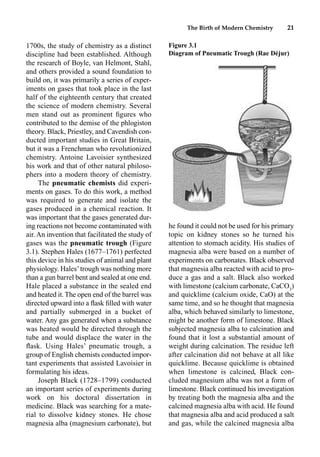
  • 348.
    334 A Futurein Chemistry build models attempting to understand the mysteries of matter. This knowledge is not collected in secrecy and coveted like the ancient alchemists. Guided by the principles embodied in the Code of Conduct, chemists operate in the world community and collec- tively have a major influence on all humans. Chemists have developed the ability to mod- ify matter in an amazing number of ways. This has led to improved materials, new compounds, and even new chemical ele- ments, the basic building blocks of matter. New knowledge is helping us to understand the chemical basis of life itself, enabling sci- entists to modify life and even create new life forms. This in turn has raised questions on the role of chemists in modern society. Many benefits have accrued from chemistry in the last three hundred years, and chem- istry continues to improve the quality of life. As chemists continue to advance the fron- tiers of science, an educated public is required to understand these advances along with their actual and potential application and resultant consequences. Only in this manner can informed discussion take place that includes both scientists and nonscien- tists. Chemists, as good citizens, have an obligation to use their knowledge for the benefit of humankind, and part of this obli- gation is educating the public on their disci- pline. In turn, all citizens have an obligation to understand basic science in order to make informed decisions. My hope is that these pages have assisted you in your understand- ing of chemistry and provided a foundation for you to use this knowledge to enhance your own life, as well as the lives of others.
  • 349.
    Glossary Absolute Zero 0Kelvins or–273.15°C, the lowest possible temperature, the point on the temperature scale where all molecular motion ceases Acceptable Daily Intake the maximum amount of a substance that can be consumed without damaging health Acid a substance that yields hydrogen ions in solution or donates protons Acid Precipitation a collective term for rain, snow, or dry deposition with low pH values Activated Complex momentary intermedi- ate arrangement of atoms when reactants are converted into products in a chemical reac- tion, also called transition state Activation Energy minimum energy needed to initiate a chemical reaction Active how easily a metal is oxidized Activity Series a ranking of elements in order of their ability to reduce or oxidize another element Acyclic an open-chained compound Addition Polymerization bonding of monomers without the elimination of atoms, formation of polymer by the bonding of unsaturated monomers Adhesion attraction between the surface of two different bodies Alcohol organic molecules characterized by containing the OH group Aldehyde organic molecules characterized by the CHO group Aliphatic Hydrocarbon organic hydrocar- bons characterized by a straight chain of carbon atoms Alkali Metal group I elements in the peri- odic table: Li, Na, K, Rb, Cs, Fr Alkaline Earth Metal group II elements in the periodic table: Be, Mg, Ca, Sr, Ba Alkaloid a nitrogen-containing compound obtained from plants, for example, caffeine, nicotine Alkane an acyclic saturated hydrocarbon Alkene an acyclic hydrocarbon that con- tains at least one carbon-carbon double bond Alkyl Group the group left when a hydro- gen atom is removed from an alkane, for example, methane gives the methyl group Alkylation chemical process in which an alkyl group is introduced into an organic compound Alkyne an acyclic hydrocarbon that con- tains at least one carbon-carbon triple bond Allotrope different forms of an element characterized by different structures Alloy a mixture of two or more metals, for example, zinc copper brass Alpha Decay nuclear process in which an alpha particle is emitted by the nucleus
  • 350.
    336 Glossary Alpha Particlea radioactive particle con- sisting of two protons and two neutrons, identical to the nucleus of a helium atom Amine organic compounds that result when one or more hydrogen atoms in ammonia are replaced by organic radicals AminoAcid organic acids that contain both an amino group NH2 and a carboxyl group COOH, the building blocks of pro- teins Amorphous Solid solids with a random particle arrangement Amphoteric a substance that exhibits both acidic and basic properties Amylopectin branched glucose polymer component of starch Amylose straight-chain glucose polymer component of starch Anabolism metabolic reactions in which smaller molecules are built up into larger molecules Anaerobic without oxygen, condition or process that exists when oxygen is absent Analgesic a drug that relieves pain Androgen a male sex hormone Anion a negatively charged ion Anneal to heat a metal or glass to a high temperature and slowly cool reducing brit- tleness of material Anode the positively charged electrode in an electrolytic cell where oxidation takes place Anoxic condition that exists when oxygen is absent Antimatter all particles having comple- mentary properties of matter, for example, positrons Antipyretic substance that reduces fever Aromatic Hydrocarbon an unsaturated cyclic hydrocarbon that does not readily undergo additional reaction, benzene and related compounds Arteriosclerosis condition known as hard- ening of the arteries due to plaque deposits in arteries Aryl Group an aromatic ring from which a single hydrogen has been removed Assimilate to incorporate into the body Atmosphere envelope of gas surrounding Earth’s surface composed primarily of nitro- gen and oxygen Atomic Number the number of protons contained in the nucleus of an atom of an element Avogadro’s Law law stating that equal vol- umes of gases at the same temperature and pressure contain an equal number of parti- cles Avogadro’s Number 6.02 1023 , the num- ber of particles defining one mole of a sub- stance Background Radiation amount of natural radiation detected in the absence of nonnat- ural radioactive sources Base a substance that yields hydroxide ions in solution or accepts protons Becquerel SI unit for activity equal to one disintegration per second, abbrevi- ated Bq Beta Decay nuclear process in which a beta particle is emitted Beta Particle in nuclear processes, particle equivalent to an electron Binding Energy the amount of energy holding the nucleus of element together, equivalent to the mass defect c2 Bioaccumulate the accumulation of a chemical in an organism Biological Magnification an increase in the concentration of a chemical moving up the food chain Biomolecule molecules associated with life, for example, carbohydrates, fats, proteins Biosphere total of living and decaying organisms Bipyridyliums class of herbicides that includes paraquat Boiling Point Elevation increase in normal boiling point of a pure liquid due to the pres- ence of solute added to the liquid
  • 351.
    Glossary 337 Bond Energythe heat of formation of a molecule and its constituent atoms or the energy necessary to form or break apart a molecule Bose-Einstein Condensate phase of matter that is created just above absolute zero when atoms lose their individual identity Boyle’s Law law that states volume of a gas is inversely related to its pressure Breeder Reactor type of nuclear reactor that creates or “breeds” fissionable pluto- nium from nonfissionable U-238 Buckministerfullerene C60 , allotrope of carbon consisting of spherical arrangement of carbon, named after architect Buckmin- ister Fuller, Invertor of geodesic dome Buffer a solution that resists a change in pH Calcination slow heating of a substance without causing it to melt Calorie unit of energy equivalent to the energy required to raise the temperature of one gram of water from 14.5°C to 15.5°C, equivalent to 4.18 J Calorimetry experimental technique used to determine the specific heat capacity of a substance or various heats of chemical reac- tions Calx oxide of metal formed during calcina- tion process Carbamates class of insecticides derived from carbamic acid Carbohydrate large class of biomolecules consisting of carbon, hydrogen, and oxygen and having the general formula Cx (H2 O)y , more specifically a polyhydroxyl ketone or polyhydroxyl aldhyde Carbonate an ion with the formula CO3 2 or a compound that contains this ion Carbonate Hardness condition of water when magnesium and calcium are combined with carbonates and bicarbonates, also called temporary hardness because it can be removed by boiling, responsible for scale in pipes Carbonyl a carbon atom and oxygen atom joined by a double bond CO, present in aldehydes and ketones Carboxyl Functional Group a carbonyl with a hydroxyl (–OH) attached to the car- bon atom Carboxylic Acid group of organic com- pounds characterized by the presence of car- boxyl group Carcinogen a substance that causes cancer Catabolism metabolic processes where molecules are broken down Catalysis chemical process in which a reac- tion rate is accelerated Catalyst a substance used to accelerate a chemical reaction without taking part in the reaction Cathode the negatively charged electrode in an electrolytic cell where reduction takes place Cathodic Protection method where a more active metal is connected to a metal struc- ture such as a tank or a ship protecting the structure because the active metal is oxi- dized rather than the structure Cation a positively charged ion Cellulase a group of enzymes that hydrolyze cellulose Cellulose common carbohydrate that is the primary constituent of cell walls in plants Chapman Reactions series of reactions responsible for the destruction of strato- spheric ozone Charles’s Law law that states volume of a gas is directly related to its absolute tem- perature ChemicalAffinity the tendency of particu- lar atoms to bond to each other Chemical Change a transformation in which one substance changes into another, as opposed to a physical change Chemical Element a pure substance that cannot be broken down into a simpler sub- stance by chemical means
  • 352.
    338 Glossary Chemical Familya group of elements that share similar chemical properties and share the same column in the periodic table, for example, halogens, alkali earth Chirality condition that describes the “handedness” of a molecule or whether a molecule exists in forms that can be super- imposed on each other Chlorofluorocarbons also called CFCs, compounds consisting of chorine, fluorine, and carbon that are responsible for strato- spheric ozone destruction Coagulation precipitation or separation from a dispersed state Coefficient of Thermal Expansion mea- sure of the rate at which a substance will expand when heated Cohesion intermolecular attractive force between particles within a substance Colligative Property a property dependent on the number of particles in solution and not on the type of particles, for example, boiling point elevation and freezing point depression Colloid particles having dimensions of 1–1000 nm or a suspension containing par- ticles of this size Combination Reaction also called synthe- sis, reaction in which two or more sub- stances combine to form a compound Combustion burning of a fuel to produce heat, oxidation of a fuel source Complete Ionic Equation equation used to express reactions in aqueous solutions where reactants and products are written as ions rather than molecules or compounds Complete Reaction a chemical reaction in which one of the reactants is completely consumed Complex Carbohydrate polysaccharides such as cellulose and starch Compound a substance consisting of atoms of two or more different elements chemi- cally bonded Condensation transformation from the gas to liquid state ConjugateAcid in the Brønsted theory, the substance formed when a base accepts a proton Conjugate Acid-Base Pair in the Brønsted theory, an acid and its conjugate base or a base and its conjugate acid Conjugate Base in the Brønsted theory, the substance that remains when an acid donates a proton Constructive Interference when waves combine to reinforce each other Control to remove or account for the effect of a variable in an experiment Control Rod rods used in nuclear reactor to absorb neutrons and control fission of radioactive fuel Controlled Experiment method in which all variables except one independent vari- able are held constant or accounted for in some fashion Coriolis Force pseudo-force introduced to account for motion that takes place on a rotating Earth, to the right in the Northern Hemisphere and left in the Southern Hemi- sphere Cosmic Radiation charged atomic particles originating from space Covalent Bond chemical bond in which electrons are shared between atoms Covalent Crystal crystal in which atoms are held together by covalent bonds in a rigid three-dimensional network, for exam- ple, diamond Cracking process by which a compound is broken down into simpler substances, typi- cally employed in petroleum industry to break carbon-carbon bonds Crenation condition that results when cells lose water and shrivel up Critical Mass quantity of fissionable mate- rial necessary to give a self-sustaining nuclear reaction
  • 353.
    Glossary 339 Crystalline Solidsolid in which atoms are arranged in definite three-dimensional pat- tern Cultural Eutrophication accelerated aging of water body due to human influence and water pollution Curie measure of radiation activity equal to 3.7 1010 disintegrations per second Cyclic arrangement of molecule in which carbons are bonded together in a ring- pattern Dalton’s Law of Partial Pressure law that states the total pressure in a mixture of gases is equal to the sum of pressures each gas would exert in absence of other gases Daughter the by-product in a radioactive decay D-Block Element a transition element, valence electrons are in the d orbitals Decay Activity the rate of decay of a radioactive substance Decomposition Reaction reaction in which a compound is broken down into its compo- nents Delocalized not associated with a particular region, in metallic bonding it refers to the fact that electrons are shared by the metal as a whole Denatured to make unsuitable for human consumption Dephlogisticated Air term Priestley used for oxygen, air devoid of phlogiston Dephlogisticated Nitrous Air term Priest- ley used for nitrous oxide, N2 O, laughing gas Destructive Interference when waves com- bine to cancel each other Deuterium isotope of hydrogen containing 1 proton and 1 neutron Dialysis the separation of particles from a colloid suspension by the passage of sus- pension solution through a semipermeable membrane Diffraction the spreading of light or other waves after passing through an opening or passing by an obstacle Dihydric an alcohol with two hydroxyl groups Dioxins chlorinated cyclic compounds Dipeptide two amino acids joined a peptide bond Dipole a difference in the centers of positive and negative charge in a molecule Dipole Moment condition when the centers of positive and negative charge in a mole- cule differ Dipole-Dipole Force type of intermolecu- lar force existing between molecules pos- sessing dipole moments Disaccharide carbohydrates in which two monosaccharides are bonded to each other Dispersing Medium in a colloid suspen- sion, the substance in which the particles are suspended Dispersing Phase in a colloid suspension, the particles that are suspended in the dis- persing medium Dispersion Force intermolecular force that results from continuous temporary dipoles formed in molecules not possessing perma- nent dipole moments Dose the amount of substance administered to an organism during a treatment or exper- iment Dose Equivalent a means of comparing dif- ferent forms of radiation on different body tissue Double Replacement Reaction a reaction between two compounds in which elements or ions replace each other Effluent discharge from a pipe or another source, associated with water qual- ity Electrical Potential the electrical potential energy of charged body above ground mea- sured in volts
  • 354.
    340 Glossary Electrochemical Cella cell in which elec- trical energy is used to cause a nonsponta- neous chemical reaction to occur Electrode a terminal that conducts current in an electrochemical cell Electrolysis process involving the passage of current through an electrochemical cell forcing a nonspontaneous reaction to occur Electrolyte a substance that conducts cur- rent when it is dissolved in water Electrolyze to bring about a chemical change by passing an electrical current through an electrolyte Electromotive Force force due to a differ- ence in electrical potential causing current to flow in a circuit Electron Configuration distribution of electrons into different shells and orbitals from the lower to higher energy levels Electronegativity measure of the attraction of an element for a bonding pair of electrons Electroplating process where a metal is reduced on to the surface of an object, which serves as the cathode in an electro- chemical cell Electrorefining purification of a metal using electrolysis Electrostatic charge at rest Element see Chemical Element Elementary Particle collectively the small- est units of matter, electrons, protons, quarks, and so on. Elementary Steps single reaction in a series of reactions that produce a net chem- ical equation Empirical experimental, to determine experimentally Emulsifier a substance that allows two phases to mix and form a solution or sus- pension, used in food processing Endothermic a chemical reaction in which energy is absorbed from the surroundings Energy the ability to do work Enzymes a biological catalyst Equilibrium state of chemical reaction where the rates of forward and reverse reac- tions are equal, causing concentrations of reactants and products to remain constant Equilibrium Constant a number equal to the ratio of the concentration of products at equilibrium over the concentration of reac- tants at equilibrium all raised to a power equal to the stoichiometric coefficient in the chemical equation Essential Amino Acid an amino acid that cannot be produced by our bodies and must be ingested Ester class of organic compounds that results from the reaction of carboxylic acid and an alcohol Estrogen female sex hormones Ether class of organic compound contain- ing an oxygen atom singly bonded to two carbon atoms C-O-C Eutrophication the natural aging of a water body Exothermic a chemical reaction that liber- ates energy to the surroundings Fats biomolecules consisting of glycerols and fatty acids (triglycerides) that are solid at room temperature FattyAcid long unbranched carboxylic acid chain F-Block Element the lanthanides and actinides, valence electrons in the f orbitals Feedstock a process chemical used to pro- duce other chemicals or products Fine Chemicals chemicals produced in rel- atively low volumes and at higher prices as compared to bulk chemicals such as sulfuric acid, includes flavorings, perfumes, phar- maceuticals, and dyes First Law of Thermodynamics law that states energy in universe is constant, energy cannot be created or destroyed First Order Reaction reaction in which the rate is dependent on the concentration of reactant to the first power
  • 355.
    Glossary 341 Fission seeNuclear Fission Fixed Air carbon dioxide, term used by Joseph Black for CO2 Fossil Fuels a fuel derived from the remains of ancient organisms: oil, natural gas, and coal Fractional Distillation process in which a mixture of chemicals is separated by their difference in boiling points, used exten- sively to refine petroleum into its different components or fractions Free Radical a species possessing at least one unpaired electron Freezing Point Depression decrease in freezing point of a pure liquid due to the presence of solute added to the liquid Fuel Cell type of electrochemical cell in which reactants are continually supplied to create electrical energy Fullerene pure carbon molecule consisting of at least 60 carbon atoms arranged spher- ically like a soccer ball Functional Group atom or group of atoms that characterize a class of compounds Fusion see Nuclear Fusion Galvanize a method used to protect metals by plating them with another metal, for example, coating iron with zinc Gamma Ray form of high energy electro- magnetic radiation with no mass and no charge Gamma Decay radioactive process in which gamma ray is emitted from the nucleus Gay-Lussac’s Law law that states the pres- sure of a gas is directly proportional to the gas’s absolute temperature Gay-Lussac’s Principle law that states when a chemical reaction takes place involving gases, the volumes of reactants and products are in small whole number ratios Gel colloid in which a liquid is dispersed in a solid Gray SI unit to measure the amount of radi- ation dose equal to deposition of one joule of energy into one kilogram of matter Greenhouse Effect warming of the Earth due to absorption of infrared radiation by particular atmospheric gases such as H2 O, CO2 , and CH4 Groups columns or families in the periodic table Haber Process method used to produce ammonia from nitrogen and hydrogen at high temperature and pressure under the presence of a catalyst Half Reaction the oxidation or reduction reaction in an oxidation-reduction reaction Half-Life time it takes for substance to be reduced to half its original amount or activ- ity in a chemical or nuclear reaction Halogen family consisting of group 17 ele- ments in the periodic table: F, Cl, Be, I, At Halogenation chemical reaction involving the addition of a halogen Hard Water water containing a high con- centration of divalent metal ions particularly calcium and magnesium Heat flow of energy from a region of higher temperature to a region of lower temperature Heat of Fusion energy necessary to change one kilogram of a substance from a liquid to solid at the substance’s freezing point Heat of Vaporization energy necessary to change one kilogram of a substance from a liquid to gas at the substance’s boiling point Heating Curve graph that shows how the temperature of a substance changes as heat is added to the substance Henry’s Law principle that states the amount of gas dissolved in a solution is directly proportional to the partial pressure of the gas above the solution Heterocyclic Compound a cyclic com- pound in which at least one carbon atom in the ring has been replaced by another atom or group of atoms
  • 356.
    342 Glossary Homogeneous asolution or mixture that is well mixed with a constant composition throughout Hormone chemical messengers released by glands Humidity the amount of moisture contained in the air expressed in mass of water vapor per unit volume of air Hydration process by which solute parti- cles become surrounded by water molecules in an aqueous solution Hydrocarbon organic compound consist- ing of only carbon and hydrogen Hydrogen Bond intermolecular force formed between hydrogen of one molecule and highly electronegative atom such as nitrogen, oxygen, or fluorine on another molecule Hydrogenation reaction in which hydrogen is added to unsaturated organic compounds in presence of a catalyst, used to turn liquid vegetable oils into solids Hydrolysis decomposition or change of a substance by its reaction with water Hydronium the H3 O ion Hydrosphere the sum total of Earth’s water including the oceans, polar ice caps, groundwater, atmospheric water, rivers, and lakes Hyperbaric a condition of elevated pres- sure Hypothesis a tentative statement used to explain some aspect of nature and tested through an experiment Iatrochemical medical school of thought that attributed disease to chemical imbal- ances in the body Ideal Gas gas in which it is assumed gas molecules occupy no appreciable portion of the total volume, do not interact with one another, and undergo elastic collision with one another Ideal Gas Law relationship describing the behavior of an ideal gas, PV nRT where P is the pressure, V is volume, n is number of moles, R is ideal gas law constant, and T is absolute temperature Immiscible when two liquids do not mix, for example, oil and water Independent Variable the factor which a researcher varies in an experiment Indicator a substance that exhibits a color change dependent on pH Industrial Hygiene dealing with the health and safety of workers, a discipline that deals with the maintenance of a healthy work environment Inhibitor a substance that slows down or stops a reaction Inorganic Chemistry chemistry of com- pounds excluding hydrocarbons and other compounds based on carbon Intermolecular between molecules Internal Energy the total potential and kinetic energy of all particles comprising a system Intramolecular within a molecule Invert Sugar a sugar mixture consisting of glucose and fructose Iodine Number measure of the amount of iodine absorbed by an unsaturated fat and used to measure the degree of satura- tion Ion a charged species created when an atom or group of atoms gains or loses electrons Ion-Dipole Force intermolecular force between an ion and a dipole Ion Pair in a solution when a positive and negative ion exist as a single particle Ion Product Constant in an ionic reaction, the product of each ion’s concentration in solution raised to a power equal to the coef- ficient in the net ionic equation, for water it equals H OH Ionic Bond intramolecular force created when electrons are transferred from one atom to another creating ions that possess electrostatic attraction for one another Ionic Solid a solid composed of anions and cations such as NaCl
  • 357.
    Glossary 343 Ionization processby which an atom or molecule gains or loses electrons and acquires a charge becoming an ion Ionizing Radiation alpha, beta, or gamma radiation possessing sufficient energy to dislodge electrons from atoms in tissue forming ions that can cause cell damage Isomer different compounds that have the same molecular formula Isotope forms of the same element that have different mass numbers Joule SI unit for energy and work equiva- lent to 0.24 calorie Ketone class of organic compounds con- taining a carbonyl group bonded to two other carbon atoms Kilojoules unit of energy equal to 1,000 joules Kinetic Energy energy associated with motion equal to 1 ⁄2 mv2 Kinetic Molecular Theory model that defines an ideal gas and assumes the aver- age kinetic energy of gas molecules is directly proportional to the absolute tem- perature Kinetics that area of chemistry that deals with how fast reactions take place Latent Heat energy transferred to material without a change in temperature, associated with phase changes such as melting and boiling Lattice Points positions in a unit cell occu- pied by atom, molecules, or ions Law of Definite Proportion law that states that different samples of the same com- pound always contain elemental mass per- centages that are constant Law of Mass Action mathematical expres- sion based on the ratio between products and reactants at equilibrium, an equation to determine the equilibrium rate constant Law of Multiple Proportions law that states when two elements combine to form more than one compound that the mass of one element compared to the fixed mass of the other element is in the ratio of small whole numbers Le Chatelier’s Principle principle that says when a system is at equilibrium and a change is imposed on the system that the system will shift to reduce the change Lewis Electron Dot Formula a diagram showing how the valence electrons are dis- tributed around an atom or distributed in a molecule Lipid a class of biomolecules including fats and oils characterized by their insolubility in water Liquid Crystals materials that have prop- erties of both solids and liquids used exten- sively in digital displays Lithosphere outer surface of Earth includ- ing the crust and upper mantle Lock-and-Key Model model to explain how enzymes catalyze reactions with specific enzymes acting as locks that only certain substrates which act as keys can fit London Force intermolecular force that arises when momentary temporary dipoles form in nonpolar molecules Long-Range Order general term to describe regular repeating structure found in crystals Longwave Radiation infrared radiation emitted by Earth Main Group Element elements in groups 1, 2, and 13–18, members in each group have the same general electron configuration Mass Defect the change in mass when a nucleus is formed from its constituent nucleons Mass Number sum of protons and neutrons in the nucleus of an atom Matter the material that comprises the uni- verse, anything that has mass and occupies space Maximum Contaminant Level the maxi- mum concentration of a substance dissolved in water deemed safe for consumption
  • 358.
    344 Glossary Meniscus thecurved upper surface of a nar- row column of water Metabolism the total of chemical reactions and processes used by organisms to trans- form energy, reproduce, and maintain them- selves Metal class of elements characterized by their ability to form positive ions, conduct heat and electricity, malleability, and luster Metallic Bond bond present in metals due to delocalized electrons moving throughout the metal lattice Metallic Solid type of solid characterized by delocalized electrons and metal atoms occupying lattice points Metalloid elements have properties inter- mediate between metals and nonmetals Mixture combination of two or more sub- stances where the individual substances maintain their identity Moderator a material such as graphite or deuterium used to slow down neutrons in nuclear reactors Molality a way to express concentration of a solution, moles of solute per kilogram of solvent Molarity a way to express concentration of a solution, moles of solute per liter of solu- tion Mole number of C-12 atoms in exactly 12 grams of C-12 equal to 6.022 1023 , a quantity of substance equal to the molar mass expressed in grams Molecular Equation a reaction in which the reactants and products are expressed as molecules or whole units rather than as ions Molecular Orbital Theory a model that uses wave functions to describe the position of electrons in a molecule, assuming elec- trons are delocalized within the molecule Molecular Solid a solid that contains mol- ecules at the lattice points Molecule a group of atoms that exist as a unit and are held together by covalent bonds Monomer discrete molecules that join together to form a polymer Monosaccharide a simple sugar molecule containing only a single aldehyde or ketone group, for example, glucose Nanometer one billionth of a meter, 109 m Nebula cloud of dust and gases, principally hydrogen, distributed throughout the uni- verse Net Ionic Equation a chemical equation that shows only the ionic species that actu- ally take part in the reaction Neutralization process that occurs when an acid reacts with a base, a type of reaction involving an acid and base Newton SI unit for force equal to 1 kg-m/s2 Nonelectrolyte a substance that does not conduct current when it is dissolved in water Nonionizing Radiation electromagnetic radiation with insufficient energy to dis- lodge electrons and cause ionization in human tissue, for example, radio waves, microwave, visible light Nonmetal elements found on the right side of the periodic table that conduct heat and electricity poorly Nonpoint Source Pollution pollution that does not originate from one specific loca- tion, such as a sewer pipe, but comes from multiple locations spread over a wide area, for example, runoff from city streets Nonrenewable Resource a resource in fixed supply or one that it is replenished at a rate so slow that it is exhausted before it is replenished, for example, oil Normal Alkane an alkane in which all the carbon atoms in the molecule are attached in a continuous chain Normality a way to express the concentra- tion of a solution, the number of equivalents per liter of solution Nuclear Fission the splitting of the nucleus of an atom of a heavier element into smaller nuclei to produce energy in a nuclear reac- tion
  • 359.
    Glossary 345 Nuclear Fusionthe combination of atomic nuclei of lighter elements into heavier nuclei to produce energy Nucleic Acid complex biomolecules responsible for passing on genetic informa- tion and for protein synthesis, include DNA and RNA Nucleon a proton or a neutron, the number of nucleons in an atom equals the sum of protons and neutrons in the nucleus Octet Rule general rule that states that the most stable electron configuration occurs when an atom surrounds itself with eight valence electrons Oil biomolecules consisting of glycerols and fatty acids (triglycerides) that are liquid at room temperature Oil of Vitriol concentrated sulfuric acid Optical Isomer isomers that differ in their ability to rotate light in opposite directions Organic Chemistry chemistry of carbon- based compounds Organochloride chlorine substituted hydro- carbon molecule widely used in industry, pesticides, CFCs Organophosphate organic compounds containing phosphorus, widely used in cer- tain pesticides Osmosis process in which a solvent flows from a diluted solution to a more concen- trated solution across a semipermeable membrane Osmotic Pressure pressure required to stop the movement of the solvent across a semi- permeable membrane during osmosis Oxidation process that describes the loss of electrons Oxidation Number the amount of charge transferred by or to an atom when it is assumed an ionic bond is formed as elec- trons are donated to the more electronega- tive atom Oxidation Reaction a chemical reaction in which an atom, molecule, or ion loses elec- trons OxidizingAgent a substance that is reduced and hence causes oxidation to occur in a redox reaction Parent in a nuclear reaction the original substance that emits some form of radiation Partial Pressure pressure exerted by an individual gas in a mixture of gases Parts Per Million way to express concen- tration by giving the number of units of mass or volume out of one million units of mass or volume Pascal SI unit for pressure equal to 1 new- ton per square meter Peptide a sequence of 50 or fewer amino acids joined by peptide bonds Peptide Bond bond formed between the carboxyl group of one amino acid and the amino group of another amino acid in a pep- tide Percent by Mass proportion of the mass of each element in a compound expressed as a percent or proportion of solute mass as total mass of solution Perfect Gas see Ideal Gas Period a horizontal row in the periodic table Permanent Hardness condition of water when magnesium and calcium are combined with chlorides and sulfates rather than car- bonates, cannot be removed by heating Petrochemical chemicals derived from oil or natural gas pH the negative of the base 10 logarithm of the molar concentration of the hydrogen ion concentration of a solution, –log H Phenol C6 H5 OH, the molecule formed when a hydroxyl group is substituted for a hydrogen in benzene or a compound that contains the phenol group Phenyl C6 H5 , group formed when a hydro- gen is removed from benzene Pheromones compounds produced in ani- mals, especially insects, to communicate messages to members of the same species Philosopher’s Stone imaginary substance that alchemists believed could turn base
  • 360.
    346 Glossary metal intogold or was an elixir to cure dis- eases Phlogiston a material once thought to be an element responsible for combustion Phospholipid lipid containing phosphorus derived from phosphoric acid Photochemical Oxidants air pollutants produced when hydrocarbons, nitrogen oxides, and other chemicals react under the influence of sunlight, for example, ozone, peroxyacylnitrates (PAN) Physical Changes transformations in the natural world, such as freezing and boiling, that do not involve a change in substances or in which a chemical reaction does not take place Phytoplankton marine and freshwater plants that float in the surface waters, many are microscopic and include different forms of algae Plasma state of matter in which atoms or molecules have been ionized to form posi- tive ions and electrons Plasmolysis condition that results when cells absorb water and rupture Pneumatic Chemistry study of gases and air, important in the development of modern chemistry Pneumatic Trough device used to collect and measure the volume of gases invented in 1700s by Stephen Hales, consisted of glass container submerged in water in which gas displaced water pOH the negative of the base 10 logarithm of the molar concentration of the hydroxide ion concentration of a solution, –log OH Point Source Pollution pollution originat- ing from a specific location, for example, a smokestack Polar Covalent Bond a covalent bond in which the bonding pair of electrons are not shared equally between atoms, the atom with the greater electronegativity has a greater affinity for the bonding electrons Polar Molecule a molecule where the cen- ters of positive and negative charge differ, creating a permanent dipole moment Polarizability ability of an electron cloud in a neutral atom to be distorted Polarized Light light in which the electro- magnetic wave vibrates in only one plane Polyatomic Ion an ion consisting of more than one atom Polymer giant molecule formed by the link- ing of simple molecules called monomers Polypeptide a chain of more than 50 amino acids Polysaccharide a carbohydrate polymer consisting of monosaccharides bonded together Polyunsaturated FattyAcid fatty acid con- taining multiple carbon-carbon double bonds Positron a subatomic particle with the mass of an electron and a charge of 1 Potential Energy the ability to do work by virtue of the position or arrangement of a system Pressure force per unit area Primary Amine an amine in which the nitrogen atom is bonded to a single carbon atom, when only one hydrogen in ammonia has been replaced by an organic R group Primary Cells batteries that cannot be recharged Primary Production conversion of matter into biomass using sunlight by plants in an ecosystem Primary Structure the sequence of amino acids bonded to each other in a peptide chain Principal Quantum Number a number that designates an electron’s energy level and its average distance from the nucleus of an atom Products the resulting substances in a chemical reaction Progestin pregnancy hormones
  • 361.
    Glossary 347 Protein biomoleculesconsisting of poly- peptide chain with large molecular mass Protostar early stage in the formation of a star when gases and dust start to contract due to gravitational forces P-V Work work associated with the expan- sion or compression of a gas Pyrethroids synthetic forms of pyrethrins, insecticides based on extracts from chrysan- themums Qualitative Analysis general method used to determine the composition of a com- pound Quality Control a system for maintaining proper standards in a product or collection of data Quantum Mechanics theory that explains the behavior of matter using wave functions to characterize the energy of electrons in atoms Quark a fundamental particle hypothesized to form the basic building blocks of all matter; there are six different quark types: up, down, strange, charm, top, and bot- tom Quaternary Structure describes the asso- ciation of the different chains in multichain proteins Rad a unit for an absorbed dose of radiation equal to 100 ergs of energy absorbed by a gram of matter Radioactive unstable atomic nuclei sponta- neously emitting particles and energy RadioactiveTracer a radioactive substance used to monitor the movement and behavior of a chemical in biological processes and chemical reactions Rate Determining Step the slowest reac- tion in the reaction mechanism Rate Law general mathematical expression that gives the rate of reaction, depends on rate constant and concentrations of reactants Reactants substances initially present in a chemical reaction Reaction Mechanism series of reactions that shows how reactants are converted into products in a chemical reaction Redox Reaction reaction involving the transfer of electrons, an oxidation-reduction reaction Reducing Agent a substance that is oxi- dized and causes reduction to occur in a redox reaction Reduction process that describes the gain of electrons Reduction Reaction a chemical reaction in which an atom, molecule, or ion gains elec- trons Relative Humidity ratio of the vapor pres- sure of water in air compared to the saturated vapor pressure of pure water at the same temperature, measure of the amount of water vapor in an air mass expressed as percent of how much water vapor that air mass can hold Relative Mass mass measured with respect to a standard, atomic masses based on C-12 standard Rem unit used to measure radiation dose equivalents based on the quantity of radia- tion absorbed and type of radiation Residual Chlorine chlorine that has not combined with organic matter Resins sticky, liquid organic substances exuded from plants that harden upon expo- sure to air Resonance Structures any of two or more structures used to represent the overall structure and behavior of a compound even though the compound does not exist in any of the resonance forms Reverse Osmosis process in which pressure is used to force a solvent of a concentrated solution through a semipermeable mem- brane toward a diluted solution, often used to purify water Reversible Reaction a reaction that occurs in both directions: reactants to products and products to reactants
  • 362.
    348 Glossary Rod componentof nuclear reactor holding fuel (fuel rod) or substances used to control nuclear reaction (control rod) Saccharides carbohydrates Sacrificial Anode in cathodic protection, the metal connected to the structure to be protected that is more readily oxidized than the structure Salt Bridge concentrated solution of elec- trolyte used to complete the circuit in an electrochemical cell that helps to equalize charge distribution in each half cell Saltpeter potassium nitrate, KNO3 Saponification conversion of a fat to soap by reacting with an alkali Saturated solution that contains the maxi- mum amount of solute under a given set of conditions Saturated Fatty Acid fatty acids in which the carbon chain contains only single carbon-carbon bonds Saturated Hydrocarbon a hydrocarbon containing only single carbon-carbon bonds Scintillation process producing discrete flashes or sparks of light Scrubbing process used to remove air pol- lutants from industrial emissions Secondary Amine an amine in which the nitrogen atom is bonded to two carbon atoms, when two hydrogen atoms in ammonia have been replaced by two organic R groups Secondary Cell batteries capable of being recharged Secondary Production conversion of plant matter into biomass by organisms feeding at the second trophic level and above Secondary Structure designates how atoms in a protein’s backbone structure are arranged in space Semipermeable Membrane media that allows the passage of solvent molecules but blocks solute molecules Shortwave Radiation radiation emitted by the Sun that passes through and interacts with the atmosphere Simple Carbohydrate monosaccharides such as glucose, fructose, and galactose that cannot be broken down by water Single Replacement Reaction type of chemical reaction in which one element replaces another in a compound Smelting to melt an ore in order to refine a metal from the ore Solute in a solution the component present in the smaller amount Solution a homogeneous mixture of two or more substances Solvation process by which a solute dis- solves in a solvent Solvay Process method used to produce sodium carbonate using sodium chloride, ammonia, and carbon dioxide Solvent in a solution the component present in the larger amount Specific Heat Capacity the amount of heat required to raise the temperature of an object by 1 degree Celsius Spectator Ions ions that do not take part in a chemical reaction Standard Hydrogen Electrode standard electrode consisting of hydrogen gas at 1 atmosphere pressure, a platinum electrode, and 1 molar hydrochloric acid, the potential of this electrode is defined as 0 and is used to determine the potential of other half- reactions Standard Reduction Potential the voltage measured for a half-cell under standard con- ditions when in reference to the standard hydrogen electrode Steady-State a system that does not change with time Stereoisomer isomers in which the atoms differ in their three-dimensional spatial arrangement Steroids lipids that contain four fused car- bon rings, three containing six carbons and one containing five carbons, include choles- terol and the sex hormones Sterols see Steroids
  • 363.
    Glossary 349 Stoichiometry massrelationship in a chem- ical reaction Straight Chain hydrocarbon structure in which carbon is bonded in a linear fashion as opposed to branching Strong Electrolyte a substance that is a good conductor of electricity when dis- solved in water Strong Nuclear Force force responsible for binding the nucleons of an atom’s nucleus together Structural Isomer compounds that have the same formula but have different atomic arrangement Subcritical Mass when the quantity of radioactive fuel is insufficient to produce a self-sustaining chain reaction Sublimation process where a substance passes directly from the solid to gaseous phase without going through the liquid phase Substrate the compound an enzyme acts upon Supercritical Mass when the quantity of a radioactive fuel is sufficient to produce a self-sustaining chain reaction Supernova massive explosion of giant star at the end of its life Supersaturated a solution containing more solute than is present in its saturated state Surface Tension property of liquid causing it to contract to the smallest possible area due to the unbalance of forces at the surface of the liquid Surroundings the remainder of the universe outside a defined system Suspension a mixture of nonsettling solid particles in a liquid, that is, gels and aerosols Synthesis Reaction see combination reac- tion System that part of the universe of concern to us Temper heat treatment of metals Temporary Hardness see Carbonate hard- ness Tertiary Amine an amine in which the nitrogen atom is bonded to three carbon atoms, when three hydrogen atoms in ammonia have been replaced by three organic R groups Tertiary Structure three-dimensional structure in protein resulting from interac- tion of amino acids in coiled chain Thermochemistry area of chemistry that deals with energy changes that take place in chemical processes Thermoplastics plastics that can be repeat- edly heated and reformed Thermosetting Plastics type of plastics that harden into final form after being heated once Trace Gas gaseous components of the atmosphere that occur in low concentra- tions, for example, methane, ozone Transmutation nuclear transformation in which the atomic nucleus of one element is converted into another element Triazine group of herbicides that work by disrupting photosynthesis Triglyceride principal component of fats and oils formed from three molecules of fatty acids and one glycerol molecule Trihalomethane class of suspected car- cinogens that form when chlorine and other halogens react with humic acids, chloro- form, and bromoform Trihydric an alcohol with three hydroxyl groups Tyndall Effect scattering of light by fine particles in a suspension Unit Cell most basic repeating unit of a lat- tice structure Unsaturated solution that has not reached the point of saturation and can hold more solute Unsaturated Hydrocarbon a hydrocarbon that contains at least one double or triple bond Valence a positive number indicating the ability of an atom or radical to combine with
  • 364.
    350 Glossary other atomsor radicals, the number of elec- trons an atom can donate or accept in a chemical reaction Valence Bond Theory theory of bonding based on overlapping valence orbitals Valence Electron Configuration quantum numbers of electrons that reside in the out- ermost shell of an atom Van Der Waal Force intermolecular force that can include dipole-dipole, ion-dipole, or London force Van’t Hoff Factor ratio of the number of actual particles dissolved in solution to the theoretical number of particles predicted when a substance dissolves Vapor the gaseous state of a substance that normally exists in the solid or liquid phase Vapor Pressure pressure exerted by a liq- uid or solid’s vapor when the liquid or solid is in equilibrium with its vapor Vaporization evaporation, process that occurs when molecules pass from liquid to gaseous state Variable one of any number of factors that change and may influence an observation or experimental outcome Viscosity the resistance to flow Vitalism theory that a vital force associated with life was associated with all organic substances VSEPR Model valence shell electron pair repulsion model, model used to predict the geometry of molecule based on distribu- tion of shared and unshared electron pairs distributed around central atom of a mole- cule Vulcanization heating rubber in the pres- ence of sulfur to remove its tackiness and improve its quality Weak Electrolyte a substance that is a poor conductor of electricity when dissolved in water White Dwarf old star that no longer under- goes thermonuclear reaction but continues to radiate light Wien’s Law law that states the wavelength of maximum energy radiation from an object is inversely proportional to the sur- face temperature of the object Work product of force times displace- ment X-Ray Crystallography method used to determine structure of crystal by examining diffraction pattern produced by x-rays directed at crystal Zooplankton marine and freshwater ani- mals that float in the surface waters, many are microscopic Zwitterion a molecule with a negative charge on one atom and a positive charge on another atom
  • 365.
    Brief Timeline ofChemistry 30000 B.C. cave paintings 8000 B.C. agriculture develops 6000 B.C. copper smelting 4000 B.C. copper alloys 2000 B.C. bronze 600 B.C. Anaximander posits air as primary element; Thasles posits water as primary element 450 B.C. Empedocies posits air, earth, fire and water as four major elements 400 B.C. Democritus leads atomists school, atoms basic form of matter 350 B.C. Aristotle’s Meterologica A.D. 300 Emperor Diocletian outlaws chemistry in Roman Empire 700–1100 height of Arab period; work of Geber, Al Razi, Avicenna 1000 gunpowder invented in China 1250 Albertus Magnus’s alchemical studies 1250 Roger Bacon studies on gunpowder 1525 Paracelsus uses chemistry in medicinal treatment 1540 Pirotechnia, Biringuccio’s work on metallurgy 1556 Agricola’s Of Metallaurgy, treatise on mining 1620 Van Helmont’s concept of gas 1640 Torricelli invents barometer 1660 Boyle’s law
  • 366.
    352 Brief Timelineof Chemistry 1661 Boyle publishes The Skeptical Chymist 1670 Becher and Stahl lay groundwork for phlogiston theory 1750 Hales invents pneumatic trough 1766 Cavendish isolates hydrogen 1770 Priestley and Scheele isolate oxygen 1789 Lavoisier’s Elements of Chemistry 1794 Lavoisier beheaded 1770–1800 Volta studies electricity 1802 DuPont chemical company founded 1808 Dalton proproses atoms as basic building blocks of matter 1808 Humphrey Davy uses electrolysis to discover metallic elements 1810 Avogadro’s hypothesis 1828 Wöhler synthesizes urea 1830 Faraday’s studies on electricity 1845 Kolbe synthesizes acetic acid 1846 ether is used as anesthetic 1852 idea of valence is introduced by Frankland 1856 Perkin perfects synthetic dyes 1859 first commercial oil well is drilled by Drake in Titusville, Pennsylvania 1863 Solvay process is discovered for making sodium bicarbonate 1865 Kekulé determines structure of benzene 1866 Nobel invents dynamite 1870 Mendeleev’s periodic table 1876 American Chemical Society is founded 1884 Arrhenius’s theory that acids produce hydrogen ions 1893 synthesis of aspirin by Hoffman 1895 Roentgen discoveres x-rays 1896 Becquerel discovers process of radioactivity 1897 Thomson discovers electron 1908 Rutherford’s model of the atom 1910 rayon production begins in U.S.A.
  • 367.
    Brief Timeline ofChemistry 353 1913 Bohr’s model of hydrogen atom 1919 Rutherford’s alpha particles support existence of protons 1920 covalent bond by Lewis and Langmuir 1923 Brønsted definition of acid and base 1927–30 quantum mechanical model of atom developed 1932 neutron discovered by Chadwick 1931 DuPont produces synthetic rubber neoprene 1936 Carothers’ DuPont team produces nylon 1939 Müller synthesizes DDT 1940 synthetic rubber is used in tires 1953 Crick and Watson present structure for DNA 1963 Rachael Carson publishes Silent Spring 1969 EPA is established 1976 evidence that chlorine compounds destroy ozone 1985 Smalley and Kroto discover buckminsterfullerenes 1989 Human Genome Project commences 1990 PCR method established 1996 cloning of Dolly the sheep 2000 conclusion of human genome sequencing
  • 369.
    Nobel Laureates inChemistry Nobel laureates are listed consecutively by year starting with 1901. The country indicates where the chemist did major work. If the chemist’s country of birth is different than where major work is done, this is indicated after the “b.” In many years, several chemists are recognized. When several chemists are recognized in the same year, it may be either for work in similar areas of chemistry, working collaboratively or independently, or for work in entirely different areas. When several laureates have been recognized for work in similar areas, the work is cited for the first laureate in the list. Year Recipient(s) Country Work 1901 Jacobus Henricus van’t Hoff Germany b. Netherlands laws of chemical dynamics and osmotic pres- sure in solutions 1902 Hermann Emil Fi- scher Germany sugar and purine syntheses 1903 Svante August Ar- rhenius Sweden electrolytic dissociation theory 1904 William Ramsay Great Britain discovery of noble gases 1905 Adolf von Baeyer Germany organic dyes and hydroaromatic compounds 1906 Henri Moissan France isolation of fluorine and electric furnace 1907 Eduard Buchner Germany fermentation in absence of cells and biochem- istry 1908 Ernest Rutherford Great Britain b. New Zealand radioactive decay 1909 Wilhelm Ostwald Germany b. Russia chemical equilibrium, kinetics, and catalysis 1910 Otto Wallach Germany pioneering work with alicyclic compounds 1911 Marie Curie France b. Poland discovery of radium and polonium 1912 Victor Grignard France discovery of Grignard’s reagent Paul Sabatier France hydrogenation with metal catalysts 1913 Alfred Werner Switzerland b. Germany bonding of inorganic compounds 1914 Theodore Richards United States determination of atomic weights 1915 Richard Willstätter Germany studies of plant pigments, especially chloro- phyll
  • 370.
    356 Nobel Laureatesin Chemistry Year Recipient(s) Country Work 1918 Fritz Haber Germany synthesis of ammonia 1920 Walter H. Nernst Germany thermochemistry 1921 Frederick Soddy Great Britain radioactive substances and isotopes 1922 Francis W. Aston Great Britain mass spectrography and discovery of isotopes 1923 Fritz Perl Austria organic microanalysis 1925 Richard A. Zsigmondy Germany b. Austria colloid chemistry 1926 Theodor Svedberg Sweden disperse systems 1927 Heinrich Otto Wie- land Germany bile acids 1928 Adolf Otto Windaus Germany sterols relationship with vitamins 1929 Arthur Harden Great Britain fermentation of sugar and sugar enzymes Hans von Euler- Chelpin Sweden b. Germany 1930 Hans Fischer Germany synthesis of hemin 1931 Carl Bosch Germany high pressure chemical processing Friedrich Bergins Germany 1932 Irving Langmuir United States surface chemistry 1934 Harold Urey United States discovery of heavy hydrogen 1935 Frédéric Joliot France synthesis of new radioactive elements Irène Joliot-Curie France 1936 Peter Debye Germany b.Netherlands dipole moments and x-ray diffraction 1937 Walter Norman Hay- worth Great Britain carbohydrates and vitamin C Paul Karrer Switzerland vitamins A and B12 1938 Richard Kuhn Germany b. Austria carotenoids and vitamins 1939 Adolf F. J. Butenandt Germany sex hormones Leopold Ruzicka Switzerland b. Hungary polymethylenes and terpenes 1943 George DeHevesy Sweden b. Hungary isotope tracers 1944 Otto Hahn Germany fission of heavy nuclei 1945 Atturi I. Virtanen Finland agricultural and food chemistry and preserva- tion of fodder 1946 James B. Sumner United States crystallation of enzymes John H. Northrop United States preparation of proteins and enzymes in pure form Wendell M. Stanley United States 1947 Robert Robinson Great Britain alkaloids 1948 Arne W. K. Tiselius Sweden electrophoresis and serum proteins 1949 William F. Giauque United States low temperature thermodynamics 1950 Otto Diels Germany diene synthesis Kurt Alder Germany 1951 Edwin McMillan United States chemistry of transuranium elements Glenn Seaborg United States
  • 371.
    Nobel Laureates inChemistry 357 Year Recipient(s) Country Work 1952 Archer J. P. Martin Great Britain invention of partition chromatography Richard L. M. Synge Great Britain 1953 Hermann Staudinger Germany macromolecular chemistry 1954 Linus Pauling United States chemical bonding and molecular structure of proteins 1955 Vincent Du Vigneaud United States sulfur compounds of biological importance, synthesis of polypeptide hormone 1956 Cyril Hinshelwood Great Britain mechanisms of chemical reaction Nikolay Semenov USSR 1957 Alexander Todd Great Britain nucleotides and their co-enzymes 1958 Frederick Sanger Great Britain protein structure, insulin 1959 Jaroslav Heyrovsky Czechoslovakia polarographic methods of analysis 1960 Willard Libby United States carbon-14 dating 1961 Melvin Calvin United States CO2 assimilation in plants 1962 Max Preutz Great Britain b. Austria structure of globular proteins John Kendrew Great Britain 1963 Giulio Natta Italy high polymers Karl Ziegler Germany 1964 Dorothy Crowfoot Hodgkin Great Britain x-ray techniques of the structures of biochem- ical substances 1965 Robert Woodward United States organic synthesis 1966 Robert Mulliken United States chemical bonds and electronic structure of molecules 1967 Manfred Eigen Germany study of very fast chemical reactions Ronald Norrish Great Britain George Porter Great Britain 1968 Lars Onsager United States b. Norway thermodynamic of irreversible processes 1969 Derek Barton Great Britain conformation Odd Hensel Norway 1970 Luis Leloir Argentina sugar nucleotides and carbohydrate biosynthe- sis 1971 Gerhard Herzberg Canada b. Germany structure and geometry of free radicals 1972 Christian Anfinsen United States ribonuclease, amino acid sequencing and bio- logical activity Stanford Moore United States chemical structure and catalytic activity of ri- bonuclease William Stein United States 1973 Ernst Fischer Germany organometallic sandwich compounds Geoffrey Wilkinson Great Britain 1974 Paul Flory United States macromolecules 1975 John Cornforth Great Britain stereochemisitry of enzyme-catalyzed reac- tions Vladmir Prelog Switzerland b. Bosnia stereochemistry of organic molecules 1976 William Lipscomb United States structure of borane and bonding
  • 372.
    358 Nobel Laureatesin Chemistry Year Recipient(s) Country Work 1977 Ilya Prigogine Belgium b. Russia theory of dissipative structures 1978 Peter Mitchell Great Britain chemiosmotic theory 1979 Herbert Brown United States b. Great Britain organic synthesis of boron and phosphorus compound George Wittig Germany 1980 Paul Berg United States recombinant DNA Walter Gilbert United States nucleic acid base sequences Frederick Sanger Great Britain 1981 Kenichi Fukui Japan chemical reactions and orbital theory Roald Hoffman United States b. Poland 1982 Aaron Klug Great Britain crystallographic electron microscopy applied to nucleic acids and proteins 1983 Henry Taube United States b. Canada electron transfer in metal complexes 1984 Robert Merrifield United States chemical synthesis 1985 Herbert Hauptman United States crystal structures Jerome Karle United States 1986 Dudley Herschbach United States chemical elementary processes Yuan Lee United States b. Taiwan John Polanyi Canada 1987 Donald Cram United States development of molecules with highly selec- tive structure specific interactions Jean-Marie Lehn France Charles Pedersen United States b. Korea, of Norwegian descent 1988 Johann Deisenhofer Germany and United States b. Germany photosynthesis Robert Huber Germany Michel Hartmut Germany 1989 Sidney Altman United States b. Canada catalytic properties of RNA Thomas Cech United States 1990 Elias James Corey United States organic synthesis 1991 Richard Ernst Switzerland nuclear resonance spectroscopy 1992 Rudolph Marcus United States b. Canada electron transfer in chemical systems 1993 Kary Mullis United States invention of PCR method Michael Smith Canada b. Great Britain mutagenesis and protein studies 1994 George Olah United States b. Hungary carbocation chemistry
  • 373.
    Nobel Laureates inChemistry 359 Year Recipient(s) Country Work 1995 Paul Crutzen Germany b. Netherlands atmospheric chemistry Mario Molina United States b. Mexico stratospheric ozone depletion Rowland F. Sherwood United States 1996 Robert Kurl United States discovery of fullerenes Harold Kroto Great Britain Richard Smalley United States 1997 Paul Boyer United States enzyme mechanism of ATP John Walker Great Britain Jens Skou Denmark discovery of ion transport enzyme NaⳭ , KⳭ - ATPase 1998 Walter Kohn United States density function theory John Pople Great Britain computational methods in quantum chemistry 1999 Ahmed Zewail United States b. Egypt transition states using femto spectroscopy 2000 Alan J. Heeger United States discovery of conductive polymers Alan MacDiarmid United States Hideki Shirakawa Japan 2001 William Knowles United States chirally catalyzed hydrogenation reactions Ryoji Noyori Japan K. Barry Sharpless United States chirally catalyzed oxidation reactions 2002 John B. Fenn United States identical of biological macromolecules Koichi Tanaka Japan Kurt Wüthrich Switzerland NMR analysis of biological macromolecules
  • 375.
    Table of theElements Element Symbol Atomic Number Atomic Mass Element Symbol Atomic Number Atomic Mass Actinium Ac 89 227 Mercury Hg 80 200.6 Aluminum Al 13 26.98 Molybdenum Mo 42 95.94 Americium Am 95 243 Neodymium Nd 60 144.2 Antimony Sb 51 121.8 Neon Ne 10 20.18 Argon Ar 18 39.95 Neptunium Np 93 237 Arsenic As 33 74.92 Nickel Ni 28 58.69 Astatine At 85 210 Niobium Nb 41 92.91 Barium Ba 56 137.3 Nitrogen N 7 14.01 Berkelium Bk 97 247 Nobelium No 102 259 Beryllium Be 4 9.012 Osmium Os 76 190.2 Bismuth Bi 83 209.0 Oxygen O 8 16.00 Bohrium Bh 107 264 Palladium Pd 46 106.4 Boron B 5 10.81 Phosphorus P 15 30.97 Bromine Br 35 79.90 Platinum Pt 78 195.1 Cadmium Cd 48 112.4 Plutonium Pu 94 242 Calcium Ca 20 40.08 Polonium Po 84 210 Californium Cf 98 251 Potassium K 19 39.10 Carbon C 6 12.01 Praseodymium Pr 59 140.9 Cerium Ce 58 140.0 Promethium Pm 61 147 Cesium Cs 55 132.9 Protactinium Pa 91 231 Chlorine Cl 17 35.45 Radium Ra 88 226 Chromium Cr 24 52.00 Radon Rn 86 222 Cobalt Co 27 58.93 Rhenium Re 75 186.2 Copper Cu 29 63.55 Rhodium Rh 45 102.9 Curium Cm 96 247 Rubidium Rb 37 85.47 Dubnium Db 105 262 Ruthenium Ru 44 101.1 Dysprosium Dy 66 162.5 Rutherfordium Rf 104 261
  • 376.
    362 Table ofthe Elements Element Symbol Atomic Number Atomic Mass Element Symbol Atomic Number Atomic Mass Einsteinium Es 99 254 Samarium Sm 62 150.4 Erbium Er 68 167.3 Scandium Sc 21 44.96 Europium Eu 63 152.0 Seaborgium Sg 106 263 Fermium Fm 100 253 Selenium Se 34 78.96 Flourine F 9 19.00 Silicon Si 14 28.09 Francium Fr 87 223 Silver Ag 47 107.9 Gadolinium Gd 64 157.3 Sodium Na 11 22.99 Gallium Ga 31 69.72 Strontium Sr 38 87.62 Germanium Ge 32 72.59 Sulfur S 16 32.07 Gold Au 79 197.0 Tantalum Ta 73 180.9 Hafnium Hf 72 178.5 Technetium Tc 43 99 Hassium Hs 108 265 Tellurium Te 52 127.6 Helium He 2 4.003 Terbium Tb 65 158.9 Holmium Ho 67 164.9 Thallium Tl 81 204.4 Hydrogen H 1 1.008 Thorium Th 90 232.0 Indium In 49 114.8 Thulium Tm 69 168.9 Iodine I 53 126.9 Tin Sn 50 118.7 Iridium Ir 77 192.2 Titanium Ti 22 47.88 Iron Fe 26 55.85 Tungsten W 74 183.9 Krypton Kr 36 83.80 Ununnilium Uun 110 269 Lanthanum La 57 138.9 Unununium Uun 111 269 Lawrencium Lr 103 257 Unumbium Uub 112 277 Lead Pb 82 207.2 Uranium U 92 238.0 Lithium Li 3 6.941 Vanadium V 23 50.94 Lutetium Lu 71 175.0 Xenon Xe 54 131.3 Magnesium Mg 12 24.31 Ytterbium Yb 70 1773.0 Manganese Mn 25 54.94 Yttrium Y 39 88.91 Meitnerium Mt 109 268 Zinc Zn 30 65.39 Mendelevium Md 101 256 Zirconium Zr 40 91.22
  • 377.
    Selected Bibliography Aftalion, Fred.A History of the International Chem- istry Industry, 2nd ed. Philadelphia: Chemical Heritage Press, 2001. Amato, Evan. Stuff: The Materials the World Is Made Of. New York: Basic Books, 1997. Asimov, Isaac. A Short History of Chemistry. Garden City, NY: Anchor Books, 1965. Baird, Colin. Environmental Chemistry. New York: W.H. Freeman and Company, 1995. Brock, William H. The Norton History of Chemistry. New York: W.W. Norton and Company, 1993. Bureau of Labor Statistics. Occupational Outlook Handbook. http://stats.bls.gov/oco/ocos029.htm. 25 February 2002. Campbell, Mary K. Biochemistry. Philadelphia: Saun- ders Publishing, 1991. Chang, Raymond. Chemistry, 7th ed. Boston: McGraw-Hill, Inc., 2002. Chemical Heritage Foundation. http://www.chem heritage.org/. 24 February 2002. Cobb, Cathy, and Goldwhite, Harold. Creations of Fire: Chemistry’s Lively History fromAlchemy to the Atomic Age. New York: Plenum Press, 1995. Cox, P. A. The Elements on Earth. Oxford: Oxford University Press, 1995. Emsley, John. The Elements, 3rd ed. Oxford: Claren- don Press, 1998. Encarta Encylopedia 99 (1999). CD-ROM . Red- mond, WA: Microsoft Inc. Farber, Eduard. Great Chemists. New York: Inter- science, 1961. Finucane, Edward W. Definitions, Conversions and Calculations for Occupational Safety and Health Professionals, 2nd ed. Boca Raton: Lewis Pub- lishers, 1998. Gibbs, F. W. Joseph Priestley. Garden City, NY: Dou- bleday and Company, Inc., 1967. Giunta, Carmen. “Selected Classic Papers from the History of Chemistry.” http://webserver.lemoyne. edu/faculty/giunta/papers/html. 23 February 2002. Goran, Morris. The Story of Fritz Haber. Norman: University of Oklahoma Press, 1967. Greenaway, Frank. John Dalton and the Atom. Ithaca: Cornell University Press, 1966. Greenberg, Arthur. A Chemical History Tour. New York: Wiley Interscience, 2000. Heiserman, David L. Exploring Chemical Elements and Their Compounds. Blue Ridge Summit, PA: TAB Books, 1992. Herron, J. Dudley, Kukla, David A, Schrader, Clifford, DiSpezio, Michael A., and Erickson, Julia Lee. Heath Chemistry. Lexington, MA: D.C. Heath and Company, 1987. Hill, John W. Chemistry for Changing Times, 6th ed. New York: Macmillan Publishing, 1992. Hill, John W., and Feigl, Dorothy M. Chemistry and Life: An Introduction to General, Organic, and Biological Chemistry, 3rd ed. New York: Macmillan Publishing Company, 1978. Hoffmann, Roald. The Same and Not The Same. New York: Columbia University Press, 1995. Hoover’s Handbook of American Business 2002. Austin, TX: Hoover’s Business Press, 2002. HowStuffWorks, Inc. http://www.howstuffworks.com/. 20 December 2001. Hudson, John. The History of Chemistry. New York: Chapman and Hall, 1992. Idhe, Aaron J. The Development of Modern Chem- istry. New York: Harper and Row, 1964.
  • 378.
    364 Selected Bibliography InternationalDirectory of Company Histories. Detroit: St. James Press, 1988. Jacobs, Bob. “Wilton High School Chemistry.” http://www.chemistrycoach.com/home.htm. 23 February 2002. Jaffe, Bernard. Crucibles: The Story of Chemistry From Ancient Alchemy to Nuclear Fission, 4th ed. New York: Dover Publications, Inc., 1976. Kent, James A., ed. Riegel’s Handbook of Industrial Chemistry, 7th ed. New York: Van Nostrand Reinhold Company, 1969. Knight, David. Humphry Davy: Science and Power. Oxford: Blackwell Publishers, 1992. Krebs, Robert E. The History and Uses of Our Earth’s Chemical Elements: A Reference Guide. West- port, CT: Greenwood Press, 1998. Lagowski, J.J. The Chemical Bond. Boston: Houghton Mifflin Company, 1966. Landis, Walter S. Your Servant the Molecule. New York: Macmillan, 1945. Lavoisier, Antoine. Elements of Chemistry, with an introduction by Douglas McKie. Translated by Robert Kerr. New York: Dover Publications, 1984. Leicester, Henry M, and Klickstein, Herbert S., A Source Book in Chemistry, 1400–1900. Cam- bridge: Harvard University Press, 1952. Levere, Trevor H. Affinity and Matter. Oxford: Oxford University Press, 1971. Mathews, Harry, Freeland, Richard, and Miesfeld, Roger L. Biochemistry: A Short Course. New York: Wiley Sons, 1997. McMurry, John, and Fay, Robert C. Chemistry, 2nd ed. Upper Saddle River, NJ: Prentice Hall, 1998. Miller, G. Tyler. Environmental Science, 4th ed. Bel- mont, CA: Wadsworth Publishing Company, 1993. Morrison, Robert Thornton, and Boyd, Robert. Organic Chemistry. Boston: Allyn and Bacon Inc., 1959. Multhauf, Robert P. Neptune’s Gift. Baltimore: The Johns Hopkins University Press, 1978. Nobel Foundation. “Nobel e-Museum.” http://www. nobel.se/index.html. 1 February 2002. O’Neil, Maryadale J., Budavari, Susan, Smith, Ann, Heckeleman, Patricia E., and Kinneary, Joanne F., eds. The Merck Index, 12th ed. Rahway, NJ: The Merck Publishing Group, 1996. Park, John L. “The Chem Team, A Tutorial for High School Chemistry.” http://www.dbhs.wvusd. k12ca.us/. 15 January 2002 Parker, Sybil P., ed. McGraw-Hill Dictionary of Chemical Terms. NewYork: McGraw-Hill Book Company, 1985. Patterson, Elizabeth C. John Dalton and the Atomic Theory. Garden City, NY: Anchor Books, 1970. Pauling, Linus. The Nature of the Chemical Bond, 3rd ed. Ithaca: Cornell University Press, 1960. Pera, Marcelo. The Ambiguous Frog: The Galvani- Volta Controversy. Translated by Jonathan Man- delbaum. Princeton, NJ: Princeton University Press, 1992. Redgrove, H. Stanley. Alchemy: Ancient and Modern. New York: Harper and Row, 1911; reprint New York: Harper and Row, 1973. Rowh, Mark. Great Jobs for Chemistry Majors. Chicago: VGM Career Horizons, 1999. Sae, Andy S. W. Chemical Magic from the Grocery Store. Dubuque, IA: Kendall/Hunt Publishing Company, 1996. Salzberg, Hugh W. From Cavemen to Chemist: Cir- cumstances andAchievements. Washington D.C.: American Chemical Society, 1991. Sass, Stephen L. The Substance of Civilization. New York: Arcade Publishing, 1998. Shreve, R. Norris, and Brink, Joseph A. Chemical Process Industries. New York: McGraw-Hill Book Company, 1977. Snyder, Carl. The Extraordinary Chemistry of Ordi- nary Things. New York: John Wiley and Sons, 1992. Stoker, H. Stephen. General, Organic, and Biological Chemistry. Boston: Houghton Mifflin Company, 2001. Summerlin, Lee R., Borgford, Christie L., and Ealy, Julie. Chemical Demonstrations, A Source- book for Teachers Volume 2, 2nd ed. Wash- ington, D.C.: American Chemical Society, 1988. Summerlin, Lee R., and Ealy, James L. Jr. Chemical Demonstrations: A Sourcebook for TeachersVol- ume 1, 2nd ed. Washington, D.C.: American Chemical Society, 1988. Taylor, F. Sherwood. The Alchemists. New York: Henry Schuman, 1949. Thomas, John Meurig. Michael Faraday and The Royal Institution: The Genius of Man and Place. Bristol: Adam Hilger, 1991. Ware, George W. The Pesticide Book, 5th ed. Fresno, CA: Thomson Publications, 1999. Wendland, Ray T. Petrochemicals, The New World of Synthetics. Garden City, NY: Doubleday and Company, 1969. Woodburn, John H. Chemistry Careers. Chicago: VGM Career Horizons, 1997. Zumdahl, Steven S., and Zumdahl, Susan A., 5th ed. Boston: Houghton Mifflin Company, 2000.
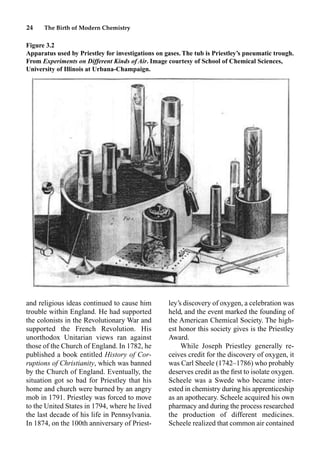

  • 379.
    1 Author Index Abegg, Richard,74 Agricola, Georgius, 16 Al-Razi, 13 Anaximander of Miletus, 9 Andrews, Samuel, 305 Aquinas, Thomas, 14 Aristotle, 10, 13, 14, 18 Arrhenius, Svante August, 141, 156, 157, 158, 159 Avicenna, 13 Avogadro, Amedeo, 35, 106 Bacon, Roger, 14 Baekeland, Leo Hendrik, 298 Bayen, Pierre, 26 Bayer, Friedrich, 168 Bayer, Karl Josef, 192 Becher, John, 19, 20 Becquerel, Antoine Henri, 38 Bergman, Tobern, 27, 72 Bernigaut, Louis Marie Hilaire, 297, 298 Berthelot, Marcellin, 196 Berthollet, Claude Louis, 27, 32, 33, 72 Berzelius, Jöns Jacob, 34, 51, 73, 196, 197, 198 Biringuccio, Vannoccio, 16 Black, Joseph, 20, 21, 22, 25, 26 Bohr, Niels, 40 Boltzmann, Ludwig, 103 Bosch, Karl, 153 Bose, Satyendra Nath, 85 Boullay, Pierre Francois Guillaume, 196 Boyle, Robert, 18, 19, 21, 25, 102 Bragg, William Henry, 91 Bragg, William Lawrence, 91 Brønsted, Johannes, 158 Bunsen, Robert, 296 Cannizzaro, Stanislao, 62, 63 Carlisle, Anthony, 176 Carothers, Wallace Hume, 298, 299, 300 Carson, Rachael, 283 Cavendish, Henry, 20, 25, 26, 27, 36 Celsius, Anders, 104 Chadwick, James, 37, 38 Chapman, Sydney, 262 Charles, Jacques Alexandre, 105, 107 Chesebrough, Robert, 218 Colgate, William, 306 Couper, Archibald Scott, 198 Crick, Francis, 234, 236 Crookes, William, 35, 36 Crutzen, Paul, 266 Curie, Marie, 38 Curie, Pierre, 38 Dalton, John, 10, 33, 34, 35, 38, 45, 46, 51, 56, 107, 131, 176 Daniell, John Fredrick, 180 Davy, Humphrey, 72, 73, 156, 176 de Broglie, Louis, 40 de Buffon, Comte, 72 de Fourcroy, Antoine Francois, 27 de Mestral, George, 299 de Morveau, Guyton, 27 Democritus, 9, 10, 47, 71 Diocletian, 12 Döbereiner, Johann, 61, 62
  • 380.
    366 Author Index Dow,Herbert Henry, 302, 303 Drake, Edwin L., 216 Du Fay, Charles, 172 Dumas, Jean-Baptiste André, 196, 197, 198 DuPont, Henry, 292, 293 DuPont, LaMont, 293 DuPont, Pierre Samuel, 292 DuPont de Nemours, Eleuthère Irènèe, 292 Eastman, George, 298 Ehrlich, Paul, 296 Einstein, Albert, 85, 246 Empedocles of Agrigentum, 9 Epicurus, 10 Fahrenheit, Daniel, 104 Faraday, Michael, 73, 176, 205, 294 Fermi, Enrico, 46 Firestone, Harvey Samuel, 305 Fischer, Ernest Gottfried, 32 Ford, Henry, 305 Frankland, Edward, 73, 198 Franklin, Benjamin, 23, 172 Fresenius, Karl, 296 Fuller, F. Buckminster, 96 Galen, 14 Galilei, Galileo, 99 Galvani, Luigi, 172, 173, 174, 180, 193 Gamble, James, 305, 306 Gamble, William, 306 Gay-Lussac, Joseph Louis, 34, 35, 105, 107, 196, 290 Geiger, Johannes Wilhelm, 39 Gell-Mann, Murray, 44 Geoffroy, Etienne Francois, 72 Gerhardt, Charles Fredric, 168, 197, 198 Gilbert, William, 171 Glover, John, 290 Goodrich, Benjamin Franklin, 304, 305 Goodyear, Charles, 300, 304 Gore, Wilbert, 299 Graham, Thomas, 136 Grove, Sir William, 188 Guldberg, Cato Maximilian, 151 Haber, Fritz, 153, 154 Hales, Stephen, 21, 22 Hall, Charles Martin, 191, 192, 193 Heisenberg, Werner, 40 Henry, William, 33, 131 Heraclitus of Ephesus, 9 Héroult, Paul L. T., 191, 192, 193 Hippocrates, 167 Hoffman, Felix, 168 Hooke, Robert, 6, 18, 19, 297 Hyatt, John Wesley, 298 Jabir ibn Hayyan (Geber), 13, 14 Joule, James Prescott, 115 Kekulé, Friedrich August, 73, 198, 206, 296 Kirwan, Richard, 27 Koch, Robert, 296 Kolbe, Adolph Wilhelm Hermann, 168, 196 Kossel, Walther, 74 Kroto, Harold, 96 Langmuir, Irving, 74 Laurent, Auguste, 73, 197, 198 Lavoisier, Antoine, 18, 20, 21, 23, 25, 26, 27, 28, 29, 31, 32, 35, 70, 156, 193, 196, 292 Le Châtelier, Henri Louis, 149, 153 LeBlanc, Nicholas, 291 Leclanché, George, 186 Leucippus, 9, 71 Lewis, Gilbert Newton, 74, 75, 76, 159 Libavius, Andreas, 16 Libby, Williard, 246 Liebig, Justus, 156, 197, 198, 295, 296 Lister, Joseph, 296 London, Fritz, 89 Lowry, Thomas, 158, 159 Lucretius, 10 Magnus, Albertus, 14 Marsden, Ernest, 39 Maxwell, James Clerk, 103 Mayow, John, 19 Mendeleev, Dmitri, 63, 64, 65 Meyer, Julius Lothar, 63 Millikan, Robert Andrew, 37 Mitscherlich, Eilhardt, 205 Molina, Mario, 265, 266 Morehead, James T., 304 Morton, William T. J., 209 Moseley, Henry, 64 Müller, Paul, 282, 283 Mullis, Kary B., 236 Newlands, John, 62 Newton, Isaac, 6, 25, 71, 72 Nicholson, William, 176 Nieuwland, Julius, 300 Nobel, Alfred, 293 Nobel, Immanuel, 293
  • 381.
    Author Index 367 Paracelsus,14, 15, 18 Parmenides, 9 Pasteur, Louis, 296 Pauli, Wolfgang, 42 Pauling, Linus, 77 Perkins, William Henry, 295 Perrin, Jean Baptiste, 56 Planté, Gaston, 186 Priestley, Joseph, 20, 23, 24, 25, 26, 27, 31, 172 Procter, Harley, 306 Procter, William, 305, 306 Proust, Joseph Louis, 32, 33 Queeny, John Francis, 303 Richter, Jermias Benjamin, 31, 32 Rockefeller, John D., 305 Roebuck, John, 290 Roentgen, Wilhelm Conrad, 38, 46 Rouelle, Giullame Francois, 25 Rowland, F. Sherwood, 265, 266 Rutherford, Daniel, 22 Rutherford, Ernest, 37, 39 Scheele, Carl, 24, 25, 26 Schrödinger, Edwin, 40 Schweppe, Jacob, 23 Seaborg, Glenn, 69 Seiberling, Charles, 304 Seiberling, Frank A., 304 Sennert, Daniel, 18 Smalley, Richard, 96 Smith, Robert Angus, 267 Sobrero, Ascanio, 293 Solvay, Ernest, 292 Sorenson, Soren Peer Lauritz, 162 Stahl, George, 20, 21 Stoney, George, 37 Thompson, William (Lord Kelvin), 104, 105 Thomson, Joseph John, 36, 37, 38, 73, 176 Topham, Charles, 297 Torricelli, Evangelista, 99, 100 Tyndall, John, 137 van der Waals, Johannes Diederick, 90, 91 van Helmont, Jan Baptista, 17, 18, 21 van Musschenbroek, Pieter, 172 van’t Hoff, Jacobus Hendricus, 142 Volta, Alessandro, 72, 172, 174, 175, 176, 180, 193 von Guericke, Otto, 171 von Hofmann, Wilhelm, 295, 296 von Laue, Max Theodor Felix, 91 Waage, Peter, 151 Watson, James, 234, 236 Watt, James, 22, 26 Williams, Charles Greville, 300 Willson, Thomas L., 304 Wöhler, Friedrich, 195, 196, 197, 294 Zweig, George, 44
  • 383.
    1 Subject Index Absolute zero,105 Acetone, 210 Acid ionization constant (Ka ), 160 Acid precipitation, 164, 266 Acid rain, 266–70, 314; effect on aquatic organisms, 269 Acids: common, 157; definitions of, 156–59; gen- eral properties of, 156; history of 155–56, 290–91; stock solutions, 299 Actinides, 67 Activated complex, 141 Activation energy, 141 Activity series, 181 Addition polymerization, 203 Adhesion, 95 Alchemy, 11 Alcohols, 208, 217; common, 386; denatured, 386 Aldehyde, 209–10 Alizarin, 294 Alkali metal, 64 Alkaline earth metal, 64 Alkaloid, 215 Alkanes, 199–201, 205 Alkenes, 202–3, 205 Alkyl group, 207 Alkynes, 202–3, 205 Allotrope, 495 Alloy, 8, 317 Alpha: decay, 39, 243–44; particle, 39, 243–44 Alpha helix, 231–32 Aluminum, 191–93 American Chemical Society, 332–33 Amine, 215–17 Amino acid, 229; essential, 230 Ammonia, 152–54 Ammonium ion, 52 Amorphous solids, 92 Amylopectin, 224 Amylose, 224 Anabolism, 221 Androgen, 228 Anion, 46 Annealing, 8 Antacids, 167 Antimatter, 254 Aqua regia, 155 Aromatic hydrocarbons, 205–7, 217 Arsenic, 276; use as pesticide, 282 Arteriosclerosis, 228 Aryl group, 207 Aspirin, 168–69 Atmospheric pressure, 99–100, 318–20; composi- tion of, 100 Atom: Bohr model, 40; history of, 9, 33–34; plane- tary model, 39 Atomic mass, 45 Atomic number, 42, 45 Atomic orbitals, 40–43 Atomic theory, 31–34 Avogadro’s law, 106 Avogadro’s number, 56 Bakelite, 298 Base ionization constant (Kb ), 160 BASF, 306–7 Bayer Company, 168, 306–7
  • 384.
    370 Subject Index Becquerel:radiation unit, 244 Benzene, 205–7 Beta: decay, 39, 243–44; particle, 39, 243–44 B. F. Goodrich Company, 301–4 Binding energy, 246–47 Biological magnification, 283 Bipyridyliums, 286 Boiling point elevation, 132–33 Bond energies, 79 Bonds: covalent, 76–78; early ides, 71–74; ionic, 74–76; metallic, 80; polar covalent, 76–77 Bose-Einstein condensate, 85 Boyle’s Law, 102 Breeder reactor, 249 Buckminsterfullerenes, 96–97 Buffer, 166–67 Caffeine: structure, 215 Calcination, 19–20 Calorimetry, 118–20 Calx, 20 Carbamates, 284 Carbohydrates, 221–26 Carbon dioxide: emissions by country, 273 Carbon monoxide, 279–80 Carbon-14 dating, 246 Carbonyl, 209 Carboxyl, 210 Carboxylic acids, 210–12, 217 Catabolism, 221 Catalysts, 144–47 Catalytic converter, 146 Cathode-ray tube, 35–36 Cathode rays, 35–36 Cathodic protection, 190 Cation, 46 Cellulase, 223–24 Cellulose, 223–24 Celsius temperature scale, 104 Chain reaction, 248 Chapman reactions, 262 Charles’ law, 105 Chemical change, 4 Chemical composition: of Earth, 70; of human body, 70 Chemical compound: naming, 51–53 Chemical equilibrium, 147–49 Chemical formula, 54 Chemist’s code of conduct, 333 Chirality, 222–23 Chlorine: as water disinfectant, 275 Cohesion, 95 Colligative properties, 131–34 Collision theory, 140–42 Colloids, 136–37 Compounds, 49; common names, 53; cyclic, 205; naming, 51–53 Concentration units: of solutions, 129 Conjugate acid-base pairs, 158 Corrosion, 189–90 Cracking process, 218 Crenation, 133 Crookes tube, 35 Crystalline solid, 90–92 Curie: radiation unit, 255 Cyclic compounds, 205 Dalton’s Law of Partial Pressure, 107 d-Block elements, 67 DDT, 282–84 Dephlogisticated air, 23 Diabetes, 224–25 Dialysis, 133 Diamond: structure, 4; synthetic, 97 Dioxins, 285 Dipole-dipole force, 89 Dipole moment, 271 Dispersion force, 89 DNA, 2; replication, 235; structure, 233–35 Dry cell battery, 185–86 Dry ice, 324 Dupont Chemical Company, 292–93, 302 Dyes, 293–97 Dynamite, 293 Electrochemical cell, 179–84 Electrolysis: of water, 185, 315 Electrolyte, 128 Electromagnetic radiation, 262; spectrum of, 263 Electromotive force, 182 Electron: charge to mass ratio, 36–37; discovery of, 36–37; size, 45 Electron configuration, 42–45 Electronegativity, 76–78 Electroplating, 190 Element, 3, 28 Elementary steps, 145 Elements: discovery of, 61–62; periodic trends, 63; table of, 361–62 Emulsifier, 227 Endothermic reaction, 121 Energy content: of selected fuels, 122 Enzymes, 146–47 Error: random, 312; systematic, 312 Esters, 211–12, 217 Estrogens, 228 Ether, 208–9, 217; as anesthetic, 209 Eutrophication, 274
  • 385.
    Subject Index 371 Exothermicreaction, 120 Exxon, 301, 305 Fahrenheit temperature scale, 104 Fatty acids, 211, 226–27; common, 212; in common fats and oils, 227; in soap, 213 Fermentation, 8 Firestone Tire and Rubber Company, 305 First law of thermodynamics, 121 Fission, 246–47 Fixed air, 22 Formaldehyde, 209 Fossil fuels, 216 Fractional distillation, 217 Free radical, 265 Freezing point depression, 132 Fructose, 222 Fuel cells, 188 Fullerene, 96–97 Functional group, 198, 207, 217 Fundamental particle, 44–45 Fusion, 247 Gamma: decay, 39, 243; energy, 39, 243 Gasoline, 218; combustion of, 279 Gay Lussac’s law, 105–6 Geiger counter, 256 Genetic engineering, 238 Glass, 92–93 Glucose, 222–23 Glycogen, 224 Goodyear Tire and Rubber Company, 300, 304 Gore-Tex, 299 Gunpowder, 292–93 Haber process, 152–53 Half-Life: chemical, 144; of common isotopes, 245; radioactive, 244 Half reactions, 177 Halogen, 64 Halogenation, 202 Hard water, 274 Heat capacity, 116 Heat of: fusion, 117, 119; reaction, 120; vaporization, 117, 119 Henry’s law, 110, 131 Histamine, 215 Human genome project, 236 Hydration, 127 Hydrocarbons, 199; saturated, 199; unsaturated, 199 Hydrogen, 25 Hydrogen bond, 87–88 Hydrogenation, 202 Hydrolysis, 213 Ideal gas, 102 Ideal gas law, 106–7 Indigo, 294 Internal energy, 114 Invert sugar, 223 Iodine number, 226; of common fats and oils, 227 Ion product constant (Kw ), 162 Ion-dipole force, 89 Ionization, 46 Ionizing radiation, 256 Ions, 45–46; present in seawater, 125 Iron: corrosion of, 189 Isotope, 45; half-lives of, 245 IUPAC, 69 Ivory soap, 305–6 Joule: unit of energy, 115 Ka , 160 Kb , 160 Kelvin temperature scale, 104–6 Ketone, 209–10, 217 Latex, 299 Lathanides, 67 Law of Definite Proportions, 33–34 Law of mass action, 151 Law of Multiple Proportions, 33–34 Lead: toxic effects, 266–67 Lead-chamber process, 290 Lead storage battery, 186–87 LeBlanc method, 291 LeChâtelier’s Principle, 149–50 Lewis acid, 159 Lewis base, 159 Lewis electron dot formula, 74–76 Limewater, 321 Lipids, 226 Liquid crystals, 95–96 Lock-and-key model, 147 London force, 89 Long-range order, 93 Main group elements, 64–67 Mass defect, 246 Mass number, 45 Matter, 3, 10 Mauve, 295 Mercury: toxic effects, 276–77 Metallic bond, 80 Metalloids, 67 Metals, 67–69 Mixture, 49 Mole, 56
  • 386.
    372 Subject Index Molecularorbital theory, 83 Molecule, 35, 49–50 Monsanto, 303–4 MTBE, 209 Neutron, 37, 45 Nicotine: as pesticide, 282; structure, 215 Nitroglycerin, 293 Nitrous gas, 34 Nobel prize, 293 Nobel prizes: in chemistry, 355–59 Noble gas, 64, 68 Nomenclature: ancient symbols, 50; common names, 53; history of, 49–52; for naming com- pounds, 51–54 Non-ionizing radiation, 256 Nonmetals, 67 Nuclear fission, 246–47 Nuclear fusion, 247; and stellar evolution, 251–52 Nuclear power, 248–51 Nuclear stability, 241–42 Nucleon, 241 Nylon, 298–99 Octane number, 201–2 Octet rule, 74 Oil, 94 Optical isomer, 296 Organic Foods Production Act, 219 Organic substitution, 197 Organochloride, 284 Organophosphates, 284 Osmosis, 133 Osmotic pressure, 133 Oxidation numbers, 177–79 Oxidation reaction, 176–77 Oxidizing agent, 177 Oxygen: discovery of, 23–25 Ozone, 262; depletion, 262–66 Partial pressure, 107; and diving, 109–10 Pauli Exclusion Principle, 42 PCBs, 277–78 Peptide, 229 Perfect gas, 102 Periodic table, inside cover; history of, 63–64; mod- ern, 64; recently discovered elements and, 69 Pesticides, 281–87; history of, 281–82 Petrochemicals, 218 pH, 161–63; of common substances, 163; indicator, 163, 310 Phase changes, 113–16 Phenol, 208 Phenyl, 207 Pheromones, 212 Philosopher’s stone, 11 Phlogiston theory, 19–20 Physical change, 4 Plasmolysis, 133 Plastics, 297–99; recycling symbols, 204 Pneumatic trough, 21 pOH, 161–63 Polarizability: and intermolecular forces, 90 Polarized light, 96 Polyatomic ions, 52 Polyethylene terephthalate (PET), 214 Polymerase chain reaction, 236–37 Polymerization, 203 Polysaccharide, 223 Potash, 290–91 Potential energy, 114; chemical, 120 Pressure, 99; units, 101 Procter and Gamble, 305–6; and Ivory soap, 306 Progestin, 228 Protein, 229; structure, 229–32; synthesis, 235 Proton, 44–45; discovery of, 37 Pyrethroids, 284–85 Quantum numbers, 40–42 Qualitative analysis, 136 Quarks, 44 Quaternary structure, 231–32 Radiation: background, 259; biological effects, 257–59; detection, 256–57; units, 255–56 Radical theory, 196 Radiometric dating, 244–46 Random error, 312 Rate law, 143 Reaction order, 143 Reaction rates: factors affecting, 142 Reactions, 54; balancing, 55; complete, 147; oxida- tion/reduction, 176–77; reversible; 147; types of, 55 Recombinant DNA, 238 Recycling symbols, 204 Reducing agent, 177 Relative humidity, 108 Relative mass, 45; Dalton’s, 33 Resins, 209 Resonance structures, 206 Reverse osmosis, 134 RNA, 235–36 Rubber: synthetic, 299–301 Saccharides, 221, 223 Saccharin, 2 SAE number, 94
  • 387.
    Subject Index 373 Saponification,213–14 Scientific method, 310–13 Sickle-cell anemia, 231 Smog, 280–81 Soap, 213 Soda ash, 291. See also LeBlanc method; Solvay process Solids: amorphous, 92; crystalline, 90; ionic, 91; metallic, 91; molecular, 91 Solubility: of gases, 130–131; rules for ionic com- pounds, 128; and temperature, 130 Solutions: concentration units, 129; saturated, 129 Solvation, 127 Solvay process, 292 Specific heat, 116; of common substances, 116 Specific heat capacity, 116 Standard hydrogen electrode, 182 Standard reduction potential, 182; of common half- reactions, 184 Starch, 224 States of matter, 85–87 Stereoisomers, 223 Steroids, 228 Stoichiometry, 32 Structural isomers, 201 Sublimation, 113–14 Sulfuric acid, 155, 157; lead chamber process, 290 Surface tension, 94 Temperature scales, 104 Tokamak, 251 Transmutation, 252 Triazines, 285–86 Trihalomethanes, 275 Tyndall effect, 137 Ultraviolet radiation, 263; in ozone depletion, 262–63 Union Carbide, 304 Urea: synthesis of, 195 Valence, 73 Valence bond theory, 83 Valence electron configuration, 43–44 Valence shell electron pair repulsion (VSEPR), 80–83 Vapor pressure, 107 Vaporization, 113–14; heat of, 117 Vaseline, 218 Velcro, 299 Viscosity, 93 Vitalism, 195 Vulcanization, 300 Water: hydrogen bonding in, 87; quality, 273–78 Wien’s Law, 270 Work: P-V , 115 X-Ray crystallography, 91–92 Zwitterion, 231