1
Basic Chemistry:
A Foundation
by Steven S. Zumdahl
University of Illinois
2
Chemistry: An Introduction
Chapter 1
3
Why is Chemistry Important?
• In Our Daily Lives
– New Materials
– New Pharmaceuticals
– New Energy Sources
– Food Supplies
– Can you think of others?
4
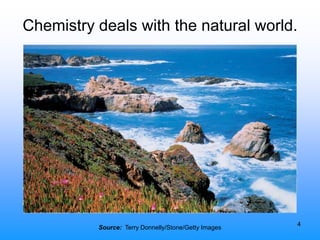
Chemistry deals with the natural world.
Source: Terry Donnelly/Stone/Getty Images
5
Why is Chemistry Important?
• In Your Education
– Help you learn to Gather and Organize
Information
• Qualitative and Quantitative
– Help you learn to find Patterns in Information
– Help you learn to Analyze Complex Systems
– Help you develop skills to Predict Future
Events based on Patterns of Behavior
– Help you develop Problem-Solving Skills
• Systematic Approach
6
What is Chemistry?
• The science that deals with the materials
of the universe and the changes these
materials undergo
• The Central Science
– Understanding most other fields of science
requires an understanding of Chemistry
7
Solving Problems Using a Scientific
Approach
• Define the Problem
• Gather Information
Facts
Observations
• Propose Solutions
• Organize Information and look for Patterns
• Hypotheses
8
• Evaluate your Proposed Solutions
• Test your Patterns by using them to Predict
What Will Happen
• Experiments
Solving Problems Using a Scientific
Approach
9
The Scientific Method
• A process of studying natural phenomena
that involves making observations, forming
laws and theories, and testing theories by
experimentation
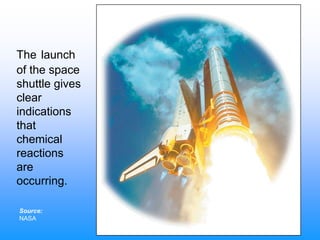
The launch
of the space
shuttle gives
clear
indications
that
chemical
reactions
are
occurring.
Source:
NASA
11
The Scientific Method
• Make Observations
– Qualitative  Descriptions
– Quantitative  Measurements
• Formulate Hypotheses
– Possible Explanations for Observed
Characteristics or Behaviors
• Perform Experiments
– Test Hypothesis
12
The Scientific Method
• Repeat the process until we get a well-
tested explanation
• Theory  a set of assumptions put forth
to explain some aspect of the observed
behavior of matter
– May need to be modified or discarded as new
information (observations) becomes known
13
The Scientific Method
• While Experimenting we may Observe the
Same Behavior all the time, and therefore
be able to Predict this Behavior will Always
Occur in the Future
• Law  a generally observed behavior
– Without explanation as to why the behavior
occurs!
14
The Difference Between a Theory and a
Law
• Laws predict what will happen
• Theories explain why something
happens
– Which will also allow you to predict what
will happen!
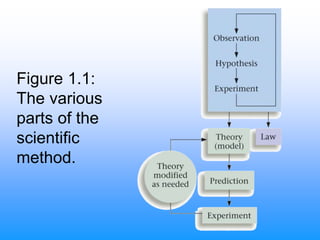
Figure 1.1:
The various
parts of the
scientific
method.
16
The Best Approach to Learning
Chemistry
• Learn the Vocabulary of Chemistry
– Definitions of Terms
– How Common Vocabulary is Applied to Chemistry
• Memorize Important Information
– Names, Formulas and Charges of Polyatomic Ions
– Solubility Rules
• Learn and Practice Processes
– Systematic Names and Formulas
– Dimensional Analysis
• Do the Questions and Exercises at the End of the
Chapter to Test your Understanding and help you
See the Patterns

Chemistry Introduction.ppt

  • 1.
    1 Basic Chemistry: A Foundation bySteven S. Zumdahl University of Illinois
  • 2.
  • 3.
    3 Why is ChemistryImportant? • In Our Daily Lives – New Materials – New Pharmaceuticals – New Energy Sources – Food Supplies – Can you think of others?
  • 4.
    4 Chemistry deals withthe natural world. Source: Terry Donnelly/Stone/Getty Images
  • 5.
    5 Why is ChemistryImportant? • In Your Education – Help you learn to Gather and Organize Information • Qualitative and Quantitative – Help you learn to find Patterns in Information – Help you learn to Analyze Complex Systems – Help you develop skills to Predict Future Events based on Patterns of Behavior – Help you develop Problem-Solving Skills • Systematic Approach
  • 6.
    6 What is Chemistry? •The science that deals with the materials of the universe and the changes these materials undergo • The Central Science – Understanding most other fields of science requires an understanding of Chemistry
  • 7.
    7 Solving Problems Usinga Scientific Approach • Define the Problem • Gather Information Facts Observations • Propose Solutions • Organize Information and look for Patterns • Hypotheses
  • 8.
    8 • Evaluate yourProposed Solutions • Test your Patterns by using them to Predict What Will Happen • Experiments Solving Problems Using a Scientific Approach
  • 9.
    9 The Scientific Method •A process of studying natural phenomena that involves making observations, forming laws and theories, and testing theories by experimentation
  • 10.
    The launch of thespace shuttle gives clear indications that chemical reactions are occurring. Source: NASA
  • 11.
    11 The Scientific Method •Make Observations – Qualitative  Descriptions – Quantitative  Measurements • Formulate Hypotheses – Possible Explanations for Observed Characteristics or Behaviors • Perform Experiments – Test Hypothesis
  • 12.
    12 The Scientific Method •Repeat the process until we get a well- tested explanation • Theory  a set of assumptions put forth to explain some aspect of the observed behavior of matter – May need to be modified or discarded as new information (observations) becomes known
  • 13.
    13 The Scientific Method •While Experimenting we may Observe the Same Behavior all the time, and therefore be able to Predict this Behavior will Always Occur in the Future • Law  a generally observed behavior – Without explanation as to why the behavior occurs!
  • 14.
    14 The Difference Betweena Theory and a Law • Laws predict what will happen • Theories explain why something happens – Which will also allow you to predict what will happen!
  • 15.
    Figure 1.1: The various partsof the scientific method.
  • 16.
    16 The Best Approachto Learning Chemistry • Learn the Vocabulary of Chemistry – Definitions of Terms – How Common Vocabulary is Applied to Chemistry • Memorize Important Information – Names, Formulas and Charges of Polyatomic Ions – Solubility Rules • Learn and Practice Processes – Systematic Names and Formulas – Dimensional Analysis • Do the Questions and Exercises at the End of the Chapter to Test your Understanding and help you See the Patterns