PRESENTED BY: SHAHZAIB NASIR
ROLL NO. 14
BS(HONS) GEOGRAPHY
DEPARTMENT OF GEOGRAPHY
UNIVERSITY OF THE PUNJAB
PHYSICS
OUTLINE
 Introduction
 Definition
 Branches of physics
 Comparison of two branches
 Contribution of Muslim scientist
Physics
Introduction
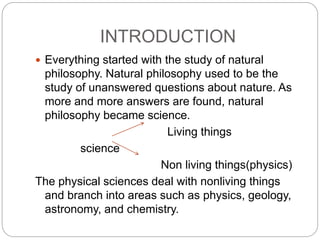
INTRODUCTION
 Everything started with the study of natural
philosophy. Natural philosophy used to be the
study of unanswered questions about nature. As
more and more answers are found, natural
philosophy became science.
Living things
science
Non living things(physics)
The physical sciences deal with nonliving things
and branch into areas such as physics, geology,
astronomy, and chemistry.
Physics
Definition
Definition:
The branch of science concerned with the
nature and properties of matter and energy.
The subject matter of physics includes:
-Mechanics
-Heat
-Light and other radiation
-Sound
-Electricity
-Magnetism
-and the structure of atoms.
Physics
Branches of physics
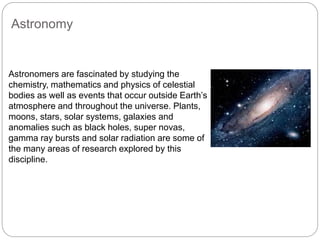
Astronomy
Astronomers are fascinated by studying the
chemistry, mathematics and physics of celestial
bodies as well as events that occur outside Earth’s
atmosphere and throughout the universe. Plants,
moons, stars, solar systems, galaxies and
anomalies such as black holes, super novas,
gamma ray bursts and solar radiation are some of
the many areas of research explored by this
discipline.
Astrophysics
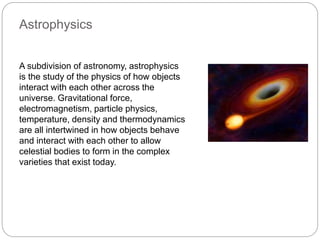
A subdivision of astronomy, astrophysics
is the study of the physics of how objects
interact with each other across the
universe. Gravitational force,
electromagnetism, particle physics,
temperature, density and thermodynamics
are all intertwined in how objects behave
and interact with each other to allow
celestial bodies to form in the complex
varieties that exist today.
Atomic Physics
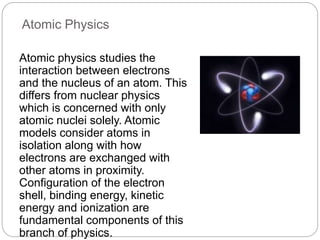
Atomic physics studies the
interaction between electrons
and the nucleus of an atom. This
differs from nuclear physics
which is concerned with only
atomic nuclei solely. Atomic
models consider atoms in
isolation along with how
electrons are exchanged with
other atoms in proximity.
Configuration of the electron
shell, binding energy, kinetic
energy and ionization are
fundamental components of this
branch of physics.
Geophysics
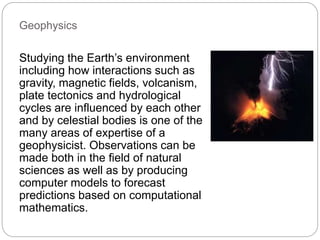
Studying the Earth’s environment
including how interactions such as
gravity, magnetic fields, volcanism,
plate tectonics and hydrological
cycles are influenced by each other
and by celestial bodies is one of the
many areas of expertise of a
geophysicist. Observations can be
made both in the field of natural
sciences as well as by producing
computer models to forecast
predictions based on computational
mathematics.
High Energy Physics
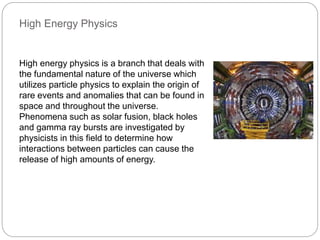
High energy physics is a branch that deals with
the fundamental nature of the universe which
utilizes particle physics to explain the origin of
rare events and anomalies that can be found in
space and throughout the universe.
Phenomena such as solar fusion, black holes
and gamma ray bursts are investigated by
physicists in this field to determine how
interactions between particles can cause the
release of high amounts of energy.
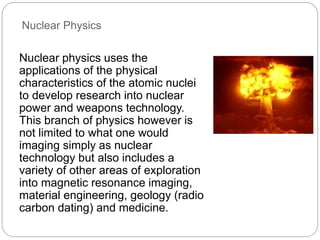
Nuclear Physics
Nuclear physics uses the
applications of the physical
characteristics of the atomic nuclei
to develop research into nuclear
power and weapons technology.
This branch of physics however is
not limited to what one would
imaging simply as nuclear
technology but also includes a
variety of other areas of exploration
into magnetic resonance imaging,
material engineering, geology (radio
carbon dating) and medicine.
PHYSICS
Comparison of two branches of
physics
Astronomy Astrophysics
• Astronomers are fascinated by
studying the chemistry,
mathematics and physics of
celestial bodies as well as
events that occur outside
Earth’s atmosphere and
throughout the universe. Plants,
moons, stars, solar systems,
galaxies and anomalies such as
black holes, super novas,
gamma ray bursts and solar
radiation are some of the many
areas of research explored by
this discipline.
 A subdivision of astronomy,
astrophysics is the study of the
physics of how objects interact
with each other across the
universe. Gravitational force,
electromagnetism, particle
physics, temperature, density
and thermodynamics are all
intertwined in how objects
behave and interact with each
other to allow celestial bodies to
form in the complex varieties
that exist today.
PHYSICS
Contribution of Muslim scientist in
science
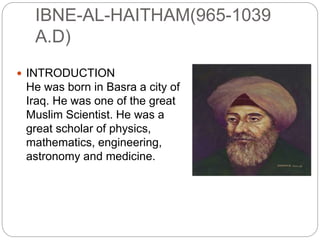
IBNE-AL-HAITHAM(965-1039
A.D)
 INTRODUCTION
He was born in Basra a city of
Iraq. He was one of the great
Muslim Scientist. He was a
great scholar of physics,
mathematics, engineering,
astronomy and medicine.
CONTRIBUTION
1. He was a first man who discussed in detail
about the luminous, non-luminous and
transparent bodies.
2. He also gave the structure and working of
eyes.
3. He gave us many laws of reflection and
wrote many books about the reflection of light.
4. He also first time gave the idea that
whenever the ray of light is incident on an
object some of the incident rays are reflected
from the object and enter the eyes
consequently the object becomes visible to the
Physics

Physics

  • 1.
    PRESENTED BY: SHAHZAIBNASIR ROLL NO. 14 BS(HONS) GEOGRAPHY DEPARTMENT OF GEOGRAPHY UNIVERSITY OF THE PUNJAB PHYSICS
  • 2.
    OUTLINE  Introduction  Definition Branches of physics  Comparison of two branches  Contribution of Muslim scientist
  • 3.
  • 4.
    INTRODUCTION  Everything startedwith the study of natural philosophy. Natural philosophy used to be the study of unanswered questions about nature. As more and more answers are found, natural philosophy became science. Living things science Non living things(physics) The physical sciences deal with nonliving things and branch into areas such as physics, geology, astronomy, and chemistry.
  • 5.
  • 6.
    Definition: The branch ofscience concerned with the nature and properties of matter and energy. The subject matter of physics includes: -Mechanics -Heat -Light and other radiation -Sound -Electricity -Magnetism -and the structure of atoms.
  • 7.
  • 8.
    Astronomy Astronomers are fascinatedby studying the chemistry, mathematics and physics of celestial bodies as well as events that occur outside Earth’s atmosphere and throughout the universe. Plants, moons, stars, solar systems, galaxies and anomalies such as black holes, super novas, gamma ray bursts and solar radiation are some of the many areas of research explored by this discipline.
  • 9.
    Astrophysics A subdivision ofastronomy, astrophysics is the study of the physics of how objects interact with each other across the universe. Gravitational force, electromagnetism, particle physics, temperature, density and thermodynamics are all intertwined in how objects behave and interact with each other to allow celestial bodies to form in the complex varieties that exist today.
  • 10.
    Atomic Physics Atomic physicsstudies the interaction between electrons and the nucleus of an atom. This differs from nuclear physics which is concerned with only atomic nuclei solely. Atomic models consider atoms in isolation along with how electrons are exchanged with other atoms in proximity. Configuration of the electron shell, binding energy, kinetic energy and ionization are fundamental components of this branch of physics.
  • 11.
    Geophysics Studying the Earth’senvironment including how interactions such as gravity, magnetic fields, volcanism, plate tectonics and hydrological cycles are influenced by each other and by celestial bodies is one of the many areas of expertise of a geophysicist. Observations can be made both in the field of natural sciences as well as by producing computer models to forecast predictions based on computational mathematics.
  • 12.
    High Energy Physics Highenergy physics is a branch that deals with the fundamental nature of the universe which utilizes particle physics to explain the origin of rare events and anomalies that can be found in space and throughout the universe. Phenomena such as solar fusion, black holes and gamma ray bursts are investigated by physicists in this field to determine how interactions between particles can cause the release of high amounts of energy.
  • 13.
    Nuclear Physics Nuclear physicsuses the applications of the physical characteristics of the atomic nuclei to develop research into nuclear power and weapons technology. This branch of physics however is not limited to what one would imaging simply as nuclear technology but also includes a variety of other areas of exploration into magnetic resonance imaging, material engineering, geology (radio carbon dating) and medicine.
  • 14.
    PHYSICS Comparison of twobranches of physics
  • 15.
    Astronomy Astrophysics • Astronomersare fascinated by studying the chemistry, mathematics and physics of celestial bodies as well as events that occur outside Earth’s atmosphere and throughout the universe. Plants, moons, stars, solar systems, galaxies and anomalies such as black holes, super novas, gamma ray bursts and solar radiation are some of the many areas of research explored by this discipline.  A subdivision of astronomy, astrophysics is the study of the physics of how objects interact with each other across the universe. Gravitational force, electromagnetism, particle physics, temperature, density and thermodynamics are all intertwined in how objects behave and interact with each other to allow celestial bodies to form in the complex varieties that exist today.
  • 16.
    PHYSICS Contribution of Muslimscientist in science
  • 17.
    IBNE-AL-HAITHAM(965-1039 A.D)  INTRODUCTION He wasborn in Basra a city of Iraq. He was one of the great Muslim Scientist. He was a great scholar of physics, mathematics, engineering, astronomy and medicine.
  • 18.
    CONTRIBUTION 1. He wasa first man who discussed in detail about the luminous, non-luminous and transparent bodies. 2. He also gave the structure and working of eyes. 3. He gave us many laws of reflection and wrote many books about the reflection of light. 4. He also first time gave the idea that whenever the ray of light is incident on an object some of the incident rays are reflected from the object and enter the eyes consequently the object becomes visible to the