Expected Learning Outcome1:
“ Able to understand and use knowledge
of the concepts, scope and dynamics of
digital marketing “
5.
"Digital Marketing Excellence"by Dave Chaffey and PR Smith (2017)
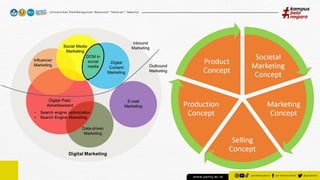
Digital marketing is defined as the management
process responsible for identifying, anticipating, and
satisfying customer requirements profitably using
digital technologies. This includes not only internet
marketing but also management of digital customer
data and digital customer relationship systems.
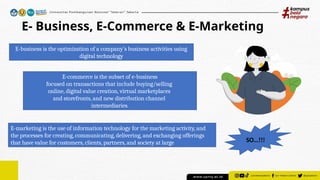
E- Business, E-Commerce& E-Marketing
E-business is the optimization of a company’s business activities using
digital technology
E-commerce is the subset of e-business
focused on transactions that include buying/selling
online, digital value creation, virtual marketplaces
and storefronts, and new distribution channel
intermediaries.
E-marketing is the use of information technology for the marketing activity, and
the processes for creating, communicating, delivering, and exchanging offerings
that have value for customers, clients, partners, and
society at large SO…!!!
8.
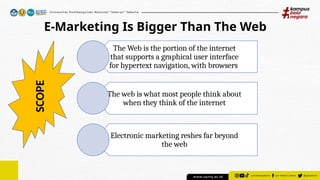
E-Marketing Is BiggerThan The Web
The Web is the portion of the internet
that supports a graphical user interface
for hypertext navigation, with browsers
The web is what most people think about
when they think of the internet
Electronic marketing reshes far beyond
the web
SCOPE
9.
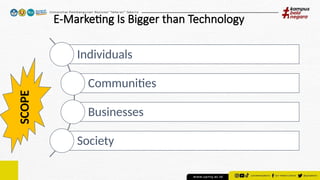
E-Marketing Is Biggerthan Technology
Individuals
Communities
Businesses
Society
SCOPE
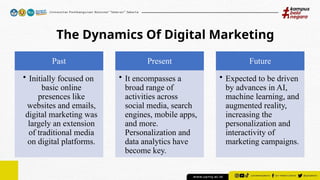
The Dynamics OfDigital Marketing
Past
• Initially focused on
basic online
presences like
websites and emails,
digital marketing was
largely an extension
of traditional media
on digital platforms.
Present
• It encompasses a
broad range of
activities across
social media, search
engines, mobile apps,
and more.
Personalization and
data analytics have
become key.
Future
• Expected to be driven
by advances in AI,
machine learning, and
augmented reality,
increasing the
personalization and
interactivity of
marketing campaigns.
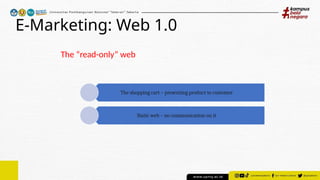
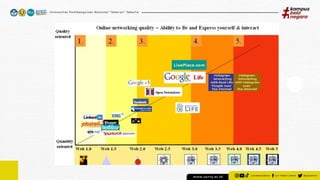
E-Marketing: Web 1.0
Theshopping cart – presenting product to customer
Static web – no communication on it
The “read-only” web
15.
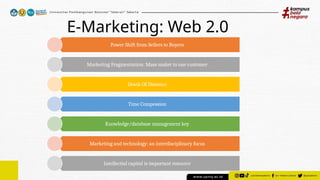
E-Marketing: Web 2.0
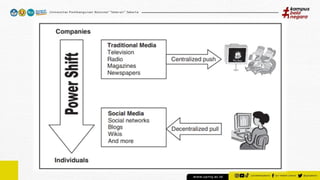
PowerShift from Sellers to Buyers
Marketing Fragmentation: Mass maket to one customer
Death Of Distance
Time Compession
Knowledge/database management key
Marketing and technology: an interdisciplinary focus
Intellectial capital is important resource
16.
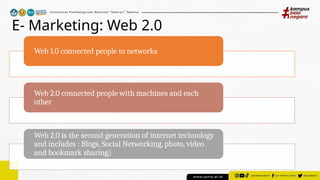
E- Marketing: Web2.0
Web 1.0 connected people to networks
Web 2.0 connected people with machines and each
other
Web 2.0 is the second generation of internet technology
and includes : Blogs, Social Networking, photo, video
and bookmark sharing)
18.
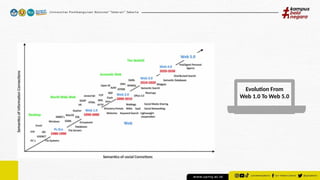
E-Marketing: Web 3.0
Thenewst technologies allow marketer fo focus
on user: Engagement, participant and Co-
creation
Online gaming represented over $1 billion in
renevue and 15 million player in 2006
Wireless Networking andMobile Computing
• Cell phones, PDAs and laptop connect to the internet via
wireless modem worldwide
o Starbucks
o Hotels and airports
o Queen mary II Luxury lines
o Train stations
• Customers will have information, entertainment and
communications when, where and how they want it.
21.
Appliance Convergence
The receivingappliance is separate from the media type.
• Computers can receive digital radio and TV.
• TV sets can receive the Web.
New types of “smart” receiving appliances will emerge.
• Internet refrigerator is many digital appliances in one.
• Global positioning systems (GPS) allow in-car
communication and entertainment.
22.
E-Marketing: Web 4.0
Notexactly a new version, but an alternate version of what
we already have.
“Adaptation to it’s mobile surrounding”
Web 4.0 connects all devices in real and virtual world in
real time
23.
The Future: Web5.0 “THE NEXT WEB”
“SYMBIOTIC WEB”
Open, Linked and Intelligent web
Emotional web
THE IMPACT OFDIGITAL MARKETING
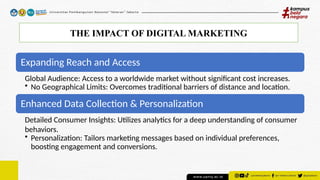
Expanding Reach and Access
Global Audience: Access to a worldwide market without significant cost increases.
• No Geographical Limits: Overcomes traditional barriers of distance and location.
Enhanced Data Collection & Personalization
Detailed Consumer Insights: Utilizes analytics for a deep understanding of consumer
behaviors.
• Personalization: Tailors marketing messages based on individual preferences,
boosting engagement and conversions.
31.
THE IMPACT OFDIGITAL MARKETING
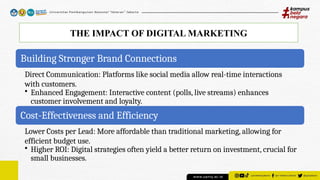
Building Stronger Brand Connections
Direct Communication: Platforms like social media allow real-time interactions
with customers.
• Enhanced Engagement: Interactive content (polls, live streams) enhances
customer involvement and loyalty.
Cost-Effectiveness and Efficiency
Lower Costs per Lead: More affordable than traditional marketing, allowing for
efficient budget use.
• Higher ROI: Digital strategies often yield a better return on investment, crucial for
small businesses.
32.
THE IMPACT OFDIGITAL MARKETING
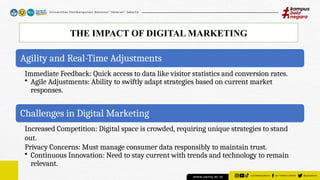
Agility and Real-Time Adjustments
Immediate Feedback: Quick access to data like visitor statistics and conversion rates.
• Agile Adjustments: Ability to swiftly adapt strategies based on current market
responses.
Challenges in Digital Marketing
Increased Competition: Digital space is crowded, requiring unique strategies to stand
out.
Privacy Concerns: Must manage consumer data responsibly to maintain trust.
• Continuous Innovation: Need to stay current with trends and technology to remain
relevant.
33.
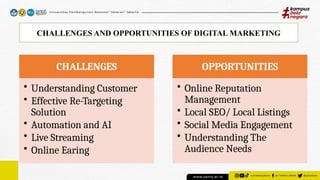
CHALLENGES AND OPPORTUNITIESOF DIGITAL MARKETING
CHALLENGES
• Understanding Customer
• Effective Re-Targeting
Solution
• Automation and AI
• Live Streaming
• Online Earing
OPPORTUNITIES
• Online Reputation
Management
• Local SEO/ Local Listings
• Social Media Engagement
• Understanding The
Audience Needs
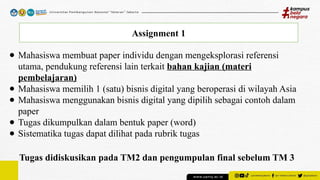
Assignment 1
● Mahasiswamembuat paper individu dengan mengeksplorasi referensi
utama, pendukung referensi lain terkait bahan kajian (materi
pembelajaran)
● Mahasiswa memilih 1 (satu) bisnis digital yang beroperasi di wilayah Asia
● Mahasiswa menggunakan bisnis digital yang dipilih sebagai contoh dalam
paper
● Tugas dikumpulkan dalam bentuk paper (word)
● Sistematika tugas dapat dilihat pada rubrik tugas
Tugas didiskusikan pada TM2 dan pengumpulan final sebelum TM 3