Copyright © 2019, 2015, 2011 Pearson Education, Inc. All Rights Reserved
Digital Business and E-Commerce
Management
Seventh Edition
Part 1
Introduction
Chapter 1
Introduction to digital business
Copyright © 2019, 2015, 2011 Pearson Education, Inc. All Rights Reserved
Learning Outcomes
• Define the meaning and scope of digital
business and the difference between
digital business and e-commerce
• Summarise the main reasons for
becoming a digital business and barriers
that may restrict it
• Outline the ongoing business challenges
of managing digital business in an
organisation, particularly tech start-ups
Copyright © 2019, 2015, 2011 Pearson Education, Inc. All Rights Reserved
Management issues
• How do we explain the scope and
implications of digital business to staff?
• What is the full range of benefits of
introducing digital business and what are
the risks?
• How do we evaluate our current digital
capabilities?
Copyright © 2019, 2015, 2011 Pearson Education, Inc. All Rights Reserved
Digital business innovation and
opportunity
• Since Google was launched in 1998,
which digital start-ups have transformed
the way we work, live and play?
• How has Google innovated in search
and its business model?
• See Table 1.1 for some of the major
innovators
Copyright © 2019, 2015, 2011 Pearson Education, Inc. All Rights Reserved
The impact of digital communications
on traditional businesses
• Impact and time a business takes to react
varies by industry sector
• Andy Grove, Chairman of Intel, one of the
early adopters of digital business, noted
that every organisation needs to ask
whether, for them:
“The Internet is a typhoon force, a ten times
force, or is it a bit of wind? Or is it a force that
fundamentally alters our business?”
(Grove, 1996)
Copyright © 2019, 2015, 2011 Pearson Education, Inc. All Rights Reserved
New communications approaches
and consumer behaviour
• Inbound marketing
‒ The consumer is proactive in actively seeking
out information for their needs, and interactions
with brands are attracted through content,
search and social media marketing
• Zero Moment of Truth (ZMOT, Figure 1.2)
‒ A summary of today’s multichannel consumer
decision-making for product purchase where
they search, review ratings, styles, prices and
comments on social media before visiting a
retailer
Copyright © 2019, 2015, 2011 Pearson Education, Inc. All Rights Reserved
New communications approaches
and consumer behaviour (Continued)
• Content marketing
‒ …the marketing and business process for
creating and distributing relevant and valuable
content to attract, acquire, and engage a
clearly defined and understood target audience
– with the objective of driving profitable
customer action (Pulizzi, 2012)
Copyright © 2019, 2015, 2011 Pearson Education, Inc. All Rights Reserved
Figure 1.2 Zero Moment of Truth
Source: Google, Lecinski (2012).
Copyright © 2019, 2015, 2011 Pearson Education, Inc. All Rights Reserved
What is digital business and
e-commerce
• You are attending a role in the digital
team of a global retailer
• You anticipate you may be asked the
distinction between e-commerce and
digital business
• Write down a definition for each:
‒ E-commerce
‒ Digital business
Copyright © 2019, 2015, 2011 Pearson Education, Inc. All Rights Reserved
The difference between digital
business and e-commerce
• Digital business
‒ The transformation of key business
processes through the use of digital
technologies
• E-commerce
‒ All digital (and electronic) mediated
transactions between an organisation and a
third party
Copyright © 2019, 2015, 2011 Pearson Education, Inc. All Rights Reserved
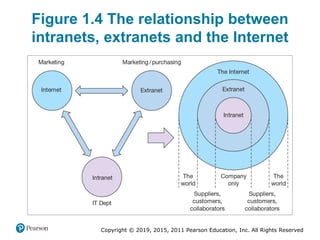
Figure 1.4 The relationship between
intranets, extranets and the Internet
Copyright © 2019, 2015, 2011 Pearson Education, Inc. All Rights Reserved
Understanding different types
of digital presence (Activity 1.3)
• Transactional e‐commerce site
• Services‐oriented relationship‐building
website
• Brand‐building site
• Portal or media site
• Social network
‒ These aren’t mutually exclusive, but there is
usually a focus of each website
‒ Examples of each
Copyright © 2019, 2015, 2011 Pearson Education, Inc. All Rights Reserved
Digital marketing
• Digital marketing involves:
‒ Applying technologies which create digital channels to market
 For example, Websites, search engines, email, social media sites and text
messaging
• To achieve these objectives
‒ Support marketing activities aimed at achieving profitable acquisition,
conversion and retention of customers within a multichannel buying process
and customer lifecycle
• By using these tactics
‒ Recognising the strategic importance of digital technologies and developing a
planned approach to reach and migrate customers to digital services through
digital and traditional communications
‒ Retention is achieved through improving our customer knowledge (of their
profiles, behaviour, value and loyalty drivers), then delivering integrated,
targeted communications and digital services that match their personal needs
Copyright © 2019, 2015, 2011 Pearson Education, Inc. All Rights Reserved
Figure 1.7 The three main options
for online media investment
Copyright © 2019, 2015, 2011 Pearson Education, Inc. All Rights Reserved
Figure 1.8 Digital and offline
communications techniques
Copyright © 2019, 2015, 2011 Pearson Education, Inc. All Rights Reserved
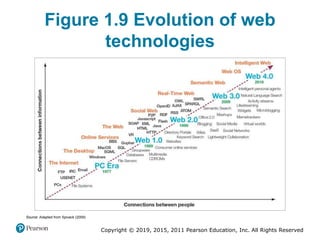
Figure 1.9 Evolution of web
technologies
Source: Adapted from Spivack (2009)
Copyright © 2019, 2015, 2011 Pearson Education, Inc. All Rights Reserved
Figure 1.10 Summary and examples of
transaction alternatives between businesses,
consumers and governmental organisations
Copyright © 2019, 2015, 2011 Pearson Education, Inc. All Rights Reserved
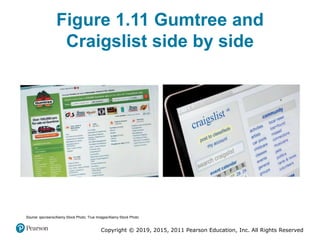
Figure 1.11 Gumtree and
Craigslist side by side
Source: sjscreens/Alamy Stock Photo; True Images/Alamy Stock Photo
Copyright © 2019, 2015, 2011 Pearson Education, Inc. All Rights Reserved
Figure 1.12 A simple stage model for
buy-side and sell-side e-commerce
Copyright © 2019, 2015, 2011 Pearson Education, Inc. All Rights Reserved
Digtial business opportunities
• Reach
‒ Billions of global consumers
‒ Millions of products
• Richness
‒ 100s of billions of pages indexed by search
engines
• Affiliation
‒ Links with partners
Copyright © 2019, 2015, 2011 Pearson Education, Inc. All Rights Reserved
Risks in digital business
• Too many customers
• Hacking
• Privacy issues
• Goods/services not being delivered
when outside the control of the digital
business
• Communications not getting to the right
person in the organisation
Copyright © 2019, 2015, 2011 Pearson Education, Inc. All Rights Reserved
Drivers
• Cost/efficiency drivers
‒ Increasing speed with which supplies can be
obtained
‒ Increasing speed with which goods can be
dispatched
‒ Reduced sales and purchasing costs
‒ Reduced operating costs
• Competitiveness drivers
‒ Customer demand
‒ Improving the range and quality of services offered
‒ Avoid losing market share to businesses already
using e-commerce
Copyright © 2019, 2015, 2011 Pearson Education, Inc. All Rights Reserved
Activity – drivers and barriers
• You work as an advisor to a local government
organisation that promotes the take-up of e-
commerce amongst small businesses
• List:
‒ Drivers to adoption of sell-side e-commerce by
business and how you can reinforce these by
marketing benefits
‒ Barriers to adoption of sell-side e-commerce by
business and how you can reinforce these by
stressing benefits
Copyright © 2019, 2015, 2011 Pearson Education, Inc. All Rights Reserved
Summary
• You should be able to define the meaning and
scope of digital business and the difference
between digital business and e-commerce
• You should be able to summarise the main
reasons for becoming a digital business and
barriers that may restrict it
• You should be able to outline the ongoing
business challenges of managing digital
business in an organisation, particularly tech
start-ups

BSAD 372 - CH 1

  • 1.
    Copyright © 2019,2015, 2011 Pearson Education, Inc. All Rights Reserved Digital Business and E-Commerce Management Seventh Edition Part 1 Introduction Chapter 1 Introduction to digital business
  • 2.
    Copyright © 2019,2015, 2011 Pearson Education, Inc. All Rights Reserved Learning Outcomes • Define the meaning and scope of digital business and the difference between digital business and e-commerce • Summarise the main reasons for becoming a digital business and barriers that may restrict it • Outline the ongoing business challenges of managing digital business in an organisation, particularly tech start-ups
  • 3.
    Copyright © 2019,2015, 2011 Pearson Education, Inc. All Rights Reserved Management issues • How do we explain the scope and implications of digital business to staff? • What is the full range of benefits of introducing digital business and what are the risks? • How do we evaluate our current digital capabilities?
  • 4.
    Copyright © 2019,2015, 2011 Pearson Education, Inc. All Rights Reserved Digital business innovation and opportunity • Since Google was launched in 1998, which digital start-ups have transformed the way we work, live and play? • How has Google innovated in search and its business model? • See Table 1.1 for some of the major innovators
  • 5.
    Copyright © 2019,2015, 2011 Pearson Education, Inc. All Rights Reserved The impact of digital communications on traditional businesses • Impact and time a business takes to react varies by industry sector • Andy Grove, Chairman of Intel, one of the early adopters of digital business, noted that every organisation needs to ask whether, for them: “The Internet is a typhoon force, a ten times force, or is it a bit of wind? Or is it a force that fundamentally alters our business?” (Grove, 1996)
  • 6.
    Copyright © 2019,2015, 2011 Pearson Education, Inc. All Rights Reserved New communications approaches and consumer behaviour • Inbound marketing ‒ The consumer is proactive in actively seeking out information for their needs, and interactions with brands are attracted through content, search and social media marketing • Zero Moment of Truth (ZMOT, Figure 1.2) ‒ A summary of today’s multichannel consumer decision-making for product purchase where they search, review ratings, styles, prices and comments on social media before visiting a retailer
  • 7.
    Copyright © 2019,2015, 2011 Pearson Education, Inc. All Rights Reserved New communications approaches and consumer behaviour (Continued) • Content marketing ‒ …the marketing and business process for creating and distributing relevant and valuable content to attract, acquire, and engage a clearly defined and understood target audience – with the objective of driving profitable customer action (Pulizzi, 2012)
  • 8.
    Copyright © 2019,2015, 2011 Pearson Education, Inc. All Rights Reserved Figure 1.2 Zero Moment of Truth Source: Google, Lecinski (2012).
  • 9.
    Copyright © 2019,2015, 2011 Pearson Education, Inc. All Rights Reserved What is digital business and e-commerce • You are attending a role in the digital team of a global retailer • You anticipate you may be asked the distinction between e-commerce and digital business • Write down a definition for each: ‒ E-commerce ‒ Digital business
  • 10.
    Copyright © 2019,2015, 2011 Pearson Education, Inc. All Rights Reserved The difference between digital business and e-commerce • Digital business ‒ The transformation of key business processes through the use of digital technologies • E-commerce ‒ All digital (and electronic) mediated transactions between an organisation and a third party
  • 11.
    Copyright © 2019,2015, 2011 Pearson Education, Inc. All Rights Reserved Figure 1.4 The relationship between intranets, extranets and the Internet
  • 12.
    Copyright © 2019,2015, 2011 Pearson Education, Inc. All Rights Reserved Understanding different types of digital presence (Activity 1.3) • Transactional e‐commerce site • Services‐oriented relationship‐building website • Brand‐building site • Portal or media site • Social network ‒ These aren’t mutually exclusive, but there is usually a focus of each website ‒ Examples of each
  • 13.
    Copyright © 2019,2015, 2011 Pearson Education, Inc. All Rights Reserved Digital marketing • Digital marketing involves: ‒ Applying technologies which create digital channels to market  For example, Websites, search engines, email, social media sites and text messaging • To achieve these objectives ‒ Support marketing activities aimed at achieving profitable acquisition, conversion and retention of customers within a multichannel buying process and customer lifecycle • By using these tactics ‒ Recognising the strategic importance of digital technologies and developing a planned approach to reach and migrate customers to digital services through digital and traditional communications ‒ Retention is achieved through improving our customer knowledge (of their profiles, behaviour, value and loyalty drivers), then delivering integrated, targeted communications and digital services that match their personal needs
  • 14.
    Copyright © 2019,2015, 2011 Pearson Education, Inc. All Rights Reserved Figure 1.7 The three main options for online media investment
  • 15.
    Copyright © 2019,2015, 2011 Pearson Education, Inc. All Rights Reserved Figure 1.8 Digital and offline communications techniques
  • 16.
    Copyright © 2019,2015, 2011 Pearson Education, Inc. All Rights Reserved Figure 1.9 Evolution of web technologies Source: Adapted from Spivack (2009)
  • 17.
    Copyright © 2019,2015, 2011 Pearson Education, Inc. All Rights Reserved Figure 1.10 Summary and examples of transaction alternatives between businesses, consumers and governmental organisations
  • 18.
    Copyright © 2019,2015, 2011 Pearson Education, Inc. All Rights Reserved Figure 1.11 Gumtree and Craigslist side by side Source: sjscreens/Alamy Stock Photo; True Images/Alamy Stock Photo
  • 19.
    Copyright © 2019,2015, 2011 Pearson Education, Inc. All Rights Reserved Figure 1.12 A simple stage model for buy-side and sell-side e-commerce
  • 20.
    Copyright © 2019,2015, 2011 Pearson Education, Inc. All Rights Reserved Digtial business opportunities • Reach ‒ Billions of global consumers ‒ Millions of products • Richness ‒ 100s of billions of pages indexed by search engines • Affiliation ‒ Links with partners
  • 21.
    Copyright © 2019,2015, 2011 Pearson Education, Inc. All Rights Reserved Risks in digital business • Too many customers • Hacking • Privacy issues • Goods/services not being delivered when outside the control of the digital business • Communications not getting to the right person in the organisation
  • 22.
    Copyright © 2019,2015, 2011 Pearson Education, Inc. All Rights Reserved Drivers • Cost/efficiency drivers ‒ Increasing speed with which supplies can be obtained ‒ Increasing speed with which goods can be dispatched ‒ Reduced sales and purchasing costs ‒ Reduced operating costs • Competitiveness drivers ‒ Customer demand ‒ Improving the range and quality of services offered ‒ Avoid losing market share to businesses already using e-commerce
  • 23.
    Copyright © 2019,2015, 2011 Pearson Education, Inc. All Rights Reserved Activity – drivers and barriers • You work as an advisor to a local government organisation that promotes the take-up of e- commerce amongst small businesses • List: ‒ Drivers to adoption of sell-side e-commerce by business and how you can reinforce these by marketing benefits ‒ Barriers to adoption of sell-side e-commerce by business and how you can reinforce these by stressing benefits
  • 24.
    Copyright © 2019,2015, 2011 Pearson Education, Inc. All Rights Reserved Summary • You should be able to define the meaning and scope of digital business and the difference between digital business and e-commerce • You should be able to summarise the main reasons for becoming a digital business and barriers that may restrict it • You should be able to outline the ongoing business challenges of managing digital business in an organisation, particularly tech start-ups