CHAPTER 7
MARKETING
COMMUNICATI
ON USING
DIGITAL MEDIA
CHANNEL
NUR AQILAH BINTI ZAINUDIN
2014416824
Learning objective
 Distinguish between the different types of digital media
channels
 Evaluate the advantages and disadvantages of each
media channel for marketing communications
 Assess the suitability of different types of digital media
for diferrent purpose
 Digital media channel – online communications
technique such as search engine marketing , affiliate
marketing and display advertising used to engage web
users on third-party sites, encourage them to visit an
organisation’s site or purchase through traditional
channels such as by phone or instore
Introduction
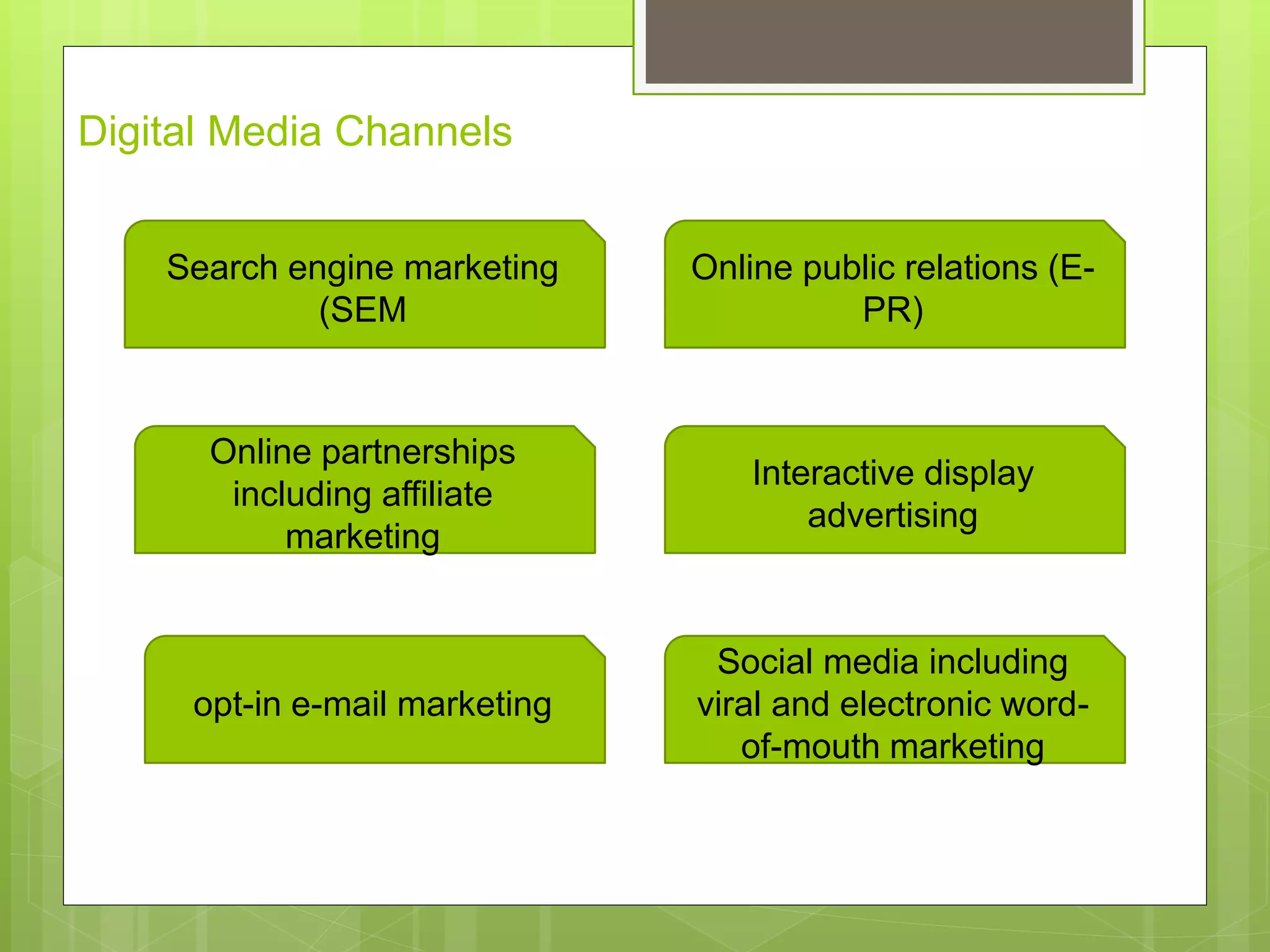
Digital Media Channels
Search engine marketing
(SEM
Online public relations (E-
PR)
Interactive display
advertising
Social media including
viral and electronic word-
of-mouth marketing
opt-in e-mail marketing
Online partnerships
including affiliate
marketing
1. Search engine marketing
 Search engine marketing (SEM) – promoting an organisation
through search engines to meet its objectives by delivering relevant
content in the search listings for searchers and encouraging them
to click through to a destination site.
 Two types of SEM
 Search engine optimisation (SEO) – to increase the position of
company or its products in search single natural/organic result
listing for selected keywords or phrases
 crawling
 Indexing
 Ranking scoring
 Query request and result serving
 Paid search (pay-per-click) marketing
 Similar to conventional advertising.
 Relevant text ad with a link to company page is displayed when
user search engine types in specific phrase.
Usually labelled as spnsored links
Eg : advertising in an other website
 Search engine ranking factor
 Matching between page copy and the key phase searched
 Link into the page (inbound or backlinks)
Advantages and
disadvantages of SEO
 Advantages
 Significant traffic driver
 Highly targeted
 Potentially low-cost visitors
 Dynamic
 Disadvantages
 Lack of predictability
 Time for result to be implemented
 Complexity and dynamic nature
 Ongoing investment
 Poor for developing awareness in comparison with other media
channels
Best practice in planning
and managing SEO
 Search engine submission
 Index inclusion
 Technical reasons why the search robots do not crawl all the pages
 Pages identified as spam or less importance or considered to be
duplicate content
 Keyphrase analysis
 Comparison/ quality
 Adjective (price/product qualifiers)
 Product types
 Vendor
 Location
 Action request
 On-page optimisation
 Occurrence of search term in body copy
 Alternative image text
 Document meta-data
 External linking
 Identify and create popular content and services
 Identify potential partner sites
 Contact partner sites
 Internal link structures
Include keyphrases used by searcher within anchor text of hyperlink
to point relevant content.
Paid search marketing
A. What is paid search marketing
 main model for paying sponsored listing is PPC marketing, we call
this section paid search marketing
B. Paid serach content network
 Paid listing also available through displaynetwork
c. Trusted fees
 Paid for inclusion is no longer significant to search advertising
D. What control position in paid search
E. The quality score
 Key to successful paid search marketing
Advantages and
disadvantages of paid search marketing
 Advantages
 The advertiser is not paying for the ad to be displayed
 PPC advertising is highly targeted
 Good accountability
 Predictable
 Technically simpler than SEO
 Remarketing
 Speed
 Branding
 Disadvantages
 competitive and expensive
 Inappropriate
 Requires specialist knowledge
 Time consuming
 Irrelevant
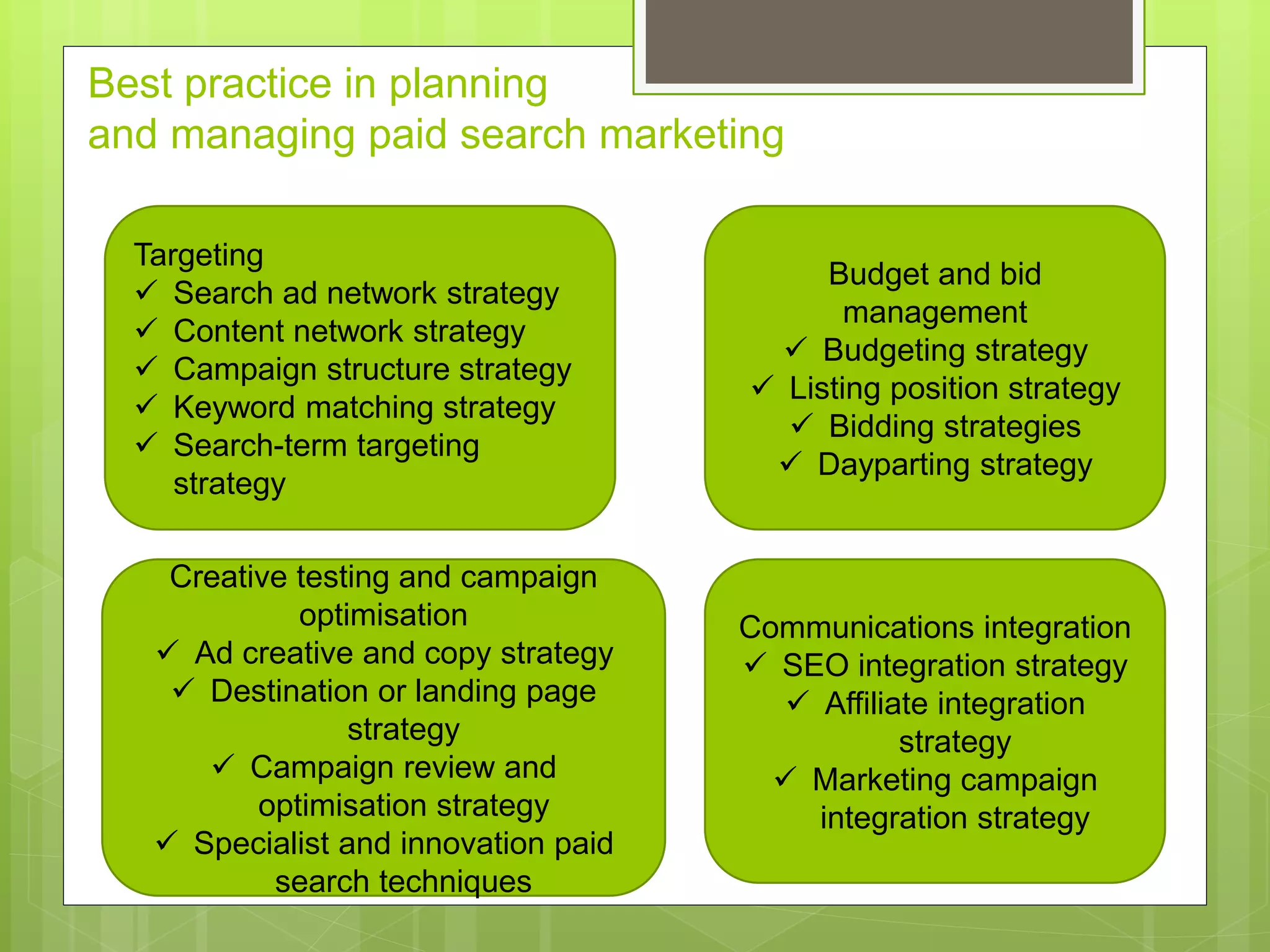
Best practice in planning
and managing paid search marketing
Targeting
 Search ad network strategy
 Content network strategy
 Campaign structure strategy
 Keyword matching strategy
 Search-term targeting
strategy
Budget and bid
management
 Budgeting strategy
 Listing position strategy
 Bidding strategies
 Dayparting strategy
Creative testing and campaign
optimisation
 Ad creative and copy strategy
 Destination or landing page
strategy
 Campaign review and
optimisation strategy
 Specialist and innovation paid
search techniques
Communications integration
 SEO integration strategy
 Affiliate integration
strategy
 Marketing campaign
integration strategy
2. Online public relations
 Public relation
 Management of the awareness, understanding and reputation of an
organisation or brand, primarily achieve through influencing
exposure in media.
 What is online public relation?
 Associated with improving results from many of the other
communication technique.
 Eg : blogs, feeds, social network
Differences between online
PR and traditional PR
1. The audience is connected to organisation
2. The members of the audience are connected to each other
3. The audience has access to other information
4. Audiences pull information
 For the marketer or PR professional, managing PR, the main
differences are:
 Less easy to control
 More options to create their own stories
 Need for faster response
 Easier to monitor
Advantages and
disadvantages of Online public relations
 Advantage
 reach
 Cost
 Creadibility
 Search engine optimisations
 Brand- enhancement and protection
o Disadvantages
 Not a controlled discipline
 Less controlled on third-party site
Best practice in
planning and managing online public
relations
 Communicating with online media owners (influencer outreach)
 Link building
 Web 2.0 atomised content
 Blogs and blogging
 Tagging and folksonomies
 Social bookmarking
 Photo, video and slide sharing sites
 Really simple syndication feeds
 Mashups
 Social networks
 Widgets
 Atomisation
 Managing how your brand is presented on third-party sites
 Creating a buzz – online viral marketing
3. Online partnership including
Affiliate marketing
 Affiliate Marketing
 Commision based arrangement where publisher receive a
commision on sales or lead by retailer or other transactional sites.
 Options of affiliate marketing models
 Aggregators
 Review sites
 Reward sites
 vouchers code sites
 Uber-bloggers
 Everyone else
Advantages and
disadvantages of affiliate marketing
>SERPS visibility
>Reach differ audience
>Responsiveness to
market place changes
>Target generic phrases in
SERPs
>Increase reach in SERPs
>Generate awareness
>Diversity risk
>Pay-per-performance
>Incremental profit / sales
may be limited
>Affiliates may exploit your
brand names
>May damage brand
reputation
>Programmed
management fees
>Program management
time
Best practice in planning
and managing affiliate marketing
 Best practice in planning and managing affiliate marketing
 Affiliate networks
 Commission
 Cookie expiry period
 Creative and links
 Online sponsorship
 Co-branding
 Contra-deals
4. Interactive display advertising
What is display advertising?
 Display advertising – display ads are paid ad placement using
graphical or rich media ad units within a web page to achieve
goals of delivering brand awareness, familiarity, favorability
and purchase intent.
Purchasing ad placements
 The run-of-site (the entire site)
 A section of site
 According to keywords entered on a search engine
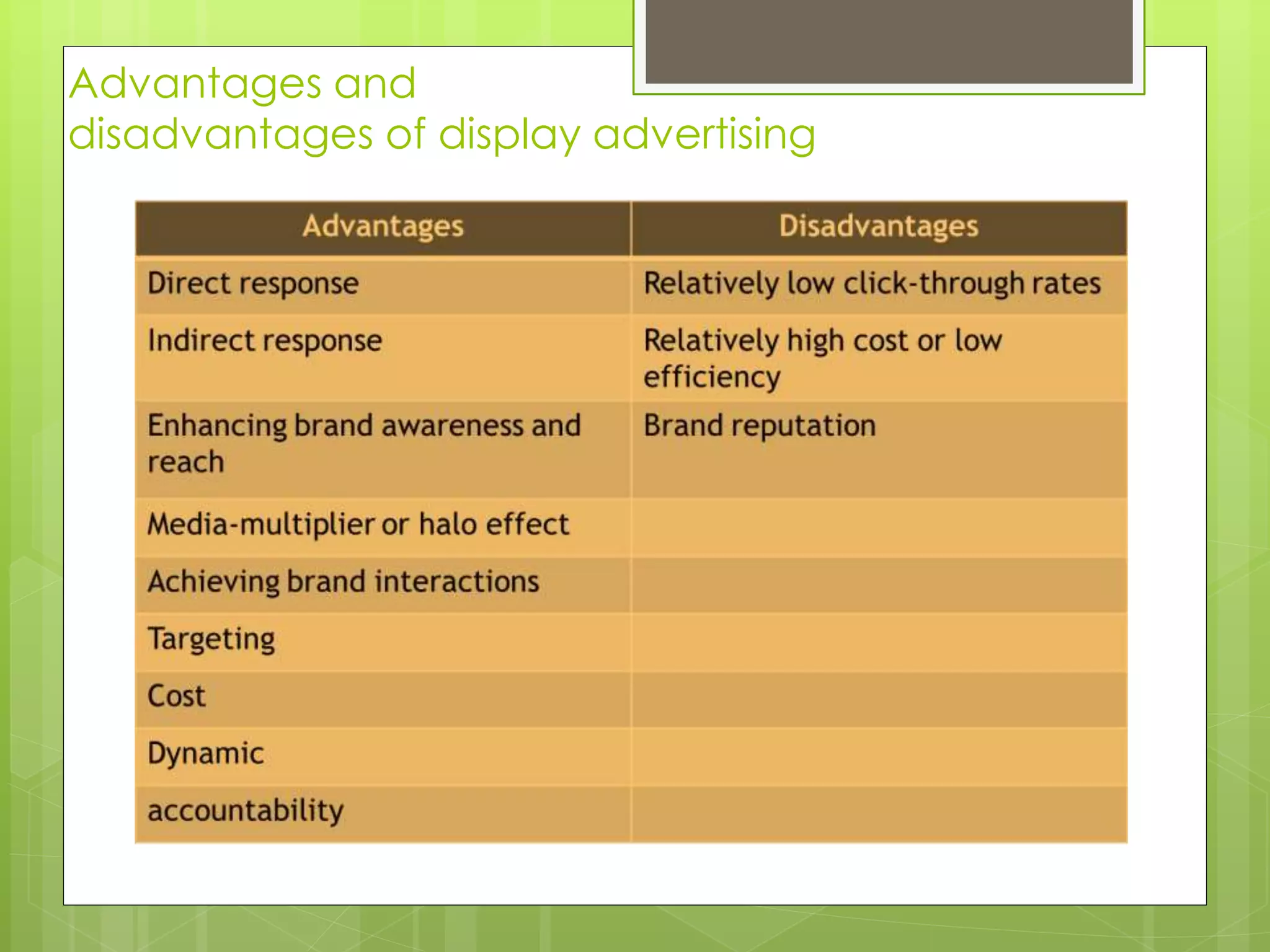
Advantages and
disadvantages of display advertising
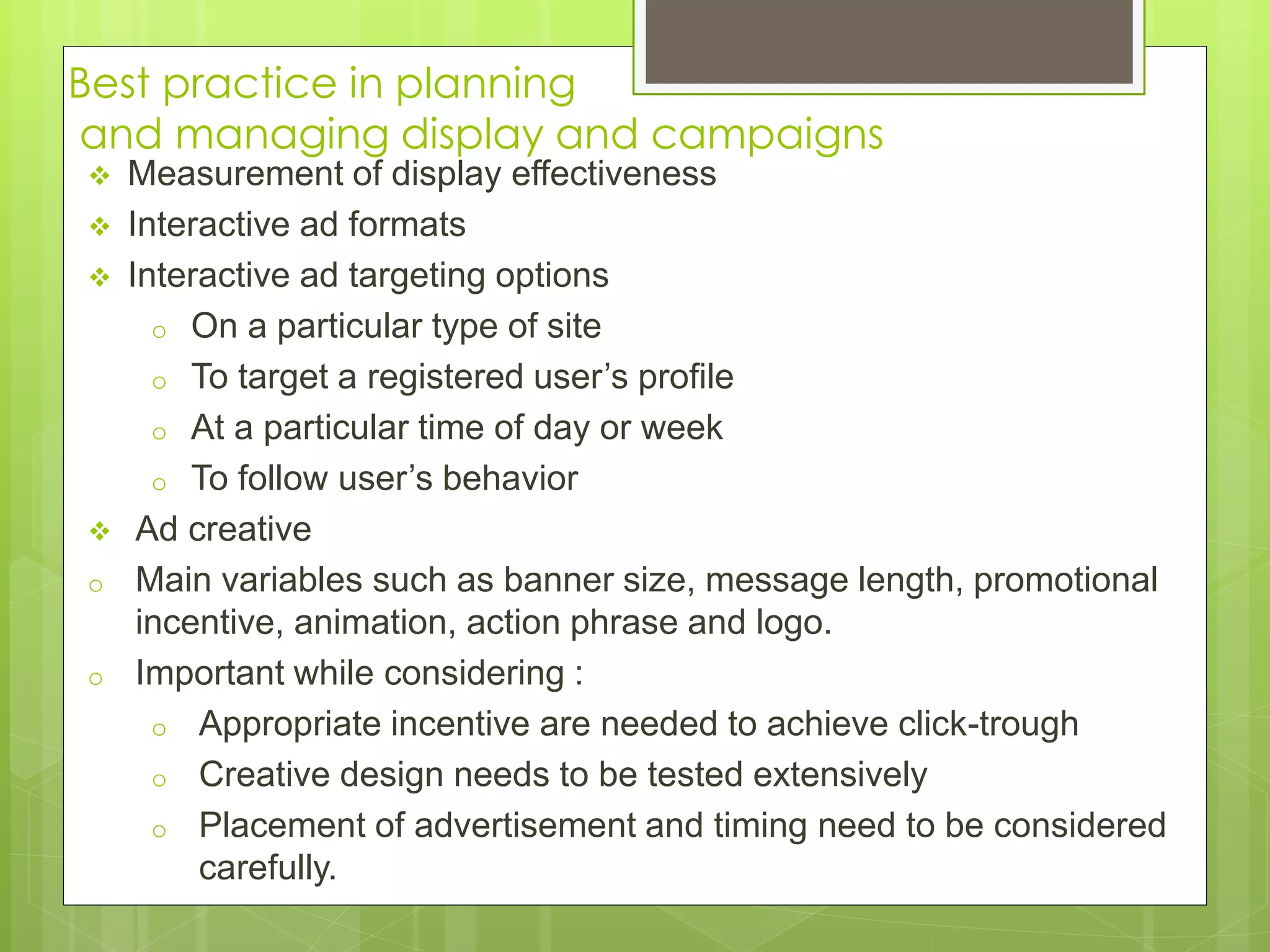
Best practice in planning
and managing display and campaigns
 Measurement of display effectiveness
 Interactive ad formats
 Interactive ad targeting options
o On a particular type of site
o To target a registered user’s profile
o At a particular time of day or week
o To follow user’s behavior
 Ad creative
o Main variables such as banner size, message length, promotional
incentive, animation, action phrase and logo.
o Important while considering :
o Appropriate incentive are needed to achieve click-trough
o Creative design needs to be tested extensively
o Placement of advertisement and timing need to be considered
carefully.
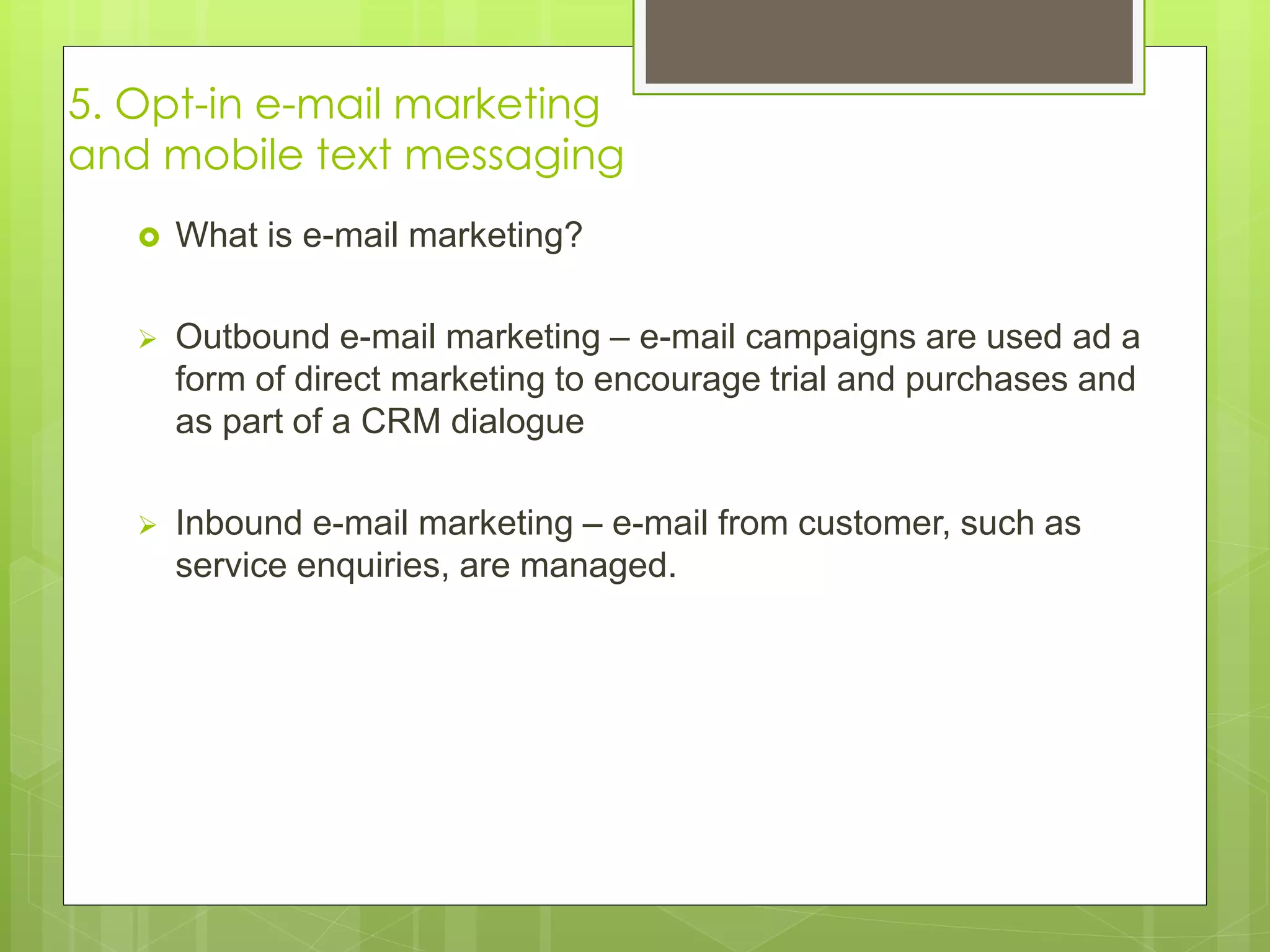
5. Opt-in e-mail marketing
and mobile text messaging
 What is e-mail marketing?
 Outbound e-mail marketing – e-mail campaigns are used ad a
form of direct marketing to encourage trial and purchases and
as part of a CRM dialogue
 Inbound e-mail marketing – e-mail from customer, such as
service enquiries, are managed.
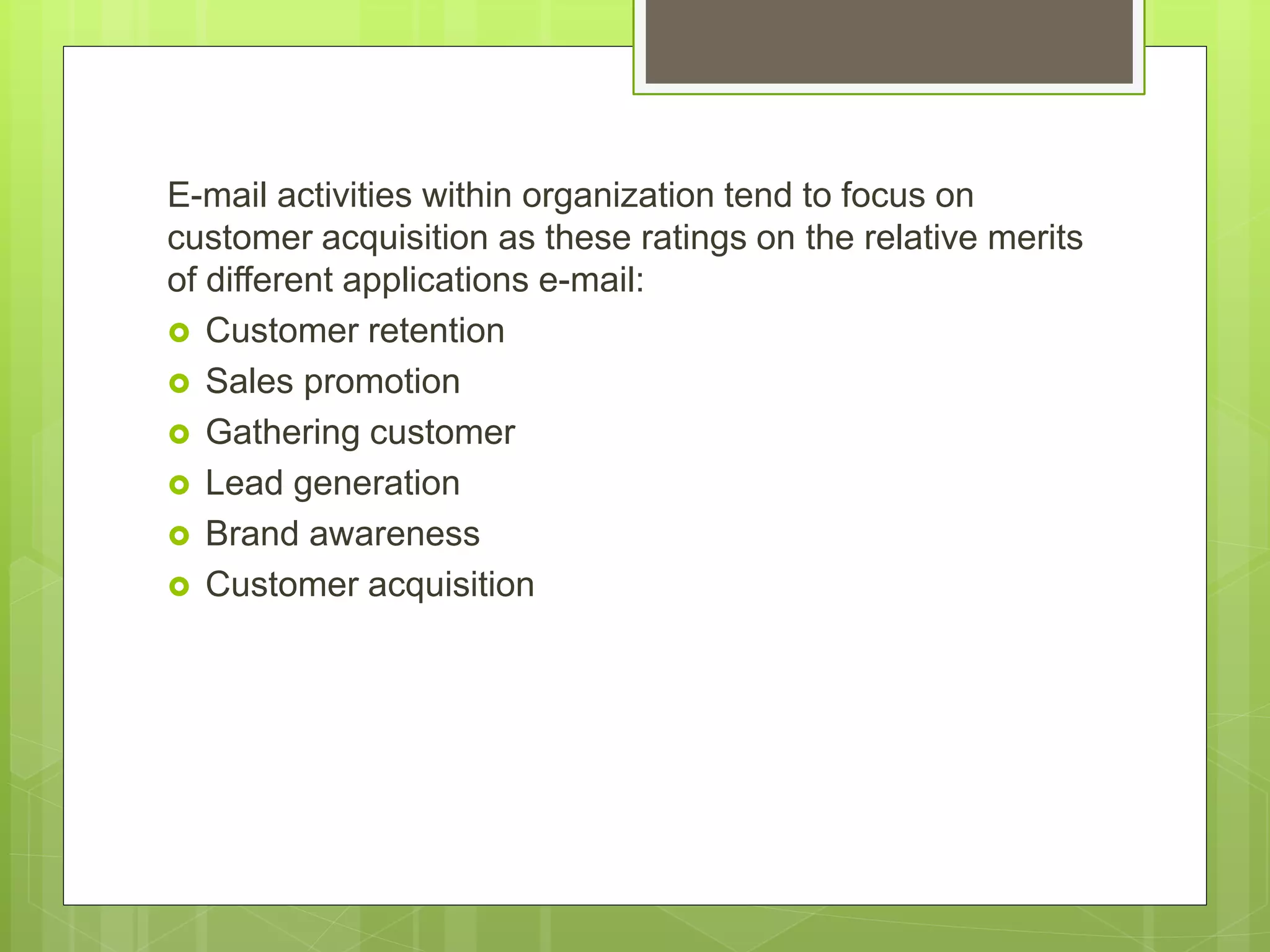
E-mail activities within organization tend to focus on
customer acquisition as these ratings on the relative merits
of different applications e-mail:
 Customer retention
 Sales promotion
 Gathering customer
 Lead generation
 Brand awareness
 Customer acquisition
 Opt-in e-mail option for customer acquisition
 Cold e-mail campaigns
 Co-branded e-mail
 Third-party e-newletter
 Opt-in e-mail options for prospect conversion and customer
retention (house list)
 Conversion e-mail
 Regular e-newsletter types
 House-list campaign
 Event-triggered
 E-mail sequence
Advantages and
disadvantages of e-mail marketing
> Relatively low cost
fulfillment
> Direct response
medium encourage
immediate action
> Faster campaign
deployment
> Ease of
personalization
> Deliverability
> Renderability
>Email response decay
> Communication
preferences
> Resources intensive
Best practice in planning
and managing e-mail marketing
 E-mail service providers
 Measuring e-mail marketing
o Delivery rate
o Open rate
o Click-through or click here
 E-mail marketing success factors
o Creative
o Incentive
o Relevance
o Targeting and timing
o Integration
o Copy
o Attribute
o Landing page
 Practical issues in managing e-mail marketing
 List management
6. Social media and
viral marketing
 Involve encourage customer communication on companies
own site, social presences such as Facebook or in specialist
publisher sites, blogs and forum.
1. Developing a social media communication strategy
2. Viral marketing
3. e-mail forwarding or pass along viral marketing
4. Social network-related viral marketing
Advantage and
disadvantage of social media and viral
marketing
 Advantage
>>> effective viral agent reach a large audience in a cost-
effective way
>>> consumer rate the opinion of their friends and family
highly
 Disadvantage
>>> high risk marketing communication techniques
>>> challenging to engage audiences
>>> difficult to find the right types of content
Best practice in planning
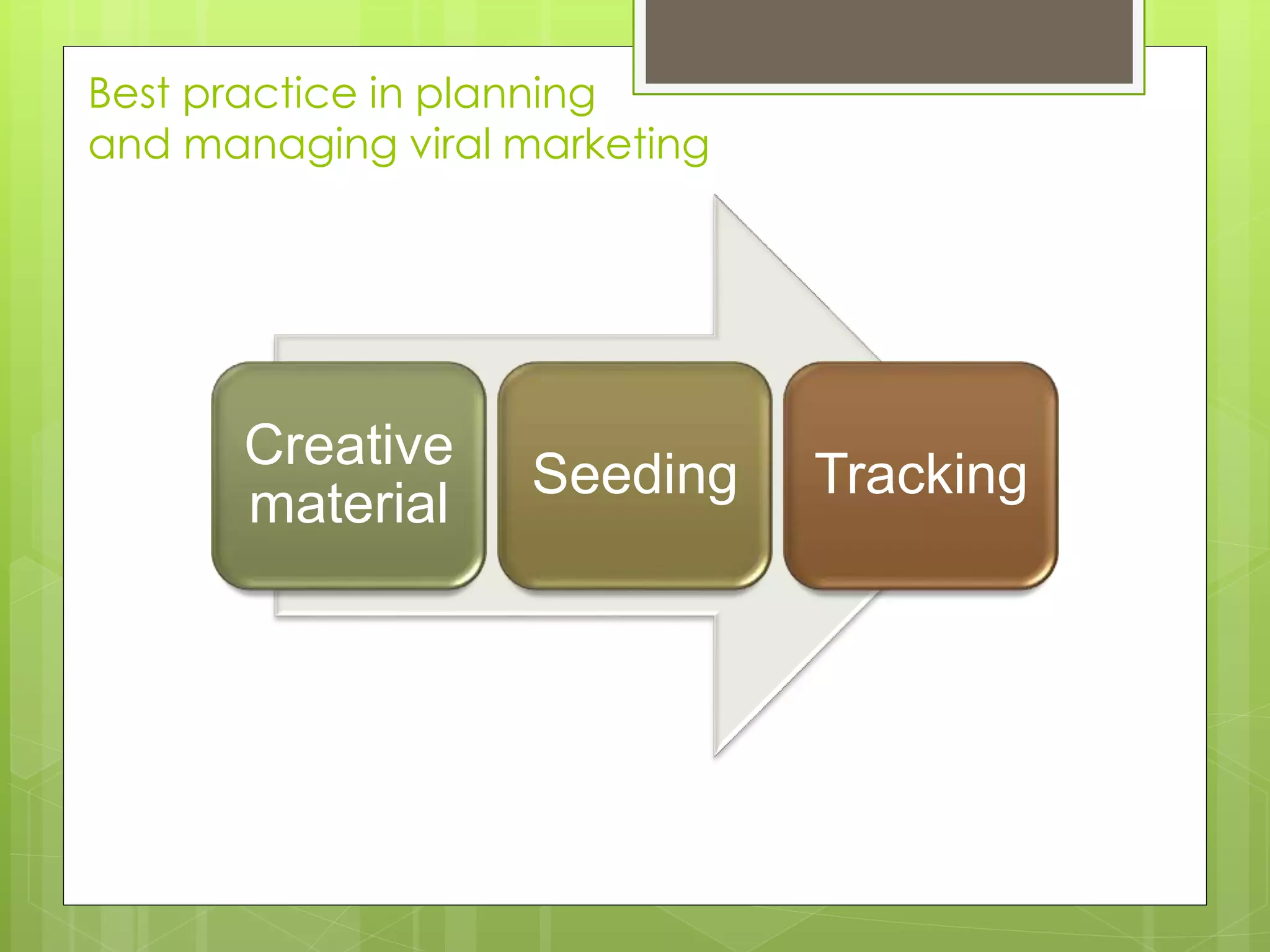
and managing viral marketing
Creative
material
Seeding Tracking
Advantages and
disadvantages of using offline
communication to support e-commerce
> Reach
> Brand awareness
> Emotional
> explanation
> Higher cost
> Higher wastage
> Poorer targeting
> Poorer accountability
> Less detailed
information
>Less personalized
> Less interactive
experience
Offline promotion techniques
 Incidental and specific advertising of the online
presence
 Public relation
 Direct marketing
 Other physical reminders
 Word-of-mouth marketing
Summary
1. Online promotion techniques include:
• Search engine submission
• Index inclusion
• Keyphrase analysis
• On-page optimisation
• External linking
• Internal link structures
 2. Offline promotion involves promoting the website address,
highlighting the value proposition of the website and achieving web
response through traditional media advertisements in print or on
television.
 3. Interactive marketing communications must be developed as
part of integrated marketing communications for maximum cost
effectiveness
 4. Objectives for interactive communications include direct sales
for transactional sites but they also indirectly support brand
awareness, favourability and purchase intent.

Chapter 7 DIGITAL MARKETING

  • 1.
    CHAPTER 7 MARKETING COMMUNICATI ON USING DIGITALMEDIA CHANNEL NUR AQILAH BINTI ZAINUDIN 2014416824
  • 2.
    Learning objective  Distinguishbetween the different types of digital media channels  Evaluate the advantages and disadvantages of each media channel for marketing communications  Assess the suitability of different types of digital media for diferrent purpose
  • 3.
     Digital mediachannel – online communications technique such as search engine marketing , affiliate marketing and display advertising used to engage web users on third-party sites, encourage them to visit an organisation’s site or purchase through traditional channels such as by phone or instore Introduction
  • 4.
    Digital Media Channels Searchengine marketing (SEM Online public relations (E- PR) Interactive display advertising Social media including viral and electronic word- of-mouth marketing opt-in e-mail marketing Online partnerships including affiliate marketing
  • 5.
    1. Search enginemarketing  Search engine marketing (SEM) – promoting an organisation through search engines to meet its objectives by delivering relevant content in the search listings for searchers and encouraging them to click through to a destination site.  Two types of SEM  Search engine optimisation (SEO) – to increase the position of company or its products in search single natural/organic result listing for selected keywords or phrases  crawling  Indexing  Ranking scoring  Query request and result serving
  • 6.
     Paid search(pay-per-click) marketing  Similar to conventional advertising.  Relevant text ad with a link to company page is displayed when user search engine types in specific phrase. Usually labelled as spnsored links Eg : advertising in an other website  Search engine ranking factor  Matching between page copy and the key phase searched  Link into the page (inbound or backlinks)
  • 7.
    Advantages and disadvantages ofSEO  Advantages  Significant traffic driver  Highly targeted  Potentially low-cost visitors  Dynamic  Disadvantages  Lack of predictability  Time for result to be implemented  Complexity and dynamic nature  Ongoing investment  Poor for developing awareness in comparison with other media channels
  • 8.
    Best practice inplanning and managing SEO  Search engine submission  Index inclusion  Technical reasons why the search robots do not crawl all the pages  Pages identified as spam or less importance or considered to be duplicate content  Keyphrase analysis  Comparison/ quality  Adjective (price/product qualifiers)  Product types  Vendor  Location  Action request
  • 9.
     On-page optimisation Occurrence of search term in body copy  Alternative image text  Document meta-data  External linking  Identify and create popular content and services  Identify potential partner sites  Contact partner sites  Internal link structures Include keyphrases used by searcher within anchor text of hyperlink to point relevant content.
  • 10.
    Paid search marketing A.What is paid search marketing  main model for paying sponsored listing is PPC marketing, we call this section paid search marketing B. Paid serach content network  Paid listing also available through displaynetwork c. Trusted fees  Paid for inclusion is no longer significant to search advertising D. What control position in paid search E. The quality score  Key to successful paid search marketing
  • 11.
    Advantages and disadvantages ofpaid search marketing  Advantages  The advertiser is not paying for the ad to be displayed  PPC advertising is highly targeted  Good accountability  Predictable  Technically simpler than SEO  Remarketing  Speed  Branding  Disadvantages  competitive and expensive  Inappropriate  Requires specialist knowledge  Time consuming  Irrelevant
  • 12.
    Best practice inplanning and managing paid search marketing Targeting  Search ad network strategy  Content network strategy  Campaign structure strategy  Keyword matching strategy  Search-term targeting strategy Budget and bid management  Budgeting strategy  Listing position strategy  Bidding strategies  Dayparting strategy Creative testing and campaign optimisation  Ad creative and copy strategy  Destination or landing page strategy  Campaign review and optimisation strategy  Specialist and innovation paid search techniques Communications integration  SEO integration strategy  Affiliate integration strategy  Marketing campaign integration strategy
  • 13.
    2. Online publicrelations  Public relation  Management of the awareness, understanding and reputation of an organisation or brand, primarily achieve through influencing exposure in media.  What is online public relation?  Associated with improving results from many of the other communication technique.  Eg : blogs, feeds, social network
  • 14.
    Differences between online PRand traditional PR 1. The audience is connected to organisation 2. The members of the audience are connected to each other 3. The audience has access to other information 4. Audiences pull information  For the marketer or PR professional, managing PR, the main differences are:  Less easy to control  More options to create their own stories  Need for faster response  Easier to monitor
  • 15.
    Advantages and disadvantages ofOnline public relations  Advantage  reach  Cost  Creadibility  Search engine optimisations  Brand- enhancement and protection o Disadvantages  Not a controlled discipline  Less controlled on third-party site
  • 16.
    Best practice in planningand managing online public relations  Communicating with online media owners (influencer outreach)  Link building  Web 2.0 atomised content  Blogs and blogging  Tagging and folksonomies  Social bookmarking  Photo, video and slide sharing sites  Really simple syndication feeds  Mashups  Social networks  Widgets  Atomisation  Managing how your brand is presented on third-party sites  Creating a buzz – online viral marketing
  • 17.
    3. Online partnershipincluding Affiliate marketing  Affiliate Marketing  Commision based arrangement where publisher receive a commision on sales or lead by retailer or other transactional sites.  Options of affiliate marketing models  Aggregators  Review sites  Reward sites  vouchers code sites  Uber-bloggers  Everyone else
  • 18.
    Advantages and disadvantages ofaffiliate marketing >SERPS visibility >Reach differ audience >Responsiveness to market place changes >Target generic phrases in SERPs >Increase reach in SERPs >Generate awareness >Diversity risk >Pay-per-performance >Incremental profit / sales may be limited >Affiliates may exploit your brand names >May damage brand reputation >Programmed management fees >Program management time
  • 19.
    Best practice inplanning and managing affiliate marketing  Best practice in planning and managing affiliate marketing  Affiliate networks  Commission  Cookie expiry period  Creative and links  Online sponsorship  Co-branding  Contra-deals
  • 20.
    4. Interactive displayadvertising What is display advertising?  Display advertising – display ads are paid ad placement using graphical or rich media ad units within a web page to achieve goals of delivering brand awareness, familiarity, favorability and purchase intent. Purchasing ad placements  The run-of-site (the entire site)  A section of site  According to keywords entered on a search engine
  • 21.
  • 22.
    Best practice inplanning and managing display and campaigns  Measurement of display effectiveness  Interactive ad formats  Interactive ad targeting options o On a particular type of site o To target a registered user’s profile o At a particular time of day or week o To follow user’s behavior  Ad creative o Main variables such as banner size, message length, promotional incentive, animation, action phrase and logo. o Important while considering : o Appropriate incentive are needed to achieve click-trough o Creative design needs to be tested extensively o Placement of advertisement and timing need to be considered carefully.
  • 23.
    5. Opt-in e-mailmarketing and mobile text messaging  What is e-mail marketing?  Outbound e-mail marketing – e-mail campaigns are used ad a form of direct marketing to encourage trial and purchases and as part of a CRM dialogue  Inbound e-mail marketing – e-mail from customer, such as service enquiries, are managed.
  • 24.
    E-mail activities withinorganization tend to focus on customer acquisition as these ratings on the relative merits of different applications e-mail:  Customer retention  Sales promotion  Gathering customer  Lead generation  Brand awareness  Customer acquisition
  • 25.
     Opt-in e-mailoption for customer acquisition  Cold e-mail campaigns  Co-branded e-mail  Third-party e-newletter  Opt-in e-mail options for prospect conversion and customer retention (house list)  Conversion e-mail  Regular e-newsletter types  House-list campaign  Event-triggered  E-mail sequence
  • 26.
    Advantages and disadvantages ofe-mail marketing > Relatively low cost fulfillment > Direct response medium encourage immediate action > Faster campaign deployment > Ease of personalization > Deliverability > Renderability >Email response decay > Communication preferences > Resources intensive
  • 27.
    Best practice inplanning and managing e-mail marketing  E-mail service providers  Measuring e-mail marketing o Delivery rate o Open rate o Click-through or click here  E-mail marketing success factors o Creative o Incentive o Relevance o Targeting and timing o Integration o Copy o Attribute o Landing page  Practical issues in managing e-mail marketing  List management
  • 28.
    6. Social mediaand viral marketing  Involve encourage customer communication on companies own site, social presences such as Facebook or in specialist publisher sites, blogs and forum. 1. Developing a social media communication strategy 2. Viral marketing 3. e-mail forwarding or pass along viral marketing 4. Social network-related viral marketing
  • 29.
    Advantage and disadvantage ofsocial media and viral marketing  Advantage >>> effective viral agent reach a large audience in a cost- effective way >>> consumer rate the opinion of their friends and family highly  Disadvantage >>> high risk marketing communication techniques >>> challenging to engage audiences >>> difficult to find the right types of content
  • 30.
    Best practice inplanning and managing viral marketing Creative material Seeding Tracking
  • 31.
    Advantages and disadvantages ofusing offline communication to support e-commerce > Reach > Brand awareness > Emotional > explanation > Higher cost > Higher wastage > Poorer targeting > Poorer accountability > Less detailed information >Less personalized > Less interactive experience
  • 32.
    Offline promotion techniques Incidental and specific advertising of the online presence  Public relation  Direct marketing  Other physical reminders  Word-of-mouth marketing
  • 33.
    Summary 1. Online promotiontechniques include: • Search engine submission • Index inclusion • Keyphrase analysis • On-page optimisation • External linking • Internal link structures  2. Offline promotion involves promoting the website address, highlighting the value proposition of the website and achieving web response through traditional media advertisements in print or on television.  3. Interactive marketing communications must be developed as part of integrated marketing communications for maximum cost effectiveness  4. Objectives for interactive communications include direct sales for transactional sites but they also indirectly support brand awareness, favourability and purchase intent.