Digital Marketing
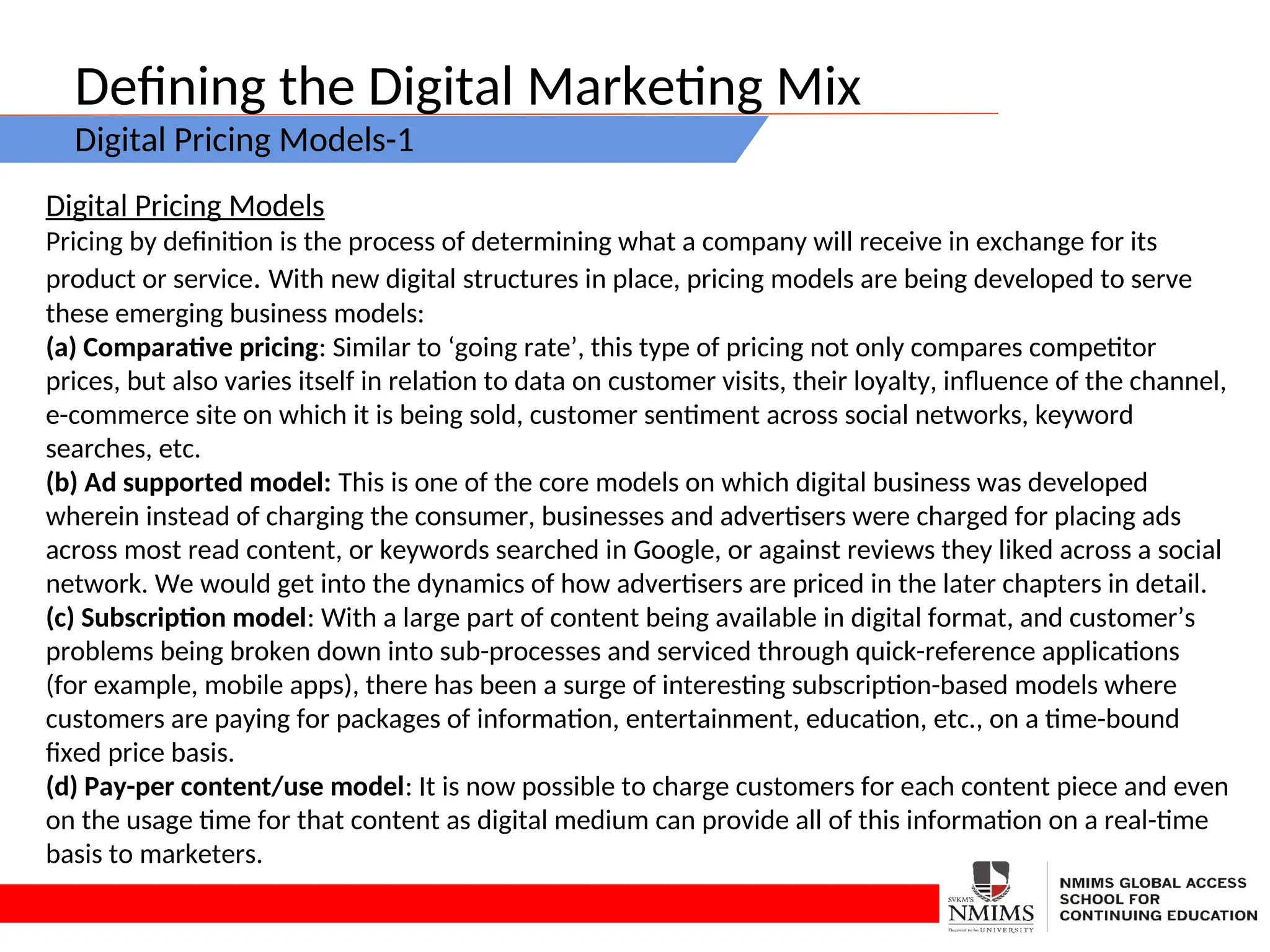
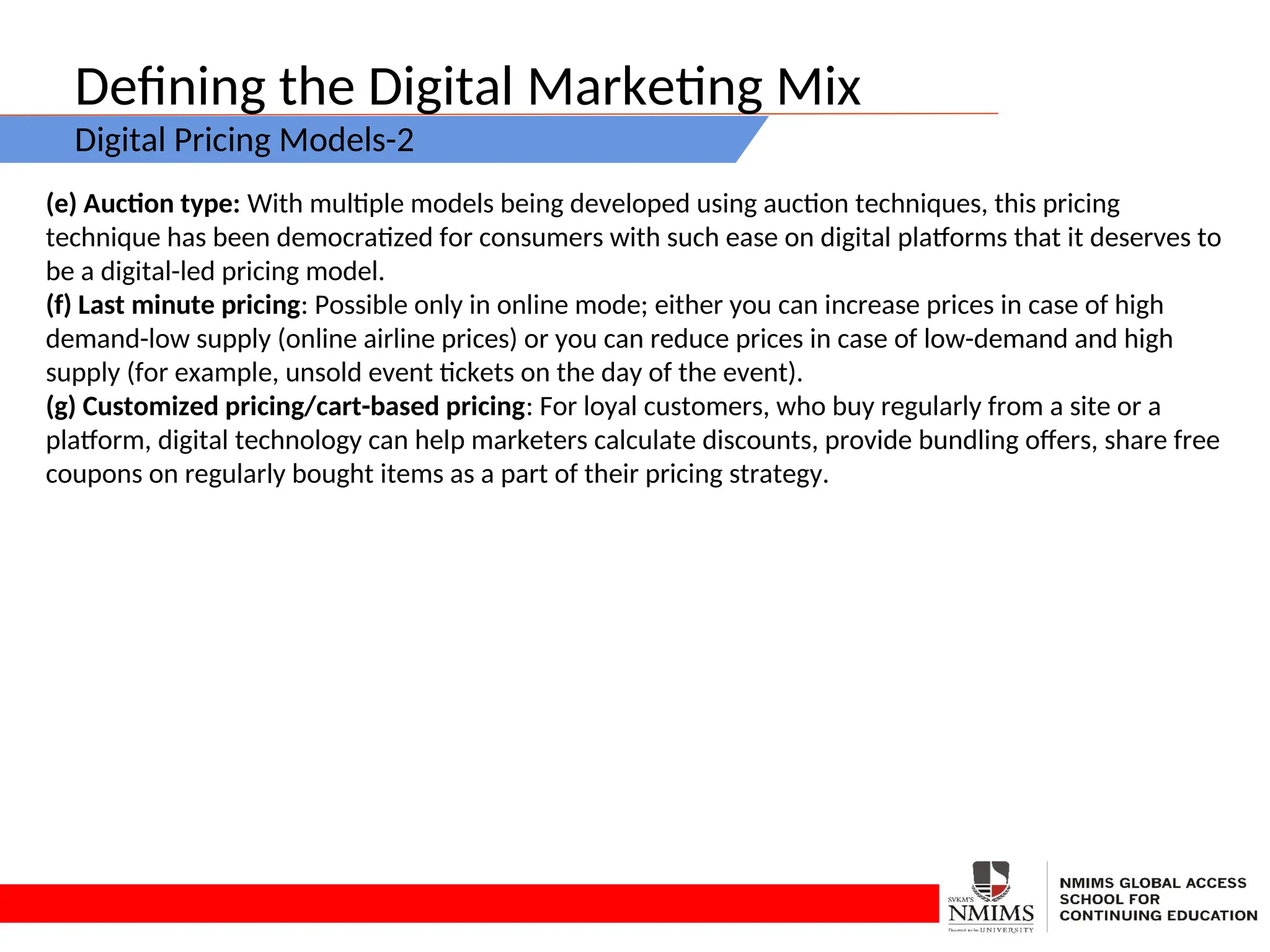
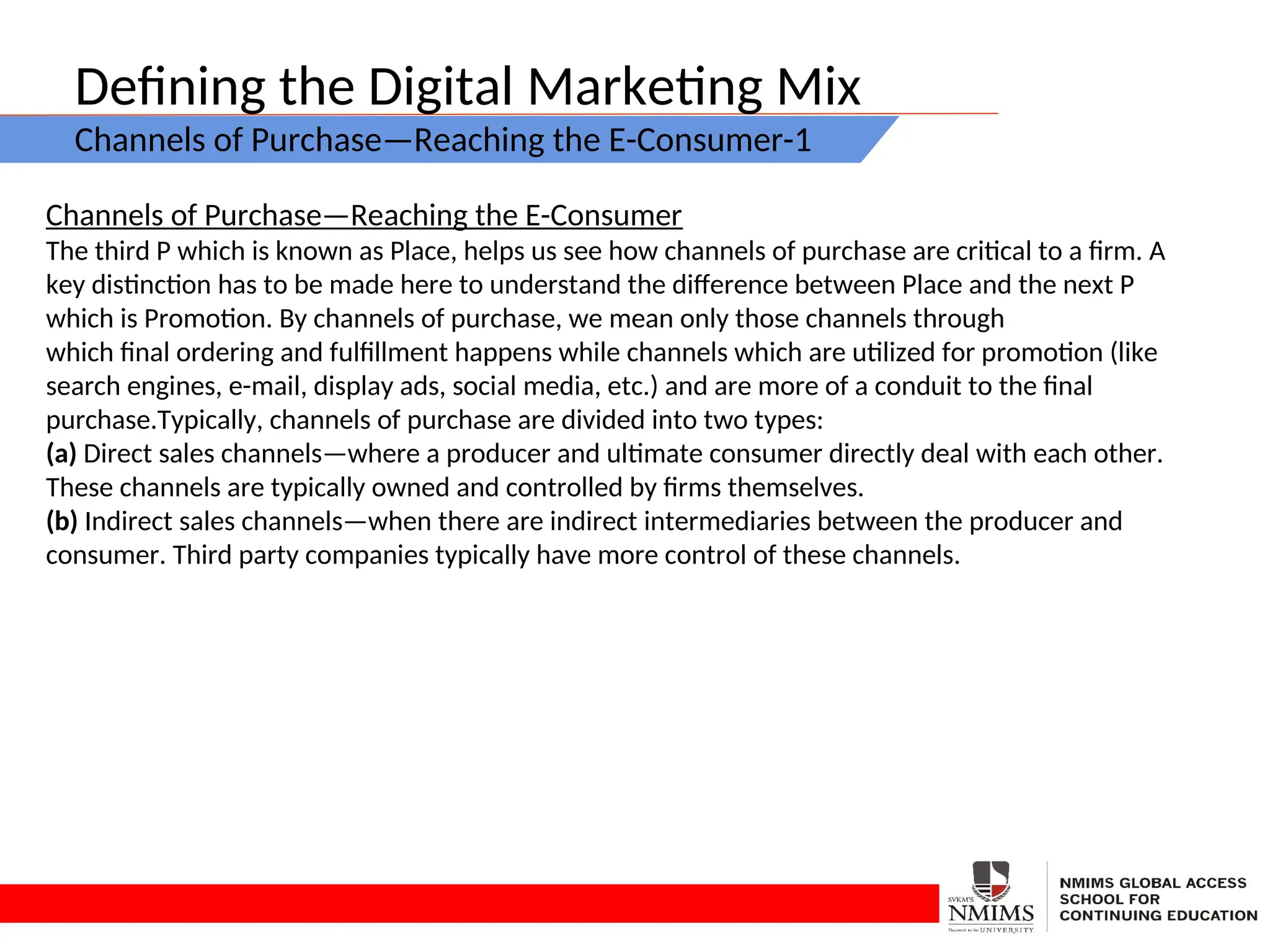
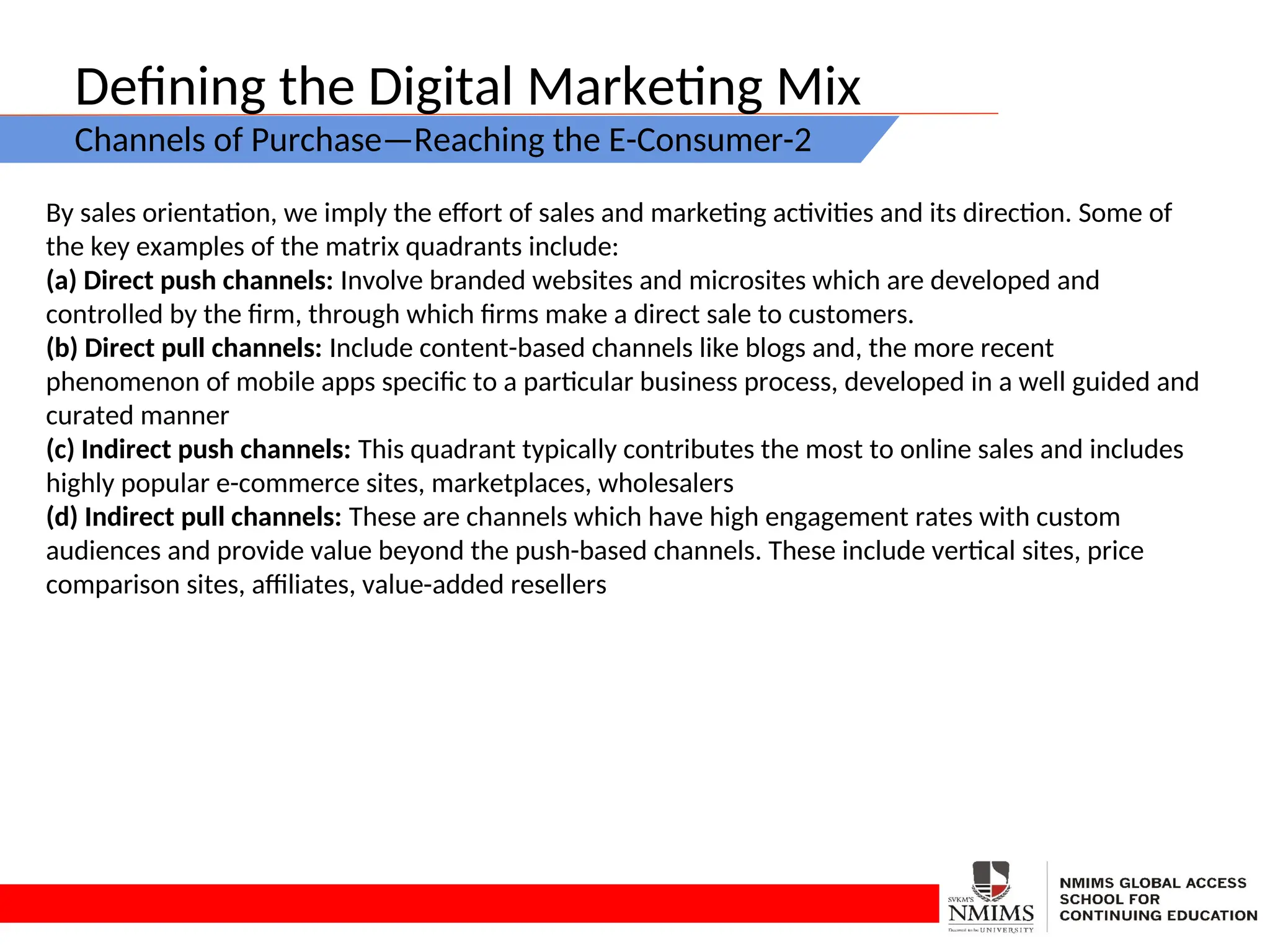
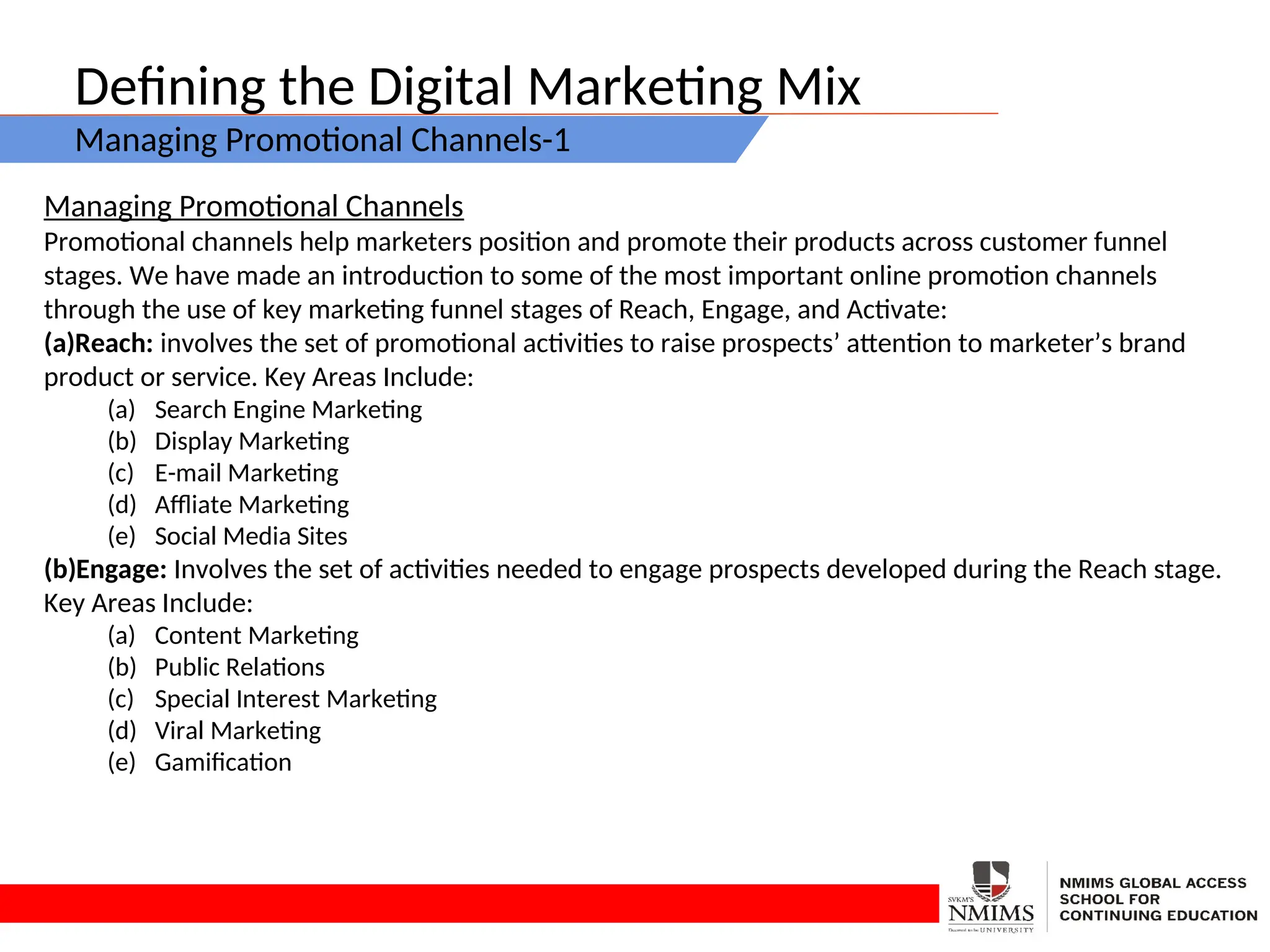
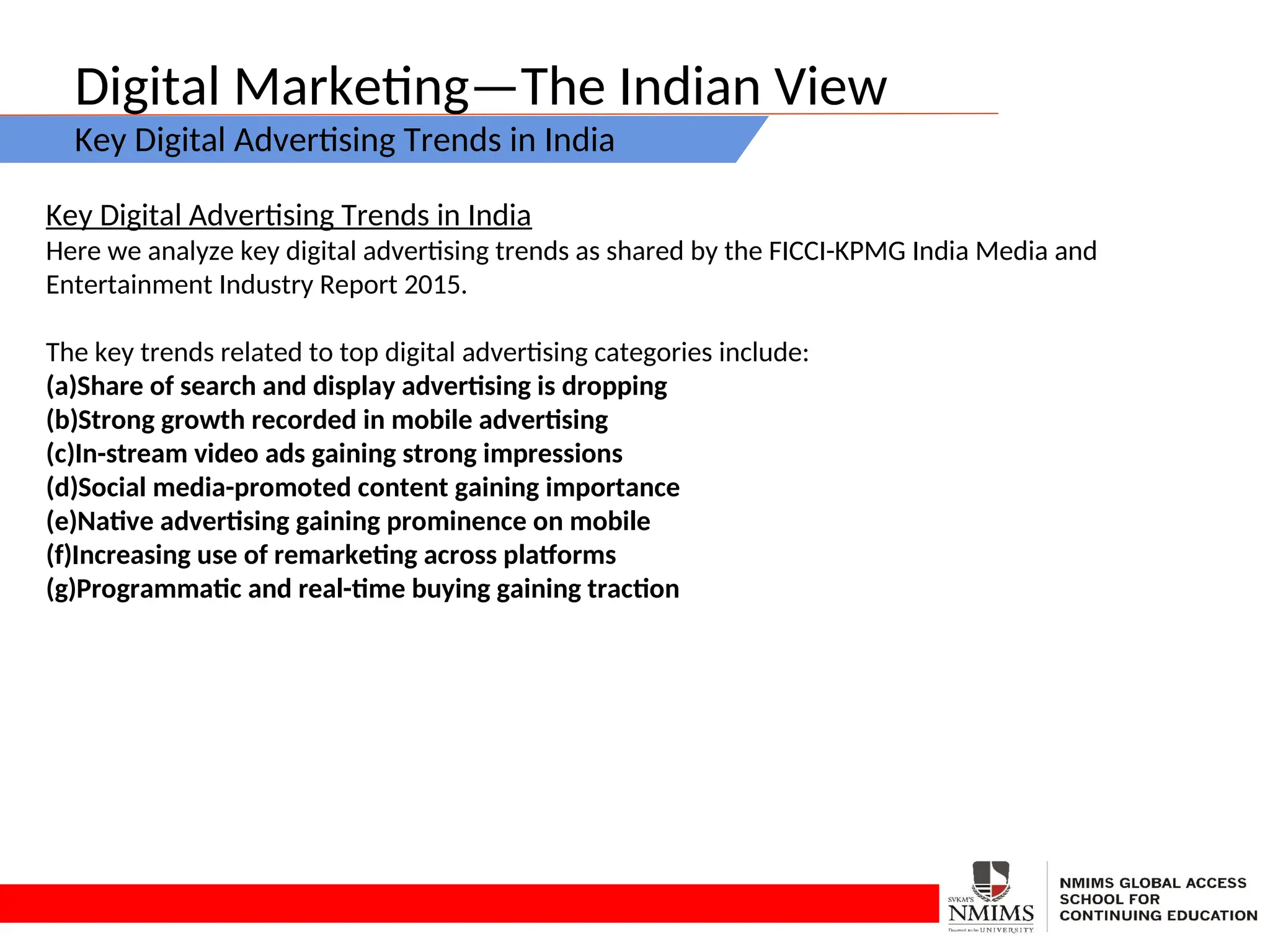
1. Introduction to Digital Marketing
2. Digital Marketing Models Creation
3. The Consumer for Digital Marketing
4. Digital Marketing Assessment Phase
5. Digital Marketing Strategy Definition
6. Digital Marketing Communications and
Channel Mix
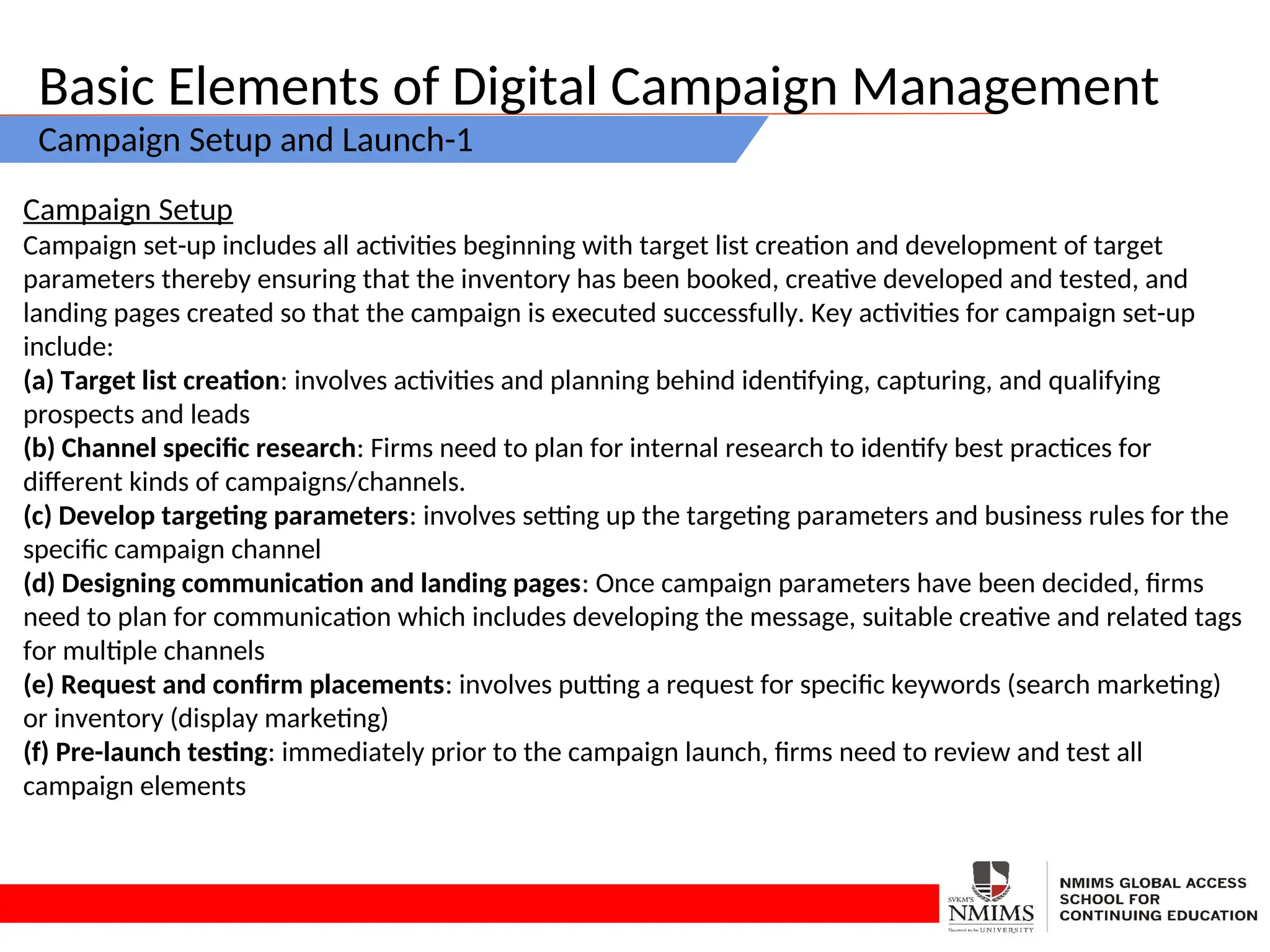
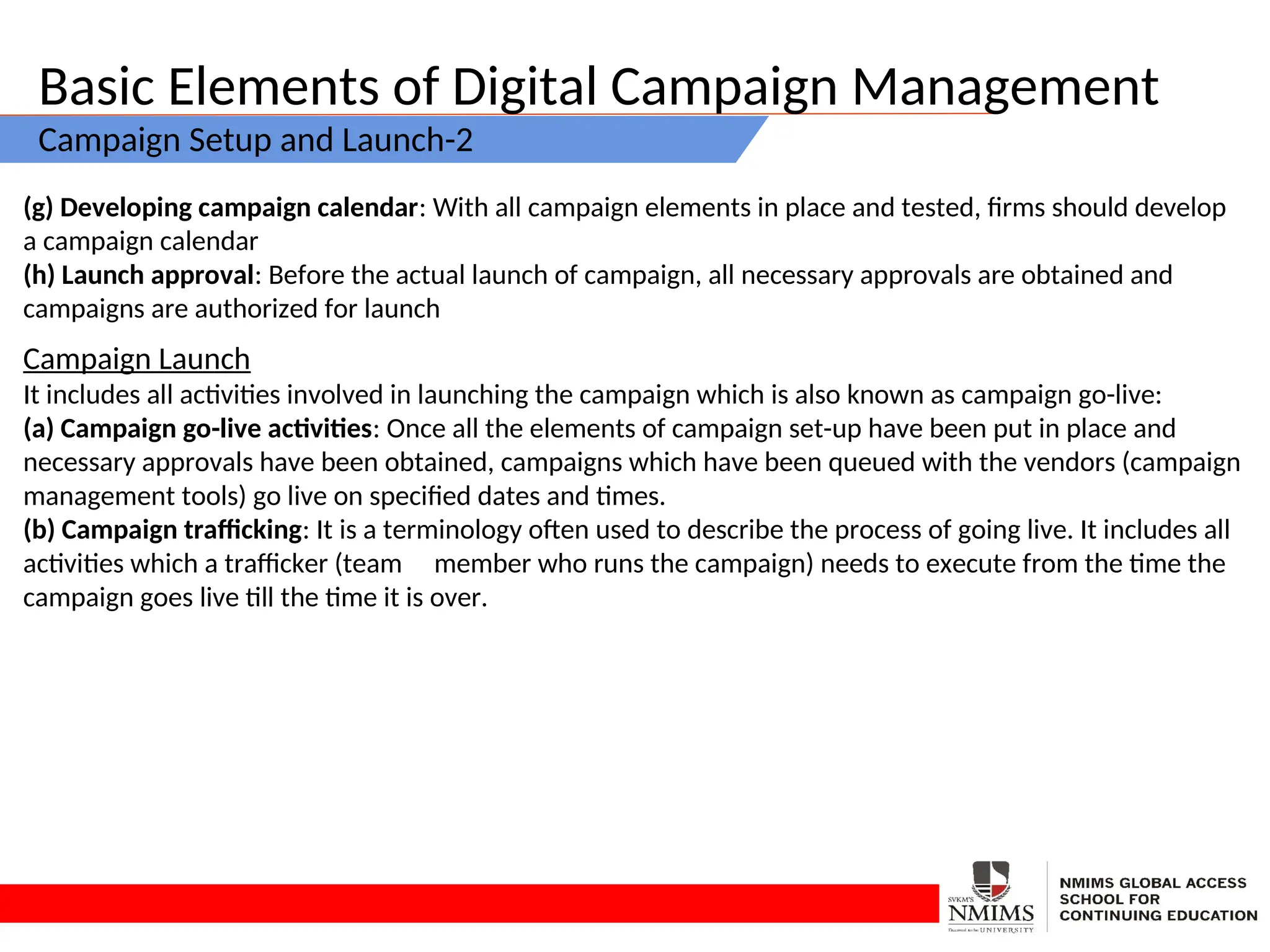
7. Digital Marketing Operations Set-up
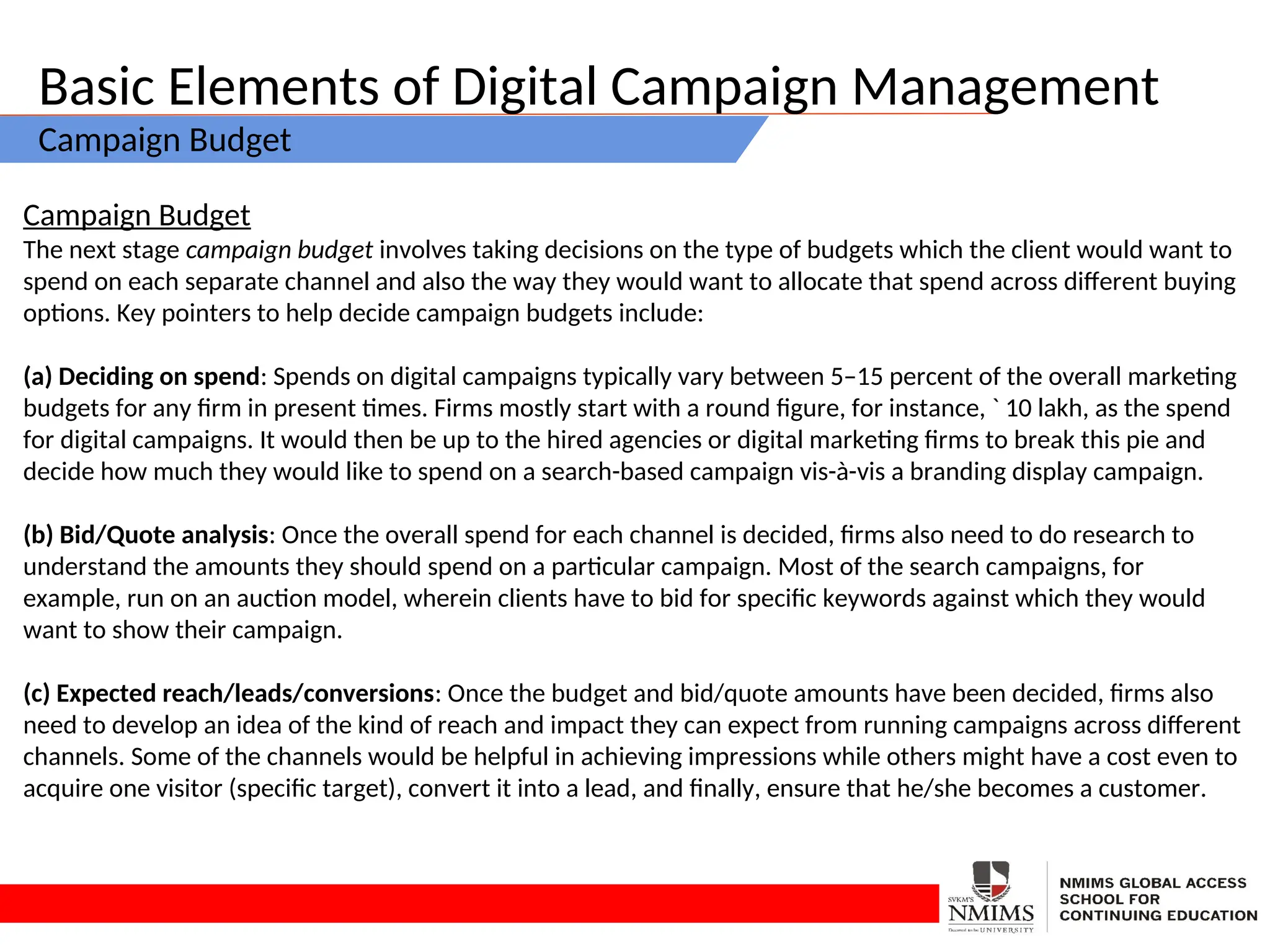
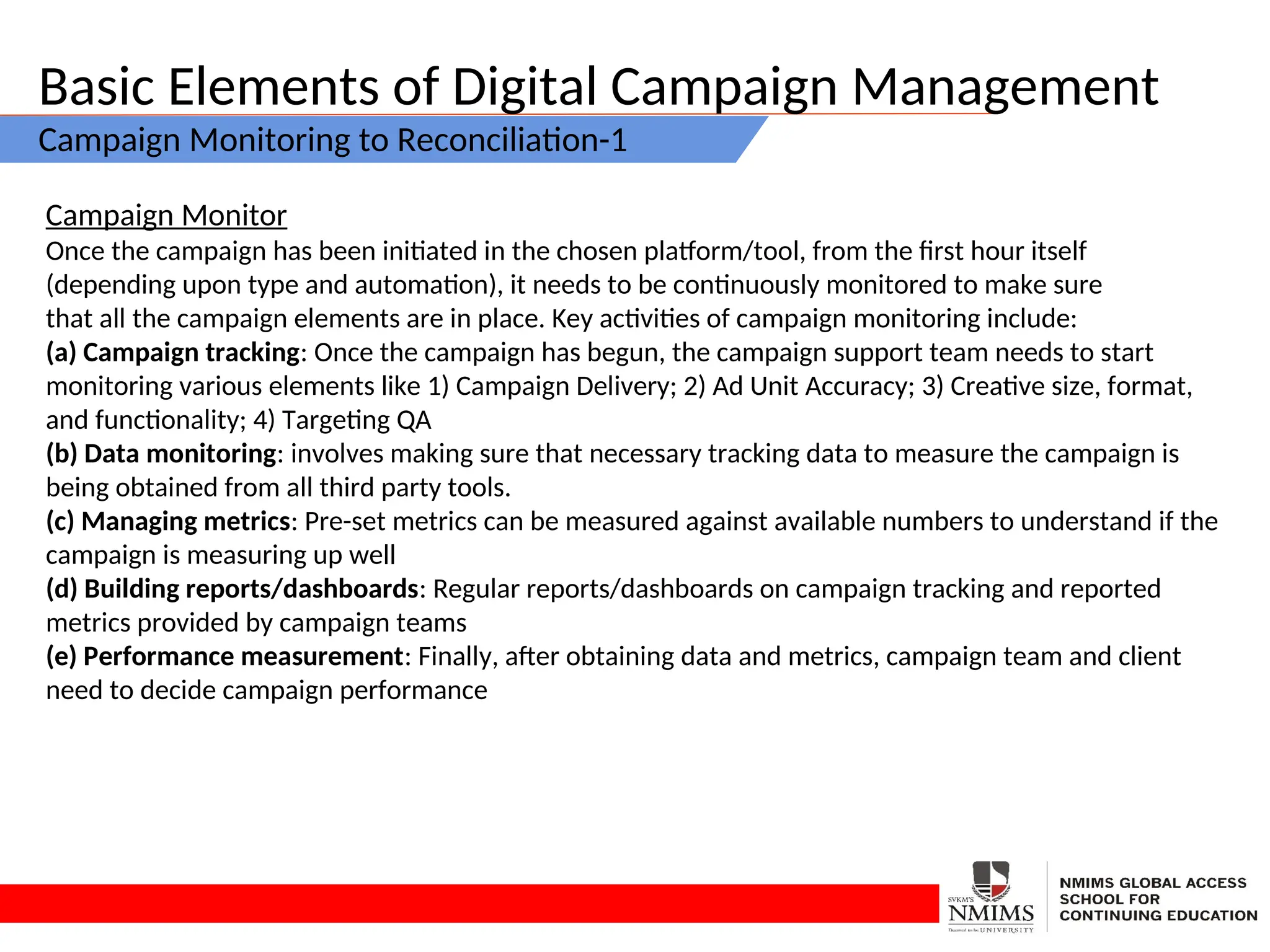
8. Digital Marketing Campaign
Management
9. Digital Marketing Execution Elements
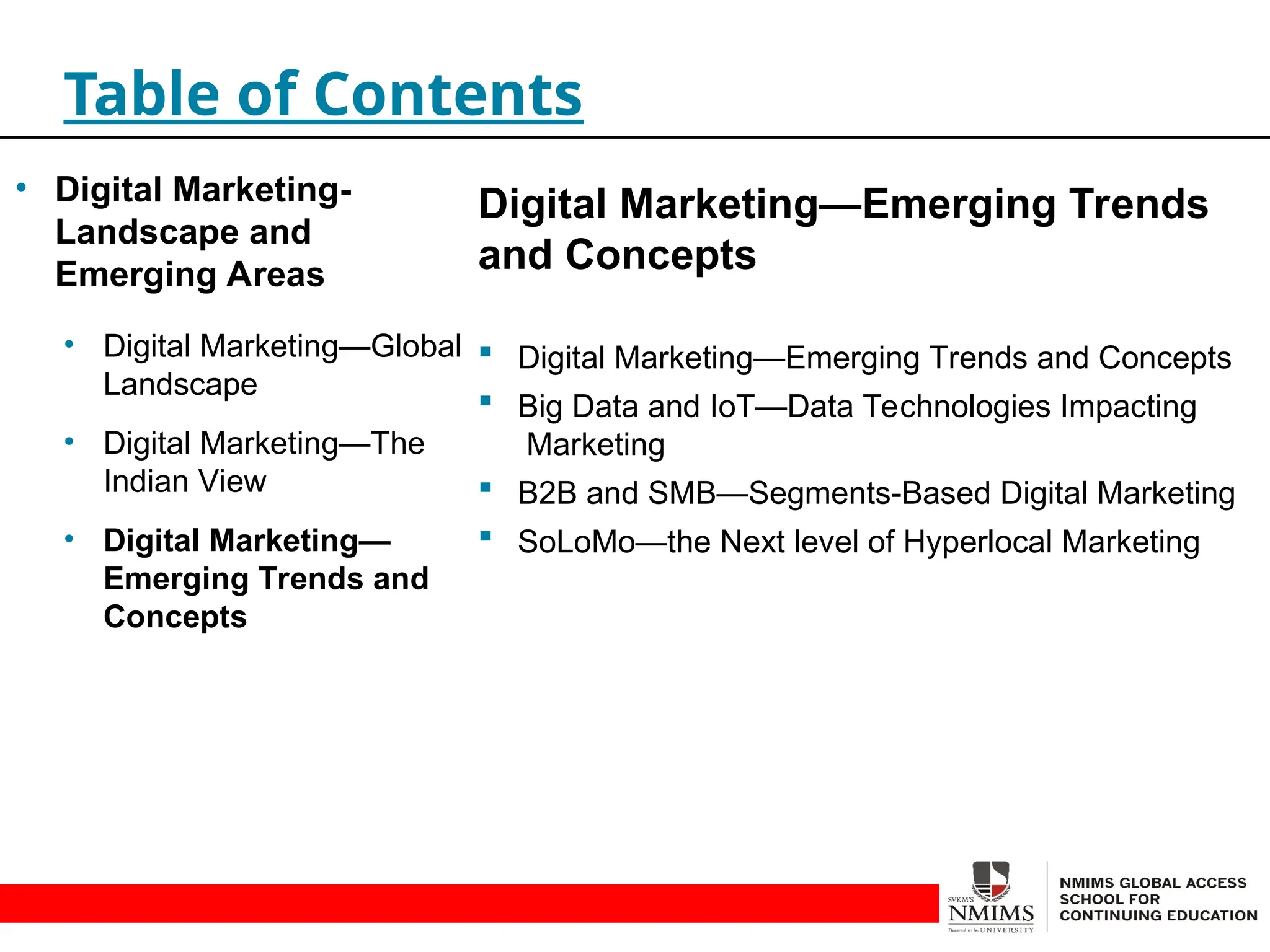
10. Digital Marketing-Landscape and
Emerging Areas
11. A Career in Digital Marketing
Brief Contents
Chapter 1
Introduction to Digital
Marketing
Evolution of Digital Marketing
 From Traditional to Modern Marketing
 Rise of the Internet - The Dotcom Era
 Post Dotcom - Creation of Internet Business
Models
 The Growth of ‘E’ Concepts- From E-Business
to Advanced E-Commerce
 Digital - the Next Wave of Marketing
Table of Contents
• Introduction to Digital
Marketing
• Evolution of Digital
Marketing
• Digital Marketing: An
Introduction
• Internet Marketing-
Underlying Technologies
and Frameworks
• The Digital Marketing
Framework
Evolution of Digital Marketing
From Traditional To Modern Marketing
Definition of Traditional Marketing
(According to AMA)
“The activity, set of institutions, and processes for
creating, communicating, delivering, and
exchanging offerings that have value for
customers, clients, partners, and society at large”.
The Premise of Traditional Marketing
Print Marketing (Newspapers/Magazines/Direct
Mailers/Catalogues)
Broadcasting (Television/Radio)
Out of Home Marketing (Billboards)
One-to-One Marketing (Telemarketing)
Factors Impacting the Shift From Traditional
To Modern
Power shift from Business to Consumer  Wide variety of
product choices & saturation of key categories
Growing amount of communication channels Leading to
clutter leads & brands moving from mass to customized online
marketing
Consumers preference to interactive mediums Traditional
channels (Newspapers, Magazines, TV) had a one-way
information flow
The need to validate marketing with product and service
recommendations Trusted group of influencers/social
interactions
The need for comparison of product benefits to take informed
decisions  Multiple messages need to be heard, understood
and trusted upon by target segment
Higher interaction with product Develop avenues for such
interactions facilitating holistic messaging rather than one off
marketing
Marketing has shifted to being a discovery-led immersive
exercise Moving from forced to messages targeted to large
audiences
Evolution of Digital Marketing
Rise of the Internet- The Dotcom Era
World Wide Web Leading to an Explosion of Information Share
The evolution of WWW brought with it the development of HTTP (Hypertext Transfer Protocol) which is
the foundation of data communication for the World Wide Web.
Emergence of Websites and the Concept of URL
All the websites together constitute what we call the World Wide Web. Websites contain web pages
which are typically documents in plain text with specified formatting instructions of Hypertext Markup
Language (HTML).
Dotcom Era and the Phenomenon of Modern Marketing
•Modern marketing began to create and use web pages to build virtual information centers for their
products and brands primarily for information dissemination and also to become the first movers to
adapt technology as a part of their marketing activities.
•Phenomenon of Dotcom Bubble
•Post Dotcom Bubble, many interesting business ideas came forth, which a decade later, would flourish
to actually become internet behemoths
Evolution of Digital Marketing
Post Dotcom- Creation of Internet Business Models
Growth and Impact of Search Technologies
The biggest impact which internet had on marketing can be clearly attributed to the rise of search
technologies.
From Web 1.0 to Web 2.0: The Changing Nature of Web
It is important to trace how the nature of web transformed over the years and how it impacted
internet commerce and marketing.
The shift from Web1.0 to Web2.0 and now even extending to Version 3.0, has had a major impact on
how marketing through the internet has evolved and continues to do so.
Evolution of Digital Marketing
Growth of ‘E’ Concepts
Understanding E-Models
The key objective of ‘e-business,’ which was set up to help transition of the physical processes of any business to
make them more technology enabled and efficient. E-commerce is considered to be the sales aspect of e-business and
involves a wide variety of internet-based business models.
The major difference between e-commerce and e-business is that while e-business is aimed at improvements in
efficiency and productivity, e-commerce is a more revenue-oriented concept which focusses on bridging internal and
external systems through improved collaboration across all commerce-oriented functions, from procurement to
delivery.
Difference between E-Business and E-Commerce
Moving ahead from business and commerce, the most commonly used marketing term to denote any form of internet
operations is e-marketing. This term is typically misused for e-business and e-commerce and, as per proper definition,
should also be used to denote and represent marketing-related activities.
The focus of e-marketing is to facilitate the transition of physical marketing and sales-based activities to a more
automated, technology supported system which can drive the product discovery process.
Online/Internet marketing started with reference to the internet and e-mail-based aspects of physical marketing and
went on to grow and
represent activities aimed at transitioning all marketing activities to web and online platforms — most primary of
them being web-portals, e-mails, and blogs.
Evolution of Digital Marketing
Digital- the Next Wave of Marketing
Digital marketing if explained on the lines on the Porter Value Chain concept would include consumer
and data-based technology implementations which aim at introducing and integrating newer
technologies for a more data-oriented highly targeted marketing which is personalized for every
consumer.
Definition of Digital and What It Means for Business
Digital by definition involves storing and transferring data in machine-readable language by conversion
into binary values of ‘zero’ and ‘one.’ It involves a shift from the way data, be it audio, video, and
images, was stored in the traditional mode (analog) to the manner in which it is presently stored in the
digital world.
Key Digital Transformation elements include:
(a) Automation: includes automation of various functions to enable faster and cheaper ways of
performing key business activities
(b) Digitization: involves conversion of physical assets and processes to port them on digital platforms to
be utilized by stakeholders and delivered to customers
(c) Collaboration: helps integrate and share knowledge through a set of tools and practices to provide
customers with a multi-channel digital experience.
Digital Marketing: An Introduction
 Emergence of Digital Marketing as a Tool
 Media Consumption Drivers for New Marketing
Environment
 Digital Marketing Channels: Types and
Business Models
 Digital Marketing Applications and Benefits
Table of Contents
• Introduction to Digital
Marketing
• Evolution of Digital
Marketing
• Digital Marketing:
An Introduction
• Internet Marketing-
Underlying Technologies
and Frameworks
• The Digital Marketing
Framework
Digital Marketing: An Introduction
Emergence of Digital Marketing as a Tool
Digital Marketing Definition
The definition of digital marketing according to IDM includes ‘the management and execution of marketing using
electronic media such as the web, email, interactive TV, wireless media in conjunction with digital data about
customers characteristics and behavior.’
Key Reasons why Digital scores over other forms of marketing: Audience Targeting: Cost leverage: Actionable
reporting: Location-based messaging: Quicker funnel fulfillment: Multi-channel reach: Instant customer interaction
Emergence of Digital Marketing as a Tool
The difference which successive marketing concepts kept bringing about till the present digital marketing era relate
most to the manner in which the power of consumer choice has shifted from being a tame receptor to an active
seeker of information.
Push & Pull Marketing
Two types of marketing include:
Medium-initiated contact (Push marketing): This is the traditional type of marketing where marketing messages are
packaged with information pre-configured for a particular set of users.
Consumer-initiated contact (Pull marketing): Pull marketing involves a consumer placing his intent and specific
interest for a particular type of information and being offered that information along with marketing messages suited
to his intent, query, or profile-based interests.
Digital marketing includes all those techniques and concepts that utilize the intent (pull-based) action of the consumer
to market products and services (in a push-based manner) which would be most needed, relevant, and of interest to
him/her.
Digital Marketing: An Introduction
Media Consumption Drivers for New Marketing Environment
Key drivers behind this change in marketing to digital platforms and the reasons for shifting
consumption patterns:
1.Emergence of internet was one of the biggest factors of the transition to digital marketing
2.Rise of millennial generation or Generation Y
3.Technology advancements in devices and investments in hardware, infrastructure, location
positioning and device memory
4.Advancements in design/UI is becoming crucial.
5.Consumerism/rising global economies in the context of emerging nations since the past two decades
and with the rise of discretionary income across many work sectors.
Digital Marketing: An Introduction
Digital Marketing Channels: Types and Business Models
Digital Marketing Types Explained through REAN Marketing Framework
We have used the REAN (Reach Engage Activate Nurture) marketing funnel model and added a Plan
Stage before the four stages (to include the set of activities which involve planning and creation of
the marketing material) and termed it as the ‘Marketing Funnel’ view.
Explanation of Marketing and Consumer Funnel Stages
With digital marketing providing a strong platform for consumers to proactively show their intent
and interest towards a product, service, or brand, we felt it imperative to move beyond the regular
‘Marketing Funnel’ model to also add the ‘Consumer Funnel’ to it.
Interaction Points of Marketing and Consumer Funnel Stages
Key Interaction points include:
•Interaction Point A (PLAN-INTENT)
•Interaction Point B (REACH-AWARENESS)
•Interaction Point C (ENGAGE-INTEREST)
•Interaction Point D (ACTIVATE-ACTION)
•Interaction Point E (NURTURE-FOLLOW)
Understanding Digital Marketing Business Models
Five types of Digital Marketing Business Models include: advertising, subscription, commerce,
transaction fee, and social collaboration-based revenue models.
Digital Marketing: An Introduction
Digital Marketing Applications and Benefits
Key Digital Marketing applications include:
•Enhancement of revenues
•Brand presence amplification
•Support information-seeking and customer validation exercise
•Develop customized forms of consumption
•Mixing multiple digital channels and online-offline media
•Instant response generation mechanism to negative customer feedback
Key Benefits include:
(a)Provides a level-playing field
(b)Much cheaper to run campaigns, collaborate, and analyze insights
(c) Helps to reach out to customers in real time based on their latest actions
(d) Easier to measure effectiveness of a campaign or a marketing message
(e) Viral effect includes ability of a strong concept to reach the mass market instantly
(f) Provides greater engagement with the use of imagery, content, information, customer support, and personalization
(g) Utilizes multiple technologies and collaborative platforms available to harness the power of big data and internet
reach
(h) Acts as a medium to understand customer segments and their actions better
(i) Helps understand customer intent across multi-channel platforms
(j) Utilizes the power of social networks to reach out to multiple users in a trusted environment
(k) Integrates traditional campaigns to extend the reach of branding to its longest possible tail
Internet Marketing- Underlying
Technologies and Frameworks
 Internet Basics—Internet/Intranet/Extranet/
Portals
 Understanding Web and Wireless Technologies
 Reshaping Interactions: Individuals/
Businesses/Non-Profit
 Opportunities and Challenges to Internet
Marketing
Table of Contents
• Introduction to Digital
Marketing
• Evolution of Digital
Marketing
• Digital Marketing:
An Introduction
• Internet Marketing-
Underlying
Technologies and
Frameworks
• The Digital Marketing
Framework
Internet Marketing- Technologies and Frameworks
Internet Basics—Internet/Intranet/Extranet/Portals
An intranet is a local network that uses internet technologies and creates a localized version of the
internet that would only be used by the members of a corporation with authorized access to share
data on the network.
On the other hand, extranet can be looked at as an extension of the company’s intranet.
Stakeholders can have specific access areas based on the type of interaction and collaboration set
up for each of them.
Portals as a concept and terminology is very common in internet parlance and is used to describe
sites which have been developed on specific business interest topics or verticals like business,
government, culture, entertainment, etc.
Internet Marketing- Technologies and Frameworks
Understanding Web and Wireless Technologies
Web technologies involve a combination of multi-tier infrastructure stacks which put together help
deliver the data and content requested through any specific web browser.
Client Server Model
Deals with the most important concept which forms the basis of web technologies relates to how a
request is placed and information packets are sent back to the receiver.
Wireless Networks
Wireless by definition is the transfer of information between two or more points that are not
connected by an electrical conductor.
Mobile as the Most Important Wireless Technology for Marketing
Marketing through a wireless device, mostly referred to as mobile marketing, provides multiple
advantages of an easy-to-carry computing device, location-based promotion, personalization,
multiple communication channels, etc., which are difficult to achieve with any fixed line or
communication device.
Internet Marketing- Technologies and Frameworks
Reshaping Interactions: Individuals/Businesses/Non-Profit
As we move forward and embrace the complex digital world and its multiple channels of interactions,
we would see a change in the manner various entities interact and produce business possibilities.
Key Business interactions include:
1.Individual to individual
2.Individual to SMBs
3.Individual to NGO
4.SMB to individual
5.SMB to SMB
6.Large business to individuals
7.Large businesses to social enterprises
8.Government to government
9.NGO to consumer
Internet Marketing- Technologies and Frameworks
Opportunities and Challenges to Internet Marketing
Internet Marketing Opportunities
Key opportunities include:
1.Reaching out to new set of prospects and leads
2.Improving customer connect
3.Increasing availability
4.Multiple pricing options
5.Reaching international markets
Challenges to Internet Marketing
Six biggest challenges in introducing and establishing internet marketing in any new organization:
1.Investment
2.Adoption
3.Resource
4.Training
5.Integration
6.Establishing RoI
The Digital Marketing Frameworks
 Delivering Enhanced Customer Value
 Market Opportunity Analysis and Digital Services
Development
 ASCOR Digital Marketing Framework
 Application of Digital Marketing
 Critical Success Factors for Digital Marketing
Table of Contents
• Introduction to Digital
Marketing
• Evolution of Digital
Marketing
• Digital Marketing:
An Introduction
• Internet Marketing-
Underlying Technologies
and Frameworks
• The Digital Marketing
Framework
The Digital Marketing Framework
Delivering Enhanced Customer Value
Understanding Problem-Value Mapping
The core of any marketing activity is to ascertain that the customer has a specific need and is looking
to a solution to meet that need.
There are two sides for any business transaction to occur: The Buy side and the Sell side
There has to be a mapping between the left and right sides and only when the Sell side is able to
identify the right kind of needs and service them with an appropriate kind of product/service does a
business transaction occur.
The term value for a customer would be any kind of tangible or intangible (or a mix of both)
enhancement which a customer experiences
while interacting with any product or service in comparison to similar products/services which he has
used/interacted with earlier.
The problem–value mapping helps entrepreneurs and business owners launch new products to test
the feasibility of product launches in the market.
The Digital Marketing Framework
Market Opportunity Analysis and Digital Services Development
Market Opportunity Analysis helps clearly identify a market segment (which is ready to consume their
products/services) and a viable revenue mode towards adoption of those products/services.
Digital Services Development has also become an important step as products and services need to be
oriented or developed from scratch to suit the digital marketplace and its consumption pattern.
Important strategies for Digital Service Development:
1.Converting present traditional products to digital formats
2.Looking at avenues to create new digital/virtual avatars of present physical products
3.Understanding the impact and pressure digital marketing is placing on the whole backend value chain
to help provide efficiencies
4.Defining strategies for procurement, production, fulfillment, and channel digitization
5.Realize aspects related to storing of digital products on cloud platforms, the way they are searched
and retrieved, how their metadata is managed, and how they are rendered onto multiple platforms,
devices, applications
The Digital Marketing Framework
ASCOR Digital Marketing Framework
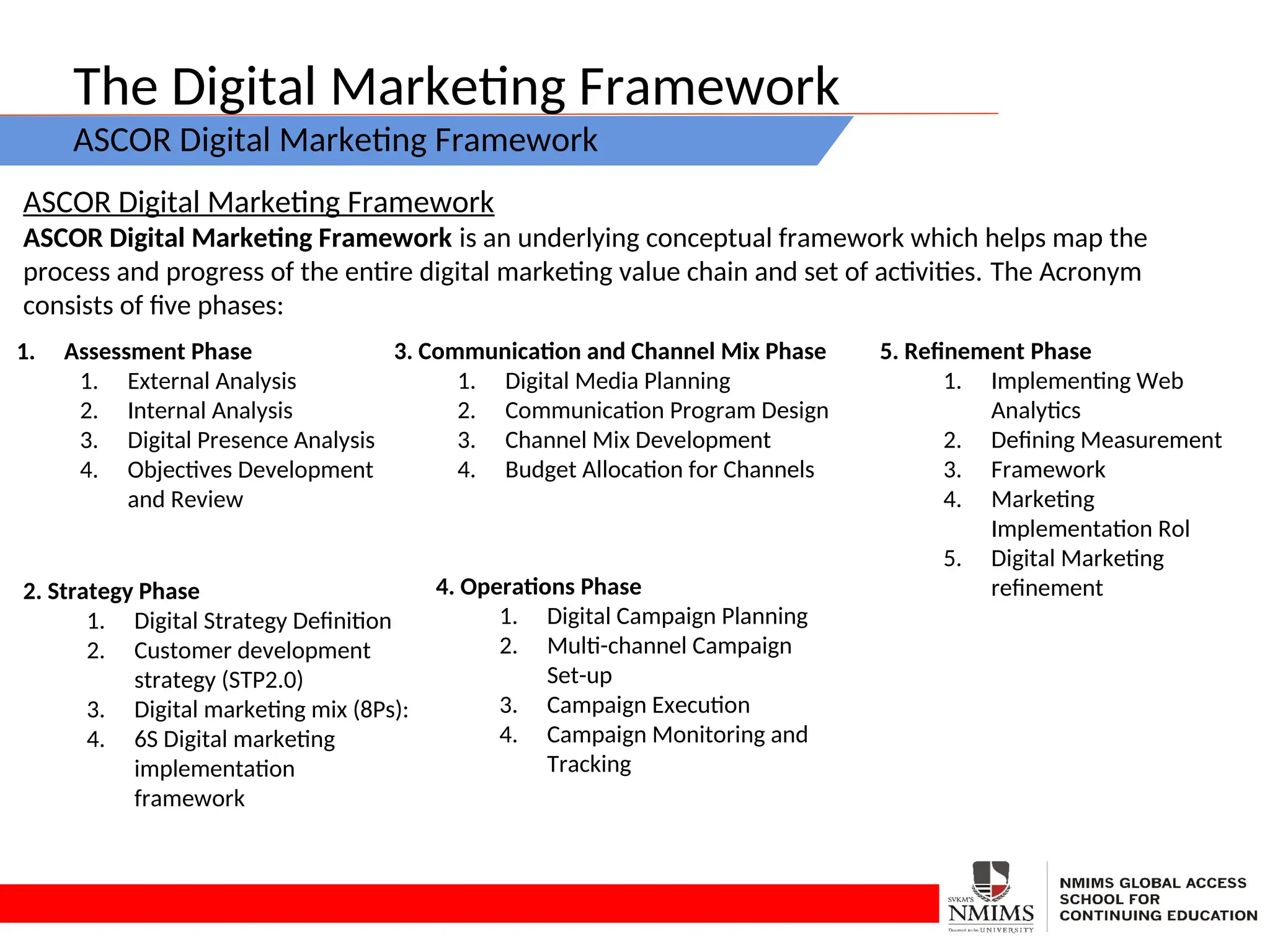
ASCOR Digital Marketing Framework is an underlying conceptual framework which helps map the
process and progress of the entire digital marketing value chain and set of activities. The Acronym
consists of five phases:
1. Assessment Phase
1. External Analysis
2. Internal Analysis
3. Digital Presence Analysis
4. Objectives Development
and Review
2. Strategy Phase
1. Digital Strategy Definition
2. Customer development
strategy (STP2.0)
3. Digital marketing mix (8Ps):
4. 6S Digital marketing
implementation
framework
3. Communication and Channel Mix Phase
1. Digital Media Planning
2. Communication Program Design
3. Channel Mix Development
4. Budget Allocation for Channels
4. Operations Phase
1. Digital Campaign Planning
2. Multi-channel Campaign
Set-up
3. Campaign Execution
4. Campaign Monitoring and
Tracking
5. Refinement Phase
1. Implementing Web
Analytics
2. Defining Measurement
3. Framework
4. Marketing
Implementation Rol
5. Digital Marketing
refinement
The Digital Marketing Framework
Application of Digital Marketing
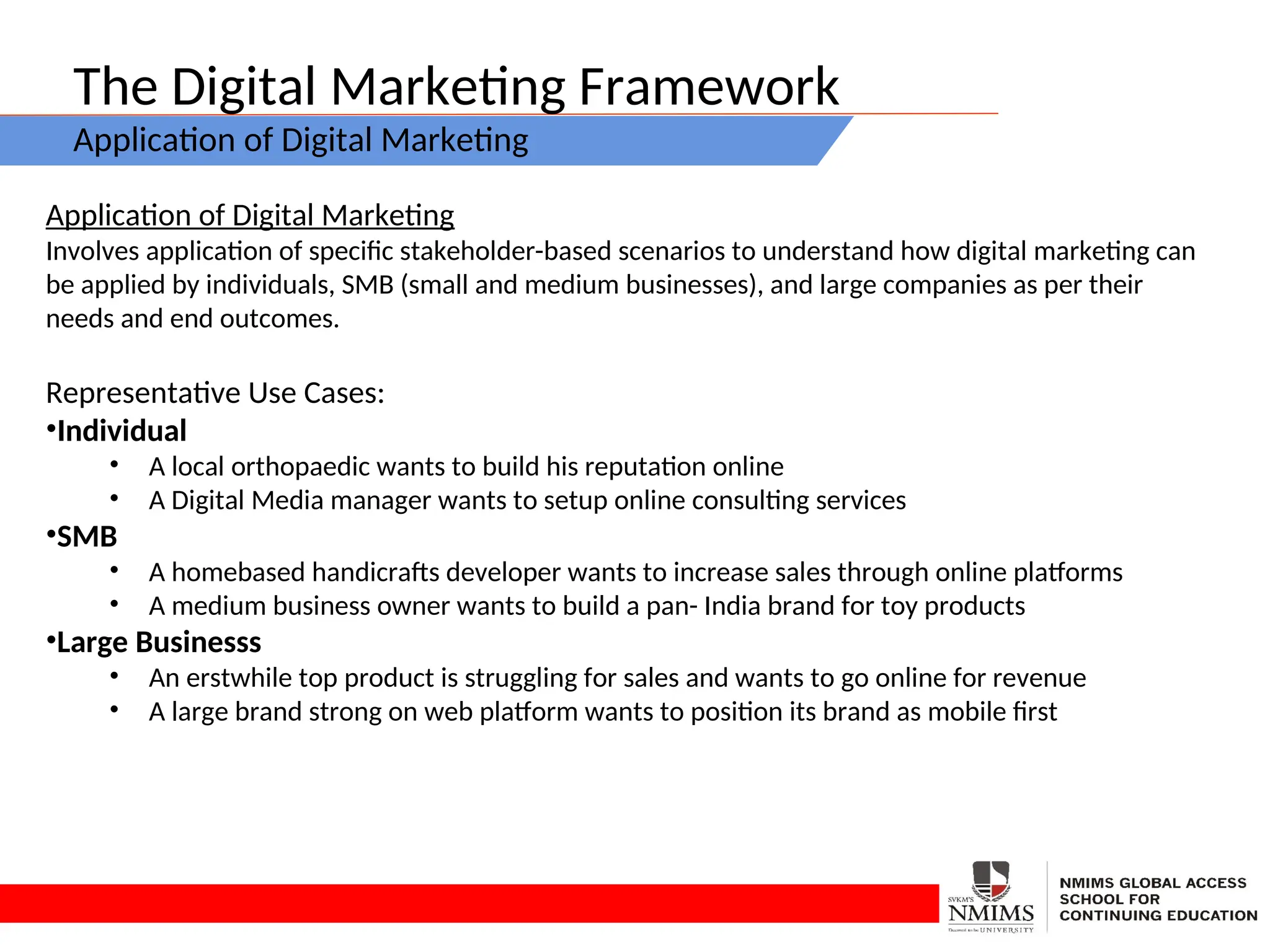
Involves application of specific stakeholder-based scenarios to understand how digital marketing can
be applied by individuals, SMB (small and medium businesses), and large companies as per their
needs and end outcomes.
Representative Use Cases:
•Individual
• A local orthopaedic wants to build his reputation online
• A Digital Media manager wants to setup online consulting services
•SMB
• A homebased handicrafts developer wants to increase sales through online platforms
• A medium business owner wants to build a pan- India brand for toy products
•Large Businesss
• An erstwhile top product is struggling for sales and wants to go online for revenue
• A large brand strong on web platform wants to position its brand as mobile first
The Digital Marketing Framework
Critical Success Factors for Digital Marketing
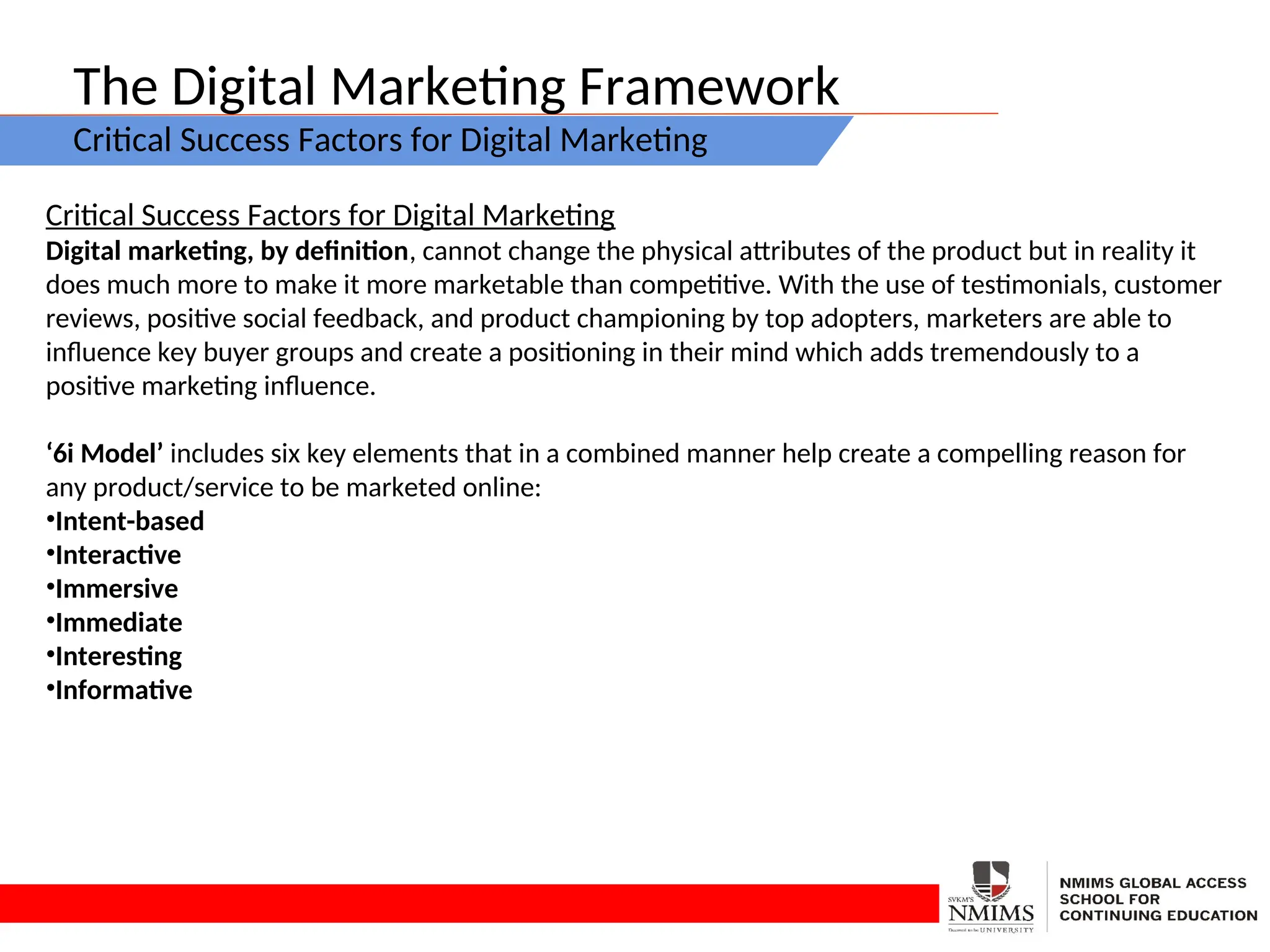
Digital marketing, by definition, cannot change the physical attributes of the product but in reality it
does much more to make it more marketable than competitive. With the use of testimonials, customer
reviews, positive social feedback, and product championing by top adopters, marketers are able to
influence key buyer groups and create a positioning in their mind which adds tremendously to a
positive marketing influence.
‘6i Model’ includes six key elements that in a combined manner help create a compelling reason for
any product/service to be marketed online:
•Intent-based
•Interactive
•Immersive
•Immediate
•Interesting
•Informative
APPENDIX- 1
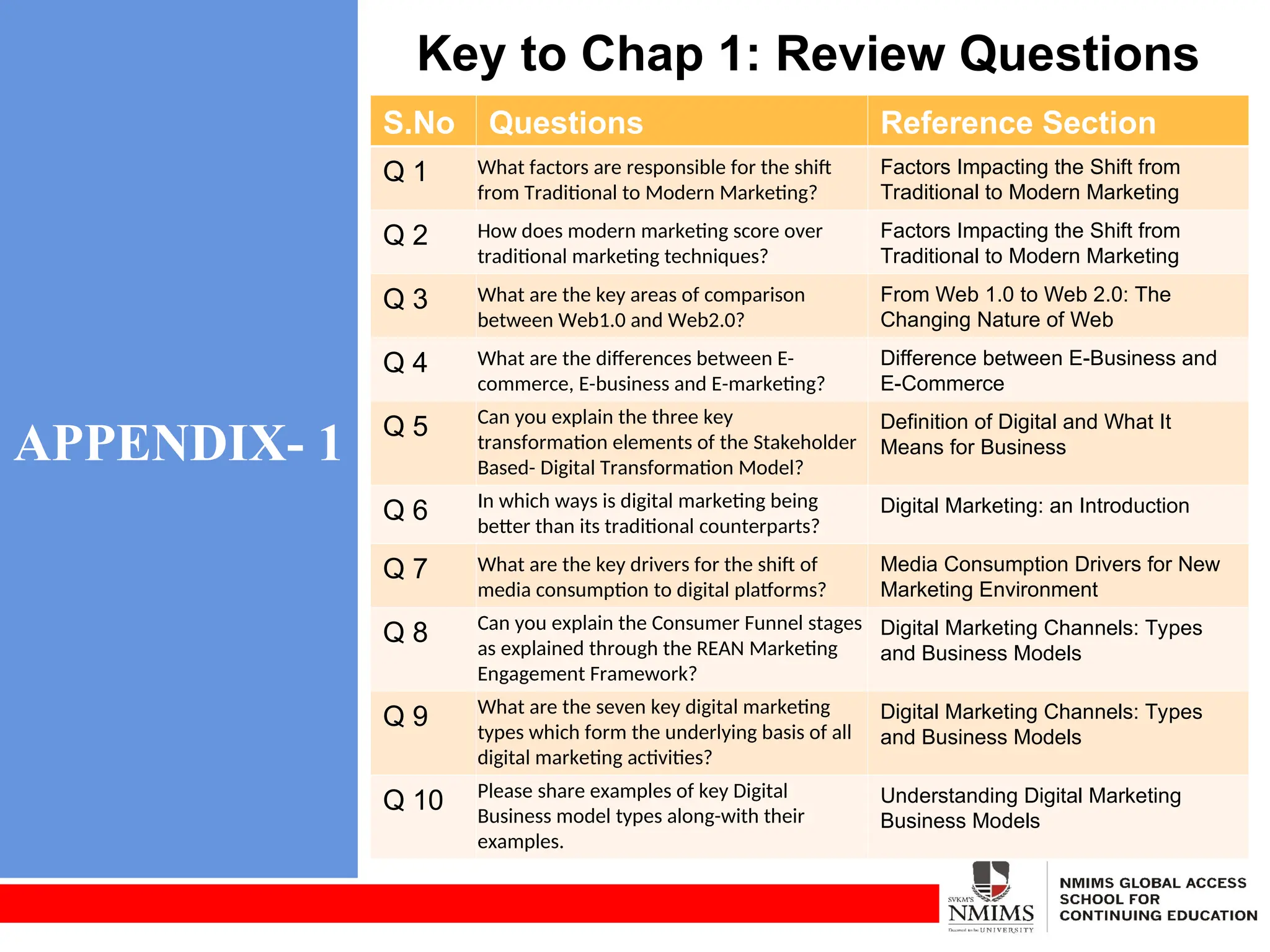
Key to Chap 1: Review Questions
S.No Questions Reference Section
Q 1 What factors are responsible for the shift
from Traditional to Modern Marketing?
Factors Impacting the Shift from
Traditional to Modern Marketing
Q 2 How does modern marketing score over
traditional marketing techniques?
Factors Impacting the Shift from
Traditional to Modern Marketing
Q 3 What are the key areas of comparison
between Web1.0 and Web2.0?
From Web 1.0 to Web 2.0: The
Changing Nature of Web
Q 4 What are the differences between E-
commerce, E-business and E-marketing?
Difference between E-Business and
E-Commerce
Q 5 Can you explain the three key
transformation elements of the Stakeholder
Based- Digital Transformation Model?
Definition of Digital and What It
Means for Business
Q 6 In which ways is digital marketing being
better than its traditional counterparts?
Digital Marketing: an Introduction
Q 7 What are the key drivers for the shift of
media consumption to digital platforms?
Media Consumption Drivers for New
Marketing Environment
Q 8 Can you explain the Consumer Funnel stages
as explained through the REAN Marketing
Engagement Framework?
Digital Marketing Channels: Types
and Business Models
Q 9 What are the seven key digital marketing
types which form the underlying basis of all
digital marketing activities?
Digital Marketing Channels: Types
and Business Models
Q 10 Please share examples of key Digital
Business model types along-with their
examples.
Understanding Digital Marketing
Business Models
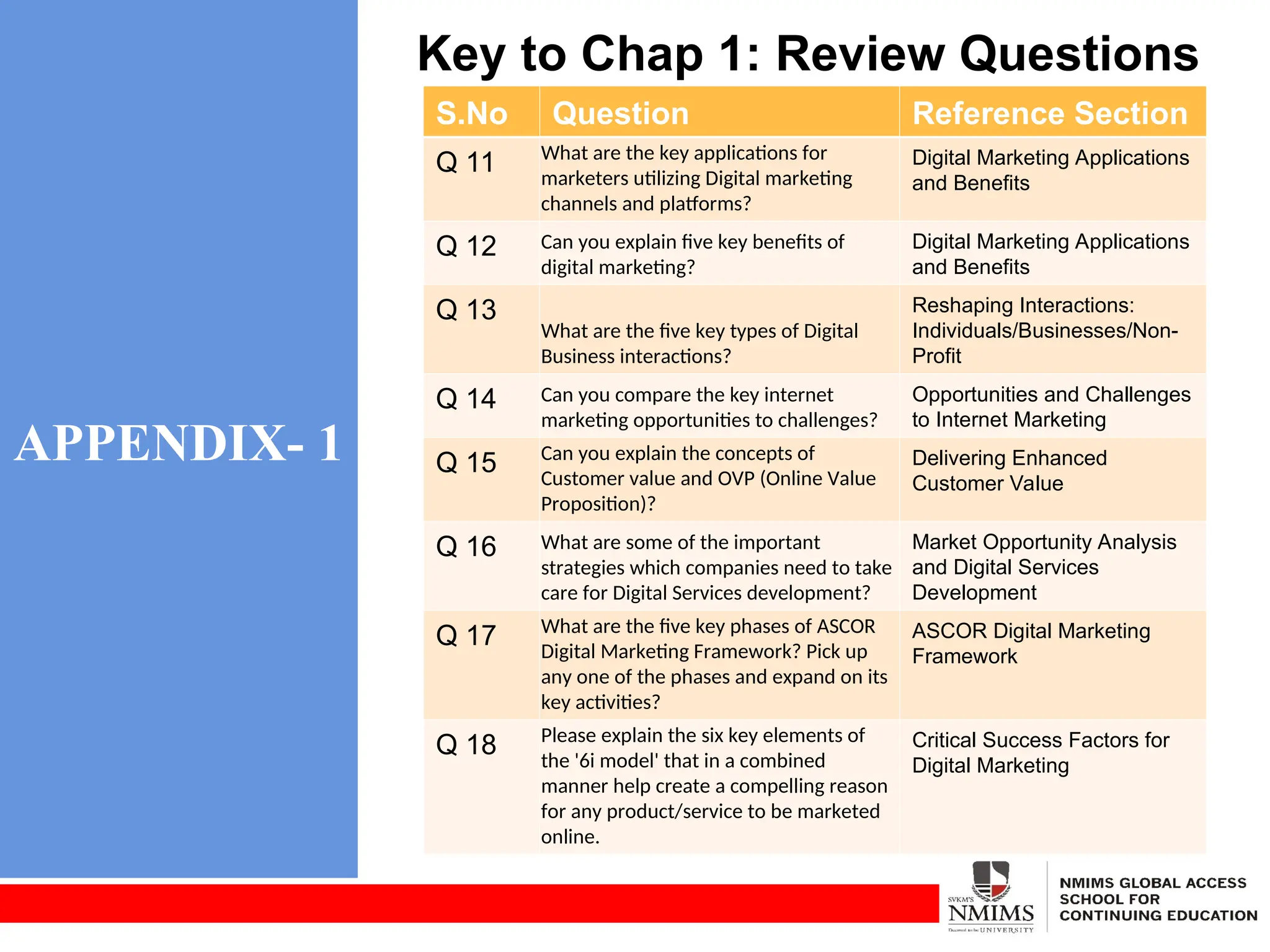
APPENDIX- 1
Key to Chap 1: Review Questions
S.No Question Reference Section
Q 11 What are the key applications for
marketers utilizing Digital marketing
channels and platforms?
Digital Marketing Applications
and Benefits
Q 12 Can you explain five key benefits of
digital marketing?
Digital Marketing Applications
and Benefits
Q 13
What are the five key types of Digital
Business interactions?
Reshaping Interactions:
Individuals/Businesses/Non-
Profit
Q 14 Can you compare the key internet
marketing opportunities to challenges?
Opportunities and Challenges
to Internet Marketing
Q 15 Can you explain the concepts of
Customer value and OVP (Online Value
Proposition)?
Delivering Enhanced
Customer Value
Q 16 What are some of the important
strategies which companies need to take
care for Digital Services development?
Market Opportunity Analysis
and Digital Services
Development
Q 17 What are the five key phases of ASCOR
Digital Marketing Framework? Pick up
any one of the phases and expand on its
key activities?
ASCOR Digital Marketing
Framework
Q 18 Please explain the six key elements of
the '6i model' that in a combined
manner help create a compelling reason
for any product/service to be marketed
online.
Critical Success Factors for
Digital Marketing
Chapter 2
Digital Marketing
Models Creation
Factors Impacting Digital
Marketplace
 From Brick and Mortar to Bricks and Clicks
 Growth of Interactive Platforms
 The New Network Economy
 From Marketspaces to Marketplaces
 Changing Sales and Customer Service Patterns
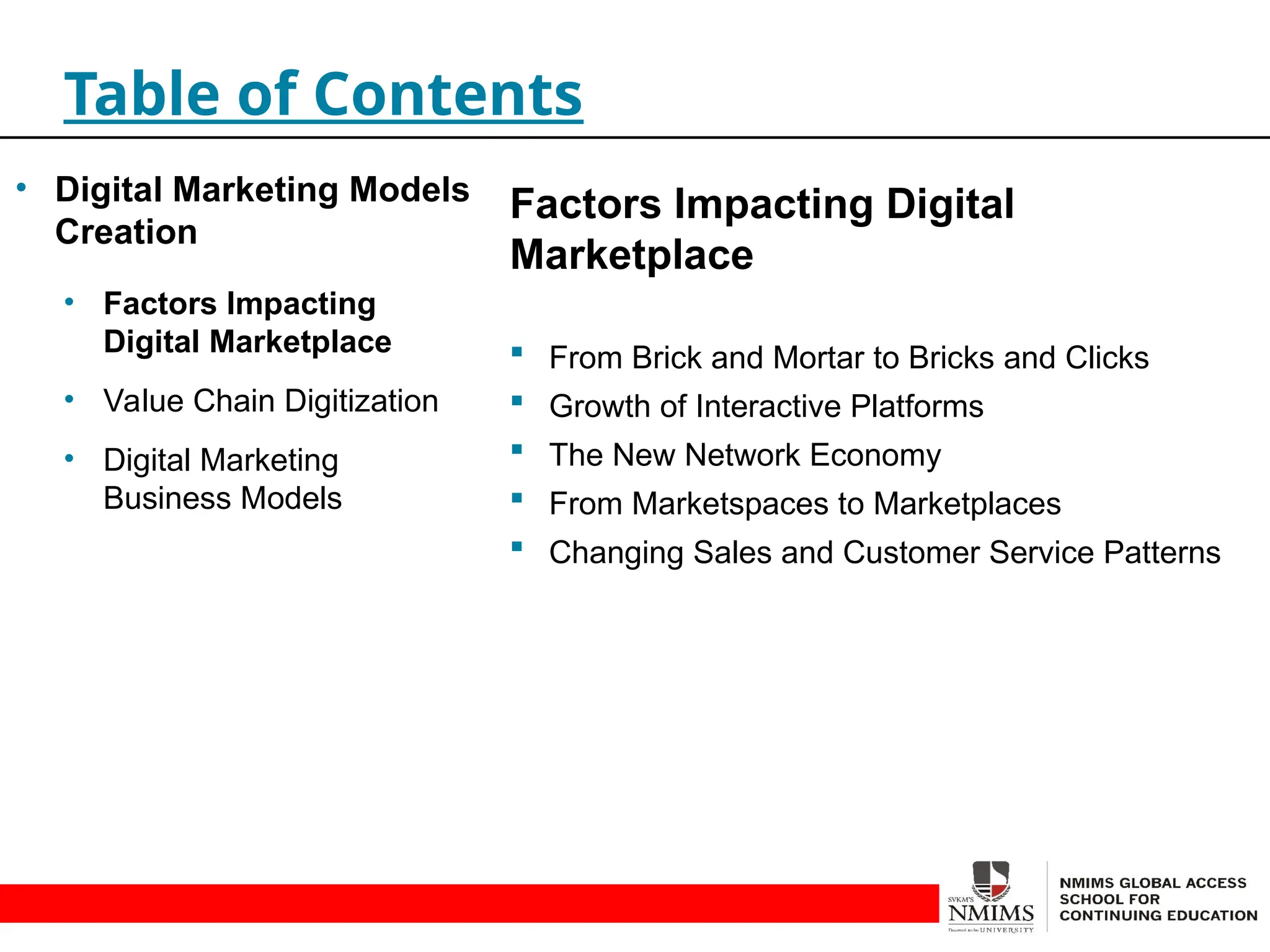
Table of Contents
• Digital Marketing Models
Creation
• Factors Impacting
Digital Marketplace
• Value Chain Digitization
• Digital Marketing
Business Models
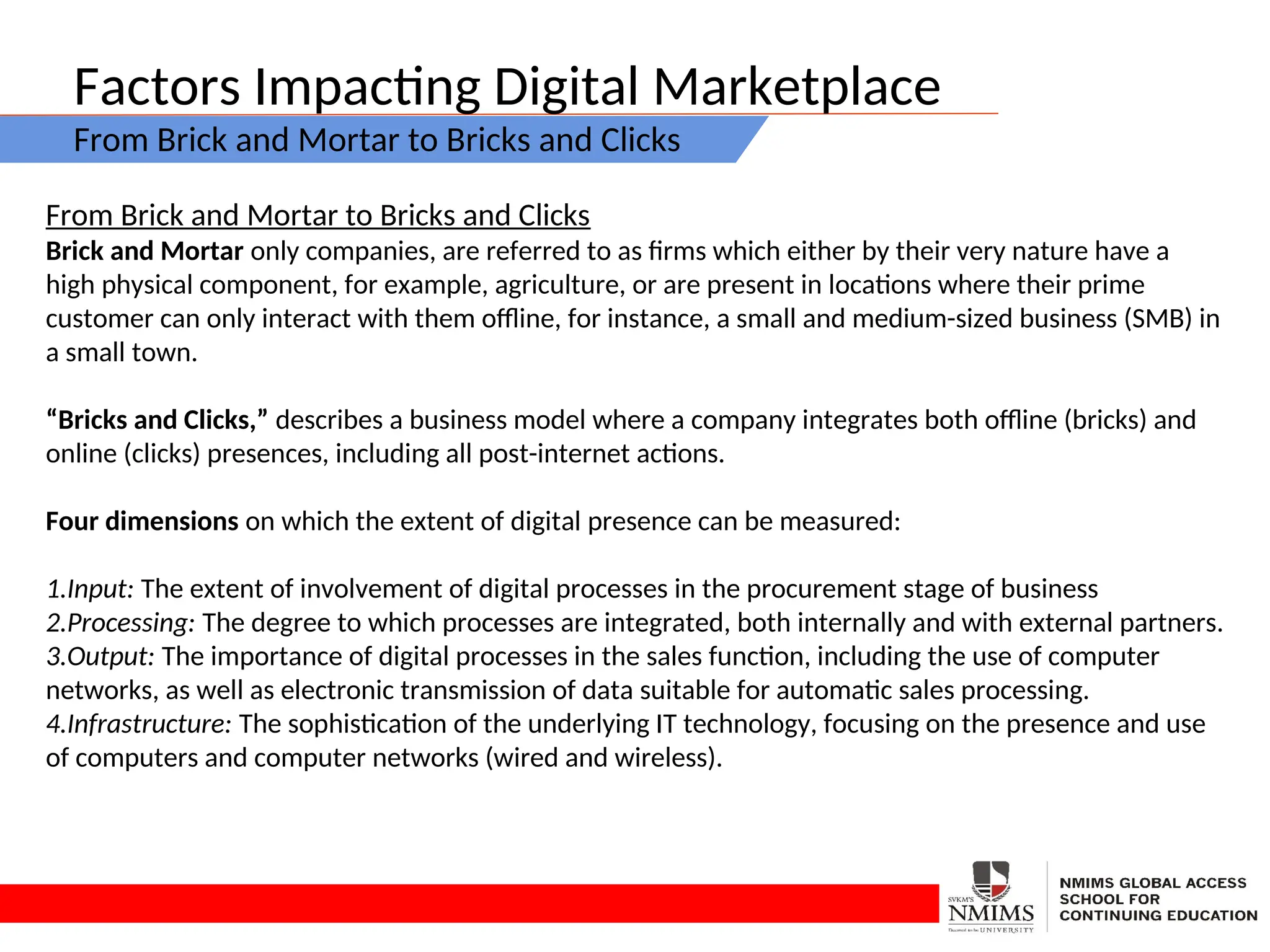
Factors Impacting Digital Marketplace
From Brick and Mortar to Bricks and Clicks
Brick and Mortar only companies, are referred to as firms which either by their very nature have a
high physical component, for example, agriculture, or are present in locations where their prime
customer can only interact with them offline, for instance, a small and medium-sized business (SMB) in
a small town.
“Bricks and Clicks,” describes a business model where a company integrates both offline (bricks) and
online (clicks) presences, including all post-internet actions.
Four dimensions on which the extent of digital presence can be measured:
1.Input: The extent of involvement of digital processes in the procurement stage of business
2.Processing: The degree to which processes are integrated, both internally and with external partners.
3.Output: The importance of digital processes in the sales function, including the use of computer
networks, as well as electronic transmission of data suitable for automatic sales processing.
4.Infrastructure: The sophistication of the underlying IT technology, focusing on the presence and use
of computers and computer networks (wired and wireless).
Factors Impacting Digital Marketplace
Growth of Interactive Platforms
Interactive by definition implies any medium which allows a two-way interaction between a
human and an electronic medium often in a conversational manner to obtain data or information
and to give immediate results. The platforms which provide the capability for such exchanges are
known as interactive platforms.
Impact and Importance of Interactive Platforms
Key types of interactions supported by interactive platforms:
1.Information Seeking Interactions
2.Problem-solving Interactions
3.Community Interactions
4.Activity/promotions-based Interactions
5.Expert opinion Interactions
6.Feedback eliciting Interactions
Factors Impacting Digital Marketplace
The New Network Economy
The Network Economy Phenomenon
The concept of network economy involves value being added to products and services through social
networks operating on a large or global scale. The core principle behind this economy is termed as the
“network effect.” which states that a product displays positive network effects when increasing usage by
a user augments the product’s value for other users (and sometimes all users).
Type of Network Effects
Network effects can be classified on the basis of cause and effect relationships of the networks at hand:
1.Direct network effects- where increase in usage of a particular good or service leads to a direct
increase in value and subsequent adoption for other users.
2.Indirect network effects- where increase in the usage of one product or service augments the value of
a complimentary product or service which in turn raises the value of the original product.
3.Two-sided network effects- where increase in the usage by one set of users increases the value of a
complementary product to another set of users distinct from the first set and vice versa.
4.Local network effects- where the micro-structure of the networks influences how much network
effects matter to each group.
Impact of Networks on Digital Marketing
With social channels and networks being a key component of the growth and perpetuity of major digital
marketing efforts, it is evident that these impacts need to be traced by marketers so that companies
which have grown through positive network impacts are not hit by sudden negative network effects,
which can take a huge toll on brand standing, imagery, and trust.
Factors Impacting Digital Marketplace
From Marketspaces to Marketplaces
A marketplace (from its most generic definition) is a regular gathering of people for purchase and sale of
provisions, livestock, and other goods. In other words, marketplace is the physical equivalent of what
marketers term as the offline model where buyer and seller transactions occur in specific designated
places without the use of any electronic communications or software.
The marketspace concept, on the other hand, is a recent one which involves information and
communication-based electronic exchange environment, where goods and services instead of being sold
only physically are marketed through an online space that facilitates bi-directional commerce.
The three most distinct concepts which define a marketplace transaction include:
(a) Content of the transaction
(b) Context in which the transaction takes place
(c) Infrastructure that enables the transaction to occur
According to a Harvard Business Review article the value creation exercise differs between a
marketplace and a marketspace. In a marketplace, the three differentiating concepts of content,
context, and infrastructure are all combined as an entity to provide the experience, while in a
marketspace the marketer can utilize and build upon each of the three components as unique
differentiators by themselves which individually can build unique differences difficult to replicate
otherwise.
Factors Impacting Digital Marketplace
Changing Sales and Customer Service Patterns
Changing Sales Function in the Digital World
With the impact of multiple forces on the way, customers are receiving information and conducting
business through marketspaces and distinct shifts have occurred in the way sales and customer service
are structured in the internet age.
With the onset of online marketing and the present digital era, the sales channel has
changed its ways with the following trends:
1.Information accessible to customer
2.Changing pattern of communication channels:
3.Deriving meaning and utilizing huge sets of customer data
4.Knowledge of changing platforms and tools for sales
Impact of digital on customer service patterns
According to McKinsey (as shown in one of their surveys), a pure digital journey has the potential to
drive higher customer satisfaction across all stages of the customer journey.
Value Chain Digitization
 Understanding Value Chain Functions
 Key Value Chain Process: A Basic
Understanding
 Value Chain Elaboration: A Case of Journal
Publishing
 Emergence of Digitized Value Chain
Table of Contents
• Digital Marketing Models
Creation
• Factors Impacting Digital
Marketplace
• Value Chain Digitization
• Digital Marketing
Business Models
Value Chain Digitization
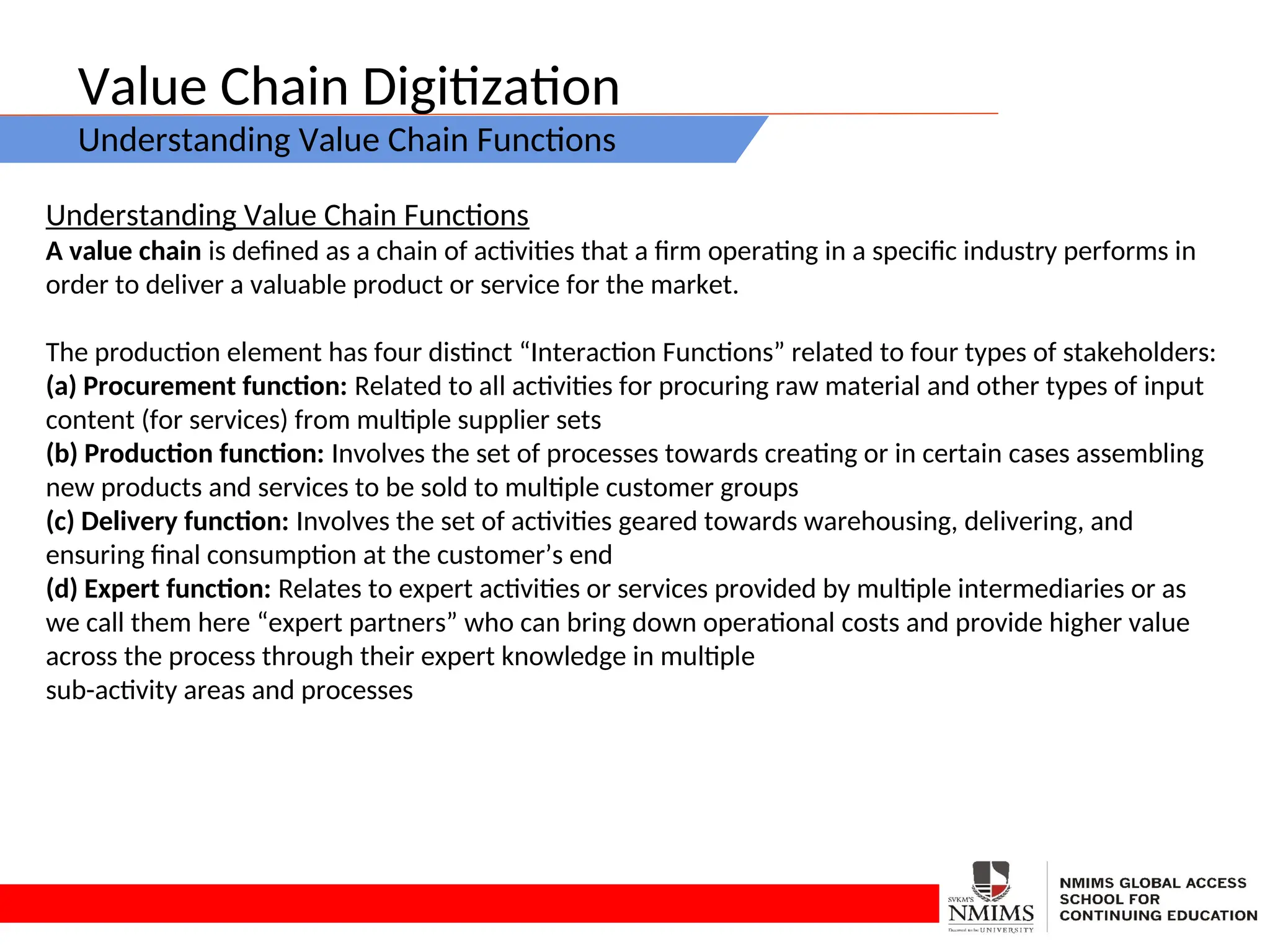
Understanding Value Chain Functions
A value chain is defined as a chain of activities that a firm operating in a specific industry performs in
order to deliver a valuable product or service for the market.
The production element has four distinct “Interaction Functions” related to four types of stakeholders:
(a) Procurement function: Related to all activities for procuring raw material and other types of input
content (for services) from multiple supplier sets
(b) Production function: Involves the set of processes towards creating or in certain cases assembling
new products and services to be sold to multiple customer groups
(c) Delivery function: Involves the set of activities geared towards warehousing, delivering, and
ensuring final consumption at the customer’s end
(d) Expert function: Relates to expert activities or services provided by multiple intermediaries or as
we call them here “expert partners” who can bring down operational costs and provide higher value
across the process through their expert knowledge in multiple
sub-activity areas and processes
Value Chain Digitization
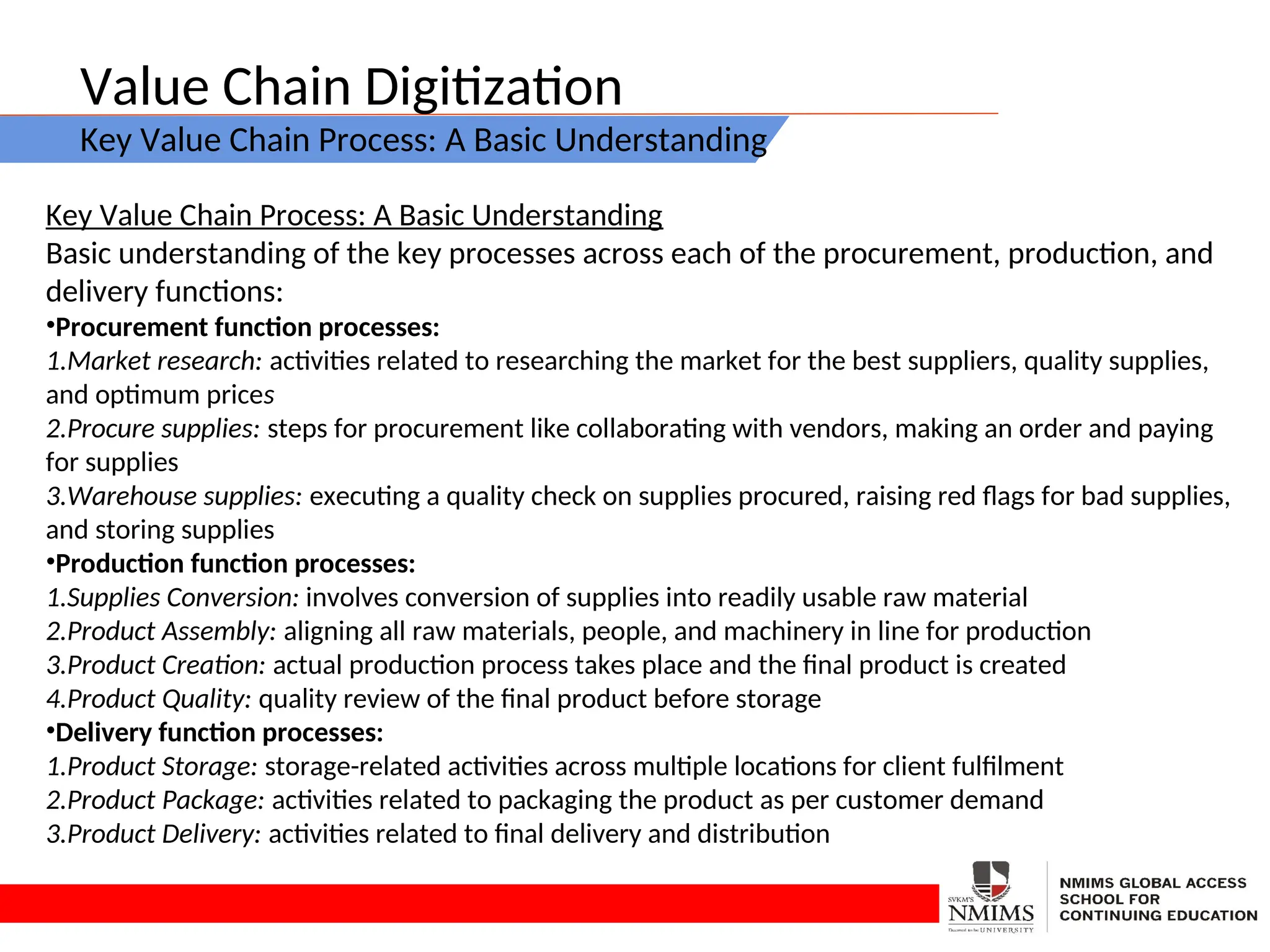
Key Value Chain Process: A Basic Understanding
Basic understanding of the key processes across each of the procurement, production, and
delivery functions:
•Procurement function processes:
1.Market research: activities related to researching the market for the best suppliers, quality supplies,
and optimum prices
2.Procure supplies: steps for procurement like collaborating with vendors, making an order and paying
for supplies
3.Warehouse supplies: executing a quality check on supplies procured, raising red flags for bad supplies,
and storing supplies
•Production function processes:
1.Supplies Conversion: involves conversion of supplies into readily usable raw material
2.Product Assembly: aligning all raw materials, people, and machinery in line for production
3.Product Creation: actual production process takes place and the final product is created
4.Product Quality: quality review of the final product before storage
•Delivery function processes:
1.Product Storage: storage-related activities across multiple locations for client fulfilment
2.Product Package: activities related to packaging the product as per customer demand
3.Product Delivery: activities related to final delivery and distribution
Value Chain Digitization
Key Value Chain Process: A Basic Understanding
Transaction Cost Concept for Expert Function
Transaction cost by definition is the cost incurred in making an economic exchange.
Expert functions are the intermediaries which while acting as experts across different areas of the value
chain, help reduce this cost and provide most value to the process.
Value Chain Digitization
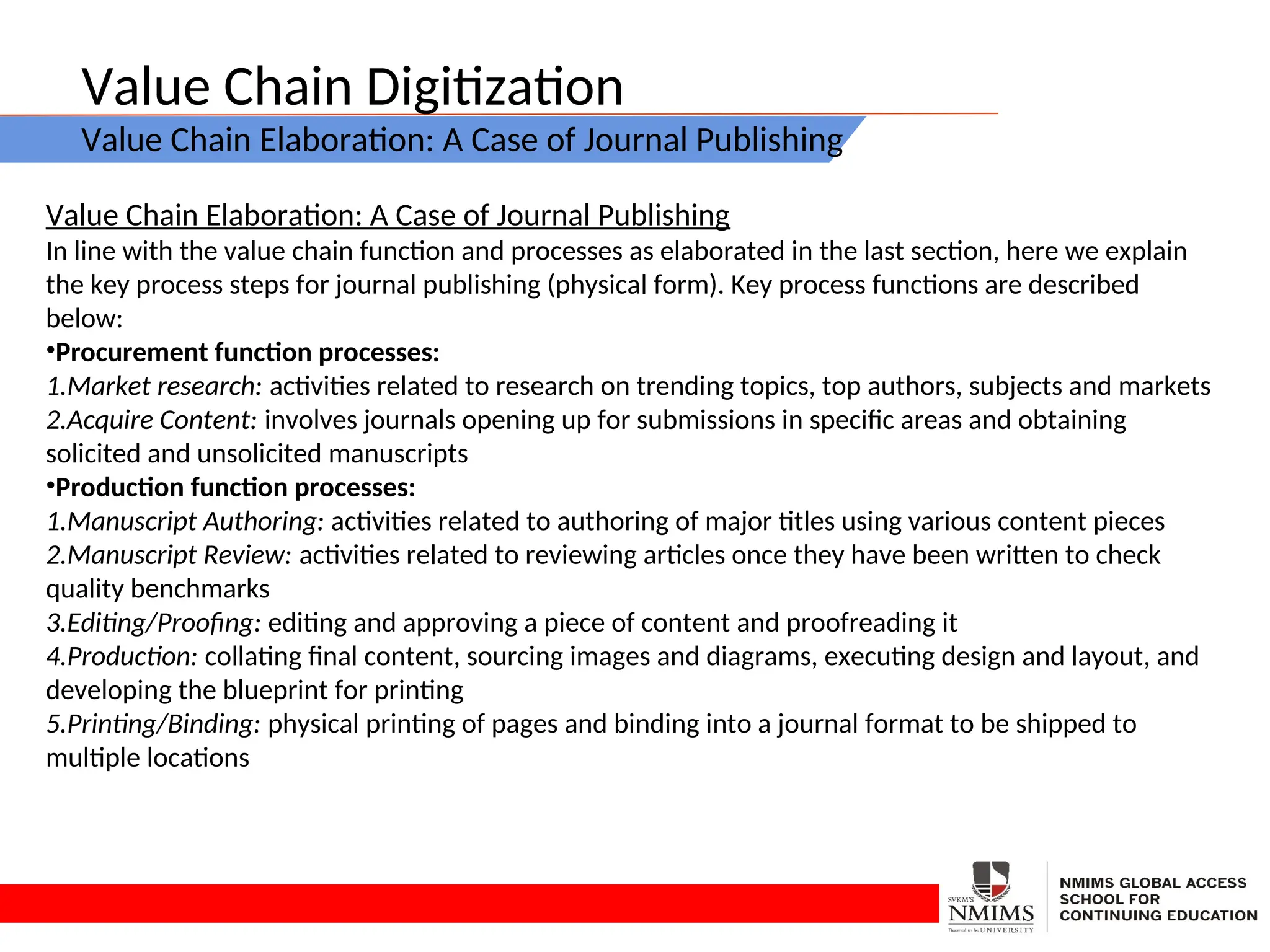
Value Chain Elaboration: A Case of Journal Publishing
In line with the value chain function and processes as elaborated in the last section, here we explain
the key process steps for journal publishing (physical form). Key process functions are described
below:
•Procurement function processes:
1.Market research: activities related to research on trending topics, top authors, subjects and markets
2.Acquire Content: involves journals opening up for submissions in specific areas and obtaining
solicited and unsolicited manuscripts
•Production function processes:
1.Manuscript Authoring: activities related to authoring of major titles using various content pieces
2.Manuscript Review: activities related to reviewing articles once they have been written to check
quality benchmarks
3.Editing/Proofing: editing and approving a piece of content and proofreading it
4.Production: collating final content, sourcing images and diagrams, executing design and layout, and
developing the blueprint for printing
5.Printing/Binding: physical printing of pages and binding into a journal format to be shipped to
multiple locations
Value Chain Digitization
Value Chain Elaboration: A Case of Journal Publishing
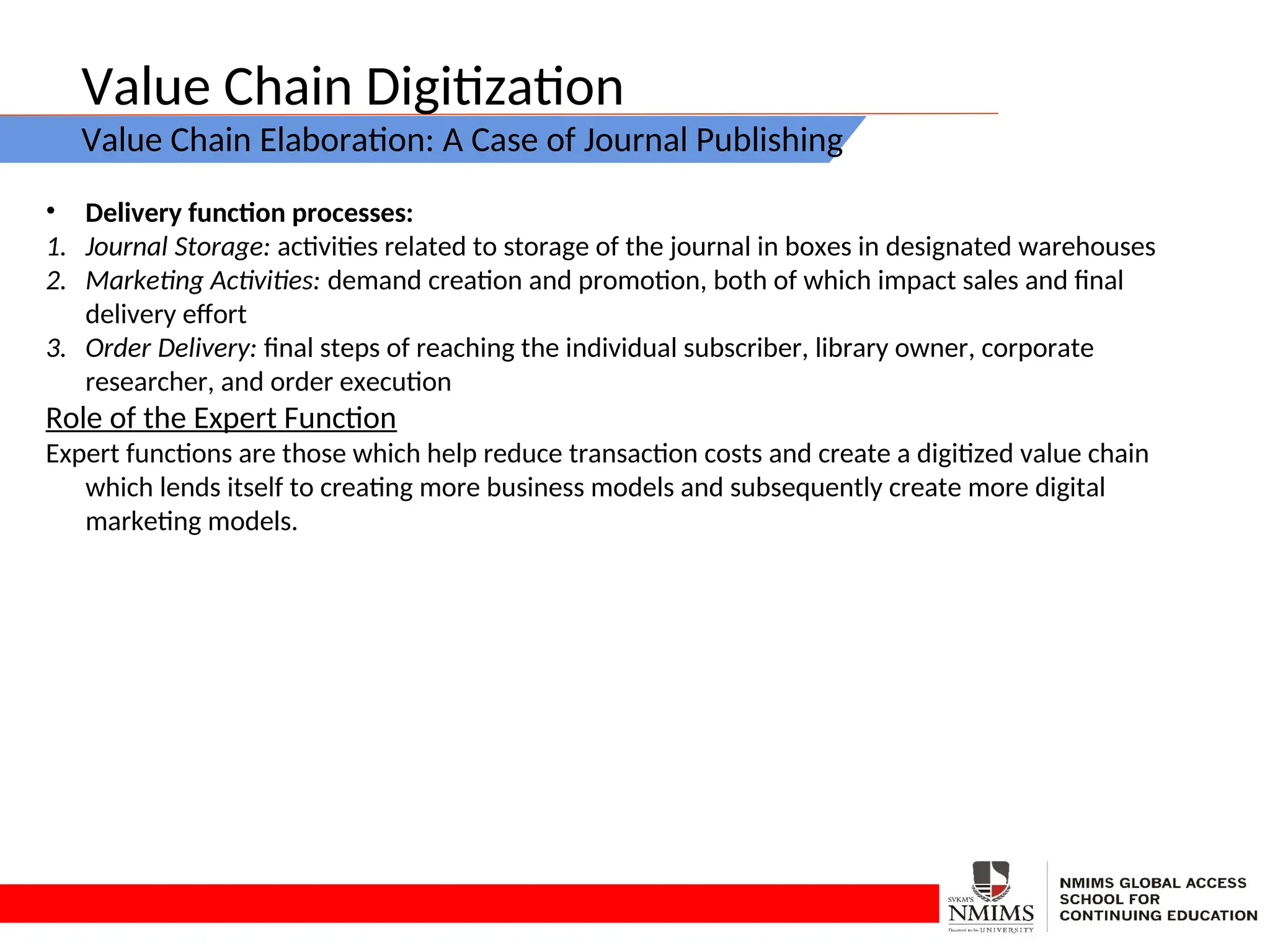
• Delivery function processes:
1. Journal Storage: activities related to storage of the journal in boxes in designated warehouses
2. Marketing Activities: demand creation and promotion, both of which impact sales and final
delivery effort
3. Order Delivery: final steps of reaching the individual subscriber, library owner, corporate
researcher, and order execution
Role of the Expert Function
Expert functions are those which help reduce transaction costs and create a digitized value chain
which lends itself to creating more business models and subsequently create more digital
marketing models.
Value Chain Digitization
Emergence of Digitized Value Chain
With an understanding of the value chain process steps for a generic journal publishing value chain, let
us look at how multiple and digital expert functions help revise the value chain to create a completely
refined and agile ‘Digitized Value Chain’:
Two new inner layers include:
1.Oval Layer: located next to the generic value chain, this layer contains ovals which stream out from
the central expert function. The arrows moving out to each of the ovals are actually individual digital
value elements which are associated with each process of the outer value chain and help reduce the
transaction cost for that process step (the impact of each of these ovals is covered process by process in
this section).
2.Inner Digitized Value Chain: the inner value chain processes, which have been reduced to just four
steps instead of 10, (as was in the original chain), showcase how digital can help create a more agile
value chain which has lesser friction than before, hence, provides more value creation possibilities both
for the firm and the customer.
We then go through each of the key process steps which we had drawn out in the generic value chain
earlier to assess the impact of expert function ovals on each of them and also understand how some of
the circled process activities in the original chain are disappearing (since they are not core to the firm),
leading to a more compact inner digitized value chain.
Digital Marketing Business Models
 Understanding Digital Value Elements
 Digital Value-Led Marketing Approach
 Digital Marketing Models Creation
 Application of Digital Marketing Models
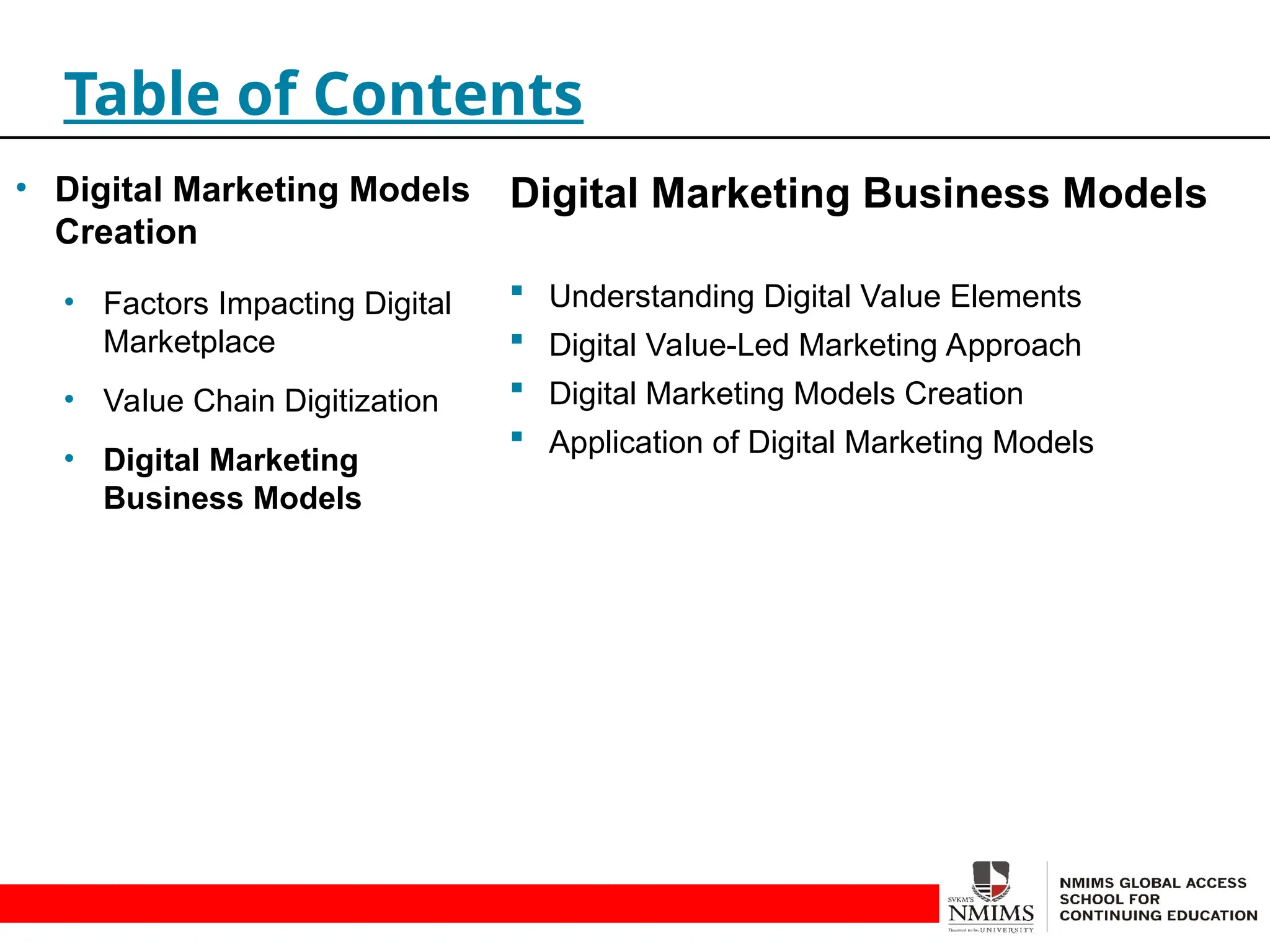
Table of Contents
• Digital Marketing Models
Creation
• Factors Impacting Digital
Marketplace
• Value Chain Digitization
• Digital Marketing
Business Models
Digital Marketing Business Models
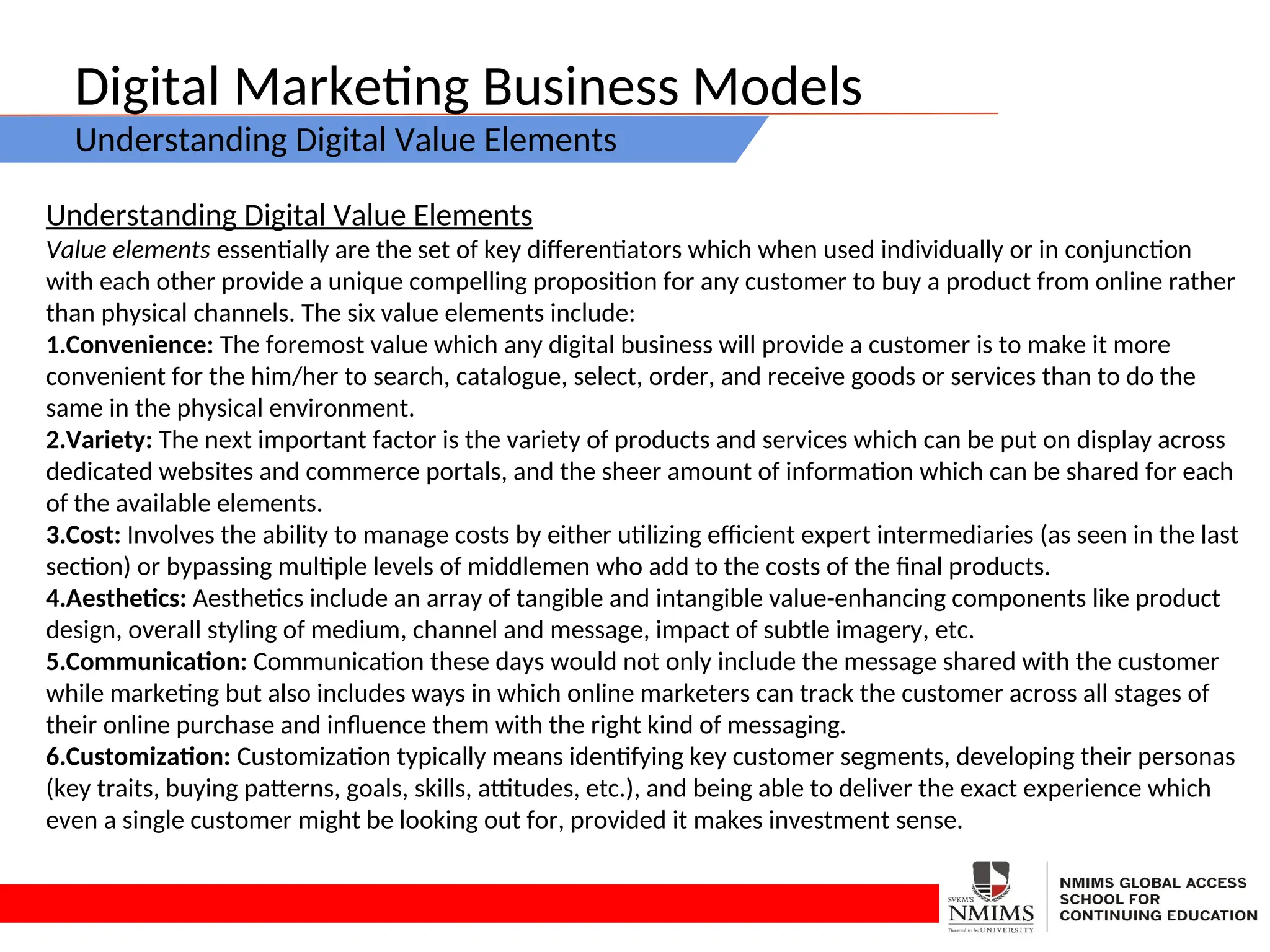
Understanding Digital Value Elements
Value elements essentially are the set of key differentiators which when used individually or in conjunction
with each other provide a unique compelling proposition for any customer to buy a product from online rather
than physical channels. The six value elements include:
1.Convenience: The foremost value which any digital business will provide a customer is to make it more
convenient for the him/her to search, catalogue, select, order, and receive goods or services than to do the
same in the physical environment.
2.Variety: The next important factor is the variety of products and services which can be put on display across
dedicated websites and commerce portals, and the sheer amount of information which can be shared for each
of the available elements.
3.Cost: Involves the ability to manage costs by either utilizing efficient expert intermediaries (as seen in the last
section) or bypassing multiple levels of middlemen who add to the costs of the final products.
4.Aesthetics: Aesthetics include an array of tangible and intangible value-enhancing components like product
design, overall styling of medium, channel and message, impact of subtle imagery, etc.
5.Communication: Communication these days would not only include the message shared with the customer
while marketing but also includes ways in which online marketers can track the customer across all stages of
their online purchase and influence them with the right kind of messaging.
6.Customization: Customization typically means identifying key customer segments, developing their personas
(key traits, buying patterns, goals, skills, attitudes, etc.), and being able to deliver the exact experience which
even a single customer might be looking out for, provided it makes investment sense.
Digital Marketing Business Models
Digital Value-Led Marketing Approach
Involves application of digital value drivers related to the marketing of an academic journal.
Digital Marketing Business Models
Digital Marketing Models Creation
With an understanding of how key digital value elements impact the manner in which new marketing
models are generated and utilized, this section extends the example of journal publishing to see how
new business models are developed combining a couple of value elements and how digital marketing
acts as the key behind supporting these new models.
Digital Marketing Business Models
Application of Digital Marketing Models
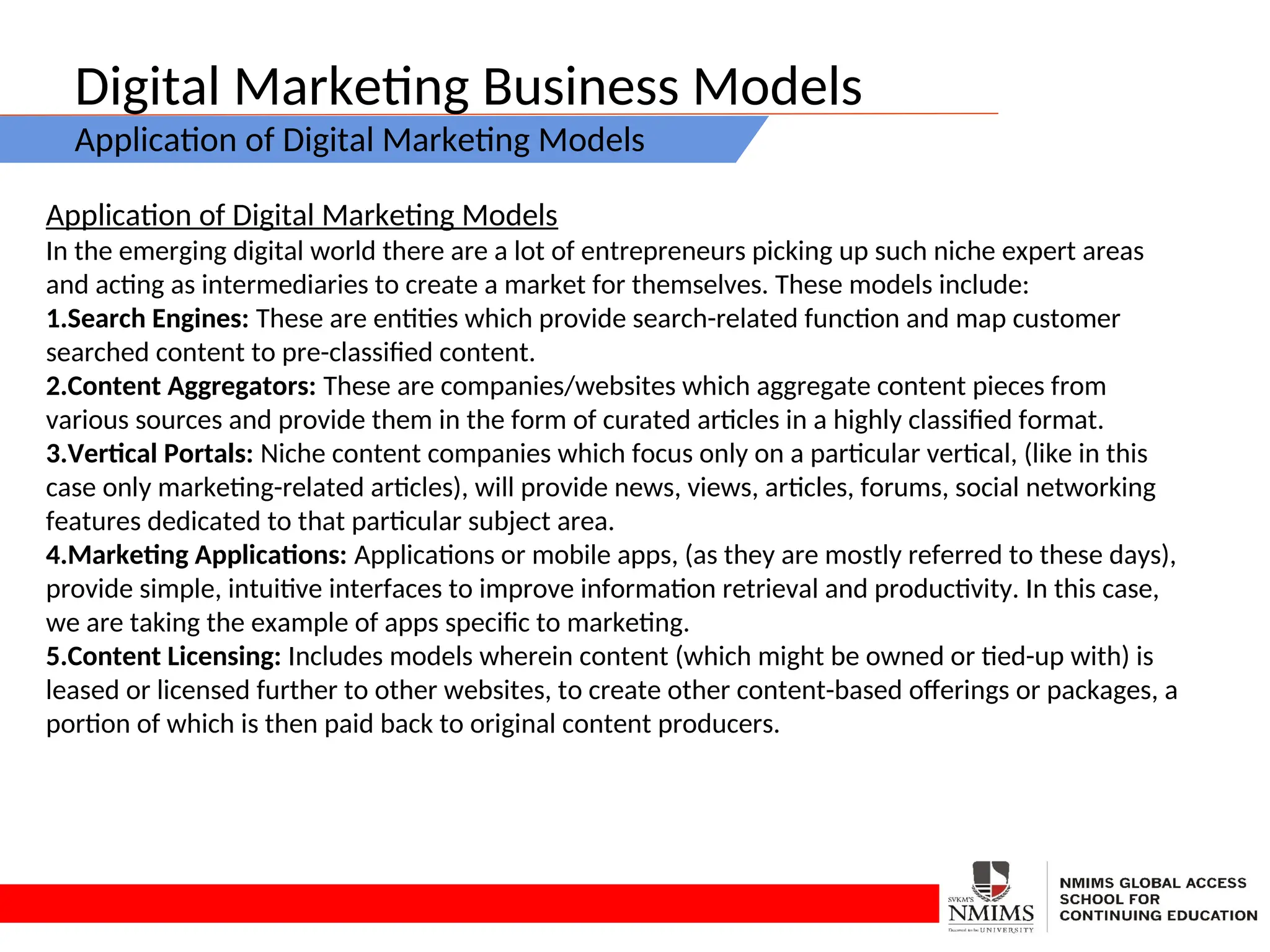
In the emerging digital world there are a lot of entrepreneurs picking up such niche expert areas
and acting as intermediaries to create a market for themselves. These models include:
1.Search Engines: These are entities which provide search-related function and map customer
searched content to pre-classified content.
2.Content Aggregators: These are companies/websites which aggregate content pieces from
various sources and provide them in the form of curated articles in a highly classified format.
3.Vertical Portals: Niche content companies which focus only on a particular vertical, (like in this
case only marketing-related articles), will provide news, views, articles, forums, social networking
features dedicated to that particular subject area.
4.Marketing Applications: Applications or mobile apps, (as they are mostly referred to these days),
provide simple, intuitive interfaces to improve information retrieval and productivity. In this case,
we are taking the example of apps specific to marketing.
5.Content Licensing: Includes models wherein content (which might be owned or tied-up with) is
leased or licensed further to other websites, to create other content-based offerings or packages, a
portion of which is then paid back to original content producers.
APPENDIX- 1
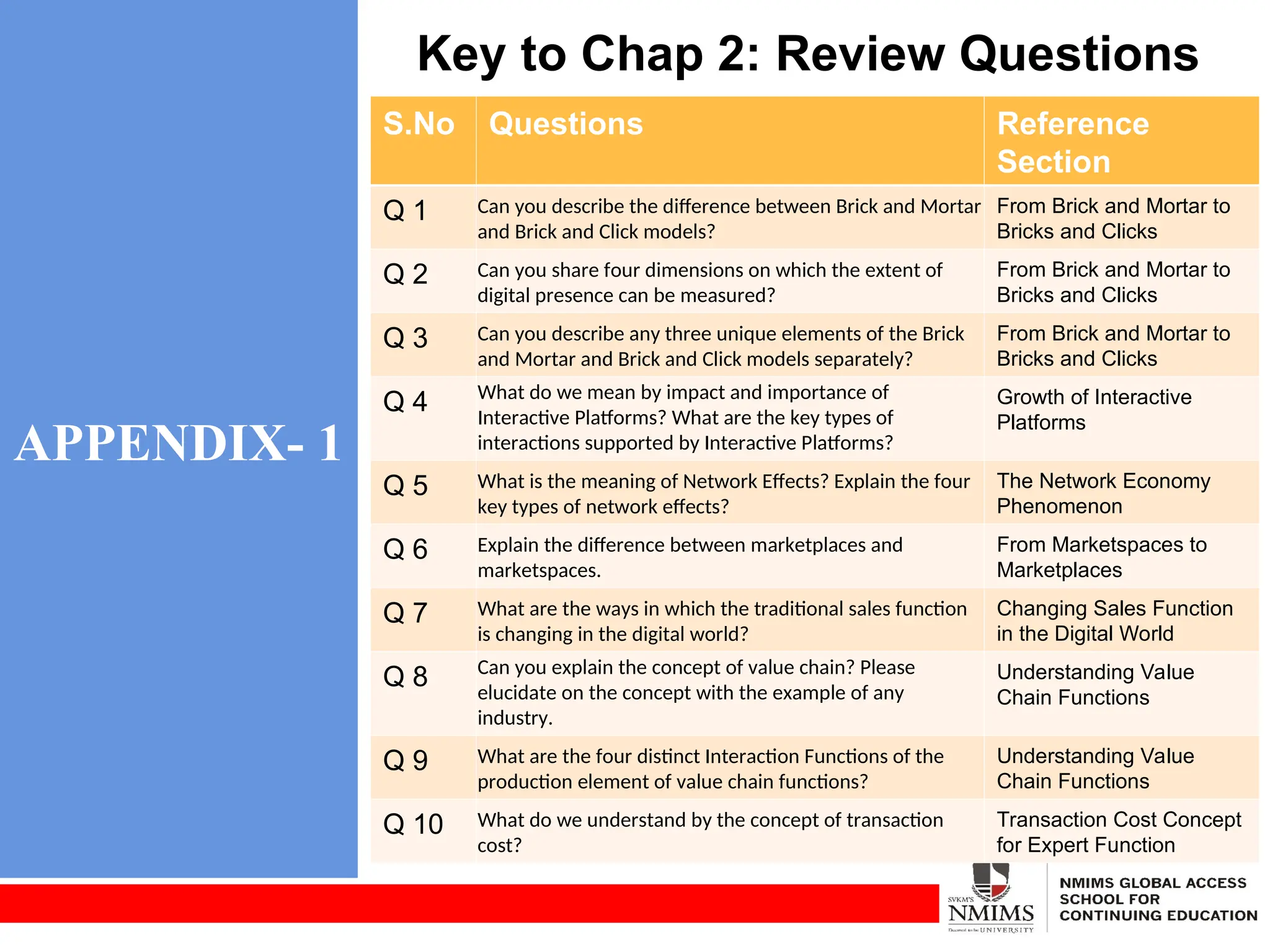
Key to Chap 2: Review Questions
S.No Questions Reference
Section
Q 1 Can you describe the difference between Brick and Mortar
and Brick and Click models?
From Brick and Mortar to
Bricks and Clicks
Q 2 Can you share four dimensions on which the extent of
digital presence can be measured?
From Brick and Mortar to
Bricks and Clicks
Q 3 Can you describe any three unique elements of the Brick
and Mortar and Brick and Click models separately?
From Brick and Mortar to
Bricks and Clicks
Q 4 What do we mean by impact and importance of
Interactive Platforms? What are the key types of
interactions supported by Interactive Platforms?
Growth of Interactive
Platforms
Q 5 What is the meaning of Network Effects? Explain the four
key types of network effects?
The Network Economy
Phenomenon
Q 6 Explain the difference between marketplaces and
marketspaces.
From Marketspaces to
Marketplaces
Q 7 What are the ways in which the traditional sales function
is changing in the digital world?
Changing Sales Function
in the Digital World
Q 8 Can you explain the concept of value chain? Please
elucidate on the concept with the example of any
industry.
Understanding Value
Chain Functions
Q 9 What are the four distinct Interaction Functions of the
production element of value chain functions?
Understanding Value
Chain Functions
Q 10 What do we understand by the concept of transaction
cost?
Transaction Cost Concept
for Expert Function
APPENDIX- 1
Key to Chap 2: Review Questions
S.No Question Reference
Section
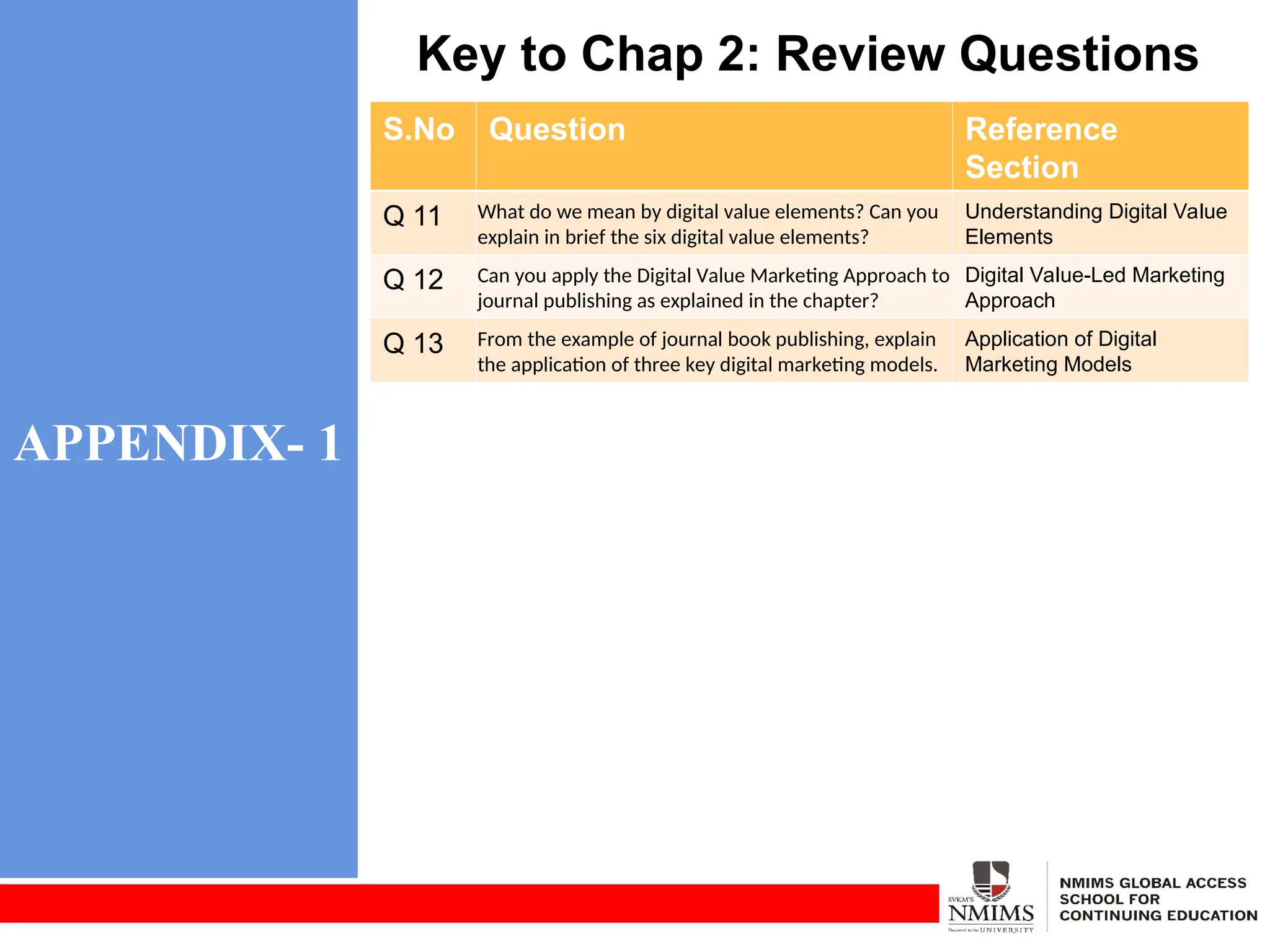
Q 11 What do we mean by digital value elements? Can you
explain in brief the six digital value elements?
Understanding Digital Value
Elements
Q 12 Can you apply the Digital Value Marketing Approach to
journal publishing as explained in the chapter?
Digital Value-Led Marketing
Approach
Q 13 From the example of journal book publishing, explain
the application of three key digital marketing models.
Application of Digital
Marketing Models
Chapter 3
The Consumer for
Digital Marketing
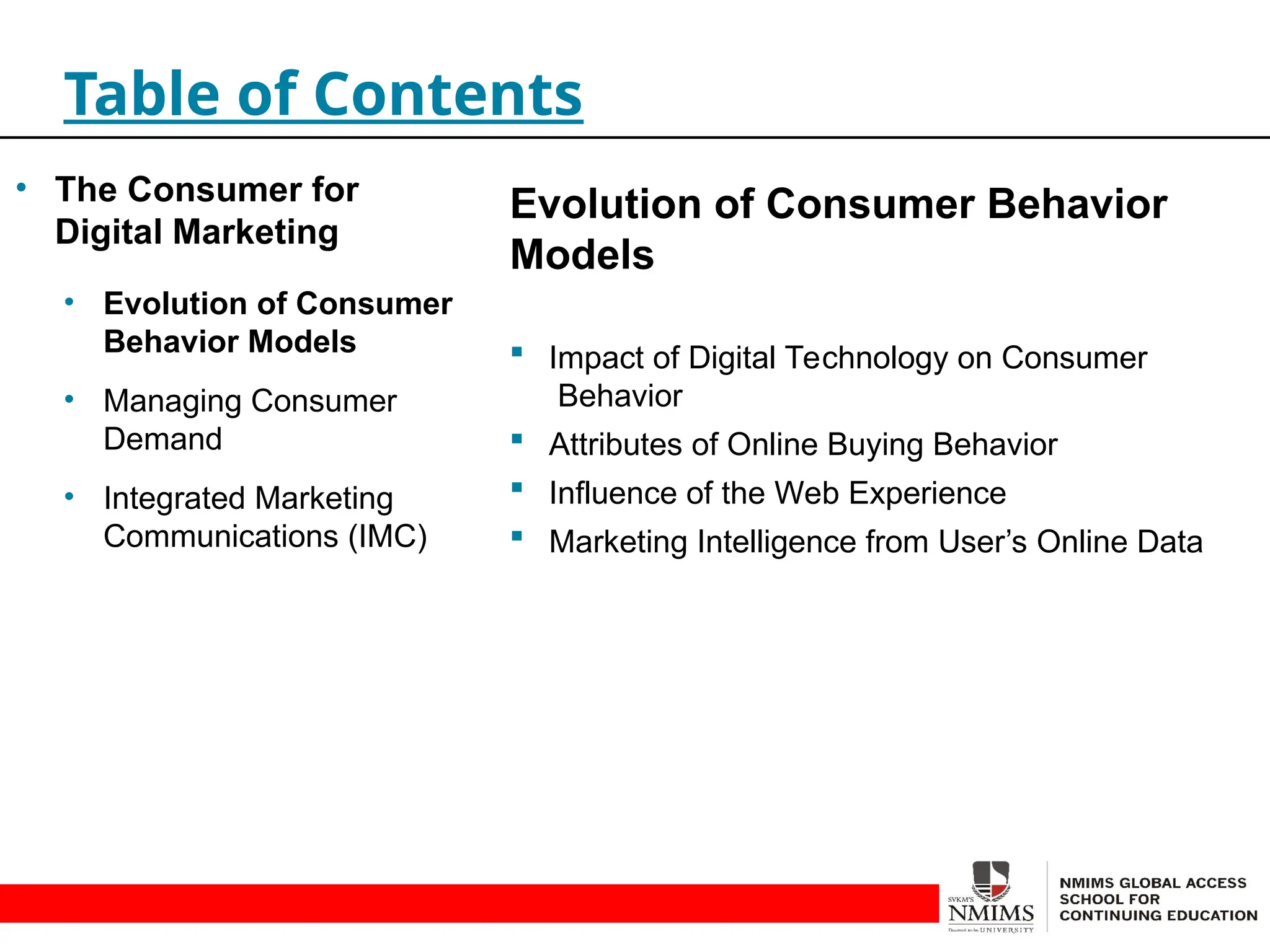
Evolution of Consumer Behavior
Models
 Impact of Digital Technology on Consumer
Behavior
 Attributes of Online Buying Behavior
 Influence of the Web Experience
 Marketing Intelligence from User’s Online Data
Table of Contents
• The Consumer for
Digital Marketing
• Evolution of Consumer
Behavior Models
• Managing Consumer
Demand
• Integrated Marketing
Communications (IMC)
Evolution of Consumer Behaviour Models
Impact of Digital Technology on Consumer Behavior - 1
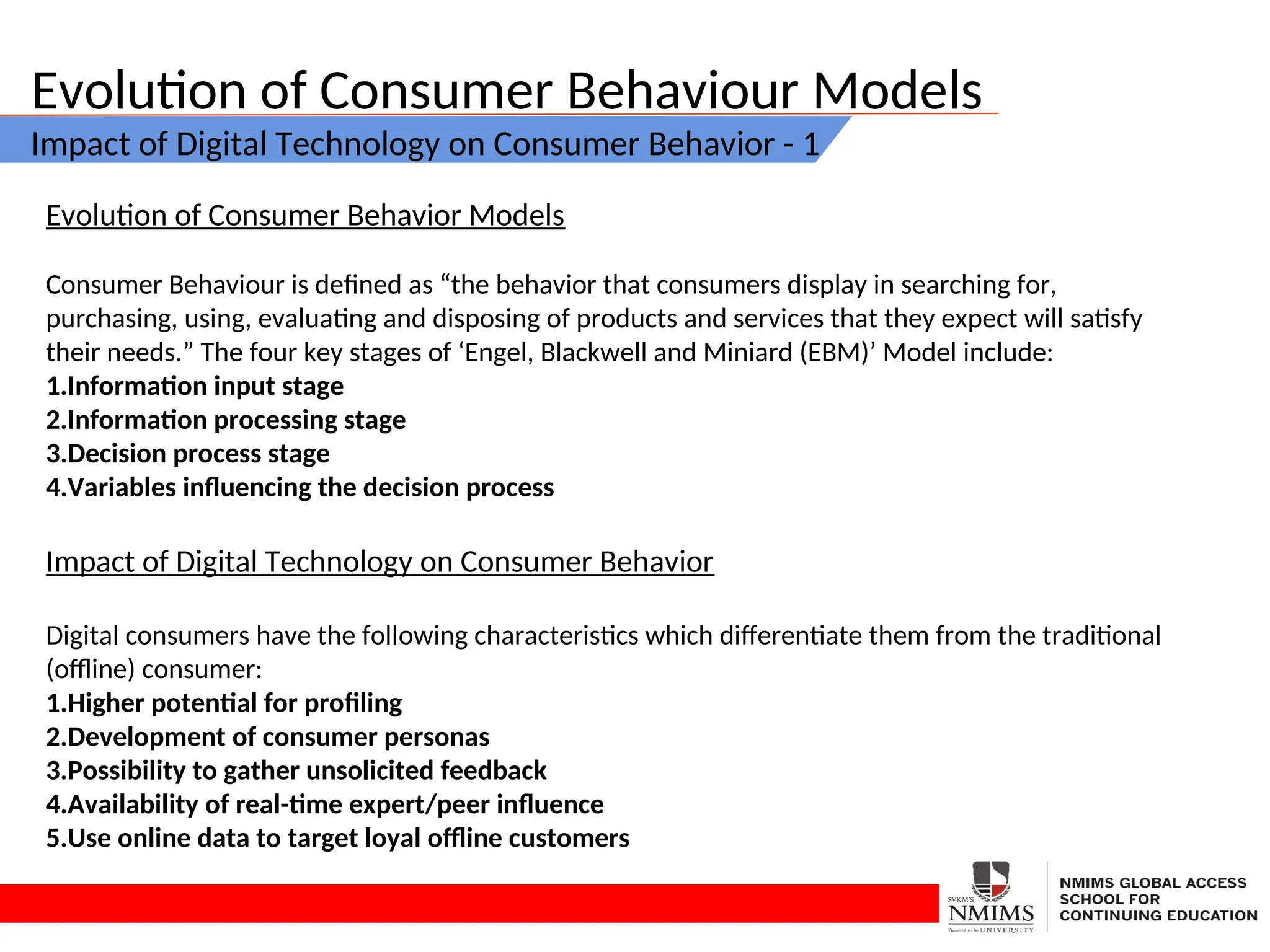
Evolution of Consumer Behavior Models
Consumer Behaviour is defined as “the behavior that consumers display in searching for,
purchasing, using, evaluating and disposing of products and services that they expect will satisfy
their needs.” The four key stages of ‘Engel, Blackwell and Miniard (EBM)’ Model include:
1.Information input stage
2.Information processing stage
3.Decision process stage
4.Variables influencing the decision process
Impact of Digital Technology on Consumer Behavior
Digital consumers have the following characteristics which differentiate them from the traditional
(offline) consumer:
1.Higher potential for profiling
2.Development of consumer personas
3.Possibility to gather unsolicited feedback
4.Availability of real-time expert/peer influence
5.Use online data to target loyal offline customers
Evolution of Consumer Behaviour Models
Impact of Digital Technology on Consumer Behavior- 2
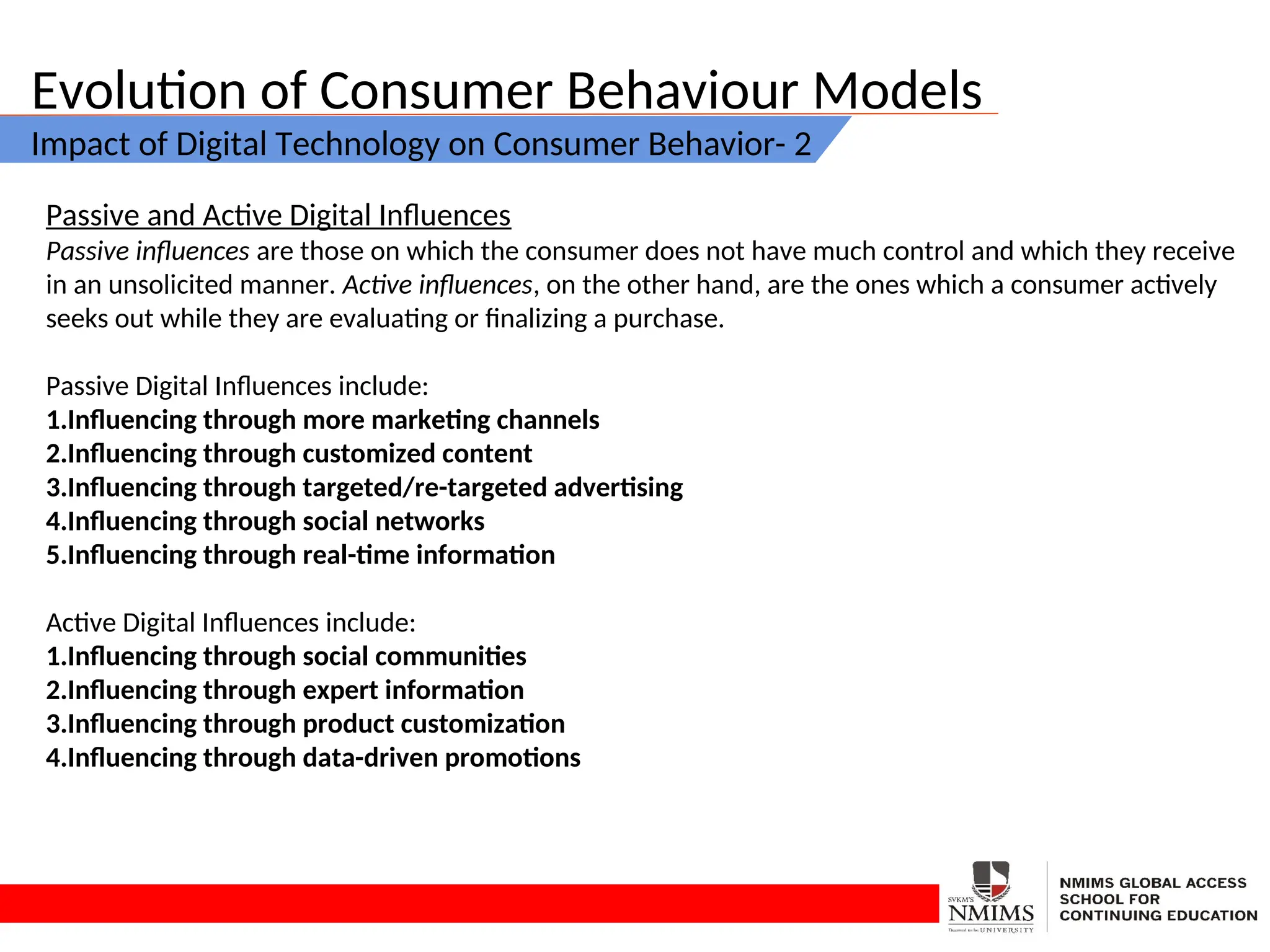
Passive and Active Digital Influences
Passive influences are those on which the consumer does not have much control and which they receive
in an unsolicited manner. Active influences, on the other hand, are the ones which a consumer actively
seeks out while they are evaluating or finalizing a purchase.
Passive Digital Influences include:
1.Influencing through more marketing channels
2.Influencing through customized content
3.Influencing through targeted/re-targeted advertising
4.Influencing through social networks
5.Influencing through real-time information
Active Digital Influences include:
1.Influencing through social communities
2.Influencing through expert information
3.Influencing through product customization
4.Influencing through data-driven promotions
Evolution of Consumer Behaviour Models
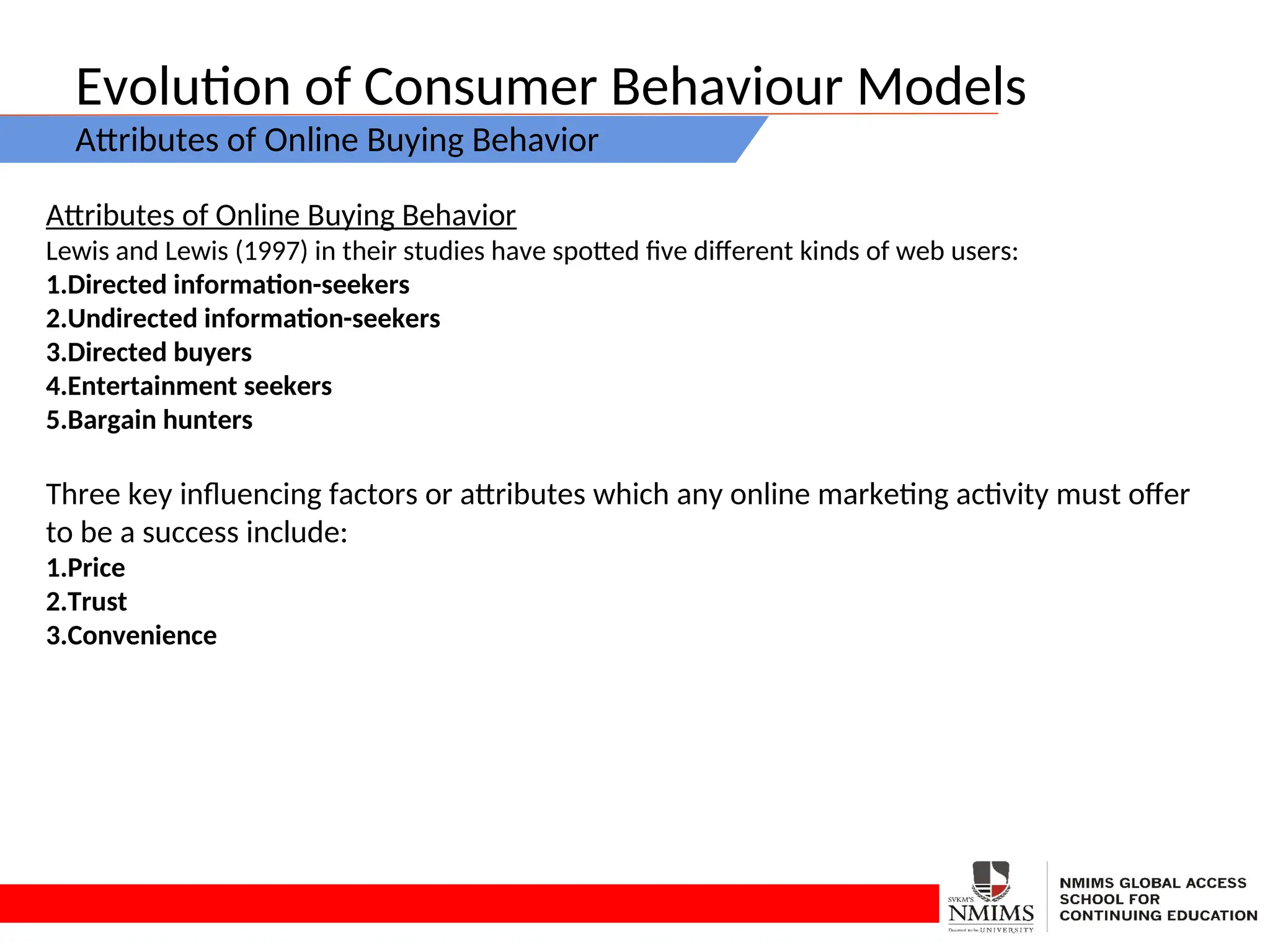
Attributes of Online Buying Behavior
Lewis and Lewis (1997) in their studies have spotted five different kinds of web users:
1.Directed information-seekers
2.Undirected information-seekers
3.Directed buyers
4.Entertainment seekers
5.Bargain hunters
Three key influencing factors or attributes which any online marketing activity must offer
to be a success include:
1.Price
2.Trust
3.Convenience
Evolution of Consumer Behavior Models
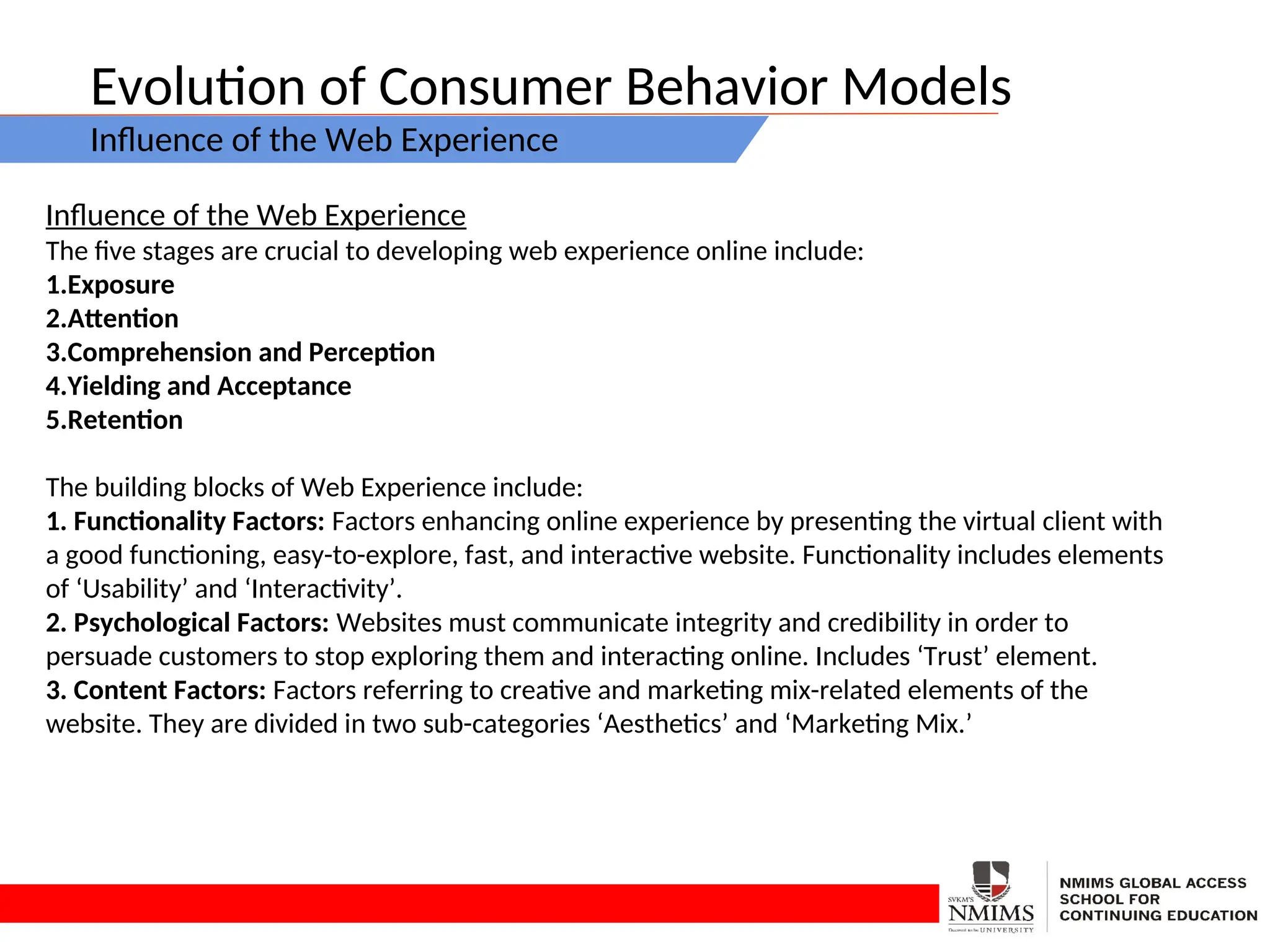
Influence of the Web Experience
The five stages are crucial to developing web experience online include:
1.Exposure
2.Attention
3.Comprehension and Perception
4.Yielding and Acceptance
5.Retention
The building blocks of Web Experience include:
1. Functionality Factors: Factors enhancing online experience by presenting the virtual client with
a good functioning, easy-to-explore, fast, and interactive website. Functionality includes elements
of ‘Usability’ and ‘Interactivity’.
2. Psychological Factors: Websites must communicate integrity and credibility in order to
persuade customers to stop exploring them and interacting online. Includes ‘Trust’ element.
3. Content Factors: Factors referring to creative and marketing mix-related elements of the
website. They are divided in two sub-categories ‘Aesthetics’ and ‘Marketing Mix.’
Evolution of Consumer Behavior Models
Marketing Intelligence from User’s Online Data-1
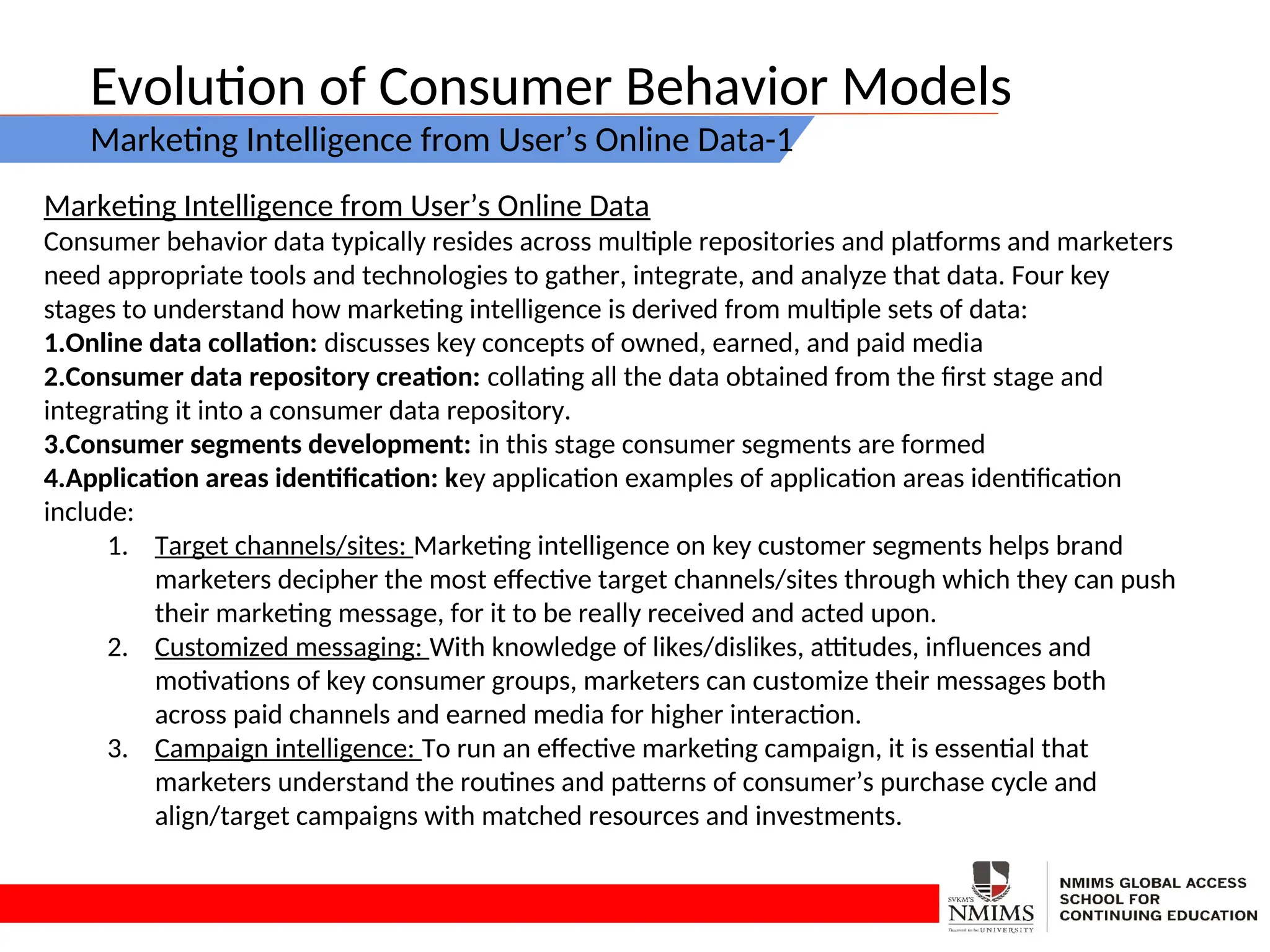
Marketing Intelligence from User’s Online Data
Consumer behavior data typically resides across multiple repositories and platforms and marketers
need appropriate tools and technologies to gather, integrate, and analyze that data. Four key
stages to understand how marketing intelligence is derived from multiple sets of data:
1.Online data collation: discusses key concepts of owned, earned, and paid media
2.Consumer data repository creation: collating all the data obtained from the first stage and
integrating it into a consumer data repository.
3.Consumer segments development: in this stage consumer segments are formed
4.Application areas identification: key application examples of application areas identification
include:
1. Target channels/sites: Marketing intelligence on key customer segments helps brand
marketers decipher the most effective target channels/sites through which they can push
their marketing message, for it to be really received and acted upon.
2. Customized messaging: With knowledge of likes/dislikes, attitudes, influences and
motivations of key consumer groups, marketers can customize their messages both
across paid channels and earned media for higher interaction.
3. Campaign intelligence: To run an effective marketing campaign, it is essential that
marketers understand the routines and patterns of consumer’s purchase cycle and
align/target campaigns with matched resources and investments.
Evolution of Consumer Behavior Models
Marketing Intelligence from User’s Online Data-2
4. Sentiment analysis: Through advanced analytics tools, it is possible to understand
consumer sentiment across any property and channel to decipher the impact of
marketing messages received and products browsed.
5. Advertising exposure: Helps marketers decide the nature and extent of marketing
exposure needed for varied consumer segments.
6. Product optimization: Involves optimizing products based on consumer’s previous buying
patterns and comments/feedback across varied online channels.
7. Data-driven promotions: Marketers can use technology in a real-time manner to target
promotions based on location and intent to help improve conversions.
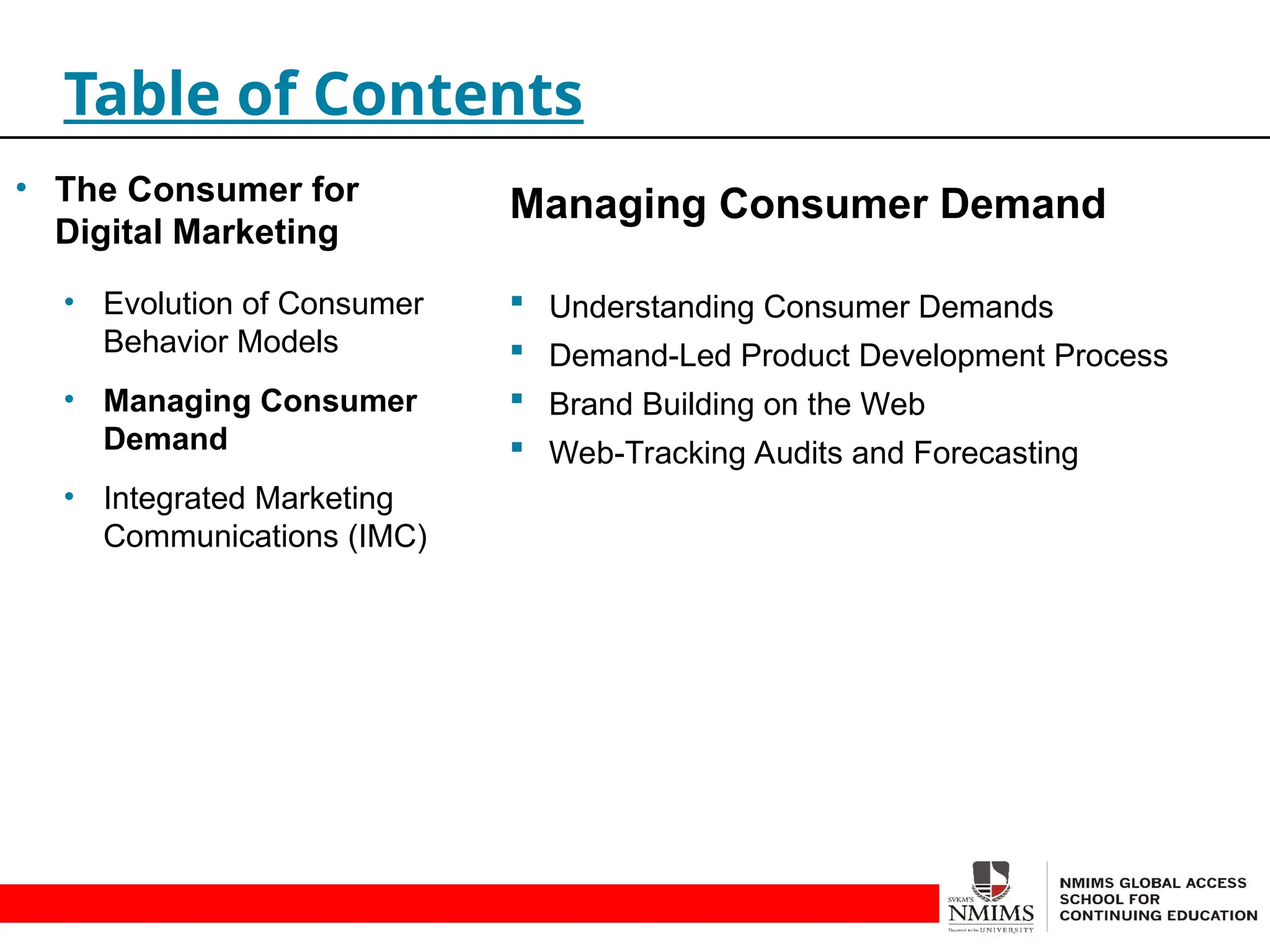
Managing Consumer Demand
 Understanding Consumer Demands
 Demand-Led Product Development Process
 Brand Building on the Web
 Web-Tracking Audits and Forecasting
Table of Contents
• The Consumer for
Digital Marketing
• Evolution of Consumer
Behavior Models
• Managing Consumer
Demand
• Integrated Marketing
Communications (IMC)
Managing Consumer Demand
Understanding Consumer Demands-1
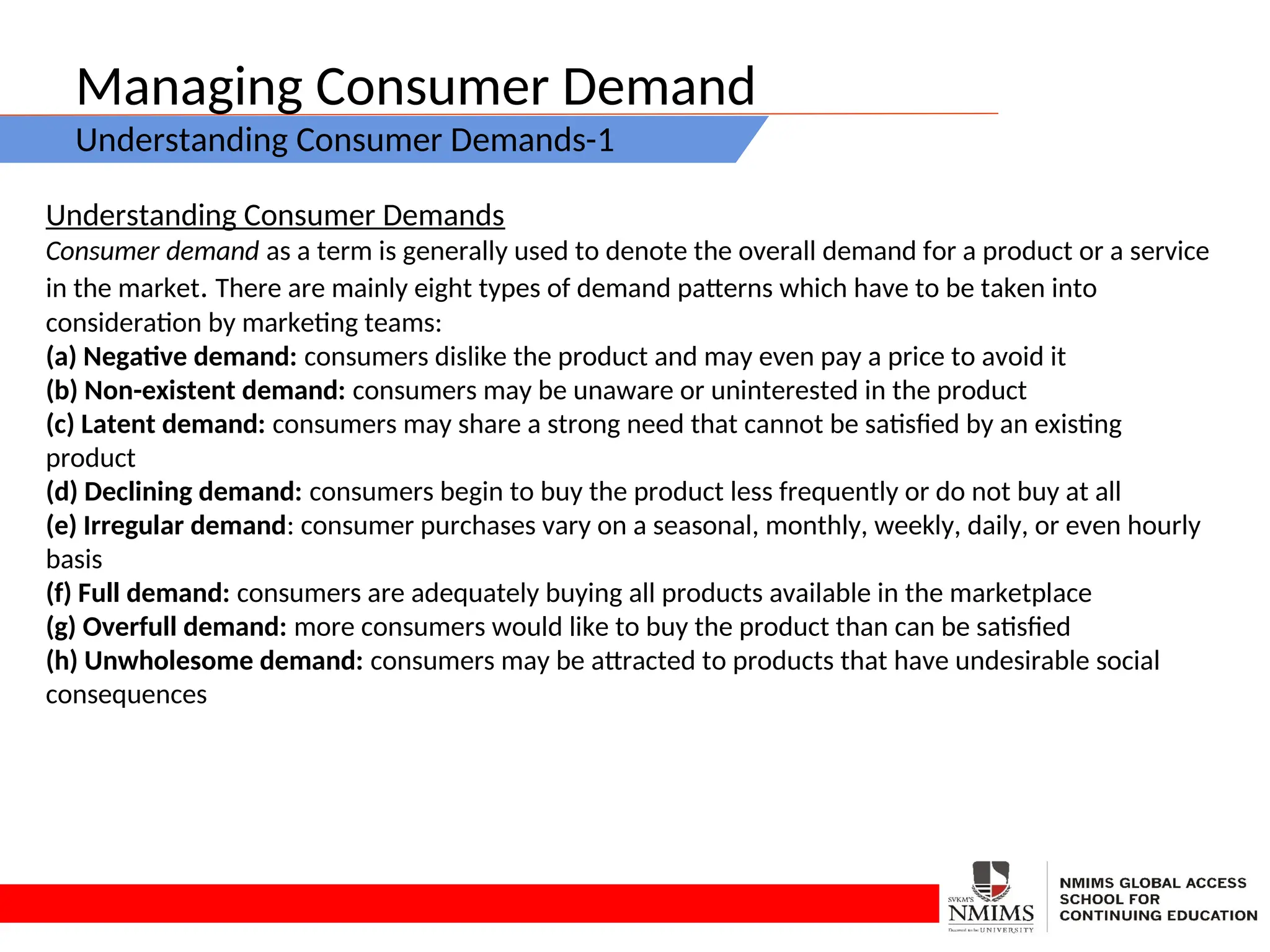
Understanding Consumer Demands
Consumer demand as a term is generally used to denote the overall demand for a product or a service
in the market. There are mainly eight types of demand patterns which have to be taken into
consideration by marketing teams:
(a) Negative demand: consumers dislike the product and may even pay a price to avoid it
(b) Non-existent demand: consumers may be unaware or uninterested in the product
(c) Latent demand: consumers may share a strong need that cannot be satisfied by an existing
product
(d) Declining demand: consumers begin to buy the product less frequently or do not buy at all
(e) Irregular demand: consumer purchases vary on a seasonal, monthly, weekly, daily, or even hourly
basis
(f) Full demand: consumers are adequately buying all products available in the marketplace
(g) Overfull demand: more consumers would like to buy the product than can be satisfied
(h) Unwholesome demand: consumers may be attracted to products that have undesirable social
consequences
Managing Consumer Demand
Understanding Consumer Demands-2
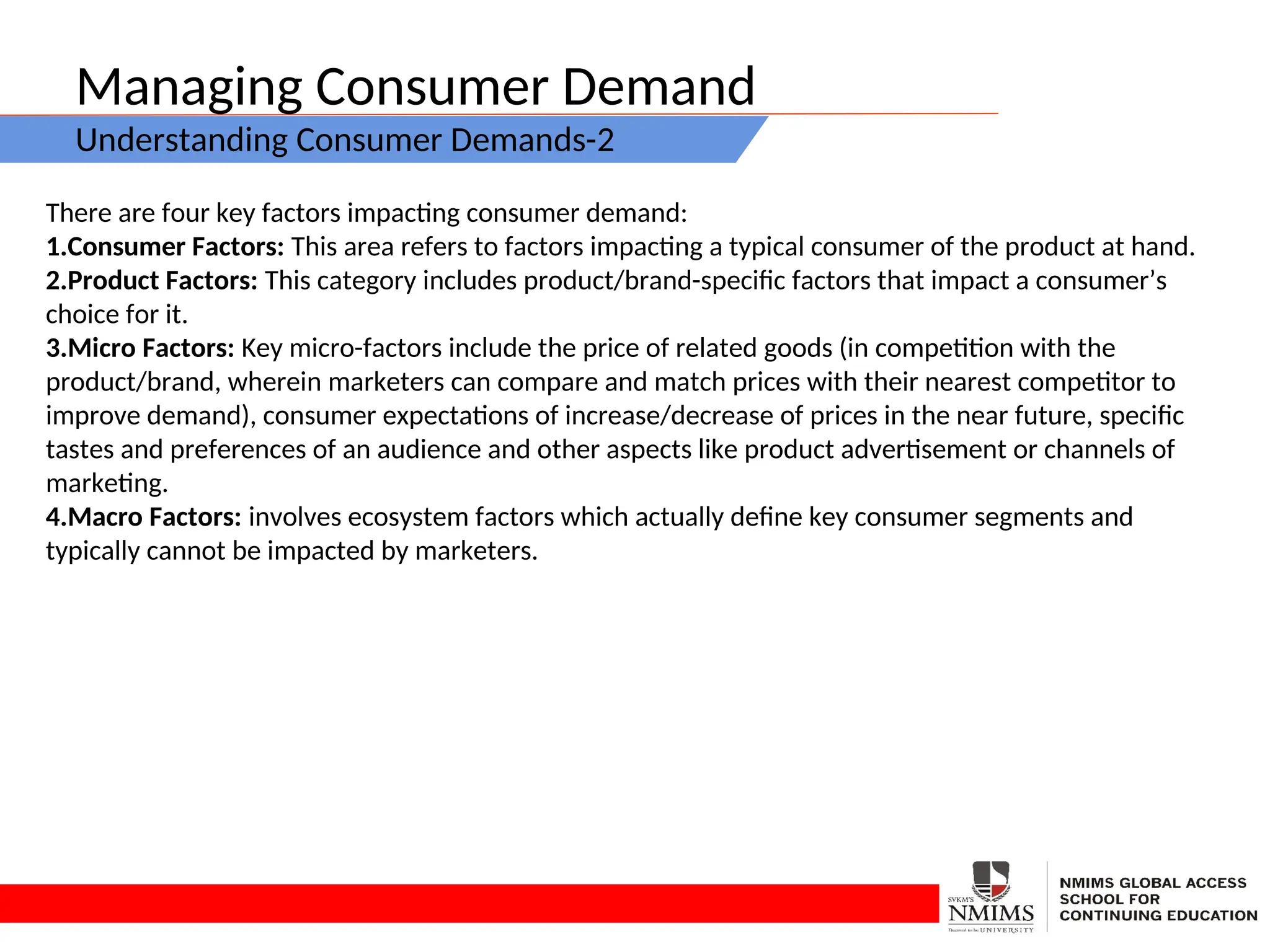
There are four key factors impacting consumer demand:
1.Consumer Factors: This area refers to factors impacting a typical consumer of the product at hand.
2.Product Factors: This category includes product/brand-specific factors that impact a consumer’s
choice for it.
3.Micro Factors: Key micro-factors include the price of related goods (in competition with the
product/brand, wherein marketers can compare and match prices with their nearest competitor to
improve demand), consumer expectations of increase/decrease of prices in the near future, specific
tastes and preferences of an audience and other aspects like product advertisement or channels of
marketing.
4.Macro Factors: involves ecosystem factors which actually define key consumer segments and
typically cannot be impacted by marketers.
Managing Consumer Demand
Demand-Led Product Development Process-1
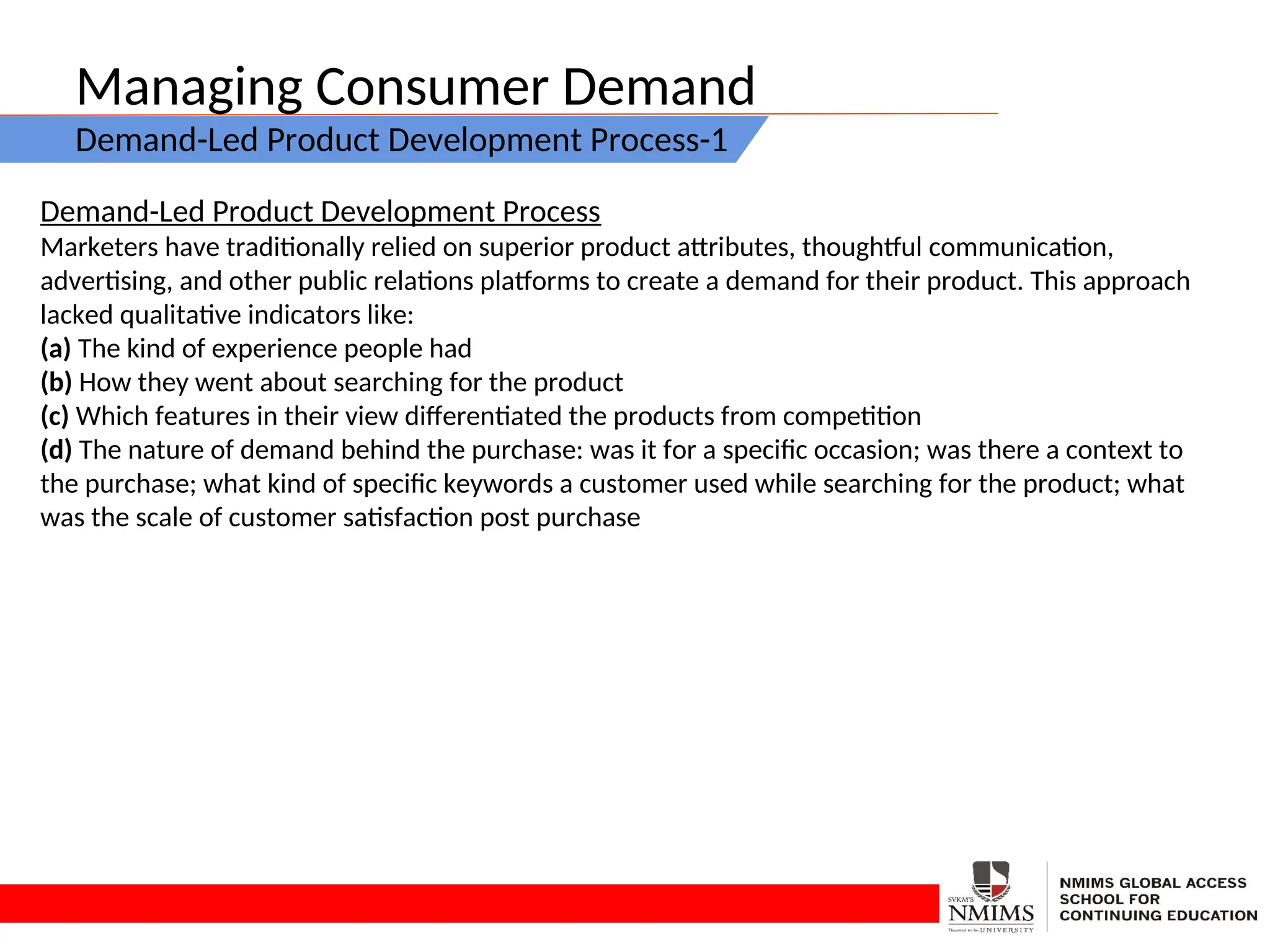
Demand-Led Product Development Process
Marketers have traditionally relied on superior product attributes, thoughtful communication,
advertising, and other public relations platforms to create a demand for their product. This approach
lacked qualitative indicators like:
(a) The kind of experience people had
(b) How they went about searching for the product
(c) Which features in their view differentiated the products from competition
(d) The nature of demand behind the purchase: was it for a specific occasion; was there a context to
the purchase; what kind of specific keywords a customer used while searching for the product; what
was the scale of customer satisfaction post purchase
Managing Consumer Demand
Demand-Led Product Development Process-2
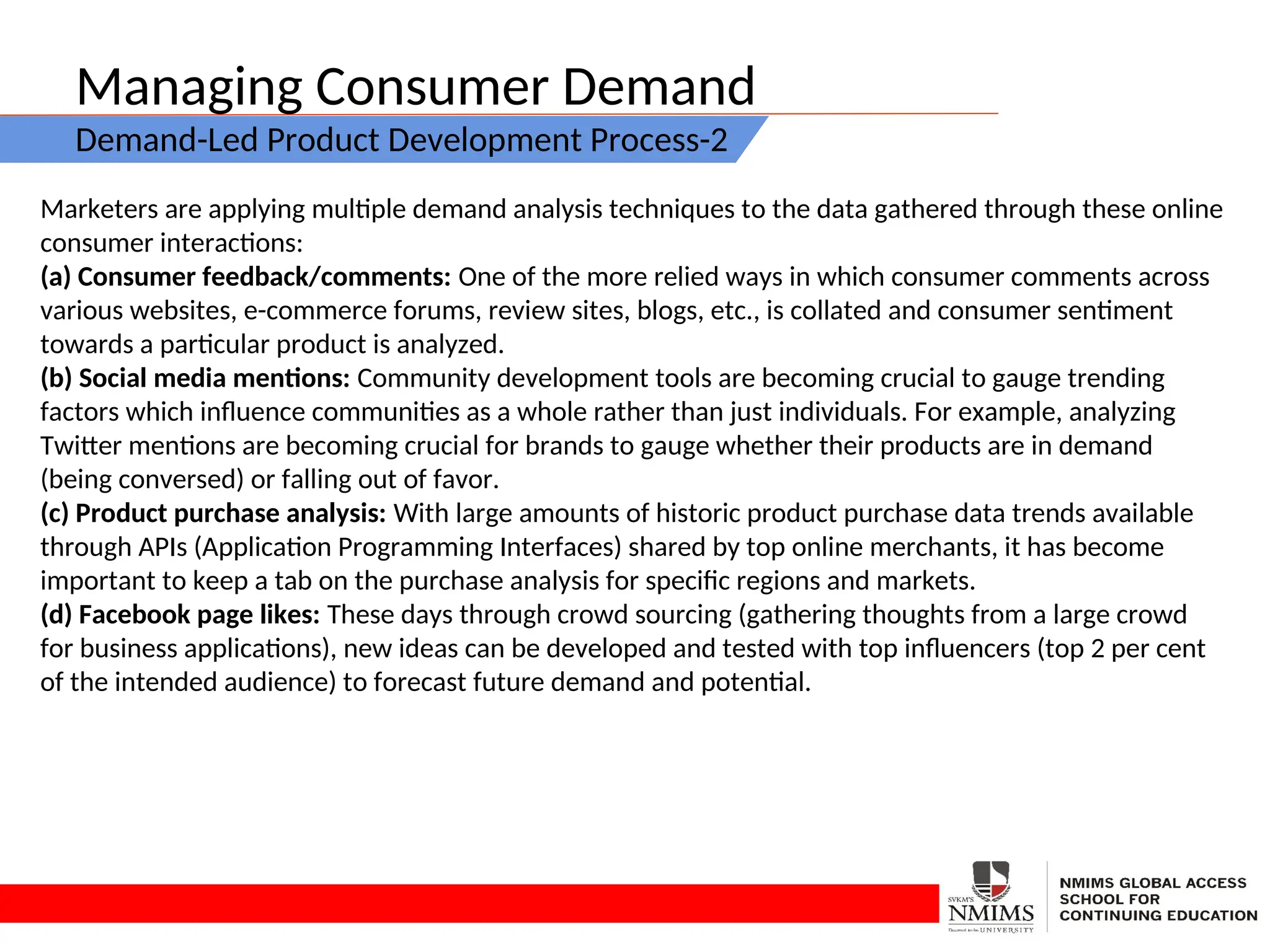
Marketers are applying multiple demand analysis techniques to the data gathered through these online
consumer interactions:
(a) Consumer feedback/comments: One of the more relied ways in which consumer comments across
various websites, e-commerce forums, review sites, blogs, etc., is collated and consumer sentiment
towards a particular product is analyzed.
(b) Social media mentions: Community development tools are becoming crucial to gauge trending
factors which influence communities as a whole rather than just individuals. For example, analyzing
Twitter mentions are becoming crucial for brands to gauge whether their products are in demand
(being conversed) or falling out of favor.
(c) Product purchase analysis: With large amounts of historic product purchase data trends available
through APIs (Application Programming Interfaces) shared by top online merchants, it has become
important to keep a tab on the purchase analysis for specific regions and markets.
(d) Facebook page likes: These days through crowd sourcing (gathering thoughts from a large crowd
for business applications), new ideas can be developed and tested with top influencers (top 2 per cent
of the intended audience) to forecast future demand and potential.
Managing Consumer Demand
Brand Building on the Web-1
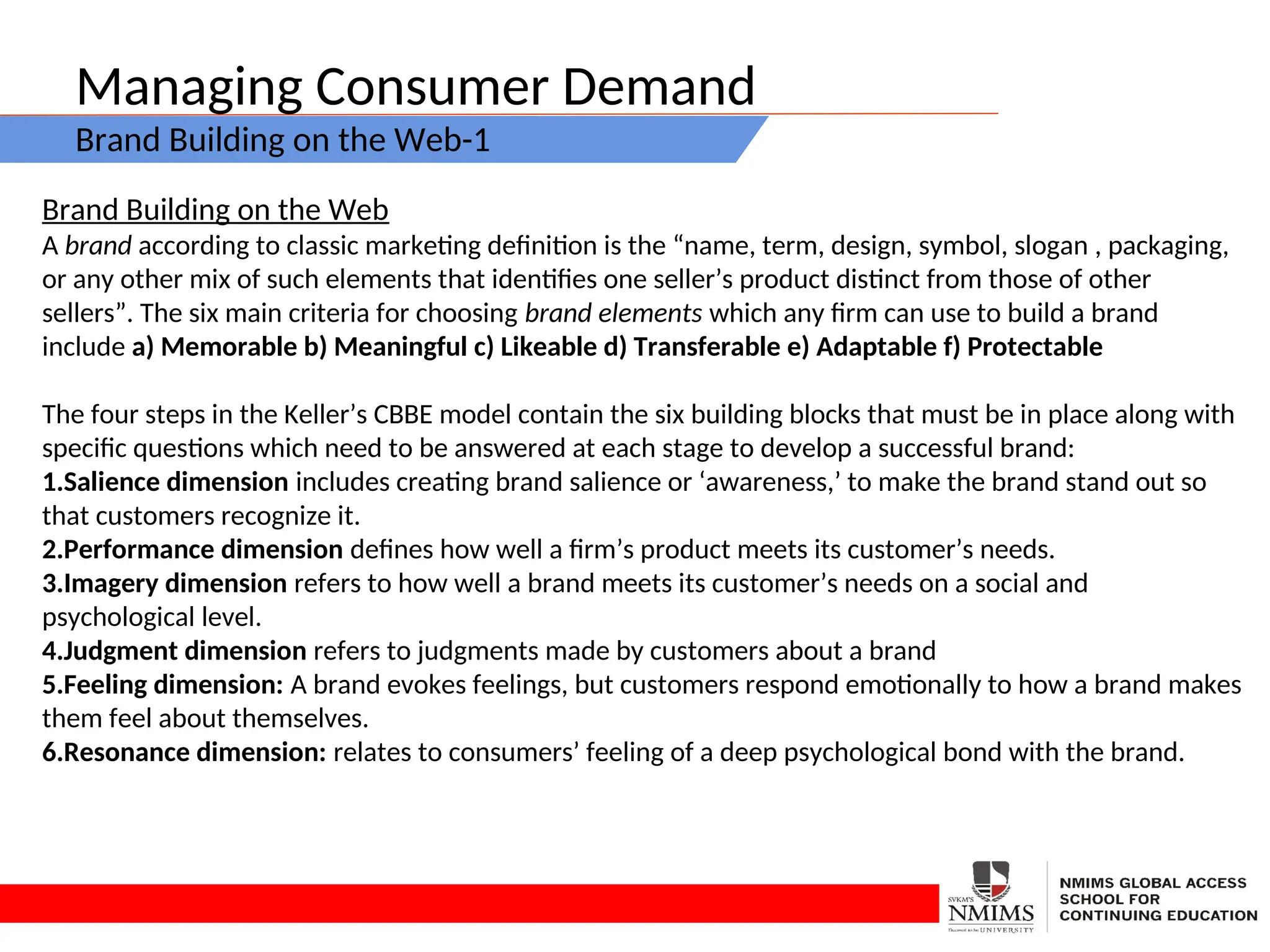
Brand Building on the Web
A brand according to classic marketing definition is the “name, term, design, symbol, slogan , packaging,
or any other mix of such elements that identifies one seller’s product distinct from those of other
sellers”. The six main criteria for choosing brand elements which any firm can use to build a brand
include a) Memorable b) Meaningful c) Likeable d) Transferable e) Adaptable f) Protectable
The four steps in the Keller’s CBBE model contain the six building blocks that must be in place along with
specific questions which need to be answered at each stage to develop a successful brand:
1.Salience dimension includes creating brand salience or ‘awareness,’ to make the brand stand out so
that customers recognize it.
2.Performance dimension defines how well a firm’s product meets its customer’s needs.
3.Imagery dimension refers to how well a brand meets its customer’s needs on a social and
psychological level.
4.Judgment dimension refers to judgments made by customers about a brand
5.Feeling dimension: A brand evokes feelings, but customers respond emotionally to how a brand makes
them feel about themselves.
6.Resonance dimension: relates to consumers’ feeling of a deep psychological bond with the brand.
Managing Consumer Demand
Brand Building on the Web-2
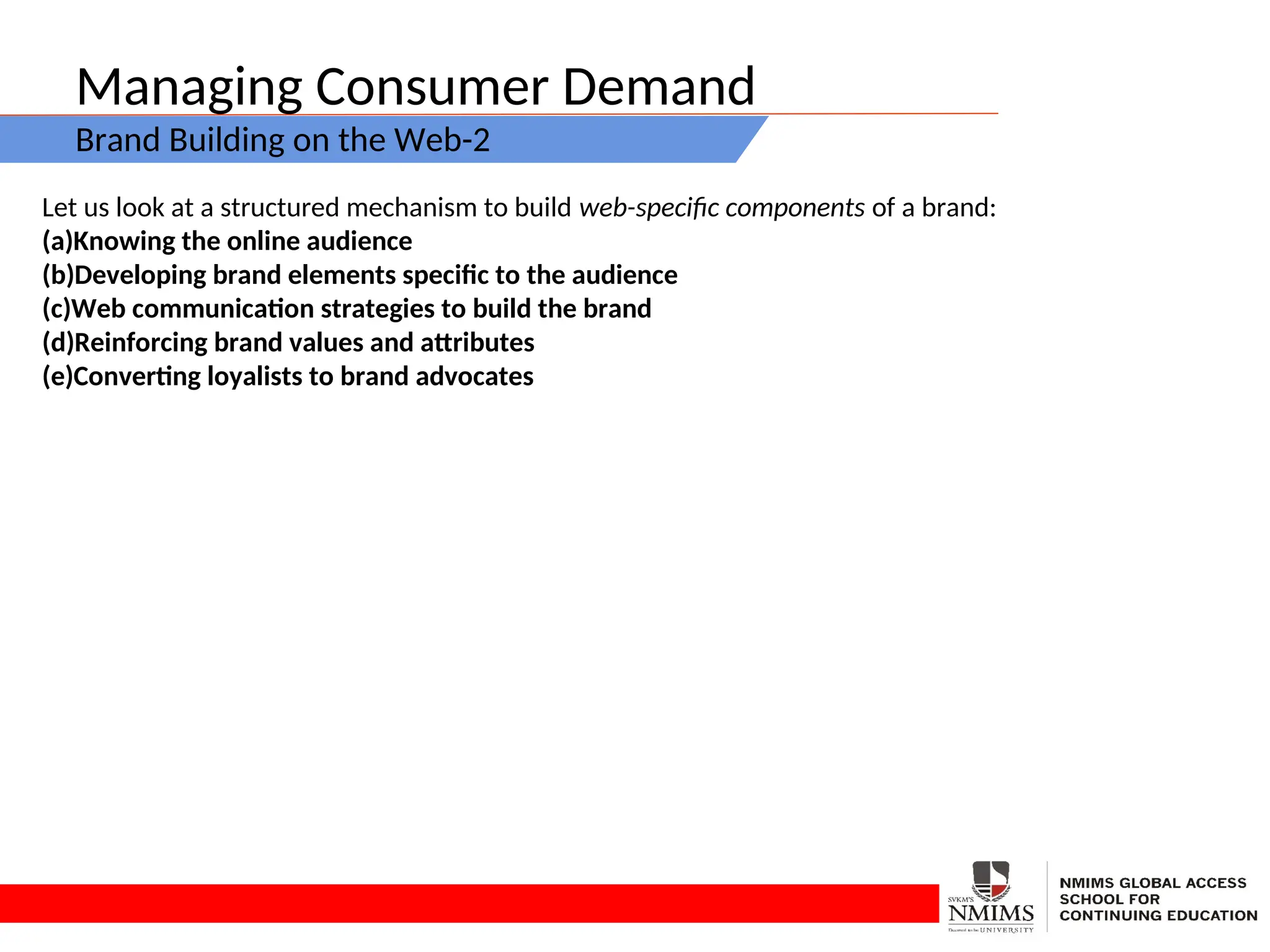
Let us look at a structured mechanism to build web-specific components of a brand:
(a)Knowing the online audience
(b)Developing brand elements specific to the audience
(c)Web communication strategies to build the brand
(d)Reinforcing brand values and attributes
(e)Converting loyalists to brand advocates
Managing Consumer Demand
Web-Tracking Audits and Forecasting
A web-tracking audit implies using web visitor tracking tools to analyze visit behavior on a website. Any
web-tracking process typically involves a code that tracks each user’s visit pattern and with the resulting
data on consumer behavior helps provide targeted content and experiences that make the website and the
brand experience more personal and interactive.
Need for Web-Tracking Audits
Web-tracking audits are important to:
(a)Improve consumer interaction
(b)Understand consumer preferences
(c)Develop successful campaigns
(d)Improve site performance
(e)Track consumer data leakage
Understanding Web Cookies and the Web-Tracking System
Cookies are small bits of text that are downloaded to consumer browsers as they surf the web. Their
purpose is to carry bits of useful information about consumer’s interaction with the website that sets them.
Web tracking is done by looking and combining data collected through these cookies and other sources like
flash trackers, server logs, and web beacons. A web-tracking tool typically analyses these trackers to
understand relevant consumer behavior and at the same time manage a list of approved vendors who can
place their cookies (third party trackers) onto the website.
Integrated Marketing
Communications (IMC)
 Basics of Integrated Marketing Communications
(IMC)
 Channels for Integrated Marketing
Communications
 Four Pillars of the IMC Construct
 Impact of Digital Channels on IMC
Table of Contents
• The Consumer for
Digital Marketing
• Evolution of Consumer
Behavior Models
• Managing Consumer
Demand
• Integrated Marketing
Communications (IMC)
Integrated Marketing Communications
Basics of Integrated Marketing Communications (IMC)
“IMC is a concept of marketing communications planning that recognizes the added value of a
comprehensive plan that evaluates the strategic roles of a variety of communications disciplines
(for example, general advertising, direct response, sales promotion, and public relations) and
combines these disciplines to provide clarity, consistency, and maximum communications
impact.”
According to Tom, Duncan; Caywood, Clarke (1996), the following trends and changes have been
the key factors behind the adoption of integrated marketing communication:
(a)Decreasing message impact and credibility
(b)Decreasing cost of using databases
(c)Increasing client expertise
(d)Increasing mergers and acquisitions of agencies
(e)Increasing mass media costs
(f)Increasing media and audience fragmentation
(g)Increasing global marketing
(h)Increased number of competitive products
Integrated Marketing Communications
Channels for Integrated Marketing Communications
Key channels which can be included as a part of IMC:
(a) Advertising: It includes broadcasting/mass advertising (print, internet advertising, radio, television
commercials) and outdoor advertising (billboards, street furniture, stadiums, rest areas, subway advertising, taxis,
transit).
(b) Sales promotion: Contests, coupons, product samples (freebies), premiums, prizes, refunds/rebates, special
events, bonus packs, loyalty programs, sales materials (sell sheets, brochures, presentations), installation, customer
help, returns and repairs, billing.
(c) Public relations: includes special events, interviews, conference speeches, industry awards, press conferences,
testimonials, news releases, publicity stunts, community involvement, charity involvement, and events.
(d) Direct marketing: refers to direct mail, telemarketing, catalogs, shopping channels, internet sales, emails, text
messaging, websites, online display ads, fliers, catalog distribution, promotional letters, outdoor advertising,
telemarketing, coupons, direct mail, direct selling,
grassroots/community marketing, mobile.
(e) Digital/internet marketing: This being the latest addition to IMC includes all the digital marketing and
communication channels like search, display, content, community, partner, communication, partner marketing
It is primarily the addition of digital/internet marketing and communication channels which has brought
about the value differentiators of customer centricity and audience-driven inputs to the overall IMC process.
Integrated Marketing Communications
Four Pillars of the IMC Construct
The four elements of IMC as defined by Kliatchko (2008) include stakeholders, content, channels, and
results:
(a)Stakeholders: The term ‘stakeholders’ refers to all relevant publics or multiple markets with which
the firm interacts. The term ‘publics’ include both external and internal audiences. External audiences
may refer to customers, consumers, prospects, intermediaries, and other entities outside the
organization, while internal audiences consist of those within the organization, such as employees,
managers, etc.
(b)Content: The development of content in IMC flows from a deep knowledge and understanding of
multiple markets that an IMC program is intended to address. Understanding consumers beyond
traditional marketing descriptors, such as demographic and psychographic data is essential.
(c)Channel: There are two main determinants to consider in deciding which marketing or brand
communication channel to utilize in preparing an integrated media plan: relevance and preference
(d)Results: Measuring results of marketing communications programs against set objectives has always
been the norm for business organizations.
At the heart of IMC, therefore, is the drive for accountability, that is, IMC programs must be
accountable for business results. This is done through a process of customer valuation and by
estimating return-on-customer-investments, or ROCI (that is predicted incremental sales achieved by
investing in specific customers), which are then verified and evaluated at certain points over time, to
track the effectiveness of IMC programs.
Integrated Marketing Communications
Impact of Digital Channels on IMC-1
Impact of Digital Channels on IMC
Following are the impacts digital channels have on overall marketing communications:
(a)Intent-based marketing (search marketing): With the incorporation of search-based marketing
communication, not only do firms get to know the top keywords which are important to their
customer set with regards to the products they aim to sell, but it is also the most credible medium to
take customers from an intent to the consumption stage in the least possible time.
(b)Brand marketing (display/digital advertising): With display having the power to track all online
customer actions and send them targeted messages based upon each marketing- funnel stage
interaction, this form of advertising extends a creative and immersive angle to other integrated
communication channels.
(c)Content marketing (website, blog, native content): Digital content as also in the case of traditional
content is a powerful addition to the marketer’s communication armoury and with the emerging
usage of native content and advertorials.
(d)Community-based marketing (social media, business platforms): With digital community channels
providing a quick, responsive, and immediately accessible word-of-mouth option, it has grained a lot
of prominence in improving brand trust
(e)Partner marketing (affiliate marketing, sponsorships, PR): Partner marketing helps the overall IMC
program reach out to customers with varied interests on the online destinations they like to visit.
Integrated Marketing Communications
Impact of Digital Channels on IMC-2
(f) Communication channel marketing (e-mail, messaging, sms): Through details collected from
traditional visits and feedback forms, companies now have options to pursue personal data for
permission-based marketing, wherein communications are guided by seeking customer
permissions rather than pushing the product onto the consumer.
(g) Platform-based marketing (mobile, video, media platforms kiosks, In-apps): With new
technology platforms being developed there are tremendous possibilities to improve reach,
extend branding, customized interaction, all of which form the core of IMC exercise.
APPENDIX- 1
Key to Chap 3: Review Questions
S.No Question Reference
Section
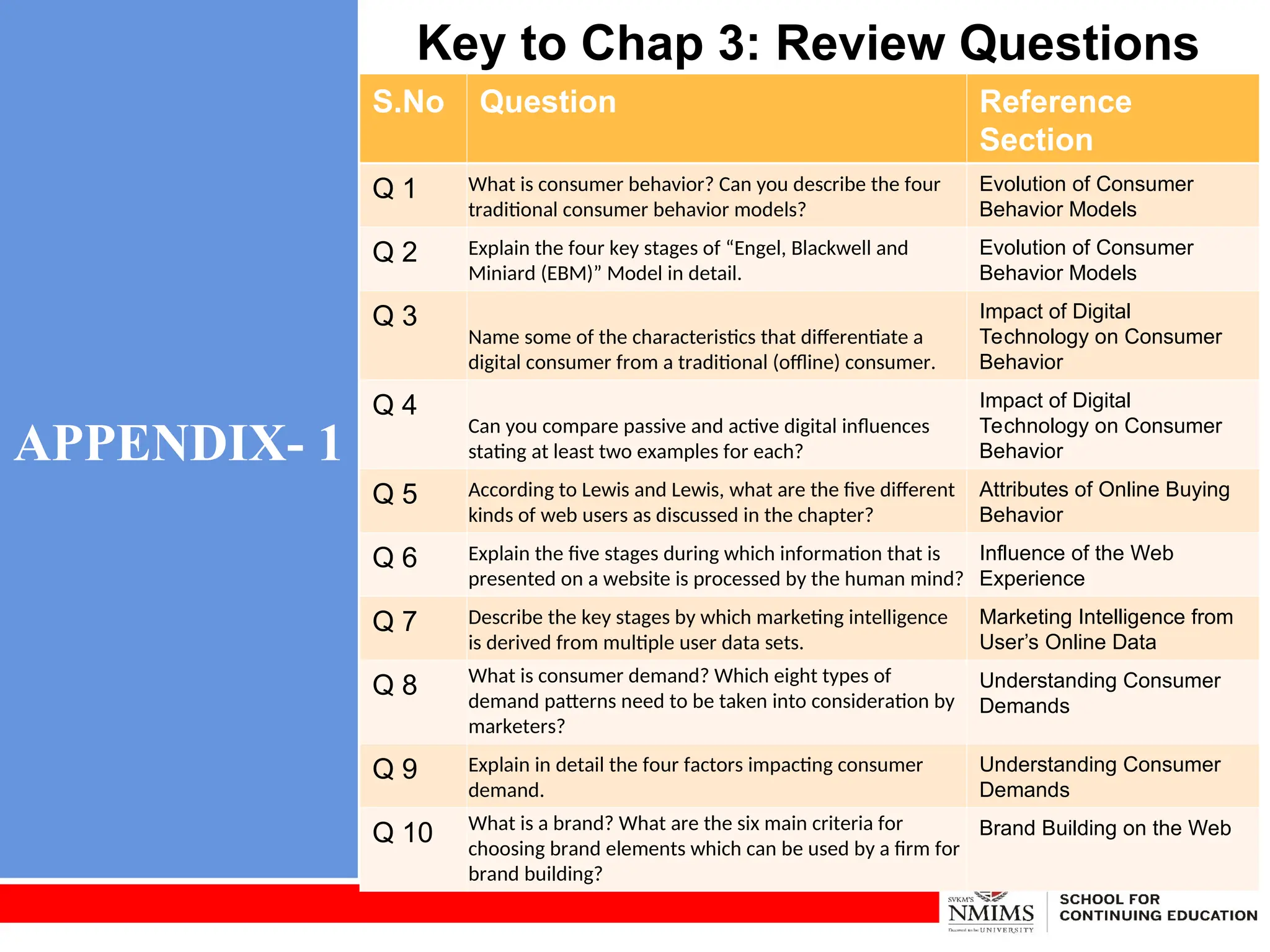
Q 1 What is consumer behavior? Can you describe the four
traditional consumer behavior models?
Evolution of Consumer
Behavior Models
Q 2 Explain the four key stages of “Engel, Blackwell and
Miniard (EBM)” Model in detail.
Evolution of Consumer
Behavior Models
Q 3
Name some of the characteristics that differentiate a
digital consumer from a traditional (offline) consumer.
Impact of Digital
Technology on Consumer
Behavior
Q 4
Can you compare passive and active digital influences
stating at least two examples for each?
Impact of Digital
Technology on Consumer
Behavior
Q 5 According to Lewis and Lewis, what are the five different
kinds of web users as discussed in the chapter?
Attributes of Online Buying
Behavior
Q 6 Explain the five stages during which information that is
presented on a website is processed by the human mind?
Influence of the Web
Experience
Q 7 Describe the key stages by which marketing intelligence
is derived from multiple user data sets.
Marketing Intelligence from
User’s Online Data
Q 8 What is consumer demand? Which eight types of
demand patterns need to be taken into consideration by
marketers?
Understanding Consumer
Demands
Q 9 Explain in detail the four factors impacting consumer
demand.
Understanding Consumer
Demands
Q 10 What is a brand? What are the six main criteria for
choosing brand elements which can be used by a firm for
brand building?
Brand Building on the Web
APPENDIX- 1
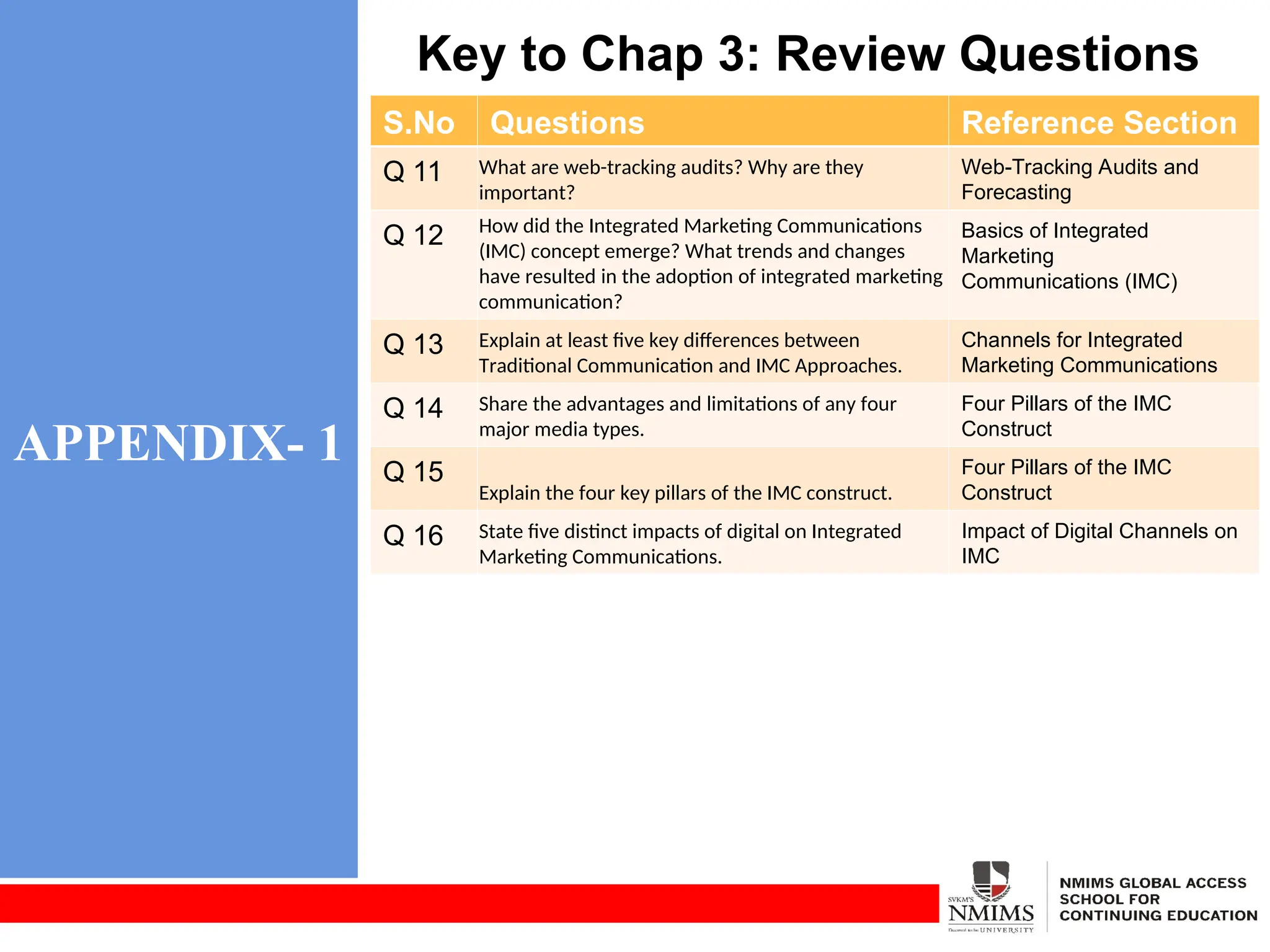
Key to Chap 3: Review Questions
S.No Questions Reference Section
Q 11 What are web-tracking audits? Why are they
important?
Web-Tracking Audits and
Forecasting
Q 12 How did the Integrated Marketing Communications
(IMC) concept emerge? What trends and changes
have resulted in the adoption of integrated marketing
communication?
Basics of Integrated
Marketing
Communications (IMC)
Q 13 Explain at least five key differences between
Traditional Communication and IMC Approaches.
Channels for Integrated
Marketing Communications
Q 14 Share the advantages and limitations of any four
major media types.
Four Pillars of the IMC
Construct
Q 15
Explain the four key pillars of the IMC construct.
Four Pillars of the IMC
Construct
Q 16 State five distinct impacts of digital on Integrated
Marketing Communications.
Impact of Digital Channels on
IMC
Chapter 4
Digital Marketing
Assessment Phase
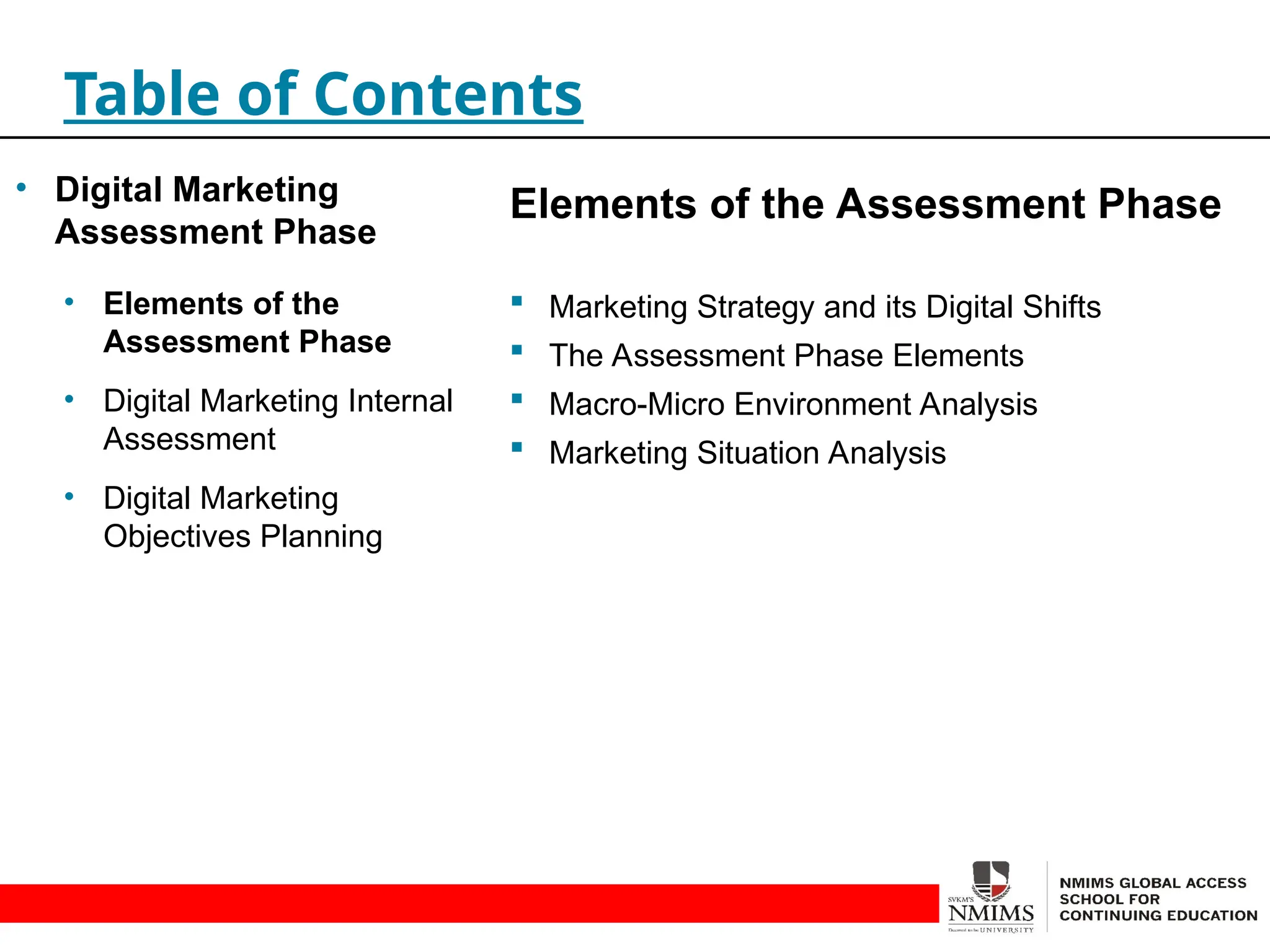
Elements of the Assessment Phase
 Marketing Strategy and its Digital Shifts
 The Assessment Phase Elements
 Macro-Micro Environment Analysis
 Marketing Situation Analysis
Table of Contents
• Digital Marketing
Assessment Phase
• Elements of the
Assessment Phase
• Digital Marketing Internal
Assessment
• Digital Marketing
Objectives Planning
Elements of the Assessment Phase
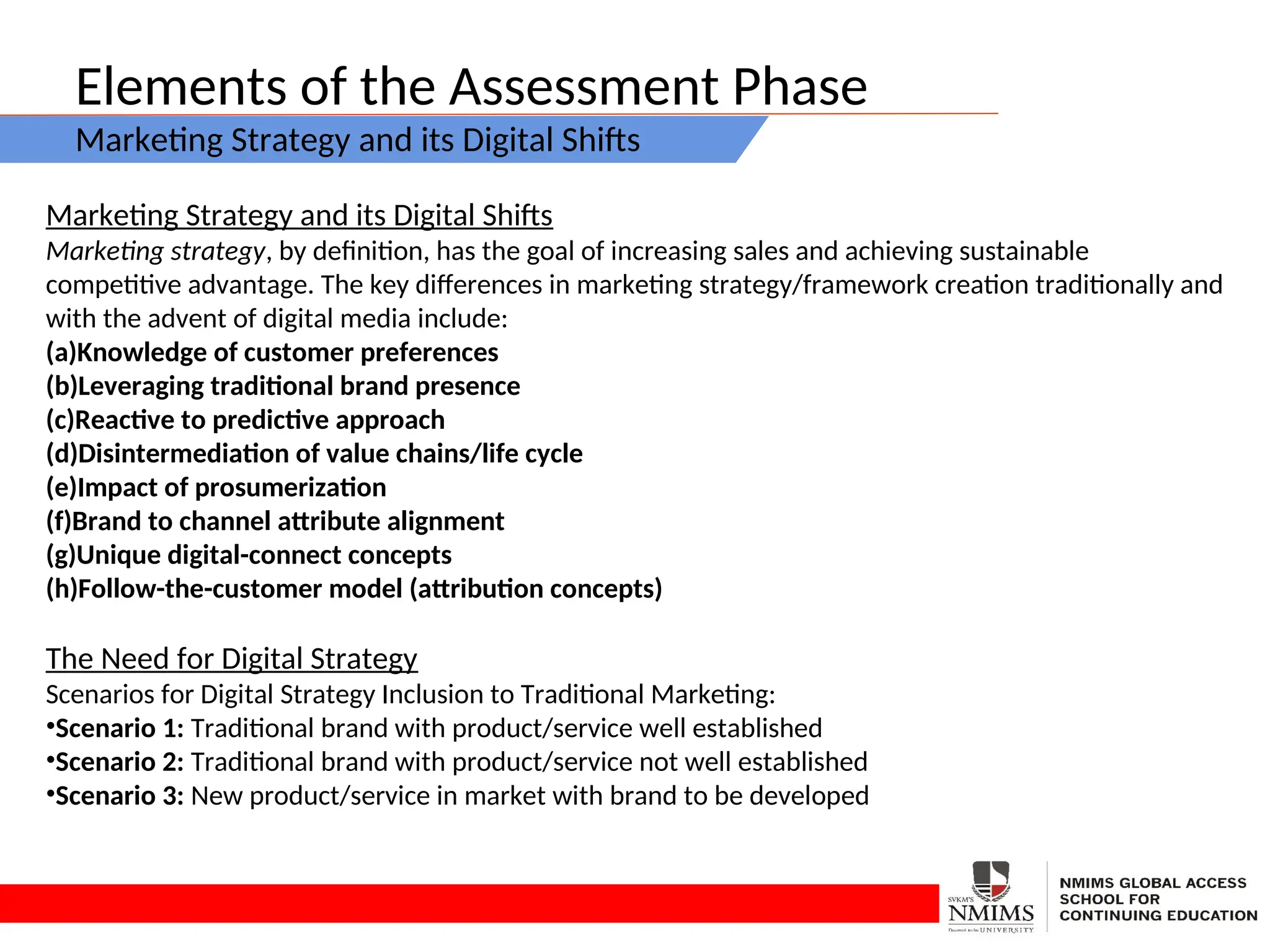
Marketing Strategy and its Digital Shifts
Marketing strategy, by definition, has the goal of increasing sales and achieving sustainable
competitive advantage. The key differences in marketing strategy/framework creation traditionally and
with the advent of digital media include:
(a)Knowledge of customer preferences
(b)Leveraging traditional brand presence
(c)Reactive to predictive approach
(d)Disintermediation of value chains/life cycle
(e)Impact of prosumerization
(f)Brand to channel attribute alignment
(g)Unique digital-connect concepts
(h)Follow-the-customer model (attribution concepts)
The Need for Digital Strategy
Scenarios for Digital Strategy Inclusion to Traditional Marketing:
•Scenario 1: Traditional brand with product/service well established
•Scenario 2: Traditional brand with product/service not well established
•Scenario 3: New product/service in market with brand to be developed
Elements of the Assessment Phase
The Assessment Phase Elements
Understanding The Assessment Phase
The assessment phase can be divided into four key elements based on the nature and interaction of all
forces impacting digital marketing objectives development:
(a) External analysis: Includes the analysis of macro-micro environment (entities which surround and
influence the firm, its products, operations, and opportunities) and market situation analysis (referring
to market and competition analysis, specific to the industry where the firm and its product are
operating).
(b) Internal analysis: Involves an analysis of factors which are internal to a company and within their
control to influence their goal setting and create successful and realistic digital marketing objectives. It
includes four main analysis areas—offerings mix, marketing mix, resources mix, and competencies mix.
(c) Digital presence analysis: It is a 2 × 2 matrix which helps firms identify their present digital state
through a combined analysis of external and internal factors.
(d) Objectives development and review: Involves setting high-level digital marketing objectives based
upon the specific digital state in which the firm is present. The review stage consists of activities that
involves monitoring, evaluating, and controlling marketing activities continuously.
Elements of the Assessment Phase
Macro-Micro Environment Analysis
Understanding Macro-Micro Environments
The terms macro and micro environments are classic marketing environment terminologies used to
bunch and analyze key factors that impact a firm’s ability to build and maintain a profitable business
and relationship with customers. A macro environment, by definition, includes variables and factors
outside of business which have a positive or negative influence on growth and continued existence of
business.
The four key elements of macro environment and their impact include:
(a)Political
(b)Economic
(c)Socio-cultural
(d)Technological
Micro environment factors include those entities which directly impact the firm and its growth
prospects and are closer to the company’s ecosystem than the macro factors.
(a)Suppliers
(b)Partners
(c)Intermediaries
(d)Customers
Elements of the Assessment Phase
Marketing Situation Analysis
Application of Market Research
Two basic types of Market Research include:
(a) Primary research: consists of a collection of original primary data collected from the field by the
researcher using questionnaires, focus group discussions, interviews, etc.
(b) Secondary research: involves the summary, collation and synthesis of existing research available
from multiple sources like research papers, previous experiments, articles, etc.
Industry Analysis
(a)Market segment analysis: conducting research to understand the market segment and its data
points
(b)Opportunity analysis: market opportunity sizing exercise with the help of research data
Competition Analysis
(a)Category analysis: maps specific category of a product to understand key competitors and defining
elements which would make the product stand apart in the wake of competition
(b)Opportunity analysis: involves conducting an analysis of key brand attributes against competing
brands to realize intangible factors like brand value, imagery, perception, and other unique value
elements which differentiate it in the market
Digital Marketing Internal
Assessment
 Analyzing Present Offerings Mix
 Marketing Mix Analysis
 Internal Resource Mapping
 Core Competencies Analysis
Table of Contents
• Digital Marketing
Assessment Phase
• Elements of the
Assessment Phase
• Digital Marketing
Internal Assessment
• Digital Marketing
Objectives Planning
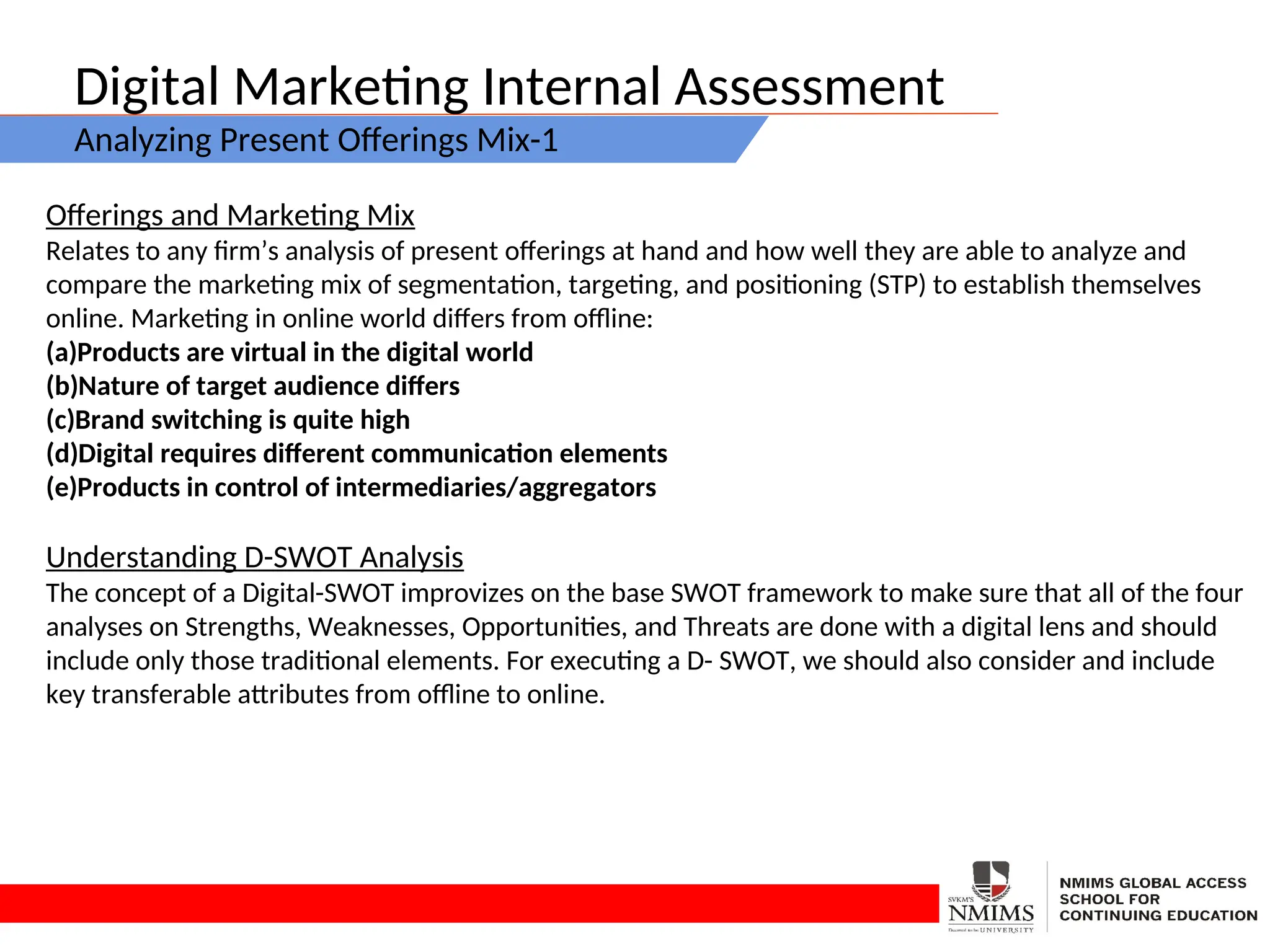
Digital Marketing Internal Assessment
Analyzing Present Offerings Mix-1
Offerings and Marketing Mix
Relates to any firm’s analysis of present offerings at hand and how well they are able to analyze and
compare the marketing mix of segmentation, targeting, and positioning (STP) to establish themselves
online. Marketing in online world differs from offline:
(a)Products are virtual in the digital world
(b)Nature of target audience differs
(c)Brand switching is quite high
(d)Digital requires different communication elements
(e)Products in control of intermediaries/aggregators
Understanding D-SWOT Analysis
The concept of a Digital-SWOT improvizes on the base SWOT framework to make sure that all of the four
analyses on Strengths, Weaknesses, Opportunities, and Threats are done with a digital lens and should
include only those traditional elements. For executing a D- SWOT, we should also consider and include
key transferable attributes from offline to online.
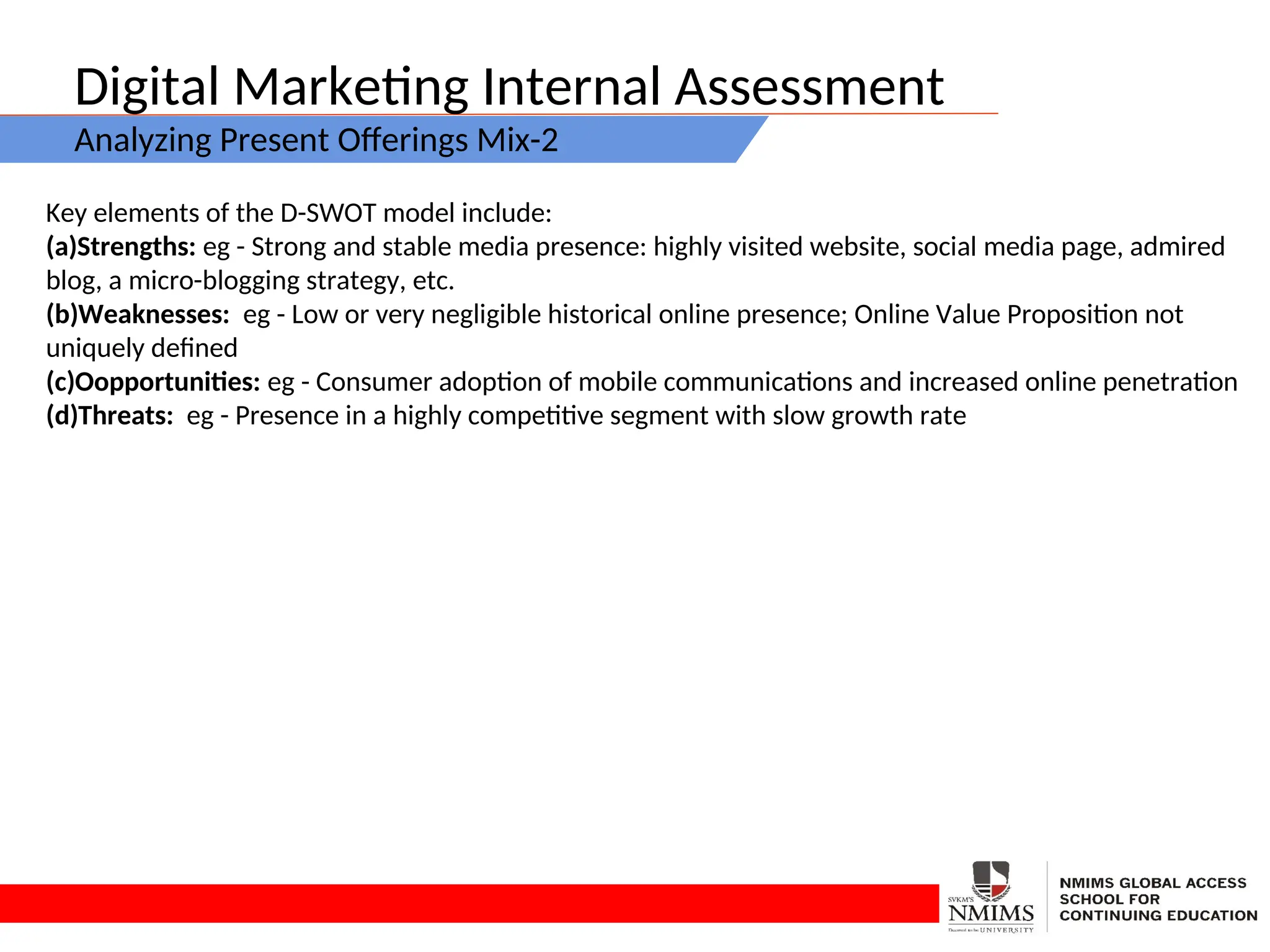
Digital Marketing Internal Assessment
Analyzing Present Offerings Mix-2
Key elements of the D-SWOT model include:
(a)Strengths: eg - Strong and stable media presence: highly visited website, social media page, admired
blog, a micro-blogging strategy, etc.
(b)Weaknesses: eg - Low or very negligible historical online presence; Online Value Proposition not
uniquely defined
(c)Oopportunities: eg - Consumer adoption of mobile communications and increased online penetration
(d)Threats: eg - Presence in a highly competitive segment with slow growth rate
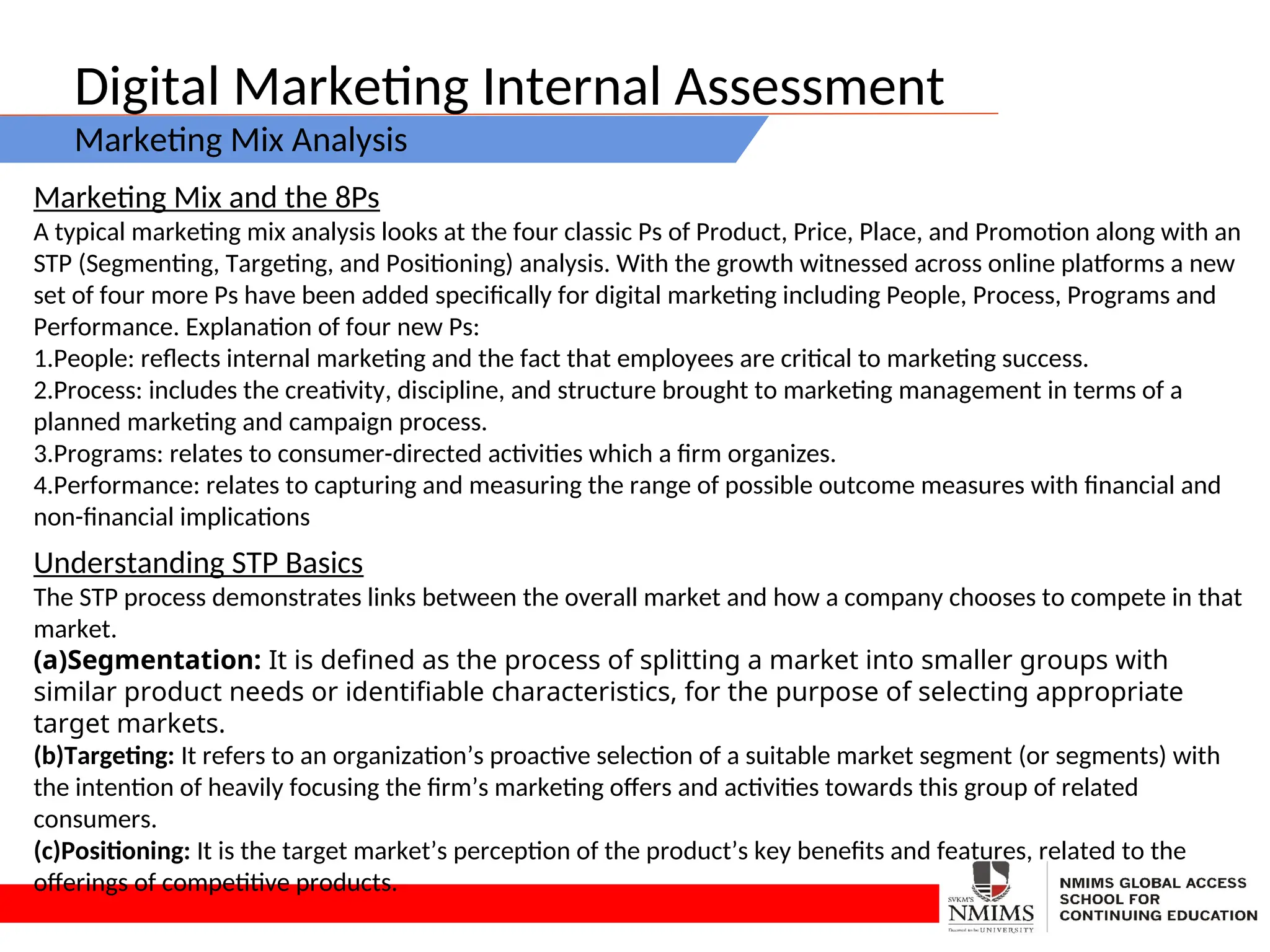
Digital Marketing Internal Assessment
Marketing Mix Analysis
Marketing Mix and the 8Ps
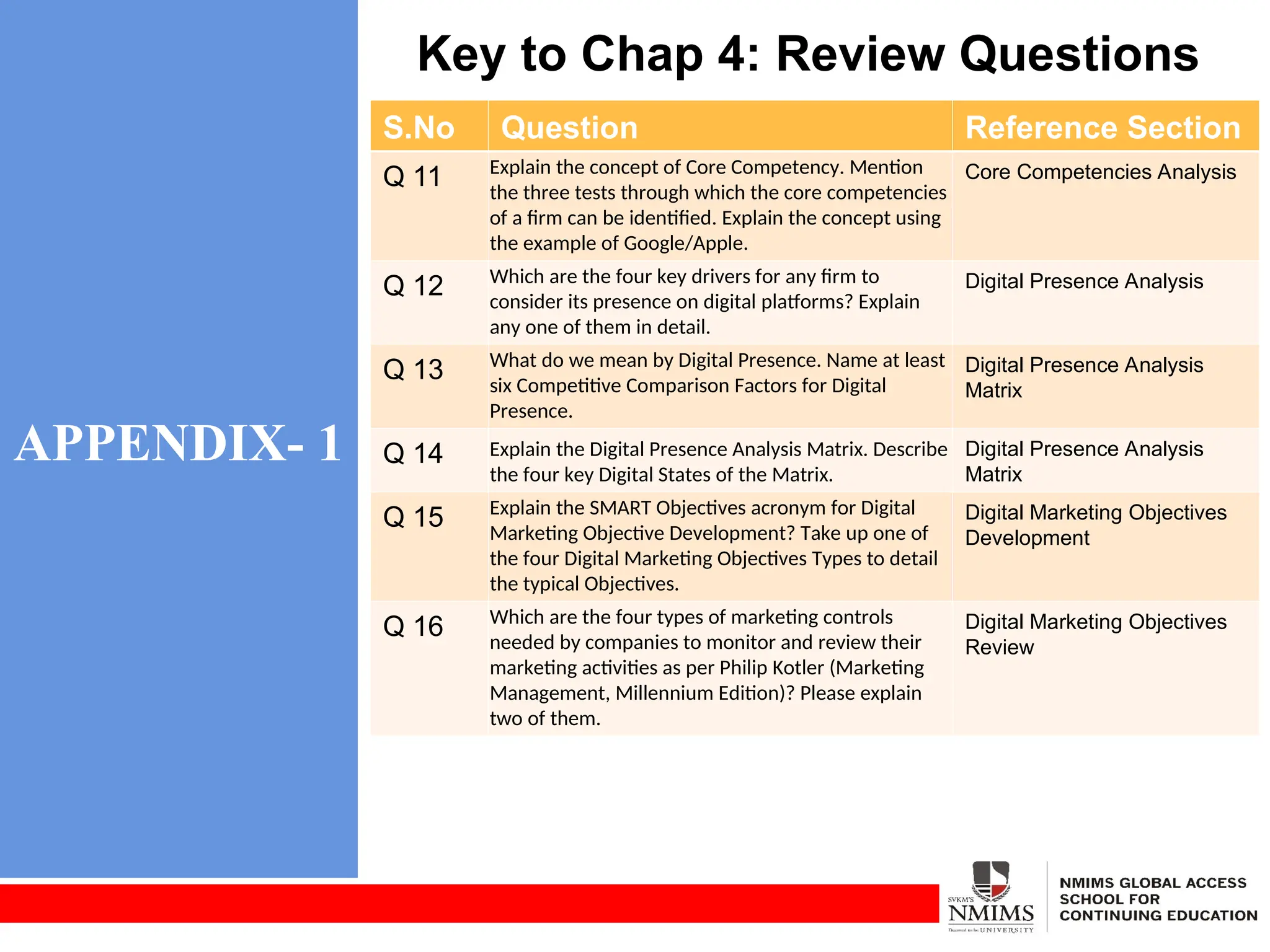
A typical marketing mix analysis looks at the four classic Ps of Product, Price, Place, and Promotion along with an
STP (Segmenting, Targeting, and Positioning) analysis. With the growth witnessed across online platforms a new
set of four more Ps have been added specifically for digital marketing including People, Process, Programs and
Performance. Explanation of four new Ps:
1.People: reflects internal marketing and the fact that employees are critical to marketing success.
2.Process: includes the creativity, discipline, and structure brought to marketing management in terms of a
planned marketing and campaign process.
3.Programs: relates to consumer-directed activities which a firm organizes.
4.Performance: relates to capturing and measuring the range of possible outcome measures with financial and
non-financial implications
Understanding STP Basics
The STP process demonstrates links between the overall market and how a company chooses to compete in that
market.
(a)Segmentation: It is defined as the process of splitting a market into smaller groups with
similar product needs or identifiable characteristics, for the purpose of selecting appropriate
target markets.
(b)Targeting: It refers to an organization’s proactive selection of a suitable market segment (or segments) with
the intention of heavily focusing the firm’s marketing offers and activities towards this group of related
consumers.
(c)Positioning: It is the target market’s perception of the product’s key benefits and features, related to the
offerings of competitive products.
Digital Marketing Internal Assessment
Internal Resource Mapping
A resource is defined as a source or supply from which benefit is derived or produced. Resources for any
organization could be classified as: Input Driven; Economic; Human, Technology, Intellectual, Partner/
Intermediary.
VRIN Framework helps any company benchmark its resources to know which of them are more
strategic than others and which of them would stand the test of competition more effectively.
The VRIN Framework (Valuable, Rare, Inimitable, Non-Substitutable) derives its roots from the
RBV (Resource-Based View) of viewing the firm. RBV theory postulates the firm to be a bundle of
resources including assets, capabilities, organizational processes, firm’s attributes, information,
and knowledge. It believes that the firm can utilize a mix of these resources taking an inside-out
approach as the starting point of the analysis of the internal environment of any organization.
According to the VRIN model (Barney 1991), a firm should display four key attributes and only if
these conditions hold can the firm sustain above average returns. These four elements are
described as:
(a) Valuable: A resource must enable a firm to employ a value-creating strategy, by outperforming competitors
or reducing weaknesses.
(b) Rare: Resources drive competitive advantage only when they are relatively scarce. While a resource does
not need to be unique to only one firm, it must not be widely available.
(c) Inimitable: A resource is termed to be inimitable, if it is controlled by only one firm. A resource can provide
sustainable competitive advantage only if competitors are not able to duplicate this asset perfectly and lack the
capability to obtain them.
(d) Non-substitutable: Even if a resource is rare, potentially value-creating and imperfectly imitable, an equally
important aspect is lack of substitutability.
Digital Marketing Internal Assessment
Core Competencies Analysis-1
Core Competencies Analysis
The development of core competencies falls in perfect order as the fourth element of internal analysis
where present offerings have been developed, marketing mix defined, and internal resources analyzed
for competitiveness.
Differences between Resources and Capabilities
Resources are a stock of available factors that are owned or controlled by the organization, and
capabilities are an organization’s capacity to deploy resources.
Understanding Competitive Advantage and Core Competencies
Core competency as a management concept was introduced by C.K. Prahalad, Julian Kriviak, and Gary
Hamel. It can be defined as a harmonized combination of multiple resources and skills that distinguish a
firm in the marketplace. A core competency, thus, is a bundle of skills that enable an organization to
provide particular benefits to customers. There are three tests to identify core competencies:
(a) Relevance: The competence must give the customer something that strongly influences him/her to
choose a firm’s product or service. If it does not, then it has no effect on competitive position and is not
a core competence.
Digital Marketing Internal Assessment
Core Competencies Analysis-2
(b) Difficulty of imitation: The core competence should be difficult to imitate. This allows the firm to
provide products that are better than competition. And, through continuous work to improve these
skills, a company’s competitive position can be sustained.
(c) Breadth of application: It should be something that opens up a good number of potential markets. If
it only opens up a few small, niche markets, then success in these markets will not be enough to sustain
significant growth.
Digital Marketing Objectives
Planning
 Digital Presence Analysis
 Digital Presence Analysis Matrix
 Digital Marketing Objectives Development
 Digital Marketing Objectives Review
Table of Contents
• Digital Marketing
Assessment Phase
• Elements of the
Assessment Phase
• Digital Marketing Internal
Assessment
• Digital Marketing
Objectives Planning
Digital Marketing Objectives Planning
Digital Presence Analysis
The four key drivers for any firm to consider its presence on digital platforms:
(a)Stakeholder-driven needs: It includes factors which are business/stakeholder-driven which
necessitates a firm to move its product portfolio online.
(b)Market-driven needs: external or market environment has a huge role to play in driving firms
online.
(c)Customer-driven needs: The most immediate and relevant trends driving brands online are posed
by customers themselves in the way their consumption patterns evolve.
(d)Competitor-driven needs: It is competition too which drives brands to move towards digital
channels.
Digital Marketing Objectives Planning
Digital Presence Analysis Matrix
Digital presence is defined as the relative extent to which a company is present on digital channels in
comparison to direct competition, based on comparison of key competitive factors.
The DPA (Digital Presence Analysis) Matrix provides the base for developing Digital Marketing objectives. The
Digital Presence Analysis is a 2X2 matrix, which has been developed across two axes— Extent of Digital Presence
and Market Standing wrt (with respect to) Competition. It has been developed with the earlier competitive
comparison as the base and introduces four key states (in the form of matrices and a fifth state related to a new
launch) through which the extent of digital presence of a firm can be established and used for digital marketing
applications. The four key digital states which can also be called DLs include:
(a) Digital laggard: This is the first quadrant of the DPA Matrix (bottom-left) which relates to firms which have no
or minimal digital presence and are lagging their respective market/ industry segment wrt to direct competitors.
(b) Digital ladder: The second quadrant of the DPA Matrix (top-left) would be the second state of the DPA
matrix, wherein firms themselves are in a much better shape w.r.t. competition (as they are market leaders
across some key products), but they still do not have substantial digital presence.
(c) Digital leverage: This is the third quadrant of the DPA Matrix (bottom-right) and represents companies that
have a strong digital presence (in comparison to competition in their sector) but are still lagging behind in terms
of a market share.
(d) Digital leader: The final quadrant (top-right) belongs to firms which are market leaders in their segments and
have leveraged digital to the best possible extent.
Digital Marketing Objectives Planning
Digital Marketing Objectives Development
Digital Marketing Objectives set on a yearly basis, during the yearly marketing plan creation are
followed, reviewed, and revised at a weekly level to ensure that firms are on track.
SMART Objectives Creation
Objectives creation as an exercise has to be clear, rigorous, and at the same time, achievable in the
time-frame it has been set to achieve. The most widely used framework across management circles
for objectives creation is commonly attributed to Peter Drucker in his “management by objectives”
concept which is also termed as the SMART criteria:
(a) Specific: Targets a specific area for improvement
(b) Measurable: Quantifies or at least suggest an indicator for progress
(c) Assignable: Specifies who will do it
(d) Realistic: States what results can realistically be achieved, given the available resources
(e) Time-related: Specifies when the results can be achieved
Digital Marketing Objectives Planning
Digital Marketing Objectives Review
A typical marketing objectives review consists of activities that involve monitoring, evaluating, and
controlling marketing activities continuously. According to Philip Kotler, there are four types of
marketing controls needed by companies to monitor and review their marketing activities:
(a) Annual plan control: It involves reviews to ensure that firms achieve the targets set for sales, market
share, and other such financial goals set up across the key digital channels.
(b) Profitability control: It involves understanding the digital channels where the company is making
profits and those where it is losing out. Profitability is measured across products, territories, customer
segments, and business to business (B2B) channels.
(c) Efficiency control: Post annual plan and profitability control, marketers have a much better idea on
how best they can improve spending and allocate resources and efforts to channels which might yield
them more efficient results.
(d) Strategic control: It involves periodically re-assessing a firm’s strategic approach through market
effectiveness reviews, strategic re-orientation, operation efficiency analysis, and digital marketing audits
across all key products and markets.
APPENDIX- 1
Key to Chap 4: Review Questions
S.No Question Reference Section
Q 1 Explain five key differences in marketing strategy
which occurred with the advent of digital media.
Markteting Strategy and its
Digital Shifts
Q 2 Compare and contrast the three different scenarios
in the chapter which showcase how digital strategy
supports and
extends traditional marketing strategy.
The Need for Digital Strategy
Q 3 Explain at a high level the four key elements of the
ASCOR Assessment Phase.
Understanding the
Assessment Phase
Q 4 What is PEST? Describe these four key elements of
Macro Environment Analysis.
Understanding Macro-Micro
Environments
Q 5 What are the key micro-environment impact
factors? Explain the factors in detail.
Understanding Macro-Micro
Environments
Q 6 Explain the two key components of Market
Situation Analysis and their key elements in detail.
Marketing Situation Analysis
Q 7 What are the four major types of Internal Analysis
of the ASCOR Assessment Phase? Explain two of
them in detail.
Digital Marketing Internal
Assessment
Q 8 What is D-SWOT? Explain the key elements of D-
SWOT model in detail.
Understanding D-SWOT
Analysis
Q 9 What are the 8Ps of Marketing Mix analysis? Name
the 8Ps and explain five of them in detail.
Marketing Mix and the 8Ps
Q 10 How would you classify resources for any
organization? Explain in detail the VRIN Model.
Internal Resource Mapping
APPENDIX- 1
Key to Chap 4: Review Questions
S.No Question Reference Section
Q 11 Explain the concept of Core Competency. Mention
the three tests through which the core competencies
of a firm can be identified. Explain the concept using
the example of Google/Apple.
Core Competencies Analysis
Q 12 Which are the four key drivers for any firm to
consider its presence on digital platforms? Explain
any one of them in detail.
Digital Presence Analysis
Q 13 What do we mean by Digital Presence. Name at least
six Competitive Comparison Factors for Digital
Presence.
Digital Presence Analysis
Matrix
Q 14 Explain the Digital Presence Analysis Matrix. Describe
the four key Digital States of the Matrix.
Digital Presence Analysis
Matrix
Q 15 Explain the SMART Objectives acronym for Digital
Marketing Objective Development? Take up one of
the four Digital Marketing Objectives Types to detail
the typical Objectives.
Digital Marketing Objectives
Development
Q 16 Which are the four types of marketing controls
needed by companies to monitor and review their
marketing activities as per Philip Kotler (Marketing
Management, Millennium Edition)? Please explain
two of them.
Digital Marketing Objectives
Review
Chapter 5
Digital Marketing
Strategy Definition
Digital Marketing Strategy
Groundwork
 Understanding Digital Business Strategy
 Emerging Digital Business Structures
 Digital Core Competency Alignment
 Customer Development Strategy
(STP 2.0 Framework)
Table of Contents
• Digital Marketing
Strategy Definition
• Digital Marketing
Strategy Groundwork
• Defining the Digital
Marketing Mix
• Digital Marketing Strategy
Roadmap
Digital Marketing Strategy Groundwork
Understanding Digital Business Strategy
Strategic management, by definition, involves the formulation and implementation of major goals and
initiatives taken by a company’s top management on behalf of owners, based on consideration of
resources and an assessment of the internal and external environments in which the organization
competes. Porter who is considered to be the leading authority on competitive strategy has contributed
to multiple strategy frameworks including:
(a) Modern portfolio theory: Talks about corporation as a portfolio of business units, with each unit
plotted graphically based on market share and industry growth rate.
(b) Porter’s five force analysis: A framework for analyzing the profitability of industries and how those
profits are divided among the participants. The framework involves the bargaining power of buyers and
suppliers, threat of new entrants, availability of substitute
products, and the competitive rivalry of firms in the industry.
(c) Porter’s generic strategies: Porter shared that there are three generic strategies—cost leadership,
differentiation, and focus—and a company must choose only one of these three or risk wasting precious
resources.
Digital Factors Impacting Business Strategy
To understand and provide the context on the factors impacting a firm’s strategy development for
digital platforms, we would use the same mix of Digital Presence Drivers—stakeholder, market,
customer, and competitor.
Digital Marketing Strategy Groundwork
Emerging Digital Business Structures-1
Emerging Digital Business Structures
Defining RoI and strategic intent for any company operating in a particular industry sector would
typically involve thinking through key questions which the management needs to decide in the best
interest of the shareholders. A company’s RoI is the key criteria for it to determine its performance. In
Fig. 5.2, we have used the key elements of an RoI calculation which relates to:
(a) The investments a firm is willing to put into its operations (as X axis and classified as Minimal,
Requisite, and Strategic), depicting the risk profile of any firm for digital operations.
(b) The type of returns and subsequent growth expected (as Y axis and classified as Nominal, Decent,
and Industry-Leading), depicting targeted growth and expectations.
By plotting different types of firms and their digital objectives across the two axes of investment and
growth, we see multiple types of digital business structures operating in the digital market and at times
even usurping a firm’s offline operations:
(a) Aggressive market leader: Typical big-weight players with strong and stable portfolio of brands and
huge investments at hand.
(b) Strong national player: Market challenger brands which deal in strategic investments since they are
not the leaders in their segment.
(c) Challenger SMB: These firms typically have a limit on the type of investments they can make and
have to be really strategic in their spends.
Digital Marketing Strategy Groundwork
Emerging Digital Business Structures-2
(d) Online prospector firm: These firms are considered as followers to all other brands in their
segment.
(e) Status quo disruptor: They do not have huge investments behind them but are being developed by
a generation of innovative entrepreneurs
(f) Local area opportunist: These are firms at a regional level which have minimal resources to spend
online but have loyal regional audiences
(g) Individual business owner: There are millions of individual business owners who leverage internet
as a model to set up their own web pages, blogs, e-commerce sites, consulting services, etc., even with
the minimal resources and budgets they have at hand.
Digital Marketing Strategy Groundwork
Digital Core Competency Alignment
This section explains how companies which have different business structures/objectives (specifically
those which are transitioning from offline to a major online presence) need to regularly map the
changing OVP for their customer set to align core competencies to revised industry/sector/competitive
value propositions.
The concept of CCA relates to the response which any specific firm of a particular industry will develop
to match and compete in the wake of the multiple value shifts caused in its sector. Here, we need to
understand that CCA is not about a firm changing its core competencies, but
instead aligning them to changing industry value function shifts so that they are able to use their core
strengths and enhance them in the best possible manner to changing environment and competitive
forces.
Once the firm has aligned and developed a new set of core competencies based on emerging market
structures, it can define its overall strategy accordingly to create/refine its set of OVPs to match the
changes in customer value and achieve its short and long-term objectives.
Digital Marketing Strategy Groundwork
Customer Development Strategy (STP 2.0 Framework)-1
Customer Development Strategy (STP 2.0 Framework)
Customer Development Strategy involves defining and developing the target customer.
The next advanced level of STP can be termed as STP2.0 Framework which discusses new approaches
to all the three elements of segmenting, targeting, and positioning. It involves looking at how
concrete customer action data (derived through analytics) and knowledge of customer’s buying intent
and final action (through search and conversion keywords and data) can help marketers develop
highly refined target segments, and position them through personal communication and channels
which could never be deployed earlier because such data was never available in the first place. Key
underlying elements of STP2.0 Framework include:
(a) Data segmentation matrix (Segmentation 2.0): To understand the kind of extended customer
transaction data which can be used to develop segments in present times, we have developed a data
segmentation matrix with data origin (across X axis) and data type (across Y axis), mapping all data
collated across internal/external or offline/online generated data. The four quadrants which emerge
from this matrix include: Traditional Data; External Data; Data from brand’s owned media; Data
from earned and paid media.
Digital Marketing Strategy Groundwork
Customer Development Strategy (STP 2.0 Framework)-2
(b) Clustering and persona creation (Targeting 2.0): Discusses the concept of clustering and persona
development to target the set of buyer groups that a company choses to serve. ‘Persona
Development’ includes: Target segment identification; Understanding values, behaviors, and
interests; Research site analytics, search keywords, social media listening; Qualitative data-
audience interviews/affinity mapping
(c) Positioning across consumer funnel scenarios (Positioning 2.0): Once marketers have identified
key customer segments and developed personas to target, they need to develop messages and
actions to complete the objectives set for each of the customer interaction stages.
Defining the Digital Marketing Mix
 Offering Mix for Digital
 Digital Pricing Models
 Channels of Purchase—Reaching the
E-Consumer
 Managing Promotional Channels
 Developing the Extended Ps- People,
Process, Programs, and Performance
Table of Contents
• Digital Marketing
Strategy Definition
• Digital Marketing Strategy
Groundwork
• Defining the Digital
Marketing Mix
• Digital Marketing Strategy
Roadmap
Defining the Digital Marketing Mix
Offering Mix for Digital-1
Offering Mix for Digital
The first P of the marketing mix known as Product. A product can be classified as consisting two key
components—tangible and intangible. Tangible components are described as the ones which can be
physically seen while the intangible parts might not be directly visible but their impact is felt and
perceived by the customer. A service is also considered to be a product category which is intangible in
nature.
An offering on the digital platform differs from its traditional form in the way it develops and
integrates the intangible or service aspects to it. These services can either be developed as new digital
products (along with main product line) or be an extension to the physical product itself to make it
easier for the customer to access, interact, and ultimately, purchase the main product. The offering
mix of any firm can be classified across five states depending upon the extent of tangible products
and intangible service elements which are a part of it:
(a)State A: Firms in this state have a mix of only tangible products which are primarily physical in form
and mostly commodity in nature. Examples could be sugar, steel, a basic accessory, etc.
(b)State B: It involves tangible goods which have a decent service element to them. Examples include
mobiles, automobiles, furniture, etc., which in their base state are tangible products, but addition of
digital value elements (aesthetics, customization, convenience, etc.) provides a service experience to
the target customer
Defining the Digital Marketing Mix
Offering Mix for Digital-2
(c) State C: The offering has an equal mix of product and service elements built into it. Key examples
would relate to hospitality services like theme parks (which sell a service and also merchandise),
restaurants (where food is tangible and service is the intangible part), etc.
(d) State D: In this state, the intangible part forms the core service, while the tangible part is built as
a support element. This includes typical examples like air travel where additional services or
supporting goods like snacks and drinks are sold.
(e) State E: This final state involves an offering having complete intangible attributes. Examples
include Spa and other wellness services, online consulting, support helplines, etc.
Defining the Digital Marketing Mix
Digital Pricing Models-1
Digital Pricing Models
Pricing by definition is the process of determining what a company will receive in exchange for its
product or service. With new digital structures in place, pricing models are being developed to serve
these emerging business models:
(a) Comparative pricing: Similar to ‘going rate’, this type of pricing not only compares competitor
prices, but also varies itself in relation to data on customer visits, their loyalty, influence of the channel,
e-commerce site on which it is being sold, customer sentiment across social networks, keyword
searches, etc.
(b) Ad supported model: This is one of the core models on which digital business was developed
wherein instead of charging the consumer, businesses and advertisers were charged for placing ads
across most read content, or keywords searched in Google, or against reviews they liked across a social
network. We would get into the dynamics of how advertisers are priced in the later chapters in detail.
(c) Subscription model: With a large part of content being available in digital format, and customer’s
problems being broken down into sub-processes and serviced through quick-reference applications
(for example, mobile apps), there has been a surge of interesting subscription-based models where
customers are paying for packages of information, entertainment, education, etc., on a time-bound
fixed price basis.
(d) Pay-per content/use model: It is now possible to charge customers for each content piece and even
on the usage time for that content as digital medium can provide all of this information on a real-time
basis to marketers.
Defining the Digital Marketing Mix
Digital Pricing Models-2
(e) Auction type: With multiple models being developed using auction techniques, this pricing
technique has been democratized for consumers with such ease on digital platforms that it deserves to
be a digital-led pricing model.
(f) Last minute pricing: Possible only in online mode; either you can increase prices in case of high
demand-low supply (online airline prices) or you can reduce prices in case of low-demand and high
supply (for example, unsold event tickets on the day of the event).
(g) Customized pricing/cart-based pricing: For loyal customers, who buy regularly from a site or a
platform, digital technology can help marketers calculate discounts, provide bundling offers, share free
coupons on regularly bought items as a part of their pricing strategy.
Defining the Digital Marketing Mix
Channels of Purchase—Reaching the E-Consumer-1
Channels of Purchase—Reaching the E-Consumer
The third P which is known as Place, helps us see how channels of purchase are critical to a firm. A
key distinction has to be made here to understand the difference between Place and the next P
which is Promotion. By channels of purchase, we mean only those channels through
which final ordering and fulfillment happens while channels which are utilized for promotion (like
search engines, e-mail, display ads, social media, etc.) and are more of a conduit to the final
purchase.Typically, channels of purchase are divided into two types:
(a) Direct sales channels—where a producer and ultimate consumer directly deal with each other.
These channels are typically owned and controlled by firms themselves.
(b) Indirect sales channels—when there are indirect intermediaries between the producer and
consumer. Third party companies typically have more control of these channels.
Defining the Digital Marketing Mix
Channels of Purchase—Reaching the E-Consumer-2
By sales orientation, we imply the effort of sales and marketing activities and its direction. Some of
the key examples of the matrix quadrants include:
(a) Direct push channels: Involve branded websites and microsites which are developed and
controlled by the firm, through which firms make a direct sale to customers.
(b) Direct pull channels: Include content-based channels like blogs and, the more recent
phenomenon of mobile apps specific to a particular business process, developed in a well guided and
curated manner
(c) Indirect push channels: This quadrant typically contributes the most to online sales and includes
highly popular e-commerce sites, marketplaces, wholesalers
(d) Indirect pull channels: These are channels which have high engagement rates with custom
audiences and provide value beyond the push-based channels. These include vertical sites, price
comparison sites, affiliates, value-added resellers
Defining the Digital Marketing Mix
Managing Promotional Channels-1
Managing Promotional Channels
Promotional channels help marketers position and promote their products across customer funnel
stages. We have made an introduction to some of the most important online promotion channels
through the use of key marketing funnel stages of Reach, Engage, and Activate:
(a)Reach: involves the set of promotional activities to raise prospects’ attention to marketer’s brand
product or service. Key Areas Include:
(a) Search Engine Marketing
(b) Display Marketing
(c) E-mail Marketing
(d) Affliate Marketing
(e) Social Media Sites
(b)Engage: Involves the set of activities needed to engage prospects developed during the Reach stage.
Key Areas Include:
(a) Content Marketing
(b) Public Relations
(c) Special Interest Marketing
(d) Viral Marketing
(e) Gamification
Defining the Digital Marketing Mix
Managing Promotional Channels-2
(c) Activate: Includes activities to convert leads and make prospects take other actions which
marketers want them to. Key Areas Include:
(a) Interest-Based Marketing
(b) Social Targeting
(c) Retargeting
(d) Response Marketing
(e) Custom Recommendations
Defining the Digital Marketing Mix
Developing the Extended Ps
Developing the Extended Ps- People, Process, Programs and Performance
With the growing proliferation of marketing channels, techniques and technologies being deployed,
the 4Ps suggested by McCarthy have been added with four more Ps which should be considered by
marketers while creating their marketing mix plans and strategies.
Detailing the Extended Ps:
(a)People: Involves developing online teams with a mix of digital marketing expertise, technology
know-how, multi-channel experience, knowledge of automation tools, and most of all, target
customer insights.
(b)Processes: Involves developing a rigorous process-driven marketing organization which lays down
clear steps to understand and identify target customer clusters, develop thought through and tightly
integrated supplier-customer processes.
(c)Programs: It is defined as the entire set of consumer-driven programs which are run in a holistic
manner online and offline to meet a firm’s marketing objectives.
(d)Performance: The final P relates to setting up systems and ways to measure performance and
desired output at each stage of the marketing activity, through well-defined metrics and KPIs (Key
Performance Indicators).
Digital Marketing Strategy Roadmap
 Developing Digital Marketing Strategy
Roadmap
 The 6S Digital Marketing Implementation
Strategy
 PLC Concept—Marketing across the Product
Life Cycle
Table of Contents
• Digital Marketing
Strategy Definition
• Digital Marketing Strategy
Groundwork
• Defining the Digital
Marketing Mix
• Digital Marketing
Strategy Roadmap
Digital Marketing Strategy Roadmap
Developing Digital Marketing Strategy Roadmap
These four stages of developing a digital marketing strategy roadmap constitute the key steps required to develop
the second phase of the ASCOR framework:
(a)Business strategy for digital: Involves developing the overall strategy and direction for any firm planning to
move to the digital platform. Key Elements include:
(a) Factors impacting digital strategy
(b) Firms strategic intent
(c) Core competency alignment
(b) Customer development strategy: Includes strategy elements to identify and define target customer segments
and position product marketing and experience accordingly. Key Elements include
(a) Segmentation 2.0
(b) Targeting 2.0
(c) Positioning 2.0
(c) Digital marketing mix strategy: Includes the 8 marketing Ps to develop the marketing Mix. Key Elements
include
(a) Classic 4Ps
(b) Extended 4Ps
(d) Digital marketing implementation strategy: Includes the 6S of digital marketing implementation strategy for
each product depending on its presence across product life cycle stage. This would also include looking at each
product’s presence across the product lifecycle stage and
developing strategies accordingly.
Digital Marketing Strategy Roadmap
The 6S Digital Marketing Implementation Strategy-1
The 6S Digital Marketing Implementation Strategy
The last stage involves developing an implementation strategy for chosen customer segments and
marketing mix to chart the strategy for firm’s digital growth. To develop this implementation
strategy, we have developed a ‘6S Framework’ which has been developed using the ‘Digital Presence
Analysis Matrix’ (discussed earlier Chapter 4) as its base.
To develop the 6S implementation stages, the matrix has been divided into six distinct columns
which represent the gradual journey of a firm which has no digital presence (extreme left- DS1
Column) to the stage where it is present across multiple digital channels and platforms (shown as
DS6 Column in Extreme Right). Each of these six digital implementation stages combined, form the
6S Framework.
Detaling the 6S Stages:
(a) Stage DS1 (Digital Scoping): includes firms which are purely traditional and have no presence at
all on any digital channels.
(b) Stage DS2 (Digital Shadow): This next stage is covered with companies which have taken their
first steps towards being digital in the form of getting their names to be a part of product listing
sites
(c) Stage DS3 (Digital Set-up): The third column represents firms which have definitely realized the
importance of an online set-up to their offline operations and are willing to spend effort and
budget in developing the appropriate channels to compete and climb the digital
Digital Marketing Strategy Roadmap
The 6S Digital Marketing Implementation Strategy-2
(d) Stage DS4 (Digital Stability): With this stage, we move on the quadrants which have strong
digital presences. The digital stability column includes companies which already have a stable
digital presence for some time now; have a well-functioning website and blog, etc
(e) Stage DS5 (Digital Scale-up): The penultimate state involves firms scaling up rapidly to
leverage digital across key strategic business areas and where online presence has become
as crucial and advantageous for firms as physical presence and revenues.
(f) Stage DS6 (Digital Spectrum): This last stage of the 6S Framework represents companies
which are digital-first in nature and where most of the digital activities and campaigns are
well orchestrated with clarity of desired outcomes.
Digital Marketing Strategy Roadmap
PLC Concept—Marketing across the Product Life Cycle-1
PLC Concept—Marketing across the Product Life Cycle
Product life cycle management involves the process of managing the entire life cycle of a product
from inception, through engineering design and manufacture, to service and disposal of
manufactured products.
The importance of understanding PLC in the context of digital marketing involves marketers having a
knowledge of the life cycle stage in which each of their products in the portfolio lie, so that they can
develop specific implementation strategies in accordance with the 6S digital presence state as shared
in the last section.
Key phases of the PLC curve include:
(a) Product launch/development phase: Refers to the period when a new product is launched in the
market or an old product is repositioned in the market with a new variant or completely new
positioning to a similar or new audience segment.
(b) Product growth/enhancement phase: This is the stage where the product grows in stature and it’s
in the most flourishing state. Most of the products typically touch their highest revenue and market
share during this phase, although that can be prolonged to the next stage of product maturity too.
(c) Product maturity phase/decline phase: In this phase, the product starts to decline, its features are
being perceived as generic, and there are other competitors which have arrived to take over the value
function and develop compelling value propositions.
Digital Marketing Strategy Roadmap
PLC Concept—Marketing across the Product Life Cycle-2
(d) Product sunset phase/termination phase: This last and final phase involves a gradual termination
of the product wherein it is either pulled out of the portfolio or is put aside to market a similar brand
in the portfolio which has attributes well suited to changing consumption
patterns and tastes of the new target audience.
APPENDIX- 1
Key to Chap 5: Review Questions
S.No Questions Reference Section
Q 1 Explain the four Digital Strategy Impact factors. Pick up any one of the four
drivers to compare and contrast the sub-elements of one of these external
factors to understand how they have been impacted by digital interventions.
Digital Factors Impacting
Business Strategy
Q 2 Explain the RoI-based Digital Market Structure Development model. Discuss
briefly, the seven types of Digital Business structures.
Emerging Digital Business
Structures
Q 3 Explain the concept of Core Competency Alignment and its five key stages in
detail.
Digital Core Competency
Alignment
Q 4 What is STP 2.0 Framework? How does it differ from the traditional STP model? Customer Development
Strategy (STP 2.0
Framework)
Q 5 Explain in detail either of the three STP 2.0 elements:
(a) Data Segmentation Matrix (Segmentation 2.0)
(b) Clustering and Persona Creation (Targeting 2.0)
(c) Positioning across Consumer Funnel Scenarios (Positioning 2.0)
Customer Development
Strategy (STP 2.0
Framework)
Q 6
Explain the concept of Positioning 2.0 through the process of persona creation
across each of the five consumer funnel stages.
Customer Development
Strategy (STP 2.0
Framework)
Q 7 What do we mean by an offering mix for digital? Explain the five stages of an
offering mix across product-service states.
Offering Mix for Digital
Q 8 What are some of the key trends which have impacted the shift of pricing
products and services from traditional to digital?
Digital Pricing Models
Q 9 With new digital structures in place, name some pricing models which are
being developed to serve emerging business models
Digital Pricing Models
Q 10 What do we mean by channels of purchase? Share your understanding of
Channel Ownership-Sales Orientation Matrix in detail.
Channels of Purchase—
Reaching the E-Consumer
APPENDIX- 1
Key to Chap 5: Review Questions
S.No Question Reference Section
Q 11 What are promotional channels? Name the key promotional
channels across key marketing funnel stages and explain the
channels across any one of the funnel stages in detail.
Managing Promotional Channels
Q 12 Explain the four key stages of the Digital Marketing Strategy
Roadmap.
Developing Digital Marketing
Strategy Roadmap
Q 13 What is the 6S Framework for Digital Marketing Implementation
Strategy? Explain the six implementation stages in detail.
The 6S Digital Marketing
Implementation Strategy
Q 14 What is the PLC concept? Describe the 4 key stages of the PLC
curve as discussed in the chapter.
PLC Concept—Marketing across the
Product Life Cycle
Q 15 Share few examples of how PLC helps devise Digital Marketing
Implementation strategies across each of its four stages.
PLC Concept—Marketing across the
Product Life Cycle
Chapter 6
Digital Marketing
Communications and
Channel Mix
Digital Marketing Planning
Development
 The Media Planning Shift to Digital
 Understanding Digital Media Planning
Terminology
 Digital Media Planning Stages
 Investment Analysis and Planning
for Marketing RoI
Table of Contents
• Digital Marketing
Communications and
Channel Mix
• Digital Marketing
Planning Development
• Designing the
Communication Mix
• Introduction to Digital
Marketing Channels
Digital Marketing Planning Development
The Media Planning Shift to Digital-1
The Media Planning Shift to Digital
Media planning by definition is the task of allocating promotional budgets to multiple media
channels/platforms to communicate a product’s presence, differentiators, and values. Traditional
definitions which form a part of media planning exercise include:
(a) Media channel: It is the medium/platform through which brands communicate their message to
target audiences.
(b) Media vehicle: It includes the specific methods used by companies to deliver the communication
message, for example, advertisements placed in a TV or a radio program.
(c) Media audience: The target audience which consumes a particular communication message
placed onto a channel.
(d) Media schedule: In traditional media planning, specific insertion dates or time periods (parts of
the day in case of broadcasting) were chosen to share promotions.
(e) Media budget: With digital channels, marketers need to think and invest in multiple other factors
like market research, customer profile development, testing strategies, costs of tracking and
monitoring, purchasing analytical products, etc.
(f) Media delivery: Finally, there are concepts of media delivery like reach, frequency, impressions,
etc., which have differing connotations and strategies in the online world
Digital Marketing Planning Development
The Media Planning Shift to Digital-2
The impact of digital channels on media planning exercise through the example of advertising are as
follows:
(a)Marketing shift (from outbound to inbound)
(b)Pricing shift (from premium to targeted)
(c)Impact of programmatic (from human to algorithmic)
(d)Fragmented channels (from loyalists to disengaged)
(e)Follow the data (from analytics to big data)
Digital Marketing Planning Development
Understanding Digital Media Planning Terminology-1
Understanding Digital Media Planning Terminology
The two key considerations for a media planner while selecting a particular media for any type of
promotion include:
(a) Effectiveness of media channel: Media planner has to ascertain which media channels would be
best for higher reach and response.
(b) ROI of communication/promotion on that media: The other key factor is the anticipated return
on investment (RoI) from the media promotions. RoI depends on cost, frequency, and revenue
potential of executed promotions.
Key concepts which are common to any media plan include:
(a) Reach: refers to the total number of potential audience exposed to media during the plan time
period at least once.
(b) Response: includes the actual audience who actually read, viewed, or made a web visit and
performed an action which is related and is important for marketer’s promotion.
(c) Relevance/impact: involves looking at the relevance or context of a particular promotion in
relation to the media vehicles chosen.
(d) Timing and scheduling: relates to decisions taken by a firm for its specific set of products to
determine the period for promotions run and the way they would be scheduled for maximum
impact.
Digital Marketing Planning Development
Understanding Digital Media Planning Terminology-2
(e) Cost: includes the basis on which costs are calculated to communicate different types of
promotions. Digital media is typically bought as cost per million impressions (CPMs).
(f) Frequency: It involves the number of times a particular promotion is exposed to a person during
the media plan.
(g) Media plan RoI: It refers to the overall RoI which a marketer would achieve based on the total
amount spent on a particular media plan across all the media channels and promotions combined.
Key Digital Planning Concepts
Key concepts of Digital Planning include:
(a) Web visits: A visit refers to a visitor’s session on all the firm’s product sites within a
particular period of time. During the session, the user might view multiple pages but the
overall session is counted as a single one.
(b) Page visits: involves the number of people visiting a particular page of the firm’s
website. This could be the homepage or a landing page specifically created to channel
pre-defined consumer actions across the funnel.
(c) Unique visitors: refers to the number of unique individuals that visit a website within
a specific timeframe. The two methods to track unique visitors include tracking cookies or
unique IP addresses.
Digital Marketing Planning Development
Understanding Digital Media Planning Terminology-3
(d) Impressions: impressions relate particularly to display ads placed on multiple webpages and
are the sum total of responses from a web server to a page request from the user browser.
Impressions are calculated as Reach * Frequency (number of people reached (X) number of times
they saw an ad across media vehicles) and are measured in an automated fashion by designated
servers. It should be noted that even in the same web session, if a user lands on a particular page
twice, it would be counted as two impressions instead of one.
(e) Page views: The total number of unique pages viewed by a person in a particular session
would be the page views for that session.
(f) Clicks: The opportunity for a user to download another file by clicking an advertisement, as
recorded by the server. After impressions count, this is the next stage in the conversion funnel for
advertising.
(g) Click-through: The action of following a link within an advertisement or editorial to another
website or page or frame within the website.
(h) CPM (cost-per-thousand): defines the cost of serving 1000 impressions. Almost all digital
media buys are executed using this metric.
(i) CPC (cost per click): Cost of advertising based on the number of clicks received.
(j) CPA (cost per action): Cost of advertising based on a visitor taking a specifically designed action
in response to an ad. Actions could include sales transaction, customer acquisition, or a click.
Digital Marketing Planning Development
Digital Media Planning Stages-1
Digital Media Planning Stages
The key difference in planning media for digital channels from traditional offline planning is the
presence of owned media. With the advent of the digital platform, a brand’s most credible marketing
channel is supposed to be its website and blog, where you hear directly from the brand owners on their
products and services and where communication is mostly in the form of content-based marketing.
Determine the Media Planning Strategy
The first step towards creating a digital media plan is to determine what the brand wants to
communicate and which channel mix is the best to promote given the budget allocation for the product
portfolio and the timelines it has set to achieve its desired objects. The following are four core elements
which digital marketers can mix to create specific media plans based on the requirements of each
product and the promotional budget available.
(a) Channels: includes general digital marketing communication channels like search engines, display
sites, social media communities, e-mail, and other media platforms like mobile, video marketing, etc., to
which a promotional budget is paid.
(b) Affiliates: involves developing a partner network in the same business, industry, similar product
theme start-ups to obtain leads and conversion prospects at an agreed price. It includes vertical sites,
price comparison portals, reward/loyalty sites, coupon sites, etc
Digital Marketing Planning Development
Digital Media Planning Stages-2
(c) Content creators: Firms can utilize content as one of the core elements and pay content producers
to generate compelling content for SEO blogs, websites for converting targeted. leads. Firms, in present
times, are driving their content strategy in a lean manner through crowdsourcing and curating relevant
user-generated content.
(d) Customers: involves using direct customers and their influencers as a channel, wherein consumers
are either paid for their loyalty in the form of points or given discounts for trails and even freebies or
coupons for writing reviews or giving product feedback, thus making them further advocates or
influencers for the brand.
Design Communications Program
The first and most credible step for a firm is to decide on the channel mix (where it should start
spending its budget), develop its owned channels like websites and blogs, and study the analytics of
visitors and their actions on these owned channels to get a fair idea of their customer’s credible intent
through actions on these channels. Apart from this, other types of considerations could also include:
• Mass media vs selective audience communication needs
• Expert vs social impact communication needs
• Implicit vs highly engaging (responsive) communication needs
• New product launch vs existing product communication needs
• Attention-seeking vs credibility-enhancing communication needs
Digital Marketing Planning Development
Digital Media Planning Stages-3
Two key considerations which would help firms decide their channel mix include:
• Promotion outcome type (organic/inorganic): involves assessing the need for the type of desired
outcome of the promotion which could be more short-term/action-oriented–organic or
long-term/influence-oriented–inorganic.
• Promotion investment type (low or lean/high cost): includes the type of investment the firm
(product) is willing to put into the stage in which they are operating.
Allocate Budget across Channel Mix
The four methods most commonly used for communication budget allocation include (Philip Kotler,
Marketing Management, 14th edition):
(a)Affordable method: Communication budget is set depending upon what the firm thinks it can afford.
(b)Percentage of sales method: Communication expenditures are set as a specified percentage of
current or anticipated sales.
(c)Competitive parity method: Setting communication budget in comparison to competitive budgets on
similar products.
(d)Objective and task method: marketers develop communication budgets by defining objectives,
determining tasks and estimating costs
Digital Marketing Planning Development
Investment Analysis and Planning for Marketing RoI-1
Investment Analysis and Planning for Marketing RoI
According to Lenskold, RoI can typically be calculated as:
ROI = {(Net Present Value of Profits & Expenses) –Investment} /Investment
‘Investment’ here represents the marketing expense and the ‘Net Present Value of Profits and
Expenses’ represents the resulting flow of profits and expenses, with future cashflow discounted back
to reflect the time value of money.
The three key components of the RoI equation which can be used to measure and plan marketing
initiatives include:
(a) Customer Lifetime Value (CLV): It represents the net present value of profit from the stream of
customer transactions resulting from the investment. RoI improves as CLV increases.
(b) Total number of customers: It is generated from marketing investment. RoI improves as total
number of customers increase, provided the CLV per customer is greater than the marketing expense
per customer.
(c) Marketing expense: includes the total investment made with the expectation of generating a return.
Digital Marketing Planning Development
Investment Analysis and Planning for Marketing RoI-2
The Marketo Group has devised a three-step process to plan for marketing RoI:
(a) Establishing targets and RoI estimates: The first objective for any marketer includes definition of
their digital planning objectives and identification of measurable metrics for the chosen goals of their
specific product portfolio and respective presence across marketing funnel.
(b) Designing measurable programs: All the programs developed should be measurable. The marketer
should exactly know what he is going to measure for the specific channel, timing of measurement, and
the way the program will be measured.
(c) Marketing improvement decisions: Involves marketers focusing not just on data which is
measurable but which improves company profitability. This means marketers should focus beyond
‘what is’ to ‘what if.’
Designing the Communication Mix
 Marketing Communications: from Mass Market
to Mass Customized
 Steps to Creating Marketing Communications
Strategy
 Developing Communications Messaging
 Communication Mix across Digital Channels
Table of Contents
• Digital Marketing
Communications and
Channel Mix
• Digital Marketing Planning
Development
• Designing the
Communication Mix
• Introduction to Digital
Marketing Channels
Designing the Communication Mix
Marketing Communications: Mass Market to Mass Customized
Automation of Marketing Communication
Marketing communications, according to CIM (The Chartered Institute of Marketing), are the tools a firm
uses to deliver a range of promotional messages to its target markets. Marketing automation typically
involves using technology to aggregate contact lists, generating customized direct marketing messages
using direct media channels, tracking sales leads in automated fashion, and selecting messages based on
reception and multiple testing. Key benefits include:
(a)Knowledge of customer preferences
(b)Communication on preferred channels
(c)Personalization based on prior brand interactions
(d)Promotions based on real-time funnel activity
Elements of Marketing Communications
To understand the key elements of marketing communication, we will look at the DRIP model designed by
Chris Fill:
(a) Differentiate: It involves differentiating a particular product from its competitors.
(b) Reinforce: It includes reminding people of their interactions with the brand and providing reassurance
that the brand works better than any other, to resist competitor’s attempts at getting ‘top of the mind
awareness.
(c) Inform: It includes ways and means on making potential customers aware of the organization’s
offering.
(d) Persuade: It entices the customer on the desirable prospects of getting into an exchange and buying
the product.
Designing the Communication Mix
Steps to Creating Marketing Communications Strategy
Steps to Developing Marketing Communications Strategy
Below are shared seven key steps for developing a marketing communication strategy for a particular product or a
portfolio for a firm:
(a)Researching perceptions to present communication efforts
(b)Setting the overall communication/positioning objectives
(c)Identifying target audiences
(d)Detailed primary and secondary communication channels
(e)Developing the communication message/creative plan for each channel
(f)Executing the communication strategy through timed campaigns
(g)Evaluate and refine communication strategy on an ongoing basis
Criteria for Judging Communications Strategy
CIM has shared a 4C model where each element of the media mix can be judged by the following 4C criteria
(a) Cost: It involves looking at 1) comparison of campaign costs overall and across media, 2) • wastage involved
with respect to investment made, and 3) evaluation of costs related to reaching out to specific
segments/individuals.
(b) Clout: It looks at the campaign’s reach quality in terms of the number of people it can impact, the campaigns
that are either selective or involve mass media, and the extent of personalization provided.
(c) Credibility: It includes the trust factor of any specific type of promotion, both in terms of the content and the
medium through which the message is shared.
(d) Control: It involves the kind of control marketers have to target audiences with specific needs and ability to
adjust messages to suit individuals as the campaign progresses.
Designing the Communication Mix
Developing Communications Messaging
Developing communications message involves taking decisions on four key areas:
(a)Message content: What to say?
Each communication is driven by some specific objectives of the firm (product). The brief should
typically cover details on the message objective, target audiences/personas, their buying criteria, value
proposition, and how the audience should feel after the promotion.
(b) Message structure: How to say it logically?
The second part of message development is how to put forth the content to selected audiences. Key
concepts which form a part of message structure include: 1) Brand voice; 2) Message tone; 3) Message
framing; 4) Order effects; 5) One-sided Vs Two-sided messages
(c) Message format: How the message will be shared?
It involves taking a decision on the method of presentation of the message. This is also referred to as
the creative strategy and involves decision on the kind of words being used, the way the
communication story is developed, the use of images, audio and video elements built for certain
effects, etc.
(d) Message source: Who would say it?
Source refers to the origination of the message. Source credibility is crucial as the audience is
influenced by factors like the level of perceived expertise/knowledge of the source, personal motives
behind the source involvement, the degree of trust that can be placed on the source, etc. Typical
sources include formal sources—organization/firm celebrity endorsements, product experts, and
informal sources—family, friends, peers, colleagues, and other social groups.
Designing the Communication Mix
Communication Mix across Digital Channels
Digital channels lend the possibility to share content in multiple types/formats for differing effects as desired for
an overall integrated communication mix. Message orientation takes into consideration the key objective of the
promotion (awareness/engagement-oriented or purchase/conversion-oriented). Communication type axis
involves division of the typical kind of communication that takes place
on that channel which could be static or dynamic (real time) in nature of execution.
(a) Engagement-oriented static: This quadrant stands for channel types which typically deliver
communication/messages that are static in nature (created well ahead of time and delivered in a passive format)
and are more geared towards engaging target audiences rather than selling to them. Key examples include blogs,
website content, webinars, social media posts, e-mail for information, and PR articles.
(b) Engagement-oriented dynamic: In this second quadrant are included channels whose main objective is
engagement again but they present content in a more dynamic (realtime) manner to audiences and can also
massage content in real time to share versions which connect better with a certain audience based on
experience. Typical examples include dynamic landing page content, SMS activation messages, infomercials
(video), rich media ads for engagement, and customer support.
(c) Conversion-oriented static: The third quadrant shifts to the conversion side, wherein the key role of the
channel is to carry messages which result directly in a purchase, but where the messaging format is still static in
nature. Key examples include coupon affiliation sites, e-mail for promotions, and loyalty discounts.
(d) Conversion-oriented dynamic: Most of the communications in this quadrant relates to real-time
advertisements which are presented to a customer at a time he/she is most vulnerable to act on them (click for
conversions). Typical examples include: search engine marketing ads, display ads, mobile app ads, social media
ads, direct marketing, affiliate links, remarketing, etc.
Introduction to Digital Marketing
Channels
 Intent-Based Marketing (Search Marketing)
 Brand-Based Marketing (Display Marketing)
 Community-Based Marketing (Social Media
Marketing)
 Partner, Direct, Content, and Platform-Based
Marketing Channels
Table of Contents
• Digital Marketing
Communications and
Channel Mix
• Digital Marketing Planning
Development
• Designing the
Communication Mix
• Introduction to Digital
Marketing Channels
Introduction to Digital Marketing Channels
Intent-Based Marketing (Search Marketing)
Intent-based marketing, as the term suggests, includes those types of marketing which leverage the biggest strength
of the digital medium—the exact knowledge of the specific intent of a particular consumer. Search engine marketing,
by definition, involves marketing to internet users through natural search engine result page listings and paid
advertisement placement next to the search results.
How Search Engines Support Marketing
Search engines execute two major functions which form the core of their business:
(a) Crawling and indexing: A search engine’s main job is to crawl and index the billions of websites, their content (text,
audio, video), and other unstructured files and data which typically would not be easy to locate and access by a
common user.
(b) Mapping and serving most relevant content: includes ranking the crawled and indexed content with pre-defined
parameters to filter and present the most relevant answers to a particular query put up by the user through his/her
keywords.
Advantages of SEM, SEO as Marketing Channels
(a) SEM is considered to be one of the earliest approaches that digital marketers take while thinking of spending their
budgets online.
(b) The basic premise that SEM originates from is voluntary audience-driven intent and it is intrinsically a pull-
marketing model rather than a push model.
(c) In the case of SEO, since brands spend a tremendous amount of time to match their content to search marketing
keywords and search authority rules, what emerges is an ecosystem of pure meritocracy where marketers with the
most effort and ingenuity succeed.
Introduction to Digital Marketing Channels
Brand-Based Marketing (Display Marketing)
Brand-Based Display Marketing
A display ad is typically embedded into a webpage and placed alongside content which is most related to the brand
being advertised. We label this form of marketing as brand-based marketing, as the key objective here is to build the
imagery of a brand and its elements.
Key Display Ecosystem Players
(a) Ad network: Ad-networks aggregate left-over inventory of websites in their network to sell them in bulk to
advertisers (generally at lower prices), which helps publishers realize money on the inventory that they otherwise could
not have sold. Examples of major ad networks include Google, Microsoft, Brightroll, TribalFusion, etc.
(b) Ad exchange: Tools that facilitate the buying and selling of aggregated ad inventory from multiple ad networks, for
example, Google Ad Exchange, OpenX, Right Media, Advertising.com, etc.
(c) DSP (demand side platforms): Tools that advertisers can control to access impressions from multiple sources. Eg:
DataXu, Invitemedia, etc.
(d) SSP (supply side platforms): Tools that publishers can control to access impressions from multiple sources. Eg:
Pubmatic, Rubicon, etc.
(e) ATD (agency trading desks): ATDs are centralized management platforms used by ad agencies that specialize in
programmatic media and audience buying. Examples include Accuen (ATD for Omnicom), Xaxis (WPP), Audience on
Demand (Vivaki).
Advantages of Display Marketing
• Helps reach prospects at every stage of the marketing funnel be it creating awareness, enhancing interest, supporting
activation, or guiding to purchase.
• Since display lends itself to brand building in the most natural manner, it helps create a visual connect and builds in
discovery-led elements (through just a click) effectively.
Introduction to Digital Marketing Channels
Community-Based Marketing (Social Media Marketing)-1
Definition of Social Media Marketing
Social media is defined as the way people interact and communicate online utilizing platforms developed
for community-based networking.
Types of Social Media Marketing
(a) Engagement (through dedicated pages): Social media marketing gives a chance to marketers to
create an owned media presence and engage with present customers at almost no cost.
(b) Advertising (through native/content ads): The biggest advantage is to build customized content and
native ads for users who are immersed in the social media site for maximum impact.
(c) Viral platforms (through network effects): It is one of the few channels which supports the network
effort and strong word-of-mouth.
(d) Idea/concept testing (through crowdsourcing): Social media can help get feedback on new concepts
through influencer testing and also help obtain new ideas through crowdsourcing (getting consumers to
share their thoughts and provide ideas for free).
(e) Customer feedback (through listening tools): Social media is a very powerful tool to gain customer
feedback through listening tools like social media command center.
(f) Learning platforms (through gamification concepts): It helps to propagate brand awareness and
consumer connect through gamification (use of game-thinking in non-game contexts).
Introduction to Digital Marketing Channels
Community-Based Marketing (Social Media Marketing)-2
Advantages of Social Media Marketing
(a)Best channel to develop user following: Social media with its networking effects provides the best
opportunity to develop influencers
(b) The humanizing effect: Social media helps brands increase engagement by being more humanized
across all their interactions
(c) Best channel to begin with a lean budget: This channel requires minimum upfront investment to
begin with
(d) Improved customer insights: social media helps understand what consumers are interested in and
how they behave and react
Introduction to Digital Marketing Channels
Partner, Direct, Content, and Platform-Based Marketing Channels
Partner Marketing
Partner marketing is a term we have given to all types of marketing channels which involve partnering
with other influencers in the same domain or area of operation (which either have their own influence or
are serving similar audiences as the brand). It includes areas like affiliate marketing, online public
relations, paid editorial partnerships with similar vertical sites, etc.
Direct Marketing
It includes the set of channels which involve directly reaching out and marketing to consumers through
direct outbound (push messages) and inbound channels (pull marketing). Key types include e-mail, SMS
marketing, chat, inbound calls, user comments, etc.
Content Marketing
One of the emerging channels of marketing, it includes ways and means to use “content” as a marketing
channel by itself which guides consumers to purchases and end-of funnel activities. Key examples include
native content, website, blog content, videos, webinars, etc.
Platform Marketing
Again one of the emerging forms of marketing, it includes using new media platforms, devices, and
consumer interaction media (like gaming) as vehicles for carrying marketing messages in the digital
format. Examples include mobile applications, in-game marketing, kiosk marketing,
wearables (watches, glasses), etc.
APPENDIX- 1
Key to Chap 6: Review Questions
S.No Questions Reference Section
Q 1 What is media planning? Explain two of the six key traditional
definitions which form a part of any Media Planning exercise:
(a) Media Channel
(b) Media Vehicle
(c) Media Audience
(d) Media Schedule
(e) Media Budget
(f) Media Delivery
The Media Planning Shift to
Digital
Q 2 Explain any three differences in media planning—offline versus
digital platforms.
The Media Planning Shift to
Digital
Q 3 Share some of the key impacts of digital channels on media
planning.
The Media Planning Shift to
Digital
Q 4 What are the two key considerations for a media planner while
selecting a particular media for any type of promotion?
Understanding Digital Media
Planning Terminology
Q 5 Explain four key concepts which are common to any media
plan.
Understanding Digital Media
Planning Terminology
Q 6 Describe any of the five key digital planning concepts as
discussed in the chapter.
Key Digital Planning
Concepts
Q 7 What is paid, earned, and owned media? Explain the digital
media classification of promotion types.
Digital Media Planning
Stages
Q 8 What are the four key digital media planning stages which
marketers should follow?
Determine the Media
Planning Strategy
Q 9 How do we determine media planning strategy? What are the
four core elements of digital media planning?
Determine the Media
Planning Strategy
Q 10 Group the 6S Digital Implementation stages into three buckets
to chart their channel mix strategies.
Select Channel Mix
APPENDIX- 1
Key to Chap 6: Review Questions
S.No Questions Reference Section
Q 11 What are the two key considerations which would help firms
decide their channel mix?
Select Channel Mix
Q 12 What do you understand by the Digital Marketing Channel Mix
Matrix? Explain the matrix through any of
the three stages: launch, growth, or established.
Select Channel Mix
Q 13 According to Lenskold how is RoI typically calculated? Explain the
three components of RoI equation which can be used to measure
and plan marketing initiatives.
Investment Analysis and
Planning for Marketing
RoI
Q 14 What is the three-step process to plan for marketing RoI as per the
Marketo Group. Explain briefly what you understand by the Right
Metrics Summary.
Investment Analysis and
Planning for Marketing
RoI
Q 15 Define marketing communications? Describe the evolution to
marketing communication automation.
Automation of Marketing
Communication
Q 16 What are the key benefits of marketing communication
automation? Discuss key elements of marketing communication
through the DRIP model.
Automation of Marketing
Communication
Q 17 What are the steps to creating marketing communications
strategy? Pick up any one of the stages and discuss that in detail.
Steps to Developing a
Communication Strategy
Q 18 Describe the four key decisions to be taken into consideration
while developing communications messaging.
Developing
Communications
Messaging
Q 19 Develop the Digital Channels Communication Mix Matrix and
explain each of the magic quadrants in detail.
Communication Mix
across Digital Channels
Q 20 What do you understand by intent-based marketing (widely
referred to as search marketing)? Describe in brief the
working of search engines for search marketing.
Intent-Based Marketing
(Search Marketing)
APPENDIX- 1
Key to Chap 6: Review Questions
S.No Questions Reference
Section
Q 21 What is brand-based marketing (widely referred to as
display marketing)? Explain the display ad serving
mechanism in brief.
Brand-Based Marketing
(Display Marketing)
Q 22 What do we understand by Community-based
marketing (widely referred to as social media
marketing)? Describe the key types of social media
marketing.
Community-Based
Marketing (Social Media
Marketing)
Q 23 Describe partner, direct, content, and platform-based
marketing channels? Choose any one of these four
areas and detail the key types and advantages of that
channel.
Partner, Direct, Content,
and Platform-Based
Marketing Channels
Chapter 7
Digital Marketing
Operations Set-up
Understanding Digital Marketing
Conversion
 Basics of Lead Generation and Conversion
Marketing
 Lead Nurturing and Lead Scoring Concepts
 Setting up for Conversion: from Web-Page to
Landing Page
 Lead Management across Channels—Owned,
Earned, and Paid
Table of Contents
• Digital Marketing
Operations Set-up
• Understanding Digital
Marketing Conversion
• Basics of Web
Development and
Management
• User Experience,
Usability, and Service
Quality Elements
Understanding Digital Marketing Conversion
Basics of Lead Generation and Conversion Marketing
Lead generation, by definition, is the generation of consumer attention or inquiry into products and services of a
business. A lead is differentiated from a visitor or a prospect primarily in its intent, as it is more ‘qualified,’ thus,
has higher chances of conversion.
Lead Generation Process
The lead generation process (according to ‘The Definitive Guide to Lead Generation by Marketo’) involves:
(a) Agreeing on a clear definition of the lead: Sales and marketing teams need to discuss the elements that
actually define a target as a lead.
(b) Defining a mechanism to gather leads from all marketing channels: Firms need to develop a mechanism to
be able to gather and create a view of all their leads across multiple online and offline channels.
(c) Classifying leads for better targeting: Firms should classify their leads list based on demographics, budget,
authority, need, time, and other such parameters.
(d) Identifying gradation of importance and developing a list of ‘quality leads’: Each company, depending on its
business and nature of lead-generation process, should define a ‘quality lead’ for their business which they
should nurture.
(e) Developing Service Level Agreements (SLAs) between sales and marketing: Once leads are in place and have
been shared with the sales teams, SLAs should be developed between marketing and sales to ensure that sales
follow through the leads in a diligent manner.
Conversion Marketing across Consumer Funnel Stages
Activities performed at each of the funnel stages to take the consumer forward in the consumer funnel.
Understanding Digital Marketing Conversion
Lead Nurturing and Lead Scoring Concepts-1
Lead Nurturing
It involves the series of steps marketers need to execute as a well-defined program to continually reach
out to and build relationships with targets and qualified leads, and influence them throughout the
consumer decision journey till they become a customer.
Elements of Lead Nurturing
Any lead-nurturing exercise should typically have the following elements built into them:
(a)Be permission lead
(b)Include educational elements
(c)Create moments of conversation
(d)Follow a natural progression
(e)Measure regularly
(f)Multi-channel interactions
(g)Develop interactivity
Types of Lead-Nurturing Campaigns:
Include 1) Incoming lead-processing campaigns; 2) Stay-in-touch campaigns; 3) Accelerator campaigns;
4) Lead life cycle campaigns; 5) Buying stage campaigns; 6) Interest-based campaigns
Understanding Digital Marketing Conversion
Lead Nurturing and Lead Scoring Concepts-2
Lead Scoring
There are three aspects to a lead scoring exercise:
a)Lead Fit: Firms should first see whether a particular lead fits in their description of who they would
want to nurture.
b)Lead interest: Also known as implicit lead scoring, it involves measuring the level of interest a
prospect has in the firm’s product/service.
c)Lead recycling: Some of the leads might not be ready for the purchase stage and need to be sent back
to the lead-nurturing cycle
Understanding Digital Marketing Conversion
Setting up for Conversion: from Web-Page to Landing Page
A landing page, known as a ‘lead-capture’ page or a ‘lander,’ is a single web page which has been
customized to receive and convert visitors on specific objectives from multiple other media channels
like search campaigns, social media, e-mail campaigns, etc.
Landing Page Optimization
All activities towards analyzing conversions and trying newer and effective variations of landing pages
include landing page optimization.
Landing Page Optimization (LPO) Techniques
Landing pages can be optimized based on inputs from multiple sources. Key techniques include:
LPO Based on Targeting includes:
(a)Associative content targeting (also called rule-based optimization or passive targeting)
(b)Predictive content targeting (also called active targeting)
(c)Consumer directed targeting (also called social targeting)
LPO Based on Targeting includes:
(a)Close-ended experimentation
(b)Open-ended experimentation
Introduction to Marketing Apps
A marketing app is a browser-based digital experience designed for user interaction, which provides an
experience even more engaging than the landing page. Not only does it refer to mobile apps but such a
marketing app can reside within the browser regardless of the device.
Understanding Digital Marketing Conversion
Lead Management across Channels—Owned, Earned, and Paid
This section helps understand the various ways in which leads can be generated and converted across
different types of digital media channels—owned, earned, and paid. Key channels discussed include:
• Owned channels—website, blogs
• Earned channels—social media
• Paid media—SEM, e-mail marketing
Below is an understanding of these channels:
(a) Website-based lead management: It involves utilizing the product/brand website as the base for lead
generation to conversion activities.
(b) Blog-based lead management: Blog opt-ins or subscriptions is a great way to lock-in target audience, keep
them engaged and offer them multiple points of conversion
(c) Social media: Social content and CTA have become a stable and effective way not only to share engaging
messages but to also generate leads without spending a lot.
(d) SEM (Search Engine Marketing): With search marketing being one of the most prominent paid lead-
generation techniques, firms depend on it the most to start their lead-building efforts.
(e) E-mail marketing: E-mail marketing has been the cornerstone for engagement building with audiences and
historically has had the highest RoI of all paid programs, primarily due to the cost-effectiveness of paid e-mail
programs.
(f) Other paid channels: Apart from SEM and e-mail marketing, there are other types of paid marketing
channels which are also the key to lead generation. These include affiliate marketing, content syndication,
direct marketing, online events, among others. Apart from these, other traditional methods like inbound and
outbound tele-calling are also channels.
Basics of Web Development and
Management
 Pre-Planning for Web Development
 Website Development Stages
 Developing Site Diagrams and Wireframes
 Website Content Development and Management
Table of Contents
• Digital Marketing
Operations Set-up
• Understanding Digital
Marketing Conversion
• Basics of Web
Development and
Management
• User Experience,
Usability, and Service
Quality Elements
Basics of Web Development and Management
Pre-Planning for Web Development
firms need to pre-plan their objectives and goals from the development standpoint.
Key pre-planning activities include:
(a)Developing the purpose of the website
(b)Defining visitor segments and characteristics
(c)Researching competitive websites/elements
(d)Understanding latest computing platforms, browsers, devices
(e)Firm’s planned spend on the site
(f)Developing in-house or vendor development teams
Selecting a Domain to Manage Hosting
Before a firm gets into the nitty-gritties of the actual website development cycle and its key steps,
they need to execute two important activities:
(a)Obtaining a domain name
(b)Website hosting
Multiple types of hosting services include: 1) Shared web hosting; 2) Virtual dedicated server; 3)
Dedicated hosting service; 4) Cloud hosting; 5) Reseller web hosting
Basics of Web Development and Management
Website Development Stages
Web Development Cycle
Any web development effort (website development being a part of it), would involve a firm going
through key stages which are together known as the web development cycle. These include:
(a) Analysis: The first stage of web development begins with an analysis of website’s core users and
how they would potentially interact.
(b) Requirements specification: In this stage, all the research and understanding developed in the
analysis stage is used to create a preliminary specification document.
(c) Design and development: Before this stage commences, the specifications developed in the
previous stage have been signed and content has been developed or acquired from vendors.
(d) Testing: Once the beta version of the site is available, firms proceed with quality assurance to test
the complete functionality of the site.
(e) Deployment and maintenance: Once the site is fully tested and approved, the final stage is to
deploy it and upload files to the server. Key areas for successful deployment include site publishing,
regular updating and monitoring, sending of website notifications to audiences, etc.
Basics of Web Development and Management
Developing Site Diagrams and Wireframes
“Site diagrams visualize the developing information hierarchy and help communicate organizational
concepts to the team, stakeholders and project sponsors.” Typically, a site diagram evolves throughout the
project with multiple iterations from different teams. The visual vocabulary elements of a mature site
diagram, according to Web Style Guide, include:
• Content structure and organization: major site content divisions and subdivisions
• Logical functional grouping or structural relationships
• The ‘click depth’ of each level of the site: how many clicks are required to reach a given page?
• Page type or template (menu page, internal page, major section entry point, and so on)
• Site directory and file structure
• Dynamic data elements like databases, RSS, or applications
• Major navigation terms and controlled vocabularies
• Link relationships, internal and external to the site
• Levels of user access, log-ins required, or other restricted areas FDM
Wireframes Development
Wireframes typically are visual sketches, an approximate representation of how the areas of a web page
would be organized. Site diagrams provide an overview of the developing site while wireframes are more of
a rough map which are used by graphic and interface designer teams to develop page designs for the site.
Basics of Web Development and Management
Website Content Development and Management
Firms need to manage collation and development of relevant content to populate various site pages.
The content for any website will largely be driven by the objectives of the site and interests of the
audience. The key steps for defining and managing website content include:
(a)Understanding content expectations
(b)Defining key content areas
(c)Analyzing content sources
(d)Revising outdated content
(e)Developing content themes
(f)Mapping content themes to sitemap
(g)Outlining navigation
(h)Labeling content
(i)Placing content on pages
Website Content Management
The key goal of a WCMS is to provide an easy-to-use platform to develop and update content at
specific page levels for the website.
User Experience, Usability, and
Service Quality Elements
 Understanding Elements of User Experience
 Implementation of Interaction Design
 Understanding Web Usability and Evaluation
 Measuring Service Quality Elements
Table of Contents
• Digital Marketing
Operations Set-up
• Understanding Digital
Marketing Conversion
• Basics of Web
Development and
Management
• User Experience,
Usability, and Service
Quality Elements
User Experience, Usability, and Service Quality Elements
Understanding Elements of User Experience
Jesse James Garrett, has shared that the fundamental difference which ‘user experience’ provides is the application of
context of a particular design element (in relation to the other elements of the product), driven by an understanding of
the psychology and behavior of users themselves rather than a stand-alone focus on design or form.
Difference between User Experience and Usability:
Key differences between User Experience and Usability include:
(a)Usability is about task-based interactions.
(b)Usability makes a task easy and intuitive
(c)Usability involves reducing steps and roadblocks
Elements of User Experience
Understanding of five key planes as key elements of User Experience:
• Strategy: It involves understanding user needs and externally derived goals for the site.
• Scope: It involves defining the content requirement at the information side and functional specifications on
the functionality side.
• Structure: Once the scope has been developed, developers need to provide a structure to the development
process which is termed as ‘Information Architecture’ on the information side and ‘Interaction Design’ on the
functionality side.
• Skeleton: The skeleton of the site involves placement of buttons, controls, photos, and blocks of text.
• Surface: The major concern of a web developer is to provide sensory experience created primarily through an
interaction with the finished product, which could be interactive or non-interactive text and images on
multiple web pages across the site.
User Experience, Usability, and Service Quality Elements
Implementation of Interaction Design
Here we study how application of interaction design concepts can help companies develop superior user
experience. Interaction design as a field forms a part of the growing prominence of Human- Computer Interaction
(HCI), but covers only a part of HCI. Key approaches include:
(a)Focusing on users
(b)Finding alternatives
(c)Using ideation and prototyping
(d)Collaborating and addressing constraints
(e)Creating appropriate solutions
(f)Drawing on a wide range of influences
(g)Incorporating emotion
According to Dan Saffer, the four main approaches to interaction design include:
(a) User-centered design: It involves designers collaborating with users through every stage of the design process
to incorporate their needs, preferences, and goals while building content and awareness.
(b) Activity-centered design: The design is focused on pre-decided tasks and actions.
(c) System design: It focuses on the system’s inputs, outputs, processes, feedback loops, goals, etc., for
developing the design.
(d) Genius design: It emphasizes on the skills and knowledge of subject matter experts to develop instructional
content.
With multiple techniques involved in managing and developing interaction design across the overall design
process, we study three most widely used techniques: a) Use Case Development; 2) Card Sorting; 3) Prototyping
User Experience, Usability, and Service Quality Elements
Understanding Web Usability and Evaluation
The definition of usability is “The extent to which a product can be used by specific users to achieve specified
goals with effectiveness, efficiency, and satisfaction in a specified context of use.” In his book Usability
Engineering, Jacob Nielsen share 5 qualities of a usable product:
(a) Learnability: It is the ease of learning functionality and behavior of the system.
(b) Efficiency: It refers to the level of attainable productivity once the user has learned the system.
(c) Memorability: It denotes the ease of remembering the system functionality on the next return.
(d) Few errors: It is the capability of a system to feature a low-error rate.
(e) User’s satisfaction: It refers to the measure in which the user finds the system pleasant to use.
Usability Evaluation
It involves techniques to assess application functionality, verify the impact of the interface on users, and identify
intermittent problems which might emerge. Evaluation can be performed either as formative evaluation (which
takes place during design) or summative evaluation (which takes place after the product has been developed).
Two broad categories of evaluation methods includes:
(a)User testing: involves observing and analyzing user performance of a certain set of tasks, collecting empirical
data, and thereafter, improving the application. Steps for a robust usability testing include: a) Defining testing
goals; b) Choosing sample for testing; c) Selecting tasks and scenarios; d) Defining measurement parameters; e)
Preparing experimental environment
(b)Inspection methods: It involves predicting usability problems which can typically crop up during user testing
at a later stage. Key methods involve: a) Heuristic evaluation; b) Cognitive Walkthrough; c) Web Usage analysis
User Experience, Usability, and Service Quality Elements
Measuring Service Quality Elements
The first formal definition of website service quality, or e-SQ, was provided by Zeithaml, Parasuraman, and Malhotra
(2000). In their terms, e-SQ can be defined as the extent to which a website facilitates efficient and effective shopping,
purchasing, and delivery of products and services. According to them, there are four types of potential disconnects
between the customer’s and company’s view of e-service quality–communication gap, design gap, information gap—all
three of which result in fulfillment gap (the fourth type) for the customer. They categorized e-SQ across 11 dimensions:
• Reliability: correct technical functioning of the site and the accuracy of service promises (having items in stock,
delivering what is ordered, delivering when promised), billing, and product information
• Responsiveness: quick response and the ability to get help if there is a problem or question
• Access: ability to get on the site quickly and to reach the company when needed
• Flexibility: choice of ways to pay, ship, buy, search for, and return items
• Ease of navigation: functions on the site that help customers find what they need without difficulty and allows the
customer to manoeuvre easily and quickly (back and forth) through the pages
• Efficiency: simple to use site, which is, structured properly, and requires minimum information as input by the customer
• Assurance/trust: reputation of the site and the products or services it sells, as the well as clear and truthful information
presented generates confidence in the customer
• Security/privacy: instilling the belief in the customer that the site is safe from intrusion and personal information is
protected
• Price knowledge: the extent to which shipping price, total price, and comparative prices during the shopping process
can be determined
• Site aesthetics: appearance of the site
• Customization: how much and how easily the site can be tailored to individual customers’ preferences, histories, ways
of shopping
APPENDIX- 1
Key to Chap 7: Review Questions
S.No Questions Reference Section
Q 1 What is the definition of lead generation? Explain
the steps involved in the lead generation process.
Basics of Lead Generation and
Conversion Marketing
Q 2 What is conversion marketing? Take up any of the
consumer funnel stages and share related
conversion marketing activities.
Basics of Lead Generation and
Conversion Marketing
Q 3 What is lead nurturing? What are the elements of
lead nurturing?
Lead Nurturing and Lead Scoring
Concepts
Q 4 Share key types of lead nurturing campaigns and
explain three of them in detail.
Lead Nurturing and Lead Scoring
Concepts
Q 5 What is lead scoring? Share the typical benefits of
a lead scoring exercise.
Lead Scoring
Q 6 What is a landing page? Why is landing page
optimization crucial?
Setting up for Conversion: from
Web-Page to Landing Page
Q 7 Share key landing page optimization (LPO)
techniques either on targeting or on
experimentation, as explained in the chapter.
Landing Page Optimization (LPO)
Techniques
Q 8 Explain lead management activities across any of
the following: owned; earned; paid channels.
Lead Management across
Channels—Owned, Earned, Paid
Q 9 What is web development? Explain some of the
key pre-planning activities for web development.
Pre-Planning for Web
Development
Q 10 Explain the activities involved in obtaining a
domain name and hosting a website.
Selecting a Domain to Manage
Hosting
APPENDIX- 1
Key to Chap 7: Review Questions
S.No Questions Reference Section
Q 11 What is a web development cycle? Explain the stages
of a web development cycle in detail.
Website Development Stages
Q 12 What is a site diagram? According to the Web Style
Guide, what are the visual vocabulary elements of a
mature site diagram?
Developing Site Diagrams and
Wireframes
Q 13 What are the key steps for defining and managing
website content?
Website Content Development
and Management
Q 14 What is a Web Content Management system
(WCMS)? State some typical advantages of a WCMS?
Web Content Management
Q 15 What do you understand by user experience?
Elucidate on the five key elements of user
experience.
Elements of User Experience
Q 16 What is the definition of interaction design? Explain
the four main approaches to interaction design.
Implementation of Interaction
Design
Q 17 Choose any one of the three key techniques involved
in managing and developing interaction design and
explain it in detail.
Implementation of Interaction
Design
Q 18 Explain the definition of usability. Which are the five
Es of usability?
Understanding Web Usability
and Evaluation
Q 19 Describe the two key techniques of usability
evaluation.
Usability Evaluation
Q 20 What do you understand by service quality
elements? Explain any five of the eleven e-SQ
(service quality) dimensions.
Measuring Service Quality
Elements
Chapter 8
Digital Marketing
Campaign Management
Basic Elements of Digital
Campaign Management
 Campaign Planning and Budgeting
 Campaign Set-up and Launch
 Campaign Monitoring to Reconciliation
Table of Contents
• Digital Marketing
Campaign Management
• Basic Elements of Digital
Campaign Management
• Implementing Intent-Based
Campaigns (Search
Execution)
• Implementing Brand-
Based Campaigns
(Display Execution)
• Campaign Execution for
Emerging Marketing
Models
• Campaign Analytics and
Marketing RoI
Basic Elements of Digital Campaign Management
Campaign Planning and Budgeting-1
Basic Elements of Digital Campaign Management
Campaign management activities follow these first three stages of assessment, strategy, communication, and
channel phase mix, to get into an execution mode and decide how marketing would be run across each of the
chosen channels with a specific end-purpose. Below are the seven stages for setting up a marketing campaign
for any mix of channels:
(a) Campaign plan: The first stage of campaign development involves planning separately for each chosen digital
marketing channel.
(b) Campaign budget: The second stage includes all activities leading to development of the budget for each
kind of campaign and channel, based upon specific product needs and overall digital marketing budget.
(c) Campaign set-up: This is the stage where actual operations work begins, first developing a campaign calendar
and getting it approved internally before sharing it with the execution teams for implementation.
(d) Campaign launch: Refers to all activities towards launching the campaign across multiple channels and the
campaign go-live parameters that need to be determined
(e) Campaign monitor: Extensive metrics need to be developed and put in place so that all captured data can be
effectively analyzed and monitored.
(f) Campaign fine-tune: Involves investigating the ‘whys’ and the ‘hows’ to make each campaign successful.
(g) Campaign reconciliation: Finally, when each campaign is executed, marketers conduct post-campaign
activities to measure success and check if various channel managers have been able to deliver impressions,
clicks, and leads, as promised and negotiated earlier.
Basic Elements of Digital Campaign Management
Campaign Planning and Budgeting-2
Campaign Planning and Budgeting
The first two stages of campaign management involve firms developing initial planning and taking
decisions on overall and channel-specific budget that they would want to spend on digital campaigns.
Key activities for campaign planning include:
(a) Campaign objectives: the key campaign objective for any firm is to help generate leads who could
then be further converted to customers to execute a sales transaction.
(b) Target market: For running any campaign it is crucial that its ‘Target Market’ has already been clearly
identified and target personas created to help execution teams develop the right kind of
message/creative without wasting spend or impressions on non-targeted audience.
(c) Determining flight dates: The third key activity involves deciding on flight dates (campaign run dates)
as this would finally determine the impact which needs to be generated through the campaign and
targets that need to be achieved at regular intervals to ensure that the campaign is successful.
(d) Target output: Equally important is to decide on the kind of output expected from the campaign and
what needs to be measured to interpret its success.
(e) Resource identification: Finally, after all the campaign details have been resolved, firms need to look
at how they would want to get campaigns delivered—through an agency, in-house, outsourced, etc—
and what kind of resources need to be deployed to ensure that
campaigns run smoothly and maintain the expected quality and effectiveness.
Basic Elements of Digital Campaign Management
Campaign Budget
Campaign Budget
The next stage campaign budget involves taking decisions on the type of budgets which the client would want to
spend on each separate channel and also the way they would want to allocate that spend across different buying
options. Key pointers to help decide campaign budgets include:
(a) Deciding on spend: Spends on digital campaigns typically vary between 5–15 percent of the overall marketing
budgets for any firm in present times. Firms mostly start with a round figure, for instance, ` 10 lakh, as the spend
for digital campaigns. It would then be up to the hired agencies or digital marketing firms to break this pie and
decide how much they would like to spend on a search-based campaign vis-à-vis a branding display campaign.
(b) Bid/Quote analysis: Once the overall spend for each channel is decided, firms also need to do research to
understand the amounts they should spend on a particular campaign. Most of the search campaigns, for
example, run on an auction model, wherein clients have to bid for specific keywords against which they would
want to show their campaign.
(c) Expected reach/leads/conversions: Once the budget and bid/quote amounts have been decided, firms also
need to develop an idea of the kind of reach and impact they can expect from running campaigns across different
channels. Some of the channels would be helpful in achieving impressions while others might have a cost even to
acquire one visitor (specific target), convert it into a lead, and finally, ensure that he/she becomes a customer.
Basic Elements of Digital Campaign Management
Campaign Setup and Launch-1
Campaign Setup
Campaign set-up includes all activities beginning with target list creation and development of target
parameters thereby ensuring that the inventory has been booked, creative developed and tested, and
landing pages created so that the campaign is executed successfully. Key activities for campaign set-up
include:
(a) Target list creation: involves activities and planning behind identifying, capturing, and qualifying
prospects and leads
(b) Channel specific research: Firms need to plan for internal research to identify best practices for
different kinds of campaigns/channels.
(c) Develop targeting parameters: involves setting up the targeting parameters and business rules for the
specific campaign channel
(d) Designing communication and landing pages: Once campaign parameters have been decided, firms
need to plan for communication which includes developing the message, suitable creative and related tags
for multiple channels
(e) Request and confirm placements: involves putting a request for specific keywords (search marketing)
or inventory (display marketing)
(f) Pre-launch testing: immediately prior to the campaign launch, firms need to review and test all
campaign elements
Basic Elements of Digital Campaign Management
Campaign Setup and Launch-2
(g) Developing campaign calendar: With all campaign elements in place and tested, firms should develop
a campaign calendar
(h) Launch approval: Before the actual launch of campaign, all necessary approvals are obtained and
campaigns are authorized for launch
Campaign Launch
It includes all activities involved in launching the campaign which is also known as campaign go-live:
(a) Campaign go-live activities: Once all the elements of campaign set-up have been put in place and
necessary approvals have been obtained, campaigns which have been queued with the vendors (campaign
management tools) go live on specified dates and times.
(b) Campaign trafficking: It is a terminology often used to describe the process of going live. It includes all
activities which a trafficker (team member who runs the campaign) needs to execute from the time the
campaign goes live till the time it is over.
Basic Elements of Digital Campaign Management
Campaign Monitoring to Reconciliation-1
Campaign Monitor
Once the campaign has been initiated in the chosen platform/tool, from the first hour itself
(depending upon type and automation), it needs to be continuously monitored to make sure
that all the campaign elements are in place. Key activities of campaign monitoring include:
(a) Campaign tracking: Once the campaign has begun, the campaign support team needs to start
monitoring various elements like 1) Campaign Delivery; 2) Ad Unit Accuracy; 3) Creative size, format,
and functionality; 4) Targeting QA
(b) Data monitoring: involves making sure that necessary tracking data to measure the campaign is
being obtained from all third party tools.
(c) Managing metrics: Pre-set metrics can be measured against available numbers to understand if the
campaign is measuring up well
(d) Building reports/dashboards: Regular reports/dashboards on campaign tracking and reported
metrics provided by campaign teams
(e) Performance measurement: Finally, after obtaining data and metrics, campaign team and client
need to decide campaign performance
Basic Elements of Digital Campaign Management
Campaign Monitoring to Reconciliation-2
Campaign Fine-Tune
It involves taking necessary steps to ensure that there are minimum variances across key campaign
metrics. It includes:
• Measuring campaign variance: Campaign variance typically refers to the difference in the impressions,
clicks, leads, final conversions, which the client had signed up initially and actual numbers witnessed.
• Optimizing campaigns: Campaigns are optimized to enhance performance and bring them at par with
their best possible execution values.
Campaign Reconciliation
The final stage involves activities which occur post-campaign implementation and deal mostly
reconciling with unmet objectives:
(a) Post-campaign activities: involves measuring each aspect of final post-campaign execution to
ascertain if all objectives have been met.
(b) Make-goods management: If campaign team has not been able to meet client’s objectives fully
vendor team has to provide adjustments
(c) Billing and invoicing: involves all activities related to sharing and getting the final bills cleared for
campaigns executed successfully
Implementing Intent-Based
Campaigns (Search Execution)
 Search Campaign Planning Basics
 SEM Campaign Set-up and Execution
 SEO Basics and Management
Table of Contents
• Digital Marketing
Campaign Management
• Basic Elements of Digital
Campaign Management
• Implementing Intent-
Based Campaigns
(Search Execution)
• Implementing Brand-
Based Campaigns
(Display Execution)
• Campaign Execution for
Emerging Marketing
Models
• Campaign Analytics and
Marketing RoI
Implementing Intent-Based Campaigns (Search Execution)
Search Campaign Planning Basics
SEM supports marketing in two different ways:
•Supporting a website to develop content and techniques to match with search queries and emerge at the top of
the organic results’ listing which is known as search engine optimization.
• Providing options to marketers to place their ads against related keywords by paying search engines on the
basis of the number of clicks executed on the ads. This type of SEM is known as paid search marketing.
Planning for Search Marketing Campaigns
Planning for SEM campaign involves the following aspects:
(a) Establishing the need and objectives for SEM: Marketers typically choose SEM as one of their first options for
digital marketing since SEM is one of the most credible techniques to drive regular targeted traffic to a site
(b) Understanding competitor presence: It is important for the brand to do a thorough research of the kind of
competition they have for their product, category, geography, etc., to get a good idea of the investment needed
(c) Defining target audience and performing keyword research: The next important part is to decide the type of
audience marketers want to target and their typical research patterns.
(d) Deciding on budget and bids: Marketers also should have developed pre-campaign strategies on the kind of
budget that they would like to invest (in terms of a campaign calendar) during the various campaigns that they
would execute through SEM.
(e) Defining campaign goals: marketers should define clear campaign execution goals like click-through rate, web
traffic, conversion targets, etc., so that whichever team executes the campaign has clear knowhow and target on
what they need to achieve for the campaign
Implementing Intent-Based Campaigns
SEM Campaign Set-up and Execution- 1
Basics of Search Campaign Set-Up
To understand the building blocks of a search campaign, in this section we have taken a fictitious
example of a watch reseller company XYZ which wants to launch an online watch portal by the name
‘Xquisite’ to sell global watch brands to buyers across Indian metros. We have built the case by looking
at the key aspects and decisions which the newly hired marketing manager of XYZ Digital will have to
take to set up a search campaign and the parameters which need to be defined to make
the launch successful.
Key concepts in this section include:
•Understanding Keywords
•Campaign and Ad Groups
•Keyword Classification and Development for Ad Groups
•Constituent Parts of a Text Ad
•Guidelines for Effective Text Ad Creation
•Concept of Ad-Rank Calculation
Implementing Intent-Based Campaigns
SEM Campaign Set-up and Execution- 2
Search Campaign Execution
We can study the key steps of search campaign execution by dividing them into three key stages:
(a) Pre-campaign launch: involves the set of activities which need to be carried out before the search
campaign begins. Elements include:
•Developing base metrics for website
•Creating account and keyword strategy
•Setting an SEM Budget
(b) Campaign launch: This stage includes all the activities from developing an AdWords account (for
Google SEM campaigns), creating targeted campaigns and ads, executing pre-decided bids and budget
strategies to monitoring and optimizing campaigns. Elements include:
•Developing Google AdWords account (For Google SEM Campaigns)
•Creating Targeted Campaigns
•Developing ad groups and keywords
•Deciding device type
•Specifying locations:
•Deciding target languages:
•Choosing bid strategy and budget:
•Developing ads and campaign go-live:
Implementing Intent-Based Campaigns
SEM Campaign Set-up and Execution- 3
(c) Post-campaign launch: involves all activities related to making sure that AdWords SEM
campaigns are meeting the desired results within target budget spend and supporting
brand and conversion objectives as per business requirements. Elements include:
•Monitoring metrics and conversion tracking
•Optimizing under-performing campaigns
•Measuring overall campaign RoI
Strategies for Successful SEM Campaigns
Key strategy areas for running successful SEM campaigns as discussed in the section include:
1)Keyword Management
2)Quality score
3)Bidding
4)Ad Creative
5)Ad Extensions
6)Mobile App Engagement
Implementing Intent-Based Campaigns (Search Execution)
SEO Basics and Management
Understanding WhiteHat and BlackHat SEO
Key examples of whitehat SEO include the website following search engine’s guidelines, developing
good quality, useful content, and web pages, and ensuring that the web pages are built for customers
rather than search engines. Blackhat SEO (also known as spamdexing) includes practices like paying for
link building, keyword stuffing, cloaked pages, including hidden texts and links, among others.
Detailing On-Page Optimization Parameters
On-page Optimization It includes all activities which can be executed on the web pages themselves for
SEO. These are parameters that typically can be controlled by coding on the page. Key activities include
keyword development, meta tags management, improvement of quality content, web-page
interlinking, etc.
Detailing Off-Page Optimization Parameters
Off-page Optimization It covers activities that take place outside web pages which cannot be controlled
just through web page optimization. Key examples include link building, increasing link popularity in
directories, leveraging social interactions, guest blogging, etc.
Implementing Brand-Based
Campaigns (Display Execution)
 Display Campaign Management Basics
 Emerging Data-Driven Display Models
(Programmatic and RTB)
 Rich Media Ad Campaign Management
Table of Contents
• Digital Marketing
Campaign Management
• Basic Elements of Digital
Campaign Management
• Implementing Intent-Based
Campaigns (Search
Execution)
• Implementing Brand-
Based Campaigns
(Display Execution)
• Campaign Execution for
Emerging Marketing
Models
• Campaign Analytics and
Marketing RoI
Implementing Brand-Based Campaigns
Display Campaign Management Basics-1
Understanding Key Display Advertising Players
Key roles and objectives of each of Display Advertising players:
(a)Advertisers: They form the Buy Side of display advertising along with agencies
(b)Agencies: Agencies is an industry term for a bunch of varied companies supporting advertisers with
their brand and marketing objectives.
(c) Publishers: Publishers are known as the Buy side of display advertising.
(d) Tech-tool providers: multiple tech-focused entities have developed across the ecosystem to support
the ever-growing complexities of display campaign management
Understanding Display Inventory Classification
This section looks at look at how publishers forecast and classify the display inventory available to them
across their websites (and web pages).
Display inventory, in most basic terms, is the number of total impressions available in an aggregate
manner on all web pages of a particular website, whose inventory a publisher is looking to sell.
Key classifying parameters for display inventory sales include:
(a) Interaction based: Direct and indirect inventory
(b) Sales mechanism based: Manual and programmatic sales
Implementing Brand-Based Campaigns
Display Campaign Management Basics-2
Standard Display Campaign Workflow
The following is an in-depth understanding of each of the four key stages and key activities behind
campaign run:
(a) Stage 1: Campaign Planning: This is the first stage of setting up a campaign and it typically starts
with an advertiser developing a media plan based upon his advertising objectives and the kind of
digital properties and inventories he would want to advertise
(b) Stage 2: Campaign set-up: This is the second stage of campaign management and is also generally
referred to as the campaign ‘pre-live’ stage wherein agency and publishers perform activities which
are necessary to kick-start any live campaign.
(c) Stage 3: Campaign trafficking: Also known as the Campaign Go-live Stage, this is the point where
the campaign is finally launched and trafficked.
(d) Stage 4: Campaign reporting: As campaigns are being run, the publisher’s team has to share
regular delivery reports with the agency/advertiser (as agreed upon in the contract).
Implementing Brand-Based Campaigns
Emerging Data-Driven Display Models (Programmatic and RTB)- 1
Emerging Data-Driven Display Models (Programmatic and RTB)
Programmatic buying involves using technology to help display advertisers target multiple audiences
through machine tools which talk to each other using complex in-built algorithms. Figure 8.11
showcases the programmatic buying models as an extension of the Y-Axis of the diagram on Manual
Display Sales Classification. We have classified the X and Y axes and their parameters separate to the
earlier-given manual classification diagram. The key classifying parameters for display sales here are:
(a) Reservation based: Reserved and un-reserved inventory (similar in line to the previous
x-axis parameters: direct and indirect inventory)
(b) Price mechanism based: Fixed price and auction-based sales
Understanding each of these four programmatic sales models in detail:
(a) Automated guaranteed: This model is most similar to a direct sale in which inventory and pricing are
guaranteed with the key difference being the way in which campaign set-up and trafficking processes
are automated.
(b) Unreserved fixed rate: Typically sold through exchange environment transactions, these types of
deals help advertisers with a pre-negotiated, more predictable and fixed pricing which they typically
cannot expect of transactions through exchanges.
Implementing Brand-Based Campaigns
Emerging Data-Driven Display Models (Programmatic and RTB)-2
(c) Invitation only auction: This is one of the two ways of an auction-led sales, wherein
multiple buyers bid for specific inventory and targeting parameters, and a winner is decided
within 200 microseconds with his ad being served to a profile who had just typed the URL to
visit the specific web page.
(d) Open auction: This final type of programmatic sales model involves publishers allowing
any type of buyers to buy their inventory (though publishers have the power to block certain
advertisers or set a floor pricing for their inventory).
Real-Time Bidding Campaign Workflow
In Fig. 8.12, key interactions between the advertiser (buying) and publisher (selling) are listed for a
typical case of RTB execution:
(a) Advertiser: An advertiser mostly runs three types of RTB campaigns based on his campaign
requirements: a) Branding Campaigns; b) Prospecting Campaigns; c) Remarketing Campaigns
(b) Publisher: Publisher at his end would do an in-depth understanding of his first party visitor data and
with the help of Data Management Platform (DMP) tools, create a list of prospective first-and third-party
audience which it can sell at a premium through RTB.
Implementing Brand-Based Campaigns
Emerging Data-Driven Display Models (Programmatic and RTB)-3
(c) Advertiser’s RTB team: The next step of action on the advertiser’s side would be to set up an in-
house team to execute RTB campaigns or utilize the tool-support team or outsource it to a third party
for execution.
(d) Publisher RTB team: The publisher sets up similar teams to manage and review the RTB campaigns
and optimize their inventory for maximum revenue.
(e) DSP set-up: This is the most crucial part of RTB campaign where we would look at key parameters set
up in the system to execute RTB transactions.
(f) SSP Set-up: It involves publishers setting up their audience and inventory parameters which are made
available to the exchange/DSP for them to execute RTB campaigns.
(g) Exchange RTB process: It relates to the key stages of RTB execution:
•Stage 1: User visits webpage
•Stage 2: Picks bid from SSP and shares to multiple DSPs
•Stage 3: Evaluates and matches advertisers bids through DSPs
•Stage 4: Winning ad served to user
Implementing Brand-Based Campaigns (Display Execution)
Rich Media Ad Campaign Management
Understanding Rich Media Advertising
According to IAB, rich media includes “advertisements with which users can interact (as opposed to solely
animation) in a web page
format.” Figure 8.13 explains the differences between different creative ad types deployed for display
advertising.
Rich Media Ad Campaign Management
Below we would look at look at how a rich media campaign is developed and executed to support any display
campaign:
(a) Determining the team: The media agency can either choose a creative agency or get service from the tool’s
support group to help develop the creative.
(b) Collecting site specs: Typically, a media agency develops the media plan, collects site specs, and generates a
minimum requirement chart for the creative agency to follow.
(c) Kick-off call: A kick-off call is scheduled between the media and creative agency wherein the media agency
shares the creative brief and discusses any questions which the creative team might have on execution.
(d) Build the creative: Includes four sub-stages: 1) Creative Development; 2) Post-Production; 3) Quality
Assurance; 4) Approvals
(e) Make an association: An association is made by the media agency with an advertiser in the system.
(f) Trafficking: The units once finalized are pushed by the media agency for the trafficking stage of display
campaigns which we have seen in earlier sections.
(g) Post-launch creative changes: It involves changes to be made to the creative after it has gone live.
(h) Reporting: Finally, standard and custom reporting are implemented to help review key values and metrics.
Campaign Execution for Emerging
Marketing Models
 Content Marketing (Cornerstone of Emerging
Marketing Models)
 Community-Based Campaigns (Social Media
Execution)
 Campaigns for Partner, Communication, and
Platform-Based Marketing
Table of Contents
• Digital Marketing
Campaign Management
• Basic Elements of Digital
Campaign Management
• Implementing Intent-Based
Campaigns (Search
Execution)
• Implementing Brand-
Based Campaigns
(Display Execution)
• Campaign Execution for
Emerging Marketing
Models
• Campaign Analytics and
Marketing RoI
Campaign Execution for Emerging Marketing Models
Content Marketing (Cornerstone of Emerging Marketing Models)-1
Content Marketing (Cornerstone of Emerging Marketing Models)
The power of content lies in the fact that with the deluge of websites and service providers which have
mushroomed over the internet, the nature of marketing has changed from interruption- based
marketing to a more influential engagement or conversation-based marketing.
Understanding Content Marketing
Content Marketing Institute’s (CMI) extended definition talks about content marketing as “The business
process for creating and distributing relevant and valuable content to attract, acquire, and engage a
clearly defined and well understood target audience.”
(a) Campaign planning: It involves activities geared towards researching about client’s major pain points
and deciding on the key business objectives for content marketing.
(b) Content research and repurposing: It involves collating and mapping presently available content and
deciding how best it can be repurposed along with researching for content through primary and
secondary sources, in-house experts, crowdsourcing, etc.
(c) Team creation: deciding content team mix (in-house or outsourced or mixed), key members, and
each of their tasks and responsibilities.
(d) Audience definition: It involves understanding the core audience, creation of buyer persona (roles,
key traits, challenges, need–gap analysis, competitor choices available, etc.) and mapping of their
journey.
Campaign Execution for Emerging Marketing Models
Content Marketing (Cornerstone of Emerging Marketing Models)-2
(e) Story development: includes key steps: 1) Type of content and conversion goals; 2) Messaging
strategy; 3) Creation calendar; 4) Content creation process
(f) Channel selection: It involves selecting key channels and optimizing content specific for each channel
to maximize its effectiveness.
(g) Promotions execution: It involves setting of the most efficient programs to target and promote
content.
(h) Measurement and optimization: Content marketing should be reviewed on a regular basis to
understand impact and conversion rates.
Campaign Execution for Emerging Marketing Models
Community-Based Campaigns (Social Media Execution)
Key campaign stages for social media execution include:
(a)Campaign planning: Includes:
(a) Defining goals and objectives
(b) Developing social media strategy
(c) Setting up social media internally
(b)Content creation: Includes:
(a) Understanding type of content to promote
(b) Developing the message points
(c) Choosing social media channel
(d) Creating a posting calendar
(e) Mapping target audience to content type
(c)Campaign execution: Includes:
(a) Developing promotion techniques:
(b) Understanding key tools and technologies
(c) Link distribution strategy
(d) On-site and off-site social media optimization
(d)Campaign tracking and monitoring: Includes:
(a) Assessing measurement tools
(b) Monitoring mechanisms
(c) Campaign RoI assessment
(e)Campaign execution
Campaign Execution for Emerging Marketing Models
Partner, Communication, and Platform-Based Marketing-1
Campaigns for Partner-Based Marketing (Taking example of Affiliate Marketing)
Key campaign stages for partner-based marketing (affiliate marketing, public relations, editorial partnerships, etc.)
include:
(a) Campaign planning: It involves strategies that need to be developed by merchants to set up affiliate marketing
campaigns:
• Understanding the costs involved
• Choosing the right network.
• Researching keyword activity and web traffic
(b) Campaign set-up: It includes the following activities prior to actual execution:
• Affiliate recruitment
• Structuring commission
• Choosing creative
• Affiliate landing pages
(c) Campaign execution: It includes activities related to the execution of the affiliate campaign:
• Sharing creative.
• Campaign initiation
• Tracking campaigns
• Rewarding affiliates
(d) Campaign refinement: It involves refinement of campaigns and affiliates post execution:
• Tracking metrics
• Refining campaigns.
• Renewing partnerships
Campaign Execution for Emerging Marketing Models
Partner, Communication, and Platform-Based Marketing-2
Campaigns for Communication- Based Marketing (Taking example of E-mail Marketing)
Key campaign stages for communication-based marketing (e-mail, SMS marketing, chat, inbound calls,
user comments, etc.) include:
(a) Campaign planning: It involves researching and developing the plan for e-mail marketing.
• Goal setting
• Determining audiences
• Content delivery plan
• Decide distribution channels
(b) Campaign set-up: It includes key steps behind the setting up of a successful email campaign:
• Developing a database
• Content and design
• Developing call to action.
• Testing and refining
• Choose service provider
(c) Campaign execution: Activities related to executing e-mail campaign delivery:
• Email delivery
• Measuring quality and reputation
• Goal tracking
(d) Campaign refinement: Improving effectiveness during and post campaign run includes the following aspects.
• Listening and adapting.
• Lead nurturing
Campaign Execution for Emerging Marketing Models
Partner, Communication, and Platform-Based Marketing-3
Campaigns for Platform-Based Marketing (Taking example of Mobile Marketing)
Key campaign stages for platform-based marketing (mobile applications, in-game marketing, kiosk
marketing, etc.) include:
(a) Campaign planning: Includes:
• Goal setting
• Choosing campaign types
(b) Campaign set-up: Includes:
• Building audiences
• Creative and design
• Developing CTAs
• Rendering for mobile
• Pre-launch testing
(c) Campaign execution: Includes:
• Campaign launch
• Measuring conversions
• Reporting and analytics
(d) Campaign refinement: Includes:
• Tracking metrics
• Refining campaigns
• Developing follow-up strategy
Campaign Analytics and Marketing
RoI
 Basics of Web Analytics
 Understanding KPIs
 Web Analytics 2.0: Developing a Marketing
Analytics Framework
 Marketing Implementation RoI
 Digital Marketing Refinement Phase
Table of Contents
• Digital Marketing
Campaign Management
• Basic Elements of Digital
Campaign Management
• Implementing Intent-Based
Campaigns (Search
Execution)
• Implementing Brand-
Based Campaigns
(Display Execution)
• Campaign Execution for
Emerging Marketing
Models
• Campaign Analytics and
Marketing RoI
Campaign Analytics and Marketing RoI
Basics of Web Analytics
According to Eric Peterson, in his book, Web Analytics Demystified, web analytics includes assessment of the following
types of data to help create a generalized experience of online visitors:
(a) Web traffic data: It includes data mined from web server log files and Javascript page tags
(b) Web transactional data: It refers to business data related to transactions like number of customers, number of
orders, average size of transactions, etc.
(c) Web server performance data: It includes data related to usage-based characteristics of web pages, including page
weight, load time, etc.
(d) Usability studies: It refers to data related to visitors’ usage of website and key interactions.
(e) User-submitted information: It refers to information collated through online forms/surveys.
Key web metrics include:
(a) Visit-related metrics: It denotes metrics like number of visits, pages per visit, etc.
(b) Visitor-related metrics: It refers to metrics like new visitor, repeat visitor, etc.
(c) Page-related metrics: An example is Unique Page Views which is the number of visits during which a specified page
was viewed once.
(d) Time-related metrics: Top metrics here include Bounce Rate (percent visits where the visitor leaves the site from the
entry page itself), visit duration, time on site, etc.
(e) Engagement-related metrics: Examples include number of repeat metrics, customer retention related metrics, etc.
(f) Conversion-related metrics: Defined as outcomes divided by unique visitors, it could cover conversion types like
form-filling, white-paper download, sales enquiry, etc.
(g) Exit-related metrics: Exit rate measures the number of visitors who exit a website from a certain page.
Campaign Analytics and Marketing RoI
Understanding KPIs
Understanding KPIs
KPI or key performance indicators, by definition, is a metric that helps achieve a specific company
objective.
The key difference between metrics and KPIs is the fact that metrics are generally measured without a
specific goal at hand, while KPIs can specifically be developed based on internal-target measurement
needs.
For example, First time Asset Download (number of marketing assets like white papers, Industry
Reports Downloaded by unique visitors coming to the site for the first time); Share of Search
(percentage of search traffic as compared to competition) etc.
Campaign Analytics and Marketing RoI
Web Analytics 2.0: A Marketing Analytics Framework-1
Web Analytics 2.0: Developing a Marketing Analytics Framework
The key elements of Kaushik’s Web Analytics 2.0 paradigm which differentiate from the earlier clickstream-only
based analytics include:
(a) Multiple outcomes analysis: It involves measuring outcomes which means connecting customer behavior to
the bottom-line of the firm.
(b) Experimentation and testing: includes running multiple experiments on the site using varied testing tools
(c) Voice of customer: It involves getting direct feedback from customers on the site using surveys, usability
testing, card sorting, etc
(d) Competitive intelligence: It relates to collating and comparing information on direct and indirect
competitors to measure performance
Marketing Analytics Measurement Framework
The marketing analytics measurement framework is based on REAN marketing engagement model.
Quantitative analytics are measured across:
(a) Count: It measures the number/ratio of a particular metric.
(b) Return: It measures the overall value/return on investment for related metrics.
Qualitative analytics have also been classified across two primary parameters:
(a) Quality: It assesses the quality/relevancy/engagement value of each metric captured.
(b) Connect: It develops an index to measure the connectedness of metrics to marketing objectives. This index
can be developed for any variable and is context dependent.
Campaign Analytics and Marketing RoI
Web Analytics 2.0: A Marketing Analytics Framework-2
Key metrics devised according to the framework include:
(a) Count: It includes the total visitor count and unique visitors as key metrics.
(b) Return: It measures the value/RoI for unique and total visitors to the website.
(c) Quality: It includes parameters to measure the quality of visitors to the site.
(d) Connect: It refers to developing a visitor connect index to establish the impact of the site.
Campaign Analytics and Marketing RoI
Marketing Implementation RoI
This section determines the final RoI (Return on Investment) from all of the marketing activities
(combined together) to assess how much of this effort has resulted in actual tangible sales for the firm.
To understand how marketing RoI can be calculated, we have developed a marketing RoI model for a
typical small-medium e-commerce company, on the types of marketing channel expenses such firms run
and the typical marketing impact and RoI they receive from their efforts. We have based this model on
one of the most widely used marketing RoI models as developed by the Lenskold group in their CMO
Guide to Marketing RoI.
The key elements of marketing channel expenses include:
• Marketing expenses have been sub-divided across owned and paid channels (earned channel expenses
have been included as a part of the resource expense, as there is minimal capital expense involved for
managing earned channels).
• Tools expenses relate to costs incurred towards buying and licensing online marketing tools (for
example, automation, research, analytics).
• Resource expenses paid towards in-house and contract resources (typically calculated in terms of
salaries for full-time resources and man hours for part-time effort).
• Apart from the expenses mentioned here, to calculate the total investment, we also need to add the
overall costs of goods sold to each of the above categories.
Total Expense = Cost of (Owned +Paid) Channels & (Tools+ Resource +COGS) Expenses
Campaign Analytics and Marketing RoI
Digital Marketing Refinement Phase
We will base our refinement process model on the Web Metrics Lifecycle Process as shared by Avinash
Kaushik in his book Web Analytics 2.0, which essentially represents the five key steps integral to any
campaign refinement process. These five steps include:
• Define: It refers to defining key activities and metrics for each of the marketing campaign activities to
be tracked, measured, and refined to obtain an overall picture of digital marketing campaign execution.
• Measure: It involves developing the marketing analytics measurement framework on the lines shared
in the second section of this part to develop funnel-based quantitative and qualitative metrics for
analysis.
• Analyze: This third step involves analyzing the overall metrics obtained to understand whether we are
achieving the tactical and strategic objectives set out initially for the campaign and the typical actions
involved for any recourse or changes.
• Action: It is the actual refinement stage wherein changes are made to key campaign targeting values
and multiple optimizations and testing are conducted to improve the path taken to help deliver on
finalized business objectives.
• Improve or eliminate: This final stage involves taking a call on the steps to move post-refinement
attempts to assess whether we are witnessing necessary improvements with the refinements executed
or if we need to eliminate some steps and actions.
APPENDIX- 1
Key to Chap 8: Review Questions
S.No Question Reference Section
Q 1 What is Campaign Management? Explain the seven stages of
setting up a marketing campaign for any mix of channels.
Basic Elements of Digital
Campaign Management
Q 2 What is campaign planning and budgeting?
Describe the key activities for any one of these.
Campaign Planning and
Budgeting
Q 3 List the key activities involved in campaign set up and launch.
What is meant by campaign trafficking?
Campaign Set-up and
Launch
Q 4 Explain the key elements involved in the stages beginning from
campaign monitoring to reconciliation.
Campaign Monitoring to
Reconciliation
Q 5 What is the key difference between Pay- Per-Click Marketing and
Search Engine Marketing?
Search Campaign Planning
Basics
Q 6 What are the key elements of planning
for any SEM campaign?
Planning for Search
Marketing Campaigns
Q 7 Explain the following terms:
(a) Keyword (b) Search Query (c) Campaign (d) Ad Group
Basics of Search
Campaign Set-Up
Q 8 Explain the difference between Exact Match, Phrase Match,
Broad Match, and Negative Match?
Basics of Search
Campaign Set-Up
Q 9 What are the three key parts of a text ad? What are the key
guidelines to be taken care of while creating an effective
text ad?
Basics of Search
Campaign Set-Up
Q 10 Explain the following terms in detail:
(a) Click-Through Rate
(b) Quality Score
(c) Campaign Bid
(d) Ad Rank
Basics of Search
Campaign Set-Up
APPENDIX- 1
Key to Chap 8: Review Questions
S.No Question Reference Section
Q 11 Explain the differences between pre campaign launch, campaign
launch and post campaign launch. Pick up any one of these three
stages and explain that stage in detail.
Search Campaign
Execution
Q 12 What are the six key strategies of successful SEM campaigns? Explain
any two of them in detail.
Strategies for Successful
SEM Campaigns
Q 13 From the section on SEO Management, explain the difference
between: (a) White-Hat and Black-Hat SEO
(b) On-Page and Off-Page Optimization
SEO Basics and
Management
Q 14 Detail the key impact parameters of On-Page and Off-Page
Optimization. Explain any one On-Page and Off-Page Optimization
Impact parameter in detail.
Understanding Key SEO
Concepts
Q 15 Name the four types of display ad formats and four key stakeholders
of display campaign management. Detail the key roles and objectives
of any one of these stakeholders.
Understanding Key Display
Advertising Players
Q 16 What are the two key classifying parameters for display inventory
sales? Further, describe the two key means of manual sales:
Premium (Guaranteed) and Remnant (Non-Guaranteed) Inventory.
Understanding Display
Inventory Classification
Q 17 Explain the key advantages of each of the two manual inventory
sales types for either advertisers or publishers.
Understanding Display
Inventory Classification
Q 18 What are the four key stages of a standard display campaign
workflow? Pick any one to elaborate in detail.
Standard Display
Campaign Workflow
Q 19 What are the key classification parameters for programmatic display
inventory sales? Name the four programmatic sales models and
explain them in brief.
Emerging Data-Driven
Display Models
(Programmatic and RTB)
Q 20 Explain the four key attributes that differentiate a real-time bidding
campaign from traditional types of display buying.
Real-Time Bidding
Campaign Workflow
APPENDIX- 1
Key to Chap 8: Review Questions
S.No Question Reference Section
Q 21 Describe the key interactions and activities shared in the
Display RTB Campaign Process diagram in the chapter.
Real-Time Bidding Campaign
Workflow
Q 22 What do you understand by rich media advertising.
Explain in brief the key stages of rich media ad campaign
management.
Rich Media Ad Campaign
Management
Q 23 What is content marketing? What are the key stages to
set up and successfully execute a content marketing plan?
Explain any two of those stages in detail.
Understanding Content
Marketing
Q 24 What are community-based campaigns? Explain the key
campaign stages for social media execution in brief.
Community-Based Campaigns
(Social Media Execution)
Q 25 What is the difference between partner, communication
and platform based marketing. Pick any one of these
three
campaign types to elaborate their stages in detail.
Campaigns for Partner,
Communication, and Platform-
Based Marketing
Q 26 What is the difference between a metric and a key
performance indicator (KPI)? Describe some of the key
web metrics mentioned in the chapter.
Campaign Analytics and
Marketing RoI
Q 27 Explain the primary parameters of quantitative and
qualitative analytics as discussed in the Marketing
Analytics Measurement Framework.
Marketing Analytics
Measurement Framework
Q 28 From the Marketing RoI Calculation Table, explain the key
elements of marketing channel expenses.
Marketing Implementation RoI
Q 29 Explain in brief the five steps integral to any campaign
refinement process.
Digital Marketing Refinement
Phase
Chapter 9
Digital Marketing
Execution Elements
Managing Digital Marketing Revenue
 Digital Revenue Generation Models
 Customer Loyalty Management in the Digital Era
 Rise of Relationship Marketing: Turning Loyalists
to Advocates
 Driving Advocates through Customer Experience
Table of Contents
• Digital Marketing
Execution Elements
• Managing Digital
Marketing Revenue
• Managing Service
Delivery and Payment
• Managing Digital
Implementation Challenges
Managing Digital Marketing Revenue
Digital Revenue Generation Models
Digital revenue generation models have been categorized into four broader categories which can
be elaborated as follows:
•Product Revenue Model: These models generate revenue primarily from direct sale of
physical/digital products (or any related information/data) which happens more as a one-time
payment exercise. Direct trade or e-commerce companies are the best examples.
•Services Revenue Model: This model involves selling in a recurring fashion and generally includes
two types:
• 1) Subscription/Licensing; 2) Pay-Per-View model
•Advertising Revenue Model: One of the most commonly talked about and discussed online
revenue models is that of advertising (which includes most of the multiple digital advertising types)
and the sponsorship revenue model (which has helped sustain a large number of small and
medium digital enterprises over the past twenty years).
•Commission-Based Revenue Model: This type of model is typically adopted by companies which
are affiliate networks and helps provide leads to bigger online companies in lieu of specified pre-
decided commissions.
Managing Digital Marketing Revenue
Customer Loyalty Management in the Digital Era
Rajat Paharia, in his book Loyalty 3.0, has shared the three stages of loyalty evolution as below:
(a)Loyalty 1.0: included programs that were purely transactional, completely focused on customers
(b)Loyalty 2.0: In the 1990s the concept converted into a one-to-one marketing approach
(c)Loyalty 3.0: According to the book, there are three key enabling components which have helped the
development of Loyalty 3.0: 1) Motivation; 2) Big Data; 3) Gamification
Four pillars of customer loyalty management in the digital era:
•Combining traditional loyalty with new programs: traditional loyalty programs are still the best bet
across the industry to develop a first hook with the customer, be it loyalty cards or e-commerce-specific
coupons fetching reward points for each consumer activity in the online cart.
•Blending wider event streams: It refers to an ability to capture wider set of impactful events and
recognize patterns which impact consumer involvement to help respond with the most engaging ideas.
•Marketing-driven relationship management: Relationship marketing emphasizes on the ability to
continually balance the supply of offers with aligned customer demand as the best path possible for
customer retention.
•Test and learn (empowering creativity): The test and learn mechanism involves measuring analytics to
determine changes in performance with small but statistically relevant sample sizes.
Chapter 10
Digital Marketing-
Landscape and
Emerging Areas
Digital Marketing—Global Landscape
 Digital Marketing Overview—Global Spend
 Digital Marketing Overview—Advertising Spend
 Conceptualizing Digital Marketing Landscape
 Digital Marketing Technology/Tools Landscape
Table of Contents
• Digital Marketing-
Landscape and
Emerging Areas
• Digital Marketing—
Global Landscape
• Digital Marketing—The
Indian View
• Digital Marketing—
Emerging Trends and
Concepts
Digital Marketing—Global Landscape
Digital Marketing Overview—Global Spend
To calculate the overall size of global digital marketing business and its growth pattern, we will need
to size the global marketing spend across key categories like advertising, marketing services, ad
agency/marketing BPO fees, data/intelligence, and software/technology. This is showcased in the
2012 BMO Capital Markets Report.
The global advertising spend forecast numbers have been shared in the Zenith Optimedia diagram.
Digital Marketing—Global Landscape
Digital Marketing Overview—Advertising Spend
In this section we first study the break-up of global advertising spend by format, as well as digital
advertising numbers for the largest spending country, US, along with figures for US digital ad spending
share by industry.
We then move on from global numbers to digital ad spend data specific to the US (since it has the largest
digital ad spend of all countries).
Digital Marketing—Global Landscape
Conceptualizing Digital Marketing Landscape
Here we look at the overall landscape for global digital marketing services which multiple vendors are
delivering to clients across industries and functions. To understand and explain this classification, we will
take support of ‘The Digital Marketing Tube Map’ by digital marketing agency ‘Hallam’.
The map according to Hallam can be better understood as a mesh of stations and stops with stations
representing individual campaigns or platforms, and stops representing the areas that need to be
considered for any online campaign to be a success.
Digital Marketing—Global Landscape
Digital Marketing Technology/Tools Landscape
To make sense of the digital tools landscape, Lumapartners (a strategic media, marketing, and
technology advisory) has launched multiple
infographics by the name Lumascapes which aim to provide a well-classified view of key emerging
tools/technology vendors presently in the advertising and marketing sectors.
The main areas included in each of the key sectors in the infographic include:
• Sales and marketing sector: Marketing Modeling; Integrated Marketing Management; Social
Marketing Management; E-mail Optimization; E-mail Service Providers; Marketing Automation;
Database Marketing; Visualization; DMPs; Marketing Data; and Data Warehouses
• Website ‘personalization and optimization’ sub-sector: SEO Platforms/Tools; Real-time
Message/Offers; Landing Pages; AB/MV Testing; and Recommendation Systems.
• Website ‘e-commerce technology’ sub-sector: Platform/Storefront; Social Referral; Merchandising;
Payments; and M-commerce
• Website ‘creation and management’ sub-sector: WCM (Content Management Systems); Web
Analytics; DAM (Digital Asset Management); Online Video Players; Tag Management; Site Performance;
Feedback/Surveys; Community; Social Content/Forums; Mobile Web; Social Login/Sharing; Translation;
and Gamification.
Digital Marketing—The Indian View
 India Digital Spend Overview
 India Digital Advertising Spend
 Key Digital Advertising Trends in India
 India Digital Marketing/Advertising Tools
Landscape
Table of Contents
• Digital Marketing-
Landscape and
Emerging Areas
• Digital Marketing—Global
Landscape
• Digital Marketing—The
Indian View
• Digital Marketing—
Emerging Trends and
Concepts
Digital Marketing—The Indian View
India Digital Spend Overview- 1
India Digital Spend Overview
The overall internet penetration numbers and the diversity of the Indian consumer (in terms of
urban/rural divide) has had a major impact on digital marketing and advertising trends and the overall
adoption of digital services in India.
In this section we look at look at the key areas of the contribution of internet to GDP, the most
important among them being e-commerce products, online content, and advertisements and
classifieds.
Digital Marketing—The Indian View
India Digital Spend Overview- 2
India Digital Spend Overview
Here we study the percentage break-up of all media segments, comparing 2016 numbers and the
estimated figures of 2020.
Finally we also look at we look at similar industry-wise classification of the Indian media and
entertainment Sector.
Digital Marketing—The Indian View
India Digital Advertising Spend
In this section we look at India specific numbers for advertising, their shares, forecasts, and classification.
We study the total media, digital, and mobile internet ad spending numbers in India from 2013 till 2018.
We also look at we look at industry-wise classification of advertising revenues in terms of absolute and
CAGR growth numbers.
Finally we also see the percentage-wise division of key digital advertising categories through a
comparative analysis between FY12 to FY14.
Digital Marketing—The Indian View
Key Digital Advertising Trends in India
Here we analyze key digital advertising trends as shared by the FICCI-KPMG India Media and
Entertainment Industry Report 2015.
The key trends related to top digital advertising categories include:
(a)Share of search and display advertising is dropping
(b)Strong growth recorded in mobile advertising
(c)In-stream video ads gaining strong impressions
(d)Social media-promoted content gaining importance
(e)Native advertising gaining prominence on mobile
(f)Increasing use of remarketing across platforms
(g)Programmatic and real-time buying gaining traction
Digital Marketing—The Indian View
India Digital Marketing/Advertising Tools Landscape
In the last section of this part, we look at the overall digital marketing tools landscape in India across
all key digital marketing areas.
We study the most popularly used digital marketing tool brands in India across areas including e-mail,
sms, social media, search, digital, mobile VAS marketing.
We understand the most popularly used display advertising tool brands in India.
We also look at the most popularly used mobile commerce tool brands in India.
Digital Marketing—Emerging Trends
and Concepts
 Digital Marketing—Emerging Trends and Concepts
 Big Data and IoT—Data Technologies Impacting
Marketing
 B2B and SMB—Segments-Based Digital Marketing
 SoLoMo—the Next level of Hyperlocal Marketing
Table of Contents
• Digital Marketing-
Landscape and
Emerging Areas
• Digital Marketing—Global
Landscape
• Digital Marketing—The
Indian View
• Digital Marketing—
Emerging Trends and
Concepts
Digital Marketing—Emerging Trends and Concepts
According to multiple industry sources, here are the top ten most impactful trends:
(a) Content marketing: Content marketing is becoming crucial to propel all other kinds of digital marketing areas
(b) Mobile marketing: Mobile is becoming the device and platform of choice leaving behind even desktop visits.
(c) Social media marketing: The biggest trend for social media is investments in top three platforms—LinkedIn,
Facebook and Twitter
(d) Programmatic buying and real-time bidding (RTB): With programmatic media buying on the rise (impacting
even traditional media spend), there is growing adoption of algorithmic and real-time bidding (RTB) spend
(e) Responsive design and visual storytelling: Responsive design is increasingly being adopted by marketing
(f) Marketing automation: With companies using marketing automation 11 times more than in 2011 (Sirius
Decisions ‘B-to-B Marketing Automation Study’—2014), the rising adoption of marketing automation
(g) Personalization and micro targeting: Personalized marketing involves using technology to target individuals
at scale, based on key buying segments, preferences and prior behaviours.
(h) Localization and translation: With businesses going global and acquiring/merging companies with multi-
cultural products, it is increasingly becoming crucial to localize and translate marketing offers and messages
(i) Multi-channel marketing: With multiple devices and platforms combining their might to provide a common
brand experience to consumers across multiple channels, it is crucial that marketers devote attention to key
aspects of multi-channel marketing
(j) Big Data and Internet of Things (IOT):Data and device collaboration is becoming crucial for marketers.
Digital Marketing—Emerging Trends and Concepts
Big Data and IoT—Data Technologies Impacting Marketing-1
Big Data and IoT—Data Technologies Impacting Marketing
Big Data has been used extensively to refer to the mix of structured and unstructured data which
marketers have at their hand to understand customer preferences, actions, and behavioral patterns, and
helps them target customers and convert them more effectively. It includes:
(a) Volume: refers to the scale of data which is involved and which makes it viable to derive meaningful
references through analytics.
(b) Variety: It involves looking at the kind of data which could be structured as well as unstructured and
how to best make sense from it
(c) Velocity: It refers to the frequency of data which needs to be processed in a particular timeframe.
(d) Veracity: It involves differentiation between good and bad data in terms of how trustful the source of
data origination is
According to the Global Standards Initiative on Internet of Things (IoT-GSI), IoT has been defined as a global
infrastructure for the information society, enabling advanced services by interconnecting (physical and
virtual) things based on existing and evolving interoperable information and communication technologies.
The impact of IoT on digital marketing includes:
•IoT will provide highly actionable consumer data: As amount of data available from connected devices,
consumer wearables, and public–private digital platforms increases, marketers will be able to enrich
present online–offline data sets with real-time interaction data and influence consumers in a highly
targeted fashion.
Digital Marketing—Emerging Trends and Concepts
Big Data and IoT—Data Technologies Impacting Marketing-2
• Marketers will use IoT devices to provide highly personalized consumer touch points: Presently,
marketers are able to target consumers mostly through internet, mobile, and offline media. With
inclusion of everyday devices like Smart TVs, interactive kitchen appliances, wearable devices, etc.,
marketers will be able to interact with consumer using the digital device as an extension of its branding.
• IoT will help refine consumer personas and buying journeys in real time: With the help of the IoT
ecosystem, marketers in the near future would be able to exactly understand and predict the real
buying points of consumers, thus utilizing specific digital devices to sell closest to the consumer-buying
moment.
Digital Marketing—Emerging Trends and Concepts
B2B and SMB—Segments-Based Digital Marketing
With digital marketing growing in stature and influence, its adoption has grown multi-fold, especially
across two key segments—Business to Business (B2B) and the Small and Medium Business (SMB)
categories.
This section showcases the trends for both the categories.
Digital Marketing—Emerging Trends and Concepts
SoLoMo—the Next level of Hyperlocal Marketing
Hyperlocal marketing, by definition, involves targeting a highly specified local region based upon its
cultural nuances and the key concerns of
its population. With advancements in technology, it has become easier for marketers to keep defining
narrower customer segments based on micro-regions and develop strategies and tactics to target them.
Implementation of SoLoMo Marketing: Includes:
Social: With consumers trusting their social circles and through their networks gathering advice about a
range of issues, beginning from the cat food they should buy to the next apartment they should invest in,
social technology has become crucial for most purchase decisions across the world.
Mobile: With 82 percent smartphone owners commenting that they always have their phones with them
when they are in-store (according to Vibes Mobile Consumer Report), one can conclude that consumers
use a mix of online–offline data to decide on most purchases, even while being within a store.
Local: Finally, with localization being the key differentiator for SoLoMo concept, the rise of location-based
services offers convenience to an individual to get the best offers for a particular product or brand with in
a nearby location; this is the ultimate experience a consumer looks for.
APPENDIX- 1
Key to Chap 10: Review Questions
S.No Questions Reference Section
Q 1 Mention a few key statistics of global marketing
spending by category, as shared in the chapter.
Digital Marketing Overview—
Global Spend
Q 2 What are the key components of global digital ad spend
by format?
Digital Marketing Overview—
Advertising Spend
Q 3 List the digital marketing stations as shared in the Hallam
Digital Marketing Tube Map and describe a few of the
stops they depict.
Conceptualizing Digital
Marketing Landscape
Q 4 Describe the key components of digital marketing
technology/tools landscape, as discussed in the chapter.
Digital Marketing
Technology/Tools Landscape
Q 5 Provide an overview’s of India digital spend as per
population/contribution to GDP.
India Digital Spend Overview
Q 6 Describe key industry numbers of Indian media and
entertainment industry.
India Digital Spend Overview
Q 7 Share an overview of India’s digital advertising spend as
per the details shared in the chapter.
India Digital Advertising Spend
Q 8 List key digital advertising trends in India and explain two
of them in detail.
Key Digital Advertising Trends
in India
Q 9 Share an overview of India’s digital marketing/
advertising/mobile commerce landscape as per your
understanding from the chapter.
India Digital
Marketing/Advertising Tools
Landscape
Q 10 List the ten most impactful digital marketing trends and
describe three of them in detail.
Digital Marketing—Emerging
Trends and Concepts
APPENDIX- 1
Key to Chap 10: Review Questions
S.No Question Reference Section
Q 11 What do we understand by Big Data and its 4 Vs? Share
three key areas where big data impacts and enhances
marketing effectiveness.
Understanding Big Data
Q 12 What is Internet of Things (IoT)? Explain three key
advantages of IoT for marketing.
Understanding Internet of
Things (IoT)
Q 13 Explain in your own words the concepts of segments-
based digital marketing.
B2B and SMB—Segments-
Based Digital Marketing
Q 14 Explain the concept of hyperlocal marketing and the key
constituents of the SoLoMo coinage. What according to
you is the key impact of the emerging SoLoMo concept
on digital marketing?
SoLoMo—the Next level of
Hyperlocal Marketing
Managing Digital Marketing Revenue
Rise of Relationship Marketing: Turning Loyalists to Advocates-1
Rise of Relationship Marketing: Turning Loyalists to Advocates
Relationship marketing helps turn new customers into regularly purchasing clients, and to progressively
move them to become strong supporters of the company to finally being active and vocal advocates for
the company. The six stages of relationship marketing are:
• Prospect: A prospect is one who pays attention to a firm’s promotion and might be persuaded to buy
its products.
• Purchaser: A purchaser is a person who has recently bought from the firm or executed any business
transaction.
• Client: A client is one who has done business more than once with firm but his engagement status with
the firm is not positive.
• Supporter: A supporter is a client who has positive disposition towards the firm but might not be
actively engaged with the firm’s activities.
• Advocate: An advocate is a person who is deeply involved with an organization and also influences
others through positive word-of-mouth communication.
• Partner: A partner is a client who is working together with the firm for mutual benefit and has a stake
in its growth.
Managing Digital Marketing Revenue
Rise of Relationship Marketing: Turning Loyalists to Advocates-2
Chris Fill (2002) suggested a technique known as DRIP marketing, wherein with the help of four kinds of
communication
on a regular basis, firms can keep strengthening their relationships with clients:
(a) Differentiate: It helps channel members understand how a manufacturer or a specific product adds
value and is different from the competitors and other products that they carry.
(b) Reinforce: It involves reminding downstream members regularly about their needs, problems, and
how the brand is working hard on their behalf to provide them with unique product features and
benefits.
(c) Inform: This includes keeping customers informed about multiple brand facets, new initiatives
undertaken, market leadership achieved
(d) Persuade: It involves persuading customers regularly to have a look at the features of the product or
give specific reasons on why they should buy more or carry extra stock.
Managing Digital Marketing Revenue
Driving Advocates through Customer Experience
According to TapInfluence advocate marketing differs from influencer marketing as marketing through
influencers is more around partnering with individuals who have a significant influence and audience, while
advocate marketing attempts to engage advocates to support sales and marketing objectives by sharing their
positive experiences.
For any company to engage in successful advocate marketing, Influitive’s advocate marketing playbook details
the following five key steps:
(a) Developing a strategic plan: Development of an advocate marketing program involves deciding on 1) Program
objectives; 2) Developing personas; 3) Creating a process; 4) Identifying people
(b) Identifying and onboarding advocates: It is crucial to involve the right advocates as they would be the flag-
bearers of the advocacy program and their efforts would count a lot in setting up the basic tone of how engaging
the activities would be.
(c) Engaging advocates with campaigns: Once advocates have been identified and onboarded, it is important to
assign the right kind of campaigns to specific advocates to make use of their expertise, experience, and interest
for optimal success.
(d) Recognizing and rewarding advocates: It is important for companies to have specific rewards and recognition
programs for advocates which are not only material based but also have strong intangible components attached.
(e) Analyzing and optimizing efforts—It refers to quantifying advocate marketing programs through pre-defined
metrics that measure their efforts towards attaining objectives like revenue generated, influence created,
referrals, converted leads, average revenue per campaign, etc.
Managing Service Delivery and
Payment
 Understanding Electronic Payment Systems
 Emerging Digital Payments Solutions
 Managing Digital e-Services (Setting up Digital
Services Unit)
 Selling through Cybermediaries
Table of Contents
• Digital Marketing
Execution Elements
• Managing Digital Marketing
Revenue
• Managing Service
Delivery and Payment
• Managing Digital
Implementation Challenges
Managing Service Delivery and Payment
Understanding Electronic Payment Systems
An electronic payment system, by definition, is a mode of payment that facilitates acceptance of electronic payment
primarily for commercial transactions over the internet. Any electronic payment system must involve three key types of
stakeholders—the payer (consumer), the payee (business or merchant), a financial network (with which both payer and
payee have accounts). With the advent of internet and electronic transactions, multiple types of new payment models
have emerged. The most prominent four among them include:
(a) Credit card payment: Credit card transactions take place over large electronic networks, typically linking cardholders,
merchants, card-issuing banks, merchant banks, and credit card companies.
(b) E-cash: Electronic cash, which is cash converted into electronic form, improves upon paper cash since the security and
privacy features offer more efficient means of cash payments. E-cash, have not been that popular for reasons of lack of
standards and interoperable software.
(c) E-checks: An e-check is an electronic version of the paper check and is a payment instrument which was developed by
a collaboration of banks, government entities, tech companies & e-comm organizations to provide highly secure, speedy,
and convenient online transactions.
(d) Smart cards: These are plastic cards containing an embedded microchip that contain important financial and personal
information which can be periodically recharged and helped with very small transactions.
Key electronic payment and settlement systems in India include
(a)ECS (Electronic Clearing Service) Credit
(b)ECS (Electronic Clearing Service) Debit
(c)RTGS (Real Time Gross Settlement)
(d)NEFT (National Electronic Fund Transfer)
(e)IMPS (Immediate Payment System)
Managing Service Delivery and Payment
Emerging Digital Payments Solutions-1
Emerging Digital Payments Solutions
At a fundamental level, there are three important trends which are defining the emerging payments
landscape (as shared by ABA):
(a) Consumer protection: Numerous protections have to be offered for consumers while making
electronic payments such as protection against unauthorized charges and procedures for disputing any
charge.
(b) Payment system integrity: Overall stability, efficiency, and integrity of payments system is becoming
crucial.
(c) Competitive equity: Government policies need to ensure that new entrants and incumbents in the
payments area are treated by a similar set of rules and standards.
Major digital payments types which are emerging globally include:
a)Mobile Payments Solutions: Key mobile payment models include- 1) SMS Payments; 2) NFC Payments;
3) WAP Payments
b)Digital P2P Payments: P2P payments as a terminology is used for two kinds of payments 1) Personal to
Personal; 2) Peer to Peer
c)Social Media Payments: There are multiple applications which have come up and are utilizing the
power of mobile, peer-to-peer,
and other online purchase mechanisms to drive payments across social media platforms.
Managing Service Delivery and Payment
Emerging Digital Payments Solutions-2
Other payment options which are gaining currency include:
• Digital kiosks: Companies are setting up service kiosks which are fixed stations with phone
connections, where the customer can make payments using a digital screen and keyboard to make
transactions.
• TV set-top boxes: The future of media involves payments not only though mobile but also across the
IOT (Internet of things) ecosystem where smart internet-enabled TVs are the best example.
• Biometric payments: Fingerprint-based payments have just started getting traction
Managing Service Delivery and Payment
Managing Digital e-Services (Setting up Digital Services Unit)
E-services are internet-based applications that fulfil service needs by seamlessly bringing together distributed,
specialized resources to enable complex (often real-time) transactions.
Capgemini, in their co-research with MIT, have seen that for setting up digital e-services, it is crucial that digital
leaders invest in a Digital Services Unit (DSU) which can support a firm’s governance initiatives around these
crucial initiatives. In their whitepaper ‘Accelerating Digital
Transformation: Understanding and Setting Up a Digital Services Unit,’ they have shared the definition of a DSU
as “an organizational structure, which focuses on digital activities across an organization and plays a critical role
by challenging traditional strategies and incorporating new digital initiatives.”
Service Catalog: It is a collective definition of services that are currently being offered and those which need
development.
There are three key considerations for DSU implementation:
(a) Evaluation of budget impacts: Key funding models include
(a) Local investments funding model
(b) Central investments funding model
(c) Supplier’s investment funding model
(b) People management and communications: This involves managing skills and competencies both within and
outside the DSU, and deciding on the investment areas.
(c) Setting up a DSU operation on the ground: For a DSU implementation, organizations need to carefully map
hierarchy, visibility, and information access at every stage to depict interdependencies.
Managing Service Delivery and Payment
Selling through Cybermediaries-1
Selling through Cybermediaries
A cybermediary is a business organization that occupies an intermediary position in a supply chain
between a buyer and seller and which has an internet-based business model. To discuss the exact role
of intermediaries many researchers have shared multiple models out of which a prominent approach
was attempted by Anderson and Anderson (2002) who emphasized the following three roles of
cybermediaries:
(a) Matching: An informational role where buyers and sellers are brought together by providing
information about them & their products.
(b) Requisitioning: Bringing products to customers at the right time, in the right place, and at the right
price to enable a transaction to occur.
(c) Problem solving: It involves ensuring quality, offering anonymity to buyers, if required, and
customizing products.
Key internet intermediaries include:
(a)Internet access and service providers
(b)Data processing and web hosting providers
(c)Internet search engines and portals
(d)E-commerce intermediaries
(e)Internet payment systems
(f)Participative networked platforms
Managing Service Delivery and Payment
Selling through Cybermediaries-2
Network Externalities: Cybermediaries typically create network externalities (also generally referred as
network effects), which mean that the advantages from using the specific services increase as the
diffusion spreads.
Two-sided markets: These are economic networks which involve two complementary user groups that
provide each other network benefits by working together. An example is internet search engines and
portals which are composed of advertisers and users.
Managing Digital Implementation
and Challenges
 Understanding E-commerce Implementation
Challenges
 Internal Challenges: Business and Infrastructure
 External Challenges: Legal and Compliance
 Consumer-Specific Security, Privacy, Ethical,
and Social Challenges
Table of Contents
• Digital Marketing
Execution Elements
• Managing Digital Marketing
Revenue
• Managing Service
Delivery and Payment
• Managing Digital
Implementation
Challenges
Managing Digital Implementation and Challenges
Understanding E-commerce Implementation Challenges
PWC in its report ‘e-Commerce in India: Drivers and Challenges,’ has divided e-commerce drivers and
challenges into eight key aspects which impact the firm’s internal and external implementation plan.
External elements include:
(a)Product and market strategy
(b)Customer/digital experience
(c)Payments and transactions
(d)Fulfilment
Internal elements consist of:
(a)Organization scaling
(b)Tax and regulatory structuring
(c)Risk, fraud, and cyber security
(d)Compliance framework
Three key challenges include:
(a) Internal-specific—business and infrastructure challenges: They refer to all challenges related to setting up
e-commerce and underlying technology and infrastructure.
(b) External specific—legal and compliance challenges: They denote challenges which are external to the
company’s environment.
(c) Consumer Specific—Security, Privacy, Ethical, and Social Challenges: It includes challenges related to and
impacting the final consumer and his/her interaction with the firm while undertaking transactions.
Managing Digital Implementation and Challenges
Internal Challenges: Business and Infrastructure
•Lack of Organizational Set-up and Business Models: Typically, companies planning to go digital and
implement a commerce module, lack the knowledge of online business models, and have little or no
precedence towards the best practices involved in setting them up.
•Economic and Cost Justification: Similar to organizational set-up, economic challenges are as crucial,
since without assessing the overall business environment and economic viability, no digital
implementation can be deemed a success.
•Access to Internet and Telecom Infrastructure: The next big hurdle is setting up the infrastructure for
digital since accessibility to internet is still quite expensive and a lot of small firms, especially in
developing countries, do not have similar access to the global infrastructure available to companies in
the developed world.
•Technical Issues like Interoperability, Reliability, and Integration: Once the infrastructure is in place
for the firm, the next key challenge to solve are technical issues related to interoperability, reliability,
and integration with existing applications.
•Availability of Skilled Manpower: Since there are not too many digital professionals available, non-
availability or inexperienced staffing results in delayed projects and revenue opportunity losses which
fledgling firms/divisions cannot afford.
Managing Digital Implementation and Challenges
External Challenges: Legal and Compliance
This section covers external challenges for e-commerce implementation which involves legal and
compliance issues that have to be addressed while conducting e-commerce transactions online. Key
legal and compliance related challenges include:
•Intellectual Property Rights Issues: Typical forms of intellectual property issues which are key to digital
works include copyrights (related to software, arts), patents (concerned with inventions), and
trademarks (represent name brands and logos).
•Taxation Issues: It involves issues related to the nature of sales tax imposed on internet-related
businesses
•Legal validity of transactions: To extend legal rules to digital transactions, it is important that digital
signatures and documents are granted the same legal validity as the written form. This is becoming a
challenge as each geography and country might have differing rules regarding such digital validity and its
implementation.
•Economic and Cost Justification: Potential issues which are posing a problem include those related to
cyber law compliance, inefficient anti-corruption framework, legal exposure in agreements or
arrangements, indirect and direct tax compliance framework, and Foreign Exchange Management Act
(FEMA) contraventions and regularization.
Managing Digital Implementation and Challenges
Consumer-Specific Security, Privacy, Ethical, and Social Challenges
This section covers consumer-specific challenges which impact growth of e-commerce firms. Key
challenges include:
(a) Security, cybercrime, digital signature issues: Issues on security can typically be related to
organizational security threats as well as managing security for a firm’s customers.
(b) Privacy, Data Usage, and Web Tracking: This next set of issues relates to consumer privacy areas
related to online transactions
(c) Trust-related issues: The issue of trust was defined by Hosmer (1995) as “the expectation that the
other party will behave in accordance with commitments, negotiate honestly, and not take advantage,
even when the opportunity arises.” The lack of trust often results in user resistance towards buying
products or services.
(d) Ethical issues: With recently funded start-ups aiming at aggressive growth, there have been multiple
cases where firms have made failed ethical judgments. The rise of digital technologies not only raises
ethical questions for both individuals and societies but have also impacted existing distributions of
power, rights, money, and obligations.
(e) Societal and Digital Divide Issues: Societal issues involve concerns related to cultural diversity,
consumer protection issues, and shortage of labor. The digital divide issues are typically concerned with
unequal access to internet technologies and acceptance of digital as a means of buying and social
exclusions.
APPENDIX- 1
Key to Chap 9: Review Questions
S.No Questions Reference Section
Q 1 What are the four key types of digital revenue generation
models? Explain any one of them in detail.
Digital Revenue Generation
Models
Q 2
Describe briefly the key stages of customer loyalty evolution.
Customer Loyalty Management in
the Digital Era
Q 3 What is the key difference between transaction marketing
and relationship marketing? Explain the six stages of
relationship marketing as portrayed in the Ladder of
Customer Loyalty.
Rise of Relationship Marketing:
Turning Loyalists to Advocates
Q 4 What is advocate marketing? What are the five key steps for
any company to engage in successful advocate marketing.
Explain any one of them in detail.
Driving Advocates through
Customer Experience
Q 5 What are the four key payment models which have emerged
with the advent of internet and electronic transactions.
Describe them briefly.
Understanding Electronic
Payment Systems
Q 6 Name the major digital payment types which are emerging
globally and explain a couple of them in detail.
Emerging Digital Payments
Solutions
Q 7 What are e-services and what is a services catalogue in an e-
services context?
Managing Digital e-Services
(Setting up Digital Services Unit)
Q 8 What are cybermediaries? List any five key roles of
cybermediaries.
Emergence of Cybermediaries
Q 9 What are some of the key internet intermediaries as shared
in the chapter? Describe two key characteristics
of internet intermediaries.
Emergence of Cybermediaries
Q 10 Describe two e-commerce implementation challenges, each
for external and internal elements.
Understanding E-commerce
Implementation Challenges
APPENDIX- 1
Key to Chap 9: Review Questions
S.No Questions Reference Section
Q 11 What are internal, external, and consumer- specific e-
commerce implementation challenges? Detail their key
types.
Understanding E-commerce
Implementation Challenges
Q 12 List five key internal challenges (business and
infrastructure) and explain any two of them in detail.
Understanding E-commerce
Implementation Challenges
Q 13 Share four key external challenges (legal and compliance)
and explain any two of them in detail.
External Challenges: Legal
and Compliance
Q 14
Detail five key external challenges (security, privacy,
ethical and social) and explain any two of them in detail.
Consumer-Specific Security,
Privacy, Ethical, and Social
Challenges
Chapter 11
A Career in Digital
Marketing
Emerging Opportunities for Digital
Marketing Professionals
 The Changing Role of CMOs in Organizations
 Building a Career in Digital Marketing
 Top Digital Marketing Areas as Career Tracks
 Approaching a Career in Digital Marketing
Table of Contents
• A Career in Digital
Marketing
• Emerging Opportunities
for Digital Marketing
Professionals
Emerging Opportunities for Digital Marketing Professionals
The Changing Role of CMOs in Organizations
Marketing as a corporate function is witnessing big changes which are not only impacting the core skills
marketers need to possess, but also necessitating future CMOs to primarily be digital natives rather than
retain their erstwhile traditional avatar.
Vivaldi Partners Group, a brand consulting firm in NewYork, in their recent study on ‘The Changing Role
of the CMO’ have shared five core areas which are impacting marketing transformation:
(a) Strategy: As per the report, marketing has moved far ahead of traditional push-based
communications and is now more about co-creating products with customers.
(b) Customer: Engaging the customer through social listening and new digital technologies is becoming
crucial as traditional ways of assessing marketing needs with just a round-table discussion in the office
does not suffice in today’s time.
(c) Operations: According to the report, CMOs are developing digital command centers to collect near
real-time insights and data to manage highly advanced and efficient decision making.
(d) Organization: With rapid decision making becoming more and more crucial for the marketing
function, cost is not as important as the ability to get various groups across the organization work
together with the marketing team on multiple digital platforms
(e) Technology: Technology, which is the basis of differentiation for marketers strengthening their hold
on digital platforms, is impacting the way CMOs are allocating their costs across all marketing functions.
Emerging Opportunities for Digital Marketing Professionals
Building a Career in Digital Marketing
In 2014, a study by Manipal Global Education services had predicted an estimated 1.5 lakh jobs to be available in
the digital medium by 2016. The digital marketing sector seems to have grown leaps and bounds since then, in
terms of overall jobs created and today, this area has the highest potential for new passouts to build a stable
and rewarding career.
Though there are several job opportunities across multiple digital marketing areas, building a career in digital
marketing needs a lot of focus in a particular digital marketing field with a broad knowledge of how all key areas
work in unison to help achieve a marketer’s objectives. This was propagated by the T-shaped web marketer
model by the Team at Moz. According to Moz following are key advantages of the model:
• Breadth showcases knowledge: With the kind of dependencies each digital marketing area and channel have
on each other, it is crucial that digital marketers develop a basic knowledge of all key areas to be able to gauge
the impact of multiple outcomes on each other.
• Depth provides expertise: The real competence of a digital marketer will be assessed from his/her knowledge
of specific deep-down experience in a particular area. The more knowledge a professional gains in any specific
area, greater are the chances of a brilliant career in that discipline.
• T-joint provides cross-innovation: The T-model provides a structure whereby professionals can develop
multiple overlapping T-shapes by mixing their expertise area with a general area (which is gaining importance)
to showcase innovation.
• T-model reduces people’s dependencies: Every firm can benefit from the T-model to nurture professionals
with an all-round experience who can not only compliment skills of other professionals but also be available in
case an employee with a critical skill is unavailable or leaves the firm.
Emerging Opportunities for Digital Marketing Professionals
Top Digital Marketing Areas as Career Tracks
In this section, we would cover the top digital marketing areas which are opening up as career tracks
for aspiring professionals. The T-shaped model provides a good framework which lists the most
prominent areas and roles. Key digital marketing career tracks include:
• SEO Manager
• PPC Executive
• Social Media Marketing
• Content Manager
• UX Designers and Developers
• E-commerce Management
• Affiliate Marketing
• Display Advertising
• CRM Specialist
• Mobile Marketing
Emerging Opportunities for Digital Marketing Professionals
Approaching a Career in Digital Marketing
This section shares key tips for aspiring digital marketers:
• Know the terminology
• Develop your personal brand
• Follow the T-shaped model
• Get certified
• Hands-on experience is crucial
• Regular skill updation is a must
• Grasp underlying technologies
• Be metrics driven
• Networking makes a difference
• Be passionate and eager to learn
Strategic Management

Digital_Marketing_-_Course_PPT_O16yT4XZ7T.ppt

  • 1.
  • 2.
    1. Introduction toDigital Marketing 2. Digital Marketing Models Creation 3. The Consumer for Digital Marketing 4. Digital Marketing Assessment Phase 5. Digital Marketing Strategy Definition 6. Digital Marketing Communications and Channel Mix 7. Digital Marketing Operations Set-up 8. Digital Marketing Campaign Management 9. Digital Marketing Execution Elements 10. Digital Marketing-Landscape and Emerging Areas 11. A Career in Digital Marketing Brief Contents
  • 3.
    Chapter 1 Introduction toDigital Marketing
  • 4.
    Evolution of DigitalMarketing  From Traditional to Modern Marketing  Rise of the Internet - The Dotcom Era  Post Dotcom - Creation of Internet Business Models  The Growth of ‘E’ Concepts- From E-Business to Advanced E-Commerce  Digital - the Next Wave of Marketing Table of Contents • Introduction to Digital Marketing • Evolution of Digital Marketing • Digital Marketing: An Introduction • Internet Marketing- Underlying Technologies and Frameworks • The Digital Marketing Framework
  • 5.
    Evolution of DigitalMarketing From Traditional To Modern Marketing Definition of Traditional Marketing (According to AMA) “The activity, set of institutions, and processes for creating, communicating, delivering, and exchanging offerings that have value for customers, clients, partners, and society at large”. The Premise of Traditional Marketing Print Marketing (Newspapers/Magazines/Direct Mailers/Catalogues) Broadcasting (Television/Radio) Out of Home Marketing (Billboards) One-to-One Marketing (Telemarketing) Factors Impacting the Shift From Traditional To Modern Power shift from Business to Consumer  Wide variety of product choices & saturation of key categories Growing amount of communication channels Leading to clutter leads & brands moving from mass to customized online marketing Consumers preference to interactive mediums Traditional channels (Newspapers, Magazines, TV) had a one-way information flow The need to validate marketing with product and service recommendations Trusted group of influencers/social interactions The need for comparison of product benefits to take informed decisions  Multiple messages need to be heard, understood and trusted upon by target segment Higher interaction with product Develop avenues for such interactions facilitating holistic messaging rather than one off marketing Marketing has shifted to being a discovery-led immersive exercise Moving from forced to messages targeted to large audiences
  • 6.
    Evolution of DigitalMarketing Rise of the Internet- The Dotcom Era World Wide Web Leading to an Explosion of Information Share The evolution of WWW brought with it the development of HTTP (Hypertext Transfer Protocol) which is the foundation of data communication for the World Wide Web. Emergence of Websites and the Concept of URL All the websites together constitute what we call the World Wide Web. Websites contain web pages which are typically documents in plain text with specified formatting instructions of Hypertext Markup Language (HTML). Dotcom Era and the Phenomenon of Modern Marketing •Modern marketing began to create and use web pages to build virtual information centers for their products and brands primarily for information dissemination and also to become the first movers to adapt technology as a part of their marketing activities. •Phenomenon of Dotcom Bubble •Post Dotcom Bubble, many interesting business ideas came forth, which a decade later, would flourish to actually become internet behemoths
  • 7.
    Evolution of DigitalMarketing Post Dotcom- Creation of Internet Business Models Growth and Impact of Search Technologies The biggest impact which internet had on marketing can be clearly attributed to the rise of search technologies. From Web 1.0 to Web 2.0: The Changing Nature of Web It is important to trace how the nature of web transformed over the years and how it impacted internet commerce and marketing. The shift from Web1.0 to Web2.0 and now even extending to Version 3.0, has had a major impact on how marketing through the internet has evolved and continues to do so.
  • 8.
    Evolution of DigitalMarketing Growth of ‘E’ Concepts Understanding E-Models The key objective of ‘e-business,’ which was set up to help transition of the physical processes of any business to make them more technology enabled and efficient. E-commerce is considered to be the sales aspect of e-business and involves a wide variety of internet-based business models. The major difference between e-commerce and e-business is that while e-business is aimed at improvements in efficiency and productivity, e-commerce is a more revenue-oriented concept which focusses on bridging internal and external systems through improved collaboration across all commerce-oriented functions, from procurement to delivery. Difference between E-Business and E-Commerce Moving ahead from business and commerce, the most commonly used marketing term to denote any form of internet operations is e-marketing. This term is typically misused for e-business and e-commerce and, as per proper definition, should also be used to denote and represent marketing-related activities. The focus of e-marketing is to facilitate the transition of physical marketing and sales-based activities to a more automated, technology supported system which can drive the product discovery process. Online/Internet marketing started with reference to the internet and e-mail-based aspects of physical marketing and went on to grow and represent activities aimed at transitioning all marketing activities to web and online platforms — most primary of them being web-portals, e-mails, and blogs.
  • 9.
    Evolution of DigitalMarketing Digital- the Next Wave of Marketing Digital- the Next Wave of Marketing Digital marketing if explained on the lines on the Porter Value Chain concept would include consumer and data-based technology implementations which aim at introducing and integrating newer technologies for a more data-oriented highly targeted marketing which is personalized for every consumer. Definition of Digital and What It Means for Business Digital by definition involves storing and transferring data in machine-readable language by conversion into binary values of ‘zero’ and ‘one.’ It involves a shift from the way data, be it audio, video, and images, was stored in the traditional mode (analog) to the manner in which it is presently stored in the digital world. Key Digital Transformation elements include: (a) Automation: includes automation of various functions to enable faster and cheaper ways of performing key business activities (b) Digitization: involves conversion of physical assets and processes to port them on digital platforms to be utilized by stakeholders and delivered to customers (c) Collaboration: helps integrate and share knowledge through a set of tools and practices to provide customers with a multi-channel digital experience.
  • 10.
    Digital Marketing: AnIntroduction  Emergence of Digital Marketing as a Tool  Media Consumption Drivers for New Marketing Environment  Digital Marketing Channels: Types and Business Models  Digital Marketing Applications and Benefits Table of Contents • Introduction to Digital Marketing • Evolution of Digital Marketing • Digital Marketing: An Introduction • Internet Marketing- Underlying Technologies and Frameworks • The Digital Marketing Framework
  • 11.
    Digital Marketing: AnIntroduction Emergence of Digital Marketing as a Tool Digital Marketing Definition The definition of digital marketing according to IDM includes ‘the management and execution of marketing using electronic media such as the web, email, interactive TV, wireless media in conjunction with digital data about customers characteristics and behavior.’ Key Reasons why Digital scores over other forms of marketing: Audience Targeting: Cost leverage: Actionable reporting: Location-based messaging: Quicker funnel fulfillment: Multi-channel reach: Instant customer interaction Emergence of Digital Marketing as a Tool The difference which successive marketing concepts kept bringing about till the present digital marketing era relate most to the manner in which the power of consumer choice has shifted from being a tame receptor to an active seeker of information. Push & Pull Marketing Two types of marketing include: Medium-initiated contact (Push marketing): This is the traditional type of marketing where marketing messages are packaged with information pre-configured for a particular set of users. Consumer-initiated contact (Pull marketing): Pull marketing involves a consumer placing his intent and specific interest for a particular type of information and being offered that information along with marketing messages suited to his intent, query, or profile-based interests. Digital marketing includes all those techniques and concepts that utilize the intent (pull-based) action of the consumer to market products and services (in a push-based manner) which would be most needed, relevant, and of interest to him/her.
  • 12.
    Digital Marketing: AnIntroduction Media Consumption Drivers for New Marketing Environment Media Consumption Drivers for New Marketing Environment Key drivers behind this change in marketing to digital platforms and the reasons for shifting consumption patterns: 1.Emergence of internet was one of the biggest factors of the transition to digital marketing 2.Rise of millennial generation or Generation Y 3.Technology advancements in devices and investments in hardware, infrastructure, location positioning and device memory 4.Advancements in design/UI is becoming crucial. 5.Consumerism/rising global economies in the context of emerging nations since the past two decades and with the rise of discretionary income across many work sectors.
  • 13.
    Digital Marketing: AnIntroduction Digital Marketing Channels: Types and Business Models Digital Marketing Types Explained through REAN Marketing Framework We have used the REAN (Reach Engage Activate Nurture) marketing funnel model and added a Plan Stage before the four stages (to include the set of activities which involve planning and creation of the marketing material) and termed it as the ‘Marketing Funnel’ view. Explanation of Marketing and Consumer Funnel Stages With digital marketing providing a strong platform for consumers to proactively show their intent and interest towards a product, service, or brand, we felt it imperative to move beyond the regular ‘Marketing Funnel’ model to also add the ‘Consumer Funnel’ to it. Interaction Points of Marketing and Consumer Funnel Stages Key Interaction points include: •Interaction Point A (PLAN-INTENT) •Interaction Point B (REACH-AWARENESS) •Interaction Point C (ENGAGE-INTEREST) •Interaction Point D (ACTIVATE-ACTION) •Interaction Point E (NURTURE-FOLLOW) Understanding Digital Marketing Business Models Five types of Digital Marketing Business Models include: advertising, subscription, commerce, transaction fee, and social collaboration-based revenue models.
  • 14.
    Digital Marketing: AnIntroduction Digital Marketing Applications and Benefits Digital Marketing Applications and Benefits Key Digital Marketing applications include: •Enhancement of revenues •Brand presence amplification •Support information-seeking and customer validation exercise •Develop customized forms of consumption •Mixing multiple digital channels and online-offline media •Instant response generation mechanism to negative customer feedback Key Benefits include: (a)Provides a level-playing field (b)Much cheaper to run campaigns, collaborate, and analyze insights (c) Helps to reach out to customers in real time based on their latest actions (d) Easier to measure effectiveness of a campaign or a marketing message (e) Viral effect includes ability of a strong concept to reach the mass market instantly (f) Provides greater engagement with the use of imagery, content, information, customer support, and personalization (g) Utilizes multiple technologies and collaborative platforms available to harness the power of big data and internet reach (h) Acts as a medium to understand customer segments and their actions better (i) Helps understand customer intent across multi-channel platforms (j) Utilizes the power of social networks to reach out to multiple users in a trusted environment (k) Integrates traditional campaigns to extend the reach of branding to its longest possible tail
  • 15.
    Internet Marketing- Underlying Technologiesand Frameworks  Internet Basics—Internet/Intranet/Extranet/ Portals  Understanding Web and Wireless Technologies  Reshaping Interactions: Individuals/ Businesses/Non-Profit  Opportunities and Challenges to Internet Marketing Table of Contents • Introduction to Digital Marketing • Evolution of Digital Marketing • Digital Marketing: An Introduction • Internet Marketing- Underlying Technologies and Frameworks • The Digital Marketing Framework
  • 16.
    Internet Marketing- Technologiesand Frameworks Internet Basics—Internet/Intranet/Extranet/Portals Internet Basics—Internet/Intranet/Extranet/Portals An intranet is a local network that uses internet technologies and creates a localized version of the internet that would only be used by the members of a corporation with authorized access to share data on the network. On the other hand, extranet can be looked at as an extension of the company’s intranet. Stakeholders can have specific access areas based on the type of interaction and collaboration set up for each of them. Portals as a concept and terminology is very common in internet parlance and is used to describe sites which have been developed on specific business interest topics or verticals like business, government, culture, entertainment, etc.
  • 17.
    Internet Marketing- Technologiesand Frameworks Understanding Web and Wireless Technologies Understanding Web and Wireless Technologies Web technologies involve a combination of multi-tier infrastructure stacks which put together help deliver the data and content requested through any specific web browser. Client Server Model Deals with the most important concept which forms the basis of web technologies relates to how a request is placed and information packets are sent back to the receiver. Wireless Networks Wireless by definition is the transfer of information between two or more points that are not connected by an electrical conductor. Mobile as the Most Important Wireless Technology for Marketing Marketing through a wireless device, mostly referred to as mobile marketing, provides multiple advantages of an easy-to-carry computing device, location-based promotion, personalization, multiple communication channels, etc., which are difficult to achieve with any fixed line or communication device.
  • 18.
    Internet Marketing- Technologiesand Frameworks Reshaping Interactions: Individuals/Businesses/Non-Profit Reshaping Interactions: Individuals/Businesses/Non-Profit As we move forward and embrace the complex digital world and its multiple channels of interactions, we would see a change in the manner various entities interact and produce business possibilities. Key Business interactions include: 1.Individual to individual 2.Individual to SMBs 3.Individual to NGO 4.SMB to individual 5.SMB to SMB 6.Large business to individuals 7.Large businesses to social enterprises 8.Government to government 9.NGO to consumer
  • 19.
    Internet Marketing- Technologiesand Frameworks Opportunities and Challenges to Internet Marketing Internet Marketing Opportunities Key opportunities include: 1.Reaching out to new set of prospects and leads 2.Improving customer connect 3.Increasing availability 4.Multiple pricing options 5.Reaching international markets Challenges to Internet Marketing Six biggest challenges in introducing and establishing internet marketing in any new organization: 1.Investment 2.Adoption 3.Resource 4.Training 5.Integration 6.Establishing RoI
  • 20.
    The Digital MarketingFrameworks  Delivering Enhanced Customer Value  Market Opportunity Analysis and Digital Services Development  ASCOR Digital Marketing Framework  Application of Digital Marketing  Critical Success Factors for Digital Marketing Table of Contents • Introduction to Digital Marketing • Evolution of Digital Marketing • Digital Marketing: An Introduction • Internet Marketing- Underlying Technologies and Frameworks • The Digital Marketing Framework
  • 21.
    The Digital MarketingFramework Delivering Enhanced Customer Value Understanding Problem-Value Mapping The core of any marketing activity is to ascertain that the customer has a specific need and is looking to a solution to meet that need. There are two sides for any business transaction to occur: The Buy side and the Sell side There has to be a mapping between the left and right sides and only when the Sell side is able to identify the right kind of needs and service them with an appropriate kind of product/service does a business transaction occur. The term value for a customer would be any kind of tangible or intangible (or a mix of both) enhancement which a customer experiences while interacting with any product or service in comparison to similar products/services which he has used/interacted with earlier. The problem–value mapping helps entrepreneurs and business owners launch new products to test the feasibility of product launches in the market.
  • 22.
    The Digital MarketingFramework Market Opportunity Analysis and Digital Services Development Market Opportunity Analysis and Digital Services Development Market Opportunity Analysis helps clearly identify a market segment (which is ready to consume their products/services) and a viable revenue mode towards adoption of those products/services. Digital Services Development has also become an important step as products and services need to be oriented or developed from scratch to suit the digital marketplace and its consumption pattern. Important strategies for Digital Service Development: 1.Converting present traditional products to digital formats 2.Looking at avenues to create new digital/virtual avatars of present physical products 3.Understanding the impact and pressure digital marketing is placing on the whole backend value chain to help provide efficiencies 4.Defining strategies for procurement, production, fulfillment, and channel digitization 5.Realize aspects related to storing of digital products on cloud platforms, the way they are searched and retrieved, how their metadata is managed, and how they are rendered onto multiple platforms, devices, applications
  • 23.
    The Digital MarketingFramework ASCOR Digital Marketing Framework ASCOR Digital Marketing Framework ASCOR Digital Marketing Framework is an underlying conceptual framework which helps map the process and progress of the entire digital marketing value chain and set of activities. The Acronym consists of five phases: 1. Assessment Phase 1. External Analysis 2. Internal Analysis 3. Digital Presence Analysis 4. Objectives Development and Review 2. Strategy Phase 1. Digital Strategy Definition 2. Customer development strategy (STP2.0) 3. Digital marketing mix (8Ps): 4. 6S Digital marketing implementation framework 3. Communication and Channel Mix Phase 1. Digital Media Planning 2. Communication Program Design 3. Channel Mix Development 4. Budget Allocation for Channels 4. Operations Phase 1. Digital Campaign Planning 2. Multi-channel Campaign Set-up 3. Campaign Execution 4. Campaign Monitoring and Tracking 5. Refinement Phase 1. Implementing Web Analytics 2. Defining Measurement 3. Framework 4. Marketing Implementation Rol 5. Digital Marketing refinement
  • 24.
    The Digital MarketingFramework Application of Digital Marketing Application of Digital Marketing Involves application of specific stakeholder-based scenarios to understand how digital marketing can be applied by individuals, SMB (small and medium businesses), and large companies as per their needs and end outcomes. Representative Use Cases: •Individual • A local orthopaedic wants to build his reputation online • A Digital Media manager wants to setup online consulting services •SMB • A homebased handicrafts developer wants to increase sales through online platforms • A medium business owner wants to build a pan- India brand for toy products •Large Businesss • An erstwhile top product is struggling for sales and wants to go online for revenue • A large brand strong on web platform wants to position its brand as mobile first
  • 25.
    The Digital MarketingFramework Critical Success Factors for Digital Marketing Critical Success Factors for Digital Marketing Digital marketing, by definition, cannot change the physical attributes of the product but in reality it does much more to make it more marketable than competitive. With the use of testimonials, customer reviews, positive social feedback, and product championing by top adopters, marketers are able to influence key buyer groups and create a positioning in their mind which adds tremendously to a positive marketing influence. ‘6i Model’ includes six key elements that in a combined manner help create a compelling reason for any product/service to be marketed online: •Intent-based •Interactive •Immersive •Immediate •Interesting •Informative
  • 26.
    APPENDIX- 1 Key toChap 1: Review Questions S.No Questions Reference Section Q 1 What factors are responsible for the shift from Traditional to Modern Marketing? Factors Impacting the Shift from Traditional to Modern Marketing Q 2 How does modern marketing score over traditional marketing techniques? Factors Impacting the Shift from Traditional to Modern Marketing Q 3 What are the key areas of comparison between Web1.0 and Web2.0? From Web 1.0 to Web 2.0: The Changing Nature of Web Q 4 What are the differences between E- commerce, E-business and E-marketing? Difference between E-Business and E-Commerce Q 5 Can you explain the three key transformation elements of the Stakeholder Based- Digital Transformation Model? Definition of Digital and What It Means for Business Q 6 In which ways is digital marketing being better than its traditional counterparts? Digital Marketing: an Introduction Q 7 What are the key drivers for the shift of media consumption to digital platforms? Media Consumption Drivers for New Marketing Environment Q 8 Can you explain the Consumer Funnel stages as explained through the REAN Marketing Engagement Framework? Digital Marketing Channels: Types and Business Models Q 9 What are the seven key digital marketing types which form the underlying basis of all digital marketing activities? Digital Marketing Channels: Types and Business Models Q 10 Please share examples of key Digital Business model types along-with their examples. Understanding Digital Marketing Business Models
  • 27.
    APPENDIX- 1 Key toChap 1: Review Questions S.No Question Reference Section Q 11 What are the key applications for marketers utilizing Digital marketing channels and platforms? Digital Marketing Applications and Benefits Q 12 Can you explain five key benefits of digital marketing? Digital Marketing Applications and Benefits Q 13 What are the five key types of Digital Business interactions? Reshaping Interactions: Individuals/Businesses/Non- Profit Q 14 Can you compare the key internet marketing opportunities to challenges? Opportunities and Challenges to Internet Marketing Q 15 Can you explain the concepts of Customer value and OVP (Online Value Proposition)? Delivering Enhanced Customer Value Q 16 What are some of the important strategies which companies need to take care for Digital Services development? Market Opportunity Analysis and Digital Services Development Q 17 What are the five key phases of ASCOR Digital Marketing Framework? Pick up any one of the phases and expand on its key activities? ASCOR Digital Marketing Framework Q 18 Please explain the six key elements of the '6i model' that in a combined manner help create a compelling reason for any product/service to be marketed online. Critical Success Factors for Digital Marketing
  • 28.
  • 29.
    Factors Impacting Digital Marketplace From Brick and Mortar to Bricks and Clicks  Growth of Interactive Platforms  The New Network Economy  From Marketspaces to Marketplaces  Changing Sales and Customer Service Patterns Table of Contents • Digital Marketing Models Creation • Factors Impacting Digital Marketplace • Value Chain Digitization • Digital Marketing Business Models
  • 30.
    Factors Impacting DigitalMarketplace From Brick and Mortar to Bricks and Clicks From Brick and Mortar to Bricks and Clicks Brick and Mortar only companies, are referred to as firms which either by their very nature have a high physical component, for example, agriculture, or are present in locations where their prime customer can only interact with them offline, for instance, a small and medium-sized business (SMB) in a small town. “Bricks and Clicks,” describes a business model where a company integrates both offline (bricks) and online (clicks) presences, including all post-internet actions. Four dimensions on which the extent of digital presence can be measured: 1.Input: The extent of involvement of digital processes in the procurement stage of business 2.Processing: The degree to which processes are integrated, both internally and with external partners. 3.Output: The importance of digital processes in the sales function, including the use of computer networks, as well as electronic transmission of data suitable for automatic sales processing. 4.Infrastructure: The sophistication of the underlying IT technology, focusing on the presence and use of computers and computer networks (wired and wireless).
  • 31.
    Factors Impacting DigitalMarketplace Growth of Interactive Platforms Growth of Interactive Platforms Interactive by definition implies any medium which allows a two-way interaction between a human and an electronic medium often in a conversational manner to obtain data or information and to give immediate results. The platforms which provide the capability for such exchanges are known as interactive platforms. Impact and Importance of Interactive Platforms Key types of interactions supported by interactive platforms: 1.Information Seeking Interactions 2.Problem-solving Interactions 3.Community Interactions 4.Activity/promotions-based Interactions 5.Expert opinion Interactions 6.Feedback eliciting Interactions
  • 32.
    Factors Impacting DigitalMarketplace The New Network Economy The Network Economy Phenomenon The concept of network economy involves value being added to products and services through social networks operating on a large or global scale. The core principle behind this economy is termed as the “network effect.” which states that a product displays positive network effects when increasing usage by a user augments the product’s value for other users (and sometimes all users). Type of Network Effects Network effects can be classified on the basis of cause and effect relationships of the networks at hand: 1.Direct network effects- where increase in usage of a particular good or service leads to a direct increase in value and subsequent adoption for other users. 2.Indirect network effects- where increase in the usage of one product or service augments the value of a complimentary product or service which in turn raises the value of the original product. 3.Two-sided network effects- where increase in the usage by one set of users increases the value of a complementary product to another set of users distinct from the first set and vice versa. 4.Local network effects- where the micro-structure of the networks influences how much network effects matter to each group. Impact of Networks on Digital Marketing With social channels and networks being a key component of the growth and perpetuity of major digital marketing efforts, it is evident that these impacts need to be traced by marketers so that companies which have grown through positive network impacts are not hit by sudden negative network effects, which can take a huge toll on brand standing, imagery, and trust.
  • 33.
    Factors Impacting DigitalMarketplace From Marketspaces to Marketplaces From Marketspaces to Marketplaces A marketplace (from its most generic definition) is a regular gathering of people for purchase and sale of provisions, livestock, and other goods. In other words, marketplace is the physical equivalent of what marketers term as the offline model where buyer and seller transactions occur in specific designated places without the use of any electronic communications or software. The marketspace concept, on the other hand, is a recent one which involves information and communication-based electronic exchange environment, where goods and services instead of being sold only physically are marketed through an online space that facilitates bi-directional commerce. The three most distinct concepts which define a marketplace transaction include: (a) Content of the transaction (b) Context in which the transaction takes place (c) Infrastructure that enables the transaction to occur According to a Harvard Business Review article the value creation exercise differs between a marketplace and a marketspace. In a marketplace, the three differentiating concepts of content, context, and infrastructure are all combined as an entity to provide the experience, while in a marketspace the marketer can utilize and build upon each of the three components as unique differentiators by themselves which individually can build unique differences difficult to replicate otherwise.
  • 34.
    Factors Impacting DigitalMarketplace Changing Sales and Customer Service Patterns Changing Sales Function in the Digital World With the impact of multiple forces on the way, customers are receiving information and conducting business through marketspaces and distinct shifts have occurred in the way sales and customer service are structured in the internet age. With the onset of online marketing and the present digital era, the sales channel has changed its ways with the following trends: 1.Information accessible to customer 2.Changing pattern of communication channels: 3.Deriving meaning and utilizing huge sets of customer data 4.Knowledge of changing platforms and tools for sales Impact of digital on customer service patterns According to McKinsey (as shown in one of their surveys), a pure digital journey has the potential to drive higher customer satisfaction across all stages of the customer journey.
  • 35.
    Value Chain Digitization Understanding Value Chain Functions  Key Value Chain Process: A Basic Understanding  Value Chain Elaboration: A Case of Journal Publishing  Emergence of Digitized Value Chain Table of Contents • Digital Marketing Models Creation • Factors Impacting Digital Marketplace • Value Chain Digitization • Digital Marketing Business Models
  • 36.
    Value Chain Digitization UnderstandingValue Chain Functions Understanding Value Chain Functions A value chain is defined as a chain of activities that a firm operating in a specific industry performs in order to deliver a valuable product or service for the market. The production element has four distinct “Interaction Functions” related to four types of stakeholders: (a) Procurement function: Related to all activities for procuring raw material and other types of input content (for services) from multiple supplier sets (b) Production function: Involves the set of processes towards creating or in certain cases assembling new products and services to be sold to multiple customer groups (c) Delivery function: Involves the set of activities geared towards warehousing, delivering, and ensuring final consumption at the customer’s end (d) Expert function: Relates to expert activities or services provided by multiple intermediaries or as we call them here “expert partners” who can bring down operational costs and provide higher value across the process through their expert knowledge in multiple sub-activity areas and processes
  • 37.
    Value Chain Digitization KeyValue Chain Process: A Basic Understanding Key Value Chain Process: A Basic Understanding Basic understanding of the key processes across each of the procurement, production, and delivery functions: •Procurement function processes: 1.Market research: activities related to researching the market for the best suppliers, quality supplies, and optimum prices 2.Procure supplies: steps for procurement like collaborating with vendors, making an order and paying for supplies 3.Warehouse supplies: executing a quality check on supplies procured, raising red flags for bad supplies, and storing supplies •Production function processes: 1.Supplies Conversion: involves conversion of supplies into readily usable raw material 2.Product Assembly: aligning all raw materials, people, and machinery in line for production 3.Product Creation: actual production process takes place and the final product is created 4.Product Quality: quality review of the final product before storage •Delivery function processes: 1.Product Storage: storage-related activities across multiple locations for client fulfilment 2.Product Package: activities related to packaging the product as per customer demand 3.Product Delivery: activities related to final delivery and distribution
  • 38.
    Value Chain Digitization KeyValue Chain Process: A Basic Understanding Transaction Cost Concept for Expert Function Transaction cost by definition is the cost incurred in making an economic exchange. Expert functions are the intermediaries which while acting as experts across different areas of the value chain, help reduce this cost and provide most value to the process.
  • 39.
    Value Chain Digitization ValueChain Elaboration: A Case of Journal Publishing Value Chain Elaboration: A Case of Journal Publishing In line with the value chain function and processes as elaborated in the last section, here we explain the key process steps for journal publishing (physical form). Key process functions are described below: •Procurement function processes: 1.Market research: activities related to research on trending topics, top authors, subjects and markets 2.Acquire Content: involves journals opening up for submissions in specific areas and obtaining solicited and unsolicited manuscripts •Production function processes: 1.Manuscript Authoring: activities related to authoring of major titles using various content pieces 2.Manuscript Review: activities related to reviewing articles once they have been written to check quality benchmarks 3.Editing/Proofing: editing and approving a piece of content and proofreading it 4.Production: collating final content, sourcing images and diagrams, executing design and layout, and developing the blueprint for printing 5.Printing/Binding: physical printing of pages and binding into a journal format to be shipped to multiple locations
  • 40.
    Value Chain Digitization ValueChain Elaboration: A Case of Journal Publishing • Delivery function processes: 1. Journal Storage: activities related to storage of the journal in boxes in designated warehouses 2. Marketing Activities: demand creation and promotion, both of which impact sales and final delivery effort 3. Order Delivery: final steps of reaching the individual subscriber, library owner, corporate researcher, and order execution Role of the Expert Function Expert functions are those which help reduce transaction costs and create a digitized value chain which lends itself to creating more business models and subsequently create more digital marketing models.
  • 41.
    Value Chain Digitization Emergenceof Digitized Value Chain Emergence of Digitized Value Chain With an understanding of the value chain process steps for a generic journal publishing value chain, let us look at how multiple and digital expert functions help revise the value chain to create a completely refined and agile ‘Digitized Value Chain’: Two new inner layers include: 1.Oval Layer: located next to the generic value chain, this layer contains ovals which stream out from the central expert function. The arrows moving out to each of the ovals are actually individual digital value elements which are associated with each process of the outer value chain and help reduce the transaction cost for that process step (the impact of each of these ovals is covered process by process in this section). 2.Inner Digitized Value Chain: the inner value chain processes, which have been reduced to just four steps instead of 10, (as was in the original chain), showcase how digital can help create a more agile value chain which has lesser friction than before, hence, provides more value creation possibilities both for the firm and the customer. We then go through each of the key process steps which we had drawn out in the generic value chain earlier to assess the impact of expert function ovals on each of them and also understand how some of the circled process activities in the original chain are disappearing (since they are not core to the firm), leading to a more compact inner digitized value chain.
  • 42.
    Digital Marketing BusinessModels  Understanding Digital Value Elements  Digital Value-Led Marketing Approach  Digital Marketing Models Creation  Application of Digital Marketing Models Table of Contents • Digital Marketing Models Creation • Factors Impacting Digital Marketplace • Value Chain Digitization • Digital Marketing Business Models
  • 43.
    Digital Marketing BusinessModels Understanding Digital Value Elements Understanding Digital Value Elements Value elements essentially are the set of key differentiators which when used individually or in conjunction with each other provide a unique compelling proposition for any customer to buy a product from online rather than physical channels. The six value elements include: 1.Convenience: The foremost value which any digital business will provide a customer is to make it more convenient for the him/her to search, catalogue, select, order, and receive goods or services than to do the same in the physical environment. 2.Variety: The next important factor is the variety of products and services which can be put on display across dedicated websites and commerce portals, and the sheer amount of information which can be shared for each of the available elements. 3.Cost: Involves the ability to manage costs by either utilizing efficient expert intermediaries (as seen in the last section) or bypassing multiple levels of middlemen who add to the costs of the final products. 4.Aesthetics: Aesthetics include an array of tangible and intangible value-enhancing components like product design, overall styling of medium, channel and message, impact of subtle imagery, etc. 5.Communication: Communication these days would not only include the message shared with the customer while marketing but also includes ways in which online marketers can track the customer across all stages of their online purchase and influence them with the right kind of messaging. 6.Customization: Customization typically means identifying key customer segments, developing their personas (key traits, buying patterns, goals, skills, attitudes, etc.), and being able to deliver the exact experience which even a single customer might be looking out for, provided it makes investment sense.
  • 44.
    Digital Marketing BusinessModels Digital Value-Led Marketing Approach Digital Value-Led Marketing Approach Involves application of digital value drivers related to the marketing of an academic journal.
  • 45.
    Digital Marketing BusinessModels Digital Marketing Models Creation Digital Marketing Models Creation With an understanding of how key digital value elements impact the manner in which new marketing models are generated and utilized, this section extends the example of journal publishing to see how new business models are developed combining a couple of value elements and how digital marketing acts as the key behind supporting these new models.
  • 46.
    Digital Marketing BusinessModels Application of Digital Marketing Models Application of Digital Marketing Models In the emerging digital world there are a lot of entrepreneurs picking up such niche expert areas and acting as intermediaries to create a market for themselves. These models include: 1.Search Engines: These are entities which provide search-related function and map customer searched content to pre-classified content. 2.Content Aggregators: These are companies/websites which aggregate content pieces from various sources and provide them in the form of curated articles in a highly classified format. 3.Vertical Portals: Niche content companies which focus only on a particular vertical, (like in this case only marketing-related articles), will provide news, views, articles, forums, social networking features dedicated to that particular subject area. 4.Marketing Applications: Applications or mobile apps, (as they are mostly referred to these days), provide simple, intuitive interfaces to improve information retrieval and productivity. In this case, we are taking the example of apps specific to marketing. 5.Content Licensing: Includes models wherein content (which might be owned or tied-up with) is leased or licensed further to other websites, to create other content-based offerings or packages, a portion of which is then paid back to original content producers.
  • 47.
    APPENDIX- 1 Key toChap 2: Review Questions S.No Questions Reference Section Q 1 Can you describe the difference between Brick and Mortar and Brick and Click models? From Brick and Mortar to Bricks and Clicks Q 2 Can you share four dimensions on which the extent of digital presence can be measured? From Brick and Mortar to Bricks and Clicks Q 3 Can you describe any three unique elements of the Brick and Mortar and Brick and Click models separately? From Brick and Mortar to Bricks and Clicks Q 4 What do we mean by impact and importance of Interactive Platforms? What are the key types of interactions supported by Interactive Platforms? Growth of Interactive Platforms Q 5 What is the meaning of Network Effects? Explain the four key types of network effects? The Network Economy Phenomenon Q 6 Explain the difference between marketplaces and marketspaces. From Marketspaces to Marketplaces Q 7 What are the ways in which the traditional sales function is changing in the digital world? Changing Sales Function in the Digital World Q 8 Can you explain the concept of value chain? Please elucidate on the concept with the example of any industry. Understanding Value Chain Functions Q 9 What are the four distinct Interaction Functions of the production element of value chain functions? Understanding Value Chain Functions Q 10 What do we understand by the concept of transaction cost? Transaction Cost Concept for Expert Function
  • 48.
    APPENDIX- 1 Key toChap 2: Review Questions S.No Question Reference Section Q 11 What do we mean by digital value elements? Can you explain in brief the six digital value elements? Understanding Digital Value Elements Q 12 Can you apply the Digital Value Marketing Approach to journal publishing as explained in the chapter? Digital Value-Led Marketing Approach Q 13 From the example of journal book publishing, explain the application of three key digital marketing models. Application of Digital Marketing Models
  • 49.
    Chapter 3 The Consumerfor Digital Marketing
  • 50.
    Evolution of ConsumerBehavior Models  Impact of Digital Technology on Consumer Behavior  Attributes of Online Buying Behavior  Influence of the Web Experience  Marketing Intelligence from User’s Online Data Table of Contents • The Consumer for Digital Marketing • Evolution of Consumer Behavior Models • Managing Consumer Demand • Integrated Marketing Communications (IMC)
  • 51.
    Evolution of ConsumerBehaviour Models Impact of Digital Technology on Consumer Behavior - 1 Evolution of Consumer Behavior Models Consumer Behaviour is defined as “the behavior that consumers display in searching for, purchasing, using, evaluating and disposing of products and services that they expect will satisfy their needs.” The four key stages of ‘Engel, Blackwell and Miniard (EBM)’ Model include: 1.Information input stage 2.Information processing stage 3.Decision process stage 4.Variables influencing the decision process Impact of Digital Technology on Consumer Behavior Digital consumers have the following characteristics which differentiate them from the traditional (offline) consumer: 1.Higher potential for profiling 2.Development of consumer personas 3.Possibility to gather unsolicited feedback 4.Availability of real-time expert/peer influence 5.Use online data to target loyal offline customers
  • 52.
    Evolution of ConsumerBehaviour Models Impact of Digital Technology on Consumer Behavior- 2 Passive and Active Digital Influences Passive influences are those on which the consumer does not have much control and which they receive in an unsolicited manner. Active influences, on the other hand, are the ones which a consumer actively seeks out while they are evaluating or finalizing a purchase. Passive Digital Influences include: 1.Influencing through more marketing channels 2.Influencing through customized content 3.Influencing through targeted/re-targeted advertising 4.Influencing through social networks 5.Influencing through real-time information Active Digital Influences include: 1.Influencing through social communities 2.Influencing through expert information 3.Influencing through product customization 4.Influencing through data-driven promotions
  • 53.
    Evolution of ConsumerBehaviour Models Attributes of Online Buying Behavior Attributes of Online Buying Behavior Lewis and Lewis (1997) in their studies have spotted five different kinds of web users: 1.Directed information-seekers 2.Undirected information-seekers 3.Directed buyers 4.Entertainment seekers 5.Bargain hunters Three key influencing factors or attributes which any online marketing activity must offer to be a success include: 1.Price 2.Trust 3.Convenience
  • 54.
    Evolution of ConsumerBehavior Models Influence of the Web Experience Influence of the Web Experience The five stages are crucial to developing web experience online include: 1.Exposure 2.Attention 3.Comprehension and Perception 4.Yielding and Acceptance 5.Retention The building blocks of Web Experience include: 1. Functionality Factors: Factors enhancing online experience by presenting the virtual client with a good functioning, easy-to-explore, fast, and interactive website. Functionality includes elements of ‘Usability’ and ‘Interactivity’. 2. Psychological Factors: Websites must communicate integrity and credibility in order to persuade customers to stop exploring them and interacting online. Includes ‘Trust’ element. 3. Content Factors: Factors referring to creative and marketing mix-related elements of the website. They are divided in two sub-categories ‘Aesthetics’ and ‘Marketing Mix.’
  • 55.
    Evolution of ConsumerBehavior Models Marketing Intelligence from User’s Online Data-1 Marketing Intelligence from User’s Online Data Consumer behavior data typically resides across multiple repositories and platforms and marketers need appropriate tools and technologies to gather, integrate, and analyze that data. Four key stages to understand how marketing intelligence is derived from multiple sets of data: 1.Online data collation: discusses key concepts of owned, earned, and paid media 2.Consumer data repository creation: collating all the data obtained from the first stage and integrating it into a consumer data repository. 3.Consumer segments development: in this stage consumer segments are formed 4.Application areas identification: key application examples of application areas identification include: 1. Target channels/sites: Marketing intelligence on key customer segments helps brand marketers decipher the most effective target channels/sites through which they can push their marketing message, for it to be really received and acted upon. 2. Customized messaging: With knowledge of likes/dislikes, attitudes, influences and motivations of key consumer groups, marketers can customize their messages both across paid channels and earned media for higher interaction. 3. Campaign intelligence: To run an effective marketing campaign, it is essential that marketers understand the routines and patterns of consumer’s purchase cycle and align/target campaigns with matched resources and investments.
  • 56.
    Evolution of ConsumerBehavior Models Marketing Intelligence from User’s Online Data-2 4. Sentiment analysis: Through advanced analytics tools, it is possible to understand consumer sentiment across any property and channel to decipher the impact of marketing messages received and products browsed. 5. Advertising exposure: Helps marketers decide the nature and extent of marketing exposure needed for varied consumer segments. 6. Product optimization: Involves optimizing products based on consumer’s previous buying patterns and comments/feedback across varied online channels. 7. Data-driven promotions: Marketers can use technology in a real-time manner to target promotions based on location and intent to help improve conversions.
  • 57.
    Managing Consumer Demand Understanding Consumer Demands  Demand-Led Product Development Process  Brand Building on the Web  Web-Tracking Audits and Forecasting Table of Contents • The Consumer for Digital Marketing • Evolution of Consumer Behavior Models • Managing Consumer Demand • Integrated Marketing Communications (IMC)
  • 58.
    Managing Consumer Demand UnderstandingConsumer Demands-1 Understanding Consumer Demands Consumer demand as a term is generally used to denote the overall demand for a product or a service in the market. There are mainly eight types of demand patterns which have to be taken into consideration by marketing teams: (a) Negative demand: consumers dislike the product and may even pay a price to avoid it (b) Non-existent demand: consumers may be unaware or uninterested in the product (c) Latent demand: consumers may share a strong need that cannot be satisfied by an existing product (d) Declining demand: consumers begin to buy the product less frequently or do not buy at all (e) Irregular demand: consumer purchases vary on a seasonal, monthly, weekly, daily, or even hourly basis (f) Full demand: consumers are adequately buying all products available in the marketplace (g) Overfull demand: more consumers would like to buy the product than can be satisfied (h) Unwholesome demand: consumers may be attracted to products that have undesirable social consequences
  • 59.
    Managing Consumer Demand UnderstandingConsumer Demands-2 There are four key factors impacting consumer demand: 1.Consumer Factors: This area refers to factors impacting a typical consumer of the product at hand. 2.Product Factors: This category includes product/brand-specific factors that impact a consumer’s choice for it. 3.Micro Factors: Key micro-factors include the price of related goods (in competition with the product/brand, wherein marketers can compare and match prices with their nearest competitor to improve demand), consumer expectations of increase/decrease of prices in the near future, specific tastes and preferences of an audience and other aspects like product advertisement or channels of marketing. 4.Macro Factors: involves ecosystem factors which actually define key consumer segments and typically cannot be impacted by marketers.
  • 60.
    Managing Consumer Demand Demand-LedProduct Development Process-1 Demand-Led Product Development Process Marketers have traditionally relied on superior product attributes, thoughtful communication, advertising, and other public relations platforms to create a demand for their product. This approach lacked qualitative indicators like: (a) The kind of experience people had (b) How they went about searching for the product (c) Which features in their view differentiated the products from competition (d) The nature of demand behind the purchase: was it for a specific occasion; was there a context to the purchase; what kind of specific keywords a customer used while searching for the product; what was the scale of customer satisfaction post purchase
  • 61.
    Managing Consumer Demand Demand-LedProduct Development Process-2 Marketers are applying multiple demand analysis techniques to the data gathered through these online consumer interactions: (a) Consumer feedback/comments: One of the more relied ways in which consumer comments across various websites, e-commerce forums, review sites, blogs, etc., is collated and consumer sentiment towards a particular product is analyzed. (b) Social media mentions: Community development tools are becoming crucial to gauge trending factors which influence communities as a whole rather than just individuals. For example, analyzing Twitter mentions are becoming crucial for brands to gauge whether their products are in demand (being conversed) or falling out of favor. (c) Product purchase analysis: With large amounts of historic product purchase data trends available through APIs (Application Programming Interfaces) shared by top online merchants, it has become important to keep a tab on the purchase analysis for specific regions and markets. (d) Facebook page likes: These days through crowd sourcing (gathering thoughts from a large crowd for business applications), new ideas can be developed and tested with top influencers (top 2 per cent of the intended audience) to forecast future demand and potential.
  • 62.
    Managing Consumer Demand BrandBuilding on the Web-1 Brand Building on the Web A brand according to classic marketing definition is the “name, term, design, symbol, slogan , packaging, or any other mix of such elements that identifies one seller’s product distinct from those of other sellers”. The six main criteria for choosing brand elements which any firm can use to build a brand include a) Memorable b) Meaningful c) Likeable d) Transferable e) Adaptable f) Protectable The four steps in the Keller’s CBBE model contain the six building blocks that must be in place along with specific questions which need to be answered at each stage to develop a successful brand: 1.Salience dimension includes creating brand salience or ‘awareness,’ to make the brand stand out so that customers recognize it. 2.Performance dimension defines how well a firm’s product meets its customer’s needs. 3.Imagery dimension refers to how well a brand meets its customer’s needs on a social and psychological level. 4.Judgment dimension refers to judgments made by customers about a brand 5.Feeling dimension: A brand evokes feelings, but customers respond emotionally to how a brand makes them feel about themselves. 6.Resonance dimension: relates to consumers’ feeling of a deep psychological bond with the brand.
  • 63.
    Managing Consumer Demand BrandBuilding on the Web-2 Let us look at a structured mechanism to build web-specific components of a brand: (a)Knowing the online audience (b)Developing brand elements specific to the audience (c)Web communication strategies to build the brand (d)Reinforcing brand values and attributes (e)Converting loyalists to brand advocates
  • 64.
    Managing Consumer Demand Web-TrackingAudits and Forecasting Web-Tracking Audits and Forecasting A web-tracking audit implies using web visitor tracking tools to analyze visit behavior on a website. Any web-tracking process typically involves a code that tracks each user’s visit pattern and with the resulting data on consumer behavior helps provide targeted content and experiences that make the website and the brand experience more personal and interactive. Need for Web-Tracking Audits Web-tracking audits are important to: (a)Improve consumer interaction (b)Understand consumer preferences (c)Develop successful campaigns (d)Improve site performance (e)Track consumer data leakage Understanding Web Cookies and the Web-Tracking System Cookies are small bits of text that are downloaded to consumer browsers as they surf the web. Their purpose is to carry bits of useful information about consumer’s interaction with the website that sets them. Web tracking is done by looking and combining data collected through these cookies and other sources like flash trackers, server logs, and web beacons. A web-tracking tool typically analyses these trackers to understand relevant consumer behavior and at the same time manage a list of approved vendors who can place their cookies (third party trackers) onto the website.
  • 65.
    Integrated Marketing Communications (IMC) Basics of Integrated Marketing Communications (IMC)  Channels for Integrated Marketing Communications  Four Pillars of the IMC Construct  Impact of Digital Channels on IMC Table of Contents • The Consumer for Digital Marketing • Evolution of Consumer Behavior Models • Managing Consumer Demand • Integrated Marketing Communications (IMC)
  • 66.
    Integrated Marketing Communications Basicsof Integrated Marketing Communications (IMC) Basics of Integrated Marketing Communications (IMC) “IMC is a concept of marketing communications planning that recognizes the added value of a comprehensive plan that evaluates the strategic roles of a variety of communications disciplines (for example, general advertising, direct response, sales promotion, and public relations) and combines these disciplines to provide clarity, consistency, and maximum communications impact.” According to Tom, Duncan; Caywood, Clarke (1996), the following trends and changes have been the key factors behind the adoption of integrated marketing communication: (a)Decreasing message impact and credibility (b)Decreasing cost of using databases (c)Increasing client expertise (d)Increasing mergers and acquisitions of agencies (e)Increasing mass media costs (f)Increasing media and audience fragmentation (g)Increasing global marketing (h)Increased number of competitive products
  • 67.
    Integrated Marketing Communications Channelsfor Integrated Marketing Communications Channels for Integrated Marketing Communications Key channels which can be included as a part of IMC: (a) Advertising: It includes broadcasting/mass advertising (print, internet advertising, radio, television commercials) and outdoor advertising (billboards, street furniture, stadiums, rest areas, subway advertising, taxis, transit). (b) Sales promotion: Contests, coupons, product samples (freebies), premiums, prizes, refunds/rebates, special events, bonus packs, loyalty programs, sales materials (sell sheets, brochures, presentations), installation, customer help, returns and repairs, billing. (c) Public relations: includes special events, interviews, conference speeches, industry awards, press conferences, testimonials, news releases, publicity stunts, community involvement, charity involvement, and events. (d) Direct marketing: refers to direct mail, telemarketing, catalogs, shopping channels, internet sales, emails, text messaging, websites, online display ads, fliers, catalog distribution, promotional letters, outdoor advertising, telemarketing, coupons, direct mail, direct selling, grassroots/community marketing, mobile. (e) Digital/internet marketing: This being the latest addition to IMC includes all the digital marketing and communication channels like search, display, content, community, partner, communication, partner marketing It is primarily the addition of digital/internet marketing and communication channels which has brought about the value differentiators of customer centricity and audience-driven inputs to the overall IMC process.
  • 68.
    Integrated Marketing Communications FourPillars of the IMC Construct Four Pillars of the IMC Construct The four elements of IMC as defined by Kliatchko (2008) include stakeholders, content, channels, and results: (a)Stakeholders: The term ‘stakeholders’ refers to all relevant publics or multiple markets with which the firm interacts. The term ‘publics’ include both external and internal audiences. External audiences may refer to customers, consumers, prospects, intermediaries, and other entities outside the organization, while internal audiences consist of those within the organization, such as employees, managers, etc. (b)Content: The development of content in IMC flows from a deep knowledge and understanding of multiple markets that an IMC program is intended to address. Understanding consumers beyond traditional marketing descriptors, such as demographic and psychographic data is essential. (c)Channel: There are two main determinants to consider in deciding which marketing or brand communication channel to utilize in preparing an integrated media plan: relevance and preference (d)Results: Measuring results of marketing communications programs against set objectives has always been the norm for business organizations. At the heart of IMC, therefore, is the drive for accountability, that is, IMC programs must be accountable for business results. This is done through a process of customer valuation and by estimating return-on-customer-investments, or ROCI (that is predicted incremental sales achieved by investing in specific customers), which are then verified and evaluated at certain points over time, to track the effectiveness of IMC programs.
  • 69.
    Integrated Marketing Communications Impactof Digital Channels on IMC-1 Impact of Digital Channels on IMC Following are the impacts digital channels have on overall marketing communications: (a)Intent-based marketing (search marketing): With the incorporation of search-based marketing communication, not only do firms get to know the top keywords which are important to their customer set with regards to the products they aim to sell, but it is also the most credible medium to take customers from an intent to the consumption stage in the least possible time. (b)Brand marketing (display/digital advertising): With display having the power to track all online customer actions and send them targeted messages based upon each marketing- funnel stage interaction, this form of advertising extends a creative and immersive angle to other integrated communication channels. (c)Content marketing (website, blog, native content): Digital content as also in the case of traditional content is a powerful addition to the marketer’s communication armoury and with the emerging usage of native content and advertorials. (d)Community-based marketing (social media, business platforms): With digital community channels providing a quick, responsive, and immediately accessible word-of-mouth option, it has grained a lot of prominence in improving brand trust (e)Partner marketing (affiliate marketing, sponsorships, PR): Partner marketing helps the overall IMC program reach out to customers with varied interests on the online destinations they like to visit.
  • 70.
    Integrated Marketing Communications Impactof Digital Channels on IMC-2 (f) Communication channel marketing (e-mail, messaging, sms): Through details collected from traditional visits and feedback forms, companies now have options to pursue personal data for permission-based marketing, wherein communications are guided by seeking customer permissions rather than pushing the product onto the consumer. (g) Platform-based marketing (mobile, video, media platforms kiosks, In-apps): With new technology platforms being developed there are tremendous possibilities to improve reach, extend branding, customized interaction, all of which form the core of IMC exercise.
  • 71.
    APPENDIX- 1 Key toChap 3: Review Questions S.No Question Reference Section Q 1 What is consumer behavior? Can you describe the four traditional consumer behavior models? Evolution of Consumer Behavior Models Q 2 Explain the four key stages of “Engel, Blackwell and Miniard (EBM)” Model in detail. Evolution of Consumer Behavior Models Q 3 Name some of the characteristics that differentiate a digital consumer from a traditional (offline) consumer. Impact of Digital Technology on Consumer Behavior Q 4 Can you compare passive and active digital influences stating at least two examples for each? Impact of Digital Technology on Consumer Behavior Q 5 According to Lewis and Lewis, what are the five different kinds of web users as discussed in the chapter? Attributes of Online Buying Behavior Q 6 Explain the five stages during which information that is presented on a website is processed by the human mind? Influence of the Web Experience Q 7 Describe the key stages by which marketing intelligence is derived from multiple user data sets. Marketing Intelligence from User’s Online Data Q 8 What is consumer demand? Which eight types of demand patterns need to be taken into consideration by marketers? Understanding Consumer Demands Q 9 Explain in detail the four factors impacting consumer demand. Understanding Consumer Demands Q 10 What is a brand? What are the six main criteria for choosing brand elements which can be used by a firm for brand building? Brand Building on the Web
  • 72.
    APPENDIX- 1 Key toChap 3: Review Questions S.No Questions Reference Section Q 11 What are web-tracking audits? Why are they important? Web-Tracking Audits and Forecasting Q 12 How did the Integrated Marketing Communications (IMC) concept emerge? What trends and changes have resulted in the adoption of integrated marketing communication? Basics of Integrated Marketing Communications (IMC) Q 13 Explain at least five key differences between Traditional Communication and IMC Approaches. Channels for Integrated Marketing Communications Q 14 Share the advantages and limitations of any four major media types. Four Pillars of the IMC Construct Q 15 Explain the four key pillars of the IMC construct. Four Pillars of the IMC Construct Q 16 State five distinct impacts of digital on Integrated Marketing Communications. Impact of Digital Channels on IMC
  • 73.
  • 74.
    Elements of theAssessment Phase  Marketing Strategy and its Digital Shifts  The Assessment Phase Elements  Macro-Micro Environment Analysis  Marketing Situation Analysis Table of Contents • Digital Marketing Assessment Phase • Elements of the Assessment Phase • Digital Marketing Internal Assessment • Digital Marketing Objectives Planning
  • 75.
    Elements of theAssessment Phase Marketing Strategy and its Digital Shifts Marketing Strategy and its Digital Shifts Marketing strategy, by definition, has the goal of increasing sales and achieving sustainable competitive advantage. The key differences in marketing strategy/framework creation traditionally and with the advent of digital media include: (a)Knowledge of customer preferences (b)Leveraging traditional brand presence (c)Reactive to predictive approach (d)Disintermediation of value chains/life cycle (e)Impact of prosumerization (f)Brand to channel attribute alignment (g)Unique digital-connect concepts (h)Follow-the-customer model (attribution concepts) The Need for Digital Strategy Scenarios for Digital Strategy Inclusion to Traditional Marketing: •Scenario 1: Traditional brand with product/service well established •Scenario 2: Traditional brand with product/service not well established •Scenario 3: New product/service in market with brand to be developed
  • 76.
    Elements of theAssessment Phase The Assessment Phase Elements Understanding The Assessment Phase The assessment phase can be divided into four key elements based on the nature and interaction of all forces impacting digital marketing objectives development: (a) External analysis: Includes the analysis of macro-micro environment (entities which surround and influence the firm, its products, operations, and opportunities) and market situation analysis (referring to market and competition analysis, specific to the industry where the firm and its product are operating). (b) Internal analysis: Involves an analysis of factors which are internal to a company and within their control to influence their goal setting and create successful and realistic digital marketing objectives. It includes four main analysis areas—offerings mix, marketing mix, resources mix, and competencies mix. (c) Digital presence analysis: It is a 2 × 2 matrix which helps firms identify their present digital state through a combined analysis of external and internal factors. (d) Objectives development and review: Involves setting high-level digital marketing objectives based upon the specific digital state in which the firm is present. The review stage consists of activities that involves monitoring, evaluating, and controlling marketing activities continuously.
  • 77.
    Elements of theAssessment Phase Macro-Micro Environment Analysis Understanding Macro-Micro Environments The terms macro and micro environments are classic marketing environment terminologies used to bunch and analyze key factors that impact a firm’s ability to build and maintain a profitable business and relationship with customers. A macro environment, by definition, includes variables and factors outside of business which have a positive or negative influence on growth and continued existence of business. The four key elements of macro environment and their impact include: (a)Political (b)Economic (c)Socio-cultural (d)Technological Micro environment factors include those entities which directly impact the firm and its growth prospects and are closer to the company’s ecosystem than the macro factors. (a)Suppliers (b)Partners (c)Intermediaries (d)Customers
  • 78.
    Elements of theAssessment Phase Marketing Situation Analysis Application of Market Research Two basic types of Market Research include: (a) Primary research: consists of a collection of original primary data collected from the field by the researcher using questionnaires, focus group discussions, interviews, etc. (b) Secondary research: involves the summary, collation and synthesis of existing research available from multiple sources like research papers, previous experiments, articles, etc. Industry Analysis (a)Market segment analysis: conducting research to understand the market segment and its data points (b)Opportunity analysis: market opportunity sizing exercise with the help of research data Competition Analysis (a)Category analysis: maps specific category of a product to understand key competitors and defining elements which would make the product stand apart in the wake of competition (b)Opportunity analysis: involves conducting an analysis of key brand attributes against competing brands to realize intangible factors like brand value, imagery, perception, and other unique value elements which differentiate it in the market
  • 79.
    Digital Marketing Internal Assessment Analyzing Present Offerings Mix  Marketing Mix Analysis  Internal Resource Mapping  Core Competencies Analysis Table of Contents • Digital Marketing Assessment Phase • Elements of the Assessment Phase • Digital Marketing Internal Assessment • Digital Marketing Objectives Planning
  • 80.
    Digital Marketing InternalAssessment Analyzing Present Offerings Mix-1 Offerings and Marketing Mix Relates to any firm’s analysis of present offerings at hand and how well they are able to analyze and compare the marketing mix of segmentation, targeting, and positioning (STP) to establish themselves online. Marketing in online world differs from offline: (a)Products are virtual in the digital world (b)Nature of target audience differs (c)Brand switching is quite high (d)Digital requires different communication elements (e)Products in control of intermediaries/aggregators Understanding D-SWOT Analysis The concept of a Digital-SWOT improvizes on the base SWOT framework to make sure that all of the four analyses on Strengths, Weaknesses, Opportunities, and Threats are done with a digital lens and should include only those traditional elements. For executing a D- SWOT, we should also consider and include key transferable attributes from offline to online.
  • 81.
    Digital Marketing InternalAssessment Analyzing Present Offerings Mix-2 Key elements of the D-SWOT model include: (a)Strengths: eg - Strong and stable media presence: highly visited website, social media page, admired blog, a micro-blogging strategy, etc. (b)Weaknesses: eg - Low or very negligible historical online presence; Online Value Proposition not uniquely defined (c)Oopportunities: eg - Consumer adoption of mobile communications and increased online penetration (d)Threats: eg - Presence in a highly competitive segment with slow growth rate
  • 82.
    Digital Marketing InternalAssessment Marketing Mix Analysis Marketing Mix and the 8Ps A typical marketing mix analysis looks at the four classic Ps of Product, Price, Place, and Promotion along with an STP (Segmenting, Targeting, and Positioning) analysis. With the growth witnessed across online platforms a new set of four more Ps have been added specifically for digital marketing including People, Process, Programs and Performance. Explanation of four new Ps: 1.People: reflects internal marketing and the fact that employees are critical to marketing success. 2.Process: includes the creativity, discipline, and structure brought to marketing management in terms of a planned marketing and campaign process. 3.Programs: relates to consumer-directed activities which a firm organizes. 4.Performance: relates to capturing and measuring the range of possible outcome measures with financial and non-financial implications Understanding STP Basics The STP process demonstrates links between the overall market and how a company chooses to compete in that market. (a)Segmentation: It is defined as the process of splitting a market into smaller groups with similar product needs or identifiable characteristics, for the purpose of selecting appropriate target markets. (b)Targeting: It refers to an organization’s proactive selection of a suitable market segment (or segments) with the intention of heavily focusing the firm’s marketing offers and activities towards this group of related consumers. (c)Positioning: It is the target market’s perception of the product’s key benefits and features, related to the offerings of competitive products.
  • 83.
    Digital Marketing InternalAssessment Internal Resource Mapping Internal Resource Mapping A resource is defined as a source or supply from which benefit is derived or produced. Resources for any organization could be classified as: Input Driven; Economic; Human, Technology, Intellectual, Partner/ Intermediary. VRIN Framework helps any company benchmark its resources to know which of them are more strategic than others and which of them would stand the test of competition more effectively. The VRIN Framework (Valuable, Rare, Inimitable, Non-Substitutable) derives its roots from the RBV (Resource-Based View) of viewing the firm. RBV theory postulates the firm to be a bundle of resources including assets, capabilities, organizational processes, firm’s attributes, information, and knowledge. It believes that the firm can utilize a mix of these resources taking an inside-out approach as the starting point of the analysis of the internal environment of any organization. According to the VRIN model (Barney 1991), a firm should display four key attributes and only if these conditions hold can the firm sustain above average returns. These four elements are described as: (a) Valuable: A resource must enable a firm to employ a value-creating strategy, by outperforming competitors or reducing weaknesses. (b) Rare: Resources drive competitive advantage only when they are relatively scarce. While a resource does not need to be unique to only one firm, it must not be widely available. (c) Inimitable: A resource is termed to be inimitable, if it is controlled by only one firm. A resource can provide sustainable competitive advantage only if competitors are not able to duplicate this asset perfectly and lack the capability to obtain them. (d) Non-substitutable: Even if a resource is rare, potentially value-creating and imperfectly imitable, an equally important aspect is lack of substitutability.
  • 84.
    Digital Marketing InternalAssessment Core Competencies Analysis-1 Core Competencies Analysis The development of core competencies falls in perfect order as the fourth element of internal analysis where present offerings have been developed, marketing mix defined, and internal resources analyzed for competitiveness. Differences between Resources and Capabilities Resources are a stock of available factors that are owned or controlled by the organization, and capabilities are an organization’s capacity to deploy resources. Understanding Competitive Advantage and Core Competencies Core competency as a management concept was introduced by C.K. Prahalad, Julian Kriviak, and Gary Hamel. It can be defined as a harmonized combination of multiple resources and skills that distinguish a firm in the marketplace. A core competency, thus, is a bundle of skills that enable an organization to provide particular benefits to customers. There are three tests to identify core competencies: (a) Relevance: The competence must give the customer something that strongly influences him/her to choose a firm’s product or service. If it does not, then it has no effect on competitive position and is not a core competence.
  • 85.
    Digital Marketing InternalAssessment Core Competencies Analysis-2 (b) Difficulty of imitation: The core competence should be difficult to imitate. This allows the firm to provide products that are better than competition. And, through continuous work to improve these skills, a company’s competitive position can be sustained. (c) Breadth of application: It should be something that opens up a good number of potential markets. If it only opens up a few small, niche markets, then success in these markets will not be enough to sustain significant growth.
  • 86.
    Digital Marketing Objectives Planning Digital Presence Analysis  Digital Presence Analysis Matrix  Digital Marketing Objectives Development  Digital Marketing Objectives Review Table of Contents • Digital Marketing Assessment Phase • Elements of the Assessment Phase • Digital Marketing Internal Assessment • Digital Marketing Objectives Planning
  • 87.
    Digital Marketing ObjectivesPlanning Digital Presence Analysis Digital Presence Analysis The four key drivers for any firm to consider its presence on digital platforms: (a)Stakeholder-driven needs: It includes factors which are business/stakeholder-driven which necessitates a firm to move its product portfolio online. (b)Market-driven needs: external or market environment has a huge role to play in driving firms online. (c)Customer-driven needs: The most immediate and relevant trends driving brands online are posed by customers themselves in the way their consumption patterns evolve. (d)Competitor-driven needs: It is competition too which drives brands to move towards digital channels.
  • 88.
    Digital Marketing ObjectivesPlanning Digital Presence Analysis Matrix Digital Presence Analysis Matrix Digital presence is defined as the relative extent to which a company is present on digital channels in comparison to direct competition, based on comparison of key competitive factors. The DPA (Digital Presence Analysis) Matrix provides the base for developing Digital Marketing objectives. The Digital Presence Analysis is a 2X2 matrix, which has been developed across two axes— Extent of Digital Presence and Market Standing wrt (with respect to) Competition. It has been developed with the earlier competitive comparison as the base and introduces four key states (in the form of matrices and a fifth state related to a new launch) through which the extent of digital presence of a firm can be established and used for digital marketing applications. The four key digital states which can also be called DLs include: (a) Digital laggard: This is the first quadrant of the DPA Matrix (bottom-left) which relates to firms which have no or minimal digital presence and are lagging their respective market/ industry segment wrt to direct competitors. (b) Digital ladder: The second quadrant of the DPA Matrix (top-left) would be the second state of the DPA matrix, wherein firms themselves are in a much better shape w.r.t. competition (as they are market leaders across some key products), but they still do not have substantial digital presence. (c) Digital leverage: This is the third quadrant of the DPA Matrix (bottom-right) and represents companies that have a strong digital presence (in comparison to competition in their sector) but are still lagging behind in terms of a market share. (d) Digital leader: The final quadrant (top-right) belongs to firms which are market leaders in their segments and have leveraged digital to the best possible extent.
  • 89.
    Digital Marketing ObjectivesPlanning Digital Marketing Objectives Development Digital Marketing Objectives Development Digital Marketing Objectives set on a yearly basis, during the yearly marketing plan creation are followed, reviewed, and revised at a weekly level to ensure that firms are on track. SMART Objectives Creation Objectives creation as an exercise has to be clear, rigorous, and at the same time, achievable in the time-frame it has been set to achieve. The most widely used framework across management circles for objectives creation is commonly attributed to Peter Drucker in his “management by objectives” concept which is also termed as the SMART criteria: (a) Specific: Targets a specific area for improvement (b) Measurable: Quantifies or at least suggest an indicator for progress (c) Assignable: Specifies who will do it (d) Realistic: States what results can realistically be achieved, given the available resources (e) Time-related: Specifies when the results can be achieved
  • 90.
    Digital Marketing ObjectivesPlanning Digital Marketing Objectives Review Digital Marketing Objectives Review A typical marketing objectives review consists of activities that involve monitoring, evaluating, and controlling marketing activities continuously. According to Philip Kotler, there are four types of marketing controls needed by companies to monitor and review their marketing activities: (a) Annual plan control: It involves reviews to ensure that firms achieve the targets set for sales, market share, and other such financial goals set up across the key digital channels. (b) Profitability control: It involves understanding the digital channels where the company is making profits and those where it is losing out. Profitability is measured across products, territories, customer segments, and business to business (B2B) channels. (c) Efficiency control: Post annual plan and profitability control, marketers have a much better idea on how best they can improve spending and allocate resources and efforts to channels which might yield them more efficient results. (d) Strategic control: It involves periodically re-assessing a firm’s strategic approach through market effectiveness reviews, strategic re-orientation, operation efficiency analysis, and digital marketing audits across all key products and markets.
  • 91.
    APPENDIX- 1 Key toChap 4: Review Questions S.No Question Reference Section Q 1 Explain five key differences in marketing strategy which occurred with the advent of digital media. Markteting Strategy and its Digital Shifts Q 2 Compare and contrast the three different scenarios in the chapter which showcase how digital strategy supports and extends traditional marketing strategy. The Need for Digital Strategy Q 3 Explain at a high level the four key elements of the ASCOR Assessment Phase. Understanding the Assessment Phase Q 4 What is PEST? Describe these four key elements of Macro Environment Analysis. Understanding Macro-Micro Environments Q 5 What are the key micro-environment impact factors? Explain the factors in detail. Understanding Macro-Micro Environments Q 6 Explain the two key components of Market Situation Analysis and their key elements in detail. Marketing Situation Analysis Q 7 What are the four major types of Internal Analysis of the ASCOR Assessment Phase? Explain two of them in detail. Digital Marketing Internal Assessment Q 8 What is D-SWOT? Explain the key elements of D- SWOT model in detail. Understanding D-SWOT Analysis Q 9 What are the 8Ps of Marketing Mix analysis? Name the 8Ps and explain five of them in detail. Marketing Mix and the 8Ps Q 10 How would you classify resources for any organization? Explain in detail the VRIN Model. Internal Resource Mapping
  • 92.
    APPENDIX- 1 Key toChap 4: Review Questions S.No Question Reference Section Q 11 Explain the concept of Core Competency. Mention the three tests through which the core competencies of a firm can be identified. Explain the concept using the example of Google/Apple. Core Competencies Analysis Q 12 Which are the four key drivers for any firm to consider its presence on digital platforms? Explain any one of them in detail. Digital Presence Analysis Q 13 What do we mean by Digital Presence. Name at least six Competitive Comparison Factors for Digital Presence. Digital Presence Analysis Matrix Q 14 Explain the Digital Presence Analysis Matrix. Describe the four key Digital States of the Matrix. Digital Presence Analysis Matrix Q 15 Explain the SMART Objectives acronym for Digital Marketing Objective Development? Take up one of the four Digital Marketing Objectives Types to detail the typical Objectives. Digital Marketing Objectives Development Q 16 Which are the four types of marketing controls needed by companies to monitor and review their marketing activities as per Philip Kotler (Marketing Management, Millennium Edition)? Please explain two of them. Digital Marketing Objectives Review
  • 93.
  • 94.
    Digital Marketing Strategy Groundwork Understanding Digital Business Strategy  Emerging Digital Business Structures  Digital Core Competency Alignment  Customer Development Strategy (STP 2.0 Framework) Table of Contents • Digital Marketing Strategy Definition • Digital Marketing Strategy Groundwork • Defining the Digital Marketing Mix • Digital Marketing Strategy Roadmap
  • 95.
    Digital Marketing StrategyGroundwork Understanding Digital Business Strategy Understanding Digital Business Strategy Strategic management, by definition, involves the formulation and implementation of major goals and initiatives taken by a company’s top management on behalf of owners, based on consideration of resources and an assessment of the internal and external environments in which the organization competes. Porter who is considered to be the leading authority on competitive strategy has contributed to multiple strategy frameworks including: (a) Modern portfolio theory: Talks about corporation as a portfolio of business units, with each unit plotted graphically based on market share and industry growth rate. (b) Porter’s five force analysis: A framework for analyzing the profitability of industries and how those profits are divided among the participants. The framework involves the bargaining power of buyers and suppliers, threat of new entrants, availability of substitute products, and the competitive rivalry of firms in the industry. (c) Porter’s generic strategies: Porter shared that there are three generic strategies—cost leadership, differentiation, and focus—and a company must choose only one of these three or risk wasting precious resources. Digital Factors Impacting Business Strategy To understand and provide the context on the factors impacting a firm’s strategy development for digital platforms, we would use the same mix of Digital Presence Drivers—stakeholder, market, customer, and competitor.
  • 96.
    Digital Marketing StrategyGroundwork Emerging Digital Business Structures-1 Emerging Digital Business Structures Defining RoI and strategic intent for any company operating in a particular industry sector would typically involve thinking through key questions which the management needs to decide in the best interest of the shareholders. A company’s RoI is the key criteria for it to determine its performance. In Fig. 5.2, we have used the key elements of an RoI calculation which relates to: (a) The investments a firm is willing to put into its operations (as X axis and classified as Minimal, Requisite, and Strategic), depicting the risk profile of any firm for digital operations. (b) The type of returns and subsequent growth expected (as Y axis and classified as Nominal, Decent, and Industry-Leading), depicting targeted growth and expectations. By plotting different types of firms and their digital objectives across the two axes of investment and growth, we see multiple types of digital business structures operating in the digital market and at times even usurping a firm’s offline operations: (a) Aggressive market leader: Typical big-weight players with strong and stable portfolio of brands and huge investments at hand. (b) Strong national player: Market challenger brands which deal in strategic investments since they are not the leaders in their segment. (c) Challenger SMB: These firms typically have a limit on the type of investments they can make and have to be really strategic in their spends.
  • 97.
    Digital Marketing StrategyGroundwork Emerging Digital Business Structures-2 (d) Online prospector firm: These firms are considered as followers to all other brands in their segment. (e) Status quo disruptor: They do not have huge investments behind them but are being developed by a generation of innovative entrepreneurs (f) Local area opportunist: These are firms at a regional level which have minimal resources to spend online but have loyal regional audiences (g) Individual business owner: There are millions of individual business owners who leverage internet as a model to set up their own web pages, blogs, e-commerce sites, consulting services, etc., even with the minimal resources and budgets they have at hand.
  • 98.
    Digital Marketing StrategyGroundwork Digital Core Competency Alignment Digital Core Competency Alignment This section explains how companies which have different business structures/objectives (specifically those which are transitioning from offline to a major online presence) need to regularly map the changing OVP for their customer set to align core competencies to revised industry/sector/competitive value propositions. The concept of CCA relates to the response which any specific firm of a particular industry will develop to match and compete in the wake of the multiple value shifts caused in its sector. Here, we need to understand that CCA is not about a firm changing its core competencies, but instead aligning them to changing industry value function shifts so that they are able to use their core strengths and enhance them in the best possible manner to changing environment and competitive forces. Once the firm has aligned and developed a new set of core competencies based on emerging market structures, it can define its overall strategy accordingly to create/refine its set of OVPs to match the changes in customer value and achieve its short and long-term objectives.
  • 99.
    Digital Marketing StrategyGroundwork Customer Development Strategy (STP 2.0 Framework)-1 Customer Development Strategy (STP 2.0 Framework) Customer Development Strategy involves defining and developing the target customer. The next advanced level of STP can be termed as STP2.0 Framework which discusses new approaches to all the three elements of segmenting, targeting, and positioning. It involves looking at how concrete customer action data (derived through analytics) and knowledge of customer’s buying intent and final action (through search and conversion keywords and data) can help marketers develop highly refined target segments, and position them through personal communication and channels which could never be deployed earlier because such data was never available in the first place. Key underlying elements of STP2.0 Framework include: (a) Data segmentation matrix (Segmentation 2.0): To understand the kind of extended customer transaction data which can be used to develop segments in present times, we have developed a data segmentation matrix with data origin (across X axis) and data type (across Y axis), mapping all data collated across internal/external or offline/online generated data. The four quadrants which emerge from this matrix include: Traditional Data; External Data; Data from brand’s owned media; Data from earned and paid media.
  • 100.
    Digital Marketing StrategyGroundwork Customer Development Strategy (STP 2.0 Framework)-2 (b) Clustering and persona creation (Targeting 2.0): Discusses the concept of clustering and persona development to target the set of buyer groups that a company choses to serve. ‘Persona Development’ includes: Target segment identification; Understanding values, behaviors, and interests; Research site analytics, search keywords, social media listening; Qualitative data- audience interviews/affinity mapping (c) Positioning across consumer funnel scenarios (Positioning 2.0): Once marketers have identified key customer segments and developed personas to target, they need to develop messages and actions to complete the objectives set for each of the customer interaction stages.
  • 101.
    Defining the DigitalMarketing Mix  Offering Mix for Digital  Digital Pricing Models  Channels of Purchase—Reaching the E-Consumer  Managing Promotional Channels  Developing the Extended Ps- People, Process, Programs, and Performance Table of Contents • Digital Marketing Strategy Definition • Digital Marketing Strategy Groundwork • Defining the Digital Marketing Mix • Digital Marketing Strategy Roadmap
  • 102.
    Defining the DigitalMarketing Mix Offering Mix for Digital-1 Offering Mix for Digital The first P of the marketing mix known as Product. A product can be classified as consisting two key components—tangible and intangible. Tangible components are described as the ones which can be physically seen while the intangible parts might not be directly visible but their impact is felt and perceived by the customer. A service is also considered to be a product category which is intangible in nature. An offering on the digital platform differs from its traditional form in the way it develops and integrates the intangible or service aspects to it. These services can either be developed as new digital products (along with main product line) or be an extension to the physical product itself to make it easier for the customer to access, interact, and ultimately, purchase the main product. The offering mix of any firm can be classified across five states depending upon the extent of tangible products and intangible service elements which are a part of it: (a)State A: Firms in this state have a mix of only tangible products which are primarily physical in form and mostly commodity in nature. Examples could be sugar, steel, a basic accessory, etc. (b)State B: It involves tangible goods which have a decent service element to them. Examples include mobiles, automobiles, furniture, etc., which in their base state are tangible products, but addition of digital value elements (aesthetics, customization, convenience, etc.) provides a service experience to the target customer
  • 103.
    Defining the DigitalMarketing Mix Offering Mix for Digital-2 (c) State C: The offering has an equal mix of product and service elements built into it. Key examples would relate to hospitality services like theme parks (which sell a service and also merchandise), restaurants (where food is tangible and service is the intangible part), etc. (d) State D: In this state, the intangible part forms the core service, while the tangible part is built as a support element. This includes typical examples like air travel where additional services or supporting goods like snacks and drinks are sold. (e) State E: This final state involves an offering having complete intangible attributes. Examples include Spa and other wellness services, online consulting, support helplines, etc.
  • 104.
    Defining the DigitalMarketing Mix Digital Pricing Models-1 Digital Pricing Models Pricing by definition is the process of determining what a company will receive in exchange for its product or service. With new digital structures in place, pricing models are being developed to serve these emerging business models: (a) Comparative pricing: Similar to ‘going rate’, this type of pricing not only compares competitor prices, but also varies itself in relation to data on customer visits, their loyalty, influence of the channel, e-commerce site on which it is being sold, customer sentiment across social networks, keyword searches, etc. (b) Ad supported model: This is one of the core models on which digital business was developed wherein instead of charging the consumer, businesses and advertisers were charged for placing ads across most read content, or keywords searched in Google, or against reviews they liked across a social network. We would get into the dynamics of how advertisers are priced in the later chapters in detail. (c) Subscription model: With a large part of content being available in digital format, and customer’s problems being broken down into sub-processes and serviced through quick-reference applications (for example, mobile apps), there has been a surge of interesting subscription-based models where customers are paying for packages of information, entertainment, education, etc., on a time-bound fixed price basis. (d) Pay-per content/use model: It is now possible to charge customers for each content piece and even on the usage time for that content as digital medium can provide all of this information on a real-time basis to marketers.
  • 105.
    Defining the DigitalMarketing Mix Digital Pricing Models-2 (e) Auction type: With multiple models being developed using auction techniques, this pricing technique has been democratized for consumers with such ease on digital platforms that it deserves to be a digital-led pricing model. (f) Last minute pricing: Possible only in online mode; either you can increase prices in case of high demand-low supply (online airline prices) or you can reduce prices in case of low-demand and high supply (for example, unsold event tickets on the day of the event). (g) Customized pricing/cart-based pricing: For loyal customers, who buy regularly from a site or a platform, digital technology can help marketers calculate discounts, provide bundling offers, share free coupons on regularly bought items as a part of their pricing strategy.
  • 106.
    Defining the DigitalMarketing Mix Channels of Purchase—Reaching the E-Consumer-1 Channels of Purchase—Reaching the E-Consumer The third P which is known as Place, helps us see how channels of purchase are critical to a firm. A key distinction has to be made here to understand the difference between Place and the next P which is Promotion. By channels of purchase, we mean only those channels through which final ordering and fulfillment happens while channels which are utilized for promotion (like search engines, e-mail, display ads, social media, etc.) and are more of a conduit to the final purchase.Typically, channels of purchase are divided into two types: (a) Direct sales channels—where a producer and ultimate consumer directly deal with each other. These channels are typically owned and controlled by firms themselves. (b) Indirect sales channels—when there are indirect intermediaries between the producer and consumer. Third party companies typically have more control of these channels.
  • 107.
    Defining the DigitalMarketing Mix Channels of Purchase—Reaching the E-Consumer-2 By sales orientation, we imply the effort of sales and marketing activities and its direction. Some of the key examples of the matrix quadrants include: (a) Direct push channels: Involve branded websites and microsites which are developed and controlled by the firm, through which firms make a direct sale to customers. (b) Direct pull channels: Include content-based channels like blogs and, the more recent phenomenon of mobile apps specific to a particular business process, developed in a well guided and curated manner (c) Indirect push channels: This quadrant typically contributes the most to online sales and includes highly popular e-commerce sites, marketplaces, wholesalers (d) Indirect pull channels: These are channels which have high engagement rates with custom audiences and provide value beyond the push-based channels. These include vertical sites, price comparison sites, affiliates, value-added resellers
  • 108.
    Defining the DigitalMarketing Mix Managing Promotional Channels-1 Managing Promotional Channels Promotional channels help marketers position and promote their products across customer funnel stages. We have made an introduction to some of the most important online promotion channels through the use of key marketing funnel stages of Reach, Engage, and Activate: (a)Reach: involves the set of promotional activities to raise prospects’ attention to marketer’s brand product or service. Key Areas Include: (a) Search Engine Marketing (b) Display Marketing (c) E-mail Marketing (d) Affliate Marketing (e) Social Media Sites (b)Engage: Involves the set of activities needed to engage prospects developed during the Reach stage. Key Areas Include: (a) Content Marketing (b) Public Relations (c) Special Interest Marketing (d) Viral Marketing (e) Gamification
  • 109.
    Defining the DigitalMarketing Mix Managing Promotional Channels-2 (c) Activate: Includes activities to convert leads and make prospects take other actions which marketers want them to. Key Areas Include: (a) Interest-Based Marketing (b) Social Targeting (c) Retargeting (d) Response Marketing (e) Custom Recommendations
  • 110.
    Defining the DigitalMarketing Mix Developing the Extended Ps Developing the Extended Ps- People, Process, Programs and Performance With the growing proliferation of marketing channels, techniques and technologies being deployed, the 4Ps suggested by McCarthy have been added with four more Ps which should be considered by marketers while creating their marketing mix plans and strategies. Detailing the Extended Ps: (a)People: Involves developing online teams with a mix of digital marketing expertise, technology know-how, multi-channel experience, knowledge of automation tools, and most of all, target customer insights. (b)Processes: Involves developing a rigorous process-driven marketing organization which lays down clear steps to understand and identify target customer clusters, develop thought through and tightly integrated supplier-customer processes. (c)Programs: It is defined as the entire set of consumer-driven programs which are run in a holistic manner online and offline to meet a firm’s marketing objectives. (d)Performance: The final P relates to setting up systems and ways to measure performance and desired output at each stage of the marketing activity, through well-defined metrics and KPIs (Key Performance Indicators).
  • 111.
    Digital Marketing StrategyRoadmap  Developing Digital Marketing Strategy Roadmap  The 6S Digital Marketing Implementation Strategy  PLC Concept—Marketing across the Product Life Cycle Table of Contents • Digital Marketing Strategy Definition • Digital Marketing Strategy Groundwork • Defining the Digital Marketing Mix • Digital Marketing Strategy Roadmap
  • 112.
    Digital Marketing StrategyRoadmap Developing Digital Marketing Strategy Roadmap Developing Digital Marketing Strategy Roadmap These four stages of developing a digital marketing strategy roadmap constitute the key steps required to develop the second phase of the ASCOR framework: (a)Business strategy for digital: Involves developing the overall strategy and direction for any firm planning to move to the digital platform. Key Elements include: (a) Factors impacting digital strategy (b) Firms strategic intent (c) Core competency alignment (b) Customer development strategy: Includes strategy elements to identify and define target customer segments and position product marketing and experience accordingly. Key Elements include (a) Segmentation 2.0 (b) Targeting 2.0 (c) Positioning 2.0 (c) Digital marketing mix strategy: Includes the 8 marketing Ps to develop the marketing Mix. Key Elements include (a) Classic 4Ps (b) Extended 4Ps (d) Digital marketing implementation strategy: Includes the 6S of digital marketing implementation strategy for each product depending on its presence across product life cycle stage. This would also include looking at each product’s presence across the product lifecycle stage and developing strategies accordingly.
  • 113.
    Digital Marketing StrategyRoadmap The 6S Digital Marketing Implementation Strategy-1 The 6S Digital Marketing Implementation Strategy The last stage involves developing an implementation strategy for chosen customer segments and marketing mix to chart the strategy for firm’s digital growth. To develop this implementation strategy, we have developed a ‘6S Framework’ which has been developed using the ‘Digital Presence Analysis Matrix’ (discussed earlier Chapter 4) as its base. To develop the 6S implementation stages, the matrix has been divided into six distinct columns which represent the gradual journey of a firm which has no digital presence (extreme left- DS1 Column) to the stage where it is present across multiple digital channels and platforms (shown as DS6 Column in Extreme Right). Each of these six digital implementation stages combined, form the 6S Framework. Detaling the 6S Stages: (a) Stage DS1 (Digital Scoping): includes firms which are purely traditional and have no presence at all on any digital channels. (b) Stage DS2 (Digital Shadow): This next stage is covered with companies which have taken their first steps towards being digital in the form of getting their names to be a part of product listing sites (c) Stage DS3 (Digital Set-up): The third column represents firms which have definitely realized the importance of an online set-up to their offline operations and are willing to spend effort and budget in developing the appropriate channels to compete and climb the digital
  • 114.
    Digital Marketing StrategyRoadmap The 6S Digital Marketing Implementation Strategy-2 (d) Stage DS4 (Digital Stability): With this stage, we move on the quadrants which have strong digital presences. The digital stability column includes companies which already have a stable digital presence for some time now; have a well-functioning website and blog, etc (e) Stage DS5 (Digital Scale-up): The penultimate state involves firms scaling up rapidly to leverage digital across key strategic business areas and where online presence has become as crucial and advantageous for firms as physical presence and revenues. (f) Stage DS6 (Digital Spectrum): This last stage of the 6S Framework represents companies which are digital-first in nature and where most of the digital activities and campaigns are well orchestrated with clarity of desired outcomes.
  • 115.
    Digital Marketing StrategyRoadmap PLC Concept—Marketing across the Product Life Cycle-1 PLC Concept—Marketing across the Product Life Cycle Product life cycle management involves the process of managing the entire life cycle of a product from inception, through engineering design and manufacture, to service and disposal of manufactured products. The importance of understanding PLC in the context of digital marketing involves marketers having a knowledge of the life cycle stage in which each of their products in the portfolio lie, so that they can develop specific implementation strategies in accordance with the 6S digital presence state as shared in the last section. Key phases of the PLC curve include: (a) Product launch/development phase: Refers to the period when a new product is launched in the market or an old product is repositioned in the market with a new variant or completely new positioning to a similar or new audience segment. (b) Product growth/enhancement phase: This is the stage where the product grows in stature and it’s in the most flourishing state. Most of the products typically touch their highest revenue and market share during this phase, although that can be prolonged to the next stage of product maturity too. (c) Product maturity phase/decline phase: In this phase, the product starts to decline, its features are being perceived as generic, and there are other competitors which have arrived to take over the value function and develop compelling value propositions.
  • 116.
    Digital Marketing StrategyRoadmap PLC Concept—Marketing across the Product Life Cycle-2 (d) Product sunset phase/termination phase: This last and final phase involves a gradual termination of the product wherein it is either pulled out of the portfolio or is put aside to market a similar brand in the portfolio which has attributes well suited to changing consumption patterns and tastes of the new target audience.
  • 117.
    APPENDIX- 1 Key toChap 5: Review Questions S.No Questions Reference Section Q 1 Explain the four Digital Strategy Impact factors. Pick up any one of the four drivers to compare and contrast the sub-elements of one of these external factors to understand how they have been impacted by digital interventions. Digital Factors Impacting Business Strategy Q 2 Explain the RoI-based Digital Market Structure Development model. Discuss briefly, the seven types of Digital Business structures. Emerging Digital Business Structures Q 3 Explain the concept of Core Competency Alignment and its five key stages in detail. Digital Core Competency Alignment Q 4 What is STP 2.0 Framework? How does it differ from the traditional STP model? Customer Development Strategy (STP 2.0 Framework) Q 5 Explain in detail either of the three STP 2.0 elements: (a) Data Segmentation Matrix (Segmentation 2.0) (b) Clustering and Persona Creation (Targeting 2.0) (c) Positioning across Consumer Funnel Scenarios (Positioning 2.0) Customer Development Strategy (STP 2.0 Framework) Q 6 Explain the concept of Positioning 2.0 through the process of persona creation across each of the five consumer funnel stages. Customer Development Strategy (STP 2.0 Framework) Q 7 What do we mean by an offering mix for digital? Explain the five stages of an offering mix across product-service states. Offering Mix for Digital Q 8 What are some of the key trends which have impacted the shift of pricing products and services from traditional to digital? Digital Pricing Models Q 9 With new digital structures in place, name some pricing models which are being developed to serve emerging business models Digital Pricing Models Q 10 What do we mean by channels of purchase? Share your understanding of Channel Ownership-Sales Orientation Matrix in detail. Channels of Purchase— Reaching the E-Consumer
  • 118.
    APPENDIX- 1 Key toChap 5: Review Questions S.No Question Reference Section Q 11 What are promotional channels? Name the key promotional channels across key marketing funnel stages and explain the channels across any one of the funnel stages in detail. Managing Promotional Channels Q 12 Explain the four key stages of the Digital Marketing Strategy Roadmap. Developing Digital Marketing Strategy Roadmap Q 13 What is the 6S Framework for Digital Marketing Implementation Strategy? Explain the six implementation stages in detail. The 6S Digital Marketing Implementation Strategy Q 14 What is the PLC concept? Describe the 4 key stages of the PLC curve as discussed in the chapter. PLC Concept—Marketing across the Product Life Cycle Q 15 Share few examples of how PLC helps devise Digital Marketing Implementation strategies across each of its four stages. PLC Concept—Marketing across the Product Life Cycle
  • 119.
  • 120.
    Digital Marketing Planning Development The Media Planning Shift to Digital  Understanding Digital Media Planning Terminology  Digital Media Planning Stages  Investment Analysis and Planning for Marketing RoI Table of Contents • Digital Marketing Communications and Channel Mix • Digital Marketing Planning Development • Designing the Communication Mix • Introduction to Digital Marketing Channels
  • 121.
    Digital Marketing PlanningDevelopment The Media Planning Shift to Digital-1 The Media Planning Shift to Digital Media planning by definition is the task of allocating promotional budgets to multiple media channels/platforms to communicate a product’s presence, differentiators, and values. Traditional definitions which form a part of media planning exercise include: (a) Media channel: It is the medium/platform through which brands communicate their message to target audiences. (b) Media vehicle: It includes the specific methods used by companies to deliver the communication message, for example, advertisements placed in a TV or a radio program. (c) Media audience: The target audience which consumes a particular communication message placed onto a channel. (d) Media schedule: In traditional media planning, specific insertion dates or time periods (parts of the day in case of broadcasting) were chosen to share promotions. (e) Media budget: With digital channels, marketers need to think and invest in multiple other factors like market research, customer profile development, testing strategies, costs of tracking and monitoring, purchasing analytical products, etc. (f) Media delivery: Finally, there are concepts of media delivery like reach, frequency, impressions, etc., which have differing connotations and strategies in the online world
  • 122.
    Digital Marketing PlanningDevelopment The Media Planning Shift to Digital-2 The impact of digital channels on media planning exercise through the example of advertising are as follows: (a)Marketing shift (from outbound to inbound) (b)Pricing shift (from premium to targeted) (c)Impact of programmatic (from human to algorithmic) (d)Fragmented channels (from loyalists to disengaged) (e)Follow the data (from analytics to big data)
  • 123.
    Digital Marketing PlanningDevelopment Understanding Digital Media Planning Terminology-1 Understanding Digital Media Planning Terminology The two key considerations for a media planner while selecting a particular media for any type of promotion include: (a) Effectiveness of media channel: Media planner has to ascertain which media channels would be best for higher reach and response. (b) ROI of communication/promotion on that media: The other key factor is the anticipated return on investment (RoI) from the media promotions. RoI depends on cost, frequency, and revenue potential of executed promotions. Key concepts which are common to any media plan include: (a) Reach: refers to the total number of potential audience exposed to media during the plan time period at least once. (b) Response: includes the actual audience who actually read, viewed, or made a web visit and performed an action which is related and is important for marketer’s promotion. (c) Relevance/impact: involves looking at the relevance or context of a particular promotion in relation to the media vehicles chosen. (d) Timing and scheduling: relates to decisions taken by a firm for its specific set of products to determine the period for promotions run and the way they would be scheduled for maximum impact.
  • 124.
    Digital Marketing PlanningDevelopment Understanding Digital Media Planning Terminology-2 (e) Cost: includes the basis on which costs are calculated to communicate different types of promotions. Digital media is typically bought as cost per million impressions (CPMs). (f) Frequency: It involves the number of times a particular promotion is exposed to a person during the media plan. (g) Media plan RoI: It refers to the overall RoI which a marketer would achieve based on the total amount spent on a particular media plan across all the media channels and promotions combined. Key Digital Planning Concepts Key concepts of Digital Planning include: (a) Web visits: A visit refers to a visitor’s session on all the firm’s product sites within a particular period of time. During the session, the user might view multiple pages but the overall session is counted as a single one. (b) Page visits: involves the number of people visiting a particular page of the firm’s website. This could be the homepage or a landing page specifically created to channel pre-defined consumer actions across the funnel. (c) Unique visitors: refers to the number of unique individuals that visit a website within a specific timeframe. The two methods to track unique visitors include tracking cookies or unique IP addresses.
  • 125.
    Digital Marketing PlanningDevelopment Understanding Digital Media Planning Terminology-3 (d) Impressions: impressions relate particularly to display ads placed on multiple webpages and are the sum total of responses from a web server to a page request from the user browser. Impressions are calculated as Reach * Frequency (number of people reached (X) number of times they saw an ad across media vehicles) and are measured in an automated fashion by designated servers. It should be noted that even in the same web session, if a user lands on a particular page twice, it would be counted as two impressions instead of one. (e) Page views: The total number of unique pages viewed by a person in a particular session would be the page views for that session. (f) Clicks: The opportunity for a user to download another file by clicking an advertisement, as recorded by the server. After impressions count, this is the next stage in the conversion funnel for advertising. (g) Click-through: The action of following a link within an advertisement or editorial to another website or page or frame within the website. (h) CPM (cost-per-thousand): defines the cost of serving 1000 impressions. Almost all digital media buys are executed using this metric. (i) CPC (cost per click): Cost of advertising based on the number of clicks received. (j) CPA (cost per action): Cost of advertising based on a visitor taking a specifically designed action in response to an ad. Actions could include sales transaction, customer acquisition, or a click.
  • 126.
    Digital Marketing PlanningDevelopment Digital Media Planning Stages-1 Digital Media Planning Stages The key difference in planning media for digital channels from traditional offline planning is the presence of owned media. With the advent of the digital platform, a brand’s most credible marketing channel is supposed to be its website and blog, where you hear directly from the brand owners on their products and services and where communication is mostly in the form of content-based marketing. Determine the Media Planning Strategy The first step towards creating a digital media plan is to determine what the brand wants to communicate and which channel mix is the best to promote given the budget allocation for the product portfolio and the timelines it has set to achieve its desired objects. The following are four core elements which digital marketers can mix to create specific media plans based on the requirements of each product and the promotional budget available. (a) Channels: includes general digital marketing communication channels like search engines, display sites, social media communities, e-mail, and other media platforms like mobile, video marketing, etc., to which a promotional budget is paid. (b) Affiliates: involves developing a partner network in the same business, industry, similar product theme start-ups to obtain leads and conversion prospects at an agreed price. It includes vertical sites, price comparison portals, reward/loyalty sites, coupon sites, etc
  • 127.
    Digital Marketing PlanningDevelopment Digital Media Planning Stages-2 (c) Content creators: Firms can utilize content as one of the core elements and pay content producers to generate compelling content for SEO blogs, websites for converting targeted. leads. Firms, in present times, are driving their content strategy in a lean manner through crowdsourcing and curating relevant user-generated content. (d) Customers: involves using direct customers and their influencers as a channel, wherein consumers are either paid for their loyalty in the form of points or given discounts for trails and even freebies or coupons for writing reviews or giving product feedback, thus making them further advocates or influencers for the brand. Design Communications Program The first and most credible step for a firm is to decide on the channel mix (where it should start spending its budget), develop its owned channels like websites and blogs, and study the analytics of visitors and their actions on these owned channels to get a fair idea of their customer’s credible intent through actions on these channels. Apart from this, other types of considerations could also include: • Mass media vs selective audience communication needs • Expert vs social impact communication needs • Implicit vs highly engaging (responsive) communication needs • New product launch vs existing product communication needs • Attention-seeking vs credibility-enhancing communication needs
  • 128.
    Digital Marketing PlanningDevelopment Digital Media Planning Stages-3 Two key considerations which would help firms decide their channel mix include: • Promotion outcome type (organic/inorganic): involves assessing the need for the type of desired outcome of the promotion which could be more short-term/action-oriented–organic or long-term/influence-oriented–inorganic. • Promotion investment type (low or lean/high cost): includes the type of investment the firm (product) is willing to put into the stage in which they are operating. Allocate Budget across Channel Mix The four methods most commonly used for communication budget allocation include (Philip Kotler, Marketing Management, 14th edition): (a)Affordable method: Communication budget is set depending upon what the firm thinks it can afford. (b)Percentage of sales method: Communication expenditures are set as a specified percentage of current or anticipated sales. (c)Competitive parity method: Setting communication budget in comparison to competitive budgets on similar products. (d)Objective and task method: marketers develop communication budgets by defining objectives, determining tasks and estimating costs
  • 129.
    Digital Marketing PlanningDevelopment Investment Analysis and Planning for Marketing RoI-1 Investment Analysis and Planning for Marketing RoI According to Lenskold, RoI can typically be calculated as: ROI = {(Net Present Value of Profits & Expenses) –Investment} /Investment ‘Investment’ here represents the marketing expense and the ‘Net Present Value of Profits and Expenses’ represents the resulting flow of profits and expenses, with future cashflow discounted back to reflect the time value of money. The three key components of the RoI equation which can be used to measure and plan marketing initiatives include: (a) Customer Lifetime Value (CLV): It represents the net present value of profit from the stream of customer transactions resulting from the investment. RoI improves as CLV increases. (b) Total number of customers: It is generated from marketing investment. RoI improves as total number of customers increase, provided the CLV per customer is greater than the marketing expense per customer. (c) Marketing expense: includes the total investment made with the expectation of generating a return.
  • 130.
    Digital Marketing PlanningDevelopment Investment Analysis and Planning for Marketing RoI-2 The Marketo Group has devised a three-step process to plan for marketing RoI: (a) Establishing targets and RoI estimates: The first objective for any marketer includes definition of their digital planning objectives and identification of measurable metrics for the chosen goals of their specific product portfolio and respective presence across marketing funnel. (b) Designing measurable programs: All the programs developed should be measurable. The marketer should exactly know what he is going to measure for the specific channel, timing of measurement, and the way the program will be measured. (c) Marketing improvement decisions: Involves marketers focusing not just on data which is measurable but which improves company profitability. This means marketers should focus beyond ‘what is’ to ‘what if.’
  • 131.
    Designing the CommunicationMix  Marketing Communications: from Mass Market to Mass Customized  Steps to Creating Marketing Communications Strategy  Developing Communications Messaging  Communication Mix across Digital Channels Table of Contents • Digital Marketing Communications and Channel Mix • Digital Marketing Planning Development • Designing the Communication Mix • Introduction to Digital Marketing Channels
  • 132.
    Designing the CommunicationMix Marketing Communications: Mass Market to Mass Customized Automation of Marketing Communication Marketing communications, according to CIM (The Chartered Institute of Marketing), are the tools a firm uses to deliver a range of promotional messages to its target markets. Marketing automation typically involves using technology to aggregate contact lists, generating customized direct marketing messages using direct media channels, tracking sales leads in automated fashion, and selecting messages based on reception and multiple testing. Key benefits include: (a)Knowledge of customer preferences (b)Communication on preferred channels (c)Personalization based on prior brand interactions (d)Promotions based on real-time funnel activity Elements of Marketing Communications To understand the key elements of marketing communication, we will look at the DRIP model designed by Chris Fill: (a) Differentiate: It involves differentiating a particular product from its competitors. (b) Reinforce: It includes reminding people of their interactions with the brand and providing reassurance that the brand works better than any other, to resist competitor’s attempts at getting ‘top of the mind awareness. (c) Inform: It includes ways and means on making potential customers aware of the organization’s offering. (d) Persuade: It entices the customer on the desirable prospects of getting into an exchange and buying the product.
  • 133.
    Designing the CommunicationMix Steps to Creating Marketing Communications Strategy Steps to Developing Marketing Communications Strategy Below are shared seven key steps for developing a marketing communication strategy for a particular product or a portfolio for a firm: (a)Researching perceptions to present communication efforts (b)Setting the overall communication/positioning objectives (c)Identifying target audiences (d)Detailed primary and secondary communication channels (e)Developing the communication message/creative plan for each channel (f)Executing the communication strategy through timed campaigns (g)Evaluate and refine communication strategy on an ongoing basis Criteria for Judging Communications Strategy CIM has shared a 4C model where each element of the media mix can be judged by the following 4C criteria (a) Cost: It involves looking at 1) comparison of campaign costs overall and across media, 2) • wastage involved with respect to investment made, and 3) evaluation of costs related to reaching out to specific segments/individuals. (b) Clout: It looks at the campaign’s reach quality in terms of the number of people it can impact, the campaigns that are either selective or involve mass media, and the extent of personalization provided. (c) Credibility: It includes the trust factor of any specific type of promotion, both in terms of the content and the medium through which the message is shared. (d) Control: It involves the kind of control marketers have to target audiences with specific needs and ability to adjust messages to suit individuals as the campaign progresses.
  • 134.
    Designing the CommunicationMix Developing Communications Messaging Developing Communications Messaging Developing communications message involves taking decisions on four key areas: (a)Message content: What to say? Each communication is driven by some specific objectives of the firm (product). The brief should typically cover details on the message objective, target audiences/personas, their buying criteria, value proposition, and how the audience should feel after the promotion. (b) Message structure: How to say it logically? The second part of message development is how to put forth the content to selected audiences. Key concepts which form a part of message structure include: 1) Brand voice; 2) Message tone; 3) Message framing; 4) Order effects; 5) One-sided Vs Two-sided messages (c) Message format: How the message will be shared? It involves taking a decision on the method of presentation of the message. This is also referred to as the creative strategy and involves decision on the kind of words being used, the way the communication story is developed, the use of images, audio and video elements built for certain effects, etc. (d) Message source: Who would say it? Source refers to the origination of the message. Source credibility is crucial as the audience is influenced by factors like the level of perceived expertise/knowledge of the source, personal motives behind the source involvement, the degree of trust that can be placed on the source, etc. Typical sources include formal sources—organization/firm celebrity endorsements, product experts, and informal sources—family, friends, peers, colleagues, and other social groups.
  • 135.
    Designing the CommunicationMix Communication Mix across Digital Channels Communication Mix across Digital Channels Digital channels lend the possibility to share content in multiple types/formats for differing effects as desired for an overall integrated communication mix. Message orientation takes into consideration the key objective of the promotion (awareness/engagement-oriented or purchase/conversion-oriented). Communication type axis involves division of the typical kind of communication that takes place on that channel which could be static or dynamic (real time) in nature of execution. (a) Engagement-oriented static: This quadrant stands for channel types which typically deliver communication/messages that are static in nature (created well ahead of time and delivered in a passive format) and are more geared towards engaging target audiences rather than selling to them. Key examples include blogs, website content, webinars, social media posts, e-mail for information, and PR articles. (b) Engagement-oriented dynamic: In this second quadrant are included channels whose main objective is engagement again but they present content in a more dynamic (realtime) manner to audiences and can also massage content in real time to share versions which connect better with a certain audience based on experience. Typical examples include dynamic landing page content, SMS activation messages, infomercials (video), rich media ads for engagement, and customer support. (c) Conversion-oriented static: The third quadrant shifts to the conversion side, wherein the key role of the channel is to carry messages which result directly in a purchase, but where the messaging format is still static in nature. Key examples include coupon affiliation sites, e-mail for promotions, and loyalty discounts. (d) Conversion-oriented dynamic: Most of the communications in this quadrant relates to real-time advertisements which are presented to a customer at a time he/she is most vulnerable to act on them (click for conversions). Typical examples include: search engine marketing ads, display ads, mobile app ads, social media ads, direct marketing, affiliate links, remarketing, etc.
  • 136.
    Introduction to DigitalMarketing Channels  Intent-Based Marketing (Search Marketing)  Brand-Based Marketing (Display Marketing)  Community-Based Marketing (Social Media Marketing)  Partner, Direct, Content, and Platform-Based Marketing Channels Table of Contents • Digital Marketing Communications and Channel Mix • Digital Marketing Planning Development • Designing the Communication Mix • Introduction to Digital Marketing Channels
  • 137.
    Introduction to DigitalMarketing Channels Intent-Based Marketing (Search Marketing) Intent-Based Marketing (Search Marketing) Intent-based marketing, as the term suggests, includes those types of marketing which leverage the biggest strength of the digital medium—the exact knowledge of the specific intent of a particular consumer. Search engine marketing, by definition, involves marketing to internet users through natural search engine result page listings and paid advertisement placement next to the search results. How Search Engines Support Marketing Search engines execute two major functions which form the core of their business: (a) Crawling and indexing: A search engine’s main job is to crawl and index the billions of websites, their content (text, audio, video), and other unstructured files and data which typically would not be easy to locate and access by a common user. (b) Mapping and serving most relevant content: includes ranking the crawled and indexed content with pre-defined parameters to filter and present the most relevant answers to a particular query put up by the user through his/her keywords. Advantages of SEM, SEO as Marketing Channels (a) SEM is considered to be one of the earliest approaches that digital marketers take while thinking of spending their budgets online. (b) The basic premise that SEM originates from is voluntary audience-driven intent and it is intrinsically a pull- marketing model rather than a push model. (c) In the case of SEO, since brands spend a tremendous amount of time to match their content to search marketing keywords and search authority rules, what emerges is an ecosystem of pure meritocracy where marketers with the most effort and ingenuity succeed.
  • 138.
    Introduction to DigitalMarketing Channels Brand-Based Marketing (Display Marketing) Brand-Based Display Marketing A display ad is typically embedded into a webpage and placed alongside content which is most related to the brand being advertised. We label this form of marketing as brand-based marketing, as the key objective here is to build the imagery of a brand and its elements. Key Display Ecosystem Players (a) Ad network: Ad-networks aggregate left-over inventory of websites in their network to sell them in bulk to advertisers (generally at lower prices), which helps publishers realize money on the inventory that they otherwise could not have sold. Examples of major ad networks include Google, Microsoft, Brightroll, TribalFusion, etc. (b) Ad exchange: Tools that facilitate the buying and selling of aggregated ad inventory from multiple ad networks, for example, Google Ad Exchange, OpenX, Right Media, Advertising.com, etc. (c) DSP (demand side platforms): Tools that advertisers can control to access impressions from multiple sources. Eg: DataXu, Invitemedia, etc. (d) SSP (supply side platforms): Tools that publishers can control to access impressions from multiple sources. Eg: Pubmatic, Rubicon, etc. (e) ATD (agency trading desks): ATDs are centralized management platforms used by ad agencies that specialize in programmatic media and audience buying. Examples include Accuen (ATD for Omnicom), Xaxis (WPP), Audience on Demand (Vivaki). Advantages of Display Marketing • Helps reach prospects at every stage of the marketing funnel be it creating awareness, enhancing interest, supporting activation, or guiding to purchase. • Since display lends itself to brand building in the most natural manner, it helps create a visual connect and builds in discovery-led elements (through just a click) effectively.
  • 139.
    Introduction to DigitalMarketing Channels Community-Based Marketing (Social Media Marketing)-1 Definition of Social Media Marketing Social media is defined as the way people interact and communicate online utilizing platforms developed for community-based networking. Types of Social Media Marketing (a) Engagement (through dedicated pages): Social media marketing gives a chance to marketers to create an owned media presence and engage with present customers at almost no cost. (b) Advertising (through native/content ads): The biggest advantage is to build customized content and native ads for users who are immersed in the social media site for maximum impact. (c) Viral platforms (through network effects): It is one of the few channels which supports the network effort and strong word-of-mouth. (d) Idea/concept testing (through crowdsourcing): Social media can help get feedback on new concepts through influencer testing and also help obtain new ideas through crowdsourcing (getting consumers to share their thoughts and provide ideas for free). (e) Customer feedback (through listening tools): Social media is a very powerful tool to gain customer feedback through listening tools like social media command center. (f) Learning platforms (through gamification concepts): It helps to propagate brand awareness and consumer connect through gamification (use of game-thinking in non-game contexts).
  • 140.
    Introduction to DigitalMarketing Channels Community-Based Marketing (Social Media Marketing)-2 Advantages of Social Media Marketing (a)Best channel to develop user following: Social media with its networking effects provides the best opportunity to develop influencers (b) The humanizing effect: Social media helps brands increase engagement by being more humanized across all their interactions (c) Best channel to begin with a lean budget: This channel requires minimum upfront investment to begin with (d) Improved customer insights: social media helps understand what consumers are interested in and how they behave and react
  • 141.
    Introduction to DigitalMarketing Channels Partner, Direct, Content, and Platform-Based Marketing Channels Partner Marketing Partner marketing is a term we have given to all types of marketing channels which involve partnering with other influencers in the same domain or area of operation (which either have their own influence or are serving similar audiences as the brand). It includes areas like affiliate marketing, online public relations, paid editorial partnerships with similar vertical sites, etc. Direct Marketing It includes the set of channels which involve directly reaching out and marketing to consumers through direct outbound (push messages) and inbound channels (pull marketing). Key types include e-mail, SMS marketing, chat, inbound calls, user comments, etc. Content Marketing One of the emerging channels of marketing, it includes ways and means to use “content” as a marketing channel by itself which guides consumers to purchases and end-of funnel activities. Key examples include native content, website, blog content, videos, webinars, etc. Platform Marketing Again one of the emerging forms of marketing, it includes using new media platforms, devices, and consumer interaction media (like gaming) as vehicles for carrying marketing messages in the digital format. Examples include mobile applications, in-game marketing, kiosk marketing, wearables (watches, glasses), etc.
  • 142.
    APPENDIX- 1 Key toChap 6: Review Questions S.No Questions Reference Section Q 1 What is media planning? Explain two of the six key traditional definitions which form a part of any Media Planning exercise: (a) Media Channel (b) Media Vehicle (c) Media Audience (d) Media Schedule (e) Media Budget (f) Media Delivery The Media Planning Shift to Digital Q 2 Explain any three differences in media planning—offline versus digital platforms. The Media Planning Shift to Digital Q 3 Share some of the key impacts of digital channels on media planning. The Media Planning Shift to Digital Q 4 What are the two key considerations for a media planner while selecting a particular media for any type of promotion? Understanding Digital Media Planning Terminology Q 5 Explain four key concepts which are common to any media plan. Understanding Digital Media Planning Terminology Q 6 Describe any of the five key digital planning concepts as discussed in the chapter. Key Digital Planning Concepts Q 7 What is paid, earned, and owned media? Explain the digital media classification of promotion types. Digital Media Planning Stages Q 8 What are the four key digital media planning stages which marketers should follow? Determine the Media Planning Strategy Q 9 How do we determine media planning strategy? What are the four core elements of digital media planning? Determine the Media Planning Strategy Q 10 Group the 6S Digital Implementation stages into three buckets to chart their channel mix strategies. Select Channel Mix
  • 143.
    APPENDIX- 1 Key toChap 6: Review Questions S.No Questions Reference Section Q 11 What are the two key considerations which would help firms decide their channel mix? Select Channel Mix Q 12 What do you understand by the Digital Marketing Channel Mix Matrix? Explain the matrix through any of the three stages: launch, growth, or established. Select Channel Mix Q 13 According to Lenskold how is RoI typically calculated? Explain the three components of RoI equation which can be used to measure and plan marketing initiatives. Investment Analysis and Planning for Marketing RoI Q 14 What is the three-step process to plan for marketing RoI as per the Marketo Group. Explain briefly what you understand by the Right Metrics Summary. Investment Analysis and Planning for Marketing RoI Q 15 Define marketing communications? Describe the evolution to marketing communication automation. Automation of Marketing Communication Q 16 What are the key benefits of marketing communication automation? Discuss key elements of marketing communication through the DRIP model. Automation of Marketing Communication Q 17 What are the steps to creating marketing communications strategy? Pick up any one of the stages and discuss that in detail. Steps to Developing a Communication Strategy Q 18 Describe the four key decisions to be taken into consideration while developing communications messaging. Developing Communications Messaging Q 19 Develop the Digital Channels Communication Mix Matrix and explain each of the magic quadrants in detail. Communication Mix across Digital Channels Q 20 What do you understand by intent-based marketing (widely referred to as search marketing)? Describe in brief the working of search engines for search marketing. Intent-Based Marketing (Search Marketing)
  • 144.
    APPENDIX- 1 Key toChap 6: Review Questions S.No Questions Reference Section Q 21 What is brand-based marketing (widely referred to as display marketing)? Explain the display ad serving mechanism in brief. Brand-Based Marketing (Display Marketing) Q 22 What do we understand by Community-based marketing (widely referred to as social media marketing)? Describe the key types of social media marketing. Community-Based Marketing (Social Media Marketing) Q 23 Describe partner, direct, content, and platform-based marketing channels? Choose any one of these four areas and detail the key types and advantages of that channel. Partner, Direct, Content, and Platform-Based Marketing Channels
  • 145.
  • 146.
    Understanding Digital Marketing Conversion Basics of Lead Generation and Conversion Marketing  Lead Nurturing and Lead Scoring Concepts  Setting up for Conversion: from Web-Page to Landing Page  Lead Management across Channels—Owned, Earned, and Paid Table of Contents • Digital Marketing Operations Set-up • Understanding Digital Marketing Conversion • Basics of Web Development and Management • User Experience, Usability, and Service Quality Elements
  • 147.
    Understanding Digital MarketingConversion Basics of Lead Generation and Conversion Marketing Basics of Lead Generation and Conversion Marketing Lead generation, by definition, is the generation of consumer attention or inquiry into products and services of a business. A lead is differentiated from a visitor or a prospect primarily in its intent, as it is more ‘qualified,’ thus, has higher chances of conversion. Lead Generation Process The lead generation process (according to ‘The Definitive Guide to Lead Generation by Marketo’) involves: (a) Agreeing on a clear definition of the lead: Sales and marketing teams need to discuss the elements that actually define a target as a lead. (b) Defining a mechanism to gather leads from all marketing channels: Firms need to develop a mechanism to be able to gather and create a view of all their leads across multiple online and offline channels. (c) Classifying leads for better targeting: Firms should classify their leads list based on demographics, budget, authority, need, time, and other such parameters. (d) Identifying gradation of importance and developing a list of ‘quality leads’: Each company, depending on its business and nature of lead-generation process, should define a ‘quality lead’ for their business which they should nurture. (e) Developing Service Level Agreements (SLAs) between sales and marketing: Once leads are in place and have been shared with the sales teams, SLAs should be developed between marketing and sales to ensure that sales follow through the leads in a diligent manner. Conversion Marketing across Consumer Funnel Stages Activities performed at each of the funnel stages to take the consumer forward in the consumer funnel.
  • 148.
    Understanding Digital MarketingConversion Lead Nurturing and Lead Scoring Concepts-1 Lead Nurturing It involves the series of steps marketers need to execute as a well-defined program to continually reach out to and build relationships with targets and qualified leads, and influence them throughout the consumer decision journey till they become a customer. Elements of Lead Nurturing Any lead-nurturing exercise should typically have the following elements built into them: (a)Be permission lead (b)Include educational elements (c)Create moments of conversation (d)Follow a natural progression (e)Measure regularly (f)Multi-channel interactions (g)Develop interactivity Types of Lead-Nurturing Campaigns: Include 1) Incoming lead-processing campaigns; 2) Stay-in-touch campaigns; 3) Accelerator campaigns; 4) Lead life cycle campaigns; 5) Buying stage campaigns; 6) Interest-based campaigns
  • 149.
    Understanding Digital MarketingConversion Lead Nurturing and Lead Scoring Concepts-2 Lead Scoring There are three aspects to a lead scoring exercise: a)Lead Fit: Firms should first see whether a particular lead fits in their description of who they would want to nurture. b)Lead interest: Also known as implicit lead scoring, it involves measuring the level of interest a prospect has in the firm’s product/service. c)Lead recycling: Some of the leads might not be ready for the purchase stage and need to be sent back to the lead-nurturing cycle
  • 150.
    Understanding Digital MarketingConversion Setting up for Conversion: from Web-Page to Landing Page Setting up for Conversion: from Web-Page to Landing Page A landing page, known as a ‘lead-capture’ page or a ‘lander,’ is a single web page which has been customized to receive and convert visitors on specific objectives from multiple other media channels like search campaigns, social media, e-mail campaigns, etc. Landing Page Optimization All activities towards analyzing conversions and trying newer and effective variations of landing pages include landing page optimization. Landing Page Optimization (LPO) Techniques Landing pages can be optimized based on inputs from multiple sources. Key techniques include: LPO Based on Targeting includes: (a)Associative content targeting (also called rule-based optimization or passive targeting) (b)Predictive content targeting (also called active targeting) (c)Consumer directed targeting (also called social targeting) LPO Based on Targeting includes: (a)Close-ended experimentation (b)Open-ended experimentation Introduction to Marketing Apps A marketing app is a browser-based digital experience designed for user interaction, which provides an experience even more engaging than the landing page. Not only does it refer to mobile apps but such a marketing app can reside within the browser regardless of the device.
  • 151.
    Understanding Digital MarketingConversion Lead Management across Channels—Owned, Earned, and Paid Lead Management across Channels—Owned, Earned, and Paid This section helps understand the various ways in which leads can be generated and converted across different types of digital media channels—owned, earned, and paid. Key channels discussed include: • Owned channels—website, blogs • Earned channels—social media • Paid media—SEM, e-mail marketing Below is an understanding of these channels: (a) Website-based lead management: It involves utilizing the product/brand website as the base for lead generation to conversion activities. (b) Blog-based lead management: Blog opt-ins or subscriptions is a great way to lock-in target audience, keep them engaged and offer them multiple points of conversion (c) Social media: Social content and CTA have become a stable and effective way not only to share engaging messages but to also generate leads without spending a lot. (d) SEM (Search Engine Marketing): With search marketing being one of the most prominent paid lead- generation techniques, firms depend on it the most to start their lead-building efforts. (e) E-mail marketing: E-mail marketing has been the cornerstone for engagement building with audiences and historically has had the highest RoI of all paid programs, primarily due to the cost-effectiveness of paid e-mail programs. (f) Other paid channels: Apart from SEM and e-mail marketing, there are other types of paid marketing channels which are also the key to lead generation. These include affiliate marketing, content syndication, direct marketing, online events, among others. Apart from these, other traditional methods like inbound and outbound tele-calling are also channels.
  • 152.
    Basics of WebDevelopment and Management  Pre-Planning for Web Development  Website Development Stages  Developing Site Diagrams and Wireframes  Website Content Development and Management Table of Contents • Digital Marketing Operations Set-up • Understanding Digital Marketing Conversion • Basics of Web Development and Management • User Experience, Usability, and Service Quality Elements
  • 153.
    Basics of WebDevelopment and Management Pre-Planning for Web Development Pre-Planning for Web Development firms need to pre-plan their objectives and goals from the development standpoint. Key pre-planning activities include: (a)Developing the purpose of the website (b)Defining visitor segments and characteristics (c)Researching competitive websites/elements (d)Understanding latest computing platforms, browsers, devices (e)Firm’s planned spend on the site (f)Developing in-house or vendor development teams Selecting a Domain to Manage Hosting Before a firm gets into the nitty-gritties of the actual website development cycle and its key steps, they need to execute two important activities: (a)Obtaining a domain name (b)Website hosting Multiple types of hosting services include: 1) Shared web hosting; 2) Virtual dedicated server; 3) Dedicated hosting service; 4) Cloud hosting; 5) Reseller web hosting
  • 154.
    Basics of WebDevelopment and Management Website Development Stages Web Development Cycle Any web development effort (website development being a part of it), would involve a firm going through key stages which are together known as the web development cycle. These include: (a) Analysis: The first stage of web development begins with an analysis of website’s core users and how they would potentially interact. (b) Requirements specification: In this stage, all the research and understanding developed in the analysis stage is used to create a preliminary specification document. (c) Design and development: Before this stage commences, the specifications developed in the previous stage have been signed and content has been developed or acquired from vendors. (d) Testing: Once the beta version of the site is available, firms proceed with quality assurance to test the complete functionality of the site. (e) Deployment and maintenance: Once the site is fully tested and approved, the final stage is to deploy it and upload files to the server. Key areas for successful deployment include site publishing, regular updating and monitoring, sending of website notifications to audiences, etc.
  • 155.
    Basics of WebDevelopment and Management Developing Site Diagrams and Wireframes Developing Site Diagrams and Wireframes “Site diagrams visualize the developing information hierarchy and help communicate organizational concepts to the team, stakeholders and project sponsors.” Typically, a site diagram evolves throughout the project with multiple iterations from different teams. The visual vocabulary elements of a mature site diagram, according to Web Style Guide, include: • Content structure and organization: major site content divisions and subdivisions • Logical functional grouping or structural relationships • The ‘click depth’ of each level of the site: how many clicks are required to reach a given page? • Page type or template (menu page, internal page, major section entry point, and so on) • Site directory and file structure • Dynamic data elements like databases, RSS, or applications • Major navigation terms and controlled vocabularies • Link relationships, internal and external to the site • Levels of user access, log-ins required, or other restricted areas FDM Wireframes Development Wireframes typically are visual sketches, an approximate representation of how the areas of a web page would be organized. Site diagrams provide an overview of the developing site while wireframes are more of a rough map which are used by graphic and interface designer teams to develop page designs for the site.
  • 156.
    Basics of WebDevelopment and Management Website Content Development and Management Website Content Development and Management Firms need to manage collation and development of relevant content to populate various site pages. The content for any website will largely be driven by the objectives of the site and interests of the audience. The key steps for defining and managing website content include: (a)Understanding content expectations (b)Defining key content areas (c)Analyzing content sources (d)Revising outdated content (e)Developing content themes (f)Mapping content themes to sitemap (g)Outlining navigation (h)Labeling content (i)Placing content on pages Website Content Management The key goal of a WCMS is to provide an easy-to-use platform to develop and update content at specific page levels for the website.
  • 157.
    User Experience, Usability,and Service Quality Elements  Understanding Elements of User Experience  Implementation of Interaction Design  Understanding Web Usability and Evaluation  Measuring Service Quality Elements Table of Contents • Digital Marketing Operations Set-up • Understanding Digital Marketing Conversion • Basics of Web Development and Management • User Experience, Usability, and Service Quality Elements
  • 158.
    User Experience, Usability,and Service Quality Elements Understanding Elements of User Experience Understanding Elements of User Experience Jesse James Garrett, has shared that the fundamental difference which ‘user experience’ provides is the application of context of a particular design element (in relation to the other elements of the product), driven by an understanding of the psychology and behavior of users themselves rather than a stand-alone focus on design or form. Difference between User Experience and Usability: Key differences between User Experience and Usability include: (a)Usability is about task-based interactions. (b)Usability makes a task easy and intuitive (c)Usability involves reducing steps and roadblocks Elements of User Experience Understanding of five key planes as key elements of User Experience: • Strategy: It involves understanding user needs and externally derived goals for the site. • Scope: It involves defining the content requirement at the information side and functional specifications on the functionality side. • Structure: Once the scope has been developed, developers need to provide a structure to the development process which is termed as ‘Information Architecture’ on the information side and ‘Interaction Design’ on the functionality side. • Skeleton: The skeleton of the site involves placement of buttons, controls, photos, and blocks of text. • Surface: The major concern of a web developer is to provide sensory experience created primarily through an interaction with the finished product, which could be interactive or non-interactive text and images on multiple web pages across the site.
  • 159.
    User Experience, Usability,and Service Quality Elements Implementation of Interaction Design Implementation of Interaction Design Here we study how application of interaction design concepts can help companies develop superior user experience. Interaction design as a field forms a part of the growing prominence of Human- Computer Interaction (HCI), but covers only a part of HCI. Key approaches include: (a)Focusing on users (b)Finding alternatives (c)Using ideation and prototyping (d)Collaborating and addressing constraints (e)Creating appropriate solutions (f)Drawing on a wide range of influences (g)Incorporating emotion According to Dan Saffer, the four main approaches to interaction design include: (a) User-centered design: It involves designers collaborating with users through every stage of the design process to incorporate their needs, preferences, and goals while building content and awareness. (b) Activity-centered design: The design is focused on pre-decided tasks and actions. (c) System design: It focuses on the system’s inputs, outputs, processes, feedback loops, goals, etc., for developing the design. (d) Genius design: It emphasizes on the skills and knowledge of subject matter experts to develop instructional content. With multiple techniques involved in managing and developing interaction design across the overall design process, we study three most widely used techniques: a) Use Case Development; 2) Card Sorting; 3) Prototyping
  • 160.
    User Experience, Usability,and Service Quality Elements Understanding Web Usability and Evaluation Understanding Web Usability and Evaluation The definition of usability is “The extent to which a product can be used by specific users to achieve specified goals with effectiveness, efficiency, and satisfaction in a specified context of use.” In his book Usability Engineering, Jacob Nielsen share 5 qualities of a usable product: (a) Learnability: It is the ease of learning functionality and behavior of the system. (b) Efficiency: It refers to the level of attainable productivity once the user has learned the system. (c) Memorability: It denotes the ease of remembering the system functionality on the next return. (d) Few errors: It is the capability of a system to feature a low-error rate. (e) User’s satisfaction: It refers to the measure in which the user finds the system pleasant to use. Usability Evaluation It involves techniques to assess application functionality, verify the impact of the interface on users, and identify intermittent problems which might emerge. Evaluation can be performed either as formative evaluation (which takes place during design) or summative evaluation (which takes place after the product has been developed). Two broad categories of evaluation methods includes: (a)User testing: involves observing and analyzing user performance of a certain set of tasks, collecting empirical data, and thereafter, improving the application. Steps for a robust usability testing include: a) Defining testing goals; b) Choosing sample for testing; c) Selecting tasks and scenarios; d) Defining measurement parameters; e) Preparing experimental environment (b)Inspection methods: It involves predicting usability problems which can typically crop up during user testing at a later stage. Key methods involve: a) Heuristic evaluation; b) Cognitive Walkthrough; c) Web Usage analysis
  • 161.
    User Experience, Usability,and Service Quality Elements Measuring Service Quality Elements Measuring Service Quality Elements The first formal definition of website service quality, or e-SQ, was provided by Zeithaml, Parasuraman, and Malhotra (2000). In their terms, e-SQ can be defined as the extent to which a website facilitates efficient and effective shopping, purchasing, and delivery of products and services. According to them, there are four types of potential disconnects between the customer’s and company’s view of e-service quality–communication gap, design gap, information gap—all three of which result in fulfillment gap (the fourth type) for the customer. They categorized e-SQ across 11 dimensions: • Reliability: correct technical functioning of the site and the accuracy of service promises (having items in stock, delivering what is ordered, delivering when promised), billing, and product information • Responsiveness: quick response and the ability to get help if there is a problem or question • Access: ability to get on the site quickly and to reach the company when needed • Flexibility: choice of ways to pay, ship, buy, search for, and return items • Ease of navigation: functions on the site that help customers find what they need without difficulty and allows the customer to manoeuvre easily and quickly (back and forth) through the pages • Efficiency: simple to use site, which is, structured properly, and requires minimum information as input by the customer • Assurance/trust: reputation of the site and the products or services it sells, as the well as clear and truthful information presented generates confidence in the customer • Security/privacy: instilling the belief in the customer that the site is safe from intrusion and personal information is protected • Price knowledge: the extent to which shipping price, total price, and comparative prices during the shopping process can be determined • Site aesthetics: appearance of the site • Customization: how much and how easily the site can be tailored to individual customers’ preferences, histories, ways of shopping
  • 162.
    APPENDIX- 1 Key toChap 7: Review Questions S.No Questions Reference Section Q 1 What is the definition of lead generation? Explain the steps involved in the lead generation process. Basics of Lead Generation and Conversion Marketing Q 2 What is conversion marketing? Take up any of the consumer funnel stages and share related conversion marketing activities. Basics of Lead Generation and Conversion Marketing Q 3 What is lead nurturing? What are the elements of lead nurturing? Lead Nurturing and Lead Scoring Concepts Q 4 Share key types of lead nurturing campaigns and explain three of them in detail. Lead Nurturing and Lead Scoring Concepts Q 5 What is lead scoring? Share the typical benefits of a lead scoring exercise. Lead Scoring Q 6 What is a landing page? Why is landing page optimization crucial? Setting up for Conversion: from Web-Page to Landing Page Q 7 Share key landing page optimization (LPO) techniques either on targeting or on experimentation, as explained in the chapter. Landing Page Optimization (LPO) Techniques Q 8 Explain lead management activities across any of the following: owned; earned; paid channels. Lead Management across Channels—Owned, Earned, Paid Q 9 What is web development? Explain some of the key pre-planning activities for web development. Pre-Planning for Web Development Q 10 Explain the activities involved in obtaining a domain name and hosting a website. Selecting a Domain to Manage Hosting
  • 163.
    APPENDIX- 1 Key toChap 7: Review Questions S.No Questions Reference Section Q 11 What is a web development cycle? Explain the stages of a web development cycle in detail. Website Development Stages Q 12 What is a site diagram? According to the Web Style Guide, what are the visual vocabulary elements of a mature site diagram? Developing Site Diagrams and Wireframes Q 13 What are the key steps for defining and managing website content? Website Content Development and Management Q 14 What is a Web Content Management system (WCMS)? State some typical advantages of a WCMS? Web Content Management Q 15 What do you understand by user experience? Elucidate on the five key elements of user experience. Elements of User Experience Q 16 What is the definition of interaction design? Explain the four main approaches to interaction design. Implementation of Interaction Design Q 17 Choose any one of the three key techniques involved in managing and developing interaction design and explain it in detail. Implementation of Interaction Design Q 18 Explain the definition of usability. Which are the five Es of usability? Understanding Web Usability and Evaluation Q 19 Describe the two key techniques of usability evaluation. Usability Evaluation Q 20 What do you understand by service quality elements? Explain any five of the eleven e-SQ (service quality) dimensions. Measuring Service Quality Elements
  • 164.
  • 165.
    Basic Elements ofDigital Campaign Management  Campaign Planning and Budgeting  Campaign Set-up and Launch  Campaign Monitoring to Reconciliation Table of Contents • Digital Marketing Campaign Management • Basic Elements of Digital Campaign Management • Implementing Intent-Based Campaigns (Search Execution) • Implementing Brand- Based Campaigns (Display Execution) • Campaign Execution for Emerging Marketing Models • Campaign Analytics and Marketing RoI
  • 166.
    Basic Elements ofDigital Campaign Management Campaign Planning and Budgeting-1 Basic Elements of Digital Campaign Management Campaign management activities follow these first three stages of assessment, strategy, communication, and channel phase mix, to get into an execution mode and decide how marketing would be run across each of the chosen channels with a specific end-purpose. Below are the seven stages for setting up a marketing campaign for any mix of channels: (a) Campaign plan: The first stage of campaign development involves planning separately for each chosen digital marketing channel. (b) Campaign budget: The second stage includes all activities leading to development of the budget for each kind of campaign and channel, based upon specific product needs and overall digital marketing budget. (c) Campaign set-up: This is the stage where actual operations work begins, first developing a campaign calendar and getting it approved internally before sharing it with the execution teams for implementation. (d) Campaign launch: Refers to all activities towards launching the campaign across multiple channels and the campaign go-live parameters that need to be determined (e) Campaign monitor: Extensive metrics need to be developed and put in place so that all captured data can be effectively analyzed and monitored. (f) Campaign fine-tune: Involves investigating the ‘whys’ and the ‘hows’ to make each campaign successful. (g) Campaign reconciliation: Finally, when each campaign is executed, marketers conduct post-campaign activities to measure success and check if various channel managers have been able to deliver impressions, clicks, and leads, as promised and negotiated earlier.
  • 167.
    Basic Elements ofDigital Campaign Management Campaign Planning and Budgeting-2 Campaign Planning and Budgeting The first two stages of campaign management involve firms developing initial planning and taking decisions on overall and channel-specific budget that they would want to spend on digital campaigns. Key activities for campaign planning include: (a) Campaign objectives: the key campaign objective for any firm is to help generate leads who could then be further converted to customers to execute a sales transaction. (b) Target market: For running any campaign it is crucial that its ‘Target Market’ has already been clearly identified and target personas created to help execution teams develop the right kind of message/creative without wasting spend or impressions on non-targeted audience. (c) Determining flight dates: The third key activity involves deciding on flight dates (campaign run dates) as this would finally determine the impact which needs to be generated through the campaign and targets that need to be achieved at regular intervals to ensure that the campaign is successful. (d) Target output: Equally important is to decide on the kind of output expected from the campaign and what needs to be measured to interpret its success. (e) Resource identification: Finally, after all the campaign details have been resolved, firms need to look at how they would want to get campaigns delivered—through an agency, in-house, outsourced, etc— and what kind of resources need to be deployed to ensure that campaigns run smoothly and maintain the expected quality and effectiveness.
  • 168.
    Basic Elements ofDigital Campaign Management Campaign Budget Campaign Budget The next stage campaign budget involves taking decisions on the type of budgets which the client would want to spend on each separate channel and also the way they would want to allocate that spend across different buying options. Key pointers to help decide campaign budgets include: (a) Deciding on spend: Spends on digital campaigns typically vary between 5–15 percent of the overall marketing budgets for any firm in present times. Firms mostly start with a round figure, for instance, ` 10 lakh, as the spend for digital campaigns. It would then be up to the hired agencies or digital marketing firms to break this pie and decide how much they would like to spend on a search-based campaign vis-à-vis a branding display campaign. (b) Bid/Quote analysis: Once the overall spend for each channel is decided, firms also need to do research to understand the amounts they should spend on a particular campaign. Most of the search campaigns, for example, run on an auction model, wherein clients have to bid for specific keywords against which they would want to show their campaign. (c) Expected reach/leads/conversions: Once the budget and bid/quote amounts have been decided, firms also need to develop an idea of the kind of reach and impact they can expect from running campaigns across different channels. Some of the channels would be helpful in achieving impressions while others might have a cost even to acquire one visitor (specific target), convert it into a lead, and finally, ensure that he/she becomes a customer.
  • 169.
    Basic Elements ofDigital Campaign Management Campaign Setup and Launch-1 Campaign Setup Campaign set-up includes all activities beginning with target list creation and development of target parameters thereby ensuring that the inventory has been booked, creative developed and tested, and landing pages created so that the campaign is executed successfully. Key activities for campaign set-up include: (a) Target list creation: involves activities and planning behind identifying, capturing, and qualifying prospects and leads (b) Channel specific research: Firms need to plan for internal research to identify best practices for different kinds of campaigns/channels. (c) Develop targeting parameters: involves setting up the targeting parameters and business rules for the specific campaign channel (d) Designing communication and landing pages: Once campaign parameters have been decided, firms need to plan for communication which includes developing the message, suitable creative and related tags for multiple channels (e) Request and confirm placements: involves putting a request for specific keywords (search marketing) or inventory (display marketing) (f) Pre-launch testing: immediately prior to the campaign launch, firms need to review and test all campaign elements
  • 170.
    Basic Elements ofDigital Campaign Management Campaign Setup and Launch-2 (g) Developing campaign calendar: With all campaign elements in place and tested, firms should develop a campaign calendar (h) Launch approval: Before the actual launch of campaign, all necessary approvals are obtained and campaigns are authorized for launch Campaign Launch It includes all activities involved in launching the campaign which is also known as campaign go-live: (a) Campaign go-live activities: Once all the elements of campaign set-up have been put in place and necessary approvals have been obtained, campaigns which have been queued with the vendors (campaign management tools) go live on specified dates and times. (b) Campaign trafficking: It is a terminology often used to describe the process of going live. It includes all activities which a trafficker (team member who runs the campaign) needs to execute from the time the campaign goes live till the time it is over.
  • 171.
    Basic Elements ofDigital Campaign Management Campaign Monitoring to Reconciliation-1 Campaign Monitor Once the campaign has been initiated in the chosen platform/tool, from the first hour itself (depending upon type and automation), it needs to be continuously monitored to make sure that all the campaign elements are in place. Key activities of campaign monitoring include: (a) Campaign tracking: Once the campaign has begun, the campaign support team needs to start monitoring various elements like 1) Campaign Delivery; 2) Ad Unit Accuracy; 3) Creative size, format, and functionality; 4) Targeting QA (b) Data monitoring: involves making sure that necessary tracking data to measure the campaign is being obtained from all third party tools. (c) Managing metrics: Pre-set metrics can be measured against available numbers to understand if the campaign is measuring up well (d) Building reports/dashboards: Regular reports/dashboards on campaign tracking and reported metrics provided by campaign teams (e) Performance measurement: Finally, after obtaining data and metrics, campaign team and client need to decide campaign performance
  • 172.
    Basic Elements ofDigital Campaign Management Campaign Monitoring to Reconciliation-2 Campaign Fine-Tune It involves taking necessary steps to ensure that there are minimum variances across key campaign metrics. It includes: • Measuring campaign variance: Campaign variance typically refers to the difference in the impressions, clicks, leads, final conversions, which the client had signed up initially and actual numbers witnessed. • Optimizing campaigns: Campaigns are optimized to enhance performance and bring them at par with their best possible execution values. Campaign Reconciliation The final stage involves activities which occur post-campaign implementation and deal mostly reconciling with unmet objectives: (a) Post-campaign activities: involves measuring each aspect of final post-campaign execution to ascertain if all objectives have been met. (b) Make-goods management: If campaign team has not been able to meet client’s objectives fully vendor team has to provide adjustments (c) Billing and invoicing: involves all activities related to sharing and getting the final bills cleared for campaigns executed successfully
  • 173.
    Implementing Intent-Based Campaigns (SearchExecution)  Search Campaign Planning Basics  SEM Campaign Set-up and Execution  SEO Basics and Management Table of Contents • Digital Marketing Campaign Management • Basic Elements of Digital Campaign Management • Implementing Intent- Based Campaigns (Search Execution) • Implementing Brand- Based Campaigns (Display Execution) • Campaign Execution for Emerging Marketing Models • Campaign Analytics and Marketing RoI
  • 174.
    Implementing Intent-Based Campaigns(Search Execution) Search Campaign Planning Basics Search Campaign Planning Basics SEM supports marketing in two different ways: •Supporting a website to develop content and techniques to match with search queries and emerge at the top of the organic results’ listing which is known as search engine optimization. • Providing options to marketers to place their ads against related keywords by paying search engines on the basis of the number of clicks executed on the ads. This type of SEM is known as paid search marketing. Planning for Search Marketing Campaigns Planning for SEM campaign involves the following aspects: (a) Establishing the need and objectives for SEM: Marketers typically choose SEM as one of their first options for digital marketing since SEM is one of the most credible techniques to drive regular targeted traffic to a site (b) Understanding competitor presence: It is important for the brand to do a thorough research of the kind of competition they have for their product, category, geography, etc., to get a good idea of the investment needed (c) Defining target audience and performing keyword research: The next important part is to decide the type of audience marketers want to target and their typical research patterns. (d) Deciding on budget and bids: Marketers also should have developed pre-campaign strategies on the kind of budget that they would like to invest (in terms of a campaign calendar) during the various campaigns that they would execute through SEM. (e) Defining campaign goals: marketers should define clear campaign execution goals like click-through rate, web traffic, conversion targets, etc., so that whichever team executes the campaign has clear knowhow and target on what they need to achieve for the campaign
  • 175.
    Implementing Intent-Based Campaigns SEMCampaign Set-up and Execution- 1 Basics of Search Campaign Set-Up To understand the building blocks of a search campaign, in this section we have taken a fictitious example of a watch reseller company XYZ which wants to launch an online watch portal by the name ‘Xquisite’ to sell global watch brands to buyers across Indian metros. We have built the case by looking at the key aspects and decisions which the newly hired marketing manager of XYZ Digital will have to take to set up a search campaign and the parameters which need to be defined to make the launch successful. Key concepts in this section include: •Understanding Keywords •Campaign and Ad Groups •Keyword Classification and Development for Ad Groups •Constituent Parts of a Text Ad •Guidelines for Effective Text Ad Creation •Concept of Ad-Rank Calculation
  • 176.
    Implementing Intent-Based Campaigns SEMCampaign Set-up and Execution- 2 Search Campaign Execution We can study the key steps of search campaign execution by dividing them into three key stages: (a) Pre-campaign launch: involves the set of activities which need to be carried out before the search campaign begins. Elements include: •Developing base metrics for website •Creating account and keyword strategy •Setting an SEM Budget (b) Campaign launch: This stage includes all the activities from developing an AdWords account (for Google SEM campaigns), creating targeted campaigns and ads, executing pre-decided bids and budget strategies to monitoring and optimizing campaigns. Elements include: •Developing Google AdWords account (For Google SEM Campaigns) •Creating Targeted Campaigns •Developing ad groups and keywords •Deciding device type •Specifying locations: •Deciding target languages: •Choosing bid strategy and budget: •Developing ads and campaign go-live:
  • 177.
    Implementing Intent-Based Campaigns SEMCampaign Set-up and Execution- 3 (c) Post-campaign launch: involves all activities related to making sure that AdWords SEM campaigns are meeting the desired results within target budget spend and supporting brand and conversion objectives as per business requirements. Elements include: •Monitoring metrics and conversion tracking •Optimizing under-performing campaigns •Measuring overall campaign RoI Strategies for Successful SEM Campaigns Key strategy areas for running successful SEM campaigns as discussed in the section include: 1)Keyword Management 2)Quality score 3)Bidding 4)Ad Creative 5)Ad Extensions 6)Mobile App Engagement
  • 178.
    Implementing Intent-Based Campaigns(Search Execution) SEO Basics and Management Understanding WhiteHat and BlackHat SEO Key examples of whitehat SEO include the website following search engine’s guidelines, developing good quality, useful content, and web pages, and ensuring that the web pages are built for customers rather than search engines. Blackhat SEO (also known as spamdexing) includes practices like paying for link building, keyword stuffing, cloaked pages, including hidden texts and links, among others. Detailing On-Page Optimization Parameters On-page Optimization It includes all activities which can be executed on the web pages themselves for SEO. These are parameters that typically can be controlled by coding on the page. Key activities include keyword development, meta tags management, improvement of quality content, web-page interlinking, etc. Detailing Off-Page Optimization Parameters Off-page Optimization It covers activities that take place outside web pages which cannot be controlled just through web page optimization. Key examples include link building, increasing link popularity in directories, leveraging social interactions, guest blogging, etc.
  • 179.
    Implementing Brand-Based Campaigns (DisplayExecution)  Display Campaign Management Basics  Emerging Data-Driven Display Models (Programmatic and RTB)  Rich Media Ad Campaign Management Table of Contents • Digital Marketing Campaign Management • Basic Elements of Digital Campaign Management • Implementing Intent-Based Campaigns (Search Execution) • Implementing Brand- Based Campaigns (Display Execution) • Campaign Execution for Emerging Marketing Models • Campaign Analytics and Marketing RoI
  • 180.
    Implementing Brand-Based Campaigns DisplayCampaign Management Basics-1 Understanding Key Display Advertising Players Key roles and objectives of each of Display Advertising players: (a)Advertisers: They form the Buy Side of display advertising along with agencies (b)Agencies: Agencies is an industry term for a bunch of varied companies supporting advertisers with their brand and marketing objectives. (c) Publishers: Publishers are known as the Buy side of display advertising. (d) Tech-tool providers: multiple tech-focused entities have developed across the ecosystem to support the ever-growing complexities of display campaign management Understanding Display Inventory Classification This section looks at look at how publishers forecast and classify the display inventory available to them across their websites (and web pages). Display inventory, in most basic terms, is the number of total impressions available in an aggregate manner on all web pages of a particular website, whose inventory a publisher is looking to sell. Key classifying parameters for display inventory sales include: (a) Interaction based: Direct and indirect inventory (b) Sales mechanism based: Manual and programmatic sales
  • 181.
    Implementing Brand-Based Campaigns DisplayCampaign Management Basics-2 Standard Display Campaign Workflow The following is an in-depth understanding of each of the four key stages and key activities behind campaign run: (a) Stage 1: Campaign Planning: This is the first stage of setting up a campaign and it typically starts with an advertiser developing a media plan based upon his advertising objectives and the kind of digital properties and inventories he would want to advertise (b) Stage 2: Campaign set-up: This is the second stage of campaign management and is also generally referred to as the campaign ‘pre-live’ stage wherein agency and publishers perform activities which are necessary to kick-start any live campaign. (c) Stage 3: Campaign trafficking: Also known as the Campaign Go-live Stage, this is the point where the campaign is finally launched and trafficked. (d) Stage 4: Campaign reporting: As campaigns are being run, the publisher’s team has to share regular delivery reports with the agency/advertiser (as agreed upon in the contract).
  • 182.
    Implementing Brand-Based Campaigns EmergingData-Driven Display Models (Programmatic and RTB)- 1 Emerging Data-Driven Display Models (Programmatic and RTB) Programmatic buying involves using technology to help display advertisers target multiple audiences through machine tools which talk to each other using complex in-built algorithms. Figure 8.11 showcases the programmatic buying models as an extension of the Y-Axis of the diagram on Manual Display Sales Classification. We have classified the X and Y axes and their parameters separate to the earlier-given manual classification diagram. The key classifying parameters for display sales here are: (a) Reservation based: Reserved and un-reserved inventory (similar in line to the previous x-axis parameters: direct and indirect inventory) (b) Price mechanism based: Fixed price and auction-based sales Understanding each of these four programmatic sales models in detail: (a) Automated guaranteed: This model is most similar to a direct sale in which inventory and pricing are guaranteed with the key difference being the way in which campaign set-up and trafficking processes are automated. (b) Unreserved fixed rate: Typically sold through exchange environment transactions, these types of deals help advertisers with a pre-negotiated, more predictable and fixed pricing which they typically cannot expect of transactions through exchanges.
  • 183.
    Implementing Brand-Based Campaigns EmergingData-Driven Display Models (Programmatic and RTB)-2 (c) Invitation only auction: This is one of the two ways of an auction-led sales, wherein multiple buyers bid for specific inventory and targeting parameters, and a winner is decided within 200 microseconds with his ad being served to a profile who had just typed the URL to visit the specific web page. (d) Open auction: This final type of programmatic sales model involves publishers allowing any type of buyers to buy their inventory (though publishers have the power to block certain advertisers or set a floor pricing for their inventory). Real-Time Bidding Campaign Workflow In Fig. 8.12, key interactions between the advertiser (buying) and publisher (selling) are listed for a typical case of RTB execution: (a) Advertiser: An advertiser mostly runs three types of RTB campaigns based on his campaign requirements: a) Branding Campaigns; b) Prospecting Campaigns; c) Remarketing Campaigns (b) Publisher: Publisher at his end would do an in-depth understanding of his first party visitor data and with the help of Data Management Platform (DMP) tools, create a list of prospective first-and third-party audience which it can sell at a premium through RTB.
  • 184.
    Implementing Brand-Based Campaigns EmergingData-Driven Display Models (Programmatic and RTB)-3 (c) Advertiser’s RTB team: The next step of action on the advertiser’s side would be to set up an in- house team to execute RTB campaigns or utilize the tool-support team or outsource it to a third party for execution. (d) Publisher RTB team: The publisher sets up similar teams to manage and review the RTB campaigns and optimize their inventory for maximum revenue. (e) DSP set-up: This is the most crucial part of RTB campaign where we would look at key parameters set up in the system to execute RTB transactions. (f) SSP Set-up: It involves publishers setting up their audience and inventory parameters which are made available to the exchange/DSP for them to execute RTB campaigns. (g) Exchange RTB process: It relates to the key stages of RTB execution: •Stage 1: User visits webpage •Stage 2: Picks bid from SSP and shares to multiple DSPs •Stage 3: Evaluates and matches advertisers bids through DSPs •Stage 4: Winning ad served to user
  • 185.
    Implementing Brand-Based Campaigns(Display Execution) Rich Media Ad Campaign Management Understanding Rich Media Advertising According to IAB, rich media includes “advertisements with which users can interact (as opposed to solely animation) in a web page format.” Figure 8.13 explains the differences between different creative ad types deployed for display advertising. Rich Media Ad Campaign Management Below we would look at look at how a rich media campaign is developed and executed to support any display campaign: (a) Determining the team: The media agency can either choose a creative agency or get service from the tool’s support group to help develop the creative. (b) Collecting site specs: Typically, a media agency develops the media plan, collects site specs, and generates a minimum requirement chart for the creative agency to follow. (c) Kick-off call: A kick-off call is scheduled between the media and creative agency wherein the media agency shares the creative brief and discusses any questions which the creative team might have on execution. (d) Build the creative: Includes four sub-stages: 1) Creative Development; 2) Post-Production; 3) Quality Assurance; 4) Approvals (e) Make an association: An association is made by the media agency with an advertiser in the system. (f) Trafficking: The units once finalized are pushed by the media agency for the trafficking stage of display campaigns which we have seen in earlier sections. (g) Post-launch creative changes: It involves changes to be made to the creative after it has gone live. (h) Reporting: Finally, standard and custom reporting are implemented to help review key values and metrics.
  • 186.
    Campaign Execution forEmerging Marketing Models  Content Marketing (Cornerstone of Emerging Marketing Models)  Community-Based Campaigns (Social Media Execution)  Campaigns for Partner, Communication, and Platform-Based Marketing Table of Contents • Digital Marketing Campaign Management • Basic Elements of Digital Campaign Management • Implementing Intent-Based Campaigns (Search Execution) • Implementing Brand- Based Campaigns (Display Execution) • Campaign Execution for Emerging Marketing Models • Campaign Analytics and Marketing RoI
  • 187.
    Campaign Execution forEmerging Marketing Models Content Marketing (Cornerstone of Emerging Marketing Models)-1 Content Marketing (Cornerstone of Emerging Marketing Models) The power of content lies in the fact that with the deluge of websites and service providers which have mushroomed over the internet, the nature of marketing has changed from interruption- based marketing to a more influential engagement or conversation-based marketing. Understanding Content Marketing Content Marketing Institute’s (CMI) extended definition talks about content marketing as “The business process for creating and distributing relevant and valuable content to attract, acquire, and engage a clearly defined and well understood target audience.” (a) Campaign planning: It involves activities geared towards researching about client’s major pain points and deciding on the key business objectives for content marketing. (b) Content research and repurposing: It involves collating and mapping presently available content and deciding how best it can be repurposed along with researching for content through primary and secondary sources, in-house experts, crowdsourcing, etc. (c) Team creation: deciding content team mix (in-house or outsourced or mixed), key members, and each of their tasks and responsibilities. (d) Audience definition: It involves understanding the core audience, creation of buyer persona (roles, key traits, challenges, need–gap analysis, competitor choices available, etc.) and mapping of their journey.
  • 188.
    Campaign Execution forEmerging Marketing Models Content Marketing (Cornerstone of Emerging Marketing Models)-2 (e) Story development: includes key steps: 1) Type of content and conversion goals; 2) Messaging strategy; 3) Creation calendar; 4) Content creation process (f) Channel selection: It involves selecting key channels and optimizing content specific for each channel to maximize its effectiveness. (g) Promotions execution: It involves setting of the most efficient programs to target and promote content. (h) Measurement and optimization: Content marketing should be reviewed on a regular basis to understand impact and conversion rates.
  • 189.
    Campaign Execution forEmerging Marketing Models Community-Based Campaigns (Social Media Execution) Community-Based Campaigns (Social Media Execution) Key campaign stages for social media execution include: (a)Campaign planning: Includes: (a) Defining goals and objectives (b) Developing social media strategy (c) Setting up social media internally (b)Content creation: Includes: (a) Understanding type of content to promote (b) Developing the message points (c) Choosing social media channel (d) Creating a posting calendar (e) Mapping target audience to content type (c)Campaign execution: Includes: (a) Developing promotion techniques: (b) Understanding key tools and technologies (c) Link distribution strategy (d) On-site and off-site social media optimization (d)Campaign tracking and monitoring: Includes: (a) Assessing measurement tools (b) Monitoring mechanisms (c) Campaign RoI assessment (e)Campaign execution
  • 190.
    Campaign Execution forEmerging Marketing Models Partner, Communication, and Platform-Based Marketing-1 Campaigns for Partner-Based Marketing (Taking example of Affiliate Marketing) Key campaign stages for partner-based marketing (affiliate marketing, public relations, editorial partnerships, etc.) include: (a) Campaign planning: It involves strategies that need to be developed by merchants to set up affiliate marketing campaigns: • Understanding the costs involved • Choosing the right network. • Researching keyword activity and web traffic (b) Campaign set-up: It includes the following activities prior to actual execution: • Affiliate recruitment • Structuring commission • Choosing creative • Affiliate landing pages (c) Campaign execution: It includes activities related to the execution of the affiliate campaign: • Sharing creative. • Campaign initiation • Tracking campaigns • Rewarding affiliates (d) Campaign refinement: It involves refinement of campaigns and affiliates post execution: • Tracking metrics • Refining campaigns. • Renewing partnerships
  • 191.
    Campaign Execution forEmerging Marketing Models Partner, Communication, and Platform-Based Marketing-2 Campaigns for Communication- Based Marketing (Taking example of E-mail Marketing) Key campaign stages for communication-based marketing (e-mail, SMS marketing, chat, inbound calls, user comments, etc.) include: (a) Campaign planning: It involves researching and developing the plan for e-mail marketing. • Goal setting • Determining audiences • Content delivery plan • Decide distribution channels (b) Campaign set-up: It includes key steps behind the setting up of a successful email campaign: • Developing a database • Content and design • Developing call to action. • Testing and refining • Choose service provider (c) Campaign execution: Activities related to executing e-mail campaign delivery: • Email delivery • Measuring quality and reputation • Goal tracking (d) Campaign refinement: Improving effectiveness during and post campaign run includes the following aspects. • Listening and adapting. • Lead nurturing
  • 192.
    Campaign Execution forEmerging Marketing Models Partner, Communication, and Platform-Based Marketing-3 Campaigns for Platform-Based Marketing (Taking example of Mobile Marketing) Key campaign stages for platform-based marketing (mobile applications, in-game marketing, kiosk marketing, etc.) include: (a) Campaign planning: Includes: • Goal setting • Choosing campaign types (b) Campaign set-up: Includes: • Building audiences • Creative and design • Developing CTAs • Rendering for mobile • Pre-launch testing (c) Campaign execution: Includes: • Campaign launch • Measuring conversions • Reporting and analytics (d) Campaign refinement: Includes: • Tracking metrics • Refining campaigns • Developing follow-up strategy
  • 193.
    Campaign Analytics andMarketing RoI  Basics of Web Analytics  Understanding KPIs  Web Analytics 2.0: Developing a Marketing Analytics Framework  Marketing Implementation RoI  Digital Marketing Refinement Phase Table of Contents • Digital Marketing Campaign Management • Basic Elements of Digital Campaign Management • Implementing Intent-Based Campaigns (Search Execution) • Implementing Brand- Based Campaigns (Display Execution) • Campaign Execution for Emerging Marketing Models • Campaign Analytics and Marketing RoI
  • 194.
    Campaign Analytics andMarketing RoI Basics of Web Analytics Basics of Web Analytics According to Eric Peterson, in his book, Web Analytics Demystified, web analytics includes assessment of the following types of data to help create a generalized experience of online visitors: (a) Web traffic data: It includes data mined from web server log files and Javascript page tags (b) Web transactional data: It refers to business data related to transactions like number of customers, number of orders, average size of transactions, etc. (c) Web server performance data: It includes data related to usage-based characteristics of web pages, including page weight, load time, etc. (d) Usability studies: It refers to data related to visitors’ usage of website and key interactions. (e) User-submitted information: It refers to information collated through online forms/surveys. Key web metrics include: (a) Visit-related metrics: It denotes metrics like number of visits, pages per visit, etc. (b) Visitor-related metrics: It refers to metrics like new visitor, repeat visitor, etc. (c) Page-related metrics: An example is Unique Page Views which is the number of visits during which a specified page was viewed once. (d) Time-related metrics: Top metrics here include Bounce Rate (percent visits where the visitor leaves the site from the entry page itself), visit duration, time on site, etc. (e) Engagement-related metrics: Examples include number of repeat metrics, customer retention related metrics, etc. (f) Conversion-related metrics: Defined as outcomes divided by unique visitors, it could cover conversion types like form-filling, white-paper download, sales enquiry, etc. (g) Exit-related metrics: Exit rate measures the number of visitors who exit a website from a certain page.
  • 195.
    Campaign Analytics andMarketing RoI Understanding KPIs Understanding KPIs KPI or key performance indicators, by definition, is a metric that helps achieve a specific company objective. The key difference between metrics and KPIs is the fact that metrics are generally measured without a specific goal at hand, while KPIs can specifically be developed based on internal-target measurement needs. For example, First time Asset Download (number of marketing assets like white papers, Industry Reports Downloaded by unique visitors coming to the site for the first time); Share of Search (percentage of search traffic as compared to competition) etc.
  • 196.
    Campaign Analytics andMarketing RoI Web Analytics 2.0: A Marketing Analytics Framework-1 Web Analytics 2.0: Developing a Marketing Analytics Framework The key elements of Kaushik’s Web Analytics 2.0 paradigm which differentiate from the earlier clickstream-only based analytics include: (a) Multiple outcomes analysis: It involves measuring outcomes which means connecting customer behavior to the bottom-line of the firm. (b) Experimentation and testing: includes running multiple experiments on the site using varied testing tools (c) Voice of customer: It involves getting direct feedback from customers on the site using surveys, usability testing, card sorting, etc (d) Competitive intelligence: It relates to collating and comparing information on direct and indirect competitors to measure performance Marketing Analytics Measurement Framework The marketing analytics measurement framework is based on REAN marketing engagement model. Quantitative analytics are measured across: (a) Count: It measures the number/ratio of a particular metric. (b) Return: It measures the overall value/return on investment for related metrics. Qualitative analytics have also been classified across two primary parameters: (a) Quality: It assesses the quality/relevancy/engagement value of each metric captured. (b) Connect: It develops an index to measure the connectedness of metrics to marketing objectives. This index can be developed for any variable and is context dependent.
  • 197.
    Campaign Analytics andMarketing RoI Web Analytics 2.0: A Marketing Analytics Framework-2 Key metrics devised according to the framework include: (a) Count: It includes the total visitor count and unique visitors as key metrics. (b) Return: It measures the value/RoI for unique and total visitors to the website. (c) Quality: It includes parameters to measure the quality of visitors to the site. (d) Connect: It refers to developing a visitor connect index to establish the impact of the site.
  • 198.
    Campaign Analytics andMarketing RoI Marketing Implementation RoI Marketing Implementation RoI This section determines the final RoI (Return on Investment) from all of the marketing activities (combined together) to assess how much of this effort has resulted in actual tangible sales for the firm. To understand how marketing RoI can be calculated, we have developed a marketing RoI model for a typical small-medium e-commerce company, on the types of marketing channel expenses such firms run and the typical marketing impact and RoI they receive from their efforts. We have based this model on one of the most widely used marketing RoI models as developed by the Lenskold group in their CMO Guide to Marketing RoI. The key elements of marketing channel expenses include: • Marketing expenses have been sub-divided across owned and paid channels (earned channel expenses have been included as a part of the resource expense, as there is minimal capital expense involved for managing earned channels). • Tools expenses relate to costs incurred towards buying and licensing online marketing tools (for example, automation, research, analytics). • Resource expenses paid towards in-house and contract resources (typically calculated in terms of salaries for full-time resources and man hours for part-time effort). • Apart from the expenses mentioned here, to calculate the total investment, we also need to add the overall costs of goods sold to each of the above categories. Total Expense = Cost of (Owned +Paid) Channels & (Tools+ Resource +COGS) Expenses
  • 199.
    Campaign Analytics andMarketing RoI Digital Marketing Refinement Phase Digital Marketing Refinement Phase We will base our refinement process model on the Web Metrics Lifecycle Process as shared by Avinash Kaushik in his book Web Analytics 2.0, which essentially represents the five key steps integral to any campaign refinement process. These five steps include: • Define: It refers to defining key activities and metrics for each of the marketing campaign activities to be tracked, measured, and refined to obtain an overall picture of digital marketing campaign execution. • Measure: It involves developing the marketing analytics measurement framework on the lines shared in the second section of this part to develop funnel-based quantitative and qualitative metrics for analysis. • Analyze: This third step involves analyzing the overall metrics obtained to understand whether we are achieving the tactical and strategic objectives set out initially for the campaign and the typical actions involved for any recourse or changes. • Action: It is the actual refinement stage wherein changes are made to key campaign targeting values and multiple optimizations and testing are conducted to improve the path taken to help deliver on finalized business objectives. • Improve or eliminate: This final stage involves taking a call on the steps to move post-refinement attempts to assess whether we are witnessing necessary improvements with the refinements executed or if we need to eliminate some steps and actions.
  • 200.
    APPENDIX- 1 Key toChap 8: Review Questions S.No Question Reference Section Q 1 What is Campaign Management? Explain the seven stages of setting up a marketing campaign for any mix of channels. Basic Elements of Digital Campaign Management Q 2 What is campaign planning and budgeting? Describe the key activities for any one of these. Campaign Planning and Budgeting Q 3 List the key activities involved in campaign set up and launch. What is meant by campaign trafficking? Campaign Set-up and Launch Q 4 Explain the key elements involved in the stages beginning from campaign monitoring to reconciliation. Campaign Monitoring to Reconciliation Q 5 What is the key difference between Pay- Per-Click Marketing and Search Engine Marketing? Search Campaign Planning Basics Q 6 What are the key elements of planning for any SEM campaign? Planning for Search Marketing Campaigns Q 7 Explain the following terms: (a) Keyword (b) Search Query (c) Campaign (d) Ad Group Basics of Search Campaign Set-Up Q 8 Explain the difference between Exact Match, Phrase Match, Broad Match, and Negative Match? Basics of Search Campaign Set-Up Q 9 What are the three key parts of a text ad? What are the key guidelines to be taken care of while creating an effective text ad? Basics of Search Campaign Set-Up Q 10 Explain the following terms in detail: (a) Click-Through Rate (b) Quality Score (c) Campaign Bid (d) Ad Rank Basics of Search Campaign Set-Up
  • 201.
    APPENDIX- 1 Key toChap 8: Review Questions S.No Question Reference Section Q 11 Explain the differences between pre campaign launch, campaign launch and post campaign launch. Pick up any one of these three stages and explain that stage in detail. Search Campaign Execution Q 12 What are the six key strategies of successful SEM campaigns? Explain any two of them in detail. Strategies for Successful SEM Campaigns Q 13 From the section on SEO Management, explain the difference between: (a) White-Hat and Black-Hat SEO (b) On-Page and Off-Page Optimization SEO Basics and Management Q 14 Detail the key impact parameters of On-Page and Off-Page Optimization. Explain any one On-Page and Off-Page Optimization Impact parameter in detail. Understanding Key SEO Concepts Q 15 Name the four types of display ad formats and four key stakeholders of display campaign management. Detail the key roles and objectives of any one of these stakeholders. Understanding Key Display Advertising Players Q 16 What are the two key classifying parameters for display inventory sales? Further, describe the two key means of manual sales: Premium (Guaranteed) and Remnant (Non-Guaranteed) Inventory. Understanding Display Inventory Classification Q 17 Explain the key advantages of each of the two manual inventory sales types for either advertisers or publishers. Understanding Display Inventory Classification Q 18 What are the four key stages of a standard display campaign workflow? Pick any one to elaborate in detail. Standard Display Campaign Workflow Q 19 What are the key classification parameters for programmatic display inventory sales? Name the four programmatic sales models and explain them in brief. Emerging Data-Driven Display Models (Programmatic and RTB) Q 20 Explain the four key attributes that differentiate a real-time bidding campaign from traditional types of display buying. Real-Time Bidding Campaign Workflow
  • 202.
    APPENDIX- 1 Key toChap 8: Review Questions S.No Question Reference Section Q 21 Describe the key interactions and activities shared in the Display RTB Campaign Process diagram in the chapter. Real-Time Bidding Campaign Workflow Q 22 What do you understand by rich media advertising. Explain in brief the key stages of rich media ad campaign management. Rich Media Ad Campaign Management Q 23 What is content marketing? What are the key stages to set up and successfully execute a content marketing plan? Explain any two of those stages in detail. Understanding Content Marketing Q 24 What are community-based campaigns? Explain the key campaign stages for social media execution in brief. Community-Based Campaigns (Social Media Execution) Q 25 What is the difference between partner, communication and platform based marketing. Pick any one of these three campaign types to elaborate their stages in detail. Campaigns for Partner, Communication, and Platform- Based Marketing Q 26 What is the difference between a metric and a key performance indicator (KPI)? Describe some of the key web metrics mentioned in the chapter. Campaign Analytics and Marketing RoI Q 27 Explain the primary parameters of quantitative and qualitative analytics as discussed in the Marketing Analytics Measurement Framework. Marketing Analytics Measurement Framework Q 28 From the Marketing RoI Calculation Table, explain the key elements of marketing channel expenses. Marketing Implementation RoI Q 29 Explain in brief the five steps integral to any campaign refinement process. Digital Marketing Refinement Phase
  • 203.
  • 204.
    Managing Digital MarketingRevenue  Digital Revenue Generation Models  Customer Loyalty Management in the Digital Era  Rise of Relationship Marketing: Turning Loyalists to Advocates  Driving Advocates through Customer Experience Table of Contents • Digital Marketing Execution Elements • Managing Digital Marketing Revenue • Managing Service Delivery and Payment • Managing Digital Implementation Challenges
  • 205.
    Managing Digital MarketingRevenue Digital Revenue Generation Models Digital Revenue Generation Models Digital revenue generation models have been categorized into four broader categories which can be elaborated as follows: •Product Revenue Model: These models generate revenue primarily from direct sale of physical/digital products (or any related information/data) which happens more as a one-time payment exercise. Direct trade or e-commerce companies are the best examples. •Services Revenue Model: This model involves selling in a recurring fashion and generally includes two types: • 1) Subscription/Licensing; 2) Pay-Per-View model •Advertising Revenue Model: One of the most commonly talked about and discussed online revenue models is that of advertising (which includes most of the multiple digital advertising types) and the sponsorship revenue model (which has helped sustain a large number of small and medium digital enterprises over the past twenty years). •Commission-Based Revenue Model: This type of model is typically adopted by companies which are affiliate networks and helps provide leads to bigger online companies in lieu of specified pre- decided commissions.
  • 206.
    Managing Digital MarketingRevenue Customer Loyalty Management in the Digital Era Customer Loyalty Management in the Digital Era Rajat Paharia, in his book Loyalty 3.0, has shared the three stages of loyalty evolution as below: (a)Loyalty 1.0: included programs that were purely transactional, completely focused on customers (b)Loyalty 2.0: In the 1990s the concept converted into a one-to-one marketing approach (c)Loyalty 3.0: According to the book, there are three key enabling components which have helped the development of Loyalty 3.0: 1) Motivation; 2) Big Data; 3) Gamification Four pillars of customer loyalty management in the digital era: •Combining traditional loyalty with new programs: traditional loyalty programs are still the best bet across the industry to develop a first hook with the customer, be it loyalty cards or e-commerce-specific coupons fetching reward points for each consumer activity in the online cart. •Blending wider event streams: It refers to an ability to capture wider set of impactful events and recognize patterns which impact consumer involvement to help respond with the most engaging ideas. •Marketing-driven relationship management: Relationship marketing emphasizes on the ability to continually balance the supply of offers with aligned customer demand as the best path possible for customer retention. •Test and learn (empowering creativity): The test and learn mechanism involves measuring analytics to determine changes in performance with small but statistically relevant sample sizes.
  • 207.
  • 208.
    Digital Marketing—Global Landscape Digital Marketing Overview—Global Spend  Digital Marketing Overview—Advertising Spend  Conceptualizing Digital Marketing Landscape  Digital Marketing Technology/Tools Landscape Table of Contents • Digital Marketing- Landscape and Emerging Areas • Digital Marketing— Global Landscape • Digital Marketing—The Indian View • Digital Marketing— Emerging Trends and Concepts
  • 209.
    Digital Marketing—Global Landscape DigitalMarketing Overview—Global Spend Digital Marketing Overview—Global Spend To calculate the overall size of global digital marketing business and its growth pattern, we will need to size the global marketing spend across key categories like advertising, marketing services, ad agency/marketing BPO fees, data/intelligence, and software/technology. This is showcased in the 2012 BMO Capital Markets Report. The global advertising spend forecast numbers have been shared in the Zenith Optimedia diagram.
  • 210.
    Digital Marketing—Global Landscape DigitalMarketing Overview—Advertising Spend Digital Marketing Overview—Advertising Spend In this section we first study the break-up of global advertising spend by format, as well as digital advertising numbers for the largest spending country, US, along with figures for US digital ad spending share by industry. We then move on from global numbers to digital ad spend data specific to the US (since it has the largest digital ad spend of all countries).
  • 211.
    Digital Marketing—Global Landscape ConceptualizingDigital Marketing Landscape Conceptualizing Digital Marketing Landscape Here we look at the overall landscape for global digital marketing services which multiple vendors are delivering to clients across industries and functions. To understand and explain this classification, we will take support of ‘The Digital Marketing Tube Map’ by digital marketing agency ‘Hallam’. The map according to Hallam can be better understood as a mesh of stations and stops with stations representing individual campaigns or platforms, and stops representing the areas that need to be considered for any online campaign to be a success.
  • 212.
    Digital Marketing—Global Landscape DigitalMarketing Technology/Tools Landscape Digital Marketing Technology/Tools Landscape To make sense of the digital tools landscape, Lumapartners (a strategic media, marketing, and technology advisory) has launched multiple infographics by the name Lumascapes which aim to provide a well-classified view of key emerging tools/technology vendors presently in the advertising and marketing sectors. The main areas included in each of the key sectors in the infographic include: • Sales and marketing sector: Marketing Modeling; Integrated Marketing Management; Social Marketing Management; E-mail Optimization; E-mail Service Providers; Marketing Automation; Database Marketing; Visualization; DMPs; Marketing Data; and Data Warehouses • Website ‘personalization and optimization’ sub-sector: SEO Platforms/Tools; Real-time Message/Offers; Landing Pages; AB/MV Testing; and Recommendation Systems. • Website ‘e-commerce technology’ sub-sector: Platform/Storefront; Social Referral; Merchandising; Payments; and M-commerce • Website ‘creation and management’ sub-sector: WCM (Content Management Systems); Web Analytics; DAM (Digital Asset Management); Online Video Players; Tag Management; Site Performance; Feedback/Surveys; Community; Social Content/Forums; Mobile Web; Social Login/Sharing; Translation; and Gamification.
  • 213.
    Digital Marketing—The IndianView  India Digital Spend Overview  India Digital Advertising Spend  Key Digital Advertising Trends in India  India Digital Marketing/Advertising Tools Landscape Table of Contents • Digital Marketing- Landscape and Emerging Areas • Digital Marketing—Global Landscape • Digital Marketing—The Indian View • Digital Marketing— Emerging Trends and Concepts
  • 214.
    Digital Marketing—The IndianView India Digital Spend Overview- 1 India Digital Spend Overview The overall internet penetration numbers and the diversity of the Indian consumer (in terms of urban/rural divide) has had a major impact on digital marketing and advertising trends and the overall adoption of digital services in India. In this section we look at look at the key areas of the contribution of internet to GDP, the most important among them being e-commerce products, online content, and advertisements and classifieds.
  • 215.
    Digital Marketing—The IndianView India Digital Spend Overview- 2 India Digital Spend Overview Here we study the percentage break-up of all media segments, comparing 2016 numbers and the estimated figures of 2020. Finally we also look at we look at similar industry-wise classification of the Indian media and entertainment Sector.
  • 216.
    Digital Marketing—The IndianView India Digital Advertising Spend India Digital Advertising Spend In this section we look at India specific numbers for advertising, their shares, forecasts, and classification. We study the total media, digital, and mobile internet ad spending numbers in India from 2013 till 2018. We also look at we look at industry-wise classification of advertising revenues in terms of absolute and CAGR growth numbers. Finally we also see the percentage-wise division of key digital advertising categories through a comparative analysis between FY12 to FY14.
  • 217.
    Digital Marketing—The IndianView Key Digital Advertising Trends in India Key Digital Advertising Trends in India Here we analyze key digital advertising trends as shared by the FICCI-KPMG India Media and Entertainment Industry Report 2015. The key trends related to top digital advertising categories include: (a)Share of search and display advertising is dropping (b)Strong growth recorded in mobile advertising (c)In-stream video ads gaining strong impressions (d)Social media-promoted content gaining importance (e)Native advertising gaining prominence on mobile (f)Increasing use of remarketing across platforms (g)Programmatic and real-time buying gaining traction
  • 218.
    Digital Marketing—The IndianView India Digital Marketing/Advertising Tools Landscape India Digital Marketing/Advertising Tools Landscape In the last section of this part, we look at the overall digital marketing tools landscape in India across all key digital marketing areas. We study the most popularly used digital marketing tool brands in India across areas including e-mail, sms, social media, search, digital, mobile VAS marketing. We understand the most popularly used display advertising tool brands in India. We also look at the most popularly used mobile commerce tool brands in India.
  • 219.
    Digital Marketing—Emerging Trends andConcepts  Digital Marketing—Emerging Trends and Concepts  Big Data and IoT—Data Technologies Impacting Marketing  B2B and SMB—Segments-Based Digital Marketing  SoLoMo—the Next level of Hyperlocal Marketing Table of Contents • Digital Marketing- Landscape and Emerging Areas • Digital Marketing—Global Landscape • Digital Marketing—The Indian View • Digital Marketing— Emerging Trends and Concepts
  • 220.
    Digital Marketing—Emerging Trendsand Concepts Digital Marketing—Emerging Trends and Concepts Digital Marketing—Emerging Trends and Concepts According to multiple industry sources, here are the top ten most impactful trends: (a) Content marketing: Content marketing is becoming crucial to propel all other kinds of digital marketing areas (b) Mobile marketing: Mobile is becoming the device and platform of choice leaving behind even desktop visits. (c) Social media marketing: The biggest trend for social media is investments in top three platforms—LinkedIn, Facebook and Twitter (d) Programmatic buying and real-time bidding (RTB): With programmatic media buying on the rise (impacting even traditional media spend), there is growing adoption of algorithmic and real-time bidding (RTB) spend (e) Responsive design and visual storytelling: Responsive design is increasingly being adopted by marketing (f) Marketing automation: With companies using marketing automation 11 times more than in 2011 (Sirius Decisions ‘B-to-B Marketing Automation Study’—2014), the rising adoption of marketing automation (g) Personalization and micro targeting: Personalized marketing involves using technology to target individuals at scale, based on key buying segments, preferences and prior behaviours. (h) Localization and translation: With businesses going global and acquiring/merging companies with multi- cultural products, it is increasingly becoming crucial to localize and translate marketing offers and messages (i) Multi-channel marketing: With multiple devices and platforms combining their might to provide a common brand experience to consumers across multiple channels, it is crucial that marketers devote attention to key aspects of multi-channel marketing (j) Big Data and Internet of Things (IOT):Data and device collaboration is becoming crucial for marketers.
  • 221.
    Digital Marketing—Emerging Trendsand Concepts Big Data and IoT—Data Technologies Impacting Marketing-1 Big Data and IoT—Data Technologies Impacting Marketing Big Data has been used extensively to refer to the mix of structured and unstructured data which marketers have at their hand to understand customer preferences, actions, and behavioral patterns, and helps them target customers and convert them more effectively. It includes: (a) Volume: refers to the scale of data which is involved and which makes it viable to derive meaningful references through analytics. (b) Variety: It involves looking at the kind of data which could be structured as well as unstructured and how to best make sense from it (c) Velocity: It refers to the frequency of data which needs to be processed in a particular timeframe. (d) Veracity: It involves differentiation between good and bad data in terms of how trustful the source of data origination is According to the Global Standards Initiative on Internet of Things (IoT-GSI), IoT has been defined as a global infrastructure for the information society, enabling advanced services by interconnecting (physical and virtual) things based on existing and evolving interoperable information and communication technologies. The impact of IoT on digital marketing includes: •IoT will provide highly actionable consumer data: As amount of data available from connected devices, consumer wearables, and public–private digital platforms increases, marketers will be able to enrich present online–offline data sets with real-time interaction data and influence consumers in a highly targeted fashion.
  • 222.
    Digital Marketing—Emerging Trendsand Concepts Big Data and IoT—Data Technologies Impacting Marketing-2 • Marketers will use IoT devices to provide highly personalized consumer touch points: Presently, marketers are able to target consumers mostly through internet, mobile, and offline media. With inclusion of everyday devices like Smart TVs, interactive kitchen appliances, wearable devices, etc., marketers will be able to interact with consumer using the digital device as an extension of its branding. • IoT will help refine consumer personas and buying journeys in real time: With the help of the IoT ecosystem, marketers in the near future would be able to exactly understand and predict the real buying points of consumers, thus utilizing specific digital devices to sell closest to the consumer-buying moment.
  • 223.
    Digital Marketing—Emerging Trendsand Concepts B2B and SMB—Segments-Based Digital Marketing B2B and SMB—Segments-Based Digital Marketing With digital marketing growing in stature and influence, its adoption has grown multi-fold, especially across two key segments—Business to Business (B2B) and the Small and Medium Business (SMB) categories. This section showcases the trends for both the categories.
  • 224.
    Digital Marketing—Emerging Trendsand Concepts SoLoMo—the Next level of Hyperlocal Marketing SoLoMo—the Next level of Hyperlocal Marketing Hyperlocal marketing, by definition, involves targeting a highly specified local region based upon its cultural nuances and the key concerns of its population. With advancements in technology, it has become easier for marketers to keep defining narrower customer segments based on micro-regions and develop strategies and tactics to target them. Implementation of SoLoMo Marketing: Includes: Social: With consumers trusting their social circles and through their networks gathering advice about a range of issues, beginning from the cat food they should buy to the next apartment they should invest in, social technology has become crucial for most purchase decisions across the world. Mobile: With 82 percent smartphone owners commenting that they always have their phones with them when they are in-store (according to Vibes Mobile Consumer Report), one can conclude that consumers use a mix of online–offline data to decide on most purchases, even while being within a store. Local: Finally, with localization being the key differentiator for SoLoMo concept, the rise of location-based services offers convenience to an individual to get the best offers for a particular product or brand with in a nearby location; this is the ultimate experience a consumer looks for.
  • 225.
    APPENDIX- 1 Key toChap 10: Review Questions S.No Questions Reference Section Q 1 Mention a few key statistics of global marketing spending by category, as shared in the chapter. Digital Marketing Overview— Global Spend Q 2 What are the key components of global digital ad spend by format? Digital Marketing Overview— Advertising Spend Q 3 List the digital marketing stations as shared in the Hallam Digital Marketing Tube Map and describe a few of the stops they depict. Conceptualizing Digital Marketing Landscape Q 4 Describe the key components of digital marketing technology/tools landscape, as discussed in the chapter. Digital Marketing Technology/Tools Landscape Q 5 Provide an overview’s of India digital spend as per population/contribution to GDP. India Digital Spend Overview Q 6 Describe key industry numbers of Indian media and entertainment industry. India Digital Spend Overview Q 7 Share an overview of India’s digital advertising spend as per the details shared in the chapter. India Digital Advertising Spend Q 8 List key digital advertising trends in India and explain two of them in detail. Key Digital Advertising Trends in India Q 9 Share an overview of India’s digital marketing/ advertising/mobile commerce landscape as per your understanding from the chapter. India Digital Marketing/Advertising Tools Landscape Q 10 List the ten most impactful digital marketing trends and describe three of them in detail. Digital Marketing—Emerging Trends and Concepts
  • 226.
    APPENDIX- 1 Key toChap 10: Review Questions S.No Question Reference Section Q 11 What do we understand by Big Data and its 4 Vs? Share three key areas where big data impacts and enhances marketing effectiveness. Understanding Big Data Q 12 What is Internet of Things (IoT)? Explain three key advantages of IoT for marketing. Understanding Internet of Things (IoT) Q 13 Explain in your own words the concepts of segments- based digital marketing. B2B and SMB—Segments- Based Digital Marketing Q 14 Explain the concept of hyperlocal marketing and the key constituents of the SoLoMo coinage. What according to you is the key impact of the emerging SoLoMo concept on digital marketing? SoLoMo—the Next level of Hyperlocal Marketing
  • 227.
    Managing Digital MarketingRevenue Rise of Relationship Marketing: Turning Loyalists to Advocates-1 Rise of Relationship Marketing: Turning Loyalists to Advocates Relationship marketing helps turn new customers into regularly purchasing clients, and to progressively move them to become strong supporters of the company to finally being active and vocal advocates for the company. The six stages of relationship marketing are: • Prospect: A prospect is one who pays attention to a firm’s promotion and might be persuaded to buy its products. • Purchaser: A purchaser is a person who has recently bought from the firm or executed any business transaction. • Client: A client is one who has done business more than once with firm but his engagement status with the firm is not positive. • Supporter: A supporter is a client who has positive disposition towards the firm but might not be actively engaged with the firm’s activities. • Advocate: An advocate is a person who is deeply involved with an organization and also influences others through positive word-of-mouth communication. • Partner: A partner is a client who is working together with the firm for mutual benefit and has a stake in its growth.
  • 228.
    Managing Digital MarketingRevenue Rise of Relationship Marketing: Turning Loyalists to Advocates-2 Chris Fill (2002) suggested a technique known as DRIP marketing, wherein with the help of four kinds of communication on a regular basis, firms can keep strengthening their relationships with clients: (a) Differentiate: It helps channel members understand how a manufacturer or a specific product adds value and is different from the competitors and other products that they carry. (b) Reinforce: It involves reminding downstream members regularly about their needs, problems, and how the brand is working hard on their behalf to provide them with unique product features and benefits. (c) Inform: This includes keeping customers informed about multiple brand facets, new initiatives undertaken, market leadership achieved (d) Persuade: It involves persuading customers regularly to have a look at the features of the product or give specific reasons on why they should buy more or carry extra stock.
  • 229.
    Managing Digital MarketingRevenue Driving Advocates through Customer Experience Driving Advocates through Customer Experience According to TapInfluence advocate marketing differs from influencer marketing as marketing through influencers is more around partnering with individuals who have a significant influence and audience, while advocate marketing attempts to engage advocates to support sales and marketing objectives by sharing their positive experiences. For any company to engage in successful advocate marketing, Influitive’s advocate marketing playbook details the following five key steps: (a) Developing a strategic plan: Development of an advocate marketing program involves deciding on 1) Program objectives; 2) Developing personas; 3) Creating a process; 4) Identifying people (b) Identifying and onboarding advocates: It is crucial to involve the right advocates as they would be the flag- bearers of the advocacy program and their efforts would count a lot in setting up the basic tone of how engaging the activities would be. (c) Engaging advocates with campaigns: Once advocates have been identified and onboarded, it is important to assign the right kind of campaigns to specific advocates to make use of their expertise, experience, and interest for optimal success. (d) Recognizing and rewarding advocates: It is important for companies to have specific rewards and recognition programs for advocates which are not only material based but also have strong intangible components attached. (e) Analyzing and optimizing efforts—It refers to quantifying advocate marketing programs through pre-defined metrics that measure their efforts towards attaining objectives like revenue generated, influence created, referrals, converted leads, average revenue per campaign, etc.
  • 230.
    Managing Service Deliveryand Payment  Understanding Electronic Payment Systems  Emerging Digital Payments Solutions  Managing Digital e-Services (Setting up Digital Services Unit)  Selling through Cybermediaries Table of Contents • Digital Marketing Execution Elements • Managing Digital Marketing Revenue • Managing Service Delivery and Payment • Managing Digital Implementation Challenges
  • 231.
    Managing Service Deliveryand Payment Understanding Electronic Payment Systems Understanding Electronic Payment Systems An electronic payment system, by definition, is a mode of payment that facilitates acceptance of electronic payment primarily for commercial transactions over the internet. Any electronic payment system must involve three key types of stakeholders—the payer (consumer), the payee (business or merchant), a financial network (with which both payer and payee have accounts). With the advent of internet and electronic transactions, multiple types of new payment models have emerged. The most prominent four among them include: (a) Credit card payment: Credit card transactions take place over large electronic networks, typically linking cardholders, merchants, card-issuing banks, merchant banks, and credit card companies. (b) E-cash: Electronic cash, which is cash converted into electronic form, improves upon paper cash since the security and privacy features offer more efficient means of cash payments. E-cash, have not been that popular for reasons of lack of standards and interoperable software. (c) E-checks: An e-check is an electronic version of the paper check and is a payment instrument which was developed by a collaboration of banks, government entities, tech companies & e-comm organizations to provide highly secure, speedy, and convenient online transactions. (d) Smart cards: These are plastic cards containing an embedded microchip that contain important financial and personal information which can be periodically recharged and helped with very small transactions. Key electronic payment and settlement systems in India include (a)ECS (Electronic Clearing Service) Credit (b)ECS (Electronic Clearing Service) Debit (c)RTGS (Real Time Gross Settlement) (d)NEFT (National Electronic Fund Transfer) (e)IMPS (Immediate Payment System)
  • 232.
    Managing Service Deliveryand Payment Emerging Digital Payments Solutions-1 Emerging Digital Payments Solutions At a fundamental level, there are three important trends which are defining the emerging payments landscape (as shared by ABA): (a) Consumer protection: Numerous protections have to be offered for consumers while making electronic payments such as protection against unauthorized charges and procedures for disputing any charge. (b) Payment system integrity: Overall stability, efficiency, and integrity of payments system is becoming crucial. (c) Competitive equity: Government policies need to ensure that new entrants and incumbents in the payments area are treated by a similar set of rules and standards. Major digital payments types which are emerging globally include: a)Mobile Payments Solutions: Key mobile payment models include- 1) SMS Payments; 2) NFC Payments; 3) WAP Payments b)Digital P2P Payments: P2P payments as a terminology is used for two kinds of payments 1) Personal to Personal; 2) Peer to Peer c)Social Media Payments: There are multiple applications which have come up and are utilizing the power of mobile, peer-to-peer, and other online purchase mechanisms to drive payments across social media platforms.
  • 233.
    Managing Service Deliveryand Payment Emerging Digital Payments Solutions-2 Other payment options which are gaining currency include: • Digital kiosks: Companies are setting up service kiosks which are fixed stations with phone connections, where the customer can make payments using a digital screen and keyboard to make transactions. • TV set-top boxes: The future of media involves payments not only though mobile but also across the IOT (Internet of things) ecosystem where smart internet-enabled TVs are the best example. • Biometric payments: Fingerprint-based payments have just started getting traction
  • 234.
    Managing Service Deliveryand Payment Managing Digital e-Services (Setting up Digital Services Unit) Managing Digital e-Services (Setting up Digital Services Unit) E-services are internet-based applications that fulfil service needs by seamlessly bringing together distributed, specialized resources to enable complex (often real-time) transactions. Capgemini, in their co-research with MIT, have seen that for setting up digital e-services, it is crucial that digital leaders invest in a Digital Services Unit (DSU) which can support a firm’s governance initiatives around these crucial initiatives. In their whitepaper ‘Accelerating Digital Transformation: Understanding and Setting Up a Digital Services Unit,’ they have shared the definition of a DSU as “an organizational structure, which focuses on digital activities across an organization and plays a critical role by challenging traditional strategies and incorporating new digital initiatives.” Service Catalog: It is a collective definition of services that are currently being offered and those which need development. There are three key considerations for DSU implementation: (a) Evaluation of budget impacts: Key funding models include (a) Local investments funding model (b) Central investments funding model (c) Supplier’s investment funding model (b) People management and communications: This involves managing skills and competencies both within and outside the DSU, and deciding on the investment areas. (c) Setting up a DSU operation on the ground: For a DSU implementation, organizations need to carefully map hierarchy, visibility, and information access at every stage to depict interdependencies.
  • 235.
    Managing Service Deliveryand Payment Selling through Cybermediaries-1 Selling through Cybermediaries A cybermediary is a business organization that occupies an intermediary position in a supply chain between a buyer and seller and which has an internet-based business model. To discuss the exact role of intermediaries many researchers have shared multiple models out of which a prominent approach was attempted by Anderson and Anderson (2002) who emphasized the following three roles of cybermediaries: (a) Matching: An informational role where buyers and sellers are brought together by providing information about them & their products. (b) Requisitioning: Bringing products to customers at the right time, in the right place, and at the right price to enable a transaction to occur. (c) Problem solving: It involves ensuring quality, offering anonymity to buyers, if required, and customizing products. Key internet intermediaries include: (a)Internet access and service providers (b)Data processing and web hosting providers (c)Internet search engines and portals (d)E-commerce intermediaries (e)Internet payment systems (f)Participative networked platforms
  • 236.
    Managing Service Deliveryand Payment Selling through Cybermediaries-2 Network Externalities: Cybermediaries typically create network externalities (also generally referred as network effects), which mean that the advantages from using the specific services increase as the diffusion spreads. Two-sided markets: These are economic networks which involve two complementary user groups that provide each other network benefits by working together. An example is internet search engines and portals which are composed of advertisers and users.
  • 237.
    Managing Digital Implementation andChallenges  Understanding E-commerce Implementation Challenges  Internal Challenges: Business and Infrastructure  External Challenges: Legal and Compliance  Consumer-Specific Security, Privacy, Ethical, and Social Challenges Table of Contents • Digital Marketing Execution Elements • Managing Digital Marketing Revenue • Managing Service Delivery and Payment • Managing Digital Implementation Challenges
  • 238.
    Managing Digital Implementationand Challenges Understanding E-commerce Implementation Challenges Understanding E-commerce Implementation Challenges PWC in its report ‘e-Commerce in India: Drivers and Challenges,’ has divided e-commerce drivers and challenges into eight key aspects which impact the firm’s internal and external implementation plan. External elements include: (a)Product and market strategy (b)Customer/digital experience (c)Payments and transactions (d)Fulfilment Internal elements consist of: (a)Organization scaling (b)Tax and regulatory structuring (c)Risk, fraud, and cyber security (d)Compliance framework Three key challenges include: (a) Internal-specific—business and infrastructure challenges: They refer to all challenges related to setting up e-commerce and underlying technology and infrastructure. (b) External specific—legal and compliance challenges: They denote challenges which are external to the company’s environment. (c) Consumer Specific—Security, Privacy, Ethical, and Social Challenges: It includes challenges related to and impacting the final consumer and his/her interaction with the firm while undertaking transactions.
  • 239.
    Managing Digital Implementationand Challenges Internal Challenges: Business and Infrastructure Internal Challenges: Business and Infrastructure •Lack of Organizational Set-up and Business Models: Typically, companies planning to go digital and implement a commerce module, lack the knowledge of online business models, and have little or no precedence towards the best practices involved in setting them up. •Economic and Cost Justification: Similar to organizational set-up, economic challenges are as crucial, since without assessing the overall business environment and economic viability, no digital implementation can be deemed a success. •Access to Internet and Telecom Infrastructure: The next big hurdle is setting up the infrastructure for digital since accessibility to internet is still quite expensive and a lot of small firms, especially in developing countries, do not have similar access to the global infrastructure available to companies in the developed world. •Technical Issues like Interoperability, Reliability, and Integration: Once the infrastructure is in place for the firm, the next key challenge to solve are technical issues related to interoperability, reliability, and integration with existing applications. •Availability of Skilled Manpower: Since there are not too many digital professionals available, non- availability or inexperienced staffing results in delayed projects and revenue opportunity losses which fledgling firms/divisions cannot afford.
  • 240.
    Managing Digital Implementationand Challenges External Challenges: Legal and Compliance External Challenges: Legal and Compliance This section covers external challenges for e-commerce implementation which involves legal and compliance issues that have to be addressed while conducting e-commerce transactions online. Key legal and compliance related challenges include: •Intellectual Property Rights Issues: Typical forms of intellectual property issues which are key to digital works include copyrights (related to software, arts), patents (concerned with inventions), and trademarks (represent name brands and logos). •Taxation Issues: It involves issues related to the nature of sales tax imposed on internet-related businesses •Legal validity of transactions: To extend legal rules to digital transactions, it is important that digital signatures and documents are granted the same legal validity as the written form. This is becoming a challenge as each geography and country might have differing rules regarding such digital validity and its implementation. •Economic and Cost Justification: Potential issues which are posing a problem include those related to cyber law compliance, inefficient anti-corruption framework, legal exposure in agreements or arrangements, indirect and direct tax compliance framework, and Foreign Exchange Management Act (FEMA) contraventions and regularization.
  • 241.
    Managing Digital Implementationand Challenges Consumer-Specific Security, Privacy, Ethical, and Social Challenges Consumer-Specific Security, Privacy, Ethical, and Social Challenges This section covers consumer-specific challenges which impact growth of e-commerce firms. Key challenges include: (a) Security, cybercrime, digital signature issues: Issues on security can typically be related to organizational security threats as well as managing security for a firm’s customers. (b) Privacy, Data Usage, and Web Tracking: This next set of issues relates to consumer privacy areas related to online transactions (c) Trust-related issues: The issue of trust was defined by Hosmer (1995) as “the expectation that the other party will behave in accordance with commitments, negotiate honestly, and not take advantage, even when the opportunity arises.” The lack of trust often results in user resistance towards buying products or services. (d) Ethical issues: With recently funded start-ups aiming at aggressive growth, there have been multiple cases where firms have made failed ethical judgments. The rise of digital technologies not only raises ethical questions for both individuals and societies but have also impacted existing distributions of power, rights, money, and obligations. (e) Societal and Digital Divide Issues: Societal issues involve concerns related to cultural diversity, consumer protection issues, and shortage of labor. The digital divide issues are typically concerned with unequal access to internet technologies and acceptance of digital as a means of buying and social exclusions.
  • 242.
    APPENDIX- 1 Key toChap 9: Review Questions S.No Questions Reference Section Q 1 What are the four key types of digital revenue generation models? Explain any one of them in detail. Digital Revenue Generation Models Q 2 Describe briefly the key stages of customer loyalty evolution. Customer Loyalty Management in the Digital Era Q 3 What is the key difference between transaction marketing and relationship marketing? Explain the six stages of relationship marketing as portrayed in the Ladder of Customer Loyalty. Rise of Relationship Marketing: Turning Loyalists to Advocates Q 4 What is advocate marketing? What are the five key steps for any company to engage in successful advocate marketing. Explain any one of them in detail. Driving Advocates through Customer Experience Q 5 What are the four key payment models which have emerged with the advent of internet and electronic transactions. Describe them briefly. Understanding Electronic Payment Systems Q 6 Name the major digital payment types which are emerging globally and explain a couple of them in detail. Emerging Digital Payments Solutions Q 7 What are e-services and what is a services catalogue in an e- services context? Managing Digital e-Services (Setting up Digital Services Unit) Q 8 What are cybermediaries? List any five key roles of cybermediaries. Emergence of Cybermediaries Q 9 What are some of the key internet intermediaries as shared in the chapter? Describe two key characteristics of internet intermediaries. Emergence of Cybermediaries Q 10 Describe two e-commerce implementation challenges, each for external and internal elements. Understanding E-commerce Implementation Challenges
  • 243.
    APPENDIX- 1 Key toChap 9: Review Questions S.No Questions Reference Section Q 11 What are internal, external, and consumer- specific e- commerce implementation challenges? Detail their key types. Understanding E-commerce Implementation Challenges Q 12 List five key internal challenges (business and infrastructure) and explain any two of them in detail. Understanding E-commerce Implementation Challenges Q 13 Share four key external challenges (legal and compliance) and explain any two of them in detail. External Challenges: Legal and Compliance Q 14 Detail five key external challenges (security, privacy, ethical and social) and explain any two of them in detail. Consumer-Specific Security, Privacy, Ethical, and Social Challenges
  • 244.
    Chapter 11 A Careerin Digital Marketing
  • 245.
    Emerging Opportunities forDigital Marketing Professionals  The Changing Role of CMOs in Organizations  Building a Career in Digital Marketing  Top Digital Marketing Areas as Career Tracks  Approaching a Career in Digital Marketing Table of Contents • A Career in Digital Marketing • Emerging Opportunities for Digital Marketing Professionals
  • 246.
    Emerging Opportunities forDigital Marketing Professionals The Changing Role of CMOs in Organizations Marketing as a corporate function is witnessing big changes which are not only impacting the core skills marketers need to possess, but also necessitating future CMOs to primarily be digital natives rather than retain their erstwhile traditional avatar. Vivaldi Partners Group, a brand consulting firm in NewYork, in their recent study on ‘The Changing Role of the CMO’ have shared five core areas which are impacting marketing transformation: (a) Strategy: As per the report, marketing has moved far ahead of traditional push-based communications and is now more about co-creating products with customers. (b) Customer: Engaging the customer through social listening and new digital technologies is becoming crucial as traditional ways of assessing marketing needs with just a round-table discussion in the office does not suffice in today’s time. (c) Operations: According to the report, CMOs are developing digital command centers to collect near real-time insights and data to manage highly advanced and efficient decision making. (d) Organization: With rapid decision making becoming more and more crucial for the marketing function, cost is not as important as the ability to get various groups across the organization work together with the marketing team on multiple digital platforms (e) Technology: Technology, which is the basis of differentiation for marketers strengthening their hold on digital platforms, is impacting the way CMOs are allocating their costs across all marketing functions.
  • 247.
    Emerging Opportunities forDigital Marketing Professionals Building a Career in Digital Marketing In 2014, a study by Manipal Global Education services had predicted an estimated 1.5 lakh jobs to be available in the digital medium by 2016. The digital marketing sector seems to have grown leaps and bounds since then, in terms of overall jobs created and today, this area has the highest potential for new passouts to build a stable and rewarding career. Though there are several job opportunities across multiple digital marketing areas, building a career in digital marketing needs a lot of focus in a particular digital marketing field with a broad knowledge of how all key areas work in unison to help achieve a marketer’s objectives. This was propagated by the T-shaped web marketer model by the Team at Moz. According to Moz following are key advantages of the model: • Breadth showcases knowledge: With the kind of dependencies each digital marketing area and channel have on each other, it is crucial that digital marketers develop a basic knowledge of all key areas to be able to gauge the impact of multiple outcomes on each other. • Depth provides expertise: The real competence of a digital marketer will be assessed from his/her knowledge of specific deep-down experience in a particular area. The more knowledge a professional gains in any specific area, greater are the chances of a brilliant career in that discipline. • T-joint provides cross-innovation: The T-model provides a structure whereby professionals can develop multiple overlapping T-shapes by mixing their expertise area with a general area (which is gaining importance) to showcase innovation. • T-model reduces people’s dependencies: Every firm can benefit from the T-model to nurture professionals with an all-round experience who can not only compliment skills of other professionals but also be available in case an employee with a critical skill is unavailable or leaves the firm.
  • 248.
    Emerging Opportunities forDigital Marketing Professionals Top Digital Marketing Areas as Career Tracks In this section, we would cover the top digital marketing areas which are opening up as career tracks for aspiring professionals. The T-shaped model provides a good framework which lists the most prominent areas and roles. Key digital marketing career tracks include: • SEO Manager • PPC Executive • Social Media Marketing • Content Manager • UX Designers and Developers • E-commerce Management • Affiliate Marketing • Display Advertising • CRM Specialist • Mobile Marketing
  • 249.
    Emerging Opportunities forDigital Marketing Professionals Approaching a Career in Digital Marketing This section shares key tips for aspiring digital marketers: • Know the terminology • Develop your personal brand • Follow the T-shaped model • Get certified • Hands-on experience is crucial • Regular skill updation is a must • Grasp underlying technologies • Be metrics driven • Networking makes a difference • Be passionate and eager to learn
  • 250.