INSURANCE
Made by:- Ankit Singh
Class:- B.com h
Semester:-4
Topics The topics of this presentation are:-
 Introduction
 History
 Importance
 Terms
 Concept Of Assurance
 Reinsurance
 Principle of Insurance
 LIC
 GIC
 Fire Insurance
 Marine Insurance
 Health Insurance
 Reimbursement
 Vehicle Insurance
 Conclusion
Introduction:-Meaning and Concept
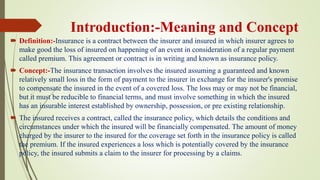
 Definition:-Insurance is a contract between the insurer and insured in which insurer agrees to
make good the loss of insured on happening of an event in consideration of a regular payment
called premium. This agreement or contract is in writing and known as insurance policy.
 Concept:-The insurance transaction involves the insured assuming a guaranteed and known
relatively small loss in the form of payment to the insurer in exchange for the insurer's promise
to compensate the insured in the event of a covered loss. The loss may or may not be financial,
but it must be reducible to financial terms, and must involve something in which the insured
has an insurable interest established by ownership, possession, or pre existing relationship.
 The insured receives a contract, called the insurance policy, which details the conditions and
circumstances under which the insured will be financially compensated. The amount of money
charged by the insurer to the insured for the coverage set forth in the insurance policy is called
the premium. If the insured experiences a loss which is potentially covered by the insurance
policy, the insured submits a claim to the insurer for processing by a claims.
History
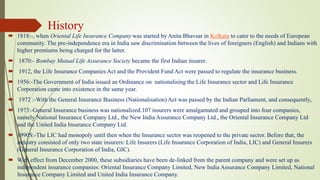
 1818:-, when Oriental Life Insurance Company was started by Anita Bhavsar in Kolkata to cater to the needs of European
community. The pre-independence era in India saw discrimination between the lives of foreigners (English) and Indians with
higher premiums being charged for the latter.
 1870:- Bombay Mutual Life Assurance Society became the first Indian insurer.
 1912, the Life Insurance Companies Act and the Provident Fund Act were passed to regulate the insurance business.
 1956:-The Government of India issued an Ordinance on nationalising the Life Insurance sector and Life Insurance
Corporation came into existence in the same year.
 1972 :-With the General Insurance Business (Nationalisation) Act was passed by the Indian Parliament, and consequently,
 1973:-General Insurance business was nationalized.107 insurers were amalgamated and grouped into four companies,
namely National Insurance Company Ltd., the New India Assurance Company Ltd., the Oriental Insurance Company Ltd
and the United India Insurance Company Ltd.
 1990S:-The LIC had monopoly until then when the Insurance sector was reopened to the private sector. Before that, the
industry consisted of only two state insurers: Life Insurers (Life Insurance Corporation of India, LIC) and General Insurers
(General Insurance Corporation of India, GIC).
 With effect from December 2000, these subsidiaries have been de-linked from the parent company and were set up as
independent insurance companies: Oriental Insurance Company Limited, New India Assurance Company Limited, National
Insurance Company Limited and United India Insurance Company.
Importance Of Insurance
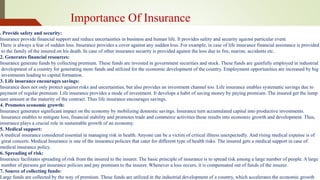
. Provide safety and security:
Insurance provide financial support and reduce uncertainties in business and human life. It provides safety and security against particular event.
There is always a fear of sudden loss. Insurance provides a cover against any sudden loss. For example, in case of life insurance financial assistance is provided
to the family of the insured on his death. In case of other insurance security is provided against the loss due to fire, marine, accidents etc.
2. Generates financial resources:
Insurance generate funds by collecting premium. These funds are invested in government securities and stock. These funds are gainfully employed in industrial
development of a country for generating more funds and utilized for the economic development of the country. Employment opportunities are increased by big
investments leading to capital formation.
3. Life insurance encourages savings:
Insurance does not only protect against risks and uncertainties, but also provides an investment channel too. Life insurance enables systematic savings due to
payment of regular premium. Life insurance provides a mode of investment. It develops a habit of saving money by paying premium. The insured get the lump
sum amount at the maturity of the contract. Thus life insurance encourages savings.
4. Promotes economic growth:
Insurance generates significant impact on the economy by mobilizing domestic savings. Insurance turn accumulated capital into productive investments.
Insurance enables to mitigate loss, financial stability and promotes trade and commerce activities those results into economic growth and development. Thus,
insurance plays a crucial role in sustainable growth of an economy.
5. Medical support:
A medical insurance considered essential in managing risk in health. Anyone can be a victim of critical illness unexpectedly. And rising medical expense is of
great concern. Medical Insurance is one of the insurance policies that cater for different type of health risks. The insured gets a medical support in case of
medical insurance policy.
6. Spreading of risk:
Insurance facilitates spreading of risk from the insured to the insurer. The basic principle of insurance is to spread risk among a large number of people. A large
number of persons get insurance policies and pay premium to the insurer. Whenever a loss occurs, it is compensated out of funds of the insurer.
7. Source of collecting funds:
Large funds are collected by the way of premium. These funds are utilized in the industrial development of a country, which accelerates the economic growth
Terms used in Insurance
 The important terms are:-
 Insurer:- An individual or firm known as insurance company which agrees to compensate the
loss of insured.
 Insured:- The individual or firm who gets compensation of loss.
 Premium:-It refers to the amount paid quarterly, half yearly or annually by the insured to insurer
for getting compensation at the time of loss.
 Happening of an event:- It refers to the subject matter of the policy or the kinds of loss covered
under the policy, for e.g. in fire insurance ,the loss is compensated only if it is due to fire.
Concept of Assurance
 Generally the term Insurance and Assurance are considered the same thing but these two are different
in their meaning.
 Assurance refers to a contract in which the sum assured is bound to paid sooner or later. In case of
insurance the sum paid only when insured suffered a peculiar loss.
 For e.g. in case when fire occurred in a godown, here the term of insurance says when the insured
suffers a loss then the claim be given but assurance says the claim may be given whether insured
suffers a loss or not.
 The term of assurance is equal to insurance when insured suffer a loss.
Reinsurance
 Under this the insurer enters into a contract into another contract of insurance with another insurer for
the whole or part of risk covered by first insurer. Sometimes the amount of risk covered is to high and
after entering into contract the insurer may enter into contract with another insurer called reinsurer.
 For e.g. X has insured property worth rs 10 lakhs belonging to A.He feels that the risk involved is too
high. Therefore he reinsures the contract with Y for 5lakhs.This is the contract of reinsurance. Here A
is insured, X is insurer in 1st policy, in second policy x will be called reinsured and Y is reinsurer.
 Reinsurance is a contract in which at the time of loss the original insurer X only. Later on X can be
indemnified by the reinsurer Y.
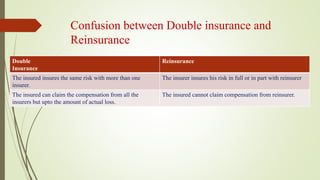
Confusion between Double insurance and
Reinsurance
Double
Insurance
Reinsurance
The insured insures the same risk with more than one
insurer.
The insurer insures his risk in full or in part with reinsurer
The insured can claim the compensation from all the
insurers but upto the amount of actual loss.
The insured cannot claim compensation from reinsurer.
Principle of Insurance
 The principle of Insurance are:-
 Principle of utmost Good Faith
 Principle of Insurable Interest
 Principle of Indemnity
 Principle of Contribution
 Principle of Subrogation
 Principle of Causa Proxima
 Principle of mitigation of loss
Principle of Utmost Good Faith
 Both parties, insurer and insured should enter into contract in good faith
 Insured should provide all the information that impacts the subject matter
 Insurer should provide all the details regarding insurance contract
 For example - John took a health insurance policy. At the time of taking policy, he was a smoker and
he didn't disclose this fact. He got cancer. Insurance company won't pay anything as John didn't
reveal the important facts.
Principle of Insurable Interest
 Insured must have the insurable interest on the subject matter
 In case of life insurance spouse and dependents have insurable interest in the life of a person.
Corporations also have insurable interests in the life of it's employees
 In case of life or marine insurance, insured must be the owner both at the time of entering of
entering into the insurance contract and at the time of accident.
Principle of Indemnity
 Insured can't make any profit from the insurance contract. Insurance contract is meant
for coverage of losses only
 Indemnity means a guarantee to put the insured in the position as he was before
accident
 This principle doesn't apply to life insurance contracts
Principle of Contribution
 In case the insured took more than one insurance policy for same subject matter, he/she can't
make profit by making claim for same loss more than once
 For example - Raj has a property worth Rs.5,00,000. He took insurance from Company A worth
Rs.3,00,000 and from Company B - Rs.1,00,000.
 In case of accident, he incurred a loss of Rs.3,00,000 to the property. Raj can claim Rs.
Rs.3,00,000 from A but after that he can't make profit by making a claim from Company B. Now
Company A can make a claim from Company B to for proportional loss claim value.
Principle of Subrogation
 After the insured gets the claim money, the insurer steps into the shoes of insured. After making
the payment insurance claim, the insurer becomes the owner of subject matter.
 For example :- Ram took a insurance policy for his Car. In an accident his car totally damaged.
Insurer paid the full policy value to insured. Now Ram can't sell the scrap remained after the
scrap.
Principle of Causa Proxima
 Word "Cause Proxima" means "Nearest Cause"
 An accident may be caused by more than one cause. In case property insured for only one
cause. In such case nearest cause of the accident is found out.
 Insurer pays the claim money only if the nearest cause is insured
Principle of Mitigation of Loss
 This principle states that the insured must take all the necessary steps to minimize the losses
to inured assets.
 For example - Ram took insurance policy for his house. In an cylinder blast, his house burnt.
He should have called nearest fire station so that the loss could be minimised.

Types of Insurance
Insurance
General
Insurance
Fire
&
Marine
Health
Life
Insurance
Life
Life Insurance
 The life insurance is related with two types of risks:-
 Risk of dying too early
 Risk of dying too late
Generally people take insurance policy when the have a fear of dying too early as to provide financial support to their family
they take life insurance policy. Sometimes people take insurance policy to get financial support and economic independence
during their old age. When people think of living too late then to provide financial support during their old age also the insurance
policy is taken.
In life insurance ,the sum assured is paid at the death or a maturity period whichever come early, If a person dies early his family
gets compensation amount and if a person survives the he/she can get the policy amount.
In life insurance ,the insured has to pay a fixed amount of premium and in return the compensation is assured at his death or at a
maturity period whichever comes earlier.
Types of Life Insurance
 Types:-
 Whole life Assurance Policy:- sometimes called "straight life" or "ordinary life," is a life insurance policy
which is guaranteed to remain in force for the insured's entire lifetime, provided required premiums are paid, or to
the maturity date. As a life insurance policy it represents a contract between the insured and insurer that as long as
the contract terms are met, the insurer will pay the death benefit of the policy to the policy's beneficiaries when the
insured dies. Because whole life policies are guaranteed to remain in force as long as the required premiums are
paid, the premiums are typically much higher than those of term life insurance where the premium is fixed only for
a limited term. Whole life premiums are fixed, based on the age of issue, and usually do not increase with age. The
insured party normally pays premiums until death, except for limited pay policies which may be paid-up in 10
years, 20 years, or at age 65.
 Endowment Life Assurance Policy:-An endowment policy is a life insurance contract designed to pay a
lump sum after a specific term (on its 'maturity') or on death. Typical maturities are ten, fifteen or twenty years up to
a certain age limit. Some policies also pay out in the case of critical illness. Policies are typically traditional with-
profits or unit-linked (including those with unitised with-profits funds).Endowments can be cashed in early (or
surrendered) and the holder then receives the surrender value which is determined by the insurance company
depending on how long the policy has been running and how much has been paid into it.
LIC (Life insurance
Corporation)
 Life Insurance Corporation of India (LIC) is an Indian state-owned insurance
group and investment company headquartered in Mumbai.
 It is the largest insurance company in India with an estimated asset value of ₹1,560,482
crore (US$240 billion).[3] As of 2013 it had total life fund of Rs.1433103.14 crore with total
value of policies sold of 367.82 lakh that year.
 The Life Insurance Corporation of India was founded in 1956 when the Parliament of
India passed the Life Insurance of India Act that nationalised the private insurance industry in
India. Over 245 insurance companies and provident societies were merged to create the state
owned Life Insurance Corporation.
BASIS FOR COMPARISON LIFE INSURANCE GENERAL INSURANCE
Meaning Life insurance can be understood as the
insurance contract, in which the life risk of
an individual is covered.
General insurance refers to the insurance,
which are not covered under life insurance
and includes various types of insurance, i.e.
fire, marine, motor, etc.
What is it? It is a form of investment. It is a contract of indemnity.
Term of contract Long term Short term
Claim payment Insurable amount is paid, either on the
occurrence of the event, or on maturity.
Loss is reimbursed, or liability incurred
will be repaid on the occurrence of
uncertain event.
Premium Premium has to be paid over the years. Premium should be paid in lump sum.
Insurable interest Must be present at the time of contract. Must be present, both at the time of
contract and at the time of loss.
Policy value It can be done for any value based on the
premium the policy holder willing to pay.
The amount payable under non-life
insurance is confined to the actual loss
suffered or liability uncured, irrespective of
the policy amount.
Savings Life insurance place has a component in
savings.
General insurance has no such savings
component.
General Insurance
Process Of Filing General Insurance
General Insurance
 General insurance or non-life insurance policies, including automobile and homeowners policies, provide payments
depending on the loss from a particular financial event. General insurance is typically defined as any insurance that is
not determined to be life insurance.
 It is called property and casualty insurance in the United States and Canada and non-life insurance in
Continental Europe.
 Types:-
 Fire Insurance
 Marine Insurance
 Health Insurance
 Motor Insurance
Fire Insurance
 Fire insurance covers damage or loss to a property because of fire. It is a
specific form of insurance in addition to homeowner’s or property
insurance, and it covers the cost of replacement and repair or
reconstruction above what the property insurance policy covers. Fire
insurance policies cover damage to the property, and may also cover
damage to nearby structures, personal property and costs because of not
having the capacity to live in or use the property if damages occur.
Fire insurance covers a policyholder against fire loss or damage brought
about by the ignition of fire, electricity, lightning or explosion of gas,
natural disasters, and bursting and overflowing of a water tank or pipes.
 Most policies cover a home regardless of whether the fire originates from
within the home or from outside the home. Coverage limits are dependent
on the cause of the fire. The policy reimburses the policyholder on a
replacement-cost basis in the event the property is lost, or on an actual cash
value basis for damages.

Marine Insurance
 Marine insurance covers the loss or damage of ships, cargo, terminals, and any
transport or cargo by which the property is transferred, acquired, or held between
the points of origin and the final destination. In this the insurer undertakes to indemnify
the manner and to extent thereby agreed against the marine loss.
 Marine insurance is an insurance where insured can be a cargo owner or ship owner or
freight receiver.
 Different types of marine insurance policies are:-
 Cargo Insurance:-This include coverage of cargo or the goods contained in the ship and
the personal belongings of the crew and passenger.
 Hull Insurance:- The whole ship is insured . It covers the insurance of the vessel and its
equipment.
 Freight Insurance:- Provides protection against the freight.
Reimbursement
 Reimbursement is the act of compensating someone for an out-of-pocket
expense by giving them an amount of money equal to what was spent.
 Companies, governments and non-profit organizations may compensate
their employees or officers for necessary and reasonable expenses .Reimbursement is
also provided for supply, day care, mobile, medical, or education expenses, as
determined by the payer.
 Reimbursement is also used in insurance, when a provider pays for expenses after
they have been paid directly by the policy holder or another party. This is especially
relevant in health insurance, due to urgency, high costs, and administrative
procedures which may cause a healthcare provider to incur costs pending
reimbursement by a private or public provider in obtaining reimbursement.
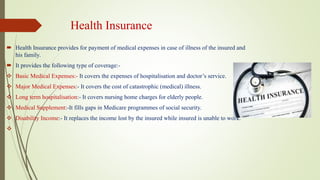
Health Insurance
 Health Insurance provides for payment of medical expenses in case of illness of the insured and
his family.
 It provides the following type of coverage:-
 Basic Medical Expenses:- It covers the expenses of hospitalisation and doctor’s service.
 Major Medical Expenses:- It covers the cost of catastrophic (medical) illness.
 Long term hospitalisation:- It covers nursing home charges for elderly people.
 Medical Supplement:-It fills gaps in Medicare programmes of social security.
 Disability Income:- It replaces the income lost by the insured while insured is unable to work.

Vehicle Insurance
 Vehicle insurance (also known as car insurance, motor
insurance or auto insurance)
is insurance for cars, trucks, motorcycles, and other road
vehicles. Its primary use is to provide financial protection
against physical damage or bodily injury resulting from traffic
collisions and against liability that could also arise there from.
Vehicle insurance may additionally offer financial protection
against as theft of the vehicle, and against damage to the
vehicle sustained from events other than traffic collisions, such
as keying and damage sustained by colliding with stationary
objects. The specific terms of vehicle insurance vary with
legal regulations in each region.
Condition Of Indian Insurance
 The industry has of late achieved a yearly growth rate within 32 and 34 percent and this makes it the 5th best among
emerging economies around the world. The various entities of the industry are also bringing out newer products on a
regular basis to attract their customers.
As per rules, the upper limit of foreign direct investment permitted in this sector is 26 percent. However, this has to be
done through the automatic route and the investor needs a license from Insurance Regulatory and Development Authority
(IRDA).
At present there are 22 life insurers in India. The IRDA has recently taken away the tariffs of the interest rates and this has
provided insurers greater independence when it comes to deciding the price of their insurance policies. The insurance
industry has also become more competitive as a result.
Insurance

Insurance

  • 1.
    INSURANCE Made by:- AnkitSingh Class:- B.com h Semester:-4
  • 2.
    Topics The topicsof this presentation are:-  Introduction  History  Importance  Terms  Concept Of Assurance  Reinsurance  Principle of Insurance  LIC  GIC  Fire Insurance  Marine Insurance  Health Insurance  Reimbursement  Vehicle Insurance  Conclusion
  • 3.
    Introduction:-Meaning and Concept Definition:-Insurance is a contract between the insurer and insured in which insurer agrees to make good the loss of insured on happening of an event in consideration of a regular payment called premium. This agreement or contract is in writing and known as insurance policy.  Concept:-The insurance transaction involves the insured assuming a guaranteed and known relatively small loss in the form of payment to the insurer in exchange for the insurer's promise to compensate the insured in the event of a covered loss. The loss may or may not be financial, but it must be reducible to financial terms, and must involve something in which the insured has an insurable interest established by ownership, possession, or pre existing relationship.  The insured receives a contract, called the insurance policy, which details the conditions and circumstances under which the insured will be financially compensated. The amount of money charged by the insurer to the insured for the coverage set forth in the insurance policy is called the premium. If the insured experiences a loss which is potentially covered by the insurance policy, the insured submits a claim to the insurer for processing by a claims.
  • 5.
    History  1818:-, whenOriental Life Insurance Company was started by Anita Bhavsar in Kolkata to cater to the needs of European community. The pre-independence era in India saw discrimination between the lives of foreigners (English) and Indians with higher premiums being charged for the latter.  1870:- Bombay Mutual Life Assurance Society became the first Indian insurer.  1912, the Life Insurance Companies Act and the Provident Fund Act were passed to regulate the insurance business.  1956:-The Government of India issued an Ordinance on nationalising the Life Insurance sector and Life Insurance Corporation came into existence in the same year.  1972 :-With the General Insurance Business (Nationalisation) Act was passed by the Indian Parliament, and consequently,  1973:-General Insurance business was nationalized.107 insurers were amalgamated and grouped into four companies, namely National Insurance Company Ltd., the New India Assurance Company Ltd., the Oriental Insurance Company Ltd and the United India Insurance Company Ltd.  1990S:-The LIC had monopoly until then when the Insurance sector was reopened to the private sector. Before that, the industry consisted of only two state insurers: Life Insurers (Life Insurance Corporation of India, LIC) and General Insurers (General Insurance Corporation of India, GIC).  With effect from December 2000, these subsidiaries have been de-linked from the parent company and were set up as independent insurance companies: Oriental Insurance Company Limited, New India Assurance Company Limited, National Insurance Company Limited and United India Insurance Company.
  • 6.
    Importance Of Insurance .Provide safety and security: Insurance provide financial support and reduce uncertainties in business and human life. It provides safety and security against particular event. There is always a fear of sudden loss. Insurance provides a cover against any sudden loss. For example, in case of life insurance financial assistance is provided to the family of the insured on his death. In case of other insurance security is provided against the loss due to fire, marine, accidents etc. 2. Generates financial resources: Insurance generate funds by collecting premium. These funds are invested in government securities and stock. These funds are gainfully employed in industrial development of a country for generating more funds and utilized for the economic development of the country. Employment opportunities are increased by big investments leading to capital formation. 3. Life insurance encourages savings: Insurance does not only protect against risks and uncertainties, but also provides an investment channel too. Life insurance enables systematic savings due to payment of regular premium. Life insurance provides a mode of investment. It develops a habit of saving money by paying premium. The insured get the lump sum amount at the maturity of the contract. Thus life insurance encourages savings. 4. Promotes economic growth: Insurance generates significant impact on the economy by mobilizing domestic savings. Insurance turn accumulated capital into productive investments. Insurance enables to mitigate loss, financial stability and promotes trade and commerce activities those results into economic growth and development. Thus, insurance plays a crucial role in sustainable growth of an economy. 5. Medical support: A medical insurance considered essential in managing risk in health. Anyone can be a victim of critical illness unexpectedly. And rising medical expense is of great concern. Medical Insurance is one of the insurance policies that cater for different type of health risks. The insured gets a medical support in case of medical insurance policy. 6. Spreading of risk: Insurance facilitates spreading of risk from the insured to the insurer. The basic principle of insurance is to spread risk among a large number of people. A large number of persons get insurance policies and pay premium to the insurer. Whenever a loss occurs, it is compensated out of funds of the insurer. 7. Source of collecting funds: Large funds are collected by the way of premium. These funds are utilized in the industrial development of a country, which accelerates the economic growth
  • 7.
    Terms used inInsurance  The important terms are:-  Insurer:- An individual or firm known as insurance company which agrees to compensate the loss of insured.  Insured:- The individual or firm who gets compensation of loss.  Premium:-It refers to the amount paid quarterly, half yearly or annually by the insured to insurer for getting compensation at the time of loss.  Happening of an event:- It refers to the subject matter of the policy or the kinds of loss covered under the policy, for e.g. in fire insurance ,the loss is compensated only if it is due to fire.
  • 8.
    Concept of Assurance Generally the term Insurance and Assurance are considered the same thing but these two are different in their meaning.  Assurance refers to a contract in which the sum assured is bound to paid sooner or later. In case of insurance the sum paid only when insured suffered a peculiar loss.  For e.g. in case when fire occurred in a godown, here the term of insurance says when the insured suffers a loss then the claim be given but assurance says the claim may be given whether insured suffers a loss or not.  The term of assurance is equal to insurance when insured suffer a loss.
  • 9.
    Reinsurance  Under thisthe insurer enters into a contract into another contract of insurance with another insurer for the whole or part of risk covered by first insurer. Sometimes the amount of risk covered is to high and after entering into contract the insurer may enter into contract with another insurer called reinsurer.  For e.g. X has insured property worth rs 10 lakhs belonging to A.He feels that the risk involved is too high. Therefore he reinsures the contract with Y for 5lakhs.This is the contract of reinsurance. Here A is insured, X is insurer in 1st policy, in second policy x will be called reinsured and Y is reinsurer.  Reinsurance is a contract in which at the time of loss the original insurer X only. Later on X can be indemnified by the reinsurer Y.
  • 10.
    Confusion between Doubleinsurance and Reinsurance Double Insurance Reinsurance The insured insures the same risk with more than one insurer. The insurer insures his risk in full or in part with reinsurer The insured can claim the compensation from all the insurers but upto the amount of actual loss. The insured cannot claim compensation from reinsurer.
  • 11.
    Principle of Insurance The principle of Insurance are:-  Principle of utmost Good Faith  Principle of Insurable Interest  Principle of Indemnity  Principle of Contribution  Principle of Subrogation  Principle of Causa Proxima  Principle of mitigation of loss
  • 12.
    Principle of UtmostGood Faith  Both parties, insurer and insured should enter into contract in good faith  Insured should provide all the information that impacts the subject matter  Insurer should provide all the details regarding insurance contract  For example - John took a health insurance policy. At the time of taking policy, he was a smoker and he didn't disclose this fact. He got cancer. Insurance company won't pay anything as John didn't reveal the important facts.
  • 13.
    Principle of InsurableInterest  Insured must have the insurable interest on the subject matter  In case of life insurance spouse and dependents have insurable interest in the life of a person. Corporations also have insurable interests in the life of it's employees  In case of life or marine insurance, insured must be the owner both at the time of entering of entering into the insurance contract and at the time of accident.
  • 14.
    Principle of Indemnity Insured can't make any profit from the insurance contract. Insurance contract is meant for coverage of losses only  Indemnity means a guarantee to put the insured in the position as he was before accident  This principle doesn't apply to life insurance contracts
  • 15.
    Principle of Contribution In case the insured took more than one insurance policy for same subject matter, he/she can't make profit by making claim for same loss more than once  For example - Raj has a property worth Rs.5,00,000. He took insurance from Company A worth Rs.3,00,000 and from Company B - Rs.1,00,000.  In case of accident, he incurred a loss of Rs.3,00,000 to the property. Raj can claim Rs. Rs.3,00,000 from A but after that he can't make profit by making a claim from Company B. Now Company A can make a claim from Company B to for proportional loss claim value.
  • 16.
    Principle of Subrogation After the insured gets the claim money, the insurer steps into the shoes of insured. After making the payment insurance claim, the insurer becomes the owner of subject matter.  For example :- Ram took a insurance policy for his Car. In an accident his car totally damaged. Insurer paid the full policy value to insured. Now Ram can't sell the scrap remained after the scrap.
  • 17.
    Principle of CausaProxima  Word "Cause Proxima" means "Nearest Cause"  An accident may be caused by more than one cause. In case property insured for only one cause. In such case nearest cause of the accident is found out.  Insurer pays the claim money only if the nearest cause is insured
  • 18.
    Principle of Mitigationof Loss  This principle states that the insured must take all the necessary steps to minimize the losses to inured assets.  For example - Ram took insurance policy for his house. In an cylinder blast, his house burnt. He should have called nearest fire station so that the loss could be minimised. 
  • 19.
  • 20.
    Life Insurance  Thelife insurance is related with two types of risks:-  Risk of dying too early  Risk of dying too late Generally people take insurance policy when the have a fear of dying too early as to provide financial support to their family they take life insurance policy. Sometimes people take insurance policy to get financial support and economic independence during their old age. When people think of living too late then to provide financial support during their old age also the insurance policy is taken. In life insurance ,the sum assured is paid at the death or a maturity period whichever come early, If a person dies early his family gets compensation amount and if a person survives the he/she can get the policy amount. In life insurance ,the insured has to pay a fixed amount of premium and in return the compensation is assured at his death or at a maturity period whichever comes earlier.
  • 21.
    Types of LifeInsurance  Types:-  Whole life Assurance Policy:- sometimes called "straight life" or "ordinary life," is a life insurance policy which is guaranteed to remain in force for the insured's entire lifetime, provided required premiums are paid, or to the maturity date. As a life insurance policy it represents a contract between the insured and insurer that as long as the contract terms are met, the insurer will pay the death benefit of the policy to the policy's beneficiaries when the insured dies. Because whole life policies are guaranteed to remain in force as long as the required premiums are paid, the premiums are typically much higher than those of term life insurance where the premium is fixed only for a limited term. Whole life premiums are fixed, based on the age of issue, and usually do not increase with age. The insured party normally pays premiums until death, except for limited pay policies which may be paid-up in 10 years, 20 years, or at age 65.  Endowment Life Assurance Policy:-An endowment policy is a life insurance contract designed to pay a lump sum after a specific term (on its 'maturity') or on death. Typical maturities are ten, fifteen or twenty years up to a certain age limit. Some policies also pay out in the case of critical illness. Policies are typically traditional with- profits or unit-linked (including those with unitised with-profits funds).Endowments can be cashed in early (or surrendered) and the holder then receives the surrender value which is determined by the insurance company depending on how long the policy has been running and how much has been paid into it.
  • 22.
    LIC (Life insurance Corporation) Life Insurance Corporation of India (LIC) is an Indian state-owned insurance group and investment company headquartered in Mumbai.  It is the largest insurance company in India with an estimated asset value of ₹1,560,482 crore (US$240 billion).[3] As of 2013 it had total life fund of Rs.1433103.14 crore with total value of policies sold of 367.82 lakh that year.  The Life Insurance Corporation of India was founded in 1956 when the Parliament of India passed the Life Insurance of India Act that nationalised the private insurance industry in India. Over 245 insurance companies and provident societies were merged to create the state owned Life Insurance Corporation.
  • 23.
    BASIS FOR COMPARISONLIFE INSURANCE GENERAL INSURANCE Meaning Life insurance can be understood as the insurance contract, in which the life risk of an individual is covered. General insurance refers to the insurance, which are not covered under life insurance and includes various types of insurance, i.e. fire, marine, motor, etc. What is it? It is a form of investment. It is a contract of indemnity. Term of contract Long term Short term Claim payment Insurable amount is paid, either on the occurrence of the event, or on maturity. Loss is reimbursed, or liability incurred will be repaid on the occurrence of uncertain event. Premium Premium has to be paid over the years. Premium should be paid in lump sum. Insurable interest Must be present at the time of contract. Must be present, both at the time of contract and at the time of loss. Policy value It can be done for any value based on the premium the policy holder willing to pay. The amount payable under non-life insurance is confined to the actual loss suffered or liability uncured, irrespective of the policy amount. Savings Life insurance place has a component in savings. General insurance has no such savings component.
  • 24.
  • 25.
    Process Of FilingGeneral Insurance
  • 26.
    General Insurance  Generalinsurance or non-life insurance policies, including automobile and homeowners policies, provide payments depending on the loss from a particular financial event. General insurance is typically defined as any insurance that is not determined to be life insurance.  It is called property and casualty insurance in the United States and Canada and non-life insurance in Continental Europe.  Types:-  Fire Insurance  Marine Insurance  Health Insurance  Motor Insurance
  • 27.
    Fire Insurance  Fireinsurance covers damage or loss to a property because of fire. It is a specific form of insurance in addition to homeowner’s or property insurance, and it covers the cost of replacement and repair or reconstruction above what the property insurance policy covers. Fire insurance policies cover damage to the property, and may also cover damage to nearby structures, personal property and costs because of not having the capacity to live in or use the property if damages occur. Fire insurance covers a policyholder against fire loss or damage brought about by the ignition of fire, electricity, lightning or explosion of gas, natural disasters, and bursting and overflowing of a water tank or pipes.  Most policies cover a home regardless of whether the fire originates from within the home or from outside the home. Coverage limits are dependent on the cause of the fire. The policy reimburses the policyholder on a replacement-cost basis in the event the property is lost, or on an actual cash value basis for damages. 
  • 28.
    Marine Insurance  Marineinsurance covers the loss or damage of ships, cargo, terminals, and any transport or cargo by which the property is transferred, acquired, or held between the points of origin and the final destination. In this the insurer undertakes to indemnify the manner and to extent thereby agreed against the marine loss.  Marine insurance is an insurance where insured can be a cargo owner or ship owner or freight receiver.  Different types of marine insurance policies are:-  Cargo Insurance:-This include coverage of cargo or the goods contained in the ship and the personal belongings of the crew and passenger.  Hull Insurance:- The whole ship is insured . It covers the insurance of the vessel and its equipment.  Freight Insurance:- Provides protection against the freight.
  • 29.
    Reimbursement  Reimbursement isthe act of compensating someone for an out-of-pocket expense by giving them an amount of money equal to what was spent.  Companies, governments and non-profit organizations may compensate their employees or officers for necessary and reasonable expenses .Reimbursement is also provided for supply, day care, mobile, medical, or education expenses, as determined by the payer.  Reimbursement is also used in insurance, when a provider pays for expenses after they have been paid directly by the policy holder or another party. This is especially relevant in health insurance, due to urgency, high costs, and administrative procedures which may cause a healthcare provider to incur costs pending reimbursement by a private or public provider in obtaining reimbursement.
  • 30.
    Health Insurance  HealthInsurance provides for payment of medical expenses in case of illness of the insured and his family.  It provides the following type of coverage:-  Basic Medical Expenses:- It covers the expenses of hospitalisation and doctor’s service.  Major Medical Expenses:- It covers the cost of catastrophic (medical) illness.  Long term hospitalisation:- It covers nursing home charges for elderly people.  Medical Supplement:-It fills gaps in Medicare programmes of social security.  Disability Income:- It replaces the income lost by the insured while insured is unable to work. 
  • 31.
    Vehicle Insurance  Vehicleinsurance (also known as car insurance, motor insurance or auto insurance) is insurance for cars, trucks, motorcycles, and other road vehicles. Its primary use is to provide financial protection against physical damage or bodily injury resulting from traffic collisions and against liability that could also arise there from. Vehicle insurance may additionally offer financial protection against as theft of the vehicle, and against damage to the vehicle sustained from events other than traffic collisions, such as keying and damage sustained by colliding with stationary objects. The specific terms of vehicle insurance vary with legal regulations in each region.
  • 32.
    Condition Of IndianInsurance  The industry has of late achieved a yearly growth rate within 32 and 34 percent and this makes it the 5th best among emerging economies around the world. The various entities of the industry are also bringing out newer products on a regular basis to attract their customers. As per rules, the upper limit of foreign direct investment permitted in this sector is 26 percent. However, this has to be done through the automatic route and the investor needs a license from Insurance Regulatory and Development Authority (IRDA). At present there are 22 life insurers in India. The IRDA has recently taken away the tariffs of the interest rates and this has provided insurers greater independence when it comes to deciding the price of their insurance policies. The insurance industry has also become more competitive as a result.