Introduction To Insurance
The Indian Contract Act 1872
• A contract is an agreement between two or more parties to do or to
  abstain from doing an act and which is
• intended to create a legally binding relationship


                          An Agreement
                           enforceable
                           by Law is a
                             contract
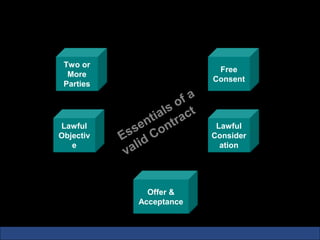
Essentials of a Valid Contract


         Two or
                                       Free
          More
                                      Consent
         Parties

                                fa
                             s o ct
                          ial ra
                        nt nt
        Lawful
                      se o             Lawful
        Objectiv   Es id C            Consider
           e
                    val                 ation


                         Offer &
                       Acceptance
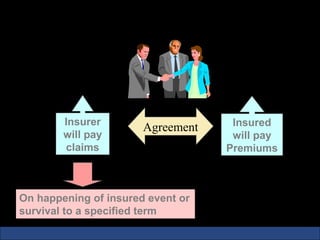
The Life Insurance Contract


        Insurer                     Insured
                       Agreement
        will pay                    will pay
        claims                     Premiums


On happening of insured event or
survival to a specified term
Is Life Insurance a Legal Contract?
•   Intention is legal
•   Proposer offers-insurer accepts
•   Premium is consideration
•   Insured must be major with sound mind-capacity to contract
•   Insured and Insurer are in agreement –of same mind and free
    consent


     Yes, since all essentials of valid contract are present
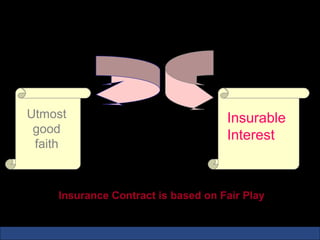
Principles of Life Insurance


 Utmost                                Insurable
  good
                                       Interest
  faith


       Insurance Contract is based on Fair Play
Insurance Contract Vs Commercial Contract
    INSURANCE CONTRACT                       COMMERCIAL CONTRACT

•   In Life Insurance proposer has all   •   When one buys a TV or Fridge he
    the facts                                examines the quality/quantity

•   The Insurer Knows only those         •   Buyer has no right to come later
    facts that the proposer discloses        and ask for termination of contract

•   Ordinary faith is not sufficient-    •   Buyer Beware or Caveat Emptor
    Utmost Good Faith is required            applies
Utmost Good Faith


• A Positive Duty to voluntarily disclose,accurately and fully, all facts
  material to risk being proposed, whether requested or not.
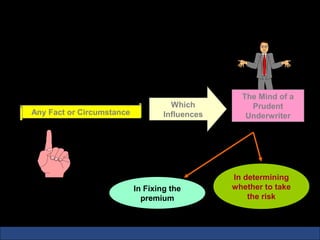
What is a material Fact?


                                                    The Mind of a
                                       Which          Prudent
  Any Fact or Circumstance           Influences      Underwriter


                                                  In determining
                             In Fixing the        whether to take
                               premium                the risk
What must be disclosed?
• Facts of higher Risk

• External Factors that make the risk higher

• Any refusal/special terms imposed on previous proposals

• Existence of other policies

• Facts relating to health
Declaration

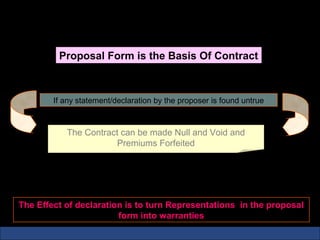
         Proposal Form is the Basis Of Contract


        If any statement/declaration by the proposer is found untrue


           The Contract can be made Null and Void and
                       Premiums Forfeited


The Effect of declaration is to turn Representations in the proposal
                        form into warranties
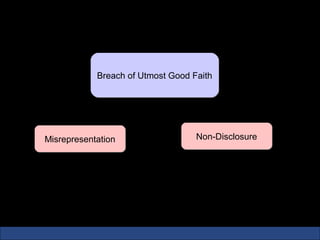
Breach Of Utmost Good Faith


                Breach of Utmost Good Faith


    Misrepresentation                  Non-Disclosure
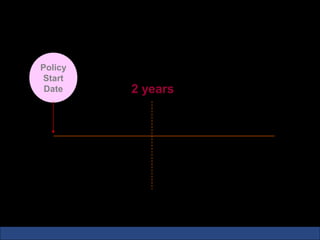
Section 45 of the Insurance Act,1938


   Policy
   Start
    Date                        2 years


 If Material Facts discovered       The policy cannot be called in question
 within 2 years of the policy       after 2 years, on the grounds of
 then the insurer can declare       inaccurate or false statement unless it is
 the policy null and void           proved to be material and fraudulent.
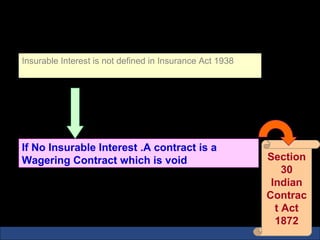
What is Insurable Interest ?


 Insurable Interest is not defined in Insurance Act 1938


 If No Insurable Interest .A contract is a
 Wagering Contract which is void                           Section
                                                               30
                                                            Indian
Insurable Interest is a Legal Prerequisite                 Contrac
                                                             t Act
                                                             1872
Insurable Interest

 •All risks are not Insurable

 •Insured must suffer a loss, if the risk is not covered

 •Financial interest in Subject matter of Insurance


 The insured must be interested in the safety and
 the well being of the subject of Insurance

       He Should not benefit from loss or damage to it
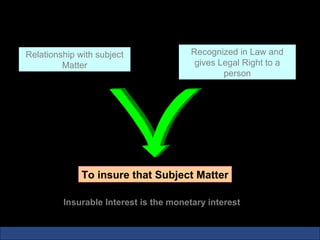
What is Insurable Interest ?

 Relationship with subject               Recognized in Law and
          Matter                          gives Legal Right to a
                                                 person


               To insure that Subject Matter

          Insurable Interest is the monetary interest
Who have insurable interest in each other
• Any person in himself
• Husband and wife in each other
• Creditor on Debtor(To the Extent of Outstanding Mortgage with
  Interest)
• Surety on Principal(To the extent of Debt)
• Partners in business
• Employer on its employees
• Parents in Lives of their Minor Children
When do these principles apply?
• Insurable Interest interest is required at the time of entering the
  contract

• Utmost Good Faith is required Throughout the contract
Principle Of Indemnity


• Insurance is meant to compensate the losses

• The Mechanism of Insurance cannot be used to make profits

• Amount of claim cannot exceed the amount of loss incurred

• Insurance makes good the loss

• In Life Insurance, insurable interest on own life is unlimited hence
  Principle of indeminity does not apply but it does apply in General
  Insurance
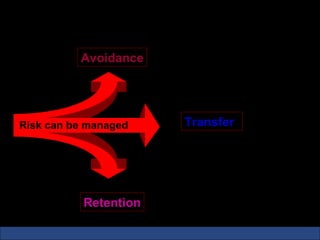
Risk Management

          Avoidance


Risk can be managed    Transfer


           Retention
Classification of Needs
• Protection of the standard of living of family incase of early death

• Future Expenses eg. Children Education

• Income incase of Retirement or Disability

• Helps by facilitating borrowing
Case Study 1
• In a village there are 400 houses, each valued at Rs 20,000.

• Every year on an average, 4 houses get burnt, resulting into a total
  loss of Rs 80,000.


                      Find a Solution
Sharing Risk


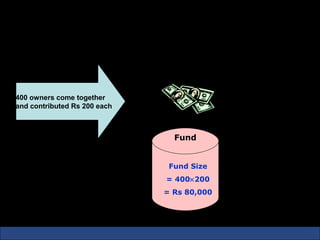
400 owners come together
and contributed Rs 200 each


                                Fund


                               Fund Size
                              = 400×200
                              = Rs 80,000
Sharing Risk

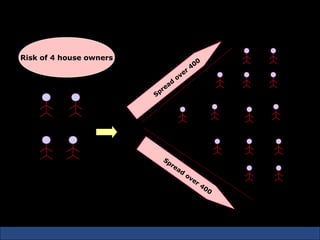
Risk of 4 house owners
                                              4 00
                                          r
                                      ove
                              a   d
                           re
                         Sp


                           Sp
                              re
                                 ad
                                         ov
                                            e   r4
                                                  00
Type of Risks

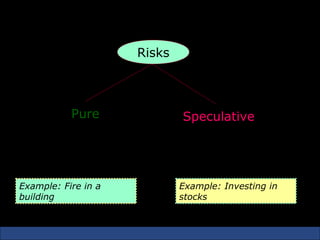
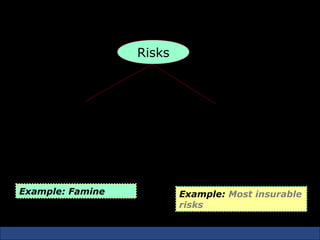
                          Risks


           Pure                     Speculative
    No prospect of gain           Offers possibility of loss
                                          or gain


Example: Fire in a                 Example: Investing in
building                           stocks
Type of Risks

                       Risks


    Fundamental                 Particular

Affect large section           Consequences are
     of society                  comparatively
                                   restricted

Example: Famine                Example: Most insurable
                               risks
How to Manage Risk
• Avoiding Risk

• Controlling Risk

• Accepting Risk

• Transferring Risk
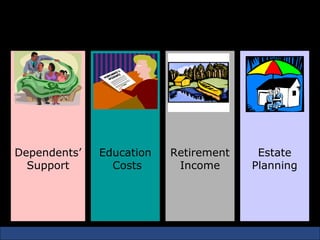
Why we need life insurance


Dependents’   Education   Retirement    Estate
  Support       Costs      Income      Planning
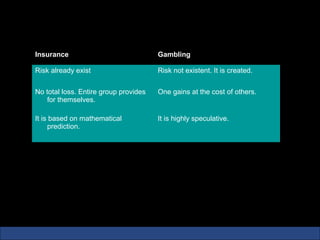
Insurance vs. Gambling

  Insurance                              Gambling

  Risk already exist                     Risk not existent. It is created.


  No total loss. Entire group provides   One gains at the cost of others.
     for themselves.

  It is based on mathematical            It is highly speculative.
       prediction.
Basic Life Insurance Policy
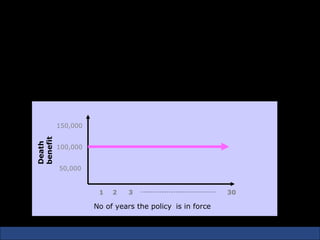
Term Insurance

• Provides a death benefit if the insured dies during a
  specified period


             150,000
   benefit
   Death


             100,000


             50,000


                        1   2    3                          30

                       No of years the policy is in force
Term Insurance


                       In case of death during the policy
                       term, the SA = 100,000 is paid


     1   2    3                                      30


             No of years the policy is in force
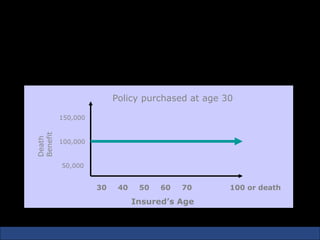
Whole Life Policy

 Whole life insurance provides insurance coverage
 throughout the insured’s lifetime.


                            Policy purchased at age 30

             150,000
   Benefit
   Death


             100,000


             50,000


                       30    40    50   60   70      100 or death

                                  Insured’s Age
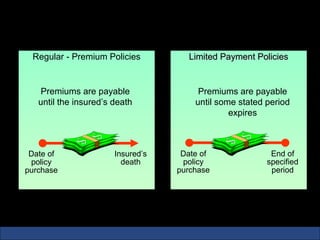
Types of Whole Life Policies

 Regular - Premium Policies          Limited Payment Policies


    Premiums are payable                Premiums are payable
   until the insured’s death           until some stated period
                                                expires


 Date of               Insured’s    Date of               End of
 policy                  death      policy               specified
purchase                           purchase               period
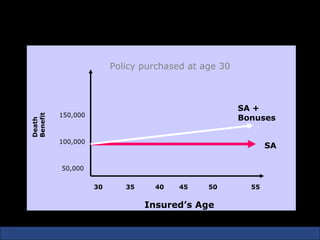
Endowment Policies
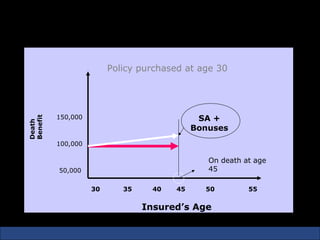
• Endowment policies provide insurance coverage for a specified
  period.

• On surviving the specified period, policyholder gets the sum assured
  + bonuses.

• On death during the specified term, policyholder gets the sum
  assured + bonuses.
Endowment Policies


                          Policy purchased at age 30


                                                       SA +
           150,000
 Benefit


                                                       Bonuses
 Death


           100,000
                                                              SA

           50,000


                     30      35    40   45     50        55


                                  Insured’s Age
Endowment Policies


                          Policy purchased at age 30


           150,000                            SA +
 Benefit
 Death


                                             Bonuses
           100,000

                                                On death at age
           50,000                               45

                     30      35    40   45     50         55


                                  Insured’s Age
Annuities

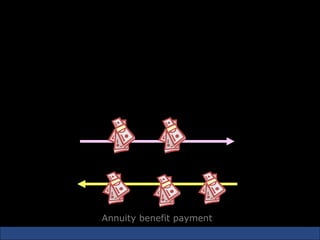
• An annuity is a series of periodic payments. In annuity contract, a
  person agrees to pay to the insurer a specified capital sum in
  return for a series of payments.


                    Periodic Payments made


                    Annuity benefit payment
Factors Affecting Annuity Benefits
•   The amount of money invested
•   The interest rate earned on investment
•   The number & timing of annuity payments
•   The time over which money grows at interest
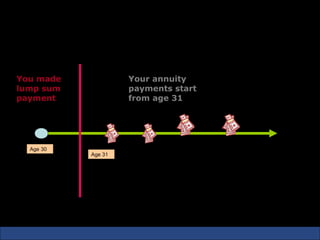
How Immediate Annuity Works


You made             Your annuity
lump sum             payments start
payment              from age 31


  Age 30
            Age 31
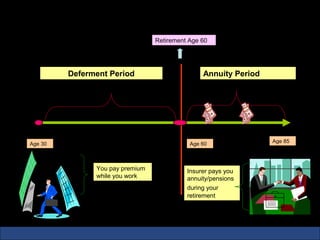
How Deferred Annuity works
                                  Retirement Age 60


          Deferment Period                       Annuity Period


                                                                  Age 85
 Age 30                                      Age 60


                You pay premium             Insurer pays you
                while you work              annuity/pensions
                                            during your
                                            retirement
Insurance   introduction

Insurance introduction

  • 1.
  • 2.
    The Indian ContractAct 1872 • A contract is an agreement between two or more parties to do or to abstain from doing an act and which is • intended to create a legally binding relationship An Agreement enforceable by Law is a contract
  • 3.
    Essentials of aValid Contract Two or Free More Consent Parties fa s o ct ial ra nt nt Lawful se o Lawful Objectiv Es id C Consider e val ation Offer & Acceptance
  • 4.
    The Life InsuranceContract Insurer Insured Agreement will pay will pay claims Premiums On happening of insured event or survival to a specified term
  • 5.
    Is Life Insurancea Legal Contract? • Intention is legal • Proposer offers-insurer accepts • Premium is consideration • Insured must be major with sound mind-capacity to contract • Insured and Insurer are in agreement –of same mind and free consent Yes, since all essentials of valid contract are present
  • 6.
    Principles of LifeInsurance Utmost Insurable good Interest faith Insurance Contract is based on Fair Play
  • 7.
    Insurance Contract VsCommercial Contract INSURANCE CONTRACT COMMERCIAL CONTRACT • In Life Insurance proposer has all • When one buys a TV or Fridge he the facts examines the quality/quantity • The Insurer Knows only those • Buyer has no right to come later facts that the proposer discloses and ask for termination of contract • Ordinary faith is not sufficient- • Buyer Beware or Caveat Emptor Utmost Good Faith is required applies
  • 8.
    Utmost Good Faith •A Positive Duty to voluntarily disclose,accurately and fully, all facts material to risk being proposed, whether requested or not.
  • 9.
    What is amaterial Fact? The Mind of a Which Prudent Any Fact or Circumstance Influences Underwriter In determining In Fixing the whether to take premium the risk
  • 10.
    What must bedisclosed? • Facts of higher Risk • External Factors that make the risk higher • Any refusal/special terms imposed on previous proposals • Existence of other policies • Facts relating to health
  • 11.
    Declaration Proposal Form is the Basis Of Contract If any statement/declaration by the proposer is found untrue The Contract can be made Null and Void and Premiums Forfeited The Effect of declaration is to turn Representations in the proposal form into warranties
  • 12.
    Breach Of UtmostGood Faith Breach of Utmost Good Faith Misrepresentation Non-Disclosure
  • 13.
    Section 45 ofthe Insurance Act,1938 Policy Start Date 2 years If Material Facts discovered The policy cannot be called in question within 2 years of the policy after 2 years, on the grounds of then the insurer can declare inaccurate or false statement unless it is the policy null and void proved to be material and fraudulent.
  • 14.
    What is InsurableInterest ? Insurable Interest is not defined in Insurance Act 1938 If No Insurable Interest .A contract is a Wagering Contract which is void Section 30 Indian Insurable Interest is a Legal Prerequisite Contrac t Act 1872
  • 15.
    Insurable Interest •Allrisks are not Insurable •Insured must suffer a loss, if the risk is not covered •Financial interest in Subject matter of Insurance The insured must be interested in the safety and the well being of the subject of Insurance He Should not benefit from loss or damage to it
  • 16.
    What is InsurableInterest ? Relationship with subject Recognized in Law and Matter gives Legal Right to a person To insure that Subject Matter Insurable Interest is the monetary interest
  • 17.
    Who have insurableinterest in each other • Any person in himself • Husband and wife in each other • Creditor on Debtor(To the Extent of Outstanding Mortgage with Interest) • Surety on Principal(To the extent of Debt) • Partners in business • Employer on its employees • Parents in Lives of their Minor Children
  • 18.
    When do theseprinciples apply? • Insurable Interest interest is required at the time of entering the contract • Utmost Good Faith is required Throughout the contract
  • 19.
    Principle Of Indemnity •Insurance is meant to compensate the losses • The Mechanism of Insurance cannot be used to make profits • Amount of claim cannot exceed the amount of loss incurred • Insurance makes good the loss • In Life Insurance, insurable interest on own life is unlimited hence Principle of indeminity does not apply but it does apply in General Insurance
  • 20.
    Risk Management Avoidance Risk can be managed Transfer Retention
  • 21.
    Classification of Needs •Protection of the standard of living of family incase of early death • Future Expenses eg. Children Education • Income incase of Retirement or Disability • Helps by facilitating borrowing
  • 22.
    Case Study 1 •In a village there are 400 houses, each valued at Rs 20,000. • Every year on an average, 4 houses get burnt, resulting into a total loss of Rs 80,000. Find a Solution
  • 23.
    Sharing Risk 400 ownerscome together and contributed Rs 200 each Fund Fund Size = 400×200 = Rs 80,000
  • 24.
    Sharing Risk Risk of4 house owners 4 00 r ove a d re Sp Sp re ad ov e r4 00
  • 25.
    Type of Risks Risks Pure Speculative No prospect of gain Offers possibility of loss or gain Example: Fire in a Example: Investing in building stocks
  • 26.
    Type of Risks Risks Fundamental Particular Affect large section Consequences are of society comparatively restricted Example: Famine Example: Most insurable risks
  • 27.
    How to ManageRisk • Avoiding Risk • Controlling Risk • Accepting Risk • Transferring Risk
  • 28.
    Why we needlife insurance Dependents’ Education Retirement Estate Support Costs Income Planning
  • 29.
    Insurance vs. Gambling Insurance Gambling Risk already exist Risk not existent. It is created. No total loss. Entire group provides One gains at the cost of others. for themselves. It is based on mathematical It is highly speculative. prediction.
  • 30.
  • 31.
    Term Insurance • Providesa death benefit if the insured dies during a specified period 150,000 benefit Death 100,000 50,000 1 2 3 30 No of years the policy is in force
  • 32.
    Term Insurance In case of death during the policy term, the SA = 100,000 is paid 1 2 3 30 No of years the policy is in force
  • 33.
    Whole Life Policy Whole life insurance provides insurance coverage throughout the insured’s lifetime. Policy purchased at age 30 150,000 Benefit Death 100,000 50,000 30 40 50 60 70 100 or death Insured’s Age
  • 34.
    Types of WholeLife Policies Regular - Premium Policies Limited Payment Policies Premiums are payable Premiums are payable until the insured’s death until some stated period expires Date of Insured’s Date of End of policy death policy specified purchase purchase period
  • 35.
    Endowment Policies • Endowmentpolicies provide insurance coverage for a specified period. • On surviving the specified period, policyholder gets the sum assured + bonuses. • On death during the specified term, policyholder gets the sum assured + bonuses.
  • 36.
    Endowment Policies Policy purchased at age 30 SA + 150,000 Benefit Bonuses Death 100,000 SA 50,000 30 35 40 45 50 55 Insured’s Age
  • 37.
    Endowment Policies Policy purchased at age 30 150,000 SA + Benefit Death Bonuses 100,000 On death at age 50,000 45 30 35 40 45 50 55 Insured’s Age
  • 38.
    Annuities • An annuityis a series of periodic payments. In annuity contract, a person agrees to pay to the insurer a specified capital sum in return for a series of payments. Periodic Payments made Annuity benefit payment
  • 39.
    Factors Affecting AnnuityBenefits • The amount of money invested • The interest rate earned on investment • The number & timing of annuity payments • The time over which money grows at interest
  • 40.
    How Immediate AnnuityWorks You made Your annuity lump sum payments start payment from age 31 Age 30 Age 31
  • 41.
    How Deferred Annuityworks Retirement Age 60 Deferment Period Annuity Period Age 85 Age 30 Age 60 You pay premium Insurer pays you while you work annuity/pensions during your retirement