Insurance
Business
CO2: To examine the nature of insurance
contract and types of policies
You will learn these
 Concept of insurance, Need for insurance, Legal aspects of
insurance contracts
 Objectives of insurance contract
 Structure of insurance industry
 Property & liability coverage
 Classification of Policies- Annuity- Pension Fund- ULIP
 Institutions for insurance & reinsurance
What is Insurance
• Insurance is defined as a contract, which is called a
policy, in which an individual or organisation receives
financial protection and reimbursement of damages from
the insurer or the insurance company.
• “It is an arrangement by which a company or the state
undertakes to provide a guarantee of compensation for:
 specified loss,
 damage,
 illness, or death
in return for payment of a specified premium”
Features of Insurance
1. A large number of insured persons
 To reduce the burden of premium, large number of insured will be there
2. A contract
 Insurance is a contract between insurer & insured
3. Sharing Risk
 Insurance is an event that is a person to share a risk
 e.g. Death of a person, Fire breakout
4. Payment on contingency
 Most of the insurance policy will be payable only on contingency
 E.g. Medical insurance
5. Non- catastrophic loss
 Not all units in the homogenous group suffer adverse event
6. Payment of Premium
 Insured will pay a premium to transfer the risk to the insured
Need for Insurance
1. To minimize risk
 Prone to various risk
 It leads to its reduction
 E.g. Life insurance, fire insurance, Health insurance etc.
2. To maintain the stability of assets
 Taking insurance can maintain the value of assets/ life
3. Protection
 To protect family (individual), Stakeholders (Company)
4. Confidence
Objectives of Insurance
1. To minimize risk
2. To develop the economy
a) To mobilize scattered resources: They are pooled from the
insured and invested in projects
b) Creation of Liquidity: Money behalf of insurance premium is
invested in private as well as public projects creates liquidity
c) Economies of scale: The bulk funds reduce overall finance cost
which leads to economic development
3. To make good the loss
 To provide money for the loss
4. To ensure well being of the stakeholders
 Life Insurance: The bereaved family members
 Corporate Insurance: Owners and other stake holders
Objectives of Insurance
5. To reimburse losses
6. To reduce tension and fear
7. To act as an investment avenue (ULIP)
8. To reduce the cost of business operations
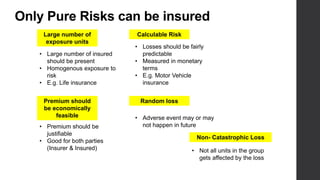
Only Pure Risks can be insured
Large number of
exposure units
Calculable Risk
Random lossPremium should
be economically
feasible
• Large number of insured
should be present
• Homogenous exposure to
risk
• E.g. Life insurance
• Losses should be fairly
predictable
• Measured in monetary
terms
• E.g. Motor Vehicle
insurance
• Premium should be
justifiable
• Good for both parties
(Insurer & Insured)
• Adverse event may or may
not happen in future
Non- Catastrophic Loss
• Not all units in the group
gets affected by the loss
Legal
Aspects
in
Insurance
Principles
of
Insurance
Torts &
Crimes
Insurance
as a
Contract
Laws
relating to
Insurance
Legal aspects of Insurance
PRINCIPLES OF INSURANCE
1. Uberrimae fidei - Utmost Good Faith
 Insurer, Insured are bound to disclose all material facts relating to the risk covered
 It applies to all types of insurance contract
 E.g. Life: Details of heart disease
2. Insurable Interest
 Legal right to insure arising out of financial relationship between insured and subject
matter
 The insured must be benefitted from its safety
 E.g. A has a car insured and sold to B. If insurance not transferred > Cease
3. Principle of indemnity
 On happening of an event, insurer will put insured in the same monetary position
 Insured shall get neither more nor less than the actual amount of loss sustained
4. Contribution
 The insured cannot claim same loss from more than 1 insurer
 Each policy pays only ratable portion
 Three conditions (Cover same peril, Cover same subject, Behalf of same insured)
Legal aspects of Insurance
PRINCIPLES OF INSURANCE
5. Principle of Subrogation
 Stepping in the shoes of others
 After paying claims, insurer will have the rights against third parties
6. Mitigation of loss
 Even though insured has an insurance contract;
 He should give in efforts to reduce the loss
 E.g. During a fire outbreak, don’t sit and watch it as it is insured…
7. Causa Proxima
 The causes for the adverse event would be a chain of events
 The dominant cause would be the proximate cause
 If the proximate cause is insured, insurer > insured and vice verse
 E.g. You have insured your stock against fire, it was kept outside and rained. The
stock was damaged. Will u be able to claim insurance?
Legal aspects of Insurance
TORTS & CRIME
1. Torts: It is a private wrong. It occurs when a someone acts in a way that an
individual’s peace of mind and rights are jeopardized.
1. E.g. : Negligence, Slander (Talking), Libel (Written)
2. Crimes: They are public wrong. It include the following:
1. Rebating – Passing commissions by agent to prospective insured to purchase
insurance.
2. Twisting – Inducing clients to terminate existing insurance policy to buy new
3. Unfair Discrimination – Charging different rates by the same insurance
company to similar risk class
4. Filing of false claims – To collect money from insurance even no loss or less
loss by false estimates
5. Asson – Felonious burning of property of another to defraud an insurance
company
Legal aspects of Insurance
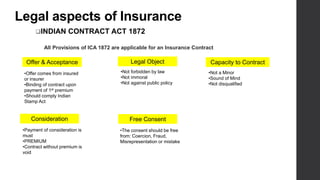
INDIAN CONTRACT ACT 1872
All Provisions of ICA 1872 are applicable for an Insurance Contract
Offer & Acceptance Legal Object Capacity to Contract
Consideration Free Consent
•Offer comes from insured
or insurer
•Binding of contract upon
payment of 1st premium
•Should comply Indian
Stamp Act
•Not forbidden by law
•Not immoral
•Not against public policy
•Not a Minor
•Sound of Mind
•Not disqualified
•Payment of consideration is
must
•PREMIUM
•Contract without premium is
void
•The consent should be free
from: Coercion, Fraud,
Misrepresentation or mistake
Legal aspects of Insurance
INDIAN CONTRACT ACT 1872
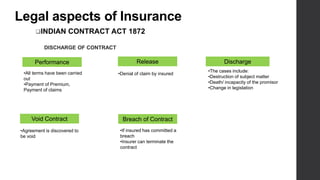
DISCHARGE OF CONTRACT
Performance Release Discharge
Void Contract Breach of Contract
•All terms have been carried
out
•Payment of Premium,
Payment of claims
•Denial of claim by insured
•The cases include:
•Destruction of subject matter
•Death/ incapacity of the promisor
•Change in legislation
•Agreement is discovered to
be void
•If insured has committed a
breach
•Insurer can terminate the
contract
Legal aspects of Insurance
LAWS RELATING TO INSURANCE
1. Insurance Act 1938
2. IRDA Act 1999
3. LIC Act 1956
4. General Insurance Business Act 1972
5. Motor Vehicles Act 1988
6. Marine Insurance Act 1963
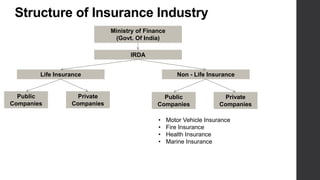
Structure of Insurance Industry
Ministry of Finance
(Govt. Of India)
IRDA
Life Insurance Non - Life Insurance
Public
Companies
Private
Companies
Public
Companies
Private
Companies
• Motor Vehicle Insurance
• Fire Insurance
• Health Insurance
• Marine Insurance
Property and Liability Coverage
• What is Coverage Limit?
• The amount of money that the insurance company pays for each
kind of loss.
PROPERTY COVERAGE LIABILITY COVERAGE
• Coverage for your STUFF if a loss
happens to it
• E.g. CAR, HOME, DINING TABLE,
JEWELLERY etc.
• Coverage for other people for loss
because of you
• E.g. Your car hits other one, Your dog
bites the neighbor etc.
• Paying an injured person his medical
bills
• Most common liability claim - Damage
done to other person’s car
Property and Liability Coverage
• Property insurance protects business from the loss of assets
due to fires, vandalism, theft, and equipment breakdown.
• The insurance pays to replace or rebuild property destroyed by
a covered loss
• Liability insurance, is a critical coverage every business needs
to purchase to protect their finances, public image, and well-
being in these instances
 Medical payments when a third-party is injured as a result of your negligence.
 Property replacement costs to replace damaged property that doesn’t belong to you.
 Settlement expenses if you are found guilty of libel, slander, or advertising theft
PropertyLiability
Classification of Policies- Annuity-
Pension Fund- ULIP
• What is an Insurance Policy?
• It is a document that contains the agreement that an
insurance company and a person have made.
• In insurance, the insurance policy is a contract between the
insurer and the insured, known as the policyholder, which
determines the claims which the insurer is legally required to pay
Classification of Policies
Policies
Whole Life
Policy
Endowment
Policy
Term
Insurance
Policy
Annuity Policy
Pension Plan
Policy
ULIP
Classification of Policies
1. Whole Life Policy
 A person is insured for whole life.
 The insurance company cannot pay any money to the insured until he is alive.
 The premium for such policy is very low.
 Money is payable only after the death of the insured person to his legal heir or
his nominee.
 This policy is more beneficial for the family of the deceased, as it provides
financial assistance to the family after the death of the insured person
2. Endowment Policy
 Insurance is taken for a specific time in such policies.
 Sum assured along with the bonus is given on his death to the dependent of
the family or on the expiry of the particular time, the insured get the specific
sum along with bonus.
 It protects the family of the dead person or provides old-age pension to the
insured
Classification of Policies
3. Term Insurance Policy
 The period of such policies is specific.
 The premium of this policy is the lowest among all the insurance schemes.
 Throughout the term of the policy, the premium is fix, and it does not change
 In the term life insurance agreement, dependents will receive the specified
benefited amount in case of untimely death of the person
 If insured survives, nothing is received
Classification of Policies
4. Annuity Policy
 The insured has to pay the premium of the policy in installments or in the lump
sum for a specific period of time.
 The insured will receive back a specific sum periodically from a mentioned
date onwards, either for life or for the fixed number of years.
 It helps people who have some extra money and want to use the same after
their retirement (Provides 10 to 12.5 % returns)
 Annuities are of the following types:
Immediate
• Payment begin within
1 year of purchase
• Income will be for
lifetime or specified
no. of years
• Invest lump sum
premium
Deferred
• Payment begin after
deferment period
• Single purchase or
several purchase
• Invest regularly
• Amt. accumulated
Fixed
• Assures minimum rate
of return
• E.g. Jeevan Dhara
Variable
• Variable returns based
on performance of
portfolio
Payout Options in Annuity
Single Life Annuity
• Annuitant receives
income payment for
the rest of his life
Single life with period certain
• Annuitant receives income
payment for the rest of his life
• If annuitant dies, beneficiary
receives till the remainder
period
Joint & Survivor
• Annuitant and joint
annuitant receives
income payment for the
rest of their life
• If annuitant dies, joint
annuitant receives till he
dies
Joint and survivor with period certain
• Annuitant and joint annuitant receives
income payment for the rest of their
life
• If annuitant dies, joint annuitant
receives till he dies
• If JA dies, beneficiary gets till the
remainder period
Benefits of Annuity Plan
 Accumulate long term savings
 Maximize income in retirement
 Life time source of income
 Tax benefits
 Benefits the beneficiary on the death on annuitant
Classification of Policies
5. Pension Plan Policy
 This policy is different from all other forms of life insurance policies.
 As it does not provide any kind of life cover, but it offers a guaranteed income
after certain period of time or life time.
 These insurance policies are taken to provide some financial support after
retirement.
6. ULIP - Unit Linked insurance policy
 The private companies introduced ULIPs to merge the profits of life insurance
policies with mutual funds.
 Specific amount of premium is invested in listed companies or bonds, funds
and remaining amount is used in fund management expense and life
insurance to provide balance.
 Its benefits include:
Long term wealth creation
A concept of insurance + Investment
Tax benefits
BASIS
Whole Life
Policy
Endowment
Policy
Term
Insurance
Annuity
Policy
Pension
Fund
ULIP
Duration Entire life Specific Specific Specific Specific Specific
Coverage Family
Family/
Insured
Family
Family/
Insured
No
Family/
Insured
Beneficiary Yes Yes Yes Yes Yes Yes
Premium Less Higher Very Less
Single/
Multiple
(high)
Single/
Multiple
(high)
High
(Charges also
high)
Payout
Only if death
occurs
Sum assured
+ Bonus
Only if death
occurs
Annual,
Month, Qtr.
Annual,
Month, Qtr.
Death/
Duration
lapse
Investment/
Savings
Nil Savings Nil Savings Savings Investment
Concept of Reinsurance
• We’ll be learning:
Reinsuran
ce
Meaning
ObjectivesTechniques
Reinsurance
“Reinsurance is a transaction in which:
 One insurer agrees, for a premium
 to indemnify another insurer
 against all or part of the loss that insurer may sustain under its
policy or policies of insurance”
Purchaser = CEDING INSURER Seller = ASSUMING INSURER
Basically means: INSURANCE OF INSURANCE COMPANIES
Basic Objective: Spread the risk to reduce financial burden
How this works?
Reinsurance - Objectives
• To limit liability on specific risks:
 Helps to stabilize losses on individual risks as well as on accumulated
losses under many policies in a specific period
 E.g. Flood Affected vehicles, Huge fire etc.
• Stabilization:
 Helps to reduce swings in profit and loss for the ceding company
 E.g. Risks cannot be calculated on an accurate basis
• Catastrophe Protection:
 Disruptive effects of such risks can be avoided which depends upon
the type and size of the company purchasing reinsurance
 E.g. Loss from a single event, Single event affecting many
• Increased Capacity:
 Reinsurance can induce more risk taking by the ceding company due
to protection
Reinsurance - Techniques
Techniques of
Reinsurance
Reinsurance
Treaties
Facultative
Reinsurance
1. Reinsurance Treaties
• Comprehensive coverage bought directly/ Indirectly
• It is to protect all or a part of their portfolio for a given class of business
• The reinsurer cannot decline a risk coming under the treaty
• Both parties are obliged to perform their duties
NON PROPORTIONAL TREATY PROPORTIONAL TREATY
• Reinsurance cover begins once the
amount of claim exceeds the
predetermined amount
• E.g. NPT REIN for Rs. 400 crores in
excess of Rs. 100 crores (400 Cr. will
be paid by the reinsurer
• Premium and losses are shared by
both proportionally
• E.g. PT REIN for 40% of its portfolio
has a claim amount of Rs. 100 crores,
the reinsurer is liable to pay Rs. 40
crores (100-60)
1. Facultative Reinsurance
• A case by case method (Individual policy)
• The ceding company insures risks for amount in excess of its capacity
• The reinsurer assess each risk individually after consulting the ceding
company and makes the terms of policy
• It covers major industrial and civil engineering risks
• The reinsurer can accept or reject the business offered by the ceding
company
• To provide the coverage, the primary insurer submits to the risk to the
reinsurer to facilitate (allow) the coverage. If the reinsurer agrees,
coverage is written and a facultative reinsurance contract is created
• E.g. : One commercial fire policy, One location of a huge plant etc.
Treaty V/S Facultative
Basis Treaty Facultative
Coverage Protects a large block of Business Covers individual risks
Offer and
Acceptance
The reinsurer does not have a right
to reject claim
The reinsurer may or may not
accept the claim
Document Basically a treaty/ contract Duly signed certificate
Conditions Pre - Agreed Based on the certificate
Applicability
XYZ reinsures its automobile
policy claims of 40%
ABC reinsures one of its Fire policy
according to their terms and
conditions
Who Provides Reinsurance?
• Professional Reinsurers
 General Re (Berkshire Hathaway)
• Reinsurance department of primary insurers
 Travelers, CIGNA
Who Provides Reinsurance in India?
General Insurance Corporation of India
As a sole reinsurer in the domestic reinsurance market, GIC Re provides
reinsurance to the direct general insurance companies in the Indian
market.
THANK YOU

Insurance business

  • 1.
    Insurance Business CO2: To examinethe nature of insurance contract and types of policies
  • 2.
    You will learnthese  Concept of insurance, Need for insurance, Legal aspects of insurance contracts  Objectives of insurance contract  Structure of insurance industry  Property & liability coverage  Classification of Policies- Annuity- Pension Fund- ULIP  Institutions for insurance & reinsurance
  • 3.
    What is Insurance •Insurance is defined as a contract, which is called a policy, in which an individual or organisation receives financial protection and reimbursement of damages from the insurer or the insurance company. • “It is an arrangement by which a company or the state undertakes to provide a guarantee of compensation for:  specified loss,  damage,  illness, or death in return for payment of a specified premium”
  • 4.
    Features of Insurance 1.A large number of insured persons  To reduce the burden of premium, large number of insured will be there 2. A contract  Insurance is a contract between insurer & insured 3. Sharing Risk  Insurance is an event that is a person to share a risk  e.g. Death of a person, Fire breakout 4. Payment on contingency  Most of the insurance policy will be payable only on contingency  E.g. Medical insurance 5. Non- catastrophic loss  Not all units in the homogenous group suffer adverse event 6. Payment of Premium  Insured will pay a premium to transfer the risk to the insured
  • 5.
    Need for Insurance 1.To minimize risk  Prone to various risk  It leads to its reduction  E.g. Life insurance, fire insurance, Health insurance etc. 2. To maintain the stability of assets  Taking insurance can maintain the value of assets/ life 3. Protection  To protect family (individual), Stakeholders (Company) 4. Confidence
  • 6.
    Objectives of Insurance 1.To minimize risk 2. To develop the economy a) To mobilize scattered resources: They are pooled from the insured and invested in projects b) Creation of Liquidity: Money behalf of insurance premium is invested in private as well as public projects creates liquidity c) Economies of scale: The bulk funds reduce overall finance cost which leads to economic development 3. To make good the loss  To provide money for the loss 4. To ensure well being of the stakeholders  Life Insurance: The bereaved family members  Corporate Insurance: Owners and other stake holders
  • 7.
    Objectives of Insurance 5.To reimburse losses 6. To reduce tension and fear 7. To act as an investment avenue (ULIP) 8. To reduce the cost of business operations
  • 8.
    Only Pure Riskscan be insured Large number of exposure units Calculable Risk Random lossPremium should be economically feasible • Large number of insured should be present • Homogenous exposure to risk • E.g. Life insurance • Losses should be fairly predictable • Measured in monetary terms • E.g. Motor Vehicle insurance • Premium should be justifiable • Good for both parties (Insurer & Insured) • Adverse event may or may not happen in future Non- Catastrophic Loss • Not all units in the group gets affected by the loss
  • 9.
  • 10.
    Legal aspects ofInsurance PRINCIPLES OF INSURANCE 1. Uberrimae fidei - Utmost Good Faith  Insurer, Insured are bound to disclose all material facts relating to the risk covered  It applies to all types of insurance contract  E.g. Life: Details of heart disease 2. Insurable Interest  Legal right to insure arising out of financial relationship between insured and subject matter  The insured must be benefitted from its safety  E.g. A has a car insured and sold to B. If insurance not transferred > Cease 3. Principle of indemnity  On happening of an event, insurer will put insured in the same monetary position  Insured shall get neither more nor less than the actual amount of loss sustained 4. Contribution  The insured cannot claim same loss from more than 1 insurer  Each policy pays only ratable portion  Three conditions (Cover same peril, Cover same subject, Behalf of same insured)
  • 11.
    Legal aspects ofInsurance PRINCIPLES OF INSURANCE 5. Principle of Subrogation  Stepping in the shoes of others  After paying claims, insurer will have the rights against third parties 6. Mitigation of loss  Even though insured has an insurance contract;  He should give in efforts to reduce the loss  E.g. During a fire outbreak, don’t sit and watch it as it is insured… 7. Causa Proxima  The causes for the adverse event would be a chain of events  The dominant cause would be the proximate cause  If the proximate cause is insured, insurer > insured and vice verse  E.g. You have insured your stock against fire, it was kept outside and rained. The stock was damaged. Will u be able to claim insurance?
  • 12.
    Legal aspects ofInsurance TORTS & CRIME 1. Torts: It is a private wrong. It occurs when a someone acts in a way that an individual’s peace of mind and rights are jeopardized. 1. E.g. : Negligence, Slander (Talking), Libel (Written) 2. Crimes: They are public wrong. It include the following: 1. Rebating – Passing commissions by agent to prospective insured to purchase insurance. 2. Twisting – Inducing clients to terminate existing insurance policy to buy new 3. Unfair Discrimination – Charging different rates by the same insurance company to similar risk class 4. Filing of false claims – To collect money from insurance even no loss or less loss by false estimates 5. Asson – Felonious burning of property of another to defraud an insurance company
  • 13.
    Legal aspects ofInsurance INDIAN CONTRACT ACT 1872 All Provisions of ICA 1872 are applicable for an Insurance Contract Offer & Acceptance Legal Object Capacity to Contract Consideration Free Consent •Offer comes from insured or insurer •Binding of contract upon payment of 1st premium •Should comply Indian Stamp Act •Not forbidden by law •Not immoral •Not against public policy •Not a Minor •Sound of Mind •Not disqualified •Payment of consideration is must •PREMIUM •Contract without premium is void •The consent should be free from: Coercion, Fraud, Misrepresentation or mistake
  • 14.
    Legal aspects ofInsurance INDIAN CONTRACT ACT 1872 DISCHARGE OF CONTRACT Performance Release Discharge Void Contract Breach of Contract •All terms have been carried out •Payment of Premium, Payment of claims •Denial of claim by insured •The cases include: •Destruction of subject matter •Death/ incapacity of the promisor •Change in legislation •Agreement is discovered to be void •If insured has committed a breach •Insurer can terminate the contract
  • 15.
    Legal aspects ofInsurance LAWS RELATING TO INSURANCE 1. Insurance Act 1938 2. IRDA Act 1999 3. LIC Act 1956 4. General Insurance Business Act 1972 5. Motor Vehicles Act 1988 6. Marine Insurance Act 1963
  • 16.
    Structure of InsuranceIndustry Ministry of Finance (Govt. Of India) IRDA Life Insurance Non - Life Insurance Public Companies Private Companies Public Companies Private Companies • Motor Vehicle Insurance • Fire Insurance • Health Insurance • Marine Insurance
  • 17.
    Property and LiabilityCoverage • What is Coverage Limit? • The amount of money that the insurance company pays for each kind of loss. PROPERTY COVERAGE LIABILITY COVERAGE • Coverage for your STUFF if a loss happens to it • E.g. CAR, HOME, DINING TABLE, JEWELLERY etc. • Coverage for other people for loss because of you • E.g. Your car hits other one, Your dog bites the neighbor etc. • Paying an injured person his medical bills • Most common liability claim - Damage done to other person’s car
  • 18.
    Property and LiabilityCoverage • Property insurance protects business from the loss of assets due to fires, vandalism, theft, and equipment breakdown. • The insurance pays to replace or rebuild property destroyed by a covered loss • Liability insurance, is a critical coverage every business needs to purchase to protect their finances, public image, and well- being in these instances  Medical payments when a third-party is injured as a result of your negligence.  Property replacement costs to replace damaged property that doesn’t belong to you.  Settlement expenses if you are found guilty of libel, slander, or advertising theft PropertyLiability
  • 19.
    Classification of Policies-Annuity- Pension Fund- ULIP • What is an Insurance Policy? • It is a document that contains the agreement that an insurance company and a person have made. • In insurance, the insurance policy is a contract between the insurer and the insured, known as the policyholder, which determines the claims which the insurer is legally required to pay
  • 20.
    Classification of Policies Policies WholeLife Policy Endowment Policy Term Insurance Policy Annuity Policy Pension Plan Policy ULIP
  • 21.
    Classification of Policies 1.Whole Life Policy  A person is insured for whole life.  The insurance company cannot pay any money to the insured until he is alive.  The premium for such policy is very low.  Money is payable only after the death of the insured person to his legal heir or his nominee.  This policy is more beneficial for the family of the deceased, as it provides financial assistance to the family after the death of the insured person 2. Endowment Policy  Insurance is taken for a specific time in such policies.  Sum assured along with the bonus is given on his death to the dependent of the family or on the expiry of the particular time, the insured get the specific sum along with bonus.  It protects the family of the dead person or provides old-age pension to the insured
  • 22.
    Classification of Policies 3.Term Insurance Policy  The period of such policies is specific.  The premium of this policy is the lowest among all the insurance schemes.  Throughout the term of the policy, the premium is fix, and it does not change  In the term life insurance agreement, dependents will receive the specified benefited amount in case of untimely death of the person  If insured survives, nothing is received
  • 23.
    Classification of Policies 4.Annuity Policy  The insured has to pay the premium of the policy in installments or in the lump sum for a specific period of time.  The insured will receive back a specific sum periodically from a mentioned date onwards, either for life or for the fixed number of years.  It helps people who have some extra money and want to use the same after their retirement (Provides 10 to 12.5 % returns)  Annuities are of the following types: Immediate • Payment begin within 1 year of purchase • Income will be for lifetime or specified no. of years • Invest lump sum premium Deferred • Payment begin after deferment period • Single purchase or several purchase • Invest regularly • Amt. accumulated Fixed • Assures minimum rate of return • E.g. Jeevan Dhara Variable • Variable returns based on performance of portfolio
  • 24.
    Payout Options inAnnuity Single Life Annuity • Annuitant receives income payment for the rest of his life Single life with period certain • Annuitant receives income payment for the rest of his life • If annuitant dies, beneficiary receives till the remainder period Joint & Survivor • Annuitant and joint annuitant receives income payment for the rest of their life • If annuitant dies, joint annuitant receives till he dies Joint and survivor with period certain • Annuitant and joint annuitant receives income payment for the rest of their life • If annuitant dies, joint annuitant receives till he dies • If JA dies, beneficiary gets till the remainder period
  • 25.
    Benefits of AnnuityPlan  Accumulate long term savings  Maximize income in retirement  Life time source of income  Tax benefits  Benefits the beneficiary on the death on annuitant
  • 26.
    Classification of Policies 5.Pension Plan Policy  This policy is different from all other forms of life insurance policies.  As it does not provide any kind of life cover, but it offers a guaranteed income after certain period of time or life time.  These insurance policies are taken to provide some financial support after retirement. 6. ULIP - Unit Linked insurance policy  The private companies introduced ULIPs to merge the profits of life insurance policies with mutual funds.  Specific amount of premium is invested in listed companies or bonds, funds and remaining amount is used in fund management expense and life insurance to provide balance.  Its benefits include: Long term wealth creation A concept of insurance + Investment Tax benefits
  • 27.
    BASIS Whole Life Policy Endowment Policy Term Insurance Annuity Policy Pension Fund ULIP Duration Entirelife Specific Specific Specific Specific Specific Coverage Family Family/ Insured Family Family/ Insured No Family/ Insured Beneficiary Yes Yes Yes Yes Yes Yes Premium Less Higher Very Less Single/ Multiple (high) Single/ Multiple (high) High (Charges also high) Payout Only if death occurs Sum assured + Bonus Only if death occurs Annual, Month, Qtr. Annual, Month, Qtr. Death/ Duration lapse Investment/ Savings Nil Savings Nil Savings Savings Investment
  • 28.
    Concept of Reinsurance •We’ll be learning: Reinsuran ce Meaning ObjectivesTechniques
  • 29.
    Reinsurance “Reinsurance is atransaction in which:  One insurer agrees, for a premium  to indemnify another insurer  against all or part of the loss that insurer may sustain under its policy or policies of insurance” Purchaser = CEDING INSURER Seller = ASSUMING INSURER Basically means: INSURANCE OF INSURANCE COMPANIES Basic Objective: Spread the risk to reduce financial burden
  • 30.
  • 31.
    Reinsurance - Objectives •To limit liability on specific risks:  Helps to stabilize losses on individual risks as well as on accumulated losses under many policies in a specific period  E.g. Flood Affected vehicles, Huge fire etc. • Stabilization:  Helps to reduce swings in profit and loss for the ceding company  E.g. Risks cannot be calculated on an accurate basis • Catastrophe Protection:  Disruptive effects of such risks can be avoided which depends upon the type and size of the company purchasing reinsurance  E.g. Loss from a single event, Single event affecting many • Increased Capacity:  Reinsurance can induce more risk taking by the ceding company due to protection
  • 32.
    Reinsurance - Techniques Techniquesof Reinsurance Reinsurance Treaties Facultative Reinsurance
  • 33.
    1. Reinsurance Treaties •Comprehensive coverage bought directly/ Indirectly • It is to protect all or a part of their portfolio for a given class of business • The reinsurer cannot decline a risk coming under the treaty • Both parties are obliged to perform their duties NON PROPORTIONAL TREATY PROPORTIONAL TREATY • Reinsurance cover begins once the amount of claim exceeds the predetermined amount • E.g. NPT REIN for Rs. 400 crores in excess of Rs. 100 crores (400 Cr. will be paid by the reinsurer • Premium and losses are shared by both proportionally • E.g. PT REIN for 40% of its portfolio has a claim amount of Rs. 100 crores, the reinsurer is liable to pay Rs. 40 crores (100-60)
  • 34.
    1. Facultative Reinsurance •A case by case method (Individual policy) • The ceding company insures risks for amount in excess of its capacity • The reinsurer assess each risk individually after consulting the ceding company and makes the terms of policy • It covers major industrial and civil engineering risks • The reinsurer can accept or reject the business offered by the ceding company • To provide the coverage, the primary insurer submits to the risk to the reinsurer to facilitate (allow) the coverage. If the reinsurer agrees, coverage is written and a facultative reinsurance contract is created • E.g. : One commercial fire policy, One location of a huge plant etc.
  • 35.
    Treaty V/S Facultative BasisTreaty Facultative Coverage Protects a large block of Business Covers individual risks Offer and Acceptance The reinsurer does not have a right to reject claim The reinsurer may or may not accept the claim Document Basically a treaty/ contract Duly signed certificate Conditions Pre - Agreed Based on the certificate Applicability XYZ reinsures its automobile policy claims of 40% ABC reinsures one of its Fire policy according to their terms and conditions
  • 36.
    Who Provides Reinsurance? •Professional Reinsurers  General Re (Berkshire Hathaway) • Reinsurance department of primary insurers  Travelers, CIGNA
  • 37.
    Who Provides Reinsurancein India? General Insurance Corporation of India As a sole reinsurer in the domestic reinsurance market, GIC Re provides reinsurance to the direct general insurance companies in the Indian market.
  • 38.