Law of Insurance
Laws(4011)
Genetu G.(LLB,LLM)
Hawassa University
Introduction to the Law of Insurance
The Law of Insurance is an area of financial Law governing
the nature and function of insurance.
It basically deals with
 the definition and types of insurance,
 the requirements for the formation of a valid contract of
insurance,
 the requirements for the establishment and operation of
an insurance business,
 the basic principles governing insurance contracts and
 the rights and duties of the parties to the insurance
contract.
CHAPTER ONE –Insurance in general
This Chapter deals with:-
 The notion of Insurance
 The Development of Insurance System
 Nature of Contracts of Insurance and insurance policy
 Distinguishing Characteristics of Insurance
 The Requirements to Carry on Insurance Business
 Parties to contract of insurance;
 General obligations and rights of the parties
 Significance of Insurance
 Types of insurance
 Reinsurance
The notion of Insurance
 Insurance may be described as a social device to
reduce or eliminate risk of life and property.
 Under the plan of insurance, a large number of
people associate themselves by sharing risk through
contributing small premiums attached to individuals.
 The risk can be insured against Life, Fire, Marine,
MotorVehicle, & burglary.
 Any risk contingent upon these may be insured
against at a premium commensurate with the risk
involved.
Cont.
 Insurance is a contract; the general principles of
law of contract are applicable to the law of
Insurance.
 Insurance is a contract whereby, in return for the
payment of premium by the insured, the insurers
make good the losses suffered by the insured as a
result of the occurrence of unforeseen events.
 An insurer is a company selling the insurance, an
insured or policyholder is the person or entity buying
the insurance which is instrumental in the growth of
Capital Market as well as the Nation’s economy.
Definition of Insurance
 There is no universal agreement on the definition of the
term ‘insurance’ though most definitions have common
elements.
 Most of the definitions are based on two important schools
of thoughts called transfer school and pooling school.
 According to transfer school, insurance is a device
through which one party called insured transfer
uncertain particular risk to another party called
insurer(upon payment of premium). It is risk transfer
economic device.
Definition Cont.
 From the point view of an individual, it may be defined as a risk
transfer mechanism or an economic device whereby a
person, called the insured transfers a risk of a possible financial
loss resulting from unforeseeable events affecting property, life or
body to a person called the insurer for consideration. E.g if the
person purchases a motor insurance policy covering these risks
from an insurer, it means that he transferred this possible financial
loss to the insurer.
 From the point of view of the insurer, insurance may be defined as
a mechanism through which a risk is distributed among the group
of persons who are exposed to the same type of risk, i.e., persons
who bear the risk of suffering a financial loss as a result of events
affecting property, life or body.
Definition Cont.
 On the other hand, according to pooling school, the essence of
insurance lies in the elimination of uncertainty or risk of
loss for the individual through the combination of large
number of similarly exposed individuals.
 This is to say insurance operates on the principle of pooling
risks where the lucky ones who do not suffer loss help the
unlucky ones who suffer loss during a defined insurance
period.
 Accordingly, insurance not only facilitates economic
transactions through risk transfer and indemnification but it
also promotes financial intermediation.
Definition Cont.
 Moreover, insurance is the means by which risks of loss or
damage can be shifted to another party (the insurers) on
payment of a charge known as premium.
 The party whose risk is shifted to the insurer is known as the
insured. Obviously insurer is generally an organization
(Insurance Company).
 So, insurance is a contract between the insurer and insured
whereby the insurer undertakes to pay the insured a fixed
amount on the happening of a certain event (like at a certain age
or on death.
 Finally, the definition of insurance comprises two key elements:
transfer of risk and spread of risk through insurance companies.
This is the way how insurance is defined by different scholars.
Definition Cont.
 Form the definitions provided above, we can understand that
insurance is a cooperative economic device to spread the
loss caused by a particular risk over a number of persons who are
exposed to it and who agree to insure themselves against that
risk.
 This is always true in the case of property and liability insurance
which cover contingencies and given for a short period of time,
usually a period of one year, but does not so fully apply to
insurance of persons particularly life insurance(Art 692) in
which the policy usually becomes a claim ultimately.
Definition Cont.
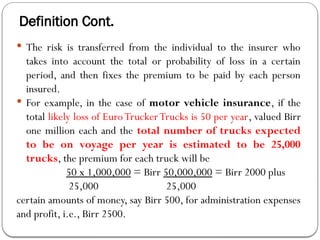
 The risk is transferred from the individual to the insurer who
takes into account the total or probability of loss in a certain
period, and then fixes the premium to be paid by each person
insured.
 For example, in the case of motor vehicle insurance, if the
total likely loss of EuroTruckerTrucks is 50 per year, valued Birr
one million each and the total number of trucks expected
to be on voyage per year is estimated to be 25,000
trucks, the premium for each truck will be
50 x 1,000,000 = Birr 50,000,000 = Birr 2000 plus
25,000 25,000
certain amounts of money, say Birr 500, for administration expenses
and profit, i.e., Birr 2500.
Definition Cont.
 Thus, it can be seen that insurance is a device by which an insured
person can protect himself from heavy loss likely to be caused by an
uncertain event by paying a comparatively much smaller sum of
money as premium.
 Insurance does not and cannot prevent loss of property,
incurring civil liability, death, or injury or illness, rather it provides
financial compensation for the effects of misfortune.
 In other words, we can say that insurance does not protect the
insured property from loss or damage, or the insured from
incurring civil liability or the insured person from death or
injury or illness, but provides a financial compensation to the
insured or the beneficiary who has suffered pecuniary losses as a
result of loss or damage to property, or because he has incurred a civil
liability or illness or death of the insured.
The Development of Insurance System
The Development of Insurance Systems:General Overview
 In some sense, one can say that insurance appeared
simultaneously with the appearance of human
society.
 There are two types of economies in human societies: money
economies (with markets, money, financial instruments and
so on) and non-money or natural economies (without money,
markets, financial instruments and so on).
 The second type is a more ancient form than the first.
 In such an economy and community, we can see insurance in
the form of people helping each other.
The Development Cont’d….
 For example, if a house burns down, members of the
community help build a new one. If the same thing happen to
one’s neighbor, the other neighbors must help, otherwise,
neighbors will not receive help in the future.
 This type of insurance has survived to the present day in
some countries where modern money economy with its
financial instruments is not widespread.
 Turning to insurance in the modern sense (i.e., insurance in a
modern money economy, in which insurance is part of the
financial sphere), early methods of transferring or distributing
risk were practiced by Chinese and Babylonian traders as
long ago as the 3rd
and 2nd
millennia BC, respectively.
The Development Cont’d….
 The Greeks and Romans introduced the origins of health and life
insurance in 600 AD when they organized guilds called “benevolent
societies” which cared for the families and paid funeral expenses of
members upon death.
 Guilds in the Middle Ages served a similar purpose. The Talmud
deals with several aspects of insuring goods.
 Before insurance was established in the late 17th
century,
friendly societies existed in England, in which people donated
amounts of money to a general sum that could be used for
emergencies.”
 Insurance as we know it today can be traced to the Great Fire of
London, which in 1666 devoured 13,200 houses.
The Development Cont’d…….
 In the aftermath of this disaster, Nicholas Barbon opened an office to
insure buildings.
 In 1680, he established England’s first fire insurance company, “The Fire
Office,” to insure brick and frame homes.
 The first insurance company in the United States underwrote fire insurance
and was formed in Charles Town (modern-day Charleston), South
Carolina, in 1732.
 Benjamin Franklin helped to popularize and make standard the practice of
insurance, particularly against fire in the form of perpetual insurance.
 In 1752, he founded the Philadelphia Contributionship for the
Insurance of Houses from Loss by Fire. Franklin’s company was the first to
make contributions toward fire prevention.
 Not only did his company warn against certain fire hazards, it refused to
insure certain buildings where the risk of fire was too great, such as in all
wooden houses
The Birth and Development of insurance in Ethiopia
• Bank of Abysinia (Habesha Bank) started rendering what could be called
modern insurance service for the first time in Ethiopia in 1905
as an agent for a foreign insurance company. (Mr. Muzinger, an Austrian
citizen, opened a full-fledged insurance branch in Addis Ababa as an agent
for Balois Fire Insurance Company.)
• During the Italian occupation only Italian companies were allowed to
operate in Addis Ababa and other central regions of the country and in
Eritrea.
• AfterWorldWar II several British and other overseas companies provided
insurance service until 1950.
• In 1951, the Imperial Insurance Company was established by some
enlightened Ethiopians
The Birth Cont’d…..
 This development encouraged Ethiopians and consequently some
18 companies were established in 1954 with branches and agents
inAddis Abab,Asmara, Dire Dawa, Massawa,Assab and Dessie.
 In 1970, the first proclamation on licensing and supervision of
insurance services, proclamation No.281/70 was enacted.
 An office for the supervision of insurance business was established
under the Ministry of Trade and Industry. The office
licensed only 15 new companies.
 The following year two insurance companies were closed and
only 13 remained; but these 13 lasted until 1974, the coming of
the Dergue regime.
The Birth Cont’d…..
 On January 1, 1975 all these 13 insurance
companies were nationalized in accordance with the
proclamation of the provisional military government.
 The Government merged the 13 companies and, by
proclamation 26/1975, established the Ethiopian
Insurance Corporation as a monopoly in
insurance business.
 The Ethiopian Insurance Corporation functioned as a
monopoly for nearly two decades until 1994.
The Birth Cont’d…..
 Therefore the Ethiopian Insurance Corporation was formed by a
merger of 13 insurance companies.
 Thus, from 1975 to 1994 there were four state owned banks
and one state owned insurance company, i.e., the National Bank
of Ethiopia (The Central Bank), the Commercial Bank of
Ethiopia, the Housing and Savings Bank, the Development Bank of
Ethiopia and the Ethiopian Insurance Corporation.
 After the overthrow of the Dergue regime by the EPRDF, the
Transitional Government of Ethiopia was established and
the New Economic Policy for the period of transition was issued.
The Birth Cont’d…..
 This new economic policy replaced a centrally planned
and market oriented economic system which ushered
in the private sector.
 Several private companies were formed during the early
1990s, one of which is OdA S.C, which conceived the idea
of establishing a private bank and private insurance company
in anticipation of a law which will open up the financial
sector to private investors.
Nature of a contract of Insurance and
Insurance policy

A contract of insurance is a contract whereby one party
undertakes, in return for a consideration called a premium, to
pay to the other party a sum of money on the happening of a
certain event (death or attainment of a certain age, or injury) or
to indemnify the other party against a financial loss arising from
the loss or damage to property or from incurring civil liability.

The party which promises to pay a certain amount of money to,
or to indemnify, the other party is called the insurer (sometimes
called the assurer- in cases of insurance of persons and the under
writer in cases of marine insurance and the party to whom such
protection is given is called the inured (or the assured).
Nature Cont’d…..
 The document containing the terms and conditions of the
contract of insurance is called the policy, and the insured
is therefore, also referred to as a policyholder.
 Insurance policy means a document evidencing a
contract of insurance whereby an insurer undertakes,
against payment of premiums, to pay indemnity or the benefit
specified in the policy to the insured where condition
specified in the policy fulfilled or risk materialized, and
includes a certificate, interim receipt, renewal receipt,
or any other document evidencing a contract of
insurance (Art 2(20) Proc.No.746/2012.
Nature Cont’d…..
A contract of insurance is a type of contingent or conditional
contract.
As contingent or conditional contract is a contract to do or
not to do something, if some event, collateral to such contract,
does or does not happen.
Accordingly, as the obligation of the insurer/assurer to pay
compensation or the agreed amount to the insured or the
beneficiary is dependent upon materialization of the risk
or risks specified in the policy.
For instance:-I Insurance Company agrees to pay Birr 250,000 in
exchange for B paying Birr 5000 as premium, if B's house is
destroyed by fire; there will be contingent contract, the
performance of which depends upon the destruction of the house
by fire.
Nature Cont’d…..
 Although a contract of insurance resembles, to a certain extent, a
wagering or gambling agreement whereby the insurer gambles
with the insured that his house will not be burnt, it is a legal and
enforceable contract with important economic and social
purposes.
 Note: Wagering or gambling agreements are considered void in
almost all legal systems.
For instance:- Art 713(2) of the Commercial Code of Ethiopia
provides that games and gambling shall not give rise to valid claims for
payment unless they are related to activities enumerated under Art
714, such as stock exchange speculations, sporting activities
and lottery or betting authorized by the government.
Nature Cont’d…..
 A contract of insurance differs from a contract of wagering
or gambling for the following reasons:
1. The object or purpose of an insurance contract is to protect the
insured against economic losses resulting from a certain
unforeseen future event, while the object of a wagering or gambling
agreement is to gamble for money and money alone.
2. In an insurance contract, the insured has an insurable interest in the
life or property sought to be insured. In a wagering or gambling
agreement, neither party has any pecuniary or insurable
interest in the subject matter of the agreement except the resulting
gain or loss. (This is the main distinguishing feature)
Nature Cont’d…..
3. A contract of insurance (except life, accident and sickness
insurances) is based on the principle of indemnity. However, in
a wagering agreement there is no question of indemnity, as it
does not cover any risk.
4. A contract of insurance is based on scientific calculation of
risks and the amount of premium is ascertained after taking
into account the various factors affecting the risk. In a wager,
there is no question of any calculation what so ever, it being a
mere gamble.
Nature Cont’d…..
 A contract of insurance is defined under Art 654 of the Com. Code of
Ethiopia as follows:
 “Insurance (policy) is a contract whereby a person, called the insurer, undertakes, against
payment of one or more premiums, to pay to a person, called the beneficiary, a sum of money
where a specified risk materializes”.
 According to this definition, insurance is a contract between two or
more persons in which one person called the insurer, agrees to pay
the agreed amount of money or compensation to another person,
called the insured, or the beneficiary where the insured property
is lost or destroyed (in cases of property insurance), or where the
insured person incurs civil liability (in cases of liability insurance) or
where the insured person dies or suffers bodily injury or falls ill
(in case of insurance of persons).
 The insurer undertakes this obligation for consideration, called premium
payable by the insured person.
Nature Cont’d…..
Sub Art(2) of the same article provides that a contract of insurance may be
concluded in relation to "damages" covering risks affecting
property or arising out of the insured person's civil liability. These types
of insurance are generally referred to as indemnity insurances, in which
the insurer's obligation is to pay compensation, which is always equal to
damage.
Similarly, sub Art(3) provides that a contract of insurance may also be made
in respect of human person's life, body or health in which the
insurers obligation is to pay the amount agreed upon (the sum insured).
This is a type of insurance in which the principle of indemnity or
compensation is not applicable since human life or body does not have a
market value, hence the name Non-indemnity insurance.
Nature Cont’d…..
 Thus, a contract of insurance, as a contingent contract is a
perfectly valid contract, and the general principles of the law of
contract apply equally to such a contract. Hence, to be valid, it
must fulfill the following requirements:
(i) there must be an agreement between the parties
(ii) the agreement must be supported by consideration,
(iii) the parties must be capable of contracting (must have
capacity),
(iv) the consent of the parties to the agreement must be free
from defects, and
(v) the object must be legal or the object must not be
illegal and immoral.
Distinguishing characteristics of insurance
 Insurance contracts are subject to the same basic law that governs all
types of contracts.
 However, Insurance contracts have the following distinct legal
characteristics that make them different from other contracts.
1. An insurance contract is aleatory rather than
commutative.
 Aleatory contracts have a chance element and an uneven
exchange.
 Under an aleatory contract, the performance of at least one of the parties
is dependent on chance.
 An aleatory contract also involves an uneven exchange: one of the parties
promises to do much more than the other party. Depending on chance,
one party may receive a value out of proportion to the value that is given.
Distinguishing characteristics cont’d……
 Although both gambling and insurance are aleatory in nature, an insurance
contract is not a gambling contract because no new risk is created.
 Gambling creates a new speculative risk that did not exist before the
transaction. Insurance, however, is a technique for handling an already
existing pure risk.
 In contrast, other commercial contracts are commutative. A commutative
contract is one in which the values exchanged by both parties are
theoretically even. E.g., the purchaser of a real estate/house normally pays
a price that is viewed to be equal to the value of the property.
Distinguishing characteristics cont’d……
2. An insurance contract is a unilateral contract.
 A unilateral contract is a contract in which only one party makes a
legally enforceable promise.
 The term “unilateral” means that courts will enforce the contract in one
direction only: against one of the parties; in this case, the insurer after
the insured has paid the premium for coverage, the insured’s part of the
agreement has been fulfilled.
 In this case, only the insurer makes a legally enforceable promise to pay a
claim or provide other services to the insured and the only party whose
promises are still outstanding is the insurer.
Distinguishing characteristics cont’d……
 Although the insured must continue to pay the premium to
receive payment for a loss, he or she cannot be legally forced to
do so(see Art 666/4 of the Commercial Code).
 However, if the premiums are paid, the insurer must accept them
and must continue to provide the protection promised under the
contract.
 In contrast, most commercial contracts are bilateral in nature.
Each party makes a legally enforceable promise to the other
party.
 If one party fails to perform, the other party can insist on
performance or can sue for damages because of the breach of
contract.
Distinguishing characteristics cont’d……
 3. An insurance contract is a conditional contract.
 This means the insurer’s obligation to pay a claim depends on whether
or not the beneficiary has complied with all policy conditions.
 Conditions are provisions inserted in the policy that qualify or place
limitations on the insurer’s promise to perform.
 Typical conditions include payment of premium, providing adequate
proof of loss, and giving immediate notice to the insurer of a loss. For
example, under a homeowner’s policy, the insured must give
immediate notice of loss. If the insured delays for an unreasonable
period in reporting the loss, the company can refuse to pay the claim
because a policy condition has been violated.
 The insurer is not obligated to pay a claim if the policy conditions are
not met.
Distinguishing characteristics cont’d……
4. In property insurance, insurance is a personal
contract, which means the contract is between the insured
and the insurer.
Strictly speaking, a property insurance contract does not
insure property, but insures the owner of property against loss.
Since the contract is personal, the applicant for insurance
must be acceptable to the insurer and must meet certain
underwriting standards regarding character, morals, and credit.
Since a property insurance contract is a personal contract, it
normally cannot be assigned to another party without
the insurer’s consent.
Distinguishing characteristics cont’d……
 Thus, the insurer’s consent is normally required before a
property insurance policy can be validly assigned to
another party. E.g. If the property is sold to another
person, the new owner may not be acceptable to the
insurer.
 The right of the insured to assign the policy is dependent
on the consent of the insurance company.
 Otherwise, the company could not be legally bound in a
contract with an individual to whom it would never have
issued a policy originally, and one in which the nature of
the risk is altered substantially.
Distinguishing characteristics cont’d……
 For example, Suppose an automobile owner decided to sell his
or her car to a 17-year-old boy. If it were possible to assign the
insurance policy to the boy without the consent of the insurance
company, the company would then be forced to deal with a person
with whom it would not have dealt.
 The assigned policy will be legally binding only with the
written consent of the insurance company. (Read Arts 672,
673, 660 of the Comm.Code).
 In contrast, a life insurance policy can be freely assigned to anyone
without the insurer’s consent because the assignment does not
usually alter the risk and increase the probability of death. (Arts
696-698 of the Comm. Code).
Distinguishing characteristics cont’d……
 5.The insurance contract is said to be a contract of adhesion,
i.e., whose terms and conditions are not the result of negotiations
between the parties, and one party has to agree to the terms and
conditions prepared by the other.
 In such types of contracts, ambiguities or uncertainties in the
wording of the agreement will be construed against the drafter-
the insurer.
 If the policy is ambiguous, the insured gets the benefit of the
doubt.
 This principle is due to the fact that the insurer had the advantage
of writing the terms of the contract to suit its particular purposes
and the insured has no opportunity to bargain over
conditions, stipulations, and exclusions.
Distinguishing characteristics cont’d……
 Therefore, the courts place the insurer under a duty to
make the terms of a contract clear to all parties.
 The general rule that ambiguities in insurance contracts
shall be construed against the insurer is reinforced by the
principle of reasonable expectations.
 The principle of reasonable expectations states that an
insured is entitled to coverage under a policy that he or
she reasonably expects it to provide, and that to be
effective, exclusions or qualifications must be
conspicuous(visible), plain, and clear.
The Requirements to Carry on Insurance Business
 Art 656 of the Commercial Code provides that the law shall
determine the conditions under which physical persons or
business organizations may carry on insurance business.
 Art 513 of the code provides that banks and insurance
companies cannot be established as private limited
companies, i.e., a private limited company cannot engage in
banking, insurance or any other business of similar nature.
 Similarly, Art 3(1) of the Insurance Business Pro No
746/2012 provides that no person may engage in
insurance business of any type unless it applies to and
acquires a license from the National Bank of Ethiopia for
the particular class or classes of insurance.
The Requirements cont’d……
 According to article 304 of comm. code, a share company is a company whose
capital is fixed in advance and divided into shares and whose liabilities are met
only by the assets of the company.
 The capital of the company to be established as an insurance company must be
wholly owned by Ethiopian nationals and/or business organizations
wholly owned by Ethiopian nationals, and it must be established and registered
under Ethiopian law and must have its head office in Ethiopia.
 These requirements in effect prevent foreigners from engaging in insurance
business and foreign banks from opening branches and operating in
Ethiopia.
 The most probable reason for this position is the need to protect infant
domestic insurance companies which do not have the desired financial
strength, knowhow and human resources to be able to compete with foreign
banks which have superior capacity in these areas.
The Requirements cont’d……
 The other condition that a person must fulfill to obtain a license
relates to the minimum capital of the company, i.e., it must have a
minimum capital of 3 million Birr if it is applying for license to
undertake general insurance business i.e., insurances other than
insurance of persons,
 And 4 million Birr if it is applying for a license to undertake long
term insurance business, i.e., insurance of persons and
 7 million where the application is to undertake both classes of
insurance. (Please refer Art 2.6 Vs. Art. 4 Directive
SIV/34/2013 ).
 Such capital has to be paid up in cash and deposited in a bank in
the name of the company to be established as an insurance
company.
Significance of Insurance
 Insurance as a mechanism of transfer of risk has great
economic and social benefits to the individual insured,
his family and the country in general.
 The major benefits of insurance are
Indemnification for Losses
Reduction of Worry and Fear
Source of Investment Funds
Means of Loss Control
Enhancing Credit
Significance cont’d…….
1. Indemnification for Losses
 Payment of compensation by the insurer for losses permits individuals and their
families to be restored to their original financial position after a loss has
occurred.
 As a result, they can maintain their financial security.
 It also allows businesses to remain in business and employees to keep
their jobs, suppliers will continue to receive orders, and customers
can still purchase the goods and services they desire.
 The community also benefits because its tax base is not eroded.
 Businesses and families who suffer unexpected losses are restored or at least
moved closer back to their previous economic position.
 In short, the indemnification function contributes greatly to family and
business stability and therefore is one of the most important social and
economic benefits of insurance.
Significance cont’d…….
2. Reduction of Worry and Fear
 Insurance reduces worry and fear, both before and after
loss.
 For instance,
1) If family heads have life insurance for adequate amount to cover the
future needs of their families, they are less likely to worry about
the financial security of their dependents in the event of
their premature death.
2) Persons insured for long-term disability do not have to worry
about the loss of earnings if a serious illness or accident occurs.
3) Property owners who are insured enjoy greater peace of mind
since they know that they are covered (they would be compensated) if
loss occurs to their property.
Significance cont’d…….
3. Source of Investment Funds
 The insurance industry is an important source of funds for
capital investment and accumulation.
 Premiums, which are collected by the insurer in advance,
usually at the time of conclusion of the contract and
other funds which are not needed to pay for immediate
losses and expresses, can be loaned to businesses or
invested in manufacturing, real estate... sectors.
 These investments increase the society's stock of
capital goods and promote economic growth.
Significance cont’d…….
 Insurance, through compensation of losses, also encourages
new investment. For instance, if an individual knows that
his or her and the family's financial resources are protected
by various types of property insurances, he/she may be more
willing to invest savings in a long-desired project such as a
business venture.
 In a way a better allocation of resources is achieved, i.e., idle
funds/deposits are used for a more productive purpose.
 As insurance is an efficient device to reduce risk, investors
may also be willing to enter fields they would otherwise
reject as too risky, and the society benefits from
increased services and production.
Significance cont’d…….
4. Means of Loss Control
 Although the main function of insurance is not to reduce
loss but merely to spread/distribute losses among
members of the insured group, insurers are nevertheless
vitally interested in keeping losses at a minimum.
 Insurers know that if no effort is made to prevent or minimize
occurrence of insured risks, losses and hence premium would
have a tendency to rise.
 It is human nature to relax vigilance when they know that the
loss will be fully paid by the insurer.
Significance cont’d…….
 The following illustrations are some of the areas in which
insurance companies play a very important role in loss
prevention and control:
 Development of fire safety standards and public
education programs
 Recovery of stolen properties
 Investigation of fraudulent insurance claims and
thereby deterring intentional destruction of
property and life
 The insurance industry also finances programs aimed at
reducing premature deaths, accidents and illness.
Significance cont’d…….
5. Enhancing Credit
 Insurance enhances a person's credit, i.e., it makes the
borrower/debtor a better credit risk because it guarantees the value of
the borrower’s collateral/mortgage or pledge/, and gives the
creditor /lender greater assurance that the loan will be repaid.
 For instance, when a house is purchased on credit provided by a
lending institution, the lender normally requires a property insurance
on the house before the mortgage loan is granted.
 The property insurance protects the lender's financial interest if
the property is damaged or destroyed.
 Similarly, if a purchase of an automobile is financed by bank or
other lending institution motor vehicle insurance may be required
before the loan is given.
Significance cont’d…….
 It also enhances small businesses’ competitiveness.
 Small businesses would not be able to compete with big businesses
without an insurance to which they transfer risks to their assets.
 This is true because in cases where risks occur they would be
compensated and the business remains in the market. However, in the
absence of insurance, the occurrence of a certain loss may destroy the
business and put it out of the market.
 Big businesses on the other hand, may safely retain some of such losses
even in the absence of insurance.
 Hence, insurance through payment of compensation for losses will
keep small and medium businesses in the market and enable them
to maintain their competitiveness.
Types of Insurance
 All assets have some economic value attached to them. There is
also a probability that these assets may get damaged or
destroyed or become non-operational because of different
risks such as breakdowns, fire, floods, earth quake & the like.
 Different assets are exposed to different types of risks like a man
is exposed to risk of death or accident.
 Accordingly, the types of insurance services provided are varying
from jurisdiction to jurisdiction depending on the nature of
the risks attached to the assets or persons.
 However, the insurance businesses can broadly be classified into: life
or long term and general insurances.
Types cont’d……..
 General insurance incorporates all classes of insurance business
other than long term or life insurance services. (Art. 2(14)
of Proc.No.746/2012).
 It includes insurance of property, liability insurance, marine
insurance, motor vehicle insurance, fire insurance and etc.
 On the other hand, life insurance is commonly referred as long
term insurance business.(Art. 2(24) of Proc.No.746/2012).
 Based on the benefit they provide and premium payment pattern, life
insurance can be sub divided as term life insurance, whole life
insurance, universal life insurance and variable life
insurance.
Types cont’d……..
 Term life insurance: is the most basic type of life insurance.The
policy is written for the term of the policy. If the insured dies
within the stated term, the insurance company pays the death
benefit to the beneficiary.When the term ends, the insurance ends.
 Whole Life insurance: in this type of insurance, the policy pays
a death benefit no matter when the insured dies. In most
cases, the policy will guarantee the death benefit. The premiums
are usually much higher than a term policy and the full
premium will be paid each year.
 Universal life insurance: is similar to a whole-life policy.
However, a universal-life policy gives the policy owner the
choice of changing the premium and even the death
benefit.
Types cont’d……..
 Variable universal life insurance: is a special type of universal
policy. It allows the cash-value account to be invested in stock funds,
bond funds, and other assets (much like mutual funds).
 These funds may allow the cash value to grow at higher rates than fixed-
rate whole-life or universal-life policies.
 Endowment life insurance: provides not only protection to the
dependents when the insured dies during the term of the policy but
also provide as a saving element to be payable to the insured
until maturity date. It combines a saving plan with financial
protection to the dependents.
 Annuity life insurance: provides retirement benefit to the insured
who wish to supplement their pension income. It is to protect against
the probability of outliving ones income that is protection against living
too long.
Re insura nc
e
 An insurer assuming larger risk from the direct insurance
business may arrange with another insurer to off load the
excess of the undertaken risk over his retention capacity.
 Such arrangement between two insurers is termed as
reinsurance.
 Thus, by the device of reinsurance, the original insurer
transfers part of the risk to the reinsurer.
 However, the reinsurance contract does not affect the
original insurer’s contractual obligation to the insured
under the original contract of insurance.
Reinsurance cont’d…….
 Moreover, if for any reason, the original policy lapses,
the reinsurance also comes to an end. So, a policy of
reinsurance is co-extensive with the original policy.
 According to Art. 2(32) of proc. No746/2012
‘‘Reinsurance” means an agreement whereby a person
provides insurance to a risk assumed by an insurance
company.
 Art 54 states the manner and criteria of transacting
reinsurance business shall be determined by directive.
Chapter Two
Basic Principles of Insurance
 The business of insurance aims to protect the economic
value of assets or life of a person.
 Through a contract of insurance the insurer agrees to
make good any loss on the insured property or
loss of life (as the case may be) that may occur in course
of time in consideration for a small premium to be paid by
the insured.
 Apart from the essentials of a valid contract, insurance
contracts are subject to additional principles.
Basic Principles cont’d……
These are:
1. Principle of Utmost good faith
2. Principle of Indemnity
3. Principle of Insurable interest
4. Principle of Subrogation
5. Risk Must attach
6. Principle of Proximate cause
7. Principle of Loss Minimization
8. Doctrine of Contribution
Basic Principles cont’d……
1. Principle of Utmost good faith
 Principle of Uberrimae fidei (a Latin phrase), or in simple English
words, the Principle of Utmost Good Faith,
 is a very basic and first primary principle of insurance.
 According to this principle, the insurance contract must be signed by
both parties (i.e insurer and insured) in an absolute good faith or
belief or trust.
 The person getting insured must willingly disclose and surrender to
the insurer his complete true information regarding the subject
matter of insurance.
 The insurer's liability gets void (i.e legally revoked or cancelled) if
any facts, about the subject matter of insurance are either omitted,
hidden, falsified or presented in a wrong manner by the insured.
Basic Principles cont’d……
 So, both the parties i.e. the insured and the insurer should have a
good faith towards each other.
 The insurer must provide the insured complete, correct and clear
information of subject matter.
 The insurer must provide the insured complete, correct and clear
information regarding terms and conditions of the contract.
 The principle of Uberrimae fidei applies to all types of insurance
contracts.
 The duty to make a full and true disclosure continues until the
contract is concluded, i.e., until the proposal of the insured is
accepted by the insurer, whether the policy is then issued or not
and it is not a continuing obligation.
Basic Principles cont’d……
 Thus, any material fact coming to his knowledge after
the conclusion of the contract need not be disclosed.
 However, the duty to disclose revives with every renewal
of the old policy or alterations in the existing policy.
 If the principle of utmost good faith is not observed by
either party, the contract becomes void able at the option
of the party not at fault, irrespective of whether the non-
disclosure was intentional or innocent.
 Of course, in case of innocent misrepresentation the
premium is refundable on the avoidance of the
contract.
Basic Principles cont’d……
 This principle consists of the following elements under the
Ethiopian law; from the point of view of the insured, the
principle of utmost good faith requires the insured;
 A) To disclose to the insurer, at the time of the conclusion of the
contract, all facts related to the object, liability or person
to be insured and of which he is aware and which he thinks will
help the insurer to fully understand the risks it undertakes to
insure (Art 667).
 The insured is required to disclose facts which may influence the
decision of the insurer to enter into the contract or not or if it
decides to enter into the contract if it would affect the amount of
premium it would charge (Art 668(1)).
Basic Principles cont’d……
 B) To notify the insurer of changes that may occur after the
conclusion of the contract. (Art 669/1/). For instance, where the
insured changes the purpose or use of his house from residence to
a business purpose, let us say, distribution of gases/fuel.
 C)To refrain from any fraudulent act aimed at making a net profit
or obtaining undeserved benefit out of a contract of insurance.
(Art. 680/1/).
 D) To refrain from purchasing an insurance policy in respect of
goods or objects which are already lost or damaged or destroyed
or in respect of goods or objects which are no longer exposed to a
risk with the motive of receiving compensation for the loss or
damage sustained before the conclusion of the contract.(Art
682(1) & (2).
Basic Principles cont’d……
2. Principle of Indemnity
 Indemnity means security, protection and compensation given against
damage, loss or injury.
 According to the principle of indemnity, an insurance contract is
signed only for getting protection against unpredicted financial losses
arising due to future uncertainties.
 Insurance contract is not made for making profit else its sole purpose
is to give compensation in case of any damage or loss.
 In an insurance contract, the amount of compensations paid is in
proportion to the incurred losses.
 The amount of compensations is limited to the amount assured or the
actual losses, whichever is less.
 The compensation must not be less or more than the actual damage.
Basic Principles cont’d……
 Compensation is not paid if the specified loss does not happen due
to a particular reason during a specific time period.
 Thus, insurance is only for giving protection against losses and not
for making profit.
 However, in case of life insurance, the principle of indemnity does
not apply because the value of human life cannot be measured in
terms of money.
 All contracts of insurance are contracts of indemnity, except those
of life and personal accident insurances where no money payment
can indemnify for loss of life or bodily injury.
 In case of marine and fire insurances, the insurer undertakes to
indemnify the insured for loss or damage resulting from specified
perils.
Basic Principles cont’d……
 If there is no loss under the policy, the insurer is under no obligation to
indemnify the insured.
 The purpose of indemnity is to place the insured, after a loss, in the same
position he occupied immediately before the event.
 Under no circumstances, the insured is allowed to benefit more than the
loss suffered by him.
 This is because, if that were so, the temptation would always be present to
desire the insured event and thus to obtain the policy proceeds. This
would obviously be contrary to public interest.
 This principle applies to insurance of objects (property insurances) and
liability insurances.
 It must also be noted that indemnity is linked with ‘insurable interest.’ If a one-
fourth co-owner gets the full property insured, he shall be indemnified to the extent
of his interest or share only in the case of total destruction of the property insured.
Basic Principles cont’d……
3. Proximate Cause
 Principle of Causa Proxima (a Latin phrase), or in simple English words,
the Principle of Proximate (i.e Nearest) Cause, means when a loss is
caused by more than one causes, the proximate or the nearest or the
closest cause should be taken into consideration to decide the liability of
the insurer.
 The insurer is liable only for those losses which have been proximately
caused by the peril insured against.
 In other words, in order to make the insurer liable for a loss, the nearest,
immediate, or the last cause has to be looked into, and if it is the peril
insured against, the insured can recover.
 Thus, in deciding whether the loss has arisen through any of the risks
insured against, the proximate or the last of the causes is to be
looked into and others rejected.
Basic Principles cont’d……
 For example: 1) A cargo ship's base was punctured due to rats and so
sea water entered and cargo was damaged. Here there are two causes
for the damage of the cargo ship - (i) The cargo ship getting punctured
because of rats, and (ii) The sea water entering ship through puncture.
 The risk of sea water is insured but the first cause is not.The nearest cause
of damage is sea water which is insured and therefore the insurer must pay
the compensation.
 However, in case of life insurance, the principle of Causa Proxima does
not apply.Whatever may be the reason of death (whether a natural death
or an unnatural death) the insurer is liable to pay the amount of insurance.
 If loss is caused by the operation of more than one peril simultaneously
and if one of the perils is excluded (uninsured) peril, the insurer shall be
liable to the extent of the effects of insured peril if it can be separately
ascertained.
Basic Principles cont’d……
The insurer shall not be liable at all if the effects of the insured peril and
excepted peril cannot be separated.
2) In a marine policy, the cargo was a shipment of oranges.
 The peril insured against was collision with another ship.
 During the course of voyage the ship collided with another ship,
resulting in delay and mishandling of shipment which made oranges
unfit for human consumption.
 It was held that the loss was due to mishandling and delays and not
due to collision, which was a remote cause, though without it no
mishandling or delay would have resulted.
 As such, the insurer was not held liable. (For mishandling, the crew
and their principal could be made liable but not the insurer.)
Basic Principles cont’d……
4. Insurable Interest
 ‘Insurable interest’ is an essential pre-requisite in effecting a
contract of insurance.
 The insured must possess an insurable interest in the subject
matter of the insurance at the time of contract.
 Otherwise, the contract of insurance will be a wagering
agreement which shall be void and unenforceable.
 Insurable interest means some proprietary or pecuniary interest.
 The object of insurance is to protect the pecuniary interest of the insured
in the subject matter of the insurance and not the material property as
such.
 Insurable interest is thus a financial interest in the preservation of the
subject matter of insurance.
Basic Principles cont’d……
 The principle of insurable interest states that the person getting insured
must have insurable interest in the object of insurance.
 A person has an insurable interest when the physical existence of the
insured object gives him some gain but its non-existence will give him a
loss.
 In simple words, the insured person must suffer some financial loss by the
damage of the insured object.
 For example: The owner of a taxi has insurable interest in the taxi because he
is getting income from it. But, if he sells it, he will not have an insurable
interest left in that taxi.
 From above example, we can conclude that, ownership plays a very crucial role
in evaluating insurable interest.
 Every person has an insurable interest in his own life.
 A merchant has insurable interest in his business of trading. Similarly, a creditor
has insurable interest in his debtor.
Basic Principles cont’d……
 In the case of marine insurance, it is not essential for the assured to
have an insurable interest at the time of effecting the insurance but the
assured must have insurable interest at the time of loss of the subject
matter insured.
 To take the case of fire or marine insurance, it is not only the owner
who has an insurable interest but also all those other persons who run
a risk, i.e., all those persons who have something at stake or
something to lose because of the loss or damage to the property or
goods insured.
 For example, a person who has advanced money on the security of a
house has an insurable interest in the house.
 Similarly, a bailee has an insurable interest in the goods bailed. The
charterer of a ship has insurable interest in the ship because he runs a
risk of losing his freight if the ship is lost or damaged.
Basic Principles cont’d……
 In the case of Life Insurance, insurable interest must be present only at the
time of contract (i.e., when the insurance is effected).
 It need not exist at the time of death or when the claim is made because it is
not a contract of indemnity.Thus, a life insurance policy is freely assignable.
 In the case of Fire Insurance, insurable interest must be present both at the
time when the insurance is concluded and at the time of loss.
 Being a contract of indemnity, a fire insurance policy can be assigned only
to one who has acquired some interest in the subject matter as a purchaser,
mortgagee or bailee because unless the assignee has interest at the time of
loss, he cannot be indemnified.
 In the case of Marine Insurance, insurable interest must be present at the
time of the loss of subject matter and it is not essential for the assured to
have an insurable interest at the time of conclusion of the contract of
insurance.
Basic Principles cont’d……
 The Ethiopian Insurance Law does not sufficiently incorporate the
principle of insurable interest.
 Art 675 of the commercial code, which is applicable to property
insurances, is the only provision that deals with the subject.
 According to this provision any person who has a direct economic
interest arising from property rights, such as ownership,
usufruct or use right or indirect economic interest, arising out of
contracts such as mortgage or pledge may insure such property to
protect his interests.
 However, the rules governing liability insurance and insurance of
persons fail to incorporate rules on the principle of insurable interest
which is considered as a mandatory requirement for the validity of
contracts of insurance.
Basic Principles cont’d……
 5. Doctrine of Subrogation
 The doctrine of subrogation is a corollary to the principle of
indemnity and as such, it applies only to property insurances.
 According to the principle of indemnity, the insured can recover
only the actual amount of loss caused by the peril insured against
and is not allowed to benefit more than the loss he suffered.
 In case the loss to the property insured has arisen without any
fault on anybody’s part, the insured can make the claim against the
insurer only.
 In case the loss has arisen out of tort or fault of a third party, the
insured becomes entitled to proceed against both the insurer as
well as the wrongdoer.
Basic Principles cont’d……
 However, since a contract of insurance is a contract of indemnity,
the insured cannot be allowed to recover from both and thereby
make a profit from his insurance claim.
 He can make a claim against either the insurer or the wrong doer.
 If the insured chooses to be indemnified by the insurer, the doctrine
of subrogation comes into play and as a result, the insurer shall be
subrogated to all the rights and remedies of the insured against third
parties in respect of the property destroyed or damaged.
 According to the doctrine of subrogation, the insurer, after
indemnifying the insured for his loss in full, steps into the
shoes of the insured and is subrogated to all the alternative
rights and remedies that the insured has against the third
persons, until the insurer recovers the amount he has paid under
the policy.
Basic Principles cont’d……
 The primary purpose of subrogation is to make sure that insurance is a
means of compensation or reinstatement of the insured who has
suffered a financial loss and not a mechanism to make a net profit out
of loss or damage covered by insurance.
 It denies the insured the opportunity to claim payment twice, from
the insurer on the basis of the contract of insurance and the third party
who is responsible for the loss or damage to the insured object on the
basis of tort law, for instance, and thereby making a net profit.
 Secondly, it is also intended to make sure that the third party /the tort
feasor/ does not escape liability because the owner of the property
happens to have insurance and bears the consequence of his negligence
or intentional act.
Basic Principles cont’d……
 The following points must be considered in connection with the
doctrine of subrogation:
1. This doctrine will not apply until the assured has recovered a full
indemnity in respect of his loss from the insurer.
2. The insured should provide all such facilities to the insurer that may
be required by the insurer for enforcing his rights against third
parties. Any action taken by the insurer is generally in the name of
the insured, but the cost is to be borne by the insurer.
2. The insurer gets only such rights that are available to the insured.
He gets no superior rights than the assured.As such, the insurer can
recover under this doctrine, only that which the assured himself
could have recovered.
Basic Principles cont’d……
 R owned two ships, A and B and got them insured with different
insurers. The ships collided due to the fault of the crew of ship B,
because of which ship A was damaged. The insurer of the ship A
indemnified the owner and then sued him as owner of the ship B for
negligence, claiming the amount they had paid in respect of ship A.The
court held that the insurer could not recover, as both vessels were
owned by one and the same person, no remedy has been transferred to
the insurer, because a person cannot file a suit against himself.
 Art 683 of the Commercial Code transfers to the insurer all the rights
and remedies that are available to the insured against the party
responsible for the loss or the damage to the property.
 The extent of right of subrogation of the insurer is limited to the
amount of money it has paid to the insured.
Basic Principles cont’d……
 Therefore, where the insurer has not fully compensated the insured
for the losses he has suffered, as in the case of under insurance, both
the insurer and the insured may proceed against the third party who is
responsible for the loss or damage.
 The insurer for the amount it has paid and the insured for damage he
has not received compensation.
 The law imposes on the insured an obligation to cooperate with the
insurer to enable the latter to exercise its right of subrogation and to
refrain from any act, which may damage such right or prevent the
insurer from proceeding against the third party responsible as per art
683(2) For instance, the insured has to provide the insurer with all the
necessary information and evidences showing that the third party is
responsible for the loss or damage to the property insured.
Basic Principles cont’d……
 Art 683(3) provides that the insurer cannot proceed against
ascendants, descendants, and employees, agents of the insured and
against persons living with him.
 This restriction on the right of insurer is not totally acceptable and is
not based on legally justifiable grounds.
 As the insured does not have remedy against his minor children, his
employees and agents who caused damage to the property while
performing their duties and while acting within the scope of their
power(Art. 2130,Art 2222), the restriction on the right of the insurer
is based on acceptable legal ground and appropriate.
 However, preventing the insurer from proceeding against the
ascendants and descendants of the insurer who are not his dependents
and who may have their own businesses, for instance, does not seem to
be legally explainable
Basic Principles cont’d……
6. Risk Must Attach
 For a valid contract of insurance the risk must attach.
 If the subject-matter of insurance ceases to exist (e.g. the goods
are burnt) or the insured ship has already arrived safely, at the
time the policy is effected, the risk does not attach, and as a
consequence, the premium paid can be recovered from the
insurers because the consideration for the premium has totally
failed.
 Thus, where the risk is never run, the consideration fails and
therefore the premium is returnable.
 It is a general principle of law of insurance that ‘if the insurers
have never been on the risk, they cannot be said to have earned
the premium.’
Basic Principles cont’d……
 Art 682(1) of the commercial code provides that contracts of
insurance concluded in respect of goods, which are already lost,
damaged, or destroyed, or in respect of goods, which are no longer
exposed to a risk, shall be of no effect.
 The premium paid in respect of such contracts shall be refunded to the
insured, as the insurer was not bearing the risks as it would have under
normal circumstances, i.e., in cases of valid contracts, provided that
the insured, at the time he purchased the policy, was not aware of the
loss, or damage or destruction of the object, nor of their safe arrival at
the warehouse.
Basic Principles cont’d……
7. Mitigation of Loss
 When the event insured against occurs, for example, in the case of a fire
insurance policy when the fire occurs, it is the duty of the policyholder to take
steps to mitigate or minimize the loss as if he were uninsured and must do his best
for safeguarding the remaining property.
 Otherwise, the insurer can avoid the payment for loss attributable to the
negligence of the policyholder.
 Of course, the insured is entitled to claim compensation for the loss suffered by
him in taking such steps from the insurer.
 For example: Assume, Mr. Kinfe’s house is set on fire due to an electric short-
circuit. In this tragic scenario, Mr. Kinfe must try his level best to stop fire by all
possible means, like first calling nearest fire department office, asking neighbors
for emergency fire extinguishers, etc.
 He must not remain inactive and watch his house burning hoping, "Why should I
worry? I've insured my house."
Basic Principles cont’d……
8. Doctrine of Contribution
 Like the doctrine of subrogation, the doctrine of contribution also applies
only to contracts of indemnity, i.e., to property insurances.
 Double insurance occurs where the same subject matter is insured against
the same risk with more than one insurer.
 More than one policy from different insurers covering the same interest, the
same subject matter and the same peril which has caused the loss.
 If two different policies are taken from the same insurer, it is not a case of
double insurance. It will be termed as‘full insurance.’
 Under double insurance, the same risk and the same subject matter must be
insured with two or more different insurers.
 In the event of loss under double insurance, the assured may claim payment
from the insurers in such order as he thinks fit, but he cannot recover more
than the amount of actual loss, as the contract of property insurance is a
contract of indemnity.
Basic Principles cont’d……
 The doctrine of contribution states that ‘in case of double
insurance all insurers must share the burden of payment in
proportion to the amount assured by each.
 If an insurer pays more than his ratable proportion of the loss, he
has a right to recover the excess from his co-insurers, who have
paid less than their retable proportion.’
 Thus, the essential conditions required for the application of the
doctrine of contribution are:
1.There must be double insurance
2.There must be either over-insurance or only partial
loss
Basic Principles cont’d……
 For example: Mr. Tatek insures his property worth br. 100,000 with
two insurers “Awash Ins.S.C." for `90,000 and “Nib Ins. S.C." for
`60,000.Tatek's actual property destroyed is worth ` 60,000, then Mr.
Tatek can claim the full loss of `60,000 either from Awash Ins. S.C. or
Nib Ins. S.C., or he can claim `36,000 from Awash Ins.S.C.And 24,000
from Nib Ins.S.C.
 So, if the insured claims full amount of compensation from one insurer
then he cannot claim the same compensation from other insurer and
make a profit.
 Secondly, if one insurance company pays the full compensation then it
can recover the proportionate contribution from the other insurance
company.

insurance by genetu.pptx ppppppppppppppp

  • 1.
    Law of Insurance Laws(4011) GenetuG.(LLB,LLM) Hawassa University
  • 2.
    Introduction to theLaw of Insurance The Law of Insurance is an area of financial Law governing the nature and function of insurance. It basically deals with  the definition and types of insurance,  the requirements for the formation of a valid contract of insurance,  the requirements for the establishment and operation of an insurance business,  the basic principles governing insurance contracts and  the rights and duties of the parties to the insurance contract.
  • 3.
    CHAPTER ONE –Insurancein general This Chapter deals with:-  The notion of Insurance  The Development of Insurance System  Nature of Contracts of Insurance and insurance policy  Distinguishing Characteristics of Insurance  The Requirements to Carry on Insurance Business  Parties to contract of insurance;  General obligations and rights of the parties  Significance of Insurance  Types of insurance  Reinsurance
  • 4.
    The notion ofInsurance  Insurance may be described as a social device to reduce or eliminate risk of life and property.  Under the plan of insurance, a large number of people associate themselves by sharing risk through contributing small premiums attached to individuals.  The risk can be insured against Life, Fire, Marine, MotorVehicle, & burglary.  Any risk contingent upon these may be insured against at a premium commensurate with the risk involved.
  • 5.
    Cont.  Insurance isa contract; the general principles of law of contract are applicable to the law of Insurance.  Insurance is a contract whereby, in return for the payment of premium by the insured, the insurers make good the losses suffered by the insured as a result of the occurrence of unforeseen events.  An insurer is a company selling the insurance, an insured or policyholder is the person or entity buying the insurance which is instrumental in the growth of Capital Market as well as the Nation’s economy.
  • 6.
    Definition of Insurance There is no universal agreement on the definition of the term ‘insurance’ though most definitions have common elements.  Most of the definitions are based on two important schools of thoughts called transfer school and pooling school.  According to transfer school, insurance is a device through which one party called insured transfer uncertain particular risk to another party called insurer(upon payment of premium). It is risk transfer economic device.
  • 7.
    Definition Cont.  Fromthe point view of an individual, it may be defined as a risk transfer mechanism or an economic device whereby a person, called the insured transfers a risk of a possible financial loss resulting from unforeseeable events affecting property, life or body to a person called the insurer for consideration. E.g if the person purchases a motor insurance policy covering these risks from an insurer, it means that he transferred this possible financial loss to the insurer.  From the point of view of the insurer, insurance may be defined as a mechanism through which a risk is distributed among the group of persons who are exposed to the same type of risk, i.e., persons who bear the risk of suffering a financial loss as a result of events affecting property, life or body.
  • 8.
    Definition Cont.  Onthe other hand, according to pooling school, the essence of insurance lies in the elimination of uncertainty or risk of loss for the individual through the combination of large number of similarly exposed individuals.  This is to say insurance operates on the principle of pooling risks where the lucky ones who do not suffer loss help the unlucky ones who suffer loss during a defined insurance period.  Accordingly, insurance not only facilitates economic transactions through risk transfer and indemnification but it also promotes financial intermediation.
  • 9.
    Definition Cont.  Moreover,insurance is the means by which risks of loss or damage can be shifted to another party (the insurers) on payment of a charge known as premium.  The party whose risk is shifted to the insurer is known as the insured. Obviously insurer is generally an organization (Insurance Company).  So, insurance is a contract between the insurer and insured whereby the insurer undertakes to pay the insured a fixed amount on the happening of a certain event (like at a certain age or on death.  Finally, the definition of insurance comprises two key elements: transfer of risk and spread of risk through insurance companies. This is the way how insurance is defined by different scholars.
  • 10.
    Definition Cont.  Formthe definitions provided above, we can understand that insurance is a cooperative economic device to spread the loss caused by a particular risk over a number of persons who are exposed to it and who agree to insure themselves against that risk.  This is always true in the case of property and liability insurance which cover contingencies and given for a short period of time, usually a period of one year, but does not so fully apply to insurance of persons particularly life insurance(Art 692) in which the policy usually becomes a claim ultimately.
  • 11.
    Definition Cont.  Therisk is transferred from the individual to the insurer who takes into account the total or probability of loss in a certain period, and then fixes the premium to be paid by each person insured.  For example, in the case of motor vehicle insurance, if the total likely loss of EuroTruckerTrucks is 50 per year, valued Birr one million each and the total number of trucks expected to be on voyage per year is estimated to be 25,000 trucks, the premium for each truck will be 50 x 1,000,000 = Birr 50,000,000 = Birr 2000 plus 25,000 25,000 certain amounts of money, say Birr 500, for administration expenses and profit, i.e., Birr 2500.
  • 12.
    Definition Cont.  Thus,it can be seen that insurance is a device by which an insured person can protect himself from heavy loss likely to be caused by an uncertain event by paying a comparatively much smaller sum of money as premium.  Insurance does not and cannot prevent loss of property, incurring civil liability, death, or injury or illness, rather it provides financial compensation for the effects of misfortune.  In other words, we can say that insurance does not protect the insured property from loss or damage, or the insured from incurring civil liability or the insured person from death or injury or illness, but provides a financial compensation to the insured or the beneficiary who has suffered pecuniary losses as a result of loss or damage to property, or because he has incurred a civil liability or illness or death of the insured.
  • 13.
    The Development ofInsurance System The Development of Insurance Systems:General Overview  In some sense, one can say that insurance appeared simultaneously with the appearance of human society.  There are two types of economies in human societies: money economies (with markets, money, financial instruments and so on) and non-money or natural economies (without money, markets, financial instruments and so on).  The second type is a more ancient form than the first.  In such an economy and community, we can see insurance in the form of people helping each other.
  • 14.
    The Development Cont’d…. For example, if a house burns down, members of the community help build a new one. If the same thing happen to one’s neighbor, the other neighbors must help, otherwise, neighbors will not receive help in the future.  This type of insurance has survived to the present day in some countries where modern money economy with its financial instruments is not widespread.  Turning to insurance in the modern sense (i.e., insurance in a modern money economy, in which insurance is part of the financial sphere), early methods of transferring or distributing risk were practiced by Chinese and Babylonian traders as long ago as the 3rd and 2nd millennia BC, respectively.
  • 15.
    The Development Cont’d…. The Greeks and Romans introduced the origins of health and life insurance in 600 AD when they organized guilds called “benevolent societies” which cared for the families and paid funeral expenses of members upon death.  Guilds in the Middle Ages served a similar purpose. The Talmud deals with several aspects of insuring goods.  Before insurance was established in the late 17th century, friendly societies existed in England, in which people donated amounts of money to a general sum that could be used for emergencies.”  Insurance as we know it today can be traced to the Great Fire of London, which in 1666 devoured 13,200 houses.
  • 16.
    The Development Cont’d……. In the aftermath of this disaster, Nicholas Barbon opened an office to insure buildings.  In 1680, he established England’s first fire insurance company, “The Fire Office,” to insure brick and frame homes.  The first insurance company in the United States underwrote fire insurance and was formed in Charles Town (modern-day Charleston), South Carolina, in 1732.  Benjamin Franklin helped to popularize and make standard the practice of insurance, particularly against fire in the form of perpetual insurance.  In 1752, he founded the Philadelphia Contributionship for the Insurance of Houses from Loss by Fire. Franklin’s company was the first to make contributions toward fire prevention.  Not only did his company warn against certain fire hazards, it refused to insure certain buildings where the risk of fire was too great, such as in all wooden houses
  • 17.
    The Birth andDevelopment of insurance in Ethiopia • Bank of Abysinia (Habesha Bank) started rendering what could be called modern insurance service for the first time in Ethiopia in 1905 as an agent for a foreign insurance company. (Mr. Muzinger, an Austrian citizen, opened a full-fledged insurance branch in Addis Ababa as an agent for Balois Fire Insurance Company.) • During the Italian occupation only Italian companies were allowed to operate in Addis Ababa and other central regions of the country and in Eritrea. • AfterWorldWar II several British and other overseas companies provided insurance service until 1950. • In 1951, the Imperial Insurance Company was established by some enlightened Ethiopians
  • 18.
    The Birth Cont’d….. This development encouraged Ethiopians and consequently some 18 companies were established in 1954 with branches and agents inAddis Abab,Asmara, Dire Dawa, Massawa,Assab and Dessie.  In 1970, the first proclamation on licensing and supervision of insurance services, proclamation No.281/70 was enacted.  An office for the supervision of insurance business was established under the Ministry of Trade and Industry. The office licensed only 15 new companies.  The following year two insurance companies were closed and only 13 remained; but these 13 lasted until 1974, the coming of the Dergue regime.
  • 19.
    The Birth Cont’d….. On January 1, 1975 all these 13 insurance companies were nationalized in accordance with the proclamation of the provisional military government.  The Government merged the 13 companies and, by proclamation 26/1975, established the Ethiopian Insurance Corporation as a monopoly in insurance business.  The Ethiopian Insurance Corporation functioned as a monopoly for nearly two decades until 1994.
  • 20.
    The Birth Cont’d….. Therefore the Ethiopian Insurance Corporation was formed by a merger of 13 insurance companies.  Thus, from 1975 to 1994 there were four state owned banks and one state owned insurance company, i.e., the National Bank of Ethiopia (The Central Bank), the Commercial Bank of Ethiopia, the Housing and Savings Bank, the Development Bank of Ethiopia and the Ethiopian Insurance Corporation.  After the overthrow of the Dergue regime by the EPRDF, the Transitional Government of Ethiopia was established and the New Economic Policy for the period of transition was issued.
  • 21.
    The Birth Cont’d….. This new economic policy replaced a centrally planned and market oriented economic system which ushered in the private sector.  Several private companies were formed during the early 1990s, one of which is OdA S.C, which conceived the idea of establishing a private bank and private insurance company in anticipation of a law which will open up the financial sector to private investors.
  • 22.
    Nature of acontract of Insurance and Insurance policy  A contract of insurance is a contract whereby one party undertakes, in return for a consideration called a premium, to pay to the other party a sum of money on the happening of a certain event (death or attainment of a certain age, or injury) or to indemnify the other party against a financial loss arising from the loss or damage to property or from incurring civil liability.  The party which promises to pay a certain amount of money to, or to indemnify, the other party is called the insurer (sometimes called the assurer- in cases of insurance of persons and the under writer in cases of marine insurance and the party to whom such protection is given is called the inured (or the assured).
  • 23.
    Nature Cont’d…..  Thedocument containing the terms and conditions of the contract of insurance is called the policy, and the insured is therefore, also referred to as a policyholder.  Insurance policy means a document evidencing a contract of insurance whereby an insurer undertakes, against payment of premiums, to pay indemnity or the benefit specified in the policy to the insured where condition specified in the policy fulfilled or risk materialized, and includes a certificate, interim receipt, renewal receipt, or any other document evidencing a contract of insurance (Art 2(20) Proc.No.746/2012.
  • 24.
    Nature Cont’d….. A contractof insurance is a type of contingent or conditional contract. As contingent or conditional contract is a contract to do or not to do something, if some event, collateral to such contract, does or does not happen. Accordingly, as the obligation of the insurer/assurer to pay compensation or the agreed amount to the insured or the beneficiary is dependent upon materialization of the risk or risks specified in the policy. For instance:-I Insurance Company agrees to pay Birr 250,000 in exchange for B paying Birr 5000 as premium, if B's house is destroyed by fire; there will be contingent contract, the performance of which depends upon the destruction of the house by fire.
  • 25.
    Nature Cont’d…..  Althougha contract of insurance resembles, to a certain extent, a wagering or gambling agreement whereby the insurer gambles with the insured that his house will not be burnt, it is a legal and enforceable contract with important economic and social purposes.  Note: Wagering or gambling agreements are considered void in almost all legal systems. For instance:- Art 713(2) of the Commercial Code of Ethiopia provides that games and gambling shall not give rise to valid claims for payment unless they are related to activities enumerated under Art 714, such as stock exchange speculations, sporting activities and lottery or betting authorized by the government.
  • 26.
    Nature Cont’d…..  Acontract of insurance differs from a contract of wagering or gambling for the following reasons: 1. The object or purpose of an insurance contract is to protect the insured against economic losses resulting from a certain unforeseen future event, while the object of a wagering or gambling agreement is to gamble for money and money alone. 2. In an insurance contract, the insured has an insurable interest in the life or property sought to be insured. In a wagering or gambling agreement, neither party has any pecuniary or insurable interest in the subject matter of the agreement except the resulting gain or loss. (This is the main distinguishing feature)
  • 27.
    Nature Cont’d….. 3. Acontract of insurance (except life, accident and sickness insurances) is based on the principle of indemnity. However, in a wagering agreement there is no question of indemnity, as it does not cover any risk. 4. A contract of insurance is based on scientific calculation of risks and the amount of premium is ascertained after taking into account the various factors affecting the risk. In a wager, there is no question of any calculation what so ever, it being a mere gamble.
  • 28.
    Nature Cont’d…..  Acontract of insurance is defined under Art 654 of the Com. Code of Ethiopia as follows:  “Insurance (policy) is a contract whereby a person, called the insurer, undertakes, against payment of one or more premiums, to pay to a person, called the beneficiary, a sum of money where a specified risk materializes”.  According to this definition, insurance is a contract between two or more persons in which one person called the insurer, agrees to pay the agreed amount of money or compensation to another person, called the insured, or the beneficiary where the insured property is lost or destroyed (in cases of property insurance), or where the insured person incurs civil liability (in cases of liability insurance) or where the insured person dies or suffers bodily injury or falls ill (in case of insurance of persons).  The insurer undertakes this obligation for consideration, called premium payable by the insured person.
  • 29.
    Nature Cont’d….. Sub Art(2)of the same article provides that a contract of insurance may be concluded in relation to "damages" covering risks affecting property or arising out of the insured person's civil liability. These types of insurance are generally referred to as indemnity insurances, in which the insurer's obligation is to pay compensation, which is always equal to damage. Similarly, sub Art(3) provides that a contract of insurance may also be made in respect of human person's life, body or health in which the insurers obligation is to pay the amount agreed upon (the sum insured). This is a type of insurance in which the principle of indemnity or compensation is not applicable since human life or body does not have a market value, hence the name Non-indemnity insurance.
  • 30.
    Nature Cont’d…..  Thus,a contract of insurance, as a contingent contract is a perfectly valid contract, and the general principles of the law of contract apply equally to such a contract. Hence, to be valid, it must fulfill the following requirements: (i) there must be an agreement between the parties (ii) the agreement must be supported by consideration, (iii) the parties must be capable of contracting (must have capacity), (iv) the consent of the parties to the agreement must be free from defects, and (v) the object must be legal or the object must not be illegal and immoral.
  • 31.
    Distinguishing characteristics ofinsurance  Insurance contracts are subject to the same basic law that governs all types of contracts.  However, Insurance contracts have the following distinct legal characteristics that make them different from other contracts. 1. An insurance contract is aleatory rather than commutative.  Aleatory contracts have a chance element and an uneven exchange.  Under an aleatory contract, the performance of at least one of the parties is dependent on chance.  An aleatory contract also involves an uneven exchange: one of the parties promises to do much more than the other party. Depending on chance, one party may receive a value out of proportion to the value that is given.
  • 32.
    Distinguishing characteristics cont’d…… Although both gambling and insurance are aleatory in nature, an insurance contract is not a gambling contract because no new risk is created.  Gambling creates a new speculative risk that did not exist before the transaction. Insurance, however, is a technique for handling an already existing pure risk.  In contrast, other commercial contracts are commutative. A commutative contract is one in which the values exchanged by both parties are theoretically even. E.g., the purchaser of a real estate/house normally pays a price that is viewed to be equal to the value of the property.
  • 33.
    Distinguishing characteristics cont’d…… 2.An insurance contract is a unilateral contract.  A unilateral contract is a contract in which only one party makes a legally enforceable promise.  The term “unilateral” means that courts will enforce the contract in one direction only: against one of the parties; in this case, the insurer after the insured has paid the premium for coverage, the insured’s part of the agreement has been fulfilled.  In this case, only the insurer makes a legally enforceable promise to pay a claim or provide other services to the insured and the only party whose promises are still outstanding is the insurer.
  • 34.
    Distinguishing characteristics cont’d…… Although the insured must continue to pay the premium to receive payment for a loss, he or she cannot be legally forced to do so(see Art 666/4 of the Commercial Code).  However, if the premiums are paid, the insurer must accept them and must continue to provide the protection promised under the contract.  In contrast, most commercial contracts are bilateral in nature. Each party makes a legally enforceable promise to the other party.  If one party fails to perform, the other party can insist on performance or can sue for damages because of the breach of contract.
  • 35.
    Distinguishing characteristics cont’d…… 3. An insurance contract is a conditional contract.  This means the insurer’s obligation to pay a claim depends on whether or not the beneficiary has complied with all policy conditions.  Conditions are provisions inserted in the policy that qualify or place limitations on the insurer’s promise to perform.  Typical conditions include payment of premium, providing adequate proof of loss, and giving immediate notice to the insurer of a loss. For example, under a homeowner’s policy, the insured must give immediate notice of loss. If the insured delays for an unreasonable period in reporting the loss, the company can refuse to pay the claim because a policy condition has been violated.  The insurer is not obligated to pay a claim if the policy conditions are not met.
  • 36.
    Distinguishing characteristics cont’d…… 4.In property insurance, insurance is a personal contract, which means the contract is between the insured and the insurer. Strictly speaking, a property insurance contract does not insure property, but insures the owner of property against loss. Since the contract is personal, the applicant for insurance must be acceptable to the insurer and must meet certain underwriting standards regarding character, morals, and credit. Since a property insurance contract is a personal contract, it normally cannot be assigned to another party without the insurer’s consent.
  • 37.
    Distinguishing characteristics cont’d…… Thus, the insurer’s consent is normally required before a property insurance policy can be validly assigned to another party. E.g. If the property is sold to another person, the new owner may not be acceptable to the insurer.  The right of the insured to assign the policy is dependent on the consent of the insurance company.  Otherwise, the company could not be legally bound in a contract with an individual to whom it would never have issued a policy originally, and one in which the nature of the risk is altered substantially.
  • 38.
    Distinguishing characteristics cont’d…… For example, Suppose an automobile owner decided to sell his or her car to a 17-year-old boy. If it were possible to assign the insurance policy to the boy without the consent of the insurance company, the company would then be forced to deal with a person with whom it would not have dealt.  The assigned policy will be legally binding only with the written consent of the insurance company. (Read Arts 672, 673, 660 of the Comm.Code).  In contrast, a life insurance policy can be freely assigned to anyone without the insurer’s consent because the assignment does not usually alter the risk and increase the probability of death. (Arts 696-698 of the Comm. Code).
  • 39.
    Distinguishing characteristics cont’d…… 5.The insurance contract is said to be a contract of adhesion, i.e., whose terms and conditions are not the result of negotiations between the parties, and one party has to agree to the terms and conditions prepared by the other.  In such types of contracts, ambiguities or uncertainties in the wording of the agreement will be construed against the drafter- the insurer.  If the policy is ambiguous, the insured gets the benefit of the doubt.  This principle is due to the fact that the insurer had the advantage of writing the terms of the contract to suit its particular purposes and the insured has no opportunity to bargain over conditions, stipulations, and exclusions.
  • 40.
    Distinguishing characteristics cont’d…… Therefore, the courts place the insurer under a duty to make the terms of a contract clear to all parties.  The general rule that ambiguities in insurance contracts shall be construed against the insurer is reinforced by the principle of reasonable expectations.  The principle of reasonable expectations states that an insured is entitled to coverage under a policy that he or she reasonably expects it to provide, and that to be effective, exclusions or qualifications must be conspicuous(visible), plain, and clear.
  • 41.
    The Requirements toCarry on Insurance Business  Art 656 of the Commercial Code provides that the law shall determine the conditions under which physical persons or business organizations may carry on insurance business.  Art 513 of the code provides that banks and insurance companies cannot be established as private limited companies, i.e., a private limited company cannot engage in banking, insurance or any other business of similar nature.  Similarly, Art 3(1) of the Insurance Business Pro No 746/2012 provides that no person may engage in insurance business of any type unless it applies to and acquires a license from the National Bank of Ethiopia for the particular class or classes of insurance.
  • 42.
    The Requirements cont’d…… According to article 304 of comm. code, a share company is a company whose capital is fixed in advance and divided into shares and whose liabilities are met only by the assets of the company.  The capital of the company to be established as an insurance company must be wholly owned by Ethiopian nationals and/or business organizations wholly owned by Ethiopian nationals, and it must be established and registered under Ethiopian law and must have its head office in Ethiopia.  These requirements in effect prevent foreigners from engaging in insurance business and foreign banks from opening branches and operating in Ethiopia.  The most probable reason for this position is the need to protect infant domestic insurance companies which do not have the desired financial strength, knowhow and human resources to be able to compete with foreign banks which have superior capacity in these areas.
  • 43.
    The Requirements cont’d…… The other condition that a person must fulfill to obtain a license relates to the minimum capital of the company, i.e., it must have a minimum capital of 3 million Birr if it is applying for license to undertake general insurance business i.e., insurances other than insurance of persons,  And 4 million Birr if it is applying for a license to undertake long term insurance business, i.e., insurance of persons and  7 million where the application is to undertake both classes of insurance. (Please refer Art 2.6 Vs. Art. 4 Directive SIV/34/2013 ).  Such capital has to be paid up in cash and deposited in a bank in the name of the company to be established as an insurance company.
  • 44.
    Significance of Insurance Insurance as a mechanism of transfer of risk has great economic and social benefits to the individual insured, his family and the country in general.  The major benefits of insurance are Indemnification for Losses Reduction of Worry and Fear Source of Investment Funds Means of Loss Control Enhancing Credit
  • 45.
    Significance cont’d……. 1. Indemnificationfor Losses  Payment of compensation by the insurer for losses permits individuals and their families to be restored to their original financial position after a loss has occurred.  As a result, they can maintain their financial security.  It also allows businesses to remain in business and employees to keep their jobs, suppliers will continue to receive orders, and customers can still purchase the goods and services they desire.  The community also benefits because its tax base is not eroded.  Businesses and families who suffer unexpected losses are restored or at least moved closer back to their previous economic position.  In short, the indemnification function contributes greatly to family and business stability and therefore is one of the most important social and economic benefits of insurance.
  • 46.
    Significance cont’d……. 2. Reductionof Worry and Fear  Insurance reduces worry and fear, both before and after loss.  For instance, 1) If family heads have life insurance for adequate amount to cover the future needs of their families, they are less likely to worry about the financial security of their dependents in the event of their premature death. 2) Persons insured for long-term disability do not have to worry about the loss of earnings if a serious illness or accident occurs. 3) Property owners who are insured enjoy greater peace of mind since they know that they are covered (they would be compensated) if loss occurs to their property.
  • 47.
    Significance cont’d……. 3. Sourceof Investment Funds  The insurance industry is an important source of funds for capital investment and accumulation.  Premiums, which are collected by the insurer in advance, usually at the time of conclusion of the contract and other funds which are not needed to pay for immediate losses and expresses, can be loaned to businesses or invested in manufacturing, real estate... sectors.  These investments increase the society's stock of capital goods and promote economic growth.
  • 48.
    Significance cont’d…….  Insurance,through compensation of losses, also encourages new investment. For instance, if an individual knows that his or her and the family's financial resources are protected by various types of property insurances, he/she may be more willing to invest savings in a long-desired project such as a business venture.  In a way a better allocation of resources is achieved, i.e., idle funds/deposits are used for a more productive purpose.  As insurance is an efficient device to reduce risk, investors may also be willing to enter fields they would otherwise reject as too risky, and the society benefits from increased services and production.
  • 49.
    Significance cont’d……. 4. Meansof Loss Control  Although the main function of insurance is not to reduce loss but merely to spread/distribute losses among members of the insured group, insurers are nevertheless vitally interested in keeping losses at a minimum.  Insurers know that if no effort is made to prevent or minimize occurrence of insured risks, losses and hence premium would have a tendency to rise.  It is human nature to relax vigilance when they know that the loss will be fully paid by the insurer.
  • 50.
    Significance cont’d…….  Thefollowing illustrations are some of the areas in which insurance companies play a very important role in loss prevention and control:  Development of fire safety standards and public education programs  Recovery of stolen properties  Investigation of fraudulent insurance claims and thereby deterring intentional destruction of property and life  The insurance industry also finances programs aimed at reducing premature deaths, accidents and illness.
  • 51.
    Significance cont’d……. 5. EnhancingCredit  Insurance enhances a person's credit, i.e., it makes the borrower/debtor a better credit risk because it guarantees the value of the borrower’s collateral/mortgage or pledge/, and gives the creditor /lender greater assurance that the loan will be repaid.  For instance, when a house is purchased on credit provided by a lending institution, the lender normally requires a property insurance on the house before the mortgage loan is granted.  The property insurance protects the lender's financial interest if the property is damaged or destroyed.  Similarly, if a purchase of an automobile is financed by bank or other lending institution motor vehicle insurance may be required before the loan is given.
  • 52.
    Significance cont’d…….  Italso enhances small businesses’ competitiveness.  Small businesses would not be able to compete with big businesses without an insurance to which they transfer risks to their assets.  This is true because in cases where risks occur they would be compensated and the business remains in the market. However, in the absence of insurance, the occurrence of a certain loss may destroy the business and put it out of the market.  Big businesses on the other hand, may safely retain some of such losses even in the absence of insurance.  Hence, insurance through payment of compensation for losses will keep small and medium businesses in the market and enable them to maintain their competitiveness.
  • 53.
    Types of Insurance All assets have some economic value attached to them. There is also a probability that these assets may get damaged or destroyed or become non-operational because of different risks such as breakdowns, fire, floods, earth quake & the like.  Different assets are exposed to different types of risks like a man is exposed to risk of death or accident.  Accordingly, the types of insurance services provided are varying from jurisdiction to jurisdiction depending on the nature of the risks attached to the assets or persons.  However, the insurance businesses can broadly be classified into: life or long term and general insurances.
  • 54.
    Types cont’d……..  Generalinsurance incorporates all classes of insurance business other than long term or life insurance services. (Art. 2(14) of Proc.No.746/2012).  It includes insurance of property, liability insurance, marine insurance, motor vehicle insurance, fire insurance and etc.  On the other hand, life insurance is commonly referred as long term insurance business.(Art. 2(24) of Proc.No.746/2012).  Based on the benefit they provide and premium payment pattern, life insurance can be sub divided as term life insurance, whole life insurance, universal life insurance and variable life insurance.
  • 55.
    Types cont’d……..  Termlife insurance: is the most basic type of life insurance.The policy is written for the term of the policy. If the insured dies within the stated term, the insurance company pays the death benefit to the beneficiary.When the term ends, the insurance ends.  Whole Life insurance: in this type of insurance, the policy pays a death benefit no matter when the insured dies. In most cases, the policy will guarantee the death benefit. The premiums are usually much higher than a term policy and the full premium will be paid each year.  Universal life insurance: is similar to a whole-life policy. However, a universal-life policy gives the policy owner the choice of changing the premium and even the death benefit.
  • 56.
    Types cont’d……..  Variableuniversal life insurance: is a special type of universal policy. It allows the cash-value account to be invested in stock funds, bond funds, and other assets (much like mutual funds).  These funds may allow the cash value to grow at higher rates than fixed- rate whole-life or universal-life policies.  Endowment life insurance: provides not only protection to the dependents when the insured dies during the term of the policy but also provide as a saving element to be payable to the insured until maturity date. It combines a saving plan with financial protection to the dependents.  Annuity life insurance: provides retirement benefit to the insured who wish to supplement their pension income. It is to protect against the probability of outliving ones income that is protection against living too long.
  • 57.
    Re insura nc e An insurer assuming larger risk from the direct insurance business may arrange with another insurer to off load the excess of the undertaken risk over his retention capacity.  Such arrangement between two insurers is termed as reinsurance.  Thus, by the device of reinsurance, the original insurer transfers part of the risk to the reinsurer.  However, the reinsurance contract does not affect the original insurer’s contractual obligation to the insured under the original contract of insurance.
  • 58.
    Reinsurance cont’d…….  Moreover,if for any reason, the original policy lapses, the reinsurance also comes to an end. So, a policy of reinsurance is co-extensive with the original policy.  According to Art. 2(32) of proc. No746/2012 ‘‘Reinsurance” means an agreement whereby a person provides insurance to a risk assumed by an insurance company.  Art 54 states the manner and criteria of transacting reinsurance business shall be determined by directive.
  • 59.
    Chapter Two Basic Principlesof Insurance  The business of insurance aims to protect the economic value of assets or life of a person.  Through a contract of insurance the insurer agrees to make good any loss on the insured property or loss of life (as the case may be) that may occur in course of time in consideration for a small premium to be paid by the insured.  Apart from the essentials of a valid contract, insurance contracts are subject to additional principles.
  • 60.
    Basic Principles cont’d…… Theseare: 1. Principle of Utmost good faith 2. Principle of Indemnity 3. Principle of Insurable interest 4. Principle of Subrogation 5. Risk Must attach 6. Principle of Proximate cause 7. Principle of Loss Minimization 8. Doctrine of Contribution
  • 61.
    Basic Principles cont’d…… 1.Principle of Utmost good faith  Principle of Uberrimae fidei (a Latin phrase), or in simple English words, the Principle of Utmost Good Faith,  is a very basic and first primary principle of insurance.  According to this principle, the insurance contract must be signed by both parties (i.e insurer and insured) in an absolute good faith or belief or trust.  The person getting insured must willingly disclose and surrender to the insurer his complete true information regarding the subject matter of insurance.  The insurer's liability gets void (i.e legally revoked or cancelled) if any facts, about the subject matter of insurance are either omitted, hidden, falsified or presented in a wrong manner by the insured.
  • 62.
    Basic Principles cont’d…… So, both the parties i.e. the insured and the insurer should have a good faith towards each other.  The insurer must provide the insured complete, correct and clear information of subject matter.  The insurer must provide the insured complete, correct and clear information regarding terms and conditions of the contract.  The principle of Uberrimae fidei applies to all types of insurance contracts.  The duty to make a full and true disclosure continues until the contract is concluded, i.e., until the proposal of the insured is accepted by the insurer, whether the policy is then issued or not and it is not a continuing obligation.
  • 63.
    Basic Principles cont’d…… Thus, any material fact coming to his knowledge after the conclusion of the contract need not be disclosed.  However, the duty to disclose revives with every renewal of the old policy or alterations in the existing policy.  If the principle of utmost good faith is not observed by either party, the contract becomes void able at the option of the party not at fault, irrespective of whether the non- disclosure was intentional or innocent.  Of course, in case of innocent misrepresentation the premium is refundable on the avoidance of the contract.
  • 64.
    Basic Principles cont’d…… This principle consists of the following elements under the Ethiopian law; from the point of view of the insured, the principle of utmost good faith requires the insured;  A) To disclose to the insurer, at the time of the conclusion of the contract, all facts related to the object, liability or person to be insured and of which he is aware and which he thinks will help the insurer to fully understand the risks it undertakes to insure (Art 667).  The insured is required to disclose facts which may influence the decision of the insurer to enter into the contract or not or if it decides to enter into the contract if it would affect the amount of premium it would charge (Art 668(1)).
  • 65.
    Basic Principles cont’d…… B) To notify the insurer of changes that may occur after the conclusion of the contract. (Art 669/1/). For instance, where the insured changes the purpose or use of his house from residence to a business purpose, let us say, distribution of gases/fuel.  C)To refrain from any fraudulent act aimed at making a net profit or obtaining undeserved benefit out of a contract of insurance. (Art. 680/1/).  D) To refrain from purchasing an insurance policy in respect of goods or objects which are already lost or damaged or destroyed or in respect of goods or objects which are no longer exposed to a risk with the motive of receiving compensation for the loss or damage sustained before the conclusion of the contract.(Art 682(1) & (2).
  • 66.
    Basic Principles cont’d…… 2.Principle of Indemnity  Indemnity means security, protection and compensation given against damage, loss or injury.  According to the principle of indemnity, an insurance contract is signed only for getting protection against unpredicted financial losses arising due to future uncertainties.  Insurance contract is not made for making profit else its sole purpose is to give compensation in case of any damage or loss.  In an insurance contract, the amount of compensations paid is in proportion to the incurred losses.  The amount of compensations is limited to the amount assured or the actual losses, whichever is less.  The compensation must not be less or more than the actual damage.
  • 67.
    Basic Principles cont’d…… Compensation is not paid if the specified loss does not happen due to a particular reason during a specific time period.  Thus, insurance is only for giving protection against losses and not for making profit.  However, in case of life insurance, the principle of indemnity does not apply because the value of human life cannot be measured in terms of money.  All contracts of insurance are contracts of indemnity, except those of life and personal accident insurances where no money payment can indemnify for loss of life or bodily injury.  In case of marine and fire insurances, the insurer undertakes to indemnify the insured for loss or damage resulting from specified perils.
  • 68.
    Basic Principles cont’d…… If there is no loss under the policy, the insurer is under no obligation to indemnify the insured.  The purpose of indemnity is to place the insured, after a loss, in the same position he occupied immediately before the event.  Under no circumstances, the insured is allowed to benefit more than the loss suffered by him.  This is because, if that were so, the temptation would always be present to desire the insured event and thus to obtain the policy proceeds. This would obviously be contrary to public interest.  This principle applies to insurance of objects (property insurances) and liability insurances.  It must also be noted that indemnity is linked with ‘insurable interest.’ If a one- fourth co-owner gets the full property insured, he shall be indemnified to the extent of his interest or share only in the case of total destruction of the property insured.
  • 69.
    Basic Principles cont’d…… 3.Proximate Cause  Principle of Causa Proxima (a Latin phrase), or in simple English words, the Principle of Proximate (i.e Nearest) Cause, means when a loss is caused by more than one causes, the proximate or the nearest or the closest cause should be taken into consideration to decide the liability of the insurer.  The insurer is liable only for those losses which have been proximately caused by the peril insured against.  In other words, in order to make the insurer liable for a loss, the nearest, immediate, or the last cause has to be looked into, and if it is the peril insured against, the insured can recover.  Thus, in deciding whether the loss has arisen through any of the risks insured against, the proximate or the last of the causes is to be looked into and others rejected.
  • 70.
    Basic Principles cont’d…… For example: 1) A cargo ship's base was punctured due to rats and so sea water entered and cargo was damaged. Here there are two causes for the damage of the cargo ship - (i) The cargo ship getting punctured because of rats, and (ii) The sea water entering ship through puncture.  The risk of sea water is insured but the first cause is not.The nearest cause of damage is sea water which is insured and therefore the insurer must pay the compensation.  However, in case of life insurance, the principle of Causa Proxima does not apply.Whatever may be the reason of death (whether a natural death or an unnatural death) the insurer is liable to pay the amount of insurance.  If loss is caused by the operation of more than one peril simultaneously and if one of the perils is excluded (uninsured) peril, the insurer shall be liable to the extent of the effects of insured peril if it can be separately ascertained.
  • 71.
    Basic Principles cont’d…… Theinsurer shall not be liable at all if the effects of the insured peril and excepted peril cannot be separated. 2) In a marine policy, the cargo was a shipment of oranges.  The peril insured against was collision with another ship.  During the course of voyage the ship collided with another ship, resulting in delay and mishandling of shipment which made oranges unfit for human consumption.  It was held that the loss was due to mishandling and delays and not due to collision, which was a remote cause, though without it no mishandling or delay would have resulted.  As such, the insurer was not held liable. (For mishandling, the crew and their principal could be made liable but not the insurer.)
  • 72.
    Basic Principles cont’d…… 4.Insurable Interest  ‘Insurable interest’ is an essential pre-requisite in effecting a contract of insurance.  The insured must possess an insurable interest in the subject matter of the insurance at the time of contract.  Otherwise, the contract of insurance will be a wagering agreement which shall be void and unenforceable.  Insurable interest means some proprietary or pecuniary interest.  The object of insurance is to protect the pecuniary interest of the insured in the subject matter of the insurance and not the material property as such.  Insurable interest is thus a financial interest in the preservation of the subject matter of insurance.
  • 73.
    Basic Principles cont’d…… The principle of insurable interest states that the person getting insured must have insurable interest in the object of insurance.  A person has an insurable interest when the physical existence of the insured object gives him some gain but its non-existence will give him a loss.  In simple words, the insured person must suffer some financial loss by the damage of the insured object.  For example: The owner of a taxi has insurable interest in the taxi because he is getting income from it. But, if he sells it, he will not have an insurable interest left in that taxi.  From above example, we can conclude that, ownership plays a very crucial role in evaluating insurable interest.  Every person has an insurable interest in his own life.  A merchant has insurable interest in his business of trading. Similarly, a creditor has insurable interest in his debtor.
  • 74.
    Basic Principles cont’d…… In the case of marine insurance, it is not essential for the assured to have an insurable interest at the time of effecting the insurance but the assured must have insurable interest at the time of loss of the subject matter insured.  To take the case of fire or marine insurance, it is not only the owner who has an insurable interest but also all those other persons who run a risk, i.e., all those persons who have something at stake or something to lose because of the loss or damage to the property or goods insured.  For example, a person who has advanced money on the security of a house has an insurable interest in the house.  Similarly, a bailee has an insurable interest in the goods bailed. The charterer of a ship has insurable interest in the ship because he runs a risk of losing his freight if the ship is lost or damaged.
  • 75.
    Basic Principles cont’d…… In the case of Life Insurance, insurable interest must be present only at the time of contract (i.e., when the insurance is effected).  It need not exist at the time of death or when the claim is made because it is not a contract of indemnity.Thus, a life insurance policy is freely assignable.  In the case of Fire Insurance, insurable interest must be present both at the time when the insurance is concluded and at the time of loss.  Being a contract of indemnity, a fire insurance policy can be assigned only to one who has acquired some interest in the subject matter as a purchaser, mortgagee or bailee because unless the assignee has interest at the time of loss, he cannot be indemnified.  In the case of Marine Insurance, insurable interest must be present at the time of the loss of subject matter and it is not essential for the assured to have an insurable interest at the time of conclusion of the contract of insurance.
  • 76.
    Basic Principles cont’d…… The Ethiopian Insurance Law does not sufficiently incorporate the principle of insurable interest.  Art 675 of the commercial code, which is applicable to property insurances, is the only provision that deals with the subject.  According to this provision any person who has a direct economic interest arising from property rights, such as ownership, usufruct or use right or indirect economic interest, arising out of contracts such as mortgage or pledge may insure such property to protect his interests.  However, the rules governing liability insurance and insurance of persons fail to incorporate rules on the principle of insurable interest which is considered as a mandatory requirement for the validity of contracts of insurance.
  • 77.
    Basic Principles cont’d…… 5. Doctrine of Subrogation  The doctrine of subrogation is a corollary to the principle of indemnity and as such, it applies only to property insurances.  According to the principle of indemnity, the insured can recover only the actual amount of loss caused by the peril insured against and is not allowed to benefit more than the loss he suffered.  In case the loss to the property insured has arisen without any fault on anybody’s part, the insured can make the claim against the insurer only.  In case the loss has arisen out of tort or fault of a third party, the insured becomes entitled to proceed against both the insurer as well as the wrongdoer.
  • 78.
    Basic Principles cont’d…… However, since a contract of insurance is a contract of indemnity, the insured cannot be allowed to recover from both and thereby make a profit from his insurance claim.  He can make a claim against either the insurer or the wrong doer.  If the insured chooses to be indemnified by the insurer, the doctrine of subrogation comes into play and as a result, the insurer shall be subrogated to all the rights and remedies of the insured against third parties in respect of the property destroyed or damaged.  According to the doctrine of subrogation, the insurer, after indemnifying the insured for his loss in full, steps into the shoes of the insured and is subrogated to all the alternative rights and remedies that the insured has against the third persons, until the insurer recovers the amount he has paid under the policy.
  • 79.
    Basic Principles cont’d…… The primary purpose of subrogation is to make sure that insurance is a means of compensation or reinstatement of the insured who has suffered a financial loss and not a mechanism to make a net profit out of loss or damage covered by insurance.  It denies the insured the opportunity to claim payment twice, from the insurer on the basis of the contract of insurance and the third party who is responsible for the loss or damage to the insured object on the basis of tort law, for instance, and thereby making a net profit.  Secondly, it is also intended to make sure that the third party /the tort feasor/ does not escape liability because the owner of the property happens to have insurance and bears the consequence of his negligence or intentional act.
  • 80.
    Basic Principles cont’d…… The following points must be considered in connection with the doctrine of subrogation: 1. This doctrine will not apply until the assured has recovered a full indemnity in respect of his loss from the insurer. 2. The insured should provide all such facilities to the insurer that may be required by the insurer for enforcing his rights against third parties. Any action taken by the insurer is generally in the name of the insured, but the cost is to be borne by the insurer. 2. The insurer gets only such rights that are available to the insured. He gets no superior rights than the assured.As such, the insurer can recover under this doctrine, only that which the assured himself could have recovered.
  • 81.
    Basic Principles cont’d…… R owned two ships, A and B and got them insured with different insurers. The ships collided due to the fault of the crew of ship B, because of which ship A was damaged. The insurer of the ship A indemnified the owner and then sued him as owner of the ship B for negligence, claiming the amount they had paid in respect of ship A.The court held that the insurer could not recover, as both vessels were owned by one and the same person, no remedy has been transferred to the insurer, because a person cannot file a suit against himself.  Art 683 of the Commercial Code transfers to the insurer all the rights and remedies that are available to the insured against the party responsible for the loss or the damage to the property.  The extent of right of subrogation of the insurer is limited to the amount of money it has paid to the insured.
  • 82.
    Basic Principles cont’d…… Therefore, where the insurer has not fully compensated the insured for the losses he has suffered, as in the case of under insurance, both the insurer and the insured may proceed against the third party who is responsible for the loss or damage.  The insurer for the amount it has paid and the insured for damage he has not received compensation.  The law imposes on the insured an obligation to cooperate with the insurer to enable the latter to exercise its right of subrogation and to refrain from any act, which may damage such right or prevent the insurer from proceeding against the third party responsible as per art 683(2) For instance, the insured has to provide the insurer with all the necessary information and evidences showing that the third party is responsible for the loss or damage to the property insured.
  • 83.
    Basic Principles cont’d…… Art 683(3) provides that the insurer cannot proceed against ascendants, descendants, and employees, agents of the insured and against persons living with him.  This restriction on the right of insurer is not totally acceptable and is not based on legally justifiable grounds.  As the insured does not have remedy against his minor children, his employees and agents who caused damage to the property while performing their duties and while acting within the scope of their power(Art. 2130,Art 2222), the restriction on the right of the insurer is based on acceptable legal ground and appropriate.  However, preventing the insurer from proceeding against the ascendants and descendants of the insurer who are not his dependents and who may have their own businesses, for instance, does not seem to be legally explainable
  • 84.
    Basic Principles cont’d…… 6.Risk Must Attach  For a valid contract of insurance the risk must attach.  If the subject-matter of insurance ceases to exist (e.g. the goods are burnt) or the insured ship has already arrived safely, at the time the policy is effected, the risk does not attach, and as a consequence, the premium paid can be recovered from the insurers because the consideration for the premium has totally failed.  Thus, where the risk is never run, the consideration fails and therefore the premium is returnable.  It is a general principle of law of insurance that ‘if the insurers have never been on the risk, they cannot be said to have earned the premium.’
  • 85.
    Basic Principles cont’d…… Art 682(1) of the commercial code provides that contracts of insurance concluded in respect of goods, which are already lost, damaged, or destroyed, or in respect of goods, which are no longer exposed to a risk, shall be of no effect.  The premium paid in respect of such contracts shall be refunded to the insured, as the insurer was not bearing the risks as it would have under normal circumstances, i.e., in cases of valid contracts, provided that the insured, at the time he purchased the policy, was not aware of the loss, or damage or destruction of the object, nor of their safe arrival at the warehouse.
  • 86.
    Basic Principles cont’d…… 7.Mitigation of Loss  When the event insured against occurs, for example, in the case of a fire insurance policy when the fire occurs, it is the duty of the policyholder to take steps to mitigate or minimize the loss as if he were uninsured and must do his best for safeguarding the remaining property.  Otherwise, the insurer can avoid the payment for loss attributable to the negligence of the policyholder.  Of course, the insured is entitled to claim compensation for the loss suffered by him in taking such steps from the insurer.  For example: Assume, Mr. Kinfe’s house is set on fire due to an electric short- circuit. In this tragic scenario, Mr. Kinfe must try his level best to stop fire by all possible means, like first calling nearest fire department office, asking neighbors for emergency fire extinguishers, etc.  He must not remain inactive and watch his house burning hoping, "Why should I worry? I've insured my house."
  • 87.
    Basic Principles cont’d…… 8.Doctrine of Contribution  Like the doctrine of subrogation, the doctrine of contribution also applies only to contracts of indemnity, i.e., to property insurances.  Double insurance occurs where the same subject matter is insured against the same risk with more than one insurer.  More than one policy from different insurers covering the same interest, the same subject matter and the same peril which has caused the loss.  If two different policies are taken from the same insurer, it is not a case of double insurance. It will be termed as‘full insurance.’  Under double insurance, the same risk and the same subject matter must be insured with two or more different insurers.  In the event of loss under double insurance, the assured may claim payment from the insurers in such order as he thinks fit, but he cannot recover more than the amount of actual loss, as the contract of property insurance is a contract of indemnity.
  • 88.
    Basic Principles cont’d…… The doctrine of contribution states that ‘in case of double insurance all insurers must share the burden of payment in proportion to the amount assured by each.  If an insurer pays more than his ratable proportion of the loss, he has a right to recover the excess from his co-insurers, who have paid less than their retable proportion.’  Thus, the essential conditions required for the application of the doctrine of contribution are: 1.There must be double insurance 2.There must be either over-insurance or only partial loss
  • 89.
    Basic Principles cont’d…… For example: Mr. Tatek insures his property worth br. 100,000 with two insurers “Awash Ins.S.C." for `90,000 and “Nib Ins. S.C." for `60,000.Tatek's actual property destroyed is worth ` 60,000, then Mr. Tatek can claim the full loss of `60,000 either from Awash Ins. S.C. or Nib Ins. S.C., or he can claim `36,000 from Awash Ins.S.C.And 24,000 from Nib Ins.S.C.  So, if the insured claims full amount of compensation from one insurer then he cannot claim the same compensation from other insurer and make a profit.  Secondly, if one insurance company pays the full compensation then it can recover the proportionate contribution from the other insurance company.