The Insurance Act, 1938

Act was passed to control the working and activities of the
    companies carrying on business of life, fire, marine and
    accident insurance.
Apart from the above Act, the Indian insurance business is
    governed by the following special Acts.

1.   The Life Insurance Corporation Act, 1956
2.   The Marine Insurance Act, 1963 and
3.   The General Insurance Business (Nationalization) Act 1972
Why insurance?
To provide against the risk and insecurity
But, it does not avert or eliminate loss arising from uncertain events
It only spreads the loss over a large number of people

Contract of Insurance
A contract of insurance is a contract by which a person, in
  consideration of a sum of money, undertakes to make good the
  loss of another against a specified risk e.g. fire or to compensate
  him or his estate on happening of a specified event, e.g. accident or
  death.
Essential elements
1.   Insurer and insured
2.   Premium : The consideration for which the insurer
     undertakes to indemnify the insured against the risk –
     may be single or periodical
3.   Policy
4.   Subject matter of insurance
5.   Perils insured against.
Kinds of insurance

1. Life insurance
2. Fire insurance
3. Marine insurance
4. Personal accident insurance
Nature of the contract of insurance
   The contract of insurance is called an aleatory contract
   At first sight, this would seem to be a wagering
    agreement, because insurer betting with the insured that
    his house will not be burnt
   But, modern view is that insurance contracts are not
    speculative or wagering
   In actual practice, it is a valid contract, because the
    insured is only indemnified for his loss and he dose not
    gain by the happening of the event insured against.
   Plus he must have an insurable interest in the subject
    matter
   Contract of insurance is a species of the general
    contract
   Comes into existence by the process of offer by insured
    to insurer
   Insurer should communicate its acceptance
   Object of insurance must be lawful and consent must be
    free and genuine
   Contract must be supported by consideration
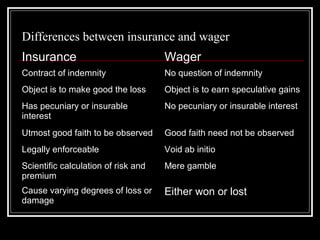
Differences between insurance and wager
Insurance                            Wager
Contract of indemnity                No question of indemnity
Object is to make good the loss      Object is to earn speculative gains
Has pecuniary or insurable           No pecuniary or insurable interest
interest
Utmost good faith to be observed     Good faith need not be observed
Legally enforceable                  Void ab initio
Scientific calculation of risk and   Mere gamble
premium
Cause varying degrees of loss or     Either won or lost
damage
Fundamental principles of insurance contracts

1.   Utmost good faith
2.   Insurable interest
3.   Indemnity
4.   Causa Proxima
5.   Mitigation of loss
6.   Risk must attach
7.   Doctrine of subrogation
8.   Doctrine of contribution
9.   Period of insurance
Utmost good faith (uberrimae fidei )

   Utmost good faith must be observed by either party – otherwise
   Whole truth must be told about the subject matter
   Fraud, concealment or misrepresentation of the material facts is
    fatal to the contract
   Material facts: needed to judge (a) whether he should accept the
    risk and (b) what premium he should charge
   Proposer should disclose at the time of making the proposal and
    must continue to do so till the negotiations are completed but need
    not after the contract
   Principle of caveat emptor is not applicable
   Exceptions:
Insurable interest

•   Insured must be in a legally recognized relationship to what is
    insured so that he will suffer a direct financial loss on the happening
    of the event insured ( or benefit from the existence of the subject
    matter)
•   It is the legal right of the person to insure
•   It is not the owner alone, but every person who would suffer direct
    financial loss from the destruction
•   Existence of insurable interest for different types of insurance
   Life insurance : at the time of insurance
   Fire insurance : both at the of insurance and loss
   Marine insurance : at the time of loss
Causa proxima

   Insurer is liable only for those losses which have been proximately
    caused by the peril insured against
   Maxim is : Causa Proxima Non remota Spectatur ( the proximate
    or immediate and not the remote cause is to be looked to)
   The question, which is the causa proxima of a loss arises only
    when there is a succession of causes
   When a loss has been brought about by two or more causes, one
    has to look to the nearest cause, although the loss would no doubt
    not have happened without the remote or other causes
   Commonsense is to be used
   Loss if brought about by a cause attributable to the misconduct of
    the insured - insurer is not liable
   Cases: read out
Risk must attach

   The insurer receives the premium for running a certain
    risk
   If risk is not run, the consideration for which the
    premium was given fails
   Then, insurer must return the premium
   The premium is also to be returned even where the risk
    is not run or could not be run due to the fault, will or
    pleasure of the insured
Mitigation of loss

   The insured must take all necessary steps for the
    purpose of averting or minimizing loss
   He must act as an uninsured prudent person
   If insured dose not do so, the insurer can avoid the
    payment of loss attributable to his negligence
   He is not bound to do so at the risk of his life
Doctrine of contribution

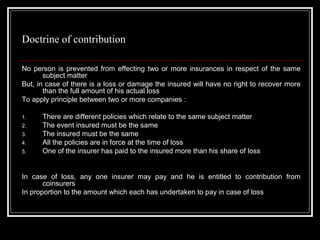
No person is prevented from effecting two or more insurances in respect of the same
       subject matter
But, in case of there is a loss or damage the insured will have no right to recover more
       than the full amount of his actual loss
To apply principle between two or more companies :

1.    There are different policies which relate to the same subject matter
2.    The event insured must be the same
3.    The insured must be the same
4.    All the policies are in force at the time of loss
5.    One of the insurer has paid to the insured more than his share of loss


In case of loss, any one insurer may pay and he is entitled to contribution from
       coinsurers
In proportion to the amount which each has undertaken to pay in case of loss
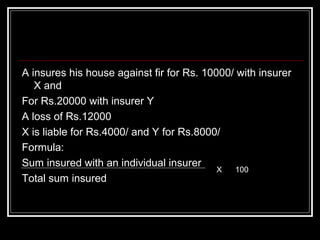
A insures his house against fir for Rs. 10000/ with insurer
   X and
For Rs.20000 with insurer Y
A loss of Rs.12000
X is liable for Rs.4000/ and Y for Rs.8000/
Formula:
Sum insured with an individual insurer
                                           X  100
Total sum insured
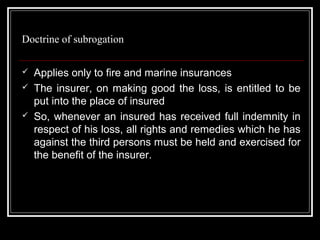
Doctrine of subrogation

   Applies only to fire and marine insurances
   The insurer, on making good the loss, is entitled to be
    put into the place of insured
   So, whenever an insured has received full indemnity in
    respect of his loss, all rights and remedies which he has
    against the third persons must be held and exercised for
    the benefit of the insurer.
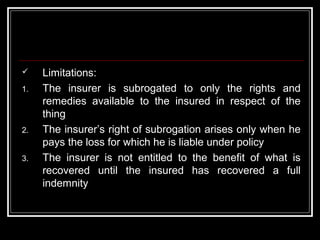
    Limitations:
1.   The insurer is subrogated to only the rights and
     remedies available to the insured in respect of the
     thing
2.   The insurer’s right of subrogation arises only when he
     pays the loss for which he is liable under policy
3.   The insurer is not entitled to the benefit of what is
     recovered until the insured has recovered a full
     indemnity
Period of insurance : period or time for which the insurance contract
  has been entered into
 Life insurance
 Fire insurance
 Marine insurance


Premium
 The consideration paid by the insured to the insurer for the risk
   undertaken by the latter
 Determined by taking into : average of losses, total premium he
   receives, overhead and other expenses and profit
Illustration

  Suppose there are 10,000 houses in a locality
 Owners of 8000 of them decide to get their houses insured
 Experience shows ( and sometime on the basis of probability
   models) : every year average 2 houses catch fire
 Each house is valued at Rs. 2,00,000 – So average loss Rs.
   4,00,000
 Assume premium of Rs.100/ per house
 So, total premium Rs.8,00,000
 Now, Rs. 8,00,000 – Rs. 4,00,000 = Rs. 4,00,000
 Deduct overhead expenses and left with profit

In case of fire and marine on similar considerations but in life :
   mortality rate
Return of premium


1.   Where the consideration for the premium has totally
     failed
2.   Where the policy is void ab initio
3.   Where the assured has no insurable interest
4.   Where the assured bona fide over-insures
Re-insurance


Insuring the same risk either wholly or partially with other
   insurers to safeguard his own interest
The re-insurer is not liable to the insured
The policy of re-insurance is co-extensive with the original
   policy
All principles are applicable between original insurer and
   re-insurer
Double insurance


Where the insured insures the same risk with two or more
 independent insurers

Over-insurance
Where the insured insures the same risk with two or more
  independent insurers and the total sum insured exceeds
  the value of the subject matter

If no express contract, both are valid
Rules applicable


1.   Recovery of actual loss
2.   Excess amount recovered to be held in trust
3.   Liability of insurers – contribution
4.   No limit on life insurances
Life insurance


The contracts are governed by:
1.The insurance Act, 1938
2.The Life Insurance Corporation Act, 1956

Contract of life insurance:
A contract by which the insurer, in consideration of the
  payment

Insurance act for class

  • 1.
    The Insurance Act,1938 Act was passed to control the working and activities of the companies carrying on business of life, fire, marine and accident insurance. Apart from the above Act, the Indian insurance business is governed by the following special Acts. 1. The Life Insurance Corporation Act, 1956 2. The Marine Insurance Act, 1963 and 3. The General Insurance Business (Nationalization) Act 1972
  • 2.
    Why insurance? To provideagainst the risk and insecurity But, it does not avert or eliminate loss arising from uncertain events It only spreads the loss over a large number of people Contract of Insurance A contract of insurance is a contract by which a person, in consideration of a sum of money, undertakes to make good the loss of another against a specified risk e.g. fire or to compensate him or his estate on happening of a specified event, e.g. accident or death.
  • 3.
    Essential elements 1. Insurer and insured 2. Premium : The consideration for which the insurer undertakes to indemnify the insured against the risk – may be single or periodical 3. Policy 4. Subject matter of insurance 5. Perils insured against.
  • 4.
    Kinds of insurance 1.Life insurance 2. Fire insurance 3. Marine insurance 4. Personal accident insurance
  • 5.
    Nature of thecontract of insurance  The contract of insurance is called an aleatory contract  At first sight, this would seem to be a wagering agreement, because insurer betting with the insured that his house will not be burnt  But, modern view is that insurance contracts are not speculative or wagering  In actual practice, it is a valid contract, because the insured is only indemnified for his loss and he dose not gain by the happening of the event insured against.  Plus he must have an insurable interest in the subject matter
  • 6.
    Contract of insurance is a species of the general contract  Comes into existence by the process of offer by insured to insurer  Insurer should communicate its acceptance  Object of insurance must be lawful and consent must be free and genuine  Contract must be supported by consideration
  • 7.
    Differences between insuranceand wager Insurance Wager Contract of indemnity No question of indemnity Object is to make good the loss Object is to earn speculative gains Has pecuniary or insurable No pecuniary or insurable interest interest Utmost good faith to be observed Good faith need not be observed Legally enforceable Void ab initio Scientific calculation of risk and Mere gamble premium Cause varying degrees of loss or Either won or lost damage
  • 8.
    Fundamental principles ofinsurance contracts 1. Utmost good faith 2. Insurable interest 3. Indemnity 4. Causa Proxima 5. Mitigation of loss 6. Risk must attach 7. Doctrine of subrogation 8. Doctrine of contribution 9. Period of insurance
  • 9.
    Utmost good faith(uberrimae fidei )  Utmost good faith must be observed by either party – otherwise  Whole truth must be told about the subject matter  Fraud, concealment or misrepresentation of the material facts is fatal to the contract  Material facts: needed to judge (a) whether he should accept the risk and (b) what premium he should charge  Proposer should disclose at the time of making the proposal and must continue to do so till the negotiations are completed but need not after the contract  Principle of caveat emptor is not applicable  Exceptions:
  • 10.
    Insurable interest • Insured must be in a legally recognized relationship to what is insured so that he will suffer a direct financial loss on the happening of the event insured ( or benefit from the existence of the subject matter) • It is the legal right of the person to insure • It is not the owner alone, but every person who would suffer direct financial loss from the destruction • Existence of insurable interest for different types of insurance  Life insurance : at the time of insurance  Fire insurance : both at the of insurance and loss  Marine insurance : at the time of loss
  • 11.
    Causa proxima  Insurer is liable only for those losses which have been proximately caused by the peril insured against  Maxim is : Causa Proxima Non remota Spectatur ( the proximate or immediate and not the remote cause is to be looked to)  The question, which is the causa proxima of a loss arises only when there is a succession of causes  When a loss has been brought about by two or more causes, one has to look to the nearest cause, although the loss would no doubt not have happened without the remote or other causes  Commonsense is to be used  Loss if brought about by a cause attributable to the misconduct of the insured - insurer is not liable  Cases: read out
  • 12.
    Risk must attach  The insurer receives the premium for running a certain risk  If risk is not run, the consideration for which the premium was given fails  Then, insurer must return the premium  The premium is also to be returned even where the risk is not run or could not be run due to the fault, will or pleasure of the insured
  • 13.
    Mitigation of loss  The insured must take all necessary steps for the purpose of averting or minimizing loss  He must act as an uninsured prudent person  If insured dose not do so, the insurer can avoid the payment of loss attributable to his negligence  He is not bound to do so at the risk of his life
  • 14.
    Doctrine of contribution Noperson is prevented from effecting two or more insurances in respect of the same subject matter But, in case of there is a loss or damage the insured will have no right to recover more than the full amount of his actual loss To apply principle between two or more companies : 1. There are different policies which relate to the same subject matter 2. The event insured must be the same 3. The insured must be the same 4. All the policies are in force at the time of loss 5. One of the insurer has paid to the insured more than his share of loss In case of loss, any one insurer may pay and he is entitled to contribution from coinsurers In proportion to the amount which each has undertaken to pay in case of loss
  • 15.
    A insures hishouse against fir for Rs. 10000/ with insurer X and For Rs.20000 with insurer Y A loss of Rs.12000 X is liable for Rs.4000/ and Y for Rs.8000/ Formula: Sum insured with an individual insurer X 100 Total sum insured
  • 16.
    Doctrine of subrogation  Applies only to fire and marine insurances  The insurer, on making good the loss, is entitled to be put into the place of insured  So, whenever an insured has received full indemnity in respect of his loss, all rights and remedies which he has against the third persons must be held and exercised for the benefit of the insurer.
  • 17.
    Limitations: 1. The insurer is subrogated to only the rights and remedies available to the insured in respect of the thing 2. The insurer’s right of subrogation arises only when he pays the loss for which he is liable under policy 3. The insurer is not entitled to the benefit of what is recovered until the insured has recovered a full indemnity
  • 18.
    Period of insurance: period or time for which the insurance contract has been entered into  Life insurance  Fire insurance  Marine insurance Premium  The consideration paid by the insured to the insurer for the risk undertaken by the latter  Determined by taking into : average of losses, total premium he receives, overhead and other expenses and profit
  • 19.
    Illustration  Supposethere are 10,000 houses in a locality  Owners of 8000 of them decide to get their houses insured  Experience shows ( and sometime on the basis of probability models) : every year average 2 houses catch fire  Each house is valued at Rs. 2,00,000 – So average loss Rs. 4,00,000  Assume premium of Rs.100/ per house  So, total premium Rs.8,00,000  Now, Rs. 8,00,000 – Rs. 4,00,000 = Rs. 4,00,000  Deduct overhead expenses and left with profit In case of fire and marine on similar considerations but in life : mortality rate
  • 20.
    Return of premium 1. Where the consideration for the premium has totally failed 2. Where the policy is void ab initio 3. Where the assured has no insurable interest 4. Where the assured bona fide over-insures
  • 21.
    Re-insurance Insuring the samerisk either wholly or partially with other insurers to safeguard his own interest The re-insurer is not liable to the insured The policy of re-insurance is co-extensive with the original policy All principles are applicable between original insurer and re-insurer
  • 22.
    Double insurance Where theinsured insures the same risk with two or more independent insurers Over-insurance Where the insured insures the same risk with two or more independent insurers and the total sum insured exceeds the value of the subject matter If no express contract, both are valid
  • 23.
    Rules applicable 1. Recovery of actual loss 2. Excess amount recovered to be held in trust 3. Liability of insurers – contribution 4. No limit on life insurances
  • 24.
    Life insurance The contractsare governed by: 1.The insurance Act, 1938 2.The Life Insurance Corporation Act, 1956 Contract of life insurance: A contract by which the insurer, in consideration of the payment