PRACTICE OF  LIFE INSURANCE
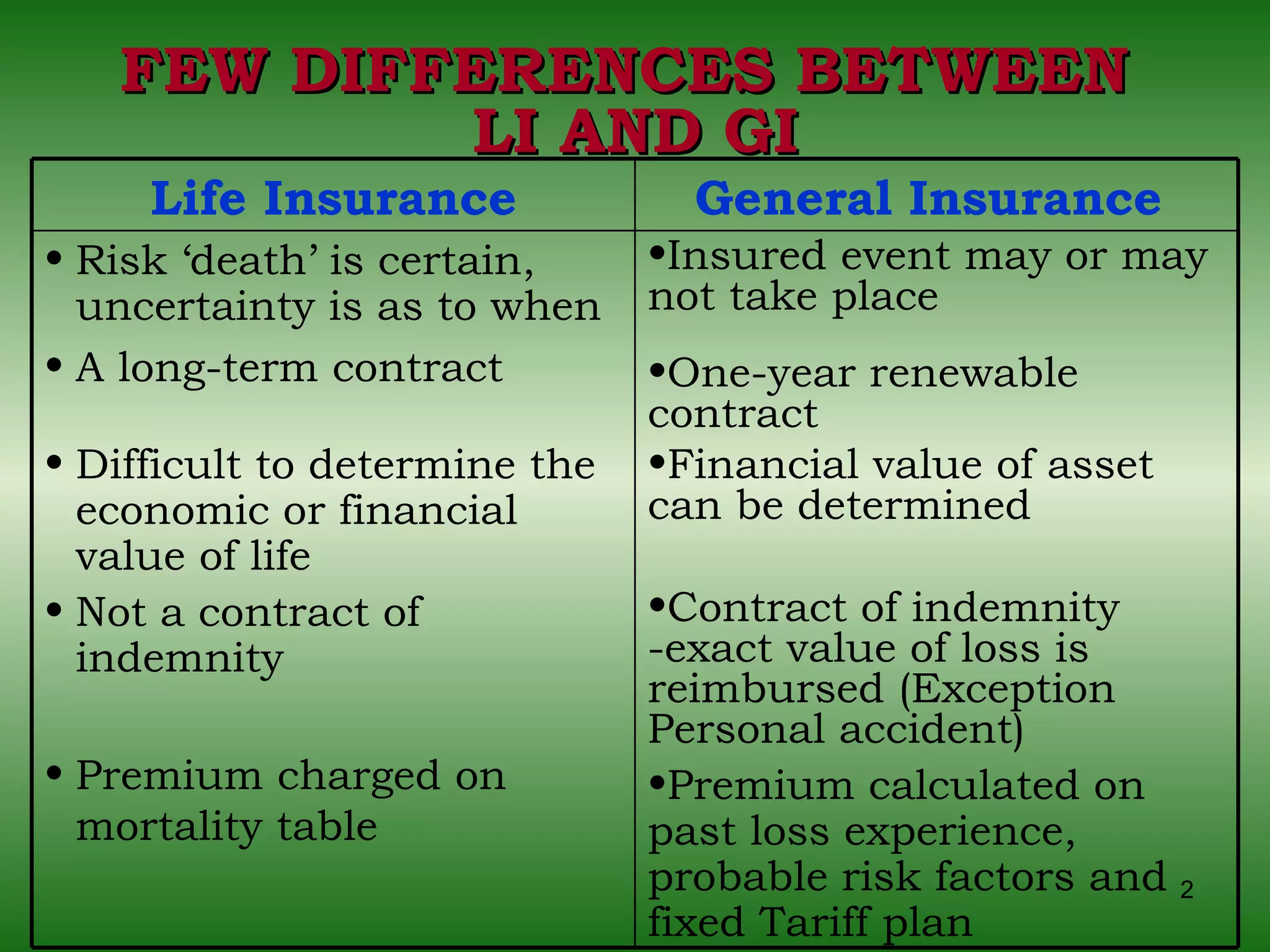
FEW DIFFERENCES BETWEEN  LI AND GI Insured event may or may not take place One-year renewable contract Financial value of asset can be determined Contract of indemnity -exact value of loss is reimbursed (Exception Personal accident) Premium calculated on past loss experience, probable risk factors and fixed Tariff plan Risk ‘death’ is certain, uncertainty is as to when A long-term contract Difficult to determine the economic or financial value of life Not a contract of indemnity Premium charged on mortality table General Insurance   Life Insurance
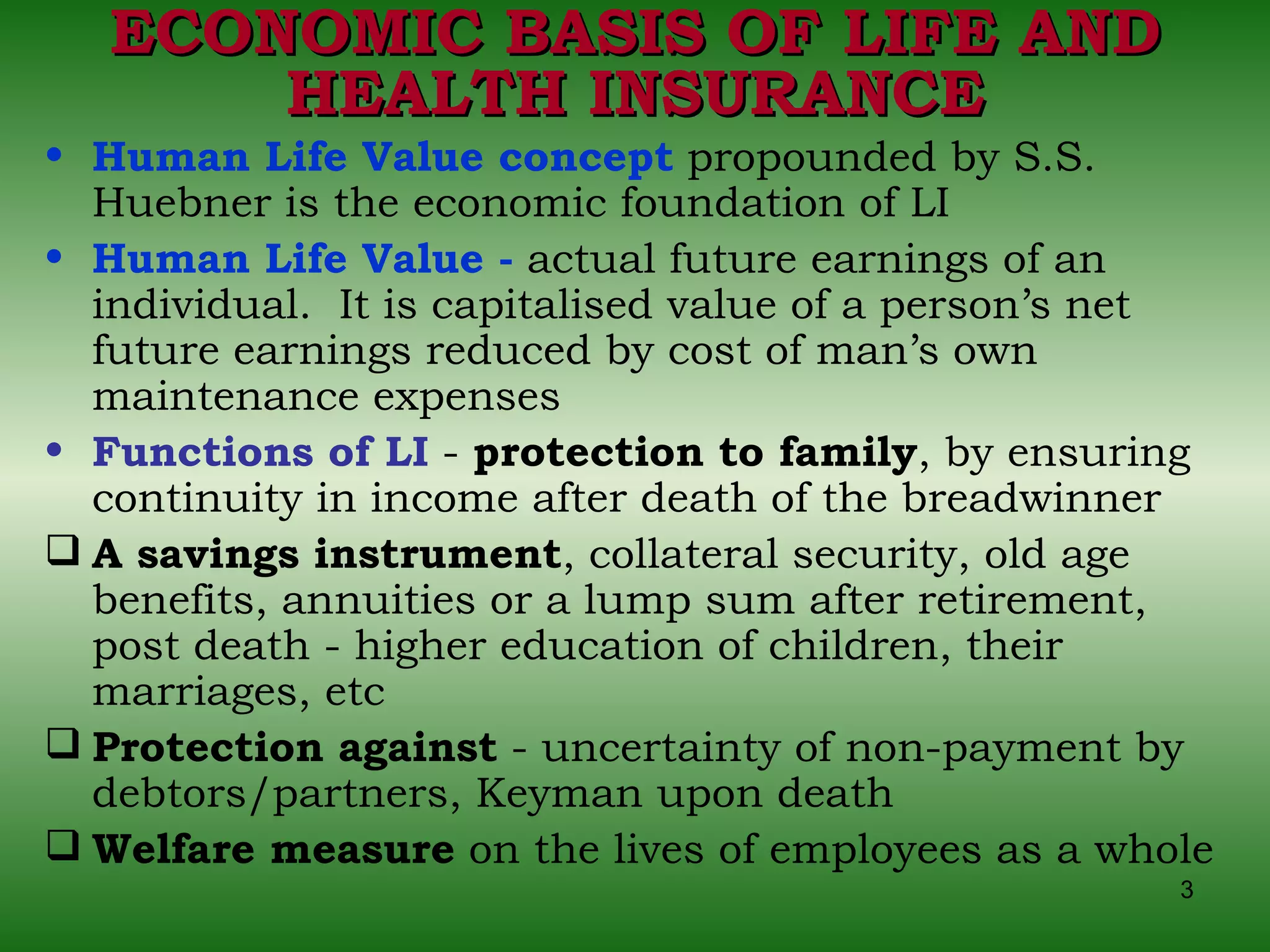
ECONOMIC BASIS OF LIFE AND HEALTH INSURANCE Human Life Value concept  propounded by S.S. Huebner is the economic foundation of LI  Human Life Value -  actual future earnings of an individual.  It is capitalised value of a person’s net future earnings reduced by cost of man’s own maintenance expenses Functions of LI  -  protection to family , by ensuring continuity in income after death of the breadwinner A savings instrument , collateral security, old age benefits, annuities or a lump sum after retirement, post death - higher education of children, their marriages, etc Protection against  - uncertainty of non-payment by debtors/partners, Keyman upon death  Welfare measure  on the lives of employees as a whole
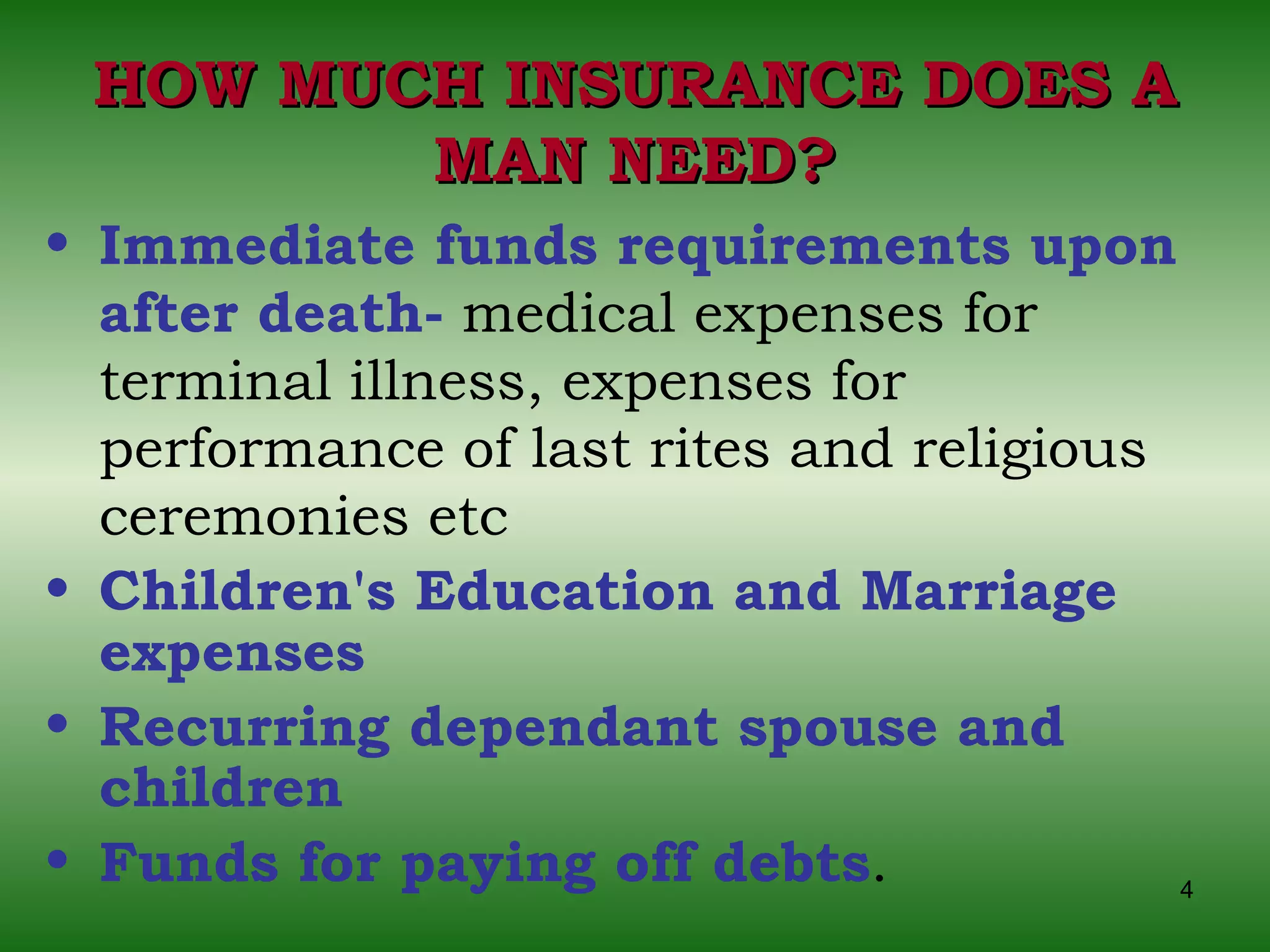
HOW MUCH INSURANCE DOES A MAN NEED? Immediate funds requirements upon after death-  medical expenses for terminal illness, expenses for performance of last rites and religious ceremonies etc Children's Education and Marriage expenses Recurring dependant spouse and children Funds for paying off debts .
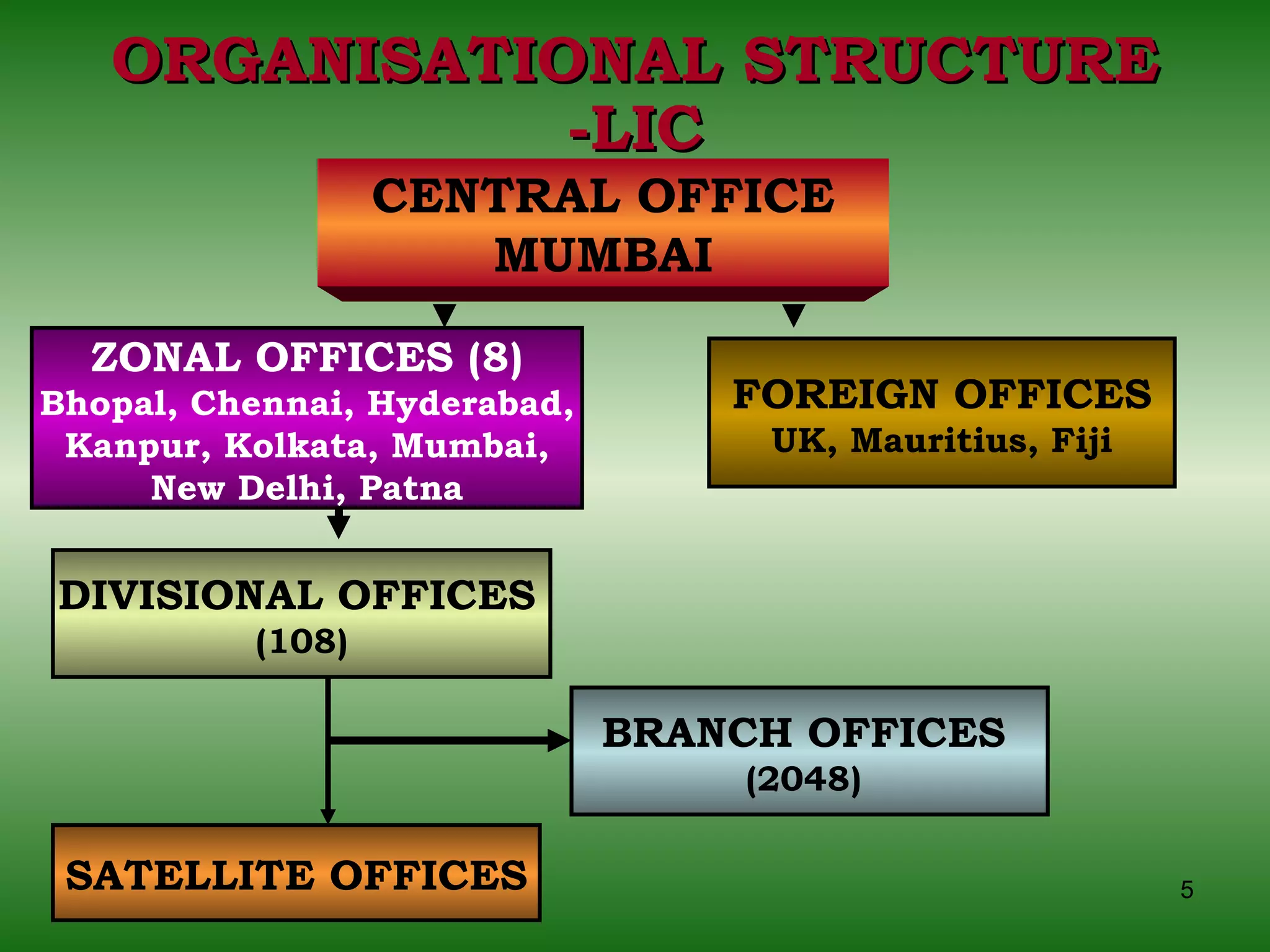
ORGANISATIONAL STRUCTURE -LIC CENTRAL OFFICE MUMBAI ZONAL OFFICES (8) Bhopal, Chennai, Hyderabad, Kanpur, Kolkata, Mumbai, New Delhi, Patna FOREIGN OFFICES UK, Mauritius, Fiji DIVISIONAL OFFICES   (108) BRANCH OFFICES   (2048)  SATELLITE OFFICES
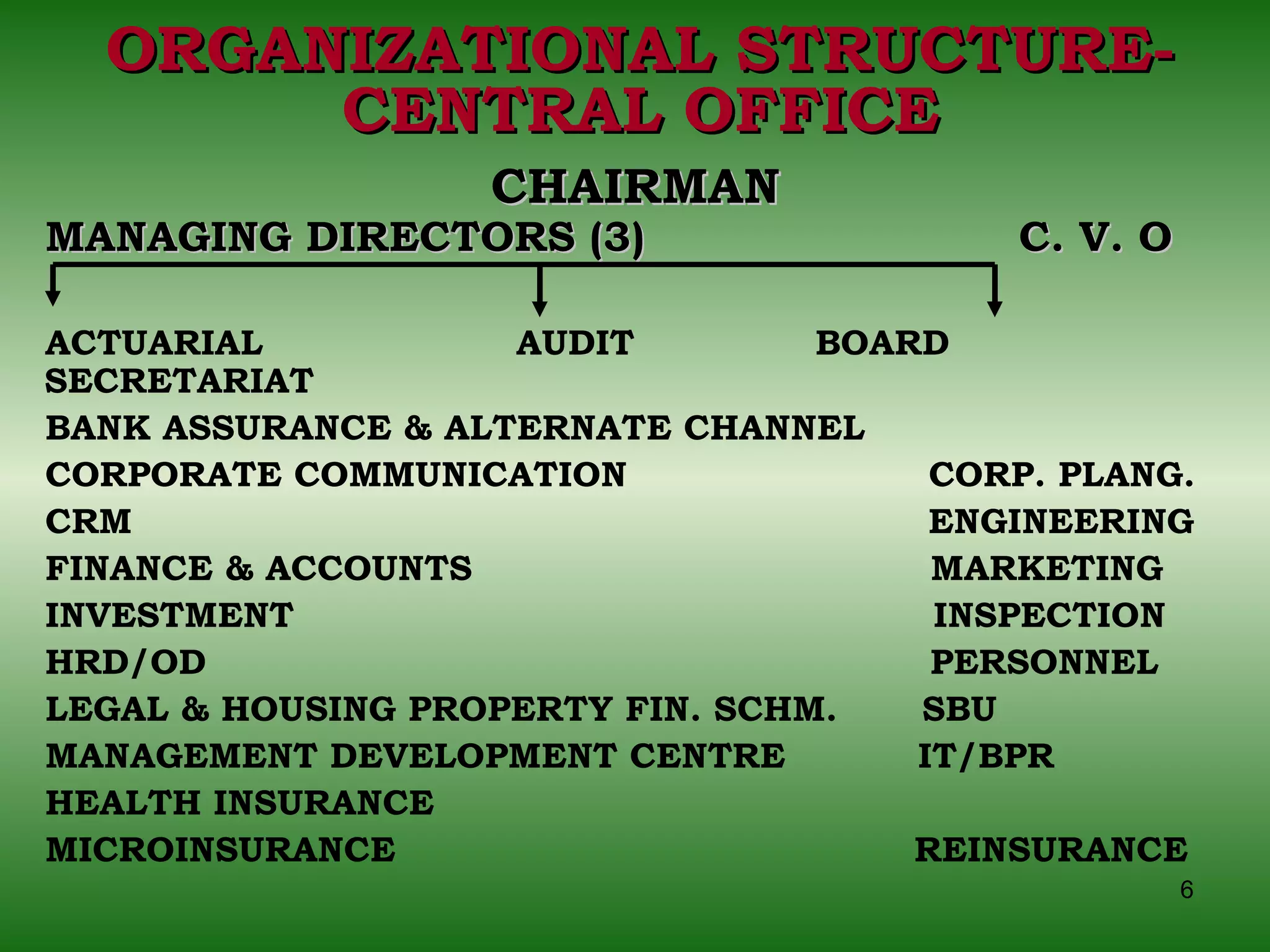
ORGANIZATIONAL STRUCTURE- CENTRAL OFFICE CHAIRMAN MANAGING DIRECTORS (3)   C. V. O   ACTUARIAL  AUDIT  BOARD SECRETARIAT BANK ASSURANCE & ALTERNATE CHANNEL CORPORATE COMMUNICATION  CORP. PLANG. CRM  ENGINEERING  FINANCE & ACCOUNTS  MARKETING INVESTMENT  INSPECTION HRD/OD  PERSONNEL LEGAL & HOUSING PROPERTY FIN. SCHM.  SBU MANAGEMENT DEVELOPMENT CENTRE  IT/BPR HEALTH INSURANCE  MICROINSURANCE  REINSURANCE
CLASSIFICATION OF LIFE AND HEALTH INSURANCE Group Insurance  -  A group of persons, who usually have a business or professional relationship to contract owner, are provided insurance coverage under  a single contract . [ Ex –  Employees, Savings account depositors, poorer sections of society, landless agricultural workers] Ordinary  –  individually issued policies  – majority of policies fall within the ordinary category Industrial Insurance   –includes life and health insurance policies issued to individuals in small amounts, premiums payable on a weekly or monthly basis. Not popular in India. Credit insurance   –This is issued through lending institutions to cover debtors’ obligations if they die or become disabled
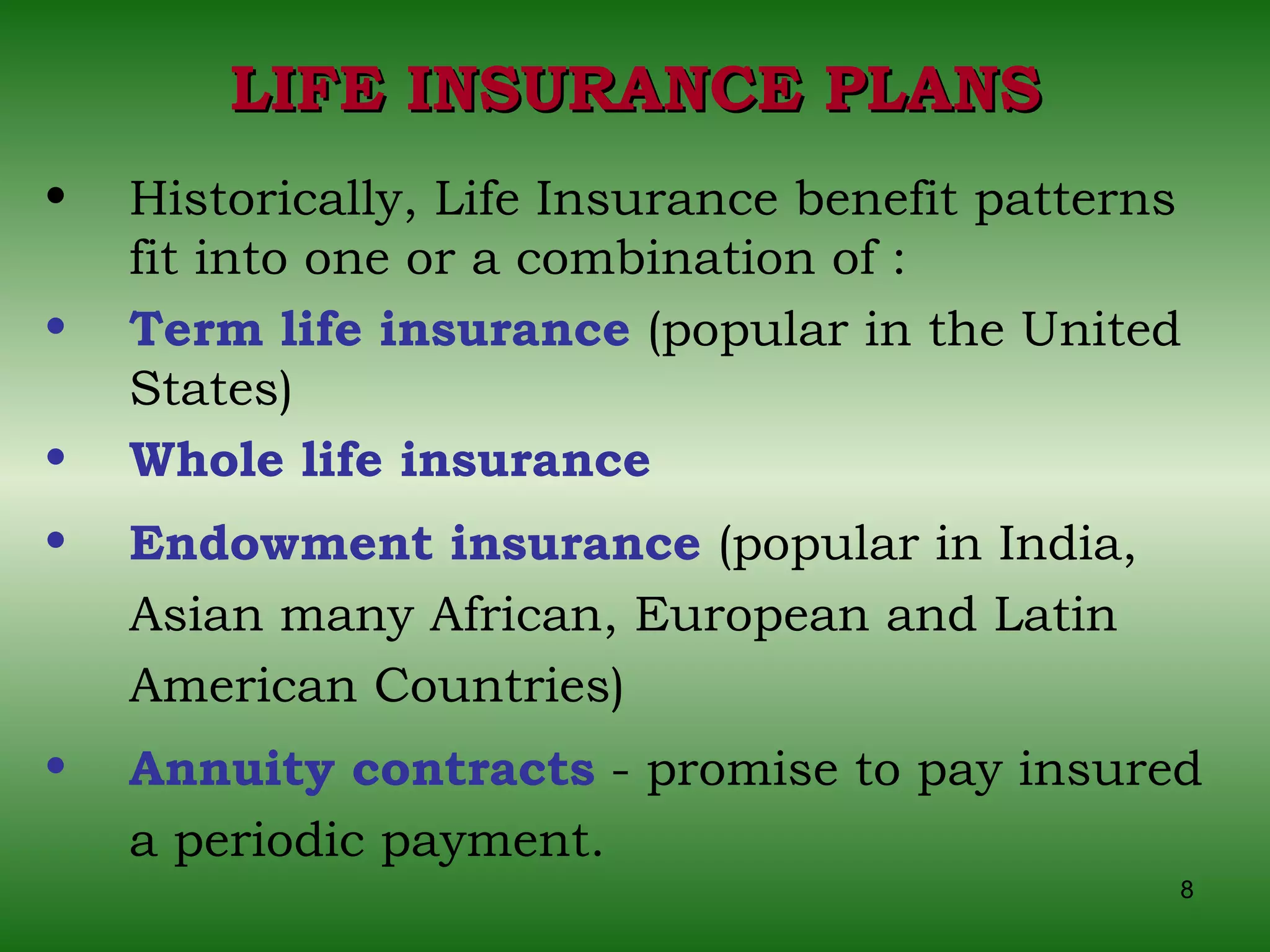
LIFE INSURANCE PLANS Historically, Life Insurance benefit patterns fit into one or a combination of : Term life insurance  (popular in the United States)  Whole life insurance Endowment insurance  (popular in India, Asian many African, European and Latin American Countries) Annuity contracts  - promise to pay insured a periodic payment.
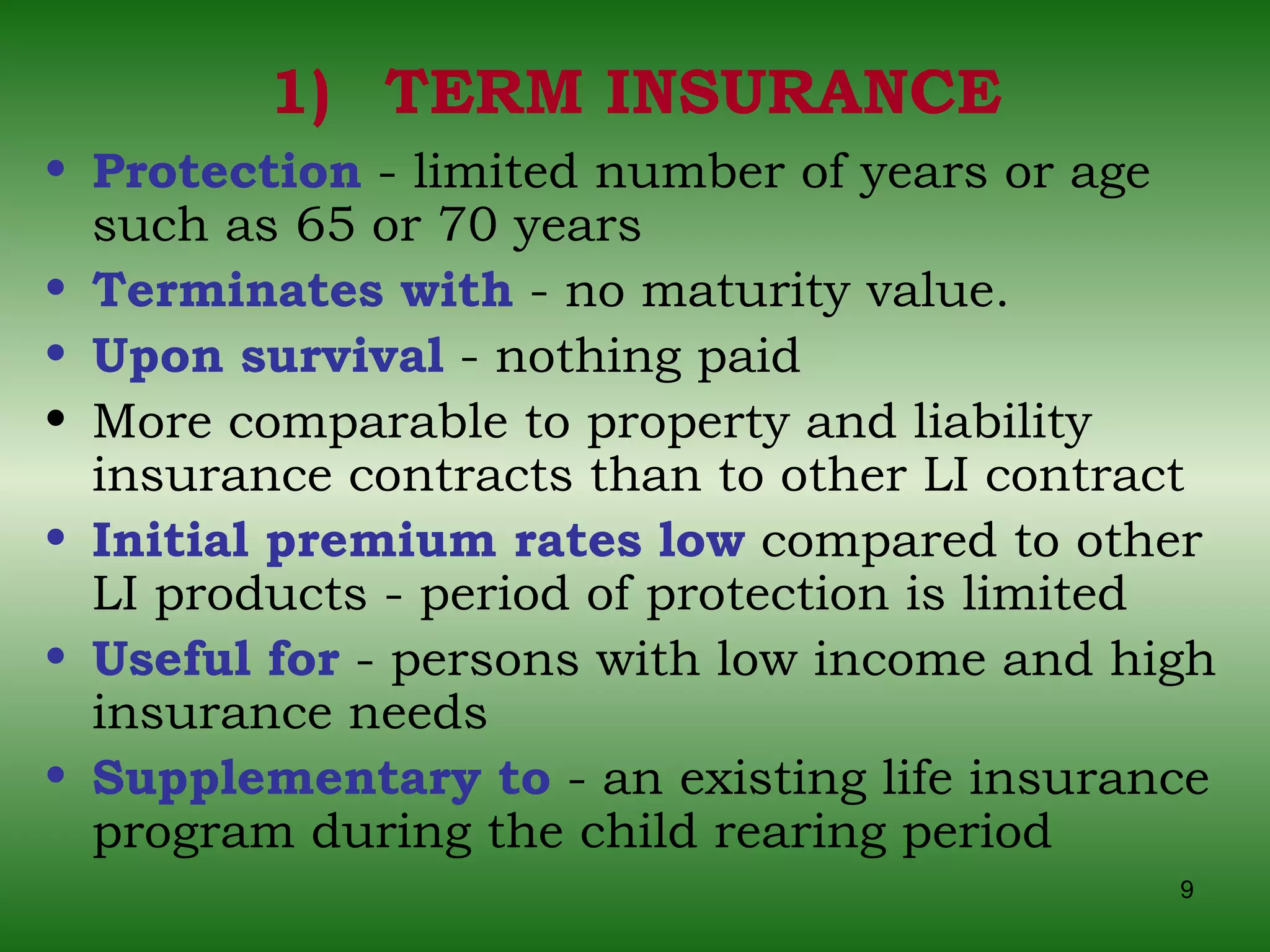
TERM INSURANCE Protection  - limited number of years or age such as 65 or 70 years Terminates with  - no maturity value. Upon survival  - nothing paid More comparable to property and liability insurance contracts than to other LI contract Initial premium rates low  compared to other LI products - period of protection is limited Useful for  - persons with low income and high insurance needs Supplementary to  - an existing life insurance program during the child rearing period
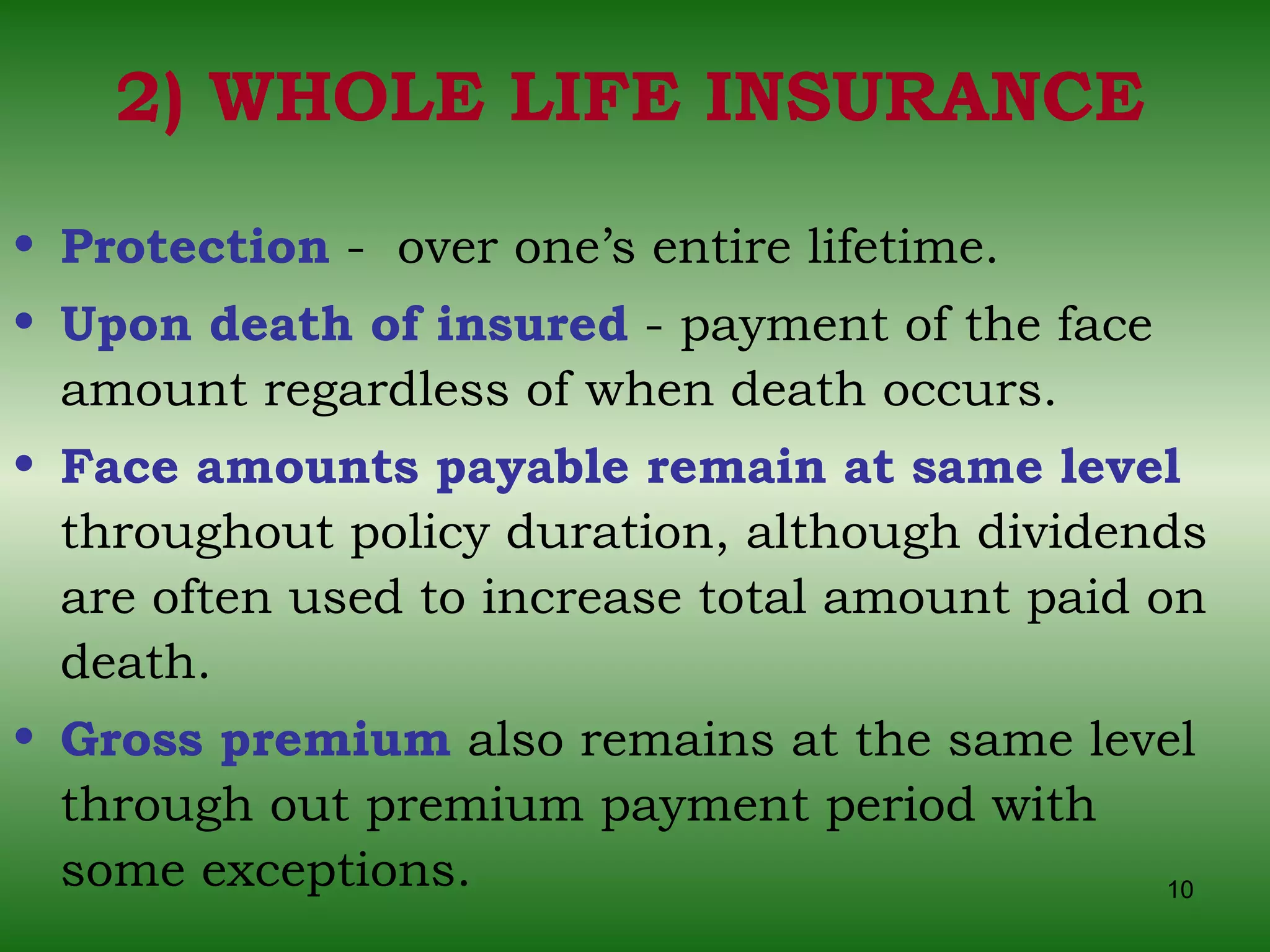
2) WHOLE LIFE INSURANCE Protection  -  over one’s entire lifetime. Upon death of insured  - payment of the face amount regardless of when death occurs. Face amounts payable remain at same level   throughout policy duration, although dividends are often used to increase total amount paid on death. Gross premium  also remains at the same level through out premium payment period with some exceptions.
3) ENDOWMENT INSURANCE PROMISE TO PAY   - Policy amount on death of insured during a fixed term of years  (+)   Full-face amount at the end of the term if insured survives term ENDOWMENT INSURANCE  =  Term life insurance  (+)   Pure endowment  [to pay face amount if insured dies during the period  +  to pay maturity amount only if insured is living at the end of a specific period, with nothing paid in case of prior death]
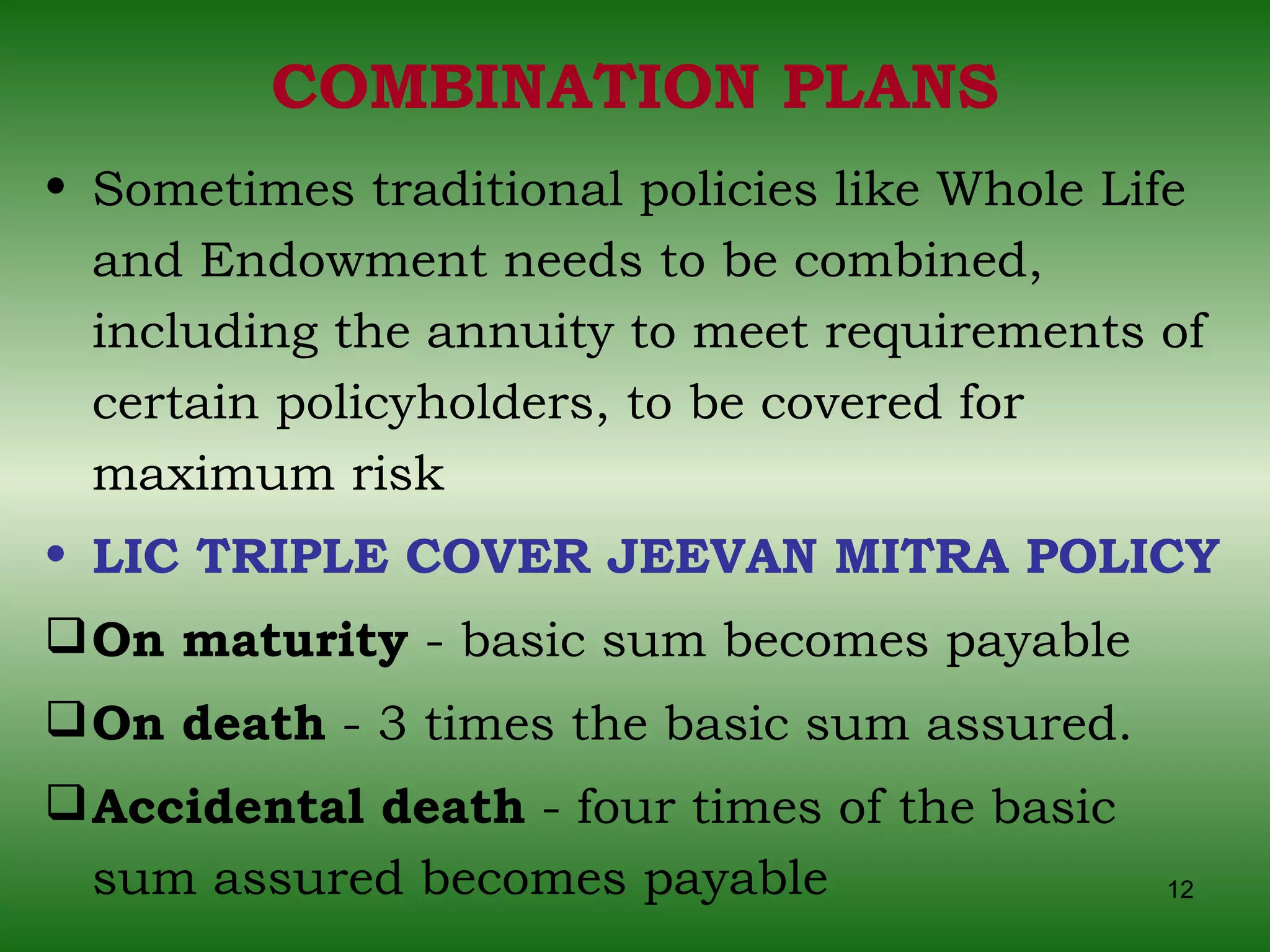
COMBINATION PLANS Sometimes traditional policies like Whole Life and Endowment needs to be combined, including the annuity to meet requirements of certain policyholders, to be covered for maximum risk LIC TRIPLE COVER JEEVAN MITRA POLICY   On maturity  - basic sum becomes payable  On death  - 3 times the basic sum assured.  Accidental death  - four times of the basic sum assured becomes payable
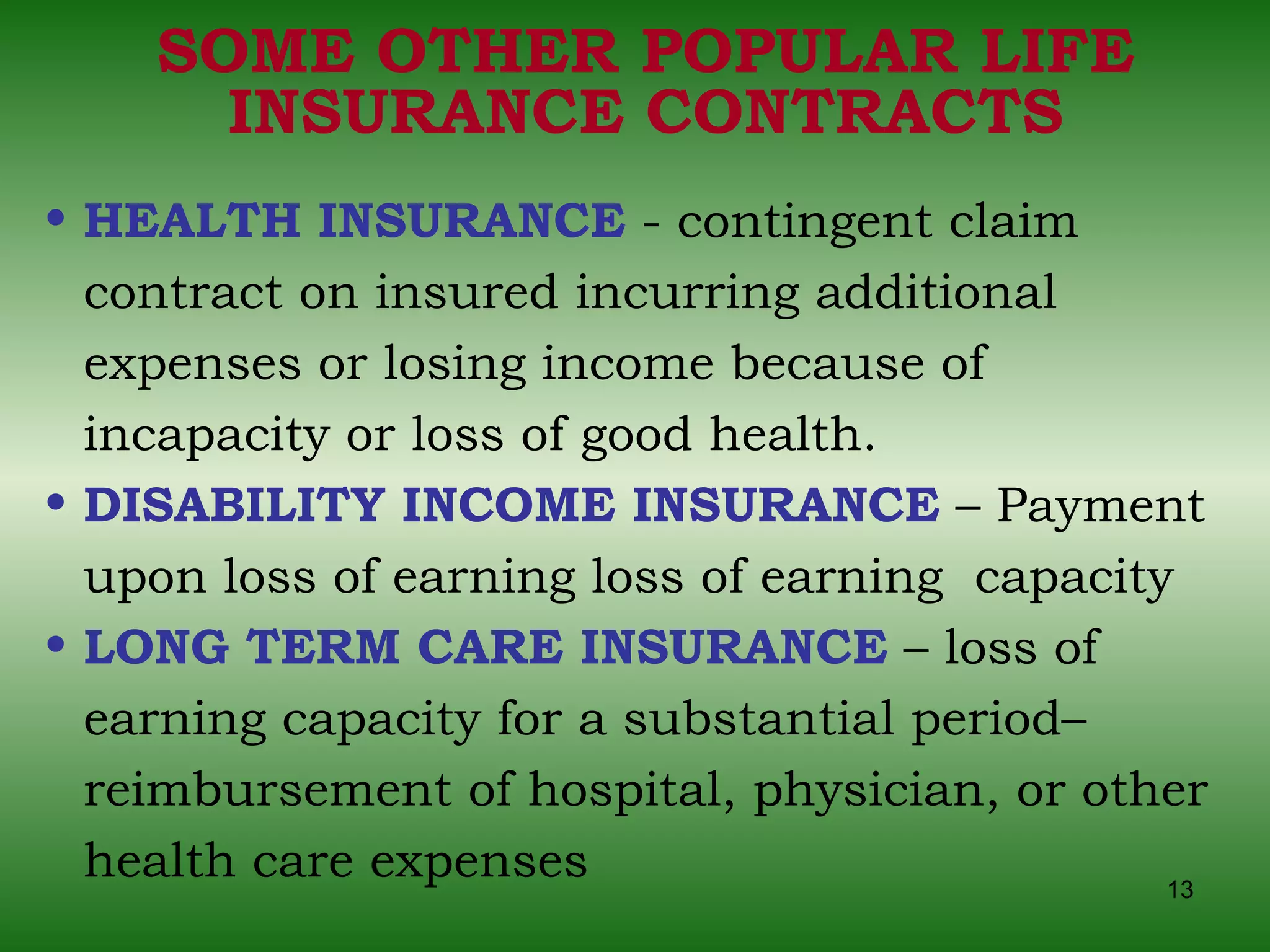
SOME OTHER POPULAR LIFE INSURANCE CONTRACTS HEALTH INSURANCE  - contingent claim contract on insured incurring additional expenses or losing income because of incapacity or loss of good health.  DISABILITY INCOME INSURANCE  – Payment upon loss of earning loss of earning  capacity LONG TERM CARE INSURANCE  – loss of earning capacity for a substantial period– reimbursement of hospital, physician, or other health care expenses
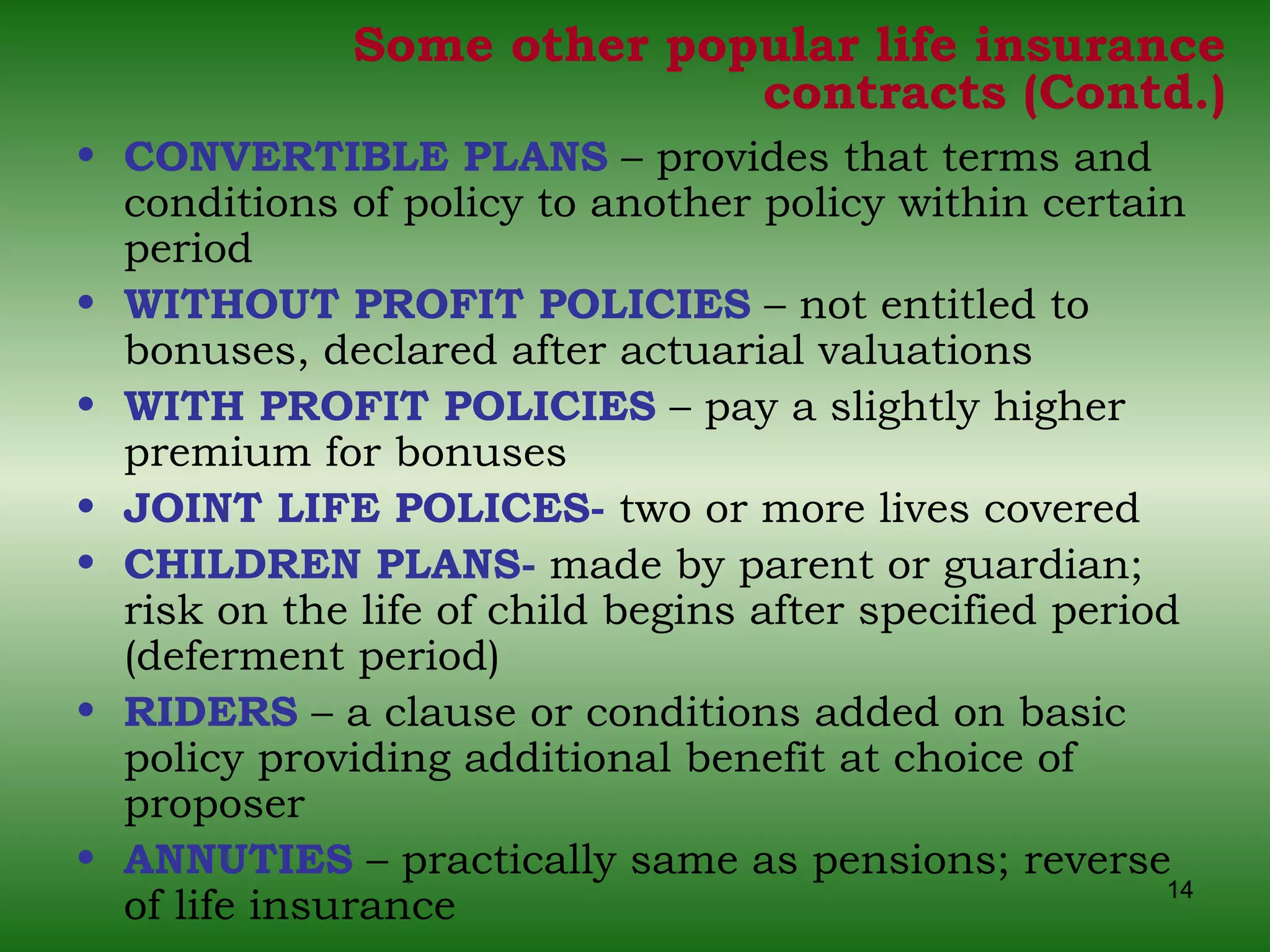
Some other popular life insurance contracts (Contd.) CONVERTIBLE PLANS  – provides that terms and conditions of policy to another policy within certain period WITHOUT PROFIT POLICIES  – not entitled to bonuses, declared after actuarial valuations WITH PROFIT POLICIES  – pay a slightly higher premium for bonuses JOINT LIFE POLICES-  two or more lives covered  CHILDREN PLANS-  made by parent or guardian; risk on the life of child begins after specified period (deferment period) RIDERS  – a clause or conditions added on basic policy providing additional benefit at choice of proposer ANNUTIES  – practically same as pensions; reverse of life insurance
PRINCIPLES AND PRACTICE OF REINSURANCE
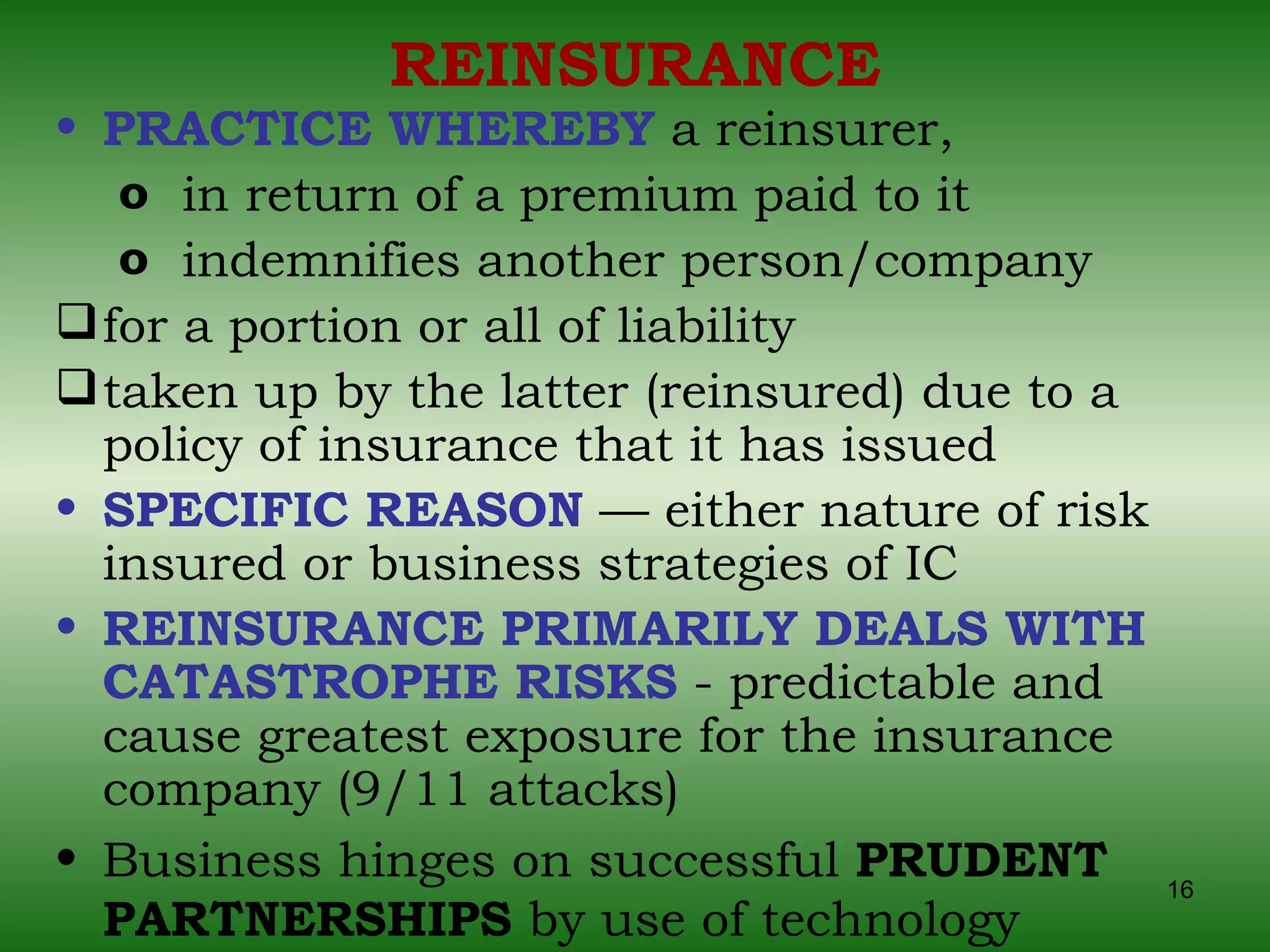
REINSURANCE PRACTICE WHEREBY  a reinsurer,  in return of a premium paid to it  indemnifies another person/company  for a portion or all of liability taken up by the latter (reinsured) due to a policy of insurance that it has issued SPECIFIC REASON  — either nature of risk insured or business strategies of IC REINSURANCE PRIMARILY DEALS WITH CATASTROPHE RISKS  - predictable and cause greatest exposure for the insurance company (9/11 attacks) Business hinges on successful  PRUDENT PARTNERSHIPS  by use of technology
Reinsurance (Contd.) RISK MANAGEMENT  - involving transfer of risk from IC to Reinsurer CONTRACT OF INDEMNITY  –  basis for providing insurance to IC  REINSURANCE AGREEMENT  – entered into between IC and Reinsurer GLOBAL SPREAD OF RISKS  – local market bad losses do not impact local businesses; there are tie-ups with global reinsurers HOW IT WORKS IC insurer gives reinsurer a portion of the premium it collects from the insured and  in return IC is covered for losses above a particular limit.
PRINCIPLES AND ADVANTAGES OF REINSURANCE PRINCIPLE OF UTMOST GOOD FAITH PRINCIPLE OF INDEMNITY NO REINSURANCE WITHOUT RETENTION :   IC must retain a part of Risk before reinsuring.  No reinsurance of complete risk Those risks that are within retention capacity of IC must be retained completely ADVANTAGES   Safeguards capital and reinforces stability Helps IC to upgrade itself Also helps a company to withdraw from business
TYPES OF REINSURANCE TREATY REINSURANCE  – covers entire category of risk or line of business in advance.  Capacity + Coverage of all prerils with adequate limits + confidence on security of reinsurers + continuity of reinsurance after a loss FACULTATIVE REINSURANCE  - reinsurance of current single risk and options are open for both reinsured and reinsurers reinsurer retains the faculty or power to either accept or reject each individual risk offered to it by IC
IRDA REGULATIONS OBJECTIVE  - to expand retention within India, ensure best protection for reinsurance costs incurred and simplify administration. RETENTION OF RISK  - proportionate to financial strength and business volumes. REINSURANCE WITH NATIONAL REINSURER  - 10% of sum assured on each policy by IC (only in non-life sector) REINSURANCE PROGRAMME  - beginning F/Y and submitted to IRDA, 45 days` before EXCESS OF REINSURANCE BUSINESS-  to be placed outside India with reinsurers having at least BBB (S&P) rating for the preceding 5 years. (India's own sovereign rating) LIC can continue to reinsure its policies with GIC ( private IC cannot)
UNDERWRITING Selection of a policyholder  after recognising and evaluating hazard, fixing a premium and deciding all other terms and conditions Safeguards  - against any moral, morale or general hazard Limiting factors  – capacity, skilled human resources, compliance of regulatory provisions,   availability of reinsurance Line underwriting  –  Where daily underwriting carried out; underwriters usually located in offices of insurer Staff underwriting  –  Where underwriter helps management in formulating and implementing underwriting policy. They are usually located at H.O.

Chapter 03 principles and practice of lifeinsurance

  • 1.
    PRACTICE OF LIFE INSURANCE
  • 2.
    FEW DIFFERENCES BETWEEN LI AND GI Insured event may or may not take place One-year renewable contract Financial value of asset can be determined Contract of indemnity -exact value of loss is reimbursed (Exception Personal accident) Premium calculated on past loss experience, probable risk factors and fixed Tariff plan Risk ‘death’ is certain, uncertainty is as to when A long-term contract Difficult to determine the economic or financial value of life Not a contract of indemnity Premium charged on mortality table General Insurance Life Insurance
  • 3.
    ECONOMIC BASIS OFLIFE AND HEALTH INSURANCE Human Life Value concept propounded by S.S. Huebner is the economic foundation of LI Human Life Value - actual future earnings of an individual. It is capitalised value of a person’s net future earnings reduced by cost of man’s own maintenance expenses Functions of LI - protection to family , by ensuring continuity in income after death of the breadwinner A savings instrument , collateral security, old age benefits, annuities or a lump sum after retirement, post death - higher education of children, their marriages, etc Protection against - uncertainty of non-payment by debtors/partners, Keyman upon death Welfare measure on the lives of employees as a whole
  • 4.
    HOW MUCH INSURANCEDOES A MAN NEED? Immediate funds requirements upon after death- medical expenses for terminal illness, expenses for performance of last rites and religious ceremonies etc Children's Education and Marriage expenses Recurring dependant spouse and children Funds for paying off debts .
  • 5.
    ORGANISATIONAL STRUCTURE -LICCENTRAL OFFICE MUMBAI ZONAL OFFICES (8) Bhopal, Chennai, Hyderabad, Kanpur, Kolkata, Mumbai, New Delhi, Patna FOREIGN OFFICES UK, Mauritius, Fiji DIVISIONAL OFFICES (108) BRANCH OFFICES (2048) SATELLITE OFFICES
  • 6.
    ORGANIZATIONAL STRUCTURE- CENTRALOFFICE CHAIRMAN MANAGING DIRECTORS (3) C. V. O ACTUARIAL AUDIT BOARD SECRETARIAT BANK ASSURANCE & ALTERNATE CHANNEL CORPORATE COMMUNICATION CORP. PLANG. CRM ENGINEERING FINANCE & ACCOUNTS MARKETING INVESTMENT INSPECTION HRD/OD PERSONNEL LEGAL & HOUSING PROPERTY FIN. SCHM. SBU MANAGEMENT DEVELOPMENT CENTRE IT/BPR HEALTH INSURANCE MICROINSURANCE REINSURANCE
  • 7.
    CLASSIFICATION OF LIFEAND HEALTH INSURANCE Group Insurance - A group of persons, who usually have a business or professional relationship to contract owner, are provided insurance coverage under a single contract . [ Ex – Employees, Savings account depositors, poorer sections of society, landless agricultural workers] Ordinary – individually issued policies – majority of policies fall within the ordinary category Industrial Insurance –includes life and health insurance policies issued to individuals in small amounts, premiums payable on a weekly or monthly basis. Not popular in India. Credit insurance –This is issued through lending institutions to cover debtors’ obligations if they die or become disabled
  • 8.
    LIFE INSURANCE PLANSHistorically, Life Insurance benefit patterns fit into one or a combination of : Term life insurance (popular in the United States) Whole life insurance Endowment insurance (popular in India, Asian many African, European and Latin American Countries) Annuity contracts - promise to pay insured a periodic payment.
  • 9.
    TERM INSURANCE Protection - limited number of years or age such as 65 or 70 years Terminates with - no maturity value. Upon survival - nothing paid More comparable to property and liability insurance contracts than to other LI contract Initial premium rates low compared to other LI products - period of protection is limited Useful for - persons with low income and high insurance needs Supplementary to - an existing life insurance program during the child rearing period
  • 10.
    2) WHOLE LIFEINSURANCE Protection - over one’s entire lifetime. Upon death of insured - payment of the face amount regardless of when death occurs. Face amounts payable remain at same level throughout policy duration, although dividends are often used to increase total amount paid on death. Gross premium also remains at the same level through out premium payment period with some exceptions.
  • 11.
    3) ENDOWMENT INSURANCEPROMISE TO PAY - Policy amount on death of insured during a fixed term of years (+) Full-face amount at the end of the term if insured survives term ENDOWMENT INSURANCE = Term life insurance (+) Pure endowment [to pay face amount if insured dies during the period + to pay maturity amount only if insured is living at the end of a specific period, with nothing paid in case of prior death]
  • 12.
    COMBINATION PLANS Sometimestraditional policies like Whole Life and Endowment needs to be combined, including the annuity to meet requirements of certain policyholders, to be covered for maximum risk LIC TRIPLE COVER JEEVAN MITRA POLICY On maturity - basic sum becomes payable On death - 3 times the basic sum assured. Accidental death - four times of the basic sum assured becomes payable
  • 13.
    SOME OTHER POPULARLIFE INSURANCE CONTRACTS HEALTH INSURANCE - contingent claim contract on insured incurring additional expenses or losing income because of incapacity or loss of good health. DISABILITY INCOME INSURANCE – Payment upon loss of earning loss of earning capacity LONG TERM CARE INSURANCE – loss of earning capacity for a substantial period– reimbursement of hospital, physician, or other health care expenses
  • 14.
    Some other popularlife insurance contracts (Contd.) CONVERTIBLE PLANS – provides that terms and conditions of policy to another policy within certain period WITHOUT PROFIT POLICIES – not entitled to bonuses, declared after actuarial valuations WITH PROFIT POLICIES – pay a slightly higher premium for bonuses JOINT LIFE POLICES- two or more lives covered CHILDREN PLANS- made by parent or guardian; risk on the life of child begins after specified period (deferment period) RIDERS – a clause or conditions added on basic policy providing additional benefit at choice of proposer ANNUTIES – practically same as pensions; reverse of life insurance
  • 15.
  • 16.
    REINSURANCE PRACTICE WHEREBY a reinsurer, in return of a premium paid to it indemnifies another person/company for a portion or all of liability taken up by the latter (reinsured) due to a policy of insurance that it has issued SPECIFIC REASON — either nature of risk insured or business strategies of IC REINSURANCE PRIMARILY DEALS WITH CATASTROPHE RISKS - predictable and cause greatest exposure for the insurance company (9/11 attacks) Business hinges on successful PRUDENT PARTNERSHIPS by use of technology
  • 17.
    Reinsurance (Contd.) RISKMANAGEMENT - involving transfer of risk from IC to Reinsurer CONTRACT OF INDEMNITY – basis for providing insurance to IC REINSURANCE AGREEMENT – entered into between IC and Reinsurer GLOBAL SPREAD OF RISKS – local market bad losses do not impact local businesses; there are tie-ups with global reinsurers HOW IT WORKS IC insurer gives reinsurer a portion of the premium it collects from the insured and in return IC is covered for losses above a particular limit.
  • 18.
    PRINCIPLES AND ADVANTAGESOF REINSURANCE PRINCIPLE OF UTMOST GOOD FAITH PRINCIPLE OF INDEMNITY NO REINSURANCE WITHOUT RETENTION : IC must retain a part of Risk before reinsuring. No reinsurance of complete risk Those risks that are within retention capacity of IC must be retained completely ADVANTAGES Safeguards capital and reinforces stability Helps IC to upgrade itself Also helps a company to withdraw from business
  • 19.
    TYPES OF REINSURANCETREATY REINSURANCE – covers entire category of risk or line of business in advance. Capacity + Coverage of all prerils with adequate limits + confidence on security of reinsurers + continuity of reinsurance after a loss FACULTATIVE REINSURANCE - reinsurance of current single risk and options are open for both reinsured and reinsurers reinsurer retains the faculty or power to either accept or reject each individual risk offered to it by IC
  • 20.
    IRDA REGULATIONS OBJECTIVE - to expand retention within India, ensure best protection for reinsurance costs incurred and simplify administration. RETENTION OF RISK - proportionate to financial strength and business volumes. REINSURANCE WITH NATIONAL REINSURER - 10% of sum assured on each policy by IC (only in non-life sector) REINSURANCE PROGRAMME - beginning F/Y and submitted to IRDA, 45 days` before EXCESS OF REINSURANCE BUSINESS- to be placed outside India with reinsurers having at least BBB (S&P) rating for the preceding 5 years. (India's own sovereign rating) LIC can continue to reinsure its policies with GIC ( private IC cannot)
  • 21.
    UNDERWRITING Selection ofa policyholder after recognising and evaluating hazard, fixing a premium and deciding all other terms and conditions Safeguards - against any moral, morale or general hazard Limiting factors – capacity, skilled human resources, compliance of regulatory provisions, availability of reinsurance Line underwriting – Where daily underwriting carried out; underwriters usually located in offices of insurer Staff underwriting – Where underwriter helps management in formulating and implementing underwriting policy. They are usually located at H.O.