Hi-Lights I Journalism Today! Chapter One Review
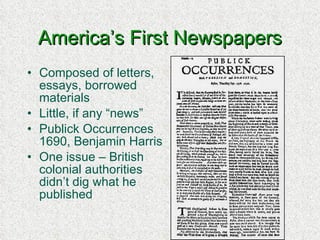
America’s First Newspapers Composed of letters, essays, borrowed materials Little, if any “news” Publick Occurrences 1690, Benjamin Harris One issue – British colonial authorities didn’t dig what he published
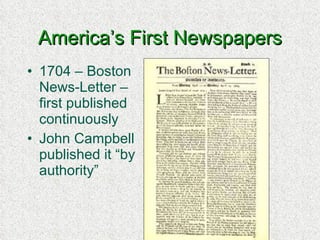
America’s First Newspapers 1704 – Boston News-Letter – first published continuously John Campbell published it “by authority”
Freedom of the Press If attempted to criticize government – guilty of SEDITION Sedition  = stirring of rebellion, criticizing government “ The greater the truth, the greater the libel.”  In early 1700s, truth was not a defense against libel. Libel  – written defamation of character – person, institution, belief
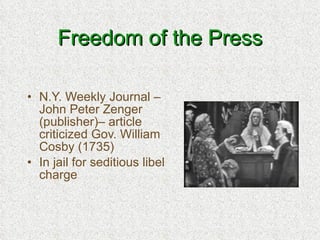
Freedom of the Press N.Y. Weekly Journal – John Peter Zenger (publisher)– article criticized Gov. William Cosby (1735) In jail for seditious libel charge
Freedom of the Press Case was hopeless – if he printed attacks on government, he was guilty of libel, even if his statements were true . . . Andrew Hamilton, attorney Basically stated that through our country’s freedom, we have secured ourselves the right to truth – the liberty of both expressing and opposing power
Freedom of the Press “ Were it left to me to decide whether we should have a government without newspapers or newspapers without a government, I should not hesitate to prefer the latter.” -  Thomas Jefferson
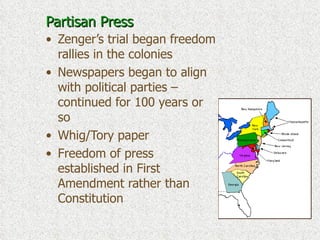
Partisan Press Zenger’s trial began freedom rallies in the colonies Newspapers began to align with political parties – continued for 100 years or so Whig/Tory paper Freedom of press established in First Amendment rather than Constitution
The Penny Press 1833 Benjamin Day – New York Sun Full of glorious, real “news”! (police beat, tragedies, natural disasters, minimized the opinions) Sold for a penny on street sales, not subscriptions Became very popular Advertising became prominent Others – New York Morning Herald (James Gordon Bennet), New York Tribune (Horace Greely)
Women in early American Journalism Cornelia Walter – editor of the Boston Transcript in 1840s Jane Grey Swisshelm – first woman to cover Congress (1850 . . . for the Tribune)
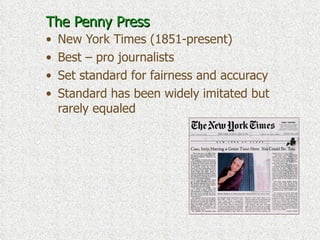
The Penny Press New York Times (1851-present) Best – pro journalists Set standard for fairness and accuracy  Standard has been widely imitated but rarely equaled
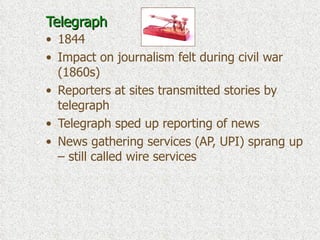
Telegraph 1844 Impact on journalism felt during civil war (1860s) Reporters at sites transmitted stories by telegraph Telegraph sped up reporting of news News gathering services (AP, UPI) sprang up – still called wire services
Yellow Journalism Late 19th century – low point in journalism Unethical, irresponsible journalism Hoaxes, altered photos, screaming headlines, promotion of newspapers themselves Much like today’s National Enquirer, Sun,  World Weekly News ,  Globe  magazine, The Onion, etc. William Randolph Hearst (New York Journal), Joseph Pulitzer (New York World)
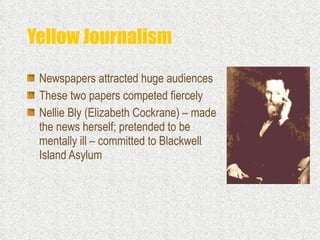
Yellow Journalism Newspapers attracted huge audiences  These two papers competed fiercely Nellie Bly (Elizabeth Cockrane) – made the news herself; pretended to be mentally ill – committed to Blackwell Island Asylum
Muckraking Opposite of yellow journalism – journalists on crusade Papers crusaded for child labor laws, promoted hospitals, collected money for needy Battled corruption in all its forms Pure Food and Drug act of 1906 – result of public scrutiny of meat packing industry
Radio and TV Radio newscasts brought live news to listeners TV brought live, moving pictures to viewers Newspapers took less of a breaking news role TV had big impact on viewers during Vietnam – led to increased instances of protest FCC – jurisdiction over airwaves – NO Censorship power
Journalism Today General decline in readership 24% of young people surveyed said they don’t read newspapers Good journalists need to keep up with current news! To stay competitive, newspapers have increased their online presence as their print presence has decreased
Final Thoughts First Amendment right – the press is the only constitutionally protected industry in the country. This implies responsibility, even for high school journalists! Because of this right, journalists have an obligation to perform for the benefit of society – accurate, responsible reporting!!!

Chapter 1

  • 1.
    Hi-Lights I JournalismToday! Chapter One Review
  • 2.
    America’s First NewspapersComposed of letters, essays, borrowed materials Little, if any “news” Publick Occurrences 1690, Benjamin Harris One issue – British colonial authorities didn’t dig what he published
  • 3.
    America’s First Newspapers1704 – Boston News-Letter – first published continuously John Campbell published it “by authority”
  • 4.
    Freedom of thePress If attempted to criticize government – guilty of SEDITION Sedition = stirring of rebellion, criticizing government “ The greater the truth, the greater the libel.” In early 1700s, truth was not a defense against libel. Libel – written defamation of character – person, institution, belief
  • 5.
    Freedom of thePress N.Y. Weekly Journal – John Peter Zenger (publisher)– article criticized Gov. William Cosby (1735) In jail for seditious libel charge
  • 6.
    Freedom of thePress Case was hopeless – if he printed attacks on government, he was guilty of libel, even if his statements were true . . . Andrew Hamilton, attorney Basically stated that through our country’s freedom, we have secured ourselves the right to truth – the liberty of both expressing and opposing power
  • 7.
    Freedom of thePress “ Were it left to me to decide whether we should have a government without newspapers or newspapers without a government, I should not hesitate to prefer the latter.” - Thomas Jefferson
  • 8.
    Partisan Press Zenger’strial began freedom rallies in the colonies Newspapers began to align with political parties – continued for 100 years or so Whig/Tory paper Freedom of press established in First Amendment rather than Constitution
  • 9.
    The Penny Press1833 Benjamin Day – New York Sun Full of glorious, real “news”! (police beat, tragedies, natural disasters, minimized the opinions) Sold for a penny on street sales, not subscriptions Became very popular Advertising became prominent Others – New York Morning Herald (James Gordon Bennet), New York Tribune (Horace Greely)
  • 10.
    Women in earlyAmerican Journalism Cornelia Walter – editor of the Boston Transcript in 1840s Jane Grey Swisshelm – first woman to cover Congress (1850 . . . for the Tribune)
  • 11.
    The Penny PressNew York Times (1851-present) Best – pro journalists Set standard for fairness and accuracy Standard has been widely imitated but rarely equaled
  • 12.
    Telegraph 1844 Impacton journalism felt during civil war (1860s) Reporters at sites transmitted stories by telegraph Telegraph sped up reporting of news News gathering services (AP, UPI) sprang up – still called wire services
  • 13.
    Yellow Journalism Late19th century – low point in journalism Unethical, irresponsible journalism Hoaxes, altered photos, screaming headlines, promotion of newspapers themselves Much like today’s National Enquirer, Sun, World Weekly News , Globe magazine, The Onion, etc. William Randolph Hearst (New York Journal), Joseph Pulitzer (New York World)
  • 14.
    Yellow Journalism Newspapersattracted huge audiences These two papers competed fiercely Nellie Bly (Elizabeth Cockrane) – made the news herself; pretended to be mentally ill – committed to Blackwell Island Asylum
  • 15.
    Muckraking Opposite ofyellow journalism – journalists on crusade Papers crusaded for child labor laws, promoted hospitals, collected money for needy Battled corruption in all its forms Pure Food and Drug act of 1906 – result of public scrutiny of meat packing industry
  • 16.
    Radio and TVRadio newscasts brought live news to listeners TV brought live, moving pictures to viewers Newspapers took less of a breaking news role TV had big impact on viewers during Vietnam – led to increased instances of protest FCC – jurisdiction over airwaves – NO Censorship power
  • 17.
    Journalism Today Generaldecline in readership 24% of young people surveyed said they don’t read newspapers Good journalists need to keep up with current news! To stay competitive, newspapers have increased their online presence as their print presence has decreased
  • 18.
    Final Thoughts FirstAmendment right – the press is the only constitutionally protected industry in the country. This implies responsibility, even for high school journalists! Because of this right, journalists have an obligation to perform for the benefit of society – accurate, responsible reporting!!!