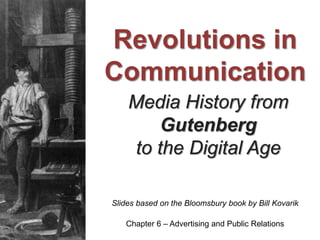
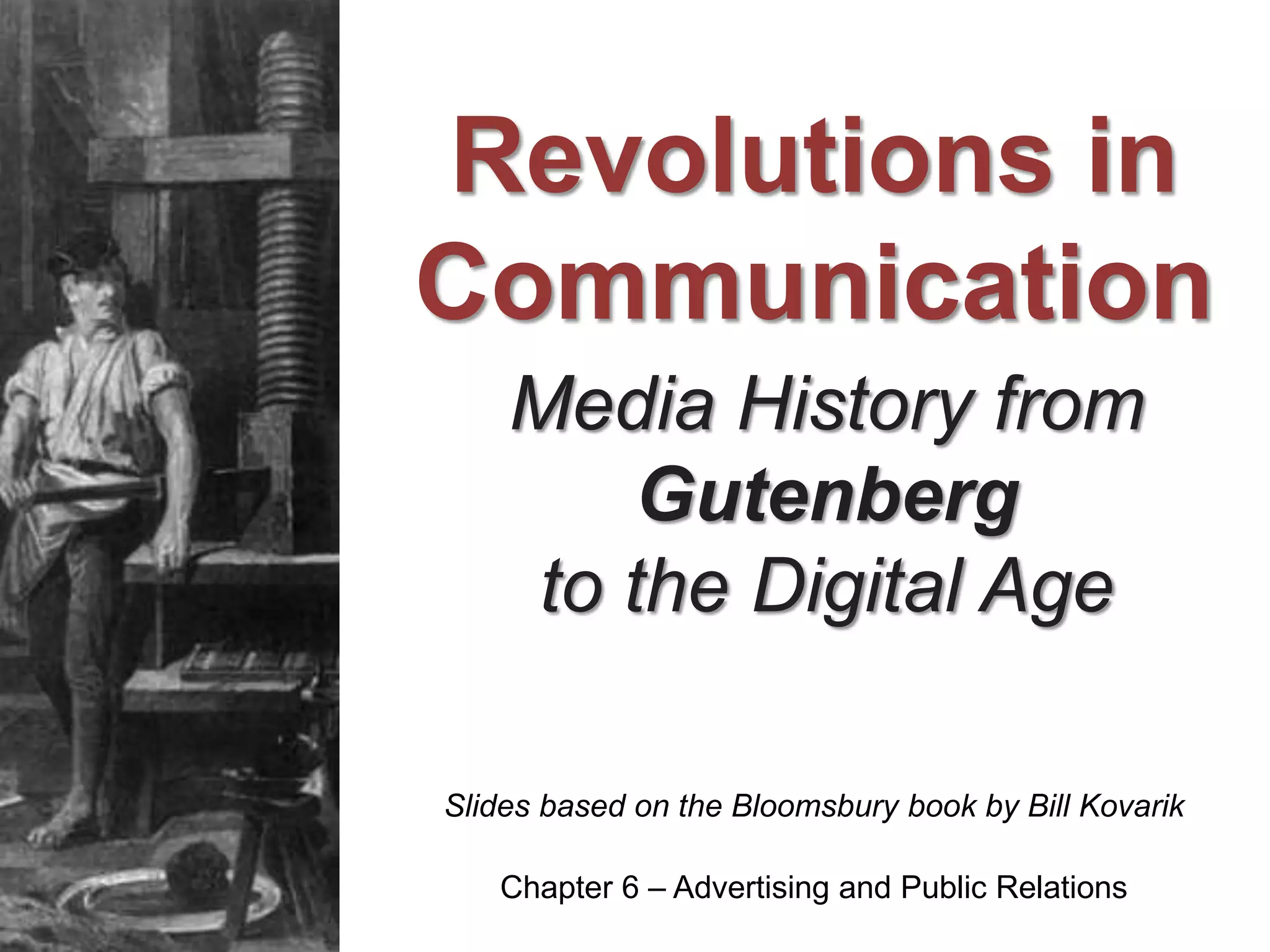
Media History from
Gutenberg
to the Digital Age
Slides based on the Bloomsbury book by Bill Kovarik
Revolutions in
Communication
Chapter 6 – Advertising and Public Relations
Web site & textbook
Textbook:
1st edition – 2011 2nd edition – 2016
http://www.revolutionsincommunication.com
 The image
 Ballyhoo: PT Barnum & Thomas Lipton
 First ad agencies: JW Thompson, NW Ayer
 Patent medicine scandals 1900s
 PR vs muckraking: Ivy Lee
 WWI & the Creel Committee
 Scientific PR: Edward Bernais
 Tobacco ads in print and on air
 Ad men (and women)
 New agencies for the digital age
This lecture is about …
Rise of the Image
 The rise of imagery in culture,
commerce and politics is the second
of four media revolutions in our history
 Along with photos and cinema, images
have a central place in the history of
advertising and public relations
 Imagery, said historian Daniel Boorstin
in the 1960s, had become so
important that it led to pseudo-events
replacing real events.
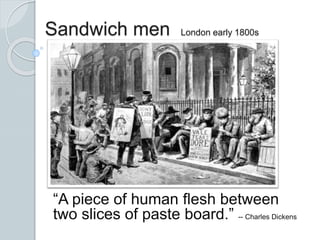
Sandwich men London early 1800s
“A piece of human flesh between
two slices of paste board.” -- Charles Dickens
Advertising and the Penny
Press
 With the advent of industrial presses
and greatly expanded circulation,
penny press editors realized that they
could sell their newspapers at one or
two cents, actually losing money on
circulation, but then regaining it with
advertising revenue.
 This business idea is one of the most
important in media history.
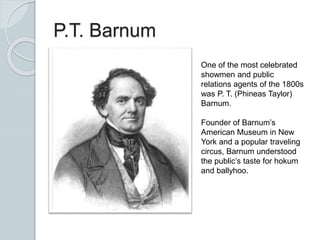
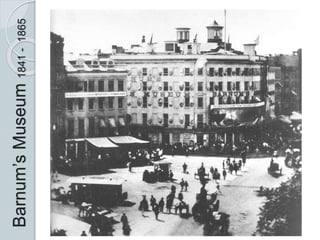
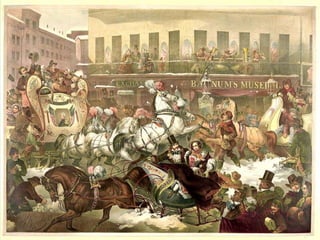
P.T. Barnum
One of the most celebrated
showmen and public
relations agents of the 1800s
was P. T. (Phineas Taylor)
Barnum.
Founder of Barnum’s
American Museum in New
York and a popular traveling
circus, Barnum understood
the public’s taste for hokum
and ballyhoo.
Barnum’sMuseum1841-1865
Philosophy of Advertising
Men of business are hardly aware of the
immense change which a few years
have wrought in the power of the public
press . . . He who would build a business
must be like the times . . . To neglect
(advertising) is like resolving never to
travel by steam nor communicate by
telegraph. It is to close one’s eyes to the
light and insist on living in perpetual
darkness. . . . He who neglects the
advantages of advertising not only robs
himself of his fair advantages, but
bestows the spoils on his wiser rivals.
First Ad Agencies
 London 1812 George Reynell
◦ Legal ads
 New York 1841 Volney Palmer
◦ Quickly branched out to other cities
 N.W. Ayer & Son 1869
◦ Open book ad agency / ethical … but …
◦ Placed patent medicine ads
 J. Walter Thompson 1878
◦ Full Service ad agency – Copy writing,
design, placement
Four models of ad agencies
1. Newspaper agency (taking orders for
ads);
2. Brokers / space jobbing (selling
space to clients and then buying the ad
space);
3. Space wholesaling (buying large
amounts of advertising space at a
discount and then reselling the space to
clients at regular rates);
4. Advertising concession (contracting
for advertising space and taking the risk
of selling the space).
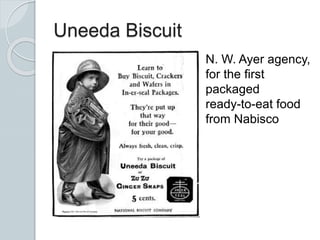
Uneeda Biscuit
N. W. Ayer agency,
for the first
packaged
ready-to-eat food
from Nabisco
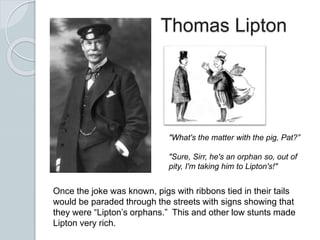
Thomas Lipton
"What's the matter with the pig, Pat?”
"Sure, Sirr, he's an orphan so, out of
pity, I'm taking him to Lipton's!"
Once the joke was known, pigs with ribbons tied in their tails
would be paraded through the streets with signs showing that
they were “Lipton’s orphans.” This and other low stunts made
Lipton very rich.
Advertising unregulated
 Anything could be advertised without
concern for the public until around
1906 – 1914 regulation in the US by:
◦ Federal Trade Commission
◦ Food and Drug Administration
 For instance, Grape nuts cereal were
advertised as a cure for appendicitis
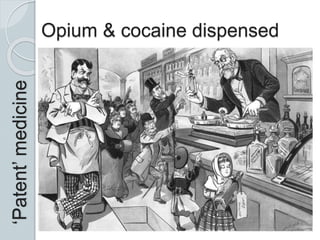
Opium & cocaine dispensed
‘Patent’medicine
‘Patent’medicine
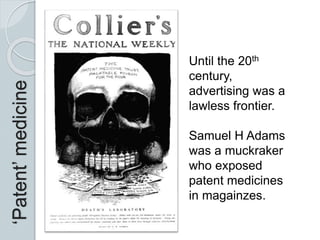
Until the 20th
century,
advertising was a
lawless frontier.
Samuel H Adams
was a muckraker
who exposed
patent medicines
in magainzes.
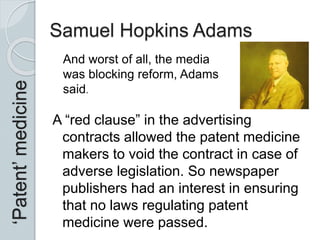
Samuel Hopkins Adams
A “red clause” in the advertising
contracts allowed the patent medicine
makers to void the contract in case of
adverse legislation. So newspaper
publishers had an interest in ensuring
that no laws regulating patent
medicine were passed.
‘Patent’medicine
And worst of all, the media
was blocking reform, Adams
said.
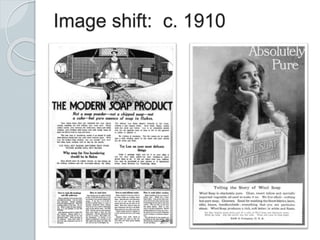
Image shift: c. 1910
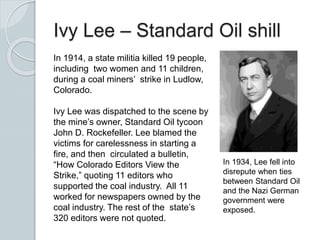
Ivy Lee – Standard Oil shill
In 1914, a state militia killed 19 people,
including two women and 11 children,
during a coal miners’ strike in Ludlow,
Colorado.
Ivy Lee was dispatched to the scene by
the mine’s owner, Standard Oil tycoon
John D. Rockefeller. Lee blamed the
victims for carelessness in starting a
fire, and then circulated a bulletin,
“How Colorado Editors View the
Strike,” quoting 11 editors who
supported the coal industry. All 11
worked for newspapers owned by the
coal industry. The rest of the state’s
320 editors were not quoted.
In 1934, Lee fell into
disrepute when ties
between Standard Oil
and the Nazi German
government were
exposed.
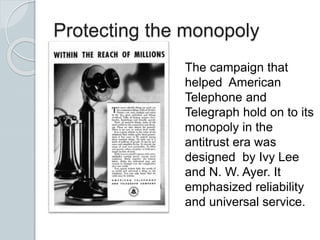
Protecting the monopoly
The campaign that
helped American
Telephone and
Telegraph hold on to its
monopoly in the
antitrust era was
designed by Ivy Lee
and N. W. Ayer. It
emphasized reliability
and universal service.
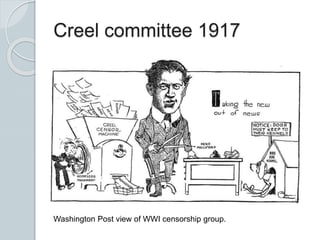
Creel committee 1917
Washington Post view of WWI censorship group.
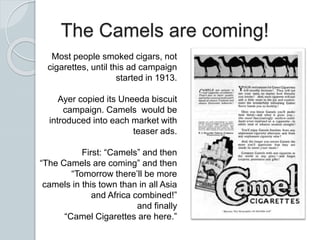
The Camels are coming!
Most people smoked cigars, not
cigarettes, until this ad campaign
started in 1913.
Ayer copied its Uneeda biscuit
campaign. Camels would be
introduced into each market with
teaser ads.
First: “Camels” and then
“The Camels are coming” and then
“Tomorrow there’ll be more
camels in this town than in all Asia
and Africa combined!”
and finally
“Camel Cigarettes are here.”
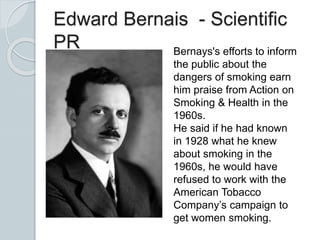
Edward Bernais - Scientific
PR Bernays's efforts to inform
the public about the
dangers of smoking earn
him praise from Action on
Smoking & Health in the
1960s.
He said if he had known
in 1928 what he knew
about smoking in the
1960s, he would have
refused to work with the
American Tobacco
Company’s campaign to
get women smoking.
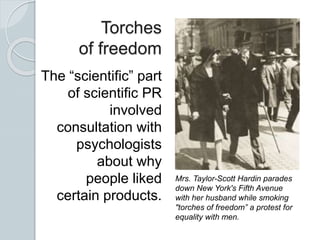
Torches
of freedom
The “scientific” part
of scientific PR
involved
consultation with
psychologists
about why
people liked
certain products.
Mrs. Taylor-Scott Hardin parades
down New York's Fifth Avenue
with her husband while smoking
"torches of freedom” a protest for
equality with men.
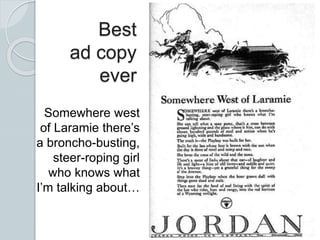
Best
ad copy
ever
Somewhere west
of Laramie there’s
a broncho-busting,
steer-roping girl
who knows what
I’m talking about…
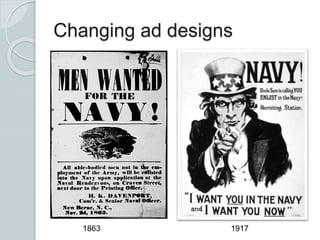
Changing ad designs
1863 1917
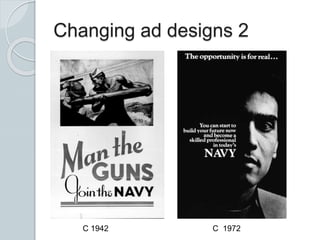
Changing ad designs 2
C 1942 C 1972
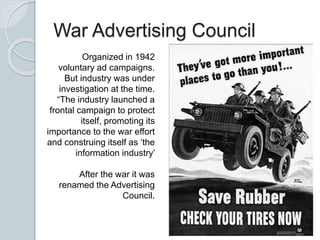
War Advertising Council
Organized in 1942
voluntary ad campaigns.
But industry was under
investigation at the time.
“The industry launched a
frontal campaign to protect
itself, promoting its
importance to the war effort
and construing itself as ‘the
information industry’
After the war it was
renamed the Advertising
Council.
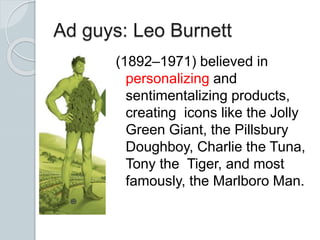
Ad guys: Leo Burnett
(1892–1971) believed in
personalizing and
sentimentalizing products,
creating icons like the Jolly
Green Giant, the Pillsbury
Doughboy, Charlie the Tuna,
Tony the Tiger, and most
famously, the Marlboro Man.
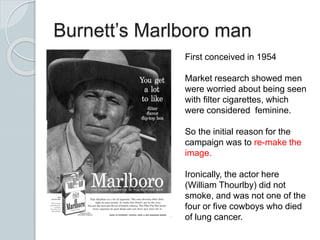
Burnett’s Marlboro man
First conceived in 1954
Market research showed men
were worried about being seen
with filter cigarettes, which
were considered feminine.
So the initial reason for the
campaign was to re-make the
image.
Ironically, the actor here
(William Thourlby) did not
smoke, and was not one of the
four or five cowboys who died
of lung cancer.
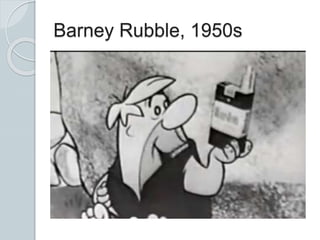
Barney Rubble, 1950s
TV tobacco ads banned 1971
 Tobacco advertising was banned from
broadcasting by Congress starting
January 2, 1971. All printed
advertising must now display a health
warning from the US Surgeon
General.
 The 2010 - 15 controversy in the US
involves highly graphic health
warnings.
David Ogilvy
 (1911–1999) said
brand personality
draws consumers to
products. At the height
of his career in 1962,
Time magazine called
him “the most sought
after wizard in today’s
advertising industry.”
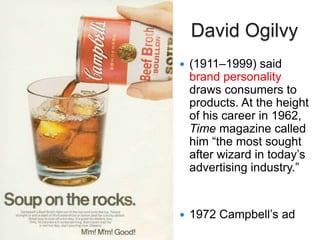
 1972 Campbell’s ad
More ad guys
 Norman B. Norman (1914–1991), one of
New York’s original ad men, tied advertising
to theories of empathy for clients including
Colgate-Palmolive, Revlon, Ronson, Chanel
and Liggett & Myers.
 Helen Lansdowne Resor (1886–1964),
worked for J. Walter Thompson to help
market products to women. Woodbury
Soap’s ad, “The skin you love to touch,” was
typical of her use of personal appeals to
attract interest.
Ad guys: Rosser Reeves
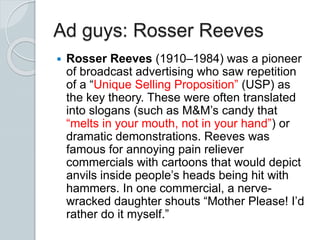
 Rosser Reeves (1910–1984) was a pioneer
of broadcast advertising who saw repetition
of a “Unique Selling Proposition” (USP) as
the key theory. These were often translated
into slogans (such as M&M’s candy that
“melts in your mouth, not in your hand”) or
dramatic demonstrations. Reeves was
famous for annoying pain reliever
commercials with cartoons that would depict
anvils inside people’s heads being hit with
hammers. In one commercial, a nerve-
wracked daughter shouts “Mother Please! I’d
rather do it myself.”
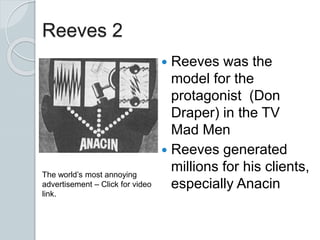
Reeves 2
 Reeves was the
model for the
protagonist (Don
Draper) in the TV
Mad Men
 Reeves generated
millions for his clients,
especially Anacin
The world’s most annoying
advertisement – Click for video
link.
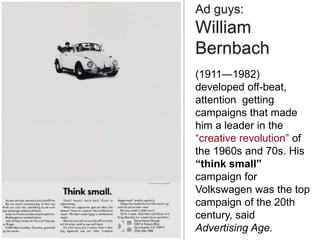
(1911—1982)
developed off-beat,
attention getting
campaigns that made
him a leader in the
“creative revolution” of
the 1960s and 70s. His
“think small”
campaign for
Volkswagen was the top
campaign of the 20th
century, said
Advertising Age.
Ad guys:
William
Bernbach
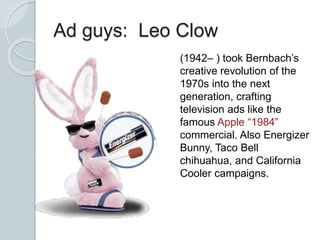
Ad guys: Leo Clow
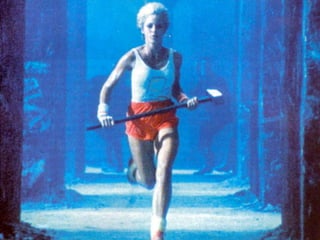
(1942– ) took Bernbach’s
creative revolution of the
1970s into the next
generation, crafting
television ads like the
famous Apple “1984”
commercial. Also Energizer
Bunny, Taco Bell
chihuahua, and California
Cooler campaigns.
Ad guys: Saatchi & Saatchi
 Maurice and Charles Saatchi (1946– ) and (1943– )
were among the first to take a global approach to
advertising when they founded Saatchi & Saatchi in
1970.
 Through a series of mergers and acquisitions in the
1980s, the company became the world’s largest
advertising super-agency by 1988. The Saatchi
brothers split off from the main agency, now owned
by Publicis Groupe, to run a smaller creative agency
M&C Saatchi.
Advertsasfreespeech
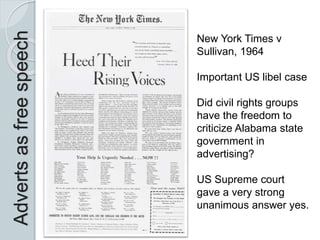
New York Times v
Sullivan, 1964
Important US libel case
Did civil rights groups
have the freedom to
criticize Alabama state
government in
advertising?
US Supreme court
gave a very strong
unanimous answer yes.
Advertsasfreespeech
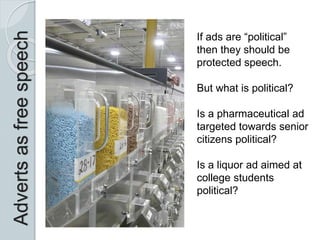
If ads are “political”
then they should be
protected speech.
But what is political?
Is a pharmaceutical ad
targeted towards senior
citizens political?
Is a liquor ad aimed at
college students
political?
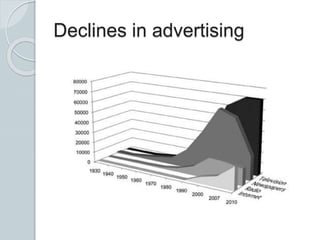
Declines in advertising
Review: people
 Volney Palmer, George Reynell, J.
Walter Thompson, N.W. Ayer, Thomas
Lipton, P.T. Barnum, Ivy Lee, Edward
Bernays, George Creel, Maurice and
Charles Saatchi, Lee Clow, Helen
Lansdowne Resor, David Ogilvy,
Rosser Reeves, Leo Burnett, James
Grunig
Review: Concepts
 Advertising is ancient, ballyhoo,
 Business models of first ad agencies:
◦ Newspaper agency,
◦ Brokers (space jobbing), Space wholesaling,
◦ Advertising concession,
 Regulation of advertising, patent medicine
 Image shift, protecting big companies with
PR,
 Creel Committee, War Advertising Council
 Changing ad designs from product to
personal appeal, re-imaging products,
brand personality, unique selling
proposition
Next: Chapter 7
Telegraph and telephone

Rc 6.ad pr

  • 1.
    Media History from Gutenberg tothe Digital Age Slides based on the Bloomsbury book by Bill Kovarik Revolutions in Communication Chapter 6 – Advertising and Public Relations
  • 2.
    Web site &textbook Textbook: 1st edition – 2011 2nd edition – 2016 http://www.revolutionsincommunication.com
  • 3.
     The image Ballyhoo: PT Barnum & Thomas Lipton  First ad agencies: JW Thompson, NW Ayer  Patent medicine scandals 1900s  PR vs muckraking: Ivy Lee  WWI & the Creel Committee  Scientific PR: Edward Bernais  Tobacco ads in print and on air  Ad men (and women)  New agencies for the digital age This lecture is about …
  • 4.
    Rise of theImage  The rise of imagery in culture, commerce and politics is the second of four media revolutions in our history  Along with photos and cinema, images have a central place in the history of advertising and public relations  Imagery, said historian Daniel Boorstin in the 1960s, had become so important that it led to pseudo-events replacing real events.
  • 5.
    Sandwich men Londonearly 1800s “A piece of human flesh between two slices of paste board.” -- Charles Dickens
  • 6.
    Advertising and thePenny Press  With the advent of industrial presses and greatly expanded circulation, penny press editors realized that they could sell their newspapers at one or two cents, actually losing money on circulation, but then regaining it with advertising revenue.  This business idea is one of the most important in media history.
  • 7.
    P.T. Barnum One ofthe most celebrated showmen and public relations agents of the 1800s was P. T. (Phineas Taylor) Barnum. Founder of Barnum’s American Museum in New York and a popular traveling circus, Barnum understood the public’s taste for hokum and ballyhoo.
  • 8.
  • 10.
    Philosophy of Advertising Menof business are hardly aware of the immense change which a few years have wrought in the power of the public press . . . He who would build a business must be like the times . . . To neglect (advertising) is like resolving never to travel by steam nor communicate by telegraph. It is to close one’s eyes to the light and insist on living in perpetual darkness. . . . He who neglects the advantages of advertising not only robs himself of his fair advantages, but bestows the spoils on his wiser rivals.
  • 11.
    First Ad Agencies London 1812 George Reynell ◦ Legal ads  New York 1841 Volney Palmer ◦ Quickly branched out to other cities  N.W. Ayer & Son 1869 ◦ Open book ad agency / ethical … but … ◦ Placed patent medicine ads  J. Walter Thompson 1878 ◦ Full Service ad agency – Copy writing, design, placement
  • 12.
    Four models ofad agencies 1. Newspaper agency (taking orders for ads); 2. Brokers / space jobbing (selling space to clients and then buying the ad space); 3. Space wholesaling (buying large amounts of advertising space at a discount and then reselling the space to clients at regular rates); 4. Advertising concession (contracting for advertising space and taking the risk of selling the space).
  • 13.
    Uneeda Biscuit N. W.Ayer agency, for the first packaged ready-to-eat food from Nabisco
  • 14.
    Thomas Lipton "What's thematter with the pig, Pat?” "Sure, Sirr, he's an orphan so, out of pity, I'm taking him to Lipton's!" Once the joke was known, pigs with ribbons tied in their tails would be paraded through the streets with signs showing that they were “Lipton’s orphans.” This and other low stunts made Lipton very rich.
  • 15.
    Advertising unregulated  Anythingcould be advertised without concern for the public until around 1906 – 1914 regulation in the US by: ◦ Federal Trade Commission ◦ Food and Drug Administration  For instance, Grape nuts cereal were advertised as a cure for appendicitis
  • 16.
    Opium & cocainedispensed ‘Patent’medicine
  • 17.
    ‘Patent’medicine Until the 20th century, advertisingwas a lawless frontier. Samuel H Adams was a muckraker who exposed patent medicines in magainzes.
  • 18.
    Samuel Hopkins Adams A“red clause” in the advertising contracts allowed the patent medicine makers to void the contract in case of adverse legislation. So newspaper publishers had an interest in ensuring that no laws regulating patent medicine were passed. ‘Patent’medicine And worst of all, the media was blocking reform, Adams said.
  • 19.
  • 20.
    Ivy Lee –Standard Oil shill In 1914, a state militia killed 19 people, including two women and 11 children, during a coal miners’ strike in Ludlow, Colorado. Ivy Lee was dispatched to the scene by the mine’s owner, Standard Oil tycoon John D. Rockefeller. Lee blamed the victims for carelessness in starting a fire, and then circulated a bulletin, “How Colorado Editors View the Strike,” quoting 11 editors who supported the coal industry. All 11 worked for newspapers owned by the coal industry. The rest of the state’s 320 editors were not quoted. In 1934, Lee fell into disrepute when ties between Standard Oil and the Nazi German government were exposed.
  • 21.
    Protecting the monopoly Thecampaign that helped American Telephone and Telegraph hold on to its monopoly in the antitrust era was designed by Ivy Lee and N. W. Ayer. It emphasized reliability and universal service.
  • 22.
    Creel committee 1917 WashingtonPost view of WWI censorship group.
  • 23.
    The Camels arecoming! Most people smoked cigars, not cigarettes, until this ad campaign started in 1913. Ayer copied its Uneeda biscuit campaign. Camels would be introduced into each market with teaser ads. First: “Camels” and then “The Camels are coming” and then “Tomorrow there’ll be more camels in this town than in all Asia and Africa combined!” and finally “Camel Cigarettes are here.”
  • 24.
    Edward Bernais -Scientific PR Bernays's efforts to inform the public about the dangers of smoking earn him praise from Action on Smoking & Health in the 1960s. He said if he had known in 1928 what he knew about smoking in the 1960s, he would have refused to work with the American Tobacco Company’s campaign to get women smoking.
  • 25.
    Torches of freedom The “scientific”part of scientific PR involved consultation with psychologists about why people liked certain products. Mrs. Taylor-Scott Hardin parades down New York's Fifth Avenue with her husband while smoking "torches of freedom” a protest for equality with men.
  • 26.
    Best ad copy ever Somewhere west ofLaramie there’s a broncho-busting, steer-roping girl who knows what I’m talking about…
  • 27.
  • 28.
    Changing ad designs2 C 1942 C 1972
  • 29.
    War Advertising Council Organizedin 1942 voluntary ad campaigns. But industry was under investigation at the time. “The industry launched a frontal campaign to protect itself, promoting its importance to the war effort and construing itself as ‘the information industry’ After the war it was renamed the Advertising Council.
  • 30.
    Ad guys: LeoBurnett (1892–1971) believed in personalizing and sentimentalizing products, creating icons like the Jolly Green Giant, the Pillsbury Doughboy, Charlie the Tuna, Tony the Tiger, and most famously, the Marlboro Man.
  • 31.
    Burnett’s Marlboro man Firstconceived in 1954 Market research showed men were worried about being seen with filter cigarettes, which were considered feminine. So the initial reason for the campaign was to re-make the image. Ironically, the actor here (William Thourlby) did not smoke, and was not one of the four or five cowboys who died of lung cancer.
  • 32.
  • 33.
    TV tobacco adsbanned 1971  Tobacco advertising was banned from broadcasting by Congress starting January 2, 1971. All printed advertising must now display a health warning from the US Surgeon General.  The 2010 - 15 controversy in the US involves highly graphic health warnings.
  • 34.
    David Ogilvy  (1911–1999)said brand personality draws consumers to products. At the height of his career in 1962, Time magazine called him “the most sought after wizard in today’s advertising industry.”  1972 Campbell’s ad
  • 35.
    More ad guys Norman B. Norman (1914–1991), one of New York’s original ad men, tied advertising to theories of empathy for clients including Colgate-Palmolive, Revlon, Ronson, Chanel and Liggett & Myers.  Helen Lansdowne Resor (1886–1964), worked for J. Walter Thompson to help market products to women. Woodbury Soap’s ad, “The skin you love to touch,” was typical of her use of personal appeals to attract interest.
  • 36.
    Ad guys: RosserReeves  Rosser Reeves (1910–1984) was a pioneer of broadcast advertising who saw repetition of a “Unique Selling Proposition” (USP) as the key theory. These were often translated into slogans (such as M&M’s candy that “melts in your mouth, not in your hand”) or dramatic demonstrations. Reeves was famous for annoying pain reliever commercials with cartoons that would depict anvils inside people’s heads being hit with hammers. In one commercial, a nerve- wracked daughter shouts “Mother Please! I’d rather do it myself.”
  • 37.
    Reeves 2  Reeveswas the model for the protagonist (Don Draper) in the TV Mad Men  Reeves generated millions for his clients, especially Anacin The world’s most annoying advertisement – Click for video link.
  • 38.
    (1911—1982) developed off-beat, attention getting campaignsthat made him a leader in the “creative revolution” of the 1960s and 70s. His “think small” campaign for Volkswagen was the top campaign of the 20th century, said Advertising Age. Ad guys: William Bernbach
  • 39.
    Ad guys: LeoClow (1942– ) took Bernbach’s creative revolution of the 1970s into the next generation, crafting television ads like the famous Apple “1984” commercial. Also Energizer Bunny, Taco Bell chihuahua, and California Cooler campaigns.
  • 41.
    Ad guys: Saatchi& Saatchi  Maurice and Charles Saatchi (1946– ) and (1943– ) were among the first to take a global approach to advertising when they founded Saatchi & Saatchi in 1970.  Through a series of mergers and acquisitions in the 1980s, the company became the world’s largest advertising super-agency by 1988. The Saatchi brothers split off from the main agency, now owned by Publicis Groupe, to run a smaller creative agency M&C Saatchi.
  • 42.
    Advertsasfreespeech New York Timesv Sullivan, 1964 Important US libel case Did civil rights groups have the freedom to criticize Alabama state government in advertising? US Supreme court gave a very strong unanimous answer yes.
  • 43.
    Advertsasfreespeech If ads are“political” then they should be protected speech. But what is political? Is a pharmaceutical ad targeted towards senior citizens political? Is a liquor ad aimed at college students political?
  • 44.
  • 45.
    Review: people  VolneyPalmer, George Reynell, J. Walter Thompson, N.W. Ayer, Thomas Lipton, P.T. Barnum, Ivy Lee, Edward Bernays, George Creel, Maurice and Charles Saatchi, Lee Clow, Helen Lansdowne Resor, David Ogilvy, Rosser Reeves, Leo Burnett, James Grunig
  • 46.
    Review: Concepts  Advertisingis ancient, ballyhoo,  Business models of first ad agencies: ◦ Newspaper agency, ◦ Brokers (space jobbing), Space wholesaling, ◦ Advertising concession,  Regulation of advertising, patent medicine  Image shift, protecting big companies with PR,  Creel Committee, War Advertising Council  Changing ad designs from product to personal appeal, re-imaging products, brand personality, unique selling proposition
  • 47.

Editor's Notes

  • #10 Currier & ives Lithograph of the Barnum Museum
  • #14 The campaign would come to a town with just one word on a billboard and in newspaper ads: “Uneeda.” The next day, the ad would read “Uneeda biscuit.” The following day it would read: “Do you know Uneeda biscuit?” And next: “Of Course Uneeda biscuit.” The Nabisco campaign was a smashing success. It was followed by Fig Newton, Animal Crackers, Lorna Doone and the Oreo.
  • #15 The British had a low opinion of American hucksterism. One pundit wrote that Brits “have not yet learned to sacrifice all that should be dear and honorable to humanity.” And yet, the public was just as susceptible. Take Thomas Lipton’s campaigns. had.
  • #26 https://www.youtube.com/watch?v=6pyyP2chM8k