People…Productivity…Profitability


                                                                      David W. Hand
                                                            Email: dhand@p2atl.com
                                                              Phone: 770.362.2964


Not For Disclosure Outside of Possibility Partners, LLC- Copyright © 2013 Possibility Partners, LLC
   Opening Remarks
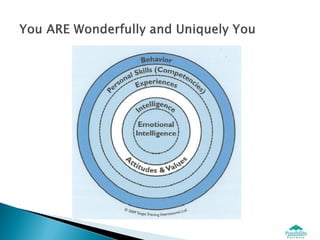
   You ARE Wonderfully and Uniquely You
   Why It Matters
    ◦   Behaviors
    ◦   Motivators
    ◦   Competencies
    ◦   Emotional Intelligence
   New Year…Real You
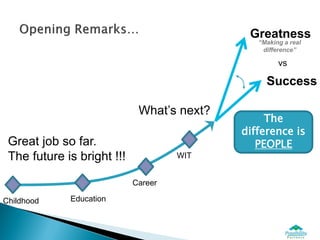
Greatness
                                               “Making a real
                                                difference”

                                                     vs

                                                 Success

                             What’s next?
                                                 The
                                            difference is
 Great job so far.                             PEOPLE
 The future is bright !!!            WIT


                            Career

Childhood    Education
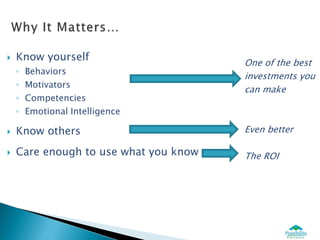
   Know yourself
                                       One of the best
    ◦   Behaviors
                                       investments you
    ◦   Motivators
                                       can make
    ◦   Competencies
    ◦   Emotional Intelligence

   Know others                        Even better

   Care enough to use what you know   The ROI
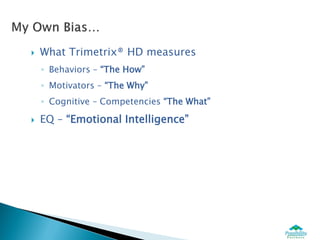
   What Trimetrix® HD measures
    ◦ Behaviors – “The How”
    ◦ Motivators – “The Why”
    ◦ Cognitive – Competencies “The What”

   EQ – “Emotional Intelligence”
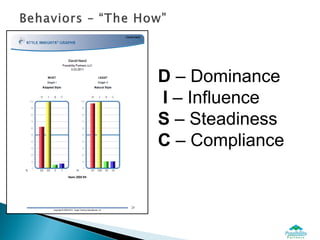
D – Dominance
I – Influence
S – Steadiness
C – Compliance
   Theoretical – Lifetime Learner
   Social - Do for Others
   Utilitarian – ROI Mentality
   Individualistic – Power, Control, Influence
   Traditional – System for Living
   Aesthetic – For, Beauty, Harmony
   Persuasion
   Personal accountability
   Resiliency
   Self management
   Planning / organizing
   Futuristic thinking
   Negotiation
   Decision making
   Leadership
   Written communication
   …
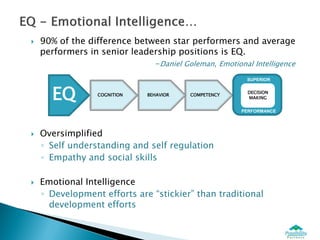
   90% of the difference between star performers and average
    performers in senior leadership positions is EQ.
                               -Daniel Goleman, Emotional Intelligence
                                                        SUPERIOR


      EQ         COGNITION   BEHAVIOR   COMPETENCY
                                                        DECISION
                                                        MAKING


                                                       PERFORMANCE


   Oversimplified
    ◦ Self understanding and self regulation
    ◦ Empathy and social skills

   Emotional Intelligence
    ◦ Development efforts are “stickier” than traditional
      development efforts
   Commit to understanding how wonderfully unique
    and special you are
   Commit to understanding others
   Care enough to use what you know
   Liberate the leader in you
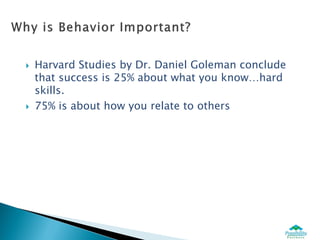
   Harvard Studies by Dr. Daniel Goleman conclude
    that success is 25% about what you know…hard
    skills.
   75% is about how you relate to others
   We can identify a person’s behavioral style
    through observation
   Fast Paced
   Angry
   Passive
   Fun
   Smiling
   Stoic
   Overly Neat
   Research has shown that each of the following is
    what % of the communication process?
   Words          _________%
   Gestures       _________%
   Tone           _________%
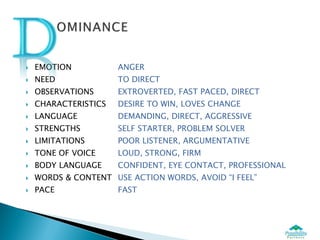
   EMOTION           ANGER
   NEED              TO DIRECT
   OBSERVATIONS      EXTROVERTED, FAST PACED, DIRECT
   CHARACTERISTICS   DESIRE TO WIN, LOVES CHANGE
   LANGUAGE          DEMANDING, DIRECT, AGGRESSIVE
   STRENGTHS         SELF STARTER, PROBLEM SOLVER
   LIMITATIONS       POOR LISTENER, ARGUMENTATIVE
   TONE OF VOICE     LOUD, STRONG, FIRM
   BODY LANGUAGE     CONFIDENT, EYE CONTACT, PROFESSIONAL
   WORDS & CONTENT USE ACTION WORDS, AVOID “I FEEL”
   PACE              FAST
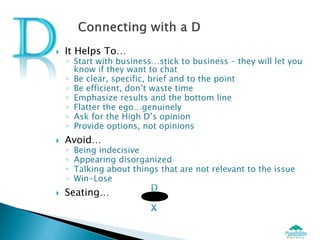
   It Helps To…
    ◦ Start with business…stick to business – they will let you
      know if they want to chat
    ◦ Be clear, specific, brief and to the point
    ◦ Be efficient, don’t waste time
    ◦ Emphasize results and the bottom line
    ◦ Flatter the ego…genuinely
    ◦ Ask for the High D’s opinion
    ◦ Provide options, not opinions
   Avoid…
    ◦   Being indecisive
    ◦   Appearing disorganized
    ◦   Talking about things that are not relevant to the issue
    ◦   Win-Lose
   Seating…
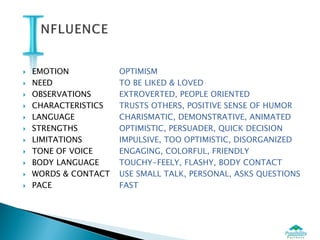
   EMOTION           OPTIMISM
   NEED              TO BE LIKED & LOVED
   OBSERVATIONS      EXTROVERTED, PEOPLE ORIENTED
   CHARACTERISTICS   TRUSTS OTHERS, POSITIVE SENSE OF HUMOR
   LANGUAGE          CHARISMATIC, DEMONSTRATIVE, ANIMATED
   STRENGTHS         OPTIMISTIC, PERSUADER, QUICK DECISION
   LIMITATIONS       IMPULSIVE, TOO OPTIMISTIC, DISORGANIZED
   TONE OF VOICE     ENGAGING, COLORFUL, FRIENDLY
   BODY LANGUAGE     TOUCHY-FEELY, FLASHY, BODY CONTACT
   WORDS & CONTACT   USE SMALL TALK, PERSONAL, ASKS QUESTIONS
   PACE              FAST
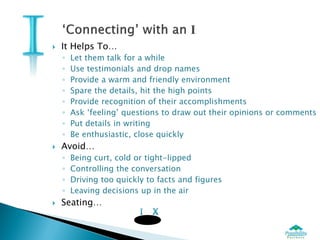
   It Helps To…
    ◦   Let them talk for a while
    ◦   Use testimonials and drop names
    ◦   Provide a warm and friendly environment
    ◦   Spare the details, hit the high points
    ◦   Provide recognition of their accomplishments
    ◦   Ask ‘feeling’ questions to draw out their opinions or comments
    ◦   Put details in writing
    ◦   Be enthusiastic, close quickly
   Avoid…
    ◦   Being curt, cold or tight-lipped
    ◦   Controlling the conversation
    ◦   Driving too quickly to facts and figures
    ◦   Leaving decisions up in the air
   Seating…
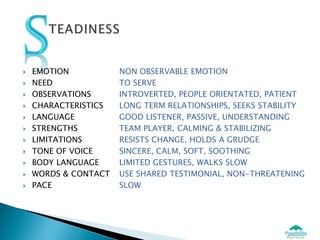
   EMOTION           NON OBSERVABLE EMOTION
   NEED              TO SERVE
   OBSERVATIONS      INTROVERTED, PEOPLE ORIENTATED, PATIENT
   CHARACTERISTICS   LONG TERM RELATIONSHIPS, SEEKS STABILITY
   LANGUAGE          GOOD LISTENER, PASSIVE, UNDERSTANDING
   STRENGTHS         TEAM PLAYER, CALMING & STABILIZING
   LIMITATIONS       RESISTS CHANGE, HOLDS A GRUDGE
   TONE OF VOICE     SINCERE, CALM, SOFT, SOOTHING
   BODY LANGUAGE     LIMITED GESTURES, WALKS SLOW
   WORDS & CONTACT   USE SHARED TESTIMONIAL, NON-THREATENING
   PACE              SLOW
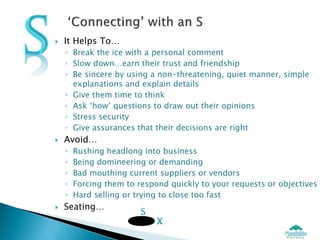
   It Helps To…
    ◦ Break the ice with a personal comment
    ◦ Slow down…earn their trust and friendship
    ◦ Be sincere by using a non-threatening, quiet manner, simple
      explanations and explain details
    ◦ Give them time to think
    ◦ Ask ‘how’ questions to draw out their opinions
    ◦ Stress security
    ◦ Give assurances that their decisions are right
   Avoid…
    ◦   Rushing headlong into business
    ◦   Being domineering or demanding
    ◦   Bad mouthing current suppliers or vendors
    ◦   Forcing them to respond quickly to your requests or objectives
    ◦   Hard selling or trying to close too fast
   Seating…
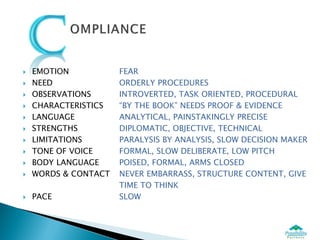
   EMOTION           FEAR
   NEED              ORDERLY PROCEDURES
   OBSERVATIONS      INTROVERTED, TASK ORIENTED, PROCEDURAL
   CHARACTERISTICS   “BY THE BOOK” NEEDS PROOF & EVIDENCE
   LANGUAGE          ANALYTICAL, PAINSTAKINGLY PRECISE
   STRENGTHS         DIPLOMATIC, OBJECTIVE, TECHNICAL
   LIMITATIONS       PARALYSIS BY ANALYSIS, SLOW DECISION MAKER
   TONE OF VOICE     FORMAL, SLOW DELIBERATE, LOW PITCH
   BODY LANGUAGE     POISED, FORMAL, ARMS CLOSED
   WORDS & CONTACT   NEVER EMBARRASS, STRUCTURE CONTENT, GIVE
                      TIME TO THINK
   PACE              SLOW
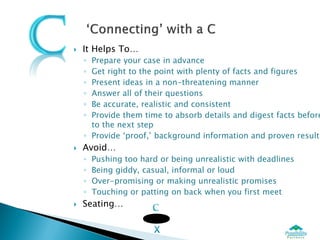
   It Helps To…
    ◦ Prepare your case in advance
    ◦ Get right to the point with plenty of facts and figures
    ◦ Present ideas in a non-threatening manner
    ◦ Answer all of their questions
    ◦ Be accurate, realistic and consistent
    ◦ Provide them time to absorb details and digest facts before
      to the next step
    ◦ Provide ‘proof,’ background information and proven results
   Avoid…
    ◦   Pushing too hard or being unrealistic with deadlines
    ◦   Being giddy, casual, informal or loud
    ◦   Over-promising or making unrealistic promises
    ◦   Touching or patting on back when you first meet
   Seating…

2013 WIT Forum - Knowing Yourself & Knowing Others

  • 1.
    People…Productivity…Profitability David W. Hand Email: dhand@p2atl.com Phone: 770.362.2964 Not For Disclosure Outside of Possibility Partners, LLC- Copyright © 2013 Possibility Partners, LLC
  • 2.
    Opening Remarks  You ARE Wonderfully and Uniquely You  Why It Matters ◦ Behaviors ◦ Motivators ◦ Competencies ◦ Emotional Intelligence  New Year…Real You
  • 3.
    Greatness “Making a real difference” vs Success What’s next? The difference is Great job so far. PEOPLE The future is bright !!! WIT Career Childhood Education
  • 5.
    Know yourself One of the best ◦ Behaviors investments you ◦ Motivators can make ◦ Competencies ◦ Emotional Intelligence  Know others Even better  Care enough to use what you know The ROI
  • 6.
    What Trimetrix® HD measures ◦ Behaviors – “The How” ◦ Motivators – “The Why” ◦ Cognitive – Competencies “The What”  EQ – “Emotional Intelligence”
  • 7.
    D – Dominance I– Influence S – Steadiness C – Compliance
  • 8.
    Theoretical – Lifetime Learner  Social - Do for Others  Utilitarian – ROI Mentality  Individualistic – Power, Control, Influence  Traditional – System for Living  Aesthetic – For, Beauty, Harmony
  • 9.
    Persuasion  Personal accountability  Resiliency  Self management  Planning / organizing  Futuristic thinking  Negotiation  Decision making  Leadership  Written communication  …
  • 10.
    90% of the difference between star performers and average performers in senior leadership positions is EQ. -Daniel Goleman, Emotional Intelligence SUPERIOR EQ COGNITION BEHAVIOR COMPETENCY DECISION MAKING PERFORMANCE  Oversimplified ◦ Self understanding and self regulation ◦ Empathy and social skills  Emotional Intelligence ◦ Development efforts are “stickier” than traditional development efforts
  • 11.
    Commit to understanding how wonderfully unique and special you are  Commit to understanding others  Care enough to use what you know  Liberate the leader in you
  • 13.
    Harvard Studies by Dr. Daniel Goleman conclude that success is 25% about what you know…hard skills.  75% is about how you relate to others
  • 14.
    We can identify a person’s behavioral style through observation  Fast Paced  Angry  Passive  Fun  Smiling  Stoic  Overly Neat
  • 15.
    Research has shown that each of the following is what % of the communication process?  Words _________%  Gestures _________%  Tone _________%
  • 16.
    EMOTION ANGER  NEED TO DIRECT  OBSERVATIONS EXTROVERTED, FAST PACED, DIRECT  CHARACTERISTICS DESIRE TO WIN, LOVES CHANGE  LANGUAGE DEMANDING, DIRECT, AGGRESSIVE  STRENGTHS SELF STARTER, PROBLEM SOLVER  LIMITATIONS POOR LISTENER, ARGUMENTATIVE  TONE OF VOICE LOUD, STRONG, FIRM  BODY LANGUAGE CONFIDENT, EYE CONTACT, PROFESSIONAL  WORDS & CONTENT USE ACTION WORDS, AVOID “I FEEL”  PACE FAST
  • 17.
    It Helps To… ◦ Start with business…stick to business – they will let you know if they want to chat ◦ Be clear, specific, brief and to the point ◦ Be efficient, don’t waste time ◦ Emphasize results and the bottom line ◦ Flatter the ego…genuinely ◦ Ask for the High D’s opinion ◦ Provide options, not opinions  Avoid… ◦ Being indecisive ◦ Appearing disorganized ◦ Talking about things that are not relevant to the issue ◦ Win-Lose  Seating…
  • 18.
    EMOTION OPTIMISM  NEED TO BE LIKED & LOVED  OBSERVATIONS EXTROVERTED, PEOPLE ORIENTED  CHARACTERISTICS TRUSTS OTHERS, POSITIVE SENSE OF HUMOR  LANGUAGE CHARISMATIC, DEMONSTRATIVE, ANIMATED  STRENGTHS OPTIMISTIC, PERSUADER, QUICK DECISION  LIMITATIONS IMPULSIVE, TOO OPTIMISTIC, DISORGANIZED  TONE OF VOICE ENGAGING, COLORFUL, FRIENDLY  BODY LANGUAGE TOUCHY-FEELY, FLASHY, BODY CONTACT  WORDS & CONTACT USE SMALL TALK, PERSONAL, ASKS QUESTIONS  PACE FAST
  • 19.
    It Helps To… ◦ Let them talk for a while ◦ Use testimonials and drop names ◦ Provide a warm and friendly environment ◦ Spare the details, hit the high points ◦ Provide recognition of their accomplishments ◦ Ask ‘feeling’ questions to draw out their opinions or comments ◦ Put details in writing ◦ Be enthusiastic, close quickly  Avoid… ◦ Being curt, cold or tight-lipped ◦ Controlling the conversation ◦ Driving too quickly to facts and figures ◦ Leaving decisions up in the air  Seating…
  • 20.
    EMOTION NON OBSERVABLE EMOTION  NEED TO SERVE  OBSERVATIONS INTROVERTED, PEOPLE ORIENTATED, PATIENT  CHARACTERISTICS LONG TERM RELATIONSHIPS, SEEKS STABILITY  LANGUAGE GOOD LISTENER, PASSIVE, UNDERSTANDING  STRENGTHS TEAM PLAYER, CALMING & STABILIZING  LIMITATIONS RESISTS CHANGE, HOLDS A GRUDGE  TONE OF VOICE SINCERE, CALM, SOFT, SOOTHING  BODY LANGUAGE LIMITED GESTURES, WALKS SLOW  WORDS & CONTACT USE SHARED TESTIMONIAL, NON-THREATENING  PACE SLOW
  • 21.
    It Helps To… ◦ Break the ice with a personal comment ◦ Slow down…earn their trust and friendship ◦ Be sincere by using a non-threatening, quiet manner, simple explanations and explain details ◦ Give them time to think ◦ Ask ‘how’ questions to draw out their opinions ◦ Stress security ◦ Give assurances that their decisions are right  Avoid… ◦ Rushing headlong into business ◦ Being domineering or demanding ◦ Bad mouthing current suppliers or vendors ◦ Forcing them to respond quickly to your requests or objectives ◦ Hard selling or trying to close too fast  Seating…
  • 22.
    EMOTION FEAR  NEED ORDERLY PROCEDURES  OBSERVATIONS INTROVERTED, TASK ORIENTED, PROCEDURAL  CHARACTERISTICS “BY THE BOOK” NEEDS PROOF & EVIDENCE  LANGUAGE ANALYTICAL, PAINSTAKINGLY PRECISE  STRENGTHS DIPLOMATIC, OBJECTIVE, TECHNICAL  LIMITATIONS PARALYSIS BY ANALYSIS, SLOW DECISION MAKER  TONE OF VOICE FORMAL, SLOW DELIBERATE, LOW PITCH  BODY LANGUAGE POISED, FORMAL, ARMS CLOSED  WORDS & CONTACT NEVER EMBARRASS, STRUCTURE CONTENT, GIVE TIME TO THINK  PACE SLOW
  • 23.
    It Helps To… ◦ Prepare your case in advance ◦ Get right to the point with plenty of facts and figures ◦ Present ideas in a non-threatening manner ◦ Answer all of their questions ◦ Be accurate, realistic and consistent ◦ Provide them time to absorb details and digest facts before to the next step ◦ Provide ‘proof,’ background information and proven results  Avoid… ◦ Pushing too hard or being unrealistic with deadlines ◦ Being giddy, casual, informal or loud ◦ Over-promising or making unrealistic promises ◦ Touching or patting on back when you first meet  Seating…