Student Instructor ProgramPresented byCarol Woodard
Basic Teaching Skills for Career Education InstructorsChapter 1The Career Education Instructor
“There are millions of birds in the sky; of these, very few are eagles.”- Unknown
Master Educators Must:Facilitate learning for studentsInvent, adapt, and create new techniques and procedures to meet the changing demands of learnersBe a motivator, coach, mentor, friend, disciplinarian, peacemaker, negotiator, arbitrator, nurturer and entertainer
LoyaltyAcceptance of advice from colleaguesConstant pursuit of knowledgeEffective time management and organized work methodsAuthority, order, self-confidenceEthics and characterThe Profile of a Master Educator
Dependability and flexibilityCooperation and teamworkInitiative and ability to work independentlyPatience and self-controlProfessional imageCourtesy, compassion and consistencyThe Profile of a Master Educator (cont’d)
Desire and motivationEnthusiasm and energyImagination and pleasureEffective communication and   general skillsWinning personality and positive attitudeThe Profile of a Master Educator (cont’d)
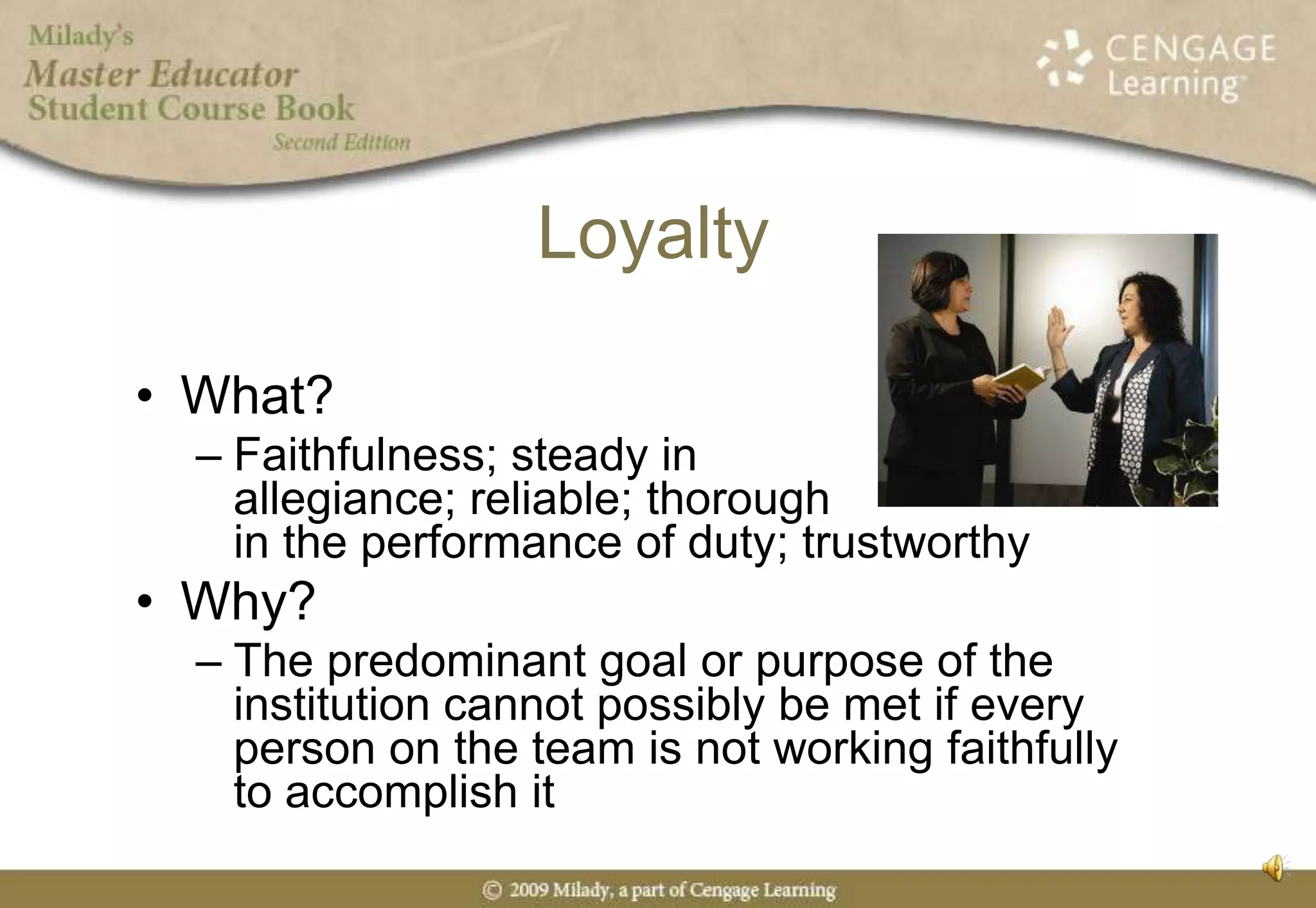
LoyaltyWhat?  Faithfulness; steady in allegiance; reliable; thorough in the performance of duty; trustworthyWhy?	The predominant goal or purpose of the institution cannot possibly be met if every person on the team is not working faithfully to accomplish it
Acceptance of Colleague Advice“When a collection of brilliant minds, hearts, and talents come together… expect a masterpiece!”UnknownBe receptive to, and guided by, competent counsel from colleagues
Constant Pursuit of KnowledgeLearning is lifelongOur goal:To become subject-matter expertsJoin professional organizations
What about Time….“Time marches on.”	“Time flies.”“Take some time.”“Time heals all wounds.”“I have no time for this.”“Where did the time go?”“Time is money.”
Effective Time ManagementTime:  One of our most valuable resources!What is it?  	“A continuum that is measured in terms of events that succeed one another from the past through the present to the future.”Webster’s DictionaryTime Management = Event Control
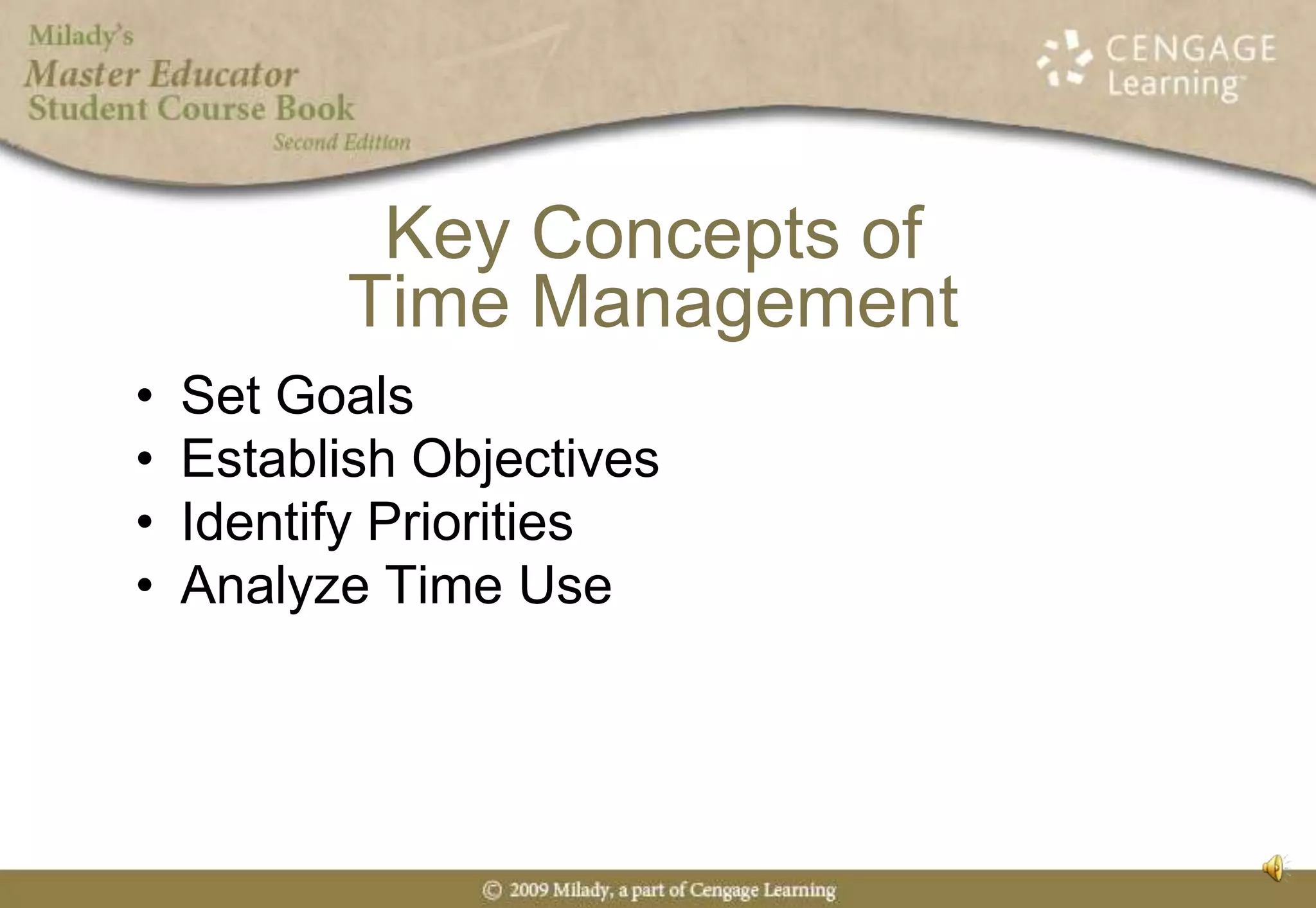
Key Concepts of Time ManagementSet GoalsEstablish ObjectivesIdentify PrioritiesAnalyze Time Use
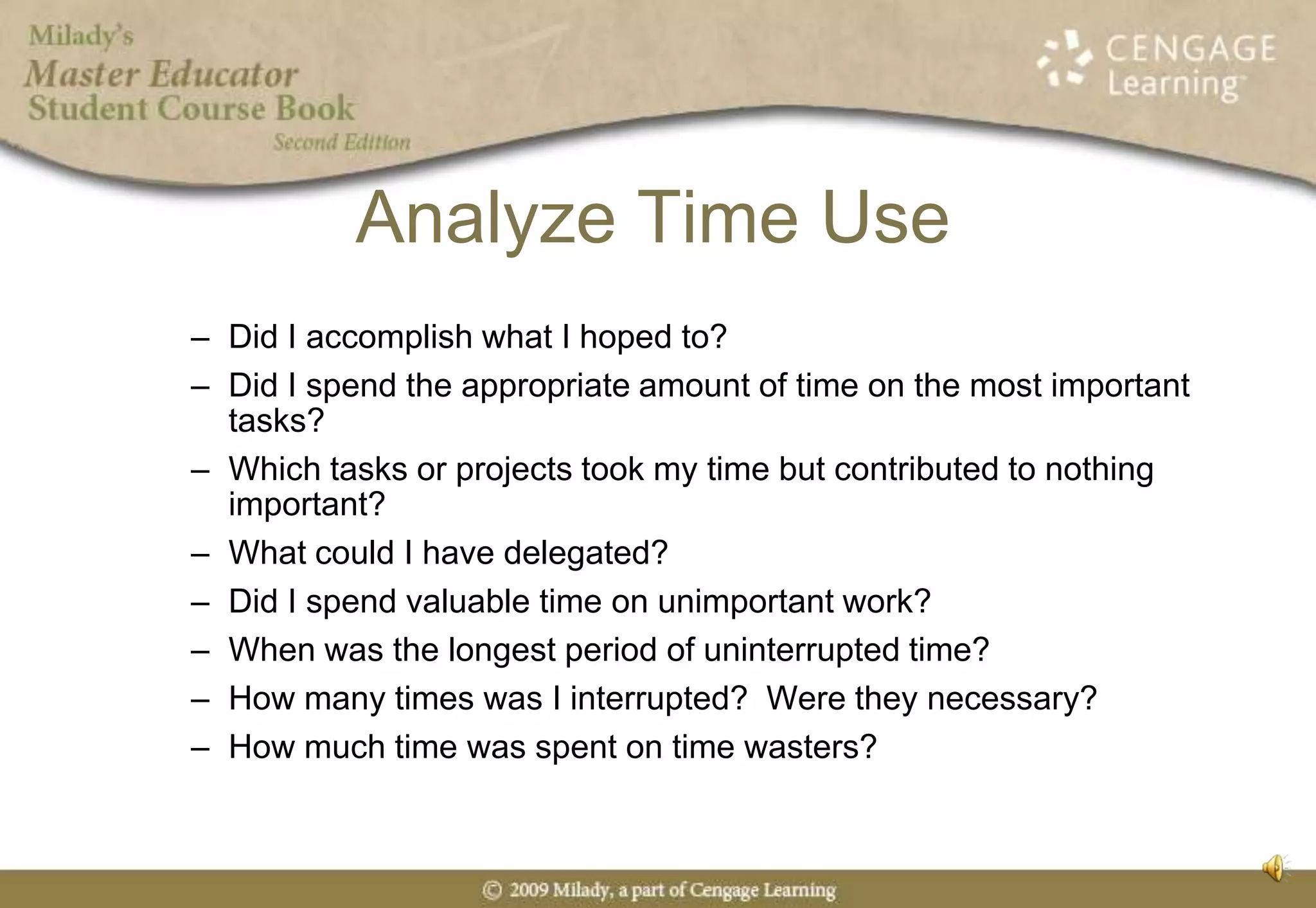
Analyze Time UseDid I accomplish what I hoped to?Did I spend the appropriate amount of time on the most important tasks?Which tasks or projects took my time but contributed to nothing important?What could I have delegated?Did I spend valuable time on unimportant work?When was the longest period of uninterrupted time?How many times was I interrupted?  Were they necessary?How much time was spent on time wasters?
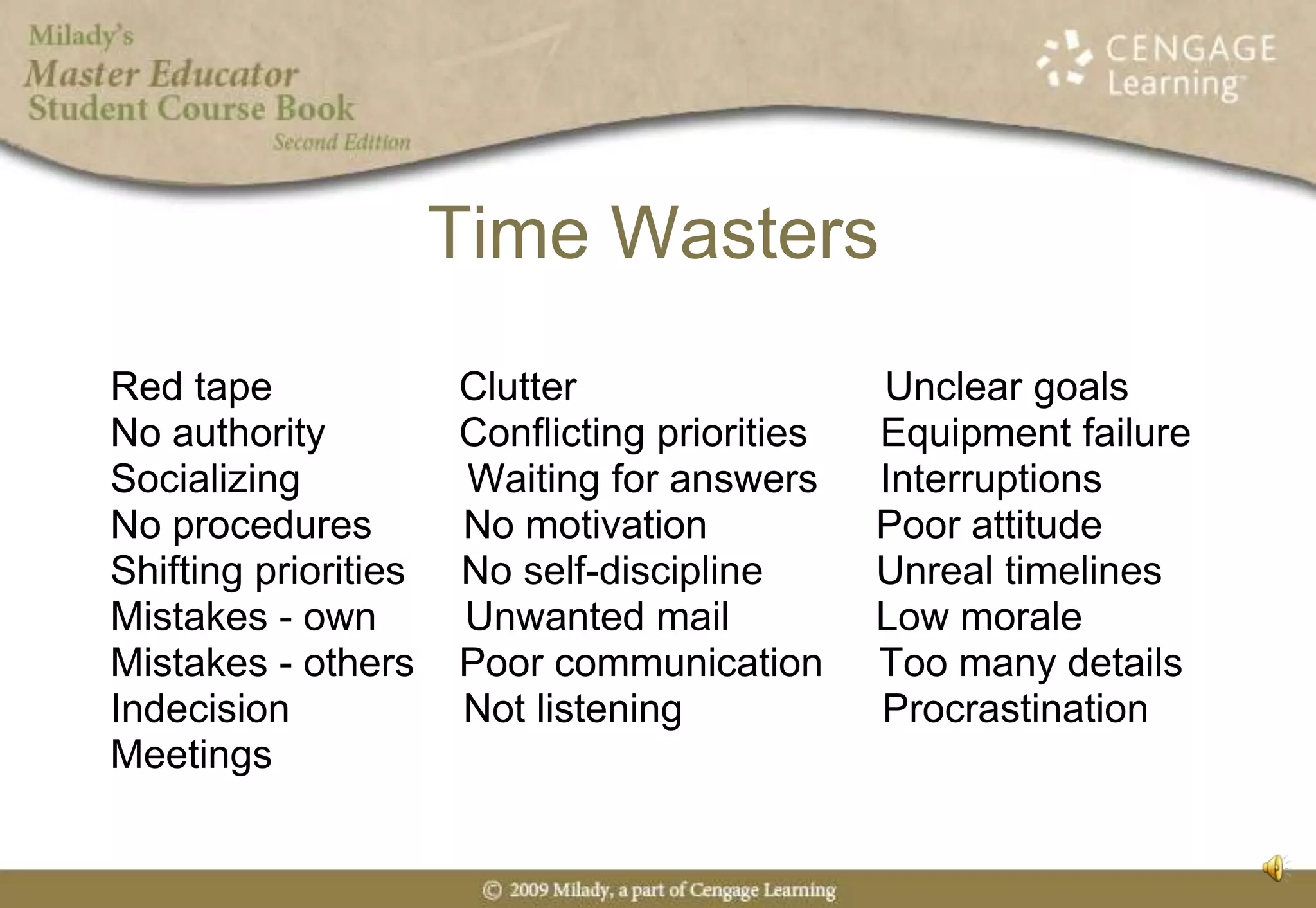
Time WastersRed tape 	     	          Clutter	                           Unclear goalsNo authority	          Conflicting priorities	     Equipment failureSocializing               Waiting for answers	     InterruptionsNo procedures	     No motivation  	          Poor attitudeShifting priorities     No self-discipline	          Unreal timelines Mistakes - own        Unwanted mail	          Low moraleMistakes - others    Poor communication     Too many detailsIndecision		     Not listening                  Procrastination  Meetings
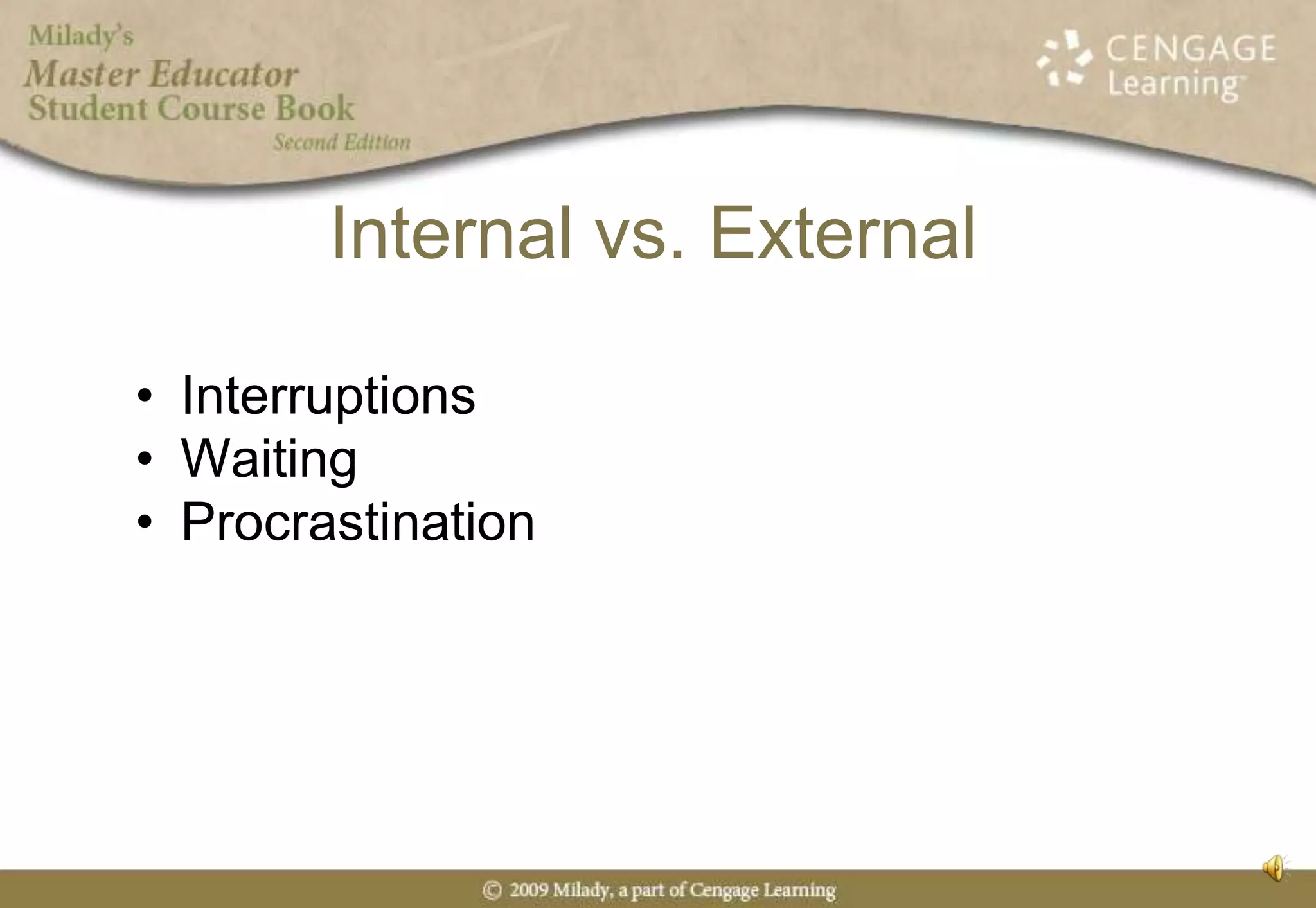
Internal vs. ExternalInterruptionsWaitingProcrastination
“Never put off until tomorrow what you can do today!”
P’s and Q’s of Event ControlQuestions
Quality
Quantity
Quirks
Quiet time
QuitPlanPrioritizePeak timeProcrastinationPracticePerfection
Authority, Order, Self-ConfidenceAuthority:  a)  a person cited or appealed to as an expert, and b) the power to influence or command thought, opinion or behaviorSelf-esteem:  the feeling we have about our own value or self-worthSelf-confidence: the confidence we have in ourselves, our powers and our abilities
Self-Confidence BuildersLike and accept yourself unconditionallyBe clear about your own valuesBe true to yourselfNever compromise your integrity
Having authority requires:Establishing a formal distance between self and learnersBeing friendly, supportive, nurturing, but not fraternizing
Enjoy your uniquenessPractice self-controlWork step-by-step toward desired goalsSelf-Confidence Builders (cont’d)
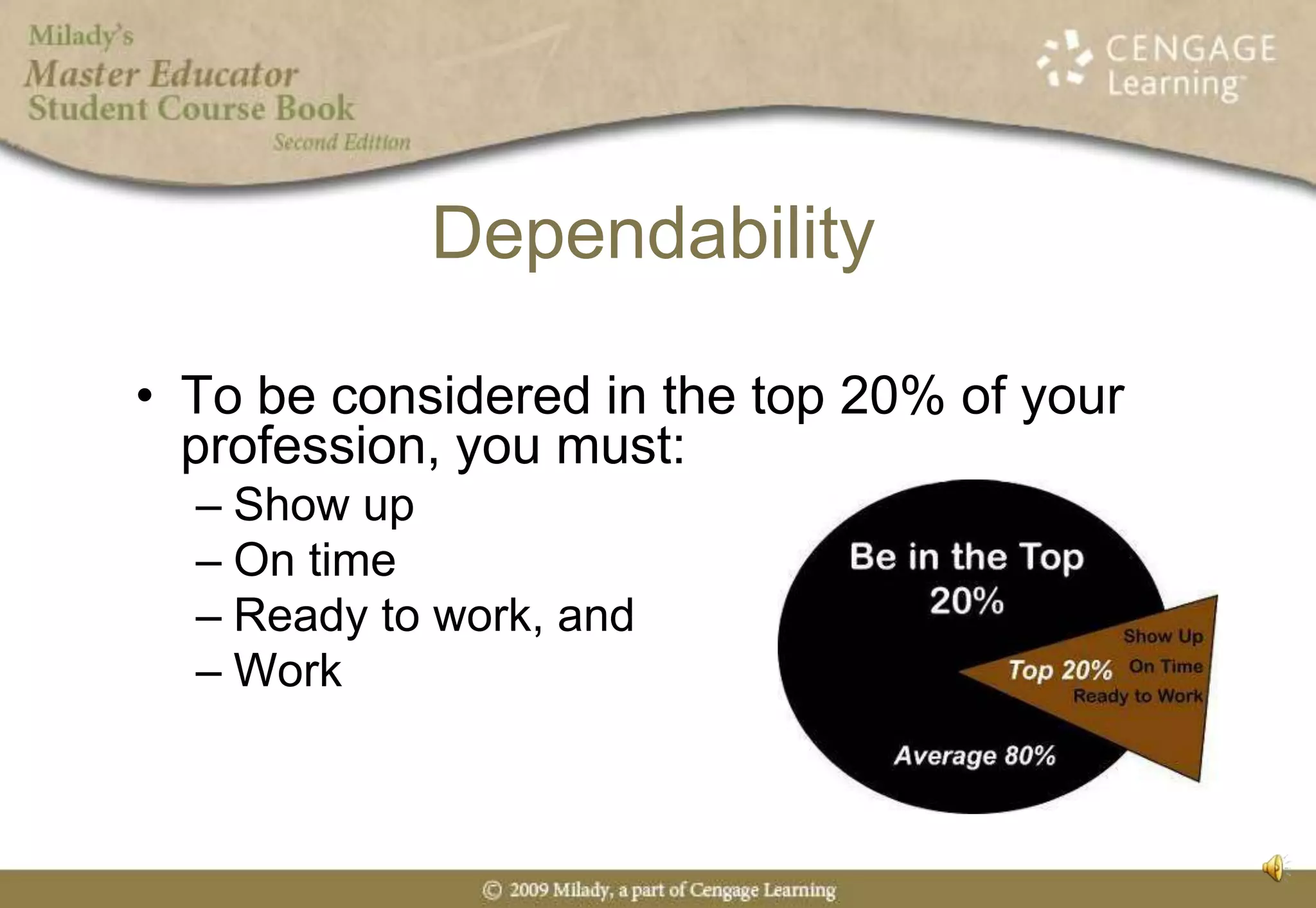
DependabilityTo be considered in the top 20% of your profession, you must:Show upOn timeReady to work, andWork
FlexibilityWhat?Susceptible to modification or change; adaptable; willing to yield.Webster’sWhy?Schools are looking for educators who are willing to adapt to new, different, or changing requirements
Become a Change Master...Rather than a change resister!Go the extra mileDon’t fall into the “it’s not my job” pit
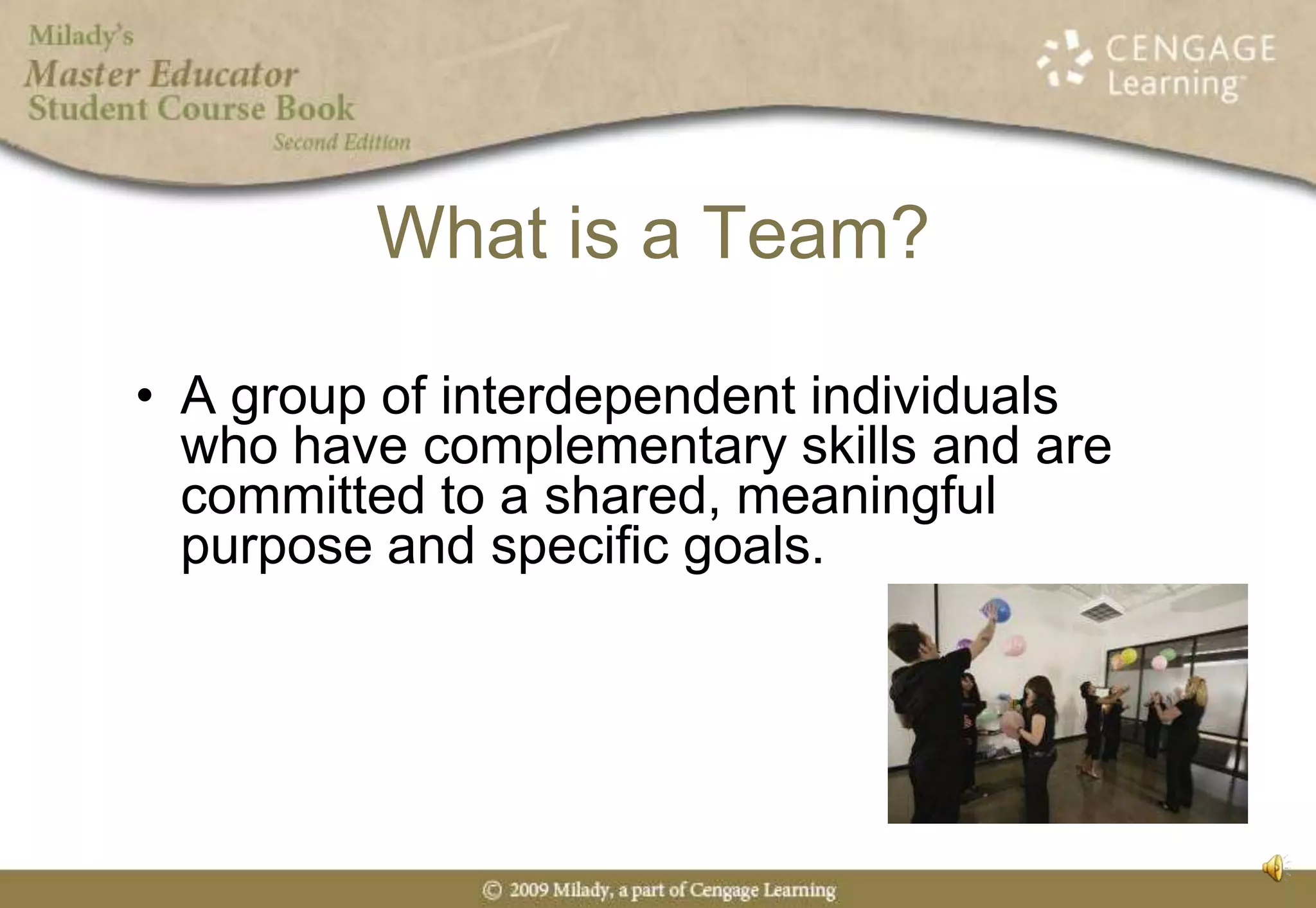
What is a Team?A group of interdependent individuals who have complementary skills and are committed to a shared, meaningful purpose and specific goals.
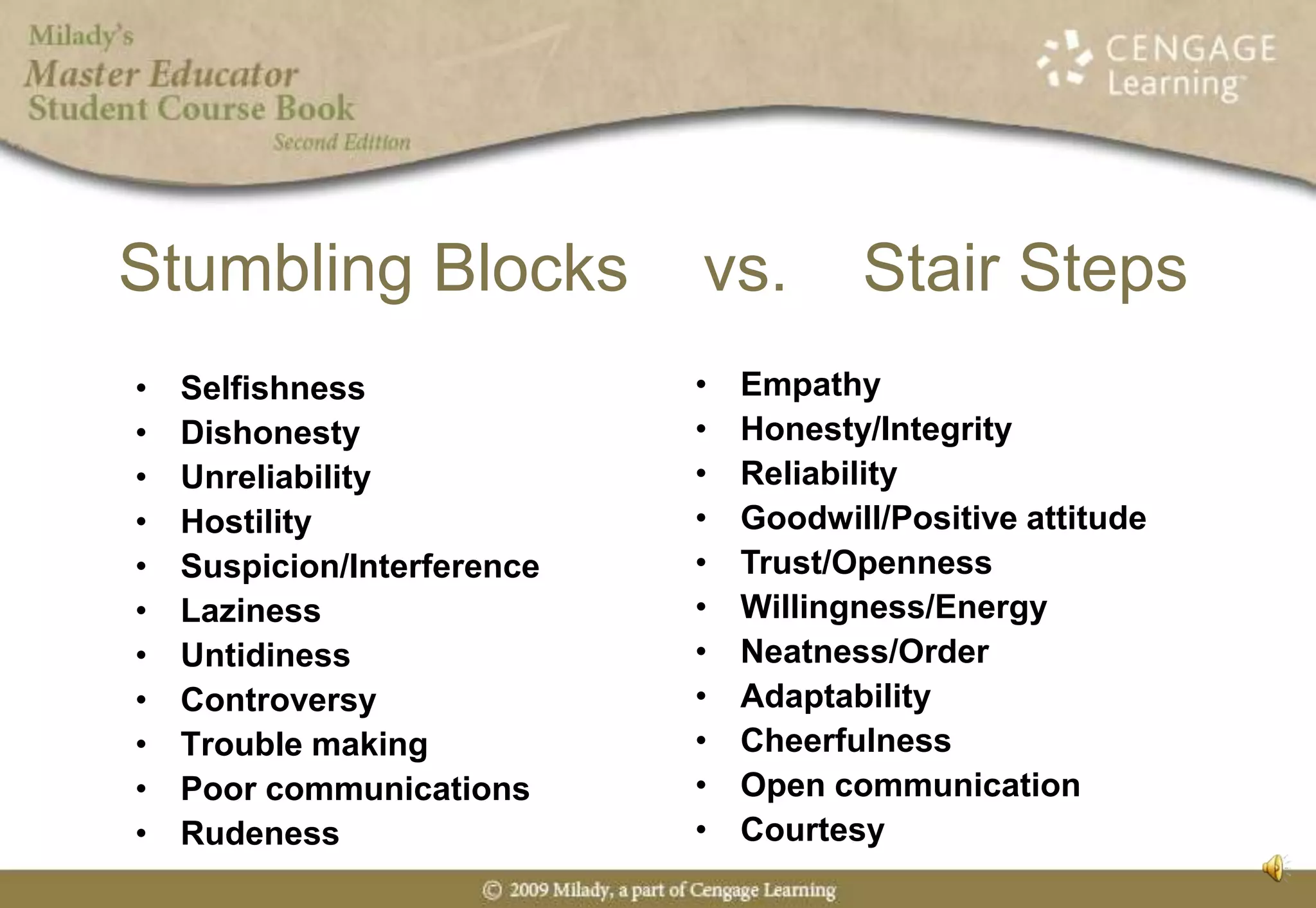
Stumbling Blocks    vs.    Stair StepsEmpathy
Honesty/Integrity
Reliability
Goodwill/Positive attitude
Trust/Openness
Willingness/Energy
Neatness/Order
Adaptability
Cheerfulness
Open communication
CourtesySelfishnessDishonestyUnreliabilityHostilitySuspicion/InterferenceLazinessUntidinessControversyTrouble makingPoor communicationsRudeness
InitiativeWork independently with little close supervisionInitiate actions for problem solving without supervisory interventionMaintain steady performance under varying work pressuresBe a “self-starter”
Steps to Independent ActionStudy position descriptionRead school’s operating proceduresLearn rules of oversight agenciesBe willing to take risksFollow the steps for building self-confidence
Patience and Self-ControlTurn challenges into opportunitiesBe honest and straightforwardBe a leaderPlan and be preparedFollow steps for control
Steps for ControlPause and breatheConsider the circumstancesEvaluate the optionsBehave professionallyListen to the studentApply the best approach
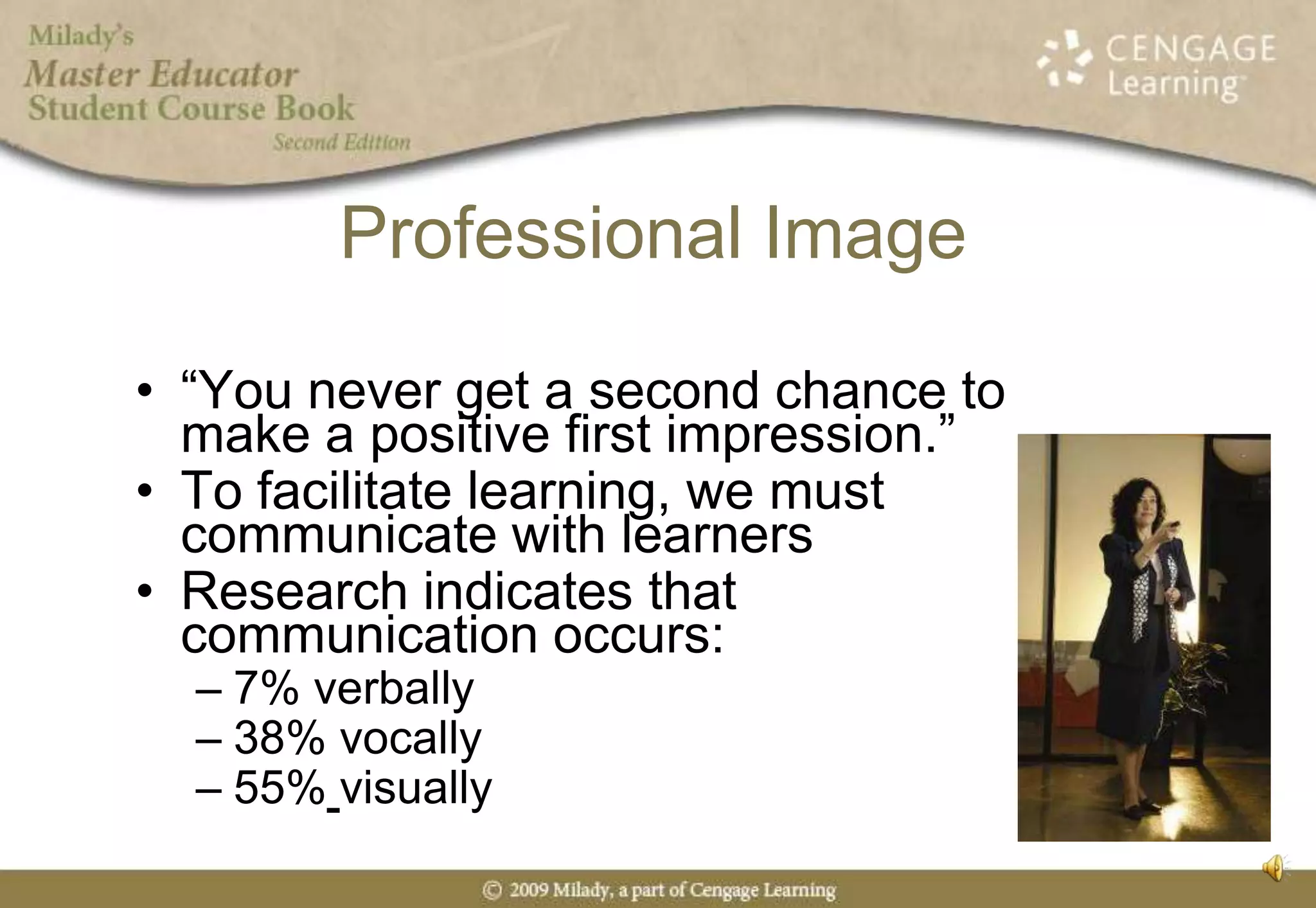
Professional Image“You never get a second chance to make a positive first impression.”To facilitate learning, we must communicate with learners  Research indicates that communication occurs:7% verbally	38% vocally55%visually
Image and GroomingBasic personal hygieneClean clothing in good repairClean shoes in good repairClean, appropriately styled hairWell-manicured hands and nailsAppropriate makeup/facial hairAppropriate jewelryProper posture
Courtesy, Compassion,ConsistencyCourtesygood mannersbe on time for workstart class on timekeep appointments
Compassiona sympathetic consciousness of your students’ distressa desire to help alleviate that distressput yourself in student’s placeunderstand what has caused student actions or behaviorconvey approval; correct with careCourtesy, Compassion,Consistency (cont’d)
Consistencyfairly apply rules and standardsdon’t enforce today and ignore tomorrowbe justlook for the best in every studentCourtesy, Compassion,Consistency (cont’d)
Desire and MotivationDesire:  the ingredient that makes the difference between an average educator and a master educatorIt creates Maslow’s theory of unconscious incompetence…we don’t know that we don’t know…like the bumble bee!It is the foundation of all self-motivation
MotiveA need or desire that causes a person to take action.Webster’sThe amount of success we achieve as educators will greatly depend on the degree of our self-motivation and the direction taken as a result of that motivation
Motivation Is Internal!We create motivational circumstancesStudents make an internal decision
More on MotivationIt’s like a car engineThe two most powerful emotions that influence our behavior:DESIREFEARTo be effective and active, it must focus on a specific need, goal, or aim
Listen to motivational tapes; read inspirational booksEliminate “I can’t”from your vocabularyChange “I wish” to “I will”Identify your major life goals or desiresActions for Self-Motivation (cont’d)
Energy and EnthusiasmWhat?“Lively; absorbing interest or involvement; a strong warmth or feeling; keen interest; fervor; inspiration.”Webster’sWhy?It is the inner fire that, combined with desire, can set us apart from those with far superior abilities!
Enthusiasm BuildersWake up singingSmile, smile, smileBe a “first timer”Apply the “pretend principle”
Practice proper postureHave personal pep ralliesAttach yourself to a purposeEnthusiasm Builders (cont’d)
Seize the spirit of adventureExpand your mind through learningThink enthusiasmEnthusiasm Builders (cont’d)

Chapter 01 volume 1 master educator

  • 1.
  • 2.
    Basic Teaching Skillsfor Career Education InstructorsChapter 1The Career Education Instructor
  • 3.
    “There are millionsof birds in the sky; of these, very few are eagles.”- Unknown
  • 4.
    Master Educators Must:Facilitatelearning for studentsInvent, adapt, and create new techniques and procedures to meet the changing demands of learnersBe a motivator, coach, mentor, friend, disciplinarian, peacemaker, negotiator, arbitrator, nurturer and entertainer
  • 5.
    LoyaltyAcceptance of advicefrom colleaguesConstant pursuit of knowledgeEffective time management and organized work methodsAuthority, order, self-confidenceEthics and characterThe Profile of a Master Educator
  • 6.
    Dependability and flexibilityCooperationand teamworkInitiative and ability to work independentlyPatience and self-controlProfessional imageCourtesy, compassion and consistencyThe Profile of a Master Educator (cont’d)
  • 7.
    Desire and motivationEnthusiasmand energyImagination and pleasureEffective communication and general skillsWinning personality and positive attitudeThe Profile of a Master Educator (cont’d)
  • 8.
    LoyaltyWhat? Faithfulness;steady in allegiance; reliable; thorough in the performance of duty; trustworthyWhy? The predominant goal or purpose of the institution cannot possibly be met if every person on the team is not working faithfully to accomplish it
  • 9.
    Acceptance of ColleagueAdvice“When a collection of brilliant minds, hearts, and talents come together… expect a masterpiece!”UnknownBe receptive to, and guided by, competent counsel from colleagues
  • 10.
    Constant Pursuit ofKnowledgeLearning is lifelongOur goal:To become subject-matter expertsJoin professional organizations
  • 11.
    What about Time….“Timemarches on.” “Time flies.”“Take some time.”“Time heals all wounds.”“I have no time for this.”“Where did the time go?”“Time is money.”
  • 12.
    Effective Time ManagementTime: One of our most valuable resources!What is it? “A continuum that is measured in terms of events that succeed one another from the past through the present to the future.”Webster’s DictionaryTime Management = Event Control
  • 13.
    Key Concepts ofTime ManagementSet GoalsEstablish ObjectivesIdentify PrioritiesAnalyze Time Use
  • 14.
    Analyze Time UseDidI accomplish what I hoped to?Did I spend the appropriate amount of time on the most important tasks?Which tasks or projects took my time but contributed to nothing important?What could I have delegated?Did I spend valuable time on unimportant work?When was the longest period of uninterrupted time?How many times was I interrupted? Were they necessary?How much time was spent on time wasters?
  • 15.
    Time WastersRed tape Clutter Unclear goalsNo authority Conflicting priorities Equipment failureSocializing Waiting for answers InterruptionsNo procedures No motivation Poor attitudeShifting priorities No self-discipline Unreal timelines Mistakes - own Unwanted mail Low moraleMistakes - others Poor communication Too many detailsIndecision Not listening Procrastination Meetings
  • 16.
  • 17.
    “Never put offuntil tomorrow what you can do today!”
  • 18.
    P’s and Q’sof Event ControlQuestions
  • 19.
  • 20.
  • 21.
  • 22.
  • 23.
  • 24.
    Authority, Order, Self-ConfidenceAuthority: a) a person cited or appealed to as an expert, and b) the power to influence or command thought, opinion or behaviorSelf-esteem: the feeling we have about our own value or self-worthSelf-confidence: the confidence we have in ourselves, our powers and our abilities
  • 25.
    Self-Confidence BuildersLike andaccept yourself unconditionallyBe clear about your own valuesBe true to yourselfNever compromise your integrity
  • 26.
    Having authority requires:Establishinga formal distance between self and learnersBeing friendly, supportive, nurturing, but not fraternizing
  • 27.
    Enjoy your uniquenessPracticeself-controlWork step-by-step toward desired goalsSelf-Confidence Builders (cont’d)
  • 28.
    DependabilityTo be consideredin the top 20% of your profession, you must:Show upOn timeReady to work, andWork
  • 29.
    FlexibilityWhat?Susceptible to modificationor change; adaptable; willing to yield.Webster’sWhy?Schools are looking for educators who are willing to adapt to new, different, or changing requirements
  • 30.
    Become a ChangeMaster...Rather than a change resister!Go the extra mileDon’t fall into the “it’s not my job” pit
  • 31.
    What is aTeam?A group of interdependent individuals who have complementary skills and are committed to a shared, meaningful purpose and specific goals.
  • 32.
    Stumbling Blocks vs. Stair StepsEmpathy
  • 33.
  • 34.
  • 35.
  • 36.
  • 37.
  • 38.
  • 39.
  • 40.
  • 41.
  • 42.
  • 43.
    InitiativeWork independently withlittle close supervisionInitiate actions for problem solving without supervisory interventionMaintain steady performance under varying work pressuresBe a “self-starter”
  • 44.
    Steps to IndependentActionStudy position descriptionRead school’s operating proceduresLearn rules of oversight agenciesBe willing to take risksFollow the steps for building self-confidence
  • 45.
    Patience and Self-ControlTurnchallenges into opportunitiesBe honest and straightforwardBe a leaderPlan and be preparedFollow steps for control
  • 46.
    Steps for ControlPauseand breatheConsider the circumstancesEvaluate the optionsBehave professionallyListen to the studentApply the best approach
  • 47.
    Professional Image“You neverget a second chance to make a positive first impression.”To facilitate learning, we must communicate with learners Research indicates that communication occurs:7% verbally 38% vocally55%visually
  • 48.
    Image and GroomingBasicpersonal hygieneClean clothing in good repairClean shoes in good repairClean, appropriately styled hairWell-manicured hands and nailsAppropriate makeup/facial hairAppropriate jewelryProper posture
  • 49.
    Courtesy, Compassion,ConsistencyCourtesygood mannersbeon time for workstart class on timekeep appointments
  • 50.
    Compassiona sympathetic consciousnessof your students’ distressa desire to help alleviate that distressput yourself in student’s placeunderstand what has caused student actions or behaviorconvey approval; correct with careCourtesy, Compassion,Consistency (cont’d)
  • 51.
    Consistencyfairly apply rulesand standardsdon’t enforce today and ignore tomorrowbe justlook for the best in every studentCourtesy, Compassion,Consistency (cont’d)
  • 52.
    Desire and MotivationDesire: the ingredient that makes the difference between an average educator and a master educatorIt creates Maslow’s theory of unconscious incompetence…we don’t know that we don’t know…like the bumble bee!It is the foundation of all self-motivation
  • 53.
    MotiveA need ordesire that causes a person to take action.Webster’sThe amount of success we achieve as educators will greatly depend on the degree of our self-motivation and the direction taken as a result of that motivation
  • 54.
    Motivation Is Internal!Wecreate motivational circumstancesStudents make an internal decision
  • 55.
    More on MotivationIt’slike a car engineThe two most powerful emotions that influence our behavior:DESIREFEARTo be effective and active, it must focus on a specific need, goal, or aim
  • 56.
    Listen to motivationaltapes; read inspirational booksEliminate “I can’t”from your vocabularyChange “I wish” to “I will”Identify your major life goals or desiresActions for Self-Motivation (cont’d)
  • 57.
    Energy and EnthusiasmWhat?“Lively;absorbing interest or involvement; a strong warmth or feeling; keen interest; fervor; inspiration.”Webster’sWhy?It is the inner fire that, combined with desire, can set us apart from those with far superior abilities!
  • 58.
    Enthusiasm BuildersWake upsingingSmile, smile, smileBe a “first timer”Apply the “pretend principle”
  • 59.
    Practice proper postureHavepersonal pep ralliesAttach yourself to a purposeEnthusiasm Builders (cont’d)
  • 60.
    Seize the spiritof adventureExpand your mind through learningThink enthusiasmEnthusiasm Builders (cont’d)
  • 61.
    Imagination …PleasureWhat?“The abilityto form mental images of things never experienced; creativity or resourcefulness.”Webster’sWhy?Educators who are resourceful, creative, and have active minds are successful and in great demand
  • 62.
    “Learning is directlyproportional to the amount of fun you have.”- Bob Pike
  • 63.
    Generational/Communication Skills“A barrierto communication is something that keeps meanings from meeting. Meaning barriers exist between all people, making communication much more difficult than most people seem to realize.”Theologian Ruel Howe
  • 64.
    Master Educators AreUnique Because:They must speak before groups of learners every dayThey are different from other professionals such as:Courtroom attorneysDoctorsClergy
  • 65.
    Learner DiversityAgeEthnicityReligionUnderachieversNo personaldisciplineLittle respect for rulesDysfunctional familiesAggressive, high achievers, etc.
  • 66.
    Winning Personality andPositiveAttitudeEducators must develop a personality that fosters learning and genuine human relationships
  • 67.
    Convey a PositiveAttitudeEducators must have a passion for the field they teach and compassion for their students
  • 68.
    Personality DevelopmentMaintain anopen mindBuild a bank of poiseMake the best of what you haveDo not hold grudges
  • 69.
    Do not livein fearFocus on the future rather than the pastAvoid sarcasm at someone else’s expensePersonality Development (cont’d)
  • 70.
    Practice sharing pleasingremarksDo not insist on having the last wordPersonality Development (cont’d)
  • 71.
    The Law ofAttractionAny visual image sets up an energetic force field that attracts the ideas, things, people, and circumstances that are consistent with your visual imageIf the image is positive, it will bring about positive, desired outcomes; and the opposite is also true, so stay positive
  • 72.
    Positive Self-TalkThree RulesStatein the personal sense using “I”State in the present tenseState with enthusiasm
  • 73.
    Negativity can spreadlike flames in a forest fire; it can destroy a school, harm interpersonal relationships, and cease the growth of creativity among studentsWhat a horrible emotion to spread!
  • 74.
    “The last greatfreedom of man is the freedom to choose his own attitude under any given set of circumstances.”- Victor Frankl
  • 75.
    Congratulations!You have justcompleted one unit of study in your Instructor Training Program.