Professionalism & Professional
Issues
In this session you will:
● Review the roles & responsibilities of
a teacher in the lifelong learning
sector
● Consider the concept of
professionalism in terms of teaching
● Critically reflect on the Professional
Standards
● Look at current issues in teaching
Professionalism and Professional
Issues
Objective Red Amber Green
Start of
session
End of
session
Start of
session
End of
session
Start of
session
End of
session
All – Recall the roles and
responsibilities of a professional
teacher
Most – Explain the difference
between roles & responsibilities
All – Define professionalism
Most – Explain dual professionalism
in terms of their own role
All – Evaluate to what extent you
are meeting the Professional
Standards
Most – Make 2 SMART targets to
work towards
Some -
All – Explain the wider social role of
a teacher
Most – Give examples of how you
achieve this in your practice
Reminder: Roles and Responsibilities
In your group, quickly list the roles and
responsibilities of a teacher
You have 3 minutes
Roles and responsibilities
of a teacher
Delivering quality teaching and learning
Meeting the needs/requirements of examining bodies
Meeting the expectations of employer / exam board
Meet the needs of learners
Managing behaviour to maintain a positive learning environment
Designing programmes of study Planning and preparing classes
Developing interesting ways of delivering learning
Assessing learning
Ensuring the learning environment is safe
Marking work and giving feedback
Keeping records of student progress and attendance
Evaluating the effectiveness of the programme
Keeping data about retention and achievement
Legal duty of care
Monitoring progress of learners
Acting within professional codes
Entering learners for exams and tests
Meeting quality assurance requirements
Being a role model
Pastoral
care
Looking smart and presentable (?)
Preparing the room
Building the
confidence,
practical and
academic skills of
students
More…?
Engaging in CPD
Demonstrating
appropriate
behaviour,
language, dress
and attitudes and
values
How did you do?
Number Evaluation
0-5 You should spend some time revising the roles and
responsibilities of a teacher. Look back over your notes
from module 1 and do some reading… urgently.
5-10 You have a basic understanding of the roles and
responsibilities of a teacher, but should spend some
time improving your knowledge in this area.
10-18 You have a pretty good understanding of the key roles
and responsibilities and may have reflected on some of
the wider roles. You should spend some time reflecting
on some of the more sophisticated principles
surrounding the roles and responsibilities of a teacher.
18+ You have spent some time reflecting on your roles and
responsibilities and have engaged with previous
modules. You will likely need to keep up with changes
to the professional role, key legislation and policy,
engage in continuous CPD and perhaps consider
mentoring other teachers in future once your
experience has developed.
Reflect:
What is the difference between a role and a
responsibility?
Definitions
Role
• The function assumed or
part played by a person
or thing in a particular
situation.
• Expected behaviour
patterns associated with
a particular social
situation.
Responsibility
• The state or fact of
having a duty to deal
with something.
• The state or fact of
being accountable or
to blame for
something.
Dictionary.com, 02.10.12
What does Professionalism mean?
In your group, write a definition of ‘Professionalism’.
You have 10 minutes.
If you are struggling:
Write a list of 5 words that relate to Professionalism
Is there an agreed definition within the
group?
Dictionary definitions of professionalism:
‘the conduct, aims, or qualities that characterize or mark a profession
or a professional person’
Merriam Webster
‘the standing, practice, or methods of a professional, as distinguished
from an amateur.’
Dictionary.com
‘the competence or skill expected of a professional… especially one that
involves prolonged training and a formal qualification’
Oxford Dictionary
This question is highly debated in academic theory… There are many
different answers!
Robson (2006) after Furlong (2000) argues it is possible to identify three
elements of teacher professionalism :
• Autonomy
• Professional knowledge
• Responsibility
Robson argues that because teachers can use individual professional
judgement they have a responsibility to act well and in line with professional
values
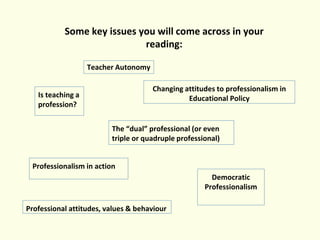
Teacher Autonomy
Some key issues you will come across in your
reading:
Changing attitudes to professionalism in
Educational PolicyIs teaching a
profession?
The “dual” professional (or even
triple or quadruple professional)
Professional attitudes, values & behaviour
Democratic
Professionalism
Professionalism in action
Reflect on this question:
How does Professionalism impact on
you and your role?
How do we measure Professionalism?
List the ways we measure Professionalism
You have 3 minutes
Additional reflection point:
Who's responsible for Professionalism in the workforce?
The Professional Standards
Have you read them (recently)?
What is the purpose of the 2014
Standards?
Who are the Standards for?
Further education colleges
Voluntary and community sector organisations
Commercial organisations and independent training providers
Adult and community learning providers
Teacher education providers
Work based learning settings
Specialist colleges and institutions
Armed and uniformed services
Prisons and offender learning institutions
Other public sector organisations
Watch the video
What are the key features of a professional?
In your group / table, write down the key
features of a professional according to the
Professional Standards
The Professional Standards
Discuss
What are the key features of a professional, as you
identified from the video?
Measuring yourself against an
aspirational target
Complete the activity
Complete Self-assessment tool 1: A paper based self-
assessment resource (15 Minutes)
Then in Section 2 Identifying Continuing Personal and
Professional
Development Needs:
Set yourself at least 4 challenging targets, which are the main
areas for development relating to your professionalism
(Mixture of short term, medium term, long term)
Discuss
Lay the cards facedown on the table
Take it in turns to draw a card
Discuss the question for a few minutes
Try to get through at least 3 questions in 15 minutes
What are your
personal professional
values?
What is your reaction
to the Professional
Standards?
Which is the most
obvious Professional
Standard?
Which is the most
challenging
Professional Standard?
Do you think the
Standards should be
‘aspirational’ or
enforced?
To what extent?
How does your college
use the Professional
Standards?
Do you think anything
is missing from the
Professional
Standards?
Are there any
Professional Standards
you would remove?
To what extent do you
think the Standards
realistically represent
your role?
Staying current
Who is the current
Education
Secretary ?
How do you stay up to
date on changes in
education or current
debates?
Who is the current
Education
Secretary ?
How do you stay up to
date on changes in
education or current
debates?
The Rt Hon Justine Greening MP.
Justine Greening was appointed Secretary of
State for Education and Minister for Women
and Equalities on 14 July 2016.
She was elected Conservative MP for Putney,
Roehampton and Southfields on 5 May 2005.
Discuss
What are the current issues
for professionals in your
subject area?
What are the current issues for
professionals in your sector?
If you aren't
sure,
how can you
find out?
Question:
In pairs write an answer to the following question.
Be prepared to share your answer with the class
What is the wider social responsibility of a teacher
in modern Britain?
You have 10 minutes.
Understanding Professional
Values
Promoting Democracy
Promoting British Values
Duty of Care
Promoting Ethical behaviour
Being a role model
Educating people about citizenship
Spiritual, moral, social and cultural development
Promoting social responsibility
Encouraging sustainability
Caring for the pastoral needs of learners
Promoting health and healthy living Protection of vulnerable people in society
Responsibility for National Security
Developing attitudes and values of learners
Actively promoting and
demonstrating values of Equality,
Diversity and Inclusion
Prioritise
In your group, prioritise the values based on
your opinions.
Some may need discussion!
Lowest
priority in
your
opinion
Highest
priority in
your
opinion
Overwhelmed?
You should be!
Being a teacher is a huge responsibility
This course is tantamount to a very long
interview for our profession
British Values
What are British Values?
In your group, take 5 minutes to list
How can we embed this into our
teaching?
Make a list of ten ways
Check off how many your group got
from the next slide!
Examples…
• Making decisions in the classroom using voting and explain democracy
• Using examples / case studies with diverse examples, especially those that
demonstrate how tolerance of those of others faiths and beliefs is protected by
law
• Discuss stereotypes and examples of discrimination in your lessons
• Make sure discrimination and prejudice is challenged where is occurs in your
institution
• Ask young people to contribute to a behaviour policy or classroom ethos,
encouraging learner voice and principles of tolerance, respect and democracy
• Look at local, national and world events within lessons
• Allow learners to debate global issues within lessons
• Make more use of student reps and explain how representation and student voice
is part of a democratic society
• Invite the authorities such as police, fire services, lifeguards and other relevant
persons to reinforce the rule of law and undermine potential stereotypes about
authority
• Embed principles of respect into classroom management, be sure to reference
how respecting others is an important part of being a citizen
• Ask students who are from other faiths & beliefs to share their knowledge where
relevant…
and many more!
What is the background of recent developments to our
wider social role?
How many of these stories do you recognise?
Professionalism and Professional
Issues
Objective Red Amber Green
Start of
session
End of
session
Start of
session
End of
session
Start of
session
End of
session
All – Recall the roles and
responsibilities of a professional
teacher
Most – Explain the difference
between roles & responsibilities
All – Define professionalism
Most – Explain dual professionalism
in terms of their own role
All – Evaluate to what extent you
are meeting the Professional
Standards
Most – Make 2 SMART targets to
work towards
Some -
All – Explain the wider social role of
a teacher
Most – Give examples of how you
achieve this in your practice
What have
you learned
today?
What is the key
thing you have
learned today?
What do you know now, that you did
not know at the start of the lesson?
How has your understanding changed,
this lesson?
2. Following the training, reflect on the following questions:
• What is Protect and Prevent? How does it relate to your roles and responsibilities?
• What are your responsibilities in relation to Protect and Prevent?
• Are there ‘signs’ that someone is becoming radicalised?
• What is the procedure for deadline with this in your institution? (Find out)
• What are the difficulties with this current issue?
• What is the background to Protect and Prevent?
• How can I embed this legislation into my practice?
1. Complete the Protect and Prevent
online module from SET on the
following link.
http://www.foundationonline.org.uk/lo
gin/index.php
3. Update your iPDP targets to include those you have written today
Next week
Is a reading week…
There is no taught class
(Yay!)
Please use this time to
read up on Curriculum
& Professional Issues.
Look at the readings in
the Additional Readings
page on the VLE
Challenge yourself
to read some
journal articles
See you on 14/11/17

Professionalism and professional issues 2

  • 1.
  • 2.
    In this sessionyou will: ● Review the roles & responsibilities of a teacher in the lifelong learning sector ● Consider the concept of professionalism in terms of teaching ● Critically reflect on the Professional Standards ● Look at current issues in teaching
  • 3.
    Professionalism and Professional Issues ObjectiveRed Amber Green Start of session End of session Start of session End of session Start of session End of session All – Recall the roles and responsibilities of a professional teacher Most – Explain the difference between roles & responsibilities All – Define professionalism Most – Explain dual professionalism in terms of their own role All – Evaluate to what extent you are meeting the Professional Standards Most – Make 2 SMART targets to work towards Some - All – Explain the wider social role of a teacher Most – Give examples of how you achieve this in your practice
  • 4.
    Reminder: Roles andResponsibilities In your group, quickly list the roles and responsibilities of a teacher You have 3 minutes
  • 5.
    Roles and responsibilities ofa teacher Delivering quality teaching and learning Meeting the needs/requirements of examining bodies Meeting the expectations of employer / exam board Meet the needs of learners Managing behaviour to maintain a positive learning environment Designing programmes of study Planning and preparing classes Developing interesting ways of delivering learning Assessing learning Ensuring the learning environment is safe Marking work and giving feedback Keeping records of student progress and attendance Evaluating the effectiveness of the programme Keeping data about retention and achievement Legal duty of care Monitoring progress of learners Acting within professional codes Entering learners for exams and tests Meeting quality assurance requirements Being a role model Pastoral care Looking smart and presentable (?) Preparing the room Building the confidence, practical and academic skills of students More…? Engaging in CPD Demonstrating appropriate behaviour, language, dress and attitudes and values
  • 6.
    How did youdo? Number Evaluation 0-5 You should spend some time revising the roles and responsibilities of a teacher. Look back over your notes from module 1 and do some reading… urgently. 5-10 You have a basic understanding of the roles and responsibilities of a teacher, but should spend some time improving your knowledge in this area. 10-18 You have a pretty good understanding of the key roles and responsibilities and may have reflected on some of the wider roles. You should spend some time reflecting on some of the more sophisticated principles surrounding the roles and responsibilities of a teacher. 18+ You have spent some time reflecting on your roles and responsibilities and have engaged with previous modules. You will likely need to keep up with changes to the professional role, key legislation and policy, engage in continuous CPD and perhaps consider mentoring other teachers in future once your experience has developed.
  • 7.
    Reflect: What is thedifference between a role and a responsibility?
  • 8.
    Definitions Role • The functionassumed or part played by a person or thing in a particular situation. • Expected behaviour patterns associated with a particular social situation. Responsibility • The state or fact of having a duty to deal with something. • The state or fact of being accountable or to blame for something. Dictionary.com, 02.10.12
  • 9.
    What does Professionalismmean? In your group, write a definition of ‘Professionalism’. You have 10 minutes. If you are struggling: Write a list of 5 words that relate to Professionalism
  • 10.
    Is there anagreed definition within the group?
  • 11.
    Dictionary definitions ofprofessionalism: ‘the conduct, aims, or qualities that characterize or mark a profession or a professional person’ Merriam Webster ‘the standing, practice, or methods of a professional, as distinguished from an amateur.’ Dictionary.com ‘the competence or skill expected of a professional… especially one that involves prolonged training and a formal qualification’ Oxford Dictionary This question is highly debated in academic theory… There are many different answers!
  • 12.
    Robson (2006) afterFurlong (2000) argues it is possible to identify three elements of teacher professionalism : • Autonomy • Professional knowledge • Responsibility Robson argues that because teachers can use individual professional judgement they have a responsibility to act well and in line with professional values
  • 13.
    Teacher Autonomy Some keyissues you will come across in your reading: Changing attitudes to professionalism in Educational PolicyIs teaching a profession? The “dual” professional (or even triple or quadruple professional) Professional attitudes, values & behaviour Democratic Professionalism Professionalism in action
  • 14.
    Reflect on thisquestion: How does Professionalism impact on you and your role?
  • 15.
    How do wemeasure Professionalism? List the ways we measure Professionalism You have 3 minutes Additional reflection point: Who's responsible for Professionalism in the workforce?
  • 16.
    The Professional Standards Haveyou read them (recently)?
  • 17.
    What is thepurpose of the 2014 Standards?
  • 18.
    Who are theStandards for? Further education colleges Voluntary and community sector organisations Commercial organisations and independent training providers Adult and community learning providers Teacher education providers Work based learning settings Specialist colleges and institutions Armed and uniformed services Prisons and offender learning institutions Other public sector organisations
  • 19.
    Watch the video Whatare the key features of a professional? In your group / table, write down the key features of a professional according to the Professional Standards
  • 20.
  • 21.
    Discuss What are thekey features of a professional, as you identified from the video?
  • 22.
    Measuring yourself againstan aspirational target Complete the activity Complete Self-assessment tool 1: A paper based self- assessment resource (15 Minutes) Then in Section 2 Identifying Continuing Personal and Professional Development Needs: Set yourself at least 4 challenging targets, which are the main areas for development relating to your professionalism (Mixture of short term, medium term, long term)
  • 23.
    Discuss Lay the cardsfacedown on the table Take it in turns to draw a card Discuss the question for a few minutes Try to get through at least 3 questions in 15 minutes
  • 24.
    What are your personalprofessional values? What is your reaction to the Professional Standards? Which is the most obvious Professional Standard? Which is the most challenging Professional Standard? Do you think the Standards should be ‘aspirational’ or enforced? To what extent? How does your college use the Professional Standards? Do you think anything is missing from the Professional Standards? Are there any Professional Standards you would remove? To what extent do you think the Standards realistically represent your role?
  • 25.
    Staying current Who isthe current Education Secretary ? How do you stay up to date on changes in education or current debates?
  • 26.
    Who is thecurrent Education Secretary ? How do you stay up to date on changes in education or current debates? The Rt Hon Justine Greening MP. Justine Greening was appointed Secretary of State for Education and Minister for Women and Equalities on 14 July 2016. She was elected Conservative MP for Putney, Roehampton and Southfields on 5 May 2005.
  • 27.
    Discuss What are thecurrent issues for professionals in your subject area? What are the current issues for professionals in your sector? If you aren't sure, how can you find out?
  • 28.
    Question: In pairs writean answer to the following question. Be prepared to share your answer with the class What is the wider social responsibility of a teacher in modern Britain? You have 10 minutes.
  • 29.
    Understanding Professional Values Promoting Democracy PromotingBritish Values Duty of Care Promoting Ethical behaviour Being a role model Educating people about citizenship Spiritual, moral, social and cultural development Promoting social responsibility Encouraging sustainability Caring for the pastoral needs of learners Promoting health and healthy living Protection of vulnerable people in society Responsibility for National Security Developing attitudes and values of learners Actively promoting and demonstrating values of Equality, Diversity and Inclusion
  • 30.
    Prioritise In your group,prioritise the values based on your opinions. Some may need discussion! Lowest priority in your opinion Highest priority in your opinion
  • 31.
    Overwhelmed? You should be! Beinga teacher is a huge responsibility This course is tantamount to a very long interview for our profession
  • 32.
    British Values What areBritish Values? In your group, take 5 minutes to list
  • 34.
    How can weembed this into our teaching? Make a list of ten ways Check off how many your group got from the next slide!
  • 35.
    Examples… • Making decisionsin the classroom using voting and explain democracy • Using examples / case studies with diverse examples, especially those that demonstrate how tolerance of those of others faiths and beliefs is protected by law • Discuss stereotypes and examples of discrimination in your lessons • Make sure discrimination and prejudice is challenged where is occurs in your institution • Ask young people to contribute to a behaviour policy or classroom ethos, encouraging learner voice and principles of tolerance, respect and democracy • Look at local, national and world events within lessons • Allow learners to debate global issues within lessons • Make more use of student reps and explain how representation and student voice is part of a democratic society • Invite the authorities such as police, fire services, lifeguards and other relevant persons to reinforce the rule of law and undermine potential stereotypes about authority • Embed principles of respect into classroom management, be sure to reference how respecting others is an important part of being a citizen • Ask students who are from other faiths & beliefs to share their knowledge where relevant… and many more!
  • 36.
    What is thebackground of recent developments to our wider social role?
  • 37.
    How many ofthese stories do you recognise?
  • 38.
    Professionalism and Professional Issues ObjectiveRed Amber Green Start of session End of session Start of session End of session Start of session End of session All – Recall the roles and responsibilities of a professional teacher Most – Explain the difference between roles & responsibilities All – Define professionalism Most – Explain dual professionalism in terms of their own role All – Evaluate to what extent you are meeting the Professional Standards Most – Make 2 SMART targets to work towards Some - All – Explain the wider social role of a teacher Most – Give examples of how you achieve this in your practice
  • 39.
    What have you learned today? Whatis the key thing you have learned today? What do you know now, that you did not know at the start of the lesson? How has your understanding changed, this lesson?
  • 40.
    2. Following thetraining, reflect on the following questions: • What is Protect and Prevent? How does it relate to your roles and responsibilities? • What are your responsibilities in relation to Protect and Prevent? • Are there ‘signs’ that someone is becoming radicalised? • What is the procedure for deadline with this in your institution? (Find out) • What are the difficulties with this current issue? • What is the background to Protect and Prevent? • How can I embed this legislation into my practice? 1. Complete the Protect and Prevent online module from SET on the following link. http://www.foundationonline.org.uk/lo gin/index.php 3. Update your iPDP targets to include those you have written today
  • 41.
    Next week Is areading week… There is no taught class (Yay!) Please use this time to read up on Curriculum & Professional Issues. Look at the readings in the Additional Readings page on the VLE Challenge yourself to read some journal articles See you on 14/11/17