Population Health 
Kent Bottles, MD 
kbottles#@pyapc.com 
Summit of the Southeast 2014 
Driving the Future of Healthcare Technology 
September 16-17, 2014 
TN HIMSS
Population Health Definitions 
• “The health outcomes of a group of 
individuals, including the distribution of 
such outcomes within the group and the 
policies and interventions that link 
outcomes and patterns of health 
determinants” 
• David Kindig & Greg Stoddart
Population Health Definitions 
• “A conceptual framework for why some 
populations are healthier than others as well 
as the policy developments, research 
agenda, and resource allocation that flow 
from this framework.” 
• T. K. Young
Population Health Statistics 
• The county of residence in USA means a 
14-year difference in life expectancy 
• On the Blue Washington DC subway route, 
there is a 9-year difference in life 
expectancy between downtown and Fairfax, 
Virginia 
• Rheumatoid arthritis & DM associated with 
living close to highly traveled roads
Population Health Statistics 
• Your zip code is more important than your 
genetic code for health and wellness 
• College grads live 5 years longer than those 
without a high school diploma 
• Detroit with 139-square-mile area and 
900,000 people has only 5 grocery stores
Population Health Statistics 
• British Medical Journal- higher levels of 
greenery and lower graffiti correlated with 
increased exercise & decreased obesity 
• Cities with sidewalks have fitter individuals 
than suburbs without sidewalks
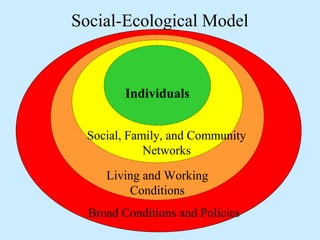
Social-Ecological Model 
Individuals 
Social, Family, and Community 
Networks 
Living and Working 
Conditions 
Broad Conditions and Policies
Population Health & Hospital 
• Hospital-centric care model is changing to 
population health management care model 
based on care coordination across 
fragmented continuum of care 
• We used to only interact with patients when 
they presented to office or hospital 
• Now we must interact with patients who do 
not show up for care
Population Health & Hospital 
• Sharing data across all points of care is only 
way to provide coordinated care 
• Data access becomes critical for patients, 
families, doctors, staff 
• Mobile applications become more important 
and essential
Population Health Strategies 
• Fitness and exercise 
promotion 
• Obesity management 
and weight reduction 
• Diet and nutrition 
• Stress management 
• Reductions in smoking 
and substance abuse 
• Protected sex and 
family planning 
• Physical activity and 
moderate amounts of 
exercise 
• Auto safety; drunk 
driving 
• Chronic disease 
management 
• Food safety 
• Clean water, sewers 
• Promoting healthy 
communities 
• Economic incentives for 
healthy behaviors 
• Universal coverage to 
encourage preventive 
care
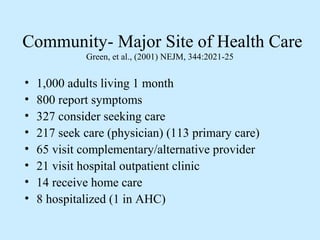
Community- Major Site of Health Care 
Green, et al., (2001) NEJM, 344:2021-25 
• 1,000 adults living 1 month 
• 800 report symptoms 
• 327 consider seeking care 
• 217 seek care (physician) (113 primary care) 
• 65 visit complementary/alternative provider 
• 21 visit hospital outpatient clinic 
• 14 receive home care 
• 8 hospitalized (1 in AHC)
We Can Do Better 
Steven A. Schroeder, MD, NEJM, September 20, 2007 
Health is influenced by 
•Genetics 
•Social circumstances 
•Environmental exposures 
•Behavior 
•Health care
We Can Do Better 
Steven A. Schroeder, MD, NEJM, September 20, 2007 
• The single greatest opportunity to improve 
health and reduce premature deaths in 
America lies in personal behavior 
• Behavior causes 40% of all deaths in USA
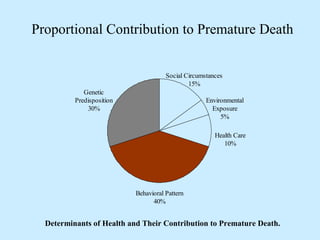
Proportional Contribution to Premature Death 
Environmental 
Exposure 
5% 
Health Care 
10% 
Social Circumstances 
15% 
Genetic 
Predisposition 
30% 
Behavioral Pattern 
40% 
Determinants of Health and Their Contribution to Premature Death.
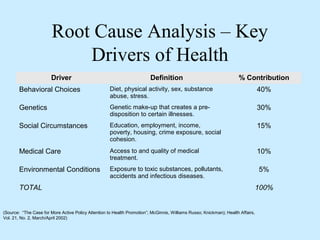
Root Cause Analysis – Key 
Drivers of Health 
Driver Definition % Contribution 
Behavioral Choices Diet, physical activity, sex, substance 
abuse, stress. 
(Source: “The Case for More Active Policy Attention to Health Promotion”; McGinnis, Williams Russo; Knickman); Health Affairs, 
Vol. 21, No. 2, March/April 2002) 
40% 
Genetics Genetic make-up that creates a pre-disposition 
to certain illnesses. 
30% 
Social Circumstances Education, employment, income, 
poverty, housing, crime exposure, social 
cohesion. 
15% 
Medical Care Access to and quality of medical 
treatment. 
10% 
Environmental Conditions Exposure to toxic substances, pollutants, 
accidents and infectious diseases. 
5% 
TOTAL 100%
North Karelia in Finland 
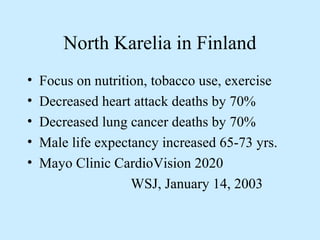
• Focus on nutrition, tobacco use, exercise 
• Decreased heart attack deaths by 70% 
• Decreased lung cancer deaths by 70% 
• Male life expectancy increased 65-73 yrs. 
• Mayo Clinic CardioVision 2020 
WSJ, January 14, 2003
North Karelia in Finland 
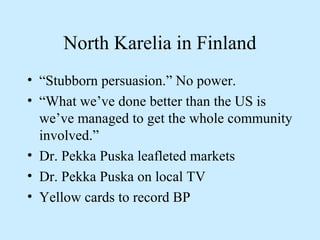
• “Stubborn persuasion.” No power. 
• “What we’ve done better than the US is 
we’ve managed to get the whole community 
involved.” 
• Dr. Pekka Puska leafleted markets 
• Dr. Pekka Puska on local TV 
• Yellow cards to record BP
North Karelia in Finland 
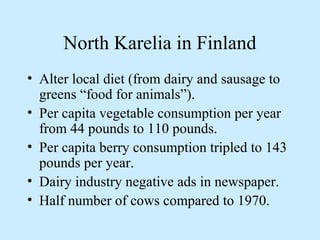
• Alter local diet (from dairy and sausage to 
greens “food for animals”). 
• Per capita vegetable consumption per year 
from 44 pounds to 110 pounds. 
• Per capita berry consumption tripled to 143 
pounds per year. 
• Dairy industry negative ads in newspaper. 
• Half number of cows compared to 1970.
Stress, Loneliness, and Death 
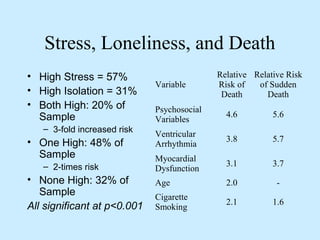
• High Stress = 57% 
• High Isolation = 31% 
• Both High: 20% of 
Sample 
– 3-fold increased risk 
• One High: 48% of 
Sample 
– 2-times risk 
• None High: 32% of 
Sample 
All significant at p<0.001 
Variable 
Relative 
Risk of 
Death 
Relative Risk 
of Sudden 
Death 
Psychosocial 
Variables 4.6 5.6 
Ventricular 
Arrhythmia 3.8 5.7 
Myocardial 
Dysfunction 3.1 3.7 
Age 2.0 - 
Cigarette 
Smoking 2.1 1.6
Emotional Support and Mortality 
The EPESE Cohort 
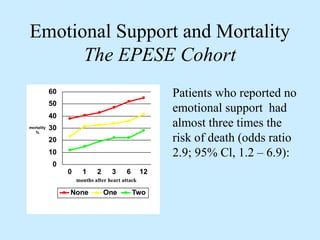
Patients who reported no 
emotional support had 
almost three times the 
risk of death (odds ratio 
2.9; 95% Cl, 1.2 – 6.9):
BMJ: 2005; 331: 611-612 
• Higher levels of greenery, lower levels of 
graffiti and litter correlated with: 
– Higher levels of physical activity (3x) 
– Lower levels of obesity (40% less)
Whiplash Pain and Culture 
• Lithuania: no car insurance, no intractable neck 
pain and lingering headaches 
• Norway: car insurance, 70,000 person 
organization for neck pain, headaches 
• Cultural forces at work in reinforcing pain & 
dysfunction include insurance, self-help groups, 
class-action lawsuits, powerful patient 
organizations
Social Networks & Medicine 
Gina Kolata, NY Times, August 5, 2007, WK 1 
• NEJM study of social network of 12,067 
people followed for 32 years 
• Obesity can spread from friend to friend 
like a virus 
• Networks amplify whatever effect they are 
propagating 
• Smoking, depression, suicide
Why is it so hard to activate a 
community to be healthy? 
• Health poorly defined. 
• Communities in disarray. 
• Biomedical model does not provide language 
sufficient to address culture. 
• Biocultural model & language may be required. 
• Health promotion: complex not complicated. 
• Getting started in uncertain environment. 
• Leadership: no one’s day job, nonprofit politics. 
• But, we must begin…
Population Health Requires 
Providers to Deal with Strangers 
• Schools 
• Police 
• Urban Planners 
• Economic development agencies 
• Job corps 
• Transportation 
• Many others
Non-provider health influencers 
• Religious entities promoting health 
behavior 
• Transportation facilitates access 
• Housing authority influences environment 
• Gyms 
• Restaurants 
• Malls
Non-medical influencers 
• Lifestyle determinants of wellness status 
• Socioeconomic determinants 
• Subpopulations (kids, frail, comorbidities) 
• Partner with non-provider organizations 
• Identify specific patient interventions 
• Dialogue with non-providers organizations 
• Establish outcome metrics to measure
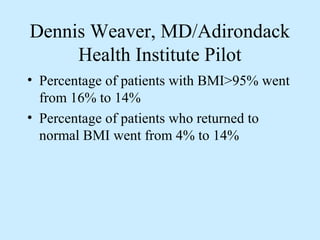
Dennis Weaver, MD/Adirondack 
Health Institute Pilot 
• Percentage of patients with BMI>95% went 
from 16% to 14% 
• Percentage of patients who returned to 
normal BMI went from 4% to 14%
Mature PHM 
• Organized system of care 
• Care teams 
• Coordination across care settings 
• Access to PCP 
• Patient self management 
• Linked EHRs and patient registries 
• Focus on behavior and lifestyle changes
Mature PHM 
• PCMH and the medical neighborhood 
– Prevention 
– Shift from acute to chronic care 
– Predictive and proactive 
– Continuous, not episodic 
– Whole person oriented, not case oriented 
– Care for people when they do not present to 
office or hospital
Medical Neighborhood 
• PCP 
• Specialists 
• Hospitals 
• Rehab and long term care 
• Home health agencies 
• Pharmacies 
• Labs and imaging centers
Patient engagement 
• Judith Hibbard’s Patient Activation 
Measure 4 level scale 
• Self-management 
• Collaboration with provider 
• Maintaining function/preventing declines 
• Access to appropriate care
Patient engagement 
• Jessie Gruman’s Center for Advancing 
Health- 43 engagement behaviors organized 
in 10 categories
Patient engagement 
10 Categories 
• Find safe care 
• Talk to providers 
• Organize health care 
• Pay for health care 
• Make decisions 
• Participate in care 
• Promote health 
• Get preventive care 
• Plan end of life 
• Seek knowledge
Jessie Gruman on Patients 
• As a savvy and confident patient who is 
flummoxed by so much of what takes place 
in health care, I am regularly surprised by 
how little you know about how little we 
patients know…
Jessie Gruman on Patients 
• You are immersed in the health culture. But 
we don’t live in your world. So we have no 
idea what you are talking about much of the 
time. One way to help us feel competent in 
such unfamiliar environments is to give us 
some guidance about what this place is and 
how it works. What are the rules?
Role of HIT in PHM 
• Identify and track cohorts of patients 
– By risk level 
– By adherence to care plans 
– By medication use 
– By achievement of therapeutic targets
Role of HIT in PHM 
• Profiling the population 
• Point of Care 
• Patient engagement and managment
Role of HIT in PHM 
• Profiling the population 
– Patient registries 
– Advanced population predictive analytics 
– Risk stratification
Role of HIT in PHM 
• Point of care 
– EHR 
– Health information exchange 
– Referral tracking
Role of HIT in PHM 
• Patient activation and management 
– Automated outreach 
– Patient portals 
– Telehealth 
– Remote patient monitoring
Thomas Graf, MD 
www.PopulationHealthNews.com 
• CMO Population Health and Longitudinal 
Care Service Lines, Geisinger Health 
• 350% increase in patients receiving all 
recommended screening tests 
• ProvenCare model for 350,000 patients with 
7% reduction in cost for Medicare aged 
patients
Camden Coalition 
• Jeffrey Brenner, MD Hotspotting 
• Data from hospitals 
• Triage 
• High risk (care management) 
• Intermediate risk (care transitions)
Camden Coalition 
• Goals of program 
• Reduce readmissions and costs for complex 
patients 
• No open referrals 
• No duplicate services 
• Facilitate clinical coordination
Camden Coalition 
• Intermediate risk outreach team 
– RN 
– LPN 
– Health coaches 
• High risk outreach team 
– RN 
– MA 
– Health coaches 
– Social worker
Camden Coalition High Risk 
• Hospital utilization 
• 2 or more chronic conditions 
• Low socioeconomic status 
• Homeless or unstable housing 
• Lack of social support, HS diploma 
• Behavioral health issues 
• Generational poverty/urban violence
Camden Coalition 
• The Transitional Care Model: Mary D. 
Naylor, PhD, University of Pennsylvania 
School of Nursing 
• The Care Transitions Program: Eric 
Coleman, MD, Division of Health Care 
Policy and Research at the University of 
Colorado School of Medicine
Food Service & Environmental 
Protection Worker Job Program 
• Disease prevention and job training viewed 
as two separate strategies for development 
• Alignment of strategies creates jobs that can 
improve health 
• New Jersey school heat-and-serve french 
fries had 5x expected fat content due to 
improper drainage or treatment of oil 
• Health Affairs, November 2011
Kent Bottles, MD 
Consulting Principal, PYA 
CMO, PYA Analytics 
Lecturer, Jefferson University School 
of Population Health

Population Health

  • 1.
    Population Health KentBottles, MD kbottles#@pyapc.com Summit of the Southeast 2014 Driving the Future of Healthcare Technology September 16-17, 2014 TN HIMSS
  • 2.
    Population Health Definitions • “The health outcomes of a group of individuals, including the distribution of such outcomes within the group and the policies and interventions that link outcomes and patterns of health determinants” • David Kindig & Greg Stoddart
  • 3.
    Population Health Definitions • “A conceptual framework for why some populations are healthier than others as well as the policy developments, research agenda, and resource allocation that flow from this framework.” • T. K. Young
  • 4.
    Population Health Statistics • The county of residence in USA means a 14-year difference in life expectancy • On the Blue Washington DC subway route, there is a 9-year difference in life expectancy between downtown and Fairfax, Virginia • Rheumatoid arthritis & DM associated with living close to highly traveled roads
  • 5.
    Population Health Statistics • Your zip code is more important than your genetic code for health and wellness • College grads live 5 years longer than those without a high school diploma • Detroit with 139-square-mile area and 900,000 people has only 5 grocery stores
  • 6.
    Population Health Statistics • British Medical Journal- higher levels of greenery and lower graffiti correlated with increased exercise & decreased obesity • Cities with sidewalks have fitter individuals than suburbs without sidewalks
  • 7.
    Social-Ecological Model Individuals Social, Family, and Community Networks Living and Working Conditions Broad Conditions and Policies
  • 8.
    Population Health &Hospital • Hospital-centric care model is changing to population health management care model based on care coordination across fragmented continuum of care • We used to only interact with patients when they presented to office or hospital • Now we must interact with patients who do not show up for care
  • 9.
    Population Health &Hospital • Sharing data across all points of care is only way to provide coordinated care • Data access becomes critical for patients, families, doctors, staff • Mobile applications become more important and essential
  • 10.
    Population Health Strategies • Fitness and exercise promotion • Obesity management and weight reduction • Diet and nutrition • Stress management • Reductions in smoking and substance abuse • Protected sex and family planning • Physical activity and moderate amounts of exercise • Auto safety; drunk driving • Chronic disease management • Food safety • Clean water, sewers • Promoting healthy communities • Economic incentives for healthy behaviors • Universal coverage to encourage preventive care
  • 11.
    Community- Major Siteof Health Care Green, et al., (2001) NEJM, 344:2021-25 • 1,000 adults living 1 month • 800 report symptoms • 327 consider seeking care • 217 seek care (physician) (113 primary care) • 65 visit complementary/alternative provider • 21 visit hospital outpatient clinic • 14 receive home care • 8 hospitalized (1 in AHC)
  • 12.
    We Can DoBetter Steven A. Schroeder, MD, NEJM, September 20, 2007 Health is influenced by •Genetics •Social circumstances •Environmental exposures •Behavior •Health care
  • 13.
    We Can DoBetter Steven A. Schroeder, MD, NEJM, September 20, 2007 • The single greatest opportunity to improve health and reduce premature deaths in America lies in personal behavior • Behavior causes 40% of all deaths in USA
  • 14.
    Proportional Contribution toPremature Death Environmental Exposure 5% Health Care 10% Social Circumstances 15% Genetic Predisposition 30% Behavioral Pattern 40% Determinants of Health and Their Contribution to Premature Death.
  • 15.
    Root Cause Analysis– Key Drivers of Health Driver Definition % Contribution Behavioral Choices Diet, physical activity, sex, substance abuse, stress. (Source: “The Case for More Active Policy Attention to Health Promotion”; McGinnis, Williams Russo; Knickman); Health Affairs, Vol. 21, No. 2, March/April 2002) 40% Genetics Genetic make-up that creates a pre-disposition to certain illnesses. 30% Social Circumstances Education, employment, income, poverty, housing, crime exposure, social cohesion. 15% Medical Care Access to and quality of medical treatment. 10% Environmental Conditions Exposure to toxic substances, pollutants, accidents and infectious diseases. 5% TOTAL 100%
  • 16.
    North Karelia inFinland • Focus on nutrition, tobacco use, exercise • Decreased heart attack deaths by 70% • Decreased lung cancer deaths by 70% • Male life expectancy increased 65-73 yrs. • Mayo Clinic CardioVision 2020 WSJ, January 14, 2003
  • 17.
    North Karelia inFinland • “Stubborn persuasion.” No power. • “What we’ve done better than the US is we’ve managed to get the whole community involved.” • Dr. Pekka Puska leafleted markets • Dr. Pekka Puska on local TV • Yellow cards to record BP
  • 18.
    North Karelia inFinland • Alter local diet (from dairy and sausage to greens “food for animals”). • Per capita vegetable consumption per year from 44 pounds to 110 pounds. • Per capita berry consumption tripled to 143 pounds per year. • Dairy industry negative ads in newspaper. • Half number of cows compared to 1970.
  • 19.
    Stress, Loneliness, andDeath • High Stress = 57% • High Isolation = 31% • Both High: 20% of Sample – 3-fold increased risk • One High: 48% of Sample – 2-times risk • None High: 32% of Sample All significant at p<0.001 Variable Relative Risk of Death Relative Risk of Sudden Death Psychosocial Variables 4.6 5.6 Ventricular Arrhythmia 3.8 5.7 Myocardial Dysfunction 3.1 3.7 Age 2.0 - Cigarette Smoking 2.1 1.6
  • 20.
    Emotional Support andMortality The EPESE Cohort Patients who reported no emotional support had almost three times the risk of death (odds ratio 2.9; 95% Cl, 1.2 – 6.9):
  • 21.
    BMJ: 2005; 331:611-612 • Higher levels of greenery, lower levels of graffiti and litter correlated with: – Higher levels of physical activity (3x) – Lower levels of obesity (40% less)
  • 22.
    Whiplash Pain andCulture • Lithuania: no car insurance, no intractable neck pain and lingering headaches • Norway: car insurance, 70,000 person organization for neck pain, headaches • Cultural forces at work in reinforcing pain & dysfunction include insurance, self-help groups, class-action lawsuits, powerful patient organizations
  • 23.
    Social Networks &Medicine Gina Kolata, NY Times, August 5, 2007, WK 1 • NEJM study of social network of 12,067 people followed for 32 years • Obesity can spread from friend to friend like a virus • Networks amplify whatever effect they are propagating • Smoking, depression, suicide
  • 24.
    Why is itso hard to activate a community to be healthy? • Health poorly defined. • Communities in disarray. • Biomedical model does not provide language sufficient to address culture. • Biocultural model & language may be required. • Health promotion: complex not complicated. • Getting started in uncertain environment. • Leadership: no one’s day job, nonprofit politics. • But, we must begin…
  • 25.
    Population Health Requires Providers to Deal with Strangers • Schools • Police • Urban Planners • Economic development agencies • Job corps • Transportation • Many others
  • 26.
    Non-provider health influencers • Religious entities promoting health behavior • Transportation facilitates access • Housing authority influences environment • Gyms • Restaurants • Malls
  • 27.
    Non-medical influencers •Lifestyle determinants of wellness status • Socioeconomic determinants • Subpopulations (kids, frail, comorbidities) • Partner with non-provider organizations • Identify specific patient interventions • Dialogue with non-providers organizations • Establish outcome metrics to measure
  • 28.
    Dennis Weaver, MD/Adirondack Health Institute Pilot • Percentage of patients with BMI>95% went from 16% to 14% • Percentage of patients who returned to normal BMI went from 4% to 14%
  • 29.
    Mature PHM •Organized system of care • Care teams • Coordination across care settings • Access to PCP • Patient self management • Linked EHRs and patient registries • Focus on behavior and lifestyle changes
  • 30.
    Mature PHM •PCMH and the medical neighborhood – Prevention – Shift from acute to chronic care – Predictive and proactive – Continuous, not episodic – Whole person oriented, not case oriented – Care for people when they do not present to office or hospital
  • 31.
    Medical Neighborhood •PCP • Specialists • Hospitals • Rehab and long term care • Home health agencies • Pharmacies • Labs and imaging centers
  • 32.
    Patient engagement •Judith Hibbard’s Patient Activation Measure 4 level scale • Self-management • Collaboration with provider • Maintaining function/preventing declines • Access to appropriate care
  • 33.
    Patient engagement •Jessie Gruman’s Center for Advancing Health- 43 engagement behaviors organized in 10 categories
  • 34.
    Patient engagement 10Categories • Find safe care • Talk to providers • Organize health care • Pay for health care • Make decisions • Participate in care • Promote health • Get preventive care • Plan end of life • Seek knowledge
  • 35.
    Jessie Gruman onPatients • As a savvy and confident patient who is flummoxed by so much of what takes place in health care, I am regularly surprised by how little you know about how little we patients know…
  • 36.
    Jessie Gruman onPatients • You are immersed in the health culture. But we don’t live in your world. So we have no idea what you are talking about much of the time. One way to help us feel competent in such unfamiliar environments is to give us some guidance about what this place is and how it works. What are the rules?
  • 37.
    Role of HITin PHM • Identify and track cohorts of patients – By risk level – By adherence to care plans – By medication use – By achievement of therapeutic targets
  • 38.
    Role of HITin PHM • Profiling the population • Point of Care • Patient engagement and managment
  • 39.
    Role of HITin PHM • Profiling the population – Patient registries – Advanced population predictive analytics – Risk stratification
  • 40.
    Role of HITin PHM • Point of care – EHR – Health information exchange – Referral tracking
  • 41.
    Role of HITin PHM • Patient activation and management – Automated outreach – Patient portals – Telehealth – Remote patient monitoring
  • 42.
    Thomas Graf, MD www.PopulationHealthNews.com • CMO Population Health and Longitudinal Care Service Lines, Geisinger Health • 350% increase in patients receiving all recommended screening tests • ProvenCare model for 350,000 patients with 7% reduction in cost for Medicare aged patients
  • 43.
    Camden Coalition •Jeffrey Brenner, MD Hotspotting • Data from hospitals • Triage • High risk (care management) • Intermediate risk (care transitions)
  • 44.
    Camden Coalition •Goals of program • Reduce readmissions and costs for complex patients • No open referrals • No duplicate services • Facilitate clinical coordination
  • 45.
    Camden Coalition •Intermediate risk outreach team – RN – LPN – Health coaches • High risk outreach team – RN – MA – Health coaches – Social worker
  • 46.
    Camden Coalition HighRisk • Hospital utilization • 2 or more chronic conditions • Low socioeconomic status • Homeless or unstable housing • Lack of social support, HS diploma • Behavioral health issues • Generational poverty/urban violence
  • 47.
    Camden Coalition •The Transitional Care Model: Mary D. Naylor, PhD, University of Pennsylvania School of Nursing • The Care Transitions Program: Eric Coleman, MD, Division of Health Care Policy and Research at the University of Colorado School of Medicine
  • 48.
    Food Service &Environmental Protection Worker Job Program • Disease prevention and job training viewed as two separate strategies for development • Alignment of strategies creates jobs that can improve health • New Jersey school heat-and-serve french fries had 5x expected fat content due to improper drainage or treatment of oil • Health Affairs, November 2011
  • 49.
    Kent Bottles, MD Consulting Principal, PYA CMO, PYA Analytics Lecturer, Jefferson University School of Population Health

Editor's Notes

  • #12 1000 adults living (in community) x 1 month 250 sought health care 9 were hospitalized &amp;lt;1 hospitalized in an AHC