Chapter One:  Shaping Your Health
Definitions of Health Episodic: seeking medical treatment during episodes when ill or injured Preventive Medicine: identifying risk factors to lower the risk of illness Morbidity: Pertaining to illness and disease Mortality: Pertaining to death
What is Health Promotion? Movement in which knowledge, practices, and values are transmitted to people for use in: Longer and better quality of life Reducing  incidence of illness Feeling better
Individual vs. Community Health Promotion Individual focuses upon risk reduction that doesn’t always emphasize the reduction of chronic illness Community places emphasis on a group centered concept to promote  empowerment Empowerment: gain more self control over one’s health perspective (i.e., drug prevention within communities at risk)
Healthy People 2010 Goals Increase the quality and years of life Eliminate health disparities in areas such as gender, race, ethnicity, income and education level.
Why Behavior Change is  Difficult Factors that influence a person to change health behaviors. Behavior must be associated with a health problem The belief must exist that the behavior causes the health problem The knowledge that risk prevention-intervention programs exist and can be effective The belief that a new behavior can justify the change of old behavior The belief that people who care about them will be accepting of such changes
Stages of Change Prochaska et al. (1994) demonstrated the following 6 stages to accomplish change of health behaviors Pre-contemplation Contemplation Preparation Action Maintenance Termination
Today’s College Students  Traditional (early adults = 66%) Non-traditional (older adults) Minority groups (numbers increasing) Disabled population (9.3%)
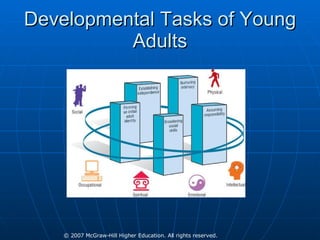
Developmental Tasks of Young Adults
Related Developmental Tasks of Young Adulthood Obtaining entry-level employment Development of parenting skills
Multiple Dimensions of Health Physical Emotional Spiritual Social Occupational Intellectual Holistic health: A requirement of health that moves beyond the cure/prevention of illness and the postponement of death
What is Wellness? A form of health promotion Uses assessments and information Develops boundaries of health beyond mortality/morbidity Unlocks an individual’s full potential at discovering a positive lifestyle
A New Definition of Health A view less centered on the concepts of mortality and morbidity Two areas of differences to focus upon: 1) The Role of Health (process of transitions) 2) The Composition of Health  Intrinsic resources Extrinsic resources
Chapter One:  Shaping Your Health

Images Chap01hahn8e

  • 1.
    Chapter One: Shaping Your Health
  • 2.
    Definitions of HealthEpisodic: seeking medical treatment during episodes when ill or injured Preventive Medicine: identifying risk factors to lower the risk of illness Morbidity: Pertaining to illness and disease Mortality: Pertaining to death
  • 3.
    What is HealthPromotion? Movement in which knowledge, practices, and values are transmitted to people for use in: Longer and better quality of life Reducing incidence of illness Feeling better
  • 4.
    Individual vs. CommunityHealth Promotion Individual focuses upon risk reduction that doesn’t always emphasize the reduction of chronic illness Community places emphasis on a group centered concept to promote empowerment Empowerment: gain more self control over one’s health perspective (i.e., drug prevention within communities at risk)
  • 5.
    Healthy People 2010Goals Increase the quality and years of life Eliminate health disparities in areas such as gender, race, ethnicity, income and education level.
  • 6.
    Why Behavior Changeis Difficult Factors that influence a person to change health behaviors. Behavior must be associated with a health problem The belief must exist that the behavior causes the health problem The knowledge that risk prevention-intervention programs exist and can be effective The belief that a new behavior can justify the change of old behavior The belief that people who care about them will be accepting of such changes
  • 7.
    Stages of ChangeProchaska et al. (1994) demonstrated the following 6 stages to accomplish change of health behaviors Pre-contemplation Contemplation Preparation Action Maintenance Termination
  • 8.
    Today’s College Students Traditional (early adults = 66%) Non-traditional (older adults) Minority groups (numbers increasing) Disabled population (9.3%)
  • 9.
  • 10.
    Related Developmental Tasksof Young Adulthood Obtaining entry-level employment Development of parenting skills
  • 11.
    Multiple Dimensions ofHealth Physical Emotional Spiritual Social Occupational Intellectual Holistic health: A requirement of health that moves beyond the cure/prevention of illness and the postponement of death
  • 12.
    What is Wellness?A form of health promotion Uses assessments and information Develops boundaries of health beyond mortality/morbidity Unlocks an individual’s full potential at discovering a positive lifestyle
  • 13.
    A New Definitionof Health A view less centered on the concepts of mortality and morbidity Two areas of differences to focus upon: 1) The Role of Health (process of transitions) 2) The Composition of Health Intrinsic resources Extrinsic resources
  • 14.
    Chapter One: Shaping Your Health