THE SLEEP – WAKE CYCLE
By
ARINDAM SAIN
Circadian Rhythms, Sleep–Wake Cycle
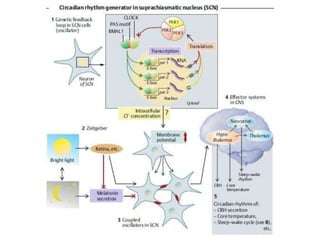
 The daily sleep–wake cycle and other circadian rhythms (diurnal
rhythms) are controlled by endogenous rhythm generators
 The central biological clock (oscillator) that times these processes is
located in the suprachiasmatic nucleus (SCN) of the hypothalamus
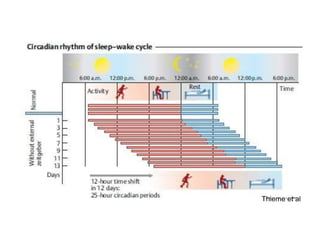
 The endogenous circadian rhythm occurs in cycles of roughly 24–
25 hours, but is unadulterated only when a person is completely
isolated from the outside influences
 External zeitgebers (entraining signals) synchronize the biological
clock to precise 24-hour cycles
 The main external zeitgeber for 24-hour synchronization of the
sleep–wake cycle is bright light (photic entrainment)
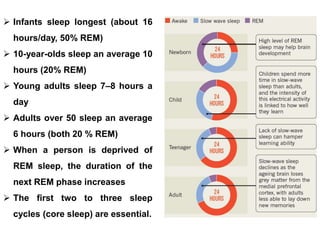
 Infants sleep longest (about 16
hours/day, 50% REM)
 10-year-olds sleep an average 10
hours (20% REM)
 Young adults sleep 7–8 hours a
day
 Adults over 50 sleep an average
6 hours (both 20 % REM)
 When a person is deprived of
REM sleep, the duration of the
next REM phase increases
 The first two to three sleep
cycles (core sleep) are essential.
Consciousness: Selective attention, abstract thinking, the ability to
verbalize experiences, the capacity to plan activities based on
experience, self-awareness and the concept of values are some of the
many characteristics of consciousness
Attention: Sensory stimuli arriving in the sensory memory are evaluated
and compared to the contents of the long-term memory within fractions
of a second
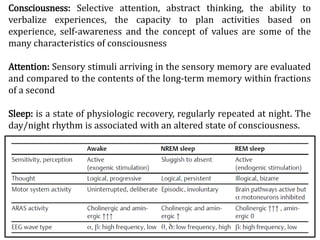
Sleep: is a state of physiologic recovery, regularly repeated at night. The
day/night rhythm is associated with an altered state of consciousness.
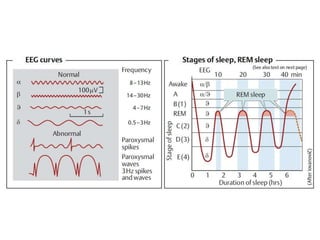
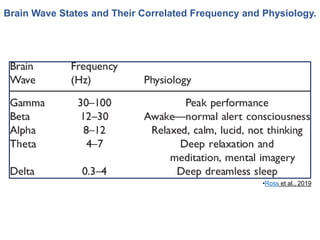
Brain Wave States and Their Correlated Frequency and Physiology.
•Ross et al., 2019
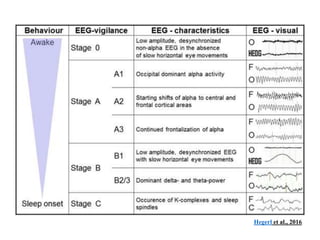
Hegerl et al., 2016
Thieme et al
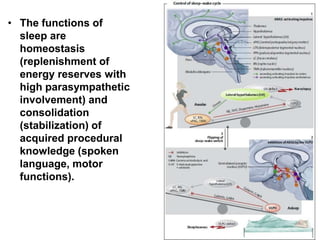
• The functions of
sleep are
homeostasis
(replenishment of
energy reserves with
high parasympathetic
involvement) and
consolidation
(stabilization) of
acquired procedural
knowledge (spoken
language, motor
functions).
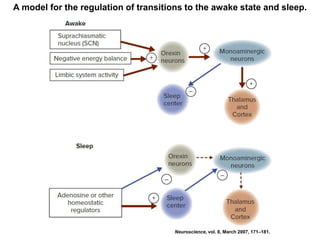
A model for the regulation of transitions to the awake state and sleep.
Neuroscience, vol. 8, March 2007, 171–181.
THANK YOU

Sleep wake cycle

  • 1.
    THE SLEEP –WAKE CYCLE By ARINDAM SAIN
  • 2.
    Circadian Rhythms, Sleep–WakeCycle  The daily sleep–wake cycle and other circadian rhythms (diurnal rhythms) are controlled by endogenous rhythm generators  The central biological clock (oscillator) that times these processes is located in the suprachiasmatic nucleus (SCN) of the hypothalamus  The endogenous circadian rhythm occurs in cycles of roughly 24– 25 hours, but is unadulterated only when a person is completely isolated from the outside influences  External zeitgebers (entraining signals) synchronize the biological clock to precise 24-hour cycles  The main external zeitgeber for 24-hour synchronization of the sleep–wake cycle is bright light (photic entrainment)
  • 3.
     Infants sleeplongest (about 16 hours/day, 50% REM)  10-year-olds sleep an average 10 hours (20% REM)  Young adults sleep 7–8 hours a day  Adults over 50 sleep an average 6 hours (both 20 % REM)  When a person is deprived of REM sleep, the duration of the next REM phase increases  The first two to three sleep cycles (core sleep) are essential.
  • 5.
    Consciousness: Selective attention,abstract thinking, the ability to verbalize experiences, the capacity to plan activities based on experience, self-awareness and the concept of values are some of the many characteristics of consciousness Attention: Sensory stimuli arriving in the sensory memory are evaluated and compared to the contents of the long-term memory within fractions of a second Sleep: is a state of physiologic recovery, regularly repeated at night. The day/night rhythm is associated with an altered state of consciousness.
  • 6.
    Brain Wave Statesand Their Correlated Frequency and Physiology. •Ross et al., 2019
  • 7.
  • 9.
  • 10.
    • The functionsof sleep are homeostasis (replenishment of energy reserves with high parasympathetic involvement) and consolidation (stabilization) of acquired procedural knowledge (spoken language, motor functions).
  • 11.
    A model forthe regulation of transitions to the awake state and sleep. Neuroscience, vol. 8, March 2007, 171–181.
  • 12.