NETWORK TESTING &  TROUBLESHOOTING   TS, PHẠM VĂN TÍNH PART15
EXAMINING THE ROUTING TABLE
The show ip route Command The  show ip route  command displays the contents of the IP routing table. This table contains entries for all known networks and subnetworks,  and  a code that indicates how that information was learned .
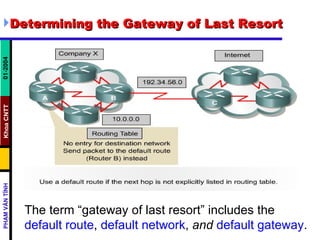
Determining the Gateway of Last Resort The term  “ gateway of last resort ”  includes the  default route ,  default network ,  and   default gateway .
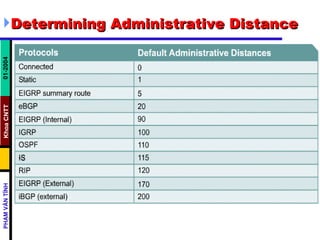
Determining Administrative Distance
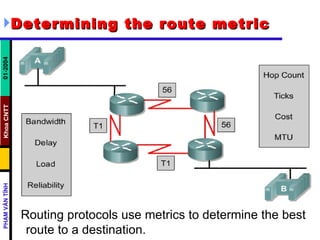
Determining the route metric   Routing protocols use metrics to determine the best route to a destination.
NETWORK TESTING
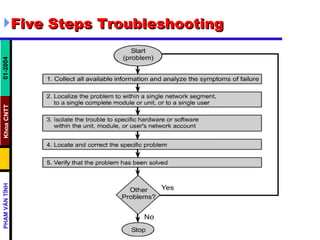
Five Steps Troubleshooting
Typical Layer 1 Errors Broken cables  Disconnected cables  Cables connected to the wrong ports  Intermittent cable connection  Wrong cables used for the task at hand (must use rollovers, crossover cables, and straight-through cables correctly)  Transceiver problems  DCE cable problems  DTE cable problems  Devices turned of
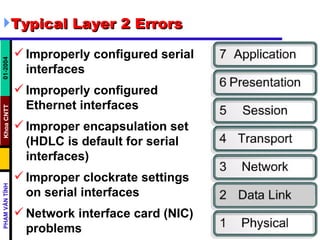
Typical Layer 2 Errors Improperly configured serial interfaces  Improperly configured Ethernet interfaces  Improper encapsulation set (HDLC is default for serial interfaces)  Improper clockrate settings on serial interfaces  Network interface card (NIC) problems
Typical Layer 3 Errors Routing protocol not enabled  Wrong routing protocol enabled  Incorrect IP addresses  Incorrect subnet masks
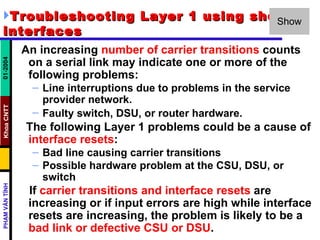
Troubleshooting Layer 1 using show interfaces   An increasing  number of carrier transitions  counts on a serial link may indicate one or more of the following problems:  Line interruptions due to problems in the service provider network.  Faulty switch, DSU, or router hardware.   The following Layer 1 problems could be a cause of  interface resets : Bad line causing carrier transitions  Possible hardware problem at the CSU, DSU, or switch  If  carrier transitions and interface resets  are increasing or if input errors are high while interface resets are increasing, the problem is likely to be a  bad link or defective CSU or DSU .
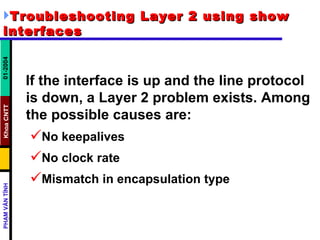
Troubleshooting Layer 2 using show interfaces   If the interface is up and the line protocol is down, a Layer 2 problem exists. Among the possible causes are: No keepalives  No clock rate  Mismatch in encapsulation type
Troubleshooting routing issues   Show ip route Show ip protocols
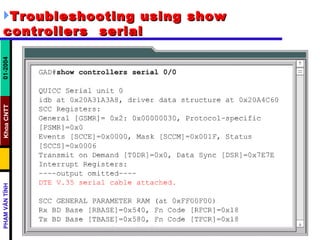
Troubleshooting using show controllers  serial

Chapter 09 - Net Testing

  • 1.
    NETWORK TESTING & TROUBLESHOOTING TS, PHẠM VĂN TÍNH PART15
  • 2.
  • 3.
    The show iproute Command The show ip route command displays the contents of the IP routing table. This table contains entries for all known networks and subnetworks, and a code that indicates how that information was learned .
  • 4.
    Determining the Gatewayof Last Resort The term “ gateway of last resort ” includes the default route , default network , and default gateway .
  • 5.
  • 6.
    Determining the routemetric Routing protocols use metrics to determine the best route to a destination.
  • 7.
  • 8.
  • 9.
    Typical Layer 1Errors Broken cables Disconnected cables Cables connected to the wrong ports Intermittent cable connection Wrong cables used for the task at hand (must use rollovers, crossover cables, and straight-through cables correctly) Transceiver problems DCE cable problems DTE cable problems Devices turned of
  • 10.
    Typical Layer 2Errors Improperly configured serial interfaces Improperly configured Ethernet interfaces Improper encapsulation set (HDLC is default for serial interfaces) Improper clockrate settings on serial interfaces Network interface card (NIC) problems
  • 11.
    Typical Layer 3Errors Routing protocol not enabled Wrong routing protocol enabled Incorrect IP addresses Incorrect subnet masks
  • 12.
    Troubleshooting Layer 1using show interfaces An increasing number of carrier transitions counts on a serial link may indicate one or more of the following problems: Line interruptions due to problems in the service provider network. Faulty switch, DSU, or router hardware. The following Layer 1 problems could be a cause of interface resets : Bad line causing carrier transitions Possible hardware problem at the CSU, DSU, or switch If carrier transitions and interface resets are increasing or if input errors are high while interface resets are increasing, the problem is likely to be a bad link or defective CSU or DSU .
  • 13.
    Troubleshooting Layer 2using show interfaces If the interface is up and the line protocol is down, a Layer 2 problem exists. Among the possible causes are: No keepalives No clock rate Mismatch in encapsulation type
  • 14.
    Troubleshooting routing issues Show ip route Show ip protocols
  • 15.
    Troubleshooting using showcontrollers serial