Buddhist
Architecture
Submitted By
SWARA BENDRE
and
AYUSHI DONGRE
(B. Arch Sem II)
SDPS Women’s
College
Acknowledgement
We would like to express our special thanks to our H.O.D Ar.
Vishal Yardi sir as well as our teacher Mr. S. P. Verma sir who
gave us the golden opportunity to work on paper presentation
on the topic “Buddhist Architecture” which helped us to obtain
knowledge about so many new things.
Secondly we would also like to thank our faculty members
Mr. Ketan Jain sir and Mr. Abhijit Kulkarni sir who helped us a
lot in finishing this paper. We are making this paper not only
for competition but also to increase our knowledge .
INTRODUCTION TO BUDDHIST
ARCHITECTURE
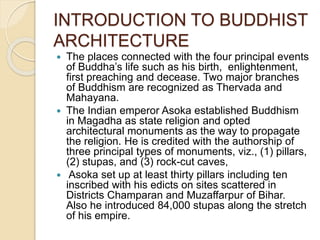
 The places connected with the four principal events
of Buddha’s life such as his birth, enlightenment,
first preaching and decease. Two major branches
of Buddhism are recognized as Thervada and
Mahayana.
 The Indian emperor Asoka established Buddhism
in Magadha as state religion and opted
architectural monuments as the way to propagate
the religion. He is credited with the authorship of
three principal types of monuments, viz., (1) pillars,
(2) stupas, and (3) rock-cut caves,
 Asoka set up at least thirty pillars including ten
inscribed with his edicts on sites scattered in
Districts Champaran and Muzaffarpur of Bihar.
Also he introduced 84,000 stupas along the stretch
of his empire.
The early mahayana phase
 During the centuries
immediately after the
beginning of the Christian
era, the Buddhist
communities in the middle
and southern parts of the
peninsula were actively
engaged in producing
monuments, such as
masonry stupas, wooden
chaitya halls, and rock-cut
monasteries, according to
the system of the Buddhist
faith. Also the main area of
inspiration was from
Afghanistan and some
European countries.
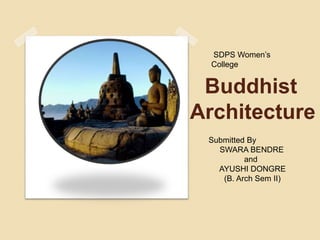
Borobudur Stupa , Indonesia
Pillars
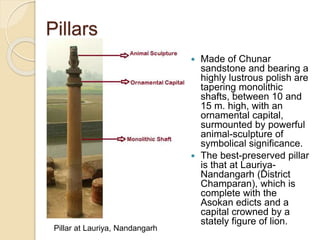
 Made of Chunar
sandstone and bearing a
highly lustrous polish are
tapering monolithic
shafts, between 10 and
15 m. high, with an
ornamental capital,
surmounted by powerful
animal-sculpture of
symbolical significance.
 The best-preserved pillar
is that at Lauriya-
Nandangarh (District
Champaran), which is
complete with the
Asokan edicts and a
capital crowned by a
stately figure of lion.
Pillar at Lauriya, Nandangarh
Stupas
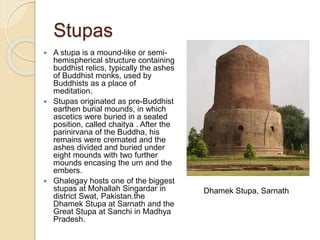
 A stupa is a mound-like or semi-
hemispherical structure containing
buddhist relics, typically the ashes
of Buddhist monks, used by
Buddhists as a place of
meditation.
 Stupas originated as pre-Buddhist
earthen burial mounds, in which
ascetics were buried in a seated
position, called chaitya . After the
parinirvana of the Buddha, his
remains were cremated and the
ashes divided and buried under
eight mounds with two further
mounds encasing the urn and the
embers.
 Ghalegay hosts one of the biggest
stupas at Mohallah Singardar in
district Swat, Pakistan.the
Dhamek Stupa at Sarnath and the
Great Stupa at Sanchi in Madhya
Pradesh.
Dhamek Stupa, Sarnath
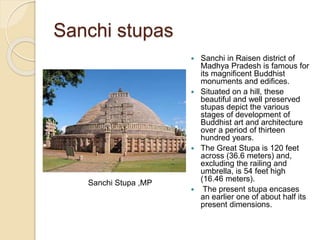
Sanchi stupas
 Sanchi in Raisen district of
Madhya Pradesh is famous for
its magnificent Buddhist
monuments and edifices.
 Situated on a hill, these
beautiful and well preserved
stupas depict the various
stages of development of
Buddhist art and architecture
over a period of thirteen
hundred years.
 The Great Stupa is 120 feet
across (36.6 meters) and,
excluding the railing and
umbrella, is 54 feet high
(16.46 meters).
 The present stupa encases
an earlier one of about half its
present dimensions.
Sanchi Stupa ,MP
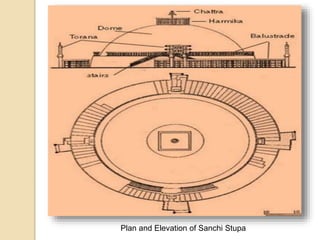
Plan and Elevation of Sanchi Stupa
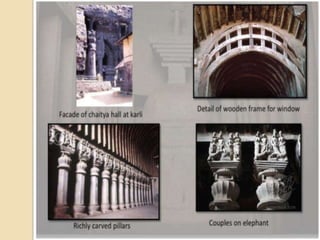
Chaitya halls
 Chaitya grihas or halls of
worship were built all over
the country either of brick
or excavated from rocks.
 Ruins of a large number of
structural Buddhist chaitya
grihas are found in the
eastern districts of Andhra
Pradesh, in valleys, near
rivers and lakes.
 The largest brick chaitya
hall was excavated at
Guntapalli.
 The chunar sand-stone
rock-cut chaityas are at
Bhaja. Kondane.
Chaityagriha Karla,
Maharashtra
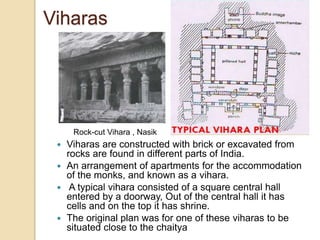
Viharas
 Viharas are constructed with brick or excavated from
rocks are found in different parts of India.
 An arrangement of apartments for the accommodation
of the monks, and known as a vihara.
 A typical vihara consisted of a square central hall
entered by a doorway, Out of the central hall it has
cells and on the top it has shrine.
 The original plan was for one of these viharas to be
situated close to the chaitya
Plan of ViharasRock-cut Vihara , Nasik
Rock-cut caves
 These caves are true
treasure and history of
great India followed by
the era of Ashoka the
Great of Mauryan,
Chalukyas and
Pallava.
 Most of the natural
caves in India are
Hindu cave temples
such as Vaishno Devi,
Amarnath and Varaha
cave temple and these
Hindu cave temples
are one of the most
visited pilgrimage site
in India.
Ajanta Caves
Examples of Rock-cut caves
 Ajanta Caves: The Ajanta
caves are the world’s
greatest historical
monument situated in
Jalgaon city of
Maharashtra.
 The 29 rock-cut cave
monuments include
paintings and sculptures of
religious art. The
Ajanta and Ellora caves in
India are the masterpieces
of India’s hillside rock cut
architecture.
 The other famous caves in
Maharashtra are Karla and
Bhaja caves, Kanheri
caves, Ellora caves and
Elephanta caves.
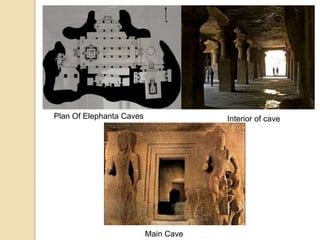
Elephanta Caves, Maharashtra
Plan Of Elephanta Caves
Main Cave
Interior of cave
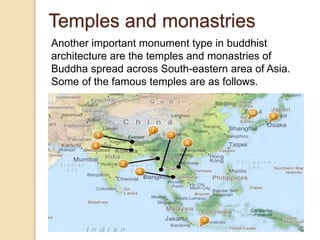
Temples and monastries
Another important monument type in buddhist
architecture are the temples and monastries of
Buddha spread across South-eastern area of Asia.
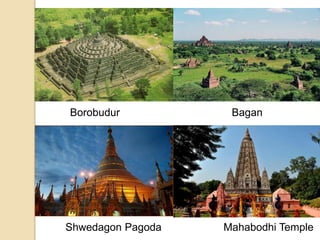
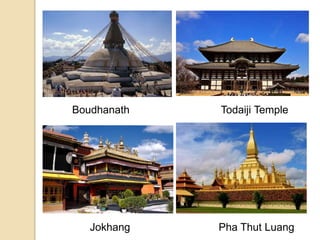
Some of the famous temples are as follows.
Borobudur Bagan
Shwedagon Pagoda Mahabodhi Temple
Boudhanath Todaiji Temple
Jokhang Pha Thut Luang
Wat Arun
Haeinsa
Temple
Conclusion
 The Buddhist communities in Mahayana
phase decided to freeze their principle for
years in the form of monuments.
 The preachings of Buddha have a effect on
architecture of Pillars, Stupas, Rock cut
caves, Chaityagrihas, Viharas, Temples and
Monastries.
 Also inspired by architecture of diff
countries.
 Showcase a variety of shapes and
stuctures like Dome, Pagodas, Stone-made
structures, Brick-made and Wooden
structures spreading Buddhism across
Bibliography
•The Great ages of world architecture by G.N.
Hiraskar
•Percy Brown, Indian Architecture (Buddhist
and Hindu period), Taraporevala and sons,
Bombay, 1983
• Satish Grover, The Architecture of India
(Buddhist and Hindu period),Vikas Publishing
House, New Delhi, 1981
• http://www.wikipedia.org/
• http://indiapicks.com/
• http://www.google.co.in/
Buddhist architecture

Buddhist architecture

  • 1.
    Buddhist Architecture Submitted By SWARA BENDRE and AYUSHIDONGRE (B. Arch Sem II) SDPS Women’s College
  • 2.
    Acknowledgement We would liketo express our special thanks to our H.O.D Ar. Vishal Yardi sir as well as our teacher Mr. S. P. Verma sir who gave us the golden opportunity to work on paper presentation on the topic “Buddhist Architecture” which helped us to obtain knowledge about so many new things. Secondly we would also like to thank our faculty members Mr. Ketan Jain sir and Mr. Abhijit Kulkarni sir who helped us a lot in finishing this paper. We are making this paper not only for competition but also to increase our knowledge .
  • 3.
    INTRODUCTION TO BUDDHIST ARCHITECTURE The places connected with the four principal events of Buddha’s life such as his birth, enlightenment, first preaching and decease. Two major branches of Buddhism are recognized as Thervada and Mahayana.  The Indian emperor Asoka established Buddhism in Magadha as state religion and opted architectural monuments as the way to propagate the religion. He is credited with the authorship of three principal types of monuments, viz., (1) pillars, (2) stupas, and (3) rock-cut caves,  Asoka set up at least thirty pillars including ten inscribed with his edicts on sites scattered in Districts Champaran and Muzaffarpur of Bihar. Also he introduced 84,000 stupas along the stretch of his empire.
  • 4.
    The early mahayanaphase  During the centuries immediately after the beginning of the Christian era, the Buddhist communities in the middle and southern parts of the peninsula were actively engaged in producing monuments, such as masonry stupas, wooden chaitya halls, and rock-cut monasteries, according to the system of the Buddhist faith. Also the main area of inspiration was from Afghanistan and some European countries. Borobudur Stupa , Indonesia
  • 5.
    Pillars  Made ofChunar sandstone and bearing a highly lustrous polish are tapering monolithic shafts, between 10 and 15 m. high, with an ornamental capital, surmounted by powerful animal-sculpture of symbolical significance.  The best-preserved pillar is that at Lauriya- Nandangarh (District Champaran), which is complete with the Asokan edicts and a capital crowned by a stately figure of lion. Pillar at Lauriya, Nandangarh
  • 6.
    Stupas  A stupais a mound-like or semi- hemispherical structure containing buddhist relics, typically the ashes of Buddhist monks, used by Buddhists as a place of meditation.  Stupas originated as pre-Buddhist earthen burial mounds, in which ascetics were buried in a seated position, called chaitya . After the parinirvana of the Buddha, his remains were cremated and the ashes divided and buried under eight mounds with two further mounds encasing the urn and the embers.  Ghalegay hosts one of the biggest stupas at Mohallah Singardar in district Swat, Pakistan.the Dhamek Stupa at Sarnath and the Great Stupa at Sanchi in Madhya Pradesh. Dhamek Stupa, Sarnath
  • 7.
    Sanchi stupas  Sanchiin Raisen district of Madhya Pradesh is famous for its magnificent Buddhist monuments and edifices.  Situated on a hill, these beautiful and well preserved stupas depict the various stages of development of Buddhist art and architecture over a period of thirteen hundred years.  The Great Stupa is 120 feet across (36.6 meters) and, excluding the railing and umbrella, is 54 feet high (16.46 meters).  The present stupa encases an earlier one of about half its present dimensions. Sanchi Stupa ,MP
  • 8.
    Plan and Elevationof Sanchi Stupa
  • 10.
    Chaitya halls  Chaityagrihas or halls of worship were built all over the country either of brick or excavated from rocks.  Ruins of a large number of structural Buddhist chaitya grihas are found in the eastern districts of Andhra Pradesh, in valleys, near rivers and lakes.  The largest brick chaitya hall was excavated at Guntapalli.  The chunar sand-stone rock-cut chaityas are at Bhaja. Kondane.
  • 11.
  • 13.
    Viharas  Viharas areconstructed with brick or excavated from rocks are found in different parts of India.  An arrangement of apartments for the accommodation of the monks, and known as a vihara.  A typical vihara consisted of a square central hall entered by a doorway, Out of the central hall it has cells and on the top it has shrine.  The original plan was for one of these viharas to be situated close to the chaitya Plan of ViharasRock-cut Vihara , Nasik
  • 14.
    Rock-cut caves  Thesecaves are true treasure and history of great India followed by the era of Ashoka the Great of Mauryan, Chalukyas and Pallava.  Most of the natural caves in India are Hindu cave temples such as Vaishno Devi, Amarnath and Varaha cave temple and these Hindu cave temples are one of the most visited pilgrimage site in India. Ajanta Caves
  • 15.
    Examples of Rock-cutcaves  Ajanta Caves: The Ajanta caves are the world’s greatest historical monument situated in Jalgaon city of Maharashtra.  The 29 rock-cut cave monuments include paintings and sculptures of religious art. The Ajanta and Ellora caves in India are the masterpieces of India’s hillside rock cut architecture.  The other famous caves in Maharashtra are Karla and Bhaja caves, Kanheri caves, Ellora caves and Elephanta caves. Elephanta Caves, Maharashtra
  • 16.
    Plan Of ElephantaCaves Main Cave Interior of cave
  • 17.
    Temples and monastries Anotherimportant monument type in buddhist architecture are the temples and monastries of Buddha spread across South-eastern area of Asia. Some of the famous temples are as follows.
  • 18.
  • 19.
  • 20.
  • 21.
    Conclusion  The Buddhistcommunities in Mahayana phase decided to freeze their principle for years in the form of monuments.  The preachings of Buddha have a effect on architecture of Pillars, Stupas, Rock cut caves, Chaityagrihas, Viharas, Temples and Monastries.  Also inspired by architecture of diff countries.  Showcase a variety of shapes and stuctures like Dome, Pagodas, Stone-made structures, Brick-made and Wooden structures spreading Buddhism across
  • 22.
    Bibliography •The Great agesof world architecture by G.N. Hiraskar •Percy Brown, Indian Architecture (Buddhist and Hindu period), Taraporevala and sons, Bombay, 1983 • Satish Grover, The Architecture of India (Buddhist and Hindu period),Vikas Publishing House, New Delhi, 1981 • http://www.wikipedia.org/ • http://indiapicks.com/ • http://www.google.co.in/

Editor's Notes

  • #4 INTRODUCTION TO BUDDHIST ARCHITECTURE