A N A T O M Y A N D
P H Y S I O L O G Y
O F
N E R V O U S
S Y S T E M
DR. PALLAVI PATHANIA
A N AT O M Y A N D P H Y S I O L O G Y O F
N E RV O U S S Y S T E M
S U B M IT T E D TO S U B M I T T E D B Y
D R . PA L L AV I PAT H A N I A M S . K A N C H A N
H . O . D [ M . S . N . ] M . S C . ( N ) 1 S T Y E A R
INDEX
Seria
l no.
content
1 Introduction to nervous system
2 Structure and function of neuron
3 Central Nervous System
4 Meninges and cerebrospinal fluid
5 Brain
6 Spinal cord
7 Peripheral nervous system
8 Summarization and conclusion
9 References
10 Assignment
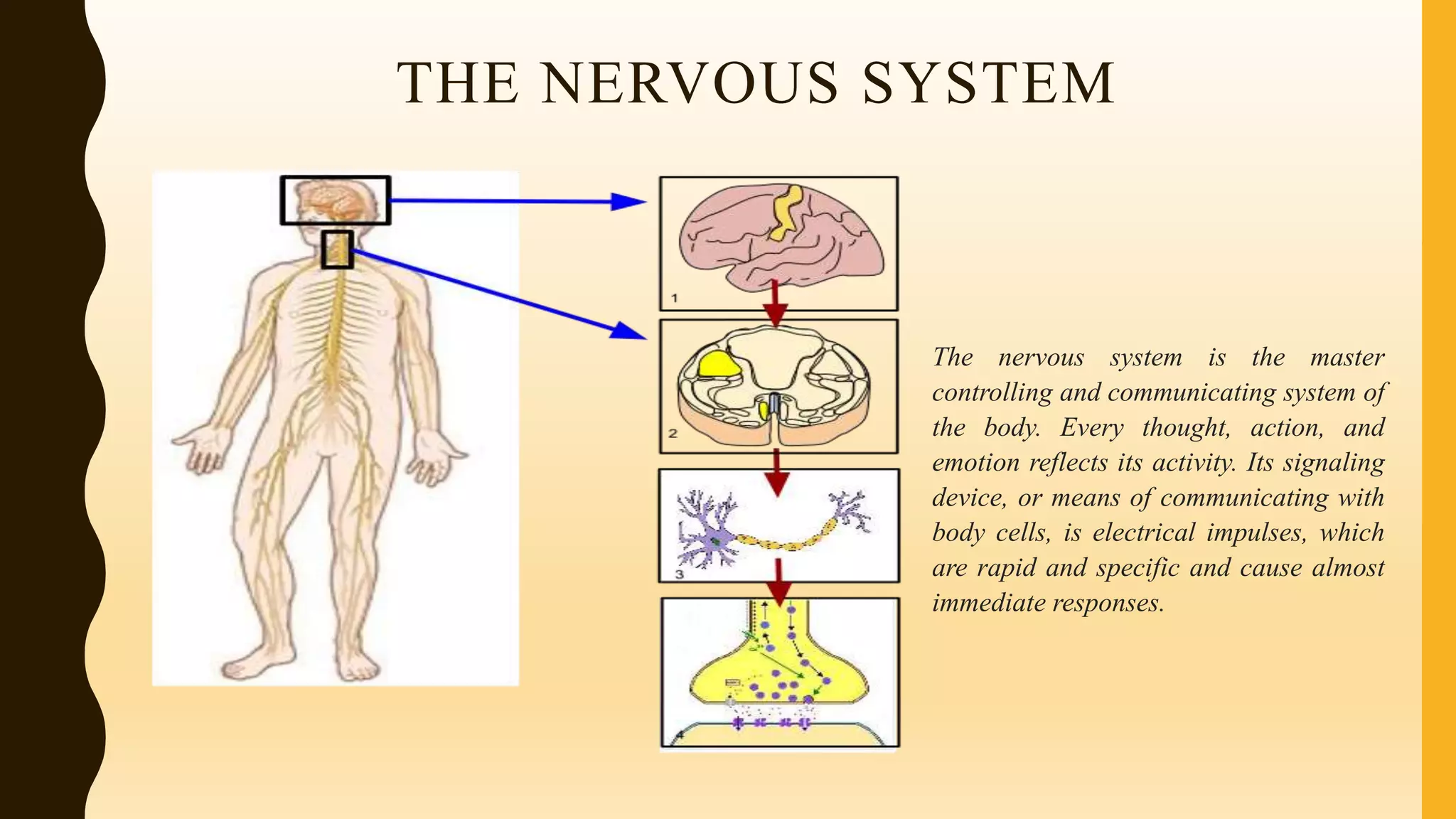
THE NERVOUS SYSTEM
The nervous system is the master
controlling and communicating system of
the body. Every thought, action, and
emotion reflects its activity. Its signaling
device, or means of communicating with
body cells, is electrical impulses, which
are rapid and specific and cause almost
immediate responses.
INTRODUCTION
• As we know, the functions of the organs or the organ
system in our body must be coordinated to maintain
homeostasis.
• Coordination: the process through which two or
more organs interact and complement the functions of
one another.
• For e.g.: when we do physical exercise, the energy
demand is increased for maintaining an increased
muscular activity . The supply of oxygen is also
increased and in turn the rate of respiration, heart beat
and blood flow increases.
CONT….
• When the physical exercise is stopped, the activities of
nerves, lungs heart and kidney gradually return to their
normal conditions.
• Hence the functions of all these organs are coordinated
while performing physical exercise.
• Nervous system and the endocrine system jointly
coordinate and integrate all the activities of the organs.
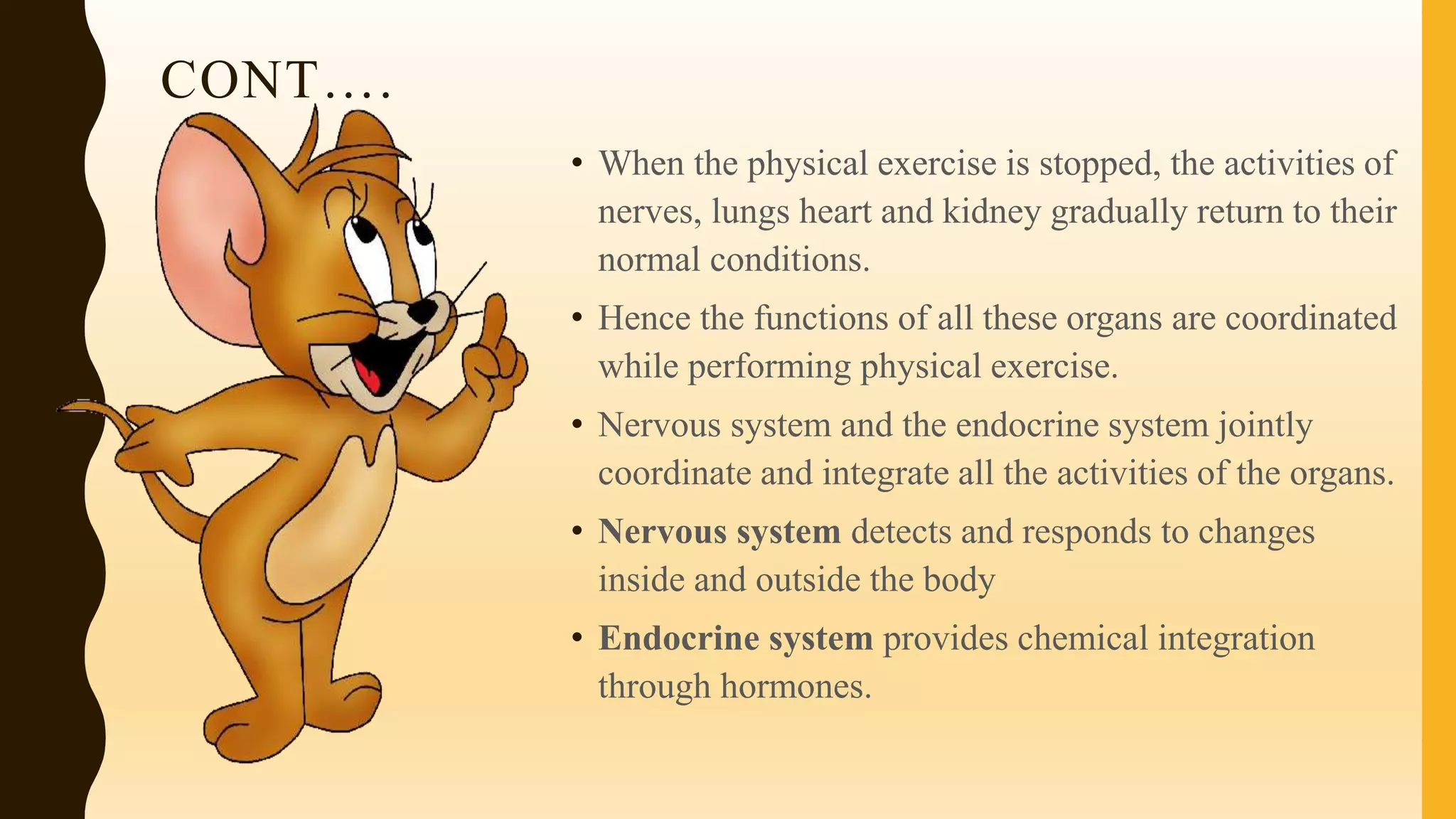
• Nervous system detects and responds to changes
inside and outside the body
• Endocrine system provides chemical integration
through hormones.
A N AT O M Y
O F
T H E
N E RV O U S S Y S T E M .
NERVOUS SYSTEM
• The nervous system does not work alone to regulate and maintain body homeostasis;
the endocrine system is a second important regulating system.
Organization of the Nervous System
We only have one nervous system, but, because of its complexity, it is difficult to consider all of
its parts at the same time; so, to simplify its study, we divide it in terms of its structures
(structural classification) or in terms of its activities (functional classification).
Structural Classification
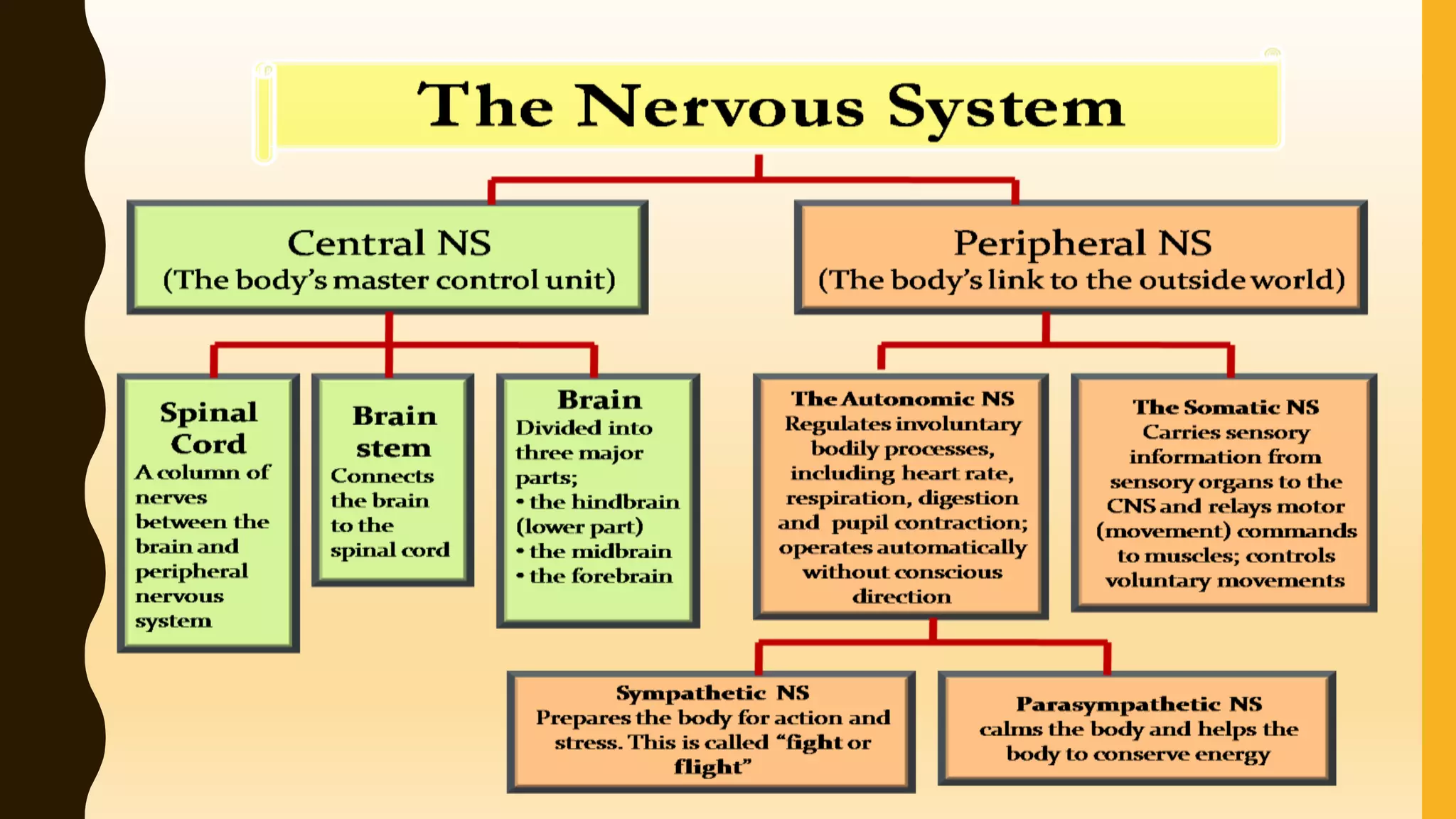
The structural classification, which includes all of the nervous system organs, has two
subdivisions- the central nervous system and the peripheral nervous system.
 Central nervous system (CNS). The CNS consists of the brain and spinal cord,
which occupy the dorsal body cavity and act as the integrating and command centers
of the nervous system
 Peripheral nervous system (PNS). The PNS, the part of the nervous system outside
the CNS, consists mainly of the nerves that extend from the brain and spinal cord.
NERVOUS SYSTEM
• The nervous system of all animals is
composed of highly specialised cells called
neurons which can detect, receive and
transmit different kinds of stimuli.
• The human nervous system is divided into:
– CNS (the central nervous system) consisting
of brain and spinal cord.
– PNS (the peripheral nervous system)
consisting of all nerves outside the brain and
spinal cord.
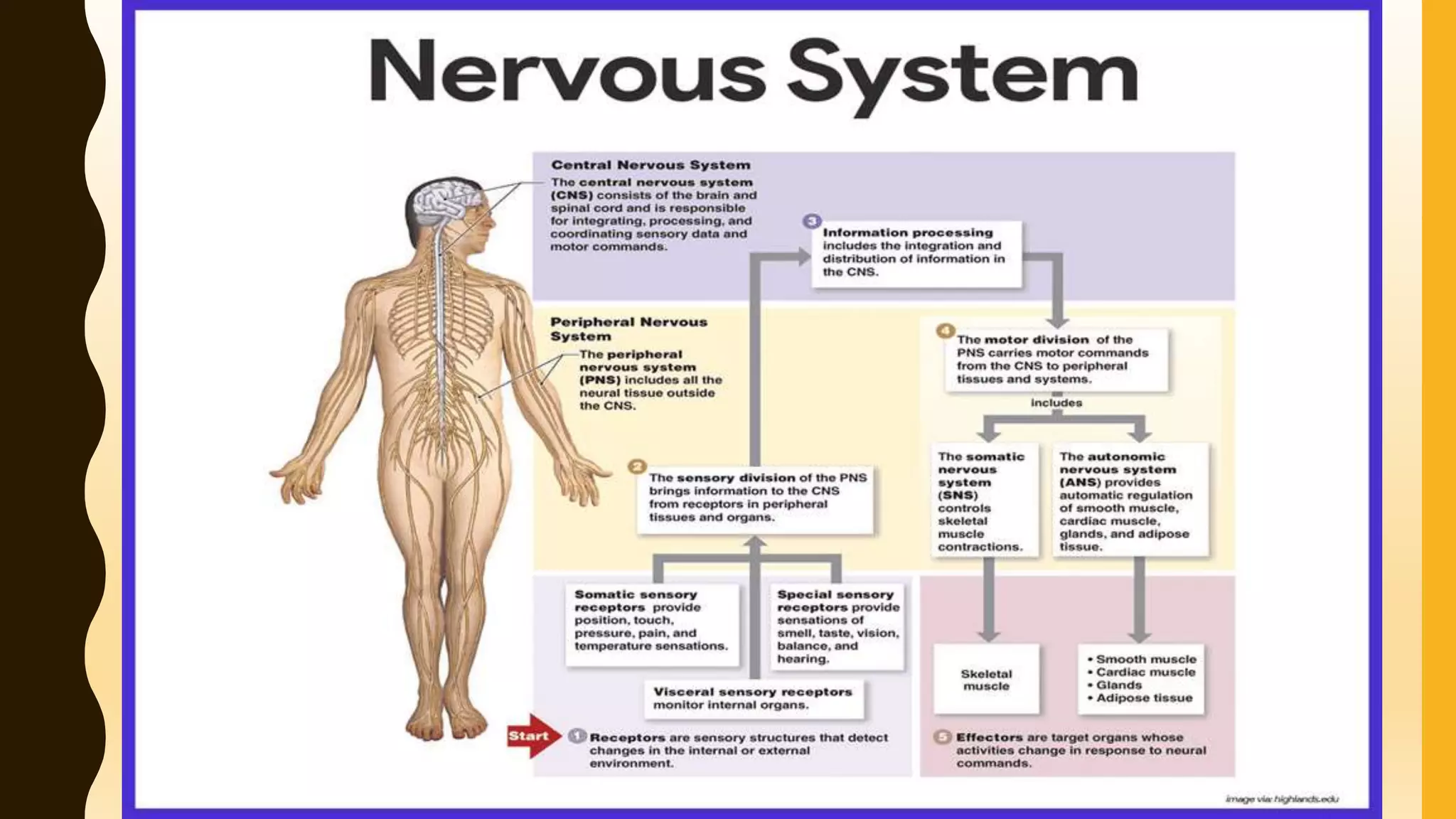
DIAGRAMMATIC PRESENTATION OF
FUNCTIONAL COMPONENTS OF THE NERVOUS
SYSTEM.
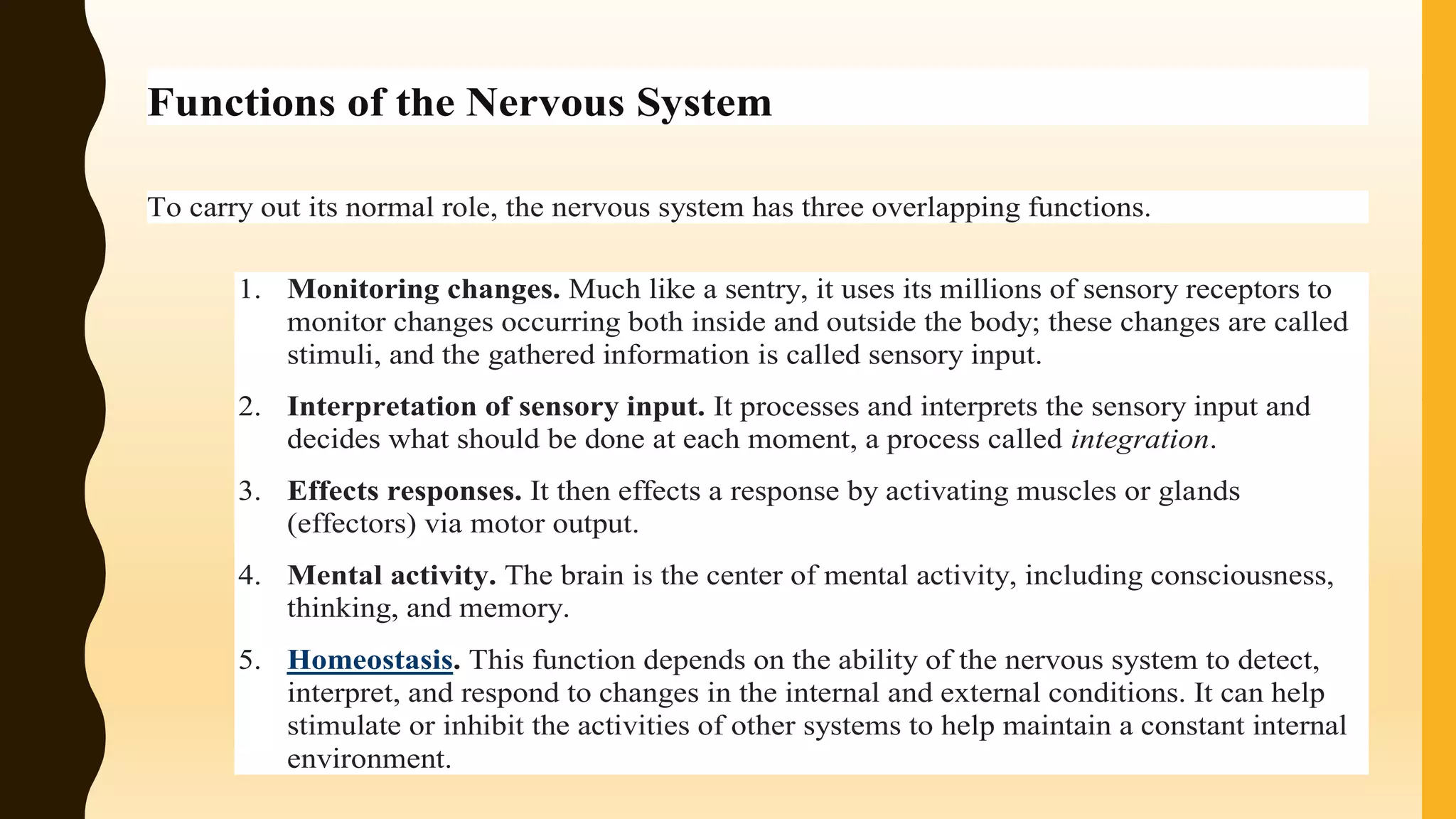
Functions of the Nervous System
To carry out its normal role, the nervous system has three overlapping functions.
1. Monitoring changes. Much like a sentry, it uses its millions of sensory receptors to
monitor changes occurring both inside and outside the body; these changes are called
stimuli, and the gathered information is called sensory input.
2. Interpretation of sensory input. It processes and interprets the sensory input and
decides what should be done at each moment, a process called integration.
3. Effects responses. It then effects a response by activating muscles or glands
(effectors) via motor output.
4. Mental activity. The brain is the center of mental activity, including consciousness,
thinking, and memory.
5. Homeostasis. This function depends on the ability of the nervous system to detect,
interpret, and respond to changes in the internal and external conditions. It can help
stimulate or inhibit the activities of other systems to help maintain a constant internal
environment.
A N AT O M Y
O F
T H E
N E U R O N S .
STRUCTURE AND FUNCTIONS OF
NEURON
This Photo by Unknown Author is licensed under CC BY-NC
NEURONS
• Neuron is the structural and functional unit of nervous system
• It is commonly known as nerve cell.
• It is a microscopic structure consist of three major parts:
Cell body
Dendrites
Axon
• Bundles of axons bound together to
form nerves.
• Neurones cannot divide, and for their
survival they need a continuous
supply of oxygen and glucose.
• Cell bodies: these bodies are located
at the periphery of the brain and in the
centre of spinal cord
• Cell body contains cytoplasm, cell organelles
• Groups of cell bodies are called nuclei in CNS
• Groups of cell bodies are called ganglia in PNS
• Cell body forms the grey matter of nervous system
• Axon: the axon is a long fibre extending from the cell
body.
– The membrane of the axon is called axolemma and it
encloses the cytoplasm.
– These axons carry impulses away from the cell body .
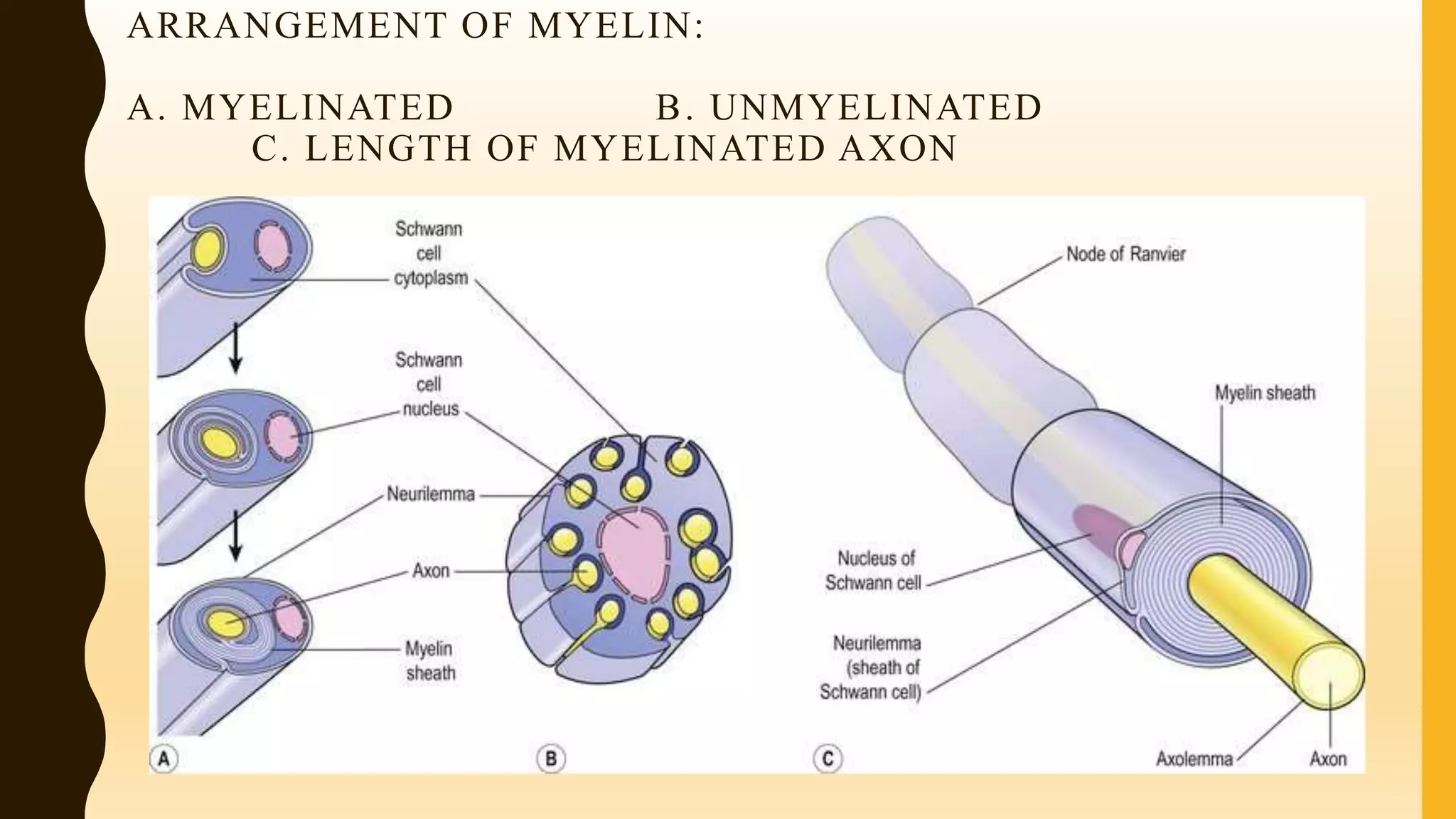
• Myelinated neurons: the large axons when surrounded
by a myelin sheath
– This consists of a series of Schwann cells arranged along
the length of the axon
– Each Schwann cell membrane is wrapped around the axon
in concentric layers
• Myelin the fatty substance present between the layers of
Schwann cell plasma membrane.
• The outermost layer of the Schwann cell plasma
membrane is the neurilemma.
• There are tiny areas of exposed axolemma
between adjacent Schwann cells, called nodes of
Ranvier
• it assist the rapid transmission of nerve impulses
in myelinated neurones.
– Unmyelinated neurons: a few nerve fibres in CNS
lacks myelin sheath hence called unmyelinated
neurons.
– In this type a number of axons are embedded in one
Schwann cell
– The adjacent Schwann cells are in close association
and there is no exposed axolemma
– The speed of transmission of nerve impulses is
significantly slower in unmyelinated fibres.
CLASSIFICATION: NEURONS MAY BE CLASSIFIED EITHER
ACCORDING TO HOW THEY FUNCTION OR ACCORDING TO THEIR
STRUCTURE.
 Functional classification. Functional classification groups neurons according to the direction the nerve impulse is
traveling relative to the CNS; on this basis, there are sensory, motor, and association neurons.
 Sensory neurons. Neurons carrying impulses from sensory receptors to the CNS are sensory, or afferent, neurons;
sensory neurons keep us informed about what is happening both inside and outside the body.
 Motor neurons. Neurons carrying impulses from the CNS to the viscera and/or muscles and glands are motor,
or efferent, neurons.
 Interneurons. The third category of neurons is known as the interneurons, or association neurons; they connect
the motor and sensory neurons in neural pathways.
 Structural classification. Structural classification is based on the number of processes extending from the cell
body.
 Multipolar neuron. If there are several processes, the neuron is a multipolar neuron; because all motor and
association neurons are multipolar, this is the most common structural type.
 Bipolar neurons. Neurons with two processes- an axon and a dendrite- are called bipolar neurons; these are rare in
adults, found only in some special sense organs, where they act in sensory processing as receptor cells.
 Unipolar neurons. Unipolar neurons have a single process emerging from the cell’s body, however, it is very short
and divides almost immediately into proximal (central) and distal (peripheral) processes.
ARRANGEMENT OF MYELIN:
A. MYELINATED B. UNMYELINATED
C. LENGTH OF MYELINATED AXON
• Dendrites:
– These are short fibres which branch
repeatedly and project out of the cell
body.
– In motor neurones dendrites form part
of synapses
– In sensory neurones they form the
sensory receptors that respond to
specific stimuli.
GENERATION AND CONDUCTION OF
NERVE IMPULSE (MYELINATED)
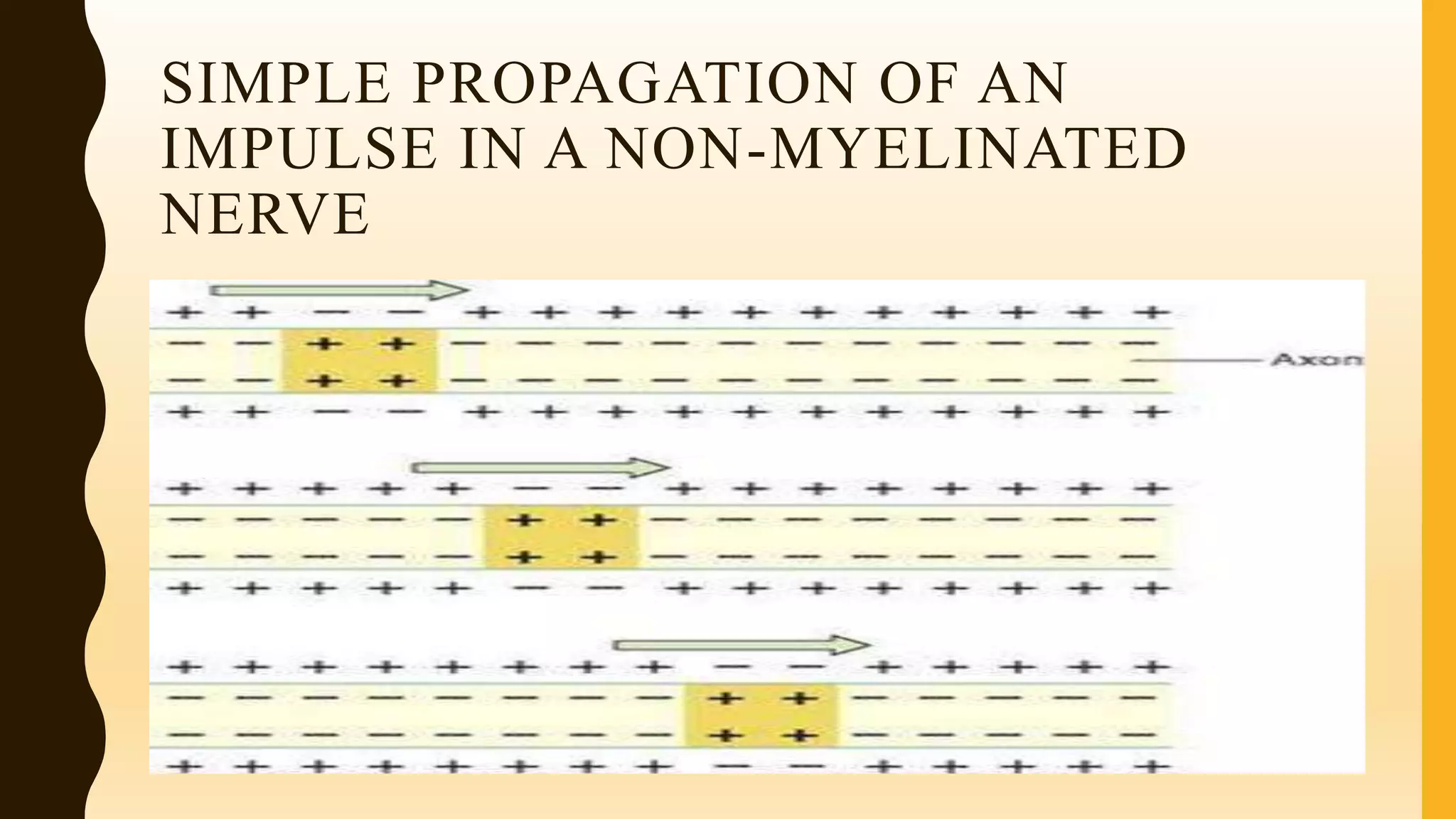
SIMPLE PROPAGATION OF AN
IMPULSE IN A NON-MYELINATED
NERVE
GENERATION AND CONDUCTION OF
NERVE IMPULSE
• In the resting state the nerve cell membrane is polarised due to
differences in the concentrations of ions across the plasma membrane.
• An impulse is initiated by stimulation of sensory nerve endings or by the
passage of an impulse from another nerve.
• Transmission of the impulse, or action potential, is due to movement of
ions across the nerve cell membrane.
• At rest the charge on the outside is positive and inside it is negative
• The principal ions involved are: • sodium (Na+ ), the main extracellular cation •
potassium (K+ ), the main intracellular cation.
• When nerve fibre gets stimulation, the permeability of the nerve cell membrane
changes.
• Initially Na+ floods into the neurone from the extracellular fluid causing
depolarisation, creating a nerve impulse or action potential.
• Conduction of nerve impulse occurs in one way only.
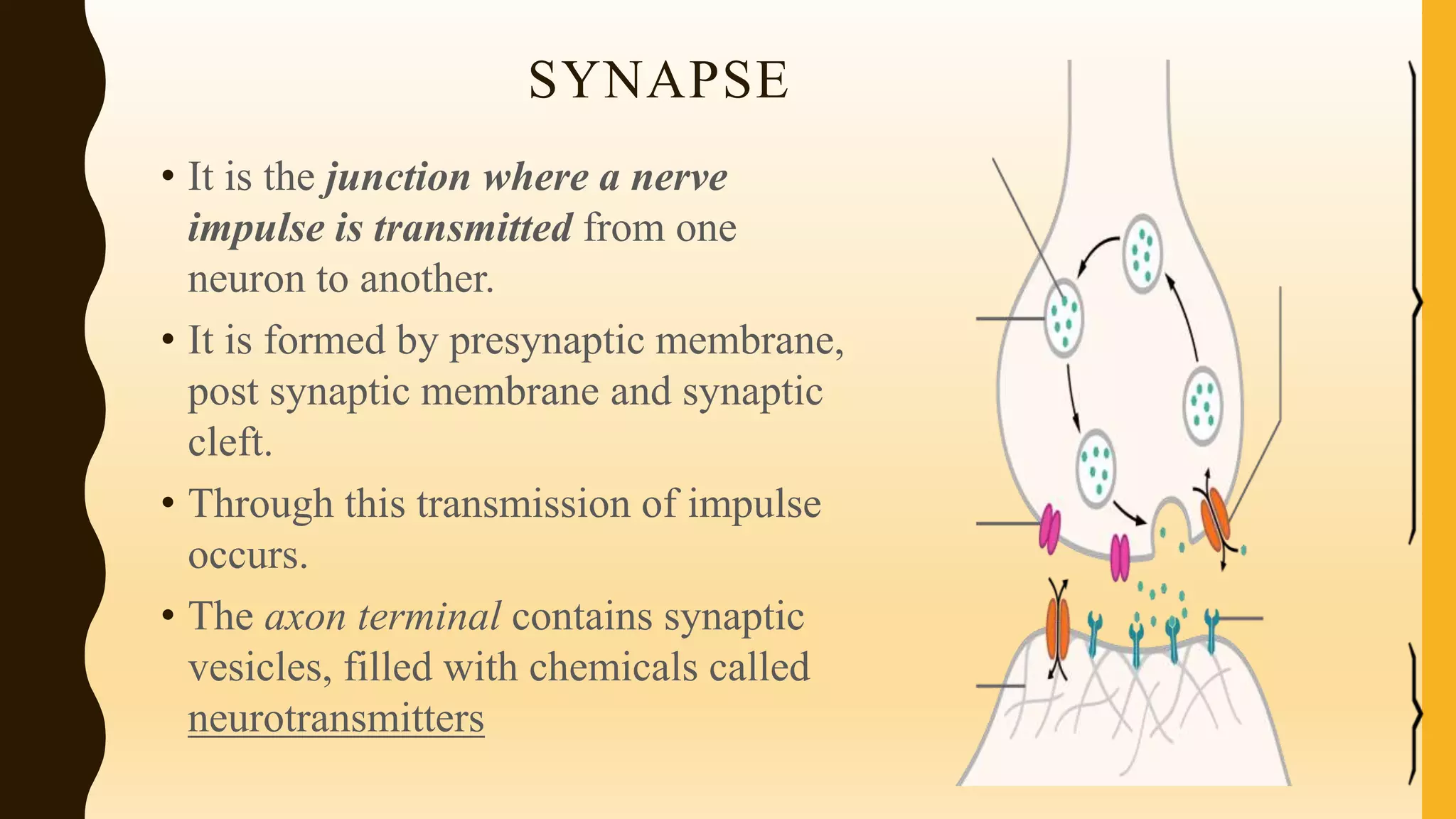
THE SYNAPSE:
SYNAPSE
• It is the junction where a nerve
impulse is transmitted from one
neuron to another.
• It is formed by presynaptic membrane,
post synaptic membrane and synaptic
cleft.
• Through this transmission of impulse
occurs.
• The axon terminal contains synaptic
vesicles, filled with chemicals called
neurotransmitters
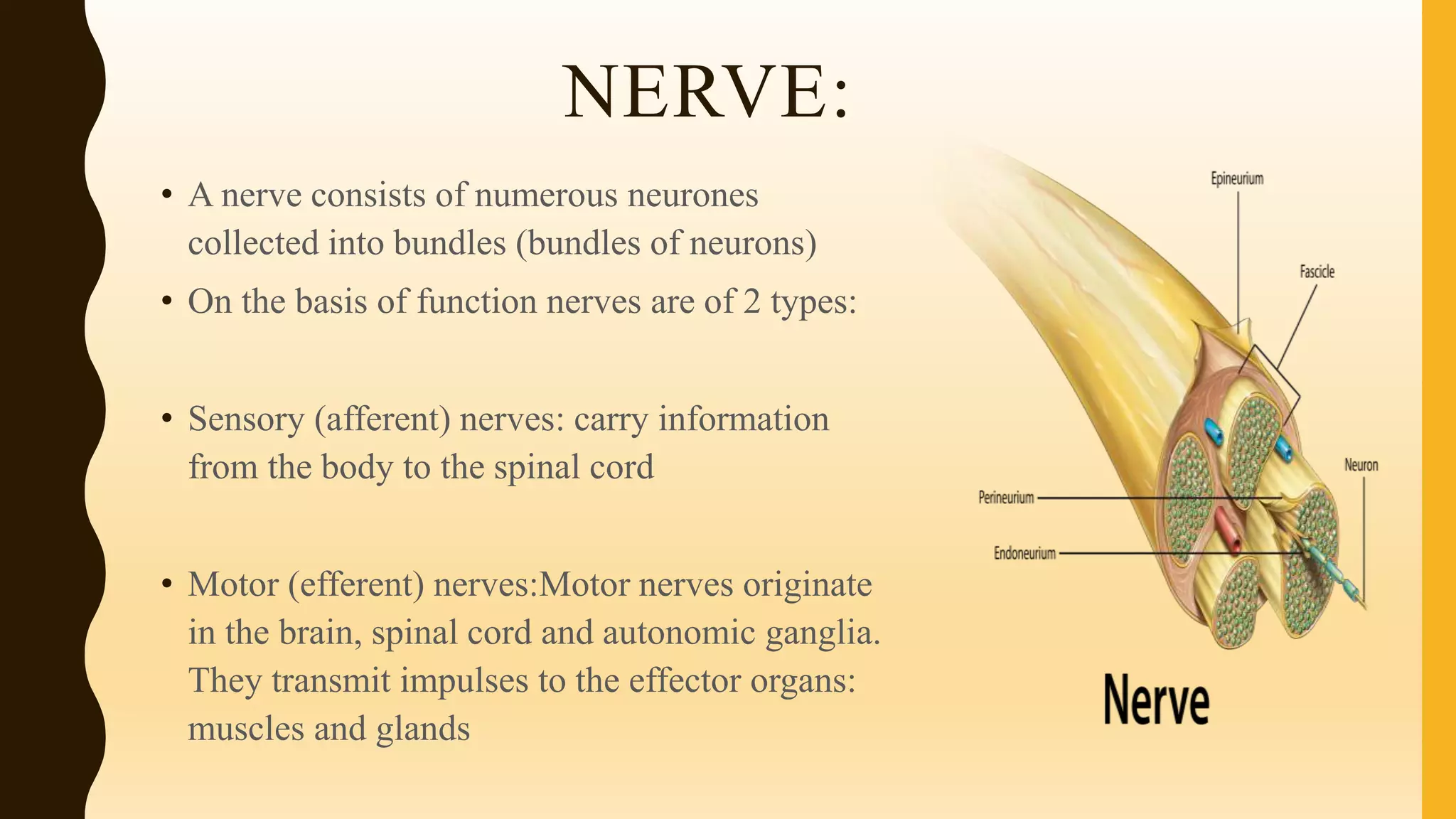
STRUCTURE OF NERVE
NERVE:
• A nerve consists of numerous neurones
collected into bundles (bundles of neurons)
• On the basis of function nerves are of 2 types:
• Sensory (afferent) nerves: carry information
from the body to the spinal cord
• Motor (efferent) nerves:Motor nerves originate
in the brain, spinal cord and autonomic ganglia.
They transmit impulses to the effector organs:
muscles and glands
CENTRAL NERVOUS SYSTEM
• The central nervous system consists of the brain and the spinal cord.
PROTECTIVE COVERINGS OF
CENTRAL NERVOUS SYSTEM
MENINGES: THE PROTECTIVE COVERING
OF BRAIN AND SPINAL CORD
THE MENINGES AND CEREBROSPINAL
FLUID (CSF)
• The meninges: these are the
protective coverings of brain and
spinal cord.
• Brain and spinal cord are covered
with 3 layers of meninges. These
are:
– Dura mater (outer most)
– Arachnoid mater (middle)
– Pia mater (inner most)
•Dura mater
–The cerebral dura mater consists
of two layers of dense fibrous
tissue. The outer layer takes the
place of the periosteum on the
inner surface of the skull bones
and the inner layer provides a
protective covering for the brain
• Arachnoid mater
–This is a layer of fibrous tissue that lies
between the dura and pia maters. It is
separated from the dura mater by
the subdural space, and from the pia
mater by the subarachnoid space,
containing cerebrospinal fluid.
• Pia mater
–This is a delicate layer of connective
tissue containing many minute blood
vessels. It adheres to the brain,
completely
–It continues downwards surrounding the
spinal cord.
VENTRICLES OF BRAIN
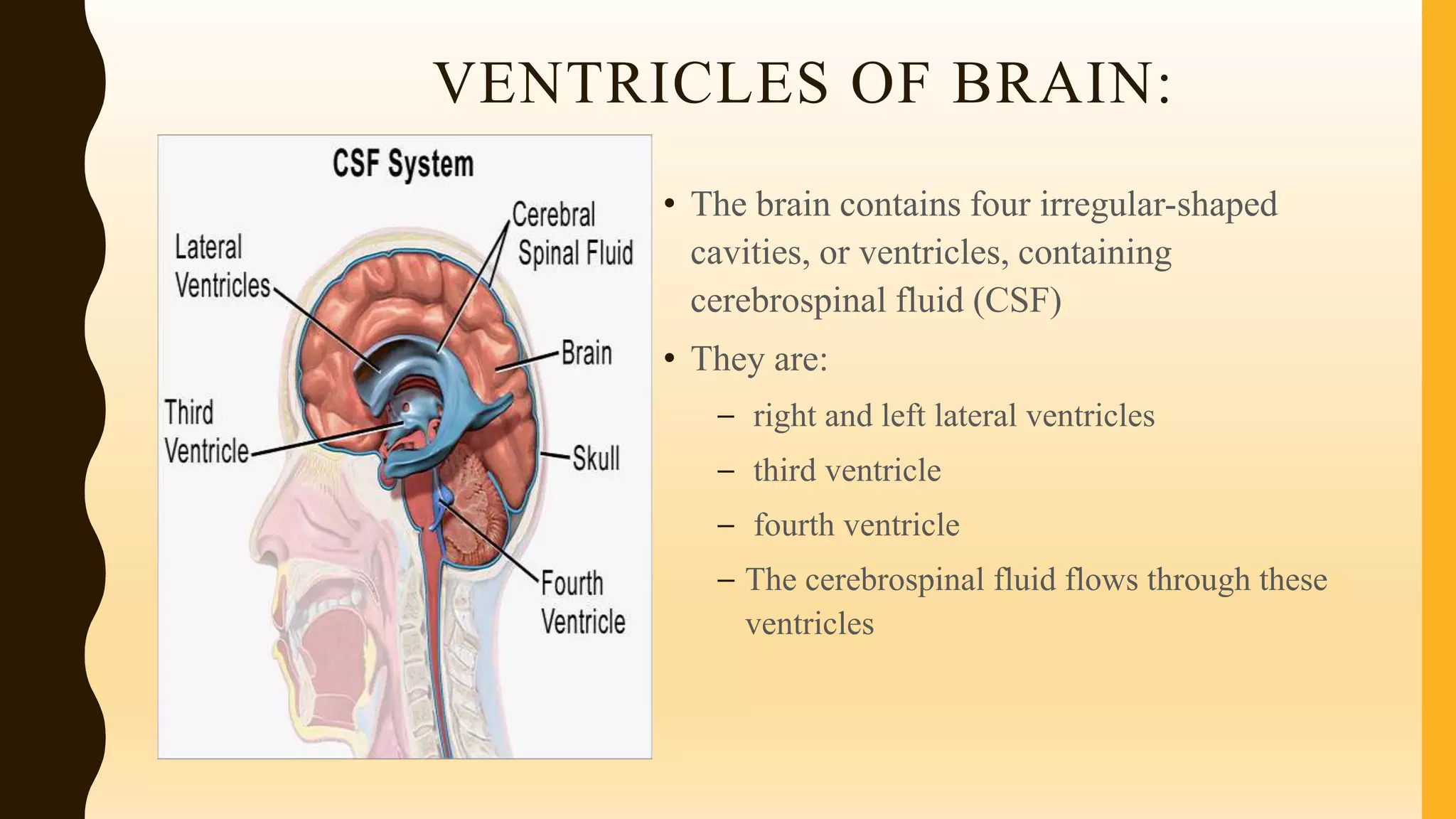
VENTRICLES OF BRAIN:
• The brain contains four irregular-shaped
cavities, or ventricles, containing
cerebrospinal fluid (CSF)
• They are:
– right and left lateral ventricles
– third ventricle
– fourth ventricle
– The cerebrospinal fluid flows through these
ventricles
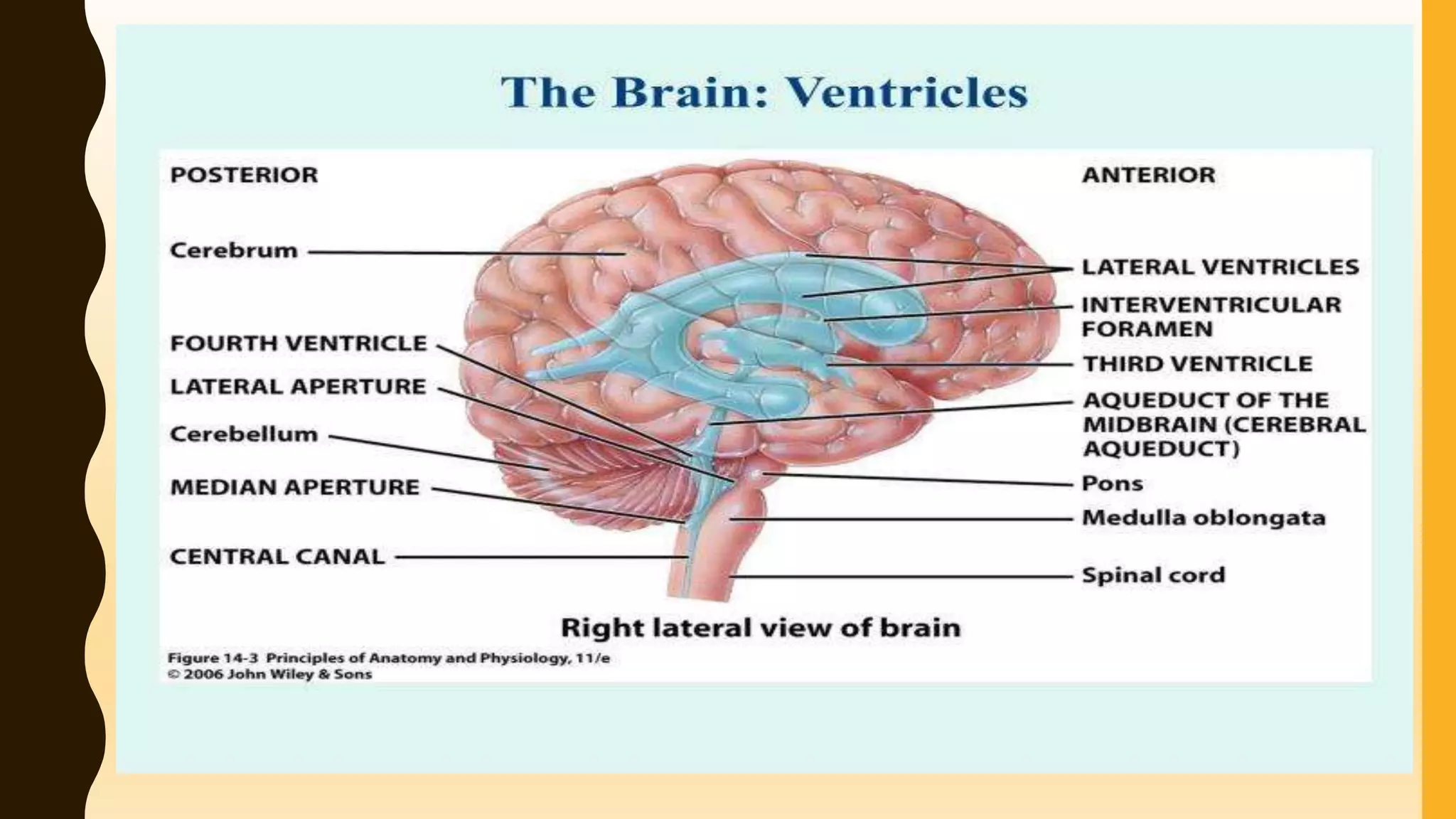
• The lateral ventricles: These cavities lie within the cerebral hemispheres and
are separated from each other by a thin membrane, the septum lucidum.
• The third ventricle: The third ventricle is a cavity situated below the lateral
ventricles between the two parts of the thalamus
• The fourth ventricle: The fourth ventricle is a diamond-shaped cavity situated
below and behind the third ventricle, between the cerebellum and pons.
ARROWS SHOWING THE FLOW OF
CEREBROSPINAL FLUID.
CEREBROSPINAL FLUID (CSF)
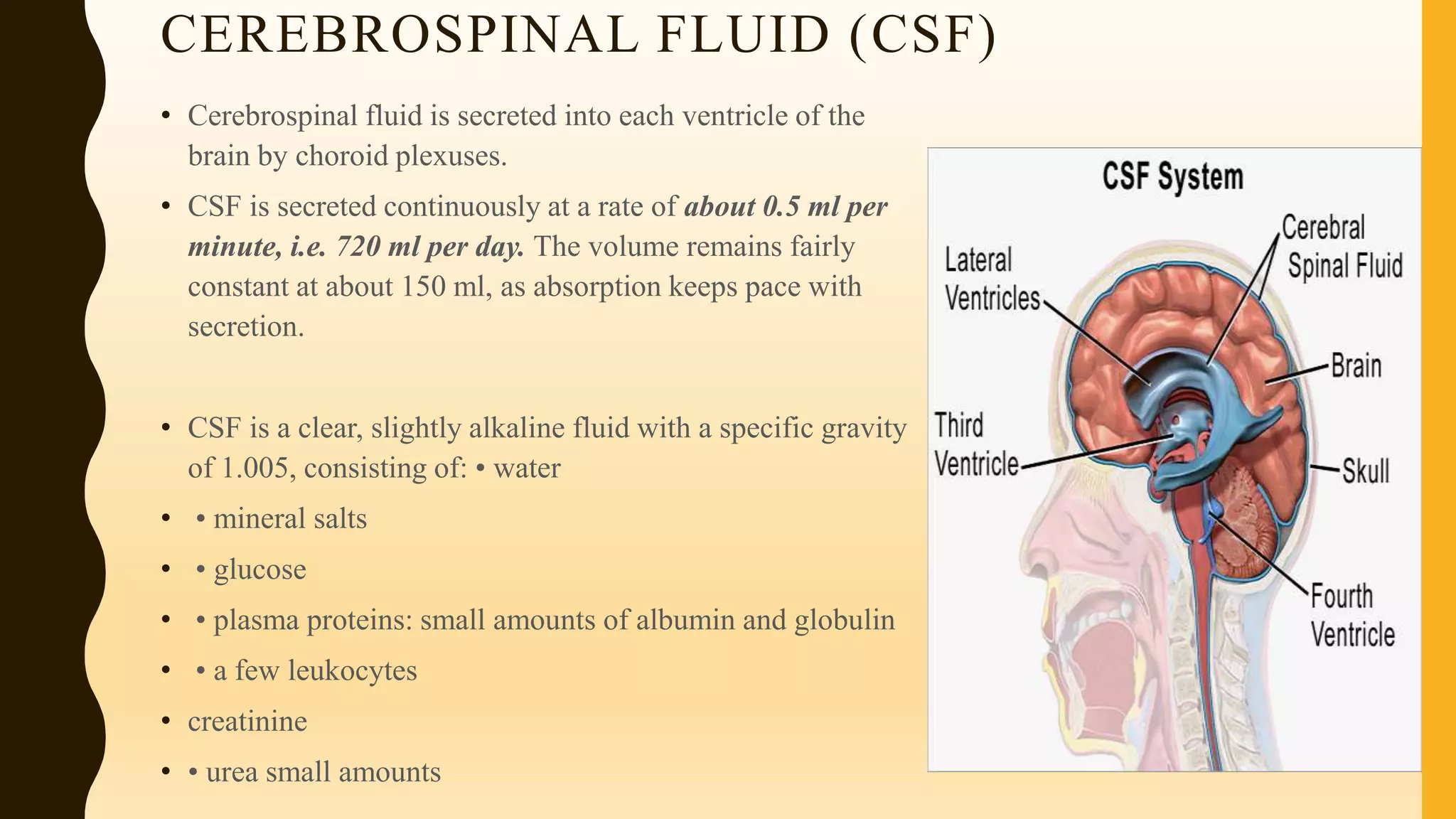
• Cerebrospinal fluid is secreted into each ventricle of the
brain by choroid plexuses.
• CSF is secreted continuously at a rate of about 0.5 ml per
minute, i.e. 720 ml per day. The volume remains fairly
constant at about 150 ml, as absorption keeps pace with
secretion.
• CSF is a clear, slightly alkaline fluid with a specific gravity
of 1.005, consisting of: • water
• • mineral salts
• • glucose
• • plasma proteins: small amounts of albumin and globulin
• • a few leukocytes
• creatinine
• • urea small amounts
FUNCTIONS OF CEREBROSPINAL FLUID
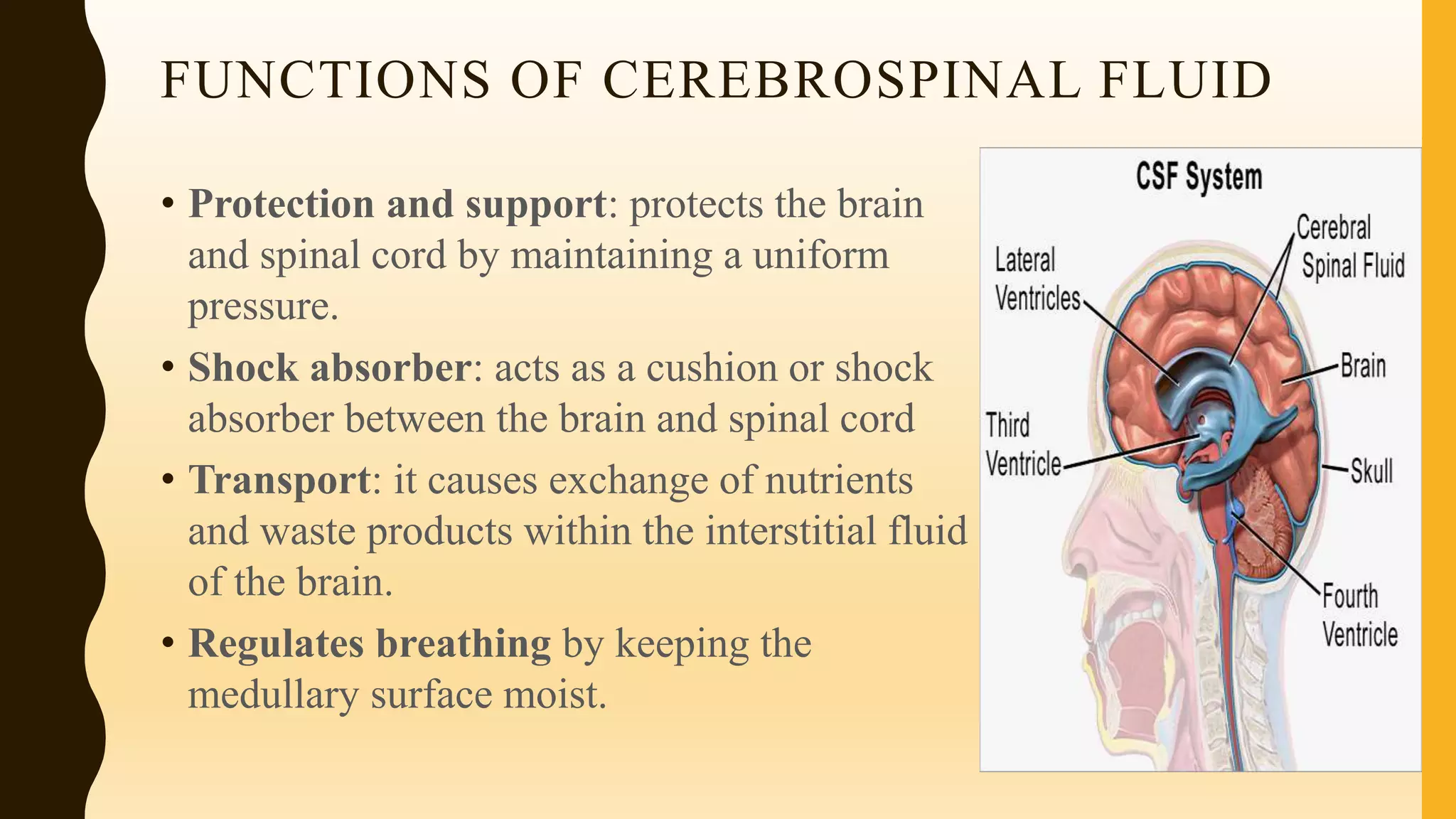
• Protection and support: protects the brain
and spinal cord by maintaining a uniform
pressure.
• Shock absorber: acts as a cushion or shock
absorber between the brain and spinal cord
• Transport: it causes exchange of nutrients
and waste products within the interstitial fluid
of the brain.
• Regulates breathing by keeping the
medullary surface moist.
BRAIN:
• Brain is the central information processing
organ of our body.
• It acts as the : ‘command and control
system’
• The human brain weighs around 1.4 kg and
lies in the cranial cavity.
• Parts of brain: 3 major parts of brain are-
• i) fore brain
• ii) mid brain
• iii) hind brain
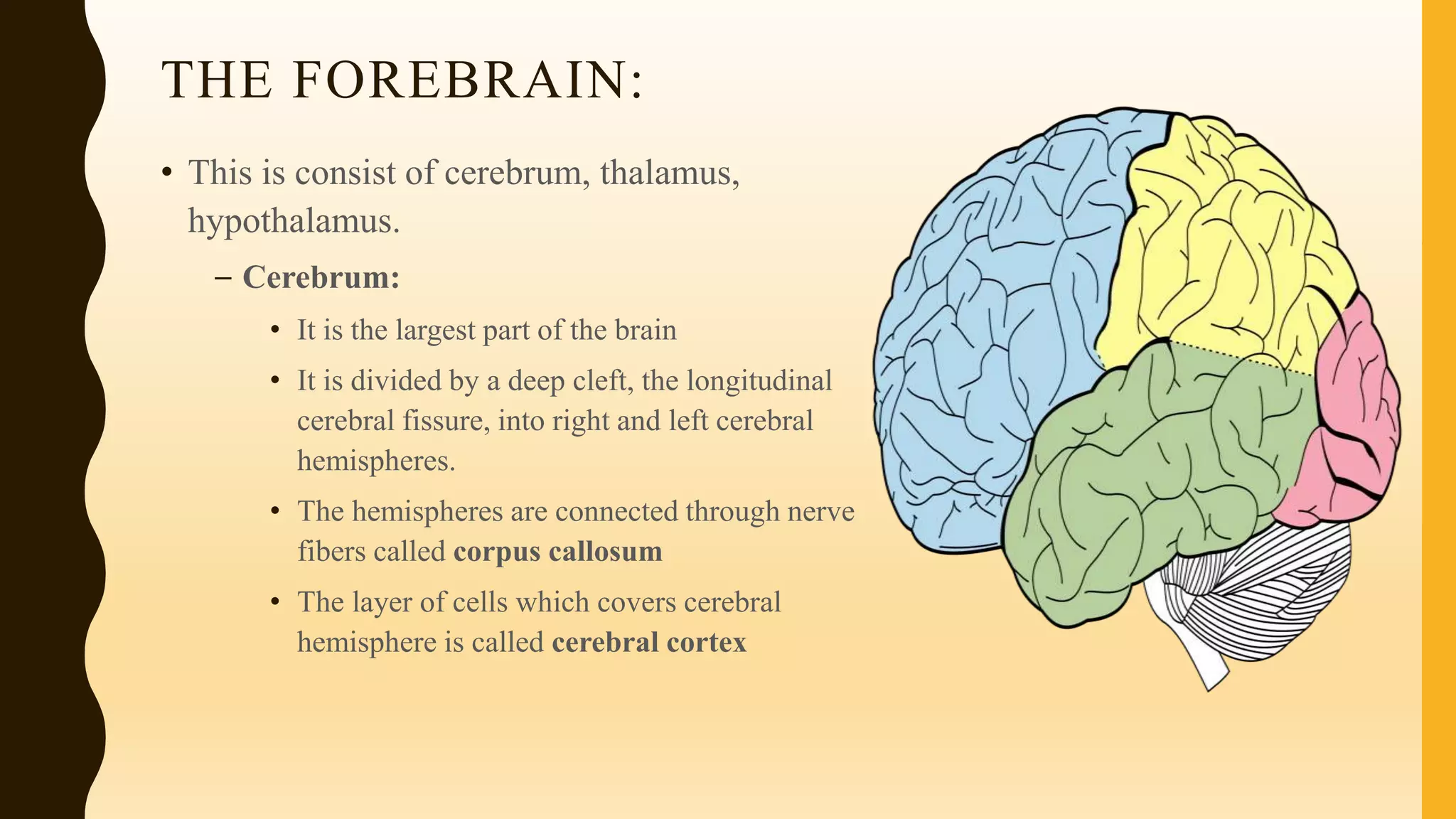
THE FOREBRAIN:
• This is consist of cerebrum, thalamus,
hypothalamus.
– Cerebrum:
• It is the largest part of the brain
• It is divided by a deep cleft, the longitudinal
cerebral fissure, into right and left cerebral
hemispheres.
• The hemispheres are connected through nerve
fibers called corpus callosum
• The layer of cells which covers cerebral
hemisphere is called cerebral cortex
• Cerebral Hemispheres: The paired cerebral hemispheres, collectively called cerebrum, are the
most superior part of the brain, and together are a good deal larger than the other three brain
regions combined.
• Gyri. The entire surface of the cerebral hemispheres exhibits elevated ridges of tissue called gyri,
separated by shallow grooves called sulci.
• Fissures. Less numerous are the deeper grooves of tissue called fissures, which separate large
regions of the brain; the cerebral hemispheres are separated by a single deep fissure,
the longitudinal fissure.
• Lobes. Other fissures or sulci divide each hemisphere into a number of lobes, named for the
cranial bones that lie over them.
• Regions of cerebral hemisphere. Each cerebral hemisphere has three basic regions: a
superficial cortex of gray matter, an internal white matter, and the basal nuclei.
• Cerebral cortex. Speech, memory, logical and emotional response, as well as consciousness,
interpretation of sensation, and voluntary movement are all functions of neurons of the cerebral
cortex.
• Parietal lobe. The primary somatic sensory area is located in the parietal lobe posterior to the
central sulcus; impulses traveling from the body’s sensory receptors are localized and interpreted
in this area.
• Occipital lobe. The visual area is located in the posterior part of the occipital lobe.
• Temporal lobe. The auditory area is in the temporal lobe bordering the lateral sulcus,
and the olfactory area is found deep inside the temporal lobe.
• Frontal lobe. The primary motor area, which allows us to consciously move our
skeletal muscles, is anterior to the central sulcus in the front lobe.
• Pyramidal tract. The axons of these motor neurons form the major voluntary motor
tract- the corticospinal or pyramidal tract, which descends to the cord.
• Broca’s area. A specialized cortical area that is very involved in our ability to speak,
Broca’s area, is found at the base of the precentral gyrus (the gyrus anterior to the
central sulcus).
• Speech area. The speech area is located at the junction of the temporal, parietal, and
occipital lobes; the speech area allows one to sound out words.
• Cerebral white matter. The deeper cerebral white matter is compose of fiber tracts carrying impulses
to, from, and within the cortex.
• Corpus callosum. One very large fiber tract, the corpus callosum, connect the cerbral hemispheres;
such fiber tracts are called commisures.
• Fiber tracts. Association fiber tracts connect areas within a hemisphere, and projection fiber
tracts connect the cerebrum with lower CNS centers.
• Basal nuclei. There are several islands of gray matter, called the basal nuclei, or basal ganglia,
buried deep within the white matter of the cerebral hemispheres; it helps regulate the voluntary motor
activities by modifying instructions sent to the skeletal muscles by the primary motor cortex.
FUNCTIONAL AREAS OF THE CEREBRAL
CORTEX:
• There are different types of functional area:
– motor area: which direct skeletal (voluntary) muscle
movements
– sensory area: which receive and decode sensory
impulses enabling sensory perception (auditory,
olfactory, gustatory)
– association area: which are concerned with integration
and processing of complex mental functions such as
intelligence, memory, reasoning, judgement and
emotions.
FUNCTIONS OF THE CEREBRAL CORTEX
• There are three main types of activity associated
with the cerebral cortex:
• higher order functions, i.e. the mental activities
involved in memory, sense of responsibility,
thinking, reasoning, moral decision making and
learning
• sensory perception, including the perception of
pain, temperature, touch, sight, hearing, taste and
smell
• initiation and control of skeletal muscle
contraction and therefore voluntary movement.
SECTION OF THE BRAIN SHOWING
MAIN PARTS.
THE BRAIN : LOBES OF CEREBRUM
This Photo by Unknown Author is licensed under CC BY-SA
THE CEREBRUM SHOWING THE MAIN
FUNCTIONAL AREAS.
Diencephalon
– The diencephalon, or interbrain, sits atop the brain stem and is enclosed by the cerebral hemispheres.
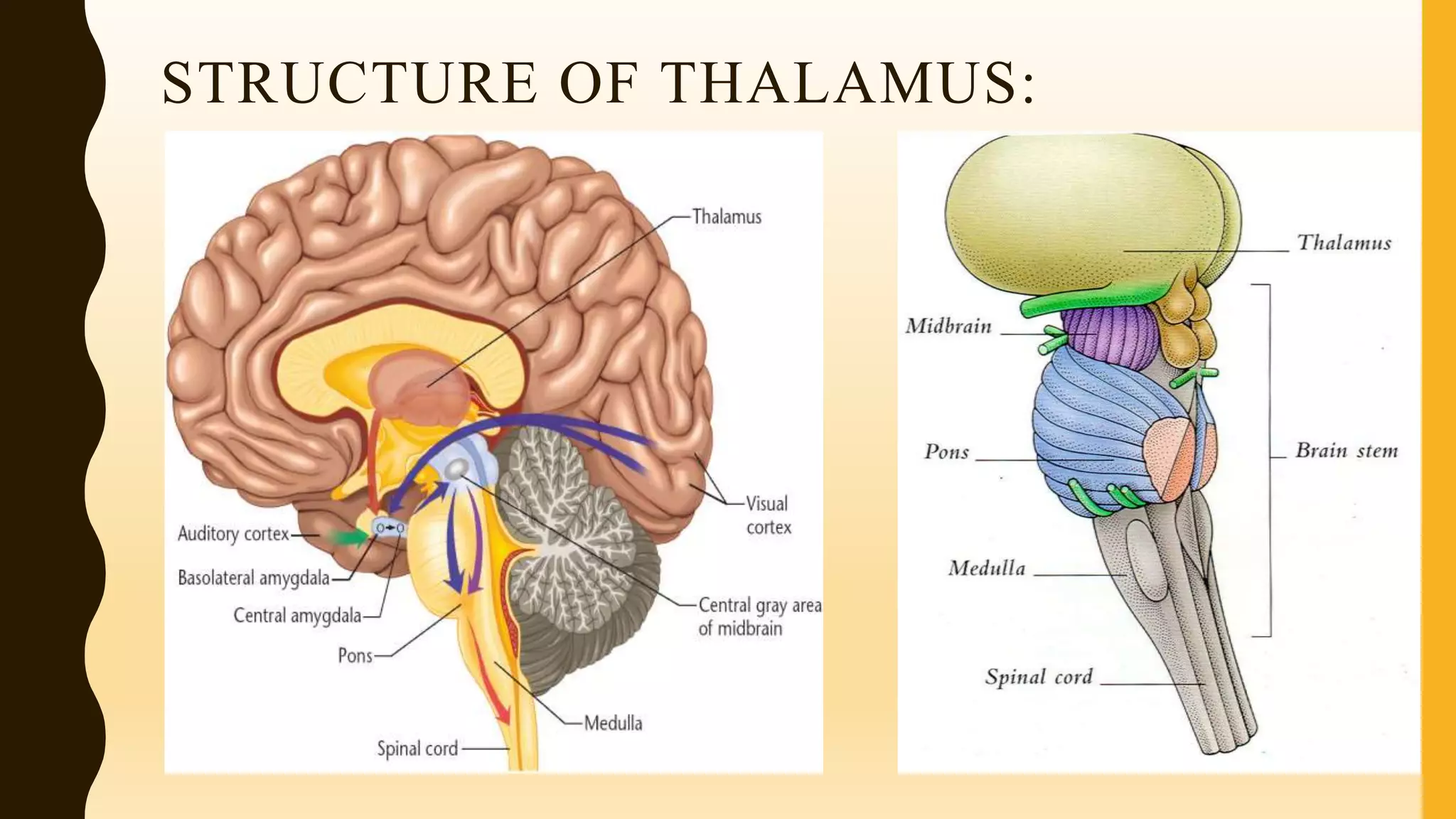
• Thalamus. The thalamus, which encloses the shallow third ventricle of the brain, is a relay station for
sensory impulses passing upward to the sensory cortex.
• Hypothalamus. The hypothalamus makes up the floor of the diencephalon; it is an important
autonomic nervous system center because it plays a role in the regulation of body temperature, water
balance, and metabolism; it is also the center for many drives and emotions, and as such, it is an
important part of the so-called limbic system or “emotional-visceral brain”; the hypothalamus also
regulates the pituitary gland and produces two hormones of its own.
• Mammillary bodies. The mammillary bodies, reflex centers involved in olfaction (the sense of smell),
bulge from the floor of the hypothalamus posterior to the pituitary gland.
• Epithalamus. The epithalamus forms the roof of the third ventricle; important parts of the epithalamus
are the pineal body (part of the endocrine system) and the choroid plexus of the third ventricle,
which forms the cerebrospinal fluid.
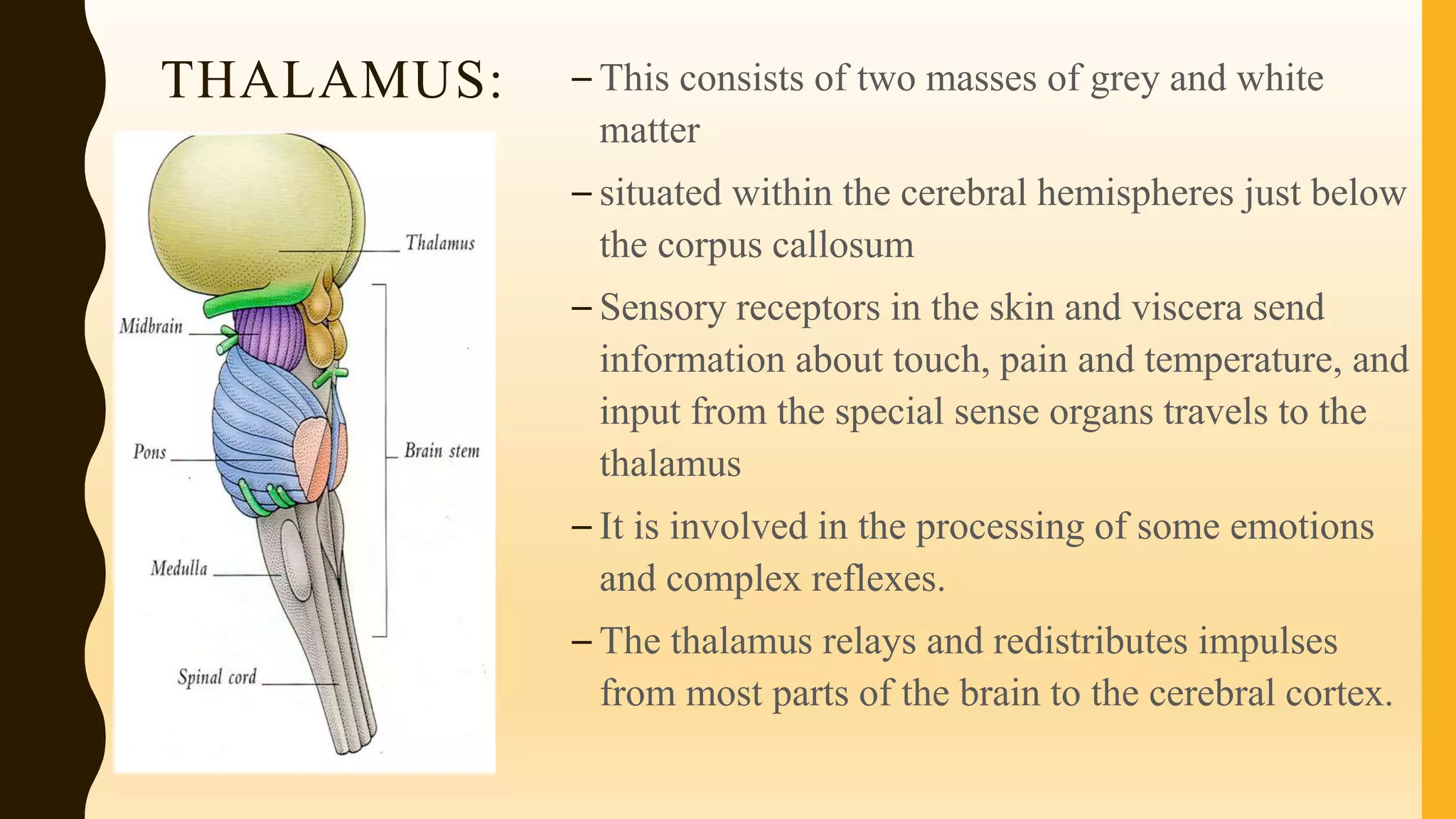
STRUCTURE OF THALAMUS:
THALAMUS: – This consists of two masses of grey and white
matter
– situated within the cerebral hemispheres just below
the corpus callosum
– Sensory receptors in the skin and viscera send
information about touch, pain and temperature, and
input from the special sense organs travels to the
thalamus
– It is involved in the processing of some emotions
and complex reflexes.
– The thalamus relays and redistributes impulses
from most parts of the brain to the cerebral cortex.
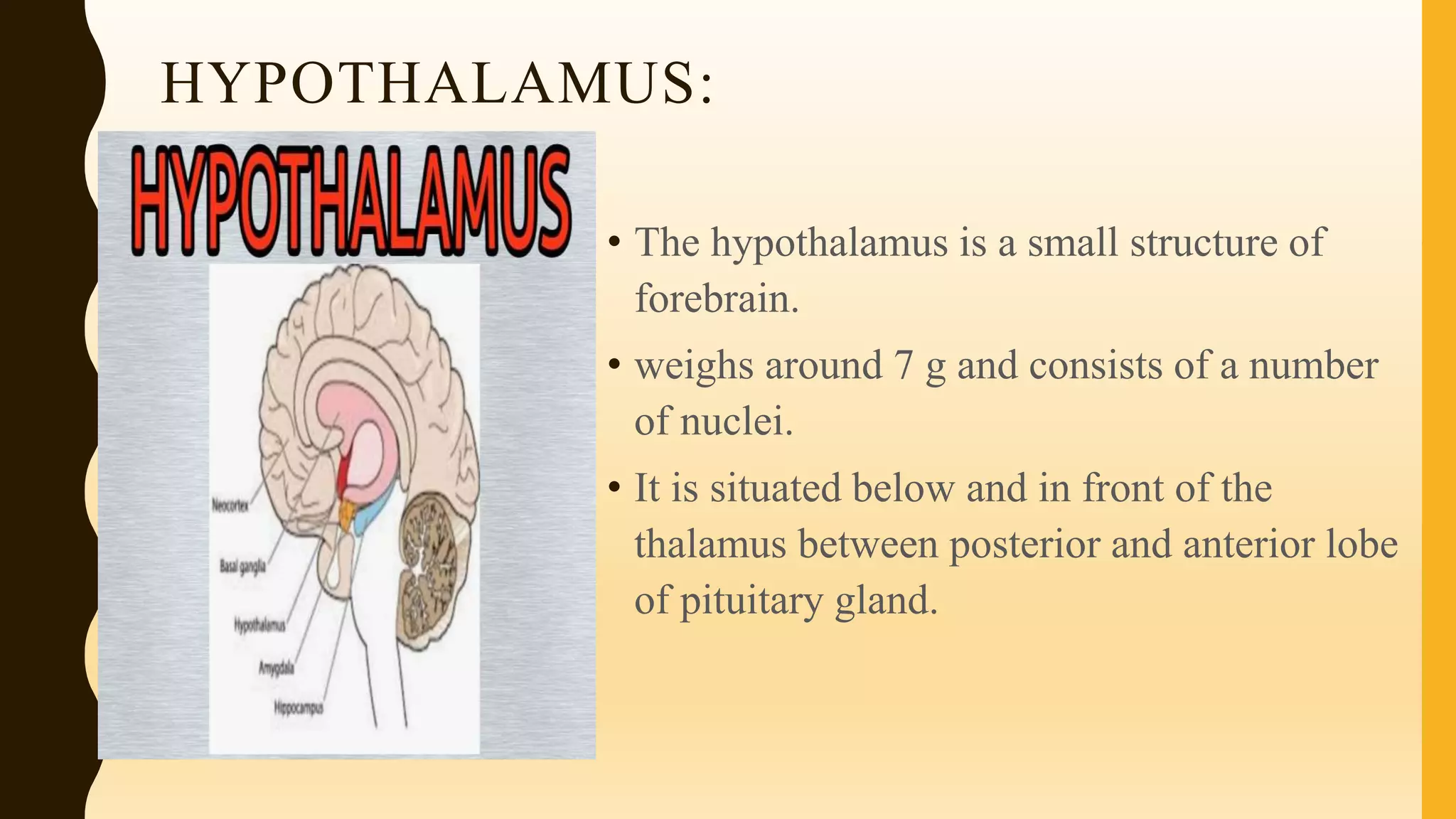
HYPOTHALAMUS:
HYPOTHALAMUS:
• The hypothalamus is a small structure of
forebrain.
• weighs around 7 g and consists of a number
of nuclei.
• It is situated below and in front of the
thalamus between posterior and anterior lobe
of pituitary gland.
FUNCTIONS OF THE HYPOTHALAMUS
INCLUDE CONTROL OF
• the autonomic nervous system
• appetite and satiety
• thirst and water balance
• body temperature
• emotional reactions, e.g. pleasure,
fear, rage
• sexual behaviour and child rearing
• sleeping and waking cycles.
Brain Stem
– The brain stem is about the size of a thumb in diameter and approximately 3 inches long.
• Structures. Its structures are the midbrain, pons, and the medulla oblongata.
• Midbrain. The midbrain extends from the mammillary bodies to the pons inferiorly; it is composed of two
bulging fiber tracts, the cerebral peduncles, which convey descending and ascending impulses.
• Corpora quadrigemina. Dorsally located are four rounded protrusions called the corpora quadrigemina
because they remind some anatomist of two pairs of twins; these bulging nuclei are reflex centers involved
in vision and hearing.
• Pons. The pons is a rounded structure that protrudes just below the midbrain, and this area of the brain
stem is mostly fiber tracts; however, it does have important nuclei involved in the control of breathing.
• Medulla oblongata. The medulla oblongata is the most inferior part of the brain stem; it contains nuclei that
regulate vital visceral activities; it contains centers that control heart rate, blood pressure, breathing,
swallowing, and vomiting among others.
• Reticular formation. Extending the entire length of the brain stem is a diffuse mass of gray matter, the
reticular formation; the neurons of the reticular formation are involved in motor control of the visceral organs;
a special group of reticular formation neurons, the reticular activating system (RAS), plays a role in
consciousness and the awake/sleep cycles.
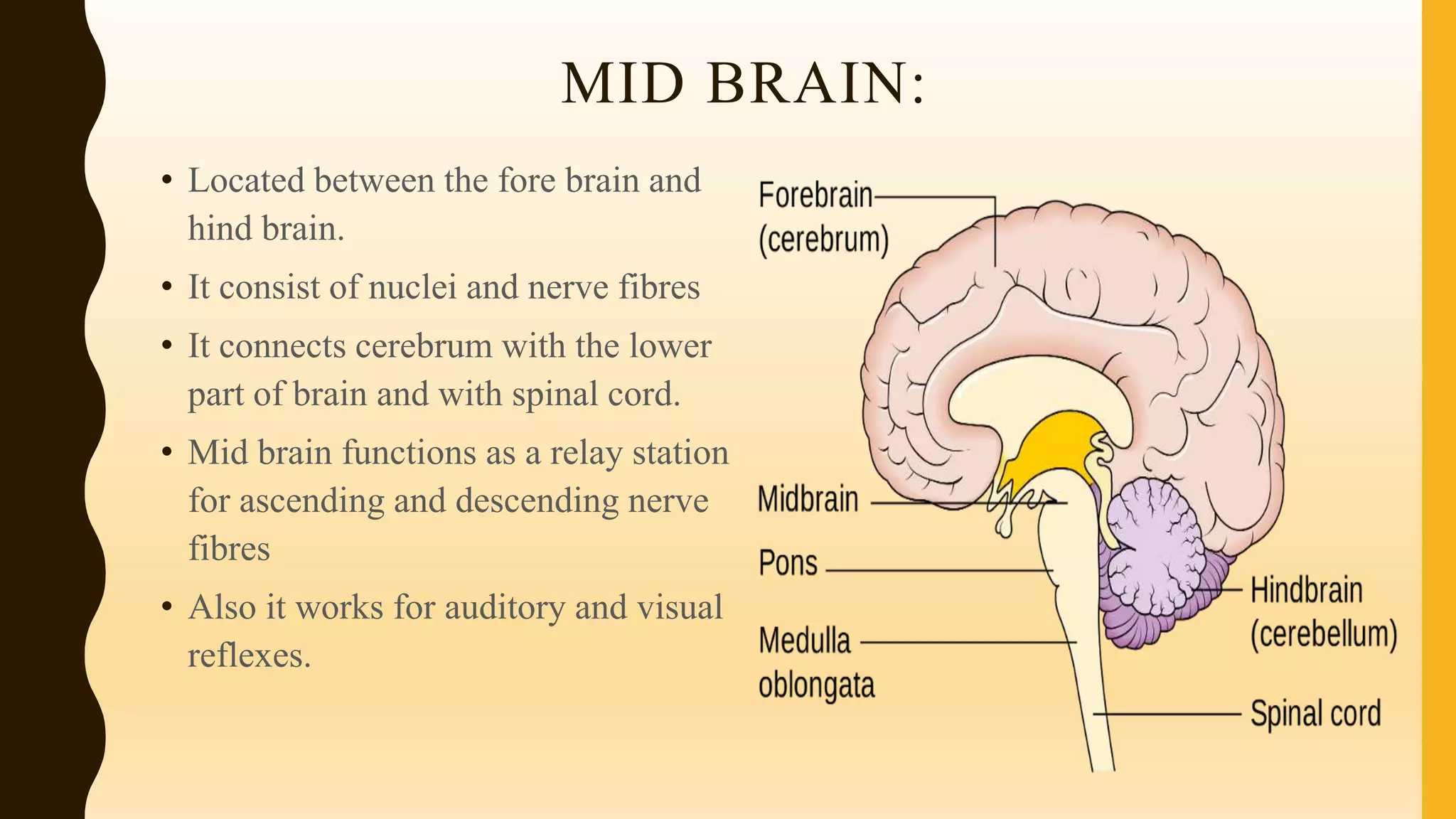
MID BRAIN:
• Located between the fore brain and
hind brain.
• It consist of nuclei and nerve fibres
• It connects cerebrum with the lower
part of brain and with spinal cord.
• Mid brain functions as a relay station
for ascending and descending nerve
fibres
• Also it works for auditory and visual
reflexes.
HIND BRAIN:
• The hind brain comprises:
• Pons, cerebellum, medulla oblongata
• Pons: The pons is situated in front of
the cerebellum, below the midbrain and
above the medulla oblongata.
• There are nuclei within the pons that act
as relay stations and some of these are
associated with the cranial nerves.
• Medulla oblongata: The medulla oblongata, or simply the medulla,
is the most interior region of the brain stem.
• Extending from the pons above, it is continuous with the spinal cord
below.
• It is about 2.5 cm long and lies just within the cranium.
• The outer aspect is composed of white matter, which passes
between the brain and the spinal cord, and grey matter, which lies
centrally.
• Functions of medulla:
– Coordination of activity of cardiovascular, respiratory and
gastrointestinal activity
– Selective awareness.
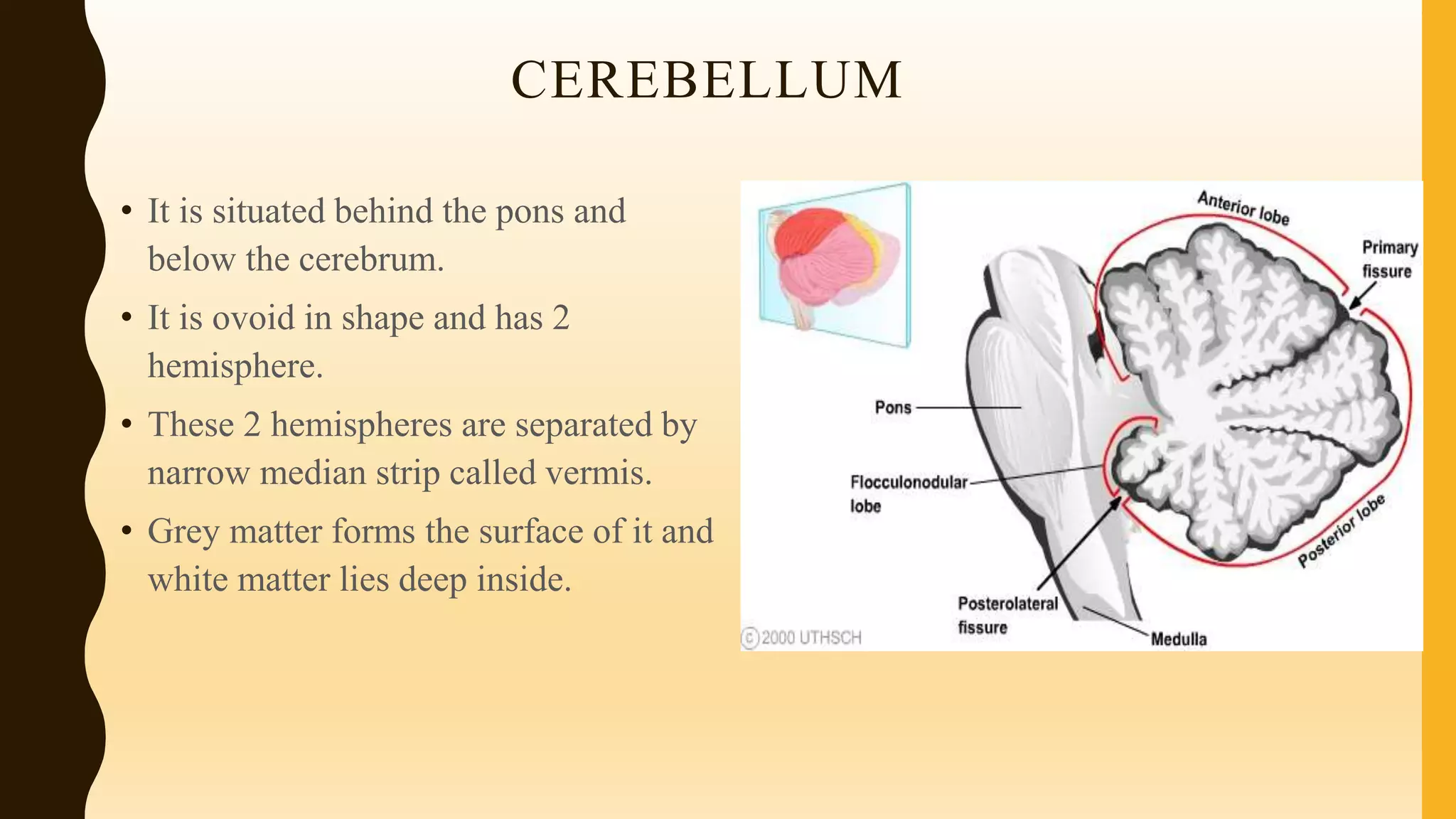
CEREBELLUM
• It is situated behind the pons and
below the cerebrum.
• It is ovoid in shape and has 2
hemisphere.
• These 2 hemispheres are separated by
narrow median strip called vermis.
• Grey matter forms the surface of it and
white matter lies deep inside.
FUNCTIONS OF CEREBELLUM
• Coordination: it coordinates the movement of voluntary muscles.
• Balance and posture: maintains the balance and erect posture of body.
• Learning and processing: it also plays an important role in learning language
and processing .
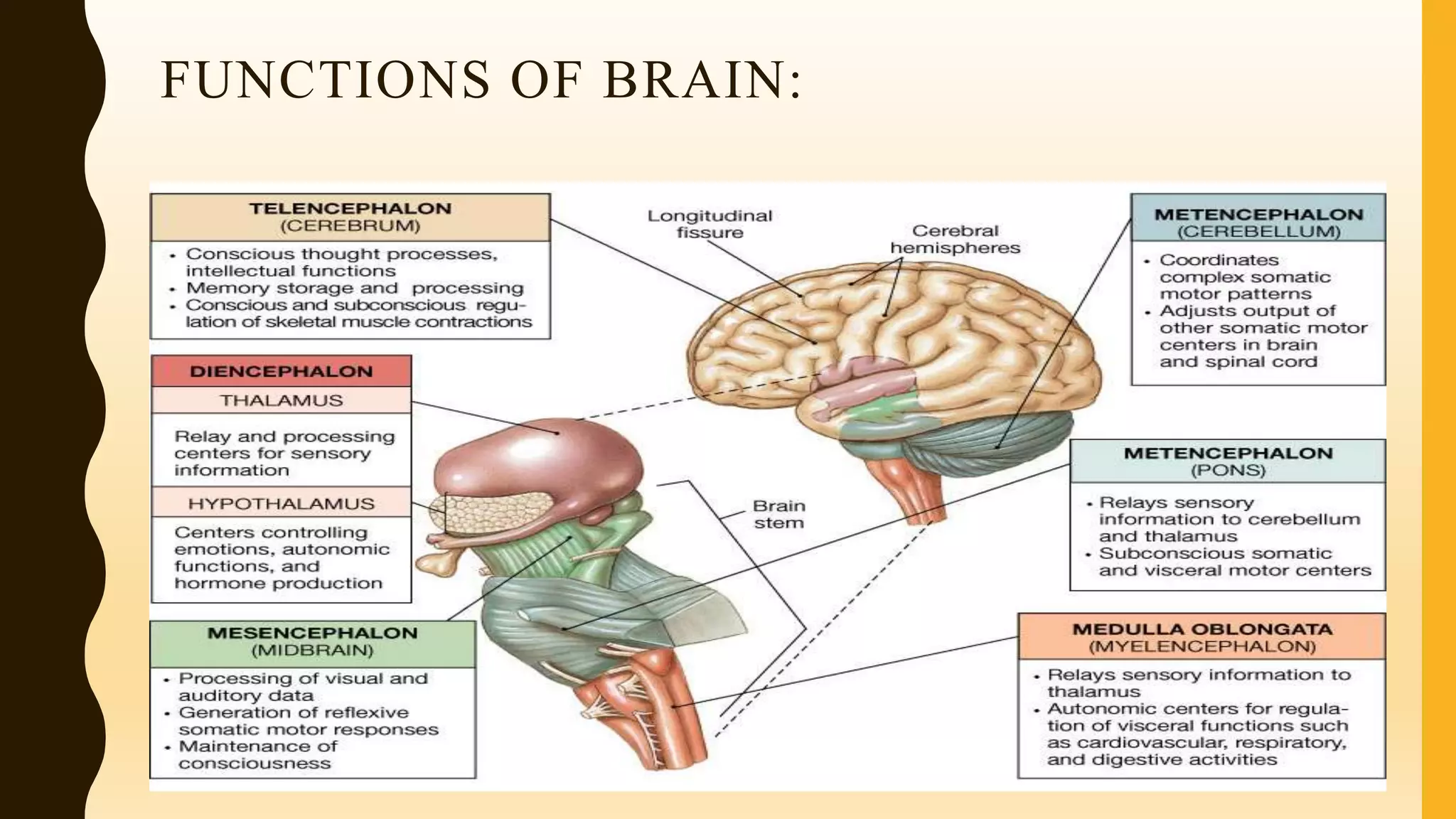
FUNCTIONS OF BRAIN:
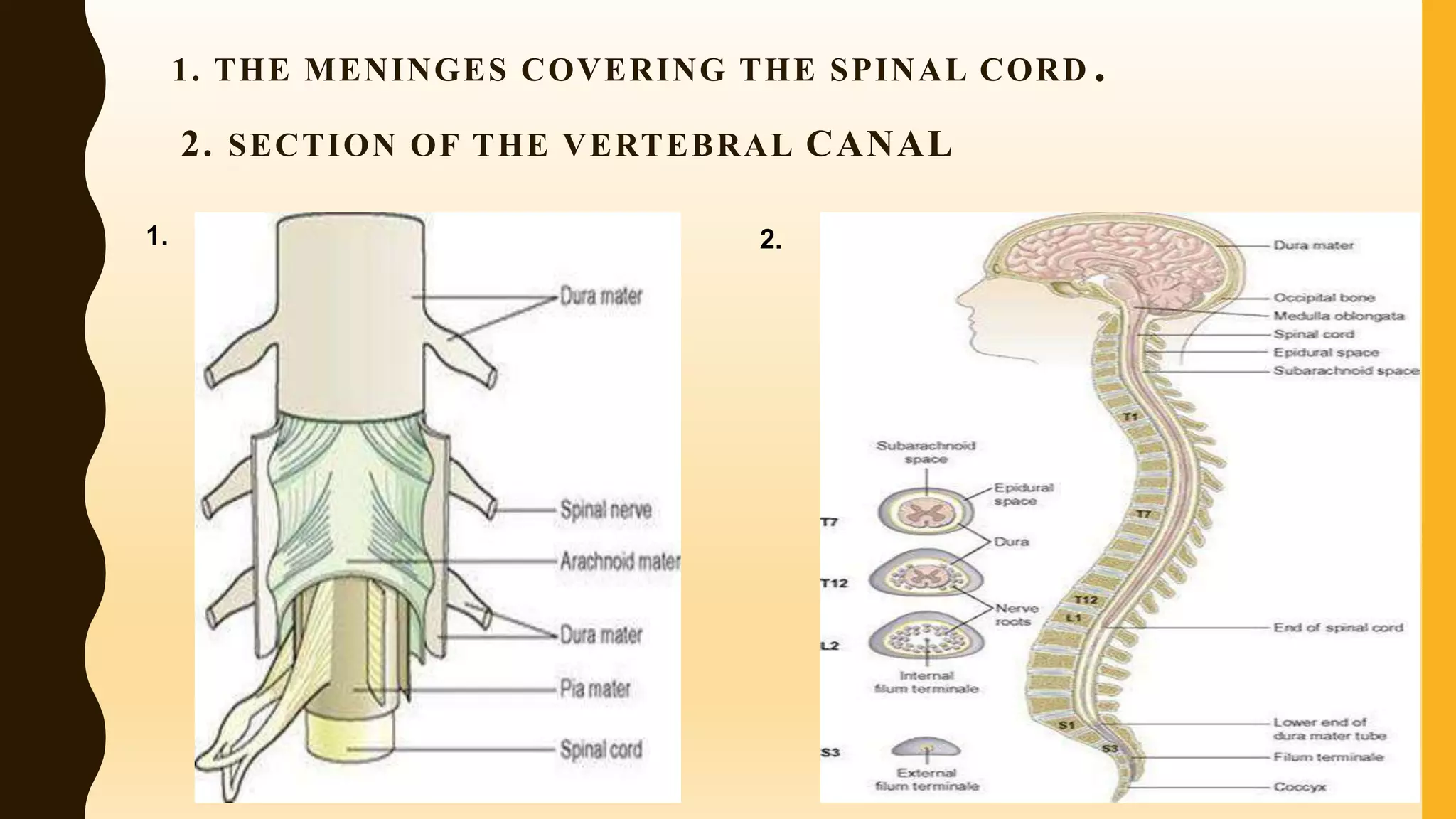
1. THE MENINGES COVERING THE SPINAL CORD.
2. SECTION OF THE VERTEBRAL CANAL
1. 2.
SPINAL CORD
• The cylindrical spinal cord is a glistening white continuation of the brain stem.
• Length. The spinal cord is approximately 17 inches (42 cm) long.
• Major function. The spinal cord provides a two-way conduction pathway to and from the brain, and it
is a major reflex center (spinal reflexes are completed at this level).
• Location. Enclosed within the vertebral column, the spinal cord extends from the foramen magnum of
the skull to the first or second lumbar vertebra, where it ends just below the ribs.
• Meninges. Like the brain, the spinal cord is cushioned and protected by the meninges; meningeal
coverings do not end at the second lumbar vertebra but instead extend well beyond the end of the
spinal cord in the vertebral canal.
• Spinal nerves. In humans, 31 pairs of spinal nerves arise from the cord and exit from the vertebral
column to serve the body area close by.
• Cauda equina. The collection of spinal nerves at the inferior end of the vertebral canal is called
cauda equina because it looks so much like a horse’s tail.
SPINAL CORD
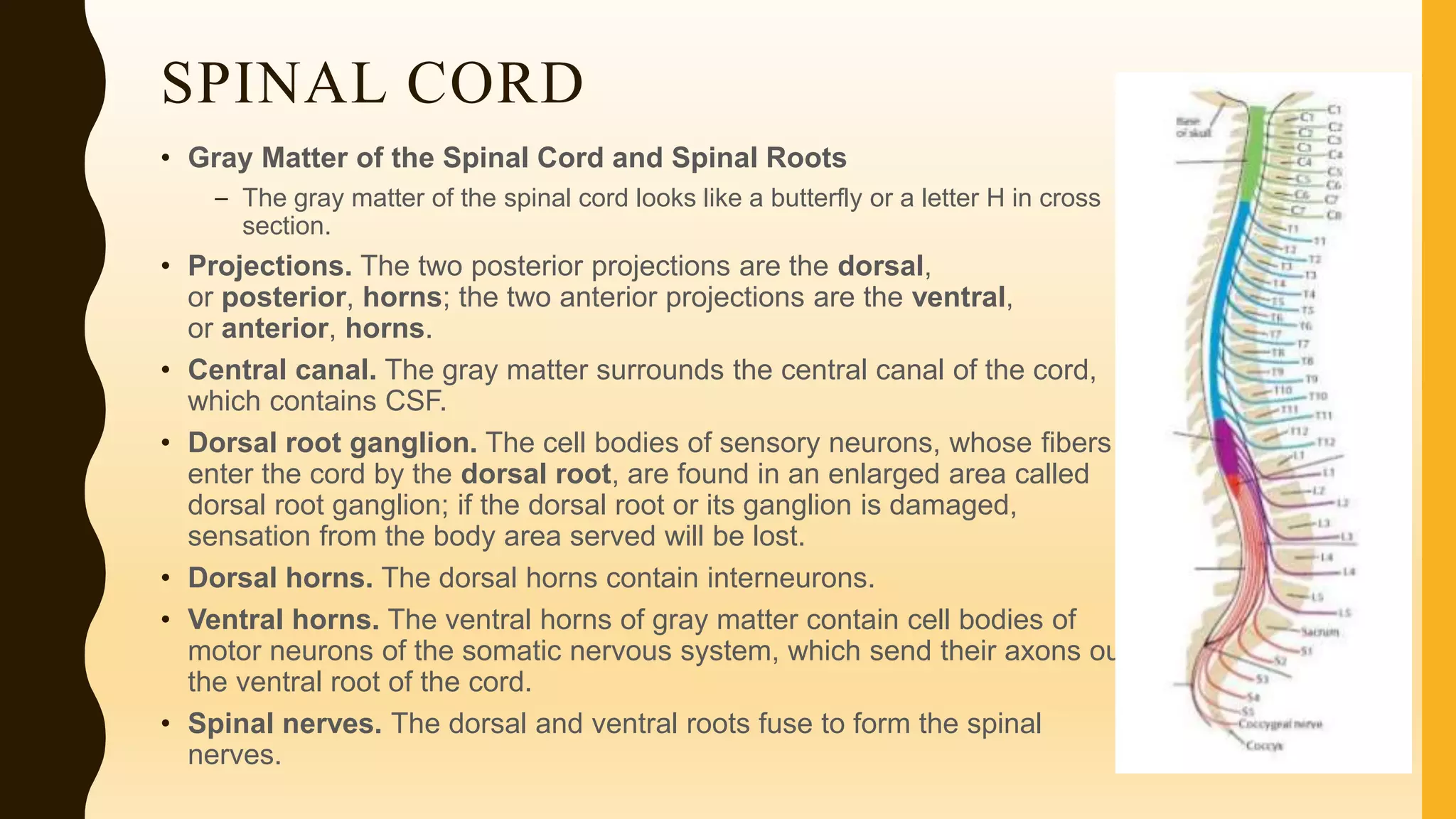
• Gray Matter of the Spinal Cord and Spinal Roots
– The gray matter of the spinal cord looks like a butterfly or a letter H in cross
section.
• Projections. The two posterior projections are the dorsal,
or posterior, horns; the two anterior projections are the ventral,
or anterior, horns.
• Central canal. The gray matter surrounds the central canal of the cord,
which contains CSF.
• Dorsal root ganglion. The cell bodies of sensory neurons, whose fibers
enter the cord by the dorsal root, are found in an enlarged area called
dorsal root ganglion; if the dorsal root or its ganglion is damaged,
sensation from the body area served will be lost.
• Dorsal horns. The dorsal horns contain interneurons.
• Ventral horns. The ventral horns of gray matter contain cell bodies of
motor neurons of the somatic nervous system, which send their axons out
the ventral root of the cord.
• Spinal nerves. The dorsal and ventral roots fuse to form the spinal
nerves.
White Matter of the Spinal Cord
– White matter of the spinal cord is composed of myelinated fiber tracts- some running to
higher centers, some traveling from the brain to the cord, and some conducting impulses
from one side of the spinal cord to the other.
• Regions. Because of the irregular shape of the gray matter, the white matter on each
side of the cord is divided into three regions- the dorsal, lateral, and ventral columns;
each of the columns contains a number of fiber tracts made up of axon with the same
destination and function.
• Sensory tracts. Tracts conducting sensory impulses to the brain are sensory,
or afferent, tracts.
• Motor tracts. Those carrying impulses from the brain to skeletal muscles are motor,
or efferent, tracts.
PERIPHERAL NERVOUS SYSTEM
• The peripheral nervous system consists of nerves and scattered groups of
neuronal cell bodies (ganglia) found outside the CNS
• This part of nervous system is consist of:
• 31 pairs of spinal nerves originating from spinal cord
• 12 pairs of cranial nerves, originating from brain
• Autonomic nervous system (ANS)
Structure of a Nerve
A nerve is a bundle of neuron fibers found outside the CNS.
Endoneurium. Each fiber is surrounded by a delicate connective tissue sheath, an endoneurium
 Perimeurium. Groups of fibers are bound by a coarser connective tissue wrapping, the
perineurium, to form fiber bundles, or fascicles.
 Epineurium. Finally, all the fascicles are bound together by a tough fibrous sheath, the
epineurium, to form the cordlike nerve.
 Mixed nerves. Nerves carrying both sensory and motor fibers are called mixed nerves.
 Sensory nerves. Nerves that carry impulses toward the CNS only are called sensory, or afferent,
nerves.
 Motor nerves. Those that carry only motor fibers are motor, or efferent, nerves.
THE SPINAL CORD AND SPINAL
NERVES.
SPINAL NERVES
• These are total 31 in pairs:
• 8 cervical
• 12 thoracic
• 5 lumbar
• 5 sacral
• 1 coccygeal
• C8T12L5S5C1
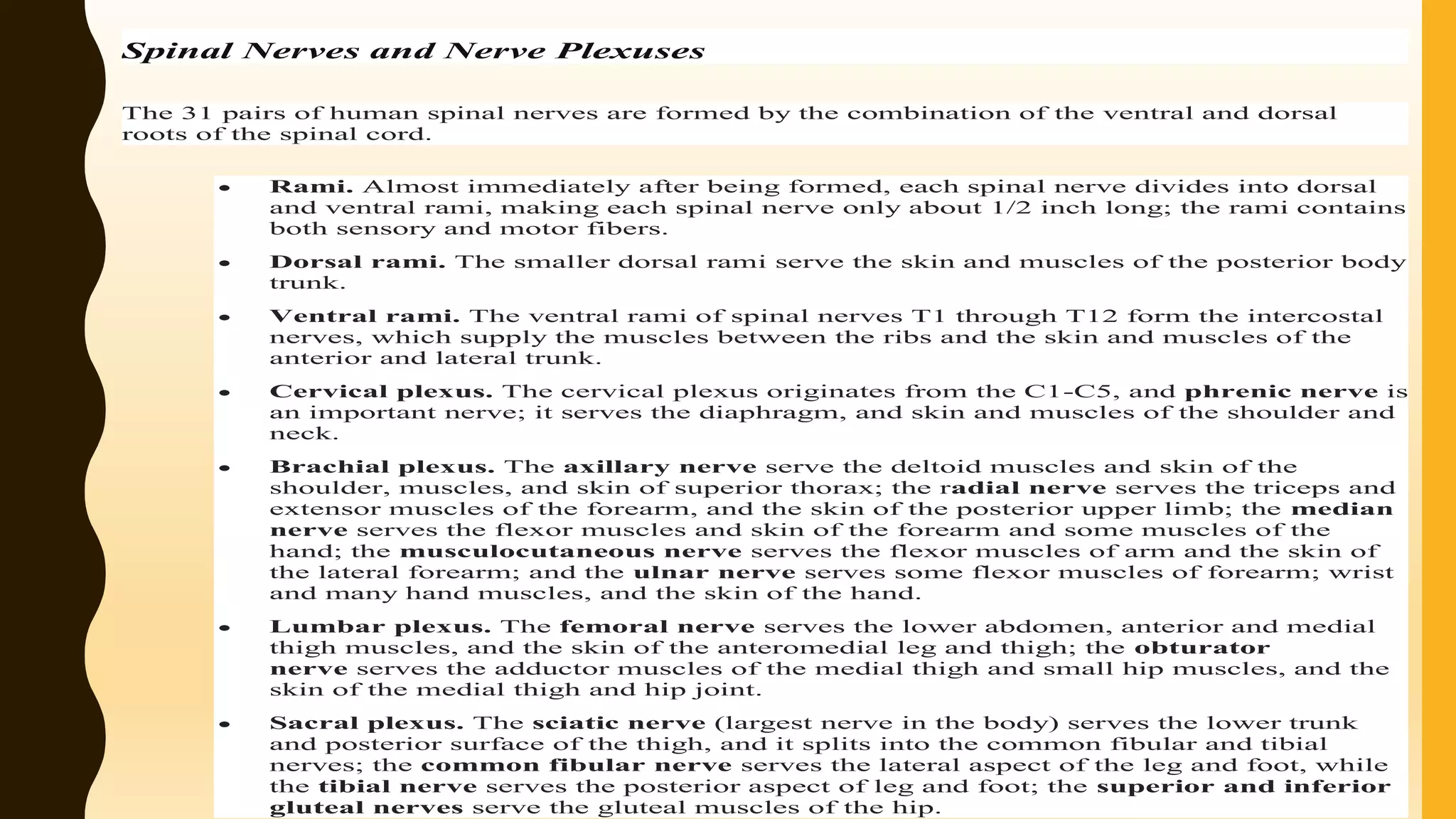
Spinal Nerves and Nerve Plexuses
The 31 pairs of human spinal nerves are formed by the combination of the ventral and dorsal
roots of the spinal cord.
 Rami. Almost immediately after being formed, each spinal nerve divides into dorsal
and ventral rami, making each spinal nerve only about 1/2 inch long; the rami contains
both sensory and motor fibers.
 Dorsal rami. The smaller dorsal rami serve the skin and muscles of the posterior body
trunk.
 Ventral rami. The ventral rami of spinal nerves T1 through T12 form the intercostal
nerves, which supply the muscles between the ribs and the skin and muscles of the
anterior and lateral trunk.
 Cervical plexus. The cervical plexus originates from the C1-C5, and phrenic nerve is
an important nerve; it serves the diaphragm, and skin and muscles of the shoulder and
neck.
 Brachial plexus. The axillary nerve serve the deltoid muscles and skin of the
shoulder, muscles, and skin of superior thorax; the radial nerve serves the triceps and
extensor muscles of the forearm, and the skin of the posterior upper limb; the median
nerve serves the flexor muscles and skin of the forearm and some muscles of the
hand; the musculocutaneous nerve serves the flexor muscles of arm and the skin of
the lateral forearm; and the ulnar nerve serves some flexor muscles of forearm; wrist
and many hand muscles, and the skin of the hand.
 Lumbar plexus. The femoral nerve serves the lower abdomen, anterior and medial
thigh muscles, and the skin of the anteromedial leg and thigh; the obturator
nerve serves the adductor muscles of the medial thigh and small hip muscles, and the
skin of the medial thigh and hip joint.
 Sacral plexus. The sciatic nerve (largest nerve in the body) serves the lower trunk
and posterior surface of the thigh, and it splits into the common fibular and tibial
nerves; the common fibular nerve serves the lateral aspect of the leg and foot, while
the tibial nerve serves the posterior aspect of leg and foot; the superior and inferior
gluteal nerves serve the gluteal muscles of the hip.
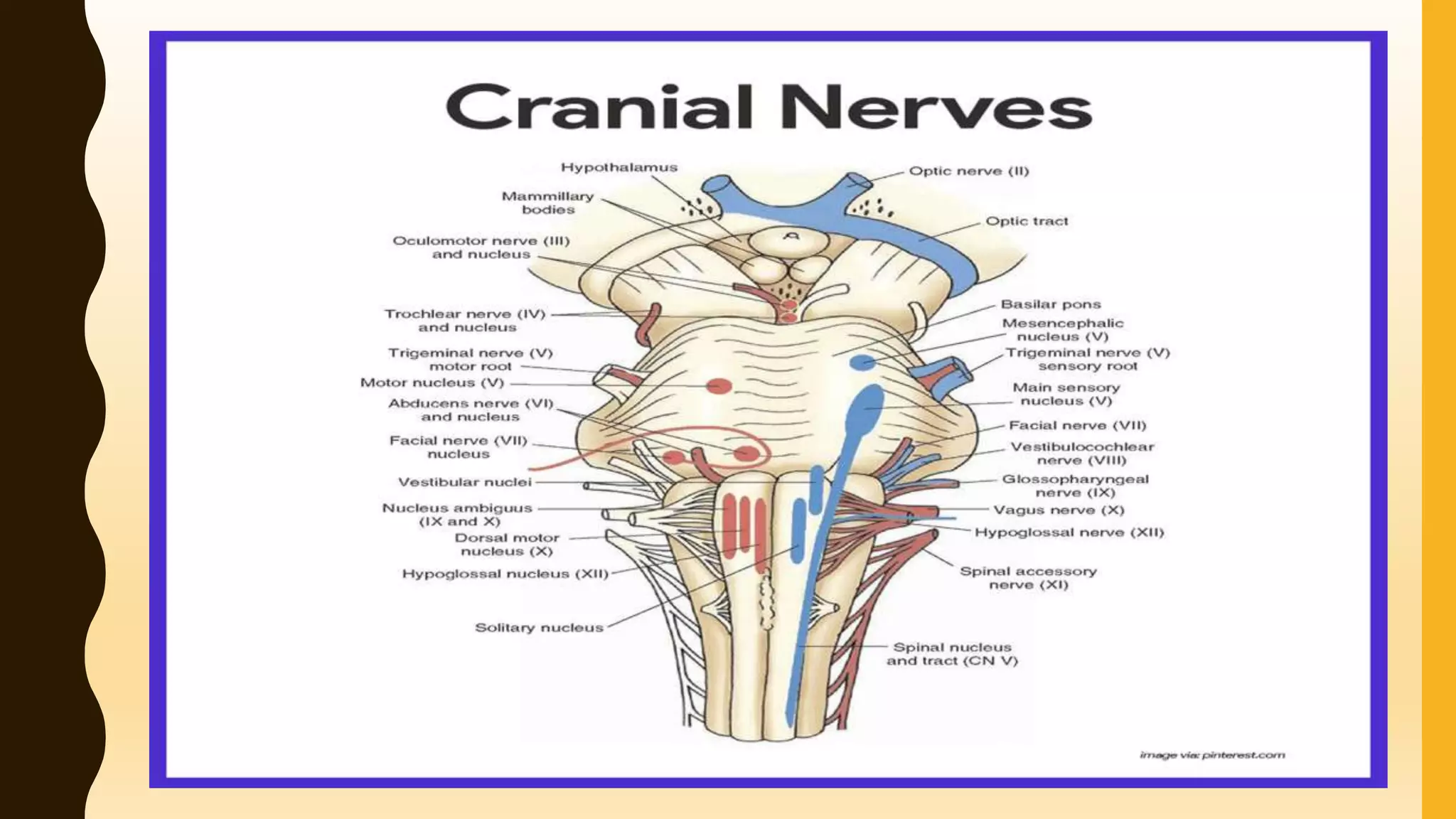
CRANIAL NERVES:
CRANIAL NERVES:
• There are 12 pairs of cranial nerves originating from nuclei
in the inferior surface of the brain, some sensory, some
motor and some mixed.
• They are:
• I. Olfactory: sensory ( origin- temporal lobe of cerebrum,
sensory receptors-mucous membrane of nasal cavity)
• II. Optic: sensory (origin-occipital lobes of the cerebrum,
sensory receptors: retina of eye)
• III. Oculomotor: motor (origin- nuclei near the cerebral
aqueduct, sensory receptors- eyeball)
• IV. Trochlear: motor (origin- nuclei near the cerebral
aqueduct, sensory receptor- muscles of eye)
• V. Trigeminal: mixed (origin- mid brain, pons and medulla,
receptors- face and head)
• VI. Abducent : motor (origin- nuclei lying under the 4th
ventricle, receptors- eyeball)
• VII. Facial: mixed ( origin- nuclei of lower part of pons,
receptors-muscles of face and taste buds of tongue)
• VIII. Vestibulocochlear (auditory): sensory (origin-
cerebellum and cerebral cortex, receptors- inner ear)
• . IX. Glossopharyngeal: mixed (origin- medulla
oblongata, cerebral cortex. Receptors- muscle of
tongue and pharynx)
• X. Vagus: mixed (origin-medulla, receptors: all
organs of thoracic and abdominal cavity)
• XI. Accessory: motor (origin- medulla, receptors-
pharyngeal and laryngeal muscles)
• XII. Hypoglossal: motor. ( origin- medulla,
receptors- muscles of tongue and muscles
surrounding hyoid bone)
AUTONOMIC NERVOUS SYSTEM
(ANS)
• The autonomic nervous system (ANS) is the motor subdivision of the PNS that controls
body activities automatically.
• Composition. It is composed of a specialized group of neurons that regulate cardiac
muscle, smooth muscles, and glands.
• Function. At every moment, signals flood from the visceral organs into the CNS, and
the automatic nerves make adjustments as necessary to best support body activities.
• Divisions. The ANS has two arms: the sympathetic division and the parasympathetic
division.
AUTONOMIC NERVOUS SYSTEM:
• The autonomic or involuntary part of the nervous system
controls the ‘automatic’ functions of the body.
• Although stimulation does not occur voluntarily, the individual
may be conscious of its effects, e.g. an increase in their heart
rate.
• The effects of autonomic activity are rapid and the effector
organs are:
• smooth muscle, e.g. changes in airway or blood vessel
diameter
• cardiac muscle, e.g. changes in rate and force of the heartbeat
• glands, e.g. increasing or decreasing gastrointestinal
secretions.
• The autonomic nervous system is separated into two divisions:
– sympathetic (thoracolumbar outflow)
– parasympathetic (craniosacral outflow).
Anatomy of the Sympathetic Division
– The sympathetic division mobilizes the body during extreme situations, and is also called
the thoracolumbar division because its preganglionic neurons are in the gray matter of the
spinal cord from T1 through L2.
• Ramus communicans. The preganglionic axons leave the cord in the ventral root,
enter the spinal nerve, and then pass through a ramus communicans, or small
communicating branch, to enter a sympathetic chain ganglion.
• Sympathetic chain. The sympathetic trunk, or chain, lies along the vertebral column
on each side.
• Splanchnic nerves. After it reaches the ganglion, the axon may synapse with the
second neuron in the sympathetic chain at the same or a different level, or the axon
may through the ganglion without synapsing and form part of the splanchnic nerves.
• Collateral ganglion. The splanchnic nerves travel to the viscera to synapse with the
ganglionic neuron, found in a collateral ganglion anterior to the vertebral column
Anatomy of the Parasympathetic Division
– The parasympathetic division allows us to “unwind” and conserve energy.
• Preganglionic neurons. The preganglionic neurons of the parasympathetic division
are located in brain nuclei of several cranial nerves- III, VII, IX, and X (the vagus being
the most important of these) and in the S2 through S4 levels of the spinal cord.
• Craniosacral division. The parasympathetic division is also called the craniosacral
division; the neurons of the cranial region send their axons out in cranial nerves to
serve the head and neck organs.
• Pelvic splanchnic nerves. In the sacral region, the preganglionic axons leave the
spinal cord and form the pelvic splanchnic nerves, also called the pelvic nerves, which
travel to the pelvic cavity.
AUTONOMIC NERVOUS SYSTEM
SYMPATHETIC
• It works during stressful
situations
• Maintains balance of
involuntary functions
• Covers the thoracolumbar
region
• For sympathetic effector
neuron the neurotransmitter is
noradrenalin and for source
neuron is acetylcholine
PARASYMPATHETIC
• Remains active during rest.
• Works in an opposing manner
to sympathetic nervous system
• Situated in craniosacral
region.
• For both , source and effector
neuron acetylcholine is the
common neurotransmitter.
PHYSIOLOGY OF THE NERVOUS
SYSTEM
• The physiology of the nervous system involves a complex journey of impulses.
Nerve Impulse
Neurons have two major functional properties: irritability, the ability to respond to a stimulus and
convert it into a nerve impulse, and conductivity, the ability to transmit the impulse to other
neurons, muscles, or glands.
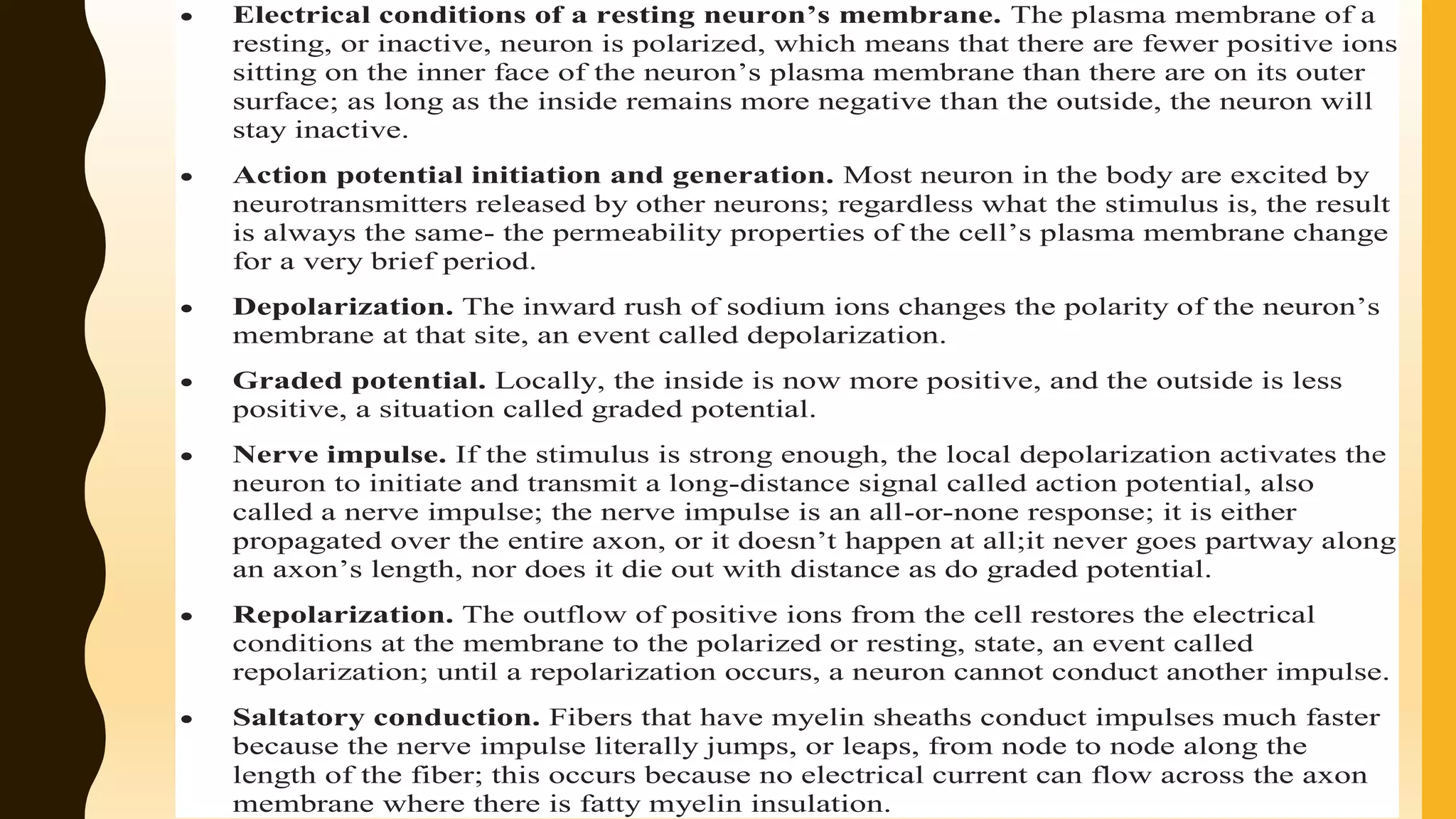
 Electrical conditions of a resting neuron’s membrane. The plasma membrane of a
resting, or inactive, neuron is polarized, which means that there are fewer positive ions
sitting on the inner face of the neuron’s plasma membrane than there are on its outer
surface; as long as the inside remains more negative than the outside, the neuron will
stay inactive.
 Action potential initiation and generation. Most neuron in the body are excited by
neurotransmitters released by other neurons; regardless what the stimulus is, the result
is always the same- the permeability properties of the cell’s plasma membrane change
for a very brief period.
 Depolarization. The inward rush of sodium ions changes the polarity of the neuron’s
membrane at that site, an event called depolarization.
 Graded potential. Locally, the inside is now more positive, and the outside is less
positive, a situation called graded potential.
 Nerve impulse. If the stimulus is strong enough, the local depolarization activates the
neuron to initiate and transmit a long-distance signal called action potential, also
called a nerve impulse; the nerve impulse is an all-or-none response; it is either
propagated over the entire axon, or it doesn’t happen at all;it never goes partway along
an axon’s length, nor does it die out with distance as do graded potential.
 Repolarization. The outflow of positive ions from the cell restores the electrical
conditions at the membrane to the polarized or resting, state, an event called
repolarization; until a repolarization occurs, a neuron cannot conduct another impulse.
 Saltatory conduction. Fibers that have myelin sheaths conduct impulses much faster
because the nerve impulse literally jumps, or leaps, from node to node along the
length of the fiber; this occurs because no electrical current can flow across the axon
membrane where there is fatty myelin insulation.
Communication of Neurons at Synapses
The events occurring at the synapse are arranged below.
 Arrival. The action potential arrives at the axon terminal.
 Fusion. The vesicle fuses with plasma membrane.
 Release. Neurotransmitter is released into synaptic cleft.
 Binding. Neurotransmitter binds to receptor on receiving neuron’s end.
 Opening. The ion channel opens.
 Closing. Once the neurotransmitter is broken down and released, the ion channel
close.
Autonomic Functioning
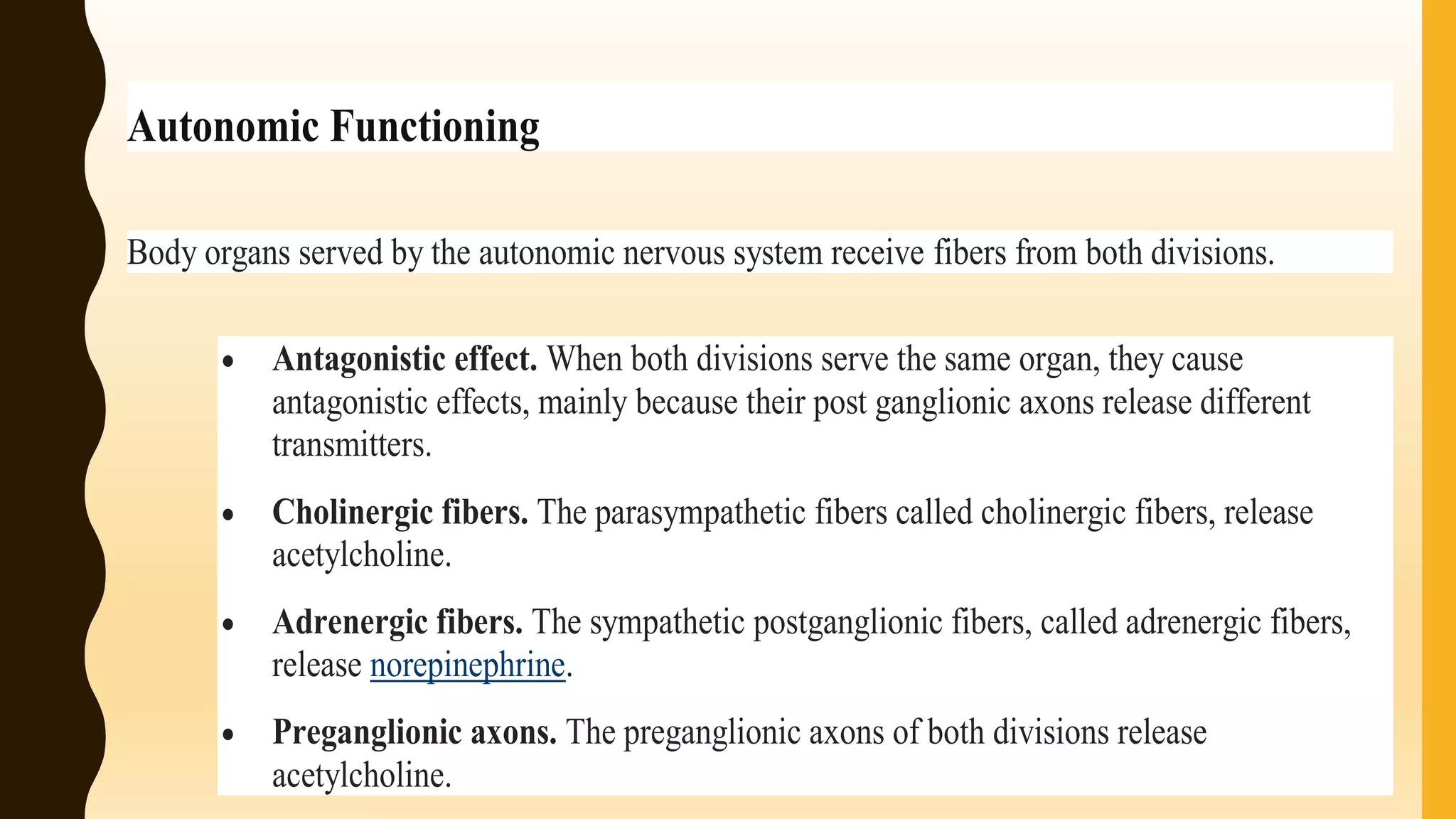
Body organs served by the autonomic nervous system receive fibers from both divisions.
 Antagonistic effect. When both divisions serve the same organ, they cause
antagonistic effects, mainly because their post ganglionic axons release different
transmitters.
 Cholinergic fibers. The parasympathetic fibers called cholinergic fibers, release
acetylcholine.
 Adrenergic fibers. The sympathetic postganglionic fibers, called adrenergic fibers,
release norepinephrine.
 Preganglionic axons. The preganglionic axons of both divisions release
acetylcholine.
Sympathetic Division
The sympathetic division is often referred to as the “fight-or-flight” system.
 Signs of sympathetic nervous system activities. A pounding heart; rapid, deep
breathing; cold, sweaty skin; a prickly scalp, and dilated pupils are sure signs
sympathetic nervous system activities.
 Effects. Under such conditions, the sympathetic nervous system increases heart rate,
blood pressure, and blood glucose levels; dilates the bronchioles of the lungs; and
brings about many other effects that help the individual cope with the stressor.
 Duration of the effect. The effects of sympathetic nervous system activation continue
for several minutes until its hormones are destroyed by the liver.
 Function. Its function is to provide the best conditions for responding to some threat,
whether the best response is to run, to see better, or to think more clearly.
Parasympathetic Division
The parasympathetic division is most active when the body is at rest and not threatened in any
way.
 Function. This division, sometimes called the “resting-and-digesting” system, is
chiefly concerned with promoting normal digestion, with elimination
of feces and urine, and with conserving body energy, particularly by decreasing
demands on the cardiovascular system.
 Relaxed state. Blood pressure and heart and respiratory rates rate being regulated at
normal levels, the digestive tract is actively digesting food, and the skin is warm
(indicating that there is no need to divert blood to skeletal muscles or vital organs.
 Optical state. The eye pupils are constricted to protect the retinas from excessive
damaging light, and the lenses of the eye are “set” for close vision.
CONCLUSION:
• The nervous system detects and responds to changes inside and outside the
body. Together with the endocrine system, it controls many vital aspects of
body function and maintains homeostasis.
• The nervous system consists of the brain, the spinal cord and peripheral nerves.
The structure and organisation of the tissues that form these components
enables rapid communication between different parts of the body.
• Response to changes in the internal environment regulates essential involuntary
functions, such as respiration and blood pressure. Response to changes in the
external environment maintains posture and other voluntary activities.
The nervous system detects and responds to changes inside and outside the body.
Together with the endocrine system, it controls many vital aspects of body function
and maintains homeostasis.
The nervous system consists of the brain, the spinal cord and peripheral nerves. The
structure and organisation of the tissues that form these components enables rapid
communication between different parts of the body.
Response to changes in the internal environment regulates essential involuntary
functions, such as respiration and blood pressure. Response to changes in the
external environment maintains posture and other voluntary activities.
SUMMARIZATION:
• In this presentation, we have
discussed about:
• Introduction to nervous system
• Structure and function of neuron
• Central Nervous System
• Meninges and cerebrospinal fluid
• Brain
• Spinal cord
• Peripheral nervous system
TEST ON Anatomy n physiology of nervous system
• Draw a well labelled diagram of neurons?
• Draw the structures of Brain ?
• Explain about Meninges in detail?
• Explain the functions of nervous system?
• Describe the Anatomy of nervous system with structural classification and functional
classification?
• Describe the Autonomic nervous system
• Describe the parts of medulla oblongata?
• Describe Spinal Cord with well labelled diagram?
• Define Nerve and explain Cranial Nerves?
REFERENCE:
• Wilson and ross, anatomy and physiology in health and
illness, published by Elsevier, 12th edn., pp143-157.
• www.binge.com viewed on 24/5/2020
Nervous system

Nervous system

  • 1.
    A N AT O M Y A N D P H Y S I O L O G Y O F N E R V O U S S Y S T E M DR. PALLAVI PATHANIA
  • 2.
    A N ATO M Y A N D P H Y S I O L O G Y O F N E RV O U S S Y S T E M S U B M IT T E D TO S U B M I T T E D B Y D R . PA L L AV I PAT H A N I A M S . K A N C H A N H . O . D [ M . S . N . ] M . S C . ( N ) 1 S T Y E A R
  • 3.
    INDEX Seria l no. content 1 Introductionto nervous system 2 Structure and function of neuron 3 Central Nervous System 4 Meninges and cerebrospinal fluid 5 Brain 6 Spinal cord 7 Peripheral nervous system 8 Summarization and conclusion 9 References 10 Assignment
  • 4.
    THE NERVOUS SYSTEM Thenervous system is the master controlling and communicating system of the body. Every thought, action, and emotion reflects its activity. Its signaling device, or means of communicating with body cells, is electrical impulses, which are rapid and specific and cause almost immediate responses.
  • 6.
    INTRODUCTION • As weknow, the functions of the organs or the organ system in our body must be coordinated to maintain homeostasis. • Coordination: the process through which two or more organs interact and complement the functions of one another. • For e.g.: when we do physical exercise, the energy demand is increased for maintaining an increased muscular activity . The supply of oxygen is also increased and in turn the rate of respiration, heart beat and blood flow increases.
  • 7.
    CONT…. • When thephysical exercise is stopped, the activities of nerves, lungs heart and kidney gradually return to their normal conditions. • Hence the functions of all these organs are coordinated while performing physical exercise. • Nervous system and the endocrine system jointly coordinate and integrate all the activities of the organs. • Nervous system detects and responds to changes inside and outside the body • Endocrine system provides chemical integration through hormones.
  • 8.
    A N ATO M Y O F T H E N E RV O U S S Y S T E M .
  • 9.
    NERVOUS SYSTEM • Thenervous system does not work alone to regulate and maintain body homeostasis; the endocrine system is a second important regulating system. Organization of the Nervous System We only have one nervous system, but, because of its complexity, it is difficult to consider all of its parts at the same time; so, to simplify its study, we divide it in terms of its structures (structural classification) or in terms of its activities (functional classification). Structural Classification The structural classification, which includes all of the nervous system organs, has two subdivisions- the central nervous system and the peripheral nervous system.  Central nervous system (CNS). The CNS consists of the brain and spinal cord, which occupy the dorsal body cavity and act as the integrating and command centers of the nervous system  Peripheral nervous system (PNS). The PNS, the part of the nervous system outside the CNS, consists mainly of the nerves that extend from the brain and spinal cord.
  • 11.
    NERVOUS SYSTEM • Thenervous system of all animals is composed of highly specialised cells called neurons which can detect, receive and transmit different kinds of stimuli. • The human nervous system is divided into: – CNS (the central nervous system) consisting of brain and spinal cord. – PNS (the peripheral nervous system) consisting of all nerves outside the brain and spinal cord.
  • 12.
    DIAGRAMMATIC PRESENTATION OF FUNCTIONALCOMPONENTS OF THE NERVOUS SYSTEM.
  • 13.
    Functions of theNervous System To carry out its normal role, the nervous system has three overlapping functions. 1. Monitoring changes. Much like a sentry, it uses its millions of sensory receptors to monitor changes occurring both inside and outside the body; these changes are called stimuli, and the gathered information is called sensory input. 2. Interpretation of sensory input. It processes and interprets the sensory input and decides what should be done at each moment, a process called integration. 3. Effects responses. It then effects a response by activating muscles or glands (effectors) via motor output. 4. Mental activity. The brain is the center of mental activity, including consciousness, thinking, and memory. 5. Homeostasis. This function depends on the ability of the nervous system to detect, interpret, and respond to changes in the internal and external conditions. It can help stimulate or inhibit the activities of other systems to help maintain a constant internal environment.
  • 14.
    A N ATO M Y O F T H E N E U R O N S .
  • 15.
    STRUCTURE AND FUNCTIONSOF NEURON This Photo by Unknown Author is licensed under CC BY-NC
  • 16.
    NEURONS • Neuron isthe structural and functional unit of nervous system • It is commonly known as nerve cell. • It is a microscopic structure consist of three major parts: Cell body Dendrites Axon
  • 18.
    • Bundles ofaxons bound together to form nerves. • Neurones cannot divide, and for their survival they need a continuous supply of oxygen and glucose. • Cell bodies: these bodies are located at the periphery of the brain and in the centre of spinal cord
  • 19.
    • Cell bodycontains cytoplasm, cell organelles • Groups of cell bodies are called nuclei in CNS • Groups of cell bodies are called ganglia in PNS • Cell body forms the grey matter of nervous system
  • 20.
    • Axon: theaxon is a long fibre extending from the cell body. – The membrane of the axon is called axolemma and it encloses the cytoplasm. – These axons carry impulses away from the cell body . • Myelinated neurons: the large axons when surrounded by a myelin sheath – This consists of a series of Schwann cells arranged along the length of the axon – Each Schwann cell membrane is wrapped around the axon in concentric layers • Myelin the fatty substance present between the layers of Schwann cell plasma membrane.
  • 21.
    • The outermostlayer of the Schwann cell plasma membrane is the neurilemma. • There are tiny areas of exposed axolemma between adjacent Schwann cells, called nodes of Ranvier • it assist the rapid transmission of nerve impulses in myelinated neurones.
  • 22.
    – Unmyelinated neurons:a few nerve fibres in CNS lacks myelin sheath hence called unmyelinated neurons. – In this type a number of axons are embedded in one Schwann cell – The adjacent Schwann cells are in close association and there is no exposed axolemma – The speed of transmission of nerve impulses is significantly slower in unmyelinated fibres.
  • 24.
    CLASSIFICATION: NEURONS MAYBE CLASSIFIED EITHER ACCORDING TO HOW THEY FUNCTION OR ACCORDING TO THEIR STRUCTURE.  Functional classification. Functional classification groups neurons according to the direction the nerve impulse is traveling relative to the CNS; on this basis, there are sensory, motor, and association neurons.  Sensory neurons. Neurons carrying impulses from sensory receptors to the CNS are sensory, or afferent, neurons; sensory neurons keep us informed about what is happening both inside and outside the body.  Motor neurons. Neurons carrying impulses from the CNS to the viscera and/or muscles and glands are motor, or efferent, neurons.  Interneurons. The third category of neurons is known as the interneurons, or association neurons; they connect the motor and sensory neurons in neural pathways.  Structural classification. Structural classification is based on the number of processes extending from the cell body.  Multipolar neuron. If there are several processes, the neuron is a multipolar neuron; because all motor and association neurons are multipolar, this is the most common structural type.  Bipolar neurons. Neurons with two processes- an axon and a dendrite- are called bipolar neurons; these are rare in adults, found only in some special sense organs, where they act in sensory processing as receptor cells.  Unipolar neurons. Unipolar neurons have a single process emerging from the cell’s body, however, it is very short and divides almost immediately into proximal (central) and distal (peripheral) processes.
  • 25.
    ARRANGEMENT OF MYELIN: A.MYELINATED B. UNMYELINATED C. LENGTH OF MYELINATED AXON
  • 26.
    • Dendrites: – Theseare short fibres which branch repeatedly and project out of the cell body. – In motor neurones dendrites form part of synapses – In sensory neurones they form the sensory receptors that respond to specific stimuli.
  • 27.
    GENERATION AND CONDUCTIONOF NERVE IMPULSE (MYELINATED)
  • 28.
    SIMPLE PROPAGATION OFAN IMPULSE IN A NON-MYELINATED NERVE
  • 29.
    GENERATION AND CONDUCTIONOF NERVE IMPULSE • In the resting state the nerve cell membrane is polarised due to differences in the concentrations of ions across the plasma membrane. • An impulse is initiated by stimulation of sensory nerve endings or by the passage of an impulse from another nerve. • Transmission of the impulse, or action potential, is due to movement of ions across the nerve cell membrane.
  • 30.
    • At restthe charge on the outside is positive and inside it is negative • The principal ions involved are: • sodium (Na+ ), the main extracellular cation • potassium (K+ ), the main intracellular cation. • When nerve fibre gets stimulation, the permeability of the nerve cell membrane changes. • Initially Na+ floods into the neurone from the extracellular fluid causing depolarisation, creating a nerve impulse or action potential. • Conduction of nerve impulse occurs in one way only.
  • 31.
  • 32.
    SYNAPSE • It isthe junction where a nerve impulse is transmitted from one neuron to another. • It is formed by presynaptic membrane, post synaptic membrane and synaptic cleft. • Through this transmission of impulse occurs. • The axon terminal contains synaptic vesicles, filled with chemicals called neurotransmitters
  • 33.
  • 34.
    NERVE: • A nerveconsists of numerous neurones collected into bundles (bundles of neurons) • On the basis of function nerves are of 2 types: • Sensory (afferent) nerves: carry information from the body to the spinal cord • Motor (efferent) nerves:Motor nerves originate in the brain, spinal cord and autonomic ganglia. They transmit impulses to the effector organs: muscles and glands
  • 35.
    CENTRAL NERVOUS SYSTEM •The central nervous system consists of the brain and the spinal cord.
  • 37.
  • 38.
    MENINGES: THE PROTECTIVECOVERING OF BRAIN AND SPINAL CORD
  • 39.
    THE MENINGES ANDCEREBROSPINAL FLUID (CSF) • The meninges: these are the protective coverings of brain and spinal cord. • Brain and spinal cord are covered with 3 layers of meninges. These are: – Dura mater (outer most) – Arachnoid mater (middle) – Pia mater (inner most)
  • 40.
    •Dura mater –The cerebraldura mater consists of two layers of dense fibrous tissue. The outer layer takes the place of the periosteum on the inner surface of the skull bones and the inner layer provides a protective covering for the brain
  • 41.
    • Arachnoid mater –Thisis a layer of fibrous tissue that lies between the dura and pia maters. It is separated from the dura mater by the subdural space, and from the pia mater by the subarachnoid space, containing cerebrospinal fluid. • Pia mater –This is a delicate layer of connective tissue containing many minute blood vessels. It adheres to the brain, completely –It continues downwards surrounding the spinal cord.
  • 42.
  • 43.
    VENTRICLES OF BRAIN: •The brain contains four irregular-shaped cavities, or ventricles, containing cerebrospinal fluid (CSF) • They are: – right and left lateral ventricles – third ventricle – fourth ventricle – The cerebrospinal fluid flows through these ventricles
  • 44.
    • The lateralventricles: These cavities lie within the cerebral hemispheres and are separated from each other by a thin membrane, the septum lucidum. • The third ventricle: The third ventricle is a cavity situated below the lateral ventricles between the two parts of the thalamus • The fourth ventricle: The fourth ventricle is a diamond-shaped cavity situated below and behind the third ventricle, between the cerebellum and pons.
  • 46.
    ARROWS SHOWING THEFLOW OF CEREBROSPINAL FLUID.
  • 47.
    CEREBROSPINAL FLUID (CSF) •Cerebrospinal fluid is secreted into each ventricle of the brain by choroid plexuses. • CSF is secreted continuously at a rate of about 0.5 ml per minute, i.e. 720 ml per day. The volume remains fairly constant at about 150 ml, as absorption keeps pace with secretion. • CSF is a clear, slightly alkaline fluid with a specific gravity of 1.005, consisting of: • water • • mineral salts • • glucose • • plasma proteins: small amounts of albumin and globulin • • a few leukocytes • creatinine • • urea small amounts
  • 48.
    FUNCTIONS OF CEREBROSPINALFLUID • Protection and support: protects the brain and spinal cord by maintaining a uniform pressure. • Shock absorber: acts as a cushion or shock absorber between the brain and spinal cord • Transport: it causes exchange of nutrients and waste products within the interstitial fluid of the brain. • Regulates breathing by keeping the medullary surface moist.
  • 50.
    BRAIN: • Brain isthe central information processing organ of our body. • It acts as the : ‘command and control system’ • The human brain weighs around 1.4 kg and lies in the cranial cavity. • Parts of brain: 3 major parts of brain are- • i) fore brain • ii) mid brain • iii) hind brain
  • 51.
    THE FOREBRAIN: • Thisis consist of cerebrum, thalamus, hypothalamus. – Cerebrum: • It is the largest part of the brain • It is divided by a deep cleft, the longitudinal cerebral fissure, into right and left cerebral hemispheres. • The hemispheres are connected through nerve fibers called corpus callosum • The layer of cells which covers cerebral hemisphere is called cerebral cortex
  • 52.
    • Cerebral Hemispheres:The paired cerebral hemispheres, collectively called cerebrum, are the most superior part of the brain, and together are a good deal larger than the other three brain regions combined. • Gyri. The entire surface of the cerebral hemispheres exhibits elevated ridges of tissue called gyri, separated by shallow grooves called sulci. • Fissures. Less numerous are the deeper grooves of tissue called fissures, which separate large regions of the brain; the cerebral hemispheres are separated by a single deep fissure, the longitudinal fissure. • Lobes. Other fissures or sulci divide each hemisphere into a number of lobes, named for the cranial bones that lie over them. • Regions of cerebral hemisphere. Each cerebral hemisphere has three basic regions: a superficial cortex of gray matter, an internal white matter, and the basal nuclei. • Cerebral cortex. Speech, memory, logical and emotional response, as well as consciousness, interpretation of sensation, and voluntary movement are all functions of neurons of the cerebral cortex. • Parietal lobe. The primary somatic sensory area is located in the parietal lobe posterior to the central sulcus; impulses traveling from the body’s sensory receptors are localized and interpreted in this area. • Occipital lobe. The visual area is located in the posterior part of the occipital lobe.
  • 53.
    • Temporal lobe.The auditory area is in the temporal lobe bordering the lateral sulcus, and the olfactory area is found deep inside the temporal lobe. • Frontal lobe. The primary motor area, which allows us to consciously move our skeletal muscles, is anterior to the central sulcus in the front lobe. • Pyramidal tract. The axons of these motor neurons form the major voluntary motor tract- the corticospinal or pyramidal tract, which descends to the cord. • Broca’s area. A specialized cortical area that is very involved in our ability to speak, Broca’s area, is found at the base of the precentral gyrus (the gyrus anterior to the central sulcus). • Speech area. The speech area is located at the junction of the temporal, parietal, and occipital lobes; the speech area allows one to sound out words.
  • 54.
    • Cerebral whitematter. The deeper cerebral white matter is compose of fiber tracts carrying impulses to, from, and within the cortex. • Corpus callosum. One very large fiber tract, the corpus callosum, connect the cerbral hemispheres; such fiber tracts are called commisures. • Fiber tracts. Association fiber tracts connect areas within a hemisphere, and projection fiber tracts connect the cerebrum with lower CNS centers. • Basal nuclei. There are several islands of gray matter, called the basal nuclei, or basal ganglia, buried deep within the white matter of the cerebral hemispheres; it helps regulate the voluntary motor activities by modifying instructions sent to the skeletal muscles by the primary motor cortex.
  • 55.
    FUNCTIONAL AREAS OFTHE CEREBRAL CORTEX: • There are different types of functional area: – motor area: which direct skeletal (voluntary) muscle movements – sensory area: which receive and decode sensory impulses enabling sensory perception (auditory, olfactory, gustatory) – association area: which are concerned with integration and processing of complex mental functions such as intelligence, memory, reasoning, judgement and emotions.
  • 56.
    FUNCTIONS OF THECEREBRAL CORTEX • There are three main types of activity associated with the cerebral cortex: • higher order functions, i.e. the mental activities involved in memory, sense of responsibility, thinking, reasoning, moral decision making and learning • sensory perception, including the perception of pain, temperature, touch, sight, hearing, taste and smell • initiation and control of skeletal muscle contraction and therefore voluntary movement.
  • 57.
    SECTION OF THEBRAIN SHOWING MAIN PARTS.
  • 58.
    THE BRAIN :LOBES OF CEREBRUM This Photo by Unknown Author is licensed under CC BY-SA
  • 59.
    THE CEREBRUM SHOWINGTHE MAIN FUNCTIONAL AREAS.
  • 60.
    Diencephalon – The diencephalon,or interbrain, sits atop the brain stem and is enclosed by the cerebral hemispheres. • Thalamus. The thalamus, which encloses the shallow third ventricle of the brain, is a relay station for sensory impulses passing upward to the sensory cortex. • Hypothalamus. The hypothalamus makes up the floor of the diencephalon; it is an important autonomic nervous system center because it plays a role in the regulation of body temperature, water balance, and metabolism; it is also the center for many drives and emotions, and as such, it is an important part of the so-called limbic system or “emotional-visceral brain”; the hypothalamus also regulates the pituitary gland and produces two hormones of its own. • Mammillary bodies. The mammillary bodies, reflex centers involved in olfaction (the sense of smell), bulge from the floor of the hypothalamus posterior to the pituitary gland. • Epithalamus. The epithalamus forms the roof of the third ventricle; important parts of the epithalamus are the pineal body (part of the endocrine system) and the choroid plexus of the third ventricle, which forms the cerebrospinal fluid.
  • 61.
  • 62.
    THALAMUS: – Thisconsists of two masses of grey and white matter – situated within the cerebral hemispheres just below the corpus callosum – Sensory receptors in the skin and viscera send information about touch, pain and temperature, and input from the special sense organs travels to the thalamus – It is involved in the processing of some emotions and complex reflexes. – The thalamus relays and redistributes impulses from most parts of the brain to the cerebral cortex.
  • 63.
  • 64.
    HYPOTHALAMUS: • The hypothalamusis a small structure of forebrain. • weighs around 7 g and consists of a number of nuclei. • It is situated below and in front of the thalamus between posterior and anterior lobe of pituitary gland.
  • 65.
    FUNCTIONS OF THEHYPOTHALAMUS INCLUDE CONTROL OF • the autonomic nervous system • appetite and satiety • thirst and water balance • body temperature • emotional reactions, e.g. pleasure, fear, rage • sexual behaviour and child rearing • sleeping and waking cycles.
  • 66.
    Brain Stem – Thebrain stem is about the size of a thumb in diameter and approximately 3 inches long. • Structures. Its structures are the midbrain, pons, and the medulla oblongata. • Midbrain. The midbrain extends from the mammillary bodies to the pons inferiorly; it is composed of two bulging fiber tracts, the cerebral peduncles, which convey descending and ascending impulses. • Corpora quadrigemina. Dorsally located are four rounded protrusions called the corpora quadrigemina because they remind some anatomist of two pairs of twins; these bulging nuclei are reflex centers involved in vision and hearing. • Pons. The pons is a rounded structure that protrudes just below the midbrain, and this area of the brain stem is mostly fiber tracts; however, it does have important nuclei involved in the control of breathing. • Medulla oblongata. The medulla oblongata is the most inferior part of the brain stem; it contains nuclei that regulate vital visceral activities; it contains centers that control heart rate, blood pressure, breathing, swallowing, and vomiting among others. • Reticular formation. Extending the entire length of the brain stem is a diffuse mass of gray matter, the reticular formation; the neurons of the reticular formation are involved in motor control of the visceral organs; a special group of reticular formation neurons, the reticular activating system (RAS), plays a role in consciousness and the awake/sleep cycles.
  • 67.
    MID BRAIN: • Locatedbetween the fore brain and hind brain. • It consist of nuclei and nerve fibres • It connects cerebrum with the lower part of brain and with spinal cord. • Mid brain functions as a relay station for ascending and descending nerve fibres • Also it works for auditory and visual reflexes.
  • 68.
    HIND BRAIN: • Thehind brain comprises: • Pons, cerebellum, medulla oblongata • Pons: The pons is situated in front of the cerebellum, below the midbrain and above the medulla oblongata. • There are nuclei within the pons that act as relay stations and some of these are associated with the cranial nerves.
  • 69.
    • Medulla oblongata:The medulla oblongata, or simply the medulla, is the most interior region of the brain stem. • Extending from the pons above, it is continuous with the spinal cord below. • It is about 2.5 cm long and lies just within the cranium. • The outer aspect is composed of white matter, which passes between the brain and the spinal cord, and grey matter, which lies centrally. • Functions of medulla: – Coordination of activity of cardiovascular, respiratory and gastrointestinal activity – Selective awareness.
  • 70.
    CEREBELLUM • It issituated behind the pons and below the cerebrum. • It is ovoid in shape and has 2 hemisphere. • These 2 hemispheres are separated by narrow median strip called vermis. • Grey matter forms the surface of it and white matter lies deep inside.
  • 71.
    FUNCTIONS OF CEREBELLUM •Coordination: it coordinates the movement of voluntary muscles. • Balance and posture: maintains the balance and erect posture of body. • Learning and processing: it also plays an important role in learning language and processing .
  • 72.
  • 73.
    1. THE MENINGESCOVERING THE SPINAL CORD. 2. SECTION OF THE VERTEBRAL CANAL 1. 2.
  • 74.
    SPINAL CORD • Thecylindrical spinal cord is a glistening white continuation of the brain stem. • Length. The spinal cord is approximately 17 inches (42 cm) long. • Major function. The spinal cord provides a two-way conduction pathway to and from the brain, and it is a major reflex center (spinal reflexes are completed at this level). • Location. Enclosed within the vertebral column, the spinal cord extends from the foramen magnum of the skull to the first or second lumbar vertebra, where it ends just below the ribs. • Meninges. Like the brain, the spinal cord is cushioned and protected by the meninges; meningeal coverings do not end at the second lumbar vertebra but instead extend well beyond the end of the spinal cord in the vertebral canal. • Spinal nerves. In humans, 31 pairs of spinal nerves arise from the cord and exit from the vertebral column to serve the body area close by. • Cauda equina. The collection of spinal nerves at the inferior end of the vertebral canal is called cauda equina because it looks so much like a horse’s tail.
  • 75.
    SPINAL CORD • GrayMatter of the Spinal Cord and Spinal Roots – The gray matter of the spinal cord looks like a butterfly or a letter H in cross section. • Projections. The two posterior projections are the dorsal, or posterior, horns; the two anterior projections are the ventral, or anterior, horns. • Central canal. The gray matter surrounds the central canal of the cord, which contains CSF. • Dorsal root ganglion. The cell bodies of sensory neurons, whose fibers enter the cord by the dorsal root, are found in an enlarged area called dorsal root ganglion; if the dorsal root or its ganglion is damaged, sensation from the body area served will be lost. • Dorsal horns. The dorsal horns contain interneurons. • Ventral horns. The ventral horns of gray matter contain cell bodies of motor neurons of the somatic nervous system, which send their axons out the ventral root of the cord. • Spinal nerves. The dorsal and ventral roots fuse to form the spinal nerves.
  • 76.
    White Matter ofthe Spinal Cord – White matter of the spinal cord is composed of myelinated fiber tracts- some running to higher centers, some traveling from the brain to the cord, and some conducting impulses from one side of the spinal cord to the other. • Regions. Because of the irregular shape of the gray matter, the white matter on each side of the cord is divided into three regions- the dorsal, lateral, and ventral columns; each of the columns contains a number of fiber tracts made up of axon with the same destination and function. • Sensory tracts. Tracts conducting sensory impulses to the brain are sensory, or afferent, tracts. • Motor tracts. Those carrying impulses from the brain to skeletal muscles are motor, or efferent, tracts.
  • 77.
    PERIPHERAL NERVOUS SYSTEM •The peripheral nervous system consists of nerves and scattered groups of neuronal cell bodies (ganglia) found outside the CNS • This part of nervous system is consist of: • 31 pairs of spinal nerves originating from spinal cord • 12 pairs of cranial nerves, originating from brain • Autonomic nervous system (ANS)
  • 78.
    Structure of aNerve A nerve is a bundle of neuron fibers found outside the CNS. Endoneurium. Each fiber is surrounded by a delicate connective tissue sheath, an endoneurium  Perimeurium. Groups of fibers are bound by a coarser connective tissue wrapping, the perineurium, to form fiber bundles, or fascicles.  Epineurium. Finally, all the fascicles are bound together by a tough fibrous sheath, the epineurium, to form the cordlike nerve.  Mixed nerves. Nerves carrying both sensory and motor fibers are called mixed nerves.  Sensory nerves. Nerves that carry impulses toward the CNS only are called sensory, or afferent, nerves.  Motor nerves. Those that carry only motor fibers are motor, or efferent, nerves.
  • 79.
    THE SPINAL CORDAND SPINAL NERVES.
  • 80.
    SPINAL NERVES • Theseare total 31 in pairs: • 8 cervical • 12 thoracic • 5 lumbar • 5 sacral • 1 coccygeal • C8T12L5S5C1
  • 81.
    Spinal Nerves andNerve Plexuses The 31 pairs of human spinal nerves are formed by the combination of the ventral and dorsal roots of the spinal cord.  Rami. Almost immediately after being formed, each spinal nerve divides into dorsal and ventral rami, making each spinal nerve only about 1/2 inch long; the rami contains both sensory and motor fibers.  Dorsal rami. The smaller dorsal rami serve the skin and muscles of the posterior body trunk.  Ventral rami. The ventral rami of spinal nerves T1 through T12 form the intercostal nerves, which supply the muscles between the ribs and the skin and muscles of the anterior and lateral trunk.  Cervical plexus. The cervical plexus originates from the C1-C5, and phrenic nerve is an important nerve; it serves the diaphragm, and skin and muscles of the shoulder and neck.  Brachial plexus. The axillary nerve serve the deltoid muscles and skin of the shoulder, muscles, and skin of superior thorax; the radial nerve serves the triceps and extensor muscles of the forearm, and the skin of the posterior upper limb; the median nerve serves the flexor muscles and skin of the forearm and some muscles of the hand; the musculocutaneous nerve serves the flexor muscles of arm and the skin of the lateral forearm; and the ulnar nerve serves some flexor muscles of forearm; wrist and many hand muscles, and the skin of the hand.  Lumbar plexus. The femoral nerve serves the lower abdomen, anterior and medial thigh muscles, and the skin of the anteromedial leg and thigh; the obturator nerve serves the adductor muscles of the medial thigh and small hip muscles, and the skin of the medial thigh and hip joint.  Sacral plexus. The sciatic nerve (largest nerve in the body) serves the lower trunk and posterior surface of the thigh, and it splits into the common fibular and tibial nerves; the common fibular nerve serves the lateral aspect of the leg and foot, while the tibial nerve serves the posterior aspect of leg and foot; the superior and inferior gluteal nerves serve the gluteal muscles of the hip.
  • 82.
  • 84.
    CRANIAL NERVES: • Thereare 12 pairs of cranial nerves originating from nuclei in the inferior surface of the brain, some sensory, some motor and some mixed. • They are: • I. Olfactory: sensory ( origin- temporal lobe of cerebrum, sensory receptors-mucous membrane of nasal cavity) • II. Optic: sensory (origin-occipital lobes of the cerebrum, sensory receptors: retina of eye) • III. Oculomotor: motor (origin- nuclei near the cerebral aqueduct, sensory receptors- eyeball) • IV. Trochlear: motor (origin- nuclei near the cerebral aqueduct, sensory receptor- muscles of eye)
  • 85.
    • V. Trigeminal:mixed (origin- mid brain, pons and medulla, receptors- face and head) • VI. Abducent : motor (origin- nuclei lying under the 4th ventricle, receptors- eyeball) • VII. Facial: mixed ( origin- nuclei of lower part of pons, receptors-muscles of face and taste buds of tongue) • VIII. Vestibulocochlear (auditory): sensory (origin- cerebellum and cerebral cortex, receptors- inner ear)
  • 86.
    • . IX.Glossopharyngeal: mixed (origin- medulla oblongata, cerebral cortex. Receptors- muscle of tongue and pharynx) • X. Vagus: mixed (origin-medulla, receptors: all organs of thoracic and abdominal cavity) • XI. Accessory: motor (origin- medulla, receptors- pharyngeal and laryngeal muscles) • XII. Hypoglossal: motor. ( origin- medulla, receptors- muscles of tongue and muscles surrounding hyoid bone)
  • 87.
    AUTONOMIC NERVOUS SYSTEM (ANS) •The autonomic nervous system (ANS) is the motor subdivision of the PNS that controls body activities automatically. • Composition. It is composed of a specialized group of neurons that regulate cardiac muscle, smooth muscles, and glands. • Function. At every moment, signals flood from the visceral organs into the CNS, and the automatic nerves make adjustments as necessary to best support body activities. • Divisions. The ANS has two arms: the sympathetic division and the parasympathetic division.
  • 88.
    AUTONOMIC NERVOUS SYSTEM: •The autonomic or involuntary part of the nervous system controls the ‘automatic’ functions of the body. • Although stimulation does not occur voluntarily, the individual may be conscious of its effects, e.g. an increase in their heart rate. • The effects of autonomic activity are rapid and the effector organs are: • smooth muscle, e.g. changes in airway or blood vessel diameter • cardiac muscle, e.g. changes in rate and force of the heartbeat • glands, e.g. increasing or decreasing gastrointestinal secretions.
  • 89.
    • The autonomicnervous system is separated into two divisions: – sympathetic (thoracolumbar outflow) – parasympathetic (craniosacral outflow).
  • 90.
    Anatomy of theSympathetic Division – The sympathetic division mobilizes the body during extreme situations, and is also called the thoracolumbar division because its preganglionic neurons are in the gray matter of the spinal cord from T1 through L2. • Ramus communicans. The preganglionic axons leave the cord in the ventral root, enter the spinal nerve, and then pass through a ramus communicans, or small communicating branch, to enter a sympathetic chain ganglion. • Sympathetic chain. The sympathetic trunk, or chain, lies along the vertebral column on each side. • Splanchnic nerves. After it reaches the ganglion, the axon may synapse with the second neuron in the sympathetic chain at the same or a different level, or the axon may through the ganglion without synapsing and form part of the splanchnic nerves. • Collateral ganglion. The splanchnic nerves travel to the viscera to synapse with the ganglionic neuron, found in a collateral ganglion anterior to the vertebral column
  • 91.
    Anatomy of theParasympathetic Division – The parasympathetic division allows us to “unwind” and conserve energy. • Preganglionic neurons. The preganglionic neurons of the parasympathetic division are located in brain nuclei of several cranial nerves- III, VII, IX, and X (the vagus being the most important of these) and in the S2 through S4 levels of the spinal cord. • Craniosacral division. The parasympathetic division is also called the craniosacral division; the neurons of the cranial region send their axons out in cranial nerves to serve the head and neck organs. • Pelvic splanchnic nerves. In the sacral region, the preganglionic axons leave the spinal cord and form the pelvic splanchnic nerves, also called the pelvic nerves, which travel to the pelvic cavity.
  • 92.
    AUTONOMIC NERVOUS SYSTEM SYMPATHETIC •It works during stressful situations • Maintains balance of involuntary functions • Covers the thoracolumbar region • For sympathetic effector neuron the neurotransmitter is noradrenalin and for source neuron is acetylcholine PARASYMPATHETIC • Remains active during rest. • Works in an opposing manner to sympathetic nervous system • Situated in craniosacral region. • For both , source and effector neuron acetylcholine is the common neurotransmitter.
  • 94.
    PHYSIOLOGY OF THENERVOUS SYSTEM • The physiology of the nervous system involves a complex journey of impulses. Nerve Impulse Neurons have two major functional properties: irritability, the ability to respond to a stimulus and convert it into a nerve impulse, and conductivity, the ability to transmit the impulse to other neurons, muscles, or glands.
  • 95.
     Electrical conditionsof a resting neuron’s membrane. The plasma membrane of a resting, or inactive, neuron is polarized, which means that there are fewer positive ions sitting on the inner face of the neuron’s plasma membrane than there are on its outer surface; as long as the inside remains more negative than the outside, the neuron will stay inactive.  Action potential initiation and generation. Most neuron in the body are excited by neurotransmitters released by other neurons; regardless what the stimulus is, the result is always the same- the permeability properties of the cell’s plasma membrane change for a very brief period.  Depolarization. The inward rush of sodium ions changes the polarity of the neuron’s membrane at that site, an event called depolarization.  Graded potential. Locally, the inside is now more positive, and the outside is less positive, a situation called graded potential.  Nerve impulse. If the stimulus is strong enough, the local depolarization activates the neuron to initiate and transmit a long-distance signal called action potential, also called a nerve impulse; the nerve impulse is an all-or-none response; it is either propagated over the entire axon, or it doesn’t happen at all;it never goes partway along an axon’s length, nor does it die out with distance as do graded potential.  Repolarization. The outflow of positive ions from the cell restores the electrical conditions at the membrane to the polarized or resting, state, an event called repolarization; until a repolarization occurs, a neuron cannot conduct another impulse.  Saltatory conduction. Fibers that have myelin sheaths conduct impulses much faster because the nerve impulse literally jumps, or leaps, from node to node along the length of the fiber; this occurs because no electrical current can flow across the axon membrane where there is fatty myelin insulation.
  • 96.
    Communication of Neuronsat Synapses The events occurring at the synapse are arranged below.  Arrival. The action potential arrives at the axon terminal.  Fusion. The vesicle fuses with plasma membrane.  Release. Neurotransmitter is released into synaptic cleft.  Binding. Neurotransmitter binds to receptor on receiving neuron’s end.  Opening. The ion channel opens.  Closing. Once the neurotransmitter is broken down and released, the ion channel close.
  • 97.
    Autonomic Functioning Body organsserved by the autonomic nervous system receive fibers from both divisions.  Antagonistic effect. When both divisions serve the same organ, they cause antagonistic effects, mainly because their post ganglionic axons release different transmitters.  Cholinergic fibers. The parasympathetic fibers called cholinergic fibers, release acetylcholine.  Adrenergic fibers. The sympathetic postganglionic fibers, called adrenergic fibers, release norepinephrine.  Preganglionic axons. The preganglionic axons of both divisions release acetylcholine.
  • 98.
    Sympathetic Division The sympatheticdivision is often referred to as the “fight-or-flight” system.  Signs of sympathetic nervous system activities. A pounding heart; rapid, deep breathing; cold, sweaty skin; a prickly scalp, and dilated pupils are sure signs sympathetic nervous system activities.  Effects. Under such conditions, the sympathetic nervous system increases heart rate, blood pressure, and blood glucose levels; dilates the bronchioles of the lungs; and brings about many other effects that help the individual cope with the stressor.  Duration of the effect. The effects of sympathetic nervous system activation continue for several minutes until its hormones are destroyed by the liver.  Function. Its function is to provide the best conditions for responding to some threat, whether the best response is to run, to see better, or to think more clearly.
  • 99.
    Parasympathetic Division The parasympatheticdivision is most active when the body is at rest and not threatened in any way.  Function. This division, sometimes called the “resting-and-digesting” system, is chiefly concerned with promoting normal digestion, with elimination of feces and urine, and with conserving body energy, particularly by decreasing demands on the cardiovascular system.  Relaxed state. Blood pressure and heart and respiratory rates rate being regulated at normal levels, the digestive tract is actively digesting food, and the skin is warm (indicating that there is no need to divert blood to skeletal muscles or vital organs.  Optical state. The eye pupils are constricted to protect the retinas from excessive damaging light, and the lenses of the eye are “set” for close vision.
  • 100.
    CONCLUSION: • The nervoussystem detects and responds to changes inside and outside the body. Together with the endocrine system, it controls many vital aspects of body function and maintains homeostasis. • The nervous system consists of the brain, the spinal cord and peripheral nerves. The structure and organisation of the tissues that form these components enables rapid communication between different parts of the body. • Response to changes in the internal environment regulates essential involuntary functions, such as respiration and blood pressure. Response to changes in the external environment maintains posture and other voluntary activities. The nervous system detects and responds to changes inside and outside the body. Together with the endocrine system, it controls many vital aspects of body function and maintains homeostasis. The nervous system consists of the brain, the spinal cord and peripheral nerves. The structure and organisation of the tissues that form these components enables rapid communication between different parts of the body. Response to changes in the internal environment regulates essential involuntary functions, such as respiration and blood pressure. Response to changes in the external environment maintains posture and other voluntary activities.
  • 101.
    SUMMARIZATION: • In thispresentation, we have discussed about: • Introduction to nervous system • Structure and function of neuron • Central Nervous System • Meninges and cerebrospinal fluid • Brain • Spinal cord • Peripheral nervous system
  • 102.
    TEST ON Anatomyn physiology of nervous system • Draw a well labelled diagram of neurons? • Draw the structures of Brain ? • Explain about Meninges in detail? • Explain the functions of nervous system? • Describe the Anatomy of nervous system with structural classification and functional classification? • Describe the Autonomic nervous system • Describe the parts of medulla oblongata? • Describe Spinal Cord with well labelled diagram? • Define Nerve and explain Cranial Nerves?
  • 103.
    REFERENCE: • Wilson andross, anatomy and physiology in health and illness, published by Elsevier, 12th edn., pp143-157. • www.binge.com viewed on 24/5/2020