




TRAINING YOUR ETHICAL MIND
#PRCA12

Mark W. McClennan, APR
Senior Vice President, Schwartz MSL
National Board of Directors, PRSA
mmcclennan@schwartzmsl.com
@mcclennan
Four Golden Rules of Ethics Today


  Be transparent

  Accept you have lost control

  Be ever vigilant

  The curtain (and safety net) is gone


                                          1
Ptching - Prioritizing
  You’ve found them, how do you determine which
   ones matter

    
    
    
              Character
        Remember CAIT
        Use the MAP
        Focus on those with the most relevance and that arewhat you by in the dark
                                                         is linked to are
        other blogs

       Each requires a subtly different approach


                                                               Dwight Moody and Buckaroo Banzai

                                                                                      2
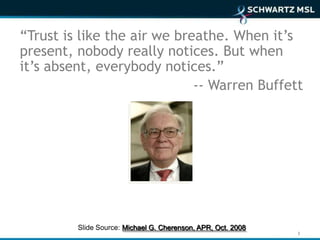
“Trust is like the air we breathe. When it’s
present, nobody really notices. But when
it’s absent, everybody notices.”
                             -- Warren Buffett


         Slide Source: Michael G. Cherenson, APR, Oct. 2008
                                                              3
Trust Matters

 If a company loses trust
   76% of people say they simply stop buying the product


 If a company earns consumer trust
   42% will buy more products
   54% will recommend the product to others


                                                 UK Consumer Trust Index


                                                                           4
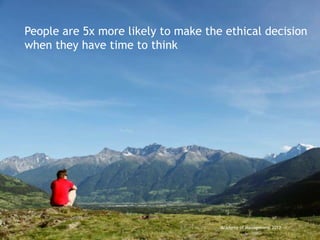
People are 5x more likely to make the ethical decision
when they have time to think


                                     Academy of Management 2012
                                                                  5
Why?

“Immediate, automatic moral intuitions tend to be selfish,
given that self-interest is a basic, instinctual response to
external stimuli.

In contrast, conscious, deliberative thought adds social
concerns, setting off a battle within the individual that pits
the strength of self-interested intuitive desires against the
constraints established by social learning.“

                                    - Academy of Management 2012


                                                                   6
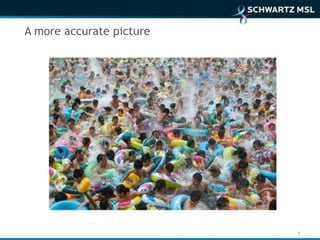
A more accurate picture


                          7
The time to discuss is not now…


                                  8
Or when studying for this…


                             9
It’s Now….


             10
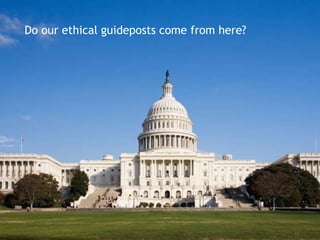
Do our ethical guideposts come from here?


                                            11
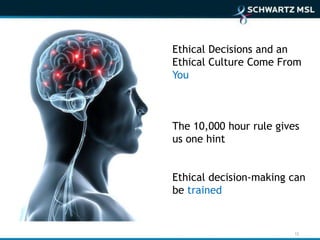
Ethical Decisions and an
Ethical Culture Come From
You


The 10,000 hour rule gives
us one hint


Ethical decision-making can
be trained


                         12
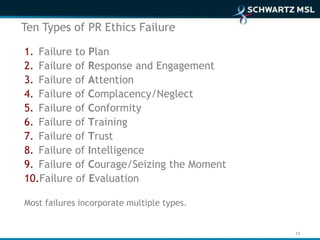
Ten Types of PR Ethics Failure

1. Failure to Plan
2. Failure of Response and Engagement
3. Failure of Attention
4. Failure of Complacency/Neglect
5. Failure of Conformity
6. Failure of Training
7. Failure of Trust
8. Failure of Intelligence
9. Failure of Courage/Seizing the Moment
10.Failure of Evaluation

Most failures incorporate multiple types.


                                            13
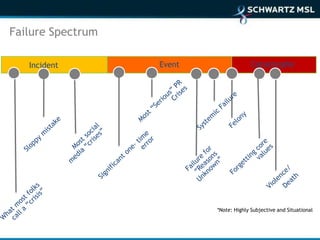
Failure Spectrum

   Incident        Event                 Catastrophe


                           *Note: Highly Subjective and Situational
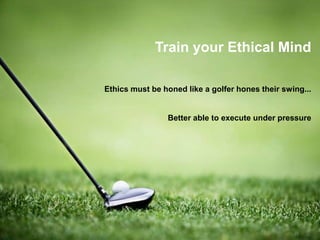
Train your Ethical Mind

Ethics must be honed like a golfer hones their swing...


                Better able to execute under pressure


                                                  15
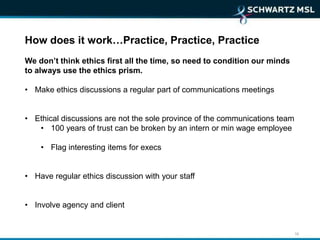
How does it work…Practice, Practice, Practice
We don’t think ethics first all the time, so need to condition our minds
to always use the ethics prism.

• Make ethics discussions a regular part of communications meetings


• Ethical discussions are not the sole province of the communications team
   • 100 years of trust can be broken by an intern or min wage employee

    • Flag interesting items for execs


• Have regular ethics discussion with your staff


• Involve agency and client


                                                                             16
How do you make it happen, really?

• Highlight a situation you have seen of a recent ethical misstep.

• Ask everyone if they saw it and what they thought.

• Don’t give your opinion until the end; let the discussion flow freely.
   • Have others bring examples

• This ongoing exercise will train employees to:

    • Think ethically
    • Understand the importance you put on ethics
    • Might uncover issues you haven’t considered

• Pays dividends in agency/client relationship


                                                                           17
Don’t do it all yourself. Use Outside Coaching:

 Look to the codes

     PRSA Code of Ethics
     WOMMA Code of Ethics
     Arthur Page Society’s Principles


 Codes are references. Don’t memorize.

 Going back to reexamine can help you


                                                  18   18
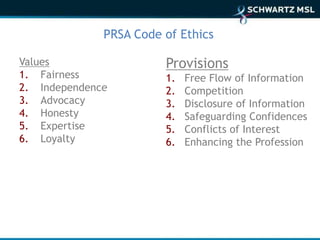
PRSA Code of Ethics

Values                  Provisions
1. Fairness             1.   Free Flow of Information
2. Independence         2.   Competition
3. Advocacy             3.   Disclosure of Information
4. Honesty              4.   Safeguarding Confidences
5. Expertise            5.   Conflicts of Interest
6. Loyalty              6.   Enhancing the Profession
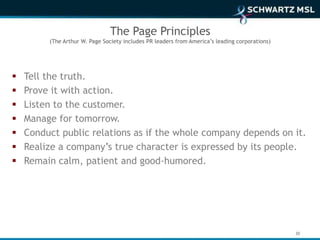
The Page Principles
         (The Arthur W. Page Society includes PR leaders from America’s leading corporations)


   Tell the truth.
   Prove it with action.
   Listen to the customer.
   Manage for tomorrow.
   Conduct public relations as if the whole company depends on it.
   Realize a company’s true character is expressed by its people.
   Remain calm, patient and good-humored.


                                                                                                20
Beyond the Codes, know the laws


 FTC and Mom Blogs


 State Laws – Tim Cahill

     TV Ads
     Unclaimed property


                                  21
Ethical Engagement is Just the Beginning
Engagement


                                           22
Is just the beginning


                        23
Once is not enough

 Just because you hit the perfect drive once, doesn’t mean
  you will do it again.

 Make this a regular part (at least bi-weekly) discussion of
  every meeting

 Embed it in your culture….

 Reward ethical behavior
     Give ethics awards
     Highlight in your award apps


                                                                24
Constantly Ask the Tough Qs

 Black & White is easy. It’s the grey that gets is in trouble.

 Ask prospective employees and agencies:
     What would you do?
     What is a difficult ethical decision you have had to make or
       Give an example of a recent ethical lapse in the industry, how would you
        change?


 Wait for in person
     Make ethics Qs a part of the hiring process


 Start training at the newest employee
     You will be amazed at differences of opinion


                                                                                   25
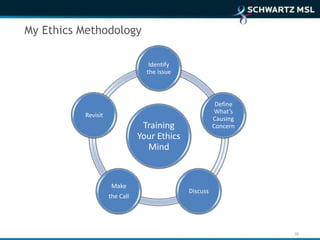
My Ethics Methodology

                                  Identify
                                 the Issue


                                                        Define
                                                        What’s
          Revisit
                                                       Causing
                                Training               Concern
                               Your Ethics
                                 Mind


                     Make
                                             Discuss
                    the Call


                                                                 26
Enough Theory


                27
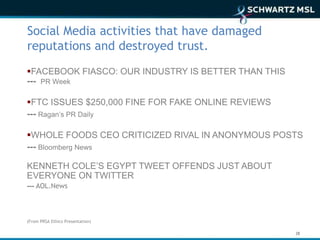
Social Media activities that have damaged
reputations and destroyed trust.
FACEBOOK FIASCO: OUR INDUSTRY IS BETTER THAN THIS
--- PR Week

FTC ISSUES $250,000 FINE FOR FAKE ONLINE REVIEWS
--- Ragan’s PR Daily

WHOLE FOODS CEO CRITICIZED RIVAL IN ANONYMOUS POSTS
--- Bloomberg News

KENNETH COLE’S EGYPT TWEET OFFENDS JUST ABOUT
EVERYONE ON TWITTER
--- AOL.News


(From PRSA Ethics Presentation)

                                                     28
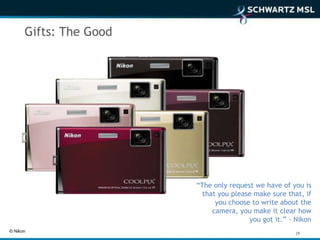
Gifts: The Good


                        “The only request we have of you is
                          that you please make sure that, if
                              you choose to write about the
                             camera, you make it clear how
                                        you got it.” - Nikon
© Nikon                                                29
Some ethical slippery slopes today


 PR Measurement

 There is no one true answer, but there are unethical ones

     PR   pros   inflate
     PR   pros   add multiples
     PR   pros   don’t divide by 30
     PR   pros   report based on total Twitter followers, really?


 Don’t pass the buck to the vendors

 Barcelona Declaration of Principles a good start

                                                                     30
Ethics in Twitter

 How do you have your employees and agency disclose?

 Will folks remember where you are from?

 At MSLGROUP, we make it simple. #cl or #client in every
  single tweet mentioning a client

 Not just you and your employees
     Get the brand advocates on board as well


                                                            31
New ethical challenges facing the industry

   Astroturfing

   Brand journalism?

   Interns paid v unpaid?

   Freelancers?

   Recording?

   How do you monitor for violations?

                                             32
Practical Transparency
 Be transparent (and professional)

  For blogging/tweeting:
       Identify yourself as either:
           Being with agency/client
           Being with the PR Agency for your client
           Or when mentioning their name state “(my client)”
       Once is not enough. Each and every time
  When creating a site/social network/fan page
       Disclose early and often


  Remember:
       Transparency does not mean tell everything – “No” is still an option


                                                                               33
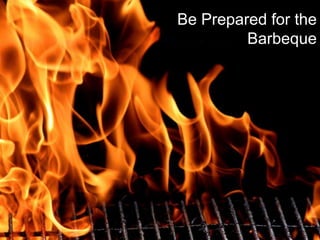
Be Prepared for the
         Barbeque


                34
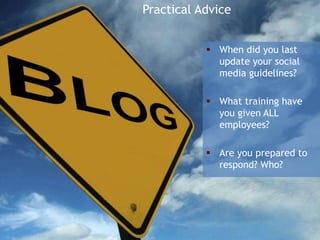
Practical Advice


            When did you last
             update your social
             media guidelines?

            What training have
             you given ALL
             employees?

            Are you prepared to
             respond? Who?


                              35
Discussion Topic #1
  Blogging
       You are made aware that one of your employees loves wine and is a
        B-list wine blogger. You work for a wine company.
          Should your employee blog about your wine? If so, how?
          Your competitors?
          What about twittering about what they drink?
                Every Tweet?
                Is the bio enough?

       Your CEO wants the company to have a blog to communicate with
        key stakeholders. It should be attributed to him.
          Who writes it?
          The power of teams


                                                                            36
Discussion Topic #2
  Information
       You are working on an important new business presentation. You get
        some great ideas from your competitors blog posts.
          Can you use them?
          What if they are in a slide deck linked to the blog that says
             “confidential”?
          Not for use without permission?


                                                                             37
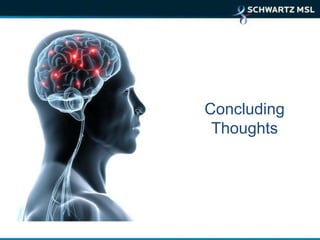
Concluding
 Thoughts
Every day

 Slips happen because we allow them
     Every member of management, every employee is your ethics guardian
     Mistakes will happen.
         Prevent the ones you can
         Respond quickly
         How you react to the others will shape public reaction.


 Train Your Ethical Mind

 You are not alone:
     PRSA Code of Ethics
     WOMMA Code of Ethics
     Most PRSA chapters have an ethics officer
     A vibrant community – 8,700+ blog posts on the topic


                                                                           39
Ethics ≠ Smart

Unethical = Dumb

                   40
Bottom Line:


         Reputation is based on trust.

     Profits come from strong reputations.

Strong reputations come from ethical decisions.

  Ethical decisions can and must be trained.
Questions?
Mark W. McClennan, APR
mmcclennan@schwartzmsl.com
www.schwartzmsl.com/crossroads
Twitter: @McClennan
P: 781-684-0770

Public Relations: Training Your Ethical Mind

  • 1.
    TRAINING YOUR ETHICALMIND #PRCA12 Mark W. McClennan, APR Senior Vice President, Schwartz MSL National Board of Directors, PRSA mmcclennan@schwartzmsl.com @mcclennan
  • 2.
    Four Golden Rulesof Ethics Today  Be transparent  Accept you have lost control  Be ever vigilant  The curtain (and safety net) is gone 1
  • 3.
    Ptching - Prioritizing  You’ve found them, how do you determine which ones matter    Character Remember CAIT Use the MAP Focus on those with the most relevance and that arewhat you by in the dark is linked to are other blogs  Each requires a subtly different approach Dwight Moody and Buckaroo Banzai 2
  • 4.
    “Trust is likethe air we breathe. When it’s present, nobody really notices. But when it’s absent, everybody notices.” -- Warren Buffett Slide Source: Michael G. Cherenson, APR, Oct. 2008 3
  • 5.
    Trust Matters  Ifa company loses trust  76% of people say they simply stop buying the product  If a company earns consumer trust  42% will buy more products  54% will recommend the product to others UK Consumer Trust Index 4
  • 6.
    People are 5xmore likely to make the ethical decision when they have time to think Academy of Management 2012 5
  • 7.
    Why? “Immediate, automatic moralintuitions tend to be selfish, given that self-interest is a basic, instinctual response to external stimuli. In contrast, conscious, deliberative thought adds social concerns, setting off a battle within the individual that pits the strength of self-interested intuitive desires against the constraints established by social learning.“ - Academy of Management 2012 6
  • 8.
    A more accuratepicture 7
  • 9.
    The time todiscuss is not now… 8
  • 10.
    Or when studyingfor this… 9
  • 11.
  • 12.
    Do our ethicalguideposts come from here? 11
  • 13.
    Ethical Decisions andan Ethical Culture Come From You The 10,000 hour rule gives us one hint Ethical decision-making can be trained 12
  • 14.
    Ten Types ofPR Ethics Failure 1. Failure to Plan 2. Failure of Response and Engagement 3. Failure of Attention 4. Failure of Complacency/Neglect 5. Failure of Conformity 6. Failure of Training 7. Failure of Trust 8. Failure of Intelligence 9. Failure of Courage/Seizing the Moment 10.Failure of Evaluation Most failures incorporate multiple types. 13
  • 15.
    Failure Spectrum Incident Event Catastrophe *Note: Highly Subjective and Situational
  • 16.
    Train your EthicalMind Ethics must be honed like a golfer hones their swing... Better able to execute under pressure 15
  • 17.
    How does itwork…Practice, Practice, Practice We don’t think ethics first all the time, so need to condition our minds to always use the ethics prism. • Make ethics discussions a regular part of communications meetings • Ethical discussions are not the sole province of the communications team • 100 years of trust can be broken by an intern or min wage employee • Flag interesting items for execs • Have regular ethics discussion with your staff • Involve agency and client 16
  • 18.
    How do youmake it happen, really? • Highlight a situation you have seen of a recent ethical misstep. • Ask everyone if they saw it and what they thought. • Don’t give your opinion until the end; let the discussion flow freely. • Have others bring examples • This ongoing exercise will train employees to: • Think ethically • Understand the importance you put on ethics • Might uncover issues you haven’t considered • Pays dividends in agency/client relationship 17
  • 19.
    Don’t do itall yourself. Use Outside Coaching:  Look to the codes  PRSA Code of Ethics  WOMMA Code of Ethics  Arthur Page Society’s Principles  Codes are references. Don’t memorize.  Going back to reexamine can help you 18 18
  • 20.
    PRSA Code ofEthics Values Provisions 1. Fairness 1. Free Flow of Information 2. Independence 2. Competition 3. Advocacy 3. Disclosure of Information 4. Honesty 4. Safeguarding Confidences 5. Expertise 5. Conflicts of Interest 6. Loyalty 6. Enhancing the Profession
  • 21.
    The Page Principles (The Arthur W. Page Society includes PR leaders from America’s leading corporations)  Tell the truth.  Prove it with action.  Listen to the customer.  Manage for tomorrow.  Conduct public relations as if the whole company depends on it.  Realize a company’s true character is expressed by its people.  Remain calm, patient and good-humored. 20
  • 22.
    Beyond the Codes,know the laws  FTC and Mom Blogs  State Laws – Tim Cahill  TV Ads  Unclaimed property 21
  • 23.
    Ethical Engagement isJust the Beginning Engagement 22
  • 24.
    Is just thebeginning 23
  • 25.
    Once is notenough  Just because you hit the perfect drive once, doesn’t mean you will do it again.  Make this a regular part (at least bi-weekly) discussion of every meeting  Embed it in your culture….  Reward ethical behavior  Give ethics awards  Highlight in your award apps 24
  • 26.
    Constantly Ask theTough Qs  Black & White is easy. It’s the grey that gets is in trouble.  Ask prospective employees and agencies:  What would you do?  What is a difficult ethical decision you have had to make or  Give an example of a recent ethical lapse in the industry, how would you change?  Wait for in person  Make ethics Qs a part of the hiring process  Start training at the newest employee  You will be amazed at differences of opinion 25
  • 27.
    My Ethics Methodology Identify the Issue Define What’s Revisit Causing Training Concern Your Ethics Mind Make Discuss the Call 26
  • 28.
  • 29.
    Social Media activitiesthat have damaged reputations and destroyed trust. FACEBOOK FIASCO: OUR INDUSTRY IS BETTER THAN THIS --- PR Week FTC ISSUES $250,000 FINE FOR FAKE ONLINE REVIEWS --- Ragan’s PR Daily WHOLE FOODS CEO CRITICIZED RIVAL IN ANONYMOUS POSTS --- Bloomberg News KENNETH COLE’S EGYPT TWEET OFFENDS JUST ABOUT EVERYONE ON TWITTER --- AOL.News (From PRSA Ethics Presentation) 28
  • 30.
    Gifts: The Good “The only request we have of you is that you please make sure that, if you choose to write about the camera, you make it clear how you got it.” - Nikon © Nikon 29
  • 31.
    Some ethical slipperyslopes today  PR Measurement  There is no one true answer, but there are unethical ones  PR pros inflate  PR pros add multiples  PR pros don’t divide by 30  PR pros report based on total Twitter followers, really?  Don’t pass the buck to the vendors  Barcelona Declaration of Principles a good start 30
  • 32.
    Ethics in Twitter How do you have your employees and agency disclose?  Will folks remember where you are from?  At MSLGROUP, we make it simple. #cl or #client in every single tweet mentioning a client  Not just you and your employees  Get the brand advocates on board as well 31
  • 33.
    New ethical challengesfacing the industry  Astroturfing  Brand journalism?  Interns paid v unpaid?  Freelancers?  Recording?  How do you monitor for violations? 32
  • 34.
    Practical Transparency Betransparent (and professional)  For blogging/tweeting:  Identify yourself as either:  Being with agency/client  Being with the PR Agency for your client  Or when mentioning their name state “(my client)”  Once is not enough. Each and every time  When creating a site/social network/fan page  Disclose early and often  Remember:  Transparency does not mean tell everything – “No” is still an option 33
  • 35.
    Be Prepared forthe Barbeque 34
  • 36.
    Practical Advice  When did you last update your social media guidelines?  What training have you given ALL employees?  Are you prepared to respond? Who? 35
  • 37.
    Discussion Topic #1  Blogging  You are made aware that one of your employees loves wine and is a B-list wine blogger. You work for a wine company.  Should your employee blog about your wine? If so, how?  Your competitors?  What about twittering about what they drink?  Every Tweet?  Is the bio enough?  Your CEO wants the company to have a blog to communicate with key stakeholders. It should be attributed to him.  Who writes it?  The power of teams 36
  • 38.
    Discussion Topic #2  Information  You are working on an important new business presentation. You get some great ideas from your competitors blog posts.  Can you use them?  What if they are in a slide deck linked to the blog that says “confidential”?  Not for use without permission? 37
  • 39.
  • 40.
    Every day  Slipshappen because we allow them  Every member of management, every employee is your ethics guardian  Mistakes will happen.  Prevent the ones you can  Respond quickly  How you react to the others will shape public reaction.  Train Your Ethical Mind  You are not alone:  PRSA Code of Ethics  WOMMA Code of Ethics  Most PRSA chapters have an ethics officer  A vibrant community – 8,700+ blog posts on the topic 39
  • 41.
  • 42.
    Bottom Line: Reputation is based on trust. Profits come from strong reputations. Strong reputations come from ethical decisions. Ethical decisions can and must be trained.
  • 43.
    Questions? Mark W. McClennan,APR mmcclennan@schwartzmsl.com www.schwartzmsl.com/crossroads Twitter: @McClennan P: 781-684-0770