Chapter 2 Safety Concepts
Objectives List the three elements that affect safety in the work environment Discuss the differences between formal and informal processes List the qualities of a well-written procedure or guideline
Objectives (con’t.) Discuss the external influences that influence safety equipment design and purchase List and discuss the three factors that contribute to a person’s ability to act safely Define risk management Identify and explain the five parts of classic risk management
Theory Versus Reality: An Introduction to Safety Concepts ISOs need both theory and reality  Theory: uncommon sense Recognized safety concepts Reality: common sense ISOs look at components of operational environment  Procedures, equipment, and personnel
Figure 2-1   Personnel, equipment, and procedures all play a role in defining safety in operations.
Safety in the Operational Environment Procedures Strict processes with little or no flexibility Formal (written) or informal (routine practices) SOPs: standard operating procedures Guidelines Adaptable templates that give widespread application flexibility SOGs: standard operating guidelines
Safety in the Operational Environment (con’t.) Sample standard operating procedure (SOP) topics: Use of PPE and SCBA Equipment maintenance Risk/benefit principles Highway and traffic safety at incidents Accident/injury procedures and reporting Incident scene accountability
Safety in the Operational Environment (con’t.) Qualities of a good SOP Clear outline Simple language Clear direction Tested technique Easy interpretation Applicability to many scenarios Specific only on critical/life-endangering points
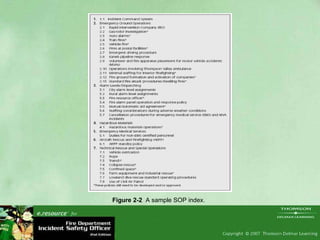
Figure 2-2   A sample SOP index.
Figure 2-3   A sample SOP format.
Safety in the Operational Environment (con’t.) Equipment Least important factor in operational triad of procedure, equipment, and personnel Selection and use factors: Department mission External influences Maintenance The right equipment
Safety in the Operational Environment (con’t.) Equipment (con’t.) Department mission List types of incidents handled in jurisdiction List equipment necessary to safely handle incidents Check items that are essential Note items that are nice to have
Safety in the Operational Environment (con’t.) Equipment (con’t.) External influences: focus on required equipment OSHA regulations NFPA standards NIOSH, ANSI, and UL
Safety in the Operational Environment (con’t.) Equipment (con’t.) Equipment maintenance Keep complete documentation of repairs and maintenance Maintain complete set of equipment guidelines regarding selection, use, cleaning and decontamination, storage, inspection, repairs, and criteria for retirement
Safety in the Operational Environment (con’t.) Equipment (con’t.) The right equipment Personal protective equipment: be aware of the thermal protective performance (TPP) rating  Apparatus Tools Station equipment
Figure 2-6   High-tech tools allow firefighters to work more safely and monitor their health.
Safety in the Operational Environment (con’t.) Personnel Three factors contribute to a person’s ability to act safely Training Health Attitude
Safety in the Operational Environment (con’t.) Personnel (con’t.) Qualities of an effective training program Clear objectives Applicability to incident handling Established proficiency level Identification of potential hazards Definition of acceptable risks List of options, should something go wrong Accountability to act as trained
Figure 2-8   Injury and death statistics suggest that essential training subjects be addressed.
Safety in the Operational Environment (con’t.) Personnel (con’t.) Physical health support Annual health screening Vaccination and immunization offerings Employee assistance programs Fitness determination and program Nutrition education Effective rehabilitation strategies
Safety in the Operational Environment (con’t.) Personnel (con’t.) Mental health support Provide training of critical incident stress signs and symptoms Activate CISD (critical incident stress debriefing) team as necessary Include firefighter’s family in department events Make EAP available for job stress or family issues
Safety in the Operational Environment (con’t.) Personnel (con’t.) Attitude is affected by: Department’s safety culture Department history of no duty-firefighters or significant injuries Department’s death or injury history Example set by line officers or firefighters Attitude changes are slow and often emotional
Risk Management Risk Chance of damage, injury, or loss Risk management Process of minimizing chance, degree, or probability of damage, injury, or loss Most risk managers use a five-step process called classic risk management
Risk Management (con’t.) Five-step risk management Hazard identification Primary function of ISO Hazard evaluation Frequency: probability that an injurious event can happen Severity: harmful consequence or cost associated with injury or damage from a given hazard
Figure 2-10   A recognized hazard should be placed in one of these boxes based on the potential severity and frequency of the hazard.
Risk Management (con’t.) Five-step risk management (con’t.) Hazard prioritization Divide hazard matrix into three classes Hazard control Avoidance Hazard transfer Hazard adaptation: mitigation Monitoring hazards Cyclic thinking
Figure 2-11   Once a hazard is classified in one of these boxes, a priority can be assigned to it.  This helps the ISO juggle multiple hazards.
Risk Management (con’t.) Risk/Benefit thinking Are the risks being taken by people worth the benefit that can be gained? A good ISO continually reassesses risk versus benefit
Summary An effective ISO Has a solid foundation in general safety concepts and risk management Appreciates the roles of workplace procedures, equipment, and personnel Achieves a safe workplace through evaluation and improvement Improvement in attitude is especially difficult
Summary (con’t.) Risk management Process of minimizing chance, degree, or probability of damage, injury, or loss Most common approach: five-step classic risk management model Continual monitoring of tasks Application of risk/benefit thinking

Chapter 02

  • 1.
  • 2.
    Objectives List thethree elements that affect safety in the work environment Discuss the differences between formal and informal processes List the qualities of a well-written procedure or guideline
  • 3.
    Objectives (con’t.) Discussthe external influences that influence safety equipment design and purchase List and discuss the three factors that contribute to a person’s ability to act safely Define risk management Identify and explain the five parts of classic risk management
  • 4.
    Theory Versus Reality:An Introduction to Safety Concepts ISOs need both theory and reality Theory: uncommon sense Recognized safety concepts Reality: common sense ISOs look at components of operational environment Procedures, equipment, and personnel
  • 5.
    Figure 2-1 Personnel, equipment, and procedures all play a role in defining safety in operations.
  • 6.
    Safety in theOperational Environment Procedures Strict processes with little or no flexibility Formal (written) or informal (routine practices) SOPs: standard operating procedures Guidelines Adaptable templates that give widespread application flexibility SOGs: standard operating guidelines
  • 7.
    Safety in theOperational Environment (con’t.) Sample standard operating procedure (SOP) topics: Use of PPE and SCBA Equipment maintenance Risk/benefit principles Highway and traffic safety at incidents Accident/injury procedures and reporting Incident scene accountability
  • 8.
    Safety in theOperational Environment (con’t.) Qualities of a good SOP Clear outline Simple language Clear direction Tested technique Easy interpretation Applicability to many scenarios Specific only on critical/life-endangering points
  • 9.
    Figure 2-2 A sample SOP index.
  • 10.
    Figure 2-3 A sample SOP format.
  • 11.
    Safety in theOperational Environment (con’t.) Equipment Least important factor in operational triad of procedure, equipment, and personnel Selection and use factors: Department mission External influences Maintenance The right equipment
  • 12.
    Safety in theOperational Environment (con’t.) Equipment (con’t.) Department mission List types of incidents handled in jurisdiction List equipment necessary to safely handle incidents Check items that are essential Note items that are nice to have
  • 13.
    Safety in theOperational Environment (con’t.) Equipment (con’t.) External influences: focus on required equipment OSHA regulations NFPA standards NIOSH, ANSI, and UL
  • 14.
    Safety in theOperational Environment (con’t.) Equipment (con’t.) Equipment maintenance Keep complete documentation of repairs and maintenance Maintain complete set of equipment guidelines regarding selection, use, cleaning and decontamination, storage, inspection, repairs, and criteria for retirement
  • 15.
    Safety in theOperational Environment (con’t.) Equipment (con’t.) The right equipment Personal protective equipment: be aware of the thermal protective performance (TPP) rating Apparatus Tools Station equipment
  • 16.
    Figure 2-6 High-tech tools allow firefighters to work more safely and monitor their health.
  • 17.
    Safety in theOperational Environment (con’t.) Personnel Three factors contribute to a person’s ability to act safely Training Health Attitude
  • 18.
    Safety in theOperational Environment (con’t.) Personnel (con’t.) Qualities of an effective training program Clear objectives Applicability to incident handling Established proficiency level Identification of potential hazards Definition of acceptable risks List of options, should something go wrong Accountability to act as trained
  • 19.
    Figure 2-8 Injury and death statistics suggest that essential training subjects be addressed.
  • 20.
    Safety in theOperational Environment (con’t.) Personnel (con’t.) Physical health support Annual health screening Vaccination and immunization offerings Employee assistance programs Fitness determination and program Nutrition education Effective rehabilitation strategies
  • 21.
    Safety in theOperational Environment (con’t.) Personnel (con’t.) Mental health support Provide training of critical incident stress signs and symptoms Activate CISD (critical incident stress debriefing) team as necessary Include firefighter’s family in department events Make EAP available for job stress or family issues
  • 22.
    Safety in theOperational Environment (con’t.) Personnel (con’t.) Attitude is affected by: Department’s safety culture Department history of no duty-firefighters or significant injuries Department’s death or injury history Example set by line officers or firefighters Attitude changes are slow and often emotional
  • 23.
    Risk Management RiskChance of damage, injury, or loss Risk management Process of minimizing chance, degree, or probability of damage, injury, or loss Most risk managers use a five-step process called classic risk management
  • 24.
    Risk Management (con’t.)Five-step risk management Hazard identification Primary function of ISO Hazard evaluation Frequency: probability that an injurious event can happen Severity: harmful consequence or cost associated with injury or damage from a given hazard
  • 25.
    Figure 2-10 A recognized hazard should be placed in one of these boxes based on the potential severity and frequency of the hazard.
  • 26.
    Risk Management (con’t.)Five-step risk management (con’t.) Hazard prioritization Divide hazard matrix into three classes Hazard control Avoidance Hazard transfer Hazard adaptation: mitigation Monitoring hazards Cyclic thinking
  • 27.
    Figure 2-11 Once a hazard is classified in one of these boxes, a priority can be assigned to it. This helps the ISO juggle multiple hazards.
  • 28.
    Risk Management (con’t.)Risk/Benefit thinking Are the risks being taken by people worth the benefit that can be gained? A good ISO continually reassesses risk versus benefit
  • 29.
    Summary An effectiveISO Has a solid foundation in general safety concepts and risk management Appreciates the roles of workplace procedures, equipment, and personnel Achieves a safe workplace through evaluation and improvement Improvement in attitude is especially difficult
  • 30.
    Summary (con’t.) Riskmanagement Process of minimizing chance, degree, or probability of damage, injury, or loss Most common approach: five-step classic risk management model Continual monitoring of tasks Application of risk/benefit thinking