Chaparral Biome
Xander Koo and Kevin Li
Conditions and Climate
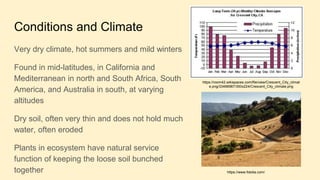
Very dry climate, hot summers and mild winters
Found in mid-latitudes, in California and
Mediterranean in north and South Africa, South
America, and Australia in south, at varying
altitudes
Dry soil, often very thin and does not hold much
water, often eroded
Plants in ecosystem have natural service
function of keeping the loose soil bunched
together
https://room42.wikispaces.com/file/view/Crescent_City_climat
e.png/33466987/350x224/Crescent_City_climate.png
https://www.fotolia.com/
Types and Classification
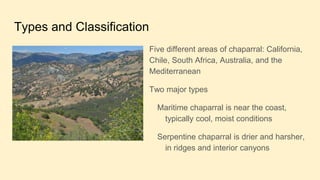
Five different areas of chaparral: California,
Chile, South Africa, Australia, and the
Mediterranean
Two major types
Maritime chaparral is near the coast,
typically cool, moist conditions
Serpentine chaparral is drier and harsher,
in ridges and interior canyons
Plants and Animals
Plant life is diverse, characterized by
smaller brushes, bushes, cacti, and
shrubs as well as trees such as
pines and oaks
Animal life includes jackrabbits,
rattlesnakes, and kangaroos in
Australia
http://www.americanforests.org/wp-
content/uploads/2012/02/Gray-fox-kit.jpg
Threats
Increased human development in chaparral
areas (mild climate is very suitable for
human habitation)
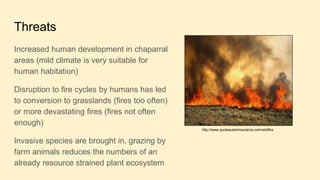
Disruption to fire cycles by humans has led
to conversion to grasslands (fires too often)
or more devastating fires (fires not often
enough)
Invasive species are brought in, grazing by
farm animals reduces the numbers of an
already resource strained plant ecosystem
http://www.quoteaustininsurance.com/wildfire
Organism Interactions
- Example Food Web
Hawk Fox
Lizard
Snake
Rodents
CactiShrubs
Insects
Ecological Interactions - 1
Mutualism: Harvester Ants
protect Indian Rice Grass by
eating predators of the grass,
and getting food in the process Commensalism: The
Red-Winged Blackbird
lives in reeds, who are
not harmed but provide a
home
Parasitism: Ticks suck on
the Kit Fox’s blood for
food. The fox is at risk of
disease as a result
All images from:
http://chaparralawareness.weebly.com/relationships-
between-animals.html
Ecological Interactions - 2
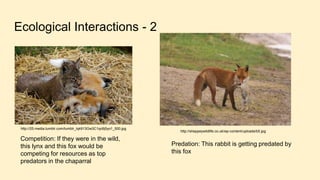
Competition: If they were in the wild,
this lynx and this fox would be
competing for resources as top
predators in the chaparral
http://25.media.tumblr.com/tumblr_lqk913Gw3C1qc6j5yo1_500.jpg
http://sheppeywildlife.co.uk/wp-content/uploads/b5.jpg
Predation: This rabbit is getting predated by
this fox
Coyote Brush Adaptations
waxy leaves prevent moisture
escaping
oils on leaf are fire-retardant for
when wildfires occur
leaves taste bad, animals tend to
stay away
long roots, absorbs lots of moisture
http://science.halleyhosting.com/nature/plants/sun/butt
on/baccharis/pilularis/pilularis1a.jpg
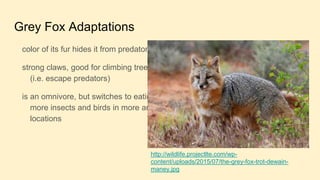
color of its fur hides it from predators
strong claws, good for climbing trees
(i.e. escape predators)
is an omnivore, but switches to eating
more insects and birds in more arid
locations
Grey Fox Adaptations
http://wildlife.projectlte.com/wp-
content/uploads/2015/07/the-grey-fox-trot-dewain-
maney.jpg
Endangered Species
California Condor - Native to California,
Classified as Critically Endangered, but
population rising, top predator in the
ecosystem, protected through captive
breeding and poaching ban
Northern Hairy-nosed Wombat - Native
to Australian Chaparral, Classified as
Critically Endangered, Population
stable, primary consumer, protected
with fences and captive breeding
http://northerncaliforniachaparral.weebly.com/invasiveendangered-species.html
https://biodiversitywarriors.wikispaces.com/file/view/GW424H3
00.jpeg/378110286/GW424H300.jpeg

Chaparral biome

  • 1.
  • 2.
    Conditions and Climate Verydry climate, hot summers and mild winters Found in mid-latitudes, in California and Mediterranean in north and South Africa, South America, and Australia in south, at varying altitudes Dry soil, often very thin and does not hold much water, often eroded Plants in ecosystem have natural service function of keeping the loose soil bunched together https://room42.wikispaces.com/file/view/Crescent_City_climat e.png/33466987/350x224/Crescent_City_climate.png https://www.fotolia.com/
  • 3.
    Types and Classification Fivedifferent areas of chaparral: California, Chile, South Africa, Australia, and the Mediterranean Two major types Maritime chaparral is near the coast, typically cool, moist conditions Serpentine chaparral is drier and harsher, in ridges and interior canyons
  • 4.
    Plants and Animals Plantlife is diverse, characterized by smaller brushes, bushes, cacti, and shrubs as well as trees such as pines and oaks Animal life includes jackrabbits, rattlesnakes, and kangaroos in Australia http://www.americanforests.org/wp- content/uploads/2012/02/Gray-fox-kit.jpg
  • 5.
    Threats Increased human developmentin chaparral areas (mild climate is very suitable for human habitation) Disruption to fire cycles by humans has led to conversion to grasslands (fires too often) or more devastating fires (fires not often enough) Invasive species are brought in, grazing by farm animals reduces the numbers of an already resource strained plant ecosystem http://www.quoteaustininsurance.com/wildfire
  • 6.
    Organism Interactions - ExampleFood Web Hawk Fox Lizard Snake Rodents CactiShrubs Insects
  • 7.
    Ecological Interactions -1 Mutualism: Harvester Ants protect Indian Rice Grass by eating predators of the grass, and getting food in the process Commensalism: The Red-Winged Blackbird lives in reeds, who are not harmed but provide a home Parasitism: Ticks suck on the Kit Fox’s blood for food. The fox is at risk of disease as a result All images from: http://chaparralawareness.weebly.com/relationships- between-animals.html
  • 8.
    Ecological Interactions -2 Competition: If they were in the wild, this lynx and this fox would be competing for resources as top predators in the chaparral http://25.media.tumblr.com/tumblr_lqk913Gw3C1qc6j5yo1_500.jpg http://sheppeywildlife.co.uk/wp-content/uploads/b5.jpg Predation: This rabbit is getting predated by this fox
  • 9.
    Coyote Brush Adaptations waxyleaves prevent moisture escaping oils on leaf are fire-retardant for when wildfires occur leaves taste bad, animals tend to stay away long roots, absorbs lots of moisture http://science.halleyhosting.com/nature/plants/sun/butt on/baccharis/pilularis/pilularis1a.jpg
  • 10.
    color of itsfur hides it from predators strong claws, good for climbing trees (i.e. escape predators) is an omnivore, but switches to eating more insects and birds in more arid locations Grey Fox Adaptations http://wildlife.projectlte.com/wp- content/uploads/2015/07/the-grey-fox-trot-dewain- maney.jpg
  • 11.
    Endangered Species California Condor- Native to California, Classified as Critically Endangered, but population rising, top predator in the ecosystem, protected through captive breeding and poaching ban Northern Hairy-nosed Wombat - Native to Australian Chaparral, Classified as Critically Endangered, Population stable, primary consumer, protected with fences and captive breeding http://northerncaliforniachaparral.weebly.com/invasiveendangered-species.html https://biodiversitywarriors.wikispaces.com/file/view/GW424H3 00.jpeg/378110286/GW424H300.jpeg