Industrial Tech 315MEDITERRANEAN COUNTRIES AND THEIR FOODBSIT Food Tech 3 -D
THE MEDITERRANEAN SEA
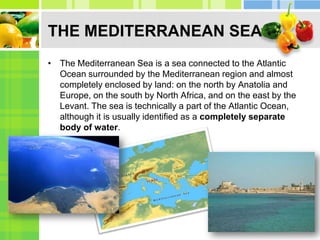
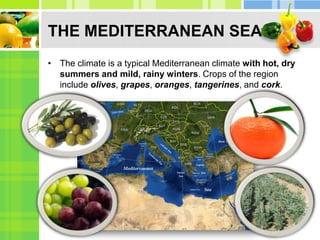
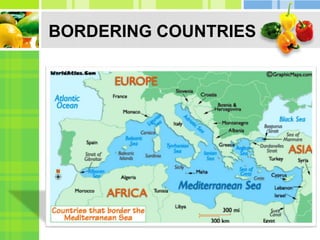
THE MEDITERRANEAN SEAThe Mediterranean Sea is a sea connected to the Atlantic Ocean surrounded by the Mediterranean region and almost completely enclosed by land: on the north by Anatolia and Europe, on the south by North Africa, and on the east by the Levant. The sea is technically a part of the Atlantic Ocean, although it is usually identified as a completely separate body of water.THE MEDITERRANEAN SEAThe climate is a typical Mediterranean climate with hot, dry summers and mild, rainy winters. Crops of the region include olives, grapes, oranges, tangerines, and cork.NAME and BACKGROUNDThe Mediterranean Region
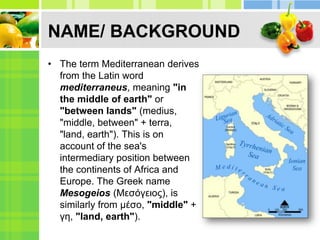
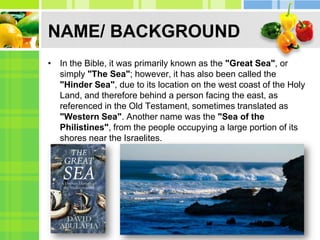
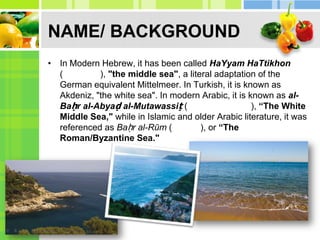
NAME/ BACKGROUNDThe term Mediterranean derives from the Latin word mediterraneus, meaning "in the middle of earth" or "between lands" (medius, "middle, between" + terra, "land, earth"). This is on account of the sea's intermediary position between the continents of Africa and Europe. The Greek name Mesogeios (Μεσόγειος), is similarly from μέσο, "middle" + γη, "land, earth").NAME/ BACKGROUNDIn the Bible, it was primarily known as the "Great Sea", or simply "The Sea"; however, it has also been called the "Hinder Sea", due to its location on the west coast of the Holy Land, and therefore behind a person facing the east, as referenced in the Old Testament, sometimes translated as "Western Sea". Another name was the "Sea of the Philistines", from the people occupying a large portion of its shores near the Israelites.NAME/ BACKGROUNDIn Modern Hebrew, it has been called HaYyamHaTtikhon(הַיָּם הַתִּיכוֹן), "the middle sea", a literal adaptation of the German equivalent Mittelmeer. In Turkish, it is known as Akdeniz, "the white sea". In modern Arabic, it is known as al-Baḥr al-Abyaḍ al-Mutawassiṭ (البحرالأبيضالمتوسط), “The White Middle Sea," while in Islamic and older Arabic literature, it was referenced as Baḥr al-Rūm(بحرالروم), or “The Roman/Byzantine Sea."HISTORYThe Mediterranean Region
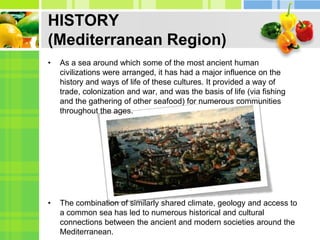
HISTORY(Mediterranean Region)As a sea around which some of the most ancient human civilizations were arranged, it has had a major influence on the history and ways of life of these cultures. It provided a way of trade, colonization and war, and was the basis of life (via fishing and the gathering of other seafood) for numerous communities throughout the ages. The combination of similarly shared climate, geology and access to a common sea has led to numerous historical and cultural connections between the ancient and modern societies around the Mediterranean.
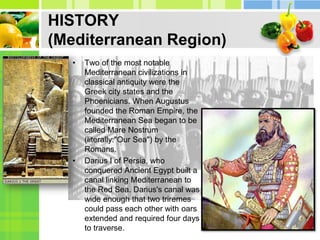
HISTORY(Mediterranean Region)Two of the most notable Mediterranean civilizations in classical antiquity were the Greek city states and the Phoenicians. When Augustus founded the Roman Empire, the Mediterranean Sea began to be called Mare Nostrum (literally:"Our Sea") by the Romans.Darius I of Persia, who conquered Ancient Egypt built a canal linking Mediterranean to the Red Sea. Darius's canal was wide enough that two triremes could pass each other with oars extended and required four days to traverse.
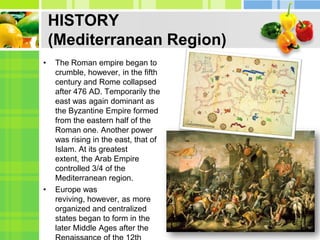
HISTORY(Mediterranean Region)The Roman empire began to crumble, however, in the fifth century and Rome collapsed after 476 AD. Temporarily the east was again dominant as the Byzantine Empire formed from the eastern half of the Roman one. Another power was rising in the east, that of Islam. At its greatest extent, the Arab Empire controlled 3/4 of the Mediterranean region. Europe was reviving, however, as more organized and centralized states began to form in the later Middle Ages after the Renaissance of the 12th century.
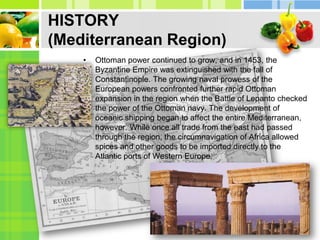
HISTORY(Mediterranean Region)Ottoman power continued to grow, and in 1453, the Byzantine Empire was extinguished with the fall of Constantinople. The growing naval prowess of the European powers confronted further rapid Ottoman expansion in the region when the Battle of Lepanto checked the power of the Ottoman navy. The development of oceanic shipping began to affect the entire Mediterranean, however. While once all trade from the east had passed through the region, the circumnavigation of Africa allowed spices and other goods to be imported directly to the Atlantic ports of Western Europe.
BORDERING COUNTRIESHISTORY
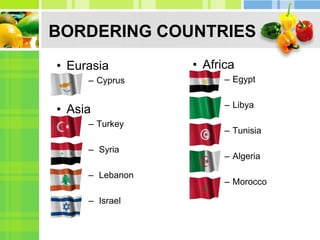
BORDERING COUNTRIES
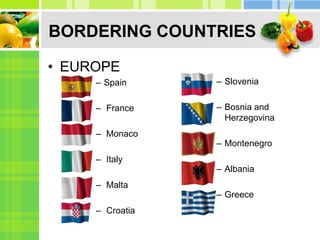
BORDERING COUNTRIESEUROPESpainFranceMonacoItalyMaltaCroatiaSlovenia
Bosnia and Herzegovina
Montenegro
Albania
GreeceBORDERING COUNTRIESAfrica
Egypt
Libya
Tunisia
Algeria
Morocco
EurasiaCyprusAsiaTurkeySyriaLebanon Israel
MEDITERRANEAN NUTRITION and DIET
MEDITERRANEAN NUTRITION and DIETThe Mediterranean diet is a modern nutritional recommendation inspired by the traditional dietary patterns of southern Italy, Crete and much of the rest of Greece in the 1960s. On November 17, 2010, UNESCO recognized this diet pattern as an Intangible Cultural Heritage of Italy, Greece, Spain and Morocco, thus reinforcing it not only as a fundamental part of their history and background, but also as a great contribution to the world.Despite its name, this diet is not typical of all Mediterraneancuisine. In Northern Italy, for instance, lard and butter are commonly used in cooking, and olive oil is reserved for dressing salads and cooked vegetables. In North Africa, wine is traditionally avoided by Muslims. In both North Africa and the Levant, along with olive oil, sheep's tail fat and rendered butter (samna) are traditional staple fats.
MEDITERRANEAN NUTRITION and DIETHISTORY of the MEDITERRANEAN DIET Although it was first publicized in 1945 by the American doctor Ancel Keys stationed in Salerno, Italy, the Mediterranean diet failed to gain widespread recognition until the 1990s. Objective data showing that Mediterranean diet is healthy first originated from the Seven Countries Study.Mediterranean diet is based on what from the point of view of mainstream nutrition is considered a paradox: that although the people living in Mediterranean countries tend to consume relatively high amounts of fat, they have far lower rates of cardiovascular disease than in countries like the United States, where similar levels of fat consumption are found. A parallel phenomenon is known as the French Paradox. A diet rich in salads was promoted in England during the early Renaissance period by GiacomoCastelvetro in A Brief Account of the Fruits, Herbs and Vegetables of Italy. He attempted, without success, to convince the English to eat more fruits and vegetables.
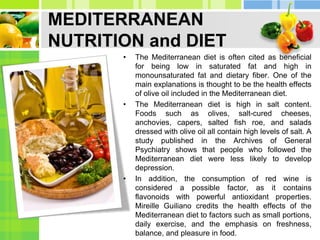
MEDITERRANEAN NUTRITION and DIETThe Mediterranean diet is often cited as beneficial for being low in saturated fat and high in monounsaturated fat and dietary fiber. One of the main explanations is thought to be the health effects of olive oil included in the Mediterranean diet.The Mediterranean diet is high in salt content. Foods such as olives, salt-cured cheeses, anchovies, capers, salted fish roe, and salads dressed with olive oil all contain high levels of salt. A study published in the Archives of General Psychiatry shows that people who followed the Mediterranean diet were less likely to develop depression.In addition, the consumption of red wine is considered a possible factor, as it contains flavonoids with powerful antioxidant properties. MireilleGuiliano credits the health effects of the Mediterranean diet to factors such as small portions, daily exercise, and the emphasis on freshness, balance, and pleasure in food.
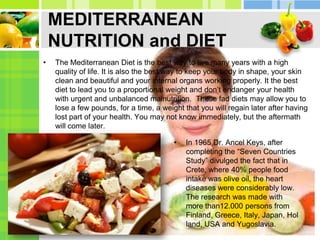
MEDITERRANEAN NUTRITION and DIETThe Mediterranean Diet is the best way to live many years with a high quality of life. It is also the best way to keep your body in shape, your skin clean and beautiful and your internal organs working properly. It the best diet to lead you to a proportional weight and don’t endanger your health with urgent and unbalanced malnutrition.  These fad diets may allow you to lose a few pounds, for a time, a weight that you will regain later after having lost part of your health. You may not know immediately, but the aftermath will come later.In 1965 Dr. Ancel Keys, after completing the “Seven Countries Study” divulged the fact that in Crete, where 40% people food intake was olive oil, the heart diseases were considerably low. The research was made with more than12.000 persons from Finland, Greece, Italy, Japan, Holland, USA and Yugoslavia.
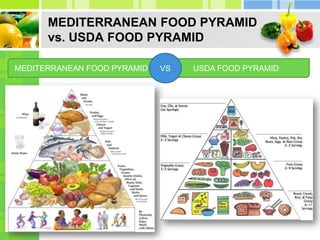
MEDITERRANEAN NUTRITION and DIETThe Original Mediterranean Diet characteristics are:High consumption of virgin olive oil.High intake of vegetables and fruits and legumes.Use of non refined carbohydrates (portions to be adjusted to physical activity).Consumption of fish, specially oily (or “bluish” one) three o for times a weekConsumption of milk and derivates, cheese and yogurt (the original cheese was fresh goat cheese). Keep an eye on the saturated fats of the dairy products. Do not consume too much!Three or four eggs per week.Moderate consumption of meat and saturated fats (natural, not artificially hydrogenated!).One or two small glasses of wine a day, preferably red and at the main meals. White wine and beer are alternatives.Nuts as snacks.In “special occasions” Mediterranean traditional desserts.
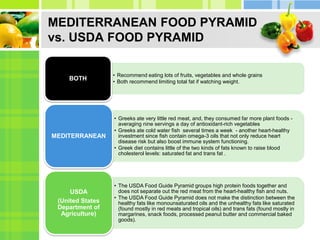
MEDITERRANEAN FOOD PYRAMID vs. USDA FOOD PYRAMID
MEDITERRANEAN FOOD PYRAMID vs. USDA FOOD PYRAMIDVSUSDA FOOD PYRAMIDMEDITERRANEAN FOOD PYRAMID
MEDITERRANEAN FOOD PYRAMID vs. USDA FOOD PYRAMID
MEDITERRANEAN COUNTRIES AND SOME OF THEIR POPULAR DISHES
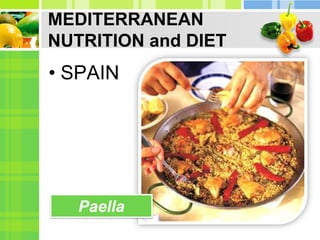
MEDITERRANEAN NUTRITION and DIETSPAINPaella
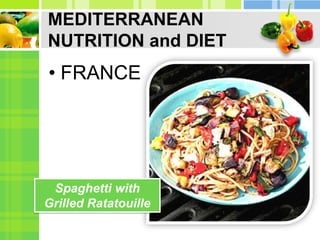
MEDITERRANEAN NUTRITION and DIETFRANCESpaghetti with Grilled Ratatouille
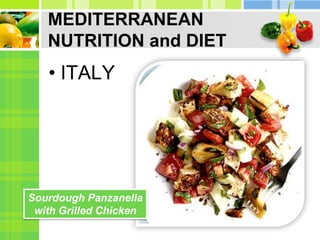
MEDITERRANEAN NUTRITION and DIETITALYSourdough Panzanella with Grilled Chicken
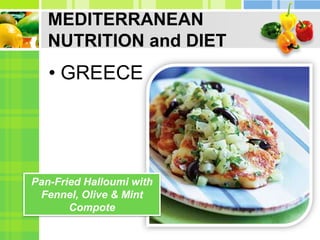
MEDITERRANEAN NUTRITION and DIETGREECEPan-Fried Halloumi with Fennel, Olive & Mint Compote
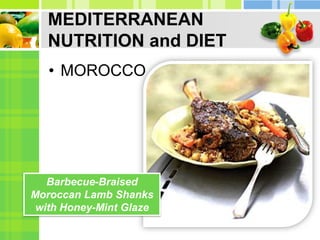
MEDITERRANEAN NUTRITION and DIETMOROCCOBarbecue-Braised Moroccan Lamb Shanks with Honey-Mint Glaze
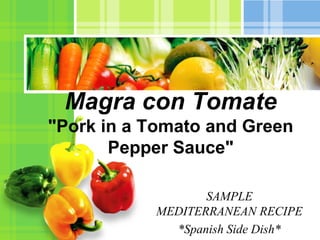
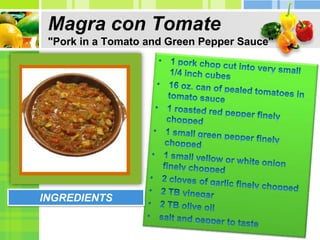
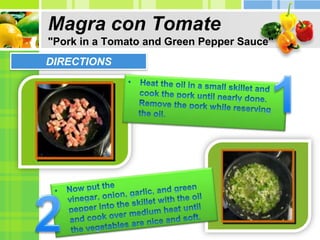
Magra con Tomate"Pork in a Tomato and Green Pepper Sauce"SAMPLE MEDITERRANEAN RECIPE*Spanish Side Dish*

Mediterranean Countries and Their Food

  • 1.
    Industrial Tech 315MEDITERRANEANCOUNTRIES AND THEIR FOODBSIT Food Tech 3 -D
  • 2.
  • 3.
    THE MEDITERRANEAN SEATheMediterranean Sea is a sea connected to the Atlantic Ocean surrounded by the Mediterranean region and almost completely enclosed by land: on the north by Anatolia and Europe, on the south by North Africa, and on the east by the Levant. The sea is technically a part of the Atlantic Ocean, although it is usually identified as a completely separate body of water.THE MEDITERRANEAN SEAThe climate is a typical Mediterranean climate with hot, dry summers and mild, rainy winters. Crops of the region include olives, grapes, oranges, tangerines, and cork.NAME and BACKGROUNDThe Mediterranean Region
  • 4.
    NAME/ BACKGROUNDThe termMediterranean derives from the Latin word mediterraneus, meaning "in the middle of earth" or "between lands" (medius, "middle, between" + terra, "land, earth"). This is on account of the sea's intermediary position between the continents of Africa and Europe. The Greek name Mesogeios (Μεσόγειος), is similarly from μέσο, "middle" + γη, "land, earth").NAME/ BACKGROUNDIn the Bible, it was primarily known as the "Great Sea", or simply "The Sea"; however, it has also been called the "Hinder Sea", due to its location on the west coast of the Holy Land, and therefore behind a person facing the east, as referenced in the Old Testament, sometimes translated as "Western Sea". Another name was the "Sea of the Philistines", from the people occupying a large portion of its shores near the Israelites.NAME/ BACKGROUNDIn Modern Hebrew, it has been called HaYyamHaTtikhon(הַיָּם הַתִּיכוֹן), "the middle sea", a literal adaptation of the German equivalent Mittelmeer. In Turkish, it is known as Akdeniz, "the white sea". In modern Arabic, it is known as al-Baḥr al-Abyaḍ al-Mutawassiṭ (البحرالأبيضالمتوسط), “The White Middle Sea," while in Islamic and older Arabic literature, it was referenced as Baḥr al-Rūm(بحرالروم), or “The Roman/Byzantine Sea."HISTORYThe Mediterranean Region
  • 5.
    HISTORY(Mediterranean Region)As asea around which some of the most ancient human civilizations were arranged, it has had a major influence on the history and ways of life of these cultures. It provided a way of trade, colonization and war, and was the basis of life (via fishing and the gathering of other seafood) for numerous communities throughout the ages. The combination of similarly shared climate, geology and access to a common sea has led to numerous historical and cultural connections between the ancient and modern societies around the Mediterranean.
  • 6.
    HISTORY(Mediterranean Region)Two ofthe most notable Mediterranean civilizations in classical antiquity were the Greek city states and the Phoenicians. When Augustus founded the Roman Empire, the Mediterranean Sea began to be called Mare Nostrum (literally:"Our Sea") by the Romans.Darius I of Persia, who conquered Ancient Egypt built a canal linking Mediterranean to the Red Sea. Darius's canal was wide enough that two triremes could pass each other with oars extended and required four days to traverse.
  • 7.
    HISTORY(Mediterranean Region)The Romanempire began to crumble, however, in the fifth century and Rome collapsed after 476 AD. Temporarily the east was again dominant as the Byzantine Empire formed from the eastern half of the Roman one. Another power was rising in the east, that of Islam. At its greatest extent, the Arab Empire controlled 3/4 of the Mediterranean region. Europe was reviving, however, as more organized and centralized states began to form in the later Middle Ages after the Renaissance of the 12th century.
  • 8.
    HISTORY(Mediterranean Region)Ottoman powercontinued to grow, and in 1453, the Byzantine Empire was extinguished with the fall of Constantinople. The growing naval prowess of the European powers confronted further rapid Ottoman expansion in the region when the Battle of Lepanto checked the power of the Ottoman navy. The development of oceanic shipping began to affect the entire Mediterranean, however. While once all trade from the east had passed through the region, the circumnavigation of Africa allowed spices and other goods to be imported directly to the Atlantic ports of Western Europe.
  • 9.
  • 10.
  • 11.
  • 12.
  • 13.
  • 14.
  • 15.
  • 16.
  • 17.
  • 18.
  • 19.
  • 20.
  • 21.
  • 22.
  • 23.
    MEDITERRANEAN NUTRITION andDIETThe Mediterranean diet is a modern nutritional recommendation inspired by the traditional dietary patterns of southern Italy, Crete and much of the rest of Greece in the 1960s. On November 17, 2010, UNESCO recognized this diet pattern as an Intangible Cultural Heritage of Italy, Greece, Spain and Morocco, thus reinforcing it not only as a fundamental part of their history and background, but also as a great contribution to the world.Despite its name, this diet is not typical of all Mediterraneancuisine. In Northern Italy, for instance, lard and butter are commonly used in cooking, and olive oil is reserved for dressing salads and cooked vegetables. In North Africa, wine is traditionally avoided by Muslims. In both North Africa and the Levant, along with olive oil, sheep's tail fat and rendered butter (samna) are traditional staple fats.
  • 24.
    MEDITERRANEAN NUTRITION andDIETHISTORY of the MEDITERRANEAN DIET Although it was first publicized in 1945 by the American doctor Ancel Keys stationed in Salerno, Italy, the Mediterranean diet failed to gain widespread recognition until the 1990s. Objective data showing that Mediterranean diet is healthy first originated from the Seven Countries Study.Mediterranean diet is based on what from the point of view of mainstream nutrition is considered a paradox: that although the people living in Mediterranean countries tend to consume relatively high amounts of fat, they have far lower rates of cardiovascular disease than in countries like the United States, where similar levels of fat consumption are found. A parallel phenomenon is known as the French Paradox. A diet rich in salads was promoted in England during the early Renaissance period by GiacomoCastelvetro in A Brief Account of the Fruits, Herbs and Vegetables of Italy. He attempted, without success, to convince the English to eat more fruits and vegetables.
  • 25.
    MEDITERRANEAN NUTRITION andDIETThe Mediterranean diet is often cited as beneficial for being low in saturated fat and high in monounsaturated fat and dietary fiber. One of the main explanations is thought to be the health effects of olive oil included in the Mediterranean diet.The Mediterranean diet is high in salt content. Foods such as olives, salt-cured cheeses, anchovies, capers, salted fish roe, and salads dressed with olive oil all contain high levels of salt. A study published in the Archives of General Psychiatry shows that people who followed the Mediterranean diet were less likely to develop depression.In addition, the consumption of red wine is considered a possible factor, as it contains flavonoids with powerful antioxidant properties. MireilleGuiliano credits the health effects of the Mediterranean diet to factors such as small portions, daily exercise, and the emphasis on freshness, balance, and pleasure in food.
  • 26.
    MEDITERRANEAN NUTRITION andDIETThe Mediterranean Diet is the best way to live many years with a high quality of life. It is also the best way to keep your body in shape, your skin clean and beautiful and your internal organs working properly. It the best diet to lead you to a proportional weight and don’t endanger your health with urgent and unbalanced malnutrition. These fad diets may allow you to lose a few pounds, for a time, a weight that you will regain later after having lost part of your health. You may not know immediately, but the aftermath will come later.In 1965 Dr. Ancel Keys, after completing the “Seven Countries Study” divulged the fact that in Crete, where 40% people food intake was olive oil, the heart diseases were considerably low. The research was made with more than12.000 persons from Finland, Greece, Italy, Japan, Holland, USA and Yugoslavia.
  • 27.
    MEDITERRANEAN NUTRITION andDIETThe Original Mediterranean Diet characteristics are:High consumption of virgin olive oil.High intake of vegetables and fruits and legumes.Use of non refined carbohydrates (portions to be adjusted to physical activity).Consumption of fish, specially oily (or “bluish” one) three o for times a weekConsumption of milk and derivates, cheese and yogurt (the original cheese was fresh goat cheese). Keep an eye on the saturated fats of the dairy products. Do not consume too much!Three or four eggs per week.Moderate consumption of meat and saturated fats (natural, not artificially hydrogenated!).One or two small glasses of wine a day, preferably red and at the main meals. White wine and beer are alternatives.Nuts as snacks.In “special occasions” Mediterranean traditional desserts.
  • 28.
    MEDITERRANEAN FOOD PYRAMIDvs. USDA FOOD PYRAMID
  • 29.
    MEDITERRANEAN FOOD PYRAMIDvs. USDA FOOD PYRAMIDVSUSDA FOOD PYRAMIDMEDITERRANEAN FOOD PYRAMID
  • 30.
    MEDITERRANEAN FOOD PYRAMIDvs. USDA FOOD PYRAMID
  • 31.
    MEDITERRANEAN COUNTRIES ANDSOME OF THEIR POPULAR DISHES
  • 32.
  • 33.
    MEDITERRANEAN NUTRITION andDIETFRANCESpaghetti with Grilled Ratatouille
  • 34.
    MEDITERRANEAN NUTRITION andDIETITALYSourdough Panzanella with Grilled Chicken
  • 35.
    MEDITERRANEAN NUTRITION andDIETGREECEPan-Fried Halloumi with Fennel, Olive & Mint Compote
  • 36.
    MEDITERRANEAN NUTRITION andDIETMOROCCOBarbecue-Braised Moroccan Lamb Shanks with Honey-Mint Glaze
  • 37.
    Magra con Tomate"Porkin a Tomato and Green Pepper Sauce"SAMPLE MEDITERRANEAN RECIPE*Spanish Side Dish*