Electronic Devices and
Circuits LAB (IT-1106)
by Tajim
1
Circuit LAB 8:
Verification of
Thevenin's
Theorem
Experiment 8
by Tajim
2
by Tajim 3
Purpose/Objective
The aim of this experiment is-
To be familiar with the Thevenin’s theorem
and also to verify it.
To know about its applicability.
by Tajim 4
What is linear and
bilateral circuit?
Linear Circuit: A circuit consisting of LINEAR ELEMENTS
such as Resistor, Inductor and Capacitor(R, L and C) is
called a linear circuit. Here the components can be reduced
into source and an impedance. Diodes and Transistors have
varying impedances. They are non linear.
[Electrical impedance is the amount of opposition that a circuit
presents to current or voltage change.]
Bilateral Network: A circuit or network in which the
magnitude of current remains constant when the polarity of
source is reversed is called bilateral network.
by Tajim 5
Theory (Thevenin’s Theorem)
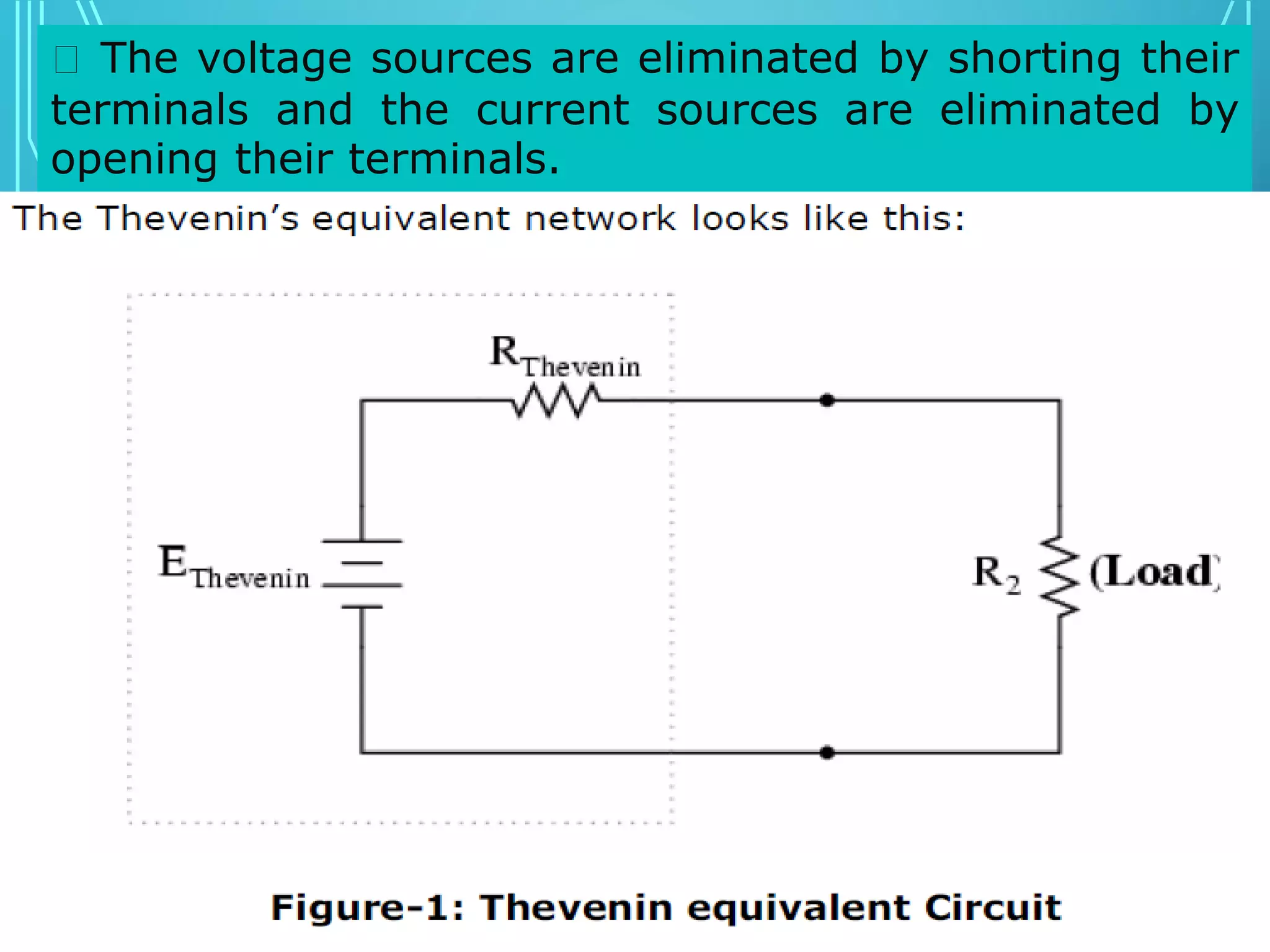
Thevenin's Theorem states that it is possible to
simplify any linear bilateral circuit, having a number
of sources of energy, to an equivalent circuit with just
a single voltage source (VTH) in series with a single
resistor (RTH) which is connected to a load (RL)
where the value of the voltage source (VTH) is equal
to the open circuit voltage across the two terminals
of the network, and resistance (RTH) is equal to the
equivalent resistance measured between the
terminals with all the energy sources eliminated.
The voltage sources are eliminated by shorting their
terminals and the current sources are eliminated by
opening their terminals.
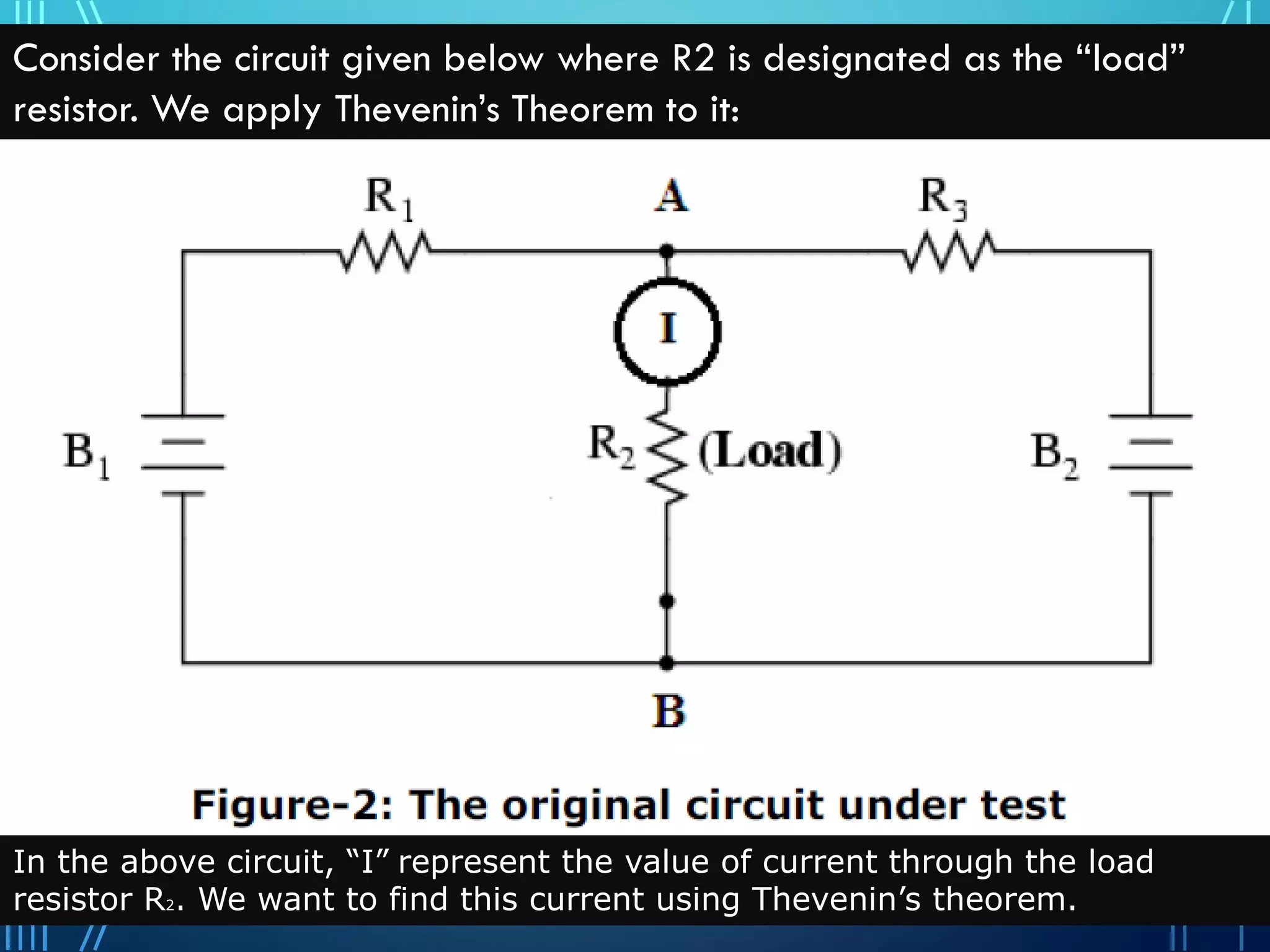
Consider the circuit given below where R2 is designated as the “load”
resistor. We apply Thevenin’s Theorem to it:
In the above circuit, “I” represent the value of current through the load
resistor R2. We want to find this current using Thevenin’s theorem.
To find the current I through the load resistor R2,
just follow the steps below:
by Tajim 9
by Tajim 10
by Tajim 11
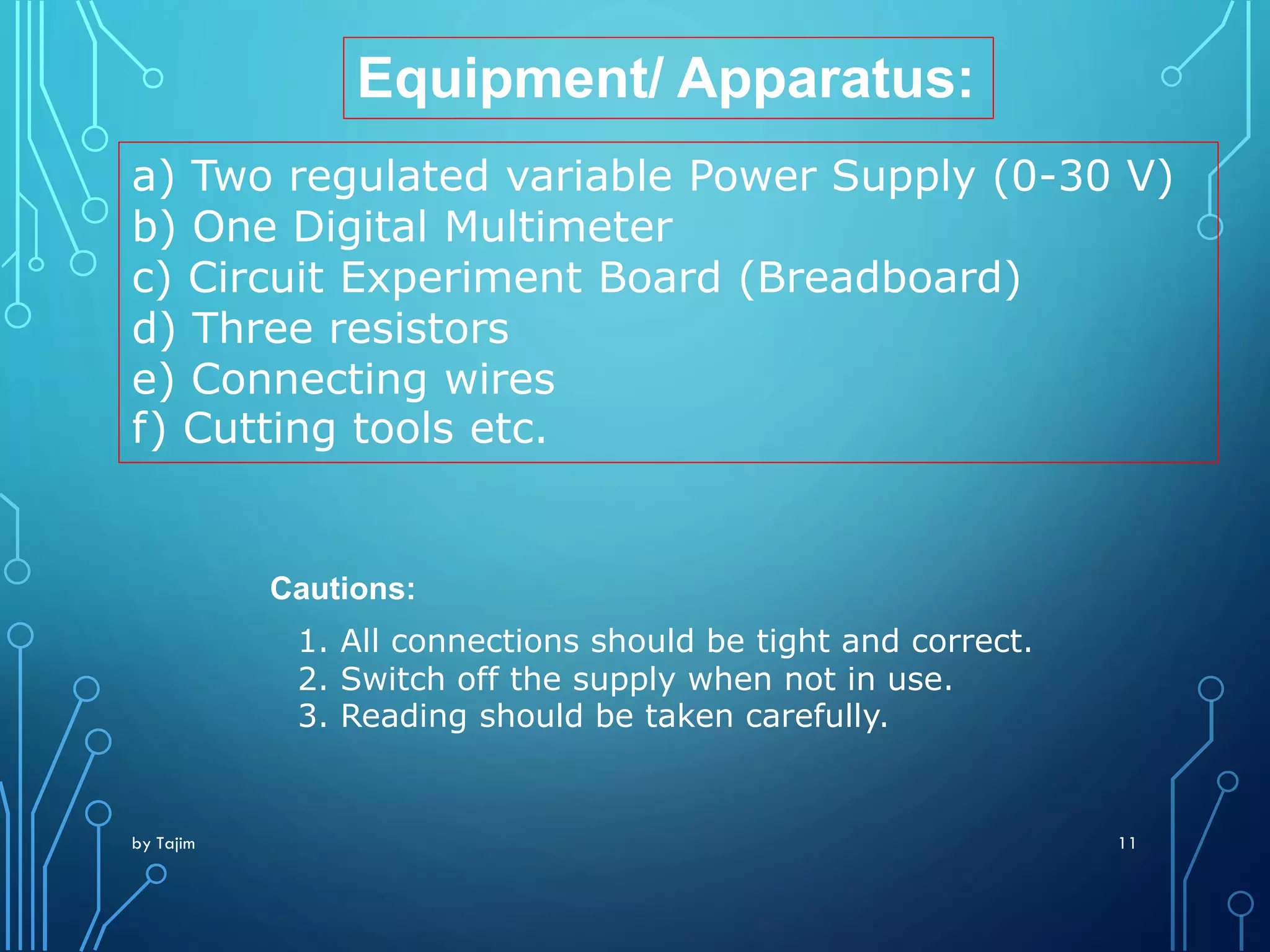
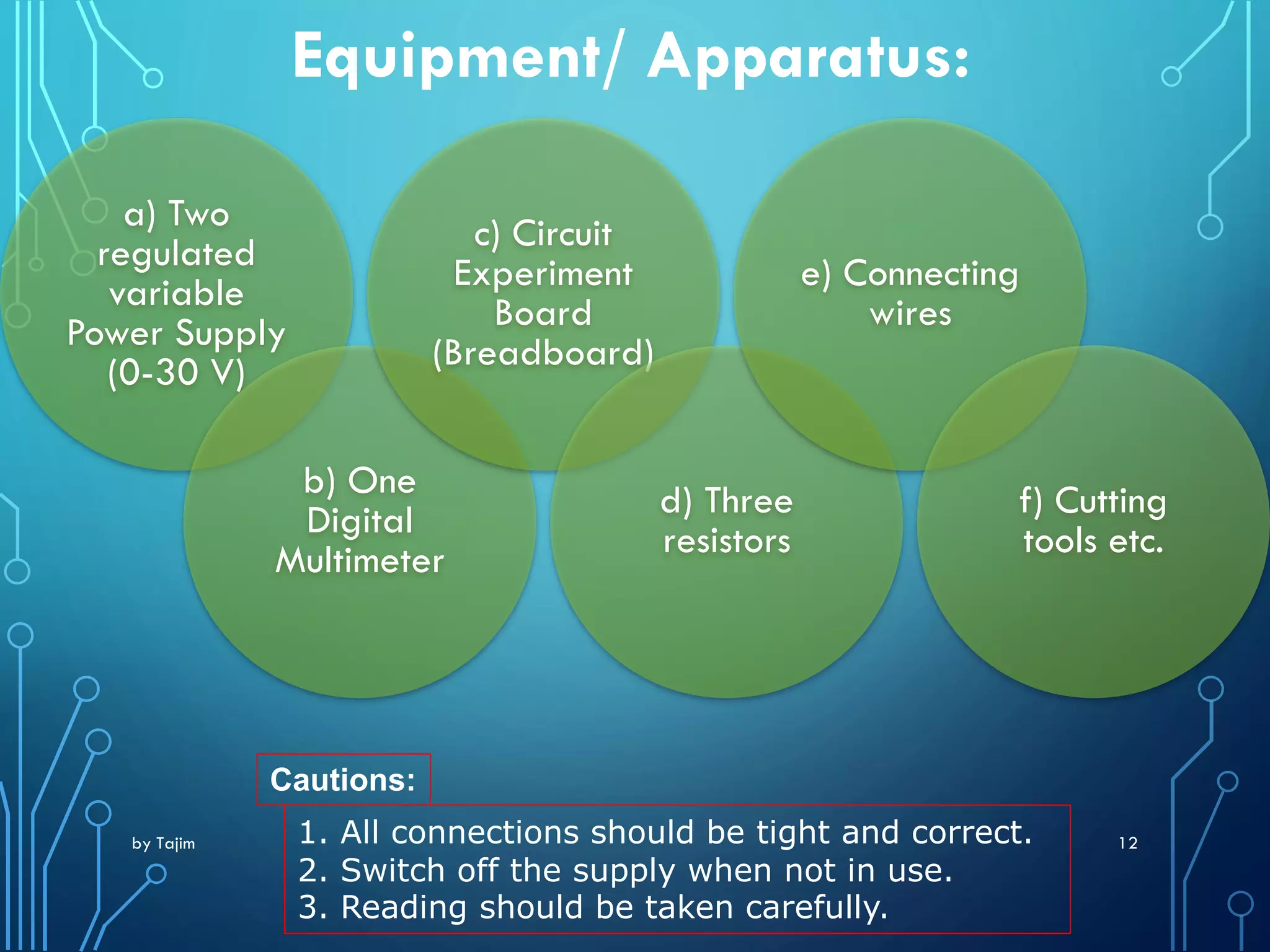
Equipment/ Apparatus:
a) Two regulated variable Power Supply (0-30 V)
b) One Digital Multimeter
c) Circuit Experiment Board (Breadboard)
d) Three resistors
e) Connecting wires
f) Cutting tools etc.
Cautions:
1. All connections should be tight and correct.
2. Switch off the supply when not in use.
3. Reading should be taken carefully.
by Tajim 12
Equipment/ Apparatus:
a) Two
regulated
variable
Power Supply
(0-30 V)
b) One
Digital
Multimeter
c) Circuit
Experiment
Board
(Breadboard)
d) Three
resistors
e) Connecting
wires
f) Cutting
tools etc.
Cautions:
1. All connections should be tight and correct.
2. Switch off the supply when not in use.
3. Reading should be taken carefully.
13
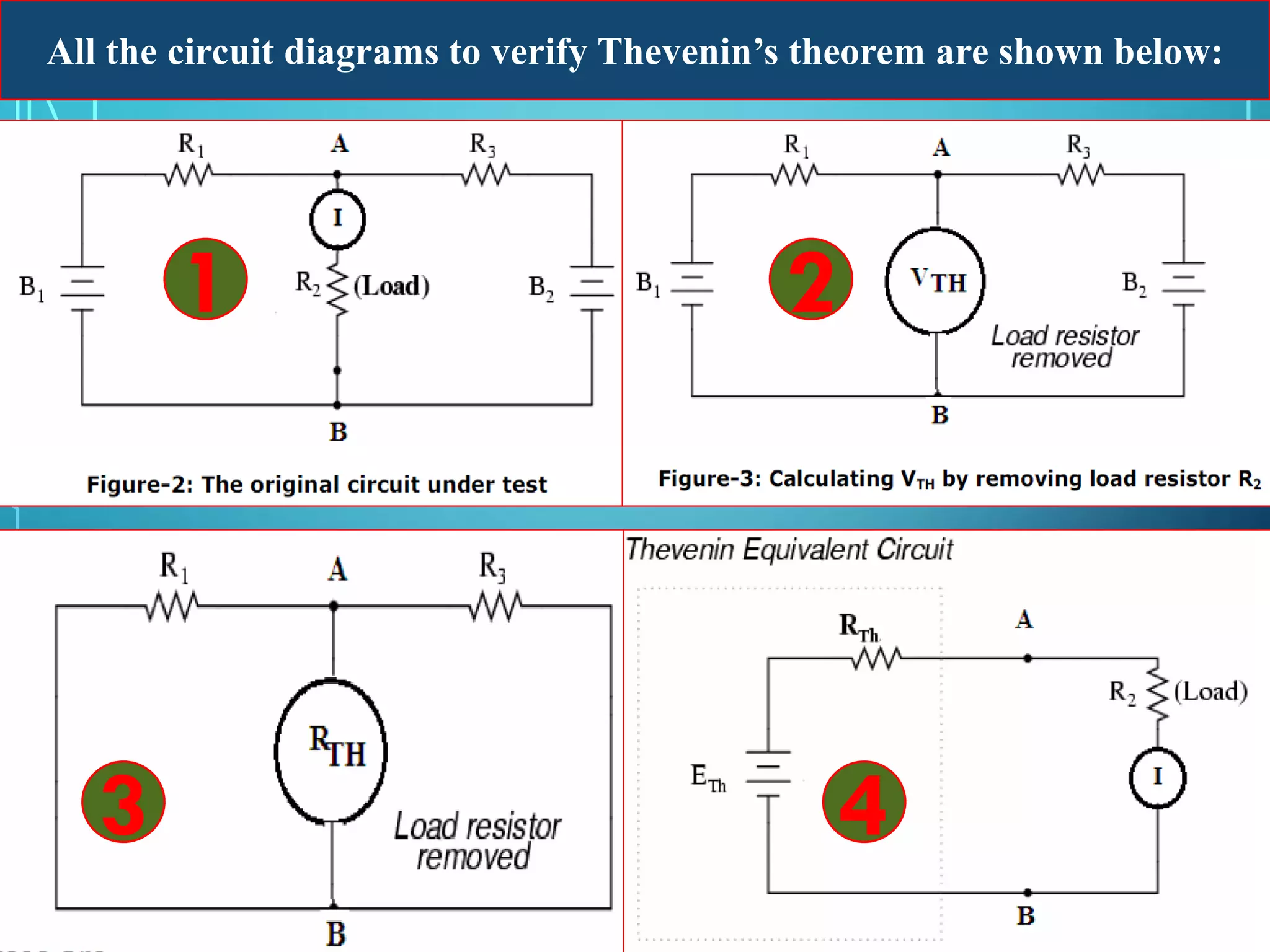
All the circuit diagrams to verify Thevenin’s theorem are shown below:
1 2
3 4
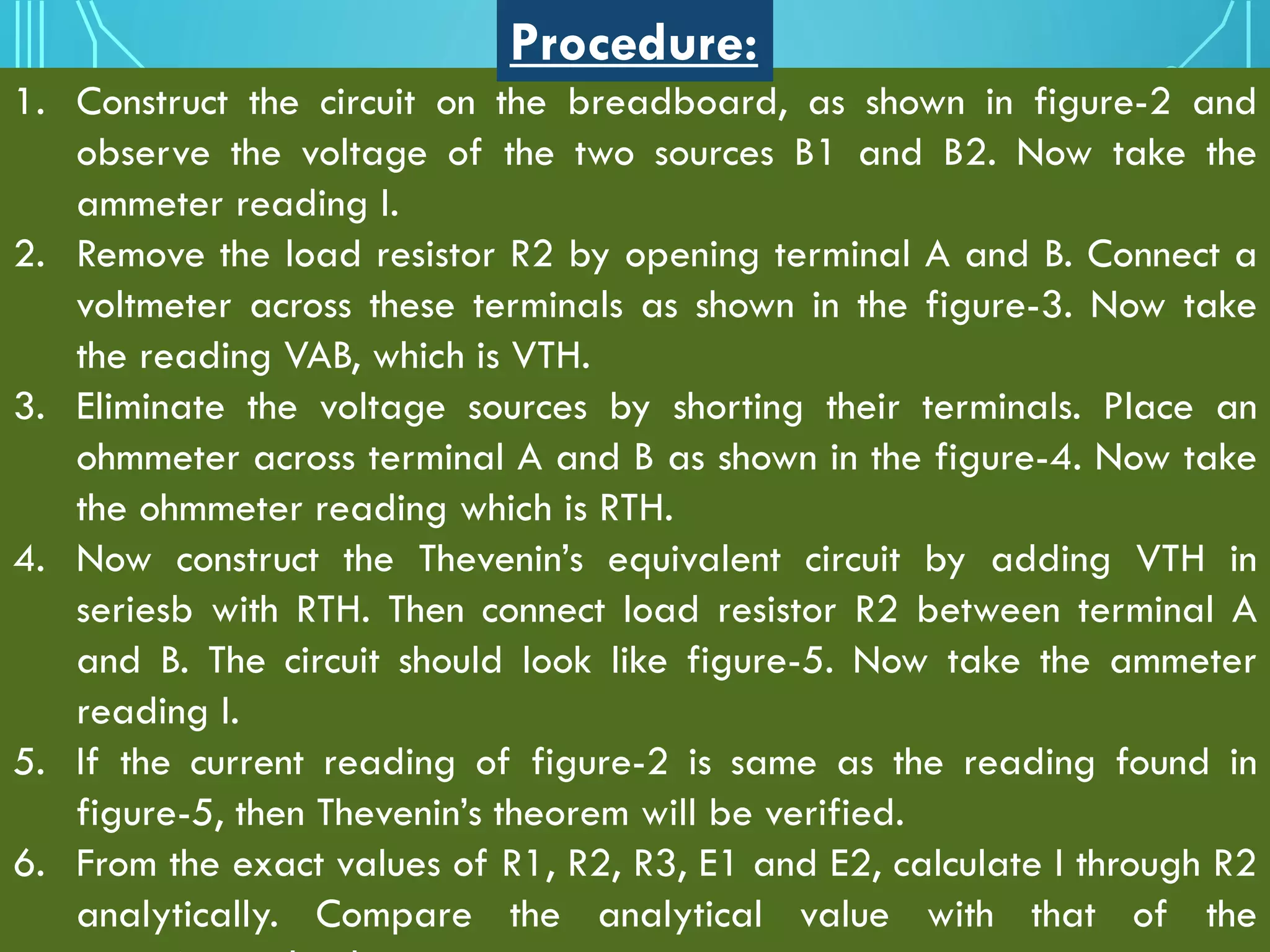
1. Construct the circuit on the breadboard, as shown in figure-2 and
observe the voltage of the two sources B1 and B2. Now take the
ammeter reading I.
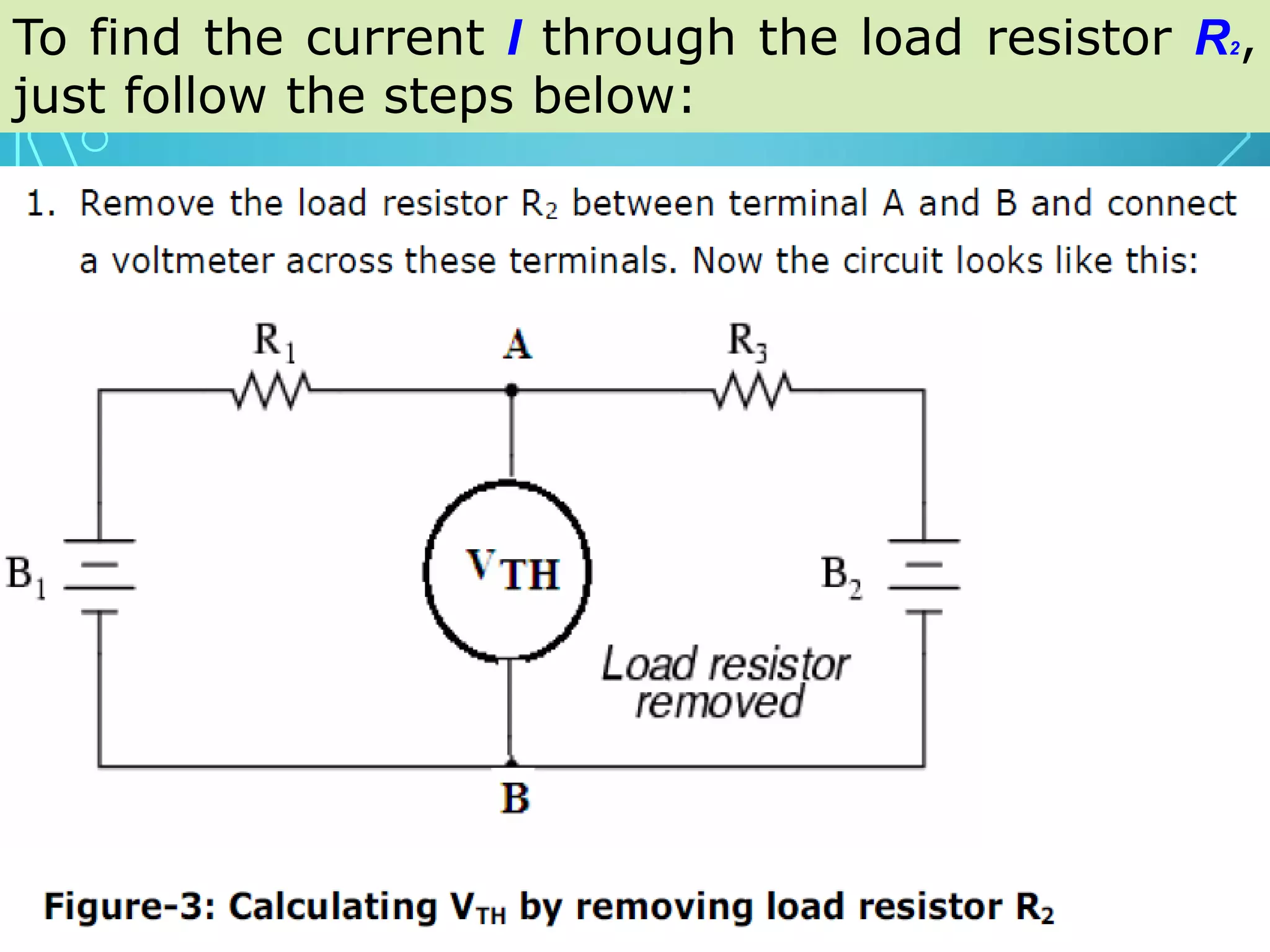
2. Remove the load resistor R2 by opening terminal A and B. Connect a
voltmeter across these terminals as shown in the figure-3. Now take
the reading VAB, which is VTH.
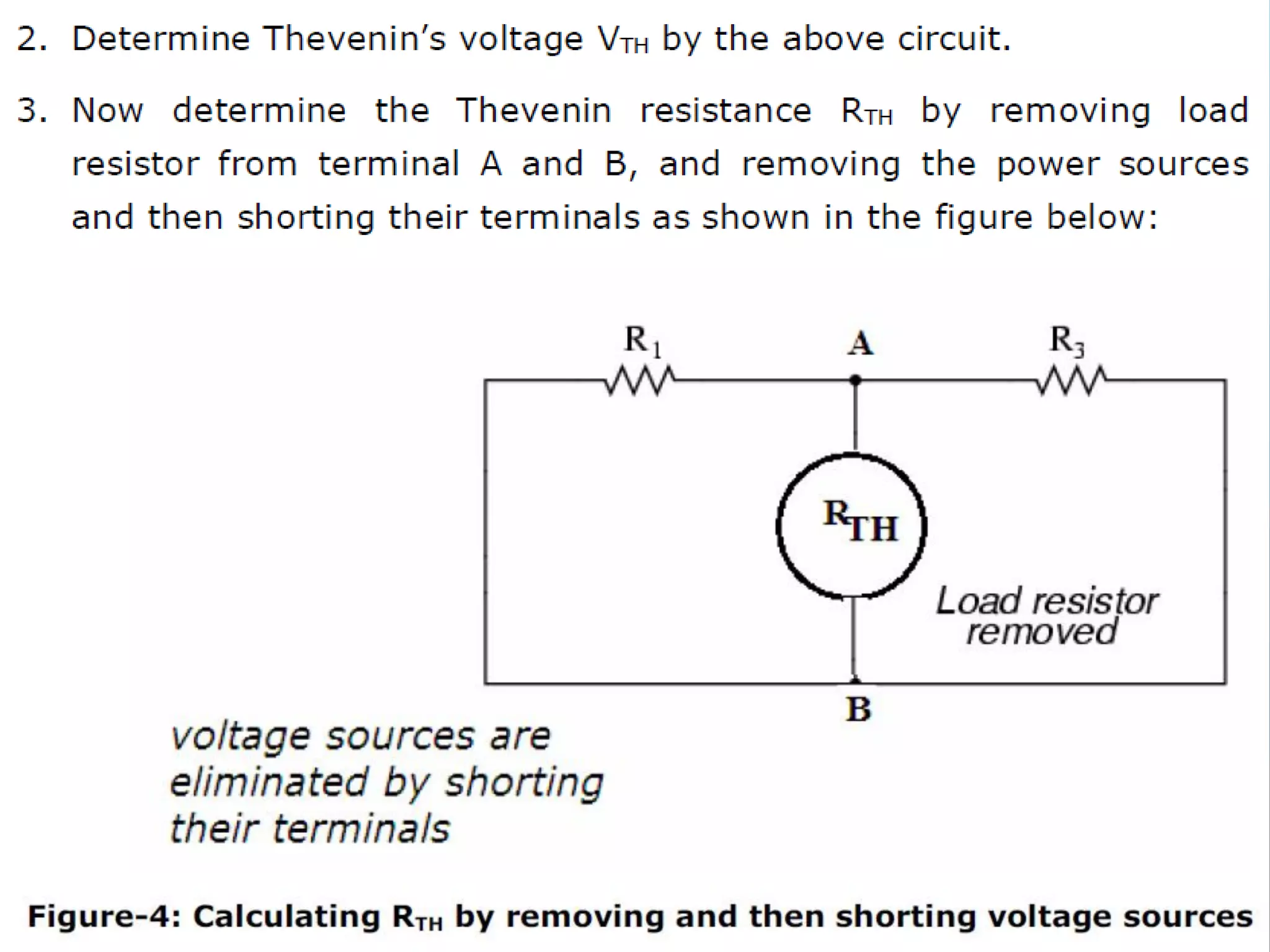
3. Eliminate the voltage sources by shorting their terminals. Place an
ohmmeter across terminal A and B as shown in the figure-4. Now take
the ohmmeter reading which is RTH.
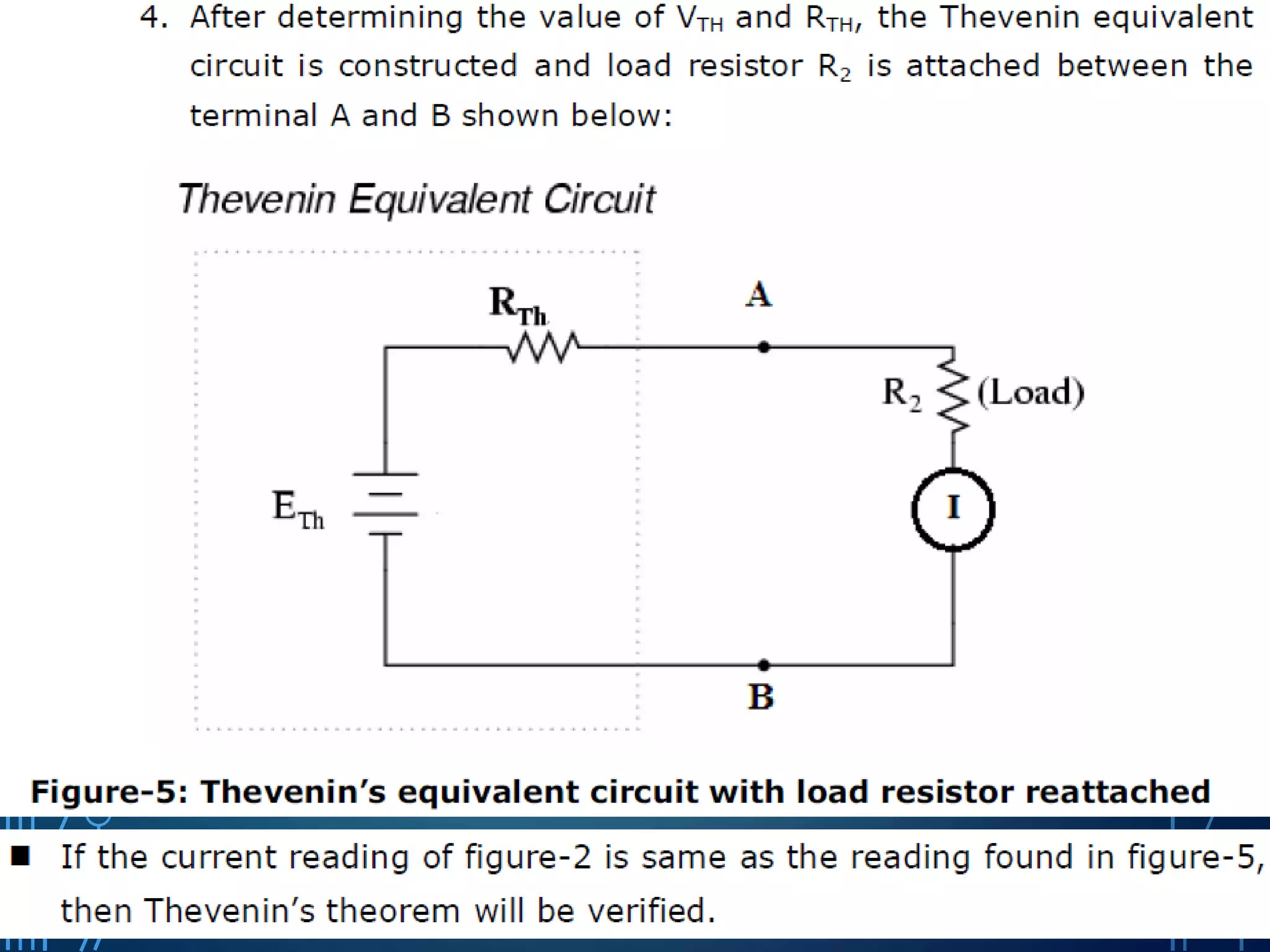
4. Now construct the Thevenin’s equivalent circuit by adding VTH in
seriesb with RTH. Then connect load resistor R2 between terminal A
and B. The circuit should look like figure-5. Now take the ammeter
reading I.
5. If the current reading of figure-2 is same as the reading found in
figure-5, then Thevenin’s theorem will be verified.
6. From the exact values of R1, R2, R3, E1 and E2, calculate I through R2
analytically. Compare the analytical value with that of the
Procedure:
by Tajim 15
LAB Report
1. LAB report must
be hand written.
2. Report on today’s
LAB must be
submitted on next
class individually.
3. LAB report will
contain: topic, brief
description of the
topic, circuit
diagram, procedure,
data table,
equipment list and
graph.
by Tajim
16
by Tajim 17

Circuit lab 8 verification of thevenin's theorem@taj

  • 1.
    Electronic Devices and CircuitsLAB (IT-1106) by Tajim 1
  • 2.
    Circuit LAB 8: Verificationof Thevenin's Theorem Experiment 8 by Tajim 2
  • 3.
    by Tajim 3 Purpose/Objective Theaim of this experiment is- To be familiar with the Thevenin’s theorem and also to verify it. To know about its applicability.
  • 4.
    by Tajim 4 Whatis linear and bilateral circuit? Linear Circuit: A circuit consisting of LINEAR ELEMENTS such as Resistor, Inductor and Capacitor(R, L and C) is called a linear circuit. Here the components can be reduced into source and an impedance. Diodes and Transistors have varying impedances. They are non linear. [Electrical impedance is the amount of opposition that a circuit presents to current or voltage change.] Bilateral Network: A circuit or network in which the magnitude of current remains constant when the polarity of source is reversed is called bilateral network.
  • 5.
    by Tajim 5 Theory(Thevenin’s Theorem) Thevenin's Theorem states that it is possible to simplify any linear bilateral circuit, having a number of sources of energy, to an equivalent circuit with just a single voltage source (VTH) in series with a single resistor (RTH) which is connected to a load (RL) where the value of the voltage source (VTH) is equal to the open circuit voltage across the two terminals of the network, and resistance (RTH) is equal to the equivalent resistance measured between the terminals with all the energy sources eliminated.
  • 6.
    The voltage sourcesare eliminated by shorting their terminals and the current sources are eliminated by opening their terminals.
  • 7.
    Consider the circuitgiven below where R2 is designated as the “load” resistor. We apply Thevenin’s Theorem to it: In the above circuit, “I” represent the value of current through the load resistor R2. We want to find this current using Thevenin’s theorem.
  • 8.
    To find thecurrent I through the load resistor R2, just follow the steps below:
  • 9.
  • 10.
  • 11.
    by Tajim 11 Equipment/Apparatus: a) Two regulated variable Power Supply (0-30 V) b) One Digital Multimeter c) Circuit Experiment Board (Breadboard) d) Three resistors e) Connecting wires f) Cutting tools etc. Cautions: 1. All connections should be tight and correct. 2. Switch off the supply when not in use. 3. Reading should be taken carefully.
  • 12.
    by Tajim 12 Equipment/Apparatus: a) Two regulated variable Power Supply (0-30 V) b) One Digital Multimeter c) Circuit Experiment Board (Breadboard) d) Three resistors e) Connecting wires f) Cutting tools etc. Cautions: 1. All connections should be tight and correct. 2. Switch off the supply when not in use. 3. Reading should be taken carefully.
  • 13.
    13 All the circuitdiagrams to verify Thevenin’s theorem are shown below: 1 2 3 4
  • 14.
    1. Construct thecircuit on the breadboard, as shown in figure-2 and observe the voltage of the two sources B1 and B2. Now take the ammeter reading I. 2. Remove the load resistor R2 by opening terminal A and B. Connect a voltmeter across these terminals as shown in the figure-3. Now take the reading VAB, which is VTH. 3. Eliminate the voltage sources by shorting their terminals. Place an ohmmeter across terminal A and B as shown in the figure-4. Now take the ohmmeter reading which is RTH. 4. Now construct the Thevenin’s equivalent circuit by adding VTH in seriesb with RTH. Then connect load resistor R2 between terminal A and B. The circuit should look like figure-5. Now take the ammeter reading I. 5. If the current reading of figure-2 is same as the reading found in figure-5, then Thevenin’s theorem will be verified. 6. From the exact values of R1, R2, R3, E1 and E2, calculate I through R2 analytically. Compare the analytical value with that of the Procedure:
  • 15.
  • 16.
    LAB Report 1. LABreport must be hand written. 2. Report on today’s LAB must be submitted on next class individually. 3. LAB report will contain: topic, brief description of the topic, circuit diagram, procedure, data table, equipment list and graph. by Tajim 16
  • 17.