Chapter 17
Holders in Due Course,
Defenses, and Liabilities

17-1
Learning Objectives
1. State the characteristics of being a holder in due
course.
2. Describe the special protection given to a holder
in due course.
3. Define holder.
4. Explain the protection given to a holder through
a holder in due course.
5. Name six personal defenses.
17-2
Learning Objectives (cont.)
6. Discuss the protection given to people who sign
consumer credit contracts.
7. Name six real defenses and explain the
significance of a real defense.
8. Explain primary liability.
9. Explain secondary liability.
10.Describe the conditions that must be met to
hold a secondary party liable.
17-3
Holder in Due Course
Holder of an instrument if:
1. When issued or negotiated to the holder does not bear
such apparent evidence of forgery or alteration or is not
otherwise so irregular or incomplete as to call into
question its authenticity
2. A holder took the instrument:
– For value
– In good faith
– Without notice that anything is wrong with the
underlying transaction
17-4
Holder
• To be a holder in due course, a person must first
be a holder
• The instrument must have been issued or
indorsed to:
– that person
– that person’s order, or
– to bearer

17-5
Value
• Value must be given for an instrument for the
person to qualify as a holder in due course
– Giving the consideration agreed upon
– Accepting instruments as payment of debts

• Receiving an instrument as a gift disqualifies one
from being a holder in due course

17-6
Good Faith
• Holder must take the instrument in good faith
– Honesty in fact and fair dealing
– Requires that the taker of a commercial instrument
act honestly

• Negligence (not discovering defects with the
instrument) will not necessarily destroy good
faith

17-7
Without Notice
• Holder must not have:
– Notice of any claim or defense to an instrument
• Visible evidence of forgery/alteration
• Instrument is incomplete or irregular to the point that it’s
legal acceptance would be cast into doubt
• Knowledge that the obligation of any party is voidable

– Notice that an instrument is overdue or has been
dishonored
• Ex: more than a reasonable amount of time has passed
since it was issued (~90 days for a check)

17-8
Holder Through a Holder in Due Course
• Shelter provision
– A holder who receives an instrument from a holder in
due course acquires the rights of the holder in due
course, even if he or she does not qualify as a holder
in due course
– Doesn’t apply to a holder who has committed fraud or
an illegal act

• Designed to permit holders in due course to
transfer all of the rights they have in the paper to
others.
17-9
Personal Defenses
• Holders in due course take instruments free
from all personal defenses of any party with
whom they have not dealt
• Personal Defenses (limited defenses)
– defenses that can be used against a holder but not a
holder in due course of a negotiable instrument.
Frank Abignale's warning (pdf)
Frank Abignale’s warning (html)
17-10
Personal Defenses

17-11
Personal Defenses
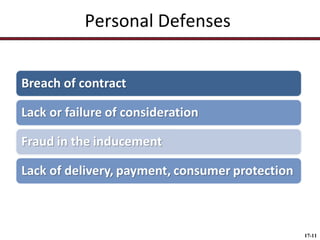
• Breach of contract
– The party to whom the instrument was issued
breaches the contract by failing to perform or by
performing in an unsatisfactory manner
– May not be used against a holder in due course unless
the parties dealt with each other

17-13
Personal Defenses
• Lack of consideration
– No consideration existed in the underlying contract
for which the instrument was issued

• Failure of consideration
– The other party breaches the contract by not
furnishing the agreed consideration

17-14
Personal Defenses
• Fraud in the Inducement
– Someone is induced by a fraudulent statement to
enter into a contract

• Lack of delivery
– Commercial instruments may be revoked by their
maker or drawer until they have been delivered to the
payee
– If a payee takes an instrument forcibly, unlawfully, or
conditionally, defense of lack of delivery may be used,
but not against holder in due course
17-15
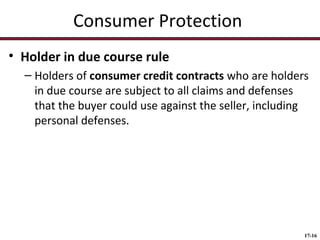
Consumer Protection
• Holder in due course rule
– Holders of consumer credit contracts who are holders
in due course are subject to all claims and defenses
that the buyer could use against the seller, including
personal defenses.

17-16
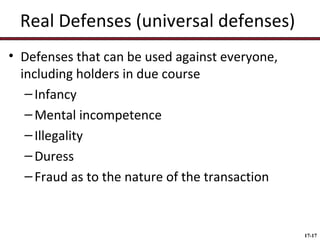
Real Defenses (universal defenses)
• Defenses that can be used against everyone,
including holders in due course
– Infancy
– Mental incompetence
– Illegality
– Duress
– Fraud as to the nature of the transaction

17-17
Real Defenses
• Infancy and Mental Incompetence
– The maker or drawer of the instrument was a minor
or mentally incompetent.

• Illegality
– The underlying contract for which the instrument was
issued was illegal.

17-19
Real Defenses
• Duress
– The instrument was drawn against the will of the
maker or drawer because of threats of force or bodily
harm.

• Bankruptcy
– An order for relief was issued by the federal court
that ended all the debtor’s outstanding contractual
obligations.

17-20
Real Defenses
• Unauthorized signature
– Someone wrongfully signed another’s name on an
instrument without authority to do so.

• Material alteration
– The amount of the instrument or the payee’s name
was changed wrongfully after it was originally drawn
by the maker or drawer.

17-21
Liability of the Parties
• No person is liable on an instrument unless that
person’s signature or the signature of an
authorized agent appears on the instrument.
• Parties’ liability depends on their function.

17-22
Makers, Acceptors, and Certain Drawers
The following are obligated to pay an instrument
without reservations of any kind:
• The maker of a note
• The issuer of a cashier’s check or other draft in
which the drawer and the drawee are the same
person
• The acceptor of a draft

17-23
Other Drawers and Indorsers
Obligated to pay an instrument only when three
conditions are met:
1. The instrument is properly presented to the
drawee or party obliged to pay the instrument,
and payment is demanded
2. The instrument is dishonored
3. Notice of the dishonor is given to the secondary
party

17-24
Other Drawers and Indorsers
• Presentment
– Demand made by a holder to pay or accept an
instrument
– May be made by any commercially reasonable means

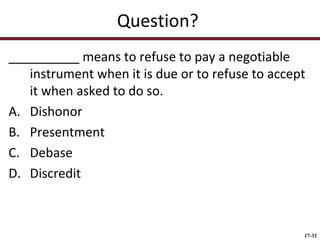
• Dishonor
– Refusal to pay or accept a negotiable instrument
when proper presentment is made

17-25
Notice of Dishonor
• May be given by any reasonable means
• Sufficient if it reasonably identifies the instrument
and indicates that it has been dishonored
• Nonbank holders
– Must give notice within 30 days after the day of
dishonor

• Bank holders
– Must give notice before midnight of the day after
which it was notified of the dishonor
17-26
Question?
A holder in _________ is a holder who takes an
instrument for value and in good faith.
A. Good course
B. Due faith
C. Due course
D. Due coarse

17-27
Question?
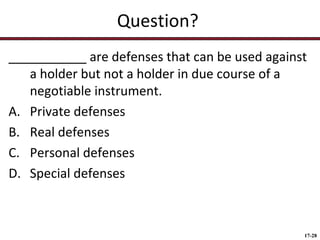
___________ are defenses that can be used against
a holder but not a holder in due course of a
negotiable instrument.
A. Private defenses
B. Real defenses
C. Personal defenses
D. Special defenses

17-28
Question?
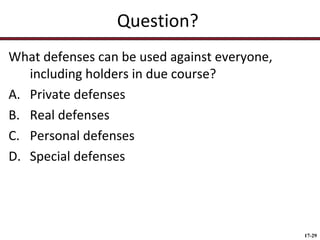
What defenses can be used against everyone,
including holders in due course?
A. Private defenses
B. Real defenses
C. Personal defenses
D. Special defenses

17-29
Question?
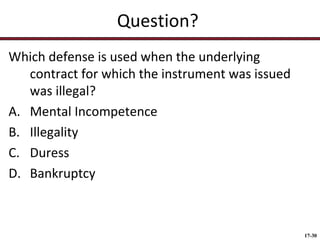
Which defense is used when the underlying
contract for which the instrument was issued
was illegal?
A. Mental Incompetence
B. Illegality
C. Duress
D. Bankruptcy

17-30
Question?
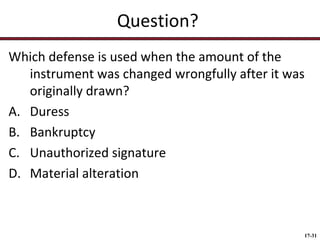
Which defense is used when the amount of the
instrument was changed wrongfully after it was
originally drawn?
A. Duress
B. Bankruptcy
C. Unauthorized signature
D. Material alteration

17-31
Question?
__________ means to refuse to pay a negotiable
instrument when it is due or to refuse to accept
it when asked to do so.
A. Dishonor
B. Presentment
C. Debase
D. Discredit

17-32

BUS 116 Chap017 holders in due couse

  • 1.
    Chapter 17 Holders inDue Course, Defenses, and Liabilities 17-1
  • 2.
    Learning Objectives 1. Statethe characteristics of being a holder in due course. 2. Describe the special protection given to a holder in due course. 3. Define holder. 4. Explain the protection given to a holder through a holder in due course. 5. Name six personal defenses. 17-2
  • 3.
    Learning Objectives (cont.) 6.Discuss the protection given to people who sign consumer credit contracts. 7. Name six real defenses and explain the significance of a real defense. 8. Explain primary liability. 9. Explain secondary liability. 10.Describe the conditions that must be met to hold a secondary party liable. 17-3
  • 4.
    Holder in DueCourse Holder of an instrument if: 1. When issued or negotiated to the holder does not bear such apparent evidence of forgery or alteration or is not otherwise so irregular or incomplete as to call into question its authenticity 2. A holder took the instrument: – For value – In good faith – Without notice that anything is wrong with the underlying transaction 17-4
  • 5.
    Holder • To bea holder in due course, a person must first be a holder • The instrument must have been issued or indorsed to: – that person – that person’s order, or – to bearer 17-5
  • 6.
    Value • Value mustbe given for an instrument for the person to qualify as a holder in due course – Giving the consideration agreed upon – Accepting instruments as payment of debts • Receiving an instrument as a gift disqualifies one from being a holder in due course 17-6
  • 7.
    Good Faith • Holdermust take the instrument in good faith – Honesty in fact and fair dealing – Requires that the taker of a commercial instrument act honestly • Negligence (not discovering defects with the instrument) will not necessarily destroy good faith 17-7
  • 8.
    Without Notice • Holdermust not have: – Notice of any claim or defense to an instrument • Visible evidence of forgery/alteration • Instrument is incomplete or irregular to the point that it’s legal acceptance would be cast into doubt • Knowledge that the obligation of any party is voidable – Notice that an instrument is overdue or has been dishonored • Ex: more than a reasonable amount of time has passed since it was issued (~90 days for a check) 17-8
  • 9.
    Holder Through aHolder in Due Course • Shelter provision – A holder who receives an instrument from a holder in due course acquires the rights of the holder in due course, even if he or she does not qualify as a holder in due course – Doesn’t apply to a holder who has committed fraud or an illegal act • Designed to permit holders in due course to transfer all of the rights they have in the paper to others. 17-9
  • 10.
    Personal Defenses • Holdersin due course take instruments free from all personal defenses of any party with whom they have not dealt • Personal Defenses (limited defenses) – defenses that can be used against a holder but not a holder in due course of a negotiable instrument. Frank Abignale's warning (pdf) Frank Abignale’s warning (html) 17-10
  • 11.
  • 12.
    Personal Defenses • Breachof contract – The party to whom the instrument was issued breaches the contract by failing to perform or by performing in an unsatisfactory manner – May not be used against a holder in due course unless the parties dealt with each other 17-13
  • 13.
    Personal Defenses • Lackof consideration – No consideration existed in the underlying contract for which the instrument was issued • Failure of consideration – The other party breaches the contract by not furnishing the agreed consideration 17-14
  • 14.
    Personal Defenses • Fraudin the Inducement – Someone is induced by a fraudulent statement to enter into a contract • Lack of delivery – Commercial instruments may be revoked by their maker or drawer until they have been delivered to the payee – If a payee takes an instrument forcibly, unlawfully, or conditionally, defense of lack of delivery may be used, but not against holder in due course 17-15
  • 15.
    Consumer Protection • Holderin due course rule – Holders of consumer credit contracts who are holders in due course are subject to all claims and defenses that the buyer could use against the seller, including personal defenses. 17-16
  • 16.
    Real Defenses (universaldefenses) • Defenses that can be used against everyone, including holders in due course – Infancy – Mental incompetence – Illegality – Duress – Fraud as to the nature of the transaction 17-17
  • 17.
    Real Defenses • Infancyand Mental Incompetence – The maker or drawer of the instrument was a minor or mentally incompetent. • Illegality – The underlying contract for which the instrument was issued was illegal. 17-19
  • 18.
    Real Defenses • Duress –The instrument was drawn against the will of the maker or drawer because of threats of force or bodily harm. • Bankruptcy – An order for relief was issued by the federal court that ended all the debtor’s outstanding contractual obligations. 17-20
  • 19.
    Real Defenses • Unauthorizedsignature – Someone wrongfully signed another’s name on an instrument without authority to do so. • Material alteration – The amount of the instrument or the payee’s name was changed wrongfully after it was originally drawn by the maker or drawer. 17-21
  • 20.
    Liability of theParties • No person is liable on an instrument unless that person’s signature or the signature of an authorized agent appears on the instrument. • Parties’ liability depends on their function. 17-22
  • 21.
    Makers, Acceptors, andCertain Drawers The following are obligated to pay an instrument without reservations of any kind: • The maker of a note • The issuer of a cashier’s check or other draft in which the drawer and the drawee are the same person • The acceptor of a draft 17-23
  • 22.
    Other Drawers andIndorsers Obligated to pay an instrument only when three conditions are met: 1. The instrument is properly presented to the drawee or party obliged to pay the instrument, and payment is demanded 2. The instrument is dishonored 3. Notice of the dishonor is given to the secondary party 17-24
  • 23.
    Other Drawers andIndorsers • Presentment – Demand made by a holder to pay or accept an instrument – May be made by any commercially reasonable means • Dishonor – Refusal to pay or accept a negotiable instrument when proper presentment is made 17-25
  • 24.
    Notice of Dishonor •May be given by any reasonable means • Sufficient if it reasonably identifies the instrument and indicates that it has been dishonored • Nonbank holders – Must give notice within 30 days after the day of dishonor • Bank holders – Must give notice before midnight of the day after which it was notified of the dishonor 17-26
  • 25.
    Question? A holder in_________ is a holder who takes an instrument for value and in good faith. A. Good course B. Due faith C. Due course D. Due coarse 17-27
  • 26.
    Question? ___________ are defensesthat can be used against a holder but not a holder in due course of a negotiable instrument. A. Private defenses B. Real defenses C. Personal defenses D. Special defenses 17-28
  • 27.
    Question? What defenses canbe used against everyone, including holders in due course? A. Private defenses B. Real defenses C. Personal defenses D. Special defenses 17-29
  • 28.
    Question? Which defense isused when the underlying contract for which the instrument was issued was illegal? A. Mental Incompetence B. Illegality C. Duress D. Bankruptcy 17-30
  • 29.
    Question? Which defense isused when the amount of the instrument was changed wrongfully after it was originally drawn? A. Duress B. Bankruptcy C. Unauthorized signature D. Material alteration 17-31
  • 30.
    Question? __________ means torefuse to pay a negotiable instrument when it is due or to refuse to accept it when asked to do so. A. Dishonor B. Presentment C. Debase D. Discredit 17-32

Editor's Notes

  • #5 A basic principle of contract law is that people cannot transfer greater rights than they have themselves. This rule, however, does not apply to the law of negotiable instruments. People who are holders in due course of negotiable instruments can receive even more rights than those who held the instruments before them. Largely for this reason, negotiable instruments are used frequently and passed liberally from one person to another.
  • #6 Teaching Tips Emphasize the importance of the holder in due course concept in the law of negotiable instruments. Discuss with the class the various problems financial institutions would encounter if there were no holder in due course rules.
  • #8 Background Information Courts of “equity,” or fairness, which developed in medieval England, coexisted with common law courts in the United States until the late 1800s. It was in the courts of equity that such maxims as, “He who seeks equity must do equity” and “He who seeks equity must have clean hands,” were developed as precedents.
  • #10 A holder who receives an instrument from a holder in due course acquires the rights of the holder in due course, even though he or she does not qualify as a holder in due course. This stipulation is called a shelter provision. It is designed to permit holders in due course to transfer all of the rights they have in the paper to others. The shelter provision does not apply to a holder who has committed fraud or an illegal act.
  • #11 The favorable treatment that holders in due course receive ensures that they take instruments free from all claims to them on the part of any person and free from all personal defenses of any party with whom they have not dealt.
  • #12 Getting Students Involved Discuss whether a holder in due course should have real defenses for failure of consideration and breach of contract. Remind students that a holder in due course may have obtained the negotiable instrument in question from another holder in due course and not from the maker
  • #14 Negotiable instruments are often issued in exchange for property, services, or some other obligation as part of an underlying contract. Sometimes, the party to whom the instrument was issued breaches the contract by failing to perform or by performing in an unsatisfactory manner. If suit is brought on the instrument by a holder against the maker or drawer, the latter may use breach of contract as a defense. Because breach of contract is a personal defense however, it may not be used if the holder of the instrument is a holder in due course unless the parties dealt with each other.
  • #15 Both lack of consideration and failure of consideration are personal defenses. They may not be used against a holder in due course.
  • #16 When someone is induced by a fraudulent statement to enter into a contract, that person may have the contract rescinded. However, he or she may not use that defense against a holder in due course. A holder in due course can cut through the defense of fraud in the inducement and collect from the person who was defrauded.
  • #17 Getting Students Involved Ask for a volunteer to contact the local/state Consumer Protection Agency to find out the kinds of protections available to consumers with respect to holders in due course.
  • #18 Teaching Tips Have students recall the different elements of a contract, and remind them if one required element is missing, the contract is invalid. Then discuss how real defenses are similar, in that if one is present, it will void a negotiable instrument.
  • #20 A minor (person under the age of 18 years) or mental incompetent need not honor a negotiable instrument if it was given in payment for a contract that the minor or mental incompetent may disaffirm on the grounds of minority or incompetency. This rule is true even if the instrument comes into the hands of a holder in due course. Similarly, persons who have been found insane by a court are not liable on a negotiable instrument, because their contracts are void.
  • #21 Terms Legally, the term duress refers to any conduct that deprives a victim of free will. All transactions entered into under such conditions are legally voidable by the victim. Duress comes from the Latin word meaning hard. Bankruptcy may be used as a defense to all negotiable instruments, even those in the hands of a holder in due course. Holders of such instruments will receive treatment equal to that of other similar creditors when the debtor’s assets are collected and divided according to the bankruptcy law.
  • #22 Usually, the alteration involves changing the payee’s name or increasing the amount of an instrument. The alteration of an instrument may be used as a real defense. Unless an instrument is written negligently so that it can be easily altered, makers and drawers are not required to pay altered amounts. They must pay only the amount for which the instrument was originally written.
  • #23 Terms Liable is related to the term ligature, which refers to something that is used to bind two things together.
  • #24 Cross-Cultural Notes In Mexico, a check must be presented for payment within 15 days of issuance. After 15 days, the drawer cannot be held liable. For checks that are made payable in different towns, the time limit is extended to 30 days.
  • #25 Other drawers and indorsers have limitations on their obligation to pay an instrument. They are said to be secondarily, or conditionally, liable. The drawer of a draft that has not been accepted is obligated to pay the draft to anyone who is entitled to enforce it; however, if a bank accepts a draft, the drawer is discharged. If a drawee other than a bank accepts a draft and it is later dishonored, the obligation of the drawer is the same as an indorser stated here.
  • #26 Presentment may be made by any commercially reasonable means, including oral, written, or electronic communication. If requested by the person to whom presentment is made, the person making presentment must exhibit the instrument and provide identification. Dishonor also occurs when presentment is excused and the instrument is past due and unpaid. The presenting party has recourse against indorsers or other secondary parties after notice of dishonor has been given.
  • #28 The correct answer is “C” – due course. See next slide.
  • #29 The correct answer is “C” – personal defenses. See next slide.
  • #30 The correct answer is “B” – real defenses. See next slide.
  • #31 The correct answer is “B” – illegality. See next slide.
  • #32 The correct answer is “D” – Material alteration. See next slide.
  • #33 The correct answer is “A” – dishonor. See next slide.