Sole Proprietorships
and Partnerships
Chapter 25
2
Learning Objectives
1. List the most common forms of business associations.
2. Outline the advantages and disadvantages of a sole
proprietorship.
3. Identify the two model acts that govern partnership
law.
4. Describe the differences between the aggregate and
the entity theories of partnership.
5. Explain the nature of a partnership agreement.
3
Learning Objectives
6. Explain when profit sharing does not create a
partnership.
7. Explain what constitutes a person in partnership law.
8. Identify the different views of specific partnership
property in partnership law.
9. Distinguish between dissociation and dissolution in
partnership law.
10.Distinguish between a registered limited liability
partnership and a limited partnership.
4
Sole Proprietorships
• The easiest business organization to form
• Businesspeople can initiate a sole proprietorship by
simply opening their doors for business.
How to set up a sole prop in NC (NOLO)
Business Link NC
5
Sole Proprietorship - Advantages
1. Owner has complete control over the business.
2. Owner may keep all of the profits made by the sole
proprietorship.
3. A sole proprietorship is relatively simple to begin and
to end.
6
Sole Proprietorship - Disadvantages
1. The owner is subject to unlimited liability
2. The sole proprietorship’s existence depends entirely
upon the sole proprietor.
3. Owners often find it difficult to raise a lot of cash
quickly for expansion purposes.
7
Revised Uniform Partnership Act
• Revised Uniform Partnership Act
– clarifies the nature of a partner’s interest in
partnership property
– explains the duties partners have in relation to one
another
– gives partners the power to pursue a remedy when
those duties are violated
UPA/RUPA in NC statutes
8
Elements of a Partnership
• Partnership
–An association of two or more persons to
carry on as co-owners a business for profit
– A “person” can be natural or artificial
– A partnership must involve a sharing of profits
• Sharing of profits is considered prima facie evidence of the
existence of a partnership, but not all profit sharing qualifies
someone as a partner
9
Entity and Aggregate Theories
Under UPA, there was some debate about whether a
partnership was an entity or an aggregate
• Entity theory
– a partnership exists as an individual person with its own
separate identity
– This unique, individual entity is separate from the identities
of the partners
• Aggregate theory
– The partnership is seen simply as an assembly or collection
of the partners who do business together
10
Entity and Aggregate Theories
• RUPA has settled the debate
• Under RUPA, a partnership is an entity in most situations
• This means a partnership:
– Can own title to property
– Can sue and be sued
– Have it’s own separate bank accounts in its own name
– Has continuity of existence
• Can continue to operate even if original partners are no longer associated
with it
• However, partnerships are still considered an aggregate with
respect to liability
11
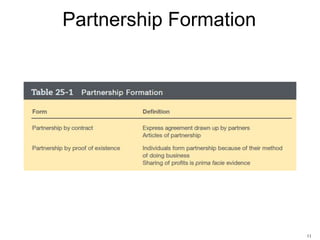
Partnership Formation
• Partnership by Contract
– Express agreement drawn up by partners
– Articles of partnership
• Partnership by Proof of Existence
– Individuals form partnership because of their
method of doing business
– Sharing of profits is prima facie evidence
12
Formation of a Partnership by Contract
• One of the most common ways to form a partnership is
by an express agreement between the parties.
• Although the agreement can be oral, it is generally best
to put the terms in writing to prevent misunderstanding
and disputes that might arise later in the life of the
partnership.
13
Formation of a Partnership by Proof of Existence
To show that a business is operating as a partnership by
proof of existence, we must be able to point to three
elements:
1. an association of two or more persons
2. who are co-owners of
3. a business for profit
14
Partnership Property Rights and Duties
• Property is an extremely critical element in partnership
law, because virtually every decision made by a partner
deals with the disposition of partnership property.
15
Partnership Property Rights and Duties
• Capital contributions
– sums that are contributed by the partners as
permanent investments and that the partners are
entitled to have returned when the partnership is
dissolved.
16
Partnership Property
• Partnership property
– any and all property that has been obtained by the
partnership itself.
• Has the partnership:
– included the property in its account books?
– expended its own funds to improve or repair the property?
– paid taxes on the property?
– paid other expenses, such as maintenance costs, for the
property?
17
Specific Partnership Property
• Under RUPA: A partner is not co-owner of partnership
property and has no interest in partnership property
which can be transferred, either voluntarily or
involuntarily.
• Partners will still be able to use partnership property.
– However, their right to hold and use such property is limited
to partnership purposes
18
Interest in the Partnership
The RUPA establishes that a partner has an interest in
the partnership as a firm that consists of two parts:
1. a transferable economic interest
– share of the profits and losses and his or her share of the
surplus
2. a nontransferable interest in management rights
19
Interest in the Partnership
• Surplus
– includes any funds that remain after the
partnership has been dissolved and all other debts
and prior obligations have been paid
20
Management of the Firm
• Silent partner
– one who does not participate in the day-today
business of the firm.
• Secret partner
– one whose identity and existence are not known
outside the firm but who nevertheless can
participate in the management of the firm.
• Junior/Senior
• Managing/Nonmanaging
21
Partnership Rights and Duties
• The rights to:
1. use partnership property, as long as the property is held and
used for partnership purposes
2. receive the partner’s share of the profits (and losses) and his
or her share of the surplus
3. manage the regular day-to-day operation of the partnership
business
4. approve of serious matters outside the ordinary course of
business
5. approve of amendments to the partnership agreement
22
Enforcement Rights
• The rights to:
1. see the firm’s financial records
2. compel an accounting
3. compel a dissolution of the entire partnership
4. under RUPA: sue (or be sued by) a partner to enforce
partnership rights
23
Partnership Duties
The RUPA notes that partners have three critical duties:
1. loyalty
2. obedience
3. due care
24
Partnership Duties
1. Loyalty
– To account to the partnership for any property, profits, or
benefit that comes from the partner’s use of partnership
property or from the winding up process after dissolution.
– To refrain from dealing with people who may have an
interest that is adverse to the best interests of the
partnership.
– To refrain from entering any competition with the
partnership in the operation of partnership business.
25
Partnership Duties
2. Obedience
– Follow the partnership agreement
– Honor decisions made by the partnership
– Assume liability for losses resulting from
disobedience
26
Partnership Duties
3. Due Care
– Partners must do their best in the business, based
on their talents, education, and abilities
– Mistakes are allowed, provided the partner acted
with ordinary skill and competence and in the best
interests of the partnership
27
Dissociation and Dissolution
• Dissociation
– when a partner is no longer associated with the
running of the firm
• Dissolution
– when a partner ceases to be associated with the
partnership and the partnership ends
28
Dissociation of a Partnership
Whether a partner’s leaving of a firm is wrongful can
depend on the type of partnership
• Term partnership
– one has been set up to run for a certain set time
period or to accomplish a task of some sort
• Partnership at will
– one that any partner may leave without liability
29
Dissolution of a Partnership
• Can occur by:
1. An Action by the Partners
2. By Operation of Law
3. By a Court Order
• Winding Up the Partnership Business
– When a partnership terminates – the sale of assets, payment
of creditors, distribution of remaining surplus
30
Registered Limited Liability Partnerships
• Considered a general partnership, but limits
the liability of partners
– Partners liable for their own wrongful acts and for
those of partners/employees under their direct
control
– BUT, no longer held jointly or severally liable for
actions of those not under their control
31
Limited Partnerships
• Limited partnership
– a partnership formed by two or more persons
having one or more general partners and one or
more limited partners
32
Limited Partnerships
• General partners
– take an active part in the management of the firm
and have unlimited liability for the firm’s debts
• Limited partners
– nonparticipating investors who contribute cash,
property, or services to the partnership but do not
take part in the management of the firm
– liability limited to what they invest in the company
33
Question?
• ____________ includes any funds that remain after the
partnership has been dissolved.
a) Surplus
b) Superfluous funds
c) Fed funds
d) Excess capital
34
Question?
What is an association of two or more persons to carry on
as co-owners a business for profit?
a) Firm
b) Enterprise
c) Partnership
d) Affiliation
35
Question?
What law explains the duties partners have in relation to
one another?
a) Revised Uniform Partnership Act
b) Partnership Act of 1957
c) Federal Partnership Act
d) Uniform Limited Liability Act
36
Question?
What type of partnership is one where any partner may
leave without liability?
a) Term partnership
b) Partnership at will
c) Limited partnership
d) Partnership ad hoc
37
Question?
What type of partner contributes cash or services to the
partnership but does not take part in the management of
the firm?
a) Silent partner
b) Secret partner
c) General partner
d) Limited partner
38
Question?
What are sums that are given by the partners as
permanent investments?
a) Capital improvements
b) Capital distributions
c) Capital contributions
d) Principal contributions

BUS 116 Chap025 sole props and partnerships

  • 1.
  • 2.
    2 Learning Objectives 1. Listthe most common forms of business associations. 2. Outline the advantages and disadvantages of a sole proprietorship. 3. Identify the two model acts that govern partnership law. 4. Describe the differences between the aggregate and the entity theories of partnership. 5. Explain the nature of a partnership agreement.
  • 3.
    3 Learning Objectives 6. Explainwhen profit sharing does not create a partnership. 7. Explain what constitutes a person in partnership law. 8. Identify the different views of specific partnership property in partnership law. 9. Distinguish between dissociation and dissolution in partnership law. 10.Distinguish between a registered limited liability partnership and a limited partnership.
  • 4.
    4 Sole Proprietorships • Theeasiest business organization to form • Businesspeople can initiate a sole proprietorship by simply opening their doors for business. How to set up a sole prop in NC (NOLO) Business Link NC
  • 5.
    5 Sole Proprietorship -Advantages 1. Owner has complete control over the business. 2. Owner may keep all of the profits made by the sole proprietorship. 3. A sole proprietorship is relatively simple to begin and to end.
  • 6.
    6 Sole Proprietorship -Disadvantages 1. The owner is subject to unlimited liability 2. The sole proprietorship’s existence depends entirely upon the sole proprietor. 3. Owners often find it difficult to raise a lot of cash quickly for expansion purposes.
  • 7.
    7 Revised Uniform PartnershipAct • Revised Uniform Partnership Act – clarifies the nature of a partner’s interest in partnership property – explains the duties partners have in relation to one another – gives partners the power to pursue a remedy when those duties are violated UPA/RUPA in NC statutes
  • 8.
    8 Elements of aPartnership • Partnership –An association of two or more persons to carry on as co-owners a business for profit – A “person” can be natural or artificial – A partnership must involve a sharing of profits • Sharing of profits is considered prima facie evidence of the existence of a partnership, but not all profit sharing qualifies someone as a partner
  • 9.
    9 Entity and AggregateTheories Under UPA, there was some debate about whether a partnership was an entity or an aggregate • Entity theory – a partnership exists as an individual person with its own separate identity – This unique, individual entity is separate from the identities of the partners • Aggregate theory – The partnership is seen simply as an assembly or collection of the partners who do business together
  • 10.
    10 Entity and AggregateTheories • RUPA has settled the debate • Under RUPA, a partnership is an entity in most situations • This means a partnership: – Can own title to property – Can sue and be sued – Have it’s own separate bank accounts in its own name – Has continuity of existence • Can continue to operate even if original partners are no longer associated with it • However, partnerships are still considered an aggregate with respect to liability
  • 11.
    11 Partnership Formation • Partnershipby Contract – Express agreement drawn up by partners – Articles of partnership • Partnership by Proof of Existence – Individuals form partnership because of their method of doing business – Sharing of profits is prima facie evidence
  • 12.
    12 Formation of aPartnership by Contract • One of the most common ways to form a partnership is by an express agreement between the parties. • Although the agreement can be oral, it is generally best to put the terms in writing to prevent misunderstanding and disputes that might arise later in the life of the partnership.
  • 13.
    13 Formation of aPartnership by Proof of Existence To show that a business is operating as a partnership by proof of existence, we must be able to point to three elements: 1. an association of two or more persons 2. who are co-owners of 3. a business for profit
  • 14.
    14 Partnership Property Rightsand Duties • Property is an extremely critical element in partnership law, because virtually every decision made by a partner deals with the disposition of partnership property.
  • 15.
    15 Partnership Property Rightsand Duties • Capital contributions – sums that are contributed by the partners as permanent investments and that the partners are entitled to have returned when the partnership is dissolved.
  • 16.
    16 Partnership Property • Partnershipproperty – any and all property that has been obtained by the partnership itself. • Has the partnership: – included the property in its account books? – expended its own funds to improve or repair the property? – paid taxes on the property? – paid other expenses, such as maintenance costs, for the property?
  • 17.
    17 Specific Partnership Property •Under RUPA: A partner is not co-owner of partnership property and has no interest in partnership property which can be transferred, either voluntarily or involuntarily. • Partners will still be able to use partnership property. – However, their right to hold and use such property is limited to partnership purposes
  • 18.
    18 Interest in thePartnership The RUPA establishes that a partner has an interest in the partnership as a firm that consists of two parts: 1. a transferable economic interest – share of the profits and losses and his or her share of the surplus 2. a nontransferable interest in management rights
  • 19.
    19 Interest in thePartnership • Surplus – includes any funds that remain after the partnership has been dissolved and all other debts and prior obligations have been paid
  • 20.
    20 Management of theFirm • Silent partner – one who does not participate in the day-today business of the firm. • Secret partner – one whose identity and existence are not known outside the firm but who nevertheless can participate in the management of the firm. • Junior/Senior • Managing/Nonmanaging
  • 21.
    21 Partnership Rights andDuties • The rights to: 1. use partnership property, as long as the property is held and used for partnership purposes 2. receive the partner’s share of the profits (and losses) and his or her share of the surplus 3. manage the regular day-to-day operation of the partnership business 4. approve of serious matters outside the ordinary course of business 5. approve of amendments to the partnership agreement
  • 22.
    22 Enforcement Rights • Therights to: 1. see the firm’s financial records 2. compel an accounting 3. compel a dissolution of the entire partnership 4. under RUPA: sue (or be sued by) a partner to enforce partnership rights
  • 23.
    23 Partnership Duties The RUPAnotes that partners have three critical duties: 1. loyalty 2. obedience 3. due care
  • 24.
    24 Partnership Duties 1. Loyalty –To account to the partnership for any property, profits, or benefit that comes from the partner’s use of partnership property or from the winding up process after dissolution. – To refrain from dealing with people who may have an interest that is adverse to the best interests of the partnership. – To refrain from entering any competition with the partnership in the operation of partnership business.
  • 25.
    25 Partnership Duties 2. Obedience –Follow the partnership agreement – Honor decisions made by the partnership – Assume liability for losses resulting from disobedience
  • 26.
    26 Partnership Duties 3. DueCare – Partners must do their best in the business, based on their talents, education, and abilities – Mistakes are allowed, provided the partner acted with ordinary skill and competence and in the best interests of the partnership
  • 27.
    27 Dissociation and Dissolution •Dissociation – when a partner is no longer associated with the running of the firm • Dissolution – when a partner ceases to be associated with the partnership and the partnership ends
  • 28.
    28 Dissociation of aPartnership Whether a partner’s leaving of a firm is wrongful can depend on the type of partnership • Term partnership – one has been set up to run for a certain set time period or to accomplish a task of some sort • Partnership at will – one that any partner may leave without liability
  • 29.
    29 Dissolution of aPartnership • Can occur by: 1. An Action by the Partners 2. By Operation of Law 3. By a Court Order • Winding Up the Partnership Business – When a partnership terminates – the sale of assets, payment of creditors, distribution of remaining surplus
  • 30.
    30 Registered Limited LiabilityPartnerships • Considered a general partnership, but limits the liability of partners – Partners liable for their own wrongful acts and for those of partners/employees under their direct control – BUT, no longer held jointly or severally liable for actions of those not under their control
  • 31.
    31 Limited Partnerships • Limitedpartnership – a partnership formed by two or more persons having one or more general partners and one or more limited partners
  • 32.
    32 Limited Partnerships • Generalpartners – take an active part in the management of the firm and have unlimited liability for the firm’s debts • Limited partners – nonparticipating investors who contribute cash, property, or services to the partnership but do not take part in the management of the firm – liability limited to what they invest in the company
  • 33.
    33 Question? • ____________ includesany funds that remain after the partnership has been dissolved. a) Surplus b) Superfluous funds c) Fed funds d) Excess capital
  • 34.
    34 Question? What is anassociation of two or more persons to carry on as co-owners a business for profit? a) Firm b) Enterprise c) Partnership d) Affiliation
  • 35.
    35 Question? What law explainsthe duties partners have in relation to one another? a) Revised Uniform Partnership Act b) Partnership Act of 1957 c) Federal Partnership Act d) Uniform Limited Liability Act
  • 36.
    36 Question? What type ofpartnership is one where any partner may leave without liability? a) Term partnership b) Partnership at will c) Limited partnership d) Partnership ad hoc
  • 37.
    37 Question? What type ofpartner contributes cash or services to the partnership but does not take part in the management of the firm? a) Silent partner b) Secret partner c) General partner d) Limited partner
  • 38.
    38 Question? What are sumsthat are given by the partners as permanent investments? a) Capital improvements b) Capital distributions c) Capital contributions d) Principal contributions