CERTAINTY IN
             CONTRACTUAL
              OBLIGATIONS:

Red Clause Letters of Credit
“RED INK”
(AND “GREEN INK”)
CLAUSES AS
PRESENTED
THROUGH A
“BLACK-LETTER”
PERSPECTIVE?
Roberto Hernandez
RELEVANCE?
 “Red ink clause credits are now largely historic…”
 “A green ink clause credit is a variation of the ‘red ink’ clause… These credits are
 now seldom if ever used.”
 - Weaver at [15.1650].

 “This type of credit [red ink clause] developed in Australasia especially in the wool
 and fishing export industries… These now appear to be used only infrequently.”
  - Burnett and Bath at 230.

 “On the evidence relating to ‘Red Clause’ letter of credit, I am satisfied that they
 are now rare, especially in the log trade.”
 - Course Materials at 278.

 “The red clause is today dying out.”
 - Gutteridge and Megrah at 13.


                                                               HERNANDEZ   |   LAWS 3072   |   3
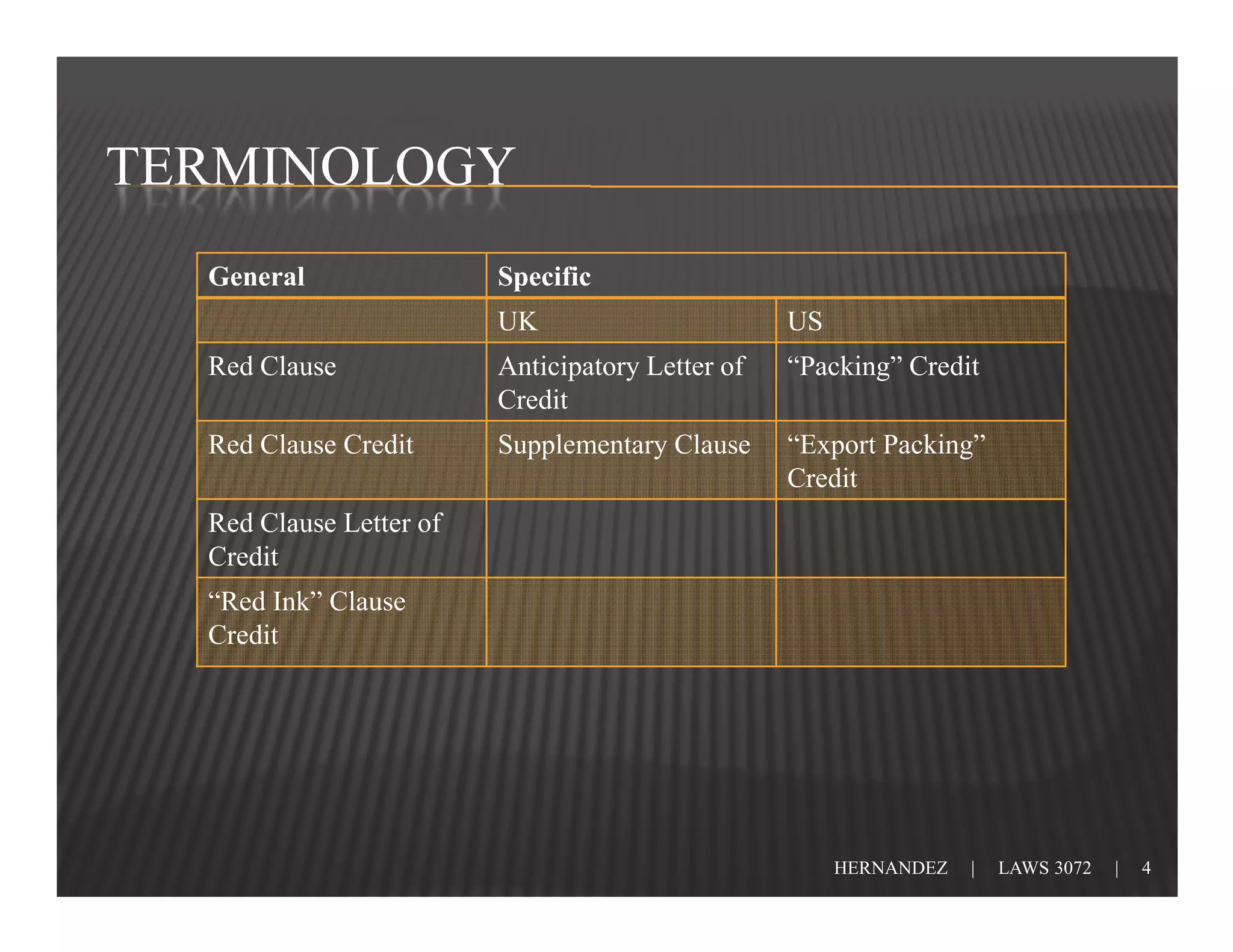
TERMINOLOGY
  General                Specific
                         UK                       US
  Red Clause             Anticipatory Letter of   “Packing” Credit
                         Credit
  Red Clause Credit      Supplementary Clause     “Export Packing”
                                                  Credit
  Red Clause Letter of
  Credit
  “Red Ink” Clause
  Credit


                                                       HERNANDEZ   |   LAWS 3072   |   4
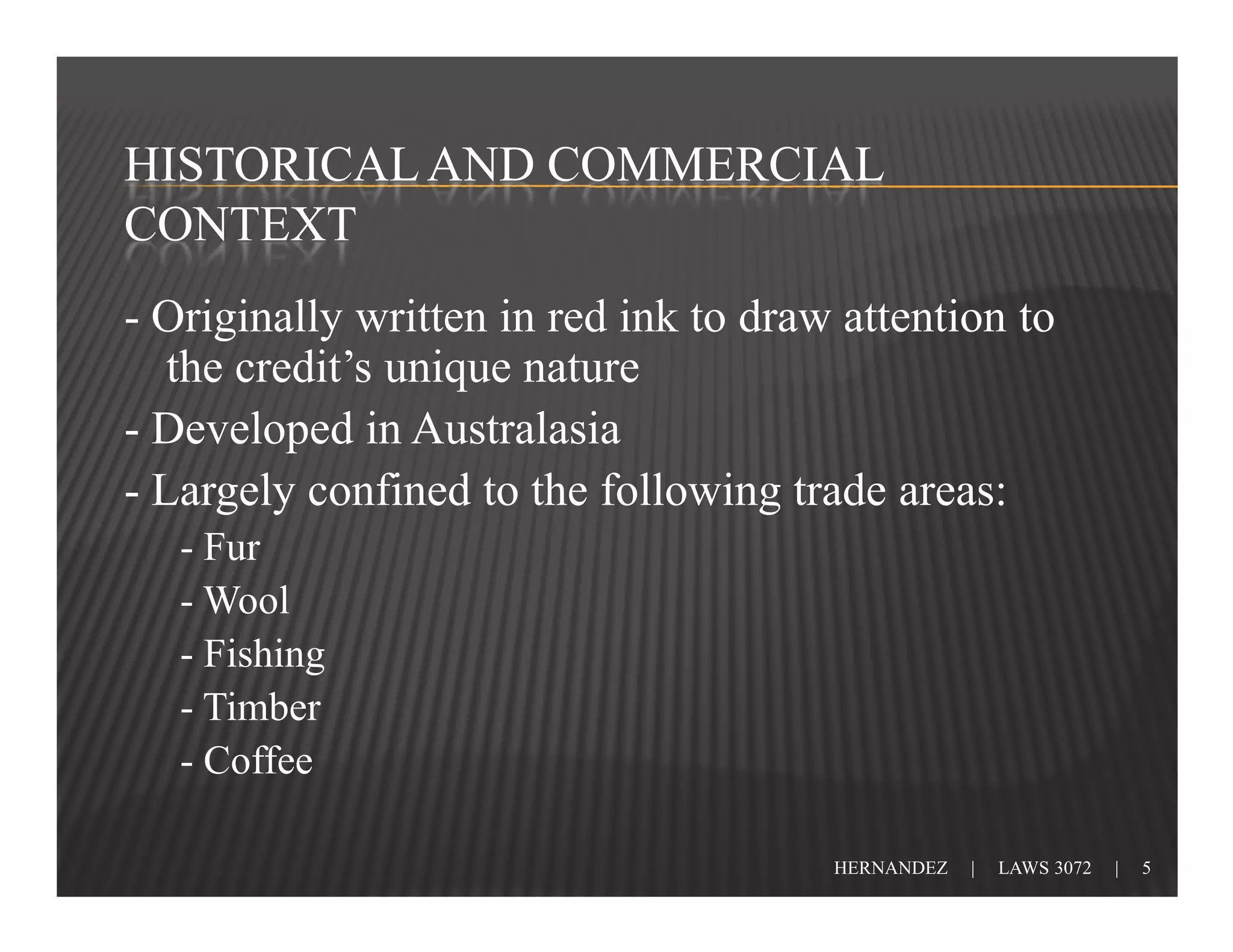
HISTORICAL AND COMMERCIAL
CONTEXT
- Originally written in red ink to draw attention to
   the credit’s unique nature
- Developed in Australasia
- Largely confined to the following trade areas:
   - Fur
   - Wool
   - Fishing
   - Timber
   - Coffee

                                       HERNANDEZ   |   LAWS 3072   |   5
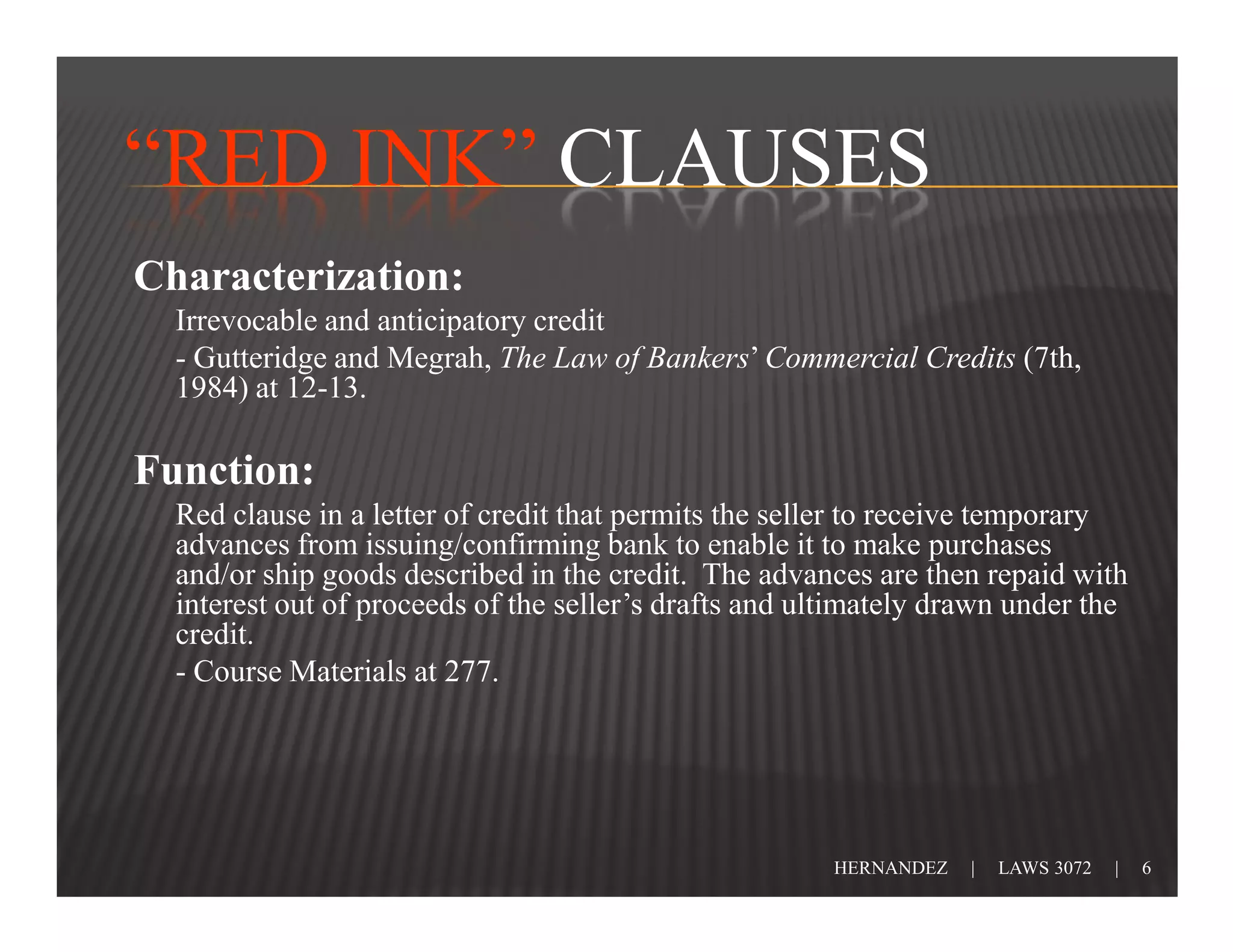
“RED INK” CLAUSES
Characterization:
  Irrevocable and anticipatory credit
  - Gutteridge and Megrah, The Law of Bankers’ Commercial Credits (7th,
  1984) at 12-13.

Function:
  Red clause in a letter of credit that permits the seller to receive temporary
  advances from issuing/confirming bank to enable it to make purchases
  and/or ship goods described in the credit. The advances are then repaid with
  interest out of proceeds of the seller’s drafts and ultimately drawn under the
  credit.
  - Course Materials at 277.


                                                       HERNANDEZ   |   LAWS 3072   |   6
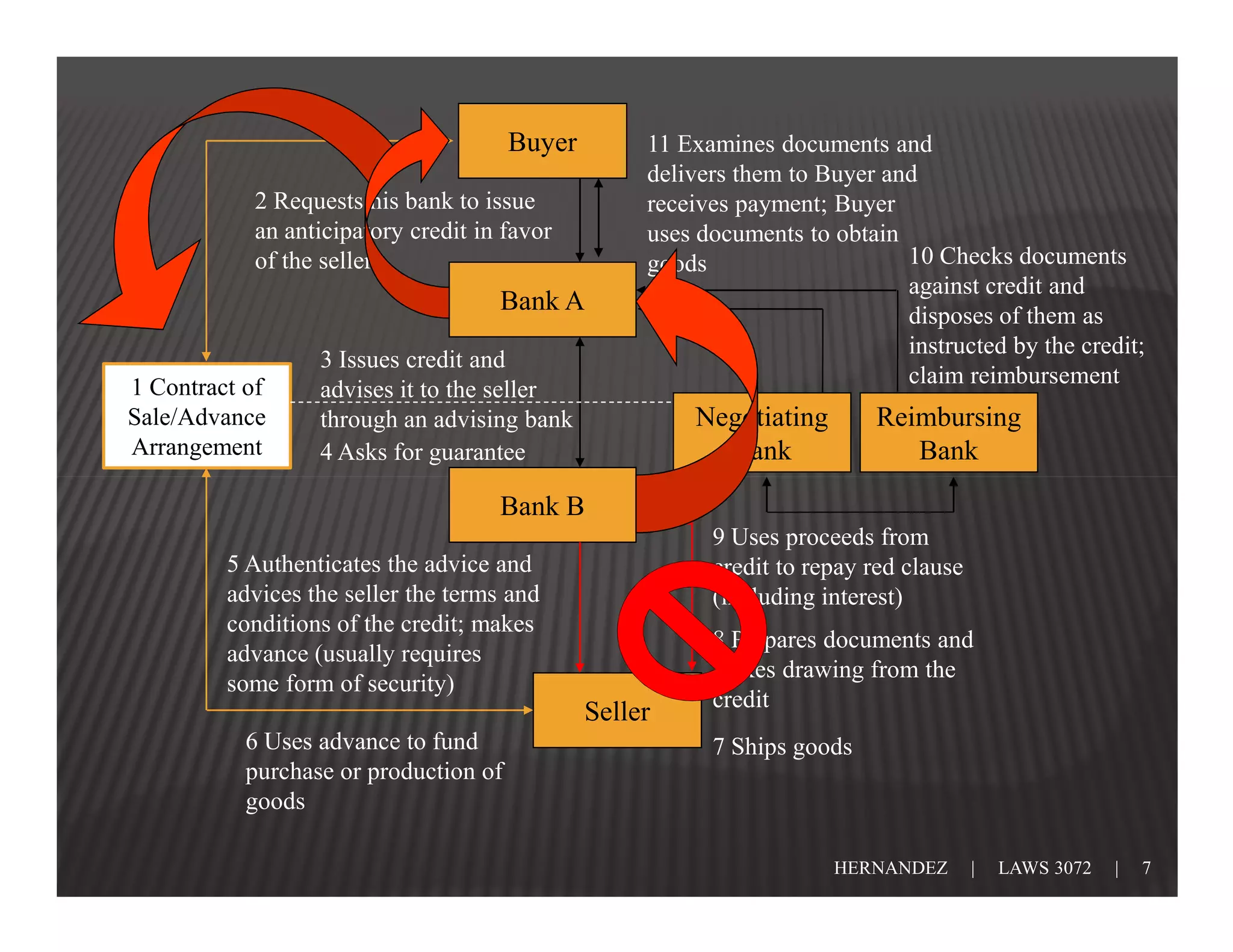
Buyer        11 Examines documents and
                                                    delivers them to Buyer and
           2 Requests his bank to issue             receives payment; Buyer
           an anticipatory credit in favor          uses documents to obtain
           of the seller                            goods                    10 Checks documents
                                                                             against credit and
                                    Bank A                                   disposes of them as
                                                                             instructed by the credit;
                  3 Issues credit and
1 Contract of                                                                claim reimbursement
                  advises it to the seller
Sale/Advance      through an advising bank              Negotiating        Reimbursing
Arrangement       4 Asks for guarantee                    Bank                Bank
                                    Bank B
                                                          9 Uses proceeds from
         5 Authenticates the advice and                   credit to repay red clause
         advices the seller the terms and                 (including interest)
         conditions of the credit; makes
                                                          8 Prepares documents and
         advance (usually requires
                                                          makes drawing from the
         some form of security)
                                                          credit
                                               Seller
           6 Uses advance to fund                         7 Ships goods
           purchase or production of
           goods

                                                                      HERNANDEZ        |   LAWS 3072   |   7
LIABILITY

 - If advance is not repaid by the seller, the issuing
 bank becomes liable for the amount (usually also
 paying interest to the confirming bank).
 - The issuing bank would then need to claim from
 the buyer.
    -Course Materials at 274.


                                     HERNANDEZ   |   LAWS 3072   |   8
“RED INK” CLAUSES
- E.g.
     “Advances are available under this credit against the
     beneficiaries’ simple receipt countersigned by Jonathan
     Franklin or Hugh Gathorne-Hardy presented to ourselves
     [- that of course is Barclays Bank.] Reimbursements will
     be made by air mail to a bank of your choice as soon as the
     receipt is received by us and in order. Each advance
     clearly states which lots it refers to, the proceeds of each
     negotiation will be applied in reduction [ - then I think
     should be inserted the word ‘of’ - ] the relevant advance on
     that lot, recourse of advance to be to beneficiary in the case
     that goods have not been shipped by expiry of the credit.”
     - Tukan Timber Ltd. v. Barclays Bank Plc. [1987] 1 Lloyd’s
     Rep 171 at 173.

                                               HERNANDEZ   |   LAWS 3072   |   9
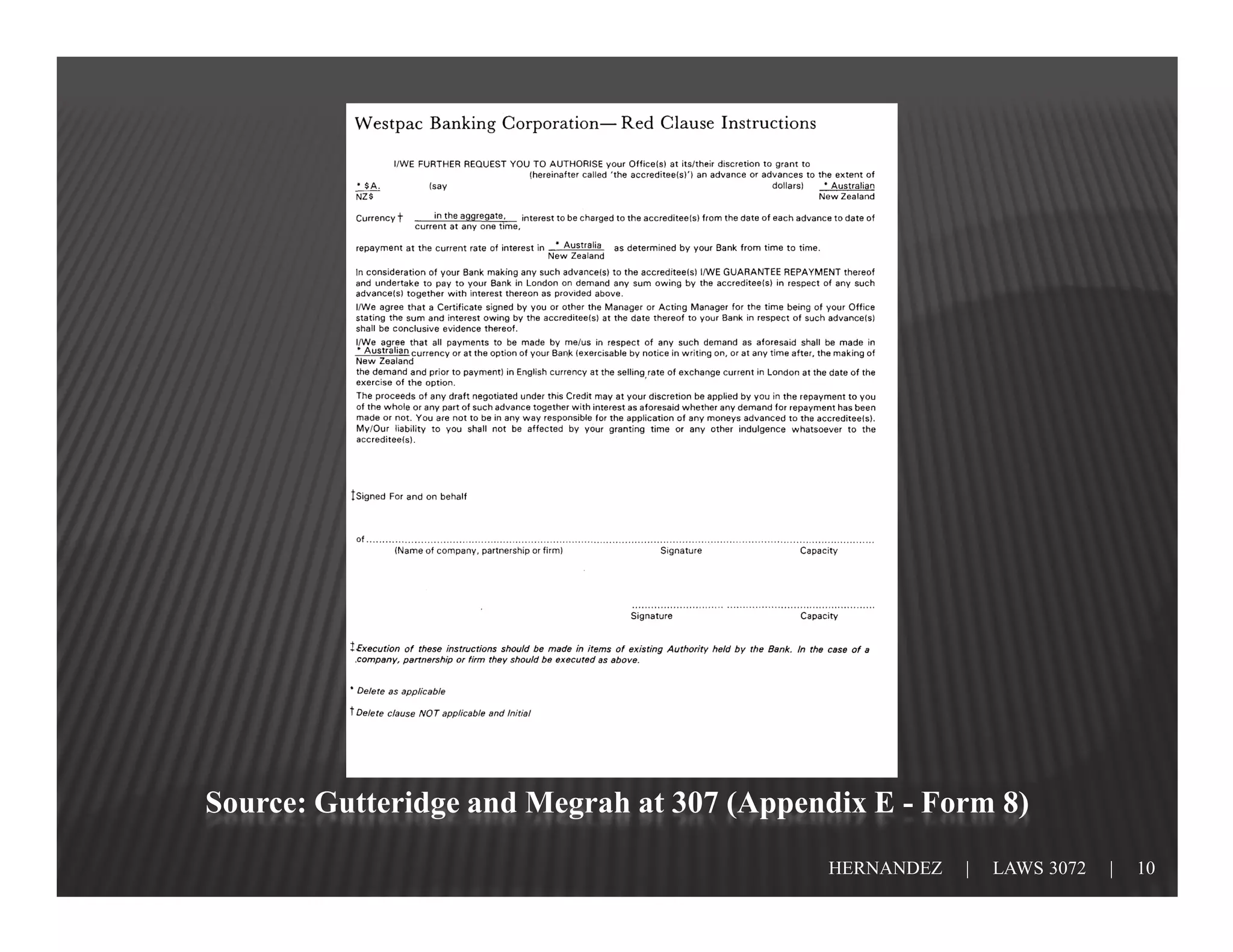
Source: Gutteridge and Megrah at 307 (Appendix E - Form 8)
                                           HERNANDEZ   |   LAWS 3072   |   10
NATURE OF RISK

- Red clause credits are a form of unsecured loan.
  - Seller = Safe
  - Buyer = High Risk
-Thus, the Buyer must have extreme trust in the
  Seller.
     - And/or attempt to minimize risk:


                                   HERNANDEZ   |   LAWS 3072   |   11
CONSIDERATIONS OF A PRUDENT PERSON
1.      Specifications and agreement on the maximum amount to be advanced
2.      Agreement on date and conditions of pre-shipment advances permitted
3.      Agreement on documents – and number of copies (e.g. commercial invoice,
        tally sheet, certificate of origin)
4.      Opt for additional safeguard requirements before corresponding draw
        downs permitted (e.g. agreed independent third party’s certification that
        goods have been assembled even before shipment)
5.      Buyer should opt for initial substantial quantity of goods to be assembled
6.      Negotiate interest payable on early advances, or a discount on a purchase
        price
7.      Provide for the possibility of supplier default, either by:
     a.     Specifying an interest rate in the event of default
     b.     Declaration of trust in the buyer’s favor, stating that any advances are
            for the purpose of the underlying contract to give the buyer priority in a
            bankruptcy.
8.      Negotiate when ownership and risk passes and subsequently who bears the
        cost of insurance.
        -Course Materials at 277.


                                                             HERNANDEZ   |   LAWS 3072   |   12
“GREEN INK” CLAUSES
- Function:
    I. Pre-shipment advances are made in the same
    way as a red ink clause
    II. BUT goods purchased are stored in the bank’s
    name
    III. Bank is then authorized to release goods to the
    beneficiary to enable the beneficiary to ship them.
    -Weaver at [15.1650].


                                        HERNANDEZ   |   LAWS 3072   |   13
CASE LAW
South African Reserve Bank v. Samuel & Co., Ltd. (1931) 40 Ll. L. Rep. 291
HELD: Bank authorized to allow anticipatory drawings, advances to be paid out of proceeds of documentary drafts when shipping
     documents available, the red clause drawings to be covered by security put up by drawer.

French American Banking Corporation v. Isbrandtsen 126 N.Y.S. 2d 853 (1953)
HELD: Neither the plaintiff nor its corresponding bank owed a duty under the red clause letter of credit other than to obtain an
    undertaking within the terms of the credit with respect to the supporting shipping or title documents.

Abe Schrader Corp. v. Legend Apparel Mfg. Co. 581 N.Y.S. 2d 319 (1992)
HELD: Issuing bank was not liable to corresponding bank for advances made to defendant pursuant to the red clause in the letter of
     credit since the corresponding bank failed to offer evidentiary proof that it has sought reimbursement in accordance with the
     terms of the letter of credit. Further, since there was no basis to conclude that corresponding bank has made a presentation of
     documents for payment, the issuing bank was not required under Article 16 of the Uniform Customs and Practice for Commercial
     Credits to give the corresponding bank notice of its refusal of the documents or to return the documents.

Tokyo Kogyo Shokai v. U.S. National Bank of Oregon 126 F. 3d 1135 (9th Cir. 1997)
HELD: Letter of credit applicant could not subrogate to position of issuing bank and sue confirming bank nominated to make
     advances under the red clause for fraud, negligence and violation of the Uniform Commercial Code (US).

Leonard A. Feinberg, Inc. v. Central Asia Credit Corp. 974 F. Supp. 822 (E.D. Pa. 1997)
HELD: Article 5 of the Uniform Commercial Code (UCC) would not govern letter of credit dispute concerning liability of nominating
    bank, which was authorized by issuing bank to advance funds to letter of credit beneficiary but which allegedly misapplied funds
    to pay down beneficiary’s loans instead of advancing funds in conformity with letter of credit’s red clause, where Art 5. of UCC
    did not address nominating banks at all; thus, customer would instead be allowed to pursue common law remedies against
    nominating bank.

                                                                                              HERNANDEZ          |   LAWS 3072     |   14
RELEVANCE REVISITED
- Recent case law
- Commentary stating popularity of red clause
   -E.g. Grassi and Laryea
- Minimal impact of “paperless trade” and newer forms of
   electronic payments
   -According to Laryea, documentary credits will only become
   irrelevant:
        a. Where the needs served by credits are no longer present;
        b. Where there is an alternative way for meeting those needs
        (i.e. an alternative method of payment that would ensure
        security, liquidity, and proximity)
        c. Where credits are electronically inoperable.


                                                HERNANDEZ   |   LAWS 3072   |   15
REFERENCES
Burnett, Robin and Vivienne Bath. Law of International Business in Australasia
   (2009).
Grassi, Paolo S. ‘Letter of Credit Transactions: The Banks’ Position in
   Determining Documentary Compliance: A Comparative Evaluation Under U.S.,
   Swiss and German Law.’ (1995) 7 Pace International Law Review 81.
Gutteridge, H.C. and Maurice Megrah. The Law of Bankers’ Commercial Credits
   (7th ed, 1984).
Herries, M.S. ‘Overseas Commercial Credits.’ (1925) 36 Journal of the Institute
   of Bankers 79.
Laryea, Emmanuel T. ‘Payment for Paperless Trade: Are There Viable Alternatives
   to the Documentary Credit?’ (2001) 33 Law and Policy in International
   Business 3.
Weaver, G.A. The Law Relating to Banker and Customer in Australia (3rd ed,
   2003).

                                                       HERNANDEZ   |   LAWS 3072   |   16

Red Clause Letters of Credit

  • 1.
    CERTAINTY IN CONTRACTUAL OBLIGATIONS: Red Clause Letters of Credit
  • 2.
    “RED INK” (AND “GREENINK”) CLAUSES AS PRESENTED THROUGH A “BLACK-LETTER” PERSPECTIVE? Roberto Hernandez
  • 3.
    RELEVANCE? “Red inkclause credits are now largely historic…” “A green ink clause credit is a variation of the ‘red ink’ clause… These credits are now seldom if ever used.” - Weaver at [15.1650]. “This type of credit [red ink clause] developed in Australasia especially in the wool and fishing export industries… These now appear to be used only infrequently.” - Burnett and Bath at 230. “On the evidence relating to ‘Red Clause’ letter of credit, I am satisfied that they are now rare, especially in the log trade.” - Course Materials at 278. “The red clause is today dying out.” - Gutteridge and Megrah at 13. HERNANDEZ | LAWS 3072 | 3
  • 4.
    TERMINOLOGY General Specific UK US Red Clause Anticipatory Letter of “Packing” Credit Credit Red Clause Credit Supplementary Clause “Export Packing” Credit Red Clause Letter of Credit “Red Ink” Clause Credit HERNANDEZ | LAWS 3072 | 4
  • 5.
    HISTORICAL AND COMMERCIAL CONTEXT -Originally written in red ink to draw attention to the credit’s unique nature - Developed in Australasia - Largely confined to the following trade areas: - Fur - Wool - Fishing - Timber - Coffee HERNANDEZ | LAWS 3072 | 5
  • 6.
    “RED INK” CLAUSES Characterization: Irrevocable and anticipatory credit - Gutteridge and Megrah, The Law of Bankers’ Commercial Credits (7th, 1984) at 12-13. Function: Red clause in a letter of credit that permits the seller to receive temporary advances from issuing/confirming bank to enable it to make purchases and/or ship goods described in the credit. The advances are then repaid with interest out of proceeds of the seller’s drafts and ultimately drawn under the credit. - Course Materials at 277. HERNANDEZ | LAWS 3072 | 6
  • 7.
    Buyer 11 Examines documents and delivers them to Buyer and 2 Requests his bank to issue receives payment; Buyer an anticipatory credit in favor uses documents to obtain of the seller goods 10 Checks documents against credit and Bank A disposes of them as instructed by the credit; 3 Issues credit and 1 Contract of claim reimbursement advises it to the seller Sale/Advance through an advising bank Negotiating Reimbursing Arrangement 4 Asks for guarantee Bank Bank Bank B 9 Uses proceeds from 5 Authenticates the advice and credit to repay red clause advices the seller the terms and (including interest) conditions of the credit; makes 8 Prepares documents and advance (usually requires makes drawing from the some form of security) credit Seller 6 Uses advance to fund 7 Ships goods purchase or production of goods HERNANDEZ | LAWS 3072 | 7
  • 8.
    LIABILITY - Ifadvance is not repaid by the seller, the issuing bank becomes liable for the amount (usually also paying interest to the confirming bank). - The issuing bank would then need to claim from the buyer. -Course Materials at 274. HERNANDEZ | LAWS 3072 | 8
  • 9.
    “RED INK” CLAUSES -E.g. “Advances are available under this credit against the beneficiaries’ simple receipt countersigned by Jonathan Franklin or Hugh Gathorne-Hardy presented to ourselves [- that of course is Barclays Bank.] Reimbursements will be made by air mail to a bank of your choice as soon as the receipt is received by us and in order. Each advance clearly states which lots it refers to, the proceeds of each negotiation will be applied in reduction [ - then I think should be inserted the word ‘of’ - ] the relevant advance on that lot, recourse of advance to be to beneficiary in the case that goods have not been shipped by expiry of the credit.” - Tukan Timber Ltd. v. Barclays Bank Plc. [1987] 1 Lloyd’s Rep 171 at 173. HERNANDEZ | LAWS 3072 | 9
  • 10.
    Source: Gutteridge andMegrah at 307 (Appendix E - Form 8) HERNANDEZ | LAWS 3072 | 10
  • 11.
    NATURE OF RISK -Red clause credits are a form of unsecured loan. - Seller = Safe - Buyer = High Risk -Thus, the Buyer must have extreme trust in the Seller. - And/or attempt to minimize risk: HERNANDEZ | LAWS 3072 | 11
  • 12.
    CONSIDERATIONS OF APRUDENT PERSON 1. Specifications and agreement on the maximum amount to be advanced 2. Agreement on date and conditions of pre-shipment advances permitted 3. Agreement on documents – and number of copies (e.g. commercial invoice, tally sheet, certificate of origin) 4. Opt for additional safeguard requirements before corresponding draw downs permitted (e.g. agreed independent third party’s certification that goods have been assembled even before shipment) 5. Buyer should opt for initial substantial quantity of goods to be assembled 6. Negotiate interest payable on early advances, or a discount on a purchase price 7. Provide for the possibility of supplier default, either by: a. Specifying an interest rate in the event of default b. Declaration of trust in the buyer’s favor, stating that any advances are for the purpose of the underlying contract to give the buyer priority in a bankruptcy. 8. Negotiate when ownership and risk passes and subsequently who bears the cost of insurance. -Course Materials at 277. HERNANDEZ | LAWS 3072 | 12
  • 13.
    “GREEN INK” CLAUSES -Function: I. Pre-shipment advances are made in the same way as a red ink clause II. BUT goods purchased are stored in the bank’s name III. Bank is then authorized to release goods to the beneficiary to enable the beneficiary to ship them. -Weaver at [15.1650]. HERNANDEZ | LAWS 3072 | 13
  • 14.
    CASE LAW South AfricanReserve Bank v. Samuel & Co., Ltd. (1931) 40 Ll. L. Rep. 291 HELD: Bank authorized to allow anticipatory drawings, advances to be paid out of proceeds of documentary drafts when shipping documents available, the red clause drawings to be covered by security put up by drawer. French American Banking Corporation v. Isbrandtsen 126 N.Y.S. 2d 853 (1953) HELD: Neither the plaintiff nor its corresponding bank owed a duty under the red clause letter of credit other than to obtain an undertaking within the terms of the credit with respect to the supporting shipping or title documents. Abe Schrader Corp. v. Legend Apparel Mfg. Co. 581 N.Y.S. 2d 319 (1992) HELD: Issuing bank was not liable to corresponding bank for advances made to defendant pursuant to the red clause in the letter of credit since the corresponding bank failed to offer evidentiary proof that it has sought reimbursement in accordance with the terms of the letter of credit. Further, since there was no basis to conclude that corresponding bank has made a presentation of documents for payment, the issuing bank was not required under Article 16 of the Uniform Customs and Practice for Commercial Credits to give the corresponding bank notice of its refusal of the documents or to return the documents. Tokyo Kogyo Shokai v. U.S. National Bank of Oregon 126 F. 3d 1135 (9th Cir. 1997) HELD: Letter of credit applicant could not subrogate to position of issuing bank and sue confirming bank nominated to make advances under the red clause for fraud, negligence and violation of the Uniform Commercial Code (US). Leonard A. Feinberg, Inc. v. Central Asia Credit Corp. 974 F. Supp. 822 (E.D. Pa. 1997) HELD: Article 5 of the Uniform Commercial Code (UCC) would not govern letter of credit dispute concerning liability of nominating bank, which was authorized by issuing bank to advance funds to letter of credit beneficiary but which allegedly misapplied funds to pay down beneficiary’s loans instead of advancing funds in conformity with letter of credit’s red clause, where Art 5. of UCC did not address nominating banks at all; thus, customer would instead be allowed to pursue common law remedies against nominating bank. HERNANDEZ | LAWS 3072 | 14
  • 15.
    RELEVANCE REVISITED - Recentcase law - Commentary stating popularity of red clause -E.g. Grassi and Laryea - Minimal impact of “paperless trade” and newer forms of electronic payments -According to Laryea, documentary credits will only become irrelevant: a. Where the needs served by credits are no longer present; b. Where there is an alternative way for meeting those needs (i.e. an alternative method of payment that would ensure security, liquidity, and proximity) c. Where credits are electronically inoperable. HERNANDEZ | LAWS 3072 | 15
  • 16.
    REFERENCES Burnett, Robin andVivienne Bath. Law of International Business in Australasia (2009). Grassi, Paolo S. ‘Letter of Credit Transactions: The Banks’ Position in Determining Documentary Compliance: A Comparative Evaluation Under U.S., Swiss and German Law.’ (1995) 7 Pace International Law Review 81. Gutteridge, H.C. and Maurice Megrah. The Law of Bankers’ Commercial Credits (7th ed, 1984). Herries, M.S. ‘Overseas Commercial Credits.’ (1925) 36 Journal of the Institute of Bankers 79. Laryea, Emmanuel T. ‘Payment for Paperless Trade: Are There Viable Alternatives to the Documentary Credit?’ (2001) 33 Law and Policy in International Business 3. Weaver, G.A. The Law Relating to Banker and Customer in Australia (3rd ed, 2003). HERNANDEZ | LAWS 3072 | 16