
Negotiable Instruments Laws
Based on 2015 Bar Exam
Syllabus for Commercial Law
References:
•Miravite, Jorge. Commercial Law Reviewer. 2002 ed.
•Sundiang and Aquino. Commercial Law Reviewer. 2014 ed.
•Lecture Notes for Commercial Law Review 1 under Fiscal R. S. Aquino-
Tambasacan (San Sebastian, PUP College of Law)
•Lecture and Handout of Atty George Ortha II for Jurists Review Center
•Handout by Atty. Danilo G. Ballena (PUP College of Law)
•Miravite serves as the primary reference for this simple reviewer as it
closely resembles the flow of the syllabus prescribed by the Supreme
Court. It is supplemented by Sundiang (2014) and further annotated and
updated with lecture notes from Tambasacan, Ortha, and Guzman
•This is not meant to be in depth, but rather as a brisk reviewer that
touches substantially the topic under the syllabus. It is still preferable to
read any book for fuller understanding.
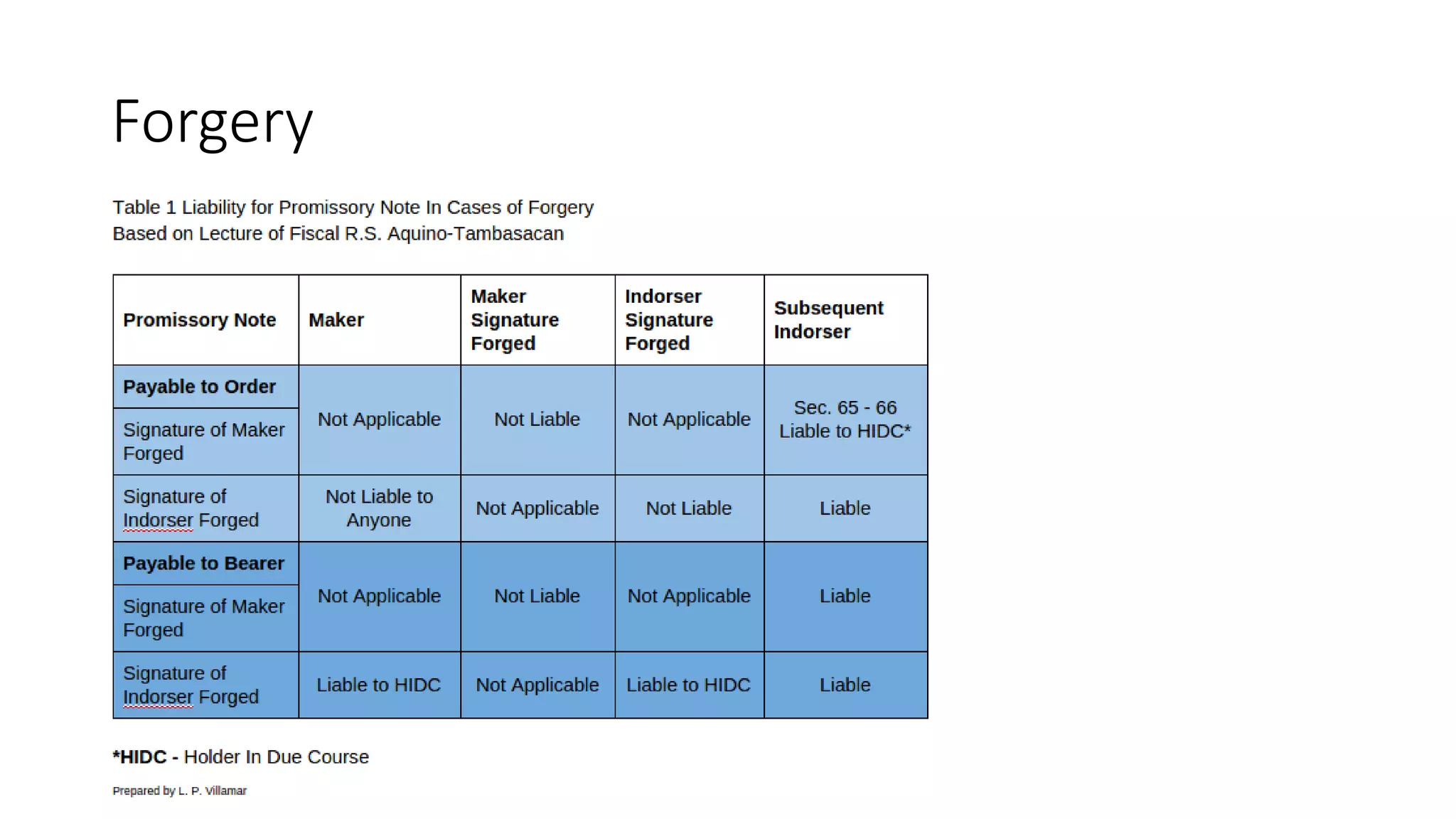
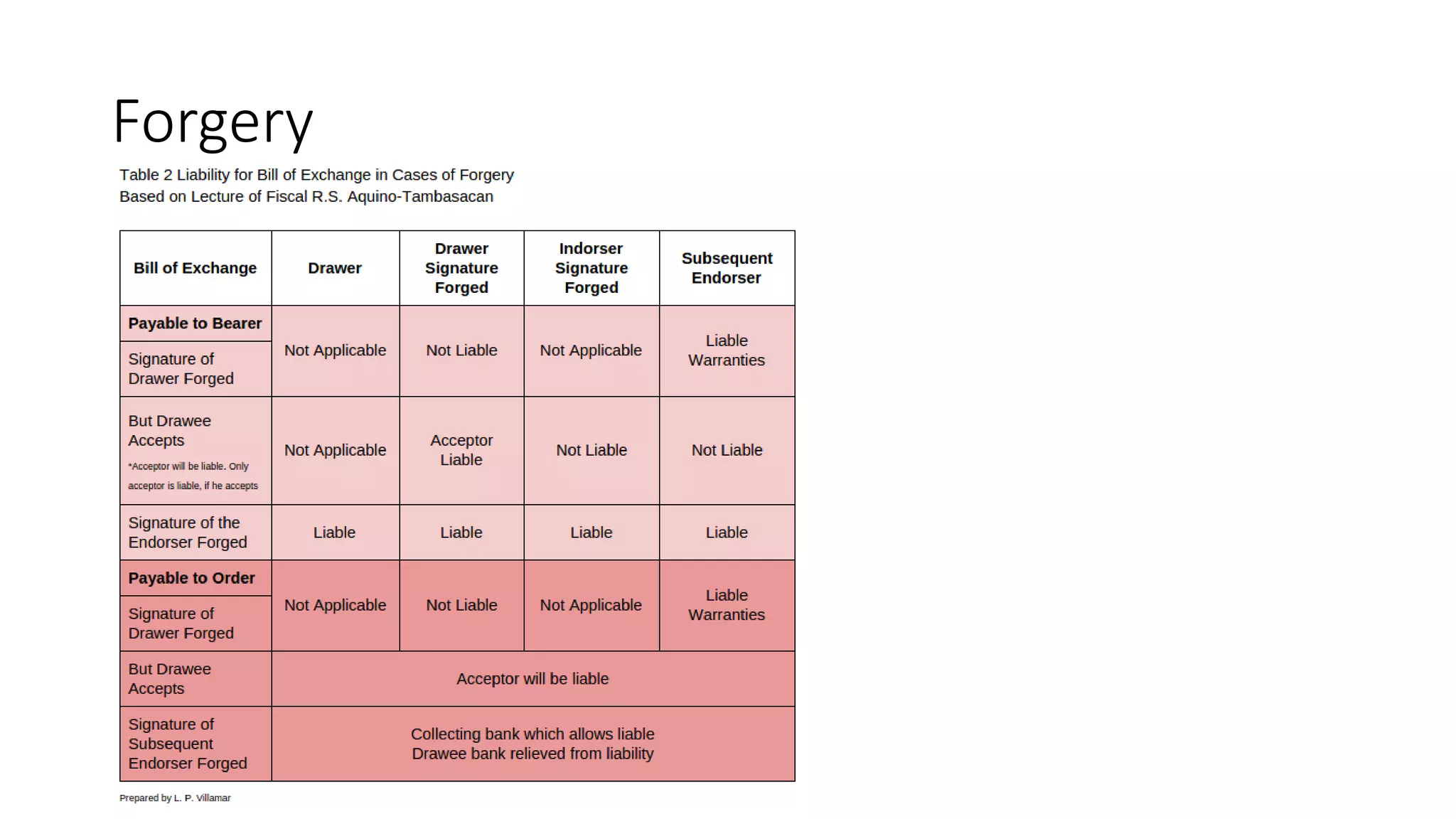
•Key feature of this reviewer are the tables on liability in case of forgery
NOTES
Prepared By
Lawrence P. Villamar
Negotiable Instrument*
lA written contract for the payment of money which by its form and on
its face is intended as a substitute for money and passes from hand to
hand as money, so as to give the holder in due course the right to hold
the instrument and collect the sum for himself (UPLC, 2005,1949 Bar)
*Peculiar that this is not part of the 2015 syllabus, but this is of primary
importance that is why this is included in this reviewer.
Forms and Interpretation
lDiscrepancy Between the Amount in Figures and that in Words
lThe word prevail, but if the words are ambiguous, reference will be made to the figures to fix the
amount
lInstrument Not Dated
lConsidered dated on date of issue
lConflict Between Written and Printed Provisions
lWritten provisions prevail
lInterest Provided for but No Starting Date Specified
lStarting date is the date of instrument, in the absence of said date, from date of issue
Forms and Interpretation
lWhen instrument is ambigous
lSuch that there is doubt whether it is a bill or note, the holder may treat it as a note or a bill
(1998 Bar)
lSignature on Instrument Does Not Indicate Capacity in Which Made
lDeemed as indorser with secodary liability
lWhen Promissory Note Worder “I Promise to Pay” is Signed By Two
Makers
lThe payee of the promissory note had the right to hold any one of the two signers of the
promissory note responsibility for the payment of the whole amount of the note
Requisites of Negotiability
lIn General (Sec. 1, NIL):
lMust be in writing and signed by the maker or drawer
lMust contain an unconditional promise or order to pay a sum certain in money
lMust be payable on demand or at a fixed or determinable future time
lMust be payable to order or to bearer
lWhere the instrument is addressed to a drawee, he must be named or otherwise indicated
therein with reasonable certainty.
Requisites of Negotiability
lPROMISSORY NOTE (1961 Bar)
lMust be in writing and signed by the maker
lMust contain an unconditional promise to pay a sum certain in money
lMust be payable on demand or at a fixed or determinable future time
lMust be payable to order or to bearer
Requisites of Negotiability
lBill of Exchange (1961 Bar)
lMust be in writing and signed by the drawer
lMust contain an unconditional promise to pay a sum certain in money
lMust be payable on demand or at a fixed or determinable future time
lMust be payable to order or to bearer
lThe drawee must be named or otherwise indicated with reasonable certainty
Quick Notes on Particular Requisites
lUnconditional Promise or Order
lWhere the promise or order to pay is made to depend on contingent even, it is conditional and
makes the instrument non negotiable
lNote that an indication of a particular fund from which the acceptor reimburses himself after paying
the holder
lAnd a statement of transaction which gives rise to the instrument.
lCertainty of Sum
lIf the amount is fixed
lNote that negotiability is not affected although to be paid with interest, by stated installments, by
stated installments with acceleration clause, with exchange, and with costs of collection or
attorney's fees
lSTATED – should include date, amount to be paid, and number of installment (Ortha)
Quick Notes on Particular Requisites
lIn Money
lGeneral rule: If payment is not by money, the instrument is non-negotiable. However, note that additional
acts do not affect negotiability.
l Need not be legal tender, may be in foreign currency (Ortha)
lAdditional acts:
lAuthorizing sale of collateral securities on default
lAuthorizes confession of judgment on default
lWaive benefit of law intended to protect debtor
lAllows the creditor the option to require something in lieu of money
lPayable on Demad
lWhere expressed to be payable on demand, at sight, or on presentation
lWhere no period of payment is stated
lWhere issued, accepted, or indorsed after maturity
lSC: A PN payable on demand is immediately due and demandable and an action prescribes in ten years.
Quick Notes on Particular Requisites
lDeterminable Future Time
lAt a fixed period after date or sight
lOn or before a specified fixed or determinable future time
lOn or at a fixed period after the concurrence of a specified event, certain to happen, although
the exact date is not certain
lTambasacan: Solar eclipse is a natural phenomenon certain to happen.
lPayable to Order
lWhere drawn payable to the order of a specified person, or to him or his order
Quick Notes on Particular Requisites
lPayable to Bearer
lWhen expressed to be so payable
lWhen payable to a person named therein or bearer
lWhen payable to the order of a fictitious or non-existing person and such fact was known to
the drawer or maker
lWhen the name of the payee is not the name of a person
lWhen the only and last indorsement is an indorsement in blank
lNOTE:
lWhere payee is vaguely designated, the loss will be borned by the party who cause it – the drawer.
lNon- negotiable: payable to a specified person and not to his order or to bearer (governed by some
other law e.g. Civil Code or Special Laws)
Kinds of Negotiable Instruments
lPromissory Note
lAn unconditional promise in writing by one person to another signed by the maker engaging to
pay on demand or at a fixed determinable future time a sum certain in money to order or to
beaer
lBill of Exchange
lAn unconditional order in wiriting addressed by one person to another, signed by the person
giving it, requiring the person to whom it is addressed to pay on demand or at requiring the
person to whom it is addressed to pay on demand or at a fixed or determinable future time a
sum certain in money to order or to bearer
lCheque
lA bill of exchange drawn on a bank payable on demand
Kinds of Negotiable Instruments
lOther forms:
lCertificate of deposit issued by banks payable to the depositor or his order or to bearer
lTrade acceptance
lBonds which are in the nature of promissory notes
lDrafts which are bills of exchange drawn by one bank upon another
lLetter of Credit*
lNOT NEGOTIABLE: Treasury Warrants
lThere is an indication of the fund as the source of payment of the disbursement.
*Ortha: LC has lots of condition before bank may honor it. Therefore, not negotiable.
Completion and Delivery
Insertion of Date
lTambasacan: “Dates are not material but only for maturity”
Insertion of Date
lRULES AS TO DATES
lWhere the instrument, its acceptance, or indorsement is dated, such date is presumed to be
the corresponding true date
lAntedating or postdating an instrument does not affect validity or negotionability unless done
for fraudulent or illegal purpose
lDate is important:
lWhere the instrument is payable within specified period after date, or after acceptance, in which case the date of
the instrument and the date of acceptance are needed to determine the date of maturity of the instrument, in
these cases, the holder may insert the true date
lWhen the instrument is payable on demand, date is necessary to determine whether the instrument was
presented within a reasonable time from issue in the case of notes or from last negtiation in case of bills, as these
factors will show whether the last holder is a holder in due course or not;
lWhen the instrument is an interest bearing one, to determine when the interest starts to run
Completion of Blanks
lA person in possessor of a check has prima facie authority to complete
by filling up the blanks therein (Miravite (2002), p. 91)
Incomplete and Undelivered Instruments
lSec. 15, NIL
lIf completed and delivered without authority, the instrument is not a
valid contact against any person who signed before delivery.
Complete but Undelivered Instruments
lBetween immediate parties and a remote party not a holder in dure
course, delivery to be effectual must be made by or under the authority
of the maker, drawer, acceptor or indorser, as the case may be
lIf the instrument is in the hands of a holder in due course all prior
deliveries are conclusively prwesumed to be valid
lIf the instrument is out of the hands of the person who signed it, a
valid and intentional delivery is disputably presumed
Incomplete but Delivered Instruments
lHolder has prima facie authority to complete the instrument
lCompletion to be fone within a reasonable time and according to the
authority given
lHolder in due course of the instrument previously completed in breach
of instructions can enforce the same as if regularly completed
Signature
•Ortha: “Not needed to be customary.”
lSignature per Procuration
lOne made by an agent with a limited authority to sign, and the principal is bound only if the
agent acts within the limits of the authority
lMade by adding “per procuration,” “per proc.” or “p.p.” under agent's signature
Signing in Trade Name
lThe person signing his trade name or assumed name is liable if the
name were his own
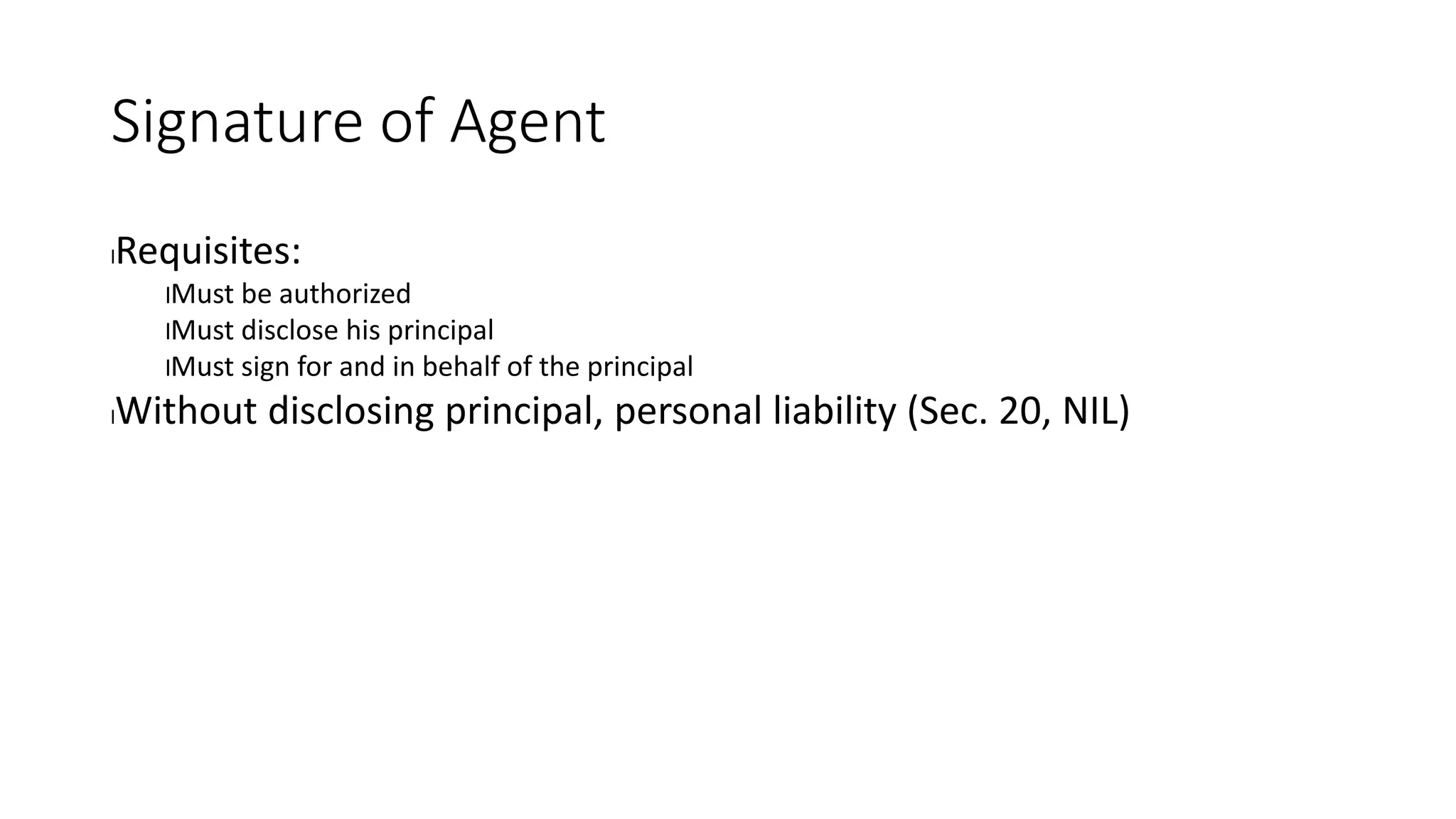
Signature of Agent
lRequisites:
lMust be authorized
lMust disclose his principal
lMust sign for and in behalf of the principal
lWithout disclosing principal, personal liability (Sec. 20, NIL)
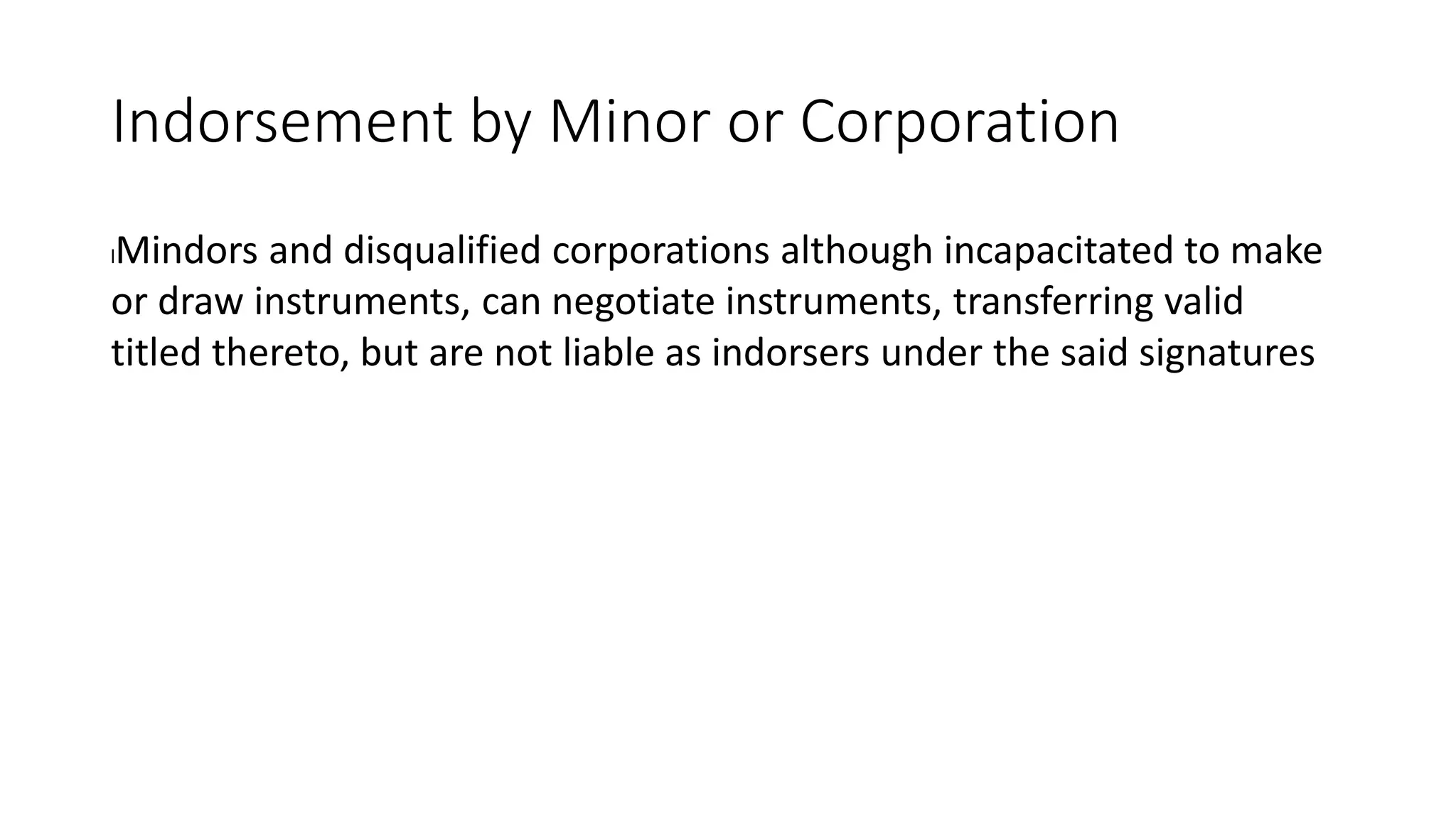
Indorsement by Minor or Corporation
lMindors and disqualified corporations although incapacitated to make
or draw instruments, can negotiate instruments, transferring valid
titled thereto, but are not liable as indorsers under the said signatures
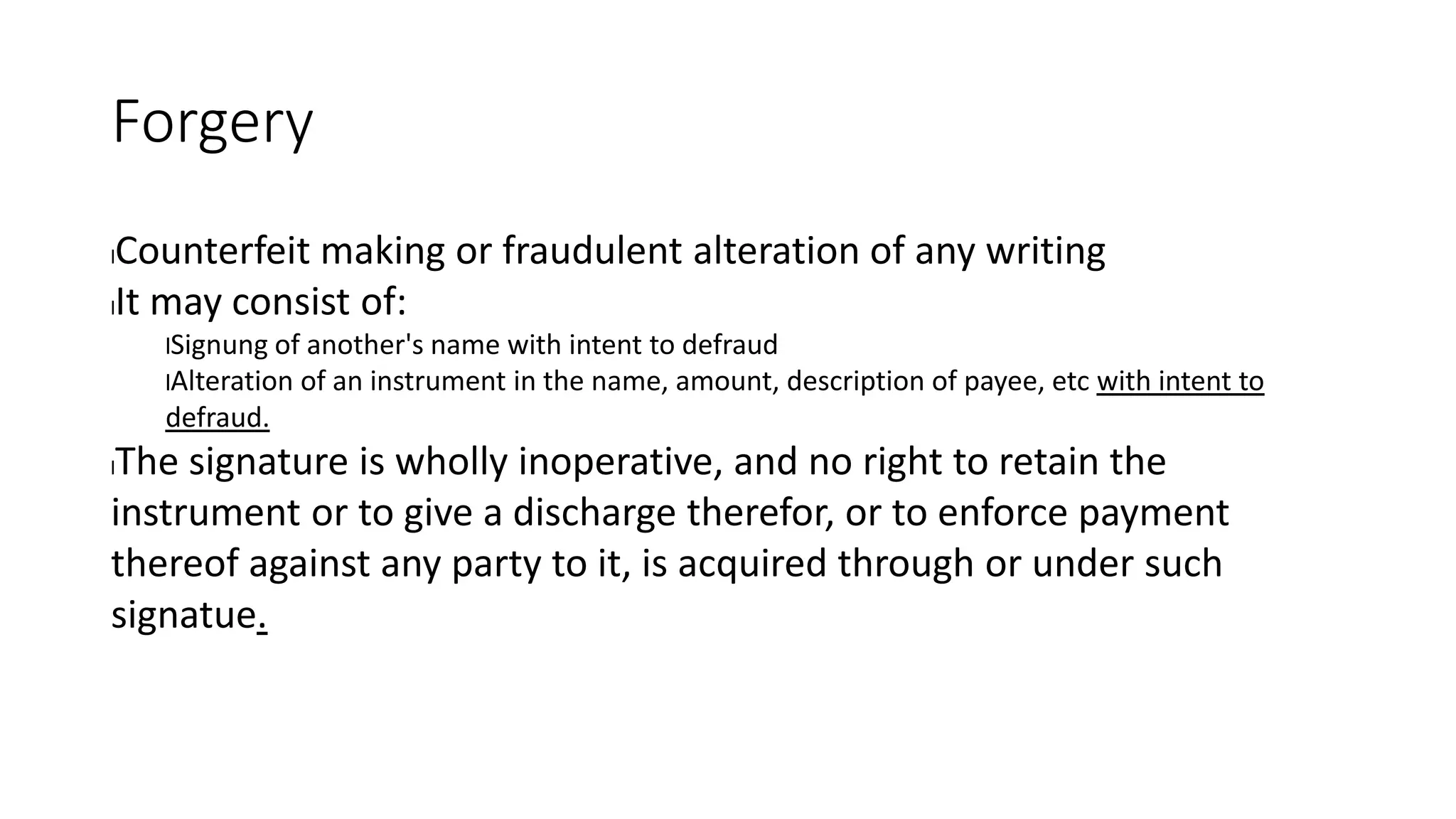
Forgery
lCounterfeit making or fraudulent alteration of any writing
lIt may consist of:
lSignung of another's name with intent to defraud
lAlteration of an instrument in the name, amount, description of payee, etc with intent to
defraud.
lThe signature is wholly inoperative, and no right to retain the
instrument or to give a discharge therefor, or to enforce payment
thereof against any party to it, is acquired through or under such
signatue.
Forgery
Forgery
Consideration
•Presumption of Consideration – every negotiable instrument is
deemed prima facie to have been issued for a vauable
consideration; and every person whose signature appears thereon
to have become a party thereto for value (Ortha)
•Value – any consideration sufficient to support a simple contract.
An antecedent or pre existing debt constitutes value; and is
deemed such whether the instrument is payable on demand or at
a future time (Ortha).
Consideration
•Effect of want of consideration – a matter of defense as againsty
any person not a holder in due course; and partial failure of
consideration is a defense pro tatnto, whether the failure os am
ascertained and liquidated amount or otherwise (Ortha)
•Absence of consideration – total lack of any valid consideration
for the contract is only a personal defense (Ortha)
•Failure of consideration – failure or refusal or one party to do,
perform or comply with the consideration agreed upon is also only
a personal defense (Ortha)
Accommodation Party
lAccomodation
lA legal arrangement under which a person called the accommodation party lends his name and
credit to another called the accomodated party, without consideration
lA person to whom the instrument thus executed is subsequently
negotiated has a right of recourse against the accommodation party
inspite of the former's knowledge that no consideration passed
between the accommodation and accommodated parties
Accommodation Party
lA person who has signed the instrument as maker, drawer, acceptor or
indorser, without receiving value therefor, and for the purpose of
lending his name to some other person, is under the law liable on the
instrument to a holder for value notwithstanding that such holder at
the time of taking the instrument knew him only to be an
accomodation party (1952 Bar)
lLiability: solidary party, unconditional and is not affected by an
extension of payment granted by the creditor to the debtor
Negotiation
lThe transfer of a negotiable instrument from one person to another as
to constitute the transferer the holder thereof
Distinguished from Assignment
l2009, 2012 Bar Exam
lAssignability pertains to contracts in general, negotiability pertains to
negotiable instrument (Sundiang & Aquino (2014 ed), p. 14)
lOne who takes an instrument by assignment takes the instrument
subject to the defenses obtaining among the original parties, whereas a
person, who takes the instrument by negotiation, takes it free from
personal defenses available among the parties (Ibid.)
Modes of Negotiation
lBy Delivery of the Instrument Alone
lNegotiation of NI may be effected by the delivery alone of the instrument to the transferrer
those NI which are originally payable to bearer, o originally payable to order instruments where
the last indorsement is an indorsement in blank
lBy Indorsement Followed By Delivery
lA NI payable to the order of a pecified person, or to him or his order, may be negotiated by the
payee by indorsement followed by delivery of the instrument to the indorsee. Subsequent
negotiations may be made in this manner if the holder who indorses acquired the instrument
under special indorsement
lDelivery of an instrument means transfer of possession from one person to another.
Kinds of Indorsements
lSpecial
lThe name of the indorsee is specified (vis a vis General). Ex. Pay to A
lBlank
lAn indorsement which does not specify the name of the indorsee and usually consists of the
indorser’s signature, and nothing else found at the back of the instrument.
lRestrictive
lLimits the right of the indorsee by restricting further negotiation, or making the indorsee the
collecting agent of the indorser, or makin him a trustee of a person named in the indorsement
l Ex. Pay to A only – restricts negotiation
l Other cases can still be negotiated subject to restriction of original restricve indorsement
(Ortha)
Kinds of Indorsements
lConditional
lThe right of the indorsee under the instrument is made to depend on the happening of the
contingent event stated in the instrument.Said indorsee however negotiate the instrument
succeeding indorsees acquiring right to it subject to the condition in the origina indorsement.
lQualified
lOne where the indorser places under his signature the words “without recourse” or the like.
Does not become liable secondarily under his indorsement. SC: “With recourse” meams
indorser is a general indorser (Ortha)
lRegular
lOne placed after the issue of the instrument
lIrregular
lOne placed in blank before the issue of the instrument.
Rights of the Holder
lIn general
lMay sue thereunder in his own name, and payment to him in due course discharges the
instrument
lIf PN is non negotiable, subsequent holders can never be holders in due course but are mere
assignees against whom defenses may be raised by prior parties.
lFact that PN was executed after the effectivity date of the merger does not militate against the
petitioner.
Holder in Due Course
lRequisites under Sec. 52:
lOne who takes the instrument in good faith and for value
lAt the time the instrument was negotiated to him, he had not notice at any defect in the title of
the person negotiating it
lEvery holder is deemed prima facie to be a holder in due course
lComplete and regular on its face (UPLC)
lSC: Fact that postdated checks were merely issued as security not a
ground for discharged as against the HIDC
lIf instrument was acquired when overdue, not HIDC for lack of good
faith. An instrument becomes overdue the day after its maturity. A
holder accepting an instrument on its date of maturity is not an HIDC
(Ortho)
Holder Not in Due Course
lWithout any, some , or all of the requisites under Sec. 52, NIL
lHOLDER FOR VALUE – one who has all the requisites for a holder in due
course except notice of want of consideration. Prior parties may avail of
defense against said holder.
lSHELTER RULE – Acquires title from HIDC and not a party on the fraud, acquires rights of HIDC but do
not become an HIDC himself (Ortho)
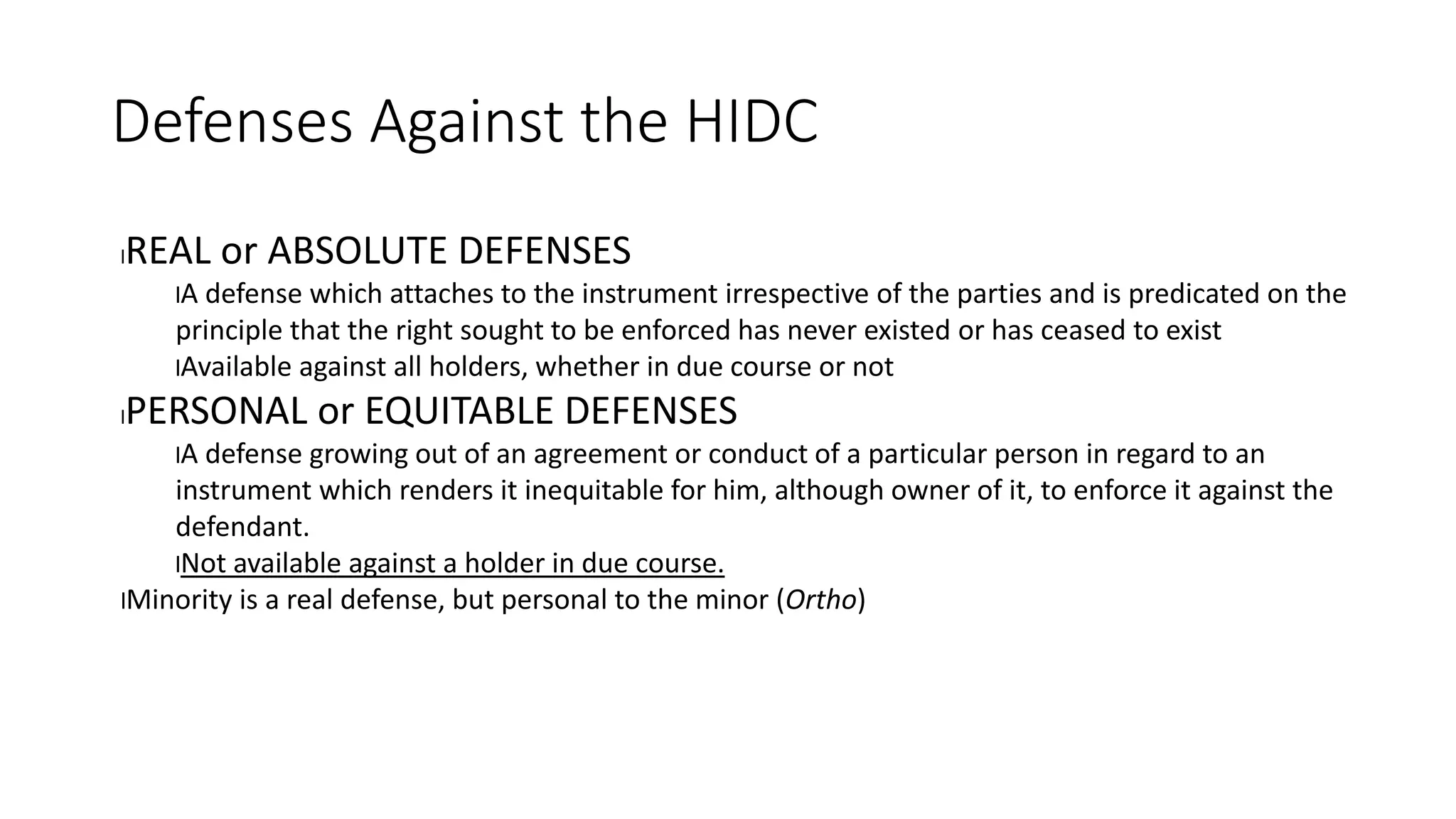
Defenses Against the HIDC
lREAL or ABSOLUTE DEFENSES
lA defense which attaches to the instrument irrespective of the parties and is predicated on the
principle that the right sought to be enforced has never existed or has ceased to exist
lAvailable against all holders, whether in due course or not
lPERSONAL or EQUITABLE DEFENSES
lA defense growing out of an agreement or conduct of a particular person in regard to an
instrument which renders it inequitable for him, although owner of it, to enforce it against the
defendant.
lNot available against a holder in due course.
lMinority is a real defense, but personal to the minor (Ortho)
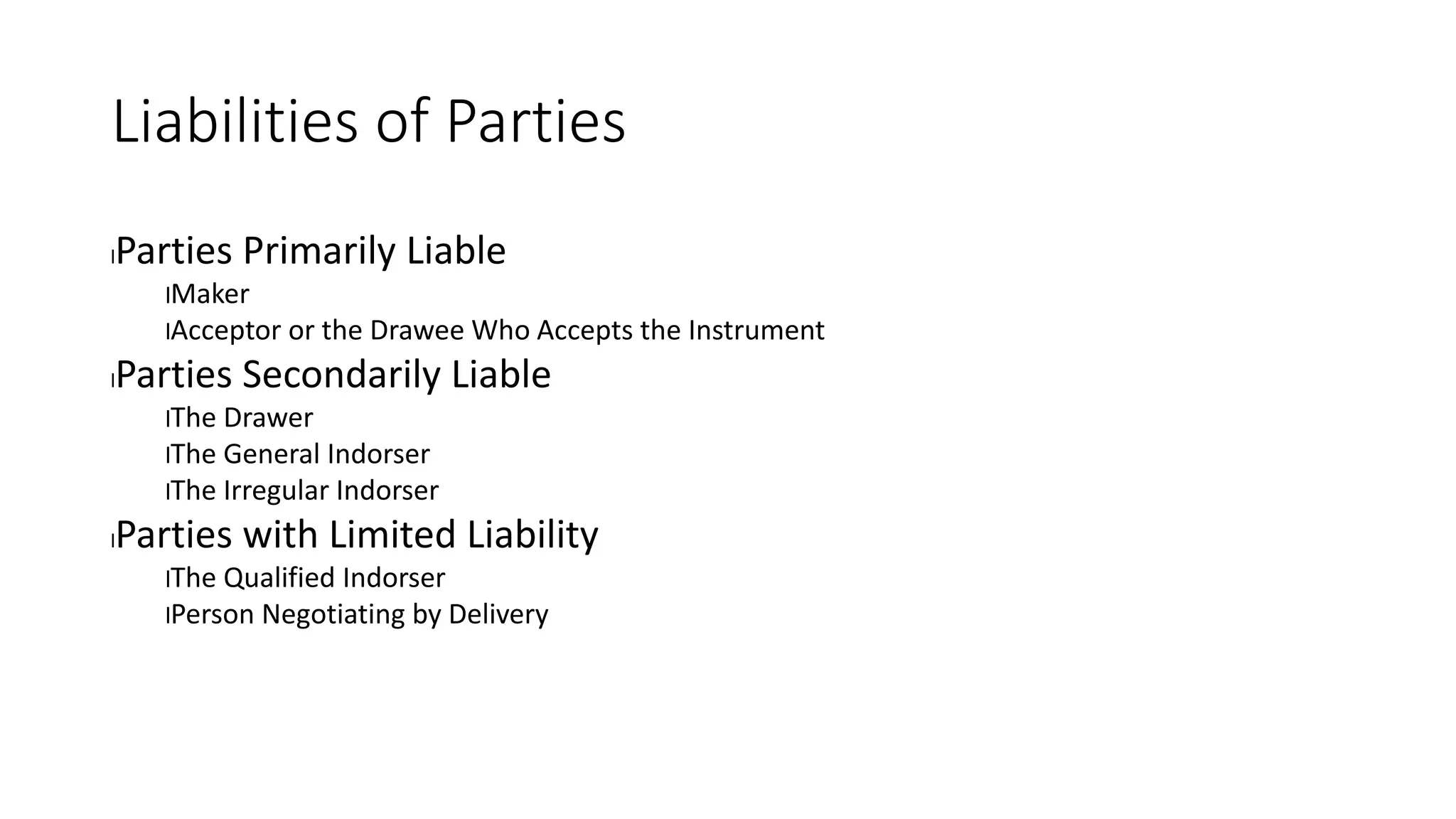
Liabilities of Parties
lParties Primarily Liable
lMaker
lAcceptor or the Drawee Who Accepts the Instrument
lParties Secondarily Liable
lThe Drawer
lThe General Indorser
lThe Irregular Indorser
lParties with Limited Liability
lThe Qualified Indorser
lPerson Negotiating by Delivery
Maker
lEnagages to pay according to the tenor of the instrument
lAdmits the existence of the payee and his capacity to indorse
Drawer
lAdmits the existence of the payee and his capacity to endorse
lEngages that the instrument will be accepted or paid by the party
primarily liable
lEngages that if the instrument is dishonored and proper proceedings
are brought, he will pay to the party entitled to be paid
Acceptor
lEngages to pay according to the tenor of his acceptance
lAdmits the existence of the drawer, the genuineness of his signatue,
and his capacity and authority to draw the instrument
lAdmits the existence of the payee and his capacity to indorse
Indorser
lGENERAL INDORSER
lWarrants the genuiness of the instrument, his good title to it, the capacity to contract prior
parties, amd the instrument is valid and subsitsting
lEngages that the instrument will be paid by the party primarily liable
lEngages that if the instrument is dishonored, and proper proceedings are taken, he will pay the
party entitled to be paid
lA collecting bank which endorses a check bearing a forged
indorsement and presents it to the drawee bank guarantees prior
indorsement, including the forged indorsement.
Indorser
lIRREGULAR INDORSER – A person, not otherwie a party to an
instrument, places his signature thereon in blank.
lIf instrument payable to the order of a 3rd person, he isnliablemto the payee and subsequent parties
lIf instrument payable to order of maker or drawer, he is liable to all parties subsequent to the maker or
drawer.
lIf he signs for accomodation of the payee, he is liable to all parties subsequent to the payee.
lQUALIFIED INDORSER – One of the parties with limited liability. He
warrants that:
lInstrument is genuine and in all respects what it purports to be
lHas good title to it
lAll prior parties had capacity to contract
lHe has no knowledge of any fact which would impair the validity of
instrument or render it valueless.
Person Negotiating By Delivery
•Warranties same as qualified Indorser
•Liability only to immediate transferees
Warranties
•Ortha: Different from primary obligation, and requires present and
notice of dishonor in order that obbligation for breach of warranties
to arise.
Presentment for Payment
•The presentation of an instrument to thn person primarily liable for the
purpose of demanding and receiving payment (Ortha)
Necessity of Presentment for Payment
•General Rule:
•Presentment for payment is nit necessary to charge persons primarily liable
•Necessary to charge persons secondarily liable; otherwise, they are dicharged
(Ortha)
Parties to Whom Presentment for Payment
Should Be Made
•Presentment for payment is not necessary to charge persons
primarily liable
•Presentment for payment is necessary to charge persons
secondarily liable; otherwise, they are discharged.
Dispensation with Presentment for Payment
•Exceptions to Need for Presentment for Payment (Ortho):
•Drawer – where her has no right to expect or require that the drawee or acceptor will pay the
instrument (Sec. 79)
•Indorser – where the instrument was made of accepted for his accommodation and he has no
reason to expect that the instrument will be paid if presented.
•When dispensed:
•Where, after the exercise of reasonable diligence, presentment as required cannot be made
•Where th drawee is a fictatious person
•By waiver of presentment, express or implied (Sec. 82)
•When the instrument has been dishonored b non-acceptance (sec. 151)
Dishonor by Non-Payment
•When instrument dishonored by non-payment:
It is duly presented for payment and payment is refused or
cannot be obtained; or
Presentment is excused and the instrument is overdue and
unpaid (Ortha)
Notice of Dishonor
•Bringing, either verbally or in writing, to the knowledge of the drawer
and indorser the fact that a NI, upon proper proceedings taken, has not
been accepted or paid and the party notified is expected to pay it.
Parties to Be Notified
•Parties secondarily liable(or his agent)
•Not necessary for qualified indorser or person who negotiated BI
by delivery (Ortha)
Parties Who May Give Notice and Dishonor
•Notice of dishonor given by or on behalf of a holder inures to the
benefit of:
All parties prior to the holder who have right of recourse
against the party to whom the notice is given; and
All holders subsequent to the holder giving notice
•Notice of dishonor given by or on beahlf of a party entitled to give
notice inures to the benefit of:
The holder; and
All parties subsequent to the party to whome notice is given
Parties Who May Give Notice and Dishonor
•A party giving notice is deemed to have given due notice where:
The notice of dishonor is duly addressed; and,
Deposited in the post office, even when there is miscarriage of
mail
Effect of Notice
• Upon valid notice of dishonor, immediate right of recourse
against the indorser arises. It is as if the indorser becomes
primarily liable in the sense that the holder need not claim
payment from the person primarily liable (Sundiang, p. 67)
Form of Notice
•Either verbally or in writing (Ortha)
Waiver
•Notice may be waived either before the time of giving notice, or
after the omission to give due notice. Waiver may be expressed or
implied. (Ortha)
•As to who are affected by an express waiver depends on where
the waiver is written:
If it appears in the body or on the face of the instrument, it
bind all parties; but
If it is written above the signature of an indorser, it binds him
only
Dispensation with Notice
•Notice of dishonor is not required to be given to the drawer in any
or the ff cases (Ortha):
1.Drawer and drawee are the same
2.Drawee is a fictitious person or not having the capacity to
contract
3.Drawer is the person to whom the instrument is presented for
payment
4.Drawer has no right to expect or require that the drawee or
acceptor will honor the instrument
5.Where the drawer has countermanded payment
Dispensation with Notice
•Notice of dishonor is not required to be given to an indorser in
any or the ff cases: (Ortha):
1.Indorser is a fictitious person or does not having the capacity
to contract, and indorser was aware of that fact at the time he
indorsed the instrument;
2.Indorser is the person to whom the instrument is presented
for payment
3.Indorser was made or accepted for his accomodation
Effect of Failure to Give Notice
•Parties liable are discharged (Ortha)
Discharge of Negotiable Instrument
•A release of all parties whether primary or secondary, from the
obligations arising thereunder. It renders the instrument without
force and effect and, consequently, it can no longer be negotiated
(Ortha)
Right of Party Who Discharged Instrument
Discharge of Negotiable Instrument
•By payment in due course by or in behalf of the principal debtor
•By payment in due course by the party accommodated, where the
instrument is made or accepted for his accomodation
•By intentional cancellation thereof by the holder
•By any other act which will discharge a simple contract for the
payment of money
•When the principal debtor becomes the holder of the instrument
at or after maturity in his own right (Sec. 119, NIL)
Discharge of Parties Secondarily Liable
•Sec. 120 of the NIL provides that a person secondarily liable on
the instrument is discharged (Sundiang, p. 73):
By any act which discharges the instrument
By the intentional cancellation of his signature by the holder
By the discharge of a prior party
By a valid tender or payment made by a prior party
By a release of the principal debtor unless the holder's right of recourse against the
party secondarily liable is expressly reserved
By any agreement binding upon the holder to extend the time of payment or to postpone
the holder's right to enforce the instrument unless made with the assent of the party
secondarily liable or unless the right of recourse against such party is expressly reserved
Renunciation by Holder
•Effects:
A renunciation in favor of a secondary party may be made by the holder
before, at or after maturity of the instrument
Effect: only such secondary party is discharged and all parties
subsequent to him but the instrument itself remains in force
A renunciation in favor of the principal debtor may be effected at or after
maturity
Effect: the instrument is discharged and all parties thereto provided
the renunciation is made unconditionally and absolutely
•In either case, renunciation does not affect the rights of a holder in due
course without notice
Material Alteration
•Concept: Any alteration which changes the date, the sum payable, the
time or place of payment, number or relation of the parties, or medium
or curreny of payment, or adds a place of payment where none
isspecified, or which alters the effect of the instrument in any respect is
a material alteration (Miravite (2002), p. 95)
• A serial number is not an essential requisite for negotiability.
Effect of Material Alteration
•Avoids the instrument, except as against the party who made,
authorized, or assented to the alteration and subsequent indorsers.
HDC can enforcemit according to original tenor. (Sundiang and Aquino)
Acceptance
• Definition: The signification by the drawee of his assent to the order
of the drawee. The acceptance must be in writing and signed by the
drawee. It must not express that the drawee will perform his promise
by any other means than the payment of money.
•Acceptance is presumed to be unqualified or absolute (Sundiang, p.
66)
Manner
•Conditional – makes payment by the acceptor dependent on the fulfillment of
a condition therein stated.
•Partial – an acceptance to pay only of the amount for which the bill is drawn.
•Local – an acceptance to pay only at a particular place.
•Qualified – as to time
•The acceptance of some, one or more of the drawees but not of all (Sundiang,
p. 65)
Time for Acceptance
•Period for drawee to accept – 24 hours after presentment in
which to decide whether or not he will accept the bill; if acceptance
is given, it dates as of the dat of presentation (Sec. 136, NIL_
Rules Governing Acceptance
•REQUISITES:
The acceptance must be in writing
The written acceptance myst be signed by the drawee
The drawee must assent to the promise to pay a sum certain
in money and not by any other means (Sundiang, p. 63)
Presentment for Acceptance
•Mandatory (Sec. 143, NIL):
Where the bill is payable within a fixed period after sight, or in any other case,
where presentment for acceptance is necessary in order to fix the maturity of
the instrument
Where the bill expressly stipulates that is shall be presented for acceptance
Where the bill drawn is payable elsewhere than at the residence or place of
business of the drawee
NOTE: It is not necessary to present a check for acceptance because it is not
one of those required to be presented for acceptance under Sec. 143
(Sundiang, p. 62)
Presentment for Acceptance
The production or exhibition of a bill of exchange to the drawee
for his accetance
Acceptance – the signification by the drawee of his assent to the
order of the drawer
Presentment for Payment
The presentation of an instrument to the person primarily liable
for the purpose of demanding and receiving payment
Time of Presentment
•Where the instrument is payable at a fixed or determinable future
time, presentment must be made on the day it falls due
•Where it is payable on demand
Promissory note: within a reasonable time after its issue
Bill of exchange: within a reasonable time after the last
negotiation
Time of Presentment
•Time of maturity
Every negotiable nstrument is payable at the time fixed therein
without grace
When the day of maturity falls upon a Sunday or a holiday, the
instruments are to be presented for payment on the next
succeeding business day
When the day of maturity falls upon a Saturday
Instrument is payable at a fixed or determinable future time
(time instrument) – presented for payment is on the next
sycceedin business day
Time of Presentment
•Time of maturity
When the day of maturity falls upon a Saturday
Instrument is payable on demand – at the option of the holder, be
presented for payment
Before 12nn on Saturday when that entire day is not a holiday or
The next succeeding business day
•HOW COMPUTED
Excluding the day from which the time is to begin to run, and by including
the date of payment
Applies to instruments which are payable at a fixed period after date,
after sight, or after the happenin of a specified event
Place of Presentment
•Place specified in the instrument
•Where no place of payment is specified by the address of the person to
make payment is given in the instrument
•If no place specified nor address of person to make payment, usual place of
business or residence of the person to make payment
•In any other case if presented to the person to make payment wherever he
can be found or if presented at his last known place of business or residence
Manner of Presentment
•Personal demand for payment at the proper place
•Readiness to exhibit the instrument if required and to receive patment and to
surrender the instrument if the debtor is willing to pay
Effect of Failure to Make Presentment
•A check must be presented for payment within a reasonable time
after its issue r the drawer will be discharged from liability thereon
to the extent of the loss caused by the delay (but indorsers are
discharged w/n they suffered any loss) (Ortha)
Dishonor by Non-Acceptance
• Instances:
When it is duly prsented for acceptance and such an
acceptance is refused or can not be obtained
When presentment for acceptance is excusded and the bill is
not accepted (Sec. 149) (Ortha)
•EFFECT: An immediate right of recourse against the drawer and
indorsers accrues to the holder and no presentment for payment is
necessary
Promissory Notes
•KINDS OF PROMISSORY NOTES
Certificate of deposit – written acknowledgment of a bank of its receipt of a
certain sum with a promise to repay the same
Bonds – certificate or evidence of a debt on which the issuing company or
governemental body promises to pay the bondholders a specified amunt of
interest for a specified length of time, and to repay the loan on the expiration date
Debenture- a promissory note or bond backed by the general credit of a
corporation and usually not secured by a mortgage or lien on any specific property
(Sundiang, p. 10)
Checks
•Definition: A bill of exchange drawn from a bank payable on demand
(Sec. 185)
• Stale check – one which has not been presented for payment withina
reasonable time after its issue (Ortha)
• Death of the drawer of a check, with the knowledge of bank,revokes
the authority of the banker to pay (Ortha)
• Need not be presented for acceptance (Ortha)
Kinds
•MANAGER’S/ CASHIER'S CHECK – drawn by a bank on itself, it is a
primary obligation if thr bank. Presumption is they are supported by
sufficient funds (Ortha)
•MEMORANDUM CHECK – like ordinary check except the word
memorandum or its variant on the face of the check. Not to be presented
for payment, but will be redeemed bybthe drawer himself
•CERTIFIED CHECK –A proper officer of thenbank certifies that the check
will be paid when dulym presented for payment
•CROSSED PAYMENT -2 parallel lines across, for deposit.
KINDS
•TRAVELER’S CHECK – the purchaser’s signature must appear twice – one
at the time he buysnit and als at the time he uses it.

Outline for Negotiable Instruments Law (Bar Exam 2015)

  • 1.
    Negotiable Instruments Laws Basedon 2015 Bar Exam Syllabus for Commercial Law
  • 2.
    References: •Miravite, Jorge. CommercialLaw Reviewer. 2002 ed. •Sundiang and Aquino. Commercial Law Reviewer. 2014 ed. •Lecture Notes for Commercial Law Review 1 under Fiscal R. S. Aquino- Tambasacan (San Sebastian, PUP College of Law) •Lecture and Handout of Atty George Ortha II for Jurists Review Center •Handout by Atty. Danilo G. Ballena (PUP College of Law)
  • 3.
    •Miravite serves asthe primary reference for this simple reviewer as it closely resembles the flow of the syllabus prescribed by the Supreme Court. It is supplemented by Sundiang (2014) and further annotated and updated with lecture notes from Tambasacan, Ortha, and Guzman •This is not meant to be in depth, but rather as a brisk reviewer that touches substantially the topic under the syllabus. It is still preferable to read any book for fuller understanding. •Key feature of this reviewer are the tables on liability in case of forgery NOTES
  • 4.
  • 5.
    Negotiable Instrument* lA writtencontract for the payment of money which by its form and on its face is intended as a substitute for money and passes from hand to hand as money, so as to give the holder in due course the right to hold the instrument and collect the sum for himself (UPLC, 2005,1949 Bar) *Peculiar that this is not part of the 2015 syllabus, but this is of primary importance that is why this is included in this reviewer.
  • 6.
    Forms and Interpretation lDiscrepancyBetween the Amount in Figures and that in Words lThe word prevail, but if the words are ambiguous, reference will be made to the figures to fix the amount lInstrument Not Dated lConsidered dated on date of issue lConflict Between Written and Printed Provisions lWritten provisions prevail lInterest Provided for but No Starting Date Specified lStarting date is the date of instrument, in the absence of said date, from date of issue
  • 7.
    Forms and Interpretation lWheninstrument is ambigous lSuch that there is doubt whether it is a bill or note, the holder may treat it as a note or a bill (1998 Bar) lSignature on Instrument Does Not Indicate Capacity in Which Made lDeemed as indorser with secodary liability lWhen Promissory Note Worder “I Promise to Pay” is Signed By Two Makers lThe payee of the promissory note had the right to hold any one of the two signers of the promissory note responsibility for the payment of the whole amount of the note
  • 8.
    Requisites of Negotiability lInGeneral (Sec. 1, NIL): lMust be in writing and signed by the maker or drawer lMust contain an unconditional promise or order to pay a sum certain in money lMust be payable on demand or at a fixed or determinable future time lMust be payable to order or to bearer lWhere the instrument is addressed to a drawee, he must be named or otherwise indicated therein with reasonable certainty.
  • 9.
    Requisites of Negotiability lPROMISSORYNOTE (1961 Bar) lMust be in writing and signed by the maker lMust contain an unconditional promise to pay a sum certain in money lMust be payable on demand or at a fixed or determinable future time lMust be payable to order or to bearer
  • 10.
    Requisites of Negotiability lBillof Exchange (1961 Bar) lMust be in writing and signed by the drawer lMust contain an unconditional promise to pay a sum certain in money lMust be payable on demand or at a fixed or determinable future time lMust be payable to order or to bearer lThe drawee must be named or otherwise indicated with reasonable certainty
  • 11.
    Quick Notes onParticular Requisites lUnconditional Promise or Order lWhere the promise or order to pay is made to depend on contingent even, it is conditional and makes the instrument non negotiable lNote that an indication of a particular fund from which the acceptor reimburses himself after paying the holder lAnd a statement of transaction which gives rise to the instrument. lCertainty of Sum lIf the amount is fixed lNote that negotiability is not affected although to be paid with interest, by stated installments, by stated installments with acceleration clause, with exchange, and with costs of collection or attorney's fees lSTATED – should include date, amount to be paid, and number of installment (Ortha)
  • 12.
    Quick Notes onParticular Requisites lIn Money lGeneral rule: If payment is not by money, the instrument is non-negotiable. However, note that additional acts do not affect negotiability. l Need not be legal tender, may be in foreign currency (Ortha) lAdditional acts: lAuthorizing sale of collateral securities on default lAuthorizes confession of judgment on default lWaive benefit of law intended to protect debtor lAllows the creditor the option to require something in lieu of money lPayable on Demad lWhere expressed to be payable on demand, at sight, or on presentation lWhere no period of payment is stated lWhere issued, accepted, or indorsed after maturity lSC: A PN payable on demand is immediately due and demandable and an action prescribes in ten years.
  • 13.
    Quick Notes onParticular Requisites lDeterminable Future Time lAt a fixed period after date or sight lOn or before a specified fixed or determinable future time lOn or at a fixed period after the concurrence of a specified event, certain to happen, although the exact date is not certain lTambasacan: Solar eclipse is a natural phenomenon certain to happen. lPayable to Order lWhere drawn payable to the order of a specified person, or to him or his order
  • 14.
    Quick Notes onParticular Requisites lPayable to Bearer lWhen expressed to be so payable lWhen payable to a person named therein or bearer lWhen payable to the order of a fictitious or non-existing person and such fact was known to the drawer or maker lWhen the name of the payee is not the name of a person lWhen the only and last indorsement is an indorsement in blank lNOTE: lWhere payee is vaguely designated, the loss will be borned by the party who cause it – the drawer. lNon- negotiable: payable to a specified person and not to his order or to bearer (governed by some other law e.g. Civil Code or Special Laws)
  • 15.
    Kinds of NegotiableInstruments lPromissory Note lAn unconditional promise in writing by one person to another signed by the maker engaging to pay on demand or at a fixed determinable future time a sum certain in money to order or to beaer lBill of Exchange lAn unconditional order in wiriting addressed by one person to another, signed by the person giving it, requiring the person to whom it is addressed to pay on demand or at requiring the person to whom it is addressed to pay on demand or at a fixed or determinable future time a sum certain in money to order or to bearer lCheque lA bill of exchange drawn on a bank payable on demand
  • 16.
    Kinds of NegotiableInstruments lOther forms: lCertificate of deposit issued by banks payable to the depositor or his order or to bearer lTrade acceptance lBonds which are in the nature of promissory notes lDrafts which are bills of exchange drawn by one bank upon another lLetter of Credit* lNOT NEGOTIABLE: Treasury Warrants lThere is an indication of the fund as the source of payment of the disbursement. *Ortha: LC has lots of condition before bank may honor it. Therefore, not negotiable.
  • 17.
  • 18.
    Insertion of Date lTambasacan:“Dates are not material but only for maturity”
  • 19.
    Insertion of Date lRULESAS TO DATES lWhere the instrument, its acceptance, or indorsement is dated, such date is presumed to be the corresponding true date lAntedating or postdating an instrument does not affect validity or negotionability unless done for fraudulent or illegal purpose lDate is important: lWhere the instrument is payable within specified period after date, or after acceptance, in which case the date of the instrument and the date of acceptance are needed to determine the date of maturity of the instrument, in these cases, the holder may insert the true date lWhen the instrument is payable on demand, date is necessary to determine whether the instrument was presented within a reasonable time from issue in the case of notes or from last negtiation in case of bills, as these factors will show whether the last holder is a holder in due course or not; lWhen the instrument is an interest bearing one, to determine when the interest starts to run
  • 20.
    Completion of Blanks lAperson in possessor of a check has prima facie authority to complete by filling up the blanks therein (Miravite (2002), p. 91)
  • 21.
    Incomplete and UndeliveredInstruments lSec. 15, NIL lIf completed and delivered without authority, the instrument is not a valid contact against any person who signed before delivery.
  • 22.
    Complete but UndeliveredInstruments lBetween immediate parties and a remote party not a holder in dure course, delivery to be effectual must be made by or under the authority of the maker, drawer, acceptor or indorser, as the case may be lIf the instrument is in the hands of a holder in due course all prior deliveries are conclusively prwesumed to be valid lIf the instrument is out of the hands of the person who signed it, a valid and intentional delivery is disputably presumed
  • 23.
    Incomplete but DeliveredInstruments lHolder has prima facie authority to complete the instrument lCompletion to be fone within a reasonable time and according to the authority given lHolder in due course of the instrument previously completed in breach of instructions can enforce the same as if regularly completed
  • 24.
    Signature •Ortha: “Not neededto be customary.” lSignature per Procuration lOne made by an agent with a limited authority to sign, and the principal is bound only if the agent acts within the limits of the authority lMade by adding “per procuration,” “per proc.” or “p.p.” under agent's signature
  • 25.
    Signing in TradeName lThe person signing his trade name or assumed name is liable if the name were his own
  • 26.
    Signature of Agent lRequisites: lMustbe authorized lMust disclose his principal lMust sign for and in behalf of the principal lWithout disclosing principal, personal liability (Sec. 20, NIL)
  • 27.
    Indorsement by Minoror Corporation lMindors and disqualified corporations although incapacitated to make or draw instruments, can negotiate instruments, transferring valid titled thereto, but are not liable as indorsers under the said signatures
  • 28.
    Forgery lCounterfeit making orfraudulent alteration of any writing lIt may consist of: lSignung of another's name with intent to defraud lAlteration of an instrument in the name, amount, description of payee, etc with intent to defraud. lThe signature is wholly inoperative, and no right to retain the instrument or to give a discharge therefor, or to enforce payment thereof against any party to it, is acquired through or under such signatue.
  • 29.
  • 30.
  • 31.
    Consideration •Presumption of Consideration– every negotiable instrument is deemed prima facie to have been issued for a vauable consideration; and every person whose signature appears thereon to have become a party thereto for value (Ortha) •Value – any consideration sufficient to support a simple contract. An antecedent or pre existing debt constitutes value; and is deemed such whether the instrument is payable on demand or at a future time (Ortha).
  • 32.
    Consideration •Effect of wantof consideration – a matter of defense as againsty any person not a holder in due course; and partial failure of consideration is a defense pro tatnto, whether the failure os am ascertained and liquidated amount or otherwise (Ortha) •Absence of consideration – total lack of any valid consideration for the contract is only a personal defense (Ortha) •Failure of consideration – failure or refusal or one party to do, perform or comply with the consideration agreed upon is also only a personal defense (Ortha)
  • 33.
    Accommodation Party lAccomodation lA legalarrangement under which a person called the accommodation party lends his name and credit to another called the accomodated party, without consideration lA person to whom the instrument thus executed is subsequently negotiated has a right of recourse against the accommodation party inspite of the former's knowledge that no consideration passed between the accommodation and accommodated parties
  • 34.
    Accommodation Party lA personwho has signed the instrument as maker, drawer, acceptor or indorser, without receiving value therefor, and for the purpose of lending his name to some other person, is under the law liable on the instrument to a holder for value notwithstanding that such holder at the time of taking the instrument knew him only to be an accomodation party (1952 Bar) lLiability: solidary party, unconditional and is not affected by an extension of payment granted by the creditor to the debtor
  • 35.
    Negotiation lThe transfer ofa negotiable instrument from one person to another as to constitute the transferer the holder thereof
  • 36.
    Distinguished from Assignment l2009,2012 Bar Exam lAssignability pertains to contracts in general, negotiability pertains to negotiable instrument (Sundiang & Aquino (2014 ed), p. 14) lOne who takes an instrument by assignment takes the instrument subject to the defenses obtaining among the original parties, whereas a person, who takes the instrument by negotiation, takes it free from personal defenses available among the parties (Ibid.)
  • 37.
    Modes of Negotiation lByDelivery of the Instrument Alone lNegotiation of NI may be effected by the delivery alone of the instrument to the transferrer those NI which are originally payable to bearer, o originally payable to order instruments where the last indorsement is an indorsement in blank lBy Indorsement Followed By Delivery lA NI payable to the order of a pecified person, or to him or his order, may be negotiated by the payee by indorsement followed by delivery of the instrument to the indorsee. Subsequent negotiations may be made in this manner if the holder who indorses acquired the instrument under special indorsement lDelivery of an instrument means transfer of possession from one person to another.
  • 38.
    Kinds of Indorsements lSpecial lThename of the indorsee is specified (vis a vis General). Ex. Pay to A lBlank lAn indorsement which does not specify the name of the indorsee and usually consists of the indorser’s signature, and nothing else found at the back of the instrument. lRestrictive lLimits the right of the indorsee by restricting further negotiation, or making the indorsee the collecting agent of the indorser, or makin him a trustee of a person named in the indorsement l Ex. Pay to A only – restricts negotiation l Other cases can still be negotiated subject to restriction of original restricve indorsement (Ortha)
  • 39.
    Kinds of Indorsements lConditional lTheright of the indorsee under the instrument is made to depend on the happening of the contingent event stated in the instrument.Said indorsee however negotiate the instrument succeeding indorsees acquiring right to it subject to the condition in the origina indorsement. lQualified lOne where the indorser places under his signature the words “without recourse” or the like. Does not become liable secondarily under his indorsement. SC: “With recourse” meams indorser is a general indorser (Ortha) lRegular lOne placed after the issue of the instrument lIrregular lOne placed in blank before the issue of the instrument.
  • 40.
    Rights of theHolder lIn general lMay sue thereunder in his own name, and payment to him in due course discharges the instrument lIf PN is non negotiable, subsequent holders can never be holders in due course but are mere assignees against whom defenses may be raised by prior parties. lFact that PN was executed after the effectivity date of the merger does not militate against the petitioner.
  • 41.
    Holder in DueCourse lRequisites under Sec. 52: lOne who takes the instrument in good faith and for value lAt the time the instrument was negotiated to him, he had not notice at any defect in the title of the person negotiating it lEvery holder is deemed prima facie to be a holder in due course lComplete and regular on its face (UPLC) lSC: Fact that postdated checks were merely issued as security not a ground for discharged as against the HIDC lIf instrument was acquired when overdue, not HIDC for lack of good faith. An instrument becomes overdue the day after its maturity. A holder accepting an instrument on its date of maturity is not an HIDC (Ortho)
  • 42.
    Holder Not inDue Course lWithout any, some , or all of the requisites under Sec. 52, NIL lHOLDER FOR VALUE – one who has all the requisites for a holder in due course except notice of want of consideration. Prior parties may avail of defense against said holder. lSHELTER RULE – Acquires title from HIDC and not a party on the fraud, acquires rights of HIDC but do not become an HIDC himself (Ortho)
  • 43.
    Defenses Against theHIDC lREAL or ABSOLUTE DEFENSES lA defense which attaches to the instrument irrespective of the parties and is predicated on the principle that the right sought to be enforced has never existed or has ceased to exist lAvailable against all holders, whether in due course or not lPERSONAL or EQUITABLE DEFENSES lA defense growing out of an agreement or conduct of a particular person in regard to an instrument which renders it inequitable for him, although owner of it, to enforce it against the defendant. lNot available against a holder in due course. lMinority is a real defense, but personal to the minor (Ortho)
  • 44.
    Liabilities of Parties lPartiesPrimarily Liable lMaker lAcceptor or the Drawee Who Accepts the Instrument lParties Secondarily Liable lThe Drawer lThe General Indorser lThe Irregular Indorser lParties with Limited Liability lThe Qualified Indorser lPerson Negotiating by Delivery
  • 45.
    Maker lEnagages to payaccording to the tenor of the instrument lAdmits the existence of the payee and his capacity to indorse
  • 46.
    Drawer lAdmits the existenceof the payee and his capacity to endorse lEngages that the instrument will be accepted or paid by the party primarily liable lEngages that if the instrument is dishonored and proper proceedings are brought, he will pay to the party entitled to be paid
  • 47.
    Acceptor lEngages to payaccording to the tenor of his acceptance lAdmits the existence of the drawer, the genuineness of his signatue, and his capacity and authority to draw the instrument lAdmits the existence of the payee and his capacity to indorse
  • 48.
    Indorser lGENERAL INDORSER lWarrants thegenuiness of the instrument, his good title to it, the capacity to contract prior parties, amd the instrument is valid and subsitsting lEngages that the instrument will be paid by the party primarily liable lEngages that if the instrument is dishonored, and proper proceedings are taken, he will pay the party entitled to be paid lA collecting bank which endorses a check bearing a forged indorsement and presents it to the drawee bank guarantees prior indorsement, including the forged indorsement.
  • 49.
    Indorser lIRREGULAR INDORSER –A person, not otherwie a party to an instrument, places his signature thereon in blank. lIf instrument payable to the order of a 3rd person, he isnliablemto the payee and subsequent parties lIf instrument payable to order of maker or drawer, he is liable to all parties subsequent to the maker or drawer. lIf he signs for accomodation of the payee, he is liable to all parties subsequent to the payee. lQUALIFIED INDORSER – One of the parties with limited liability. He warrants that: lInstrument is genuine and in all respects what it purports to be lHas good title to it lAll prior parties had capacity to contract lHe has no knowledge of any fact which would impair the validity of instrument or render it valueless.
  • 50.
    Person Negotiating ByDelivery •Warranties same as qualified Indorser •Liability only to immediate transferees
  • 51.
    Warranties •Ortha: Different fromprimary obligation, and requires present and notice of dishonor in order that obbligation for breach of warranties to arise.
  • 52.
    Presentment for Payment •Thepresentation of an instrument to thn person primarily liable for the purpose of demanding and receiving payment (Ortha)
  • 53.
    Necessity of Presentmentfor Payment •General Rule: •Presentment for payment is nit necessary to charge persons primarily liable •Necessary to charge persons secondarily liable; otherwise, they are dicharged (Ortha)
  • 54.
    Parties to WhomPresentment for Payment Should Be Made •Presentment for payment is not necessary to charge persons primarily liable •Presentment for payment is necessary to charge persons secondarily liable; otherwise, they are discharged.
  • 55.
    Dispensation with Presentmentfor Payment •Exceptions to Need for Presentment for Payment (Ortho): •Drawer – where her has no right to expect or require that the drawee or acceptor will pay the instrument (Sec. 79) •Indorser – where the instrument was made of accepted for his accommodation and he has no reason to expect that the instrument will be paid if presented. •When dispensed: •Where, after the exercise of reasonable diligence, presentment as required cannot be made •Where th drawee is a fictatious person •By waiver of presentment, express or implied (Sec. 82) •When the instrument has been dishonored b non-acceptance (sec. 151)
  • 56.
    Dishonor by Non-Payment •Wheninstrument dishonored by non-payment: It is duly presented for payment and payment is refused or cannot be obtained; or Presentment is excused and the instrument is overdue and unpaid (Ortha)
  • 57.
    Notice of Dishonor •Bringing,either verbally or in writing, to the knowledge of the drawer and indorser the fact that a NI, upon proper proceedings taken, has not been accepted or paid and the party notified is expected to pay it.
  • 58.
    Parties to BeNotified •Parties secondarily liable(or his agent) •Not necessary for qualified indorser or person who negotiated BI by delivery (Ortha)
  • 59.
    Parties Who MayGive Notice and Dishonor •Notice of dishonor given by or on behalf of a holder inures to the benefit of: All parties prior to the holder who have right of recourse against the party to whom the notice is given; and All holders subsequent to the holder giving notice •Notice of dishonor given by or on beahlf of a party entitled to give notice inures to the benefit of: The holder; and All parties subsequent to the party to whome notice is given
  • 60.
    Parties Who MayGive Notice and Dishonor •A party giving notice is deemed to have given due notice where: The notice of dishonor is duly addressed; and, Deposited in the post office, even when there is miscarriage of mail
  • 61.
    Effect of Notice •Upon valid notice of dishonor, immediate right of recourse against the indorser arises. It is as if the indorser becomes primarily liable in the sense that the holder need not claim payment from the person primarily liable (Sundiang, p. 67)
  • 62.
    Form of Notice •Eitherverbally or in writing (Ortha)
  • 63.
    Waiver •Notice may bewaived either before the time of giving notice, or after the omission to give due notice. Waiver may be expressed or implied. (Ortha) •As to who are affected by an express waiver depends on where the waiver is written: If it appears in the body or on the face of the instrument, it bind all parties; but If it is written above the signature of an indorser, it binds him only
  • 64.
    Dispensation with Notice •Noticeof dishonor is not required to be given to the drawer in any or the ff cases (Ortha): 1.Drawer and drawee are the same 2.Drawee is a fictitious person or not having the capacity to contract 3.Drawer is the person to whom the instrument is presented for payment 4.Drawer has no right to expect or require that the drawee or acceptor will honor the instrument 5.Where the drawer has countermanded payment
  • 65.
    Dispensation with Notice •Noticeof dishonor is not required to be given to an indorser in any or the ff cases: (Ortha): 1.Indorser is a fictitious person or does not having the capacity to contract, and indorser was aware of that fact at the time he indorsed the instrument; 2.Indorser is the person to whom the instrument is presented for payment 3.Indorser was made or accepted for his accomodation
  • 66.
    Effect of Failureto Give Notice •Parties liable are discharged (Ortha)
  • 67.
    Discharge of NegotiableInstrument •A release of all parties whether primary or secondary, from the obligations arising thereunder. It renders the instrument without force and effect and, consequently, it can no longer be negotiated (Ortha)
  • 68.
    Right of PartyWho Discharged Instrument
  • 69.
    Discharge of NegotiableInstrument •By payment in due course by or in behalf of the principal debtor •By payment in due course by the party accommodated, where the instrument is made or accepted for his accomodation •By intentional cancellation thereof by the holder •By any other act which will discharge a simple contract for the payment of money •When the principal debtor becomes the holder of the instrument at or after maturity in his own right (Sec. 119, NIL)
  • 70.
    Discharge of PartiesSecondarily Liable •Sec. 120 of the NIL provides that a person secondarily liable on the instrument is discharged (Sundiang, p. 73): By any act which discharges the instrument By the intentional cancellation of his signature by the holder By the discharge of a prior party By a valid tender or payment made by a prior party By a release of the principal debtor unless the holder's right of recourse against the party secondarily liable is expressly reserved By any agreement binding upon the holder to extend the time of payment or to postpone the holder's right to enforce the instrument unless made with the assent of the party secondarily liable or unless the right of recourse against such party is expressly reserved
  • 71.
    Renunciation by Holder •Effects: Arenunciation in favor of a secondary party may be made by the holder before, at or after maturity of the instrument Effect: only such secondary party is discharged and all parties subsequent to him but the instrument itself remains in force A renunciation in favor of the principal debtor may be effected at or after maturity Effect: the instrument is discharged and all parties thereto provided the renunciation is made unconditionally and absolutely •In either case, renunciation does not affect the rights of a holder in due course without notice
  • 72.
    Material Alteration •Concept: Anyalteration which changes the date, the sum payable, the time or place of payment, number or relation of the parties, or medium or curreny of payment, or adds a place of payment where none isspecified, or which alters the effect of the instrument in any respect is a material alteration (Miravite (2002), p. 95) • A serial number is not an essential requisite for negotiability.
  • 73.
    Effect of MaterialAlteration •Avoids the instrument, except as against the party who made, authorized, or assented to the alteration and subsequent indorsers. HDC can enforcemit according to original tenor. (Sundiang and Aquino)
  • 74.
    Acceptance • Definition: Thesignification by the drawee of his assent to the order of the drawee. The acceptance must be in writing and signed by the drawee. It must not express that the drawee will perform his promise by any other means than the payment of money. •Acceptance is presumed to be unqualified or absolute (Sundiang, p. 66)
  • 75.
    Manner •Conditional – makespayment by the acceptor dependent on the fulfillment of a condition therein stated. •Partial – an acceptance to pay only of the amount for which the bill is drawn. •Local – an acceptance to pay only at a particular place. •Qualified – as to time •The acceptance of some, one or more of the drawees but not of all (Sundiang, p. 65)
  • 76.
    Time for Acceptance •Periodfor drawee to accept – 24 hours after presentment in which to decide whether or not he will accept the bill; if acceptance is given, it dates as of the dat of presentation (Sec. 136, NIL_
  • 77.
    Rules Governing Acceptance •REQUISITES: Theacceptance must be in writing The written acceptance myst be signed by the drawee The drawee must assent to the promise to pay a sum certain in money and not by any other means (Sundiang, p. 63)
  • 78.
    Presentment for Acceptance •Mandatory(Sec. 143, NIL): Where the bill is payable within a fixed period after sight, or in any other case, where presentment for acceptance is necessary in order to fix the maturity of the instrument Where the bill expressly stipulates that is shall be presented for acceptance Where the bill drawn is payable elsewhere than at the residence or place of business of the drawee NOTE: It is not necessary to present a check for acceptance because it is not one of those required to be presented for acceptance under Sec. 143 (Sundiang, p. 62)
  • 79.
    Presentment for Acceptance Theproduction or exhibition of a bill of exchange to the drawee for his accetance Acceptance – the signification by the drawee of his assent to the order of the drawer
  • 80.
    Presentment for Payment Thepresentation of an instrument to the person primarily liable for the purpose of demanding and receiving payment
  • 81.
    Time of Presentment •Wherethe instrument is payable at a fixed or determinable future time, presentment must be made on the day it falls due •Where it is payable on demand Promissory note: within a reasonable time after its issue Bill of exchange: within a reasonable time after the last negotiation
  • 82.
    Time of Presentment •Timeof maturity Every negotiable nstrument is payable at the time fixed therein without grace When the day of maturity falls upon a Sunday or a holiday, the instruments are to be presented for payment on the next succeeding business day When the day of maturity falls upon a Saturday Instrument is payable at a fixed or determinable future time (time instrument) – presented for payment is on the next sycceedin business day
  • 83.
    Time of Presentment •Timeof maturity When the day of maturity falls upon a Saturday Instrument is payable on demand – at the option of the holder, be presented for payment Before 12nn on Saturday when that entire day is not a holiday or The next succeeding business day •HOW COMPUTED Excluding the day from which the time is to begin to run, and by including the date of payment Applies to instruments which are payable at a fixed period after date, after sight, or after the happenin of a specified event
  • 84.
    Place of Presentment •Placespecified in the instrument •Where no place of payment is specified by the address of the person to make payment is given in the instrument •If no place specified nor address of person to make payment, usual place of business or residence of the person to make payment •In any other case if presented to the person to make payment wherever he can be found or if presented at his last known place of business or residence
  • 85.
    Manner of Presentment •Personaldemand for payment at the proper place •Readiness to exhibit the instrument if required and to receive patment and to surrender the instrument if the debtor is willing to pay
  • 86.
    Effect of Failureto Make Presentment •A check must be presented for payment within a reasonable time after its issue r the drawer will be discharged from liability thereon to the extent of the loss caused by the delay (but indorsers are discharged w/n they suffered any loss) (Ortha)
  • 87.
    Dishonor by Non-Acceptance •Instances: When it is duly prsented for acceptance and such an acceptance is refused or can not be obtained When presentment for acceptance is excusded and the bill is not accepted (Sec. 149) (Ortha) •EFFECT: An immediate right of recourse against the drawer and indorsers accrues to the holder and no presentment for payment is necessary
  • 88.
    Promissory Notes •KINDS OFPROMISSORY NOTES Certificate of deposit – written acknowledgment of a bank of its receipt of a certain sum with a promise to repay the same Bonds – certificate or evidence of a debt on which the issuing company or governemental body promises to pay the bondholders a specified amunt of interest for a specified length of time, and to repay the loan on the expiration date Debenture- a promissory note or bond backed by the general credit of a corporation and usually not secured by a mortgage or lien on any specific property (Sundiang, p. 10)
  • 89.
    Checks •Definition: A billof exchange drawn from a bank payable on demand (Sec. 185) • Stale check – one which has not been presented for payment withina reasonable time after its issue (Ortha) • Death of the drawer of a check, with the knowledge of bank,revokes the authority of the banker to pay (Ortha) • Need not be presented for acceptance (Ortha)
  • 90.
    Kinds •MANAGER’S/ CASHIER'S CHECK– drawn by a bank on itself, it is a primary obligation if thr bank. Presumption is they are supported by sufficient funds (Ortha) •MEMORANDUM CHECK – like ordinary check except the word memorandum or its variant on the face of the check. Not to be presented for payment, but will be redeemed bybthe drawer himself •CERTIFIED CHECK –A proper officer of thenbank certifies that the check will be paid when dulym presented for payment •CROSSED PAYMENT -2 parallel lines across, for deposit.
  • 91.
    KINDS •TRAVELER’S CHECK –the purchaser’s signature must appear twice – one at the time he buysnit and als at the time he uses it.