Corporate Governance
Chapter 27
Learning Objectives
1. Explain the central dilemma of corporate
governance.
2. Describe the functions of directors, officers, and
shareholders.
3. List the five theories of corporate governance.
4. Describe cumulative voting and proxy solicitation.
5. Explain shareholder proposals.

2
Learning Objectives (cont.)
6. Distinguish between voting trusts and pooling
agreements.
7. Contrast shareholder direct suits with shareholder
derivative suits.
8. Contrast the business judgment rule with the
fairness rule.
9. List the rights that belong to shareholders.
10. Explain the management of a limited liability
company.

3
Directors of the Corporation
• Board of directors
– manages the business affairs of a corporation
– elected by the shareholders.

4
Time Commitment of Directors
• The basic time commitment for a director
is approximately 30 days per year, but
depending upon need, availability, and
interest, it can be 40, 60, 80, or even more
days.

5
Officers of the Corporation
• Officers have the authority of general
agents for the operation of the normal
business of the corporation.
– President, vice-presidents, a secretary, and
treasurer

6
Shareholders of the Corporation
• The shareholders are the owners of the
corporation.
• The more shares that a shareholder owns,
the more voting power that shareholder
has in the running of the corporation.

7
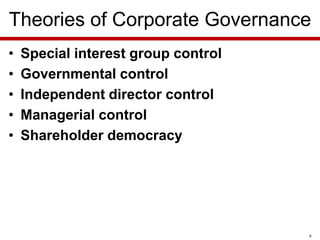
Theories of Corporate Governance
•
•
•
•
•

Special interest group control
Governmental control
Independent director control
Managerial control
Shareholder democracy

8
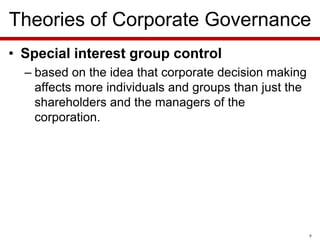
Theories of Corporate Governance
• Special interest group control
– based on the idea that corporate decision making
affects more individuals and groups than just the
shareholders and the managers of the
corporation.

9
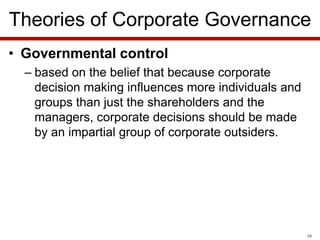
Theories of Corporate Governance
• Governmental control
– based on the belief that because corporate
decision making influences more individuals and
groups than just the shareholders and the
managers, corporate decisions should be made
by an impartial group of corporate outsiders.

10
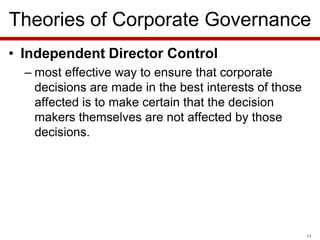
Theories of Corporate Governance
• Independent Director Control
– most effective way to ensure that corporate
decisions are made in the best interests of those
affected is to make certain that the decision
makers themselves are not affected by those
decisions.

11
Independent Director Control
• Independent directors
– directors who have no family members employed
by the corporation, or who are not themselves
employed by the corporation,

• Controlled company
– one that has more than half its voting power
concentrated in one person, or a small group of
persons, who always vote together

12
Theories of Corporate Governance
• Managerial control
– the officers and the directors of a corporation are
in the best position for judging not only the needs
of the corporation but also the needs of the
community and the needs of society at large.

13
Theories of Corporate Governance
• Shareholder democracy
– shareholders have the right to run the corporation,
because without their money, the corporation
would not be able to survive.
– also known as corporate democracy

14
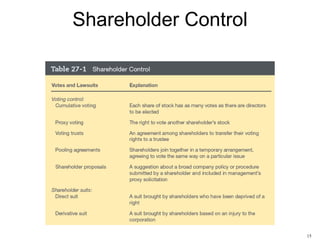
Shareholder Control

15
Shareholder Voting Control
• Cumulative voting
– system allows shareholders to multiply the
number of their voting shares by the number of
directors to be elected.
– allows minority shareholders an opportunity to be
represented on the board of directors.

16
Proxy Voting
• Proxy solicitation
– the process by which one shareholder asks
another for his or her voting right

• Proxy contest
• Proxy statement
• Proxy card

17
Shareholder Proposals
• Shareholder proposal
– a suggestion about a broad company policy or
procedure that is submitted by a shareholder.
– must concern something that affects all
shareholders.

18
Voting Trusts
• Voting trust
– an agreement
among
shareholders to
transfer their voting
rights to a trustee

• Trustee
– a person who is
entrusted with the
management and
control of another’s
property or the
rights associated
with that property.

19
Pooling Agreements
• Pooling Agreements
– shareholders join together in a temporary
arrangement and agree to vote the same way on
a particular issue
– shareholders retain control of their own votes

20
Shareholder Lawsuits
• Direct suit
– brought by shareholders who have been deprived
of a right that belongs to them as shareholders

21
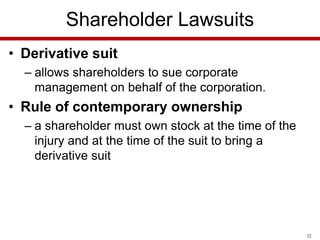
Shareholder Lawsuits
• Derivative suit
– allows shareholders to sue corporate
management on behalf of the corporation.

• Rule of contemporary ownership
– a shareholder must own stock at the time of the
injury and at the time of the suit to bring a
derivative suit

22
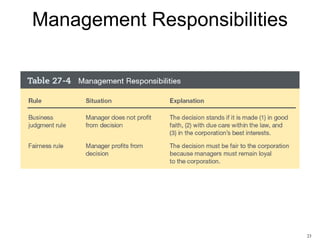
Management Responsibilities

23
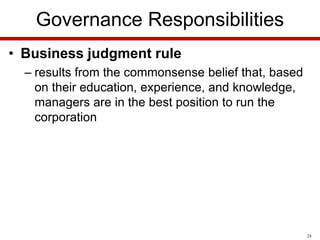
Governance Responsibilities
• Business judgment rule
– results from the commonsense belief that, based
on their education, experience, and knowledge,
managers are in the best position to run the
corporation

24
The Business Judgment Rule
Duty of due diligence says that when
acting on behalf of the corporation, a
manager must act:
1. in good faith,
2. using the same level of care that an ordinarily
prudent individual would use in a comparable
situation,
3. in the reasonable belief that the best interests of
the company are being met.

25
The Fairness Rule
• Fairness rule
– requires managers to be fair to the corporation
when they personally benefit from their business
decisions

26
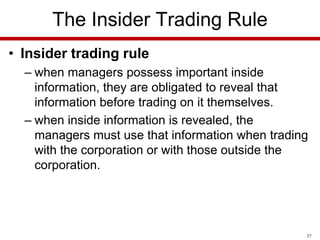
The Insider Trading Rule
• Insider trading rule
– when managers possess important inside
information, they are obligated to reveal that
information before trading on it themselves.
– when inside information is revealed, the
managers must use that information when trading
with the corporation or with those outside the
corporation.

27
The Corporate Opportunity Doctrine
• Corporate opportunity doctrine
– states that corporate managers cannot take a
corporate business opportunity for themselves if
they know that the corporation would be
interested in that opportunity as well.

28
The Actual Authority Rule
• Actual authority rule
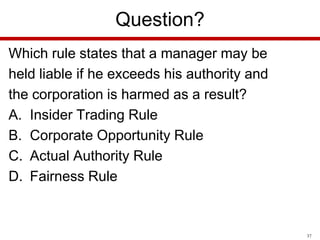
– states that a manager may be held liable if he or
she exceeds his or her authority and the
corporation is harmed as a result.

29
Efforts to Limit Liability
• Voluntary protective measures,
• Automatic protective measures
• Protective measures that limit the amount
of damages that can be recovered against
directors

30
Efforts to Increase Responsibility
• Sarbanes-Oxley Act
– places an affirmative duty on the directors of
publicly traded corporations to monitor whether
their corporation is conforming to all legal
requirements.

31
Efforts to Increase Responsibility
• United States Sentencing Commission
– issued a set of rules that control the discretion of
the federal courts in issuing fines against
corporations found guilty of criminal activities

32
Shareholder Rights
•
•
•
•

Right to Examine Corporate Records
Right to Share in Dividends
Right to Transfer Shares of Stock
Preemptive Rights

33
Preemptive Rights
• Preemptive right
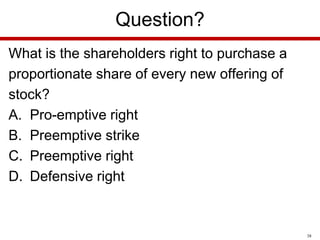
– Shareholders right to purchase a proportionate
share of every new offering of stock by the
corporation unless the right is denied or limited by
the corporate charter or by state law

34
Governance of a Limited Liability Company
• Member-Managed LLCs
• Manager-Managed LLCs
• Fiduciary Duties

35
Question?
Which law places a duty on the directors of
corporations to monitor whether their
corporation is conforming to all legal
requirements?
A. Taft-Hartley Act
B. Sarbanes-Oxley Act
C. United States Sentencing
D. McCain-Clinton Act

36
Question?
Which rule states that a manager may be
held liable if he exceeds his authority and
the corporation is harmed as a result?
A. Insider Trading Rule
B. Corporate Opportunity Rule
C. Actual Authority Rule
D. Fairness Rule

37
Question?
What is the shareholders right to purchase a
proportionate share of every new offering of
stock?
A. Pro-emptive right
B. Preemptive strike
C. Preemptive right
D. Defensive right

38
Question?
The ___________ are (is) the owners of the
corporation.
A. Managers
B. Executive committee
C. Shareholders
D. Board of directors

39
Question?
What is the process by which one
shareholder asks another for his or her
voting right?
A. Proxy solicitation
B. Proxy contest
C. Proxy card
D. Proxy statement

40
Question?
A (n) ____________ manages the business
affairs of a corporation.
A. Managing committee
B. Operations group
C. Board of directors
D. Board of executives

41

BUS 116 Chap027 corporate governance

  • 1.
  • 2.
    Learning Objectives 1. Explainthe central dilemma of corporate governance. 2. Describe the functions of directors, officers, and shareholders. 3. List the five theories of corporate governance. 4. Describe cumulative voting and proxy solicitation. 5. Explain shareholder proposals. 2
  • 3.
    Learning Objectives (cont.) 6.Distinguish between voting trusts and pooling agreements. 7. Contrast shareholder direct suits with shareholder derivative suits. 8. Contrast the business judgment rule with the fairness rule. 9. List the rights that belong to shareholders. 10. Explain the management of a limited liability company. 3
  • 4.
    Directors of theCorporation • Board of directors – manages the business affairs of a corporation – elected by the shareholders. 4
  • 5.
    Time Commitment ofDirectors • The basic time commitment for a director is approximately 30 days per year, but depending upon need, availability, and interest, it can be 40, 60, 80, or even more days. 5
  • 6.
    Officers of theCorporation • Officers have the authority of general agents for the operation of the normal business of the corporation. – President, vice-presidents, a secretary, and treasurer 6
  • 7.
    Shareholders of theCorporation • The shareholders are the owners of the corporation. • The more shares that a shareholder owns, the more voting power that shareholder has in the running of the corporation. 7
  • 8.
    Theories of CorporateGovernance • • • • • Special interest group control Governmental control Independent director control Managerial control Shareholder democracy 8
  • 9.
    Theories of CorporateGovernance • Special interest group control – based on the idea that corporate decision making affects more individuals and groups than just the shareholders and the managers of the corporation. 9
  • 10.
    Theories of CorporateGovernance • Governmental control – based on the belief that because corporate decision making influences more individuals and groups than just the shareholders and the managers, corporate decisions should be made by an impartial group of corporate outsiders. 10
  • 11.
    Theories of CorporateGovernance • Independent Director Control – most effective way to ensure that corporate decisions are made in the best interests of those affected is to make certain that the decision makers themselves are not affected by those decisions. 11
  • 12.
    Independent Director Control •Independent directors – directors who have no family members employed by the corporation, or who are not themselves employed by the corporation, • Controlled company – one that has more than half its voting power concentrated in one person, or a small group of persons, who always vote together 12
  • 13.
    Theories of CorporateGovernance • Managerial control – the officers and the directors of a corporation are in the best position for judging not only the needs of the corporation but also the needs of the community and the needs of society at large. 13
  • 14.
    Theories of CorporateGovernance • Shareholder democracy – shareholders have the right to run the corporation, because without their money, the corporation would not be able to survive. – also known as corporate democracy 14
  • 15.
  • 16.
    Shareholder Voting Control •Cumulative voting – system allows shareholders to multiply the number of their voting shares by the number of directors to be elected. – allows minority shareholders an opportunity to be represented on the board of directors. 16
  • 17.
    Proxy Voting • Proxysolicitation – the process by which one shareholder asks another for his or her voting right • Proxy contest • Proxy statement • Proxy card 17
  • 18.
    Shareholder Proposals • Shareholderproposal – a suggestion about a broad company policy or procedure that is submitted by a shareholder. – must concern something that affects all shareholders. 18
  • 19.
    Voting Trusts • Votingtrust – an agreement among shareholders to transfer their voting rights to a trustee • Trustee – a person who is entrusted with the management and control of another’s property or the rights associated with that property. 19
  • 20.
    Pooling Agreements • PoolingAgreements – shareholders join together in a temporary arrangement and agree to vote the same way on a particular issue – shareholders retain control of their own votes 20
  • 21.
    Shareholder Lawsuits • Directsuit – brought by shareholders who have been deprived of a right that belongs to them as shareholders 21
  • 22.
    Shareholder Lawsuits • Derivativesuit – allows shareholders to sue corporate management on behalf of the corporation. • Rule of contemporary ownership – a shareholder must own stock at the time of the injury and at the time of the suit to bring a derivative suit 22
  • 23.
  • 24.
    Governance Responsibilities • Businessjudgment rule – results from the commonsense belief that, based on their education, experience, and knowledge, managers are in the best position to run the corporation 24
  • 25.
    The Business JudgmentRule Duty of due diligence says that when acting on behalf of the corporation, a manager must act: 1. in good faith, 2. using the same level of care that an ordinarily prudent individual would use in a comparable situation, 3. in the reasonable belief that the best interests of the company are being met. 25
  • 26.
    The Fairness Rule •Fairness rule – requires managers to be fair to the corporation when they personally benefit from their business decisions 26
  • 27.
    The Insider TradingRule • Insider trading rule – when managers possess important inside information, they are obligated to reveal that information before trading on it themselves. – when inside information is revealed, the managers must use that information when trading with the corporation or with those outside the corporation. 27
  • 28.
    The Corporate OpportunityDoctrine • Corporate opportunity doctrine – states that corporate managers cannot take a corporate business opportunity for themselves if they know that the corporation would be interested in that opportunity as well. 28
  • 29.
    The Actual AuthorityRule • Actual authority rule – states that a manager may be held liable if he or she exceeds his or her authority and the corporation is harmed as a result. 29
  • 30.
    Efforts to LimitLiability • Voluntary protective measures, • Automatic protective measures • Protective measures that limit the amount of damages that can be recovered against directors 30
  • 31.
    Efforts to IncreaseResponsibility • Sarbanes-Oxley Act – places an affirmative duty on the directors of publicly traded corporations to monitor whether their corporation is conforming to all legal requirements. 31
  • 32.
    Efforts to IncreaseResponsibility • United States Sentencing Commission – issued a set of rules that control the discretion of the federal courts in issuing fines against corporations found guilty of criminal activities 32
  • 33.
    Shareholder Rights • • • • Right toExamine Corporate Records Right to Share in Dividends Right to Transfer Shares of Stock Preemptive Rights 33
  • 34.
    Preemptive Rights • Preemptiveright – Shareholders right to purchase a proportionate share of every new offering of stock by the corporation unless the right is denied or limited by the corporate charter or by state law 34
  • 35.
    Governance of aLimited Liability Company • Member-Managed LLCs • Manager-Managed LLCs • Fiduciary Duties 35
  • 36.
    Question? Which law placesa duty on the directors of corporations to monitor whether their corporation is conforming to all legal requirements? A. Taft-Hartley Act B. Sarbanes-Oxley Act C. United States Sentencing D. McCain-Clinton Act 36
  • 37.
    Question? Which rule statesthat a manager may be held liable if he exceeds his authority and the corporation is harmed as a result? A. Insider Trading Rule B. Corporate Opportunity Rule C. Actual Authority Rule D. Fairness Rule 37
  • 38.
    Question? What is theshareholders right to purchase a proportionate share of every new offering of stock? A. Pro-emptive right B. Preemptive strike C. Preemptive right D. Defensive right 38
  • 39.
    Question? The ___________ are(is) the owners of the corporation. A. Managers B. Executive committee C. Shareholders D. Board of directors 39
  • 40.
    Question? What is theprocess by which one shareholder asks another for his or her voting right? A. Proxy solicitation B. Proxy contest C. Proxy card D. Proxy statement 40
  • 41.
    Question? A (n) ____________manages the business affairs of a corporation. A. Managing committee B. Operations group C. Board of directors D. Board of executives 41