Chapter 10
Contractual Capacity

10-1
Contractual Capacity
• Capacity
– the legal ability to enter into a contractual
relationship

• Rebuttable presumption
– Presumption of capacity can be attacked by defending
party

• Disaffirm – to negate or back out of a contract

10-4
Minors’ Rights and Obligations
• When a minor indicates by a statement or act an
intent not to live up to a contract, that minor is
entitled to a return of everything given to the
other party
– Often, even if property is damaged/destroyed
– Some jurisdictions allow for deductions due to
damage

10-5
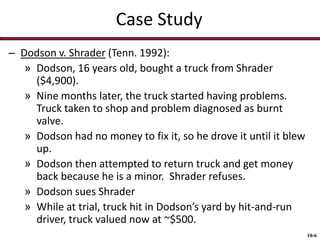
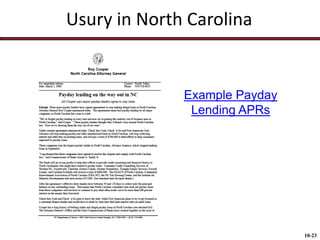
Case Study
– Dodson v. Shrader (Tenn. 1992):
» Dodson, 16 years old, bought a truck from Shrader
($4,900).
» Nine months later, the truck started having problems.
Truck taken to shop and problem diagnosed as burnt
valve.
» Dodson had no money to fix it, so he drove it until it blew
up.
» Dodson then attempted to return truck and get money
back because he is a minor. Shrader refuses.
» Dodson sues Shrader
» While at trial, truck hit in Dodson’s yard by hit-and-run
driver, truck valued now at ~$500.
10-6
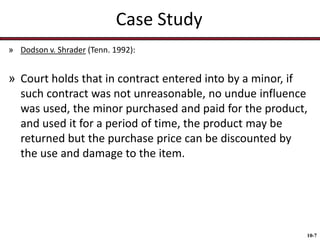
Case Study
» Dodson v. Shrader (Tenn. 1992):

» Court holds that in contract entered into by a minor, if
such contract was not unreasonable, no undue influence
was used, the minor purchased and paid for the product,
and used it for a period of time, the product may be
returned but the purchase price can be discounted by
the use and damage to the item.

10-7
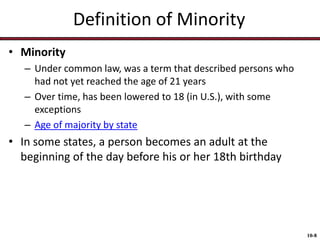
Definition of Minority
• Minority
– Under common law, was a term that described persons who
had not yet reached the age of 21 years
– Over time, has been lowered to 18 (in U.S.), with some
exceptions
– Age of majority by state

• In some states, a person becomes an adult at the
beginning of the day before his or her 18th birthday

10-8
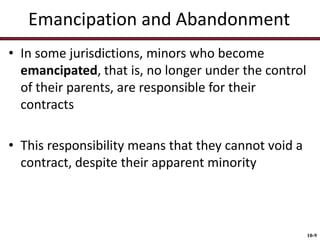
Emancipation and Abandonment
• In some jurisdictions, minors who become
emancipated, that is, no longer under the control
of their parents, are responsible for their
contracts

• This responsibility means that they cannot void a
contract, despite their apparent minority

10-9
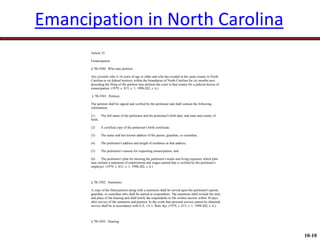
Emancipation in North Carolina
Article 35.
Emancipation.
§ 7B-3500. Who may petition.
Any juvenile who is 16 years of age or older and who has resided in the same county in North
Carolina or on federal territory within the boundaries of North Carolina for six months next
preceding the filing of the petition may petition the court in that county for a judicial decree of
emancipation. (1979, c. 815, s. 1; 1998-202, s. 6.)
§ 7B-3501. Petition.
The petition shall be signed and verified by the petitioner and shall contain the following
information:
(1)
The full name of the petitioner and the petitioner's birth date, and state and county of
birth;
(2)

A certified copy of the petitioner's birth certificate;

(3)

The name and last known address of the parent, guardian, or custodian;

(4)

The petitioner's address and length of residence at that address;

(5)

The petitioner's reasons for requesting emancipation; and

(6)
The petitioner's plan for meeting the petitioner's needs and living expenses which plan
may include a statement of employment and wages earned that is verified by the petitioner's
employer. (1979, c. 815, s. 1; 1998-202, s. 6.)

§ 7B-3502. Summons.
A copy of the filed petition along with a summons shall be served upon the petitioner's parent,
guardian, or custodian who shall be named as respondents. The summons shall include the time
and place of the hearing and shall notify the respondents to file written answer within 30 days
after service of the summons and petition. In the event that personal service cannot be obtained,
service shall be in accordance with G.S. 1A-1, Rule 4(j). (1979, c. 815, s. 1; 1998-202, s. 6.)

§ 7B-3503. Hearing.

10-10
Misrepresentation of Age
• Minors sometimes lie about their age when
making a contract
• Despite this misrepresentation of age, most
states will allow the minor to disaffirm or get out
of the contract

10-11
Contractual Capacity of Minors
• Executory contracts (those that have not been
fully performed by both parties) may be
repudiated by a minor at any time
• A promise to deliver goods or render services at
some future time need not be carried out by the
minor who decides not to do so

10-12
Contracts for Necessaries
• Necessaries
– Goods and services that are essential to a minor’s
health and welfare

• In general, if a minor makes a contract for
necessaries, he/she will be liable for the fair value
of those necessaries

10-13
Other Contracts Not Voidable
• Minors may not:
– disaffirm a valid marriage (reader friendly)
– repudiate an enlistment contract in the armed forces
based on a claim of incapacity to contract
– repudiate payments for inoculations and vaccinations
required for attendance at a university or college or
required in securing a visa for travel in certain foreign
lands
– Disaffirm student loan contract if 17 or over (in NC)

• Minors in NC
10-14
Other Contracts Not Voidable
• Shield or Sword Doctrine
– Minor exploits a law designed to serve as his/her
shield and turns it into a sword with which he/she
causes harm

• Voidable Contracts and Innocent 3rd Parties
– Under UCC, innocent 3rd parties protected

10-15
Ratification of Minors’ Contracts
• Ratification (affirmance)
– The willingness to abide by contractual obligations
– Done only after reaching age of majority
– Can be express or implied

• Disaffirmance
– Backing out of a contract made during minority once
majority is reached

10-16
Other Capacity Problems
• Persons Mentally Impaired
– Voidable if the impairment is so severe that it robs the
person of the ability to understand the nature,
purpose, and effect of the contract

• Persons Legally Insane
– A person declared insane by competent legal
authority is denied the right to enter contracts
– Would result in a void contract

10-17
Other Capacity Problems
• Persons Drugged or Intoxicated
– May be voidable if intoxication is to the point that the
contracting party has lost the ability to understand
the obligations of the contract, or if can prove the
other person was aware and took advantage of their
drunken state

10-18
Agreements to Engage in Unlawful Activity
• A contract may include:
– a valid offer,
– an effective acceptance,
– mutual assent,
– competent parties, and
– valid consideration
– and still be invalid because the agreement involves
doing something illegal

10-19
Agreements to Engage in Unlawful Activity
• The court will leave the parties to an illegal
agreement where they placed themselves.
• If it is still executory, the court will not order it
performed or award damages for breach of
contract.
• If it has been executed, the court will not award
damages or assist in having it annulled.

10-20
Agreements Made Illegal Under Statutory Law

• These activities include:
–usurious agreements
–wagering agreements
–unlicensed agreements
–unconscionable agreements
–Sunday (Sabbath) agreements

10-21
Usurious Agreements
• Usury
– Charging more interest than allowed by law

• Special statutes, however, allow small loan
companies, pawn shops, and other lending
agencies that accept high-risk applicants for
credit to charge a higher rate of interest

10-22
Usury in North Carolina

Example Payday
Lending APRs

10-23
Wagering Agreements
• Any agreement or promise concerning a wager or
some other form of gambling is invalid and may
not be enforced
• Exceptions made when bets are placed legally
(state lottery, horse racing, church/charity bingo,
legal casinos)
• Even if gambling is legal in your state, probably
still illegal to borrow money for gambling

10-24
Wagering Agreements
• Theresa Sokaitis v. Rose Bakaysa
– Splitting contract, notarized
– Rose wins $500,000, splits with brother instead of
Theresa
– Sues for breach of contract
– First court agrees with Rose (summary judgment)
– Appellate court reverses
– Connecticut Supreme Court affirms Appellate Court’s
ruling
– At trial, court finally decides in favor of Rose
10-25
Unlicensed Agreements
• Certain businesses and professions must be
licensed before they are allowed to operate
legally

• Reasons for requiring licensing:
– To protect the public
– To raise revenue (proceeds often fund regulation)

10-26
Unlicensed Agreements
• Courts distinguish between licenses purely for
revenue and those for public protection
– If license required only for revenue, lack of license
won’t necessarily void contract
– If license for public protection, contract will most
likely be void

10-27
Unconscionable Agreements
• A court will not enforce a contract or any part of a
contract that it regards as unconscionable.
• An agreement is considered unconscionable if its
terms are so grossly unfair that they shock the
court’s conscience.

10-28
Sunday Agreements
• State statutes and local ordinances regulate the
making and performing of contracts on Sunday
• Usually called blue laws

• Blue laws wiki

10-29
Sunday Agreements
If local laws prohibit Sunday business, two rules
are usually observed:
1. Agreements made on Sunday or any other day
requiring performance on Sunday may be ruled
invalid
2. Agreements made on Sunday for work to be
done or goods to be delivered on a business day
are valid and enforceable

10-30
Agreements Contrary to Public Policy
• Public policy
– the general legal principle that says no one should be
allowed to do anything that tends to injure the public
at large.

– Any action that tends to harm the health, safety,
welfare, or morals of the people

10-31
Agreements Contrary to Public Policy

•
•
•
•
•

Obstructing justice
Interfering with public service
Defrauding creditors
Escaping liability
Restraining trade

10-32
Agreements to Obstruct Justice
• Agreements to obstruct justice include:
– agreements to protect someone from arrest
– to suppress evidence
– to encourage lawsuits
– to give false testimony
– to bribe a juror
– promising not to prosecute
– promising not to serve as a witness at trial
10-33
Agreements Interfering with Public Service
• Agreements interfering with public service
are illegal and void.
– agreements to bribe or interfere with public
officials
– to obtain political preference in appointments
to office
– to pay an officer for signing a pardon
– to illegally influence a legislature for personal
gain
10-34
Agreements to Defraud Creditors
• Agreements that tend to remove or weaken the
rights of creditors, are void as contrary to public
policy
ex: transferring/destroying/hiding assets to
hinder a creditor’s claim on them.

10-35
Agreements to Escape Liability
• Exculpatory agreement
– States that one of the parties, generally the one who
wrote the contract, will not be liable for any economic
loss of physical injury even if that party caused the
loss or injury.

• Exculpatory clauses are often not sufficient to
release a party from his/her own negligence

10-36
Agreements in Restraint of Trade
• Restraint of trade
– A limitation on the full exercise of doing business with
others

• Agreements that:
– Remove competition
– Deny services to the public that they would otherwise
have
– Result in higher prices and resulting hardship

10-37
Agreements to Suppress Competition
• Any agreement made with the intent of
suppressing competition, fixing prices, and the
like is void as an illegal restraint of trade
• Rule of reason standard
– such agreements are enforceable when they do not
unreasonably restrict businesses from competing with
one another

10-38
Contracts Related to Copyright Infringement
• Copyright
– designed to protect the rights that attach to an
artistic, literary, or musical work.

• A copyright holder is given the exclusive right to
reproduce, publish, and sell a work that is set in a
tangible medium of expression

10-39
Contracts Related to Copyright Infringement
• Contributory copyright infringement.
– Illegal for one party to provide a way for a second
party to violate the copyright rights of a third party,
even if the provider of the means does not itself
violate the original copyright

• Fair use
– Copying permitted for criticism, comment, news
reporting, teaching, scholarship, research

10-40
Capitol v. Thomas
Thomas suspected of sharing 1,702 songs online via Kazaa,
plaintiffs seeking damages for only 24 (is “making available” the
same as “distributing”?
• Capitol offers $5,000 settlement, Thomas declines
• First trial (2007), Thomas ordered to pay $222,000
• Court grants new trial due to error in jury instructions
• Before 2nd trial, Capitol offers $25,000 settlement agreement,
Thomas again declines
• At 2nd trial, jury awards Capitol $1,920,000, judged reduced
to $54,000
• 3rd trial, jury awards $1,500,000, judge reduces again to
$54,000
• Appellate court reinstates award of $222,000
10-41
Sale of Business
• When a business is sold, it is common practice for
the agreement to contain covenants that restrict
the seller from entering the same type of
business.
• Such restrictive covenants in a contract for the
sale of a business will be upheld by the court if
they are reasonable in time and geographical
area.

10-42
Restrictive Employment Covenants
• An employment contract that limits a worker’s
employment options after leaving her or his
present job
– “Non-competes”

• Must be reasonable with regard to:
– Type of work
– Length of time
– Geographic area

10-43
Nondisclosure Agreements
• Nondisclosure agreement
– requires employees to promise that if they leave their
job they will not reveal any confidential trade secrets
• Court will step in to prevent information from being
revealed or used if . . .

10-44
Trade Secrets
(1) the information revealed was actually a trade secret
(2) the information was crucial to the running of the
employer’s business
(3) the employer had the right to use the trade secret

(4) the former employee came into possession of the
trade secret while in a position of trust and confidence
and in such a way that it would be unfair for the former
employee to disclose that trade secret in a way that
would hurt his or her former employer.
10-45
Consequences of Illegality
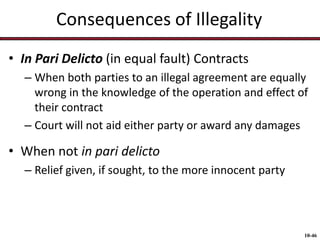
• In Pari Delicto (in equal fault) Contracts
– When both parties to an illegal agreement are equally
wrong in the knowledge of the operation and effect of
their contract
– Court will not aid either party or award any damages

• When not in pari delicto
– Relief given, if sought, to the more innocent party

10-46
Illegality in Entire Agreement
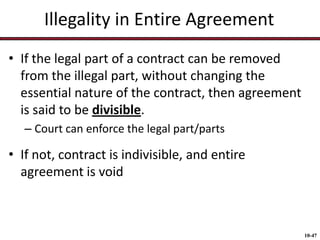
• If the legal part of a contract can be removed
from the illegal part, without changing the
essential nature of the contract, then agreement
is said to be divisible.
– Court can enforce the legal part/parts

• If not, contract is indivisible, and entire
agreement is void

10-47
Question?
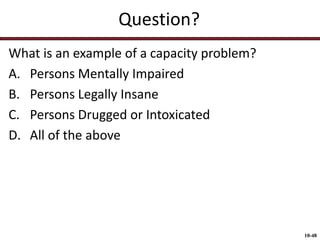
What is an example of a capacity problem?
A. Persons Mentally Impaired
B. Persons Legally Insane
C. Persons Drugged or Intoxicated
D. All of the above

10-48
Question?
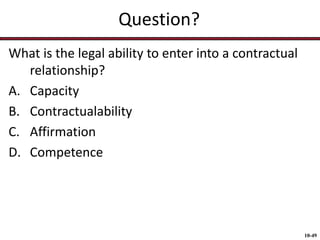
What is the legal ability to enter into a contractual
relationship?
A. Capacity
B. Contractualability
C. Affirmation
D. Competence

10-49
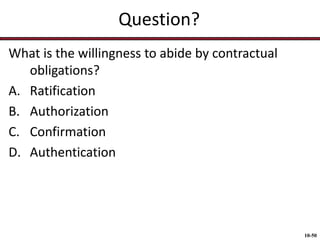
Question?
What is the willingness to abide by contractual
obligations?
A. Ratification
B. Authorization
C. Confirmation
D. Authentication

10-50
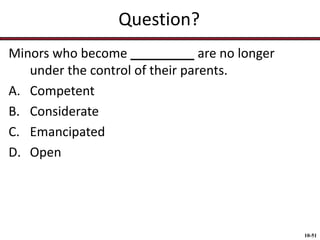
Question?
Minors who become _________ are no longer
under the control of their parents.
A. Competent
B. Considerate
C. Emancipated
D. Open

10-51
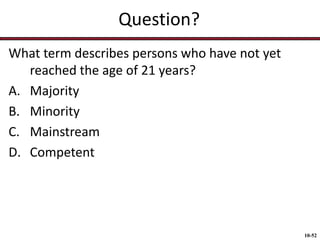
Question?
What term describes persons who have not yet
reached the age of 21 years?
A. Majority
B. Minority
C. Mainstream
D. Competent

10-52
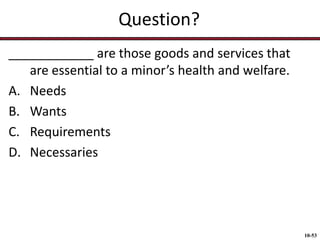
Question?
____________ are those goods and services that
are essential to a minor’s health and welfare.
A. Needs
B. Wants
C. Requirements
D. Necessaries

10-53

BUS 115 Chap010 capacity and legality

  • 1.
  • 2.
    Contractual Capacity • Capacity –the legal ability to enter into a contractual relationship • Rebuttable presumption – Presumption of capacity can be attacked by defending party • Disaffirm – to negate or back out of a contract 10-4
  • 3.
    Minors’ Rights andObligations • When a minor indicates by a statement or act an intent not to live up to a contract, that minor is entitled to a return of everything given to the other party – Often, even if property is damaged/destroyed – Some jurisdictions allow for deductions due to damage 10-5
  • 4.
    Case Study – Dodsonv. Shrader (Tenn. 1992): » Dodson, 16 years old, bought a truck from Shrader ($4,900). » Nine months later, the truck started having problems. Truck taken to shop and problem diagnosed as burnt valve. » Dodson had no money to fix it, so he drove it until it blew up. » Dodson then attempted to return truck and get money back because he is a minor. Shrader refuses. » Dodson sues Shrader » While at trial, truck hit in Dodson’s yard by hit-and-run driver, truck valued now at ~$500. 10-6
  • 5.
    Case Study » Dodsonv. Shrader (Tenn. 1992): » Court holds that in contract entered into by a minor, if such contract was not unreasonable, no undue influence was used, the minor purchased and paid for the product, and used it for a period of time, the product may be returned but the purchase price can be discounted by the use and damage to the item. 10-7
  • 6.
    Definition of Minority •Minority – Under common law, was a term that described persons who had not yet reached the age of 21 years – Over time, has been lowered to 18 (in U.S.), with some exceptions – Age of majority by state • In some states, a person becomes an adult at the beginning of the day before his or her 18th birthday 10-8
  • 7.
    Emancipation and Abandonment •In some jurisdictions, minors who become emancipated, that is, no longer under the control of their parents, are responsible for their contracts • This responsibility means that they cannot void a contract, despite their apparent minority 10-9
  • 8.
    Emancipation in NorthCarolina Article 35. Emancipation. § 7B-3500. Who may petition. Any juvenile who is 16 years of age or older and who has resided in the same county in North Carolina or on federal territory within the boundaries of North Carolina for six months next preceding the filing of the petition may petition the court in that county for a judicial decree of emancipation. (1979, c. 815, s. 1; 1998-202, s. 6.) § 7B-3501. Petition. The petition shall be signed and verified by the petitioner and shall contain the following information: (1) The full name of the petitioner and the petitioner's birth date, and state and county of birth; (2) A certified copy of the petitioner's birth certificate; (3) The name and last known address of the parent, guardian, or custodian; (4) The petitioner's address and length of residence at that address; (5) The petitioner's reasons for requesting emancipation; and (6) The petitioner's plan for meeting the petitioner's needs and living expenses which plan may include a statement of employment and wages earned that is verified by the petitioner's employer. (1979, c. 815, s. 1; 1998-202, s. 6.) § 7B-3502. Summons. A copy of the filed petition along with a summons shall be served upon the petitioner's parent, guardian, or custodian who shall be named as respondents. The summons shall include the time and place of the hearing and shall notify the respondents to file written answer within 30 days after service of the summons and petition. In the event that personal service cannot be obtained, service shall be in accordance with G.S. 1A-1, Rule 4(j). (1979, c. 815, s. 1; 1998-202, s. 6.) § 7B-3503. Hearing. 10-10
  • 9.
    Misrepresentation of Age •Minors sometimes lie about their age when making a contract • Despite this misrepresentation of age, most states will allow the minor to disaffirm or get out of the contract 10-11
  • 10.
    Contractual Capacity ofMinors • Executory contracts (those that have not been fully performed by both parties) may be repudiated by a minor at any time • A promise to deliver goods or render services at some future time need not be carried out by the minor who decides not to do so 10-12
  • 11.
    Contracts for Necessaries •Necessaries – Goods and services that are essential to a minor’s health and welfare • In general, if a minor makes a contract for necessaries, he/she will be liable for the fair value of those necessaries 10-13
  • 12.
    Other Contracts NotVoidable • Minors may not: – disaffirm a valid marriage (reader friendly) – repudiate an enlistment contract in the armed forces based on a claim of incapacity to contract – repudiate payments for inoculations and vaccinations required for attendance at a university or college or required in securing a visa for travel in certain foreign lands – Disaffirm student loan contract if 17 or over (in NC) • Minors in NC 10-14
  • 13.
    Other Contracts NotVoidable • Shield or Sword Doctrine – Minor exploits a law designed to serve as his/her shield and turns it into a sword with which he/she causes harm • Voidable Contracts and Innocent 3rd Parties – Under UCC, innocent 3rd parties protected 10-15
  • 14.
    Ratification of Minors’Contracts • Ratification (affirmance) – The willingness to abide by contractual obligations – Done only after reaching age of majority – Can be express or implied • Disaffirmance – Backing out of a contract made during minority once majority is reached 10-16
  • 15.
    Other Capacity Problems •Persons Mentally Impaired – Voidable if the impairment is so severe that it robs the person of the ability to understand the nature, purpose, and effect of the contract • Persons Legally Insane – A person declared insane by competent legal authority is denied the right to enter contracts – Would result in a void contract 10-17
  • 16.
    Other Capacity Problems •Persons Drugged or Intoxicated – May be voidable if intoxication is to the point that the contracting party has lost the ability to understand the obligations of the contract, or if can prove the other person was aware and took advantage of their drunken state 10-18
  • 17.
    Agreements to Engagein Unlawful Activity • A contract may include: – a valid offer, – an effective acceptance, – mutual assent, – competent parties, and – valid consideration – and still be invalid because the agreement involves doing something illegal 10-19
  • 18.
    Agreements to Engagein Unlawful Activity • The court will leave the parties to an illegal agreement where they placed themselves. • If it is still executory, the court will not order it performed or award damages for breach of contract. • If it has been executed, the court will not award damages or assist in having it annulled. 10-20
  • 19.
    Agreements Made IllegalUnder Statutory Law • These activities include: –usurious agreements –wagering agreements –unlicensed agreements –unconscionable agreements –Sunday (Sabbath) agreements 10-21
  • 20.
    Usurious Agreements • Usury –Charging more interest than allowed by law • Special statutes, however, allow small loan companies, pawn shops, and other lending agencies that accept high-risk applicants for credit to charge a higher rate of interest 10-22
  • 21.
    Usury in NorthCarolina Example Payday Lending APRs 10-23
  • 22.
    Wagering Agreements • Anyagreement or promise concerning a wager or some other form of gambling is invalid and may not be enforced • Exceptions made when bets are placed legally (state lottery, horse racing, church/charity bingo, legal casinos) • Even if gambling is legal in your state, probably still illegal to borrow money for gambling 10-24
  • 23.
    Wagering Agreements • TheresaSokaitis v. Rose Bakaysa – Splitting contract, notarized – Rose wins $500,000, splits with brother instead of Theresa – Sues for breach of contract – First court agrees with Rose (summary judgment) – Appellate court reverses – Connecticut Supreme Court affirms Appellate Court’s ruling – At trial, court finally decides in favor of Rose 10-25
  • 24.
    Unlicensed Agreements • Certainbusinesses and professions must be licensed before they are allowed to operate legally • Reasons for requiring licensing: – To protect the public – To raise revenue (proceeds often fund regulation) 10-26
  • 25.
    Unlicensed Agreements • Courtsdistinguish between licenses purely for revenue and those for public protection – If license required only for revenue, lack of license won’t necessarily void contract – If license for public protection, contract will most likely be void 10-27
  • 26.
    Unconscionable Agreements • Acourt will not enforce a contract or any part of a contract that it regards as unconscionable. • An agreement is considered unconscionable if its terms are so grossly unfair that they shock the court’s conscience. 10-28
  • 27.
    Sunday Agreements • Statestatutes and local ordinances regulate the making and performing of contracts on Sunday • Usually called blue laws • Blue laws wiki 10-29
  • 28.
    Sunday Agreements If locallaws prohibit Sunday business, two rules are usually observed: 1. Agreements made on Sunday or any other day requiring performance on Sunday may be ruled invalid 2. Agreements made on Sunday for work to be done or goods to be delivered on a business day are valid and enforceable 10-30
  • 29.
    Agreements Contrary toPublic Policy • Public policy – the general legal principle that says no one should be allowed to do anything that tends to injure the public at large. – Any action that tends to harm the health, safety, welfare, or morals of the people 10-31
  • 30.
    Agreements Contrary toPublic Policy • • • • • Obstructing justice Interfering with public service Defrauding creditors Escaping liability Restraining trade 10-32
  • 31.
    Agreements to ObstructJustice • Agreements to obstruct justice include: – agreements to protect someone from arrest – to suppress evidence – to encourage lawsuits – to give false testimony – to bribe a juror – promising not to prosecute – promising not to serve as a witness at trial 10-33
  • 32.
    Agreements Interfering withPublic Service • Agreements interfering with public service are illegal and void. – agreements to bribe or interfere with public officials – to obtain political preference in appointments to office – to pay an officer for signing a pardon – to illegally influence a legislature for personal gain 10-34
  • 33.
    Agreements to DefraudCreditors • Agreements that tend to remove or weaken the rights of creditors, are void as contrary to public policy ex: transferring/destroying/hiding assets to hinder a creditor’s claim on them. 10-35
  • 34.
    Agreements to EscapeLiability • Exculpatory agreement – States that one of the parties, generally the one who wrote the contract, will not be liable for any economic loss of physical injury even if that party caused the loss or injury. • Exculpatory clauses are often not sufficient to release a party from his/her own negligence 10-36
  • 35.
    Agreements in Restraintof Trade • Restraint of trade – A limitation on the full exercise of doing business with others • Agreements that: – Remove competition – Deny services to the public that they would otherwise have – Result in higher prices and resulting hardship 10-37
  • 36.
    Agreements to SuppressCompetition • Any agreement made with the intent of suppressing competition, fixing prices, and the like is void as an illegal restraint of trade • Rule of reason standard – such agreements are enforceable when they do not unreasonably restrict businesses from competing with one another 10-38
  • 37.
    Contracts Related toCopyright Infringement • Copyright – designed to protect the rights that attach to an artistic, literary, or musical work. • A copyright holder is given the exclusive right to reproduce, publish, and sell a work that is set in a tangible medium of expression 10-39
  • 38.
    Contracts Related toCopyright Infringement • Contributory copyright infringement. – Illegal for one party to provide a way for a second party to violate the copyright rights of a third party, even if the provider of the means does not itself violate the original copyright • Fair use – Copying permitted for criticism, comment, news reporting, teaching, scholarship, research 10-40
  • 39.
    Capitol v. Thomas Thomassuspected of sharing 1,702 songs online via Kazaa, plaintiffs seeking damages for only 24 (is “making available” the same as “distributing”? • Capitol offers $5,000 settlement, Thomas declines • First trial (2007), Thomas ordered to pay $222,000 • Court grants new trial due to error in jury instructions • Before 2nd trial, Capitol offers $25,000 settlement agreement, Thomas again declines • At 2nd trial, jury awards Capitol $1,920,000, judged reduced to $54,000 • 3rd trial, jury awards $1,500,000, judge reduces again to $54,000 • Appellate court reinstates award of $222,000 10-41
  • 40.
    Sale of Business •When a business is sold, it is common practice for the agreement to contain covenants that restrict the seller from entering the same type of business. • Such restrictive covenants in a contract for the sale of a business will be upheld by the court if they are reasonable in time and geographical area. 10-42
  • 41.
    Restrictive Employment Covenants •An employment contract that limits a worker’s employment options after leaving her or his present job – “Non-competes” • Must be reasonable with regard to: – Type of work – Length of time – Geographic area 10-43
  • 42.
    Nondisclosure Agreements • Nondisclosureagreement – requires employees to promise that if they leave their job they will not reveal any confidential trade secrets • Court will step in to prevent information from being revealed or used if . . . 10-44
  • 43.
    Trade Secrets (1) theinformation revealed was actually a trade secret (2) the information was crucial to the running of the employer’s business (3) the employer had the right to use the trade secret (4) the former employee came into possession of the trade secret while in a position of trust and confidence and in such a way that it would be unfair for the former employee to disclose that trade secret in a way that would hurt his or her former employer. 10-45
  • 44.
    Consequences of Illegality •In Pari Delicto (in equal fault) Contracts – When both parties to an illegal agreement are equally wrong in the knowledge of the operation and effect of their contract – Court will not aid either party or award any damages • When not in pari delicto – Relief given, if sought, to the more innocent party 10-46
  • 45.
    Illegality in EntireAgreement • If the legal part of a contract can be removed from the illegal part, without changing the essential nature of the contract, then agreement is said to be divisible. – Court can enforce the legal part/parts • If not, contract is indivisible, and entire agreement is void 10-47
  • 46.
    Question? What is anexample of a capacity problem? A. Persons Mentally Impaired B. Persons Legally Insane C. Persons Drugged or Intoxicated D. All of the above 10-48
  • 47.
    Question? What is thelegal ability to enter into a contractual relationship? A. Capacity B. Contractualability C. Affirmation D. Competence 10-49
  • 48.
    Question? What is thewillingness to abide by contractual obligations? A. Ratification B. Authorization C. Confirmation D. Authentication 10-50
  • 49.
    Question? Minors who become_________ are no longer under the control of their parents. A. Competent B. Considerate C. Emancipated D. Open 10-51
  • 50.
    Question? What term describespersons who have not yet reached the age of 21 years? A. Majority B. Minority C. Mainstream D. Competent 10-52
  • 51.
    Question? ____________ are thosegoods and services that are essential to a minor’s health and welfare. A. Needs B. Wants C. Requirements D. Necessaries 10-53