Chapter 9
Consideration and Cyberpayments

11-1
Case Study
• Dougherty v. Salt (1919)
– Elderly aunt writes a note to her nephew promising
$3,000 at her death or before
– Aunt dies, estate won’t pay
– Nephew sues
Should the court uphold the agreement?

11-4
Case Study
• Hamer v. Sidway (1891)
– Man promises his nephew that he would pay him $5000 if he
refrains from drinking, using tobacco, swearing, and playing
cards or billiards for money until he became 21 years of age
– The nephew agreed and fully performed the conditions.
– Plaintiff tries to enforce agreement, but defendant won’t
comply, citing no contract due to lack of consideration

11-5
Requirements of Consideration
• Consideration
– The mutual promise to exchange benefits and
sacrifices between the parties.

Quid pro quo – something for something

11-6
The Nature of Consideration
• A gain by the offeree is a loss to the offeror
• Likewise, the gain bargained for by the offeror
will result in a loss or sacrifice by the offeree
• Mutual benefit and detriment

11-7
The Nature of Consideration
• Legal detriment
– the legal term used to describe the sacrifice that each
party must experience

11-8
The Nature of Consideration
A legal detriment can be:
(1) doing something that one has a legal right not
to do
(2) giving up something that one has a legal right to
keep
(3) refraining from doing something that one has a
legal right to do (forbearance)

11-9
The Characteristics of Consideration
1. The agreement must involve a bargained-for
exchange
2. The contract must involve adequate
consideration
3. The benefits and detriments promised must
themselves be legal

11-10
Bargained-for Exchange
An agreement involves a bargained-for exchange
when:
1. a promise is made in exchange for another
promise
2. a promise is made in exchange for an act
3. a promise is made for forbearance of an act

11-11
Adequacy of Consideration
• In general, the courts do not look to see whether
the value of the consideration was fair to both
parties
• However, a court may refuse to enforce a
contract or any clause of a contract if it considers
the contract or clause unconscionable
– So ridiculously inadequate that it shocks the court’s
conscience

11-12
Case Studies
• Tillman v. Commercial Credit Loans, Inc., 655
S.E.2d 362 (N.C. 2008)
– An unfair arbitration clause in a subprime mortgage
contract declared unconscionable

• Ting v. AT&T (2003)
– A binding arbitration clause in AT&T’s phone contracts
declared unconscionable

11-13
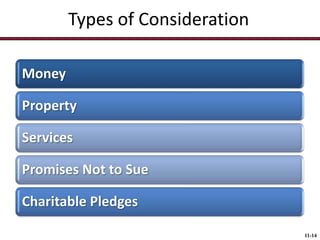
Types of Consideration
Money

Property
Services
Promises Not to Sue

Charitable Pledges
11-14
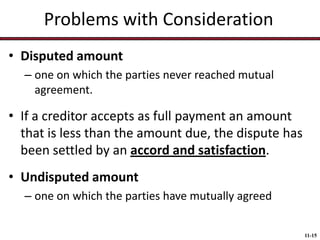
Problems with Consideration
• Disputed amount
– one on which the parties never reached mutual
agreement.

• If a creditor accepts as full payment an amount
that is less than the amount due, the dispute has
been settled by an accord and satisfaction.
• Undisputed amount
– one on which the parties have mutually agreed
11-15
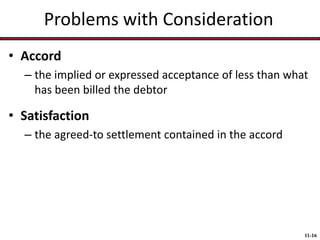
Problems with Consideration
• Accord
– the implied or expressed acceptance of less than what
has been billed the debtor

• Satisfaction
– the agreed-to settlement contained in the accord

11-16
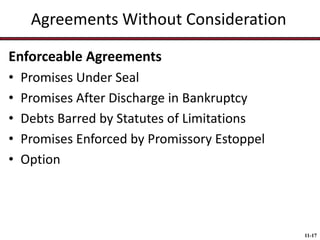
Agreements Without Consideration
Enforceable Agreements
•
•
•
•
•

Promises Under Seal
Promises After Discharge in Bankruptcy
Debts Barred by Statutes of Limitations
Promises Enforced by Promissory Estoppel
Option

11-17
Promises Under Seal
• Varies according to jurisdiction
• Seal
– a mark or an impression placed on a written contract
indicating that the instrument was executed and
accepted in a formal manner

• Locus sigilli
– “place of the seal”

11-19
Debts Barred by Statutes of Limitations
• Statutes of limitations – laws that limit the time
within which a party is allowed to bring suit.
• The time allowed for the collection of a debt
varies from state to state, usually from three to
ten years

http://www.fair-debt-collection.com/SOL-by-State.html#34

11-20
Promises Enforced by Promissory Estoppel
• Promissory estoppel
– legal doctrine that restricts a party from denying that
a promise was made under certain conditions, even
though consideration has not been exchanged to bind
an agreement.
Ex: I promise you a job if you move to California. You
move, but I refuse to give you a job.

11-21
Case Study
• East Providence Credit Union v. Geremia (1968)
– Credit Union issues car purchase loan to defendants,
required accident insurance, bank warned that they
will get insurance and bill defendants
– Car wrecked, but bank did not buy insurance
– Court ruled that Bank’s warning was a promise on
which D’s reasonably relied and thus Bank was liable
under promissory estoppel.

11-22
Option
• Option
– The giving of consideration to support an offeror’s
promise to hold open an offer for a stated or a
reasonable length of time
– Firm offer (irrevocable offer)
• Must be signed by the offeror, and for a period no longer
than three months

11-23
Unenforceable Agreements
• Preexisting Duties
– A promise to do something that one is already
obligated to do by law or by some other promise or
agreement cannot be made consideration in a new
contract

11-24
Unenforceable Agreements
• Past Consideration
– A promise to give another something of value in
return for goods or services rendered and delivered in
the past, without expectation or reward

• Promises for Future Gifts

11-25
Unenforceable Agreements
• Illusory promise
– One that seems genuine but that on close
examination actually fails to obligate the promisor to
do anything

Ex: I promise to give you all A’s, unless I decide not to.

11-26
Cyber-Payment Tactics and Concerns
• Cyber-price and competition
• Cyber-payments

11-27
Cyber-Price and Competition
• The Internet has helped improve the
transparency of the pricing process.
• Consumers can now use the Internet to seek out
competitive prices, thus improving their ability to
set the consideration at a level with which they
are comfortable.

11-28
Cyber-Price Shopping
• Some consumers subscribe to several objective
shopping search engines that provide pricing
comparison information.
• Expedia, Travelocity, Orbitz

11-29
Cyber-Payments Options
• Credit card, debit card
• European stored value or smart card
• Alternative payment system - PayPal

11-30
Cyber-Payment Security Issues
• EU Data Protection Directive along
• with the EU E-Privacy Directive guarantee the
rights of European citizens while, at the same
time, ensuring the smooth exchange of data
among those nation-states that honor the privacy
and data protection standards themselves.

11-31
Cyber-Payment Security Issues
• Safe Harbor Principles
– U.S. corporations that are involved with EU
corporations must demonstrate that the companies
themselves will promise to honor the same degree of
protection to data and to privacy as guaranteed by
the EU.

11-32

BUS 115 Chap009 consideration and cyberpayments

  • 1.
    Chapter 9 Consideration andCyberpayments 11-1
  • 2.
    Case Study • Doughertyv. Salt (1919) – Elderly aunt writes a note to her nephew promising $3,000 at her death or before – Aunt dies, estate won’t pay – Nephew sues Should the court uphold the agreement? 11-4
  • 3.
    Case Study • Hamerv. Sidway (1891) – Man promises his nephew that he would pay him $5000 if he refrains from drinking, using tobacco, swearing, and playing cards or billiards for money until he became 21 years of age – The nephew agreed and fully performed the conditions. – Plaintiff tries to enforce agreement, but defendant won’t comply, citing no contract due to lack of consideration 11-5
  • 4.
    Requirements of Consideration •Consideration – The mutual promise to exchange benefits and sacrifices between the parties. Quid pro quo – something for something 11-6
  • 5.
    The Nature ofConsideration • A gain by the offeree is a loss to the offeror • Likewise, the gain bargained for by the offeror will result in a loss or sacrifice by the offeree • Mutual benefit and detriment 11-7
  • 6.
    The Nature ofConsideration • Legal detriment – the legal term used to describe the sacrifice that each party must experience 11-8
  • 7.
    The Nature ofConsideration A legal detriment can be: (1) doing something that one has a legal right not to do (2) giving up something that one has a legal right to keep (3) refraining from doing something that one has a legal right to do (forbearance) 11-9
  • 8.
    The Characteristics ofConsideration 1. The agreement must involve a bargained-for exchange 2. The contract must involve adequate consideration 3. The benefits and detriments promised must themselves be legal 11-10
  • 9.
    Bargained-for Exchange An agreementinvolves a bargained-for exchange when: 1. a promise is made in exchange for another promise 2. a promise is made in exchange for an act 3. a promise is made for forbearance of an act 11-11
  • 10.
    Adequacy of Consideration •In general, the courts do not look to see whether the value of the consideration was fair to both parties • However, a court may refuse to enforce a contract or any clause of a contract if it considers the contract or clause unconscionable – So ridiculously inadequate that it shocks the court’s conscience 11-12
  • 11.
    Case Studies • Tillmanv. Commercial Credit Loans, Inc., 655 S.E.2d 362 (N.C. 2008) – An unfair arbitration clause in a subprime mortgage contract declared unconscionable • Ting v. AT&T (2003) – A binding arbitration clause in AT&T’s phone contracts declared unconscionable 11-13
  • 12.
  • 13.
    Problems with Consideration •Disputed amount – one on which the parties never reached mutual agreement. • If a creditor accepts as full payment an amount that is less than the amount due, the dispute has been settled by an accord and satisfaction. • Undisputed amount – one on which the parties have mutually agreed 11-15
  • 14.
    Problems with Consideration •Accord – the implied or expressed acceptance of less than what has been billed the debtor • Satisfaction – the agreed-to settlement contained in the accord 11-16
  • 15.
    Agreements Without Consideration EnforceableAgreements • • • • • Promises Under Seal Promises After Discharge in Bankruptcy Debts Barred by Statutes of Limitations Promises Enforced by Promissory Estoppel Option 11-17
  • 16.
    Promises Under Seal •Varies according to jurisdiction • Seal – a mark or an impression placed on a written contract indicating that the instrument was executed and accepted in a formal manner • Locus sigilli – “place of the seal” 11-19
  • 17.
    Debts Barred byStatutes of Limitations • Statutes of limitations – laws that limit the time within which a party is allowed to bring suit. • The time allowed for the collection of a debt varies from state to state, usually from three to ten years http://www.fair-debt-collection.com/SOL-by-State.html#34 11-20
  • 18.
    Promises Enforced byPromissory Estoppel • Promissory estoppel – legal doctrine that restricts a party from denying that a promise was made under certain conditions, even though consideration has not been exchanged to bind an agreement. Ex: I promise you a job if you move to California. You move, but I refuse to give you a job. 11-21
  • 19.
    Case Study • EastProvidence Credit Union v. Geremia (1968) – Credit Union issues car purchase loan to defendants, required accident insurance, bank warned that they will get insurance and bill defendants – Car wrecked, but bank did not buy insurance – Court ruled that Bank’s warning was a promise on which D’s reasonably relied and thus Bank was liable under promissory estoppel. 11-22
  • 20.
    Option • Option – Thegiving of consideration to support an offeror’s promise to hold open an offer for a stated or a reasonable length of time – Firm offer (irrevocable offer) • Must be signed by the offeror, and for a period no longer than three months 11-23
  • 21.
    Unenforceable Agreements • PreexistingDuties – A promise to do something that one is already obligated to do by law or by some other promise or agreement cannot be made consideration in a new contract 11-24
  • 22.
    Unenforceable Agreements • PastConsideration – A promise to give another something of value in return for goods or services rendered and delivered in the past, without expectation or reward • Promises for Future Gifts 11-25
  • 23.
    Unenforceable Agreements • Illusorypromise – One that seems genuine but that on close examination actually fails to obligate the promisor to do anything Ex: I promise to give you all A’s, unless I decide not to. 11-26
  • 24.
    Cyber-Payment Tactics andConcerns • Cyber-price and competition • Cyber-payments 11-27
  • 25.
    Cyber-Price and Competition •The Internet has helped improve the transparency of the pricing process. • Consumers can now use the Internet to seek out competitive prices, thus improving their ability to set the consideration at a level with which they are comfortable. 11-28
  • 26.
    Cyber-Price Shopping • Someconsumers subscribe to several objective shopping search engines that provide pricing comparison information. • Expedia, Travelocity, Orbitz 11-29
  • 27.
    Cyber-Payments Options • Creditcard, debit card • European stored value or smart card • Alternative payment system - PayPal 11-30
  • 28.
    Cyber-Payment Security Issues •EU Data Protection Directive along • with the EU E-Privacy Directive guarantee the rights of European citizens while, at the same time, ensuring the smooth exchange of data among those nation-states that honor the privacy and data protection standards themselves. 11-31
  • 29.
    Cyber-Payment Security Issues •Safe Harbor Principles – U.S. corporations that are involved with EU corporations must demonstrate that the companies themselves will promise to honor the same degree of protection to data and to privacy as guaranteed by the EU. 11-32