Government Regulation
of Corporate Business
Chapter 28
Learning Objectives
1. Explain the development of the federal
government’s power to regulate business.
2. Describe the source of state power to regulate
business.
3. Explain how the Securities and Exchange
Commission prevents unfair practices.
4. Explain per se antitrust violations of antitrust law.
5. Explain the rule-of-reason standard in antitrust
law.

2
Learning Objectives (cont.)
6. Outline the general provisions of all Post-Sherman
antitrust laws.
7. Define the various techniques of corporate expansion.
8. Contrast the interest of the Securities and Exchange
Commission with that of the Federal Trade
9. Commission in corporate expansion.
10.Identify the two ways that a corporation may undergo
dissolution.
11.Explain the circumstances under which a limited liability
company may undergo dissolution.
3
Business and the Constitution
• Commerce Clause
– states that “Congress shall have the Power...
To regulate Commerce with foreign nations, and
among the several States.”

4
The Judicial–Economic System
• Reasoning by Analogy
• Balancing Individual and Regulatory
Justice
• Controlling Legal Change

5
Balancing Individual and Regulatory Justice
• Individual justice
– justice meted out to the people in the case before
the judge.

• Regulatory justice
– a fair and balanced interpretation of the law that
evolves from and is consistent with previous law

6
State Regulatory Power
• Police power
– the state’s authority to restrict private rights to
promote and maintain public health, safety,
welfare, and morals.

• A state has police power simply by virtue
of its existence as a legitimate
governmental authority.

7
Securities Regulation
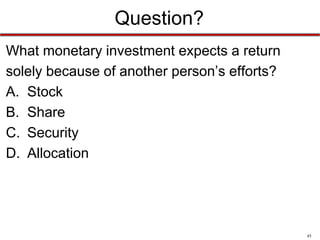
• Security
– a monetary investment that expects a return solely
because of another person’s efforts.

8
Securities Act of 1933
• Registration statement
– contains detailed information about the
corporation, including data about its management,
capitalization, and financial condition.

• Prospectus
– contains much of the same information but in a
condensed and simplified form.

9
Securities Exchange Act of 1934
• The Securities Exchange Act of 1934
– established the SEC
– requires periodic reports of financial information
concerning registered securities, and it prohibits
manipulative and deceptive actions in the sale and
purchase of securities.

10
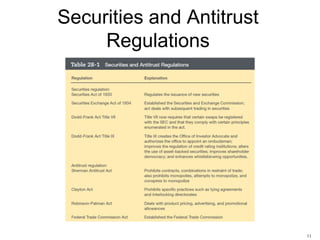
Securities and Antitrust
Regulations

11
The Wall Street Transparency and Accountability Act

• Derivative
– a financial tool the value of which emerges from a
variable item, such as an interest rate, a stock
index, or a commodity like fuel or crops

12
The Wall Street Transparency and Accountability Act

• Security-based swaps
– “swaps based on (1) a single security, (2) a loan,
(3) a narrow-based group or index of securities or
(4) events relating to a single issuer or issuers of
securities in a narrow-based security index.”

13
Title XI Investor Protection and Securities Reform Act

• Office of Investor Advocate (OIA)
– purpose is to help make the work of broker–
dealers and investment advisors ( IAs ) more
transparent
– gives the SEC the power to make new regulations

14
Title XI Investor Protection and Securities Reform Act

• Office of Credit Ratings
– purpose is to watchdog those organizations that
issue credit ratings

15
Antitrust Regulation
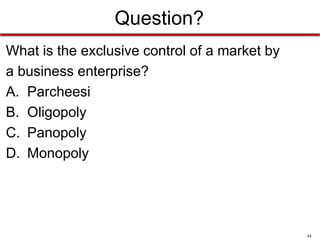
• Monopoly
– the exclusive control of a market by a business
enterprise

16
Sherman Antitrust Act
• The Sherman Antitrust Act (1890)
– prohibits contracts, combinations, and
conspiracies in restraint of trade
– also prohibits monopolization, attempts to
monopolize, and combinations or conspiracies to
monopolize any part of interstate or foreign
commerce.

17
Sherman Antitrust Act
• Per se violations
– the practice is so contrary to antitrust policy that
harm is presumed, and the practice is prohibited

18
Sherman Antitrust Act
• Rule-of-reason standard
– will stop certain practices only if they are an
unreasonable restriction of competition.

19
The Evolving Nature of the Twin Standards
• RPM agreement
– a retailer and a manufacturer agree that the
retailer will sell certain products at a price set by
the manufacturer.

• Quasi-RPM arrangement
– a manufacturer lets retailers know the price that it
expects to see on an item and then declines to sell
that item to any retailer that does not list the item
at that price

20
Clayton Act
• Congress passed the Clayton Act to police
specific business practices that could be
used to create a monopoly.
• Tying agreements, Interlocking
directorates

21
Clayton Act
• Tying agreements
– occur when one party refuses to sell a product
unless the buyer also purchases another product
tied to the first product.

• Interlocking directorates
– occur when individuals serve as directors of two
corporations that are competitors.

22
Robinson-Patman Act
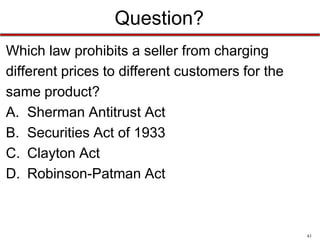
• Robinson-Patman Act
– prohibits a seller from charging different prices to
different customers for the same product when
such differences might injure competition

23
Federal Trade Commission Act
• Federal Trade Commission Act
– establishes the Federal Trade Commission (FTC)
– declares that “unfair methods of competition, and
unfair or deceptive practices in or affecting
commerce are hereby declared unlawful.”

24
The Foreign Trade Antitrust Improvements Act
• The Foreign Trade Antitrust Improvements
Act (FTAIA)
– objective is to permit American companies
operating in foreign markets to have a fighting
chance against foreign competitors that are not
subject to the strict antimonopoly provisions of the
act.

25
Expansion Tactics and Securities Law
• Merger
– involves two corporations, one of which is
absorbed by the other

• Consolidation
– both companies disappear, and a new company
carries on the business under a new name.

26
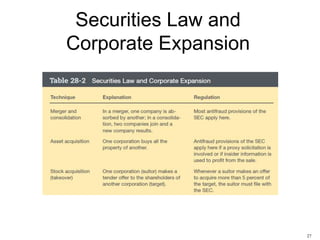
Securities Law and
Corporate Expansion

27
Expansion Tactics and Securities Law
• Asset acquisition
– one corporation purchases all the property of a
second corporation

28
Expansion Tactics and Securities Law
• Stock acquisition
– the buyer purchases enough stock in a
corporation to gain voting control of that
corporation.

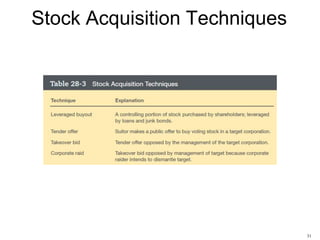
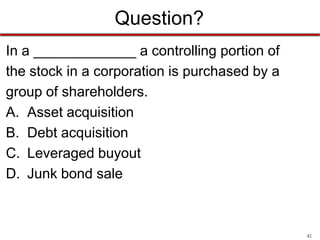
• Leveraged buyout
– a controlling portion of the stock in a corporation is
purchased by a group of shareholders

29
Expansion Tactics and Securities Law
• Tender offer
– the buyer makes a public offer to buy voting stock
in a target corporation.

• A successful tender offer occurs once the
buyer has purchased enough of the voting
stock to satisfy the original goal

30
Stock Acquisition Techniques

31
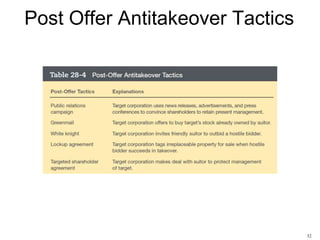
Post Offer Antitakeover Tactics

32
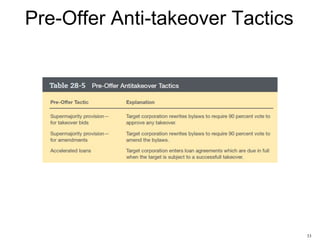
Pre-Offer Anti-takeover Tactics

33
Expansion Attempts
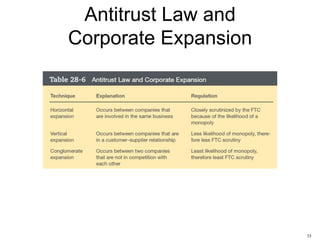
• Horizontal expansion
– occurs between companies that are involved in
the same business
– often result in monopolies.

• Vertical expansion
– occurs between companies that were in a
customer-supplier relationship.

34
Antitrust Law and
Corporate Expansion

35
Hart-Scott-Rodino Antitrust Act
• Hart-Scott-Rodino Antitrust Act
– designed to police any expansion attempts that
might harm competition in the marketplace.
– requires corporations that are setting up an
expansion attempt to notify the FTC before the
deal is completed.

36
The Tunney Antitrust Act
• The Tunney Antitrust Act
– requires that the DOJ defend its support of a
consent decree by filing the decree with the
federal court along with a complaint and a
competitive impact statement (CIS).

37
The Tunney Antitrust Act
• Competitive impact statement
– document that clarifies any potential antitrust
problems inherent within the proposed expansion
and the solutions to those problems suggested by
the decree

38
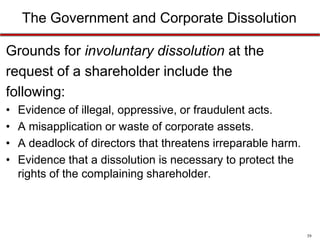
The Government and Corporate Dissolution
Grounds for involuntary dissolution at the
request of a shareholder include the
following:
•
•
•
•

Evidence of illegal, oppressive, or fraudulent acts.
A misapplication or waste of corporate assets.
A deadlock of directors that threatens irreparable harm.
Evidence that a dissolution is necessary to protect the
rights of the complaining shareholder.

39
The Government and Corporate Dissolution
• A corporation can be dissolved voluntarily by
the unanimous approval of the shareholders or
by a positive vote of the directors with the
approval of two-thirds of the shareholders.

40
Dissolution of a Limited Liability Company
• Circumstances of Dissolution
• Effects of Dissolution

41
Question?
In a _____________ a controlling portion of
the stock in a corporation is purchased by a
group of shareholders.
A. Asset acquisition
B. Debt acquisition
C. Leveraged buyout
D. Junk bond sale

42
Question?
Which law prohibits a seller from charging
different prices to different customers for the
same product?
A. Sherman Antitrust Act
B. Securities Act of 1933
C. Clayton Act
D. Robinson-Patman Act

43
Question?
What is the exclusive control of a market by
a business enterprise?
A. Parcheesi
B. Oligopoly
C. Panopoly
D. Monopoly

44
Question?
What monetary investment expects a return
solely because of another person’s efforts?
A. Stock
B. Share
C. Security
D. Allocation

45
Question?
What is a fair and balanced interpretation of
the law that evolves from and is consistent
with previous law?
A. Individual justice
B. Regulatory justice
C. Moral justice
D. Commercial justice

46
Question?
What is the state’s authority to restrict
private rights to promote and maintain public
health, safety, welfare, and morals?
A. Expert power
B. Political power
C. Police power
D. Military power

47

BUS 116 Chap028 corporate regulation

  • 1.
  • 2.
    Learning Objectives 1. Explainthe development of the federal government’s power to regulate business. 2. Describe the source of state power to regulate business. 3. Explain how the Securities and Exchange Commission prevents unfair practices. 4. Explain per se antitrust violations of antitrust law. 5. Explain the rule-of-reason standard in antitrust law. 2
  • 3.
    Learning Objectives (cont.) 6.Outline the general provisions of all Post-Sherman antitrust laws. 7. Define the various techniques of corporate expansion. 8. Contrast the interest of the Securities and Exchange Commission with that of the Federal Trade 9. Commission in corporate expansion. 10.Identify the two ways that a corporation may undergo dissolution. 11.Explain the circumstances under which a limited liability company may undergo dissolution. 3
  • 4.
    Business and theConstitution • Commerce Clause – states that “Congress shall have the Power... To regulate Commerce with foreign nations, and among the several States.” 4
  • 5.
    The Judicial–Economic System •Reasoning by Analogy • Balancing Individual and Regulatory Justice • Controlling Legal Change 5
  • 6.
    Balancing Individual andRegulatory Justice • Individual justice – justice meted out to the people in the case before the judge. • Regulatory justice – a fair and balanced interpretation of the law that evolves from and is consistent with previous law 6
  • 7.
    State Regulatory Power •Police power – the state’s authority to restrict private rights to promote and maintain public health, safety, welfare, and morals. • A state has police power simply by virtue of its existence as a legitimate governmental authority. 7
  • 8.
    Securities Regulation • Security –a monetary investment that expects a return solely because of another person’s efforts. 8
  • 9.
    Securities Act of1933 • Registration statement – contains detailed information about the corporation, including data about its management, capitalization, and financial condition. • Prospectus – contains much of the same information but in a condensed and simplified form. 9
  • 10.
    Securities Exchange Actof 1934 • The Securities Exchange Act of 1934 – established the SEC – requires periodic reports of financial information concerning registered securities, and it prohibits manipulative and deceptive actions in the sale and purchase of securities. 10
  • 11.
  • 12.
    The Wall StreetTransparency and Accountability Act • Derivative – a financial tool the value of which emerges from a variable item, such as an interest rate, a stock index, or a commodity like fuel or crops 12
  • 13.
    The Wall StreetTransparency and Accountability Act • Security-based swaps – “swaps based on (1) a single security, (2) a loan, (3) a narrow-based group or index of securities or (4) events relating to a single issuer or issuers of securities in a narrow-based security index.” 13
  • 14.
    Title XI InvestorProtection and Securities Reform Act • Office of Investor Advocate (OIA) – purpose is to help make the work of broker– dealers and investment advisors ( IAs ) more transparent – gives the SEC the power to make new regulations 14
  • 15.
    Title XI InvestorProtection and Securities Reform Act • Office of Credit Ratings – purpose is to watchdog those organizations that issue credit ratings 15
  • 16.
    Antitrust Regulation • Monopoly –the exclusive control of a market by a business enterprise 16
  • 17.
    Sherman Antitrust Act •The Sherman Antitrust Act (1890) – prohibits contracts, combinations, and conspiracies in restraint of trade – also prohibits monopolization, attempts to monopolize, and combinations or conspiracies to monopolize any part of interstate or foreign commerce. 17
  • 18.
    Sherman Antitrust Act •Per se violations – the practice is so contrary to antitrust policy that harm is presumed, and the practice is prohibited 18
  • 19.
    Sherman Antitrust Act •Rule-of-reason standard – will stop certain practices only if they are an unreasonable restriction of competition. 19
  • 20.
    The Evolving Natureof the Twin Standards • RPM agreement – a retailer and a manufacturer agree that the retailer will sell certain products at a price set by the manufacturer. • Quasi-RPM arrangement – a manufacturer lets retailers know the price that it expects to see on an item and then declines to sell that item to any retailer that does not list the item at that price 20
  • 21.
    Clayton Act • Congresspassed the Clayton Act to police specific business practices that could be used to create a monopoly. • Tying agreements, Interlocking directorates 21
  • 22.
    Clayton Act • Tyingagreements – occur when one party refuses to sell a product unless the buyer also purchases another product tied to the first product. • Interlocking directorates – occur when individuals serve as directors of two corporations that are competitors. 22
  • 23.
    Robinson-Patman Act • Robinson-PatmanAct – prohibits a seller from charging different prices to different customers for the same product when such differences might injure competition 23
  • 24.
    Federal Trade CommissionAct • Federal Trade Commission Act – establishes the Federal Trade Commission (FTC) – declares that “unfair methods of competition, and unfair or deceptive practices in or affecting commerce are hereby declared unlawful.” 24
  • 25.
    The Foreign TradeAntitrust Improvements Act • The Foreign Trade Antitrust Improvements Act (FTAIA) – objective is to permit American companies operating in foreign markets to have a fighting chance against foreign competitors that are not subject to the strict antimonopoly provisions of the act. 25
  • 26.
    Expansion Tactics andSecurities Law • Merger – involves two corporations, one of which is absorbed by the other • Consolidation – both companies disappear, and a new company carries on the business under a new name. 26
  • 27.
  • 28.
    Expansion Tactics andSecurities Law • Asset acquisition – one corporation purchases all the property of a second corporation 28
  • 29.
    Expansion Tactics andSecurities Law • Stock acquisition – the buyer purchases enough stock in a corporation to gain voting control of that corporation. • Leveraged buyout – a controlling portion of the stock in a corporation is purchased by a group of shareholders 29
  • 30.
    Expansion Tactics andSecurities Law • Tender offer – the buyer makes a public offer to buy voting stock in a target corporation. • A successful tender offer occurs once the buyer has purchased enough of the voting stock to satisfy the original goal 30
  • 31.
  • 32.
  • 33.
  • 34.
    Expansion Attempts • Horizontalexpansion – occurs between companies that are involved in the same business – often result in monopolies. • Vertical expansion – occurs between companies that were in a customer-supplier relationship. 34
  • 35.
  • 36.
    Hart-Scott-Rodino Antitrust Act •Hart-Scott-Rodino Antitrust Act – designed to police any expansion attempts that might harm competition in the marketplace. – requires corporations that are setting up an expansion attempt to notify the FTC before the deal is completed. 36
  • 37.
    The Tunney AntitrustAct • The Tunney Antitrust Act – requires that the DOJ defend its support of a consent decree by filing the decree with the federal court along with a complaint and a competitive impact statement (CIS). 37
  • 38.
    The Tunney AntitrustAct • Competitive impact statement – document that clarifies any potential antitrust problems inherent within the proposed expansion and the solutions to those problems suggested by the decree 38
  • 39.
    The Government andCorporate Dissolution Grounds for involuntary dissolution at the request of a shareholder include the following: • • • • Evidence of illegal, oppressive, or fraudulent acts. A misapplication or waste of corporate assets. A deadlock of directors that threatens irreparable harm. Evidence that a dissolution is necessary to protect the rights of the complaining shareholder. 39
  • 40.
    The Government andCorporate Dissolution • A corporation can be dissolved voluntarily by the unanimous approval of the shareholders or by a positive vote of the directors with the approval of two-thirds of the shareholders. 40
  • 41.
    Dissolution of aLimited Liability Company • Circumstances of Dissolution • Effects of Dissolution 41
  • 42.
    Question? In a _____________a controlling portion of the stock in a corporation is purchased by a group of shareholders. A. Asset acquisition B. Debt acquisition C. Leveraged buyout D. Junk bond sale 42
  • 43.
    Question? Which law prohibitsa seller from charging different prices to different customers for the same product? A. Sherman Antitrust Act B. Securities Act of 1933 C. Clayton Act D. Robinson-Patman Act 43
  • 44.
    Question? What is theexclusive control of a market by a business enterprise? A. Parcheesi B. Oligopoly C. Panopoly D. Monopoly 44
  • 45.
    Question? What monetary investmentexpects a return solely because of another person’s efforts? A. Stock B. Share C. Security D. Allocation 45
  • 46.
    Question? What is afair and balanced interpretation of the law that evolves from and is consistent with previous law? A. Individual justice B. Regulatory justice C. Moral justice D. Commercial justice 46
  • 47.
    Question? What is thestate’s authority to restrict private rights to promote and maintain public health, safety, welfare, and morals? A. Expert power B. Political power C. Police power D. Military power 47