C H A P    T   E R
                        31
Negotiable Instruments


    We at Chrysler borrow money the
    old-fashioned way. We pay it back.

    Lee Iacocca, Chairman and CEO
    of Chrysler Corporation, quoted in
    the New York Times (1983)


                                         31-1
Learning Objectives

• Explain advantages of commercial
  paper and the requirements to
  qualify as a negotiable instrument
• Identify different types of negotiable
  instruments and the key features
• Apply UCC rules for situations when
  the terms of an instrument are
  ambiguous or inherently conflicting
                                           31-2
Overview
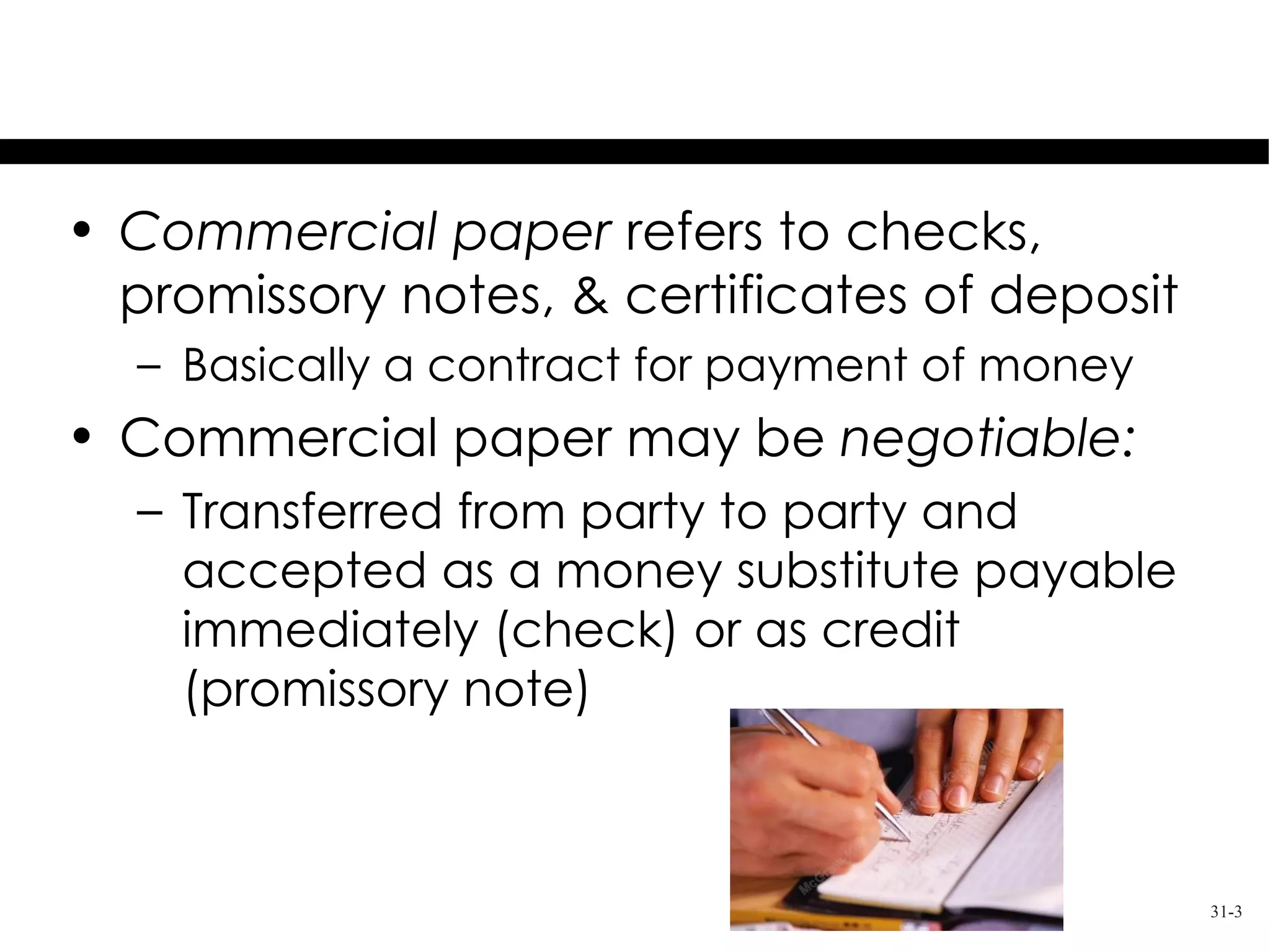
• Commercial paper refers to checks,
  promissory notes, & certificates of deposit
  – Basically a contract for payment of money
• Commercial paper may be negotiable:
  – Transferred from party to party and
    accepted as a money substitute payable
    immediately (check) or as credit
    (promissory note)


                                                31-3
The Uniform Commercial Code

• UCC Article 3 (Negotiable Instruments)
  and Article 4 (Bank Deposits and
  Collections) cover commercial paper
  – Other negotiable documents (documents
    of title, investment securities) covered by
    other sections
• Two basic types of negotiable instruments:
  – Promises to pay money
  – Orders to pay money

                                                  31-4
Promises to Pay Money
• Promissory notes and certificates of
  deposit issued by banks are promises to
  pay money
• Promissory note: two-party instrument in
  which the maker promises unconditionally
  in writing to pay the payee, a person
  specified by the payee, or the bearer of
  the note, a fixed amount of money (with
  or without interest) either on demand or
  at a specified, future time [3–104]
                                             31-5
Promises to Pay Money
• A certificate of deposit is an instrument
  containing (1) an acknowledgment by a
  bank that it has received a deposit of
  money and (2) a promise by the bank to
  repay the sum of money [3–104(j)]
  – Generally in electronic form


                                              31-6
Orders to Pay Money

• A draft is an order (not a promise) by one
  person to a second person to pay money
  to a third person [3–104(e)]
  – A check is the most common draft
• Specifically, the drawer orders the drawee
  to pay a certain sum of money to the
  payee, to a person specified by the
  payee, or to the bearer of the instrument
  – Example: writing a bank check to pay a bill

                                                  31-7
Orders to Pay Money
• Cashier’s check: draft on
  which drawer and drawee
  are the same bank (or
  branches of same bank)
• Teller’s check: draft
  drawn by a bank (as
  drawer) on second bank or
  payable through a bank
  [3–104(g) and (h)]


                              31-8
Negotiability
• Purpose of negotiability is to decrease risk
  of transfer (assignment of commercial
  paper contract) so the instrument will be
  accepted as a substitute for money
• Thus, (1) the contract for payment of
  money must meet requirements for
  negotiability, and (2) the person who
  acquires instrument must qualify as a
  holder in due course

                                                 31-9
A Holder in Due Course
• A holder in due course has good title to
  the instrument, paid value for it, acquired
  it in good faith, and had no notice of
  certain claims or defenses against
  payment
  – Instrument bears no evidence of forgery or
    triggers concerns about authenticity
• A holder in due course takes instrument
  free of all defenses and claims except
  those that concern its validity
                                                 31-10
Requirements For Negotiability

• For an instrument to be negotiable, it must
  be in writing, signed by the maker,
  containing an unconditional promise or
  order to pay a fixed amount of money,
  payable to order or to bearer, payable on
  demand at a definite time, lack any other
  instruction by the maker (three exceptions)
  [3–103; 3–104]


                                                31-11
The Signed Writing
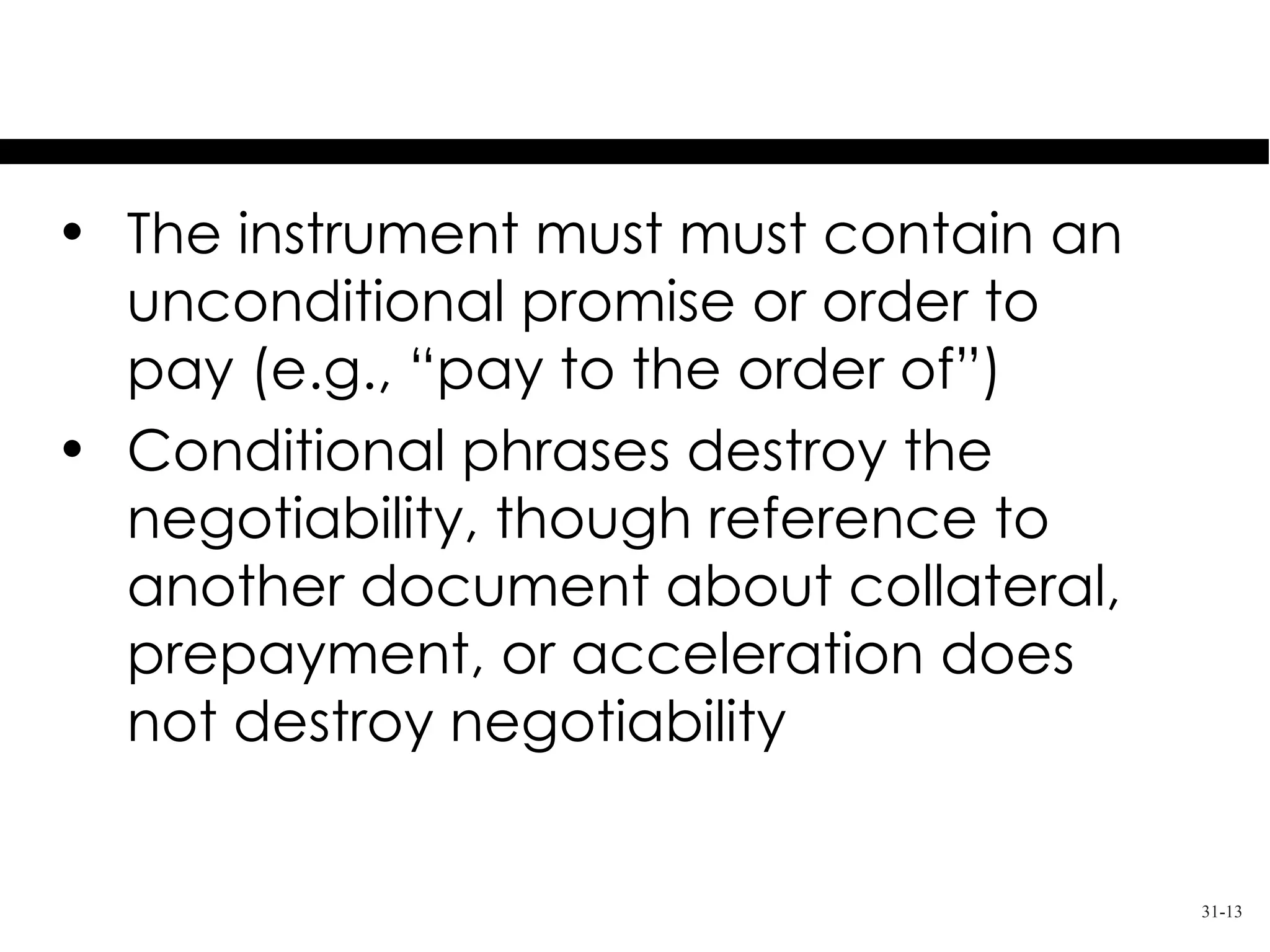
• The instrument must be in
  writing and signed by the
  maker
• Any writing (print,
  handwritten) or type of
  signature (handwritten,
  authorized stamped
  signature, or an X if
  witnessed)

                              31-12
Unconditional Promise or Order
• The instrument must must contain an
  unconditional promise or order to
  pay (e.g., “pay to the order of”)
• Conditional phrases destroy the
  negotiability, though reference to
  another document about collateral,
  prepayment, or acceleration does
  not destroy negotiability


                                        31-13
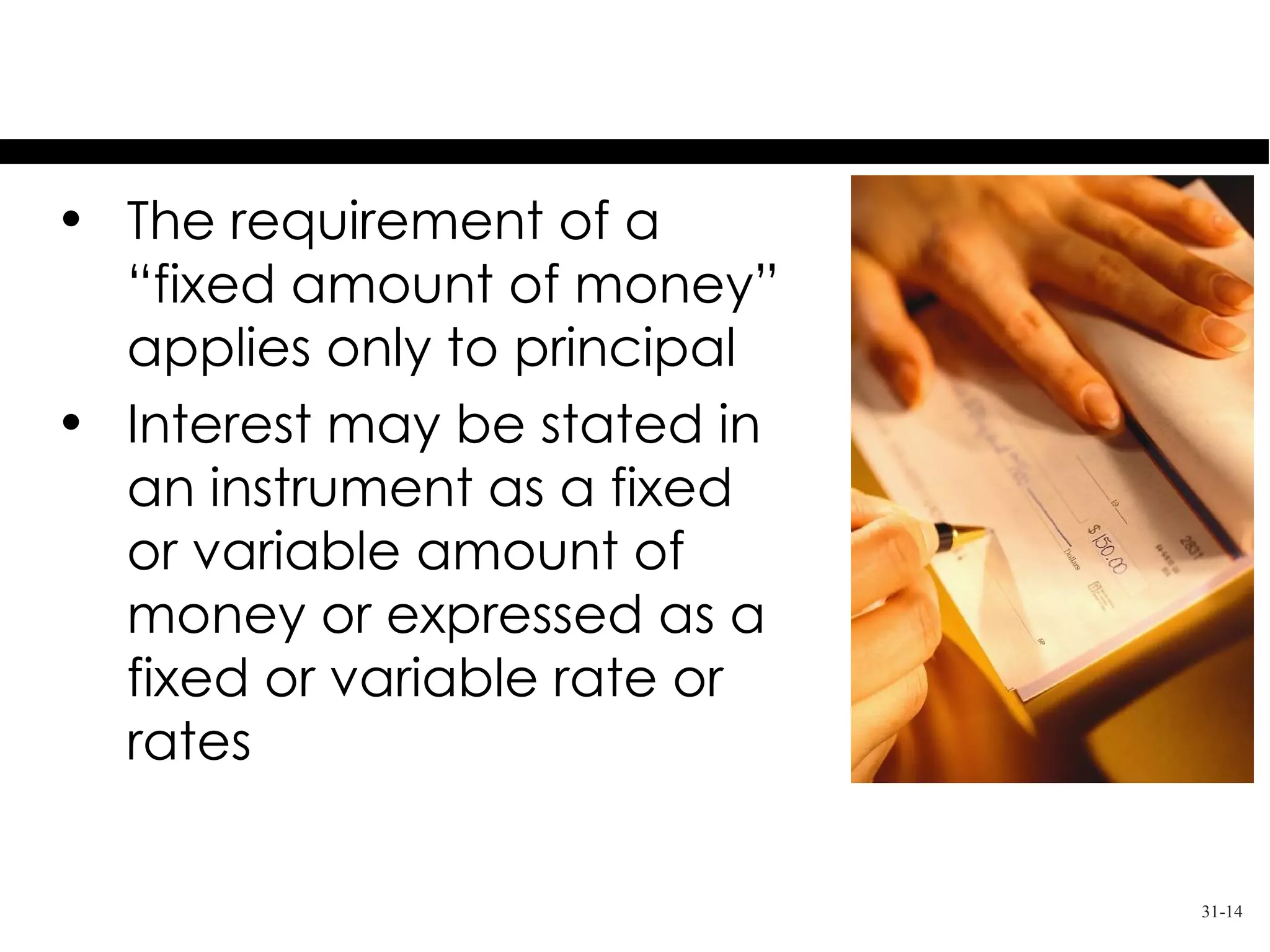
Fixed Amount of Money
• The requirement of a
  “fixed amount of money”
  applies only to principal
• Interest may be stated in
  an instrument as a fixed
  or variable amount of
  money or expressed as a
  fixed or variable rate or
  rates

                              31-14
Payable on Demand or
          At a Definite Time
• A promise or order is payable on demand
  if (1) it states it is payable on “demand” or
  “sight” or (2) does not state a specific
  time for payment [3–108(a)]
• A promise or order is payable at a definite
  time if payable at fixed date(s) or at
  time(s) readily ascertainable at the time
  the promise or order is issued [3–108(b)]
  – The typical promissory note

                                              31-15
Payable to Order or Bearer

• An instrument is payable to order (order
  paper) if payable to (1) order of
  identified person or (2) an identified
  person or that person’s order [3–109(b)]
  – Requires indorsement for negotiation
• An instrument payable to bearer or to
  cash (bearer paper) may be negotiated
  or transferred by delivery of possession
  without indorsement [3– 201(b)]

                                             31-16
Pelican National Bank v. Provident Bank

 • Facts: Insurance company issued check
   drawn on a bank to several payees listed
   without punctuation or grammatical
   connector (and/or)
 • Holding: Court concluded the check was
   ambiguous and applied the default rule
   that treated the document as if payable in
   the alternative: “The indorsement of any
   one of the payees was sufficient.”

                                            31-17
Special Terms

• A instrument will remain negotiable if it
  includes statements about:
  – Giving, maintaining, or protecting
    collateral to secure payment
  – An authorization to confess judgment or
    realize on or dispose of collateral
  – Waiving the benefit of any law intended
    for the protection or benefit of a person
    obligated on the instrument

                                                31-18
Ambiguous Terms
• If terms conflict or ambiguous term exists,
  general rules of interpretation apply:
  – Typewritten terms prevail over printed
    terms, handwritten terms prevail over
    printed and typewritten terms, and where
    words and numbers conflict, words
    control the numbers [3–114]
  – See Galatia Community State Bank v. Kindy:
     • Ambiguity caused by difference between
       numbers on the check from checkwriting
       machine and number written by hand
                                                 31-19
Test Your Knowledge
• True=A, False = B
  – Commercial paper includes checks,
    promissory notes, and certificates of deposit.
  – A holder in due course takes the instrument
    free of all defenses and claims.
  – UCC Articles 3 & 4 cover commercial paper.
  – A certificate of deposit is a negotiable
    instrument in which a bank acknowledges is
    received a money deposit and promises to
    repay the sum in the future.

                                                     31-20
Test Your Knowledge
• Multiple Choice
  – Basic types of commercial paper
    include:
     a)   Promises to pay money
     b)   Orders to pay money
     c)   A document of title
     d)   Both A and B
     e)   All of the above


                                      31-21
Test Your Knowledge
• Multiple Choice
  – Which of the following would be non-
    negotiable?
     a) Please pay to the order of Sarah $100.”
     b) “This promissory note is secured by my
        property in Pender County.”
     c) “This promissory note is subject to Sarah’s
        graduation from college.”
     d) None of the above; they are all
        negotiable
                                                      31-22
Thought Questions
• Do you use negotiable instruments?
  How do you do your banking?


                                       31-23

Chapter 31 – Negotiable Instruments

  • 1.
    C H AP T E R 31 Negotiable Instruments We at Chrysler borrow money the old-fashioned way. We pay it back. Lee Iacocca, Chairman and CEO of Chrysler Corporation, quoted in the New York Times (1983) 31-1
  • 2.
    Learning Objectives • Explainadvantages of commercial paper and the requirements to qualify as a negotiable instrument • Identify different types of negotiable instruments and the key features • Apply UCC rules for situations when the terms of an instrument are ambiguous or inherently conflicting 31-2
  • 3.
    Overview • Commercial paperrefers to checks, promissory notes, & certificates of deposit – Basically a contract for payment of money • Commercial paper may be negotiable: – Transferred from party to party and accepted as a money substitute payable immediately (check) or as credit (promissory note) 31-3
  • 4.
    The Uniform CommercialCode • UCC Article 3 (Negotiable Instruments) and Article 4 (Bank Deposits and Collections) cover commercial paper – Other negotiable documents (documents of title, investment securities) covered by other sections • Two basic types of negotiable instruments: – Promises to pay money – Orders to pay money 31-4
  • 5.
    Promises to PayMoney • Promissory notes and certificates of deposit issued by banks are promises to pay money • Promissory note: two-party instrument in which the maker promises unconditionally in writing to pay the payee, a person specified by the payee, or the bearer of the note, a fixed amount of money (with or without interest) either on demand or at a specified, future time [3–104] 31-5
  • 6.
    Promises to PayMoney • A certificate of deposit is an instrument containing (1) an acknowledgment by a bank that it has received a deposit of money and (2) a promise by the bank to repay the sum of money [3–104(j)] – Generally in electronic form 31-6
  • 7.
    Orders to PayMoney • A draft is an order (not a promise) by one person to a second person to pay money to a third person [3–104(e)] – A check is the most common draft • Specifically, the drawer orders the drawee to pay a certain sum of money to the payee, to a person specified by the payee, or to the bearer of the instrument – Example: writing a bank check to pay a bill 31-7
  • 8.
    Orders to PayMoney • Cashier’s check: draft on which drawer and drawee are the same bank (or branches of same bank) • Teller’s check: draft drawn by a bank (as drawer) on second bank or payable through a bank [3–104(g) and (h)] 31-8
  • 9.
    Negotiability • Purpose ofnegotiability is to decrease risk of transfer (assignment of commercial paper contract) so the instrument will be accepted as a substitute for money • Thus, (1) the contract for payment of money must meet requirements for negotiability, and (2) the person who acquires instrument must qualify as a holder in due course 31-9
  • 10.
    A Holder inDue Course • A holder in due course has good title to the instrument, paid value for it, acquired it in good faith, and had no notice of certain claims or defenses against payment – Instrument bears no evidence of forgery or triggers concerns about authenticity • A holder in due course takes instrument free of all defenses and claims except those that concern its validity 31-10
  • 11.
    Requirements For Negotiability •For an instrument to be negotiable, it must be in writing, signed by the maker, containing an unconditional promise or order to pay a fixed amount of money, payable to order or to bearer, payable on demand at a definite time, lack any other instruction by the maker (three exceptions) [3–103; 3–104] 31-11
  • 12.
    The Signed Writing •The instrument must be in writing and signed by the maker • Any writing (print, handwritten) or type of signature (handwritten, authorized stamped signature, or an X if witnessed) 31-12
  • 13.
    Unconditional Promise orOrder • The instrument must must contain an unconditional promise or order to pay (e.g., “pay to the order of”) • Conditional phrases destroy the negotiability, though reference to another document about collateral, prepayment, or acceleration does not destroy negotiability 31-13
  • 14.
    Fixed Amount ofMoney • The requirement of a “fixed amount of money” applies only to principal • Interest may be stated in an instrument as a fixed or variable amount of money or expressed as a fixed or variable rate or rates 31-14
  • 15.
    Payable on Demandor At a Definite Time • A promise or order is payable on demand if (1) it states it is payable on “demand” or “sight” or (2) does not state a specific time for payment [3–108(a)] • A promise or order is payable at a definite time if payable at fixed date(s) or at time(s) readily ascertainable at the time the promise or order is issued [3–108(b)] – The typical promissory note 31-15
  • 16.
    Payable to Orderor Bearer • An instrument is payable to order (order paper) if payable to (1) order of identified person or (2) an identified person or that person’s order [3–109(b)] – Requires indorsement for negotiation • An instrument payable to bearer or to cash (bearer paper) may be negotiated or transferred by delivery of possession without indorsement [3– 201(b)] 31-16
  • 17.
    Pelican National Bankv. Provident Bank • Facts: Insurance company issued check drawn on a bank to several payees listed without punctuation or grammatical connector (and/or) • Holding: Court concluded the check was ambiguous and applied the default rule that treated the document as if payable in the alternative: “The indorsement of any one of the payees was sufficient.” 31-17
  • 18.
    Special Terms • Ainstrument will remain negotiable if it includes statements about: – Giving, maintaining, or protecting collateral to secure payment – An authorization to confess judgment or realize on or dispose of collateral – Waiving the benefit of any law intended for the protection or benefit of a person obligated on the instrument 31-18
  • 19.
    Ambiguous Terms • Ifterms conflict or ambiguous term exists, general rules of interpretation apply: – Typewritten terms prevail over printed terms, handwritten terms prevail over printed and typewritten terms, and where words and numbers conflict, words control the numbers [3–114] – See Galatia Community State Bank v. Kindy: • Ambiguity caused by difference between numbers on the check from checkwriting machine and number written by hand 31-19
  • 20.
    Test Your Knowledge •True=A, False = B – Commercial paper includes checks, promissory notes, and certificates of deposit. – A holder in due course takes the instrument free of all defenses and claims. – UCC Articles 3 & 4 cover commercial paper. – A certificate of deposit is a negotiable instrument in which a bank acknowledges is received a money deposit and promises to repay the sum in the future. 31-20
  • 21.
    Test Your Knowledge •Multiple Choice – Basic types of commercial paper include: a) Promises to pay money b) Orders to pay money c) A document of title d) Both A and B e) All of the above 31-21
  • 22.
    Test Your Knowledge •Multiple Choice – Which of the following would be non- negotiable? a) Please pay to the order of Sarah $100.” b) “This promissory note is secured by my property in Pender County.” c) “This promissory note is subject to Sarah’s graduation from college.” d) None of the above; they are all negotiable 31-22
  • 23.
    Thought Questions • Doyou use negotiable instruments? How do you do your banking? 31-23

Editor's Notes

  • #6 Figures 1 and 2 on pages 826 and 827 are examples of promissory notes.
  • #8 Figures 3 and 4 (pages 828-29) depict a draft and check respectively.
  • #10 The assignee of a contract can obtain no greater rights than the assignor had at the time of the assignment. Taking an assignment of a contract involves assuming certain risks. An assignee who does not know what rights he is getting, or which risks he is assuming, may be reluctant to take an assignment of the contract. The object of a negotiable instrument is to have it accepted readily as a substitute for money. In order to accept it readily, a person must be able to take it free of many of the risks assumed by the assignee of a regular contract.
  • #13 Interbank of New York v. Fleet Bank : A bank that pays an unauthorized check (e.g., Interbank) bears the economic loss, but may sue the person that created the unauthorized item. In this case, a vendor company (Atlantic Mobile) sent preauthorized checks (telechecks) with the stamped notation, “verbally authorized by your depositor,” to their bank. The customer-depositor (Tasoulis) challenged the authorization and depositor’s bank (Interbank) sued vendor’s bank (Fleet) to recover the amount of the drafts. The court reasoned that “if Tasoulis had authorized Atlantic Mobile to issue the check with the notation ‘verbally authorized by your depositor,’ in place of his written signature, the check would qualify as a negotiable instrument. The only infirmity in the subject drafts is that Tasoulis did not authorize their issuance. Thus, the notation ‘verbally authorized by your depositor,’ which could constitute a signature under the UCC, is unauthorized. The unauthorized use of a stamped printed signature constitutes a forgery. So too here the notation ‘verbally authorized by your depositor,’ which can constitute a signature under the UCC, when unauthorized, constitutes a forged signature. Accordingly, the preauthorized checks should be treated as any other check that contains a forged signature. These preauthorized checks constitute negotiable instruments. Summary Judgment granted to Fleet.” The Federal Reserve issued a Final Rule Governing Remotely Created Checks on Dec. 1, 2005: “ A remotely created check is subject to state law on negotiable instruments, specifically Articles 3 and 4 of the Uniform Commercial Code (U.C.C.) as adopted in each state. …The provisions of the U.C.C. cited above implement the rule set forth in the seminal case of Price v. Neal ,6 which held that drawees of checks and other drafts must bear the economic loss when the instruments they pay are not properly payable because the drawer did not authorize the item. ( See also Interbank of New York v. Fleet Bank, 730 NYS 2d 208 (2001)) Under the Price v. Neal rule, the paying bank must bear the economic loss of an unauthorized check with little recourse other than bringing an action against the person that created the unauthorized item. This rule currently applies to all checks, including remotely created checks, in a majority of states.
  • #14 Unconditional promises (negotiable): “ Please pay to the order of ___” “ Pay to the bearer” or “Pay to ___” “ This note secured by ….” “ Payable to the order of ____ for (reason) ” Conditional promises (non-negotiable): “ I owe _____ $100” “ This note is subject to …” “ I promise to pay $100 to ___ if …”
  • #18 Hyperlink is to the case opinion on the Findlaw.com website.
  • #20 Hyperlink is to the opinion on the McGraw-Hill Higher Education website. Appellate court: The $5550.00 amount imprinted by the check-writing machine upon the line customarily used for words is expressed in figures and not in words. One question is whether imprinted numbers located where words are customarily placed on a check control figures placed where figures are customarily placed. Another question is whether handwritten figures control printing. We find both questions satisfactorily answered in St. Paul Fire & Marine Ins. Co. v. Bank of Salem. In that case, there was a conflict between an amount imprinted by a check- mprinting machine and numbers expressed in typewritten figures. The court recognized the imprinted amount was not expressed in words but held “the purposes of the UCC are best served by considering an amount imprinted by a check-writing machine as ‘words’ for the purpose of resolving an ambiguity between an amount and an amount entered upon the line usually used to express the amount in figures.” Because a check-imprinting machine’s purpose is to protect against alterations, the amount shown on the imprint should control whether the number is in words or figures. Turning to the question of whether typewriting controls printing, the court in United States Fidelity and Guaranty Co. .. . did not say specifically that it regarded the portion written by the check-writing machine as the equivalent of handwriting, [but] that is the clear effect of the decision.”
  • #21 True. False. A holder in due course takes the instrument free of all defenses and claims except those that concern its validity his or her parent would have taken if the parent had survived. True. True.
  • #22 The correct answer is (d). A document of title is a negotiable instrument, but is not commercial paper.
  • #23 The correct answer is (c).
  • #24 Opportunity to discuss the banking industry and trends in banking practices. Given online banking, do students use checks or do all banking online?