Part 5 Staffing  Activities: Employment Chapter  12:  Final Match McGraw-Hill/Irwin Copyright © 2012 by The McGraw-Hill Companies, Inc. All rights reserved.
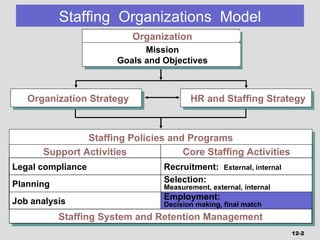
Staffing  Organizations  Model Staffing Policies and Programs Staffing System and Retention Management Support Activities Legal compliance Planning Job analysis Core Staffing Activities Recruitment:  External, internal Selection: Measurement, external, internal Employment: Decision making, final match 12- Organization Strategy HR and Staffing Strategy Organization Mission Goals and Objectives
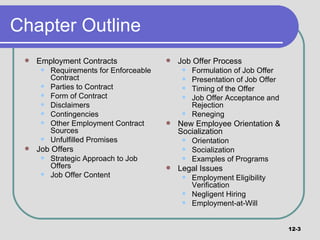
Chapter Outline Employment Contracts Requirements for Enforceable Contract Parties to Contract Form of Contract Disclaimers Contingencies Other Employment Contract Sources Unfulfilled Promises Job Offers Strategic Approach to Job Offers Job Offer Content Job Offer Process Formulation of Job Offer Presentation of Job Offer Timing of the Offer Job Offer Acceptance and Rejection Reneging New Employee Orientation & Socialization Orientation Socialization Examples of Programs Legal Issues Employment Eligibility Verification Negligent Hiring Employment-at-Will 12-
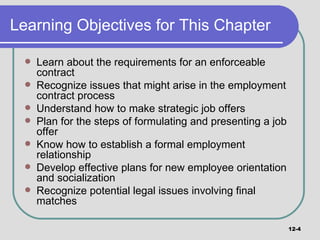
Learning Objectives for This Chapter Learn about the requirements for an enforceable contract Recognize issues that might arise in the employment contract process Understand how to make strategic job offers Plan for the steps of formulating and presenting a job offer Know how to establish a formal employment relationship Develop effective plans for new employee orientation and socialization Recognize potential legal issues involving final matches 12-
Employment Contracts Requirements for enforceable contract Parties to contract Form of contract Disclaimers Contingencies Other employment contract sources Unfulfilled promises 12-
Employment Contracts Requirements for enforceable contract Offer Acceptance Consideration Parties to contract Employee or independent contractor Third parties 12-
Employment Contracts (continued) Form of contract Written contract Does the company mean to be held to this? Where appropriate, avoid using words that imply binding commitment. Make sure all related documents are consistent with one another. Always have a second person review what another has written. Look at the entire hiring procedure. Oral contract One-year rule Parole evidence Suggestions 12-
Employment Contracts (continued) Disclaimers Oral or written statement explicitly limiting an employee right and reserving that right for employer Recommendations for enforcement Clearly stated and conspicuously placed in appropriate documents. Employee should acknowledge receipt and review of the document and the disclaimer. Should state that it may be modified only in writing and by whom. The terms and conditions of employment, including the disclaimer, as well as limits on their enforceability, should be reviewed with offer receivers and employees. 12-
Employment Contracts (continued) Contingencies Extending a job offer contingent on certain conditions being fulfilled by offer receiver Other employment contract sources Employee handbooks Oral statements made by employer representatives 12-
Employment Contracts (continued) Unfulfilled promises Organizational HR issues Do not make promises unwilling to keep Be sure promises made are kept Potential legal claims Breach of contract Promissory estoppel Fraud  12-
Job Offers Strategic Approach to Job Offers Job offer content 12-
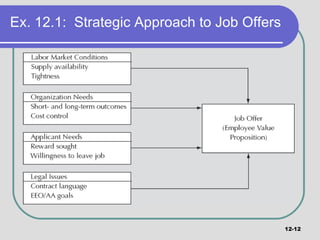
Ex. 12.1:  Strategic Approach to Job Offers 12-
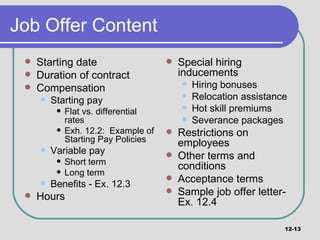
Job Offer Content Starting date Duration of contract Compensation Starting pay Flat vs. differential rates Exh. 12.2:  Example of Starting Pay Policies Variable pay Short term Long term Benefits - Ex. 12.3 Hours Special hiring inducements Hiring bonuses Relocation assistance Hot skill premiums Severance packages Restrictions on employees Other terms and conditions Acceptance terms Sample job offer letter-Ex. 12.4 12-
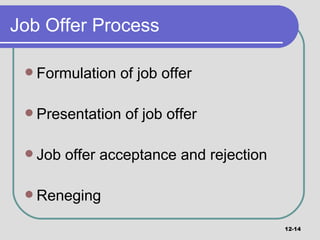
Job Offer Process Formulation of job offer Presentation of job offer Job offer acceptance and rejection Reneging 12-
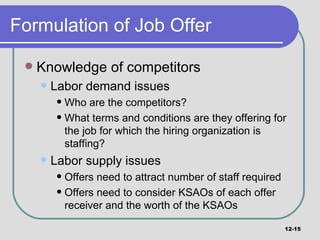
Formulation of Job Offer Knowledge of competitors Labor demand issues Who are the competitors? What terms and conditions are they offering for the job for which the hiring organization is staffing? Labor supply issues Offers need to attract number of staff required Offers need to consider KSAOs of each offer receiver and the worth of the KSAOs 12-
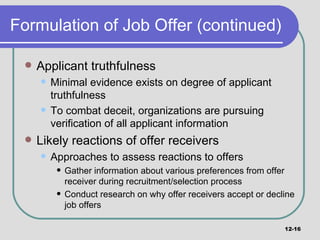
Formulation of Job Offer (continued) Applicant truthfulness Minimal evidence exists on degree of applicant truthfulness To combat deceit, organizations are pursuing verification of all applicant information Likely reactions of offer receivers Approaches to assess reactions to offers Gather information about various preferences from offer receiver during recruitment/selection process Conduct research on why offer receivers accept or decline job offers 12-
Formulation of Job Offer (continued) Policies on negotiations and initial offers Job offers occur for both external / internal staffing Consider costs of job offer being rejected by candidate Candidates may be receiving counteroffers from current employer Currently employed candidates incur costs for leaving and expect a “make whole” offer Candidates are sophisticated in presenting their demands 12-
Formulation of Job Offer (continued) Strategies for presenting initial offer Lowball offering the lower bounds of terms and conditions to the receiver Competitive an offer that is “on the market,” neither too high nor too low Best shot gives a high offer, one right at the upper bounds of feasible terms and conditions 12-
Presentation of Job Offer  Two approaches Mechanical approach Sales approach 12-
Job Offer Process: Acceptance, Rejection, Reneging  Acceptance Rejection By organization By offer receiver Reneging 12-
New Employee Orientation and Socialization Orientation Exh. 12.8:  New Employee Orientation Program Suggestions Socialization Content People Performance proficiency Organization goals and values Politics Language History Delivery 12-

Chap012 final match_editing

  • 1.
    Part 5 Staffing Activities: Employment Chapter 12: Final Match McGraw-Hill/Irwin Copyright © 2012 by The McGraw-Hill Companies, Inc. All rights reserved.
  • 2.
    Staffing Organizations Model Staffing Policies and Programs Staffing System and Retention Management Support Activities Legal compliance Planning Job analysis Core Staffing Activities Recruitment: External, internal Selection: Measurement, external, internal Employment: Decision making, final match 12- Organization Strategy HR and Staffing Strategy Organization Mission Goals and Objectives
  • 3.
    Chapter Outline EmploymentContracts Requirements for Enforceable Contract Parties to Contract Form of Contract Disclaimers Contingencies Other Employment Contract Sources Unfulfilled Promises Job Offers Strategic Approach to Job Offers Job Offer Content Job Offer Process Formulation of Job Offer Presentation of Job Offer Timing of the Offer Job Offer Acceptance and Rejection Reneging New Employee Orientation & Socialization Orientation Socialization Examples of Programs Legal Issues Employment Eligibility Verification Negligent Hiring Employment-at-Will 12-
  • 4.
    Learning Objectives forThis Chapter Learn about the requirements for an enforceable contract Recognize issues that might arise in the employment contract process Understand how to make strategic job offers Plan for the steps of formulating and presenting a job offer Know how to establish a formal employment relationship Develop effective plans for new employee orientation and socialization Recognize potential legal issues involving final matches 12-
  • 5.
    Employment Contracts Requirementsfor enforceable contract Parties to contract Form of contract Disclaimers Contingencies Other employment contract sources Unfulfilled promises 12-
  • 6.
    Employment Contracts Requirementsfor enforceable contract Offer Acceptance Consideration Parties to contract Employee or independent contractor Third parties 12-
  • 7.
    Employment Contracts (continued)Form of contract Written contract Does the company mean to be held to this? Where appropriate, avoid using words that imply binding commitment. Make sure all related documents are consistent with one another. Always have a second person review what another has written. Look at the entire hiring procedure. Oral contract One-year rule Parole evidence Suggestions 12-
  • 8.
    Employment Contracts (continued)Disclaimers Oral or written statement explicitly limiting an employee right and reserving that right for employer Recommendations for enforcement Clearly stated and conspicuously placed in appropriate documents. Employee should acknowledge receipt and review of the document and the disclaimer. Should state that it may be modified only in writing and by whom. The terms and conditions of employment, including the disclaimer, as well as limits on their enforceability, should be reviewed with offer receivers and employees. 12-
  • 9.
    Employment Contracts (continued)Contingencies Extending a job offer contingent on certain conditions being fulfilled by offer receiver Other employment contract sources Employee handbooks Oral statements made by employer representatives 12-
  • 10.
    Employment Contracts (continued)Unfulfilled promises Organizational HR issues Do not make promises unwilling to keep Be sure promises made are kept Potential legal claims Breach of contract Promissory estoppel Fraud 12-
  • 11.
    Job Offers StrategicApproach to Job Offers Job offer content 12-
  • 12.
    Ex. 12.1: Strategic Approach to Job Offers 12-
  • 13.
    Job Offer ContentStarting date Duration of contract Compensation Starting pay Flat vs. differential rates Exh. 12.2: Example of Starting Pay Policies Variable pay Short term Long term Benefits - Ex. 12.3 Hours Special hiring inducements Hiring bonuses Relocation assistance Hot skill premiums Severance packages Restrictions on employees Other terms and conditions Acceptance terms Sample job offer letter-Ex. 12.4 12-
  • 14.
    Job Offer ProcessFormulation of job offer Presentation of job offer Job offer acceptance and rejection Reneging 12-
  • 15.
    Formulation of JobOffer Knowledge of competitors Labor demand issues Who are the competitors? What terms and conditions are they offering for the job for which the hiring organization is staffing? Labor supply issues Offers need to attract number of staff required Offers need to consider KSAOs of each offer receiver and the worth of the KSAOs 12-
  • 16.
    Formulation of JobOffer (continued) Applicant truthfulness Minimal evidence exists on degree of applicant truthfulness To combat deceit, organizations are pursuing verification of all applicant information Likely reactions of offer receivers Approaches to assess reactions to offers Gather information about various preferences from offer receiver during recruitment/selection process Conduct research on why offer receivers accept or decline job offers 12-
  • 17.
    Formulation of JobOffer (continued) Policies on negotiations and initial offers Job offers occur for both external / internal staffing Consider costs of job offer being rejected by candidate Candidates may be receiving counteroffers from current employer Currently employed candidates incur costs for leaving and expect a “make whole” offer Candidates are sophisticated in presenting their demands 12-
  • 18.
    Formulation of JobOffer (continued) Strategies for presenting initial offer Lowball offering the lower bounds of terms and conditions to the receiver Competitive an offer that is “on the market,” neither too high nor too low Best shot gives a high offer, one right at the upper bounds of feasible terms and conditions 12-
  • 19.
    Presentation of JobOffer Two approaches Mechanical approach Sales approach 12-
  • 20.
    Job Offer Process:Acceptance, Rejection, Reneging Acceptance Rejection By organization By offer receiver Reneging 12-
  • 21.
    New Employee Orientationand Socialization Orientation Exh. 12.8: New Employee Orientation Program Suggestions Socialization Content People Performance proficiency Organization goals and values Politics Language History Delivery 12-