Part 3 Staffing  Activities:  Recruitment Chapter 5:  External Recruitment Chapter 6:  Internal Recruitment McGraw-Hill/Irwin Copyright © 2012 by The McGraw-Hill Companies, Inc. All rights reserved.
Part 3 Staffing  Activities:  Recruitment Chapter 05: External Recruitment
Staffing  Organizations  Model Staffing Policies and Programs Staffing System and Retention Management Support Activities Legal compliance Planning Job analysis Core Staffing Activities Recruitment:  External, internal Selection: Measurement, external, internal Employment: Decision making, final match 5- Organization Strategy HR and Staffing Strategy Organization Mission Goals and Objectives
Chapter Outline Recruitment Planning Organizational Issues Administrative Issues Recruiters Strategy Development Open Versus Targeted Recruitment Recruitment Sources Recruiting Metrics Searching Communication Message Communication Medium Applicant Reactions Reactions to Recruiters Reactions to the Recruitment Process Reactions to Diversity Issues Transition to Selection Legal Issues Definition of a Job Applicant Affirmative Action Programs Electronic Recruitment Job Advertisements Fraud and Misrepresentation 5-
Learning Objectives for This Chapter Be able to engage in effective recruitment planning activities Understand the difference between open and targeted recruitment Utilize a variety of recruitment sources Evaluate recruiting based on established metrics Create a persuasive communication message Learn about a variety of recruitment media Recognize how applicant reactions influence the effectiveness of a recruiting plan 5-
Recruitment Planning:  Administrative Issues In-house vs. external recruitment agency Many companies do recruiting in-house Recommended approach for large companies Smaller companies may rely on external recruitment agencies Individual vs. cooperative recruitment alliances Cooperative alliances involve arrangements to share recruitment resources Centralized vs. decentralized recruitment 5-
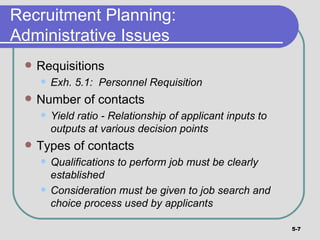
Recruitment Planning:  Administrative Issues Requisitions Exh. 5.1:  Personnel Requisition Number of contacts Yield ratio - Relationship of applicant inputs to outputs at various decision points Types of contacts Qualifications to perform job must be clearly established Consideration must be given to job search and choice process used by applicants 5-
Exh. 5.2:  Example Recruitment Budget Should recruitment expenses be charged to HR or to the business unit using HR services?  Most organizations charge the HR department, possibly to encourage each business unit to use the recruitment services of the HR group  May result in the business unit users not being concerned about minimizing costs. 5-
Exhibit 5.3 Recruitment Guide for Director of Claims 5-
Recruitment Planning:  Administrative Issues (continued) Process flow and record keeping Recruiters Selecting recruiters Training recruiters 5-
Considerations Related to Recruiters:  Selection Desirable characteristics of recruiters Strong interpersonal skills Knowledge about company, jobs, and career-related issues Technology skills Enthusiasm Various sources of recruiters HR professionals Line managers Employees 5-
Considerations Related to Recruiters:  Training Training Traditional areas of training Interviewing skills, job analysis, interpersonal skills, laws, forms and reports, company and job characteristics, and recruitment targets Nontraditional areas of training Technology skills, marketing skills, working with other departments, and ethics 5-
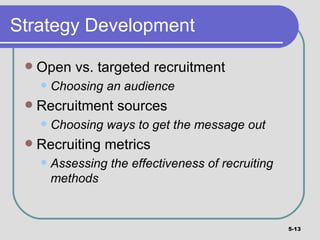
Strategy Development Open vs. targeted recruitment Choosing an audience Recruitment sources Choosing ways to get the message out Recruiting metrics Assessing the effectiveness of recruiting methods 5-
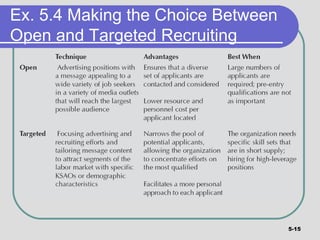
Open vs. Targeted Recruitment  Open recruitment Targeted recruitment Key KSAO shortages Workforce diversity gaps Passive job seekers or noncandidates Former military personnel Employment discouraged Reward seekers Former employees Reluctant applicants 5-
Ex. 5.4 Making the Choice Between Open and Targeted Recruiting  5-
Recruitment Sources  Applicant initiated Employee referrals Employee networks Advertisements Employment websites Colleges and placement offices Employment agencies Executive search firms Professional associations and meetings Social service agencies Outplacement services Job fairs Co-ops and internships 5-
Features of High-Impact Organizational Websites Easily navigated A “job cart” function Résumé builders Detailed information on career opportunities Clear graphics Allow applicants to create profiles Self-assessment inventories 5-
Employee Referrals One of the most common recruiting methods Finds candidates who are better informed about organizational culture and values Lower turnover rates Often boosted by providing cash bonuses to employees who refer successful candidates 5-
Employment Websites Functionality Ability to create and approve job requisitions online Manage recruiting tasks Track the progress of open positions and candidates Report on recruiting metrics like time to hire, cost per hire, or equal employment opportunity (EEO) General websites Attract a wider variety of potential applicants Reach includes millions of users Niche websites Target individuals with specific skill sets Qualified and motivated user base 5-
Metrics for Evaluating Recruiting Methods Quantity Quality Cost Impact on HR Outcomes Employee satisfaction Job performance Diversity Retention Ex. 5.5 Potential Recruiting Metrics for Different Sources 5-
Ex. 5.7 Comparing Choice of Messages 5-
Searching:  Communication Medium Word-of-mouth Recruitment brochures Videos and videoconferencing Advertisements Classified advertisements Online advertisements (banner ads) Radio and television advertisements Organizational websites Direct contact (telephone or e-mail) 5-
Exhibit 5.9 Factors for Designing Organizational Websites 5-
Applicant Reactions Reactions to recruiters Influence of recruiter vs. job characteristics Influence of recruiter on attitudes and behaviors Demographics of recruiters Influential recruiter behaviors Warmth and knowledge of the job Reactions to recruitment process Relationship of screening devices to job Delay times in recruitment process Funding of recruitment process Credibility of recruiter during recruitment process 5-
Reactions to Diversity Issues Advertising in publications targeted at women and minorities Advertisements should depict diversity, especially among those in positions of authority Target older workers by flexible schedules, health and pension benefits, and part-time opportunities 5-
Transition to Selection Involves making applicants aware of Next steps in hiring process Selection methods used and instructions  Expectations and requirements 5-

Chap005 external recruitment_editing

  • 1.
    Part 3 Staffing Activities: Recruitment Chapter 5: External Recruitment Chapter 6: Internal Recruitment McGraw-Hill/Irwin Copyright © 2012 by The McGraw-Hill Companies, Inc. All rights reserved.
  • 2.
    Part 3 Staffing Activities: Recruitment Chapter 05: External Recruitment
  • 3.
    Staffing Organizations Model Staffing Policies and Programs Staffing System and Retention Management Support Activities Legal compliance Planning Job analysis Core Staffing Activities Recruitment: External, internal Selection: Measurement, external, internal Employment: Decision making, final match 5- Organization Strategy HR and Staffing Strategy Organization Mission Goals and Objectives
  • 4.
    Chapter Outline RecruitmentPlanning Organizational Issues Administrative Issues Recruiters Strategy Development Open Versus Targeted Recruitment Recruitment Sources Recruiting Metrics Searching Communication Message Communication Medium Applicant Reactions Reactions to Recruiters Reactions to the Recruitment Process Reactions to Diversity Issues Transition to Selection Legal Issues Definition of a Job Applicant Affirmative Action Programs Electronic Recruitment Job Advertisements Fraud and Misrepresentation 5-
  • 5.
    Learning Objectives forThis Chapter Be able to engage in effective recruitment planning activities Understand the difference between open and targeted recruitment Utilize a variety of recruitment sources Evaluate recruiting based on established metrics Create a persuasive communication message Learn about a variety of recruitment media Recognize how applicant reactions influence the effectiveness of a recruiting plan 5-
  • 6.
    Recruitment Planning: Administrative Issues In-house vs. external recruitment agency Many companies do recruiting in-house Recommended approach for large companies Smaller companies may rely on external recruitment agencies Individual vs. cooperative recruitment alliances Cooperative alliances involve arrangements to share recruitment resources Centralized vs. decentralized recruitment 5-
  • 7.
    Recruitment Planning: Administrative Issues Requisitions Exh. 5.1: Personnel Requisition Number of contacts Yield ratio - Relationship of applicant inputs to outputs at various decision points Types of contacts Qualifications to perform job must be clearly established Consideration must be given to job search and choice process used by applicants 5-
  • 8.
    Exh. 5.2: Example Recruitment Budget Should recruitment expenses be charged to HR or to the business unit using HR services? Most organizations charge the HR department, possibly to encourage each business unit to use the recruitment services of the HR group May result in the business unit users not being concerned about minimizing costs. 5-
  • 9.
    Exhibit 5.3 RecruitmentGuide for Director of Claims 5-
  • 10.
    Recruitment Planning: Administrative Issues (continued) Process flow and record keeping Recruiters Selecting recruiters Training recruiters 5-
  • 11.
    Considerations Related toRecruiters: Selection Desirable characteristics of recruiters Strong interpersonal skills Knowledge about company, jobs, and career-related issues Technology skills Enthusiasm Various sources of recruiters HR professionals Line managers Employees 5-
  • 12.
    Considerations Related toRecruiters: Training Training Traditional areas of training Interviewing skills, job analysis, interpersonal skills, laws, forms and reports, company and job characteristics, and recruitment targets Nontraditional areas of training Technology skills, marketing skills, working with other departments, and ethics 5-
  • 13.
    Strategy Development Openvs. targeted recruitment Choosing an audience Recruitment sources Choosing ways to get the message out Recruiting metrics Assessing the effectiveness of recruiting methods 5-
  • 14.
    Open vs. TargetedRecruitment Open recruitment Targeted recruitment Key KSAO shortages Workforce diversity gaps Passive job seekers or noncandidates Former military personnel Employment discouraged Reward seekers Former employees Reluctant applicants 5-
  • 15.
    Ex. 5.4 Makingthe Choice Between Open and Targeted Recruiting 5-
  • 16.
    Recruitment Sources Applicant initiated Employee referrals Employee networks Advertisements Employment websites Colleges and placement offices Employment agencies Executive search firms Professional associations and meetings Social service agencies Outplacement services Job fairs Co-ops and internships 5-
  • 17.
    Features of High-ImpactOrganizational Websites Easily navigated A “job cart” function Résumé builders Detailed information on career opportunities Clear graphics Allow applicants to create profiles Self-assessment inventories 5-
  • 18.
    Employee Referrals Oneof the most common recruiting methods Finds candidates who are better informed about organizational culture and values Lower turnover rates Often boosted by providing cash bonuses to employees who refer successful candidates 5-
  • 19.
    Employment Websites FunctionalityAbility to create and approve job requisitions online Manage recruiting tasks Track the progress of open positions and candidates Report on recruiting metrics like time to hire, cost per hire, or equal employment opportunity (EEO) General websites Attract a wider variety of potential applicants Reach includes millions of users Niche websites Target individuals with specific skill sets Qualified and motivated user base 5-
  • 20.
    Metrics for EvaluatingRecruiting Methods Quantity Quality Cost Impact on HR Outcomes Employee satisfaction Job performance Diversity Retention Ex. 5.5 Potential Recruiting Metrics for Different Sources 5-
  • 21.
    Ex. 5.7 ComparingChoice of Messages 5-
  • 22.
    Searching: CommunicationMedium Word-of-mouth Recruitment brochures Videos and videoconferencing Advertisements Classified advertisements Online advertisements (banner ads) Radio and television advertisements Organizational websites Direct contact (telephone or e-mail) 5-
  • 23.
    Exhibit 5.9 Factorsfor Designing Organizational Websites 5-
  • 24.
    Applicant Reactions Reactionsto recruiters Influence of recruiter vs. job characteristics Influence of recruiter on attitudes and behaviors Demographics of recruiters Influential recruiter behaviors Warmth and knowledge of the job Reactions to recruitment process Relationship of screening devices to job Delay times in recruitment process Funding of recruitment process Credibility of recruiter during recruitment process 5-
  • 25.
    Reactions to DiversityIssues Advertising in publications targeted at women and minorities Advertisements should depict diversity, especially among those in positions of authority Target older workers by flexible schedules, health and pension benefits, and part-time opportunities 5-
  • 26.
    Transition to SelectionInvolves making applicants aware of Next steps in hiring process Selection methods used and instructions Expectations and requirements 5-