CHAPTER FOUR 
Defining 
the Project 
McGraw-Hill/Irwin 
Copyright © 2011 by The McGraw-Hill Companies, Inc. All 
rights reserved.
4–2 
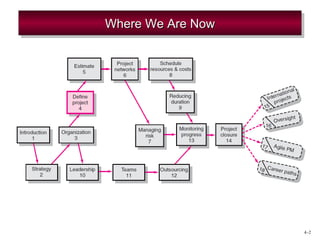
WWWWhhhheeeerrrreeee WWWWeeee AAAArrrreeee NNNNoooowwww
4–3 
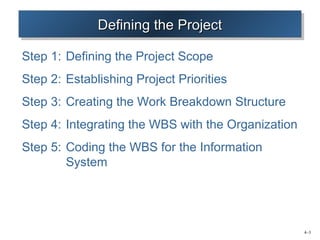
DDDDeeeeffffiiininnniiininnngggg tttthhhheeee PPPPrrrroooojjjejeeecccctttt 
Step 1: Defining the Project Scope 
Step 2: Establishing Project Priorities 
Step 3: Creating the Work Breakdown Structure 
Step 4: Integrating the WBS with the Organization 
Step 5: Coding the WBS for the Information 
System
4–4 
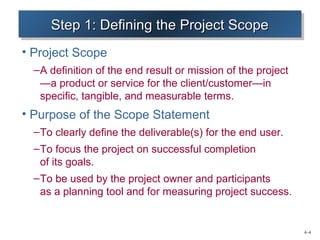
SSSStttteeeepppp 1111:::: DDDDeeeeffffiiininnniiininnngggg tttthhhheeee PPPPrrrroooojjjejeeecccctttt SSSSccccooooppppeeee 
• Project Scope 
–A definition of the end result or mission of the project 
—a product or service for the client/customer—in 
specific, tangible, and measurable terms. 
• Purpose of the Scope Statement 
–To clearly define the deliverable(s) for the end user. 
–To focus the project on successful completion 
of its goals. 
–To be used by the project owner and participants 
as a planning tool and for measuring project success.
4–5 
PPPPrrrroooojjjejeeecccctttt SSSSccccooooppppeeee CCCChhhheeeecccckkkkllliliisissstttt 
1. Project objective 
2. Deliverables 
3. Milestones 
4. Technical requirements 
5. Limits and exclusions 
6. Reviews with customer
4–6 
PPPPrrrroooojjjejeeecccctttt SSSSccccooooppppeeee:::: TTTTeeeerrrrmmmmssss aaaannnndddd DDDDeeeeffffiiininnniiititttiiioiooonnnnssss 
• Scope Statements 
–Also called statements of work (SOW) 
• Project Charter 
–Can contain an expanded version of scope statement 
–A document authorizing the project manager to initiate 
and lead the project. 
• Scope Creep 
–The tendency for the project scope to expand over 
time due to changing requirements, specifications, and 
priorities.
4–7 
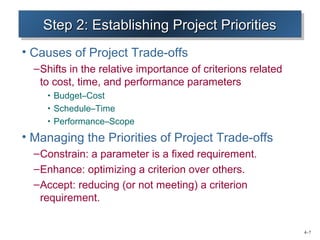
SSSStttteeeepppp 2222:::: EEEEssssttttaaaabbbbllliliisissshhhhiiininnngggg PPPPrrrroooojjjejeeecccctttt PPPPrrrriiioiooorrrriiititttiiieieeessss 
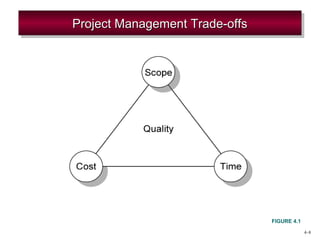
• Causes of Project Trade-offs 
–Shifts in the relative importance of criterions related 
to cost, time, and performance parameters 
• Budget–Cost 
• Schedule–Time 
• Performance–Scope 
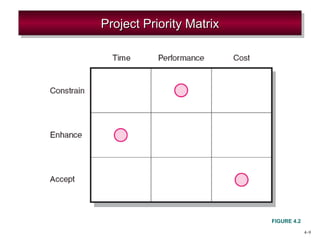
• Managing the Priorities of Project Trade-offs 
–Constrain: a parameter is a fixed requirement. 
–Enhance: optimizing a criterion over others. 
–Accept: reducing (or not meeting) a criterion 
requirement.
4–8 
PPPPrrrroooojjjejeeecccctttt MMMMaaaannnnaaaaggggeeeemmmmeeeennnntttt TTTTrrrraaaaddddeeee----ooooffffffffssss 
FIGURE 4.1
4–9 
PPPPrrrroooojjjejeeecccctttt PPPPrrrriiioiooorrrriiititttyyyy MMMMaaaattttrrrriiixixxx 
FIGURE 4.2
4–10 
SStteepp 33:: CCrreeaattiinngg tthhee WWoorrkk 
BBrreeaakkddoowwnn SSttrruuccttuurree 
• Work Breakdown Structure (WBS) 
–An hierarchical outline (map) that identifies the 
products and work elements involved in a project. 
–Defines the relationship of the final deliverable 
(the project) to its subdeliverables, and in turn, 
their relationships to work packages. 
–Best suited for design and build projects that have 
tangible outcomes rather than process-oriented 
projects.
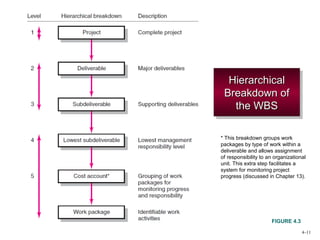
* This breakdown groups work 
packages by type of work within a 
deliverable and allows assignment 
of responsibility to an organizational 
unit. This extra step facilitates a 
system for monitoring project 
progress (discussed in Chapter 13). 
4–11 
HHiieerraarrcchhiiccaall 
BBrreeaakkddoowwnn ooff 
tthhee WWBBSS 
HHiieerraarrcchhiiccaall 
BBrreeaakkddoowwnn ooff 
tthhee WWBBSS 
FIGURE 4.3
4–12 
HHHHoooowwww WWWWBBBBSSSS HHHHeeeelllplpppssss tttthhhheeee PPPPrrrroooojjjejeeecccctttt MMMMaaaannnnaaaaggggeeeerrrr 
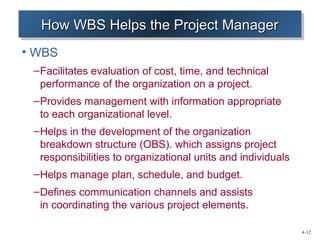
• WBS 
–Facilitates evaluation of cost, time, and technical 
performance of the organization on a project. 
–Provides management with information appropriate 
to each organizational level. 
–Helps in the development of the organization 
breakdown structure (OBS). which assigns project 
responsibilities to organizational units and individuals 
–Helps manage plan, schedule, and budget. 
–Defines communication channels and assists 
in coordinating the various project elements.
4–13 
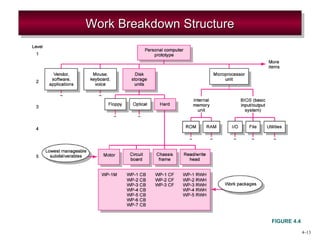
WWWWoooorrrrkkkk BBBBrrrreeeeaaaakkkkddddoooowwwwnnnn SSSSttttrrrruuuuccccttttuuuurrrreeee 
FIGURE 4.4
4–14 
WWWWoooorrrrkkkk PPPPaaaacccckkkkaaaaggggeeeessss 
• A work package is the lowest level of the WBS. 
– It is output-oriented in that it: 
1. Defines work (what). 
2. Identifies time to complete a work package (how long). 
3. Identifies a time-phased budget to complete 
a work package (cost). 
4. Identifies resources needed to complete 
a work package (how much). 
5. Identifies a person responsible for units of work (who). 
6. Identifies monitoring points (milestones) 
for measuring success.
4–15 
SStteepp 44:: IInntteeggrraattiinngg tthhee WWBBSS 
wwiitthh tthhee OOrrggaanniizzaattiioonn 
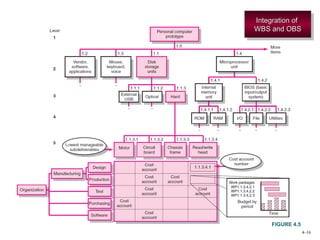
• Organizational Breakdown Structure (OBS) 
–Depicts how the firm is organized to discharge its 
work responsibility for a project. 
• Provides a framework to summarize 
organization work unit performance. 
• Identifies organization units responsible 
for work packages. 
• Ties the organizational units 
to cost control accounts.
IInntteeggrraattiioonn ooff 
WWBBSS aanndd OOBBSS 
4–16 
IInntteeggrraattiioonn ooff 
WWBBSS aanndd OOBBSS 
FIGURE 4.5
4–17 
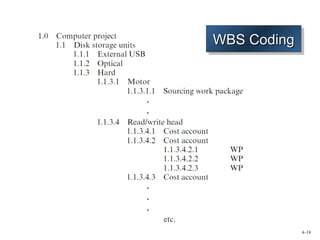
SStteepp 55:: CCooddiinngg tthhee WWBBSS ffoorr 
tthhee IInnffoorrmmaattiioonn SSyysstteemm 
• WBS Coding System 
–Defines: 
• Levels and elements of the WBS 
• Organization elements 
• Work packages 
• Budget and cost information 
–Allows reports to be consolidated at 
any level in the organization structure
4–18 
WWWWBBBBSSSS CCCCooooddddiiininnngggg
4–19 
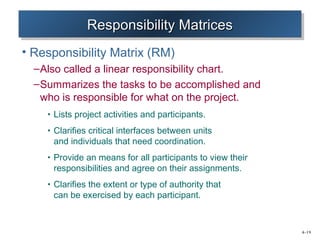
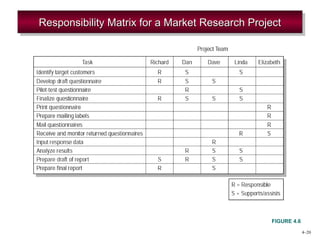
RRRReeeessssppppoooonnnnssssiiibibbbiiililliliititttyyyy MMMMaaaattttrrrriiiciccceeeessss 
• Responsibility Matrix (RM) 
–Also called a linear responsibility chart. 
–Summarizes the tasks to be accomplished and 
who is responsible for what on the project. 
• Lists project activities and participants. 
• Clarifies critical interfaces between units 
and individuals that need coordination. 
• Provide an means for all participants to view their 
responsibilities and agree on their assignments. 
• Clarifies the extent or type of authority that 
can be exercised by each participant.
4–20 
Responsibility Matrix for RRReeessspppooonnnsssiibibbiilililitittyyy MMMaaatttrrriixixx fffooorrr a aaa M MMMaaaarrrrkkkkeeeettt t R RRReeeesssseeeeaaaarrrrcccchhhh P PPPrrrroooojjejejeecccctttt 
FIGURE 4.6
4–21 
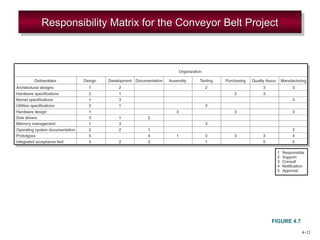
Responsibility Matrix for the RRReeessspppooonnnsssiibibbiilililitittyyy MMMaaatttrrriixixx fffooorrr ttthhheee C CCCoooonnnnvvvveeeeyyyyoooorrrr B BBBeeeelltltlt t P PPPrrrroooojjejejeecccctttt 
FIGURE 4.7
4–22 
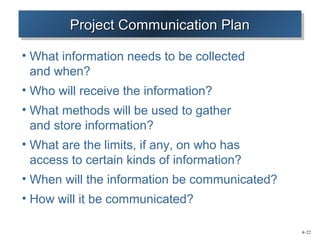
PPPPrrrroooojjjejeeecccctttt CCCCoooommmmmmmmuuuunnnniiicicccaaaattttiiioiooonnnn PPPPlllalaaannnn 
• What information needs to be collected 
and when? 
• Who will receive the information? 
• What methods will be used to gather 
and store information? 
• What are the limits, if any, on who has 
access to certain kinds of information? 
• When will the information be communicated? 
• How will it be communicated?
4–23 
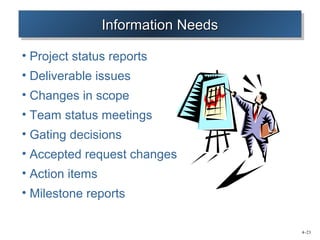
IIIInnnnffffoooorrrrmmmmaaaattttiiioiooonnnn NNNNeeeeeeeeddddssss 
• Project status reports 
• Deliverable issues 
• Changes in scope 
• Team status meetings 
• Gating decisions 
• Accepted request changes 
• Action items 
• Milestone reports
4–24 
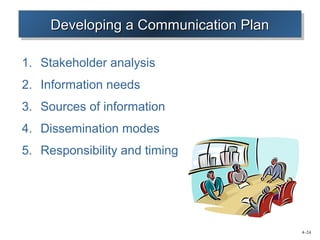
Developing DDDeeevvveeelllooopppiiinnnggg aaaa CCCCoooommmmmmmmuuuunnnniiicicccaaaattttiiioiooonnnn PPPPlllalaaannnn 
1. Stakeholder analysis 
2. Information needs 
3. Sources of information 
4. Dissemination modes 
5. Responsibility and timing
4–25 
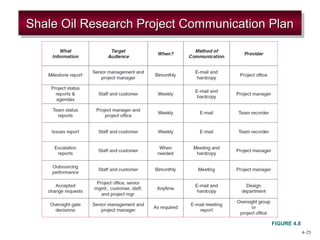
Shale Oil Research SSShhhaaallleee OOOiiilll RRReeessseeeaaarrrccchhh PPPPrrrroooojjjejeeecccctttt CCCCoooommmmmmmmuuuunnnniiicicccaaaattttiiioiooonnnn PPPPlllalaaannnn 
FIGURE 4.8
4–26 
KKKKeeeeyyyy TTTTeeeerrrrmmmmssss 
Cost account 
Milestone 
Organization breakdown structure (OBS) 
Scope creep 
Priority matrix 
Responsibility matrix 
Scope statement 
Process breakdown structure (PBS) 
Work breakdown structure (WBS) 
Work package

Chap004 (1)

  • 1.
    CHAPTER FOUR Defining the Project McGraw-Hill/Irwin Copyright © 2011 by The McGraw-Hill Companies, Inc. All rights reserved.
  • 2.
    4–2 WWWWhhhheeeerrrreeee WWWWeeeeAAAArrrreeee NNNNoooowwww
  • 3.
    4–3 DDDDeeeeffffiiininnniiininnngggg tttthhhheeeePPPPrrrroooojjjejeeecccctttt Step 1: Defining the Project Scope Step 2: Establishing Project Priorities Step 3: Creating the Work Breakdown Structure Step 4: Integrating the WBS with the Organization Step 5: Coding the WBS for the Information System
  • 4.
    4–4 SSSStttteeeepppp 1111::::DDDDeeeeffffiiininnniiininnngggg tttthhhheeee PPPPrrrroooojjjejeeecccctttt SSSSccccooooppppeeee • Project Scope –A definition of the end result or mission of the project —a product or service for the client/customer—in specific, tangible, and measurable terms. • Purpose of the Scope Statement –To clearly define the deliverable(s) for the end user. –To focus the project on successful completion of its goals. –To be used by the project owner and participants as a planning tool and for measuring project success.
  • 5.
    4–5 PPPPrrrroooojjjejeeecccctttt SSSSccccooooppppeeeeCCCChhhheeeecccckkkkllliliisissstttt 1. Project objective 2. Deliverables 3. Milestones 4. Technical requirements 5. Limits and exclusions 6. Reviews with customer
  • 6.
    4–6 PPPPrrrroooojjjejeeecccctttt SSSSccccooooppppeeee::::TTTTeeeerrrrmmmmssss aaaannnndddd DDDDeeeeffffiiininnniiititttiiioiooonnnnssss • Scope Statements –Also called statements of work (SOW) • Project Charter –Can contain an expanded version of scope statement –A document authorizing the project manager to initiate and lead the project. • Scope Creep –The tendency for the project scope to expand over time due to changing requirements, specifications, and priorities.
  • 7.
    4–7 SSSStttteeeepppp 2222::::EEEEssssttttaaaabbbbllliliisissshhhhiiininnngggg PPPPrrrroooojjjejeeecccctttt PPPPrrrriiioiooorrrriiititttiiieieeessss • Causes of Project Trade-offs –Shifts in the relative importance of criterions related to cost, time, and performance parameters • Budget–Cost • Schedule–Time • Performance–Scope • Managing the Priorities of Project Trade-offs –Constrain: a parameter is a fixed requirement. –Enhance: optimizing a criterion over others. –Accept: reducing (or not meeting) a criterion requirement.
  • 8.
    4–8 PPPPrrrroooojjjejeeecccctttt MMMMaaaannnnaaaaggggeeeemmmmeeeennnnttttTTTTrrrraaaaddddeeee----ooooffffffffssss FIGURE 4.1
  • 9.
  • 10.
    4–10 SStteepp 33::CCrreeaattiinngg tthhee WWoorrkk SStteepp 33:: CCrreeaattiinngg tthhee WWoorrkk BBrreeaakkddoowwnn SSttrruuccttuurree BBrreeaakkddoowwnn SSttrruuccttuurree • Work Breakdown Structure (WBS) –An hierarchical outline (map) that identifies the products and work elements involved in a project. –Defines the relationship of the final deliverable (the project) to its subdeliverables, and in turn, their relationships to work packages. –Best suited for design and build projects that have tangible outcomes rather than process-oriented projects.
  • 11.
    * This breakdowngroups work packages by type of work within a deliverable and allows assignment of responsibility to an organizational unit. This extra step facilitates a system for monitoring project progress (discussed in Chapter 13). 4–11 HHiieerraarrcchhiiccaall BBrreeaakkddoowwnn ooff tthhee WWBBSS HHiieerraarrcchhiiccaall BBrreeaakkddoowwnn ooff tthhee WWBBSS FIGURE 4.3
  • 12.
    4–12 HHHHoooowwww WWWWBBBBSSSSHHHHeeeelllplpppssss tttthhhheeee PPPPrrrroooojjjejeeecccctttt MMMMaaaannnnaaaaggggeeeerrrr • WBS –Facilitates evaluation of cost, time, and technical performance of the organization on a project. –Provides management with information appropriate to each organizational level. –Helps in the development of the organization breakdown structure (OBS). which assigns project responsibilities to organizational units and individuals –Helps manage plan, schedule, and budget. –Defines communication channels and assists in coordinating the various project elements.
  • 13.
    4–13 WWWWoooorrrrkkkk BBBBrrrreeeeaaaakkkkddddoooowwwwnnnnSSSSttttrrrruuuuccccttttuuuurrrreeee FIGURE 4.4
  • 14.
    4–14 WWWWoooorrrrkkkk PPPPaaaacccckkkkaaaaggggeeeessss • A work package is the lowest level of the WBS. – It is output-oriented in that it: 1. Defines work (what). 2. Identifies time to complete a work package (how long). 3. Identifies a time-phased budget to complete a work package (cost). 4. Identifies resources needed to complete a work package (how much). 5. Identifies a person responsible for units of work (who). 6. Identifies monitoring points (milestones) for measuring success.
  • 15.
    4–15 SStteepp 44::IInntteeggrraattiinngg tthhee WWBBSS SStteepp 44:: IInntteeggrraattiinngg tthhee WWBBSS wwiitthh tthhee OOrrggaanniizzaattiioonn wwiitthh tthhee OOrrggaanniizzaattiioonn • Organizational Breakdown Structure (OBS) –Depicts how the firm is organized to discharge its work responsibility for a project. • Provides a framework to summarize organization work unit performance. • Identifies organization units responsible for work packages. • Ties the organizational units to cost control accounts.
  • 16.
    IInntteeggrraattiioonn ooff WWBBSSaanndd OOBBSS 4–16 IInntteeggrraattiioonn ooff WWBBSS aanndd OOBBSS FIGURE 4.5
  • 17.
    4–17 SStteepp 55::CCooddiinngg tthhee WWBBSS ffoorr SStteepp 55:: CCooddiinngg tthhee WWBBSS ffoorr tthhee IInnffoorrmmaattiioonn SSyysstteemm tthhee IInnffoorrmmaattiioonn SSyysstteemm • WBS Coding System –Defines: • Levels and elements of the WBS • Organization elements • Work packages • Budget and cost information –Allows reports to be consolidated at any level in the organization structure
  • 18.
  • 19.
    4–19 RRRReeeessssppppoooonnnnssssiiibibbbiiililliliititttyyyy MMMMaaaattttrrrriiiciccceeeessss • Responsibility Matrix (RM) –Also called a linear responsibility chart. –Summarizes the tasks to be accomplished and who is responsible for what on the project. • Lists project activities and participants. • Clarifies critical interfaces between units and individuals that need coordination. • Provide an means for all participants to view their responsibilities and agree on their assignments. • Clarifies the extent or type of authority that can be exercised by each participant.
  • 20.
    4–20 Responsibility Matrixfor RRReeessspppooonnnsssiibibbiilililitittyyy MMMaaatttrrriixixx fffooorrr a aaa M MMMaaaarrrrkkkkeeeettt t R RRReeeesssseeeeaaaarrrrcccchhhh P PPPrrrroooojjejejeecccctttt FIGURE 4.6
  • 21.
    4–21 Responsibility Matrixfor the RRReeessspppooonnnsssiibibbiilililitittyyy MMMaaatttrrriixixx fffooorrr ttthhheee C CCCoooonnnnvvvveeeeyyyyoooorrrr B BBBeeeelltltlt t P PPPrrrroooojjejejeecccctttt FIGURE 4.7
  • 22.
    4–22 PPPPrrrroooojjjejeeecccctttt CCCCoooommmmmmmmuuuunnnniiicicccaaaattttiiioiooonnnnPPPPlllalaaannnn • What information needs to be collected and when? • Who will receive the information? • What methods will be used to gather and store information? • What are the limits, if any, on who has access to certain kinds of information? • When will the information be communicated? • How will it be communicated?
  • 23.
    4–23 IIIInnnnffffoooorrrrmmmmaaaattttiiioiooonnnn NNNNeeeeeeeeddddssss • Project status reports • Deliverable issues • Changes in scope • Team status meetings • Gating decisions • Accepted request changes • Action items • Milestone reports
  • 24.
    4–24 Developing DDDeeevvveeelllooopppiiinnngggaaaa CCCCoooommmmmmmmuuuunnnniiicicccaaaattttiiioiooonnnn PPPPlllalaaannnn 1. Stakeholder analysis 2. Information needs 3. Sources of information 4. Dissemination modes 5. Responsibility and timing
  • 25.
    4–25 Shale OilResearch SSShhhaaallleee OOOiiilll RRReeessseeeaaarrrccchhh PPPPrrrroooojjjejeeecccctttt CCCCoooommmmmmmmuuuunnnniiicicccaaaattttiiioiooonnnn PPPPlllalaaannnn FIGURE 4.8
  • 26.
    4–26 KKKKeeeeyyyy TTTTeeeerrrrmmmmssss Cost account Milestone Organization breakdown structure (OBS) Scope creep Priority matrix Responsibility matrix Scope statement Process breakdown structure (PBS) Work breakdown structure (WBS) Work package