Project Management –
Application (1)
8/8/2017 1Arch. Dania Abdel-Aziz/ Lecture 5
University of Jordan
Year 2016/2017
Second Summer Semester
Arch. Dania Abdel-Aziz
We are going to discus Project management under those main three
headlines:
1. Description.
2. Application.
3. Implementation Procedure.
8/8/2017 Arch. Dania Abdel-Aziz/ Lecture 5 2
2. APPLICATION
8/8/2017 3Arch. Dania Abdel-Aziz/ Lecture 5
Content
1. Organizations where Project Management has been applied.
2. Defining the Project.
8/8/2017 4Arch. Dania Abdel-Aziz/ Lecture 5
1.1. Organizations where Project Management has been
applied
Application areas of project management technique usually defined in
terms of:
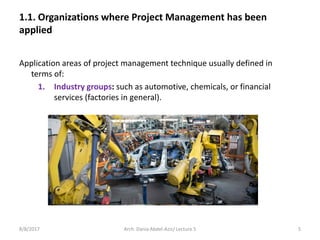
1. Industry groups: such as automotive, chemicals, or financial
services (factories in general).
8/8/2017 5Arch. Dania Abdel-Aziz/ Lecture 5
1.1. Organizations where Project Management has been
applied
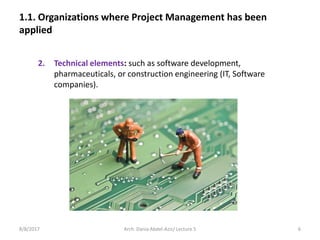
2. Technical elements: such as software development,
pharmaceuticals, or construction engineering (IT, Software
companies).
8/8/2017 6Arch. Dania Abdel-Aziz/ Lecture 5
1.1. Organizations where Project Management has been
applied
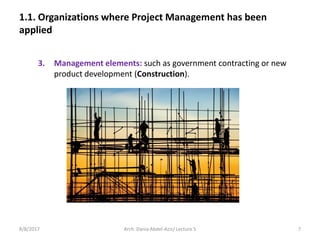
3. Management elements: such as government contracting or new
product development (Construction).
8/8/2017 7Arch. Dania Abdel-Aziz/ Lecture 5
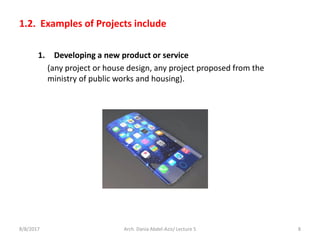
1. Developing a new product or service
(any project or house design, any project proposed from the
ministry of public works and housing).
8/8/2017 8Arch. Dania Abdel-Aziz/ Lecture 5
1.2. Examples of Projects include
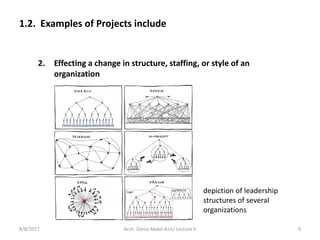
2. Effecting a change in structure, staffing, or style of an
organization
1.2. Examples of Projects include
8/8/2017 9Arch. Dania Abdel-Aziz/ Lecture 5
depiction of leadership
structures of several
organizations
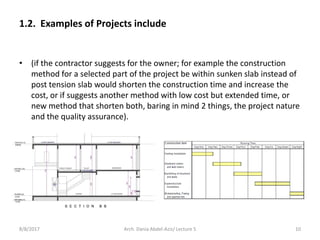
• (if the contractor suggests for the owner; for example the construction
method for a selected part of the project be within sunken slab instead of
post tension slab would shorten the construction time and increase the
cost, or if suggests another method with low cost but extended time, or
new method that shorten both, baring in mind 2 things, the project nature
and the quality assurance).
8/8/2017 Arch. Dania Abdel-Aziz/ Lecture 5 10
1.2. Examples of Projects include
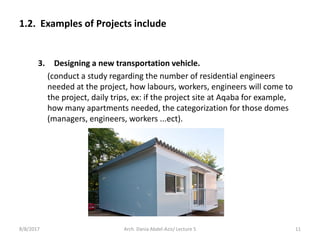
3. Designing a new transportation vehicle.
(conduct a study regarding the number of residential engineers
needed at the project, how labours, workers, engineers will come to
the project, daily trips, ex: if the project site at Aqaba for example,
how many apartments needed, the categorization for those domes
(managers, engineers, workers ...ect).
1.2. Examples of Projects include
8/8/2017 11Arch. Dania Abdel-Aziz/ Lecture 5
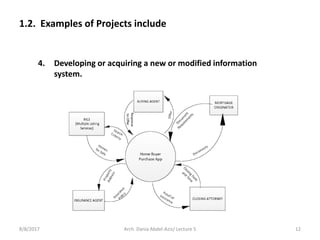
4. Developing or acquiring a new or modified information
system.
1.2. Examples of Projects include
8/8/2017 12Arch. Dania Abdel-Aziz/ Lecture 5
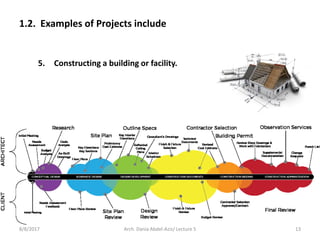
5. Constructing a building or facility.
1.2. Examples of Projects include
8/8/2017 13Arch. Dania Abdel-Aziz/ Lecture 5
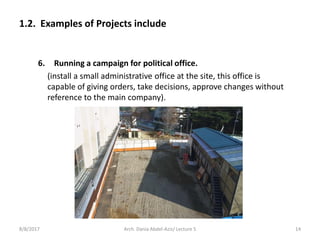
6. Running a campaign for political office.
(install a small administrative office at the site, this office is
capable of giving orders, take decisions, approve changes without
reference to the main company).
1.2. Examples of Projects include
8/8/2017 14Arch. Dania Abdel-Aziz/ Lecture 5
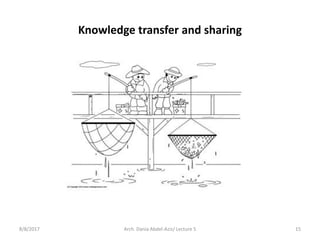
Knowledge transfer and sharing
8/8/2017 Arch. Dania Abdel-Aziz/ Lecture 5 15
DEFINING THE PROJECT
8/8/2017 Arch. Dania Abdel-Aziz/ Lecture 5 16
2. Defining the Project
8/8/2017 17Arch. Dania Abdel-Aziz/ Lecture 5
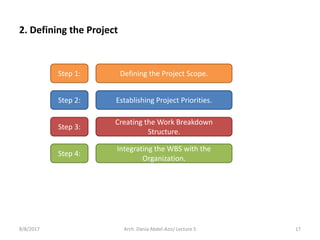
Step 1: Defining the Project Scope.
Step 2: Establishing Project Priorities.
Step 3:
Creating the Work Breakdown
Structure.
Step 4:
Integrating the WBS with the
Organization.
Step 1: Defining the Project Scope
Project Scope
A definition of the end result or mission of the project—a product or
service for the client/customer—in specific, tangible, and measurable
terms.
Purpose of the Scope Statement
• To clearly define the deliverable(s) for the end user.
• To focus the project on successful completion of its goals.
• To be used by the project owner and participants as a planning tool
and for measuring project success.
8/8/2017 18Arch. Dania Abdel-Aziz/ Lecture 5
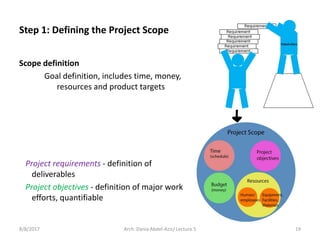
Scope definition
Goal definition, includes time, money,
resources and product targets
Project requirements - definition of
deliverables
Project objectives - definition of major work
efforts, quantifiable
8/8/2017 Arch. Dania Abdel-Aziz/ Lecture 5 19
Step 1: Defining the Project Scope
8/8/2017 Arch. Dania Abdel-Aziz/ Lecture 5 20
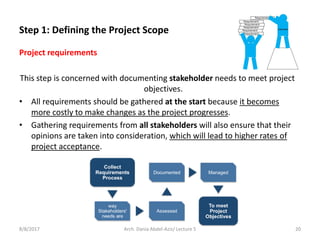
Project requirements
This step is concerned with documenting stakeholder needs to meet project
objectives.
• All requirements should be gathered at the start because it becomes
more costly to make changes as the project progresses.
• Gathering requirements from all stakeholders will also ensure that their
opinions are taken into consideration, which will lead to higher rates of
project acceptance.
Step 1: Defining the Project Scope
8/8/2017 Arch. Dania Abdel-Aziz/ Lecture 5 21
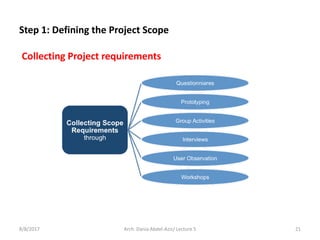
Collecting Project requirements
Step 1: Defining the Project Scope
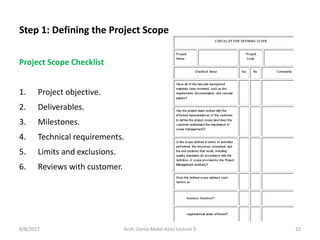
Project Scope Checklist
1. Project objective.
2. Deliverables.
3. Milestones.
4. Technical requirements.
5. Limits and exclusions.
6. Reviews with customer.
8/8/2017 22Arch. Dania Abdel-Aziz/ Lecture 5
Step 1: Defining the Project Scope
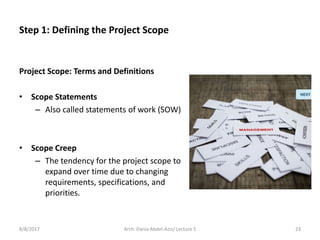
Project Scope: Terms and Definitions
• Scope Statements
– Also called statements of work (SOW)
• Scope Creep
– The tendency for the project scope to
expand over time due to changing
requirements, specifications, and
priorities.
8/8/2017 23Arch. Dania Abdel-Aziz/ Lecture 5
Step 1: Defining the Project Scope
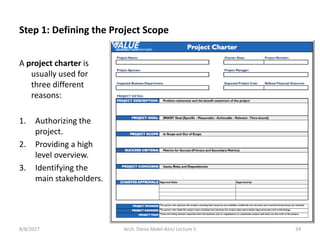
A project charter is
usually used for
three different
reasons:
1. Authorizing the
project.
2. Providing a high
level overview.
3. Identifying the
main stakeholders.
8/8/2017 Arch. Dania Abdel-Aziz/ Lecture 5 24
Step 1: Defining the Project Scope
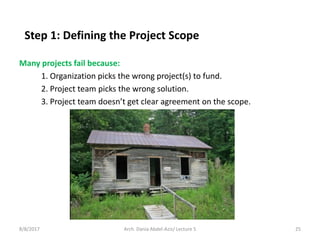
Many projects fail because:
1. Organization picks the wrong project(s) to fund.
2. Project team picks the wrong solution.
3. Project team doesn’t get clear agreement on the scope.
8/8/2017 Arch. Dania Abdel-Aziz/ Lecture 5 25
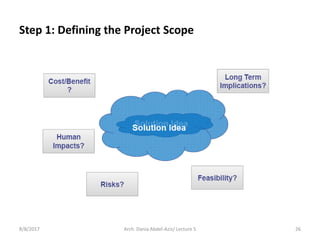
Step 1: Defining the Project Scope
8/8/2017 Arch. Dania Abdel-Aziz/ Lecture 5 26
Step 1: Defining the Project Scope
Step 2: Establishing Project Priorities
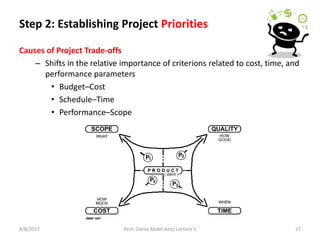
Causes of Project Trade-offs
– Shifts in the relative importance of criterions related to cost, time, and
performance parameters
• Budget–Cost
• Schedule–Time
• Performance–Scope
8/8/2017 27Arch. Dania Abdel-Aziz/ Lecture 5
FIGURE 4.1
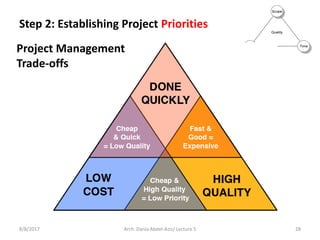
8/8/2017 28Arch. Dania Abdel-Aziz/ Lecture 5
Project Management
Trade-offs
Step 2: Establishing Project Priorities
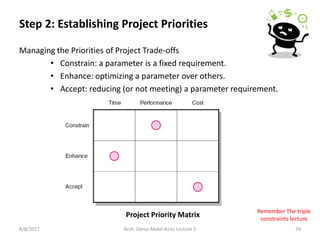
Managing the Priorities of Project Trade-offs
• Constrain: a parameter is a fixed requirement.
• Enhance: optimizing a parameter over others.
• Accept: reducing (or not meeting) a parameter requirement.
8/8/2017 29Arch. Dania Abdel-Aziz/ Lecture 5
Remember The triple
constraints lecture
Project Priority Matrix
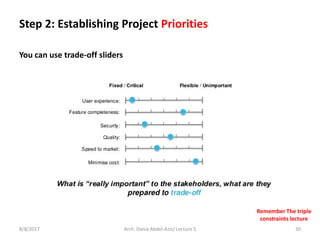
You can use trade-off sliders
8/8/2017 Arch. Dania Abdel-Aziz/ Lecture 5 30
Remember The triple
constraints lecture
Step 2: Establishing Project Priorities
Step 3: Creating the Work Breakdown Structure
Work Breakdown Structure (WBS)
• An hierarchical outline (map) that identifies the products and work
elements involved in a project.
• Defines the relationship of the final deliverable (the project) to its sub-
deliverables, and in turn, their relationships to work packages.
Best suited for design and build projects that have tangible outcomes
rather than process-oriented projects.
8/8/2017 31Arch. Dania Abdel-Aziz/ Lecture 5
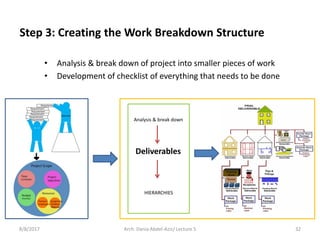
• Analysis & break down of project into smaller pieces of work
• Development of checklist of everything that needs to be done
8/8/2017 Arch. Dania Abdel-Aziz/ Lecture 5 32
Analysis & break down
Deliverables
HIERARCHIES
Step 3: Creating the Work Breakdown Structure
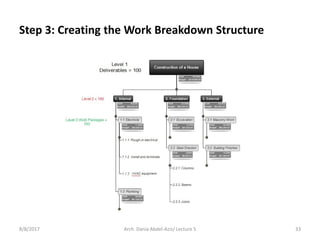
8/8/2017 Arch. Dania Abdel-Aziz/ Lecture 5 33
Step 3: Creating the Work Breakdown Structure
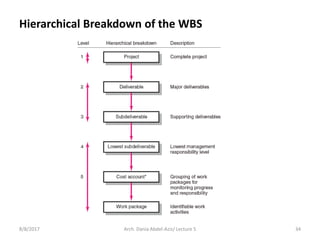
FIGURE 4.3
8/8/2017 34Arch. Dania Abdel-Aziz/ Lecture 5
Hierarchical Breakdown of the WBS
How WBS Helps the Project Manager?
Facilitates evaluation of cost, time, and technical performance of the
organization on a project
1. Provides management with information appropriate to each
organizational level.
2. Helps in the development of the organization breakdown structure
(OBS), which assigns project responsibilities to organizational units
and individuals.
3. Helps manage plan, schedule, and budget.
4. Defines communication channels and assists in coordinating the
various project elements.
8/8/2017 35Arch. Dania Abdel-Aziz/ Lecture 5
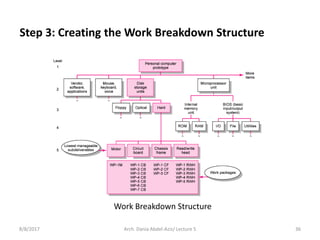
Step 3: Creating the Work Breakdown Structure
Work Breakdown Structure
FIGURE 4.4
8/8/2017 36Arch. Dania Abdel-Aziz/ Lecture 5
Step 3: Creating the Work Breakdown Structure
A Work Package Is the Lowest Level of the WBS.
• It is output-oriented in that it:
What? Defines work.
How long? Identifies time to complete a work package.
cost? Identifies a time-phased budget to complete a work package.
How much? Identifies resources needed to complete a work
package.
Who? Identifies a single person responsible for units of work.
8/8/2017 37Arch. Dania Abdel-Aziz/ Lecture 5
Step 3: Creating the Work Breakdown Structure
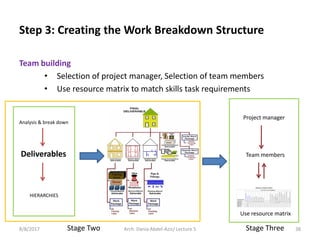
Team building
• Selection of project manager, Selection of team members
• Use resource matrix to match skills task requirements
8/8/2017 Arch. Dania Abdel-Aziz/ Lecture 5 38
Analysis & break down
Deliverables
Stage Two
HIERARCHIES
Stage Three
Project manager
Team members
Use resource matrix
Step 3: Creating the Work Breakdown Structure
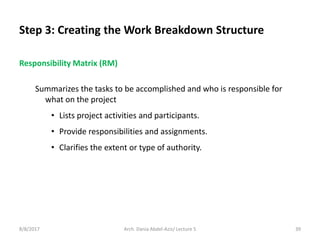
Responsibility Matrix (RM)
Summarizes the tasks to be accomplished and who is responsible for
what on the project
• Lists project activities and participants.
• Provide responsibilities and assignments.
• Clarifies the extent or type of authority.
8/8/2017 39Arch. Dania Abdel-Aziz/ Lecture 5
Step 3: Creating the Work Breakdown Structure
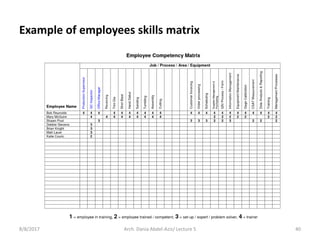
Example of employees skills matrix
8/8/2017 Arch. Dania Abdel-Aziz/ Lecture 5 40
8/8/2017 Arch. Dania Abdel-Aziz/ Lecture 5 41
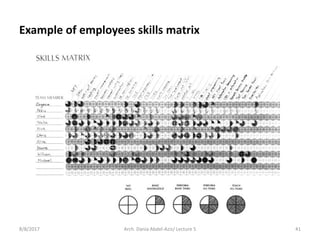
Example of employees skills matrix
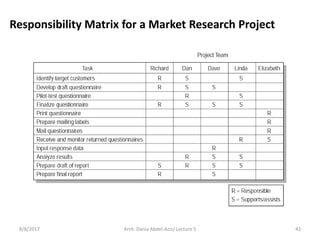
Responsibility Matrix for a Market Research Project
FIGURE 4.9
8/8/2017 42Arch. Dania Abdel-Aziz/ Lecture 5
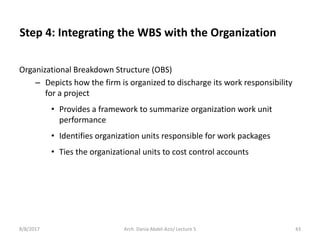
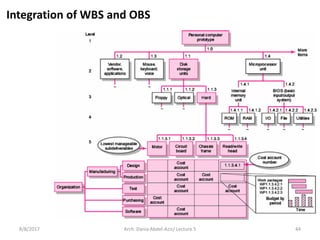
Step 4: Integrating the WBS with the Organization
Organizational Breakdown Structure (OBS)
– Depicts how the firm is organized to discharge its work responsibility
for a project
• Provides a framework to summarize organization work unit
performance
• Identifies organization units responsible for work packages
• Ties the organizational units to cost control accounts
8/8/2017 43Arch. Dania Abdel-Aziz/ Lecture 5
FIGURE 4.5
Integration of WBS and OBS
8/8/2017 44Arch. Dania Abdel-Aziz/ Lecture 5
Thank you 
8/8/2017 Arch. Dania Abdel-Aziz/ Lecture 5 45

4. project management – application (1)

  • 1.
    Project Management – Application(1) 8/8/2017 1Arch. Dania Abdel-Aziz/ Lecture 5 University of Jordan Year 2016/2017 Second Summer Semester Arch. Dania Abdel-Aziz
  • 2.
    We are goingto discus Project management under those main three headlines: 1. Description. 2. Application. 3. Implementation Procedure. 8/8/2017 Arch. Dania Abdel-Aziz/ Lecture 5 2
  • 3.
    2. APPLICATION 8/8/2017 3Arch.Dania Abdel-Aziz/ Lecture 5
  • 4.
    Content 1. Organizations whereProject Management has been applied. 2. Defining the Project. 8/8/2017 4Arch. Dania Abdel-Aziz/ Lecture 5
  • 5.
    1.1. Organizations whereProject Management has been applied Application areas of project management technique usually defined in terms of: 1. Industry groups: such as automotive, chemicals, or financial services (factories in general). 8/8/2017 5Arch. Dania Abdel-Aziz/ Lecture 5
  • 6.
    1.1. Organizations whereProject Management has been applied 2. Technical elements: such as software development, pharmaceuticals, or construction engineering (IT, Software companies). 8/8/2017 6Arch. Dania Abdel-Aziz/ Lecture 5
  • 7.
    1.1. Organizations whereProject Management has been applied 3. Management elements: such as government contracting or new product development (Construction). 8/8/2017 7Arch. Dania Abdel-Aziz/ Lecture 5
  • 8.
    1. Developing anew product or service (any project or house design, any project proposed from the ministry of public works and housing). 8/8/2017 8Arch. Dania Abdel-Aziz/ Lecture 5 1.2. Examples of Projects include
  • 9.
    2. Effecting achange in structure, staffing, or style of an organization 1.2. Examples of Projects include 8/8/2017 9Arch. Dania Abdel-Aziz/ Lecture 5 depiction of leadership structures of several organizations
  • 10.
    • (if thecontractor suggests for the owner; for example the construction method for a selected part of the project be within sunken slab instead of post tension slab would shorten the construction time and increase the cost, or if suggests another method with low cost but extended time, or new method that shorten both, baring in mind 2 things, the project nature and the quality assurance). 8/8/2017 Arch. Dania Abdel-Aziz/ Lecture 5 10 1.2. Examples of Projects include
  • 11.
    3. Designing anew transportation vehicle. (conduct a study regarding the number of residential engineers needed at the project, how labours, workers, engineers will come to the project, daily trips, ex: if the project site at Aqaba for example, how many apartments needed, the categorization for those domes (managers, engineers, workers ...ect). 1.2. Examples of Projects include 8/8/2017 11Arch. Dania Abdel-Aziz/ Lecture 5
  • 12.
    4. Developing oracquiring a new or modified information system. 1.2. Examples of Projects include 8/8/2017 12Arch. Dania Abdel-Aziz/ Lecture 5
  • 13.
    5. Constructing abuilding or facility. 1.2. Examples of Projects include 8/8/2017 13Arch. Dania Abdel-Aziz/ Lecture 5
  • 14.
    6. Running acampaign for political office. (install a small administrative office at the site, this office is capable of giving orders, take decisions, approve changes without reference to the main company). 1.2. Examples of Projects include 8/8/2017 14Arch. Dania Abdel-Aziz/ Lecture 5
  • 15.
    Knowledge transfer andsharing 8/8/2017 Arch. Dania Abdel-Aziz/ Lecture 5 15
  • 16.
    DEFINING THE PROJECT 8/8/2017Arch. Dania Abdel-Aziz/ Lecture 5 16
  • 17.
    2. Defining theProject 8/8/2017 17Arch. Dania Abdel-Aziz/ Lecture 5 Step 1: Defining the Project Scope. Step 2: Establishing Project Priorities. Step 3: Creating the Work Breakdown Structure. Step 4: Integrating the WBS with the Organization.
  • 18.
    Step 1: Definingthe Project Scope Project Scope A definition of the end result or mission of the project—a product or service for the client/customer—in specific, tangible, and measurable terms. Purpose of the Scope Statement • To clearly define the deliverable(s) for the end user. • To focus the project on successful completion of its goals. • To be used by the project owner and participants as a planning tool and for measuring project success. 8/8/2017 18Arch. Dania Abdel-Aziz/ Lecture 5
  • 19.
    Scope definition Goal definition,includes time, money, resources and product targets Project requirements - definition of deliverables Project objectives - definition of major work efforts, quantifiable 8/8/2017 Arch. Dania Abdel-Aziz/ Lecture 5 19 Step 1: Defining the Project Scope
  • 20.
    8/8/2017 Arch. DaniaAbdel-Aziz/ Lecture 5 20 Project requirements This step is concerned with documenting stakeholder needs to meet project objectives. • All requirements should be gathered at the start because it becomes more costly to make changes as the project progresses. • Gathering requirements from all stakeholders will also ensure that their opinions are taken into consideration, which will lead to higher rates of project acceptance. Step 1: Defining the Project Scope
  • 21.
    8/8/2017 Arch. DaniaAbdel-Aziz/ Lecture 5 21 Collecting Project requirements Step 1: Defining the Project Scope
  • 22.
    Project Scope Checklist 1.Project objective. 2. Deliverables. 3. Milestones. 4. Technical requirements. 5. Limits and exclusions. 6. Reviews with customer. 8/8/2017 22Arch. Dania Abdel-Aziz/ Lecture 5 Step 1: Defining the Project Scope
  • 23.
    Project Scope: Termsand Definitions • Scope Statements – Also called statements of work (SOW) • Scope Creep – The tendency for the project scope to expand over time due to changing requirements, specifications, and priorities. 8/8/2017 23Arch. Dania Abdel-Aziz/ Lecture 5 Step 1: Defining the Project Scope
  • 24.
    A project charteris usually used for three different reasons: 1. Authorizing the project. 2. Providing a high level overview. 3. Identifying the main stakeholders. 8/8/2017 Arch. Dania Abdel-Aziz/ Lecture 5 24 Step 1: Defining the Project Scope
  • 25.
    Many projects failbecause: 1. Organization picks the wrong project(s) to fund. 2. Project team picks the wrong solution. 3. Project team doesn’t get clear agreement on the scope. 8/8/2017 Arch. Dania Abdel-Aziz/ Lecture 5 25 Step 1: Defining the Project Scope
  • 26.
    8/8/2017 Arch. DaniaAbdel-Aziz/ Lecture 5 26 Step 1: Defining the Project Scope
  • 27.
    Step 2: EstablishingProject Priorities Causes of Project Trade-offs – Shifts in the relative importance of criterions related to cost, time, and performance parameters • Budget–Cost • Schedule–Time • Performance–Scope 8/8/2017 27Arch. Dania Abdel-Aziz/ Lecture 5
  • 28.
    FIGURE 4.1 8/8/2017 28Arch.Dania Abdel-Aziz/ Lecture 5 Project Management Trade-offs Step 2: Establishing Project Priorities
  • 29.
    Step 2: EstablishingProject Priorities Managing the Priorities of Project Trade-offs • Constrain: a parameter is a fixed requirement. • Enhance: optimizing a parameter over others. • Accept: reducing (or not meeting) a parameter requirement. 8/8/2017 29Arch. Dania Abdel-Aziz/ Lecture 5 Remember The triple constraints lecture Project Priority Matrix
  • 30.
    You can usetrade-off sliders 8/8/2017 Arch. Dania Abdel-Aziz/ Lecture 5 30 Remember The triple constraints lecture Step 2: Establishing Project Priorities
  • 31.
    Step 3: Creatingthe Work Breakdown Structure Work Breakdown Structure (WBS) • An hierarchical outline (map) that identifies the products and work elements involved in a project. • Defines the relationship of the final deliverable (the project) to its sub- deliverables, and in turn, their relationships to work packages. Best suited for design and build projects that have tangible outcomes rather than process-oriented projects. 8/8/2017 31Arch. Dania Abdel-Aziz/ Lecture 5
  • 32.
    • Analysis &break down of project into smaller pieces of work • Development of checklist of everything that needs to be done 8/8/2017 Arch. Dania Abdel-Aziz/ Lecture 5 32 Analysis & break down Deliverables HIERARCHIES Step 3: Creating the Work Breakdown Structure
  • 33.
    8/8/2017 Arch. DaniaAbdel-Aziz/ Lecture 5 33 Step 3: Creating the Work Breakdown Structure
  • 34.
    FIGURE 4.3 8/8/2017 34Arch.Dania Abdel-Aziz/ Lecture 5 Hierarchical Breakdown of the WBS
  • 35.
    How WBS Helpsthe Project Manager? Facilitates evaluation of cost, time, and technical performance of the organization on a project 1. Provides management with information appropriate to each organizational level. 2. Helps in the development of the organization breakdown structure (OBS), which assigns project responsibilities to organizational units and individuals. 3. Helps manage plan, schedule, and budget. 4. Defines communication channels and assists in coordinating the various project elements. 8/8/2017 35Arch. Dania Abdel-Aziz/ Lecture 5 Step 3: Creating the Work Breakdown Structure
  • 36.
    Work Breakdown Structure FIGURE4.4 8/8/2017 36Arch. Dania Abdel-Aziz/ Lecture 5 Step 3: Creating the Work Breakdown Structure
  • 37.
    A Work PackageIs the Lowest Level of the WBS. • It is output-oriented in that it: What? Defines work. How long? Identifies time to complete a work package. cost? Identifies a time-phased budget to complete a work package. How much? Identifies resources needed to complete a work package. Who? Identifies a single person responsible for units of work. 8/8/2017 37Arch. Dania Abdel-Aziz/ Lecture 5 Step 3: Creating the Work Breakdown Structure
  • 38.
    Team building • Selectionof project manager, Selection of team members • Use resource matrix to match skills task requirements 8/8/2017 Arch. Dania Abdel-Aziz/ Lecture 5 38 Analysis & break down Deliverables Stage Two HIERARCHIES Stage Three Project manager Team members Use resource matrix Step 3: Creating the Work Breakdown Structure
  • 39.
    Responsibility Matrix (RM) Summarizesthe tasks to be accomplished and who is responsible for what on the project • Lists project activities and participants. • Provide responsibilities and assignments. • Clarifies the extent or type of authority. 8/8/2017 39Arch. Dania Abdel-Aziz/ Lecture 5 Step 3: Creating the Work Breakdown Structure
  • 40.
    Example of employeesskills matrix 8/8/2017 Arch. Dania Abdel-Aziz/ Lecture 5 40
  • 41.
    8/8/2017 Arch. DaniaAbdel-Aziz/ Lecture 5 41 Example of employees skills matrix
  • 42.
    Responsibility Matrix fora Market Research Project FIGURE 4.9 8/8/2017 42Arch. Dania Abdel-Aziz/ Lecture 5
  • 43.
    Step 4: Integratingthe WBS with the Organization Organizational Breakdown Structure (OBS) – Depicts how the firm is organized to discharge its work responsibility for a project • Provides a framework to summarize organization work unit performance • Identifies organization units responsible for work packages • Ties the organizational units to cost control accounts 8/8/2017 43Arch. Dania Abdel-Aziz/ Lecture 5
  • 44.
    FIGURE 4.5 Integration ofWBS and OBS 8/8/2017 44Arch. Dania Abdel-Aziz/ Lecture 5
  • 45.
    Thank you  8/8/2017Arch. Dania Abdel-Aziz/ Lecture 5 45