CHAPTER ELEVEN 
Managing 
Project Teams 
McGraw-Hill/Irwin 
Copyright © 2011 by The McGraw-Hill Companies, Inc. All 
rights reserved.
11–3 
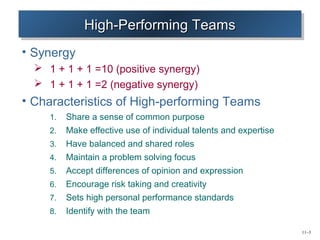
HHHHiiigiggghhhh----PPPPeeeerrrrffffoooorrrrmmmmiiininnngggg TTTTeeeeaaaammmmssss 
• Synergy 
 1 + 1 + 1 =10 (positive synergy) 
 1 + 1 + 1 =2 (negative synergy) 
• Characteristics of High-performing Teams 
1. Share a sense of common purpose 
2. Make effective use of individual talents and expertise 
3. Have balanced and shared roles 
4. Maintain a problem solving focus 
5. Accept differences of opinion and expression 
6. Encourage risk taking and creativity 
7. Sets high personal performance standards 
8. Identify with the team
11–4 
TTTThhhheeee FFFFiiivivvveeee----SSSSttttaaaaggggeeee TTTTeeeeaaaammmm DDDDeeeevvvveeeellloloooppppmmmmeeeennnntttt MMMMooooddddeeeellll 
FIGURE 11.1
11–5 
CCoonnddiittiioonnss FFaavvoorriinngg DDeevveellooppmmeenntt ooff 
HHiigghh PPeerrffoorrmmaannccee PPrroojjeecctt TTeeaammss 
Conditions FFaavvoorriinngg DDeevveellooppmmeenntt ooff 
HHiigghh PPeerrffoorrmmaannccee PPrroojjeecctt TTeeaammss 
• Ten or fewer team members 
• Voluntary team membership 
• Continuous service on the 
team 
• Full-time assignment to the 
team 
• An organization culture of 
cooperation and trust 
• Members report only to the 
project manager 
• All relevant functional areas 
are represented on the team 
• The project has a compelling 
objective 
• Members are in speaking 
distance of each other
11–6 
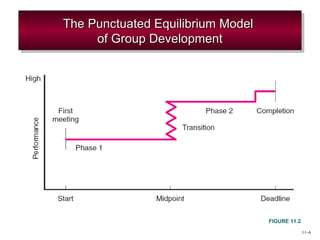
TThhee PPuunnccttuuaatteedd EEqquuiilliibbrriiuumm MMooddeell 
ooff GGrroouupp DDeevveellooppmmeenntt 
FIGURE 11.2
11–7 
Creating CCCrrreeeaaatttiiinnnggg aaaa HHHHiiigiggghhhh----PPPPeeeerrrrffffoooorrrrmmmmaaaannnncccceeee PPPPrrrroooojjjejeeecccctttt TTTTeeeeaaaammmm 
FIGURE 11.3
11–8 
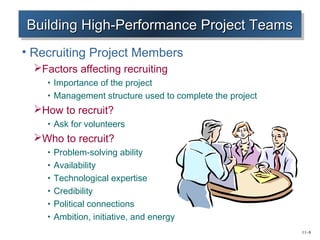
Building BBBuuuiiillldddiiinnnggg HHHHiiigiggghhhh----PPPPeeeerrrrffffoooorrrrmmmmaaaannnncccceeee PPPPrrrroooojjjejeeecccctttt TTTTeeeeaaaammmmssss 
• Recruiting Project Members 
Factors affecting recruiting 
• Importance of the project 
• Management structure used to complete the project 
How to recruit? 
• Ask for volunteers 
Who to recruit? 
• Problem-solving ability 
• Availability 
• Technological expertise 
• Credibility 
• Political connections 
• Ambition, initiative, and energy
11–9 
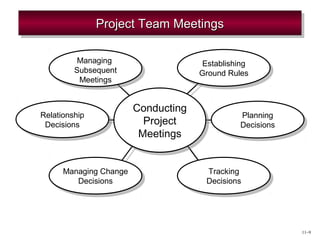
PPPPrrrroooojjjejeeecccctttt TTTTeeeeaaaammmm MMMMeeeeeeeettttiiininnnggggssss 
Conducting 
Project 
Meetings 
Conducting 
Project 
Meetings 
Establishing 
Ground Rules 
Establishing 
Ground Rules 
Planning 
Decisions 
Planning 
Decisions 
Tracking 
Decisions 
Tracking 
Decisions 
Managing 
Subsequent 
Meetings 
Managing 
Subsequent 
Meetings 
Relationship 
Decisions 
Relationship 
Decisions 
Managing Change 
Managing Change 
Decisions 
Decisions
11–10 
EEEEssssttttaaaabbbbllliliisissshhhhiiininnngggg aaaa TTTTeeeeaaaammmm IIIIddddeeeennnnttttiiititttyyyy 
EEffffeeccttiivvee UUssee 
ooff MMeeeettiinnggss 
EEffffeeccttiivvee UUssee 
ooff MMeeeettiinnggss 
CCoo--llooccaattiioonn ooff 
tteeaamm mmeemmbbeerrss 
CCoo--llooccaattiioonn ooff 
tteeaamm mmeemmbbeerrss 
CCrreeaattiioonn ooff pprroojjeecctt 
tteeaamm nnaammee 
tteeaamm nnaammee 
TTTTeeeeaaaammmm r rriitititutuuuaaaallslslss
11–12 
MMMMaaaannnnaaaaggggiiininnngggg PPPPrrrroooojjjejeeecccctttt RRRReeeewwwwaaaarrrrdddd SSSSyyyysssstttteeeemmmmssss 
• Group Rewards 
Who gets what as an individual reward? 
How to make the reward have lasting significance? 
How to recognize individual performance? 
• Letters of commendation 
• Public recognition for outstanding work 
• Desirable job assignments 
• Increased personal flexibility
Orchestrating th OOOrrrccchhheeessstttrrraaatttiiinnnggg ttthhheeee DDDDeeeecccciiisisssiiioiooonnnn----MMMMaaaakkkkiiininnngggg PPPPrrrroooocccceeeessssssss 
11–13 
Problem Identification 
Generating Alternatives 
Reaching a Decision 
Follow-up
11–14 
MMMMaaaannnnaaaaggggiiininnngggg CCCCoooonnnnffffllliliiciccctttt wwwwiiitittthhhhiiininnn tttthhhheeee PPPPrrrroooojjjejeeecccctttt TTTTeeeeaaaammmm 
• Encouraging Functional Conflict 
Encourage dissent by asking tough questions. 
Bring in people with different points of view. 
Designate someone to be a devil’s advocate. 
Ask the team to consider an unthinkable alternative 
• Managing Dysfunctional Conflict 
Mediate the conflict. 
Arbitrate the conflict. 
Control the conflict. 
Accept the conflict. 
Eliminate the conflict.
11–16 
RRRReeeejjjujuuuvvvveeeennnnaaaattttiiininnngggg tttthhhheeee PPPPrrrroooojjjejeeecccctttt TTTTeeeeaaaammmm 
• Informal Techniques 
Institute new rituals. 
Take an off-site break as a team from the project. 
View an inspiration message or movie. 
Have the project sponsor give a pep talk. 
• Formal Techniques 
Hold a team building session facilitated by an outsider 
to clarify ownership issues affecting performance. 
Engage in an outside activity that provides an intense 
common experience to promote social development of 
the team.
11–17 
MMMMaaaannnnaaaaggggiiininnngggg VVVViiirirrrttttuuuuaaaalll l PPPPrrrroooojjjejeeecccctttt TTTTeeeeaaaammmmssss 
• Challenges: 
Developing trust 
• Exchange of social information. 
• Set clear roles for each team member. 
Developing effective patterns of communication. 
• Keep team members informed on 
how the overall project is going. 
• Don’t let team members vanish. 
• Establish a code of conduct to avoid delays. 
• Establish clear norms and protocols for surfacing 
assumptions and conflicts. 
• Share the pain.
11–18 
2244--HHoouurr 
GGlloobbaall CClloocckk 
2244--HHoouurr 
GGlloobbaall CClloocckk 
FIGURE 11.6
11–20 
KKKKeeeeyyyy TTTTeeeerrrrmmmmssss 
Brainstorming 
Dysfunctional conflict 
Functional conflict 
Groupthink 
Nominal group technique (NGT) 
Positive synergy 
Project kickoff meeting 
Project vision 
Team building 
Team rituals 
Virtual project team

Chap011

  • 1.
    CHAPTER ELEVEN Managing Project Teams McGraw-Hill/Irwin Copyright © 2011 by The McGraw-Hill Companies, Inc. All rights reserved.
  • 2.
    11–3 HHHHiiigiggghhhh----PPPPeeeerrrrffffoooorrrrmmmmiiininnngggg TTTTeeeeaaaammmmssss • Synergy  1 + 1 + 1 =10 (positive synergy)  1 + 1 + 1 =2 (negative synergy) • Characteristics of High-performing Teams 1. Share a sense of common purpose 2. Make effective use of individual talents and expertise 3. Have balanced and shared roles 4. Maintain a problem solving focus 5. Accept differences of opinion and expression 6. Encourage risk taking and creativity 7. Sets high personal performance standards 8. Identify with the team
  • 3.
    11–4 TTTThhhheeee FFFFiiivivvveeee----SSSSttttaaaaggggeeeeTTTTeeeeaaaammmm DDDDeeeevvvveeeellloloooppppmmmmeeeennnntttt MMMMooooddddeeeellll FIGURE 11.1
  • 4.
    11–5 CCoonnddiittiioonnss FFaavvoorriinnggDDeevveellooppmmeenntt ooff HHiigghh PPeerrffoorrmmaannccee PPrroojjeecctt TTeeaammss Conditions FFaavvoorriinngg DDeevveellooppmmeenntt ooff HHiigghh PPeerrffoorrmmaannccee PPrroojjeecctt TTeeaammss • Ten or fewer team members • Voluntary team membership • Continuous service on the team • Full-time assignment to the team • An organization culture of cooperation and trust • Members report only to the project manager • All relevant functional areas are represented on the team • The project has a compelling objective • Members are in speaking distance of each other
  • 5.
    11–6 TThhee PPuunnccttuuaatteeddEEqquuiilliibbrriiuumm MMooddeell TThhee PPuunnccttuuaatteedd EEqquuiilliibbrriiuumm MMooddeell ooff GGrroouupp DDeevveellooppmmeenntt ooff GGrroouupp DDeevveellooppmmeenntt FIGURE 11.2
  • 6.
    11–7 Creating CCCrrreeeaaatttiiinnngggaaaa HHHHiiigiggghhhh----PPPPeeeerrrrffffoooorrrrmmmmaaaannnncccceeee PPPPrrrroooojjjejeeecccctttt TTTTeeeeaaaammmm FIGURE 11.3
  • 7.
    11–8 Building BBBuuuiiillldddiiinnngggHHHHiiigiggghhhh----PPPPeeeerrrrffffoooorrrrmmmmaaaannnncccceeee PPPPrrrroooojjjejeeecccctttt TTTTeeeeaaaammmmssss • Recruiting Project Members Factors affecting recruiting • Importance of the project • Management structure used to complete the project How to recruit? • Ask for volunteers Who to recruit? • Problem-solving ability • Availability • Technological expertise • Credibility • Political connections • Ambition, initiative, and energy
  • 8.
    11–9 PPPPrrrroooojjjejeeecccctttt TTTTeeeeaaaammmmMMMMeeeeeeeettttiiininnnggggssss Conducting Project Meetings Conducting Project Meetings Establishing Ground Rules Establishing Ground Rules Planning Decisions Planning Decisions Tracking Decisions Tracking Decisions Managing Subsequent Meetings Managing Subsequent Meetings Relationship Decisions Relationship Decisions Managing Change Managing Change Decisions Decisions
  • 9.
    11–10 EEEEssssttttaaaabbbbllliliisissshhhhiiininnngggg aaaaTTTTeeeeaaaammmm IIIIddddeeeennnnttttiiititttyyyy EEffffeeccttiivvee UUssee ooff MMeeeettiinnggss EEffffeeccttiivvee UUssee ooff MMeeeettiinnggss CCoo--llooccaattiioonn ooff tteeaamm mmeemmbbeerrss CCoo--llooccaattiioonn ooff tteeaamm mmeemmbbeerrss CCrreeaattiioonn ooff pprroojjeecctt CCrreeaattiioonn ooff pprroojjeecctt tteeaamm nnaammee tteeaamm nnaammee TTTTeeeeaaaammmm r rriitititutuuuaaaallslslss
  • 10.
    11–12 MMMMaaaannnnaaaaggggiiininnngggg PPPPrrrroooojjjejeeeccccttttRRRReeeewwwwaaaarrrrdddd SSSSyyyysssstttteeeemmmmssss • Group Rewards Who gets what as an individual reward? How to make the reward have lasting significance? How to recognize individual performance? • Letters of commendation • Public recognition for outstanding work • Desirable job assignments • Increased personal flexibility
  • 11.
    Orchestrating th OOOrrrccchhheeessstttrrraaatttiiinnngggttthhheeee DDDDeeeecccciiisisssiiioiooonnnn----MMMMaaaakkkkiiininnngggg PPPPrrrroooocccceeeessssssss 11–13 Problem Identification Generating Alternatives Reaching a Decision Follow-up
  • 12.
    11–14 MMMMaaaannnnaaaaggggiiininnngggg CCCCoooonnnnffffllliliicicccttttwwwwiiitittthhhhiiininnn tttthhhheeee PPPPrrrroooojjjejeeecccctttt TTTTeeeeaaaammmm • Encouraging Functional Conflict Encourage dissent by asking tough questions. Bring in people with different points of view. Designate someone to be a devil’s advocate. Ask the team to consider an unthinkable alternative • Managing Dysfunctional Conflict Mediate the conflict. Arbitrate the conflict. Control the conflict. Accept the conflict. Eliminate the conflict.
  • 13.
    11–16 RRRReeeejjjujuuuvvvveeeennnnaaaattttiiininnngggg tttthhhheeeePPPPrrrroooojjjejeeecccctttt TTTTeeeeaaaammmm • Informal Techniques Institute new rituals. Take an off-site break as a team from the project. View an inspiration message or movie. Have the project sponsor give a pep talk. • Formal Techniques Hold a team building session facilitated by an outsider to clarify ownership issues affecting performance. Engage in an outside activity that provides an intense common experience to promote social development of the team.
  • 14.
    11–17 MMMMaaaannnnaaaaggggiiininnngggg VVVViiirirrrttttuuuuaaaallll PPPPrrrroooojjjejeeecccctttt TTTTeeeeaaaammmmssss • Challenges: Developing trust • Exchange of social information. • Set clear roles for each team member. Developing effective patterns of communication. • Keep team members informed on how the overall project is going. • Don’t let team members vanish. • Establish a code of conduct to avoid delays. • Establish clear norms and protocols for surfacing assumptions and conflicts. • Share the pain.
  • 15.
    11–18 2244--HHoouurr GGlloobbaallCClloocckk 2244--HHoouurr GGlloobbaall CClloocckk FIGURE 11.6
  • 16.
    11–20 KKKKeeeeyyyy TTTTeeeerrrrmmmmssss Brainstorming Dysfunctional conflict Functional conflict Groupthink Nominal group technique (NGT) Positive synergy Project kickoff meeting Project vision Team building Team rituals Virtual project team