What is a Project? Project Defined A complex, nonroutine, one-time effort limited by time, budget, resources, and performance specifications designed to meet customer needs. Major Characteristics of a Project Has an established objective. Has a defined life span with a beginning and an end. Requires across-the-organizational participation. Involves doing something never been done before. Has specific time, cost, and performance requirements.
Programs versus Projects Program Defined A series of coordinated, related, multiple projects that continue over an extended time and are intended to achieve a goal. A higher level group of projects targeted  at a common goal. Example: Project: completion of a required course  in project management. Program: completion of all courses required for a business major.
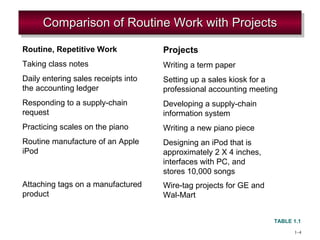
Comparison of Routine Work with Projects TABLE 1. 1 Routine, Repetitive Work   Taking class notes    Daily entering sales receipts into the accounting ledger  Responding to a supply-chain request    Practicing scales on the piano  Routine manufacture of an Apple iPod Attaching tags on a manufactured product     Projects Writing a term paper    Setting up a sales kiosk for a professional accounting meeting Developing a supply-chain information system    Writing a new piano piece Designing an iPod that is approximately 2 X 4 inches, interfaces with PC, and  stores 10,000 songs  Wire-tag projects for GE and  Wal-Mart
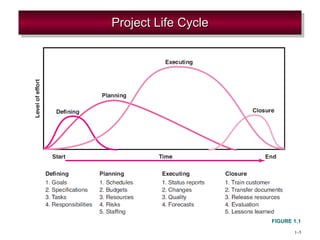
Project Life Cycle FIGURE 1. 1
The Challenge of Project Management The Project Manager Manages temporary, non-repetitive activities and frequently acts independently of the formal organization. Marshals resources for the project. Is linked directly to the customer interface. Provides direction, coordination, and integration  to the project team. Is responsible for performance and success of the project. Must induce the right people at the right time to address the right issues and make the right decisions.
The Importance of Project Management Factors leading to the increased use of project management: Compression of the product life cycle Knowledge explosion Triple bottom line (planet, people, profit) Corporate downsizing Increased customer focus Small projects represent big problems
Benefits of an Integrative Approach  to Project Management  Integration (or centralization) of project management provides senior management with: An overview of all project management activities A big picture of how organizational resources are used A risk assessment of their portfolio of projects A rough metric of the firm’s improvement in managing projects relative to others in the industry Linkages of senior management with actual project execution management
Integrated Project Management Systems Problems resulting from the use of piecemeal project management systems: Do not tie together the overall strategies of the firm. Fail to prioritize selection of projects by their importance of their contribution to the firm. Are not integrated throughout the project life cycle. Do not match project planning and controls with organizational culture to make appropriate adjustments in support of project endeavors.
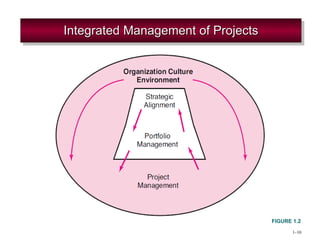
Integrated Management of Projects FIGURE 1.2
Major Functions of Portfolio Management Oversee project selection. Monitor aggregate resource levels and skills. Encourage use of best practices. Balance projects in the portfolio in order to represent a risk level appropriate to the organization. Improve communication among all stakeholders. Create a total organization perspective that goes beyond silo thinking. Improve overall management of projects over time.
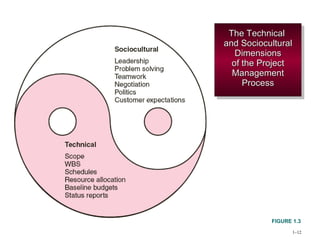
The Technical  and Sociocultural Dimensions of the Project Management Process FIGURE 1.3
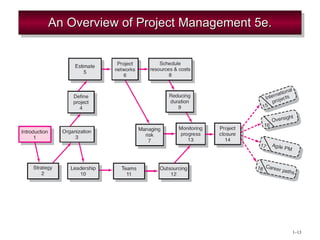
An Overview of Project Management 5e.
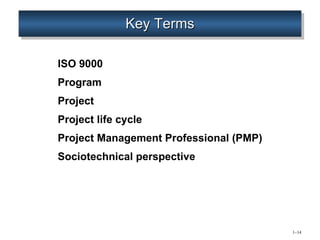
Key Terms ISO 9000 Program Project Project life cycle Project Management Professional (PMP) Sociotechnical perspective

Chap001

  • 1.
  • 2.
    What is aProject? Project Defined A complex, nonroutine, one-time effort limited by time, budget, resources, and performance specifications designed to meet customer needs. Major Characteristics of a Project Has an established objective. Has a defined life span with a beginning and an end. Requires across-the-organizational participation. Involves doing something never been done before. Has specific time, cost, and performance requirements.
  • 3.
    Programs versus ProjectsProgram Defined A series of coordinated, related, multiple projects that continue over an extended time and are intended to achieve a goal. A higher level group of projects targeted at a common goal. Example: Project: completion of a required course in project management. Program: completion of all courses required for a business major.
  • 4.
    Comparison of RoutineWork with Projects TABLE 1. 1 Routine, Repetitive Work Taking class notes Daily entering sales receipts into the accounting ledger Responding to a supply-chain request Practicing scales on the piano Routine manufacture of an Apple iPod Attaching tags on a manufactured product Projects Writing a term paper Setting up a sales kiosk for a professional accounting meeting Developing a supply-chain information system Writing a new piano piece Designing an iPod that is approximately 2 X 4 inches, interfaces with PC, and stores 10,000 songs Wire-tag projects for GE and Wal-Mart
  • 5.
    Project Life CycleFIGURE 1. 1
  • 6.
    The Challenge ofProject Management The Project Manager Manages temporary, non-repetitive activities and frequently acts independently of the formal organization. Marshals resources for the project. Is linked directly to the customer interface. Provides direction, coordination, and integration to the project team. Is responsible for performance and success of the project. Must induce the right people at the right time to address the right issues and make the right decisions.
  • 7.
    The Importance ofProject Management Factors leading to the increased use of project management: Compression of the product life cycle Knowledge explosion Triple bottom line (planet, people, profit) Corporate downsizing Increased customer focus Small projects represent big problems
  • 8.
    Benefits of anIntegrative Approach to Project Management Integration (or centralization) of project management provides senior management with: An overview of all project management activities A big picture of how organizational resources are used A risk assessment of their portfolio of projects A rough metric of the firm’s improvement in managing projects relative to others in the industry Linkages of senior management with actual project execution management
  • 9.
    Integrated Project ManagementSystems Problems resulting from the use of piecemeal project management systems: Do not tie together the overall strategies of the firm. Fail to prioritize selection of projects by their importance of their contribution to the firm. Are not integrated throughout the project life cycle. Do not match project planning and controls with organizational culture to make appropriate adjustments in support of project endeavors.
  • 10.
    Integrated Management ofProjects FIGURE 1.2
  • 11.
    Major Functions ofPortfolio Management Oversee project selection. Monitor aggregate resource levels and skills. Encourage use of best practices. Balance projects in the portfolio in order to represent a risk level appropriate to the organization. Improve communication among all stakeholders. Create a total organization perspective that goes beyond silo thinking. Improve overall management of projects over time.
  • 12.
    The Technical and Sociocultural Dimensions of the Project Management Process FIGURE 1.3
  • 13.
    An Overview ofProject Management 5e.
  • 14.
    Key Terms ISO9000 Program Project Project life cycle Project Management Professional (PMP) Sociotechnical perspective