Project Management Session 4 Project Definition
Session Outcomes Following completion of the session the delegate should: Understand the rationale and format of the SOW, WBS and OBS; Understand how the above relate to resource allocation. In addition the delegate should be able to develop a basic SOW and WBS, using an appropriate case study.
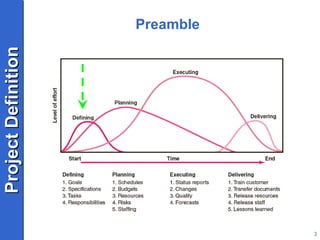
Preamble
Defining the Project One of the best ways to meet the needs of stakeholders is through an integrated, planning and control system; Essentially breaking down of final deliverable, into the work that need to be performed; Further outlining the boundaries of what must be delivered and done and who is responsible.
Defining the Project
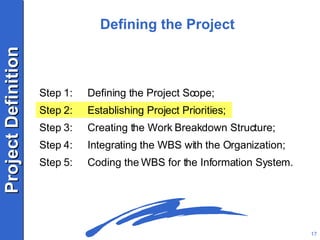
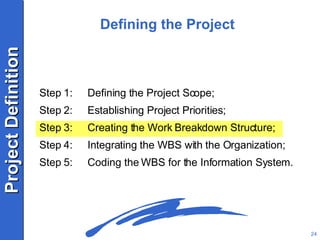
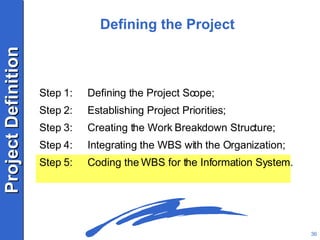
Defining the Project Step 1: Defining the Project Scope; Step 2: Establishing Project Priorities; Step 3: Creating the Work Breakdown Structure; Step 4: Integrating the WBS with the Organization; Step 5: Coding the WBS for the Information System.
Step 1: Defining the Project Scope Project Scope: A definition of the end result or mission of the project —a product or service for the client/customer—in specific, tangible, and measurable terms; Purpose of the Scope Statement: To clearly define the deliverable's for the end user; To focus the project on successful completion of its goals; To be used by the project owner and participants as a planning tool and for measuring project success; Draws boundaries for the project.
Project Scope Checklist Project objective End customer’s  needs drive  the objective; A project makes a  “promise” – value proposition; Deliverables Practically the final deliverable and the deliverable that directly link to this ; Milestones Major events ; Technical requirements Key technical requirements; Limits and exclusions What is clearly inside and outside the scope of the project ; What are the  assumptions; What are the  constraints or limitations ; Reviews with customer Reporting and review of deliverables, budgets etc.
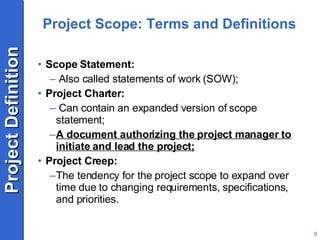
Project Scope: Terms and Definitions Scope Statement: Also called statements of work (SOW); Project Charter: Can contain an expanded version of scope statement; A document authorizing the project manager to initiate and lead the project; Project Creep: The tendency for the project scope to expand over time due to changing requirements, specifications, and priorities.
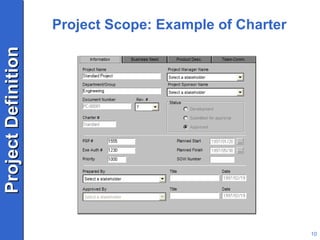
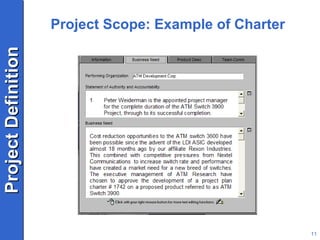
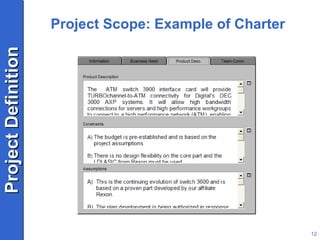
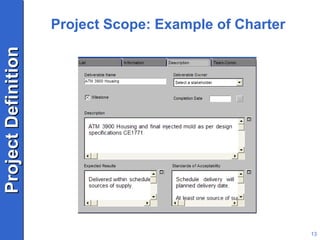
Project Scope: Example of Charter
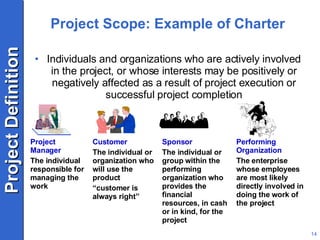
Project Scope: Example of Charter Individuals and organizations who are actively involved in the project, or whose interests may be positively or negatively affected as a result of project execution or successful project completion Project Manager The individual responsible for managing the work Customer The individual or organization who will use the product “ customer is always right” Performing Organization The enterprise whose employees are most likely directly involved in doing the work of the project Sponsor The individual or group within the performing organization who provides the financial resources, in cash or in kind, for the project
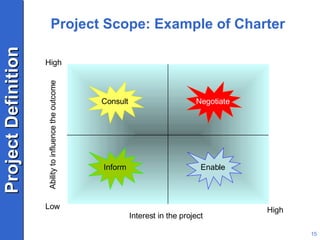
Project Scope: Example of Charter Interest in the project Ability to influence the outcome Low High High Inform Consult Negotiate Enable
Practical Exercise Write a project scope statement for the following project (see video clip)
Step 1: Defining the Project Scope; Step 2: Establishing Project Priorities; Step 3: Creating the Work Breakdown Structure; Step 4: Integrating the WBS with the Organization; Step 5: Coding the WBS for the Information System. Defining the Project
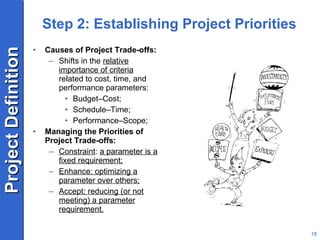
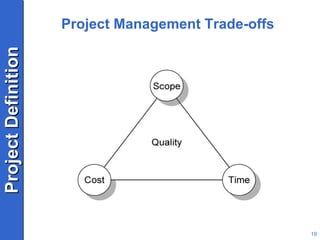
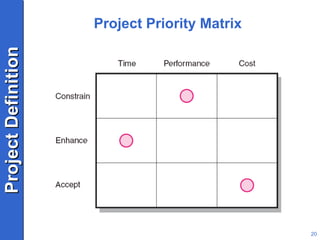
Step 2: Establishing Project Priorities Causes of Project Trade-offs: Shifts in the  relative importance of criteria  related to cost, time, and performance parameters: Budget –Cost; Schedule –Time; Performance –Scope; Managing the Priorities of Project Trade-offs: Constraint :  a parameter is a fixed requirement; Enhance: optimizing a parameter over others; Accept: reducing (or not meeting) a parameter requirement.
Project Management Trade-offs
Project Priority Matrix
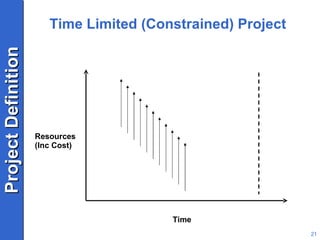
Time Limited (Constrained) Project Time Resources (Inc Cost)
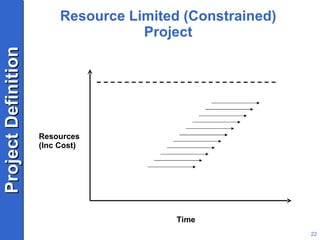
Resource Limited (Constrained) Project Resources (Inc Cost) Time
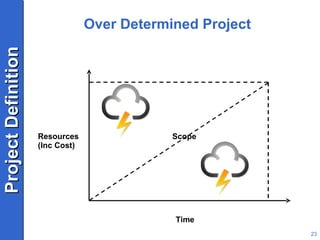
Over Determined Project Resources (Inc Cost) Time Scope
Step 1: Defining the Project Scope; Step 2: Establishing Project Priorities; Step 3: Creating the Work Breakdown Structure; Step 4: Integrating the WBS with the Organization; Step 5: Coding the WBS for the Information System. Defining the Project
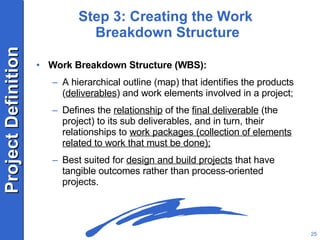
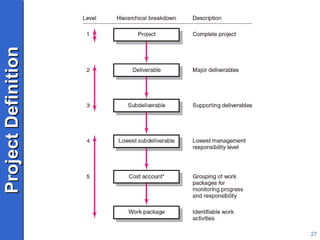
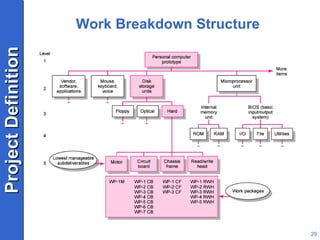
Step 3: Creating the Work  Breakdown Structure Work Breakdown Structure (WBS): A hierarchical outline (map) that identifies the products ( deliverables ) and work elements involved in a project; Defines the  relationship  of the  final deliverable  (the project) to its sub deliverables, and in turn, their relationships to  work packages (collection of elements related to work that must be done); Best suited for  design and build projects  that have tangible outcomes rather than process-oriented projects.
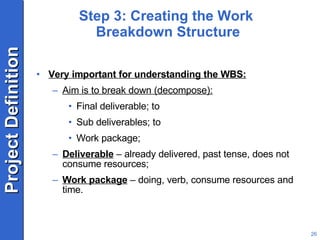
Step 3: Creating the Work  Breakdown Structure Very important for understanding the WBS: Aim is to break down (decompose): Final deliverable; to Sub deliverables; to Work package; Deliverable  – already delivered, past tense, does not consume resources; Work package  – doing, verb, consume resources and time.
 
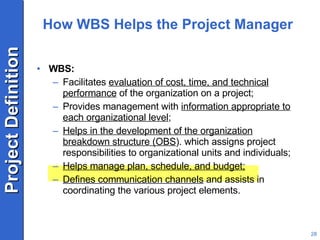
How WBS Helps the Project Manager WBS: Facilitates  evaluation of cost, time, and technical performance  of the organization on a project; Provides management with  information appropriate to each organizational level ; Helps in the development of the organization breakdown structure (OBS ). which assigns project responsibilities to organizational units and individuals; Helps manage plan, schedule, and budget; Defines communication channels  and assists in coordinating the various project elements.
Work Breakdown Structure
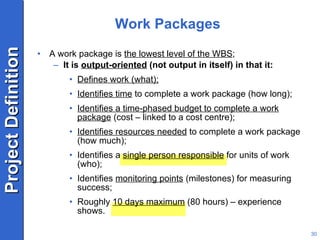
Work Packages A work package is  the lowest level of the WBS ; It is  output-oriented  (not output in itself) in that it: Defines work (what); Identifies time  to complete a work package (how long); Identifies a time-phased budget to complete a work package  (cost – linked to a cost centre); Identifies resources needed  to complete a work package (how much); Identifies a  single person responsible  for units of work (who); Identifies  monitoring points  (milestones) for measuring success; Roughly  10 days maximum  (80 hours) – experience shows.
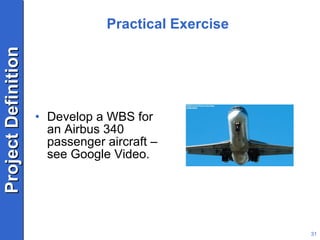
Practical Exercise Develop a WBS for an Airbus 340 passenger aircraft – see Google Video.
Step 1: Defining the Project Scope; Step 2: Establishing Project Priorities; Step 3: Creating the Work Breakdown Structure; Step 4: Integrating the WBS with the Organization; Step 5: Coding the WBS for the Information System. Defining the Project
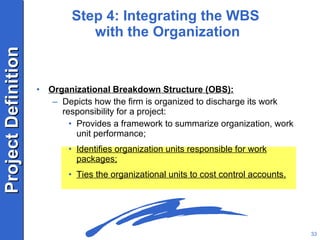
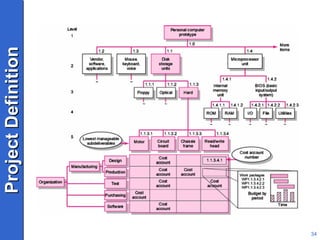
Step 4: Integrating the WBS  with the Organization Organizational Breakdown Structure (OBS): Depicts how the firm is organized to discharge its work responsibility for a project: Provides a framework to summarize organization, work unit performance; Identifies organization units responsible for work packages; Ties the organizational units to cost control accounts.
 
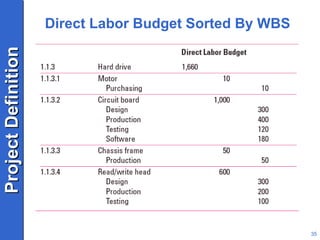
Direct Labor Budget Sorted By WBS
Step 1: Defining the Project Scope; Step 2: Establishing Project Priorities; Step 3: Creating the Work Breakdown Structure; Step 4: Integrating the WBS with the Organization; Step 5: Coding the WBS for the Information System. Defining the Project
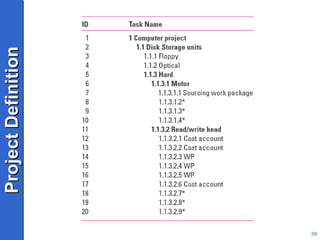
Step 5: Coding the WBS  for the Information System WBS Coding System Defines: Levels and elements of the WBS; Organization elements; Work packages; Budget and cost information; Allows reports to be consolidated at any level in the organization structure
Practical Demonstration
 
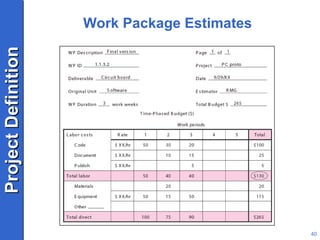
Work Package Estimates
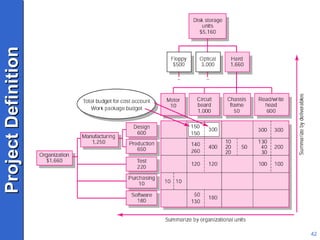
Project Roll-up Cost Account: The intersection of the WBS and the OBS that is a budgetary control point for work packages; Used to provide a  roll-up (summation) of costs  incurred over time by a work package across organization units and levels, and by deliverables.
 
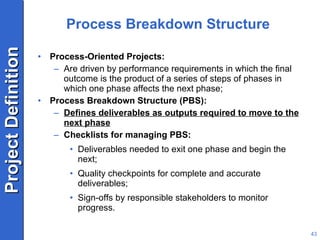
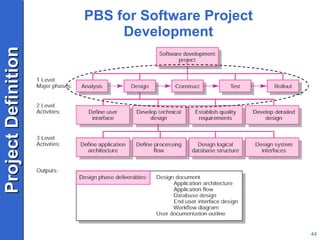
Process Breakdown Structure Process-Oriented Projects: Are driven by performance requirements in which the final outcome is the product of a series of steps of phases in which one phase affects the next phase; Process Breakdown Structure (PBS): Defines deliverables as outputs required to move to the next phase Checklists for managing PBS: Deliverables needed to exit one phase and begin the next; Quality checkpoints for complete and accurate deliverables; Sign-offs by responsible stakeholders to monitor progress.
PBS for Software Project Development
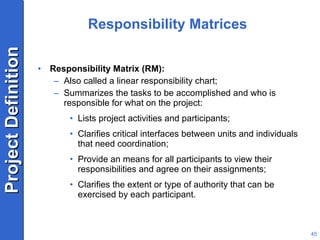
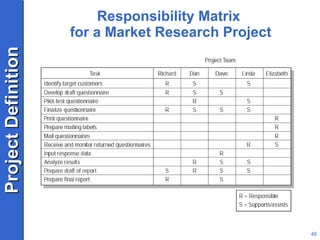
Responsibility Matrices Responsibility Matrix (RM): Also called a linear responsibility chart; Summarizes the tasks to be accomplished and who is responsible for what on the project: Lists project activities and participants; Clarifies critical interfaces between units and individuals that need coordination; Provide an means for all participants to view their responsibilities and agree on their assignments; Clarifies the extent or type of authority that can be exercised by each participant.
Responsibility Matrix  for a Market Research Project
 

PM Session 4

  • 1.
    Project Management Session4 Project Definition
  • 2.
    Session Outcomes Followingcompletion of the session the delegate should: Understand the rationale and format of the SOW, WBS and OBS; Understand how the above relate to resource allocation. In addition the delegate should be able to develop a basic SOW and WBS, using an appropriate case study.
  • 3.
  • 4.
    Defining the ProjectOne of the best ways to meet the needs of stakeholders is through an integrated, planning and control system; Essentially breaking down of final deliverable, into the work that need to be performed; Further outlining the boundaries of what must be delivered and done and who is responsible.
  • 5.
  • 6.
    Defining the ProjectStep 1: Defining the Project Scope; Step 2: Establishing Project Priorities; Step 3: Creating the Work Breakdown Structure; Step 4: Integrating the WBS with the Organization; Step 5: Coding the WBS for the Information System.
  • 7.
    Step 1: Definingthe Project Scope Project Scope: A definition of the end result or mission of the project —a product or service for the client/customer—in specific, tangible, and measurable terms; Purpose of the Scope Statement: To clearly define the deliverable's for the end user; To focus the project on successful completion of its goals; To be used by the project owner and participants as a planning tool and for measuring project success; Draws boundaries for the project.
  • 8.
    Project Scope ChecklistProject objective End customer’s needs drive the objective; A project makes a “promise” – value proposition; Deliverables Practically the final deliverable and the deliverable that directly link to this ; Milestones Major events ; Technical requirements Key technical requirements; Limits and exclusions What is clearly inside and outside the scope of the project ; What are the assumptions; What are the constraints or limitations ; Reviews with customer Reporting and review of deliverables, budgets etc.
  • 9.
    Project Scope: Termsand Definitions Scope Statement: Also called statements of work (SOW); Project Charter: Can contain an expanded version of scope statement; A document authorizing the project manager to initiate and lead the project; Project Creep: The tendency for the project scope to expand over time due to changing requirements, specifications, and priorities.
  • 10.
  • 11.
  • 12.
  • 13.
  • 14.
    Project Scope: Exampleof Charter Individuals and organizations who are actively involved in the project, or whose interests may be positively or negatively affected as a result of project execution or successful project completion Project Manager The individual responsible for managing the work Customer The individual or organization who will use the product “ customer is always right” Performing Organization The enterprise whose employees are most likely directly involved in doing the work of the project Sponsor The individual or group within the performing organization who provides the financial resources, in cash or in kind, for the project
  • 15.
    Project Scope: Exampleof Charter Interest in the project Ability to influence the outcome Low High High Inform Consult Negotiate Enable
  • 16.
    Practical Exercise Writea project scope statement for the following project (see video clip)
  • 17.
    Step 1: Definingthe Project Scope; Step 2: Establishing Project Priorities; Step 3: Creating the Work Breakdown Structure; Step 4: Integrating the WBS with the Organization; Step 5: Coding the WBS for the Information System. Defining the Project
  • 18.
    Step 2: EstablishingProject Priorities Causes of Project Trade-offs: Shifts in the relative importance of criteria related to cost, time, and performance parameters: Budget –Cost; Schedule –Time; Performance –Scope; Managing the Priorities of Project Trade-offs: Constraint : a parameter is a fixed requirement; Enhance: optimizing a parameter over others; Accept: reducing (or not meeting) a parameter requirement.
  • 19.
  • 20.
  • 21.
    Time Limited (Constrained)Project Time Resources (Inc Cost)
  • 22.
    Resource Limited (Constrained)Project Resources (Inc Cost) Time
  • 23.
    Over Determined ProjectResources (Inc Cost) Time Scope
  • 24.
    Step 1: Definingthe Project Scope; Step 2: Establishing Project Priorities; Step 3: Creating the Work Breakdown Structure; Step 4: Integrating the WBS with the Organization; Step 5: Coding the WBS for the Information System. Defining the Project
  • 25.
    Step 3: Creatingthe Work Breakdown Structure Work Breakdown Structure (WBS): A hierarchical outline (map) that identifies the products ( deliverables ) and work elements involved in a project; Defines the relationship of the final deliverable (the project) to its sub deliverables, and in turn, their relationships to work packages (collection of elements related to work that must be done); Best suited for design and build projects that have tangible outcomes rather than process-oriented projects.
  • 26.
    Step 3: Creatingthe Work Breakdown Structure Very important for understanding the WBS: Aim is to break down (decompose): Final deliverable; to Sub deliverables; to Work package; Deliverable – already delivered, past tense, does not consume resources; Work package – doing, verb, consume resources and time.
  • 27.
  • 28.
    How WBS Helpsthe Project Manager WBS: Facilitates evaluation of cost, time, and technical performance of the organization on a project; Provides management with information appropriate to each organizational level ; Helps in the development of the organization breakdown structure (OBS ). which assigns project responsibilities to organizational units and individuals; Helps manage plan, schedule, and budget; Defines communication channels and assists in coordinating the various project elements.
  • 29.
  • 30.
    Work Packages Awork package is the lowest level of the WBS ; It is output-oriented (not output in itself) in that it: Defines work (what); Identifies time to complete a work package (how long); Identifies a time-phased budget to complete a work package (cost – linked to a cost centre); Identifies resources needed to complete a work package (how much); Identifies a single person responsible for units of work (who); Identifies monitoring points (milestones) for measuring success; Roughly 10 days maximum (80 hours) – experience shows.
  • 31.
    Practical Exercise Developa WBS for an Airbus 340 passenger aircraft – see Google Video.
  • 32.
    Step 1: Definingthe Project Scope; Step 2: Establishing Project Priorities; Step 3: Creating the Work Breakdown Structure; Step 4: Integrating the WBS with the Organization; Step 5: Coding the WBS for the Information System. Defining the Project
  • 33.
    Step 4: Integratingthe WBS with the Organization Organizational Breakdown Structure (OBS): Depicts how the firm is organized to discharge its work responsibility for a project: Provides a framework to summarize organization, work unit performance; Identifies organization units responsible for work packages; Ties the organizational units to cost control accounts.
  • 34.
  • 35.
    Direct Labor BudgetSorted By WBS
  • 36.
    Step 1: Definingthe Project Scope; Step 2: Establishing Project Priorities; Step 3: Creating the Work Breakdown Structure; Step 4: Integrating the WBS with the Organization; Step 5: Coding the WBS for the Information System. Defining the Project
  • 37.
    Step 5: Codingthe WBS for the Information System WBS Coding System Defines: Levels and elements of the WBS; Organization elements; Work packages; Budget and cost information; Allows reports to be consolidated at any level in the organization structure
  • 38.
  • 39.
  • 40.
  • 41.
    Project Roll-up CostAccount: The intersection of the WBS and the OBS that is a budgetary control point for work packages; Used to provide a roll-up (summation) of costs incurred over time by a work package across organization units and levels, and by deliverables.
  • 42.
  • 43.
    Process Breakdown StructureProcess-Oriented Projects: Are driven by performance requirements in which the final outcome is the product of a series of steps of phases in which one phase affects the next phase; Process Breakdown Structure (PBS): Defines deliverables as outputs required to move to the next phase Checklists for managing PBS: Deliverables needed to exit one phase and begin the next; Quality checkpoints for complete and accurate deliverables; Sign-offs by responsible stakeholders to monitor progress.
  • 44.
    PBS for SoftwareProject Development
  • 45.
    Responsibility Matrices ResponsibilityMatrix (RM): Also called a linear responsibility chart; Summarizes the tasks to be accomplished and who is responsible for what on the project: Lists project activities and participants; Clarifies critical interfaces between units and individuals that need coordination; Provide an means for all participants to view their responsibilities and agree on their assignments; Clarifies the extent or type of authority that can be exercised by each participant.
  • 46.
    Responsibility Matrix for a Market Research Project
  • 47.