Dynamic Memory Allocation and
Linked Lists
Topics
 Dynamic memory allocation

Dynamic Memory Allocation
 The process of allocating memory at run
time is known as dynamic memory
allocation.
 There are some functions for dynamic
memory allocation. These are malloc, calloc,
free and realloc.
Allocating a Block of Memory
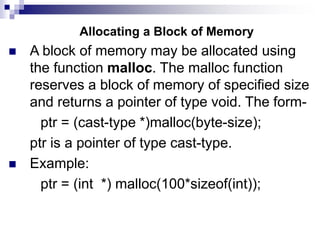
 A block of memory may be allocated using
the function malloc. The malloc function
reserves a block of memory of specified size
and returns a pointer of type void. The form-
ptr = (cast-type *)malloc(byte-size);
ptr is a pointer of type cast-type.
 Example:
ptr = (int *) malloc(100*sizeof(int));
Allocating Multiple blocks of Memory
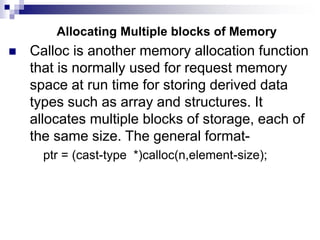
 Calloc is another memory allocation function
that is normally used for request memory
space at run time for storing derived data
types such as array and structures. It
allocates multiple blocks of storage, each of
the same size. The general format-
ptr = (cast-type *)calloc(n,element-size);
Releasing the used space & Altering the size
 free function can be used to release the
used space. The format is-
free(ptr);
 We can change the memory size already
allocated with the help of the function
realloc.
ptr = realloc(ptr, newsize);
Concepts of Linked List
 A linked list is one kind of list whose order is given
by links from one item to the next.
 Each structure of the list is called a node and
consists of two fields, one containing the item and
the other containing the address of the next item in
the list.
 A linked list is therefore a collection of structures
ordered not by their physical placement in memory
but by logical links that are stored as part of the
data in the structure itself. The link is in the form of
a pointer to another structure of the same type.
Continue…
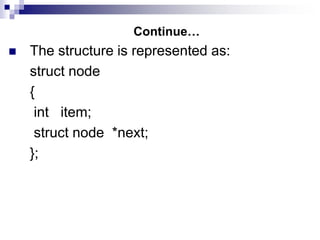
 The structure is represented as:
struct node
{
int item;
struct node *next;
};
Advantage of Linked List
 Advantages:
1. Linked list can grow or shrink in size
during the execution of a program.
2. It does not waste memory space.
3. It provides flexibility in allowing the items
to be rearranged efficiently.
 Limitation:
1. The access of any arbitrary item is little
cumbersome and time consuming.
2. It will use more storage than an array with
the same number of items as it has link field.

Chap 13(dynamic memory allocation)

  • 1.
    Dynamic Memory Allocationand Linked Lists Topics  Dynamic memory allocation 
  • 2.
    Dynamic Memory Allocation The process of allocating memory at run time is known as dynamic memory allocation.  There are some functions for dynamic memory allocation. These are malloc, calloc, free and realloc.
  • 3.
    Allocating a Blockof Memory  A block of memory may be allocated using the function malloc. The malloc function reserves a block of memory of specified size and returns a pointer of type void. The form- ptr = (cast-type *)malloc(byte-size); ptr is a pointer of type cast-type.  Example: ptr = (int *) malloc(100*sizeof(int));
  • 4.
    Allocating Multiple blocksof Memory  Calloc is another memory allocation function that is normally used for request memory space at run time for storing derived data types such as array and structures. It allocates multiple blocks of storage, each of the same size. The general format- ptr = (cast-type *)calloc(n,element-size);
  • 5.
    Releasing the usedspace & Altering the size  free function can be used to release the used space. The format is- free(ptr);  We can change the memory size already allocated with the help of the function realloc. ptr = realloc(ptr, newsize);
  • 6.
    Concepts of LinkedList  A linked list is one kind of list whose order is given by links from one item to the next.  Each structure of the list is called a node and consists of two fields, one containing the item and the other containing the address of the next item in the list.  A linked list is therefore a collection of structures ordered not by their physical placement in memory but by logical links that are stored as part of the data in the structure itself. The link is in the form of a pointer to another structure of the same type.
  • 7.
    Continue…  The structureis represented as: struct node { int item; struct node *next; };
  • 8.
    Advantage of LinkedList  Advantages: 1. Linked list can grow or shrink in size during the execution of a program. 2. It does not waste memory space. 3. It provides flexibility in allowing the items to be rearranged efficiently.  Limitation: 1. The access of any arbitrary item is little cumbersome and time consuming. 2. It will use more storage than an array with the same number of items as it has link field.