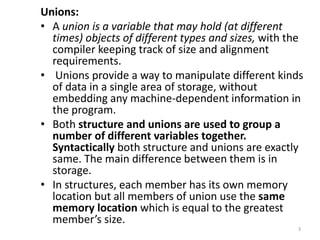
Unions allow a variable to hold objects of different types in the same memory location. All members of a union share the same memory location, which is the size of the largest member. This means unions save memory by storing all members in one block, but the programmer must ensure the correct member is being accessed based on the data currently stored. The example program defines a union called Student containing different data types, reads values into members, and displays the members to demonstrate unions share the same memory location.
![• A union is declared using the keyword union as:
union student
{
char name[20];
int roll_no;
float marks;
char section;
};
union student s;
• While accessing union members, we should make sure that
we are accessing the member whose value is currently
residing in the memory. Otherwise we will get erroneous
output (which is machine dependent).
2](https://image.slidesharecdn.com/union-150319182449-conversion-gate01/85/Union-in-C-programming-2-320.jpg)
![Example: program illustrates the structure in which read member elements of union and display
them.
#include<stdio.h>
union Student
{
char name[20];
int roll;
char sec;
F loat marks;
};
union Student s1;
void main()
{
printf(“Enter the name of a student”);
gets(s1.name);
printf(“Enter the roll number of a student”);
scanf(“%d”,&s1.roll);
printf(“Enter the section of a student”);
scanf(“%c”,&s1.sec);
printf(“Enter the marks obtained by the student”);
scanf(“%f”,&s1.marks);
/displaying the records
printf(“Name=%sn Roll number =%dn Section=%cn Obtained marks=%f”,s1.name,
s1.roll, s1.sec, s1.marks);
}
4](https://image.slidesharecdn.com/union-150319182449-conversion-gate01/85/Union-in-C-programming-4-320.jpg)
![Example:
union student
{
char name[20];
int roll_no;
float marks;
char section;
};
void main()
{
union student s;
clrscr();
printf("Size of union=%dn", sizeof(s));
strcpy(s.name, “cnr");
printf("Name=%st", s.name);
printf("Location=%u", s.name);
s.roll_no=10;
printf("nRoll=%d tLocation=%u", s.roll_no, &s.roll_no);
s.marks=91.5;
printf("nMarks=%.2f tLocation=%u", s.marks, &s.marks);
s.section='A';
printf("nSection=%c tLocation=%u", s.section, &s.section);
printf("nnErroneous output");
printf("nnNametRolltMarkstSectionn");
printf("%st%dt%.2ft%c", s.name, s.roll_no, s.marks, s.section);
getch();
}
5](https://image.slidesharecdn.com/union-150319182449-conversion-gate01/85/Union-in-C-programming-5-320.jpg)


