Data Structure &
Algorithm
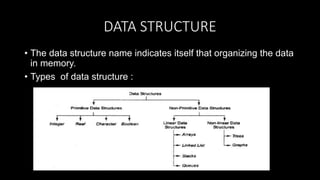
DATA STRUCTURE
• The data structure name indicates itself that organizing the data
in memory.
• Types of data structure :
Classification & Advantages of DS
Classification of DS:-
• Static data structure: It is a type of data structure where the size is allocated at the
compile time. Therefore, the maximum size is fixed. Example, Array.
• Dynamic data structure: It is a type of data structure where the size is allocated at the
run time. Therefore, the maximum size is flexible. Example, Linked Lists, Stacks,
and Queues.
Advantages of DS:-
• Efficiency: If the choice of a data structure for implementing a particular ADT is proper, it
makes the program very efficient in terms of time and space.
• Reusability: It provides reusability means that multiple client programs can use the data
structure.
• Abstraction: It is specified by an ADT also provides the level of abstraction. The client
cannot see the internal working of the data structure, so it does not have to worry about
the implementation part. The client can only see the interface.
Major Operations
• Searching: Search for any element in a data structure.
• Sorting: Sort the elements i.e.,in an ascending or descending order.
• Insertion: Insert the new element in a data structure.
• Updation: Update the element, i.e.,replace the element with
another element.
• Deletion: Delete operation to remove the element .
ARRAY
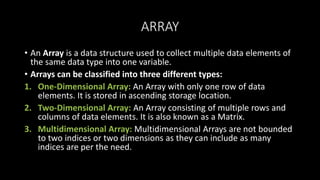
• An Array is a data structure used to collect multiple data elements of
the same data type into one variable.
• Arrays can be classified into three different types:
1. One-Dimensional Array: An Array with only one row of data
elements. It is stored in ascending storage location.
2. Two-Dimensional Array: An Array consisting of multiple rows and
columns of data elements. It is also known as a Matrix.
3. Multidimensional Array: Multidimensional Arrays are not bounded
to two indices or two dimensions as they can include as many
indices are per the need.
Applications of Array
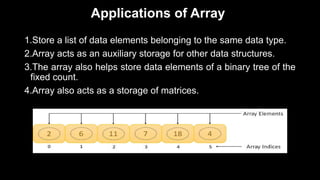
1.Store a list of data elements belonging to the same data type.
2.Array acts as an auxiliary storage for other data structures.
3.The array also helps store data elements of a binary tree of the
fixed count.
4.Array also acts as a storage of matrices.
Linked Lists
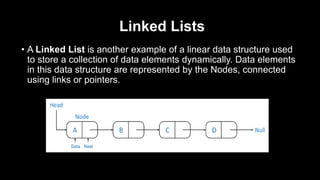
• A Linked List is another example of a linear data structure used
to store a collection of data elements dynamically. Data elements
in this data structure are represented by the Nodes, connected
using links or pointers.
Classification of Linked-list
1.Singly Linked List: A Singly Linked List is the most common type of
Linked List. Each node has data and a pointer field containing an
address to the next node.
2.Doubly Linked List: A Doubly Linked List consists of an information
field and two pointer fields. The information field contains the data.
The first pointer field contains an address of the previous node,
whereas another pointer field contains a reference to the next node.
Thus, we can go in both directions (backward as well as forward).
3.Circular Linked List: The Circular Linked List is similar to the Singly
Linked List. The only key difference is that the last node contains the
address of the first node, forming a circular loop in the Circular
Linked List.
Applications of Linked-list
1.It help us implement stacks, queues, binary trees, and graphs of predefined size.
2.We can also implement Operating System's function for dynamic memory management.
3.It also allow polynomial implementation for mathematical operations.
4.Circular Linked List to implement Operating Systems or application functions that Round
Robin execution of tasks.
5.Circular Linked List is also helpful in a Slide Show where a user requires to go back to the
first slide after the last slide is presented.
6.Doubly Linked List is utilized to implement forward and backward buttons in a browser to
move forward and backward in the opened pages of a website.
Stacks
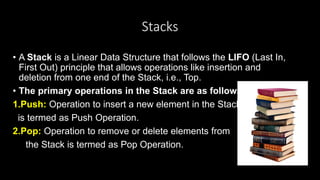
• A Stack is a Linear Data Structure that follows the LIFO (Last In,
First Out) principle that allows operations like insertion and
deletion from one end of the Stack, i.e., Top.
• The primary operations in the Stack are as follows:
1.Push: Operation to insert a new element in the Stack
is termed as Push Operation.
2.Pop: Operation to remove or delete elements from
the Stack is termed as Pop Operation.
Applications of Stacks
1.The Stack is used as a Temporary Storage Structure for recursive operations.
2.Stack is also utilized as Auxiliary Storage Structure for function calls, nested operations, and
deferred/postponed functions.
3.We can manage function calls using Stacks.
4.Stacks are also utilized to evaluate the arithmetic expressions in different programming
languages.
5.Stacks are also helpful in converting infix expressions to postfix expressions.
6.Stacks allow us to check the expression's syntax in the programming environment.
7.We can match parenthesis using Stacks.
8.Stacks can be used to reverse a String.
Queue
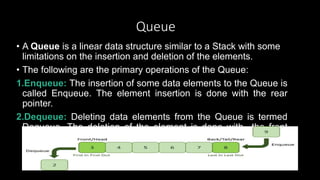
• A Queue is a linear data structure similar to a Stack with some
limitations on the insertion and deletion of the elements.
• The following are the primary operations of the Queue:
1.Enqueue: The insertion of some data elements to the Queue is
called Enqueue. The element insertion is done with the rear
pointer.
2.Dequeue: Deleting data elements from the Queue is termed
Dequeue. The deletion of the element is done with the front
pointer.
Applications of Queues
1.Queues are generally used in the breadth search operation in Graphs.
2.Queues are also used in Job Scheduler Operations of Operating Systems,
like a keyboard buffer queue to store the keys pressed by users and a print
buffer queue to store the documents printed by the printer.
3.Queues are responsible for CPU scheduling, Job scheduling, and Disk
Scheduling.
4.Priority Queues are utilized in file-downloading operations in a browser.
5.Queues are also used to transfer data between peripheral devices and the
CPU.
Thank You

Data Structure & Algorithm.pptx

  • 1.
  • 2.
    DATA STRUCTURE • Thedata structure name indicates itself that organizing the data in memory. • Types of data structure :
  • 3.
    Classification & Advantagesof DS Classification of DS:- • Static data structure: It is a type of data structure where the size is allocated at the compile time. Therefore, the maximum size is fixed. Example, Array. • Dynamic data structure: It is a type of data structure where the size is allocated at the run time. Therefore, the maximum size is flexible. Example, Linked Lists, Stacks, and Queues. Advantages of DS:- • Efficiency: If the choice of a data structure for implementing a particular ADT is proper, it makes the program very efficient in terms of time and space. • Reusability: It provides reusability means that multiple client programs can use the data structure. • Abstraction: It is specified by an ADT also provides the level of abstraction. The client cannot see the internal working of the data structure, so it does not have to worry about the implementation part. The client can only see the interface.
  • 4.
    Major Operations • Searching:Search for any element in a data structure. • Sorting: Sort the elements i.e.,in an ascending or descending order. • Insertion: Insert the new element in a data structure. • Updation: Update the element, i.e.,replace the element with another element. • Deletion: Delete operation to remove the element .
  • 5.
    ARRAY • An Arrayis a data structure used to collect multiple data elements of the same data type into one variable. • Arrays can be classified into three different types: 1. One-Dimensional Array: An Array with only one row of data elements. It is stored in ascending storage location. 2. Two-Dimensional Array: An Array consisting of multiple rows and columns of data elements. It is also known as a Matrix. 3. Multidimensional Array: Multidimensional Arrays are not bounded to two indices or two dimensions as they can include as many indices are per the need.
  • 6.
    Applications of Array 1.Storea list of data elements belonging to the same data type. 2.Array acts as an auxiliary storage for other data structures. 3.The array also helps store data elements of a binary tree of the fixed count. 4.Array also acts as a storage of matrices.
  • 7.
    Linked Lists • ALinked List is another example of a linear data structure used to store a collection of data elements dynamically. Data elements in this data structure are represented by the Nodes, connected using links or pointers.
  • 8.
    Classification of Linked-list 1.SinglyLinked List: A Singly Linked List is the most common type of Linked List. Each node has data and a pointer field containing an address to the next node. 2.Doubly Linked List: A Doubly Linked List consists of an information field and two pointer fields. The information field contains the data. The first pointer field contains an address of the previous node, whereas another pointer field contains a reference to the next node. Thus, we can go in both directions (backward as well as forward). 3.Circular Linked List: The Circular Linked List is similar to the Singly Linked List. The only key difference is that the last node contains the address of the first node, forming a circular loop in the Circular Linked List.
  • 9.
    Applications of Linked-list 1.Ithelp us implement stacks, queues, binary trees, and graphs of predefined size. 2.We can also implement Operating System's function for dynamic memory management. 3.It also allow polynomial implementation for mathematical operations. 4.Circular Linked List to implement Operating Systems or application functions that Round Robin execution of tasks. 5.Circular Linked List is also helpful in a Slide Show where a user requires to go back to the first slide after the last slide is presented. 6.Doubly Linked List is utilized to implement forward and backward buttons in a browser to move forward and backward in the opened pages of a website.
  • 10.
    Stacks • A Stackis a Linear Data Structure that follows the LIFO (Last In, First Out) principle that allows operations like insertion and deletion from one end of the Stack, i.e., Top. • The primary operations in the Stack are as follows: 1.Push: Operation to insert a new element in the Stack is termed as Push Operation. 2.Pop: Operation to remove or delete elements from the Stack is termed as Pop Operation.
  • 11.
    Applications of Stacks 1.TheStack is used as a Temporary Storage Structure for recursive operations. 2.Stack is also utilized as Auxiliary Storage Structure for function calls, nested operations, and deferred/postponed functions. 3.We can manage function calls using Stacks. 4.Stacks are also utilized to evaluate the arithmetic expressions in different programming languages. 5.Stacks are also helpful in converting infix expressions to postfix expressions. 6.Stacks allow us to check the expression's syntax in the programming environment. 7.We can match parenthesis using Stacks. 8.Stacks can be used to reverse a String.
  • 12.
    Queue • A Queueis a linear data structure similar to a Stack with some limitations on the insertion and deletion of the elements. • The following are the primary operations of the Queue: 1.Enqueue: The insertion of some data elements to the Queue is called Enqueue. The element insertion is done with the rear pointer. 2.Dequeue: Deleting data elements from the Queue is termed Dequeue. The deletion of the element is done with the front pointer.
  • 13.
    Applications of Queues 1.Queuesare generally used in the breadth search operation in Graphs. 2.Queues are also used in Job Scheduler Operations of Operating Systems, like a keyboard buffer queue to store the keys pressed by users and a print buffer queue to store the documents printed by the printer. 3.Queues are responsible for CPU scheduling, Job scheduling, and Disk Scheduling. 4.Priority Queues are utilized in file-downloading operations in a browser. 5.Queues are also used to transfer data between peripheral devices and the CPU.
  • 14.